𝗙𝗨𝗟𝗟 𝗦𝗧𝗢𝗥𝗬 The HOA President Came to Take My First Home, Certain Her Paperwork Had Already Won
𝗣𝗔𝗥𝗧 𝟮
The management company sent an automatic acknowledgement.
That was it.
Then three more envelopes arrived in the same week.
Again:
No postmarks.
No stamps.
One hundred dollars for grass above permitted height.
Photograph showed a yard I didn’t recognize.
My grass had been cut the previous Saturday.
One hundred fifty dollars for a vehicle “parked continuously beyond permitted period.”
My truck.
In my driveway.
Seventy-five dollars for an unapproved exterior planter.
The planter was a clay pot containing a fern my sister had given me as a housewarming gift.
I stood on the porch holding that letter.
Looked at the fern.
Then back at the letter.
The money irritated me.
The process worried me.
Because I had read the rules.
Before a monetary fine, the association was supposed to send a written courtesy warning.
The warning had to identify the condition.
Give a period to correct it.
Explain the dispute procedure.
I had received none.
Every document began with money.
The first step had disappeared.
In maintenance, missing steps matter.
If a technician’s report says a pump was inspected, diagnosed, repaired, tested, and returned to service, there should be evidence of each stage.
If the diagnosis isn’t there, I start asking questions.
If the part number doesn’t match the repair date, I ask more.
Processes leave traces.
When the trace is missing, the explanation usually gets interesting.
I started a folder.
Every envelope.
Every photograph.
Every email.
Every automated response.
Dates.
Times.
Notes.
I kept a running log.
April 8 — first violation found under door.
April 8 — email sent.
April 19 — follow-up sent.
April 22 — automated acknowledgement.
May 3 — three additional penalties received.
Boring.
Slow.
Exactly the way good records should be.
The next HOA meeting was held in a church community room about two miles away.
Maybe thirty residents attended.
When open comments began, I stood.
“Calvin Reese. 241 Willard Avenue.”
Blythe looked toward me.
“I’ve received four monetary penalties in six weeks.”
Several people shifted.
“I received no courtesy warnings before any of them. I’d like an itemized account statement and copies of the original violation reports.”
Blythe didn’t answer.
Instead, she looked around the room.
Like a teacher deciding how patient to be with a slow student.
“Calvin, the rules really are not complicated.”
I waited.
“Most homeowners here manage to follow them without individual instruction.”
A few people gave uncomfortable little laughs.
The kind people make when they hope humor will prevent conflict.
“I understand.”
I kept my voice level.
“I’d still like the itemized statement.”
She slid a stapled packet across the table.
When I walked forward to take it, she added:
“If a few hundred dollars is already that much of a hardship, perhaps you should ask yourself whether Stonebridge Hollow is really the right fit.”
My face got hot.
Not warm.
Hot.
I can still remember it.
The room.
The fluorescent light.
The cheap folding table.
Her hand resting on the packet.
I counted silently.
One.
Two.
Three.
Four.
Then said:
“Thank you for the statement.”
I sat down.
The next agenda item concerned spending six hundred dollars on replacement signage near the retention pond.
That night, I understood what I’d been resisting.
The trash bin wasn’t the issue.
The fern wasn’t the issue.
The grass wasn’t the issue.
Blythe had looked at a Black man wearing a maintenance uniform beside an old pickup truck and built a story about what kind of homeowner I must be.
Temporary.
Barely qualified.
Financially fragile.
Someone who had stretched too far buying into a neighborhood she believed existed above his natural place.
The fines weren’t corrections.
They were pressure.
A message.
You don’t belong.
The itemized statement made the situation worse.
My four fines were there.
Then three administrative charges I had never seen.
Then a balance carried forward from a month before I owned the property.
That should have been impossible.
I wrote it down.
Two months later, my alleged balance exceeded thirty-eight hundred dollars.
I thought there had to be a mathematical error.
There wasn’t.
The system was worse.
Each original fine had been reclassified as a continuing violation.
Every fifteen days, another charge.
Then late fees.
Interest.
Collection processing.
Compliance administration.
Legal review charges.
Four alleged violations became forty-one ledger entries.
Most no longer had any direct connection to a trash can, lawn, truck, or planter.
They were fees attached to fees.
I built a spreadsheet.
That part was easy.
At the hotel, I tracked preventive maintenance across more than two hundred rooms.
If you can manage fan-coil filters, water temperatures, work-order aging, inspection dates, and equipment downtime, an HOA ledger isn’t difficult.
It only requires patience.
Column A:
Entry date.
Column B:
Amount.
Column C:
Claimed violation date.
Column D:
Source document.
Column E:
Notice received?
Column F:
Supporting record?
By the third evening, patterns appeared.
Two “legal review” charges had been posted before the date the association claimed my file was referred to counsel.
I stared at those entries.
You cannot bill someone for legal review before the file has supposedly been sent for legal review.
At the hotel, that’s the equivalent of closing a repair ticket before the replacement part arrives.
When I find that kind of inconsistency, I stop trusting everything around it.
I called Wesley Boone.
Association treasurer.
Sixty-one.
Retired freight dispatcher.
He had lived in Stonebridge Hollow since half the area was still open land.
His phone number was in the community directory.
He listened.
Did not interrupt.
When I finished, silence.
Long enough that I checked my screen.
“Wesley?”
“I’m here.”
Then carefully:
“Request the original ledger export.”
“Not the statement?”
“No.”
“What’s the difference?”
“The statement is what they print for owners.”
His voice lowered.
“You want the underlying system export. Entry dates. User IDs. Modification history.”
I sat straighter.
“You think there’s something wrong with it?”
Another pause.
“I requested the same export in February.”
“And?”
“I haven’t received it.”
The next morning, Wesley emailed me.
Two lines.
He said he could not discuss association financial matters with individual owners and that all requests should go through the president.
It read like a hostage note written in business language.
I didn’t blame him.
I saved it.
Printed it.
Added it to the folder.
Then I sent a formal records request.
To the board.
Management company.
Certified mail.
I requested:
Original ledger export.
Previous twelve months of meeting minutes.
Proof of mailing for every violation notice.
I remember thinking it was ironic that my request for evidence they had contacted me had more proof of mailing than anything they had ever sent me.
At the next HOA meeting, Blythe opened with what she called a “financial responsibility update.”
She told the room that one homeowner had accumulated significant violations.
Was refusing to satisfy his obligations.
Was creating financial burden for dues-paying families.
No name.
Didn’t need one.
She looked directly at me while speaking.
I sat with both hands on my folder.
Didn’t move.
After the meeting, she followed me into the parking lot.
I was unlocking my truck when she stopped beside me.
“Calvin.”
I turned.
“You fix air conditioners for a living.”
There was no anger in her voice.
That almost made it worse.
“I have handled property and community governance for nearly twenty years.”
I waited.
“Don’t turn a simple matter into something you don’t understand.”
Twenty-two years of work rose behind my teeth.
Boilers.
Electrical failures.
Flooded ceilings.
Emergency shutdowns.
Vendor disputes.
Fire alarm inspections.
Union contractors.
City inspectors.
Budgets large enough to make an HOA ledger look like lunch money.
I said none of it.
“Then send me the file.”
She smiled.
“You’ll receive what you’re entitled to receive.”
Then walked away.
Two weeks later, a letter arrived.
This one had a postmark.
My balance:
More than $9,400.
Third-party collections.
Board evaluating “further remedies with respect to the property.”
That phrase sat in my stomach.
Nine thousand four hundred dollars.
More than I had left after:
Down payment.
Closing costs.
Water heater replacement.
Minor repairs.
The insult had become danger.
Then in September I came home to bright yellow paper taped to my front door.
LIEN NOTICE.
The association had recorded a lien against 241 Willard Avenue.
Assessments.
Fines.
Interest.
Costs.
Enforcement stage.
I stood there holding my lunch cooler.
Read it three times.
Went inside.
Sat on the floor with my back against the entryway wall.
And I was scared.
I don’t mean worried.
I mean frightened in a way I hadn’t felt in decades.
Everything I had saved since my thirties was in that house.
Ten years of skipped purchases.
Double shifts.
Packed lunches.
Delayed vacations.
An eleven-year-old truck.
My mother’s voice came back to me.
She rented the same apartment for thirty-one years.
Once, when I told her I wanted to own a house someday, she said:
“Ownership is the only fence ordinary people can put between themselves and somebody else’s decisions.”
Now six months after I finally built that fence, Blythe Carmichael had put a piece of paper on my door telling me she could take it apart.
I didn’t sleep.
Around three in the morning, I made coffee.
Opened my laptop.
And did the only thing I know how to do when a system feels out of control.
I started reading.
County public records.
Parcel number.
There it was.
The lien was real.
Recorded.
Indexed.
Attached to my property.
Then I read the sworn compliance statement attached to it.
The association certified that:
Multiple written notices had been sent.
I had been given opportunities to cure.
I had been offered dispute rights.
Notices had been sent by certified mail.
I had been given written notice of an internal hearing.
I stopped.
Read it again.
None of those things had happened.
Not one certified letter.
Not one hearing notice.
Not one cure notice.
I spent the next two days checking.
Doorbell footage.
Email archives.
Saved envelopes.
I had nineteen emails from the association or management company.
None used the word hearing.
I had every envelope.
No certified tracking numbers.
No green return cards.
No proof of delivery.
The fear began changing shape.
A lien is not magic.
It’s a legal instrument built from assertions.
Assertions can be tested.
And for six months, because a seventy-five-dollar fine had irritated me enough to start a folder, I had accidentally been collecting the material needed to test them.
By the end of the week:
168 documents.
Scanned.
Named by date.
Tabbed.
I called Naomi Vance.
Civil attorney.
Thirty-nine.
Office in a converted brick storefront.
I brought the binder.
Naomi read for almost forty minutes without saying much.
Then she looked up.
“Don’t focus on the nine thousand four hundred dollars.”
I blinked.
“That’s difficult.”
“I know.”
She turned the ledger toward me.
“Everyone focuses on the amount.”
She tapped the page.
“Focus on how they say the amount was created.”
She explained.
Every dollar depended on steps.
Violation.
Notice.
Opportunity to cure.
Failure to cure.
Fine.
Notice of fine.
Late status.
Collection.
Each required step should leave evidence.
“If the evidence doesn’t exist, the number isn’t merely unfair.”
She leaned back.
“It may be unsupported.”
Then she gave me homework.
Build a daily timeline.
Every notice.
Every claimed event.
Every email.
Every board statement.
Every payment.
Every address.
It took nine evenings.
On the seventh, I found something.
Three letters the HOA listed as sent to me were dated during a period when their internal owner record still carried the previous owner’s mailing address.
A post-office box.
Two counties away.
That meant whatever they supposedly sent during that period had not been mailed to my current address because their own file didn’t contain it yet.
Then Blythe called.
Sunday evening.
First time she had ever called me directly.
Her voice was warm.
Sympathetic.
“Calvin, the board discussed your situation.”
I said nothing.
“We really want to resolve this before it becomes something nobody can walk back.”
She told me she had personally advocated for flexibility.
Said she understood first-time homeowners don’t always anticipate the costs of living in a managed community.
Then came the offer.
Pay $4,200 within ten business days.
Sign a settlement.
Acknowledge the full assessed balance as valid.
Waive all claims regarding the account.
The board would suspend enforcement and put the remainder on a payment plan.
If I hadn’t built that timeline, I might have cried from relief.
I sent the agreement to Naomi.
She called at 7:15 the next morning.
“Do not sign this.”
“What does it do?”
“Three things.”
She explained.
First:
I would certify that every charge had been validly imposed and properly noticed.
Exactly the missing admission the HOA needed.
Second:
I would release the association and officers from all claims arising from the account.
Even claims I didn’t know about yet.
Third:
The lien stayed.
Enforcement was only suspended at the board’s discretion.
Meaning after I signed away my objections, they could resume.
I emailed Blythe.
Three sentences.
Declined.
Requested full records.
Reserved all rights.
She called within an hour.
No warm voice now.
“You’re being offered a chance to keep your first home.”
I gripped the phone.
“Don’t let pride cost you something you cannot replace.”
First home.
The way she said it.
Like I should remember I had arrived somewhere above my station.
I kept my voice level.
“If your file is correct, you don’t need my signature agreeing that it’s correct.”
Silence.
Four seconds.
Then she hung up.
Three days later, formal notice arrived.
Association proceeding with all remedies.
Then came Friday morning in October.
7:50.
I was making a sandwich for work.
Two vehicles stopped outside.
Blythe’s silver sedan.
White van.
Magnetic sign:
24-HOUR LOCK & KEY SERVICE.
I froze.
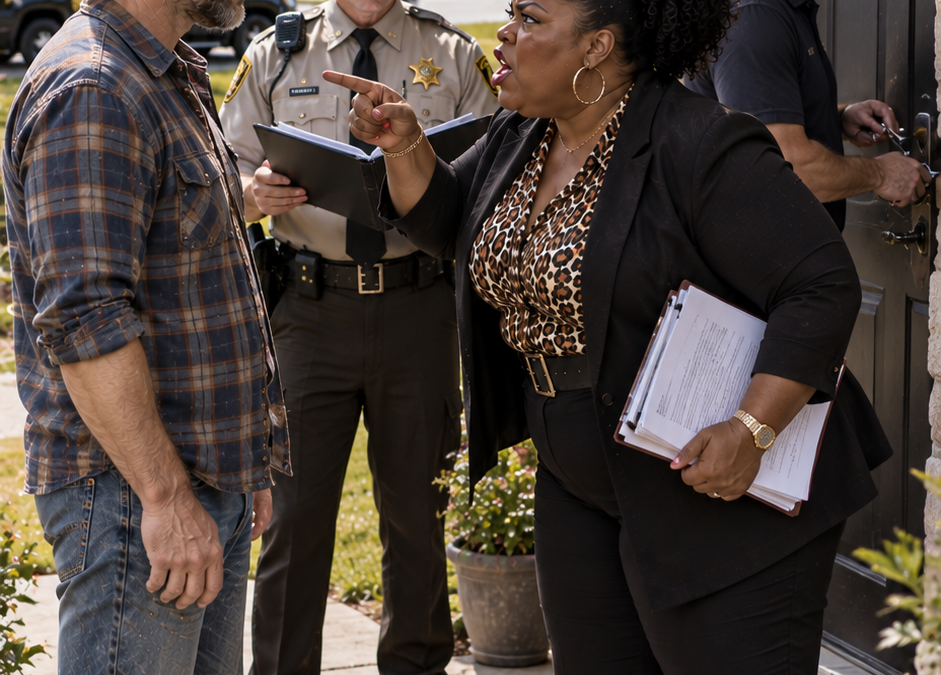
Blythe got out with a thick folder.
Man with a management-company lanyard followed.
Then the locksmith opened the van and placed a hard case on my driveway.
My heartbeat moved behind my ears.
I put down the sandwich.
Started recording on my phone.
Walked outside.
“Good morning, Calvin.”
Blythe spoke like we’d scheduled the meeting.
She introduced the management representative.
Then:
“The association has completed the required enforcement process.”
I kept recording.
“Your account remains delinquent. The lien is recorded. The association is taking possession under the governing documents.”
I stared at her.
“The locksmith will secure the property.”
She smiled.
“You’ll be given a reasonable opportunity to remove your personal belongings.”
The locksmith had stopped opening the case.
“I hope you’ll cooperate so this doesn’t become ugly.”
I said:
“Nobody is entering the house.”
Her expression tightened.
“Calvin—”
“Where’s the court order?”
“The lien has been recorded.”
“That’s not my question.”
She lifted the folder slightly.
“Counsel has reviewed this.”
“Show me the court order authorizing you to take possession today.”
“The process has been completed.”
“Show me the order.”
She stared.
Then came that tone.
The one she reserved for explaining things to me.
“You don’t need to understand every legal phase of this.”
I said nothing.
“This isn’t an air handler you can take apart in a parking lot and diagnose yourself.”
The management representative looked down.
“This is the domain of people who know what they’re doing.”
The locksmith closed his case halfway.
I said:
“Then you won’t mind waiting.”
I called the sheriff’s office.
Non-emergency line.
Told the dispatcher people were at my home attempting to change locks.
Asked whether any writ or possession order existed for my address.
We waited nineteen minutes.
Blythe made two phone calls.
Quietly.
I kept recording.
At 8:31, a marked county vehicle came up the street.
Deputy Grant Holloway stepped out.
Forty-four.
Civil division.
Moved like a man who had already walked into hundreds of arguments and had stopped being impressed by any of them.
“Who called?”
“I did.”
Before I could explain, Blythe moved toward him.
Folder extended.
Her whole voice changed.
Crisp.
Professional.
“Deputy, I’m Blythe Carmichael, president of the Stonebridge Hollow Homeowners Association.”
She explained:
Recorded lien.
More than nine thousand dollars delinquent.
Months of noncompliance.
Repeated notices.
Homeowner refusing obligations.
She was good.
Anyone arriving fresh would have believed her.
She handed him the folder like the result already existed inside.
Holloway didn’t side with her.
Didn’t side with me.
He opened the folder.
Started reading.
A minute passed.
Then:
“Ma’am.”
Blythe stepped closer.
“Where is the writ of possession or signed court order authorizing you to take possession of this residence today?”
She began flipping pages.
“The file is extensive.”
He waited.
“We have a properly recorded lien.”
“A lien is a claim against the property’s value.”
His tone was flat.
“It does not, by itself, authorize you to enter an occupied residence or change its locks.”
Blythe opened another tab.
“Our attorney advised that enforcement was complete.”
“Then you should have the case number and signed order.”
Silence.
She searched.
Couldn’t produce one.
Holloway turned two more pages.
Then he stopped.
“Ma’am.”
“Yes?”
“Can you show me the paper trail proving these notices were actually mailed?”
Everything changed.
The locksmith looked up.
Blythe responded quickly.
“All notices were properly transmitted according to the governing documents.”
Holloway nodded.
“Certified mail numbers?”
“The management company maintains those.”
“Return receipts?”
“Management company.”
“Affidavits of service?”
“I believe the file contains all required documentation.”
“Show me one.”
She flipped pages.
Nothing.
“Was proof of service filed with a court?”
“There isn’t a court case yet.”
The second the words left her mouth, she heard them.
Holloway paused.
Then:
“What authorized the locksmith to be here?”
No answer.
The management representative stepped forward.
Carefully.
“Our company generates correspondence from information supplied by the association.”
Blythe turned toward him.
“And administers notices.”
“Generates notices.”
“That is administration.”
“Mail certification is an optional service.”
Her face changed.
“The contract includes notice administration.”
“It includes notice generation.”
“Same thing.”
“No, ma’am.”
They argued.
On my driveway.
In front of a deputy.
While I recorded.
I called Naomi.
Speakerphone.
She stated clearly that I did not consent to entry.
No order had been produced.
Any attempt to change locks would be unauthorized entry, not enforcement of a court directive.
Holloway listened.
Then looked toward the van.
“As far as I’m concerned, this is a civil dispute.”
The locksmith’s hand went to the case.
“I don’t have any document in front of me that would allow me to assist anyone changing a lock.”
Assist anyone changing a lock.
He chose those words carefully.
The locksmith shut the case.
Put it back in the van.
My knees went weak.
Not dramatically.
Just enough that I shifted my weight.
It was the first thing in six months that had gone cleanly in my favor.
Then Holloway kept reading.
He stopped on one page.
Turned to another.
Another.
“Mr. Reese.”
“Yes?”
“Your address?”
“241 Willard Avenue.”
He turned the folder toward me.
Violation notice.
Mailing address:
214 Willard Avenue.
I stared.
Different house.
Four blocks away.
Across the retention pond.
Owned by an elderly couple who spent winters in Arizona.
Holloway checked another document.
Another.
The pattern hit me all at once.
Regular HOA communications came correctly.
Dues invoices.
Newsletters.
Annual meeting notices.
All:
241 Willard Avenue.
Only the violation notices.
Cure notices.
Hearing notice.
The exact paperwork required to build the lien.
Those went to 214.
Holloway didn’t accuse anyone.
He simply closed the folder.
“If these documents are going to support any further action against this property, I strongly suggest you make sure the addresses and service records line up.”
He handed the folder back.
Then gave me his card.
Case number.
He told Blythe that if he returned for another attempt to change the locks, he expected to see a signed court order.
The management representative left first.
Locksmith second.
Blythe stood at the bottom of my driveway.
Folder clutched against her chest.
Face red.
She looked smaller.
Not physically.
Contextually.
For the first time, she wasn’t the person explaining the process.
She was the person whose process had just been questioned.
She walked past me.
Stopped.
“This isn’t over.”
I looked at her.
“Good.”
She turned.
“Because I’m just getting started.”
I meant it.
Naomi sent a formal records demand Monday.
Not polite.
Original ledger export in native format.
Entry timestamps.
User identifiers.
Change history.
Eighteen months of board minutes.
Address-history changes for my parcel.
Collection contract.
Every attorney invoice billed to my account.
Proof of mailing.
Board resolution authorizing the lien.
And a preservation demand.
Emails.
Texts.
Management records.
System logs.
Everything touching my property.
The association delayed.
Called it overbroad.
Said compilation required time.
Naomi replied that the lien itself made the notice record relevant.
Then an unexpected person contacted me.
Marla Keane.
Association secretary.
Forty-six.
She asked through a neighbor if we could meet outside Stonebridge Hollow.
We met at a diner.
She looked nervous.
Hands around a coffee she barely touched.
“I am not doing this for you.”
“I understand.”
“My name is on the minutes.”
I waited.
“My daughter starts college next year. My husband is on disability.”
She looked at me.
“If this becomes a lawsuit, I am not standing beside Blythe while everybody assumes I knew.”
She had searched her personal email archive.
Then placed a flash drive on the table.
“I’m not going down for her.”
Naomi reviewed forty-one internal emails.
Most ordinary.
Four mattered.
The first was from Blythe.
Sent two weeks after my second fine.
KEEP THE PRESSURE ON REESE. HE’LL EITHER PAY OR DECIDE STONEBRIDGE ISN’T WORTH THE TROUBLE.
I stood in my kitchen while Naomi read it over the phone.
Put one hand flat on the counter.
There it was.
Not compliance.
Pressure.
Before the third fine.
Before collections.
Before lien.
Before Blythe stood in meetings telling people this was about rules.
The second email was worse.
Three months before the lien, a management-company administrator wrote Blythe.
They had discovered two conflicting mailing addresses for my property.
The employee asked whether violation correspondence should be reissued to the corrected address and the compliance timeline restarted properly.
Blythe replied:
WE ALREADY HAVE ENOUGH HISTORY ON THE ACCOUNT. DON’T RESTART THE CLOCK.
I read that line several times.
She knew.
Someone had told her the notice address was wrong.
She made a decision not to correct it because correcting it meant restarting the process.
The timeline mattered more than whether I had ever actually received the warnings.
Wesley Boone came forward after Marla.
Maybe one person telling the truth made it easier for the next.
He met Naomi.
Brought the ledger export he had finally received.
The raw ledger told a different story from the owner statements.
Nineteen penalty entries had been created on a single afternoon.
Backdated across four months.
Same user account.
Same session.
Identical timestamps down to the second on groups of entries.
Fees presented as though they had accrued gradually had actually been typed into the system in batches.
Then legal fees.
My account contained $3,100 in supposed legal charges.
Association invoices showed only $1,250 in total legal spending during that period.
None tied to my parcel.
Then notice transmission notes.
The system had a mandatory field for documenting how and when notices were sent.
Blank on thirty-three of forty-one violation-related entries.
The nine-thousand-four-hundred-dollar monster that had kept me awake in September started collapsing.
Not because the number changed.
Because each piece was being asked to show its source.
Most could not.
Then Naomi found the lien certification.
Blythe had sworn the board approved the lien at a properly held meeting.
Naomi obtained the minutes.
Two and a half pages.
Landscaping bids.
Retention pond.
Approval of prior minutes.
No motion on my property.
No second.
No vote.
Nothing.
The board had never approved the lien.
Naomi sent a demand letter.
Five items.
Release the lien.
Void unsupported charges.
Reimburse reasonable legal fees.
Correct association and county records.
Preserve evidence.
Eleven exhibits.
Emails.
Ledger irregularities.
Minutes.
Doorbell stills.
Address records.
The HOA attorney asked for two weeks.
Blythe refused the demands.
Instead, she called a special membership meeting.
She still believed the room belonged to her.
December.
Same church.
Sixty-eight residents.
Naomi and I sat at the front.
Binder.
Laptop.
Projector.
Blythe opened.
She said the association had been forced to convene because an owner refusing legitimate financial obligations had hired counsel to intimidate unpaid volunteers.
A year earlier, it might have worked.
When my turn came, I didn’t give a speech.
I asked questions.
One at a time.
“February 14 violation notice. How was it sent?”
“All notices were sent according to the governing documents.”
“That’s not a method. First class, certified, or hand delivery?”
“The management company handles mailing.”
“Then what is the tracking number?”
“I don’t have that in front of me.”
Next.
“Where in the November minutes is the vote authorizing a lien against my property?”
“The board discussed the matter extensively.”
“Which page contains the motion and vote?”
“The minutes may not capture every action.”
Next.
“Which invoice supports the eighteen hundred fifty dollars in legal fees charged to my account in August?”
“Legal matters are confidential.”
Naomi spoke.
“The association produced its legal invoices. None references 241 Willard Avenue. Would you like us to display them?”
Blythe didn’t answer.
Then Naomi projected the first email.
KEEP THE PRESSURE ON REESE. HE’LL EITHER PAY OR DECIDE STONEBRIDGE ISN’T WORTH THE TROUBLE.
Sixty-eight people read it.
Someone in the third row said:
“That was April.”
Then the second email.
Management administrator asking whether notices should be resent correctly.
Blythe:
DON’T RESTART THE CLOCK.
Wesley stood.
No one called on him.
“I am the treasurer of this association.”
He looked toward the membership.
“I requested the underlying ledger three times.”
Then Blythe.
“I did not approve the final balances used to support this lien.”
He straightened.
“I formally withdraw any implied endorsement of those figures.”
Sat down.
Didn’t look at her again.
Then Marla stood.
Hands shaking.
“I am the secretary.”
She swallowed.
“I took the minutes at the meeting cited in the lien certification.”
The room waited.
“No motion regarding a lien against Mr. Reese’s property was made.”
Blythe went still.
“There was no second.”
Marla looked directly at her.
“There was no vote.”
Then:
“And I will testify to that under oath.”
Blythe tried to recover.
She called everything clerical irregularities.
Volunteer boards make mistakes.
Administrative errors happen.
No system is perfect.
I had prepared exactly one sentence.
I stood.
“A clerical error is one wrong digit on one page.”
She looked at me.
“Using that wrong digit for six months after being told in writing that it’s wrong, while threatening to take someone’s home, isn’t a clerical error anymore.”
The room was silent.
“That’s a decision.”
I sat down.
Nobody applauded.
I’m glad.
Applause would have turned it into theater.
Silence made it evidence.
The HOA’s own attorney reached the obvious conclusion quickly afterward.
He advised the board that defending the lien further could expose the association and individual directors to costs far exceeding the dispute.
He stated he could not certify the notice record as reliable.
Ten days before Christmas, we settled.
The lien on 241 Willard Avenue was formally released.
Recorded at the county.
That mattered more than anything.
A recorded lien doesn’t disappear because people agree it’s wrong.
It dies where it was born.
In the public record.
Thirty-seven of the forty-one charges were voided.
All unsupported legal and collection fees removed.
My account balance was restored to $140.
One legitimate quarterly assessment I had deliberately held during the dispute.
I paid it that afternoon.
I had never argued that I owed nothing.
I argued that I owed what was real.
The association reimbursed an agreed portion of my legal costs.
The management company had to audit notice practices across Stonebridge Hollow.
They later found similar problems on nine other properties.
Some smaller.
Some old.
People who had quietly paid charges because fighting seemed too expensive.
Then January came.
Board meeting.
Proper notice.
Quorum.
Motion.
Second.
Discussion.
Recorded vote.
Stonebridge Hollow’s board removed Blythe Carmichael as president.
Five to one.
She wasn’t arrested.
No police escort.
No dramatic courtroom judgment.
She lost a chair.
That was all.
And somehow that was exactly right.
She had used process as a weapon.
In the end, process removed her because she had refused to follow it.
Afterward, she caught me in the church parking lot.
Cold enough that our breath showed.
She carried a cardboard box filled with association files.
“You must be very proud of yourself.”
I had imagined answering that question a hundred times.
On sleepless nights.
Driving to work.
Sitting on my entryway floor beneath the yellow lien notice.
I could have told her what she had cost me.
Could have told her what I thought of the first-home comment.
Could have told her how close I came to signing that settlement.
Instead I said:
“No.”
She waited.
“I’m just glad everybody finally read the same paperwork you told me I wasn’t smart enough to understand.”
Her face changed.
Not much.
Then she walked to her car.
That was our last conversation.
Spring came.
I finally sanded the porch railing.
Painted it soft gray.
The oak filled out.
My truck still sat in the driveway.
No tow truck.
No locksmith.
No yellow notice.
Stonebridge Hollow looked exactly the same from the street.
But I didn’t feel the same sitting there.
When I closed on the house at forty-seven, I thought ownership was:
My name on a deed.
My key in the lock.
Mortgage payment every month.
Nobody able to tell me to leave.
Now I understand ownership differently.
Ownership also means defending what the deed represents with very boring things.
Emails.
Envelopes.
Postmarks.
Photographs.
Doorbell footage.
Meeting minutes.
Spreadsheets.
Certified mail receipts.
A note written at the time instead of a memory reconstructed later.
I didn’t survive the dispute because Deputy Holloway liked me.
He didn’t know me.
I survived it because when the first seventy-five-dollar fine arrived under my door with a date that didn’t make sense, I put it into a folder instead of throwing it away.
That’s all.
A folder.
At first.
Then another.
Eventually the case binder reached more than eleven hundred pages.
It sits in the bottom drawer of the desk in my second bedroom.
Tabbed.
Indexed.
I don’t keep it because I’m afraid another HOA letter will arrive.
I keep it because it reminds me how fragile memory becomes when somebody else controls the story.
Blythe’s greatest advantage was never her title.
It was repetition.
She said I was delinquent.
Again.
And again.
At meetings.
In letters.
In the lien.
To the management company.
To the deputy.
Repeat something long enough and people stop asking where it started.
The binder starts at the beginning.
One false trash-bin notice.
Wrong date.
No warning.
No mailing proof.
Everything grew from there.
A few weeks after the settlement, Deputy Holloway drove past while I was watering the flower beds.
He slowed.
Window down.
“How’s everything, Mr. Reese?”
I looked at the house.
Gray porch rail.
Oak tree.
Driveway.
The same front door Blythe had once stood in front of with a locksmith waiting behind her.
“Better than it’s ever been.”
He nodded.
“Good.”
Then drove on.
I stood there holding the hose.
Water running across the mulch.
And for the first time in months, nothing about the sight of a county vehicle made my chest tighten.
Wesley remained treasurer for another year.
Marla stayed as secretary through the end of her term.
I respected both of them.
Not because they were brave from the beginning.
They weren’t.
That’s important.
People like stories where somebody sees wrongdoing immediately and stands up instantly.
Real life is messier.
Wesley hesitated.
Marla changed minutes she didn’t feel right about.
They both waited.
They both worried about what telling the truth might cost them.
Then eventually the cost of silence became higher.
That’s usually how courage works in ordinary people.
Not all at once.
One document at a time.
The management company changed too.
Proof-of-mailing services became mandatory for enforcement notices.
No more association presidents choosing the cheapest transmission method and later claiming certified delivery.
Address verification became part of every new-owner file.
Hearing notices required a tracking number stored in the system.
Lien authorization required a recorded board vote attached directly to the account.
Boring reforms.
Good reforms.
No speeches.
Stonebridge Hollow didn’t become perfect.
Someone still complains about the pond every August.
People still argue over parking.
The board spent three meetings debating whether decorative flags count as exterior displays.
I attend occasionally.
Mostly I don’t.
I never wanted to run Stonebridge Hollow.
I only wanted its rules applied as written.
That distinction matters.
People sometimes assume if you fight authority, you must want authority.
I don’t.
I manage enough systems at work.
I don’t need another committee.
What I gained from the whole thing was simpler.
I stopped assuming official-looking paper must already have survived scrutiny.
Sometimes it has.
Sometimes nobody read it.
Sometimes the signature is the mistake.
Sometimes the person waving the folder is relying on your fear of what’s inside it.
The morning Blythe brought the locksmith, she believed the thickness of her folder was power.
Deputy Holloway did something she never expected.
He opened it.
That’s the entire turning point.
He read.
He asked:
Where’s the court order?
Where’s the proof of mailing?
Where’s the service affidavit?
Where’s the document authorizing this locksmith?
Suddenly, pages that had frightened me for six months were being forced to support their own claims.
They couldn’t.
There is something almost mechanical about that.
A system can look impressive from the outside.
Lights.
Displays.
Alarms.
Buttons.
But when I diagnose equipment, I don’t ask whether the control panel looks professional.
I ask:
Do we have power?
Is the relay closing?
Is the sensor reading correctly?
Is the valve actually moving?
Blythe had built a beautiful control panel.
Notices.
Fees.
Lien.
Attorney language.
Collection warnings.
But behind the panel:
No service proof.
Wrong address.
No hearing.
No vote.
Unsupported fees.
Backdated entries.
No possession order.
When Holloway started checking continuity, the circuit was open everywhere.
I think about her settlement offer sometimes.
Forty-two hundred dollars.
Sign here.
Acknowledge everything.
Waive claims.
Payment plan.
If I had signed, Stonebridge Hollow would have had the single document it needed most.
My own admission.
I would have certified the process they couldn’t prove.
Then every irregularity before that signature would become harder to challenge.
That’s what scared Naomi.
Not the money.
My signature.
People underestimate the value of their own signature because signing often feels passive.
Sometimes it is the most active thing you can do.
Or refuse to do.
I said no because one question wouldn’t leave me alone.
If their paperwork was correct, why did they need me to certify that it was correct?
That question saved me.
Not because I’m brilliant.
Because hotel maintenance teaches suspicion.
If a contractor tells me a repair passed every test but also asks me to sign an acceptance sheet before showing the readings, I don’t sign first.
Show me the readings.
Then I’ll sign.
Same principle.
Different building.
The house itself changed very little during all this.
That’s another thing I remember.
The fight felt enormous.
But morning still came.
I still went to work.
Guests still complained about air conditioning.
A rooftop unit still lost a belt during the worst week of the lien dispute.
One boiler still decided October was a good month to start leaking from a flange.
I still came home.
Unlocked my door.
Cooked dinner.
Sat on the porch.
The house kept being a house while adults argued over whether paper could make it stop being mine.
That steadiness helped.
Walls don’t know they’re under dispute.
A porch rail doesn’t know there’s a lien.
The oak didn’t care about Blythe.
It dropped acorns anyway.
Maybe that’s why I stayed attached to ordinary tasks.
Sand the rail.
Change a filter.
Mow the yard.
Take the trash cans in.
Not because I wanted to prove compliance.
Because routine reminds you that a threat isn’t the entire world.
One Saturday after everything ended, my sister came by.
She noticed the fern.
The same one that had somehow generated a seventy-five-dollar violation.
It was bigger.
She laughed.
“That thing survived.”
“Apparently.”
“Didn’t they fine you over it?”
“Among other crimes.”
She looked at me.
“You keeping it?”
“Forever.”
We moved it into a larger pot.
I put it back on the porch.
No application.
No committee.
Perfectly compliant under the rules that had existed the whole time.
Sometimes I look at it and think about how absurd the beginning was.
A fern.
A truck.
Grass.
Trash.
None of those things could take a house.
Process could.
That was what I learned.
Bad process doesn’t become harmless because the original issue is small.
A seventy-five-dollar fine can become nine thousand dollars if the machinery behind it is allowed to multiply unchallenged.
That’s why procedure matters.
People hear “procedure” and think bureaucracy.
Paperwork.
Technicalities.
But procedure is often the only protection ordinary people have when somebody with more institutional power decides they already know the outcome.
Notice.
Opportunity to cure.
Hearing.
Vote.
Service.
Court order.
Those are not decorative steps.
Each exists because taking money or property from someone is serious.
Blythe treated those steps like obstacles.
Skip them.
Backfill them.
Certify them later.
Wrong address?
Don’t restart the clock.
No vote?
Sign the certification.
No court order?
Bring the locksmith anyway.
That mindset was the real violation.
I eventually learned Blythe had a history.
Nothing as extreme as my case.
But enough stories surfaced.
Owners who had sold after years of escalating disputes.
A widow who paid hundreds in lawn penalties rather than keep fighting.
A family that moved after parking citations turned into collection threats.
I didn’t dig deeply.
I didn’t need to.
My case wasn’t a revenge project.
Once my lien was gone and the records were corrected, I stopped.
Some neighbors wished I would sue individually.
Punitive damages.
Public apology.
Whatever else attorneys could construct.
I declined.
Naomi supported that choice.
Not because no additional claims existed.
Because litigation consumes years.
I had spent too many already saving for the house.
I wanted to live in it.
Not make it the subject of my life.
That decision surprised people.
Especially after what Blythe had said to me.
“Don’t let pride cost you your first home.”
I could have let pride cost me the next three years instead.
I didn’t want that either.
Justice doesn’t always need maximum punishment.
Sometimes correction is enough.
The lien released.
My account fixed.
Fees removed.
Legal costs partly reimbursed.
System audited.
President removed.
Done.
That was enough for me.
A year later, Stonebridge Hollow changed management companies.
Not because of me alone.
The notice audit had uncovered too many recordkeeping problems.
Some administrative.
Some serious.
Nine other parcels required corrections.
A few owners got refunds.
The new management company started with a full owner-address verification campaign.
Every homeowner got a letter asking them to confirm mailing address, email, emergency contact.
Mine arrived certified.
I laughed when I signed for it.
The carrier probably thought I was strange.
I stood at the door holding that green receipt like someone had sent me a gift.
That’s how low the bar had been.
Proof that a letter was actually mailed.
One afternoon, a new board member stopped while I was sanding the porch rail.
Her name was Teresa.
She had moved in recently.
“Are you Calvin Reese?”
“Depends who’s asking.”
She laughed.
“I joined the board.”
“I’m sorry.”
She laughed harder.
Then:
“I’ve heard your name a lot.”
“Most of it flattering, I’m sure.”
She looked embarrassed.
“Actually, people say you’re the reason we have better records now.”
I shook my head.
“No.”
“No?”
“I’m the reason one bad file got opened.”
I set down the sander.
“The people who changed the system were the ones who decided not to close it again.”
She thought about that.
“I’ve been reading the old minutes.”
“Good.”
“Very carefully.”
“Even better.”
She walked away.
I went back to sanding.
That’s about as much legacy as I need.
Nobody needs a plaque.
No one needs to name a rule after me.
Just read the minutes.
Keep the receipts.
Mail the notices correctly.
If you’re going to fine someone, prove why.
If you’re going to put a lien on a home, vote.
If you’re going to take possession, bring a court order.
Those aren’t revolutionary ideas.
They’re supposed to be normal.
I sometimes think about the exact second Blythe’s confidence broke.
People assume it was when Holloway said a lien didn’t give her possession.
It wasn’t.
She still believed she could recover.
Then he asked for the mailing proof.
That was the moment.
Because she knew the answer.
The lien could be explained.
Legal phases could be blurred.
A management contract could be interpreted.
But either there was a certified-mail number or there wasn’t.
Either there was a return receipt or there wasn’t.
The simplicity destroyed the fog.
That’s why good questions are dangerous to bad systems.
Bad systems survive complexity.
They bury people in terms.
Phases.
Policies.
Administrative discretion.
Good questions remove layers.
Show me the order.
Show me the tracking number.
Show me the vote.
Show me the invoice.
Show me the address.
If somebody actually has those things, the conversation gets shorter.
If they don’t, it gets interesting.
The house is worth more now than when I bought it.
People tell me that should make the story feel like a financial victory.
It doesn’t.
Home value isn’t what I think about when I sit on the porch.
I think about the first night.
Boxes still everywhere.
Pizza on the floor because I hadn’t unpacked the table.
I remember locking the front door.
Turning around.
Looking at the living room.
And thinking:
No landlord.
No upstairs neighbor.
No rent renewal.
Mine.
Then six months later, sitting on that same floor believing someone could take it.
The distance between those two nights changed what ownership meant to me.
A deed is powerful.
But ownership isn’t passive.
You don’t sign at closing and become magically protected forever.
You pay taxes.
You maintain insurance.
You meet lawful obligations.
You watch records.
You question mistakes.
You protect the chain of proof.
Not because everyone is coming for your property.
Most people aren’t.
Because systems are operated by people.
People make errors.
Some people abuse them.
And sometimes the only person in the room who knows the record is wrong is the person being harmed by it.
That’s when speaking up matters.
Even if your voice shakes.
Even if you’re tired.
Even if someone tells you you’re too simple to understand the process.
Blythe’s most effective weapon was never the lien.
It was shame.
She tried to make me embarrassed to ask questions.
Embarrassed by money.
Embarrassed by my job.
Embarrassed that it was my first house.
Embarrassed that a few thousand dollars frightened me.
As though fear meant I didn’t belong.
It took me too long to understand that.
Of course I was afraid.
A man who worked ten years to buy a house should be afraid when someone threatens to take it.
That fear wasn’t weakness.
It was evidence that the house mattered.
What mattered was what I did after the fear showed up.
At three in the morning:
Coffee.
Laptop.
Parcel search.
Documentation.
One page after another.
That’s the moment I trust more than the sheriff scene.
Holloway helped.
Naomi helped.
Wesley helped.
Marla helped.
But before any of them, there was one exhausted man sitting alone at a table deciding not to accept that because a document looked official, it must be correct.
That decision was mine.
I am proud of that.
Not much else.
Today, Stonebridge Hollow is quiet.
The retention pond still smells in August.
The curbs still crack.
The oak drops enough acorns to qualify as a personal attack every fall.
I still work.
Same field.
Same habits.
My truck finally died after twelve years.
I replaced it with a used one.
Not new.
Habits survive mortgages.
Sometimes I come home after a twelve-hour shift and sit on the porch without turning on the television.
The gray rail catches the evening light.
Fern near the steps.
Oak moving overhead.
My deed is still in the fireproof box.
The lien release is behind it.
I keep both.
Side by side.
One proves I bought the house.
The other proves I had to defend the fact that buying it meant something.
And in the desk downstairs sits the binder.
Eleven hundred pages.
I don’t open it often.
But I know exactly where it is.
Because people forget.
Paper doesn’t.
Blythe Carmichael arrived at my first home with a locksmith because she believed accumulated paperwork could become authority simply by getting thick enough.
She had fines.
Statements.
Collection letters.
A recorded lien.
A folder heavy enough to look convincing.
What she did not have was a clean chain showing how any of it had been created.
The sheriff didn’t defeat her.
He did something far simpler.
He asked the folder to prove itself.
It couldn’t.
And once that happened, everything that had frightened me for six months became what it had always been.
Paper.
Some accurate.
Some wrong.
Some unsupported.
Some signed by people who should have known better.
All readable.
All checkable.
All weaker than the truth once somebody finally forced them into the same room.
I bought that house at forty-seven after nearly ten years of saving.
Nobody gave it to me.
Nobody let me have it.
I paid for it.
I maintained it.
I met the obligations that were actually mine.
And the last time I stood in the driveway where the locksmith once set down his tools, I looked back at the porch and thought about Blythe’s line.
“You’re being offered a chance to keep your first home.”
She had it backward.
Keeping my home was never a favor she had authority to offer.
The house was mine before she arrived.
It was mine while she stood there.
And once everyone finally read the paper trail she had spent six months telling me I was too simple to understand, it was still mine when she left.








