𝗣𝗔𝗥𝗧 𝟮 The HOA President Called My Sunday BBQ a Neighborhood Nuisance, but Her Husband Saw Something on the Clipboard She Couldn’t Explain
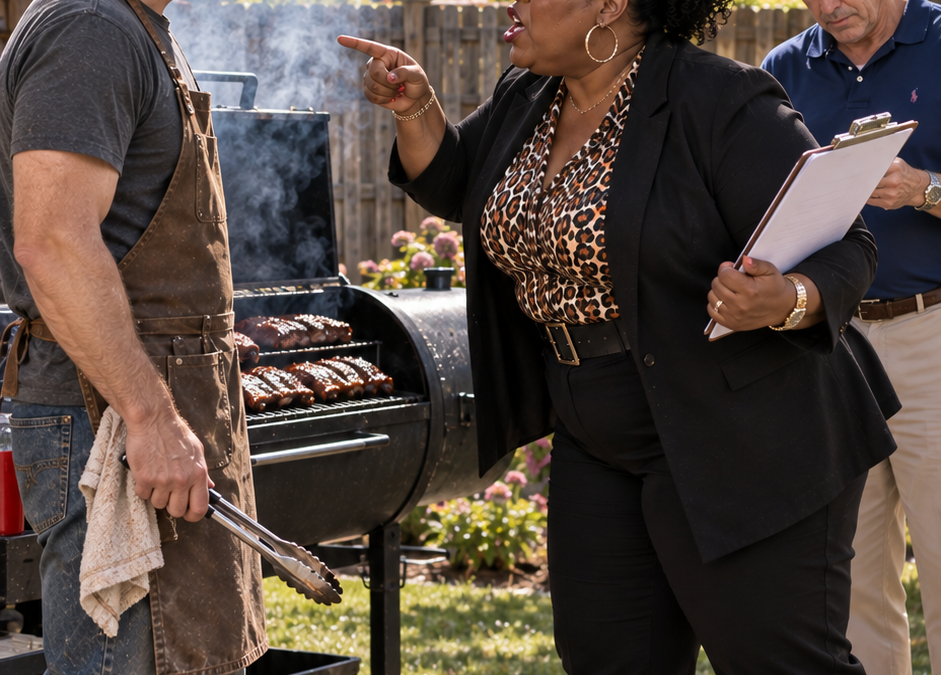
𝗣𝗔𝗥𝗧 𝟮
I was single.
Forty-one.
No wife.
No kids.
One truck.
One garage with a workbench.
I understood exactly what she meant.
I did not answer.
Silence is cheaper than most replies.
That Sunday afternoon, I came outside carrying a tray and saw Celeste standing across the street.
Cream blouse.
Clipboard against her hip.
Watching my backyard.
Not casually.
Inspecting.
Maris Caldwell was already sitting in one of my folding chairs with lemonade.
Maris was sixty-three, retired from hospital billing, and had the directness of a woman who spent decades explaining insurance policies to people who did not want to hear what they actually covered.
Two other neighbors stood by the fence talking.
No music.
No crowd.
No cars lining the street.
Four adults.
One smoker.
Celeste crossed.
She didn’t walk to my front door.
She came along the side yard and through the gate.
That bothered me immediately.
Not enough to say anything.
Enough to remember it.
She stopped at the edge of the concrete pad.
Looked at the smoker.
Then at me.
On top of her clipboard was a printed page.
My name was already typed on it.
So was my address.
“The association has received multiple complaints regarding activity at this property.”
I set the tray down.
“What activity?”
She listed the accusations in the flat cadence of somebody reading symptoms.
Smoke.
Odor.
A gathering of persons.
Fire risk.
An open-flame cooking device near a wood fence.
Then, after a pause:
“Cooking activity of an apparently commercial character.”
I looked around my own yard.
Four people.
Paper plates.
No sign.
No cash box.
No menu.
No payment app.
No strangers lined up at the gate.
The smoker lid thermometer read roughly 250 degrees.
Oak smoke drifted upward in a thin blue line.
Pork fat smelled like pork fat.
“What covenant provision am I violating?”
Celeste adjusted the clipboard.
“Residents should not need a rule book to understand what is reasonable.”
“If you’re talking about a fine, I would still like the section number.”
She didn’t give me one.
Instead, she started talking about me.
“A man who works in maintenance all week is probably more accustomed to machinery, grease, smoke, and strong odors than the average resident.”
Maris set her lemonade on the chair arm.
One man near the fence looked down.
I felt my jaw tighten.
I kept my voice level.
“The smoker meets manufacturer clearance.”
She waved a hand.
“I measured before I ever installed it.”
“Nolan—”
“I can show you the distances.”
“That’s not the point.”
“What is?”
She looked around.
“A man living alone may enjoy turning his backyard into a weekend hideout, but Brier Glenn is a community. Standards require people to consider those around them.”
There are moments when somebody insults you so specifically that answering begins to feel like accepting the premise.
I could have told her about the neighbors I had fed.
About the maintenance calls I handled at midnight.
About the fact that I owned my home and paid the same dues she did.
Instead, I asked:
“How many complaints?”
“More than you would think.”
“Can I see them?”
“Complaints are confidential.”
“Is the section number confidential too?”
Her expression hardened.
“If the smoker is not shut down immediately, I will open a formal violation file today. Continued activity can support fines under the enforcement schedule.”
My hand was on the smoker lid.
The brisket still had hours to go.
I was deciding whether shutting it down was worth avoiding the headache.
Then the gate hinge squeaked.
Graham Harrow walked into my yard carrying a paper plate.
Celeste’s husband.
I had met him maybe a dozen times.
Fifty-two.
Corporate accountant.
Quiet.
The kind of man who says good morning at the mailboxes and considers the transaction complete.
He wore khakis and a golf shirt.
He stopped between Celeste and the smoker.
Looked at the cooker.
Then at me.
“Nolan.”
“Hey, Graham.”
“If she’s making you put the fire out, can I get some ribs first?”
Silence.
Not the theatrical silence people describe afterward.
Just three awkward seconds.
Maris coughed into her lemonade and failed badly at pretending that was what happened.
One of the men at the fence turned away entirely.
Celeste looked at Graham.
“Graham.”
He kept holding the plate.
“Go home.”
He didn’t argue.
Didn’t move either.
I did not want to humiliate anyone’s husband.
The ribs were nearly ready.
So I opened the lid.
Smoke rolled out.
I cut two bones from the end and put them on his plate.
Graham ate standing up.
Chewed.
Looked at the rib.
Then said to his wife:
“This is better than that restaurant we went to last month.”
Celeste went pale.
That should have been funny.
It wasn’t.
Not to me.
Because I could see her recalculating.
The president who supposedly understood community sentiment had just been contradicted publicly by the person who lived in her house.
Then Graham’s eyes dropped to the clipboard.
He read the top sheet quickly.
Accountants do that.
They can scan a page without visibly reading it.
His posture changed.
“Is this supposed to be a collective complaint?”
Celeste turned the clipboard slightly away.
“Yes.”
Graham looked at me.
Then back at her.
“That’s strange.”
“Graham.”
“This is an enforcement matter.”
Celeste told me the file would be opened whether or not I extinguished the smoker.
Then she guided Graham toward the gate without actually touching him.
He looked over his shoulder.
“Don’t delete any emails they send you.”
Then they left.
The four of us remained in my yard.
Nobody knew what to say.
I didn’t turn the smoker off.
Not to make a point.
I simply still had no rule telling me I had to.
Instead, I took out my phone.
Photographed the smoker.
The concrete pad.
Tape measurement from the firebox to the fence.
Another to the house.
Fire extinguisher.
Lid temperature.
Digital probe app.
Four chairs.
Four people.
Empty street.
Then my watch.
I didn’t announce what I was doing.
I had spent my career managing building failures.
A system begins behaving strangely, you capture the data before somebody changes it.
At 8:14 that evening, after the brisket was wrapped and the chairs put away, my phone buzzed.
Email.
Brier Glenn HOA.
NOTICE OF VIOLATION
REFERENCE 91-44
The notice cited Article 7, Section 4:
Nuisance conditions interfering with neighboring quiet enjoyment.
Then Article 9, Section 2:
Unapproved use of residential property for activity of a commercial character.
Then I reached a sentence that stopped me.
The association had begun receiving complaints at 12:47 p.m.
I read it again.
12:47.
I opened my photos.
Then my smoker app.
Then the camera system attached beneath my rear eave.
The numbers did not fit.
At 12:38, I was paying for ice, limes, and tea at the market on Halbrook Road.
Receipt timestamp.
At 12:44, my truck entered my driveway.
Camera timestamp.
At 12:47, I was carrying bags into the kitchen.
At 1:18, my smoker chamber passed 100 degrees and the probe app automatically began logging the cook session.
The ribs went on at 1:31.
Brisket at 1:39.
At 12:47 there was no smoke.
No fire.
The smoker was cold enough to touch.
Yet somebody had filed a complaint describing heavy smoke drifting across property lines thirty-one minutes before the cooker was even warm.
I sat at the kitchen table.
Legal pad.
Receipt.
Camera times.
Probe log.
Violation notice.
I reconstructed the afternoon the way I would reconstruct an equipment failure.
Not from memory.
From records.
Then I did nothing.
For an entire day.
That was harder than it sounds.
When you find a flaw in somebody’s accusation, instinct tells you to confront them immediately.
But a timestamp is only useful if you’re sure the clocks are right.
Systems drift.
Data gets entered manually.
People mistype things.
I wanted certainty.
Monday evening, I walked to Maris Caldwell’s house.
She answered wearing slippers.
“Did you complain to the HOA about Sunday?”
She laughed.
“Nolan, I ate your brisket at four o’clock standing over my kitchen sink.”
“So no?”
“I haven’t opened the HOA website in two months.”
There was a reason I asked her first.
During the backyard argument, Celeste had said even people at the end of my row were complaining.
There were three houses at that end.
Maris.
The Ostranders.
One empty house listed for sale.
The Ostranders had left Friday morning with luggage.
I had watched them load the car.
The third house had been vacant for months.
So the residents at the end of the row consisted of one woman who ate my barbecue, two people out of state, and a lockbox.
I walked home slowly.
Maybe Celeste had exaggerated.
That was the generous explanation.
Maybe somebody elsewhere complained and she embellished the rest.
Petty.
Unprofessional.
But not yet something larger.
I tried to believe that.
Then I remembered what had happened three weeks earlier.
And suddenly the barbecue stopped being about barbecue.
Brier Glenn held general meetings on the second Tuesday of every month.
I rarely attended.
That spring, I went because the agenda included a $14,800 landscaping proposal.
My HOA dues were $480 per year.
When somebody proposed spending nearly fifteen thousand dollars, I thought reading the proposal was reasonable.
Celeste presented it personally.
The project was called:
PRIVACY AND COMMUNITY BEAUTIFICATION ENHANCEMENT.
There was a rendering mounted on foam board.
She talked about curb appeal.
Property values.
Softening the transition between Brier Glenn and the county road.
Dean Hollister, vice president, nodded.
Renee Whitaker, another board member, asked about the schedule.
I had no problem with landscaping.
I like trees.
What caught my attention was the scope.
Eleven mature arborvitae.
Fifteen-gallon size.
New irrigation controller.
Two drip zones.
Four cubic yards of hardwood mulch.
Landscape lighting.
That was not casual community planting.
It was a privacy screen.
And privacy screens go somewhere specific.
I raised my hand.
“Can the board show us the scope map?”
Celeste stopped.
“And the three competitive bids required for spending over ten thousand?”
The room went unusually quiet.
Dean looked at Celeste.
Renee wrote something.
Celeste responded with far more force than the question deserved.
“Association governance is more complicated than it appears from outside.”
“I’m just asking where the work goes.”
“Our volunteers spend enormous time serving this community and should not be interrogated as though we’re contractors.”
“I manage bids for a living. I just want to see the scope.”
“There.”
That word.
Not said loudly.
But sharp.
Then she added:
“You’re evaluating a community investment like a tradesman looking at a job site. Itemizing isn’t the same as understanding.”
I did not accuse her of anything.
Not theft.
Not fraud.
Not self-dealing.
I asked for a map and bids.
Two days later, I submitted a written records request.
Article 12, Section 3 granted members in good standing access to certain association financial records with ten days’ notice.
I requested:
The project scope map.
Three competitive bids.
Any approvals.
Payment records.
Thursday evening.
Saturday morning, the first violation note appeared on my door.
Trash bin visible outside permitted hours.
One week later:
Vehicle appearance standard.
Scratch on truck door.
Nine days later:
Turf maintenance near mailbox.
Grass around the post two inches taller than the adjacent strip.
Each notice was polite.
Each cited a section.
Each bore Celeste’s full title.
Then three weeks and one day after I requested the landscaping records, my Sunday barbecue became a collective nuisance complaint.
That changed the shape of everything.
What if Celeste did not care about the smoker?
What if she needed a file?
Because a homeowner asking why $14,800 was being spent in a particular way could be inconvenient.
A homeowner with four warnings and a nuisance violation could be characterized differently.
Difficult.
Combative.
Habitually noncompliant.
Then every question I asked about association money could be reframed as retaliation against enforcement.
She wasn’t necessarily trying to stop me from cooking.
She was building a record about the person asking questions.
The smoker was just useful material.
Visible.
Predictable.
Outdoor.
Easy to photograph.
That Thursday night, an unfamiliar number texted me.
This is Graham Harrow. I need to speak with you. Not here. Not with Celeste.
We met Saturday morning at a diner eleven miles away.
His choice.
He sat in a booth with coffee and his reading glasses resting on his head.
He did not shake my hand.
Did not apologize for Celeste.
I respected that immediately.
People who begin by apologizing for somebody else’s behavior are often preparing to ask you for something.
Graham didn’t.
He pointed at the seat opposite him.
The waitress brought coffee.
Then he said:
“Celeste has always needed to control the perimeter of things.”
I waited.
“The house. Calendar. Finances. Social stuff.”
He looked down at the table.
“When she got the HOA position, I thought maybe it would give that energy somewhere useful to go.”
He gave a tired half smile.
“I let it go too long because that was easier than arguing about it.”
Then he explained the clipboard.
The afternoon in my yard, he had seen a complaint summary page.
Four complaints.
Four reporting households.
He recognized the format because years earlier, before I lived there, he had served one term as HOA treasurer and helped build an early version of the reporting spreadsheet.
“One name was mine.”
I set my coffee down.
“You complained?”
“No.”
He answered instantly.
“I have never filed an HOA complaint against anyone.”
“Then why was your name there?”
“That’s why I’m here.”
He also admitted the only reason he came to my yard that Sunday was because he had smelled the ribs through his study window for two hours and wanted some.
That part at least made sense.
Then he told me about the previous night.
Saturday.
Around ten.
He went downstairs for water.
Celeste sat at the kitchen island.
Laptop open.
Legal pad beside her.
He barely noticed.
Association work was constant in their house.
But he remembered the screen.
It was the complaint intake form.
More than one browser window.
At the time, meaningless.
Sunday afternoon, standing in my yard and looking at a summary listing four complaints about activity that had begun less than two hours earlier, the memory changed.
I felt cold despite the diner being warm.
“You think the complaints were prepared Saturday night.”
“I know what I saw.”
“Would you give me the files?”
“No.”
Fast answer.
“I will not steal from my wife’s computer.”
I nodded.
“I won’t take passwords. I won’t copy private files. I’m not going to do something dishonest because I think something dishonest happened.”
That answer made me trust him more.
“What will you do?”
“If the board asks whether I filed a complaint, I’ll answer.”
“In public?”
“Yes.”
Before leaving, Graham said one more thing.
“If they claim four complaints exist, don’t accept a summary sheet.”
“What should I ask for?”
“The originals. Intake times. Submitting household. Exactly as entered.”
That Sunday, I did not cook.
It was the only voluntary Sunday I gave up in three years.
I wrote a letter.
One page.
No adjectives.
Sent by email to the full board.
Sent by certified mail to the registered agent.
Five requests.
Original unedited complaints underlying Notice 91-44, including intake timestamps and submitting household.
Full text of every covenant provision I allegedly violated.
Board minutes and vote record for actions involving my violation file.
Scope map and required competitive bids for the landscaping project.
Invoices and payment records relating to that project.
Article 12, Section 3.
Ten-day response requirement.
I did not accuse Celeste of fabrication.
I didn’t mention Graham.
I didn’t mention Saturday night.
I requested records.
Celeste changed tactics immediately.
She stopped entering my property.
Stopped leaving notes.
Four days later, every resident received an email about volunteerism.
The message said association volunteers sacrifice evenings to serve the community and that “a small number of homeowners” had adopted an increasingly hostile posture toward volunteers.
No names.
Didn’t need them.
The previous violation notices had already constructed the context.
People began looking at me differently.
Again.
I stopped sending food down the row.
Started trimming the grass around the mailbox almost obsessively.
Checked my trash bins twice.
For a while, I became the man her documents described.
Quiet.
Watchful.
Separate.
Work helped.
Commercial buildings do not care about HOA politics.
A failed contactor remains a failed contactor.
A belt squeals whether you’re angry or calm.
One Wednesday, I stood on a roof filling out a maintenance report.
Time.
Conditions.
Failure observed.
Actions taken.
And it struck me that all I was asking from the HOA was the same basic discipline.
What happened?
When?
Who observed it?
Where is the record?
That is not complicated.
It is simply inconvenient when somebody benefits from ambiguity.
Celeste tried twice to provoke me after that.
Once she stood on the sidewalk photographing my driveway.
“Routine exterior compliance inspection.”
I walked outside.
“If any photograph goes into my file, please include it with my records request.”
She lowered the phone slightly.
“Documentation is part of enforcement.”
“I understand.”
Then I went back inside.
The second time, she caught me at the mailboxes.
Two residents were walking a dog nearby.
She pitched her voice just loudly enough.
“I hope we can get beyond all this, Nolan. We are neighbors.”
“I hope so too.”
She smiled.
“Good.”
“Do you have a date for the documents I requested?”
Her smile stayed.
“The board addresses requests according to its schedule.”
“The governing documents say ten days.”
She walked away.
Every time I refused anger, she lost something.
A hostile resident is useful only if he acts hostile.
What I did not know was that my records request had already created problems inside the board.
Renee Whitaker handled it.
Renee was procedural by nature.
When asked for records, she opened records.
She entered the complaint system.
Pulled the four originals connected to Notice 91-44.
And found four records that did not look like four independent complaints.
Complaint one:
12:47 p.m.
Narrative described heavy smoke crossing property lines.
Complaint two:
12:51 p.m.
No verified signature.
Household field manually entered.
Complaint three:
Attributed to the Ostrander residence.
Owners out of state.
Complaint four:
Attributed to Graham Harrow.
Renee did not call me.
Did not call Celeste.
She printed the records.
Wrote notes.
Put everything into a folder for the next board meeting.
That meeting had one major agenda item.
Ratification of my fine.
$250.
Plus $50 for each subsequent occurrence.
The money itself was not the real prize.
A board-ratified violation becomes an official record.
Once that happened, any future criticism from me could be introduced with:
“Mr. Pierce has a history of compliance disputes with the association.”
That was valuable.
Celeste probably believed she had the votes.
Dean rarely opposed her.
Renee did not grandstand.
And Graham had apparently spent fourteen years avoiding public disagreement with his wife.
That last assumption failed.
The clubhouse was packed.
Forty people.
Residents standing by the coffee urn.
My barbecue had somehow become neighborhood entertainment.
Celeste opened confidently.
She was good at public meetings.
I will give her that.
Calm.
Controlled.
No shouting.
She described a resident with repeated compliance issues.
A pattern.
Appearance concerns.
Nuisance behavior.
Weekend smoke.
Odors.
Gatherings.
A combative response to informal correction.
A broader unwillingness to accept that planned communities require obligations as well as rights.
I sat in the second row with a manila folder on my knees.
The desire to interrupt was physical.
I did not.
When invited to respond, I stood.
I did not defend my character.
My truck.
My grass.
My smoker.
I placed three pages on the table.
Grocery receipt.
Camera still.
Smoker log.
Then I said:
“The notice states complaints began at 12:47.”
Nobody moved.
“My grocery receipt is timestamped 12:38.”
I slid it forward.
“My driveway camera shows me arriving home at 12:44.”
Another page.
“My smoker session began at 1:18, when the chamber first exceeded one hundred degrees.”
Then I looked at the board.
“That leaves thirty-one minutes.”
Renee leaned forward.
“For what?”
“For somebody to report heavy smoke before the fire existed.”
The room went still.
Celeste answered quickly.
“Residents familiar with recurring weekend patterns can reasonably anticipate activities before they fully develop.”
I stared at her.
“So this is a complaint about smoke filed before there was smoke.”
No laughter.
That was worse.
Forty residents simply looked at her.
Maris spoke from behind me.
“I never filed a complaint.”
Celeste glanced toward her.
Maris continued.
“I ate his brisket that afternoon. Took it home on a paper towel.”
Renee opened her folder.
“We also received an email from the Ostranders.”
She read it.
Both residents had been out of state from Friday through Sunday.
Neither had submitted a complaint.
Then Renee picked up the fourth sheet.
“Is Graham Harrow present?”
Celeste turned.
Her expression changed for the first time that night.
Graham stood near the back.
No notes.
No prepared speech.
Renee asked:
“Did you submit a complaint concerning Mr. Pierce’s property?”
“No.”
Six words would have been enough.
Then he added:
“I went over there that afternoon and asked him for food.”
A short laugh came from the back.
Graham did not smile.
He waited.
Then said:
“The ribs aren’t the issue.”
The laughter died.
“The issue is that my name is on a complaint I did not write.”
The fine was not ratified.
Renee moved to table the entire matter pending review.
Dean seconded immediately.
The investigation lasted five weeks.
Nothing cinematic happened.
No police raid.
No hidden offshore account.
No secret envelope of money.
What investigators found was smaller.
And somehow worse.
Four complaint records tied to my file had been created through the same administrative connection within nine minutes.
Two contained no verifiable resident signature.
One was attributed to people out of state.
Another to Graham, who denied submitting it.
The complaint platform allowed an administrator to create or modify reports on behalf of households.
Celeste had served as sole administrator since becoming president.
That alone did not prove every field had been deliberately falsified.
But it made the supposed “collective complaint” impossible to rely upon.
Then investigators reviewed the landscaping project.
No three competitive bids.
One actual vendor proposal.
A second “estimate” printed from the same vendor’s website.
No third bid at all.
Then they located the scope map.
Of eleven mature arborvitae, nine ran along the rear boundary of one property.
Both irrigation zones served the same stretch.
The entire landscape-lighting run followed it.
That property belonged to Celeste and Graham Harrow.
The project had been presented as general beautification.
Most of the permanent benefit would have fallen on the president’s own lot.
Then came the timeline.
Within seventy-two hours of my written request to inspect the landscaping bids, five enforcement actions had been initiated against my property.
Trash bin.
Truck appearance.
Mailbox grass.
Other minor exterior issues.
Then the barbecue.
Every one initiated under Celeste’s authority.
Board members could not identify another household receiving that concentration of enforcement during the same period.
The outside counsel hired to review the matter avoided dramatic words.
No theft finding.
No criminal accusation.
Instead, the report said the association had permitted the functions of proposing, approving, recording, and enforcing to become concentrated in one officer.
Dean gave the plain-English version at the follow-up meeting.
“We gave one person control of the records and then stopped reading them.”
The board took six actions.
My barbecue violation was vacated.
The $250 fine disappeared.
The four preceding warnings were removed from my file.
Complaint intake authority moved from the president to a two-member verification panel.
The landscaping project was halted pending financial review.
Any future project exceeding $10,000 would require publication of the scope map and all bids at least fourteen days before a vote.
And a special presidential election was scheduled.
Celeste sat through every motion.
She did not cry.
Did not resign.
Did not make a scene.
She looked at me once.
The expression was unmistakable.
In her mind, I had done this to her.
Not the records.
Not the fabricated or unverified complaints.
Not the missing bids.
Not the enforcement pattern.
Me.
I thought about saying something.
I didn’t.
If she had simply produced the scope map and three bids when I asked, none of the rest would have happened.
That was the whole tragedy.
I asked for paperwork.
She answered with a file on me.
She lost the special election by a wide margin.
She remained in Brier Glenn.
So did Graham.
Whatever happened between them afterward was private.
I never asked.
Marriage is a property line too.
Two Sundays after the election, I lit the smoker again.
Nothing ceremonial.
No neighborhood-wide barbecue.
No banner.
No victory party.
At seven in the morning, I trimmed brisket.
Around noon, I started the fire.
By early afternoon, thin blue smoke drifted from the stack.
Maris arrived carrying cucumber salad and her own folding chair.
Apparently borrowing mine had become beneath her dignity.
Dean Hollister stopped at the gate around three.
He stayed ten minutes.
We did not mention the HOA once.
I offered him a rib.
He took it.
Told me his father used to smoke meat in an old oil drum forty years ago.
Then he went home.
Renee arrived around four.
Accepted brisket.
Asked me two precise questions about internal temperature.
Left.
That was Renee.
Then around five, Graham appeared.
Paper plate in hand.
He stopped at the gate.
Held the plate up.
“Do I need to file a request before entering?”
I laughed.
I had not laughed in that backyard for weeks.
The sound surprised me.
“Depends.”
“On what?”
“Are you planning to submit a complaint?”
“Only if the ribs are bad.”
“Then you’re safe.”
He came in.
I gave him brisket from the end with the bark.
He ate standing on the same square of concrete where the first confrontation had happened.
For a while, neither of us said anything.
Then he looked toward the smoker.
“You know what the strangest part of all this is?”
“What?”
“She never cared about the ribs.”
“I know.”
He nodded.
“I think I knew too. Just later.”
The sun dropped lower.
Smoke caught the light.
Orange.
Almost transparent.
My smoker sat exactly where it had always sat.
Eleven feet from the house.
More than six from the fence.
Fire extinguisher on the garage wall.
Nothing about it had changed.
What had changed was the neighborhood’s relationship with authority.
For nearly two years, Celeste had carried a clipboard through Brier Glenn and residents treated that clipboard like a badge.
Trash cans came in early.
Doors got repainted.
Plants moved.
People apologized for lawns.
Sometimes the rule actually required it.
Sometimes nobody checked.
That was the important distinction.
Celeste’s real power had never been unlimited.
The HOA’s power came from documents.
Declarations.
Bylaws.
Procedures.
Voting rules.
Inspection requirements.
Financial controls.
Her power existed only inside those boundaries.
But most residents had never read them.
I hadn’t either.
Not carefully.
We were busy.
People work.
Raise kids.
Take care of parents.
Pay bills.
Fix leaking faucets.
They don’t want a forty-minute confrontation about shrubbery.
So when somebody approaches confidently with a clipboard and says, “This is the rule,” most people assume they’ve already checked.
Confidence fills the space where verification should be.
My barbecue did not destroy Celeste’s authority.
Paperwork exposed its limits.
That difference matters.
If I had yelled at her that Sunday, she would have had exactly what she needed.
Hostile homeowner.
Disruptive resident.
Aggressive response.
Instead, I asked:
What section?
How many complaints?
Can I see the originals?
Where are the bids?
Show me the map.
Those questions did more damage than any insult could have.
Because every one pointed back toward something that either existed or did not exist.
That is what I carried away from the whole thing.
When somebody is running on borrowed authority, matching their volume usually strengthens them.
Ask for the document.
Ask for the timestamp.
Ask who signed.
Ask where the vote is recorded.
Ask which section authorizes the action.
Then stop talking.
Silence becomes useful when the other person has nothing legitimate to put inside it.
I kept the entire file afterward.
Notice 91-44.
My grocery receipt.
Camera stills.
Smoker session log.
Records request.
Complaint printouts.
Meeting minutes.
Final letter vacating the violation.
Not because I expected another fight.
Because maintenance people keep failure records.
That’s how you avoid repeating failures.
Every complex breakdown has a root cause.
At first, I thought the root cause was Celeste disliking me.
Then I thought it was barbecue.
Then the landscaping project.
Eventually I understood it was structural.
Brier Glenn had concentrated too much process in one person and then stopped asking that person to show her work.
Celeste could initiate a complaint.
Control the complaint database.
Issue notices.
Frame the narrative to residents.
Push expenditures.
And define criticism as hostility.
No system should depend that heavily on one person’s restraint.
Good systems assume people will eventually make bad decisions.
That is what controls are for.
Second signatures.
Bid requirements.
Review periods.
Independent records.
Transparent complaints.
Those procedures are boring.
Boring is underrated.
Boring processes protect people from exciting abuses.
The new board became much less interesting after Celeste left.
Newsletters got shorter.
Complaint forms required verification.
Large expenditures came with maps.
Meeting minutes contained more questions.
People argued occasionally.
Then voted.
That was healthier.
Nobody walked through my gate with a clipboard again.
The smoker remained.
So did my old pickup.
The scratch remained on the door for another year until I finally fixed it because I got tired of looking at it.
The fig stayed on the porch.
It survived winter.
Maris claimed the tree proved rebellion worked.
I told her it proved figs are harder to kill than expected.
Graham occasionally came by on Sundays.
Not every week.
That would have been strange.
But often enough that I eventually stopped asking whether he wanted food.
I simply cut another portion.
One evening late that summer, he stood by the smoker holding a plate.
The sun was setting.
He looked across toward his house.
Then said:
“You know, the first time I came over, I really did only want ribs.”
“I believe you.”
“I wasn’t trying to make a point.”
“I know.”
He smiled.
“Probably made it worse.”
“For you?”
“For everybody.”
I turned the brisket.
“No. I think the clipboard did that.”
He laughed.
Then held out his plate.
“Another slice?”
I cut one.
He took it.
And for the first time since the whole thing began, the scene felt ordinary.
That was what I wanted more than anything.
Not victory.
Not humiliation.
Ordinary.
A man cooking food on his property.
Neighbors coming over.
Smoke drifting through late-afternoon light.
Nobody documenting anybody.
Nobody making a file.
Nobody deciding a paper plate required governance.
Celeste had entered my backyard claiming she represented a collective complaint.
Her own husband was standing behind her asking for dinner.
That contradiction was funny.
What came after was not.
Because behind the comedy was something more serious.
A complaint had been created before the event it supposedly described.
Names appeared on records belonging to people who denied submitting them.
Financial questions were answered with enforcement pressure.
Ordinary rules became useful not because they had been violated, but because they could create a narrative about the person asking inconvenient questions.
That is why I no longer think the best part of the story is Graham walking through the gate with a plate.
The best part came later.
When Renee opened the complaint system.
When Maris said no.
When the Ostranders produced travel dates.
When Graham stood in a crowded clubhouse and said:
“I did not submit that complaint.”
Six words.
Nothing dramatic.
But those six words forced forty people to reconsider every confident sentence they had heard before them.
That is what evidence does.
It does not need charisma.
It does not need a title.
It just has to remain true when somebody checks.
Celeste once told me residents should not need a rule book to understand what is reasonable.
There was a certain logic to that.
Neighbors should use judgment.
Nobody wants to live beside someone who treats every inch of freedom like a weapon.
But the moment a person threatens fines, creates an official record, or uses shared money, the rule book matters.
Very much.
Because “reasonable” changes depending on who controls the clipboard.
Written rules exist so one person’s preferences do not quietly become everybody else’s obligations.
I had spent months thinking Celeste’s strength came from being president.
It didn’t.
Her strength came from the fact that nobody asked her to prove things.
Once people did, the position itself did not save her.
The complaint database could be reviewed.
The timestamps could be compared.
The bids could be counted.
The map could be opened.
The governing documents could be read.
Her authority ended exactly where those records said it ended.
Nothing more.
Nothing less.
The next year, Brier Glenn held its annual summer picnic beside the retention pond.
I went.
That probably surprised some people.
I did not bring the smoker.
I brought coleslaw.
Maris complained.
Dean brought hamburgers.
Renee brought a potato salad with ingredients listed on an index card because of course she did.
Graham stood near one of the grills.
Celeste did not attend.
Nobody discussed the election.
Nobody discussed Complaint 91-44.
For three hours, Brier Glenn behaved like a neighborhood instead of an organization.
Kids ran near the pond.
Someone played music too quietly for anybody to complain.
People ate.
Talked.
Went home.
I remember driving back to my house afterward and realizing that was the first day in almost a year when I had not thought about where my trash can was.
That may sound small.
It wasn’t.
Small intrusions are still intrusions when you accumulate enough of them.
And small freedoms feel larger after somebody has tried to regulate them into pieces.
Sunday remains my cooking day.
The routine barely changed.
Up early.
Trim meat.
Start fire.
Wait.
Sometimes only Maris comes.
Sometimes Dean.
Sometimes Graham.
Sometimes nobody.
That is fine too.
The smoker still sits on the same concrete pad.
Eleven feet from the house.
More than six from the fence.
I still keep the extinguisher six steps away.
Not because Celeste taught me anything about fire safety.
Because the clearance was already correct before she ever walked through my gate.
That may be the most satisfying part.
She tried to turn my barbecue into evidence that I was the problem.
Instead, her paperwork became evidence of something larger.
Not because I outsmarted her.
Because I asked ordinary questions and waited for ordinary answers.
What rule?
Which complaint?
What time?
Who submitted it?
Where are the bids?
Show me the map.
That was all.
There is a temptation after something like this to believe the lesson is never trust an HOA.
I don’t think that is right.
Brier Glenn did not fail because it had rules.
It failed because too many people treated one person’s interpretation of those rules as though interpretation and rule were the same thing.
The board eventually corrected that.
Slowly.
Embarrassingly.
Expensively.
But it did.
That matters.
Institutions do not become fair because everyone inside them is good.
They become fair when the procedure makes it difficult for any one person to decide that their certainty is enough.
Celeste hated being asked for paperwork because paperwork turns personality into something measurable.
Once that happened, the cream blouse, clipboard, and presidential title stopped mattering.
The system had to answer for itself.
And it couldn’t.
A Sunday barbecue exposed all of that.
Not because ribs are powerful.
Though Graham might disagree.
It happened because Celeste chose an ordinary afternoon as the setting for a violation she had apparently already decided would exist.
She needed smoke.
So the paperwork reported smoke before the smoke arrived.
She needed complaints.
So names appeared on complaints from people who said they never wrote them.
She needed me to look unreasonable.
So routine questions became hostility.
But the problem with creating reality on paper is that paper has timestamps.
And people remember whether they signed their own names.
The final Sunday of that summer was warm.
Late light came through the oak smoke in thin orange bands.
Maris sat with her folding chair tilted back.
Dean had already gone home.
Renee had stopped by earlier and asked whether resting brisket for ninety minutes was really necessary.
I told her yes.
She asked why.
I made the mistake of explaining collagen.
She left before I finished.
Around five-thirty, Graham came through the gate carrying his paper plate.
Same kind as the first time.
He held it toward me.
“Still taking applications?”
“Depends.”
“Any references required?”
“Two.”
“Background check?”
“Definitely.”
He shook his head.
“Standards are getting out of control around here.”
I laughed.
Opened the smoker.
Smoke rolled upward.
Same yard.
Same concrete.
Same fence.
No clipboard.
No violation form.
No invented collective complaint.
Just food.
Graham held out the plate.
I cut him another rib.
Then he looked toward the fence and said:
“Celeste always thought authority meant being the person who could tell somebody no.”
I closed the smoker lid.
“What do you think?”
He considered that.
“Accounting taught me authority is mostly proving where the number came from.”
I looked at him.
“That’s probably why you noticed the clipboard.”
“Probably.”
He raised the plate.
“Also the ribs.”
“Mostly the ribs.”
“Definitely the ribs.”
The sun settled lower.
Nothing else happened.
And after months of meetings, letters, timestamps, records requests, and accusations, nothing happening felt almost luxurious.
Celeste had walked into my yard believing the clipboard made her powerful.
What finally stopped her was not somebody with a bigger clipboard.
It was a group of ordinary people asking her to show what was written on the one she already had.
Have you finished reading the story and want to read it again?
The HOA President Called My Sunday BBQ a Neighborhood Nuisance, but Her Husband Saw Something on the Clipboard She Couldn’t Explain
Celeste Harrow walked into my backyard carrying a violation form before my smoker had even finished warming up.
She told me the neighborhood had already received multiple complaints about the smoke.
Then her husband came through my gate with an empty paper plate and looked at her clipboard long enough for everything to begin unraveling.
My name is Nolan Pierce.
I was forty-one when this happened, and Sunday was the only day of the week I considered entirely mine.
Monday through Friday, I managed maintenance for a commercial office park.
That meant air-handling units that failed on the hottest day of July, burst supply lines above finished ceilings, elevator alarms at six in the morning, doors somebody had forced open with a fire extinguisher, pumps that chose holidays to stop working, and tenants convinced that a thermostat set to sixty-three degrees should somehow overpower physics.
Saturday belonged to my house.
Sunday belonged to food.
That was the arrangement.
I did not throw parties.
I did not blast music.
I did not park twelve cars along the street.
I cooked.
Usually barbecue.
Sometimes ribs.
Sometimes brisket.
Occasionally chicken or pork shoulder if the grocery store had something worth buying.
My smoker sat on a poured concrete pad behind the garage.
I had installed the pad myself the first summer after I bought the house.
Eleven feet from the rear wall.
More than six feet from the wood fence.
I knew those measurements because I had taken them before the smoker ever arrived.
Working around commercial buildings gives you a particular relationship with clearances.
Manufacturers print numbers for a reason.
So do fire codes.
The fire extinguisher hung on the garage wall six steps from the cooker.
I inspected it more often than most people inspect the oil in their car.
Nobody had ever asked me to.
It was simply how I was built.
That Sunday started before seven.
I trimmed a rack of pork ribs at the kitchen counter while the morning was still cool enough to leave the window open.
A brisket rested in the refrigerator beneath a layer of salt and cracked pepper I had put on Friday night.
Corn sat on the counter in its husks.
A bowl of coleslaw had been made the night before because cabbage needs time to stop fighting the dressing.
Four folding chairs leaned against the garage wall.
Exactly four.
That matters only because Celeste later tried to describe what happened as a gathering large enough to affect the neighborhood.
Nobody cooking for a crowd stacks four folding chairs.
By noon, I had the wood ready.
Oak splits.
Clean.
Seasoned.
No garbage.
No painted lumber.
No construction scraps.
I had not even lit the fire yet.
Brier Glenn looked like the kind of neighborhood real estate photographers dream about.
Curving streets.
Young maples.
Matching mailboxes.
Trim lawns.
Neutral siding.
Everything arranged just enough to suggest nobody ever left a hose in the yard.
I bought my one-story ranch three years earlier.
Ugly kitchen.
Good structure.
Affordable enough that I could buy it without a co-signer or family money.
I liked that.
For the first several months, Brier Glenn was pleasant.
People waved.
Neighbors borrowed tools.
A man two streets over once loaned me a post-hole digger and refused gas money.
Then Celeste Harrow became president of the homeowners association.
The neighborhood didn’t change all at once.
That would have been easier to notice.
Instead, the newsletters became longer.
One page became four.
Trash containers had to be returned from the curb within twelve hours.
Fence-post finishes appeared on an approved list.
Seasonal decorations had prescribed display periods.
Vehicle appearance suddenly became something the board felt qualified to discuss.
Each new rule could be defended individually.
Together they created a place where ordinary life started feeling supervised.
Celeste had noticed me before the barbecue.
More than once.
A note appeared on my front door because my trash bin remained at the curb about forty minutes beyond the stated return window one evening.
I had been handling a water-main break at work.
She once stopped me in my driveway to mention the scratch on the passenger door of my pickup.
The truck was clean.
Mechanically sound.
Older than most vehicles in Brier Glenn.
Apparently the scratch fell under “general appearance standards.”
Another time, she commented on work gloves drying on my porch railing.
Then there was the potted fig tree.
She suggested I move it because it was “not consistent with the architectural style.”
I never fought her over those things.
They were too small.
But the way she spoke to me was different from the way she spoke to other residents.
I had heard her address the Peyton family about a dead lawn.
She sounded apologetic.
I had heard her speak to Dean Hollister about a boat trailer that had been sitting in his driveway for six weeks.
She sounded like she was helping him avoid trouble.
With me, her voice changed.
She used my first name the way a supervisor uses your first name before writing you up.
And she always found a way to mention my work.
Maintenance.
Repair.
Tools.
As if earning a living with my hands meant I required additional instruction on how a neighborhood was supposed to look.
Once she told me, smiling, that a house without a family inside it could “start to drift.”
I was single.
Forty-one.
No wife.
No kids.
One truck.
One garage with a workbench.
I understood exactly what she meant.
I did not answer.
Silence is cheaper than most replies.
That Sunday afternoon, I came outside carrying a tray and saw Celeste standing across the street.
Cream blouse.
Clipboard against her hip.
Watching my backyard.
Not casually.
Inspecting.
Maris Caldwell was already sitting in one of my folding chairs with lemonade.
Maris was sixty-three, retired from hospital billing, and had the directness of a woman who spent decades explaining insurance policies to people who did not want to hear what they actually covered.
Two other neighbors stood by the fence talking.
No music.
No crowd.
No cars lining the street.
Four adults.
One smoker.
Celeste crossed.
She didn’t walk to my front door.
She came along the side yard and through the gate.
That bothered me immediately.
Not enough to say anything.
Enough to remember it.
She stopped at the edge of the concrete pad.
Looked at the smoker.
Then at me.
On top of her clipboard was a printed page.
My name was already typed on it.
So was my address.
“The association has received multiple complaints regarding activity at this property.”
I set the tray down.
“What activity?”
She listed the accusations in the flat cadence of somebody reading symptoms.
Smoke.
Odor.
A gathering of persons.
Fire risk.
An open-flame cooking device near a wood fence.
Then, after a pause:
“Cooking activity of an apparently commercial character.”
I looked around my own yard.
Four people.
Paper plates.
No sign.
No cash box.
No menu.
No payment app.
No strangers lined up at the gate.
The smoker lid thermometer read roughly 250 degrees.
Oak smoke drifted upward in a thin blue line.
Pork fat smelled like pork fat.
“What covenant provision am I violating?”
Celeste adjusted the clipboard.
“Residents should not need a rule book to understand what is reasonable.”
“If you’re talking about a fine, I would still like the section number.”
She didn’t give me one.
Instead, she started talking about me.
“A man who works in maintenance all week is probably more accustomed to machinery, grease, smoke, and strong odors than the average resident.”
Maris set her lemonade on the chair arm.
One man near the fence looked down.
I felt my jaw tighten.
I kept my voice level.
“The smoker meets manufacturer clearance.”
She waved a hand.
“I measured before I ever installed it.”
“Nolan—”
“I can show you the distances.”
“That’s not the point.”
“What is?”
She looked around.
“A man living alone may enjoy turning his backyard into a weekend hideout, but Brier Glenn is a community. Standards require people to consider those around them.”
There are moments when somebody insults you so specifically that answering begins to feel like accepting the premise.
I could have told her about the neighbors I had fed.
About the maintenance calls I handled at midnight.
About the fact that I owned my home and paid the same dues she did.
Instead, I asked:
“How many complaints?”
“More than you would think.”
“Can I see them?”
“Complaints are confidential.”
“Is the section number confidential too?”
Her expression hardened.
“If the smoker is not shut down immediately, I will open a formal violation file today. Continued activity can support fines under the enforcement schedule.”
My hand was on the smoker lid.
The brisket still had hours to go.
I was deciding whether shutting it down was worth avoiding the headache.
Then the gate hinge squeaked.
Graham Harrow walked into my yard carrying a paper plate.
Celeste’s husband.
I had met him maybe a dozen times.
Fifty-two.
Corporate accountant.
Quiet.
The kind of man who says good morning at the mailboxes and considers the transaction complete.
He wore khakis and a golf shirt.
He stopped between Celeste and the smoker.
Looked at the cooker.
Then at me.
“Nolan.”
“Hey, Graham.”
“If she’s making you put the fire out, can I get some ribs first?”
Silence.
Not the theatrical silence people describe afterward.
Just three awkward seconds.
Maris coughed into her lemonade and failed badly at pretending that was what happened.
One of the men at the fence turned away entirely.
Celeste looked at Graham.
“Graham.”
He kept holding the plate.
“Go home.”
He didn’t argue.
Didn’t move either.
I did not want to humiliate anyone’s husband.
The ribs were nearly ready.
So I opened the lid.
Smoke rolled out.
I cut two bones from the end and put them on his plate.
Graham ate standing up.
Chewed.
Looked at the rib.
Then said to his wife:
“This is better than that restaurant we went to last month.”
Celeste went pale.
That should have been funny.
It wasn’t.
Not to me.
Because I could see her recalculating.
The president who supposedly understood community sentiment had just been contradicted publicly by the person who lived in her house.
Then Graham’s eyes dropped to the clipboard.
He read the top sheet quickly.
Accountants do that.
They can scan a page without visibly reading it.
His posture changed.
“Is this supposed to be a collective complaint?”
Celeste turned the clipboard slightly away.
“Yes.”
Graham looked at me.
Then back at her.
“That’s strange.”
“Graham.”
“This is an enforcement matter.”
Celeste told me the file would be opened whether or not I extinguished the smoker.
Then she guided Graham toward the gate without actually touching him.
He looked over his shoulder.
“Don’t delete any emails they send you.”
Then they left.
The four of us remained in my yard.
Nobody knew what to say.
I didn’t turn the smoker off.
Not to make a point.
I simply still had no rule telling me I had to.
Instead, I took out my phone.
Photographed the smoker.
The concrete pad.
Tape measurement from the firebox to the fence.
Another to the house.
Fire extinguisher.
Lid temperature.
Digital probe app.
Four chairs.
Four people.
Empty street.
Then my watch.
I didn’t announce what I was doing.
I had spent my career managing building failures.
A system begins behaving strangely, you capture the data before somebody changes it.
At 8:14 that evening, after the brisket was wrapped and the chairs put away, my phone buzzed.
Email.
Brier Glenn HOA.
NOTICE OF VIOLATION
REFERENCE 91-44
The notice cited Article 7, Section 4:
Nuisance conditions interfering with neighboring quiet enjoyment.
Then Article 9, Section 2:
Unapproved use of residential property for activity of a commercial character.
Then I reached a sentence that stopped me.
The association had begun receiving complaints at 12:47 p.m.
I read it again.
12:47.
I opened my photos.
Then my smoker app.
Then the camera system attached beneath my rear eave.
The numbers did not fit.
At 12:38, I was paying for ice, limes, and tea at the market on Halbrook Road.
Receipt timestamp.
At 12:44, my truck entered my driveway.
Camera timestamp.
At 12:47, I was carrying bags into the kitchen.
At 1:18, my smoker chamber passed 100 degrees and the probe app automatically began logging the cook session.
The ribs went on at 1:31.
Brisket at 1:39.
At 12:47 there was no smoke.
No fire.
The smoker was cold enough to touch.
Yet somebody had filed a complaint describing heavy smoke drifting across property lines thirty-one minutes before the cooker was even warm.
I sat at the kitchen table.
Legal pad.
Receipt.
Camera times.
Probe log.
Violation notice.
I reconstructed the afternoon the way I would reconstruct an equipment failure.
Not from memory.
From records.
Then I did nothing.
For an entire day.
That was harder than it sounds.
When you find a flaw in somebody’s accusation, instinct tells you to confront them immediately.
But a timestamp is only useful if you’re sure the clocks are right.
Systems drift.
Data gets entered manually.
People mistype things.
I wanted certainty.
Monday evening, I walked to Maris Caldwell’s house.
She answered wearing slippers.
“Did you complain to the HOA about Sunday?”
She laughed.
“Nolan, I ate your brisket at four o’clock standing over my kitchen sink.”
“So no?”
“I haven’t opened the HOA website in two months.”
There was a reason I asked her first.
During the backyard argument, Celeste had said even people at the end of my row were complaining.
There were three houses at that end.
Maris.
The Ostranders.
One empty house listed for sale.
The Ostranders had left Friday morning with luggage.
I had watched them load the car.
The third house had been vacant for months.
So the residents at the end of the row consisted of one woman who ate my barbecue, two people out of state, and a lockbox.
I walked home slowly.
Maybe Celeste had exaggerated.
That was the generous explanation.
Maybe somebody elsewhere complained and she embellished the rest.
Petty.
Unprofessional.
But not yet something larger.
I tried to believe that.
Then I remembered what had happened three weeks earlier.
And suddenly the barbecue stopped being about barbecue.
Brier Glenn held general meetings on the second Tuesday of every month.
I rarely attended.
That spring, I went because the agenda included a $14,800 landscaping proposal.
My HOA dues were $480 per year.
When somebody proposed spending nearly fifteen thousand dollars, I thought reading the proposal was reasonable.
Celeste presented it personally.
The project was called:
PRIVACY AND COMMUNITY BEAUTIFICATION ENHANCEMENT.
There was a rendering mounted on foam board.
She talked about curb appeal.
Property values.
Softening the transition between Brier Glenn and the county road.
Dean Hollister, vice president, nodded.
Renee Whitaker, another board member, asked about the schedule.
I had no problem with landscaping.
I like trees.
What caught my attention was the scope.
Eleven mature arborvitae.
Fifteen-gallon size.
New irrigation controller.
Two drip zones.
Four cubic yards of hardwood mulch.
Landscape lighting.
That was not casual community planting.
It was a privacy screen.
And privacy screens go somewhere specific.
I raised my hand.
“Can the board show us the scope map?”
Celeste stopped.
“And the three competitive bids required for spending over ten thousand?”
The room went unusually quiet.
Dean looked at Celeste.
Renee wrote something.
Celeste responded with far more force than the question deserved.
“Association governance is more complicated than it appears from outside.”
“I’m just asking where the work goes.”
“Our volunteers spend enormous time serving this community and should not be interrogated as though we’re contractors.”
“I manage bids for a living. I just want to see the scope.”
“There.”
That word.
Not said loudly.
But sharp.
Then she added:
“You’re evaluating a community investment like a tradesman looking at a job site. Itemizing isn’t the same as understanding.”
I did not accuse her of anything.
Not theft.
Not fraud.
Not self-dealing.
I asked for a map and bids.
Two days later, I submitted a written records request.
Article 12, Section 3 granted members in good standing access to certain association financial records with ten days’ notice.
I requested:
The project scope map.
Three competitive bids.
Any approvals.
Payment records.
Thursday evening.
Saturday morning, the first violation note appeared on my door.
Trash bin visible outside permitted hours.
One week later:
Vehicle appearance standard.
Scratch on truck door.
Nine days later:
Turf maintenance near mailbox.
Grass around the post two inches taller than the adjacent strip.
Each notice was polite.
Each cited a section.
Each bore Celeste’s full title.
Then three weeks and one day after I requested the landscaping records, my Sunday barbecue became a collective nuisance complaint.
That changed the shape of everything.
What if Celeste did not care about the smoker?
What if she needed a file?
Because a homeowner asking why $14,800 was being spent in a particular way could be inconvenient.
A homeowner with four warnings and a nuisance violation could be characterized differently.
Difficult.
Combative.
Habitually noncompliant.
Then every question I asked about association money could be reframed as retaliation against enforcement.
She wasn’t necessarily trying to stop me from cooking.
She was building a record about the person asking questions.
The smoker was just useful material.
Visible.
Predictable.
Outdoor.
Easy to photograph.
That Thursday night, an unfamiliar number texted me.
This is Graham Harrow. I need to speak with you. Not here. Not with Celeste.
We met Saturday morning at a diner eleven miles away.
His choice.
He sat in a booth with coffee and his reading glasses resting on his head.
He did not shake my hand.
Did not apologize for Celeste.
I respected that immediately.
People who begin by apologizing for somebody else’s behavior are often preparing to ask you for something.
Graham didn’t.
He pointed at the seat opposite him.
The waitress brought coffee.
Then he said:
“Celeste has always needed to control the perimeter of things.”
I waited.
“The house. Calendar. Finances. Social stuff.”
He looked down at the table.
“When she got the HOA position, I thought maybe it would give that energy somewhere useful to go.”
He gave a tired half smile.
“I let it go too long because that was easier than arguing about it.”
Then he explained the clipboard.
The afternoon in my yard, he had seen a complaint summary page.
Four complaints.
Four reporting households.
He recognized the format because years earlier, before I lived there, he had served one term as HOA treasurer and helped build an early version of the reporting spreadsheet.
“One name was mine.”
I set my coffee down.
“You complained?”
“No.”
He answered instantly.
“I have never filed an HOA complaint against anyone.”
“Then why was your name there?”
“That’s why I’m here.”
He also admitted the only reason he came to my yard that Sunday was because he had smelled the ribs through his study window for two hours and wanted some.
That part at least made sense.
Then he told me about the previous night.
Saturday.
Around ten.
He went downstairs for water.
Celeste sat at the kitchen island.
Laptop open.
Legal pad beside her.
He barely noticed.
Association work was constant in their house.
But he remembered the screen.
It was the complaint intake form.
More than one browser window.
At the time, meaningless.
Sunday afternoon, standing in my yard and looking at a summary listing four complaints about activity that had begun less than two hours earlier, the memory changed.
I felt cold despite the diner being warm.
“You think the complaints were prepared Saturday night.”
“I know what I saw.”
“Would you give me the files?”
“No.”
Fast answer.
“I will not steal from my wife’s computer.”
I nodded.
“I won’t take passwords. I won’t copy private files. I’m not going to do something dishonest because I think something dishonest happened.”
That answer made me trust him more.
“What will you do?”
“If the board asks whether I filed a complaint, I’ll answer.”
“In public?”
“Yes.”
Before leaving, Graham said one more thing.
“If they claim four complaints exist, don’t accept a summary sheet.”
“What should I ask for?”
“The originals. Intake times. Submitting household. Exactly as entered.”
That Sunday, I did not cook.
It was the only voluntary Sunday I gave up in three years.
I wrote a letter.
One page.
No adjectives.
Sent by email to the full board.
Sent by certified mail to the registered agent.
Five requests.
Original unedited complaints underlying Notice 91-44, including intake timestamps and submitting household.
Full text of every covenant provision I allegedly violated.
Board minutes and vote record for actions involving my violation file.
Scope map and required competitive bids for the landscaping project.
Invoices and payment records relating to that project.
Article 12, Section 3.
Ten-day response requirement.
I did not accuse Celeste of fabrication.
I didn’t mention Graham.
I didn’t mention Saturday night.
I requested records.
Celeste changed tactics immediately.
She stopped entering my property.
Stopped leaving notes.
Four days later, every resident received an email about volunteerism.
The message said association volunteers sacrifice evenings to serve the community and that “a small number of homeowners” had adopted an increasingly hostile posture toward volunteers.
No names.
Didn’t need them.
The previous violation notices had already constructed the context.
People began looking at me differently.
Again.
I stopped sending food down the row.
Started trimming the grass around the mailbox almost obsessively.
Checked my trash bins twice.
For a while, I became the man her documents described.
Quiet.
Watchful.
Separate.
Work helped.
Commercial buildings do not care about HOA politics.
A failed contactor remains a failed contactor.
A belt squeals whether you’re angry or calm.
One Wednesday, I stood on a roof filling out a maintenance report.
Time.
Conditions.
Failure observed.
Actions taken.
And it struck me that all I was asking from the HOA was the same basic discipline.
What happened?
When?
Who observed it?
Where is the record?
That is not complicated.
It is simply inconvenient when somebody benefits from ambiguity.
Celeste tried twice to provoke me after that.
Once she stood on the sidewalk photographing my driveway.
“Routine exterior compliance inspection.”
I walked outside.
“If any photograph goes into my file, please include it with my records request.”
She lowered the phone slightly.
“Documentation is part of enforcement.”
“I understand.”
Then I went back inside.
The second time, she caught me at the mailboxes.
Two residents were walking a dog nearby.
She pitched her voice just loudly enough.
“I hope we can get beyond all this, Nolan. We are neighbors.”
“I hope so too.”
She smiled.
“Good.”
“Do you have a date for the documents I requested?”
Her smile stayed.
“The board addresses requests according to its schedule.”
“The governing documents say ten days.”
She walked away.
Every time I refused anger, she lost something.
A hostile resident is useful only if he acts hostile.
What I did not know was that my records request had already created problems inside the board.
Renee Whitaker handled it.
Renee was procedural by nature.
When asked for records, she opened records.
She entered the complaint system.
Pulled the four originals connected to Notice 91-44.
And found four records that did not look like four independent complaints.
Complaint one:
12:47 p.m.
Narrative described heavy smoke crossing property lines.
Complaint two:
12:51 p.m.
No verified signature.
Household field manually entered.
Complaint three:
Attributed to the Ostrander residence.
Owners out of state.
Complaint four:
Attributed to Graham Harrow.
Renee did not call me.
Did not call Celeste.
She printed the records.
Wrote notes.
Put everything into a folder for the next board meeting.
That meeting had one major agenda item.
Ratification of my fine.
$250.
Plus $50 for each subsequent occurrence.
The money itself was not the real prize.
A board-ratified violation becomes an official record.
Once that happened, any future criticism from me could be introduced with:
“Mr. Pierce has a history of compliance disputes with the association.”
That was valuable.
Celeste probably believed she had the votes.
Dean rarely opposed her.
Renee did not grandstand.
And Graham had apparently spent fourteen years avoiding public disagreement with his wife.
That last assumption failed.
The clubhouse was packed.
Forty people.
Residents standing by the coffee urn.
My barbecue had somehow become neighborhood entertainment.
Celeste opened confidently.
She was good at public meetings.
I will give her that.
Calm.
Controlled.
No shouting.
She described a resident with repeated compliance issues.
A pattern.
Appearance concerns.
Nuisance behavior.
Weekend smoke.
Odors.
Gatherings.
A combative response to informal correction.
A broader unwillingness to accept that planned communities require obligations as well as rights.
I sat in the second row with a manila folder on my knees.
The desire to interrupt was physical.
I did not.
When invited to respond, I stood.
I did not defend my character.
My truck.
My grass.
My smoker.
I placed three pages on the table.
Grocery receipt.
Camera still.
Smoker log.
Then I said:
“The notice states complaints began at 12:47.”
Nobody moved.
“My grocery receipt is timestamped 12:38.”
I slid it forward.
“My driveway camera shows me arriving home at 12:44.”
Another page.
“My smoker session began at 1:18, when the chamber first exceeded one hundred degrees.”
Then I looked at the board.
“That leaves thirty-one minutes.”
Renee leaned forward.
“For what?”
“For somebody to report heavy smoke before the fire existed.”
The room went still.
Celeste answered quickly.
“Residents familiar with recurring weekend patterns can reasonably anticipate activities before they fully develop.”
I stared at her.
“So this is a complaint about smoke filed before there was smoke.”
No laughter.
That was worse.
Forty residents simply looked at her.
Maris spoke from behind me.
“I never filed a complaint.”
Celeste glanced toward her.
Maris continued.
“I ate his brisket that afternoon. Took it home on a paper towel.”
Renee opened her folder.
“We also received an email from the Ostranders.”
She read it.
Both residents had been out of state from Friday through Sunday.
Neither had submitted a complaint.
Then Renee picked up the fourth sheet.
“Is Graham Harrow present?”
Celeste turned.
Her expression changed for the first time that night.
Graham stood near the back.
No notes.
No prepared speech.
Renee asked:
“Did you submit a complaint concerning Mr. Pierce’s property?”
“No.”
Six words would have been enough.
Then he added:
“I went over there that afternoon and asked him for food.”
A short laugh came from the back.
Graham did not smile.
He waited.
Then said:
“The ribs aren’t the issue.”
The laughter died.
“The issue is that my name is on a complaint I did not write.”
The fine was not ratified.
Renee moved to table the entire matter pending review.
Dean seconded immediately.
The investigation lasted five weeks.
Nothing cinematic happened.
No police raid.
No hidden offshore account.
No secret envelope of money.
What investigators found was smaller.
And somehow worse.
Four complaint records tied to my file had been created through the same administrative connection within nine minutes.
Two contained no verifiable resident signature.
One was attributed to people out of state.
Another to Graham, who denied submitting it.
The complaint platform allowed an administrator to create or modify reports on behalf of households.
Celeste had served as sole administrator since becoming president.
That alone did not prove every field had been deliberately falsified.
But it made the supposed “collective complaint” impossible to rely upon.
Then investigators reviewed the landscaping project.
No three competitive bids.
One actual vendor proposal.
A second “estimate” printed from the same vendor’s website.
No third bid at all.
Then they located the scope map.
Of eleven mature arborvitae, nine ran along the rear boundary of one property.
Both irrigation zones served the same stretch.
The entire landscape-lighting run followed it.
That property belonged to Celeste and Graham Harrow.
The project had been presented as general beautification.
Most of the permanent benefit would have fallen on the president’s own lot.
Then came the timeline.
Within seventy-two hours of my written request to inspect the landscaping bids, five enforcement actions had been initiated against my property.
Trash bin.
Truck appearance.
Mailbox grass.
Other minor exterior issues.
Then the barbecue.
Every one initiated under Celeste’s authority.
Board members could not identify another household receiving that concentration of enforcement during the same period.
The outside counsel hired to review the matter avoided dramatic words.
No theft finding.
No criminal accusation.
Instead, the report said the association had permitted the functions of proposing, approving, recording, and enforcing to become concentrated in one officer.
Dean gave the plain-English version at the follow-up meeting.
“We gave one person control of the records and then stopped reading them.”
The board took six actions.
My barbecue violation was vacated.
The $250 fine disappeared.
The four preceding warnings were removed from my file.
Complaint intake authority moved from the president to a two-member verification panel.
The landscaping project was halted pending financial review.
Any future project exceeding $10,000 would require publication of the scope map and all bids at least fourteen days before a vote.
And a special presidential election was scheduled.
Celeste sat through every motion.
She did not cry.
Did not resign.
Did not make a scene.
She looked at me once.
The expression was unmistakable.
In her mind, I had done this to her.
Not the records.
Not the fabricated or unverified complaints.
Not the missing bids.
Not the enforcement pattern.
Me.
I thought about saying something.
I didn’t.
If she had simply produced the scope map and three bids when I asked, none of the rest would have happened.
That was the whole tragedy.
I asked for paperwork.
She answered with a file on me.
She lost the special election by a wide margin.
She remained in Brier Glenn.
So did Graham.
Whatever happened between them afterward was private.
I never asked.
Marriage is a property line too.
Two Sundays after the election, I lit the smoker again.
Nothing ceremonial.
No neighborhood-wide barbecue.
No banner.
No victory party.
At seven in the morning, I trimmed brisket.
Around noon, I started the fire.
By early afternoon, thin blue smoke drifted from the stack.
Maris arrived carrying cucumber salad and her own folding chair.
Apparently borrowing mine had become beneath her dignity.
Dean Hollister stopped at the gate around three.
He stayed ten minutes.
We did not mention the HOA once.
I offered him a rib.
He took it.
Told me his father used to smoke meat in an old oil drum forty years ago.
Then he went home.
Renee arrived around four.
Accepted brisket.
Asked me two precise questions about internal temperature.
Left.
That was Renee.
Then around five, Graham appeared.
Paper plate in hand.
He stopped at the gate.
Held the plate up.
“Do I need to file a request before entering?”
I laughed.
I had not laughed in that backyard for weeks.
The sound surprised me.
“Depends.”
“On what?”
“Are you planning to submit a complaint?”
“Only if the ribs are bad.”
“Then you’re safe.”
He came in.
I gave him brisket from the end with the bark.
He ate standing on the same square of concrete where the first confrontation had happened.
For a while, neither of us said anything.
Then he looked toward the smoker.
“You know what the strangest part of all this is?”
“What?”
“She never cared about the ribs.”
“I know.”
He nodded.
“I think I knew too. Just later.”
The sun dropped lower.
Smoke caught the light.
Orange.
Almost transparent.
My smoker sat exactly where it had always sat.
Eleven feet from the house.
More than six from the fence.
Fire extinguisher on the garage wall.
Nothing about it had changed.
What had changed was the neighborhood’s relationship with authority.
For nearly two years, Celeste had carried a clipboard through Brier Glenn and residents treated that clipboard like a badge.
Trash cans came in early.
Doors got repainted.
Plants moved.
People apologized for lawns.
Sometimes the rule actually required it.
Sometimes nobody checked.
That was the important distinction.
Celeste’s real power had never been unlimited.
The HOA’s power came from documents.
Declarations.
Bylaws.
Procedures.
Voting rules.
Inspection requirements.
Financial controls.
Her power existed only inside those boundaries.
But most residents had never read them.
I hadn’t either.
Not carefully.
We were busy.
People work.
Raise kids.
Take care of parents.
Pay bills.
Fix leaking faucets.
They don’t want a forty-minute confrontation about shrubbery.
So when somebody approaches confidently with a clipboard and says, “This is the rule,” most people assume they’ve already checked.
Confidence fills the space where verification should be.
My barbecue did not destroy Celeste’s authority.
Paperwork exposed its limits.
That difference matters.
If I had yelled at her that Sunday, she would have had exactly what she needed.
Hostile homeowner.
Disruptive resident.
Aggressive response.
Instead, I asked:
What section?
How many complaints?
Can I see the originals?
Where are the bids?
Show me the map.
Those questions did more damage than any insult could have.
Because every one pointed back toward something that either existed or did not exist.
That is what I carried away from the whole thing.
When somebody is running on borrowed authority, matching their volume usually strengthens them.
Ask for the document.
Ask for the timestamp.
Ask who signed.
Ask where the vote is recorded.
Ask which section authorizes the action.
Then stop talking.
Silence becomes useful when the other person has nothing legitimate to put inside it.
I kept the entire file afterward.
Notice 91-44.
My grocery receipt.
Camera stills.
Smoker session log.
Records request.
Complaint printouts.
Meeting minutes.
Final letter vacating the violation.
Not because I expected another fight.
Because maintenance people keep failure records.
That’s how you avoid repeating failures.
Every complex breakdown has a root cause.
At first, I thought the root cause was Celeste disliking me.
Then I thought it was barbecue.
Then the landscaping project.
Eventually I understood it was structural.
Brier Glenn had concentrated too much process in one person and then stopped asking that person to show her work.
Celeste could initiate a complaint.
Control the complaint database.
Issue notices.
Frame the narrative to residents.
Push expenditures.
And define criticism as hostility.
No system should depend that heavily on one person’s restraint.
Good systems assume people will eventually make bad decisions.
That is what controls are for.
Second signatures.
Bid requirements.
Review periods.
Independent records.
Transparent complaints.
Those procedures are boring.
Boring is underrated.
Boring processes protect people from exciting abuses.
The new board became much less interesting after Celeste left.
Newsletters got shorter.
Complaint forms required verification.
Large expenditures came with maps.
Meeting minutes contained more questions.
People argued occasionally.
Then voted.
That was healthier.
Nobody walked through my gate with a clipboard again.
The smoker remained.
So did my old pickup.
The scratch remained on the door for another year until I finally fixed it because I got tired of looking at it.
The fig stayed on the porch.
It survived winter.
Maris claimed the tree proved rebellion worked.
I told her it proved figs are harder to kill than expected.
Graham occasionally came by on Sundays.
Not every week.
That would have been strange.
But often enough that I eventually stopped asking whether he wanted food.
I simply cut another portion.
One evening late that summer, he stood by the smoker holding a plate.
The sun was setting.
He looked across toward his house.
Then said:
“You know, the first time I came over, I really did only want ribs.”
“I believe you.”
“I wasn’t trying to make a point.”
“I know.”
He smiled.
“Probably made it worse.”
“For you?”
“For everybody.”
I turned the brisket.
“No. I think the clipboard did that.”
He laughed.
Then held out his plate.
“Another slice?”
I cut one.
He took it.
And for the first time since the whole thing began, the scene felt ordinary.
That was what I wanted more than anything.
Not victory.
Not humiliation.
Ordinary.
A man cooking food on his property.
Neighbors coming over.
Smoke drifting through late-afternoon light.
Nobody documenting anybody.
Nobody making a file.
Nobody deciding a paper plate required governance.
Celeste had entered my backyard claiming she represented a collective complaint.
Her own husband was standing behind her asking for dinner.
That contradiction was funny.
What came after was not.
Because behind the comedy was something more serious.
A complaint had been created before the event it supposedly described.
Names appeared on records belonging to people who denied submitting them.
Financial questions were answered with enforcement pressure.
Ordinary rules became useful not because they had been violated, but because they could create a narrative about the person asking inconvenient questions.
That is why I no longer think the best part of the story is Graham walking through the gate with a plate.
The best part came later.
When Renee opened the complaint system.
When Maris said no.
When the Ostranders produced travel dates.
When Graham stood in a crowded clubhouse and said:
“I did not submit that complaint.”
Six words.
Nothing dramatic.
But those six words forced forty people to reconsider every confident sentence they had heard before them.
That is what evidence does.
It does not need charisma.
It does not need a title.
It just has to remain true when somebody checks.
Celeste once told me residents should not need a rule book to understand what is reasonable.
There was a certain logic to that.
Neighbors should use judgment.
Nobody wants to live beside someone who treats every inch of freedom like a weapon.
But the moment a person threatens fines, creates an official record, or uses shared money, the rule book matters.
Very much.
Because “reasonable” changes depending on who controls the clipboard.
Written rules exist so one person’s preferences do not quietly become everybody else’s obligations.
I had spent months thinking Celeste’s strength came from being president.
It didn’t.
Her strength came from the fact that nobody asked her to prove things.
Once people did, the position itself did not save her.
The complaint database could be reviewed.
The timestamps could be compared.
The bids could be counted.
The map could be opened.
The governing documents could be read.
Her authority ended exactly where those records said it ended.
Nothing more.
Nothing less.
The next year, Brier Glenn held its annual summer picnic beside the retention pond.
I went.
That probably surprised some people.
I did not bring the smoker.
I brought coleslaw.
Maris complained.
Dean brought hamburgers.
Renee brought a potato salad with ingredients listed on an index card because of course she did.
Graham stood near one of the grills.
Celeste did not attend.
Nobody discussed the election.
Nobody discussed Complaint 91-44.
For three hours, Brier Glenn behaved like a neighborhood instead of an organization.
Kids ran near the pond.
Someone played music too quietly for anybody to complain.
People ate.
Talked.
Went home.
I remember driving back to my house afterward and realizing that was the first day in almost a year when I had not thought about where my trash can was.
That may sound small.
It wasn’t.
Small intrusions are still intrusions when you accumulate enough of them.
And small freedoms feel larger after somebody has tried to regulate them into pieces.
Sunday remains my cooking day.
The routine barely changed.
Up early.
Trim meat.
Start fire.
Wait.
Sometimes only Maris comes.
Sometimes Dean.
Sometimes Graham.
Sometimes nobody.
That is fine too.
The smoker still sits on the same concrete pad.
Eleven feet from the house.
More than six from the fence.
I still keep the extinguisher six steps away.
Not because Celeste taught me anything about fire safety.
Because the clearance was already correct before she ever walked through my gate.
That may be the most satisfying part.
She tried to turn my barbecue into evidence that I was the problem.
Instead, her paperwork became evidence of something larger.
Not because I outsmarted her.
Because I asked ordinary questions and waited for ordinary answers.
What rule?
Which complaint?
What time?
Who submitted it?
Where are the bids?
Show me the map.
That was all.
There is a temptation after something like this to believe the lesson is never trust an HOA.
I don’t think that is right.
Brier Glenn did not fail because it had rules.
It failed because too many people treated one person’s interpretation of those rules as though interpretation and rule were the same thing.
The board eventually corrected that.
Slowly.
Embarrassingly.
Expensively.
But it did.
That matters.
Institutions do not become fair because everyone inside them is good.
They become fair when the procedure makes it difficult for any one person to decide that their certainty is enough.
Celeste hated being asked for paperwork because paperwork turns personality into something measurable.
Once that happened, the cream blouse, clipboard, and presidential title stopped mattering.
The system had to answer for itself.
And it couldn’t.
A Sunday barbecue exposed all of that.
Not because ribs are powerful.
Though Graham might disagree.
It happened because Celeste chose an ordinary afternoon as the setting for a violation she had apparently already decided would exist.
She needed smoke.
So the paperwork reported smoke before the smoke arrived.
She needed complaints.
So names appeared on complaints from people who said they never wrote them.
She needed me to look unreasonable.
So routine questions became hostility.
But the problem with creating reality on paper is that paper has timestamps.
And people remember whether they signed their own names.
The final Sunday of that summer was warm.
Late light came through the oak smoke in thin orange bands.
Maris sat with her folding chair tilted back.
Dean had already gone home.
Renee had stopped by earlier and asked whether resting brisket for ninety minutes was really necessary.
I told her yes.
She asked why.
I made the mistake of explaining collagen.
She left before I finished.
Around five-thirty, Graham came through the gate carrying his paper plate.
Same kind as the first time.
He held it toward me.
“Still taking applications?”
“Depends.”
“Any references required?”
“Two.”
“Background check?”
“Definitely.”
He shook his head.
“Standards are getting out of control around here.”
I laughed.
Opened the smoker.
Smoke rolled upward.
Same yard.
Same concrete.
Same fence.
No clipboard.
No violation form.
No invented collective complaint.
Just food.
Graham held out the plate.
I cut him another rib.
Then he looked toward the fence and said:
“Celeste always thought authority meant being the person who could tell somebody no.”
I closed the smoker lid.
“What do you think?”
He considered that.
“Accounting taught me authority is mostly proving where the number came from.”
I looked at him.
“That’s probably why you noticed the clipboard.”
“Probably.”
He raised the plate.
“Also the ribs.”
“Mostly the ribs.”
“Definitely the ribs.”
The sun settled lower.
Nothing else happened.
And after months of meetings, letters, timestamps, records requests, and accusations, nothing happening felt almost luxurious.
Celeste had walked into my yard believing the clipboard made her powerful.
What finally stopped her was not somebody with a bigger clipboard.
It was a group of ordinary people asking her to show what was written on the one she already had.








