𝗙𝗨𝗟𝗟 𝗦𝗧𝗢𝗥𝗬 The HOA President Called My Radio Tower an Eyesore, but She Never Asked Who Was Using the Signal
𝗙𝗨𝗟𝗟 𝗦𝗧𝗢𝗥𝗬
The association was entering what she called a critical property-value phase.
A sight-line review had determined the tower was visible from nineteen homes.
She said nineteen twice.
Apparently nineteen made something objective.
She told me buyers form impressions within seconds.
Industrial-looking structures lower perceived value.
The board had a fiduciary responsibility to protect homeowners.
Every sentence sounded reasonable by itself.
Put together, they meant:
Tear down your tower because people in my subdivision can see it.
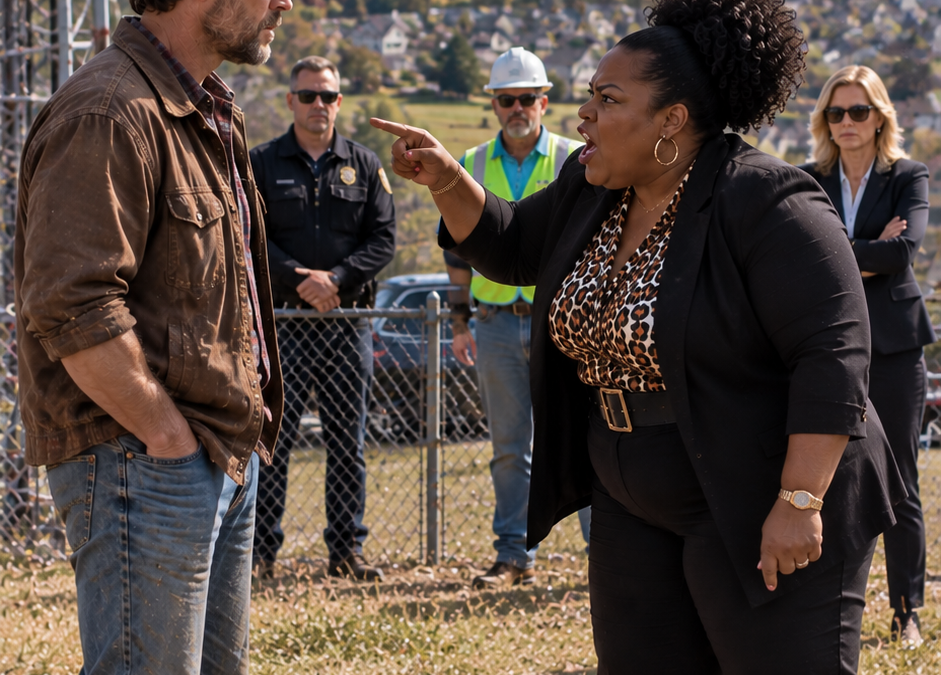
“My land isn’t part of Brier Glenn.”
Her eyes moved downward.
Boots.
Work jacket.
Old pickup.
Then back to me.
It lasted maybe a second.
Long enough.
“Mr. Calvin,” she said, “anyone living beside a community like ours has some responsibility for property values inside it.”
Mr. Calvin.
A title attached to my first name.
Almost respectful.
Not quite.
I thought about the other phrase too.
A community like ours.
Vanessa never actually told me my boundary was wrong.
She simply behaved as though a boundary could not possibly matter more than the association’s preferences.
“I have the plat.”
She stared at me.
“I had a survey done when I bought the property. The pins are still set. We can walk it right now.”
“That won’t be necessary.”
“It would settle this.”
“The board will contact you.”
Then she returned to her white crossover and left.
I stood beside the fence holding the coaxial cable and convinced myself it would disappear in a week.
Three days later, I received an envelope.
Heavy paper.
Embossed HOA logo.
The heading:
NOTICE OF VIOLATION
UNAUTHORIZED COMMUNICATION STRUCTURE
I read the word unauthorized three times.
Unauthorized by whom?
The letter cited Brier Glenn covenants regulating structures visible from common areas.
I had thirty days to remove the tower.
If I refused, I would receive a $250 initial penalty and $50 per day afterward.
Near the bottom was the clause that mattered later.
The HOA reserved the right to undertake corrective action and charge all related expenses to the responsible party.
The letter had been signed by Tessa Monroe, the management company’s property manager, on behalf of the Brier Glenn board.
I didn’t know Tessa.
I later learned Vanessa had supplied the address and represented that the board had properly authorized enforcement.
Tessa managed multiple associations.
She had processed hundreds of violations.
Never once had she been asked to send one to somebody who was not actually a member.
I never blamed her for that first letter.
I responded by certified mail.
Short.
I stated that my parcel was not subject to Brier Glenn’s declaration.
That I had never been an HOA member.
That the tower stood entirely on property I owned in fee simple.
Then I attached the deed.
Plat.
Stamped boundary survey.
County parcel record.
Everything.
The survey showed the tower base.
Every guy anchor.
All four corners.
The subdivision line almost ninety feet away.
I scanned everything before mailing it.
Kept the receipt.
Any functioning association would have ended the dispute there.
An attorney could have looked at the documents for five minutes and told them to close the file.
Eleven days later, I received another letter.
That was when I stopped believing there had been a simple mistake.
The second notice grudgingly acknowledged that my parcel might not be subject to ordinary membership assessments.
Might not.
Then it invented a new concept.
The tower was inside Brier Glenn’s “visual impact area.”
According to the letter, the HOA’s architectural authority extended to external conditions that materially affected the community’s aesthetics.
There was no such thing.
No recorded instrument.
No covenant reaching onto neighboring land because residents could see it.
Vanessa had taken a phrase that sounded official and used it to bridge a property line the actual documents would not let her cross.
I attended the next board meeting.
Tuesday night.
Brier Glenn clubhouse.
Folding chairs.
Coffee urn.
A projector someone struggled to connect.
I signed in as a guest.
Tessa sat with a laptop.
Elliot Crane sat near the end of the board table.
Vanessa sat in the center with a printed agenda.
Four empty chairs were open near the front.
When Vanessa saw me, she pointed toward the last row.
I sat there.
I hadn’t come to argue about seating.
When public comment opened, I carried my survey to the front.
I placed it on the table.
My parcel highlighted.
Brier Glenn’s boundary highlighted differently.
“I am not part of this association.”
Vanessa watched me.
“The tower is on my deeded property. I’ve already sent this survey by certified mail.”
I turned it so every board member could see it.
“I’m not asking you to like the tower. I’m asking the board to look at the boundary before penalties continue.”
Vanessa glanced downward.
Two seconds.
Maybe less.
Then she slid the survey aside with two fingers.
“We don’t need you to teach us how to manage our community.”
The room changed.
Not loudly.
The way rooms do when everyone realizes a conversation has stopped being about policy.
I looked at the survey.
Then at Vanessa.
“I’m not teaching you how to manage your community.”
I pointed at the highlighted line.
“I’m showing you where your community ends.”
Someone near the coffee urn laughed.
Then someone else.
One person disguised theirs as a cough.
Vanessa flushed red from her collar upward.
“The board has noted your remarks.”
She moved to the next agenda item.
I picked up the survey.
Went home.
And knew I had just made things worse.
Around that time, I kept doing something I’d done for years.
Every couple of weeks, I climbed about fifteen feet up the north side of the tower to inspect a gray steel enclosure mounted on a platform.
Large toolbox size.
Weather gasket.
Keyed latch.
Small status display.
I checked the seal.
Ground strap.
Readout.
Then climbed down.
One afternoon, Elliot’s wife saw me from the drainage path.
“Working on your radio?”
“Not exactly.”
She looked toward the box.
“What is it?”
“A few things up there aren’t mine.”
She nodded.
Kept walking.
I thought nothing of it.
I didn’t consider the information secret.
I considered it private.
The same way the contents of my garage were private.
I shouldn’t have needed to explain every piece of equipment on my property to an HOA that had no jurisdiction over the property in the first place.
Nine days after the clubhouse meeting, Brier Glenn emailed its residents.
A woman named Peggy forwarded it to me.
Subject:
NEIGHBORHOOD STANDARDS UPDATE.
The message described an “unregulated radio tower on the western perimeter” negatively affecting neighborhood aesthetics and subject to ongoing enforcement action.
It never named me.
Didn’t need to.
There was one tower.
One man.
“Unregulated” did a lot of work.
It sounded like an official determination.
It wasn’t.
The structure was maintained.
Grounded.
Permitted as required.
The transmitters associated with it operated under applicable licensing.
Then there was the word enforcement.
That told sixty-one households some legitimate authority had investigated the matter.
Most residents weren’t going to spend Tuesday night searching county land records to see whether their HOA had authority outside its own subdivision.
They would read enforcement and assume someone responsible had checked.
The social change was gradual.
That made it more painful.
A man who had waved at me for four years stopped.
A woman walking her dog crossed to the other side of the street.
Someone whose car stereo I had repaired came into my shop, wandered for ten minutes, then left without speaking.
Nobody threatened me.
Nobody yelled.
Courtesy just disappeared in small pieces.
By the second week, I stopped drinking morning coffee on my porch.
I didn’t want to be watched.
Then the interference rumor started.
Two residents separately told me Vanessa was suggesting my tower might be responsible for their technology problems.
Slow internet.
Garage-door remotes.
Wireless thermostats.
Television pixelation during storms.
She never said it definitely was.
That would have been easier to challenge.
She said it might be.
She said residents had concerns.
She said the board was investigating.
That’s an efficient way to manufacture a belief while retaining deniability.
Technically, the allegation made little sense.
The radio systems on my hill operated in licensed bands far removed from ordinary consumer Wi-Fi frequencies.
Output levels and antenna patterns were engineered to send energy outward across terrain, not down into a subdivision immediately below the site.
I had spectrum records.
Years of them.
Had anyone actually asked, I would have shown them.
Nobody did.
You cannot easily disprove an accusation people refuse to make directly.
The last time Vanessa came near my property before the tower disappeared, she brought Tessa Monroe.
Vanessa carried a printed satellite image with a red line drawn across it.
She pressed it against the fence rail.
“The board now has reason to believe at least one guy anchor encroaches into a Brier Glenn landscape easement.”
I looked at the image.
The resolution was poor enough that her marker line represented maybe fifteen feet of actual land.
“What easement?”
“The drainage landscape corridor.”
“Recording number?”
“We’ll provide the documentation.”
“Did you locate the corner pins?”
“The imagery is sufficient for board purposes.”
I went to my house.
Came back with my survey and a hundred-foot tape.
Then I measured each guy anchor while Vanessa and Tessa watched.
Nearest anchor:
Thirty-one feet inside my boundary.
The others farther.
I called out the measurements.
Held the tape toward Vanessa.
She didn’t take it.
“If you believe you have authority here, show me the deed or easement that gives it to you.”
Silence.
“Book and page. Recording number. Anything.”
She folded the satellite image.
Then her voice softened.
Almost kind.
“Calvin, maybe removal isn’t something you’re financially able to handle.”
I stared at her.
“There’s nothing shameful about that. The association could arrange removal. We have contractors.”
There it was.
For six weeks, Vanessa had talked about sight lines, responsibility, neighborhood standards, and property values.
Underneath it all was a judgment she had made the first day she looked at my boots and old pickup.
She thought I couldn’t afford to resist.
She wasn’t wrong that resistance costs money.
She was wrong about nearly everything else.
“My ability to pay doesn’t create your authority.”
She walked toward her car.
Tessa followed.
Vanessa opened the driver’s door and looked up at the tower.
“That thing is coming down eventually.”
That night, I started documenting everything like a failed radio site.
Second camera on the porch.
Existing camera repositioned toward the tower.
Every letter scanned.
Every email archived.
Photos saved by date.
Conversation log.
Names.
Times.
I wasn’t planning revenge.
I wasn’t planning litigation.
I was preserving system logs before somebody erased the failure.
Two weeks later, I had to drive four hours south.
An equipment recovery job.
Some paperwork connected to my late aunt’s estate.
Two days away.
I left Saturday morning.
The tower was standing in the rearview mirror when I drove out.
I returned Monday evening.
The sun was already dropping.
There is a bend in the county road where the hill becomes visible through the pines.
I looked up.
Something was wrong.
The sky looked too large.
Then I understood.
The tower was gone.
I didn’t stop at the house.
I drove straight up the two-track.
The truck bounced hard enough to throw tools against the bed.
I stepped out.
Sixty feet of steel had disappeared.
Your mind resists that kind of absence.
It knows the shape that belongs in front of it.
The sky where the tower had stood seemed unnatural.
At the concrete base were four cut anchor bolts.
Torch marks.
Slag.
Guy wires gone.
The anchor blocks had been dug around.
Hardware sheared away.
Dual-wheel ruts crossed the pasture.
My west gate had been lifted off its hinges and left leaning against a post.
I barely slept.
By six Tuesday morning, I was reviewing surveillance footage.
Coffee beside the laptop.
Cold before I remembered it existed.
At 8:17 Monday morning, a flatbed and crane truck drove onto my property.
PIKE STRUCTURAL SERVICES.
Two minutes later, Vanessa’s white crossover arrived.
She stepped out wearing boots.
Walked toward the hill.
Pointed at the tower with her whole arm.
The crew knew what they were doing.
That part mattered.
This wasn’t nighttime vandalism.
Nobody attacked the tower with an angle grinder.
The crane was positioned properly.
The top section rigged.
Guy wires released in sequence.
The structure lowered section by section.
Four and a half hours.
Professional.
Daylight.
Scheduled.
Invoiced.
Documented.
That made the whole thing worse.
At 7:40, I called Pike Structural Services.
Mason Pike answered.
“I’m Calvin Reic.”
I gave him the address.
“Why was your company on my land yesterday?”
“We performed the tower removal for Brier Glenn HOA.”
“I own that parcel.”
Silence.
“I didn’t hire you.”
Longer silence.
A compressor ran somewhere behind him.
“Say that again?”
I did.
His voice changed immediately.
Mason told me the HOA contacted him three weeks earlier.
The management company provided a work order.
The board president confirmed authorization.
He had been told the tower was a nuisance structure subject to HOA enforcement.
“Did you verify property ownership?”
Nothing.
For maybe fifteen seconds.
Then:
“I’m going to pull my file.”
He sounded sick.
“I’ll call you back. And Mr. Reic, the tower hasn’t been scrapped.”
That mattered enormously.
“It’s at our yard on Ellsworth. We sectioned it and cribbed it.”
“Everything?”
“Everything we removed.”
“I’m glad to hear that.”
He apologized.
I believed him.
Then I called Vanessa.
She answered on the fourth ring.
I asked her to come to the property.
Twenty minutes later, she walked up the hill.
Flat shoes this time.
She looked at the empty site.
No apology.
No surprise.
She exhaled almost contentedly.
“I gave you plenty of time.”
I studied her.
“You hired a contractor.”
“Yes.”
“Sent them through my gate.”
“The association took corrective action.”
“Onto private property.”
“You refused compliance.”
“To remove a structure I own.”
She looked toward the valley.
“Your penalties and the contractor’s costs will be added to your account.”
“I don’t have an HOA account.”
“You do now for enforcement purposes.”
That was the level of reality we were dealing with.
Then she said the sentence I still struggle to believe.
“If you’d cooperated from the beginning, you wouldn’t be paying for this now.”
I couldn’t find an answer worth giving her.
My phone buzzed.
I pulled it from my jacket.
Grant Holloway.
County Emergency Communications.
I had not heard his voice in more than a year.
The arrangement between us was specifically built so that we rarely needed to speak.
“Calvin,” he said, without greeting, “Ridge Four has been offline since yesterday morning. We’re not getting it back remotely. Are you doing maintenance?”
I looked at Vanessa.
Then at the four cut bolts.
“No.”
Pause.
“The entire tower is gone.”
Silence.
Grant Holloway had spent his career managing emergency radio systems.
People like Grant do not waste emotion on incident calls.
His voice changed.
“When you say gone, tell me exactly what that means.”
“A contractor removed it yesterday while I was out of town.”
Another silence.
“They cut the base. Took it down in sections. I wasn’t notified. I didn’t authorize anything.”
Grant asked one question.
“Where’s the cabinet?”
That was the moment the story became something Vanessa had never understood.
The tower itself belonged to me.
Steel.
Guy wires.
Anchors.
Grounding.
Everything structural.
But the tower had not been used only by me for a very long time.
The western third of our county is difficult radio terrain.
A long north-south ridge creates shadows behind it.
Beyond that ridge are valleys and hollows with roughly nine hundred households spread across miles of rural road.
For years, deputies and volunteer firefighters entering certain low areas could key their radios and get unreliable coverage.
The county studied the problem repeatedly.
The engineering answer never changed.
They needed elevation on the east side of the ridge to fill the shadow.
Building a county-owned site from scratch would have been expensive.
Land.
Commercial power.
Tower.
Permitting.
Maintenance.
Close to a million dollars.
So years earlier, county officials found a hill that already had steel on it.
My hill.
The Dunlap family owned it then.
They signed an agreement allowing County Emergency Communications to install equipment on the private tower.
When I bought the property in 2015, that agreement appeared in my title work.
I signed the assignment.
Four years later, Grant and I renewed it for another ten years.
The division was clear.
I owned the tower.
The county owned its communications equipment.
Their equipment included a specialized antenna near the top.
Coax feed line.
Repeater.
Duplexer.
Battery backup.
And the sealed gray cabinet mounted on the tower’s north leg.
The same cabinet I inspected externally every few weeks but never opened.
Because it wasn’t mine.
The site designation was Ridge 4.
It appeared on county radio-system maps.
Maintenance contracts.
Licensing records.
Coordinates tied to my parcel.
And I want to be precise about what Ridge 4 was.
It was not the primary county radio system.
Nobody lost county-wide emergency radio service because Vanessa removed my tower.
The main network used three commercial sites.
Those kept operating.
Ridge 4 was a fill and backup layer.
It helped cover the western shadow.
It provided redundancy if a primary link failed.
It carried additional traffic during major incidents.
It helped crews in terrain where primary signals sometimes failed to reach ground level.
Most days it simply sat there.
Like a spare tire.
A spare tire seems irrelevant right up until the moment the tire touching the road fails.
Nobody in Brier Glenn knew.
There was no big county sign.
No warning plaque on the fence.
The agreement predated the modern tendency to label everything.
Sixty-one families saw an old radio tower belonging to the quiet man uphill.
I had never corrected them.
Why would I?
The deed.
Fence.
Survey.
Locked county cabinet.
Those seemed like sufficient statements.
Standing on the hill with Grant on the phone, I looked at Vanessa.
“When your contractor removed the tower, what did they do with the gray cabinet mounted on the north leg?”
Her face showed irritation.
“I don’t know. They removed everything.”
Grant heard her through the phone.
His voice became flat.
Procedural.
“Calvin, nobody touches that equipment now. Not you. Not the contractor. Where is it?”
“Pike Structural’s yard. Ellsworth Road.”
“We’ll have someone there.”
Then he asked me to remain at the property.
Vanessa finally looked at me differently.
“What equipment?”
“The equipment that doesn’t belong to me.”
At 11:20, two county vehicles came up my gravel.
Grant arrived in a county SUV with two roof antennas.
A technician named Bill followed in a service truck loaded with cases.
Grant wore a windbreaker and credentials on a lanyard.
He shook my hand.
Then stood at the empty tower pad.
Four cut bolts.
Ruts.
Open sky.
He said nothing for a while.
Then began taking photographs.
Measured distances.
Wrote in a notebook.
That notebook meant something to me.
Grant understood immediately that this had stopped being only a technical failure.
It was now an evidence problem.
County staff split their day between my property and Mason Pike’s yard.
The damage was significant but not catastrophic.
The Ridge 4 antenna had been removed with the upper tower section.
Mounting hardware was damaged.
The radome had been crushed.
The feed line was destroyed.
The cabinet had been unbolted and placed upright on a pallet.
Mason’s crew had actually handled it carefully.
The sealed conduit connection had been sheared, compromising the environmental seal.
That meant the repeater and duplexer could not simply be reinstalled.
They had to be bench-tested.
Inspected.
Recertified.
The western shadow had lost its backup coverage.
Not primary service.
Backup.
Grant was exact about that.
So am I.
No emergency calls went unanswered because of the tower removal.
No firefighter was stranded.
No deputy was hurt.
But for the weeks Ridge 4 remained offline, the county had lost a layer of resilience across hundreds of square miles.
If a major incident saturated the network, or another site failed, or emergency crews entered one of the difficult hollows, the system had less margin.
Emergency communications rerouted two talk groups through a relay site twelve miles north.
Some volunteer radios had to be reprogrammed.
A neighboring county provided a portable repeater trailer under mutual aid.
That trailer was placed on a leased site with a generator.
Someone had to fuel it twice a week.
I asked Grant directly:
“Did anybody get hurt because of this?”
“No.”
Then he clicked his pen.
“That’s the thing about backup systems.”
I waited.
“You can remove one for six weeks and ninety-nine times out of a hundred, nothing happens.”
He looked at the missing tower.
“And everybody who removed it gets to believe they were right.”
Vanessa stayed nearby.
Around one o’clock, Grant approached her.
“Who authorized removal?”
“The association.”
“Who at the association?”
“The board.”
“When?”
“This matter was under enforcement for weeks.”
Grant waited.
“Who signed the work order?”
Before Vanessa answered, Mason Pike’s truck arrived.
He had asked permission to come.
He carried a folder.
Vanessa began talking before he fully stepped from the cab.
“The contractor was retained to perform professional services and has responsibility to verify work-site conditions—”
Mason let her finish.
Then handed Grant a printed email chain.
He gave me another copy.
Three messages.
In the first, Mason’s office asked Brier Glenn to confirm ownership of the tower and confirm that the association had legal authority to order its removal.
His insurer required it.
The second message forwarded that request through the property manager.
The third came directly from Vanessa’s HOA email.
4:11 p.m.
Nineteen days before demolition.
Eleven words before her typed signature.
Proceed with removal. HOA accepts responsibility for authorization.
Vanessa Harrow
President
Nobody spoke.
Bill stopped coiling cable.
Vanessa looked at the paper.
Then found the defense she would use repeatedly afterward.
“Nobody told me county equipment was installed there.”
Grant did not raise his voice.
He asked:
“Did you ask the landowner?”
Silence.
“Did you call the county?”
She shifted.
“There’s a public number on every county communications page.”
No answer.
“Did your association attorney review your authority to enter this parcel?”
Vanessa started to answer.
Stopped.
Then:
“Do you possess any legal right to enter Mr. Reic’s property?”
“The association governing documents provide—”
Grant interrupted.
“I didn’t ask what your governing documents provide.”
I remember that sentence.
For six weeks, I had asked Vanessa versions of those same questions.
When I asked them, I was a difficult landowner.
A man with a grievance.
When a county official asked them beside a county vehicle while emergency communications equipment sat in a contractor’s yard, they became something else.
An inquiry.
I didn’t say anything.
I didn’t need to.
Vanessa left around two.
Grant watched her car disappear.
Then he turned toward me.
“Do you have documentation?”
“All of it.”
“How much?”
“Every letter. Every email. Certified receipts. Camera footage. Conversation log.”
He almost smiled.
“Of course you do.”
“What does that mean?”
“You used to do this for a living.”
Two days later, the HOA’s attorney finally appeared.
Audrey Keane.
Partner at a small county-seat firm.
Brier Glenn had retained her office for six years.
Parking rules.
Fence colors.
Assessments.
Ordinary association work.
In all six weeks of my dispute, nobody had called her once.
Not when I sent the deed.
Not when I sent the survey.
Not before the fines.
Not before the satellite image.
Not before Vanessa sent a crane onto my property.
Audrey came to my house with Elliot Crane.
She stopped at the gate.
“Mr. Reic, may we come onto the property?”
That was the first time anyone representing Brier Glenn had asked permission.
“Yes.”
She inspected the tower site.
Cut bolts.
Ruts.
Damaged gate.
Then we went inside.
I gave her the file.
She read for twenty minutes.
Elliot sat silently at my kitchen table.
The legal issue wasn’t complicated.
My parcel was not subject to Brier Glenn’s declaration.
It had never been annexed.
Never assessed.
Never defined as an HOA lot.
No HOA easement crossed my land.
No architectural authority extended to it.
No enforcement rights.
No right to fine.
No right to enter.
Certainly no right to hire a contractor to remove a structure.
Audrey later asked Vanessa to identify the covenant provision she relied upon.
Vanessa produced the section governing external structures visible from common areas.
Confidently.
Audrey read it.
All the way to the top.
The operative qualification was six words.
Lots subject to this Declaration.
My land was not.
Everything below those words depended on those words.
Then Tessa Monroe found something worse.
After the tower removal, she began searching Brier Glenn’s archived files.
Partly because she was worried.
She had been the person whose name appeared on the notices.
In a folder five years old, she found a legal memorandum.
At that time, the HOA had considered extending a walking path near the drainage line.
Doing so would have required acquiring roughly a quarter acre of my property.
The board had consulted its attorney.
That lawyer’s written advice was explicit.
The Reic parcel is outside HOA jurisdiction, and any acquisition would require a negotiated purchase from the owner.
Brier Glenn already knew.
Not suspected.
Not overlooked.
Knew.
Its own attorney had researched the issue years earlier and documented that my property lay outside HOA control.
The memo had been sitting in their own files.
Vanessa wasn’t president then, though she had served on the architectural committee during part of that period.
Nobody bothered to look.
Then Audrey reviewed my side.
Stamped boundary survey.
Sent certified in April.
Signed receipt from management.
Sent again by email in May.
Then physically placed in front of Vanessa at the board meeting.
Three presentations.
Three opportunities.
Same answer.
The document Vanessa needed had been in her hands.
She slid it aside.
That mattered more to me than almost anything else.
Because by then I understood the entire dispute could have ended before the first fine.
Grant provided a cost estimate the following week.
Antenna replacement.
Mounting hardware.
Bench inspection.
Recertification.
Repeater and duplexer work.
New feed line.
Connectors.
Battery backup.
Grounding.
Lightning protection.
Engineering.
Replacement tower permitting.
Crane work.
Site restoration.
Then the temporary operating costs.
Portable repeater lease.
Fuel.
Relay programming.
Overtime.
Mutual aid.
The range:
$85,000 to $140,000.
Depending on equipment condition and how long the temporary arrangement remained necessary.
Not punitive damages.
Not an inflated lawsuit number.
Actual restoration and operational cost.
Ironically, the tower steel Vanessa had fought so hard to remove was one of the cheaper parts.
Vanessa attended the meeting where Grant explained the estimate.
When he finished, she asked:
“So the county will invoice Mr. Reic for those costs?”
Grant looked at her.
Audrey put her pen down.
Then Grant said:
“Why would we invoice the man who didn’t remove our equipment?”
That question traveled through Brier Glenn faster than any official notice.
Residents started asking questions.
Where did Vanessa get authority?
Why was a contractor hired without legal review?
Why did the president guarantee authority in writing?
Did insurance cover intentional entry onto private land?
Why was Audrey never consulted?
And the question that changed the board’s attitude fastest:
Were sixty-one families about to receive a special assessment because one president refused to read a survey?
An emergency meeting was scheduled.
This time I received a formal invitation.
When I entered the clubhouse, nobody pointed toward the back wall.
A chair near the front had a folded card with my name.
I almost laughed.
Vanessa opened the meeting.
She spoke about leadership.
Property values.
Good-faith judgment.
Volunteer service.
The difficulty of making decisions that later get criticized by people who never step forward to help.
I didn’t argue with any of it.
When my turn came, I placed three documents on the table.
First:
My boundary survey.
Attached to the certified-mail receipt proving the management office received it in April.
Second:
My May email attaching the same survey again.
Third:
The HOA’s own five-year-old attorney memorandum stating that my parcel was outside association jurisdiction.
Then I said the only two sentences I had prepared.
“I never asked Vanessa to like my tower.”
I looked around the room.
“I asked her not to take something that wasn’t hers.”
Elliot Crane stood.
He moved to suspend Vanessa’s executive authority pending internal review and remove her from the architectural committee during that review.
Somebody seconded immediately.
Too immediately for the idea to have been spontaneous.
Vanessa didn’t look toward Elliot.
She looked at me.
“You knew this would happen.”
“Knew what?”
“You knew that tower mattered.”
“Yes.”
“You knew county equipment was there.”
“Yes.”
Her face changed.
Energy returned.
She turned toward the room.
“Then why didn’t you tell me?”
She believed she’d found the escape.
That I had concealed something essential.
I took out my phone.
Opened an email from May 14.
Three weeks before the removal.
Then I read my own sentence.
The structure supports third-party licensed communications equipment. Unauthorized removal may affect services beyond my property.
Then I read Vanessa’s response.
Sent that same afternoon.
Your excuses do not alter HOA policy.
I placed the phone face down.
No one needed commentary.
She hadn’t lacked information.
She had been warned.
She had received the boundary survey twice.
The attorney memo was in the association’s own file.
The contractor asked her directly to confirm authority.
I warned her removing the tower could affect third-party communications.
Every possible exit had been available.
She walked past all of them.
The aftermath took about five months.
Nothing about it looked like television.
No police convoy.
No dramatic arrest.
Nobody put Vanessa in handcuffs.
County Emergency Communications handled its side as a property and restoration matter.
The department documented its damaged equipment and temporary operating expenses.
Before anything returned to the hill, the county required a formal restoration and access agreement.
I hired an attorney.
My claims were resolved without trial.
Trespass.
Tower value.
Reconstruction.
Fence and gate damage.
Pasture restoration.
Professional time I spent dealing with recovery.
Mason Pike cooperated from the first day.
Nobody treated him like the architect of the problem.
He had asked the right question.
His email was clear.
Vanessa gave him a false assurance of authority under her own signature.
He preserved the tower sections instead of scrapping them.
He gave us the correspondence without games.
That mattered.
The HOA’s insurance carrier resisted parts of the claim.
Eventually, it covered most of the losses.
I was glad.
I didn’t want sixty-one families financing every consequence of a decision they hadn’t made.
Brier Glenn still paid its deductible.
Uncovered costs.
Its own legal fees.
And later, higher insurance premiums.
Vanessa lost the presidency.
She was permanently removed from the architectural committee.
The internal review found that she had committed the association to a contractor agreement without proper authority.
She did not lose her house.
She did not go bankrupt.
She did not go to jail.
I never wanted any of that.
What she lost was simpler.
The ability to approach a fence and expect obedience because she had decided the world on the other side belonged to her jurisdiction.
By late autumn, a new tower stood on my hill.
Not identical to the old one.
The county and I decided there was no reason to recreate a 1960s guyed structure exactly.
The replacement was a self-supporting monopole roughly eight feet taller.
Cleaner.
Stronger.
Easier to secure.
The county’s communications equipment went into a proper weather-rated shelter at the base instead of a cabinet strapped to the tower.
I helped with the grounding and lightning-protection design.
The new Ridge 4 equipment was tested.
Commissioned.
Returned to service.
The temporary trailer was removed.
The western shadow had its backup layer again.
At the base of the new tower, the county installed a small steel post.
On it was an aluminum sign.
White background.
Black lettering.
AUTHORIZED COUNTY EMERGENCY COMMUNICATION SITE
NO UNAUTHORIZED ACCESS
I laughed the first time I saw it.
A sign.
Maybe forty dollars’ worth of aluminum and hardware.
The entire dispute—
Letters.
Fines.
Rumors.
Crane.
Damaged equipment.
Temporary repeater.
Attorneys.
Claims.
Five months of restoration.
Somewhere between eighty-five and one hundred forty thousand dollars in county-related costs alone—
might have been avoided if the old tower had simply worn a government label large enough for Vanessa to respect.
Grant came out on commissioning day.
He stood beside me and looked up.
“Some people only respect a boundary after an agency puts its name on it.”
“I used to think a fence was enough.”
“So did I.”
I still think about that.
Because the tower had already carried every boundary a reasonable person should have needed.
My deed.
My fence.
My survey.
The county’s private agreement.
Licensed equipment.
A locked cabinet.
None of that mattered to Vanessa because none of it was visible in the language she respected.
Title.
Authority.
Logo.
She needed the sign.
One afternoon in December, Vanessa drove past the bottom of my property.
I was splitting wood beside the shed.
Her crossover slowed.
She looked uphill.
The new monopole stood gray against a winter sky.
She didn’t stop.
Didn’t lower the window.
Didn’t enter my gravel drive.
Didn’t tell me what I was permitted to keep on my own land.
She drove on.
That silence meant more to me than the settlement.
For months, I had believed this conflict was about a tower.
Then for a while, I thought it was about property lines.
Later I understood it was about the difference between authority and certainty.
Vanessa was certain.
She was certain the tower lowered property values.
Certain HOA rules could reach anything residents could see.
Certain a poor satellite image mattered more than a stamped survey.
Certain I could not afford to resist.
Certain that because she represented sixty-one homes and I represented only myself, her claim automatically outweighed mine.
She was wrong about every one of those things.
But certainty can imitate authority surprisingly well when nobody challenges it.
That was why the violation letters mattered.
Why the phrase ongoing enforcement mattered.
Why residents stopped waving.
An official document can create its own atmosphere.
People see letterhead and assume jurisdiction.
They see a fine and assume violation.
They see a board president speaking confidently and assume somebody checked.
Often, nobody did.
Tessa hadn’t.
Mason hadn’t checked land ownership independently because Vanessa had guaranteed authority.
The board hadn’t called Audrey.
Residents hadn’t looked at the county records.
And Vanessa had refused to look even when the documents were physically placed in front of her.
That is how a ridiculous idea traveled all the way from a fence-line conversation to a sixty-foot tower being dismantled by a crane.
Not because anybody woke up and decided to commit some grand conspiracy.
Because one person decided she was right.
Then everybody around her treated that confidence as enough.
I also learned something about myself.
For years, I had assumed records were defensive.
You saved an email because someday somebody might challenge you.
You kept a survey because someone might dispute a line.
You logged an equipment reading because a system might fail.
But records do something else.
They keep you from becoming the loudest person in the room.
When Grant asked what happened, I didn’t have to convince him.
I had footage.
When Audrey asked where the boundary was, I didn’t have to describe it.
I had the survey.
When residents wanted to know whether Vanessa had been warned, I didn’t need to characterize her behavior.
I had the email.
When Mason needed to establish what he had been told, he had his request and Vanessa’s answer.
The truth stopped depending on who sounded more confident.
That may be why I never felt much satisfaction watching Vanessa lose the presidency.
By then, the outcome felt mechanical.
Input.
Output.
She signed the authorization.
The crane came.
The repeater went offline.
The county documented the loss.
The documents established jurisdiction.
The board acted.
No single moment destroyed her credibility.
The record did.
Piece by piece.
I occasionally still see people from Brier Glenn.
Some started waving again.
A few apologized.
One man told me his wife had been convinced for weeks that my tower was interfering with their garage-door opener.
“What fixed it?” I asked.
“Battery in the remote.”
I laughed harder than I probably should have.
Peggy brought cookies to the shop around Christmas.
Elliot came by with another radio.
This time I charged him for the capacitor.
Not because I was angry.
Because twenty minutes of my time had apparently become valuable.
Tessa visited the property once after everything ended.
She apologized for mailing the notices.
I told her I didn’t blame her for the first one.
“What about the second?”
“You should’ve checked by then.”
She nodded.
“Fair.”
Then she looked up at the new tower.
“Does that county sign bother you?”
“It’s ugly.”
“So was the old tower.”
“Exactly.”
We both laughed.
Grant and I renewed some language in the county agreement afterward.
More explicit notice provisions.
More visible identification.
Emergency contact information.
Restrictions requiring county consent before structural modifications.
Lawyers enjoy solving yesterday’s problem in tomorrow’s contract.
I didn’t object.
The document got thicker.
The site got safer.
Ridge 4 went back to being what it had been before Vanessa ever noticed the hill.
Quiet.
Uninteresting.
Mostly unnecessary.
Which is what good backup infrastructure should look like.
Most days, nobody thinks about it.
Police radios work.
Fire crews talk.
The commercial system carries traffic.
No crisis.
Then one storm drops ice on the wrong ridge or one fiber link goes down or a major incident fills the system with traffic, and that ugly piece of infrastructure suddenly has a job.
I still use the tower too.
My amateur antennas went back up once the county work was complete.
On cold nights, I occasionally sit in the radio room with coffee and listen to voices travel farther than they have any business traveling.
There is something humbling about radio.
You cannot see the path.
You cannot see the wave leaving the antenna.
You only know it worked when another human being answers.
Property boundaries are different.
We pretend we cannot see them because they are abstract.
But they’re not imaginary.
They exist in deeds.
Surveys.
Pins.
Recorded maps.
Agreements.
The fact that a boundary is not painted six feet high in orange does not make it optional.
Vanessa’s mistake was not that she disliked my tower.
She was allowed to dislike it.
Anyone was.
I disliked looking at parts of Brier Glenn.
Their decorative entrance monument struck me as expensive masonry surrounding a sign.
I never sent them a demolition crew.
Her mistake was believing that dislike became jurisdiction the moment she put it on HOA letterhead.
That was the entire case.
She saw the tower.
Decided it did not belong.
Then worked backward until she had invented authority to remove it.
“Visual impact area.”
Imaginary easement.
Architectural enforcement.
Daily penalties.
Eventually physical removal.
At each step, reality offered her an opportunity to stop.
The fence.
My first explanation.
The deed.
The survey.
The certified letter.
The board meeting.
The guy-anchor measurements.
The lack of a recorded easement.
My written warning about third-party communications equipment.
Mason’s direct request for proof of authority.
Her own attorney, had she bothered to call.
Every one of those was an exit.
She chose none of them.
By the time Grant Holloway called, it was too late for an exit.
The steel was already lying in sections at Mason’s yard.
The county equipment was offline.
The only remaining question was who would be responsible for putting everything back.
Vanessa had once told me that the tower lowered Brier Glenn’s property values.
Maybe some residents thought it did.
I can’t measure that.
What I can measure is what her decision cost.
Crane work.
Replacement equipment.
Temporary communications.
Engineering.
Legal bills.
Insurance deductible.
Higher premiums.
Board credibility.
County goodwill.
Months of unnecessary conflict.
The tower had stood on that hill for decades and cost Brier Glenn nothing.
Vanessa managed to make its absence extraordinarily expensive.
That is the irony people usually focus on.
I don’t.
What stays with me is Grant’s question.
Where’s the cabinet?
Not because it was dramatic.
Because in one sentence, he revealed the difference between appearance and function.
Vanessa saw an ugly tower.
Grant saw a communications site.
I saw both.
That is usually how technical infrastructure works.
To the person passing by, it is a pole.
Box.
Dish.
Cabinet.
Wire.
Eyesore.
To the system, it is a node.
A route.
Redundancy.
Coverage.
A connection that exists specifically so somebody else does not have to think about it.
Vanessa never asked what the tower did.
She asked only why she should have to look at it.
That was her failure long before the crane arrived.
The new monopole is taller than the old tower.
Eight feet taller.
I appreciate that more than I should.
Nobody in Brier Glenn has complained.
At the base, the county sign remains clean and bright.
Occasionally, when I’m checking the fence or clearing brush, I stop and look at it.
AUTHORIZED COUNTY EMERGENCY COMMUNICATION SITE.
Those words are apparently more powerful than an iron survey pin, a recorded deed, and a property owner saying no.
I used to find that depressing.
Now I mostly find it useful.
Because Vanessa taught me something I had not learned in nineteen years of technical work.
Some failures are not caused by bad equipment.
They are caused by people refusing to accept input that contradicts their assumptions.
In radio work, we call that troubleshooting the wrong problem.
You can replace every component in the system and never fix anything if your original diagnosis is false.
Vanessa diagnosed the tower as an HOA problem.
After that, every piece of evidence became something to be dismissed instead of something to be tested.
The boundary survey was an excuse.
The deed was irrelevant.
My technical warning was another excuse.
The contractor’s request was a formality.
The county equipment was something nobody had told her about.
And when every one of those explanations finally collapsed, she asked me why I had not warned her.
I had.
Repeatedly.
She simply couldn’t hear a signal that told her she was wrong.
I still keep the entire file.
Certified mail receipts.
Violation letters.
Satellite image.
Survey.
Emails.
Camera footage.
Mason’s eleven-word authorization.
County restoration estimate.
Settlement documents.
Even the first community email calling the tower unregulated.
They sit in a labeled archive box in my office.
Not because I expect another fight.
Because old technicians keep logs.
If nothing else, they remind me of the difference between what people say happened and what actually happened.
Vanessa Harrow said the HOA had removed an eyesore.
The records say something else.
They say an association entered land outside its jurisdiction after receiving a stamped survey proving exactly where its jurisdiction ended.
They say the president guaranteed authority to a contractor after being specifically asked to verify it.
They say she had been warned that third-party licensed communications equipment used the tower.
They say county equipment went offline.
They say emergency communications had to build a temporary workaround.
They say Brier Glenn paid for consequences that never needed to exist.
The tower came down because Vanessa believed being president meant she had the right to control everything visible from her neighborhood.
The tower went back up because property lines, contracts, and public-safety systems do not operate on confidence.
They operate on records.
On measurements.
On actual authority.
I was never angry that Vanessa thought the old tower was ugly.
She was right.
It was ugly.
The new one isn’t exactly beautiful either.
But on certain winter evenings, when the sky goes pink behind the ridge and the monopole is just a dark line against the light, I look up and see the county antenna near the top.
Somewhere inside the equipment shelter, Ridge 4 waits.
Most nights it does very little.
That is good.
It means the rest of the system is healthy.
But if the main network loses a link, or crews enter the western hollows during the wrong incident, the backup is there.
That was always the point.
Vanessa once believed the tower lowered the value of her neighborhood simply because sixty-one families could see it.
In the end, the thing that cost Brier Glenn money, credibility, and goodwill was not sixty feet of galvanized steel.
It was one person who believed a title on a board agenda gave her ownership over everything she could see from her side of the fence.
The old tower taught her where that fence really was.
The new one makes the lesson harder to miss.








