𝗙𝗨𝗟𝗟 𝗦𝗧𝗢𝗥𝗬 The HOA President Called My Helipad an Eyesore, but She Never Asked Why It Was on the Federal Map
𝗙𝗨𝗟𝗟 𝗦𝗧𝗢𝗥𝗬
The greater interest of the community.
It sounded respectable.
It also meant absolutely nothing if the property wasn’t theirs.
I hired a real-estate attorney named Tessa Vaughn.
Tessa was not dramatic.
That was one of the reasons I liked her immediately.
She read the documents, asked precise questions, then sent the association a formal warning explaining that any entry onto my property without permission would constitute trespass and that altering the landing facility could create additional exposure beyond an ordinary boundary dispute.
Celeste’s response was not to call Tessa.
She discussed me at another HOA meeting.
According to residents who were there, she told the room that I was threatening litigation because my pride had been wounded.
Then she added that a man “in his financial situation” would never be able to sustain a serious legal fight.
When I heard that, I almost laughed.
She had seen work boots, an aging pickup, and grease under my fingernails.
From those details she had apparently completed my balance sheet in her imagination.
A few nights later, Maren Pike contacted me.
She asked whether we could speak privately.
We met at a coffee shop outside Juniper Crest.
Maren looked nervous before she even sat down.
“I don’t think you understand how far she’s taking this.”
She slid her phone across the table.
On the screen was a board resolution authorizing eighty-four thousand six hundred dollars for what it called “emergency hazard remediation on shared land.”
The resolution supposedly approved demolition of my landing pad.
Maren’s signature appeared beneath it.
“I never signed that,” she said.
I enlarged the image.
The signature was perfectly clean.
Too clean.
It looked like a saved digital signature dropped onto the page.
“Has the board voted on this?”
“No.”
“Did anyone authorize the expenditure?”
“Not that I know of.”
“Does Celeste know you’re showing me?”
Maren gave me a tired look.
“What do you think?”
I copied the document and sent it to Tessa.
Then I scheduled an appointment with the county planning department for Monday morning.
I thought we still had time.
That was my mistake.
Friday afternoon, I left town to inspect an aviation fire-suppression system at another facility.
It was a two-day job.
At the previous HOA meeting, Celeste had casually asked whether my business required much travel.
I had answered without thinking.
Saturday morning, my phone vibrated.
Gate motion alert.
I opened the camera feed.
Two flatbed trucks were parked along my access road.
A tracked bulldozer sat behind them.
So did a small excavator.
Workers in reflective vests were moving around the gate.
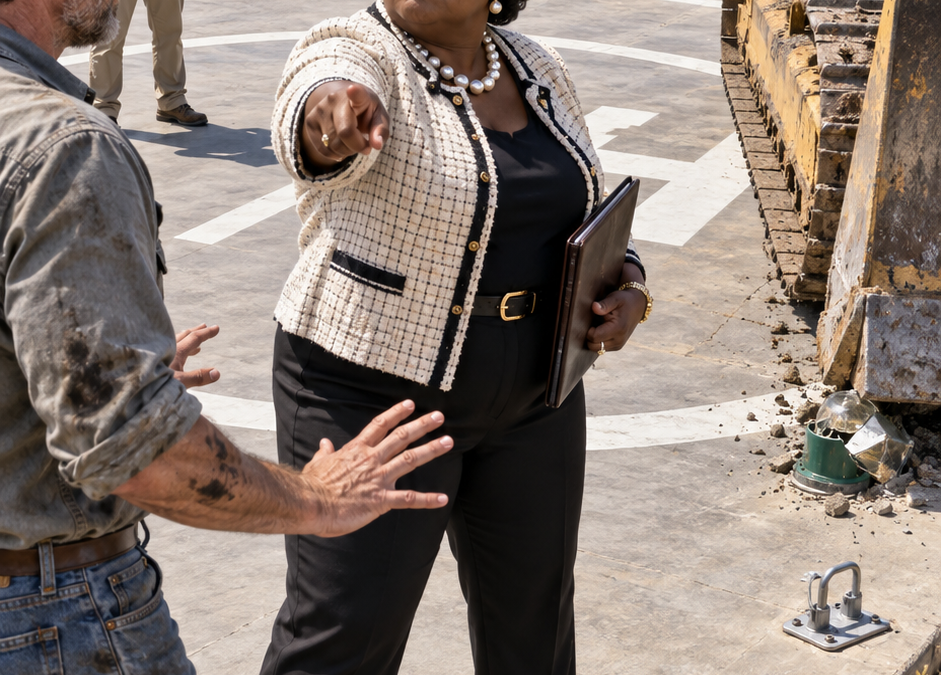
And Celeste stood beside them wearing a white jacket, a folder tucked beneath one arm.
For a few seconds, I simply stared at the screen.
My mind refused to accept what my eyes were already telling me.
Then I saw the logo on one of the trucks.
Rorke Grading.
I found the company number and called.
Wade Rorke answered.
“This is Grant Halden. You’re on my property.”
There was a pause.
“Mr. Halden?”
“Yes.”
“We were told this was HOA common property.”
“It’s not.”
Another pause.
“Ms. Harrow gave us an authorization letter.”
“She doesn’t have authority to give you one.”
“We’ve got a parcel map and board resolution.”
“Both are disputed. Stop your equipment until a surveyor and law enforcement confirm the boundary.”
“I—”
His voice disappeared.
A few seconds later, Celeste came on the phone.
“Grant.”
The familiarity in her tone made my hands tighten.
“Get your equipment off my land.”
“You cannot keep holding an entire community hostage because you need somewhere to feel important.”
“This is a registered emergency landing site.”
“You don’t own a helicopter.”
“That has nothing to do with it.”
“You’re not even a pilot.”
“No.”
“Then what exactly are you defending?”
I looked at the live camera feed.
The bulldozer’s engine was running.
“A landing site emergency crews may need.”
She laughed.
“It’s painted concrete.”
“Celeste, I’m telling you directly that you do not have permission to alter that property.”
“The board has already acted.”
“The board doesn’t own it.”
“You’ve made your position clear.”
“So have you.”
I called the sheriff.
A deputy arrived about twenty minutes later.
I spoke to him by phone while he reviewed the documents Celeste handed him.
She had a county-stamped map.
A board resolution.
An authorization letter.
The deputy was standing in the middle of a land dispute he could not adjudicate on the roadside.
He told everyone to maintain the current situation until ownership could be verified through the proper channels.
I was relieved.
For less than five minutes.
The deputy left.
Celeste walked directly to Wade.
I watched through the camera.
I couldn’t hear everything at first, but then she moved close enough to the gate microphone.
“The deputy said not to change the status quo,” she told him. “We’re not building the overlook today. We’re removing a hazard.”
Wade hesitated.
She pointed toward the pad.
“Continue.”
I called him again.
No answer.
I called Celeste.
No answer.
I called the sheriff’s office again, my attorney, and the county fire department.
Then the bulldozer moved.
There are moments when distance becomes physically painful.
I was three hundred miles away from land my family had protected for decades, watching destruction through a six-inch phone screen while a weak cellular connection froze every few seconds.
The video would stop.
Then jump.
Stop.
Then jump again.
Each time it caught up, something else was gone.
The bulldozer crushed the first perimeter light.
Then another.
The windsock pole bent before tearing free from its anchored base.
A worker dragged it aside.
The blade scraped over the painted identification markings until white paint disappeared beneath dirt and broken aggregate.
Ground anchors snapped.
Loose stone was pushed across the touchdown surface.
The excavator dug into one edge of the prepared area.
Then the bulldozer struck the backup electrical cabinet.
The housing cracked.
Dust rolled across the camera.
Behind it, I could see Celeste pointing.
Directing.
Calmly telling the crew where to go next.
She stood well away from the machinery with her folder under one arm, watching years of maintenance disappear in less than an hour.
I didn’t shout.
I didn’t throw anything.
I sat on the edge of the motel bed and documented every second.
That surprised even me.
I had imagined anger would feel hot.
Instead, mine felt cold.
I kept thinking about my father walking that perimeter.
About the way he used to tug each anchor after checking it.
About him telling me never to certify something safe simply because I hoped it was safe.
He used to say, “Someone you never meet may trust your work with their life.”
Celeste didn’t know any of that.
Worse, she didn’t care to know.
To her, the site represented wasted space and an ugly windsock.
Something standing between her and a nicer photograph of Juniper Crest.
Before leaving, her crew planted a temporary sign in the churned earth.
FUTURE SITE OF HARROW VISTA
A JUNIPER CREST COMMUNITY PROJECT.
She had named it after herself.
I took a screenshot.
Three days later, lightning struck the forest west of Juniper Crest.
By noon, smoke had begun sliding through the valley.
The fire itself was still moving away from most homes, but authorities temporarily closed the mountain road while crews dealt with falling debris, emergency utility shutdowns, and changing wind.
A utility worker named Calvin Rhodes was helping isolate power near the evacuation zone when he developed severe smoke-inhalation symptoms.
Then his heart rhythm became unstable.
His crew requested immediate medical evacuation.
Fire command pulled the nearest suitable landing location outside the heaviest smoke path.
Halden Ridge Heliport.
My property.
A medical helicopter piloted by Travis Calder was routed toward the coordinates.
Travis expected a maintained landing surface.
What he found instead was churned soil, broken anchors, debris, damaged equipment, and an excavator still sitting close enough to the approach corridor to make the site unusable.
He could not land.
He diverted.
The alternate site added nearly eighteen minutes.
Calvin survived.
He eventually recovered fully.
I have always been grateful for that.
Because if he hadn’t, everything that followed would have carried a weight no civil judgment could touch.
But the rescue report documented the problem in plain language.
An active emergency landing location shown as available in operational information was not usable when the aircraft arrived.
No one responsible for coordinating rescue operations had been told it had been destroyed.
When I returned home, the physical damage was somehow worse than the camera footage.
Video flattened everything.
Standing there made it real.
Broken conduit protruded from dirt.
One anchor lay twisted near the tree line.
Scrape marks crossed the concrete.
The electrical cabinet door hung crooked.
The windsock assembly had been tossed beside a drainage ditch.
My father’s pad looked like an abandoned construction site.
I was standing near the center when Celeste arrived.
Two board members followed her.
She didn’t apologize.
She didn’t even look embarrassed.
Instead, she said, “Don’t turn what happened to that utility worker into an opportunity to play hero.”
I stared at her.
“Did you notify the fire department before you destroyed this?”
Her mouth tightened.
“Destroyed is your word.”
“The state aviation office?”
Silence.
“The Federal Aviation Administration?”
She gave a short laugh.
“The association doesn’t need permission from the federal government to improve its own landscaping.”
Behind her stood the HARROW VISTA sign.
I looked at it.
Then back at her.
“Remember that sentence.”
“For what?”
“Because somebody is probably going to ask you to repeat it.”
That evening, my phone rang.
The caller introduced herself as Dana Kessler, an aviation safety inspector.
She said their records showed Halden Ridge as active.
Then she asked the question that changed the entire dispute.
“Mr. Halden, who changed the physical condition of the site?”
I told her.
Everything.
The notices.
The survey.
The emergency easement.
The attorney’s warning.
The board resolution.
My phone call to the contractor.
The demolition.
The diverted medical flight.
Dana listened without interrupting.
Then she said she and a state aviation representative would be on site the next morning.
When they arrived, I had a folding table covered with documents.
Deed.
Survey.
Registration information.
Site diagram.
Inspection history.
Maintenance logs.
Photographs.
Fire-department agreement.
HOA correspondence.
Certified letters.
Video recordings.
Dana reviewed them carefully.
Before asking much about Celeste, she clarified something important.
The aviation authorities were not there to decide who owned the land.
They weren’t there to referee an HOA dispute.
Their concern was that aviation information described a usable landing facility while the actual physical site was unusable.
Emergency pilots needed those two things to match.
A pilot had already approached in good faith expecting a safe landing surface.
That made the discrepancy more than theoretical.
Celeste arrived while Dana was inspecting the damaged pad.
Dana introduced herself and asked one question.
“Are you the legal owner or authorized representative of this landing facility?”
Celeste glanced at me.
Then at Dana.
“No.”
“Did the owner authorize you to modify the facility?”
“No.”
“Did you submit notice to change, close, deactivate, or otherwise alter its operational status?”
Celeste hesitated.
“No.”
Dana began writing.
“Who ordered the grading?”
Celeste tried to explain the HOA’s access rights.
Dana brought her back.
“Who ordered the physical work?”
“The association.”
“Who specifically authorized the contractor?”
“I did, on behalf of the board.”
“What date did the work occur?”
Celeste answered.
“What new obstructions or surface changes were introduced?”
Celeste started talking about landscaping again.
Dana turned to the site and continued documenting.
“Was the listed point of contact notified before work began?”
“No.”
“Was the fire department notified?”
“I don’t believe that was required.”
Dana wrote that down too.
She walked the entire site.
She photographed the broken anchors.
The scraped markings.
The damaged wiring.
The cracked electrical cabinet.
At one point, she crouched beside it and ran a gloved finger along the fractured housing.
“Whoever hit this didn’t know what it was.”
“No,” I said. “They didn’t.”
The state representative compared Celeste’s contractor packet with the county parcel record.
Then she stopped.
“Mr. Halden.”
I walked over.
She placed two maps beside each other.
The county record showed my parcel number.
The map supplied to Rorke Grading showed a different parcel number.
It belonged to an HOA access-road tract.
Someone had altered the map.
The boundary lines had not magically moved.
The parcel identifier had.
Dana looked at Celeste.
Celeste said nothing.
By the time they left, Dana summarized the problem in language simple enough that nobody could hide behind terminology.
A landing facility was recorded as active.
A rescue pilot had attempted to use it.
The facility had been physically destroyed.
No operational change had been filed.
And the person who ordered the destruction was not the owner.
“Someone needs to explain how that happened,” Dana said.
The HOA attorney tried to frame the matter as a civil landscaping disagreement.
Dana asked him for written authorization from the facility owner.
He had none.
The next emergency association meeting was scheduled for the following evening.
Dana said she planned to attend.
So did the county fire department.
So did the planning office.
The meeting room filled before it began.
Residents lined the walls.
Extra folding chairs were dragged from storage.
People who had ignored the dispute for weeks suddenly wanted answers because federal aviation officials, county planners, lawyers, and the fire department were all asking questions about something their HOA had paid eighty-four thousand six hundred dollars to destroy.
Celeste opened the meeting.
She spoke for nearly ten minutes.
She called the situation a personal feud.
She said I was exaggerating the importance of the landing pad.
She called it underused.
Unsafe.
Obsolete.
She said the HOA had acted for the benefit of residents.
She said federal aviation officials had no place interfering with local land-use decisions.
I sat near the back.
I didn’t interrupt once.
Celeste had spent months believing words became true if she delivered them with enough certainty.
I wanted everyone in the room to hear exactly how far she was willing to take that habit.
Dana entered with the state aviation representative.
Everett Sloan from the county fire department followed them.
Sylvia Boone from county planning came in behind him.
Dana placed a folder on the table.
“For the record,” she said, “we are discussing the facility listed as Halden Ridge Heliport at the coordinates contained in this file.”
She looked at me.
“Mr. Halden, did you request deactivation of the site?”
“No.”
“Did you authorize Juniper Crest HOA to alter it?”
“No.”
She turned to Celeste.
“Who authorized destruction of an emergency landing facility that remained listed as active?”
Celeste immediately reached for the blue-corridor argument.
“The property is subject to community access rights—”
Dana cut in.
“I’m not asking about the easement.”
Celeste stopped.
“Are you the legal owner of the facility?”
“I represent two hundred fourteen households whose safety and property values—”
“Are you the legal owner?”
Silence spread across the room.
Finally Celeste said, “No.”
“Did the owner authorize you to change the facility?”
“No.”
“Did the association file an operational change before the work?”
No answer.
The HOA attorney leaned toward Celeste and whispered something.
Dana waited.
Celeste finally said, “No.”
That was when Everett Sloan stood.
Everett was not theatrical either.
He didn’t need to be.
He told the room that during the wildfire response, a medical aircraft had been routed toward Halden Ridge based on information showing the landing site available.
It arrived to find the landing location unusable.
The aircraft diverted.
Eighteen minutes were added to the evacuation.
Calvin Rhodes had survived.
But Everett made one thing unmistakable.
Emergency information was only useful if people could trust it.
The room changed after that.
You could feel it.
Until then, many residents had probably imagined this as a feud between Celeste and me.
An annoying landowner.
An overzealous board president.
Boundary maps.
Lawyers.
A windsock.
Now they understood a rescue helicopter had actually arrived.
Someone might have needed that ground.
Celeste looked toward me.
“This is exactly what he’s been doing,” she said. “Using government contacts to intimidate this community.”
I stood.
For weeks I had imagined all the things I might eventually say to her.
When the moment came, I didn’t need many.
“I sent you the deed.”
She stared at me.
“I sent you the survey. My attorney warned you. I told your contractor directly while his equipment was at my gate. You weren’t deceived.”
Celeste opened her mouth.
I continued.
“You simply decided none of it mattered because you thought the man telling you no was beneath you.”
Nobody moved.
“You saw a work jacket and assumed I couldn’t own the land. You heard mechanic and assumed I didn’t understand documents. You saw an HOA title beside your name and decided it mattered more than the name on a recorded deed.”
Residents began murmuring.
Celeste straightened.
“I have served this community for twelve years.”
Sylvia Boone spoke before I could answer.
“And the county has something relevant to those twelve years.”
She opened a planning file.
Fourteen years earlier, when Juniper Crest had applied for development approval on the mountainside, the county had raised serious emergency-access concerns.
There was only one primary road out.
Wildfire exposure was high.
Medical response times were longer than ideal.
Several turns in the road network restricted large emergency vehicles.
The original developer had made specific commitments to address those concerns.
Sylvia projected the document onto the wall.
The HOA would maintain the emergency access corridor leading toward Halden Ridge.
No structure would obstruct that corridor.
The landing site would remain part of the community’s emergency-response planning.
And the association would coordinate with the property owner during wildfire or medical emergencies.
I watched residents read the screen.
Then I watched them look toward Celeste.
The blue corridor she had spent months calling shared HOA land was exactly the opposite of what she claimed.
It existed to protect emergency access to my landing site.
It granted limited passage rights.
Not ownership.
Juniper Crest had partly relied on that emergency arrangement to satisfy concerns during its own development approval.
Celeste had taken the document created to preserve access to the pad and used it as justification to destroy the pad.
I thought that would be the worst document she faced that night.
I was wrong.
Everett opened another file.
Eight months earlier, Juniper Crest had completed an insurance risk assessment.
Celeste’s signature was on it.
One section described the community as having “guaranteed emergency access to a registered emergency landing site adjacent to the development.”
That language had helped the association obtain a lower wildfire-risk premium.
I looked directly at Celeste.
“If you believed the landing pad was an illegal personal hobby, why did you use it to reduce the community’s insurance costs?”
“That form was prepared by staff.”
Maren stood.
“No, it wasn’t.”
Every head in the room turned toward her.
Celeste’s face tightened.
Maren continued.
“You edited that paragraph yourself.”
“Maren—”
“You called me into the office three times.”
“Maren, that’s enough.”
“No.”
Her voice shook, but she didn’t sit down.
“You kept changing the wording because you wanted it to sound stronger for the underwriters.”
Celeste stared at her.
Maren swallowed.
“You said the landing pad was finally earning its keep.”
The room went dead quiet.
Celeste didn’t answer.
Maren walked to the front carrying a binder.
She opened the association’s financial records.
Eighty-four thousand six hundred dollars had been paid to Rorke Grading.
The expense was categorized as emergency hazard remediation.
No legitimate board vote authorized it.
Maren’s supposed signature had been copied from a digital file.
And the payment had been divided into three invoices.
Each invoice sat below the amount requiring broader board approval.
Celeste tried to interrupt.
Maren kept going.
“She split the payments.”
The attorney beside Celeste stopped taking notes.
A man near the back asked whether Celeste had authority to do that.
Maren answered.
“No.”
The door opened again.
Wade Rorke entered with his attorney.
I had spoken with him several times since the demolition.
He looked older than he had on my gate camera.
Maybe embarrassment does that to a man.
His attorney handed documents to the board.
One was an email from Celeste.
Wade had received it before the demolition.
The final sentence read:
Remove every trace of the aviation markings before Monday. Once Halden returns, there will be nothing left worth disputing.
I had known she intended to destroy the site.
I had watched her do it.
Still, seeing the sentence in writing affected me.
Because it stripped away the last possibility of misunderstanding.
This wasn’t a confused board president relying on a bad map.
It wasn’t an emergency safety decision.
It wasn’t an unfortunate contractor mistake.
She wanted physical evidence removed before I came home.
The association attorney’s phone rang.
He stepped outside.
When he returned, his expression had changed.
He announced that the HOA’s liability carrier had begun reviewing whether certain conduct fell outside coverage because the available evidence suggested intentional acts and falsified authorization documents.
For the first time, Celeste looked frightened.
Not angry.
Not offended.
Frightened.
She had spent months treating the association as an extension of herself.
Its money.
Its lawyer.
Its insurance.
Its authority.
Now she was discovering that each one of those protections had limits.
She tried one last argument.
She claimed I had left my property poorly fenced, creating confusion.
Then she produced a memo saying the landing site had not been operational for years.
Tessa had anticipated that.
I placed my maintenance records on the table.
Monthly inspections.
Replacement lighting purchased six weeks before the demolition.
Fire-department coordination emails.
Photographs.
State inspection records.
Radio documentation from Travis Calder’s diverted flight.
Celeste changed direction again.
She accused me of trying to make two hundred fourteen families pay for an extravagant new helicopter facility.
That was when I realized how badly she still misunderstood me.
I stood again.
“I don’t want the residents paying for her decision.”
Several people stopped whispering.
I looked around the room.
“None of you voted to enter my property.”
I pointed toward the board.
“You didn’t authorize falsifying a signature.”
Then toward Celeste.
“You didn’t send the contractor that email.”
Celeste glared at me.
I continued.
“Restoration should come from the contractor’s insurance where appropriate, the association’s coverage where applicable, reimbursement from whoever authorized improper spending, and damages assessed against the individual responsible for intentional conduct.”
A woman near the front asked, “You’re not suing every homeowner?”
“No.”
“You’re not trying to take HOA funds?”
“I’m trying to restore my property and recover the costs caused by the people who actually caused them.”
That mattered.
Until then, Celeste still had one useful weapon.
Fear.
She could tell residents I was coming after their money.
Their dues.
Their reserves.
Their homes.
Once that disappeared, so did most of what remained of her support.
One board member asked her to resign.
Then another.
Celeste refused.
“This meeting is not going to become a mob.”
Maren picked up the bylaws.
“Under Article Six, a majority of the board can suspend an officer during investigation of unauthorized expenditures.”
Celeste stared at her.
“You wouldn’t.”
Maren looked almost sad.
“We should have done it sooner.”
A vote was called.
Five to one.
Celeste cast the only vote against her suspension.
She sat completely still after the result was announced.
For months she had controlled every meeting.
Every agenda.
Every interpretation.
That night, the same procedures she had used against everyone else removed her from the chair.
What followed was slower than the meeting.
Real consequences usually are.
The aviation records were updated immediately so no pilot would rely on outdated information while the landing site remained unusable.
I worked with aviation officials and the fire department on a restoration plan.
The relevant agencies documented that Celeste had no ownership interest in the facility and no authority from me to modify its status.
County planning suspended the proposed overlook project.
The emergency corridor was ordered restored.
The altered parcel documentation was referred for additional review.
My civil claims covered trespass, property destruction, loss of use, restoration, electrical damage, lighting, surveying expenses, and legal costs.
Rorke Grading cooperated.
Wade’s insurer paid a substantial share of the physical restoration expense because his company had acted on false documentation.
But Wade’s company wasn’t completely absolved.
I had personally warned him that morning.
He had continued after receiving that warning.
He accepted that.
What surprised me was what the HOA audit uncovered next.
The landing pad hadn’t been an isolated act.
It was only the first decision large enough to expose the pattern.
Celeste had approved expenses without required votes on multiple occasions.
Maren’s copied signature had appeared before.
Invoices had repeatedly been divided to avoid approval thresholds.
Vendor agreements had been signed without competitive bids.
Reserve funds designated for long-term infrastructure had been redirected into projects Celeste preferred.
My attorney’s warning letter had never been shared with the full board.
Neither had concerns raised by the fire department.
And the proposed overlook bearing Celeste’s name had never received legitimate final approval.
The association hired an outside auditor.
She spent almost three weeks reviewing years of financial records.
When she finished, she gave the board a sentence I heard about later.
This wasn’t one reckless decision made under pressure.
It was what happened when somebody grew so accustomed to operating without oversight that she stopped believing oversight existed.
That description stayed with me.
Celeste hadn’t become reckless overnight.
She had become comfortable.
Comfortable signing.
Comfortable spending.
Comfortable interpreting.
Comfortable assuming nobody would challenge her.
When internal emails were reviewed, another detail emerged.
Even the HOA’s attorney had warned her not to proceed with construction until an independent survey settled the ownership issue.
She ignored him too.
Eventually, Celeste was removed from the board entirely.
Under the terms of the association’s settlement process, she was barred from serving again.
She had to reimburse part of the unauthorized expenditure.
She remained personally responsible for portions of the civil damages that available insurance would not cover.
Questions surrounding the altered parcel paperwork were handled separately by the appropriate authorities.
There was no dramatic arrest.
No handcuffs.
No convoy of black vehicles.
No television cameras.
What happened to Celeste was quieter.
Her title disappeared.
Then her credibility.
Then the authority she had spent twelve years building around herself.
People stopped waiting for her interpretation of documents.
They started reading the documents.
I think that was probably worse for her than any public scene could have been.
During her final deposition, Celeste still called the pad “a slab of concrete.”
I was sitting across the table from her when she said it.
So I opened a folder.
Inside were the restoration invoices.
The fire department’s coordination records.
The historical emergency plan.
The original development conditions.
And one county wildfire document bearing Celeste’s own signature.
I placed it in front of her.
“You knew what it was.”
She looked down.
“You knew before you ordered the demolition.”
No answer.
“You used it in insurance paperwork.”
Silence.
“You knew the development relied on access to it.”
She kept looking at the page.
“You just decided none of that mattered once the land became useful to you.”
For once, Celeste Harrow had nothing to say.
Four months after the demolition, Halden Ridge was operational again.
I didn’t rebuild it as some monument to winning.
I rebuilt what had been lost.
Nothing more.
The new perimeter lights were more efficient.
The windsock assembly was stronger.
I installed a shielded backup electrical enclosure and a security camera positioned to cover the approach area.
A small sign near the access point identified the parcel as private property supporting authorized emergency operations.
No scenic plaza.
No elaborate monument.
No victory plaque.
The land didn’t need one.
The HARROW VISTA sign disappeared long before construction finished.
Grass eventually grew over the holes where its stakes had been driven.
The new HOA leadership signed a formal agreement with me.
The property boundary was acknowledged explicitly.
The emergency corridor was protected.
The association could not advertise the landing pad as a general community amenity.
No nonemergency access could occur without my permission.
Emergency coordination would go through the county fire department rather than whichever person happened to be HOA president.
I never joined their board.
Several residents asked.
I declined every time.
I didn’t want authority over Juniper Crest.
That had never been what the fight was about.
I only wanted them to stop pretending they had authority over me.
Maren remained treasurer.
Occasionally, I would see her near the bottom of the hill.
We rarely talked about Celeste.
We didn’t need to.
Sometimes she would nod.
I would nod back.
That was enough.
Wade Rorke sent me a handwritten note with the final insurance payment.
He apologized for trusting documents he should have questioned more carefully.
I kept it.
Not because I needed the apology.
Because I keep documents.
I put Wade’s note in the same drawer where I had placed Celeste’s first violation notice months earlier.
Every once in a while, opening that drawer reminded me how small the whole thing had looked in the beginning.
A letter.
A windsock complaint.
A woman who didn’t like hearing no.
Most serious problems probably begin looking smaller than they really are.
The first helicopter landed on the restored pad shortly before dusk.
It was an emergency-services aircraft conducting a coordination exercise with the county.
Everett Sloan stood near the perimeter while I completed one last lighting check.
I walked the same line my father had walked.
Checked the same corners.
Looked at the windsock.
Tested the backup system.
Then I stepped clear.
The helicopter came in over the ridge.
Rotor wash pushed the grass flat.
The beacon pulsed steadily in the fading light.
The aircraft settled over the center marking and touched down exactly where it was supposed to.
For several seconds, I simply watched.
I thought I would feel triumphant.
I didn’t.
I felt relieved.
That surprised me.
After everything—the meetings, attorneys, surveys, inspectors, invoices, insurance calls, depositions—I realized I had never wanted to defeat Celeste.
I had wanted the pad back.
I wanted the coordinates to mean something again.
I wanted the next pilot approaching that ridge to see exactly what the map promised.
Everett came over after the rotors stopped.
“Your dad would like this.”
I looked toward the valley.
“Yeah.”
That was all I could manage.
Celeste had believed power meant making decisions other people had to obey.
She believed it lived in titles, meeting chairs, signatures, budgets, and the ability to point toward a bulldozer and tell somebody to keep going.
My father had taught me something different.
Real authority carries responsibility with it.
A line on a survey matters because somebody has to respect where ownership begins and ends.
A signature matters because a real person has to stand behind it.
A maintenance log matters because someday a pilot may depend on the work recorded there.
And a registered emergency landing site matters because nobody gets to know in advance whose life might depend on finding it intact.
Celeste spent months dismissing my pad as painted concrete.
But concrete had never been the important part.
The important part was trust.
A pilot trusted the coordinates.
The fire department trusted the access route.
The county had trusted the emergency plan.
Residents had even benefited from insurance terms built partly on the site’s existence.
Celeste destroyed all of that because she saw empty space where everyone else had documented responsibility.
In the end, nobody needed to invent a case against her.
Nobody needed to exaggerate what she had done.
Nobody even needed her confession.
The records showed who owned the land.
The planning documents showed why the emergency corridor existed.
The insurance application showed she knew the landing site was active.
The invoices showed how she moved the money.
The copied signature showed how she claimed approval.
The contractor’s email showed what she wanted destroyed.
The video showed her standing there while it happened.
And the rescue report showed exactly why any of it mattered.
The federal inspector had asked one simple question:
Who destroyed the emergency landing site?
Celeste spent months believing she could control the answer.
But long before she was finally forced to face it, her own paperwork had already answered for her.
Have you finished reading the story and want to read it again?
The HOA President Called My Helipad an Eyesore, but She Never Asked Why It Was on the Federal Map
The bulldozer reached the painted landing circle at 8:17 on a Saturday morning.
I watched from three hundred miles away as its steel tracks crushed the first perimeter light, and Celeste Harrow stood beside my fence smiling.
She thought she was destroying an ugly slab of concrete, because she had never bothered to ask why emergency pilots had my coordinates.
My name is Grant Halden.
I own fifty-two acres on a mountainside above Juniper Crest, a polished little residential development tucked into a valley where every mailbox matches, every lawn looks professionally trimmed, and every committee seems to believe neat landscaping is a substitute for understanding where its authority ends.
My land had been there long before Juniper Crest.
So had the landing pad.
People driving the county road below sometimes assumed I owned a helicopter. I didn’t. I owned a small aviation maintenance shop, the kind of business built around torque specifications, wiring diagrams, hydraulic fluid, and people who understood that a machine did not care how confident you sounded if you had assembled it incorrectly.
The landing site on my property was different.
It wasn’t there for status.
It wasn’t there because I wanted to impress anybody.
And it certainly wasn’t a neighborhood amenity.
It was a maintained emergency landing location with registered coordinates, a beacon, perimeter lighting, a windsock, secure ground anchors, a clear approach path, and a point of contact.
My father had taught me to take that seriously.
When I was a kid, I would follow him around the perimeter while he checked bolts, wiring, drainage, and visibility. Other fathers might have taught their sons how to change spark plugs or sharpen mower blades.
Mine taught me that an emergency landing site was a promise made to people you would probably never meet.
If the map said the ground was safe, the ground had better be safe.
My father, Owen Halden, had spent years as a volunteer rescue pilot. After a brutal wildfire season decades earlier, my family had set aside the flattest portion of our property so helicopters would have a usable touchdown point above the valley.
Over time, equipment changed.
Procedures changed.
The pad was improved and formally documented.
But the purpose remained the same.
I kept maintaining it after my father died.
Every month, I walked the same perimeter he had walked.
I tested the lights.
Checked the windsock.
Inspected the anchors.
Cleared brush from the approach.
Verified the electrical cabinet.
Updated contact information when necessary.
It was routine enough that I rarely thought about the significance of it anymore.
That changed the day I met Celeste Harrow.
She was president of the Juniper Crest homeowners association and had been for twelve years.
I first encountered her near the lower section of my access road. She was wearing sunglasses and carrying a leather folder against her chest while staring uphill toward the windsock.
I had just finished replacing a corroded junction cover and still had grease on my sleeves.
She looked me over.
Then she pointed toward the ridge.
“When are you taking that orange thing down?”
I glanced at the windsock.
“I’m not.”
She frowned as if I had misunderstood a simple instruction.
“It affects the view from Juniper Crest.”
“I imagine it does.”
“We’ve received complaints.”
“From whom?”
“Residents.”
I nodded.
“Then I suppose you’ll have to tell them it’s staying.”
Her expression changed.
Not dramatically.
Just enough.
She had apparently assumed I was some maintenance employee who would respond to the right tone.
“Who do you work for?”
“Halden Aviation Maintenance.”
“So you’re the contractor.”
“I own the company.”
She gave me a thin smile.
“I’m talking about the property.”
“So am I.”
That stopped her.
I pointed uphill.
“Fifty-two acres. Mine.”
She actually laughed.
Not because anything was funny.
It was the kind of laugh people use when reality has delivered an answer they don’t like.
“Owning land doesn’t mean you can do whatever you want with it when your choices affect an established community.”
I remember studying her for a second before answering.
“Juniper Crest isn’t my community.”
Her smile vanished.
“My parcel predates the development. It was never annexed into your association. Your covenants don’t apply to it.”
She looked at me as though I had just challenged her personally instead of describing a property boundary.
“We’ll see about that.”
She walked away.
A week later, I received the first violation notice.
It ordered me to remove the landing markings within ten days for violating Juniper Crest’s aesthetic standards.
I read the letter twice.
Then I put it in a drawer.
I wasn’t being careless.
I simply knew what jurisdiction meant.
An HOA could write as many violation notices as it wanted. That did not give it authority over land outside its recorded boundaries.
Still, I responded politely.
I mailed Celeste copies of my deed and boundary survey.
I highlighted the parcel lines.
I included a short letter explaining that my property was not part of Juniper Crest and that the association therefore had no authority to issue violations against it.
I assumed that would end the matter.
Instead, three more notices arrived over the next month.
One accused me of creating excessive aviation noise.
No aircraft had landed there in months.
Another accused me of operating unauthorized commercial construction.
I wasn’t constructing anything.
The third claimed the landing-site markings and windsock violated neighborhood signage standards.
That was when I realized this wasn’t confusion anymore.
It was pressure.
So I attended an HOA meeting.
The room was packed with the usual folding chairs, bottled water, printed agendas, and residents wearing the slightly exhausted expressions of people who had expected to spend an hour discussing landscaping and trash pickup.
Celeste sat at the center of the board table.
When she saw me, she introduced me as “the man who runs the storage building on the hill.”
She knew my name.
She knew I owned the property.
The wording was deliberate.
I walked to the front and laid my recorded survey on the table.
“This is the property boundary.”
Celeste barely looked down.
“Mr. Halden, measurements don’t always resolve community-planning questions.”
“They resolve boundary questions pretty well.”
A few people laughed softly.
She didn’t.
I tapped the survey.
“Show me where Juniper Crest has authority over this parcel.”
Instead of answering, she reached into her folder and pulled out an old planning map.
A blue corridor crossed part of my access road and continued uphill toward the landing site.
She held it up.
“This corridor belongs to the community.”
“No,” I said. “That’s an emergency access easement.”
Her jaw tightened.
“It’s designated shared-access land.”
“It grants access for emergency vehicles. It doesn’t transfer ownership.”
She leaned back in her chair.
“I have run this community for twelve years. I don’t need an aircraft mechanic explaining planning documents to me.”
There it was.
Aircraft mechanic.
Not owner.
Not property holder.
Not the man whose name appeared on the deed she had already received.
Just the mechanic.
The assumption underneath her contempt was so obvious I almost admired how little effort she made to hide it.
I started gathering my papers.
That was when I noticed Maren Pike.
Maren was the HOA treasurer.
She had been quiet through the entire exchange, but while Celeste was speaking, Maren kept staring at the blue corridor on the planning map.
Not at me.
Not at Celeste.
At the document.
Her expression suggested that something about Celeste’s interpretation wasn’t sitting right with her.
I didn’t know then how important that would become.
On my way out, I noticed a rendering beside the meeting sign-in sheet.
I stopped.
It showed a covered overlook with stone benches, ornamental landscaping, a small gathering patio, and a wooden entrance sign.
JUNIPER CREST SCENIC OVERLOOK.
I recognized the valley angle immediately.
The rendering was positioned on my landing pad.
Suddenly the violation notices made sense.
Celeste didn’t want the windsock removed because it offended anyone’s aesthetic sensibilities.
She wanted the land.
Over the next few weeks, I learned why.
Juniper Crest had entered a county program recognizing model residential communities. Celeste had apparently decided that a scenic overlook would become the association’s signature improvement project.
And there was no better view anywhere nearby than the ridge on my property.
From my landing site, the valley opened beneath you in layers. Pine-covered slopes fell toward the houses, and on clear mornings the first sunlight struck the ridgeline before reaching the streets below.
Celeste wanted to put a roof, benches, landscaping, and a community sign there.
She also began telling residents that the ridge was an abandoned utility parcel.
According to her version, I was simply a stubborn local mechanic keeping community land for my own enjoyment.
That bothered me more than I expected.
Not because I cared what strangers thought of me.
But because I understood what she was doing.
She was replacing records with repetition.
Say something confidently enough, often enough, and eventually people stop asking whether it was ever true.
I stopped trying to persuade her.
Instead, I prepared.
I pulled my current deed.
My most recent survey.
The landing-site registration.
Maintenance records.
Historic photographs.
Emails from the county fire department.
Our emergency-use agreement.
Older correspondence from Juniper Crest itself acknowledging the site as part of Halden property.
Then I sent a certified cease-and-desist notice demanding that the HOA stop planning work on my land.
Celeste answered by email.
She wrote that my “opinion had been noted” and that the association intended to continue acting in “the greater interest of the community.”
That phrase stayed with me.
The greater interest of the community.
It sounded respectable.
It also meant absolutely nothing if the property wasn’t theirs.
I hired a real-estate attorney named Tessa Vaughn.
Tessa was not dramatic.
That was one of the reasons I liked her immediately.
She read the documents, asked precise questions, then sent the association a formal warning explaining that any entry onto my property without permission would constitute trespass and that altering the landing facility could create additional exposure beyond an ordinary boundary dispute.
Celeste’s response was not to call Tessa.
She discussed me at another HOA meeting.
According to residents who were there, she told the room that I was threatening litigation because my pride had been wounded.
Then she added that a man “in his financial situation” would never be able to sustain a serious legal fight.
When I heard that, I almost laughed.
She had seen work boots, an aging pickup, and grease under my fingernails.
From those details she had apparently completed my balance sheet in her imagination.
A few nights later, Maren Pike contacted me.
She asked whether we could speak privately.
We met at a coffee shop outside Juniper Crest.
Maren looked nervous before she even sat down.
“I don’t think you understand how far she’s taking this.”
She slid her phone across the table.
On the screen was a board resolution authorizing eighty-four thousand six hundred dollars for what it called “emergency hazard remediation on shared land.”
The resolution supposedly approved demolition of my landing pad.
Maren’s signature appeared beneath it.
“I never signed that,” she said.
I enlarged the image.
The signature was perfectly clean.
Too clean.
It looked like a saved digital signature dropped onto the page.
“Has the board voted on this?”
“No.”
“Did anyone authorize the expenditure?”
“Not that I know of.”
“Does Celeste know you’re showing me?”
Maren gave me a tired look.
“What do you think?”
I copied the document and sent it to Tessa.
Then I scheduled an appointment with the county planning department for Monday morning.
I thought we still had time.
That was my mistake.
Friday afternoon, I left town to inspect an aviation fire-suppression system at another facility.
It was a two-day job.
At the previous HOA meeting, Celeste had casually asked whether my business required much travel.
I had answered without thinking.
Saturday morning, my phone vibrated.
Gate motion alert.
I opened the camera feed.
Two flatbed trucks were parked along my access road.
A tracked bulldozer sat behind them.
So did a small excavator.
Workers in reflective vests were moving around the gate.
And Celeste stood beside them wearing a white jacket, a folder tucked beneath one arm.
For a few seconds, I simply stared at the screen.
My mind refused to accept what my eyes were already telling me.
Then I saw the logo on one of the trucks.
Rorke Grading.
I found the company number and called.
Wade Rorke answered.
“This is Grant Halden. You’re on my property.”
There was a pause.
“Mr. Halden?”
“Yes.”
“We were told this was HOA common property.”
“It’s not.”
Another pause.
“Ms. Harrow gave us an authorization letter.”
“She doesn’t have authority to give you one.”
“We’ve got a parcel map and board resolution.”
“Both are disputed. Stop your equipment until a surveyor and law enforcement confirm the boundary.”
“I—”
His voice disappeared.
A few seconds later, Celeste came on the phone.
“Grant.”
The familiarity in her tone made my hands tighten.
“Get your equipment off my land.”
“You cannot keep holding an entire community hostage because you need somewhere to feel important.”
“This is a registered emergency landing site.”
“You don’t own a helicopter.”
“That has nothing to do with it.”
“You’re not even a pilot.”
“No.”
“Then what exactly are you defending?”
I looked at the live camera feed.
The bulldozer’s engine was running.
“A landing site emergency crews may need.”
She laughed.
“It’s painted concrete.”
“Celeste, I’m telling you directly that you do not have permission to alter that property.”
“The board has already acted.”
“The board doesn’t own it.”
“You’ve made your position clear.”
“So have you.”
I called the sheriff.
A deputy arrived about twenty minutes later.
I spoke to him by phone while he reviewed the documents Celeste handed him.
She had a county-stamped map.
A board resolution.
An authorization letter.
The deputy was standing in the middle of a land dispute he could not adjudicate on the roadside.
He told everyone to maintain the current situation until ownership could be verified through the proper channels.
I was relieved.
For less than five minutes.
The deputy left.
Celeste walked directly to Wade.
I watched through the camera.
I couldn’t hear everything at first, but then she moved close enough to the gate microphone.
“The deputy said not to change the status quo,” she told him. “We’re not building the overlook today. We’re removing a hazard.”
Wade hesitated.
She pointed toward the pad.
“Continue.”
I called him again.
No answer.
I called Celeste.
No answer.
I called the sheriff’s office again, my attorney, and the county fire department.
Then the bulldozer moved.
There are moments when distance becomes physically painful.
I was three hundred miles away from land my family had protected for decades, watching destruction through a six-inch phone screen while a weak cellular connection froze every few seconds.
The video would stop.
Then jump.
Stop.
Then jump again.
Each time it caught up, something else was gone.
The bulldozer crushed the first perimeter light.
Then another.
The windsock pole bent before tearing free from its anchored base.
A worker dragged it aside.
The blade scraped over the painted identification markings until white paint disappeared beneath dirt and broken aggregate.
Ground anchors snapped.
Loose stone was pushed across the touchdown surface.
The excavator dug into one edge of the prepared area.
Then the bulldozer struck the backup electrical cabinet.
The housing cracked.
Dust rolled across the camera.
Behind it, I could see Celeste pointing.
Directing.
Calmly telling the crew where to go next.
She stood well away from the machinery with her folder under one arm, watching years of maintenance disappear in less than an hour.
I didn’t shout.
I didn’t throw anything.
I sat on the edge of the motel bed and documented every second.
That surprised even me.
I had imagined anger would feel hot.
Instead, mine felt cold.
I kept thinking about my father walking that perimeter.
About the way he used to tug each anchor after checking it.
About him telling me never to certify something safe simply because I hoped it was safe.
He used to say, “Someone you never meet may trust your work with their life.”
Celeste didn’t know any of that.
Worse, she didn’t care to know.
To her, the site represented wasted space and an ugly windsock.
Something standing between her and a nicer photograph of Juniper Crest.
Before leaving, her crew planted a temporary sign in the churned earth.
FUTURE SITE OF HARROW VISTA
A JUNIPER CREST COMMUNITY PROJECT.
She had named it after herself.
I took a screenshot.
Three days later, lightning struck the forest west of Juniper Crest.
By noon, smoke had begun sliding through the valley.
The fire itself was still moving away from most homes, but authorities temporarily closed the mountain road while crews dealt with falling debris, emergency utility shutdowns, and changing wind.
A utility worker named Calvin Rhodes was helping isolate power near the evacuation zone when he developed severe smoke-inhalation symptoms.
Then his heart rhythm became unstable.
His crew requested immediate medical evacuation.
Fire command pulled the nearest suitable landing location outside the heaviest smoke path.
Halden Ridge Heliport.
My property.
A medical helicopter piloted by Travis Calder was routed toward the coordinates.
Travis expected a maintained landing surface.
What he found instead was churned soil, broken anchors, debris, damaged equipment, and an excavator still sitting close enough to the approach corridor to make the site unusable.
He could not land.
He diverted.
The alternate site added nearly eighteen minutes.
Calvin survived.
He eventually recovered fully.
I have always been grateful for that.
Because if he hadn’t, everything that followed would have carried a weight no civil judgment could touch.
But the rescue report documented the problem in plain language.
An active emergency landing location shown as available in operational information was not usable when the aircraft arrived.
No one responsible for coordinating rescue operations had been told it had been destroyed.
When I returned home, the physical damage was somehow worse than the camera footage.
Video flattened everything.
Standing there made it real.
Broken conduit protruded from dirt.
One anchor lay twisted near the tree line.
Scrape marks crossed the concrete.
The electrical cabinet door hung crooked.
The windsock assembly had been tossed beside a drainage ditch.
My father’s pad looked like an abandoned construction site.
I was standing near the center when Celeste arrived.
Two board members followed her.
She didn’t apologize.
She didn’t even look embarrassed.
Instead, she said, “Don’t turn what happened to that utility worker into an opportunity to play hero.”
I stared at her.
“Did you notify the fire department before you destroyed this?”
Her mouth tightened.
“Destroyed is your word.”
“The state aviation office?”
Silence.
“The Federal Aviation Administration?”
She gave a short laugh.
“The association doesn’t need permission from the federal government to improve its own landscaping.”
Behind her stood the HARROW VISTA sign.
I looked at it.
Then back at her.
“Remember that sentence.”
“For what?”
“Because somebody is probably going to ask you to repeat it.”
That evening, my phone rang.
The caller introduced herself as Dana Kessler, an aviation safety inspector.
She said their records showed Halden Ridge as active.
Then she asked the question that changed the entire dispute.
“Mr. Halden, who changed the physical condition of the site?”
I told her.
Everything.
The notices.
The survey.
The emergency easement.
The attorney’s warning.
The board resolution.
My phone call to the contractor.
The demolition.
The diverted medical flight.
Dana listened without interrupting.
Then she said she and a state aviation representative would be on site the next morning.
When they arrived, I had a folding table covered with documents.
Deed.
Survey.
Registration information.
Site diagram.
Inspection history.
Maintenance logs.
Photographs.
Fire-department agreement.
HOA correspondence.
Certified letters.
Video recordings.
Dana reviewed them carefully.
Before asking much about Celeste, she clarified something important.
The aviation authorities were not there to decide who owned the land.
They weren’t there to referee an HOA dispute.
Their concern was that aviation information described a usable landing facility while the actual physical site was unusable.
Emergency pilots needed those two things to match.
A pilot had already approached in good faith expecting a safe landing surface.
That made the discrepancy more than theoretical.
Celeste arrived while Dana was inspecting the damaged pad.
Dana introduced herself and asked one question.
“Are you the legal owner or authorized representative of this landing facility?”
Celeste glanced at me.
Then at Dana.
“No.”
“Did the owner authorize you to modify the facility?”
“No.”
“Did you submit notice to change, close, deactivate, or otherwise alter its operational status?”
Celeste hesitated.
“No.”
Dana began writing.
“Who ordered the grading?”
Celeste tried to explain the HOA’s access rights.
Dana brought her back.
“Who ordered the physical work?”
“The association.”
“Who specifically authorized the contractor?”
“I did, on behalf of the board.”
“What date did the work occur?”
Celeste answered.
“What new obstructions or surface changes were introduced?”
Celeste started talking about landscaping again.
Dana turned to the site and continued documenting.
“Was the listed point of contact notified before work began?”
“No.”
“Was the fire department notified?”
“I don’t believe that was required.”
Dana wrote that down too.
She walked the entire site.
She photographed the broken anchors.
The scraped markings.
The damaged wiring.
The cracked electrical cabinet.
At one point, she crouched beside it and ran a gloved finger along the fractured housing.
“Whoever hit this didn’t know what it was.”
“No,” I said. “They didn’t.”
The state representative compared Celeste’s contractor packet with the county parcel record.
Then she stopped.
“Mr. Halden.”
I walked over.
She placed two maps beside each other.
The county record showed my parcel number.
The map supplied to Rorke Grading showed a different parcel number.
It belonged to an HOA access-road tract.
Someone had altered the map.
The boundary lines had not magically moved.
The parcel identifier had.
Dana looked at Celeste.
Celeste said nothing.
By the time they left, Dana summarized the problem in language simple enough that nobody could hide behind terminology.
A landing facility was recorded as active.
A rescue pilot had attempted to use it.
The facility had been physically destroyed.
No operational change had been filed.
And the person who ordered the destruction was not the owner.
“Someone needs to explain how that happened,” Dana said.
The HOA attorney tried to frame the matter as a civil landscaping disagreement.
Dana asked him for written authorization from the facility owner.
He had none.
The next emergency association meeting was scheduled for the following evening.
Dana said she planned to attend.
So did the county fire department.
So did the planning office.
The meeting room filled before it began.
Residents lined the walls.
Extra folding chairs were dragged from storage.
People who had ignored the dispute for weeks suddenly wanted answers because federal aviation officials, county planners, lawyers, and the fire department were all asking questions about something their HOA had paid eighty-four thousand six hundred dollars to destroy.
Celeste opened the meeting.
She spoke for nearly ten minutes.
She called the situation a personal feud.
She said I was exaggerating the importance of the landing pad.
She called it underused.
Unsafe.
Obsolete.
She said the HOA had acted for the benefit of residents.
She said federal aviation officials had no place interfering with local land-use decisions.
I sat near the back.
I didn’t interrupt once.
Celeste had spent months believing words became true if she delivered them with enough certainty.
I wanted everyone in the room to hear exactly how far she was willing to take that habit.
Dana entered with the state aviation representative.
Everett Sloan from the county fire department followed them.
Sylvia Boone from county planning came in behind him.
Dana placed a folder on the table.
“For the record,” she said, “we are discussing the facility listed as Halden Ridge Heliport at the coordinates contained in this file.”
She looked at me.
“Mr. Halden, did you request deactivation of the site?”
“No.”
“Did you authorize Juniper Crest HOA to alter it?”
“No.”
She turned to Celeste.
“Who authorized destruction of an emergency landing facility that remained listed as active?”
Celeste immediately reached for the blue-corridor argument.
“The property is subject to community access rights—”
Dana cut in.
“I’m not asking about the easement.”
Celeste stopped.
“Are you the legal owner of the facility?”
“I represent two hundred fourteen households whose safety and property values—”
“Are you the legal owner?”
Silence spread across the room.
Finally Celeste said, “No.”
“Did the owner authorize you to change the facility?”
“No.”
“Did the association file an operational change before the work?”
No answer.
The HOA attorney leaned toward Celeste and whispered something.
Dana waited.
Celeste finally said, “No.”
That was when Everett Sloan stood.
Everett was not theatrical either.
He didn’t need to be.
He told the room that during the wildfire response, a medical aircraft had been routed toward Halden Ridge based on information showing the landing site available.
It arrived to find the landing location unusable.
The aircraft diverted.
Eighteen minutes were added to the evacuation.
Calvin Rhodes had survived.
But Everett made one thing unmistakable.
Emergency information was only useful if people could trust it.
The room changed after that.
You could feel it.
Until then, many residents had probably imagined this as a feud between Celeste and me.
An annoying landowner.
An overzealous board president.
Boundary maps.
Lawyers.
A windsock.
Now they understood a rescue helicopter had actually arrived.
Someone might have needed that ground.
Celeste looked toward me.
“This is exactly what he’s been doing,” she said. “Using government contacts to intimidate this community.”
I stood.
For weeks I had imagined all the things I might eventually say to her.
When the moment came, I didn’t need many.
“I sent you the deed.”
She stared at me.
“I sent you the survey. My attorney warned you. I told your contractor directly while his equipment was at my gate. You weren’t deceived.”
Celeste opened her mouth.
I continued.
“You simply decided none of it mattered because you thought the man telling you no was beneath you.”
Nobody moved.
“You saw a work jacket and assumed I couldn’t own the land. You heard mechanic and assumed I didn’t understand documents. You saw an HOA title beside your name and decided it mattered more than the name on a recorded deed.”
Residents began murmuring.
Celeste straightened.
“I have served this community for twelve years.”
Sylvia Boone spoke before I could answer.
“And the county has something relevant to those twelve years.”
She opened a planning file.
Fourteen years earlier, when Juniper Crest had applied for development approval on the mountainside, the county had raised serious emergency-access concerns.
There was only one primary road out.
Wildfire exposure was high.
Medical response times were longer than ideal.
Several turns in the road network restricted large emergency vehicles.
The original developer had made specific commitments to address those concerns.
Sylvia projected the document onto the wall.
The HOA would maintain the emergency access corridor leading toward Halden Ridge.
No structure would obstruct that corridor.
The landing site would remain part of the community’s emergency-response planning.
And the association would coordinate with the property owner during wildfire or medical emergencies.
I watched residents read the screen.
Then I watched them look toward Celeste.
The blue corridor she had spent months calling shared HOA land was exactly the opposite of what she claimed.
It existed to protect emergency access to my landing site.
It granted limited passage rights.
Not ownership.
Juniper Crest had partly relied on that emergency arrangement to satisfy concerns during its own development approval.
Celeste had taken the document created to preserve access to the pad and used it as justification to destroy the pad.
I thought that would be the worst document she faced that night.
I was wrong.
Everett opened another file.
Eight months earlier, Juniper Crest had completed an insurance risk assessment.
Celeste’s signature was on it.
One section described the community as having “guaranteed emergency access to a registered emergency landing site adjacent to the development.”
That language had helped the association obtain a lower wildfire-risk premium.
I looked directly at Celeste.
“If you believed the landing pad was an illegal personal hobby, why did you use it to reduce the community’s insurance costs?”
“That form was prepared by staff.”
Maren stood.
“No, it wasn’t.”
Every head in the room turned toward her.
Celeste’s face tightened.
Maren continued.
“You edited that paragraph yourself.”
“Maren—”
“You called me into the office three times.”
“Maren, that’s enough.”
“No.”
Her voice shook, but she didn’t sit down.
“You kept changing the wording because you wanted it to sound stronger for the underwriters.”
Celeste stared at her.
Maren swallowed.
“You said the landing pad was finally earning its keep.”
The room went dead quiet.
Celeste didn’t answer.
Maren walked to the front carrying a binder.
She opened the association’s financial records.
Eighty-four thousand six hundred dollars had been paid to Rorke Grading.
The expense was categorized as emergency hazard remediation.
No legitimate board vote authorized it.
Maren’s supposed signature had been copied from a digital file.
And the payment had been divided into three invoices.
Each invoice sat below the amount requiring broader board approval.
Celeste tried to interrupt.
Maren kept going.
“She split the payments.”
The attorney beside Celeste stopped taking notes.
A man near the back asked whether Celeste had authority to do that.
Maren answered.
“No.”
The door opened again.
Wade Rorke entered with his attorney.
I had spoken with him several times since the demolition.
He looked older than he had on my gate camera.
Maybe embarrassment does that to a man.
His attorney handed documents to the board.
One was an email from Celeste.
Wade had received it before the demolition.
The final sentence read:
Remove every trace of the aviation markings before Monday. Once Halden returns, there will be nothing left worth disputing.
I had known she intended to destroy the site.
I had watched her do it.
Still, seeing the sentence in writing affected me.
Because it stripped away the last possibility of misunderstanding.
This wasn’t a confused board president relying on a bad map.
It wasn’t an emergency safety decision.
It wasn’t an unfortunate contractor mistake.
She wanted physical evidence removed before I came home.
The association attorney’s phone rang.
He stepped outside.
When he returned, his expression had changed.
He announced that the HOA’s liability carrier had begun reviewing whether certain conduct fell outside coverage because the available evidence suggested intentional acts and falsified authorization documents.
For the first time, Celeste looked frightened.
Not angry.
Not offended.
Frightened.
She had spent months treating the association as an extension of herself.
Its money.
Its lawyer.
Its insurance.
Its authority.
Now she was discovering that each one of those protections had limits.
She tried one last argument.
She claimed I had left my property poorly fenced, creating confusion.
Then she produced a memo saying the landing site had not been operational for years.
Tessa had anticipated that.
I placed my maintenance records on the table.
Monthly inspections.
Replacement lighting purchased six weeks before the demolition.
Fire-department coordination emails.
Photographs.
State inspection records.
Radio documentation from Travis Calder’s diverted flight.
Celeste changed direction again.
She accused me of trying to make two hundred fourteen families pay for an extravagant new helicopter facility.
That was when I realized how badly she still misunderstood me.
I stood again.
“I don’t want the residents paying for her decision.”
Several people stopped whispering.
I looked around the room.
“None of you voted to enter my property.”
I pointed toward the board.
“You didn’t authorize falsifying a signature.”
Then toward Celeste.
“You didn’t send the contractor that email.”
Celeste glared at me.
I continued.
“Restoration should come from the contractor’s insurance where appropriate, the association’s coverage where applicable, reimbursement from whoever authorized improper spending, and damages assessed against the individual responsible for intentional conduct.”
A woman near the front asked, “You’re not suing every homeowner?”
“No.”
“You’re not trying to take HOA funds?”
“I’m trying to restore my property and recover the costs caused by the people who actually caused them.”
That mattered.
Until then, Celeste still had one useful weapon.
Fear.
She could tell residents I was coming after their money.
Their dues.
Their reserves.
Their homes.
Once that disappeared, so did most of what remained of her support.
One board member asked her to resign.
Then another.
Celeste refused.
“This meeting is not going to become a mob.”
Maren picked up the bylaws.
“Under Article Six, a majority of the board can suspend an officer during investigation of unauthorized expenditures.”
Celeste stared at her.
“You wouldn’t.”
Maren looked almost sad.
“We should have done it sooner.”
A vote was called.
Five to one.
Celeste cast the only vote against her suspension.
She sat completely still after the result was announced.
For months she had controlled every meeting.
Every agenda.
Every interpretation.
That night, the same procedures she had used against everyone else removed her from the chair.
What followed was slower than the meeting.
Real consequences usually are.
The aviation records were updated immediately so no pilot would rely on outdated information while the landing site remained unusable.
I worked with aviation officials and the fire department on a restoration plan.
The relevant agencies documented that Celeste had no ownership interest in the facility and no authority from me to modify its status.
County planning suspended the proposed overlook project.
The emergency corridor was ordered restored.
The altered parcel documentation was referred for additional review.
My civil claims covered trespass, property destruction, loss of use, restoration, electrical damage, lighting, surveying expenses, and legal costs.
Rorke Grading cooperated.
Wade’s insurer paid a substantial share of the physical restoration expense because his company had acted on false documentation.
But Wade’s company wasn’t completely absolved.
I had personally warned him that morning.
He had continued after receiving that warning.
He accepted that.
What surprised me was what the HOA audit uncovered next.
The landing pad hadn’t been an isolated act.
It was only the first decision large enough to expose the pattern.
Celeste had approved expenses without required votes on multiple occasions.
Maren’s copied signature had appeared before.
Invoices had repeatedly been divided to avoid approval thresholds.
Vendor agreements had been signed without competitive bids.
Reserve funds designated for long-term infrastructure had been redirected into projects Celeste preferred.
My attorney’s warning letter had never been shared with the full board.
Neither had concerns raised by the fire department.
And the proposed overlook bearing Celeste’s name had never received legitimate final approval.
The association hired an outside auditor.
She spent almost three weeks reviewing years of financial records.
When she finished, she gave the board a sentence I heard about later.
This wasn’t one reckless decision made under pressure.
It was what happened when somebody grew so accustomed to operating without oversight that she stopped believing oversight existed.
That description stayed with me.
Celeste hadn’t become reckless overnight.
She had become comfortable.
Comfortable signing.
Comfortable spending.
Comfortable interpreting.
Comfortable assuming nobody would challenge her.
When internal emails were reviewed, another detail emerged.
Even the HOA’s attorney had warned her not to proceed with construction until an independent survey settled the ownership issue.
She ignored him too.
Eventually, Celeste was removed from the board entirely.
Under the terms of the association’s settlement process, she was barred from serving again.
She had to reimburse part of the unauthorized expenditure.
She remained personally responsible for portions of the civil damages that available insurance would not cover.
Questions surrounding the altered parcel paperwork were handled separately by the appropriate authorities.
There was no dramatic arrest.
No handcuffs.
No convoy of black vehicles.
No television cameras.
What happened to Celeste was quieter.
Her title disappeared.
Then her credibility.
Then the authority she had spent twelve years building around herself.
People stopped waiting for her interpretation of documents.
They started reading the documents.
I think that was probably worse for her than any public scene could have been.
During her final deposition, Celeste still called the pad “a slab of concrete.”
I was sitting across the table from her when she said it.
So I opened a folder.
Inside were the restoration invoices.
The fire department’s coordination records.
The historical emergency plan.
The original development conditions.
And one county wildfire document bearing Celeste’s own signature.
I placed it in front of her.
“You knew what it was.”
She looked down.
“You knew before you ordered the demolition.”
No answer.
“You used it in insurance paperwork.”
Silence.
“You knew the development relied on access to it.”
She kept looking at the page.
“You just decided none of that mattered once the land became useful to you.”
For once, Celeste Harrow had nothing to say.
Four months after the demolition, Halden Ridge was operational again.
I didn’t rebuild it as some monument to winning.
I rebuilt what had been lost.
Nothing more.
The new perimeter lights were more efficient.
The windsock assembly was stronger.
I installed a shielded backup electrical enclosure and a security camera positioned to cover the approach area.
A small sign near the access point identified the parcel as private property supporting authorized emergency operations.
No scenic plaza.
No elaborate monument.
No victory plaque.
The land didn’t need one.
The HARROW VISTA sign disappeared long before construction finished.
Grass eventually grew over the holes where its stakes had been driven.
The new HOA leadership signed a formal agreement with me.
The property boundary was acknowledged explicitly.
The emergency corridor was protected.
The association could not advertise the landing pad as a general community amenity.
No nonemergency access could occur without my permission.
Emergency coordination would go through the county fire department rather than whichever person happened to be HOA president.
I never joined their board.
Several residents asked.
I declined every time.
I didn’t want authority over Juniper Crest.
That had never been what the fight was about.
I only wanted them to stop pretending they had authority over me.
Maren remained treasurer.
Occasionally, I would see her near the bottom of the hill.
We rarely talked about Celeste.
We didn’t need to.
Sometimes she would nod.
I would nod back.
That was enough.
Wade Rorke sent me a handwritten note with the final insurance payment.
He apologized for trusting documents he should have questioned more carefully.
I kept it.
Not because I needed the apology.
Because I keep documents.
I put Wade’s note in the same drawer where I had placed Celeste’s first violation notice months earlier.
Every once in a while, opening that drawer reminded me how small the whole thing had looked in the beginning.
A letter.
A windsock complaint.
A woman who didn’t like hearing no.
Most serious problems probably begin looking smaller than they really are.
The first helicopter landed on the restored pad shortly before dusk.
It was an emergency-services aircraft conducting a coordination exercise with the county.
Everett Sloan stood near the perimeter while I completed one last lighting check.
I walked the same line my father had walked.
Checked the same corners.
Looked at the windsock.
Tested the backup system.
Then I stepped clear.
The helicopter came in over the ridge.
Rotor wash pushed the grass flat.
The beacon pulsed steadily in the fading light.
The aircraft settled over the center marking and touched down exactly where it was supposed to.
For several seconds, I simply watched.
I thought I would feel triumphant.
I didn’t.
I felt relieved.
That surprised me.
After everything—the meetings, attorneys, surveys, inspectors, invoices, insurance calls, depositions—I realized I had never wanted to defeat Celeste.
I had wanted the pad back.
I wanted the coordinates to mean something again.
I wanted the next pilot approaching that ridge to see exactly what the map promised.
Everett came over after the rotors stopped.
“Your dad would like this.”
I looked toward the valley.
“Yeah.”
That was all I could manage.
Celeste had believed power meant making decisions other people had to obey.
She believed it lived in titles, meeting chairs, signatures, budgets, and the ability to point toward a bulldozer and tell somebody to keep going.
My father had taught me something different.
Real authority carries responsibility with it.
A line on a survey matters because somebody has to respect where ownership begins and ends.
A signature matters because a real person has to stand behind it.
A maintenance log matters because someday a pilot may depend on the work recorded there.
And a registered emergency landing site matters because nobody gets to know in advance whose life might depend on finding it intact.
Celeste spent months dismissing my pad as painted concrete.
But concrete had never been the important part.
The important part was trust.
A pilot trusted the coordinates.
The fire department trusted the access route.
The county had trusted the emergency plan.
Residents had even benefited from insurance terms built partly on the site’s existence.
Celeste destroyed all of that because she saw empty space where everyone else had documented responsibility.
In the end, nobody needed to invent a case against her.
Nobody needed to exaggerate what she had done.
Nobody even needed her confession.
The records showed who owned the land.
The planning documents showed why the emergency corridor existed.
The insurance application showed she knew the landing site was active.
The invoices showed how she moved the money.
The copied signature showed how she claimed approval.
The contractor’s email showed what she wanted destroyed.
The video showed her standing there while it happened.
And the rescue report showed exactly why any of it mattered.
The federal inspector had asked one simple question:
Who destroyed the emergency landing site?
Celeste spent months believing she could control the answer.
But long before she was finally forced to face it, her own paperwork had already answered for her.








