𝗣𝗔𝗥𝗧 𝟮 The HOA President Called 911 at My Farm Gate, Certain the County Would Finally Make Me Obey
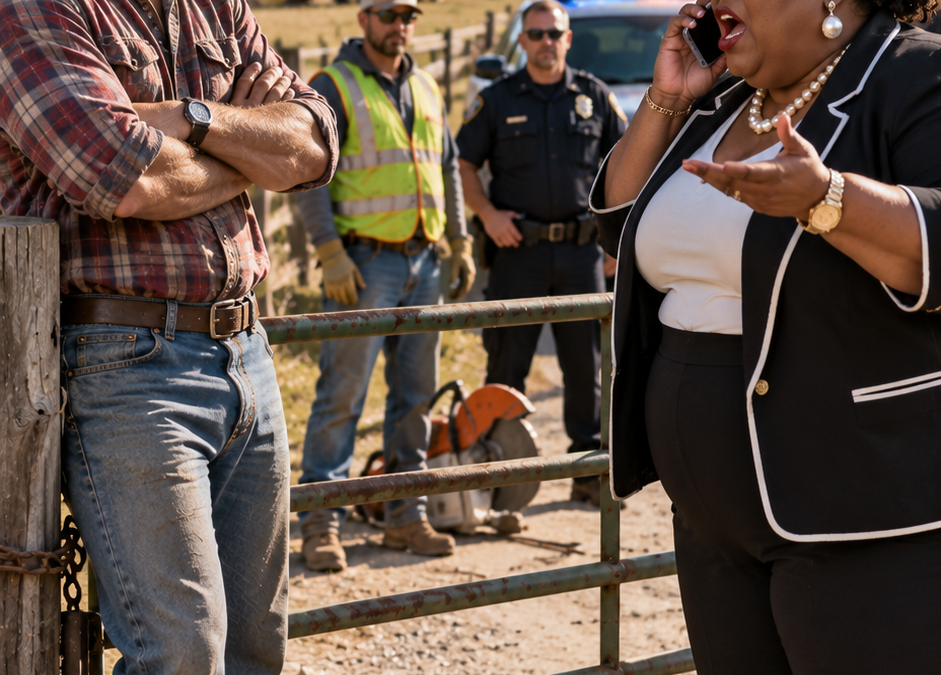
𝗣𝗔𝗥𝗧 𝟮
The developer handed control to an HOA.
And for years, nothing interesting happened between us.
Then I started noticing maintenance vehicles on my farm lane again.
At first I barely cared.
A landscaping pickup once every few weeks.
A mower trailer.
A truck heading toward the retention pond behind the subdivision.
They came through without asking.
I should have stopped it then.
I didn’t.
Partly because I wasn’t looking for a fight.
Partly because the lane had been used during construction and I assumed somebody simply hadn’t updated their route.
My father had been gone several years by then.
I had more immediate problems.
Cattle.
Equipment.
Weather.
A hydraulic pump that seemed to fail only when I needed it.
So I tolerated it.
That was my mistake.
Permission ignored long enough begins to look like entitlement to people who never bothered to ask where it came from.
What ended my patience happened after a week of hard spring rain.
A tandem dump truck came down the lane loaded with river rock.
The soil was saturated.
The truck was much heavier than that lane had ever been built to carry.
It left ruts eighteen inches deep for more than a hundred feet.
Near the culvert, one side sank and tore out the shoulder.
Then the driver tried backing to correct his angle.
The rear corner of the bed caught my fence.
Forty feet of woven wire came down.
Two posts snapped.
Nobody knocked.
Nobody called.
Nobody left a note.
I found the damage the next morning.
Two of my heifers had already stepped through the opening and were standing in the wrong field chewing weeds like they had personally arranged the escape.
I spent four days fixing someone else’s damage.
Four days in mud.
Resetting posts.
Dragging wire.
Filling ruts.
Rebuilding the shoulder with stone I paid for.
When I finished, I drove into town.
Bought a heavy chain.
Bought a weatherproof padlock.
Came home.
Closed the gate.
For the first time in twelve years, Booker Ridge Lane was locked.
It wasn’t revenge.
It wasn’t a declaration of war.
It was a farmer deciding he had absorbed enough of somebody else’s convenience.
Two days later, a silver sedan came up my driveway.
Clean enough to reflect clouds.
A woman stepped out wearing a cream blazer and dark sunglasses.
She didn’t remove the glasses.
Didn’t introduce herself.
Didn’t say hello.
She walked toward me while I was working beside the barn, stopped about eight feet away, and looked me over from my boots to my cap.
Not casually.
Deliberately.
Like she was inventorying reasons not to take me seriously.
Then she asked, “Who told you you could lock my access road?”
That was my introduction to Vivian Witkin, president of the Ashford Glen Homeowners Association.
There was technically a question mark at the end of her sentence.
But there wasn’t one in her voice.
I still had a wrench in my hand.
“Nobody told me.”
She waited.
“Because it isn’t yours.”
Vivian threw her head back and laughed.
A full laugh.
Like I had said something charmingly stupid.
“You’re serious.”
“Completely.”
“That lane has been used by Ashford Glen for years.”
“Used isn’t owned.”
Her smile thinned.
“We maintain infrastructure behind the subdivision through that route.”
“You have your own service drive.”
“This is the practical access.”
“Then your practical access is on my farm.”
She folded her arms.
“I don’t think you understand how easement rights work.”
I looked at the gate.
Then at her.
“I understand enough.”
That irritated her more than if I had argued.
She left without resolving anything.
Nine days later, I received a letter.
Heavy cream stock.
Gold-and-navy association crest.
The sort of stationery designed to make ordinary sentences feel official.
Across the top:
NOTICE OF UNAUTHORIZED OBSTRUCTION OF COMMUNITY ACCESS.
I read that line twice.
Then the demands.
Remove the chain and lock immediately.
Maintain the gate in an open condition twenty-four hours a day, seven days a week.
Permit unrestricted access to association contractors.
Confirm compliance within ten business days.
Failure to comply could result in legal action and daily fines.
I stood at my kitchen counter while my coffee went cold.
Then I laughed.
Not because the threat was funny.
Because whoever had sent that letter had missed something so basic it made everything after it absurd.
I wasn’t a member of Ashford Glen.
Never had been.
Booker Ridge Farm predated the subdivision by more than twenty years.
My parcel wasn’t inside their declaration.
My deed wasn’t burdened by their covenants.
The association had no more authority to fine me than my dentist had authority to ticket me for speeding.
The next morning, I called the HOA office.
Vivian answered herself.
“Redwood—”
She stopped.
“Ashford Glen. Vivian Witkin.”
“Vivian, Silus Booker.”
There was a pause.
Not surprise.
Recognition.
She had been waiting.
“I received your letter.”
“Good.”
“My property isn’t in your association.”
“We’re aware.”
That answer surprised me.
“Then whoever drafted the notice needs to reconsider it.”
“No, Mr. Booker.”
“What exactly are you fining me under?”
“You may not live inside Ashford Glen, but your property affects Ashford Glen.”
I waited.
“And that means our rules affect you.”
I wrote those words down immediately after hanging up.
Six days later, she returned.
This time she brought an audience.
A landscaping company’s flatbed pulled in behind her sedan.
A skid steer was chained to the trailer.
Vivian walked straight to my gate.
Grabbed the chain.
Shook it once.
Then turned toward me.
“Open it.”
Several men stood behind her.
That’s when I understood what the visit was really for.
Not access.
Submission.
She wanted witnesses.
I walked close enough to speak normally.
“No.”
“The crew is on the clock.”
“That’s unfortunate.”
“You are costing this community money by the minute.”
“They’re welcome to use a route across property the community owns.”
“You know perfectly well this is the only practical route.”
“Practical doesn’t mean yours.”
One contractor had climbed out of the truck.
He looked at the gate.
Then at Vivian.
Then at his boots.
Vivian’s voice changed.
Lower.
Sharper.
“Men like you always confuse ownership with authority.”
I let silence follow.
She expected anger.
I could tell.
Silence bothered her more.
Finally I said, “People like you confuse convenience with an easement.”
Her smile disappeared.
Completely.
She turned.
Walked back to her sedan.
Left.
The contractor didn’t.
He stayed near his truck for a moment, then approached me.
“Sorry about all that.”
“Not your fault.”
He nodded toward the lane.
“Any idea when this gets sorted?”
“What were you told?”
“That we’d have access through here all season.”
“By who?”
“The association president.”
“Occasionally?”
“Daily if needed.”
That mattered.
Vivian had promised a vendor permanent access to land she had never asked permission to use.
I started looking more closely at why.
Behind Ashford Glen’s last row of homes sat a stormwater retention basin.
About two acres.
Engineered slopes.
Concrete outfall.
Pump house.
Gravel maintenance perimeter.
Not decorative.
Required infrastructure.
Sediment had to be managed.
Mechanical equipment serviced.
Inspections completed.
Sometimes that meant bringing in vacuum trucks or compact excavation equipment.
There was an approved route for those vehicles.
I could see it from my back field.
A service drive leading from Hawthorne Loop, the cul-de-sac at the northwest edge of the subdivision, down toward the pond.
Association land from end to end.
For years, trucks had used it.
Then Vivian’s beautification project arrived.
I found photos in old HOA newsletters still posted online.
The entrance to the service drive had been transformed.
Double rows of ornamental pear trees.
Eight enormous precast concrete planters.
A decorative stamped-concrete apron.
A low seat wall.
A landscaped island occupying part of the turnaround.
It looked excellent in photographs.
It also looked nearly impossible to drive a vacuum truck through.
That was when everything began to make sense.
Vivian had three options.
Admit the beautification project had obstructed a maintenance route.
Undo it.
Or pretend my farm lane had always belonged to the HOA.
She chose the third.
If I opened the gate, nothing inside Ashford Glen had to change.
The planters stayed.
The trees stayed.
The newsletter photos stayed pretty.
And homeowners never had to learn that their president had landscaped over a route the association still needed.
I drove to the county recorder the following Monday.
My father’s file box rode on the passenger seat.
A clerk named Cole Avery helped me.
Late thirties.
Careful.
The kind of man who seemed genuinely pleased by a records question requiring more than two mouse clicks.
“I need everything on my parcel and the adjoining subdivision.”
“What specifically?”
“Anything granting Ashford Glen or anybody connected to it access across my land.”
“How far back?”
“All the way.”
He smiled slightly.
“My favorite answer.”
It took time.
But the result was remarkably clean.
There was no permanent easement across Booker Ridge Farm benefiting Ashford Glen.
No express easement.
No recorded right-of-way.
No reservation in my chain of title.
No subdivision plat notation.
No declaration reference.
Nothing.
The only recorded document connecting Ashford Glen’s development to my lane was my father’s temporary construction agreement.
Expired.
By its own terms.
Almost a decade earlier.
I certified copies.
Paid the fees.
Went home.
The next morning, I was driving toward the county road a little after seven when sunlight caught something bright beside the gate.
I stopped.
Someone had bolted a new aluminum sign to my gatepost.
Professionally made.
White background.
Red lettering.
EMERGENCY ACCESS.
Below that:
DO NOT BLOCK.
Ashford Glen’s gold-and-navy crest sat in one corner.
I turned off my truck and stared.
Someone had entered my property during the night.
Drilled into my gatepost.
And installed a sign declaring my farm lane an emergency route.
I got my phone.
Photographed it in place.
Wide shot showing gate and road.
Closer shot showing bolts.
Another showing the association crest.
Timestamp.
Then I got my socket set.
Removed the bolts carefully.
Wrapped the sign in an old feed sack.
Placed it behind the truck seat.
I didn’t bend it.
Didn’t throw it away.
Evidence works best when it remains exactly what the other person made it.
Vivian arrived before ten.
Fast.
Dust rolling behind her sedan.
That told me someone had been checking the gate.
She got out before the dust settled.
“You removed an emergency-access sign.”
“Yes.”
“You cannot do that.”
“Who designated this an emergency route?”
Her face changed.
“What?”
“Which agency?”
“Everybody knows this is the association’s access.”
“That wasn’t my question.”
I stepped closer.
“Which fire authority designated Booker Ridge Lane as emergency access?”
She didn’t answer.
Emergency access isn’t a phrase an HOA can create by printing a sign.
Real fire-access routes appear on approved plans.
They carry width requirements.
Surface standards.
Turning radii.
Vertical clearances.
Maintenance obligations.
An association crest isn’t a designation.
It’s decoration.
Vivian shifted tactics.
“If someone is injured because that gate is locked, it will be on you.”
She believed that was her strongest argument.
It was actually the most dangerous thing she could have said for herself.
Because now she wasn’t arguing convenience.
She was asserting public safety.
And public-safety claims create records.
That afternoon, I called the county fire marshal’s office.
Two transfers.
Fifteen minutes.
Eventually a plans examiner pulled Ashford Glen’s approved emergency-access documents.
He emailed me a stamped site plan.
I printed it in my barn office and spread it across the workbench.
The plan was unmistakable.
Ashford Glen had one designated secondary emergency-access route.
Hawthorne Loop.
The association’s own service drive.
Twenty feet minimum clear width.
Thirteen feet six inches vertical clearance.
Required to remain unobstructed.
The route ran through HOA property.
Booker Ridge Farm appeared only as the adjoining parcel.
No emergency route.
No access designation.
No fire lane.
Nothing.
I looked at the plan.
Then at the photographs of the concrete planters.
The landscaping wasn’t just inconvenient.
It appeared to be sitting across the approved emergency route Vivian claimed my farm had replaced.
At that point, I didn’t call her.
I didn’t send another warning.
I spent two hundred forty dollars on cameras.
One mounted on my equipment barn.
Long view down the lane.
Another on a post about twenty feet inside the gate.
It covered the gate, roadside shoulder, post, and surrounding ground.
Timestamped.
Local recording.
Backup in the barn.
Clear enough to read a license plate.
I tested both.
Then went back to work.
Eleven days passed.
Nothing.
No letter.
No contractors.
No Vivian.
It was the longest peaceful stretch we’d had in months.
Then, Thursday evening, my phone chimed.
Motion alert.
I opened the camera feed.
Vivian’s silver sedan sat along the shoulder.
Behind it was a white commercial van.
A man got out carrying a hard case.
The lettering on the van read:
MOBILE LOCKSMITH SERVICE — 7 DAYS.
Vivian walked him to my gate.
Pointed at the padlock.
They talked for four minutes and eleven seconds.
Then both vehicles left.
I saved the video.
Saturday morning was clear and already warm by eight.
I was at the far end of the west field dealing with an irrigation line that had been losing pressure.
My phone buzzed.
I wiped mud from my hand.
Opened the alert.
Vivian was back.
Silver sedan.
And behind her was a gray work truck.
A contractor in a safety vest stood at my gate.
In his hand was a battery-powered cutoff saw.
I didn’t run.
I stood.
Walked to my truck.
Wiped my hands.
Drove down my own lane at about fifteen miles an hour.
The cameras recorded all of it.
By the time I arrived, the contractor had set the saw on the ground.
That told me he had already begun reconsidering the morning.
Vivian stood close to him talking sharply.
She saw my truck.
Turned.
Her face settled into that familiar expression of controlled disappointment.
I got out.
She waited until I was about fifteen feet away.
“Unlock it.”
“No.”
“This is your last opportunity to resolve this voluntarily.”
I looked at the saw.
Then at her.
“Last opportunity to do what?”
She stared.
“Open the access road.”
“On whose property?”
The contractor looked up.
Vivian’s jaw tightened.
She could not answer without stating the thing she had spent months avoiding.
So she attacked me instead.
“This is exactly the problem with men like you.”
I said nothing.
“Give someone thirty acres and suddenly he thinks nobody can tell him what to do.”
She gestured toward my farm.
The contractor turned toward her fully now.
I still didn’t answer.
Then Vivian reached into her purse.
Pulled out her phone.
“I am finished discussing this.”
She dialed 911.
And looked directly at me while the call rang.
That smile appeared.
Small.
Certain.
I understood what she thought was happening.
She believed she had finally escalated the problem to an authority greater than mine.
A sheriff’s deputy would arrive.
She would explain “emergency access.”
He would see an HOA president in a blazer and a farmer beside a locked gate.
Then he would make me open it.
What Vivian had never considered was that 911 wasn’t a private line to someone on her side.
It was a recording.
“911. What’s the address of your emergency?”
Vivian gave my address.
“There is a man blocking emergency access to our residential community.”
She looked at me as she said it.
The dispatcher asked questions.
Vivian described me as refusing to cooperate.
She said the association needed immediate access.
She said the situation was “escalating.”
Twice.
She used “emergency access” three times in less than a minute.
I stood eleven feet away.
Hands at my sides.
Silent.
Then the dispatcher asked one question.
“Whose property is the gate located on?”
Vivian stopped.
A clean pause.
Four seconds.
Maybe five.
Her smile disappeared.
Finally she said, “Technically, his.”
Technically.
That word told the truth while trying to apologize for it.
The dispatcher continued.
“Is this a public road?”
“No, but—”
“Is there a recorded easement at this location?”
“We’ve used this route for years.”
That wasn’t an answer.
The dispatcher knew it.
I knew it.
Vivian knew it.
“Ma’am, do you have documentation showing a public or emergency access easement?”
“The association has maps.”
“Where are you currently standing?”
“At his gate.”
“On his property or on the roadway?”
“We’re at the entrance.”
“Why are you there?”
Vivian glanced at the contractor.
Then gave the answer that would eventually matter more than she understood.
“We came to have the lock removed.”
The contractor’s eyes moved toward her.
The dispatcher repeated it.
“You came to the property with someone to remove the owner’s lock?”
“We need access.”
Vivian said it faster now.
“He is unlawfully obstructing an emergency route.”
A unit was dispatched.
Vivian ended the call.
Slipped the phone into her purse.
Then she smiled again.
“Now you’ll learn how this works.”
The contractor picked up the cutoff saw.
Carried it back to his truck.
Put it in the bed.
Vivian didn’t notice.
I did.
What none of us knew yet was that the dispatcher had already begun checking Vivian’s story.
Because “emergency access” wasn’t just dramatic language.
It was a specific claim.
Specific claims can be searched.
Booker Ridge Farm appeared in county records as private agricultural property with a residential structure.
No designated emergency route.
No fire lane.
No preplanned secondary access for Ashford Glen.
Nothing.
The dispatcher escalated the discrepancy to a supervisor.
Fire communications was contacted.
Within minutes they confirmed the county file.
Ashford Glen’s approved secondary emergency access was at Hawthorne Loop.
Not Booker Ridge Farm.
That information was sent as an update to the responding deputy.
Caller acknowledges gate is on landowner’s parcel.
No emergency-access designation at this location.
Possible civil easement dispute.
Caller states she arrived with contractor to remove owner’s lock.
Four lines.
Before the patrol car ever reached my driveway, Vivian’s version had already changed from “man blocking emergency access” to “HOA president at private gate with contractor attempting to remove lock.”
We saw the patrol car about twenty minutes later.
It came over the rise on the county road.
Vivian straightened her blazer.
Adjusted her sunglasses.
Then looked at me with what I can only describe as pity.
“You should’ve listened to me.”
I watched the cruiser signal.
“I think you should listen to your phone call.”
She frowned.
Didn’t understand.
The deputy pulled onto the shoulder.
Got out slowly.
Solid build.
Early forties.
Sunglasses pushed on top of his head.
Notebook already in his hand.
Nameplate:
NOLAN PIERCE.
Vivian stepped forward.
Deputy Pierce walked directly toward her.
Not me.
“You made the call?”
“Yes.”
“Tell me what’s happening.”
Vivian did.
And she did it well.
That’s worth saying.
She wasn’t incoherent.
She wasn’t screaming.
She presented a polished story.
Ashford Glen had relied on this route for years to maintain critical drainage infrastructure.
I had suddenly locked it without warning.
My decision supposedly created safety concerns for two hundred forty homes.
She had come personally in good faith to resolve the situation.
I had been difficult.
Obstructive.
Aggressive in manner.
Pierce listened.
Wrote a few notes.
Then asked six words.
“Ma’am, do you have an easement?”
Vivian was ready.
Or thought she was.
She walked to her sedan.
Returned with a color-printed map inside a plastic sleeve.
Ashford Glen streets.
Pond.
Amenities.
And a thick yellow line running up my farm lane.
Beside it:
SERVICE ACCESS.
She handed it to Pierce as if she were handing him a deed.
He studied it.
Eight seconds maybe.
Then turned it over.
Blank.
No recorder stamp.
No instrument number.
No book or page.
No surveyor certification.
No grantor.
No recorded date.
Nothing.
It was a drawing.
Someone had put a yellow line over private land and typed two words.
Pierce handed it back.
“Is this recorded?”
“It is the association’s official site plan.”
“That’s not what I asked.”
Vivian’s lips tightened.
I walked to my truck.
Took out the folder I had brought down from the barn before leaving the field.
Placed four documents on the hood.
First.
Certified deed.
Full legal description.
Recorder’s stamp.
Second.
Certified parcel map.
My boundary.
Farm lane entirely inside it.
Third.
My father’s temporary construction-access agreement.
Expiration language.
Attached developer completion certification.
Fourth.
The fire marshal’s stamped Ashford Glen emergency-access plan.
I left that last one face down for the moment.
Deputy Pierce looked through the first three.
Then turned toward Vivian.
“Does your association have any recorded document granting permanent access across this property?”
“We have relied on this road for more than a decade.”
“I understand.”
Pierce stayed calm.
“Do you have a recorded easement?”
“Long-term use creates rights.”
“I’m asking what document you have.”
She spoke faster.
“We have contractors who need to service required infrastructure. Mr. Booker cannot simply decide—”
“Ma’am.”
She stopped.
“Do you have a recorded easement?”
“No document with me.”
Pierce nodded once.
Then looked at me.
“What have you said to her today?”
“Asked her to leave my gate locked.”
“Any threats?”
“No.”
“Raised your voice?”
“No.”
Vivian interrupted.
“His manner has been extremely aggressive.”
I pointed toward the camera.
“Everything here is recorded.”
Vivian went silent.
I said, “Both cameras have audio.”
Pierce looked toward the post.
Then back at her.
Vivian did not mention feeling unsafe again.
Deputy Pierce explained it plainly.
This was a civil property dispute.
He could not order a private landowner to open a gate on his own recorded parcel simply because another party claimed access rights.
If Ashford Glen believed it possessed an easement, it could seek a court ruling.
A judge could examine documents.
Until then, the gate was mine.
The lock was mine.
The decision to open it was mine.
Then Pierce turned toward the contractor.
“You were brought here to cut that lock?”
The man nodded carefully.
“That was the work request.”
“Don’t.”
“Yes, sir.”
“Without a court order or the landowner’s written authorization, you do not cut anything on this gate.”
“Understood.”
“If you do, we’re no longer talking about a civil easement disagreement.”
The contractor nodded immediately.
I suspect he had reached the same conclusion twenty minutes earlier.
Vivian stared at Pierce.
“So you’re taking his side?”
There was genuine disbelief in her voice.
Not anger yet.
Disbelief.
Pierce looked at her for a moment.
“I’m looking at the documents.”
That was all.
No lecture.
No humiliation.
Just the one thing she had spent months avoiding.
Documents.
Then Pierce added something she wasn’t expecting.
“Dispatch checked county emergency-access records before I arrived.”
Vivian froze.
“There is no emergency-access designation at this property.”
Her lips parted.
“Fire communications confirmed the approved secondary route for Ashford Glen is elsewhere.”
The color drained from her face.
“The county maps are outdated.”
I picked up the fourth document.
“Deputy?”
He turned.
I handed him the stamped plan.
“This is the approved emergency-access plan.”
He unfolded it across the hood.
I pointed.
“Ashford Glen’s secondary route is here.”
Hawthorne Loop.
“Twenty feet clear width. Entirely on association land.”
Pierce followed the route with his finger.
“My farm isn’t part of it.”
He nodded.
“And right now,” I continued, “that entrance has eight precast planters, ornamental trees, a seat wall, and a landscaped island built across part of it.”
Pierce looked toward the subdivision.
“How narrow?”
“About eleven feet at the tight point, by my measurement.”
Vivian stepped forward.
“That has nothing to do with this.”
Pierce looked at her.
“You called this in as an emergency-access obstruction.”
She stopped.
There was the trap.
Not one I had built.
One she had.
If this was merely an HOA maintenance disagreement, Hawthorne Loop might have remained outside the immediate conversation.
But Vivian had repeated “emergency access” until the county checked.
Pierce copied the plan number into his notebook.
He was careful.
He didn’t declare a violation.
Didn’t pretend to be the fire marshal.
He said he would document what had been presented and forward the emergency-access issue for independent review.
Then he looked at Vivian.
“You need to leave Mr. Booker’s property.”
“This is a county shoulder.”
“You can use the public roadway.”
He pointed toward the contractor.
“Your vendor leaves too.”
Vivian turned toward me.
I didn’t smile.
That seemed to bother her more than anything.
Pierce remained until both vehicles left.
I finished repairing the irrigation line that afternoon.
There was something almost soothing about it.
A problem I understood.
Pressure loss.
Bad fitting.
Replace the fitting.
Test.
Done.
That evening, I wrote one email.
Every Ashford Glen board member.
Four short paragraphs.
No accusation.
No sarcasm.
I stated the property boundary.
Stated that no permanent recorded easement existed.
Attached my deed.
Parcel map.
Expired construction agreement.
County emergency-access plan.
Then requested in writing that the association stop asserting any access right across Booker Ridge Farm.
Vivian responded within two hours.
Not to me.
To all two hundred forty Ashford Glen households.
Her email described an “ongoing access dispute with an uncooperative neighboring landowner.”
She said the association had long relied on the route.
She said community safety and infrastructure maintenance were potentially threatened.
She promised the board would pursue all available remedies to protect homeowner interests.
She did not attach my deed.
Didn’t attach the expired agreement.
Didn’t mention Deputy Pierce.
Didn’t mention dispatch checking county records.
Didn’t mention being told to leave.
It was the cleanest version of her story possible.
The next evening, my phone rang.
Unknown number.
A woman introduced herself.
“Mr. Booker? My name is Marin Holt. I’m treasurer of the Ashford Glen HOA.”
I sat down on my porch.
“What can I do for you?”
“This call isn’t on behalf of the board.”
“All right.”
“I read your email twice.”
She paused.
“And every attachment.”
I waited.
“I need to ask you something directly.”
“Go ahead.”
“Has Vivian ever told you that Ashford Glen holds a permanent easement across your property?”
“Yes.”
“In those words?”
“She called it your access road. Her letters demand unrestricted use. She has repeatedly claimed the association has rights to the lane.”
Marin went silent.
Then said, “You need to see something.”
Two years before our dispute, another board member had raised questions about maintenance crews using Booker Ridge Lane.
The board had asked its attorney to investigate.
The attorney was Graham Voss.
Longtime association counsel.
He had issued a written opinion.
Marin had found it in old legal correspondence after receiving my documents.
She read part of it aloud.
The association holds no recorded easement, express or implied, over the Booker parcel.
The temporary construction-access agreement expired according to its own terms.
It created no interest running with the land.
Continued use after expiration of permissive access did not, under the circumstances presented, establish a prescriptive right.
If the association wanted future access, counsel recommended negotiating a written easement with the property owner for consideration and recording it.
I sat down harder on the porch step.
“How old is that letter?”
“Twenty-six months.”
“Who was it addressed to?”
A pause.
“The board president.”
“Vivian?”
“Yes.”
Everything changed in that moment.
Until then, I had been willing to believe arrogance had combined with ignorance.
That she misunderstood.
That she had inherited a bad assumption.
But she hadn’t.
Her own attorney had told her.
No easement.
Expired agreement.
Ask the owner.
Pay if necessary.
She knew when she sent me the fine threat.
Knew when she called my lane “community access.”
Knew when she bolted an emergency sign onto my post.
Knew when she stood beside a contractor with a saw.
Knew when she called 911.
Marin wasn’t finished.
“There is something else.”
“What?”
“The Hawthorne Loop landscaping project.”
She had reviewed the invoices because money was her responsibility.
The original contractor proposal contained a written caution beside the planter layout.
VERIFY REQUIRED FIRE-APPARATUS CLEARANCE AT EXISTING SERVICE-DRIVE ENTRANCE PRIOR TO INSTALLATION.
The note had been there.
In the approved proposal.
And below it was Vivian’s authorization.
Proceed.
The special board meeting was scheduled for the following Thursday.
I received a written invitation because the dispute created potential litigation exposure.
I almost didn’t go.
The gate wasn’t in danger anymore.
The contractor wasn’t coming back.
Deputy Pierce’s report existed.
My documents were clear.
But two hundred forty families had been told I was threatening their safety.
If the association was about to spend their money fighting me, they deserved to know what their own records said.
So I went.
Vivian began before anyone else had a chance.
She sat at the center of the long table.
Same cream blazer style.
Same composed posture.
She described a “long-standing access arrangement.”
A neighboring farmer who had suddenly become unreasonable.
Repeated good-faith attempts at resolution.
She said I had placed my ego above the safety of the community.
She used the word safety four times.
Ego twice.
She didn’t look at me.
When she finished, the vice president asked whether I wanted to respond.
I stood.
Carried my folder to the front.
Opened it.
“This is my recorded deed.”
I placed it down.
“Certified by the county. Full legal description. No easement benefiting Ashford Glen.”
Second document.
“This is the parcel map. My gate and lane are inside my property by more than sixty feet.”
Third.
“This is the temporary construction-access agreement my father signed twelve years ago.”
I opened to the highlighted paragraph.
“Access existed during active construction only. No permanent easement was created. The agreement terminated automatically when construction ended.”
I placed the developer’s completion certification beside it.
“Nine years ago.”
Nobody spoke.
“This is the only recorded document that ever authorized Ashford Glen-related traffic on Booker Ridge Lane.”
Fourth document.
“This is the county-approved emergency-access plan.”
I pointed toward Hawthorne Loop.
“This is Ashford Glen’s designated secondary emergency route.”
I traced it.
“Twenty feet clear width. Association property from end to end.”
Then I pointed toward Booker Ridge Farm.
“My land is shown as adjoining property only.”
I looked toward Vivian.
“My gate is not emergency access.”
Still nobody moved.
Then Marin slid a paper toward me.
I didn’t need to read it.
I knew what it was.
I placed it at the center of the table.
“And this is a legal opinion from Graham Voss, counsel to this association.”
Vivian’s shoulders stiffened.
“Dated more than two years ago.”
Now she looked at me.
“It states that Ashford Glen has no permanent easement across my property, that the construction agreement expired, that continued use does not create the right being claimed, and that any future access should be negotiated with me in writing.”
I stepped back.
Marin spoke.
“An opinion you never showed us.”
She wasn’t talking to me.
She was looking at Vivian.
The room seemed to lose air.
Vivian reached for her microphone.
“The legal memorandum was preliminary.”
Marin shook her head.
“It says final opinion at the top.”
“It was one attorney’s interpretation.”
“Our attorney.”
“There were broader operational considerations.”
“Did you distribute it to the board?”
Vivian didn’t answer.
One board member leaned forward.
“Was this letter ever discussed in executive session?”
Marin checked her papers.
“I have found no record of it.”
Another member asked, “Were we told our access claim had already been rejected by counsel?”
“No record.”
Vivian began talking about institutional practice.
Historic reliance.
Infrastructure necessity.
Potential equitable claims.
The words became more elaborate as the facts became simpler.
Then Marin opened another folder.
“Hawthorne Loop.”
Vivian stopped.
Marin read the contractor note into the minutes.
Verify fire-apparatus clearance before installation.
Then the approval.
Signed by Vivian.
The room changed.
A newer board member who had been quiet all evening leaned toward his microphone.
“Why did you call 911?”
His tone wasn’t angry.
That made the question harder.
Vivian took a breath.
“Mr. Booker’s conduct at the gate made me feel unsafe.”
I didn’t move.
She continued.
“I was isolated with a contractor and dealing with an agitated landowner.”
I reached into my folder.
“Deputy Pierce’s report notes that I advised him the gate camera recorded the entire encounter.”
Several people looked at Vivian.
I didn’t need to play the video.
The possibility was enough.
Her explanation stopped growing.
The board entered executive session.
The vice president turned toward Vivian.
“For the duration of executive discussion, I need you to step down from the chair.”
That was the moment I remember most.
Not the deputy.
Not 911.
Not the attorney letter.
Vivian slowly gathered her portfolio.
Stood.
Walked away from the center position.
And sat in a folding chair along the side wall.
For months, she had treated authority as something carried inside her title.
Now the title remained printed on the agenda while the chair itself no longer belonged to her.
Quiet.
Procedural.
No shouting.
No humiliation speech.
Just consequences.
The board sent its decisions in writing eleven days later.
Vivian was removed as president.
She remained a homeowner.
The HOA formally withdrew every claim of permanent access across Booker Ridge Farm.
It acknowledged there was no recorded easement.
Vendors received written instruction that my lane was not to be used under any circumstances without my express permission.
The association reimbursed me for the dump-truck damage.
Road restoration.
Fence materials.
Labor.
A little over three thousand dollars.
One check.
The four-hundred-dollar HOA fine they had threatened never became anything because even their counsel wouldn’t pretend they had authority over my parcel once the documents were exposed.
Then Hawthorne Loop was repaired.
Six of the eight concrete planters were removed and relocated near the pool entrance.
Four ornamental pear trees came out.
The seat wall was shortened.
Part of the landscaped island was reconstructed.
The required twenty-foot clearance was restored.
The fire marshal’s office inspected it.
Approved it.
Ashford Glen finally had the emergency route it had possessed on paper the entire time.
The cost of fixing the beautification project exceeded what it had cost to create the obstruction.
That money came from homeowners.
People who had never known there was a problem.
People who would never have needed to spend a dollar if Vivian had shown the board one attorney letter two years earlier.
I didn’t enjoy that part.
It’s easy to tell these stories afterward and make consequences sound satisfying.
Some were.
Watching the gate remain closed was satisfying.
Having my name cleared mattered.
Seeing Vivian’s invented authority collapse under documents felt like justice.
But ordinary homeowners paid for part of her stubbornness.
That didn’t feel good.
Deputy Pierce came by several weeks later.
I was standing on a stepladder replacing the old faded farm sign at the gate.
His cruiser slowed.
Window came down.
“You still causing trouble with that gate, Mr. Booker?”
I looked down at him.
“Gate hasn’t moved in thirty years.”
He laughed.
“More stable than most things I get called about.”
Then he drove on.
The new sign is simple.
White background.
Black letters.
PRIVATE FARM ROAD.
NO ASSOCIATION ACCESS.
RECORDED PROPERTY BOUNDARY.
No joke.
No reference to Vivian.
No threat.
A sign should tell the truth and then get out of the way.
Vivian remained in Ashford Glen for a while.
I saw her car occasionally on the county road.
We didn’t speak.
People asked whether I intended to sue.
I didn’t.
The damage was paid.
The access claim withdrawn.
The record corrected.
There are moments when litigation is necessary.
There are also moments when continuing a fight only lets the person who started it keep living in your head.
I had hay to cut.
Cattle to feed.
A gate to oil.
That was enough.
A few months later, Marin stopped by.
She parked outside the gate and waited until I walked down rather than entering without permission.
I appreciated that more than she probably knew.
“I wanted to apologize.”
“You didn’t do any of it.”
“I was treasurer.”
“That doesn’t make you psychic.”
“I signed checks for the landscaping.”
“You relied on the president and contractor.”
She looked back toward Ashford Glen.
“I should’ve asked what those planters were sitting on.”
“Maybe.”
She smiled faintly.
“You’re not making this easy.”
“Easy isn’t the same as honest.”
She nodded.
Then asked the question I had expected eventually.
“Would you ever consider selling the association a permanent maintenance easement?”
I looked down the lane.
My father’s lane.
My barn at the far end.
The gate between us.
“No.”
She accepted it immediately.
That difference mattered.
“Fair enough.”
“You have Hawthorne Loop.”
“We do now.”
“Keep it open.”
“We will.”
She left.
That was how the problem should have been handled from the beginning.
Ask.
Listen.
Accept the answer.
My father understood that.
So did Marin.
Vivian had believed asking was something people with less authority did.
One evening near the end of summer, I sat on my porch watching the light leave the ridge.
From there, I could see part of Ashford Glen beyond the fence.
Roofs.
Trees.
A little reflection off the retention pond.
Farther west, through a break in the houses, I could just make out the reopened service-drive entrance at Hawthorne Loop.
No concrete planters blocking it.
No ornamental island in the throat.
Just a clear route.
Functional.
Unremarkable.
Safe.
My gate stood closed in the other direction.
Same pipe.
Same hinges.
Same faded green.
Nothing about it looked powerful.
That made me think about something Vivian had said.
Men like you build fences and think that makes you powerful.
She never understood what the gate meant.
The gate didn’t give me ownership.
It marked ownership that already existed.
The chain didn’t create my rights.
The deed did.
The padlock didn’t make the lane private.
The boundary did.
I never needed Vivian to respect me personally.
Didn’t need her to admire farmers.
Didn’t need her to know my father.
Didn’t need her to understand how many winters he worked two jobs to keep thirty-four acres.
I only needed her to recognize the same thing every landowner eventually expects from every neighbor.
This is yours.
That is mine.
Ask before crossing.
That’s it.
She could have solved the maintenance problem two years earlier.
Her attorney had handed her the answer.
Negotiate an easement.
Maybe I would have said yes then.
Maybe not.
She never found out.
Instead, she planted trees and concrete planters across the route her subdivision already owned.
Then built an entire theory of access around the assumption that I would be easier to pressure than her own landscaping was to remove.
When the pressure failed, she invented authority.
First association authority.
Then emergency authority.
Finally police authority.
Every escalation created another record.
The demand letter.
The sign.
The work order.
The 911 recording.
The deputy’s report.
The attorney letter.
The beautification approval.
Each piece made the next lie harder to maintain.
My father used to tell me a good fence did two jobs.
It kept livestock from wandering.
And it prevented neighbors from needing to remember where the line was.
I used to think that was just another one of his farm sayings.
Now I understand it differently.
Boundaries aren’t insults.
They are information.
Healthy people learn where they are.
Healthy organizations do too.
The ones that don’t eventually find a sheriff’s deputy standing beside a pickup hood asking for the document they were hoping nobody would request.
The following spring, another maintenance truck arrived near Ashford Glen.
I noticed it from the field.
For an old reflexive second, I expected it to turn toward my gate.
It didn’t.
The driver continued to Hawthorne Loop.
Turned into the restored service drive.
Disappeared toward the retention basin.
I watched until the truck was gone.
Then went back to what I was doing.
No confrontation.
No phone call.
No letters.
No fines.
No emergency.
Just a contractor using the road his client actually owned.
That’s what makes the whole thing almost embarrassing in retrospect.
The solution existed the entire time.
Vivian’s problem had never been that there was no way to reach the pond.
Her problem was that the legal route interfered with the version of Ashford Glen she wanted photographed.
She preferred my dirt lane because it let her preserve the image.
And once she made that preference part of her identity as president, admitting a mistake became more threatening to her than making the mistake larger.
That is how people end up dialing 911 beside somebody else’s gate.
Not because they have run out of information.
Because they have run out of ways to avoid it.
My father didn’t live to see any of this.
Sometimes I’m grateful for that.
He had little patience for people who treated recorded boundaries as suggestions.
But I wish he could have seen the file spread across my kitchen table.
His temporary agreement.
His pencil line under “no permanent easement.”
The old completion certificate.
All of it preserved because he had been the kind of man who made copies before giving papers away.
I think he would have looked at the whole mess for about thirty seconds.
Then said something irritatingly simple.
“That’s why we kept it.”
He would have been right.
The most important thing I did during those months wasn’t shouting louder than Vivian.
It wasn’t installing cameras.
It wasn’t calling the fire marshal.
It wasn’t even refusing to unlock the gate.
It was keeping the documents.
The deed existed before she became president.
The temporary agreement existed before Ashford Glen had an HOA.
The emergency-access plan existed before she planted her first tree.
The attorney’s opinion existed before she sent me her first threat.
Facts are patient that way.
They can sit in a drawer for years while people build stories around them.
Then somebody opens the drawer.
These days, I still lock the gate.
Not constantly.
Sometimes neighbors I’ve known for years come through because they’ve called first.
Sometimes I leave it open while moving equipment.
Once, Marin asked whether the fire department could use the lane temporarily during a training exercise on neighboring farmland.
She asked in writing.
Included dates.
Insurance information.
Exact purpose.
I said yes.
Temporary access.
Three days.
Then it ended.
Just like my father would have done it.
Permission isn’t weakness.
Being willing to say yes doesn’t mean surrendering the right to say no.
Vivian never understood that either.
She thought if I had tolerated years of casual HOA traffic, that tolerance had become ownership.
It hadn’t.
Kindness isn’t a deed.
Convenience isn’t an easement.
Use isn’t automatically a right.
And a title on an HOA letterhead doesn’t turn private property into common area.
The old green gate is still there.
I replaced one hinge last winter.
Repainted part of the frame.
The new paint is slightly brighter than the rest, which bothers me enough that I’ll probably repaint the whole thing someday.
The cameras remain.
I don’t check them much.
The association hasn’t sent a vehicle down my lane since the board issued its written notice.
Sometimes people from Ashford Glen walk along the county road and wave.
I wave back.
Most of them were never my enemies.
They were simply told a story.
For a while, they believed it.
Then they saw the documents.
That’s the ending I prefer.
Not Vivian losing a title.
Not the board paying me.
Not the deputy ordering her away.
The story ends with everybody finally knowing where the line actually is.
There is peace in that.
One Saturday morning, I was repairing a latch when a family from Ashford Glen passed on bicycles.
Their boy, maybe nine, slowed near the gate.
He looked at the sign.
Then at me.
“Is this really your road?”
His father looked embarrassed.
“Ethan—”
I smiled.
“It is.”
The boy pointed toward Ashford Glen.
“Then why did people use it?”
“Because my family let them for a while.”
He considered that.
“So they had permission?”
“Exactly.”
“And now they don’t?”
“Exactly.”
That was enough for him.
Kids understand boundaries better than adults sometimes.
He pedaled away.
His parents waved.
I went back to the latch.
Vivian had needed lawyers, letters, contractors, a 911 dispatcher, a deputy, a county fire plan, and an emergency board meeting to reach the same conclusion a nine-year-old understood in thirty seconds.
Permission is not ownership.
The afternoon sun moved across the field.
Cattle shifted toward the shade.
The gate cast a narrow shadow across the dirt.
Thirty years of weather had worn dents into the pipe.
My father’s welds were still holding.
Vivian once believed that gate was something I used to pretend I had power.
She had it backward.
I never needed the gate to prove anything.
The land was already mine.
The agreement had already expired.
The easement had never existed.
The emergency route was already somewhere else.
All I had to do was keep the paper, lock what belonged to me, and stay calm long enough for Vivian Witkin to tell the truth herself.
She did it at 9:17 on a Saturday morning.
On a recorded emergency line.
Standing beside a contractor she had hired to cut my lock.
And by the time Deputy Pierce turned onto the county road, the gate hadn’t changed at all.
Only her story had.








