𝗙𝗨𝗟𝗟 𝗦𝗧𝗢𝗥𝗬 The HOA President Buried My Creek for Her Greenway—Then the Storm Came and 196 Homes Had Nowhere Left to Drain
𝗣𝗔𝗥𝗧 𝟮
I remember standing there looking at it.
I thought somebody had been careless with a highlighter.
That was all.
I didn’t challenge it.
Didn’t ask who made the map.
Didn’t request corrections.
That turned out to be my first mistake.
Karen Vossberg was in her third year as HOA president when she came for the bottomland.
She was good at being president in the specific way that makes you nervous once you know what you’re looking at.
Meetings started on time.
Violation letters went out fast.
She recruited two board members personally.
Her treasurer, Neville Ashcraft, had a habit of reading whatever Karen placed in front of him as though it had been carried down a mountain on stone tablets.
Her big project that year was Phase Two of the Stonebrier Greenway.
Walking loop.
Benches.
Landscaping.
Two pickleball courts.
A ribbon-cutting kind of project.
The problem was space.
Phase Two needed around four flat acres.
There was only one large flat undeveloped section near the subdivision.
My bottomland.
The creek ran through the middle of it.
From Karen’s perspective, I suppose the solution looked simple.
Fill the channel.
Grade the land.
Pave the trail.
Pour the courts.
Call it an amenity.
She came to see me three times in January and February.
The first visit was almost friendly.
“Palmer, we’d like to talk about connectivity.”
“Connectivity to what?”
“The greenway.”
“Across my farm?”
“Along the drainage corridor.”
“You mean my creek.”
She smiled.
“Terminology aside.”
“No.”
Her smile tightened.
The second time, she brought Neville and a full-color rendering.
Trees.
Families with strollers.
A couple walking a golden retriever.
Pickleball players frozen mid-swing.
It looked beautiful because renderings always do.
Karen spread it across my potting table.
“This benefits everyone.”
“It benefits Stonebrier.”
“It increases property values in the area.”
“I don’t sell houses.”
Neville tapped the creek line.
“The existing ditch is underutilized.”
I stared at him.
“Underutilized?”
Karen stepped in before I could say more.
“We’re asking for cooperation.”
“No.”
I still offered something.
That’s my nature.
I said I’d grant a walking easement on the east bank.
Sixteen feet wide.
No vehicles.
No channel work.
Renewable agreement.
Stonebrier maintains the path.
My creek stays untouched.
I would’ve signed it that day.
Karen barely read it.
“The association does not buy what the association already owns.”
I looked up.
“What did you say?”
She rolled the rendering.
“We already have drainage rights.”
“Drainage rights are not ownership.”
She gave me a small smile.
“You should speak to someone familiar with property law.”
Then she left.
I wrote that sentence on the back of a feed receipt.
THE ASSOCIATION DOES NOT BUY WHAT THE ASSOCIATION ALREADY OWNS.
Something about it bothered me.
People don’t say “already owns” when they are negotiating.
They say it when somebody has convinced them the outcome is settled.
On March 20, I found a notice zip-tied to my front gate.
COMMON AREA IMPROVEMENT NOTICE
DRAINAGE DITCH A
CHANNEL FILL AND GRADE
COMMENCEMENT DATE: APRIL 2
There was no place for my signature.
No consent section.
No objection process.
Just a date.
So I did everything people tell you to do when conflict starts.
I documented.
On March 26, I sent Karen a certified letter.
No lawyer language.
No threats.
Just facts.
The channel is located on deeded Chadwick property.
I do not consent to any filling, grading, excavation, or alteration.
I hold state water right WR11-0842.
Then I put one sentence by itself.
If you fill that channel, the water from your subdivision has nowhere to go but back up into your subdivision.
Karen signed for that letter on March 30.
The return card came back with her name slanting hard across the signature line.
I put it in a drawer beside my seed invoices.
I assumed that would stop her.
Who reads a warning like that and keeps going?
At 4:40 in the morning on April 1, I woke to air brakes on Bell Hollow Road.
Trucks staging.
I lay in bed listening to diesel engines idle in the dark.
One thought kept repeating.
She has my letter.
She signed for it.
Either Karen didn’t believe me—
or somebody had already warned her before.
The Stonebrier board met the next evening.
I walked into the clubhouse carrying a manila folder.
No lawyer.
No engineer.
Just paper.
I had pulled my deed that morning.
Instrument 1998-02214.
Parcel 22-064.
Four paragraphs of legal description.
I also brought Stonebrier’s recorded subdivision plat.
The permanent map.
The document showing exactly where Stonebrier ended.
I laid both in front of Karen.
Then I traced the property line slowly with one finger.
“Stonebrier stops here.”
No one spoke.
I moved my finger south.
“The creek is roughly one hundred thirty feet beyond your boundary.”
A woman at the far end leaned closer.
“It’s not your common area.”
Neville stared down at a blank legal pad.
I waited.
Finally, he cleared his throat.
“This is a matter the board has already addressed.”
“When?”
“Prior to commencement.”
“That doesn’t answer anything.”
Karen leaned back.
“Twenty years.”
“What?”
“For twenty years that ditch has carried Stonebrier’s drainage.”
“It still doesn’t belong to you.”
“Twenty years of use establishes rights.”
She folded her arms.
“It’s called prescription. Look it up.”
Three people nodded.
That’s what confidence can do in a room.
It can make ignorance look like law.
I walked out realizing something important.
Being right wasn’t enough.
Not if Karen controlled the meeting, the maps, the board, and the language.
So I hired a surveyor.
On April 5, Ivor Blanchard and his crew restaked the full corridor.
Six hundred forty feet.
Pink ribbon every fifty feet.
Boundary pins located.
Capped stakes.
Three thousand two hundred dollars.
I didn’t have that money sitting around.
But I spent it.
I returned that evening.
Every stake was gone.
All of them.
Someone had stacked them neatly along Bell Hollow Road.
Pink ribbon wrapped around the bundle.
Tidy.
Deliberate.
I photographed the pile from every angle.
Then stood in the roadway with both hands on top of my head.
Because the thing I wanted to do next would have ended with a deputy putting me in a cruiser.
The following morning, a woman from Highfield Community Management arrived.
Polo shirt.
Clipboard.
Wouldn’t meet my eyes.
She handed me an envelope.
NOTICE OF TRESPASS.
I was prohibited from entering the “construction zone” on Parcel 22-064 for safety and liability reasons.
My parcel.
Entering it would be reported to law enforcement.
I read the notice twice.
“Do you understand what you’re handing me?”
“I only deliver them.”
“They filled my creek yesterday.”
She stepped backward.
“I only deliver them.”
Then she drove away.
More letters arrived over the next four days.
Five-hundred-dollar fine for interference with association contractors.
Another fine accruing at one hundred fifty dollars per day for continued obstruction.
A letter from Stonebrier’s law firm warning that public claims questioning the association’s rights in “Ditch A” could constitute slander of title.
They destroyed my watercourse.
Then fined me for objecting.
Then threatened to sue me if I told people they didn’t own it.
I called the county.
Finding the right department took almost two days.
When I finally reached code enforcement, the man listened patiently.
Typed.
Asked for parcel numbers.
Then said:
“We’re documenting this as a civil property dispute.”
“It’s not just property. There’s a state water right.”
“Then you may need to contact the state.”
“They filled a flowing creek.”
“Sir, we’re not going to referee a boundary dispute between private parties.”
I sat in my truck afterward.
Forty thousand seedlings were drinking from reserve storage.
The pumps were running longer every day.
And government had just categorized the destruction of my creek as neighbors disagreeing over a line.
On April 7, my phone rang.
Unknown number.
“Mr. Chadwick?”
“Yes.”
“This is Maud Kirkindall. I’m on the Stonebrier board.”
Her voice was older.
Quiet.
Careful.
“I want you to understand that not everyone is comfortable with what happened.”
“Comfortable?”
A pause.
“There were questions.”
“About what?”
“The channel.”
I stood.
“What questions?”
“Somebody warned us about exactly this some time ago.”
My heart started beating faster.
“Warned you about what?”
Another pause.
“Ms. Kirkindall?”
“I’ve already said more than I should.”
“Who warned you?”
“Please don’t call this number again.”
The line went dead.
I stood there holding the phone.
Somebody warned us about exactly this.
Those words changed everything.
Warnings leave records.
Warnings get emailed.
Filed.
Discussed.
Somewhere, something existed.
I didn’t know what yet.
But Karen knew more than she was admitting.
The next day, Garvin Ruddock’s grading crew returned.
They compacted the fill.
Vibratory roller.
Pass after pass.
The ground shook hard enough that greenhouse glass buzzed a quarter mile away.
When they finished, orange stakes marked the centerline of what had once been my creek.
That evening, Karen posted pictures online.
PHASE TWO IS UNDERWAY!
THANK YOU FOR YOUR PATIENCE!
Forty-some likes.
People asked about benches.
Lighting.
Pickleball opening dates.
That night, I walked the lower field with a flashlight.
There had been no rain for nine days.
My boots sank into wet grass.
I pressed my heel down.
Water filled the depression.
The spring was still running.
Of course it was.
Karen had buried the channel.
She hadn’t turned off geology.
The water had lost its route.
So it was searching for another.
I went home and looked at Stonebrier’s plat again.
Along one margin was a line of small print I’d ignored twice.
DRAINAGE AND OUTFALL — SEE INSTRUMENT 2003-05412.
I wrote the number down.
Before I could retrieve it, the first rain came.
April 14.
Nothing historic.
One-point-nine inches across roughly five hours.
Regular spring weather.
The kind you forget.
Stonebrier’s retention pond filled in about forty minutes.
Birdie Longacre later told me he watched it from his deck.
Birdie lived near the low end of Stonebrier Circle.
I’d sold him three river birches in 2019.
He said the pond climbed like somebody filling a bathtub.
Water reached the outlet structure.
Stopped.
Then kept rising.
Because the outlet pipe discharged into my creek.
And my creek was under two thousand four hundred cubic yards of stone.
By eleven that night, water crossed Bell Hollow Court.
By midnight, Stonebrier Circle looked like a shallow river.
Mulch floated through the street.
A recycling bin drifted sideways.
Twenty-two lots flooded.
Nine houses took basement water.
Cars sat in driveways with water above the hubs.
I stood at my north fence at two in the morning wearing a rain jacket.
And I want to be clear about what I felt.
Not satisfaction.
Fear.
Because the fill was moving.
Water had found a weak seam along the west edge.
It began cutting.
The sound carried through the rain.
Stone grinding.
Water hissing through gravel.
If that entire pad failed with the pond backed up behind it, a wall of water would cross my nursery.
Greenhouses.
Equipment.
Storage sheds.
People lived downstream too.
I called 911.
Explained the obstructed outfall.
Explained the fill.
Explained that the pad was scouring.
The dispatcher documented it.
I called the county emergency line.
Left the same information.
Then stood there until four in the morning watching water cut through a structure I was legally forbidden to touch.
By sunrise, the rain stopped.
Before breakfast, Karen had already decided whose fault it was.
Birdie called me around eight.
“Palmer.”
His voice sounded wrong.
“What happened?”
“She’s telling people you blocked it.”
I closed my eyes.
“What?”
“Karen’s at the entrance saying you dammed the channel to retaliate because the HOA took the greenway.”
For a second, the room tilted.
There’s a special kind of helplessness in hearing a lie so organized that you know facts won’t catch up quickly enough.
At 9:30, two men came down my driveway.
The younger one was already recording.
His daughter’s bedroom carpet had been ruined.
He was angry.
He had every reason to be.
“Did you block the drainage?”
Instead of arguing, I said:
“Come with me.”
I led them through wet grass to the gray pad.
Six hundred forty feet.
Orange trail stakes.
The fresh erosion gully at the west end.
The younger man’s phone lowered slowly.
“Where’s the creek?”
He wasn’t really asking.
“Under that.”
He looked at me.
“Who did this?”
“Stonebrier.”
“All of it?”
“Nine trucks. April second.”
Neither spoke for a while.
Then the older man said quietly:
“Nobody told us.”
They walked back to their truck much slower than they had approached me.
That afternoon, I drove to Cranmore Abstract and Title.
I gave the clerk, Rosamund Teasdale, one number.
2003-05412.
She returned ten minutes later carrying eleven warm pages.
I read them standing at the counter.
Drainage and Outfall Maintenance Agreement.
Recorded November 2003.
Parties:
Stonebrier Landing Estates.
Stonebrier Landing Estates Homeowners Association.
My father.
The document said three things.
First:
The channel crossing Parcel 22-064 remained privately owned Chadwick property.
The association had no possessory interest.
Only discharge rights.
Second:
The channel was the sole permitted outfall for the Stonebrier stormwater system.
Sole.
Third:
Stonebrier assumed a perpetual, non-terminable obligation to keep that channel clear and unobstructed.
Then came the sentence that made me read the paragraph four times.
If the association or its agents caused an obstruction, the association assumed sole responsibility for all resulting upstream and downstream damages.
Karen had not merely trespassed.
She had blocked the one drain her neighborhood was legally required to protect.
And Stonebrier’s own recorded agreement said so.
Rosamund looked over.
“Everything all right, honey?”
“No, ma’am.”
I stared at the paper.
“It’s worse than I thought.”
I paid for certified copies.
The next morning, April 15, I delivered one to Highfield Community Management.
One went certified mail to every Stonebrier board member.
Another went to the county.
I made the woman at the counter stamp my copy.
That night Karen posted a statement to the neighborhood group.
I still have the screenshot.
THE 2003 DOCUMENT BEING CIRCULATED BY THE DOWNSTREAM LANDOWNER IS OBSOLETE.
THE COMMUNITY HAS SECONDARY DRAINAGE CAPACITY THROUGH THE ORIGINAL AGRICULTURAL TILE SYSTEM.
THIS IS A PRESSURE TACTIC.
PLEASE DO NOT ENGAGE WITH HIM.
Obsolete.
A perpetual non-terminable agreement was obsolete because Karen typed the word.
But the part that really bothered me was the tile system.
I knew those old farm fields.
Had known them my entire life.
There had once been buried agricultural drainage tile.
But I’d never seen it carry stormwater.
Not once.
On April 24, Stonebrier filed a thirty-page engineering report with the county.
For eleven days, that report nearly buried me.
The conclusion was on page four.
The Stonebrier flooding was attributed to “downstream hydraulic restrictions” on my property.
Specifically:
A stone ford.
And a small irrigation weir.
My grandfather’s ford from 1938.
My father’s concrete irrigation structure from 1981.
The oldest surviving features on my land had suddenly become the reason nine houses flooded.
It was clever.
Karen didn’t deny the drainage system had backed up.
She simply moved the blame six hundred feet downstream.
And she had an engineering firm’s name stamped on the cover.
Code enforcement arrived April 25.
Dexter Amber.
Polite man.
He walked the lower creek.
Photographed the old ford.
Photographed the weir.
Then wrote something on a form.
“You have ten days to remove the obstructions.”
“Mr. Amber, that ford has been there since 1938.”
He tore off my copy.
“This is the report in our file.”
“The actual blockage is north of here.”
“I can only enforce what we’ve got.”
“There’s twelve feet of fill up there.”
“Ten days.”
Two days later, I received a letter from the state Water Resources Office.
My diversion right under WR11-0842 was temporarily suspended pending investigation.
Standard procedure, they said.
There was an active enforcement issue involving conveyance.
I had to shut down my intake.
It was April 28.
Forty thousand seedlings.
One-gallon containers.
My storage tank could keep the nursery alive about four days if I stopped irrigating the sod fields.
So I stopped watering the sod.
Three days later, redbud seedlings began curling along their margins.
The leaves folded inward.
That stage means a plant has stopped growing and started rationing life.
You can sometimes save it from there.
Past that, you lose it.
While I watched my nursery dry, Stonebrier recorded a lien against my parcel.
Twenty-eight thousand six hundred dollars.
Daily fines.
Interference fees.
Engineering costs.
They hired the report blaming me.
Then billed me for the report.
My bank saw the lien.
Froze my equipment credit.
Two commercial sod customers canceled.
Nobody wants to schedule a landscape delivery from a nursery with a water-right suspension and title trouble.
I called Averil Downey and Rue Ellenwood into the potting shed.
They had worked every spring for six years.
I told them I had to lay them off until the water issue cleared.
Rue cried.
Averil shook my hand.
“Call when it turns.”
“I will.”
“I’ll come back.”
That was worse.
On May 2, I returned to the county building carrying the certified 2003 agreement.
Finally got fifteen minutes with somebody in permits.
He read the whole thing.
Every page.
Then slid it back.
“This is a private agreement.”
“It controls drainage for 196 houses.”
“I understand.”
“It says they’re responsible.”
“You need civil court.”
“You’re telling me this doesn’t matter?”
“I’m telling you I don’t enforce contracts.”
He wasn’t lazy.
He wasn’t corrupt.
He was simply the wrong government employee.
That was almost harder to accept.
I’d spent a month knocking on correct-looking doors in the wrong hallway.
That night, Karen published a newsletter.
DRAINAGE UPDATE:
THE CAUSE HAS BEEN IDENTIFIED AND IS BEING ADDRESSED BY THE APPROPRIATE AUTHORITIES.
IT IS NOT RELATED TO PHASE TWO.
THANK YOU FOR TRUSTING YOUR BOARD.
I read it in a dark greenhouse.
No irrigation pumps.
Forty thousand pots sitting silently around me.
Then I looked down at the county folder.
On the routing stamp, somebody had checked a box.
Stormwater.
Then crossed it out.
Stormwater.
Not code enforcement.
Not boundary enforcement.
Stonebrier operated under a municipal stormwater permit.
A development that large had permitted outfalls.
Permit conditions.
Compliance certifications.
An administrator.
And one thing stormwater permits do not tolerate is somebody destroying the outfall named in the permit.
I had spent a month arguing about ownership.
The more important question was whether Stonebrier still had a legal place to discharge water.
Karen had answered that with nine dump trucks.
That night, around one in the morning, I took a sledgehammer, pry bar, tripod, and work light down to my father’s irrigation weir.
I removed it.
Block by block.
Filmed every second.
Timestamp visible.
I split the skin between my thumb and forefinger badly enough to bleed through my glove.
Kept going.
By four in the morning, the weir was gone.
I photographed the open channel from six directions.
Wrote a compliance affidavit at dawn.
Delivered it to Dexter Amber before ten.
Nine days into his ten-day order.
People later asked why I complied with an order I thought was wrong.
Because I wanted their excuse gone.
Now there was no stone structure below Stonebrier capable of explaining the flooding.
Nothing.
Except Karen’s fill.
On May 6, I filed a formal complaint with the county stormwater administrator.
Her name was Winifred Stagg.
I alleged obstruction of a permitted outfall.
False reporting.
Unauthorized watercourse alteration.
Attached:
2003 agreement.
Photos.
Flood images.
My certified warning letter.
Karen’s signed receipt.
Then I filed a state environmental referral.
For the first time, I stopped looking at the buried creek as a personal injury.
I looked at it as a destroyed permitted outfall.
That distinction changed everything.
Winifred Stagg called May 8.
“Mr. Chadwick?”
“Yes.”
“I’ve reviewed your filing and opened an investigation.”
I sat straighter.
“I need one direct answer. Is there currently any structure on your property below the fill obstructing conveyance?”
“No. I removed the weir May fourth. Code enforcement has the video.”
Silence.
Then her tone changed.
“That’s helpful.”
“How long does this take?”
“Depends on what’s in the file.”
So I requested the file.
Complete stormwater compliance history for Stonebrier Landing.
Every inspection.
Every certification.
Every engineering letter.
Every correspondence.
One hundred ten dollars in copy fees.
Nine days later, I picked up a banker’s box.
I found the document on the second afternoon of reading.
About two hundred pages down.
Ryder & Fitch Engineering.
September 11, 2019.
Addressed to Stonebrier Landing Estates Board of Directors.
Stonebrier itself had commissioned a drainage assessment.
Their engineer wrote that the channel crossing Parcel 22-064 was the sole permitted stormwater outfall.
The report said the old agricultural tile system had collapsed during utility work in 2011.
It carried no effective flow.
Then one sentence appeared by itself.
UNDER NO CIRCUMSTANCES SHOULD THE CHADWICK CHANNEL BE NARROWED, FILLED, OR OBSTRUCTED. THE COMMUNITY HAS NO ALTERNATE DISCHARGE ROUTE.
I sat down.
Karen hadn’t misunderstood.
She knew.
Four pages later came October 9, 2019 board minutes.
Item Seven:
Ryder & Fitch drainage assessment.
Possible outfall easement negotiation with Chadwick property.
Motion by President Vossberg:
Table as premature.
Defer communication with adjoining owner.
Passed four to two.
She had known for four and a half years.
Known in writing.
Engineer stamp.
Board vote.
And she buried it in the minutes.
I called Maud Kirkindall.
She answered immediately.
“You found it.”
“October ninth.”
“I was one of the two.”
“You voted against tabling it?”
“Yes.”
Her voice tightened.
“Karen collected the printed copies after the meeting.”
“Do you have one?”
Silence.
Then:
“I put mine in my purse.”
My hand went cold around the phone.
“You still have it?”
“Yes.”
“Will you tell the county?”
“Yes.”
No hesitation.
There was something else in the box.
Stonebrier’s annual stormwater certification.
Routine compliance form.
Signed by the association president under penalty of perjury.
It certified that every permitted outfall was clear, unobstructed, and functioning as designed.
Date filed:
April 22.
Twenty days after Karen buried the only outfall beneath two thousand four hundred cubic yards of stone.
She had not merely caused the obstruction.
She had certified in writing that it didn’t exist.
The county contacted Garvin Ruddock.
They discovered there had been no proper grading permit for the watercourse work.
A contractor staring at an environmental violation suddenly becomes very cooperative.
Ruddock handed over his file.
Original work order.
Stonebrier letterhead.
FILL AND GRADE CHANNEL, STATION 0+00 TO 6+40.
PER K. VOSSBERG.
At the bottom, handwritten:
TAKE IT TO GRADE.
DON’T CALL THE COUNTY.
The handwriting slanted hard to the right.
Exactly like the signature on my certified letter receipt.
That was the first evening since April 2 I believed the truth might catch up.
Karen responded by doubling down.
May 18.
Ruddock’s equipment returned.
They raised the pad another three feet.
Then armored the west side with massive riprap.
Quarry stone the size of microwave ovens.
The erosion channel from the April flood disappeared beneath a reinforced slope.
Birdie Longacre came down wearing yard shoes.
We stood at my fence.
“They told us it’s structural safety.”
I nodded toward the subdivision.
“Go look at your pond.”
He did.
The same day, Stonebrier filed for an emergency variance.
Their argument:
The feature on my property was not a natural creek.
It was an artificial agricultural drainage ditch.
Therefore no watercourse permit was required.
If the county accepted that argument, Karen could legalize the fill after the fact.
Everything would become another civil fight.
Then she levied an emergency legal assessment.
Twelve hundred dollars per household.
One hundred ninety-six homes.
That changed the mood inside Stonebrier faster than the flooding had.
Birdie told me the online thread hit hundreds of comments before moderators shut it down.
Families had already flooded once.
Now they were being asked for twelve hundred dollars apiece to defend the project that caused the dispute.
I prepared my variance response.
Historic aerials from 1962.
Another from 1988.
Both showed a natural winding channel through the bottomland.
Spring-flow records.
My state water right.
The 2003 agreement.
Photographs of the original banks.
A person can dig a ditch.
A person does not excavate a creek that meanders across eighty years of aerial photography.
I filed everything May 20.
Variance hearing scheduled for May 24.
Then weather arrived.
May 21.
Forecasts began warning about a strong storm system from the southwest.
Four to six inches possible.
The hearing was still three days away.
My redbud seedlings had maybe ten days of life left under rationed water.
And the only outlet for 196 houses was still buried under a three-foot-raised, riprap-armored pad.
At four in the afternoon, I called Stagg’s office.
“The outfall is blocked.”
“We know.”
“They raised it.”
“It’s in the file.”
“They armored the failure point.”
“We’re aware.”
“There’s four to six inches coming tomorrow.”
A pause.
“Ms. Stagg says the matter is before the hearing officer. It will be addressed on the twenty-fourth.”
I stood at the north boundary that evening.
The pad was taller now.
Flat.
Gray.
Hard.
The west face looked like a fortress.
Above it, Stonebrier’s porch lights flickered on one by one.
One hundred ninety-six houses.
Families making dinner.
Kids doing homework.
People who had no idea how completely their safety depended on the creek buried beneath my boots.
Wind shifted around nine.
Southwest.
Smelled like rain.
It started at 10:03 the next morning.
May 22.
I was awake.
I had barely slept in four days.
Sat at my kitchen table watching radar.
Red bands moved across the county.
Rain hammered the greenhouses.
By early morning, we had more than four inches.
At 3:30, I called the county emergency line.
Again.
Obstructed outfall.
Stonebrier retention pond.
No relief capacity.
Occupied homes.
The dispatcher logged it.
Then at 3:40, I called Maud.
She answered first ring.
“It’s coming,” I said.
“I know.”
I heard a chair scrape.
“What do I do?”
“Wake Stonebrier Circle. Tell them to move cars uphill. Get anything off basement floors.”
“Karen will say I’m causing panic.”
“She’ll say that either way.”
The retention pond overtopped around 4:52.
I was standing at my fence in rain so thick the flashlight was useless.
I heard the pond before I could see anything.
A broad roar.
Water spilling over the entire rim.
The outlet pipe was submerged against a wall of trapped water.
Then something happened I hadn’t fully understood until that moment.
The reinforced pad held.
The water could not escape downhill.
So it went backward.
Every storm drain in Stonebrier flowed toward the retention pond.
Once the pond filled above those pipe inverts, pressure reversed.
Water moved back into the very streets that had delivered it.
Around 5:20, manhole covers began lifting.
Birdie described one later.
Knocking beneath the pavement.
Three or four heavy impacts.
Then the iron lid rose on a column of water and landed in someone’s lawn.
After that, Stonebrier’s streets became drainage channels.
Both entrances flooded.
The sheriff closed them before six.
At 6:05, water entered houses.
Not nine this time.
Not twenty-two yards.
One hundred sixty-eight of one hundred ninety-six homes eventually appeared on the county damage assessment.
I still can’t think of that as a number.
Living rooms.
Garages.
Basements.
Children’s bedrooms.
Family photographs.
Furniture.
Three and a half feet of brown water in some streets.
The clubhouse flooded.
Water rose across two brand-new pickleball courts poured eleven days earlier.
Karen Vossberg lived on one of the lowest lots.
Birdie later told me she came onto her porch in a raincoat over pajamas.
Watched the water climb the steps.
One tread.
Then another.
People shouted toward her.
She didn’t answer.
I wasn’t there.
I was cutting the chain on my north pasture gate.
My pasture was the highest dry ground nearby.
Cars were trying to move through water nobody could judge.
At 6:10, I opened the field.
I drove Bell Hollow Road with my hazard lights on.
Waved people toward my gate.
Forty-some vehicles ended up parked in my hay.
A woman arrived carrying two dogs and a rabbit inside a laundry basket.
Somebody’s ninety-year-old mother sat in my seed office under a blanket.
My wife, Odette, made coffee in the potting shed for four hours.
The two men who had confronted me in April came into my greenhouse around seven.
Soaked.
Mud to their knees.
The younger one looked at me.
“Palmer, I—”
“Don’t.”
He stopped.
“Coffee’s in the shed.”
Nobody died.
Not one person.
I still hold onto that.
Outside, Karen’s armored pad did exactly what she’d paid it to do.
It held.
Water chewed at the west side.
But the quarry stone stopped the breach.
The only accidental relief path that might have opened had been strengthened four days earlier.
Winifred Stagg arrived around nine with the county engineer.
Ephraim Gallatin.
Lean man.
Thirty years in stormwater.
The type who never has to raise his voice because he has measurements.
They entered through my farm because Stonebrier’s roads were still underwater.
I walked them to the fill.
Karen came down the hill in rubber boots.
Neville followed with an umbrella over a folder.
Karen started immediately.
“I want it understood that this was an act of God.”
Gallatin kept writing.
“Four-plus inches in one event,” she continued. “That’s beyond normal design criteria. The downstream owner has also historically restricted conveyance.”
Gallatin finally looked up.
“Restricted how?”
“Stone structures. An irrigation dam.”
I handed Stagg my tablet.
The video showed me May 4.
One in the morning.
Taking apart the weir.
Block after block.
Timestamp visible.
Then the county-stamped compliance affidavit.
Then Dexter Amber’s closed notice.
Stagg looked at Karen.
“The county record confirms those obstructions were removed eighteen days ago.”
Karen straightened.
“Then we’re dealing with an artificial agricultural ditch. The variance filing explains—”
Gallatin already had the 2003 agreement.
He read from it aloud.
“Sole permitted outfall.”
Rainwater dripped from the page protector.
“Perpetual and non-terminable obligation to keep the channel clear and unobstructed.”
He continued.
“Sole responsibility for resulting damages upstream and downstream where obstruction is caused by the association or its agents.”
He looked at Karen.
“Stonebrier signed this.”
“That’s an obsolete private document.”
“It says non-terminable.”
“It’s civil.”
Stagg put another page on the hood of the county truck.
Held it against the wind.
“Then we’ll discuss a public document.”
Karen looked down.
Stagg tapped the signature line.
“Annual stormwater certification. Filed April twenty-second.”
Karen said nothing.
“You certified all permitted outfalls were clear, unobstructed, and functioning.”
Silence.
“This was filed twenty days after the fill went into the outfall.”
Garvin Ruddock had been told to attend.
He stood near his truck for several minutes before finally walking forward.
He didn’t look at Karen.
“I’ve got the original work order.”
Karen turned toward him.
Ruddock kept talking.
“Stonebrier letterhead. Fill and grade channel. Six-forty linear feet.”
“Garvin—”
“It’s got Ms. Vossberg’s approval.”
He swallowed.
“And the note says, ‘Take it to grade. Don’t call the county.'”
Karen’s whole strategy shifted.
Right there.
She stopped arguing about ownership.
Stopped arguing about artificial ditches.
Instead, her voice softened.
“I had no idea this would happen.”
Nobody responded.
“I’m not an engineer.”
Her voice cracked slightly.
“No one told this board that filling that channel would flood our homes. If somebody had explained the risk, we would’ve stopped.”
For about four seconds, I almost understood how a reasonable person could accept it.
Then Maud Kirkindall came down the hill.
Rain bonnet.
Manila envelope tucked under her coat.
She was breathing hard.
She handed the envelope to Gallatin.
“Ryder and Fitch.”
Karen went still.
“September eleventh, 2019,” Maud continued.
“Stonebrier commissioned it.”
Gallatin opened the report.
Maud looked at him.
“It says the Chadwick channel is the only outfall. It says the agricultural tile failed in 2011. It says the channel must never be obstructed.”
Karen stared at her.
Maud kept going.
“October ninth, Karen moved to table it.”
Neville lowered the umbrella.
“Vote was four to two.”
Maud’s voice shook.
“I was one of the two.”
No one moved.
Then I reached inside my rain jacket.
The certified-mail receipt was sealed in a plastic sleeve.
I handed it to Stagg.
Not Karen.
I didn’t want theater.
“My March twenty-sixth letter.”
Stagg read it.
Then turned the card.
Karen’s signature.
March 30.
I knew the sentence by heart.
If you fill that channel, the water from your subdivision has nowhere to go but back up into your subdivision.
Gallatin read it.
Looked at the signature.
Then at Karen.
“It’s an act of God,” she said again.
Quieter this time.
Gallatin handed me the card.
“God didn’t sign the work order.”
Nobody said anything.
By late morning, the county issued an emergency order.
Stonebrier’s stormwater discharge authorization was suspended.
The association was ordered to remove all fill from the channel across Parcel 22-064.
Restore the original natural cross-section.
State environmental supervision required.
Stonebrier paid.
Not me.
The emergency variance was denied.
The application was referred for review because of material misrepresentations.
Gallatin addressed Karen directly.
“Your signature appears on the order obstructing this outfall.”
He pointed to the annual certification.
“And your signature appears on the document telling this county it remained clear.”
His tone stayed calm.
“Those are separate problems.”
Karen walked back uphill.
By then, perhaps thirty Stonebrier residents had gathered along the high edge of the street.
Standing in ankle-deep water.
Nobody yelled.
Nobody cursed her.
No one threw anything.
They simply watched.
She walked the entire way without one person speaking.
I have been in louder places.
Football stadiums.
Construction sites.
Storms.
But nothing I’ve heard has ever sounded as loud as those people saying nothing.
Restoration started June 4.
The association could not use Ruddock.
They hired an environmental restoration contractor from the city.
State biologist on site.
Two thousand four hundred cubic yards came out.
Bucket by bucket.
Loaded.
Weighed.
Hauled.
Every truck ticket went to Stonebrier.
Nine days.
On the ninth afternoon, around four, an excavator removed the final compacted material from the original channel near the south end.
Spring water moved through the exposed gravel.
At first, a thin ribbon.
Then wider.
Then the whole creek found itself.
For the first time in sixty-eight days, water ran the length of my property.
I didn’t cheer.
Didn’t call anyone.
Didn’t take a victory picture.
I sat on the bank.
Put both boots in the water.
And listened.
The paperwork took much longer to heal.
My code violation was dismissed.
WR11-0842 was restored June 19.
That night, I ran my irrigation pumps for eleven hours.
The lien against Parcel 22-064 was released.
Twenty-eight thousand six hundred dollars in fines and charges reversed.
Interest added.
But forty thousand seedlings had not waited for the legal system.
I saved about eleven thousand.
The rest died.
Insurance and settlement money eventually covered most of the loss.
People call that being made whole.
They’ve never watched twenty-nine thousand young trees burn.
Paper doesn’t smell like a burn pile.
You don’t smell an insurance payment on your clothes after midnight.
Karen’s conduct created its own insurance problem.
Stonebrier’s carrier agreed to defend the association generally.
But Karen personally?
Different question.
Written work order.
Prior engineering warning.
Certified notice from me.
Stormwater certification filed after the fill.
The carrier took the position that intentional acts fell outside ordinary accidental coverage.
Ruddock lost his contractor’s license for twelve months.
His liability carrier paid part of the resident damage claims.
That helped some families rebuild before winter.
The residents never paid me.
I never wanted them to.
The emergency twelve-hundred-dollar legal assessment was rescinded before collection.
Homeowners pursued the contractor’s carrier, association coverage, and separate claims relating to Karen’s actions.
Eleven residents asked me to testify.
I did.
The recall meeting was held July 12 in the field beside the clubhouse.
The clubhouse itself was still stripped down from flood damage.
I wasn’t a Stonebrier member.
So I stayed home.
Maud called afterward.
“One fifty-eight to twenty-four.”
“Against Karen?”
“Yes.”
Karen hadn’t attended.
Neville resigned that same week.
Maud served as acting president for the next nine months.
She once described it to me as the worst volunteer position anybody had ever invented.
In August, the new Stonebrier board came to my nursery.
Three members.
One attorney.
No colorful rendering.
No map calling my land theirs.
They sat at the potting table.
The attorney opened a folder.
“We want to formally acknowledge the 2003 agreement.”
“Good.”
“And clarify inspection access.”
“What do you need?”
They wanted the right to inspect their outfall.
Reasonable.
I gave them a defined path along the east bank.
Annual access fee.
Written notice.
Emergency exception.
Then one condition.
“No association employee, contractor, or board member enters the channel itself without telling me first.”
The attorney nodded.
“Agreed.”
Four minutes.
That was all.
Nearly the same arrangement I’d offered Karen in February for free.
Later that summer, the county had to pump standing water from the lowest areas of Stonebrier.
The best route for discharge hoses crossed my hayfield.
They asked.
I said yes.
They offered payment.
I refused.
Not because I’m especially noble.
Those pumps ran day and night across my property.
After everything that had happened, hearing Stonebrier water being carried safely away through my field was deeply satisfying.
At the end of July, my son Beckett and I went down to my grandfather’s old ford.
The flood had scattered the stones.
Some were downstream under silt.
We found them by feel.
Beckett was ten.
He worked harder than I wanted him to.
Four Saturdays.
Lift.
Roll.
Set.
Adjust.
On the final Saturday, we placed the last stone.
Water rose between the gaps.
Then spilled over.
That old ford had a sound.
Low.
Knocking.
Almost like quiet laughter.
I hadn’t heard it since April 2.
And until it came back, I hadn’t understood how much of my life had been built around hearing it.
Beckett crouched with both hands in the creek.
“Is it the same water?”
I sat beside him.
“It’s the same creek.”
He looked upstream.
“Even after they filled it?”
“Especially after they filled it.”
He didn’t fully understand.
Maybe he didn’t need to yet.
Karen Vossberg’s mistake was never simply arrogance.
It was believing land was a flat surface on which authority could draw whatever it wanted.
Greenway.
Common area.
Drainage ditch.
Phase Two.
She believed if the board voted, engineers wrote, contractors graded, lawyers threatened, and maps used the right color, reality would eventually behave.
But a creek isn’t a line on a rendering.
It isn’t a nuisance occupying future pickleball space.
And it isn’t something you own in the ordinary sense.
A creek is going somewhere.
It was going somewhere before my grandfather stacked the ford.
Before Stonebrier existed.
Before anyone paved the hillside.
Before Karen had a title.
Before my family had a deed.
You can bury that path under two thousand four hundred yards of rock.
You can compact it.
Raise it three feet.
Armor it with stone.
File certifications.
Send lawyers.
Fine the person who warns you.
You can even convince 196 families that a creek has become a ditch because a map uses different words.
The water doesn’t care.
It never argues.
It never attends meetings.
It never raises its voice.
It simply keeps coming.
Drop after drop.
Storm after storm.
Looking for the path gravity gave it.
And sooner or later, when enough water arrives, every lie built in front of that path has to answer for itself.
Karen learned that the morning Stonebrier flooded.
I learned something too.
For weeks, I thought I was fighting for ownership.
My property.
My water right.
My nursery.
My father’s agreement.
My grandfather’s ford.
All of that mattered.
But in the end, the creek defended the larger truth better than I ever could.
The night after Beckett and I reset those stones, I walked back down alone.
The nursery pumps were running again.
Young trees stood in rows under irrigation.
Some benches were still empty where the dead seedlings had been.
You don’t refill twenty-nine thousand missing plants overnight.
The scars stayed.
But the water moved.
It passed over the ford.
Through the lower field.
Toward the south fence.
Exactly where it had always gone.
I stood there until dark.
And for the first time since April 2, I wasn’t thinking about Karen.
I wasn’t thinking about court filings.
Insurance.
Liens.
Fines.
Engineering reports.
I was listening to the creek.
The same low sound I’d heard as a boy.
The same sound my father had heard.
The same one my grandfather heard after stacking those stones in 1938.
A sound that had been missing for sixty-eight days.
Karen had believed a board president could decide where water belonged.
She discovered the hard way that none of us have that authority.
The only choice we really get is whether we respect where the water is going—
or whether we’re standing in its way when it comes back.
Have you finished reading the story and want to read it again?
The HOA President Buried My Creek for Her Greenway—Then the Storm Came and 196 Homes Had Nowhere Left to Drain
Nine dump trucks were already waiting on my road.
By noon, the creek my family had depended on for generations had vanished beneath stone.
The woman who ordered it buried never understood that water remembers where it belongs.
My name is Palmer Chadwick.
I was forty-four years old the morning Karen Vossberg killed my creek.
At 9:04, I came around the bend near the north bank and saw nine dump trucks lined up on Bell Hollow Road.
The first loader bucket was already in the air.
I ran.
Not walked.
Ran.
I was still twenty yards away when the bucket tipped.
Two tons of broken stone crashed into running water.
The creek made a sound I had known my entire life—a low, steady rush over gravel and limestone—and then that sound disappeared beneath the impact.
For eighty-eight years, water had crossed that part of our land.
Then, in the space of seconds, it stopped mid-note.
I splashed down the bank waving both arms.
“Stop!”
The loader operator, Ned Bramhall, hesitated.
He lowered the bucket.
Then he looked past me.
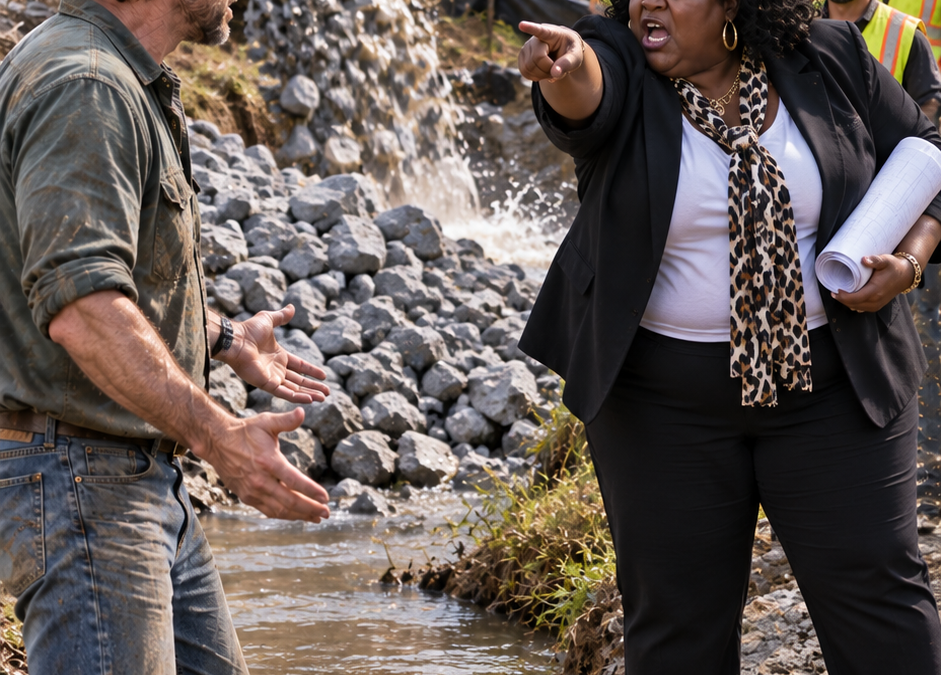
Karen Vossberg stood on my gravel road in spotless white sneakers with a rolled engineering map under one arm.
She didn’t even look surprised to see me.
“Keep going,” she told Ned.
“He isn’t on the work order.”
I turned toward her.
“You’re standing on Parcel 22-064.”
She raised an eyebrow.
“My deed,” I said. “My creek. My water right.”
Karen snapped her fingers toward the loader operator like she was telling somebody to get a dog off a couch.
“It’s not a creek.”
“What?”
“It’s a drainage ditch.”
The loader started moving again.
“Karen, you never asked permission.”
“Ditches get filled.”
“You never asked me.”
She stepped closer.
There were nine truck drivers watching.
Three laborers.
Ned in the loader.
And Karen made sure every one of them heard the next part.
“I don’t ask permission from a man who sells shrubs out of a barn.”
My face went hot.
She pointed toward the road.
“You interfere with this work and I’ll have you cited, towed, and removed from association property.”
I laughed once because the alternative was grabbing the map out of her hand.
“Association property?”
“Yes.”
“This is my land.”
“Stand there if you want.”
She glanced at the trucks.
“They’ll fill it anyway.”
So I stood there.
And they filled it anyway.
Two thousand four hundred cubic yards of stone.
Six hundred forty feet of running water.
Gone beneath a wide gray pad before noon.
Karen walked across it afterward.
Heel to toe.
Testing the grade like she’d just had a driveway poured.
She never once looked at the spring water backing up along the edges.
She never looked uphill either.
That was the strange part.
Because uphill from that fresh gray pad sat 196 houses.
Roofs.
Driveways.
Cul-de-sacs.
A clubhouse.
Parking lots.
And a retention pond designed to collect almost every drop of rain that fell on Stonebrier Landing Estates.
All of that water had one place to go.
My creek.
Karen had just buried it.
Water doesn’t care about confidence.
It doesn’t care about board votes.
It doesn’t care about maps drawn by people who never walked the land.
Water just waits.
I grew things for a living.
Chadwick Creek Nursery sat on seventy-eight acres my family had held since before Bell Hollow Road had a name.
Six greenhouses.
Four sod fields.
Thousands of ornamental trees.
And roughly forty thousand seedlings in one-gallon pots every spring.
People who don’t grow plants for a living hear “seedlings” and imagine something forgiving.
They aren’t.
A one-gallon container can become an oven in summer.
From April through September, those plants need water every day.
Miss enough irrigation and they don’t merely look sad.
They die.
A year’s work can turn brown in a week.
Everything drank from Chadwick Creek.
The water came out of the ground near the north boundary, spring-fed and cold enough in July to make your hand ache if you held it under too long.
It crossed the entire property before leaving near the south fence.
My grandfather Ellsworth had stacked a stone ford across it in 1938 so wagons could cross without chewing up the banks.
The stones were still there when I was a boy.
My father kept them in place.
I kept them in place.
We had a legal state water right too.
WR11-0842.
Filed.
Renewed.
Paid.
Every year.
I mention paperwork because this whole fight eventually turned on paperwork.
But on April 2, paperwork didn’t mean anything to Karen Vossberg.
Stonebrier Landing Estates had been built uphill from us in 2003.
One hundred ninety-six houses spread across ground that used to absorb rainfall slowly.
Then came asphalt.
Concrete.
Roofs.
Driveways.
Storm drains.
When you pave a hillside, water stops soaking in.
It runs.
The developer understood that.
So Stonebrier had a retention pond near the bottom of the subdivision.
Every street inlet fed it.
Every culvert pointed toward it.
That pond had one outlet pipe.
One.
That pipe discharged across the boundary into Chadwick Creek.
From there, stormwater moved through my land and continued downstream.
For twenty years, the system worked so well nobody talked about it.
Water entered.
Water left.
The subdivision stayed dry.
My land had never been part of Stonebrier.
Never annexed.
Never dedicated.
Never subject to HOA dues.
I didn’t get their newsletters.
I didn’t vote in their elections.
I wasn’t one of them.
About four years before the trouble started, I attended a county open house.
Stonebrier had an internal planning map displayed on an easel.
Someone had shaded my creek corridor green.
The label said:
COMMON GREENWAY — DITCH A
I remember standing there looking at it.
I thought somebody had been careless with a highlighter.
That was all.
I didn’t challenge it.
Didn’t ask who made the map.
Didn’t request corrections.
That turned out to be my first mistake.
Karen Vossberg was in her third year as HOA president when she came for the bottomland.
She was good at being president in the specific way that makes you nervous once you know what you’re looking at.
Meetings started on time.
Violation letters went out fast.
She recruited two board members personally.
Her treasurer, Neville Ashcraft, had a habit of reading whatever Karen placed in front of him as though it had been carried down a mountain on stone tablets.
Her big project that year was Phase Two of the Stonebrier Greenway.
Walking loop.
Benches.
Landscaping.
Two pickleball courts.
A ribbon-cutting kind of project.
The problem was space.
Phase Two needed around four flat acres.
There was only one large flat undeveloped section near the subdivision.
My bottomland.
The creek ran through the middle of it.
From Karen’s perspective, I suppose the solution looked simple.
Fill the channel.
Grade the land.
Pave the trail.
Pour the courts.
Call it an amenity.
She came to see me three times in January and February.
The first visit was almost friendly.
“Palmer, we’d like to talk about connectivity.”
“Connectivity to what?”
“The greenway.”
“Across my farm?”
“Along the drainage corridor.”
“You mean my creek.”
She smiled.
“Terminology aside.”
“No.”
Her smile tightened.
The second time, she brought Neville and a full-color rendering.
Trees.
Families with strollers.
A couple walking a golden retriever.
Pickleball players frozen mid-swing.
It looked beautiful because renderings always do.
Karen spread it across my potting table.
“This benefits everyone.”
“It benefits Stonebrier.”
“It increases property values in the area.”
“I don’t sell houses.”
Neville tapped the creek line.
“The existing ditch is underutilized.”
I stared at him.
“Underutilized?”
Karen stepped in before I could say more.
“We’re asking for cooperation.”
“No.”
I still offered something.
That’s my nature.
I said I’d grant a walking easement on the east bank.
Sixteen feet wide.
No vehicles.
No channel work.
Renewable agreement.
Stonebrier maintains the path.
My creek stays untouched.
I would’ve signed it that day.
Karen barely read it.
“The association does not buy what the association already owns.”
I looked up.
“What did you say?”
She rolled the rendering.
“We already have drainage rights.”
“Drainage rights are not ownership.”
She gave me a small smile.
“You should speak to someone familiar with property law.”
Then she left.
I wrote that sentence on the back of a feed receipt.
THE ASSOCIATION DOES NOT BUY WHAT THE ASSOCIATION ALREADY OWNS.
Something about it bothered me.
People don’t say “already owns” when they are negotiating.
They say it when somebody has convinced them the outcome is settled.
On March 20, I found a notice zip-tied to my front gate.
COMMON AREA IMPROVEMENT NOTICE
DRAINAGE DITCH A
CHANNEL FILL AND GRADE
COMMENCEMENT DATE: APRIL 2
There was no place for my signature.
No consent section.
No objection process.
Just a date.
So I did everything people tell you to do when conflict starts.
I documented.
On March 26, I sent Karen a certified letter.
No lawyer language.
No threats.
Just facts.
The channel is located on deeded Chadwick property.
I do not consent to any filling, grading, excavation, or alteration.
I hold state water right WR11-0842.
Then I put one sentence by itself.
If you fill that channel, the water from your subdivision has nowhere to go but back up into your subdivision.
Karen signed for that letter on March 30.
The return card came back with her name slanting hard across the signature line.
I put it in a drawer beside my seed invoices.
I assumed that would stop her.
Who reads a warning like that and keeps going?
At 4:40 in the morning on April 1, I woke to air brakes on Bell Hollow Road.
Trucks staging.
I lay in bed listening to diesel engines idle in the dark.
One thought kept repeating.
She has my letter.
She signed for it.
Either Karen didn’t believe me—
or somebody had already warned her before.
The Stonebrier board met the next evening.
I walked into the clubhouse carrying a manila folder.
No lawyer.
No engineer.
Just paper.
I had pulled my deed that morning.
Instrument 1998-02214.
Parcel 22-064.
Four paragraphs of legal description.
I also brought Stonebrier’s recorded subdivision plat.
The permanent map.
The document showing exactly where Stonebrier ended.
I laid both in front of Karen.
Then I traced the property line slowly with one finger.
“Stonebrier stops here.”
No one spoke.
I moved my finger south.
“The creek is roughly one hundred thirty feet beyond your boundary.”
A woman at the far end leaned closer.
“It’s not your common area.”
Neville stared down at a blank legal pad.
I waited.
Finally, he cleared his throat.
“This is a matter the board has already addressed.”
“When?”
“Prior to commencement.”
“That doesn’t answer anything.”
Karen leaned back.
“Twenty years.”
“What?”
“For twenty years that ditch has carried Stonebrier’s drainage.”
“It still doesn’t belong to you.”
“Twenty years of use establishes rights.”
She folded her arms.
“It’s called prescription. Look it up.”
Three people nodded.
That’s what confidence can do in a room.
It can make ignorance look like law.
I walked out realizing something important.
Being right wasn’t enough.
Not if Karen controlled the meeting, the maps, the board, and the language.
So I hired a surveyor.
On April 5, Ivor Blanchard and his crew restaked the full corridor.
Six hundred forty feet.
Pink ribbon every fifty feet.
Boundary pins located.
Capped stakes.
Three thousand two hundred dollars.
I didn’t have that money sitting around.
But I spent it.
I returned that evening.
Every stake was gone.
All of them.
Someone had stacked them neatly along Bell Hollow Road.
Pink ribbon wrapped around the bundle.
Tidy.
Deliberate.
I photographed the pile from every angle.
Then stood in the roadway with both hands on top of my head.
Because the thing I wanted to do next would have ended with a deputy putting me in a cruiser.
The following morning, a woman from Highfield Community Management arrived.
Polo shirt.
Clipboard.
Wouldn’t meet my eyes.
She handed me an envelope.
NOTICE OF TRESPASS.
I was prohibited from entering the “construction zone” on Parcel 22-064 for safety and liability reasons.
My parcel.
Entering it would be reported to law enforcement.
I read the notice twice.
“Do you understand what you’re handing me?”
“I only deliver them.”
“They filled my creek yesterday.”
She stepped backward.
“I only deliver them.”
Then she drove away.
More letters arrived over the next four days.
Five-hundred-dollar fine for interference with association contractors.
Another fine accruing at one hundred fifty dollars per day for continued obstruction.
A letter from Stonebrier’s law firm warning that public claims questioning the association’s rights in “Ditch A” could constitute slander of title.
They destroyed my watercourse.
Then fined me for objecting.
Then threatened to sue me if I told people they didn’t own it.
I called the county.
Finding the right department took almost two days.
When I finally reached code enforcement, the man listened patiently.
Typed.
Asked for parcel numbers.
Then said:
“We’re documenting this as a civil property dispute.”
“It’s not just property. There’s a state water right.”
“Then you may need to contact the state.”
“They filled a flowing creek.”
“Sir, we’re not going to referee a boundary dispute between private parties.”
I sat in my truck afterward.
Forty thousand seedlings were drinking from reserve storage.
The pumps were running longer every day.
And government had just categorized the destruction of my creek as neighbors disagreeing over a line.
On April 7, my phone rang.
Unknown number.
“Mr. Chadwick?”
“Yes.”
“This is Maud Kirkindall. I’m on the Stonebrier board.”
Her voice was older.
Quiet.
Careful.
“I want you to understand that not everyone is comfortable with what happened.”
“Comfortable?”
A pause.
“There were questions.”
“About what?”
“The channel.”
I stood.
“What questions?”
“Somebody warned us about exactly this some time ago.”
My heart started beating faster.
“Warned you about what?”
Another pause.
“Ms. Kirkindall?”
“I’ve already said more than I should.”
“Who warned you?”
“Please don’t call this number again.”
The line went dead.
I stood there holding the phone.
Somebody warned us about exactly this.
Those words changed everything.
Warnings leave records.
Warnings get emailed.
Filed.
Discussed.
Somewhere, something existed.
I didn’t know what yet.
But Karen knew more than she was admitting.
The next day, Garvin Ruddock’s grading crew returned.
They compacted the fill.
Vibratory roller.
Pass after pass.
The ground shook hard enough that greenhouse glass buzzed a quarter mile away.
When they finished, orange stakes marked the centerline of what had once been my creek.
That evening, Karen posted pictures online.
PHASE TWO IS UNDERWAY!
THANK YOU FOR YOUR PATIENCE!
Forty-some likes.
People asked about benches.
Lighting.
Pickleball opening dates.
That night, I walked the lower field with a flashlight.
There had been no rain for nine days.
My boots sank into wet grass.
I pressed my heel down.
Water filled the depression.
The spring was still running.
Of course it was.
Karen had buried the channel.
She hadn’t turned off geology.
The water had lost its route.
So it was searching for another.
I went home and looked at Stonebrier’s plat again.
Along one margin was a line of small print I’d ignored twice.
DRAINAGE AND OUTFALL — SEE INSTRUMENT 2003-05412.
I wrote the number down.
Before I could retrieve it, the first rain came.
April 14.
Nothing historic.
One-point-nine inches across roughly five hours.
Regular spring weather.
The kind you forget.
Stonebrier’s retention pond filled in about forty minutes.
Birdie Longacre later told me he watched it from his deck.
Birdie lived near the low end of Stonebrier Circle.
I’d sold him three river birches in 2019.
He said the pond climbed like somebody filling a bathtub.
Water reached the outlet structure.
Stopped.
Then kept rising.
Because the outlet pipe discharged into my creek.
And my creek was under two thousand four hundred cubic yards of stone.
By eleven that night, water crossed Bell Hollow Court.
By midnight, Stonebrier Circle looked like a shallow river.
Mulch floated through the street.
A recycling bin drifted sideways.
Twenty-two lots flooded.
Nine houses took basement water.
Cars sat in driveways with water above the hubs.
I stood at my north fence at two in the morning wearing a rain jacket.
And I want to be clear about what I felt.
Not satisfaction.
Fear.
Because the fill was moving.
Water had found a weak seam along the west edge.
It began cutting.
The sound carried through the rain.
Stone grinding.
Water hissing through gravel.
If that entire pad failed with the pond backed up behind it, a wall of water would cross my nursery.
Greenhouses.
Equipment.
Storage sheds.
People lived downstream too.
I called 911.
Explained the obstructed outfall.
Explained the fill.
Explained that the pad was scouring.
The dispatcher documented it.
I called the county emergency line.
Left the same information.
Then stood there until four in the morning watching water cut through a structure I was legally forbidden to touch.
By sunrise, the rain stopped.
Before breakfast, Karen had already decided whose fault it was.
Birdie called me around eight.
“Palmer.”
His voice sounded wrong.
“What happened?”
“She’s telling people you blocked it.”
I closed my eyes.
“What?”
“Karen’s at the entrance saying you dammed the channel to retaliate because the HOA took the greenway.”
For a second, the room tilted.
There’s a special kind of helplessness in hearing a lie so organized that you know facts won’t catch up quickly enough.
At 9:30, two men came down my driveway.
The younger one was already recording.
His daughter’s bedroom carpet had been ruined.
He was angry.
He had every reason to be.
“Did you block the drainage?”
Instead of arguing, I said:
“Come with me.”
I led them through wet grass to the gray pad.
Six hundred forty feet.
Orange trail stakes.
The fresh erosion gully at the west end.
The younger man’s phone lowered slowly.
“Where’s the creek?”
He wasn’t really asking.
“Under that.”
He looked at me.
“Who did this?”
“Stonebrier.”
“All of it?”
“Nine trucks. April second.”
Neither spoke for a while.
Then the older man said quietly:
“Nobody told us.”
They walked back to their truck much slower than they had approached me.
That afternoon, I drove to Cranmore Abstract and Title.
I gave the clerk, Rosamund Teasdale, one number.
2003-05412.
She returned ten minutes later carrying eleven warm pages.
I read them standing at the counter.
Drainage and Outfall Maintenance Agreement.
Recorded November 2003.
Parties:
Stonebrier Landing Estates.
Stonebrier Landing Estates Homeowners Association.
My father.
The document said three things.
First:
The channel crossing Parcel 22-064 remained privately owned Chadwick property.
The association had no possessory interest.
Only discharge rights.
Second:
The channel was the sole permitted outfall for the Stonebrier stormwater system.
Sole.
Third:
Stonebrier assumed a perpetual, non-terminable obligation to keep that channel clear and unobstructed.
Then came the sentence that made me read the paragraph four times.
If the association or its agents caused an obstruction, the association assumed sole responsibility for all resulting upstream and downstream damages.
Karen had not merely trespassed.
She had blocked the one drain her neighborhood was legally required to protect.
And Stonebrier’s own recorded agreement said so.
Rosamund looked over.
“Everything all right, honey?”
“No, ma’am.”
I stared at the paper.
“It’s worse than I thought.”
I paid for certified copies.
The next morning, April 15, I delivered one to Highfield Community Management.
One went certified mail to every Stonebrier board member.
Another went to the county.
I made the woman at the counter stamp my copy.
That night Karen posted a statement to the neighborhood group.
I still have the screenshot.
THE 2003 DOCUMENT BEING CIRCULATED BY THE DOWNSTREAM LANDOWNER IS OBSOLETE.
THE COMMUNITY HAS SECONDARY DRAINAGE CAPACITY THROUGH THE ORIGINAL AGRICULTURAL TILE SYSTEM.
THIS IS A PRESSURE TACTIC.
PLEASE DO NOT ENGAGE WITH HIM.
Obsolete.
A perpetual non-terminable agreement was obsolete because Karen typed the word.
But the part that really bothered me was the tile system.
I knew those old farm fields.
Had known them my entire life.
There had once been buried agricultural drainage tile.
But I’d never seen it carry stormwater.
Not once.
On April 24, Stonebrier filed a thirty-page engineering report with the county.
For eleven days, that report nearly buried me.
The conclusion was on page four.
The Stonebrier flooding was attributed to “downstream hydraulic restrictions” on my property.
Specifically:
A stone ford.
And a small irrigation weir.
My grandfather’s ford from 1938.
My father’s concrete irrigation structure from 1981.
The oldest surviving features on my land had suddenly become the reason nine houses flooded.
It was clever.
Karen didn’t deny the drainage system had backed up.
She simply moved the blame six hundred feet downstream.
And she had an engineering firm’s name stamped on the cover.
Code enforcement arrived April 25.
Dexter Amber.
Polite man.
He walked the lower creek.
Photographed the old ford.
Photographed the weir.
Then wrote something on a form.
“You have ten days to remove the obstructions.”
“Mr. Amber, that ford has been there since 1938.”
He tore off my copy.
“This is the report in our file.”
“The actual blockage is north of here.”
“I can only enforce what we’ve got.”
“There’s twelve feet of fill up there.”
“Ten days.”
Two days later, I received a letter from the state Water Resources Office.
My diversion right under WR11-0842 was temporarily suspended pending investigation.
Standard procedure, they said.
There was an active enforcement issue involving conveyance.
I had to shut down my intake.
It was April 28.
Forty thousand seedlings.
One-gallon containers.
My storage tank could keep the nursery alive about four days if I stopped irrigating the sod fields.
So I stopped watering the sod.
Three days later, redbud seedlings began curling along their margins.
The leaves folded inward.
That stage means a plant has stopped growing and started rationing life.
You can sometimes save it from there.
Past that, you lose it.
While I watched my nursery dry, Stonebrier recorded a lien against my parcel.
Twenty-eight thousand six hundred dollars.
Daily fines.
Interference fees.
Engineering costs.
They hired the report blaming me.
Then billed me for the report.
My bank saw the lien.
Froze my equipment credit.
Two commercial sod customers canceled.
Nobody wants to schedule a landscape delivery from a nursery with a water-right suspension and title trouble.
I called Averil Downey and Rue Ellenwood into the potting shed.
They had worked every spring for six years.
I told them I had to lay them off until the water issue cleared.
Rue cried.
Averil shook my hand.
“Call when it turns.”
“I will.”
“I’ll come back.”
That was worse.
On May 2, I returned to the county building carrying the certified 2003 agreement.
Finally got fifteen minutes with somebody in permits.
He read the whole thing.
Every page.
Then slid it back.
“This is a private agreement.”
“It controls drainage for 196 houses.”
“I understand.”
“It says they’re responsible.”
“You need civil court.”
“You’re telling me this doesn’t matter?”
“I’m telling you I don’t enforce contracts.”
He wasn’t lazy.
He wasn’t corrupt.
He was simply the wrong government employee.
That was almost harder to accept.
I’d spent a month knocking on correct-looking doors in the wrong hallway.
That night, Karen published a newsletter.
DRAINAGE UPDATE:
THE CAUSE HAS BEEN IDENTIFIED AND IS BEING ADDRESSED BY THE APPROPRIATE AUTHORITIES.
IT IS NOT RELATED TO PHASE TWO.
THANK YOU FOR TRUSTING YOUR BOARD.
I read it in a dark greenhouse.
No irrigation pumps.
Forty thousand pots sitting silently around me.
Then I looked down at the county folder.
On the routing stamp, somebody had checked a box.
Stormwater.
Then crossed it out.
Stormwater.
Not code enforcement.
Not boundary enforcement.
Stonebrier operated under a municipal stormwater permit.
A development that large had permitted outfalls.
Permit conditions.
Compliance certifications.
An administrator.
And one thing stormwater permits do not tolerate is somebody destroying the outfall named in the permit.
I had spent a month arguing about ownership.
The more important question was whether Stonebrier still had a legal place to discharge water.
Karen had answered that with nine dump trucks.
That night, around one in the morning, I took a sledgehammer, pry bar, tripod, and work light down to my father’s irrigation weir.
I removed it.
Block by block.
Filmed every second.
Timestamp visible.
I split the skin between my thumb and forefinger badly enough to bleed through my glove.
Kept going.
By four in the morning, the weir was gone.
I photographed the open channel from six directions.
Wrote a compliance affidavit at dawn.
Delivered it to Dexter Amber before ten.
Nine days into his ten-day order.
People later asked why I complied with an order I thought was wrong.
Because I wanted their excuse gone.
Now there was no stone structure below Stonebrier capable of explaining the flooding.
Nothing.
Except Karen’s fill.
On May 6, I filed a formal complaint with the county stormwater administrator.
Her name was Winifred Stagg.
I alleged obstruction of a permitted outfall.
False reporting.
Unauthorized watercourse alteration.
Attached:
2003 agreement.
Photos.
Flood images.
My certified warning letter.
Karen’s signed receipt.
Then I filed a state environmental referral.
For the first time, I stopped looking at the buried creek as a personal injury.
I looked at it as a destroyed permitted outfall.
That distinction changed everything.
Winifred Stagg called May 8.
“Mr. Chadwick?”
“Yes.”
“I’ve reviewed your filing and opened an investigation.”
I sat straighter.
“I need one direct answer. Is there currently any structure on your property below the fill obstructing conveyance?”
“No. I removed the weir May fourth. Code enforcement has the video.”
Silence.
Then her tone changed.
“That’s helpful.”
“How long does this take?”
“Depends on what’s in the file.”
So I requested the file.
Complete stormwater compliance history for Stonebrier Landing.
Every inspection.
Every certification.
Every engineering letter.
Every correspondence.
One hundred ten dollars in copy fees.
Nine days later, I picked up a banker’s box.
I found the document on the second afternoon of reading.
About two hundred pages down.
Ryder & Fitch Engineering.
September 11, 2019.
Addressed to Stonebrier Landing Estates Board of Directors.
Stonebrier itself had commissioned a drainage assessment.
Their engineer wrote that the channel crossing Parcel 22-064 was the sole permitted stormwater outfall.
The report said the old agricultural tile system had collapsed during utility work in 2011.
It carried no effective flow.
Then one sentence appeared by itself.
UNDER NO CIRCUMSTANCES SHOULD THE CHADWICK CHANNEL BE NARROWED, FILLED, OR OBSTRUCTED. THE COMMUNITY HAS NO ALTERNATE DISCHARGE ROUTE.
I sat down.
Karen hadn’t misunderstood.
She knew.
Four pages later came October 9, 2019 board minutes.
Item Seven:
Ryder & Fitch drainage assessment.
Possible outfall easement negotiation with Chadwick property.
Motion by President Vossberg:
Table as premature.
Defer communication with adjoining owner.
Passed four to two.
She had known for four and a half years.
Known in writing.
Engineer stamp.
Board vote.
And she buried it in the minutes.
I called Maud Kirkindall.
She answered immediately.
“You found it.”
“October ninth.”
“I was one of the two.”
“You voted against tabling it?”
“Yes.”
Her voice tightened.
“Karen collected the printed copies after the meeting.”
“Do you have one?”
Silence.
Then:
“I put mine in my purse.”
My hand went cold around the phone.
“You still have it?”
“Yes.”
“Will you tell the county?”
“Yes.”
No hesitation.
There was something else in the box.
Stonebrier’s annual stormwater certification.
Routine compliance form.
Signed by the association president under penalty of perjury.
It certified that every permitted outfall was clear, unobstructed, and functioning as designed.
Date filed:
April 22.
Twenty days after Karen buried the only outfall beneath two thousand four hundred cubic yards of stone.
She had not merely caused the obstruction.
She had certified in writing that it didn’t exist.
The county contacted Garvin Ruddock.
They discovered there had been no proper grading permit for the watercourse work.
A contractor staring at an environmental violation suddenly becomes very cooperative.
Ruddock handed over his file.
Original work order.
Stonebrier letterhead.
FILL AND GRADE CHANNEL, STATION 0+00 TO 6+40.
PER K. VOSSBERG.
At the bottom, handwritten:
TAKE IT TO GRADE.
DON’T CALL THE COUNTY.
The handwriting slanted hard to the right.
Exactly like the signature on my certified letter receipt.
That was the first evening since April 2 I believed the truth might catch up.
Karen responded by doubling down.
May 18.
Ruddock’s equipment returned.
They raised the pad another three feet.
Then armored the west side with massive riprap.
Quarry stone the size of microwave ovens.
The erosion channel from the April flood disappeared beneath a reinforced slope.
Birdie Longacre came down wearing yard shoes.
We stood at my fence.
“They told us it’s structural safety.”
I nodded toward the subdivision.
“Go look at your pond.”
He did.
The same day, Stonebrier filed for an emergency variance.
Their argument:
The feature on my property was not a natural creek.
It was an artificial agricultural drainage ditch.
Therefore no watercourse permit was required.
If the county accepted that argument, Karen could legalize the fill after the fact.
Everything would become another civil fight.
Then she levied an emergency legal assessment.
Twelve hundred dollars per household.
One hundred ninety-six homes.
That changed the mood inside Stonebrier faster than the flooding had.
Birdie told me the online thread hit hundreds of comments before moderators shut it down.
Families had already flooded once.
Now they were being asked for twelve hundred dollars apiece to defend the project that caused the dispute.
I prepared my variance response.
Historic aerials from 1962.
Another from 1988.
Both showed a natural winding channel through the bottomland.
Spring-flow records.
My state water right.
The 2003 agreement.
Photographs of the original banks.
A person can dig a ditch.
A person does not excavate a creek that meanders across eighty years of aerial photography.
I filed everything May 20.
Variance hearing scheduled for May 24.
Then weather arrived.
May 21.
Forecasts began warning about a strong storm system from the southwest.
Four to six inches possible.
The hearing was still three days away.
My redbud seedlings had maybe ten days of life left under rationed water.
And the only outlet for 196 houses was still buried under a three-foot-raised, riprap-armored pad.
At four in the afternoon, I called Stagg’s office.
“The outfall is blocked.”
“We know.”
“They raised it.”
“It’s in the file.”
“They armored the failure point.”
“We’re aware.”
“There’s four to six inches coming tomorrow.”
A pause.
“Ms. Stagg says the matter is before the hearing officer. It will be addressed on the twenty-fourth.”
I stood at the north boundary that evening.
The pad was taller now.
Flat.
Gray.
Hard.
The west face looked like a fortress.
Above it, Stonebrier’s porch lights flickered on one by one.
One hundred ninety-six houses.
Families making dinner.
Kids doing homework.
People who had no idea how completely their safety depended on the creek buried beneath my boots.
Wind shifted around nine.
Southwest.
Smelled like rain.
It started at 10:03 the next morning.
May 22.
I was awake.
I had barely slept in four days.
Sat at my kitchen table watching radar.
Red bands moved across the county.
Rain hammered the greenhouses.
By early morning, we had more than four inches.
At 3:30, I called the county emergency line.
Again.
Obstructed outfall.
Stonebrier retention pond.
No relief capacity.
Occupied homes.
The dispatcher logged it.
Then at 3:40, I called Maud.
She answered first ring.
“It’s coming,” I said.
“I know.”
I heard a chair scrape.
“What do I do?”
“Wake Stonebrier Circle. Tell them to move cars uphill. Get anything off basement floors.”
“Karen will say I’m causing panic.”
“She’ll say that either way.”
The retention pond overtopped around 4:52.
I was standing at my fence in rain so thick the flashlight was useless.
I heard the pond before I could see anything.
A broad roar.
Water spilling over the entire rim.
The outlet pipe was submerged against a wall of trapped water.
Then something happened I hadn’t fully understood until that moment.
The reinforced pad held.
The water could not escape downhill.
So it went backward.
Every storm drain in Stonebrier flowed toward the retention pond.
Once the pond filled above those pipe inverts, pressure reversed.
Water moved back into the very streets that had delivered it.
Around 5:20, manhole covers began lifting.
Birdie described one later.
Knocking beneath the pavement.
Three or four heavy impacts.
Then the iron lid rose on a column of water and landed in someone’s lawn.
After that, Stonebrier’s streets became drainage channels.
Both entrances flooded.
The sheriff closed them before six.
At 6:05, water entered houses.
Not nine this time.
Not twenty-two yards.
One hundred sixty-eight of one hundred ninety-six homes eventually appeared on the county damage assessment.
I still can’t think of that as a number.
Living rooms.
Garages.
Basements.
Children’s bedrooms.
Family photographs.
Furniture.
Three and a half feet of brown water in some streets.
The clubhouse flooded.
Water rose across two brand-new pickleball courts poured eleven days earlier.
Karen Vossberg lived on one of the lowest lots.
Birdie later told me she came onto her porch in a raincoat over pajamas.
Watched the water climb the steps.
One tread.
Then another.
People shouted toward her.
She didn’t answer.
I wasn’t there.
I was cutting the chain on my north pasture gate.
My pasture was the highest dry ground nearby.
Cars were trying to move through water nobody could judge.
At 6:10, I opened the field.
I drove Bell Hollow Road with my hazard lights on.
Waved people toward my gate.
Forty-some vehicles ended up parked in my hay.
A woman arrived carrying two dogs and a rabbit inside a laundry basket.
Somebody’s ninety-year-old mother sat in my seed office under a blanket.
My wife, Odette, made coffee in the potting shed for four hours.
The two men who had confronted me in April came into my greenhouse around seven.
Soaked.
Mud to their knees.
The younger one looked at me.
“Palmer, I—”
“Don’t.”
He stopped.
“Coffee’s in the shed.”
Nobody died.
Not one person.
I still hold onto that.
Outside, Karen’s armored pad did exactly what she’d paid it to do.
It held.
Water chewed at the west side.
But the quarry stone stopped the breach.
The only accidental relief path that might have opened had been strengthened four days earlier.
Winifred Stagg arrived around nine with the county engineer.
Ephraim Gallatin.
Lean man.
Thirty years in stormwater.
The type who never has to raise his voice because he has measurements.
They entered through my farm because Stonebrier’s roads were still underwater.
I walked them to the fill.
Karen came down the hill in rubber boots.
Neville followed with an umbrella over a folder.
Karen started immediately.
“I want it understood that this was an act of God.”
Gallatin kept writing.
“Four-plus inches in one event,” she continued. “That’s beyond normal design criteria. The downstream owner has also historically restricted conveyance.”
Gallatin finally looked up.
“Restricted how?”
“Stone structures. An irrigation dam.”
I handed Stagg my tablet.
The video showed me May 4.
One in the morning.
Taking apart the weir.
Block after block.
Timestamp visible.
Then the county-stamped compliance affidavit.
Then Dexter Amber’s closed notice.
Stagg looked at Karen.
“The county record confirms those obstructions were removed eighteen days ago.”
Karen straightened.
“Then we’re dealing with an artificial agricultural ditch. The variance filing explains—”
Gallatin already had the 2003 agreement.
He read from it aloud.
“Sole permitted outfall.”
Rainwater dripped from the page protector.
“Perpetual and non-terminable obligation to keep the channel clear and unobstructed.”
He continued.
“Sole responsibility for resulting damages upstream and downstream where obstruction is caused by the association or its agents.”
He looked at Karen.
“Stonebrier signed this.”
“That’s an obsolete private document.”
“It says non-terminable.”
“It’s civil.”
Stagg put another page on the hood of the county truck.
Held it against the wind.
“Then we’ll discuss a public document.”
Karen looked down.
Stagg tapped the signature line.
“Annual stormwater certification. Filed April twenty-second.”
Karen said nothing.
“You certified all permitted outfalls were clear, unobstructed, and functioning.”
Silence.
“This was filed twenty days after the fill went into the outfall.”
Garvin Ruddock had been told to attend.
He stood near his truck for several minutes before finally walking forward.
He didn’t look at Karen.
“I’ve got the original work order.”
Karen turned toward him.
Ruddock kept talking.
“Stonebrier letterhead. Fill and grade channel. Six-forty linear feet.”
“Garvin—”
“It’s got Ms. Vossberg’s approval.”
He swallowed.
“And the note says, ‘Take it to grade. Don’t call the county.'”
Karen’s whole strategy shifted.
Right there.
She stopped arguing about ownership.
Stopped arguing about artificial ditches.
Instead, her voice softened.
“I had no idea this would happen.”
Nobody responded.
“I’m not an engineer.”
Her voice cracked slightly.
“No one told this board that filling that channel would flood our homes. If somebody had explained the risk, we would’ve stopped.”
For about four seconds, I almost understood how a reasonable person could accept it.
Then Maud Kirkindall came down the hill.
Rain bonnet.
Manila envelope tucked under her coat.
She was breathing hard.
She handed the envelope to Gallatin.
“Ryder and Fitch.”
Karen went still.
“September eleventh, 2019,” Maud continued.
“Stonebrier commissioned it.”
Gallatin opened the report.
Maud looked at him.
“It says the Chadwick channel is the only outfall. It says the agricultural tile failed in 2011. It says the channel must never be obstructed.”
Karen stared at her.
Maud kept going.
“October ninth, Karen moved to table it.”
Neville lowered the umbrella.
“Vote was four to two.”
Maud’s voice shook.
“I was one of the two.”
No one moved.
Then I reached inside my rain jacket.
The certified-mail receipt was sealed in a plastic sleeve.
I handed it to Stagg.
Not Karen.
I didn’t want theater.
“My March twenty-sixth letter.”
Stagg read it.
Then turned the card.
Karen’s signature.
March 30.
I knew the sentence by heart.
If you fill that channel, the water from your subdivision has nowhere to go but back up into your subdivision.
Gallatin read it.
Looked at the signature.
Then at Karen.
“It’s an act of God,” she said again.
Quieter this time.
Gallatin handed me the card.
“God didn’t sign the work order.”
Nobody said anything.
By late morning, the county issued an emergency order.
Stonebrier’s stormwater discharge authorization was suspended.
The association was ordered to remove all fill from the channel across Parcel 22-064.
Restore the original natural cross-section.
State environmental supervision required.
Stonebrier paid.
Not me.
The emergency variance was denied.
The application was referred for review because of material misrepresentations.
Gallatin addressed Karen directly.
“Your signature appears on the order obstructing this outfall.”
He pointed to the annual certification.
“And your signature appears on the document telling this county it remained clear.”
His tone stayed calm.
“Those are separate problems.”
Karen walked back uphill.
By then, perhaps thirty Stonebrier residents had gathered along the high edge of the street.
Standing in ankle-deep water.
Nobody yelled.
Nobody cursed her.
No one threw anything.
They simply watched.
She walked the entire way without one person speaking.
I have been in louder places.
Football stadiums.
Construction sites.
Storms.
But nothing I’ve heard has ever sounded as loud as those people saying nothing.
Restoration started June 4.
The association could not use Ruddock.
They hired an environmental restoration contractor from the city.
State biologist on site.
Two thousand four hundred cubic yards came out.
Bucket by bucket.
Loaded.
Weighed.
Hauled.
Every truck ticket went to Stonebrier.
Nine days.
On the ninth afternoon, around four, an excavator removed the final compacted material from the original channel near the south end.
Spring water moved through the exposed gravel.
At first, a thin ribbon.
Then wider.
Then the whole creek found itself.
For the first time in sixty-eight days, water ran the length of my property.
I didn’t cheer.
Didn’t call anyone.
Didn’t take a victory picture.
I sat on the bank.
Put both boots in the water.
And listened.
The paperwork took much longer to heal.
My code violation was dismissed.
WR11-0842 was restored June 19.
That night, I ran my irrigation pumps for eleven hours.
The lien against Parcel 22-064 was released.
Twenty-eight thousand six hundred dollars in fines and charges reversed.
Interest added.
But forty thousand seedlings had not waited for the legal system.
I saved about eleven thousand.
The rest died.
Insurance and settlement money eventually covered most of the loss.
People call that being made whole.
They’ve never watched twenty-nine thousand young trees burn.
Paper doesn’t smell like a burn pile.
You don’t smell an insurance payment on your clothes after midnight.
Karen’s conduct created its own insurance problem.
Stonebrier’s carrier agreed to defend the association generally.
But Karen personally?
Different question.
Written work order.
Prior engineering warning.
Certified notice from me.
Stormwater certification filed after the fill.
The carrier took the position that intentional acts fell outside ordinary accidental coverage.
Ruddock lost his contractor’s license for twelve months.
His liability carrier paid part of the resident damage claims.
That helped some families rebuild before winter.
The residents never paid me.
I never wanted them to.
The emergency twelve-hundred-dollar legal assessment was rescinded before collection.
Homeowners pursued the contractor’s carrier, association coverage, and separate claims relating to Karen’s actions.
Eleven residents asked me to testify.
I did.
The recall meeting was held July 12 in the field beside the clubhouse.
The clubhouse itself was still stripped down from flood damage.
I wasn’t a Stonebrier member.
So I stayed home.
Maud called afterward.
“One fifty-eight to twenty-four.”
“Against Karen?”
“Yes.”
Karen hadn’t attended.
Neville resigned that same week.
Maud served as acting president for the next nine months.
She once described it to me as the worst volunteer position anybody had ever invented.
In August, the new Stonebrier board came to my nursery.
Three members.
One attorney.
No colorful rendering.
No map calling my land theirs.
They sat at the potting table.
The attorney opened a folder.
“We want to formally acknowledge the 2003 agreement.”
“Good.”
“And clarify inspection access.”
“What do you need?”
They wanted the right to inspect their outfall.
Reasonable.
I gave them a defined path along the east bank.
Annual access fee.
Written notice.
Emergency exception.
Then one condition.
“No association employee, contractor, or board member enters the channel itself without telling me first.”
The attorney nodded.
“Agreed.”
Four minutes.
That was all.
Nearly the same arrangement I’d offered Karen in February for free.
Later that summer, the county had to pump standing water from the lowest areas of Stonebrier.
The best route for discharge hoses crossed my hayfield.
They asked.
I said yes.
They offered payment.
I refused.
Not because I’m especially noble.
Those pumps ran day and night across my property.
After everything that had happened, hearing Stonebrier water being carried safely away through my field was deeply satisfying.
At the end of July, my son Beckett and I went down to my grandfather’s old ford.
The flood had scattered the stones.
Some were downstream under silt.
We found them by feel.
Beckett was ten.
He worked harder than I wanted him to.
Four Saturdays.
Lift.
Roll.
Set.
Adjust.
On the final Saturday, we placed the last stone.
Water rose between the gaps.
Then spilled over.
That old ford had a sound.
Low.
Knocking.
Almost like quiet laughter.
I hadn’t heard it since April 2.
And until it came back, I hadn’t understood how much of my life had been built around hearing it.
Beckett crouched with both hands in the creek.
“Is it the same water?”
I sat beside him.
“It’s the same creek.”
He looked upstream.
“Even after they filled it?”
“Especially after they filled it.”
He didn’t fully understand.
Maybe he didn’t need to yet.
Karen Vossberg’s mistake was never simply arrogance.
It was believing land was a flat surface on which authority could draw whatever it wanted.
Greenway.
Common area.
Drainage ditch.
Phase Two.
She believed if the board voted, engineers wrote, contractors graded, lawyers threatened, and maps used the right color, reality would eventually behave.
But a creek isn’t a line on a rendering.
It isn’t a nuisance occupying future pickleball space.
And it isn’t something you own in the ordinary sense.
A creek is going somewhere.
It was going somewhere before my grandfather stacked the ford.
Before Stonebrier existed.
Before anyone paved the hillside.
Before Karen had a title.
Before my family had a deed.
You can bury that path under two thousand four hundred yards of rock.
You can compact it.
Raise it three feet.
Armor it with stone.
File certifications.
Send lawyers.
Fine the person who warns you.
You can even convince 196 families that a creek has become a ditch because a map uses different words.
The water doesn’t care.
It never argues.
It never attends meetings.
It never raises its voice.
It simply keeps coming.
Drop after drop.
Storm after storm.
Looking for the path gravity gave it.
And sooner or later, when enough water arrives, every lie built in front of that path has to answer for itself.
Karen learned that the morning Stonebrier flooded.
I learned something too.
For weeks, I thought I was fighting for ownership.
My property.
My water right.
My nursery.
My father’s agreement.
My grandfather’s ford.
All of that mattered.
But in the end, the creek defended the larger truth better than I ever could.
The night after Beckett and I reset those stones, I walked back down alone.
The nursery pumps were running again.
Young trees stood in rows under irrigation.
Some benches were still empty where the dead seedlings had been.
You don’t refill twenty-nine thousand missing plants overnight.
The scars stayed.
But the water moved.
It passed over the ford.
Through the lower field.
Toward the south fence.
Exactly where it had always gone.
I stood there until dark.
And for the first time since April 2, I wasn’t thinking about Karen.
I wasn’t thinking about court filings.
Insurance.
Liens.
Fines.
Engineering reports.
I was listening to the creek.
The same low sound I’d heard as a boy.
The same sound my father had heard.
The same one my grandfather heard after stacking those stones in 1938.
A sound that had been missing for sixty-eight days.
Karen had believed a board president could decide where water belonged.
She discovered the hard way that none of us have that authority.
The only choice we really get is whether we respect where the water is going—
or whether we’re standing in its way when it comes back.








