𝗙𝗨𝗟𝗟 𝗦𝗧𝗢𝗥𝗬 The HOA President Accused Me of Stealing Water Without Realizing Her Own Meter Was Telling the Truth
𝗣𝗔𝗥𝗧 𝟮
The notice warned that an “outside landowner” was suspected of illegally diverting association water during drought conditions.
No name.
It didn’t need one.
There was one outside landowner on the west side.
Me.
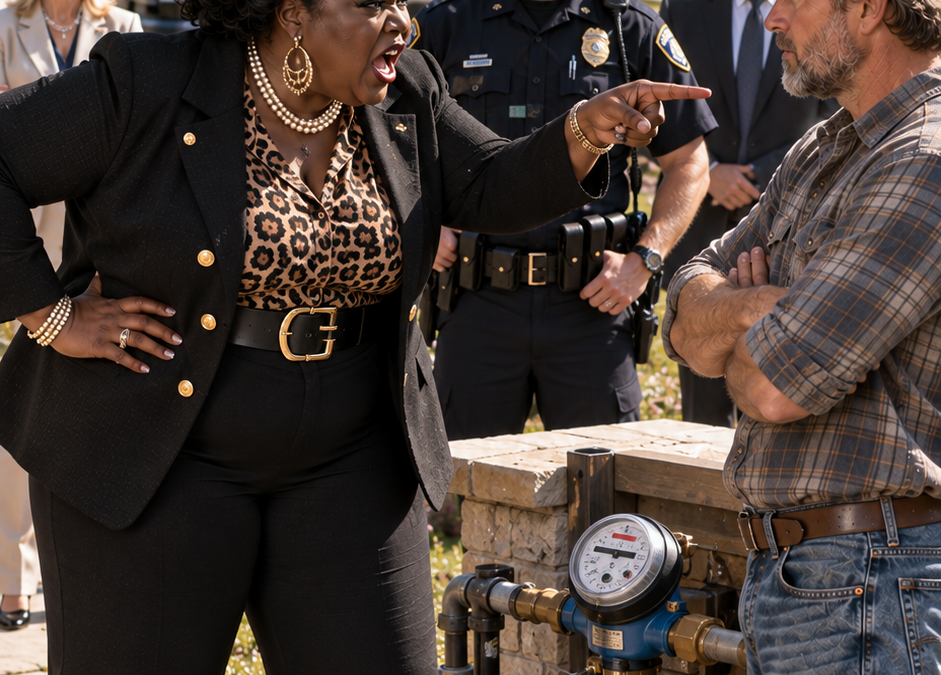
Two days later, Delphine confronted me near the gate.
“Our system has lost hundreds of thousands of gallons.”
“That’s a lot.”
“You would know.”
“What does that mean?”
“You work with water.”
“I do.”
“You have the knowledge.”
“Knowledge isn’t theft.”
“You have access.”
“To my own well.”
Her smile tightened.
“That’s exactly the problem.”
I looked at her.
“Why would a man with a private well steal HOA water?”
She stepped closer.
“Men who know how to hold a wrench often convince themselves they understand things much bigger than themselves.”
I’d heard some version of that from her before.
This time I didn’t ignore it.
“What exactly are you accusing me of?”
“Illegal connection to Bellweather infrastructure.”
“Where?”
“Near the western boundary.”
“On whose land?”
She didn’t answer directly.
“You’re interfering with community systems.”
“I haven’t touched your systems.”
“We will need access to inspect.”
“To my property?”
“Correct.”
“No.”
Her expression sharpened.
“The association has rights.”
“Show them to me.”
“You’ll receive notice.”
I did.
Cease and desist.
Trespass on association infrastructure.
Water theft.
Interference with utility systems.
Demand for inspection access.
Every accusation referenced infrastructure supposedly on or near my land.
No easement.
No permit.
No utility record.
I called the county utility locator service.
Their technician came out with equipment and marking paint.
We walked my property together.
Public electric.
Communications.
Old permitted lines.
Nothing registered where the green strip ran.
He scanned again.
Then looked at me.
“There’s something here.”
“But not mapped.”
“No.”
“What kind?”
“Can’t tell from the surface.”
He lowered the receiver.
“If it’s water, it’s private.”
“Any permit record?”
“Not in what we have.”
That afternoon, I dug carefully by hand.
No excavator.
No trenching machine.
Shovel and trowel.
About two feet down, I hit blue plastic.
Bright blue.
Newer polyethylene water pipe.
It ran east-west.
I cleaned enough soil away to see the manufacturer markings.
Pressure rating.
Production code.
Date.
Less than two years old.
My father had been dead much longer than that.
I did not cut the line.
Didn’t disconnect it.
Didn’t even scrape it more than necessary.
I photographed it.
Measured depth.
Diameter.
Recorded exact coordinates.
Followed it carefully.
A few feet away, beneath a fake landscaping rock, I found a valve box.
Mulch.
Decorative stone.
Almost invisible unless you knew it was there.
Inside sat a shutoff valve.
Entirely on my side of the property line.
I stared at that box for a long time.
Someone had installed a high-capacity water line on my land.
Hidden the valve.
Connected it to something.
And never asked me.
I called the county water utility.
Not theirs.
Planning office.
No permit.
County records.
No easement.
No excavation authorization.
No utility agreement.
I spent most of the next day reviewing filings involving my parcel.
Nothing.
No recorded right for Bellweather Pines.
No corridor.
No agreement.
Nothing signed by me.
Nothing valid under my father’s name.
I sent Delphine written notice.
Forty-eight hours.
Stop using the unpermitted line.
Produce any legal authorization.
She appeared the next day with two board members.
No lawyer.
No permit.
A laminated map.
Bright Bellweather colors.
Green subdivision outline.
A dotted line crossing my property labeled:
SHARED UTILITY CORRIDOR.
I almost laughed.
“Where did this come from?”
“Our infrastructure records.”
“This isn’t the county plat.”
“It doesn’t need to be.”
“Yes, it does.”
She looked toward the board members as though I were embarrassing myself.
“Our attorney reviewed this.”
“Name?”
Silence.
“Attorney’s name.”
“We don’t conduct legal discussions at a fence.”
“Recording number?”
Another silence.
“Utility easement number?”
Nothing.
“Permit?”
Her mouth tightened.
“You don’t have standing to challenge Bellweather internal infrastructure.”
“The pipe is under my land.”
“Because it’s inside the shared corridor.”
“Show me the recorded corridor.”
She rolled the map.
“This conversation is over.”
I called June Sutter.
June was a land-use attorney I’d worked with years earlier on a pump-station easement dispute.
She reviewed everything.
County plat.
Photos.
Notices.
Pipe location.
Valve location.
“No public system involved?”
“County confirmed no.”
“Any recorded easement?”
“None.”
“Notice already sent?”
“Yes.”
She leaned back.
“Once your deadline expires, you can isolate an unpermitted private line crossing your property, provided you don’t damage it, don’t interfere with any public utility, and document exactly what you do.”
“So I can close the valve.”
“Carefully.”
“I know how to close a valve.”
“Lawyers enjoy saying obvious things.”
I smiled.
She pointed at me.
“And camera.”
“Already planned.”
Two days later, the deadline expired.
No permit arrived.
No easement.
No attorney letter.
No explanation.
I placed a camera near the valve box.
Recorded the date.
Time.
Property marker.
Valve.
Pipe.
Then slowly turned the handle.
Quarter turn.
Pause.
Another quarter.
Pressure noise changed.
I continued until fully closed.
Within seconds, I heard a distant mechanical whine from Bellweather.
A pump straining.
Then sprinklers sputtered.
One row.
Another.
Then stopped.
The decorative fountain near the clubhouse slowed.
Water fell lower.
Then lower.
Within ten minutes, Delphine arrived.
She was practically running.
“What did you do?”
“Closed an unpermitted valve on my property.”
“You just stole community water.”
I looked at her.
“By stopping water leaving my property?”
“That’s association equipment.”
“Why is association equipment buried behind my property marker?”
Her phone was already in her hand.
“I’m calling the police.”
“Go ahead.”
She stepped close.
Perfume mixed with dust and hot grass.
“You really think you can win this?”
“I think you’re standing on the wrong side of a survey pin.”
“A man like you doesn’t beat an entire community.”
That sentence told me what this had always been about.
Not law.
Not water.
Belief.
Who would the police believe?
The HOA president in expensive clothes with a folder?
Or the well-repair man in dirty boots?
Delphine thought she knew.
Officer Rowan Hail arrived twenty minutes later.
Calm.
Mid-forties.
Body camera on.
He took one look at us and visibly settled into the posture of a man who had mediated too many property arguments.
Delphine started before his car door fully closed.
“This man has illegally tapped into and manipulated Bellweather Pines’s water system.”
She handed him a folder.
Water-loss reports.
Photographs.
Altered association map.
A printout about my work history.
According to her figures, more than four hundred thousand gallons had disappeared.
She presented the number like a murder weapon.
“He has the equipment knowledge.”
Rowan looked at me.
“Mr. Ror?”
“Yes.”
“Did you close a valve?”
“Yes.”
Delphine smiled.
Rowan kept looking at me.
“Where?”
“On my property.”
“Purpose?”
“To stop flow through an unpermitted buried line connected to my well.”
Delphine interrupted.
“That’s false.”
Rowan raised one hand.
“I’ll hear you both.”
Then to me:
“Do you have documentation?”
I did.
County plat.
Well permit.
Utility-locator confirmation.
County email.
Photographs.
Written notice.
Video of the valve closure.
I handed him copies one by one.
He read slowly.
Delphine watched him.
“This is exactly what he does,” she said. “He overwhelms people with technical paperwork.”
Rowan didn’t look up.
“Ma’am, let him finish.”
I explained the pump cycles.
Electric usage.
Pipe.
No permit.
No easement.
Then Delphine changed theories.
Maybe I wasn’t stealing association water directly.
Maybe I was pumping it backward into my well to hide consumption.
I stared at her.
Rowan looked at her water-loss report.
Then noticed something.
“What’s this household meter number?”
Delphine hesitated.
“My residence.”
“Why is your house meter included in an HOA irrigation report?”
“My home is near the pump room.”
“That doesn’t answer the question.”
“It’s used as a pressure reference.”
I looked at her.
That made no engineering sense.
A residential potable meter is not a normal pressure-balancing instrument for community irrigation.
Rowan looked toward me.
“Does that explanation make sense?”
“No.”
Delphine snapped.
“He’s not a utility engineer.”
“No,” I said. “But I’ve worked on systems long enough to know a house meter isn’t supposed to be part of irrigation balancing.”
Rowan closed the folder.
“Let’s look at it.”
Delphine immediately objected.
“My private property isn’t part of his complaint.”
Rowan looked at the paper she had handed him.
“You submitted your meter as evidence supporting the allegation.”
Her jaw tightened.
“Fine.”
We walked through Bellweather.
Perfect lawns.
Trim hedges.
Sprinkler heads sitting silent after my valve closure.
Delphine talked the entire way.
Told Rowan I was vindictive.
Unstable.
Jealous of the neighborhood.
At one point she said loudly:
“Let him enjoy the view. After today, the only pipes he’ll be touching will be in a jail.”
Rowan didn’t respond.
Neither did I.
At her house, the meter box sat near the garage wall.
Rowan opened it.
Crouched.
Looked.
I looked over his shoulder.
The little flow indicator was moving.
Backward.
Steadily.
Rowan frowned.
“Is it supposed to do that?”
“No.”
Delphine crossed her arms.
“He’s tampered with it.”
“I’ve never been on this property.”
“You could have come at night.”
Rowan looked at his body camera.
“He’s been with me since we entered.”
“I mean before.”
Rowan studied the meter.
“Let’s eliminate normal household use.”
He asked the property manager, who had arrived by then, to verify every fixture was off.
Kitchen.
Bathrooms.
Laundry.
Outdoor faucets.
Everything.
Nothing running.
The meter continued turning backward.
Delphine looked less comfortable.
I explained.
“A meter reverses when flow reverses.”
Rowan looked at me.
“Meaning?”
“Pressure on the house side is greater than pressure in the supply main.”
“How does that happen?”
“Usually a pumped connection. Something downstream forcing water back.”
Delphine scoffed.
“He’s trying to scare you.”
I ignored her.
“If there’s no backflow preventer, nonpotable or untreated water can potentially push into the drinking system.”
That got Rowan’s attention.
“Public-health issue?”
“Potentially.”
He called the regional water utility.
Described the meter.
The reversed flow.
Possible cross-connection.
The response changed instantly.
Stop water use.
Don’t disturb anything.
Technician dispatched.
While waiting, Rowan watched the dial.
Every few minutes, irrigation somewhere in Bellweather tried to cycle.
When it did, the meter moved backward faster.
I noticed a breaker panel inside Delphine’s garage.
One label caught my eye.
LANDSCAPE AUX.
“Officer.”
He looked.
“Ask her to turn that breaker off.”
Delphine snapped:
“Why?”
“Because the meter changes when the irrigation tries to run.”
“You can’t just start operating my electrical panel.”
Rowan looked at her.
“You called us over alleged water theft. We’re checking the system you cited.”
The property manager opened the garage.
Behind storage boxes sat the subpanel.
Breaker off.
The meter stopped.
Rowan stared at it.
Breaker on.
The meter immediately turned backward again.
He repeated the test.
Same result.
Off.
Stop.
On.
Reverse.
Rowan stood.
His hand moved completely away from his cuffs.
“Nobody touch anything else.”
Delphine looked at him.
“This proves nothing.”
“It proves that breaker affects reverse flow through your house meter.”
“Because he changed something upstream.”
“He’s standing beside me.”
“I’m talking about earlier.”
Rowan’s voice hardened.
“Ma’am, preserve the scene.”
Ellis Van from the regional utility arrived not long afterward.
Serious man.
Late fifties.
Utility vest.
Tablet under one arm.
He looked at the meter for maybe ten seconds.
Asked for the breaker test.
Watched it once.
Then ordered the subdivision water supply isolated.
Delphine’s face changed.
“You cannot shut off an entire community.”
Ellis didn’t raise his voice.
“We have a suspected cross-connection between a pumped nonpublic system and potable distribution.”
“This is private HOA infrastructure.”
“Not if it’s backfeeding potable water.”
“You don’t have authority—”
“During a public-health cross-connection event, I do.”
That was the moment the dispute stopped belonging to Delphine.
Ellis wanted the pump room.
Behind the clubhouse.
Keypad entry.
Delphine resisted.
Eventually opened it.
The room explained almost everything.
Industrial booster pump.
Blue polyethylene pipe.
Same diameter.
Same manufacturer markings.
Storage tank.
Pressure controls.
Return line.
And where a certified backflow device should have been, there was an altered section of plumbing carrying an inspection tag that didn’t belong there.
Ellis looked at it.
Then again.
“Where’s the preventer?”
Delphine said:
“It was serviced.”
“Where is it?”
“I don’t manage mechanical details.”
A contractor’s tag hung from the line.
Ellis photographed it.
Then he ran a hand near a corroded fitting.
“This system’s been running over pressure.”
The air smelled of chlorine.
Hot plastic.
Stagnant water.
I traced the blue line visually.
It came from the direction of my property.
Entered the storage tank.
Booster pump fed Bellweather irrigation.
Another line ran toward Delphine’s house.
The scheme became clear.
Water from my well was being pulled through the hidden line.
Used to fill Bellweather’s irrigation reserve.
Then pumped through the neighborhood to keep lawns green during drought restrictions.
When pressure rose beyond demand, excess water traveled through the return line toward Delphine’s house.
Without functioning backflow protection, that pressure pushed backward through her household meter.
Every reversed gallon reduced her net registered usage.
It was clever in the ugliest way.
My well supplied the community.
Her house acted as a relief route.
Her meter erased part of the evidence.
When I closed the source valve, the booster system strained harder against the restricted supply.
That made the reverse-pressure condition at her meter even more obvious.
Ellis looked at me.
“You think that’s what we’re seeing?”
“Yes.”
He nodded slowly.
“So do I.”
Delphine laughed.
“You two have decided all this from one meter?”
“No,” Ellis said.
He pointed around the pump room.
“From this.”
On one control panel was a service label.
CROSS COMMUNITY RESILIENCE LLC.
I’d never heard the name.
Delphine answered before anybody asked.
“That’s a vendor.”
“Who owns it?” Rowan asked.
“Independent contractor.”
A woman rushed into the pump-room doorway.
Tessa Quill.
Bellweather treasurer.
She looked panicked.
“Why is the entire neighborhood water shut off?”
Then she saw the panel.
Cross Community Resilience.
Her expression changed.
“What?”
Delphine turned.
“Tessa, not now.”
Tessa stepped inside.
“We paid them.”
“Not now.”
Tessa ignored her.
“How much?”
Rowan asked.
Tessa swallowed.
“More than a hundred eighty thousand.”
“For what?”
“The drought reserve.”
Delphine cut in.
“It was approved.”
Tessa looked at her.
“You told us it was independent.”
“It is.”
“You told us there was competitive bidding.”
“There was.”
“Who owns Cross Community Resilience?”
Delphine said nothing.
Rowan went to his patrol laptop.
Basic business registration search.
It took minutes.
Registered business address.
Delphine Cross’s house.
The same house with the backward meter.
Tessa stared at the screen.
“No.”
Delphine’s face hardened.
“It’s a legal business entity.”
Tessa looked at her.
“You paid your own company with HOA money?”
“I provided a service.”
“You didn’t disclose ownership.”
“The board didn’t need operational details.”
I watched Tessa absorb that.
She wasn’t looking at Delphine like a president anymore.
She was looking at somebody who had lied to her.
Delphine shifted strategies again.
Suddenly, the buried line wasn’t unauthorized.
My father had approved it.
She produced a document.
Warren Ror.
My father’s name.
A utility-access agreement.
Notary stamp.
Sketch.
At first glance, good enough to fool somebody.
I checked the date.
September 14.
I looked at her.
“My father was dead.”
She blinked.
“What?”
“He died eight months before this.”
“Then the date may have been entered incorrectly.”
June Sutter reviewed it.
The notary number belonged to someone who had stopped practicing three years before the supposed signing.
The attached map showed Bellweather boundary lines from an expansion phase approved after my father’s death.
There was no timeline in which the document could be genuine.
Then Tessa did something I hadn’t expected.
She pulled a small flash drive from her purse.
“I have records.”
Delphine stared at her.
“What records?”
“Copies.”
“Of what?”
“Payments. Emails. Vendor files.”
Delphine’s voice dropped.
“You had no authority to take those.”
Tessa looked at Rowan.
“I started saving them because things weren’t matching.”
The emails changed everything.
Delphine instructing a contractor to install the line at night.
Label the work as landscaping repair.
Avoid permitting.
Then a message about the backflow device.
REMOVE IT. FLOW LOSS IS TOO HIGH.
Another about the drought surcharge.
Another about payments to Cross Community Resilience.
Then the one that ended any claim of misunderstanding.
Tessa read it aloud.
“If Ror ever figures it out, we’ll say he’s pulling from us. Nobody in Bellweather is going to believe a pipe guy over the HOA president.”
Nobody spoke.
Not Rowan.
Not Ellis.
Not June.
Not me.
Delphine stood in the middle of that pump room while her own words hung in the air.
She had planned the accusation before I ever discovered the line.
I looked at her.
For years she had spoken to me like I was too simple to understand the world she operated in.
Now the whole thing was visible.
Blue pipe.
Pump.
Tank.
Backward meter.
Fake document.
Emails.
Her private company.
She had called police to accuse me of stealing the water she had been stealing from me.
Rowan looked at her.
“Ms. Cross, do you want to revise your original statement?”
She didn’t look at him.
She looked at me.
“This is too complicated for him to have done.”
I almost smiled.
“You’re right.”
Her eyes narrowed.
“I didn’t do any of it.”
The emergency HOA meeting happened three days later.
The clubhouse was full.
I had never seen so many Bellweather residents in one room.
The irrigation system remained shut down.
Engineers were still tracing lines.
Bottled drinking water had been distributed while sampling was completed.
Delphine sat at the head table.
Still president.
Still trying.
She told residents I had caused the shutdown by closing a valve during a drought.
She described the illegal piping as an unfortunate infrastructure irregularity.
She called the contamination concern overly cautious.
Ellis went first.
He projected a diagram.
My well.
Hidden pipe.
Storage tank.
Booster pump.
Return line.
Delphine residence.
Potable main.
He explained cross-connection risk in plain language.
Then showed video of her meter running backward.
Rowan played body-camera footage.
Delphine accusing me.
Claiming her meter proved Bellweather water was disappearing.
Then the breaker test.
Off.
Stop.
On.
Reverse.
Residents watched silently.
Tessa followed.
Payments.
Invoices.
Cross Community Resilience.
$180,000-plus.
Company registration.
Delphine’s home address.
Then June.
My father’s death certificate.
Supposed agreement dated eight months later.
Retired notary.
Future subdivision map attached to a supposedly older document.
The room became so quiet I could hear the HVAC cycling.
A woman near the back began crying.
Not loudly.
She just covered her mouth.
A man stood.
Looked at Delphine.
Shook his head.
Sat back down.
I thought I’d feel satisfaction.
I didn’t.
Mostly I felt tired.
Bellweather residents had trusted the wrong person.
They were paying for it.
Delphine looked at the crowd.
“You people are really going to believe him?”
She pointed toward me.
“Look at his house. Look at his property. He has hated Bellweather from the beginning.”
I stood.
“My house is old.”
She stared.
“My truck is old.”
A few people shifted.
“My clothes usually have grease on them.”
I looked toward the forged agreement on the screen.
“But my father’s signature is still worth more than every fake document you’ve printed.”
Tessa moved immediately.
“I make a motion to suspend Delphine Cross as president effective now.”
Second.
Vote.
Unanimous.
Not one voice defended her.
Account access revoked.
Vendor relationship terminated.
Records ordered preserved.
Everything forwarded to law enforcement and county investigators.
Delphine stood.
Gathered her things.
At the aisle, she stopped beside me.
“I have lawyers.”
“I’m sure.”
“I have money.”
“Probably.”
“I know people in this county.”
“I believe you.”
She leaned closer.
“This isn’t over.”
I looked toward the wall beyond her house.
Where the meter still sat.
“You don’t control that meter anymore.”
Her face changed.
She walked out.
The investigation continued for weeks.
Slow.
Methodical.
Water samples.
Pipe tracing.
Financial records.
Contractor interviews.
Digital evidence.
Testing found fertilizer residues and soil bacteria in parts of the irrigation storage system.
The potable network hadn’t reached the worst-case contamination levels Ellis feared.
But the possibility had been real.
That mattered.
Backflow protection exists for a reason.
You don’t connect untreated well water, irrigation tanks, fertilizer-exposed lines, and drinking-water distribution and simply hope pressure always moves in the direction you prefer.
The regional utility imposed major penalties related to the illegal connection.
Board members were interviewed.
Investigators concluded most had been kept deliberately uninformed.
Responsibility narrowed.
Delphine.
Cross Community Resilience.
The contractor who installed the unpermitted system.
Whoever participated in the forged notarization.
Recovered emails made blame-shifting difficult.
Delphine had personally directed removal of the backflow device.
Approved night installation.
Directed misleading work descriptions.
Authorized payments to her own company.
And planned to accuse me if the system was discovered.
There was no dramatic arrest.
No officers storming a mansion.
No television cameras.
Rowan eventually served formal documents at the real-estate brokerage where Delphine worked.
Court restrictions limited contact with me.
Professional regulators opened their own review after learning about the forged document and undisclosed business interests.
Her brokerage clients heard.
Some requested reassignment.
I didn’t follow every development.
I had already spent too much of my life thinking about Delphine Cross.
The civil settlement took longer.
Bellweather residents were refunded improperly collected drought surcharges.
The illegal system had to be removed.
My well pump had suffered extra wear from months of unauthorized draw.
The electricity wasn’t free either.
Neither was the water.
The settlement covered pump damage.
Unpaid water use.
Trespass.
Restoration of my land.
Legal costs.
I made one thing clear to June.
“I don’t want to bankrupt Bellweather.”
“They benefited from the water.”
“They didn’t know where it came from.”
“Some court could still allocate costs.”
“I want responsibility aimed at the people who created the system.”
She nodded.
Most Bellweather residents were victims too.
They had paid Delphine for water she was stealing.
That mattered to me.
I didn’t want two hundred families receiving assessments just so I could say I’d won.
I wanted my land restored.
My well repaired.
The scheme ended.
Nothing more.
Delphine eventually sold her house.
Legal fees.
Settlement obligations.
Other financial exposure.
The exact reasons weren’t my concern.
On the morning before she moved, I stood near my fence while utility workers removed the meter from the side of her garage.
They tagged it.
Bagged it.
Logged it.
The little device that had destroyed her story disappeared into an evidence case.
That was the last time I saw Delphine Cross.
Bellweather elected a new board.
Tessa Quill became interim president.
Her first rule was simple.
Every contract disclosed.
Vendor ownership disclosed.
Competitive bids documented.
Meeting records available.
No “private operational details.”
No secret reserve programs.
The new board installed a legitimate irrigation supply.
Permitted line.
Dedicated meter.
Certified backflow prevention.
Leak detection.
Annual independent inspection.
The blue pipe crossing my land came out.
I watched the excavation.
This time every permit was posted.
Every locator mark was visible.
Survey pins protected.
An inspector present.
They uncovered the old pipe section by section.
I kept a short piece from the litigation file.
The rest went away.
The land settled.
Grass returned.
The strange green strip faded.
Eventually the whole area looked ordinary again.
The new board approached me later about purchasing emergency well water during future droughts.
This time, they asked.
That difference mattered.
Tessa came to my kitchen table.
Not with a laminated fake map.
With an attorney.
An engineer.
Draft contract.
I gave three conditions.
Resident approval.
Certified metering visible to both sides.
No access to my property without advance written permission except a genuine emergency defined in the contract.
Tessa nodded.
“Anything else?”
“Backflow.”
She smiled.
“I assumed that one.”
“Certified.”
“Annually.”
“Good.”
Residents approved the agreement.
The first test happened months later.
Rowan stopped by that afternoon.
He had a folder of photographs the department no longer needed.
He handed them to me.
Then looked at the new meter installation near my property line.
“So now you’re selling water to the people who accused you of stealing it.”
“That’s one way to tell it.”
“What’s your version?”
“I’m finally getting paid for something they used to take.”
He laughed.
The system started.
Pump came on.
Water moved through the certified meter.
The dial turned forward.
Steady.
Correct direction.
Rowan pointed at it.
“That’s an improvement.”
“Usually is.”
He leaned against the fence.
“You ever think about selling?”
“The property?”
“Yeah.”
“Once.”
“And?”
“About five minutes.”
He smiled.
“Why’d you stay?”
I looked toward the farmhouse.
Old siding.
Oak trees.
Pump shed.
The place my father refused to sell when developers were offering him checks.
“Because there’s nowhere quieter than ground somebody already tried to take from you.”
Rowan nodded.
Then headed back to his car.
Life got ordinary again.
That’s what I wanted.
The well cycles normally now.
I still notice every time.
Old habit.
Pressure switch clicks.
Pump starts.
Tank fills.
Pump stops.
Nothing dramatic.
No hidden line pulling water at two in the morning.
No sprinklers glowing green beyond the tree line while my meter spins electricity away.
Just equipment doing the job it was designed to do.
Sometimes I walk the old pipe route.
The soil there has fully settled now.
The grass is rough.
Patchy.
Honest.
I prefer it to the unnatural green strip that first told me something was wrong.
Tessa sends me Bellweather’s quarterly budget.
I never asked her to.
She does it anyway.
“Transparency practice,” she calls it.
I glance through.
Water expenses.
Landscaping.
Reserves.
No Cross Community Resilience LLC.
No mysterious drought charge.
No unexplained vendor.
Bellweather lawns aren’t quite as green in dry years anymore.
Nobody died.
Property values didn’t collapse.
People discovered brown grass is survivable.
One evening, Tessa stopped by while I was changing a pressure switch.
She watched me work.
“Can I ask you something?”
“Sure.”
“When did you know?”
“Know what?”
“That Delphine was behind it.”
I tightened the fitting.
“I didn’t.”
“Not when you found the pipe?”
“I knew somebody had installed it.”
“Not when she showed the fake map?”
“I knew she was lying about the map.”
“The backward meter?”
“That told me how the system worked.”
She folded her arms.
“So when?”
I looked up.
“The email.”
“What email?”
“The one where she said if I found out, they’d accuse me.”
Tessa nodded slowly.
“Until then, you thought maybe she’d inherited the problem.”
“Possibly.”
“That’s more generous than I would’ve been.”
“It’s safer.”
“What is?”
“Separating what you know from what you think.”
She smiled.
“That’s very water-repair-man of you.”
I laughed.
Delphine had mocked that job repeatedly.
Pipe guy.
Well man.
Greasy boots.
She thought technical work meant narrow intelligence.
That always interested me.
A person who works with systems long enough becomes cautious about assumptions.
You learn that the visible problem is often not the source.
Low pressure can be a bad pump.
Or clogged filter.
Or leaking line.
Or failed bladder tank.
Or a closed valve three properties away.
You don’t decide first and diagnose second.
You observe.
Measure.
Isolate.
Test.
Delphine did the opposite.
She decided who I was.
Then forced every fact into that shape.
My truck meant broke.
My old farmhouse meant backward.
My job meant uneducated.
My private well meant opportunity.
My refusal to obey meant guilt.
And when the system she built started showing signs of failure, she already had the culprit prepared.
Me.
That’s why the backward meter mattered so much.
Not because it was dramatic.
Because it didn’t care about her story.
She could talk over me.
Interrupt me.
Send letters.
Alter maps.
Forge agreements.
Tell residents I was stealing.
Call police.
But she couldn’t argue a mechanical dial into spinning forward.
Pressure was moving where it shouldn’t.
Reality had direction.
That day outside her garage, for the first time, Rowan had something neither Delphine nor I could talk around.
A physical fact.
Water moving backward.
Years ago, my father taught me something similar.
I must have been twelve.
We were repairing an old irrigation pump behind the peach trees.
I kept insisting the motor was bad.
He kept telling me to check the line.
I was certain.
Motor sounded wrong.
Pump wouldn’t hold pressure.
Had to be the motor.
He made me pull the suction line.
A cracked fitting had been drawing air.
Motor was fine.
He looked at me and said:
“Don’t fall in love with your first answer.”
I hated that sentence when I was twelve.
I use it constantly now.
Delphine fell in love with her first answer about me.
Then defended it all the way to the end.
There was a moment during the emergency HOA meeting when I almost felt sorry for her.
The residents had just seen the financial records.
June had just shown the forged document.
Delphine looked around the room like she genuinely couldn’t understand why authority had stopped working.
For six years, she had been the voice everyone listened to.
If she said a homeowner was difficult, people believed it.
If she said a fee was necessary, people paid.
If she said a contractor was independent, nobody checked.
If she said a drought reserve existed, residents handed over money.
She confused compliance with trust.
Those aren’t the same thing.
Trust can survive questions.
Control can’t.
The moment people started asking for documents, her whole structure depended on nobody comparing one page to another.
That is a fragile way to live.
A year after the case ended, Bellweather held a neighborhood meeting about renewing the emergency water agreement.
They invited me.
I almost declined.
Tessa said I should come.
So I sat in the back.
Residents asked real questions.
Rate per gallon.
Maximum draw.
Drought priority.
Pump maintenance.
Who pays for repairs.
What happens if county restrictions change.
Meter calibration.
Backflow certification.
One man asked whether I could shut the line off whenever I wanted.
The attorney answered before I did.
“Only under the conditions written into the agreement.”
That pleased me.
Not because it limited me.
Because everybody understood the terms.
Nothing hidden.
Nothing implied.
Nothing depending on whether people liked each other.
After the meeting, an elderly woman stopped me.
“I was one of the people who believed her.”
I didn’t know what to say.
She continued.
“I told my daughter you were stealing from us.”
“She told everyone that.”
“I should have checked.”
“How?”
The question surprised her.
“Most residents didn’t have access to the records.”
“I still feel terrible.”
I nodded toward the meeting room.
“You asked questions tonight.”
She smiled sadly.
“Took me long enough.”
“Still counts.”
I meant it.
People sometimes expect stories like this to end with everyone who believed the wrong person becoming an enemy.
I didn’t feel that way.
Most residents had jobs.
Families.
Bills.
They paid an HOA because they assumed somebody else was handling infrastructure honestly.
That assumption had been exploited.
They weren’t my enemy.
Delphine had tried to make them one.
I refused.
That’s why, when the civil settlement was being negotiated, I didn’t demand the maximum possible judgment against the entire association.
That might have felt satisfying for five minutes.
Then retirees would get special assessments.
Young families would lose savings.
People who had never seen the hidden pump room would pay for Delphine’s choices.
I wanted accountability.
Not collateral damage.
June agreed.
“That’s strategically cleaner anyway.”
“Of course you’d make morality sound like litigation strategy.”
“It’s why you pay me.”
Fair enough.
My pump motor had to be rebuilt.
Months of increased cycling had worn the bearings.
The pressure tank bladder needed replacement earlier than expected.
The settlement covered it.
The first night after the repaired pump went back online, I stood near the shed.
It started.
Ran.
Stopped.
Nothing else.
No vibration toward Bellweather.
I didn’t realize how much tension I had been carrying until that silence arrived.
The farmhouse felt like mine again.
That sounds strange.
Nobody had changed the deed.
Nobody had physically taken the house.
But unauthorized infrastructure is a particular kind of violation.
Someone had entered land my father protected for decades.
Buried pipe.
Hidden the valve.
Pulled water beneath my feet.
Used my electricity.
Then built paperwork designed to make me guilty if I discovered it.
It changes how you see familiar ground.
For months, every patch of dirt made me wonder what else was under it.
Removing the line mattered beyond money.
It restored certainty.
Years later, people still tell the story wrong.
Usually they say:
“The HOA accused Gavin of stealing water, and then the cop saw the meter running backward.”
That’s true.
But it’s the dramatic version.
The meter didn’t solve everything.
It opened the door.
After that came engineering.
Records.
Emails.
Business filings.
Financial statements.
Forensic document review.
Pressure testing.
Utility inspections.
The boring things.
Truth often looks boring up close.
That’s one reason lies can spread faster.
Lies are simpler.
“Pipe guy stole neighborhood water.”
Easy.
The truth required a diagram.
A pump curve.
Property records.
A fake easement.
A business entity.
Backflow mechanics.
People prefer simple stories.
Until simple stories put their drinking water at risk.
I kept one other thing besides the short section of blue pipe.
A photograph Rowan took that day.
The meter face.
Dial visibly reversed.
You can see the serial number.
A little dirt around the box.
Nothing dramatic about it.
I keep it in the same drawer as my father’s original well permit.
Not as a trophy.
As a reminder.
Machines don’t know when they’re exposing someone.
They just behave according to conditions.
That meter wasn’t brave.
It wasn’t clever.
It didn’t care who Delphine was.
It simply recorded flow.
Backward.
Every turn stripped another layer off her story.
Sometimes that is all truth needs.
A system incapable of lying.
One summer evening, years after everything had settled, I was sitting on the porch.
Bellweather sprinklers came on.
At the legal time.
Limited zones.
New dedicated irrigation supply.
I could hear the faint hiss across the field.
My own well was off.
No pump noise.
No pressure drop.
No hidden draw.
The lawns inside Bellweather weren’t perfect anymore.
Some brown patches.
A few dry edges.
Normal.
I thought about Delphine’s obsession with appearances.
Perfect lawns during drought.
Perfect entrance.
Perfect authority.
Perfect paperwork.
She had been willing to steal water from a neighbor and risk contaminating an entire community partly because brown grass embarrassed her.
That’s the absurdity beneath a lot of serious wrongdoing.
The motive isn’t always grand.
Sometimes it’s vanity.
Sometimes control.
Sometimes a person can’t tolerate evidence that reality doesn’t match the image they’re selling.
Delphine sold luxury homes.
She sold Bellweather the same way.
Order.
Security.
Resilience.
Control.
My farmhouse ruined the picture.
My well solved a problem she didn’t want residents to know she had.
So she made both disappear on paper.
Until water made them visible again.
I never sold the farmhouse.
Still don’t plan to.
The truck finally died.
Transmission.
I replaced it with another used service pickup.
Still not German.
Still parked in my driveway overnight.
Nobody sends letters anymore.
The fence is still brown.
The mailbox post needs paint again.
I’ll get to it.
Eventually.
Tessa jokes that I now receive more transparent HOA accounting than most board members.
Probably true.
Rowan occasionally drives past.
Sometimes stops for coffee.
Ellis retired.
June still practices.
Bellweather’s new board rotates leadership every two years.
Nobody gets six uninterrupted years of control anymore.
That wasn’t my idea.
Residents came up with it.
Good.
The best reforms are the ones people choose after understanding exactly why they need them.
The wellhead has new locking hardware.
Flow telemetry.
A meter I can check from my phone.
Not because I distrust the new board specifically.
Because trust works better when verification is easy.
My father would have liked that.
He trusted people.
He also kept receipts.
Those things are not opposites.
One afternoon, I found myself telling a young apprentice the same lesson he’d taught me.
The kid was diagnosing a pump that kept losing prime.
He wanted to replace half the system.
I told him to slow down.
“Don’t fall in love with your first answer.”
He looked annoyed.
I smiled.
He’ll understand eventually.
Maybe that’s what the whole Bellweather story became for me.
An expensive reminder not to fall in love with the first answer.
Delphine’s first answer was that I was someone she could overpower.
The residents’ first answer was that their president must know where the water came from.
Rowan’s first answer, based on her complaint, was that he might be dealing with a technically skilled man stealing from an HOA.
Even my first answer, when I saw the electric bill, was that I probably had a leak.
All of us were wrong about something.
The difference was what we did when evidence appeared.
I changed my answer.
Rowan changed his.
Tessa changed hers.
Bellweather residents changed theirs.
Delphine never did.
Not even when the meter was spinning backward in front of her.
That was what destroyed her position.
Not being wrong.
Refusing to stop being wrong.
Some nights now, when everything is quiet, I walk out past the well.
Oak leaves overhead.
Pump house dark.
Bellweather lights glowing beyond the fence.
I can see the new irrigation meter from my side if I stand near the old orchard line.
When the community buys emergency water, the numbers rise forward.
Every gallon measured.
Every gallon invoiced.
Every gallon agreed to.
Simple.
Honest.
Nobody hiding anything.
That’s what water should be.
That’s what property should be.
That’s what agreements should be.
Clear enough that nobody needs a powerful person to explain what they supposedly mean.
Delphine spent years telling me a man with greasy boots couldn’t understand things bigger than himself.
Maybe she was right about one thing.
There are systems bigger than any one person.
Property records.
Pressure.
Flow.
Evidence.
Consequences.
The mistake she made was believing those systems belonged to her.
They didn’t.
And in the end, I never had to prove I was smarter than Delphine Cross.
I only had to stand beside her own garage long enough for one small mechanical dial to tell the truth.
It kept turning backward.
And everything she had built around that lie began turning with it.
Have you finished reading the story and want to read it again?
The HOA President Accused Me of Stealing Water Without Realizing Her Own Meter Was Telling the Truth
Officer Rowan Hail already had one hand resting near the cuffs on his belt when Delphine Cross’s water meter started spinning backward.
Not twitching, not stalling, not making the kind of little mechanical jump you could blame on a bad register.
It was turning steadily in reverse while she stood beside it accusing me of stealing water from her neighborhood.
My name is Gavin Ror.
I’ve lived in the same farmhouse most of my life.
My father built it more than forty years ago on three acres of red clay and oak trees west of what later became Bellweather Pines.
Back then, there was no Bellweather Pines.
No stone monument.
No wrought-iron entrance gates.
No curving streets with names like Willow Vista and Heron Crossing.
No HOA.
Just farms, wells, drainage ditches, old fence lines, and the kind of summer heat that baked clay hard enough to split it open.
My father bought the land when nobody considered it valuable.
Years later, developers started buying everything around him.
They offered for his parcel too.
More than once.
He refused.
So Bellweather Pines grew around us instead.
If you looked at the subdivision map from above, my property appeared like somebody had taken a bite out of the western edge.
A little irregular square the developers never managed to straighten.
I grew up watching beige houses close in around old fields.
The peach orchard behind our house disappeared.
The neighboring dairy became forty-seven homes.
The creek line got buried beneath a culvert and landscaping berm.
By the time I was thirty, my father’s place looked almost misplaced.
Three acres of old fence and red dirt surrounded by irrigated lawns.
I liked it that way.
I spent more than twenty years working around water systems.
Mostly well service, agricultural pumps, pressure tanks, buried irrigation, and small municipal systems.
I’d done enough emergency repairs at two in the morning to know water has one useful quality people often forget.
It tells on everybody.
Water doesn’t care who owns the house above the pipe.
It doesn’t care who chairs the HOA board.
It doesn’t care how expensive the landscaping is.
Give it pressure and an opening, and it moves.
Give it a bad connection, and eventually something somewhere will reveal it.
A wet patch.
A pressure drop.
A pump cycling at the wrong hour.
A meter turning the wrong direction.
Delphine Cross never learned that.
She became president of Bellweather Pines about six years before all this happened.
Luxury real-estate agent.
Perfect clothes.
Glossy black SUV.
Nails that always looked freshly done.
She talked about property lines as though she’d personally surveyed the county.
The first notice I got from her HOA complained about my truck.
Apparently an older service pickup parked in my own driveway diminished the visual standard of the Bellweather Pines western entrance.
I sent back the county plat.
My parcel was outside the subdivision.
A month later came another letter.
Fence stain.
Wrong shade of brown.
I sent the same plat again.
Then another complaint about weeds near the ditch.
Another about my mailbox.
Another about equipment stored behind the barn.
Every time, I responded with something close to the same sentence.
My property is not subject to Bellweather Pines HOA covenants.
The responses became sharper.
For a while, I tried to keep peace.
I trimmed the road frontage more often.
Painted the mailbox post.
Moved an old trailer farther behind the barn.
Not because Delphine had authority.
Because fighting over everything is exhausting, and I had work.
That’s how people like her gain ground.
Not because they’re always right.
Because everybody else has better things to do.
A few Bellweather residents apologized quietly when they saw me.
One man told me Delphine treated residents worse whenever they challenged assessments.
Another said she’d threatened to fine him over a shed that had been standing since before she became president.
I listened.
Didn’t involve myself.
Their HOA wasn’t my business.
Then one afternoon, Delphine came to my property line in person.
I was repairing a pump motor on a portable stand near the barn.
She stopped several feet from the fence.
Heels sinking slightly into dirt.
Looked at my stained shirt.
My work gloves.
The wrench in my hand.
Then smiled.
“A man who can’t keep his own yard presentable probably shouldn’t lecture people about property law.”
I set the wrench down.
“Afternoon, Delphine.”
“You know exactly why I’m here.”
“I usually don’t.”
“Your irrigation equipment.”
That got my attention.
“What about it?”
“Residents have complained.”
“About my irrigation equipment?”
“About noise.”
“My pump is inside an insulated shed.”
“That’s not what I’m discussing.”
I waited.
She looked toward the wellhead.
My father had drilled that well decades earlier.
Agricultural permit.
Private use.
Older than the subdivision surrounding us.
“Is that still active?”
“Yes.”
“What kind of permit?”
“Agricultural domestic combination.”
Her eyes shifted.
Only for a second.
Then back to me.
“Bellweather is under drought restrictions.”
“So am I.”
“You still have a functioning private source.”
“Correct.”
Something about the way she looked toward the well bothered me afterward.
At the time, I couldn’t explain why.
Later, I understood.
Bellweather Pines was struggling with water that summer.
The county had imposed drought restrictions.
Outdoor watering only two designated mornings a week.
Fines for violations.
Pressure complaints in several developments.
Bellweather’s lawns, however, remained suspiciously green.
Delphine bragged about what she called the Bellweather Pines Community Water Reserve.
She used the phrase constantly.
Community resilience.
Independent reserve capacity.
Drought preparedness.
Residents paid an extra assessment she called a drought resilience surcharge.
People complained about the fee, but many accepted it because their grass stayed green while neighborhoods around them turned brown.
Nobody seemed to know exactly where this reserve came from.
I didn’t care.
Not yet.
Then my electric bill arrived.
My well pump usage had nearly tripled.
That made no sense.
I’d shut down my own irrigation two weeks earlier.
The vegetable beds were dry.
The old peach-tree area hadn’t been watered in years.
Household consumption hadn’t changed.
I went out to the pump shed.
Checked pressure.
Tank.
Switch.
Check valve.
Nothing obvious.
That night, I sat near the shed with a flashlight and a notebook.
At 2:17 a.m., the pump started.
Ran seven minutes.
Stopped.
At 2:41, it started again.
Nobody in my house was awake.
No fixture running.
I checked the tank.
Pressure dropped when it shouldn’t have.
Over the next four nights, I logged every cycle.
Time.
Duration.
Tank pressure.
Electrical draw.
I had spent too many years troubleshooting pumps to ignore a pattern.
The system was supplying something.
The question was what.
On the fifth night, I walked the property while the pump was running.
Near the western fence, nothing.
South side, nothing.
Then behind the old orchard, I felt it.
A faint vibration under my boots.
Not much.
The kind of thing most people would never notice.
A pressurized line.
It ran east.
Toward Bellweather Pines.
At almost that exact moment, sprinklers inside the subdivision came on.
Not one yard.
Dozens.
Then entire streets.
Perfect green lawns lighting up under landscape lamps at nearly three in the morning while the county was under watering restrictions.
I stood there listening to my pump run.
That was the first time I thought:
Somebody is taking water.
The next morning, I walked the back acre.
Once you know what you’re looking for, disturbed ground can stay visible for years.
A slight change in grass.
A depression.
Different soil settlement.
Near the eastern property boundary, I found a narrow strip of grass greener than everything around it.
It ran from near my old agricultural line directly toward Bellweather.
I followed it.
The strip disappeared beneath mulch near their tree line.
Before I could dig, Bellweather posted a notice on its community bulletin board.
A resident sent me a photograph.
The notice warned that an “outside landowner” was suspected of illegally diverting association water during drought conditions.
No name.
It didn’t need one.
There was one outside landowner on the west side.
Me.
Two days later, Delphine confronted me near the gate.
“Our system has lost hundreds of thousands of gallons.”
“That’s a lot.”
“You would know.”
“What does that mean?”
“You work with water.”
“I do.”
“You have the knowledge.”
“Knowledge isn’t theft.”
“You have access.”
“To my own well.”
Her smile tightened.
“That’s exactly the problem.”
I looked at her.
“Why would a man with a private well steal HOA water?”
She stepped closer.
“Men who know how to hold a wrench often convince themselves they understand things much bigger than themselves.”
I’d heard some version of that from her before.
This time I didn’t ignore it.
“What exactly are you accusing me of?”
“Illegal connection to Bellweather infrastructure.”
“Where?”
“Near the western boundary.”
“On whose land?”
She didn’t answer directly.
“You’re interfering with community systems.”
“I haven’t touched your systems.”
“We will need access to inspect.”
“To my property?”
“Correct.”
“No.”
Her expression sharpened.
“The association has rights.”
“Show them to me.”
“You’ll receive notice.”
I did.
Cease and desist.
Trespass on association infrastructure.
Water theft.
Interference with utility systems.
Demand for inspection access.
Every accusation referenced infrastructure supposedly on or near my land.
No easement.
No permit.
No utility record.
I called the county utility locator service.
Their technician came out with equipment and marking paint.
We walked my property together.
Public electric.
Communications.
Old permitted lines.
Nothing registered where the green strip ran.
He scanned again.
Then looked at me.
“There’s something here.”
“But not mapped.”
“No.”
“What kind?”
“Can’t tell from the surface.”
He lowered the receiver.
“If it’s water, it’s private.”
“Any permit record?”
“Not in what we have.”
That afternoon, I dug carefully by hand.
No excavator.
No trenching machine.
Shovel and trowel.
About two feet down, I hit blue plastic.
Bright blue.
Newer polyethylene water pipe.
It ran east-west.
I cleaned enough soil away to see the manufacturer markings.
Pressure rating.
Production code.
Date.
Less than two years old.
My father had been dead much longer than that.
I did not cut the line.
Didn’t disconnect it.
Didn’t even scrape it more than necessary.
I photographed it.
Measured depth.
Diameter.
Recorded exact coordinates.
Followed it carefully.
A few feet away, beneath a fake landscaping rock, I found a valve box.
Mulch.
Decorative stone.
Almost invisible unless you knew it was there.
Inside sat a shutoff valve.
Entirely on my side of the property line.
I stared at that box for a long time.
Someone had installed a high-capacity water line on my land.
Hidden the valve.
Connected it to something.
And never asked me.
I called the county water utility.
Not theirs.
Planning office.
No permit.
County records.
No easement.
No excavation authorization.
No utility agreement.
I spent most of the next day reviewing filings involving my parcel.
Nothing.
No recorded right for Bellweather Pines.
No corridor.
No agreement.
Nothing signed by me.
Nothing valid under my father’s name.
I sent Delphine written notice.
Forty-eight hours.
Stop using the unpermitted line.
Produce any legal authorization.
She appeared the next day with two board members.
No lawyer.
No permit.
A laminated map.
Bright Bellweather colors.
Green subdivision outline.
A dotted line crossing my property labeled:
SHARED UTILITY CORRIDOR.
I almost laughed.
“Where did this come from?”
“Our infrastructure records.”
“This isn’t the county plat.”
“It doesn’t need to be.”
“Yes, it does.”
She looked toward the board members as though I were embarrassing myself.
“Our attorney reviewed this.”
“Name?”
Silence.
“Attorney’s name.”
“We don’t conduct legal discussions at a fence.”
“Recording number?”
Another silence.
“Utility easement number?”
Nothing.
“Permit?”
Her mouth tightened.
“You don’t have standing to challenge Bellweather internal infrastructure.”
“The pipe is under my land.”
“Because it’s inside the shared corridor.”
“Show me the recorded corridor.”
She rolled the map.
“This conversation is over.”
I called June Sutter.
June was a land-use attorney I’d worked with years earlier on a pump-station easement dispute.
She reviewed everything.
County plat.
Photos.
Notices.
Pipe location.
Valve location.
“No public system involved?”
“County confirmed no.”
“Any recorded easement?”
“None.”
“Notice already sent?”
“Yes.”
She leaned back.
“Once your deadline expires, you can isolate an unpermitted private line crossing your property, provided you don’t damage it, don’t interfere with any public utility, and document exactly what you do.”
“So I can close the valve.”
“Carefully.”
“I know how to close a valve.”
“Lawyers enjoy saying obvious things.”
I smiled.
She pointed at me.
“And camera.”
“Already planned.”
Two days later, the deadline expired.
No permit arrived.
No easement.
No attorney letter.
No explanation.
I placed a camera near the valve box.
Recorded the date.
Time.
Property marker.
Valve.
Pipe.
Then slowly turned the handle.
Quarter turn.
Pause.
Another quarter.
Pressure noise changed.
I continued until fully closed.
Within seconds, I heard a distant mechanical whine from Bellweather.
A pump straining.
Then sprinklers sputtered.
One row.
Another.
Then stopped.
The decorative fountain near the clubhouse slowed.
Water fell lower.
Then lower.
Within ten minutes, Delphine arrived.
She was practically running.
“What did you do?”
“Closed an unpermitted valve on my property.”
“You just stole community water.”
I looked at her.
“By stopping water leaving my property?”
“That’s association equipment.”
“Why is association equipment buried behind my property marker?”
Her phone was already in her hand.
“I’m calling the police.”
“Go ahead.”
She stepped close.
Perfume mixed with dust and hot grass.
“You really think you can win this?”
“I think you’re standing on the wrong side of a survey pin.”
“A man like you doesn’t beat an entire community.”
That sentence told me what this had always been about.
Not law.
Not water.
Belief.
Who would the police believe?
The HOA president in expensive clothes with a folder?
Or the well-repair man in dirty boots?
Delphine thought she knew.
Officer Rowan Hail arrived twenty minutes later.
Calm.
Mid-forties.
Body camera on.
He took one look at us and visibly settled into the posture of a man who had mediated too many property arguments.
Delphine started before his car door fully closed.
“This man has illegally tapped into and manipulated Bellweather Pines’s water system.”
She handed him a folder.
Water-loss reports.
Photographs.
Altered association map.
A printout about my work history.
According to her figures, more than four hundred thousand gallons had disappeared.
She presented the number like a murder weapon.
“He has the equipment knowledge.”
Rowan looked at me.
“Mr. Ror?”
“Yes.”
“Did you close a valve?”
“Yes.”
Delphine smiled.
Rowan kept looking at me.
“Where?”
“On my property.”
“Purpose?”
“To stop flow through an unpermitted buried line connected to my well.”
Delphine interrupted.
“That’s false.”
Rowan raised one hand.
“I’ll hear you both.”
Then to me:
“Do you have documentation?”
I did.
County plat.
Well permit.
Utility-locator confirmation.
County email.
Photographs.
Written notice.
Video of the valve closure.
I handed him copies one by one.
He read slowly.
Delphine watched him.
“This is exactly what he does,” she said. “He overwhelms people with technical paperwork.”
Rowan didn’t look up.
“Ma’am, let him finish.”
I explained the pump cycles.
Electric usage.
Pipe.
No permit.
No easement.
Then Delphine changed theories.
Maybe I wasn’t stealing association water directly.
Maybe I was pumping it backward into my well to hide consumption.
I stared at her.
Rowan looked at her water-loss report.
Then noticed something.
“What’s this household meter number?”
Delphine hesitated.
“My residence.”
“Why is your house meter included in an HOA irrigation report?”
“My home is near the pump room.”
“That doesn’t answer the question.”
“It’s used as a pressure reference.”
I looked at her.
That made no engineering sense.
A residential potable meter is not a normal pressure-balancing instrument for community irrigation.
Rowan looked toward me.
“Does that explanation make sense?”
“No.”
Delphine snapped.
“He’s not a utility engineer.”
“No,” I said. “But I’ve worked on systems long enough to know a house meter isn’t supposed to be part of irrigation balancing.”
Rowan closed the folder.
“Let’s look at it.”
Delphine immediately objected.
“My private property isn’t part of his complaint.”
Rowan looked at the paper she had handed him.
“You submitted your meter as evidence supporting the allegation.”
Her jaw tightened.
“Fine.”
We walked through Bellweather.
Perfect lawns.
Trim hedges.
Sprinkler heads sitting silent after my valve closure.
Delphine talked the entire way.
Told Rowan I was vindictive.
Unstable.
Jealous of the neighborhood.
At one point she said loudly:
“Let him enjoy the view. After today, the only pipes he’ll be touching will be in a jail.”
Rowan didn’t respond.
Neither did I.
At her house, the meter box sat near the garage wall.
Rowan opened it.
Crouched.
Looked.
I looked over his shoulder.
The little flow indicator was moving.
Backward.
Steadily.
Rowan frowned.
“Is it supposed to do that?”
“No.”
Delphine crossed her arms.
“He’s tampered with it.”
“I’ve never been on this property.”
“You could have come at night.”
Rowan looked at his body camera.
“He’s been with me since we entered.”
“I mean before.”
Rowan studied the meter.
“Let’s eliminate normal household use.”
He asked the property manager, who had arrived by then, to verify every fixture was off.
Kitchen.
Bathrooms.
Laundry.
Outdoor faucets.
Everything.
Nothing running.
The meter continued turning backward.
Delphine looked less comfortable.
I explained.
“A meter reverses when flow reverses.”
Rowan looked at me.
“Meaning?”
“Pressure on the house side is greater than pressure in the supply main.”
“How does that happen?”
“Usually a pumped connection. Something downstream forcing water back.”
Delphine scoffed.
“He’s trying to scare you.”
I ignored her.
“If there’s no backflow preventer, nonpotable or untreated water can potentially push into the drinking system.”
That got Rowan’s attention.
“Public-health issue?”
“Potentially.”
He called the regional water utility.
Described the meter.
The reversed flow.
Possible cross-connection.
The response changed instantly.
Stop water use.
Don’t disturb anything.
Technician dispatched.
While waiting, Rowan watched the dial.
Every few minutes, irrigation somewhere in Bellweather tried to cycle.
When it did, the meter moved backward faster.
I noticed a breaker panel inside Delphine’s garage.
One label caught my eye.
LANDSCAPE AUX.
“Officer.”
He looked.
“Ask her to turn that breaker off.”
Delphine snapped:
“Why?”
“Because the meter changes when the irrigation tries to run.”
“You can’t just start operating my electrical panel.”
Rowan looked at her.
“You called us over alleged water theft. We’re checking the system you cited.”
The property manager opened the garage.
Behind storage boxes sat the subpanel.
Breaker off.
The meter stopped.
Rowan stared at it.
Breaker on.
The meter immediately turned backward again.
He repeated the test.
Same result.
Off.
Stop.
On.
Reverse.
Rowan stood.
His hand moved completely away from his cuffs.
“Nobody touch anything else.”
Delphine looked at him.
“This proves nothing.”
“It proves that breaker affects reverse flow through your house meter.”
“Because he changed something upstream.”
“He’s standing beside me.”
“I’m talking about earlier.”
Rowan’s voice hardened.
“Ma’am, preserve the scene.”
Ellis Van from the regional utility arrived not long afterward.
Serious man.
Late fifties.
Utility vest.
Tablet under one arm.
He looked at the meter for maybe ten seconds.
Asked for the breaker test.
Watched it once.
Then ordered the subdivision water supply isolated.
Delphine’s face changed.
“You cannot shut off an entire community.”
Ellis didn’t raise his voice.
“We have a suspected cross-connection between a pumped nonpublic system and potable distribution.”
“This is private HOA infrastructure.”
“Not if it’s backfeeding potable water.”
“You don’t have authority—”
“During a public-health cross-connection event, I do.”
That was the moment the dispute stopped belonging to Delphine.
Ellis wanted the pump room.
Behind the clubhouse.
Keypad entry.
Delphine resisted.
Eventually opened it.
The room explained almost everything.
Industrial booster pump.
Blue polyethylene pipe.
Same diameter.
Same manufacturer markings.
Storage tank.
Pressure controls.
Return line.
And where a certified backflow device should have been, there was an altered section of plumbing carrying an inspection tag that didn’t belong there.
Ellis looked at it.
Then again.
“Where’s the preventer?”
Delphine said:
“It was serviced.”
“Where is it?”
“I don’t manage mechanical details.”
A contractor’s tag hung from the line.
Ellis photographed it.
Then he ran a hand near a corroded fitting.
“This system’s been running over pressure.”
The air smelled of chlorine.
Hot plastic.
Stagnant water.
I traced the blue line visually.
It came from the direction of my property.
Entered the storage tank.
Booster pump fed Bellweather irrigation.
Another line ran toward Delphine’s house.
The scheme became clear.
Water from my well was being pulled through the hidden line.
Used to fill Bellweather’s irrigation reserve.
Then pumped through the neighborhood to keep lawns green during drought restrictions.
When pressure rose beyond demand, excess water traveled through the return line toward Delphine’s house.
Without functioning backflow protection, that pressure pushed backward through her household meter.
Every reversed gallon reduced her net registered usage.
It was clever in the ugliest way.
My well supplied the community.
Her house acted as a relief route.
Her meter erased part of the evidence.
When I closed the source valve, the booster system strained harder against the restricted supply.
That made the reverse-pressure condition at her meter even more obvious.
Ellis looked at me.
“You think that’s what we’re seeing?”
“Yes.”
He nodded slowly.
“So do I.”
Delphine laughed.
“You two have decided all this from one meter?”
“No,” Ellis said.
He pointed around the pump room.
“From this.”
On one control panel was a service label.
CROSS COMMUNITY RESILIENCE LLC.
I’d never heard the name.
Delphine answered before anybody asked.
“That’s a vendor.”
“Who owns it?” Rowan asked.
“Independent contractor.”
A woman rushed into the pump-room doorway.
Tessa Quill.
Bellweather treasurer.
She looked panicked.
“Why is the entire neighborhood water shut off?”
Then she saw the panel.
Cross Community Resilience.
Her expression changed.
“What?”
Delphine turned.
“Tessa, not now.”
Tessa stepped inside.
“We paid them.”
“Not now.”
Tessa ignored her.
“How much?”
Rowan asked.
Tessa swallowed.
“More than a hundred eighty thousand.”
“For what?”
“The drought reserve.”
Delphine cut in.
“It was approved.”
Tessa looked at her.
“You told us it was independent.”
“It is.”
“You told us there was competitive bidding.”
“There was.”
“Who owns Cross Community Resilience?”
Delphine said nothing.
Rowan went to his patrol laptop.
Basic business registration search.
It took minutes.
Registered business address.
Delphine Cross’s house.
The same house with the backward meter.
Tessa stared at the screen.
“No.”
Delphine’s face hardened.
“It’s a legal business entity.”
Tessa looked at her.
“You paid your own company with HOA money?”
“I provided a service.”
“You didn’t disclose ownership.”
“The board didn’t need operational details.”
I watched Tessa absorb that.
She wasn’t looking at Delphine like a president anymore.
She was looking at somebody who had lied to her.
Delphine shifted strategies again.
Suddenly, the buried line wasn’t unauthorized.
My father had approved it.
She produced a document.
Warren Ror.
My father’s name.
A utility-access agreement.
Notary stamp.
Sketch.
At first glance, good enough to fool somebody.
I checked the date.
September 14.
I looked at her.
“My father was dead.”
She blinked.
“What?”
“He died eight months before this.”
“Then the date may have been entered incorrectly.”
June Sutter reviewed it.
The notary number belonged to someone who had stopped practicing three years before the supposed signing.
The attached map showed Bellweather boundary lines from an expansion phase approved after my father’s death.
There was no timeline in which the document could be genuine.
Then Tessa did something I hadn’t expected.
She pulled a small flash drive from her purse.
“I have records.”
Delphine stared at her.
“What records?”
“Copies.”
“Of what?”
“Payments. Emails. Vendor files.”
Delphine’s voice dropped.
“You had no authority to take those.”
Tessa looked at Rowan.
“I started saving them because things weren’t matching.”
The emails changed everything.
Delphine instructing a contractor to install the line at night.
Label the work as landscaping repair.
Avoid permitting.
Then a message about the backflow device.
REMOVE IT. FLOW LOSS IS TOO HIGH.
Another about the drought surcharge.
Another about payments to Cross Community Resilience.
Then the one that ended any claim of misunderstanding.
Tessa read it aloud.
“If Ror ever figures it out, we’ll say he’s pulling from us. Nobody in Bellweather is going to believe a pipe guy over the HOA president.”
Nobody spoke.
Not Rowan.
Not Ellis.
Not June.
Not me.
Delphine stood in the middle of that pump room while her own words hung in the air.
She had planned the accusation before I ever discovered the line.
I looked at her.
For years she had spoken to me like I was too simple to understand the world she operated in.
Now the whole thing was visible.
Blue pipe.
Pump.
Tank.
Backward meter.
Fake document.
Emails.
Her private company.
She had called police to accuse me of stealing the water she had been stealing from me.
Rowan looked at her.
“Ms. Cross, do you want to revise your original statement?”
She didn’t look at him.
She looked at me.
“This is too complicated for him to have done.”
I almost smiled.
“You’re right.”
Her eyes narrowed.
“I didn’t do any of it.”
The emergency HOA meeting happened three days later.
The clubhouse was full.
I had never seen so many Bellweather residents in one room.
The irrigation system remained shut down.
Engineers were still tracing lines.
Bottled drinking water had been distributed while sampling was completed.
Delphine sat at the head table.
Still president.
Still trying.
She told residents I had caused the shutdown by closing a valve during a drought.
She described the illegal piping as an unfortunate infrastructure irregularity.
She called the contamination concern overly cautious.
Ellis went first.
He projected a diagram.
My well.
Hidden pipe.
Storage tank.
Booster pump.
Return line.
Delphine residence.
Potable main.
He explained cross-connection risk in plain language.
Then showed video of her meter running backward.
Rowan played body-camera footage.
Delphine accusing me.
Claiming her meter proved Bellweather water was disappearing.
Then the breaker test.
Off.
Stop.
On.
Reverse.
Residents watched silently.
Tessa followed.
Payments.
Invoices.
Cross Community Resilience.
$180,000-plus.
Company registration.
Delphine’s home address.
Then June.
My father’s death certificate.
Supposed agreement dated eight months later.
Retired notary.
Future subdivision map attached to a supposedly older document.
The room became so quiet I could hear the HVAC cycling.
A woman near the back began crying.
Not loudly.
She just covered her mouth.
A man stood.
Looked at Delphine.
Shook his head.
Sat back down.
I thought I’d feel satisfaction.
I didn’t.
Mostly I felt tired.
Bellweather residents had trusted the wrong person.
They were paying for it.
Delphine looked at the crowd.
“You people are really going to believe him?”
She pointed toward me.
“Look at his house. Look at his property. He has hated Bellweather from the beginning.”
I stood.
“My house is old.”
She stared.
“My truck is old.”
A few people shifted.
“My clothes usually have grease on them.”
I looked toward the forged agreement on the screen.
“But my father’s signature is still worth more than every fake document you’ve printed.”
Tessa moved immediately.
“I make a motion to suspend Delphine Cross as president effective now.”
Second.
Vote.
Unanimous.
Not one voice defended her.
Account access revoked.
Vendor relationship terminated.
Records ordered preserved.
Everything forwarded to law enforcement and county investigators.
Delphine stood.
Gathered her things.
At the aisle, she stopped beside me.
“I have lawyers.”
“I’m sure.”
“I have money.”
“Probably.”
“I know people in this county.”
“I believe you.”
She leaned closer.
“This isn’t over.”
I looked toward the wall beyond her house.
Where the meter still sat.
“You don’t control that meter anymore.”
Her face changed.
She walked out.
The investigation continued for weeks.
Slow.
Methodical.
Water samples.
Pipe tracing.
Financial records.
Contractor interviews.
Digital evidence.
Testing found fertilizer residues and soil bacteria in parts of the irrigation storage system.
The potable network hadn’t reached the worst-case contamination levels Ellis feared.
But the possibility had been real.
That mattered.
Backflow protection exists for a reason.
You don’t connect untreated well water, irrigation tanks, fertilizer-exposed lines, and drinking-water distribution and simply hope pressure always moves in the direction you prefer.
The regional utility imposed major penalties related to the illegal connection.
Board members were interviewed.
Investigators concluded most had been kept deliberately uninformed.
Responsibility narrowed.
Delphine.
Cross Community Resilience.
The contractor who installed the unpermitted system.
Whoever participated in the forged notarization.
Recovered emails made blame-shifting difficult.
Delphine had personally directed removal of the backflow device.
Approved night installation.
Directed misleading work descriptions.
Authorized payments to her own company.
And planned to accuse me if the system was discovered.
There was no dramatic arrest.
No officers storming a mansion.
No television cameras.
Rowan eventually served formal documents at the real-estate brokerage where Delphine worked.
Court restrictions limited contact with me.
Professional regulators opened their own review after learning about the forged document and undisclosed business interests.
Her brokerage clients heard.
Some requested reassignment.
I didn’t follow every development.
I had already spent too much of my life thinking about Delphine Cross.
The civil settlement took longer.
Bellweather residents were refunded improperly collected drought surcharges.
The illegal system had to be removed.
My well pump had suffered extra wear from months of unauthorized draw.
The electricity wasn’t free either.
Neither was the water.
The settlement covered pump damage.
Unpaid water use.
Trespass.
Restoration of my land.
Legal costs.
I made one thing clear to June.
“I don’t want to bankrupt Bellweather.”
“They benefited from the water.”
“They didn’t know where it came from.”
“Some court could still allocate costs.”
“I want responsibility aimed at the people who created the system.”
She nodded.
Most Bellweather residents were victims too.
They had paid Delphine for water she was stealing.
That mattered to me.
I didn’t want two hundred families receiving assessments just so I could say I’d won.
I wanted my land restored.
My well repaired.
The scheme ended.
Nothing more.
Delphine eventually sold her house.
Legal fees.
Settlement obligations.
Other financial exposure.
The exact reasons weren’t my concern.
On the morning before she moved, I stood near my fence while utility workers removed the meter from the side of her garage.
They tagged it.
Bagged it.
Logged it.
The little device that had destroyed her story disappeared into an evidence case.
That was the last time I saw Delphine Cross.
Bellweather elected a new board.
Tessa Quill became interim president.
Her first rule was simple.
Every contract disclosed.
Vendor ownership disclosed.
Competitive bids documented.
Meeting records available.
No “private operational details.”
No secret reserve programs.
The new board installed a legitimate irrigation supply.
Permitted line.
Dedicated meter.
Certified backflow prevention.
Leak detection.
Annual independent inspection.
The blue pipe crossing my land came out.
I watched the excavation.
This time every permit was posted.
Every locator mark was visible.
Survey pins protected.
An inspector present.
They uncovered the old pipe section by section.
I kept a short piece from the litigation file.
The rest went away.
The land settled.
Grass returned.
The strange green strip faded.
Eventually the whole area looked ordinary again.
The new board approached me later about purchasing emergency well water during future droughts.
This time, they asked.
That difference mattered.
Tessa came to my kitchen table.
Not with a laminated fake map.
With an attorney.
An engineer.
Draft contract.
I gave three conditions.
Resident approval.
Certified metering visible to both sides.
No access to my property without advance written permission except a genuine emergency defined in the contract.
Tessa nodded.
“Anything else?”
“Backflow.”
She smiled.
“I assumed that one.”
“Certified.”
“Annually.”
“Good.”
Residents approved the agreement.
The first test happened months later.
Rowan stopped by that afternoon.
He had a folder of photographs the department no longer needed.
He handed them to me.
Then looked at the new meter installation near my property line.
“So now you’re selling water to the people who accused you of stealing it.”
“That’s one way to tell it.”
“What’s your version?”
“I’m finally getting paid for something they used to take.”
He laughed.
The system started.
Pump came on.
Water moved through the certified meter.
The dial turned forward.
Steady.
Correct direction.
Rowan pointed at it.
“That’s an improvement.”
“Usually is.”
He leaned against the fence.
“You ever think about selling?”
“The property?”
“Yeah.”
“Once.”
“And?”
“About five minutes.”
He smiled.
“Why’d you stay?”
I looked toward the farmhouse.
Old siding.
Oak trees.
Pump shed.
The place my father refused to sell when developers were offering him checks.
“Because there’s nowhere quieter than ground somebody already tried to take from you.”
Rowan nodded.
Then headed back to his car.
Life got ordinary again.
That’s what I wanted.
The well cycles normally now.
I still notice every time.
Old habit.
Pressure switch clicks.
Pump starts.
Tank fills.
Pump stops.
Nothing dramatic.
No hidden line pulling water at two in the morning.
No sprinklers glowing green beyond the tree line while my meter spins electricity away.
Just equipment doing the job it was designed to do.
Sometimes I walk the old pipe route.
The soil there has fully settled now.
The grass is rough.
Patchy.
Honest.
I prefer it to the unnatural green strip that first told me something was wrong.
Tessa sends me Bellweather’s quarterly budget.
I never asked her to.
She does it anyway.
“Transparency practice,” she calls it.
I glance through.
Water expenses.
Landscaping.
Reserves.
No Cross Community Resilience LLC.
No mysterious drought charge.
No unexplained vendor.
Bellweather lawns aren’t quite as green in dry years anymore.
Nobody died.
Property values didn’t collapse.
People discovered brown grass is survivable.
One evening, Tessa stopped by while I was changing a pressure switch.
She watched me work.
“Can I ask you something?”
“Sure.”
“When did you know?”
“Know what?”
“That Delphine was behind it.”
I tightened the fitting.
“I didn’t.”
“Not when you found the pipe?”
“I knew somebody had installed it.”
“Not when she showed the fake map?”
“I knew she was lying about the map.”
“The backward meter?”
“That told me how the system worked.”
She folded her arms.
“So when?”
I looked up.
“The email.”
“What email?”
“The one where she said if I found out, they’d accuse me.”
Tessa nodded slowly.
“Until then, you thought maybe she’d inherited the problem.”
“Possibly.”
“That’s more generous than I would’ve been.”
“It’s safer.”
“What is?”
“Separating what you know from what you think.”
She smiled.
“That’s very water-repair-man of you.”
I laughed.
Delphine had mocked that job repeatedly.
Pipe guy.
Well man.
Greasy boots.
She thought technical work meant narrow intelligence.
That always interested me.
A person who works with systems long enough becomes cautious about assumptions.
You learn that the visible problem is often not the source.
Low pressure can be a bad pump.
Or clogged filter.
Or leaking line.
Or failed bladder tank.
Or a closed valve three properties away.
You don’t decide first and diagnose second.
You observe.
Measure.
Isolate.
Test.
Delphine did the opposite.
She decided who I was.
Then forced every fact into that shape.
My truck meant broke.
My old farmhouse meant backward.
My job meant uneducated.
My private well meant opportunity.
My refusal to obey meant guilt.
And when the system she built started showing signs of failure, she already had the culprit prepared.
Me.
That’s why the backward meter mattered so much.
Not because it was dramatic.
Because it didn’t care about her story.
She could talk over me.
Interrupt me.
Send letters.
Alter maps.
Forge agreements.
Tell residents I was stealing.
Call police.
But she couldn’t argue a mechanical dial into spinning forward.
Pressure was moving where it shouldn’t.
Reality had direction.
That day outside her garage, for the first time, Rowan had something neither Delphine nor I could talk around.
A physical fact.
Water moving backward.
Years ago, my father taught me something similar.
I must have been twelve.
We were repairing an old irrigation pump behind the peach trees.
I kept insisting the motor was bad.
He kept telling me to check the line.
I was certain.
Motor sounded wrong.
Pump wouldn’t hold pressure.
Had to be the motor.
He made me pull the suction line.
A cracked fitting had been drawing air.
Motor was fine.
He looked at me and said:
“Don’t fall in love with your first answer.”
I hated that sentence when I was twelve.
I use it constantly now.
Delphine fell in love with her first answer about me.
Then defended it all the way to the end.
There was a moment during the emergency HOA meeting when I almost felt sorry for her.
The residents had just seen the financial records.
June had just shown the forged document.
Delphine looked around the room like she genuinely couldn’t understand why authority had stopped working.
For six years, she had been the voice everyone listened to.
If she said a homeowner was difficult, people believed it.
If she said a fee was necessary, people paid.
If she said a contractor was independent, nobody checked.
If she said a drought reserve existed, residents handed over money.
She confused compliance with trust.
Those aren’t the same thing.
Trust can survive questions.
Control can’t.
The moment people started asking for documents, her whole structure depended on nobody comparing one page to another.
That is a fragile way to live.
A year after the case ended, Bellweather held a neighborhood meeting about renewing the emergency water agreement.
They invited me.
I almost declined.
Tessa said I should come.
So I sat in the back.
Residents asked real questions.
Rate per gallon.
Maximum draw.
Drought priority.
Pump maintenance.
Who pays for repairs.
What happens if county restrictions change.
Meter calibration.
Backflow certification.
One man asked whether I could shut the line off whenever I wanted.
The attorney answered before I did.
“Only under the conditions written into the agreement.”
That pleased me.
Not because it limited me.
Because everybody understood the terms.
Nothing hidden.
Nothing implied.
Nothing depending on whether people liked each other.
After the meeting, an elderly woman stopped me.
“I was one of the people who believed her.”
I didn’t know what to say.
She continued.
“I told my daughter you were stealing from us.”
“She told everyone that.”
“I should have checked.”
“How?”
The question surprised her.
“Most residents didn’t have access to the records.”
“I still feel terrible.”
I nodded toward the meeting room.
“You asked questions tonight.”
She smiled sadly.
“Took me long enough.”
“Still counts.”
I meant it.
People sometimes expect stories like this to end with everyone who believed the wrong person becoming an enemy.
I didn’t feel that way.
Most residents had jobs.
Families.
Bills.
They paid an HOA because they assumed somebody else was handling infrastructure honestly.
That assumption had been exploited.
They weren’t my enemy.
Delphine had tried to make them one.
I refused.
That’s why, when the civil settlement was being negotiated, I didn’t demand the maximum possible judgment against the entire association.
That might have felt satisfying for five minutes.
Then retirees would get special assessments.
Young families would lose savings.
People who had never seen the hidden pump room would pay for Delphine’s choices.
I wanted accountability.
Not collateral damage.
June agreed.
“That’s strategically cleaner anyway.”
“Of course you’d make morality sound like litigation strategy.”
“It’s why you pay me.”
Fair enough.
My pump motor had to be rebuilt.
Months of increased cycling had worn the bearings.
The pressure tank bladder needed replacement earlier than expected.
The settlement covered it.
The first night after the repaired pump went back online, I stood near the shed.
It started.
Ran.
Stopped.
Nothing else.
No vibration toward Bellweather.
I didn’t realize how much tension I had been carrying until that silence arrived.
The farmhouse felt like mine again.
That sounds strange.
Nobody had changed the deed.
Nobody had physically taken the house.
But unauthorized infrastructure is a particular kind of violation.
Someone had entered land my father protected for decades.
Buried pipe.
Hidden the valve.
Pulled water beneath my feet.
Used my electricity.
Then built paperwork designed to make me guilty if I discovered it.
It changes how you see familiar ground.
For months, every patch of dirt made me wonder what else was under it.
Removing the line mattered beyond money.
It restored certainty.
Years later, people still tell the story wrong.
Usually they say:
“The HOA accused Gavin of stealing water, and then the cop saw the meter running backward.”
That’s true.
But it’s the dramatic version.
The meter didn’t solve everything.
It opened the door.
After that came engineering.
Records.
Emails.
Business filings.
Financial statements.
Forensic document review.
Pressure testing.
Utility inspections.
The boring things.
Truth often looks boring up close.
That’s one reason lies can spread faster.
Lies are simpler.
“Pipe guy stole neighborhood water.”
Easy.
The truth required a diagram.
A pump curve.
Property records.
A fake easement.
A business entity.
Backflow mechanics.
People prefer simple stories.
Until simple stories put their drinking water at risk.
I kept one other thing besides the short section of blue pipe.
A photograph Rowan took that day.
The meter face.
Dial visibly reversed.
You can see the serial number.
A little dirt around the box.
Nothing dramatic about it.
I keep it in the same drawer as my father’s original well permit.
Not as a trophy.
As a reminder.
Machines don’t know when they’re exposing someone.
They just behave according to conditions.
That meter wasn’t brave.
It wasn’t clever.
It didn’t care who Delphine was.
It simply recorded flow.
Backward.
Every turn stripped another layer off her story.
Sometimes that is all truth needs.
A system incapable of lying.
One summer evening, years after everything had settled, I was sitting on the porch.
Bellweather sprinklers came on.
At the legal time.
Limited zones.
New dedicated irrigation supply.
I could hear the faint hiss across the field.
My own well was off.
No pump noise.
No pressure drop.
No hidden draw.
The lawns inside Bellweather weren’t perfect anymore.
Some brown patches.
A few dry edges.
Normal.
I thought about Delphine’s obsession with appearances.
Perfect lawns during drought.
Perfect entrance.
Perfect authority.
Perfect paperwork.
She had been willing to steal water from a neighbor and risk contaminating an entire community partly because brown grass embarrassed her.
That’s the absurdity beneath a lot of serious wrongdoing.
The motive isn’t always grand.
Sometimes it’s vanity.
Sometimes control.
Sometimes a person can’t tolerate evidence that reality doesn’t match the image they’re selling.
Delphine sold luxury homes.
She sold Bellweather the same way.
Order.
Security.
Resilience.
Control.
My farmhouse ruined the picture.
My well solved a problem she didn’t want residents to know she had.
So she made both disappear on paper.
Until water made them visible again.
I never sold the farmhouse.
Still don’t plan to.
The truck finally died.
Transmission.
I replaced it with another used service pickup.
Still not German.
Still parked in my driveway overnight.
Nobody sends letters anymore.
The fence is still brown.
The mailbox post needs paint again.
I’ll get to it.
Eventually.
Tessa jokes that I now receive more transparent HOA accounting than most board members.
Probably true.
Rowan occasionally drives past.
Sometimes stops for coffee.
Ellis retired.
June still practices.
Bellweather’s new board rotates leadership every two years.
Nobody gets six uninterrupted years of control anymore.
That wasn’t my idea.
Residents came up with it.
Good.
The best reforms are the ones people choose after understanding exactly why they need them.
The wellhead has new locking hardware.
Flow telemetry.
A meter I can check from my phone.
Not because I distrust the new board specifically.
Because trust works better when verification is easy.
My father would have liked that.
He trusted people.
He also kept receipts.
Those things are not opposites.
One afternoon, I found myself telling a young apprentice the same lesson he’d taught me.
The kid was diagnosing a pump that kept losing prime.
He wanted to replace half the system.
I told him to slow down.
“Don’t fall in love with your first answer.”
He looked annoyed.
I smiled.
He’ll understand eventually.
Maybe that’s what the whole Bellweather story became for me.
An expensive reminder not to fall in love with the first answer.
Delphine’s first answer was that I was someone she could overpower.
The residents’ first answer was that their president must know where the water came from.
Rowan’s first answer, based on her complaint, was that he might be dealing with a technically skilled man stealing from an HOA.
Even my first answer, when I saw the electric bill, was that I probably had a leak.
All of us were wrong about something.
The difference was what we did when evidence appeared.
I changed my answer.
Rowan changed his.
Tessa changed hers.
Bellweather residents changed theirs.
Delphine never did.
Not even when the meter was spinning backward in front of her.
That was what destroyed her position.
Not being wrong.
Refusing to stop being wrong.
Some nights now, when everything is quiet, I walk out past the well.
Oak leaves overhead.
Pump house dark.
Bellweather lights glowing beyond the fence.
I can see the new irrigation meter from my side if I stand near the old orchard line.
When the community buys emergency water, the numbers rise forward.
Every gallon measured.
Every gallon invoiced.
Every gallon agreed to.
Simple.
Honest.
Nobody hiding anything.
That’s what water should be.
That’s what property should be.
That’s what agreements should be.
Clear enough that nobody needs a powerful person to explain what they supposedly mean.
Delphine spent years telling me a man with greasy boots couldn’t understand things bigger than himself.
Maybe she was right about one thing.
There are systems bigger than any one person.
Property records.
Pressure.
Flow.
Evidence.
Consequences.
The mistake she made was believing those systems belonged to her.
They didn’t.
And in the end, I never had to prove I was smarter than Delphine Cross.
I only had to stand beside her own garage long enough for one small mechanical dial to tell the truth.
It kept turning backward.
And everything she had built around that lie began turning with it.








