𝗙𝗨𝗟𝗟 𝗦𝗧𝗢𝗥𝗬 The HOA Plugged My Dam for Their Golf Resort—Then the $86 Million Project Started Sinking
𝗣𝗔𝗥𝗧 𝟮
My name is Bennett Doyle.
I was fifty-four that spring, and I owned ninety-six acres in a narrow valley my father bought in 1958.
We raised hay and kept roughly forty head of cattle.
Nothing glamorous.
No vineyard.
No resort cabins.
No wedding venue with Edison bulbs hanging from a barn ceiling.
Just grass, cattle, equipment, fences, water, and enough yearly problems to prevent a man from becoming bored.
The flat ground was the reason the ranch worked.
And the flat ground existed because my father had spent half his life making sure it stayed drained.
In 1956, two years before he bought the place, the creek flooded overnight.
Water tore through the valley, destroyed the old barn, drowned six heifers, and carried my grandmother’s upright piano halfway across the lower field.
My father used to tell that story without drama.
That was his way.
He’d say, “Water doesn’t get angry. It just goes where you leave room for it.”
After he bought the ranch, he decided he was never going to let the valley make that decision for him again.
So in 1962, he hired an engineer.
He borrowed against the herd.
Then he built an earth dam across the narrow throat of the property.
Behind it sat an eleven-acre pond.
Through the toe of the embankment ran a thirty-six-inch concrete pipe.
That pipe was the ordinary outlet.
The pond normally sat at elevation 1204.
The emergency spillway was cut at 1206.
The top of the dam was at 1210.
Four feet.
That was the difference between an ordinary pond and a serious emergency.
People who don’t work around water tend to imagine dams as walls.
They aren’t.
A dam is a controlled argument between gravity, soil, and water.
The only reason the argument remains civilized is because the water is given somewhere safe to go.
My father’s pipe gave it somewhere to go.
Every hour.
Every day.
Every year.
No valve.
No switch.
No operator deciding whether today was a convenient day for drainage.
Water entered the pond.
Water reached the outlet elevation.
Water left.
Simple.
Reliable.
Boring.
The best engineering usually is.
When my father poured the headwall around that pipe, he pressed his initials into the wet concrete.
WD.
Then he placed his hand beside them.
Flat palm.
Five fingers spread.
When I was six years old, I used to put my hand inside that print and stretch my fingers as far as I could.
They didn’t reach.
When I was eighteen, they almost did.
When he died, mine were finally larger.
I never expected that concrete handprint to become evidence in a fight that would destroy an $86 million development.
But life has a sense of humor engineers rarely include in design specifications.
I was also the operator of record for the dam with the state dam safety division.
That sounds more impressive than it is.
It mostly means the state knows exactly who to blame if something goes wrong.
My name was on the inspection file.
My name was on the maintenance logs.
My name was on the emergency action plan.
My name was attached to every staff-gauge reading I wrote down.
My father started that binder in 1962.
After he died, I continued it.
Downstream from the dam, beyond the county road, there were twenty-two houses.
That mattered.
A lot.
Stillwater Ridge had been built in the early 2000s on what used to be agricultural ground farther down the valley.
Nice houses.
Curving streets.
Stone entrance columns.
A clubhouse.
Association newsletters with photographs of smiling families holding wine glasses beside phrases like BUILDING COMMUNITY TOGETHER.
My outlet channel crossed about three hundred feet of Stillwater Ridge’s common area before emptying into the old creek.
Legally.
My father had recorded a perpetual drainage easement in November of 1962.
Book 214.
Page 88.
Thirty-eight years before Stillwater Ridge existed.
The ditch was drawn right on the old recorded plat.
Any developer buying that ground had notice of it.
Any title company reviewing it had notice.
Any association later receiving the common area took that land subject to the easement.
For nearly two decades, nobody cared.
Why would they?
It was a drainage ditch.
Cattails grew in it.
Frogs lived in it.
Children were occasionally told not to play near it after heavy rain.
Then Marlene Vance became association president.
And Marlene had plans.
I want to be fair about her.
She wasn’t stupid.
That would have made the next several months easier to understand.
She was intelligent.
Organized.
Polished.
She knew how to run meetings, manage contractors, control agendas, and produce presentation decks full of phrases like asset enhancement and long-term stakeholder value.
She ran the association like a corporation.
The problem was that she also happened to be a managing member of Ridgemont Hospitality Partners.
Ridgemont was developing a destination golf resort on sixty acres contributed by the association and additional adjoining land.
The association members received an ownership stake in the venture and preferred tee access.
Marlene got a seat on both sides.
When she said “the association,” she represented the homeowners.
When she said “the resort,” she represented Ridgemont.
Convenient arrangement.
Especially if you were Marlene.
Less convenient if a sixty-four-year-old drainage channel ran diagonally through the middle of your planned signature lake and eighteenth fairway.
The first letter arrived ten days before they plugged my pipe.
Association letterhead.
Marlene’s signature.
It described my outlet channel as an “unpermitted encroachment upon common property.”
I actually laughed when I read that.
A ditch built in 1962 had apparently waited patiently for six decades before becoming an encroachment.
The letter said the board had voted to “restore the common area to approved design intent” and instructed me to cease discharging water onto association property.
Cease discharging.
As though I was standing beside the pond every morning with a garden hose aimed downhill.
I called the association office.
“There’s a recorded easement,” I told the receptionist. “I have a certified copy.”
“The president can review it at the next meeting.”
“When is that?”
“April sixteenth.”
“That’s six weeks away.”
“Yes, sir.”
“My outlet is continuous.”
“I understand.”
“No. I don’t think you do.”
She put me on hold.
Then came back.
“The board will consider your documentation at the scheduled meeting.”
Apparently gravity had been added to the HOA agenda and was expected to wait its turn.
Four days later, the contractors arrived.
That night, after Marlene finished sealing the pipe, I walked down to the pond with a flashlight.
The staff gauge stood near the bank.
Brass rod.
White paint.
Black numbers stained green at the waterline.
March second:
1204.0.
March fifth:
1204.3.
Three inches.
Three days.
I stood there in the cold with my flashlight in one hand and did arithmetic I did not enjoy.
Roughly an inch a day.
Spring rain hadn’t really started yet.
Two feet could put me at the spillway.
Four more feet put water at the top of the dam.
I wrote the reading on the back of a feed receipt.
Then another thought stopped me.
For sixty-four years, water had been leaving this valley through that pipe.
Not just the visible pond water.
Groundwater.
Seepage.
Subsurface drainage.
Day after day.
Season after season.
I had always thought of it as my pond outlet.
I’d never asked what else it was draining.
The next morning, I went to the courthouse.
Four dollars bought me a certified copy of the 1962 easement.
One page.
Book 214.
Page 88.
Perpetual right to convey drainage across what was now Stillwater Ridge common property.
There was even a hand-drawn plat on the reverse.
I highlighted the operative language.
Then I drove straight to the association office.
Marlene came out holding coffee.
She didn’t sit.
I placed the certified page on the counter.
“Recorded drainage easement. November 1962.”
She looked down.
Not at the language.
At the date.
“It runs with the land,” I said. “Whoever owns that strip owns it subject to my drainage rights.”
She pushed the page toward me with two fingers.
“Our covenants were amended in 2011.”
I waited.
“The amendment governs common-area use,” she said. “It supersedes legacy uses.”
“An HOA amendment doesn’t erase a recorded easement.”
“That’s your interpretation.”
“No. That’s how deeds work.”
She smiled.
Patiently.
Almost kindly.
The smile people use when they believe somebody else is too unsophisticated to understand the situation.
“You’re welcome to present your position to the board.”
“My pond will be roughly two feet higher before your next board meeting.”
“Then it sounds like you have a maintenance issue.”
She turned and walked away.
The receptionist behind the desk stared down at her keyboard.
I stayed there another second.
Then picked up my easement.
That conversation changed the way I looked at the whole problem.
Marlene had barely read the strongest document I had.
Not because she was careless.
Because she already knew it existed.
That meant this wasn’t a misunderstanding.
She had made a calculation.
The resort schedule mattered more than my deed.
The question was why.
I found my answer at the resort construction site.
The gate was open.
I stayed on the public shoulder and walked the fence.
If you’ve spent enough years around farms and construction, you can read a site from stakes almost as well as drawings.
Colored ribbons.
Grade marks.
Centerline stakes.
Offsets.
Utility marks.
A large oval lay staked in the lowest ground.
The future signature lake.
Beyond it, another line climbed toward the clubhouse.
The eighteenth fairway.
My father’s drainage channel ran directly through both.
Not beside them.
Through them.
The ditch crossed the planned lake.
Then cut diagonally across the fairway.
There was no version of that golf resort with my open drainage channel left where it had been since 1962.
Suddenly the association letters made perfect sense.
This wasn’t about common-area aesthetics.
It wasn’t about restoring anything.
My ditch was in Marlene’s way.
I walked toward the construction trailer.
She was inside with two men in hard hats and a set of plans spread across a table.
When she saw me, she came outside and closed the door behind her.
“You’re on an active construction site.”
“The gate’s open.”
“You need to leave.”
I pointed down toward the stakes.
“Your signature lake sits directly on my drainage channel.”
She said nothing.
“You knew that when you plugged my outlet.”
Still nothing.
“That’s why you did it.”
Finally, she spoke.
“That ditch was always temporary.”
I stared at her.
“It’s been there since 1962.”
“The project design accounts for water movement.”
“How?”
“Our engineers accounted for it.”
That made me stop.
It was the first meaningful thing she’d said.
“Accounted for it how?”
She looked at me.
Behind the trailer door, the two engineers—or contractors, or whoever they were—had gone completely silent.
A generator hummed behind the building.
“How?” I asked again.
“Have a good day, Mr. Doyle.”
She went inside.
Door closed.
Conversation over.
I drove home and changed tactics.
If she wanted everything bureaucratic, I could be bureaucratic.
I wrote a formal demand.
One page.
No anger.
No insults.
No threats.
I identified the easement.
Identified the obstruction.
Identified the date.
Requested immediate removal.
I sent it certified to the association and copied the county engineer.
Then every morning, I walked to the same fence post and photographed the staff gauge from the same angle.
Date.
Time.
Water elevation.
March 8.
March 9.
March 10.
Higher.
Higher.
Higher.
Eleven days later, Marlene answered.
Not with a letter.
With a violation notice.
According to Stillwater Ridge, I was trespassing on common property and maintaining an unauthorized discharge.
Fine:
$250 per day.
Retroactive to March fourth.
I read it twice.
She had plugged my outlet.
Caused my pond to rise.
Then fined me because the water she was trapping still legally needed to cross association land.
It was like breaking a man’s legs and billing him because he was walking too slowly.
Then she escalated.
On March eighteenth, contractors came back.
They placed riprap across the face of the obstruction.
Then poured a concrete collar around the headwall.
The original plate had been removable with equipment.
This wasn’t.
Now they’d built a structure intended to keep the pipe sealed.
By the first week of April, the spring rain started.
My lower hayfield flooded.
Forty acres.
New growth six inches high.
Under brown water.
There would be no first cutting.
No second cutting.
Feed and income gone.
Sixteen months of hay planning drowned in nine days.
I stood beside that water one morning and remembered my father’s story about the 1956 flood.
He had spent borrowed money and years of work preventing that exact sight.
Now an HOA president in a clean vest had undone it because an open ditch interfered with a golf course.
The staff gauge read 1205.4.
Less than a foot below the emergency spillway.
That Tuesday, my phone rang.
A woman introduced herself as Naen Rutherford.
Association secretary.
Her voice shook.
“I voted no.”
“On what?”
“All of it.”
Silence.
Then she said, “I’m sending you the March board packet.”
“You’re allowed to do that?”
“No.”
Another pause.
“My husband thinks I’m insane.”
I didn’t know what to say.
She continued.
“I’ve driven past your hayfield twice this week.”
That was enough.
The email arrived that evening.
Forty pages.
Board minutes.
Contractor schedules.
Cost updates.
Resort coordination memoranda.
Six pages in, I found the motion authorizing the work at my outlet.
It didn’t say permanent closure.
It said:
TEMPORARY CLOSURE OF EXISTING OUTLET CHANNEL FOR LAKE-BED GRADING PENDING INSTALLATION OF REPLACEMENT STORM LINE.
Temporary.
Pending replacement.
That changed everything.
They had not originally intended to stop the drainage permanently.
They planned to reroute it.
Plug my father’s line.
Grade the new lake.
Install a replacement underground storm system beneath the golf course.
I didn’t like that they’d acted without involving me, but from an engineering perspective, it at least made sense.
Then I found Change Order 12.
Approved two weeks before the board vote.
The replacement storm line had been deleted.
The reason was written in one neat sentence:
Deletion maintains grading schedule and avoids approximately $18,500 per month in temporary dewatering equipment rental.
I sat back.
Read it again.
They deleted the replacement drainage.
Then two weeks later voted to plug the existing drainage “pending installation” of the system they already knew would never be installed.
Someone had written a future condition into the board minutes after deleting that future from the project.
That someone was Marlene.
Now the question became larger.
If the water wasn’t going through my father’s pipe…
And there was no replacement storm system…
Where was it going?
At five the next morning, I drove down the county road beside the resort.
At the low end of the site, I saw it.
Water.
Not flowing.
Standing.
A long shallow strip along the toe of the fill embankment.
Seepage.
Along a gravel cart path laid barely a month earlier, cattails had begun sprouting.
Cattails don’t read brochures.
They don’t care what a developer says the soil should be.
They grow where the ground stays wet.
I parked.
Walked the fence.
Then looked up at the clubhouse pad.
Twenty-two feet of engineered fill had been placed over the old valley bottom.
I knew that ground.
My father called it the soup.
Gray marl.
Black muck.
Soft alluvium.
Forty feet deep in places.
In wet years, he refused to drive across it even with a light tractor.
You could stand on certain areas in August and feel the ground flex beneath your boots.
And suddenly I understood something I’d spent fifty-four years not understanding.
My father’s outlet didn’t merely drain the pond.
It drained the valley floor.
For sixty-four years, groundwater had been moving toward the pond and out through that thirty-six-inch pipe.
Day after day, it helped keep the groundwater table down beneath the entire flat.
Including the ground where Ridgemont had just placed twenty-two feet of structural fill.
Marlene hadn’t just shut off my pond.
She had shut off the valley’s drain.
I wrote her another letter.
Four sentences.
The impoundment was rising approximately one inch per day.
The historic outlet dewatered the valley floor.
The resort was founded on compressible alluvial soils.
If she did not restore drainage, groundwater would rise beneath the structural fill.
No threat.
No lawyer.
No adjectives.
Certified mail.
She gave it to the association attorney.
Then had it entered in the association record as communication “in furtherance of harassment.”
Apparently hydrology becomes harassment when it interferes with a development schedule.
On April ninth, I called the state dam safety division.
I reported unlawful obstruction of the permitted outlet works of a regulated dam.
The woman answering the phone stopped me halfway through my explanation and asked for the dam file number.
I gave it to her.
She pulled the record.
Then said, “We take obstruction of outlet works very seriously.”
For the first time in six weeks, I thought somebody with actual authority might end the madness.
Six days later, state engineer Ellen Prescott drove onto my ranch.
Mud-stained boots.
Laser level.
Clipboard.
No theatrics.
I liked her immediately.
She walked the entire dam.
Checked elevations.
Read my maintenance binder.
Inspected the embankment.
Then we stood above the outlet.
She stared at the concrete collar.
“Who did that?”
“Stillwater Ridge Community Association.”
“Who authorized it?”
“Their president, Marlene Vance.”
“You have proof?”
“Photographs.”
She exhaled slowly.
“That is an obstruction of permitted outlet works.”
“Exactly.”
Then she looked at me.
“Mr. Doyle, I’m about to explain my jurisdiction, and you’re not going to enjoy it.”
“Go ahead.”
“I regulate dams.”
“I know.”
“I don’t regulate property disputes, HOA authority, subdivision easements, or private land access.”
“They plugged a regulated dam outlet.”
“Yes.”
“Then order them to remove it.”
“The obstruction is physically located on property owned by the association.”
“I have an easement.”
“Then establish your access rights through the appropriate process.”
I stared at her.
“You’re looking at a concrete plug.”
“Yes.”
“I have photographs showing who put it there.”
“Yes.”
“What else do you need?”
“A formal finding assigning legal responsibility for the obstruction.”
She wasn’t being difficult.
She was telling me the truth.
Agencies move on findings.
Findings move on evidence.
Evidence moves on records.
Then we checked the pond.
1206.2.
The water had crossed the emergency-spillway elevation.
A shallow flow moved through the grass notch on the west abutment.
It had already cut six inches into the soil.
Ellen went silent.
Earth dams rarely fail like movie dams.
They don’t split in half with dramatic explosions.
They erode.
Quietly.
Water finds soil.
Soil moves.
The channel gets deeper.
The flow gets stronger.
Then gravity handles the rest.
“How many houses downstream?” she asked.
“Twenty-two.”
She returned to her truck.
Forty minutes later, she handed me a Notice of Deficiency.
My name was at the top.
Bennett Doyle.
Operator of Record.
It ordered me to lower the pond below 1204 within twenty-one days.
If I failed, the state would breach the dam in a controlled emergency release.
Then bill me for the operation.
I looked at her.
“You’re citing me?”
“I’m citing the dam. The dam has one responsible operator.”
“She caused this.”
“When I establish that formally, responsibility changes.”
“Then let me remove the plug.”
“I cannot authorize you to enter association property.”
“It’s my easement.”
“Then obtain lawful access. If you do, I’ll supervise the work.”
I had a contractor lined up by dark.
Hammer rig.
Crew available Thursday.
Wednesday afternoon, a process server drove down my lane.
Stillwater Ridge had obtained a temporary restraining order.
I was forbidden from entering the common-area strip.
The evidence supporting their request?
Marlene’s own trespass violation notices.
The fines I had laughed at as harassment had become exhibits showing I allegedly posed a continuing threat to association property.
That woman had created accusations, then used the accusations as proof of themselves.
It was bureaucratic taxidermy.
She stuffed her own lie and displayed it as evidence.
So by April twenty-third, my situation was this:
The state ordered me to lower the pond.
The court ordered me not to enter the land containing the outlet.
The HOA was still fining me $250 every day.
My pond was above the emergency spillway.
Twenty-two homes sat downstream.
And I had thirteen days before the state might cut open the dam my father built.
There is a particular kind of exhaustion that comes from being demonstrably right while every mechanism around you continues treating you as the problem.
I learned it that month.
Two days later, Marlene drove up beside me while I was checking the mailbox.
She lowered the window.
Friendly smile.
Sunglasses on her head.
“Bennett. I heard about the state notice.”
I said nothing.
“That’s a difficult situation.”
“You created it.”
“The board may be willing to reconsider the closure.”
I almost laughed.
“Under what conditions?”
“The association needs certainty regarding future access.”
There it was.
“A cart path,” she said. “Across your lower forty. Permanent easement granted to the resort.”
I looked at her.
“You plugged my dam.”
She said nothing.
“You fined me because your plug caused water to back up.”
Nothing.
“You used those fines to get a restraining order.”
Still nothing.
“Now you’re offering to remove the obstruction if I give your golf resort an easement across my ranch?”
“I’m offering a negotiated solution.”
“You’re extorting me with my own drainage.”
Her smile tightened.
“You have eleven days.”
Then she drove away.
That night, I spread everything across the kitchen table.
State deficiency notice.
Restraining order.
Fine ledger.
Recorded easement.
Board packet.
Change order.
My father’s old dam binder.
Sixty-four years of readings.
Three generations of handwriting.
And I finally understood what I had been doing wrong.
I’d been fighting Marlene on her ground.
Association covenants.
Board votes.
Trespass notices.
Common-area rules.
Court access.
She controlled that battlefield.
What I needed wasn’t another argument proving I had a drainage easement.
I needed Ellen Prescott to issue the finding she’d described.
I needed proof that Marlene’s action—not my maintenance—was responsible for the dangerous water level.
And I needed proof strong enough that no board vote or restraining order could explain it away.
Which meant I needed engineering.
The resort’s engineering.
The county permit office opened at eight.
The Ridgemont resort permit record filled nine bankers boxes on a rolling cart.
I spent two days at a laminate table.
Traffic studies.
Environmental reviews.
Drainage maps.
Wetland delineations.
Landscape schedules.
I learned the botanical names of shrubs I never wanted to see again.
Late the second afternoon, I opened box six.
Third folder from the back.
GEOTECHNICAL INVESTIGATION AND FOUNDATION RECOMMENDATIONS.
Prepared by Hail & Vandermeer Consulting Engineers.
Client:
Ridgemont Hospitality Partners.
Engineers are wonderfully boring people when they write reports.
Boring becomes beautiful when you’re looking for the sentence that can save your ranch.
The third paragraph of the executive summary read:
The clubhouse and structured-parking pads are founded on approximately twenty-two feet of engineered fill over compressible alluvial deposits. Design bearing capacity is dependent upon maintenance of valley groundwater below elevation 1188. This condition is currently maintained by the existing outlet works of the upstream impoundment. Any alteration to that discharge must be offset by an equivalent engineered drainage system prior to placement of structural fill.
I read it again.
Then again.
Elevation 1188.
I pulled the grading plans.
Clubhouse pad:
Four feet.
The entire structural system depended on groundwater remaining at least four feet below the finished pad.
And the engineering report specifically identified my father’s outlet as the system maintaining that groundwater condition.
Their engineers knew.
The project knew.
The requirement was in the permit file.
Then I checked the report’s transmittal page.
Received and acknowledged on behalf of Ridgemont Hospitality Partners.
Signature:
M. Vance.
Blue ink.
Dated eleven months before she ordered the pipe sealed.
I ran my thumb over the page.
She’d pressed hard enough that I could feel the signature from the back.
Something inside me went cold.
Until then, I had tried to believe Marlene was arrogant.
Maybe careless.
Maybe she trusted the wrong people.
Maybe she skimmed documents.
Maybe she simply believed the HOA’s attorneys had more authority than they did.
That was easier to live with.
But she had personally received the engineering report stating that the outlet maintained the groundwater supporting the resort.
Then she signed Change Order 12 removing the replacement drainage.
Then she authorized closure of the original outlet.
She knew.
This wasn’t ignorance.
It was a financial calculation.
Eighteen thousand five hundred dollars per month in temporary dewatering.
A delayed grading schedule.
Those costs had been weighed against a hazard she believed would remain on my side of the fence.
She expected my dam to hold the consequences while her project stayed on schedule.
I certified copies of everything.
Engineering summary.
Transmittal.
Signature page.
Change Order 12.
Board minutes.
Then I overnighted them to Ellen Prescott with a written request:
Formal obstruction finding.
And one additional request.
Dye tracer.
Put tracer in my pond.
Sample the resort monitoring wells.
Prove where the rising groundwater came from.
The package went out April twenty-eighth.
Two days later, the resort started sinking.
It began on the driving range.
Thirty-foot depression.
Maybe eight inches deep at the center.
The hitting mats leaned inward.
The next morning, a crack appeared in the cart path.
One hundred forty feet long.
Not a simple surface crack.
An offset.
One side lower than the other.
Then the eighteenth tee dropped roughly four inches overnight.
Fresh sod split across the center.
I stayed on my ranch.
I want that understood.
I didn’t trespass.
I didn’t celebrate.
I didn’t touch anything.
Every morning, I read my staff gauge and watched from a distance as gravity performed an audit no board attorney could appeal.
Marlene went on local television May first wearing a white hard hat.
She stood beside the sunken driving range and blamed me.
She described my dam as a “poorly maintained upstream impoundment.”
She said water leaking from my property was undermining the resort.
Then she said the state had already cited me.
Technically true.
Painfully effective.
That week, some neighbors stopped speaking to me.
Lorraine Beckett lived downstream with her husband and two children.
For eleven years, she had brought tomatoes to my house every August.
At the feed store, she saw me coming down the aisle.
She turned her cart around.
That hurt more than the fines.
Because Marlene wasn’t merely damaging my farm anymore.
She was rewriting the story.
I was becoming the reckless rancher threatening families and destroying a resort.
The fine ledger passed fifteen thousand dollars.
The restraining order remained in place.
Five days.
Then four.
Ellen called May second.
“I’ve reviewed your submission.”
“And?”
“I’ve scheduled an evidentiary site inspection for May fifth.”
“Who will be there?”
“State engineering. County engineering. Hydrology. Association counsel. Ridgemont. Their lender. Their carrier has been notified.”
“The sixth is my deadline.”
“Yes.”
“Say the rest.”
Silence.
Then she did.
“The tracer goes into your pond tomorrow.”
“If it reaches the resort wells?”
“I have causation.”
“And if it doesn’t?”
“Then on May sixth I have an overtopping dam, an eroding emergency spillway, and twenty-two homes downstream.”
She paused.
“I’ll authorize the breach.”
That night before the inspection, I walked the dam with a flashlight.
Four inches of water moved through the spillway.
The channel was deeper.
Grass roots gone.
Yellow clay exposed.
At the outlet, backed-up water had reached my father’s handprint.
For sixty-four years, it had stayed above the ordinary flow.
Now it was underwater.
I sat on the embankment.
Not angry.
Just tired.
My father had borrowed against cattle to build that dam.
He had recorded the easement.
Logged the water.
Maintained the outlet.
Stamped his initials into concrete because somewhere inside him, he must have believed the work would outlast him.
Now I had one day before the state might cut through it.
The May fifth meeting took place outside the unfinished resort clubhouse because a crack had opened across the terrace and nobody trusted the building.
Eight in the morning.
Folding tables.
Canopy.
Coffee nobody drank.
Ellen Prescott.
Two state engineers.
County Engineer Wade Coleman.
A hydrologist.
Marlene.
Four board members.
Ridgemont’s attorney.
The lender’s representative.
An insurance adjuster.
Naen Rutherford sat at the far end.
I brought my father’s binder.
Marlene spoke first.
Of course she did.
She stood without notes and gave the best performance I’d ever seen from somebody losing an argument to groundwater.
She described an inadequately maintained upstream dam.
She referred twice to the state’s citation against me.
She mentioned eleven million dollars in completed resort improvements “currently suffering damage.”
Then she demanded immediate emergency breaching of my dam.
Her board applauded.
Actually applauded.
The state engineer waited until they stopped.
Then looked at me.
“Mr. Doyle. Your obstruction record.”
I laid the documents down.
Certified 1962 drainage easement.
Photographs showing the work crew sealing the outlet.
Daily staff-gauge photos.
County stream-gauge history showing continuous downstream discharge before March fourth.
No recorded discharge after.
Board minutes authorizing “temporary closure pending replacement drainage.”
Change Order 12 deleting replacement drainage two weeks before that vote.
Ridgemont’s attorney began writing.
He wrote through my entire presentation.
When I finished, Marlene leaned forward.
“None of that is disputed.”
That surprised me.
She continued.
“And none of it changes the fundamental issue.”
She looked toward the state table.
“The outlet enters association property. The association lawfully controls its common area. If Mr. Doyle believes an easement has been violated, his remedy is civil litigation. That does not excuse the condition of his dam, and it certainly does not justify allowing twenty-two families to remain exposed to an overtopping impoundment.”
She sounded reasonable.
That’s what made her dangerous.
She could take a disaster she created and describe it as evidence somebody else had failed to solve it quickly enough.
Ellen opened her folder.
“Mrs. Vance, are you familiar with the geotechnical report prepared for Ridgemont by Hail & Vandermeer?”
“We have many engineering reports.”
Ellen held up the summary.
Then read the relevant paragraph.
Groundwater below elevation 1188.
Condition maintained by the existing upstream outlet.
Equivalent engineered drainage required before any alteration.
Nobody moved.
Ellen said, “The clubhouse pad elevation is 1192.”
Silence.
“Four feet above the maximum groundwater elevation established by your engineers.”
She pointed toward the earth beneath our chairs.
“The mechanism identified by those engineers as maintaining that elevation is the outlet your association sealed.”
Marlene folded her hands.
“I’m not an engineer.”
“No,” Ellen said.
Then turned the report around.
“But you signed for the report.”
For the first time since I had known her, Marlene looked small.
Not frightened.
Not yet.
Just exposed.
Her signature sat at the bottom of the page.
Blue ink.
Hard pressure.
Dated eleven months earlier.
She stared at it.
Then said quickly, “I don’t recall reading that attachment.”
County Engineer Wade Coleman opened another folder.
“It isn’t an attachment.”
He slid the executive summary toward her.
“It’s on page one.”
Marlene’s face tightened.
Coleman continued.
“And you may not recall this either.”
He placed Change Order 12 beside the report.
“The engineered replacement drainage was deleted to protect the grading schedule and save temporary dewatering costs.”
He tapped the signature block.
“Same approval chain.”
Ridgemont’s attorney stood up.
Walked away from the table.
Stayed standing.
The lender representative pulled out his phone.
The insurance adjuster started writing and never stopped.
Marlene tried once more.
“We’ve had an unusually wet spring. There is still no evidence establishing that groundwater beneath this site originated from Mr. Doyle’s pond rather than leakage through his own dam.”
Ellen looked at the hydrologist.
He opened one page.
“Fluorescent tracer introduced into the impoundment May third.”
He read the data.
“Detected in all six monitoring wells beneath the resort pad May fourth.”
Marlene said nothing.
“Concentrations increased again this morning. Arrival timing is consistent with subsurface movement through the valley alluvium.”
She finally found her voice.
“There could still be surface migration.”
“No.”
The hydrologist looked directly at her.
“There is no surface pathway between the impoundment and these wells.”
He pointed toward the ground.
“The water traveled through the subsurface.”
Then he said the sentence that ended her remaining argument.
“It’s moving through the valley floor because the historical drainage outlet is no longer relieving the groundwater system.”
Marlene looked toward her board.
Nobody looked back.
Then the ground moved.
There wasn’t an explosion.
There wasn’t even a loud crack at first.
It was a low settling groan.
Like a timber building taking weight.
The folding table trembled.
Coffee rippled in plastic cups.
Everybody turned toward the eighteenth fairway.
The ground dropped.
Not one little sinkhole.
A broad section of fairway lowered in a slow rolling motion.
Two feet at the deepest point.
Fresh sod tore apart in three long seams.
Then the liner in the unfinished signature lake ripped.
It sounded like heavy canvas tearing in wind.
Water disappeared beneath it.
The lake-bed soil collapsed after the flow.
We stood.
Nobody needed instruction.
A cart-path bridge shifted as one abutment rotated inward.
The deck slid partly off its bearing.
Across the parking structure, the first bay dropped.
Maybe a foot.
A diagonal crack shot across the concrete.
The sound was sharp enough to make three people duck.
The clubhouse terrace split where engineered fill met the original valley bottom.
Inside the pro shop, we heard shelves fall.
For eleven minutes, the resort settled unevenly.
Two hundred forty acres of a multimillion-dollar development moving at different rates because the ground beneath it had become saturated.
Marlene stood in the middle of the lawn.
Arms hanging beside her.
No clipboard.
No smile.
No sentence prepared.
Ellen Prescott wrote the finding with her clipboard braced against her forearm.
When she finished, she read it aloud.
“Documentary evidence and tracer testing establish obstruction of the permitted outlet works of a regulated dam by Stillwater Ridge Community Association.”
She looked at me.
“The Notice of Deficiency issued against Bennett Doyle as operator of record is vacated.”
I closed my eyes for one second.
Then she turned toward Marlene.
“Emergency order effective immediately. Stillwater Ridge Community Association is directed to remove the obstruction at association expense under state supervision.”
Marlene finally spoke.
“Our attorney—”
“Can appeal the order.”
Ellen pointed toward the cracked fairway.
“He may do so while your contractor mobilizes.”
Naen Rutherford made a sound that was almost a laugh.
Ellen asked, “Whose contractor is presently on site?”
Nobody from Marlene’s side answered.
Naen raised her hand.
“Ours.”
At one o’clock that afternoon, the same crew drove the same hammer rig back up my pasture.
The men looked different.
Not literally.
But the body language was different.
Nobody laughed.
Nobody snapped fingers.
Nobody called my outlet an encroachment.
Under Ellen’s emergency order, they removed the riprap.
Broke apart the concrete collar.
Cut reinforcement.
Exposed the steel plate.
Marlene had to remain because an authorized association representative was required to sign completion documentation.
She stood on the embankment while the contractor hooked a chain to the plate.
The excavator lifted.
For one second, nothing happened.
Then the plate came free.
Water exploded from my father’s thirty-six-inch pipe.
Not a polite stream.
A roaring brown column.
Three months of hydraulic head leaving all at once.
Marlene stepped backward.
Her clean boots disappeared into mud.
Nobody laughed.
I considered that professional restraint.
The emergency wasn’t over.
We still had too much water behind an earth embankment.
Opening the pipe uncontrolled could have caused erosion at the toe.
So Ellen stayed.
Her engineers stayed.
They rigged temporary controls.
We metered the discharge in stages.
Thirty hours.
All night.
Floodlights.
Radios.
Coffee.
For sixty-two days, I had been legally forbidden from touching the pipe my family built.
At four that afternoon, under state supervision, I put my hand on the control.
Opened it a little farther.
And listened.
Water running.
The sound I’d heard nearly every day of my life.
I never realized how much silence could scare a man until I heard that pipe come back.
The pond took eleven days to return below 1204.
By May sixteenth, the emergency spillway was dry.
The valley groundwater started falling.
By August, the seep line along the resort fill had dropped almost four feet.
Exactly what the geotechnical engineers had predicted.
Unfortunately for Ridgemont, dirt isn’t a balloon.
Saturated compressible soil does not simply rise back into place when the water leaves.
The damage was permanent.
Settlement continued throughout summer.
Quarter inch here.
Half inch there.
Differential movement across structural pads.
The insurance fight began immediately.
Ridgemont filed a claim.
The carrier investigated.
Then denied coverage.
The decisive issue was a known-condition exclusion.
The developer had documented knowledge of the groundwater requirement before the damage.
Proof?
That transmittal page.
Marlene’s signature.
The same signature she’d tried to dismiss because she allegedly didn’t remember the document.
She had personally created the evidence that voided the insurance claim.
No coverage.
No practical repair plan.
No money to stabilize the entire site.
The lender then called the $86 million construction loan.
By September, the county red-tagged the clubhouse and parking structure.
Engineering consultants spent months drilling, sampling, testing, and monitoring.
By year’s end, the entire 240-acre development site had effectively been condemned for major occupancy and resort use.
There is no eighteen-hole golf resort there today.
There is fencing.
Monitoring wells.
Settlement markers.
Hydrology equipment.
And several extremely expensive signs explaining why unauthorized people should stay out.
The association removed Marlene as president in an emergency vote.
Six to one.
Naen Rutherford made the motion.
Ridgemont Hospitality Partners expelled Marlene under its misconduct provision.
The homeowners lost the equity interest they’d been promised.
They lost their preferred tee rights too.
Which was somewhat academic considering the eighteenth tee had moved vertically without permission.
Then came the civil cases.
My crop losses.
Dam repairs.
Engineering costs.
Legal fees.
Damage associated with the blocked outlet.
The association filed claims against Marlene.
Ridgemont filed claims.
Insurers investigated whether her actions were covered.
The association carrier ultimately denied personal protection for intentional conduct falling outside authorized duties.
For months, Marlene had relied on the organization as a shield.
When the documents came out, the shield stepped aside.
She listed her house the following March.
The state also brought charges arising from unlawful obstruction of permitted dam works and reckless conduct related to the twenty-two downstream households placed at risk while the emergency spillway eroded.
The prosecution’s strongest evidence wasn’t a dramatic photograph.
It was paperwork.
The geotechnical warning.
Her acknowledgment.
Change Order 12.
The deletion of replacement drainage.
My certified warning letter.
The board minutes.
The photograph of her directing work at the outlet.
She took the case to trial.
The jury deliberated less than three hours.
She received eighteen months under the resulting judgment and restitution arrangement, along with a permanent prohibition from holding any role giving her authority over regulated water infrastructure.
I didn’t attend every day of trial.
I had hay to replace.
Fences to repair.
A dam to maintain.
Unlike Marlene, gravity never rescheduled itself around my legal calendar.
Everything the association had done against me was eventually unwound.
Every trespass citation.
Every $250 daily fine.
All sixty-two days.
Vacated.
Refunded.
The restraining order was dissolved.
My drainage easement was re-recorded with a court notation clarifying its priority and enforceability.
Stillwater Ridge adopted a new conflict-of-interest policy barring officers from voting on matters affecting recorded easements when they hold a direct financial interest in the affected development.
You would think a rule saying “do not use HOA power to destroy ancient water infrastructure protecting your personal investment” would be unnecessary.
Apparently civilization requires occasional updates.
The association also paid for the dam repairs.
A new outlet-control assembly.
Armored spillway.
Reconstruction of the damaged west abutment.
Repair to the headwall where the hammer equipment had chewed into it.
Their contractor performed the work.
I inspected it every day.
Not because I mistrusted that particular crew.
Because after that year, I inspected everything.
The rebuilt system is better than what I had before.
My father would have appreciated that.
He believed improvements were the only acceptable thing to inherit from a disaster.
Lorraine Beckett came up my driveway in July carrying a flat of tomatoes.
She stood in my kitchen.
Looked at me.
Then started crying.
“Bennett, I’m sorry.”
“You don’t owe me anything.”
“I avoided you.”
“You thought my dam might kill your children.”
She wiped her face.
“She made it sound like you didn’t care.”
“I know.”
“I should’ve asked you.”
“Maybe.”
I poured coffee.
“But if somebody told me a dam above my house was failing, I probably wouldn’t stop in the feed aisle for a technical briefing either.”
She laughed through the tears.
We ate tomatoes on sandwiches.
That was the end of it.
In October, after the major repair work finished, I went down to the outlet alone.
The new concrete along the wing wall was still green enough to mark.
I didn’t touch the original headwall.
Nobody did.
WD.
My father’s handprint remained beside it.
Five fingers spread.
The lower edge sat about three inches above the normal water.
Exactly where it belonged.
I stood beside it for a long time.
Then looked at the fresh concrete they had poured next to the repaired section.
I had spent my whole childhood putting my hand inside my father’s print.
Trying to reach his fingertips.
Trying to grow into a man who seemed, when I was six, big enough to hold an entire valley in one hand.
So while the concrete was still soft, I pressed my palm beside his.
Flat.
Fingers open.
Mine was larger.
It took fifty-four years and one spectacularly stupid golf resort to make that official.
I left the two prints there.
His from 1962.
Mine beside it.
The pond sits around 1204 again.
The outlet runs every day.
The lower hayfield has recovered.
Cattle drink where they always drank.
The rebuilt spillway is armored.
The state inspector comes once a year.
So far, she hasn’t had anything exciting to write in her reports.
That is exactly how I prefer infrastructure.
Quiet.
Boring.
Working.
The abandoned resort site remains farther down the valley.
You can see sections of it from the county road.
Faded construction fence.
Monitoring equipment.
A cracked stretch of old cart path disappearing into weeds.
The clubhouse was eventually dismantled after engineers concluded stabilization would cost more than salvaging what materials they could.
The signature lake never held water again.
The eighteenth fairway grew waist-high in volunteer grass.
Marlene once told me she wasn’t delaying eighteen holes for a man with a shovel.
In the end, there weren’t eighteen holes.
There wasn’t a resort.
There wasn’t even a usable clubhouse.
There was only a file cabinet full of reports explaining what happened when somebody decided that a sixty-four-year-old drainage system was less important than a construction schedule.
People occasionally ask whether I enjoyed watching her lose everything.
That’s not quite the right word.
I enjoyed seeing the record win.
The easement she dismissed.
The report she claimed not to remember.
The change order she signed.
The letter she labeled harassment.
The photographs she called irrelevant.
The tracer test she insisted would prove nothing.
None of those documents shouted.
None threatened her.
None cared how confidently she spoke.
They simply waited.
Then, when the ground started moving, they told the same story at exactly the same time.
That was enough.
My father once told me water doesn’t get angry.
It just goes where you leave room for it.
He was right.
Marlene’s mistake wasn’t that she underestimated me.
It wasn’t even that she underestimated the state.
She underestimated sixty-four years of water following the same path through the same valley.
She believed a board vote could replace a drainage system.
She believed a concrete plug could erase an easement.
She believed an $18,500 monthly savings mattered more than the groundwater under an $86 million project.
And for sixty-two days, she looked correct.
Then the eighteenth fairway dropped two feet.
These days, I still walk down to the dam before dark.
I check the gauge.
Look over the embankment.
Run my hand along the concrete.
My father’s print.
Mine.
Then I stand there for another minute and listen to water running through thirty-six inches of concrete exactly the way he designed it to run.
You can hear it from the top of the pasture.
A steady roar beneath the evening wind.
After everything that happened, it is still one of the best sounds I know.
Because my father didn’t simply build a pond.
He built a way for the water to leave.
And in the end, the woman who tried to stop it learned what the rest of us already knew.
Water always collects its debt.
Have you finished reading the story and want to read it again?
The HOA Plugged My Dam for Their Golf Resort—Then the $86 Million Project Started Sinking
They sealed the only outlet from my dam.
They did it to protect their golf resort schedule.
Then the ground beneath their entire project started moving.
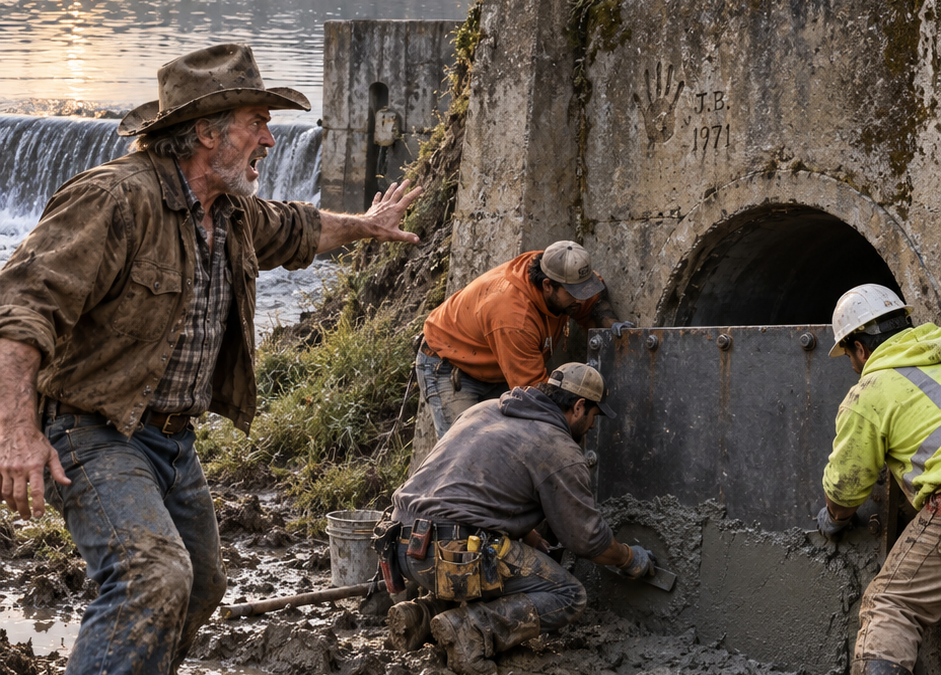
The pipe went silent at 6:40 on a Tuesday morning.
I heard the silence before I understood what it meant.
For sixty-four years, water had run through the thirty-six-inch concrete outlet beneath my father’s dam with a low, steady roar you stopped noticing only because it had always been there. It was part of the valley, like cattle bawling before breakfast or wind moving through cottonwoods.
That morning, it stopped.
I was halfway across the lower pasture before I saw why.
Three contractors were standing in my outlet channel.
A track hoe sat beside the headwall my father had poured in 1962. One man held a steel plate against the mouth of the pipe while two others packed wet concrete around it by hand.
And standing above them in a spotless vest, directing traffic like she was supervising the installation of decorative shrubs, was Marlene Vance.
President of the Stillwater Ridge Community Association.
Managing member of Ridgemont Hospitality Partners.
And, as I would eventually discover, the woman who had just made the most expensive mistake of her life.
“Get off that headwall!” I shouted.
Marlene barely glanced at me.
The track hoe operator stopped.
She waved him on.
“That outlet is permitted,” I said as I came down the slope. “There’s a recorded drainage easement across this property.”
She snapped her fingers at me.
Actually snapped them.
Like I was a dog wandering onto the wrong lawn.
“This is association common area, Bennett. You don’t own this ditch.”
“I own the dam.”
“You don’t own the association’s land.”
“You’re blocking the only outlet from an eleven-acre pond.”
She pointed toward the contractor.
“Finish the plate.”
I stared at her.
“That pond has one controlled outlet.”
“Then hire someone who knows what he’s doing.”
“I do know what I’m doing.”
“Apparently not, since your drainage structure crosses property you don’t own.”
I looked at the gray concrete already hardening around the steel plate.
“Where exactly do you think the water is going to go?”
Her expression didn’t change.
“Off your parcel.”
“That isn’t an answer.”
“It’s not my problem.”
One of the contractors laughed quietly.
Marlene told him to start the second course of concrete before I could get an attorney awake.
So I stood there in the mud and watched them do it.
I didn’t swing a shovel.
I didn’t threaten anybody.
I didn’t try to climb onto their machine.
I watched.
And I photographed everything.
Because if there was one lesson my father had drilled into me harder than any fence post on our place, it was this:
When someone insists on making a bad decision after being warned, don’t interrupt them too early.
Sometimes the most useful thing you can do is let them finish creating the evidence.
By seven-thirty that morning, Marlene Vance had sealed six hundred pounds of steel and concrete into the only outlet regulating an eleven-acre pond.
She thought she had closed a ditch.
What she had actually done was turn off the drainage system holding up the ground beneath her own golf resort.
She just didn’t know it yet.
PART2
My name is Bennett Doyle.
I was fifty-four that spring, and I owned ninety-six acres in a narrow valley my father bought in 1958.
We raised hay and kept roughly forty head of cattle.
Nothing glamorous.
No vineyard.
No resort cabins.
No wedding venue with Edison bulbs hanging from a barn ceiling.
Just grass, cattle, equipment, fences, water, and enough yearly problems to prevent a man from becoming bored.
The flat ground was the reason the ranch worked.
And the flat ground existed because my father had spent half his life making sure it stayed drained.
In 1956, two years before he bought the place, the creek flooded overnight.
Water tore through the valley, destroyed the old barn, drowned six heifers, and carried my grandmother’s upright piano halfway across the lower field.
My father used to tell that story without drama.
That was his way.
He’d say, “Water doesn’t get angry. It just goes where you leave room for it.”
After he bought the ranch, he decided he was never going to let the valley make that decision for him again.
So in 1962, he hired an engineer.
He borrowed against the herd.
Then he built an earth dam across the narrow throat of the property.
Behind it sat an eleven-acre pond.
Through the toe of the embankment ran a thirty-six-inch concrete pipe.
That pipe was the ordinary outlet.
The pond normally sat at elevation 1204.
The emergency spillway was cut at 1206.
The top of the dam was at 1210.
Four feet.
That was the difference between an ordinary pond and a serious emergency.
People who don’t work around water tend to imagine dams as walls.
They aren’t.
A dam is a controlled argument between gravity, soil, and water.
The only reason the argument remains civilized is because the water is given somewhere safe to go.
My father’s pipe gave it somewhere to go.
Every hour.
Every day.
Every year.
No valve.
No switch.
No operator deciding whether today was a convenient day for drainage.
Water entered the pond.
Water reached the outlet elevation.
Water left.
Simple.
Reliable.
Boring.
The best engineering usually is.
When my father poured the headwall around that pipe, he pressed his initials into the wet concrete.
WD.
Then he placed his hand beside them.
Flat palm.
Five fingers spread.
When I was six years old, I used to put my hand inside that print and stretch my fingers as far as I could.
They didn’t reach.
When I was eighteen, they almost did.
When he died, mine were finally larger.
I never expected that concrete handprint to become evidence in a fight that would destroy an $86 million development.
But life has a sense of humor engineers rarely include in design specifications.
I was also the operator of record for the dam with the state dam safety division.
That sounds more impressive than it is.
It mostly means the state knows exactly who to blame if something goes wrong.
My name was on the inspection file.
My name was on the maintenance logs.
My name was on the emergency action plan.
My name was attached to every staff-gauge reading I wrote down.
My father started that binder in 1962.
After he died, I continued it.
Downstream from the dam, beyond the county road, there were twenty-two houses.
That mattered.
A lot.
Stillwater Ridge had been built in the early 2000s on what used to be agricultural ground farther down the valley.
Nice houses.
Curving streets.
Stone entrance columns.
A clubhouse.
Association newsletters with photographs of smiling families holding wine glasses beside phrases like BUILDING COMMUNITY TOGETHER.
My outlet channel crossed about three hundred feet of Stillwater Ridge’s common area before emptying into the old creek.
Legally.
My father had recorded a perpetual drainage easement in November of 1962.
Book 214.
Page 88.
Thirty-eight years before Stillwater Ridge existed.
The ditch was drawn right on the old recorded plat.
Any developer buying that ground had notice of it.
Any title company reviewing it had notice.
Any association later receiving the common area took that land subject to the easement.
For nearly two decades, nobody cared.
Why would they?
It was a drainage ditch.
Cattails grew in it.
Frogs lived in it.
Children were occasionally told not to play near it after heavy rain.
Then Marlene Vance became association president.
And Marlene had plans.
I want to be fair about her.
She wasn’t stupid.
That would have made the next several months easier to understand.
She was intelligent.
Organized.
Polished.
She knew how to run meetings, manage contractors, control agendas, and produce presentation decks full of phrases like asset enhancement and long-term stakeholder value.
She ran the association like a corporation.
The problem was that she also happened to be a managing member of Ridgemont Hospitality Partners.
Ridgemont was developing a destination golf resort on sixty acres contributed by the association and additional adjoining land.
The association members received an ownership stake in the venture and preferred tee access.
Marlene got a seat on both sides.
When she said “the association,” she represented the homeowners.
When she said “the resort,” she represented Ridgemont.
Convenient arrangement.
Especially if you were Marlene.
Less convenient if a sixty-four-year-old drainage channel ran diagonally through the middle of your planned signature lake and eighteenth fairway.
The first letter arrived ten days before they plugged my pipe.
Association letterhead.
Marlene’s signature.
It described my outlet channel as an “unpermitted encroachment upon common property.”
I actually laughed when I read that.
A ditch built in 1962 had apparently waited patiently for six decades before becoming an encroachment.
The letter said the board had voted to “restore the common area to approved design intent” and instructed me to cease discharging water onto association property.
Cease discharging.
As though I was standing beside the pond every morning with a garden hose aimed downhill.
I called the association office.
“There’s a recorded easement,” I told the receptionist. “I have a certified copy.”
“The president can review it at the next meeting.”
“When is that?”
“April sixteenth.”
“That’s six weeks away.”
“Yes, sir.”
“My outlet is continuous.”
“I understand.”
“No. I don’t think you do.”
She put me on hold.
Then came back.
“The board will consider your documentation at the scheduled meeting.”
Apparently gravity had been added to the HOA agenda and was expected to wait its turn.
Four days later, the contractors arrived.
That night, after Marlene finished sealing the pipe, I walked down to the pond with a flashlight.
The staff gauge stood near the bank.
Brass rod.
White paint.
Black numbers stained green at the waterline.
March second:
1204.0.
March fifth:
1204.3.
Three inches.
Three days.
I stood there in the cold with my flashlight in one hand and did arithmetic I did not enjoy.
Roughly an inch a day.
Spring rain hadn’t really started yet.
Two feet could put me at the spillway.
Four more feet put water at the top of the dam.
I wrote the reading on the back of a feed receipt.
Then another thought stopped me.
For sixty-four years, water had been leaving this valley through that pipe.
Not just the visible pond water.
Groundwater.
Seepage.
Subsurface drainage.
Day after day.
Season after season.
I had always thought of it as my pond outlet.
I’d never asked what else it was draining.
The next morning, I went to the courthouse.
Four dollars bought me a certified copy of the 1962 easement.
One page.
Book 214.
Page 88.
Perpetual right to convey drainage across what was now Stillwater Ridge common property.
There was even a hand-drawn plat on the reverse.
I highlighted the operative language.
Then I drove straight to the association office.
Marlene came out holding coffee.
She didn’t sit.
I placed the certified page on the counter.
“Recorded drainage easement. November 1962.”
She looked down.
Not at the language.
At the date.
“It runs with the land,” I said. “Whoever owns that strip owns it subject to my drainage rights.”
She pushed the page toward me with two fingers.
“Our covenants were amended in 2011.”
I waited.
“The amendment governs common-area use,” she said. “It supersedes legacy uses.”
“An HOA amendment doesn’t erase a recorded easement.”
“That’s your interpretation.”
“No. That’s how deeds work.”
She smiled.
Patiently.
Almost kindly.
The smile people use when they believe somebody else is too unsophisticated to understand the situation.
“You’re welcome to present your position to the board.”
“My pond will be roughly two feet higher before your next board meeting.”
“Then it sounds like you have a maintenance issue.”
She turned and walked away.
The receptionist behind the desk stared down at her keyboard.
I stayed there another second.
Then picked up my easement.
That conversation changed the way I looked at the whole problem.
Marlene had barely read the strongest document I had.
Not because she was careless.
Because she already knew it existed.
That meant this wasn’t a misunderstanding.
She had made a calculation.
The resort schedule mattered more than my deed.
The question was why.
I found my answer at the resort construction site.
The gate was open.
I stayed on the public shoulder and walked the fence.
If you’ve spent enough years around farms and construction, you can read a site from stakes almost as well as drawings.
Colored ribbons.
Grade marks.
Centerline stakes.
Offsets.
Utility marks.
A large oval lay staked in the lowest ground.
The future signature lake.
Beyond it, another line climbed toward the clubhouse.
The eighteenth fairway.
My father’s drainage channel ran directly through both.
Not beside them.
Through them.
The ditch crossed the planned lake.
Then cut diagonally across the fairway.
There was no version of that golf resort with my open drainage channel left where it had been since 1962.
Suddenly the association letters made perfect sense.
This wasn’t about common-area aesthetics.
It wasn’t about restoring anything.
My ditch was in Marlene’s way.
I walked toward the construction trailer.
She was inside with two men in hard hats and a set of plans spread across a table.
When she saw me, she came outside and closed the door behind her.
“You’re on an active construction site.”
“The gate’s open.”
“You need to leave.”
I pointed down toward the stakes.
“Your signature lake sits directly on my drainage channel.”
She said nothing.
“You knew that when you plugged my outlet.”
Still nothing.
“That’s why you did it.”
Finally, she spoke.
“That ditch was always temporary.”
I stared at her.
“It’s been there since 1962.”
“The project design accounts for water movement.”
“How?”
“Our engineers accounted for it.”
That made me stop.
It was the first meaningful thing she’d said.
“Accounted for it how?”
She looked at me.
Behind the trailer door, the two engineers—or contractors, or whoever they were—had gone completely silent.
A generator hummed behind the building.
“How?” I asked again.
“Have a good day, Mr. Doyle.”
She went inside.
Door closed.
Conversation over.
I drove home and changed tactics.
If she wanted everything bureaucratic, I could be bureaucratic.
I wrote a formal demand.
One page.
No anger.
No insults.
No threats.
I identified the easement.
Identified the obstruction.
Identified the date.
Requested immediate removal.
I sent it certified to the association and copied the county engineer.
Then every morning, I walked to the same fence post and photographed the staff gauge from the same angle.
Date.
Time.
Water elevation.
March 8.
March 9.
March 10.
Higher.
Higher.
Higher.
Eleven days later, Marlene answered.
Not with a letter.
With a violation notice.
According to Stillwater Ridge, I was trespassing on common property and maintaining an unauthorized discharge.
Fine:
$250 per day.
Retroactive to March fourth.
I read it twice.
She had plugged my outlet.
Caused my pond to rise.
Then fined me because the water she was trapping still legally needed to cross association land.
It was like breaking a man’s legs and billing him because he was walking too slowly.
Then she escalated.
On March eighteenth, contractors came back.
They placed riprap across the face of the obstruction.
Then poured a concrete collar around the headwall.
The original plate had been removable with equipment.
This wasn’t.
Now they’d built a structure intended to keep the pipe sealed.
By the first week of April, the spring rain started.
My lower hayfield flooded.
Forty acres.
New growth six inches high.
Under brown water.
There would be no first cutting.
No second cutting.
Feed and income gone.
Sixteen months of hay planning drowned in nine days.
I stood beside that water one morning and remembered my father’s story about the 1956 flood.
He had spent borrowed money and years of work preventing that exact sight.
Now an HOA president in a clean vest had undone it because an open ditch interfered with a golf course.
The staff gauge read 1205.4.
Less than a foot below the emergency spillway.
That Tuesday, my phone rang.
A woman introduced herself as Naen Rutherford.
Association secretary.
Her voice shook.
“I voted no.”
“On what?”
“All of it.”
Silence.
Then she said, “I’m sending you the March board packet.”
“You’re allowed to do that?”
“No.”
Another pause.
“My husband thinks I’m insane.”
I didn’t know what to say.
She continued.
“I’ve driven past your hayfield twice this week.”
That was enough.
The email arrived that evening.
Forty pages.
Board minutes.
Contractor schedules.
Cost updates.
Resort coordination memoranda.
Six pages in, I found the motion authorizing the work at my outlet.
It didn’t say permanent closure.
It said:
TEMPORARY CLOSURE OF EXISTING OUTLET CHANNEL FOR LAKE-BED GRADING PENDING INSTALLATION OF REPLACEMENT STORM LINE.
Temporary.
Pending replacement.
That changed everything.
They had not originally intended to stop the drainage permanently.
They planned to reroute it.
Plug my father’s line.
Grade the new lake.
Install a replacement underground storm system beneath the golf course.
I didn’t like that they’d acted without involving me, but from an engineering perspective, it at least made sense.
Then I found Change Order 12.
Approved two weeks before the board vote.
The replacement storm line had been deleted.
The reason was written in one neat sentence:
Deletion maintains grading schedule and avoids approximately $18,500 per month in temporary dewatering equipment rental.
I sat back.
Read it again.
They deleted the replacement drainage.
Then two weeks later voted to plug the existing drainage “pending installation” of the system they already knew would never be installed.
Someone had written a future condition into the board minutes after deleting that future from the project.
That someone was Marlene.
Now the question became larger.
If the water wasn’t going through my father’s pipe…
And there was no replacement storm system…
Where was it going?
At five the next morning, I drove down the county road beside the resort.
At the low end of the site, I saw it.
Water.
Not flowing.
Standing.
A long shallow strip along the toe of the fill embankment.
Seepage.
Along a gravel cart path laid barely a month earlier, cattails had begun sprouting.
Cattails don’t read brochures.
They don’t care what a developer says the soil should be.
They grow where the ground stays wet.
I parked.
Walked the fence.
Then looked up at the clubhouse pad.
Twenty-two feet of engineered fill had been placed over the old valley bottom.
I knew that ground.
My father called it the soup.
Gray marl.
Black muck.
Soft alluvium.
Forty feet deep in places.
In wet years, he refused to drive across it even with a light tractor.
You could stand on certain areas in August and feel the ground flex beneath your boots.
And suddenly I understood something I’d spent fifty-four years not understanding.
My father’s outlet didn’t merely drain the pond.
It drained the valley floor.
For sixty-four years, groundwater had been moving toward the pond and out through that thirty-six-inch pipe.
Day after day, it helped keep the groundwater table down beneath the entire flat.
Including the ground where Ridgemont had just placed twenty-two feet of structural fill.
Marlene hadn’t just shut off my pond.
She had shut off the valley’s drain.
I wrote her another letter.
Four sentences.
The impoundment was rising approximately one inch per day.
The historic outlet dewatered the valley floor.
The resort was founded on compressible alluvial soils.
If she did not restore drainage, groundwater would rise beneath the structural fill.
No threat.
No lawyer.
No adjectives.
Certified mail.
She gave it to the association attorney.
Then had it entered in the association record as communication “in furtherance of harassment.”
Apparently hydrology becomes harassment when it interferes with a development schedule.
On April ninth, I called the state dam safety division.
I reported unlawful obstruction of the permitted outlet works of a regulated dam.
The woman answering the phone stopped me halfway through my explanation and asked for the dam file number.
I gave it to her.
She pulled the record.
Then said, “We take obstruction of outlet works very seriously.”
For the first time in six weeks, I thought somebody with actual authority might end the madness.
Six days later, state engineer Ellen Prescott drove onto my ranch.
Mud-stained boots.
Laser level.
Clipboard.
No theatrics.
I liked her immediately.
She walked the entire dam.
Checked elevations.
Read my maintenance binder.
Inspected the embankment.
Then we stood above the outlet.
She stared at the concrete collar.
“Who did that?”
“Stillwater Ridge Community Association.”
“Who authorized it?”
“Their president, Marlene Vance.”
“You have proof?”
“Photographs.”
She exhaled slowly.
“That is an obstruction of permitted outlet works.”
“Exactly.”
Then she looked at me.
“Mr. Doyle, I’m about to explain my jurisdiction, and you’re not going to enjoy it.”
“Go ahead.”
“I regulate dams.”
“I know.”
“I don’t regulate property disputes, HOA authority, subdivision easements, or private land access.”
“They plugged a regulated dam outlet.”
“Yes.”
“Then order them to remove it.”
“The obstruction is physically located on property owned by the association.”
“I have an easement.”
“Then establish your access rights through the appropriate process.”
I stared at her.
“You’re looking at a concrete plug.”
“Yes.”
“I have photographs showing who put it there.”
“Yes.”
“What else do you need?”
“A formal finding assigning legal responsibility for the obstruction.”
She wasn’t being difficult.
She was telling me the truth.
Agencies move on findings.
Findings move on evidence.
Evidence moves on records.
Then we checked the pond.
1206.2.
The water had crossed the emergency-spillway elevation.
A shallow flow moved through the grass notch on the west abutment.
It had already cut six inches into the soil.
Ellen went silent.
Earth dams rarely fail like movie dams.
They don’t split in half with dramatic explosions.
They erode.
Quietly.
Water finds soil.
Soil moves.
The channel gets deeper.
The flow gets stronger.
Then gravity handles the rest.
“How many houses downstream?” she asked.
“Twenty-two.”
She returned to her truck.
Forty minutes later, she handed me a Notice of Deficiency.
My name was at the top.
Bennett Doyle.
Operator of Record.
It ordered me to lower the pond below 1204 within twenty-one days.
If I failed, the state would breach the dam in a controlled emergency release.
Then bill me for the operation.
I looked at her.
“You’re citing me?”
“I’m citing the dam. The dam has one responsible operator.”
“She caused this.”
“When I establish that formally, responsibility changes.”
“Then let me remove the plug.”
“I cannot authorize you to enter association property.”
“It’s my easement.”
“Then obtain lawful access. If you do, I’ll supervise the work.”
I had a contractor lined up by dark.
Hammer rig.
Crew available Thursday.
Wednesday afternoon, a process server drove down my lane.
Stillwater Ridge had obtained a temporary restraining order.
I was forbidden from entering the common-area strip.
The evidence supporting their request?
Marlene’s own trespass violation notices.
The fines I had laughed at as harassment had become exhibits showing I allegedly posed a continuing threat to association property.
That woman had created accusations, then used the accusations as proof of themselves.
It was bureaucratic taxidermy.
She stuffed her own lie and displayed it as evidence.
So by April twenty-third, my situation was this:
The state ordered me to lower the pond.
The court ordered me not to enter the land containing the outlet.
The HOA was still fining me $250 every day.
My pond was above the emergency spillway.
Twenty-two homes sat downstream.
And I had thirteen days before the state might cut open the dam my father built.
There is a particular kind of exhaustion that comes from being demonstrably right while every mechanism around you continues treating you as the problem.
I learned it that month.
Two days later, Marlene drove up beside me while I was checking the mailbox.
She lowered the window.
Friendly smile.
Sunglasses on her head.
“Bennett. I heard about the state notice.”
I said nothing.
“That’s a difficult situation.”
“You created it.”
“The board may be willing to reconsider the closure.”
I almost laughed.
“Under what conditions?”
“The association needs certainty regarding future access.”
There it was.
“A cart path,” she said. “Across your lower forty. Permanent easement granted to the resort.”
I looked at her.
“You plugged my dam.”
She said nothing.
“You fined me because your plug caused water to back up.”
Nothing.
“You used those fines to get a restraining order.”
Still nothing.
“Now you’re offering to remove the obstruction if I give your golf resort an easement across my ranch?”
“I’m offering a negotiated solution.”
“You’re extorting me with my own drainage.”
Her smile tightened.
“You have eleven days.”
Then she drove away.
That night, I spread everything across the kitchen table.
State deficiency notice.
Restraining order.
Fine ledger.
Recorded easement.
Board packet.
Change order.
My father’s old dam binder.
Sixty-four years of readings.
Three generations of handwriting.
And I finally understood what I had been doing wrong.
I’d been fighting Marlene on her ground.
Association covenants.
Board votes.
Trespass notices.
Common-area rules.
Court access.
She controlled that battlefield.
What I needed wasn’t another argument proving I had a drainage easement.
I needed Ellen Prescott to issue the finding she’d described.
I needed proof that Marlene’s action—not my maintenance—was responsible for the dangerous water level.
And I needed proof strong enough that no board vote or restraining order could explain it away.
Which meant I needed engineering.
The resort’s engineering.
The county permit office opened at eight.
The Ridgemont resort permit record filled nine bankers boxes on a rolling cart.
I spent two days at a laminate table.
Traffic studies.
Environmental reviews.
Drainage maps.
Wetland delineations.
Landscape schedules.
I learned the botanical names of shrubs I never wanted to see again.
Late the second afternoon, I opened box six.
Third folder from the back.
GEOTECHNICAL INVESTIGATION AND FOUNDATION RECOMMENDATIONS.
Prepared by Hail & Vandermeer Consulting Engineers.
Client:
Ridgemont Hospitality Partners.
Engineers are wonderfully boring people when they write reports.
Boring becomes beautiful when you’re looking for the sentence that can save your ranch.
The third paragraph of the executive summary read:
The clubhouse and structured-parking pads are founded on approximately twenty-two feet of engineered fill over compressible alluvial deposits. Design bearing capacity is dependent upon maintenance of valley groundwater below elevation 1188. This condition is currently maintained by the existing outlet works of the upstream impoundment. Any alteration to that discharge must be offset by an equivalent engineered drainage system prior to placement of structural fill.
I read it again.
Then again.
Elevation 1188.
I pulled the grading plans.
Clubhouse pad:
Four feet.
The entire structural system depended on groundwater remaining at least four feet below the finished pad.
And the engineering report specifically identified my father’s outlet as the system maintaining that groundwater condition.
Their engineers knew.
The project knew.
The requirement was in the permit file.
Then I checked the report’s transmittal page.
Received and acknowledged on behalf of Ridgemont Hospitality Partners.
Signature:
M. Vance.
Blue ink.
Dated eleven months before she ordered the pipe sealed.
I ran my thumb over the page.
She’d pressed hard enough that I could feel the signature from the back.
Something inside me went cold.
Until then, I had tried to believe Marlene was arrogant.
Maybe careless.
Maybe she trusted the wrong people.
Maybe she skimmed documents.
Maybe she simply believed the HOA’s attorneys had more authority than they did.
That was easier to live with.
But she had personally received the engineering report stating that the outlet maintained the groundwater supporting the resort.
Then she signed Change Order 12 removing the replacement drainage.
Then she authorized closure of the original outlet.
She knew.
This wasn’t ignorance.
It was a financial calculation.
Eighteen thousand five hundred dollars per month in temporary dewatering.
A delayed grading schedule.
Those costs had been weighed against a hazard she believed would remain on my side of the fence.
She expected my dam to hold the consequences while her project stayed on schedule.
I certified copies of everything.
Engineering summary.
Transmittal.
Signature page.
Change Order 12.
Board minutes.
Then I overnighted them to Ellen Prescott with a written request:
Formal obstruction finding.
And one additional request.
Dye tracer.
Put tracer in my pond.
Sample the resort monitoring wells.
Prove where the rising groundwater came from.
The package went out April twenty-eighth.
Two days later, the resort started sinking.
It began on the driving range.
Thirty-foot depression.
Maybe eight inches deep at the center.
The hitting mats leaned inward.
The next morning, a crack appeared in the cart path.
One hundred forty feet long.
Not a simple surface crack.
An offset.
One side lower than the other.
Then the eighteenth tee dropped roughly four inches overnight.
Fresh sod split across the center.
I stayed on my ranch.
I want that understood.
I didn’t trespass.
I didn’t celebrate.
I didn’t touch anything.
Every morning, I read my staff gauge and watched from a distance as gravity performed an audit no board attorney could appeal.
Marlene went on local television May first wearing a white hard hat.
She stood beside the sunken driving range and blamed me.
She described my dam as a “poorly maintained upstream impoundment.”
She said water leaking from my property was undermining the resort.
Then she said the state had already cited me.
Technically true.
Painfully effective.
That week, some neighbors stopped speaking to me.
Lorraine Beckett lived downstream with her husband and two children.
For eleven years, she had brought tomatoes to my house every August.
At the feed store, she saw me coming down the aisle.
She turned her cart around.
That hurt more than the fines.
Because Marlene wasn’t merely damaging my farm anymore.
She was rewriting the story.
I was becoming the reckless rancher threatening families and destroying a resort.
The fine ledger passed fifteen thousand dollars.
The restraining order remained in place.
Five days.
Then four.
Ellen called May second.
“I’ve reviewed your submission.”
“And?”
“I’ve scheduled an evidentiary site inspection for May fifth.”
“Who will be there?”
“State engineering. County engineering. Hydrology. Association counsel. Ridgemont. Their lender. Their carrier has been notified.”
“The sixth is my deadline.”
“Yes.”
“Say the rest.”
Silence.
Then she did.
“The tracer goes into your pond tomorrow.”
“If it reaches the resort wells?”
“I have causation.”
“And if it doesn’t?”
“Then on May sixth I have an overtopping dam, an eroding emergency spillway, and twenty-two homes downstream.”
She paused.
“I’ll authorize the breach.”
That night before the inspection, I walked the dam with a flashlight.
Four inches of water moved through the spillway.
The channel was deeper.
Grass roots gone.
Yellow clay exposed.
At the outlet, backed-up water had reached my father’s handprint.
For sixty-four years, it had stayed above the ordinary flow.
Now it was underwater.
I sat on the embankment.
Not angry.
Just tired.
My father had borrowed against cattle to build that dam.
He had recorded the easement.
Logged the water.
Maintained the outlet.
Stamped his initials into concrete because somewhere inside him, he must have believed the work would outlast him.
Now I had one day before the state might cut through it.
The May fifth meeting took place outside the unfinished resort clubhouse because a crack had opened across the terrace and nobody trusted the building.
Eight in the morning.
Folding tables.
Canopy.
Coffee nobody drank.
Ellen Prescott.
Two state engineers.
County Engineer Wade Coleman.
A hydrologist.
Marlene.
Four board members.
Ridgemont’s attorney.
The lender’s representative.
An insurance adjuster.
Naen Rutherford sat at the far end.
I brought my father’s binder.
Marlene spoke first.
Of course she did.
She stood without notes and gave the best performance I’d ever seen from somebody losing an argument to groundwater.
She described an inadequately maintained upstream dam.
She referred twice to the state’s citation against me.
She mentioned eleven million dollars in completed resort improvements “currently suffering damage.”
Then she demanded immediate emergency breaching of my dam.
Her board applauded.
Actually applauded.
The state engineer waited until they stopped.
Then looked at me.
“Mr. Doyle. Your obstruction record.”
I laid the documents down.
Certified 1962 drainage easement.
Photographs showing the work crew sealing the outlet.
Daily staff-gauge photos.
County stream-gauge history showing continuous downstream discharge before March fourth.
No recorded discharge after.
Board minutes authorizing “temporary closure pending replacement drainage.”
Change Order 12 deleting replacement drainage two weeks before that vote.
Ridgemont’s attorney began writing.
He wrote through my entire presentation.
When I finished, Marlene leaned forward.
“None of that is disputed.”
That surprised me.
She continued.
“And none of it changes the fundamental issue.”
She looked toward the state table.
“The outlet enters association property. The association lawfully controls its common area. If Mr. Doyle believes an easement has been violated, his remedy is civil litigation. That does not excuse the condition of his dam, and it certainly does not justify allowing twenty-two families to remain exposed to an overtopping impoundment.”
She sounded reasonable.
That’s what made her dangerous.
She could take a disaster she created and describe it as evidence somebody else had failed to solve it quickly enough.
Ellen opened her folder.
“Mrs. Vance, are you familiar with the geotechnical report prepared for Ridgemont by Hail & Vandermeer?”
“We have many engineering reports.”
Ellen held up the summary.
Then read the relevant paragraph.
Groundwater below elevation 1188.
Condition maintained by the existing upstream outlet.
Equivalent engineered drainage required before any alteration.
Nobody moved.
Ellen said, “The clubhouse pad elevation is 1192.”
Silence.
“Four feet above the maximum groundwater elevation established by your engineers.”
She pointed toward the earth beneath our chairs.
“The mechanism identified by those engineers as maintaining that elevation is the outlet your association sealed.”
Marlene folded her hands.
“I’m not an engineer.”
“No,” Ellen said.
Then turned the report around.
“But you signed for the report.”
For the first time since I had known her, Marlene looked small.
Not frightened.
Not yet.
Just exposed.
Her signature sat at the bottom of the page.
Blue ink.
Hard pressure.
Dated eleven months earlier.
She stared at it.
Then said quickly, “I don’t recall reading that attachment.”
County Engineer Wade Coleman opened another folder.
“It isn’t an attachment.”
He slid the executive summary toward her.
“It’s on page one.”
Marlene’s face tightened.
Coleman continued.
“And you may not recall this either.”
He placed Change Order 12 beside the report.
“The engineered replacement drainage was deleted to protect the grading schedule and save temporary dewatering costs.”
He tapped the signature block.
“Same approval chain.”
Ridgemont’s attorney stood up.
Walked away from the table.
Stayed standing.
The lender representative pulled out his phone.
The insurance adjuster started writing and never stopped.
Marlene tried once more.
“We’ve had an unusually wet spring. There is still no evidence establishing that groundwater beneath this site originated from Mr. Doyle’s pond rather than leakage through his own dam.”
Ellen looked at the hydrologist.
He opened one page.
“Fluorescent tracer introduced into the impoundment May third.”
He read the data.
“Detected in all six monitoring wells beneath the resort pad May fourth.”
Marlene said nothing.
“Concentrations increased again this morning. Arrival timing is consistent with subsurface movement through the valley alluvium.”
She finally found her voice.
“There could still be surface migration.”
“No.”
The hydrologist looked directly at her.
“There is no surface pathway between the impoundment and these wells.”
He pointed toward the ground.
“The water traveled through the subsurface.”
Then he said the sentence that ended her remaining argument.
“It’s moving through the valley floor because the historical drainage outlet is no longer relieving the groundwater system.”
Marlene looked toward her board.
Nobody looked back.
Then the ground moved.
There wasn’t an explosion.
There wasn’t even a loud crack at first.
It was a low settling groan.
Like a timber building taking weight.
The folding table trembled.
Coffee rippled in plastic cups.
Everybody turned toward the eighteenth fairway.
The ground dropped.
Not one little sinkhole.
A broad section of fairway lowered in a slow rolling motion.
Two feet at the deepest point.
Fresh sod tore apart in three long seams.
Then the liner in the unfinished signature lake ripped.
It sounded like heavy canvas tearing in wind.
Water disappeared beneath it.
The lake-bed soil collapsed after the flow.
We stood.
Nobody needed instruction.
A cart-path bridge shifted as one abutment rotated inward.
The deck slid partly off its bearing.
Across the parking structure, the first bay dropped.
Maybe a foot.
A diagonal crack shot across the concrete.
The sound was sharp enough to make three people duck.
The clubhouse terrace split where engineered fill met the original valley bottom.
Inside the pro shop, we heard shelves fall.
For eleven minutes, the resort settled unevenly.
Two hundred forty acres of a multimillion-dollar development moving at different rates because the ground beneath it had become saturated.
Marlene stood in the middle of the lawn.
Arms hanging beside her.
No clipboard.
No smile.
No sentence prepared.
Ellen Prescott wrote the finding with her clipboard braced against her forearm.
When she finished, she read it aloud.
“Documentary evidence and tracer testing establish obstruction of the permitted outlet works of a regulated dam by Stillwater Ridge Community Association.”
She looked at me.
“The Notice of Deficiency issued against Bennett Doyle as operator of record is vacated.”
I closed my eyes for one second.
Then she turned toward Marlene.
“Emergency order effective immediately. Stillwater Ridge Community Association is directed to remove the obstruction at association expense under state supervision.”
Marlene finally spoke.
“Our attorney—”
“Can appeal the order.”
Ellen pointed toward the cracked fairway.
“He may do so while your contractor mobilizes.”
Naen Rutherford made a sound that was almost a laugh.
Ellen asked, “Whose contractor is presently on site?”
Nobody from Marlene’s side answered.
Naen raised her hand.
“Ours.”
At one o’clock that afternoon, the same crew drove the same hammer rig back up my pasture.
The men looked different.
Not literally.
But the body language was different.
Nobody laughed.
Nobody snapped fingers.
Nobody called my outlet an encroachment.
Under Ellen’s emergency order, they removed the riprap.
Broke apart the concrete collar.
Cut reinforcement.
Exposed the steel plate.
Marlene had to remain because an authorized association representative was required to sign completion documentation.
She stood on the embankment while the contractor hooked a chain to the plate.
The excavator lifted.
For one second, nothing happened.
Then the plate came free.
Water exploded from my father’s thirty-six-inch pipe.
Not a polite stream.
A roaring brown column.
Three months of hydraulic head leaving all at once.
Marlene stepped backward.
Her clean boots disappeared into mud.
Nobody laughed.
I considered that professional restraint.
The emergency wasn’t over.
We still had too much water behind an earth embankment.
Opening the pipe uncontrolled could have caused erosion at the toe.
So Ellen stayed.
Her engineers stayed.
They rigged temporary controls.
We metered the discharge in stages.
Thirty hours.
All night.
Floodlights.
Radios.
Coffee.
For sixty-two days, I had been legally forbidden from touching the pipe my family built.
At four that afternoon, under state supervision, I put my hand on the control.
Opened it a little farther.
And listened.
Water running.
The sound I’d heard nearly every day of my life.
I never realized how much silence could scare a man until I heard that pipe come back.
The pond took eleven days to return below 1204.
By May sixteenth, the emergency spillway was dry.
The valley groundwater started falling.
By August, the seep line along the resort fill had dropped almost four feet.
Exactly what the geotechnical engineers had predicted.
Unfortunately for Ridgemont, dirt isn’t a balloon.
Saturated compressible soil does not simply rise back into place when the water leaves.
The damage was permanent.
Settlement continued throughout summer.
Quarter inch here.
Half inch there.
Differential movement across structural pads.
The insurance fight began immediately.
Ridgemont filed a claim.
The carrier investigated.
Then denied coverage.
The decisive issue was a known-condition exclusion.
The developer had documented knowledge of the groundwater requirement before the damage.
Proof?
That transmittal page.
Marlene’s signature.
The same signature she’d tried to dismiss because she allegedly didn’t remember the document.
She had personally created the evidence that voided the insurance claim.
No coverage.
No practical repair plan.
No money to stabilize the entire site.
The lender then called the $86 million construction loan.
By September, the county red-tagged the clubhouse and parking structure.
Engineering consultants spent months drilling, sampling, testing, and monitoring.
By year’s end, the entire 240-acre development site had effectively been condemned for major occupancy and resort use.
There is no eighteen-hole golf resort there today.
There is fencing.
Monitoring wells.
Settlement markers.
Hydrology equipment.
And several extremely expensive signs explaining why unauthorized people should stay out.
The association removed Marlene as president in an emergency vote.
Six to one.
Naen Rutherford made the motion.
Ridgemont Hospitality Partners expelled Marlene under its misconduct provision.
The homeowners lost the equity interest they’d been promised.
They lost their preferred tee rights too.
Which was somewhat academic considering the eighteenth tee had moved vertically without permission.
Then came the civil cases.
My crop losses.
Dam repairs.
Engineering costs.
Legal fees.
Damage associated with the blocked outlet.
The association filed claims against Marlene.
Ridgemont filed claims.
Insurers investigated whether her actions were covered.
The association carrier ultimately denied personal protection for intentional conduct falling outside authorized duties.
For months, Marlene had relied on the organization as a shield.
When the documents came out, the shield stepped aside.
She listed her house the following March.
The state also brought charges arising from unlawful obstruction of permitted dam works and reckless conduct related to the twenty-two downstream households placed at risk while the emergency spillway eroded.
The prosecution’s strongest evidence wasn’t a dramatic photograph.
It was paperwork.
The geotechnical warning.
Her acknowledgment.
Change Order 12.
The deletion of replacement drainage.
My certified warning letter.
The board minutes.
The photograph of her directing work at the outlet.
She took the case to trial.
The jury deliberated less than three hours.
She received eighteen months under the resulting judgment and restitution arrangement, along with a permanent prohibition from holding any role giving her authority over regulated water infrastructure.
I didn’t attend every day of trial.
I had hay to replace.
Fences to repair.
A dam to maintain.
Unlike Marlene, gravity never rescheduled itself around my legal calendar.
Everything the association had done against me was eventually unwound.
Every trespass citation.
Every $250 daily fine.
All sixty-two days.
Vacated.
Refunded.
The restraining order was dissolved.
My drainage easement was re-recorded with a court notation clarifying its priority and enforceability.
Stillwater Ridge adopted a new conflict-of-interest policy barring officers from voting on matters affecting recorded easements when they hold a direct financial interest in the affected development.
You would think a rule saying “do not use HOA power to destroy ancient water infrastructure protecting your personal investment” would be unnecessary.
Apparently civilization requires occasional updates.
The association also paid for the dam repairs.
A new outlet-control assembly.
Armored spillway.
Reconstruction of the damaged west abutment.
Repair to the headwall where the hammer equipment had chewed into it.
Their contractor performed the work.
I inspected it every day.
Not because I mistrusted that particular crew.
Because after that year, I inspected everything.
The rebuilt system is better than what I had before.
My father would have appreciated that.
He believed improvements were the only acceptable thing to inherit from a disaster.
Lorraine Beckett came up my driveway in July carrying a flat of tomatoes.
She stood in my kitchen.
Looked at me.
Then started crying.
“Bennett, I’m sorry.”
“You don’t owe me anything.”
“I avoided you.”
“You thought my dam might kill your children.”
She wiped her face.
“She made it sound like you didn’t care.”
“I know.”
“I should’ve asked you.”
“Maybe.”
I poured coffee.
“But if somebody told me a dam above my house was failing, I probably wouldn’t stop in the feed aisle for a technical briefing either.”
She laughed through the tears.
We ate tomatoes on sandwiches.
That was the end of it.
In October, after the major repair work finished, I went down to the outlet alone.
The new concrete along the wing wall was still green enough to mark.
I didn’t touch the original headwall.
Nobody did.
WD.
My father’s handprint remained beside it.
Five fingers spread.
The lower edge sat about three inches above the normal water.
Exactly where it belonged.
I stood beside it for a long time.
Then looked at the fresh concrete they had poured next to the repaired section.
I had spent my whole childhood putting my hand inside my father’s print.
Trying to reach his fingertips.
Trying to grow into a man who seemed, when I was six, big enough to hold an entire valley in one hand.
So while the concrete was still soft, I pressed my palm beside his.
Flat.
Fingers open.
Mine was larger.
It took fifty-four years and one spectacularly stupid golf resort to make that official.
I left the two prints there.
His from 1962.
Mine beside it.
The pond sits around 1204 again.
The outlet runs every day.
The lower hayfield has recovered.
Cattle drink where they always drank.
The rebuilt spillway is armored.
The state inspector comes once a year.
So far, she hasn’t had anything exciting to write in her reports.
That is exactly how I prefer infrastructure.
Quiet.
Boring.
Working.
The abandoned resort site remains farther down the valley.
You can see sections of it from the county road.
Faded construction fence.
Monitoring equipment.
A cracked stretch of old cart path disappearing into weeds.
The clubhouse was eventually dismantled after engineers concluded stabilization would cost more than salvaging what materials they could.
The signature lake never held water again.
The eighteenth fairway grew waist-high in volunteer grass.
Marlene once told me she wasn’t delaying eighteen holes for a man with a shovel.
In the end, there weren’t eighteen holes.
There wasn’t a resort.
There wasn’t even a usable clubhouse.
There was only a file cabinet full of reports explaining what happened when somebody decided that a sixty-four-year-old drainage system was less important than a construction schedule.
People occasionally ask whether I enjoyed watching her lose everything.
That’s not quite the right word.
I enjoyed seeing the record win.
The easement she dismissed.
The report she claimed not to remember.
The change order she signed.
The letter she labeled harassment.
The photographs she called irrelevant.
The tracer test she insisted would prove nothing.
None of those documents shouted.
None threatened her.
None cared how confidently she spoke.
They simply waited.
Then, when the ground started moving, they told the same story at exactly the same time.
That was enough.
My father once told me water doesn’t get angry.
It just goes where you leave room for it.
He was right.
Marlene’s mistake wasn’t that she underestimated me.
It wasn’t even that she underestimated the state.
She underestimated sixty-four years of water following the same path through the same valley.
She believed a board vote could replace a drainage system.
She believed a concrete plug could erase an easement.
She believed an $18,500 monthly savings mattered more than the groundwater under an $86 million project.
And for sixty-two days, she looked correct.
Then the eighteenth fairway dropped two feet.
These days, I still walk down to the dam before dark.
I check the gauge.
Look over the embankment.
Run my hand along the concrete.
My father’s print.
Mine.
Then I stand there for another minute and listen to water running through thirty-six inches of concrete exactly the way he designed it to run.
You can hear it from the top of the pasture.
A steady roar beneath the evening wind.
After everything that happened, it is still one of the best sounds I know.
Because my father didn’t simply build a pond.
He built a way for the water to leave.
And in the end, the woman who tried to stop it learned what the rest of us already knew.
Water always collects its debt.








