𝗣𝗔𝗥𝗧 𝟮 The HOA Ordered My 120-Year-Old Springhouse Demolished—Then a Forgotten 1983 County Filing Surfaced
𝗣𝗔𝗥𝗧 𝟮
Cedar Run wasn’t an estate.
It wasn’t a gentleman’s farm.
It wasn’t a weekend property where I dressed in clean boots and took photographs beside a tractor I didn’t know how to operate.
It was a working northern Missouri cattle-and-hay farm, and most things on it existed because somebody before me had solved a practical problem.
The main barn sat on higher ground because spring floods had once ruined feed stored lower.
The cattle lanes curved where they did because straight lanes encouraged animals to crowd the gates.
The well house was insulated on the north side.
The creek crossings used stone where clay would wash out.
And the springhouse had been built precisely where nature had put the spring.
My great-grandparents couldn’t move groundwater fifty feet to suit a landscape architect.
So they built around it.
The walls were local limestone, irregular blocks fitted by hand.
Cold spring water entered through one side, moved through a shallow interior channel, and exited toward the creek.
Even during July heat, the stone interior stayed cool.
I grew up hearing stories about it.
My grandmother remembered fetching butter from there.
My father remembered being sent down for milk in summer.
I remembered hiding inside as a child because the stone walls made every outside sound disappear.
It wasn’t a museum.
It wasn’t glamorous.
One roof board had warped.
Moss grew along the lower north wall.
The door was newer because the original had rotted decades ago.
But the masonry still stood where it had stood for roughly 120 years.
Cedar Hollow had been around seven.
That difference in age didn’t automatically make me right.
But it made Vanessa’s confidence irritating.
The subdivision was built across County Road 18 on land that had once been open agricultural ground.
Forty-six homes.
Two curved streets.
Decorative stone entrance.
Stormwater pond.
Landscaped berms.
The developer advertised it as “country living without the maintenance.”
That phrase always amused me.
Apparently the easiest way to experience country living was to remove everything requiring country work.
For the first few years, Cedar Hollow and I got along fine.
Then came the storms.
Several heavy rain events exposed problems downstream from the subdivision’s stormwater pond.
Water leaving Cedar Hollow moved toward a shallow swale, crossed lower ground, and eventually found its way into the creek running through my farm.
The HOA began discussing improvements.
That was reasonable.
Nobody wants flooded yards.
Nobody wants an unstable pond outlet.
Nobody wants stormwater damaging roads or houses.
The problem wasn’t that Cedar Hollow wanted better drainage.
The problem was that its preferred solution gradually migrated from its property onto mine.
The first concept drawing I saw stayed mostly inside Cedar Hollow-controlled land.
A later version pushed closer to the boundary.
Another crossed my lower pasture.
I objected in writing.
I had never granted a drainage easement.
Never signed a construction-access agreement.
Never authorized excavation.
After that, the language in the HOA’s correspondence became increasingly dramatic.
“Drainage improvement” became “flood mitigation.”
“Design alternative” became “required downstream improvement.”
And eventually my springhouse acquired a new professional identity.
MASONRY OBSTRUCTION WITHIN DOWNSTREAM FLOW PATH.
That was the phrase their consultant used.
It had the useful quality of making a 120-year-old farm building sound like somebody had dropped a refrigerator into a storm sewer.
I disputed it.
The main creek channel didn’t run through the springhouse.
The building sat beside the primary creek flow, over the smaller natural spring feeding toward it.
I sent my concerns to the county.
I assumed the normal process would continue.
Engineering review.
Access questions.
Permits.
Alternatives.
Then one morning I heard machinery.
That was why the 1983 notation mattered.
Before I did anything else, I documented the site.
Every contractor track.
Every painted mark.
Every stake.
The pump hoses.
The unloaded black pipe.
The excavator.
The disturbed ground.
I photographed the springhouse exterior from all four sides.
Then I photographed inside.
Water still ran clear through the stone channel.
The old shelves were gone, but several iron brackets remained.
I went upstairs and found the oldest photograph I owned.
It was taken around 1912.
My great-grandmother stood beside the springhouse holding a milk can.
Another photo from the 1940s showed wooden shelves inside.
A picture from my childhood showed my grandfather clearing storm debris around the spring.
Then I found a photograph dated October 1983.
My father stood beside the building with two strangers.
On the back he’d written:
COUNTY HISTORY SURVEY.
The year matched the old map.
Now I had more than curiosity.
I had a trail.
At eight-thirty the next morning, I was inside the county records office.
The clerk started with my current parcel number.
The file showed ordinary things.
Assessments.
Transfers.
Boundary adjustments.
Nothing explaining the handwritten code.
Then I showed her the older map.
The parcel number had changed in the late 1990s.
Before that adjustment, the farmhouse, lower pasture, creek frontage, and springhouse had been carried under a larger tract number.
She searched that one.
Older records appeared.
When the property was divided, some road frontage eventually connected to land later involved in Cedar Hollow’s development.
But the springhouse stayed with the farm.
So did the creek frontage around it.
There was no transfer putting the structure into Cedar Hollow property.
No deed conveying it to the subdivision developer.
No recorded easement giving the future HOA the right to excavate around it.
Then the clerk found the reference.
The code on my father’s map matched an archived county file from 1983.
“It’s not digitized,” she said.
“Can we get it?”
“We can request storage.”
“How long?”
She looked at me.
“You look like you’re going to ask until I say today.”
“Probably.”
She laughed.
“Give me a little while.”
The file arrived in a gray archival folder.
The first page contained a black-and-white photograph of my springhouse.
Measurements had been written around the edges.
Twelve feet.
Sixteen feet.
Limestone.
Perennial spring.
Estimated early-twentieth-century construction.
Agricultural cooling structure.
Historic farmstead resource.
I read every page.
County survey staff had inventoried the building as part of a rural historic-resource project.
Interesting.
But an inventory didn’t automatically protect anything.
I needed more.
Near the back was a routing sheet containing a second reference number.
The clerk searched it.
Then looked at me.
“This points to preservation files.”
“Where?”
“Different office. Two blocks.”
I took photographs and walked.
The preservation office had an index card referencing a historic-resource review application dated November 1983.
Applicant:
My father.
Status:
No final disposition entered.
That got everyone’s attention.
Not excitement.
Government-records people are trained against excitement.
But the woman helping me sat up straighter.
“We need the original file.”
“Does this mean the building is protected?”
“Not yet.”
It was becoming a theme.
Every time I wanted someone to say “You win,” a professional responded with something less entertaining and more accurate.
The preservation staff first had to prove the old filing referred to the same physical structure on my modern parcel.
Fortunately, the parcel history did that.
The 1983 survey located the springhouse on the original tract.
The later subdivision of the property showed the springhouse remaining with my farm.
My current assessor map placed it on the same ground.
Parcel number changed.
Building didn’t.
While preservation staff searched archives, I went to county engineering.
That office had Cedar Hollow’s stormwater materials.
Concept plans.
Consultant correspondence.
Staff comments.
Requests for additional hydraulic data.
What it did not have was a final approval authorizing Cedar Hollow to excavate through my land.
No construction permit for the off-site work.
No easement.
No signed access agreement from me.
No condemnation proceeding.
No county order directing removal of the springhouse.
I thought about Vanessa’s removal notice.
COUNTY AUTHORIZATION NUMBER:
Blank.
It was blank because there wasn’t one.
At least not yet.
I asked to see the contractor scope.
A staff member provided the submitted copy.
The work sequence was brutally clear.
Mobilize.
Control water.
Prepare corridor.
Remove masonry spring structure.
Excavate channel.
Install drainage components.
Restore grade.
My springhouse wasn’t an accidental obstacle discovered after digging started.
Demolition had been part of the plan from the beginning.
One line in the contractor notes mattered more than the rest:
PROPERTY ACCESS AND REGULATORY COORDINATION TO BE PROVIDED BY CLIENT.
Client:
Cedar Hollow Homeowners Association.
So the contractor had assumed Vanessa’s HOA would secure access.
The contractor hadn’t created the property-right problem.
Cedar Hollow had.
I kept going.
There were three design alignments in the engineering file.
Alignment A mostly remained within Cedar Hollow-controlled land.
It required more excavation and changes at the subdivision outlet.
Alignment B crossed a narrower portion of my pasture.
Alignment C used the shortest excavation route.
Alignment C went directly through the springhouse.
Beside the revision was a note:
SHORTER EXCAVATION PATH.
I read it twice.
There it was.
Not:
ONLY HYDRAULICALLY VIABLE ROUTE.
Not:
REQUIRED TO PREVENT IMMINENT FAILURE.
Shorter excavation path.
Which usually means two things.
Faster.
Cheaper.
Suddenly, the transformation of my springhouse from old farm building to dangerous “obstruction” looked very convenient.
Had the structure actually created the drainage problem?
Or had Cedar Hollow selected a cheaper route and then begun describing everything in that route as a problem?
Those were very different questions.
By early afternoon, preservation staff called.
They’d found the second file.
I walked back.
My father’s original 1983 application was inside.
His signature.
County receipt stamp.
Survey photographs.
A routing memorandum.
The memorandum said the springhouse had been accepted for formal historic-resource evaluation.
More importantly, it instructed departments to refer any major alteration or removal proposal for preservation review while the resource process remained open.
There was no final denial.
No withdrawal.
No closure memorandum.
No completion entry.
The application had become stranded in the old paper system.
Then the parcel number changed years later.
The preservation flag remained associated with the retired tract instead of following the modern parcel into the newer database.
The file wasn’t gone.
It had simply become difficult to find.
I stood there holding a copy and thinking about my father.
He had never mentioned it to me.
At least not in a way I remembered.
Maybe he assumed the county had finished the process.
Maybe he forgot.
Maybe he simply thought getting the structure documented was enough.
But forty years later, his signature had surfaced hours before an excavator was supposed to erase the thing he had asked the county to review.
I called the farm.
The contractor had moved equipment back toward the gate.
Good.
Then I called an attorney.
His name was Michael Brenner.
He handled land use and property disputes and had the patient speaking style of a man who had spent twenty-five years explaining to angry people that rage was not a recognized filing category.
I sent him everything.
He called that evening.
“First good news,” he said. “They don’t appear to have legal access.”
“Second?”
“The county hasn’t approved the off-site construction.”
“Third?”
“The preservation file is real.”
“And the bad news?”
“None of those facts means the drainage issue disappears.”
“I know.”
“Cedar Hollow may change theories.”
He was right.
They did it the next morning.
County engineering reviewed the latest alignment against property maps and formally confirmed that part of the proposed excavation extended outside Cedar Hollow-controlled property.
Vanessa appeared with a board resolution authorizing flood-mitigation work.
It was a very official-looking document.
It proved the HOA board had authorized itself to pursue a project.
It did not prove they owned my pasture.
The county asked for an easement or other access authority.
There was none.
The contractor produced its scope sheet showing Cedar Hollow was responsible for securing access.
Engineering suspended the off-site portion.
The excavator left.
For approximately three hours, I allowed myself to enjoy that.
Then Vanessa changed tactics.
If Cedar Hollow couldn’t demolish the springhouse merely because its preferred drainage route crossed my farm, it would argue the springhouse itself was an emergency hazard.
The HOA submitted an emergency packet asking the county to classify the structure as an immediate flood obstruction.
Photographs showed moss.
Debris near the creek.
A damaged roof board.
Vegetation.
The consultant described the building as deteriorated masonry adjacent to the downstream drainage path.
It was clever.
Property rights become more complicated when public safety is genuinely involved.
If a structure is about to collapse into a channel and flood houses, a county doesn’t necessarily shrug and say, “Nice deed.”
The question became engineering.
Was the springhouse actually creating an emergency?
The county scheduled a field inspection.
Vanessa met us there.
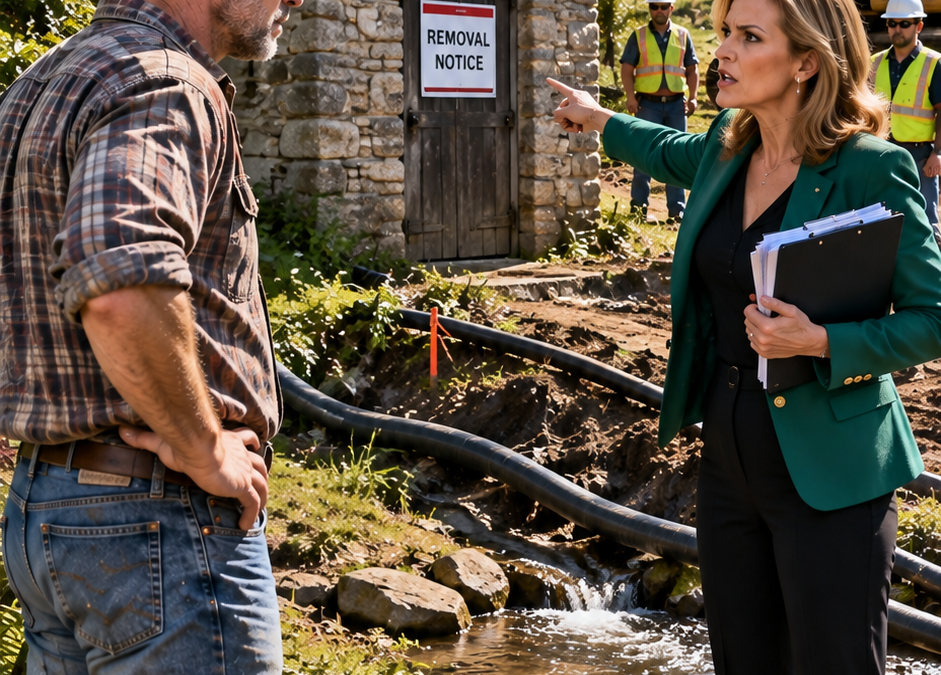
Emerald blazer.
Black folder.
No excavator this time.
She watched while county staff measured elevations.
The spring outlet.
Creek channel.
Swale.
Bank heights.
Downstream constrictions.
They compared the physical site with Cedar Hollow’s diagrams.
One engineer stood near the springhouse and looked toward the main creek.
Then he looked at the drawing.
Then back at the water.
“The structure isn’t sitting in the primary channel.”
I didn’t say anything.
Vanessa did.
“It restricts downstream conveyance.”
“To what degree?”
“Our consultant has modeled it.”
The engineer nodded.
“We’ll need the model.”
That one sentence ruined Vanessa’s morning.
Because it meant the county wasn’t going to accept adjectives.
It wanted numbers.
The springhouse stood beside the main flow path, built over the smaller spring.
Water moved around and below the site toward the creek.
The building might influence localized flow.
Nobody denied that possibility.
But an “immediate flood obstruction” should have measurable consequences.
County engineering requested additional hydraulic modeling.
No emergency demolition finding would be made until then.
That afternoon, another document surfaced.
An email from Cedar Hollow’s consultant.
Dated eleven days before the contractor arrived.
I read the sentence three times.
FURTHER HYDRAULIC ANALYSIS IS RECOMMENDED BEFORE DETERMINING WHETHER REMOVAL OF THE EXISTING SPRING STRUCTURE IS NECESSARY.
I called Michael.
“Vanessa mobilized the contractor after receiving this.”
“That’s what the dates indicate.”
“So her own engineer hadn’t decided demolition was necessary.”
“Correct.”
“And she brought an excavator anyway.”
“Apparently.”
“Can I call that reckless?”
“You can call it something your lawyer would prefer you not put in an email.”
Michael had many talents.
Ruining my best adjectives was one of them.
The consultant’s email changed the timeline.
Cedar Hollow hadn’t acted after engineering established the springhouse was the critical obstruction.
It acted while engineering was still studying the question.
That mattered when the county requested the full modeling history.
The three alignments came under new scrutiny.
Alignment A stayed largely on Cedar Hollow property.
More expensive.
More excavation.
Different outlet configuration.
Alignment B crossed part of my pasture.
Alignment C was cheapest.
Shortest.
And required eliminating the springhouse.
Cost comparisons showed why Cedar Hollow preferred C.
Less excavation.
Simpler outlet work.
Lower construction cost.
But those savings depended on using land Cedar Hollow did not own.
That’s a wonderful way to save money.
Use someone else’s property.
The updated hydraulic analysis arrived.
It did not help Vanessa.
Under existing conditions, the springhouse had a limited localized influence around the natural spring outlet.
But it wasn’t the major downstream restriction Cedar Hollow’s emergency application implied.
The more significant problem came from concentrated discharge leaving the subdivision and the geometry of the lower swale.
More importantly, removing the springhouse alone did not materially eliminate the modeled high-water condition during severe events.
That effectively ended the emergency argument.
If demolishing my building didn’t solve the underlying flood problem, it was difficult to classify that demolition as an immediate necessity.
County engineering declined to support emergency removal.
I read the determination twice.
Then I drove down to the springhouse.
The afternoon was warm.
Water was running through the old stone channel.
I put my hand against the limestone.
Cold.
Still there.
Vanessa had almost reduced 120 years of family history to a contractor line item because Alignment C was shorter.
The preservation file added the next obstacle.
A 1983 survey note explained that the building’s historical significance wasn’t limited to its stones.
Its location mattered.
It had been constructed over a natural spring in relation to the original farmstead.
Move it, and you lose the relationship.
Demolish it and rebuild somewhere decorative, and you’ve preserved a pile of limestone, not the resource.
The county preservation office did not declare the springhouse untouchable forever.
I appreciated that.
Real preservation review isn’t magic.
Old doesn’t automatically mean immortal.
Instead, staff required any major alteration or removal proposal to address reasonable alternatives.
Which brought everyone back to Alignment A.
Vanessa hated Alignment A.
I could tell because every time it appeared on an agenda, Cedar Hollow suddenly discovered a new adjective for why it was undesirable.
Costly.
Complex.
Disruptive.
I liked “disruptive.”
Apparently redesigning infrastructure on your own property was disruptive.
Driving an excavator across your neighbor’s pasture was efficient.
The county insisted that the alternatives be evaluated on comparable terms.
Not merely construction cost.
Property access.
Easement acquisition.
Environmental effects.
Historic-resource review.
Restoration.
Legal exposure.
Once those costs entered the equation, Alignment C didn’t look nearly as brilliant.
Then Cedar Hollow’s insurer entered the conversation.
That changed everything.
Engineers care about water.
Lawyers care about authority.
Insurance companies care about what they might have to pay for.
Cedar Hollow’s insurer requested records supporting the association’s right to enter my land.
There was no easement.
No access agreement.
No county authorization for physical entry.
No emergency order.
No permission from me.
The carrier raised questions about whether damages arising from unauthorized entry would be treated like ordinary insured project costs.
Residents began asking questions too.
That was when Vanessa’s problem stopped being Ethan Harrow versus Cedar Hollow.
Homeowners wanted to know why their dues were paying for mobilization before the project had final approval.
Why had contractors been sent onto land the HOA didn’t control?
Why had the cheapest route been presented as the necessary route?
Why had the board spent money before its own consultant completed hydraulic analysis?
Why was the insurer suddenly involved?
Why did a 1983 preservation file exist that nobody had found before demolition was scheduled?
People don’t enjoy discovering that their money has been attached to someone else’s confidence.
The most damaging document came from Cedar Hollow’s own legal files.
Months earlier, the HOA had asked outside counsel about off-site drainage work.
Counsel prepared a memorandum.
Michael obtained it through the proper record process and called me.
“You’re going to enjoy this one.”
“That sounds unlike you.”
“I didn’t say you should quote me.”
The memorandum laid out Cedar Hollow’s options.
Negotiate an easement.
Redesign.
Seek county involvement.
Pursue lawful remedies if a genuine downstream condition required intervention.
But physical work on neighboring property required actual authority.
Actual authority.
The phrase deserved framing.
The memo existed before Vanessa authorized mobilization.
I attended the next Cedar Hollow board meeting.
It was the first HOA meeting I had ever willingly entered.
The clubhouse smelled like coffee and carpet cleaner.
About sixty residents filled the room.
Vanessa sat at the front wearing emerald green.
Again.
At this point I wondered if the blazer came with the presidency.
The board treasurer presented project costs.
Original engineering.
Additional modeling.
Contractor mobilization.
Cancellation.
Legal review.
Preservation consultation.
Insurance response.
Future redesign.
The numbers kept climbing.
A homeowner raised his hand.
“Why did we send equipment out before the county approved the off-site work?”
Vanessa answered carefully.
“The project was advancing through regulatory coordination.”
I nearly admired the phrase.
Advancing through regulatory coordination.
The excavator was apparently just coordinating aggressively.
Another resident spoke.
“Did we have permission from the ranch owner?”
Vanessa glanced toward counsel.
“No executed easement had been finalized.”
I raised my hand from the back.
“It hadn’t been started.”
Several people turned.
Vanessa stared at me.
The board’s attorney spoke.
“Mr. Harrow’s access position is documented.”
A woman in the second row asked:
“Then why was the contractor there?”
Silence.
Not dramatic silence.
Worse.
Accounting silence.
The kind where everybody starts wondering whose money will pay for somebody else’s decision.
Another homeowner held up a printed email.
“Was the consultant still recommending additional analysis when mobilization was authorized?”
Vanessa’s face tightened.
“The board was addressing an urgent flooding concern.”
“That wasn’t my question.”
I almost smiled.
Apparently that phrase was contagious.
The board discussed Vanessa’s contracting authority in executive session.
When they returned, a motion was introduced.
Future contractor mobilization connected to the drainage project would require full board approval and written confirmation of regulatory and property access.
Vanessa lost the ability to authorize it alone.
The vote passed.
She sat very still.
I had seen that expression before.
It was the face of someone discovering that a title sounds much less impressive after the signature authority disappears.
A few weeks later, Vanessa resigned as HOA president.
The announcement was short.
Personal considerations.
Leadership transition.
Commitment to the community.
Nothing about the excavator.
Nothing about the blank county authorization number.
Nothing about the legal memo.
Nothing about the engineer who had still been studying whether demolition was needed when she authorized a crew to prepare for it.
I didn’t need a confession.
The records were better.
Cedar Hollow’s board formally acknowledged that the association possessed no independent right to enter the springhouse site.
That ended the access fight.
Not the drainage problem.
That part still needed solving.
County engineering returned Alignment A to the table.
A modified version kept the work primarily inside Cedar Hollow-controlled property.
The outlet had to be redesigned.
The route curved away from my farm.
It cost more.
Of course it did.
Doing construction on land you actually control can be surprisingly expensive compared with borrowing someone else’s for free.
But for the first time, the engineering design matched the property records.
I still had one unresolved issue.
The 1983 preservation application.
I’d prevented demolition.
I’d stopped unauthorized entry.
I’d forced the drainage project onto another route.
But what exactly was the long-term status of the springhouse?
Three weeks later, the county issued its final determination.
Michael called.
“I have it.”
“And?”
“You’re going to make me read it, aren’t you?”
“Yes.”
The county tied the entire history together.
The springhouse sat entirely on my parcel.
The 1983 historic-resource application remained relevant despite being indexed under a retired tract number.
The county’s archival record connected the structure to the same physical location after the later parcel-number change.
Cedar Hollow had not demonstrated an emergency condition requiring removal.
Any future proposal for substantial alteration or demolition would have to go through the county’s preservation-review process.
The preservation office linked the old file to my current parcel.
Forty years late.
But linked.
County engineering attached Cedar Hollow’s redesigned drainage alignment to the project file.
For the first time, the county’s digital systems told the same story the ground had been telling all along.
Their project over there.
My springhouse over here.
Property line in between.
Cedar Hollow paid to repair the limited damage caused by the contractor’s entry.
Rutted ground was restored.
A loosened fence section was reset.
Disturbed soil near the creek was stabilized.
There was no giant lawsuit settlement.
I didn’t want one.
Nothing irreplaceable had been destroyed.
Money for actual damage was enough.
The springhouse needed maintenance regardless of Cedar Hollow.
A damaged cornerstone had shifted.
Several mortar joints needed repointing.
One roof section needed replacement.
This time, I did the work properly.
Preservation staff photographed the structure first.
A mason experienced with old limestone reset the corner.
We used compatible mortar rather than smearing modern cement over everything.
The roof repair stayed within the existing form.
Nobody turned it into a gift shop.
Nobody installed decorative lighting.
Nobody put up a tasteful plaque describing “rustic heritage.”
It remained a springhouse.
Exactly what I wanted.
Cedar Hollow eventually started construction on its redesigned drainage project.
I watched from my side of the road.
Their equipment stayed on their property.
A remarkable engineering breakthrough.
The outlet configuration changed.
The channel ran primarily within subdivision-controlled ground before joining the established downstream system.
No black hoses crossed my creek.
No orange paint marked my springhouse.
No excavator sat twenty feet from the limestone wall.
The first serious test came in late September.
Rain began before dinner.
By eight, it was heavy.
By nine, water was moving hard through every low spot on the farm.
I put on a rain jacket and walked toward the creek with a flashlight.
The redesigned Cedar Hollow system was carrying runoff.
Water moved through the modified outlet into the approved channel.
I stood near the springhouse.
The creek rose.
The natural spring kept flowing.
The limestone walls stood exactly where they always had.
No water backed against the building.
No surge headed toward the farmhouse.
No catastrophic obstruction.
Cedar Hollow’s drainage route worked.
Their homes remained protected.
My property remained intact.
That was the part Vanessa had never seemed to understand.
I had never been trying to stop them from fixing their drainage.
I had been trying to stop them from solving their drainage problem by destroying my property when they had another workable option.
Those are not the same thing.
People often call you unreasonable when the cheap solution depends on you surrendering something they don’t own.
After the rain passed, I stayed by the creek.
The flashlight reflected off wet limestone.
I thought about the morning the excavator arrived.
Vanessa walking across my pasture with her black folder.
Her certainty.
Her removal notice.
Her declaration that the springhouse was an obstruction.
The empty county-authorization line.
That blank line had been the first crack.
My father’s old map opened the second.
Then the entire story came apart.
No access.
No final project approval.
No emergency demolition finding.
Unfinished hydraulic analysis.
Alternative alignment.
Historic-resource review.
Old legal memorandum.
Insurer questions.
Board scrutiny.
Vanessa’s signature authority removed.
Then Vanessa herself gone from the presidency.
The springhouse had survived not because it was old enough to deserve magical protection.
It survived because once everyone examined the full record, Cedar Hollow could no longer pretend demolition was the only reasonable answer.
Later that fall, I made a folder.
The first item was the photograph from demolition morning.
Mini excavator.
Pump hoses.
Orange markings.
Springhouse in the background.
The second was Cedar Hollow’s final engineering drawing.
The new drainage channel curved safely around my property.
On paper, the distance between those routes looked minor.
A line moved.
A curve changed.
Some excavation shifted.
In the real world, that small change was the difference between standing limestone and a pile of rubble.
I put my father’s 1983 photograph in the folder too.
He stood beside the springhouse with county history staff.
He was younger in that photograph than I was now.
I wondered why he’d filed the preservation application afterward.
Maybe somebody told him the building was unusual.
Maybe he understood that the farm around him was going to change someday.
Maybe he simply believed old things deserved to be written down before memory did what memory always does.
Fades.
Simplifies.
Forgets.
Whatever his reason, he had created a record.
Then life moved on.
The application disappeared into storage.
Parcel numbers changed.
Paper became databases.
A reference flag got stranded under an old tract number.
And four decades later, when someone with a cheaper drainage route decided the springhouse was disposable, that forgotten paper forced the county to stop and look.
That was enough.
By early spring, the repair work had weathered in.
The new mortar no longer looked bright.
Rain darkened the roof boards.
Moss began returning to the north side.
From County Road 18, nobody would have known the building had nearly been demolished.
Perfect.
I didn’t want it to look rescued.
I wanted it to look uninterrupted.
One afternoon I walked down with a metal cup.
My grandfather used to keep one hanging inside.
This wasn’t the same cup, but I filled it from the spring anyway.
The water was cold enough to hurt my teeth.
Across the road, Cedar Hollow looked the same as before.
Trim lawns.
Stone entrance.
Curving streets.
Its residents probably didn’t spend much time thinking about my springhouse.
They shouldn’t have to.
Their drainage system worked.
My farm worked.
That is what competent solutions are supposed to accomplish.
Not victory for one side at the destruction of the other.
A workable boundary.
A workable design.
A solution built where the authority exists to build it.
The new Cedar Hollow board eventually sent me a letter.
Not an apology exactly.
HOAs seem allergic to uncomplicated nouns.
It acknowledged that earlier contractor mobilization occurred before property-access issues and final regulatory review had been resolved.
The board confirmed future work would remain within approved boundaries unless separate authority was obtained.
I filed it.
Vanessa’s old removal notice went into the same folder.
I compared them sometimes.
Her notice:
REMOVE STRUCTURE.
The county:
No emergency removal finding.
Her project:
Excavate through Harrow property.
Final design:
Remain primarily on Cedar Hollow land.
Her position:
Springhouse is critical obstruction.
Hydraulic analysis:
Removing it alone does not solve the modeled condition.
Her implied authority:
Project coordination.
The actual record:
No easement.
No access agreement.
No final approval.
And then there was the part I liked best.
COUNTY AUTHORIZATION NUMBER:
Blank.
I should probably have thrown the notice away.
Instead, I kept it.
Not because I wanted to stay angry.
Because it was a useful reminder that official-looking paper can be extremely impressive right up until someone asks what authorizes it.
That summer, a Cedar Hollow resident named Martin stopped while I was repairing fence near the road.
He rolled down his truck window.
“Springhouse still standing?”
I looked toward the pasture.
“Unless it learned to walk.”
He laughed.
“My wife says the new drainage system works better than the original proposal probably would have.”
“I wouldn’t know.”
“You were right to push them.”
“I was right to make them review it.”
He nodded.
“Vanessa told everyone there was no other option.”
“There usually is another option.”
“Costs more.”
“Sometimes.”
He looked toward the subdivision.
“She made it sound like you didn’t care if our homes flooded.”
That bothered me more than I expected.
“I never wanted anyone’s house flooded.”
“I know that now.”
I leaned against the fence.
“Martin, if the county had shown that the springhouse was genuinely putting houses at risk and there was no practical alternative, we’d have had a difficult conversation.”
He nodded.
“But that wasn’t what happened.”
“No.”
“The cheapest route ran through my land. That got translated into the necessary route.”
He sighed.
“Sounds about right.”
He drove away.
That conversation stuck with me.
Because Vanessa’s real power had never come from the excavator.
It came from framing.
She framed demolition as public safety.
My objections as obstruction.
The cheapest alignment as necessity.
Her board resolution as property authority.
County awareness as county approval.
An old springhouse as a dangerous blockage.
Once the documents were examined separately, those phrases lost their magic.
That’s one of the strangest things about bureaucracy.
Language can make weak authority sound enormous.
“Flood mitigation.”
“Emergency access.”
“Critical obstruction.”
“Approved work corridor.”
“Removal notice.”
Very serious words.
But serious words still require evidence.
A few months later, Michael mailed me his final file copy.
On top he’d written:
MATTER CLOSED.
I called him.
“That’s unusually dramatic for you.”
“Two words?”
“For a lawyer? Practically poetry.”
“Do not encourage me.”
I paid his last invoice.
Then I took the entire property folder into the farm office.
The deed records occupied the bottom drawer of an old steel filing cabinet.
My father had used the same cabinet.
I added the preservation determination.
The parcel-history research.
The final drainage plan.
The restoration documents.
Then I found the old 1983 map.
My father’s handwriting looked ordinary.
That struck me.
He hadn’t written the county reference in red ink.
Hadn’t circled it.
Hadn’t added:
ETHAN, THIS WILL SAVE THE SPRINGHOUSE IN FOUR DECADES.
It was just a small notation beside a tiny square.
Easy to miss.
I’d missed it for years.
That little number had outlasted computers, parcel changes, development, and my father’s lifetime.
Records don’t need to be dramatic to matter.
They just need to exist when somebody finally needs them.
I closed the cabinet.
Outside, the cattle were moving toward the evening feed.
The springhouse remained down below the pasture.
Cedar Hollow remained across the road.
Vanessa Crow no longer ran the HOA.
I heard she’d moved on to other things.
I never asked what.
I didn’t need an epilogue for her.
Her defeat was already complete in the only place that mattered.
She had come onto my farm believing she could order the destruction of a 120-year-old building.
She left the presidency after her own association learned the project lacked access authority, the engineering case for emergency removal didn’t hold, their consultant had wanted more analysis, another alignment existed, and an old county preservation filing forced review she had never bothered to investigate.
No shouting match could have improved on that.
The final insult wasn’t even that the springhouse survived.
It was that Cedar Hollow got its drainage project anyway.
Just not by bulldozing my property.
The redesigned system worked.
Homes were protected.
Water moved.
No catastrophe occurred because Vanessa didn’t get Alignment C.
Her supposed impossible alternative turned out to be merely more expensive.
That’s a painful distinction when you’ve spent months calling yourself necessary.
A year after the excavator arrived, I walked down to the springhouse on the same date.
I hadn’t planned it.
I noticed the date on my phone after breakfast.
The grass was wet.
Morning fog hung over the creek.
Everything looked ordinary.
I stood in almost the same spot where Vanessa had once held her black folder.
No orange paint.
No equipment.
No hoses.
No removal notice.
The limestone walls carried patches of moss.
Water moved through the interior channel.
A red-tailed hawk crossed above the pasture.
I opened the wooden door.
The hinges complained.
Inside, the air was cool.
I ran my hand along the stone.
My great-grandparents had touched those walls.
My grandparents.
My father.
Now me.
I thought about how close the building had come to disappearing.
Not because a flood had destroyed it.
Not because the walls failed.
Not because county engineers concluded it endangered lives.
Because somebody looking at a construction estimate decided the shortest route was better.
That was the ridiculous part.
A century of history had almost lost to a cost column.
But history had paperwork too.
My father’s application.
The survey.
The routing memorandum.
The property chain.
Those things didn’t make the springhouse sacred.
They made it visible to the process.
And visibility forced questions.
Do you own the land?
No.
Do you have access rights?
No.
Is construction approved?
Not yet.
Is demolition necessary?
Not established.
Is there an alternative?
Yes.
Then why exactly is the excavator here?
That question ended Vanessa’s version of the story.
I stepped outside.
The creek was low that morning.
Sunlight came through the cottonwoods.
For the first time in months, I wasn’t thinking about permits, lawyers, drainage models, easements, or HOA minutes.
I was thinking about my father.
He used to say that people respected old barns only after somebody threatened to tear them down.
I thought that was one of his cynical sayings.
Now I understood it.
Ordinary things become invisible when they survive long enough.
The springhouse had been there all my life.
I’d walked past it thousands of times.
Sometimes history doesn’t look historic.
Sometimes it looks like an old stone building with moss on it that you’ve been meaning to repair for six years.
Then an excavator parks twenty feet away.
Suddenly you see it.
I repaired the latch on the door that afternoon.
Nothing dramatic.
One screw.
A little adjustment.
The door closed cleanly.
I stood back and looked at it.
A year earlier, Vanessa Crow had attached a removal notice to that same door.
She had been so confident the decision was already made.
Now her notice sat in my filing cabinet.
The springhouse remained where it had been for 120 years.
There was a certain symmetry in that.
Paper ended up stored.
Stone stayed standing.
I walked back toward the farmhouse as evening settled over the pasture.
Across County Road 18, Cedar Hollow’s drainage channel carried a narrow stream of water from an afternoon shower.
Exactly where the final drawings said it should.
On Cedar Hollow property.
Imagine that.
Nobody’s house flooded.
Nobody needed my pasture.
Nobody needed to remove the springhouse.
Nobody needed an emerald-green blazer to explain why the impossible had somehow become possible.
All it had required was one thing Vanessa should have insisted on before she sent machinery onto another man’s farm.
A complete review of the record.
Instead, she started with the excavator.
I started with one blank line.
Then one old map.
Then one forgotten filing.
And by the time the county finished reading the documents Vanessa hadn’t, the only thing Cedar Hollow removed from my property was its equipment.
Have you finished reading the story and want to read it again?
The HOA Ordered My 120-Year-Old Springhouse Demolished—Then a Forgotten 1983 County Filing Surfaced
The excavator was already twenty feet from my springhouse.
The HOA president swore the county had approved everything.
Then I noticed one blank line on the demolition notice.
My name is Ethan Harrow, and I was fifty-four the morning I found black pump hoses stretched across my creek and fresh equipment tracks carved into the wet grass of my lower pasture.
I had been repairing a broken latch near the hay barn when I heard the machinery.
At first, I assumed it was county road work.
Then I saw the contractor truck.
Then the mini excavator.
Then the orange paint sprayed across my ground.
The painted line ran from the lower pasture toward the creek and passed almost directly through a small limestone building that had been standing there longer than anyone alive in Cedar Hollow.
My springhouse.
Twelve feet by sixteen.
Thick stone walls.
Low roof.
One old wooden door.
Built around a natural spring somewhere around the beginning of the twentieth century.
My great-grandparents had used it before refrigerators were common. Milk cans sat inside. Butter. Meat. Anything that needed cool water and shade.
Nobody stored milk there anymore.
But the spring still flowed.
And the building still mattered.
A white sheet had been fastened to its door.
REMOVAL NOTICE.
I walked closer.
Behind me, the excavator engine idled.
Ahead of me, water moved quietly through the spring channel exactly as it had for generations.
The notice said the structure interfered with Cedar Hollow’s planned flood-mitigation project.
It listed a contractor.
An engineering consultant.
The homeowners association.
Near the bottom was a line labeled:
COUNTY AUTHORIZATION NUMBER.
Nothing followed it.
Blank.
That’s when I heard a woman’s voice behind me.
“You shouldn’t be inside the work zone.”
I turned.
Vanessa Crow was walking through my pasture as if she’d purchased it that morning.
She was president of the Cedar Hollow Homeowners Association, forty-two years old, polished from head to toe, and wearing the same emerald-green blazer she seemed to choose whenever she expected somebody else to have a bad day.
A black folder rested beneath one arm.
Pointed shoes sank slightly into the wet ground with every step.
I looked from her to the excavator.
“You brought machinery onto my property.”
“The drainage contractor is beginning site preparation.”
“No.”
Her eyebrows lifted.
“No?”
“No site preparation. No excavation. No removal.”
She opened the folder.
“This project has been under review for months, Ethan.”
“And I objected to it months ago.”
“The association has a responsibility to protect Cedar Hollow residents from flooding.”
“Then protect them on Cedar Hollow property.”
“The springhouse is an obstruction within the downstream flow path.”
I looked at the little limestone building.
Then at the actual creek channel several yards below it.
“According to whom?”
“Our engineer.”
“Show me the county approval.”
Her expression changed by half an inch.
That was enough.
She handed me a copy of the removal notice.
I pointed at the empty authorization line.
“This number.”
“The regulatory process has been coordinated.”
“That wasn’t my question.”
Vanessa’s jaw tightened.
“The county is aware of the project.”
“Aware isn’t approved.”
“You’re delaying necessary flood work over an abandoned stone shed.”
That was her first mistake.
Calling it abandoned.
Her second was assuming the blank line on the form was the only thing I intended to check.
I photographed the notice.
Then the excavator.
Then the pump hoses.
Then Vanessa standing on my pasture.
“Tell your contractor to leave.”
She stared at me.
“If you obstruct this project, Cedar Hollow will hold you responsible for any resulting damage.”
“Excellent.”
She frowned.
“Excellent?”
“Put that in writing too.”
Twenty minutes later, the machines were still there.
But nobody was digging.
By sunset, I had pulled an old metal cabinet open in my farmhouse and covered the kitchen table with property maps, family photographs, deeds, tax records, and survey papers.
That’s when I found something I had never really noticed before.
On an old farm map my father had saved, beside the tiny square marking the springhouse, he’d written a county reference number.
Three letters.
Four digits.
And one year.
I stared at it for a long time.
Vanessa had arrived with an excavator and a drainage plan.
My father had left me a forty-year-old number.
I had no idea yet which one mattered more.
PART2
Cedar Run wasn’t an estate.
It wasn’t a gentleman’s farm.
It wasn’t a weekend property where I dressed in clean boots and took photographs beside a tractor I didn’t know how to operate.
It was a working northern Missouri cattle-and-hay farm, and most things on it existed because somebody before me had solved a practical problem.
The main barn sat on higher ground because spring floods had once ruined feed stored lower.
The cattle lanes curved where they did because straight lanes encouraged animals to crowd the gates.
The well house was insulated on the north side.
The creek crossings used stone where clay would wash out.
And the springhouse had been built precisely where nature had put the spring.
My great-grandparents couldn’t move groundwater fifty feet to suit a landscape architect.
So they built around it.
The walls were local limestone, irregular blocks fitted by hand.
Cold spring water entered through one side, moved through a shallow interior channel, and exited toward the creek.
Even during July heat, the stone interior stayed cool.
I grew up hearing stories about it.
My grandmother remembered fetching butter from there.
My father remembered being sent down for milk in summer.
I remembered hiding inside as a child because the stone walls made every outside sound disappear.
It wasn’t a museum.
It wasn’t glamorous.
One roof board had warped.
Moss grew along the lower north wall.
The door was newer because the original had rotted decades ago.
But the masonry still stood where it had stood for roughly 120 years.
Cedar Hollow had been around seven.
That difference in age didn’t automatically make me right.
But it made Vanessa’s confidence irritating.
The subdivision was built across County Road 18 on land that had once been open agricultural ground.
Forty-six homes.
Two curved streets.
Decorative stone entrance.
Stormwater pond.
Landscaped berms.
The developer advertised it as “country living without the maintenance.”
That phrase always amused me.
Apparently the easiest way to experience country living was to remove everything requiring country work.
For the first few years, Cedar Hollow and I got along fine.
Then came the storms.
Several heavy rain events exposed problems downstream from the subdivision’s stormwater pond.
Water leaving Cedar Hollow moved toward a shallow swale, crossed lower ground, and eventually found its way into the creek running through my farm.
The HOA began discussing improvements.
That was reasonable.
Nobody wants flooded yards.
Nobody wants an unstable pond outlet.
Nobody wants stormwater damaging roads or houses.
The problem wasn’t that Cedar Hollow wanted better drainage.
The problem was that its preferred solution gradually migrated from its property onto mine.
The first concept drawing I saw stayed mostly inside Cedar Hollow-controlled land.
A later version pushed closer to the boundary.
Another crossed my lower pasture.
I objected in writing.
I had never granted a drainage easement.
Never signed a construction-access agreement.
Never authorized excavation.
After that, the language in the HOA’s correspondence became increasingly dramatic.
“Drainage improvement” became “flood mitigation.”
“Design alternative” became “required downstream improvement.”
And eventually my springhouse acquired a new professional identity.
MASONRY OBSTRUCTION WITHIN DOWNSTREAM FLOW PATH.
That was the phrase their consultant used.
It had the useful quality of making a 120-year-old farm building sound like somebody had dropped a refrigerator into a storm sewer.
I disputed it.
The main creek channel didn’t run through the springhouse.
The building sat beside the primary creek flow, over the smaller natural spring feeding toward it.
I sent my concerns to the county.
I assumed the normal process would continue.
Engineering review.
Access questions.
Permits.
Alternatives.
Then one morning I heard machinery.
That was why the 1983 notation mattered.
Before I did anything else, I documented the site.
Every contractor track.
Every painted mark.
Every stake.
The pump hoses.
The unloaded black pipe.
The excavator.
The disturbed ground.
I photographed the springhouse exterior from all four sides.
Then I photographed inside.
Water still ran clear through the stone channel.
The old shelves were gone, but several iron brackets remained.
I went upstairs and found the oldest photograph I owned.
It was taken around 1912.
My great-grandmother stood beside the springhouse holding a milk can.
Another photo from the 1940s showed wooden shelves inside.
A picture from my childhood showed my grandfather clearing storm debris around the spring.
Then I found a photograph dated October 1983.
My father stood beside the building with two strangers.
On the back he’d written:
COUNTY HISTORY SURVEY.
The year matched the old map.
Now I had more than curiosity.
I had a trail.
At eight-thirty the next morning, I was inside the county records office.
The clerk started with my current parcel number.
The file showed ordinary things.
Assessments.
Transfers.
Boundary adjustments.
Nothing explaining the handwritten code.
Then I showed her the older map.
The parcel number had changed in the late 1990s.
Before that adjustment, the farmhouse, lower pasture, creek frontage, and springhouse had been carried under a larger tract number.
She searched that one.
Older records appeared.
When the property was divided, some road frontage eventually connected to land later involved in Cedar Hollow’s development.
But the springhouse stayed with the farm.
So did the creek frontage around it.
There was no transfer putting the structure into Cedar Hollow property.
No deed conveying it to the subdivision developer.
No recorded easement giving the future HOA the right to excavate around it.
Then the clerk found the reference.
The code on my father’s map matched an archived county file from 1983.
“It’s not digitized,” she said.
“Can we get it?”
“We can request storage.”
“How long?”
She looked at me.
“You look like you’re going to ask until I say today.”
“Probably.”
She laughed.
“Give me a little while.”
The file arrived in a gray archival folder.
The first page contained a black-and-white photograph of my springhouse.
Measurements had been written around the edges.
Twelve feet.
Sixteen feet.
Limestone.
Perennial spring.
Estimated early-twentieth-century construction.
Agricultural cooling structure.
Historic farmstead resource.
I read every page.
County survey staff had inventoried the building as part of a rural historic-resource project.
Interesting.
But an inventory didn’t automatically protect anything.
I needed more.
Near the back was a routing sheet containing a second reference number.
The clerk searched it.
Then looked at me.
“This points to preservation files.”
“Where?”
“Different office. Two blocks.”
I took photographs and walked.
The preservation office had an index card referencing a historic-resource review application dated November 1983.
Applicant:
My father.
Status:
No final disposition entered.
That got everyone’s attention.
Not excitement.
Government-records people are trained against excitement.
But the woman helping me sat up straighter.
“We need the original file.”
“Does this mean the building is protected?”
“Not yet.”
It was becoming a theme.
Every time I wanted someone to say “You win,” a professional responded with something less entertaining and more accurate.
The preservation staff first had to prove the old filing referred to the same physical structure on my modern parcel.
Fortunately, the parcel history did that.
The 1983 survey located the springhouse on the original tract.
The later subdivision of the property showed the springhouse remaining with my farm.
My current assessor map placed it on the same ground.
Parcel number changed.
Building didn’t.
While preservation staff searched archives, I went to county engineering.
That office had Cedar Hollow’s stormwater materials.
Concept plans.
Consultant correspondence.
Staff comments.
Requests for additional hydraulic data.
What it did not have was a final approval authorizing Cedar Hollow to excavate through my land.
No construction permit for the off-site work.
No easement.
No signed access agreement from me.
No condemnation proceeding.
No county order directing removal of the springhouse.
I thought about Vanessa’s removal notice.
COUNTY AUTHORIZATION NUMBER:
Blank.
It was blank because there wasn’t one.
At least not yet.
I asked to see the contractor scope.
A staff member provided the submitted copy.
The work sequence was brutally clear.
Mobilize.
Control water.
Prepare corridor.
Remove masonry spring structure.
Excavate channel.
Install drainage components.
Restore grade.
My springhouse wasn’t an accidental obstacle discovered after digging started.
Demolition had been part of the plan from the beginning.
One line in the contractor notes mattered more than the rest:
PROPERTY ACCESS AND REGULATORY COORDINATION TO BE PROVIDED BY CLIENT.
Client:
Cedar Hollow Homeowners Association.
So the contractor had assumed Vanessa’s HOA would secure access.
The contractor hadn’t created the property-right problem.
Cedar Hollow had.
I kept going.
There were three design alignments in the engineering file.
Alignment A mostly remained within Cedar Hollow-controlled land.
It required more excavation and changes at the subdivision outlet.
Alignment B crossed a narrower portion of my pasture.
Alignment C used the shortest excavation route.
Alignment C went directly through the springhouse.
Beside the revision was a note:
SHORTER EXCAVATION PATH.
I read it twice.
There it was.
Not:
ONLY HYDRAULICALLY VIABLE ROUTE.
Not:
REQUIRED TO PREVENT IMMINENT FAILURE.
Shorter excavation path.
Which usually means two things.
Faster.
Cheaper.
Suddenly, the transformation of my springhouse from old farm building to dangerous “obstruction” looked very convenient.
Had the structure actually created the drainage problem?
Or had Cedar Hollow selected a cheaper route and then begun describing everything in that route as a problem?
Those were very different questions.
By early afternoon, preservation staff called.
They’d found the second file.
I walked back.
My father’s original 1983 application was inside.
His signature.
County receipt stamp.
Survey photographs.
A routing memorandum.
The memorandum said the springhouse had been accepted for formal historic-resource evaluation.
More importantly, it instructed departments to refer any major alteration or removal proposal for preservation review while the resource process remained open.
There was no final denial.
No withdrawal.
No closure memorandum.
No completion entry.
The application had become stranded in the old paper system.
Then the parcel number changed years later.
The preservation flag remained associated with the retired tract instead of following the modern parcel into the newer database.
The file wasn’t gone.
It had simply become difficult to find.
I stood there holding a copy and thinking about my father.
He had never mentioned it to me.
At least not in a way I remembered.
Maybe he assumed the county had finished the process.
Maybe he forgot.
Maybe he simply thought getting the structure documented was enough.
But forty years later, his signature had surfaced hours before an excavator was supposed to erase the thing he had asked the county to review.
I called the farm.
The contractor had moved equipment back toward the gate.
Good.
Then I called an attorney.
His name was Michael Brenner.
He handled land use and property disputes and had the patient speaking style of a man who had spent twenty-five years explaining to angry people that rage was not a recognized filing category.
I sent him everything.
He called that evening.
“First good news,” he said. “They don’t appear to have legal access.”
“Second?”
“The county hasn’t approved the off-site construction.”
“Third?”
“The preservation file is real.”
“And the bad news?”
“None of those facts means the drainage issue disappears.”
“I know.”
“Cedar Hollow may change theories.”
He was right.
They did it the next morning.
County engineering reviewed the latest alignment against property maps and formally confirmed that part of the proposed excavation extended outside Cedar Hollow-controlled property.
Vanessa appeared with a board resolution authorizing flood-mitigation work.
It was a very official-looking document.
It proved the HOA board had authorized itself to pursue a project.
It did not prove they owned my pasture.
The county asked for an easement or other access authority.
There was none.
The contractor produced its scope sheet showing Cedar Hollow was responsible for securing access.
Engineering suspended the off-site portion.
The excavator left.
For approximately three hours, I allowed myself to enjoy that.
Then Vanessa changed tactics.
If Cedar Hollow couldn’t demolish the springhouse merely because its preferred drainage route crossed my farm, it would argue the springhouse itself was an emergency hazard.
The HOA submitted an emergency packet asking the county to classify the structure as an immediate flood obstruction.
Photographs showed moss.
Debris near the creek.
A damaged roof board.
Vegetation.
The consultant described the building as deteriorated masonry adjacent to the downstream drainage path.
It was clever.
Property rights become more complicated when public safety is genuinely involved.
If a structure is about to collapse into a channel and flood houses, a county doesn’t necessarily shrug and say, “Nice deed.”
The question became engineering.
Was the springhouse actually creating an emergency?
The county scheduled a field inspection.
Vanessa met us there.
Emerald blazer.
Black folder.
No excavator this time.
She watched while county staff measured elevations.
The spring outlet.
Creek channel.
Swale.
Bank heights.
Downstream constrictions.
They compared the physical site with Cedar Hollow’s diagrams.
One engineer stood near the springhouse and looked toward the main creek.
Then he looked at the drawing.
Then back at the water.
“The structure isn’t sitting in the primary channel.”
I didn’t say anything.
Vanessa did.
“It restricts downstream conveyance.”
“To what degree?”
“Our consultant has modeled it.”
The engineer nodded.
“We’ll need the model.”
That one sentence ruined Vanessa’s morning.
Because it meant the county wasn’t going to accept adjectives.
It wanted numbers.
The springhouse stood beside the main flow path, built over the smaller spring.
Water moved around and below the site toward the creek.
The building might influence localized flow.
Nobody denied that possibility.
But an “immediate flood obstruction” should have measurable consequences.
County engineering requested additional hydraulic modeling.
No emergency demolition finding would be made until then.
That afternoon, another document surfaced.
An email from Cedar Hollow’s consultant.
Dated eleven days before the contractor arrived.
I read the sentence three times.
FURTHER HYDRAULIC ANALYSIS IS RECOMMENDED BEFORE DETERMINING WHETHER REMOVAL OF THE EXISTING SPRING STRUCTURE IS NECESSARY.
I called Michael.
“Vanessa mobilized the contractor after receiving this.”
“That’s what the dates indicate.”
“So her own engineer hadn’t decided demolition was necessary.”
“Correct.”
“And she brought an excavator anyway.”
“Apparently.”
“Can I call that reckless?”
“You can call it something your lawyer would prefer you not put in an email.”
Michael had many talents.
Ruining my best adjectives was one of them.
The consultant’s email changed the timeline.
Cedar Hollow hadn’t acted after engineering established the springhouse was the critical obstruction.
It acted while engineering was still studying the question.
That mattered when the county requested the full modeling history.
The three alignments came under new scrutiny.
Alignment A stayed largely on Cedar Hollow property.
More expensive.
More excavation.
Different outlet configuration.
Alignment B crossed part of my pasture.
Alignment C was cheapest.
Shortest.
And required eliminating the springhouse.
Cost comparisons showed why Cedar Hollow preferred C.
Less excavation.
Simpler outlet work.
Lower construction cost.
But those savings depended on using land Cedar Hollow did not own.
That’s a wonderful way to save money.
Use someone else’s property.
The updated hydraulic analysis arrived.
It did not help Vanessa.
Under existing conditions, the springhouse had a limited localized influence around the natural spring outlet.
But it wasn’t the major downstream restriction Cedar Hollow’s emergency application implied.
The more significant problem came from concentrated discharge leaving the subdivision and the geometry of the lower swale.
More importantly, removing the springhouse alone did not materially eliminate the modeled high-water condition during severe events.
That effectively ended the emergency argument.
If demolishing my building didn’t solve the underlying flood problem, it was difficult to classify that demolition as an immediate necessity.
County engineering declined to support emergency removal.
I read the determination twice.
Then I drove down to the springhouse.
The afternoon was warm.
Water was running through the old stone channel.
I put my hand against the limestone.
Cold.
Still there.
Vanessa had almost reduced 120 years of family history to a contractor line item because Alignment C was shorter.
The preservation file added the next obstacle.
A 1983 survey note explained that the building’s historical significance wasn’t limited to its stones.
Its location mattered.
It had been constructed over a natural spring in relation to the original farmstead.
Move it, and you lose the relationship.
Demolish it and rebuild somewhere decorative, and you’ve preserved a pile of limestone, not the resource.
The county preservation office did not declare the springhouse untouchable forever.
I appreciated that.
Real preservation review isn’t magic.
Old doesn’t automatically mean immortal.
Instead, staff required any major alteration or removal proposal to address reasonable alternatives.
Which brought everyone back to Alignment A.
Vanessa hated Alignment A.
I could tell because every time it appeared on an agenda, Cedar Hollow suddenly discovered a new adjective for why it was undesirable.
Costly.
Complex.
Disruptive.
I liked “disruptive.”
Apparently redesigning infrastructure on your own property was disruptive.
Driving an excavator across your neighbor’s pasture was efficient.
The county insisted that the alternatives be evaluated on comparable terms.
Not merely construction cost.
Property access.
Easement acquisition.
Environmental effects.
Historic-resource review.
Restoration.
Legal exposure.
Once those costs entered the equation, Alignment C didn’t look nearly as brilliant.
Then Cedar Hollow’s insurer entered the conversation.
That changed everything.
Engineers care about water.
Lawyers care about authority.
Insurance companies care about what they might have to pay for.
Cedar Hollow’s insurer requested records supporting the association’s right to enter my land.
There was no easement.
No access agreement.
No county authorization for physical entry.
No emergency order.
No permission from me.
The carrier raised questions about whether damages arising from unauthorized entry would be treated like ordinary insured project costs.
Residents began asking questions too.
That was when Vanessa’s problem stopped being Ethan Harrow versus Cedar Hollow.
Homeowners wanted to know why their dues were paying for mobilization before the project had final approval.
Why had contractors been sent onto land the HOA didn’t control?
Why had the cheapest route been presented as the necessary route?
Why had the board spent money before its own consultant completed hydraulic analysis?
Why was the insurer suddenly involved?
Why did a 1983 preservation file exist that nobody had found before demolition was scheduled?
People don’t enjoy discovering that their money has been attached to someone else’s confidence.
The most damaging document came from Cedar Hollow’s own legal files.
Months earlier, the HOA had asked outside counsel about off-site drainage work.
Counsel prepared a memorandum.
Michael obtained it through the proper record process and called me.
“You’re going to enjoy this one.”
“That sounds unlike you.”
“I didn’t say you should quote me.”
The memorandum laid out Cedar Hollow’s options.
Negotiate an easement.
Redesign.
Seek county involvement.
Pursue lawful remedies if a genuine downstream condition required intervention.
But physical work on neighboring property required actual authority.
Actual authority.
The phrase deserved framing.
The memo existed before Vanessa authorized mobilization.
I attended the next Cedar Hollow board meeting.
It was the first HOA meeting I had ever willingly entered.
The clubhouse smelled like coffee and carpet cleaner.
About sixty residents filled the room.
Vanessa sat at the front wearing emerald green.
Again.
At this point I wondered if the blazer came with the presidency.
The board treasurer presented project costs.
Original engineering.
Additional modeling.
Contractor mobilization.
Cancellation.
Legal review.
Preservation consultation.
Insurance response.
Future redesign.
The numbers kept climbing.
A homeowner raised his hand.
“Why did we send equipment out before the county approved the off-site work?”
Vanessa answered carefully.
“The project was advancing through regulatory coordination.”
I nearly admired the phrase.
Advancing through regulatory coordination.
The excavator was apparently just coordinating aggressively.
Another resident spoke.
“Did we have permission from the ranch owner?”
Vanessa glanced toward counsel.
“No executed easement had been finalized.”
I raised my hand from the back.
“It hadn’t been started.”
Several people turned.
Vanessa stared at me.
The board’s attorney spoke.
“Mr. Harrow’s access position is documented.”
A woman in the second row asked:
“Then why was the contractor there?”
Silence.
Not dramatic silence.
Worse.
Accounting silence.
The kind where everybody starts wondering whose money will pay for somebody else’s decision.
Another homeowner held up a printed email.
“Was the consultant still recommending additional analysis when mobilization was authorized?”
Vanessa’s face tightened.
“The board was addressing an urgent flooding concern.”
“That wasn’t my question.”
I almost smiled.
Apparently that phrase was contagious.
The board discussed Vanessa’s contracting authority in executive session.
When they returned, a motion was introduced.
Future contractor mobilization connected to the drainage project would require full board approval and written confirmation of regulatory and property access.
Vanessa lost the ability to authorize it alone.
The vote passed.
She sat very still.
I had seen that expression before.
It was the face of someone discovering that a title sounds much less impressive after the signature authority disappears.
A few weeks later, Vanessa resigned as HOA president.
The announcement was short.
Personal considerations.
Leadership transition.
Commitment to the community.
Nothing about the excavator.
Nothing about the blank county authorization number.
Nothing about the legal memo.
Nothing about the engineer who had still been studying whether demolition was needed when she authorized a crew to prepare for it.
I didn’t need a confession.
The records were better.
Cedar Hollow’s board formally acknowledged that the association possessed no independent right to enter the springhouse site.
That ended the access fight.
Not the drainage problem.
That part still needed solving.
County engineering returned Alignment A to the table.
A modified version kept the work primarily inside Cedar Hollow-controlled property.
The outlet had to be redesigned.
The route curved away from my farm.
It cost more.
Of course it did.
Doing construction on land you actually control can be surprisingly expensive compared with borrowing someone else’s for free.
But for the first time, the engineering design matched the property records.
I still had one unresolved issue.
The 1983 preservation application.
I’d prevented demolition.
I’d stopped unauthorized entry.
I’d forced the drainage project onto another route.
But what exactly was the long-term status of the springhouse?
Three weeks later, the county issued its final determination.
Michael called.
“I have it.”
“And?”
“You’re going to make me read it, aren’t you?”
“Yes.”
The county tied the entire history together.
The springhouse sat entirely on my parcel.
The 1983 historic-resource application remained relevant despite being indexed under a retired tract number.
The county’s archival record connected the structure to the same physical location after the later parcel-number change.
Cedar Hollow had not demonstrated an emergency condition requiring removal.
Any future proposal for substantial alteration or demolition would have to go through the county’s preservation-review process.
The preservation office linked the old file to my current parcel.
Forty years late.
But linked.
County engineering attached Cedar Hollow’s redesigned drainage alignment to the project file.
For the first time, the county’s digital systems told the same story the ground had been telling all along.
Their project over there.
My springhouse over here.
Property line in between.
Cedar Hollow paid to repair the limited damage caused by the contractor’s entry.
Rutted ground was restored.
A loosened fence section was reset.
Disturbed soil near the creek was stabilized.
There was no giant lawsuit settlement.
I didn’t want one.
Nothing irreplaceable had been destroyed.
Money for actual damage was enough.
The springhouse needed maintenance regardless of Cedar Hollow.
A damaged cornerstone had shifted.
Several mortar joints needed repointing.
One roof section needed replacement.
This time, I did the work properly.
Preservation staff photographed the structure first.
A mason experienced with old limestone reset the corner.
We used compatible mortar rather than smearing modern cement over everything.
The roof repair stayed within the existing form.
Nobody turned it into a gift shop.
Nobody installed decorative lighting.
Nobody put up a tasteful plaque describing “rustic heritage.”
It remained a springhouse.
Exactly what I wanted.
Cedar Hollow eventually started construction on its redesigned drainage project.
I watched from my side of the road.
Their equipment stayed on their property.
A remarkable engineering breakthrough.
The outlet configuration changed.
The channel ran primarily within subdivision-controlled ground before joining the established downstream system.
No black hoses crossed my creek.
No orange paint marked my springhouse.
No excavator sat twenty feet from the limestone wall.
The first serious test came in late September.
Rain began before dinner.
By eight, it was heavy.
By nine, water was moving hard through every low spot on the farm.
I put on a rain jacket and walked toward the creek with a flashlight.
The redesigned Cedar Hollow system was carrying runoff.
Water moved through the modified outlet into the approved channel.
I stood near the springhouse.
The creek rose.
The natural spring kept flowing.
The limestone walls stood exactly where they always had.
No water backed against the building.
No surge headed toward the farmhouse.
No catastrophic obstruction.
Cedar Hollow’s drainage route worked.
Their homes remained protected.
My property remained intact.
That was the part Vanessa had never seemed to understand.
I had never been trying to stop them from fixing their drainage.
I had been trying to stop them from solving their drainage problem by destroying my property when they had another workable option.
Those are not the same thing.
People often call you unreasonable when the cheap solution depends on you surrendering something they don’t own.
After the rain passed, I stayed by the creek.
The flashlight reflected off wet limestone.
I thought about the morning the excavator arrived.
Vanessa walking across my pasture with her black folder.
Her certainty.
Her removal notice.
Her declaration that the springhouse was an obstruction.
The empty county-authorization line.
That blank line had been the first crack.
My father’s old map opened the second.
Then the entire story came apart.
No access.
No final project approval.
No emergency demolition finding.
Unfinished hydraulic analysis.
Alternative alignment.
Historic-resource review.
Old legal memorandum.
Insurer questions.
Board scrutiny.
Vanessa’s signature authority removed.
Then Vanessa herself gone from the presidency.
The springhouse had survived not because it was old enough to deserve magical protection.
It survived because once everyone examined the full record, Cedar Hollow could no longer pretend demolition was the only reasonable answer.
Later that fall, I made a folder.
The first item was the photograph from demolition morning.
Mini excavator.
Pump hoses.
Orange markings.
Springhouse in the background.
The second was Cedar Hollow’s final engineering drawing.
The new drainage channel curved safely around my property.
On paper, the distance between those routes looked minor.
A line moved.
A curve changed.
Some excavation shifted.
In the real world, that small change was the difference between standing limestone and a pile of rubble.
I put my father’s 1983 photograph in the folder too.
He stood beside the springhouse with county history staff.
He was younger in that photograph than I was now.
I wondered why he’d filed the preservation application afterward.
Maybe somebody told him the building was unusual.
Maybe he understood that the farm around him was going to change someday.
Maybe he simply believed old things deserved to be written down before memory did what memory always does.
Fades.
Simplifies.
Forgets.
Whatever his reason, he had created a record.
Then life moved on.
The application disappeared into storage.
Parcel numbers changed.
Paper became databases.
A reference flag got stranded under an old tract number.
And four decades later, when someone with a cheaper drainage route decided the springhouse was disposable, that forgotten paper forced the county to stop and look.
That was enough.
By early spring, the repair work had weathered in.
The new mortar no longer looked bright.
Rain darkened the roof boards.
Moss began returning to the north side.
From County Road 18, nobody would have known the building had nearly been demolished.
Perfect.
I didn’t want it to look rescued.
I wanted it to look uninterrupted.
One afternoon I walked down with a metal cup.
My grandfather used to keep one hanging inside.
This wasn’t the same cup, but I filled it from the spring anyway.
The water was cold enough to hurt my teeth.
Across the road, Cedar Hollow looked the same as before.
Trim lawns.
Stone entrance.
Curving streets.
Its residents probably didn’t spend much time thinking about my springhouse.
They shouldn’t have to.
Their drainage system worked.
My farm worked.
That is what competent solutions are supposed to accomplish.
Not victory for one side at the destruction of the other.
A workable boundary.
A workable design.
A solution built where the authority exists to build it.
The new Cedar Hollow board eventually sent me a letter.
Not an apology exactly.
HOAs seem allergic to uncomplicated nouns.
It acknowledged that earlier contractor mobilization occurred before property-access issues and final regulatory review had been resolved.
The board confirmed future work would remain within approved boundaries unless separate authority was obtained.
I filed it.
Vanessa’s old removal notice went into the same folder.
I compared them sometimes.
Her notice:
REMOVE STRUCTURE.
The county:
No emergency removal finding.
Her project:
Excavate through Harrow property.
Final design:
Remain primarily on Cedar Hollow land.
Her position:
Springhouse is critical obstruction.
Hydraulic analysis:
Removing it alone does not solve the modeled condition.
Her implied authority:
Project coordination.
The actual record:
No easement.
No access agreement.
No final approval.
And then there was the part I liked best.
COUNTY AUTHORIZATION NUMBER:
Blank.
I should probably have thrown the notice away.
Instead, I kept it.
Not because I wanted to stay angry.
Because it was a useful reminder that official-looking paper can be extremely impressive right up until someone asks what authorizes it.
That summer, a Cedar Hollow resident named Martin stopped while I was repairing fence near the road.
He rolled down his truck window.
“Springhouse still standing?”
I looked toward the pasture.
“Unless it learned to walk.”
He laughed.
“My wife says the new drainage system works better than the original proposal probably would have.”
“I wouldn’t know.”
“You were right to push them.”
“I was right to make them review it.”
He nodded.
“Vanessa told everyone there was no other option.”
“There usually is another option.”
“Costs more.”
“Sometimes.”
He looked toward the subdivision.
“She made it sound like you didn’t care if our homes flooded.”
That bothered me more than I expected.
“I never wanted anyone’s house flooded.”
“I know that now.”
I leaned against the fence.
“Martin, if the county had shown that the springhouse was genuinely putting houses at risk and there was no practical alternative, we’d have had a difficult conversation.”
He nodded.
“But that wasn’t what happened.”
“No.”
“The cheapest route ran through my land. That got translated into the necessary route.”
He sighed.
“Sounds about right.”
He drove away.
That conversation stuck with me.
Because Vanessa’s real power had never come from the excavator.
It came from framing.
She framed demolition as public safety.
My objections as obstruction.
The cheapest alignment as necessity.
Her board resolution as property authority.
County awareness as county approval.
An old springhouse as a dangerous blockage.
Once the documents were examined separately, those phrases lost their magic.
That’s one of the strangest things about bureaucracy.
Language can make weak authority sound enormous.
“Flood mitigation.”
“Emergency access.”
“Critical obstruction.”
“Approved work corridor.”
“Removal notice.”
Very serious words.
But serious words still require evidence.
A few months later, Michael mailed me his final file copy.
On top he’d written:
MATTER CLOSED.
I called him.
“That’s unusually dramatic for you.”
“Two words?”
“For a lawyer? Practically poetry.”
“Do not encourage me.”
I paid his last invoice.
Then I took the entire property folder into the farm office.
The deed records occupied the bottom drawer of an old steel filing cabinet.
My father had used the same cabinet.
I added the preservation determination.
The parcel-history research.
The final drainage plan.
The restoration documents.
Then I found the old 1983 map.
My father’s handwriting looked ordinary.
That struck me.
He hadn’t written the county reference in red ink.
Hadn’t circled it.
Hadn’t added:
ETHAN, THIS WILL SAVE THE SPRINGHOUSE IN FOUR DECADES.
It was just a small notation beside a tiny square.
Easy to miss.
I’d missed it for years.
That little number had outlasted computers, parcel changes, development, and my father’s lifetime.
Records don’t need to be dramatic to matter.
They just need to exist when somebody finally needs them.
I closed the cabinet.
Outside, the cattle were moving toward the evening feed.
The springhouse remained down below the pasture.
Cedar Hollow remained across the road.
Vanessa Crow no longer ran the HOA.
I heard she’d moved on to other things.
I never asked what.
I didn’t need an epilogue for her.
Her defeat was already complete in the only place that mattered.
She had come onto my farm believing she could order the destruction of a 120-year-old building.
She left the presidency after her own association learned the project lacked access authority, the engineering case for emergency removal didn’t hold, their consultant had wanted more analysis, another alignment existed, and an old county preservation filing forced review she had never bothered to investigate.
No shouting match could have improved on that.
The final insult wasn’t even that the springhouse survived.
It was that Cedar Hollow got its drainage project anyway.
Just not by bulldozing my property.
The redesigned system worked.
Homes were protected.
Water moved.
No catastrophe occurred because Vanessa didn’t get Alignment C.
Her supposed impossible alternative turned out to be merely more expensive.
That’s a painful distinction when you’ve spent months calling yourself necessary.
A year after the excavator arrived, I walked down to the springhouse on the same date.
I hadn’t planned it.
I noticed the date on my phone after breakfast.
The grass was wet.
Morning fog hung over the creek.
Everything looked ordinary.
I stood in almost the same spot where Vanessa had once held her black folder.
No orange paint.
No equipment.
No hoses.
No removal notice.
The limestone walls carried patches of moss.
Water moved through the interior channel.
A red-tailed hawk crossed above the pasture.
I opened the wooden door.
The hinges complained.
Inside, the air was cool.
I ran my hand along the stone.
My great-grandparents had touched those walls.
My grandparents.
My father.
Now me.
I thought about how close the building had come to disappearing.
Not because a flood had destroyed it.
Not because the walls failed.
Not because county engineers concluded it endangered lives.
Because somebody looking at a construction estimate decided the shortest route was better.
That was the ridiculous part.
A century of history had almost lost to a cost column.
But history had paperwork too.
My father’s application.
The survey.
The routing memorandum.
The property chain.
Those things didn’t make the springhouse sacred.
They made it visible to the process.
And visibility forced questions.
Do you own the land?
No.
Do you have access rights?
No.
Is construction approved?
Not yet.
Is demolition necessary?
Not established.
Is there an alternative?
Yes.
Then why exactly is the excavator here?
That question ended Vanessa’s version of the story.
I stepped outside.
The creek was low that morning.
Sunlight came through the cottonwoods.
For the first time in months, I wasn’t thinking about permits, lawyers, drainage models, easements, or HOA minutes.
I was thinking about my father.
He used to say that people respected old barns only after somebody threatened to tear them down.
I thought that was one of his cynical sayings.
Now I understood it.
Ordinary things become invisible when they survive long enough.
The springhouse had been there all my life.
I’d walked past it thousands of times.
Sometimes history doesn’t look historic.
Sometimes it looks like an old stone building with moss on it that you’ve been meaning to repair for six years.
Then an excavator parks twenty feet away.
Suddenly you see it.
I repaired the latch on the door that afternoon.
Nothing dramatic.
One screw.
A little adjustment.
The door closed cleanly.
I stood back and looked at it.
A year earlier, Vanessa Crow had attached a removal notice to that same door.
She had been so confident the decision was already made.
Now her notice sat in my filing cabinet.
The springhouse remained where it had been for 120 years.
There was a certain symmetry in that.
Paper ended up stored.
Stone stayed standing.
I walked back toward the farmhouse as evening settled over the pasture.
Across County Road 18, Cedar Hollow’s drainage channel carried a narrow stream of water from an afternoon shower.
Exactly where the final drawings said it should.
On Cedar Hollow property.
Imagine that.
Nobody’s house flooded.
Nobody needed my pasture.
Nobody needed to remove the springhouse.
Nobody needed an emerald-green blazer to explain why the impossible had somehow become possible.
All it had required was one thing Vanessa should have insisted on before she sent machinery onto another man’s farm.
A complete review of the record.
Instead, she started with the excavator.
I started with one blank line.
Then one old map.
Then one forgotten filing.
And by the time the county finished reading the documents Vanessa hadn’t, the only thing Cedar Hollow removed from my property was its equipment.








