The HOA Ordered Me to Remove 84 Cattle From My Grandfather’s Pasture—Then I Found Out Who Really Owned Their Front Gate
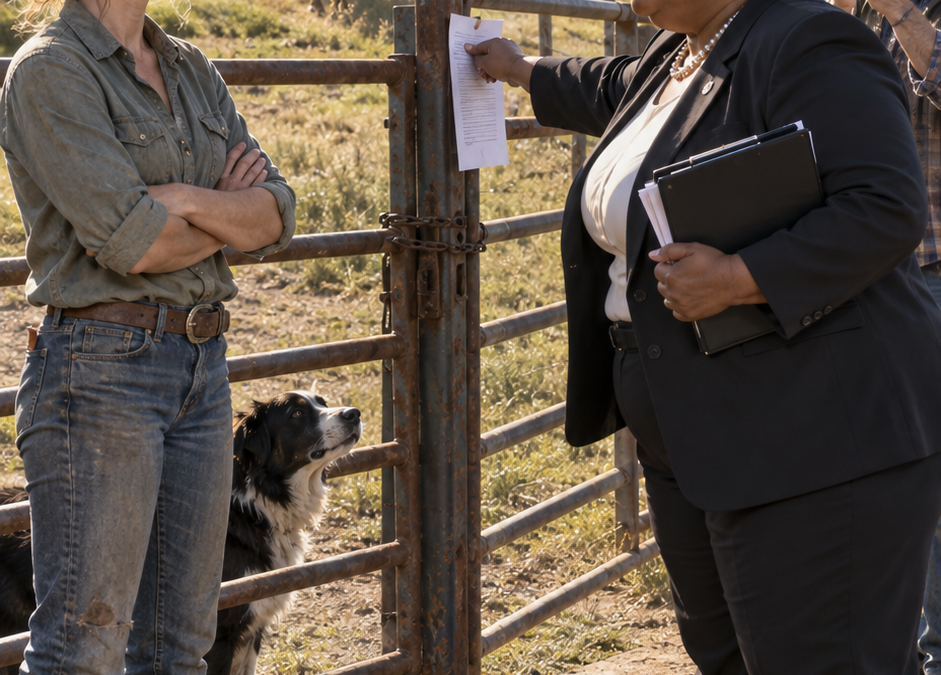
𝗣𝗔𝗥𝗧 𝟮
She ran Stillwater Bend from a three-ring binder like she had been waiting her entire life for ninety-one households to regulate.
And yet they kept reelecting her.
Mostly because nobody else wanted the job as badly as she did.
Her house sat on the northern edge of the subdivision.
Her back deck faced directly toward our water gap.
From her kitchen window, she could see my cattle drinking from Slate Creek.
Her argument was simple.
The recorded subdivision plat from 1998 labeled the creek ground “Tract C—Common Area.”
The HOA covenants prohibited livestock on common areas.
Therefore, the cattle had to go.
It was clean.
Logical.
Official.
And completely wrong.
The trouble was that I didn’t know why yet.
That night, I went through Grandpa’s records.
He kept everything important in a green metal file box beneath the workbench in his shop.
When I opened it, the smell of chain oil, dust, and old paper came out together.
Probate documents.
Insurance policies.
Tax bills.
Receipts.
A spiral notebook written in his narrow, slanted handwriting.
It was half ledger and half private language.
Calf weights.
Rainfall totals.
Medication dosages.
Pasture notes.
Names of people I barely remembered.
Near the middle, one line caught my eye.
Four words and a dash.
Gate strip—license, not sale.
I stared at it.
Then turned the page.
It meant nothing to me.
Not yet.
Eventually, I found the deed transferred to me through probate.
I sat on a stool under the fluorescent shop light and read it three times.
The homestead parcel was there.
The southern range was there.
The boundary descriptions circled the property in dense legal language.
I traced every line with my finger.
Then I reached the end.
The north pasture wasn’t there.
I went back.
Read it again.
Sixty-two acres.
The most valuable grazing ground on the ranch.
The only dependable water.
Missing.
I told myself it had to be a clerical mistake.
A dropped line.
A retyped deed.
Something ordinary.
That was what I needed to believe at eleven o’clock that night, standing alone in my grandfather’s shop three months after burying him.
The next morning, I called the county assessor.
I asked for the tax information on Tract C.
The clerk found it almost immediately.
“Separate parcel number,” she said. “Separate account.”
“Who pays it?”
“Account is current. No delinquency.”
“HOA?”
I heard papers moving.
“No.”
My pulse picked up.
“My grandfather?”
Another pause.
“No, ma’am. Not Elwood Fowler.”
I stopped breathing for half a second.
“Then who?”
“The account name is Fowler Grazing Trust.”
I wrote it down.
Fowler Grazing Trust.
I had never heard those words before.
That Thursday, I attended the Stillwater Bend board meeting.
The clubhouse smelled like coffee, carpet cleaner, and air-conditioning that had been running too hard.
Dileia sat in the center of the board table with her binder aligned perfectly in front of her.
I asked to speak.
She glanced at the clock.
“Three minutes, Miss Fowler. The board has a schedule.”
I used two.
I told them my family had grazed that pasture long before Stillwater Bend existed.
I explained that I had discovered conflicting records.
Then I asked the board to suspend the violation until ownership could be confirmed.
Dileia waited until I finished.
“Thank you for your comments.”
She turned toward the secretary.
“For the minutes, the thirty-day cure period remains in effect as issued.”
Somebody in the back applauded.
Not loudly.
Just enough.
I drove home past their stone entrance sign, crossed the cattle guard, and stopped at the gate with Grandpa’s initials.
The violation was still taped over them.
I sat there thinking about what the assessor had told me.
Fowler Grazing Trust.
Then something else began bothering me.
Grandpa had never called that pasture his.
Not once.
He called it “the north.”
He called it “the herd’s water.”
He called it “creek ground.”
I had always assumed that was simply how old ranchers talked.
Now I wasn’t so sure.
The Ellsworth County Recorder’s Office occupied one room in an old courthouse annex.
There were two microfilm readers, a scarred wooden counter, and a clerk named Beth who had worked there long enough to remember when people smoked in the lobby.
“I need the original Stillwater Bend plat,” I told her. “1998.”
She didn’t ask why.
A few minutes later, she returned with a roll of microfilm.
The image appeared sideways at first.
I rotated it.
There were the roads.
The lots.
The pond.
And along Slate Creek, exactly where Dileia said it would be:
TRACT C—COMMON AREA.
Seeing those words on an official county record made my stomach sink.
For the first time, I understood that Dileia hadn’t invented her evidence.
She had simply stopped reading too early.
Beth leaned over my shoulder.
“There should be a dedication.”
I looked at her.
“A what?”
“The plat shows what the developer drew. The dedication tells you what land was actually conveyed.”
She advanced the film.
Two frames.
A new document appeared.
I read it once.
Then again.
Then a third time.
The undersigned hereby dedicates to the Stillwater Bend Homeowners Association the following…
Tract A.
Tract B.
End of list.
I leaned closer.
“Where’s Tract C?”
Beth looked at the screen.
Then at me.
“It isn’t there.”
I felt my pulse beating in my throat.
“So the map calls it common area…”
“But the dedication never transferred it,” Beth said.
I sat back.
For almost twenty years, Stillwater Bend had treated the creek pasture as HOA property despite the fact that the document creating the HOA’s ownership omitted it completely.
“Can you pull the tax account?”
Beth moved to another computer.
A minute later she turned the monitor toward me.
FOWLER GRAZING TRUST.
Twelve consecutive years of payments were visible.
Every one current.
Every one paid by the trust.
Nothing from Stillwater Bend.
For about ninety seconds, I believed the fight was over.
I printed everything and drove straight to the HOA clubhouse.
Dileia was in her office.
I laid the documents on her desk.
“Your plat labels it common area,” I said. “But the dedication never conveyed it to you. The taxes have been paid by a Fowler trust, not the association.”
She looked at the documents for barely a breath.
Then she squared the pages with both hands and slid them back toward me.
“The county accepted the map before you were born.”
“The county accepted a drawing.”
“Nobody deeded you the ground.”
“That isn’t a technicality.”
Her mouth curved into the faintest smile.
Patient.
Almost sympathetic.
That somehow made it worse.
“Miss Fowler,” she said, “ranchers create trusts all the time for estate and tax purposes. An account name is not a boundary line.”
She capped her pen.
“And frankly, if your grandfather was so certain, I imagine he would have told you before he died.”
That landed exactly where she intended.
For a moment, I couldn’t answer.
Then I said, “Thirty days?”
“That’s what the notice says.”
“You said fines started after thirty days.”
“The violation is ongoing,” she replied. “The board has discretion regarding enforcement.”
“What does that mean?”
“It means the fines begin today.”
“Two hundred fifty dollars?”
“Per day.”
Outside, I stood beside my truck with one hand on the open door.
Two hundred fifty dollars a day.
Seven thousand five hundred dollars a month.
And I still didn’t have a deed.
Then Dileia stopped attacking the pasture and started attacking my ability to keep the ranch.
She wrote to the bank.
Carol Hines managed the operating line Grandpa had used for feed, fuel, seed, medicine, and expenses between calf sales.
Carol called me Tuesday morning.
Her voice sounded miserable.
“Tessa, I’m sorry.”
My stomach tightened.
“What happened?”
“We received a notice from Stillwater Bend stating part of the collateral property is under an active ownership dispute.”
“So?”
“So our title department froze additional advances until it’s resolved.”
I closed my eyes.
“Carol, I need that line.”
“I know.”
“The ranch needs that line.”
“I know.”
“Then tell them the HOA doesn’t own the pasture.”
“I can’t make that determination.”
A second letter went to Dunlap Feeders.
They had planned to buy my second hay cutting.
They never formally canceled.
They simply stopped returning calls.
In rural counties, silence can kill a contract just as effectively as a signature.
That evening, I walked the north pasture.
June Bug stood knee-deep in Slate Creek.
The herd spread behind her.
I listened to the water moving over gravel.
Then I calculated tanker costs again.
Two twelve-hundred-gallon loads every day.
Truck.
Driver.
Fuel.
Forty days of serious summer.
The number was larger than the expected calf margin.
I called a land attorney in the next county because I wanted someone who didn’t attend barbecues with anyone on the Stillwater Bend board.
His name was Ray Stallings.
His office had two overflowing bookshelves and a coffee mug that said TITLE IS EVERYTHING.
I brought Grandpa’s entire green file box.
Ray read quietly for nearly an hour.
Plat.
Dedication.
Tax records.
Probate deed.
Then he removed his glasses.
“Miss Fowler, you’re asking me whether the HOA owns this pasture.”
“Yes.”
“That’s the wrong question.”
He tapped my probate deed.
“The first question is whether you do.”
The sentence emptied the room.
Over the next two weeks, Ray started tracing the chain of title.
Three days into my own search, my phone rang.
“Is this Elwood Fowler’s granddaughter?”
“Yes.”
“My name is Harold Beckett.”
I knew the name vaguely.
“I sat on the Stillwater Bend board years ago,” he said. “Secretary, 2002 through 2006.”
I stood up.
“What can I do for you?”
“I heard what Rutherford is doing with your cattle.”
He paused.
“I’ve got some old boxes in my garage. There’s something in one of them I probably should’ve handed over years ago.”
His garage smelled like cardboard, fertilizer, and gasoline.
Harold pulled a banker’s box from a shelf.
“Old legal files,” he said.
I found the letter inside a manila folder marked ASSOCIATION LEGAL—MISC.
It was dated 2004.
The letterhead belonged to Lowell Price, Stillwater Bend’s original attorney.
I began reading.
By the second paragraph, my hands were shaking.
Price had reviewed the HOA’s land records.
He had found a discrepancy.
Tract C had been drawn and labeled on the recorded plat as common area.
But the dedication had transferred only Tracts A and B.
No deed.
No conveyance.
No legal instrument had ever transferred Tract C to Stillwater Bend.
Title, Price wrote, remained with Fowler family holdings.
He recommended two options.
Purchase the land from the Fowlers.
Or amend the plat and remove the common-area label.
The board had done neither.
I turned the page.
Stapled behind the letter was a routing sheet recording transfer of old board files.
Near the bottom was a signature pressed so hard in blue ink that it embossed the paper.
Dileia Rutherford.
I looked at Harold.
“When did she sign this?”
“When she took over as president.”
“She received the whole file?”
“Everything we had.”
I looked back at the letter.
“So she knew.”
Harold rubbed his chin.
“I can’t tell you what she read.”
“She signed for it.”
“That she did.”
“Why didn’t the board fix the plat in 2004?”
Harold gave a tired shrug.
“Fixing things costs money.”
He looked at the boxes.
“Leaving them alone is free until somebody gets hurt.”
Ray studied the letter.
Then the routing sheet.
Then he leaned back.
“Put this in front of the board.”
“That’s it?”
“In an open meeting.”
He pointed at the documents.
“Read the relevant paragraph. Show the routing slip. Don’t accuse her of anything. Don’t argue. Make her respond where her neighbors can hear.”
The clubhouse was packed that night.
Word had traveled.
Residents filled every folding chair.
People stood along the walls.
Dileia sat behind her binder.
I had three minutes.
This time, I used all of them.
I read Lowell Price’s sentence slowly.
“No instrument has ever conveyed Tract C to the association.”
Then I held up the routing sheet.
I read Dileia’s name.
I asked the board to suspend enforcement until a court or title professional determined ownership.
The air conditioner rattled.
Nobody spoke.
Then Mara Puit, a newer board member sitting at the far end, turned toward Dileia.
“Did you know about this letter?”
Dileia didn’t flinch.
That stayed with me.
She simply folded her hands.
“I’m aware of it.”
A murmur passed through the room.
Mara frowned.
“It says we never received title.”
“It says one attorney could not locate a conveyance twenty years ago.”
“That’s not the same thing.”
“No,” Dileia replied. “It isn’t.”
Then she turned toward the residents.
“What this association does have is twenty years of open, continuous use.”
Her voice became stronger.
“We’ve maintained the creek bank. We paid for invasive weed treatment. Residents have walked that ground openly since the subdivision was developed. Children play there. The association has maintained it as common area for decades.”
People nodded.
“And state law recognizes rights established through long, open use.”
That was all most people needed to hear.
She had given ninety-one households a version of reality in which they weren’t living beside privately owned land.
They were protecting something that had always belonged to them.
I started to answer.
“That is not how prescriptive—”
“Miss Fowler,” Dileia interrupted, “your three minutes expired some time ago.”
Mara made a motion to suspend the fines pending title review.
Another board member seconded.
The vote failed four to two.
Dileia looked toward the secretary.
“Please record that the board has reviewed the correspondence and finds it nonbinding.”
I drove home exhausted.
Halfway down the county road, the real problem finally settled into me.
I had proved the HOA probably didn’t own the pasture.
I had proved its own lawyer had questioned ownership twenty years earlier.
I might even have proved Dileia knew about that problem.
But I still hadn’t proved I owned it.
Lowell Price had written “Fowler family holdings.”
That wasn’t a deed.
Ray filed for a temporary restraining order to stop enforcement.
The hearing happened Monday morning.
The courtroom was small enough that I could hear Dileia turning pages in her binder.
Ray presented the plat.
The dedication.
The taxes.
The 2004 letter.
Then the HOA attorney stood.
He looked directly at me.
“Miss Fowler, do you personally hold title to Tract C?”
“My family—”
“Not your family. You.”
I looked toward Ray.
His expression told me not to dance around it.
“Is your name on a deed conveying Tract C to you?”
“No.”
The judge asked for the chain of title.
Ray laid it out.
And that was when I finally learned what Grandpa had done in 1998.
The same year he sold sixty acres to the developer, he had transferred the north pasture out of his own name.
Sixty-two acres.
Warranty deed.
Grantee:
Fowler Grazing Trust.
That meant the pasture wasn’t legally his when he died.
It wasn’t part of his probate estate.
And the deed giving me the ranch had never included it because probate could not transfer property Grandpa no longer personally owned.
The judge was patient.
He said the evidence created substantial questions about the HOA’s claim.
But he also said I had not demonstrated standing as the titled owner or authorized representative of the titled owner.
He denied the temporary restraining order.
Outside the courthouse, Ray caught my arm.
“Tessa, listen to me. Denied on standing. Not merits.”
I heard him.
It didn’t matter.
Dileia was already standing on the courthouse steps speaking into somebody’s phone.
“The court has ruled,” she said.
I stopped.
“The association’s position was upheld.”
“That’s false,” I said.
She looked at me.
“The injunction was denied.”
“On standing.”
But by lunch, Stillwater Bend had heard that I lost.
Two days later, I heard the post driver.
Anyone who has lived around ranch equipment long enough knows certain sounds immediately.
That metallic pounding came from the north pasture.
I drove over the ridge in the side-by-side.
Four men from Ridgeline Fence and Post were setting steel posts across the water gap.
Not along a boundary.
Across the creek.
They were dividing the pasture so my cattle could not reach Slate Creek.
I jumped out.
“Who ordered this?”
The foreman straightened.
“Stillwater Bend Association.”
“Stop.”
“I’ve got a signed work order, ma’am.”
“Show me.”
He didn’t hand it over, but he held it where I could read it.
I photographed it.
INSTALL APPROX. 400 FT FENCE—TRACT C.
RESTRICT LIVESTOCK ACCESS AT CREEK.
Authorized by:
Dileia Rutherford.
Her signature.
Not a board resolution.
Not a court order.
Her.
I filmed the workers driving posts.
I filmed the wire.
I filmed the date and location.
Then I went home.
It was August 12.
The forecast was 105 degrees.
This wasn’t paperwork anymore.
It was water.
The next ten days were the worst I had ever spent on that ranch.
I hauled twelve hundred gallons at a time.
Two loads a day.
Sometimes more.
The cattle could hear Slate Creek beyond the new fence.
They gathered along it and bawled.
I slept in pieces.
Four hours if I was lucky.
On the fourth day, June Bug stopped eating.
I found her standing near the fence with her head low.
“Come on, old girl.”
She didn’t move.
I brought feed to her.
Nothing.
I called Doc Prentice at nine that night.
He gave her fluids.
We stood beneath truck lights while sweat ran down my back.
After two hours, he pulled off his gloves.
“She’s heat-stressed.”
I stared at June Bug.
“Can you fix it?”
“Tessa…”
“Can you fix it?”
“She’s sixteen.”
“I know how old she is.”
“She needs normal water access and less stress.”
He looked toward the fence.
“If this continues, she may be the first one you lose.”
I sat beside her after he left.
An overturned bucket.
Dark pasture.
An old cow breathing beside me.
I put my hand against her neck.
When I was twelve years old, Grandpa had put June Bug into my arms as a newborn calf.
She was wet, furious, and stronger than I was.
“You don’t hold cattle with your arms,” he had told me.
“You hold them with where you stand.”
At twelve, I had no idea what he meant.
That night, sitting beside her, I understood more than I wanted to.
For the first time, I considered calling the sale barn.
Maybe selling them myself would hurt less than watching somebody else force them out.
The fines passed eighteen thousand dollars.
The bank still refused to reopen my operating line.
Dunlap Feeders formally bought their hay somewhere else.
Then Dileia sent another letter.
The association had scheduled livestock transport for six o’clock in the morning on the final day of the cure period.
They intended to remove all eighty-four head from Tract C.
My grandfather’s gate.
My cattle.
Someone else’s trailers.
I read the letter twice.
And something changed in me.
Until then, I had been fighting as Tessa Fowler, granddaughter of Elwood Fowler, heir to the ranch.
But the court had made the truth painfully simple.
Tessa Fowler did not own Tract C.
The Fowler Grazing Trust did.
So I stopped trying to prove Dileia wrong.
I started trying to find the trust.
Ray told me trusts leave two types of evidence.
Paper.
And habit.
The paperwork wasn’t in Grandpa’s file box.
So I followed his habits.
I called the small bank on Main Street.
Not Carol’s bank.
The older one with the clock outside that had been six minutes slow since I was a child.
“Did Elwood Fowler rent a safe-deposit box?”
The clerk checked.
“He did.”
My heart jumped.
“For twenty-six years.”
“Can I access it?”
“If you have authority and the key.”
The authority could be dealt with later.
The key became my whole world.
I tore the shop apart.
Tool drawers.
Coffee cans.
Desk compartments.
Jackets.
Old tobacco tins.
Tackle boxes.
Finally, inside an old Prince Albert tin at the bottom of Grandpa’s fishing box, I found a small brass key taped to a piece of paper.
A box number was written in his crooked handwriting.
At the bank, they placed me in a small private room.
The box was heavier than I expected.
Inside was a bundle of papers wrapped with a rubber band.
I removed it.
The first page read:
FOWLER GRAZING TRUST
Executed 1998.
My hands went cold.
A warranty deed was clipped behind it.
Grantor:
Elwood Fowler.
Grantee:
Fowler Grazing Trust.
Property:
Sixty-two acres along Slate Creek.
There it was.
Ownership.
One document.
One chain.
One answer.
Then I reached page three of the trust.
Successor trustees shall serve in the following order.
My grandmother first.
She died in 2004.
My uncle second.
He died in 2012.
Third:
Tessa Marie Fowler.
I read the name again.
Sole surviving successor trustee.
Sole remaining beneficiary.
I sat back in the chair.
For three months, I had believed Grandpa had failed to tell me something essential.
Dileia had even used that fear against me.
If he was so certain, he would have told you.
But he had prepared for me.
Years before I understood why.
He had taken the most important water on the ranch and placed it somewhere a bad loan, a lawsuit, or his own financial trouble couldn’t casually reach.
Then life had run out before he explained the details.
I cried.
Not for long.
Maybe ninety seconds.
Then I kept reading.
And that was when the entire dispute changed.
The trust did not own sixty-two acres.
It owned sixty-six.
Four additional acres lay at the southern boundary.
Long.
Narrow.
Stretching from the county road into Stillwater Bend.
I unfolded the legal description beside the original development plat.
My finger followed the boundaries.
Once.
Twice.
Then I realized what I was looking at.
The four-acre strip contained Stillwater Bend’s entrance road.
The cattle guard.
The stone sign.
Part of the stormwater pond.
Their only main access.
Behind the deed was one more document.
A 1998 license agreement signed by Grandpa and the original developer.
Not an easement.
Not a sale.
Not a permanent conveyance.
A license.
Permission to use the four-acre strip for road access and drainage.
Revocable by the grantor or successor upon ninety days’ written notice.
I remembered the notebook.
Gate strip—license, not sale.
I had read the answer during the first week.
I simply hadn’t known what question it answered.
Ray read the trust in silence.
Then he stood.
“You’re signing an acceptance of trusteeship today.”
He began pulling forms.
“We notarize it. Record it tomorrow morning.”
He pointed toward the trust.
“The second that acceptance is recorded, you are no longer simply an heir making a historical argument.”
He tapped the deed.
“You become the recorded trustee representing the titled owner.”
“And the four acres?”
Ray looked at me over his glasses.
“That is a different conversation.”
I waited.
He gave me a very small smile.
“And we are going to have it carefully.”
We spent four days building the file.
Certified tax receipts.
Every year paid by the trust.
Certified chain of title.
No recorded deed to the HOA.
No conveyance.
No corrective instrument.
Nothing.
The chain ran from Grandpa’s 1998 deed directly through the trust to my recorded acceptance as successor trustee.
Then Mara Puit sent me an email from the HOA’s internal records.
Dileia had written to a development consultant that spring.
She asked how adding a creekside walking trail and pickleball courts on Tract C might affect the values of homes backing the pasture.
The consultant identified a range of homes likely to benefit.
Dileia’s own address was inside that range.
I sat staring at the email.
So that was it.
The cattle weren’t the real problem.
They were standing where she wanted an amenity.
The covenant had simply given her a weapon.
Ray made another call.
He contacted County Attorney Paula Winslow.
He showed her the incorrect recorded plat.
The certified chain of title.
The fines.
The fence.
Paula asked to see everything Thursday.
Dileia learned that my acceptance of trusteeship had been recorded.
She reacted quickly.
An emergency board meeting was called Tuesday night.
Mara emailed me the packet afterward.
No message.
Just the document.
Dileia had drafted a resolution.
It declared that Stillwater Bend had openly maintained, used, and improved Tract C since 1998.
It claimed those activities created prescriptive rights.
But the most important sentence was in paragraph three.
Notwithstanding the absence of a recorded conveyance to the association…
I read it twice.
Dileia had finally put the truth into her own document.
The HOA did not have a deed.
She had persuaded the board to vote on the resolution.
It entered the minutes.
Then she sent a warning to all ninety-one households advising residents of a “possible temporary disruption” at the neighborhood entrance because of the Fowler dispute.
She thought I was going to cause trouble.
She was right about the location.
Wrong about the reason.
Wednesday night, I placed three documents into a manila envelope.
Certified chain of title.
Recorded acceptance of trusteeship.
The trust deed.
Then I added the entrance-strip license.
I set the envelope beside the kitchen door.
At 4:30 the next morning, my alarm sounded.
I had slept maybe three hours.
The livestock haulers were scheduled for six.
They arrived early.
When I came over the ridge at 5:50, headlights filled the field entrance.
A gooseneck livestock trailer.
A semi pulling a double-deck.
The Ridgeline Fence truck.
Men holding sorting sticks.
Dileia stood in the middle of everything with her clipboard.
A county sheriff’s cruiser idled nearby.
Deputy Neil Carver leaned against it holding coffee.
Along the subdivision fence, maybe twenty residents had gathered.
Phones were already out.
One man had brought a lawn chair.
I parked.
Took the envelope.
Walked toward the gate.
“Open it,” Dileia said.
She wasn’t speaking to me.
She spoke to the livestock foreman.
Deputy Carver straightened.
“Let’s make sure everybody stays calm.”
“The association has a lawful removal scheduled on association property,” Dileia said. “I asked you here to keep the peace.”
Nobody moved.
I walked to Carver.
“Before anyone loads an animal, will you read these?”
Dileia sighed loudly.
“This is another delay.”
Carver held his hand out.
“Then two minutes won’t hurt.”
He put his coffee on the cruiser hood.
First came the certified chain.
1998 warranty deed.
Elwood Fowler.
Fowler Grazing Trust.
Sixty-two acres along Slate Creek.
Then the Stillwater Bend dedication.
Tract A.
Tract B.
No Tract C.
Then my recorded acceptance as successor trustee.
Carver read it twice.
He lifted his head.
“Mrs. Rutherford.”
Dileia stepped closer.
“This land isn’t owned by the association.”
Someone at the fence said, “What?”
Carver continued.
“It belongs to the Fowler Grazing Trust. Miss Fowler is the recorded trustee.”
Dileia opened her binder immediately.
She pulled out the emergency resolution.
“The board adopted this Tuesday.”
She handed it to him.
“Twenty years of maintenance. Open and continuous use. Weed control. Mowing. Residents walking the land. The association has prescriptive rights.”
She said it with complete confidence.
A week earlier, that confidence would have frightened me.
That morning, it didn’t.
Because I had read her resolution.
“Deputy,” I said, “read paragraph three.”
He looked down.
Then read aloud.
“Notwithstanding the absence of a recorded conveyance to the association…”
He stopped.
Looked at Dileia.
“Your own resolution says you don’t have title.”
Nobody along the fence spoke.
Then a car came down the road.
Paula Winslow stepped out.
Jeans.
Boots.
Folder in hand.
Ray had moved our Thursday meeting.
Paula introduced herself as county attorney.
Then she addressed Dileia.
“I reviewed the county chain this week.”
Dileia folded her arms.
Paula continued.
“No recorded instrument has ever conveyed Tract C to Stillwater Bend.”
She held up another document.
“The recorded plat contains a labeling error. Your association was advised of that discrepancy in 2004.”
Dileia started to speak.
Paula lifted one hand.
“And a board resolution does not create prescriptive title.”
Silence.
“The trust has also been assessed on the tract and has paid the property taxes for twelve consecutive years.”
She looked directly at Dileia.
“Your association has not.”
Dileia’s face changed.
Just slightly.
“The board made these decisions.”
It was the first defensive thing I had ever heard her say.
“This was board action. I carried out board action.”
I opened my second folder.
“Then let’s look at the board actions.”
I placed the violation notice on the cruiser hood.
Signed by Dileia Rutherford.
The letter to my bank.
Signed by Dileia Rutherford.
The letter to Dunlap Feeders.
Signed by Dileia Rutherford.
The Ridgeline work order ordering a fence across Slate Creek.
Signed by Dileia Rutherford.
Then I added Lowell Price’s 2004 letter.
Behind it, the routing sheet.
Dileia’s signature.
Proof she had accepted the file containing a legal warning that Stillwater Bend never received title.
I said nothing.
I didn’t need to.
The Ridgeline foreman leaned forward, read enough of the documents to understand what was happening, and took one step away from the gate.
Deputy Carver handed the papers back to me.
“All right.”
He pointed toward the trailers.
“Both livestock rigs off this private approach.”
Then toward the Ridgeline crew.
“And the fence blocking the creek comes out.”
The foreman moved immediately.
He had fence pliers in his hand before Carver finished.
For forty minutes, the crew removed what had taken them a day to install.
Wire came down.
Posts came out.
The cattle had already gathered on the ridge.
When the opening was wide enough, June Bug started downhill.
Slowly.
Sideways.
Old knees stiff.
The entire herd followed.
She stepped into Slate Creek until the water reached halfway up her legs.
Then she lowered her head.
And drank.
For a long time.
I watched her.
Ten days of tanker trucks.
Ten days of bawling cattle.
Ten days wondering which animal would fall first.
Now water ran over the gravel around her hooves as though none of us had ever interrupted it.
I wanted Grandpa there.
Just for one minute.
I wanted him leaning against the gate, saying something ordinary because that was his way of surviving extraordinary things.
Instead, I wiped my face and walked back toward Dileia.
She stood alone beside the cruiser.
I took one final envelope from my jacket.
“Mrs. Rutherford.”
She looked down at it.
Didn’t reach.
I held it there.
Eventually, she took it.
“The trust owns another parcel.”
Her eyes lifted.
“Four acres along your southern entrance.”
She said nothing.
“The road.”
Still nothing.
“The cattle guard.”
Her fingers tightened.
“The entrance sign.”
I continued.
“And part of your stormwater pond.”
“That’s association property.”
“No.”
I nodded toward the envelope.
“My grandfather licensed it to the developer in 1998.”
I waited.
“Licensed. He never sold it.”
She opened the envelope.
“Not an easement. Not a conveyance. A revocable license.”
Her eyes moved across the page.
“The trust can terminate it with ninety days’ written notice.”
I pointed at the document.
“That’s your notice.”
For the first time all summer, Dileia looked genuinely stunned.
“You can’t do that.”
“It’s already done.”
“That is our only entrance.”
“I know.”
“Ninety-one families use that road.”
“I know.”
She stared at me.
Then toward the subdivision.
Residents had heard enough to understand.
I lowered my voice.
“Same trust.”
I nodded toward the documents.
“Same chain of title.”
“Same county records nobody bothered to read.”
The HOA’s attorney called Ray before the end of the week.
After that, the fight moved very quickly.
Because once everyone finally read the same documents, there wasn’t much left to argue about.
The livestock violation was withdrawn.
Every fine was voided.
The $18,400 I had already paid under protest was refunded with interest.
Stillwater Bend petitioned the county for a corrected plat.
By October, the words Tract C—Common Area were formally removed from the subdivision drawing.
Dileia Rutherford lasted one more month as president.
Residents called a special meeting in September.
I didn’t attend.
Mara told me what happened.
Dileia stood with her binder and started explaining the HOA’s twenty years of maintenance.
A man in the third row interrupted.
“How much of our dues did you spend putting a fence across somebody else’s water?”
She said the board authorized it.
He asked, “Who signed the work order?”
She sat down.
The removal vote was sixty-one to nine.
Dileia tried to run for the board again the following spring.
Her filing was rejected under the association’s eligibility rules.
Then the insurance issue arrived.
Stillwater Bend carried directors and officers coverage.
Normally, that policy would defend board members against lawsuits arising from official decisions.
But the carrier reviewed the file.
The violation notice bearing Dileia’s signature.
The letter to my bank.
The letter to Dunlap Feeders.
The fence order.
The 2004 attorney letter.
The routing sheet proving she had accepted the file containing it.
The insurer denied her personal defense for acts it determined fell outside protected authority and involved prior notice of the ownership problem.
After that, she had her own lawyer.
The civil judgment eventually totaled $242,000.
Pasture repair.
Fence removal.
Emergency water hauling.
Veterinary expenses.
Lost income from the hay sale.
Attorney’s fees.
And damages resulting from the letters she sent to my lender and buyer while pursuing an ownership claim the HOA’s own historical records contradicted.
The county also filed misdemeanor charges connected to trespass and the attempted livestock removal.
Dileia received probation, fines, and restitution.
No jail.
Ray had told me not to expect jail.
I didn’t want it.
By then, I wanted distance more than punishment.
Dileia sold her house in November.
The house with the deck overlooking Slate Creek.
The proposed walking trail disappeared.
So did the pickleball expansion.
Then I still had to decide what to do about the four acres beneath Stillwater Bend’s entrance.
Legally, I could have let the ninety-day revocation run.
I could have closed the road.
For several days, I imagined it.
Not because I wanted ninety-one families trapped.
Because some small, angry part of me wanted Dileia to understand what it felt like to be told you had thirty days before somebody dismantled the life you assumed was secure.
But Dileia wasn’t ninety-one families.
Most of those people had never touched my cattle.
Many had simply trusted the map their association gave them.
So I sold the strip to the HOA at appraised value.
This time, everything was done properly.
Recorded deed.
Permanent access easement.
Drainage rights.
Surveyed boundaries.
Real instruments.
No assumptions.
No handwritten labels treated like ownership.
I required one condition.
Stillwater Bend had to record a permanent covenant acknowledging that the north pasture belonged to the Fowler Grazing Trust and that the association possessed no regulatory, enforcement, access, or common-area rights over it.
The covenant would run with the subdivision land.
Future boards could not pretend they had forgotten.
They signed within eleven days.
The bank reopened my operating line in October.
The following spring, Dunlap Feeders called asking about second cutting.
They spoke as though the previous year had never happened.
I sold it to them.
This is a small county.
You can spend the rest of your life collecting grudges or collecting customers.
Sometimes you have to decide which one pays better.
All eighty-four cattle survived that summer.
June Bug started eating again four days after the fence was removed.
She lived another two years.
When she finally went down, there was no tanker truck beside her.
No fence between her and water.
No strangers holding paperwork.
She died in the north pasture beneath a cottonwood with the herd nearby.
I buried her on the ridge.
The 1998 warranty deed hangs framed beside my kitchen door now.
Above it is a photograph of Grandpa standing at the north gate.
His hand is resting on the crossbar.
EF is visible in the steel.
There is still a faint rectangular shadow where Dileia taped that first violation notice over his initials.
I could clean it off.
I never have.
Every June evening, I walk through that gate toward Slate Creek.
The herd follows.
A heifer descended from June Bug leads them now.
She has the same habit of stopping halfway down the ridge to look behind her, checking whether everyone else is coming.
Then she continues toward the creek.
The cattle spread along the bank.
Water moves over stone.
Beyond the fence, I can see the roofs of Stillwater Bend.
Their entrance still uses the same road.
Their pond still catches the same stormwater.
The difference is that now every inch of it exists where the paperwork says it does.
For months, I thought my grandfather had left me a mess.
Then I thought he had left me an incomplete ranch.
Eventually, I understood what he had actually done.
Elwood Fowler knew land could disappear without moving an inch.
A bank could take it.
A developer could misunderstand it.
A surveyor could label it wrong.
An HOA could repeat that mistake for twenty years until everyone forgot it had ever been a mistake.
So Grandpa protected the one thing the ranch could not survive without.
The water.
He placed it inside a trust.
Then he kept the entrance strip separate from the sale and gave the developer only permission to use it.
He had built two layers of protection around land that nobody else considered important enough to examine closely.
The only thing he failed to do was explain it before he died.
For a while, I was angry at him for that.
I’m not anymore.
Because every document I needed existed.
Every signature mattered.
Every tax payment mattered.
Every old note mattered.
Even those four words I almost ignored.
Gate strip—license, not sale.
Dileia Rutherford had been right about one thing the morning she stood at my gate.
Three months after inheriting the ranch, I truly didn’t know what I owned.
Neither did she.
The difference was that I eventually went looking.
And when I finally found the answer, I discovered something bigger than sixty-two acres of pasture.
My grandfather hadn’t simply left me land.
He left me proof.
And in the end, proof was the one thing the HOA had never bothered to own.
Have you finished reading the story and want to read it again?
The HOA Ordered Me to Remove 84 Cattle From My Grandfather’s Pasture—Then I Found Out Who Really Owned Their Front Gate
They gave me thirty days to erase four generations of my family’s ranch.
The HOA president was so certain the pasture belonged to her neighborhood that she started fencing my cattle away from their only reliable water.
Then I found a document my grandfather had hidden for twenty-six years—and suddenly the pasture wasn’t the only piece of land the HOA needed to worry about.
My name is Tessa Fowler.
The morning this started, Dileia Rutherford taped the violation notice to my gate before eight o’clock and waited there long enough to make sure I saw her do it.
She didn’t greet me.
She didn’t ask how I was holding up after burying my grandfather three months earlier.
She didn’t even say my name.
She simply raised a pen toward the eighty-four cattle moving slowly down from the ridge behind me.
“Get them off.”
For a moment, I thought I had misunderstood her.
June Bug was leading the herd, as she usually did. She was sixteen years old then, an old red cow with a white mark above her nose and the kind of deliberate walk that came from having crossed the same pasture nearly every day of her life.
“Get what off?” I asked.
Dileia looked past me.
“All of them. You have thirty days.”
She pressed the violation notice flat against the steel crossbar of the gate.
“After that, it’s two hundred and fifty dollars a day.”
That gate had been welded by my grandfather, Elwood Fowler, in 1998. His initials—EF—were burned crookedly into the steel near the latch.
Dileia smoothed the tape directly over them with her thumb.
“That’s common area, Tract C,” she said. “You’ve been running livestock on ground that was never yours.”
I stared at her.
“That’s my family’s pasture.”
“It was your grandfather’s problem,” she replied. “Now it’s mine.”
The way she said it made my jaw tighten.
Then her eyes moved deliberately over my boots, my faded jeans, the old Ford parked beside the barn, and finally back to the gate.
“You’ve had this place three months,” she said. “You don’t know what you own. That isn’t the board’s fault.”
A man standing beside her was filming on his phone.
I pointed toward the clipboard under her arm.
“Show me the deed.”
“I don’t need a deed.”
“Then what do you have?”
She tapped the clipboard twice.
“I have the map.”
Behind me, June Bug bawled softly.
The rest of the cattle kept walking.
Dileia stepped toward her car.
“Move them,” she said, “or I’ll have them moved for you.”
Then she backed over the cattle guard and drove toward Stillwater Bend, carrying that map with her as though a line drawn on paper had settled ownership forever.
At the time, I thought she was bluffing.
I learned very quickly that Dileia Rutherford did not bluff.
My grandfather died in March.
Elwood Fowler was eighty-one years old, and they found him sitting upright behind the wheel of his truck at the top of the north ridge. The engine was off. One hand rested on the steering wheel.
He had been looking out over his cattle.
There were worse ways for an old rancher to go.
That was what everybody told me.
I tried to believe them.
I had spent nearly every summer of my childhood on that ranch. I learned to drive a truck in a hay field before my feet could comfortably reach both pedals. I learned which cows would kick, which gates sagged in wet weather, how to tell when a storm was moving in by the smell of the air.
But visiting a ranch and running one are two different lives.
After Grandpa died, I gave notice at the farm supply store where I had worked for eleven years and moved into his house.
The numbers were waiting for me.
Three hundred twenty acres.
Eighty-four head of cattle.
Feed.
Fuel.
Veterinary bills.
Equipment repairs.
Taxes.
A stack of invoices that seemed to reproduce whenever I turned my back.
And then there was the north pasture.
Sixty-two acres along Slate Creek.
It didn’t look like much on a county map, but it made the rest of the ranch possible.
It contained the only natural water gap on the property that ran year-round.
By July, our south ponds shrank into mud bowls. The homestead well could support a house, a garden, and not much more.
Without Slate Creek, watering eighty-four cattle meant hauling water.
Two tanker loads a day.
Every day.
Through the hottest part of summer.
I did the math the same afternoon Dileia posted the violation.
The numbers were brutal.
If I lost access to the north pasture, the cost of hauling water through August would eat almost everything I expected to make selling calves in the fall.
I wouldn’t have to reduce the herd.
I would have to sell it.
All of it.
One taped piece of paper had given me thirty days to dismantle four generations.
Stillwater Bend existed because my grandfather had once needed money.
In 1998, cattle prices were down, his knee was failing, and a bank loan was squeezing him.
So he sold sixty acres along the southern edge of the ranch to a developer.
I was eleven years old then.
I remember sitting on the tailgate of Grandpa’s truck while framing crews raised houses where cattle used to graze.
Eventually, Stillwater Bend became ninety-one homes with curved streets, stone entrance pillars, ornamental trees, and a stormwater pond the residents called a lake.
For almost twenty years, the subdivision and the ranch existed beside each other without much trouble.
Then Dileia Rutherford became HOA president.
By the time I inherited the ranch, she was serving her third term.
People complained about her constantly.
At the grocery store, at the feed store, after church.
She had a form for everything.
Wrong mailbox color.
Fence stain.
Basketball hoop left out overnight.
Garbage container visible from the street.
She ran Stillwater Bend from a three-ring binder like she had been waiting her entire life for ninety-one households to regulate.
And yet they kept reelecting her.
Mostly because nobody else wanted the job as badly as she did.
Her house sat on the northern edge of the subdivision.
Her back deck faced directly toward our water gap.
From her kitchen window, she could see my cattle drinking from Slate Creek.
Her argument was simple.
The recorded subdivision plat from 1998 labeled the creek ground “Tract C—Common Area.”
The HOA covenants prohibited livestock on common areas.
Therefore, the cattle had to go.
It was clean.
Logical.
Official.
And completely wrong.
The trouble was that I didn’t know why yet.
That night, I went through Grandpa’s records.
He kept everything important in a green metal file box beneath the workbench in his shop.
When I opened it, the smell of chain oil, dust, and old paper came out together.
Probate documents.
Insurance policies.
Tax bills.
Receipts.
A spiral notebook written in his narrow, slanted handwriting.
It was half ledger and half private language.
Calf weights.
Rainfall totals.
Medication dosages.
Pasture notes.
Names of people I barely remembered.
Near the middle, one line caught my eye.
Four words and a dash.
Gate strip—license, not sale.
I stared at it.
Then turned the page.
It meant nothing to me.
Not yet.
Eventually, I found the deed transferred to me through probate.
I sat on a stool under the fluorescent shop light and read it three times.
The homestead parcel was there.
The southern range was there.
The boundary descriptions circled the property in dense legal language.
I traced every line with my finger.
Then I reached the end.
The north pasture wasn’t there.
I went back.
Read it again.
Sixty-two acres.
The most valuable grazing ground on the ranch.
The only dependable water.
Missing.
I told myself it had to be a clerical mistake.
A dropped line.
A retyped deed.
Something ordinary.
That was what I needed to believe at eleven o’clock that night, standing alone in my grandfather’s shop three months after burying him.
The next morning, I called the county assessor.
I asked for the tax information on Tract C.
The clerk found it almost immediately.
“Separate parcel number,” she said. “Separate account.”
“Who pays it?”
“Account is current. No delinquency.”
“HOA?”
I heard papers moving.
“No.”
My pulse picked up.
“My grandfather?”
Another pause.
“No, ma’am. Not Elwood Fowler.”
I stopped breathing for half a second.
“Then who?”
“The account name is Fowler Grazing Trust.”
I wrote it down.
Fowler Grazing Trust.
I had never heard those words before.
That Thursday, I attended the Stillwater Bend board meeting.
The clubhouse smelled like coffee, carpet cleaner, and air-conditioning that had been running too hard.
Dileia sat in the center of the board table with her binder aligned perfectly in front of her.
I asked to speak.
She glanced at the clock.
“Three minutes, Miss Fowler. The board has a schedule.”
I used two.
I told them my family had grazed that pasture long before Stillwater Bend existed.
I explained that I had discovered conflicting records.
Then I asked the board to suspend the violation until ownership could be confirmed.
Dileia waited until I finished.
“Thank you for your comments.”
She turned toward the secretary.
“For the minutes, the thirty-day cure period remains in effect as issued.”
Somebody in the back applauded.
Not loudly.
Just enough.
I drove home past their stone entrance sign, crossed the cattle guard, and stopped at the gate with Grandpa’s initials.
The violation was still taped over them.
I sat there thinking about what the assessor had told me.
Fowler Grazing Trust.
Then something else began bothering me.
Grandpa had never called that pasture his.
Not once.
He called it “the north.”
He called it “the herd’s water.”
He called it “creek ground.”
I had always assumed that was simply how old ranchers talked.
Now I wasn’t so sure.
The Ellsworth County Recorder’s Office occupied one room in an old courthouse annex.
There were two microfilm readers, a scarred wooden counter, and a clerk named Beth who had worked there long enough to remember when people smoked in the lobby.
“I need the original Stillwater Bend plat,” I told her. “1998.”
She didn’t ask why.
A few minutes later, she returned with a roll of microfilm.
The image appeared sideways at first.
I rotated it.
There were the roads.
The lots.
The pond.
And along Slate Creek, exactly where Dileia said it would be:
TRACT C—COMMON AREA.
Seeing those words on an official county record made my stomach sink.
For the first time, I understood that Dileia hadn’t invented her evidence.
She had simply stopped reading too early.
Beth leaned over my shoulder.
“There should be a dedication.”
I looked at her.
“A what?”
“The plat shows what the developer drew. The dedication tells you what land was actually conveyed.”
She advanced the film.
Two frames.
A new document appeared.
I read it once.
Then again.
Then a third time.
The undersigned hereby dedicates to the Stillwater Bend Homeowners Association the following…
Tract A.
Tract B.
End of list.
I leaned closer.
“Where’s Tract C?”
Beth looked at the screen.
Then at me.
“It isn’t there.”
I felt my pulse beating in my throat.
“So the map calls it common area…”
“But the dedication never transferred it,” Beth said.
I sat back.
For almost twenty years, Stillwater Bend had treated the creek pasture as HOA property despite the fact that the document creating the HOA’s ownership omitted it completely.
“Can you pull the tax account?”
Beth moved to another computer.
A minute later she turned the monitor toward me.
FOWLER GRAZING TRUST.
Twelve consecutive years of payments were visible.
Every one current.
Every one paid by the trust.
Nothing from Stillwater Bend.
For about ninety seconds, I believed the fight was over.
I printed everything and drove straight to the HOA clubhouse.
Dileia was in her office.
I laid the documents on her desk.
“Your plat labels it common area,” I said. “But the dedication never conveyed it to you. The taxes have been paid by a Fowler trust, not the association.”
She looked at the documents for barely a breath.
Then she squared the pages with both hands and slid them back toward me.
“The county accepted the map before you were born.”
“The county accepted a drawing.”
“Nobody deeded you the ground.”
“That isn’t a technicality.”
Her mouth curved into the faintest smile.
Patient.
Almost sympathetic.
That somehow made it worse.
“Miss Fowler,” she said, “ranchers create trusts all the time for estate and tax purposes. An account name is not a boundary line.”
She capped her pen.
“And frankly, if your grandfather was so certain, I imagine he would have told you before he died.”
That landed exactly where she intended.
For a moment, I couldn’t answer.
Then I said, “Thirty days?”
“That’s what the notice says.”
“You said fines started after thirty days.”
“The violation is ongoing,” she replied. “The board has discretion regarding enforcement.”
“What does that mean?”
“It means the fines begin today.”
“Two hundred fifty dollars?”
“Per day.”
Outside, I stood beside my truck with one hand on the open door.
Two hundred fifty dollars a day.
Seven thousand five hundred dollars a month.
And I still didn’t have a deed.
Then Dileia stopped attacking the pasture and started attacking my ability to keep the ranch.
She wrote to the bank.
Carol Hines managed the operating line Grandpa had used for feed, fuel, seed, medicine, and expenses between calf sales.
Carol called me Tuesday morning.
Her voice sounded miserable.
“Tessa, I’m sorry.”
My stomach tightened.
“What happened?”
“We received a notice from Stillwater Bend stating part of the collateral property is under an active ownership dispute.”
“So?”
“So our title department froze additional advances until it’s resolved.”
I closed my eyes.
“Carol, I need that line.”
“I know.”
“The ranch needs that line.”
“I know.”
“Then tell them the HOA doesn’t own the pasture.”
“I can’t make that determination.”
A second letter went to Dunlap Feeders.
They had planned to buy my second hay cutting.
They never formally canceled.
They simply stopped returning calls.
In rural counties, silence can kill a contract just as effectively as a signature.
That evening, I walked the north pasture.
June Bug stood knee-deep in Slate Creek.
The herd spread behind her.
I listened to the water moving over gravel.
Then I calculated tanker costs again.
Two twelve-hundred-gallon loads every day.
Truck.
Driver.
Fuel.
Forty days of serious summer.
The number was larger than the expected calf margin.
I called a land attorney in the next county because I wanted someone who didn’t attend barbecues with anyone on the Stillwater Bend board.
His name was Ray Stallings.
His office had two overflowing bookshelves and a coffee mug that said TITLE IS EVERYTHING.
I brought Grandpa’s entire green file box.
Ray read quietly for nearly an hour.
Plat.
Dedication.
Tax records.
Probate deed.
Then he removed his glasses.
“Miss Fowler, you’re asking me whether the HOA owns this pasture.”
“Yes.”
“That’s the wrong question.”
He tapped my probate deed.
“The first question is whether you do.”
The sentence emptied the room.
Over the next two weeks, Ray started tracing the chain of title.
Three days into my own search, my phone rang.
“Is this Elwood Fowler’s granddaughter?”
“Yes.”
“My name is Harold Beckett.”
I knew the name vaguely.
“I sat on the Stillwater Bend board years ago,” he said. “Secretary, 2002 through 2006.”
I stood up.
“What can I do for you?”
“I heard what Rutherford is doing with your cattle.”
He paused.
“I’ve got some old boxes in my garage. There’s something in one of them I probably should’ve handed over years ago.”
His garage smelled like cardboard, fertilizer, and gasoline.
Harold pulled a banker’s box from a shelf.
“Old legal files,” he said.
I found the letter inside a manila folder marked ASSOCIATION LEGAL—MISC.
It was dated 2004.
The letterhead belonged to Lowell Price, Stillwater Bend’s original attorney.
I began reading.
By the second paragraph, my hands were shaking.
Price had reviewed the HOA’s land records.
He had found a discrepancy.
Tract C had been drawn and labeled on the recorded plat as common area.
But the dedication had transferred only Tracts A and B.
No deed.
No conveyance.
No legal instrument had ever transferred Tract C to Stillwater Bend.
Title, Price wrote, remained with Fowler family holdings.
He recommended two options.
Purchase the land from the Fowlers.
Or amend the plat and remove the common-area label.
The board had done neither.
I turned the page.
Stapled behind the letter was a routing sheet recording transfer of old board files.
Near the bottom was a signature pressed so hard in blue ink that it embossed the paper.
Dileia Rutherford.
I looked at Harold.
“When did she sign this?”
“When she took over as president.”
“She received the whole file?”
“Everything we had.”
I looked back at the letter.
“So she knew.”
Harold rubbed his chin.
“I can’t tell you what she read.”
“She signed for it.”
“That she did.”
“Why didn’t the board fix the plat in 2004?”
Harold gave a tired shrug.
“Fixing things costs money.”
He looked at the boxes.
“Leaving them alone is free until somebody gets hurt.”
Ray studied the letter.
Then the routing sheet.
Then he leaned back.
“Put this in front of the board.”
“That’s it?”
“In an open meeting.”
He pointed at the documents.
“Read the relevant paragraph. Show the routing slip. Don’t accuse her of anything. Don’t argue. Make her respond where her neighbors can hear.”
The clubhouse was packed that night.
Word had traveled.
Residents filled every folding chair.
People stood along the walls.
Dileia sat behind her binder.
I had three minutes.
This time, I used all of them.
I read Lowell Price’s sentence slowly.
“No instrument has ever conveyed Tract C to the association.”
Then I held up the routing sheet.
I read Dileia’s name.
I asked the board to suspend enforcement until a court or title professional determined ownership.
The air conditioner rattled.
Nobody spoke.
Then Mara Puit, a newer board member sitting at the far end, turned toward Dileia.
“Did you know about this letter?”
Dileia didn’t flinch.
That stayed with me.
She simply folded her hands.
“I’m aware of it.”
A murmur passed through the room.
Mara frowned.
“It says we never received title.”
“It says one attorney could not locate a conveyance twenty years ago.”
“That’s not the same thing.”
“No,” Dileia replied. “It isn’t.”
Then she turned toward the residents.
“What this association does have is twenty years of open, continuous use.”
Her voice became stronger.
“We’ve maintained the creek bank. We paid for invasive weed treatment. Residents have walked that ground openly since the subdivision was developed. Children play there. The association has maintained it as common area for decades.”
People nodded.
“And state law recognizes rights established through long, open use.”
That was all most people needed to hear.
She had given ninety-one households a version of reality in which they weren’t living beside privately owned land.
They were protecting something that had always belonged to them.
I started to answer.
“That is not how prescriptive—”
“Miss Fowler,” Dileia interrupted, “your three minutes expired some time ago.”
Mara made a motion to suspend the fines pending title review.
Another board member seconded.
The vote failed four to two.
Dileia looked toward the secretary.
“Please record that the board has reviewed the correspondence and finds it nonbinding.”
I drove home exhausted.
Halfway down the county road, the real problem finally settled into me.
I had proved the HOA probably didn’t own the pasture.
I had proved its own lawyer had questioned ownership twenty years earlier.
I might even have proved Dileia knew about that problem.
But I still hadn’t proved I owned it.
Lowell Price had written “Fowler family holdings.”
That wasn’t a deed.
Ray filed for a temporary restraining order to stop enforcement.
The hearing happened Monday morning.
The courtroom was small enough that I could hear Dileia turning pages in her binder.
Ray presented the plat.
The dedication.
The taxes.
The 2004 letter.
Then the HOA attorney stood.
He looked directly at me.
“Miss Fowler, do you personally hold title to Tract C?”
“My family—”
“Not your family. You.”
I looked toward Ray.
His expression told me not to dance around it.
“Is your name on a deed conveying Tract C to you?”
“No.”
The judge asked for the chain of title.
Ray laid it out.
And that was when I finally learned what Grandpa had done in 1998.
The same year he sold sixty acres to the developer, he had transferred the north pasture out of his own name.
Sixty-two acres.
Warranty deed.
Grantee:
Fowler Grazing Trust.
That meant the pasture wasn’t legally his when he died.
It wasn’t part of his probate estate.
And the deed giving me the ranch had never included it because probate could not transfer property Grandpa no longer personally owned.
The judge was patient.
He said the evidence created substantial questions about the HOA’s claim.
But he also said I had not demonstrated standing as the titled owner or authorized representative of the titled owner.
He denied the temporary restraining order.
Outside the courthouse, Ray caught my arm.
“Tessa, listen to me. Denied on standing. Not merits.”
I heard him.
It didn’t matter.
Dileia was already standing on the courthouse steps speaking into somebody’s phone.
“The court has ruled,” she said.
I stopped.
“The association’s position was upheld.”
“That’s false,” I said.
She looked at me.
“The injunction was denied.”
“On standing.”
But by lunch, Stillwater Bend had heard that I lost.
Two days later, I heard the post driver.
Anyone who has lived around ranch equipment long enough knows certain sounds immediately.
That metallic pounding came from the north pasture.
I drove over the ridge in the side-by-side.
Four men from Ridgeline Fence and Post were setting steel posts across the water gap.
Not along a boundary.
Across the creek.
They were dividing the pasture so my cattle could not reach Slate Creek.
I jumped out.
“Who ordered this?”
The foreman straightened.
“Stillwater Bend Association.”
“Stop.”
“I’ve got a signed work order, ma’am.”
“Show me.”
He didn’t hand it over, but he held it where I could read it.
I photographed it.
INSTALL APPROX. 400 FT FENCE—TRACT C.
RESTRICT LIVESTOCK ACCESS AT CREEK.
Authorized by:
Dileia Rutherford.
Her signature.
Not a board resolution.
Not a court order.
Her.
I filmed the workers driving posts.
I filmed the wire.
I filmed the date and location.
Then I went home.
It was August 12.
The forecast was 105 degrees.
This wasn’t paperwork anymore.
It was water.
The next ten days were the worst I had ever spent on that ranch.
I hauled twelve hundred gallons at a time.
Two loads a day.
Sometimes more.
The cattle could hear Slate Creek beyond the new fence.
They gathered along it and bawled.
I slept in pieces.
Four hours if I was lucky.
On the fourth day, June Bug stopped eating.
I found her standing near the fence with her head low.
“Come on, old girl.”
She didn’t move.
I brought feed to her.
Nothing.
I called Doc Prentice at nine that night.
He gave her fluids.
We stood beneath truck lights while sweat ran down my back.
After two hours, he pulled off his gloves.
“She’s heat-stressed.”
I stared at June Bug.
“Can you fix it?”
“Tessa…”
“Can you fix it?”
“She’s sixteen.”
“I know how old she is.”
“She needs normal water access and less stress.”
He looked toward the fence.
“If this continues, she may be the first one you lose.”
I sat beside her after he left.
An overturned bucket.
Dark pasture.
An old cow breathing beside me.
I put my hand against her neck.
When I was twelve years old, Grandpa had put June Bug into my arms as a newborn calf.
She was wet, furious, and stronger than I was.
“You don’t hold cattle with your arms,” he had told me.
“You hold them with where you stand.”
At twelve, I had no idea what he meant.
That night, sitting beside her, I understood more than I wanted to.
For the first time, I considered calling the sale barn.
Maybe selling them myself would hurt less than watching somebody else force them out.
The fines passed eighteen thousand dollars.
The bank still refused to reopen my operating line.
Dunlap Feeders formally bought their hay somewhere else.
Then Dileia sent another letter.
The association had scheduled livestock transport for six o’clock in the morning on the final day of the cure period.
They intended to remove all eighty-four head from Tract C.
My grandfather’s gate.
My cattle.
Someone else’s trailers.
I read the letter twice.
And something changed in me.
Until then, I had been fighting as Tessa Fowler, granddaughter of Elwood Fowler, heir to the ranch.
But the court had made the truth painfully simple.
Tessa Fowler did not own Tract C.
The Fowler Grazing Trust did.
So I stopped trying to prove Dileia wrong.
I started trying to find the trust.
Ray told me trusts leave two types of evidence.
Paper.
And habit.
The paperwork wasn’t in Grandpa’s file box.
So I followed his habits.
I called the small bank on Main Street.
Not Carol’s bank.
The older one with the clock outside that had been six minutes slow since I was a child.
“Did Elwood Fowler rent a safe-deposit box?”
The clerk checked.
“He did.”
My heart jumped.
“For twenty-six years.”
“Can I access it?”
“If you have authority and the key.”
The authority could be dealt with later.
The key became my whole world.
I tore the shop apart.
Tool drawers.
Coffee cans.
Desk compartments.
Jackets.
Old tobacco tins.
Tackle boxes.
Finally, inside an old Prince Albert tin at the bottom of Grandpa’s fishing box, I found a small brass key taped to a piece of paper.
A box number was written in his crooked handwriting.
At the bank, they placed me in a small private room.
The box was heavier than I expected.
Inside was a bundle of papers wrapped with a rubber band.
I removed it.
The first page read:
FOWLER GRAZING TRUST
Executed 1998.
My hands went cold.
A warranty deed was clipped behind it.
Grantor:
Elwood Fowler.
Grantee:
Fowler Grazing Trust.
Property:
Sixty-two acres along Slate Creek.
There it was.
Ownership.
One document.
One chain.
One answer.
Then I reached page three of the trust.
Successor trustees shall serve in the following order.
My grandmother first.
She died in 2004.
My uncle second.
He died in 2012.
Third:
Tessa Marie Fowler.
I read the name again.
Sole surviving successor trustee.
Sole remaining beneficiary.
I sat back in the chair.
For three months, I had believed Grandpa had failed to tell me something essential.
Dileia had even used that fear against me.
If he was so certain, he would have told you.
But he had prepared for me.
Years before I understood why.
He had taken the most important water on the ranch and placed it somewhere a bad loan, a lawsuit, or his own financial trouble couldn’t casually reach.
Then life had run out before he explained the details.
I cried.
Not for long.
Maybe ninety seconds.
Then I kept reading.
And that was when the entire dispute changed.
The trust did not own sixty-two acres.
It owned sixty-six.
Four additional acres lay at the southern boundary.
Long.
Narrow.
Stretching from the county road into Stillwater Bend.
I unfolded the legal description beside the original development plat.
My finger followed the boundaries.
Once.
Twice.
Then I realized what I was looking at.
The four-acre strip contained Stillwater Bend’s entrance road.
The cattle guard.
The stone sign.
Part of the stormwater pond.
Their only main access.
Behind the deed was one more document.
A 1998 license agreement signed by Grandpa and the original developer.
Not an easement.
Not a sale.
Not a permanent conveyance.
A license.
Permission to use the four-acre strip for road access and drainage.
Revocable by the grantor or successor upon ninety days’ written notice.
I remembered the notebook.
Gate strip—license, not sale.
I had read the answer during the first week.
I simply hadn’t known what question it answered.
Ray read the trust in silence.
Then he stood.
“You’re signing an acceptance of trusteeship today.”
He began pulling forms.
“We notarize it. Record it tomorrow morning.”
He pointed toward the trust.
“The second that acceptance is recorded, you are no longer simply an heir making a historical argument.”
He tapped the deed.
“You become the recorded trustee representing the titled owner.”
“And the four acres?”
Ray looked at me over his glasses.
“That is a different conversation.”
I waited.
He gave me a very small smile.
“And we are going to have it carefully.”
We spent four days building the file.
Certified tax receipts.
Every year paid by the trust.
Certified chain of title.
No recorded deed to the HOA.
No conveyance.
No corrective instrument.
Nothing.
The chain ran from Grandpa’s 1998 deed directly through the trust to my recorded acceptance as successor trustee.
Then Mara Puit sent me an email from the HOA’s internal records.
Dileia had written to a development consultant that spring.
She asked how adding a creekside walking trail and pickleball courts on Tract C might affect the values of homes backing the pasture.
The consultant identified a range of homes likely to benefit.
Dileia’s own address was inside that range.
I sat staring at the email.
So that was it.
The cattle weren’t the real problem.
They were standing where she wanted an amenity.
The covenant had simply given her a weapon.
Ray made another call.
He contacted County Attorney Paula Winslow.
He showed her the incorrect recorded plat.
The certified chain of title.
The fines.
The fence.
Paula asked to see everything Thursday.
Dileia learned that my acceptance of trusteeship had been recorded.
She reacted quickly.
An emergency board meeting was called Tuesday night.
Mara emailed me the packet afterward.
No message.
Just the document.
Dileia had drafted a resolution.
It declared that Stillwater Bend had openly maintained, used, and improved Tract C since 1998.
It claimed those activities created prescriptive rights.
But the most important sentence was in paragraph three.
Notwithstanding the absence of a recorded conveyance to the association…
I read it twice.
Dileia had finally put the truth into her own document.
The HOA did not have a deed.
She had persuaded the board to vote on the resolution.
It entered the minutes.
Then she sent a warning to all ninety-one households advising residents of a “possible temporary disruption” at the neighborhood entrance because of the Fowler dispute.
She thought I was going to cause trouble.
She was right about the location.
Wrong about the reason.
Wednesday night, I placed three documents into a manila envelope.
Certified chain of title.
Recorded acceptance of trusteeship.
The trust deed.
Then I added the entrance-strip license.
I set the envelope beside the kitchen door.
At 4:30 the next morning, my alarm sounded.
I had slept maybe three hours.
The livestock haulers were scheduled for six.
They arrived early.
When I came over the ridge at 5:50, headlights filled the field entrance.
A gooseneck livestock trailer.
A semi pulling a double-deck.
The Ridgeline Fence truck.
Men holding sorting sticks.
Dileia stood in the middle of everything with her clipboard.
A county sheriff’s cruiser idled nearby.
Deputy Neil Carver leaned against it holding coffee.
Along the subdivision fence, maybe twenty residents had gathered.
Phones were already out.
One man had brought a lawn chair.
I parked.
Took the envelope.
Walked toward the gate.
“Open it,” Dileia said.
She wasn’t speaking to me.
She spoke to the livestock foreman.
Deputy Carver straightened.
“Let’s make sure everybody stays calm.”
“The association has a lawful removal scheduled on association property,” Dileia said. “I asked you here to keep the peace.”
Nobody moved.
I walked to Carver.
“Before anyone loads an animal, will you read these?”
Dileia sighed loudly.
“This is another delay.”
Carver held his hand out.
“Then two minutes won’t hurt.”
He put his coffee on the cruiser hood.
First came the certified chain.
1998 warranty deed.
Elwood Fowler.
Fowler Grazing Trust.
Sixty-two acres along Slate Creek.
Then the Stillwater Bend dedication.
Tract A.
Tract B.
No Tract C.
Then my recorded acceptance as successor trustee.
Carver read it twice.
He lifted his head.
“Mrs. Rutherford.”
Dileia stepped closer.
“This land isn’t owned by the association.”
Someone at the fence said, “What?”
Carver continued.
“It belongs to the Fowler Grazing Trust. Miss Fowler is the recorded trustee.”
Dileia opened her binder immediately.
She pulled out the emergency resolution.
“The board adopted this Tuesday.”
She handed it to him.
“Twenty years of maintenance. Open and continuous use. Weed control. Mowing. Residents walking the land. The association has prescriptive rights.”
She said it with complete confidence.
A week earlier, that confidence would have frightened me.
That morning, it didn’t.
Because I had read her resolution.
“Deputy,” I said, “read paragraph three.”
He looked down.
Then read aloud.
“Notwithstanding the absence of a recorded conveyance to the association…”
He stopped.
Looked at Dileia.
“Your own resolution says you don’t have title.”
Nobody along the fence spoke.
Then a car came down the road.
Paula Winslow stepped out.
Jeans.
Boots.
Folder in hand.
Ray had moved our Thursday meeting.
Paula introduced herself as county attorney.
Then she addressed Dileia.
“I reviewed the county chain this week.”
Dileia folded her arms.
Paula continued.
“No recorded instrument has ever conveyed Tract C to Stillwater Bend.”
She held up another document.
“The recorded plat contains a labeling error. Your association was advised of that discrepancy in 2004.”
Dileia started to speak.
Paula lifted one hand.
“And a board resolution does not create prescriptive title.”
Silence.
“The trust has also been assessed on the tract and has paid the property taxes for twelve consecutive years.”
She looked directly at Dileia.
“Your association has not.”
Dileia’s face changed.
Just slightly.
“The board made these decisions.”
It was the first defensive thing I had ever heard her say.
“This was board action. I carried out board action.”
I opened my second folder.
“Then let’s look at the board actions.”
I placed the violation notice on the cruiser hood.
Signed by Dileia Rutherford.
The letter to my bank.
Signed by Dileia Rutherford.
The letter to Dunlap Feeders.
Signed by Dileia Rutherford.
The Ridgeline work order ordering a fence across Slate Creek.
Signed by Dileia Rutherford.
Then I added Lowell Price’s 2004 letter.
Behind it, the routing sheet.
Dileia’s signature.
Proof she had accepted the file containing a legal warning that Stillwater Bend never received title.
I said nothing.
I didn’t need to.
The Ridgeline foreman leaned forward, read enough of the documents to understand what was happening, and took one step away from the gate.
Deputy Carver handed the papers back to me.
“All right.”
He pointed toward the trailers.
“Both livestock rigs off this private approach.”
Then toward the Ridgeline crew.
“And the fence blocking the creek comes out.”
The foreman moved immediately.
He had fence pliers in his hand before Carver finished.
For forty minutes, the crew removed what had taken them a day to install.
Wire came down.
Posts came out.
The cattle had already gathered on the ridge.
When the opening was wide enough, June Bug started downhill.
Slowly.
Sideways.
Old knees stiff.
The entire herd followed.
She stepped into Slate Creek until the water reached halfway up her legs.
Then she lowered her head.
And drank.
For a long time.
I watched her.
Ten days of tanker trucks.
Ten days of bawling cattle.
Ten days wondering which animal would fall first.
Now water ran over the gravel around her hooves as though none of us had ever interrupted it.
I wanted Grandpa there.
Just for one minute.
I wanted him leaning against the gate, saying something ordinary because that was his way of surviving extraordinary things.
Instead, I wiped my face and walked back toward Dileia.
She stood alone beside the cruiser.
I took one final envelope from my jacket.
“Mrs. Rutherford.”
She looked down at it.
Didn’t reach.
I held it there.
Eventually, she took it.
“The trust owns another parcel.”
Her eyes lifted.
“Four acres along your southern entrance.”
She said nothing.
“The road.”
Still nothing.
“The cattle guard.”
Her fingers tightened.
“The entrance sign.”
I continued.
“And part of your stormwater pond.”
“That’s association property.”
“No.”
I nodded toward the envelope.
“My grandfather licensed it to the developer in 1998.”
I waited.
“Licensed. He never sold it.”
She opened the envelope.
“Not an easement. Not a conveyance. A revocable license.”
Her eyes moved across the page.
“The trust can terminate it with ninety days’ written notice.”
I pointed at the document.
“That’s your notice.”
For the first time all summer, Dileia looked genuinely stunned.
“You can’t do that.”
“It’s already done.”
“That is our only entrance.”
“I know.”
“Ninety-one families use that road.”
“I know.”
She stared at me.
Then toward the subdivision.
Residents had heard enough to understand.
I lowered my voice.
“Same trust.”
I nodded toward the documents.
“Same chain of title.”
“Same county records nobody bothered to read.”
The HOA’s attorney called Ray before the end of the week.
After that, the fight moved very quickly.
Because once everyone finally read the same documents, there wasn’t much left to argue about.
The livestock violation was withdrawn.
Every fine was voided.
The $18,400 I had already paid under protest was refunded with interest.
Stillwater Bend petitioned the county for a corrected plat.
By October, the words Tract C—Common Area were formally removed from the subdivision drawing.
Dileia Rutherford lasted one more month as president.
Residents called a special meeting in September.
I didn’t attend.
Mara told me what happened.
Dileia stood with her binder and started explaining the HOA’s twenty years of maintenance.
A man in the third row interrupted.
“How much of our dues did you spend putting a fence across somebody else’s water?”
She said the board authorized it.
He asked, “Who signed the work order?”
She sat down.
The removal vote was sixty-one to nine.
Dileia tried to run for the board again the following spring.
Her filing was rejected under the association’s eligibility rules.
Then the insurance issue arrived.
Stillwater Bend carried directors and officers coverage.
Normally, that policy would defend board members against lawsuits arising from official decisions.
But the carrier reviewed the file.
The violation notice bearing Dileia’s signature.
The letter to my bank.
The letter to Dunlap Feeders.
The fence order.
The 2004 attorney letter.
The routing sheet proving she had accepted the file containing it.
The insurer denied her personal defense for acts it determined fell outside protected authority and involved prior notice of the ownership problem.
After that, she had her own lawyer.
The civil judgment eventually totaled $242,000.
Pasture repair.
Fence removal.
Emergency water hauling.
Veterinary expenses.
Lost income from the hay sale.
Attorney’s fees.
And damages resulting from the letters she sent to my lender and buyer while pursuing an ownership claim the HOA’s own historical records contradicted.
The county also filed misdemeanor charges connected to trespass and the attempted livestock removal.
Dileia received probation, fines, and restitution.
No jail.
Ray had told me not to expect jail.
I didn’t want it.
By then, I wanted distance more than punishment.
Dileia sold her house in November.
The house with the deck overlooking Slate Creek.
The proposed walking trail disappeared.
So did the pickleball expansion.
Then I still had to decide what to do about the four acres beneath Stillwater Bend’s entrance.
Legally, I could have let the ninety-day revocation run.
I could have closed the road.
For several days, I imagined it.
Not because I wanted ninety-one families trapped.
Because some small, angry part of me wanted Dileia to understand what it felt like to be told you had thirty days before somebody dismantled the life you assumed was secure.
But Dileia wasn’t ninety-one families.
Most of those people had never touched my cattle.
Many had simply trusted the map their association gave them.
So I sold the strip to the HOA at appraised value.
This time, everything was done properly.
Recorded deed.
Permanent access easement.
Drainage rights.
Surveyed boundaries.
Real instruments.
No assumptions.
No handwritten labels treated like ownership.
I required one condition.
Stillwater Bend had to record a permanent covenant acknowledging that the north pasture belonged to the Fowler Grazing Trust and that the association possessed no regulatory, enforcement, access, or common-area rights over it.
The covenant would run with the subdivision land.
Future boards could not pretend they had forgotten.
They signed within eleven days.
The bank reopened my operating line in October.
The following spring, Dunlap Feeders called asking about second cutting.
They spoke as though the previous year had never happened.
I sold it to them.
This is a small county.
You can spend the rest of your life collecting grudges or collecting customers.
Sometimes you have to decide which one pays better.
All eighty-four cattle survived that summer.
June Bug started eating again four days after the fence was removed.
She lived another two years.
When she finally went down, there was no tanker truck beside her.
No fence between her and water.
No strangers holding paperwork.
She died in the north pasture beneath a cottonwood with the herd nearby.
I buried her on the ridge.
The 1998 warranty deed hangs framed beside my kitchen door now.
Above it is a photograph of Grandpa standing at the north gate.
His hand is resting on the crossbar.
EF is visible in the steel.
There is still a faint rectangular shadow where Dileia taped that first violation notice over his initials.
I could clean it off.
I never have.
Every June evening, I walk through that gate toward Slate Creek.
The herd follows.
A heifer descended from June Bug leads them now.
She has the same habit of stopping halfway down the ridge to look behind her, checking whether everyone else is coming.
Then she continues toward the creek.
The cattle spread along the bank.
Water moves over stone.
Beyond the fence, I can see the roofs of Stillwater Bend.
Their entrance still uses the same road.
Their pond still catches the same stormwater.
The difference is that now every inch of it exists where the paperwork says it does.
For months, I thought my grandfather had left me a mess.
Then I thought he had left me an incomplete ranch.
Eventually, I understood what he had actually done.
Elwood Fowler knew land could disappear without moving an inch.
A bank could take it.
A developer could misunderstand it.
A surveyor could label it wrong.
An HOA could repeat that mistake for twenty years until everyone forgot it had ever been a mistake.
So Grandpa protected the one thing the ranch could not survive without.
The water.
He placed it inside a trust.
Then he kept the entrance strip separate from the sale and gave the developer only permission to use it.
He had built two layers of protection around land that nobody else considered important enough to examine closely.
The only thing he failed to do was explain it before he died.
For a while, I was angry at him for that.
I’m not anymore.
Because every document I needed existed.
Every signature mattered.
Every tax payment mattered.
Every old note mattered.
Even those four words I almost ignored.
Gate strip—license, not sale.
Dileia Rutherford had been right about one thing the morning she stood at my gate.
Three months after inheriting the ranch, I truly didn’t know what I owned.
Neither did she.
The difference was that I eventually went looking.
And when I finally found the answer, I discovered something bigger than sixty-two acres of pasture.
My grandfather hadn’t simply left me land.
He left me proof.
And in the end, proof was the one thing the HOA had never bothered to own.








