𝗙𝗨𝗟𝗟 𝗦𝗧𝗢𝗥𝗬 The HOA Moved My Fence 40 Feet to Take My Well—Then One Permit Number Cost Them Nearly $2 Million
𝗣𝗔𝗥𝗧 𝟮
I was fifty-seven then, and most mornings at Keane Ranch had nothing to do with homeowners associations.
They involved cows.
Hay.
Irrigation.
Weather.
Hydraulics.
Broken equipment.
Or the unique talent cattle possess for locating the one weak section of fence on eighty-six acres.
Canyon Ridge had grown beside us slowly.
The original subdivision went in almost twenty years earlier.
Then came phase two.
Phase three.
New cul-de-sacs.
Bigger houses.
Stone entrance walls.
Landscaped medians.
Decorative ponds.
The usual progression from open ground to a neighborhood where somebody eventually forms a committee about mailbox consistency.
My father never minded the development much.
“People need somewhere to live,” he’d say.
But he also believed in documents.
When Canyon Ridge’s original developer approached him in 2006 asking about irrigation water, Dad didn’t shake hands and hope everybody remembered the conversation.
He got an agreement written.
At the time, the subdivision had a problem.
Its landscaping required water.
The reclaimed-water network the developer expected to use had not yet reached that part of the county.
Our agricultural well had extra seasonal capacity.
So Dad agreed to sell them a limited quantity.
Simple.
At least it was supposed to be.
The subdivision installed a branch line.
A separate meter measured delivery.
Dad operated the well.
They paid for water.
For years, nobody confused that arrangement with ownership.
Then Dad died.
The developer turned the subdivision over to the HOA.
Board members changed.
Managers changed.
Engineers changed.
Files were copied.
Maps were cropped.
And somewhere along the way, Canyon Ridge forgot it was a customer.
Karen Vale inherited that forgetfulness and apparently upgraded it into confidence.
She had been HOA president for four years.
She came from commercial property management and had the calm certainty of somebody who believed a binder became more accurate if you held it firmly enough.
She loved phrases like:
“Operational authority.”
“Community asset.”
“Board-directed improvements.”
“Standardized access.”
All useful expressions if you ever need to describe taking somebody else’s equipment without saying the word taking.
I asked the fence contractor who had authorized the new alignment.
He pointed toward Karen.
“We’re working from the HOA engineering plan.”
“Did anybody survey the property line?”
He hesitated.
Karen answered.
“The project has been professionally designed.”
“That wasn’t my question.”
She exhaled.
“Jonah, the association has maintained this irrigation infrastructure for years.”
“No, you’ve maintained your landscape system.”
“Which is supplied by this well.”
“Correct.”
“So the distinction is academic.”
I looked around the pump house.
My electrical panel.
My pressure tank.
My maintenance stickers.
My branch meter.
“My cows will be relieved to know ownership is academic.”
The contractor foreman looked down, trying not to smile.
Karen didn’t.
“We are not going to debate this beside a pump house.”
“Perfect.”
I took another photograph.
“We’ll let the records debate it.”
She gave me one final warning before leaving.
“Do not interfere with association infrastructure.”
I looked at the new steel fence cutting through my pasture.
“That sentence is going to age badly.”
Back at the ranch office, I opened the old metal filing cabinet.
Dad had believed every important document deserved two copies.
One for the file.
One somewhere inconvenient enough that nobody accidentally threw it away.
That habit had annoyed me for years.
That morning, it became one of the better things he ever taught me.
I started with the well file.
The 1987 completion report was near the front.
Drilling depth.
Casing diameter.
Static water level.
Pump test.
Original permit holder:
My father.
Legal location:
Keane Ranch.
Permit number:
Same six digits on the brass plate.
Below that was a later ownership update transferring the permit into my name when I took over the ranch.
I checked the county parcel map.
The pump house sat inside the ranch.
Not near the line.
Not straddling it.
Inside.
Then came twenty years of electrical records.
The dedicated service was mine.
Every bill came to Keane Ranch.
Motor replacement?
Mine.
Casing inspection?
Mine.
Pressure-control upgrade?
Mine.
Flow-meter service?
Mine.
Canyon Ridge appeared in the records too.
But always downstream.
Their branch meter.
Their irrigation-line repairs.
Their landscaping invoices.
Their consumption.
That distinction showed up in the physical plumbing as clearly as it did on paper.
The well produced water.
The HOA purchased some of it after the delivery point.
I kept digging.
Near the bottom of the cabinet was a brown envelope.
Across the front, Dad had written:
CANYON RIDGE—WATER
Inside was the 2006 agreement.
The title alone almost solved half the argument.
METERED IRRIGATION WATER SUPPLY AGREEMENT
Supplier:
Keane Ranch.
Customer:
Original Canyon Ridge developer.
Not:
WELL TRANSFER AGREEMENT.
Not:
UTILITY CONVEYANCE.
Not:
HERE, HAVE OUR PUMP HOUSE BECAUSE YOU BOUGHT SOME WATER.
I read every page.
The agreement described a maximum seasonal quantity.
Metering requirements.
Rates.
Maintenance responsibilities.
A delivery point.
Then I reached the section I needed.
Ownership and operational control of the source well, pump house, electrical equipment, and production system remained with the ranch.
The customer could receive water.
It could maintain downstream infrastructure.
It could not modify the well.
Could not increase production.
Could not control the pump.
Could not enter the source enclosure except under a narrowly defined emergency provision.
There it was.
Canyon Ridge had bought water.
My family had never sold the well.
I sat back.
For a moment, I thought the problem was solved.
Send Karen the agreement.
She apologizes.
Fence moves back.
Everybody learns a valuable lesson.
Then I remembered who I was dealing with.
People who move fences before checking ownership rarely become humble because you email them page four of a contract.
So I kept going.
The engineering plan I’d photographed cited a 2011 utility base map.
I searched the old development folder.
Found a reduced copy.
The well appeared on it.
So did the branch line running toward Canyon Ridge.
Beside the well was a short label:
COMMUNITY IRRIGATION SUPPLY
Technically true.
My well supplied irrigation water to the community.
It did not say:
COMMUNITY-OWNED WELL.
But on Karen’s current plan, the same facility had become:
EXISTING HOA IRRIGATION WELL NO. 1
One extra word.
HOA.
Amazing what one word can steal.
I traced the newer documents.
HOA maintenance summaries referred to the well as an “association irrigation asset.”
A reserve forecast included future pump replacement.
Which was interesting because the HOA had never replaced my pump.
A landscape capital plan assumed the well would remain permanently available.
One engineering memo referred to “existing HOA groundwater capacity.”
The error had become institutional.
Somebody saw water coming from a well.
Somebody copied an old utility map.
Somebody entered the source into an asset spreadsheet.
That spreadsheet fed a reserve study.
The reserve study fed a capital plan.
The capital plan fed an engineering project.
And eventually Karen stood in my pasture wearing a scarlet jacket telling me the pump house belonged behind her fence.
Ten copies of the same assumption still don’t make it true.
I called County Water Resources.
Requested the complete public file under the permit number.
Then pulled current title records for the ranch.
My deed included the pump-house area.
No exception.
No conveyance.
No HOA parcel.
No utility tract transferring the source.
No recorded pump-house transfer.
No bill of sale for equipment.
Nothing.
Then I noticed something in Karen’s plan that changed the stakes.
The fence project was part of a larger irrigation upgrade.
They weren’t simply trying to beautify access around an old utility.
They were preparing to expand it.
New landscape zones.
Automated control.
Higher peak demand.
Future common-area planting.
The engineering notes assumed Canyon Ridge could directly integrate the well into its upgraded irrigation controls.
That’s why they wanted the pump house inside an HOA fence.
Not for appearance.
Control.
I called Marcus Weller.
Marcus was an attorney who worked with rural property, utility agreements, and water-related transactions.
He had a habit of reading documents silently for so long that you started questioning whether he had fallen asleep.
I laid everything on his conference table.
Deed.
Permit.
Supply agreement.
Engineering plan.
Old utility drawing.
Invoices.
He began reading.
Twenty minutes.
Thirty.
Forty.
Finally:
“Three separate issues.”
“Of course there are.”
“Land ownership.”
He tapped the deed.
“Well permit.”
He tapped the county record.
“Contract rights.”
He tapped the water-supply agreement.
“People love to mash those together.”
“Karen certainly does.”
“The land can belong to you. The permit can identify you. And the HOA can still have a contractual right to buy some water.”
“I understand.”
“Likewise, buying water does not automatically give them the land or permit.”
“That’s what I thought.”
“What you think isn’t what matters.”
“I was afraid you’d say that.”
“What the documents support matters.”
That was Marcus.
Professional optimism would have killed him.
He reviewed the successor clause.
When the developer transferred common facilities to the HOA, Canyon Ridge inherited the customer’s rights and obligations.
Customer.
That word survived.
Supplier remained the ranch.
No clause converted customer into supplier.
No clause granted ownership after a certain number of years.
No clause said, “After eighteen summers of watering decorative grass, congratulations, you now own the source.”
Then Marcus pointed to a paragraph I’d nearly forgotten.
Future conversion.
The 2006 agreement anticipated that Canyon Ridge would eventually connect to reclaimed water once regional service became reasonably available.
My father’s well had been a bridge.
Not the permanent foundation of the subdivision’s irrigation future.
That sent me to recent utility-district records.
And there it was.
The reclaimed-water main had been extended along the state highway the previous year.
Canyon Ridge was now within a possible connection area.
Possible.
Not cheap.
That’s where the money entered the story.
If Canyon Ridge continued relying on my well under the old agreement, it remained a customer of a private agricultural source with limits.
If it built the permanent reclaimed-water system the original developer expected, it would face major infrastructure costs.
But if Karen could treat my well as an HOA-owned asset?
Problem solved.
No expensive regional connection.
Upgrade the pump.
Expand controls.
Increase irrigation.
Move a fence.
Pretend history had always looked that way.
Marcus leaned back.
“That gives them motive to prefer their interpretation.”
“That’s lawyer language for ‘two million reasons to be wrong.’”
“We don’t know the number yet.”
“I know.”
“Don’t outrun your evidence.”
“My father used to say the same thing.”
“Smart man.”
Marcus told me to separate the fence dispute from the water-regulatory issue.
Ownership of the pump house didn’t automatically answer every question about water use.
And water rights or permits didn’t automatically establish land title.
We needed professionals for both.
That’s how I met Lena Ortiz.
Lena was a hydrogeologist who worked with agricultural wells, municipal supply systems, and groundwater compliance.
She arrived at the ranch in a steel-blue field shirt carrying less paper than Karen and considerably more knowledge.
She spent the first hour ignoring my opinions.
I liked her immediately.
She inspected the casing.
Pressure tank.
Flow meter.
Electrical controls.
Branch meter.
Pump specifications.
Delivery history.
She followed the plumbing physically from source toward Canyon Ridge.
Then she looked at me.
“This system is very straightforward.”
“Thank God.”
“Your well produces water. Their branch receives metered water.”
“Correct.”
“Who controls pump operation?”
“I do.”
“Who pays power?”
“I do.”
“Who maintains the production equipment?”
“I do.”
“Who maintains downstream irrigation?”
“Canyon Ridge.”
“Who has historically scheduled pump cycles?”
“Me, based on ranch demand and contracted deliveries.”
She nodded.
“The physical system matches the agreement.”
Then she opened Canyon Ridge’s proposed upgrade package.
Her expression changed.
“This doesn’t.”
The new design assumed the HOA could directly command pump cycles through its landscape controller.
It also assumed higher peak demand.
New irrigation zones.
Greater seasonal volume.
“This moves them from customer coordination toward source control,” she said.
“Which the contract doesn’t give them.”
“Correct.”
“And the permit?”
“We need to be careful.”
She pulled the county records closer.
“Your permit authorizes specific uses under specific conditions. A material change in operation, use, or responsible operator may require regulatory review.”
“Can Karen move the fence and become operator?”
Lena looked at me.
“That’s not how water regulation works.”
I enjoyed that answer more than I should have.
The full county file arrived two days later.
Original 1987 permit.
Drilling log.
Completion certificate.
Pump test.
Casing work.
Ownership update.
Then the page that mattered most.
CURRENT PERMIT HOLDER: JONAH KEANE
Same six digits.
Same well.
Same location.
The permit had survived almost forty years of weather, development, new boards, new property managers, new spreadsheets, and one scarlet-jacketed HOA president.
The fence had moved overnight.
The permit hadn’t moved an inch.
I sent everything to Marcus and Lena.
Then Marcus discovered the document that explained how the mistake had survived.
An internal HOA asset schedule.
Prepared years after the developer left.
One line:
HOA WELL—HASS
No acquisition date.
No deed.
No bill of sale.
No permit reference.
No purchase price.
Just a label.
From there, everything downstream treated the label as fact.
It was almost beautiful in its incompetence.
A reserve analyst didn’t verify title.
He trusted the asset list.
An engineer didn’t verify the permit.
He trusted the reserve report.
A new consultant didn’t verify the engineering assumptions.
He trusted the previous drawings.
Karen didn’t verify any original ownership document.
She trusted the thick folder generated by everyone before her.
She had a mountain of paperwork.
The problem was that the mountain stood on one unsupported sentence.
Marcus reconstructed the chain.
Recorded deed:
Keane Ranch.
Well permit:
Jonah Keane.
Electrical service:
Keane Ranch.
Pump invoices:
Keane Ranch.
Original supply agreement:
Keane Ranch owns source.
HOA documents:
HOA owns source.
“How did they acquire it?” I asked.
Marcus flipped the file closed.
“They haven’t shown us.”
“What would we expect to see if they did?”
“Deed. Bill of sale. Assignment. Permit transfer. Recorded easement with unusually broad terms. Something.”
“And they have?”
“An asset spreadsheet.”
I smiled.
“That seems less impressive.”
“Judges tend to prefer deeds.”
We formally requested Canyon Ridge’s basis for ownership.
Their response packet was thick.
Capital plans.
Maintenance summaries.
Utility drawings.
Reserve schedules.
Invoices for downstream landscape repairs.
The internal asset list.
Not one instrument transferring the pump-house land.
Not one transfer of the production well.
Not one permit assignment.
Not one bill of sale.
They had documentation of dependence.
Not ownership.
And those are different things.
Karen returned to the pump house twice while the review continued.
The first time she had arrived like an empress inspecting newly annexed territory.
Now she mostly watched engineers photograph valves.
The black steel fence still stood.
But it had lost its authority.
It looked less like a border and more like Exhibit A.
Then County Water Resources responded in writing.
Their records identified me as the current permit holder.
Any proposed material change in operator or permitted use would require the appropriate review process.
The county did not decide land title.
Marcus made sure I understood that.
But the response destroyed the easiest version of Canyon Ridge’s plan.
They couldn’t update their capital spreadsheet, move a fence, and announce themselves owner-operator of the well.
Their engineering team now had to treat the underlying rights as unresolved.
So Canyon Ridge hired its own professionals.
Good.
I wanted that.
Truth that only survives when your own expert says it is weak truth.
Their title review started with the pump-house parcel.
Easy.
It belonged to Keane Ranch.
Their own survey materials showed it.
The existing agricultural fence was consistent with older property records.
The new black steel fence was not.
That part collapsed first.
Then their lawyers reviewed the 2006 agreement.
Supplier:
Keane Ranch.
Customer:
Developer, later HOA successor.
Delivered water.
Metered quantity.
Ranch retains source equipment.
There was no sophisticated legal mystery.
They had purchased water.
Not the machine that produced it.
Then came their regulatory review.
Same six-digit permit number.
Same ownership chain.
Same authorized-use framework.
The brass plate Karen had dismissed as irrelevant tied the physical well to a government file that never once identified Canyon Ridge as owner.
That was when the engineering department had to redo the future plan.
And that’s where the $2 million arrived.
Their preferred option had been inexpensive on paper.
Why wouldn’t it be?
They thought they already owned the well.
Upgrade existing pump.
Add controls.
Expand irrigation.
Done.
Once my well disappeared from their asset column, they needed an actual long-term source.
Option one:
Negotiate a new private agreement with me.
Possible.
But Canyon Ridge wanted more volume.
More control.
Long-term certainty.
I wasn’t giving them operational control of a ranch well that served my cattle and fields.
Option two:
Drill a new HOA well.
Their consultants studied it.
Possible site limitations.
Water quality concerns.
Permitting uncertainty.
Common-area land required.
Treatment might be necessary.
Not cheap.
Not predictable.
Option three:
Connect to the reclaimed-water system.
The choice the original developer had anticipated nearly twenty years earlier.
The nearest main wasn’t sitting conveniently beside the subdivision entrance.
Of course not.
That would’ve been too easy.
The route had to run from the state highway.
Bore beneath a county road.
Cross utility corridors.
Enter Canyon Ridge along the western frontage.
Feed a booster station.
Connect to their landscape distribution network.
Then several pressure zones needed modifications.
New control panel.
Backflow protection.
Possible balancing storage.
Traffic control.
Road restoration.
Design.
Permits.
Construction management.
Contingency.
Temporary irrigation during transition.
When the first conceptual estimate arrived, it was already north of one million dollars.
The board asked engineers to find cheaper alternatives.
Engineers did what engineers do.
They calculated.
The numbers remained ugly.
A groundwater alternative had uncertainty.
A reclaimed-water connection cost more initially but provided predictable long-term capacity.
Then contractor pricing came in.
Road bore.
Booster equipment.
Electrical.
Controls.
Distribution modifications.
Mobilization.
Contingency.
The planning figure climbed.
$1.4 million.
Then $1.6.
Then higher after revised road-work assumptions.
Eventually the board’s capital documents rounded the full program close to:
$2 million.
To be clear, they didn’t owe me $2 million.
This wasn’t a magical lawsuit where a judge handed me a giant novelty check because Karen moved my fence.
The nearly $2 million was more humiliating.
It was infrastructure Canyon Ridge should have planned for years earlier.
The money represented the cost of replacing a water strategy built around something they never owned.
My permit number didn’t create that cost.
It exposed it.
That’s why the consequence felt so precise.
Karen had moved forty feet of fence to make an expensive problem look solved.
The permit moved nothing.
It simply forced everyone to look at the correct records.
The HOA board created a temporary water-transition committee.
That was the polite way of removing the project from Karen’s hands without holding a public execution.
She remained president.
But capital decisions now required legal review.
Survey review.
Engineering confirmation.
Actual source documents.
A shocking innovation.
Meanwhile, I kept operating the well.
Alfalfa received water.
Cattle drank.
Canyon Ridge continued receiving the amount it was entitled to purchase under the existing agreement.
I didn’t shut the branch valve.
I could have made life politically ugly.
I chose not to.
Hundreds of homeowners weren’t responsible for Karen’s assumption.
Their landscaping had depended on the supply for years.
And I didn’t want revenge muddying the record.
Marcus approved of that.
“Boring clients make good plaintiffs.”
“I’m not suing yet.”
“Exactly.”
Lena agreed.
“Keep the physical system operating under the historic arrangement while everyone separates ownership from service.”
That’s what we did.
Karen did not appreciate the calm.
She called one afternoon.
“The board understands you’ve been speaking directly with our consultants.”
“They asked questions.”
“You’re undermining a capital project.”
“I own the well in the capital project.”
“That remains disputed.”
“Your own title review says otherwise.”
Silence.
Then:
“The HOA has relied on this source for almost twenty years.”
“And paid for water almost twenty years.”
“You benefited financially.”
“Yes.”
“Then you can’t suddenly pretend Canyon Ridge has no interest.”
“I didn’t.”
I leaned back in my office chair.
“You have a contract interest as a customer.”
Her voice hardened.
“You’re splitting hairs.”
“No, Karen. You’re splitting property.”
She exhaled.
“The community will suffer significant costs because of your position.”
“My position?”
“Yes.”
“My position is the deed says I own my land, the permit says I hold the well, and the contract says you buy water.”
“You know exactly what I mean.”
“I do.”
I looked through the office window toward the pump house.
“You want the expensive part to become my fault because your cheaper plan depended on owning something you never bought.”
She said nothing.
“That isn’t my position.”
Pause.
“That’s your budget problem.”
She hung up.
Marcus later told me I shouldn’t enjoy calls like that so much.
I told him professional discipline has limits.
The settlement on the property side came before the water project was finalized.
Canyon Ridge agreed the pump-house land belonged to Keane Ranch.
The black steel fence would be removed.
The new access gate would be removed.
My original ranch boundary would be restored.
Damaged soil repaired.
Professional expenses related to the encroachment reimbursed.
Then came the part I cared about most.
Written acknowledgment that Canyon Ridge held no ownership interest in the source well, pump house, production equipment, or surrounding ranch land.
They remained a water customer during a defined transition period.
The temporary extension agreement was painfully specific.
Supplier:
Keane Ranch.
Customer:
Canyon Ridge HOA.
Source:
Private ranch well.
Delivery point:
Branch meter.
Maximum volume:
Capped.
Pump control:
Ranch.
Term:
Temporary.
Expiration:
Tied to commissioning of reclaimed-water infrastructure.
No ambiguity.
No “community well.”
No “HOA asset.”
No mysterious utility-access zones.
Funny how clear documents become after unclear ones cost enough money.
The day the black steel fence came out, I drove down early.
Same contractor company.
Different crew.
Karen wasn’t there yet.
They removed the gate first.
Then steel sections.
Posts came out one by one.
Concrete broke loose.
By midmorning, the pump house was visually back inside the ranch.
Of course, visually had never mattered.
That was the lesson.
A fence can create an impression.
A map can create an impression.
A spreadsheet can create an impression.
A permit and deed create records.
Karen arrived just before lunch.
Scarlet field jacket again.
I wondered if she owned any other color.
An irrigation engineer was labeling the branch meter.
He installed a small permanent identification plate:
CANYON RIDGE DELIVERY POINT
Everything downstream of that point belonged to the HOA system.
Everything upstream belonged to the ranch.
Karen stared at the plate.
I stood beside her.
Neither of us spoke for a moment.
Then she said:
“You seem pleased.”
“I like accurate labels.”
She looked toward the pump house.
“This could have been handled differently.”
“Yes.”
She turned toward me.
That answer surprised her.
“You agree?”
“Absolutely.”
“How?”
“You could’ve checked the permit before moving my fence.”
Her jaw tightened.
“I’m talking about cooperation.”
“So am I.”
“You’ve forced the association into an extremely expensive infrastructure transition.”
“No.”
I pointed toward the brass plate.
“That was always the transition.”
“What?”
“The 2006 agreement expected you to eventually move to reclaimed water.”
“That was nearly twenty years ago.”
“Exactly.”
“The HOA inherited an operational reality.”
“You inherited a water-purchase agreement.”
“We inherited a system.”
“You inherited the customer side of a system.”
She looked away.
There it was again.
The distinction she’d called academic.
Now it had a seven-figure price tag.
Canyon Ridge formally approved the reclaimed-water project.
Reserve funds covered part.
Financing covered another piece.
Homeowners received a capital-project explanation.
To the board’s credit, the final version was relatively honest.
The association had historically relied on a private agricultural source under a supply arrangement.
Internal planning had incorrectly treated the source well as HOA-owned infrastructure.
A long-term permanent irrigation supply was therefore required.
They did not name me.
They did not need to.
Everybody knew.
Homeowners were angry.
Some at Karen.
Some at previous boards.
Some at developers.
Some at the engineering consultants.
Some simply at the cost.
I understood.
Two million dollars is the kind of number that makes everyone suddenly remember they always opposed a project.
Karen defended herself at one meeting.
She said the board had relied on established asset records.
A homeowner asked:
“Did those records include the well permit?”
“No.”
“Did they include a deed?”
“The HOA had longstanding operational documentation.”
“That wasn’t my question.”
I wasn’t there.
But someone sent me the recording.
I replayed that part twice.
Another resident asked who had approved the fence relocation.
Karen explained that the relocation had been part of “formalizing access around legacy infrastructure.”
The resident answered:
“So you moved the fence before confirming you owned what’s behind it?”
There was a pause.
Then Karen said:
“We relied on professional plans.”
Someone else asked:
“Did a professional tell you the well belonged to us?”
That silence was even longer.
The board eventually adopted new capital-project controls.
Any project involving land ownership, utility sources, recorded rights, third-party infrastructure, or easements required a source-document review before construction authorization.
Asset schedules had to cite the legal document supporting ownership.
Engineering drawings could not substitute for title.
Property fences could not be moved based solely on an internal plan.
I found that last one particularly advanced.
Karen lost much of her unilateral project authority.
Major infrastructure decisions went through the new committee.
She remained president for the immediate aftermath.
That suited me.
I wasn’t interested in making her resign.
I wanted the system corrected.
Though I won’t pretend it wasn’t satisfying watching the system correct her.
Construction on the reclaimed-water connection began in early fall.
Survey crews first.
Actual survey crews.
I appreciated the novelty.
Every alignment stayed on HOA land, utility easements, or public rights-of-way with documented authority.
Nobody moved my fence.
Nobody annexed my pump house.
The directional boring beneath the county road took longer than expected.
Naturally.
Contractors discovered a utility conflict.
Naturally.
The booster-station electrical work cost more.
Naturally.
Every time the project budget crept upward, I imagined that little brass plate quietly continuing to exist.
It had been bolted to the casing since 1987.
No meetings.
No speeches.
No consultants.
Just six digits.
The HOA’s old pump-house upgrade design became sunk cost.
Some control equipment specifications were discarded.
Engineering had to be redone.
Schedules slipped.
Temporary water-supply arrangements extended.
All those expenses pushed the overall consequence close to the $2 million range.
Again:
Not damages paid to me.
Correction costs.
Infrastructure.
The bill for reality.
By spring, the new reclaimed-water system was ready for staged testing.
Canyon Ridge gradually reduced purchases from the ranch.
My branch meter slowed.
For almost twenty years, I’d grown accustomed to seeing the subdivision’s irrigation demand register there.
Then one morning, nothing.
A week later, their engineer called.
“We’re ready for full transition.”
“Good.”
“We’d like to schedule termination of the legacy supply.”
“Come Thursday.”
Thursday morning, Lena joined me.
So did a Canyon Ridge technician.
We recorded the final meter reading.
Photographed it.
Checked the transition agreement.
Then I closed the branch valve.
No drama.
No threat.
No “Now you’ll see.”
Just metal turning.
The line went quiet.
For the first time in nearly two decades, the well served only Keane Ranch again.
I stood there longer than necessary.
Dad would have appreciated the ending.
He had never intended the arrangement to last forever.
He had simply helped a neighboring development solve a temporary problem.
Temporary arrangements have a bad habit of becoming permanent in people’s minds.
Especially when the people who created them are gone.
That was what happened at Canyon Ridge.
No single evil mastermind had spent twenty years plotting to steal my well.
The original developer knew the truth.
Then details degraded.
One map lost a property layer.
Another document used a functional label.
Somebody created an asset spreadsheet.
New managers trusted old spreadsheets.
New engineers trusted old managers.
A board trusted engineers.
Karen trusted the board file.
Then she trusted it enough to move a fence.
That last step was hers.
Institutional mistakes can explain confusion.
They do not excuse bulldozing through uncertainty.
That’s what ultimately changed things for the board.
Karen had every opportunity to verify the source before making the misunderstanding physical.
The permit number was there.
The brass plate was there.
The county file was public.
The 2006 agreement was in the records.
The title documents existed.
Instead, she had a fence installed.
Forty feet.
Just enough to put my pump house inside Canyon Ridge.
As if steel posts could rewrite history.
The ranch settled back into normal life quickly.
That’s one thing I love about cattle.
They have no respect for administrative drama.
The day after the transition ended, one heifer got her head stuck between two gate rails.
I spent forty minutes getting her free.
That crisis mattered more to her than Canyon Ridge’s entire capital budget.
The alfalfa came in well.
The stock tanks stayed full.
I replaced a leaking valve near the west pasture.
Marcus sent his final invoice.
Lena sent hers.
Both were reimbursed under the settlement terms related to the encroachment and review.
I filed every document.
Of course I did.
One afternoon, Marcus stopped by.
We walked toward the pump house.
The restored ranch fence ran exactly where it had before Karen’s project.
He looked at the brass tag.
“That’s the famous number?”
“Apparently.”
“Ugly little thing.”
“Very.”
“How much did Canyon Ridge end up spending?”
“Depends which number you use.”
“Ballpark.”
“Near two million by the time you count the reclaimed-water program, redesign, road crossing, controls, transition, and correction work.”
Marcus whistled.
“And you got?”
“My fence fixed.”
“Plus costs.”
“Some costs.”
“Any desire for more?”
I shook my head.
“I wanted my well.”
He nodded.
“That may be the healthiest answer you’ve given me.”
“Don’t get used to it.”
At the next Canyon Ridge election, Karen did not retain the presidency.
She lost to a quieter board member named Michael Durant.
There was no dramatic recall.
No police.
No public humiliation ceremony.
Just ballots.
Then a new name on the meeting agenda.
The first time Michael contacted me, he asked whether I would review a draft access protocol for infrastructure near private boundaries.
I laughed.
“You know I’m not in your HOA.”
“I know.”
“You understand I have no interest in joining.”
“I know.”
“Then why ask?”
“Because your fence cost us almost two million dollars.”
“My fence didn’t.”
He paused.
“Our mistake around your fence.”
“Better.”
He laughed.
I gave him comments.
One page.
Clear language.
Before entering non-HOA property:
Verify ownership.
Verify access rights.
Get written authorization.
If uncertain, stop.
It should not require a hundred-page manual to explain that.
The next winter, Canyon Ridge’s new irrigation system was shut down for the season.
My pump house sat quiet beneath a light snow.
I walked out during an afternoon inspection.
The brass permit tag was still there.
A little darker.
A little more scratched.
I wiped snow from it.
Six digits.
That number had never argued with Karen.
Never raised its voice.
Never attended a board meeting.
Never hired a lawyer.
It simply connected a physical well to a documented history.
My father.
Keane Ranch.
Permit.
Transfer to me.
Agricultural operation.
Everything else followed.
The completion report.
The ownership record.
The 2006 supply agreement.
The branch-meter history.
The original developer’s intent.
The future-conversion clause.
The distinction between seller and customer.
All because I photographed one dirty brass plate before anyone had the chance to remove or replace it.
That was the part I thought about most.
Not the two million dollars.
Not Karen losing the presidency.
Not the contractors pulling out the black steel fence.
The photograph.
Because evidence is often ordinary when you find it.
A tag.
A receipt.
A date.
A handwritten note.
A serial number.
A permit.
People expect decisive proof to arrive dramatically.
Usually, it sits somewhere dusty while louder people talk over it.
Karen had a tablet.
A board resolution.
An engineering plan.
An asset schedule.
A new fence.
A red jacket.
She looked like authority.
I had an old pump house and six numbers stamped into brass.
But appearances don’t establish ownership.
Paperwork does.
Years later, Canyon Ridge’s reclaimed-water system became completely ordinary.
Their lawns stayed green.
Their common areas survived.
Nobody missed buying water from me.
Children played around the reservoir.
Landscapers opened valves.
Sprinklers turned on.
Life continued.
That’s another irony.
Karen had acted as if taking control of my well was essential to protecting the community.
It wasn’t.
Canyon Ridge always had another option.
They simply didn’t like the price.
So they built years of planning around the cheaper assumption.
Then treated that assumption as a property right.
That’s where expensive mistakes begin.
Not always with greed.
Sometimes with convenience.
Somebody wants the easier answer badly enough that nobody asks whether the answer is true.
The well is nearby.
We use it.
Therefore it must be ours.
The map shows it.
Therefore it must be ours.
The spreadsheet lists it.
Therefore it must be ours.
The board budgeted for it.
Therefore it must be ours.
The fence now surrounds it.
Therefore it must be ours.
No.
It was mine before the fence moved.
It was mine while the fence stood around it.
And it was mine after the fence came back out.
Nothing legally had to be returned to me because nothing legally left.
That was the most satisfying part.
Karen could relocate posts.
She could relocate gates.
She could relocate a line on an engineering plan.
She could even relocate almost two million dollars out of the HOA’s future capital budget.
But she couldn’t relocate ownership by forty feet.
One evening near the end of summer, I rode along the restored northern fence.
The irrigation season was winding down.
The pump house hummed quietly.
My alfalfa field was still green.
A few steers stood near the trough.
Across the boundary, Canyon Ridge sprinklers ran on reclaimed water.
Different system.
Different source.
Exactly as it should have been all along.
I stopped beside the pump house.
Dad’s old well.
My well now.
Same casing.
Same permit number.
Same patch of gravel.
No black steel HOA fence.
No new access gate.
No orange paint.
Just the ranch.
I thought about the first morning again.
Karen had stood there and called the well “community infrastructure.”
At the time, I wanted to argue.
I’m glad I didn’t.
Arguments disappear.
Records accumulate.
Every photograph I took.
Every invoice.
Every permit page.
Every clause in the 2006 agreement.
Every county response.
Every engineering revision.
Each one made the truth harder to ignore.
Eventually, Canyon Ridge’s own lawyers and engineers were explaining to its own board exactly what I’d understood standing beside the pump house.
They had bought water.
They had never bought the well.
That distinction cost them nearly two million dollars to finally respect.
I checked the gate latch.
Secure.
Then brushed a little dust off the brass plate.
Six digits.
I smiled.
Some people need forty feet of new fencing before they feel powerful.
Sometimes all you need is the right number on the right piece of metal.
The HOA moved my fence.
They surrounded my pump house.
They rewrote their maps.
They called my well an association asset.
They designed an entire future around water they believed they controlled.
Then somebody finally followed the permit number.
And once the records caught up with the fence, Canyon Ridge discovered the most expensive truth in the whole project:
You can buy water for twenty years.
You can build pipes to it.
You can budget around it.
You can even move a fence around it overnight.
But none of those things make the well yours.
Have you finished reading the story and want to read it again?
The HOA Moved My Fence 40 Feet to Take My Well—Then One Permit Number Cost Them Nearly $2 Million
They moved my fence forty feet overnight.
Then they claimed the well behind it belonged to them.
One six-digit permit number turned that little land grab into a nearly $2 million mistake.
By the time I reached the north pump house that morning, Canyon Ridge HOA President Karen Vale was standing on what had been my side of the pasture the day before, wearing a scarlet field jacket and watching a contractor chain my ranch gate to a brand-new black steel post.
I stopped my truck and stared.
For nearly forty years, the northern boundary of Keane Ranch had run along the same woven-wire fence. My father had repaired it. I had repaired it. Cattle had leaned against it, calves had squeezed beneath it, snow had buried it, and summer weeds had climbed through it.
Now part of it was lying in a twisted roll beside a contractor trailer.
Forty feet south stood a new fence.
And inside that new fence sat my irrigation well.
Karen noticed me climbing out of the truck.
She didn’t look surprised.
That told me plenty.
“Morning, Jonah,” she called.
I looked at the new gate.
Then the pump house.
Then her.
“Interesting morning.”
“The boundary project is almost complete.”
“Boundary project?”
She walked toward me carrying a black tablet.
“The HOA corrected the utility-access line.”
I almost laughed.
Not because anything was funny.
Because sometimes people use bureaucratic language the way stage magicians use smoke.
If Karen had said, We moved your fence forty feet and took your well, it would have sounded exactly as insane as it was.
Instead, she called it a utility-access correction.
Much more civilized.
The pump house itself wasn’t impressive. It was a low green structure with a corrugated metal roof, a pressure tank, disconnect panel, valves, meter equipment, and the headworks of a deep agricultural well my father had drilled in 1987.
That well irrigated alfalfa.
It filled several stock tanks.
And for almost two decades, it had also supplied a measured amount of irrigation water to Canyon Ridge through a separate metered branch.
That last part mattered.
Apparently more than I understood that morning.
I didn’t argue.
I started photographing.
Old fence posts.
Fresh post holes.
Cut bolts from my gate.
Tire tracks.
The contractor trailer.
The new steel line.
The branch pipe heading toward Canyon Ridge.
Then I walked into the pump house.
Karen followed.
“You don’t need to document everything.”
“I disagree.”
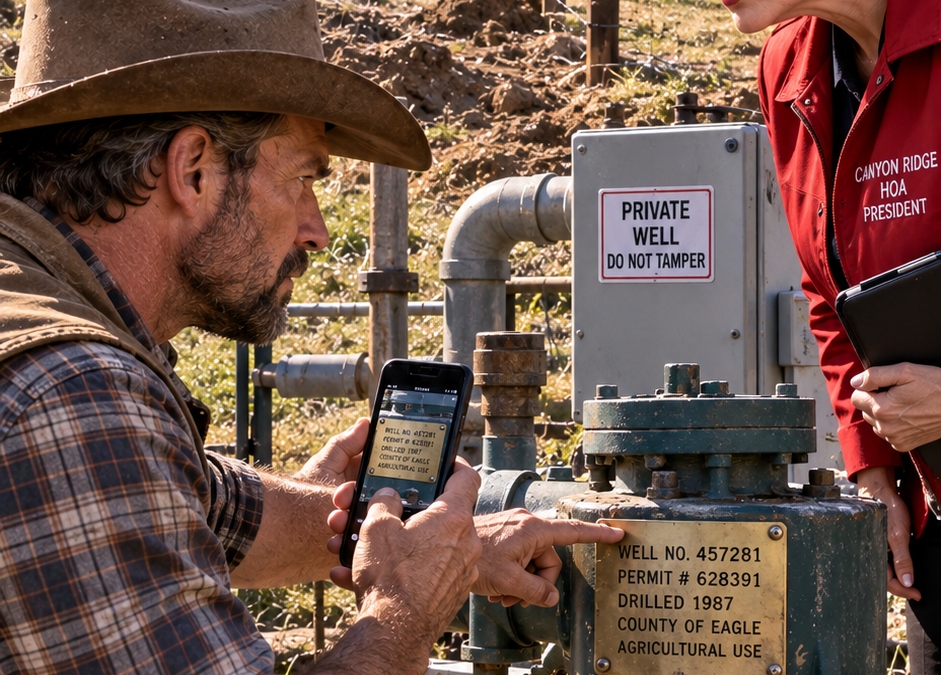
On the pump assembly, beneath decades of dust and mineral staining, sat a brass identification plate.
I had looked at it hundreds of times without giving it much thought.
Well depth.
Drilling contractor.
Completion year.
County permit.
Six digits.
I wiped the plate with my glove and photographed it.
Karen watched.
“What exactly do you think that’s going to prove?”
“I don’t know yet.”
I photographed the electrical-service identifier too.
Account holder:
Keane Ranch.
Then the faded pump-maintenance sticker from the previous spring.
Keane Ranch again.
Outside, a contractor plan was clipped to a temporary board.
I photographed that too.
The drawing labeled my pump house:
EXISTING HOA IRRIGATION WELL NO. 1
That was when I stopped thinking somebody had simply put a fence in the wrong place.
Somebody had designed this.
The new fence wrapped around the pump house intentionally.
A new access gate faced Canyon Ridge.
Orange paint marked a route from the subdivision toward the building.
My well hadn’t accidentally ended up on their side.
Their side had been moved around my well.
Karen folded her arms.
“The association is formalizing access to existing community infrastructure.”
I looked at her.
“Community infrastructure?”
“The well has supplied Canyon Ridge for years.”
“It has sold Canyon Ridge water for years.”
She smiled in that tired way people smile when they believe you’re being difficult on purpose.
“Jonah, that’s a distinction without practical difference.”
I looked at the brass permit plate again.
“That’s the sort of sentence that gets expensive.”
Her smile disappeared.
I didn’t know yet how expensive.
But before the year was over, Canyon Ridge would spend close to two million dollars correcting the assumption Karen had just summarized in eight words.
And all of it would start with the six digits stamped on that brass plate.
PART2
I was fifty-seven then, and most mornings at Keane Ranch had nothing to do with homeowners associations.
They involved cows.
Hay.
Irrigation.
Weather.
Hydraulics.
Broken equipment.
Or the unique talent cattle possess for locating the one weak section of fence on eighty-six acres.
Canyon Ridge had grown beside us slowly.
The original subdivision went in almost twenty years earlier.
Then came phase two.
Phase three.
New cul-de-sacs.
Bigger houses.
Stone entrance walls.
Landscaped medians.
Decorative ponds.
The usual progression from open ground to a neighborhood where somebody eventually forms a committee about mailbox consistency.
My father never minded the development much.
“People need somewhere to live,” he’d say.
But he also believed in documents.
When Canyon Ridge’s original developer approached him in 2006 asking about irrigation water, Dad didn’t shake hands and hope everybody remembered the conversation.
He got an agreement written.
At the time, the subdivision had a problem.
Its landscaping required water.
The reclaimed-water network the developer expected to use had not yet reached that part of the county.
Our agricultural well had extra seasonal capacity.
So Dad agreed to sell them a limited quantity.
Simple.
At least it was supposed to be.
The subdivision installed a branch line.
A separate meter measured delivery.
Dad operated the well.
They paid for water.
For years, nobody confused that arrangement with ownership.
Then Dad died.
The developer turned the subdivision over to the HOA.
Board members changed.
Managers changed.
Engineers changed.
Files were copied.
Maps were cropped.
And somewhere along the way, Canyon Ridge forgot it was a customer.
Karen Vale inherited that forgetfulness and apparently upgraded it into confidence.
She had been HOA president for four years.
She came from commercial property management and had the calm certainty of somebody who believed a binder became more accurate if you held it firmly enough.
She loved phrases like:
“Operational authority.”
“Community asset.”
“Board-directed improvements.”
“Standardized access.”
All useful expressions if you ever need to describe taking somebody else’s equipment without saying the word taking.
I asked the fence contractor who had authorized the new alignment.
He pointed toward Karen.
“We’re working from the HOA engineering plan.”
“Did anybody survey the property line?”
He hesitated.
Karen answered.
“The project has been professionally designed.”
“That wasn’t my question.”
She exhaled.
“Jonah, the association has maintained this irrigation infrastructure for years.”
“No, you’ve maintained your landscape system.”
“Which is supplied by this well.”
“Correct.”
“So the distinction is academic.”
I looked around the pump house.
My electrical panel.
My pressure tank.
My maintenance stickers.
My branch meter.
“My cows will be relieved to know ownership is academic.”
The contractor foreman looked down, trying not to smile.
Karen didn’t.
“We are not going to debate this beside a pump house.”
“Perfect.”
I took another photograph.
“We’ll let the records debate it.”
She gave me one final warning before leaving.
“Do not interfere with association infrastructure.”
I looked at the new steel fence cutting through my pasture.
“That sentence is going to age badly.”
Back at the ranch office, I opened the old metal filing cabinet.
Dad had believed every important document deserved two copies.
One for the file.
One somewhere inconvenient enough that nobody accidentally threw it away.
That habit had annoyed me for years.
That morning, it became one of the better things he ever taught me.
I started with the well file.
The 1987 completion report was near the front.
Drilling depth.
Casing diameter.
Static water level.
Pump test.
Original permit holder:
My father.
Legal location:
Keane Ranch.
Permit number:
Same six digits on the brass plate.
Below that was a later ownership update transferring the permit into my name when I took over the ranch.
I checked the county parcel map.
The pump house sat inside the ranch.
Not near the line.
Not straddling it.
Inside.
Then came twenty years of electrical records.
The dedicated service was mine.
Every bill came to Keane Ranch.
Motor replacement?
Mine.
Casing inspection?
Mine.
Pressure-control upgrade?
Mine.
Flow-meter service?
Mine.
Canyon Ridge appeared in the records too.
But always downstream.
Their branch meter.
Their irrigation-line repairs.
Their landscaping invoices.
Their consumption.
That distinction showed up in the physical plumbing as clearly as it did on paper.
The well produced water.
The HOA purchased some of it after the delivery point.
I kept digging.
Near the bottom of the cabinet was a brown envelope.
Across the front, Dad had written:
CANYON RIDGE—WATER
Inside was the 2006 agreement.
The title alone almost solved half the argument.
METERED IRRIGATION WATER SUPPLY AGREEMENT
Supplier:
Keane Ranch.
Customer:
Original Canyon Ridge developer.
Not:
WELL TRANSFER AGREEMENT.
Not:
UTILITY CONVEYANCE.
Not:
HERE, HAVE OUR PUMP HOUSE BECAUSE YOU BOUGHT SOME WATER.
I read every page.
The agreement described a maximum seasonal quantity.
Metering requirements.
Rates.
Maintenance responsibilities.
A delivery point.
Then I reached the section I needed.
Ownership and operational control of the source well, pump house, electrical equipment, and production system remained with the ranch.
The customer could receive water.
It could maintain downstream infrastructure.
It could not modify the well.
Could not increase production.
Could not control the pump.
Could not enter the source enclosure except under a narrowly defined emergency provision.
There it was.
Canyon Ridge had bought water.
My family had never sold the well.
I sat back.
For a moment, I thought the problem was solved.
Send Karen the agreement.
She apologizes.
Fence moves back.
Everybody learns a valuable lesson.
Then I remembered who I was dealing with.
People who move fences before checking ownership rarely become humble because you email them page four of a contract.
So I kept going.
The engineering plan I’d photographed cited a 2011 utility base map.
I searched the old development folder.
Found a reduced copy.
The well appeared on it.
So did the branch line running toward Canyon Ridge.
Beside the well was a short label:
COMMUNITY IRRIGATION SUPPLY
Technically true.
My well supplied irrigation water to the community.
It did not say:
COMMUNITY-OWNED WELL.
But on Karen’s current plan, the same facility had become:
EXISTING HOA IRRIGATION WELL NO. 1
One extra word.
HOA.
Amazing what one word can steal.
I traced the newer documents.
HOA maintenance summaries referred to the well as an “association irrigation asset.”
A reserve forecast included future pump replacement.
Which was interesting because the HOA had never replaced my pump.
A landscape capital plan assumed the well would remain permanently available.
One engineering memo referred to “existing HOA groundwater capacity.”
The error had become institutional.
Somebody saw water coming from a well.
Somebody copied an old utility map.
Somebody entered the source into an asset spreadsheet.
That spreadsheet fed a reserve study.
The reserve study fed a capital plan.
The capital plan fed an engineering project.
And eventually Karen stood in my pasture wearing a scarlet jacket telling me the pump house belonged behind her fence.
Ten copies of the same assumption still don’t make it true.
I called County Water Resources.
Requested the complete public file under the permit number.
Then pulled current title records for the ranch.
My deed included the pump-house area.
No exception.
No conveyance.
No HOA parcel.
No utility tract transferring the source.
No recorded pump-house transfer.
No bill of sale for equipment.
Nothing.
Then I noticed something in Karen’s plan that changed the stakes.
The fence project was part of a larger irrigation upgrade.
They weren’t simply trying to beautify access around an old utility.
They were preparing to expand it.
New landscape zones.
Automated control.
Higher peak demand.
Future common-area planting.
The engineering notes assumed Canyon Ridge could directly integrate the well into its upgraded irrigation controls.
That’s why they wanted the pump house inside an HOA fence.
Not for appearance.
Control.
I called Marcus Weller.
Marcus was an attorney who worked with rural property, utility agreements, and water-related transactions.
He had a habit of reading documents silently for so long that you started questioning whether he had fallen asleep.
I laid everything on his conference table.
Deed.
Permit.
Supply agreement.
Engineering plan.
Old utility drawing.
Invoices.
He began reading.
Twenty minutes.
Thirty.
Forty.
Finally:
“Three separate issues.”
“Of course there are.”
“Land ownership.”
He tapped the deed.
“Well permit.”
He tapped the county record.
“Contract rights.”
He tapped the water-supply agreement.
“People love to mash those together.”
“Karen certainly does.”
“The land can belong to you. The permit can identify you. And the HOA can still have a contractual right to buy some water.”
“I understand.”
“Likewise, buying water does not automatically give them the land or permit.”
“That’s what I thought.”
“What you think isn’t what matters.”
“I was afraid you’d say that.”
“What the documents support matters.”
That was Marcus.
Professional optimism would have killed him.
He reviewed the successor clause.
When the developer transferred common facilities to the HOA, Canyon Ridge inherited the customer’s rights and obligations.
Customer.
That word survived.
Supplier remained the ranch.
No clause converted customer into supplier.
No clause granted ownership after a certain number of years.
No clause said, “After eighteen summers of watering decorative grass, congratulations, you now own the source.”
Then Marcus pointed to a paragraph I’d nearly forgotten.
Future conversion.
The 2006 agreement anticipated that Canyon Ridge would eventually connect to reclaimed water once regional service became reasonably available.
My father’s well had been a bridge.
Not the permanent foundation of the subdivision’s irrigation future.
That sent me to recent utility-district records.
And there it was.
The reclaimed-water main had been extended along the state highway the previous year.
Canyon Ridge was now within a possible connection area.
Possible.
Not cheap.
That’s where the money entered the story.
If Canyon Ridge continued relying on my well under the old agreement, it remained a customer of a private agricultural source with limits.
If it built the permanent reclaimed-water system the original developer expected, it would face major infrastructure costs.
But if Karen could treat my well as an HOA-owned asset?
Problem solved.
No expensive regional connection.
Upgrade the pump.
Expand controls.
Increase irrigation.
Move a fence.
Pretend history had always looked that way.
Marcus leaned back.
“That gives them motive to prefer their interpretation.”
“That’s lawyer language for ‘two million reasons to be wrong.’”
“We don’t know the number yet.”
“I know.”
“Don’t outrun your evidence.”
“My father used to say the same thing.”
“Smart man.”
Marcus told me to separate the fence dispute from the water-regulatory issue.
Ownership of the pump house didn’t automatically answer every question about water use.
And water rights or permits didn’t automatically establish land title.
We needed professionals for both.
That’s how I met Lena Ortiz.
Lena was a hydrogeologist who worked with agricultural wells, municipal supply systems, and groundwater compliance.
She arrived at the ranch in a steel-blue field shirt carrying less paper than Karen and considerably more knowledge.
She spent the first hour ignoring my opinions.
I liked her immediately.
She inspected the casing.
Pressure tank.
Flow meter.
Electrical controls.
Branch meter.
Pump specifications.
Delivery history.
She followed the plumbing physically from source toward Canyon Ridge.
Then she looked at me.
“This system is very straightforward.”
“Thank God.”
“Your well produces water. Their branch receives metered water.”
“Correct.”
“Who controls pump operation?”
“I do.”
“Who pays power?”
“I do.”
“Who maintains the production equipment?”
“I do.”
“Who maintains downstream irrigation?”
“Canyon Ridge.”
“Who has historically scheduled pump cycles?”
“Me, based on ranch demand and contracted deliveries.”
She nodded.
“The physical system matches the agreement.”
Then she opened Canyon Ridge’s proposed upgrade package.
Her expression changed.
“This doesn’t.”
The new design assumed the HOA could directly command pump cycles through its landscape controller.
It also assumed higher peak demand.
New irrigation zones.
Greater seasonal volume.
“This moves them from customer coordination toward source control,” she said.
“Which the contract doesn’t give them.”
“Correct.”
“And the permit?”
“We need to be careful.”
She pulled the county records closer.
“Your permit authorizes specific uses under specific conditions. A material change in operation, use, or responsible operator may require regulatory review.”
“Can Karen move the fence and become operator?”
Lena looked at me.
“That’s not how water regulation works.”
I enjoyed that answer more than I should have.
The full county file arrived two days later.
Original 1987 permit.
Drilling log.
Completion certificate.
Pump test.
Casing work.
Ownership update.
Then the page that mattered most.
CURRENT PERMIT HOLDER: JONAH KEANE
Same six digits.
Same well.
Same location.
The permit had survived almost forty years of weather, development, new boards, new property managers, new spreadsheets, and one scarlet-jacketed HOA president.
The fence had moved overnight.
The permit hadn’t moved an inch.
I sent everything to Marcus and Lena.
Then Marcus discovered the document that explained how the mistake had survived.
An internal HOA asset schedule.
Prepared years after the developer left.
One line:
HOA WELL—HASS
No acquisition date.
No deed.
No bill of sale.
No permit reference.
No purchase price.
Just a label.
From there, everything downstream treated the label as fact.
It was almost beautiful in its incompetence.
A reserve analyst didn’t verify title.
He trusted the asset list.
An engineer didn’t verify the permit.
He trusted the reserve report.
A new consultant didn’t verify the engineering assumptions.
He trusted the previous drawings.
Karen didn’t verify any original ownership document.
She trusted the thick folder generated by everyone before her.
She had a mountain of paperwork.
The problem was that the mountain stood on one unsupported sentence.
Marcus reconstructed the chain.
Recorded deed:
Keane Ranch.
Well permit:
Jonah Keane.
Electrical service:
Keane Ranch.
Pump invoices:
Keane Ranch.
Original supply agreement:
Keane Ranch owns source.
HOA documents:
HOA owns source.
“How did they acquire it?” I asked.
Marcus flipped the file closed.
“They haven’t shown us.”
“What would we expect to see if they did?”
“Deed. Bill of sale. Assignment. Permit transfer. Recorded easement with unusually broad terms. Something.”
“And they have?”
“An asset spreadsheet.”
I smiled.
“That seems less impressive.”
“Judges tend to prefer deeds.”
We formally requested Canyon Ridge’s basis for ownership.
Their response packet was thick.
Capital plans.
Maintenance summaries.
Utility drawings.
Reserve schedules.
Invoices for downstream landscape repairs.
The internal asset list.
Not one instrument transferring the pump-house land.
Not one transfer of the production well.
Not one permit assignment.
Not one bill of sale.
They had documentation of dependence.
Not ownership.
And those are different things.
Karen returned to the pump house twice while the review continued.
The first time she had arrived like an empress inspecting newly annexed territory.
Now she mostly watched engineers photograph valves.
The black steel fence still stood.
But it had lost its authority.
It looked less like a border and more like Exhibit A.
Then County Water Resources responded in writing.
Their records identified me as the current permit holder.
Any proposed material change in operator or permitted use would require the appropriate review process.
The county did not decide land title.
Marcus made sure I understood that.
But the response destroyed the easiest version of Canyon Ridge’s plan.
They couldn’t update their capital spreadsheet, move a fence, and announce themselves owner-operator of the well.
Their engineering team now had to treat the underlying rights as unresolved.
So Canyon Ridge hired its own professionals.
Good.
I wanted that.
Truth that only survives when your own expert says it is weak truth.
Their title review started with the pump-house parcel.
Easy.
It belonged to Keane Ranch.
Their own survey materials showed it.
The existing agricultural fence was consistent with older property records.
The new black steel fence was not.
That part collapsed first.
Then their lawyers reviewed the 2006 agreement.
Supplier:
Keane Ranch.
Customer:
Developer, later HOA successor.
Delivered water.
Metered quantity.
Ranch retains source equipment.
There was no sophisticated legal mystery.
They had purchased water.
Not the machine that produced it.
Then came their regulatory review.
Same six-digit permit number.
Same ownership chain.
Same authorized-use framework.
The brass plate Karen had dismissed as irrelevant tied the physical well to a government file that never once identified Canyon Ridge as owner.
That was when the engineering department had to redo the future plan.
And that’s where the $2 million arrived.
Their preferred option had been inexpensive on paper.
Why wouldn’t it be?
They thought they already owned the well.
Upgrade existing pump.
Add controls.
Expand irrigation.
Done.
Once my well disappeared from their asset column, they needed an actual long-term source.
Option one:
Negotiate a new private agreement with me.
Possible.
But Canyon Ridge wanted more volume.
More control.
Long-term certainty.
I wasn’t giving them operational control of a ranch well that served my cattle and fields.
Option two:
Drill a new HOA well.
Their consultants studied it.
Possible site limitations.
Water quality concerns.
Permitting uncertainty.
Common-area land required.
Treatment might be necessary.
Not cheap.
Not predictable.
Option three:
Connect to the reclaimed-water system.
The choice the original developer had anticipated nearly twenty years earlier.
The nearest main wasn’t sitting conveniently beside the subdivision entrance.
Of course not.
That would’ve been too easy.
The route had to run from the state highway.
Bore beneath a county road.
Cross utility corridors.
Enter Canyon Ridge along the western frontage.
Feed a booster station.
Connect to their landscape distribution network.
Then several pressure zones needed modifications.
New control panel.
Backflow protection.
Possible balancing storage.
Traffic control.
Road restoration.
Design.
Permits.
Construction management.
Contingency.
Temporary irrigation during transition.
When the first conceptual estimate arrived, it was already north of one million dollars.
The board asked engineers to find cheaper alternatives.
Engineers did what engineers do.
They calculated.
The numbers remained ugly.
A groundwater alternative had uncertainty.
A reclaimed-water connection cost more initially but provided predictable long-term capacity.
Then contractor pricing came in.
Road bore.
Booster equipment.
Electrical.
Controls.
Distribution modifications.
Mobilization.
Contingency.
The planning figure climbed.
$1.4 million.
Then $1.6.
Then higher after revised road-work assumptions.
Eventually the board’s capital documents rounded the full program close to:
$2 million.
To be clear, they didn’t owe me $2 million.
This wasn’t a magical lawsuit where a judge handed me a giant novelty check because Karen moved my fence.
The nearly $2 million was more humiliating.
It was infrastructure Canyon Ridge should have planned for years earlier.
The money represented the cost of replacing a water strategy built around something they never owned.
My permit number didn’t create that cost.
It exposed it.
That’s why the consequence felt so precise.
Karen had moved forty feet of fence to make an expensive problem look solved.
The permit moved nothing.
It simply forced everyone to look at the correct records.
The HOA board created a temporary water-transition committee.
That was the polite way of removing the project from Karen’s hands without holding a public execution.
She remained president.
But capital decisions now required legal review.
Survey review.
Engineering confirmation.
Actual source documents.
A shocking innovation.
Meanwhile, I kept operating the well.
Alfalfa received water.
Cattle drank.
Canyon Ridge continued receiving the amount it was entitled to purchase under the existing agreement.
I didn’t shut the branch valve.
I could have made life politically ugly.
I chose not to.
Hundreds of homeowners weren’t responsible for Karen’s assumption.
Their landscaping had depended on the supply for years.
And I didn’t want revenge muddying the record.
Marcus approved of that.
“Boring clients make good plaintiffs.”
“I’m not suing yet.”
“Exactly.”
Lena agreed.
“Keep the physical system operating under the historic arrangement while everyone separates ownership from service.”
That’s what we did.
Karen did not appreciate the calm.
She called one afternoon.
“The board understands you’ve been speaking directly with our consultants.”
“They asked questions.”
“You’re undermining a capital project.”
“I own the well in the capital project.”
“That remains disputed.”
“Your own title review says otherwise.”
Silence.
Then:
“The HOA has relied on this source for almost twenty years.”
“And paid for water almost twenty years.”
“You benefited financially.”
“Yes.”
“Then you can’t suddenly pretend Canyon Ridge has no interest.”
“I didn’t.”
I leaned back in my office chair.
“You have a contract interest as a customer.”
Her voice hardened.
“You’re splitting hairs.”
“No, Karen. You’re splitting property.”
She exhaled.
“The community will suffer significant costs because of your position.”
“My position?”
“Yes.”
“My position is the deed says I own my land, the permit says I hold the well, and the contract says you buy water.”
“You know exactly what I mean.”
“I do.”
I looked through the office window toward the pump house.
“You want the expensive part to become my fault because your cheaper plan depended on owning something you never bought.”
She said nothing.
“That isn’t my position.”
Pause.
“That’s your budget problem.”
She hung up.
Marcus later told me I shouldn’t enjoy calls like that so much.
I told him professional discipline has limits.
The settlement on the property side came before the water project was finalized.
Canyon Ridge agreed the pump-house land belonged to Keane Ranch.
The black steel fence would be removed.
The new access gate would be removed.
My original ranch boundary would be restored.
Damaged soil repaired.
Professional expenses related to the encroachment reimbursed.
Then came the part I cared about most.
Written acknowledgment that Canyon Ridge held no ownership interest in the source well, pump house, production equipment, or surrounding ranch land.
They remained a water customer during a defined transition period.
The temporary extension agreement was painfully specific.
Supplier:
Keane Ranch.
Customer:
Canyon Ridge HOA.
Source:
Private ranch well.
Delivery point:
Branch meter.
Maximum volume:
Capped.
Pump control:
Ranch.
Term:
Temporary.
Expiration:
Tied to commissioning of reclaimed-water infrastructure.
No ambiguity.
No “community well.”
No “HOA asset.”
No mysterious utility-access zones.
Funny how clear documents become after unclear ones cost enough money.
The day the black steel fence came out, I drove down early.
Same contractor company.
Different crew.
Karen wasn’t there yet.
They removed the gate first.
Then steel sections.
Posts came out one by one.
Concrete broke loose.
By midmorning, the pump house was visually back inside the ranch.
Of course, visually had never mattered.
That was the lesson.
A fence can create an impression.
A map can create an impression.
A spreadsheet can create an impression.
A permit and deed create records.
Karen arrived just before lunch.
Scarlet field jacket again.
I wondered if she owned any other color.
An irrigation engineer was labeling the branch meter.
He installed a small permanent identification plate:
CANYON RIDGE DELIVERY POINT
Everything downstream of that point belonged to the HOA system.
Everything upstream belonged to the ranch.
Karen stared at the plate.
I stood beside her.
Neither of us spoke for a moment.
Then she said:
“You seem pleased.”
“I like accurate labels.”
She looked toward the pump house.
“This could have been handled differently.”
“Yes.”
She turned toward me.
That answer surprised her.
“You agree?”
“Absolutely.”
“How?”
“You could’ve checked the permit before moving my fence.”
Her jaw tightened.
“I’m talking about cooperation.”
“So am I.”
“You’ve forced the association into an extremely expensive infrastructure transition.”
“No.”
I pointed toward the brass plate.
“That was always the transition.”
“What?”
“The 2006 agreement expected you to eventually move to reclaimed water.”
“That was nearly twenty years ago.”
“Exactly.”
“The HOA inherited an operational reality.”
“You inherited a water-purchase agreement.”
“We inherited a system.”
“You inherited the customer side of a system.”
She looked away.
There it was again.
The distinction she’d called academic.
Now it had a seven-figure price tag.
Canyon Ridge formally approved the reclaimed-water project.
Reserve funds covered part.
Financing covered another piece.
Homeowners received a capital-project explanation.
To the board’s credit, the final version was relatively honest.
The association had historically relied on a private agricultural source under a supply arrangement.
Internal planning had incorrectly treated the source well as HOA-owned infrastructure.
A long-term permanent irrigation supply was therefore required.
They did not name me.
They did not need to.
Everybody knew.
Homeowners were angry.
Some at Karen.
Some at previous boards.
Some at developers.
Some at the engineering consultants.
Some simply at the cost.
I understood.
Two million dollars is the kind of number that makes everyone suddenly remember they always opposed a project.
Karen defended herself at one meeting.
She said the board had relied on established asset records.
A homeowner asked:
“Did those records include the well permit?”
“No.”
“Did they include a deed?”
“The HOA had longstanding operational documentation.”
“That wasn’t my question.”
I wasn’t there.
But someone sent me the recording.
I replayed that part twice.
Another resident asked who had approved the fence relocation.
Karen explained that the relocation had been part of “formalizing access around legacy infrastructure.”
The resident answered:
“So you moved the fence before confirming you owned what’s behind it?”
There was a pause.
Then Karen said:
“We relied on professional plans.”
Someone else asked:
“Did a professional tell you the well belonged to us?”
That silence was even longer.
The board eventually adopted new capital-project controls.
Any project involving land ownership, utility sources, recorded rights, third-party infrastructure, or easements required a source-document review before construction authorization.
Asset schedules had to cite the legal document supporting ownership.
Engineering drawings could not substitute for title.
Property fences could not be moved based solely on an internal plan.
I found that last one particularly advanced.
Karen lost much of her unilateral project authority.
Major infrastructure decisions went through the new committee.
She remained president for the immediate aftermath.
That suited me.
I wasn’t interested in making her resign.
I wanted the system corrected.
Though I won’t pretend it wasn’t satisfying watching the system correct her.
Construction on the reclaimed-water connection began in early fall.
Survey crews first.
Actual survey crews.
I appreciated the novelty.
Every alignment stayed on HOA land, utility easements, or public rights-of-way with documented authority.
Nobody moved my fence.
Nobody annexed my pump house.
The directional boring beneath the county road took longer than expected.
Naturally.
Contractors discovered a utility conflict.
Naturally.
The booster-station electrical work cost more.
Naturally.
Every time the project budget crept upward, I imagined that little brass plate quietly continuing to exist.
It had been bolted to the casing since 1987.
No meetings.
No speeches.
No consultants.
Just six digits.
The HOA’s old pump-house upgrade design became sunk cost.
Some control equipment specifications were discarded.
Engineering had to be redone.
Schedules slipped.
Temporary water-supply arrangements extended.
All those expenses pushed the overall consequence close to the $2 million range.
Again:
Not damages paid to me.
Correction costs.
Infrastructure.
The bill for reality.
By spring, the new reclaimed-water system was ready for staged testing.
Canyon Ridge gradually reduced purchases from the ranch.
My branch meter slowed.
For almost twenty years, I’d grown accustomed to seeing the subdivision’s irrigation demand register there.
Then one morning, nothing.
A week later, their engineer called.
“We’re ready for full transition.”
“Good.”
“We’d like to schedule termination of the legacy supply.”
“Come Thursday.”
Thursday morning, Lena joined me.
So did a Canyon Ridge technician.
We recorded the final meter reading.
Photographed it.
Checked the transition agreement.
Then I closed the branch valve.
No drama.
No threat.
No “Now you’ll see.”
Just metal turning.
The line went quiet.
For the first time in nearly two decades, the well served only Keane Ranch again.
I stood there longer than necessary.
Dad would have appreciated the ending.
He had never intended the arrangement to last forever.
He had simply helped a neighboring development solve a temporary problem.
Temporary arrangements have a bad habit of becoming permanent in people’s minds.
Especially when the people who created them are gone.
That was what happened at Canyon Ridge.
No single evil mastermind had spent twenty years plotting to steal my well.
The original developer knew the truth.
Then details degraded.
One map lost a property layer.
Another document used a functional label.
Somebody created an asset spreadsheet.
New managers trusted old spreadsheets.
New engineers trusted old managers.
A board trusted engineers.
Karen trusted the board file.
Then she trusted it enough to move a fence.
That last step was hers.
Institutional mistakes can explain confusion.
They do not excuse bulldozing through uncertainty.
That’s what ultimately changed things for the board.
Karen had every opportunity to verify the source before making the misunderstanding physical.
The permit number was there.
The brass plate was there.
The county file was public.
The 2006 agreement was in the records.
The title documents existed.
Instead, she had a fence installed.
Forty feet.
Just enough to put my pump house inside Canyon Ridge.
As if steel posts could rewrite history.
The ranch settled back into normal life quickly.
That’s one thing I love about cattle.
They have no respect for administrative drama.
The day after the transition ended, one heifer got her head stuck between two gate rails.
I spent forty minutes getting her free.
That crisis mattered more to her than Canyon Ridge’s entire capital budget.
The alfalfa came in well.
The stock tanks stayed full.
I replaced a leaking valve near the west pasture.
Marcus sent his final invoice.
Lena sent hers.
Both were reimbursed under the settlement terms related to the encroachment and review.
I filed every document.
Of course I did.
One afternoon, Marcus stopped by.
We walked toward the pump house.
The restored ranch fence ran exactly where it had before Karen’s project.
He looked at the brass tag.
“That’s the famous number?”
“Apparently.”
“Ugly little thing.”
“Very.”
“How much did Canyon Ridge end up spending?”
“Depends which number you use.”
“Ballpark.”
“Near two million by the time you count the reclaimed-water program, redesign, road crossing, controls, transition, and correction work.”
Marcus whistled.
“And you got?”
“My fence fixed.”
“Plus costs.”
“Some costs.”
“Any desire for more?”
I shook my head.
“I wanted my well.”
He nodded.
“That may be the healthiest answer you’ve given me.”
“Don’t get used to it.”
At the next Canyon Ridge election, Karen did not retain the presidency.
She lost to a quieter board member named Michael Durant.
There was no dramatic recall.
No police.
No public humiliation ceremony.
Just ballots.
Then a new name on the meeting agenda.
The first time Michael contacted me, he asked whether I would review a draft access protocol for infrastructure near private boundaries.
I laughed.
“You know I’m not in your HOA.”
“I know.”
“You understand I have no interest in joining.”
“I know.”
“Then why ask?”
“Because your fence cost us almost two million dollars.”
“My fence didn’t.”
He paused.
“Our mistake around your fence.”
“Better.”
He laughed.
I gave him comments.
One page.
Clear language.
Before entering non-HOA property:
Verify ownership.
Verify access rights.
Get written authorization.
If uncertain, stop.
It should not require a hundred-page manual to explain that.
The next winter, Canyon Ridge’s new irrigation system was shut down for the season.
My pump house sat quiet beneath a light snow.
I walked out during an afternoon inspection.
The brass permit tag was still there.
A little darker.
A little more scratched.
I wiped snow from it.
Six digits.
That number had never argued with Karen.
Never raised its voice.
Never attended a board meeting.
Never hired a lawyer.
It simply connected a physical well to a documented history.
My father.
Keane Ranch.
Permit.
Transfer to me.
Agricultural operation.
Everything else followed.
The completion report.
The ownership record.
The 2006 supply agreement.
The branch-meter history.
The original developer’s intent.
The future-conversion clause.
The distinction between seller and customer.
All because I photographed one dirty brass plate before anyone had the chance to remove or replace it.
That was the part I thought about most.
Not the two million dollars.
Not Karen losing the presidency.
Not the contractors pulling out the black steel fence.
The photograph.
Because evidence is often ordinary when you find it.
A tag.
A receipt.
A date.
A handwritten note.
A serial number.
A permit.
People expect decisive proof to arrive dramatically.
Usually, it sits somewhere dusty while louder people talk over it.
Karen had a tablet.
A board resolution.
An engineering plan.
An asset schedule.
A new fence.
A red jacket.
She looked like authority.
I had an old pump house and six numbers stamped into brass.
But appearances don’t establish ownership.
Paperwork does.
Years later, Canyon Ridge’s reclaimed-water system became completely ordinary.
Their lawns stayed green.
Their common areas survived.
Nobody missed buying water from me.
Children played around the reservoir.
Landscapers opened valves.
Sprinklers turned on.
Life continued.
That’s another irony.
Karen had acted as if taking control of my well was essential to protecting the community.
It wasn’t.
Canyon Ridge always had another option.
They simply didn’t like the price.
So they built years of planning around the cheaper assumption.
Then treated that assumption as a property right.
That’s where expensive mistakes begin.
Not always with greed.
Sometimes with convenience.
Somebody wants the easier answer badly enough that nobody asks whether the answer is true.
The well is nearby.
We use it.
Therefore it must be ours.
The map shows it.
Therefore it must be ours.
The spreadsheet lists it.
Therefore it must be ours.
The board budgeted for it.
Therefore it must be ours.
The fence now surrounds it.
Therefore it must be ours.
No.
It was mine before the fence moved.
It was mine while the fence stood around it.
And it was mine after the fence came back out.
Nothing legally had to be returned to me because nothing legally left.
That was the most satisfying part.
Karen could relocate posts.
She could relocate gates.
She could relocate a line on an engineering plan.
She could even relocate almost two million dollars out of the HOA’s future capital budget.
But she couldn’t relocate ownership by forty feet.
One evening near the end of summer, I rode along the restored northern fence.
The irrigation season was winding down.
The pump house hummed quietly.
My alfalfa field was still green.
A few steers stood near the trough.
Across the boundary, Canyon Ridge sprinklers ran on reclaimed water.
Different system.
Different source.
Exactly as it should have been all along.
I stopped beside the pump house.
Dad’s old well.
My well now.
Same casing.
Same permit number.
Same patch of gravel.
No black steel HOA fence.
No new access gate.
No orange paint.
Just the ranch.
I thought about the first morning again.
Karen had stood there and called the well “community infrastructure.”
At the time, I wanted to argue.
I’m glad I didn’t.
Arguments disappear.
Records accumulate.
Every photograph I took.
Every invoice.
Every permit page.
Every clause in the 2006 agreement.
Every county response.
Every engineering revision.
Each one made the truth harder to ignore.
Eventually, Canyon Ridge’s own lawyers and engineers were explaining to its own board exactly what I’d understood standing beside the pump house.
They had bought water.
They had never bought the well.
That distinction cost them nearly two million dollars to finally respect.
I checked the gate latch.
Secure.
Then brushed a little dust off the brass plate.
Six digits.
I smiled.
Some people need forty feet of new fencing before they feel powerful.
Sometimes all you need is the right number on the right piece of metal.
The HOA moved my fence.
They surrounded my pump house.
They rewrote their maps.
They called my well an association asset.
They designed an entire future around water they believed they controlled.
Then somebody finally followed the permit number.
And once the records caught up with the fence, Canyon Ridge discovered the most expensive truth in the whole project:
You can buy water for twenty years.
You can build pipes to it.
You can budget around it.
You can even move a fence around it overnight.
But none of those things make the well yours.








