𝗙𝗨𝗟𝗟 𝗦𝗧𝗢𝗥𝗬 The HOA Manager Threatened to Take Everything I Owned Over One Detail Buried in a Parcel Record
𝗣𝗔𝗥𝗧 𝟮
I never learned exactly what words she used inside her head.
I didn’t need to.
Every conversation afterward communicated the same conclusion.
Working man.
Limited resources.
Limited education.
Probably intimidated by official paper.
Eventually compliant.
The actual dispute began with the workshop roof.
The old one had been corrugated metal.
Twenty years old, maybe more.
Rust had eaten through the protective coating on two long sections.
It wasn’t leaking yet, but it would.
I hired a roofing crew I’d used on a commercial cabinetry project.
They removed the old sheets and installed charcoal standing-seam metal.
It looked better.
Performed better.
Matched the dark trim on the main house.
Nobody complained during installation.
Nobody stopped the work.
Nobody posted a notice.
A week later, I opened my mailbox and found a violation letter.
The workshop roof, according to Cedar Ridge, had been altered without Architectural Review Committee approval.
Immediate remediation required.
I read it once.
Then again.
Then a third time at my kitchen table.
The problem wasn’t that I’d forgotten to submit a form.
If I had, I’d have filled one out.
I had no interest in manufacturing a fight over a roof.
The problem was that I remembered something from my closing documents.
Something about the rear structure and a separate parcel description.
I couldn’t remember exactly what.
So I wrote a short response.
Please provide the specific recorded provision requiring Architectural Review Committee approval for the structure in question, along with the applicable parcel designation.
That was it.
No sarcasm.
No accusation.
No threat.
Just show me the rule.
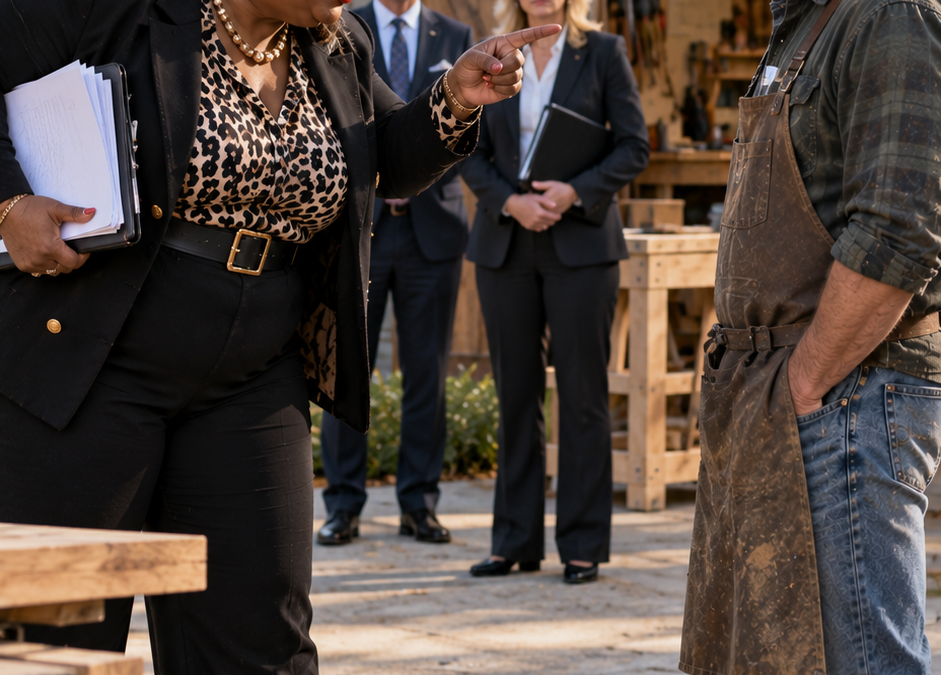
Three days later, Mallerie appeared in my driveway.
She looked toward the shop.
Studied the charcoal roof.
Then looked at me.
“Grant, men like you always turn something straightforward into a production.”
I remember the sentence word for word.
Not because it hurt my feelings.
Because it told me the dispute had already changed shape inside her mind.
I wasn’t a homeowner asking for a citation.
I was a type.
“Men like me?”
She ignored that.
“You replaced an exterior roof without approval.”
“I’m asking what rule requires approval.”
“The association has architectural standards.”
“I understand.”
“Then comply.”
“I’m asking which standard applies to that building.”
She exhaled.
“You’re making this much harder than it needs to be.”
“I’m asking for a document.”
She tapped the clipboard against her leg.
“I’ve been managing communities for sixteen years.”
“Then this should be easy.”
Her eyes narrowed.
“Submit a correction plan.”
“What needs correcting?”
“The roof.”
“Under what recorded provision?”
She stared at me.
I waited.
Finally she said, “You’ll receive further notice.”
Two days later, the fine arrived.
$250 initial penalty.
$100 per day until compliance.
I thought that was aggressive.
I hadn’t seen anything yet.
Within two and a half weeks, Northgate added an inspection charge.
Administrative processing fee.
Attorney preparation fee.
Additional accumulated daily penalties.
The balance crossed four thousand dollars.
No hearing.
No cited provision.
No board vote I could identify.
No architectural determination with a section number.
Just increasing numbers.
So I made a formal records request.
Full declaration.
CC&Rs.
Subdivision plat.
Relevant Architectural Review Committee minutes.
Board minutes concerning my violation.
Written violation determination.
Fine authorization.
Appeal procedure.
What I received was a PDF containing hundreds of pages.
No index.
No highlighted provision.
No article number.
No explanation.
Mallerie had effectively answered my question by sending me the entire rulebook and telling me to find the accusation myself.
I requested a formal hearing.
Her response contained five words.
There is nothing to hear.
I read that email several times.
Then saved it.
A few days later, I ran into her near the community mailboxes.
She was talking to a landscaper.
When she saw me, she finished the conversation and walked over.
“Still working on your legal education?”
I looked at her.
“I’m still waiting for the provision.”
“I’ve been doing this sixteen years, Grant.”
“I know.”
“You are not the first homeowner who reads a few pages of real estate rules and starts believing he can outmaneuver a professional management company.”
There was almost no emotion in her voice.
That was what made her so effective.
She didn’t scream.
She didn’t curse.
She didn’t make obvious threats.
She talked like someone giving weather information.
Routine.
Inevitable.
“What’s the appeal process?” I asked.
“There isn’t anything to appeal until you comply.”
“That doesn’t make sense.”
“It doesn’t need to make sense to you.”
That was another sentence I remembered.
“What happens if I don’t pay?”
Her answer came instantly.
“Additional fines. Legal fees. Lien. Foreclosure if necessary.”
Then she added:
“Most men become cooperative once their house is the thing at risk.”
That evening, I made a decision.
I wasn’t changing the roof.
Not because charcoal metal had become sacred to me.
Not because I needed to win.
Because I no longer believed compliance was the actual objective.
Mallerie had never shown me a rule.
She had only increased the pressure.
That isn’t how you correct a violation.
That’s how you force surrender.
I made coffee.
Pulled my closing binder from the bottom desk drawer.
Started reading.
The property survey was near the back.
I unfolded it across the dining table.
Main house.
Driveway.
Boundary lines.
Then the workshop.
I leaned closer.
The residence sat on Lot 42.
The workshop sat behind it.
But the surveyor’s notation beside that portion didn’t say Lot 42.
Parcel B17.
I stared at those characters.
B17.
Separate legal description.
Different survey reference.
I had owned the place two years and never really noticed.
The next morning, I drove to the county recorder’s office.
I arrived shortly after opening.
Yellow legal pad.
Coffee.
No expectation other than perhaps losing most of a Tuesday.
Three hours later, I knew I had a problem.
More accurately, Cedar Ridge had one.
The original subdivision plat listed every parcel incorporated into Cedar Ridge Estates.
Lot 42 was there.
My house.
Lot 41.
Lot 43.
Everything around me.
Parcel B17 wasn’t.
The workshop parcel predated Cedar Ridge.
It came from an older agricultural boundary survey.
When the subdivision had been formed, that rear parcel hadn’t been annexed.
At least not in the original declaration.
So I looked for later annexation.
Supplemental declaration.
Deed amendment.
Boundary agreement.
Owner consent.
Any recorded instrument connecting B17 to Cedar Ridge’s covenants.
Nothing.
I checked twice.
Then asked a clerk to help verify the index.
Still nothing.
No recording number.
No signed annexation.
No supplemental declaration.
No instrument bringing parcel B17 under HOA architectural authority.
Lot 42 belonged to Cedar Ridge.
My house.
Front yard.
Driveway.
Mailbox.
All unquestionably governed by the association.
But the workshop?
The exact structure Mallerie had fined me thousands of dollars for?
That appeared to sit entirely on property Cedar Ridge had never legally absorbed.
I drove home.
Parked.
Didn’t get out immediately.
I sat inside the truck with the engine off.
Thinking about all the conversations.
“Men like you.”
“Sixteen years.”
“Most men become cooperative.”
The confidence.
Absolute confidence.
Then I called Tessa Monroe.
Tessa was a real-estate attorney a contractor had recommended.
We weren’t friends.
I’d never hired her before.
She had a small office downtown and a reputation for being annoyingly thorough.
That sounded perfect.
She reviewed the plat.
My deed.
Parcel history.
Northgate letters.
Fine schedule.
Emails.
Then she leaned back.
“Don’t contact Mallerie again.”
“Why?”
“Because we want her to keep writing.”
I almost smiled.
Tessa pointed toward the stack.
“Either there’s an annexation instrument we haven’t found, in which case she will eventually produce it.”
“And if there isn’t?”
“Then every enforcement action she takes after you’ve specifically asked for jurisdiction becomes more useful.”
“Useful how?”
“Evidence.”
I nodded.
Doyle would have liked her.
Patience.
Let the grain show you where it’s going.
Tessa had me send one final precise request through Northgate’s management portal.
Please identify the recorded instrument placing parcel B17 under Cedar Ridge HOA architectural jurisdiction.
Nothing else.
Mallerie’s response arrived the next afternoon.
Cedar Ridge HOA governs all properties within the community boundaries. This matter is considered closed.
No deed reference.
No book and page.
No instrument number.
No recording date.
Nothing.
Three days later, Northgate sent a Notice of Intent to Record Lien.
Amount:
$11,840.
I sat at my kitchen table looking at the number.
Eleven thousand eight hundred forty dollars.
I won’t pretend that didn’t affect me.
Legal principles feel very clean when the money is theoretical.
Eleven thousand dollars attached to your home is different.
I photographed every page.
Forwarded them to Tessa.
Then I attended my first HOA board meeting in two years.
I sat in the third row.
Waited through pool maintenance.
Landscaping.
Gate repair.
Then public comment.
When my name was called, Mallerie spoke before I could stand.
“Grant isn’t here to ask questions. He’s here to argue.”
She said it to the board.
A framing move.
Define the difficult person before he opens his mouth.
I ignored it.
“I’d like to see the minutes from the meeting where the fines against my property were approved and the lien was authorized.”
Mallerie responded immediately.
“Enforcement was reviewed and approved.”
“By the board?”
“Yes.”
“When?”
“Through the normal process.”
“Which meeting?”
She looked toward the board.
I followed her gaze.
That’s when I noticed Calvin Price.
Treasurer.
Late fifties.
Gray hair.
Usually quiet.
He had both hands folded in his lap.
He was staring at them like they contained something fascinating.
He wasn’t looking at Mallerie.
Wasn’t looking at me.
Wasn’t looking at anyone.
I knew that posture.
People adopt it when participation feels dangerous.
I wrote his name in my notes.
After the meeting, Mallerie caught me in the hallway.
“Grant.”
I stopped.
She lowered her voice.
“You should consider listing the property.”
“Why?”
“Before attorney fees make recovery difficult.”
She sounded almost kind.
That was the unsettling part.
As though she were advising me to refinance.
“You really think the HOA has architectural authority over B17?”
She looked straight at me.
“I think you’ll run out of money before you can prove otherwise.”
There it was.
Not law.
Not jurisdiction.
Attrition.
I didn’t answer.
The next morning, she came to my house.
Not emailed.
Not mailed.
Personally.
She carried a thick stack of documents.
She placed them on my porch railing.
“You’ll lose everything, Grant.”
Neighbors were outside on both sides.
She knew it.
Her voice carried.
“The house. The land. All of it.”
I didn’t move.
She looked toward the workshop.
“And if you keep spending money fighting this, you may lose that business too.”
She smiled.
“There’s still time to be reasonable.”
Then she left.
I watched her car disappear.
Afterward, I looked through the papers.
Another demand.
Updated balance.
Attorney warning.
Then board minutes.
June 12.
The minutes stated that the Cedar Ridge board had met and unanimously authorized lien proceedings against my property.
I read the date again.
June 12.
Something felt wrong.
Then I remembered.
Northgate had emailed every resident that week.
The June 12 board meeting had been canceled.
Clubhouse power failure.
No meeting.
I still had the email.
I found it.
Printed it.
Placed it beside the minutes.
Same date.
One document said the meeting happened.
One said it didn’t.
I called Tessa.
She told me to come immediately.
She read the cancellation email.
Then the minutes.
Then looked at me.
“This isn’t a roof dispute anymore.”
That sentence changed everything.
Tessa sent a formal demand.
Original meeting notice.
Attendance sheet.
Vote record.
Emails between board members.
Written approvals.
Minutes revision history.
Full electronic audit trail for my enforcement file.
Northgate’s attorneys objected.
Requested extensions.
Narrowed responses.
Argued burden.
Meanwhile, Mallerie continued sending fines.
Balance approaching eighteen thousand dollars.
Then the lien was recorded against Lot 42.
My house.
I couldn’t refinance.
Cash that I had been saving for a wide-belt sander and new drum sanding equipment went into Tessa’s retainer.
That’s the part of legal fights people skip when they tell stories later.
The paperwork is one thing.
The financial bleed is another.
Every hour an attorney spends reading a letter costs money.
Every response.
Every filing.
Every discovery dispute.
Mallerie understood that.
She had been right about one thing from the beginning.
Pressure changes calculations.
I spent nights at my kitchen table going through bank balances.
Business reserves.
Material invoices.
Upcoming cabinetry jobs.
Mortgage.
Insurance.
Tessa’s bills.
How long could I fight?
Two months?
Four?
Would I have to delay equipment upgrades?
Lay off the part-time helper I sometimes brought in for installs?
Sell the truck?
I remembered Mallerie’s hallway comment.
Men usually become cooperative once their house is the thing at risk.
She wasn’t wrong about the fear.
She was wrong about what I would do with it.
Then Calvin Price contacted Tessa.
Not me.
Her.
That mattered.
He didn’t want an informal conversation.
He wanted a record.
He told her his name appeared on approval documentation he had never signed.
He confirmed no board meeting occurred June 12.
No vote regarding my case had been taken.
He had not approved the lien.
He had not participated in any formal discussion authorizing it.
Tessa prepared a declaration.
Calvin signed it.
Then she examined the June 12 minutes electronically.
File properties.
Metadata.
Creation timestamp.
The document had not been created June 12.
It had been created several days later.
The date at the top was fiction.
Tessa immediately sent Northgate a litigation-hold notice.
Preserve all audit logs.
System records.
Versions.
Emails.
User activity.
Everything.
Then she subpoenaed Warren Beckett.
Northgate regional director.
Mallerie’s supervisor.
That was when Mallerie’s tone changed.
Only slightly.
Her next message through the HOA portal was almost conciliatory.
Northgate would consider dismissing the balance if I installed an approved roof color and paid a reduced administrative fee.
Tessa replied.
Please release the lien in full.
Mallerie said no.
That decision ended whatever possibility remained that this could disappear quietly.
Northgate eventually produced the system audit logs.
Modern management software records almost everything.
Login.
Access.
Upload.
Status change.
Modification.
Timestamp.
User account.
You can dislike technology for a lot of reasons.
That week, I loved it.
Tessa and I sat in her conference room.
She opened the log.
My enforcement file had been accessed by an account tied to Mallerie.
After my written request asking for the recorded instrument governing B17, her user account performed several changes.
A revised violation description was added.
June 12 minutes were uploaded.
Case status changed.
MANAGER REVIEW PENDING became BOARD APPROVED.
All of it happened after the dispute was formally underway.
Every timestamp.
Every action.
Every account identifier.
Automatic.
Tessa scrolled slowly.
Neither of us spoke for a while.
Then she said:
“She never thought anyone would get this far.”
Northgate’s internal policies came next.
They were even worse.
Community managers could not certify board approval without a documented vote.
Enforcement files under active homeowner dispute could not be materially altered without creating an explanatory audit note.
Architectural jurisdiction had to be verified against deed records before enforcement against questionable parcels.
Three rules.
Mallerie’s account had apparently violated all three.
Warren Beckett was deposed.
He was careful.
Professional.
Didn’t speculate.
Didn’t accuse Mallerie of a crime.
He confirmed facts.
The account belonged to her.
The audit logs were authentic.
The recorded modifications occurred when the logs said they occurred.
Those modifications were inconsistent with Northgate policy.
A manager wasn’t authorized to fabricate board approval or certify nonexistent votes.
He used corporate language.
But corporate language can still cut.
By the time we reached the courthouse, Mallerie had lost the thing that had made her intimidating from the beginning.
Her documents no longer carried automatic credibility.
Judge Everett Sloan presided.
Sixty-one.
Silver hair.
Calm face.
The kind of judge who had listened to too many people describe obvious situations as incredibly complicated.
I arrived early.
Tessa arranged exhibits.
Mallerie sat with Garrett Hale, counsel for the HOA.
Garrett was good.
I want to be fair about that.
Precise.
Controlled.
He had spent two months fighting discovery without ever sounding obstructive.
Mallerie looked across the room.
Our eyes met.
She looked away first.
Her expression still carried that old confidence.
Just less of it.
Garrett presented first.
He described me as a homeowner who had refused legitimate architectural enforcement.
He emphasized unpaid fines.
Delay.
Legal expense.
He said a routine community-management matter had been transformed unnecessarily into litigation.
Mallerie, he said, was a longtime professional performing her duties.
Judge Sloan listened.
No visible reaction.
When Garrett finished, the judge looked toward Tessa.
She stood.
The first exhibit was the original Cedar Ridge plat.
Projected onto the screen.
“Your Honor, this is Lot 42.”
She pointed.
“My client’s residence.”
Then another outline.
“This is parcel B17.”
Workshop.
Separate legal designation.
Tessa displayed the original annexation schedule.
Every lot governed by Cedar Ridge.
Judge Sloan leaned forward.
“Where’s B17?”
“It isn’t there.”
The judge turned toward Garrett.
“Show me the annexation instrument.”
Garrett consulted Mallerie.
Whispered.
Then said:
“We may need an opportunity to provide supplemental documentation.”
Judge Sloan’s face did not change.
“You’ve known jurisdiction over B17 was disputed since discovery began.”
“Yes, Your Honor.”
“Show me what you have today.”
Garrett didn’t have one.
Mallerie spoke quietly to him.
The judge noticed.
Garrett said the entire property had historically been understood as inside Cedar Ridge.
Judge Sloan looked at him.
“I’m not asking where it is geographically.”
Silence.
“I’m asking what legal instrument subjects that parcel to the declaration.”
Another silence.
“Those are different questions.”
Nobody answered.
Tessa moved to the lien.
Judge Sloan asked:
“Who authorized it?”
Garrett replied:
“The board.”
“When?”
“June 12.”
Tessa placed the Northgate cancellation email on the screen.
Cedar Ridge Board Meeting Canceled — June 12.
Power outage.
No meeting.
Then Calvin Price’s declaration.
Then Calvin himself.
He took the stand.
Tessa asked:
“Was there a Cedar Ridge board meeting on June 12?”
“No.”
“Did the board vote on Mr. Mercer’s enforcement case on June 12?”
“No.”
“Did you vote to authorize a lien?”
“No.”
“Did you sign any written authorization?”
“No.”
“Did you participate in a unanimous vote?”
“No.”
Mallerie stared at the table.
Judge Sloan picked up the June 12 minutes.
He looked at them.
Then at Mallerie.
“Ms. Whitaker.”
She looked up.
“When was this document created?”
“It memorialized the board’s decision.”
“That’s not what I asked.”
A pause.
“When was the document created?”
“I don’t recall the exact date.”
“Was it created June 12?”
“I would need to review the system record.”
Tessa already had it.
The judge asked:
“When did the board actually make the decision described here?”
Mallerie said members had expressed agreement during informal conversations.
“Which members?”
She named several.
“Written record?”
“Not necessarily.”
“Emails?”
“I don’t know.”
“Texts?”
“Possibly.”
“Signed confirmations?”
“No.”
“Meeting notice?”
“No.”
“Agenda?”
“No.”
“Vote?”
“The board consensus was clear.”
Judge Sloan set down the minutes.
“Was the homeowner told the lien was based on informal conversations rather than a formal recorded vote?”
“No.”
“Why not?”
“That distinction is administrative.”
The judge looked at her for several seconds.
Not angry.
That would have been easier.
He simply looked.
Then Tessa introduced the audit log.
She walked through it one line at a time.
User login.
Enforcement file opened.
Violation text revised.
Meeting minutes uploaded.
Status changed.
Each action tied to Mallerie’s account.
Each action timestamped after my jurisdiction challenge.
Warren Beckett confirmed everything.
Judge Sloan asked:
“Can the timestamps be changed by the manager?”
“No, Your Honor.”
“Could another person use the account?”
“They would need her credentials.”
“Is account sharing permitted?”
“No.”
“Were there any indications of unauthorized access?”
“No.”
“Was the change from manager review pending to board approved consistent with policy absent a documented vote?”
“No.”
“Was adding purported meeting minutes after a dispute had begun without a corresponding explanatory note consistent with policy?”
“No.”
“Was enforcement against a parcel with unresolved jurisdiction supposed to continue without deed verification?”
“No.”
By then, the courtroom felt different.
When we arrived, the argument had been framed as Grant Mercer refuses to comply with HOA rules.
Now the question was:
What exactly had Northgate done after I asked them to prove they had authority?
Garrett’s closing was measured.
He argued that not every procedural mistake should be interpreted as misconduct.
Community management involved imperfect records.
Boards often communicated informally.
My unwillingness to cooperate had contributed to escalation.
Then he made the argument that changed the room.
He urged the court to avoid turning one administrative matter into consequences that could destroy a sixteen-year professional career.
Judge Sloan stopped writing.
He looked up.
“You’re asking me to consider professional consequences?”
Garrett nodded.
“Yes, Your Honor.”
The judge picked up one of Mallerie’s emails.
Not the audit log.
Not the policy manual.
A simple communication she had sent weeks earlier.
He read from it.
The language concerning my house.
My land.
My business.
My finances.
Then he looked toward Garrett.
“Your client warned Mr. Mercer that he could lose essentially everything over this enforcement matter.”
Nobody moved.
The judge glanced toward Mallerie.
Then back at the attorney.
“And now you’re asking the court to protect her from the consequences of her own professional conduct?”
Garrett started to answer.
Judge Sloan raised one hand slightly.
“No. Let me understand the position.”
Silence.
“If the concern is that continued review of these records could affect her employment…”
He paused.
“Does ‘everything’ include her job?”
The courtroom became completely still.
Not movie silence.
No dramatic gasp.
Just ordinary stillness.
The kind that happens when everyone realizes a sentence has stripped the argument down to its center.
Mallerie’s face didn’t crumble.
It simply went blank.
The performance stopped.
Judge Sloan delivered preliminary findings.
Substantial evidence showed parcel B17 had never been properly annexed into Cedar Ridge.
Therefore the HOA appeared to lack architectural authority over the workshop.
The majority of the fines underlying the lien related to that structure.
The purported board-approval record contained serious procedural defects.
Foreclosure action was suspended immediately.
Cedar Ridge was ordered to show cause why the lien should not be released.
All electronic records related to my file had to be preserved.
Then Judge Sloan looked toward Garrett.
“At the next hearing, I want a clear answer to one question.”
Garrett stood.
“Yes, Your Honor.”
“Who knew when those minutes were created, and when did they know it?”
Garrett nodded.
The hearing ended.
Outside, I expected relief.
Instead, I felt exhausted.
Tessa closed her briefcase.
“That went well.”
“I know.”
“You don’t sound happy.”
“I don’t feel happy.”
She looked at me.
“What do you feel?”
“Tired.”
She nodded.
“That’s normal.”
Northgate reacted quickly.
Their attorneys understood what the audit log meant.
Continuing to defend Mallerie’s actions would mean defending their own employee’s use of company systems against written company policies.
Within forty-eight hours, her system access was suspended.
Three days later, Cedar Ridge held an emergency board meeting.
Calvin Price pushed the issue.
So did two other board members.
All enforcement against my property was terminated.
The HOA agreed not to contest release of the lien.
At the follow-up hearing, Garrett presented settlement terms.
Lien released in full.
Every fine vacated.
Administrative fees erased.
A portion of my documented attorney expenses reimbursed.
Written acknowledgement that parcel B17 sat outside Cedar Ridge’s architectural authority.
Property records corrected.
Judge Sloan accepted.
He noted that sanctions and complete attorney-fee recovery remained subject to further review.
He did not order Northgate to fire Mallerie.
He didn’t need to.
Employment decisions belonged elsewhere.
Northgate finished its internal investigation that week.
Warren Beckett notified Cedar Ridge that Mallerie had been removed from the account.
Then came formal termination.
Falsification of association records.
Violation of document-management policies.
Unauthorized modification of enforcement files.
Sixteen years.
Ended not by a dramatic confession.
Not by someone catching her destroying paper.
By timestamps.
Rows of data she apparently assumed nobody would ever see.
I saw her once after that.
Outside the courthouse.
Final paperwork day.
No lanyard.
No clipboard.
No Northgate folder.
She stood near the bottom of the steps.
I came down.
She watched me approach.
“Are you satisfied?”
I stopped.
There was no edge in her voice.
That surprised me.
“I never wanted your job, Mallerie.”
She looked away briefly.
“I just wanted you to stay out of my deed.”
She didn’t answer.
I walked past.
Then stopped.
Turned back.
“For what it’s worth, I would have changed the roof if you’d shown me a valid rule.”
She looked at me.
That seemed to hurt more than anger would have.
Because it meant everything had been avoidable.
I left.
Three weeks later, the county recorder mailed the lien release.
One page.
Standard legal language.
Recording stamp in the upper corner.
RELEASE OF LIEN.
I opened it in the workshop.
Read it once.
Then laid it on the bench beside a cabinet door I was finishing.
That was the moment the fight ended for me.
Not the judge’s question.
Not the settlement.
Not Mallerie’s termination.
The clean piece of paper beside sawdust.
My title was clear.
The pressure was gone.
I made coffee.
Then returned to the cabinet door.
The new Cedar Ridge manager started about a month later.
Before she began, the board rewrote its enforcement procedures.
No major fine without an actual documented vote.
Formal homeowner hearing before lien action.
Every parcel verified against recorded deed records before architectural enforcement.
No manager authorized to certify board approval independently.
Electronic modification histories retained.
None of those changes came from me.
I didn’t demand them.
The board reached them on its own.
That mattered.
A rule adopted because somebody lost a lawsuit can disappear once fear fades.
A rule adopted because people understand how the system failed has a better chance of surviving.
Calvin Price apologized to me.
Before a board meeting.
Quietly.
“I knew something was off.”
I waited.
He continued.
“Before the June 12 minutes.”
“Why didn’t you say anything?”
His eyes dropped.
“I’d watched Mallerie deal with people who challenged her.”
That answer was disappointing.
It was also honest.
“I didn’t want to be next.”
I nodded.
“I’m sorry.”
“Okay.”
“You accept that?”
“I accept the apology.”
He understood the distinction.
Accepting an apology does not erase responsibility.
Calvin had sat silently while another person used the appearance of board authority to pressure me.
He hadn’t created the records.
But silence made the space comfortable.
That’s how people like Mallerie last sixteen years.
Not through force alone.
Through accumulated hesitation.
One person notices something odd.
Doesn’t speak.
Another person is uncomfortable.
Waits.
Someone else assumes the manager knows better.
Someone signs because arguing feels expensive.
Eventually the system seems powerful because everyone around it has quietly agreed not to test it.
Mallerie wasn’t magic.
She was practiced.
And she had been protected by other people’s reluctance.
The workshop is still there.
Same concrete floor.
Same electrical panel.
Same table saw.
Same router station in the corner.
Same short gravel path from the house.
And the same charcoal standing-seam roof.
Nobody made me repaint it.
Nobody made me remove it.
Rain sounds different on standing-seam metal than corrugated panels.
Softer.
More even.
Sometimes, late at night, I sit in the shop after finishing a job and listen to it.
The night the final paperwork came through, I stayed there longer than usual.
The lien release rested beside me.
I thought about Mallerie standing on my porch.
“You’ll lose everything.”
At the time, she meant my house.
My shop.
My business.
My savings.
My ability to keep paying a lawyer.
She understood pressure well.
Better than I originally gave her credit for.
What she misunderstood was where authority actually lived.
She thought it lived in Northgate letterhead.
HOA seals.
Violation notices.
A phrase like intent to lien printed in bold.
Attorney-fee schedules.
Her ability to speak calmly about foreclosure while standing beside someone else’s front door.
But none of those things created jurisdiction.
A recorded instrument did.
And none existed for B17.
A fake meeting minute could create the appearance of board authority.
But a cancellation email and an audit log could show what really happened.
A management portal could display the words BOARD APPROVED.
But if no board had voted, those words were only pixels.
That was the lesson.
Power isn’t in how official something looks.
It’s in what supports it underneath.
When the support isn’t there, the appearance eventually collapses.
Doyle taught me something similar about furniture.
You can make a cabinet beautiful from the front and still ruin it with bad joinery.
A customer may not notice the first day.
Maybe not the first year.
But weight finds weakness.
Humidity finds weakness.
Time finds weakness.
Then one morning the drawer racks sideways or the door pulls away because the structure underneath was never right.
Mallerie’s enforcement case looked strong from the outside.
Letters.
Fees.
Lawyer.
Lien.
Minutes.
Management system.
Sixteen years of experience.
Underneath, it had no joint.
No annexation.
No valid vote.
No clean record.
It only needed enough pressure in the right place.
And once Tessa applied that pressure, the whole thing moved.
I often wondered later whether Mallerie believed the workshop truly belonged under HOA authority.
At the beginning?
Maybe.
It’s possible she saw the structure behind my house and simply assumed.
People make mistakes.
I make them.
Tessa makes them.
Judges make them.
What mattered was what happened after I asked her to verify.
That was the line.
I didn’t accuse her.
Didn’t refuse to pay because I hated HOAs.
Didn’t claim some imaginary constitutional right to paint my workshop whatever color I wanted.
I asked:
Show me the recorded provision.
She could have checked.
Discovered B17.
Stopped the fine.
Sent an apology.
Case over.
Instead she escalated.
Then when I asked for jurisdiction again, she escalated.
When I asked for a hearing, she said there was nothing to hear.
When I asked for the board vote, records appeared.
When money didn’t move me, foreclosure entered the conversation.
When I challenged the lien, the file changed.
Mistakes don’t usually destroy people.
Defending mistakes at all costs does.
Months afterward, I was installing a built-in walnut bookcase for a couple across town.
The husband worked in insurance.
He recognized my name from a local article about the Cedar Ridge dispute.
“You’re the workshop guy.”
I laughed.
“I guess.”
He asked the question everybody asked.
“Were you scared you’d lose the house?”
I was trimming a face frame when he said it.
I stopped.
“Yes.”
He seemed surprised.
People prefer their stories cleaner.
Quiet man versus arrogant manager.
Quiet man secretly fearless.
No.
I was scared.
There were nights I thought I might have to sell equipment.
Nights I wondered if Tessa would discover some old annexation document I’d missed and the entire case would turn.
Nights I calculated legal expenses until two in the morning.
Nights I wondered if I was sacrificing too much over a building.
Fear doesn’t mean you’re wrong.
It means the thing matters.
The difference is whether fear decides for you.
Mallerie expected fear to make my decision.
That had probably worked before.
Someone sees lien.
Foreclosure.
Attorney fees.
They pay.
Not because the HOA is right.
Because certainty is expensive and fear wants an exit.
I understood that temptation.
More than anyone around me knew.
At one point, Mallerie offered what would have been the financially easier route.
Reduced fee.
Approved roof color.
Case dismissed.
I could have written a check.
Replaced perfectly good metal.
Saved legal costs.
Moved on.
But signing that settlement would have done more than change a roof.
It would have accepted the claim that Cedar Ridge had authority over B17.
Maybe that wouldn’t have mattered immediately.
But someday I’d sell.
A future buyer would see the history.
HOA regulation.
Compliance.
Acknowledged authority.
A bad premise would become part of the property’s story.
So I said no.
Not because I love fighting.
I hate it.
Because bad paperwork doesn’t improve with age.
Months passed.
Life normalized.
Neighbors stopped looking at me like I had somehow tried to bankrupt the association.
A few people apologized for assuming I was being difficult.
Most didn’t.
That was fine.
I didn’t need a parade.
I needed access to my shop.
A clean title.
No lien.
No fabricated board vote sitting in a permanent file.
The main house still needed maintenance.
The window caulking finally got replaced.
I rebuilt part of the kitchen plumbing.
Bought the wide-belt machine eventually, though later than planned.
It was used.
Good condition.
Tessa told me it was the least attractive victory purchase she had ever seen.
“It’s a sander.”
“Exactly.”
“It saves hours.”
“I’m sure it does.”
She shook her head.
We became friendly after the case.
Not close friends.
But the kind of people who occasionally send each other photographs of absurd contracts.
She once emailed me a document with a subject line:
YOU ARE NOT ALLOWED TO OWN THIS MUCH WOOD.
I sent back a picture of stacked walnut.
NO RECORDED PROVISION FOUND.
That was about as sentimental as either of us got.
Cedar Ridge changed too.
Not dramatically.
That’s usually how real institutional change looks.
Boring.
Procedures.
Checklists.
Shared folders.
Mandatory hearings.
Board signatures.
Parcel verification.
The new community manager actually introduced herself to me before sending anything.
Her name was Ellen.
About two months into her tenure, she called.
“I want to confirm something before I issue a notice.”
I almost laughed.
“That’s already an improvement.”
She laughed too.
“Your driveway is Lot 42.”
“Correct.”
“And the rear workshop is B17.”
“Correct.”
“Separate jurisdiction.”
“Correct.”
“Thank you.”
That was the entire conversation.
Two minutes.
Sixteen years of arrogance had made something simple feel miraculous.
Calvin eventually became board president.
He didn’t want the job.
That was probably why he was decent at it.
At his first meeting, he said something I heard later from a neighbor.
“If we can’t point to the rule, we’re not enforcing the rule.”
I liked that.
Not because it was revolutionary.
Because it should have been obvious.
A year after the case, Calvin came by the workshop.
He had never been inside.
He stood near the door, looking at clamps hanging from the wall.
Planes.
Chisels.
Stacks of hardwood.
Cabinet doors.
“You make all this?”
“Most of it.”
He ran his hand across a finished walnut panel.
“Mallerie thought this was a hobby shed.”
“I know.”
He looked embarrassed.
“Most of us did.”
“Doesn’t matter.”
“It kind of does.”
I set down the orbital sander.
“Why?”
“Because it made it easier to believe her.”
That answer surprised me.
He looked toward the roof.
“You looked like somebody who would eventually give up.”
I leaned against the bench.
“And?”
“You didn’t.”
“No.”
He nodded.
“I’ve thought about that a lot.”
“So have I.”
He hesitated.
“Do you think she would’ve done the same thing if you’d been a lawyer?”
I considered it.
“Maybe not.”
“If you drove a new Mercedes?”
“Maybe not.”
“Wore a suit?”
“Maybe.”
He shook his head.
“That’s ugly.”
“People make assumptions.”
“She almost took your house.”
“She tried.”
He looked back at the workbench.
Then said:
“You know what bothers me most?”
“What?”
“She kept giving you the evidence.”
That made me smile.
“Yeah.”
Every threat.
Every email.
Every refusal to identify an instrument.
The fake minutes.
The file status.
She kept writing because she had decided I wasn’t someone who would read carefully enough.
That assumption was fatal to her case.
Not because I was brilliant.
Because I was patient.
Doyle again.
The most expensive tool in the shop.
Patience.
Mallerie pushed.
I documented.
She escalated.
I asked for records.
She threatened.
I checked dates.
She changed files.
Tessa requested logs.
The more pressure Mallerie applied, the clearer the grain became.
There was no dramatic moment where I outsmarted her with one secret clause.
That’s not how it happened.
It was a sequence.
One detail.
Then another.
B17.
No annexation.
No hearing.
No board vote.
Canceled meeting.
False minutes.
Metadata.
Audit log.
Policy violation.
Each piece ordinary by itself.
Together, unavoidable.
The last time I saw Judge Sloan was during the final administrative hearing.
Everything important had already been settled.
Lien released.
Fines gone.
B17 confirmed outside HOA architectural control.
Mallerie already gone from Northgate.
Judge Sloan reviewed the final agreement.
Asked several questions.
Then looked at me.
“Mr. Mercer, anything further?”
I stood.
“No, Your Honor.”
“You’re satisfied the title record is accurate?”
“Yes.”
“Association?”
Garrett answered.
“Yes, Your Honor.”
Judge Sloan signed.
Done.
No speech.
No moral.
No courtroom applause.
Just a signature.
That was fitting.
Paper had started the problem.
Paper ended it.
The release is still in my filing cabinet.
Not framed.
Not displayed.
I don’t need to stare at it.
The shop itself is enough.
Sometimes customers ask about the charcoal roof because standing-seam metal has become more common.
I tell them it holds up well.
Nobody sees a battlefield.
They see a roof.
That’s what I wanted from the beginning.
One afternoon, almost two years later, I was building a cherry dining table.
The top was wide.
Beautiful grain.
One section wanted to tear out under the plane.
I changed direction.
Slowed down.
Made three lighter passes instead of one aggressive one.
The surface came clean.
I thought about Doyle.
Then Mallerie.
Strange connection.
But life does that.
People think strength is pressure.
Push harder.
Threaten more.
Escalate.
Force the material to go where you want.
Craftsmanship teaches the opposite.
Read what is actually in front of you.
Respect structure.
Know when force will cause damage.
Mallerie spent sixteen years learning how to apply pressure.
She never learned when to stop.
That was why the judge’s question mattered.
“Does everything include her job?”
He wasn’t celebrating her downfall.
He was testing the logic she’d spent months applying to me.
Professional consequences mattered when they belonged to her.
Financial consequences were supposedly routine when they belonged to me.
Losing a career was catastrophic.
Losing a home was enforcement.
That contradiction had sat underneath the entire case.
Judge Sloan simply said it aloud.
I don’t know what happened to Mallerie afterward.
I heard she left property management.
Maybe she found another field.
Maybe not.
I never looked.
Once the lien disappeared, she stopped being relevant to my life.
That was the ending I wanted.
Not revenge.
Distance.
People sometimes ask whether I feel bad that she lost her career.
That’s not quite the right question.
I didn’t report fake records to Northgate because I wanted her fired.
I didn’t subpoena audit logs to ruin her employment.
I challenged documents being used to place a lien against my home.
Northgate made its own employment decision after seeing what had happened inside its system.
Consequences belong to actions.
Not to the person who discovers them.
That’s an important distinction.
If I had fabricated evidence against her, that’s revenge.
If I had lied to her employer, that’s revenge.
If I had used my lawsuit to demand termination, that’s something else.
I did none of those things.
I asked one question from the beginning.
Show me your authority.
Everything else grew from her refusal to answer honestly.
The house is still mine.
The land is still mine.
The workshop is still mine.
My business survived.
The charcoal roof survived.
My old pickup finally didn’t.
Transmission gave out at 238,000 miles.
I replaced it with another used truck.
Tessa laughed when she saw it.
“You’ve learned nothing.”
“I bought it cash.”
“That wasn’t my point.”
I kept the old truck’s tailgate.
It’s hanging on the shop wall.
Doyle would have understood.
Some things earn their scars.
The gravel path between my house and the workshop is still uneven.
I’ve thought about paving it.
Never have.
I like the sound of boots on gravel in the morning.
I like the separation.
House behind me.
Shop ahead.
No emails.
No board room.
No courtroom.
Just work.
The same work I was trying to do before Northgate ever sent the first letter.
One winter evening, rain hit the metal roof while I was finishing a set of cabinet doors.
The sound was steady.
I turned off the machines.
Stood there listening.
On the bench was a stack of customer plans.
On the wall hung clamps.
My coffee had gone cold.
Everything ordinary.
And I realized that was the real thing I had been fighting for.
Not the right to beat Mallerie.
Not the right to embarrass an HOA.
The right to return to ordinary.
To live inside my own life without somebody manufacturing authority that didn’t exist.
To work.
To make things.
To pay legitimate obligations.
To question illegitimate ones.
To own a workshop on a parcel exactly as the county record said I owned it.
Mallerie had stood on my porch and told me I would lose everything.
She had looked around while she said it.
House.
Land.
Shop.
Truck.
Business.
She thought “everything” was a list of things she could pressure me with.
But everything, to me, was quieter.
The ability to walk that gravel path in the morning.
Open the shop doors.
Turn on the lights.
Put a board on the bench.
Start where I left off the night before.
That’s what she almost disrupted.
That’s what the lien threatened.
That’s what the fake minutes were built to pressure.
And that’s what remained after all the letterhead and court filings were gone.
Sometimes power looks impressive.
Sometimes it looks like an HOA seal embossed on heavy paper.
Sometimes it sounds like the word foreclosure spoken calmly.
Sometimes it wears a lanyard and tells you sixteen years of experience means you shouldn’t bother asking questions.
And sometimes real power is much less dramatic.
A parcel number.
A recorder stamp.
A canceled-meeting email.
A creation timestamp.
A system audit log.
A person willing to read carefully after someone else assumes he won’t.
Mallerie’s mistake was never simply that she underestimated me.
People underestimate each other every day.
Her real mistake was believing that authority became real because she spoke with enough certainty.
It doesn’t.
Authority has a source.
Ownership has a record.
A vote either happened or it didn’t.
A meeting either occurred or it didn’t.
A document was either created when it claims to have been created or it wasn’t.
Facts have grain too.
Push against them hard enough, and eventually something tears.
The charcoal roof above me still makes that soft, even sound whenever rain comes down.
Every time I hear it, I remember the first violation letter.
One roof.
One parcel.
One question.
Show me the rule.
She never did.
In the end, that was all I had ever asked her to do.
Have you finished reading the story and want to read it again?
The HOA Manager Threatened to Take Everything I Owned Over One Detail Buried in a Parcel Record
Mallerie Whitaker told me I was about to lose my house, my land, and the business I had spent half my life building.
I said nothing because the last document in her stack contained a date I knew could not be true.
Three weeks later, a judge was holding that same page in his hands.
My name is Grant Mercer.
I bought my house in Cedar Ridge Estates because of the workshop.
Not the kitchen.
Not the neighborhood pool.
Not the little stone sign at the entrance with flowers changed out every season.
The workshop.
It sat behind the house at the end of a short gravel path, separated from the main structure by maybe forty feet.
Concrete floor.
Dedicated electrical panel.
Nine-foot ceiling.
Double doors wide enough to bring in a dining table without turning it sideways.
It wasn’t a garden shed pretending to be useful.
It was a real shop.
I restore antique furniture and build custom cabinetry for a living.
I’ve done that since I was twenty-three.
The man who taught me was an old cabinetmaker named Doyle Ramsey.
Doyle had forearms like fence posts and enough dried lacquer embedded around his fingernails that I’m not sure it ever came off completely.
On my second day as his apprentice, he watched me rush a hand plane across a walnut board and stopped me with one finger on the tool.
“You’re trying to make the wood hurry because you’re impatient.”
I remember looking at him like I wasn’t sure whether he was joking.
He wasn’t.
“The most expensive tool in this shop is patience,” he said. “Everything else you can replace.”
I thought I understood him then.
I didn’t.
Not completely.
It took years.
Wood has direction.
Pressure has direction.
Mistakes have direction.
You can force a piece for a while, but sooner or later the grain tells you what it is.
That lesson served me surprisingly well outside a workshop.
Especially when Mallerie Whitaker showed up.
The house itself wasn’t particularly remarkable.
Two-story.
Brick and siding.
Three bedrooms.
The plumbing beneath the kitchen needed work when I bought it.
The roof over the main house needed replacement within a year.
Several windows leaked around the frames whenever storms came in from the west.
I didn’t care.
I could repair all of that.
The shop was what sold me.
I could leave a half-finished dresser clamped overnight.
Lay out twenty cabinet doors across the benches.
Run the dust collector late without rattling somebody else’s wall.
After years of renting workspace, the idea of walking fifty feet from my kitchen to my business felt like a luxury.
Cedar Ridge itself seemed ordinary.
Quiet streets.
Trim lawns.
A clubhouse I almost never used.
A neighborhood pool I’d walked past more times than I’d entered.
I paid my association dues every quarter.
Never late.
Never argued.
Never attended decorating committees.
Never volunteered for pool events.
I had nothing against anybody.
I simply wasn’t social by instinct.
I liked sawdust.
Coffee.
Radio low in the background.
A drawer sliding perfectly into a cabinet without binding.
That was enough company most days.
For the first two years, Cedar Ridge barely noticed me.
Then the HOA hired Northgate Community Management.
And the name Mallerie Whitaker began appearing at the bottom of every official email.
The first time I saw her in person, I was unloading rough maple from my pickup.
My truck wasn’t pretty.
It was old enough to have scratches on both rear quarter panels and a dent near the tailgate that I had stopped noticing years earlier.
I was wearing work jeans.
Canvas shirt.
Sawdust in the seams.
One shoulder had a small tear I’d been telling myself for six months I would stitch.
Mallerie walked up the driveway carrying a clipboard.
Blazer.
Northgate lanyard.
Flat-soled shoes.
She looked at me.
Then the lumber.
Then my truck.
“Is the homeowner available?”
I shifted the maple board against my hip.
“You’re looking at him.”
She paused.
Only for a fraction of a second.
She didn’t apologize.
Didn’t smile.
She simply brushed something invisible from her sleeve.
“I’m Mallerie Whitaker with Northgate Community Management. We’ve recently taken over administration for Cedar Ridge.”
“Grant Mercer.”
“I know.”
Apparently she knew the name.
Just hadn’t expected the man attached to it.
That was the first time I saw the assessment happen.
People do it quickly.
Clothes.
Truck.
Hands.
House.
Accent.
Occupation.
They build a whole person out of what they can see in ten seconds.
Mallerie decided something about me that morning.
I never learned exactly what words she used inside her head.
I didn’t need to.
Every conversation afterward communicated the same conclusion.
Working man.
Limited resources.
Limited education.
Probably intimidated by official paper.
Eventually compliant.
The actual dispute began with the workshop roof.
The old one had been corrugated metal.
Twenty years old, maybe more.
Rust had eaten through the protective coating on two long sections.
It wasn’t leaking yet, but it would.
I hired a roofing crew I’d used on a commercial cabinetry project.
They removed the old sheets and installed charcoal standing-seam metal.
It looked better.
Performed better.
Matched the dark trim on the main house.
Nobody complained during installation.
Nobody stopped the work.
Nobody posted a notice.
A week later, I opened my mailbox and found a violation letter.
The workshop roof, according to Cedar Ridge, had been altered without Architectural Review Committee approval.
Immediate remediation required.
I read it once.
Then again.
Then a third time at my kitchen table.
The problem wasn’t that I’d forgotten to submit a form.
If I had, I’d have filled one out.
I had no interest in manufacturing a fight over a roof.
The problem was that I remembered something from my closing documents.
Something about the rear structure and a separate parcel description.
I couldn’t remember exactly what.
So I wrote a short response.
Please provide the specific recorded provision requiring Architectural Review Committee approval for the structure in question, along with the applicable parcel designation.
That was it.
No sarcasm.
No accusation.
No threat.
Just show me the rule.
Three days later, Mallerie appeared in my driveway.
She looked toward the shop.
Studied the charcoal roof.
Then looked at me.
“Grant, men like you always turn something straightforward into a production.”
I remember the sentence word for word.
Not because it hurt my feelings.
Because it told me the dispute had already changed shape inside her mind.
I wasn’t a homeowner asking for a citation.
I was a type.
“Men like me?”
She ignored that.
“You replaced an exterior roof without approval.”
“I’m asking what rule requires approval.”
“The association has architectural standards.”
“I understand.”
“Then comply.”
“I’m asking which standard applies to that building.”
She exhaled.
“You’re making this much harder than it needs to be.”
“I’m asking for a document.”
She tapped the clipboard against her leg.
“I’ve been managing communities for sixteen years.”
“Then this should be easy.”
Her eyes narrowed.
“Submit a correction plan.”
“What needs correcting?”
“The roof.”
“Under what recorded provision?”
She stared at me.
I waited.
Finally she said, “You’ll receive further notice.”
Two days later, the fine arrived.
$250 initial penalty.
$100 per day until compliance.
I thought that was aggressive.
I hadn’t seen anything yet.
Within two and a half weeks, Northgate added an inspection charge.
Administrative processing fee.
Attorney preparation fee.
Additional accumulated daily penalties.
The balance crossed four thousand dollars.
No hearing.
No cited provision.
No board vote I could identify.
No architectural determination with a section number.
Just increasing numbers.
So I made a formal records request.
Full declaration.
CC&Rs.
Subdivision plat.
Relevant Architectural Review Committee minutes.
Board minutes concerning my violation.
Written violation determination.
Fine authorization.
Appeal procedure.
What I received was a PDF containing hundreds of pages.
No index.
No highlighted provision.
No article number.
No explanation.
Mallerie had effectively answered my question by sending me the entire rulebook and telling me to find the accusation myself.
I requested a formal hearing.
Her response contained five words.
There is nothing to hear.
I read that email several times.
Then saved it.
A few days later, I ran into her near the community mailboxes.
She was talking to a landscaper.
When she saw me, she finished the conversation and walked over.
“Still working on your legal education?”
I looked at her.
“I’m still waiting for the provision.”
“I’ve been doing this sixteen years, Grant.”
“I know.”
“You are not the first homeowner who reads a few pages of real estate rules and starts believing he can outmaneuver a professional management company.”
There was almost no emotion in her voice.
That was what made her so effective.
She didn’t scream.
She didn’t curse.
She didn’t make obvious threats.
She talked like someone giving weather information.
Routine.
Inevitable.
“What’s the appeal process?” I asked.
“There isn’t anything to appeal until you comply.”
“That doesn’t make sense.”
“It doesn’t need to make sense to you.”
That was another sentence I remembered.
“What happens if I don’t pay?”
Her answer came instantly.
“Additional fines. Legal fees. Lien. Foreclosure if necessary.”
Then she added:
“Most men become cooperative once their house is the thing at risk.”
That evening, I made a decision.
I wasn’t changing the roof.
Not because charcoal metal had become sacred to me.
Not because I needed to win.
Because I no longer believed compliance was the actual objective.
Mallerie had never shown me a rule.
She had only increased the pressure.
That isn’t how you correct a violation.
That’s how you force surrender.
I made coffee.
Pulled my closing binder from the bottom desk drawer.
Started reading.
The property survey was near the back.
I unfolded it across the dining table.
Main house.
Driveway.
Boundary lines.
Then the workshop.
I leaned closer.
The residence sat on Lot 42.
The workshop sat behind it.
But the surveyor’s notation beside that portion didn’t say Lot 42.
Parcel B17.
I stared at those characters.
B17.
Separate legal description.
Different survey reference.
I had owned the place two years and never really noticed.
The next morning, I drove to the county recorder’s office.
I arrived shortly after opening.
Yellow legal pad.
Coffee.
No expectation other than perhaps losing most of a Tuesday.
Three hours later, I knew I had a problem.
More accurately, Cedar Ridge had one.
The original subdivision plat listed every parcel incorporated into Cedar Ridge Estates.
Lot 42 was there.
My house.
Lot 41.
Lot 43.
Everything around me.
Parcel B17 wasn’t.
The workshop parcel predated Cedar Ridge.
It came from an older agricultural boundary survey.
When the subdivision had been formed, that rear parcel hadn’t been annexed.
At least not in the original declaration.
So I looked for later annexation.
Supplemental declaration.
Deed amendment.
Boundary agreement.
Owner consent.
Any recorded instrument connecting B17 to Cedar Ridge’s covenants.
Nothing.
I checked twice.
Then asked a clerk to help verify the index.
Still nothing.
No recording number.
No signed annexation.
No supplemental declaration.
No instrument bringing parcel B17 under HOA architectural authority.
Lot 42 belonged to Cedar Ridge.
My house.
Front yard.
Driveway.
Mailbox.
All unquestionably governed by the association.
But the workshop?
The exact structure Mallerie had fined me thousands of dollars for?
That appeared to sit entirely on property Cedar Ridge had never legally absorbed.
I drove home.
Parked.
Didn’t get out immediately.
I sat inside the truck with the engine off.
Thinking about all the conversations.
“Men like you.”
“Sixteen years.”
“Most men become cooperative.”
The confidence.
Absolute confidence.
Then I called Tessa Monroe.
Tessa was a real-estate attorney a contractor had recommended.
We weren’t friends.
I’d never hired her before.
She had a small office downtown and a reputation for being annoyingly thorough.
That sounded perfect.
She reviewed the plat.
My deed.
Parcel history.
Northgate letters.
Fine schedule.
Emails.
Then she leaned back.
“Don’t contact Mallerie again.”
“Why?”
“Because we want her to keep writing.”
I almost smiled.
Tessa pointed toward the stack.
“Either there’s an annexation instrument we haven’t found, in which case she will eventually produce it.”
“And if there isn’t?”
“Then every enforcement action she takes after you’ve specifically asked for jurisdiction becomes more useful.”
“Useful how?”
“Evidence.”
I nodded.
Doyle would have liked her.
Patience.
Let the grain show you where it’s going.
Tessa had me send one final precise request through Northgate’s management portal.
Please identify the recorded instrument placing parcel B17 under Cedar Ridge HOA architectural jurisdiction.
Nothing else.
Mallerie’s response arrived the next afternoon.
Cedar Ridge HOA governs all properties within the community boundaries. This matter is considered closed.
No deed reference.
No book and page.
No instrument number.
No recording date.
Nothing.
Three days later, Northgate sent a Notice of Intent to Record Lien.
Amount:
$11,840.
I sat at my kitchen table looking at the number.
Eleven thousand eight hundred forty dollars.
I won’t pretend that didn’t affect me.
Legal principles feel very clean when the money is theoretical.
Eleven thousand dollars attached to your home is different.
I photographed every page.
Forwarded them to Tessa.
Then I attended my first HOA board meeting in two years.
I sat in the third row.
Waited through pool maintenance.
Landscaping.
Gate repair.
Then public comment.
When my name was called, Mallerie spoke before I could stand.
“Grant isn’t here to ask questions. He’s here to argue.”
She said it to the board.
A framing move.
Define the difficult person before he opens his mouth.
I ignored it.
“I’d like to see the minutes from the meeting where the fines against my property were approved and the lien was authorized.”
Mallerie responded immediately.
“Enforcement was reviewed and approved.”
“By the board?”
“Yes.”
“When?”
“Through the normal process.”
“Which meeting?”
She looked toward the board.
I followed her gaze.
That’s when I noticed Calvin Price.
Treasurer.
Late fifties.
Gray hair.
Usually quiet.
He had both hands folded in his lap.
He was staring at them like they contained something fascinating.
He wasn’t looking at Mallerie.
Wasn’t looking at me.
Wasn’t looking at anyone.
I knew that posture.
People adopt it when participation feels dangerous.
I wrote his name in my notes.
After the meeting, Mallerie caught me in the hallway.
“Grant.”
I stopped.
She lowered her voice.
“You should consider listing the property.”
“Why?”
“Before attorney fees make recovery difficult.”
She sounded almost kind.
That was the unsettling part.
As though she were advising me to refinance.
“You really think the HOA has architectural authority over B17?”
She looked straight at me.
“I think you’ll run out of money before you can prove otherwise.”
There it was.
Not law.
Not jurisdiction.
Attrition.
I didn’t answer.
The next morning, she came to my house.
Not emailed.
Not mailed.
Personally.
She carried a thick stack of documents.
She placed them on my porch railing.
“You’ll lose everything, Grant.”
Neighbors were outside on both sides.
She knew it.
Her voice carried.
“The house. The land. All of it.”
I didn’t move.
She looked toward the workshop.
“And if you keep spending money fighting this, you may lose that business too.”
She smiled.
“There’s still time to be reasonable.”
Then she left.
I watched her car disappear.
Afterward, I looked through the papers.
Another demand.
Updated balance.
Attorney warning.
Then board minutes.
June 12.
The minutes stated that the Cedar Ridge board had met and unanimously authorized lien proceedings against my property.
I read the date again.
June 12.
Something felt wrong.
Then I remembered.
Northgate had emailed every resident that week.
The June 12 board meeting had been canceled.
Clubhouse power failure.
No meeting.
I still had the email.
I found it.
Printed it.
Placed it beside the minutes.
Same date.
One document said the meeting happened.
One said it didn’t.
I called Tessa.
She told me to come immediately.
She read the cancellation email.
Then the minutes.
Then looked at me.
“This isn’t a roof dispute anymore.”
That sentence changed everything.
Tessa sent a formal demand.
Original meeting notice.
Attendance sheet.
Vote record.
Emails between board members.
Written approvals.
Minutes revision history.
Full electronic audit trail for my enforcement file.
Northgate’s attorneys objected.
Requested extensions.
Narrowed responses.
Argued burden.
Meanwhile, Mallerie continued sending fines.
Balance approaching eighteen thousand dollars.
Then the lien was recorded against Lot 42.
My house.
I couldn’t refinance.
Cash that I had been saving for a wide-belt sander and new drum sanding equipment went into Tessa’s retainer.
That’s the part of legal fights people skip when they tell stories later.
The paperwork is one thing.
The financial bleed is another.
Every hour an attorney spends reading a letter costs money.
Every response.
Every filing.
Every discovery dispute.
Mallerie understood that.
She had been right about one thing from the beginning.
Pressure changes calculations.
I spent nights at my kitchen table going through bank balances.
Business reserves.
Material invoices.
Upcoming cabinetry jobs.
Mortgage.
Insurance.
Tessa’s bills.
How long could I fight?
Two months?
Four?
Would I have to delay equipment upgrades?
Lay off the part-time helper I sometimes brought in for installs?
Sell the truck?
I remembered Mallerie’s hallway comment.
Men usually become cooperative once their house is the thing at risk.
She wasn’t wrong about the fear.
She was wrong about what I would do with it.
Then Calvin Price contacted Tessa.
Not me.
Her.
That mattered.
He didn’t want an informal conversation.
He wanted a record.
He told her his name appeared on approval documentation he had never signed.
He confirmed no board meeting occurred June 12.
No vote regarding my case had been taken.
He had not approved the lien.
He had not participated in any formal discussion authorizing it.
Tessa prepared a declaration.
Calvin signed it.
Then she examined the June 12 minutes electronically.
File properties.
Metadata.
Creation timestamp.
The document had not been created June 12.
It had been created several days later.
The date at the top was fiction.
Tessa immediately sent Northgate a litigation-hold notice.
Preserve all audit logs.
System records.
Versions.
Emails.
User activity.
Everything.
Then she subpoenaed Warren Beckett.
Northgate regional director.
Mallerie’s supervisor.
That was when Mallerie’s tone changed.
Only slightly.
Her next message through the HOA portal was almost conciliatory.
Northgate would consider dismissing the balance if I installed an approved roof color and paid a reduced administrative fee.
Tessa replied.
Please release the lien in full.
Mallerie said no.
That decision ended whatever possibility remained that this could disappear quietly.
Northgate eventually produced the system audit logs.
Modern management software records almost everything.
Login.
Access.
Upload.
Status change.
Modification.
Timestamp.
User account.
You can dislike technology for a lot of reasons.
That week, I loved it.
Tessa and I sat in her conference room.
She opened the log.
My enforcement file had been accessed by an account tied to Mallerie.
After my written request asking for the recorded instrument governing B17, her user account performed several changes.
A revised violation description was added.
June 12 minutes were uploaded.
Case status changed.
MANAGER REVIEW PENDING became BOARD APPROVED.
All of it happened after the dispute was formally underway.
Every timestamp.
Every action.
Every account identifier.
Automatic.
Tessa scrolled slowly.
Neither of us spoke for a while.
Then she said:
“She never thought anyone would get this far.”
Northgate’s internal policies came next.
They were even worse.
Community managers could not certify board approval without a documented vote.
Enforcement files under active homeowner dispute could not be materially altered without creating an explanatory audit note.
Architectural jurisdiction had to be verified against deed records before enforcement against questionable parcels.
Three rules.
Mallerie’s account had apparently violated all three.
Warren Beckett was deposed.
He was careful.
Professional.
Didn’t speculate.
Didn’t accuse Mallerie of a crime.
He confirmed facts.
The account belonged to her.
The audit logs were authentic.
The recorded modifications occurred when the logs said they occurred.
Those modifications were inconsistent with Northgate policy.
A manager wasn’t authorized to fabricate board approval or certify nonexistent votes.
He used corporate language.
But corporate language can still cut.
By the time we reached the courthouse, Mallerie had lost the thing that had made her intimidating from the beginning.
Her documents no longer carried automatic credibility.
Judge Everett Sloan presided.
Sixty-one.
Silver hair.
Calm face.
The kind of judge who had listened to too many people describe obvious situations as incredibly complicated.
I arrived early.
Tessa arranged exhibits.
Mallerie sat with Garrett Hale, counsel for the HOA.
Garrett was good.
I want to be fair about that.
Precise.
Controlled.
He had spent two months fighting discovery without ever sounding obstructive.
Mallerie looked across the room.
Our eyes met.
She looked away first.
Her expression still carried that old confidence.
Just less of it.
Garrett presented first.
He described me as a homeowner who had refused legitimate architectural enforcement.
He emphasized unpaid fines.
Delay.
Legal expense.
He said a routine community-management matter had been transformed unnecessarily into litigation.
Mallerie, he said, was a longtime professional performing her duties.
Judge Sloan listened.
No visible reaction.
When Garrett finished, the judge looked toward Tessa.
She stood.
The first exhibit was the original Cedar Ridge plat.
Projected onto the screen.
“Your Honor, this is Lot 42.”
She pointed.
“My client’s residence.”
Then another outline.
“This is parcel B17.”
Workshop.
Separate legal designation.
Tessa displayed the original annexation schedule.
Every lot governed by Cedar Ridge.
Judge Sloan leaned forward.
“Where’s B17?”
“It isn’t there.”
The judge turned toward Garrett.
“Show me the annexation instrument.”
Garrett consulted Mallerie.
Whispered.
Then said:
“We may need an opportunity to provide supplemental documentation.”
Judge Sloan’s face did not change.
“You’ve known jurisdiction over B17 was disputed since discovery began.”
“Yes, Your Honor.”
“Show me what you have today.”
Garrett didn’t have one.
Mallerie spoke quietly to him.
The judge noticed.
Garrett said the entire property had historically been understood as inside Cedar Ridge.
Judge Sloan looked at him.
“I’m not asking where it is geographically.”
Silence.
“I’m asking what legal instrument subjects that parcel to the declaration.”
Another silence.
“Those are different questions.”
Nobody answered.
Tessa moved to the lien.
Judge Sloan asked:
“Who authorized it?”
Garrett replied:
“The board.”
“When?”
“June 12.”
Tessa placed the Northgate cancellation email on the screen.
Cedar Ridge Board Meeting Canceled — June 12.
Power outage.
No meeting.
Then Calvin Price’s declaration.
Then Calvin himself.
He took the stand.
Tessa asked:
“Was there a Cedar Ridge board meeting on June 12?”
“No.”
“Did the board vote on Mr. Mercer’s enforcement case on June 12?”
“No.”
“Did you vote to authorize a lien?”
“No.”
“Did you sign any written authorization?”
“No.”
“Did you participate in a unanimous vote?”
“No.”
Mallerie stared at the table.
Judge Sloan picked up the June 12 minutes.
He looked at them.
Then at Mallerie.
“Ms. Whitaker.”
She looked up.
“When was this document created?”
“It memorialized the board’s decision.”
“That’s not what I asked.”
A pause.
“When was the document created?”
“I don’t recall the exact date.”
“Was it created June 12?”
“I would need to review the system record.”
Tessa already had it.
The judge asked:
“When did the board actually make the decision described here?”
Mallerie said members had expressed agreement during informal conversations.
“Which members?”
She named several.
“Written record?”
“Not necessarily.”
“Emails?”
“I don’t know.”
“Texts?”
“Possibly.”
“Signed confirmations?”
“No.”
“Meeting notice?”
“No.”
“Agenda?”
“No.”
“Vote?”
“The board consensus was clear.”
Judge Sloan set down the minutes.
“Was the homeowner told the lien was based on informal conversations rather than a formal recorded vote?”
“No.”
“Why not?”
“That distinction is administrative.”
The judge looked at her for several seconds.
Not angry.
That would have been easier.
He simply looked.
Then Tessa introduced the audit log.
She walked through it one line at a time.
User login.
Enforcement file opened.
Violation text revised.
Meeting minutes uploaded.
Status changed.
Each action tied to Mallerie’s account.
Each action timestamped after my jurisdiction challenge.
Warren Beckett confirmed everything.
Judge Sloan asked:
“Can the timestamps be changed by the manager?”
“No, Your Honor.”
“Could another person use the account?”
“They would need her credentials.”
“Is account sharing permitted?”
“No.”
“Were there any indications of unauthorized access?”
“No.”
“Was the change from manager review pending to board approved consistent with policy absent a documented vote?”
“No.”
“Was adding purported meeting minutes after a dispute had begun without a corresponding explanatory note consistent with policy?”
“No.”
“Was enforcement against a parcel with unresolved jurisdiction supposed to continue without deed verification?”
“No.”
By then, the courtroom felt different.
When we arrived, the argument had been framed as Grant Mercer refuses to comply with HOA rules.
Now the question was:
What exactly had Northgate done after I asked them to prove they had authority?
Garrett’s closing was measured.
He argued that not every procedural mistake should be interpreted as misconduct.
Community management involved imperfect records.
Boards often communicated informally.
My unwillingness to cooperate had contributed to escalation.
Then he made the argument that changed the room.
He urged the court to avoid turning one administrative matter into consequences that could destroy a sixteen-year professional career.
Judge Sloan stopped writing.
He looked up.
“You’re asking me to consider professional consequences?”
Garrett nodded.
“Yes, Your Honor.”
The judge picked up one of Mallerie’s emails.
Not the audit log.
Not the policy manual.
A simple communication she had sent weeks earlier.
He read from it.
The language concerning my house.
My land.
My business.
My finances.
Then he looked toward Garrett.
“Your client warned Mr. Mercer that he could lose essentially everything over this enforcement matter.”
Nobody moved.
The judge glanced toward Mallerie.
Then back at the attorney.
“And now you’re asking the court to protect her from the consequences of her own professional conduct?”
Garrett started to answer.
Judge Sloan raised one hand slightly.
“No. Let me understand the position.”
Silence.
“If the concern is that continued review of these records could affect her employment…”
He paused.
“Does ‘everything’ include her job?”
The courtroom became completely still.
Not movie silence.
No dramatic gasp.
Just ordinary stillness.
The kind that happens when everyone realizes a sentence has stripped the argument down to its center.
Mallerie’s face didn’t crumble.
It simply went blank.
The performance stopped.
Judge Sloan delivered preliminary findings.
Substantial evidence showed parcel B17 had never been properly annexed into Cedar Ridge.
Therefore the HOA appeared to lack architectural authority over the workshop.
The majority of the fines underlying the lien related to that structure.
The purported board-approval record contained serious procedural defects.
Foreclosure action was suspended immediately.
Cedar Ridge was ordered to show cause why the lien should not be released.
All electronic records related to my file had to be preserved.
Then Judge Sloan looked toward Garrett.
“At the next hearing, I want a clear answer to one question.”
Garrett stood.
“Yes, Your Honor.”
“Who knew when those minutes were created, and when did they know it?”
Garrett nodded.
The hearing ended.
Outside, I expected relief.
Instead, I felt exhausted.
Tessa closed her briefcase.
“That went well.”
“I know.”
“You don’t sound happy.”
“I don’t feel happy.”
She looked at me.
“What do you feel?”
“Tired.”
She nodded.
“That’s normal.”
Northgate reacted quickly.
Their attorneys understood what the audit log meant.
Continuing to defend Mallerie’s actions would mean defending their own employee’s use of company systems against written company policies.
Within forty-eight hours, her system access was suspended.
Three days later, Cedar Ridge held an emergency board meeting.
Calvin Price pushed the issue.
So did two other board members.
All enforcement against my property was terminated.
The HOA agreed not to contest release of the lien.
At the follow-up hearing, Garrett presented settlement terms.
Lien released in full.
Every fine vacated.
Administrative fees erased.
A portion of my documented attorney expenses reimbursed.
Written acknowledgement that parcel B17 sat outside Cedar Ridge’s architectural authority.
Property records corrected.
Judge Sloan accepted.
He noted that sanctions and complete attorney-fee recovery remained subject to further review.
He did not order Northgate to fire Mallerie.
He didn’t need to.
Employment decisions belonged elsewhere.
Northgate finished its internal investigation that week.
Warren Beckett notified Cedar Ridge that Mallerie had been removed from the account.
Then came formal termination.
Falsification of association records.
Violation of document-management policies.
Unauthorized modification of enforcement files.
Sixteen years.
Ended not by a dramatic confession.
Not by someone catching her destroying paper.
By timestamps.
Rows of data she apparently assumed nobody would ever see.
I saw her once after that.
Outside the courthouse.
Final paperwork day.
No lanyard.
No clipboard.
No Northgate folder.
She stood near the bottom of the steps.
I came down.
She watched me approach.
“Are you satisfied?”
I stopped.
There was no edge in her voice.
That surprised me.
“I never wanted your job, Mallerie.”
She looked away briefly.
“I just wanted you to stay out of my deed.”
She didn’t answer.
I walked past.
Then stopped.
Turned back.
“For what it’s worth, I would have changed the roof if you’d shown me a valid rule.”
She looked at me.
That seemed to hurt more than anger would have.
Because it meant everything had been avoidable.
I left.
Three weeks later, the county recorder mailed the lien release.
One page.
Standard legal language.
Recording stamp in the upper corner.
RELEASE OF LIEN.
I opened it in the workshop.
Read it once.
Then laid it on the bench beside a cabinet door I was finishing.
That was the moment the fight ended for me.
Not the judge’s question.
Not the settlement.
Not Mallerie’s termination.
The clean piece of paper beside sawdust.
My title was clear.
The pressure was gone.
I made coffee.
Then returned to the cabinet door.
The new Cedar Ridge manager started about a month later.
Before she began, the board rewrote its enforcement procedures.
No major fine without an actual documented vote.
Formal homeowner hearing before lien action.
Every parcel verified against recorded deed records before architectural enforcement.
No manager authorized to certify board approval independently.
Electronic modification histories retained.
None of those changes came from me.
I didn’t demand them.
The board reached them on its own.
That mattered.
A rule adopted because somebody lost a lawsuit can disappear once fear fades.
A rule adopted because people understand how the system failed has a better chance of surviving.
Calvin Price apologized to me.
Before a board meeting.
Quietly.
“I knew something was off.”
I waited.
He continued.
“Before the June 12 minutes.”
“Why didn’t you say anything?”
His eyes dropped.
“I’d watched Mallerie deal with people who challenged her.”
That answer was disappointing.
It was also honest.
“I didn’t want to be next.”
I nodded.
“I’m sorry.”
“Okay.”
“You accept that?”
“I accept the apology.”
He understood the distinction.
Accepting an apology does not erase responsibility.
Calvin had sat silently while another person used the appearance of board authority to pressure me.
He hadn’t created the records.
But silence made the space comfortable.
That’s how people like Mallerie last sixteen years.
Not through force alone.
Through accumulated hesitation.
One person notices something odd.
Doesn’t speak.
Another person is uncomfortable.
Waits.
Someone else assumes the manager knows better.
Someone signs because arguing feels expensive.
Eventually the system seems powerful because everyone around it has quietly agreed not to test it.
Mallerie wasn’t magic.
She was practiced.
And she had been protected by other people’s reluctance.
The workshop is still there.
Same concrete floor.
Same electrical panel.
Same table saw.
Same router station in the corner.
Same short gravel path from the house.
And the same charcoal standing-seam roof.
Nobody made me repaint it.
Nobody made me remove it.
Rain sounds different on standing-seam metal than corrugated panels.
Softer.
More even.
Sometimes, late at night, I sit in the shop after finishing a job and listen to it.
The night the final paperwork came through, I stayed there longer than usual.
The lien release rested beside me.
I thought about Mallerie standing on my porch.
“You’ll lose everything.”
At the time, she meant my house.
My shop.
My business.
My savings.
My ability to keep paying a lawyer.
She understood pressure well.
Better than I originally gave her credit for.
What she misunderstood was where authority actually lived.
She thought it lived in Northgate letterhead.
HOA seals.
Violation notices.
A phrase like intent to lien printed in bold.
Attorney-fee schedules.
Her ability to speak calmly about foreclosure while standing beside someone else’s front door.
But none of those things created jurisdiction.
A recorded instrument did.
And none existed for B17.
A fake meeting minute could create the appearance of board authority.
But a cancellation email and an audit log could show what really happened.
A management portal could display the words BOARD APPROVED.
But if no board had voted, those words were only pixels.
That was the lesson.
Power isn’t in how official something looks.
It’s in what supports it underneath.
When the support isn’t there, the appearance eventually collapses.
Doyle taught me something similar about furniture.
You can make a cabinet beautiful from the front and still ruin it with bad joinery.
A customer may not notice the first day.
Maybe not the first year.
But weight finds weakness.
Humidity finds weakness.
Time finds weakness.
Then one morning the drawer racks sideways or the door pulls away because the structure underneath was never right.
Mallerie’s enforcement case looked strong from the outside.
Letters.
Fees.
Lawyer.
Lien.
Minutes.
Management system.
Sixteen years of experience.
Underneath, it had no joint.
No annexation.
No valid vote.
No clean record.
It only needed enough pressure in the right place.
And once Tessa applied that pressure, the whole thing moved.
I often wondered later whether Mallerie believed the workshop truly belonged under HOA authority.
At the beginning?
Maybe.
It’s possible she saw the structure behind my house and simply assumed.
People make mistakes.
I make them.
Tessa makes them.
Judges make them.
What mattered was what happened after I asked her to verify.
That was the line.
I didn’t accuse her.
Didn’t refuse to pay because I hated HOAs.
Didn’t claim some imaginary constitutional right to paint my workshop whatever color I wanted.
I asked:
Show me the recorded provision.
She could have checked.
Discovered B17.
Stopped the fine.
Sent an apology.
Case over.
Instead she escalated.
Then when I asked for jurisdiction again, she escalated.
When I asked for a hearing, she said there was nothing to hear.
When I asked for the board vote, records appeared.
When money didn’t move me, foreclosure entered the conversation.
When I challenged the lien, the file changed.
Mistakes don’t usually destroy people.
Defending mistakes at all costs does.
Months afterward, I was installing a built-in walnut bookcase for a couple across town.
The husband worked in insurance.
He recognized my name from a local article about the Cedar Ridge dispute.
“You’re the workshop guy.”
I laughed.
“I guess.”
He asked the question everybody asked.
“Were you scared you’d lose the house?”
I was trimming a face frame when he said it.
I stopped.
“Yes.”
He seemed surprised.
People prefer their stories cleaner.
Quiet man versus arrogant manager.
Quiet man secretly fearless.
No.
I was scared.
There were nights I thought I might have to sell equipment.
Nights I wondered if Tessa would discover some old annexation document I’d missed and the entire case would turn.
Nights I calculated legal expenses until two in the morning.
Nights I wondered if I was sacrificing too much over a building.
Fear doesn’t mean you’re wrong.
It means the thing matters.
The difference is whether fear decides for you.
Mallerie expected fear to make my decision.
That had probably worked before.
Someone sees lien.
Foreclosure.
Attorney fees.
They pay.
Not because the HOA is right.
Because certainty is expensive and fear wants an exit.
I understood that temptation.
More than anyone around me knew.
At one point, Mallerie offered what would have been the financially easier route.
Reduced fee.
Approved roof color.
Case dismissed.
I could have written a check.
Replaced perfectly good metal.
Saved legal costs.
Moved on.
But signing that settlement would have done more than change a roof.
It would have accepted the claim that Cedar Ridge had authority over B17.
Maybe that wouldn’t have mattered immediately.
But someday I’d sell.
A future buyer would see the history.
HOA regulation.
Compliance.
Acknowledged authority.
A bad premise would become part of the property’s story.
So I said no.
Not because I love fighting.
I hate it.
Because bad paperwork doesn’t improve with age.
Months passed.
Life normalized.
Neighbors stopped looking at me like I had somehow tried to bankrupt the association.
A few people apologized for assuming I was being difficult.
Most didn’t.
That was fine.
I didn’t need a parade.
I needed access to my shop.
A clean title.
No lien.
No fabricated board vote sitting in a permanent file.
The main house still needed maintenance.
The window caulking finally got replaced.
I rebuilt part of the kitchen plumbing.
Bought the wide-belt machine eventually, though later than planned.
It was used.
Good condition.
Tessa told me it was the least attractive victory purchase she had ever seen.
“It’s a sander.”
“Exactly.”
“It saves hours.”
“I’m sure it does.”
She shook her head.
We became friendly after the case.
Not close friends.
But the kind of people who occasionally send each other photographs of absurd contracts.
She once emailed me a document with a subject line:
YOU ARE NOT ALLOWED TO OWN THIS MUCH WOOD.
I sent back a picture of stacked walnut.
NO RECORDED PROVISION FOUND.
That was about as sentimental as either of us got.
Cedar Ridge changed too.
Not dramatically.
That’s usually how real institutional change looks.
Boring.
Procedures.
Checklists.
Shared folders.
Mandatory hearings.
Board signatures.
Parcel verification.
The new community manager actually introduced herself to me before sending anything.
Her name was Ellen.
About two months into her tenure, she called.
“I want to confirm something before I issue a notice.”
I almost laughed.
“That’s already an improvement.”
She laughed too.
“Your driveway is Lot 42.”
“Correct.”
“And the rear workshop is B17.”
“Correct.”
“Separate jurisdiction.”
“Correct.”
“Thank you.”
That was the entire conversation.
Two minutes.
Sixteen years of arrogance had made something simple feel miraculous.
Calvin eventually became board president.
He didn’t want the job.
That was probably why he was decent at it.
At his first meeting, he said something I heard later from a neighbor.
“If we can’t point to the rule, we’re not enforcing the rule.”
I liked that.
Not because it was revolutionary.
Because it should have been obvious.
A year after the case, Calvin came by the workshop.
He had never been inside.
He stood near the door, looking at clamps hanging from the wall.
Planes.
Chisels.
Stacks of hardwood.
Cabinet doors.
“You make all this?”
“Most of it.”
He ran his hand across a finished walnut panel.
“Mallerie thought this was a hobby shed.”
“I know.”
He looked embarrassed.
“Most of us did.”
“Doesn’t matter.”
“It kind of does.”
I set down the orbital sander.
“Why?”
“Because it made it easier to believe her.”
That answer surprised me.
He looked toward the roof.
“You looked like somebody who would eventually give up.”
I leaned against the bench.
“And?”
“You didn’t.”
“No.”
He nodded.
“I’ve thought about that a lot.”
“So have I.”
He hesitated.
“Do you think she would’ve done the same thing if you’d been a lawyer?”
I considered it.
“Maybe not.”
“If you drove a new Mercedes?”
“Maybe not.”
“Wore a suit?”
“Maybe.”
He shook his head.
“That’s ugly.”
“People make assumptions.”
“She almost took your house.”
“She tried.”
He looked back at the workbench.
Then said:
“You know what bothers me most?”
“What?”
“She kept giving you the evidence.”
That made me smile.
“Yeah.”
Every threat.
Every email.
Every refusal to identify an instrument.
The fake minutes.
The file status.
She kept writing because she had decided I wasn’t someone who would read carefully enough.
That assumption was fatal to her case.
Not because I was brilliant.
Because I was patient.
Doyle again.
The most expensive tool in the shop.
Patience.
Mallerie pushed.
I documented.
She escalated.
I asked for records.
She threatened.
I checked dates.
She changed files.
Tessa requested logs.
The more pressure Mallerie applied, the clearer the grain became.
There was no dramatic moment where I outsmarted her with one secret clause.
That’s not how it happened.
It was a sequence.
One detail.
Then another.
B17.
No annexation.
No hearing.
No board vote.
Canceled meeting.
False minutes.
Metadata.
Audit log.
Policy violation.
Each piece ordinary by itself.
Together, unavoidable.
The last time I saw Judge Sloan was during the final administrative hearing.
Everything important had already been settled.
Lien released.
Fines gone.
B17 confirmed outside HOA architectural control.
Mallerie already gone from Northgate.
Judge Sloan reviewed the final agreement.
Asked several questions.
Then looked at me.
“Mr. Mercer, anything further?”
I stood.
“No, Your Honor.”
“You’re satisfied the title record is accurate?”
“Yes.”
“Association?”
Garrett answered.
“Yes, Your Honor.”
Judge Sloan signed.
Done.
No speech.
No moral.
No courtroom applause.
Just a signature.
That was fitting.
Paper had started the problem.
Paper ended it.
The release is still in my filing cabinet.
Not framed.
Not displayed.
I don’t need to stare at it.
The shop itself is enough.
Sometimes customers ask about the charcoal roof because standing-seam metal has become more common.
I tell them it holds up well.
Nobody sees a battlefield.
They see a roof.
That’s what I wanted from the beginning.
One afternoon, almost two years later, I was building a cherry dining table.
The top was wide.
Beautiful grain.
One section wanted to tear out under the plane.
I changed direction.
Slowed down.
Made three lighter passes instead of one aggressive one.
The surface came clean.
I thought about Doyle.
Then Mallerie.
Strange connection.
But life does that.
People think strength is pressure.
Push harder.
Threaten more.
Escalate.
Force the material to go where you want.
Craftsmanship teaches the opposite.
Read what is actually in front of you.
Respect structure.
Know when force will cause damage.
Mallerie spent sixteen years learning how to apply pressure.
She never learned when to stop.
That was why the judge’s question mattered.
“Does everything include her job?”
He wasn’t celebrating her downfall.
He was testing the logic she’d spent months applying to me.
Professional consequences mattered when they belonged to her.
Financial consequences were supposedly routine when they belonged to me.
Losing a career was catastrophic.
Losing a home was enforcement.
That contradiction had sat underneath the entire case.
Judge Sloan simply said it aloud.
I don’t know what happened to Mallerie afterward.
I heard she left property management.
Maybe she found another field.
Maybe not.
I never looked.
Once the lien disappeared, she stopped being relevant to my life.
That was the ending I wanted.
Not revenge.
Distance.
People sometimes ask whether I feel bad that she lost her career.
That’s not quite the right question.
I didn’t report fake records to Northgate because I wanted her fired.
I didn’t subpoena audit logs to ruin her employment.
I challenged documents being used to place a lien against my home.
Northgate made its own employment decision after seeing what had happened inside its system.
Consequences belong to actions.
Not to the person who discovers them.
That’s an important distinction.
If I had fabricated evidence against her, that’s revenge.
If I had lied to her employer, that’s revenge.
If I had used my lawsuit to demand termination, that’s something else.
I did none of those things.
I asked one question from the beginning.
Show me your authority.
Everything else grew from her refusal to answer honestly.
The house is still mine.
The land is still mine.
The workshop is still mine.
My business survived.
The charcoal roof survived.
My old pickup finally didn’t.
Transmission gave out at 238,000 miles.
I replaced it with another used truck.
Tessa laughed when she saw it.
“You’ve learned nothing.”
“I bought it cash.”
“That wasn’t my point.”
I kept the old truck’s tailgate.
It’s hanging on the shop wall.
Doyle would have understood.
Some things earn their scars.
The gravel path between my house and the workshop is still uneven.
I’ve thought about paving it.
Never have.
I like the sound of boots on gravel in the morning.
I like the separation.
House behind me.
Shop ahead.
No emails.
No board room.
No courtroom.
Just work.
The same work I was trying to do before Northgate ever sent the first letter.
One winter evening, rain hit the metal roof while I was finishing a set of cabinet doors.
The sound was steady.
I turned off the machines.
Stood there listening.
On the bench was a stack of customer plans.
On the wall hung clamps.
My coffee had gone cold.
Everything ordinary.
And I realized that was the real thing I had been fighting for.
Not the right to beat Mallerie.
Not the right to embarrass an HOA.
The right to return to ordinary.
To live inside my own life without somebody manufacturing authority that didn’t exist.
To work.
To make things.
To pay legitimate obligations.
To question illegitimate ones.
To own a workshop on a parcel exactly as the county record said I owned it.
Mallerie had stood on my porch and told me I would lose everything.
She had looked around while she said it.
House.
Land.
Shop.
Truck.
Business.
She thought “everything” was a list of things she could pressure me with.
But everything, to me, was quieter.
The ability to walk that gravel path in the morning.
Open the shop doors.
Turn on the lights.
Put a board on the bench.
Start where I left off the night before.
That’s what she almost disrupted.
That’s what the lien threatened.
That’s what the fake minutes were built to pressure.
And that’s what remained after all the letterhead and court filings were gone.
Sometimes power looks impressive.
Sometimes it looks like an HOA seal embossed on heavy paper.
Sometimes it sounds like the word foreclosure spoken calmly.
Sometimes it wears a lanyard and tells you sixteen years of experience means you shouldn’t bother asking questions.
And sometimes real power is much less dramatic.
A parcel number.
A recorder stamp.
A canceled-meeting email.
A creation timestamp.
A system audit log.
A person willing to read carefully after someone else assumes he won’t.
Mallerie’s mistake was never simply that she underestimated me.
People underestimate each other every day.
Her real mistake was believing that authority became real because she spoke with enough certainty.
It doesn’t.
Authority has a source.
Ownership has a record.
A vote either happened or it didn’t.
A meeting either occurred or it didn’t.
A document was either created when it claims to have been created or it wasn’t.
Facts have grain too.
Push against them hard enough, and eventually something tears.
The charcoal roof above me still makes that soft, even sound whenever rain comes down.
Every time I hear it, I remember the first violation letter.
One roof.
One parcel.
One question.
Show me the rule.
She never did.
In the end, that was all I had ever asked her to do.








