The HOA Locked Me Out of My Own Field—When I Tore Down Their Gate, Police Found What They Had Buried Beneath It
𝗣𝗔𝗥𝗧 𝟮
I inherited two hay cuttings and the responsibility of not being the first Ashford who let that ground disappear under weeds.
Ashford Lane ran about 380 yards from the county road back to the field.
Most of it was narrow gravel.
There was only one place wide enough for me to unload the tractor from a trailer.
The apron at the head of the lane.
That detail ended up mattering more than almost anything.
In April, Sable Creek Estates demolished its old clubhouse and a maintenance shed behind it.
Both buildings had been there a long time.
The clubhouse had cracked floor tile.
The maintenance building stored old landscaping supplies, pool chemicals, oil, paint, cleaning products, and everything else communities collect over decades when nobody wants to pay to dispose of it properly.
Diane personally ran the renovation project.
At the spring association meeting, she announced that she had found savings substantial enough to bring the demolition under budget.
People applauded.
So did I.
I was standing near the back with a paper cup of coffee, thinking about whether the weather would cooperate for first cutting.
That’s the thing about being fooled.
Sometimes you’re applauding while it happens.
On May 6, I left the state.
My sister and I had to clean out our aunt’s house after she moved into assisted living.
I was gone nearly four weeks.
When I came home on June 2, I pulled onto the county road and noticed immediately that the apron at Ashford Lane looked different.
Fresh gravel.
Not a patch.
Not a load dumped into potholes.
The entire apron had been resurfaced and graded.
Flat.
Smooth.
Better than it had looked in twenty years.
I stood there with my truck door open, staring at it.
At the mailboxes later that day, Diane saw me.
“We resurfaced your entrance while you were away,” she said.
“Why?”
She smiled.
“Community improvement.”
“That’s private property.”
“Consider it a gift.”
And I did something that would bother me for a long time afterward.
I said, “Thank you.”
She smiled again.
“You’re welcome.”
PART2
August came wet.
Three straight days of rain soaked the county.
Afterward, standing water collected in the ditch beside the newly graveled apron.
I noticed an orange film floating across the top.
Thin.
Almost oily.
The water looked like cold soup with something separated across the surface.
There was an odor too.
Faint.
Metallic.
Chemical.
I had worked for the county road department for thirty years.
I had dug ditches, moved fill, repaired washouts, cut drainage channels and seen every color of mud God seemed interested in inventing.
Iron in soil can produce orange water.
So that was what I told myself.
Iron.
Natural runoff.
Nothing more.
I’d give a lot now to go back and slap myself for wanting the easy answer.
But I did one thing right.
On September 2, I wrote a certified letter to the association.
I kept it simple.
Orange discharge visible in ditch at head of Ashford Lane.
Unidentified odor.
Please advise.
Diane signed the return receipt on September 5.
Nobody called.
Nobody inspected it.
Nobody even pretended to care.
Then something strange happened.
On September 22, the association held an emergency meeting.
I wasn’t invited.
Later, Diane explained why with that smug little lift of her chin.
“Parcel 1104-B isn’t association property, Brad. Why would you be notified about association business?”
At that meeting, the board approved an access-control gate at the head of Ashford Lane.
Diane told the board there was a safety easement on file.
She said the association had authority to restrict access.
Nobody asked to see the easement.
Nobody asked why their urgent safety problem happened to sit on privately owned land outside the subdivision.
The gate was installed October 14.
I arrived while the contractor was finishing.
Two steel posts.
Concrete footings.
Locking crossbar.
U-lock.
The crew washed their tools in my ditch.
I asked the foreman for a key.
“The association has them.”
That evening, I went to Diane.
“I need a key.”
She didn’t even pretend to think about it.
“Access is a privilege here, Brad.”
“It’s my field.”
“You’re a homeowner in Sable Creek.”
“I’m also the owner of that road.”
She gave me the look she usually saved for people who left trash cans visible after collection day.
“The board has acted.”
October passed.
Then November.
The hay in the field stood brown and collapsed in the weather.
Every time I drove past that gate, I stared at the U-lock.
Two hard metallic clicks.
Open.
Close.
Except I couldn’t open it.
My father’s field sat behind it.
For the first time in sixty years, nobody in my family had cut the hay.
All winter, one thing bothered me.
Diane had never asked to see my deed.
Not once.
This was a woman who could quote landscaping regulations from memory.
She knew which shutters were approved.
She knew exactly how far a shed had to sit from a property line.
Yet every time I said the lane wasn’t association property, she never once replied, “Show me.”
Why?
There were only two explanations.
Either she didn’t want to know.
Or she already knew.
In February, I pulled my father’s old records out of the closet.
Then I went to the Marberry County Recorder’s office.
The records room was in the courthouse basement.
It smelled like old paper, copier toner, and concrete.
The clerk pulled the original plat.
She spread it across the counter and rotated it toward me.
There it was.
Parcel 1104-B.
And beside it, in old survey lettering:
EXCEPTED PARCEL.
NOT INCLUDED IN SABLE CREEK ESTATES.
She pulled the deed history.
Ashford ownership, uninterrupted from 1961.
Then she searched every recorded easement.
There were two.
A 1964 utility easement.
A drainage easement near the back fence.
Nothing giving Sable Creek Estates access.
Nothing about community safety.
Nothing giving Diane Kesler authority to build so much as a birdhouse on Ashford Lane.
“Want certified copies?” the clerk asked.
“Every page.”
She stamped them.
For four hours afterward, I genuinely believed the problem was solved.
I mailed certified copies to every board member.
Then I hand-delivered Diane’s.
Attached to the packet was one sentence.
REMOVE THE GATE FROM PARCEL 1104-B WITHIN TEN DAYS.
Diane called a board meeting.
I expected theater.
I thought she’d argue for ten minutes, pretend there had been confusion, then remove the gate quietly later.
Instead, she stood at the front holding my certified plat.
“Nobody disputes Mr. Ashford’s ownership.”
I actually relaxed.
Then she turned the document face down.
“The gate is not an ownership matter. It’s a safety measure.”
I stared at her.
She continued.
“Mr. Ashford himself reported a discharge hazard at the head of that lane. The board has an obligation to protect residents and children.”
That’s when I realized what she was doing.
She was using my own certified letter against me.
“Then test it,” I said.
The room went quiet.
“If there’s a hazard, test it. Publish the results. Call the county.”
Diane looked at me a fraction too long.
“We’ll take that under advisement.”
Then she called the vote.
Five to one.
Gate stays.
I watched Curt Halloway.
Curt was the association treasurer.
Big man.
Soft shoulders.
Retired insurance salesman.
The kind who shook everybody’s hand twice.
When Diane called his name, he said, “Aye.”
But he didn’t look at me.
He looked at the table.
Afterward, he took a longer route around the folding chairs just to avoid passing me.
I remembered that.
Nine days later, a certified envelope arrived.
The association had recorded a claim against Lot 22.
My house.
The one property I owned that actually was inside the HOA.
They claimed $3,600 in unpaid access assessments plus a continuing fine of $150 per day for what they called unauthorized approach to a controlled gate.
Unauthorized approach.
To my own land.
Every time I’d walked toward the field, Diane had apparently been counting.
I called my mortgage lender.
I had been refinancing.
The woman explained that the recorded claim froze the process until the title issue was resolved.
I could pay it.
Or sue.
I hung up.
Then I calculated $150 a day across an entire season.
Diane hadn’t beaten my deed.
She had gone around it.
That evening, I went to her house.
She opened the door wearing an apron.
Dish towel over one shoulder.
Perfect picture of domestic innocence.
“You put a lien on my house.”
“The association secured an obligation.”
“You know the gate isn’t on association property.”
“You have options.”
Her tone was gentle.
That made it worse.
“You can pay the amount. You can appeal.”
She paused.
To the board.
Her board.
“Or you can go to court and spend more than that field is worth proving a point.”
I stared at her.
“You’re pricing me out.”
“What’s happening, Brad, is that you’re finally learning the rules apply to you too.”
Then she smiled slightly.
“And before you consider cutting that lock, I’ve filed a standing complaint with the sheriff’s department. Your name is already in their system.”
She closed the door.
I stood on her porch staring at the wood grain.
That’s when the real shape of the trap became clear.
She hadn’t built a gate.
She’d built a room around me.
Every exit had either a dollar sign or a deputy standing in it.
The lawyer I consulted agreed the gate was trespass.
I’d win, he said.
Eventually.
Then he told me how long litigation could take.
And what it would cost.
I looked at the estimate.
He studied my face.
“I’m not telling you you’re wrong, Brad.”
“I know.”
“I’m telling you what winning costs.”
That night, I walked around the gate on foot and went down the lane.
The field was silver under moonlight.
Dead hay bent in the breeze.
I stood there thinking about Dad.
About how many times I’d watched him step off the tractor and stare across that same ground without saying anything.
On the way back, my boot sank.
Only an inch or two.
But gravel moved beneath my heel.
Not sideways.
Down.
It slipped under the surface with a faint whisper.
Like sand going into a funnel.
I crouched.
Ran my hand over the apron.
The fresh gravel had settled.
Not randomly.
In a rectangle.
Straight edges.
Square corners.
Later, in daylight, I measured it.
About ninety feet long.
Twelve feet wide.
Nearly four inches lower than the surrounding grade.
Thirty years running county equipment teaches you things.
One of them is this:
Undisturbed ground does not settle into perfect rectangles.
Fill does.
Something had been excavated there.
Something had been covered.
A few days later, my coffee started tasting wrong.
Metallic.
Flat.
I blamed the coffee maker.
Then the beans.
Then I noticed a gray ring inside my kettle.
That had never happened before.
Our well had always run clean.
It was downhill from the apron.
About three hundred feet away.
I filled two sample bottles and drove them to a private lab.
Paid extra for rush testing.
Then I walked back to the lane.
One of my grandfather’s maples had gone nearly bare.
The bark peeled away in wet sheets.
The other maple had lost half its crown on the side closest to the apron.
Trees don’t testify.
But they don’t lie either.
Four days later, the lab results arrived.
Chlorinated solvents.
Lead.
Cadmium.
Several readings above regulatory action levels.
Some far above.
I sat at my kitchen table staring at the report.
My father drank water from that well for fifty years.
I had been drinking it my whole life.
Suddenly the gate wasn’t about hay.
It wasn’t even about property anymore.
I took out a yellow legal pad.
Then I wrote every date.
April 18: clubhouse and maintenance building demolished.
May 6: I leave the state.
June 2: I return.
Fresh gravel at lane entrance.
Diane calls it a gift.
August: orange discharge.
September 2: certified letter sent.
September 5: Diane signs for it.
September 22: emergency meeting.
Gate approved.
October 14: gate installed.
I stared at the dates.
Nothing about me changed in September.
I hadn’t bought louder equipment.
I hadn’t threatened anyone.
I hadn’t changed how I used the field.
I had written a letter.
And within twenty days, Diane called an emergency meeting to block access to the exact location I had reported.
The gate had not been built to keep me away from the field.
It had been built to keep me away from that patch of ground.
Then another realization hit me.
Gateposts require holes.
Deep ones.
And concrete.
Those footings weren’t merely near the suspicious fill.
They had been poured into it.
Diane had put a permanent association structure directly over the site.
That wasn’t how you warn somebody about contamination.
That was how you physically bury access beneath concrete.
And anybody who tried to excavate that area would first have to destroy association property.
Property protected by a standing sheriff’s complaint.
It was brilliant in the ugliest possible way.
So I started looking backward.
I remembered a white pickup that had been on the road while I was gone.
Green lettering.
A neighbor, Ruth Anne Soul, had mentioned construction noise.
At the time, I ignored it.
Then the company name came back to me.
Rener Fence and Grading.
Except Rener installed the gate in October.
Why had their truck been there in May?
Then I remembered something else.
Behind the truck had been a dump trailer.
The next morning, I called the county environmental office.
I gave them everything.
The lab report.
The well.
The rectangular settlement.
The orange discharge.
The timeline.
The man on the phone started asking very specific questions.
Finally he said, “We can send a field crew.”
For the first time in months, I felt something close to relief.
The crew came Thursday.
They stayed outside the gate on my property.
Hand augers.
Sample jars.
Coolers.
One technician pulled a core from the shoulder.
He smelled it.
Then looked at me.
“You’ve been smelling that since August?”
“Yes.”
He capped the sample.
“We’ll run numbers.”
Eleven days later, the county called a responsibility conference.
The county attorney attended.
Environmental staff.
Diane.
Curt Halloway.
The association’s lawyer.
And me.
I arrived fifteen minutes early.
Diane had arrived before me.
She had her files spread neatly across the conference table.
Black accordion folder.
Legal pad perfectly squared.
She shook the county attorney’s hand like she was co-hosting.
When I walked in, she smiled.
“Brad. Glad you came.”
I will probably remember the next forty minutes until the day I die.
Diane did not deny the contamination.
She embraced it.
“We’ve been gravely concerned for some time.”
Then she slid a photocopy across the table.
A county inspection card from 1998.
AGRICULTURAL CHEMICAL STORAGE.
ASHFORD FARM.
PARCEL 1104-B.
My father had stored herbicide there.
Legally.
Like farmers all across the county.
His storage area had been inspected.
It passed.
But Diane didn’t care about the truth.
She cared about the existence of paper she could bend toward a different story.
“The Ashford operation stored agricultural chemicals on this parcel for decades.”
“It was inspected and approved.”
She nodded.
“Nobody’s accusing anyone. We’re simply establishing historical use.”
Then came signed statements.
Two board members claimed there had always been a community understanding that the field had been used for dumping.
No dates.
No witnesses.
No photographs.
Just that slippery phrase.
Everyone knew.
Curt’s signature was on one.
I looked at him.
He lifted a water glass.
His hand shook so hard the ice clicked.
Then the county attorney turned toward me.
He wasn’t cruel.
That almost made it worse.
“Mr. Ashford, regardless of who placed the contaminated material there, the property owner can be held responsible for remediation under state environmental law.”
I stared at him.
He slid a notice across the table.
Twenty-one days to provide a remediation plan.
Daily penalties afterward.
Preliminary estimate?
Six figures.
The words barely made sense.
Diane sat across from me wearing the expression of somebody attending a funeral.
“We’ll cooperate however we can.”
I don’t remember the drive home.
I remember my kitchen.
A glass of water I wouldn’t drink.
A recorded lien against my house.
A county notice requiring me to pay for a toxic trench I hadn’t dug.
She had taken the fact I’d trusted most—ownership—and turned it into a weapon.
My land.
My responsibility.
Two days later, the association newsletter arrived.
I opened it at the mailbox.
HISTORICAL CONTAMINATION ISSUE IDENTIFIED ON ADJACENT PRIVATE PROPERTY.
It credited the board with proactively restricting resident exposure by installing the gate.
It thanked Diane Kesler for her leadership.
She had turned evidence of a cover-up into proof of heroism.
Then neighbors started looking at me differently.
One man I’d plowed out during three winters crossed the street rather than pass me.
At the gas station, a woman asked quietly whether it was true my father had buried chemical drums.
That one hurt more than anything else.
My father saved bent nails because throwing away usable metal offended him.
He hauled scrap thirty miles to recycling.
And now people were telling stories about him poisoning land.
That night, I sat in the shed holding an old mower blade he’d sharpened.
His fingerprints were probably still somewhere under the oil.
For the first time, I wasn’t angry.
I was simply exhausted.
I’d spent months trying to prove something was buried there.
Now I’d proven it.
And it looked like Diane was going to use the truth to ruin me.
Then one question changed everything.
Not what was buried?
When?
A trench has no birthday.
But work does.
Work requires labor.
Equipment.
Invoices.
Schedules.
Payments.
I stopped chasing chemicals.
I started chasing dates.
Ruth Anne Soul lived near the entrance to our road.
Eighty-one years old.
Sharp-eyed.
Sharp-tongued.
She kept a spiral notebook near her window because, according to her, “Everybody around here remembers things wrong.”
I asked about early May.
She made me eat a cookie first.
Then she opened the notebook.
May 6.
Dump trailers up Ashford Lane.
6:40 a.m.
Tracked mud onto road.
Called association.
No answer.
May 7 had another entry.
Then another.
“You remember how many loads?”
“I stopped counting.”
She stood.
“I took pictures.”
My heart started pounding.
She came back with printed photographs.
Time stamped.
A tandem dump trailer backed into my apron.
A mini excavator.
The same white pickup.
Green lettering.
Rener Fence and Grading.
The first photo was dated May 6.
The day I left the state.
I drove to Rener’s yard.
Asked for Dale Rener.
The moment I gave my name, something changed in his face.
He knew.
“I need work orders, invoices, anything related to Ashford Lane.”
“Can’t help you.”
“You installed a gate on land you didn’t verify belonged to your customer.”
“We install where customers represent they have authority.”
He said it too smoothly.
Probably lawyered.
“Sable Creek’s one of my biggest accounts,” he said. “I’ve got nine employees.”
“I have twenty-one days to submit a six-figure cleanup plan.”
His eyes shifted.
“Subpoena me and I’ll comply.”
He walked me toward my truck.
Then stopped.
“For what it’s worth…”
I turned.
“Everything out there was one job number.”
Then he walked away.
One job number.
The May excavation.
The October gate.
One file.
One customer.
One chain of authorization.
Somewhere inside his office was the paper I needed.
But I couldn’t legally get it.
And I didn’t have time.
Six days remained on my county deadline.
Then the HOA mailed a special meeting notice.
Meeting date: the twelfth.
Agenda:
Ratify a permanent safety easement across the head of Ashford Lane.
Approve reinforced replacement gate.
Assess Lot 22 eighteen thousand dollars for reconstruction.
At first, I focused on the money.
Then I saw the real purpose.
She wasn’t merely defending the gate.
She was trying to create legal authority retroactively.
If that easement passed and was recorded, she would finally have paper behind the fiction she’d been repeating for months.
And deeper replacement footings would pour more concrete into the site.
I called my attorney.
“What am I legally allowed to do right now?”
He asked me several questions.
Then said, “As of today, there is no recorded easement.”
“Correct.”
“The gate is on your deeded property.”
“Correct.”
“Then you may remove an unauthorized encroachment using reasonable force limited to the encroachment.”
I didn’t breathe.
“But Brad…”
“Yes?”
“Do not excavate whatever is underneath.”
“Why?”
“Because the moment you disturb the buried material yourself, they can argue you contaminated the evidence.”
I wrote one sentence on the legal pad.
PULL THE GATE.
DON’T DIG.
I called the environmental office.
Told them I intended to remove the obstruction so remediation access could occur.
They logged the call.
I wrote down the time and name.
I mounted my son’s dash camera on the tractor.
Continuous power.
Timestamp confirmed.
Chain.
Shackle.
Tools.
Then I slept maybe two hours.
At 6:40 the next morning, I drove the tractor up Ashford Lane.
Wrapped the chain around the post.
And Diane arrived.
“Touch that gate and I’ll have you arrested.”
“Then start counting.”
The post came out.
Wet.
Chemical smell.
Black plastic.
Rust-colored soil.
I climbed off the tractor.
Looked into the hole.
And stepped backward.
I never touched anything.
Diane already had her phone to her ear.
The deputy arrived eleven minutes later.
Deputy Owen Bellamy.
Mid-thirties.
Quiet.
Methodical.
He took in the tractor.
Chain.
Broken gate.
Diane rushed toward him.
“He destroyed association property. I want charges.”
“Ma’am, give me a minute.”
“I have video.”
“Ma’am.”
Then he turned to me.
“Sir?”
I handed him my folder.
Certified deed.
Certified plat.
Recorded easement search.
He read them standing there.
Then looked toward the lane.
“This is your property?”
“Since 1961.”
“No HOA easement?”
“None.”
Diane stepped forward.
“That’s irrelevant. It’s a safety installation.”
Bellamy looked at her.
“Ma’am, the certified plat says the lane is outside association property.”
“We need everything documented. Every dollar of damage. I want the posts, footings, latch—all of it photographed.”
That demand destroyed her.
Bellamy took out his camera.
He photographed the latch.
The steel.
Then crouched beside the footing.
He stopped.
I watched him pull out a flashlight.
He moved a flap of black plastic aside with the back of his knuckle.
The light disappeared into the hole.
Then stopped on something.
A steel edge.
A printed chemical label.
Still readable.
Bellamy stood.
“Everybody away from the hole.”
Diane started talking.
He raised one hand.
“Ma’am. Back up.”
Then he keyed his radio.
The voice that came out was no longer casual.
He requested a supervisor.
Then environmental response.
Then I heard the words:
“Possible hazardous material.”
Within an hour, vehicles filled the road.
County environmental personnel.
State contractors.
Protective suits.
Caution tape.
Diane stood watching.
Then she tried the story she’d prepared.
“That’s old farm dumping. That’s exactly why we gated the area. Mr. Ashford’s father stored agricultural chemicals there.”
Bellamy turned.
He pointed toward the uprooted concrete footing.
“If this is an old farm dump site…”
His voice was calm.
“…why is your new concrete poured into it?”
Nobody spoke.
For the first time since I’d known her, Diane Kesler had no answer.
Then Bellamy turned the fallen gate frame to photograph the manufacturer’s tag.
A small metal plate was riveted underneath.
RENER FENCE AND GRADING.
JOB 3084.
He read it aloud.
I heard Diane take two steps backward.
By that afternoon, investigators were at Dale Rener’s office.
He turned over the file.
One job number.
Two primary line items.
May 6:
Excavate and backfill trench, ninety feet.
October 14:
Install access gate.
Same account.
Same customer.
Both authorized by D. Kesler.
But the photographs were what killed every lie.
Contractors photograph jobs now.
Not for criminal investigations.
For invoices.
Customers complain.
Pictures settle disputes.
Rener’s crew had photographed the trench open.
Timestamped.
May 6.
Ninety feet long.
Inside it were chemical drums.
Broken old floor tiles.
Buckets.
Bulk debris.
The contents of the demolished clubhouse and maintenance shed.
My land.
While I was four states away.
The story about my father collapsed immediately.
Diane’s attorney tried another angle.
They argued that because I had removed the gate with a tractor, I could have disturbed or planted evidence.
Except my dash camera had recorded everything continuously.
The chain tightening.
The footing rising.
The plastic already wrapped around it.
Me shutting down the tractor.
Me approaching.
Stopping.
Backing away.
Hands visible.
Four and a half minutes later, the deputy arrived.
I had never touched the hole.
Diane had spent more than a year making sure everything I did was documented.
In the end, documentation saved me.
The investigation expanded.
The trench didn’t stop at my boundary.
It continued another forty feet onto Sable Creek common property.
Downhill.
Toward the community irrigation system.
Diane hadn’t merely dumped waste on the man she was fighting.
She had buried it beneath her own neighborhood.
Then investigators audited the clubhouse demolition budget.
One line changed everything.
HAZARDOUS MATERIAL ABATEMENT AND DISPOSAL:
$61,200.
Approved.
Paid.
Rener’s trenching and hauling invoice?
$9,400.
At that point, the investigation stopped being only environmental.
It became criminal.
Where had the remaining money gone?
Who authorized the false disposal accounting?
Who benefited?
The property damage complaint against me died quickly.
The prosecutor reviewed my deed, the absence of an easement, the county notification, and the video.
No charges.
I had removed an unauthorized structure from my own property.
Curt Halloway broke nine days later.
He came in with a lawyer.
His statement filled forty pages.
The part I cared about could have fit on an index card.
Diane had decided to bury the demolition waste because proper disposal would destroy the budget she had publicly bragged about.
That was it.
That was the grand reason.
A budget.
She had poisoned land.
Locked me away from it.
Put a lien on my house.
Used my own contamination report against me.
Blamed my dead father.
All because she didn’t want to stand in front of the neighborhood and admit her cost estimate had been wrong.
Curt admitted he knew.
He had signed the false statement blaming historical dumping because he feared what would happen when investigators discovered the checks he had approved.
He eventually cooperated for reduced charges.
The two board members who signed false declarations faced charges as well.
Dale Rener lost his contractor’s license and paid a substantial penalty.
He knew what his crew buried.
He had seen the drums.
He had seen the debris.
And he accepted the check.
Diane was charged with unlawful disposal of hazardous waste, conspiracy, and theft by deception connected to the $61,200.
She pleaded before trial.
Thirty months in state custody.
Probation afterward.
Permanent prohibition against serving on an HOA board in the state.
At sentencing, she asked for leniency.
Her attorney talked about volunteer service.
Years spent helping the community.
Her health.
Then the prosecutor stood.
He didn’t display trench photographs.
Didn’t discuss money.
Didn’t talk about the gate.
He simply read my September 2 certified letter.
Orange discharge in ditch.
Unidentified odor.
Please advise.
Then he held up the return receipt.
Signed September 5.
D. Kesler.
He sat down.
Because that signature proved the part she could never explain away.
She knew.
Before the emergency meeting.
Before the gate.
Before the concrete footings.
She knew.
Full remediation eventually cost about $610,000.
The association.
The contractor.
Diane personally.
All responsible.
The directors-and-officers insurer denied coverage for intentional conduct.
Diane sold her home in Sable Creek to cover part of the judgment.
Everything she had built around me came apart.
The lien on Lot 22 was released.
The $18,000 reconstruction assessment disappeared.
The special meeting never occurred.
The county withdrew its remediation order against me and redirected responsibility toward the parties who had caused the contamination.
The association formally rescinded the old gate resolution.
And somewhere in county records now exists a document saying the alleged safety easement Diane had repeatedly cited never existed.
That may be the strangest sentence government has ever had to record.
The new HOA board passed one major rule its first year.
No association structure may ever be installed outside the platted association boundary.
They didn’t have to mention me.
Everybody knew why.
My civil settlement totaled $284,000.
It covered a replacement well.
Property damage.
Lost hay production.
Part of my legal expenses.
And restoration.
But the most important result wasn’t the money.
It was a correction filed in the county record.
No agricultural chemical disposal associated with the Ashford farming operation was responsible for contamination discovered on Parcel 1104-B.
My father’s name was cleared.
That document is the only legal paper from the entire fight I keep inside my house.
Everything else stays boxed.
The near maple died.
Its roots had taken too much.
When the remediation crew cut it down, I stood nearby and watched.
That morning hurt worse than anything involving Diane.
My grandfather had planted that tree.
My father had parked tractors beneath it.
I had climbed it as a boy.
Watching the sections come down felt like losing something nobody could compensate me for.
The second maple survived.
Barely.
The next spring, one side leafed out.
The spring after that, more branches came back.
Last April, I planted another maple about six feet from the old stump.
Someday, if both survive long enough, their branches will crowd each other.
My grandfather would’ve planted them exactly that way.
Two summers after I wrapped that chain around the gate, I cut the field again.
The tractor started on the second try.
Dad would have called that “starting right up.”
The first cutting was thin.
The second was better.
I sold both to the same horse barns off County Road 9.
Made almost no money.
Just like before.
And I can’t explain properly what it felt like to hear that tractor running across open ground again.
No lock.
No sign.
No gate.
Just diesel.
Hay.
Wind.
At the head of Ashford Lane, the contaminated soil is gone.
Clean fill replaced it.
The gravel lies flat.
If you didn’t know what happened there, you’d never guess.
Sometimes I walk across the exact spot in the dark and try to find the old trench by feel.
I know exactly where it was.
I still can’t find the edge anymore.
People occasionally ask whether I feel satisfied about what happened to Diane.
I usually don’t know what to say.
I don’t spend much time thinking about her.
What I remember is the field.
The year it stood uncut.
The brown hay folding over itself.
The sound the lock made every time somebody closed it.
My father would have hated the contamination.
He would’ve hated what they did to his name.
But I know him well enough to know the thing that would’ve angered him most.
The gate.
Because buried waste is something a man can clean up.
Poisoned soil can be removed.
A well can be drilled again.
Money can be repaid.
Documents can correct lies.
But telling a man he no longer has the right to walk onto ground his family protected for sixty years?
Dad wouldn’t have tolerated that for ten minutes.
I tolerated it for fourteen months.
Then one morning, I put a chain around the post.
And the truth came out with the concrete.
Have you finished reading the story and want to read it again?
The HOA Locked Me Out of My Own Field—When I Tore Down Their Gate, Police Found What They Had Buried Beneath It
They locked me out of land my family had owned since 1961.
I thought the gate was the worst thing they had done.
Then I pulled one steel post out of the ground.
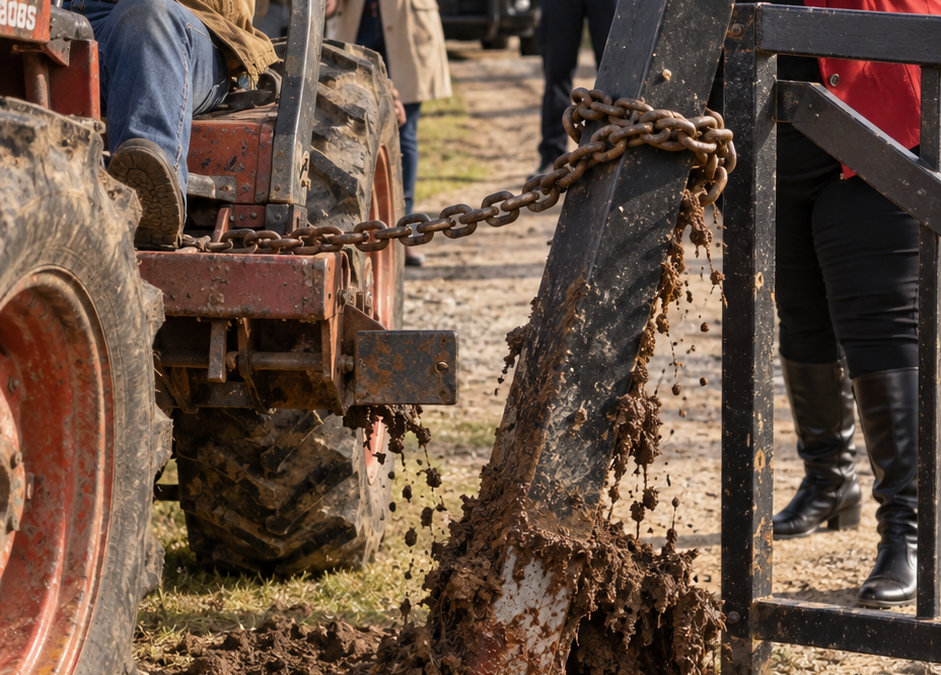
Diane Kesler was standing twenty yards away with her phone pointed at me when I wrapped the chain around the first gatepost.
She had been waiting for this.
Maybe not that exact morning, but for some version of it.
For months, she had treated me like a man slowly walking toward a trap she had already built. Every certified letter, every fine, every warning, every photograph she took from the roadside had pushed me toward that moment.
The gate stood across Ashford Lane like it belonged there.
Two steel posts sunk into concrete.
Heavy crossbars.
A U-lock through the latch.
And a professionally lettered sign bolted across the center:
PRIVATE
SABLE CREEK ESTATES
ACCESS CONTROL
The only problem was that the gate wasn’t on Sable Creek Estates property.
It was on mine.
Ashford Lane crossed Parcel 1104-B, six-point-two acres of hay ground my family had owned since 1961. My father had cut that field for more than fifty years. I had been cutting it since his death.
Yet Diane had spent almost a year pretending that ownership was some kind of technicality.
She stepped out of her car that morning wearing a red field jacket and holding her phone upright.
No fear.
No hesitation.
She had the confidence of somebody who believed the ending had already been written.
“Get off the equipment, Brad.”
I stayed seated on the tractor.
“You don’t own this lane,” I said.
She raised the phone higher.
“You own dirt. You don’t own access.”
I almost laughed.
The absurdity of it still had power back then.
“It’s my dirt.”
“It’s my community.”
The sentence came out so naturally that I realized she had probably said some version of it a hundred times.
She pointed toward the gate.
“Touch that structure, and I’ll have you arrested before lunch.”
I looked at her.
Then I looked at the chain.
“Every second you’re doing this is costing you money,” she added.
“Then start counting.”
I eased the tractor forward.
The chain snapped tight.
Steel screamed.
The near post leaned hard toward me.
Diane kept recording.
At first, everything sounded exactly the way I expected.
Metal bending.
Chain pulling.
Concrete grinding against soil.
Then the footing started to rise.
And the sound changed.
Concrete coming out of dry earth makes a certain noise.
Sharp.
Cracking.
Gravel against stone.
This wasn’t like that.
This came up wet.
The footing rolled sideways out of the ground with a thick sucking sound, and something black came up wrapped around the bottom of it.
Plastic.
Then I saw the soil.
Dark reddish brown.
Almost rust colored.
A smell rose out of the hole.
Sweet.
Chemical.
Sharp enough to catch behind my nose.
It reminded me of a car battery that had overheated.
I shut the tractor off.
The silence after the diesel died felt enormous.
Diane lowered her phone.
That was the first time in fourteen months I saw fear on her face.
And that’s when I finally understood the gate had never really been built to keep me out.
It had been built to keep something else in.
About fourteen months earlier, I still believed Diane Kesler was nothing more than an overly ambitious HOA president with too much time, too many bylaws, and a personality that improved whenever somebody else was uncomfortable.
I owned two pieces of property around Sable Creek Estates.
That distinction matters.
Lot 22 was my house.
Brick ranch.
Quarter acre.
Inside the association.
I paid the dues.
I kept the grass cut.
I followed the rules about trash cans, fences, and all the other small things people agree to tolerate when they buy into a neighborhood governed by an HOA.
Parcel 1104-B was different.
Six-point-two acres of hay ground.
Separate deed.
Separate tax parcel.
Separate history.
When the developer built Sable Creek Estates decades ago, my father refused to sell that field.
He didn’t hate development.
He simply liked the ground.
My grandfather had worked it before him.
There were two maples near the lane that my grandfather had planted with his own hands.
So when the subdivision plat was recorded, the surveyor marked the property clearly.
EXCEPTED PARCEL.
NOT INCLUDED IN SABLE CREEK ESTATES.
There was never any ambiguity.
Not legally.
Not geographically.
And certainly not historically.
My father died three years before Diane built the gate.
He was seventy-nine and still climbing onto that tractor, which was ridiculous.
I told him so.
More than once.
“One day you’re going to fall getting off that thing,” I told him.
He looked at me and said, “Then I’ll fall on my own ground.”
That was Dad.
Stubborn enough to make stubborn people tired.
The last thing he really asked of me wasn’t about money.
It wasn’t about the house.
It wasn’t even about his funeral.
It was the field.
“Don’t let it go to brush.”
That was all.
So I didn’t.
I cut it twice a year.
June and August.
Sold the hay to two horse barns off County Road 9.
It never made much money.
That wasn’t why I did it.
The field gave my year a rhythm.
June.
August.
The smell of cut grass.
Dust behind the tractor.
The same ruts my father’s tires had made.
Some men inherit watches.
Some inherit businesses.
I inherited two hay cuttings and the responsibility of not being the first Ashford who let that ground disappear under weeds.
Ashford Lane ran about 380 yards from the county road back to the field.
Most of it was narrow gravel.
There was only one place wide enough for me to unload the tractor from a trailer.
The apron at the head of the lane.
That detail ended up mattering more than almost anything.
In April, Sable Creek Estates demolished its old clubhouse and a maintenance shed behind it.
Both buildings had been there a long time.
The clubhouse had cracked floor tile.
The maintenance building stored old landscaping supplies, pool chemicals, oil, paint, cleaning products, and everything else communities collect over decades when nobody wants to pay to dispose of it properly.
Diane personally ran the renovation project.
At the spring association meeting, she announced that she had found savings substantial enough to bring the demolition under budget.
People applauded.
So did I.
I was standing near the back with a paper cup of coffee, thinking about whether the weather would cooperate for first cutting.
That’s the thing about being fooled.
Sometimes you’re applauding while it happens.
On May 6, I left the state.
My sister and I had to clean out our aunt’s house after she moved into assisted living.
I was gone nearly four weeks.
When I came home on June 2, I pulled onto the county road and noticed immediately that the apron at Ashford Lane looked different.
Fresh gravel.
Not a patch.
Not a load dumped into potholes.
The entire apron had been resurfaced and graded.
Flat.
Smooth.
Better than it had looked in twenty years.
I stood there with my truck door open, staring at it.
At the mailboxes later that day, Diane saw me.
“We resurfaced your entrance while you were away,” she said.
“Why?”
She smiled.
“Community improvement.”
“That’s private property.”
“Consider it a gift.”
And I did something that would bother me for a long time afterward.
I said, “Thank you.”
She smiled again.
“You’re welcome.”
PART2
August came wet.
Three straight days of rain soaked the county.
Afterward, standing water collected in the ditch beside the newly graveled apron.
I noticed an orange film floating across the top.
Thin.
Almost oily.
The water looked like cold soup with something separated across the surface.
There was an odor too.
Faint.
Metallic.
Chemical.
I had worked for the county road department for thirty years.
I had dug ditches, moved fill, repaired washouts, cut drainage channels and seen every color of mud God seemed interested in inventing.
Iron in soil can produce orange water.
So that was what I told myself.
Iron.
Natural runoff.
Nothing more.
I’d give a lot now to go back and slap myself for wanting the easy answer.
But I did one thing right.
On September 2, I wrote a certified letter to the association.
I kept it simple.
Orange discharge visible in ditch at head of Ashford Lane.
Unidentified odor.
Please advise.
Diane signed the return receipt on September 5.
Nobody called.
Nobody inspected it.
Nobody even pretended to care.
Then something strange happened.
On September 22, the association held an emergency meeting.
I wasn’t invited.
Later, Diane explained why with that smug little lift of her chin.
“Parcel 1104-B isn’t association property, Brad. Why would you be notified about association business?”
At that meeting, the board approved an access-control gate at the head of Ashford Lane.
Diane told the board there was a safety easement on file.
She said the association had authority to restrict access.
Nobody asked to see the easement.
Nobody asked why their urgent safety problem happened to sit on privately owned land outside the subdivision.
The gate was installed October 14.
I arrived while the contractor was finishing.
Two steel posts.
Concrete footings.
Locking crossbar.
U-lock.
The crew washed their tools in my ditch.
I asked the foreman for a key.
“The association has them.”
That evening, I went to Diane.
“I need a key.”
She didn’t even pretend to think about it.
“Access is a privilege here, Brad.”
“It’s my field.”
“You’re a homeowner in Sable Creek.”
“I’m also the owner of that road.”
She gave me the look she usually saved for people who left trash cans visible after collection day.
“The board has acted.”
October passed.
Then November.
The hay in the field stood brown and collapsed in the weather.
Every time I drove past that gate, I stared at the U-lock.
Two hard metallic clicks.
Open.
Close.
Except I couldn’t open it.
My father’s field sat behind it.
For the first time in sixty years, nobody in my family had cut the hay.
All winter, one thing bothered me.
Diane had never asked to see my deed.
Not once.
This was a woman who could quote landscaping regulations from memory.
She knew which shutters were approved.
She knew exactly how far a shed had to sit from a property line.
Yet every time I said the lane wasn’t association property, she never once replied, “Show me.”
Why?
There were only two explanations.
Either she didn’t want to know.
Or she already knew.
In February, I pulled my father’s old records out of the closet.
Then I went to the Marberry County Recorder’s office.
The records room was in the courthouse basement.
It smelled like old paper, copier toner, and concrete.
The clerk pulled the original plat.
She spread it across the counter and rotated it toward me.
There it was.
Parcel 1104-B.
And beside it, in old survey lettering:
EXCEPTED PARCEL.
NOT INCLUDED IN SABLE CREEK ESTATES.
She pulled the deed history.
Ashford ownership, uninterrupted from 1961.
Then she searched every recorded easement.
There were two.
A 1964 utility easement.
A drainage easement near the back fence.
Nothing giving Sable Creek Estates access.
Nothing about community safety.
Nothing giving Diane Kesler authority to build so much as a birdhouse on Ashford Lane.
“Want certified copies?” the clerk asked.
“Every page.”
She stamped them.
For four hours afterward, I genuinely believed the problem was solved.
I mailed certified copies to every board member.
Then I hand-delivered Diane’s.
Attached to the packet was one sentence.
REMOVE THE GATE FROM PARCEL 1104-B WITHIN TEN DAYS.
Diane called a board meeting.
I expected theater.
I thought she’d argue for ten minutes, pretend there had been confusion, then remove the gate quietly later.
Instead, she stood at the front holding my certified plat.
“Nobody disputes Mr. Ashford’s ownership.”
I actually relaxed.
Then she turned the document face down.
“The gate is not an ownership matter. It’s a safety measure.”
I stared at her.
She continued.
“Mr. Ashford himself reported a discharge hazard at the head of that lane. The board has an obligation to protect residents and children.”
That’s when I realized what she was doing.
She was using my own certified letter against me.
“Then test it,” I said.
The room went quiet.
“If there’s a hazard, test it. Publish the results. Call the county.”
Diane looked at me a fraction too long.
“We’ll take that under advisement.”
Then she called the vote.
Five to one.
Gate stays.
I watched Curt Halloway.
Curt was the association treasurer.
Big man.
Soft shoulders.
Retired insurance salesman.
The kind who shook everybody’s hand twice.
When Diane called his name, he said, “Aye.”
But he didn’t look at me.
He looked at the table.
Afterward, he took a longer route around the folding chairs just to avoid passing me.
I remembered that.
Nine days later, a certified envelope arrived.
The association had recorded a claim against Lot 22.
My house.
The one property I owned that actually was inside the HOA.
They claimed $3,600 in unpaid access assessments plus a continuing fine of $150 per day for what they called unauthorized approach to a controlled gate.
Unauthorized approach.
To my own land.
Every time I’d walked toward the field, Diane had apparently been counting.
I called my mortgage lender.
I had been refinancing.
The woman explained that the recorded claim froze the process until the title issue was resolved.
I could pay it.
Or sue.
I hung up.
Then I calculated $150 a day across an entire season.
Diane hadn’t beaten my deed.
She had gone around it.
That evening, I went to her house.
She opened the door wearing an apron.
Dish towel over one shoulder.
Perfect picture of domestic innocence.
“You put a lien on my house.”
“The association secured an obligation.”
“You know the gate isn’t on association property.”
“You have options.”
Her tone was gentle.
That made it worse.
“You can pay the amount. You can appeal.”
She paused.
To the board.
Her board.
“Or you can go to court and spend more than that field is worth proving a point.”
I stared at her.
“You’re pricing me out.”
“What’s happening, Brad, is that you’re finally learning the rules apply to you too.”
Then she smiled slightly.
“And before you consider cutting that lock, I’ve filed a standing complaint with the sheriff’s department. Your name is already in their system.”
She closed the door.
I stood on her porch staring at the wood grain.
That’s when the real shape of the trap became clear.
She hadn’t built a gate.
She’d built a room around me.
Every exit had either a dollar sign or a deputy standing in it.
The lawyer I consulted agreed the gate was trespass.
I’d win, he said.
Eventually.
Then he told me how long litigation could take.
And what it would cost.
I looked at the estimate.
He studied my face.
“I’m not telling you you’re wrong, Brad.”
“I know.”
“I’m telling you what winning costs.”
That night, I walked around the gate on foot and went down the lane.
The field was silver under moonlight.
Dead hay bent in the breeze.
I stood there thinking about Dad.
About how many times I’d watched him step off the tractor and stare across that same ground without saying anything.
On the way back, my boot sank.
Only an inch or two.
But gravel moved beneath my heel.
Not sideways.
Down.
It slipped under the surface with a faint whisper.
Like sand going into a funnel.
I crouched.
Ran my hand over the apron.
The fresh gravel had settled.
Not randomly.
In a rectangle.
Straight edges.
Square corners.
Later, in daylight, I measured it.
About ninety feet long.
Twelve feet wide.
Nearly four inches lower than the surrounding grade.
Thirty years running county equipment teaches you things.
One of them is this:
Undisturbed ground does not settle into perfect rectangles.
Fill does.
Something had been excavated there.
Something had been covered.
A few days later, my coffee started tasting wrong.
Metallic.
Flat.
I blamed the coffee maker.
Then the beans.
Then I noticed a gray ring inside my kettle.
That had never happened before.
Our well had always run clean.
It was downhill from the apron.
About three hundred feet away.
I filled two sample bottles and drove them to a private lab.
Paid extra for rush testing.
Then I walked back to the lane.
One of my grandfather’s maples had gone nearly bare.
The bark peeled away in wet sheets.
The other maple had lost half its crown on the side closest to the apron.
Trees don’t testify.
But they don’t lie either.
Four days later, the lab results arrived.
Chlorinated solvents.
Lead.
Cadmium.
Several readings above regulatory action levels.
Some far above.
I sat at my kitchen table staring at the report.
My father drank water from that well for fifty years.
I had been drinking it my whole life.
Suddenly the gate wasn’t about hay.
It wasn’t even about property anymore.
I took out a yellow legal pad.
Then I wrote every date.
April 18: clubhouse and maintenance building demolished.
May 6: I leave the state.
June 2: I return.
Fresh gravel at lane entrance.
Diane calls it a gift.
August: orange discharge.
September 2: certified letter sent.
September 5: Diane signs for it.
September 22: emergency meeting.
Gate approved.
October 14: gate installed.
I stared at the dates.
Nothing about me changed in September.
I hadn’t bought louder equipment.
I hadn’t threatened anyone.
I hadn’t changed how I used the field.
I had written a letter.
And within twenty days, Diane called an emergency meeting to block access to the exact location I had reported.
The gate had not been built to keep me away from the field.
It had been built to keep me away from that patch of ground.
Then another realization hit me.
Gateposts require holes.
Deep ones.
And concrete.
Those footings weren’t merely near the suspicious fill.
They had been poured into it.
Diane had put a permanent association structure directly over the site.
That wasn’t how you warn somebody about contamination.
That was how you physically bury access beneath concrete.
And anybody who tried to excavate that area would first have to destroy association property.
Property protected by a standing sheriff’s complaint.
It was brilliant in the ugliest possible way.
So I started looking backward.
I remembered a white pickup that had been on the road while I was gone.
Green lettering.
A neighbor, Ruth Anne Soul, had mentioned construction noise.
At the time, I ignored it.
Then the company name came back to me.
Rener Fence and Grading.
Except Rener installed the gate in October.
Why had their truck been there in May?
Then I remembered something else.
Behind the truck had been a dump trailer.
The next morning, I called the county environmental office.
I gave them everything.
The lab report.
The well.
The rectangular settlement.
The orange discharge.
The timeline.
The man on the phone started asking very specific questions.
Finally he said, “We can send a field crew.”
For the first time in months, I felt something close to relief.
The crew came Thursday.
They stayed outside the gate on my property.
Hand augers.
Sample jars.
Coolers.
One technician pulled a core from the shoulder.
He smelled it.
Then looked at me.
“You’ve been smelling that since August?”
“Yes.”
He capped the sample.
“We’ll run numbers.”
Eleven days later, the county called a responsibility conference.
The county attorney attended.
Environmental staff.
Diane.
Curt Halloway.
The association’s lawyer.
And me.
I arrived fifteen minutes early.
Diane had arrived before me.
She had her files spread neatly across the conference table.
Black accordion folder.
Legal pad perfectly squared.
She shook the county attorney’s hand like she was co-hosting.
When I walked in, she smiled.
“Brad. Glad you came.”
I will probably remember the next forty minutes until the day I die.
Diane did not deny the contamination.
She embraced it.
“We’ve been gravely concerned for some time.”
Then she slid a photocopy across the table.
A county inspection card from 1998.
AGRICULTURAL CHEMICAL STORAGE.
ASHFORD FARM.
PARCEL 1104-B.
My father had stored herbicide there.
Legally.
Like farmers all across the county.
His storage area had been inspected.
It passed.
But Diane didn’t care about the truth.
She cared about the existence of paper she could bend toward a different story.
“The Ashford operation stored agricultural chemicals on this parcel for decades.”
“It was inspected and approved.”
She nodded.
“Nobody’s accusing anyone. We’re simply establishing historical use.”
Then came signed statements.
Two board members claimed there had always been a community understanding that the field had been used for dumping.
No dates.
No witnesses.
No photographs.
Just that slippery phrase.
Everyone knew.
Curt’s signature was on one.
I looked at him.
He lifted a water glass.
His hand shook so hard the ice clicked.
Then the county attorney turned toward me.
He wasn’t cruel.
That almost made it worse.
“Mr. Ashford, regardless of who placed the contaminated material there, the property owner can be held responsible for remediation under state environmental law.”
I stared at him.
He slid a notice across the table.
Twenty-one days to provide a remediation plan.
Daily penalties afterward.
Preliminary estimate?
Six figures.
The words barely made sense.
Diane sat across from me wearing the expression of somebody attending a funeral.
“We’ll cooperate however we can.”
I don’t remember the drive home.
I remember my kitchen.
A glass of water I wouldn’t drink.
A recorded lien against my house.
A county notice requiring me to pay for a toxic trench I hadn’t dug.
She had taken the fact I’d trusted most—ownership—and turned it into a weapon.
My land.
My responsibility.
Two days later, the association newsletter arrived.
I opened it at the mailbox.
HISTORICAL CONTAMINATION ISSUE IDENTIFIED ON ADJACENT PRIVATE PROPERTY.
It credited the board with proactively restricting resident exposure by installing the gate.
It thanked Diane Kesler for her leadership.
She had turned evidence of a cover-up into proof of heroism.
Then neighbors started looking at me differently.
One man I’d plowed out during three winters crossed the street rather than pass me.
At the gas station, a woman asked quietly whether it was true my father had buried chemical drums.
That one hurt more than anything else.
My father saved bent nails because throwing away usable metal offended him.
He hauled scrap thirty miles to recycling.
And now people were telling stories about him poisoning land.
That night, I sat in the shed holding an old mower blade he’d sharpened.
His fingerprints were probably still somewhere under the oil.
For the first time, I wasn’t angry.
I was simply exhausted.
I’d spent months trying to prove something was buried there.
Now I’d proven it.
And it looked like Diane was going to use the truth to ruin me.
Then one question changed everything.
Not what was buried?
When?
A trench has no birthday.
But work does.
Work requires labor.
Equipment.
Invoices.
Schedules.
Payments.
I stopped chasing chemicals.
I started chasing dates.
Ruth Anne Soul lived near the entrance to our road.
Eighty-one years old.
Sharp-eyed.
Sharp-tongued.
She kept a spiral notebook near her window because, according to her, “Everybody around here remembers things wrong.”
I asked about early May.
She made me eat a cookie first.
Then she opened the notebook.
May 6.
Dump trailers up Ashford Lane.
6:40 a.m.
Tracked mud onto road.
Called association.
No answer.
May 7 had another entry.
Then another.
“You remember how many loads?”
“I stopped counting.”
She stood.
“I took pictures.”
My heart started pounding.
She came back with printed photographs.
Time stamped.
A tandem dump trailer backed into my apron.
A mini excavator.
The same white pickup.
Green lettering.
Rener Fence and Grading.
The first photo was dated May 6.
The day I left the state.
I drove to Rener’s yard.
Asked for Dale Rener.
The moment I gave my name, something changed in his face.
He knew.
“I need work orders, invoices, anything related to Ashford Lane.”
“Can’t help you.”
“You installed a gate on land you didn’t verify belonged to your customer.”
“We install where customers represent they have authority.”
He said it too smoothly.
Probably lawyered.
“Sable Creek’s one of my biggest accounts,” he said. “I’ve got nine employees.”
“I have twenty-one days to submit a six-figure cleanup plan.”
His eyes shifted.
“Subpoena me and I’ll comply.”
He walked me toward my truck.
Then stopped.
“For what it’s worth…”
I turned.
“Everything out there was one job number.”
Then he walked away.
One job number.
The May excavation.
The October gate.
One file.
One customer.
One chain of authorization.
Somewhere inside his office was the paper I needed.
But I couldn’t legally get it.
And I didn’t have time.
Six days remained on my county deadline.
Then the HOA mailed a special meeting notice.
Meeting date: the twelfth.
Agenda:
Ratify a permanent safety easement across the head of Ashford Lane.
Approve reinforced replacement gate.
Assess Lot 22 eighteen thousand dollars for reconstruction.
At first, I focused on the money.
Then I saw the real purpose.
She wasn’t merely defending the gate.
She was trying to create legal authority retroactively.
If that easement passed and was recorded, she would finally have paper behind the fiction she’d been repeating for months.
And deeper replacement footings would pour more concrete into the site.
I called my attorney.
“What am I legally allowed to do right now?”
He asked me several questions.
Then said, “As of today, there is no recorded easement.”
“Correct.”
“The gate is on your deeded property.”
“Correct.”
“Then you may remove an unauthorized encroachment using reasonable force limited to the encroachment.”
I didn’t breathe.
“But Brad…”
“Yes?”
“Do not excavate whatever is underneath.”
“Why?”
“Because the moment you disturb the buried material yourself, they can argue you contaminated the evidence.”
I wrote one sentence on the legal pad.
PULL THE GATE.
DON’T DIG.
I called the environmental office.
Told them I intended to remove the obstruction so remediation access could occur.
They logged the call.
I wrote down the time and name.
I mounted my son’s dash camera on the tractor.
Continuous power.
Timestamp confirmed.
Chain.
Shackle.
Tools.
Then I slept maybe two hours.
At 6:40 the next morning, I drove the tractor up Ashford Lane.
Wrapped the chain around the post.
And Diane arrived.
“Touch that gate and I’ll have you arrested.”
“Then start counting.”
The post came out.
Wet.
Chemical smell.
Black plastic.
Rust-colored soil.
I climbed off the tractor.
Looked into the hole.
And stepped backward.
I never touched anything.
Diane already had her phone to her ear.
The deputy arrived eleven minutes later.
Deputy Owen Bellamy.
Mid-thirties.
Quiet.
Methodical.
He took in the tractor.
Chain.
Broken gate.
Diane rushed toward him.
“He destroyed association property. I want charges.”
“Ma’am, give me a minute.”
“I have video.”
“Ma’am.”
Then he turned to me.
“Sir?”
I handed him my folder.
Certified deed.
Certified plat.
Recorded easement search.
He read them standing there.
Then looked toward the lane.
“This is your property?”
“Since 1961.”
“No HOA easement?”
“None.”
Diane stepped forward.
“That’s irrelevant. It’s a safety installation.”
Bellamy looked at her.
“Ma’am, the certified plat says the lane is outside association property.”
“We need everything documented. Every dollar of damage. I want the posts, footings, latch—all of it photographed.”
That demand destroyed her.
Bellamy took out his camera.
He photographed the latch.
The steel.
Then crouched beside the footing.
He stopped.
I watched him pull out a flashlight.
He moved a flap of black plastic aside with the back of his knuckle.
The light disappeared into the hole.
Then stopped on something.
A steel edge.
A printed chemical label.
Still readable.
Bellamy stood.
“Everybody away from the hole.”
Diane started talking.
He raised one hand.
“Ma’am. Back up.”
Then he keyed his radio.
The voice that came out was no longer casual.
He requested a supervisor.
Then environmental response.
Then I heard the words:
“Possible hazardous material.”
Within an hour, vehicles filled the road.
County environmental personnel.
State contractors.
Protective suits.
Caution tape.
Diane stood watching.
Then she tried the story she’d prepared.
“That’s old farm dumping. That’s exactly why we gated the area. Mr. Ashford’s father stored agricultural chemicals there.”
Bellamy turned.
He pointed toward the uprooted concrete footing.
“If this is an old farm dump site…”
His voice was calm.
“…why is your new concrete poured into it?”
Nobody spoke.
For the first time since I’d known her, Diane Kesler had no answer.
Then Bellamy turned the fallen gate frame to photograph the manufacturer’s tag.
A small metal plate was riveted underneath.
RENER FENCE AND GRADING.
JOB 3084.
He read it aloud.
I heard Diane take two steps backward.
By that afternoon, investigators were at Dale Rener’s office.
He turned over the file.
One job number.
Two primary line items.
May 6:
Excavate and backfill trench, ninety feet.
October 14:
Install access gate.
Same account.
Same customer.
Both authorized by D. Kesler.
But the photographs were what killed every lie.
Contractors photograph jobs now.
Not for criminal investigations.
For invoices.
Customers complain.
Pictures settle disputes.
Rener’s crew had photographed the trench open.
Timestamped.
May 6.
Ninety feet long.
Inside it were chemical drums.
Broken old floor tiles.
Buckets.
Bulk debris.
The contents of the demolished clubhouse and maintenance shed.
My land.
While I was four states away.
The story about my father collapsed immediately.
Diane’s attorney tried another angle.
They argued that because I had removed the gate with a tractor, I could have disturbed or planted evidence.
Except my dash camera had recorded everything continuously.
The chain tightening.
The footing rising.
The plastic already wrapped around it.
Me shutting down the tractor.
Me approaching.
Stopping.
Backing away.
Hands visible.
Four and a half minutes later, the deputy arrived.
I had never touched the hole.
Diane had spent more than a year making sure everything I did was documented.
In the end, documentation saved me.
The investigation expanded.
The trench didn’t stop at my boundary.
It continued another forty feet onto Sable Creek common property.
Downhill.
Toward the community irrigation system.
Diane hadn’t merely dumped waste on the man she was fighting.
She had buried it beneath her own neighborhood.
Then investigators audited the clubhouse demolition budget.
One line changed everything.
HAZARDOUS MATERIAL ABATEMENT AND DISPOSAL:
$61,200.
Approved.
Paid.
Rener’s trenching and hauling invoice?
$9,400.
At that point, the investigation stopped being only environmental.
It became criminal.
Where had the remaining money gone?
Who authorized the false disposal accounting?
Who benefited?
The property damage complaint against me died quickly.
The prosecutor reviewed my deed, the absence of an easement, the county notification, and the video.
No charges.
I had removed an unauthorized structure from my own property.
Curt Halloway broke nine days later.
He came in with a lawyer.
His statement filled forty pages.
The part I cared about could have fit on an index card.
Diane had decided to bury the demolition waste because proper disposal would destroy the budget she had publicly bragged about.
That was it.
That was the grand reason.
A budget.
She had poisoned land.
Locked me away from it.
Put a lien on my house.
Used my own contamination report against me.
Blamed my dead father.
All because she didn’t want to stand in front of the neighborhood and admit her cost estimate had been wrong.
Curt admitted he knew.
He had signed the false statement blaming historical dumping because he feared what would happen when investigators discovered the checks he had approved.
He eventually cooperated for reduced charges.
The two board members who signed false declarations faced charges as well.
Dale Rener lost his contractor’s license and paid a substantial penalty.
He knew what his crew buried.
He had seen the drums.
He had seen the debris.
And he accepted the check.
Diane was charged with unlawful disposal of hazardous waste, conspiracy, and theft by deception connected to the $61,200.
She pleaded before trial.
Thirty months in state custody.
Probation afterward.
Permanent prohibition against serving on an HOA board in the state.
At sentencing, she asked for leniency.
Her attorney talked about volunteer service.
Years spent helping the community.
Her health.
Then the prosecutor stood.
He didn’t display trench photographs.
Didn’t discuss money.
Didn’t talk about the gate.
He simply read my September 2 certified letter.
Orange discharge in ditch.
Unidentified odor.
Please advise.
Then he held up the return receipt.
Signed September 5.
D. Kesler.
He sat down.
Because that signature proved the part she could never explain away.
She knew.
Before the emergency meeting.
Before the gate.
Before the concrete footings.
She knew.
Full remediation eventually cost about $610,000.
The association.
The contractor.
Diane personally.
All responsible.
The directors-and-officers insurer denied coverage for intentional conduct.
Diane sold her home in Sable Creek to cover part of the judgment.
Everything she had built around me came apart.
The lien on Lot 22 was released.
The $18,000 reconstruction assessment disappeared.
The special meeting never occurred.
The county withdrew its remediation order against me and redirected responsibility toward the parties who had caused the contamination.
The association formally rescinded the old gate resolution.
And somewhere in county records now exists a document saying the alleged safety easement Diane had repeatedly cited never existed.
That may be the strangest sentence government has ever had to record.
The new HOA board passed one major rule its first year.
No association structure may ever be installed outside the platted association boundary.
They didn’t have to mention me.
Everybody knew why.
My civil settlement totaled $284,000.
It covered a replacement well.
Property damage.
Lost hay production.
Part of my legal expenses.
And restoration.
But the most important result wasn’t the money.
It was a correction filed in the county record.
No agricultural chemical disposal associated with the Ashford farming operation was responsible for contamination discovered on Parcel 1104-B.
My father’s name was cleared.
That document is the only legal paper from the entire fight I keep inside my house.
Everything else stays boxed.
The near maple died.
Its roots had taken too much.
When the remediation crew cut it down, I stood nearby and watched.
That morning hurt worse than anything involving Diane.
My grandfather had planted that tree.
My father had parked tractors beneath it.
I had climbed it as a boy.
Watching the sections come down felt like losing something nobody could compensate me for.
The second maple survived.
Barely.
The next spring, one side leafed out.
The spring after that, more branches came back.
Last April, I planted another maple about six feet from the old stump.
Someday, if both survive long enough, their branches will crowd each other.
My grandfather would’ve planted them exactly that way.
Two summers after I wrapped that chain around the gate, I cut the field again.
The tractor started on the second try.
Dad would have called that “starting right up.”
The first cutting was thin.
The second was better.
I sold both to the same horse barns off County Road 9.
Made almost no money.
Just like before.
And I can’t explain properly what it felt like to hear that tractor running across open ground again.
No lock.
No sign.
No gate.
Just diesel.
Hay.
Wind.
At the head of Ashford Lane, the contaminated soil is gone.
Clean fill replaced it.
The gravel lies flat.
If you didn’t know what happened there, you’d never guess.
Sometimes I walk across the exact spot in the dark and try to find the old trench by feel.
I know exactly where it was.
I still can’t find the edge anymore.
People occasionally ask whether I feel satisfied about what happened to Diane.
I usually don’t know what to say.
I don’t spend much time thinking about her.
What I remember is the field.
The year it stood uncut.
The brown hay folding over itself.
The sound the lock made every time somebody closed it.
My father would have hated the contamination.
He would’ve hated what they did to his name.
But I know him well enough to know the thing that would’ve angered him most.
The gate.
Because buried waste is something a man can clean up.
Poisoned soil can be removed.
A well can be drilled again.
Money can be repaid.
Documents can correct lies.
But telling a man he no longer has the right to walk onto ground his family protected for sixty years?
Dad wouldn’t have tolerated that for ten minutes.
I tolerated it for fourteen months.
Then one morning, I put a chain around the post.
And the truth came out with the concrete.








