The HOA Karen Scam Crew Bulldozed My Mountain Property and Claimed They Could Seize It—They Had No Idea I’d Recorded Everything
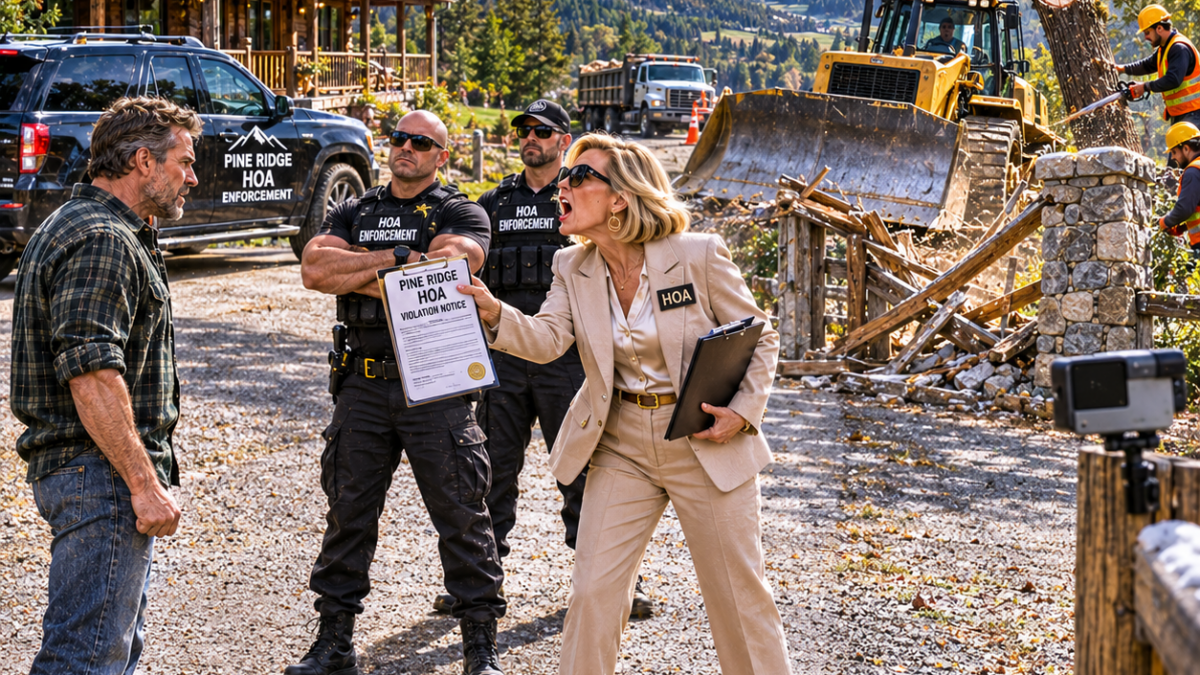
part 2
My parents bought the property when I was twenty-three.
Back then, I lived three hours away and thought the place was too isolated.
No stores nearby.
Cell service barely worked.
Winter roads were unpredictable.
My father loved it.
He had spent thirty years working around cities and said the silence was worth every inconvenience.
My mother planted wildflowers near the entrance and complained constantly about deer eating them.
The oaks Garrett wanted cut down had been planted the second spring they lived there.
Dad put three in.
Two survived.
After they died, I almost sold the property.
I couldn’t stay inside their house without seeing them everywhere.
My mother’s chipped blue mug.
Dad’s reading glasses.
A pencil mark beside the pantry where he once measured my nephew’s height.
Eventually I understood selling wouldn’t erase the grief.
So I stayed.
Repaired the fence.
Rebuilt the back deck.
Installed better internet.
Added cameras mostly because mountain lions occasionally wandered near the lower trail.
I never imagined those cameras would record a criminal crew pretending to be a homeowners association.
Sheriff Mitchell called me back that night.
I knew him casually.
Everybody in a rural county eventually knows the sheriff or someone related to him.
I told him what happened.
He asked me to email photographs of the men and documents.
Twenty minutes later, he called again.
His voice had changed.
“Robert, don’t confront them tomorrow.”
“You recognize them?”
“I recognize one face.”
“From what?”
“Another complaint.”
My stomach tightened.
“What kind?”
“Property coercion.”
He didn’t give me details.
He told me deputies would increase patrols and asked me to call immediately if Garrett returned.
Then came the problem that had protected men like Garrett for a long time.
My property sat close to the convergence of three county jurisdictions.
A crew could leave my road and cross into another county in less than fifteen minutes.
Response times in the mountains depended on distance, weather, staffing, and where deputies happened to be.
That wasn’t corruption.
It was geography.
Garrett understood geography.
The next morning, I woke before dawn.
At 6:42, engines rumbled from the county road.
Three trucks.
One equipment trailer.
A bulldozer.
Garrett stepped from the SUV.
Henson followed.
Six other men spread around the entrance.
I was already recording.
“Morning, Mr. Collins,” Garrett called.
“You’re trespassing.”
He looked at my house.
“I see you ignored the violations.”
“There is no Pine Ridge HOA.”
His expression didn’t move.
“We’ve already explained this.”
“I called the county.”
That got a reaction.
Small.
But real.
“You spoke to a clerk who doesn’t understand the district process.”
“Then give me the recorded instrument.”
Henson stepped forward.
“You have been notified.”
Garrett looked toward the bulldozer operator.
Then nodded.
The machine moved.
Its blade caught the decorative fence section near my entrance.
Wood cracked.
A post twisted out of the ground.
My mother’s wildflower bed disappeared beneath a track.
I shouted once.
“This is private property. Stop.”
Garrett didn’t look at me.
“Bringing the entrance into compliance.”
I called 911.
Then kept filming.
I did not put myself in front of the bulldozer.
That matters.
A fence can be rebuilt.
A flower bed can be replanted.
I wasn’t going to risk getting crushed to prove ownership.
One crew member walked toward my garage.
Another photographed the side of the house.
A third measured near the oak trees.
That was when the purpose became clearer.
They weren’t randomly vandalizing.
They were assessing.
Access.
Buildings.
Vehicles.
Trees.
Terrain.
Every part of the property.
Henson handed me another notice.
“Tomorrow the oaks come down. Exterior painting starts after that.”
I looked at him.
“You expect me to let you repaint my house?”
“If you cooperate.”
“And if I don’t?”
He smiled.
“Then the process gets more expensive.”
They left before a deputy arrived.
That had probably been the plan.
Hit.
Damage.
Threaten.
Leave.
Deputy Sarah Nolan reached my property twenty-three minutes later.
I showed her the footage.
She looked at the destroyed entrance.
Then at the fake HOA documents.
“This isn’t civil anymore.”
“No.”
She photographed everything.
Took the note.
Collected copies.
Then contacted Sheriff Mitchell.
By afternoon, I was sitting in his office with a formal complaint.
My friend Kevin joined me.
Kevin had served in the Marines years earlier and now lived across the valley. He knew the land better than almost anyone and had spent enough time at my property to recognize which cameras covered which trails.
He didn’t bring a rifle.
He didn’t need to.
What we needed was another witness and a plan that didn’t involve me confronting ten men by myself.
Sheriff Mitchell agreed.
“If they come back tomorrow, you stay inside or somewhere safe. Cameras run. Kevin can observe from his property if he can do it lawfully. Deputies will stage closer.”
“Will they come?”
Mitchell looked at the damage photographs.
“If their pattern is what I think it is, yes.”
“What pattern?”
He hesitated.
Then turned his monitor toward me.
Garrett’s face appeared on screen.
Different name.
Another county.
Another property owner.
Then Henson.
Different surname.
Same face.
“We have reports going back eighteen months,” Mitchell said.
My anger disappeared.
Replaced by something colder.
“How many?”
“Confirmed? Several. Suspected? More.”
“What do they do?”
“Target isolated owners. Usually high-value rural land. They create some kind of regulatory pressure—fake association, fake access district, invented land-use violation. They make the owner believe they’re already in trouble.”
“And then?”
“Fines. Threats. Damage. Offers to ‘resolve’ the problem.”
“By selling?”
“Usually.”
I stared at the screen.
“Who buys?”
“Intermediaries.”
“Connected to them?”
“We suspect so.”
“Why haven’t you arrested them?”
“Because suspicion isn’t evidence. Jurisdiction is fragmented. Victims often believe the paperwork. Some move. Some sell. Some are embarrassed afterward and don’t want to testify.”
He tapped my phone.
“You have faces, plates, threats, property damage, fake documents, and a recorded crew returning after being told they had no authority.”
Kevin spoke.
“That’s more than before.”
Mitchell nodded.
“It is.”
That night, Kevin and I checked every camera.
Not because we planned an ambush.
Because we wanted coverage.
Driveway.
Side trail.
Garage.
Back fence.
Entrance.
I uploaded backups automatically so destroying a camera would not erase the footage.
Then we waited.
At 7:11 the next morning, five vehicles appeared.
Bulldozer.
Backhoe.
At least ten men.
Garrett had escalated.
I stood on the porch with my phone recording while remaining behind the locked gate closer to the house.
He smiled.
“I see we’re still resisting.”
“I know Pine Ridge doesn’t exist.”
His smile faded.
“I know the county has no annexation.”
Nothing.
“I know you used another name in a neighboring county.”
That hit.
Henson looked at Garrett.
Garrett stepped forward.
“You don’t understand your position.”
“I understand it better than yesterday.”
“We’re isolated up here, Collins.”
That sentence was probably supposed to frighten me.
Instead, I let him finish.
“Help takes time.”
I looked toward the security camera above the porch.
“Everything you’re saying is going directly off-site.”
Garrett looked up.
I continued.
“Your faces. Vehicles. Plates. Every word.”
One of the men near the backhoe stepped away from it.
Another looked toward the road.
Then distant sirens became audible through the trees.
Not close.
Close enough.
Garrett’s face changed.
He pointed at me.
“This isn’t over.”
“For you, I think it might be.”
They started pulling out.
I did not chase them.
Deputies intercepted two vehicles lower on the mountain and followed the others across jurisdictions while coordinating with neighboring agencies.
Garrett and Henson escaped that morning.
But now law enforcement had fresh plates.
Witnesses.
Video.
Known associates.
And a direction of travel.
Kevin came over afterward.
“You okay?”
“No.”
He looked at the demolished entrance.
“Understandable.”
“I don’t want to keep doing this.”
“You won’t.”
“You don’t know that.”
“No.”
He looked toward the road.
“But now they’re running.”
That afternoon, Sheriff Mitchell asked Kevin and me to come in.
He laid photographs across a table.
Three additional property owners.
Same basic story.
Different fake organizations.
Different paperwork.
One couple had paid more than $20,000 in supposed compliance penalties before realizing the association didn’t exist.
Another man sold a parcel at a steep discount after being told liens would make the property unsellable.
A widow had been pressured into signing what she thought was an HOA settlement.
The document turned out to be tied to a purchase option.
I felt sick.
“They’ve been taking houses.”
Mitchell nodded.
“Not directly. That’s what makes the scheme effective.”
He explained.
Fear first.
Administrative pressure.
Fake authority.
Then an apparently independent buyer appears.
Maybe you should sell before the dispute gets worse.
The owner sells below market.
A shell company acquires the property.
Later it is resold.
The fake HOA disappears.
I thought about Garrett’s note.
PROPERTY LIKE YOURS IS WORTH A LOT TO THE RIGHT PEOPLE.
“What makes mine valuable?”
Mitchell shrugged.
“Could be location.”
It wasn’t.
Not entirely.
We wouldn’t understand that part until later.
That evening, neighboring agencies located Garrett, Henson, and three crew members at a motel near Pine Creek.
They were detained while warrants and charging decisions were coordinated.
I did not watch the arrest.
Didn’t need to.
The next morning, I met with Assistant District Attorney Diana Prescott.
She was in her fifties, direct, efficient, and uninterested in making promises.
“Your evidence helped us connect cases,” she said.
“Does that mean charges?”
“It means we have probable cause supporting several charges. The investigation is still developing.”
“Sheriff Mitchell said other victims are coming forward.”
“Five since the arrests became known.”
She opened a folder.
“Your testimony will matter.”
“I’ll testify.”
“No hesitation?”
I thought about my parents.
“No.”
The first court appearance was not a trial.
That distinction mattered.
Garrett and Henson entered in jail clothing while attorneys argued detention conditions and probable cause.
Charges under consideration included forgery, extortion-related offenses, criminal mischief, trespass, intimidation, conspiracy, and fraud tied to coerced property transactions.
Their attorney described them as legitimate real-estate businessmen caught in jurisdictional misunderstandings.
I almost laughed.
Then the prosecutor displayed a photograph of my bulldozed entrance.
Nothing was funny.
When I was called later during preliminary proceedings, I described each interaction.
The first visit.
Fake HOA papers.
$500 daily fines.
Threat of confiscation.
Note on my truck.
Bulldozer.
Property damage.
Second return.
Cameras.
County confirmation that Pine Ridge did not exist.
The defense tried to characterize the dispute as confusion.
“Mr. Collins, you understood that my clients believed they possessed regulatory authority?”
“No.”
“You’re saying you knew what they believed?”
“No. I’m saying I told them their association didn’t exist and asked for recorded authority. They returned with a bulldozer.”
That ended that line.
Outside court, an elderly couple approached me.
Martha and George Tanner.
Martha held my hand with both of hers.
“We lost our place last year.”
“To them?”
She nodded.
“They told us our property violated new district standards. We couldn’t afford the fines.”
George stared at the ground.
“Then a buyer showed up.”
My throat tightened.
“How much below market?”
“Enough that I don’t like saying it.”
Martha’s eyes filled.
“We thought we were alone.”
That sentence changed something in me.
Until then, part of me still viewed the case as a fight over my land.
It wasn’t.
My land was simply the property where they finally left enough evidence behind.
The investigation expanded.
Search warrants produced laptops, phones, financial records, shell-company documents, property lists, and correspondence.
Sheriff Mitchell called me one afternoon.
“They had another list.”
“How many?”
“Twenty potential properties in this region.”
Mine was one.
Several had handwritten values beside them.
Estimated market price.
Pressure points.
Age of owner.
Occupancy.
Access conditions.
One category made my stomach turn.
ISOLATED / LOW RESPONSE TIME
They had turned geography into a vulnerability score.
Then investigators found something else.
Water.
My land contained two natural springs.
I had always thought of them as beautiful inconveniences.
Cold water bubbling from rock along the lower slope, feeding a narrow creek before disappearing toward the valley.
Dad protected them mostly because he liked wildlife.
The shell companies saw something different.
Resource value.
Kevin was drinking coffee on my porch when Mitchell explained what investigators had found.
“Some target properties overlap with mapped spring or groundwater assets.”
I looked toward the lower field.
“You’re saying they wanted my land for water?”
“It’s one possible motive. We’re still proving connections.”
Kevin whistled softly.
Mitchell continued.
“Several investment groups tied to these buyers have been acquiring rural properties with long-term resource value.”
The mountains looked different after that.
Still beautiful.
But suddenly I understood why somebody might look at two quiet acres and see something entirely different from home.
Garrett’s scheme had apparently operated in multiple counties through several fake associations and regulatory names.
Investigators traced more than $2 million in suspiciously acquired or coerced property during the early phase of the case.
Later financial tracing suggested total proceeds connected to the network were higher.
But Diana Prescott was careful.
“Don’t repeat numbers publicly until they’re established.”
I respected that.
The first weeks after the arrests were difficult.
I repaired the entrance.
Replaced the damaged fence.
Replanted part of Mom’s wildflower bed even though autumn was the wrong season.
Installed better cameras.
Added lighting.
Not because I wanted my home to become a fortress.
Because the feeling of safety had changed.
One night, an unfamiliar car drove slowly past three times.
I called the sheriff.
A deputy checked the area.
Nothing happened.
Three days later, Diana called.
“Defense counsel is challenging aspects of the evidence.”
“Which evidence?”
“Several things.”
She mentioned the confrontation during the second return.
Garrett claimed he had been unlawfully intimidated into leaving.
I laughed.
“By my cameras?”
“Your evidence is strong. I’m telling you because defense counsel will attack every weakness.”
That was when I became grateful we had not tried anything reckless.
No weapons.
No laser.
No homemade traps.
No threats.
Just cameras, witnesses, calls to law enforcement, and deputies approaching on a public road.
The defense could criticize my tone.
It couldn’t turn documentation into misconduct.
Kevin heard about the challenge later.
“Good thing we didn’t do anything stupid.”
I looked at him.
“That sentence implies you had ideas.”
“I always have ideas.”
“Never tell me.”
“Probably best.”
Months passed.
More victims testified.
Investigators traced shell companies.
One company bought distressed rural land shortly after fake enforcement pressure began.
Another transferred property to an investment group at a significant profit.
Some purchasers claimed they had no knowledge of the coercion.
Some probably didn’t.
Others had connections investigators considered far more troubling.
The prosecution narrowed the case to what could actually be proven.
That disappointed people who wanted every suspicious transaction charged.
Diana explained it to me.
“Court is not where we prosecute everything we believe happened.”
“What is it?”
“Where we prove specific crimes with admissible evidence.”
That stayed with me.
Garrett wanted everything to look complicated.
Different counties.
Different names.
Different entities.
Fake associations.
Shell buyers.
Contractors.
The prosecution did the opposite.
One victim.
One false document.
One threat.
One payment.
One property.
Then another.
And another.
Build the pattern from facts.
Six months after Garrett first stood on my porch, the trial ended.
Guilty verdicts on the core fraud, forgery, extortion-related, conspiracy, trespass, and property-damage charges supported by the evidence.
Garrett received eight years.
Henson received six.
Other participants received separate outcomes depending on their roles and cooperation.
I sat in the courtroom when sentence was imposed.
I expected satisfaction.
What I felt was exhaustion.
Martha Tanner sat two rows behind me.
When the judge finished, she started crying.
Not loudly.
George put his arm around her.
That was when it finally felt real.
For me, the entrance had been repaired.
My property never transferred.
For them, a conviction did not automatically return the year they lost.
Justice can punish.
It cannot always rewind.
After sentencing, federal investigators continued examining the financial network.
The water-resource angle turned out to be part of a larger investment strategy.
Properties with springs, groundwater access, or other long-term natural-resource potential had appeared repeatedly among acquisition targets in several western states.
Not every investor was criminal.
Not every land purchase was fraudulent.
But Garrett’s operation had been useful to people who wanted certain properties cheaply.
That distinction mattered.
The criminal conspiracy and the broader world of speculative land investment were not automatically the same thing.
The overlap was still disturbing.
Diana visited my property one afternoon carrying a folder.
Inside were maps recovered during the investigation.
Red circles.
Notes.
Property IDs.
My parcel was marked.
Beside it:
SPRING ACCESS — HIGH VALUE
I stared at the words.
“Did Garrett write this?”
“Investigators haven’t established authorship of every notation.”
“So what do we know?”
“The property was on their target list. Resource value was noted. Several associated investment entities remain under investigation.”
I closed the folder.
“Are they still operating?”
“Some legitimate entities remain active. That’s not the same as saying they’re all part of the crime.”
She was always careful.
I had come to appreciate careful language.
Fear thrives on exaggeration almost as easily as scams do.
I didn’t want Garrett’s operation to turn me into a man who saw conspiracies behind every vehicle.
Still, I took legal precautions.
Not tactical ones.
Legal.
I hired a land-use attorney.
Reviewed my title.
Updated estate documents.
Recorded updated surveys.
Worked with conservation counsel to place long-term restrictions around the springs so they could not simply be commercially exploited by a future buyer without navigating the protections my parents would have wanted.
That gave me more peace than another camera ever could.
Kevin helped rebuild a small storage shed near the lower trail.
He joked about turning it into a cabin.
Eventually he actually did, with permits and my written permission.
A tiny fishing cabin.
Nothing tactical.
Nothing hidden.
He stayed there occasionally.
Mostly because he liked the creek.
One evening, we sat on my porch watching the sun turn the valley gold.
He looked toward the rebuilt fence.
“You know what bothers me?”
“What?”
“A fence seems permanent until somebody decides it isn’t.”
I understood.
Property rights feel abstract until challenged.
A deed sits in a drawer.
Boundary markers disappear under leaves.
Recorded documents live in county databases nobody thinks about.
Most days, ownership is invisible.
Then somebody arrives holding fake paperwork and suddenly everything depends on whether you can prove what you always assumed everyone knew.
“I used to think the fence protected the land,” I said.
Kevin shook his head.
“The records protect the fence.”
Exactly.
That became the real lesson.
Not standing armed on a porch.
Not out-threatening criminals.
Paper.
Cameras.
County records.
Formal complaints.
Witnesses.
Reports.
Patience.
Garrett’s greatest weapon had been the appearance of legitimacy.
People see a seal and assume government.
See an HOA letter and assume authority.
See daily fines and panic.
Hear “lien” and imagine losing everything.
Then when the pressure becomes unbearable, somebody friendly arrives offering a clean way out.
Sell.
Leave.
Problem solved.
Except the problem was manufactured from the beginning.
Martha and George had not been foolish.
They had been frightened by paperwork designed specifically to look real.
That distinction mattered to me.
Victims don’t need lectures about how they “should have known.”
They need systems that make fraud harder.
After the trial, Sheriff Mitchell organized a regional meeting among neighboring counties.
Shared case alerts.
Common document templates.
Information on fake district and HOA scams.
Faster plate sharing.
Better coordination when crews crossed county lines.
The jurisdiction problem that helped Garrett operate didn’t disappear.
But agencies became less isolated.
That mattered.
One deputy told me later:
“Your case gave everyone something concrete to recognize.”
“What?”
“Fake HOAs used to sound ridiculous. Now dispatch knows not to laugh.”
I understood that too.
The scheme was absurd until it worked.
A year after the first visit, I found the original fake Pine Ridge packet in my evidence copies.
The seal looked even worse than I remembered.
I sat at my kitchen table examining it.
The paper was high quality.
The language sounded official.
The signature blocks looked real enough.
If Garrett had arrived when I was seventy-five instead of forty-something, if I had been alone, if county offices were closed for a long weekend, if I had no cameras and no familiarity with property records—would I have reacted differently?
Maybe.
That was uncomfortable to admit.
Confidence is easy after you know the answer.
On day one, I did not know whether some obscure district action had occurred without my knowledge.
That’s why my first move mattered.
I verified.
Not argued.
Verified.
One call to county records broke the first layer.
Then one question exposed the next.
Instrument number?
Board filing?
Permit?
Registered entity?
Every fake system eventually runs into a real system it cannot control.
Garrett counted on victims being too intimidated to make those calls.
He was right often enough to make millions.
He was wrong at my house.
The oak trees survived.
That mattered more than I expected.
Every spring, they leaf out later than the lower trees.
For a few weeks I worry one has died.
Then small green leaves appear.
My father planted them.
Garrett called them violations.
Henson called them an obstruction.
The fake Pine Ridge documents called them noncompliant vegetation.
I call them Dad’s trees.
One evening, I found an old photograph of my parents standing beside the smaller oak shortly after planting it.
Dad had one hand on a shovel.
Mom looked annoyed at the camera.
Probably because he had made her pose.
I framed the photo.
Put it near the window facing the trees.
There are things property records cannot measure.
That’s why defending land is never only about market value.
A parcel number doesn’t show where your mother planted flowers.
A deed doesn’t show where your father taught you to split wood.
An appraisal doesn’t know why one tree matters more than another.
Garrett’s operation understood value only as leverage.
Land price.
Water.
Resale.
Owner vulnerability.
They had columns for everything except attachment.
That was their mistake with me.
During sentencing, the judge asked whether I wanted to submit a victim-impact statement.
I did.
I kept it short.
I wrote that the greatest harm was not the fence or landscaping.
It was the attempt to make me doubt whether my ownership meant anything when confronted by enough official-looking paper.
For weeks after the attack, every vehicle on the mountain road felt suspicious.
Every unknown number felt connected.
That changes a home.
You can repair wood faster than trust.
But trust comes back.
Slowly.
The first time I went an entire day without checking a camera alert, I noticed only afterward.
Then a whole weekend.
Then weeks.
The mountains became mountains again instead of hiding places.
The valley became beautiful again instead of exposed.
I kept the security system.
I also stopped letting it dictate my life.
That balance took time.
Kevin once asked whether I regretted staying.
“No.”
“Never?”
“First month after the arrests? Sometimes.”
“Why stay?”
I looked toward the oaks.
“Because leaving would’ve made their argument for them.”
“What argument?”
“That pressure decides ownership.”
He nodded.
I wasn’t staying to prove toughness.
I stayed because I still wanted the life my parents had built there.
Garrett didn’t get to redefine the property as dangerous simply because he made it dangerous for a while.
Several former victims eventually pursued civil remedies against shell companies and intermediaries connected to coerced sales.
Some recovered money.
A few transactions were challenged.
Not everyone got their property back.
Legal remedies depend on facts, subsequent purchasers, statutes, timing, and evidence.
That’s the frustrating part.
There was no single courtroom order restoring every mountain home overnight.
But the network broke.
Future targets were warned.
Records were preserved.
Victims finally understood they had not imagined the fraud.
Martha sent me a Christmas card the following year.
On the front was a photograph of a cabin surrounded by snow.
Inside she wrote:
WE BOUGHT A SMALL PLACE AGAIN. NOT THE SAME. BUT OURS.
I kept that card.
Maybe because I understood those last two words.
But ours.
That’s what Garrett never respected.
Ownership isn’t a bureaucratic inconvenience waiting for somebody with better paperwork to erase.
It is a legal relationship.
And often an emotional one.
The last major update came from Sheriff Mitchell almost eighteen months after the original arrest.
Several financial investigations remained open.
Some investment entities had legitimate business operations.
Others were being examined for transactions connected to coerced sales.
He couldn’t tell me everything.
Didn’t need to.
“Do you think somebody will try again?” I asked.
“Garrett’s exact playbook?”
“Yes.”
“Somebody somewhere will.”
“Here?”
He looked toward my house.
“Not if they do basic research.”
I laughed.
“My reputation?”
“Your cameras.”
“Disappointing.”
“And the fact that every county around here now knows the scheme.”
Better answer.
I walked him to his truck.
Before leaving, he looked at the restored entrance.
“Looks good.”
“My mother would complain about the flowers.”
“Why?”
“Wrong colors.”
He smiled.
“Sounds like an HOA violation.”
“Don’t even joke.”
After he left, I sat on the porch.
The same porch where I watched Garrett’s bulldozer tear through the entrance.
The fence was rebuilt.
Wildflowers had returned.
Not exactly the same.
Nothing repaired ever is.
The oaks moved slightly in the wind.
The springs ran cold along the lower slope.
The cameras sat quietly under the roofline.
For once, none of them had anything worth recording.
That was peace.
Not believing nothing bad could happen.
Knowing something bad had happened and refusing to let it own everything afterward.
I sometimes tell people the fake HOA story when they ask why the sign near my entrance now includes the parcel number beneath my name.
They laugh.
Then stop laughing when I tell them the criminals had done it before.
That is usually when they ask the same question.
“How could anyone fall for a fake HOA?”
Easy.
Because it didn’t begin with someone shouting:
We’re criminals.
It began with:
Your property was incorporated last month.
Official language.
Stamped paper.
Daily fines.
Compliance deadlines.
Then escalation.
People are trained to respect institutions.
Criminals know that.
Garrett didn’t need people to believe him forever.
He needed them to believe him long enough to panic.
Long enough to sign.
Long enough to sell.
That’s why my first question eventually became the question I tell every rural property owner to ask when someone unexpectedly claims authority over land.
Where is it recorded?
Not:
Who are you?
Not:
How angry should I get?
Not:
How do I scare you away?
Where is the legal authority recorded?
Real systems leave records.
Real HOAs have declarations.
Real districts have filings.
Real liens have procedures.
Real easements have instruments.
Real code enforcement has jurisdiction.
Fake authority hates specific questions.
Garrett had answers until I asked for instrument numbers.
Then he had threats.
That distinction saved my property.
I also stopped mocking my father for keeping paperwork.
After my parents died, I found boxes of deeds, surveys, tax receipts, insurance policies, water tests, road-maintenance agreements, and documents dating back decades.
I nearly threw half away.
I didn’t.
Now they’re indexed.
Scanned.
Backed up.
Originals stored safely.
Kevin makes fun of me.
“You’ve become your father.”
“There are worse outcomes.”
“Definitely.”
The conservation documents protecting the springs sit in the same cabinet.
Not because I’m afraid someone will steal the land tomorrow.
Because ownership survives best when memory has evidence.
One spring morning, I walked down toward the lower watercourse.
Sunlight came through the trees.
The spring bubbled over stone.
Clear.
Cold.
Nothing about it looked like millions of dollars.
That was what disturbed me.
Garrett’s people had looked at a place I loved and seen future scarcity.
Control the water.
Control value.
Control the land.
Maybe that is how certain investors think.
I can’t stop everyone from wanting what I own.
I can decide under what terms it changes hands.
That’s what the conservation protection gave me.
Garrett’s scheme depended on removing choice.
Fake authority.
Fear.
Manufactured urgency.
I answered by making my choice harder to override.
Years later, strangers still occasionally drive slowly past.
Most are hikers.
Survey crews.
Hunters.
Lost tourists.
Once, a real-estate investor stopped and asked whether I would consider selling.
I laughed.
He looked confused.
“Bad time?”
“No.”
“Bad price?”
“You haven’t given one.”
“Then why laugh?”
“Long history.”
He handed me a card.
I took it.
No threat.
No fake HOA.
No bulldozer.
Just an offer.
That’s how legitimate interest works.
Ask.
Accept no.
Leave.
I watched him drive away and realized how much my understanding of power had changed.
Garrett believed force was efficient.
Maybe short term.
But force creates records.
Victims.
Witnesses.
Cases.
Real authority moves slower because it has rules.
Those rules can be frustrating.
They also protect the difference between persuasion and theft.
The last time Kevin and I sat outside discussing the case, the sunset turned the valley orange.
He looked at the rebuilt entrance.
“You know the weirdest part?”
“What?”
“If they had just offered you money first, would you have sold?”
“No.”
“How much?”
“No.”
“Everybody has a number.”
“My parents didn’t.”
He nodded.
“Fair.”
Maybe there is a number.
I’ve never needed to know it.
The point is mine to choose.
That’s the principle Garrett never understood.
Not fences.
Not trees.
Not water.
Consent.
For a while, he nearly built a business around pretending consent didn’t matter if intimidation was convincing enough.
It worked until enough victims stopped standing alone.
Sheriff Mitchell connected counties.
Diana connected cases.
Martha and George testified.
Other owners came forward.
Financial investigators followed shell companies.
The pattern emerged.
The scheme failed not because one homeowner was fearless.
I wasn’t.
I was afraid plenty of times.
It failed because fear became evidence instead of surrender.
That’s what I think about when people call me brave.
I wasn’t brave when Garrett returned with a bulldozer.
I was furious.
I was scared.
I wanted to run down the driveway and physically stop them.
The smarter decision was to step back.
Record.
Call.
Preserve.
Let the damage become evidence instead of letting the confrontation become a tragedy.
That choice felt passive for about three hours.
Then a fire of paperwork started moving through three counties.
That’s another lesson.
Doing nothing reckless is not the same as doing nothing.
Sometimes restraint is the action.
The final physical reminder is a small section of fence near the entrance.
One rebuilt post still has a scrape where the bulldozer blade caught the original footing.
I could replace it.
I don’t.
Like the camera footage, it reminds me how close the story came to a different ending.
Garrett expected an isolated homeowner.
Someone who would see six men and a machine and decide the fight wasn’t worth it.
Instead, he found a homeowner who called the county.
Then the sheriff.
Then signed a formal complaint.
Then testified.
Then kept showing up.
That was enough.
Not because I was stronger.
Because his operation depended on people disappearing.
I didn’t.
The mountains look the same today as they did before any of this.
That may be the strangest part.
The same ridgelines.
Same oaks.
Same spring water.
Same evening shadows moving across the valley.
The world doesn’t mark where your sense of safety changed.
You do.
For a long time, the property reminded me of threat.
Eventually, it became home again.
That’s the real ending.
Garrett and Henson served their sentences.
The investigation into related financial interests continued beyond my case.
My land stayed mine.
The oaks stayed standing.
The springs stayed protected.
The fake Pine Ridge HOA disappeared as completely as it had appeared.
There is no monument to the case.
No plaque.
No dramatic gate.
Just my ordinary property sign beside the rebuilt entrance.
ROBERT COLLINS
PRIVATE PROPERTY
Below it, in smaller letters:
COUNTY PARCEL RECORD ON FILE
Kevin calls that excessive.
I call it educational.
Every morning, I still make coffee.
Some days I sit by the window before going outside.
The cup steams.
Sunlight comes over the ridge.
If tires crunch on gravel, I look up.
Most of the time it’s nobody.
Sometimes a delivery truck.
Sometimes Kevin.
Once in a while a stranger turns around at the entrance and drives away.
The old fear still flickers for half a second.
Then passes.
Because I learned something from Garrett that I never wanted to learn.
Property can feel permanent until somebody tests whether you can prove it.
But I learned something better from my parents.
You don’t protect land by becoming more frightening than the people who want it.
You protect it by knowing what belongs to you, preserving the evidence, using the law before panic replaces judgment, and refusing to let fake authority write a new history just because it arrived with a seal and a bulldozer.
Garrett thought isolation made me vulnerable.
In the end, isolation was only useful to him while every victim believed he was alone.
Once the cameras, records, counties, witnesses, and cases connected, his whole operation stopped looking like authority.
It looked exactly like what it had always been.
A scam.
And the mountain never belonged to them for a single day.
𝗧𝗛𝗘 𝗘𝗡𝗗
The HOA Karen Scam Crew Bulldozed My Mountain Property and Claimed They Could Seize It—They Had No Idea I’d Recorded Everything
The fake HOA crew gave me twenty-four hours to repaint my house, cut down my father’s oak trees, and accept $500-a-day fines from an association that did not legally exist.
When I refused, they came back with trucks, six men, and a bulldozer and started tearing apart the entrance to land my family had owned for years.
What they didn’t know was that every fake document, license plate, threat, and act of destruction was being preserved—and the sheriff had already seen their faces under different names in three other counties.
My coffee was still steaming when tires screamed across the gravel at the bottom of my driveway.
I looked through the kitchen window and watched a black SUV climb the last hundred yards toward my house. It stopped crooked across the entrance like whoever was driving wanted me to understand immediately that this wasn’t a social visit.
Two men got out.
The older one was broad through the shoulders, bald, wearing mirrored sunglasses despite the thin autumn clouds. The younger man carried a clipboard and moved with a clipped, careful confidence that made me think he had practiced whatever was about to happen.
I had lived on that mountain property for five years.
Two acres overlooking a valley of pine, oak, stone, and low morning fog. The place had belonged to my parents before they died in an accident, and after everything that followed—the funeral, probate, cleaning out a house that still smelled like my mother’s coffee and my father’s cedar shavings—it became the one place where I could breathe.
I opened the door before they knocked.
“Robert Collins?” the bald man asked.
“That’s me.”
He pointed to himself.
“Garrett.”
Then to the younger man.
“Henson.”
He smiled as though we were starting a business meeting.
“We’re officers with the Pine Ridge Homeowners Association.”
For half a second, I thought I had misheard him.
“What homeowners association?”
Henson’s eyes moved toward the house.
Then the fence.
Then the old oaks along the eastern edge.
“The one governing this district.”
“There is no HOA here.”
Garrett’s smile became almost sympathetic.
“There is now.”
He said my property had been incorporated into Pine Ridge the previous month. He said new district standards had taken effect. My fence was allegedly noncompliant. My house color had not received architectural approval. Several mature trees violated what he called the association’s wildfire-view corridor.
Then Henson handed me a packet.
Official-looking seal.
Lot number.
Property description.
Signature lines.
A page titled:
PINE RIDGE HOA — NOTICE OF INCORPORATION AND MANDATORY COMPLIANCE
I read the first paragraph.
Then the second.
Something felt wrong.
The county parcel format wasn’t quite right.
The embossed seal looked impressive until I noticed the mountain graphic inside it seemed pixelated.
One signature line identified a county planning administrator whose name I recognized vaguely—but the title was slightly off.
Garrett tapped the paper.
“You have twenty-four hours to begin corrective action.”
“Or?”
“Five hundred dollars per day.”
I looked up.
He continued.
“If violations remain unresolved for seven days, Pine Ridge may initiate recovery proceedings against the property.”
“Recovery?”
“Confiscation, if necessary.”
That word changed the temperature of the conversation.
I looked past Garrett toward their SUV.
No county logo.
No association address I recognized.
No visible business markings beyond a removable magnetic Pine Ridge emblem on the rear door.
Then I looked back at him.
“This land belongs to me.”
“For now.”
He adjusted his glasses.
That was the moment I stopped treating them like confused bureaucrats.
“Who recorded the annexation?”
Henson answered.
“County.”
“Which instrument number?”
Silence.
“What board approved it?”
Garrett smiled again.
“You’ll find everything in the packet.”
I didn’t argue.
People who arrive expecting fear often become careless when they don’t get it.
I thanked them for the paperwork.
Garrett seemed disappointed.
He pointed toward the oaks.
“Those need to be removed first.”
“My father planted two of those.”
“Then he planted them in the wrong location.”
My jaw tightened.
I said nothing.
They returned to the SUV.
As it pulled away, I photographed the plate.
Then I called the county.
It took fourteen minutes to reach someone in land records.
I gave the woman my parcel number.
Then the alleged HOA name.
Keyboard clicks.
Long pause.
“Mr. Collins?”
“Yes.”
“There is no Pine Ridge Homeowners Association registered over your parcel.”
“I assumed that.”
“Actually, I’m not finding any association by that name formed in this area.”
“Any annexation filing in the last two months?”
“No.”
“Any change affecting title?”
“No.”
I looked at the papers lying on my kitchen table.
“Thank you.”
I hung up.
Then I started photographing every page.
By sunset, I had confirmed enough to know the documents were not merely mistaken.
They were fabricated.
And tucked beneath my truck’s windshield wiper that evening was a folded sheet of paper I had not put there.
Four lines.
WE’LL BE BACK TOMORROW WITH A CREW.
DON’T MAKE THIS DIFFICULT.
PROPERTY LIKE YOURS IS WORTH A LOT TO THE RIGHT PEOPLE.
RESIST, AND THINGS WILL GET UGLY.
I read it twice.
Then looked toward the valley.
The sun had dropped behind the western ridge, leaving the mountains purple and black against the sky.
For five years, that view had meant peace.
That evening, it felt like somebody was standing beyond the tree line looking back.
I photographed the note.
Bagged it.
Saved the footage from every camera covering the driveway.
Then I called the sheriff’s office.
Because whatever Pine Ridge was, it wasn’t an HOA.
And the men who had just threatened to “confiscate” my home were coming back in the morning.
part 2
My parents bought the property when I was twenty-three.
Back then, I lived three hours away and thought the place was too isolated.
No stores nearby.
Cell service barely worked.
Winter roads were unpredictable.
My father loved it.
He had spent thirty years working around cities and said the silence was worth every inconvenience.
My mother planted wildflowers near the entrance and complained constantly about deer eating them.
The oaks Garrett wanted cut down had been planted the second spring they lived there.
Dad put three in.
Two survived.
After they died, I almost sold the property.
I couldn’t stay inside their house without seeing them everywhere.
My mother’s chipped blue mug.
Dad’s reading glasses.
A pencil mark beside the pantry where he once measured my nephew’s height.
Eventually I understood selling wouldn’t erase the grief.
So I stayed.
Repaired the fence.
Rebuilt the back deck.
Installed better internet.
Added cameras mostly because mountain lions occasionally wandered near the lower trail.
I never imagined those cameras would record a criminal crew pretending to be a homeowners association.
Sheriff Mitchell called me back that night.
I knew him casually.
Everybody in a rural county eventually knows the sheriff or someone related to him.
I told him what happened.
He asked me to email photographs of the men and documents.
Twenty minutes later, he called again.
His voice had changed.
“Robert, don’t confront them tomorrow.”
“You recognize them?”
“I recognize one face.”
“From what?”
“Another complaint.”
My stomach tightened.
“What kind?”
“Property coercion.”
He didn’t give me details.
He told me deputies would increase patrols and asked me to call immediately if Garrett returned.
Then came the problem that had protected men like Garrett for a long time.
My property sat close to the convergence of three county jurisdictions.
A crew could leave my road and cross into another county in less than fifteen minutes.
Response times in the mountains depended on distance, weather, staffing, and where deputies happened to be.
That wasn’t corruption.
It was geography.
Garrett understood geography.
The next morning, I woke before dawn.
At 6:42, engines rumbled from the county road.
Three trucks.
One equipment trailer.
A bulldozer.
Garrett stepped from the SUV.
Henson followed.
Six other men spread around the entrance.
I was already recording.
“Morning, Mr. Collins,” Garrett called.
“You’re trespassing.”
He looked at my house.
“I see you ignored the violations.”
“There is no Pine Ridge HOA.”
His expression didn’t move.
“We’ve already explained this.”
“I called the county.”
That got a reaction.
Small.
But real.
“You spoke to a clerk who doesn’t understand the district process.”
“Then give me the recorded instrument.”
Henson stepped forward.
“You have been notified.”
Garrett looked toward the bulldozer operator.
Then nodded.
The machine moved.
Its blade caught the decorative fence section near my entrance.
Wood cracked.
A post twisted out of the ground.
My mother’s wildflower bed disappeared beneath a track.
I shouted once.
“This is private property. Stop.”
Garrett didn’t look at me.
“Bringing the entrance into compliance.”
I called 911.
Then kept filming.
I did not put myself in front of the bulldozer.
That matters.
A fence can be rebuilt.
A flower bed can be replanted.
I wasn’t going to risk getting crushed to prove ownership.
One crew member walked toward my garage.
Another photographed the side of the house.
A third measured near the oak trees.
That was when the purpose became clearer.
They weren’t randomly vandalizing.
They were assessing.
Access.
Buildings.
Vehicles.
Trees.
Terrain.
Every part of the property.
Henson handed me another notice.
“Tomorrow the oaks come down. Exterior painting starts after that.”
I looked at him.
“You expect me to let you repaint my house?”
“If you cooperate.”
“And if I don’t?”
He smiled.
“Then the process gets more expensive.”
They left before a deputy arrived.
That had probably been the plan.
Hit.
Damage.
Threaten.
Leave.
Deputy Sarah Nolan reached my property twenty-three minutes later.
I showed her the footage.
She looked at the destroyed entrance.
Then at the fake HOA documents.
“This isn’t civil anymore.”
“No.”
She photographed everything.
Took the note.
Collected copies.
Then contacted Sheriff Mitchell.
By afternoon, I was sitting in his office with a formal complaint.
My friend Kevin joined me.
Kevin had served in the Marines years earlier and now lived across the valley. He knew the land better than almost anyone and had spent enough time at my property to recognize which cameras covered which trails.
He didn’t bring a rifle.
He didn’t need to.
What we needed was another witness and a plan that didn’t involve me confronting ten men by myself.
Sheriff Mitchell agreed.
“If they come back tomorrow, you stay inside or somewhere safe. Cameras run. Kevin can observe from his property if he can do it lawfully. Deputies will stage closer.”
“Will they come?”
Mitchell looked at the damage photographs.
“If their pattern is what I think it is, yes.”
“What pattern?”
He hesitated.
Then turned his monitor toward me.
Garrett’s face appeared on screen.
Different name.
Another county.
Another property owner.
Then Henson.
Different surname.
Same face.
“We have reports going back eighteen months,” Mitchell said.
My anger disappeared.
Replaced by something colder.
“How many?”
“Confirmed? Several. Suspected? More.”
“What do they do?”
“Target isolated owners. Usually high-value rural land. They create some kind of regulatory pressure—fake association, fake access district, invented land-use violation. They make the owner believe they’re already in trouble.”
“And then?”
“Fines. Threats. Damage. Offers to ‘resolve’ the problem.”
“By selling?”
“Usually.”
I stared at the screen.
“Who buys?”
“Intermediaries.”
“Connected to them?”
“We suspect so.”
“Why haven’t you arrested them?”
“Because suspicion isn’t evidence. Jurisdiction is fragmented. Victims often believe the paperwork. Some move. Some sell. Some are embarrassed afterward and don’t want to testify.”
He tapped my phone.
“You have faces, plates, threats, property damage, fake documents, and a recorded crew returning after being told they had no authority.”
Kevin spoke.
“That’s more than before.”
Mitchell nodded.
“It is.”
That night, Kevin and I checked every camera.
Not because we planned an ambush.
Because we wanted coverage.
Driveway.
Side trail.
Garage.
Back fence.
Entrance.
I uploaded backups automatically so destroying a camera would not erase the footage.
Then we waited.
At 7:11 the next morning, five vehicles appeared.
Bulldozer.
Backhoe.
At least ten men.
Garrett had escalated.
I stood on the porch with my phone recording while remaining behind the locked gate closer to the house.
He smiled.
“I see we’re still resisting.”
“I know Pine Ridge doesn’t exist.”
His smile faded.
“I know the county has no annexation.”
Nothing.
“I know you used another name in a neighboring county.”
That hit.
Henson looked at Garrett.
Garrett stepped forward.
“You don’t understand your position.”
“I understand it better than yesterday.”
“We’re isolated up here, Collins.”
That sentence was probably supposed to frighten me.
Instead, I let him finish.
“Help takes time.”
I looked toward the security camera above the porch.
“Everything you’re saying is going directly off-site.”
Garrett looked up.
I continued.
“Your faces. Vehicles. Plates. Every word.”
One of the men near the backhoe stepped away from it.
Another looked toward the road.
Then distant sirens became audible through the trees.
Not close.
Close enough.
Garrett’s face changed.
He pointed at me.
“This isn’t over.”
“For you, I think it might be.”
They started pulling out.
I did not chase them.
Deputies intercepted two vehicles lower on the mountain and followed the others across jurisdictions while coordinating with neighboring agencies.
Garrett and Henson escaped that morning.
But now law enforcement had fresh plates.
Witnesses.
Video.
Known associates.
And a direction of travel.
Kevin came over afterward.
“You okay?”
“No.”
He looked at the demolished entrance.
“Understandable.”
“I don’t want to keep doing this.”
“You won’t.”
“You don’t know that.”
“No.”
He looked toward the road.
“But now they’re running.”
That afternoon, Sheriff Mitchell asked Kevin and me to come in.
He laid photographs across a table.
Three additional property owners.
Same basic story.
Different fake organizations.
Different paperwork.
One couple had paid more than $20,000 in supposed compliance penalties before realizing the association didn’t exist.
Another man sold a parcel at a steep discount after being told liens would make the property unsellable.
A widow had been pressured into signing what she thought was an HOA settlement.
The document turned out to be tied to a purchase option.
I felt sick.
“They’ve been taking houses.”
Mitchell nodded.
“Not directly. That’s what makes the scheme effective.”
He explained.
Fear first.
Administrative pressure.
Fake authority.
Then an apparently independent buyer appears.
Maybe you should sell before the dispute gets worse.
The owner sells below market.
A shell company acquires the property.
Later it is resold.
The fake HOA disappears.
I thought about Garrett’s note.
PROPERTY LIKE YOURS IS WORTH A LOT TO THE RIGHT PEOPLE.
“What makes mine valuable?”
Mitchell shrugged.
“Could be location.”
It wasn’t.
Not entirely.
We wouldn’t understand that part until later.
That evening, neighboring agencies located Garrett, Henson, and three crew members at a motel near Pine Creek.
They were detained while warrants and charging decisions were coordinated.
I did not watch the arrest.
Didn’t need to.
The next morning, I met with Assistant District Attorney Diana Prescott.
She was in her fifties, direct, efficient, and uninterested in making promises.
“Your evidence helped us connect cases,” she said.
“Does that mean charges?”
“It means we have probable cause supporting several charges. The investigation is still developing.”
“Sheriff Mitchell said other victims are coming forward.”
“Five since the arrests became known.”
She opened a folder.
“Your testimony will matter.”
“I’ll testify.”
“No hesitation?”
I thought about my parents.
“No.”
The first court appearance was not a trial.
That distinction mattered.
Garrett and Henson entered in jail clothing while attorneys argued detention conditions and probable cause.
Charges under consideration included forgery, extortion-related offenses, criminal mischief, trespass, intimidation, conspiracy, and fraud tied to coerced property transactions.
Their attorney described them as legitimate real-estate businessmen caught in jurisdictional misunderstandings.
I almost laughed.
Then the prosecutor displayed a photograph of my bulldozed entrance.
Nothing was funny.
When I was called later during preliminary proceedings, I described each interaction.
The first visit.
Fake HOA papers.
$500 daily fines.
Threat of confiscation.
Note on my truck.
Bulldozer.
Property damage.
Second return.
Cameras.
County confirmation that Pine Ridge did not exist.
The defense tried to characterize the dispute as confusion.
“Mr. Collins, you understood that my clients believed they possessed regulatory authority?”
“No.”
“You’re saying you knew what they believed?”
“No. I’m saying I told them their association didn’t exist and asked for recorded authority. They returned with a bulldozer.”
That ended that line.
Outside court, an elderly couple approached me.
Martha and George Tanner.
Martha held my hand with both of hers.
“We lost our place last year.”
“To them?”
She nodded.
“They told us our property violated new district standards. We couldn’t afford the fines.”
George stared at the ground.
“Then a buyer showed up.”
My throat tightened.
“How much below market?”
“Enough that I don’t like saying it.”
Martha’s eyes filled.
“We thought we were alone.”
That sentence changed something in me.
Until then, part of me still viewed the case as a fight over my land.
It wasn’t.
My land was simply the property where they finally left enough evidence behind.
The investigation expanded.
Search warrants produced laptops, phones, financial records, shell-company documents, property lists, and correspondence.
Sheriff Mitchell called me one afternoon.
“They had another list.”
“How many?”
“Twenty potential properties in this region.”
Mine was one.
Several had handwritten values beside them.
Estimated market price.
Pressure points.
Age of owner.
Occupancy.
Access conditions.
One category made my stomach turn.
ISOLATED / LOW RESPONSE TIME
They had turned geography into a vulnerability score.
Then investigators found something else.
Water.
My land contained two natural springs.
I had always thought of them as beautiful inconveniences.
Cold water bubbling from rock along the lower slope, feeding a narrow creek before disappearing toward the valley.
Dad protected them mostly because he liked wildlife.
The shell companies saw something different.
Resource value.
Kevin was drinking coffee on my porch when Mitchell explained what investigators had found.
“Some target properties overlap with mapped spring or groundwater assets.”
I looked toward the lower field.
“You’re saying they wanted my land for water?”
“It’s one possible motive. We’re still proving connections.”
Kevin whistled softly.
Mitchell continued.
“Several investment groups tied to these buyers have been acquiring rural properties with long-term resource value.”
The mountains looked different after that.
Still beautiful.
But suddenly I understood why somebody might look at two quiet acres and see something entirely different from home.
Garrett’s scheme had apparently operated in multiple counties through several fake associations and regulatory names.
Investigators traced more than $2 million in suspiciously acquired or coerced property during the early phase of the case.
Later financial tracing suggested total proceeds connected to the network were higher.
But Diana Prescott was careful.
“Don’t repeat numbers publicly until they’re established.”
I respected that.
The first weeks after the arrests were difficult.
I repaired the entrance.
Replaced the damaged fence.
Replanted part of Mom’s wildflower bed even though autumn was the wrong season.
Installed better cameras.
Added lighting.
Not because I wanted my home to become a fortress.
Because the feeling of safety had changed.
One night, an unfamiliar car drove slowly past three times.
I called the sheriff.
A deputy checked the area.
Nothing happened.
Three days later, Diana called.
“Defense counsel is challenging aspects of the evidence.”
“Which evidence?”
“Several things.”
She mentioned the confrontation during the second return.
Garrett claimed he had been unlawfully intimidated into leaving.
I laughed.
“By my cameras?”
“Your evidence is strong. I’m telling you because defense counsel will attack every weakness.”
That was when I became grateful we had not tried anything reckless.
No weapons.
No laser.
No homemade traps.
No threats.
Just cameras, witnesses, calls to law enforcement, and deputies approaching on a public road.
The defense could criticize my tone.
It couldn’t turn documentation into misconduct.
Kevin heard about the challenge later.
“Good thing we didn’t do anything stupid.”
I looked at him.
“That sentence implies you had ideas.”
“I always have ideas.”
“Never tell me.”
“Probably best.”
Months passed.
More victims testified.
Investigators traced shell companies.
One company bought distressed rural land shortly after fake enforcement pressure began.
Another transferred property to an investment group at a significant profit.
Some purchasers claimed they had no knowledge of the coercion.
Some probably didn’t.
Others had connections investigators considered far more troubling.
The prosecution narrowed the case to what could actually be proven.
That disappointed people who wanted every suspicious transaction charged.
Diana explained it to me.
“Court is not where we prosecute everything we believe happened.”
“What is it?”
“Where we prove specific crimes with admissible evidence.”
That stayed with me.
Garrett wanted everything to look complicated.
Different counties.
Different names.
Different entities.
Fake associations.
Shell buyers.
Contractors.
The prosecution did the opposite.
One victim.
One false document.
One threat.
One payment.
One property.
Then another.
And another.
Build the pattern from facts.
Six months after Garrett first stood on my porch, the trial ended.
Guilty verdicts on the core fraud, forgery, extortion-related, conspiracy, trespass, and property-damage charges supported by the evidence.
Garrett received eight years.
Henson received six.
Other participants received separate outcomes depending on their roles and cooperation.
I sat in the courtroom when sentence was imposed.
I expected satisfaction.
What I felt was exhaustion.
Martha Tanner sat two rows behind me.
When the judge finished, she started crying.
Not loudly.
George put his arm around her.
That was when it finally felt real.
For me, the entrance had been repaired.
My property never transferred.
For them, a conviction did not automatically return the year they lost.
Justice can punish.
It cannot always rewind.
After sentencing, federal investigators continued examining the financial network.
The water-resource angle turned out to be part of a larger investment strategy.
Properties with springs, groundwater access, or other long-term natural-resource potential had appeared repeatedly among acquisition targets in several western states.
Not every investor was criminal.
Not every land purchase was fraudulent.
But Garrett’s operation had been useful to people who wanted certain properties cheaply.
That distinction mattered.
The criminal conspiracy and the broader world of speculative land investment were not automatically the same thing.
The overlap was still disturbing.
Diana visited my property one afternoon carrying a folder.
Inside were maps recovered during the investigation.
Red circles.
Notes.
Property IDs.
My parcel was marked.
Beside it:
SPRING ACCESS — HIGH VALUE
I stared at the words.
“Did Garrett write this?”
“Investigators haven’t established authorship of every notation.”
“So what do we know?”
“The property was on their target list. Resource value was noted. Several associated investment entities remain under investigation.”
I closed the folder.
“Are they still operating?”
“Some legitimate entities remain active. That’s not the same as saying they’re all part of the crime.”
She was always careful.
I had come to appreciate careful language.
Fear thrives on exaggeration almost as easily as scams do.
I didn’t want Garrett’s operation to turn me into a man who saw conspiracies behind every vehicle.
Still, I took legal precautions.
Not tactical ones.
Legal.
I hired a land-use attorney.
Reviewed my title.
Updated estate documents.
Recorded updated surveys.
Worked with conservation counsel to place long-term restrictions around the springs so they could not simply be commercially exploited by a future buyer without navigating the protections my parents would have wanted.
That gave me more peace than another camera ever could.
Kevin helped rebuild a small storage shed near the lower trail.
He joked about turning it into a cabin.
Eventually he actually did, with permits and my written permission.
A tiny fishing cabin.
Nothing tactical.
Nothing hidden.
He stayed there occasionally.
Mostly because he liked the creek.
One evening, we sat on my porch watching the sun turn the valley gold.
He looked toward the rebuilt fence.
“You know what bothers me?”
“What?”
“A fence seems permanent until somebody decides it isn’t.”
I understood.
Property rights feel abstract until challenged.
A deed sits in a drawer.
Boundary markers disappear under leaves.
Recorded documents live in county databases nobody thinks about.
Most days, ownership is invisible.
Then somebody arrives holding fake paperwork and suddenly everything depends on whether you can prove what you always assumed everyone knew.
“I used to think the fence protected the land,” I said.
Kevin shook his head.
“The records protect the fence.”
Exactly.
That became the real lesson.
Not standing armed on a porch.
Not out-threatening criminals.
Paper.
Cameras.
County records.
Formal complaints.
Witnesses.
Reports.
Patience.
Garrett’s greatest weapon had been the appearance of legitimacy.
People see a seal and assume government.
See an HOA letter and assume authority.
See daily fines and panic.
Hear “lien” and imagine losing everything.
Then when the pressure becomes unbearable, somebody friendly arrives offering a clean way out.
Sell.
Leave.
Problem solved.
Except the problem was manufactured from the beginning.
Martha and George had not been foolish.
They had been frightened by paperwork designed specifically to look real.
That distinction mattered to me.
Victims don’t need lectures about how they “should have known.”
They need systems that make fraud harder.
After the trial, Sheriff Mitchell organized a regional meeting among neighboring counties.
Shared case alerts.
Common document templates.
Information on fake district and HOA scams.
Faster plate sharing.
Better coordination when crews crossed county lines.
The jurisdiction problem that helped Garrett operate didn’t disappear.
But agencies became less isolated.
That mattered.
One deputy told me later:
“Your case gave everyone something concrete to recognize.”
“What?”
“Fake HOAs used to sound ridiculous. Now dispatch knows not to laugh.”
I understood that too.
The scheme was absurd until it worked.
A year after the first visit, I found the original fake Pine Ridge packet in my evidence copies.
The seal looked even worse than I remembered.
I sat at my kitchen table examining it.
The paper was high quality.
The language sounded official.
The signature blocks looked real enough.
If Garrett had arrived when I was seventy-five instead of forty-something, if I had been alone, if county offices were closed for a long weekend, if I had no cameras and no familiarity with property records—would I have reacted differently?
Maybe.
That was uncomfortable to admit.
Confidence is easy after you know the answer.
On day one, I did not know whether some obscure district action had occurred without my knowledge.
That’s why my first move mattered.
I verified.
Not argued.
Verified.
One call to county records broke the first layer.
Then one question exposed the next.
Instrument number?
Board filing?
Permit?
Registered entity?
Every fake system eventually runs into a real system it cannot control.
Garrett counted on victims being too intimidated to make those calls.
He was right often enough to make millions.
He was wrong at my house.
The oak trees survived.
That mattered more than I expected.
Every spring, they leaf out later than the lower trees.
For a few weeks I worry one has died.
Then small green leaves appear.
My father planted them.
Garrett called them violations.
Henson called them an obstruction.
The fake Pine Ridge documents called them noncompliant vegetation.
I call them Dad’s trees.
One evening, I found an old photograph of my parents standing beside the smaller oak shortly after planting it.
Dad had one hand on a shovel.
Mom looked annoyed at the camera.
Probably because he had made her pose.
I framed the photo.
Put it near the window facing the trees.
There are things property records cannot measure.
That’s why defending land is never only about market value.
A parcel number doesn’t show where your mother planted flowers.
A deed doesn’t show where your father taught you to split wood.
An appraisal doesn’t know why one tree matters more than another.
Garrett’s operation understood value only as leverage.
Land price.
Water.
Resale.
Owner vulnerability.
They had columns for everything except attachment.
That was their mistake with me.
During sentencing, the judge asked whether I wanted to submit a victim-impact statement.
I did.
I kept it short.
I wrote that the greatest harm was not the fence or landscaping.
It was the attempt to make me doubt whether my ownership meant anything when confronted by enough official-looking paper.
For weeks after the attack, every vehicle on the mountain road felt suspicious.
Every unknown number felt connected.
That changes a home.
You can repair wood faster than trust.
But trust comes back.
Slowly.
The first time I went an entire day without checking a camera alert, I noticed only afterward.
Then a whole weekend.
Then weeks.
The mountains became mountains again instead of hiding places.
The valley became beautiful again instead of exposed.
I kept the security system.
I also stopped letting it dictate my life.
That balance took time.
Kevin once asked whether I regretted staying.
“No.”
“Never?”
“First month after the arrests? Sometimes.”
“Why stay?”
I looked toward the oaks.
“Because leaving would’ve made their argument for them.”
“What argument?”
“That pressure decides ownership.”
He nodded.
I wasn’t staying to prove toughness.
I stayed because I still wanted the life my parents had built there.
Garrett didn’t get to redefine the property as dangerous simply because he made it dangerous for a while.
Several former victims eventually pursued civil remedies against shell companies and intermediaries connected to coerced sales.
Some recovered money.
A few transactions were challenged.
Not everyone got their property back.
Legal remedies depend on facts, subsequent purchasers, statutes, timing, and evidence.
That’s the frustrating part.
There was no single courtroom order restoring every mountain home overnight.
But the network broke.
Future targets were warned.
Records were preserved.
Victims finally understood they had not imagined the fraud.
Martha sent me a Christmas card the following year.
On the front was a photograph of a cabin surrounded by snow.
Inside she wrote:
WE BOUGHT A SMALL PLACE AGAIN. NOT THE SAME. BUT OURS.
I kept that card.
Maybe because I understood those last two words.
But ours.
That’s what Garrett never respected.
Ownership isn’t a bureaucratic inconvenience waiting for somebody with better paperwork to erase.
It is a legal relationship.
And often an emotional one.
The last major update came from Sheriff Mitchell almost eighteen months after the original arrest.
Several financial investigations remained open.
Some investment entities had legitimate business operations.
Others were being examined for transactions connected to coerced sales.
He couldn’t tell me everything.
Didn’t need to.
“Do you think somebody will try again?” I asked.
“Garrett’s exact playbook?”
“Yes.”
“Somebody somewhere will.”
“Here?”
He looked toward my house.
“Not if they do basic research.”
I laughed.
“My reputation?”
“Your cameras.”
“Disappointing.”
“And the fact that every county around here now knows the scheme.”
Better answer.
I walked him to his truck.
Before leaving, he looked at the restored entrance.
“Looks good.”
“My mother would complain about the flowers.”
“Why?”
“Wrong colors.”
He smiled.
“Sounds like an HOA violation.”
“Don’t even joke.”
After he left, I sat on the porch.
The same porch where I watched Garrett’s bulldozer tear through the entrance.
The fence was rebuilt.
Wildflowers had returned.
Not exactly the same.
Nothing repaired ever is.
The oaks moved slightly in the wind.
The springs ran cold along the lower slope.
The cameras sat quietly under the roofline.
For once, none of them had anything worth recording.
That was peace.
Not believing nothing bad could happen.
Knowing something bad had happened and refusing to let it own everything afterward.
I sometimes tell people the fake HOA story when they ask why the sign near my entrance now includes the parcel number beneath my name.
They laugh.
Then stop laughing when I tell them the criminals had done it before.
That is usually when they ask the same question.
“How could anyone fall for a fake HOA?”
Easy.
Because it didn’t begin with someone shouting:
We’re criminals.
It began with:
Your property was incorporated last month.
Official language.
Stamped paper.
Daily fines.
Compliance deadlines.
Then escalation.
People are trained to respect institutions.
Criminals know that.
Garrett didn’t need people to believe him forever.
He needed them to believe him long enough to panic.
Long enough to sign.
Long enough to sell.
That’s why my first question eventually became the question I tell every rural property owner to ask when someone unexpectedly claims authority over land.
Where is it recorded?
Not:
Who are you?
Not:
How angry should I get?
Not:
How do I scare you away?
Where is the legal authority recorded?
Real systems leave records.
Real HOAs have declarations.
Real districts have filings.
Real liens have procedures.
Real easements have instruments.
Real code enforcement has jurisdiction.
Fake authority hates specific questions.
Garrett had answers until I asked for instrument numbers.
Then he had threats.
That distinction saved my property.
I also stopped mocking my father for keeping paperwork.
After my parents died, I found boxes of deeds, surveys, tax receipts, insurance policies, water tests, road-maintenance agreements, and documents dating back decades.
I nearly threw half away.
I didn’t.
Now they’re indexed.
Scanned.
Backed up.
Originals stored safely.
Kevin makes fun of me.
“You’ve become your father.”
“There are worse outcomes.”
“Definitely.”
The conservation documents protecting the springs sit in the same cabinet.
Not because I’m afraid someone will steal the land tomorrow.
Because ownership survives best when memory has evidence.
One spring morning, I walked down toward the lower watercourse.
Sunlight came through the trees.
The spring bubbled over stone.
Clear.
Cold.
Nothing about it looked like millions of dollars.
That was what disturbed me.
Garrett’s people had looked at a place I loved and seen future scarcity.
Control the water.
Control value.
Control the land.
Maybe that is how certain investors think.
I can’t stop everyone from wanting what I own.
I can decide under what terms it changes hands.
That’s what the conservation protection gave me.
Garrett’s scheme depended on removing choice.
Fake authority.
Fear.
Manufactured urgency.
I answered by making my choice harder to override.
Years later, strangers still occasionally drive slowly past.
Most are hikers.
Survey crews.
Hunters.
Lost tourists.
Once, a real-estate investor stopped and asked whether I would consider selling.
I laughed.
He looked confused.
“Bad time?”
“No.”
“Bad price?”
“You haven’t given one.”
“Then why laugh?”
“Long history.”
He handed me a card.
I took it.
No threat.
No fake HOA.
No bulldozer.
Just an offer.
That’s how legitimate interest works.
Ask.
Accept no.
Leave.
I watched him drive away and realized how much my understanding of power had changed.
Garrett believed force was efficient.
Maybe short term.
But force creates records.
Victims.
Witnesses.
Cases.
Real authority moves slower because it has rules.
Those rules can be frustrating.
They also protect the difference between persuasion and theft.
The last time Kevin and I sat outside discussing the case, the sunset turned the valley orange.
He looked at the rebuilt entrance.
“You know the weirdest part?”
“What?”
“If they had just offered you money first, would you have sold?”
“No.”
“How much?”
“No.”
“Everybody has a number.”
“My parents didn’t.”
He nodded.
“Fair.”
Maybe there is a number.
I’ve never needed to know it.
The point is mine to choose.
That’s the principle Garrett never understood.
Not fences.
Not trees.
Not water.
Consent.
For a while, he nearly built a business around pretending consent didn’t matter if intimidation was convincing enough.
It worked until enough victims stopped standing alone.
Sheriff Mitchell connected counties.
Diana connected cases.
Martha and George testified.
Other owners came forward.
Financial investigators followed shell companies.
The pattern emerged.
The scheme failed not because one homeowner was fearless.
I wasn’t.
I was afraid plenty of times.
It failed because fear became evidence instead of surrender.
That’s what I think about when people call me brave.
I wasn’t brave when Garrett returned with a bulldozer.
I was furious.
I was scared.
I wanted to run down the driveway and physically stop them.
The smarter decision was to step back.
Record.
Call.
Preserve.
Let the damage become evidence instead of letting the confrontation become a tragedy.
That choice felt passive for about three hours.
Then a fire of paperwork started moving through three counties.
That’s another lesson.
Doing nothing reckless is not the same as doing nothing.
Sometimes restraint is the action.
The final physical reminder is a small section of fence near the entrance.
One rebuilt post still has a scrape where the bulldozer blade caught the original footing.
I could replace it.
I don’t.
Like the camera footage, it reminds me how close the story came to a different ending.
Garrett expected an isolated homeowner.
Someone who would see six men and a machine and decide the fight wasn’t worth it.
Instead, he found a homeowner who called the county.
Then the sheriff.
Then signed a formal complaint.
Then testified.
Then kept showing up.
That was enough.
Not because I was stronger.
Because his operation depended on people disappearing.
I didn’t.
The mountains look the same today as they did before any of this.
That may be the strangest part.
The same ridgelines.
Same oaks.
Same spring water.
Same evening shadows moving across the valley.
The world doesn’t mark where your sense of safety changed.
You do.
For a long time, the property reminded me of threat.
Eventually, it became home again.
That’s the real ending.
Garrett and Henson served their sentences.
The investigation into related financial interests continued beyond my case.
My land stayed mine.
The oaks stayed standing.
The springs stayed protected.
The fake Pine Ridge HOA disappeared as completely as it had appeared.
There is no monument to the case.
No plaque.
No dramatic gate.
Just my ordinary property sign beside the rebuilt entrance.
ROBERT COLLINS
PRIVATE PROPERTY
Below it, in smaller letters:
COUNTY PARCEL RECORD ON FILE
Kevin calls that excessive.
I call it educational.
Every morning, I still make coffee.
Some days I sit by the window before going outside.
The cup steams.
Sunlight comes over the ridge.
If tires crunch on gravel, I look up.
Most of the time it’s nobody.
Sometimes a delivery truck.
Sometimes Kevin.
Once in a while a stranger turns around at the entrance and drives away.
The old fear still flickers for half a second.
Then passes.
Because I learned something from Garrett that I never wanted to learn.
Property can feel permanent until somebody tests whether you can prove it.
But I learned something better from my parents.
You don’t protect land by becoming more frightening than the people who want it.
You protect it by knowing what belongs to you, preserving the evidence, using the law before panic replaces judgment, and refusing to let fake authority write a new history just because it arrived with a seal and a bulldozer.
Garrett thought isolation made me vulnerable.
In the end, isolation was only useful to him while every victim believed he was alone.
Once the cameras, records, counties, witnesses, and cases connected, his whole operation stopped looking like authority.
It looked exactly like what it had always been.
A scam.
And the mountain never belonged to them for a single day.








