𝗣𝗔𝗥𝗧 𝟮 The HOA Hired a Crew to Cut My Power—Then the Utility Commission Asked Who Owned Every Line in Their Neighborhood
𝗣𝗔𝗥𝗧 𝟮
He hung up before I could thank him.
That was Dennis.
The gratitude could wait until the electricity was safe.
Twenty-three minutes later, a Ridgecrest Power Services truck came around the corner. The technician removed the damaged lock, inspected the connection, verified the circuit, and restored service at 8:08.
The outage lasted forty-seven minutes.
Margaret would later describe those forty-seven minutes as a successful compliance action.
Dennis would describe them differently.
I founded Ridgecrest Power Services in 1991 with one truck, two employees, and more confidence than money.
I was twenty-nine years old and had spent most of my twenties working for a regional electrical contractor. I understood field work, permitting, infrastructure maintenance, and the difference between fixing a homeowner’s panel and touching a regulated distribution line.
What I did not understand was business.
I learned that part through mistakes expensive enough to remember.
Over thirty years, the company grew from residential service calls into a licensed regional utility provider. We developed and maintained distribution systems for communities too small or too remote to interest larger providers.
Ridgecrest Meadows was one of those developments.
The first franchise agreement was executed in 2008, before construction of the neighborhood had finished. It covered every distribution line, junction, transformer connection, service point, and meter installed to serve the development.
The agreement had been renewed in 2016 and remained active through 2031.
Our company owned or held exclusive franchise control over the infrastructure. The HOA maintained streets, landscaping, community spaces, and whatever else its governing documents properly assigned to it.
Electricity was not one of those things.
I knew the system better than anyone living in Ridgecrest Meadows because my people had built and maintained it.
When I stepped back from daily operations four years earlier, I moved into the neighborhood.
It was quiet, familiar, and close enough to the office that Dennis could still find me whenever he decided retirement was making me useless.
I did not advertise who I was.
My company name was on bills and service vehicles, but residents rarely examined the signature page of a franchise agreement before plugging in a toaster.
To my neighbors, I was Warren Mills, the semiretired man at number fourteen who trimmed his own hedge, drove an old truck, and occasionally disappeared for meetings downtown.
That suited me.
For the first two and a half years, Ridgecrest Meadows was exactly what I wanted.
Ninety-six houses.
Mature trees.
Children riding bicycles through sprinklers in summer.
Neighbors leaving tomatoes and squash on porches in August because every garden produced too much at the same time.
Then Margaret Chen ran for HOA president.
Her platform consisted of two words:
Property values.
She ran unopposed.
Nobody considered the office important enough to challenge her.
That was the first mistake the neighborhood made.
Within six months, Margaret introduced fourteen new standards.
Grass could not exceed three and a half inches.
Mailboxes had to match an approved palette.
Roof moss became grounds for mandatory remediation.
Vehicles had to park parallel within six inches of the curb.
Holiday decorations could appear no earlier than forty-five days before the applicable holiday and had to disappear within fifteen days afterward.
Garden ornaments could not exceed twenty-four inches.
Two board members who attended Margaret’s church joined her in the same uncontested election. They approved every proposal she presented.
One amendment passed so quickly that I doubted either man had finished reading the page before voting.
People complained quietly.
Nobody filed a formal challenge.
Margaret had made it clear that anyone questioning enforcement would receive more attention from enforcement.
It was an efficient system.
Fear performed most of the labor for free.
Eleanor Patterson lived three houses from me.
She was seventy-four, widowed, and retired from teaching elementary school.
Along the left side of her fence grew a row of pink roses planted the spring after her husband died.
They had bloomed there for eleven years.
Eight months into Margaret’s presidency, Eleanor received a $900 fine for keeping a nonapproved flowering species visible from the street.
She called the HOA office.
The woman answering told her to appeal in writing.
Eleanor explained that the roses had been there for over a decade.
Margaret’s response arrived four days later.
The former board’s failure to enforce the restriction did not grandfather an existing violation.
Pay the fine or the association would proceed toward a lien.
I found Eleanor standing in her driveway holding that letter.
She read the first page, turned it over, then returned to the first page as if repetition might rearrange the words into something merciful.
“Are you all right?” I asked.
She folded the letter too quickly.
“Oh, yes. Just HOA business.”
She attempted a smile.
I looked toward the roses.
“They’re fining you for those?”
Her smile disappeared.
“Nine hundred dollars.”
“That doesn’t make sense.”
“They said they can put something against the house.”
“A lien.”
Her face changed when I supplied the word.
“My house is paid for, Warren.”
“I know.”
“Can they take it?”
There was no honest answer I could give without reading the documents.
“They can threaten a great deal,” I said. “That doesn’t mean every threat is valid.”
She looked down at the letter.
“My husband planted the first one. The rest came later.”
I started keeping records that week.
At first, I told myself I was only helping a neighbor understand an unusually aggressive notice.
Then I heard about Tom Garza.
Tom lived across the street and had retired after thirty-five years as an electrician. He had the shoulders of a man who had carried ladders through narrow hallways most of his life and the patience of someone who had been asked whether flipping a breaker might help more times than he could count.
Margaret cited him twice.
He responded in writing both times, quoting the governing documents correctly.
Both appeals were denied without addressing the provisions he cited.
Tom did not frighten easily, but he understood systems. He recognized when the purpose of a process had changed from resolving problems to exhausting whoever questioned it.
Three weeks before my power was cut, he attended a board meeting and challenged Margaret’s claim that the HOA controlled neighborhood utilities.
“The lines aren’t association property,” he told her. “They’re operated under a private utility franchise.”
Margaret barely looked up.
“That was before my administration. Everything gets reviewed.”
“I’m telling you those lines are regulated.”
“And I’m telling you the board will review all infrastructure affecting community standards.”
The exchange lasted less than a minute.
The following week, she signed Work Order 2241.
The morning after the outage, Richard sat at my kitchen table with the work order enclosed in a clear evidence sleeve.
Dennis stood beside the panel outside while two senior technicians documented the damage.
Richard read Margaret’s statement twice.
“She really wrote that the HOA owns the utility infrastructure.”
“She said it too.”
“In front of the crew?”
“And half the street.”
He turned to the second page.
“FastCut’s license number is here.”
“Yes.”
He photographed it.
“Do you know their classification?”
“Not yet.”
“We will.”
I looked through the window.
Eleanor’s garage door was working again. She stood beneath it speaking with one of our technicians.
“You’re going to need to separate two things,” Richard said.
“What happened to the utility infrastructure and what Margaret has been doing to homeowners.”
“They’re connected.”
“Factually, yes. Legally, they may travel through different channels.”
He tapped the work order.
“This goes to the commission.”
Then he pointed toward the folder containing Eleanor’s fine.
“That may go somewhere else.”
“I want both documented.”
“They will be.”
He closed the evidence sleeve.
“What do you want to do now?”
“Nothing dramatic.”
“That’s a useful beginning.”
“I want every agreement, permit, plat, maintenance record, and service map covering Ridgecrest Meadows.”
“All of it?”
“All of it.”
Richard smiled faintly.
“I knew you weren’t retired.”
Three days after Margaret cut my power, I received a certified letter.
The first page was a notice of infrastructure noncompliance.
The second demanded $3,500.
That was not the original fine Margaret claimed I had refused to pay. This was a new “compliance action fee” covering the contractor she had hired to disconnect me.
She had sent an unqualified crew onto regulated infrastructure and then charged me for the privilege.
Behind the fine was a copy of a complaint she had filed with the county zoning office.
According to that filing, my property contained unauthorized utility modifications creating a potential danger to neighboring homes.
Every connection at my address was properly permitted.
My meter and service junction had been part of the licensed system since the house was built.
Margaret had manufactured a safety complaint from the language in her own violation notice, then submitted it to another agency in the hope that official letterhead would convert repetition into truth.
I photographed every page.
Then I placed the originals in a folder marked SEPTEMBER 14 INCIDENT.
Four days later, Margaret called a mandatory board meeting.
Residents received thirty-six hours’ notice.
The bylaws required forty-eight.
Twelve homeowners attended.
Eleanor sat near the aisle with her hands clasped in her lap. Tom took the chair behind me.
At the front, Margaret had arranged a photograph of my meter panel beside the fine notice and a printed excerpt she called the applicable CC&R provision.
She opened the meeting at precisely seven.
“On September fourteenth, the board took necessary action to address a documented infrastructure compliance issue at fourteen Elmcrest Drive.”
She indicated the enlarged photograph.
“The installation contained connections inconsistent with HOA infrastructure standards and posed a potential safety risk to neighboring homes. The board’s compliance contractor corrected the problem.”
I raised my hand.
Margaret recognized me with visible reluctance.
“Which section defines the utility connection standard you claim I violated?”
“The applicable documentation will be produced in any formal proceeding.”
“So you cannot identify the section tonight?”
“Our compliance team has reviewed the relevant provisions.”
“Which provision?”
“The fine stands, Mr. Mills.”
She moved on.
I let her.
Near the end, I asked one more question.
“Before you make additional filings with the county, do you know who owns the utility infrastructure serving this development?”
Margaret set down her notes.
“The HOA owns all common infrastructure in Ridgecrest Meadows. That is established by the CC&Rs.”
I wrote the statement in my notebook.
7:18 p.m., September 18.
After the meeting, she intercepted me in the parking lot.
The procedural tone was gone.
“You have thirty days to pay.”
Tom was beside his truck, near enough to hear.
“If you don’t,” she continued, “the board will file a lien against your property. Once it’s recorded, the matter can escalate.”
She adjusted her purse on her arm.
“I’ve done it before.”
“I’m sure you have.”
I opened my car door.
She waited as if expecting an argument.
I gave her none.
At 7:42, I photographed the dashboard clock.
Then I drove home and made two calls.
The first went to Richard.
“Start the clock,” I said.
The second went to Dennis.
“I want every Ridgecrest Meadows infrastructure record on my desk by Thursday.”
He did not ask how many.
He understood what all meant.
For the next two weeks, I listened.
I knocked on doors after dinner carrying coffee instead of a clipboard.
“How are things going with the HOA?”
The answers differed in details and matched in effect.
A retired couple on Birchwood Lane had paid $400 because their trash container remained visible forty minutes beyond the retrieval deadline.
A young family accumulated $1,200 in penalties over a basketball hoop.
The first notice concerned its location.
The second, its color.
The third cited a crack in the backboard photographed from the sidewalk without anyone knocking.
Seven families had received fines in eight months.
Two faced liens.
Most refused to let me write down their names.
“We can’t afford to become targets,” one woman whispered while standing in her doorway.
“You already received a fine.”
“That can become another fine.”
The Riveras had left in April.
They had lived in Ridgecrest Meadows three years. Their children attended the local school. They grew vegetables behind the house and gave away peppers every summer.
Margaret’s board accumulated $6,000 in fines against them over fourteen months.
Fighting required money they did not have.
They sold at a loss and moved.
The house stood empty six weeks before another family arrived.
On moving day, the new owners found a welcome packet containing a four-page compliance summary.
Margaret called that community stewardship.
It looked more like a warning label.
Eleanor noticed me going door to door.
On the third evening, she waited on her porch.
“Come inside,” she said.
Her kitchen table was covered in paper.
She had preserved every association communication received during her eleven years in the neighborhood.
Fine notices.
Meeting announcements.
Policy updates.
Appeal responses.
She grouped them by month with rubber bands.
“I keep things,” she said apologetically. “My husband used to tease me about it.”
“Don’t apologize.”
She pushed a shoebox toward me.
“I didn’t know what else to do.”
“You did exactly the right thing.”
We spent three hours sorting.
Four meeting notices violated the forty-eight-hour requirement.
Thirty-six hours.
Thirty-eight.
Thirty-four.
One gave residents only thirty-one.
A fine dated Friday cited a rule adopted at a board meeting earlier that same week.
The amendment had passed three to zero and was then applied to conduct already in progress.
The public financial statements showed fine revenue had more than tripled under Margaret. The money entered a general fund with no useful itemization showing residents how it was spent.
Eleanor watched me create separate stacks.
“Is that enough to matter?”
I looked at her roses through the kitchen window.
“It matters already.”
“I mean, can it stop her?”
“I don’t know yet.”
She appreciated the honest answer more than a promise.
“Take the box,” she said.
“I’ll return everything.”
“I know.”
Then she placed the $900 rose notice on top.
“That one stays first.”
Tom came to my door Thursday evening.
He remained on the porch.
“I want to tell you exactly what I told her.”
I took out my notebook.
He repeated the exchange from the board meeting.
He had identified the existence of the private franchise and warned Margaret that HOA rules did not authorize interference with regulated utility equipment.
Margaret said everything would be reviewed.
Then she issued the work order.
“I’ll testify,” he said. “Under oath, if necessary.”
“It will probably be necessary.”
“Good.”
He started down the steps, then stopped.
“Did she know who you were?”
“No.”
Tom looked toward my meter panel.
“Still doesn’t?”
“I haven’t told her.”
For the first time since the outage, he smiled.
“I wouldn’t rush.”
Richard’s written opinion arrived the next morning.
FastCut Electrical held a Class B residential contractor license covering ordinary repair, renovation, and standard panel work.
The work at my property required Class A utility authorization and prior commission approval.
FastCut held neither.
No isolation request had been submitted.
No coordination had occurred with our operations center.
No authorized utility representative had approved the work.
Richard’s conclusion was plain.
This was not merely a disagreement about community rules.
The facts supported investigation as unauthorized interference with regulated utility infrastructure.
I placed that opinion beside Eleanor’s shoebox.
One pile showed what Margaret had done to individual homeowners when nobody challenged her authority.
The other showed what happened when she extended that invented authority into a system governed by laws she had never bothered to learn.
I bought a second filing cabinet.
One drawer was labeled PATTERN.
The other was labeled VIOLATION.
By Sunday, both were nearly full.
The lien arrived Wednesday.
Lot 14.
Ridgecrest Meadows.
Warren Mills.
$3,500.
Recorded by the county.
A fraudulent claim can still interfere with property until it is challenged and removed. It can appear during a title search, complicate financing, and become the foundation for more aggressive collection efforts.
Margaret knew that.
A lien was not merely paperwork to her.
It was fear given a document number.
I placed it in the violation drawer.
Two days later, ninety-six letters went into ninety-six mailboxes.
The subject line read:
IMPORTANT COMMUNITY SAFETY NOTICE.
A neighbor called before my copy arrived.
“Warren, should we be worried about our electricity?”
“No.”
“The letter says your connections may endanger nearby houses.”
“They don’t.”
“It says the board may need additional action.”
“The system is safe. Ridgecrest Power restored the affected service and verified it.”
“Are you sure?”
“I am.”
My copy arrived the next morning.
Margaret had signed it in blue ink.
She claimed my property contained unauthorized utility connections presenting a potential safety risk. She described the September 14 disconnection as swift, responsible board action. She accused me of refusing to cooperate with a legitimate infrastructure process.
Every factual claim was false.
Every household received it.
I photographed both pages at 8:07 a.m. on September 26.
Then I created a third folder.
DEFAMATION.
The telephone rang for three days.
People wanted to know whether their insurance was affected.
Whether power could fail.
Whether my dispute might lower home values.
Whether they should call the county.
I kept my answers calm.
“The system is safe.”
“The outage was corrected.”
“The proper authorities have the records.”
One call came from the couple fined over the trash can.
The husband spoke softly.
“We have every notice they sent us.”
“Keep the originals.”
“Would copies help?”
“Yes.”
A pause.
“We never thought anyone would fight them.”
“I understand.”
“What should we bring?”
“Everything.”
Dennis arrived Saturday with a six-page incident report.
He sat at the table and pushed it toward me.
“I wanted the sequence exact.”
FastCut’s crew had opened an active primary service junction without commission authorization, required safety paperwork, or coordination with our control center.
The interruption affected three homes for forty-seven minutes.
The method used created a risk to a twelve-home circuit.
Dennis tapped the second page.
“If they had moved six inches farther into the secondary side, we could have lost the full branch.”
“For how long?”
“Depends on the damage. In September heat, longer than anybody would have enjoyed.”
“Fire risk?”
“Possible arcing if they made the wrong contact. We were lucky.”
I read the report three times.
The third time, Dennis sat beside me while I asked questions.
With every answer, the morning became less like an HOA argument and more like what it had been from the beginning.
An unauthorized person had directed an unqualified crew to interfere with electrical infrastructure serving homes occupied by real families.
Margaret had treated electricity as another mailbox color.
Richard arranged a meeting with Patricia Okafor, a utility-law specialist who had appeared before the County Utility Commission fourteen times.
She reviewed our evidence in a conference room overlooking a parking garage.
The franchise agreement came first.
Then the plats.
Work Order 2241.
FastCut’s license.
Dennis’s report.
The lien.
Margaret’s neighborhood letter.
Patricia read quietly, making notes in narrow handwriting.
Finally, she looked up.
“This goes to the utility commission before county civil court.”
Richard nodded.
“And depending on the findings?”
“The district attorney.”
She turned to me.
“How long has your company held this franchise?”
“Fifteen years.”
“And you live in the development?”
“For four.”
She glanced at Margaret’s signature.
“Did she conduct any ownership search before ordering the work?”
“Not that we can find.”
“Was she warned?”
“Tom told her directly three weeks earlier.”
Patricia looked at Richard.
“That testimony matters.”
We listed the issues.
Unauthorized work on regulated infrastructure.
An improperly licensed contractor.
No commission approval.
No system coordination.
A false lien based on authority the HOA did not possess.
Written safety allegations distributed to all ninety-six homeowners.
Patricia placed both hands on the table.
“Do you want the fastest settlement or a complete administrative record?”
“A complete record.”
“That takes longer.”
“I’ve been building things meant to last for thirty years.”
She nodded once.
That afternoon, Richard filed the commission complaint.
The submission included the franchise documents, permits, plats, technical incident report, work order, contractor licensing records, lien, correspondence, and Margaret’s community letter.
The commission classified it as a critical-infrastructure interference matter and scheduled review.
Margaret did not yet know the hearing was coming.
She was still preparing another presentation.
Sixty-three homeowners attended the next HOA meeting.
It was the largest turnout anyone remembered.
People filled the folding chairs, lined the walls, and remained standing near the door.
Eleanor sat three seats from me with her handbag in her lap.
Tom stood along the back wall.
Margaret occupied the front table between her two board members. Behind them, a projector slide read:
COMMUNITY STANDARDS ENFORCEMENT UPDATE.
She began with September 14.
The board, she said, had acted under Section 12 to correct dangerous infrastructure violations at fourteen Elmcrest Drive.
The homeowner had received notice.
A licensed contractor had performed the work.
The action protected every home in Ridgecrest Meadows.
She clicked to the next slide.
My meter panel filled the screen.
Beside it appeared Work Order 2241.
“The homeowner has refused to cooperate,” Margaret said. “He has declined to pay the assessed fee. The board has therefore recorded a lien against the property.”
The word lien moved through the room in whispers.
“If compliance is not achieved, the association is prepared to pursue all available remedies, including foreclosure.”
She said it as casually as a person listing steps in a recipe.
A man near the front raised his hand.
It was the husband from Birchwood Lane.
“What specifically was wrong with his electrical connection?”
“Our compliance contractor documented multiple deviations.”
“Which ones?”
“They will be presented in any formal proceeding.”
“Can you give us the CC&R section?”
“The board has already reviewed the applicable provisions.”
He tried to continue.
Margaret moved to her next slide.
Her two board members nodded.
They had been nodding from the beginning.
I looked at Eleanor.
She was watching them with the recognition of someone seeing her own experience repeated on a larger screen.
The presentation lasted eighteen minutes.
At the end, Margaret looked at me.
“Mr. Mills, does the homeowner wish to respond?”
I stood.
My folder remained closed on the chair.
Sixty-three people looked toward me.
“Thank you for the meeting, Mrs. Chen. I have one question.”
Her expression tightened.
“Who do you believe supplies electricity to every house represented in this room?”
A small change passed across her face.
Not fear.
Recalculation.
“That is not relevant to tonight’s agenda.”
“I believe it will become relevant very soon.”
I sat down.
Whispers spread through the room.
Margaret held my gaze.
Then she called for a vote.
Should the association pursue additional legal action against the owner of fourteen Elmcrest Drive?
First board member: yes.
Second board member: yes.
Margaret: yes.
Three to zero.
She gathered her papers with a satisfied smile.
I picked up my unopened folder and walked out.
In the parking lot, I called Richard.
“The commission confirmed October nineteenth,” he said. “Priority status.”
“When will she receive notice?”
“Certified mail should reach her Tuesday.”
Inside the clubhouse, Margaret was still telling people she had protected their property values.
By Tuesday, she would need counsel familiar with something more serious than grass height.
The County Utility Commission hearing room was smaller than I expected.
Three commissioners sat behind a rectangular table.
A court reporter occupied one corner.
Fourteen chairs had been arranged for observers.
Fluorescent lights hummed overhead.
Tom took a seat beside Eleanor.
Margaret sat at the respondent’s table with a young attorney in a gray suit. He rearranged the same stack of papers three times before proceedings began.
Richard sat beside me.
Patricia occupied the chair on his other side.
Commission Chair Gerald Foss opened the matter and confirmed the participants.
Richard stood.
He did not give a speech.
He placed one document in front of Foss.
Thirty-one pages.
County seal.
Executed in 2008.
Renewed in 2016.
Active through 2031.
Foss put on his reading glasses.
For ninety seconds, the only sounds were turning pages and the lights above us.
Then he removed his glasses.
Commissioner Elaine Marsh leaned toward her microphone.
“For the record, is the owner of Ridgecrest Power Services present?”
Richard gestured toward me.
“Yes,” I said. “I am.”
Marsh looked at me.
Then at Margaret.
Then back at me.
She wrote down my name slowly.
Margaret’s attorney leaned close and whispered something to her.
Foss folded his hands.
“This agreement identifies Ridgecrest Power Services LLC as the sole licensed franchise provider serving the Ridgecrest Meadows development. It grants the company exclusive authority over the electrical distribution infrastructure covered by the agreement.”
He tapped the document.
“Mrs. Chen, did you sign a work order authorizing an outside contractor to alter part of that infrastructure?”
Her attorney spoke quietly into her ear.
“The board acted pursuant to its authority under the CC&Rs,” Margaret replied.
Foss’s voice remained level.
“That was not my question.”
The room became still.
“Did you authorize a contractor to disconnect an electrical service point governed by this franchise?”
Margaret looked down at Work Order 2241.
“We were unaware of the franchise agreement.”
Foss turned one page.
“The record indicates that a retired electrician informed you of a private utility franchise approximately three weeks before the work order was issued.”
Her attorney placed a hand lightly on her forearm.
Margaret said nothing.
Richard presented the recorded plat.
Every line.
Every junction.
Every service point.
He showed that the infrastructure FastCut touched sat on private property and within Ridgecrest Power’s exclusive licensed system.
It was not HOA common property.
The third exhibit was FastCut’s license.
Class B residential.
No authority for regulated utility-line work.
No commission approval.
The fourth was Work Order 2241.
Margaret’s signature.
The association seal.
FastCut named as contractor.
My name and address.
Instructions authorizing the disconnection.
Foss looked from the document to Margaret.
Before he could speak, one board member leaned toward his microphone.
“We voted based on the information Mrs. Chen gave us.”
Margaret turned toward him.
He avoided her eyes.
“We weren’t told about the franchise.”
The second board member nodded.
It was not courage.
It was distance.
They had realized Margaret’s authority no longer protected them, so they began moving away one inch at a time.
Richard introduced Dennis’s incident report.
“Three homes lost power for forty-seven minutes,” he said. “The method used placed a twelve-home branch at risk of a broader failure.”
Commissioner Marsh stopped writing.
“Twelve homes?”
“Yes.”
“Was the contractor qualified to perform the isolation?”
“No.”
“Did the franchise operator receive notice?”
“No.”
“Was there commission approval?”
“No.”
Each answer landed separately.
Foss called Tom.
Tom gave his name, address, and work history.
“Did you warn Mrs. Chen that the HOA did not own the utility infrastructure?” Foss asked.
“Yes.”
“What did you tell her?”
“That the lines were controlled under a private franchise. I told her the HOA had no authority to direct work on them.”
“Her response?”
“She said, ‘That was before my administration. Everything gets reviewed.’”
“What happened next?”
“She signed the work order the following week.”
Tom stepped down.
Eleanor rose from her chair.
“I would like to say something.”
Foss explained that the hearing concerned utility infrastructure.
“I understand,” she said. “But what happened to Mr. Mills was not the first time this board invented authority.”
Richard looked at me.
I nodded.
Foss allowed her five minutes.
She used four.
She described the roses.
The $900 fine.
The retroactive rule.
The lien threat.
The afternoon she stood alone in her driveway wondering whether flowers planted after her husband’s death could somehow cost her the home they had shared.
Nobody interrupted.
Margaret stared at the table.
When Eleanor finished, Commissioner Marsh was no longer taking notes.
She was simply listening.
The final exhibit was Margaret’s community safety letter.
Ninety-six copies.
Signed in blue ink.
False claims about unauthorized connections.
False claims about safety hazards.
Richard placed it beside the franchise agreement, plat, contractor record, work order, and incident report.
Five documents in a row.
Margaret’s attorney cleared his throat.
“The association acted in good faith based on its understanding of the governing covenants.”
Foss studied him.
“The commission is referring this matter to the county district attorney for review of potential criminal utility tampering arising from the September fourteenth incident.”
The attorney’s face changed.
Foss continued.
“The lien recorded against Mr. Mills’s property is suspended and deemed unenforceable pending completion of the investigation. The commission is opening a formal inquiry into the authorization and performance of all work under Work Order 2241.”
He looked directly at Margaret.
“Mrs. Chen, you should retain separate counsel regarding the criminal referral. The attorney appearing with you today handles civil association matters.”
He allowed a brief silence.
“This is no longer a routine HOA compliance dispute.”
The gray-suited attorney began closing his briefcase.
Margaret remained seated with both hands flat on the table.
An hour earlier, she had entered the room believing she was the authority.
Now a county commissioner had advised her that the person beside her was the wrong kind of lawyer.
She said nothing.
I spoke eleven words during the hearing that mattered.
“Yes. I am the owner of Ridgecrest Power Services LLC.”
The documents did everything else.
Outside, the October air felt clean.
Tom held the door for Eleanor.
She thanked him.
He said something I could not hear, and she laughed.
It was the first time I had heard that sound from her since the rose notice arrived.
Richard joined me on the steps.
“You all right?”
“I expected to feel better.”
“You will.”
“When?”
“When the record begins changing what happened outside that room.”
He was right.
Consequences arrived quietly.
Not as one dramatic collapse.
As letters, calls, filings, refunds, corrected records, and people learning that the authority they had feared was smaller than it pretended to be.
Three weeks after the hearing, the district attorney filed charges against Margaret.
One count related to criminal utility tampering.
Another concerned the fraudulent lien.
FastCut Electrical’s contractor license was suspended pending investigation.
The company faced separate civil exposure for performing unauthorized work on active franchise infrastructure.
The interim HOA obtained a new legal opinion.
It was direct.
The CC&Rs never granted the association authority over regulated franchise utilities.
State utility law and the franchise agreement controlled those systems.
Every infrastructure fine, work order, and lien issued under Margaret’s invented program was void.
The $3,500 lien against my property was dissolved and expunged.
The notice reached me on a Friday.
I placed it in the violation drawer.
For weeks, that cabinet had felt like a weapon I was assembling because nobody else would protect us.
Now it felt like an archive.
Its work was nearly finished.
The HOA’s insurer paid $14,200 in legal fees.
The check came by certified mail.
I found that appropriate.
There was also the utility agreement.
When I moved into Ridgecrest Meadows, Ridgecrest Power Services had quietly continued a below-market community rate as a goodwill gesture.
I had never announced it.
Residents did not know they were receiving it.
After the commission findings, the interim board negotiated the next service period at the current market rate.
I did not extend the discount again.
They did not ask.
That was not revenge.
A utility contract had to support the people maintaining the system.
Goodwill could not survive indefinitely where one side believed it included the right to send bolt cutters.
Margaret settled her personal defamation exposure outside court.
The terms remained confidential.
Patricia described the figure only as substantial.
I did not ask for more.
The written retractions mattered to me more than neighborhood speculation about a number.
All eleven infrastructure-related liens issued during Margaret’s administration were reviewed and voided.
Affected fines were refunded.
The Riveras were contacted.
I never learned exactly what the association offered them or whether it could compensate for selling a home they had not wanted to leave.
Money could repay fines.
It could not give their children those months back or restore the garden another family now tended.
I hoped the call at least told them they had not been wrong.
Eleanor received a check for $900 and a written apology.
She called me.
“They apologized for the roses.”
“In writing?”
“Yes.”
“Keep it.”
“I’m keeping the roses too.”
“I assumed you would.”
She became quiet.
Then she began to cry.
Not loudly.
The tears came like something she had held in place for eighteen months had finally been given permission to fall.
I stayed on the telephone.
There was nothing useful to say.
When she was ready, she thanked me and hung up.
The homeowners handled the board more quickly.
Forty-four residents signed a petition for an emergency recall meeting.
The final vote was seventy-one to two.
Margaret was removed by a margin large enough to end every claim that a noisy minority had caused the trouble.
Her two board allies resigned before the count became official.
Their resignations saved them from sitting at the table afterward.
It did not remove their votes from the minutes.
The interim board issued a three-page apology to every resident affected by the infrastructure compliance program.
It identified the invalid actions specifically.
No vague regret.
No sentence claiming mistakes had been made by nobody in particular.
Tom Garza won a board seat through forty-one write-in votes.
He called me that evening.
“I wasn’t running.”
“I know.”
“I didn’t ask anyone to write my name.”
“That may be why they did.”
He sighed.
“What am I supposed to do now?”
“Read everything before you vote.”
“I already do that.”
“Then you’re ahead of the last board.”
The community social-media group changed administrators within forty-eight hours.
Margaret had used it to delete criticism.
Under the new administrator, thirty-four posts appeared on the first day.
Fine letters.
Photographs.
Appeals.
Stories people had kept inside their homes because isolation had made each family believe its experience was unique.
Someone posted a photograph of the Riveras’ old vegetable garden.
Forty-seven people responded.
I read most of the comments.
Then I closed the application.
I had spent enough of my life reading what fear had made people hide.
Six weeks after the hearing, a county utility inspector arrived at my house.
The visit was standard after a reported interference incident.
He was young, efficient, and uninterested in conversation.
He inspected the panel housing, checked the seals, measured the connection, compared readings, and photographed the certification marks.
I watched from the porch with coffee.
Then he reached the service documentation.
He read the company name.
Looked at the panel.
Looked at me.
“Ridgecrest Power Services?”
“Yes.”
He checked the name on his paperwork.
“Are you Warren Mills?”
I lifted my coffee.
“Just a homeowner.”
For a moment, he seemed unsure whether I was joking.
Then he nodded, stamped the inspection form, and pressed a fresh certification sticker onto the panel.
County seal.
Date.
Signature.
He packed his equipment and drove away.
I set my cup on the railing and walked over.
The panel looked almost exactly as it had before September 14.
Gray housing.
Tamper-evident seals.
Utility identification.
The only visible difference was the new certification sticker.
I placed my palm against the metal.
A faint vibration moved through it.
Current running through infrastructure my employees maintained.
Through ninety-six kitchens, bedrooms, garages, and living rooms.
Through Eleanor’s house, where her garage door now opened all the way and her roses remained beside the fence.
Through Tom’s house, where a retired electrician sat reading board documents no president would ever again be allowed to wave past him unread.
Through homes whose owners had spent eighteen months being told that fear was the same thing as community order.
The panel hummed steadily beneath my hand.
I had not built a utility company to fight an HOA.
I built it to keep lights on.
For thirty years, that had been the job.
Margaret believed cutting my power would teach one homeowner to surrender.
Instead, she created the first document in a record that exposed everything her board had been doing.
I returned to the porch, picked up my coffee, and looked along the street.
Garage doors opened.
Kitchen lights glowed behind windows.
A basketball hoop stood at the far end of a driveway, cracked backboard and all.
Three houses down, Eleanor was trimming her roses.
The neighborhood had power.
For the first time in eighteen months, it also had people willing to question who claimed to control it.
Have you finished reading the story and want to read it again?
The HOA Hired a Crew to Cut My Power—Then the Utility Commission Asked Who Owned Every Line in Their Neighborhood
They arrived before breakfast.
They carried bolt cutters instead of a warrant.
When the lights went out, the woman in charge still had no idea which line she had ordered them to cut.
I stepped outside at 7:14 on the morning of September 14 and found a pair of bolt cutters pressed against my electrical panel.
A white FastCut Electrical truck blocked my driveway. Its engine was running, the tailgate was down, and two men in work clothes crouched beside the gray panel attached to the side of my house.
One already had his hands on the utility lock.
“Step back, sir,” the supervisor said without looking at me. “HOA compliance action.”
I remained on the porch.
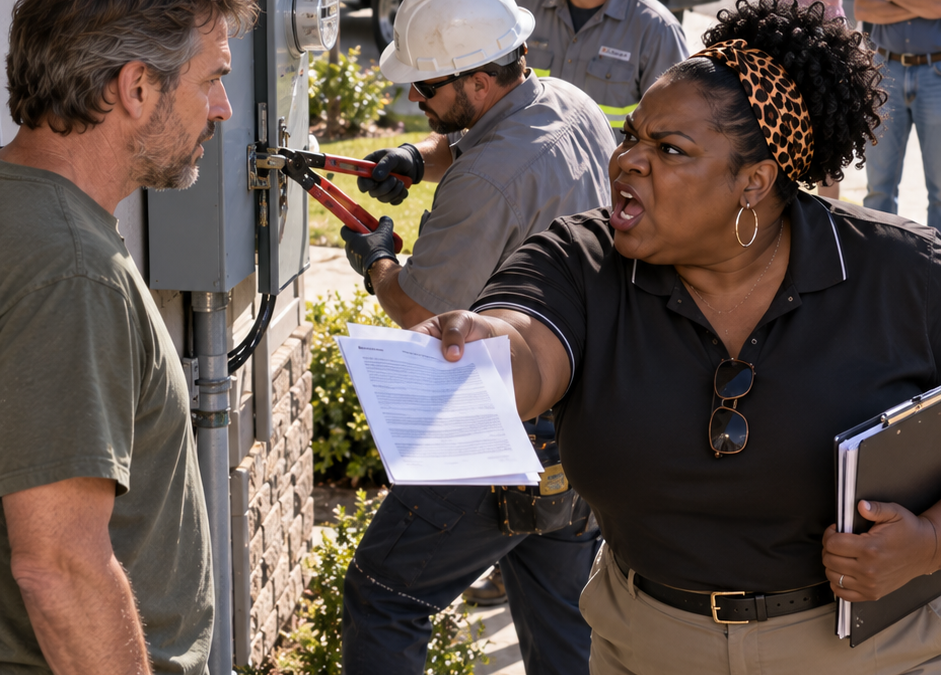
A woman in a Ridgecrest Meadows polo walked up my driveway carrying two sheets of paper. Margaret Chen had been HOA president for eighteen months, and she wore that title with the grim enthusiasm of someone who had finally found a job where politeness could be classified as optional.
She pressed the document against my chest with two fingers.
She did not hand it to me.
She delivered it the way a parking officer leaves a ticket under a windshield wiper.
“Work Order 2241,” she said. “The HOA owns all utility infrastructure serving this community. Your connections are noncompliant, and the board has authorized corrective action.”
I unfolded the pages.
My name.
My address.
My lot number.
FastCut Electrical listed as the contractor.
Margaret’s signature appeared above the HOA seal.
“Do they have a County Utility Commission permit?” I asked.
Margaret lowered her sunglasses just enough to look at me over them.
“We don’t need a county permit for internal HOA compliance work.”
She turned toward the supervisor.
“Continue.”
I looked at the two men.
“Before you touch that panel, I want the contractor’s full name and license information in writing.”
Margaret nodded toward the supervisor again.
That was her answer.
The cutters closed with a flat metallic pop.
The light I had left on in the kitchen went dark.
Three houses down, Eleanor Patterson’s garage door stopped halfway open. Its motor groaned once and fell silent.
Someone called from across the street.
A dog began barking.
Margaret did not flinch.
“You should have paid the fine,” she said. “The association has both the authority and the obligation to enforce community standards. This isn’t personal, Mr. Mills.”
I took out my phone.
I photographed the truck, the license plate, the contractor’s logo, the crew, Margaret’s polo, and every page of Work Order 2241.
Then I opened the notebook I kept in my truck and wrote down the time.
7:21 a.m.
I recorded her exact statements beneath it.
The HOA owns all utility infrastructure.
We don’t need a county permit.
Margaret watched me.
“Is there anything else?”
“No,” I said. “I think I have everything I need.”
By 7:29, the truck had left.
My house stood silent behind me. Eleanor’s garage door remained suspended over her car.
I held Work Order 2241 in both hands and thought about the fireproof cabinet in my office.
Inside it was a thirty-one-page franchise agreement granting Ridgecrest Power Services LLC the exclusive authority to own, operate, and maintain the electrical infrastructure serving all ninety-six homes in Ridgecrest Meadows.
I had founded that company in 1991.
My signature appeared at the bottom of the agreement.
Margaret thought she had cut power to a stubborn homeowner.
She had no idea she had just handed the owner of the power company written proof of who ordered it.
PART2
I went inside and sat at the kitchen table.
Without electricity, the house sounded different.
The refrigerator had stopped humming. The ceiling fan was motionless. Even the clock above the stove had gone blank.
Outside, neighbors stood in their driveways trying to work out why three homes had lost power at the exact moment an HOA contractor left my property.
I placed Work Order 2241 flat on the table and called my attorney.
Richard Callaway had represented Ridgecrest Power Services for twelve years. He was the kind of man who kept an empty desk because every piece of paper on it had to justify occupying the space.
He answered on the third ring.
“Richard, someone just disconnected an active service junction at my house.”
“Storm damage?”
“HOA work order.”
He was silent.
“They hired an outside contractor,” I continued. “FastCut Electrical. Two men came with bolt cutters. Margaret Chen personally ordered them to continue after I asked for a utility permit.”
“Is anyone hurt?”
“No.”
“How many customers are out?”
“At least three homes.”
“Do you have the work order?”
“I’m looking at it.”
“Signed?”
“In blue ink.”
“Photographs?”
“Truck, plate, crew, panel, document, Margaret.”
“Video?”
“Part of it.”
He exhaled slowly.
“Don’t touch the panel. Call operations. I’m coming over.”
My next call was to Dennis Rowe, my operations manager.
He had worked for me eleven years and possessed the rare ability to sound calm while already moving faster than everyone else.
“Our crew didn’t authorize work at fourteen Elmcrest, did they?” I asked.
“No.”
“FastCut Electrical just disconnected the junction at my panel.”
He paused.
“They touched our side?”
“Yes.”
“How many houses?”
“Mine and at least two neighbors.”
“I’ll isolate the circuit and send a licensed crew.”
He hung up before I could thank him.
That was Dennis.
The gratitude could wait until the electricity was safe.
Twenty-three minutes later, a Ridgecrest Power Services truck came around the corner. The technician removed the damaged lock, inspected the connection, verified the circuit, and restored service at 8:08.
The outage lasted forty-seven minutes.
Margaret would later describe those forty-seven minutes as a successful compliance action.
Dennis would describe them differently.
I founded Ridgecrest Power Services in 1991 with one truck, two employees, and more confidence than money.
I was twenty-nine years old and had spent most of my twenties working for a regional electrical contractor. I understood field work, permitting, infrastructure maintenance, and the difference between fixing a homeowner’s panel and touching a regulated distribution line.
What I did not understand was business.
I learned that part through mistakes expensive enough to remember.
Over thirty years, the company grew from residential service calls into a licensed regional utility provider. We developed and maintained distribution systems for communities too small or too remote to interest larger providers.
Ridgecrest Meadows was one of those developments.
The first franchise agreement was executed in 2008, before construction of the neighborhood had finished. It covered every distribution line, junction, transformer connection, service point, and meter installed to serve the development.
The agreement had been renewed in 2016 and remained active through 2031.
Our company owned or held exclusive franchise control over the infrastructure. The HOA maintained streets, landscaping, community spaces, and whatever else its governing documents properly assigned to it.
Electricity was not one of those things.
I knew the system better than anyone living in Ridgecrest Meadows because my people had built and maintained it.
When I stepped back from daily operations four years earlier, I moved into the neighborhood.
It was quiet, familiar, and close enough to the office that Dennis could still find me whenever he decided retirement was making me useless.
I did not advertise who I was.
My company name was on bills and service vehicles, but residents rarely examined the signature page of a franchise agreement before plugging in a toaster.
To my neighbors, I was Warren Mills, the semiretired man at number fourteen who trimmed his own hedge, drove an old truck, and occasionally disappeared for meetings downtown.
That suited me.
For the first two and a half years, Ridgecrest Meadows was exactly what I wanted.
Ninety-six houses.
Mature trees.
Children riding bicycles through sprinklers in summer.
Neighbors leaving tomatoes and squash on porches in August because every garden produced too much at the same time.
Then Margaret Chen ran for HOA president.
Her platform consisted of two words:
Property values.
She ran unopposed.
Nobody considered the office important enough to challenge her.
That was the first mistake the neighborhood made.
Within six months, Margaret introduced fourteen new standards.
Grass could not exceed three and a half inches.
Mailboxes had to match an approved palette.
Roof moss became grounds for mandatory remediation.
Vehicles had to park parallel within six inches of the curb.
Holiday decorations could appear no earlier than forty-five days before the applicable holiday and had to disappear within fifteen days afterward.
Garden ornaments could not exceed twenty-four inches.
Two board members who attended Margaret’s church joined her in the same uncontested election. They approved every proposal she presented.
One amendment passed so quickly that I doubted either man had finished reading the page before voting.
People complained quietly.
Nobody filed a formal challenge.
Margaret had made it clear that anyone questioning enforcement would receive more attention from enforcement.
It was an efficient system.
Fear performed most of the labor for free.
Eleanor Patterson lived three houses from me.
She was seventy-four, widowed, and retired from teaching elementary school.
Along the left side of her fence grew a row of pink roses planted the spring after her husband died.
They had bloomed there for eleven years.
Eight months into Margaret’s presidency, Eleanor received a $900 fine for keeping a nonapproved flowering species visible from the street.
She called the HOA office.
The woman answering told her to appeal in writing.
Eleanor explained that the roses had been there for over a decade.
Margaret’s response arrived four days later.
The former board’s failure to enforce the restriction did not grandfather an existing violation.
Pay the fine or the association would proceed toward a lien.
I found Eleanor standing in her driveway holding that letter.
She read the first page, turned it over, then returned to the first page as if repetition might rearrange the words into something merciful.
“Are you all right?” I asked.
She folded the letter too quickly.
“Oh, yes. Just HOA business.”
She attempted a smile.
I looked toward the roses.
“They’re fining you for those?”
Her smile disappeared.
“Nine hundred dollars.”
“That doesn’t make sense.”
“They said they can put something against the house.”
“A lien.”
Her face changed when I supplied the word.
“My house is paid for, Warren.”
“I know.”
“Can they take it?”
There was no honest answer I could give without reading the documents.
“They can threaten a great deal,” I said. “That doesn’t mean every threat is valid.”
She looked down at the letter.
“My husband planted the first one. The rest came later.”
I started keeping records that week.
At first, I told myself I was only helping a neighbor understand an unusually aggressive notice.
Then I heard about Tom Garza.
Tom lived across the street and had retired after thirty-five years as an electrician. He had the shoulders of a man who had carried ladders through narrow hallways most of his life and the patience of someone who had been asked whether flipping a breaker might help more times than he could count.
Margaret cited him twice.
He responded in writing both times, quoting the governing documents correctly.
Both appeals were denied without addressing the provisions he cited.
Tom did not frighten easily, but he understood systems. He recognized when the purpose of a process had changed from resolving problems to exhausting whoever questioned it.
Three weeks before my power was cut, he attended a board meeting and challenged Margaret’s claim that the HOA controlled neighborhood utilities.
“The lines aren’t association property,” he told her. “They’re operated under a private utility franchise.”
Margaret barely looked up.
“That was before my administration. Everything gets reviewed.”
“I’m telling you those lines are regulated.”
“And I’m telling you the board will review all infrastructure affecting community standards.”
The exchange lasted less than a minute.
The following week, she signed Work Order 2241.
The morning after the outage, Richard sat at my kitchen table with the work order enclosed in a clear evidence sleeve.
Dennis stood beside the panel outside while two senior technicians documented the damage.
Richard read Margaret’s statement twice.
“She really wrote that the HOA owns the utility infrastructure.”
“She said it too.”
“In front of the crew?”
“And half the street.”
He turned to the second page.
“FastCut’s license number is here.”
“Yes.”
He photographed it.
“Do you know their classification?”
“Not yet.”
“We will.”
I looked through the window.
Eleanor’s garage door was working again. She stood beneath it speaking with one of our technicians.
“You’re going to need to separate two things,” Richard said.
“What happened to the utility infrastructure and what Margaret has been doing to homeowners.”
“They’re connected.”
“Factually, yes. Legally, they may travel through different channels.”
He tapped the work order.
“This goes to the commission.”
Then he pointed toward the folder containing Eleanor’s fine.
“That may go somewhere else.”
“I want both documented.”
“They will be.”
He closed the evidence sleeve.
“What do you want to do now?”
“Nothing dramatic.”
“That’s a useful beginning.”
“I want every agreement, permit, plat, maintenance record, and service map covering Ridgecrest Meadows.”
“All of it?”
“All of it.”
Richard smiled faintly.
“I knew you weren’t retired.”
Three days after Margaret cut my power, I received a certified letter.
The first page was a notice of infrastructure noncompliance.
The second demanded $3,500.
That was not the original fine Margaret claimed I had refused to pay. This was a new “compliance action fee” covering the contractor she had hired to disconnect me.
She had sent an unqualified crew onto regulated infrastructure and then charged me for the privilege.
Behind the fine was a copy of a complaint she had filed with the county zoning office.
According to that filing, my property contained unauthorized utility modifications creating a potential danger to neighboring homes.
Every connection at my address was properly permitted.
My meter and service junction had been part of the licensed system since the house was built.
Margaret had manufactured a safety complaint from the language in her own violation notice, then submitted it to another agency in the hope that official letterhead would convert repetition into truth.
I photographed every page.
Then I placed the originals in a folder marked SEPTEMBER 14 INCIDENT.
Four days later, Margaret called a mandatory board meeting.
Residents received thirty-six hours’ notice.
The bylaws required forty-eight.
Twelve homeowners attended.
Eleanor sat near the aisle with her hands clasped in her lap. Tom took the chair behind me.
At the front, Margaret had arranged a photograph of my meter panel beside the fine notice and a printed excerpt she called the applicable CC&R provision.
She opened the meeting at precisely seven.
“On September fourteenth, the board took necessary action to address a documented infrastructure compliance issue at fourteen Elmcrest Drive.”
She indicated the enlarged photograph.
“The installation contained connections inconsistent with HOA infrastructure standards and posed a potential safety risk to neighboring homes. The board’s compliance contractor corrected the problem.”
I raised my hand.
Margaret recognized me with visible reluctance.
“Which section defines the utility connection standard you claim I violated?”
“The applicable documentation will be produced in any formal proceeding.”
“So you cannot identify the section tonight?”
“Our compliance team has reviewed the relevant provisions.”
“Which provision?”
“The fine stands, Mr. Mills.”
She moved on.
I let her.
Near the end, I asked one more question.
“Before you make additional filings with the county, do you know who owns the utility infrastructure serving this development?”
Margaret set down her notes.
“The HOA owns all common infrastructure in Ridgecrest Meadows. That is established by the CC&Rs.”
I wrote the statement in my notebook.
7:18 p.m., September 18.
After the meeting, she intercepted me in the parking lot.
The procedural tone was gone.
“You have thirty days to pay.”
Tom was beside his truck, near enough to hear.
“If you don’t,” she continued, “the board will file a lien against your property. Once it’s recorded, the matter can escalate.”
She adjusted her purse on her arm.
“I’ve done it before.”
“I’m sure you have.”
I opened my car door.
She waited as if expecting an argument.
I gave her none.
At 7:42, I photographed the dashboard clock.
Then I drove home and made two calls.
The first went to Richard.
“Start the clock,” I said.
The second went to Dennis.
“I want every Ridgecrest Meadows infrastructure record on my desk by Thursday.”
He did not ask how many.
He understood what all meant.
For the next two weeks, I listened.
I knocked on doors after dinner carrying coffee instead of a clipboard.
“How are things going with the HOA?”
The answers differed in details and matched in effect.
A retired couple on Birchwood Lane had paid $400 because their trash container remained visible forty minutes beyond the retrieval deadline.
A young family accumulated $1,200 in penalties over a basketball hoop.
The first notice concerned its location.
The second, its color.
The third cited a crack in the backboard photographed from the sidewalk without anyone knocking.
Seven families had received fines in eight months.
Two faced liens.
Most refused to let me write down their names.
“We can’t afford to become targets,” one woman whispered while standing in her doorway.
“You already received a fine.”
“That can become another fine.”
The Riveras had left in April.
They had lived in Ridgecrest Meadows three years. Their children attended the local school. They grew vegetables behind the house and gave away peppers every summer.
Margaret’s board accumulated $6,000 in fines against them over fourteen months.
Fighting required money they did not have.
They sold at a loss and moved.
The house stood empty six weeks before another family arrived.
On moving day, the new owners found a welcome packet containing a four-page compliance summary.
Margaret called that community stewardship.
It looked more like a warning label.
Eleanor noticed me going door to door.
On the third evening, she waited on her porch.
“Come inside,” she said.
Her kitchen table was covered in paper.
She had preserved every association communication received during her eleven years in the neighborhood.
Fine notices.
Meeting announcements.
Policy updates.
Appeal responses.
She grouped them by month with rubber bands.
“I keep things,” she said apologetically. “My husband used to tease me about it.”
“Don’t apologize.”
She pushed a shoebox toward me.
“I didn’t know what else to do.”
“You did exactly the right thing.”
We spent three hours sorting.
Four meeting notices violated the forty-eight-hour requirement.
Thirty-six hours.
Thirty-eight.
Thirty-four.
One gave residents only thirty-one.
A fine dated Friday cited a rule adopted at a board meeting earlier that same week.
The amendment had passed three to zero and was then applied to conduct already in progress.
The public financial statements showed fine revenue had more than tripled under Margaret. The money entered a general fund with no useful itemization showing residents how it was spent.
Eleanor watched me create separate stacks.
“Is that enough to matter?”
I looked at her roses through the kitchen window.
“It matters already.”
“I mean, can it stop her?”
“I don’t know yet.”
She appreciated the honest answer more than a promise.
“Take the box,” she said.
“I’ll return everything.”
“I know.”
Then she placed the $900 rose notice on top.
“That one stays first.”
Tom came to my door Thursday evening.
He remained on the porch.
“I want to tell you exactly what I told her.”
I took out my notebook.
He repeated the exchange from the board meeting.
He had identified the existence of the private franchise and warned Margaret that HOA rules did not authorize interference with regulated utility equipment.
Margaret said everything would be reviewed.
Then she issued the work order.
“I’ll testify,” he said. “Under oath, if necessary.”
“It will probably be necessary.”
“Good.”
He started down the steps, then stopped.
“Did she know who you were?”
“No.”
Tom looked toward my meter panel.
“Still doesn’t?”
“I haven’t told her.”
For the first time since the outage, he smiled.
“I wouldn’t rush.”
Richard’s written opinion arrived the next morning.
FastCut Electrical held a Class B residential contractor license covering ordinary repair, renovation, and standard panel work.
The work at my property required Class A utility authorization and prior commission approval.
FastCut held neither.
No isolation request had been submitted.
No coordination had occurred with our operations center.
No authorized utility representative had approved the work.
Richard’s conclusion was plain.
This was not merely a disagreement about community rules.
The facts supported investigation as unauthorized interference with regulated utility infrastructure.
I placed that opinion beside Eleanor’s shoebox.
One pile showed what Margaret had done to individual homeowners when nobody challenged her authority.
The other showed what happened when she extended that invented authority into a system governed by laws she had never bothered to learn.
I bought a second filing cabinet.
One drawer was labeled PATTERN.
The other was labeled VIOLATION.
By Sunday, both were nearly full.
The lien arrived Wednesday.
Lot 14.
Ridgecrest Meadows.
Warren Mills.
$3,500.
Recorded by the county.
A fraudulent claim can still interfere with property until it is challenged and removed. It can appear during a title search, complicate financing, and become the foundation for more aggressive collection efforts.
Margaret knew that.
A lien was not merely paperwork to her.
It was fear given a document number.
I placed it in the violation drawer.
Two days later, ninety-six letters went into ninety-six mailboxes.
The subject line read:
IMPORTANT COMMUNITY SAFETY NOTICE.
A neighbor called before my copy arrived.
“Warren, should we be worried about our electricity?”
“No.”
“The letter says your connections may endanger nearby houses.”
“They don’t.”
“It says the board may need additional action.”
“The system is safe. Ridgecrest Power restored the affected service and verified it.”
“Are you sure?”
“I am.”
My copy arrived the next morning.
Margaret had signed it in blue ink.
She claimed my property contained unauthorized utility connections presenting a potential safety risk. She described the September 14 disconnection as swift, responsible board action. She accused me of refusing to cooperate with a legitimate infrastructure process.
Every factual claim was false.
Every household received it.
I photographed both pages at 8:07 a.m. on September 26.
Then I created a third folder.
DEFAMATION.
The telephone rang for three days.
People wanted to know whether their insurance was affected.
Whether power could fail.
Whether my dispute might lower home values.
Whether they should call the county.
I kept my answers calm.
“The system is safe.”
“The outage was corrected.”
“The proper authorities have the records.”
One call came from the couple fined over the trash can.
The husband spoke softly.
“We have every notice they sent us.”
“Keep the originals.”
“Would copies help?”
“Yes.”
A pause.
“We never thought anyone would fight them.”
“I understand.”
“What should we bring?”
“Everything.”
Dennis arrived Saturday with a six-page incident report.
He sat at the table and pushed it toward me.
“I wanted the sequence exact.”
FastCut’s crew had opened an active primary service junction without commission authorization, required safety paperwork, or coordination with our control center.
The interruption affected three homes for forty-seven minutes.
The method used created a risk to a twelve-home circuit.
Dennis tapped the second page.
“If they had moved six inches farther into the secondary side, we could have lost the full branch.”
“For how long?”
“Depends on the damage. In September heat, longer than anybody would have enjoyed.”
“Fire risk?”
“Possible arcing if they made the wrong contact. We were lucky.”
I read the report three times.
The third time, Dennis sat beside me while I asked questions.
With every answer, the morning became less like an HOA argument and more like what it had been from the beginning.
An unauthorized person had directed an unqualified crew to interfere with electrical infrastructure serving homes occupied by real families.
Margaret had treated electricity as another mailbox color.
Richard arranged a meeting with Patricia Okafor, a utility-law specialist who had appeared before the County Utility Commission fourteen times.
She reviewed our evidence in a conference room overlooking a parking garage.
The franchise agreement came first.
Then the plats.
Work Order 2241.
FastCut’s license.
Dennis’s report.
The lien.
Margaret’s neighborhood letter.
Patricia read quietly, making notes in narrow handwriting.
Finally, she looked up.
“This goes to the utility commission before county civil court.”
Richard nodded.
“And depending on the findings?”
“The district attorney.”
She turned to me.
“How long has your company held this franchise?”
“Fifteen years.”
“And you live in the development?”
“For four.”
She glanced at Margaret’s signature.
“Did she conduct any ownership search before ordering the work?”
“Not that we can find.”
“Was she warned?”
“Tom told her directly three weeks earlier.”
Patricia looked at Richard.
“That testimony matters.”
We listed the issues.
Unauthorized work on regulated infrastructure.
An improperly licensed contractor.
No commission approval.
No system coordination.
A false lien based on authority the HOA did not possess.
Written safety allegations distributed to all ninety-six homeowners.
Patricia placed both hands on the table.
“Do you want the fastest settlement or a complete administrative record?”
“A complete record.”
“That takes longer.”
“I’ve been building things meant to last for thirty years.”
She nodded once.
That afternoon, Richard filed the commission complaint.
The submission included the franchise documents, permits, plats, technical incident report, work order, contractor licensing records, lien, correspondence, and Margaret’s community letter.
The commission classified it as a critical-infrastructure interference matter and scheduled review.
Margaret did not yet know the hearing was coming.
She was still preparing another presentation.
Sixty-three homeowners attended the next HOA meeting.
It was the largest turnout anyone remembered.
People filled the folding chairs, lined the walls, and remained standing near the door.
Eleanor sat three seats from me with her handbag in her lap.
Tom stood along the back wall.
Margaret occupied the front table between her two board members. Behind them, a projector slide read:
COMMUNITY STANDARDS ENFORCEMENT UPDATE.
She began with September 14.
The board, she said, had acted under Section 12 to correct dangerous infrastructure violations at fourteen Elmcrest Drive.
The homeowner had received notice.
A licensed contractor had performed the work.
The action protected every home in Ridgecrest Meadows.
She clicked to the next slide.
My meter panel filled the screen.
Beside it appeared Work Order 2241.
“The homeowner has refused to cooperate,” Margaret said. “He has declined to pay the assessed fee. The board has therefore recorded a lien against the property.”
The word lien moved through the room in whispers.
“If compliance is not achieved, the association is prepared to pursue all available remedies, including foreclosure.”
She said it as casually as a person listing steps in a recipe.
A man near the front raised his hand.
It was the husband from Birchwood Lane.
“What specifically was wrong with his electrical connection?”
“Our compliance contractor documented multiple deviations.”
“Which ones?”
“They will be presented in any formal proceeding.”
“Can you give us the CC&R section?”
“The board has already reviewed the applicable provisions.”
He tried to continue.
Margaret moved to her next slide.
Her two board members nodded.
They had been nodding from the beginning.
I looked at Eleanor.
She was watching them with the recognition of someone seeing her own experience repeated on a larger screen.
The presentation lasted eighteen minutes.
At the end, Margaret looked at me.
“Mr. Mills, does the homeowner wish to respond?”
I stood.
My folder remained closed on the chair.
Sixty-three people looked toward me.
“Thank you for the meeting, Mrs. Chen. I have one question.”
Her expression tightened.
“Who do you believe supplies electricity to every house represented in this room?”
A small change passed across her face.
Not fear.
Recalculation.
“That is not relevant to tonight’s agenda.”
“I believe it will become relevant very soon.”
I sat down.
Whispers spread through the room.
Margaret held my gaze.
Then she called for a vote.
Should the association pursue additional legal action against the owner of fourteen Elmcrest Drive?
First board member: yes.
Second board member: yes.
Margaret: yes.
Three to zero.
She gathered her papers with a satisfied smile.
I picked up my unopened folder and walked out.
In the parking lot, I called Richard.
“The commission confirmed October nineteenth,” he said. “Priority status.”
“When will she receive notice?”
“Certified mail should reach her Tuesday.”
Inside the clubhouse, Margaret was still telling people she had protected their property values.
By Tuesday, she would need counsel familiar with something more serious than grass height.
The County Utility Commission hearing room was smaller than I expected.
Three commissioners sat behind a rectangular table.
A court reporter occupied one corner.
Fourteen chairs had been arranged for observers.
Fluorescent lights hummed overhead.
Tom took a seat beside Eleanor.
Margaret sat at the respondent’s table with a young attorney in a gray suit. He rearranged the same stack of papers three times before proceedings began.
Richard sat beside me.
Patricia occupied the chair on his other side.
Commission Chair Gerald Foss opened the matter and confirmed the participants.
Richard stood.
He did not give a speech.
He placed one document in front of Foss.
Thirty-one pages.
County seal.
Executed in 2008.
Renewed in 2016.
Active through 2031.
Foss put on his reading glasses.
For ninety seconds, the only sounds were turning pages and the lights above us.
Then he removed his glasses.
Commissioner Elaine Marsh leaned toward her microphone.
“For the record, is the owner of Ridgecrest Power Services present?”
Richard gestured toward me.
“Yes,” I said. “I am.”
Marsh looked at me.
Then at Margaret.
Then back at me.
She wrote down my name slowly.
Margaret’s attorney leaned close and whispered something to her.
Foss folded his hands.
“This agreement identifies Ridgecrest Power Services LLC as the sole licensed franchise provider serving the Ridgecrest Meadows development. It grants the company exclusive authority over the electrical distribution infrastructure covered by the agreement.”
He tapped the document.
“Mrs. Chen, did you sign a work order authorizing an outside contractor to alter part of that infrastructure?”
Her attorney spoke quietly into her ear.
“The board acted pursuant to its authority under the CC&Rs,” Margaret replied.
Foss’s voice remained level.
“That was not my question.”
The room became still.
“Did you authorize a contractor to disconnect an electrical service point governed by this franchise?”
Margaret looked down at Work Order 2241.
“We were unaware of the franchise agreement.”
Foss turned one page.
“The record indicates that a retired electrician informed you of a private utility franchise approximately three weeks before the work order was issued.”
Her attorney placed a hand lightly on her forearm.
Margaret said nothing.
Richard presented the recorded plat.
Every line.
Every junction.
Every service point.
He showed that the infrastructure FastCut touched sat on private property and within Ridgecrest Power’s exclusive licensed system.
It was not HOA common property.
The third exhibit was FastCut’s license.
Class B residential.
No authority for regulated utility-line work.
No commission approval.
The fourth was Work Order 2241.
Margaret’s signature.
The association seal.
FastCut named as contractor.
My name and address.
Instructions authorizing the disconnection.
Foss looked from the document to Margaret.
Before he could speak, one board member leaned toward his microphone.
“We voted based on the information Mrs. Chen gave us.”
Margaret turned toward him.
He avoided her eyes.
“We weren’t told about the franchise.”
The second board member nodded.
It was not courage.
It was distance.
They had realized Margaret’s authority no longer protected them, so they began moving away one inch at a time.
Richard introduced Dennis’s incident report.
“Three homes lost power for forty-seven minutes,” he said. “The method used placed a twelve-home branch at risk of a broader failure.”
Commissioner Marsh stopped writing.
“Twelve homes?”
“Yes.”
“Was the contractor qualified to perform the isolation?”
“No.”
“Did the franchise operator receive notice?”
“No.”
“Was there commission approval?”
“No.”
Each answer landed separately.
Foss called Tom.
Tom gave his name, address, and work history.
“Did you warn Mrs. Chen that the HOA did not own the utility infrastructure?” Foss asked.
“Yes.”
“What did you tell her?”
“That the lines were controlled under a private franchise. I told her the HOA had no authority to direct work on them.”
“Her response?”
“She said, ‘That was before my administration. Everything gets reviewed.’”
“What happened next?”
“She signed the work order the following week.”
Tom stepped down.
Eleanor rose from her chair.
“I would like to say something.”
Foss explained that the hearing concerned utility infrastructure.
“I understand,” she said. “But what happened to Mr. Mills was not the first time this board invented authority.”
Richard looked at me.
I nodded.
Foss allowed her five minutes.
She used four.
She described the roses.
The $900 fine.
The retroactive rule.
The lien threat.
The afternoon she stood alone in her driveway wondering whether flowers planted after her husband’s death could somehow cost her the home they had shared.
Nobody interrupted.
Margaret stared at the table.
When Eleanor finished, Commissioner Marsh was no longer taking notes.
She was simply listening.
The final exhibit was Margaret’s community safety letter.
Ninety-six copies.
Signed in blue ink.
False claims about unauthorized connections.
False claims about safety hazards.
Richard placed it beside the franchise agreement, plat, contractor record, work order, and incident report.
Five documents in a row.
Margaret’s attorney cleared his throat.
“The association acted in good faith based on its understanding of the governing covenants.”
Foss studied him.
“The commission is referring this matter to the county district attorney for review of potential criminal utility tampering arising from the September fourteenth incident.”
The attorney’s face changed.
Foss continued.
“The lien recorded against Mr. Mills’s property is suspended and deemed unenforceable pending completion of the investigation. The commission is opening a formal inquiry into the authorization and performance of all work under Work Order 2241.”
He looked directly at Margaret.
“Mrs. Chen, you should retain separate counsel regarding the criminal referral. The attorney appearing with you today handles civil association matters.”
He allowed a brief silence.
“This is no longer a routine HOA compliance dispute.”
The gray-suited attorney began closing his briefcase.
Margaret remained seated with both hands flat on the table.
An hour earlier, she had entered the room believing she was the authority.
Now a county commissioner had advised her that the person beside her was the wrong kind of lawyer.
She said nothing.
I spoke eleven words during the hearing that mattered.
“Yes. I am the owner of Ridgecrest Power Services LLC.”
The documents did everything else.
Outside, the October air felt clean.
Tom held the door for Eleanor.
She thanked him.
He said something I could not hear, and she laughed.
It was the first time I had heard that sound from her since the rose notice arrived.
Richard joined me on the steps.
“You all right?”
“I expected to feel better.”
“You will.”
“When?”
“When the record begins changing what happened outside that room.”
He was right.
Consequences arrived quietly.
Not as one dramatic collapse.
As letters, calls, filings, refunds, corrected records, and people learning that the authority they had feared was smaller than it pretended to be.
Three weeks after the hearing, the district attorney filed charges against Margaret.
One count related to criminal utility tampering.
Another concerned the fraudulent lien.
FastCut Electrical’s contractor license was suspended pending investigation.
The company faced separate civil exposure for performing unauthorized work on active franchise infrastructure.
The interim HOA obtained a new legal opinion.
It was direct.
The CC&Rs never granted the association authority over regulated franchise utilities.
State utility law and the franchise agreement controlled those systems.
Every infrastructure fine, work order, and lien issued under Margaret’s invented program was void.
The $3,500 lien against my property was dissolved and expunged.
The notice reached me on a Friday.
I placed it in the violation drawer.
For weeks, that cabinet had felt like a weapon I was assembling because nobody else would protect us.
Now it felt like an archive.
Its work was nearly finished.
The HOA’s insurer paid $14,200 in legal fees.
The check came by certified mail.
I found that appropriate.
There was also the utility agreement.
When I moved into Ridgecrest Meadows, Ridgecrest Power Services had quietly continued a below-market community rate as a goodwill gesture.
I had never announced it.
Residents did not know they were receiving it.
After the commission findings, the interim board negotiated the next service period at the current market rate.
I did not extend the discount again.
They did not ask.
That was not revenge.
A utility contract had to support the people maintaining the system.
Goodwill could not survive indefinitely where one side believed it included the right to send bolt cutters.
Margaret settled her personal defamation exposure outside court.
The terms remained confidential.
Patricia described the figure only as substantial.
I did not ask for more.
The written retractions mattered to me more than neighborhood speculation about a number.
All eleven infrastructure-related liens issued during Margaret’s administration were reviewed and voided.
Affected fines were refunded.
The Riveras were contacted.
I never learned exactly what the association offered them or whether it could compensate for selling a home they had not wanted to leave.
Money could repay fines.
It could not give their children those months back or restore the garden another family now tended.
I hoped the call at least told them they had not been wrong.
Eleanor received a check for $900 and a written apology.
She called me.
“They apologized for the roses.”
“In writing?”
“Yes.”
“Keep it.”
“I’m keeping the roses too.”
“I assumed you would.”
She became quiet.
Then she began to cry.
Not loudly.
The tears came like something she had held in place for eighteen months had finally been given permission to fall.
I stayed on the telephone.
There was nothing useful to say.
When she was ready, she thanked me and hung up.
The homeowners handled the board more quickly.
Forty-four residents signed a petition for an emergency recall meeting.
The final vote was seventy-one to two.
Margaret was removed by a margin large enough to end every claim that a noisy minority had caused the trouble.
Her two board allies resigned before the count became official.
Their resignations saved them from sitting at the table afterward.
It did not remove their votes from the minutes.
The interim board issued a three-page apology to every resident affected by the infrastructure compliance program.
It identified the invalid actions specifically.
No vague regret.
No sentence claiming mistakes had been made by nobody in particular.
Tom Garza won a board seat through forty-one write-in votes.
He called me that evening.
“I wasn’t running.”
“I know.”
“I didn’t ask anyone to write my name.”
“That may be why they did.”
He sighed.
“What am I supposed to do now?”
“Read everything before you vote.”
“I already do that.”
“Then you’re ahead of the last board.”
The community social-media group changed administrators within forty-eight hours.
Margaret had used it to delete criticism.
Under the new administrator, thirty-four posts appeared on the first day.
Fine letters.
Photographs.
Appeals.
Stories people had kept inside their homes because isolation had made each family believe its experience was unique.
Someone posted a photograph of the Riveras’ old vegetable garden.
Forty-seven people responded.
I read most of the comments.
Then I closed the application.
I had spent enough of my life reading what fear had made people hide.
Six weeks after the hearing, a county utility inspector arrived at my house.
The visit was standard after a reported interference incident.
He was young, efficient, and uninterested in conversation.
He inspected the panel housing, checked the seals, measured the connection, compared readings, and photographed the certification marks.
I watched from the porch with coffee.
Then he reached the service documentation.
He read the company name.
Looked at the panel.
Looked at me.
“Ridgecrest Power Services?”
“Yes.”
He checked the name on his paperwork.
“Are you Warren Mills?”
I lifted my coffee.
“Just a homeowner.”
For a moment, he seemed unsure whether I was joking.
Then he nodded, stamped the inspection form, and pressed a fresh certification sticker onto the panel.
County seal.
Date.
Signature.
He packed his equipment and drove away.
I set my cup on the railing and walked over.
The panel looked almost exactly as it had before September 14.
Gray housing.
Tamper-evident seals.
Utility identification.
The only visible difference was the new certification sticker.
I placed my palm against the metal.
A faint vibration moved through it.
Current running through infrastructure my employees maintained.
Through ninety-six kitchens, bedrooms, garages, and living rooms.
Through Eleanor’s house, where her garage door now opened all the way and her roses remained beside the fence.
Through Tom’s house, where a retired electrician sat reading board documents no president would ever again be allowed to wave past him unread.
Through homes whose owners had spent eighteen months being told that fear was the same thing as community order.
The panel hummed steadily beneath my hand.
I had not built a utility company to fight an HOA.
I built it to keep lights on.
For thirty years, that had been the job.
Margaret believed cutting my power would teach one homeowner to surrender.
Instead, she created the first document in a record that exposed everything her board had been doing.
I returned to the porch, picked up my coffee, and looked along the street.
Garage doors opened.
Kitchen lights glowed behind windows.
A basketball hoop stood at the far end of a driveway, cracked backboard and all.
Three houses down, Eleanor was trimming her roses.
The neighborhood had power.
For the first time in eighteen months, it also had people willing to question who claimed to control it.








