𝗙𝗨𝗟𝗟 𝗦𝗧𝗢𝗥𝗬 The HOA Hated My Propane Tank, but Nobody Asked Why Forty-Seven Homes Were Connected to It
𝗣𝗔𝗥𝗧 𝟮
I could have told her everything then.
I want to be honest about that.
I have replayed that afternoon enough times to know exactly where the conversation could have changed.
I could have pointed behind the arborvitae.
I could have said:
There is a distribution line under your streets, and it starts right there.
Nine words.
Maybe ten depending on how you count.
Instead, I told her the technically correct thing.
“My property predates Cedar Hollow and is not governed by its architectural covenants.”
Celeste heard the sentence as resistance.
She explained that Cedar Hollow had spent years developing a cohesive community identity.
She talked about appraisal values.
Southern sightlines.
Visual clutter.
She said she was certain a reasonable man would want to be part of a reasonable solution.
“What solution?”
“Screening. Relocation. Ideally removal.”
She suggested I contact my propane company and have the tank taken away.
I told her again that it served my house and shop.
She said “shop” with slightly more tolerance than she had said “business.”
Then she thanked me for my time and left.
Two days later, I saw her at the neighborhood mailbox cluster with Tessa Monroe.
Tessa was another board member.
Tall.
Quiet.
Bookkeeper by profession.
Usually wore reading glasses pushed into her hair.
Celeste saw me and smiled.
“Nolan. I was just telling Tessa you’re going to help us with the tank situation.”
Tessa turned.
“Oh. Good.”
“I didn’t say that.”
Celeste laughed lightly.
“We discussed solutions.”
“You discussed solutions.”
Tessa looked uncomfortable.
“What about a fence?” she asked. “Could you just screen it?”
Celeste answered before I could.
“A fence would draw even more attention to it.”
I stood there holding my mail while two women planned improvements to property neither one owned.
I said nothing.
On the walk back to my house, I wondered whether that silence was discipline or cowardice.
I still do not know.
A week later, the first official letter arrived.
Cream-colored envelope.
Association name printed in an ornate font that looked expensive enough to have required a committee.
Inside was a single-page violation notice.
The heading was bold.
UNAUTHORIZED PROPANE STORAGE SYSTEM.
Four findings followed.
Each cited language from the Cedar Hollow Declaration of Covenants, Conditions, and Restrictions.
The final paragraph gave me fourteen days to comply.
The problem was simple.
Those covenants did not govern my parcel.
I read the notice standing in the driveway.
Then read it again at the kitchen table.
The second page contained the fines.
Five hundred dollars immediately.
Then one hundred dollars per day after the cure period until the tank was removed or approved by the architectural review committee.
At the bottom was a checkbox offering me permission to apply for retroactive approval.
Seventy-five-dollar filing fee.
Nonrefundable.
I sat there with a pencil and calculated how quickly the daily fines would grow.
The number became uncomfortable very fast.
Then I realized that was the entire point.
The number was supposed to hurt before the paperwork did.
That evening, I wrote back from my shop computer.
Three sentences.
My parcel is outside the platted Cedar Hollow boundary.
My property is not subject to HOA architectural jurisdiction.
I would gladly provide the county parcel identification number if the board wanted to verify either statement.
Celeste replied within an hour.
The board, she wrote, had already reviewed the matter and disagreed with my “characterization.”
Benefit and burden ran together within a planned community.
She hoped I would not force the association to escalate.
Nothing in the message addressed the parcel number.
Nothing addressed jurisdiction.
Nothing addressed ownership.
I printed it.
Put it inside a manila folder.
Wrote the date on the front.
A man who works with pressure systems learns to recognize when pressure is building even while everybody claims conditions are stable.
The following Saturday, Celeste returned.
This time Graham Pike came with her.
Graham worked for the management company hired by Cedar Hollow.
He was in his fifties.
Heavyset.
Tired eyes.
Polo shirt with the company logo.
Clipboard tucked under one arm.
He had the exhausted posture of a man whose professional life consisted of carrying messages between people who hated one another.
I met them at the gate.
Celeste said she wanted a real conversation.
Neighbor to neighbor.
Then she spoke for nearly six minutes without letting me get a sentence in.
Community standards.
Safety.
Image.
Consistency.
Property values.
Professional management.
When she finally stopped, she said the line I remembered most clearly afterward.
“You live next to Cedar Hollow. You benefit from what Cedar Hollow is worth, and you cannot simply do whatever you want out here.”
“Did you pull the parcel map?”
She looked annoyed.
“I don’t need a map to see your tank sits next to the subdivision.”
Graham shifted.
His eyes moved toward the arborvitae.
Not toward the visible white side of the tank.
Toward the ground below it.
I noticed.
At the time, I did not understand why.
Celeste asked how much fuel the tank held.
“One thousand gallons.”
She wrote it down.
The way she moved the pen made it feel like a confession.
“Is it inspected?”
“Every year.”
“By whom?”
“A licensed technician.”
“Documented?”
“The inspection log is inside that regulator cabinet.”
I pointed.
“You can read it from your side of the fence anytime.”
Then she turned toward Graham.
“Could we just hire someone to remove it if he refuses?”
Graham’s mouth tightened.
“We would need to verify ownership and access.”
Celeste laughed.
“Ownership isn’t complicated. It sits against a managed community. Communities have remedies.”
That was when I said something I meant only as advice.
“I wouldn’t recommend doing that.”
Celeste’s whole posture changed.
She heard lawsuit.
That was a language she understood.
“The association has counsel on retainer.”
“I know.”
“I am not intimidated by somebody because he drives a work truck.”
I looked at her white crossover.
Then at my truck.
“All right.”
She left thinking she had won the exchange.
I went back into my shop.
There was still time to explain everything.
I did not.
Not because I had some secret strategy.
Not because I was trying to trap her.
I simply could not get past the fact that she had shown up twice, mistaken me for hired help, treated my tank capacity like evidence of wrongdoing, refused to examine a parcel map, and asked her manager whether strangers could dismantle my equipment while standing eight feet from me.
So I went back to work.
The fines kept accumulating.
A man named Doyle Hurst stopped by later that week.
Doyle lived in the second house uphill from my boundary.
We were not close friends, but he had helped me pull a transmission once when rain started halfway through the job.
That counts for something.
“Heard they’re fining you,” he said.
“So have I.”
“For the tank?”
“Apparently.”
He shook his head.
“Half that board is scared of Celeste.”
Then, as he was leaving, he turned.
“You know anything about water heaters?”
“Some.”
“Mine keeps cutting out when it’s cold. Pilot doesn’t seem happy.”
“That sounds like upstream pressure or regulation.”
“You know somebody?”
“I can look if your supplier gives you trouble.”
“Appreciate it.”
He drove away.
Neither of us said where his fuel came from.
Doyle did not know.
And I still had not decided how much I was responsible for teaching people who had spent fifteen years benefiting from something without asking who maintained it.
Six weeks passed.
By mid-February, my balance reached $4,800.
The management company mailed me an itemized ledger.
Every day had its own row.
Date.
One hundred dollars.
Date.
Another hundred.
Two pages of penalties marching downward like a hospital fever chart.
The accompanying demand letter was worse.
Cease all use of the propane storage system.
Disconnect and cap associated piping.
Remove commercial equipment from the property-line area.
Provide an association agent access to the rear of my parcel for inspection.
That was the moment the problem changed.
Until then, they had mostly been trying to make me remove something ugly.
Now they were ordering me to stop operating it.
I went to the next board meeting.
Not because I paid HOA dues.
I did not.
Not because I had voting rights.
I did not.
I went because the posted agenda included an item called:
FUEL STORAGE NONCONFORMITY — SOUTHERN BOUNDARY.
That meant me.
The clubhouse smelled like carpet glue and coffee.
About thirty residents sat in folding chairs.
Three board members were behind a card table.
Graham sat off to one side with a laptop.
I took the back row.
Tessa saw me.
Gave me a small nod.
When my agenda item came up, Celeste stood.
Nobody else had stood all evening.
She told the room the association had been patiently working with the owner of the adjacent property for more than two months.
She described my place as “a makeshift commercial fuel operation directly against a residential community.”
She said she had personally documented one thousand gallons of propane stored within a few hundred feet of family homes.
Insurance exposure.
Resale comparables.
Southern property values.
Then she said the association had exhausted informal remedies and would move toward a lien and legal action if I continued refusing compliance.
Finally, her voice softened.
“I respect people who work with their hands. I truly do. But Cedar Hollow is a professionally managed community. It cannot function if everyone simply decides to make up his own rules.”
I sat there listening to thirty neighbors being told who I was.
There is a particular kind of anger that does not feel hot.
It feels cold.
Useful.
When the open-comment period began, I raised my hand.
Celeste smiled.
“Nolan.”
Like we were friends.
“Has the board obtained a formal legal opinion establishing jurisdiction over my parcel?”
“Our counsel is comfortable with our position.”
“That wasn’t my question.”
She smiled.
I continued.
“Has the board found any recorded instrument giving Cedar Hollow an ownership interest in the tank, regulator station, or fuel line on my property?”
“That is not the issue before the board.”
“All right.”
I leaned forward.
“Are you directing me to stop using the tank?”
“We are directing you to comply.”
“I need a specific answer.”
A few heads turned.
“Is Cedar Hollow directing me to cease operation of the propane system on my property?”
Celeste laughed slightly.
“The directive has been in writing for weeks.”
“I’d like the answer stated aloud for the minutes.”
She stared at me.
I asked a third time.
“Celeste, is the association ordering me to stop operating the propane system?”
She looked around the room.
At everyone watching.
Then back at me.
“Absolutely.”
Graham Pike stopped typing.
That mattered.
I watched his hands leave the keyboard.
He leaned back.
And for the first time, he looked at me not like another angry homeowner adjacent to one of his accounts.
He looked at me like I had asked a question he understood much better than Celeste did.
I left the meeting knowing there was something underneath the paperwork I had not found yet.
The following morning, I went to the county records office.
The building was a flat brick rectangle with a parking lot that flooded every spring.
A clerk named Naomi Brooks helped me.
I gave her my parcel number.
“I need anything recorded against this land involving fuel, utilities, easements, licenses, pipelines. Go back as far as you need.”
“How far?”
“Far enough that whoever signed it is probably retired.”
She brought me bound volumes.
Microfilm.
Loose recorded instruments.
A gray archival box.
At eleven, she brought me coffee without asking.
The first day produced nothing.
I came back.
The second day, I found it.
Not where any sensible person would have filed it.
Buried inside a supplemental exhibit attached to a utility dedication from the year Cedar Hollow’s first phase was platted.
The title was painfully boring.
TEMPORARY COMMUNITY PROPANE DISTRIBUTION LICENSE.
I read it once.
Then again.
Then a third time with my finger under each sentence.
The original Cedar Hollow developer, Harrogate Land Partners, had a problem.
They had houses framed.
Closings scheduled.
Families ready to move in.
But the natural gas extension they had promised buyers was still years away because of permits and construction delays.
They needed heat.
So they approached Adele Barlo.
Adele was the widow who owned my property before me.
She kept goats.
Apparently did not care what anybody thought about sightlines.
Harrogate negotiated a license allowing it to install a bulk propane tank on her land.
A regulator station beside it.
A buried distribution line running uphill into the first two phases of Cedar Hollow.
In return, Harrogate paid an annual land-use fee.
It agreed to inspection costs.
Maintenance costs.
Repair costs.
And Adele kept ownership.
Tank.
Regulator.
Hardware.
Land.
Harrogate had tried to buy the whole thing.
She refused.
So they licensed it.
Then I reached paragraph nine.
I read it four times.
If the using party obstructed inspection, refused required maintenance, disputed the landowner’s ownership, or directed the landowner to cease operation, the landowner could suspend service upon reasonable written notice to limit liability.
The owner would not be responsible for interruptions resulting from that suspension.
I leaned back in the plastic chair.
Then I laughed.
One short sound.
Naomi looked up from her desk.
“You find it?”
“I think I found the whole winter.”
I paid for certified copies.
On the drive home, the folder sat in my passenger seat.
At red lights, I kept touching it.
Here is what those papers meant.
I did not own the propane inside Cedar Hollow’s houses.
I did not own their appliances.
Their meters.
Their furnaces.
The supplier controlled deliveries.
But I owned the tank.
The regulator station.
The concrete piers.
The ground.
The first hundred feet of line.
And the master shutoff.
The brass handle controlling every gallon moving toward phases one and two sat eleven steps from my fence.
On my land.
I owned the throat.
That night, I counted houses against the old service drawings.
Forty-seven.
Forty-seven of Cedar Hollow’s sixty houses still depended on that original propane leg.
Every house on Larch Bend.
Every house on Cedar Hollow Court.
The even-numbered side of Thistle Row.
The thirteen newer homes at the top had a different system installed by a later builder.
Celeste lived in one of those thirteen.
Her house would not notice if my valve was open or closed.
Doyle’s would.
The retired teacher’s would.
The young couple with the baby would.
The clubhouse furnace would.
The pool heater Celeste had argued about for three meetings would.
That was why I did not shut anything down.
I could have.
The paper was sitting in front of me.
But those forty-seven households had not fined me.
Doyle had helped me in the rain.
One woman on Larch Bend brought me tomatoes every August.
The young family on Thistle Row had a baby.
Whatever Celeste believed about me, I was not going to become the man who used their furnaces as leverage.
So I gave the association one more chance.
I wrote a one-page letter.
Copied the full board.
Copied Graham.
I acknowledged their written order directing me to cease operating the propane system.
I asked them to rescind the $4,800 in assessments because my parcel lay outside Cedar Hollow.
I asked whether the association claimed ownership of the tank, regulator station, or distribution line.
If so, please identify the recorded instrument.
I offered a joint inspection with a licensed technician.
I offered to negotiate a renewed access and maintenance agreement.
I gave them ten business days.
Celeste replied before eight the next morning.
Two sentences.
The association would not negotiate with me concerning a violation.
Further correspondence should go to counsel.
No answer about ownership.
No answer about inspection.
No answer about the line.
So I wrote one more sentence.
Please confirm that Cedar Hollow Homeowners Association is directing me to cease operation of the propane system located on my property.
Eleven minutes later, the answer came.
Confirmed.
Celeste Whitaker, President.
I printed it.
Then I called Reed Callahan.
Reed had handled my property closing years earlier.
He is the kind of attorney who can become genuinely excited by a badly written easement.
I brought him everything.
Certified license.
Parcel map.
Fine ledger.
Demand letter.
Meeting notes.
Emails.
Celeste’s confirmation.
We laid them out across his conference table.
He read the license.
Paragraph nine.
Then her one-word reply.
He removed his glasses.
“What do you want?”
“The fines gone.”
“Reasonable.”
“My property left alone.”
“Also reasonable.”
“And the system handled properly.”
He leaned back.
“We can file for declaratory relief.”
“How long?”
“Could be eighteen months.”
“How much?”
“Forty thousand if everybody behaves.”
I stared at him.
He smiled without humor.
“Litigation is efficient at only one thing.”
“Billing?”
“Exactly.”
Then his expression changed.
“Do not turn this into revenge.”
“I wasn’t planning to.”
“Good.”
He watched me.
“What are you planning?”
I slid the license toward him.
Put my finger on paragraph nine.
Then on Celeste’s message.
“I plan to do what they ordered me to do.”
Reed said nothing for a moment.
Then he asked, “Who is your propane technician?”
“Warren Hale.”
“Good.”
“You know him?”
“I know his reputation.”
Reed tapped the paper.
“Don’t touch that valve without him.”
Warren Hale was sixty-three, half deaf in his right ear, and one of the few people left who had actually worked on Cedar Hollow’s original system.
He spent nineteen years with the regional propane company Harrogate had hired.
He had helped install the tank.
I met him at a diner off the state highway.
Put the license beside his breakfast.
He read paragraph nine while his eggs got cold.
Then tapped the page with his fork.
“I always wondered when somebody would find this.”
“You knew?”
“Knew there was a license. Didn’t remember the details.”
“Who owns the hardware?”
“Looks like you.”
“Did the association ever buy it?”
“I assumed they had years ago.”
“They didn’t.”
Warren stared at me.
“Who told you to shut it down?”
I slid Celeste’s confirmation across the table.
He read it.
Then sat back.
“Well.”
“That bad?”
“No.”
He thought.
“That stupid.”
We spent two hours talking through what a safe suspension required.
Closing the master valve itself was easy.
The houses would not explode.
Nothing dramatic happened when a properly installed propane distribution leg lost supply.
The danger came later.
Once pressure dropped, pilot appliances extinguished.
If someone restored pressure incorrectly without verifying appliance valves and relighting systems, you could create dangerous conditions.
Reopening the system was the serious part.
Every affected structure needed technician supervision.
Pressure checks.
Relights.
Safety verification.
“No responsible person shuts forty-seven houses without warning,” Warren said.
“I agree.”
So we built the warning.
Reed drafted it.
Warren corrected the technical language.
I signed.
Two and a half pages.
Boring.
Specific.
Safe.
The notice identified the equipment.
The parcel.
The recorded license.
It quoted the association’s order.
Quoted Celeste’s confirmation.
Cited paragraph nine.
It stated that service would be suspended eight days later at 9:00 Monday morning.
A licensed technician would conduct the shutdown.
All forty-seven affected addresses appeared in an attachment.
Restoration would require inspection followed by technician-controlled repressurization and relighting.
Twice, in bold, the notice instructed the association to immediately notify affected homeowners.
We sent it everywhere.
Certified mail to the registered agent.
Certified copy to Celeste.
Email to every board member.
Email to Graham.
Hand delivery to the management company.
Courtesy copy to HOA counsel.
Then I waited.
I honestly expected somebody to stop it.
Four days before the scheduled suspension, Graham called my shop at seven in the morning.
“Is this real?”
“No good morning?”
“Nolan.”
“Yes. It’s real.”
“The master valve is on your property?”
“You already knew that.”
Silence.
“The first day you came out with Celeste, she asked whether somebody could remove the tank. You stared at the arborvitae instead.”
He breathed out.
“I’ll talk to her.”
“Please do.”
“She isn’t going to listen.”
“Why?”
Another silence.
“It isn’t because she doesn’t understand.”
That sentence caught me.
“What does that mean?”
“I have to go.”
He hung up.
Celeste emailed the next afternoon.
Three lines.
The association would not be extorted.
My attempt at intimidation had been documented.
The lien would proceed.
Then she added:
Do whatever you need to do with your ugly tank.
I printed that too.
Put it behind the confirmation.
Even then, I was not comfortable letting forty-seven households discover everything Monday morning.
So Saturday, I put on a clean jacket and walked those streets myself.
Forty-seven letters.
Forty-seven doors.
The notice was simple.
Your home receives propane through a distribution line originating on private property.
The homeowners association has directed the owner to cease operation.
Suspension is scheduled for Monday at 9:00 a.m.
Restoration will require licensed technician service.
Contact the board immediately with questions or concerns.
Twenty-two people answered.
Four told me I was lying.
Doyle read his letter twice.
Then looked at me.
“You own that tank?”
“Yes.”
“The one feeding us?”
“Yes.”
He sat on the porch step.
“Well, hell.”
A retired teacher on Larch Bend asked whether her mother’s oxygen concentrator would stop.
“Electric?”
“Yes.”
“Then not because of this.”
We checked her furnace together.
I gave her the number of a friend with portable electric heaters.
Two families decided to stay in town for the night.
I offered to pay.
They refused.
Sunday, Warren came over.
We checked everything.
Logged pressure.
Tagged equipment.
Reviewed the procedure twice.
I slept four hours.
Monday morning was twenty-six degrees.
At 8:45, Warren and I stood behind my property.
Frost covered the top of the tank.
The arborvitae branches were stiff.
Our breath hung in front of us.
Warren connected his gauge.
Read the pressure aloud.
Wrote it down.
Then looked at me.
“You sure?”
“No.”
He smiled slightly.
“Good answer.”
“I am sure what the paperwork says.”
“That’ll do.”
He gave me one more chance.
“Ready?”
I put my glove around the brass master handle.
It was cold enough to stick against the leather.
“Yes.”
I turned it.
Quarter turn.
Then the rest.
There was no explosion.
No dramatic hiss.
No alarm.
Forty-seven homes went off a fifteen-year-old fuel supply with one dry metallic click.
A crow called from somewhere beyond the property.
A truck downshifted on the county road.
Warren watched the gauge fall.
Logged the reading.
Installed the lockout.
Hung the tag.
Signed.
I signed beneath him.
Less than four minutes.
That was all.
I stood there afterward with my hands in my pockets.
I expected satisfaction.
Instead, I felt hollow.
Being right is not always a pleasant feeling.
Sometimes it is just the absence of another option.
At 9:20, my shop phone rang.
A woman on Thistle Row.
Her stove would not light.
I explained.
Gave her the HOA number.
Four minutes later, another call.
Then another.
Doyle called.
Not angry.
“My water heater finally quit.”
“I figured.”
“Whole street’s talking.”
“I figured that too.”
Warren sat across from me drinking coffee.
“A system this size doesn’t go dead all at once,” he said. “It dies appliance by appliance.”
Around ten, the clubhouse furnace stopped heating.
Politically, that mattered.
There was a Monday exercise class.
Eleven women arrived to a cold building.
The management office received thirty-one calls in about ninety minutes.
Two people called the fire department.
An engine came.
Checked conditions.
Left.
Residents called the propane supplier.
The supplier said the bulk tank was not empty.
That confused everyone even more.
At 11:11, my phone displayed Celeste Whitaker.
I let it ring twice.
I am not proud of how satisfying those two rings were.
Then I answered.
“What have you done?”
No hello.
No warm voice.
I said, “What you told me to.”
“You shut off gas to the subdivision.”
“I suspended the distribution system located on my property after eight days’ written notice.”
“You cannot do that.”
“You directed me to cease operation.”
“I did not direct you to cut off forty-seven homes.”
“You directed me to stop using the system. I asked you to confirm. You confirmed.”
“You knew what I meant.”
“I knew what you wrote.”
Her breathing changed.
“The association owns that system.”
“Where’s the deed?”
Silence.
Long enough that I heard a dog barking somewhere near her.
Then she hung up.
Nineteen minutes later, the white crossover came down my driveway too fast.
Celeste got out without a coat.
Graham climbed from the passenger side holding his clipboard against his chest.
I met them at my gate.
The same place we had first discussed the tank.
“Turn it back on,” Celeste said.
“I can’t.”
“I am not asking.”
“That isn’t why.”
Her face hardened.
“Why can’t you?”
“Because once a propane distribution leg depressurizes, it cannot responsibly be restored by turning the valve back open. Forty-seven homes have appliances that now require technician checks and relighting.”
“You created this situation.”
“No.”
“You did.”
“The association ordered a shutdown.”
“You endangered elderly residents.”
“I knocked on every affected door Saturday because your notice never went out.”
Her face changed.
“You what?”
“Forty-seven letters.”
“You had no right to contact association residents.”
“They were losing heat.”
“The board was handling it.”
“No, it wasn’t.”
She stepped closer to the gate.
“We will seek an injunction today.”
“You should.”
Her expression flickered.
“Reed Callahan accepts service for me.”
I gave her his office address from memory.
Then she reached for the sentence she probably believed would put me back where she thought I belonged.
“You are a technician, Nolan. You don’t understand how association law works.”
I considered raising my voice.
I did not.
“Maybe not.”
Graham stared at the ground.
I let a second pass.
“But I understand my propane line.”
I opened the folder I had carried outside.
Certified license.
Recorded number highlighted.
Plat map.
My parcel outside Cedar Hollow.
As-built drawing.
Tank.
Regulator.
Master shutoff.
All on my side.
Then Celeste’s own email.
CONFIRMED.
Then her second message.
Do whatever you need to do with your ugly tank.
I handed the documents across the gate.
She read the license.
Not the way someone reads something unfamiliar.
The way someone searches for a flaw.
Back to the top.
Down again.
Paragraph nine.
Her fingers were not completely steady.
That was when I realized something.
She had seen it before.
Graham’s face had gone pale.
“Celeste.”
She kept reading.
“Celeste.”
Nothing.
He looked at me.
Then back at her.
“We need to call the attorney.”
She finally lowered the paper.
They left.
For nine days, I thought I understood the story.
I thought Celeste had been arrogant.
Careless.
Too confident to read old records.
I even started feeling sorry for her.
Then Graham Pike walked into Reed Callahan’s office carrying a flash drive.
Reed called me that evening.
“Come in.”
“Now?”
“Yes.”
“What happened?”
“Bring nothing.”
“What?”
“I already have everything you need.”
I arrived twenty minutes later.
Graham was gone.
A laptop sat open on Reed’s desk.
He pointed at the chair.
“Before you read this, understand one thing.”
“What?”
“She knew.”
The email chain began three months before my first violation notice.
September.
The HOA’s insurance carrier had been conducting its annual renewal review.
An underwriter flagged a fuel distribution system serving phases one and two.
No documented HOA ownership.
No current inspection certificate in the association file.
No current access agreement with the property owner.
The carrier wanted three things.
Licensed inspection.
Updated maintenance and access agreement.
Clear allocation of liability.
Otherwise, the insurer was considering excluding the propane system from coverage.
Graham had responded correctly.
He searched records.
It took him three weeks.
He found the same temporary propane distribution license Naomi later found for me.
October 6.
He emailed Celeste.
The tank, regulator station, and shutoff were located on the Avery parcel.
The HOA appeared to possess only a conditional right of use.
There was no recorded transfer of ownership.
The maintenance obligation apparently remained with the association as successor to the developer’s use rights.
He attached the license.
Attached the plat.
Recommended opening negotiations with me before the insurance renewal deadline.
Celeste responded the following day.
I read her words three times.
Opening negotiations on those terms would place the association in a weak position.
She did not want the board formally accepting maintenance liability over infrastructure it did not control.
She wanted the matter handled instead as a compliance issue.
Compliance.
She instructed Graham not to circulate the license to the full board yet.
She wanted what she called a “resolution pathway.”
Then she asked one question.
How many homes are connected to the line?
Graham answered.
Forty-seven.
And she continued anyway.
That changed every conversation we had ever had.
When she asked how many gallons my tank held and wrote down one thousand as though it proved I was running some reckless commercial facility, she already had the as-built drawings.
When she said she did not need a map, Graham had sent her the plat eleven weeks earlier.
When she asked him in front of me whether they could simply hire somebody to remove the tank, she knew ownership was complicated.
She was not ignorant.
She was testing me.
Graham’s vague response had not been uncertainty.
He was trying not to contradict her openly.
The email chain continued.
Eleven messages.
Then the motive appeared.
Celeste had a major amenity modernization plan.
New pool heater.
Clubhouse mechanical renovation.
Fitness annex.
The financing worked better if Cedar Hollow had clear control over the utilities feeding its shared facilities.
My system created a problem.
Not because it was ugly.
Because I owned it.
An outside property owner holding the fuel infrastructure meant somebody outside the HOA could say no.
On November 11, Celeste emailed a former board treasurer.
Her plan was to have the tank and associated easement conveyed to Cedar Hollow at nominal cost.
She wrote one sentence that I still remember word for word.
Eventually, he will realize fighting us costs more than signing it over.
I stared at the screen.
The five hundred dollars.
The hundred dollars per day.
The lien threat.
The inspection demand.
The retroactive application fee.
It had never really been about appearance.
Not the arborvitae.
Not property values.
Not my workshop.
Not my coveralls.
The fines were pressure.
She expected the bill to grow until a self-employed tradesman looked at eight thousand, ten thousand, maybe fifteen thousand dollars in penalties and legal fees and decided surrendering the tank was cheaper than resisting.
The requested rear-property inspection gave them access to survey the equipment.
The retroactive approval application would have made me acknowledge their jurisdiction.
And the entire scheme had one flaw.
Paragraph nine.
To make the financial pressure work, Celeste had to repeatedly order me to stop using equipment the HOA depended on.
Every letter strengthened the exact condition that gave me the right to suspend service.
She was not defeated by my valve.
She was defeated by her own strategy.
The emergency meeting happened the following Tuesday.
Standing room only.
The clubhouse was still cold.
People wore coats inside.
Children sat in the back.
Coffee came from an insulated dispenser somebody had brought from home.
Reed came with me carrying a slim accordion folder.
This time I did not sit in the back.
Second row.
Tessa Monroe ran the meeting.
Graham sat at the end of the board table.
His laptop stayed closed.
That told me everything.
Celeste read a prepared statement.
She described Cedar Hollow as the victim of a deliberate utility disruption.
She accused an adjacent property owner of weaponizing essential service.
She said I had endangered residents during February weather to gain leverage in a personal dispute.
And people believed her.
At first.
That matters.
A man near me turned and stared.
Someone in back said his mother-in-law was eighty-one.
I kept my hands together.
Reed had warned me in the parking lot.
“Do not defend yourself until the documents are on the screen.”
When Celeste finished, Tessa looked toward me.
“Mr. Avery, would you like to respond?”
Reed stood.
“If the board will allow me six minutes and the projector.”
Nobody objected.
People expected an argument.
They got dates.
September.
Insurance carrier notice.
October 6.
Graham’s memorandum.
Temporary distribution license attached.
Parcel map attached.
Ownership concern.
Maintenance responsibility.
October 7.
Celeste’s instruction to treat the matter as a compliance issue.
Her direction not to circulate the license.
Her question.
How many homes?
Forty-seven.
Then the first violation notice.
Three weeks later.
Then my responses.
Then the fine ledger.
$4,800.
Then my question asking whether Cedar Hollow claimed an ownership interest.
No answer.
Then my request:
Please confirm that the association is directing me to cease operation.
The next slide contained one word.
CONFIRMED.
Large enough to read from the back wall.
Someone shifted behind me.
Reed continued.
Eight-day suspension notice.
Sent certified.
Sent electronically.
Hand-delivered.
Forty-seven addresses attached.
Two bold instructions asking the board to notify residents.
Then Celeste’s response.
The association will not be extorted.
Then:
Do whatever you need to do with your ugly tank.
The room made one sound.
A collective breath.
Next slide.
County records.
Tank ownership.
Regulator ownership.
Master valve.
Parcel boundary.
No transfer to the HOA.
Then Reed put up the November email.
Eventually, he will realize fighting us costs more than signing it over.
He stopped talking.
The sentence remained on the screen.
Tessa turned slowly toward Celeste.
She did not use the microphone.
“You knew.”
Celeste began talking.
Community value.
Fiduciary duty.
Insurance risk.
Unregulated private infrastructure.
She claimed she had been trying to bring an important utility under professional management.
Graham finally spoke.
Quietly.
“No.”
She turned.
He looked exhausted.
“You were warned.”
“Graham—”
“In October.”
He opened both hands on the table.
“In writing.”
A woman on Larch Bend stood.
“How long has my house been using Nolan’s tank?”
Graham answered.
“Approximately fifteen years.”
Doyle stood next.
“He brought me a warning Saturday. Why didn’t the board?”
No one answered immediately.
Another resident asked whether my fines were legal.
HOA counsel was on speakerphone.
The lawyer took several seconds.
“The jurisdiction question was not fully evaluated before enforcement.”
“When did you first see the propane license?”
“Nine days ago.”
The room changed.
People stopped looking at me.
They started looking at Celeste.
Somebody asked whether she had ever intended to pay for the inspection the insurance company required.
No answer.
Another resident asked why the license had been withheld from the full board.
Celeste said she was trying to preserve negotiating leverage.
That answer made things worse.
I sat in the second row listening to people understand, one question at a time, that the man they had been told was irresponsible had been the only person in the entire dispute who followed every procedure.
The settlement took eleven days.
Every fine was vacated.
All $4,800.
The HOA issued a written acknowledgment that my parcel sat outside Cedar Hollow and was not subject to its architectural review authority.
They paid my legal fees.
Just over six thousand dollars.
A new twenty-year access and maintenance agreement was signed.
Annual land-use fee.
Clear maintenance obligations.
Inspection requirements.
Repair responsibility.
No ambiguity.
The association paid for the tank and regulator inspection.
Paid Warren.
Paid the technicians needed to relight all forty-seven homes.
Adopted a resolution prohibiting any HOA officer, employee, contractor, or agent from entering my parcel or touching equipment without written consent.
I agreed to restore service immediately after inspection approval.
That last part mattered to me.
I was not keeping the valve closed one extra day to punish Celeste.
If I had, her accusation would have become true.
Warren spent Wednesday and Thursday testing everything.
He found one corroded riser fitting that should have been replaced years earlier.
The association paid for that too.
Friday morning, I stood beside the same brass handle.
Cold again.
Warren beside me.
“Ready?”
“Yes.”
I opened the valve.
Pressure returned.
Not instantly.
Gradually.
Exactly the way systems are supposed to recover.
Warren and three technicians spent the entire day moving from house to house.
Pressure testing.
Relighting.
Checking appliances.
Doyle brought sandwiches.
By eight that evening, Cedar Hollow had heat.
Eighteen days after the shutdown.
Celeste never regained her office.
Tessa circulated a petition for a special meeting.
The removal vote stood at thirty-nine to four, with the rest abstaining.
Celeste resigned by letter forty minutes before the result was formally announced.
Nobody was fooled.
She was not destroyed.
She did not lose her house.
She did not leave town in disgrace.
She still lives at the top of Cedar Hollow.
Still drives the white crossover.
Still keeps it cleaner than any vehicle has a right to be during winter.
Someone told me she joined a garden organization in another town.
I hope she enjoys it.
The clubhouse modernization plan disappeared.
Partly because the new board discovered how much fifteen years of deferred mechanical maintenance actually costs when someone finally opens the cabinets.
That was not the end of what I learned.
In spring, Warren and I were sitting on the tailgate of my truck waiting for a delivery when he told me about Adele Barlo.
Harrogate had wanted my property from the beginning.
They tried to buy it three times.
Cash first.
Then cash plus a lot in Cedar Hollow.
Then an offer Warren said was genuinely more than the land was worth.
Adele refused all three.
By the third refusal, the developer had houses ready to close and no time left.
So they took a license because it was the only document she would sign.
“The tank was supposed to be temporary,” Warren said.
“How temporary?”
“Five years, maybe.”
Natural gas was expected to reach the area.
Then came wetland reviews.
Route changes.
Harrogate sold phase three.
The economy shifted.
The company eventually went bankrupt.
A second builder installed a separate system for the thirteen newest houses and ignored the older forty-seven.
Management companies changed.
Board members came and went.
People retired.
People died.
Documents disappeared into storage.
The temporary license ended up four thousand pages deep inside recorded utility documents.
For fifteen years, an entire section of Cedar Hollow burned propane through a system everyone assumed the association owned because nobody still involved remembered otherwise.
The weakness was old.
Celeste did not create it.
Other HOA presidents walked past that tank for years without asking questions.
Ironically, their indifference kept everything peaceful.
Celeste brought something different.
Confidence.
She found the weak point.
Had Graham hand her the document explaining exactly where it was.
Then kicked it.
A few weeks after service returned, a crew installed new signage on the regulator enclosure.
White metal.
Black letters.
PRIVATE EQUIPMENT.
AUTHORIZED ACCESS ONLY.
My shop number beneath it.
I stood nearby drinking coffee while they tightened the bolts.
Tessa Monroe happened to walk past.
She stopped.
Read the sign.
Then laughed.
“Maybe we should make it bigger.”
“I think everybody remembers now.”
She smiled.
“Probably.”
I am not proud of eighteen days of cold water heaters.
I have thought about the young couple with the baby.
The retired teacher.
Her mother.
Doyle.
Every family that spent nights using space heaters or staying somewhere else because a fight they did not start reached their furnace.
There is no version of the story where I feel clean about that.
I also do not think I defeated Cedar Hollow.
Cedar Hollow was never my enemy.
Forty-seven households depended on my line.
Not one of those houses fined me.
Not one ordered me to surrender equipment.
Not one hid legal documents.
What happened was smaller than the title people later gave it.
An organization spent months insisting that equipment on my property was illegal.
Then that organization ordered me in writing to stop operating it.
So I stopped letting the organization use it.
That was all.
One brass handle.
Four seconds.
A dry click.
And forty-seven houses learned where their fuel had actually been coming from for fifteen years.
What stayed with me most was not Celeste losing her position.
It was the first conversation.
Her standing near my workshop.
Looking at my boots.
My truck.
My coveralls.
Asking whether I was hired maintenance.
She had decided what kind of man I was before I stood upright.
Everything afterward grew from that first assumption.
A thousand-gallon propane tank on a tradesman’s property had to be crude.
Unregulated.
Probably unnecessary.
A man working under his own truck probably did not understand plats.
Licenses.
Easements.
Association law.
Insurance.
He would see a growing fine and panic.
He would sign whatever document made the pressure stop.
Celeste’s mistake was not that she underestimated the propane tank.
Steel does not care what anybody thinks of it.
She underestimated the person maintaining it.
More importantly, she underestimated the paperwork behind it.
I still work from the same shop.
The truck is still old.
The cedar siding is still silver.
My coveralls still hang from a nail.
The propane tank still sits behind the arborvitae.
Some winters, frost covers the top.
In summer, heat shimmers over the white steel.
It is not beautiful.
I have never claimed otherwise.
But whenever I walk past the regulator cabinet, I check the gauges.
I inspect the log.
And once in a while, I look at the brass shutoff handle.
Most people would see a valve.
I see fifteen years of forgotten paperwork.
Forty-seven furnaces.
A widow who refused to sell.
A developer desperate to close houses.
Three management companies.
One insurance underwriter who finally asked the right question.
And a woman who believed the fastest way to control something was to make its owner too expensive to resist.
Celeste fined me because she thought the tank was something Cedar Hollow should control.
Then she ordered me to shut it down.
She confirmed that order in one word.
It took me four seconds to comply.
It took Cedar Hollow less than an hour to discover that the ugly tank at the bottom of the hill had never belonged to them at all.
Have you finished reading the story and want to read it again?
The HOA Hated My Propane Tank, but Nobody Asked Why Forty-Seven Homes Were Connected to It
I knew Celeste Whitaker hated my propane tank the first time she stood at my fence and called it an ugly slab dragging down property values.
What I did not expect was a $4,800 stack of fines ordering me to shut down equipment sitting on land her association did not own.
So when she finally confirmed, in writing and in front of a room full of people, that she wanted the system turned off, I decided to do exactly what she had asked.
My name is Nolan Avery.
I was forty-one that winter, and until Cedar Hollow decided my property needed fixing, I had probably the quietest life of anybody within two miles.
I run a small heating and propane service out of a metal workshop behind my house. My mornings usually start with cold coffee and end with grease worked so far into my knuckles that soap has mostly stopped pretending it can help.
I repair regulators.
Troubleshoot furnaces.
Pressure-test lines.
Replace valves people never think about until February.
There is nothing glamorous about the work, but I have always liked systems that tell the truth.
Pressure is pressure.
Flow is flow.
A valve is either open or closed.
Machines do not care what somebody hoped would happen.
My house sits on four and a half acres below a subdivision called Cedar Hollow.
Sixty houses.
Pale siding.
Matching mailbox posts.
Three curving streets that eventually disappear into cul-de-sacs with names involving trees that had to be cut down to build them.
My property is not one of those sixty lots.
The house is older.
Smaller.
Cedar siding weathered silver.
A low roof.
A porch I rebuilt myself.
Before there was a Cedar Hollow, the family who owned my place kept goats and hay on the property and used a private right-of-way to reach the county road.
When they finally sold, they chose me because I was the only buyer who did not begin the conversation by explaining how quickly I could demolish everything.
Behind a screen of arborvitae at the rear of my land sits a bulk propane tank.
White steel.
One thousand gallons.
Mounted horizontally on concrete piers.
When the July sun hits it, heat waves shimmer off the top.
Beside it is a regulator station inside a squat gray cabinet with two pressure stages, gauges, shutoffs, and an inspection log protected inside a plastic sleeve.
I use propane for my house.
My water heater.
The furnace in my shop.
Two test burners for equipment I repair.
For years, everybody in Cedar Hollow assumed that tank belonged only to me.
A working man’s oversized fuel bottle.
Ugly, perhaps.
Useful to the guy living below them.
That assumption was almost right.
The part that was wrong eventually shut down forty-seven houses.
There was a buried line leaving the regulator station.
It crossed beneath my fence and ran uphill into Cedar Hollow.
Most of the people burning fuel from that line had no idea it existed.
Celeste Whitaker had been HOA president about eight months when she first came down my driveway.
She drove a white crossover so clean it looked ridiculous during a winter when the county roads turned into gray slush three hours after every snow.
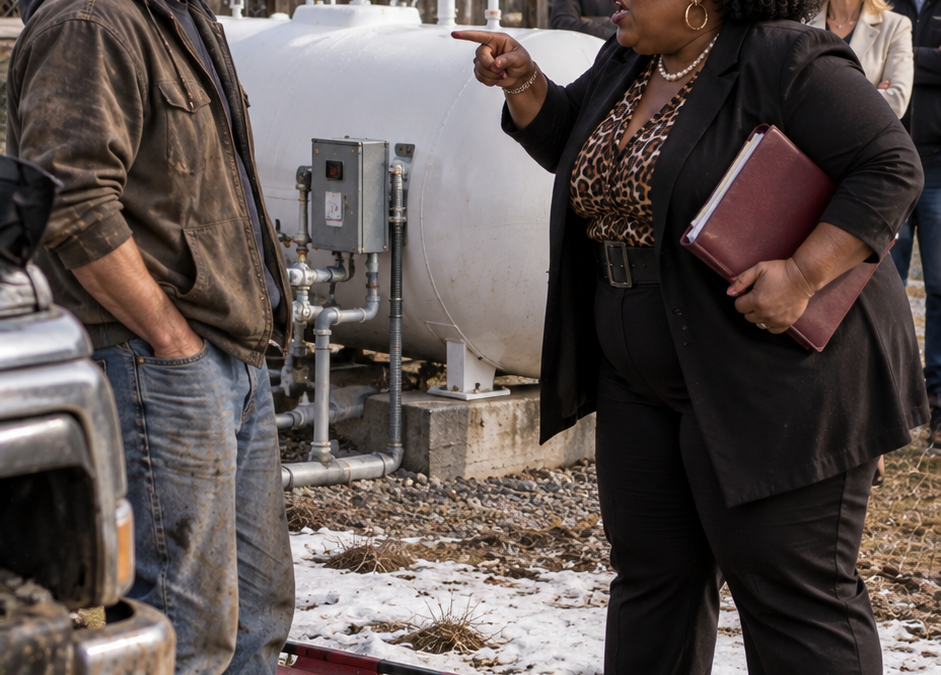
She carried a burgundy folder under one arm.
Some people carry folders the way police carry badges.
Celeste was one of them.
I was underneath my truck when she arrived.
The first thing she saw of me was a pair of boots, a stained sleeve, and a wrench.
I slid out on the creeper and stood.
Her eyes moved past me.
Workshop.
Utility trailer.
Coveralls hanging beside the door.
Old truck.
Then me.
“Are you the maintenance contractor working out here?”
“No.”
She waited.
“I live here.”
She looked toward the house.
“In Cedar Hollow?”
The way she said it was interesting.
Not really a question.
More like a fact she expected me to confirm.
“Not exactly.”
That answer takes about four minutes and a parcel map to explain accurately.
And I have learned that people who introduce themselves carrying folders are rarely ready for four-minute answers.
Celeste smiled.
It was a particular smile.
One I would see many times that winter.
It arrived a second before her sentences and stayed a second after them.
“Well, we’re all neighbors here.”
“I suppose.”
“And neighbors have a responsibility to help maintain standards.”
There it was.
She looked past me toward the arborvitae.
Through an opening between the branches, the white side of the tank was visible.
Her smile stayed in place.
Her eyes changed.
“We’ve had some concerns about that.”
“The tank?”
“Yes.”
“What concerns?”
“Visual impact, primarily.”
I looked back at it.
From her position, maybe eight feet of white steel could be seen through evergreen branches.
“What would you like me to do?”
“Ideally?”
“Sure.”
“Remove it.”
She said it casually enough that for half a second I wondered if I had heard correctly.
“And use what?”
“A smaller residential tank. Something appropriate.”
“How small?”
“The kind people use for grills, perhaps. Or have your supplier recommend something.”
I looked at her.
“That tank serves my house and my business.”
Her expression tightened at the word business.
“Business?”
“Yes.”
“You operate a commercial business from this property?”
“I repair heating equipment in my shop.”
Celeste looked toward the metal building behind me.
It was the first time she had looked at it as evidence rather than scenery.
“I see.”
“No, I don’t think you do.”
She smiled again.
“I understand that you have practical needs. I’m simply saying there are ways to meet those needs that are more consistent with the character of the community.”
“My parcel isn’t part of your association.”
“That doesn’t mean it doesn’t affect it.”
I could have told her everything then.
I want to be honest about that.
I have replayed that afternoon enough times to know exactly where the conversation could have changed.
I could have pointed behind the arborvitae.
I could have said:
There is a distribution line under your streets, and it starts right there.
Nine words.
Maybe ten depending on how you count.
Instead, I told her the technically correct thing.
“My property predates Cedar Hollow and is not governed by its architectural covenants.”
Celeste heard the sentence as resistance.
She explained that Cedar Hollow had spent years developing a cohesive community identity.
She talked about appraisal values.
Southern sightlines.
Visual clutter.
She said she was certain a reasonable man would want to be part of a reasonable solution.
“What solution?”
“Screening. Relocation. Ideally removal.”
She suggested I contact my propane company and have the tank taken away.
I told her again that it served my house and shop.
She said “shop” with slightly more tolerance than she had said “business.”
Then she thanked me for my time and left.
Two days later, I saw her at the neighborhood mailbox cluster with Tessa Monroe.
Tessa was another board member.
Tall.
Quiet.
Bookkeeper by profession.
Usually wore reading glasses pushed into her hair.
Celeste saw me and smiled.
“Nolan. I was just telling Tessa you’re going to help us with the tank situation.”
Tessa turned.
“Oh. Good.”
“I didn’t say that.”
Celeste laughed lightly.
“We discussed solutions.”
“You discussed solutions.”
Tessa looked uncomfortable.
“What about a fence?” she asked. “Could you just screen it?”
Celeste answered before I could.
“A fence would draw even more attention to it.”
I stood there holding my mail while two women planned improvements to property neither one owned.
I said nothing.
On the walk back to my house, I wondered whether that silence was discipline or cowardice.
I still do not know.
A week later, the first official letter arrived.
Cream-colored envelope.
Association name printed in an ornate font that looked expensive enough to have required a committee.
Inside was a single-page violation notice.
The heading was bold.
UNAUTHORIZED PROPANE STORAGE SYSTEM.
Four findings followed.
Each cited language from the Cedar Hollow Declaration of Covenants, Conditions, and Restrictions.
The final paragraph gave me fourteen days to comply.
The problem was simple.
Those covenants did not govern my parcel.
I read the notice standing in the driveway.
Then read it again at the kitchen table.
The second page contained the fines.
Five hundred dollars immediately.
Then one hundred dollars per day after the cure period until the tank was removed or approved by the architectural review committee.
At the bottom was a checkbox offering me permission to apply for retroactive approval.
Seventy-five-dollar filing fee.
Nonrefundable.
I sat there with a pencil and calculated how quickly the daily fines would grow.
The number became uncomfortable very fast.
Then I realized that was the entire point.
The number was supposed to hurt before the paperwork did.
That evening, I wrote back from my shop computer.
Three sentences.
My parcel is outside the platted Cedar Hollow boundary.
My property is not subject to HOA architectural jurisdiction.
I would gladly provide the county parcel identification number if the board wanted to verify either statement.
Celeste replied within an hour.
The board, she wrote, had already reviewed the matter and disagreed with my “characterization.”
Benefit and burden ran together within a planned community.
She hoped I would not force the association to escalate.
Nothing in the message addressed the parcel number.
Nothing addressed jurisdiction.
Nothing addressed ownership.
I printed it.
Put it inside a manila folder.
Wrote the date on the front.
A man who works with pressure systems learns to recognize when pressure is building even while everybody claims conditions are stable.
The following Saturday, Celeste returned.
This time Graham Pike came with her.
Graham worked for the management company hired by Cedar Hollow.
He was in his fifties.
Heavyset.
Tired eyes.
Polo shirt with the company logo.
Clipboard tucked under one arm.
He had the exhausted posture of a man whose professional life consisted of carrying messages between people who hated one another.
I met them at the gate.
Celeste said she wanted a real conversation.
Neighbor to neighbor.
Then she spoke for nearly six minutes without letting me get a sentence in.
Community standards.
Safety.
Image.
Consistency.
Property values.
Professional management.
When she finally stopped, she said the line I remembered most clearly afterward.
“You live next to Cedar Hollow. You benefit from what Cedar Hollow is worth, and you cannot simply do whatever you want out here.”
“Did you pull the parcel map?”
She looked annoyed.
“I don’t need a map to see your tank sits next to the subdivision.”
Graham shifted.
His eyes moved toward the arborvitae.
Not toward the visible white side of the tank.
Toward the ground below it.
I noticed.
At the time, I did not understand why.
Celeste asked how much fuel the tank held.
“One thousand gallons.”
She wrote it down.
The way she moved the pen made it feel like a confession.
“Is it inspected?”
“Every year.”
“By whom?”
“A licensed technician.”
“Documented?”
“The inspection log is inside that regulator cabinet.”
I pointed.
“You can read it from your side of the fence anytime.”
Then she turned toward Graham.
“Could we just hire someone to remove it if he refuses?”
Graham’s mouth tightened.
“We would need to verify ownership and access.”
Celeste laughed.
“Ownership isn’t complicated. It sits against a managed community. Communities have remedies.”
That was when I said something I meant only as advice.
“I wouldn’t recommend doing that.”
Celeste’s whole posture changed.
She heard lawsuit.
That was a language she understood.
“The association has counsel on retainer.”
“I know.”
“I am not intimidated by somebody because he drives a work truck.”
I looked at her white crossover.
Then at my truck.
“All right.”
She left thinking she had won the exchange.
I went back into my shop.
There was still time to explain everything.
I did not.
Not because I had some secret strategy.
Not because I was trying to trap her.
I simply could not get past the fact that she had shown up twice, mistaken me for hired help, treated my tank capacity like evidence of wrongdoing, refused to examine a parcel map, and asked her manager whether strangers could dismantle my equipment while standing eight feet from me.
So I went back to work.
The fines kept accumulating.
A man named Doyle Hurst stopped by later that week.
Doyle lived in the second house uphill from my boundary.
We were not close friends, but he had helped me pull a transmission once when rain started halfway through the job.
That counts for something.
“Heard they’re fining you,” he said.
“So have I.”
“For the tank?”
“Apparently.”
He shook his head.
“Half that board is scared of Celeste.”
Then, as he was leaving, he turned.
“You know anything about water heaters?”
“Some.”
“Mine keeps cutting out when it’s cold. Pilot doesn’t seem happy.”
“That sounds like upstream pressure or regulation.”
“You know somebody?”
“I can look if your supplier gives you trouble.”
“Appreciate it.”
He drove away.
Neither of us said where his fuel came from.
Doyle did not know.
And I still had not decided how much I was responsible for teaching people who had spent fifteen years benefiting from something without asking who maintained it.
Six weeks passed.
By mid-February, my balance reached $4,800.
The management company mailed me an itemized ledger.
Every day had its own row.
Date.
One hundred dollars.
Date.
Another hundred.
Two pages of penalties marching downward like a hospital fever chart.
The accompanying demand letter was worse.
Cease all use of the propane storage system.
Disconnect and cap associated piping.
Remove commercial equipment from the property-line area.
Provide an association agent access to the rear of my parcel for inspection.
That was the moment the problem changed.
Until then, they had mostly been trying to make me remove something ugly.
Now they were ordering me to stop operating it.
I went to the next board meeting.
Not because I paid HOA dues.
I did not.
Not because I had voting rights.
I did not.
I went because the posted agenda included an item called:
FUEL STORAGE NONCONFORMITY — SOUTHERN BOUNDARY.
That meant me.
The clubhouse smelled like carpet glue and coffee.
About thirty residents sat in folding chairs.
Three board members were behind a card table.
Graham sat off to one side with a laptop.
I took the back row.
Tessa saw me.
Gave me a small nod.
When my agenda item came up, Celeste stood.
Nobody else had stood all evening.
She told the room the association had been patiently working with the owner of the adjacent property for more than two months.
She described my place as “a makeshift commercial fuel operation directly against a residential community.”
She said she had personally documented one thousand gallons of propane stored within a few hundred feet of family homes.
Insurance exposure.
Resale comparables.
Southern property values.
Then she said the association had exhausted informal remedies and would move toward a lien and legal action if I continued refusing compliance.
Finally, her voice softened.
“I respect people who work with their hands. I truly do. But Cedar Hollow is a professionally managed community. It cannot function if everyone simply decides to make up his own rules.”
I sat there listening to thirty neighbors being told who I was.
There is a particular kind of anger that does not feel hot.
It feels cold.
Useful.
When the open-comment period began, I raised my hand.
Celeste smiled.
“Nolan.”
Like we were friends.
“Has the board obtained a formal legal opinion establishing jurisdiction over my parcel?”
“Our counsel is comfortable with our position.”
“That wasn’t my question.”
She smiled.
I continued.
“Has the board found any recorded instrument giving Cedar Hollow an ownership interest in the tank, regulator station, or fuel line on my property?”
“That is not the issue before the board.”
“All right.”
I leaned forward.
“Are you directing me to stop using the tank?”
“We are directing you to comply.”
“I need a specific answer.”
A few heads turned.
“Is Cedar Hollow directing me to cease operation of the propane system on my property?”
Celeste laughed slightly.
“The directive has been in writing for weeks.”
“I’d like the answer stated aloud for the minutes.”
She stared at me.
I asked a third time.
“Celeste, is the association ordering me to stop operating the propane system?”
She looked around the room.
At everyone watching.
Then back at me.
“Absolutely.”
Graham Pike stopped typing.
That mattered.
I watched his hands leave the keyboard.
He leaned back.
And for the first time, he looked at me not like another angry homeowner adjacent to one of his accounts.
He looked at me like I had asked a question he understood much better than Celeste did.
I left the meeting knowing there was something underneath the paperwork I had not found yet.
The following morning, I went to the county records office.
The building was a flat brick rectangle with a parking lot that flooded every spring.
A clerk named Naomi Brooks helped me.
I gave her my parcel number.
“I need anything recorded against this land involving fuel, utilities, easements, licenses, pipelines. Go back as far as you need.”
“How far?”
“Far enough that whoever signed it is probably retired.”
She brought me bound volumes.
Microfilm.
Loose recorded instruments.
A gray archival box.
At eleven, she brought me coffee without asking.
The first day produced nothing.
I came back.
The second day, I found it.
Not where any sensible person would have filed it.
Buried inside a supplemental exhibit attached to a utility dedication from the year Cedar Hollow’s first phase was platted.
The title was painfully boring.
TEMPORARY COMMUNITY PROPANE DISTRIBUTION LICENSE.
I read it once.
Then again.
Then a third time with my finger under each sentence.
The original Cedar Hollow developer, Harrogate Land Partners, had a problem.
They had houses framed.
Closings scheduled.
Families ready to move in.
But the natural gas extension they had promised buyers was still years away because of permits and construction delays.
They needed heat.
So they approached Adele Barlo.
Adele was the widow who owned my property before me.
She kept goats.
Apparently did not care what anybody thought about sightlines.
Harrogate negotiated a license allowing it to install a bulk propane tank on her land.
A regulator station beside it.
A buried distribution line running uphill into the first two phases of Cedar Hollow.
In return, Harrogate paid an annual land-use fee.
It agreed to inspection costs.
Maintenance costs.
Repair costs.
And Adele kept ownership.
Tank.
Regulator.
Hardware.
Land.
Harrogate had tried to buy the whole thing.
She refused.
So they licensed it.
Then I reached paragraph nine.
I read it four times.
If the using party obstructed inspection, refused required maintenance, disputed the landowner’s ownership, or directed the landowner to cease operation, the landowner could suspend service upon reasonable written notice to limit liability.
The owner would not be responsible for interruptions resulting from that suspension.
I leaned back in the plastic chair.
Then I laughed.
One short sound.
Naomi looked up from her desk.
“You find it?”
“I think I found the whole winter.”
I paid for certified copies.
On the drive home, the folder sat in my passenger seat.
At red lights, I kept touching it.
Here is what those papers meant.
I did not own the propane inside Cedar Hollow’s houses.
I did not own their appliances.
Their meters.
Their furnaces.
The supplier controlled deliveries.
But I owned the tank.
The regulator station.
The concrete piers.
The ground.
The first hundred feet of line.
And the master shutoff.
The brass handle controlling every gallon moving toward phases one and two sat eleven steps from my fence.
On my land.
I owned the throat.
That night, I counted houses against the old service drawings.
Forty-seven.
Forty-seven of Cedar Hollow’s sixty houses still depended on that original propane leg.
Every house on Larch Bend.
Every house on Cedar Hollow Court.
The even-numbered side of Thistle Row.
The thirteen newer homes at the top had a different system installed by a later builder.
Celeste lived in one of those thirteen.
Her house would not notice if my valve was open or closed.
Doyle’s would.
The retired teacher’s would.
The young couple with the baby would.
The clubhouse furnace would.
The pool heater Celeste had argued about for three meetings would.
That was why I did not shut anything down.
I could have.
The paper was sitting in front of me.
But those forty-seven households had not fined me.
Doyle had helped me in the rain.
One woman on Larch Bend brought me tomatoes every August.
The young family on Thistle Row had a baby.
Whatever Celeste believed about me, I was not going to become the man who used their furnaces as leverage.
So I gave the association one more chance.
I wrote a one-page letter.
Copied the full board.
Copied Graham.
I acknowledged their written order directing me to cease operating the propane system.
I asked them to rescind the $4,800 in assessments because my parcel lay outside Cedar Hollow.
I asked whether the association claimed ownership of the tank, regulator station, or distribution line.
If so, please identify the recorded instrument.
I offered a joint inspection with a licensed technician.
I offered to negotiate a renewed access and maintenance agreement.
I gave them ten business days.
Celeste replied before eight the next morning.
Two sentences.
The association would not negotiate with me concerning a violation.
Further correspondence should go to counsel.
No answer about ownership.
No answer about inspection.
No answer about the line.
So I wrote one more sentence.
Please confirm that Cedar Hollow Homeowners Association is directing me to cease operation of the propane system located on my property.
Eleven minutes later, the answer came.
Confirmed.
Celeste Whitaker, President.
I printed it.
Then I called Reed Callahan.
Reed had handled my property closing years earlier.
He is the kind of attorney who can become genuinely excited by a badly written easement.
I brought him everything.
Certified license.
Parcel map.
Fine ledger.
Demand letter.
Meeting notes.
Emails.
Celeste’s confirmation.
We laid them out across his conference table.
He read the license.
Paragraph nine.
Then her one-word reply.
He removed his glasses.
“What do you want?”
“The fines gone.”
“Reasonable.”
“My property left alone.”
“Also reasonable.”
“And the system handled properly.”
He leaned back.
“We can file for declaratory relief.”
“How long?”
“Could be eighteen months.”
“How much?”
“Forty thousand if everybody behaves.”
I stared at him.
He smiled without humor.
“Litigation is efficient at only one thing.”
“Billing?”
“Exactly.”
Then his expression changed.
“Do not turn this into revenge.”
“I wasn’t planning to.”
“Good.”
He watched me.
“What are you planning?”
I slid the license toward him.
Put my finger on paragraph nine.
Then on Celeste’s message.
“I plan to do what they ordered me to do.”
Reed said nothing for a moment.
Then he asked, “Who is your propane technician?”
“Warren Hale.”
“Good.”
“You know him?”
“I know his reputation.”
Reed tapped the paper.
“Don’t touch that valve without him.”
Warren Hale was sixty-three, half deaf in his right ear, and one of the few people left who had actually worked on Cedar Hollow’s original system.
He spent nineteen years with the regional propane company Harrogate had hired.
He had helped install the tank.
I met him at a diner off the state highway.
Put the license beside his breakfast.
He read paragraph nine while his eggs got cold.
Then tapped the page with his fork.
“I always wondered when somebody would find this.”
“You knew?”
“Knew there was a license. Didn’t remember the details.”
“Who owns the hardware?”
“Looks like you.”
“Did the association ever buy it?”
“I assumed they had years ago.”
“They didn’t.”
Warren stared at me.
“Who told you to shut it down?”
I slid Celeste’s confirmation across the table.
He read it.
Then sat back.
“Well.”
“That bad?”
“No.”
He thought.
“That stupid.”
We spent two hours talking through what a safe suspension required.
Closing the master valve itself was easy.
The houses would not explode.
Nothing dramatic happened when a properly installed propane distribution leg lost supply.
The danger came later.
Once pressure dropped, pilot appliances extinguished.
If someone restored pressure incorrectly without verifying appliance valves and relighting systems, you could create dangerous conditions.
Reopening the system was the serious part.
Every affected structure needed technician supervision.
Pressure checks.
Relights.
Safety verification.
“No responsible person shuts forty-seven houses without warning,” Warren said.
“I agree.”
So we built the warning.
Reed drafted it.
Warren corrected the technical language.
I signed.
Two and a half pages.
Boring.
Specific.
Safe.
The notice identified the equipment.
The parcel.
The recorded license.
It quoted the association’s order.
Quoted Celeste’s confirmation.
Cited paragraph nine.
It stated that service would be suspended eight days later at 9:00 Monday morning.
A licensed technician would conduct the shutdown.
All forty-seven affected addresses appeared in an attachment.
Restoration would require inspection followed by technician-controlled repressurization and relighting.
Twice, in bold, the notice instructed the association to immediately notify affected homeowners.
We sent it everywhere.
Certified mail to the registered agent.
Certified copy to Celeste.
Email to every board member.
Email to Graham.
Hand delivery to the management company.
Courtesy copy to HOA counsel.
Then I waited.
I honestly expected somebody to stop it.
Four days before the scheduled suspension, Graham called my shop at seven in the morning.
“Is this real?”
“No good morning?”
“Nolan.”
“Yes. It’s real.”
“The master valve is on your property?”
“You already knew that.”
Silence.
“The first day you came out with Celeste, she asked whether somebody could remove the tank. You stared at the arborvitae instead.”
He breathed out.
“I’ll talk to her.”
“Please do.”
“She isn’t going to listen.”
“Why?”
Another silence.
“It isn’t because she doesn’t understand.”
That sentence caught me.
“What does that mean?”
“I have to go.”
He hung up.
Celeste emailed the next afternoon.
Three lines.
The association would not be extorted.
My attempt at intimidation had been documented.
The lien would proceed.
Then she added:
Do whatever you need to do with your ugly tank.
I printed that too.
Put it behind the confirmation.
Even then, I was not comfortable letting forty-seven households discover everything Monday morning.
So Saturday, I put on a clean jacket and walked those streets myself.
Forty-seven letters.
Forty-seven doors.
The notice was simple.
Your home receives propane through a distribution line originating on private property.
The homeowners association has directed the owner to cease operation.
Suspension is scheduled for Monday at 9:00 a.m.
Restoration will require licensed technician service.
Contact the board immediately with questions or concerns.
Twenty-two people answered.
Four told me I was lying.
Doyle read his letter twice.
Then looked at me.
“You own that tank?”
“Yes.”
“The one feeding us?”
“Yes.”
He sat on the porch step.
“Well, hell.”
A retired teacher on Larch Bend asked whether her mother’s oxygen concentrator would stop.
“Electric?”
“Yes.”
“Then not because of this.”
We checked her furnace together.
I gave her the number of a friend with portable electric heaters.
Two families decided to stay in town for the night.
I offered to pay.
They refused.
Sunday, Warren came over.
We checked everything.
Logged pressure.
Tagged equipment.
Reviewed the procedure twice.
I slept four hours.
Monday morning was twenty-six degrees.
At 8:45, Warren and I stood behind my property.
Frost covered the top of the tank.
The arborvitae branches were stiff.
Our breath hung in front of us.
Warren connected his gauge.
Read the pressure aloud.
Wrote it down.
Then looked at me.
“You sure?”
“No.”
He smiled slightly.
“Good answer.”
“I am sure what the paperwork says.”
“That’ll do.”
He gave me one more chance.
“Ready?”
I put my glove around the brass master handle.
It was cold enough to stick against the leather.
“Yes.”
I turned it.
Quarter turn.
Then the rest.
There was no explosion.
No dramatic hiss.
No alarm.
Forty-seven homes went off a fifteen-year-old fuel supply with one dry metallic click.
A crow called from somewhere beyond the property.
A truck downshifted on the county road.
Warren watched the gauge fall.
Logged the reading.
Installed the lockout.
Hung the tag.
Signed.
I signed beneath him.
Less than four minutes.
That was all.
I stood there afterward with my hands in my pockets.
I expected satisfaction.
Instead, I felt hollow.
Being right is not always a pleasant feeling.
Sometimes it is just the absence of another option.
At 9:20, my shop phone rang.
A woman on Thistle Row.
Her stove would not light.
I explained.
Gave her the HOA number.
Four minutes later, another call.
Then another.
Doyle called.
Not angry.
“My water heater finally quit.”
“I figured.”
“Whole street’s talking.”
“I figured that too.”
Warren sat across from me drinking coffee.
“A system this size doesn’t go dead all at once,” he said. “It dies appliance by appliance.”
Around ten, the clubhouse furnace stopped heating.
Politically, that mattered.
There was a Monday exercise class.
Eleven women arrived to a cold building.
The management office received thirty-one calls in about ninety minutes.
Two people called the fire department.
An engine came.
Checked conditions.
Left.
Residents called the propane supplier.
The supplier said the bulk tank was not empty.
That confused everyone even more.
At 11:11, my phone displayed Celeste Whitaker.
I let it ring twice.
I am not proud of how satisfying those two rings were.
Then I answered.
“What have you done?”
No hello.
No warm voice.
I said, “What you told me to.”
“You shut off gas to the subdivision.”
“I suspended the distribution system located on my property after eight days’ written notice.”
“You cannot do that.”
“You directed me to cease operation.”
“I did not direct you to cut off forty-seven homes.”
“You directed me to stop using the system. I asked you to confirm. You confirmed.”
“You knew what I meant.”
“I knew what you wrote.”
Her breathing changed.
“The association owns that system.”
“Where’s the deed?”
Silence.
Long enough that I heard a dog barking somewhere near her.
Then she hung up.
Nineteen minutes later, the white crossover came down my driveway too fast.
Celeste got out without a coat.
Graham climbed from the passenger side holding his clipboard against his chest.
I met them at my gate.
The same place we had first discussed the tank.
“Turn it back on,” Celeste said.
“I can’t.”
“I am not asking.”
“That isn’t why.”
Her face hardened.
“Why can’t you?”
“Because once a propane distribution leg depressurizes, it cannot responsibly be restored by turning the valve back open. Forty-seven homes have appliances that now require technician checks and relighting.”
“You created this situation.”
“No.”
“You did.”
“The association ordered a shutdown.”
“You endangered elderly residents.”
“I knocked on every affected door Saturday because your notice never went out.”
Her face changed.
“You what?”
“Forty-seven letters.”
“You had no right to contact association residents.”
“They were losing heat.”
“The board was handling it.”
“No, it wasn’t.”
She stepped closer to the gate.
“We will seek an injunction today.”
“You should.”
Her expression flickered.
“Reed Callahan accepts service for me.”
I gave her his office address from memory.
Then she reached for the sentence she probably believed would put me back where she thought I belonged.
“You are a technician, Nolan. You don’t understand how association law works.”
I considered raising my voice.
I did not.
“Maybe not.”
Graham stared at the ground.
I let a second pass.
“But I understand my propane line.”
I opened the folder I had carried outside.
Certified license.
Recorded number highlighted.
Plat map.
My parcel outside Cedar Hollow.
As-built drawing.
Tank.
Regulator.
Master shutoff.
All on my side.
Then Celeste’s own email.
CONFIRMED.
Then her second message.
Do whatever you need to do with your ugly tank.
I handed the documents across the gate.
She read the license.
Not the way someone reads something unfamiliar.
The way someone searches for a flaw.
Back to the top.
Down again.
Paragraph nine.
Her fingers were not completely steady.
That was when I realized something.
She had seen it before.
Graham’s face had gone pale.
“Celeste.”
She kept reading.
“Celeste.”
Nothing.
He looked at me.
Then back at her.
“We need to call the attorney.”
She finally lowered the paper.
They left.
For nine days, I thought I understood the story.
I thought Celeste had been arrogant.
Careless.
Too confident to read old records.
I even started feeling sorry for her.
Then Graham Pike walked into Reed Callahan’s office carrying a flash drive.
Reed called me that evening.
“Come in.”
“Now?”
“Yes.”
“What happened?”
“Bring nothing.”
“What?”
“I already have everything you need.”
I arrived twenty minutes later.
Graham was gone.
A laptop sat open on Reed’s desk.
He pointed at the chair.
“Before you read this, understand one thing.”
“What?”
“She knew.”
The email chain began three months before my first violation notice.
September.
The HOA’s insurance carrier had been conducting its annual renewal review.
An underwriter flagged a fuel distribution system serving phases one and two.
No documented HOA ownership.
No current inspection certificate in the association file.
No current access agreement with the property owner.
The carrier wanted three things.
Licensed inspection.
Updated maintenance and access agreement.
Clear allocation of liability.
Otherwise, the insurer was considering excluding the propane system from coverage.
Graham had responded correctly.
He searched records.
It took him three weeks.
He found the same temporary propane distribution license Naomi later found for me.
October 6.
He emailed Celeste.
The tank, regulator station, and shutoff were located on the Avery parcel.
The HOA appeared to possess only a conditional right of use.
There was no recorded transfer of ownership.
The maintenance obligation apparently remained with the association as successor to the developer’s use rights.
He attached the license.
Attached the plat.
Recommended opening negotiations with me before the insurance renewal deadline.
Celeste responded the following day.
I read her words three times.
Opening negotiations on those terms would place the association in a weak position.
She did not want the board formally accepting maintenance liability over infrastructure it did not control.
She wanted the matter handled instead as a compliance issue.
Compliance.
She instructed Graham not to circulate the license to the full board yet.
She wanted what she called a “resolution pathway.”
Then she asked one question.
How many homes are connected to the line?
Graham answered.
Forty-seven.
And she continued anyway.
That changed every conversation we had ever had.
When she asked how many gallons my tank held and wrote down one thousand as though it proved I was running some reckless commercial facility, she already had the as-built drawings.
When she said she did not need a map, Graham had sent her the plat eleven weeks earlier.
When she asked him in front of me whether they could simply hire somebody to remove the tank, she knew ownership was complicated.
She was not ignorant.
She was testing me.
Graham’s vague response had not been uncertainty.
He was trying not to contradict her openly.
The email chain continued.
Eleven messages.
Then the motive appeared.
Celeste had a major amenity modernization plan.
New pool heater.
Clubhouse mechanical renovation.
Fitness annex.
The financing worked better if Cedar Hollow had clear control over the utilities feeding its shared facilities.
My system created a problem.
Not because it was ugly.
Because I owned it.
An outside property owner holding the fuel infrastructure meant somebody outside the HOA could say no.
On November 11, Celeste emailed a former board treasurer.
Her plan was to have the tank and associated easement conveyed to Cedar Hollow at nominal cost.
She wrote one sentence that I still remember word for word.
Eventually, he will realize fighting us costs more than signing it over.
I stared at the screen.
The five hundred dollars.
The hundred dollars per day.
The lien threat.
The inspection demand.
The retroactive application fee.
It had never really been about appearance.
Not the arborvitae.
Not property values.
Not my workshop.
Not my coveralls.
The fines were pressure.
She expected the bill to grow until a self-employed tradesman looked at eight thousand, ten thousand, maybe fifteen thousand dollars in penalties and legal fees and decided surrendering the tank was cheaper than resisting.
The requested rear-property inspection gave them access to survey the equipment.
The retroactive approval application would have made me acknowledge their jurisdiction.
And the entire scheme had one flaw.
Paragraph nine.
To make the financial pressure work, Celeste had to repeatedly order me to stop using equipment the HOA depended on.
Every letter strengthened the exact condition that gave me the right to suspend service.
She was not defeated by my valve.
She was defeated by her own strategy.
The emergency meeting happened the following Tuesday.
Standing room only.
The clubhouse was still cold.
People wore coats inside.
Children sat in the back.
Coffee came from an insulated dispenser somebody had brought from home.
Reed came with me carrying a slim accordion folder.
This time I did not sit in the back.
Second row.
Tessa Monroe ran the meeting.
Graham sat at the end of the board table.
His laptop stayed closed.
That told me everything.
Celeste read a prepared statement.
She described Cedar Hollow as the victim of a deliberate utility disruption.
She accused an adjacent property owner of weaponizing essential service.
She said I had endangered residents during February weather to gain leverage in a personal dispute.
And people believed her.
At first.
That matters.
A man near me turned and stared.
Someone in back said his mother-in-law was eighty-one.
I kept my hands together.
Reed had warned me in the parking lot.
“Do not defend yourself until the documents are on the screen.”
When Celeste finished, Tessa looked toward me.
“Mr. Avery, would you like to respond?”
Reed stood.
“If the board will allow me six minutes and the projector.”
Nobody objected.
People expected an argument.
They got dates.
September.
Insurance carrier notice.
October 6.
Graham’s memorandum.
Temporary distribution license attached.
Parcel map attached.
Ownership concern.
Maintenance responsibility.
October 7.
Celeste’s instruction to treat the matter as a compliance issue.
Her direction not to circulate the license.
Her question.
How many homes?
Forty-seven.
Then the first violation notice.
Three weeks later.
Then my responses.
Then the fine ledger.
$4,800.
Then my question asking whether Cedar Hollow claimed an ownership interest.
No answer.
Then my request:
Please confirm that the association is directing me to cease operation.
The next slide contained one word.
CONFIRMED.
Large enough to read from the back wall.
Someone shifted behind me.
Reed continued.
Eight-day suspension notice.
Sent certified.
Sent electronically.
Hand-delivered.
Forty-seven addresses attached.
Two bold instructions asking the board to notify residents.
Then Celeste’s response.
The association will not be extorted.
Then:
Do whatever you need to do with your ugly tank.
The room made one sound.
A collective breath.
Next slide.
County records.
Tank ownership.
Regulator ownership.
Master valve.
Parcel boundary.
No transfer to the HOA.
Then Reed put up the November email.
Eventually, he will realize fighting us costs more than signing it over.
He stopped talking.
The sentence remained on the screen.
Tessa turned slowly toward Celeste.
She did not use the microphone.
“You knew.”
Celeste began talking.
Community value.
Fiduciary duty.
Insurance risk.
Unregulated private infrastructure.
She claimed she had been trying to bring an important utility under professional management.
Graham finally spoke.
Quietly.
“No.”
She turned.
He looked exhausted.
“You were warned.”
“Graham—”
“In October.”
He opened both hands on the table.
“In writing.”
A woman on Larch Bend stood.
“How long has my house been using Nolan’s tank?”
Graham answered.
“Approximately fifteen years.”
Doyle stood next.
“He brought me a warning Saturday. Why didn’t the board?”
No one answered immediately.
Another resident asked whether my fines were legal.
HOA counsel was on speakerphone.
The lawyer took several seconds.
“The jurisdiction question was not fully evaluated before enforcement.”
“When did you first see the propane license?”
“Nine days ago.”
The room changed.
People stopped looking at me.
They started looking at Celeste.
Somebody asked whether she had ever intended to pay for the inspection the insurance company required.
No answer.
Another resident asked why the license had been withheld from the full board.
Celeste said she was trying to preserve negotiating leverage.
That answer made things worse.
I sat in the second row listening to people understand, one question at a time, that the man they had been told was irresponsible had been the only person in the entire dispute who followed every procedure.
The settlement took eleven days.
Every fine was vacated.
All $4,800.
The HOA issued a written acknowledgment that my parcel sat outside Cedar Hollow and was not subject to its architectural review authority.
They paid my legal fees.
Just over six thousand dollars.
A new twenty-year access and maintenance agreement was signed.
Annual land-use fee.
Clear maintenance obligations.
Inspection requirements.
Repair responsibility.
No ambiguity.
The association paid for the tank and regulator inspection.
Paid Warren.
Paid the technicians needed to relight all forty-seven homes.
Adopted a resolution prohibiting any HOA officer, employee, contractor, or agent from entering my parcel or touching equipment without written consent.
I agreed to restore service immediately after inspection approval.
That last part mattered to me.
I was not keeping the valve closed one extra day to punish Celeste.
If I had, her accusation would have become true.
Warren spent Wednesday and Thursday testing everything.
He found one corroded riser fitting that should have been replaced years earlier.
The association paid for that too.
Friday morning, I stood beside the same brass handle.
Cold again.
Warren beside me.
“Ready?”
“Yes.”
I opened the valve.
Pressure returned.
Not instantly.
Gradually.
Exactly the way systems are supposed to recover.
Warren and three technicians spent the entire day moving from house to house.
Pressure testing.
Relighting.
Checking appliances.
Doyle brought sandwiches.
By eight that evening, Cedar Hollow had heat.
Eighteen days after the shutdown.
Celeste never regained her office.
Tessa circulated a petition for a special meeting.
The removal vote stood at thirty-nine to four, with the rest abstaining.
Celeste resigned by letter forty minutes before the result was formally announced.
Nobody was fooled.
She was not destroyed.
She did not lose her house.
She did not leave town in disgrace.
She still lives at the top of Cedar Hollow.
Still drives the white crossover.
Still keeps it cleaner than any vehicle has a right to be during winter.
Someone told me she joined a garden organization in another town.
I hope she enjoys it.
The clubhouse modernization plan disappeared.
Partly because the new board discovered how much fifteen years of deferred mechanical maintenance actually costs when someone finally opens the cabinets.
That was not the end of what I learned.
In spring, Warren and I were sitting on the tailgate of my truck waiting for a delivery when he told me about Adele Barlo.
Harrogate had wanted my property from the beginning.
They tried to buy it three times.
Cash first.
Then cash plus a lot in Cedar Hollow.
Then an offer Warren said was genuinely more than the land was worth.
Adele refused all three.
By the third refusal, the developer had houses ready to close and no time left.
So they took a license because it was the only document she would sign.
“The tank was supposed to be temporary,” Warren said.
“How temporary?”
“Five years, maybe.”
Natural gas was expected to reach the area.
Then came wetland reviews.
Route changes.
Harrogate sold phase three.
The economy shifted.
The company eventually went bankrupt.
A second builder installed a separate system for the thirteen newest houses and ignored the older forty-seven.
Management companies changed.
Board members came and went.
People retired.
People died.
Documents disappeared into storage.
The temporary license ended up four thousand pages deep inside recorded utility documents.
For fifteen years, an entire section of Cedar Hollow burned propane through a system everyone assumed the association owned because nobody still involved remembered otherwise.
The weakness was old.
Celeste did not create it.
Other HOA presidents walked past that tank for years without asking questions.
Ironically, their indifference kept everything peaceful.
Celeste brought something different.
Confidence.
She found the weak point.
Had Graham hand her the document explaining exactly where it was.
Then kicked it.
A few weeks after service returned, a crew installed new signage on the regulator enclosure.
White metal.
Black letters.
PRIVATE EQUIPMENT.
AUTHORIZED ACCESS ONLY.
My shop number beneath it.
I stood nearby drinking coffee while they tightened the bolts.
Tessa Monroe happened to walk past.
She stopped.
Read the sign.
Then laughed.
“Maybe we should make it bigger.”
“I think everybody remembers now.”
She smiled.
“Probably.”
I am not proud of eighteen days of cold water heaters.
I have thought about the young couple with the baby.
The retired teacher.
Her mother.
Doyle.
Every family that spent nights using space heaters or staying somewhere else because a fight they did not start reached their furnace.
There is no version of the story where I feel clean about that.
I also do not think I defeated Cedar Hollow.
Cedar Hollow was never my enemy.
Forty-seven households depended on my line.
Not one of those houses fined me.
Not one ordered me to surrender equipment.
Not one hid legal documents.
What happened was smaller than the title people later gave it.
An organization spent months insisting that equipment on my property was illegal.
Then that organization ordered me in writing to stop operating it.
So I stopped letting the organization use it.
That was all.
One brass handle.
Four seconds.
A dry click.
And forty-seven houses learned where their fuel had actually been coming from for fifteen years.
What stayed with me most was not Celeste losing her position.
It was the first conversation.
Her standing near my workshop.
Looking at my boots.
My truck.
My coveralls.
Asking whether I was hired maintenance.
She had decided what kind of man I was before I stood upright.
Everything afterward grew from that first assumption.
A thousand-gallon propane tank on a tradesman’s property had to be crude.
Unregulated.
Probably unnecessary.
A man working under his own truck probably did not understand plats.
Licenses.
Easements.
Association law.
Insurance.
He would see a growing fine and panic.
He would sign whatever document made the pressure stop.
Celeste’s mistake was not that she underestimated the propane tank.
Steel does not care what anybody thinks of it.
She underestimated the person maintaining it.
More importantly, she underestimated the paperwork behind it.
I still work from the same shop.
The truck is still old.
The cedar siding is still silver.
My coveralls still hang from a nail.
The propane tank still sits behind the arborvitae.
Some winters, frost covers the top.
In summer, heat shimmers over the white steel.
It is not beautiful.
I have never claimed otherwise.
But whenever I walk past the regulator cabinet, I check the gauges.
I inspect the log.
And once in a while, I look at the brass shutoff handle.
Most people would see a valve.
I see fifteen years of forgotten paperwork.
Forty-seven furnaces.
A widow who refused to sell.
A developer desperate to close houses.
Three management companies.
One insurance underwriter who finally asked the right question.
And a woman who believed the fastest way to control something was to make its owner too expensive to resist.
Celeste fined me because she thought the tank was something Cedar Hollow should control.
Then she ordered me to shut it down.
She confirmed that order in one word.
It took me four seconds to comply.
It took Cedar Hollow less than an hour to discover that the ugly tank at the bottom of the hill had never belonged to them at all.








