𝗣𝗔𝗥𝗧 𝟮 THE HOA HANDCUFFED ME FOR 43 MINUTES—THEN DEPUTIES SURROUNDED THE CLUBHOUSE AND MY WIFE, THE SHERIFF, WALKED IN
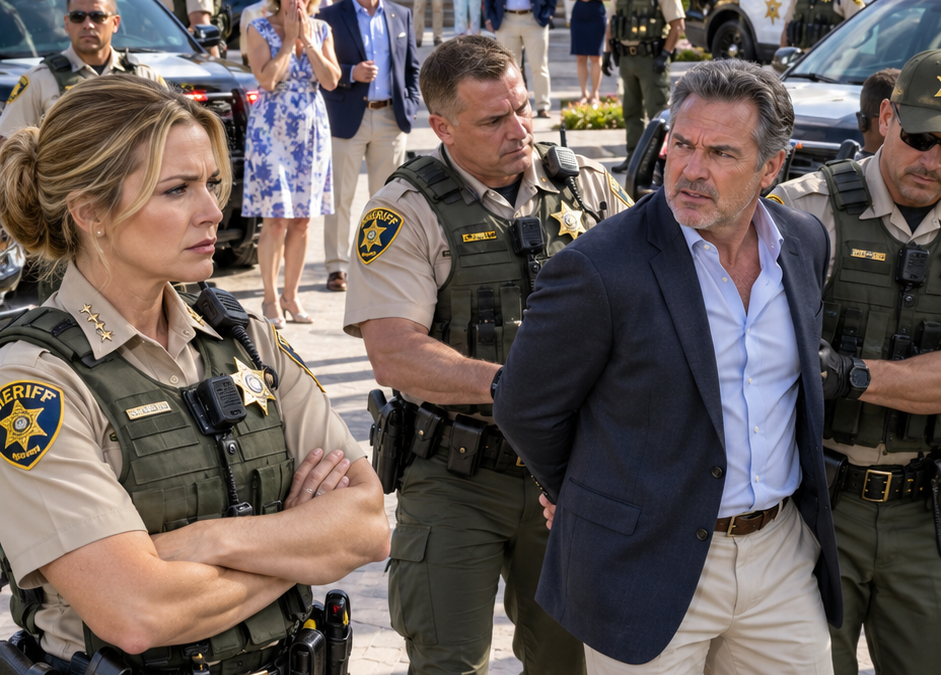
𝗣𝗔𝗥𝗧 𝟮
Brier Glenn had been designed to look uneventful.
That was part of the appeal.
Willow Bend.
Cedar Hollow.
Magnolia Court.
Perfect lawns.
Approved mailbox colors.
Sidewalks pressure-washed twice a year.
The monthly newsletter routinely devoted half a page to trash-can placement.
For most of its history, the neighborhood’s largest controversy had involved a basketball hoop that remained in someone’s driveway three days longer than permitted.
Then Lenora Vance became HOA president.
Lenora had served on the board for almost six years.
She originally campaigned on a predictable platform: stronger property values, stricter enforcement, cleaner common areas.
Nothing extraordinary.
But over time, “standards” became something else.
Lenora seemed to believe a well-managed community required constant correction.
A homeowner who disagreed with her was not simply disagreeing.
They were undermining the neighborhood.
A resident challenging a fee was not asking a financial question.
They were refusing to contribute.
Someone who wanted to inspect a record was creating trouble.
The board meetings became increasingly controlled.
Lenora prepared the agenda.
Lenora decided who spoke.
Lenora summarized disagreements in the minutes.
And somehow every disagreement ended with exactly the result Lenora had wanted before the meeting began.
I knew her reputation.
I had never dealt with her directly.
That changed when I walked into the clubhouse carrying the budget.
Audrey Sloan, the association’s office manager, was sitting behind the administrative desk.
I introduced myself.
“Graham Caldwell.”
“I know who you are.”
That surprised me slightly.
“I’m looking for supporting documents for one of the annual budget expenses.”
She gave me a practiced smile.
“Which expense?”
“Compliance enforcement services.”
Her smile faded.
“What about it?”
“One hundred eighty-six thousand four hundred dollars.”
She looked down at the desk.
“I don’t handle vendor contracts.”
“Who does?”
“The board.”
“Then I’d like to inspect the contract.”
“You can’t.”
“Why?”
“It’s confidential.”
I pulled a copy of the bylaws from my folder.
“I don’t think it is.”
Her eyes shifted toward the hallway.
I opened the section I had marked.
“Members have inspection rights covering financial records and vendor expenditures. I’m not asking for employee medical files. I’m asking what the association purchased for $186,400.”
“That’s security-related.”
“What was purchased?”
“Services.”
“What services?”
“Security services.”
I smiled.
“That answer is why people hire accountants.”
She did not smile back.
I continued.
“Was there a competitive bid?”
“I don’t know.”
“Do you have invoices?”
“The board approved the payments.”
“That wasn’t the question.”
“Mr. Caldwell—”
“Graham.”
“Graham, you’ll have to speak with President Vance.”
“Fine.”
I expected Audrey to call Lenora.
Instead she said, “She’s already here.”
The office door behind me opened.
Lenora walked in carrying a leather portfolio.
She was in her late fifties, immaculately dressed, silver-blond hair cut precisely enough that I suspected she scheduled trims with the same regularity she scheduled violation notices.
“What seems to be the problem?”
“No problem,” I said. “I’m reviewing the annual budget.”
“Why?”
“Because several homeowners asked me to.”
“You’re not the association accountant.”
“No.”
“You’re not on the board.”
“No.”
“Then why would internal expenditures be any of your concern?”
I slid the budget across the desk.
“Because the people paying these expenditures want to know what they purchased.”
She barely looked at it.
“The board approved them.”
“$186,400 went to Keane Community Protection.”
“Yes.”
“For what?”
“Compliance enforcement.”
“That is the category. I’m asking about the actual services.”
Lenora looked at me as though I were deliberately being difficult.
“The company handles residents who refuse to follow community requirements.”
That was a strange answer.
Not cameras.
Not patrols.
Not vandalism prevention.
Residents.
I looked back at the budget.
“What does ‘handles residents’ mean?”
She ignored the question.
“This association has had substantial problems with noncompliance.”
“Enough to cost $186,400?”
“Safety is expensive.”
“How much of this was security?”
“All of it.”
“Then show me the invoices.”
“No.”
“Why not?”
“Because enforcement records are confidential.”
“That doesn’t make vendor invoices confidential.”
Lenora closed the folder in front of me.
“You’re finished here.”
“I haven’t actually started.”
“You’ve seen everything you’re entitled to see.”
“I disagree.”
“That is your right.”
“Good.”
I reached for my papers.
Then Audrey moved another folder.
Underneath it was a thin stack of pages.
I saw the top one for perhaps two seconds.
Maybe less.
But accountants live on two-second details.
The header read:
DETENTION LOG — INTERNAL USE ONLY
Beneath it were columns.
NAME.
DATE.
START.
END.
REASON.
RELEASE CONDITION.
Rows.
Many rows.
Lenora saw where I was looking.
She snatched the papers away.
“What was that?”
“Nothing relevant to you.”
“It said detention log.”
“You misread it.”
“No.”
Her face hardened.
“I think this meeting is over.”
I stayed seated.
“What exactly are you detaining people for?”
“We are not detaining anyone.”
“I just saw a detention log.”
“You saw internal security documentation you had no authorization to view.”
“It was lying on a desk.”
“That does not authorize you to access it.”
“I didn’t touch it.”
“You were attempting to examine confidential files.”
“I was sitting here.”
Lenora turned to Audrey.
“Call Brett.”
Audrey hesitated.
“Lenora—”
“Call him.”
Something in Audrey’s face changed.
Not disagreement.
Fear.
And that interested me even more than the log.
She made the call.
Within minutes, two men came through the clubhouse doors.
The first was Brett Keane.
Owner of Keane Community Protection.
Recipient of $186,400 in HOA money.
The second was younger, maybe twenty-six.
Both wore tactical-style uniforms.
Dark shirts.
Metal badges.
Duty belts.
Body cameras.
The words COMMUNITY ENFORCEMENT were printed across their backs.
Their clothing had clearly been designed to encourage exactly one misunderstanding.
That they were police.
They were not.
Brett stopped in front of me.
“Mr. Caldwell.”
“Mr. Keane.”
“You need to turn over your phone.”
“No.”
“You were accessing confidential records.”
“No.”
“You photographed documents.”
“No.”
“Give me the phone.”
“No.”
Lenora folded her arms.
“Graham, this will be much easier if you cooperate.”
“With what?”
“We need to determine what information you stole.”
“I haven’t stolen anything.”
Brett moved between me and the door.
I looked at him.
“Am I free to leave?”
He did not answer.
So I asked again.
“Brett, am I free to leave?”
Lenora answered this time.
“You’re not going anywhere until we determine what you took.”
There it was.
That sentence changed everything.
Until then, we had been arguing.
Now they were restricting my freedom to leave.
I remained calm.
“Then I want it clearly understood that I am asking to leave.”
“You can leave after we finish.”
“No. I’m asking now.”
Brett reached for my arm.
“Don’t touch me.”
“I’m going to need you to cooperate.”
“I am not resisting you. But I do not consent to being detained, searched, or restrained.”
The younger guard shifted uncomfortably.
“Brett…”
Brett glanced toward him.
“It’s authorized.”
“By who?” I asked.
“President Vance.”
Lenora nodded.
“We have emergency detention authority for compliance threats.”
I actually thought I had misunderstood her.
“Emergency what?”
“Community detention authority.”
“You’re an HOA.”
“We have adopted safety procedures.”
“You cannot vote yourselves police powers.”
Brett took my phone.
I did not physically fight him.
That mattered.
I wanted every decision after that moment to belong entirely to them.
He took my wallet next.
Then my keys.
They placed everything in a drawer.
I looked directly at Lenora.
“How many other people have you done this to?”
She smiled.
That smile answered more than words could have.
Then Brett pulled out a pair of handcuffs.
The younger guard spoke again.
“I don’t know about this.”
Brett said, “Citizen’s detention.”
“For what crime?”
Nobody answered.
“No,” I said. “State the crime.”
Lenora responded.
“Theft of confidential information.”
“What did I steal?”
“You attempted to steal records.”
“What property did I remove?”
“You photographed materials.”
“No, I didn’t.”
“We’ll determine that when we examine your phone.”
“You do not have permission to examine my phone.”
Brett grabbed my wrist.
“I do not consent to this.”
He pulled my arm toward the metal folding chair.
I repeated it.
“I do not consent to being restrained.”
The cuff closed around my left wrist.
The other side went around the chair arm.
Click.
I looked down.
Then at Lenora.
“You need to understand something.”
She looked pleased with herself.
“This is false imprisonment.”
“You are being temporarily detained for safety and compliance.”
“No. You are holding me against my will when I have committed no crime.”
“We have authority.”
“From where?”
“The association.”
I almost laughed.
Instead I said, “That will not help you.”
Lenora picked up her phone.
Then she made the situation worse.
She called county dispatch.
I could hear her entire side of the conversation.
“Yes, we have an aggressive individual at the Brier Glenn clubhouse.”
I stared at her.
“He attempted to steal confidential association records.”
Pause.
“Yes.”
Then:
“He became physical with security.”
That had never happened.
I said loudly enough for her phone to pick it up:
“That statement is false.”
She turned away.
“Our security team was forced to restrain him.”
I looked at Brett.
His body camera light was on.
Good.
Lenora had just lied to dispatch while Brett’s camera recorded me sitting handcuffed to a chair.
From that moment on, I stopped thinking about getting out quickly.
I started thinking about preserving evidence.
Because the detention log meant one thing.
They had done this before.
I just did not know how many times.
Deputy Tessa Rowan arrived alone a little after five.
Lenora intercepted her before she reached the rear hallway.
I could hear voices from my chair.
Lenora was already presenting her version.
Trespassing.
Theft.
Threats.
Assault.
The word assault nearly impressed me.
Her story was growing faster than the national debt.
Several minutes later, Brett brought Tessa into the conference room.
She stopped when she saw me.
I was sitting quietly.
One wrist cuffed to the chair.
No overturned furniture.
No injuries.
No evidence of struggle.
The first thing she said was, “Mr. Caldwell?”
“Yes.”
“Are you injured?”
“No.”
“Did you assault anyone?”
“No.”
Lenora began speaking.
Tessa raised one hand.
“Ma’am, I’ll get your statement separately.”
Then she looked at me.
I could have said, “Get me out of this chair.”
Instead I said, “Preserve every camera in this building.”
She paused.
That reaction told me she was paying attention.
“Why?”
“Because what happened to me may not be the important part.”
I nodded toward Lenora.
“There is a detention log somewhere in this building. I saw the first page before they hid it. Names. Times. Release conditions.”
Lenora scoffed.
“There is no detention log.”
I looked at Tessa.
“She’s lying.”
“That’s enough,” Lenora snapped.
Tessa turned toward her.
“Who restrained him?”
“Our security team.”
“Why?”
“He was attempting theft.”
“What did he steal?”
“He accessed confidential documents.”
“That’s not what I asked.”
Lenora hesitated.
Tessa repeated it.
“What property did he steal?”
Audrey was standing in the doorway now.
“He saw confidential material.”
Tessa looked at her.
“Looking at something isn’t theft.”
Lenora pulled out a printed document.
“We have established authority to hold residents who become compliance threats.”
Tessa took it.
She read the section.
I watched her eyebrows move slightly.
Then she looked at Lenora.
“This is an HOA policy.”
“Yes.”
“It does not give you authority to detain people.”
“Our attorney reviewed it.”
“Who is your attorney?”
Lenora changed the subject.
“Sheriff Caldwell is aware of our procedures.”
That was the first time my wife entered the conversation.
Not physically.
By name.
I looked at Lenora.
Then at Tessa.
Tessa noticed.
Lenora continued.
“The sheriff’s office has worked with our security program for years.”
That was completely false.
I had heard enough.
I said, “Deputy, perhaps you should call Sheriff Caldwell and ask her.”
Tessa looked at me.
Something about the way I said it made her curious.
She stepped outside.
I learned later what happened next.
Dispatch ran my identification.
Graham Ellis Caldwell.
My address matched Sheriff Marin Caldwell’s.
Emergency contact:
Marin Caldwell.
Spouse.
Tessa did not call Marin first.
That was important.
She called Chief Deputy Wesley Crowe.
Wesley immediately recognized the conflict.
His instructions were precise.
I was not to be released simply because I was married to the sheriff.
Lenora was not to be arrested merely because she had restrained the sheriff’s husband.
Everyone was to be treated exactly the way they would have been treated if I had been Graham Smith.
Witnesses separated.
Video preserved.
Statements taken.
Evidence documented.
County attorney notified.
Only after that framework was established did Tessa call Marin.
My wife was leaving her office.
“Tessa?”
“Sheriff, we have a situation at Brier Glenn involving Graham.”
According to Marin, she stopped walking immediately.
“Is he hurt?”
“No, ma’am.”
“Is he under arrest?”
There was a pause.
“No.”
Marin knew her deputies well enough to hear what Tessa was not saying.
“Is somebody else holding him?”
“Yes.”
“Who?”
“Private HOA security.”
Marin told me later that for about two seconds she stopped being sheriff.
She became my wife.
Then training took over again.
“Is Wesley there?”
“On his way.”
“Good. He runs it.”
By the time Marin arrived, Wesley was already outside.
She removed her duty belt before entering the building.
She handed it to him.
Then she said clearly, in front of the deputies nearby:
“I am entering as Graham’s spouse. This investigation belongs to you.”
Wesley nodded.
“Understood.”
It was exactly what Lenora would never have understood about real authority.
The more legitimate power a person holds, the more careful that person has to be about using it.
Marin walked down the hallway.
Lenora saw her first.
Her face changed.
Then Marin entered the room.
I was still cuffed to the chair.
She looked at me.
“Hello.”
“Hi.”
That was all.
Then her eyes dropped to my wrist.
The steel had rubbed the skin raw.
There was a red ring around it.
Her expression hardened.
She looked at Tessa.
“Who restrained him?”
“Private security.”
Marin turned toward Wesley.
“The scene is yours.”
Four words.
That was all she said.
She did not order an arrest.
Did not demand revenge.
Did not tell deputies what charges to file.
She simply removed herself.
Wesley walked to me.
“Mr. Caldwell, I’m removing the restraint.”
Brett stepped forward.
“He’s still under association detention.”
Wesley looked at him.
“No, he isn’t.”
The cuff came off.
Blood rushed back through my wrist.
I rubbed it once.
Then Wesley addressed everyone.
“No one leaves until we have identified all witnesses and established what happened here.”
Lenora stared at him.
“You can’t detain an entire board.”
“No one said we were detaining an entire board.”
“This is private property.”
“And we are responding to an alleged criminal offense.”
“The offense was committed by him.”
She pointed at me.
Wesley glanced in my direction.
“What did he steal?”
Again, nobody had an answer.
That question was becoming inconvenient.
I asked for my belongings.
Tessa recovered my wallet and keys.
My phone was still locked.
Good.
Then I told Wesley about the log.
“I saw maybe seventeen or twenty entries.”
“Describe it.”
“Names, dates, start and end times, security officer initials, reasons for detention and release conditions.”
“What kind of release conditions?”
“I only saw a few.”
“Which ones?”
I thought carefully.
“Fine paid.”
He wrote.
“Violation form signed.”
More writing.
“Vehicle surrendered.”
He stopped.
“What?”
“One row appeared to say vehicle surrendered.”
“Anything else?”
“Complaint withdrawn.”
Then I remembered the last one.
“And recording deleted.”
The room went silent.
Wesley looked at Lenora.
Lenora rolled her eyes.
“He saw a routine incident sheet for two seconds.”
“So the log exists?” I asked.
“No.”
“You just described it.”
“I described what you may have misunderstood.”
Audrey interrupted.
“There is no detention log.”
Brett said, “We maintain standard security reports.”
Three people.
Three explanations.
Wesley’s expression told me he had noticed too.
Assistant County Attorney Dana Kesler was contacted.
She instructed Wesley not to overreach.
They needed probable cause for any locked office or cabinet.
Until then, deputies could secure what was in plain view, take statements, and preserve the scene.
So Tessa started interviewing residents.
That changed everything.
There were more than twenty homeowners still inside.
At first, nobody wanted to speak.
Then a woman named Monica Vale raised her hand.
“I was detained.”
Lenora spun toward her.
“Monica.”
Tessa said, “Please don’t address the witness.”
Monica swallowed.
“How long?” Tessa asked.
“Thirty-two minutes.”
“When?”
“March.”
“Why?”
“I refused to sign a violation notice.”
“What happened?”
“They told me I couldn’t leave until Lenora arrived.”
“Were you physically prevented from leaving?”
“Yes.”
“How?”
“Two security officers stood in front of the door.”
“Did you ask to leave?”
“Yes.”
“How did it end?”
Monica looked toward the floor.
“I signed.”
Another resident stepped forward.
Russell Dayne.
“I was held too.”
“How long?”
“I don’t know. Maybe forty minutes.”
“Why?”
“I recorded Lenora yelling at another homeowner in the parking lot.”
“What did they want?”
“My phone.”
“Did you give it to them?”
“Eventually.”
“Why?”
“They said if I didn’t delete the video, deputies would come and arrest me for interfering with association enforcement.”
I looked at Marin.
She was standing well away from the investigation, arms folded.
But I saw what happened in her face.
Lenora had been using her office as a threat.
Russell continued.
“I deleted it.”
“Did deputies ever come?”
“No.”
“Were you free to leave before deleting it?”
“No.”
Another person spoke.
Then another.
It was like watching a dam crack one small piece at a time.
People who had spent months believing what happened to them had been an isolated humiliation suddenly discovered neighbors had experienced almost the same thing.
Someone had been held until paying a fine.
Someone else until signing a parking agreement.
Another resident said security took his phone for nearly an hour.
Nobody had reported any of it.
Why would they?
Lenora had convinced them the sheriff’s office supported what she was doing.
Then Audrey disappeared.
Tessa noticed first.
“Where did Ms. Sloan go?”
Nobody answered.
Tessa walked toward the administrative hallway.
The records-office door was closed.
Locked.
Then one of the deputies watching the clubhouse security monitor said:
“Camera just went down.”
Wesley turned.
“Which camera?”
“Hallway outside records.”
That was the moment the scene escalated.
Not because I was married to Marin.
Not because Lenora had bruised my wrist.
Because someone had entered the exact room believed to contain evidence, locked the door, and disabled the camera.
Wesley called Dana.
Additional patrol units were requested.
Outside, residents saw cruisers beginning to arrive.
One.
Then another.
Then another.
By 9:47 p.m., the clubhouse looked nothing like the quiet building where people argued over mailbox colors.
Four patrol vehicles blocked the front drive.
Two more covered the rear.
Deputies stood near each exit.
There were no sirens.
That made the scene stranger.
The entire neighborhood seemed to have fallen silent.
Lenora stood at the front doors telling deputies they were trespassing.
Brett stood beside her insisting they had no warrant.
Tessa glanced at her watch.
“One is coming.”
While Dana prepared the application, deputies examined material that was already accessible.
At the security desk they found a thick binder.
BRIER GLENN COMMUNITY ENFORCEMENT MANUAL
Wesley began reading.
The first instruction was astonishingly direct.
Detain the non-compliant resident.
Another section instructed guards to:
Confiscate recording devices when necessary.
Another:
Hold the individual until a board representative arrives.
And:
Escalate refusal to cooperate to county law enforcement.
Then Wesley found the part involving Marin.
The manual stated that Brier Glenn’s procedures operated under “standards recognized by the Redmont County Sheriff’s Office.”
Not true.
It also contained a photograph of Lenora standing beside Marin.
The caption read:
Sheriff Caldwell with Brier Glenn Enforcement Leadership.
Marin stared at it.
“I remember this picture.”
“When?” Wesley asked.
“Community safety seminar. Two years ago.”
“For Brier Glenn?”
“No. It was open to the entire county.”
There had been dozens of people there.
Lenora had apparently taken an ordinary photograph from a public seminar and repurposed it to imply a law-enforcement partnership that did not exist.
Marin gave a formal witness statement.
She had never authorized Brier Glenn’s security program.
Never reviewed its detention policy.
Never approved its training.
Never granted authority to its officers.
Never agreed that the association could use her department’s name.
And certainly never authorized private guards to confine residents in conference rooms.
That statement mattered more than anything Marin could have done by taking control of the investigation.
Because for months, Lenora had been telling frightened homeowners that what she was doing carried the sheriff’s approval.
Now the sheriff had formally stated the opposite.
Dana called.
The judge had signed the warrant.
It covered the detention records.
Security contracts.
Relevant emails.
Body-camera footage.
Clubhouse surveillance.
Association communications involving detention policies.
The records office.
Wesley carried the warrant down the hallway.
Brett and several security officers stood between him and the locked door.
“Move.”
Brett folded his arms.
“You’re not entering until our attorney gets here.”
Wesley held up the warrant.
“This is signed by a judge.”
“Our counsel is reviewing it.”
“You can review it from outside the doorway.”
One of Brett’s younger guards looked from Wesley to Brett.
Then stepped aside.
He wanted no part of what was happening.
Another guard followed.
Brett was left standing nearly alone.
Finally, he moved.
Wesley unlocked nothing himself.
A deputy documented the door first.
Then they entered.
Audrey was sitting at a computer.
On the screen was a progress bar.
DELETING ARCHIVED CAMERA FILES — 63% COMPLETE
Tessa immediately pulled the network cable.
Another deputy photographed the screen.
USB drives sat beside the keyboard.
The shredder was running.
Several bags of shredded paper were stacked nearby.
Wesley stared at Audrey.
“Hands away from the keyboard.”
“I was cleaning old files.”
“At nine forty-seven at night?”
“Those files were scheduled for deletion.”
“After deputies began asking about them?”
She said nothing.
Lenora started shouting from the hallway.
“This is retaliation!”
Nobody responded.
“You are doing this because Graham is married to her!”
Wesley turned toward her.
His voice stayed level.
“Your problem is not who you detained tonight.”
Lenora stopped.
“Your problem is that you appear to have been detaining people long before you knew whose husband he was.”
That ended the argument.
Deputies found the log inside a locked drawer.
I had underestimated it.
There were not seventeen names.
Not twenty.
Thirty-eight.
Thirty-eight documented detentions.
Eleven months.
The shortest lasted minutes.
Several exceeded ninety minutes.
One lasted two hours and fourteen minutes.
The release conditions were exactly as I remembered.
Fine paid.
Violation acknowledgment signed.
Parking rights surrendered.
Complaint withdrawn.
Recording deleted.
Another drawer contained settlement agreements.
Residents were offered reduced fines if they formally withdrew complaints.
Then deputies found memory cards.
Dozens of them.
Many labeled with homeowner names.
Apparently some phones and cameras seized by security had been copied before being returned.
I stared at the evidence table.
And suddenly the $186,400 made sense.
The association had not purchased security.
The association had purchased compliance.
Residents had paid an $1,850 security assessment to finance a private enforcement system being used against those same residents.
The next discovery made it worse.
Emails.
One from Lenora read:
If residents believe county law enforcement supports enforcement operations, resistance should decline significantly.
Another instructed security never to use the word “arrest.”
The approved phrase was:
Compliance detention.
That wording mattered.
It suggested Lenora understood there was something dangerous about describing honestly what they were doing.
Brett’s body camera finished the rest.
He had activated it before cuffing me.
The video showed me asking whether I could leave.
Twice.
It recorded me saying I did not consent to being restrained.
It recorded Lenora ordering Brett to keep me there.
Then her voice said:
“He stays until he gives us the phone.”
No ambiguity.
No misunderstanding.
No chaotic recollection.
Her own security company had recorded her.
The arrests were deliberate.
Not everyone was dragged away simply because they worked for the HOA.
Dana and Wesley separated conduct carefully.
The younger security guard who had hesitated before my detention cooperated immediately.
Other board members became witnesses.
Audrey faced allegations tied to attempted destruction of evidence.
Brett was arrested in connection with unlawful detentions and his direct role in restraining residents.
Then Wesley approached Lenora.
She stared at Marin.
“This is because of you.”
Marin said nothing.
Wesley told Lenora to turn around.
“You’re letting them arrest me because I detained your husband.”
Marin finally answered.
“I’m not letting them do anything.”
She gestured slightly toward Wesley.
“I removed myself from this investigation hours ago.”
“You expect anyone to believe that?”
“I’m not the arresting officer.”
Wesley placed the cuffs on Lenora.
Marin continued.
“You’re being arrested based on evidence collected by deputies operating under a warrant issued by a judge.”
Lenora looked toward me.
I said nothing.
There was nothing worth saying.
They walked her out through the front doors.
Residents were standing across the street.
No one cheered.
I was grateful for that.
Cheering would have made it feel like revenge.
It was not.
It was something much quieter.
People were watching the person who had spent months making them afraid finally encounter authority she had not invented herself.
Marin waited until the patrol car carrying Lenora disappeared.
Then she came to me.
She looked at my wrist.
“You’re going to bruise.”
“I’ve had worse.”
“Where?”
I considered it.
“I haven’t.”
She almost smiled.
Then she said, “You are never volunteering to audit another HOA as long as we are married.”
“I found $186,400 in undocumented expenditures.”
“Graham.”
“You should see the spreadsheet.”
“Absolutely not.”
That was the first time all evening I laughed.
Six weeks later, Redmont County held a formal oversight hearing.
Marin refused to become its centerpiece.
So did I.
The people who mattered were Monica.
Russell.
And the others who had been sitting in that conference room months before I ever saw the detention log.
Monica testified first.
She described refusing to sign a violation form.
Brett’s guards blocked the door.
She asked to leave.
They refused.
Lenora arrived.
Monica was told that if she signed the acknowledgment, the issue would be resolved.
So she signed.
Not because she agreed.
Because she wanted to go home.
Then she said something that changed the atmosphere in the hearing room.
“For weeks afterward, I kept wondering whether maybe it really was my fault.”
Nobody moved.
“That’s what bothered me more than being held there. They made it sound so official that I started thinking I had done something wrong by saying no.”
Russell testified next.
He had recorded Lenora arguing with a homeowner.
Security demanded the recording.
Russell refused.
They prevented him from leaving.
Then somebody invoked the sheriff’s office.
He believed deputies were coming to arrest him.
So he deleted the video.
“What did you tell your wife?” an attorney asked.
Russell looked down.
“Nothing.”
“Why?”
“I was embarrassed.”
“About what?”
“How quickly I gave in.”
Marin sat in the back row for that testimony.
I knew her well enough to recognize anger even when she showed none.
Lenora had not merely misused a photograph.
She had borrowed Marin’s credibility.
Every year my wife had spent building public trust had been converted into a threat against people who thought they were dealing with something legally sanctioned.
That was why Marin refused interviews afterward.
Reporters wanted headlines about the sheriff whose husband had been handcuffed by an HOA.
Marin repeatedly corrected them.
“This is not primarily a story about my husband.”
She would say no more.
The financial investigation expanded.
The original $186,400 represented only one portion of the spending.
Additional association money had gone toward legal retainers.
Confidential settlement agreements.
Consultants.
Defense expenses arising from complaints residents had made about the enforcement program.
That meant homeowners were effectively paying twice.
First to finance the private security team pressuring them.
Then again to finance lawyers defending the association when they complained.
The accounting was exactly what I had suspected from the first moment I saw the budget.
Not clever.
Just hidden behind bland words.
Most financial misconduct does not announce itself.
Nobody writes:
Money we should not be spending: $186,400.
They write:
Compliance enforcement services.
People read it.
It sounds official.
They move on.
Lenora had understood something disturbing.
Bureaucratic language could intimidate people almost as effectively as uniforms.
“Compliance detention.”
“Community enforcement.”
“Safety assessment.”
“Resident misconduct.”
Every phrase transformed something questionable into something that sounded procedural.
The association held an emergency election.
Lenora was removed from every position she still technically held.
Brett’s company lost its contract.
Every provision referring to detention authority was deleted.
The temporary resident committee began examining contracts independently.
Meeting records were opened.
Homeowners were given clearer access to invoices.
No security company would ever again be permitted to represent itself in a way that could reasonably be confused with law enforcement.
The county attorney also insisted that notices be sent to every homeowner whose name appeared in the detention log.
Thirty-eight letters.
Thirty-eight people formally informed that investigators had found records showing they might have been unlawfully detained.
Some already knew.
Others had convinced themselves what happened was normal.
A few had moved away.
Several came forward only after receiving the letters.
One man had surrendered the right to use two visitor parking spaces.
Another had paid more than $4,000 in disputed penalties.
A woman had withdrawn a written complaint after being told continued resistance could result in sheriff’s involvement.
The same pattern repeated.
Pressure.
Confusion.
Authority theater.
Compliance.
Silence.
Guilt afterward.
That was Lenora’s system.
Not violence in the dramatic sense.
Something more mundane.
Make resistance seem expensive.
Make authority seem absolute.
Make every resident believe they are alone.
Then offer an easy way out.
Sign.
Pay.
Delete.
Withdraw.
Leave quietly.
What Lenora had never anticipated was thirty-eight people eventually comparing stories.
The criminal proceedings took much longer than the dramatic night at the clubhouse.
That is how real cases work.
Evidence had to be authenticated.
Digital records reconstructed.
Payments traced.
Witnesses interviewed.
Attorneys filed motions.
Nothing happened with the theatrical speed Lenora herself had once pretended the law possessed.
I testified about the financial documents and what I saw on the day I was detained.
I did not exaggerate.
I did not need to.
The facts were enough.
I had asked to inspect expenses.
I saw the detention log.
Lenora ordered me to surrender my phone.
I refused.
I asked whether I was free to leave.
I was told I was not.
Private guards took my belongings.
They cuffed me to a chair.
Lenora reported an assault that had not happened.
The body-camera footage showed the entire sequence.
When one attorney asked whether I had identified myself as Sheriff Caldwell’s husband during the detention, I answered:
“No.”
“Why not?”
“Because it wasn’t relevant.”
“You didn’t think your relationship to the sheriff might get you released?”
“Possibly.”
“Then why not mention it?”
I looked toward Lenora.
“Because if what they were doing was lawful, being married to the sheriff should not change anything.”
“And if it was unlawful?”
“Then being married to the sheriff should not be necessary to make it stop.”
The room went quiet.
That had been the point from the beginning.
What happened to me mattered because it happened.
Not because of who I went home with afterward.
Marin and I talked about it one night several months later.
We were back at the same kitchen counter where the story had begun.
The bruise on my wrist was long gone.
The original budget lay inside a file cabinet in my office.
“You really never thought about telling her?” Marin asked.
“Who you were?”
“I knew who you were.”
“You know what I mean.”
I smiled.
“Not seriously.”
“Why?”
“I wanted to see where it went.”
“That is an extremely accountant answer.”
“I saw the log.”
She became serious.
“I know.”
“Once I saw that, getting myself released wasn’t the biggest issue anymore.”
Marin nodded slowly.
“You could have been hurt.”
“I know.”
“I don’t think you fully understand how much I hated seeing you in that chair.”
“I probably do.”
“No.”
She looked at me.
“You don’t.”
I let that sit for a moment.
Then I said, “You did exactly the right thing.”
She frowned slightly.
“By leaving you cuffed until Wesley got there?”
“By not becoming the story.”
That was what Lenora had wanted once she learned who Marin was.
If Marin had stormed into the clubhouse and personally ordered arrests, Lenora would have had an argument.
Retaliation.
Abuse of office.
Personal revenge.
Instead Marin handed over her duty belt.
She stepped away.
Other deputies established probable cause.
An independent county attorney supervised.
A judge issued the warrant.
Evidence created the case.
Not a marriage.
The distinction mattered.
Brier Glenn changed after that.
Not instantly.
Trust is slower to rebuild than a clubhouse policy manual.
Residents who had once avoided association meetings began attending again.
Some sat together.
People started asking questions about expenses.
Actual questions.
Not accusations.
What company?
What service?
Where is the contract?
What authority permits this?
Can we see the invoice?
How many bids were submitted?
Who approved payment?
Those questions would have sounded tedious a year earlier.
After Lenora, they sounded like freedom.
A new board placed every large contract in a digital repository accessible to members.
Meeting minutes became detailed.
Vendor relationships required disclosure.
Security was reduced to what security should have been from the beginning.
Watching common areas.
Reporting suspected crimes.
Calling actual law enforcement when necessary.
Not deciding guilt.
Not confiscating phones.
Not blocking doors.
Not restraining people over landscaping forms.
Keane Community Protection disappeared from the neighborhood entirely.
The tactical uniforms went with them.
Nobody missed them.
Someone eventually asked whether Marin wanted the sheriff’s office to provide regular patrols inside Brier Glenn.
She declined to create any special arrangement.
Brier Glenn would receive the same service as every other community in the county.
No more.
No less.
That answer irritated a few people.
I loved it.
Because it was the opposite of Lenora’s philosophy.
Lenora had believed authority existed to be expanded.
Marin believed legitimate authority had boundaries.
The difference between those two ideas had taken thirty-eight detentions to expose.
I never volunteered to audit another HOA.
Marin made me promise.
I did, however, agree to speak at a county financial-literacy workshop.
My presentation was called:
The Quiet Danger of Boring Numbers.
Marin laughed at the title.
“People are going to fall asleep.”
“They’ll wake up before the fraud section.”
I used the original budget as an example without displaying confidential case details.
I showed one slide.
Compliance Enforcement Services — $186,400
Then I asked the room what it meant.
Someone said security.
Someone said collections.
Someone said legal support.
Exactly.
Nobody knew.
That was the problem.
A vague line item permits the person controlling the details to decide what everyone else thinks it means.
At the hearing, I had been asked what first made me suspicious.
The answer was never handcuffs.
Never Lenora’s attitude.
Never Brett’s fake-looking badge.
It was two ordinary words attached to an extraordinary amount of money.
Compliance enforcement.
That was where the whole thing began.
Months after the clubhouse was reopened under the new board, I drove past one evening.
The parking lot was almost empty.
No patrol cars.
No private security officers standing near the doors.
Just a few residents leaving a meeting.
For a second, I thought about the night the building had been surrounded.
At 9:47 p.m., deputies had occupied every exit.
Residents stood across the road watching.
Lenora insisted the police were trespassing.
Brett insisted they could not enter.
Audrey was behind a locked door deleting video files.
And my wife stood deliberately outside the command structure because she understood something Lenora never had.
Authority is not proven by how quickly you use it.
Sometimes it is proven by refusing to use it when you personally have the most reason to want to.
Anyone standing outside that clubhouse that night could easily have misunderstood what they were witnessing.
They might have assumed Sheriff Marin Caldwell had mobilized half her department because some HOA guards were stupid enough to handcuff her husband.
That would have made a better rumor.
It was also wrong.
The patrol cars came because someone was destroying evidence.
The warrant came because witnesses described a pattern.
The arrests came because records showed thirty-eight detentions.
The investigation expanded because association funds had been used to finance the system.
And Lenora’s own emails revealed that she had intentionally borrowed the sheriff’s name to convince residents resistance was useless.
My marriage did not make those facts true.
It simply produced an irony Lenora could not escape.
For almost a year, she had used my wife’s name as a weapon.
Then one afternoon, without realizing it, she used that imaginary authority against Marin’s own husband.
I had been number thirty-eight.
That was Lenora’s real mistake.
Not that she detained the wrong man.
There should never have been a right man to detain.
The only thing different about me was that I happened to recognize what I was seeing.
I knew to preserve the cameras.
I knew the financial records mattered.
I remembered the columns on the log.
I understood that if people suddenly started deleting files, the deletion itself could become evidence.
And when Lenora tried invoking Sheriff Caldwell one final time, I happened to know the sheriff well enough to suggest they call her.
Forty-three minutes.
That was how long I sat handcuffed to the chair before anyone bothered figuring out who I was.
For Lenora, those forty-three minutes became the story of the night.
For me, they never were.
The real story was thirty-eight names written inside a ledger that almost disappeared.
Thirty-eight adults who had individually been convinced nobody would believe them.
Thirty-eight moments when private security officers stood between someone and a door.
Thirty-eight times ordinary people were told compliance would make everything easier.
One pair of handcuffs finally exposed the pattern.
One accountant asked what $186,400 had purchased.
One deputy thought to ask a second question.
And one sheriff understood that the strongest thing she could do after seeing the red mark around her husband’s wrist was not take control.
It was step aside and allow the evidence to do what Lenora’s pretend authority never could.
Speak for itself.
Have you finished reading the story and want to read it again?
THE HOA HANDCUFFED ME FOR 43 MINUTES—THEN DEPUTIES SURROUNDED THE CLUBHOUSE AND MY WIFE, THE SHERIFF, WALKED IN
Forty-three minutes after HOA President Lenora Vance ordered private security guards to take my phone, confiscate my wallet, and handcuff me to a folding chair inside the Brier Glenn clubhouse, she was still confidently calling what she had done a “compliance detention,” completely unaware that the woman whose badge she had secretly invoked for nearly a year to frighten other homeowners happened to be my wife.
I could have told Lenora immediately that Sheriff Marin Caldwell was married to the man sitting in front of her with a steel cuff cutting a red circle into his wrist, but by then I had already seen something far more important than my own predicament—a hidden detention log containing name after name, time after time, and enough evidence to tell me that I was not the first resident her security team had prevented from leaving that room.
Then Marin walked through the clubhouse doors, saw my wrist, heard exactly how Lenora had been using the sheriff’s name, and within hours the quietest neighborhood in Redmont County was surrounded by patrol cars while deputies raced to stop someone inside the HOA office from deleting the records that could prove thirty-eight people had been unlawfully detained before me.
My name is Graham Caldwell.
I am a certified public accountant.
For nearly twenty years, I have made a living looking at numbers most people find too boring to examine twice.
That fact is important because nothing that happened at Brier Glenn began with handcuffs.
It began with a line item.
Two words.
Compliance enforcement.
And beside those two words was a number that made absolutely no sense.
$186,400.
Six hours before I found myself restrained inside the clubhouse, I had been sitting at my kitchen counter with several pages of the Brier Glenn Homeowners Association’s annual budget spread in front of me.
I was not working for the sheriff’s office.
I had no government role.
I had no badge.
I was not even officially working for the HOA.
Several homeowners had simply asked whether I would look at the financial statements because the board had imposed a new $1,850-per-household “community security assessment,” and nobody seemed capable of explaining what the money was actually buying.
My wife, Marin, stood on the opposite side of the kitchen drinking coffee while I ran a finger down the expense column.
“Please tell me you’re not about to start a war with our homeowners association,” she said.
I looked up.
“I audit nonprofit organizations for fun.”
“No normal person says that sentence.”
“I don’t do it for fun.”
“You smiled when Mrs. Vickers brought you those spreadsheets.”
“I smiled because they didn’t reconcile.”
“That proves my point.”
Marin was sheriff of Redmont County.
She had been elected twice and had spent most of her career cultivating a reputation for one principle above everything else.
No favors.
No special treatment.
No using the badge because somebody happened to know her.
That included me.
Especially me.
Before I left for the clubhouse, she pointed at the folder under my arm.
“Whatever you find, do not drag me into an HOA dispute.”
“I won’t.”
“Graham.”
“I promise.”
I meant it.
Neither of us understood how difficult keeping that promise was about to become.
At 9:47 that night, six sheriff’s vehicles would be positioned around the Brier Glenn clubhouse.
Deputies would be standing at every door.
Residents would be watching from across the street.
A judge would be reviewing an emergency search warrant.
And Lenora Vance would still be insisting that the deputies were trespassing on private association property.
But at 3:40 that afternoon, none of that existed yet.
There was only a spreadsheet.
A missing contract.
And $186,400 nobody could explain.
PART2
Brier Glenn had been designed to look uneventful.
That was part of the appeal.
Willow Bend.
Cedar Hollow.
Magnolia Court.
Perfect lawns.
Approved mailbox colors.
Sidewalks pressure-washed twice a year.
The monthly newsletter routinely devoted half a page to trash-can placement.
For most of its history, the neighborhood’s largest controversy had involved a basketball hoop that remained in someone’s driveway three days longer than permitted.
Then Lenora Vance became HOA president.
Lenora had served on the board for almost six years.
She originally campaigned on a predictable platform: stronger property values, stricter enforcement, cleaner common areas.
Nothing extraordinary.
But over time, “standards” became something else.
Lenora seemed to believe a well-managed community required constant correction.
A homeowner who disagreed with her was not simply disagreeing.
They were undermining the neighborhood.
A resident challenging a fee was not asking a financial question.
They were refusing to contribute.
Someone who wanted to inspect a record was creating trouble.
The board meetings became increasingly controlled.
Lenora prepared the agenda.
Lenora decided who spoke.
Lenora summarized disagreements in the minutes.
And somehow every disagreement ended with exactly the result Lenora had wanted before the meeting began.
I knew her reputation.
I had never dealt with her directly.
That changed when I walked into the clubhouse carrying the budget.
Audrey Sloan, the association’s office manager, was sitting behind the administrative desk.
I introduced myself.
“Graham Caldwell.”
“I know who you are.”
That surprised me slightly.
“I’m looking for supporting documents for one of the annual budget expenses.”
She gave me a practiced smile.
“Which expense?”
“Compliance enforcement services.”
Her smile faded.
“What about it?”
“One hundred eighty-six thousand four hundred dollars.”
She looked down at the desk.
“I don’t handle vendor contracts.”
“Who does?”
“The board.”
“Then I’d like to inspect the contract.”
“You can’t.”
“Why?”
“It’s confidential.”
I pulled a copy of the bylaws from my folder.
“I don’t think it is.”
Her eyes shifted toward the hallway.
I opened the section I had marked.
“Members have inspection rights covering financial records and vendor expenditures. I’m not asking for employee medical files. I’m asking what the association purchased for $186,400.”
“That’s security-related.”
“What was purchased?”
“Services.”
“What services?”
“Security services.”
I smiled.
“That answer is why people hire accountants.”
She did not smile back.
I continued.
“Was there a competitive bid?”
“I don’t know.”
“Do you have invoices?”
“The board approved the payments.”
“That wasn’t the question.”
“Mr. Caldwell—”
“Graham.”
“Graham, you’ll have to speak with President Vance.”
“Fine.”
I expected Audrey to call Lenora.
Instead she said, “She’s already here.”
The office door behind me opened.
Lenora walked in carrying a leather portfolio.
She was in her late fifties, immaculately dressed, silver-blond hair cut precisely enough that I suspected she scheduled trims with the same regularity she scheduled violation notices.
“What seems to be the problem?”
“No problem,” I said. “I’m reviewing the annual budget.”
“Why?”
“Because several homeowners asked me to.”
“You’re not the association accountant.”
“No.”
“You’re not on the board.”
“No.”
“Then why would internal expenditures be any of your concern?”
I slid the budget across the desk.
“Because the people paying these expenditures want to know what they purchased.”
She barely looked at it.
“The board approved them.”
“$186,400 went to Keane Community Protection.”
“Yes.”
“For what?”
“Compliance enforcement.”
“That is the category. I’m asking about the actual services.”
Lenora looked at me as though I were deliberately being difficult.
“The company handles residents who refuse to follow community requirements.”
That was a strange answer.
Not cameras.
Not patrols.
Not vandalism prevention.
Residents.
I looked back at the budget.
“What does ‘handles residents’ mean?”
She ignored the question.
“This association has had substantial problems with noncompliance.”
“Enough to cost $186,400?”
“Safety is expensive.”
“How much of this was security?”
“All of it.”
“Then show me the invoices.”
“No.”
“Why not?”
“Because enforcement records are confidential.”
“That doesn’t make vendor invoices confidential.”
Lenora closed the folder in front of me.
“You’re finished here.”
“I haven’t actually started.”
“You’ve seen everything you’re entitled to see.”
“I disagree.”
“That is your right.”
“Good.”
I reached for my papers.
Then Audrey moved another folder.
Underneath it was a thin stack of pages.
I saw the top one for perhaps two seconds.
Maybe less.
But accountants live on two-second details.
The header read:
DETENTION LOG — INTERNAL USE ONLY
Beneath it were columns.
NAME.
DATE.
START.
END.
REASON.
RELEASE CONDITION.
Rows.
Many rows.
Lenora saw where I was looking.
She snatched the papers away.
“What was that?”
“Nothing relevant to you.”
“It said detention log.”
“You misread it.”
“No.”
Her face hardened.
“I think this meeting is over.”
I stayed seated.
“What exactly are you detaining people for?”
“We are not detaining anyone.”
“I just saw a detention log.”
“You saw internal security documentation you had no authorization to view.”
“It was lying on a desk.”
“That does not authorize you to access it.”
“I didn’t touch it.”
“You were attempting to examine confidential files.”
“I was sitting here.”
Lenora turned to Audrey.
“Call Brett.”
Audrey hesitated.
“Lenora—”
“Call him.”
Something in Audrey’s face changed.
Not disagreement.
Fear.
And that interested me even more than the log.
She made the call.
Within minutes, two men came through the clubhouse doors.
The first was Brett Keane.
Owner of Keane Community Protection.
Recipient of $186,400 in HOA money.
The second was younger, maybe twenty-six.
Both wore tactical-style uniforms.
Dark shirts.
Metal badges.
Duty belts.
Body cameras.
The words COMMUNITY ENFORCEMENT were printed across their backs.
Their clothing had clearly been designed to encourage exactly one misunderstanding.
That they were police.
They were not.
Brett stopped in front of me.
“Mr. Caldwell.”
“Mr. Keane.”
“You need to turn over your phone.”
“No.”
“You were accessing confidential records.”
“No.”
“You photographed documents.”
“No.”
“Give me the phone.”
“No.”
Lenora folded her arms.
“Graham, this will be much easier if you cooperate.”
“With what?”
“We need to determine what information you stole.”
“I haven’t stolen anything.”
Brett moved between me and the door.
I looked at him.
“Am I free to leave?”
He did not answer.
So I asked again.
“Brett, am I free to leave?”
Lenora answered this time.
“You’re not going anywhere until we determine what you took.”
There it was.
That sentence changed everything.
Until then, we had been arguing.
Now they were restricting my freedom to leave.
I remained calm.
“Then I want it clearly understood that I am asking to leave.”
“You can leave after we finish.”
“No. I’m asking now.”
Brett reached for my arm.
“Don’t touch me.”
“I’m going to need you to cooperate.”
“I am not resisting you. But I do not consent to being detained, searched, or restrained.”
The younger guard shifted uncomfortably.
“Brett…”
Brett glanced toward him.
“It’s authorized.”
“By who?” I asked.
“President Vance.”
Lenora nodded.
“We have emergency detention authority for compliance threats.”
I actually thought I had misunderstood her.
“Emergency what?”
“Community detention authority.”
“You’re an HOA.”
“We have adopted safety procedures.”
“You cannot vote yourselves police powers.”
Brett took my phone.
I did not physically fight him.
That mattered.
I wanted every decision after that moment to belong entirely to them.
He took my wallet next.
Then my keys.
They placed everything in a drawer.
I looked directly at Lenora.
“How many other people have you done this to?”
She smiled.
That smile answered more than words could have.
Then Brett pulled out a pair of handcuffs.
The younger guard spoke again.
“I don’t know about this.”
Brett said, “Citizen’s detention.”
“For what crime?”
Nobody answered.
“No,” I said. “State the crime.”
Lenora responded.
“Theft of confidential information.”
“What did I steal?”
“You attempted to steal records.”
“What property did I remove?”
“You photographed materials.”
“No, I didn’t.”
“We’ll determine that when we examine your phone.”
“You do not have permission to examine my phone.”
Brett grabbed my wrist.
“I do not consent to this.”
He pulled my arm toward the metal folding chair.
I repeated it.
“I do not consent to being restrained.”
The cuff closed around my left wrist.
The other side went around the chair arm.
Click.
I looked down.
Then at Lenora.
“You need to understand something.”
She looked pleased with herself.
“This is false imprisonment.”
“You are being temporarily detained for safety and compliance.”
“No. You are holding me against my will when I have committed no crime.”
“We have authority.”
“From where?”
“The association.”
I almost laughed.
Instead I said, “That will not help you.”
Lenora picked up her phone.
Then she made the situation worse.
She called county dispatch.
I could hear her entire side of the conversation.
“Yes, we have an aggressive individual at the Brier Glenn clubhouse.”
I stared at her.
“He attempted to steal confidential association records.”
Pause.
“Yes.”
Then:
“He became physical with security.”
That had never happened.
I said loudly enough for her phone to pick it up:
“That statement is false.”
She turned away.
“Our security team was forced to restrain him.”
I looked at Brett.
His body camera light was on.
Good.
Lenora had just lied to dispatch while Brett’s camera recorded me sitting handcuffed to a chair.
From that moment on, I stopped thinking about getting out quickly.
I started thinking about preserving evidence.
Because the detention log meant one thing.
They had done this before.
I just did not know how many times.
Deputy Tessa Rowan arrived alone a little after five.
Lenora intercepted her before she reached the rear hallway.
I could hear voices from my chair.
Lenora was already presenting her version.
Trespassing.
Theft.
Threats.
Assault.
The word assault nearly impressed me.
Her story was growing faster than the national debt.
Several minutes later, Brett brought Tessa into the conference room.
She stopped when she saw me.
I was sitting quietly.
One wrist cuffed to the chair.
No overturned furniture.
No injuries.
No evidence of struggle.
The first thing she said was, “Mr. Caldwell?”
“Yes.”
“Are you injured?”
“No.”
“Did you assault anyone?”
“No.”
Lenora began speaking.
Tessa raised one hand.
“Ma’am, I’ll get your statement separately.”
Then she looked at me.
I could have said, “Get me out of this chair.”
Instead I said, “Preserve every camera in this building.”
She paused.
That reaction told me she was paying attention.
“Why?”
“Because what happened to me may not be the important part.”
I nodded toward Lenora.
“There is a detention log somewhere in this building. I saw the first page before they hid it. Names. Times. Release conditions.”
Lenora scoffed.
“There is no detention log.”
I looked at Tessa.
“She’s lying.”
“That’s enough,” Lenora snapped.
Tessa turned toward her.
“Who restrained him?”
“Our security team.”
“Why?”
“He was attempting theft.”
“What did he steal?”
“He accessed confidential documents.”
“That’s not what I asked.”
Lenora hesitated.
Tessa repeated it.
“What property did he steal?”
Audrey was standing in the doorway now.
“He saw confidential material.”
Tessa looked at her.
“Looking at something isn’t theft.”
Lenora pulled out a printed document.
“We have established authority to hold residents who become compliance threats.”
Tessa took it.
She read the section.
I watched her eyebrows move slightly.
Then she looked at Lenora.
“This is an HOA policy.”
“Yes.”
“It does not give you authority to detain people.”
“Our attorney reviewed it.”
“Who is your attorney?”
Lenora changed the subject.
“Sheriff Caldwell is aware of our procedures.”
That was the first time my wife entered the conversation.
Not physically.
By name.
I looked at Lenora.
Then at Tessa.
Tessa noticed.
Lenora continued.
“The sheriff’s office has worked with our security program for years.”
That was completely false.
I had heard enough.
I said, “Deputy, perhaps you should call Sheriff Caldwell and ask her.”
Tessa looked at me.
Something about the way I said it made her curious.
She stepped outside.
I learned later what happened next.
Dispatch ran my identification.
Graham Ellis Caldwell.
My address matched Sheriff Marin Caldwell’s.
Emergency contact:
Marin Caldwell.
Spouse.
Tessa did not call Marin first.
That was important.
She called Chief Deputy Wesley Crowe.
Wesley immediately recognized the conflict.
His instructions were precise.
I was not to be released simply because I was married to the sheriff.
Lenora was not to be arrested merely because she had restrained the sheriff’s husband.
Everyone was to be treated exactly the way they would have been treated if I had been Graham Smith.
Witnesses separated.
Video preserved.
Statements taken.
Evidence documented.
County attorney notified.
Only after that framework was established did Tessa call Marin.
My wife was leaving her office.
“Tessa?”
“Sheriff, we have a situation at Brier Glenn involving Graham.”
According to Marin, she stopped walking immediately.
“Is he hurt?”
“No, ma’am.”
“Is he under arrest?”
There was a pause.
“No.”
Marin knew her deputies well enough to hear what Tessa was not saying.
“Is somebody else holding him?”
“Yes.”
“Who?”
“Private HOA security.”
Marin told me later that for about two seconds she stopped being sheriff.
She became my wife.
Then training took over again.
“Is Wesley there?”
“On his way.”
“Good. He runs it.”
By the time Marin arrived, Wesley was already outside.
She removed her duty belt before entering the building.
She handed it to him.
Then she said clearly, in front of the deputies nearby:
“I am entering as Graham’s spouse. This investigation belongs to you.”
Wesley nodded.
“Understood.”
It was exactly what Lenora would never have understood about real authority.
The more legitimate power a person holds, the more careful that person has to be about using it.
Marin walked down the hallway.
Lenora saw her first.
Her face changed.
Then Marin entered the room.
I was still cuffed to the chair.
She looked at me.
“Hello.”
“Hi.”
That was all.
Then her eyes dropped to my wrist.
The steel had rubbed the skin raw.
There was a red ring around it.
Her expression hardened.
She looked at Tessa.
“Who restrained him?”
“Private security.”
Marin turned toward Wesley.
“The scene is yours.”
Four words.
That was all she said.
She did not order an arrest.
Did not demand revenge.
Did not tell deputies what charges to file.
She simply removed herself.
Wesley walked to me.
“Mr. Caldwell, I’m removing the restraint.”
Brett stepped forward.
“He’s still under association detention.”
Wesley looked at him.
“No, he isn’t.”
The cuff came off.
Blood rushed back through my wrist.
I rubbed it once.
Then Wesley addressed everyone.
“No one leaves until we have identified all witnesses and established what happened here.”
Lenora stared at him.
“You can’t detain an entire board.”
“No one said we were detaining an entire board.”
“This is private property.”
“And we are responding to an alleged criminal offense.”
“The offense was committed by him.”
She pointed at me.
Wesley glanced in my direction.
“What did he steal?”
Again, nobody had an answer.
That question was becoming inconvenient.
I asked for my belongings.
Tessa recovered my wallet and keys.
My phone was still locked.
Good.
Then I told Wesley about the log.
“I saw maybe seventeen or twenty entries.”
“Describe it.”
“Names, dates, start and end times, security officer initials, reasons for detention and release conditions.”
“What kind of release conditions?”
“I only saw a few.”
“Which ones?”
I thought carefully.
“Fine paid.”
He wrote.
“Violation form signed.”
More writing.
“Vehicle surrendered.”
He stopped.
“What?”
“One row appeared to say vehicle surrendered.”
“Anything else?”
“Complaint withdrawn.”
Then I remembered the last one.
“And recording deleted.”
The room went silent.
Wesley looked at Lenora.
Lenora rolled her eyes.
“He saw a routine incident sheet for two seconds.”
“So the log exists?” I asked.
“No.”
“You just described it.”
“I described what you may have misunderstood.”
Audrey interrupted.
“There is no detention log.”
Brett said, “We maintain standard security reports.”
Three people.
Three explanations.
Wesley’s expression told me he had noticed too.
Assistant County Attorney Dana Kesler was contacted.
She instructed Wesley not to overreach.
They needed probable cause for any locked office or cabinet.
Until then, deputies could secure what was in plain view, take statements, and preserve the scene.
So Tessa started interviewing residents.
That changed everything.
There were more than twenty homeowners still inside.
At first, nobody wanted to speak.
Then a woman named Monica Vale raised her hand.
“I was detained.”
Lenora spun toward her.
“Monica.”
Tessa said, “Please don’t address the witness.”
Monica swallowed.
“How long?” Tessa asked.
“Thirty-two minutes.”
“When?”
“March.”
“Why?”
“I refused to sign a violation notice.”
“What happened?”
“They told me I couldn’t leave until Lenora arrived.”
“Were you physically prevented from leaving?”
“Yes.”
“How?”
“Two security officers stood in front of the door.”
“Did you ask to leave?”
“Yes.”
“How did it end?”
Monica looked toward the floor.
“I signed.”
Another resident stepped forward.
Russell Dayne.
“I was held too.”
“How long?”
“I don’t know. Maybe forty minutes.”
“Why?”
“I recorded Lenora yelling at another homeowner in the parking lot.”
“What did they want?”
“My phone.”
“Did you give it to them?”
“Eventually.”
“Why?”
“They said if I didn’t delete the video, deputies would come and arrest me for interfering with association enforcement.”
I looked at Marin.
She was standing well away from the investigation, arms folded.
But I saw what happened in her face.
Lenora had been using her office as a threat.
Russell continued.
“I deleted it.”
“Did deputies ever come?”
“No.”
“Were you free to leave before deleting it?”
“No.”
Another person spoke.
Then another.
It was like watching a dam crack one small piece at a time.
People who had spent months believing what happened to them had been an isolated humiliation suddenly discovered neighbors had experienced almost the same thing.
Someone had been held until paying a fine.
Someone else until signing a parking agreement.
Another resident said security took his phone for nearly an hour.
Nobody had reported any of it.
Why would they?
Lenora had convinced them the sheriff’s office supported what she was doing.
Then Audrey disappeared.
Tessa noticed first.
“Where did Ms. Sloan go?”
Nobody answered.
Tessa walked toward the administrative hallway.
The records-office door was closed.
Locked.
Then one of the deputies watching the clubhouse security monitor said:
“Camera just went down.”
Wesley turned.
“Which camera?”
“Hallway outside records.”
That was the moment the scene escalated.
Not because I was married to Marin.
Not because Lenora had bruised my wrist.
Because someone had entered the exact room believed to contain evidence, locked the door, and disabled the camera.
Wesley called Dana.
Additional patrol units were requested.
Outside, residents saw cruisers beginning to arrive.
One.
Then another.
Then another.
By 9:47 p.m., the clubhouse looked nothing like the quiet building where people argued over mailbox colors.
Four patrol vehicles blocked the front drive.
Two more covered the rear.
Deputies stood near each exit.
There were no sirens.
That made the scene stranger.
The entire neighborhood seemed to have fallen silent.
Lenora stood at the front doors telling deputies they were trespassing.
Brett stood beside her insisting they had no warrant.
Tessa glanced at her watch.
“One is coming.”
While Dana prepared the application, deputies examined material that was already accessible.
At the security desk they found a thick binder.
BRIER GLENN COMMUNITY ENFORCEMENT MANUAL
Wesley began reading.
The first instruction was astonishingly direct.
Detain the non-compliant resident.
Another section instructed guards to:
Confiscate recording devices when necessary.
Another:
Hold the individual until a board representative arrives.
And:
Escalate refusal to cooperate to county law enforcement.
Then Wesley found the part involving Marin.
The manual stated that Brier Glenn’s procedures operated under “standards recognized by the Redmont County Sheriff’s Office.”
Not true.
It also contained a photograph of Lenora standing beside Marin.
The caption read:
Sheriff Caldwell with Brier Glenn Enforcement Leadership.
Marin stared at it.
“I remember this picture.”
“When?” Wesley asked.
“Community safety seminar. Two years ago.”
“For Brier Glenn?”
“No. It was open to the entire county.”
There had been dozens of people there.
Lenora had apparently taken an ordinary photograph from a public seminar and repurposed it to imply a law-enforcement partnership that did not exist.
Marin gave a formal witness statement.
She had never authorized Brier Glenn’s security program.
Never reviewed its detention policy.
Never approved its training.
Never granted authority to its officers.
Never agreed that the association could use her department’s name.
And certainly never authorized private guards to confine residents in conference rooms.
That statement mattered more than anything Marin could have done by taking control of the investigation.
Because for months, Lenora had been telling frightened homeowners that what she was doing carried the sheriff’s approval.
Now the sheriff had formally stated the opposite.
Dana called.
The judge had signed the warrant.
It covered the detention records.
Security contracts.
Relevant emails.
Body-camera footage.
Clubhouse surveillance.
Association communications involving detention policies.
The records office.
Wesley carried the warrant down the hallway.
Brett and several security officers stood between him and the locked door.
“Move.”
Brett folded his arms.
“You’re not entering until our attorney gets here.”
Wesley held up the warrant.
“This is signed by a judge.”
“Our counsel is reviewing it.”
“You can review it from outside the doorway.”
One of Brett’s younger guards looked from Wesley to Brett.
Then stepped aside.
He wanted no part of what was happening.
Another guard followed.
Brett was left standing nearly alone.
Finally, he moved.
Wesley unlocked nothing himself.
A deputy documented the door first.
Then they entered.
Audrey was sitting at a computer.
On the screen was a progress bar.
DELETING ARCHIVED CAMERA FILES — 63% COMPLETE
Tessa immediately pulled the network cable.
Another deputy photographed the screen.
USB drives sat beside the keyboard.
The shredder was running.
Several bags of shredded paper were stacked nearby.
Wesley stared at Audrey.
“Hands away from the keyboard.”
“I was cleaning old files.”
“At nine forty-seven at night?”
“Those files were scheduled for deletion.”
“After deputies began asking about them?”
She said nothing.
Lenora started shouting from the hallway.
“This is retaliation!”
Nobody responded.
“You are doing this because Graham is married to her!”
Wesley turned toward her.
His voice stayed level.
“Your problem is not who you detained tonight.”
Lenora stopped.
“Your problem is that you appear to have been detaining people long before you knew whose husband he was.”
That ended the argument.
Deputies found the log inside a locked drawer.
I had underestimated it.
There were not seventeen names.
Not twenty.
Thirty-eight.
Thirty-eight documented detentions.
Eleven months.
The shortest lasted minutes.
Several exceeded ninety minutes.
One lasted two hours and fourteen minutes.
The release conditions were exactly as I remembered.
Fine paid.
Violation acknowledgment signed.
Parking rights surrendered.
Complaint withdrawn.
Recording deleted.
Another drawer contained settlement agreements.
Residents were offered reduced fines if they formally withdrew complaints.
Then deputies found memory cards.
Dozens of them.
Many labeled with homeowner names.
Apparently some phones and cameras seized by security had been copied before being returned.
I stared at the evidence table.
And suddenly the $186,400 made sense.
The association had not purchased security.
The association had purchased compliance.
Residents had paid an $1,850 security assessment to finance a private enforcement system being used against those same residents.
The next discovery made it worse.
Emails.
One from Lenora read:
If residents believe county law enforcement supports enforcement operations, resistance should decline significantly.
Another instructed security never to use the word “arrest.”
The approved phrase was:
Compliance detention.
That wording mattered.
It suggested Lenora understood there was something dangerous about describing honestly what they were doing.
Brett’s body camera finished the rest.
He had activated it before cuffing me.
The video showed me asking whether I could leave.
Twice.
It recorded me saying I did not consent to being restrained.
It recorded Lenora ordering Brett to keep me there.
Then her voice said:
“He stays until he gives us the phone.”
No ambiguity.
No misunderstanding.
No chaotic recollection.
Her own security company had recorded her.
The arrests were deliberate.
Not everyone was dragged away simply because they worked for the HOA.
Dana and Wesley separated conduct carefully.
The younger security guard who had hesitated before my detention cooperated immediately.
Other board members became witnesses.
Audrey faced allegations tied to attempted destruction of evidence.
Brett was arrested in connection with unlawful detentions and his direct role in restraining residents.
Then Wesley approached Lenora.
She stared at Marin.
“This is because of you.”
Marin said nothing.
Wesley told Lenora to turn around.
“You’re letting them arrest me because I detained your husband.”
Marin finally answered.
“I’m not letting them do anything.”
She gestured slightly toward Wesley.
“I removed myself from this investigation hours ago.”
“You expect anyone to believe that?”
“I’m not the arresting officer.”
Wesley placed the cuffs on Lenora.
Marin continued.
“You’re being arrested based on evidence collected by deputies operating under a warrant issued by a judge.”
Lenora looked toward me.
I said nothing.
There was nothing worth saying.
They walked her out through the front doors.
Residents were standing across the street.
No one cheered.
I was grateful for that.
Cheering would have made it feel like revenge.
It was not.
It was something much quieter.
People were watching the person who had spent months making them afraid finally encounter authority she had not invented herself.
Marin waited until the patrol car carrying Lenora disappeared.
Then she came to me.
She looked at my wrist.
“You’re going to bruise.”
“I’ve had worse.”
“Where?”
I considered it.
“I haven’t.”
She almost smiled.
Then she said, “You are never volunteering to audit another HOA as long as we are married.”
“I found $186,400 in undocumented expenditures.”
“Graham.”
“You should see the spreadsheet.”
“Absolutely not.”
That was the first time all evening I laughed.
Six weeks later, Redmont County held a formal oversight hearing.
Marin refused to become its centerpiece.
So did I.
The people who mattered were Monica.
Russell.
And the others who had been sitting in that conference room months before I ever saw the detention log.
Monica testified first.
She described refusing to sign a violation form.
Brett’s guards blocked the door.
She asked to leave.
They refused.
Lenora arrived.
Monica was told that if she signed the acknowledgment, the issue would be resolved.
So she signed.
Not because she agreed.
Because she wanted to go home.
Then she said something that changed the atmosphere in the hearing room.
“For weeks afterward, I kept wondering whether maybe it really was my fault.”
Nobody moved.
“That’s what bothered me more than being held there. They made it sound so official that I started thinking I had done something wrong by saying no.”
Russell testified next.
He had recorded Lenora arguing with a homeowner.
Security demanded the recording.
Russell refused.
They prevented him from leaving.
Then somebody invoked the sheriff’s office.
He believed deputies were coming to arrest him.
So he deleted the video.
“What did you tell your wife?” an attorney asked.
Russell looked down.
“Nothing.”
“Why?”
“I was embarrassed.”
“About what?”
“How quickly I gave in.”
Marin sat in the back row for that testimony.
I knew her well enough to recognize anger even when she showed none.
Lenora had not merely misused a photograph.
She had borrowed Marin’s credibility.
Every year my wife had spent building public trust had been converted into a threat against people who thought they were dealing with something legally sanctioned.
That was why Marin refused interviews afterward.
Reporters wanted headlines about the sheriff whose husband had been handcuffed by an HOA.
Marin repeatedly corrected them.
“This is not primarily a story about my husband.”
She would say no more.
The financial investigation expanded.
The original $186,400 represented only one portion of the spending.
Additional association money had gone toward legal retainers.
Confidential settlement agreements.
Consultants.
Defense expenses arising from complaints residents had made about the enforcement program.
That meant homeowners were effectively paying twice.
First to finance the private security team pressuring them.
Then again to finance lawyers defending the association when they complained.
The accounting was exactly what I had suspected from the first moment I saw the budget.
Not clever.
Just hidden behind bland words.
Most financial misconduct does not announce itself.
Nobody writes:
Money we should not be spending: $186,400.
They write:
Compliance enforcement services.
People read it.
It sounds official.
They move on.
Lenora had understood something disturbing.
Bureaucratic language could intimidate people almost as effectively as uniforms.
“Compliance detention.”
“Community enforcement.”
“Safety assessment.”
“Resident misconduct.”
Every phrase transformed something questionable into something that sounded procedural.
The association held an emergency election.
Lenora was removed from every position she still technically held.
Brett’s company lost its contract.
Every provision referring to detention authority was deleted.
The temporary resident committee began examining contracts independently.
Meeting records were opened.
Homeowners were given clearer access to invoices.
No security company would ever again be permitted to represent itself in a way that could reasonably be confused with law enforcement.
The county attorney also insisted that notices be sent to every homeowner whose name appeared in the detention log.
Thirty-eight letters.
Thirty-eight people formally informed that investigators had found records showing they might have been unlawfully detained.
Some already knew.
Others had convinced themselves what happened was normal.
A few had moved away.
Several came forward only after receiving the letters.
One man had surrendered the right to use two visitor parking spaces.
Another had paid more than $4,000 in disputed penalties.
A woman had withdrawn a written complaint after being told continued resistance could result in sheriff’s involvement.
The same pattern repeated.
Pressure.
Confusion.
Authority theater.
Compliance.
Silence.
Guilt afterward.
That was Lenora’s system.
Not violence in the dramatic sense.
Something more mundane.
Make resistance seem expensive.
Make authority seem absolute.
Make every resident believe they are alone.
Then offer an easy way out.
Sign.
Pay.
Delete.
Withdraw.
Leave quietly.
What Lenora had never anticipated was thirty-eight people eventually comparing stories.
The criminal proceedings took much longer than the dramatic night at the clubhouse.
That is how real cases work.
Evidence had to be authenticated.
Digital records reconstructed.
Payments traced.
Witnesses interviewed.
Attorneys filed motions.
Nothing happened with the theatrical speed Lenora herself had once pretended the law possessed.
I testified about the financial documents and what I saw on the day I was detained.
I did not exaggerate.
I did not need to.
The facts were enough.
I had asked to inspect expenses.
I saw the detention log.
Lenora ordered me to surrender my phone.
I refused.
I asked whether I was free to leave.
I was told I was not.
Private guards took my belongings.
They cuffed me to a chair.
Lenora reported an assault that had not happened.
The body-camera footage showed the entire sequence.
When one attorney asked whether I had identified myself as Sheriff Caldwell’s husband during the detention, I answered:
“No.”
“Why not?”
“Because it wasn’t relevant.”
“You didn’t think your relationship to the sheriff might get you released?”
“Possibly.”
“Then why not mention it?”
I looked toward Lenora.
“Because if what they were doing was lawful, being married to the sheriff should not change anything.”
“And if it was unlawful?”
“Then being married to the sheriff should not be necessary to make it stop.”
The room went quiet.
That had been the point from the beginning.
What happened to me mattered because it happened.
Not because of who I went home with afterward.
Marin and I talked about it one night several months later.
We were back at the same kitchen counter where the story had begun.
The bruise on my wrist was long gone.
The original budget lay inside a file cabinet in my office.
“You really never thought about telling her?” Marin asked.
“Who you were?”
“I knew who you were.”
“You know what I mean.”
I smiled.
“Not seriously.”
“Why?”
“I wanted to see where it went.”
“That is an extremely accountant answer.”
“I saw the log.”
She became serious.
“I know.”
“Once I saw that, getting myself released wasn’t the biggest issue anymore.”
Marin nodded slowly.
“You could have been hurt.”
“I know.”
“I don’t think you fully understand how much I hated seeing you in that chair.”
“I probably do.”
“No.”
She looked at me.
“You don’t.”
I let that sit for a moment.
Then I said, “You did exactly the right thing.”
She frowned slightly.
“By leaving you cuffed until Wesley got there?”
“By not becoming the story.”
That was what Lenora had wanted once she learned who Marin was.
If Marin had stormed into the clubhouse and personally ordered arrests, Lenora would have had an argument.
Retaliation.
Abuse of office.
Personal revenge.
Instead Marin handed over her duty belt.
She stepped away.
Other deputies established probable cause.
An independent county attorney supervised.
A judge issued the warrant.
Evidence created the case.
Not a marriage.
The distinction mattered.
Brier Glenn changed after that.
Not instantly.
Trust is slower to rebuild than a clubhouse policy manual.
Residents who had once avoided association meetings began attending again.
Some sat together.
People started asking questions about expenses.
Actual questions.
Not accusations.
What company?
What service?
Where is the contract?
What authority permits this?
Can we see the invoice?
How many bids were submitted?
Who approved payment?
Those questions would have sounded tedious a year earlier.
After Lenora, they sounded like freedom.
A new board placed every large contract in a digital repository accessible to members.
Meeting minutes became detailed.
Vendor relationships required disclosure.
Security was reduced to what security should have been from the beginning.
Watching common areas.
Reporting suspected crimes.
Calling actual law enforcement when necessary.
Not deciding guilt.
Not confiscating phones.
Not blocking doors.
Not restraining people over landscaping forms.
Keane Community Protection disappeared from the neighborhood entirely.
The tactical uniforms went with them.
Nobody missed them.
Someone eventually asked whether Marin wanted the sheriff’s office to provide regular patrols inside Brier Glenn.
She declined to create any special arrangement.
Brier Glenn would receive the same service as every other community in the county.
No more.
No less.
That answer irritated a few people.
I loved it.
Because it was the opposite of Lenora’s philosophy.
Lenora had believed authority existed to be expanded.
Marin believed legitimate authority had boundaries.
The difference between those two ideas had taken thirty-eight detentions to expose.
I never volunteered to audit another HOA.
Marin made me promise.
I did, however, agree to speak at a county financial-literacy workshop.
My presentation was called:
The Quiet Danger of Boring Numbers.
Marin laughed at the title.
“People are going to fall asleep.”
“They’ll wake up before the fraud section.”
I used the original budget as an example without displaying confidential case details.
I showed one slide.
Compliance Enforcement Services — $186,400
Then I asked the room what it meant.
Someone said security.
Someone said collections.
Someone said legal support.
Exactly.
Nobody knew.
That was the problem.
A vague line item permits the person controlling the details to decide what everyone else thinks it means.
At the hearing, I had been asked what first made me suspicious.
The answer was never handcuffs.
Never Lenora’s attitude.
Never Brett’s fake-looking badge.
It was two ordinary words attached to an extraordinary amount of money.
Compliance enforcement.
That was where the whole thing began.
Months after the clubhouse was reopened under the new board, I drove past one evening.
The parking lot was almost empty.
No patrol cars.
No private security officers standing near the doors.
Just a few residents leaving a meeting.
For a second, I thought about the night the building had been surrounded.
At 9:47 p.m., deputies had occupied every exit.
Residents stood across the road watching.
Lenora insisted the police were trespassing.
Brett insisted they could not enter.
Audrey was behind a locked door deleting video files.
And my wife stood deliberately outside the command structure because she understood something Lenora never had.
Authority is not proven by how quickly you use it.
Sometimes it is proven by refusing to use it when you personally have the most reason to want to.
Anyone standing outside that clubhouse that night could easily have misunderstood what they were witnessing.
They might have assumed Sheriff Marin Caldwell had mobilized half her department because some HOA guards were stupid enough to handcuff her husband.
That would have made a better rumor.
It was also wrong.
The patrol cars came because someone was destroying evidence.
The warrant came because witnesses described a pattern.
The arrests came because records showed thirty-eight detentions.
The investigation expanded because association funds had been used to finance the system.
And Lenora’s own emails revealed that she had intentionally borrowed the sheriff’s name to convince residents resistance was useless.
My marriage did not make those facts true.
It simply produced an irony Lenora could not escape.
For almost a year, she had used my wife’s name as a weapon.
Then one afternoon, without realizing it, she used that imaginary authority against Marin’s own husband.
I had been number thirty-eight.
That was Lenora’s real mistake.
Not that she detained the wrong man.
There should never have been a right man to detain.
The only thing different about me was that I happened to recognize what I was seeing.
I knew to preserve the cameras.
I knew the financial records mattered.
I remembered the columns on the log.
I understood that if people suddenly started deleting files, the deletion itself could become evidence.
And when Lenora tried invoking Sheriff Caldwell one final time, I happened to know the sheriff well enough to suggest they call her.
Forty-three minutes.
That was how long I sat handcuffed to the chair before anyone bothered figuring out who I was.
For Lenora, those forty-three minutes became the story of the night.
For me, they never were.
The real story was thirty-eight names written inside a ledger that almost disappeared.
Thirty-eight adults who had individually been convinced nobody would believe them.
Thirty-eight moments when private security officers stood between someone and a door.
Thirty-eight times ordinary people were told compliance would make everything easier.
One pair of handcuffs finally exposed the pattern.
One accountant asked what $186,400 had purchased.
One deputy thought to ask a second question.
And one sheriff understood that the strongest thing she could do after seeing the red mark around her husband’s wrist was not take control.
It was step aside and allow the evidence to do what Lenora’s pretend authority never could.
Speak for itself.








