𝗙𝗨𝗟𝗟 𝗦𝗧𝗢𝗥𝗬 The HOA Had Used My Bridge for Twenty Years Without Ever Reading the Document That Let Them Cross It
𝗣𝗔𝗥𝗧 𝟮
I found it on a Saturday morning.
I went into the shop.
Got a socket wrench.
Removed the bolts carefully.
Set the sign against my fence so it would not be damaged.
Then changed the oil in my tractor.
The railing was mine.
I did not think the matter required a committee.
Vanessa arrived the following morning.
She parked on the bridge itself.
That irritated me more than the sign.
Nobody parks on a one-lane bridge.
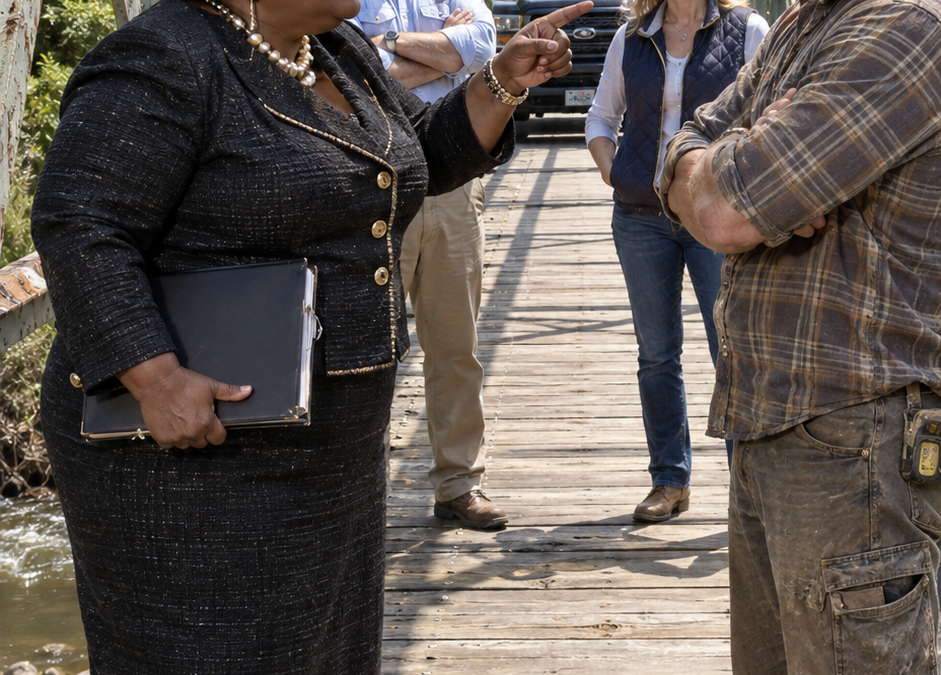
She walked up my gravel driveway wearing white sneakers and a smile.
“You removed association property.”
“No. I removed a sign from my railing.”
“That sign belonged to Ridgewater.”
“I didn’t damage it.”
“That isn’t the point.”
“Then what is?”
“You don’t get to unilaterally interfere with community infrastructure.”
I thought maybe we had reached the misunderstanding early enough to fix it.
“Vanessa, have you ever looked at the deed for this crossing?”
She tilted her head.
“I don’t need to.”
Five words.
I remember them better than some entire conversations.
She explained that Ridgewater had used the bridge for nearly twenty years.
The association had paid for plowing.
Approach patching.
Storm cleanup.
Routine maintenance.
Therefore, according to her, ownership was not something a piece of paper suddenly allowed me to dispute.
“You bought this property two years ago,” she said. “You don’t get to rewrite two decades of community investment.”
“Use isn’t ownership.”
She smiled.
“You’re splitting hairs.”
“No. Those are two completely different things.”
She turned away.
“I am not relitigating twenty years of community history with someone who has lived here for two.”
Then she got into her vehicle and backed off the bridge without checking behind her.
That night I slept badly.
Not from anger.
From the same feeling I get before an inspection when I know one dimension on the drawing does not match what was built.
Something was wrong.
The next morning I went to the shop.
Moved the extension cord off the plastic tote.
Opened the closing folder.
The deed confirmed what Dale had told me.
The bridge sat within my parcel.
The survey showed the same.
But those documents did not explain why forty-seven homes had been using it for nearly two decades.
Vanessa’s argument was simple.
That was why it worked.
Ridgewater used the bridge.
Ridgewater spent money on the bridge.
Therefore Ridgewater owned the bridge.
People like arguments that feel fair before they feel legal.
I made the mistake of thinking the distinction would be easy to explain.
At the community mailboxes a few days later, I told Vanessa that permission and ownership were not the same thing.
Someone can use private property for decades and still own nothing if the arrangement says exactly that.
She listened with her chin lowered and eyebrows slightly raised.
I later learned that was her waiting posture.
She was not considering my point.
She was waiting for me to stop making it.
I wrote her a short letter.
Four paragraphs.
Nothing threatening.
No lawyer.
I explained that the bridge appeared on my deed and survey.
I asked the association to identify whatever recorded right supported its ownership claim.
She never replied.
Instead, she told several neighbors I had sent a threatening letter.
I learned that when Ross Fenwick approached me in June.
Ross lived on Ridgewater Lane.
“Are you suing us?”
“What?”
“Vanessa said you sent some legal threat.”
“I asked her for the document showing the HOA owns the bridge.”
He looked confused.
“That isn’t what I heard.”
That sentence would follow me for months.
That isn’t what we were told.
Vanessa rarely argued with what I actually said.
She replaced it with something easier to defeat.
According to her, I was not asking who owned a bridge.
I was a man angry that other people crossed his land.
I needed control.
I wanted a gate.
I liked reminding forty-seven households that they depended on me.
She said those things with sympathy.
That was the clever part.
If someone attacks you angrily, you can defend yourself.
If they explain your supposed personality flaw with gentle concern, anger only confirms their diagnosis.
Then came the association meeting.
Second Thursday.
Ridgewater clubhouse.
Formal invitation.
The board wanted, according to the letter, to resolve the matter in a “neighborly fashion.”
I shaved.
Put on a clean shirt.
Drove across my bridge.
At the clubhouse, one folding chair had been set at the very back.
Behind roughly forty residents.
Facing the board across the entire room.
I manage construction meetings for a living.
I understand seating.
That chair was a message.
Vanessa opened the meeting.
Thanked people for refreshments.
Handled ordinary agenda items.
Then she looked toward me.
“And here he is,” she said. “Mr. Ror, our self-appointed bridge king.”
People laughed.
It was a good line.
I will give her that.
I did not laugh.
Did not object.
I opened my notebook.
Wrote the date.
Then listened.
Vanessa had slides.
Association expenses stretching back nearly twenty years.
Snow removal.
Deck cleaning.
Approach asphalt.
Minor repairs.
Thousands here.
Thousands there.
She totaled it dramatically.
“This is the community’s investment in its own infrastructure.”
Heads nodded.
“No reasonable person,” she continued, “can look at nearly two decades of use and maintenance and conclude that this is one individual’s private driveway.”
That was when I realized she believed what she was saying.
She was not knowingly selling a weak argument.
She truly believed long use had transformed permission into ownership.
That conviction made her much more dangerous.
Then she announced the new project.
Electronic gate.
Mounted at the near end of the crossing.
Resident access cards.
Guest keypad.
Camera integration.
Contractor scheduled for the next month.
People applauded.
I raised my hand.
Vanessa smiled.
“Yes, Caleb?”
“Has the association obtained written permission from the owner before designing equipment that will be attached to the bridge?”
The room went quiet.
Vanessa let the silence sit.
Then answered slowly.
“Men like you always think a piece of paper in a drawer means you can give orders to an entire community.”
A few people murmured.
I closed the notebook.
“Thank you for your time.”
Then left.
I drove home.
Crossed the bridge.
Parked in the dark.
Sat with the engine cooling.
I was not plotting revenge.
Revenge is generally useless once it reaches a records office.
I was thinking about one word Vanessa had used repeatedly.
Investment.
Dale Everheart had not simply allowed Ridgewater to cross indefinitely out of kindness.
Money had changed hands.
Money meant an agreement.
An agreement meant terms.
Somebody had written down what Ridgewater was buying with those payments.
I went into the shop.
Used a flashlight because one overhead ballast had burned out.
Emptied the entire plastic tote onto my workbench.
Survey.
Title commitment.
Insurance records.
Old invoices.
Then I found four pages stapled together on yellowing paper.
PRIVATE CROSSING ACCESS LICENSE.
Dated 2008.
Signed by Dale Everheart.
Signed by Ridgewater Estates Homeowners Association.
Not an easement.
Not a deed.
A license.
I read page two twice.
Then I called Paige Hensley.
Paige practiced real estate law above a hardware store in the county seat.
Thirty-nine.
Fast reader.
Wood floors.
Window air conditioner that rattled constantly.
She specialized in farmers, small builders, inherited property, and the kinds of land problems that begin with phrases like, “My grandfather always said…”
She read the license silently.
Halfway through page two, she stopped.
Tapped the desk twice.
Then started again from page one.
When she finally looked up, she said:
“Vanessa is wrong.”
“How wrong?”
“Very.”
The license was clear.
Dale had never transferred ownership.
He had given Ridgewater residents permission to cross.
The permission renewed annually.
In return, the association paid a maintenance contribution and a share of the bridge insurance premium.
Then Paige pointed to one sentence.
CONTINUED USE SHALL CREATE NO OWNERSHIP INTEREST.
“Five years or fifty,” she said. “They remain users.”
Then page two.
The association could not, without written consent from the landowner:
Attach fixtures.
Alter structural configuration.
Add surfacing.
Install gates.
Install barriers.
Install controlled-access equipment.
Represent to any third party that the HOA had exclusive control over the crossing.
I counted them.
Vanessa had already violated four.
She had announced the fifth at the meeting.
“Can I close it?” I asked.
Paige leaned back.
“Yes.”
I waited.
“And absolutely not.”
“That sounds useful.”
“As a question of raw contractual right, yes, depending on status and notice. As a strategy? Don’t.”
“Why?”
“The second you lock that bridge, you stop being the owner holding a document. You become the guy who trapped forty-seven families.”
I knew she was right.
Her instructions were simple.
Do not block the bridge.
Do not confront residents.
Do not interfere with traffic.
No matter what anybody said.
So we used paper.
Six-page notice.
License attached.
Certified delivery to Vanessa.
Certified delivery to Ridgewater’s registered agent.
Three demands.
Stop modifying the bridge.
Acknowledge private ownership.
Remove unauthorized signs and the camera post within fourteen days without damaging the structure.
Paige called the letter an exit ramp.
“People sometimes make terrible decisions because backing down feels more humiliating than continuing.”
“You think Vanessa uses the ramp?”
“No.”
Neither did I.
The response came from an attorney.
Heavy paper.
City firm.
Nearly twenty years of continuous use.
Maintenance.
Vested rights.
Community infrastructure.
Lawful stewardship.
Any attempt to interfere with resident passage would bring immediate action.
The word stewardship appeared four times.
The license appeared zero.
Paige called me.
“They either never gave their attorney the license or told him it doesn’t exist.”
A week later, Vanessa escalated.
I was coming home with a load of gravel when I saw a contractor’s truck near the bridge.
Two men had a magnetic drill clamped to the upstream truss.
Vanessa stood on the deck holding a clipboard.
Behind them, an aluminum sign was halfway installed.
PROPERTY OF RIDGEWATER ESTATES HOA.
I got out.
Walked over.
“This bridge is privately owned. You do not have my permission to drill into it.”
The older contractor stopped.
Looked at Vanessa.
I know that look.
Every superintendent knows it.
The look a tradesman gives when he begins wondering whether the person paying him actually has authority to order the work.
Vanessa answered him.
“Continue.”
Then she faced me.
“You can hire lawyers. You can send letters. You can make yourself feel important with whatever paperwork you like.”
The drill started behind her.
“But when this is over, you will still be one man standing in the middle of a road belonging to forty-seven families.”
She liked the sentence.
I could see that.
The drill bit into steel.
I did not touch it.
Did not shout.
Did not call the sheriff.
Instead, I took photographs.
Forty-one of them.
Drill.
Bracket.
Truss penetration.
Camera post.
New sign.
Deck overlay the HOA had recently installed.
Vanessa in frame supervising.
Time stamps.
Angles.
Details.
Then I made one phone call.
Heartline Mutual.
My bridge insurer.
I paid the premium.
The policy identified me as owner.
I told the adjuster unauthorized work had been performed on the insured structure.
He asked for photographs.
I sent all forty-one.
He became quiet.
“This may create a coverage question.”
I did not yet understand how important those words were.
Vanessa continued outward.
Ridgewater’s attorneys filed an action asking the court to declare permanent association rights over the crossing.
That did not surprise us.
Her Sunday email to residents did.
A neighbor forwarded it.
The subject framed the dispute as an effort by an adjacent landowner to convert a community road into a private toll asset.
She wrote that I had implied passage could be withdrawn.
That I was seeking leverage.
That one person should not be permitted to hold forty-seven households hostage.
I had never mentioned tolls.
Never blocked traffic.
Never demanded more money.
None of that mattered.
By Monday, people who used to wave stopped.
A note appeared beneath my windshield wiper.
JUST LET US LIVE.
A woman stopped her minivan on my gravel drive.
Two children sat behind her.
“Why are you doing this to us?”
“I haven’t stopped anyone.”
“That isn’t what we were told.”
There it was again.
I could have posted my own letter.
Could have put a sign beside the bridge.
Could have knocked on every door.
Paige advised against all of it.
“The only thing worse than being called a villain is arguing about it somewhere with no record.”
So I documented.
Every day.
Traffic crossed normally.
Hundreds of vehicle trips.
No barrier.
No delay.
No confrontation.
Then Heartline called.
Their staff engineer had reviewed the modifications.
Four problems.
Gate brackets drilled through primary truss members.
Added deck surfacing changing dead load.
Unauthorized attached devices.
A public ownership dispute over who controlled the insured structure.
That created an insurance problem with no simple answer.
If Ridgewater controlled the bridge, as Vanessa claimed, then my policy could not blindly insure work controlled by an outside entity.
If I controlled it, as the deed and policy said, unauthorized structural modifications had been made by a third party.
Either way, the bridge no longer matched the engineering condition Heartline had agreed to insure.
They needed an inspection.
The county became involved automatically.
I did not call them.
Heartline did.
A privately owned bridge carrying residential traffic was not something county engineers could ignore once structural alterations were reported.
Grant Holloway arrived on a Tuesday.
County infrastructure engineer.
Fifty-five.
Button-down shirt under a safety vest.
Folding rule.
Small notebook.
Almost aggressively calm.
He stepped onto the bridge.
Vanessa arrived before he reached the center.
She introduced herself.
Then immediately explained that Ridgewater had maintained the crossing for nearly twenty years and recently made several “improvements.”
Grant crouched beside one of the drilled brackets.
Touched it.
Stood.
“Who authorized these alterations?”
“I did.”
Vanessa said it proudly.
Grant wrote something.
“Was the deck overlay evaluated for added load?”
“The contractor said it was cosmetic.”
“Was the gate attachment engineered?”
“It is a standard residential product.”
Grant thanked her.
Thanked me.
Photographed the connection.
Left.
At 6:40 the following morning, an email arrived.
TEMPORARY VEHICULAR CLOSURE ORDER.
I read those words three times.
The county did not declare the bridge structurally unsafe.
What it said was narrower.
The bridge had been modified.
Primary structural members had been penetrated.
Additional dead load had been installed.
The engineering condition on record no longer matched the field condition.
Responsibility and control were disputed.
Until a certified inspection established the bridge’s condition and the responsible party, vehicular traffic was suspended.
I called Paige.
She read the order.
Then became silent.
“They’re going to say you did this.”
My stomach dropped because she was right.
Within thirty-five minutes, barricades were going up.
By 7:15, the first Ridgewater car had to turn around.
By eight, eleven vehicles were lined up on the far side.
Forty-seven homes had lost their only normal vehicular exit.
The visual was almost absurd.
One of the county closure notices was zip-tied directly below the shiny aluminum sign declaring:
PROPERTY OF RIDGEWATER ESTATES HOA.
I still have the photograph.
The reality for residents was not funny.
Some had left early for work and could not drive back home.
Others had cars trapped inside Ridgewater.
The county established an emergency protocol.
A gravel low-water ford could accommodate fire and ambulance vehicles under controlled conditions.
A shuttle point was created on my side.
Pedestrians were still permitted across the bridge.
I opened my gate.
Turned part of my hayfield into temporary parking.
Thirty-some vehicles.
I graded the soft approach with my tractor.
Not one person thanked me.
I do not blame them.
Vanessa emailed residents within ninety minutes.
Subject:
CALEB ROR HAS CLOSED OUR BRIDGE.
She said I had exploited a technical process to punish Ridgewater.
The board was seeking emergency relief.
Residents should document all hardship for litigation.
Nothing about drilled truss members.
Nothing about load review.
Nothing about her own statement to Grant.
By afternoon, around thirty residents were gathered at my fence.
Vanessa stood in the middle.
Pale blazer.
Perfect posture.
When I approached, she turned toward them instead of me.
“This is what happens when one man’s ego is placed above forty-seven families.”
People murmured.
Someone said my name angrily.
I did not argue.
I opened the county order on my phone.
Then handed it to Martin Keane.
Ridgewater treasurer.
Sixty-one.
Nine years on the board.
Always carried his own pen.
He had voted with Vanessa repeatedly.
Martin took the phone reluctantly.
Read.
Then reached the fourth paragraph.
Stopped.
Adjusted his glasses.
Read it again.
Then looked at Vanessa.
“Vanessa.”
Something changed in the crowd.
“This says the closure resulted from unauthorized association alterations.”
Silence.
Vanessa barely blinked.
“Boilerplate.”
She said an old bridge would always produce inspection findings.
She claimed I had intentionally invited county scrutiny.
Some residents believed her.
But Martin was still holding my phone.
That mattered.
A treasurer who begins reading source documents is very different from a treasurer who listens to summaries.
Vanessa used her last argument before leaving.
“The association owns this bridge.”
Once the court confirmed it, she said, all the county’s confusion would disappear.
That evening Paige came to my property.
We stood beside the barricades.
She watched residents carrying grocery bags across on foot.
“She’s going to keep saying they own it until someone forces her to prove it.”
Then she looked toward Ridgewater.
“Let’s find out what Ridgewater actually owns.”
I expected more title research.
Instead, Paige went to the county planning archive.
She pulled the original Ridgewater approval file.
Four days later, she called.
“Come to my office.”
“What did you find?”
“Come here.”
The file covered Ridgewater’s creation in the late 1990s.
The planning commission had identified a problem from the beginning.
One commissioner objected to approving a forty-seven-home development whose only exit depended on a privately owned bridge over Blackwood Creek.
If the landowner ever changed the arrangement, the county would have no control.
The commission required two means of access.
The first was the existing private bridge.
The second was a strip along Ridgewater’s northern edge connecting to Quarry Bend Road.
On the original plat:
EMERGENCY ACCESS CORRIDOR — PARCEL E.
Dedicated.
Recorded.
Required to be improved to a gravel standard capable of supporting fire apparatus.
I knew that northern boundary.
There was no road.
There was a small landscaped park.
Benches.
Ornamental grasses.
Decorative fencing.
Walking loop.
A carved sign:
WILLOW GREEN PRESERVE.
Paige opened another file.
Ridgewater Estates HOA petition to vacate Parcel E’s vehicular designation.
Reason:
An improved corridor would invite cut-through traffic from Quarry Bend Road.
Damage community character.
Create security concerns.
The petition requested conversion to landscaped common area.
Signed board resolution attached.
On the final page:
Vanessa Whitlock.
Her signature.
Her title.
I stared at it.
Ridgewater’s only exit had not become the bridge by accident.
The HOA had deliberately removed the other one.
Paige turned another page.
Board minutes from the 2021 discussion.
Vanessa’s remarks were summarized in detail.
One phrase appeared repeatedly.
THE PRIVATELY OWNED ROR CROSSING.
I read it again.
Then again.
“Is that what I think it is?”
“Yes.”
Four years earlier, Vanessa had formally described the bridge to the county as privately owned.
Now her attorneys were arguing Ridgewater had always owned it.
Both could not be true.
Martin called an emergency meeting.
This time he invited me himself.
Asked Paige to attend.
He sounded like a man who had spent several nights reading.
Vanessa spoke first.
No notes.
She was excellent.
The closure, she said, was manufactured.
I had triggered insurance scrutiny intentionally.
The board needed to hold firm against a private landowner weaponizing technical regulations.
If Ridgewater gave in, every subdivision in the county would become vulnerable to adjacent owners seeking leverage.
Paige said nothing.
She distributed packets.
Thirty-some copies.
People read.
Page one.
2021 petition removing Parcel E.
Page two.
Vanessa’s signature.
Page three.
Minutes.
Privately owned Ror crossing.
Martin reached the signature first.
“Did you sign this?”
Vanessa looked at the document.
“The board signs many administrative documents.”
“Did you sign it?”
“I would not claim to remember every certification from four years ago.”
A woman named Roa Marsh spoke.
Her husband used oxygen.
She had spent the closure week worrying about emergency access.
“If Parcel E still existed, would that be the road the fire department could use?”
No one answered immediately.
Questions started.
Why had residents never been told Ridgewater was approved with two exits?
Why had the board removed one?
Why had the petition described the bridge as private?
Vanessa answered each question reasonably.
That was almost impressive.
Every individual answer sounded plausible.
Together, they created a pattern no explanation could repair.
Then she turned toward me.
“This has never really been about property for Caleb.”
I looked at her.
She addressed the room.
“He has spent two years waiting for an opportunity to prove he is smarter than a woman running an association.”
Good line.
Again.
“He needs to be the man holding the keys.”
I had not spoken all evening.
I stood.
“No, Vanessa.”
The room went quiet.
“I’ve just been waiting for you to stop talking long enough for the paperwork to say something.”
No applause.
Good.
I did not want applause.
I sat.
Vanessa still had one strong argument.
Money.
The association had spent roughly $63,000 on the bridge over seventeen years.
Community money.
Maintenance.
Repairs.
Snow removal.
Insurance contributions.
That number mattered.
Sixty-three thousand dollars sounded like ownership.
People shifted.
Paige asked for the ledger.
Martin had his laptop.
He had already checked.
The total was real.
Just over $63,000.
But the accounting category was not capital improvement.
It was not HOA-owned infrastructure.
Nearly every recurring payment used the same description.
PRIVATE CROSSING MAINTENANCE CONTRIBUTION.
The annual payment required by the 2008 license.
Martin displayed old entries.
Then invoices from Dale Everheart’s years.
At the bottom of several:
PAYMENT DOES NOT CONVEY OWNERSHIP.
For months, Vanessa had been presenting the association’s payment for permission as proof of ownership.
Then Paige asked:
“Was the current annual payment made?”
Martin searched.
Stopped.
“No.”
“Why?”
He opened an approval log.
The payment had been prepared.
Then canceled.
Approver:
Vanessa Whitlock.
A note was attached.
WE DO NOT PAY RENT ON INFRASTRUCTURE WE OWN.
The room went silent again.
The chain was now complete.
Vanessa canceled the payment that renewed permission.
Declared Ridgewater the owner.
Ordered structural modifications.
The modifications created an insurance problem.
The insurer notified the county.
The county closed the bridge.
Forty-seven households lost their exit.
Not because I locked a gate.
Because Vanessa tried to prove there was no license by refusing to honor the license.
Paige still had one document left.
She saved it for the county hearing.
Eleven days later, we sat beneath fluorescent lights before a hearing officer.
Grant Holloway attended as county staff.
Association attorneys.
Paige.
Me.
Vanessa.
Technical evidence came first.
Deck overlay.
Brackets.
Truss penetrations.
Inspection requirements.
Vanessa adjusted her argument.
Smartly.
She no longer claimed unquestioned historic ownership.
Now the HOA had held a good-faith belief that it owned the bridge because of decades of maintenance and use.
Decisions made under that belief, she argued, should not be treated as deliberate violations.
It was a much better position.
Good faith matters.
The hearing officer seemed to be listening.
Then Paige offered one final exhibit.
An email preserved inside the county’s 2021 Parcel E file.
Sent by Vanessa to planning staff while advocating removal of Ridgewater’s second access corridor.
Paige read one sentence.
“If the private landowner should at some future point withdraw permission for use of the crossing, the association can revisit opening Parcel E at that time.”
Nothing moved.
Even the association’s attorney stopped taking notes.
The sentence answered everything.
Private landowner.
Vanessa knew Ridgewater was not the owner.
Withdraw permission.
She knew residents crossed by permission.
Revisit Parcel E.
She knew the second access existed specifically as protection against losing the bridge.
Four years earlier, she had predicted the exact situation Ridgewater was now experiencing.
Then helped eliminate the solution.
I looked across the table.
I expected triumph.
There was none.
Mostly I felt empty.
For months she had called me selfish.
Controlling.
Ego-driven.
I had spent endless energy resisting the urge to defend myself.
And now her own sentence was doing it for me.
The fight had never truly been between Vanessa and me.
It was Vanessa against the record.
The record had simply taken months to arrive.
The county’s findings came eleven days later.
The bridge was private property.
Mine.
The 2008 license was valid.
Long use created no ownership.
Maintenance payments created no ownership.
The HOA was responsible for removing unauthorized gate equipment, brackets, camera installation, and added deck surfacing.
Ridgewater had to fund the engineering inspection required before vehicular use resumed.
The association’s ownership action failed.
Then came the finding that changed Ridgewater permanently.
The county noted that the subdivision had originally been approved with two access routes.
Ridgewater itself had eliminated the second.
Within 180 days, the HOA had to submit a plan for restoring secondary access.
The county would no longer allow forty-seven homes to depend indefinitely on one privately owned bridge outside county control.
The planners had worried about exactly that in the 1990s.
They had been right.
Inspection took six weeks.
Deck overlay removed.
Gate brackets removed.
Two damaged gusset plates replaced at drilled connections.
Certified structural review.
Original load rating restored.
I paid for the gusset plates myself.
Nobody asked me to.
I never told Ridgewater.
The association already had enough costs.
I did not need the residents paying for two pieces of steel just so I could prove a point.
By then I had more leverage than Vanessa had ever imagined I wanted.
The annual access license had lapsed.
Ridgewater had no automatic right to cross.
I could have refused.
Could have named a new price.
Could have let the residents use temporary arrangements until Parcel E reopened.
Paige gave me the choices.
Then let me decide.
I thought for two days.
Then signed a new agreement.
Forty-seven households could continue using the bridge while Ridgewater designed and constructed its second access.
The agreement renewed annually.
Thirteen pages this time.
No assumptions.
Private ownership stated repeatedly.
No attachments.
No drilling.
No gates.
No surfacing.
No signage on the bridge itself.
Maintenance contributions itemized.
Receipts clear.
And Dale Everheart’s old sentence remained.
USE CREATES NO OWNERSHIP INTEREST.
Residents gradually learned what had actually happened.
Ross Fenwick came up my driveway in August.
He stood awkwardly.
“I repeated some things.”
“I figured.”
“They weren’t true.”
“I know.”
“I should’ve checked.”
I looked at him.
“So should everybody.”
He nodded.
“I’m sorry.”
“I would’ve believed her too.”
That surprised him.
But it was true.
Vanessa was persuasive.
Roa Marsh sent a card.
The woman who had confronted me with her children later stopped me at the hardware store and apologized.
Then asked whether her boys could see my tractor.
There was never a collective apology.
I did not need one.
Forty-seven families had never been my enemy.
One woman had made herself the interpreter of a situation she had stopped verifying.
In September, Martin and four other owners petitioned for a special vote.
Ridgewater had never removed a president before.
Thirty-nine households participated.
Thirty-one voted to remove Vanessa Whitlock.
I did not attend.
I was not a Ridgewater member.
I had no vote.
I belonged on my side of the creek.
Vanessa was not ruined.
She did not lose her home.
No one accused her of stealing association money.
I do not believe she ever saw herself as dishonest.
I think she genuinely believed she was protecting her community.
That may have been the problem.
When somebody becomes certain her intention is good, she can begin treating verification as an insult.
At the end of September, Vanessa came to my property one final time.
She did not park on the bridge.
She pulled onto the shoulder and walked.
She looked tired.
Not defeated.
Just smaller somehow without the association speaking through her.
“You won.”
I said nothing.
“Are you happy?”
I had imagined that moment many times.
Every clever answer sounded stupid once she was actually standing there.
So I told her the truth.
“I never needed to beat you.”
She looked at the bridge.
“I needed you to stop calling my property yours.”
She left.
I have not spoken to her since.
Parcel E is being reopened.
The Willow Green Preserve is changing.
The benches are being moved.
The ornamental grasses will survive in a smaller landscaped area.
A gravel emergency route will run to Quarry Bend Road.
It will meet county standard.
It will be gated for controlled use.
Ridgewater residents will pay for it.
Their children will grow up in a neighborhood with two ways out.
Which is what the county required from the beginning.
My bridge is still where it was.
One lane.
Steel truss.
Timber deck.
I repainted the north abutment in April.
There is a new sign at the near end.
I made it myself from scrap steel.
Brushed.
Clear coated.
Three lines.
ROR BRIDGE
PRIVATE PROPERTY
RESIDENT ACCESS BY AGREEMENT
It is mounted to a separate post.
Not the truss.
I read page two very carefully.
Every morning, cars cross.
Most people wave again.
Some do not.
That is fine.
I never needed them to.
Sometimes, standing beside the shop, I think about how completely Vanessa misunderstood the bridge.
She wanted it to prove that forty-seven households and an HOA board carried more authority than one man with a deed.
Every action she took to strengthen that claim forced somebody else to examine the record more closely.
The access license.
The canceled annual payment.
The insurance policy.
The drilled truss.
The original subdivision approval.
Parcel E.
The 2021 petition.
The maintenance ledger.
Her email to the county.
She kept insisting the bridge belonged to Ridgewater.
The harder she pushed, the deeper everyone looked.
And when they finally reached the bottom, they discovered something neither she nor the residents had thought about in years.
Ridgewater’s entire relationship with that crossing had always depended on permission.
Dale Everheart understood that in 2008.
He wrote it down.
Payment does not convey ownership.
Continued use creates no ownership interest.
Simple sentences.
Quiet sentences.
The kind people ignore when everything is working.
Vanessa stood on my bridge and told me that decades of habit had made those words irrelevant.
In the end, the opposite was true.
The habit was temporary.
The words were what survived.
Forty-seven homes still cross Blackwood Creek every day.
They still use my bridge.
I am glad they do.
But now everybody involved understands the difference between being allowed to use something and owning it.
And the strangest part is that I never had to close the bridge to teach them.
Vanessa’s own decisions did that for me.
She canceled the payment.
She ordered the modifications.
She claimed control.
The insurer asked questions.
The county looked at the steel.
The barricades went up.
And for one miserable week, forty-seven families learned just how dangerous it is when somebody mistakes long permission for permanent ownership.
By next spring, Ridgewater will have two exits again.
My bridge will become what it should have been all along.
Useful.
Private.
Ordinary.
Something people cross without thinking too much about it.
And that suits me.
I bought eighteen acres because I wanted quiet.
Not power.
Not leverage.
Not forty-seven households depending on my goodwill.
Vanessa spent months insisting I was trying to become the man holding the keys.
The truth was simpler.
I never wanted the keys.
I only wanted the person using my bridge to remember who owned the door.
Have you finished reading the story and want to read it again?
The HOA Had Used My Bridge for Twenty Years Without Ever Reading the Document That Let Them Cross It
The first time Vanessa Whitlock stood on my bridge and told me I had no right to interfere with community property, I asked her one question.
“Are you sure?”
She laughed, and three months later forty-seven homes discovered exactly how much of their neighborhood had been resting on an answer nobody had bothered to verify.
My name is Caleb Ror.
I was forty-two when the bridge became the most discussed piece of steel in Asheford County.
Before that, it was simply something I owned.
My property is eighteen acres of rough ground on the near side of Blackwood Creek.
There is nothing elegant about it.
A gravel drive.
A metal shop where I keep a welder and a tractor with a hydraulic leak I have promised myself for two years I will finally fix.
A stand of black walnut my grandfather would have considered valuable and I mostly consider shade.
A low stretch of pasture that floods every spring and dries out sometime in April.
I manage construction projects for a living.
Schedules.
Change orders.
Inspections.
Subcontractors blaming other subcontractors.
Owners blaming designers.
Designers blaming drawings everyone approved six months earlier.
After spending my workdays inside other people’s deadlines, I bought the property because I wanted one place where nobody could hand me a schedule.
The bridge was already there.
One lane.
Steel truss.
Timber deck.
Old enough that nobody I knew could tell me the exact year it had first crossed Blackwood Creek.
A small weight plate was riveted to the upstream beam.
The north abutment carried layers of paint thick enough to tell its own history.
On the far side of the bridge sat Ridgewater Estates.
Forty-seven homes.
Three curving streets.
Matching lamp posts.
Brick mailboxes.
Lawns that somehow appeared to be cut on the same afternoon.
It was the kind of neighborhood where people apologized if their driveway had a stain.
And there was one unusual thing about Ridgewater.
If you lived there and wanted to reach school, groceries, work, a doctor’s office, or anything else beyond those three streets, you crossed Blackwood Creek on my bridge.
There was no other paved exit.
Not one.
For decades, residents drove across that bridge so routinely that nobody thought about it.
A staircase is invisible until one of the steps disappears.
The bridge was like that.
The man who sold me the property was Dale Everheart.
He was eighty-one at closing and had farmed the ground since the 1970s.
We were sitting in a title office with fluorescent lights and weak coffee when he told me two things.
First, the black walnut was worth more than the old tractor included in the sale.
Second, I owned the crossing.
“Don’t ever let anybody talk you out of knowing that,” he said.
There was something in the way he said it.
Not dramatic.
Almost tired.
Like he had explained the same thing before to someone who had chosen not to hear him.
I nodded.
Signed my closing papers.
Put the folder in a plastic tote in my shop.
Then forgot about most of it for two years.
I never restricted the bridge.
I never put up a toll.
Never installed a gate.
Never stopped a single resident.
What I did was maintain it.
The first autumn, I replaced eleven damaged deck boards after a snowplow chewed them.
The following spring, I ground rust from the north abutment plate and repainted it.
One October, I stood waist-deep in cold creek water wearing waders and pulled a shopping cart and half a sycamore tree from beneath the center pier.
I was not trying to be generous.
I was maintaining my property.
The fact that forty-seven other households benefited was fine with me.
A few residents waved when they crossed.
One woman once left cinnamon rolls on my gate with a note thanking me for replacing a rail.
I still have that note.
Then Ridgewater held a board election.
Vanessa Whitlock became HOA president.
I knew Vanessa the way you know people who pass your house every morning.
I knew her SUV.
Her sunglasses.
Her habit of slowing slightly at the bridge before accelerating uphill.
She was forty-eight and had spent years managing a regional sales territory before retiring early.
Vanessa was good in a room.
Very good.
I once watched her speak at a county road meeting.
Twenty exhausted residents entered with twenty different complaints.
Vanessa stood up, gave the problem one clean sentence, and within ten minutes most of them were repeating her sentence instead of their own.
That is a real skill.
The danger comes when somebody becomes so good at shaping other people’s understanding that she begins believing facts are only another audience to manage.
The first sign appeared in March.
White aluminum.
Green lettering.
RIDGEWATER ESTATES RESIDENT ACCESS ONLY.
It had been screwed directly into the north railing of my bridge.
Nobody called me.
Nobody asked permission.
Someone simply walked onto my property carrying a cordless drill and decided my steel was an appropriate place to mount association signage.
I stood there in a jacket reading it.
Twice.
Then left it alone.
I was working in another county that week and assumed someone would contact me.
Nobody did.
That was my first lesson about Ridgewater under Vanessa.
Silence became consent if she needed it to.
A camera came next.
Pressure-treated post.
Set into my bank about six feet from the abutment.
Lens pointed directly along the bridge deck.
Again, no request.
Then a second sign arrived.
Larger.
Bolted through the railing.
HOA PROPERTY.
I found it on a Saturday morning.
I went into the shop.
Got a socket wrench.
Removed the bolts carefully.
Set the sign against my fence so it would not be damaged.
Then changed the oil in my tractor.
The railing was mine.
I did not think the matter required a committee.
Vanessa arrived the following morning.
She parked on the bridge itself.
That irritated me more than the sign.
Nobody parks on a one-lane bridge.
She walked up my gravel driveway wearing white sneakers and a smile.
“You removed association property.”
“No. I removed a sign from my railing.”
“That sign belonged to Ridgewater.”
“I didn’t damage it.”
“That isn’t the point.”
“Then what is?”
“You don’t get to unilaterally interfere with community infrastructure.”
I thought maybe we had reached the misunderstanding early enough to fix it.
“Vanessa, have you ever looked at the deed for this crossing?”
She tilted her head.
“I don’t need to.”
Five words.
I remember them better than some entire conversations.
She explained that Ridgewater had used the bridge for nearly twenty years.
The association had paid for plowing.
Approach patching.
Storm cleanup.
Routine maintenance.
Therefore, according to her, ownership was not something a piece of paper suddenly allowed me to dispute.
“You bought this property two years ago,” she said. “You don’t get to rewrite two decades of community investment.”
“Use isn’t ownership.”
She smiled.
“You’re splitting hairs.”
“No. Those are two completely different things.”
She turned away.
“I am not relitigating twenty years of community history with someone who has lived here for two.”
Then she got into her vehicle and backed off the bridge without checking behind her.
That night I slept badly.
Not from anger.
From the same feeling I get before an inspection when I know one dimension on the drawing does not match what was built.
Something was wrong.
The next morning I went to the shop.
Moved the extension cord off the plastic tote.
Opened the closing folder.
The deed confirmed what Dale had told me.
The bridge sat within my parcel.
The survey showed the same.
But those documents did not explain why forty-seven homes had been using it for nearly two decades.
Vanessa’s argument was simple.
That was why it worked.
Ridgewater used the bridge.
Ridgewater spent money on the bridge.
Therefore Ridgewater owned the bridge.
People like arguments that feel fair before they feel legal.
I made the mistake of thinking the distinction would be easy to explain.
At the community mailboxes a few days later, I told Vanessa that permission and ownership were not the same thing.
Someone can use private property for decades and still own nothing if the arrangement says exactly that.
She listened with her chin lowered and eyebrows slightly raised.
I later learned that was her waiting posture.
She was not considering my point.
She was waiting for me to stop making it.
I wrote her a short letter.
Four paragraphs.
Nothing threatening.
No lawyer.
I explained that the bridge appeared on my deed and survey.
I asked the association to identify whatever recorded right supported its ownership claim.
She never replied.
Instead, she told several neighbors I had sent a threatening letter.
I learned that when Ross Fenwick approached me in June.
Ross lived on Ridgewater Lane.
“Are you suing us?”
“What?”
“Vanessa said you sent some legal threat.”
“I asked her for the document showing the HOA owns the bridge.”
He looked confused.
“That isn’t what I heard.”
That sentence would follow me for months.
That isn’t what we were told.
Vanessa rarely argued with what I actually said.
She replaced it with something easier to defeat.
According to her, I was not asking who owned a bridge.
I was a man angry that other people crossed his land.
I needed control.
I wanted a gate.
I liked reminding forty-seven households that they depended on me.
She said those things with sympathy.
That was the clever part.
If someone attacks you angrily, you can defend yourself.
If they explain your supposed personality flaw with gentle concern, anger only confirms their diagnosis.
Then came the association meeting.
Second Thursday.
Ridgewater clubhouse.
Formal invitation.
The board wanted, according to the letter, to resolve the matter in a “neighborly fashion.”
I shaved.
Put on a clean shirt.
Drove across my bridge.
At the clubhouse, one folding chair had been set at the very back.
Behind roughly forty residents.
Facing the board across the entire room.
I manage construction meetings for a living.
I understand seating.
That chair was a message.
Vanessa opened the meeting.
Thanked people for refreshments.
Handled ordinary agenda items.
Then she looked toward me.
“And here he is,” she said. “Mr. Ror, our self-appointed bridge king.”
People laughed.
It was a good line.
I will give her that.
I did not laugh.
Did not object.
I opened my notebook.
Wrote the date.
Then listened.
Vanessa had slides.
Association expenses stretching back nearly twenty years.
Snow removal.
Deck cleaning.
Approach asphalt.
Minor repairs.
Thousands here.
Thousands there.
She totaled it dramatically.
“This is the community’s investment in its own infrastructure.”
Heads nodded.
“No reasonable person,” she continued, “can look at nearly two decades of use and maintenance and conclude that this is one individual’s private driveway.”
That was when I realized she believed what she was saying.
She was not knowingly selling a weak argument.
She truly believed long use had transformed permission into ownership.
That conviction made her much more dangerous.
Then she announced the new project.
Electronic gate.
Mounted at the near end of the crossing.
Resident access cards.
Guest keypad.
Camera integration.
Contractor scheduled for the next month.
People applauded.
I raised my hand.
Vanessa smiled.
“Yes, Caleb?”
“Has the association obtained written permission from the owner before designing equipment that will be attached to the bridge?”
The room went quiet.
Vanessa let the silence sit.
Then answered slowly.
“Men like you always think a piece of paper in a drawer means you can give orders to an entire community.”
A few people murmured.
I closed the notebook.
“Thank you for your time.”
Then left.
I drove home.
Crossed the bridge.
Parked in the dark.
Sat with the engine cooling.
I was not plotting revenge.
Revenge is generally useless once it reaches a records office.
I was thinking about one word Vanessa had used repeatedly.
Investment.
Dale Everheart had not simply allowed Ridgewater to cross indefinitely out of kindness.
Money had changed hands.
Money meant an agreement.
An agreement meant terms.
Somebody had written down what Ridgewater was buying with those payments.
I went into the shop.
Used a flashlight because one overhead ballast had burned out.
Emptied the entire plastic tote onto my workbench.
Survey.
Title commitment.
Insurance records.
Old invoices.
Then I found four pages stapled together on yellowing paper.
PRIVATE CROSSING ACCESS LICENSE.
Dated 2008.
Signed by Dale Everheart.
Signed by Ridgewater Estates Homeowners Association.
Not an easement.
Not a deed.
A license.
I read page two twice.
Then I called Paige Hensley.
Paige practiced real estate law above a hardware store in the county seat.
Thirty-nine.
Fast reader.
Wood floors.
Window air conditioner that rattled constantly.
She specialized in farmers, small builders, inherited property, and the kinds of land problems that begin with phrases like, “My grandfather always said…”
She read the license silently.
Halfway through page two, she stopped.
Tapped the desk twice.
Then started again from page one.
When she finally looked up, she said:
“Vanessa is wrong.”
“How wrong?”
“Very.”
The license was clear.
Dale had never transferred ownership.
He had given Ridgewater residents permission to cross.
The permission renewed annually.
In return, the association paid a maintenance contribution and a share of the bridge insurance premium.
Then Paige pointed to one sentence.
CONTINUED USE SHALL CREATE NO OWNERSHIP INTEREST.
“Five years or fifty,” she said. “They remain users.”
Then page two.
The association could not, without written consent from the landowner:
Attach fixtures.
Alter structural configuration.
Add surfacing.
Install gates.
Install barriers.
Install controlled-access equipment.
Represent to any third party that the HOA had exclusive control over the crossing.
I counted them.
Vanessa had already violated four.
She had announced the fifth at the meeting.
“Can I close it?” I asked.
Paige leaned back.
“Yes.”
I waited.
“And absolutely not.”
“That sounds useful.”
“As a question of raw contractual right, yes, depending on status and notice. As a strategy? Don’t.”
“Why?”
“The second you lock that bridge, you stop being the owner holding a document. You become the guy who trapped forty-seven families.”
I knew she was right.
Her instructions were simple.
Do not block the bridge.
Do not confront residents.
Do not interfere with traffic.
No matter what anybody said.
So we used paper.
Six-page notice.
License attached.
Certified delivery to Vanessa.
Certified delivery to Ridgewater’s registered agent.
Three demands.
Stop modifying the bridge.
Acknowledge private ownership.
Remove unauthorized signs and the camera post within fourteen days without damaging the structure.
Paige called the letter an exit ramp.
“People sometimes make terrible decisions because backing down feels more humiliating than continuing.”
“You think Vanessa uses the ramp?”
“No.”
Neither did I.
The response came from an attorney.
Heavy paper.
City firm.
Nearly twenty years of continuous use.
Maintenance.
Vested rights.
Community infrastructure.
Lawful stewardship.
Any attempt to interfere with resident passage would bring immediate action.
The word stewardship appeared four times.
The license appeared zero.
Paige called me.
“They either never gave their attorney the license or told him it doesn’t exist.”
A week later, Vanessa escalated.
I was coming home with a load of gravel when I saw a contractor’s truck near the bridge.
Two men had a magnetic drill clamped to the upstream truss.
Vanessa stood on the deck holding a clipboard.
Behind them, an aluminum sign was halfway installed.
PROPERTY OF RIDGEWATER ESTATES HOA.
I got out.
Walked over.
“This bridge is privately owned. You do not have my permission to drill into it.”
The older contractor stopped.
Looked at Vanessa.
I know that look.
Every superintendent knows it.
The look a tradesman gives when he begins wondering whether the person paying him actually has authority to order the work.
Vanessa answered him.
“Continue.”
Then she faced me.
“You can hire lawyers. You can send letters. You can make yourself feel important with whatever paperwork you like.”
The drill started behind her.
“But when this is over, you will still be one man standing in the middle of a road belonging to forty-seven families.”
She liked the sentence.
I could see that.
The drill bit into steel.
I did not touch it.
Did not shout.
Did not call the sheriff.
Instead, I took photographs.
Forty-one of them.
Drill.
Bracket.
Truss penetration.
Camera post.
New sign.
Deck overlay the HOA had recently installed.
Vanessa in frame supervising.
Time stamps.
Angles.
Details.
Then I made one phone call.
Heartline Mutual.
My bridge insurer.
I paid the premium.
The policy identified me as owner.
I told the adjuster unauthorized work had been performed on the insured structure.
He asked for photographs.
I sent all forty-one.
He became quiet.
“This may create a coverage question.”
I did not yet understand how important those words were.
Vanessa continued outward.
Ridgewater’s attorneys filed an action asking the court to declare permanent association rights over the crossing.
That did not surprise us.
Her Sunday email to residents did.
A neighbor forwarded it.
The subject framed the dispute as an effort by an adjacent landowner to convert a community road into a private toll asset.
She wrote that I had implied passage could be withdrawn.
That I was seeking leverage.
That one person should not be permitted to hold forty-seven households hostage.
I had never mentioned tolls.
Never blocked traffic.
Never demanded more money.
None of that mattered.
By Monday, people who used to wave stopped.
A note appeared beneath my windshield wiper.
JUST LET US LIVE.
A woman stopped her minivan on my gravel drive.
Two children sat behind her.
“Why are you doing this to us?”
“I haven’t stopped anyone.”
“That isn’t what we were told.”
There it was again.
I could have posted my own letter.
Could have put a sign beside the bridge.
Could have knocked on every door.
Paige advised against all of it.
“The only thing worse than being called a villain is arguing about it somewhere with no record.”
So I documented.
Every day.
Traffic crossed normally.
Hundreds of vehicle trips.
No barrier.
No delay.
No confrontation.
Then Heartline called.
Their staff engineer had reviewed the modifications.
Four problems.
Gate brackets drilled through primary truss members.
Added deck surfacing changing dead load.
Unauthorized attached devices.
A public ownership dispute over who controlled the insured structure.
That created an insurance problem with no simple answer.
If Ridgewater controlled the bridge, as Vanessa claimed, then my policy could not blindly insure work controlled by an outside entity.
If I controlled it, as the deed and policy said, unauthorized structural modifications had been made by a third party.
Either way, the bridge no longer matched the engineering condition Heartline had agreed to insure.
They needed an inspection.
The county became involved automatically.
I did not call them.
Heartline did.
A privately owned bridge carrying residential traffic was not something county engineers could ignore once structural alterations were reported.
Grant Holloway arrived on a Tuesday.
County infrastructure engineer.
Fifty-five.
Button-down shirt under a safety vest.
Folding rule.
Small notebook.
Almost aggressively calm.
He stepped onto the bridge.
Vanessa arrived before he reached the center.
She introduced herself.
Then immediately explained that Ridgewater had maintained the crossing for nearly twenty years and recently made several “improvements.”
Grant crouched beside one of the drilled brackets.
Touched it.
Stood.
“Who authorized these alterations?”
“I did.”
Vanessa said it proudly.
Grant wrote something.
“Was the deck overlay evaluated for added load?”
“The contractor said it was cosmetic.”
“Was the gate attachment engineered?”
“It is a standard residential product.”
Grant thanked her.
Thanked me.
Photographed the connection.
Left.
At 6:40 the following morning, an email arrived.
TEMPORARY VEHICULAR CLOSURE ORDER.
I read those words three times.
The county did not declare the bridge structurally unsafe.
What it said was narrower.
The bridge had been modified.
Primary structural members had been penetrated.
Additional dead load had been installed.
The engineering condition on record no longer matched the field condition.
Responsibility and control were disputed.
Until a certified inspection established the bridge’s condition and the responsible party, vehicular traffic was suspended.
I called Paige.
She read the order.
Then became silent.
“They’re going to say you did this.”
My stomach dropped because she was right.
Within thirty-five minutes, barricades were going up.
By 7:15, the first Ridgewater car had to turn around.
By eight, eleven vehicles were lined up on the far side.
Forty-seven homes had lost their only normal vehicular exit.
The visual was almost absurd.
One of the county closure notices was zip-tied directly below the shiny aluminum sign declaring:
PROPERTY OF RIDGEWATER ESTATES HOA.
I still have the photograph.
The reality for residents was not funny.
Some had left early for work and could not drive back home.
Others had cars trapped inside Ridgewater.
The county established an emergency protocol.
A gravel low-water ford could accommodate fire and ambulance vehicles under controlled conditions.
A shuttle point was created on my side.
Pedestrians were still permitted across the bridge.
I opened my gate.
Turned part of my hayfield into temporary parking.
Thirty-some vehicles.
I graded the soft approach with my tractor.
Not one person thanked me.
I do not blame them.
Vanessa emailed residents within ninety minutes.
Subject:
CALEB ROR HAS CLOSED OUR BRIDGE.
She said I had exploited a technical process to punish Ridgewater.
The board was seeking emergency relief.
Residents should document all hardship for litigation.
Nothing about drilled truss members.
Nothing about load review.
Nothing about her own statement to Grant.
By afternoon, around thirty residents were gathered at my fence.
Vanessa stood in the middle.
Pale blazer.
Perfect posture.
When I approached, she turned toward them instead of me.
“This is what happens when one man’s ego is placed above forty-seven families.”
People murmured.
Someone said my name angrily.
I did not argue.
I opened the county order on my phone.
Then handed it to Martin Keane.
Ridgewater treasurer.
Sixty-one.
Nine years on the board.
Always carried his own pen.
He had voted with Vanessa repeatedly.
Martin took the phone reluctantly.
Read.
Then reached the fourth paragraph.
Stopped.
Adjusted his glasses.
Read it again.
Then looked at Vanessa.
“Vanessa.”
Something changed in the crowd.
“This says the closure resulted from unauthorized association alterations.”
Silence.
Vanessa barely blinked.
“Boilerplate.”
She said an old bridge would always produce inspection findings.
She claimed I had intentionally invited county scrutiny.
Some residents believed her.
But Martin was still holding my phone.
That mattered.
A treasurer who begins reading source documents is very different from a treasurer who listens to summaries.
Vanessa used her last argument before leaving.
“The association owns this bridge.”
Once the court confirmed it, she said, all the county’s confusion would disappear.
That evening Paige came to my property.
We stood beside the barricades.
She watched residents carrying grocery bags across on foot.
“She’s going to keep saying they own it until someone forces her to prove it.”
Then she looked toward Ridgewater.
“Let’s find out what Ridgewater actually owns.”
I expected more title research.
Instead, Paige went to the county planning archive.
She pulled the original Ridgewater approval file.
Four days later, she called.
“Come to my office.”
“What did you find?”
“Come here.”
The file covered Ridgewater’s creation in the late 1990s.
The planning commission had identified a problem from the beginning.
One commissioner objected to approving a forty-seven-home development whose only exit depended on a privately owned bridge over Blackwood Creek.
If the landowner ever changed the arrangement, the county would have no control.
The commission required two means of access.
The first was the existing private bridge.
The second was a strip along Ridgewater’s northern edge connecting to Quarry Bend Road.
On the original plat:
EMERGENCY ACCESS CORRIDOR — PARCEL E.
Dedicated.
Recorded.
Required to be improved to a gravel standard capable of supporting fire apparatus.
I knew that northern boundary.
There was no road.
There was a small landscaped park.
Benches.
Ornamental grasses.
Decorative fencing.
Walking loop.
A carved sign:
WILLOW GREEN PRESERVE.
Paige opened another file.
Ridgewater Estates HOA petition to vacate Parcel E’s vehicular designation.
Reason:
An improved corridor would invite cut-through traffic from Quarry Bend Road.
Damage community character.
Create security concerns.
The petition requested conversion to landscaped common area.
Signed board resolution attached.
On the final page:
Vanessa Whitlock.
Her signature.
Her title.
I stared at it.
Ridgewater’s only exit had not become the bridge by accident.
The HOA had deliberately removed the other one.
Paige turned another page.
Board minutes from the 2021 discussion.
Vanessa’s remarks were summarized in detail.
One phrase appeared repeatedly.
THE PRIVATELY OWNED ROR CROSSING.
I read it again.
Then again.
“Is that what I think it is?”
“Yes.”
Four years earlier, Vanessa had formally described the bridge to the county as privately owned.
Now her attorneys were arguing Ridgewater had always owned it.
Both could not be true.
Martin called an emergency meeting.
This time he invited me himself.
Asked Paige to attend.
He sounded like a man who had spent several nights reading.
Vanessa spoke first.
No notes.
She was excellent.
The closure, she said, was manufactured.
I had triggered insurance scrutiny intentionally.
The board needed to hold firm against a private landowner weaponizing technical regulations.
If Ridgewater gave in, every subdivision in the county would become vulnerable to adjacent owners seeking leverage.
Paige said nothing.
She distributed packets.
Thirty-some copies.
People read.
Page one.
2021 petition removing Parcel E.
Page two.
Vanessa’s signature.
Page three.
Minutes.
Privately owned Ror crossing.
Martin reached the signature first.
“Did you sign this?”
Vanessa looked at the document.
“The board signs many administrative documents.”
“Did you sign it?”
“I would not claim to remember every certification from four years ago.”
A woman named Roa Marsh spoke.
Her husband used oxygen.
She had spent the closure week worrying about emergency access.
“If Parcel E still existed, would that be the road the fire department could use?”
No one answered immediately.
Questions started.
Why had residents never been told Ridgewater was approved with two exits?
Why had the board removed one?
Why had the petition described the bridge as private?
Vanessa answered each question reasonably.
That was almost impressive.
Every individual answer sounded plausible.
Together, they created a pattern no explanation could repair.
Then she turned toward me.
“This has never really been about property for Caleb.”
I looked at her.
She addressed the room.
“He has spent two years waiting for an opportunity to prove he is smarter than a woman running an association.”
Good line.
Again.
“He needs to be the man holding the keys.”
I had not spoken all evening.
I stood.
“No, Vanessa.”
The room went quiet.
“I’ve just been waiting for you to stop talking long enough for the paperwork to say something.”
No applause.
Good.
I did not want applause.
I sat.
Vanessa still had one strong argument.
Money.
The association had spent roughly $63,000 on the bridge over seventeen years.
Community money.
Maintenance.
Repairs.
Snow removal.
Insurance contributions.
That number mattered.
Sixty-three thousand dollars sounded like ownership.
People shifted.
Paige asked for the ledger.
Martin had his laptop.
He had already checked.
The total was real.
Just over $63,000.
But the accounting category was not capital improvement.
It was not HOA-owned infrastructure.
Nearly every recurring payment used the same description.
PRIVATE CROSSING MAINTENANCE CONTRIBUTION.
The annual payment required by the 2008 license.
Martin displayed old entries.
Then invoices from Dale Everheart’s years.
At the bottom of several:
PAYMENT DOES NOT CONVEY OWNERSHIP.
For months, Vanessa had been presenting the association’s payment for permission as proof of ownership.
Then Paige asked:
“Was the current annual payment made?”
Martin searched.
Stopped.
“No.”
“Why?”
He opened an approval log.
The payment had been prepared.
Then canceled.
Approver:
Vanessa Whitlock.
A note was attached.
WE DO NOT PAY RENT ON INFRASTRUCTURE WE OWN.
The room went silent again.
The chain was now complete.
Vanessa canceled the payment that renewed permission.
Declared Ridgewater the owner.
Ordered structural modifications.
The modifications created an insurance problem.
The insurer notified the county.
The county closed the bridge.
Forty-seven households lost their exit.
Not because I locked a gate.
Because Vanessa tried to prove there was no license by refusing to honor the license.
Paige still had one document left.
She saved it for the county hearing.
Eleven days later, we sat beneath fluorescent lights before a hearing officer.
Grant Holloway attended as county staff.
Association attorneys.
Paige.
Me.
Vanessa.
Technical evidence came first.
Deck overlay.
Brackets.
Truss penetrations.
Inspection requirements.
Vanessa adjusted her argument.
Smartly.
She no longer claimed unquestioned historic ownership.
Now the HOA had held a good-faith belief that it owned the bridge because of decades of maintenance and use.
Decisions made under that belief, she argued, should not be treated as deliberate violations.
It was a much better position.
Good faith matters.
The hearing officer seemed to be listening.
Then Paige offered one final exhibit.
An email preserved inside the county’s 2021 Parcel E file.
Sent by Vanessa to planning staff while advocating removal of Ridgewater’s second access corridor.
Paige read one sentence.
“If the private landowner should at some future point withdraw permission for use of the crossing, the association can revisit opening Parcel E at that time.”
Nothing moved.
Even the association’s attorney stopped taking notes.
The sentence answered everything.
Private landowner.
Vanessa knew Ridgewater was not the owner.
Withdraw permission.
She knew residents crossed by permission.
Revisit Parcel E.
She knew the second access existed specifically as protection against losing the bridge.
Four years earlier, she had predicted the exact situation Ridgewater was now experiencing.
Then helped eliminate the solution.
I looked across the table.
I expected triumph.
There was none.
Mostly I felt empty.
For months she had called me selfish.
Controlling.
Ego-driven.
I had spent endless energy resisting the urge to defend myself.
And now her own sentence was doing it for me.
The fight had never truly been between Vanessa and me.
It was Vanessa against the record.
The record had simply taken months to arrive.
The county’s findings came eleven days later.
The bridge was private property.
Mine.
The 2008 license was valid.
Long use created no ownership.
Maintenance payments created no ownership.
The HOA was responsible for removing unauthorized gate equipment, brackets, camera installation, and added deck surfacing.
Ridgewater had to fund the engineering inspection required before vehicular use resumed.
The association’s ownership action failed.
Then came the finding that changed Ridgewater permanently.
The county noted that the subdivision had originally been approved with two access routes.
Ridgewater itself had eliminated the second.
Within 180 days, the HOA had to submit a plan for restoring secondary access.
The county would no longer allow forty-seven homes to depend indefinitely on one privately owned bridge outside county control.
The planners had worried about exactly that in the 1990s.
They had been right.
Inspection took six weeks.
Deck overlay removed.
Gate brackets removed.
Two damaged gusset plates replaced at drilled connections.
Certified structural review.
Original load rating restored.
I paid for the gusset plates myself.
Nobody asked me to.
I never told Ridgewater.
The association already had enough costs.
I did not need the residents paying for two pieces of steel just so I could prove a point.
By then I had more leverage than Vanessa had ever imagined I wanted.
The annual access license had lapsed.
Ridgewater had no automatic right to cross.
I could have refused.
Could have named a new price.
Could have let the residents use temporary arrangements until Parcel E reopened.
Paige gave me the choices.
Then let me decide.
I thought for two days.
Then signed a new agreement.
Forty-seven households could continue using the bridge while Ridgewater designed and constructed its second access.
The agreement renewed annually.
Thirteen pages this time.
No assumptions.
Private ownership stated repeatedly.
No attachments.
No drilling.
No gates.
No surfacing.
No signage on the bridge itself.
Maintenance contributions itemized.
Receipts clear.
And Dale Everheart’s old sentence remained.
USE CREATES NO OWNERSHIP INTEREST.
Residents gradually learned what had actually happened.
Ross Fenwick came up my driveway in August.
He stood awkwardly.
“I repeated some things.”
“I figured.”
“They weren’t true.”
“I know.”
“I should’ve checked.”
I looked at him.
“So should everybody.”
He nodded.
“I’m sorry.”
“I would’ve believed her too.”
That surprised him.
But it was true.
Vanessa was persuasive.
Roa Marsh sent a card.
The woman who had confronted me with her children later stopped me at the hardware store and apologized.
Then asked whether her boys could see my tractor.
There was never a collective apology.
I did not need one.
Forty-seven families had never been my enemy.
One woman had made herself the interpreter of a situation she had stopped verifying.
In September, Martin and four other owners petitioned for a special vote.
Ridgewater had never removed a president before.
Thirty-nine households participated.
Thirty-one voted to remove Vanessa Whitlock.
I did not attend.
I was not a Ridgewater member.
I had no vote.
I belonged on my side of the creek.
Vanessa was not ruined.
She did not lose her home.
No one accused her of stealing association money.
I do not believe she ever saw herself as dishonest.
I think she genuinely believed she was protecting her community.
That may have been the problem.
When somebody becomes certain her intention is good, she can begin treating verification as an insult.
At the end of September, Vanessa came to my property one final time.
She did not park on the bridge.
She pulled onto the shoulder and walked.
She looked tired.
Not defeated.
Just smaller somehow without the association speaking through her.
“You won.”
I said nothing.
“Are you happy?”
I had imagined that moment many times.
Every clever answer sounded stupid once she was actually standing there.
So I told her the truth.
“I never needed to beat you.”
She looked at the bridge.
“I needed you to stop calling my property yours.”
She left.
I have not spoken to her since.
Parcel E is being reopened.
The Willow Green Preserve is changing.
The benches are being moved.
The ornamental grasses will survive in a smaller landscaped area.
A gravel emergency route will run to Quarry Bend Road.
It will meet county standard.
It will be gated for controlled use.
Ridgewater residents will pay for it.
Their children will grow up in a neighborhood with two ways out.
Which is what the county required from the beginning.
My bridge is still where it was.
One lane.
Steel truss.
Timber deck.
I repainted the north abutment in April.
There is a new sign at the near end.
I made it myself from scrap steel.
Brushed.
Clear coated.
Three lines.
ROR BRIDGE
PRIVATE PROPERTY
RESIDENT ACCESS BY AGREEMENT
It is mounted to a separate post.
Not the truss.
I read page two very carefully.
Every morning, cars cross.
Most people wave again.
Some do not.
That is fine.
I never needed them to.
Sometimes, standing beside the shop, I think about how completely Vanessa misunderstood the bridge.
She wanted it to prove that forty-seven households and an HOA board carried more authority than one man with a deed.
Every action she took to strengthen that claim forced somebody else to examine the record more closely.
The access license.
The canceled annual payment.
The insurance policy.
The drilled truss.
The original subdivision approval.
Parcel E.
The 2021 petition.
The maintenance ledger.
Her email to the county.
She kept insisting the bridge belonged to Ridgewater.
The harder she pushed, the deeper everyone looked.
And when they finally reached the bottom, they discovered something neither she nor the residents had thought about in years.
Ridgewater’s entire relationship with that crossing had always depended on permission.
Dale Everheart understood that in 2008.
He wrote it down.
Payment does not convey ownership.
Continued use creates no ownership interest.
Simple sentences.
Quiet sentences.
The kind people ignore when everything is working.
Vanessa stood on my bridge and told me that decades of habit had made those words irrelevant.
In the end, the opposite was true.
The habit was temporary.
The words were what survived.
Forty-seven homes still cross Blackwood Creek every day.
They still use my bridge.
I am glad they do.
But now everybody involved understands the difference between being allowed to use something and owning it.
And the strangest part is that I never had to close the bridge to teach them.
Vanessa’s own decisions did that for me.
She canceled the payment.
She ordered the modifications.
She claimed control.
The insurer asked questions.
The county looked at the steel.
The barricades went up.
And for one miserable week, forty-seven families learned just how dangerous it is when somebody mistakes long permission for permanent ownership.
By next spring, Ridgewater will have two exits again.
My bridge will become what it should have been all along.
Useful.
Private.
Ordinary.
Something people cross without thinking too much about it.
And that suits me.
I bought eighteen acres because I wanted quiet.
Not power.
Not leverage.
Not forty-seven households depending on my goodwill.
Vanessa spent months insisting I was trying to become the man holding the keys.
The truth was simpler.
I never wanted the keys.
I only wanted the person using my bridge to remember who owned the door.








