𝗣𝗔𝗥𝗧 𝟮 The HOA Gave Me 21 Days to Remove My Bulls—Then My Grandfather’s Deed Ended Their Case
𝗣𝗔𝗥𝗧 𝟮
I read it again.
Then a third time.
The relevant words were not cattle.
They were not noise.
They were not odor.
They were not visual disturbance.
They were within the Meadowbrook Estates community.
My ranch was not within Meadowbrook Estates.
The entire argument rested on a jurisdiction they did not have.
I poured another cup of coffee and opened the filing cabinet in my office.
The folder I wanted was labeled:
MEADOWBROOK—BOUNDARY REFERENCE.
Inside were my copies of the 2008 covenants, plat documents, older survey information, and correspondence related to construction along the eastern edge.
At the front of a separate fireproof box was my family deed.
Instrument number 1951-CR-00441.
I set it on the kitchen table beside Patricia’s violation notice.
One document had been delivered that morning in a spotless SUV.
The other had survived more than seven decades.
I knew which one I trusted.
Still, trust is not evidence.
So the next day I called Gerald Fitch.
Gerald owned the property north of mine.
He was seventy-one years old, retired from professional surveying, and had spent forty-three years measuring land throughout Asheford County.
He also had opinions about Meadowbrook Estates.
Most of them were unprintable.
He came over the following afternoon.
I pushed Patricia’s letter across the kitchen table.
Gerald read all four pages.
Then he read the attached rule.
He removed his glasses and placed them beside the letter.
“They don’t have a thing.”
He said it quietly.
Gerald had performed survey work on the old Kner property in 2006, before its sale to Hargrove.
He knew exactly where the Kner boundary ended and ours began.
“The line is the same line your grandfather had,” he said. “Iron pins at both corners. Meadowbrook starts east of it. You’re west.”
“I know.”
“Then why are we having coffee?”
“Because I want to know whether I know it or whether the county record knows it.”
Gerald smiled.
“That’s the right question.”
He offered to dig out his original field notes.
I told him I wanted them.
My next call went to Ruth Callaway.
Ruth practiced agricultural and property law in Marshfield. She had represented me in 2011 when the county and I disagreed about the width of an old road easement.
She had won that dispute without raising her voice once.
Ruth read legal documents the way a surgeon reads an X-ray.
She was interested not merely in what appeared on the page but in what should have appeared and did not.
I explained Patricia’s visit.
When I finished, Ruth was silent.
“Send me the notice,” she said. “Send the Meadowbrook declaration and your deed. I’ll call you.”
She called the following morning.
“Their standard applies to lots within their recorded plat.”
“Yes.”
“Your parcel is not in their recorded plat.”
“Yes.”
“This isn’t close, James.”
That was comforting.
But Ruth was not finished.
“The question is whether they know they have no authority and are hoping you don’t, or whether they genuinely believe some other recorded instrument extends their jurisdiction onto your property.”
“Does that distinction matter?”
“Legally? Probably not. Strategically? It can.”
I looked through the kitchen window toward the south pasture.
One of the Angus bulls stood near the creek.
“Then find out.”
Ruth began a title search.
I asked for everything.
The Meadowbrook plat.
Its chain of title.
The development documents.
Recorded easements.
Boundary instruments.
Any covenant touching the Cray parcel.
I also asked for a fresh certified copy of my own deed.
For the next several days, I said nothing to Meadowbrook.
The bulls stayed exactly where they were.
There were four breeding bulls on the ranch at that time—three Angus and one Simmental cross.
All were part of the breeding program.
The oldest Angus weighed roughly 1,200 pounds and had been born in our south barn in the spring of 2011.
He had been on Cray land before some Meadowbrook residents had even moved into their houses.
He knew nothing about community standards.
I suspected Patricia Voss knew nearly as little about real-property law.
The twenty-one-day deadline kept moving.
I photographed the eastern and southern fence lines.
I documented the survey pins.
I photographed the position of the pasture relative to the boundary.
Every image was dated.
Every letter went into a folder I labeled:
MEADOWBROOK DISPUTE.
Three days later, Gerald delivered copies of his 2006 field notes.
They showed the Kner-Cray boundary clearly.
A straight surveyed line running north to south.
Iron pins at the corners.
Cray Ranch to the west.
Former Kner property to the east.
Two properties sharing a boundary.
Not jurisdiction.
Nine days after Patricia’s visit, Ruth called with the title search.
“The chain is clean.”
“How clean?”
“Clean enough that if they have authority over your ranch, they’ve hidden it somewhere no recorder in Asheford County has ever seen.”
That was Ruth’s version of humor.
The recorded Meadowbrook plat was clear.
The recorded covenants were clear.
My deed was clear.
Gerald’s earlier survey was clear.
There was no easement, covenant, declaration, annexation document, or other recorded instrument extending Meadowbrook’s HOA authority west of the boundary.
“Then send them the answer,” I said.
Ruth prepared a formal letter.
It cited my deed—instrument number 1951-CR-00441.
It cited the Meadowbrook plat recorded March 14, 2008, Plat Book 22, Page 7.
It cited Gerald Fitch’s certified 2006 boundary survey, survey record 2006-1187.
The letter stated plainly that the Cray Ranch was not subject to the Meadowbrook Estates covenants.
It informed the HOA that it had no enforcement authority over my livestock operation.
And it warned that further efforts to levy fines or obtain an injunction would be opposed in Asheford County Circuit Court.
No insults.
No threats beyond the law.
No mention of Patricia’s clean tires.
Ruth sent me the draft.
I read every word.
Then I authorized it.
The letter went out by certified mail on Thursday.
Four days later, the signed return receipt came back.
I added it to my folder.
Patricia called the next morning.
I let it go to voicemail.
Her message lasted two minutes and forty seconds.
She said Meadowbrook’s board was reviewing Ruth’s assertions with legal counsel.
She said the association expected me to communicate with them directly.
Her tone was different.
The confidence remained, but it had tightened at the edges.
She sounded like someone who had walked confidently across what she thought was solid ground and had just felt it move beneath her.
I did not call back.
Ruth was my communication.
The deed was my communication.
The county record was my communication.
That afternoon, I watched the bulls grazing under the low October sun.
The creek moved along the eastern edge of the ranch.
Nothing about the land had changed.
Only Meadowbrook’s understanding of it had begun to.
For several days, the HOA was silent.
I did not mistake that silence for surrender.
Organizations rarely abandon authority gracefully after discovering they never possessed it.
Someone at Meadowbrook was making calls.
Someone was reading files.
Somewhere inside their clubhouse, board members were probably passing Ruth’s letter across a table and asking the uncomfortable question Patricia should have asked before she drove onto my ranch.
Do we actually have the right to do this?
I went back to work.
Two fence posts near the creek needed replacement.
I set them myself.
My father used to say that a man who never repaired his own fences eventually stopped understanding where his property truly began.
I had hired plenty of help during thirty-one years of ranching, but some jobs I still preferred to do personally.
A post driver tells you things about soil.
The resistance changes as the post descends.
Clay feels different from sand.
Frozen ground answers differently than wet ground.
You feel the property through your hands.
I had just finished the second post when Ruth called.
Meadowbrook had retained Douglas Pel, a Madison attorney whose practice included real estate and HOA litigation.
“You know him?” I asked.
“By reputation.”
“Good?”
“Competent.”
From Ruth, that meant I should take him seriously.
She expected Pel to pursue one of two theories.
Either he would claim that Meadowbrook’s covenants somehow burdened adjacent land through an implied covenant or equitable-servitude theory, or he would produce some separate development agreement, easement, or plat notation extending restrictions beyond Meadowbrook’s formal boundary.
“I don’t think either survives the record we’ve seen,” Ruth said. “But if they want to litigate, I don’t want to walk into court with ‘I don’t think.’”
“What do you want?”
“A complete chain of title for your ranch. Every recorded easement. And a current certified boundary survey.”
I looked down the fresh fence line.
“Gerald?”
“If he’s willing to come out of retirement for it, yes.”
Gerald was willing.
He arrived the following Thursday in the same old pickup he had owned for years, surveying equipment secured in the bed and a steel thermos beside him.
For two days, he worked the eastern boundary.
He located the historic iron pins.
He tied them to the county baseline.
He cross-referenced the 1951 survey information, his 2006 work, and the Meadowbrook plat.
He used modern GPS equipment and a total station.
He measured more points than I thought any human being could reasonably need.
I understood why.
This survey was not being prepared for a fence.
It was being prepared for a courtroom.
Late on the second day, Gerald knocked on my back door.
I poured him coffee.
He drank half of it before saying anything.
Then he looked at me.
“The pins are where they were.”
I waited.
“The line is where it was.”
“Nothing moved?”
“Not unless the whole county moved with it.”
That was as close as Gerald came to dramatics.
He said the formal survey would be filed within ten days.
Douglas Pel’s response arrived before Gerald’s report.
Seven pages.
Certified mail.
Professionally written.
Carefully argued.
And for the first time, Meadowbrook produced something that required real attention.
Pel cited a document called the Hargrove-Asheford County Development Agreement dated September 12, 2007.
Instrument number 2007-DA-002.
According to Pel, that agreement created an agricultural buffer extending half a mile from Meadowbrook’s boundary.
He quoted the following provision:
“Adjacent property owners within the defined buffer zone shall be subject to agricultural use restrictions as outlined in the Meadowbrook Estates community standards as may be amended from time to time by the association’s board of directors.”
I stopped reading.
Then I read it again.
If that language attached to my parcel, the dispute had changed.
It did not necessarily mean Meadowbrook could order my bulls removed, but it meant their argument was no longer obviously empty.
I called Ruth.
She had received the same letter.
“I’m pulling the full agreement,” she said.
“Have you seen this paragraph?”
“Yes.”
“What do you think?”
“I think I don’t form opinions from paragraphs somebody else selected for me.”
That was Ruth.
“I’ll have the whole instrument tomorrow.”
She called at 8:15 the next morning.
I knew from her voice that something had changed.
“The agreement is real,” she said.
“All right.”
“And Pel quoted it accurately.”
I felt my jaw tighten.
Then Ruth continued.
“He just stopped one paragraph too early.”
I said nothing.
She read the next section aloud.
“For the purposes of this agreement, the defined buffer zone shall encompass parcels identified in Exhibit A, attached hereto and incorporated by reference. No property not identified in Exhibit A shall be subject to the provisions of this section.”
I looked toward the kitchen window.
“What’s in Exhibit A?”
“Eleven parcels.”
I waited.
“Is mine one of them?”
“No.”
That single word changed the entire morning.
Ruth continued.
“All eleven are parcels connected to the Meadowbrook development. Your property isn’t listed by parcel number, deed number, tax ID, legal description, or owner name. Nothing.”
“So the paragraph he cited—”
“Only applies to the parcels in Exhibit A.”
“And the next paragraph explicitly says property outside Exhibit A is not subject?”
“Yes.”
I leaned back in my chair.
Outside, a tractor started near the north barn.
For a moment I thought about my grandfather.
Elden Cray had sat at a kitchen table in 1951 reading the deed that would become the foundation of everything around me.
He had checked names.
Numbers.
Distances.
Descriptions.
Not because he expected an HOA seventy years later.
Because details matter whether or not you know yet why they will matter.
“Did Pel miss Exhibit A?” I asked.
“Possibly.”
“Or?”
“Or he hoped the court would interpret the broader geographic language without focusing on the limiting clause.”
“Which do you believe?”
“It doesn’t matter what I believe. The recorded instrument controls.”
I smiled.
That sounded like my grandfather.
“Write back.”
Ruth’s second letter was more pointed.
She quoted the provision Pel relied on.
Then she quoted the paragraph immediately following it.
Then she reproduced Exhibit A.
She identified my parcel as instrument number 1951-CR-00441 and noted that it was absent from every relevant list.
By then, Gerald’s new survey was also complete.
Survey record 2023-0441.
Filed and certified.
It confirmed what the old surveys had shown.
The eastern boundary of Cray Ranch ran on the same north-south line.
The original iron pins remained undisturbed.
Meadowbrook began to the east.
The Cray parcel remained west.
The nearest ranch structure stood 412 feet from Meadowbrook’s platted boundary.
Four hundred twelve feet.
I had never considered that number emotionally before.
It was simply a measurement.
Yet now I found myself thinking about everything contained within those 412 feet.
Pasture.
Soil.
Fence posts.
Snow.
Creek bank.
The footprints of my father.
The work of my grandfather.
The steps I had taken across that ground for more than half my life.
Four hundred twelve feet that Meadowbrook’s paperwork had no right to cross.
Ruth attached the survey.
She attached the deed.
She quoted Exhibit A.
And she informed Pel that if Meadowbrook pursued injunctive relief despite the clear record, we would seek attorney’s fees under Wisconsin law on the ground that the action lacked a reasonable legal foundation.
The letter went out certified.
Three days later, the return receipt came back.
Then Meadowbrook sued anyway.
The petition asked Asheford County Circuit Court to order me to remove the breeding bulls.
The twenty-one-day deadline had come and gone.
I had moved nothing.
They had assessed fines on paper.
I had paid nothing.
Now they wanted a judge to give their demand the authority their own documents did not.
The hearing was scheduled for the third Tuesday in November.
Courtroom Four.
Asheford County Courthouse.
I arrived early.
Courtrooms have their own smell.
Old wood.
Paper.
Radiator heat.
Wool coats in winter.
A little dust.
And something else I have never quite been able to name.
Perhaps it is the smell of people trying to turn disagreement into a record.
Ruth was already seated at the respondent’s table.
Technically, the HOA was the petitioner because it had requested the injunction.
Her briefcase was open beside her.
The exhibits were arranged in the sequence she planned to use them.
Not chronological order.
Argument order.
Deed.
Plat.
Surveys.
Development agreement.
Exhibit A.
Correspondence.
Gerald sat in the gallery behind us wearing a good flannel shirt under his surveyor’s vest.
I turned around.
“You wore the vest?”
“In case anybody forgets why I’m here.”
That made Ruth smile.
Across the aisle, Douglas Pel sat with two associates.
He looked exactly like the attorney his letter suggested.
Well dressed.
Prepared.
Controlled.
Patricia Voss sat beside him in a dark blazer.
For the first time since I had met her, she had no clipboard.
She did not look at me.
Judge Carol Mertens entered shortly afterward.
She had served on the Asheford County bench for nineteen years.
Ruth had told me she knew agricultural-property disputes especially well.
Judge Mertens sat, adjusted her glasses, and opened the file.
Pel went first.
He was good.
I will give him that.
He described Meadowbrook as a residential community established under a county-approved development plan.
He explained that agricultural operations near the subdivision could affect homeowners through odor, noise, visual impact, and animal activity.
He cited Community Standard 7.4(B).
Then he turned to the 2007 Hargrove development agreement.
He emphasized the half-mile agricultural buffer.
He argued that my ranch fell geographically within that radius and therefore had obligations under the agreement.
He repeatedly used the word community.
Not plat.
Not parcel.
Community.
The distinction was deliberate.
His argument invited the judge to think of Meadowbrook as something larger than its surveyed boundaries.
A shared area.
A zone of neighboring properties affected by one another.
It was professionally done.
For several minutes, if you ignored Exhibit A, it even sounded reasonable.
Judge Mertens listened without interruption.
Pel finished.
She made a note.
Then she looked toward us.
“Ms. Callaway.”
Ruth stood.
She did not begin with cattle.
She did not begin with noise.
She did not begin with Patricia Voss.
She began with my grandfather’s deed.
“Your Honor, respondent’s property is identified in the Asheford County Register of Deeds as instrument number 1951-CR-00441.”
She handed up the certified copy.
Then she read the relevant legal description into the record.
Boundary by boundary.
Call by call.
No drama.
No adjective that was not necessary.
Next came the Meadowbrook plat.
She showed where its western edge met the recorded Cray boundary.
Then came Gerald’s current survey.
“Survey record 2023-0441 confirms the same boundary previously established and confirmed by historical surveys. The Cray parcel lies entirely west of the Meadowbrook Estates plat.”
Pel listened.
Patricia stared forward.
Ruth continued.
“The nearest ranch structure is 412 feet from the plat boundary.”
Then she reached the development agreement.
She read the paragraph Pel had relied on.
Every word.
When she finished, she paused.
Not long.
Just long enough for the language to settle.
Then she said, “The next paragraph states as follows.”
She read:
“For the purposes of this agreement, the defined buffer zone shall encompass parcels identified in Exhibit A, attached hereto and incorporated by reference. No property not identified in Exhibit A shall be subject to the provisions of this section.”
I saw Pel lower his eyes briefly toward his binder.
Ruth placed Exhibit A before the court.
“Exhibit A identifies eleven parcels.”
She read the parcel numbers.
All eleven.
Then she looked toward Judge Mertens.
“The Cray Ranch parcel, instrument number 1951-CR-00441, tax parcel identification number 08-241-000017, does not appear in Exhibit A.”
She paused.
“It is not identified by instrument number.”
Another pause.
“It is not identified by tax parcel number.”
Another.
“It is not identified by legal description.”
Then:
“It is not identified by owner name.”
The courtroom was very quiet.
“The petitioner asks this court to enforce a buffer-zone provision against property that the same recorded instrument expressly excludes from that provision.”
Pel shifted slightly.
Ruth continued.
“The association’s covenant authority ends at its recorded plat boundary. The development agreement does not extend that authority to the Cray Ranch. There is no recorded covenant, easement, annexation, declaration, amendment, or servitude binding this parcel to Meadowbrook Estates.”
She closed the document.
“The bulls are not located on an HOA lot. They are located on a seventy-two-year agricultural property beyond the association’s jurisdiction. The petition should be denied.”
Then she sat down.
Judge Mertens turned to Pel.
“Mr. Pel.”
“Yes, Your Honor.”
“Your response to Exhibit A?”
For the first time that morning, the polished rhythm disappeared.
Only briefly.
But it disappeared.
Pel stood.
He argued that omission of the Cray parcel from Exhibit A might have been a drafting error.
He said the agreement’s overall purpose supported a broader interpretation.
He said the geographic half-mile language indicated an intent to protect Meadowbrook residents from adjacent agricultural impacts.
Judge Mertens looked at him over her glasses.
“The instrument says what it says, counsel.”
“Yes, Your Honor, but the intent—”
“Intent not expressed in the recorded instrument does not create a burden on somebody else’s land.”
Pel stopped.
The judge continued.
“You are asking this court to impose a land-use restriction on a parcel expressly absent from the exhibit that defines which parcels are subject to that restriction.”
Pel tried another approach.
He discussed equitable interpretation.
Purpose.
Notice.
Proximity.
But every path eventually returned to the same obstacle.
Exhibit A.
Eleven parcels.
Mine was not among them.
Judge Mertens took the matter under advisement.
Six days later, the ruling arrived.
I read it where I had read almost every important document in the dispute.
At my kitchen table.
Coffee beside me.
The Meadowbrook folder open.
The decision was twelve pages.
The important language appeared near the end.
The court found that the Cray Ranch parcel described in instrument number 1951-CR-00441 was not subject to the Meadowbrook Estates covenants.
It was not subject to the agricultural restrictions in the 2007 Hargrove-Asheford County Development Agreement because it did not appear in Exhibit A.
It lay outside the recorded Meadowbrook plat.
Therefore, Meadowbrook had no authority to force removal of my bulls.
The request for injunctive relief was denied.
Then I reached the next paragraph.
The court ordered the HOA to pay my attorney’s fees after finding its claim lacked sufficient legal foundation.
The award was $14,200.
I read that number twice.
Not because it mattered more than the rest.
It did not.
The real victory was jurisdiction.
The court had drawn the same line my grandfather’s documents had drawn generations earlier.
But $14,200 meant Meadowbrook did not merely fail.
It had to pay for insisting on a claim after the record told them they were wrong.
I sat there quietly for several minutes.
There was no cheering.
No dramatic phone call.
No urge to drive through Meadowbrook waving the ruling out the window.
That was never what I wanted.
I looked outside.
The creek was moving beneath a gray November sky.
One of the bulls stood near a hay feeder.
Nothing on the ranch looked different.
That was the point.
Nothing was supposed to be different.
The bulls were supposed to remain.
The ranch was supposed to remain agricultural.
The boundary was supposed to remain exactly where it had been.
The law had not given me something new.
It had simply refused to let Meadowbrook take something old.
I folded the decision and placed it in the dispute folder.
By then, the folder had grown thick.
Patricia’s original four-page notice.
The violation schedule.
My deed.
Gerald’s 2006 notes.
The current survey.
The Meadowbrook plat.
The 2007 agreement.
Exhibit A.
Ruth’s letters.
Certified-mail receipts.
Douglas Pel’s response.
Court filings.
The ruling.
I carried the folder into my office.
Opened the filing cabinet.
And placed it in the drawer marked:
MEADOWBROOK—BOUNDARY REFERENCE.
Then I closed the drawer.
That should have been the end of it.
In a legal sense, it was.
But consequences have a way of continuing after judgments.
A few weeks later, Gerald stopped by.
He had heard that three of Meadowbrook’s five board members did not intend to stand for reelection at the January annual meeting.
Patricia Voss was among them.
The community standards director position was subsequently removed from the HOA budget.
I never learned whether the court case was the direct reason.
Maybe there were other problems inside the association.
Maybe residents were unhappy that dues had been spent trying to regulate cattle on somebody else’s ranch.
Maybe Douglas Pel had given the board an uncomfortable post-case explanation of Exhibit A.
I did not ask.
That was their side of the fence.
I had work on mine.
The posts I had installed during the dispute held through the first hard freeze.
The bulls remained in the south pasture.
The old Angus still watched me whenever I worked near the fence.
I sometimes wondered what Patricia would have thought if she knew that the animal at the center of her enforcement action had spent the entire lawsuit doing little more than eating grass, breeding cows, and staring suspiciously at tractors.
He had no idea anyone wanted him evicted.
He never missed a meal over it.
There was probably a lesson in that.
The first substantial snow arrived in early December.
The following morning, I walked the eastern fence.
Snow had covered the pasture in a clean white layer.
My boots broke through the crust with each step.
The air was cold enough that my breath lingered.
Gerald’s survey markers were still visible.
Orange flags against white snow.
The historic iron pins were where they had always been.
Beyond the boundary, Meadowbrook’s rooftops rose above the trees.
Four hundred homes.
Families.
Cars starting in driveways.
Smoke lifting from chimneys.
People getting children ready for school.
Ordinary neighbors.
I never hated them.
Most of those people had probably never heard of instrument number 1951-CR-00441.
Most had likely known nothing about the lawsuit until the board told them.
The dispute was never really about homeowners against farmers.
It was about authority.
Specifically, the difference between authority that exists and authority that merely sounds official.
I stopped near the creek.
Water moved beneath thin ice around the stones.
My grandfather had stood somewhere near that same spot after buying the first parcel.
My father had repaired fence along that line.
I had spent most of my life crossing and recrossing the land they left me.
For seventy-three years, our ownership had been described by paper and expressed by work.
Both mattered.
A deed without stewardship becomes an abstraction.
Stewardship without a deed can become somebody else’s opportunity.
Granddad understood both.
That was why he kept receipts.
That was why he saved surveys.
That was why a piece of paper signed when Harry Truman was president could still matter when a woman with an embossed business card drove onto my ranch seven decades later.
I thought again about Patricia’s first sentence.
“Your livestock are in violation of Meadowbrook Estates community standards.”
It had sounded so final when she said it.
But that sentence contained an assumption.
Your livestock are subject to us.
Everything after that assumption—the deadline, the fines, the threat of injunction—depended on it being true.
It was not.
That was the part institutions sometimes forget.
Authority does not grow stronger because it is printed on official letterhead.
A deadline does not create jurisdiction.
A fine schedule does not create ownership.
A title on a business card does not move a surveyed boundary.
And confidence does not rewrite a deed.
When somebody makes a claim against your property, the first question should never be how frightening their letter looks.
The first question is simpler.
What gives them the legal right?
The answer might be a deed restriction.
An easement.
A covenant.
A court order.
A statute.
A recorded agreement.
Sometimes the answer will be something you do not like but must obey.
But sometimes, when you trace the authority to its source, you discover that the impressive letter is standing on nothing.
That was what happened to Meadowbrook.
Their own covenant limited them to their community.
Their own development agreement limited the buffer provision to Exhibit A.
Their own recorded plat stopped at my fence.
Every document they relied on eventually pointed to the same conclusion.
My grandfather’s land was still my grandfather’s land.
The HOA could regulate houses on its lots.
It could enforce its lawn standards.
It could debate fence colors.
It could tell its own residents where to park recreational vehicles.
But it could not cross 412 feet of Wisconsin farmland, step onto a ranch that predated its existence by generations, and order me to remove cattle from property it did not govern.
The law drew that line.
The survey marked it.
My family had maintained it.
And when Meadowbrook finally forced the question into a courtroom, the judge simply read the record.
That winter passed.
Then another.
The south pasture remained a breeding pasture.
The bulls stayed.
Calves came the following spring.
The dairy kept operating.
Meadowbrook remained next door.
Sometimes, on quiet evenings, I could see the roofs through the trees while checking cattle.
There was no hostility in it.
Just distance.
Four hundred twelve feet at the nearest structure.
A small distance geographically.
An enormous one legally.
I still keep the Meadowbrook folder.
I expect I always will.
It sits beside deeds, tax records, survey maps, easement files, and the other documents my grandfather would have told me never to throw away.
His original 1951 deed remains in the fireproof box.
The paper has aged.
The language sounds old-fashioned now.
But the boundary has not aged.
Truth on land has a strange durability when somebody takes the trouble to record it correctly.
People change.
Boards change.
Developments rise.
Titles come and go.
A “community standards director” position can exist one year and disappear the next.
But an iron pin driven into Wisconsin soil can outlast all of them.
So can a deed.
The morning Patricia Voss came to my gate, she believed she was giving me twenty-one days to choose between my bulls and a fight.
She was wrong about that too.
There was never a choice.
The bulls belonged on the ranch.
The ranch belonged to me.
And after seventy-three years of my family keeping faith with that land, I was not going to surrender either one because somebody with clean tires had failed to read Exhibit A.
Have you finished reading the story and want to read it again?
The HOA Gave Me 21 Days to Remove My Bulls—Then My Grandfather’s Deed Ended Their Case
The woman at my gate gave me twenty-one days to remove every breeding bull from the ranch my family had owned since 1951, and she spoke with such certainty that for a moment you might have thought she owned the ground beneath both of our boots.
What she did not understand was that the 5,214 acres behind me had never belonged to her HOA, had never been bound by its covenants, and had been surveyed, recorded, worked, taxed, and defended by three generations of my family long before Meadowbrook Estates existed.
I could have told her all of that before she drove away in her spotless white SUV—but I decided it would be far more useful to let her put everything in writing first.
“Your livestock are in violation of Meadowbrook Estates community standards.”
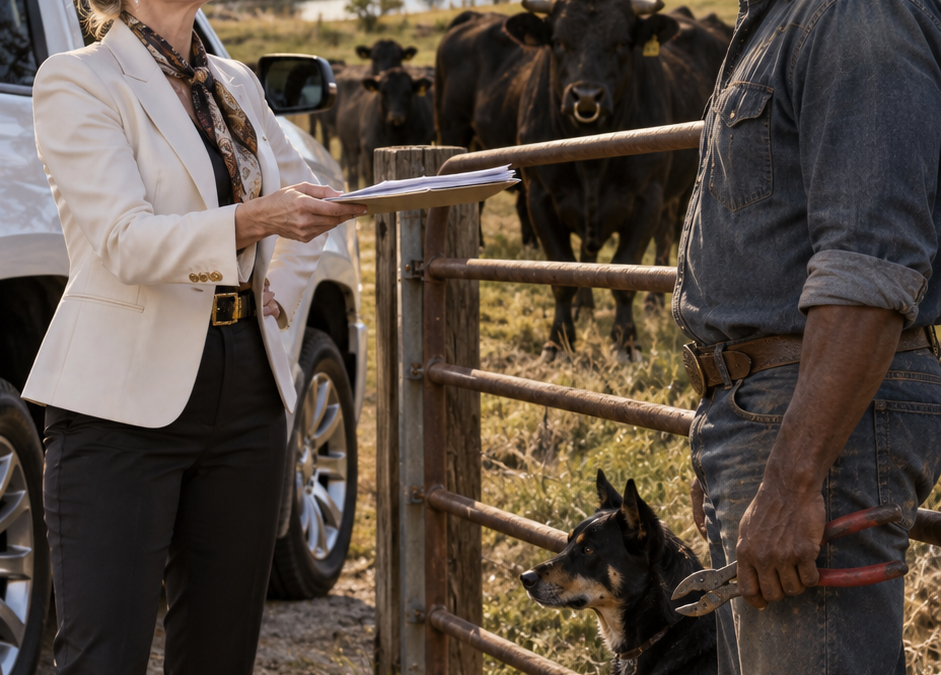
Patricia Voss read the sentence from a laminated card she held in one hand.
“You have twenty-one days to remove all breeding bulls from the property, Mr. Cray, or the association will pursue enforcement action.”
She delivered every clause with the careful rhythm of someone reciting language she had practiced but did not completely understand.
I stood on the edge of my south pasture with a pair of fencing pliers hanging from one hand.
The morning grass was still wet.
Two nights earlier, one of my Angus bulls had leaned hard enough against the creek-side fence to loosen three strands of wire, and I had been replacing staples since sunrise. The air smelled of damp earth, crushed grass, manure, and cattle.
My grandfather called that smell honest air.
Patricia apparently disagreed.
Behind her, a late-model white Suburban idled at my gate. Meadowbrook Estates was printed neatly on a decal across the back window.
The tires were perfectly clean.
Not dusty.
Not muddy.
Not even stained along the sidewalls.
That told me almost everything I needed to know about how much time Patricia Voss had spent around working farms.
She held out a four-page envelope.
I took it.
“Thank you,” I said.
For the first time, she seemed uncertain.
“You understand that this is a formal enforcement notice?”
“I understand that you handed me a letter.”
Her mouth tightened.
“The board expects compliance within twenty-one days.”
I looked past her toward the eastern fence line.
Beyond it, through several hundred feet of trees and open ground, stood the first rooftops of Meadowbrook Estates.
Then I looked back at her.
“All right.”
That was all I gave her.
No argument.
No lecture.
No threat.
Patricia climbed back into her Suburban and drove away.
I watched the clean white vehicle disappear down my gravel road.
Then I put the envelope on the seat of my truck, picked up my fencing pliers, and went back to repairing the fence.
Because the first lesson my grandfather ever taught me about land was that a man should never confuse somebody else’s confidence with somebody else’s ownership.
And the second lesson was simpler.
Keep the paperwork.
My grandfather, Elden Cray, bought the first piece of our ranch in 1951.
He had spent eleven years working dairy operations in three Wisconsin counties, saving almost everything he could. He was not wealthy. He was not lucky.
He was methodical.
There was a difference.
He believed land was one of the few things a man could buy that would repay patience better than ambition, provided he did not abuse it.
The first purchase covered 1,200 acres of rolling central Wisconsin pasture, oak timber, wet bottomland, and a spring-fed creek running along part of the eastern boundary.
He paid forty-one dollars an acre.
He kept the receipt.
That fact used to make me smile when I was young.
Who keeps a receipt for land?
Elden Cray did.
He kept deeds, tax statements, feed invoices, drainage maps, equipment serial numbers, cattle records, handwritten boundary notes, and survey receipts. He stored the important papers in metal boxes long before fireproof home safes became common.
“Memory argues,” he once told me. “Paper doesn’t.”
Over the next two decades, he acquired more land whenever an adjoining parcel became available.
A neighbor’s hayfield.
A timber tract.
Several hundred acres of bottomland nobody wanted because it flooded in wet years.
Granddad understood water better than the men who laughed at him for buying it.
He installed drainage where drainage made sense and left wetlands alone where water clearly intended to stay.
By the time my father, Harland Cray, took over in 1974, the operation covered just under 3,000 acres and supported roughly 400 Holstein dairy cows.
Dad expanded again in 1981.
Then again in 1988.
When he died in 1993, the property transferred to me.
James Cray.
One parcel assembled over generations.
5,214 acres according to the current survey.
Recorded in Asheford County, Wisconsin.
Boundaries unchanged for decades.
By the morning Patricia Voss arrived, I had been responsible for that operation for thirty-one years.
I knew that ranch the way some men know the rooms in their own house.
I knew which pastures dried first after spring rain.
I knew which low fields held frost into April.
I knew the creek could rise eighteen inches after a wet March thaw.
I knew there was a soft patch near the third gatepost on the south fence because the ground never properly settled after drainage work we completed in 2004.
I knew where my father had buried an old milk pump because he had been too stubborn to haul it to scrap.
I knew which oak had been struck by lightning in 1987.
And I knew precisely where my eastern boundary ended.
Meadowbrook Estates sat on the other side.
The subdivision had been built in two phases between 2009 and 2014 on land that once belonged to the Kner family.
The Kners sold to Hargrove Properties in 2007.
Hargrove platted the development, recorded its covenants, and created the Meadowbrook Estates Homeowners Association before the first foundation was poured.
None of that involved the Cray Ranch.
Not one surveyed inch.
When Meadowbrook was first proposed, I had read its declaration of covenants, conditions, and restrictions because a careful landowner reads anything recorded near his boundary.
The document had a great deal to say about fence appearance, lawn height, exterior paint, recreational vehicles, mailbox styles, and landscaping.
It said nothing that placed my ranch under HOA authority.
I filed my copy away and forgot about it for eleven years.
Until Patricia Voss appeared.
That evening, I opened her envelope at my kitchen table.
The first page accused me of violating Meadowbrook Estates Community Standard 7.4, subsection B, because breeding bulls near residential properties allegedly created a nuisance.
The second page demanded removal of all breeding bulls within twenty-one days.
The third announced fines of $250 per day after the deadline and warned that the association could seek injunctive relief in Asheford County Circuit Court.
The fourth page contained a signature line acknowledging receipt.
I did not sign it.
Instead, I read the attached regulation.
It stated:
“No livestock operations, including but not limited to cattle, swine, poultry, or equine, shall be conducted on any lot within the Meadowbrook Estates community in a manner that creates unreasonable noise, odor, or visual disturbance to neighboring residents on any lot within the Meadowbrook Estates community.”
I read it again.
Then a third time.
The relevant words were not cattle.
They were not noise.
They were not odor.
They were not visual disturbance.
They were within the Meadowbrook Estates community.
My ranch was not within Meadowbrook Estates.
The entire argument rested on a jurisdiction they did not have.
I poured another cup of coffee and opened the filing cabinet in my office.
The folder I wanted was labeled:
MEADOWBROOK—BOUNDARY REFERENCE.
Inside were my copies of the 2008 covenants, plat documents, older survey information, and correspondence related to construction along the eastern edge.
At the front of a separate fireproof box was my family deed.
Instrument number 1951-CR-00441.
I set it on the kitchen table beside Patricia’s violation notice.
One document had been delivered that morning in a spotless SUV.
The other had survived more than seven decades.
I knew which one I trusted.
Still, trust is not evidence.
So the next day I called Gerald Fitch.
Gerald owned the property north of mine.
He was seventy-one years old, retired from professional surveying, and had spent forty-three years measuring land throughout Asheford County.
He also had opinions about Meadowbrook Estates.
Most of them were unprintable.
He came over the following afternoon.
I pushed Patricia’s letter across the kitchen table.
Gerald read all four pages.
Then he read the attached rule.
He removed his glasses and placed them beside the letter.
“They don’t have a thing.”
He said it quietly.
Gerald had performed survey work on the old Kner property in 2006, before its sale to Hargrove.
He knew exactly where the Kner boundary ended and ours began.
“The line is the same line your grandfather had,” he said. “Iron pins at both corners. Meadowbrook starts east of it. You’re west.”
“I know.”
“Then why are we having coffee?”
“Because I want to know whether I know it or whether the county record knows it.”
Gerald smiled.
“That’s the right question.”
He offered to dig out his original field notes.
I told him I wanted them.
My next call went to Ruth Callaway.
Ruth practiced agricultural and property law in Marshfield. She had represented me in 2011 when the county and I disagreed about the width of an old road easement.
She had won that dispute without raising her voice once.
Ruth read legal documents the way a surgeon reads an X-ray.
She was interested not merely in what appeared on the page but in what should have appeared and did not.
I explained Patricia’s visit.
When I finished, Ruth was silent.
“Send me the notice,” she said. “Send the Meadowbrook declaration and your deed. I’ll call you.”
She called the following morning.
“Their standard applies to lots within their recorded plat.”
“Yes.”
“Your parcel is not in their recorded plat.”
“Yes.”
“This isn’t close, James.”
That was comforting.
But Ruth was not finished.
“The question is whether they know they have no authority and are hoping you don’t, or whether they genuinely believe some other recorded instrument extends their jurisdiction onto your property.”
“Does that distinction matter?”
“Legally? Probably not. Strategically? It can.”
I looked through the kitchen window toward the south pasture.
One of the Angus bulls stood near the creek.
“Then find out.”
Ruth began a title search.
I asked for everything.
The Meadowbrook plat.
Its chain of title.
The development documents.
Recorded easements.
Boundary instruments.
Any covenant touching the Cray parcel.
I also asked for a fresh certified copy of my own deed.
For the next several days, I said nothing to Meadowbrook.
The bulls stayed exactly where they were.
There were four breeding bulls on the ranch at that time—three Angus and one Simmental cross.
All were part of the breeding program.
The oldest Angus weighed roughly 1,200 pounds and had been born in our south barn in the spring of 2011.
He had been on Cray land before some Meadowbrook residents had even moved into their houses.
He knew nothing about community standards.
I suspected Patricia Voss knew nearly as little about real-property law.
The twenty-one-day deadline kept moving.
I photographed the eastern and southern fence lines.
I documented the survey pins.
I photographed the position of the pasture relative to the boundary.
Every image was dated.
Every letter went into a folder I labeled:
MEADOWBROOK DISPUTE.
Three days later, Gerald delivered copies of his 2006 field notes.
They showed the Kner-Cray boundary clearly.
A straight surveyed line running north to south.
Iron pins at the corners.
Cray Ranch to the west.
Former Kner property to the east.
Two properties sharing a boundary.
Not jurisdiction.
Nine days after Patricia’s visit, Ruth called with the title search.
“The chain is clean.”
“How clean?”
“Clean enough that if they have authority over your ranch, they’ve hidden it somewhere no recorder in Asheford County has ever seen.”
That was Ruth’s version of humor.
The recorded Meadowbrook plat was clear.
The recorded covenants were clear.
My deed was clear.
Gerald’s earlier survey was clear.
There was no easement, covenant, declaration, annexation document, or other recorded instrument extending Meadowbrook’s HOA authority west of the boundary.
“Then send them the answer,” I said.
Ruth prepared a formal letter.
It cited my deed—instrument number 1951-CR-00441.
It cited the Meadowbrook plat recorded March 14, 2008, Plat Book 22, Page 7.
It cited Gerald Fitch’s certified 2006 boundary survey, survey record 2006-1187.
The letter stated plainly that the Cray Ranch was not subject to the Meadowbrook Estates covenants.
It informed the HOA that it had no enforcement authority over my livestock operation.
And it warned that further efforts to levy fines or obtain an injunction would be opposed in Asheford County Circuit Court.
No insults.
No threats beyond the law.
No mention of Patricia’s clean tires.
Ruth sent me the draft.
I read every word.
Then I authorized it.
The letter went out by certified mail on Thursday.
Four days later, the signed return receipt came back.
I added it to my folder.
Patricia called the next morning.
I let it go to voicemail.
Her message lasted two minutes and forty seconds.
She said Meadowbrook’s board was reviewing Ruth’s assertions with legal counsel.
She said the association expected me to communicate with them directly.
Her tone was different.
The confidence remained, but it had tightened at the edges.
She sounded like someone who had walked confidently across what she thought was solid ground and had just felt it move beneath her.
I did not call back.
Ruth was my communication.
The deed was my communication.
The county record was my communication.
That afternoon, I watched the bulls grazing under the low October sun.
The creek moved along the eastern edge of the ranch.
Nothing about the land had changed.
Only Meadowbrook’s understanding of it had begun to.
For several days, the HOA was silent.
I did not mistake that silence for surrender.
Organizations rarely abandon authority gracefully after discovering they never possessed it.
Someone at Meadowbrook was making calls.
Someone was reading files.
Somewhere inside their clubhouse, board members were probably passing Ruth’s letter across a table and asking the uncomfortable question Patricia should have asked before she drove onto my ranch.
Do we actually have the right to do this?
I went back to work.
Two fence posts near the creek needed replacement.
I set them myself.
My father used to say that a man who never repaired his own fences eventually stopped understanding where his property truly began.
I had hired plenty of help during thirty-one years of ranching, but some jobs I still preferred to do personally.
A post driver tells you things about soil.
The resistance changes as the post descends.
Clay feels different from sand.
Frozen ground answers differently than wet ground.
You feel the property through your hands.
I had just finished the second post when Ruth called.
Meadowbrook had retained Douglas Pel, a Madison attorney whose practice included real estate and HOA litigation.
“You know him?” I asked.
“By reputation.”
“Good?”
“Competent.”
From Ruth, that meant I should take him seriously.
She expected Pel to pursue one of two theories.
Either he would claim that Meadowbrook’s covenants somehow burdened adjacent land through an implied covenant or equitable-servitude theory, or he would produce some separate development agreement, easement, or plat notation extending restrictions beyond Meadowbrook’s formal boundary.
“I don’t think either survives the record we’ve seen,” Ruth said. “But if they want to litigate, I don’t want to walk into court with ‘I don’t think.’”
“What do you want?”
“A complete chain of title for your ranch. Every recorded easement. And a current certified boundary survey.”
I looked down the fresh fence line.
“Gerald?”
“If he’s willing to come out of retirement for it, yes.”
Gerald was willing.
He arrived the following Thursday in the same old pickup he had owned for years, surveying equipment secured in the bed and a steel thermos beside him.
For two days, he worked the eastern boundary.
He located the historic iron pins.
He tied them to the county baseline.
He cross-referenced the 1951 survey information, his 2006 work, and the Meadowbrook plat.
He used modern GPS equipment and a total station.
He measured more points than I thought any human being could reasonably need.
I understood why.
This survey was not being prepared for a fence.
It was being prepared for a courtroom.
Late on the second day, Gerald knocked on my back door.
I poured him coffee.
He drank half of it before saying anything.
Then he looked at me.
“The pins are where they were.”
I waited.
“The line is where it was.”
“Nothing moved?”
“Not unless the whole county moved with it.”
That was as close as Gerald came to dramatics.
He said the formal survey would be filed within ten days.
Douglas Pel’s response arrived before Gerald’s report.
Seven pages.
Certified mail.
Professionally written.
Carefully argued.
And for the first time, Meadowbrook produced something that required real attention.
Pel cited a document called the Hargrove-Asheford County Development Agreement dated September 12, 2007.
Instrument number 2007-DA-002.
According to Pel, that agreement created an agricultural buffer extending half a mile from Meadowbrook’s boundary.
He quoted the following provision:
“Adjacent property owners within the defined buffer zone shall be subject to agricultural use restrictions as outlined in the Meadowbrook Estates community standards as may be amended from time to time by the association’s board of directors.”
I stopped reading.
Then I read it again.
If that language attached to my parcel, the dispute had changed.
It did not necessarily mean Meadowbrook could order my bulls removed, but it meant their argument was no longer obviously empty.
I called Ruth.
She had received the same letter.
“I’m pulling the full agreement,” she said.
“Have you seen this paragraph?”
“Yes.”
“What do you think?”
“I think I don’t form opinions from paragraphs somebody else selected for me.”
That was Ruth.
“I’ll have the whole instrument tomorrow.”
She called at 8:15 the next morning.
I knew from her voice that something had changed.
“The agreement is real,” she said.
“All right.”
“And Pel quoted it accurately.”
I felt my jaw tighten.
Then Ruth continued.
“He just stopped one paragraph too early.”
I said nothing.
She read the next section aloud.
“For the purposes of this agreement, the defined buffer zone shall encompass parcels identified in Exhibit A, attached hereto and incorporated by reference. No property not identified in Exhibit A shall be subject to the provisions of this section.”
I looked toward the kitchen window.
“What’s in Exhibit A?”
“Eleven parcels.”
I waited.
“Is mine one of them?”
“No.”
That single word changed the entire morning.
Ruth continued.
“All eleven are parcels connected to the Meadowbrook development. Your property isn’t listed by parcel number, deed number, tax ID, legal description, or owner name. Nothing.”
“So the paragraph he cited—”
“Only applies to the parcels in Exhibit A.”
“And the next paragraph explicitly says property outside Exhibit A is not subject?”
“Yes.”
I leaned back in my chair.
Outside, a tractor started near the north barn.
For a moment I thought about my grandfather.
Elden Cray had sat at a kitchen table in 1951 reading the deed that would become the foundation of everything around me.
He had checked names.
Numbers.
Distances.
Descriptions.
Not because he expected an HOA seventy years later.
Because details matter whether or not you know yet why they will matter.
“Did Pel miss Exhibit A?” I asked.
“Possibly.”
“Or?”
“Or he hoped the court would interpret the broader geographic language without focusing on the limiting clause.”
“Which do you believe?”
“It doesn’t matter what I believe. The recorded instrument controls.”
I smiled.
That sounded like my grandfather.
“Write back.”
Ruth’s second letter was more pointed.
She quoted the provision Pel relied on.
Then she quoted the paragraph immediately following it.
Then she reproduced Exhibit A.
She identified my parcel as instrument number 1951-CR-00441 and noted that it was absent from every relevant list.
By then, Gerald’s new survey was also complete.
Survey record 2023-0441.
Filed and certified.
It confirmed what the old surveys had shown.
The eastern boundary of Cray Ranch ran on the same north-south line.
The original iron pins remained undisturbed.
Meadowbrook began to the east.
The Cray parcel remained west.
The nearest ranch structure stood 412 feet from Meadowbrook’s platted boundary.
Four hundred twelve feet.
I had never considered that number emotionally before.
It was simply a measurement.
Yet now I found myself thinking about everything contained within those 412 feet.
Pasture.
Soil.
Fence posts.
Snow.
Creek bank.
The footprints of my father.
The work of my grandfather.
The steps I had taken across that ground for more than half my life.
Four hundred twelve feet that Meadowbrook’s paperwork had no right to cross.
Ruth attached the survey.
She attached the deed.
She quoted Exhibit A.
And she informed Pel that if Meadowbrook pursued injunctive relief despite the clear record, we would seek attorney’s fees under Wisconsin law on the ground that the action lacked a reasonable legal foundation.
The letter went out certified.
Three days later, the return receipt came back.
Then Meadowbrook sued anyway.
The petition asked Asheford County Circuit Court to order me to remove the breeding bulls.
The twenty-one-day deadline had come and gone.
I had moved nothing.
They had assessed fines on paper.
I had paid nothing.
Now they wanted a judge to give their demand the authority their own documents did not.
The hearing was scheduled for the third Tuesday in November.
Courtroom Four.
Asheford County Courthouse.
I arrived early.
Courtrooms have their own smell.
Old wood.
Paper.
Radiator heat.
Wool coats in winter.
A little dust.
And something else I have never quite been able to name.
Perhaps it is the smell of people trying to turn disagreement into a record.
Ruth was already seated at the respondent’s table.
Technically, the HOA was the petitioner because it had requested the injunction.
Her briefcase was open beside her.
The exhibits were arranged in the sequence she planned to use them.
Not chronological order.
Argument order.
Deed.
Plat.
Surveys.
Development agreement.
Exhibit A.
Correspondence.
Gerald sat in the gallery behind us wearing a good flannel shirt under his surveyor’s vest.
I turned around.
“You wore the vest?”
“In case anybody forgets why I’m here.”
That made Ruth smile.
Across the aisle, Douglas Pel sat with two associates.
He looked exactly like the attorney his letter suggested.
Well dressed.
Prepared.
Controlled.
Patricia Voss sat beside him in a dark blazer.
For the first time since I had met her, she had no clipboard.
She did not look at me.
Judge Carol Mertens entered shortly afterward.
She had served on the Asheford County bench for nineteen years.
Ruth had told me she knew agricultural-property disputes especially well.
Judge Mertens sat, adjusted her glasses, and opened the file.
Pel went first.
He was good.
I will give him that.
He described Meadowbrook as a residential community established under a county-approved development plan.
He explained that agricultural operations near the subdivision could affect homeowners through odor, noise, visual impact, and animal activity.
He cited Community Standard 7.4(B).
Then he turned to the 2007 Hargrove development agreement.
He emphasized the half-mile agricultural buffer.
He argued that my ranch fell geographically within that radius and therefore had obligations under the agreement.
He repeatedly used the word community.
Not plat.
Not parcel.
Community.
The distinction was deliberate.
His argument invited the judge to think of Meadowbrook as something larger than its surveyed boundaries.
A shared area.
A zone of neighboring properties affected by one another.
It was professionally done.
For several minutes, if you ignored Exhibit A, it even sounded reasonable.
Judge Mertens listened without interruption.
Pel finished.
She made a note.
Then she looked toward us.
“Ms. Callaway.”
Ruth stood.
She did not begin with cattle.
She did not begin with noise.
She did not begin with Patricia Voss.
She began with my grandfather’s deed.
“Your Honor, respondent’s property is identified in the Asheford County Register of Deeds as instrument number 1951-CR-00441.”
She handed up the certified copy.
Then she read the relevant legal description into the record.
Boundary by boundary.
Call by call.
No drama.
No adjective that was not necessary.
Next came the Meadowbrook plat.
She showed where its western edge met the recorded Cray boundary.
Then came Gerald’s current survey.
“Survey record 2023-0441 confirms the same boundary previously established and confirmed by historical surveys. The Cray parcel lies entirely west of the Meadowbrook Estates plat.”
Pel listened.
Patricia stared forward.
Ruth continued.
“The nearest ranch structure is 412 feet from the plat boundary.”
Then she reached the development agreement.
She read the paragraph Pel had relied on.
Every word.
When she finished, she paused.
Not long.
Just long enough for the language to settle.
Then she said, “The next paragraph states as follows.”
She read:
“For the purposes of this agreement, the defined buffer zone shall encompass parcels identified in Exhibit A, attached hereto and incorporated by reference. No property not identified in Exhibit A shall be subject to the provisions of this section.”
I saw Pel lower his eyes briefly toward his binder.
Ruth placed Exhibit A before the court.
“Exhibit A identifies eleven parcels.”
She read the parcel numbers.
All eleven.
Then she looked toward Judge Mertens.
“The Cray Ranch parcel, instrument number 1951-CR-00441, tax parcel identification number 08-241-000017, does not appear in Exhibit A.”
She paused.
“It is not identified by instrument number.”
Another pause.
“It is not identified by tax parcel number.”
Another.
“It is not identified by legal description.”
Then:
“It is not identified by owner name.”
The courtroom was very quiet.
“The petitioner asks this court to enforce a buffer-zone provision against property that the same recorded instrument expressly excludes from that provision.”
Pel shifted slightly.
Ruth continued.
“The association’s covenant authority ends at its recorded plat boundary. The development agreement does not extend that authority to the Cray Ranch. There is no recorded covenant, easement, annexation, declaration, amendment, or servitude binding this parcel to Meadowbrook Estates.”
She closed the document.
“The bulls are not located on an HOA lot. They are located on a seventy-two-year agricultural property beyond the association’s jurisdiction. The petition should be denied.”
Then she sat down.
Judge Mertens turned to Pel.
“Mr. Pel.”
“Yes, Your Honor.”
“Your response to Exhibit A?”
For the first time that morning, the polished rhythm disappeared.
Only briefly.
But it disappeared.
Pel stood.
He argued that omission of the Cray parcel from Exhibit A might have been a drafting error.
He said the agreement’s overall purpose supported a broader interpretation.
He said the geographic half-mile language indicated an intent to protect Meadowbrook residents from adjacent agricultural impacts.
Judge Mertens looked at him over her glasses.
“The instrument says what it says, counsel.”
“Yes, Your Honor, but the intent—”
“Intent not expressed in the recorded instrument does not create a burden on somebody else’s land.”
Pel stopped.
The judge continued.
“You are asking this court to impose a land-use restriction on a parcel expressly absent from the exhibit that defines which parcels are subject to that restriction.”
Pel tried another approach.
He discussed equitable interpretation.
Purpose.
Notice.
Proximity.
But every path eventually returned to the same obstacle.
Exhibit A.
Eleven parcels.
Mine was not among them.
Judge Mertens took the matter under advisement.
Six days later, the ruling arrived.
I read it where I had read almost every important document in the dispute.
At my kitchen table.
Coffee beside me.
The Meadowbrook folder open.
The decision was twelve pages.
The important language appeared near the end.
The court found that the Cray Ranch parcel described in instrument number 1951-CR-00441 was not subject to the Meadowbrook Estates covenants.
It was not subject to the agricultural restrictions in the 2007 Hargrove-Asheford County Development Agreement because it did not appear in Exhibit A.
It lay outside the recorded Meadowbrook plat.
Therefore, Meadowbrook had no authority to force removal of my bulls.
The request for injunctive relief was denied.
Then I reached the next paragraph.
The court ordered the HOA to pay my attorney’s fees after finding its claim lacked sufficient legal foundation.
The award was $14,200.
I read that number twice.
Not because it mattered more than the rest.
It did not.
The real victory was jurisdiction.
The court had drawn the same line my grandfather’s documents had drawn generations earlier.
But $14,200 meant Meadowbrook did not merely fail.
It had to pay for insisting on a claim after the record told them they were wrong.
I sat there quietly for several minutes.
There was no cheering.
No dramatic phone call.
No urge to drive through Meadowbrook waving the ruling out the window.
That was never what I wanted.
I looked outside.
The creek was moving beneath a gray November sky.
One of the bulls stood near a hay feeder.
Nothing on the ranch looked different.
That was the point.
Nothing was supposed to be different.
The bulls were supposed to remain.
The ranch was supposed to remain agricultural.
The boundary was supposed to remain exactly where it had been.
The law had not given me something new.
It had simply refused to let Meadowbrook take something old.
I folded the decision and placed it in the dispute folder.
By then, the folder had grown thick.
Patricia’s original four-page notice.
The violation schedule.
My deed.
Gerald’s 2006 notes.
The current survey.
The Meadowbrook plat.
The 2007 agreement.
Exhibit A.
Ruth’s letters.
Certified-mail receipts.
Douglas Pel’s response.
Court filings.
The ruling.
I carried the folder into my office.
Opened the filing cabinet.
And placed it in the drawer marked:
MEADOWBROOK—BOUNDARY REFERENCE.
Then I closed the drawer.
That should have been the end of it.
In a legal sense, it was.
But consequences have a way of continuing after judgments.
A few weeks later, Gerald stopped by.
He had heard that three of Meadowbrook’s five board members did not intend to stand for reelection at the January annual meeting.
Patricia Voss was among them.
The community standards director position was subsequently removed from the HOA budget.
I never learned whether the court case was the direct reason.
Maybe there were other problems inside the association.
Maybe residents were unhappy that dues had been spent trying to regulate cattle on somebody else’s ranch.
Maybe Douglas Pel had given the board an uncomfortable post-case explanation of Exhibit A.
I did not ask.
That was their side of the fence.
I had work on mine.
The posts I had installed during the dispute held through the first hard freeze.
The bulls remained in the south pasture.
The old Angus still watched me whenever I worked near the fence.
I sometimes wondered what Patricia would have thought if she knew that the animal at the center of her enforcement action had spent the entire lawsuit doing little more than eating grass, breeding cows, and staring suspiciously at tractors.
He had no idea anyone wanted him evicted.
He never missed a meal over it.
There was probably a lesson in that.
The first substantial snow arrived in early December.
The following morning, I walked the eastern fence.
Snow had covered the pasture in a clean white layer.
My boots broke through the crust with each step.
The air was cold enough that my breath lingered.
Gerald’s survey markers were still visible.
Orange flags against white snow.
The historic iron pins were where they had always been.
Beyond the boundary, Meadowbrook’s rooftops rose above the trees.
Four hundred homes.
Families.
Cars starting in driveways.
Smoke lifting from chimneys.
People getting children ready for school.
Ordinary neighbors.
I never hated them.
Most of those people had probably never heard of instrument number 1951-CR-00441.
Most had likely known nothing about the lawsuit until the board told them.
The dispute was never really about homeowners against farmers.
It was about authority.
Specifically, the difference between authority that exists and authority that merely sounds official.
I stopped near the creek.
Water moved beneath thin ice around the stones.
My grandfather had stood somewhere near that same spot after buying the first parcel.
My father had repaired fence along that line.
I had spent most of my life crossing and recrossing the land they left me.
For seventy-three years, our ownership had been described by paper and expressed by work.
Both mattered.
A deed without stewardship becomes an abstraction.
Stewardship without a deed can become somebody else’s opportunity.
Granddad understood both.
That was why he kept receipts.
That was why he saved surveys.
That was why a piece of paper signed when Harry Truman was president could still matter when a woman with an embossed business card drove onto my ranch seven decades later.
I thought again about Patricia’s first sentence.
“Your livestock are in violation of Meadowbrook Estates community standards.”
It had sounded so final when she said it.
But that sentence contained an assumption.
Your livestock are subject to us.
Everything after that assumption—the deadline, the fines, the threat of injunction—depended on it being true.
It was not.
That was the part institutions sometimes forget.
Authority does not grow stronger because it is printed on official letterhead.
A deadline does not create jurisdiction.
A fine schedule does not create ownership.
A title on a business card does not move a surveyed boundary.
And confidence does not rewrite a deed.
When somebody makes a claim against your property, the first question should never be how frightening their letter looks.
The first question is simpler.
What gives them the legal right?
The answer might be a deed restriction.
An easement.
A covenant.
A court order.
A statute.
A recorded agreement.
Sometimes the answer will be something you do not like but must obey.
But sometimes, when you trace the authority to its source, you discover that the impressive letter is standing on nothing.
That was what happened to Meadowbrook.
Their own covenant limited them to their community.
Their own development agreement limited the buffer provision to Exhibit A.
Their own recorded plat stopped at my fence.
Every document they relied on eventually pointed to the same conclusion.
My grandfather’s land was still my grandfather’s land.
The HOA could regulate houses on its lots.
It could enforce its lawn standards.
It could debate fence colors.
It could tell its own residents where to park recreational vehicles.
But it could not cross 412 feet of Wisconsin farmland, step onto a ranch that predated its existence by generations, and order me to remove cattle from property it did not govern.
The law drew that line.
The survey marked it.
My family had maintained it.
And when Meadowbrook finally forced the question into a courtroom, the judge simply read the record.
That winter passed.
Then another.
The south pasture remained a breeding pasture.
The bulls stayed.
Calves came the following spring.
The dairy kept operating.
Meadowbrook remained next door.
Sometimes, on quiet evenings, I could see the roofs through the trees while checking cattle.
There was no hostility in it.
Just distance.
Four hundred twelve feet at the nearest structure.
A small distance geographically.
An enormous one legally.
I still keep the Meadowbrook folder.
I expect I always will.
It sits beside deeds, tax records, survey maps, easement files, and the other documents my grandfather would have told me never to throw away.
His original 1951 deed remains in the fireproof box.
The paper has aged.
The language sounds old-fashioned now.
But the boundary has not aged.
Truth on land has a strange durability when somebody takes the trouble to record it correctly.
People change.
Boards change.
Developments rise.
Titles come and go.
A “community standards director” position can exist one year and disappear the next.
But an iron pin driven into Wisconsin soil can outlast all of them.
So can a deed.
The morning Patricia Voss came to my gate, she believed she was giving me twenty-one days to choose between my bulls and a fight.
She was wrong about that too.
There was never a choice.
The bulls belonged on the ranch.
The ranch belonged to me.
And after seventy-three years of my family keeping faith with that land, I was not going to surrender either one because somebody with clean tires had failed to read Exhibit A.








