𝗙𝗨𝗟𝗟 𝗦𝗧𝗢𝗥𝗬 The HOA Fined Us $20,000 for a Pit Bull We Never Owned — Then Our Camera Destroyed Their Case
𝗣𝗔𝗥𝗧 𝟮
The first thing I did was take pictures.
It felt almost insulting in its simplicity.
I took Otis and Peanut onto the back patio and photographed them together from several angles, as though I were assembling evidence for the world’s least intimidating police lineup.
Otis stood there looking deeply inconvenienced.
Peanut kept trying to wander off toward a flowerpot.
I took close-ups.
Full-body photographs.
Photographs beside the patio chair for scale.
I even took one with my wife holding Peanut so there could be absolutely no confusion about the fact that this animal weighed roughly as much as a grocery bag.
Then I found Peanut’s shelter paperwork.
Breed: Chihuahua mix.
Weight at adoption: eight pounds.
I scanned everything.
I wrote a polite email.
I explained that we had lived at the address for eleven years, that the only dogs residing in our home were the two animals pictured, and that neither remotely resembled an American Pit Bull Terrier.
Then I attached every document and sent it to the management company.
I expected an answer by the following morning.
It took nearly two weeks.
The response consisted of several sentences that managed to acknowledge everything while resolving nothing.
My materials had been received.
My materials had been added to the file.
My materials would be forwarded to the architectural review committee for consideration at its next scheduled meeting.
I stared at the screen.
Architectural review committee.
Apparently, the people responsible for roof shingles and mailbox colors were now being asked to determine whether a nine-pound Chihuahua mix was secretly a pit bull.
I called again.
“Why does this need a committee meeting?”
“That’s the established review procedure.”
“But you have photographs.”
“Yes, sir.”
“You have shelter paperwork.”
“Yes, sir.”
“So what exactly is the committee deciding?”
“They’ll review the documentation.”
“To determine whether Peanut is actually forty pounds heavier than he appears?”
She did not laugh.
Neither did I.
By then, I had begun to understand the real problem.
Nobody was making a decision.
Everyone was moving paperwork.
And paperwork, unlike people, has no common sense.
Another month passed before the committee met.
That meant another thirty days of fines.
Fifty dollars a day.
Every morning, whether anything happened or not, the number grew.
There was something almost impressive about it.
The HOA had created a dog out of thin air and then figured out how to monetize him.
When the committee finally issued its decision, I opened the letter standing at the kitchen counter.
My wife watched from across the room.
“Well?”
I read it once.
Then again.
“What?”
I handed it to her.
The committee had determined that “additional verification” was required before reconsideration of the fines.
My wife looked at me.
“What additional verification?”
“They want documentation proving the current ownership status of all dogs residing at the property.”
She stared at the letter.
“We already sent that.”
“I know.”
“We sent photographs.”
“I know.”
“We sent Peanut’s adoption paperwork.”
“I know.”
“Do they want blood samples?”
I laughed once, but there was no humor in it.
That was the moment I realized we were no longer dealing with a misunderstanding.
We were dealing with a system that had lost the ability to reverse itself.
The original accusation had somehow become the default truth.
Our job was no longer to show what dogs we owned.
Our job was to prove that an imaginary third dog did not exist.
Try proving you do not own something.
Try proving there is not a tiger in your basement.
Try proving you have never parked a helicopter behind your garage.
The allegation requires one sentence.
The denial requires evidence.
And even then, someone can always say they need “additional verification.”
Two months into the mess, we called Walter.
Walter had handled a contractor dispute for us years earlier. He was calm, methodical, and almost impossible to provoke.
That was precisely why I wanted him.
I had reached the stage where every HOA envelope increased my blood pressure before I even opened it.
Walter listened as I explained everything.
The complaint.
The pictures.
The shelter paperwork.
The committee review.
The accumulating fines.
He did not interrupt.
When I finished, he said, “I’ve seen versions of this before.”
“A nonexistent dog?”
“No. A process that becomes more important than the facts.”
That was somehow less comforting.
Walter explained that associations sometimes became trapped by their own procedures. A management employee issued a notice. A committee inherited it. Lawyers became involved. Nobody wanted to be the person who admitted the original complaint should never have survived the first phone call.
“So how do we stop it?”
“Officially.”
“I’ve been official.”
He smiled.
“You’ve been a homeowner. That’s different.”
Walter sent a letter on his firm’s letterhead.
It was not dramatic.
It contained no threats.
It simply stated facts.
We did not own an American Pit Bull Terrier.
We had never owned one at that property.
We had already supplied photographic evidence identifying our two dogs.
We had supplied adoption paperwork.
The association had provided no independent evidence supporting the alleged violation.
Therefore, the fines lacked a verified factual basis and should be immediately withdrawn.
Walter also demanded a copy of the original complaint.
I remember feeling relieved after he sent it.
Maybe that sounds foolish now, but I genuinely believed the involvement of an attorney would end the nonsense.
Surely the HOA’s lawyer would look at the file and say, “Wait. Does anyone have evidence of this dog?”
Surely professionals would behave differently.
The response came almost a month later.
The fines remained in effect.
The dispute would have to continue through the association’s internal resolution procedure.
The association also refused to identify the resident who had submitted the complaint, citing confidentiality provisions in the governing documents.
Notably absent from their response was any evidence that the pit bull existed.
No photograph.
No video.
No veterinarian record.
No witness statement we were allowed to review.
No date on which the alleged dog had supposedly been seen.
Nothing.
Just the accusation.
By then, the fines had climbed above four thousand dollars.
My wife sat across from me at the kitchen table while I read Walter’s summary of the HOA attorney’s response.
“So someone can accuse us anonymously,” she said, “and we have to prove they’re wrong?”
“Apparently.”
“And nobody has to prove they’re right?”
“Apparently.”
She shook her head slowly.
“That’s insane.”
It was.
But insanity printed on official letterhead has a way of feeling disturbingly legitimate.
That was what bothered me most.
Not the tone.
Nobody was screaming at us.
Nobody was pounding on the door.
Every letter was calm.
Professional.
Almost courteous.
That made it worse.
There is something uniquely maddening about being treated politely while an organization methodically charges you thousands of dollars for something everyone involved could disprove by standing in your driveway for thirty seconds.
During those months, my relationship with the neighborhood changed.
Nothing obvious happened.
Nobody confronted us.
Nobody spray-painted PIT BULL OWNERS across the garage.
But once you know an anonymous neighbor accused you of something, your mind begins doing unpleasant arithmetic.
Was it the man across the street?
The woman who walked every morning at six?
Someone who disliked Peanut barking at squirrels?
Someone who had confused our address with another house?
My wife wondered whether somebody held a grudge we did not know about.
I doubted it.
We had been there eleven years.
Our neighborhood relationships consisted mostly of waving, discussing weather, and occasionally borrowing hedge clippers.
But suspicion is a weed.
Once planted, it grows without evidence.
Then other neighbors began hearing about the dispute.
Not because we launched some campaign against the HOA.
We didn’t.
We were too tired.
But association matters have a way of traveling.
One Saturday morning, Ruth, a retired teacher who lived two streets over, stopped me while I was walking Peanut.
“I heard they’re giving you trouble about a dog.”
I looked down at Peanut.
He was sniffing a storm drain.
“Apparently this criminal mastermind isn’t our only dog.”
Ruth smiled faintly.
Then she became serious.
“They did something similar to me.”
“What happened?”
“Fence height.”
She told me her fence had been challenged several years earlier. The association claimed part of it exceeded the approved height.
She measured it.
They measured it.
She sent photographs.
They continued sending notices anyway.
The dispute dragged on for nearly a year before simply disappearing.
“They never admitted they were wrong,” she said.
“So what happened?”
“I think they got tired before I did.”
Then she said something that stayed with me.
“The process is the punishment.”
At the time, I thought she was being cynical.
A few months later, I understood exactly what she meant.
The fine total kept growing.
Five thousand.
Seven thousand.
Ten thousand.
At fifty dollars a day, time itself had become the HOA’s collection agent.
Every weekend cost us another hundred dollars.
Every month cost roughly fifteen hundred.
The association did not need to prove anything.
It only needed to keep the case open.
My wife started placing each new statement in the same folder.
That folder became thick enough to stand upright on the counter.
Original violation.
Follow-up notice.
Photographs.
Adoption paperwork.
Emails.
Committee letters.
Walter’s correspondence.
The HOA attorney’s responses.
Fine statements.
At some point, I realized we had accumulated more documentation about a fictional dog than we possessed about either of our real dogs.
Otis, meanwhile, remained entirely unconcerned.
His hips were worsening.
Some mornings I had to carry him down the porch steps.
He would stand in the grass for a few minutes, do what he needed to do, then look at me with an expression that clearly communicated that stairs had become beneath his dignity.
Peanut followed him everywhere.
Watching those two made the accusation feel even more absurd.
This supposedly dangerous canine operation at our address consisted of one elderly pug who required transportation assistance and one Chihuahua mix who once hid behind my wife because a plastic bag blew across the driveway.
Then the balance crossed twenty thousand dollars.
I remember that statement.
Not because it looked different from the others.
Because it didn’t.
The same logo.
The same sterile formatting.
The same bureaucratic language.
Amount due: more than $20,000.
I stood at the kitchen counter holding that sheet of paper.
My wife came into the room.
“How bad?”
I handed it to her.
She looked at the number.
Neither of us spoke for several seconds.
We had savings.
We were not facing immediate financial collapse.
But twenty thousand dollars was not theoretical money.
That was a car.
Home repairs.
Years of vacations.
Part of our retirement savings.
And according to the HOA, we owed it because an unnamed person had once claimed to see an animal nobody else could produce evidence of.
“We’re not paying them,” my wife said.
“I know.”
“Not one dollar.”
“I know.”
“I’d rather spend twenty thousand fighting them.”
I looked at her.
“At this rate, we might.”
That was around the time we installed the camera.
I would love to tell you I suddenly had a brilliant legal strategy.
I didn’t.
I was tired.
That was all.
Tired of proving the same thing.
Tired of hearing that more verification was required.
Tired of arguing about what did not exist.
So I bought a security camera and mounted it above our garage, aimed directly down the driveway.
If the HOA wanted evidence, I decided, I would give them evidence so boring they would eventually suffocate under the weight of it.
The camera recorded continuously.
Day.
Night.
Rain.
Sunshine.
Every animal entering or leaving our property.
The first day produced approximately twenty-four hours of devastating legal evidence showing absolutely nothing interesting.
Otis went outside.
Peanut went outside.
The mail arrived.
A squirrel ran across the driveway.
A delivery driver dropped off a box.
My wife watered flowers.
No pit bull.
The second day looked much the same.
So did the third.
Then the fourth.
Then the fifth.
Weeks passed.
The camera recorded our life with the ruthless accuracy of a machine that did not care about anyone’s opinion.
There was something strangely comforting about that.
A camera does not care which person has the title of property manager.
It does not know what a committee decided.
It does not understand the phrase “restricted breed policy.”
It records what is there.
And more importantly, what is not.
My wife started keeping a notebook.
Date.
Time.
Dogs outside.
Visitors.
Anything unusual.
Most entries were almost comically mundane.
“Otis had trouble with steps. Carried him down.”
“Peanut chased squirrel.”
“UPS delivery 3:14.”
“Neighbor walked golden retriever past house.”
Nothing.
Day after day.
Beautiful, magnificent nothing.
Sometimes in the evening, I sat at the kitchen table scrolling through the footage.
I watched our own lives unfold in fast-forward.
My wife leaving for errands.
Me taking out garbage.
Otis moving slowly across the porch.
Peanut zigzagging through the yard.
Cars passing.
Sunlight shifting.
Shadows stretching.
Rain falling.
I had never appreciated boredom so much.
Every uneventful hour was another witness.
Still, the letters continued.
Walter kept pushing for an in-person board meeting.
The HOA’s attorney kept steering everything back into written procedure.
Walter finally told me, “We’re not going to solve this by arguing with the management company.”
“Why not?”
“Because they don’t have the incentive or authority to admit the file is nonsense. We need the board.”
He sent another request.
Then another.
Eventually, perhaps because even the HOA was tiring of paying its attorney to write increasingly elaborate explanations of why nobody could verify the existence of our imaginary dog, the board agreed.
We were granted an in-person hearing.
I prepared as if I were going to court.
The folder had become ridiculous.
I organized everything chronologically.
I printed photographs.
I copied shelter records.
I included every email.
Every response.
Every fine statement.
Walter brought his own materials.
And I copied several weeks of unedited security footage onto a flash drive.
The meeting took place in the small association conference room near the clubhouse.
Five board members sat across from us.
The property manager was there.
Their attorney joined by speakerphone.
My wife sat beside me.
Walter sat between us and the board.
I knew most of those people by sight.
That was one of the strangest parts.
I had passed them on sidewalks.
Waved while driving.
Seen them at neighborhood gatherings.
Yet here we were, sitting across a long table because their organization had spent months insisting I owned an animal none of them had ever seen.
The board president opened the meeting.
“We’re here regarding the restricted breed violation associated with your property.”
Walter spoke before I could.
“Actually, we’re here to determine whether there has ever been evidence supporting that violation.”
His tone remained pleasant.
That was Walter’s talent.
He could dismantle your position while sounding as though he were helping you assemble furniture.
He started at the beginning.
Date of complaint.
Date of first notice.
My phone call.
Our photographs.
Our shelter paperwork.
Committee review.
Additional documentation request.
Fine escalation.
Attorney correspondence.
Twenty thousand dollars.
He placed copies of everything in front of them.
Then he asked a simple question.
“What evidence does the association currently possess showing that my clients own, or have ever owned, an American Pit Bull Terrier?”
Nobody answered immediately.
The property manager said, “The original violation was resident-reported.”
Walter nodded.
“That’s the allegation. I’m asking about evidence.”
“The complaint described the animal.”
“Do you have a photograph?”
“No.”
“Video?”
“No.”
“Veterinary record?”
“No.”
“Registration?”
“No.”
“Animal control report?”
“No.”
“A statement from another witness?”
“Not that I’m aware of.”
Walter glanced down at his notes.
“Has any employee of the management company personally observed this dog?”
Another pause.
“Not that I’m aware of.”
“Has any board member?”
Nobody raised a hand.
Walter nodded.
“So after nearly a year and more than twenty thousand dollars in assessed fines, nobody representing the association has ever seen the dog?”
The room went quiet.
I had been saying essentially the same thing for months.
But sitting there, hearing it reduced to one clean question, I realized just how absurd the situation sounded when nobody could hide behind procedural language.
Walter continued.
“My clients, on the other hand, have provided photographs identifying their dogs, adoption documentation, and now continuous video evidence of the property.”
He inserted the flash drive into his laptop.
Then he turned the screen toward the board.
There was Otis.
Timestamp visible.
Me carrying him down the steps.
The old man waddled into the grass.
Peanut trotted behind us.
Next clip.
Different day.
Same two dogs.
Next clip.
My wife walking Peanut down the driveway.
Next.
Otis sleeping on the porch.
Next.
A neighbor walking a Labrador past our house.
Next.
Another day.
Another timestamp.
No pit bull.
Walter explained that the full footage remained available, unedited, with continuous date and time information.
“We are not suggesting that several video clips alone prove every second of every day,” he said. “That is why we retained the complete files. If the association wishes, it may review every recorded hour.”
Nobody volunteered.
One board member, an older man named Charles who had joined the board only a few months earlier, leaned forward.
He had been watching the footage carefully.
“Can I ask something?”
“Of course,” Walter said.
Charles turned toward the property manager.
“Has anyone actually gone back and reviewed the original complaint?”
She hesitated.
“What do you mean?”
“I mean the original report. Not the violation notice. The complaint.”
“It was entered into the management system.”
“Do we have it here?”
Another pause.
“I don’t believe so.”
Charles frowned.
“Can you pull it up?”
The property manager opened her laptop.
She clicked through several screens.
We waited.
Her expression changed slightly.
Not dramatically.
Just enough.
“I may need to check the archived records.”
“Why?”
“The employee who originally handled this matter is no longer with the company.”
Charles looked at her.
“But the complaint still exists.”
“It should.”
“Should?”
The word hung there.
I looked at Walter.
He said nothing.
He did not need to.
Charles leaned back.
“So we’ve fined these people twenty thousand dollars based on a complaint we’re not currently able to produce?”
The property manager shifted in her chair.
“I wouldn’t characterize it that way.”
That was when my wife finally spoke.
“How would you characterize it?”
Everyone looked at her.
She was calm.
Much calmer than I felt.
“We have spent almost a year sending you pictures of our dogs. We sent adoption paperwork. We hired a lawyer. We installed a camera. You have charged us twenty thousand dollars. And apparently nobody in this room can even produce the document that started it.”
The property manager began, “The association followed its established—”
My wife held up one hand.
“I know.”
Her voice remained quiet.
“I know you followed the process.”
Nobody interrupted.
“That’s all anyone has told us for months. The process. The procedure. The committee. The review. The next meeting. The next letter.”
She looked around the table.
“But did anybody ever look at the dogs?”
Silence.
That question did more than any angry speech could have done.
Because the answer was no.
Nobody had.
One of the younger board members, a woman named Melissa who ran an accounting business from her home, looked down at the photographs again.
Then at the laptop.
Then toward the property manager.
“I don’t understand how this went this far.”
Neither did we.
Walter answered calmly.
“Because every step assumed the previous step was correct.”
That was it.
The entire nightmare in one sentence.
The original employee accepted the complaint.
The next employee assumed the violation had been verified.
The committee assumed management had verified it.
The lawyer assumed the committee had a factual record.
Each person inherited certainty from the person before them.
Nobody went back to the beginning.
Charles asked, “Can we suspend the fines while the original complaint is located?”
Walter looked at him.
“With respect, we’re well beyond suspension.”
He slid one of the photographs toward the center of the table.
Otis and Peanut stood together on our patio.
“This is not a situation in which evidence is evenly balanced. Your association has assessed more than twenty thousand dollars in penalties without producing any evidence that the prohibited animal exists.”
Melissa nodded.
“I agree.”
The board president looked toward the attorney on speakerphone.
“Any reason we cannot rescind this?”
The attorney’s voice came through the speaker.
“I would recommend the board consider the evidentiary record currently before it and act accordingly.”
That, translated from lawyer into English, meant: Please stop this before it becomes an even bigger problem.
Melissa made the motion.
Rescind all fines.
Close the violation.
Mark the complaint unsubstantiated.
Charles seconded it.
The board voted.
One by one.
Yes.
Yes.
Yes.
Yes.
Yes.
Unanimous.
Just like that, more than twenty thousand dollars disappeared.
Nearly a year of fines erased in under a minute.
I should have felt triumphant.
Instead, I felt strangely hollow.
I looked at the board and thought about every phone call.
Every letter.
Every conversation with Walter.
Every evening scrolling through security footage.
Every moment my wife and I had sat at the kitchen table wondering whether somehow we would end up paying for this.
All of it could have been avoided if someone had done during the first week what those five board members had finally done that afternoon.
Look.
Just look.
The board agreed to issue written confirmation that the violation was unfounded and that all related penalties had been rescinded.
Walter insisted on that.
He wanted the record corrected, not merely the account balance.
Before we left, Charles came over.
“I’m sorry this got this far,” he said.
I appreciated that.
It was the closest thing to an apology we received.
The management company never apologized.
The person who filed the complaint was never identified.
The original report, as far as I know, was never located.
For a while, that bothered me.
I wanted a name.
I wanted to know which neighbor had supposedly seen this pit bull.
I wanted to know whether they had confused our house with another one or whether the complaint had been malicious from the beginning.
My wife felt the same way.
For several weeks after the board meeting, we’d see someone at the mailbox and privately wonder.
Was it him?
Was it her?
Did somebody simply dislike us?
Did somebody see a dog walking near our driveway and assume it belonged to us?
We never learned the answer.
And eventually, I stopped wanting it as badly.
The more I thought about the whole experience, the more I realized that the anonymous complaint was only the spark.
The real failure came afterward.
One mistaken neighbor could make one mistaken report.
That should have lasted a day.
Maybe a week.
What turned it into a year-long ordeal was the chain of people who accepted the accusation without verifying it.
That was harder to forgive.
Life in the neighborhood returned to normal almost immediately.
That surprised me.
For months, the dispute had occupied our kitchen.
Our conversations.
Our mail.
Our finances.
Our evenings.
Then suddenly it was gone.
Saturday came.
Someone grilled hamburgers.
Kids rode bicycles down the street.
The Hendersons argued with their sprinkler system.
The mail carrier delivered another stack of advertisements.
The world did not pause to celebrate the death of the imaginary pit bull.
Ruth stopped me one afternoon.
“How’d it turn out?”
“All fines rescinded.”
She nodded.
“Told you.”
“They couldn’t even find the original complaint.”
She laughed.
Not because it was funny.
Because, apparently, it was exactly what she expected.
“That’s how these things happen,” she said.
“What do you mean?”
“Most of these boards aren’t full of evil people.”
She glanced toward the clubhouse.
“They’re full of people who trust the last person to have checked.”
I thought about that.
“The problem,” she continued, “is sometimes nobody was the last person to check.”
She was right.
We left the camera above the garage.
At first I kept it because I no longer trusted the HOA.
Later, I kept it because removing it seemed unnecessary.
Eventually, I barely noticed it.
It became another fixture of the house.
A small black lens overlooking the driveway.
Otis appeared in many of those recordings during the final years of his life.
He grew slower.
Then slower still.
I carried him down those porch steps more frequently.
He slept more.
Ate enthusiastically.
Snored with astonishing commitment.
Eventually, at fourteen years old, he died.
We buried him under the dogwood tree near the edge of the backyard, where he had always liked lying in the afternoon sun.
Peanut aged too.
His muzzle turned gray.
His walks became shorter.
He stopped chasing squirrels with any realistic expectation of catching them.
Sometimes I would watch him crossing the driveway beneath that camera and think about how much trouble one imaginary dog had caused two very real ones.
Years later, the part I remember most clearly is not the twenty-thousand-dollar statement.
It is not Walter’s letters.
It is not even the unanimous board vote.
It is the silence in that conference room after Charles asked whether anyone had reviewed the original complaint.
That silence told me everything.
The machine had been running for almost a year.
Nobody knew whether anyone had ever put fuel in it.
Everyone had simply heard the engine and assumed somebody else knew why it was moving.
We had spent months trying to fight an accusation.
In reality, we were fighting inertia.
And inertia is a surprisingly powerful opponent because it has no ego to appeal to, no conscience to persuade, and no embarrassment when proven wrong.
It simply keeps going.
Letter creates response.
Response creates review.
Review creates delay.
Delay creates another fine.
Another fine creates another letter.
Eventually, the procedure itself starts looking like evidence.
People think, “Surely this would not have gone on for six months if there were nothing to it.”
But that assumption is exactly how something false survives six months.
Then eight.
Then ten.
That was why the camera mattered.
Not because it captured some spectacular revelation.
Quite the opposite.
It captured nothing.
Hour after hour.
Day after day.
Our driveway was painfully ordinary.
Two little dogs.
Two middle-aged homeowners.
A mail carrier.
Delivery trucks.
Neighbors passing.
Leaves blowing across concrete.
Rain.
Sun.
Nothing dramatic.
Nothing dangerous.
Nothing resembling the animal in the HOA’s file.
The truth did not arrive wearing a cape.
It sat quietly on a hard drive.
Timestamped.
Boring.
Patient.
Waiting for someone with authority to finally look.
I still have the final letter from the association somewhere.
It confirms that the fines were rescinded in full.
It says the violation was closed.
It says the available evidence did not substantiate the restricted-breed complaint.
Very formal.
Very clean.
Almost elegant.
If you read only that letter, you would never know what came before it.
You would never know about the months of frustration.
You would never know about my wife sitting at the kitchen table refusing to pay one dollar on principle.
You would never know about Walter politely asking the same question in six different legal formulations.
You would never know that we accumulated twenty thousand dollars in fines because somebody accused us of owning a dog that nobody could photograph, locate, identify, register, or apparently even remember clearly enough to preserve the original complaint.
The final document makes it sound as though the system worked.
Technically, I suppose it did.
Eventually.
But there is an enormous difference between a system that corrects an error immediately and one that drags innocent people through nearly a year of stress before reluctantly discovering what was obvious from the beginning.
These days, when I sit on the porch, I sometimes think about that first letter.
I can still picture my wife holding Peanut and joking that someone must have mistaken him for a terrifying pit bull.
We genuinely thought the whole thing would be resolved before dinner.
That innocence makes me smile now.
We believed common sense was automatic.
It isn’t.
Common sense requires somebody willing to stop the machinery long enough to ask a basic question.
Does this make sense?
For almost a year, nobody did.
Then five people finally sat around a table, watched an old pug struggle down a porch step, watched a nine-pound mutt trot after him, and realized the obvious.
There had never been a pit bull.
There had never been evidence of a pit bull.
And there had never been any legitimate basis for twenty thousand dollars in fines.
The HOA’s enormous case against us collapsed not because we uncovered a conspiracy, not because Walter gave some explosive courtroom speech, and not because the anonymous accuser dramatically confessed.
It collapsed because after months of hiding behind paperwork, somebody finally pressed play.
And there we were.
Otis.
Peanut.
My wife.
Me.
Our ordinary driveway.
Our ordinary life.
And absolutely no dog matching the accusation that had consumed nearly a year of it.
The HOA had spent months demanding that we prove something did not exist.
So eventually, we gave them weeks of footage showing exactly that.
The fines vanished.
The violation disappeared from our record.
The board closed the case.
And the dangerous pit bull that had supposedly justified twenty thousand dollars in penalties remained what he had been from the very beginning.
Imaginary.
Have you finished reading the story and want to read it again?
The HOA Fined Us $20,000 for a Pit Bull We Never Owned — Then Our Camera Destroyed Their Case
The HOA fined us for a dog that did not exist.
By the time they reached $20,000, they still had never seen him.
Then we turned on the camera.
I had lived in our little subdivision outside Charlotte for eleven years without giving the homeowners association much thought, which, in my opinion, is exactly how a homeowners association should function.
You pay the dues.
You keep your grass reasonably short.
You avoid painting your house fluorescent orange.
Everyone leaves everyone else alone.
That had been our arrangement for more than a decade.
My wife and I were not rebels. We were not the people parking boats on the front lawn or building unauthorized chicken coops beside the mailbox. We had never received a violation notice, never attended a board meeting to shout about property rights, and never even argued with the architectural committee.
We were boring.
And we liked being boring.
Our biggest neighborhood controversy up to that point had been whether the Hendersons next door were overwatering their tomatoes.
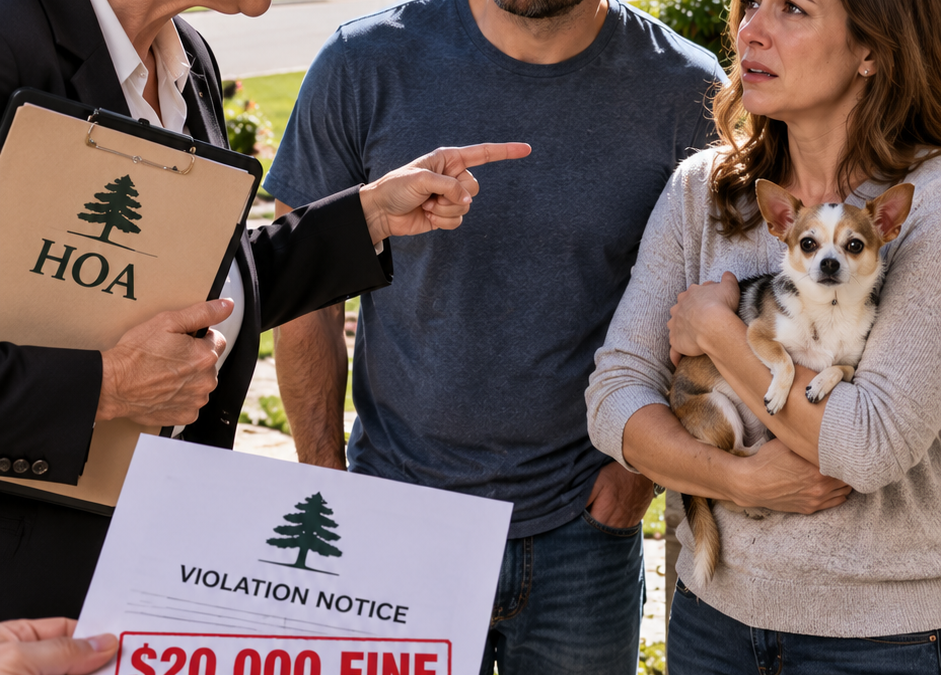
Then one afternoon, an envelope arrived with the HOA’s little pine-tree logo printed in the upper corner.
Inside was a formal violation notice accusing us of harboring a prohibited dog.
Specifically, an American Pit Bull Terrier.
I read the letter twice.
Then I looked across the kitchen.
Our twelve-year-old pug, Otis, was asleep on the rug, snoring so loudly his entire round body seemed to vibrate.
Peanut, our nine-pound shelter mutt, was curled in my wife’s lap.
I looked back at the letter.
Then at the dogs.
Then at my wife.
“Apparently,” I said, “we own a pit bull.”
She looked down at Peanut.
Peanut looked up at her.
He was a scruffy little thing the shelter had labeled a Chihuahua mix. His legs were thin, his ears were too large for his head, and he considered the vacuum cleaner a credible threat to national security.
My wife lifted him slightly.
“This one?”
“According to the HOA.”
She laughed.
I laughed too.
That was our first mistake.
Not because we had done anything wrong.
Because we assumed absurdity would protect us.
Surely, we thought, somebody had typed the wrong address.
Surely one phone call would fix it.
Surely no organization could spend months fining two people for an animal that had never existed without eventually stopping to ask whether anyone had actually seen the animal.
I called the management company that afternoon.
The woman who answered sounded perfectly pleasant.
She told me a resident had reported seeing “a large, aggressive dog matching pit bull characteristics” being walked from our property.
“I don’t have a pit bull,” I said.
“I understand your concern, sir.”
“We have a pug.”
A pause.
“And a nine-pound Chihuahua mix.”
Another pause.
“I understand.”
“If you understand, can you remove the violation?”
Unfortunately, she explained, that was not how the process worked.
The complaint had already been logged.
The violation had been opened.
The matter now required official review.
I remember leaning against the kitchen counter, looking at Otis as he slept peacefully through the conversation.
“Can someone just come look at the dogs?”
“I’ll make a note in the file.”
That sentence would haunt me for months.
I’ll make a note in the file.
Seven days later, another envelope arrived.
This one informed us that the violation remained unresolved.
The HOA had begun fining us fifty dollars per day.
Retroactively.
For the pit bull we did not own.
That was when I stopped laughing.
And that was when a ridiculous clerical mistake began turning into one of the most exhausting fights of our lives.
PART2
The first thing I did was take pictures.
It felt almost insulting in its simplicity.
I took Otis and Peanut onto the back patio and photographed them together from several angles, as though I were assembling evidence for the world’s least intimidating police lineup.
Otis stood there looking deeply inconvenienced.
Peanut kept trying to wander off toward a flowerpot.
I took close-ups.
Full-body photographs.
Photographs beside the patio chair for scale.
I even took one with my wife holding Peanut so there could be absolutely no confusion about the fact that this animal weighed roughly as much as a grocery bag.
Then I found Peanut’s shelter paperwork.
Breed: Chihuahua mix.
Weight at adoption: eight pounds.
I scanned everything.
I wrote a polite email.
I explained that we had lived at the address for eleven years, that the only dogs residing in our home were the two animals pictured, and that neither remotely resembled an American Pit Bull Terrier.
Then I attached every document and sent it to the management company.
I expected an answer by the following morning.
It took nearly two weeks.
The response consisted of several sentences that managed to acknowledge everything while resolving nothing.
My materials had been received.
My materials had been added to the file.
My materials would be forwarded to the architectural review committee for consideration at its next scheduled meeting.
I stared at the screen.
Architectural review committee.
Apparently, the people responsible for roof shingles and mailbox colors were now being asked to determine whether a nine-pound Chihuahua mix was secretly a pit bull.
I called again.
“Why does this need a committee meeting?”
“That’s the established review procedure.”
“But you have photographs.”
“Yes, sir.”
“You have shelter paperwork.”
“Yes, sir.”
“So what exactly is the committee deciding?”
“They’ll review the documentation.”
“To determine whether Peanut is actually forty pounds heavier than he appears?”
She did not laugh.
Neither did I.
By then, I had begun to understand the real problem.
Nobody was making a decision.
Everyone was moving paperwork.
And paperwork, unlike people, has no common sense.
Another month passed before the committee met.
That meant another thirty days of fines.
Fifty dollars a day.
Every morning, whether anything happened or not, the number grew.
There was something almost impressive about it.
The HOA had created a dog out of thin air and then figured out how to monetize him.
When the committee finally issued its decision, I opened the letter standing at the kitchen counter.
My wife watched from across the room.
“Well?”
I read it once.
Then again.
“What?”
I handed it to her.
The committee had determined that “additional verification” was required before reconsideration of the fines.
My wife looked at me.
“What additional verification?”
“They want documentation proving the current ownership status of all dogs residing at the property.”
She stared at the letter.
“We already sent that.”
“I know.”
“We sent photographs.”
“I know.”
“We sent Peanut’s adoption paperwork.”
“I know.”
“Do they want blood samples?”
I laughed once, but there was no humor in it.
That was the moment I realized we were no longer dealing with a misunderstanding.
We were dealing with a system that had lost the ability to reverse itself.
The original accusation had somehow become the default truth.
Our job was no longer to show what dogs we owned.
Our job was to prove that an imaginary third dog did not exist.
Try proving you do not own something.
Try proving there is not a tiger in your basement.
Try proving you have never parked a helicopter behind your garage.
The allegation requires one sentence.
The denial requires evidence.
And even then, someone can always say they need “additional verification.”
Two months into the mess, we called Walter.
Walter had handled a contractor dispute for us years earlier. He was calm, methodical, and almost impossible to provoke.
That was precisely why I wanted him.
I had reached the stage where every HOA envelope increased my blood pressure before I even opened it.
Walter listened as I explained everything.
The complaint.
The pictures.
The shelter paperwork.
The committee review.
The accumulating fines.
He did not interrupt.
When I finished, he said, “I’ve seen versions of this before.”
“A nonexistent dog?”
“No. A process that becomes more important than the facts.”
That was somehow less comforting.
Walter explained that associations sometimes became trapped by their own procedures. A management employee issued a notice. A committee inherited it. Lawyers became involved. Nobody wanted to be the person who admitted the original complaint should never have survived the first phone call.
“So how do we stop it?”
“Officially.”
“I’ve been official.”
He smiled.
“You’ve been a homeowner. That’s different.”
Walter sent a letter on his firm’s letterhead.
It was not dramatic.
It contained no threats.
It simply stated facts.
We did not own an American Pit Bull Terrier.
We had never owned one at that property.
We had already supplied photographic evidence identifying our two dogs.
We had supplied adoption paperwork.
The association had provided no independent evidence supporting the alleged violation.
Therefore, the fines lacked a verified factual basis and should be immediately withdrawn.
Walter also demanded a copy of the original complaint.
I remember feeling relieved after he sent it.
Maybe that sounds foolish now, but I genuinely believed the involvement of an attorney would end the nonsense.
Surely the HOA’s lawyer would look at the file and say, “Wait. Does anyone have evidence of this dog?”
Surely professionals would behave differently.
The response came almost a month later.
The fines remained in effect.
The dispute would have to continue through the association’s internal resolution procedure.
The association also refused to identify the resident who had submitted the complaint, citing confidentiality provisions in the governing documents.
Notably absent from their response was any evidence that the pit bull existed.
No photograph.
No video.
No veterinarian record.
No witness statement we were allowed to review.
No date on which the alleged dog had supposedly been seen.
Nothing.
Just the accusation.
By then, the fines had climbed above four thousand dollars.
My wife sat across from me at the kitchen table while I read Walter’s summary of the HOA attorney’s response.
“So someone can accuse us anonymously,” she said, “and we have to prove they’re wrong?”
“Apparently.”
“And nobody has to prove they’re right?”
“Apparently.”
She shook her head slowly.
“That’s insane.”
It was.
But insanity printed on official letterhead has a way of feeling disturbingly legitimate.
That was what bothered me most.
Not the tone.
Nobody was screaming at us.
Nobody was pounding on the door.
Every letter was calm.
Professional.
Almost courteous.
That made it worse.
There is something uniquely maddening about being treated politely while an organization methodically charges you thousands of dollars for something everyone involved could disprove by standing in your driveway for thirty seconds.
During those months, my relationship with the neighborhood changed.
Nothing obvious happened.
Nobody confronted us.
Nobody spray-painted PIT BULL OWNERS across the garage.
But once you know an anonymous neighbor accused you of something, your mind begins doing unpleasant arithmetic.
Was it the man across the street?
The woman who walked every morning at six?
Someone who disliked Peanut barking at squirrels?
Someone who had confused our address with another house?
My wife wondered whether somebody held a grudge we did not know about.
I doubted it.
We had been there eleven years.
Our neighborhood relationships consisted mostly of waving, discussing weather, and occasionally borrowing hedge clippers.
But suspicion is a weed.
Once planted, it grows without evidence.
Then other neighbors began hearing about the dispute.
Not because we launched some campaign against the HOA.
We didn’t.
We were too tired.
But association matters have a way of traveling.
One Saturday morning, Ruth, a retired teacher who lived two streets over, stopped me while I was walking Peanut.
“I heard they’re giving you trouble about a dog.”
I looked down at Peanut.
He was sniffing a storm drain.
“Apparently this criminal mastermind isn’t our only dog.”
Ruth smiled faintly.
Then she became serious.
“They did something similar to me.”
“What happened?”
“Fence height.”
She told me her fence had been challenged several years earlier. The association claimed part of it exceeded the approved height.
She measured it.
They measured it.
She sent photographs.
They continued sending notices anyway.
The dispute dragged on for nearly a year before simply disappearing.
“They never admitted they were wrong,” she said.
“So what happened?”
“I think they got tired before I did.”
Then she said something that stayed with me.
“The process is the punishment.”
At the time, I thought she was being cynical.
A few months later, I understood exactly what she meant.
The fine total kept growing.
Five thousand.
Seven thousand.
Ten thousand.
At fifty dollars a day, time itself had become the HOA’s collection agent.
Every weekend cost us another hundred dollars.
Every month cost roughly fifteen hundred.
The association did not need to prove anything.
It only needed to keep the case open.
My wife started placing each new statement in the same folder.
That folder became thick enough to stand upright on the counter.
Original violation.
Follow-up notice.
Photographs.
Adoption paperwork.
Emails.
Committee letters.
Walter’s correspondence.
The HOA attorney’s responses.
Fine statements.
At some point, I realized we had accumulated more documentation about a fictional dog than we possessed about either of our real dogs.
Otis, meanwhile, remained entirely unconcerned.
His hips were worsening.
Some mornings I had to carry him down the porch steps.
He would stand in the grass for a few minutes, do what he needed to do, then look at me with an expression that clearly communicated that stairs had become beneath his dignity.
Peanut followed him everywhere.
Watching those two made the accusation feel even more absurd.
This supposedly dangerous canine operation at our address consisted of one elderly pug who required transportation assistance and one Chihuahua mix who once hid behind my wife because a plastic bag blew across the driveway.
Then the balance crossed twenty thousand dollars.
I remember that statement.
Not because it looked different from the others.
Because it didn’t.
The same logo.
The same sterile formatting.
The same bureaucratic language.
Amount due: more than $20,000.
I stood at the kitchen counter holding that sheet of paper.
My wife came into the room.
“How bad?”
I handed it to her.
She looked at the number.
Neither of us spoke for several seconds.
We had savings.
We were not facing immediate financial collapse.
But twenty thousand dollars was not theoretical money.
That was a car.
Home repairs.
Years of vacations.
Part of our retirement savings.
And according to the HOA, we owed it because an unnamed person had once claimed to see an animal nobody else could produce evidence of.
“We’re not paying them,” my wife said.
“I know.”
“Not one dollar.”
“I know.”
“I’d rather spend twenty thousand fighting them.”
I looked at her.
“At this rate, we might.”
That was around the time we installed the camera.
I would love to tell you I suddenly had a brilliant legal strategy.
I didn’t.
I was tired.
That was all.
Tired of proving the same thing.
Tired of hearing that more verification was required.
Tired of arguing about what did not exist.
So I bought a security camera and mounted it above our garage, aimed directly down the driveway.
If the HOA wanted evidence, I decided, I would give them evidence so boring they would eventually suffocate under the weight of it.
The camera recorded continuously.
Day.
Night.
Rain.
Sunshine.
Every animal entering or leaving our property.
The first day produced approximately twenty-four hours of devastating legal evidence showing absolutely nothing interesting.
Otis went outside.
Peanut went outside.
The mail arrived.
A squirrel ran across the driveway.
A delivery driver dropped off a box.
My wife watered flowers.
No pit bull.
The second day looked much the same.
So did the third.
Then the fourth.
Then the fifth.
Weeks passed.
The camera recorded our life with the ruthless accuracy of a machine that did not care about anyone’s opinion.
There was something strangely comforting about that.
A camera does not care which person has the title of property manager.
It does not know what a committee decided.
It does not understand the phrase “restricted breed policy.”
It records what is there.
And more importantly, what is not.
My wife started keeping a notebook.
Date.
Time.
Dogs outside.
Visitors.
Anything unusual.
Most entries were almost comically mundane.
“Otis had trouble with steps. Carried him down.”
“Peanut chased squirrel.”
“UPS delivery 3:14.”
“Neighbor walked golden retriever past house.”
Nothing.
Day after day.
Beautiful, magnificent nothing.
Sometimes in the evening, I sat at the kitchen table scrolling through the footage.
I watched our own lives unfold in fast-forward.
My wife leaving for errands.
Me taking out garbage.
Otis moving slowly across the porch.
Peanut zigzagging through the yard.
Cars passing.
Sunlight shifting.
Shadows stretching.
Rain falling.
I had never appreciated boredom so much.
Every uneventful hour was another witness.
Still, the letters continued.
Walter kept pushing for an in-person board meeting.
The HOA’s attorney kept steering everything back into written procedure.
Walter finally told me, “We’re not going to solve this by arguing with the management company.”
“Why not?”
“Because they don’t have the incentive or authority to admit the file is nonsense. We need the board.”
He sent another request.
Then another.
Eventually, perhaps because even the HOA was tiring of paying its attorney to write increasingly elaborate explanations of why nobody could verify the existence of our imaginary dog, the board agreed.
We were granted an in-person hearing.
I prepared as if I were going to court.
The folder had become ridiculous.
I organized everything chronologically.
I printed photographs.
I copied shelter records.
I included every email.
Every response.
Every fine statement.
Walter brought his own materials.
And I copied several weeks of unedited security footage onto a flash drive.
The meeting took place in the small association conference room near the clubhouse.
Five board members sat across from us.
The property manager was there.
Their attorney joined by speakerphone.
My wife sat beside me.
Walter sat between us and the board.
I knew most of those people by sight.
That was one of the strangest parts.
I had passed them on sidewalks.
Waved while driving.
Seen them at neighborhood gatherings.
Yet here we were, sitting across a long table because their organization had spent months insisting I owned an animal none of them had ever seen.
The board president opened the meeting.
“We’re here regarding the restricted breed violation associated with your property.”
Walter spoke before I could.
“Actually, we’re here to determine whether there has ever been evidence supporting that violation.”
His tone remained pleasant.
That was Walter’s talent.
He could dismantle your position while sounding as though he were helping you assemble furniture.
He started at the beginning.
Date of complaint.
Date of first notice.
My phone call.
Our photographs.
Our shelter paperwork.
Committee review.
Additional documentation request.
Fine escalation.
Attorney correspondence.
Twenty thousand dollars.
He placed copies of everything in front of them.
Then he asked a simple question.
“What evidence does the association currently possess showing that my clients own, or have ever owned, an American Pit Bull Terrier?”
Nobody answered immediately.
The property manager said, “The original violation was resident-reported.”
Walter nodded.
“That’s the allegation. I’m asking about evidence.”
“The complaint described the animal.”
“Do you have a photograph?”
“No.”
“Video?”
“No.”
“Veterinary record?”
“No.”
“Registration?”
“No.”
“Animal control report?”
“No.”
“A statement from another witness?”
“Not that I’m aware of.”
Walter glanced down at his notes.
“Has any employee of the management company personally observed this dog?”
Another pause.
“Not that I’m aware of.”
“Has any board member?”
Nobody raised a hand.
Walter nodded.
“So after nearly a year and more than twenty thousand dollars in assessed fines, nobody representing the association has ever seen the dog?”
The room went quiet.
I had been saying essentially the same thing for months.
But sitting there, hearing it reduced to one clean question, I realized just how absurd the situation sounded when nobody could hide behind procedural language.
Walter continued.
“My clients, on the other hand, have provided photographs identifying their dogs, adoption documentation, and now continuous video evidence of the property.”
He inserted the flash drive into his laptop.
Then he turned the screen toward the board.
There was Otis.
Timestamp visible.
Me carrying him down the steps.
The old man waddled into the grass.
Peanut trotted behind us.
Next clip.
Different day.
Same two dogs.
Next clip.
My wife walking Peanut down the driveway.
Next.
Otis sleeping on the porch.
Next.
A neighbor walking a Labrador past our house.
Next.
Another day.
Another timestamp.
No pit bull.
Walter explained that the full footage remained available, unedited, with continuous date and time information.
“We are not suggesting that several video clips alone prove every second of every day,” he said. “That is why we retained the complete files. If the association wishes, it may review every recorded hour.”
Nobody volunteered.
One board member, an older man named Charles who had joined the board only a few months earlier, leaned forward.
He had been watching the footage carefully.
“Can I ask something?”
“Of course,” Walter said.
Charles turned toward the property manager.
“Has anyone actually gone back and reviewed the original complaint?”
She hesitated.
“What do you mean?”
“I mean the original report. Not the violation notice. The complaint.”
“It was entered into the management system.”
“Do we have it here?”
Another pause.
“I don’t believe so.”
Charles frowned.
“Can you pull it up?”
The property manager opened her laptop.
She clicked through several screens.
We waited.
Her expression changed slightly.
Not dramatically.
Just enough.
“I may need to check the archived records.”
“Why?”
“The employee who originally handled this matter is no longer with the company.”
Charles looked at her.
“But the complaint still exists.”
“It should.”
“Should?”
The word hung there.
I looked at Walter.
He said nothing.
He did not need to.
Charles leaned back.
“So we’ve fined these people twenty thousand dollars based on a complaint we’re not currently able to produce?”
The property manager shifted in her chair.
“I wouldn’t characterize it that way.”
That was when my wife finally spoke.
“How would you characterize it?”
Everyone looked at her.
She was calm.
Much calmer than I felt.
“We have spent almost a year sending you pictures of our dogs. We sent adoption paperwork. We hired a lawyer. We installed a camera. You have charged us twenty thousand dollars. And apparently nobody in this room can even produce the document that started it.”
The property manager began, “The association followed its established—”
My wife held up one hand.
“I know.”
Her voice remained quiet.
“I know you followed the process.”
Nobody interrupted.
“That’s all anyone has told us for months. The process. The procedure. The committee. The review. The next meeting. The next letter.”
She looked around the table.
“But did anybody ever look at the dogs?”
Silence.
That question did more than any angry speech could have done.
Because the answer was no.
Nobody had.
One of the younger board members, a woman named Melissa who ran an accounting business from her home, looked down at the photographs again.
Then at the laptop.
Then toward the property manager.
“I don’t understand how this went this far.”
Neither did we.
Walter answered calmly.
“Because every step assumed the previous step was correct.”
That was it.
The entire nightmare in one sentence.
The original employee accepted the complaint.
The next employee assumed the violation had been verified.
The committee assumed management had verified it.
The lawyer assumed the committee had a factual record.
Each person inherited certainty from the person before them.
Nobody went back to the beginning.
Charles asked, “Can we suspend the fines while the original complaint is located?”
Walter looked at him.
“With respect, we’re well beyond suspension.”
He slid one of the photographs toward the center of the table.
Otis and Peanut stood together on our patio.
“This is not a situation in which evidence is evenly balanced. Your association has assessed more than twenty thousand dollars in penalties without producing any evidence that the prohibited animal exists.”
Melissa nodded.
“I agree.”
The board president looked toward the attorney on speakerphone.
“Any reason we cannot rescind this?”
The attorney’s voice came through the speaker.
“I would recommend the board consider the evidentiary record currently before it and act accordingly.”
That, translated from lawyer into English, meant: Please stop this before it becomes an even bigger problem.
Melissa made the motion.
Rescind all fines.
Close the violation.
Mark the complaint unsubstantiated.
Charles seconded it.
The board voted.
One by one.
Yes.
Yes.
Yes.
Yes.
Yes.
Unanimous.
Just like that, more than twenty thousand dollars disappeared.
Nearly a year of fines erased in under a minute.
I should have felt triumphant.
Instead, I felt strangely hollow.
I looked at the board and thought about every phone call.
Every letter.
Every conversation with Walter.
Every evening scrolling through security footage.
Every moment my wife and I had sat at the kitchen table wondering whether somehow we would end up paying for this.
All of it could have been avoided if someone had done during the first week what those five board members had finally done that afternoon.
Look.
Just look.
The board agreed to issue written confirmation that the violation was unfounded and that all related penalties had been rescinded.
Walter insisted on that.
He wanted the record corrected, not merely the account balance.
Before we left, Charles came over.
“I’m sorry this got this far,” he said.
I appreciated that.
It was the closest thing to an apology we received.
The management company never apologized.
The person who filed the complaint was never identified.
The original report, as far as I know, was never located.
For a while, that bothered me.
I wanted a name.
I wanted to know which neighbor had supposedly seen this pit bull.
I wanted to know whether they had confused our house with another one or whether the complaint had been malicious from the beginning.
My wife felt the same way.
For several weeks after the board meeting, we’d see someone at the mailbox and privately wonder.
Was it him?
Was it her?
Did somebody simply dislike us?
Did somebody see a dog walking near our driveway and assume it belonged to us?
We never learned the answer.
And eventually, I stopped wanting it as badly.
The more I thought about the whole experience, the more I realized that the anonymous complaint was only the spark.
The real failure came afterward.
One mistaken neighbor could make one mistaken report.
That should have lasted a day.
Maybe a week.
What turned it into a year-long ordeal was the chain of people who accepted the accusation without verifying it.
That was harder to forgive.
Life in the neighborhood returned to normal almost immediately.
That surprised me.
For months, the dispute had occupied our kitchen.
Our conversations.
Our mail.
Our finances.
Our evenings.
Then suddenly it was gone.
Saturday came.
Someone grilled hamburgers.
Kids rode bicycles down the street.
The Hendersons argued with their sprinkler system.
The mail carrier delivered another stack of advertisements.
The world did not pause to celebrate the death of the imaginary pit bull.
Ruth stopped me one afternoon.
“How’d it turn out?”
“All fines rescinded.”
She nodded.
“Told you.”
“They couldn’t even find the original complaint.”
She laughed.
Not because it was funny.
Because, apparently, it was exactly what she expected.
“That’s how these things happen,” she said.
“What do you mean?”
“Most of these boards aren’t full of evil people.”
She glanced toward the clubhouse.
“They’re full of people who trust the last person to have checked.”
I thought about that.
“The problem,” she continued, “is sometimes nobody was the last person to check.”
She was right.
We left the camera above the garage.
At first I kept it because I no longer trusted the HOA.
Later, I kept it because removing it seemed unnecessary.
Eventually, I barely noticed it.
It became another fixture of the house.
A small black lens overlooking the driveway.
Otis appeared in many of those recordings during the final years of his life.
He grew slower.
Then slower still.
I carried him down those porch steps more frequently.
He slept more.
Ate enthusiastically.
Snored with astonishing commitment.
Eventually, at fourteen years old, he died.
We buried him under the dogwood tree near the edge of the backyard, where he had always liked lying in the afternoon sun.
Peanut aged too.
His muzzle turned gray.
His walks became shorter.
He stopped chasing squirrels with any realistic expectation of catching them.
Sometimes I would watch him crossing the driveway beneath that camera and think about how much trouble one imaginary dog had caused two very real ones.
Years later, the part I remember most clearly is not the twenty-thousand-dollar statement.
It is not Walter’s letters.
It is not even the unanimous board vote.
It is the silence in that conference room after Charles asked whether anyone had reviewed the original complaint.
That silence told me everything.
The machine had been running for almost a year.
Nobody knew whether anyone had ever put fuel in it.
Everyone had simply heard the engine and assumed somebody else knew why it was moving.
We had spent months trying to fight an accusation.
In reality, we were fighting inertia.
And inertia is a surprisingly powerful opponent because it has no ego to appeal to, no conscience to persuade, and no embarrassment when proven wrong.
It simply keeps going.
Letter creates response.
Response creates review.
Review creates delay.
Delay creates another fine.
Another fine creates another letter.
Eventually, the procedure itself starts looking like evidence.
People think, “Surely this would not have gone on for six months if there were nothing to it.”
But that assumption is exactly how something false survives six months.
Then eight.
Then ten.
That was why the camera mattered.
Not because it captured some spectacular revelation.
Quite the opposite.
It captured nothing.
Hour after hour.
Day after day.
Our driveway was painfully ordinary.
Two little dogs.
Two middle-aged homeowners.
A mail carrier.
Delivery trucks.
Neighbors passing.
Leaves blowing across concrete.
Rain.
Sun.
Nothing dramatic.
Nothing dangerous.
Nothing resembling the animal in the HOA’s file.
The truth did not arrive wearing a cape.
It sat quietly on a hard drive.
Timestamped.
Boring.
Patient.
Waiting for someone with authority to finally look.
I still have the final letter from the association somewhere.
It confirms that the fines were rescinded in full.
It says the violation was closed.
It says the available evidence did not substantiate the restricted-breed complaint.
Very formal.
Very clean.
Almost elegant.
If you read only that letter, you would never know what came before it.
You would never know about the months of frustration.
You would never know about my wife sitting at the kitchen table refusing to pay one dollar on principle.
You would never know about Walter politely asking the same question in six different legal formulations.
You would never know that we accumulated twenty thousand dollars in fines because somebody accused us of owning a dog that nobody could photograph, locate, identify, register, or apparently even remember clearly enough to preserve the original complaint.
The final document makes it sound as though the system worked.
Technically, I suppose it did.
Eventually.
But there is an enormous difference between a system that corrects an error immediately and one that drags innocent people through nearly a year of stress before reluctantly discovering what was obvious from the beginning.
These days, when I sit on the porch, I sometimes think about that first letter.
I can still picture my wife holding Peanut and joking that someone must have mistaken him for a terrifying pit bull.
We genuinely thought the whole thing would be resolved before dinner.
That innocence makes me smile now.
We believed common sense was automatic.
It isn’t.
Common sense requires somebody willing to stop the machinery long enough to ask a basic question.
Does this make sense?
For almost a year, nobody did.
Then five people finally sat around a table, watched an old pug struggle down a porch step, watched a nine-pound mutt trot after him, and realized the obvious.
There had never been a pit bull.
There had never been evidence of a pit bull.
And there had never been any legitimate basis for twenty thousand dollars in fines.
The HOA’s enormous case against us collapsed not because we uncovered a conspiracy, not because Walter gave some explosive courtroom speech, and not because the anonymous accuser dramatically confessed.
It collapsed because after months of hiding behind paperwork, somebody finally pressed play.
And there we were.
Otis.
Peanut.
My wife.
Me.
Our ordinary driveway.
Our ordinary life.
And absolutely no dog matching the accusation that had consumed nearly a year of it.
The HOA had spent months demanding that we prove something did not exist.
So eventually, we gave them weeks of footage showing exactly that.
The fines vanished.
The violation disappeared from our record.
The board closed the case.
And the dangerous pit bull that had supposedly justified twenty thousand dollars in penalties remained what he had been from the very beginning.
Imaginary.








