𝗣𝗔𝗥𝗧 𝟮 The HOA Filed New Covenants Against My 146-Acre Ranch—Then One Notary Record Blew Their Claim Apart
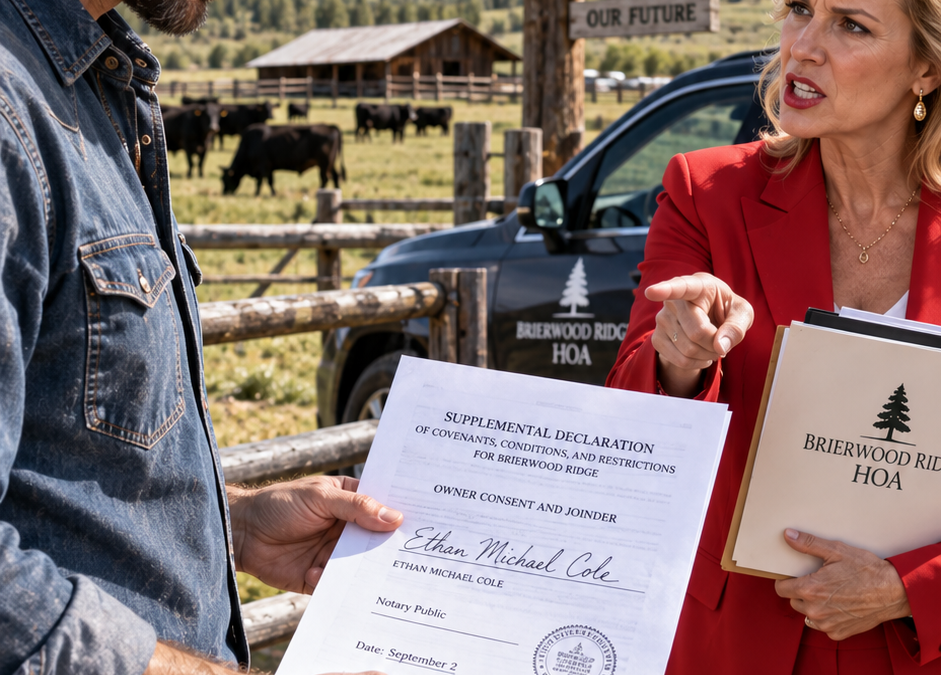
𝗣𝗔𝗥𝗧 𝟮
My name is Ethan Cole.
I was fifty-five years old, and Cedar Run Ranch had been in my family for three generations.
It was working land.
Not decorative acreage.
Not a hobby pasture designed to make a luxury subdivision feel “rural.”
Everything on those 146 acres had a purpose.
The cattle pens were where they were because of drainage.
The hay barn faced south because my grandfather understood winter wind.
The creek pasture stayed open because cattle needed shade in August.
Water lines followed elevations.
Gates followed traffic patterns.
Fence corners existed where they did because men before me had learned, usually the hard way, where a frightened cow was most likely to push through.
Brierwood Ridge came later.
Much later.
Before the subdivision existed, soybean fields stretched beyond my eastern fence.
Then developers bought the neighboring ground.
Roads appeared.
Then utility trenches.
Then model homes with stone veneers and identical mailboxes.
Eventually, Brierwood Ridge had several hundred houses and an HOA that issued newsletters describing itself as a “premier lifestyle community.”
My cattle were apparently not part of the premier lifestyle.
For years, that hadn’t mattered.
I stayed on my side.
They stayed on theirs.
I knew several homeowners.
A few bought straw or old hay from me for garden mulch.
A retired teacher named Anne stopped at the fence sometimes to photograph calves.
One man from Pine Hollow Drive brought his grandson out every spring just to watch the herd.
I never paid Brierwood Ridge dues.
Never attended a board meeting.
Never voted in an election.
Never signed their architectural forms.
Nobody had ever told me Cedar Run Ranch belonged to the HOA because everybody understood something remarkably complicated:
It didn’t.
Until Melissa Grant decided otherwise.
The next morning, I reached the Millstone County Recorder’s Office before it opened.
At eight-thirty, I requested a certified copy of the supplemental declaration and every attachment recorded with it.
When the clerk handed me the packet, I took it to my truck and read it page by page in the courthouse parking lot.
Melissa’s copy had not been altered.
That would have been the easy answer.
The county version contained the same legal description.
Same parcel number.
Same supposed signature.
Same notarial acknowledgment.
Same September 2 date.
Someone had deliberately identified Cedar Run Ranch.
I drove home with the packet on the passenger seat.
At the kitchen table, I placed my deed on the left and the certified filing on the right.
Between them sat my yellow legal pad.
The deed was uncomplicated.
Cedar Run Ranch had transferred fully to me after my father retired.
There was no reference to Brierwood Ridge.
No declaration number.
No HOA membership.
No covenant attachment.
No future annexation agreement.
Nothing.
The supplemental declaration, however, described my parcel with uncomfortable precision.
Whoever prepared it hadn’t guessed.
They had obtained accurate land records.
That bothered me.
A clerical error might accidentally catch the wrong lot.
An organized legal description meant somebody had specifically selected mine.
I studied the signature again.
Then I went to my office cabinet and pulled out three documents I knew I had signed myself.
A tractor loan.
A livestock insurance renewal.
A grazing lease.
My signature varied depending on how quickly I wrote it, but certain habits remained.
I pushed the capital E forward.
The M in Michael was usually compressed because I hated writing my middle name.
And Cole always ended with a short upward stroke.
The signature on the HOA document copied the broad silhouette but missed the natural movements.
It looked rehearsed.
I photographed the pages and called Rachel Monroe.
Rachel was a real-estate attorney who had handled a boundary-access dispute for a rancher I knew two counties away. Her practice involved land use, title problems, deeds, easements, and the particular brand of human insanity that appears when two people believe the same six feet of dirt belongs to both of them.
She listened without interrupting.
When I finished, she asked:
“What document do they claim brought your property into the HOA?”
“The owner consent and joinder.”
“Maybe.”
“Maybe?”
“That may be the key document. But I don’t want to start with the signature.”
“Why not?”
“Because I want to know whether they had any legal mechanism to bring your property in at all.”
I leaned back.
“They recorded one.”
“They recorded paper. That’s not quite the same question.”
That distinction became the foundation of the case.
Rachel explained that an HOA couldn’t usually point at neighboring private land and declare jurisdiction because the board had discovered a sudden enthusiasm for cattle regulation.
There had to be a chain of authority.
A declaration.
An annexation provision.
Ownership rights.
A recorded agreement.
Valid owner consent.
Something.
“You’re focused on whether somebody signed your name,” she said. “I am too. But first I want to know why anybody thought your signature was necessary.”
That was classic Rachel.
She could take the fact making me angriest and put it in a box labeled LATER.
I scanned everything and emailed it to her.
Two hours later, she called.
“The legal description is clean.”
“Meaning?”
“They knew exactly which land they were trying to add.”
“So it wasn’t a typo.”
“Doesn’t look like one.”
“Great.”
“I didn’t say good.”
“I know.”
“The supplemental declaration treats Cedar Run Ranch as property newly subjected to Brierwood Ridge restrictions. I need the original declaration and every amendment.”
While Rachel began tracing the paper trail, Melissa began sending threats.
The first email arrived that afternoon.
FINAL COMPLIANCE SCHEDULE — CEDAR RUN RANCH.
Starting Monday:
$250 for livestock inside the restricted buffer.
$100 per day for denying exterior inspection.
Additional penalties for equipment placement.
Additional penalties for barn lighting.
I forwarded it to Rachel.
She called almost immediately.
“Don’t ignore it.”
“I was planning to frame it.”
“Ethan.”
“I know.”
“You need to respond without conceding jurisdiction.”
“What do I say?”
She dictated a short statement.
I sent it exactly as written:
The status of Cedar Run Ranch under the recently recorded supplemental declaration is formally disputed. I do not consent to any HOA inspection of the property. I am reviewing the underlying recorded instruments and reserve all rights regarding enforcement, access, title, and damages.
Melissa responded nine minutes later.
Recorded covenants are not optional, Mr. Cole.
I saved the email.
Late that afternoon, Rachel found the original Brierwood Ridge declaration.
Her next phone call was different.
More focused.
“I found what they’re relying on.”
“What?”
“An annexation provision.”
I looked out the kitchen window toward the eastern pasture.
“My land?”
“Not exactly. I’ll email the exhibit.”
A minute later, an old development map appeared on my screen.
Brierwood Ridge occupied the center.
Residential lots.
Roads.
Drainage tracts.
Common areas.
And along the edge was a broad shaded zone.
RESERVED FUTURE ANNEXATION AREA.
Part of Cedar Run Ranch overlapped the shaded area.
I stared at it.
“So they’ve had my land marked for years.”
“No.”
“Rachel, I’m looking at it.”
“You’re looking at a planning exhibit. Don’t give it more legal force than it has.”
She explained that a development plan could show intentions.
A developer might hope to acquire additional acreage.
Might plan future phases.
Might reserve rights over property it actually controlled.
But a shaded shape on an old map did not magically transfer ownership of land belonging to someone else.
“Plans describe possibilities,” Rachel said. “Recorded instruments create rights.”
“So that map doesn’t put me in the HOA.”
“No.”
“Then why does it matter?”
“Because it may explain why somebody later believed your property should be included.”
That sentence bothered me more.
An accidental mistake was one thing.
A long-term assumption that Cedar Run Ranch belonged inside Brierwood Ridge was another.
The next morning, I met Rachel at her office.
She had printed the original declaration and several amendments.
The document was nearly thirty years old.
She had highlighted the relevant provisions.
The original developer had retained expansion rights during a defined period and under defined conditions.
Some parcels could be annexed under the developer’s reserved authority.
Other land required additional participation.
Privately owned property outside those rights couldn’t simply be absorbed because someone had once shaded it on a map.
“My family never sold Cedar Run Ranch to this developer,” I said.
“I checked.”
“No easement?”
“Not one that does this.”
“No annexation agreement?”
“Not in the records I’ve found.”
She placed the new supplemental declaration beside the old map.
“Look at the difference.”
The old exhibit showed an imprecise shaded area.
The new filing contained my current parcel number and full deed description.
Someone had moved from concept to precision.
That required a legal bridge.
“What bridge?”
Rachel placed her finger on the owner consent.
“This may be it.”
My supposedly notarized signature.
For the first time, the whole structure became clear.
The HOA wasn’t merely using my alleged consent as decoration.
They might need it.
Without it, their claim could have no support.
Rachel wanted every document between the old planning map and the new recording.
Board minutes.
Drafts.
Title reports.
Management emails.
Legal correspondence.
Execution copies.
Everything.
She sent a formal records request.
Melissa responded by escalating.
That afternoon, a white pickup stopped on the county road beside my eastern pasture.
A man stepped out wearing a polo shirt with the logo of a compliance company.
He photographed my cattle.
Then my barn.
Then my equipment shed.
I walked down the lane and stopped on my side of the gate.
“Can I help you?”
“Brierwood Ridge compliance inspection.”
“This isn’t Brierwood Ridge.”
“I was told the parcel was recently added.”
“Were you told you had permission to enter?”
He looked toward the gate.
“I have a work order.”
“That wasn’t my question.”
To his credit, he stayed on the public side.
I asked for his name, employer, and work-order number.
He gave me all three.
I wrote them down.
Then he photographed my gate and drove away.
Twenty minutes later, Melissa called.
“You interfered with an authorized inspection.”
“No. He never entered.”
“Because you denied access.”
“I denied access to a contractor claiming rights I dispute.”
“You’re making this more expensive than it needs to be.”
“No, Melissa. I’m asking you to prove that you control my land.”
“The declaration is recorded.”
“So you’ve mentioned.”
“We’re done debating that.”
“Then send my attorney every document showing how Cedar Run Ranch became subject to it.”
Silence.
Then:
“You hired a lawyer?”
“You suggested it.”
She hung up.
I stared at my phone.
There are few experiences more satisfying than taking unwanted advice very seriously.
Rachel sent a preservation letter that afternoon demanding the HOA retain everything connected to the preparation and recording of the supplemental declaration.
Emails.
Drafts.
Scans.
Board packets.
Management correspondence.
Title materials.
Execution versions.
Notary information.
The HOA acknowledged the request.
It produced nothing immediately.
Instead, the following morning I received a new violation.
DENIED INSPECTION ACCESS.
One hundred dollars per day.
I forwarded it.
Rachel replied:
Save it. Do not pay. Do not delete anything.
That became our rhythm.
Melissa produced pressure.
Rachel collected evidence.
Melissa claimed authority.
Rachel traced authority backward.
And every time we moved one step back through the paperwork, Brierwood Ridge’s position got weaker.
Eventually Rachel found an older amendment clarifying the annexation process.
She called me that evening.
“I found the legal bridge.”
“Good bridge or bad bridge?”
“For them? Potentially very bad.”
She explained that whatever earlier expansion rights had existed, Cedar Run Ranch had never become developer-owned property.
My family remained in title.
The ranch was private.
The old developer’s powers didn’t permanently give future HOA boards the ability to annex land the developer never owned.
“So they needed my participation.”
“That’s what the documents indicate.”
“The consent.”
“Yes.”
I looked at the certified page.
One signature.
One acknowledgment.
One sheet of paper.
The HOA was threatening to regulate 146 acres, move thirty-seven cattle, inspect my buildings, control my lights, restrict my machinery, and fine me daily.
And all of it might depend on whether that one page was legitimate.
Rachel spent the next several days reducing the matter to a simple chain.
Ownership first.
My family owned Cedar Run Ranch before Brierwood Ridge existed.
We never transferred it to the developer.
We never deeded it to the HOA.
Then declarations.
None of the early documents clearly subjected the ranch to Brierwood Ridge.
Then annexation.
No earlier recorded agreement tied my parcel to the association.
Then owner consent.
That was the only document currently claiming I had voluntarily joined.
“If they have another agreement, I haven’t found it,” Rachel said.
“So this one page is carrying everything.”
“So far.”
She refused to say more.
Then the HOA finally produced records.
Most were boring.
Meeting agendas.
Management reports.
Old exhibits.
Draft amendments.
Emails.
But one board minute stopped Rachel cold.
The meeting had occurred six weeks before Melissa visited my gate.
Agenda item:
BOUNDARY COMPLIANCE INITIATIVE.
The board discussed several properties along Brierwood Ridge’s rural side.
Most were already HOA parcels.
One was listed separately.
CEDAR RUN RANCH — PENDING INCLUSION PARCEL.
I read that phrase three times.
“Pending inclusion?”
“Yes.”
“Six weeks before they supposedly already had authority?”
“Correct.”
“And Melissa told me this was basically settled history.”
“Correct.”
“So she lied.”
Rachel gave me the look.
“What?”
“We document contradictions. We don’t outrun the evidence.”
“You should embroider that on a pillow.”
“I might.”
The minutes showed Melissa had personally presented the initiative.
The goal was “uniform standards” along the rural edge.
Residents had complained about livestock odors.
Equipment noise.
Barn lighting.
Visual inconsistency.
My ranch wasn’t named in every complaint.
It didn’t have to be.
There was only one working cattle operation on that boundary.
A board motion authorized management to finalize documents necessary for pending inclusion parcels.
I tapped the page.
“They wanted my ranch.”
“They wanted it regulated.”
“Same difference.”
“Not legally.”
Rachel had a point, which was becoming irritatingly common.
Motive explained conduct.
Authority determined rights.
We needed to keep those separate.
Still, the minutes mattered.
The HOA had not always treated Cedar Run Ranch as existing association property.
Only six weeks before the new declaration was filed, its own records called my ranch pending.
Pending meant unfinished.
Unfinished meant a step still had to occur.
That step appeared to be my consent.
And I knew I had never given it.
Rachel turned to the notarization.
The notary was Diane Keller.
Rachel checked the state commission database.
Diane was real.
Her commission had been active on September 2.
Nothing obvious was wrong with her name, seal information, or commission date.
That made the acknowledgment appear credible.
“If she says I appeared, what happens?”
Rachel looked at me.
“Then we have a much different problem.”
“I wasn’t there.”
“I understand.”
“I know where I was.”
“That may help. But first we ask the notary.”
Rachel sent a careful letter.
No accusation.
No allegation of forgery.
Just a request asking whether Diane could confirm the September 2 acknowledgment associated with an owner consent for Ethan Michael Cole and Cedar Run Ranch.
While we waited, Melissa added another fine.
Seven hundred fifty dollars total now.
Her email copied Rachel.
Rachel answered:
The HOA’s asserted authority over Cedar Run Ranch remains disputed. Please preserve all records concerning preparation, execution, acknowledgment, approval, and recording of the supplemental declaration.
Melissa replied:
The recorded documents speak for themselves.
Rachel printed the email.
She smiled.
“You are smiling.”
“Barely.”
“Why?”
“People love saying documents speak for themselves when they don’t want you asking how the documents were created.”
Two days later, Diane Keller responded.
Rachel called me.
“She remembers September 2.”
My stomach tightened.
“Does she remember me?”
“No.”
I said nothing.
“She says she performed several notarizations that day. Your name doesn’t sound familiar, and she does not recall a Cedar Run Ranch document.”
“Is that enough?”
“No.”
The speed of her answer almost annoyed me.
“Anything ever enough for you?”
“Evidence is.”
Diane had agreed to check her journal.
That mattered.
The dispute had started with Melissa’s copy of a recorded document.
Then my denial.
Then old declarations.
Then board minutes.
Now, finally, we were about to compare the acknowledgment against a contemporaneous record created by someone outside the HOA.
Rachel called me at 7:12 the next morning.
I was in the barn checking a mineral feeder.
“I have the journal entry.”
I stopped.
“And?”
“It does not match your document.”
I was in my truck within ten minutes.
At Rachel’s office, she had copies spread across the conference table.
Diane kept a detailed notary journal.
Date.
Time.
Type of act.
Signer identity.
Identification method.
Document description.
The kind of administrative record almost nobody cares about until suddenly it becomes the most important piece of paper in the county.
Rachel pointed to September 2.
The transaction matching the date and acknowledgment sequence on my supposed consent did not list Ethan Michael Cole.
It listed two different people.
Both were Brierwood Ridge homeowners.
The associated property was a residential lot inside the subdivision.
Not Cedar Run Ranch.
“Same date?”
“Yes.”
“Same notary?”
“Yes.”
“Same transaction reference?”
“Yes.”
“And I’m nowhere in the journal.”
“Correct.”
I read the entry again.
Rachel slid another document toward me.
“This is what Diane actually notarized.”
It was a legitimate property document involving those two homeowners.
Different signers.
Different parcel.
Different purpose.
But the notarial acknowledgment format looked almost identical to the one attached to the supposed Cedar Run Ranch consent.
Same notary.
Same date.
Same layout.
I felt heat rise into my face.
“So somebody—”
Rachel held up one finger.
I stopped.
“I know.”
“No. You know something is wrong. That is not yet the same as knowing who did what.”
She pointed at the journal.
“What we can establish right now is precise.”
She began counting.
“Diane’s journal does not show you appearing before her on September 2.”
Second finger.
“The transaction recorded in her journal for the relevant acknowledgment involved different signers.”
Third.
“A different property.”
Fourth.
“She has no separate journal entry for you.”
“And fifth,” I said, “I never signed the thing.”
“Yes. But your statement is strengthened now by independent contemporaneous evidence.”
Diane provided a written declaration confirming her records.
She stated that her journal reflected the notarizations she performed on September 2.
She confirmed the relevant entry involved other signers and another Brierwood Ridge parcel.
And she confirmed there was no journal entry showing Ethan Michael Cole appearing before her to acknowledge a Cedar Run Ranch owner consent.
I sat back.
“So this kills their covenants.”
Rachel folded her hands.
“It severely undermines the document they appear to need to establish your consent.”
“Rachel.”
“You want dramatic language. I want language I can defend.”
“Fine.”
She smiled.
“That was dramatic enough.”
The county recording stamp proved the document had been submitted and recorded.
It did not prove every factual statement in the document was true.
A stamp couldn’t transport me into Diane Keller’s office on September 2.
A stamp couldn’t create a journal entry.
And a stamp couldn’t make my handwriting appear where I had never written it.
Rachel assembled a formal demand package.
Certified supplemental declaration.
Owner consent.
Relevant annexation provisions.
Board minutes identifying Cedar Run Ranch as a pending inclusion parcel.
Diane’s declaration.
Journal evidence.
The letter demanded that Brierwood Ridge immediately suspend enforcement, withdraw inspection claims, stop fines, preserve all relevant materials, and begin correcting the county record.
She sent it to the HOA.
The management company.
And association counsel.
Forty-three minutes later, Melissa called me.
I watched the phone ring.
Then stop.
Then ring again.
I didn’t answer.
An email followed.
You are mischaracterizing association documents. The recorded declaration remains effective unless formally challenged.
I forwarded it.
Rachel answered:
Do not engage.
By afternoon, something changed.
The HOA portal still showed my $750 balance.
But beneath it was a new notation.
UNDER LEGAL REVIEW.
The inspection appointment disappeared.
No apology.
No explanation.
The next morning, I saw Melissa’s SUV on the road beside the east pasture.
She stopped.
I could see her through the windshield.
She did not come to the gate.
For the first time since the whole thing started, Melissa Grant remained on her own side of the fence.
That should have felt better than it did.
But we still had one major problem.
If Diane Keller had notarized a legitimate document for two other homeowners on September 2, how had an acknowledgment associated with that transaction ended up behind a supposed consent bearing my name?
Three days later, Rachel called.
“Brierwood Ridge hired outside counsel.”
“Good.”
“That depends what you’re hoping for.”
“Someone over there who reads.”
“That would be a promising start.”
The lawyer was Daniel Price.
His first letter sounded nothing like Melissa.
No threats.
No red type.
No claims that everything was settled.
Brierwood Ridge had initiated an internal review.
During that review, enforcement against Cedar Run Ranch would be suspended.
No cattle fines.
No inspection.
No access demand.
No equipment penalties.
No barn-lighting penalties.
The compliance contractor would stay away.
My $750 balance changed from UNDER LEGAL REVIEW to SUSPENDED.
“They backed off,” I said.
“They paused.”
“Rachel, you could make Christmas sound temporary.”
“It is. Happens every year.”
I stared at her.
She pointed at the county recording number.
“The disputed declaration is still in your title history. We’re not finished.”
Daniel requested ten business days.
Rachel agreed only after securing written confirmation that the HOA would take no enforcement, lien, inspection, or collection action during the review.
Then Brierwood Ridge began auditing itself.
And apparently, its file system had been designed by people who believed the word “final” was a decorative suggestion.
There were files called:
FINAL.
FINAL2.
FINAL-BOARD.
FINAL-REVISION.
FINAL-REALLY.
RECORDING-COPY.
RECORDING-COPY-UPDATED.
Rachel looked at me over her glasses.
“That naming convention should be a misdemeanor.”
The HOA maintained a shared electronic folder for the western-boundary project.
Inside were old maps.
Draft supplemental declarations.
Legal descriptions.
Unsigned consent forms.
Previously executed consent pages.
Scanned acknowledgment pages.
Board packets.
Management notes.
Enough versions to guarantee that nobody could confidently explain which document belonged with which attachment without opening them individually.
The project had begun as an attempt to create uniform restrictions along Brierwood Ridge’s rural edge.
Melissa pushed it.
Some parcels already belonged to the HOA.
Others involved owners who had actually signed documents.
Cedar Run Ranch was different.
My ranch required valid owner participation.
That was why an owner-consent draft existed.
But Daniel couldn’t find anything showing participation from me.
No email agreeing to join.
No appointment.
No signed original.
No transmittal letter.
No title company returning an executed document.
No lawyer for me.
No witness.
No record of anybody even scheduling a meeting with me.
Nothing.
Then he found the folder that mattered.
RECORDING PACKAGE — WESTERN BOUNDARY.
Inside were PDFs prepared within days of each other.
One supplemental declaration.
One set of property descriptions.
Several owner-consent forms.
And scanned acknowledgment pages from prior transactions handled through the management office.
One of those acknowledgment pages was Diane Keller’s.
The legitimate September 2 notarization.
The one involving two Brierwood Ridge homeowners.
The one that had absolutely nothing to do with Ethan Cole or Cedar Run Ranch.
Outside counsel did not immediately accuse anyone of knowingly falsifying anything.
Neither did Rachel.
What Daniel could say was bad enough.
The final recording package had been assembled from a directory containing unfinished drafts and completed documents from unrelated transactions.
At some point before recording, the acknowledgment associated with the other homeowners had ended up behind the consent bearing my name.
The assembled PDF looked complete.
Signature.
Notary.
Commission information.
Legal description.
Recording package.
But the supporting records did not authenticate that combination.
I asked Rachel:
“Who put it together?”
“They haven’t determined that.”
“Melissa?”
“They haven’t said that.”
“Management?”
“They haven’t said that either.”
“So nobody knows.”
“Not yet.”
“That bothers me.”
“I understand.”
“If somebody attached that page intentionally, I want to know.”
“And if they determine that, other consequences may follow.”
She tapped the deed.
“But don’t lose sight of your primary objective.”
“My land.”
“Exactly.”
That was the hardest part of dealing with Rachel.
She refused to let outrage replace strategy.
I wanted a name.
She wanted a clean title.
I wanted someone forced to explain how my signature ended up on a recorded document.
She wanted the HOA to admit it could not prove I had consented.
The second goal mattered more.
Brierwood Ridge held an emergency executive session.
Melissa attended.
Daniel attended.
Management representatives attended.
Rachel and I were not invited.
The meeting lasted nearly three hours.
The next morning, Daniel sent a written summary.
Brierwood Ridge could not presently authenticate the owner consent and joinder attributed to Ethan Michael Cole.
All enforcement against Cedar Run Ranch would remain suspended indefinitely.
The board had directed counsel to prepare options for correcting the public record.
I read the last sentence three times.
Correcting the public record.
Not reviewing.
Not reconsidering.
Correcting.
Melissa called later.
This time I answered.
“The board is reviewing some administrative irregularities,” she said.
“Administrative irregularities.”
“That is how counsel described them.”
“Your HOA recorded covenants against 146 acres of my land using a consent you cannot authenticate.”
“I cannot discuss privileged matters.”
“You called me.”
A pause.
“The suspension is temporary while we evaluate options.”
“Then evaluate them.”
“You don’t need to make this adversarial, Ethan.”
For one full second, I thought I had misheard her.
Then I looked out the window at my cattle.
“You came to my gate wearing a red suit and gave me four days to remove livestock from land my family has owned for three generations.”
Silence.
“You demanded inspections.”
Nothing.
“You issued daily fines.”
Still nothing.
“You told me a county stamp ended the discussion.”
She exhaled.
“I was relying on documents provided to the board.”
“Then don’t call me now and explain that I’m making things adversarial.”
Melissa ended the call.
Two nights later, the HOA held a public meeting.
I didn’t attend.
The minutes went online the following morning.
One line mattered.
ALL CEDAR RUN RANCH ENFORCEMENT ACTIONS ARE FORMALLY SUSPENDED PENDING TITLE AND RECORD CORRECTION.
No cattle deadline.
No inspection.
No fines.
No claim that HOA contractors could walk through my gate.
No declaration from Melissa that Cedar Run Ranch was simply another Brierwood Ridge property.
For the first time, the HOA had stopped pretending it controlled my ranch.
I thought we had won.
Rachel corrected me.
Again.
She put the new minutes beside my deed.
“They stopped enforcement.”
“Yes.”
“They acknowledge the document issue.”
“Yes.”
“They’re preparing a correction.”
“Yes.”
She pointed at the original recording number.
“But this is still in the county record.”
I understood.
An informal promise from today’s board did not protect me from tomorrow’s board.
Melissa had demonstrated exactly how quickly management philosophy could change.
If I sold the ranch someday, a title examiner could find the supplemental declaration.
A lender could ask questions.
A buyer could hesitate.
A future HOA president could decide the suspension had expired.
The title record needed to tell the complete story.
“What do we demand?”
Rachel slid a draft across the table.
“We don’t ask them to leave you alone.”
I read the heading.
DEMAND FOR CORRECTIVE RECORDING.
“We make them fix what they recorded.”
The final resolution wasn’t cinematic.
No police convoy arrived at Brierwood Ridge.
No television crew waited outside the clubhouse.
Melissa didn’t confess into a microphone.
Daniel Price sent Rachel a draft.
She called me while I was near the north cattle pens.
“They’re preparing a corrective instrument.”
I stood there with mud on my boots while a calf tried to chew the sleeve of my jacket.
“Read it.”
“Come to the office.”
An hour later, the document sat on Rachel’s conference table.
CORRECTIVE RELEASE AND CLARIFICATION OF SUPPLEMENTAL DECLARATION.
It identified the recording number of the disputed supplemental declaration.
Then Cedar Run Ranch.
Parcel number.
Legal description.
All 146 acres.
Then the paragraph I had waited nearly two months to see.
Brierwood Ridge Homeowners Association stated that it could not establish a valid owner consent and joinder executed by Ethan Michael Cole and therefore did not claim Cedar Run Ranch had been validly subjected to the supplemental declaration through that filing.
I read it.
Then again.
“That’s it?”
“For the property issue, that’s the core.”
“They’re actually putting this into the county record?”
“Yes.”
That mattered more than any apology Melissa could have given me.
The HOA had created the problem publicly.
Now it would correct it publicly.
Rachel revised the language.
Daniel accepted most of the changes.
The final version stated that all Cedar Run Ranch enforcement notices arising from the disputed filing were withdrawn.
All fines were cancelled.
The association disclaimed authority under that filing to inspect, regulate, or enforce Brierwood Ridge restrictions against the ranch.
The HOA agreed to cooperate with reasonable future title inquiries involving the correction.
Daniel submitted it to the Millstone County Recorder.
Three days later, Rachel called.
One word.
“Recorded.”
I drove back to the same courthouse where I had obtained the original packet.
The same clerk was working.
I requested a certified copy of the corrective instrument.
When she handed it over, the county stamp sat at the top.
Same government office.
Same public-record system.
But this time the record contained something Melissa hadn’t expected when she stood at my gate.
The HOA’s own statement that it could not establish the owner consent it had relied upon.
I stood beside the courthouse counter reading that paragraph again.
There was something almost poetic about it.
Melissa had spent weeks treating the county recorder’s stamp like divine intervention.
Recorded means final.
Recorded means legal.
Recorded means stop asking questions.
Now the same recording system carried the correction that dismantled her claim.
Paper really did speak for itself eventually.
You just had to make sure you had all the pages.
The financial cleanup came next.
The $750 balance disappeared.
Livestock violation:
CANCELLED.
Inspection violation:
CANCELLED.
Equipment warning:
WITHDRAWN.
Barn-lighting notice:
WITHDRAWN.
Rachel required a written account statement showing I owed nothing.
The HOA provided it.
They also agreed to reimburse reasonable legal and title-review expenses directly associated with clearing the record.
I didn’t make money.
I didn’t want money.
I wanted the legal condition of Cedar Run Ranch restored to what it had been before somebody decided 146 acres of private ranchland would look better inside an HOA compliance spreadsheet.
Brierwood Ridge changed its procedures afterward.
At the next open meeting, the board adopted a recording-verification policy.
Any future annexation affecting privately owned property required independent verification of title.
Executed documents had to be matched against the correct parcel.
Notarial acknowledgments had to correspond to the actual execution pages.
Draft and completed documents could no longer live together in one giant digital junk drawer labeled “recording.”
Outside counsel would review any attempt to bring privately owned land under association covenants.
Rachel read the policy.
“They learned something.”
“Think it’ll last?”
“Policies are often what organizations write after somebody creates a disaster memorable enough that everyone wants instructions for avoiding the sequel.”
Melissa was still technically on the board when the corrective document was recorded.
But she no longer controlled communications.
Daniel handled legal correspondence.
Another director chaired meetings.
Management answered administrative requests.
Her name appeared less.
Then Brierwood Ridge reorganized its leadership.
The minutes were painfully boring.
Election of officers.
Appointments.
Committee assignments.
And one important change.
Melissa Grant was no longer president.
No announcement.
No grand speech.
No formal rebuke.
Just a new president’s name where hers used to be.
I was surprised by how satisfying that was.
Not because I needed Melissa humiliated.
I didn’t.
Public humiliation is temporary.
A corrected land record lasts considerably longer.
I didn’t need to watch her apologize.
I didn’t need neighbors cheering while she packed a cardboard box.
I needed something much simpler.
Her authority removed from my ranch.
The paperwork accomplished exactly that.
About a week after the board reorganization, I saw Melissa again.
Her SUV came down the county road beside my eastern pasture.
I was fixing a loose lower fence strand.
A calf had pushed against it.
Melissa slowed.
For a second, I thought she’d stop.
She didn’t.
She drove on toward Brierwood Ridge.
Behind me, the same Angus cattle she had ordered removed were grazing exactly where they had been before.
The barn lights remained unchanged.
The tractor sat beside the equipment shed.
No inspector waited at the gate.
No photographer stood along the road.
No violation notice was attached to anything.
I tightened the fence wire and went back to work.
That afternoon, I carried the certified corrective instrument into the ranch office.
The fireproof cabinet held documents my family had accumulated over generations.
Old deeds.
Surveys.
Insurance papers.
Loan records.
My father’s transfer documents.
Tax records.
I placed the corrective filing beside the deed.
Then I closed the cabinet.
For me, that was the real ending.
Cedar Run Ranch hadn’t moved.
The eastern fence hadn’t changed.
The cattle hadn’t suddenly become legal again because they had never become illegal in the first place.
The land was still 146 acres.
The creek still rose after heavy spring rain.
Hay still had to be cut.
Water troughs still froze if I didn’t stay ahead of winter.
Fences still broke.
Calves still escaped whenever they discovered I had somewhere important to be.
Brierwood Ridge still existed beyond the pasture.
Its houses were still there.
Its HOA was still there.
But the line between their authority and my property meant something again.
Months earlier, Melissa had arrived holding a recorded document as though a county stamp erased every question.
She had mistaken recording for truth.
They were not the same thing.
A county office can record a document presented in proper form.
The public record can show that paper exists.
But the factual foundation underneath the paper still matters.
Who owned the property?
What authority permitted the restriction?
Who signed?
Who appeared before the notary?
What did the contemporaneous records show?
That was where Melissa’s certainty collapsed.
Her entire argument depended on the sentence:
You agreed.
I hadn’t.
She depended on a signature.
It wasn’t one I recognized as mine.
She depended on a notarization.
The notary’s journal didn’t show me.
She depended on the claim that Cedar Run Ranch had been properly added.
The HOA’s own earlier minutes called it a pending inclusion parcel.
She depended on “recorded means settled.”
The HOA eventually had to record a correction saying it couldn’t establish my consent.
That was about as settled as I needed it to be.
I thought often about Melissa’s first deadline.
Friday.
Move the cattle by Friday.
The arrogance of it became funnier with distance.
Thirty-seven Angus cows had been grazing on my family’s property when the president of a subdivision across the fence decided they needed to move because a packet of paper told her so.
She had four days mapped out for me.
Friday cattle deadline.
Inspection next week.
Fines Monday.
Probably a lien after that.
Maybe more.
People who misuse administrative authority often build momentum deliberately.
They want you answering their schedule.
Their notice.
Their deadline.
Their hearing.
Their interpretation.
Their paperwork.
Every day you spend defending yourself against the last demand is a day you aren’t questioning the authority behind the first one.
Rachel understood that immediately.
She never let me waste the case arguing whether cattle should be 150 feet away or 200.
She didn’t debate whether my barn light was too bright.
She didn’t negotiate the inspection window.
She kept asking the same foundational question.
Why do they believe they have jurisdiction?
Then:
What recorded instrument creates it?
Then:
What authority supports that instrument?
Then:
Where is valid owner participation?
Then:
Does the acknowledgment prove execution?
Then:
What does the notary’s journal show?
One question at a time.
By the end, Melissa’s mountain of enforcement notices had become irrelevant.
You cannot enforce rules against property you failed to validly bring under those rules.
The best part was that the HOA had created most of the evidence itself.
Its minutes.
Its drafts.
Its folders.
Its recording package.
Its emails.
Its compliance notices.
Melissa’s message insisting that “the recorded documents speak for themselves.”
They certainly did.
Just not in the way she expected.
The following spring, one of the Brierwood Ridge homeowners stopped at my fence.
His name was Paul.
I’d sold him straw before.
He leaned out his pickup window.
“You keeping those cattle there?”
I looked toward the herd.
“That seems to be their plan.”
He laughed.
“New board says they don’t have anything to do with your side.”
“New board is correct.”
Paul rubbed his jaw.
“Melissa used to tell people the ranch was going to be incorporated into the community.”
“Did she?”
“Yeah. Said eventually the whole western boundary would have uniform standards.”
I looked past him toward the subdivision.
“I suppose eventually is a flexible word.”
He laughed again.
Then his expression changed.
“I’m glad you fought it.”
“I mostly read paperwork.”
“That’s fighting for grown-ups.”
I couldn’t argue with that.
Later that summer, I repaired the east pasture gate.
The old cedar post had rotted near the base, so I replaced it with a new one set in concrete.
While the mix cured, I sat on an overturned bucket and looked across the boundary.
From that spot, you could see the contrast clearly.
On one side:
Brierwood Ridge.
Curving streets.
Trimmed lawns.
Stone entrance monuments.
Matching mailboxes.
On the other:
Cedar Run Ranch.
Pasture.
Cattle.
Rust-red barn roof.
Tractor tracks.
Stacks of hay.
Neither side needed to be better than the other.
They simply needed to understand where one ended and the other began.
That was the entire conflict.
Melissa had mistaken proximity for jurisdiction.
Because my ranch touched Brierwood Ridge, she treated it as unfinished HOA territory.
Because an old planning map once shaded part of the area, she treated future intent as present authority.
Because a recording package contained my name, she treated consent as established.
Because nobody stopped her immediately, she assumed nobody could.
Then somebody checked.
That was all it took.
Not shouting.
Not threats.
Not driving cattle through the HOA clubhouse.
Not blocking roads with tractors.
Not tearing down signs.
Just checking.
The deed.
The declaration.
The amendment.
The board minutes.
The consent.
The acknowledgment.
The notary journal.
The recording folder.
The correction.
I had spent most of my life learning that ranching rewards patience.
You don’t pull a calf too early because you’re nervous.
You don’t cut hay while the moisture is wrong because rain might come tomorrow.
You don’t repair a fence by hammering harder when the post is rotten.
You find the actual problem.
The legal fight wasn’t very different.
Melissa tried to make me move fast.
Friday.
Monday.
Inspection day.
Fine deadline.
Rachel made me move carefully.
That difference saved the ranch from becoming trapped under a set of restrictions I had never accepted.
The yellow legal pad from that first afternoon remained in my desk drawer.
September 2.
Owner consent and joinder.
Certified county copy.
And underneath:
Who created the authority?
The question looked almost simple now.
At the beginning, Melissa’s answer had been:
We did.
Then:
The declaration did.
Then:
The recording did.
Eventually, after enough records were checked, the real answer was:
Nobody had established it.
That was why their entire enforcement campaign collapsed.
Not because I was louder.
Melissa was louder.
Not because I had more official-looking stationery.
The HOA won that contest easily.
Not because I had a better suit.
I owned exactly one jacket that might have qualified, and it smelled faintly of cedar shavings.
I won because when somebody claimed authority over my property, I asked them to show every link in the chain.
One link failed.
Then another.
Then the most important one.
The notary journal did not match.
Everything after that was cleanup.
A few months later, I was working near the same front gate where Melissa had first confronted me.
The afternoon sun was low.
The herd was moving slowly toward the water trough.
I remembered her standing beside that HOA SUV in her red suit.
“Move those cattle by Friday.”
At the time, she had looked completely certain.
I almost admired that kind of confidence.
Almost.
Then I remembered what it had been built on.
A shaded map.
A draft project.
A questionable signature.
A mismatched acknowledgment.
A county stamp.
And the belief that nobody would bother checking.
I rested my arms on the top rail.
One of the cows lifted her head and stared at me while chewing.
“You caused a lot of trouble,” I told her.
She kept chewing.
“Apparently you’re a restricted visual condition.”
She had no reaction.
Cattle are very secure in themselves.
Beyond the pasture, the roofs of Brierwood Ridge caught the evening light.
The subdivision looked peaceful.
So did the ranch.
That was how it should have been all along.
Two pieces of land.
Two different uses.
One fence between them.
No confusion.
I went inside after dark.
The certified corrective instrument was still locked in the fireproof cabinet beside my deed.
Melissa’s first compliance notice was in another drawer.
I kept that one for a different reason.
The notice said I had four days to comply.
I liked looking at it occasionally.
Not because it made me angry anymore.
Because it reminded me how quickly official language can become ridiculous once the authority underneath it disappears.
“Move cattle.”
“Permit inspection.”
“Pay fine.”
“Comply immediately.”
Every command had looked powerful when Melissa believed the ranch was hers to regulate.
After the correction, they were just sentences printed on paper.
The cattle stayed.
The inspectors stayed out.
The fines vanished.
The title was corrected.
The board replaced Melissa as president.
And the HOA that had tried to pull a 146-acre working ranch under its covenants eventually had to record, in the same county system Melissa had waved in my face, that it could not establish I had ever agreed to join them.
That was enough for me.
Because land ownership is not established by who speaks with the most confidence at a gate.
It isn’t created by who owns the biggest binder.
It isn’t expanded because a board votes unanimously.
And it certainly doesn’t change because somebody puts your name on a page and hopes you never compare it against the records behind it.
A boundary matters.
A signature matters.
A notarial acknowledgment matters.
And when somebody claims all three support them, they had better match.
Melissa learned that after trying to regulate my cattle.
I learned something too.
Whenever somebody arrives at your gate waving paperwork and telling you the argument is already over, that’s probably a very good time to start reading the paperwork.
Especially the page they hope you’ll never check.
Especially the signature.
And most of all, the log.
Have you finished reading the story and want to read it again?
The HOA Filed New Covenants Against My 146-Acre Ranch—Then One Notary Record Blew Their Claim Apart
Melissa thought the paperwork had already beaten me.
She gave me four days to move my cattle.
Then I asked one question she clearly hadn’t prepared for.
“Move those cattle by Friday, or we start fining you.”
Melissa Grant said it like she was announcing the weather.
She stood outside the front gate of Cedar Run Ranch in a bright red suit that looked absurd against 146 acres of pasture, weathered cedar posts, cattle pens, creek bottom, and a hay barn my grandfather had helped build decades earlier. Behind her, an SUV bearing the Brierwood Ridge Homeowners Association logo idled on the shoulder.
Melissa was the HOA president.
That was important to Melissa.
She liked titles.
She liked letterhead.
And, judging by the thick packet she held against her chest, she especially liked documents that allowed her to tell other people what to do.
I rested one hand on the gate.
“Move them where?”
She opened the packet and pointed to a highlighted section.
“Two hundred feet from the residential boundary.”
I looked over my shoulder.
Thirty-seven black Angus cattle were grazing quietly in the eastern pasture.
Moving them two hundred feet away from Brierwood Ridge would make most of that pasture unusable.
“That eliminates most of my grazing area.”
Melissa gave me a professional little smile.
“That isn’t the association’s problem.”
There are sentences people say when they believe authority has replaced common sense.
That was one of them.
I held out my hand.
“Let me see it.”
She passed me the packet.
The first page carried a Millstone County recording stamp.
The title read:
SUPPLEMENTAL DECLARATION OF COVENANTS, CONDITIONS, AND RESTRICTIONS FOR BRIERWOOD RIDGE.
I flipped through it.
Livestock restrictions.
Exterior-lighting restrictions.
Equipment-storage restrictions.
Architectural controls.
Inspection rights.
Daily fines.
Apparently, while I had been repairing irrigation lines, ordering winter hay, and worrying about whether one heifer was going to calve early, the neighborhood next door had somehow decided it controlled my ranch.
“When exactly did I join Brierwood Ridge?”
Melissa tapped the packet.
“Your property was included in the supplemental declaration.”
“That wasn’t my question.”
Her smile thinned.
I turned to the legal exhibit.
There it was.
Cedar Run Ranch.
Parcel number.
Full legal description.
One hundred forty-six acres.
Not a little strip beside the subdivision.
Not a questionable fence corner.
The entire ranch.
Then I found the page that mattered.
OWNER CONSENT AND JOINDER TO SUPPLEMENTAL DECLARATION.
My full name appeared underneath a signature.
ETHAN MICHAEL COLE.
And above it was something pretending to be my handwriting.
I had signed cattle contracts, equipment loans, grazing agreements, insurance renewals, tax documents, deeds, and more checks than I could count.
That signature had the general outline of mine.
But it looked too careful.
Too constructed.
Like someone had studied my name rather than written it.
I didn’t accuse Melissa of anything.
I kept reading.
Below the signature was a notarial acknowledgment stating that I had personally appeared and acknowledged the document.
Date:
September 2.
I read it twice.
Melissa noticed.
“Like I said,” she told me. “It’s legal.”
I closed the packet.
“I want a certified copy directly from the county.”
“Request whatever you want.”
She reached into the SUV and produced another envelope.
“Your compliance schedule.”
I opened it.
Cattle removed by Friday.
Exterior inspection the following week.
Daily fines beginning immediately after the deadlines.
I looked up.
“No one enters this ranch without my permission.”
“The association has inspection rights now.”
There was that word again.
Now.
“You keep saying ‘now.’”
Melissa’s posture stiffened.
“I want to know what created ‘now.’”
“You should probably talk to an attorney before you make this harder on yourself.”
I handed the packet back.
“That is the first useful thing you’ve said all morning.”
She stared at me for a second, climbed into the HOA SUV, and drove toward Brierwood Ridge.
I stayed at the gate.
Nothing on Cedar Run Ranch had changed.
The cattle were still grazing.
The creek was still moving through the cottonwoods.
The barn doors were still open.
The eastern fence still stood exactly where it had stood the previous day.
But according to a document recorded at the county courthouse, somebody had changed the legal story of my family’s land without asking me.
I went inside, set Melissa’s compliance notice on the kitchen table, and opened a yellow legal pad.
I wrote three things.
September 2.
Owner consent and joinder.
Certified county copy.
Then, underneath them, I wrote the only question that mattered.
Who created the authority?
PART2
My name is Ethan Cole.
I was fifty-five years old, and Cedar Run Ranch had been in my family for three generations.
It was working land.
Not decorative acreage.
Not a hobby pasture designed to make a luxury subdivision feel “rural.”
Everything on those 146 acres had a purpose.
The cattle pens were where they were because of drainage.
The hay barn faced south because my grandfather understood winter wind.
The creek pasture stayed open because cattle needed shade in August.
Water lines followed elevations.
Gates followed traffic patterns.
Fence corners existed where they did because men before me had learned, usually the hard way, where a frightened cow was most likely to push through.
Brierwood Ridge came later.
Much later.
Before the subdivision existed, soybean fields stretched beyond my eastern fence.
Then developers bought the neighboring ground.
Roads appeared.
Then utility trenches.
Then model homes with stone veneers and identical mailboxes.
Eventually, Brierwood Ridge had several hundred houses and an HOA that issued newsletters describing itself as a “premier lifestyle community.”
My cattle were apparently not part of the premier lifestyle.
For years, that hadn’t mattered.
I stayed on my side.
They stayed on theirs.
I knew several homeowners.
A few bought straw or old hay from me for garden mulch.
A retired teacher named Anne stopped at the fence sometimes to photograph calves.
One man from Pine Hollow Drive brought his grandson out every spring just to watch the herd.
I never paid Brierwood Ridge dues.
Never attended a board meeting.
Never voted in an election.
Never signed their architectural forms.
Nobody had ever told me Cedar Run Ranch belonged to the HOA because everybody understood something remarkably complicated:
It didn’t.
Until Melissa Grant decided otherwise.
The next morning, I reached the Millstone County Recorder’s Office before it opened.
At eight-thirty, I requested a certified copy of the supplemental declaration and every attachment recorded with it.
When the clerk handed me the packet, I took it to my truck and read it page by page in the courthouse parking lot.
Melissa’s copy had not been altered.
That would have been the easy answer.
The county version contained the same legal description.
Same parcel number.
Same supposed signature.
Same notarial acknowledgment.
Same September 2 date.
Someone had deliberately identified Cedar Run Ranch.
I drove home with the packet on the passenger seat.
At the kitchen table, I placed my deed on the left and the certified filing on the right.
Between them sat my yellow legal pad.
The deed was uncomplicated.
Cedar Run Ranch had transferred fully to me after my father retired.
There was no reference to Brierwood Ridge.
No declaration number.
No HOA membership.
No covenant attachment.
No future annexation agreement.
Nothing.
The supplemental declaration, however, described my parcel with uncomfortable precision.
Whoever prepared it hadn’t guessed.
They had obtained accurate land records.
That bothered me.
A clerical error might accidentally catch the wrong lot.
An organized legal description meant somebody had specifically selected mine.
I studied the signature again.
Then I went to my office cabinet and pulled out three documents I knew I had signed myself.
A tractor loan.
A livestock insurance renewal.
A grazing lease.
My signature varied depending on how quickly I wrote it, but certain habits remained.
I pushed the capital E forward.
The M in Michael was usually compressed because I hated writing my middle name.
And Cole always ended with a short upward stroke.
The signature on the HOA document copied the broad silhouette but missed the natural movements.
It looked rehearsed.
I photographed the pages and called Rachel Monroe.
Rachel was a real-estate attorney who had handled a boundary-access dispute for a rancher I knew two counties away. Her practice involved land use, title problems, deeds, easements, and the particular brand of human insanity that appears when two people believe the same six feet of dirt belongs to both of them.
She listened without interrupting.
When I finished, she asked:
“What document do they claim brought your property into the HOA?”
“The owner consent and joinder.”
“Maybe.”
“Maybe?”
“That may be the key document. But I don’t want to start with the signature.”
“Why not?”
“Because I want to know whether they had any legal mechanism to bring your property in at all.”
I leaned back.
“They recorded one.”
“They recorded paper. That’s not quite the same question.”
That distinction became the foundation of the case.
Rachel explained that an HOA couldn’t usually point at neighboring private land and declare jurisdiction because the board had discovered a sudden enthusiasm for cattle regulation.
There had to be a chain of authority.
A declaration.
An annexation provision.
Ownership rights.
A recorded agreement.
Valid owner consent.
Something.
“You’re focused on whether somebody signed your name,” she said. “I am too. But first I want to know why anybody thought your signature was necessary.”
That was classic Rachel.
She could take the fact making me angriest and put it in a box labeled LATER.
I scanned everything and emailed it to her.
Two hours later, she called.
“The legal description is clean.”
“Meaning?”
“They knew exactly which land they were trying to add.”
“So it wasn’t a typo.”
“Doesn’t look like one.”
“Great.”
“I didn’t say good.”
“I know.”
“The supplemental declaration treats Cedar Run Ranch as property newly subjected to Brierwood Ridge restrictions. I need the original declaration and every amendment.”
While Rachel began tracing the paper trail, Melissa began sending threats.
The first email arrived that afternoon.
FINAL COMPLIANCE SCHEDULE — CEDAR RUN RANCH.
Starting Monday:
$250 for livestock inside the restricted buffer.
$100 per day for denying exterior inspection.
Additional penalties for equipment placement.
Additional penalties for barn lighting.
I forwarded it to Rachel.
She called almost immediately.
“Don’t ignore it.”
“I was planning to frame it.”
“Ethan.”
“I know.”
“You need to respond without conceding jurisdiction.”
“What do I say?”
She dictated a short statement.
I sent it exactly as written:
The status of Cedar Run Ranch under the recently recorded supplemental declaration is formally disputed. I do not consent to any HOA inspection of the property. I am reviewing the underlying recorded instruments and reserve all rights regarding enforcement, access, title, and damages.
Melissa responded nine minutes later.
Recorded covenants are not optional, Mr. Cole.
I saved the email.
Late that afternoon, Rachel found the original Brierwood Ridge declaration.
Her next phone call was different.
More focused.
“I found what they’re relying on.”
“What?”
“An annexation provision.”
I looked out the kitchen window toward the eastern pasture.
“My land?”
“Not exactly. I’ll email the exhibit.”
A minute later, an old development map appeared on my screen.
Brierwood Ridge occupied the center.
Residential lots.
Roads.
Drainage tracts.
Common areas.
And along the edge was a broad shaded zone.
RESERVED FUTURE ANNEXATION AREA.
Part of Cedar Run Ranch overlapped the shaded area.
I stared at it.
“So they’ve had my land marked for years.”
“No.”
“Rachel, I’m looking at it.”
“You’re looking at a planning exhibit. Don’t give it more legal force than it has.”
She explained that a development plan could show intentions.
A developer might hope to acquire additional acreage.
Might plan future phases.
Might reserve rights over property it actually controlled.
But a shaded shape on an old map did not magically transfer ownership of land belonging to someone else.
“Plans describe possibilities,” Rachel said. “Recorded instruments create rights.”
“So that map doesn’t put me in the HOA.”
“No.”
“Then why does it matter?”
“Because it may explain why somebody later believed your property should be included.”
That sentence bothered me more.
An accidental mistake was one thing.
A long-term assumption that Cedar Run Ranch belonged inside Brierwood Ridge was another.
The next morning, I met Rachel at her office.
She had printed the original declaration and several amendments.
The document was nearly thirty years old.
She had highlighted the relevant provisions.
The original developer had retained expansion rights during a defined period and under defined conditions.
Some parcels could be annexed under the developer’s reserved authority.
Other land required additional participation.
Privately owned property outside those rights couldn’t simply be absorbed because someone had once shaded it on a map.
“My family never sold Cedar Run Ranch to this developer,” I said.
“I checked.”
“No easement?”
“Not one that does this.”
“No annexation agreement?”
“Not in the records I’ve found.”
She placed the new supplemental declaration beside the old map.
“Look at the difference.”
The old exhibit showed an imprecise shaded area.
The new filing contained my current parcel number and full deed description.
Someone had moved from concept to precision.
That required a legal bridge.
“What bridge?”
Rachel placed her finger on the owner consent.
“This may be it.”
My supposedly notarized signature.
For the first time, the whole structure became clear.
The HOA wasn’t merely using my alleged consent as decoration.
They might need it.
Without it, their claim could have no support.
Rachel wanted every document between the old planning map and the new recording.
Board minutes.
Drafts.
Title reports.
Management emails.
Legal correspondence.
Execution copies.
Everything.
She sent a formal records request.
Melissa responded by escalating.
That afternoon, a white pickup stopped on the county road beside my eastern pasture.
A man stepped out wearing a polo shirt with the logo of a compliance company.
He photographed my cattle.
Then my barn.
Then my equipment shed.
I walked down the lane and stopped on my side of the gate.
“Can I help you?”
“Brierwood Ridge compliance inspection.”
“This isn’t Brierwood Ridge.”
“I was told the parcel was recently added.”
“Were you told you had permission to enter?”
He looked toward the gate.
“I have a work order.”
“That wasn’t my question.”
To his credit, he stayed on the public side.
I asked for his name, employer, and work-order number.
He gave me all three.
I wrote them down.
Then he photographed my gate and drove away.
Twenty minutes later, Melissa called.
“You interfered with an authorized inspection.”
“No. He never entered.”
“Because you denied access.”
“I denied access to a contractor claiming rights I dispute.”
“You’re making this more expensive than it needs to be.”
“No, Melissa. I’m asking you to prove that you control my land.”
“The declaration is recorded.”
“So you’ve mentioned.”
“We’re done debating that.”
“Then send my attorney every document showing how Cedar Run Ranch became subject to it.”
Silence.
Then:
“You hired a lawyer?”
“You suggested it.”
She hung up.
I stared at my phone.
There are few experiences more satisfying than taking unwanted advice very seriously.
Rachel sent a preservation letter that afternoon demanding the HOA retain everything connected to the preparation and recording of the supplemental declaration.
Emails.
Drafts.
Scans.
Board packets.
Management correspondence.
Title materials.
Execution versions.
Notary information.
The HOA acknowledged the request.
It produced nothing immediately.
Instead, the following morning I received a new violation.
DENIED INSPECTION ACCESS.
One hundred dollars per day.
I forwarded it.
Rachel replied:
Save it. Do not pay. Do not delete anything.
That became our rhythm.
Melissa produced pressure.
Rachel collected evidence.
Melissa claimed authority.
Rachel traced authority backward.
And every time we moved one step back through the paperwork, Brierwood Ridge’s position got weaker.
Eventually Rachel found an older amendment clarifying the annexation process.
She called me that evening.
“I found the legal bridge.”
“Good bridge or bad bridge?”
“For them? Potentially very bad.”
She explained that whatever earlier expansion rights had existed, Cedar Run Ranch had never become developer-owned property.
My family remained in title.
The ranch was private.
The old developer’s powers didn’t permanently give future HOA boards the ability to annex land the developer never owned.
“So they needed my participation.”
“That’s what the documents indicate.”
“The consent.”
“Yes.”
I looked at the certified page.
One signature.
One acknowledgment.
One sheet of paper.
The HOA was threatening to regulate 146 acres, move thirty-seven cattle, inspect my buildings, control my lights, restrict my machinery, and fine me daily.
And all of it might depend on whether that one page was legitimate.
Rachel spent the next several days reducing the matter to a simple chain.
Ownership first.
My family owned Cedar Run Ranch before Brierwood Ridge existed.
We never transferred it to the developer.
We never deeded it to the HOA.
Then declarations.
None of the early documents clearly subjected the ranch to Brierwood Ridge.
Then annexation.
No earlier recorded agreement tied my parcel to the association.
Then owner consent.
That was the only document currently claiming I had voluntarily joined.
“If they have another agreement, I haven’t found it,” Rachel said.
“So this one page is carrying everything.”
“So far.”
She refused to say more.
Then the HOA finally produced records.
Most were boring.
Meeting agendas.
Management reports.
Old exhibits.
Draft amendments.
Emails.
But one board minute stopped Rachel cold.
The meeting had occurred six weeks before Melissa visited my gate.
Agenda item:
BOUNDARY COMPLIANCE INITIATIVE.
The board discussed several properties along Brierwood Ridge’s rural side.
Most were already HOA parcels.
One was listed separately.
CEDAR RUN RANCH — PENDING INCLUSION PARCEL.
I read that phrase three times.
“Pending inclusion?”
“Yes.”
“Six weeks before they supposedly already had authority?”
“Correct.”
“And Melissa told me this was basically settled history.”
“Correct.”
“So she lied.”
Rachel gave me the look.
“What?”
“We document contradictions. We don’t outrun the evidence.”
“You should embroider that on a pillow.”
“I might.”
The minutes showed Melissa had personally presented the initiative.
The goal was “uniform standards” along the rural edge.
Residents had complained about livestock odors.
Equipment noise.
Barn lighting.
Visual inconsistency.
My ranch wasn’t named in every complaint.
It didn’t have to be.
There was only one working cattle operation on that boundary.
A board motion authorized management to finalize documents necessary for pending inclusion parcels.
I tapped the page.
“They wanted my ranch.”
“They wanted it regulated.”
“Same difference.”
“Not legally.”
Rachel had a point, which was becoming irritatingly common.
Motive explained conduct.
Authority determined rights.
We needed to keep those separate.
Still, the minutes mattered.
The HOA had not always treated Cedar Run Ranch as existing association property.
Only six weeks before the new declaration was filed, its own records called my ranch pending.
Pending meant unfinished.
Unfinished meant a step still had to occur.
That step appeared to be my consent.
And I knew I had never given it.
Rachel turned to the notarization.
The notary was Diane Keller.
Rachel checked the state commission database.
Diane was real.
Her commission had been active on September 2.
Nothing obvious was wrong with her name, seal information, or commission date.
That made the acknowledgment appear credible.
“If she says I appeared, what happens?”
Rachel looked at me.
“Then we have a much different problem.”
“I wasn’t there.”
“I understand.”
“I know where I was.”
“That may help. But first we ask the notary.”
Rachel sent a careful letter.
No accusation.
No allegation of forgery.
Just a request asking whether Diane could confirm the September 2 acknowledgment associated with an owner consent for Ethan Michael Cole and Cedar Run Ranch.
While we waited, Melissa added another fine.
Seven hundred fifty dollars total now.
Her email copied Rachel.
Rachel answered:
The HOA’s asserted authority over Cedar Run Ranch remains disputed. Please preserve all records concerning preparation, execution, acknowledgment, approval, and recording of the supplemental declaration.
Melissa replied:
The recorded documents speak for themselves.
Rachel printed the email.
She smiled.
“You are smiling.”
“Barely.”
“Why?”
“People love saying documents speak for themselves when they don’t want you asking how the documents were created.”
Two days later, Diane Keller responded.
Rachel called me.
“She remembers September 2.”
My stomach tightened.
“Does she remember me?”
“No.”
I said nothing.
“She says she performed several notarizations that day. Your name doesn’t sound familiar, and she does not recall a Cedar Run Ranch document.”
“Is that enough?”
“No.”
The speed of her answer almost annoyed me.
“Anything ever enough for you?”
“Evidence is.”
Diane had agreed to check her journal.
That mattered.
The dispute had started with Melissa’s copy of a recorded document.
Then my denial.
Then old declarations.
Then board minutes.
Now, finally, we were about to compare the acknowledgment against a contemporaneous record created by someone outside the HOA.
Rachel called me at 7:12 the next morning.
I was in the barn checking a mineral feeder.
“I have the journal entry.”
I stopped.
“And?”
“It does not match your document.”
I was in my truck within ten minutes.
At Rachel’s office, she had copies spread across the conference table.
Diane kept a detailed notary journal.
Date.
Time.
Type of act.
Signer identity.
Identification method.
Document description.
The kind of administrative record almost nobody cares about until suddenly it becomes the most important piece of paper in the county.
Rachel pointed to September 2.
The transaction matching the date and acknowledgment sequence on my supposed consent did not list Ethan Michael Cole.
It listed two different people.
Both were Brierwood Ridge homeowners.
The associated property was a residential lot inside the subdivision.
Not Cedar Run Ranch.
“Same date?”
“Yes.”
“Same notary?”
“Yes.”
“Same transaction reference?”
“Yes.”
“And I’m nowhere in the journal.”
“Correct.”
I read the entry again.
Rachel slid another document toward me.
“This is what Diane actually notarized.”
It was a legitimate property document involving those two homeowners.
Different signers.
Different parcel.
Different purpose.
But the notarial acknowledgment format looked almost identical to the one attached to the supposed Cedar Run Ranch consent.
Same notary.
Same date.
Same layout.
I felt heat rise into my face.
“So somebody—”
Rachel held up one finger.
I stopped.
“I know.”
“No. You know something is wrong. That is not yet the same as knowing who did what.”
She pointed at the journal.
“What we can establish right now is precise.”
She began counting.
“Diane’s journal does not show you appearing before her on September 2.”
Second finger.
“The transaction recorded in her journal for the relevant acknowledgment involved different signers.”
Third.
“A different property.”
Fourth.
“She has no separate journal entry for you.”
“And fifth,” I said, “I never signed the thing.”
“Yes. But your statement is strengthened now by independent contemporaneous evidence.”
Diane provided a written declaration confirming her records.
She stated that her journal reflected the notarizations she performed on September 2.
She confirmed the relevant entry involved other signers and another Brierwood Ridge parcel.
And she confirmed there was no journal entry showing Ethan Michael Cole appearing before her to acknowledge a Cedar Run Ranch owner consent.
I sat back.
“So this kills their covenants.”
Rachel folded her hands.
“It severely undermines the document they appear to need to establish your consent.”
“Rachel.”
“You want dramatic language. I want language I can defend.”
“Fine.”
She smiled.
“That was dramatic enough.”
The county recording stamp proved the document had been submitted and recorded.
It did not prove every factual statement in the document was true.
A stamp couldn’t transport me into Diane Keller’s office on September 2.
A stamp couldn’t create a journal entry.
And a stamp couldn’t make my handwriting appear where I had never written it.
Rachel assembled a formal demand package.
Certified supplemental declaration.
Owner consent.
Relevant annexation provisions.
Board minutes identifying Cedar Run Ranch as a pending inclusion parcel.
Diane’s declaration.
Journal evidence.
The letter demanded that Brierwood Ridge immediately suspend enforcement, withdraw inspection claims, stop fines, preserve all relevant materials, and begin correcting the county record.
She sent it to the HOA.
The management company.
And association counsel.
Forty-three minutes later, Melissa called me.
I watched the phone ring.
Then stop.
Then ring again.
I didn’t answer.
An email followed.
You are mischaracterizing association documents. The recorded declaration remains effective unless formally challenged.
I forwarded it.
Rachel answered:
Do not engage.
By afternoon, something changed.
The HOA portal still showed my $750 balance.
But beneath it was a new notation.
UNDER LEGAL REVIEW.
The inspection appointment disappeared.
No apology.
No explanation.
The next morning, I saw Melissa’s SUV on the road beside the east pasture.
She stopped.
I could see her through the windshield.
She did not come to the gate.
For the first time since the whole thing started, Melissa Grant remained on her own side of the fence.
That should have felt better than it did.
But we still had one major problem.
If Diane Keller had notarized a legitimate document for two other homeowners on September 2, how had an acknowledgment associated with that transaction ended up behind a supposed consent bearing my name?
Three days later, Rachel called.
“Brierwood Ridge hired outside counsel.”
“Good.”
“That depends what you’re hoping for.”
“Someone over there who reads.”
“That would be a promising start.”
The lawyer was Daniel Price.
His first letter sounded nothing like Melissa.
No threats.
No red type.
No claims that everything was settled.
Brierwood Ridge had initiated an internal review.
During that review, enforcement against Cedar Run Ranch would be suspended.
No cattle fines.
No inspection.
No access demand.
No equipment penalties.
No barn-lighting penalties.
The compliance contractor would stay away.
My $750 balance changed from UNDER LEGAL REVIEW to SUSPENDED.
“They backed off,” I said.
“They paused.”
“Rachel, you could make Christmas sound temporary.”
“It is. Happens every year.”
I stared at her.
She pointed at the county recording number.
“The disputed declaration is still in your title history. We’re not finished.”
Daniel requested ten business days.
Rachel agreed only after securing written confirmation that the HOA would take no enforcement, lien, inspection, or collection action during the review.
Then Brierwood Ridge began auditing itself.
And apparently, its file system had been designed by people who believed the word “final” was a decorative suggestion.
There were files called:
FINAL.
FINAL2.
FINAL-BOARD.
FINAL-REVISION.
FINAL-REALLY.
RECORDING-COPY.
RECORDING-COPY-UPDATED.
Rachel looked at me over her glasses.
“That naming convention should be a misdemeanor.”
The HOA maintained a shared electronic folder for the western-boundary project.
Inside were old maps.
Draft supplemental declarations.
Legal descriptions.
Unsigned consent forms.
Previously executed consent pages.
Scanned acknowledgment pages.
Board packets.
Management notes.
Enough versions to guarantee that nobody could confidently explain which document belonged with which attachment without opening them individually.
The project had begun as an attempt to create uniform restrictions along Brierwood Ridge’s rural edge.
Melissa pushed it.
Some parcels already belonged to the HOA.
Others involved owners who had actually signed documents.
Cedar Run Ranch was different.
My ranch required valid owner participation.
That was why an owner-consent draft existed.
But Daniel couldn’t find anything showing participation from me.
No email agreeing to join.
No appointment.
No signed original.
No transmittal letter.
No title company returning an executed document.
No lawyer for me.
No witness.
No record of anybody even scheduling a meeting with me.
Nothing.
Then he found the folder that mattered.
RECORDING PACKAGE — WESTERN BOUNDARY.
Inside were PDFs prepared within days of each other.
One supplemental declaration.
One set of property descriptions.
Several owner-consent forms.
And scanned acknowledgment pages from prior transactions handled through the management office.
One of those acknowledgment pages was Diane Keller’s.
The legitimate September 2 notarization.
The one involving two Brierwood Ridge homeowners.
The one that had absolutely nothing to do with Ethan Cole or Cedar Run Ranch.
Outside counsel did not immediately accuse anyone of knowingly falsifying anything.
Neither did Rachel.
What Daniel could say was bad enough.
The final recording package had been assembled from a directory containing unfinished drafts and completed documents from unrelated transactions.
At some point before recording, the acknowledgment associated with the other homeowners had ended up behind the consent bearing my name.
The assembled PDF looked complete.
Signature.
Notary.
Commission information.
Legal description.
Recording package.
But the supporting records did not authenticate that combination.
I asked Rachel:
“Who put it together?”
“They haven’t determined that.”
“Melissa?”
“They haven’t said that.”
“Management?”
“They haven’t said that either.”
“So nobody knows.”
“Not yet.”
“That bothers me.”
“I understand.”
“If somebody attached that page intentionally, I want to know.”
“And if they determine that, other consequences may follow.”
She tapped the deed.
“But don’t lose sight of your primary objective.”
“My land.”
“Exactly.”
That was the hardest part of dealing with Rachel.
She refused to let outrage replace strategy.
I wanted a name.
She wanted a clean title.
I wanted someone forced to explain how my signature ended up on a recorded document.
She wanted the HOA to admit it could not prove I had consented.
The second goal mattered more.
Brierwood Ridge held an emergency executive session.
Melissa attended.
Daniel attended.
Management representatives attended.
Rachel and I were not invited.
The meeting lasted nearly three hours.
The next morning, Daniel sent a written summary.
Brierwood Ridge could not presently authenticate the owner consent and joinder attributed to Ethan Michael Cole.
All enforcement against Cedar Run Ranch would remain suspended indefinitely.
The board had directed counsel to prepare options for correcting the public record.
I read the last sentence three times.
Correcting the public record.
Not reviewing.
Not reconsidering.
Correcting.
Melissa called later.
This time I answered.
“The board is reviewing some administrative irregularities,” she said.
“Administrative irregularities.”
“That is how counsel described them.”
“Your HOA recorded covenants against 146 acres of my land using a consent you cannot authenticate.”
“I cannot discuss privileged matters.”
“You called me.”
A pause.
“The suspension is temporary while we evaluate options.”
“Then evaluate them.”
“You don’t need to make this adversarial, Ethan.”
For one full second, I thought I had misheard her.
Then I looked out the window at my cattle.
“You came to my gate wearing a red suit and gave me four days to remove livestock from land my family has owned for three generations.”
Silence.
“You demanded inspections.”
Nothing.
“You issued daily fines.”
Still nothing.
“You told me a county stamp ended the discussion.”
She exhaled.
“I was relying on documents provided to the board.”
“Then don’t call me now and explain that I’m making things adversarial.”
Melissa ended the call.
Two nights later, the HOA held a public meeting.
I didn’t attend.
The minutes went online the following morning.
One line mattered.
ALL CEDAR RUN RANCH ENFORCEMENT ACTIONS ARE FORMALLY SUSPENDED PENDING TITLE AND RECORD CORRECTION.
No cattle deadline.
No inspection.
No fines.
No claim that HOA contractors could walk through my gate.
No declaration from Melissa that Cedar Run Ranch was simply another Brierwood Ridge property.
For the first time, the HOA had stopped pretending it controlled my ranch.
I thought we had won.
Rachel corrected me.
Again.
She put the new minutes beside my deed.
“They stopped enforcement.”
“Yes.”
“They acknowledge the document issue.”
“Yes.”
“They’re preparing a correction.”
“Yes.”
She pointed at the original recording number.
“But this is still in the county record.”
I understood.
An informal promise from today’s board did not protect me from tomorrow’s board.
Melissa had demonstrated exactly how quickly management philosophy could change.
If I sold the ranch someday, a title examiner could find the supplemental declaration.
A lender could ask questions.
A buyer could hesitate.
A future HOA president could decide the suspension had expired.
The title record needed to tell the complete story.
“What do we demand?”
Rachel slid a draft across the table.
“We don’t ask them to leave you alone.”
I read the heading.
DEMAND FOR CORRECTIVE RECORDING.
“We make them fix what they recorded.”
The final resolution wasn’t cinematic.
No police convoy arrived at Brierwood Ridge.
No television crew waited outside the clubhouse.
Melissa didn’t confess into a microphone.
Daniel Price sent Rachel a draft.
She called me while I was near the north cattle pens.
“They’re preparing a corrective instrument.”
I stood there with mud on my boots while a calf tried to chew the sleeve of my jacket.
“Read it.”
“Come to the office.”
An hour later, the document sat on Rachel’s conference table.
CORRECTIVE RELEASE AND CLARIFICATION OF SUPPLEMENTAL DECLARATION.
It identified the recording number of the disputed supplemental declaration.
Then Cedar Run Ranch.
Parcel number.
Legal description.
All 146 acres.
Then the paragraph I had waited nearly two months to see.
Brierwood Ridge Homeowners Association stated that it could not establish a valid owner consent and joinder executed by Ethan Michael Cole and therefore did not claim Cedar Run Ranch had been validly subjected to the supplemental declaration through that filing.
I read it.
Then again.
“That’s it?”
“For the property issue, that’s the core.”
“They’re actually putting this into the county record?”
“Yes.”
That mattered more than any apology Melissa could have given me.
The HOA had created the problem publicly.
Now it would correct it publicly.
Rachel revised the language.
Daniel accepted most of the changes.
The final version stated that all Cedar Run Ranch enforcement notices arising from the disputed filing were withdrawn.
All fines were cancelled.
The association disclaimed authority under that filing to inspect, regulate, or enforce Brierwood Ridge restrictions against the ranch.
The HOA agreed to cooperate with reasonable future title inquiries involving the correction.
Daniel submitted it to the Millstone County Recorder.
Three days later, Rachel called.
One word.
“Recorded.”
I drove back to the same courthouse where I had obtained the original packet.
The same clerk was working.
I requested a certified copy of the corrective instrument.
When she handed it over, the county stamp sat at the top.
Same government office.
Same public-record system.
But this time the record contained something Melissa hadn’t expected when she stood at my gate.
The HOA’s own statement that it could not establish the owner consent it had relied upon.
I stood beside the courthouse counter reading that paragraph again.
There was something almost poetic about it.
Melissa had spent weeks treating the county recorder’s stamp like divine intervention.
Recorded means final.
Recorded means legal.
Recorded means stop asking questions.
Now the same recording system carried the correction that dismantled her claim.
Paper really did speak for itself eventually.
You just had to make sure you had all the pages.
The financial cleanup came next.
The $750 balance disappeared.
Livestock violation:
CANCELLED.
Inspection violation:
CANCELLED.
Equipment warning:
WITHDRAWN.
Barn-lighting notice:
WITHDRAWN.
Rachel required a written account statement showing I owed nothing.
The HOA provided it.
They also agreed to reimburse reasonable legal and title-review expenses directly associated with clearing the record.
I didn’t make money.
I didn’t want money.
I wanted the legal condition of Cedar Run Ranch restored to what it had been before somebody decided 146 acres of private ranchland would look better inside an HOA compliance spreadsheet.
Brierwood Ridge changed its procedures afterward.
At the next open meeting, the board adopted a recording-verification policy.
Any future annexation affecting privately owned property required independent verification of title.
Executed documents had to be matched against the correct parcel.
Notarial acknowledgments had to correspond to the actual execution pages.
Draft and completed documents could no longer live together in one giant digital junk drawer labeled “recording.”
Outside counsel would review any attempt to bring privately owned land under association covenants.
Rachel read the policy.
“They learned something.”
“Think it’ll last?”
“Policies are often what organizations write after somebody creates a disaster memorable enough that everyone wants instructions for avoiding the sequel.”
Melissa was still technically on the board when the corrective document was recorded.
But she no longer controlled communications.
Daniel handled legal correspondence.
Another director chaired meetings.
Management answered administrative requests.
Her name appeared less.
Then Brierwood Ridge reorganized its leadership.
The minutes were painfully boring.
Election of officers.
Appointments.
Committee assignments.
And one important change.
Melissa Grant was no longer president.
No announcement.
No grand speech.
No formal rebuke.
Just a new president’s name where hers used to be.
I was surprised by how satisfying that was.
Not because I needed Melissa humiliated.
I didn’t.
Public humiliation is temporary.
A corrected land record lasts considerably longer.
I didn’t need to watch her apologize.
I didn’t need neighbors cheering while she packed a cardboard box.
I needed something much simpler.
Her authority removed from my ranch.
The paperwork accomplished exactly that.
About a week after the board reorganization, I saw Melissa again.
Her SUV came down the county road beside my eastern pasture.
I was fixing a loose lower fence strand.
A calf had pushed against it.
Melissa slowed.
For a second, I thought she’d stop.
She didn’t.
She drove on toward Brierwood Ridge.
Behind me, the same Angus cattle she had ordered removed were grazing exactly where they had been before.
The barn lights remained unchanged.
The tractor sat beside the equipment shed.
No inspector waited at the gate.
No photographer stood along the road.
No violation notice was attached to anything.
I tightened the fence wire and went back to work.
That afternoon, I carried the certified corrective instrument into the ranch office.
The fireproof cabinet held documents my family had accumulated over generations.
Old deeds.
Surveys.
Insurance papers.
Loan records.
My father’s transfer documents.
Tax records.
I placed the corrective filing beside the deed.
Then I closed the cabinet.
For me, that was the real ending.
Cedar Run Ranch hadn’t moved.
The eastern fence hadn’t changed.
The cattle hadn’t suddenly become legal again because they had never become illegal in the first place.
The land was still 146 acres.
The creek still rose after heavy spring rain.
Hay still had to be cut.
Water troughs still froze if I didn’t stay ahead of winter.
Fences still broke.
Calves still escaped whenever they discovered I had somewhere important to be.
Brierwood Ridge still existed beyond the pasture.
Its houses were still there.
Its HOA was still there.
But the line between their authority and my property meant something again.
Months earlier, Melissa had arrived holding a recorded document as though a county stamp erased every question.
She had mistaken recording for truth.
They were not the same thing.
A county office can record a document presented in proper form.
The public record can show that paper exists.
But the factual foundation underneath the paper still matters.
Who owned the property?
What authority permitted the restriction?
Who signed?
Who appeared before the notary?
What did the contemporaneous records show?
That was where Melissa’s certainty collapsed.
Her entire argument depended on the sentence:
You agreed.
I hadn’t.
She depended on a signature.
It wasn’t one I recognized as mine.
She depended on a notarization.
The notary’s journal didn’t show me.
She depended on the claim that Cedar Run Ranch had been properly added.
The HOA’s own earlier minutes called it a pending inclusion parcel.
She depended on “recorded means settled.”
The HOA eventually had to record a correction saying it couldn’t establish my consent.
That was about as settled as I needed it to be.
I thought often about Melissa’s first deadline.
Friday.
Move the cattle by Friday.
The arrogance of it became funnier with distance.
Thirty-seven Angus cows had been grazing on my family’s property when the president of a subdivision across the fence decided they needed to move because a packet of paper told her so.
She had four days mapped out for me.
Friday cattle deadline.
Inspection next week.
Fines Monday.
Probably a lien after that.
Maybe more.
People who misuse administrative authority often build momentum deliberately.
They want you answering their schedule.
Their notice.
Their deadline.
Their hearing.
Their interpretation.
Their paperwork.
Every day you spend defending yourself against the last demand is a day you aren’t questioning the authority behind the first one.
Rachel understood that immediately.
She never let me waste the case arguing whether cattle should be 150 feet away or 200.
She didn’t debate whether my barn light was too bright.
She didn’t negotiate the inspection window.
She kept asking the same foundational question.
Why do they believe they have jurisdiction?
Then:
What recorded instrument creates it?
Then:
What authority supports that instrument?
Then:
Where is valid owner participation?
Then:
Does the acknowledgment prove execution?
Then:
What does the notary’s journal show?
One question at a time.
By the end, Melissa’s mountain of enforcement notices had become irrelevant.
You cannot enforce rules against property you failed to validly bring under those rules.
The best part was that the HOA had created most of the evidence itself.
Its minutes.
Its drafts.
Its folders.
Its recording package.
Its emails.
Its compliance notices.
Melissa’s message insisting that “the recorded documents speak for themselves.”
They certainly did.
Just not in the way she expected.
The following spring, one of the Brierwood Ridge homeowners stopped at my fence.
His name was Paul.
I’d sold him straw before.
He leaned out his pickup window.
“You keeping those cattle there?”
I looked toward the herd.
“That seems to be their plan.”
He laughed.
“New board says they don’t have anything to do with your side.”
“New board is correct.”
Paul rubbed his jaw.
“Melissa used to tell people the ranch was going to be incorporated into the community.”
“Did she?”
“Yeah. Said eventually the whole western boundary would have uniform standards.”
I looked past him toward the subdivision.
“I suppose eventually is a flexible word.”
He laughed again.
Then his expression changed.
“I’m glad you fought it.”
“I mostly read paperwork.”
“That’s fighting for grown-ups.”
I couldn’t argue with that.
Later that summer, I repaired the east pasture gate.
The old cedar post had rotted near the base, so I replaced it with a new one set in concrete.
While the mix cured, I sat on an overturned bucket and looked across the boundary.
From that spot, you could see the contrast clearly.
On one side:
Brierwood Ridge.
Curving streets.
Trimmed lawns.
Stone entrance monuments.
Matching mailboxes.
On the other:
Cedar Run Ranch.
Pasture.
Cattle.
Rust-red barn roof.
Tractor tracks.
Stacks of hay.
Neither side needed to be better than the other.
They simply needed to understand where one ended and the other began.
That was the entire conflict.
Melissa had mistaken proximity for jurisdiction.
Because my ranch touched Brierwood Ridge, she treated it as unfinished HOA territory.
Because an old planning map once shaded part of the area, she treated future intent as present authority.
Because a recording package contained my name, she treated consent as established.
Because nobody stopped her immediately, she assumed nobody could.
Then somebody checked.
That was all it took.
Not shouting.
Not threats.
Not driving cattle through the HOA clubhouse.
Not blocking roads with tractors.
Not tearing down signs.
Just checking.
The deed.
The declaration.
The amendment.
The board minutes.
The consent.
The acknowledgment.
The notary journal.
The recording folder.
The correction.
I had spent most of my life learning that ranching rewards patience.
You don’t pull a calf too early because you’re nervous.
You don’t cut hay while the moisture is wrong because rain might come tomorrow.
You don’t repair a fence by hammering harder when the post is rotten.
You find the actual problem.
The legal fight wasn’t very different.
Melissa tried to make me move fast.
Friday.
Monday.
Inspection day.
Fine deadline.
Rachel made me move carefully.
That difference saved the ranch from becoming trapped under a set of restrictions I had never accepted.
The yellow legal pad from that first afternoon remained in my desk drawer.
September 2.
Owner consent and joinder.
Certified county copy.
And underneath:
Who created the authority?
The question looked almost simple now.
At the beginning, Melissa’s answer had been:
We did.
Then:
The declaration did.
Then:
The recording did.
Eventually, after enough records were checked, the real answer was:
Nobody had established it.
That was why their entire enforcement campaign collapsed.
Not because I was louder.
Melissa was louder.
Not because I had more official-looking stationery.
The HOA won that contest easily.
Not because I had a better suit.
I owned exactly one jacket that might have qualified, and it smelled faintly of cedar shavings.
I won because when somebody claimed authority over my property, I asked them to show every link in the chain.
One link failed.
Then another.
Then the most important one.
The notary journal did not match.
Everything after that was cleanup.
A few months later, I was working near the same front gate where Melissa had first confronted me.
The afternoon sun was low.
The herd was moving slowly toward the water trough.
I remembered her standing beside that HOA SUV in her red suit.
“Move those cattle by Friday.”
At the time, she had looked completely certain.
I almost admired that kind of confidence.
Almost.
Then I remembered what it had been built on.
A shaded map.
A draft project.
A questionable signature.
A mismatched acknowledgment.
A county stamp.
And the belief that nobody would bother checking.
I rested my arms on the top rail.
One of the cows lifted her head and stared at me while chewing.
“You caused a lot of trouble,” I told her.
She kept chewing.
“Apparently you’re a restricted visual condition.”
She had no reaction.
Cattle are very secure in themselves.
Beyond the pasture, the roofs of Brierwood Ridge caught the evening light.
The subdivision looked peaceful.
So did the ranch.
That was how it should have been all along.
Two pieces of land.
Two different uses.
One fence between them.
No confusion.
I went inside after dark.
The certified corrective instrument was still locked in the fireproof cabinet beside my deed.
Melissa’s first compliance notice was in another drawer.
I kept that one for a different reason.
The notice said I had four days to comply.
I liked looking at it occasionally.
Not because it made me angry anymore.
Because it reminded me how quickly official language can become ridiculous once the authority underneath it disappears.
“Move cattle.”
“Permit inspection.”
“Pay fine.”
“Comply immediately.”
Every command had looked powerful when Melissa believed the ranch was hers to regulate.
After the correction, they were just sentences printed on paper.
The cattle stayed.
The inspectors stayed out.
The fines vanished.
The title was corrected.
The board replaced Melissa as president.
And the HOA that had tried to pull a 146-acre working ranch under its covenants eventually had to record, in the same county system Melissa had waved in my face, that it could not establish I had ever agreed to join them.
That was enough for me.
Because land ownership is not established by who speaks with the most confidence at a gate.
It isn’t created by who owns the biggest binder.
It isn’t expanded because a board votes unanimously.
And it certainly doesn’t change because somebody puts your name on a page and hopes you never compare it against the records behind it.
A boundary matters.
A signature matters.
A notarial acknowledgment matters.
And when somebody claims all three support them, they had better match.
Melissa learned that after trying to regulate my cattle.
I learned something too.
Whenever somebody arrives at your gate waving paperwork and telling you the argument is already over, that’s probably a very good time to start reading the paperwork.
Especially the page they hope you’ll never check.
Especially the signature.
And most of all, the log.








