𝗣𝗔𝗥𝗧 𝟮 The HOA Filed 17 Violations Over My Chickens—Then My Attorney Found Their Only Access Road Crossed My Land
𝗣𝗔𝗥𝗧 𝟮
Mil Haven Ridge was built during the late 1990s on land that had once been part of another farm.
The development was large enough to require a formal access road connecting it to the county highway.
That road passed through a narrow corridor near the northwest edge of the old Cutter property before entering the subdivision.
At least, that was what I had always remembered.
But for more than twenty years, I never had reason to study it closely.
Mil Haven Ridge residents drove in.
They drove out.
The road existed.
Everybody treated it as settled.
That is how property mistakes survive.
Not because they are well hidden.
Because nobody has a reason to look.
For years, the HOA paid no attention to me.
That made sense.
My farm sat roughly nine miles from the entrance to their subdivision.
Even the closest point between my remaining agricultural parcel and the Mil Haven Ridge plat was approximately 1.3 miles away.
Between us stood a county road, a drainage corridor, and land owned by Dale Whitfield, who raised hay and had no relationship to the HOA.
My chickens could not possibly be “adjacent” to Mil Haven Ridge unless the word had lost all geographic meaning.
Yet the first certified letter arrived in late September.
I opened it at my kitchen table.
MIL HAVEN RIDGE HOMEOWNERS ASSOCIATION.
Diane Foresight, President.
The letter cited Community Standard 4.7B.
It claimed that poultry maintained on properties “within or adjacent to the community boundary” could not create nuisance conditions for residents.
My forty-three chickens supposedly qualified.
Fine: $150.
Thirty days to remediate.
I read the phrase adjacent to the community boundary twice.
Then I looked out the window.
Nine miles.
I put the letter down.
Finished my coffee.
Went back to work.
But I kept the letter.
At the top right corner, I wrote the date received in ink.
Granddad had taught Dad to do that.
Dad taught me.
The second letter arrived three weeks later.
Violation 6.2A.
Failure to maintain property in a manner consistent with community aesthetic standards.
Fine: $200.
I filed it behind the first.
Two weeks later came another.
Violation 8.1A.
Operation of a commercial agricultural enterprise within a restricted zone.
Fine: $350.
The letter warned that the HOA might refer the matter to legal counsel.
I filed that too.
More followed.
Eleven certified letters over ten weeks.
Each contained a new citation.
Some duplicated earlier complaints under slightly different labels.
Each assumed Mil Haven Ridge rules somehow reached across county roads and unrelated parcels until they landed on my farm.
None cited a deed restriction applying to me.
None identified an easement.
None identified a covenant binding the Cutter property.
None included a plat showing my land inside the subdivision.
They simply declared violations and calculated money.
By the time Diane arrived at my driveway, the file contained seventeen active violation entries and $3,290 in claimed fines.
I never paid a dollar.
But I also never threw anything away.
Every envelope.
Every green certified-mail card.
Every letter.
Every date.
The folder grew.
On the tab I wrote:
FORESIGHT — HOA CORRESPONDENCE
Before Diane ever stepped onto my gravel drive, I had already called Carol Brandt.
Carol had practiced property and agricultural law in Harden County for twenty-seven years.
Her office was small.
No glass lobby.
No dramatic conference rooms.
Just bookshelves, a copier that sounded older than some associates at large firms, and a woman who had spent nearly three decades discovering the expensive consequences of badly drafted documents.
She had done title work for my family in the 1980s.
She knew the Cutter records.
When I first told her about the HOA notices, she asked me one question.
“Are you inside their recorded plat?”
“No.”
“Do you touch their recorded plat?”
“No.”
“How far away?”
“About one-point-three miles at the nearest point.”
Silence.
Then:
“Bring me the letters.”
I brought them.
Carol read every notice in order.
When she finished, she tapped the stack.
“They haven’t cited one recorded instrument.”
“That was my impression.”
“This is internal HOA policy.”
She lifted one letter.
“Their rules may be enforceable against property subject to their declaration.”
Another.
“They do not become county law because somebody puts them on association letterhead.”
She set everything down.
“What I want is their plat.”
“I have a copy.”
“I want the full recorded instrument.”
Then she looked toward a folder I had brought containing old Cutter surveys.
“And I want to look at that access road.”
That surprised me.
“What does the road have to do with chickens?”
“Probably nothing.”
“Then why look?”
“Because people who misunderstand one boundary sometimes misunderstand another.”
That was Carol.
She had already begun pulling county records before Diane came to see me.
I did not tell Diane.
There was no reason.
After her visit, I drove directly to Carol’s office with the updated folder.
Seventeen violations.
$3,290.
Carol arranged them chronologically.
Then she started comparing them to the Mil Haven Ridge declaration.
The recorded HOA covenants described the association’s jurisdiction precisely.
All lots and common areas within the recorded plat of Mil Haven Ridge subdivision, Harden County, Tennessee.
Plat Book 22.
Pages 14 through 19.
That was it.
No external enforcement zone.
No nine-mile radius.
No agricultural nuisance district.
No authority over unrelated neighboring farms.
My property did not appear anywhere in those pages.
Not my tax parcel.
Not my deed.
Not my name.
Nothing.
Carol sat back.
“The violations are garbage.”
“That seems unfair to garbage.”
She looked at me.
I smiled.
She did not.
Carol was not much for humor while billing by the hour.
Then she said:
“But the access road may be more interesting.”
She ordered a full title search on Mil Haven Ridge.
Meridian Title Associates in Nashville handled it.
Forty-seven pages when complete.
It took eleven days.
During those eleven days, two additional violation notices arrived from Diane.
Apparently the board’s legal review had not slowed her down.
Seventeen became nineteen.
The total claimed fines rose to $3,740.
I wrote dates on both.
Filed both.
Said nothing.
Then Carol called.
“Robert.”
I knew her tone.
“What?”
“Do you have the title report?”
“Just opened it.”
“Pages thirty-one through thirty-four.”
I turned.
The document concerned the main access easement serving Mil Haven Ridge.
Created in 1997.
Grantor: Callaway Properties.
The easement ran approximately 1,200 feet from the county-road right-of-way toward what became the subdivision entrance.
Callaway’s recorded document described the corridor as crossing fee-simple property owned by the grantor.
That statement was the problem.
Carol spoke slowly.
“I plotted the metes and bounds.”
“So did Meridian?”
“Yes.”
“And?”
“Callaway did not own all the ground it purported to burden.”
I stopped turning pages.
“How much?”
“Approximately 340 feet of the easement corridor crosses the northwest corner of the original Cutter tract.”
I looked toward my filing cabinet.
“You’re sure?”
“Yes.”
“The mill parcel?”
“The same historical tract, yes.”
I stood up without realizing it.
Carol continued.
“The 1951 Cutter deed predates the Callaway instrument by forty-six years. Gerald Fitch’s 1998 survey confirms the same boundary. I have found no deed transferring that 340-foot segment to Callaway before 1997.”
I sat down again.
“So Callaway granted an easement over land Callaway did not own.”
“That is what the current record appears to show.”
“And Mil Haven Ridge has been using it ever since.”
“Every day.”
I looked out the kitchen window.
A Rhode Island Red hopped onto a low section of fence.
Another followed.
For months, an HOA that did not govern my farm had been fining me for chickens.
Meanwhile, the legal instrument supporting part of the subdivision’s primary road appeared to have been written across Cutter land by a developer who lacked title to it.
The irony was almost too clean.
I did not laugh.
I did not celebrate.
I had lived with land long enough to understand what this meant.
If the title problem was real, it had to be handled carefully.
Hundreds of people used that road.
Families.
School buses.
Delivery trucks.
Emergency vehicles.
I was not interested in blocking anybody’s home.
I was interested in correcting the record.
Carol and I met the following week.
She had the title report on her desk.
Gerald Fitch’s 1998 survey beside it.
A large county plat weighted flat at each corner.
And a red tracing showing the easement description over the older Cutter boundary.
She pointed.
“Here.”
The easement entered the disputed area.
Her finger moved along the red line.
“Three hundred forty feet.”
Then back to the recorded Cutter line.
“This segment was never Callaway’s to grant.”
“What do you think happened?”
“No one checked.”
“That simple?”
“In my experience, complicated property disputes often begin with very simple mistakes.”
She lifted the 1997 instrument.
“Somebody drafted this using what Callaway believed it owned. Either no boundary survey was completed, or a survey was completed and nobody reconciled it against the older Cutter deed.”
“Could twenty-six years of use change that?”
“It creates issues we need to examine. But it does not magically rewrite the original title.”
I leaned back.
Carol pointed to another page.
“There is something else.”
The Mil Haven Ridge declaration.
Plat Book 22.
Pages 14 through 19.
The territorial language was explicit.
HOA authority applied to lots and common areas within the recorded subdivision.
Nothing in that document extended enforcement to my farm.
Nothing in it permitted Diane to impose fines against nonmembers.
Nothing connected my chickens to her jurisdiction.
“So we have two issues,” I said.
Carol nodded.
“They tried to regulate property they don’t govern.”
“And?”
“The road instrument they rely on appears to cross property their developer did not own.”
I rubbed a hand over my jaw.
“What do you want to do first?”
“Give them one opportunity to stop.”
Carol drafted a four-page letter.
It was not emotional.
No accusations.
No rhetoric.
She cited the HOA declaration by recorded location.
Quoted its jurisdiction clause.
Identified each violation notice.
Stated that the Cutter property lay outside the Mil Haven Ridge plat and was not subject to association enforcement.
She demanded termination of all pending violations and fines.
Then, near the end, she included one sentence advising the board that our title review had also identified a separate issue regarding the recorded access easement serving the development.
She gave no details.
Not yet.
I read the draft.
“Why not show them everything?”
“Because I want their attorney to read their own records first.”
Carol sent the letter certified.
Copy to the HOA.
Copy to Whitmore & Associates, the law firm named in one of Diane’s later notices.
Then we waited.
Whitmore called Carol the following Monday.
Their attorney had reviewed the plat language.
The board was being advised to pause enforcement while counsel investigated.
They requested an informal conference.
Carol agreed.
After she hung up, she called me.
“They know the chicken notices are indefensible.”
“What about the road?”
“I haven’t given them enough yet.”
“When do we?”
“At the table.”
The conference was set three weeks later at Meridian Title’s office in Mil Haven.
Two more notices had already arrived before counsel intervened, which was how we reached nineteen.
After that, nothing.
No additional letters.
No fines.
No white SUV.
For the first time in months, Diane Foresight stopped writing to me.
The farm continued.
Feed deliveries left every Tuesday and Friday.
The mill ran six days a week.
The chickens laid eggs.
Cold settled across the fields.
And every morning Mil Haven Ridge residents drove over the same access corridor.
Most of them had no idea there was a title issue.
I wanted to keep it that way until the issue was solved.
A neighbor named Harlon Briggs gave us one more piece of history.
Harlon was seventy-one.
His cattle farm sat two miles north.
His family had known the Cutter family since before Mil Haven Ridge existed.
When I described the access-road problem, he became quiet.
Then he said:
“I always thought that road was wrong.”
“Why?”
“I remember your granddad’s cedar posts.”
I leaned forward.
“Where?”
“Northwest corner.”
“Before they graded?”
“Yep.”
“What happened?”
“Dozer pushed them.”
He said it as casually as if he were describing rainfall.
“The posts were standing when Callaway started road work?”
“They sure were.”
“Inside what became the road corridor?”
“That’s where I remember them.”
I called Carol.
She prepared a written statement.
Harlon signed it before a notary.
We did not treat that statement as a replacement for the deed.
It was not.
But it supported what the older survey lines already showed.
Someone grading the road in 1997 had encountered physical evidence of the Cutter boundary.
Whether the developer understood its significance was another question.
The conference took place on a cold morning at Meridian Title.
Carol arrived before me.
Her banker’s box sat open beside her.
The documents were arranged in order.
HOA letters.
Recorded declaration.
Cutter deed.
Fitch survey.
2014 survey.
Title report.
Callaway easement.
Harlon’s statement.
I brought the original certified copy of Deed Book 47, Page 211 in a manila envelope.
Diane arrived with two board members and Whitmore’s attorney, Preston Gale.
Gale was polite.
Dark suit.
Leather portfolio.
Controlled voice.
Diane wore the same slate blazer she had worn at my farm.
But there was no clipboard.
That difference did not escape me.
We sat.
Gale spoke first.
He described the violation notices as an administrative problem.
He said the association’s compliance system used geographic proximity data.
He said certain notices had apparently been generated for properties not properly subject to Mil Haven Ridge covenants.
He used the phrase administrative overstep.
Then again.
Administrative overstep.
I listened.
So did Carol.
Diane kept her hands flat on the table.
Gale continued.
The HOA was prepared to void all outstanding notices.
Remove all accumulated fines.
Confirm in writing that the Mil Haven Ridge standards did not apply to the Cutter property.
He framed this as a good-faith resolution.
Carol waited until he finished.
Then she opened her banker’s box.
“Before we discuss resolution of the violation notices,” she said, “there is a separate title matter your clients need to understand.”
Gale looked at her.
Carol placed the title report in front of him.
Then the 1997 Callaway access instrument.
Then Gerald Fitch’s 1998 survey.
Finally, the red overlay.
She started with the Cutter deed.
Deed Book 47.
Page 211.
Original boundary.
Then the mill parcel history.
Then the Callaway instrument.
Then the easement description.
Preston Gale’s face changed slowly.
Not dramatically.
He followed the line with his eyes.
Carol pointed to the overlap.
“Approximately 340 feet.”
Gale leaned closer.
“What is your position on the underlying fee?”
“The Cutter Family Trust holds it.”
He looked at the Callaway document.
“Callaway described this as fee-simple land owned by the grantor.”
“Callaway was wrong.”
Gale looked toward one of the board members.
Then back to Carol.
“What subsequent conveyance are you relying on?”
“None.”
His eyes returned to the title report.
Carol continued.
“There is no subsequent conveyance because the Cutter interest never left the Cutter chain.”
She placed Harlon Briggs’s statement beside the survey.
“This witness observed original Cutter cedar boundary posts within the corridor when Callaway grading began in 1997.”
Diane spoke for the first time.
“What does this have to do with the chicken violations?”
Carol looked at her.
“Legally, they are separate issues.”
Diane’s shoulders loosened slightly.
Then Carol added:
“But they arise from the same problem.”
“What problem?”
“Your association has been making claims about land without first verifying the underlying instruments.”
Nobody answered.
Carol turned back to Gale.
“The violation notices have no jurisdictional basis. Separately, the association’s primary access easement relies in part on a conveyance from a party that did not own the underlying land.”
Gale made several notes.
“What is your client proposing?”
Carol looked at me.
I nodded.
She answered.
“First, formal written rescission of every violation notice issued against Robert Cutter.”
Gale wrote.
“Second, cancellation of all associated fines.”
Another note.
“Third, a recorded acknowledgement that Mil Haven Ridge’s covenants apply only within the boundaries described in Plat Book 22, Pages 14 through 19.”
Diane shifted.
Carol continued.
“Fourth, a quiet-title action concerning the 340-foot overlap so that the public record accurately establishes underlying fee ownership.”
One board member spoke.
“Are you planning to close the road?”
I answered before Carol could.
“No.”
Everyone looked at me.
“I have no interest in blocking residents from their homes.”
The board member visibly relaxed.
“But,” I continued, “the record needs to be correct.”
Gale asked:
“And what happens to the easement if title is quieted in the Cutter trust?”
Carol answered.
“That will depend on the final agreement and court order. Our objective is not to strand the subdivision. Our objective is to stop pretending Callaway owned land it did not own.”
Gale requested a recess.
The HOA side left the room.
For fifteen minutes, Carol and I sat alone.
“You all right?” she asked.
“Yes.”
“You sure you don’t want leverage on the road?”
“We already have leverage.”
“That isn’t what I asked.”
“I don’t want two hundred families wondering whether they can get home because their board president sent me chicken fines.”
Carol studied me.
“That is probably the correct answer.”
“It’s the only one I’m interested in.”
They returned.
Gale’s posture was different.
More cautious.
He asked what legal fees we sought.
Carol had documented everything.
Title search.
Survey review.
Correspondence.
Meeting preparation.
Just under $4,000.
Gale requested two weeks to take the proposal to the board.
Carol gave him ten days.
The quiet-title case was filed in Harden County Circuit Court in January.
Mil Haven Ridge did not contest the Cutter chain of title.
That mattered.
There was no dramatic courtroom fight.
No cross-examination.
No judge shouting at Diane.
Once the documents were read carefully, there was little left to fight about.
The HOA’s answer acknowledged that the Callaway easement instrument contained an erroneous property description to the extent it purported to burden land outside Callaway’s ownership.
The association agreed that the underlying fee interest in the disputed 340-foot segment belonged to the Cutter Family Trust.
We agreed that existing roadway access would continue under a corrected recorded instrument.
That was important to me.
I did not want ambulances, school buses, delivery vehicles, or homeowners caught inside somebody else’s title mistake.
So Carol structured the resolution to do two things at once.
Correct ownership.
Preserve practical access.
In March, the court entered judgment.
Title to the disputed 340-foot segment was quieted in favor of the Cutter Family Trust.
The county recorder was directed to annotate the 1997 Callaway instrument so future title searches would show the corrected underlying ownership.
A replacement access agreement was recorded.
This time the grantor actually owned the land being burdened.
That distinction seemed worth writing down.
The same week, the Mil Haven Ridge board executed a formal acknowledgement concerning its covenant jurisdiction.
Plat Book 22.
Pages 14 through 19.
The association’s authority stopped there.
My farm was outside.
The feed mill parcel was outside.
My chickens were outside.
The nineteen violation notices were rescinded.
Every fine disappeared.
$3,740 became zero.
The HOA paid my documented legal expenses within thirty days.
The final judgment arrived on a Thursday.
I read it at my kitchen table.
No champagne.
No phone calls.
No celebration.
I read every paragraph.
Then I carried it to the filing cabinet.
The document went behind the surveys.
The Foresight letters stayed in their own folder.
All nineteen.
In order.
Dated.
Certified receipts attached.
Not because I planned to use them again.
Because that was how Elden Cutter kept records.
You did not destroy history merely because you had won the argument.
Outside, the chickens were noisy.
One Rhode Island Red had decided the top of an overturned bucket was the proper place to announce something to the entire county.
I opened the back door.
She stopped.
Looked at me.
Then started again.
I laughed.
All of that over chickens.
Except it had never really been about chickens.
The chickens had merely revealed the larger problem.
Diane Foresight believed Mil Haven Ridge rules followed the HOA wherever its board wanted them to go.
When somebody complained about agricultural activity outside the development, she did not begin by asking whether the property was subject to her covenants.
She began by generating violations.
Then more violations.
Then fines.
Then certified notices.
By the time she reached seventeen, the volume of paperwork itself probably felt like proof.
That is a dangerous illusion.
Repetition does not make an invalid claim valid.
Nineteen invalid notices are not stronger than one.
They are simply nineteen exhibits.
I saw Diane once after the case ended.
It was at Cutter Grain & Feed.
She walked in on a Friday afternoon.
I happened to be near the front office reviewing a delivery schedule.
I recognized her immediately.
The slate blazer was gone.
Jeans.
Dark coat.
Hair pulled back.
She looked different outside the setting where we first met.
Less like a title.
More like a person.
She saw me.
Stopped.
“Mr. Cutter.”
“Ms. Foresight.”
For a moment, neither of us said anything.
Then she glanced around.
“You own this?”
I followed her eyes.
The bins.
Bagged feed.
Forklift.
Loading doors.
Office.
“I do.”
Her expression shifted.
“I didn’t know.”
“No reason you would.”
“My husband buys feed here.”
That explained why she was there.
“For what?”
“His horses.”
I nodded.
One of my employees passed behind us carrying an invoice.
Diane looked toward the warehouse again.
“I suppose that makes this awkward.”
“It doesn’t have to.”
She gave a small, embarrassed laugh.
“No. I suppose not.”
Then she became serious.
“I owe you an apology.”
I waited.
“I should have verified the property records before those notices were issued.”
“Yes.”
The answer came out more directly than she probably expected.
I did not soften it.
She nodded.
“I thought the system was accurate.”
“The system was only as accurate as what somebody put into it.”
“I understand that now.”
For a second, I considered telling her that her husband could continue buying feed.
Then I realized saying it would imply I had ever considered doing otherwise.
I had not.
Business was business.
Land was land.
I was not going to punish a customer because his wife had misunderstood an HOA boundary.
Diane looked toward the loading area.
“Frank handles the horse account.”
“I’ll tell the office you stopped in.”
“Thank you.”
She turned to leave.
Then stopped.
“For what it’s worth, the board changed the compliance process.”
“How?”
“Title or parcel verification before enforcement against any property not clearly inside the plat.”
“That sounds sensible.”
“It should have been the process already.”
“Yes.”
She nodded once.
Then left.
I watched through the office window as she crossed the parking lot.
Her vehicle had some mud on the tires that day.
I smiled at that.
Not because I had defeated her.
Because she looked more ordinary.
That was a good thing.
Titles can make people forget that authority has edges.
Sometimes losing a dispute teaches where those edges are.
I never stopped selling feed to anyone in Mil Haven Ridge.
Why would I?
The residents had not sent me nineteen violation notices.
Their board had.
Most homeowners probably knew nothing about the dispute until the legal costs appeared somewhere in an association report.
The corrected road easement remained open.
Every morning, people drove across it.
They went to work.
Took children to school.
Picked up groceries.
Returned home.
Nobody needed to think about the fact that 340 feet of that road crossed Cutter land under a newly corrected access agreement.
That was exactly how it should be.
A good easement disappears into ordinary life.
People notice property instruments mostly when they are wrong.
The feed mill continued running.
The farm continued operating.
And the chickens remained exactly where they had been before Diane arrived.
Forty-three became forty-six the following spring after I kept three pullets from a hatch.
Then forty-four when a fox got two.
Agriculture does not respect round numbers.
Neither did Elden Cutter.
I thought about my grandfather often during the months after the case.
He never knew Mil Haven Ridge.
He never knew what an HOA was in the modern sense.
He died before the development existed.
Yet almost everything that protected me during that dispute came from habits he had established.
Know the deed.
Keep the survey.
Save correspondence.
Write down dates.
Do not trust memory when paper is available.
Do not assume the person speaking most confidently has read the older document.
Most of all, understand the difference between possession, permission, and ownership.
Those distinctions mattered in 1951.
They mattered in 1997 when Callaway graded that road.
They mattered when Diane walked onto my farm decades later.
They will matter long after I am gone.
The original wooden record box still exists.
I keep it in the back of my office.
The hinges are worn.
One corner has been repaired with two small brass screws.
Inside are some of Elden’s oldest papers.
Tax receipts faded almost white.
A hand-drawn pasture map.
Invoices written in pencil.
A receipt for fencing wire dated 1956.
I could probably throw away half of it.
I do not.
Not because every piece has legal value.
Because the box reminds me how easily people lose track of what happened when nobody preserves the sequence.
The HOA dispute was ultimately about sequence.
The Cutter deed came first.
Callaway’s easement came later.
Mil Haven Ridge covenants applied to a specific recorded plat.
My farm was never in it.
Those facts did not become less true because twenty-six years passed.
Time can make a mistake familiar.
It cannot automatically make the mistake correct.
That is what happened with the access road.
Residents drove it so long that everyone assumed the document beneath it must be right.
The road existed physically.
Therefore the legal instrument supporting it felt invisible.
Nobody checked.
Carol had been right.
The answer was almost always that nobody looked.
And that was also what happened with the chicken violations.
Someone entered proximity data into a compliance system.
Someone complained about farm activity.
Someone searched an address.
Maybe the software showed my parcel in a nearby zone.
Maybe a prior board had created a policy using careless language such as adjacent properties.
Then Diane inherited the process.
Instead of asking whether the underlying declaration actually extended that far, she trusted the system.
One bad assumption generated seventeen violations.
Then nineteen.
That is how institutions can become dangerous without anyone intending to be dangerous.
A mistake enters a system.
The system gives the mistake formatting.
Formatting gives it authority.
Authority gives it repetition.
Eventually a person standing on a gravel driveway believes the repetition means the law must agree.
Sometimes it does.
Sometimes it does not.
The only way to know is to find the instrument.
I walked the northwest boundary again that spring.
The area had changed since Harlon Briggs watched Callaway’s dozer push out my grandfather’s cedar posts.
The road was paved now.
Drainage installed.
Utility lines nearby.
Subdivision landscaping began beyond the corridor.
Very little resembled the old farm corner he remembered.
But Gerald Fitch’s survey pins still tied the modern landscape back to the earlier deed.
I stood beside one marker for a while.
Cars passed on the access road.
Nobody slowed.
Nobody looked at me.
None of them knew that a court order had recently clarified the land beneath part of their tires.
That was fine.
Property law works best when ordinary people do not need to think about it every morning.
The point was not to make residents conscious of my ownership.
The point was to ensure the record was accurate if the question ever arose again.
That afternoon, I walked back toward the feed barn.
The chickens saw me coming and immediately assumed food was involved.
All forty-four ran toward me.
There are few things less dignified than a flock of chickens running at full speed.
I stood there laughing while they gathered around my boots.
Those were the animals Diane’s first notices had identified as a nuisance.
They were also descendants, in breed if not direct bloodline, of birds my grandfather had kept before Mil Haven Ridge was even imaginable.
That did not give the chickens special legal rights.
It did not need to.
The property rights were mine.
That was enough.
A homeowner association can have legitimate authority.
I have never disputed that.
If you buy a home subject to recorded covenants, those covenants can matter.
Rules can matter.
Assessments can matter.
Common areas need management.
Roads need maintenance.
Communities need structures for making shared decisions.
The problem begins when private authority forgets the private part.
Mil Haven Ridge governed Mil Haven Ridge.
Not Harden County.
Not my farm.
Not my feed mill.
Not every piece of land from which residents might hear a rooster.
The recorded declaration described the boundary.
The boundary controlled.
That principle was so simple that Diane’s nineteen violation letters could not change it.
The same principle worked in reverse.
I owned the land underlying that disputed road segment.
That did not mean I could ignore the practical reliance of hundreds of people and close access for revenge.
Ownership created rights.
It also gave me choices about how to use those rights responsibly.
So we corrected the instrument.
Preserved the road.
Recorded the proper relationship.
Nobody lost access.
Nobody lost a home.
Nobody needed an emergency alternate entrance.
The only thing we removed was the legal fiction that Callaway had once owned ground it had never owned.
That was enough for me.
Years from now, someone may purchase a house in Mil Haven Ridge and never hear the name Robert Cutter.
They may drive over that road for twenty years without knowing the history beneath it.
That is fine.
If a title company searches the records, though, the corrected instruments will be there.
Cutter Family Trust.
Underlying fee.
Recorded easement.
Clear boundaries.
No mystery.
And if some future HOA president ever decides a rooster nine miles away is violating community standards, I hope somebody on the board opens the right folder before mailing the first letter.
I still have Diane’s business card.
It sits inside the Foresight correspondence folder.
The embossed logo has not faded.
Neither has the line beneath her name.
PRESIDENT.
When I look at it now, I do not think about her personally.
I think about what a title means.
President.
Owner.
Trustee.
Grantor.
Grantee.
Each title has limits.
Each derives authority from somewhere.
President of an HOA is meaningful inside the authority granted to that association.
Owner means something different.
A developer who owns one parcel cannot grant an easement over another simply because the legal description is convenient.
A board cannot regulate land absent from its declaration because a complaint makes the land inconvenient.
A title tells you what role someone holds.
The record tells you how far that role reaches.
That is the distinction Diane missed.
It was also the distinction Callaway Properties missed in 1997.
Both mistakes eventually landed in the same file.
One afternoon near the end of summer, I found myself repairing the north fence.
The cedar posts there were replacements I had installed after the 2014 survey.
Harlon had helped me set two of them.
He complained the entire time that modern concrete was inferior to properly tamped clay.
He may have been right.
I drove a staple into the final post.
Stepped back.
The fence ran straight.
On the other side of the ridge, traffic moved toward Mil Haven Ridge.
Behind me, the chickens wandered through the shade.
Farther west, I could hear the low industrial hum of the mill.
Farm.
Mill.
Road.
Subdivision.
Four different uses of land.
Four different sets of interests.
All capable of existing beside one another when the lines between them were understood.
That was what the whole dispute had finally taught everyone involved.
Not that HOAs were evil.
Not that neighbors were enemies.
Not that every paperwork error required a war.
Something simpler.
A boundary is not an insult.
It is information.
A deed is not aggression.
It is evidence.
And asking someone to prove the authority they claim is not defiance.
Sometimes it is the only thing preventing a small administrative mistake from becoming a very expensive one.
Diane Foresight arrived at my farm believing she was delivering a final courtesy notice.
She thought I had seventeen problems.
Then nineteen.
She thought the chickens were violating Mil Haven Ridge standards.
She thought the fines were real.
She thought formal enforcement was the next logical step.
But she had begun the process at the wrong end.
She started with enforcement.
Carol Brandt started with the record.
The record won.
It showed that my farm had never been subject to Mil Haven Ridge covenants.
It showed that every violation notice was legally empty.
Then it revealed something nobody expected.
For twenty-six years, the development had relied on an access instrument that crossed 340 feet of Cutter land the developer had never owned.
Nobody needed to shout.
Nobody needed to threaten to block the road.
Nobody needed to humiliate anyone.
The papers were enough.
Nineteen violation notices disappeared.
$3,740 in fines disappeared.
The HOA paid my legal costs.
The county record was corrected.
The access road remained open under a valid agreement.
And my chickens stayed exactly where they were.
That evening after I finished repairing the fence, I stood near the feed barn and watched the last light settle across the property.
Grain dust hung faintly in the doorway.
The Rhode Island Reds were already drifting toward the roost.
A Barred Rock scratched beneath an old cedar.
The air smelled of dry grass, feed, wood, and late summer heat.
It was not dramatic.
Land rarely is after people finish arguing about it.
It simply returns to being land.
I thought about Elden Cutter and his wooden box.
Deed Book 47.
Page 211.
A record made in 1951 by men who could not possibly have imagined white SUVs, HOA compliance software, certified violation letters, automated proximity data, or modern title searches.
Yet the document they recorded had outlasted all of those things.
That was the part I carried with me.
Confidence fades.
Boards change.
Presidents resign.
Developers disappear.
Computer systems get replaced.
But a properly recorded property interest can wait quietly for decades until somebody finally asks the correct question.
Diane asked whether my chickens complied with her rules.
Carol asked whether her rules applied to my land.
That second question changed everything.
And once the answer was in front of us, the seventeen complaints, the fines, the clipboard, and all that rehearsed certainty became what they had been from the beginning.
Paper without jurisdiction.
The chickens never knew the difference.
Have you finished reading the story and want to read it again?
The HOA Filed 17 Violations Over My Chickens—Then My Attorney Found Their Only Access Road Crossed My Land
The HOA president stood at the end of my gravel drive and told me I had seventeen active violations because forty-three chickens on a seventy-year-old farm offended rules written for a subdivision more than a mile away.
She had arrived expecting me to worry about $3,290 in fines, but while she was speaking, my attorney was already checking a much older set of documents—documents tied not only to my farm, but to the feed mill and the road every resident in her development used to reach the county highway.
What Diane Foresight did not know that morning was that her seventeen complaints were about to become the least important papers in the file.
“You have seventeen active violations on record.”
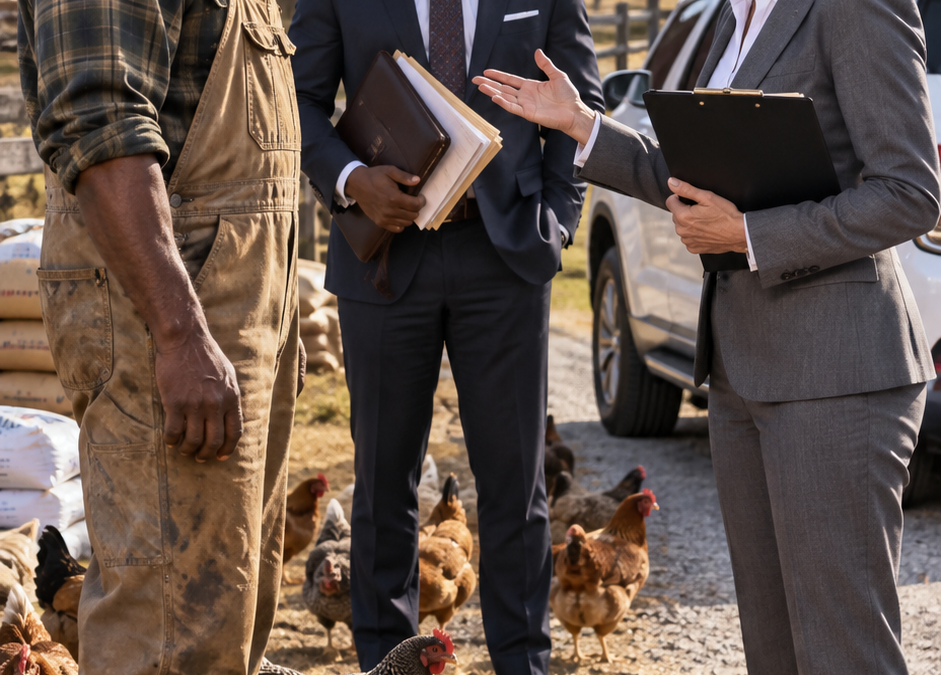
Diane Foresight held her clipboard against her chest as though the weight of the plastic and paper gave the sentence additional authority.
“This is your final courtesy notice before the association proceeds with formal enforcement.”
She stood at the edge of my gravel drive in a slate-gray blazer over a white collared shirt.
Behind her, a white SUV idled in the November cold.
It was spotless.
Not farm clean.
Dealership clean.
The tires looked as if they had never rolled through mud.
I had been near the feed barn when she arrived, unloading fifty-pound sacks from the back of a utility truck. Grain dust still covered my hands. Pine shavings clung to one sleeve of my jacket.
Behind me, forty-three chickens moved across the yard.
Rhode Island Reds.
Barred Rocks.
A few mixed hens whose lineage had stopped mattering years earlier.
They scratched beneath the bare pecan trees, pecked around the edge of the barn, and carried on with the ordinary business of being chickens.
The same kind of chickens my grandfather had raised on this ground decades before I was born.
Diane looked past me toward them.
“The noise and agricultural use have generated repeated complaints.”
“From whom?”
“I’m not at liberty to identify individual complainants.”
I nodded.
“How many complaints?”
“The violations are documented.”
“That wasn’t what I asked.”
Her mouth tightened.
“The board has reviewed the matter.”
I had met people like Diane before.
Not exactly her.
But the type.
People who become so accustomed to exercising authority inside one defined area that they gradually stop noticing where the boundary ends.
Diane was president of the Mil Haven Ridge Homeowners Association.
That title gave her real responsibilities.
It gave her authority over HOA business.
It gave her no authority over me.
My farm was not inside Mil Haven Ridge.
It did not touch Mil Haven Ridge.
It was not subject to Mil Haven Ridge covenants.
It had existed as an agricultural property roughly half a century before the development was built.
But Diane had driven nine miles from the subdivision to tell me my chickens violated her community standards.
She opened the clipboard.
“Violation 4.7B, nuisance poultry.”
She turned a page.
“Violation 6.2A, failure to maintain property consistent with community aesthetic standards.”
Another page.
“Violation 8.1A, unauthorized commercial agricultural activity within the restricted zone.”
I almost interrupted her at restricted zone.
Instead, I let her continue.
Fences.
Feed storage.
Exterior structures.
Commercial deliveries.
Noise.
Livestock.
Signage.
Seventeen entries.
When she finished, she looked at me directly.
“The association has both the standing and the resources to see this matter through to resolution.”
That sentence sounded practiced.
Probably because it was.
She waited.
I wiped grain dust from one palm onto my jeans.
“I understand your position.”
Her eyebrows lifted slightly.
That was apparently not the response she expected.
“You understand this is serious?”
“I understand what you’ve told me.”
“Then I assume we’ll see compliance.”
“I’ll review everything.”
Diane extended a business card.
I accepted it.
DIANE FORESIGHT
PRESIDENT
MIL HAVEN RIDGE HOMEOWNERS ASSOCIATION
Embossed lettering.
Heavy card stock.
Professional logo.
I slipped it into my jacket.
“Thank you for coming out.”
She stood there another second.
Maybe two.
Then she turned toward her SUV.
I watched her drive down the gravel lane.
The chickens continued scratching behind me.
One of the Barred Rocks had found something beneath a pile of leaves and was defending it from three others with the seriousness of international diplomacy.
I smiled.
Then I looked toward the northwest ridge.
Beyond it, miles away, sat Mil Haven Ridge.
And beyond that, at the edge of town, stood Cutter Grain & Feed.
My mill.
What Diane did not know was that the mill parcel came out of the same family land history as the farm beneath her feet.
She did not know that the road serving Mil Haven Ridge crossed a corridor my attorney was already investigating.
She did not know that the seventy-three-year chain of title behind my property was considerably older than her association.
Most importantly, she did not know that I had learned from three generations of Cutters never to argue with an official-looking document until I had found the older document underneath it.
My name is Robert Cutter.
I was fifty-two that year.
I had lived or worked on that property almost my entire life.
The original Cutter land began with my grandfather, Elden Cutter.
He bought 340 acres in central Tennessee in 1951.
Mixed pasture.
Timber.
A spring branch.
Enough open ground for livestock.
Enough trees to build with.
He paid in three installments.
The final payment was made in cash at the office of a county title lawyer named Harold Pew.
The deed was recorded in Harden County on March 14, 1951.
Deed Book 47.
Page 211.
My grandfather taught those numbers to my father.
My father taught them to me.
By the time I was eighteen, I knew Deed Book 47, Page 211 as naturally as I knew my birthday.
Elden Cutter was not sentimental about land.
He did not frame sayings about soil.
He did not talk about roots.
He worked.
He cleared the eastern pasture with a borrowed draft horse and logging chain.
He built the first feed barn from lumber milled off the property.
He repaired fences instead of replacing them whenever repair would hold.
And he kept records.
That was the habit that survived him longest.
Receipts.
Tax bills.
Survey sketches.
Correspondence.
Feed invoices.
County notices.
Equipment papers.
Anything involving ownership or money went into a wooden box above his workbench.
“Men remember what helps them,” he told my father once. “Paper remembers everything.”
When Elden died in 1987, the box passed to my father, James Cutter.
When Dad died in 2009, it passed to me.
By then, the box was no longer enough.
I moved the records into a filing cabinet.
Then two filing cabinets.
Manila folders.
Dates.
Instrument numbers.
Surveys.
Every property-related document organized so that I could find it without searching through a lifetime of paper.
Granddad would have approved.
Our boundaries had been professionally surveyed in 1998 after a neighbor raised a question about the southern fence.
The surveyor was Gerald Fitch.
Thirty years of experience.
Careful man.
He confirmed the Cutter boundaries exactly as the recorded deed described them.
That report went into a folder marked:
SURVEY — FITCH — 1998
In 2014, I commissioned another survey when I sold eighty acres off the southern end to finance modernization at Cutter Grain & Feed.
That report went directly behind Gerald’s earlier work.
The mill had its own history.
Elden built the original operation in 1963.
He carved approximately forty-two acres from the northwest portion of the main property and placed the commercial operation on a separate tax parcel.
That made insurance and accounting easier.
For twenty years, he ran the business as Cutter Grain & Feed.
After that, he leased it to an agricultural cooperative.
The cooperative changed the operating name.
It also modernized some equipment.
But the land stayed tied to the Cutter family.
When the cooperative dissolved in 2001, the parcel returned to direct control through the Cutter Family Trust.
I took over the mill in 2013.
It needed work.
The grinders were old.
The bagging system leaked dust.
The loading area was too small for modern trucks.
That was why I sold the southern eighty acres.
I put the money into conveyors, new storage bins, dust-control equipment, a computerized batching system, and a larger loading apron.
Within three years, Cutter Grain & Feed was supplying corn, mixed grain, pellets, mineral supplements, and specialty feed to farms throughout the county.
Our delivery trucks went everywhere.
Dairy operations.
Cattle farms.
Horse barns.
Small poultry operations.
Independent feed retailers.
Most farmers around Mil Haven knew the Cutter name.
Many suburban residents did not.
That suited me.
I did not need them to know who owned the mill.
I needed the mill to work.
Mil Haven Ridge was built during the late 1990s on land that had once been part of another farm.
The development was large enough to require a formal access road connecting it to the county highway.
That road passed through a narrow corridor near the northwest edge of the old Cutter property before entering the subdivision.
At least, that was what I had always remembered.
But for more than twenty years, I never had reason to study it closely.
Mil Haven Ridge residents drove in.
They drove out.
The road existed.
Everybody treated it as settled.
That is how property mistakes survive.
Not because they are well hidden.
Because nobody has a reason to look.
For years, the HOA paid no attention to me.
That made sense.
My farm sat roughly nine miles from the entrance to their subdivision.
Even the closest point between my remaining agricultural parcel and the Mil Haven Ridge plat was approximately 1.3 miles away.
Between us stood a county road, a drainage corridor, and land owned by Dale Whitfield, who raised hay and had no relationship to the HOA.
My chickens could not possibly be “adjacent” to Mil Haven Ridge unless the word had lost all geographic meaning.
Yet the first certified letter arrived in late September.
I opened it at my kitchen table.
MIL HAVEN RIDGE HOMEOWNERS ASSOCIATION.
Diane Foresight, President.
The letter cited Community Standard 4.7B.
It claimed that poultry maintained on properties “within or adjacent to the community boundary” could not create nuisance conditions for residents.
My forty-three chickens supposedly qualified.
Fine: $150.
Thirty days to remediate.
I read the phrase adjacent to the community boundary twice.
Then I looked out the window.
Nine miles.
I put the letter down.
Finished my coffee.
Went back to work.
But I kept the letter.
At the top right corner, I wrote the date received in ink.
Granddad had taught Dad to do that.
Dad taught me.
The second letter arrived three weeks later.
Violation 6.2A.
Failure to maintain property in a manner consistent with community aesthetic standards.
Fine: $200.
I filed it behind the first.
Two weeks later came another.
Violation 8.1A.
Operation of a commercial agricultural enterprise within a restricted zone.
Fine: $350.
The letter warned that the HOA might refer the matter to legal counsel.
I filed that too.
More followed.
Eleven certified letters over ten weeks.
Each contained a new citation.
Some duplicated earlier complaints under slightly different labels.
Each assumed Mil Haven Ridge rules somehow reached across county roads and unrelated parcels until they landed on my farm.
None cited a deed restriction applying to me.
None identified an easement.
None identified a covenant binding the Cutter property.
None included a plat showing my land inside the subdivision.
They simply declared violations and calculated money.
By the time Diane arrived at my driveway, the file contained seventeen active violation entries and $3,290 in claimed fines.
I never paid a dollar.
But I also never threw anything away.
Every envelope.
Every green certified-mail card.
Every letter.
Every date.
The folder grew.
On the tab I wrote:
FORESIGHT — HOA CORRESPONDENCE
Before Diane ever stepped onto my gravel drive, I had already called Carol Brandt.
Carol had practiced property and agricultural law in Harden County for twenty-seven years.
Her office was small.
No glass lobby.
No dramatic conference rooms.
Just bookshelves, a copier that sounded older than some associates at large firms, and a woman who had spent nearly three decades discovering the expensive consequences of badly drafted documents.
She had done title work for my family in the 1980s.
She knew the Cutter records.
When I first told her about the HOA notices, she asked me one question.
“Are you inside their recorded plat?”
“No.”
“Do you touch their recorded plat?”
“No.”
“How far away?”
“About one-point-three miles at the nearest point.”
Silence.
Then:
“Bring me the letters.”
I brought them.
Carol read every notice in order.
When she finished, she tapped the stack.
“They haven’t cited one recorded instrument.”
“That was my impression.”
“This is internal HOA policy.”
She lifted one letter.
“Their rules may be enforceable against property subject to their declaration.”
Another.
“They do not become county law because somebody puts them on association letterhead.”
She set everything down.
“What I want is their plat.”
“I have a copy.”
“I want the full recorded instrument.”
Then she looked toward a folder I had brought containing old Cutter surveys.
“And I want to look at that access road.”
That surprised me.
“What does the road have to do with chickens?”
“Probably nothing.”
“Then why look?”
“Because people who misunderstand one boundary sometimes misunderstand another.”
That was Carol.
She had already begun pulling county records before Diane came to see me.
I did not tell Diane.
There was no reason.
After her visit, I drove directly to Carol’s office with the updated folder.
Seventeen violations.
$3,290.
Carol arranged them chronologically.
Then she started comparing them to the Mil Haven Ridge declaration.
The recorded HOA covenants described the association’s jurisdiction precisely.
All lots and common areas within the recorded plat of Mil Haven Ridge subdivision, Harden County, Tennessee.
Plat Book 22.
Pages 14 through 19.
That was it.
No external enforcement zone.
No nine-mile radius.
No agricultural nuisance district.
No authority over unrelated neighboring farms.
My property did not appear anywhere in those pages.
Not my tax parcel.
Not my deed.
Not my name.
Nothing.
Carol sat back.
“The violations are garbage.”
“That seems unfair to garbage.”
She looked at me.
I smiled.
She did not.
Carol was not much for humor while billing by the hour.
Then she said:
“But the access road may be more interesting.”
She ordered a full title search on Mil Haven Ridge.
Meridian Title Associates in Nashville handled it.
Forty-seven pages when complete.
It took eleven days.
During those eleven days, two additional violation notices arrived from Diane.
Apparently the board’s legal review had not slowed her down.
Seventeen became nineteen.
The total claimed fines rose to $3,740.
I wrote dates on both.
Filed both.
Said nothing.
Then Carol called.
“Robert.”
I knew her tone.
“What?”
“Do you have the title report?”
“Just opened it.”
“Pages thirty-one through thirty-four.”
I turned.
The document concerned the main access easement serving Mil Haven Ridge.
Created in 1997.
Grantor: Callaway Properties.
The easement ran approximately 1,200 feet from the county-road right-of-way toward what became the subdivision entrance.
Callaway’s recorded document described the corridor as crossing fee-simple property owned by the grantor.
That statement was the problem.
Carol spoke slowly.
“I plotted the metes and bounds.”
“So did Meridian?”
“Yes.”
“And?”
“Callaway did not own all the ground it purported to burden.”
I stopped turning pages.
“How much?”
“Approximately 340 feet of the easement corridor crosses the northwest corner of the original Cutter tract.”
I looked toward my filing cabinet.
“You’re sure?”
“Yes.”
“The mill parcel?”
“The same historical tract, yes.”
I stood up without realizing it.
Carol continued.
“The 1951 Cutter deed predates the Callaway instrument by forty-six years. Gerald Fitch’s 1998 survey confirms the same boundary. I have found no deed transferring that 340-foot segment to Callaway before 1997.”
I sat down again.
“So Callaway granted an easement over land Callaway did not own.”
“That is what the current record appears to show.”
“And Mil Haven Ridge has been using it ever since.”
“Every day.”
I looked out the kitchen window.
A Rhode Island Red hopped onto a low section of fence.
Another followed.
For months, an HOA that did not govern my farm had been fining me for chickens.
Meanwhile, the legal instrument supporting part of the subdivision’s primary road appeared to have been written across Cutter land by a developer who lacked title to it.
The irony was almost too clean.
I did not laugh.
I did not celebrate.
I had lived with land long enough to understand what this meant.
If the title problem was real, it had to be handled carefully.
Hundreds of people used that road.
Families.
School buses.
Delivery trucks.
Emergency vehicles.
I was not interested in blocking anybody’s home.
I was interested in correcting the record.
Carol and I met the following week.
She had the title report on her desk.
Gerald Fitch’s 1998 survey beside it.
A large county plat weighted flat at each corner.
And a red tracing showing the easement description over the older Cutter boundary.
She pointed.
“Here.”
The easement entered the disputed area.
Her finger moved along the red line.
“Three hundred forty feet.”
Then back to the recorded Cutter line.
“This segment was never Callaway’s to grant.”
“What do you think happened?”
“No one checked.”
“That simple?”
“In my experience, complicated property disputes often begin with very simple mistakes.”
She lifted the 1997 instrument.
“Somebody drafted this using what Callaway believed it owned. Either no boundary survey was completed, or a survey was completed and nobody reconciled it against the older Cutter deed.”
“Could twenty-six years of use change that?”
“It creates issues we need to examine. But it does not magically rewrite the original title.”
I leaned back.
Carol pointed to another page.
“There is something else.”
The Mil Haven Ridge declaration.
Plat Book 22.
Pages 14 through 19.
The territorial language was explicit.
HOA authority applied to lots and common areas within the recorded subdivision.
Nothing in that document extended enforcement to my farm.
Nothing in it permitted Diane to impose fines against nonmembers.
Nothing connected my chickens to her jurisdiction.
“So we have two issues,” I said.
Carol nodded.
“They tried to regulate property they don’t govern.”
“And?”
“The road instrument they rely on appears to cross property their developer did not own.”
I rubbed a hand over my jaw.
“What do you want to do first?”
“Give them one opportunity to stop.”
Carol drafted a four-page letter.
It was not emotional.
No accusations.
No rhetoric.
She cited the HOA declaration by recorded location.
Quoted its jurisdiction clause.
Identified each violation notice.
Stated that the Cutter property lay outside the Mil Haven Ridge plat and was not subject to association enforcement.
She demanded termination of all pending violations and fines.
Then, near the end, she included one sentence advising the board that our title review had also identified a separate issue regarding the recorded access easement serving the development.
She gave no details.
Not yet.
I read the draft.
“Why not show them everything?”
“Because I want their attorney to read their own records first.”
Carol sent the letter certified.
Copy to the HOA.
Copy to Whitmore & Associates, the law firm named in one of Diane’s later notices.
Then we waited.
Whitmore called Carol the following Monday.
Their attorney had reviewed the plat language.
The board was being advised to pause enforcement while counsel investigated.
They requested an informal conference.
Carol agreed.
After she hung up, she called me.
“They know the chicken notices are indefensible.”
“What about the road?”
“I haven’t given them enough yet.”
“When do we?”
“At the table.”
The conference was set three weeks later at Meridian Title’s office in Mil Haven.
Two more notices had already arrived before counsel intervened, which was how we reached nineteen.
After that, nothing.
No additional letters.
No fines.
No white SUV.
For the first time in months, Diane Foresight stopped writing to me.
The farm continued.
Feed deliveries left every Tuesday and Friday.
The mill ran six days a week.
The chickens laid eggs.
Cold settled across the fields.
And every morning Mil Haven Ridge residents drove over the same access corridor.
Most of them had no idea there was a title issue.
I wanted to keep it that way until the issue was solved.
A neighbor named Harlon Briggs gave us one more piece of history.
Harlon was seventy-one.
His cattle farm sat two miles north.
His family had known the Cutter family since before Mil Haven Ridge existed.
When I described the access-road problem, he became quiet.
Then he said:
“I always thought that road was wrong.”
“Why?”
“I remember your granddad’s cedar posts.”
I leaned forward.
“Where?”
“Northwest corner.”
“Before they graded?”
“Yep.”
“What happened?”
“Dozer pushed them.”
He said it as casually as if he were describing rainfall.
“The posts were standing when Callaway started road work?”
“They sure were.”
“Inside what became the road corridor?”
“That’s where I remember them.”
I called Carol.
She prepared a written statement.
Harlon signed it before a notary.
We did not treat that statement as a replacement for the deed.
It was not.
But it supported what the older survey lines already showed.
Someone grading the road in 1997 had encountered physical evidence of the Cutter boundary.
Whether the developer understood its significance was another question.
The conference took place on a cold morning at Meridian Title.
Carol arrived before me.
Her banker’s box sat open beside her.
The documents were arranged in order.
HOA letters.
Recorded declaration.
Cutter deed.
Fitch survey.
2014 survey.
Title report.
Callaway easement.
Harlon’s statement.
I brought the original certified copy of Deed Book 47, Page 211 in a manila envelope.
Diane arrived with two board members and Whitmore’s attorney, Preston Gale.
Gale was polite.
Dark suit.
Leather portfolio.
Controlled voice.
Diane wore the same slate blazer she had worn at my farm.
But there was no clipboard.
That difference did not escape me.
We sat.
Gale spoke first.
He described the violation notices as an administrative problem.
He said the association’s compliance system used geographic proximity data.
He said certain notices had apparently been generated for properties not properly subject to Mil Haven Ridge covenants.
He used the phrase administrative overstep.
Then again.
Administrative overstep.
I listened.
So did Carol.
Diane kept her hands flat on the table.
Gale continued.
The HOA was prepared to void all outstanding notices.
Remove all accumulated fines.
Confirm in writing that the Mil Haven Ridge standards did not apply to the Cutter property.
He framed this as a good-faith resolution.
Carol waited until he finished.
Then she opened her banker’s box.
“Before we discuss resolution of the violation notices,” she said, “there is a separate title matter your clients need to understand.”
Gale looked at her.
Carol placed the title report in front of him.
Then the 1997 Callaway access instrument.
Then Gerald Fitch’s 1998 survey.
Finally, the red overlay.
She started with the Cutter deed.
Deed Book 47.
Page 211.
Original boundary.
Then the mill parcel history.
Then the Callaway instrument.
Then the easement description.
Preston Gale’s face changed slowly.
Not dramatically.
He followed the line with his eyes.
Carol pointed to the overlap.
“Approximately 340 feet.”
Gale leaned closer.
“What is your position on the underlying fee?”
“The Cutter Family Trust holds it.”
He looked at the Callaway document.
“Callaway described this as fee-simple land owned by the grantor.”
“Callaway was wrong.”
Gale looked toward one of the board members.
Then back to Carol.
“What subsequent conveyance are you relying on?”
“None.”
His eyes returned to the title report.
Carol continued.
“There is no subsequent conveyance because the Cutter interest never left the Cutter chain.”
She placed Harlon Briggs’s statement beside the survey.
“This witness observed original Cutter cedar boundary posts within the corridor when Callaway grading began in 1997.”
Diane spoke for the first time.
“What does this have to do with the chicken violations?”
Carol looked at her.
“Legally, they are separate issues.”
Diane’s shoulders loosened slightly.
Then Carol added:
“But they arise from the same problem.”
“What problem?”
“Your association has been making claims about land without first verifying the underlying instruments.”
Nobody answered.
Carol turned back to Gale.
“The violation notices have no jurisdictional basis. Separately, the association’s primary access easement relies in part on a conveyance from a party that did not own the underlying land.”
Gale made several notes.
“What is your client proposing?”
Carol looked at me.
I nodded.
She answered.
“First, formal written rescission of every violation notice issued against Robert Cutter.”
Gale wrote.
“Second, cancellation of all associated fines.”
Another note.
“Third, a recorded acknowledgement that Mil Haven Ridge’s covenants apply only within the boundaries described in Plat Book 22, Pages 14 through 19.”
Diane shifted.
Carol continued.
“Fourth, a quiet-title action concerning the 340-foot overlap so that the public record accurately establishes underlying fee ownership.”
One board member spoke.
“Are you planning to close the road?”
I answered before Carol could.
“No.”
Everyone looked at me.
“I have no interest in blocking residents from their homes.”
The board member visibly relaxed.
“But,” I continued, “the record needs to be correct.”
Gale asked:
“And what happens to the easement if title is quieted in the Cutter trust?”
Carol answered.
“That will depend on the final agreement and court order. Our objective is not to strand the subdivision. Our objective is to stop pretending Callaway owned land it did not own.”
Gale requested a recess.
The HOA side left the room.
For fifteen minutes, Carol and I sat alone.
“You all right?” she asked.
“Yes.”
“You sure you don’t want leverage on the road?”
“We already have leverage.”
“That isn’t what I asked.”
“I don’t want two hundred families wondering whether they can get home because their board president sent me chicken fines.”
Carol studied me.
“That is probably the correct answer.”
“It’s the only one I’m interested in.”
They returned.
Gale’s posture was different.
More cautious.
He asked what legal fees we sought.
Carol had documented everything.
Title search.
Survey review.
Correspondence.
Meeting preparation.
Just under $4,000.
Gale requested two weeks to take the proposal to the board.
Carol gave him ten days.
The quiet-title case was filed in Harden County Circuit Court in January.
Mil Haven Ridge did not contest the Cutter chain of title.
That mattered.
There was no dramatic courtroom fight.
No cross-examination.
No judge shouting at Diane.
Once the documents were read carefully, there was little left to fight about.
The HOA’s answer acknowledged that the Callaway easement instrument contained an erroneous property description to the extent it purported to burden land outside Callaway’s ownership.
The association agreed that the underlying fee interest in the disputed 340-foot segment belonged to the Cutter Family Trust.
We agreed that existing roadway access would continue under a corrected recorded instrument.
That was important to me.
I did not want ambulances, school buses, delivery vehicles, or homeowners caught inside somebody else’s title mistake.
So Carol structured the resolution to do two things at once.
Correct ownership.
Preserve practical access.
In March, the court entered judgment.
Title to the disputed 340-foot segment was quieted in favor of the Cutter Family Trust.
The county recorder was directed to annotate the 1997 Callaway instrument so future title searches would show the corrected underlying ownership.
A replacement access agreement was recorded.
This time the grantor actually owned the land being burdened.
That distinction seemed worth writing down.
The same week, the Mil Haven Ridge board executed a formal acknowledgement concerning its covenant jurisdiction.
Plat Book 22.
Pages 14 through 19.
The association’s authority stopped there.
My farm was outside.
The feed mill parcel was outside.
My chickens were outside.
The nineteen violation notices were rescinded.
Every fine disappeared.
$3,740 became zero.
The HOA paid my documented legal expenses within thirty days.
The final judgment arrived on a Thursday.
I read it at my kitchen table.
No champagne.
No phone calls.
No celebration.
I read every paragraph.
Then I carried it to the filing cabinet.
The document went behind the surveys.
The Foresight letters stayed in their own folder.
All nineteen.
In order.
Dated.
Certified receipts attached.
Not because I planned to use them again.
Because that was how Elden Cutter kept records.
You did not destroy history merely because you had won the argument.
Outside, the chickens were noisy.
One Rhode Island Red had decided the top of an overturned bucket was the proper place to announce something to the entire county.
I opened the back door.
She stopped.
Looked at me.
Then started again.
I laughed.
All of that over chickens.
Except it had never really been about chickens.
The chickens had merely revealed the larger problem.
Diane Foresight believed Mil Haven Ridge rules followed the HOA wherever its board wanted them to go.
When somebody complained about agricultural activity outside the development, she did not begin by asking whether the property was subject to her covenants.
She began by generating violations.
Then more violations.
Then fines.
Then certified notices.
By the time she reached seventeen, the volume of paperwork itself probably felt like proof.
That is a dangerous illusion.
Repetition does not make an invalid claim valid.
Nineteen invalid notices are not stronger than one.
They are simply nineteen exhibits.
I saw Diane once after the case ended.
It was at Cutter Grain & Feed.
She walked in on a Friday afternoon.
I happened to be near the front office reviewing a delivery schedule.
I recognized her immediately.
The slate blazer was gone.
Jeans.
Dark coat.
Hair pulled back.
She looked different outside the setting where we first met.
Less like a title.
More like a person.
She saw me.
Stopped.
“Mr. Cutter.”
“Ms. Foresight.”
For a moment, neither of us said anything.
Then she glanced around.
“You own this?”
I followed her eyes.
The bins.
Bagged feed.
Forklift.
Loading doors.
Office.
“I do.”
Her expression shifted.
“I didn’t know.”
“No reason you would.”
“My husband buys feed here.”
That explained why she was there.
“For what?”
“His horses.”
I nodded.
One of my employees passed behind us carrying an invoice.
Diane looked toward the warehouse again.
“I suppose that makes this awkward.”
“It doesn’t have to.”
She gave a small, embarrassed laugh.
“No. I suppose not.”
Then she became serious.
“I owe you an apology.”
I waited.
“I should have verified the property records before those notices were issued.”
“Yes.”
The answer came out more directly than she probably expected.
I did not soften it.
She nodded.
“I thought the system was accurate.”
“The system was only as accurate as what somebody put into it.”
“I understand that now.”
For a second, I considered telling her that her husband could continue buying feed.
Then I realized saying it would imply I had ever considered doing otherwise.
I had not.
Business was business.
Land was land.
I was not going to punish a customer because his wife had misunderstood an HOA boundary.
Diane looked toward the loading area.
“Frank handles the horse account.”
“I’ll tell the office you stopped in.”
“Thank you.”
She turned to leave.
Then stopped.
“For what it’s worth, the board changed the compliance process.”
“How?”
“Title or parcel verification before enforcement against any property not clearly inside the plat.”
“That sounds sensible.”
“It should have been the process already.”
“Yes.”
She nodded once.
Then left.
I watched through the office window as she crossed the parking lot.
Her vehicle had some mud on the tires that day.
I smiled at that.
Not because I had defeated her.
Because she looked more ordinary.
That was a good thing.
Titles can make people forget that authority has edges.
Sometimes losing a dispute teaches where those edges are.
I never stopped selling feed to anyone in Mil Haven Ridge.
Why would I?
The residents had not sent me nineteen violation notices.
Their board had.
Most homeowners probably knew nothing about the dispute until the legal costs appeared somewhere in an association report.
The corrected road easement remained open.
Every morning, people drove across it.
They went to work.
Took children to school.
Picked up groceries.
Returned home.
Nobody needed to think about the fact that 340 feet of that road crossed Cutter land under a newly corrected access agreement.
That was exactly how it should be.
A good easement disappears into ordinary life.
People notice property instruments mostly when they are wrong.
The feed mill continued running.
The farm continued operating.
And the chickens remained exactly where they had been before Diane arrived.
Forty-three became forty-six the following spring after I kept three pullets from a hatch.
Then forty-four when a fox got two.
Agriculture does not respect round numbers.
Neither did Elden Cutter.
I thought about my grandfather often during the months after the case.
He never knew Mil Haven Ridge.
He never knew what an HOA was in the modern sense.
He died before the development existed.
Yet almost everything that protected me during that dispute came from habits he had established.
Know the deed.
Keep the survey.
Save correspondence.
Write down dates.
Do not trust memory when paper is available.
Do not assume the person speaking most confidently has read the older document.
Most of all, understand the difference between possession, permission, and ownership.
Those distinctions mattered in 1951.
They mattered in 1997 when Callaway graded that road.
They mattered when Diane walked onto my farm decades later.
They will matter long after I am gone.
The original wooden record box still exists.
I keep it in the back of my office.
The hinges are worn.
One corner has been repaired with two small brass screws.
Inside are some of Elden’s oldest papers.
Tax receipts faded almost white.
A hand-drawn pasture map.
Invoices written in pencil.
A receipt for fencing wire dated 1956.
I could probably throw away half of it.
I do not.
Not because every piece has legal value.
Because the box reminds me how easily people lose track of what happened when nobody preserves the sequence.
The HOA dispute was ultimately about sequence.
The Cutter deed came first.
Callaway’s easement came later.
Mil Haven Ridge covenants applied to a specific recorded plat.
My farm was never in it.
Those facts did not become less true because twenty-six years passed.
Time can make a mistake familiar.
It cannot automatically make the mistake correct.
That is what happened with the access road.
Residents drove it so long that everyone assumed the document beneath it must be right.
The road existed physically.
Therefore the legal instrument supporting it felt invisible.
Nobody checked.
Carol had been right.
The answer was almost always that nobody looked.
And that was also what happened with the chicken violations.
Someone entered proximity data into a compliance system.
Someone complained about farm activity.
Someone searched an address.
Maybe the software showed my parcel in a nearby zone.
Maybe a prior board had created a policy using careless language such as adjacent properties.
Then Diane inherited the process.
Instead of asking whether the underlying declaration actually extended that far, she trusted the system.
One bad assumption generated seventeen violations.
Then nineteen.
That is how institutions can become dangerous without anyone intending to be dangerous.
A mistake enters a system.
The system gives the mistake formatting.
Formatting gives it authority.
Authority gives it repetition.
Eventually a person standing on a gravel driveway believes the repetition means the law must agree.
Sometimes it does.
Sometimes it does not.
The only way to know is to find the instrument.
I walked the northwest boundary again that spring.
The area had changed since Harlon Briggs watched Callaway’s dozer push out my grandfather’s cedar posts.
The road was paved now.
Drainage installed.
Utility lines nearby.
Subdivision landscaping began beyond the corridor.
Very little resembled the old farm corner he remembered.
But Gerald Fitch’s survey pins still tied the modern landscape back to the earlier deed.
I stood beside one marker for a while.
Cars passed on the access road.
Nobody slowed.
Nobody looked at me.
None of them knew that a court order had recently clarified the land beneath part of their tires.
That was fine.
Property law works best when ordinary people do not need to think about it every morning.
The point was not to make residents conscious of my ownership.
The point was to ensure the record was accurate if the question ever arose again.
That afternoon, I walked back toward the feed barn.
The chickens saw me coming and immediately assumed food was involved.
All forty-four ran toward me.
There are few things less dignified than a flock of chickens running at full speed.
I stood there laughing while they gathered around my boots.
Those were the animals Diane’s first notices had identified as a nuisance.
They were also descendants, in breed if not direct bloodline, of birds my grandfather had kept before Mil Haven Ridge was even imaginable.
That did not give the chickens special legal rights.
It did not need to.
The property rights were mine.
That was enough.
A homeowner association can have legitimate authority.
I have never disputed that.
If you buy a home subject to recorded covenants, those covenants can matter.
Rules can matter.
Assessments can matter.
Common areas need management.
Roads need maintenance.
Communities need structures for making shared decisions.
The problem begins when private authority forgets the private part.
Mil Haven Ridge governed Mil Haven Ridge.
Not Harden County.
Not my farm.
Not my feed mill.
Not every piece of land from which residents might hear a rooster.
The recorded declaration described the boundary.
The boundary controlled.
That principle was so simple that Diane’s nineteen violation letters could not change it.
The same principle worked in reverse.
I owned the land underlying that disputed road segment.
That did not mean I could ignore the practical reliance of hundreds of people and close access for revenge.
Ownership created rights.
It also gave me choices about how to use those rights responsibly.
So we corrected the instrument.
Preserved the road.
Recorded the proper relationship.
Nobody lost access.
Nobody lost a home.
Nobody needed an emergency alternate entrance.
The only thing we removed was the legal fiction that Callaway had once owned ground it had never owned.
That was enough for me.
Years from now, someone may purchase a house in Mil Haven Ridge and never hear the name Robert Cutter.
They may drive over that road for twenty years without knowing the history beneath it.
That is fine.
If a title company searches the records, though, the corrected instruments will be there.
Cutter Family Trust.
Underlying fee.
Recorded easement.
Clear boundaries.
No mystery.
And if some future HOA president ever decides a rooster nine miles away is violating community standards, I hope somebody on the board opens the right folder before mailing the first letter.
I still have Diane’s business card.
It sits inside the Foresight correspondence folder.
The embossed logo has not faded.
Neither has the line beneath her name.
PRESIDENT.
When I look at it now, I do not think about her personally.
I think about what a title means.
President.
Owner.
Trustee.
Grantor.
Grantee.
Each title has limits.
Each derives authority from somewhere.
President of an HOA is meaningful inside the authority granted to that association.
Owner means something different.
A developer who owns one parcel cannot grant an easement over another simply because the legal description is convenient.
A board cannot regulate land absent from its declaration because a complaint makes the land inconvenient.
A title tells you what role someone holds.
The record tells you how far that role reaches.
That is the distinction Diane missed.
It was also the distinction Callaway Properties missed in 1997.
Both mistakes eventually landed in the same file.
One afternoon near the end of summer, I found myself repairing the north fence.
The cedar posts there were replacements I had installed after the 2014 survey.
Harlon had helped me set two of them.
He complained the entire time that modern concrete was inferior to properly tamped clay.
He may have been right.
I drove a staple into the final post.
Stepped back.
The fence ran straight.
On the other side of the ridge, traffic moved toward Mil Haven Ridge.
Behind me, the chickens wandered through the shade.
Farther west, I could hear the low industrial hum of the mill.
Farm.
Mill.
Road.
Subdivision.
Four different uses of land.
Four different sets of interests.
All capable of existing beside one another when the lines between them were understood.
That was what the whole dispute had finally taught everyone involved.
Not that HOAs were evil.
Not that neighbors were enemies.
Not that every paperwork error required a war.
Something simpler.
A boundary is not an insult.
It is information.
A deed is not aggression.
It is evidence.
And asking someone to prove the authority they claim is not defiance.
Sometimes it is the only thing preventing a small administrative mistake from becoming a very expensive one.
Diane Foresight arrived at my farm believing she was delivering a final courtesy notice.
She thought I had seventeen problems.
Then nineteen.
She thought the chickens were violating Mil Haven Ridge standards.
She thought the fines were real.
She thought formal enforcement was the next logical step.
But she had begun the process at the wrong end.
She started with enforcement.
Carol Brandt started with the record.
The record won.
It showed that my farm had never been subject to Mil Haven Ridge covenants.
It showed that every violation notice was legally empty.
Then it revealed something nobody expected.
For twenty-six years, the development had relied on an access instrument that crossed 340 feet of Cutter land the developer had never owned.
Nobody needed to shout.
Nobody needed to threaten to block the road.
Nobody needed to humiliate anyone.
The papers were enough.
Nineteen violation notices disappeared.
$3,740 in fines disappeared.
The HOA paid my legal costs.
The county record was corrected.
The access road remained open under a valid agreement.
And my chickens stayed exactly where they were.
That evening after I finished repairing the fence, I stood near the feed barn and watched the last light settle across the property.
Grain dust hung faintly in the doorway.
The Rhode Island Reds were already drifting toward the roost.
A Barred Rock scratched beneath an old cedar.
The air smelled of dry grass, feed, wood, and late summer heat.
It was not dramatic.
Land rarely is after people finish arguing about it.
It simply returns to being land.
I thought about Elden Cutter and his wooden box.
Deed Book 47.
Page 211.
A record made in 1951 by men who could not possibly have imagined white SUVs, HOA compliance software, certified violation letters, automated proximity data, or modern title searches.
Yet the document they recorded had outlasted all of those things.
That was the part I carried with me.
Confidence fades.
Boards change.
Presidents resign.
Developers disappear.
Computer systems get replaced.
But a properly recorded property interest can wait quietly for decades until somebody finally asks the correct question.
Diane asked whether my chickens complied with her rules.
Carol asked whether her rules applied to my land.
That second question changed everything.
And once the answer was in front of us, the seventeen complaints, the fines, the clipboard, and all that rehearsed certainty became what they had been from the beginning.
Paper without jurisdiction.
The chickens never knew the difference.








