𝗣𝗔𝗥𝗧 𝟮 The HOA Dumped Construction Trash on My Farm—Then Learned Their 22-Acre Stormwater Area Was Mine
𝗣𝗔𝗥𝗧 𝟮
Then I did.
Later, when beef prices and operating costs made a large herd less attractive, I leased part of the acreage to hay farmers and reduced my own cattle numbers.
But the land remained together.
The north pasture was especially important to me.
Native bluestem grew there.
In spring, water drained through a shallow natural corridor before moving east toward the creek.
My great-grandfather would have recognized the shape of the ground immediately.
Maybe not the paved road beyond it.
Maybe not the rooftops.
But the slope, creek, and grass would have made sense to him.
I married once.
My wife died six years before the HOA dispute.
A short illness.
Too short to prepare.
Long enough to understand what was happening.
We had no children.
People sometimes asked whether that made me worry about the future of the farm.
It did.
But not in the way they meant.
I did not need a son carrying my last name to justify keeping the land.
I needed to leave it clean.
Unencumbered where possible.
Properly documented.
Whatever happened after me would happen through my choice, not because somebody quietly absorbed pieces of the property while I was not paying attention.
That principle became especially important once Meadowbrook Estates arrived.
The development began with Warren Pettigrew.
He first came to see me in 1996.
He wore polished boots, a sport coat, and the expression developers wear when they believe they are about to explain your own land’s potential to you.
“I’m putting together a master-planned community,” he told me.
“Congratulations.”
“I’d like your acreage.”
“All of it?”
“If we can agree on a number.”
“We can’t.”
He laughed.
I did not.
The first offer was generous by agricultural standards.
I still said no.
Pettigrew returned three times over the next two years.
Each offer increased.
The fourth time, he changed strategy.
“What if I just bought the frontage?”
“How much?”
“Forty acres. Fifty maybe.”
“No.”
“You haven’t heard the number.”
“I heard the acreage.”
That was our last serious conversation.
Pettigrew eventually purchased approximately 480 acres south of me.
That became Meadowbrook Estates.
What I did not understand at the time was that he had a drainage problem.
The county required larger residential developments to include stormwater retention infrastructure.
The natural drainage path serving Pettigrew’s project ran toward my north pasture.
The easiest engineering solution was to extend part of the retention area into that corridor.
There was nothing inherently wrong with that idea.
Developers negotiate drainage easements all the time.
They purchase property.
They pay landowners.
They record rights.
That is how it is supposed to work.
Pettigrew never asked.
Instead, the approved subdivision plat showed a stormwater retention area extending northward into what it identified as common area.
That shaded green shape crossed my recorded line by twenty-two acres.
The plat also referenced a drainage easement.
No drainage easement existed.
At least not one granted by me.
The county approved the plat.
Homes were built.
Roads went in.
The HOA was formed.
Everybody proceeded as though the developer’s drawing must reflect valid ownership underneath it.
That assumption lasted for more than twenty years.
The first time I realized something was wrong came around 2003.
I was bush-hogging the north pasture when I saw orange survey stakes.
They formed a line approximately forty feet inside the place I knew my boundary to be.
I pulled the tractor over.
Got down.
Checked them.
Temporary plastic markers.
No permanent monument.
No explanation.
I pulled them and tossed them into the truck bed.
A few weeks later, a county crew arrived near the drainage corridor.
They had equipment with them.
I drove down.
The foreman was inspecting a culvert.
“What are you doing?”
“Stormwater maintenance.”
“Whose?”
“Meadowbrook.”
“You’re on Hail land.”
He looked genuinely confused.
“I’m working off the county-approved subdivision plan.”
“That plan is wrong.”
He stared at me for a moment.
Then at the culvert.
I could have stopped everything then.
Maybe I should have.
But the work did not interfere with cattle.
It improved water movement.
And at that point, I had no appetite for spending thousands of dollars arguing over a culvert that caused me no practical harm.
So I let it happen.
That decision later became part of the HOA’s legal argument against me.
I understood that possibility even then.
But there is a difference between understanding a risk and predicting exactly how arrogant somebody else will eventually become.
Over the next fifteen years, the HOA treated the twenty-two-acre strip as though it were theirs.
They mowed twice a year.
Installed decorative grass near the berm.
Maintained the culvert.
Added a split-rail fence.
Eventually they installed a Meadowbrook Estates sign.
I watched all of it.
And every few years I wondered when somebody would finally check the deed.
Nobody did.
Then they dumped trash on my pasture and threatened me for failing to clean it.
That changed my level of interest.
After Diane left, I walked to the debris pile.
Up close, it was worse.
Drywall.
Broken two-by-fours with exposed nails.
Old electrical wire.
Insulation.
Plastic.
Paint cans.
Cabinet pieces.
Black contractor bags torn open.
Whoever dumped it had backed directly off the county road.
The tread marks were deep.
About thirty feet parallel to the pavement, then a turn.
I took out a notebook.
Date.
Time.
Weather.
Estimated volume.
Types of material.
Then photographs.
Four angles.
Fence.
Road.
Culvert.
Tire tracks.
One photograph included the Meadowbrook entrance sign in the distance.
I did not touch the debris.
That was deliberate.
The HOA had given me ten days.
I wanted to see exactly what happened on day eleven.
Patience is not passivity.
Sometimes patience is how you let another person finish building the record against themselves.
The second notice arrived on the eleventh day.
Certified mail.
I signed for it at the post office.
Two pages.
The first stated that I had failed to correct the violation.
The second invoked Section 9.2 of the Meadowbrook covenants.
According to the HOA, they now had authority to enter the property, remove the debris, and assess the expense to me.
Estimated cost:
$1,800.
Administrative charges extra.
Then the line that got my full attention:
Continued noncompliance may result in a lien against the property.
A lien.
I made coffee.
Sat at the kitchen table.
Placed both notices side by side.
The parcel number Meadowbrook referenced did not match mine.
The legal description was off by approximately four hundred feet.
Their covenants did not appear in my deed.
The subdivision plat overlapped my title.
And now an HOA I did not belong to was threatening a lien.
That was enough.
The next morning I drove to the old county courthouse.
The recorder’s office occupied the basement.
Terrazzo floors.
Brass door handles.
Fluorescent lighting.
The kind of government office where paper accumulates for generations because that is exactly what the building was designed to hold.
The clerk recognized me.
“What do you need, Daniel?”
“Meadowbrook Estates plat. Drainage easements. Covenants. Anything recorded after 1995.”
She disappeared into the back.
Twenty minutes later, she returned with three binders and a cardboard tube.
I spread the subdivision plat on the research table.
Lots.
Streets.
Common areas.
Drainage.
The northern retention zone was shaded green.
COMMON AREA — DRAINAGE EASEMENT.
I laid my own survey beside it.
Then traced both boundaries.
Twenty-two acres.
The subdivision’s drawing extended across twenty-two acres that belonged to the Hail tract.
I started reading.
The HOA covenants were forty-seven pages.
Architectural rules.
Landscape rules.
Governance.
Assessments.
Board powers.
Common areas.
I found the retention area description.
The covenants treated it as collectively owned HOA property.
They referenced the plat.
What they did not reference was any deed transferring it.
I checked the next binder.
Then the third.
Articles of incorporation.
Budgets.
Board elections.
Amendments.
Fence requirements.
Mailbox rules.
Parking.
Nothing establishing title to the twenty-two acres.
I asked the clerk to search easements separately under the names of every possible grantor.
Solomon Hail.
My father.
Me.
1990 through 2005.
She searched.
Nothing.
No drainage easement.
No sale.
No donation.
No license.
No deed.
I stood there looking at the records and felt something inside me become very quiet.
For twenty years, Meadowbrook had maintained land it did not own.
That might have remained a manageable title mistake.
But now it had crossed into something else.
They were asserting regulatory authority against the actual owner.
They were threatening to place a lien on his property.
Over trash he had not dumped.
The HOA had managed to turn its own old mistake into my reason to finally challenge it.
I drove straight home and called Katherine Merrick.
Katherine practiced property law out of a brick building on Main Street that had once been a bank.
The original vault door was still in the back office.
Her father had handled estate planning for my parents.
I trusted the family.
She listened without interrupting.
When I finished, she said, “Bring everything.”
That afternoon, I spread the deed, the HOA notices, my survey, photographs, and plat copies across her conference table.
Katherine spent twenty minutes reading.
Then she pointed at the green retention area.
“They’ve maintained this how long?”
“Roughly twenty years.”
“You never granted an easement?”
“No.”
“Never signed anything?”
“No.”
“Never sold it?”
“No.”
“Did Pettigrew ever ask?”
“He tried to buy the farm. Then frontage. Never drainage.”
She wrote something.
“The absence matters.”
“I thought it might.”
She picked up the second HOA notice.
“They’re threatening a lien.”
“Yes.”
“That’s aggressive.”
“For garbage I didn’t put there.”
“Do you know who did?”
“No.”
“Any evidence it came from Meadowbrook?”
“Not directly.”
That was important.
I was not going to accuse anyone without proof.
The trash had been dumped near their drainage area.
The tire tracks came from the road.
That did not establish who owned the truck.
Katherine appreciated the distinction.
“We don’t need to prove who dumped it to deal with the jurisdiction issue.”
She leaned back.
“Here’s the problem for them. HOA covenants are private restrictions. Their authority comes from recorded instruments binding the land.”
“My parcel isn’t bound.”
“Based on what you’ve shown me, no.”
“And the twenty-two acres?”
“If your chain is clean and nobody granted an easement, the plat alone does not magically transfer ownership.”
“What do we do?”
“Make them prove their claim.”
Her first letter was polite.
Four pages.
It disputed Meadowbrook’s jurisdiction over the Hail property.
It demanded any deed, easement, purchase agreement, title instrument, or recorded covenant supporting their claimed authority over the twenty-two-acre retention area.
It also demanded suspension of all enforcement against me.
Certified mail.
Copy to the HOA registered agent.
Copy to Pettigrew’s last known address.
Katherine mailed it Thursday.
By Tuesday, a large law firm from the state capital responded.
Three names on the letterhead.
Formal language.
Expensive tone.
The HOA categorically rejected my ownership position.
The retention area, they claimed, had appeared as common property on the recorded plat for more than twenty years.
The HOA had openly maintained it.
Residents had relied upon its existence.
The subdivision’s stormwater system depended on it.
Therefore, they argued, Meadowbrook possessed rights arising through long use, reliance, and equitable principles.
I noticed what was missing.
No deed.
No easement.
No signature.
Just theory.
I called Katherine.
“They’re moving toward adverse possession or prescriptive rights,” she said.
“Do they have it?”
“They have arguments. Arguments are not rights.”
She explained that long use could create claims under certain circumstances, but those claims had elements that had to be proven.
Open use.
Continuous use.
Adverse or hostile use.
The required statutory period.
Facts mattered.
Their maintenance history mattered.
My tolerance mattered.
Their belief that the land belonged to them mattered.
The precise legal theory mattered.
She was careful not to promise an automatic victory.
That was one reason I trusted her.
“I don’t want to spend the next year arguing abstract law.”
“Good.”
“What do you want?”
“Documents.”
She sent a formal demand.
Every deed.
Every easement.
Every purchase agreement.
Every title opinion.
Every survey.
Every document Meadowbrook believed gave it rights to the retention area.
Thirty days.
Then we would decide whether to file quiet title.
During those weeks, the debris stayed where it was.
Twice, trucks slowed along the county road.
One was a white pickup with a Meadowbrook Estates magnetic logo.
The other was a sedan I did not recognize.
People inside photographed the pasture.
I photographed them photographing it.
Dates.
Times.
Vehicle descriptions.
The notebook continued filling.
Then a courier delivered three binders to Katherine’s office.
Two decades of HOA records.
Maintenance invoices.
Board minutes.
Landscaping contracts.
Photographs.
Stormwater inspections.
County-engineer correspondence.
Mowing bills.
Culvert repairs.
Split-rail-fence invoices.
Budget entries.
They had documented everything except ownership.
Katherine called.
“They gave us hundreds of pages.”
“And?”
“Not one deed.”
“Easement?”
“No.”
“Purchase agreement?”
“No.”
“Title opinion?”
“Nothing showing how they acquired your twenty-two acres.”
“What does that tell you?”
“That we’re filing.”
The quiet-title action went to county circuit court in June.
We asked for a declaration that the Hail Family Trust owned the twenty-two acres.
We asked the court to declare Meadowbrook had no ownership interest or recorded easement.
We asked for relief against the HOA’s enforcement claims.
And we preserved our ability to address trespass or unauthorized improvements if necessary.
The HOA moved to dismiss.
Their strongest argument was laches.
In ordinary language, they argued that I had waited too long.
I knew about their maintenance.
I had watched the culvert work.
I had seen the mowing.
I had allowed landscaping.
They had spent money in reliance on my silence.
Therefore, it would be unfair to let me assert ownership after two decades.
That was the first argument that made me uncomfortable.
Not because I believed the land was theirs.
Because part of the factual description was true.
I had watched.
I had tolerated.
I had chosen not to challenge them.
I asked Katherine about it.
“They’re not wrong about the delay,” she said.
“That sounds bad.”
“Delay is one element. It isn’t the whole case.”
“Could we lose?”
“You can always lose in litigation.”
I appreciated the answer.
“Do you think we will?”
“I think your title evidence is substantially stronger than their property-right evidence.”
She wrote an eleven-page response.
The deed came first.
Continuous title dating to 1947.
Then the absence of any grant.
Then the defective subdivision plat.
She argued that county approval of a subdivision map could not transfer title from an owner who never conveyed it.
She distinguished maintenance from ownership.
And she argued that equitable doctrines could not simply replace a missing conveyance under these facts.
Then she asked for summary judgment.
No trial.
No jury.
Just a legal ruling based on an undisputed record.
The hearing was scheduled for October.
For months, the north pasture carried that garbage pile like an accusation.
I could have cleaned it.
Some days I wanted to.
Rain soaked the drywall.
Plastic caught in grass.
One contractor bag tore further and spread insulation along the fence.
But Katherine wanted the site preserved long enough to document the dispute.
Eventually, after full photographic documentation, we had the debris contained enough to prevent additional spread without conceding the HOA’s position.
Every time I passed it, I thought about how absurd the entire case was.
The HOA had pointed at garbage somebody else dumped on my land.
Then demanded I obey covenants that did not apply.
That demand forced me to inspect the legal foundation beneath their entire stormwater system.
If Diane Mercer had simply contacted me and said, “There’s illegal dumping near our subdivision. Can we coordinate cleanup?”
I probably would have agreed the same afternoon.
Instead, she arrived with enforcement language.
That decision cost everyone more.
The courthouse hearing took place under tall windows filled with pale autumn light.
Katherine sat beside me.
Across the aisle was Meadowbrook’s attorney.
Silver hair.
Dark suit.
A briefcase that looked older than some young lawyers.
Three HOA board members sat behind him.
Diane was there.
Same navy blazer.
No folder this time.
She avoided looking toward me.
Judge Eleanor Hastings entered.
Everyone stood.
Then Katherine began.
No theatrics.
First exhibit.
The Hail deed.
Three hundred forty acres.
Continuous ownership.
Legal description including the twenty-two-acre drainage corridor.
Second exhibit.
Meadowbrook’s 1998 plat.
The green-shaded retention area overlapped Hail land.
Third.
Title search.
No deed from Hail.
No easement.
No purchase agreement.
No recorded transfer.
Fourth.
HOA document production.
Three binders of maintenance history.
Still no property interest.
Katherine turned toward the judge.
“The defendant has demonstrated use. It has demonstrated maintenance. It has demonstrated belief. What it has not demonstrated is acquisition.”
That sentence stayed with me.
The HOA attorney stood.
He argued fairness.
Meadowbrook had maintained the system in good faith.
The county had approved the plat.
Hundreds of homes relied on the drainage infrastructure.
The association had invested thousands over two decades.
I had watched without objecting.
He called my lawsuit an ambush.
He said allowing me to reclaim control after so long would reward gamesmanship.
Judge Hastings listened.
Then she asked the question.
“Counsel, do you have any instrument showing that the developer or the association acquired an interest in these twenty-two acres from Mr. Hail or his predecessors?”
The attorney paused.
“We have the approved subdivision plat, Your Honor.”
“That isn’t my question.”
Silence.
“A deed?”
“No.”
“Recorded easement?”
“No.”
“Purchase agreement?”
“No.”
“Any signed instrument of transfer?”
“No, Your Honor.”
The judge looked down at her notes.
The attorney continued.
He argued that the plat and long-term maintenance established an implied right.
Judge Hastings looked up.
“A plat can reflect a right. It does not necessarily create a right the developer did not otherwise possess.”
That was the point.
Everything came back to that.
Warren Pettigrew had drawn the twenty-two acres into his development.
The county approved what he submitted.
The HOA inherited his drawing.
But nobody had obtained the land.
Judge Hastings ruled from the bench.
The Hail Family Trust had established title.
Meadowbrook had failed to produce any instrument transferring ownership or granting a recorded easement.
The approved plat could not independently cure the title defect.
Summary judgment was entered in my favor.
The twenty-two-acre retention area belonged to me.
The HOA was ordered to stop claiming ownership or covenant authority over it.
Their attempt to enforce Meadowbrook property standards against me ended.
Their request for attorney’s fees was denied.
Each side bore its own costs.
Diane stood before the judge had fully finished.
She walked out.
I watched her leave.
I expected to feel triumphant.
I did not.
Mostly, I felt tired.
The court had not given me anything.
It had confirmed something that had been true for decades.
Those twenty-two acres were mine.
The HOA did not appeal.
A few weeks later, a letter arrived from Kevin Marsh, Meadowbrook’s board president.
Different tone.
No threats.
No compliance code.
No red circles.
He acknowledged the judgment.
The HOA would cease maintenance unless we reached a new agreement.
Then he asked to meet.
The stormwater system still needed to function.
That was true.
Water did not care who won the lawsuit.
When heavy rain fell across Meadowbrook’s streets and roofs, it moved downhill.
The drainage corridor crossed my land because geography had placed it there long before either subdivision or farmhouse existed.
I called Katherine.
“They want an easement.”
“That makes sense.”
“After everything?”
“Daniel, the court settled ownership. It didn’t eliminate gravity.”
I laughed.
She continued.
“You don’t want to maintain a subdivision stormwater system.”
“No.”
“And you probably don’t want the county taking over maintenance.”
“Definitely not.”
“Then negotiate from the position the court just confirmed.”
That was what we did.
I thought about my terms for a week.
Then I called Katherine.
“First, the trash.”
“Removed?”
“At their expense.”
“Reasonable.”
“Second, a gate at the county-road entrance.”
“Why?”
“Because somebody dumped once. I don’t want trucks driving in whenever they feel like it.”
She wrote.
“Third, their rights are limited.”
“To?”
“Mowing. Erosion control. Culvert maintenance. Nothing else without written approval.”
“Good.”
“Fourth, if they violate the maintenance terms, I want termination rights.”
She paused.
“We’ll have to draft that carefully.”
“Fine.”
“And compensation?”
“Twelve or fifteen thousand.”
“Which?”
“Ask fifteen.”
Katherine did.
Meadowbrook countered at ten.
I said twelve.
They accepted.
The agreement was drafted as a formal recorded easement.
For the first time in Meadowbrook’s history, the subdivision actually had a legitimate legal right to use the stormwater corridor.
Not because Warren Pettigrew colored it green on a map.
Because the owner granted it.
Me.
The easement allowed entry for defined maintenance.
Specified notice requirements.
Limited vehicle access.
Assigned liability.
Required restoration after work.
No unrelated landscaping.
No construction without approval.
No dumping.
That clause did not need much negotiation.
The HOA paid $12,000.
The debris disappeared before the end of January.
A contractor came with a roll-off container.
Drywall.
Lumber.
Insulation.
Paint cans.
Everything removed.
I stood by the fence and watched.
I never carried a single bag to their clubhouse.
I did not need to.
The better outcome was making them pay to remove it properly from my land.
A week later, the gate was installed.
Plain steel farm gate.
No decorative stone.
No subdivision logo.
I supplied the lock.
The HOA received controlled access under the easement.
I retained ownership.
The first afternoon after the gate was locked, I stood beside it for a long time.
Beyond the fence, the retention corridor looked almost unchanged.
Ornamental grass.
Berm.
Culvert.
Drainage channel.
Winter pasture.
The difference could not be seen.
It existed in paper.
Recorded easement.
Defined rights.
Defined owner.
Defined limits.
That mattered more than appearance.
Diane Mercer never returned to my porch.
I saw her months later at the feed store.
She saw me too.
For a moment, it looked as though she might say something.
Then she turned toward another aisle.
I did not follow.
There was nothing left to discuss.
My life went back to normal.
The hay farmer cut the south pasture three times that year.
My smaller cattle herd stayed on the western fields.
I replaced several fence posts along the county road with cedar from the back forty.
I put a metal roof on the old barn.
The original oak frame remained beneath it.
Some beams still showed axe and saw marks from Solomon’s work.
I liked that.
Old labor hidden under new protection.
The court order went into the fireproof box.
Third drawer.
Beside it went the easement.
Then copies of Meadowbrook’s notices.
Katherine’s letters.
Title search.
Plat.
Photographs.
I kept everything.
People sometimes think keeping records means expecting conflict.
I see it differently.
Good records prevent old facts from becoming new arguments.
Twenty years from now, a different HOA president may look at the retention corridor.
They may see Meadowbrook crews mowing it.
They may see a gate.
They may assume it belongs to the association.
Then they can pull the recorded easement.
The document will tell them exactly what is true.
Hail ownership.
Meadowbrook maintenance right.
Limited purpose.
No ownership transfer.
No ambiguity.
That is how it should have been done in 1998.
The north pasture looked especially good the following spring.
Bluestem returned thick after winter rain.
The area where the trash had sat recovered more slowly.
I raked bits of plastic from the soil.
Found two nails.
A piece of electrical wire.
A broken cabinet hinge.
Evidence stays after people think cleanup is finished.
Land remembers carelessness for a while.
One April morning, I walked the fence.
Checked wire.
Checked posts.
Checked the new gate.
Everything held.
Water moved through the culvert.
Meadowbrook’s stormwater system was functioning.
The subdivision had what it needed.
I had what I needed.
Ownership acknowledged.
Boundaries respected.
That was enough.
The whole thing changed the way I thought about institutional confidence.
Diane had not arrived at my house pretending to be the government.
She represented a private homeowners association.
But her language sounded governmental.
Violation.
Compliance.
Enforcement.
Assessment.
Lien.
Corrective action.
Those words carry weight.
They are supposed to.
Inside legitimate authority, they matter.
Outside it, they become theater.
That was the mistake Meadowbrook made.
Its board had real power over land bound by its covenants.
But private authority has borders.
The moment they crossed onto Hail property, they needed something else.
Ownership.
An easement.
A contract.
Permission.
They had none.
The fact that nobody challenged them for twenty years did not automatically supply the missing document.
Their largest error was not the old plat.
That belonged to Warren Pettigrew.
Their largest error was seeing my objection and refusing to check whether I might be right.
When Katherine first asked them for proof, they could have investigated.
They could have said:
We found a title problem.
Let’s fix it.
Instead, they hired a large firm to defend an assumption.
That made the eventual correction more expensive.
The case also forced me to examine my own decisions.
I had tolerated their use for years.
That was not ideal.
The culvert crew in 2003 should have triggered a title review.
The split-rail fence should have.
The Meadowbrook sign should have.
I let each one pass.
Why?
Because none caused enough immediate trouble.
That is how most boundary problems grow.
Not through dramatic encroachment.
Through convenience.
A little mowing.
A culvert.
A fence.
A sign.
Nobody wants to hire a lawyer over something small.
So everyone adapts.
Then one day somebody treats the adaptation as ownership.
That was my mistake.
It was different from theirs, but it was still mine.
The lesson was not that every neighborly accommodation should become a lawsuit.
That would make country life unbearable.
The lesson was to document accommodation before it becomes inheritance.
If I had written Meadowbrook in 2003:
I acknowledge your maintenance activity but grant no permanent property right,
we might have avoided the dispute.
If Pettigrew had offered money for a drainage easement in 1998, we definitely would have avoided it.
Instead, everyone relied on assumption until the assumption became expensive.
I sometimes thought about Warren Pettigrew.
Whether he knowingly drew the retention area across my land or whether his engineer made the mistake and he simply never corrected it.
Katherine believed he probably knew more than he admitted.
Maybe.
I never had enough evidence to make that accusation confidently.
And by the time the case was resolved, it did not matter.
The deed mattered.
The absent easement mattered.
The current rights mattered.
Speculation did not.
That was another lesson.
Property disputes invite storytelling.
People want villains.
Secret motives.
Schemes.
Sometimes those exist.
Often the simplest explanation is enough.
Somebody failed to verify title.
Somebody else copied the error.
Everyone afterward assumed the copy was correct.
Twenty years later, the paperwork looked official enough that nobody questioned it.
Until somebody did.
The fireproof box in my office became heavier after the Meadowbrook dispute.
Not literally by much.
A few dozen pages.
But I felt the weight whenever I opened it.
1947 deed.
Family trust documents.
Court judgment.
New easement.
Three generations connected by documents that never needed to raise their voices.
My grandfather Solomon had never heard of Meadowbrook Estates.
My great-grandfather could not have imagined modern HOA governance.
Yet both understood something I had briefly forgotten.
Land should be described carefully.
What is yours should be recorded.
What you grant should be written.
What you do not grant should not be assumed.
That is as true now as it was when Solomon plowed that pasture behind mules.
Maybe more true.
The county is busier.
More development.
More maps.
More planning.
More layers of administration.
Each new document creates another opportunity for somebody to assume the document beneath it must have been correct.
The only defense is to look.
One summer afternoon, Kevin Marsh—the HOA president—called me directly.
By then, the easement had been operating smoothly for months.
“Daniel?”
“Yeah.”
“This is Kevin.”
“I know.”
“We need to do some culvert work next Thursday.”
He was following the notice requirement.
“All right.”
“Two trucks. Mini excavator.”
“How long?”
“Probably six hours.”
“Stay inside the corridor.”
“We will.”
That simple conversation pleased me more than it probably should have.
Not because I wanted Kevin asking permission for ordinary maintenance.
Because the relationship was clear.
They had rights.
Defined rights.
I had ownership.
Defined ownership.
Nobody needed to pretend.
The crew arrived Thursday.
Did their work.
Removed sediment.
Repaired erosion.
Reseeded disturbed ground.
Locked the gate.
No argument.
That was what the original development should have looked like.
Law is often most successful when nobody needs to talk about it.
The document sits somewhere.
People follow it.
Life continues.
I watched rain move through the drainage area that autumn.
A heavy storm rolled across the county.
Meadowbrook’s streets shed water.
The retention system filled.
Flow slowed through the twenty-two acres.
The culvert carried it east.
Exactly what Pettigrew’s engineer had designed decades earlier.
The engineering was fine.
The title work was not.
That distinction made me smile.
A system can function physically for twenty years and still be legally wrong.
People confuse those things.
If the water flows, the map must be correct.
If everyone uses the road, somebody must own it.
If the HOA mows the grass, it must be common area.
If a rule appears on letterhead, it must apply.
None of those conclusions necessarily follow.
Physical routine is powerful.
But ownership is not determined by habit alone.
That was what Judge Hastings cut through with one question.
Do you have a deed, easement, purchase agreement, or other instrument?
No.
Everything else was argument around the missing center.
I remember that moment more clearly than the ruling.
The HOA lawyer was competent.
Prepared.
Probably expensive.
He had cases.
Equitable doctrines.
Twenty years of invoices.
County approvals.
Maintenance records.
A whole history of conduct.
And one question reduced all of it to the underlying problem.
Where did your right come from?
He could not answer with a document.
That did not mean their history was irrelevant.
It meant their history could not replace the missing foundation.
The farm changed slowly afterward.
Cattle numbers went down another year.
Hay acreage went up.
I planted several rows of oak near the creek.
Not for me.
I would likely never see them mature.
That was partly the point.
Great-granddad bought land.
Solomon cleared pasture.
Dad built fences.
I protected the title.
Different generations do different work.
All of it counts.
One evening I carried coffee to the porch.
The light was low.
The north pasture turned gold.
From where I sat, I could just see the retention berm.
Beyond it, Meadowbrook rooftops rose above trees.
Hundreds of people living ordinary lives.
Most had probably never heard my name.
I liked that.
They were not my enemy.
Their homes needed drainage.
Their children needed safe roads.
Their association needed to maintain common obligations.
Nothing about my court victory required resentment toward people who had simply bought houses.
The conflict was never farmer versus subdivision.
It was record versus assumption.
That distinction mattered.
I would have granted Pettigrew an easement if he had asked properly.
Maybe not for free.
But we could have negotiated.
Twenty years of conflict avoided with a conversation and a signature.
Instead, he apparently chose convenience.
That convenience passed down.
Board to board.
Manager to manager.
Until Diane Mercer stood on my porch threatening a lien over somebody else’s garbage.
That was when the old shortcut finally became expensive.
I never learned who dumped the trash.
For a while, that bothered me.
I wanted the answer.
Contractor?
Resident?
Random hauler?
Someone remodeling a Meadowbrook kitchen?
The debris looked residential.
But appearance is not evidence.
Eventually, I stopped caring.
The person responsible should not have dumped it.
But that unknown person did something unintentionally useful.
Without that pile, I might never have challenged the twenty-two-acre error.
Meadowbrook might still be maintaining my land under a false assumption.
Future boards might gradually add more structures.
Maybe a walking trail.
Maybe benches.
Maybe signage.
Maybe somebody decades later would claim even stronger rights.
Instead, the title was corrected.
The maintenance relationship was formalized.
Sometimes an ugly problem exposes an older one before the older one becomes impossible to ignore.
The black contractor bags did that.
They sat in my pasture looking like the entire conflict.
They were not.
They were just the match.
The real fuel had been sitting in county records since 1998.
Every once in a while, someone asks what I would have done if Meadowbrook refused to negotiate after losing.
Would I have closed the retention area?
Blocked access?
Forced them to redesign stormwater infrastructure?
I do not know.
Probably not immediately.
Owning land does not require using every right in the most destructive way available.
That is another place people become confused.
Winning is not the same as punishing.
Once the court confirmed ownership, I had leverage.
The responsible use of leverage was to create a legal arrangement that protected the farm while allowing necessary drainage.
That was better than revenge.
I could have made the dispute uglier.
I chose not to.
I could have hauled the debris to the Meadowbrook clubhouse and dumped it on their entrance.
It would have made a dramatic story.
It also would have made me responsible for dumping.
That was not the point.
The point was to make the people who created and benefited from the maintenance system take responsibility through lawful terms.
They removed the trash.
Paid compensation.
Installed the gate.
Signed an easement.
Acknowledged ownership.
That was stronger than a stunt.
A stunt lasts one afternoon.
A recorded easement lasts.
When I walk the north pasture now, I still see evidence of all three eras.
Near the creek, traces of the original farm.
Old fence wire embedded in one cedar.
Part of a stone line Solomon built.
Then the subdivision era.
Culvert.
Retention berm.
Ornamental grasses.
Finally, the correction.
Steel gate.
Lock.
Recorded rights behind it.
Land carries history physically and legally.
You need both to understand it.
The deed says one thing.
The ground says another kind of thing.
Good stewardship means making sure they do not drift too far apart.
That is what I failed to do for a while.
That is what Meadowbrook failed to do entirely.
But eventually we fixed it.
The north pasture belongs to the Hail Family Trust.
Meadowbrook has a defined stormwater-maintenance easement.
Their covenants do not govern my farm.
Their crews enter only for authorized purposes.
The debris is gone.
The gate remains locked except when needed.
Simple.
Accurate.
Boring.
I have come to value boring legal arrangements.
Boring means everybody knows what they can do.
Boring means no white crossover arrives with a violation folder.
Boring means lawyers stay in their offices.
The original HOA notices remain in my file.
I could throw them away.
I will not.
The photograph with the red circle is especially useful.
It captures the pasture, debris, drainage corridor, and Meadowbrook sign in one frame.
Somebody at the HOA thought that photograph proved I had a violation.
Instead, it reminds me that the most important question was just outside the red circle.
Whose land is this?
They had never asked.
Katherine did.
The judge did.
Once that question was answered, everything else became easier.
That is what I would tell anyone facing a property claim from an institution.
Do not begin with outrage.
Do not begin with their deadline.
Do not begin by assuming official language means official power.
Begin with the source.
What property is subject?
What deed describes it?
What easement burdens it?
What covenant binds it?
Who signed?
When?
Where was it recorded?
Sometimes the institution will be right.
If it is, knowing the record helps you respond intelligently.
Sometimes the institution will be partly right.
That happens often.
And sometimes, as Meadowbrook discovered, twenty years of confident behavior are standing on a document that never existed.
Confidence cannot fill that gap.
Neither can landscaping.
Neither can mowing.
Neither can a developer’s colored plat.
The record has to support the right.
Great-granddad understood that without ever using the phrase property law.
Solomon understood it when he inherited the land.
Dad understood it.
I had grown casual.
Meadowbrook reminded me.
One spring morning, years after the first violation notice, I walked from the house to the north pasture before sunrise.
Mist sat above the drainage channel.
The bluestem was wet.
A meadowlark called from a fence post.
At the gate, I stopped.
The steel was cold.
Beyond it, the retention area lay quiet.
No trucks.
No HOA staff.
No contractors.
Just grass and water.
The Meadowbrook entrance sign stood farther away, partly hidden by trees.
I thought about Diane’s first sentence.
“We need to talk about your property.”
She had been right about that.
We did need to talk about my property.
Just not in the way she expected.
She wanted to discuss how I maintained it.
The court ended up discussing who owned it.
There was something satisfying about that symmetry.
I unlocked the gate and walked through.
Not because I needed to inspect anything.
Because I could.
Twenty-two acres.
Mine since before Meadowbrook existed.
Still serving their drainage.
Still part of the Hail tract.
Now finally described honestly.
I followed the watercourse toward the creek.
For years, I had thought keeping land meant preventing people from taking it.
That was too simple.
Keeping land also means knowing when to share use.
Knowing when to grant rights.
Knowing how to document those rights so generosity never becomes confusion.
The new easement did not weaken my ownership.
It clarified it.
Meadowbrook could maintain the system because I had granted permission under recorded terms.
That was fundamentally different from them maintaining it because they assumed it was theirs.
A right granted by the owner respects ownership.
A right assumed against the owner erases it.
That was the entire dispute in one sentence.
The sun began lifting over the eastern ridge.
Light reached the pasture.
The wet grass turned silver.
Water moved through the culvert.
Somewhere beyond the trees, Meadowbrook residents were waking up.
Cars would soon cross their streets.
Children would wait for school buses.
Sprinklers would run.
Roofs would shed rain into drains during the next storm.
And the twenty-two acres beneath my boots would quietly help protect their homes from water because that was the arrangement we had finally made.
Not because a developer colored it green.
Not because an HOA declared it common area.
Because the owner said yes.
On paper.
Recorded.
That difference had taken more than twenty years to establish.
But once established, it was clear.
I stood there until the sun cleared the ridge.
Then I walked back toward the farmhouse.
The fireproof box was still in my office.
Third drawer down.
The deed inside.
Court judgment beside it.
Recorded easement beside that.
The complete story reduced to paper.
The garbage was gone.
The legal threat was gone.
The false ownership claim was gone.
What remained was the land.
Exactly where it had always been.
Have you finished reading the story and want to read it again?
The HOA Dumped Construction Trash on My Farm—Then Learned Their 22-Acre Stormwater Area Was Mine
The woman from Meadowbrook Estates stood on my porch and threatened to fine me for a pile of construction trash dumped on my own pasture, apparently unaware that the debris had arrived from the direction of the subdivision she represented.
For more than twenty years, her HOA had also mowed, landscaped, fenced, and maintained twenty-two acres along my northern boundary as though that ground belonged to them, even though nobody had ever purchased it from my family, obtained an easement, or gotten a signature from me.
I could have hauled the garbage back toward their clubhouse and started the kind of fight people would talk about for years, but once I opened the old deed in my office and compared it to their subdivision plat, I realized there was a much quieter way to make the entire HOA answer for what it had done.
“We need to talk about your property.”
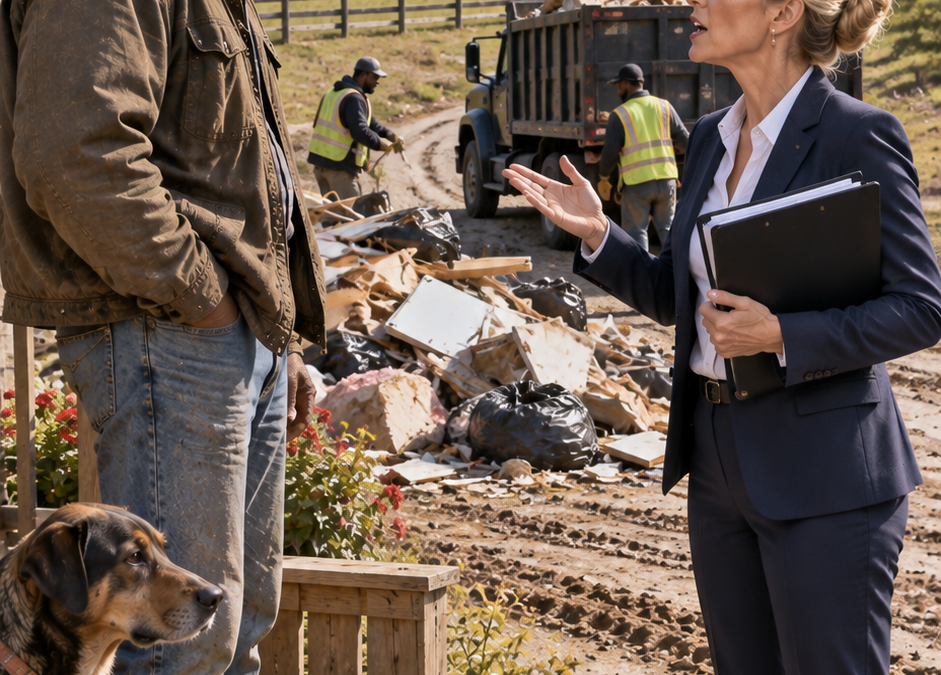
The woman standing on my gravel drive wore a navy blazer and heels that had already collected dust during the short walk from her white crossover to my porch.
She carried a folder bearing a logo I recognized.
MEADOWBROOK ESTATES HOMEOWNERS ASSOCIATION.
“It violates subdivision covenants,” she continued. “If you do not remedy the situation within ten days, the association will remedy it for you and bill you accordingly.”
She spoke with the absolute confidence of somebody who had never considered that the person listening might reject the premise beneath the entire conversation.
I looked past her.
Across the fence, the north pasture stretched toward the county road.
Near the drainage culvert, fresh tire tracks cut through the grass.
Beside them sat a heap of broken drywall, splintered lumber, black contractor bags, insulation, wiring, paint cans, and debris from what looked like somebody’s kitchen renovation.
It had appeared sometime during the previous forty-eight hours.
The woman followed my eyes.
“That kind of dumping is precisely what we are trying to prevent.”
I looked back at her.
“You believe I put it there?”
“The condition exists on the parcel.”
“That wasn’t my question.”
She adjusted the folder.
“The association’s concern is remediation.”
That answer told me enough.
“What’s your name?”
“Diane Mercer. Compliance committee chair.”
“All right, Ms. Mercer.”
Her expression suggested she expected more.
An apology perhaps.
A promise.
Maybe panic.
Instead, I stood there with one hand resting on the porch rail.
The October air smelled of dry grass, clay, and the faint sourness of construction dust drifting from the debris pile.
Behind Diane, beyond the road, Meadowbrook’s entrance sign stood among ornamental grasses and stone landscaping.
What she did not know was that the drainage corridor beneath that sign continued into twenty-two acres her subdivision had been calling common property for more than two decades.
She did not know that those twenty-two acres belonged to me.
Not metaphorically.
Not emotionally.
On paper.
Recorded.
Deeded.
Surveyed.
The Hail Family Trust had never conveyed them to Meadowbrook.
My family had never granted Warren Pettigrew—the developer who built the subdivision—any permanent easement across them.
The HOA had simply acted for years as though somebody must have taken care of that paperwork.
Nobody had.
I had known something was wrong for a long time.
I had simply never forced the question.
Diane handed me the folder.
“The compliance committee will monitor the property.”
“I understand.”
“The ten-day period begins today.”
“All right.”
She hesitated.
Then turned and walked back to her vehicle.
I watched the white crossover disappear toward the subdivision.
Only after she was gone did I open the folder.
Inside was a violation notice.
A photograph of my pasture.
The debris had been circled in red.
There was also a copy of the Meadowbrook Estates Architectural and Environmental Standards, Revised 2019.
The violation notice referenced a parcel number I did not recognize.
Section 4.7 supposedly required all properties inside the subdivision boundary to remain clean and aesthetically consistent with community standards.
Inside the subdivision boundary.
That phrase mattered.
My land was not inside the Meadowbrook boundary.
My land existed before Meadowbrook.
Before Warren Pettigrew.
Before the HOA.
Before their clubhouse.
Before their landscaping committee had opinions about what my pasture should look like.
I read the notice again.
Then I went inside.
Third drawer down.
Fireproof box.
The Hail family deed.
My name is Daniel Hail.
I was fifty-nine when Meadowbrook Estates decided a pile of somebody else’s trash on my land was my violation.
Except for four years in the Army, I had spent my entire life on that farm.
The original Hail tract covered 340 acres.
My great-grandfather bought it in 1947 with money earned cutting timber in the northern counties and helping drive logs downstream during spring runs.
He was not the kind of man who left behind many stories written in his own hand.
What survived him were records.
Tax receipts.
Deeds.
An old timber ledger.
Several photographs.
And land.
My grandfather Solomon inherited the farm.
He cleared the first major pasture with a team of mules and a two-bottom plow.
The original barn was built from oak cut and milled on the property.
Some of those beams were still above my head whenever I climbed into the hayloft.
My father raised cattle there.
Then I did.
Later, when beef prices and operating costs made a large herd less attractive, I leased part of the acreage to hay farmers and reduced my own cattle numbers.
But the land remained together.
The north pasture was especially important to me.
Native bluestem grew there.
In spring, water drained through a shallow natural corridor before moving east toward the creek.
My great-grandfather would have recognized the shape of the ground immediately.
Maybe not the paved road beyond it.
Maybe not the rooftops.
But the slope, creek, and grass would have made sense to him.
I married once.
My wife died six years before the HOA dispute.
A short illness.
Too short to prepare.
Long enough to understand what was happening.
We had no children.
People sometimes asked whether that made me worry about the future of the farm.
It did.
But not in the way they meant.
I did not need a son carrying my last name to justify keeping the land.
I needed to leave it clean.
Unencumbered where possible.
Properly documented.
Whatever happened after me would happen through my choice, not because somebody quietly absorbed pieces of the property while I was not paying attention.
That principle became especially important once Meadowbrook Estates arrived.
The development began with Warren Pettigrew.
He first came to see me in 1996.
He wore polished boots, a sport coat, and the expression developers wear when they believe they are about to explain your own land’s potential to you.
“I’m putting together a master-planned community,” he told me.
“Congratulations.”
“I’d like your acreage.”
“All of it?”
“If we can agree on a number.”
“We can’t.”
He laughed.
I did not.
The first offer was generous by agricultural standards.
I still said no.
Pettigrew returned three times over the next two years.
Each offer increased.
The fourth time, he changed strategy.
“What if I just bought the frontage?”
“How much?”
“Forty acres. Fifty maybe.”
“No.”
“You haven’t heard the number.”
“I heard the acreage.”
That was our last serious conversation.
Pettigrew eventually purchased approximately 480 acres south of me.
That became Meadowbrook Estates.
What I did not understand at the time was that he had a drainage problem.
The county required larger residential developments to include stormwater retention infrastructure.
The natural drainage path serving Pettigrew’s project ran toward my north pasture.
The easiest engineering solution was to extend part of the retention area into that corridor.
There was nothing inherently wrong with that idea.
Developers negotiate drainage easements all the time.
They purchase property.
They pay landowners.
They record rights.
That is how it is supposed to work.
Pettigrew never asked.
Instead, the approved subdivision plat showed a stormwater retention area extending northward into what it identified as common area.
That shaded green shape crossed my recorded line by twenty-two acres.
The plat also referenced a drainage easement.
No drainage easement existed.
At least not one granted by me.
The county approved the plat.
Homes were built.
Roads went in.
The HOA was formed.
Everybody proceeded as though the developer’s drawing must reflect valid ownership underneath it.
That assumption lasted for more than twenty years.
The first time I realized something was wrong came around 2003.
I was bush-hogging the north pasture when I saw orange survey stakes.
They formed a line approximately forty feet inside the place I knew my boundary to be.
I pulled the tractor over.
Got down.
Checked them.
Temporary plastic markers.
No permanent monument.
No explanation.
I pulled them and tossed them into the truck bed.
A few weeks later, a county crew arrived near the drainage corridor.
They had equipment with them.
I drove down.
The foreman was inspecting a culvert.
“What are you doing?”
“Stormwater maintenance.”
“Whose?”
“Meadowbrook.”
“You’re on Hail land.”
He looked genuinely confused.
“I’m working off the county-approved subdivision plan.”
“That plan is wrong.”
He stared at me for a moment.
Then at the culvert.
I could have stopped everything then.
Maybe I should have.
But the work did not interfere with cattle.
It improved water movement.
And at that point, I had no appetite for spending thousands of dollars arguing over a culvert that caused me no practical harm.
So I let it happen.
That decision later became part of the HOA’s legal argument against me.
I understood that possibility even then.
But there is a difference between understanding a risk and predicting exactly how arrogant somebody else will eventually become.
Over the next fifteen years, the HOA treated the twenty-two-acre strip as though it were theirs.
They mowed twice a year.
Installed decorative grass near the berm.
Maintained the culvert.
Added a split-rail fence.
Eventually they installed a Meadowbrook Estates sign.
I watched all of it.
And every few years I wondered when somebody would finally check the deed.
Nobody did.
Then they dumped trash on my pasture and threatened me for failing to clean it.
That changed my level of interest.
After Diane left, I walked to the debris pile.
Up close, it was worse.
Drywall.
Broken two-by-fours with exposed nails.
Old electrical wire.
Insulation.
Plastic.
Paint cans.
Cabinet pieces.
Black contractor bags torn open.
Whoever dumped it had backed directly off the county road.
The tread marks were deep.
About thirty feet parallel to the pavement, then a turn.
I took out a notebook.
Date.
Time.
Weather.
Estimated volume.
Types of material.
Then photographs.
Four angles.
Fence.
Road.
Culvert.
Tire tracks.
One photograph included the Meadowbrook entrance sign in the distance.
I did not touch the debris.
That was deliberate.
The HOA had given me ten days.
I wanted to see exactly what happened on day eleven.
Patience is not passivity.
Sometimes patience is how you let another person finish building the record against themselves.
The second notice arrived on the eleventh day.
Certified mail.
I signed for it at the post office.
Two pages.
The first stated that I had failed to correct the violation.
The second invoked Section 9.2 of the Meadowbrook covenants.
According to the HOA, they now had authority to enter the property, remove the debris, and assess the expense to me.
Estimated cost:
$1,800.
Administrative charges extra.
Then the line that got my full attention:
Continued noncompliance may result in a lien against the property.
A lien.
I made coffee.
Sat at the kitchen table.
Placed both notices side by side.
The parcel number Meadowbrook referenced did not match mine.
The legal description was off by approximately four hundred feet.
Their covenants did not appear in my deed.
The subdivision plat overlapped my title.
And now an HOA I did not belong to was threatening a lien.
That was enough.
The next morning I drove to the old county courthouse.
The recorder’s office occupied the basement.
Terrazzo floors.
Brass door handles.
Fluorescent lighting.
The kind of government office where paper accumulates for generations because that is exactly what the building was designed to hold.
The clerk recognized me.
“What do you need, Daniel?”
“Meadowbrook Estates plat. Drainage easements. Covenants. Anything recorded after 1995.”
She disappeared into the back.
Twenty minutes later, she returned with three binders and a cardboard tube.
I spread the subdivision plat on the research table.
Lots.
Streets.
Common areas.
Drainage.
The northern retention zone was shaded green.
COMMON AREA — DRAINAGE EASEMENT.
I laid my own survey beside it.
Then traced both boundaries.
Twenty-two acres.
The subdivision’s drawing extended across twenty-two acres that belonged to the Hail tract.
I started reading.
The HOA covenants were forty-seven pages.
Architectural rules.
Landscape rules.
Governance.
Assessments.
Board powers.
Common areas.
I found the retention area description.
The covenants treated it as collectively owned HOA property.
They referenced the plat.
What they did not reference was any deed transferring it.
I checked the next binder.
Then the third.
Articles of incorporation.
Budgets.
Board elections.
Amendments.
Fence requirements.
Mailbox rules.
Parking.
Nothing establishing title to the twenty-two acres.
I asked the clerk to search easements separately under the names of every possible grantor.
Solomon Hail.
My father.
Me.
1990 through 2005.
She searched.
Nothing.
No drainage easement.
No sale.
No donation.
No license.
No deed.
I stood there looking at the records and felt something inside me become very quiet.
For twenty years, Meadowbrook had maintained land it did not own.
That might have remained a manageable title mistake.
But now it had crossed into something else.
They were asserting regulatory authority against the actual owner.
They were threatening to place a lien on his property.
Over trash he had not dumped.
The HOA had managed to turn its own old mistake into my reason to finally challenge it.
I drove straight home and called Katherine Merrick.
Katherine practiced property law out of a brick building on Main Street that had once been a bank.
The original vault door was still in the back office.
Her father had handled estate planning for my parents.
I trusted the family.
She listened without interrupting.
When I finished, she said, “Bring everything.”
That afternoon, I spread the deed, the HOA notices, my survey, photographs, and plat copies across her conference table.
Katherine spent twenty minutes reading.
Then she pointed at the green retention area.
“They’ve maintained this how long?”
“Roughly twenty years.”
“You never granted an easement?”
“No.”
“Never signed anything?”
“No.”
“Never sold it?”
“No.”
“Did Pettigrew ever ask?”
“He tried to buy the farm. Then frontage. Never drainage.”
She wrote something.
“The absence matters.”
“I thought it might.”
She picked up the second HOA notice.
“They’re threatening a lien.”
“Yes.”
“That’s aggressive.”
“For garbage I didn’t put there.”
“Do you know who did?”
“No.”
“Any evidence it came from Meadowbrook?”
“Not directly.”
That was important.
I was not going to accuse anyone without proof.
The trash had been dumped near their drainage area.
The tire tracks came from the road.
That did not establish who owned the truck.
Katherine appreciated the distinction.
“We don’t need to prove who dumped it to deal with the jurisdiction issue.”
She leaned back.
“Here’s the problem for them. HOA covenants are private restrictions. Their authority comes from recorded instruments binding the land.”
“My parcel isn’t bound.”
“Based on what you’ve shown me, no.”
“And the twenty-two acres?”
“If your chain is clean and nobody granted an easement, the plat alone does not magically transfer ownership.”
“What do we do?”
“Make them prove their claim.”
Her first letter was polite.
Four pages.
It disputed Meadowbrook’s jurisdiction over the Hail property.
It demanded any deed, easement, purchase agreement, title instrument, or recorded covenant supporting their claimed authority over the twenty-two-acre retention area.
It also demanded suspension of all enforcement against me.
Certified mail.
Copy to the HOA registered agent.
Copy to Pettigrew’s last known address.
Katherine mailed it Thursday.
By Tuesday, a large law firm from the state capital responded.
Three names on the letterhead.
Formal language.
Expensive tone.
The HOA categorically rejected my ownership position.
The retention area, they claimed, had appeared as common property on the recorded plat for more than twenty years.
The HOA had openly maintained it.
Residents had relied upon its existence.
The subdivision’s stormwater system depended on it.
Therefore, they argued, Meadowbrook possessed rights arising through long use, reliance, and equitable principles.
I noticed what was missing.
No deed.
No easement.
No signature.
Just theory.
I called Katherine.
“They’re moving toward adverse possession or prescriptive rights,” she said.
“Do they have it?”
“They have arguments. Arguments are not rights.”
She explained that long use could create claims under certain circumstances, but those claims had elements that had to be proven.
Open use.
Continuous use.
Adverse or hostile use.
The required statutory period.
Facts mattered.
Their maintenance history mattered.
My tolerance mattered.
Their belief that the land belonged to them mattered.
The precise legal theory mattered.
She was careful not to promise an automatic victory.
That was one reason I trusted her.
“I don’t want to spend the next year arguing abstract law.”
“Good.”
“What do you want?”
“Documents.”
She sent a formal demand.
Every deed.
Every easement.
Every purchase agreement.
Every title opinion.
Every survey.
Every document Meadowbrook believed gave it rights to the retention area.
Thirty days.
Then we would decide whether to file quiet title.
During those weeks, the debris stayed where it was.
Twice, trucks slowed along the county road.
One was a white pickup with a Meadowbrook Estates magnetic logo.
The other was a sedan I did not recognize.
People inside photographed the pasture.
I photographed them photographing it.
Dates.
Times.
Vehicle descriptions.
The notebook continued filling.
Then a courier delivered three binders to Katherine’s office.
Two decades of HOA records.
Maintenance invoices.
Board minutes.
Landscaping contracts.
Photographs.
Stormwater inspections.
County-engineer correspondence.
Mowing bills.
Culvert repairs.
Split-rail-fence invoices.
Budget entries.
They had documented everything except ownership.
Katherine called.
“They gave us hundreds of pages.”
“And?”
“Not one deed.”
“Easement?”
“No.”
“Purchase agreement?”
“No.”
“Title opinion?”
“Nothing showing how they acquired your twenty-two acres.”
“What does that tell you?”
“That we’re filing.”
The quiet-title action went to county circuit court in June.
We asked for a declaration that the Hail Family Trust owned the twenty-two acres.
We asked the court to declare Meadowbrook had no ownership interest or recorded easement.
We asked for relief against the HOA’s enforcement claims.
And we preserved our ability to address trespass or unauthorized improvements if necessary.
The HOA moved to dismiss.
Their strongest argument was laches.
In ordinary language, they argued that I had waited too long.
I knew about their maintenance.
I had watched the culvert work.
I had seen the mowing.
I had allowed landscaping.
They had spent money in reliance on my silence.
Therefore, it would be unfair to let me assert ownership after two decades.
That was the first argument that made me uncomfortable.
Not because I believed the land was theirs.
Because part of the factual description was true.
I had watched.
I had tolerated.
I had chosen not to challenge them.
I asked Katherine about it.
“They’re not wrong about the delay,” she said.
“That sounds bad.”
“Delay is one element. It isn’t the whole case.”
“Could we lose?”
“You can always lose in litigation.”
I appreciated the answer.
“Do you think we will?”
“I think your title evidence is substantially stronger than their property-right evidence.”
She wrote an eleven-page response.
The deed came first.
Continuous title dating to 1947.
Then the absence of any grant.
Then the defective subdivision plat.
She argued that county approval of a subdivision map could not transfer title from an owner who never conveyed it.
She distinguished maintenance from ownership.
And she argued that equitable doctrines could not simply replace a missing conveyance under these facts.
Then she asked for summary judgment.
No trial.
No jury.
Just a legal ruling based on an undisputed record.
The hearing was scheduled for October.
For months, the north pasture carried that garbage pile like an accusation.
I could have cleaned it.
Some days I wanted to.
Rain soaked the drywall.
Plastic caught in grass.
One contractor bag tore further and spread insulation along the fence.
But Katherine wanted the site preserved long enough to document the dispute.
Eventually, after full photographic documentation, we had the debris contained enough to prevent additional spread without conceding the HOA’s position.
Every time I passed it, I thought about how absurd the entire case was.
The HOA had pointed at garbage somebody else dumped on my land.
Then demanded I obey covenants that did not apply.
That demand forced me to inspect the legal foundation beneath their entire stormwater system.
If Diane Mercer had simply contacted me and said, “There’s illegal dumping near our subdivision. Can we coordinate cleanup?”
I probably would have agreed the same afternoon.
Instead, she arrived with enforcement language.
That decision cost everyone more.
The courthouse hearing took place under tall windows filled with pale autumn light.
Katherine sat beside me.
Across the aisle was Meadowbrook’s attorney.
Silver hair.
Dark suit.
A briefcase that looked older than some young lawyers.
Three HOA board members sat behind him.
Diane was there.
Same navy blazer.
No folder this time.
She avoided looking toward me.
Judge Eleanor Hastings entered.
Everyone stood.
Then Katherine began.
No theatrics.
First exhibit.
The Hail deed.
Three hundred forty acres.
Continuous ownership.
Legal description including the twenty-two-acre drainage corridor.
Second exhibit.
Meadowbrook’s 1998 plat.
The green-shaded retention area overlapped Hail land.
Third.
Title search.
No deed from Hail.
No easement.
No purchase agreement.
No recorded transfer.
Fourth.
HOA document production.
Three binders of maintenance history.
Still no property interest.
Katherine turned toward the judge.
“The defendant has demonstrated use. It has demonstrated maintenance. It has demonstrated belief. What it has not demonstrated is acquisition.”
That sentence stayed with me.
The HOA attorney stood.
He argued fairness.
Meadowbrook had maintained the system in good faith.
The county had approved the plat.
Hundreds of homes relied on the drainage infrastructure.
The association had invested thousands over two decades.
I had watched without objecting.
He called my lawsuit an ambush.
He said allowing me to reclaim control after so long would reward gamesmanship.
Judge Hastings listened.
Then she asked the question.
“Counsel, do you have any instrument showing that the developer or the association acquired an interest in these twenty-two acres from Mr. Hail or his predecessors?”
The attorney paused.
“We have the approved subdivision plat, Your Honor.”
“That isn’t my question.”
Silence.
“A deed?”
“No.”
“Recorded easement?”
“No.”
“Purchase agreement?”
“No.”
“Any signed instrument of transfer?”
“No, Your Honor.”
The judge looked down at her notes.
The attorney continued.
He argued that the plat and long-term maintenance established an implied right.
Judge Hastings looked up.
“A plat can reflect a right. It does not necessarily create a right the developer did not otherwise possess.”
That was the point.
Everything came back to that.
Warren Pettigrew had drawn the twenty-two acres into his development.
The county approved what he submitted.
The HOA inherited his drawing.
But nobody had obtained the land.
Judge Hastings ruled from the bench.
The Hail Family Trust had established title.
Meadowbrook had failed to produce any instrument transferring ownership or granting a recorded easement.
The approved plat could not independently cure the title defect.
Summary judgment was entered in my favor.
The twenty-two-acre retention area belonged to me.
The HOA was ordered to stop claiming ownership or covenant authority over it.
Their attempt to enforce Meadowbrook property standards against me ended.
Their request for attorney’s fees was denied.
Each side bore its own costs.
Diane stood before the judge had fully finished.
She walked out.
I watched her leave.
I expected to feel triumphant.
I did not.
Mostly, I felt tired.
The court had not given me anything.
It had confirmed something that had been true for decades.
Those twenty-two acres were mine.
The HOA did not appeal.
A few weeks later, a letter arrived from Kevin Marsh, Meadowbrook’s board president.
Different tone.
No threats.
No compliance code.
No red circles.
He acknowledged the judgment.
The HOA would cease maintenance unless we reached a new agreement.
Then he asked to meet.
The stormwater system still needed to function.
That was true.
Water did not care who won the lawsuit.
When heavy rain fell across Meadowbrook’s streets and roofs, it moved downhill.
The drainage corridor crossed my land because geography had placed it there long before either subdivision or farmhouse existed.
I called Katherine.
“They want an easement.”
“That makes sense.”
“After everything?”
“Daniel, the court settled ownership. It didn’t eliminate gravity.”
I laughed.
She continued.
“You don’t want to maintain a subdivision stormwater system.”
“No.”
“And you probably don’t want the county taking over maintenance.”
“Definitely not.”
“Then negotiate from the position the court just confirmed.”
That was what we did.
I thought about my terms for a week.
Then I called Katherine.
“First, the trash.”
“Removed?”
“At their expense.”
“Reasonable.”
“Second, a gate at the county-road entrance.”
“Why?”
“Because somebody dumped once. I don’t want trucks driving in whenever they feel like it.”
She wrote.
“Third, their rights are limited.”
“To?”
“Mowing. Erosion control. Culvert maintenance. Nothing else without written approval.”
“Good.”
“Fourth, if they violate the maintenance terms, I want termination rights.”
She paused.
“We’ll have to draft that carefully.”
“Fine.”
“And compensation?”
“Twelve or fifteen thousand.”
“Which?”
“Ask fifteen.”
Katherine did.
Meadowbrook countered at ten.
I said twelve.
They accepted.
The agreement was drafted as a formal recorded easement.
For the first time in Meadowbrook’s history, the subdivision actually had a legitimate legal right to use the stormwater corridor.
Not because Warren Pettigrew colored it green on a map.
Because the owner granted it.
Me.
The easement allowed entry for defined maintenance.
Specified notice requirements.
Limited vehicle access.
Assigned liability.
Required restoration after work.
No unrelated landscaping.
No construction without approval.
No dumping.
That clause did not need much negotiation.
The HOA paid $12,000.
The debris disappeared before the end of January.
A contractor came with a roll-off container.
Drywall.
Lumber.
Insulation.
Paint cans.
Everything removed.
I stood by the fence and watched.
I never carried a single bag to their clubhouse.
I did not need to.
The better outcome was making them pay to remove it properly from my land.
A week later, the gate was installed.
Plain steel farm gate.
No decorative stone.
No subdivision logo.
I supplied the lock.
The HOA received controlled access under the easement.
I retained ownership.
The first afternoon after the gate was locked, I stood beside it for a long time.
Beyond the fence, the retention corridor looked almost unchanged.
Ornamental grass.
Berm.
Culvert.
Drainage channel.
Winter pasture.
The difference could not be seen.
It existed in paper.
Recorded easement.
Defined rights.
Defined owner.
Defined limits.
That mattered more than appearance.
Diane Mercer never returned to my porch.
I saw her months later at the feed store.
She saw me too.
For a moment, it looked as though she might say something.
Then she turned toward another aisle.
I did not follow.
There was nothing left to discuss.
My life went back to normal.
The hay farmer cut the south pasture three times that year.
My smaller cattle herd stayed on the western fields.
I replaced several fence posts along the county road with cedar from the back forty.
I put a metal roof on the old barn.
The original oak frame remained beneath it.
Some beams still showed axe and saw marks from Solomon’s work.
I liked that.
Old labor hidden under new protection.
The court order went into the fireproof box.
Third drawer.
Beside it went the easement.
Then copies of Meadowbrook’s notices.
Katherine’s letters.
Title search.
Plat.
Photographs.
I kept everything.
People sometimes think keeping records means expecting conflict.
I see it differently.
Good records prevent old facts from becoming new arguments.
Twenty years from now, a different HOA president may look at the retention corridor.
They may see Meadowbrook crews mowing it.
They may see a gate.
They may assume it belongs to the association.
Then they can pull the recorded easement.
The document will tell them exactly what is true.
Hail ownership.
Meadowbrook maintenance right.
Limited purpose.
No ownership transfer.
No ambiguity.
That is how it should have been done in 1998.
The north pasture looked especially good the following spring.
Bluestem returned thick after winter rain.
The area where the trash had sat recovered more slowly.
I raked bits of plastic from the soil.
Found two nails.
A piece of electrical wire.
A broken cabinet hinge.
Evidence stays after people think cleanup is finished.
Land remembers carelessness for a while.
One April morning, I walked the fence.
Checked wire.
Checked posts.
Checked the new gate.
Everything held.
Water moved through the culvert.
Meadowbrook’s stormwater system was functioning.
The subdivision had what it needed.
I had what I needed.
Ownership acknowledged.
Boundaries respected.
That was enough.
The whole thing changed the way I thought about institutional confidence.
Diane had not arrived at my house pretending to be the government.
She represented a private homeowners association.
But her language sounded governmental.
Violation.
Compliance.
Enforcement.
Assessment.
Lien.
Corrective action.
Those words carry weight.
They are supposed to.
Inside legitimate authority, they matter.
Outside it, they become theater.
That was the mistake Meadowbrook made.
Its board had real power over land bound by its covenants.
But private authority has borders.
The moment they crossed onto Hail property, they needed something else.
Ownership.
An easement.
A contract.
Permission.
They had none.
The fact that nobody challenged them for twenty years did not automatically supply the missing document.
Their largest error was not the old plat.
That belonged to Warren Pettigrew.
Their largest error was seeing my objection and refusing to check whether I might be right.
When Katherine first asked them for proof, they could have investigated.
They could have said:
We found a title problem.
Let’s fix it.
Instead, they hired a large firm to defend an assumption.
That made the eventual correction more expensive.
The case also forced me to examine my own decisions.
I had tolerated their use for years.
That was not ideal.
The culvert crew in 2003 should have triggered a title review.
The split-rail fence should have.
The Meadowbrook sign should have.
I let each one pass.
Why?
Because none caused enough immediate trouble.
That is how most boundary problems grow.
Not through dramatic encroachment.
Through convenience.
A little mowing.
A culvert.
A fence.
A sign.
Nobody wants to hire a lawyer over something small.
So everyone adapts.
Then one day somebody treats the adaptation as ownership.
That was my mistake.
It was different from theirs, but it was still mine.
The lesson was not that every neighborly accommodation should become a lawsuit.
That would make country life unbearable.
The lesson was to document accommodation before it becomes inheritance.
If I had written Meadowbrook in 2003:
I acknowledge your maintenance activity but grant no permanent property right,
we might have avoided the dispute.
If Pettigrew had offered money for a drainage easement in 1998, we definitely would have avoided it.
Instead, everyone relied on assumption until the assumption became expensive.
I sometimes thought about Warren Pettigrew.
Whether he knowingly drew the retention area across my land or whether his engineer made the mistake and he simply never corrected it.
Katherine believed he probably knew more than he admitted.
Maybe.
I never had enough evidence to make that accusation confidently.
And by the time the case was resolved, it did not matter.
The deed mattered.
The absent easement mattered.
The current rights mattered.
Speculation did not.
That was another lesson.
Property disputes invite storytelling.
People want villains.
Secret motives.
Schemes.
Sometimes those exist.
Often the simplest explanation is enough.
Somebody failed to verify title.
Somebody else copied the error.
Everyone afterward assumed the copy was correct.
Twenty years later, the paperwork looked official enough that nobody questioned it.
Until somebody did.
The fireproof box in my office became heavier after the Meadowbrook dispute.
Not literally by much.
A few dozen pages.
But I felt the weight whenever I opened it.
1947 deed.
Family trust documents.
Court judgment.
New easement.
Three generations connected by documents that never needed to raise their voices.
My grandfather Solomon had never heard of Meadowbrook Estates.
My great-grandfather could not have imagined modern HOA governance.
Yet both understood something I had briefly forgotten.
Land should be described carefully.
What is yours should be recorded.
What you grant should be written.
What you do not grant should not be assumed.
That is as true now as it was when Solomon plowed that pasture behind mules.
Maybe more true.
The county is busier.
More development.
More maps.
More planning.
More layers of administration.
Each new document creates another opportunity for somebody to assume the document beneath it must have been correct.
The only defense is to look.
One summer afternoon, Kevin Marsh—the HOA president—called me directly.
By then, the easement had been operating smoothly for months.
“Daniel?”
“Yeah.”
“This is Kevin.”
“I know.”
“We need to do some culvert work next Thursday.”
He was following the notice requirement.
“All right.”
“Two trucks. Mini excavator.”
“How long?”
“Probably six hours.”
“Stay inside the corridor.”
“We will.”
That simple conversation pleased me more than it probably should have.
Not because I wanted Kevin asking permission for ordinary maintenance.
Because the relationship was clear.
They had rights.
Defined rights.
I had ownership.
Defined ownership.
Nobody needed to pretend.
The crew arrived Thursday.
Did their work.
Removed sediment.
Repaired erosion.
Reseeded disturbed ground.
Locked the gate.
No argument.
That was what the original development should have looked like.
Law is often most successful when nobody needs to talk about it.
The document sits somewhere.
People follow it.
Life continues.
I watched rain move through the drainage area that autumn.
A heavy storm rolled across the county.
Meadowbrook’s streets shed water.
The retention system filled.
Flow slowed through the twenty-two acres.
The culvert carried it east.
Exactly what Pettigrew’s engineer had designed decades earlier.
The engineering was fine.
The title work was not.
That distinction made me smile.
A system can function physically for twenty years and still be legally wrong.
People confuse those things.
If the water flows, the map must be correct.
If everyone uses the road, somebody must own it.
If the HOA mows the grass, it must be common area.
If a rule appears on letterhead, it must apply.
None of those conclusions necessarily follow.
Physical routine is powerful.
But ownership is not determined by habit alone.
That was what Judge Hastings cut through with one question.
Do you have a deed, easement, purchase agreement, or other instrument?
No.
Everything else was argument around the missing center.
I remember that moment more clearly than the ruling.
The HOA lawyer was competent.
Prepared.
Probably expensive.
He had cases.
Equitable doctrines.
Twenty years of invoices.
County approvals.
Maintenance records.
A whole history of conduct.
And one question reduced all of it to the underlying problem.
Where did your right come from?
He could not answer with a document.
That did not mean their history was irrelevant.
It meant their history could not replace the missing foundation.
The farm changed slowly afterward.
Cattle numbers went down another year.
Hay acreage went up.
I planted several rows of oak near the creek.
Not for me.
I would likely never see them mature.
That was partly the point.
Great-granddad bought land.
Solomon cleared pasture.
Dad built fences.
I protected the title.
Different generations do different work.
All of it counts.
One evening I carried coffee to the porch.
The light was low.
The north pasture turned gold.
From where I sat, I could just see the retention berm.
Beyond it, Meadowbrook rooftops rose above trees.
Hundreds of people living ordinary lives.
Most had probably never heard my name.
I liked that.
They were not my enemy.
Their homes needed drainage.
Their children needed safe roads.
Their association needed to maintain common obligations.
Nothing about my court victory required resentment toward people who had simply bought houses.
The conflict was never farmer versus subdivision.
It was record versus assumption.
That distinction mattered.
I would have granted Pettigrew an easement if he had asked properly.
Maybe not for free.
But we could have negotiated.
Twenty years of conflict avoided with a conversation and a signature.
Instead, he apparently chose convenience.
That convenience passed down.
Board to board.
Manager to manager.
Until Diane Mercer stood on my porch threatening a lien over somebody else’s garbage.
That was when the old shortcut finally became expensive.
I never learned who dumped the trash.
For a while, that bothered me.
I wanted the answer.
Contractor?
Resident?
Random hauler?
Someone remodeling a Meadowbrook kitchen?
The debris looked residential.
But appearance is not evidence.
Eventually, I stopped caring.
The person responsible should not have dumped it.
But that unknown person did something unintentionally useful.
Without that pile, I might never have challenged the twenty-two-acre error.
Meadowbrook might still be maintaining my land under a false assumption.
Future boards might gradually add more structures.
Maybe a walking trail.
Maybe benches.
Maybe signage.
Maybe somebody decades later would claim even stronger rights.
Instead, the title was corrected.
The maintenance relationship was formalized.
Sometimes an ugly problem exposes an older one before the older one becomes impossible to ignore.
The black contractor bags did that.
They sat in my pasture looking like the entire conflict.
They were not.
They were just the match.
The real fuel had been sitting in county records since 1998.
Every once in a while, someone asks what I would have done if Meadowbrook refused to negotiate after losing.
Would I have closed the retention area?
Blocked access?
Forced them to redesign stormwater infrastructure?
I do not know.
Probably not immediately.
Owning land does not require using every right in the most destructive way available.
That is another place people become confused.
Winning is not the same as punishing.
Once the court confirmed ownership, I had leverage.
The responsible use of leverage was to create a legal arrangement that protected the farm while allowing necessary drainage.
That was better than revenge.
I could have made the dispute uglier.
I chose not to.
I could have hauled the debris to the Meadowbrook clubhouse and dumped it on their entrance.
It would have made a dramatic story.
It also would have made me responsible for dumping.
That was not the point.
The point was to make the people who created and benefited from the maintenance system take responsibility through lawful terms.
They removed the trash.
Paid compensation.
Installed the gate.
Signed an easement.
Acknowledged ownership.
That was stronger than a stunt.
A stunt lasts one afternoon.
A recorded easement lasts.
When I walk the north pasture now, I still see evidence of all three eras.
Near the creek, traces of the original farm.
Old fence wire embedded in one cedar.
Part of a stone line Solomon built.
Then the subdivision era.
Culvert.
Retention berm.
Ornamental grasses.
Finally, the correction.
Steel gate.
Lock.
Recorded rights behind it.
Land carries history physically and legally.
You need both to understand it.
The deed says one thing.
The ground says another kind of thing.
Good stewardship means making sure they do not drift too far apart.
That is what I failed to do for a while.
That is what Meadowbrook failed to do entirely.
But eventually we fixed it.
The north pasture belongs to the Hail Family Trust.
Meadowbrook has a defined stormwater-maintenance easement.
Their covenants do not govern my farm.
Their crews enter only for authorized purposes.
The debris is gone.
The gate remains locked except when needed.
Simple.
Accurate.
Boring.
I have come to value boring legal arrangements.
Boring means everybody knows what they can do.
Boring means no white crossover arrives with a violation folder.
Boring means lawyers stay in their offices.
The original HOA notices remain in my file.
I could throw them away.
I will not.
The photograph with the red circle is especially useful.
It captures the pasture, debris, drainage corridor, and Meadowbrook sign in one frame.
Somebody at the HOA thought that photograph proved I had a violation.
Instead, it reminds me that the most important question was just outside the red circle.
Whose land is this?
They had never asked.
Katherine did.
The judge did.
Once that question was answered, everything else became easier.
That is what I would tell anyone facing a property claim from an institution.
Do not begin with outrage.
Do not begin with their deadline.
Do not begin by assuming official language means official power.
Begin with the source.
What property is subject?
What deed describes it?
What easement burdens it?
What covenant binds it?
Who signed?
When?
Where was it recorded?
Sometimes the institution will be right.
If it is, knowing the record helps you respond intelligently.
Sometimes the institution will be partly right.
That happens often.
And sometimes, as Meadowbrook discovered, twenty years of confident behavior are standing on a document that never existed.
Confidence cannot fill that gap.
Neither can landscaping.
Neither can mowing.
Neither can a developer’s colored plat.
The record has to support the right.
Great-granddad understood that without ever using the phrase property law.
Solomon understood it when he inherited the land.
Dad understood it.
I had grown casual.
Meadowbrook reminded me.
One spring morning, years after the first violation notice, I walked from the house to the north pasture before sunrise.
Mist sat above the drainage channel.
The bluestem was wet.
A meadowlark called from a fence post.
At the gate, I stopped.
The steel was cold.
Beyond it, the retention area lay quiet.
No trucks.
No HOA staff.
No contractors.
Just grass and water.
The Meadowbrook entrance sign stood farther away, partly hidden by trees.
I thought about Diane’s first sentence.
“We need to talk about your property.”
She had been right about that.
We did need to talk about my property.
Just not in the way she expected.
She wanted to discuss how I maintained it.
The court ended up discussing who owned it.
There was something satisfying about that symmetry.
I unlocked the gate and walked through.
Not because I needed to inspect anything.
Because I could.
Twenty-two acres.
Mine since before Meadowbrook existed.
Still serving their drainage.
Still part of the Hail tract.
Now finally described honestly.
I followed the watercourse toward the creek.
For years, I had thought keeping land meant preventing people from taking it.
That was too simple.
Keeping land also means knowing when to share use.
Knowing when to grant rights.
Knowing how to document those rights so generosity never becomes confusion.
The new easement did not weaken my ownership.
It clarified it.
Meadowbrook could maintain the system because I had granted permission under recorded terms.
That was fundamentally different from them maintaining it because they assumed it was theirs.
A right granted by the owner respects ownership.
A right assumed against the owner erases it.
That was the entire dispute in one sentence.
The sun began lifting over the eastern ridge.
Light reached the pasture.
The wet grass turned silver.
Water moved through the culvert.
Somewhere beyond the trees, Meadowbrook residents were waking up.
Cars would soon cross their streets.
Children would wait for school buses.
Sprinklers would run.
Roofs would shed rain into drains during the next storm.
And the twenty-two acres beneath my boots would quietly help protect their homes from water because that was the arrangement we had finally made.
Not because a developer colored it green.
Not because an HOA declared it common area.
Because the owner said yes.
On paper.
Recorded.
That difference had taken more than twenty years to establish.
But once established, it was clear.
I stood there until the sun cleared the ridge.
Then I walked back toward the farmhouse.
The fireproof box was still in my office.
Third drawer down.
The deed inside.
Court judgment beside it.
Recorded easement beside that.
The complete story reduced to paper.
The garbage was gone.
The legal threat was gone.
The false ownership claim was gone.
What remained was the land.
Exactly where it had always been.








