𝗙𝗨𝗟𝗟 𝗦𝗧𝗢𝗥𝗬 The HOA Dumped 60 Loads of Fill Across My Meadow—Then the County Found Their Grading Plan Ended at My Fence
𝗣𝗔𝗥𝗧 𝟮
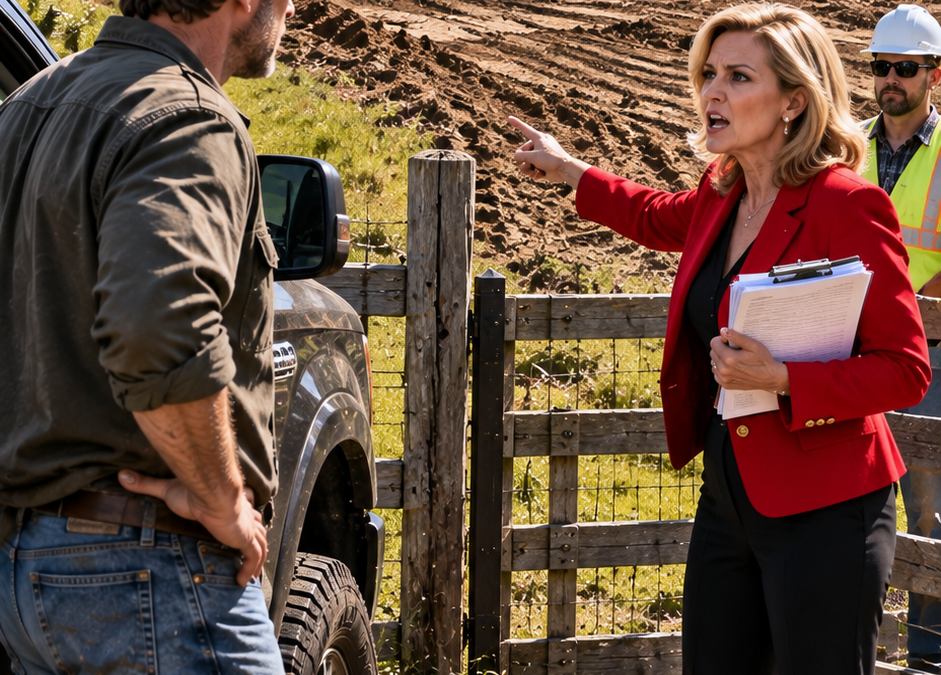
I told the driver of the sixth truck not to dump.
I did not stand in front of the cab.
I did not close the gate behind him.
I did not touch the equipment.
I made that deliberate.
If Dana intended to turn this into a story about an irrational rancher obstructing an emergency project, I wasn’t going to provide the photographs.
“I’m not preventing anybody from leaving,” I said. “I’m saying no additional material gets placed on my property until somebody shows me the authority for it.”
Dana crossed her arms.
“The HOA possesses drainage rights over this area.”
“Show me.”
“I don’t carry the entire recorded easement around in my purse.”
“You brought a grading plan.”
“That should be enough.”
“The grading plan stops before the fence.”
“The drainage easement controls.”
“Then show me the easement.”
Her tone sharpened.
“You received it when you purchased the property.”
That part was true.
And the fact that it was true mattered.
Dana was not standing there with absolutely nothing.
Cedar Hollow did possess a drainage easement affecting part of my lower meadow.
I remembered seeing it in my closing documents.
That was precisely why I didn’t start shouting that she was trespassing and call the sheriff.
Property disputes become dangerous when one side has no paperwork.
They become expensive when both sides have some.
I turned to the foreman.
“What’s your name?”
“Luis Ortega.”
“Luis, are you the project manager?”
“Site superintendent.”
“Who told your crew to extend across the fence?”
He glanced toward Dana.
She answered for him.
“I did.”
That was useful.
I kept my face neutral.
“Under what written authorization?”
“The easement.”
“Do you have it?”
“No.”
“Did Luis?”
Dana looked at him.
Luis answered.
“No, sir.”
“Did anyone from the engineering firm approve moving the grading limit?”
Dana stepped forward.
“This conversation is becoming inappropriate.”
I looked at her.
“You’ve dumped soil on my land, Dana. We’re already past appropriate.”
Luis cleared his throat.
“I’ve stopped placement for now.”
Dana snapped toward him.
“I did not authorize a stop.”
He didn’t flinch.
“I have a boundary question.”
“You have an owner representative directing you.”
Luis looked at the stamped plan.
Then toward my fence.
“With respect, I also have a limit of disturbance on an issued construction set.”
Dana’s eyes narrowed.
There was the first crack.
Not defeat.
Not even close.
But the first moment when someone she assumed would obey had decided to ask for paper.
“Fine,” she said. “Pause the trucks while this gets clarified.”
Pause.
Not stop.
That word stayed with me.
The drivers backed out one by one.
I filmed each truck leaving.
Then I walked the disturbed ground.
The smell surprised me.
Wet soil.
Diesel.
Crushed grass.
The imported material was sandy loam mixed with compactable fill, brown-gray and slightly granular. It wasn’t trash. There was no obvious construction debris.
That mattered too.
I wasn’t going to claim contamination because the color offended me.
I wanted facts.
At one spot, the fill was thin enough that flattened grass still pushed through.
Farther downhill, it was much deeper.
The seasonal swale was partly buried.
I put one boot beside a tire rut.
The groove was several inches deep.
For reasons I couldn’t fully explain, that bothered me more than the piles.
Maybe because piles could be counted.
A rut felt personal.
I had driven over that ground carefully for years.
I had avoided it after heavy rain.
I had reseeded sections after drought.
The truck tires had crossed it without hesitation because somebody in a red blazer told them they could.
Dana headed toward the gate.
“I’ll send you the relevant documents,” she said.
“I’d appreciate that.”
“You’ll also receive a notice concerning interference with required drainage work.”
I almost laughed.
“Of course I will.”
She stopped.
“What is that supposed to mean?”
“Nothing.”
“I don’t appreciate your tone.”
I looked down at her pointed heels sinking slightly into the mud.
“Dana, you just buried part of my meadow under trucked fill. My tone is probably the least expensive problem standing here.”
She left without answering.
From my kitchen window, the damage looked worse.
Up close, I had seen individual piles and ruts.
From the house, I saw the shape.
My lower meadow normally formed one uninterrupted green slope toward the shallow drainage swale.
Now a wide strip of brown-gray soil cut through it.
It looked artificial because it was.
I opened the file cabinet where I kept my purchase documents.
My ranch consisted of eighty-four acres.
Hay ground.
Pasture.
A machine shed.
The farmhouse.
A narrow creek.
And eleven acres of lower meadow running along Cedar Hollow’s eastern edge.
The ranch predated the subdivision by decades.
Cedar Hollow had been built uphill.
That meant stormwater mattered.
Roofs, paved driveways, streets, culverts—all of them moved water differently than open land.
When the subdivision was approved, the developer had been required to manage that runoff so it didn’t simply dump onto existing agricultural property.
Hence the easement.
I found it.
DRAINAGE MAINTENANCE EASEMENT.
I carried the deed, survey, parcel map, and easement outside.
I started with the simplest question.
Who owned the meadow?
The deed answered that.
Me.
Where did my property end?
The survey answered that.
The eastern fence line.
Then I unfolded the easement.
Its legal description did not cover the entire meadow.
It described a narrower corridor associated with the seasonal swale.
That was important.
But I still didn’t assume it solved everything.
Easements can be broader in purpose than they look on a survey.
Words such as maintain, repair, restore, access, and reasonably necessary can do a lot of work in property law.
So I measured.
I used a wheel to mark the disturbed width.
I photographed the survey against identifiable fence corners.
I photographed old posts.
Then I found an aerial image from the year Cedar Hollow was first laid out.
The same fence was there.
So was the swale.
I found an old fencing invoice referencing two corner posts by location.
None of that proved what the easement legally allowed.
But it proved the ground had not magically become Cedar Hollow property sometime last Tuesday.
By late afternoon, clouds were building.
Dana emailed at 4:17.
The subject line read:
Required Drainage Correction — Cedar Hollow
Her message informed me that the association possessed recorded maintenance authority over the lower drainage area and warned me against obstructing contractors when the project resumed.
One sentence stood out.
The Association’s recorded drainage rights authorize all work reasonably necessary to correct the contributing drainage condition.
I printed it.
Then I looked out the window at the imported fill.
That was her argument.
Not ownership.
Authority.
There is a difference.
Dana did not need to prove the HOA owned my meadow if she could prove the easement allowed them to regrade it.
That made the fight narrower.
And more interesting.
The next morning, Luis called at 8:10.
“I wanted to talk before anyone dispatches another truck.”
“Good.”
“We’ve halted deliveries.”
“For how long?”
“Until the boundary issue is resolved.”
Boundary issue.
Not drainage correction.
Not routine maintenance.
Boundary issue.
Twenty minutes later, his white work truck came up my driveway.
No Dana.
That also told me something.
Luis lowered the tailgate and spread paperwork across it.
Delivery tickets.
Daily logs.
Plan sets.
Emails.
Wind caught the top sheet.
He pinned it down.
“I checked yesterday’s truck records.”
“How many loads?”
“More than I thought.”
“How many?”
He began counting.
“Fifty-eight confirmed to the lower placement zone.”
I stared at him.
“Fifty-eight?”
“Yes.”
He slid two additional tickets toward me.
“Two more are coded to the project but don’t have final placement notes.”
“So potentially sixty.”
“Yes.”
I looked across the meadow.
Sixty.
The number made the brown scar look larger.
“What material?”
“Clean fill. Sandy loam, compactable soil from another permitted project.”
“Testing?”
“We have source documentation.”
“Send it.”
“I will.”
I had no reason to accuse his company of dumping hazardous material.
My problem was location.
“Why did your drivers cross my fence?”
Luis opened the stamped grading set.
“This is the issued plan.”
Then he placed Dana’s version beside it.
“This arrived later.”
“From Dana?”
He flipped the sheet.
Printed email header.
Dana Whitmore.
Subject: Field Direction — Lower Drainage Transition.
The wording read:
Proceed with feathering beyond existing fence to eliminate low pocket and create positive drainage transition.
I looked at Luis.
“You treated this as a revision?”
“As an owner-directed field adjustment.”
“Owner?”
“Project owner. Cedar Hollow HOA.”
I pointed toward the meadow.
“They do not own this side.”
“I understand that now.”
“Did anyone on your crew question it?”
His expression changed.
“Yes.”
He opened the daily log.
The foreman’s handwriting was blocky and direct.
Extended fill placement beyond east fence per owner representative direction. Authorization to be verified.
I looked up.
“When was that written?”
“Same day.”
“Before or after the trucks crossed?”
“After Dana told him to continue.”
“So someone noticed the boundary.”
“Yes.”
“And she told them the easement authorized it.”
“Yes.”
“Before sixty loads were dumped.”
Luis paused.
“Before most of them.”
That was a very important sentence.
“Can I get copies of all of this?”
“I need approval from our office.”
“Ask.”
By noon, scanned copies were in my inbox.
I downloaded everything.
Cloud backup.
External drive.
Printed set.
If something existed in only one place, I treated it as temporary.
Then the storm arrived.
Nothing extraordinary.
One of those hard late-spring storms that comes across open ranch country fast.
Wind first.
Then rain.
Heavy for twenty minutes.
Steady for another hour.
I watched from the porch.
The undisturbed meadow absorbed water.
The new fill behaved differently.
Darkened almost black.
Water began sheeting across its compacted surface.
After the storm passed, I put on boots.
I carried my phone, measuring rod, and survey in a clear sleeve.
The old swale had moved water through that meadow for years.
Now one band of fill crossed it.
Water stood against the raised section.
Three inches at first.
Closer to four at the deepest spot.
I did not call it a flood.
It wasn’t.
No buildings were threatened.
No fences floated away.
Nothing dramatic happened.
Which was exactly why the evidence mattered.
This had been an ordinary storm.
The grade had changed.
I placed the rod in the water.
Photo.
Then I stepped sideways until the buried swale, standing water, and new fill all appeared in one frame.
Photo.
Then a slow video pan.
No narration.
No angry speech.
Just ground.
The next morning, water remained.
I called an excavation contractor I’d used before.
He walked the site.
Whistled.
“That’s a lot of material.”
“Potentially sixty loads.”
“That sounds right.”
“If it has to come out?”
He looked at the field.
“Removal isn’t the only cost.”
“What else?”
“Compaction remediation. Topsoil. Seed. Maybe drainage restoration. Access damage. Depends how deep they went.”
I looked at the ruts.
For the first time, I thought beyond stopping the project.
Getting trucks out was easy.
Getting my meadow back could be expensive.
At 3:25 p.m., Dana sent another email.
NOTICE OF INTERFERENCE WITH REQUIRED STORMWATER WORK
I printed that one too.
There is something psychologically useful about printing an aggressive email.
On a screen, it feels immediate.
On paper, it becomes evidence.
Dana accused me of increasing drainage risk to Cedar Hollow homeowners.
Again, I did not dismiss the underlying concern.
Drainage problems could be real.
What I disputed was her assumption that a legitimate goal gave her unlimited authority.
That evening, Luis called again.
“I found another note.”
“What kind?”
“Field record.”
He emailed it.
One line.
Property boundary concern raised. Owner representative states easement permits continuation.
I read it twice.
The contractor had noticed.
The question had been raised.
Dana answered it.
That meant this wasn’t a driver missing a fence.
It wasn’t a foreman misunderstanding a stake.
Someone stopped long enough to ask whether they had authority.
Dana said yes.
Now I needed to know whether she was right.
I created a timeline across my dining table.
Truck number.
Arrival time.
Load ticket.
Placement area.
Photo.
I matched visible truck numbers from my videos to delivery slips.
One silver cab appeared at 7:14.
Again at 8:02.
A blue truck made three cycles before I ever reached the gate.
By midnight, memory had become chronology.
Then I sent a formal records request to the county engineering department.
Issued grading permit.
Stamped plan set.
Approved revisions.
Inspection notes.
Erosion-control records.
Correspondence.
Any document changing the limit of disturbance.
My question was simple.
Show me the approved line.
The answer came three days later.
I spread the county plans across my kitchen table.
Outside, wind moved through the meadow.
Inside, I put a ruler against the bold dashed construction boundary.
The label was simple:
LIMIT OF DISTURBANCE.
LOD.
It stopped before my fence.
I checked the revision block.
Two modifications had been approved.
One involved a storm drain inlet.
The other changed erosion-control sequencing.
Neither moved the LOD.
Neither added my meadow.
Neither authorized grading across my fence.
I made a note card with four questions.
Where did approved grading stop?
At the LOD.
Was there a county-approved revision extending it?
No.
Did the project engineer approve Dana’s extension?
Not yet known.
Could the drainage easement separately authorize some work?
Still unresolved.
That method kept me from drowning in paper.
Every document had to answer a question.
If it didn’t, it went back in the file.
Then I found a county email exchange.
A reviewer had asked the project engineer to confirm that off-site drainage patterns would remain protected.
The engineer responded:
Work will remain within approved construction limits and will not require grading on adjacent private property.
I underlined the sentence.
Then carried the plan outside.
Orange construction stakes remained on Cedar Hollow’s side.
I aligned the drawing with the site.
The visual was almost embarrassing.
Orange stake.
Fence.
Then brown fill beyond both.
I measured from the nearest approved stake to the farthest disturbed edge.
Photographed it.
Then called the engineering company listed on the title block.
The receptionist connected me with Maya Bennett, the civil engineer whose stamp appeared on the drainage calculations.
I gave her the permit number.
There was a pause.
“I’ve heard there may be an issue.”
“That depends on your definition.”
“What do you need?”
“Did your firm approve grading across the eastern fence into my ranch?”
“No.”
Fast answer.
No hesitation.
“Did you issue any field revision extending the LOD?”
“Not that I’m aware of.”
“I have a sheet using your base drawing with colored markup crossing my fence.”
Another pause.
“We didn’t issue colored field markup.”
“Would you be willing to look at it?”
“Yes.”
Two days later, Maya arrived.
She wore mud-ready field shoes, jeans, a waterproof jacket, and carried her tablet.
Dana arrived twelve minutes later.
Crimson blazer.
Black pointed heels.
Again.
I had started to believe the blazer was some kind of ceremonial uniform.
Dana stepped out of her SUV.
“Maya.”
“Dana.”
“I wish someone had told me there was going to be a field meeting.”
Maya glanced toward me.
“He did.”
Dana looked annoyed.
“The eastern transition was required to complete the drainage correction.”
Maya walked toward the stakes.
“I’ll compare it to the issued drawings.”
Dana followed.
I spread the stamped plan and Dana’s marked-up version across the hood of Maya’s vehicle.
A drizzle started.
Maya traced the official LOD.
Then Dana’s colored extension.
“Did your office approve this?” I asked.
“No.”
Dana folded her arms.
“It’s based on your design.”
“The base is ours.”
Maya tapped the added shading.
“This isn’t.”
“It was a field adjustment.”
“Not from us.”
“The HOA has drainage easement rights.”
Maya nodded.
“That is a property-right question.”
She pointed to the dashed line.
“I’m answering the construction question. Our approved grading stops here.”
Dana’s jaw tightened.
She looked toward the fence.
Then back.
“The change was necessary.”
Maya shrugged slightly.
“Necessary doesn’t mean approved.”
That was the first time Dana had heard the difference from someone whose name appeared on the actual engineering plan.
The rain intensified.
Water began moving across the fill.
Maya watched it.
One thin stream curved toward the low depression I’d photographed earlier.
She pulled out her phone.
Dana noticed.
“What are you photographing?”
“Existing conditions.”
“Those conditions are incomplete because the project was stopped.”
“Maybe.”
Maya took another picture.
“I still need elevations.”
That restraint mattered.
She did not declare Dana wrong because a puddle existed.
She measured.
Engineers don’t gain credibility by pretending every observation is already a conclusion.
Back in her truck, Maya opened the revision log.
No amendment moved the LOD east.
No field directive from her company authorized work beyond my fence.
No county revision expanded the project.
I asked her one more time.
“Say it without engineering shorthand.”
She looked at me.
“This permit does not show approved grading on your parcel.”
That was one part of the fight.
The easement was another.
I ordered a certified copy from the recorder’s office.
Full document.
All exhibits.
All amendments.
Then I reduced the pages to three questions.
What area?
What purpose?
What conditions?
The legal description followed a narrow corridor around the drainage feature.
Not the full meadow.
The easement permitted inspection.
Clearing.
Maintenance.
Repair.
Restoration.
Access connected to those functions.
It required notice except in defined emergency circumstances.
It also required disturbed surfaces to be restored.
One clause allowed work reasonably necessary to maintain drainage function.
Dana had relied heavily on those words.
But another section limited the granted rights to the area described in the attached exhibit.
That was where a lawyer became useful.
Before I called one, I requested Cedar Hollow’s own project records.
Board minutes.
Project authorizations.
Emails.
Contractor communications.
Invoices.
Engineering correspondence.
Anything discussing work beyond the LOD.
The first batch arrived three days later.
I spread it across my kitchen floor.
One line for board records.
One for engineering.
One for contractor communications.
One for Dana.
Then I started walking through the sequence.
Cedar Hollow homeowners had complained about standing water near the lower edge of the subdivision.
Legitimate problem.
The engineering firm designed improvements entirely on the Cedar Hollow side.
The design intentionally stopped before my fence.
Then an internal memo identified a “low pocket” near the eastern boundary.
The approved plan left it alone.
Dana didn’t like that.
She proposed extending fill beyond the fence for what she described as a “smoother transition,” “reduced future complaints,” and “simplified maintenance.”
Then I found the board minutes.
A director named Paul Reyes—not related to anyone else in the story—asked:
Do we have written authorization to grade private land east of the fence?
I stopped reading.
There it was.
Someone on Dana’s own board had asked the right question.
According to the minutes, Dana responded that the recorded drainage easement provided maintenance authority.
Paul then asked whether that had been confirmed against the grading permit.
The response:
Counsel review to be confirmed.
I searched the packet.
No written counsel opinion.
No signed permission from me.
No approved county revision.
But the trucks had rolled anyway.
Then came the email chain.
The contractor’s project manager wrote:
Please confirm whether east-side feathering is within owner-controlled property or existing easement rights.
Dana replied:
HOA has drainage maintenance authority. Proceed as directed.
Then, sent earlier that same morning, I found Maya Bennett’s warning:
Any grading outside the stamped LOD should be held pending confirmation of property authorization and permit implications.
I put the emails side by side.
One said hold.
One said proceed.
Sixty loads followed the second.
I called Luis.
“Did your project manager receive Maya’s warning?”
“Yes.”
“Before work crossed the fence?”
“Yes.”
“And Dana still instructed you to continue?”
“Yes.”
“Why did your company follow Dana instead of the engineer?”
“She was the owner’s representative. She said the easement issue had been resolved and the HOA accepted responsibility.”
“Accepted responsibility?”
“Yes.”
I wrote those words down.
There is a world of difference between having authority and agreeing to take responsibility if you don’t.
Luis sent another internal daily report.
It read:
East extension questioned due to LOD. Owner rep confirms easement authority and directs continuation. Engineering revision not received.
I printed it.
Then I did something simple.
I held the paper against the fence post.
Brown fill behind it.
Photograph.
That image connected administrative decision to physical consequence better than twenty angry paragraphs ever could.
The official plan said stop.
The engineer said hold.
The contractor asked.
Dana said proceed.
Still, I didn’t pretend the HOA had no argument.
The easement existed.
It granted real rights.
That was why I finally called Evan Price.
Evan was a property attorney with the rare quality of being able to explain complicated land documents without sounding pleased that nobody else understood them.
He listened for fifteen minutes.
Then he took out a yellow legal pad.
He drew three boxes.
EASEMENT.
MAINTENANCE AUTHORITY.
GRADING PERMIT.
He turned the pad toward me.
“Cedar Hollow has been treating these as one thing.”
“Aren’t they related?”
“Related isn’t identical.”
He tapped the first box.
“The easement is a property interest. It tells us what limited rights the HOA may exercise on land it does not own.”
Second box.
“Maintenance authority is the scope of activity permitted by that easement.”
Third.
“The grading permit answers what this specific construction project was approved to disturb.”
He leaned back.
“Dana seems to have taken the existence of Box One and treated it like unlimited permission for Boxes Two and Three.”
I handed him the easement.
He read the legal description.
Then the maintenance clauses.
Then the exhibit.
“The HOA does have drainage rights.”
“I know.”
“That’s important. Don’t pretend otherwise.”
“I haven’t.”
“Good.”
He placed my survey beside the legal exhibit.
“But these rights are geographically limited.”
He traced the corridor.
Then looked at the fill photographs.
“This disturbance extends beyond it.”
He moved to the stamped grading plan.
“And separately, this project’s LOD ends before your property.”
“So they crossed two lines.”
“Potentially.”
“Potentially?”
“Don’t collapse the arguments.”
He pointed to the easement.
“This line answers where their property right exists.”
Then the plan.
“This line answers where the permitted project could operate.”
He pointed at Dana’s colored markup.
“This piece of paper doesn’t automatically bridge the two.”
That clarified everything.
The dispute wasn’t:
Does Cedar Hollow have drainage rights?
Yes.
It did.
The dispute was:
Did those drainage rights authorize this particular regrading operation, at this scale, in this location, under this permit?
Much stronger question.
Evan read Dana’s email.
“The association’s recorded drainage rights authorize all work reasonably necessary…”
He nodded.
“This is her best argument.”
“So what do we ask?”
“Was this work inside the easement corridor?”
“Not all of it.”
“Was imported fill of this scale maintenance, or was it material regrading?”
“Good question.”
“Were notice requirements followed?”
“No.”
“Was there an emergency?”
“No.”
“Did the county permit authorize the expanded footprint?”
“No.”
“Did the project engineer approve it?”
“No.”
“Did you consent?”
“No.”
He put down his pen.
“Then those are the facts.”
I showed him my storm photographs.
“Standing water appeared after a normal storm.”
“Keep saying exactly that.”
“Why?”
“Because it is accurate. Don’t tell people your ranch flooded if it didn’t.”
“It didn’t.”
“Good. Facts this strong don’t need makeup.”
He drafted a formal demand.
Stop all grading beyond whatever rights Cedar Hollow could lawfully establish.
Preserve every relevant email.
Markups.
Board records.
Delivery tickets.
Invoices.
Contractor logs.
Engineering communications.
Permit correspondence.
Identify who authorized work beyond the LOD.
Provide the legal basis.
Provide a stabilization plan.
Propose restoration.
No demand for ten million dollars.
No accusation that Dana had committed some spectacular criminal conspiracy.
Just scope.
Evidence.
Correction.
Near the end, Evan wrote:
A limited easement for drainage maintenance does not, without additional authority, confer unlimited rights to materially regrade private property outside the described easement area, nor does such an easement independently enlarge the approved limits of a separate permitted construction project.
I read it.
“That sounds obvious.”
“Most expensive legal sentences do.”
The demand went out.
Certified mail.
Email.
Copies to the contractor.
Engineering firm.
County.
Dana replied that Cedar Hollow maintained its rights and would not agree to removal until the dispute was formally reviewed.
I forwarded it to Evan.
He called.
“She can make that argument.”
“She still thinks she’s right.”
“She doesn’t need to agree with us.”
“What do we need?”
“Someone independent to check the line.”
That someone was Mark Ellison from county engineering.
Mark arrived without drama.
No speech.
No interest in Dana’s interpretation.
He opened the stamped plans on a tablet.
Then walked directly to the construction stakes.
Dana stood nearby in her crimson blazer.
Luis held the field records.
I stayed out of Mark’s way.
He began on Cedar Hollow’s side.
Stake.
Measurement.
Plan.
Another stake.
Then he crossed the fence.
The tire tracks remained obvious.
He hooked a tape at the nearest approved reference point and pulled it toward the disturbed edge.
The metal tape clicked across the grass.
Dana shifted behind me.
I watched the numbers.
That moment mattered more than all of our emails.
Because if Mark decided the field work was actually within the approved construction footprint, my entire permit argument weakened.
He looked at the tablet.
Then the tape.
Then the fence.
“How far outside the LOD?” I asked.
He did not answer.
“I need to document before I give you a number.”
Fair.
He took photographs.
Checked coordinates.
Reviewed the plan.
Dana stepped closer.
“The eastern transition was required to correct drainage.”
Mark looked up.
“I’m reviewing the permit footprint.”
“The HOA has easement rights.”
“That may be relevant to a private property question.”
He pointed at the tablet.
“My question is whether this permitted grading stayed inside its approved disturbance limits.”
Dana pressed her lips together.
Mark asked Luis for the project records.
Luis handed him the daily log.
Dana’s field direction.
Her marked plan.
The contractor email.
Mark read each one.
Then asked:
“Did the county approve this revised limit?”
Luis shook his head.
“Not that we received.”
Mark turned to Dana.
“Do you have an approved revision?”
“The easement allowed the work.”
“That isn’t my question.”
She hesitated.
“Do you have a county-approved revision moving the LOD onto this parcel?”
“No.”
One word.
That was all.
No.
Mark’s written notice arrived the next afternoon.
It stated that grading and fill placement had occurred outside the approved limit of disturbance.
No fireworks.
No accusation.
Just the sentence I had been waiting for.
Additional work could not proceed unless properly reviewed and approved.
The disturbed off-site area had to be stabilized while corrective plans were evaluated.
Dana’s favorite piece of paper had just lost its magic.
The HOA attorney contacted Evan within twenty-four hours.
Their insurer wanted photographs.
Delivery tickets.
Emails.
Contractor logs.
Engineering correspondence.
Luis’s company confirmed no additional work would occur on my parcel without written authorization from all required parties.
Then came the expensive question.
What had sixty loads done?
We hired Rachel Kim, a civil engineer who specialized in grading and drainage.
Rachel did not care about Dana.
She barely asked about the HOA dispute.
She cared about elevations.
She surveyed the meadow.
Shot grades along the swale.
Checked undisturbed reference points.
Measured fill depth.
Mapped ponding.
Compared current slopes against historic contours where possible.
Her conclusion was more nuanced than the revenge fantasy people probably expected me to want.
Not all the fill needed to be hauled away.
Some could remain if reshaped correctly.
Some needed partial removal.
Some had to come out because it had raised the natural drainage path and contributed to standing water.
“Can you restore it exactly?” I asked.
She shook her head.
“No responsible engineer is going to promise exactly.”
“Why?”
“Because disturbed soil doesn’t become undisturbed history again.”
That answer hurt.
But it was honest.
“What can you promise?”
“We can restore drainage function, remove inappropriate fill, rebuild surface grades, replace topsoil where necessary, reseed, and create a defensible condition.”
That became the objective.
Not punishing Cedar Hollow with sixty trucks going back out because sixty had come in.
I wanted my ground functional.
The more evidence accumulated, the more the HOA’s position changed.
At first:
Everything was authorized.
Then:
The easement allowed it.
Then:
The purpose was legitimate.
Then:
The contractor misunderstood the scope.
Then:
We should focus on restoration.
Interesting how quickly certainty becomes cooperation when insurance carriers begin reading emails.
The contractor’s insurer asked who gave the instruction.
Luis’s log answered.
Dana.
The HOA’s insurer asked whether engineering approved the extension.
Maya’s email answered.
No.
The county asked whether the LOD had been revised.
Its own permit file answered.
No.
The HOA attorney asked whether my meadow was inside Cedar Hollow property.
The deed answered.
No.
The one thing Dana had left was the easement.
And the easement, Evan reminded everyone, was not worthless.
It simply wasn’t infinite.
Settlement discussions began.
Dana attended the first one.
Evan, Rachel, the HOA lawyer, insurer representatives, and I sat around a conference table.
Dana placed a thick binder in front of her.
She looked at me.
“I want to begin by saying this entire dispute could have been avoided if you had allowed the drainage correction to finish.”
I looked at Evan.
He looked at me.
Then I said, “Good morning, Dana.”
Her jaw tightened.
The HOA attorney intervened.
“We’re here to discuss corrective work.”
Dana opened her binder.
“The subdivision has experienced recurring drainage complaints.”
“I don’t dispute that.”
She seemed surprised.
I continued.
“I dispute your belief that complaints gave you authority to move a county construction boundary and grade my meadow.”
“The drainage easement—”
Evan spoke.
“Let’s be precise.”
He placed a copy of the easement on the table.
“No one disputes Cedar Hollow has defined drainage-maintenance rights.”
Dana leaned back as though that proved everything.
Then Evan placed the survey beside it.
“We dispute that those rights cover all of the disturbed acreage.”
Next came the grading plan.
“And regardless of the private easement, the county has already determined the permitted project exceeded its LOD.”
The HOA attorney nodded.
He knew that part was over.
Dana did not.
“The county doesn’t determine private easement scope.”
“Correct,” Evan said.
“And we haven’t asked it to.”
“Then the HOA may still have had authority.”
“Within the easement.”
“For all necessary work.”
“Within the easement.”
“You’re repeating yourself.”
“Because the document does.”
I had to look down to hide a smile.
Dana turned toward me.
“You are benefiting from Cedar Hollow’s drainage infrastructure.”
“I’m downhill from it.”
“Exactly.”
“That is not the same thing.”
“You’ve known about the easement since purchasing the ranch.”
“Yes.”
“And you’ve never objected to maintenance.”
“No.”
“Then why are you objecting now?”
“Because maintenance arrived in sixty dump trucks and crossed two boundaries after your engineer said hold.”
For the first time, the insurer’s representative looked directly at Dana.
That mattered.
Dana opened her mouth.
The HOA attorney touched her arm.
“Let’s move to restoration.”
And that was basically the moment her argument stopped driving the meeting.
Rachel presented her plan.
Three zones.
Zone One could be reshaped.
Zone Two required partial excavation.
Zone Three needed most imported fill removed.
Topsoil replacement.
Seed.
Erosion control.
Swale restoration.
Repair to the widened fence access.
Monitoring after normal rainfall.
The contractor provided cost estimates.
The insurer began negotiating allocation.
Nobody asked whether Dana liked it.
That may have been the most satisfying change of all.
The first excavator arrived two weeks later.
This time, before crossing my gate, the operator handed me the work authorization.
Actual written authorization.
Imagine that.
I read it.
Signed access.
Then opened the gate.
The excavator bucket lifted the first deep band of fill.
Dark original topsoil appeared beneath it.
Almost black.
For the first time in weeks, I could see the old ground again.
I stood with Rachel.
“That’s better than I expected.”
“Wait until we shoot the grades.”
“You really know how to ruin a sentimental moment.”
“It’s my job.”
Some material was loaded out.
Some was shifted back toward Cedar Hollow’s side within the approved corrective area.
Some remained and was reshaped.
Rachel checked every critical elevation.
The swale reappeared gradually.
Not as if nothing had happened.
But as a drainage feature again.
Luis visited once during restoration.
We stood beside the excavator.
“I should have stopped when my foreman flagged the boundary,” he said.
I looked at him.
“Yes.”
“I trusted the owner’s representative.”
“Yes.”
“I should have asked for the revision.”
“Yes.”
He exhaled.
“You’re not making this easy.”
“You already know the answer.”
“I know.”
He watched the machine peel away another strip.
“Next time I stop.”
“That would be cheaper.”
He laughed quietly.
“No argument there.”
The final settlement came together without a courtroom trial.
Cedar Hollow funded the corrective grading required under Rachel’s plan.
The contractor performed much of the physical restoration.
Topsoil was replaced where needed.
The disturbed ground was reseeded.
The swale was reopened.
The access point at my fence returned to its previous width.
Cedar Hollow reimbursed my documented engineering costs.
They paid an agreed portion of my legal fees.
The settlement also created procedures for future work.
Any project extending onto land Cedar Hollow did not own required written confirmation of property authority before mobilization.
Any movement beyond a stamped LOD required documented engineering and permitting review.
A field representative could no longer redraw construction limits with colored markup and a confident email.
Contractors were specifically instructed to stop when property authority and permit scope conflicted.
Paul Reyes—the board member who had originally asked whether they had permission—pushed for those provisions.
I respected him for that.
At the next open HOA meeting, he read part of the new policy aloud.
Dana sat at the far end of the board table.
No crimson blazer that night.
Gray cardigan.
No speeches.
When Paul finished, a homeowner asked:
“So this means nobody can just tell a contractor, ‘The easement covers it’?”
Paul answered.
“Correct.”
The homeowner looked directly at Dana.
Dana stared down at her papers.
Another resident asked:
“Will project plans be available to homeowners before major grading begins?”
“Yes.”
“Full stamped plans?”
“Yes.”
“Not marked-up copies?”
A few people laughed.
Dana’s face tightened.
Paul waited until the room quieted.
“Full issued plans.”
I had not gone there to humiliate her.
I genuinely hadn’t.
But I admit I enjoyed that sentence.
Dana completed the remainder of her board term.
When election season came, she did not run for president again.
She issued a statement explaining that she wanted to “focus on other community priorities.”
That was HOA language for losing control of the room.
Another director became president.
Paul chaired the infrastructure committee.
One of his first changes required the board to include property boundaries and easement limits in project reviews.
I heard later that contractors loved him.
Apparently asking where they were legally allowed to work before sending trucks saved everyone time.
Revolutionary concept.
Months passed.
Spring became summer.
The seed came up.
At first, the restored section looked different.
Lighter green.
Younger.
Uneven.
Then the grass thickened.
Rain came.
The swale carried water.
No standing pool against the old fill band because the fill band no longer blocked it.
The fence stood where it had stood before.
I repaired one post myself.
I could have charged that too.
I didn’t.
Some things I wanted to do with my own hands.
One evening after a light storm, I walked the lower meadow.
Boots wet from the grass.
Clouds breaking west of the ranch.
Cedar Hollow sat beyond the fence.
Still there.
Still uphill.
Still sending runoff toward the drainage system.
And the easement remained.
I had never tried to erase it.
The HOA still had legitimate access to a defined drainage corridor.
They could inspect.
Maintain.
Repair.
Perform work the document actually authorized.
What changed was the assumption that the word drainage could be used like a master key.
That had been Dana’s mistake.
She took a legitimate purpose and treated it as unlimited permission.
There is a seductive logic to that kind of overreach.
The problem is real.
Therefore, our solution is justified.
Our solution is justified.
Therefore, the method must be allowed.
The method is allowed.
Therefore, the boundary can move.
And once the boundary moves, anyone who objects becomes the problem.
That reasoning had carried sixty loads of dirt into my meadow.
It stopped when we forced every step apart.
Who owns the land?
What does the easement actually grant?
Where does the permit authorize disturbance?
Who approved the change?
What did the engineer say?
What did the county approve?
Who directed the contractor after the concern was raised?
One question at a time.
That was all.
Dana had stood at my gate with a crimson blazer and a marked-up drawing and told me the HOA had authorization to raise the entire low area.
Months later, I still remembered asking:
“Plan number?”
Two words.
That had been the first loose thread.
Her expression told me to pull it.
So I did.
It led to the stamped plan.
The stamped plan led to the LOD.
The LOD led to the engineer.
The engineer led to her warning email.
That led to the contractor logs.
Those led to the board minutes.
The minutes led to the unresolved authorization question.
And eventually, the whole thing became impossible to disguise as a simple drainage project.
The goal may have been drainage.
The overreach was hers.
That distinction cost Cedar Hollow money.
A lot less than a lawsuit could have cost them, but enough to make people remember.
The contractor absorbed part of the corrective cost through its insurer.
The HOA paid the rest according to the settlement.
My engineering bills were reimbursed.
Most of my legal expense was covered.
The meadow recovered.
And the board acquired a sudden institutional fascination with checking property lines.
I considered that a fair outcome.
The part I found most satisfying came almost a year later.
I was cutting hay in the upper field when I saw a white contractor pickup stop outside the eastern fence.
A man got out holding a plan tube.
Different company.
Different project.
He walked along the fence.
Then he saw me.
He raised a hand.
I shut off the tractor.
He approached.
“You own this parcel?”
“Yes.”
“We’re doing inlet maintenance for Cedar Hollow next week.”
“All right.”
He opened the tube.
“I was told to verify the easement corridor with you before equipment access.”
I stared at him.
He seemed nervous.
“Problem?”
“No.”
I stepped down from the tractor.
“Actually, that’s perfect.”
He showed me the drawing.
Stamped plan.
Easement overlay.
Access path.
Everything stayed inside the defined corridor.
“Looks right,” I said.
“We’ll need your gate open Tuesday morning.”
“What time?”
“Seven-thirty.”
“I’ll have it open.”
That was it.
No confrontation.
No red blazer.
No surprise trucks.
No sixty-load misunderstanding.
Just a contractor asking before crossing somebody else’s property.
It felt almost boring.
Boring was wonderful.
Tuesday morning, I opened the gate at seven-twenty.
The crew arrived.
They cleaned debris from the drainage feature.
Repaired a small eroded section.
Removed their equipment.
Closed the gate.
They were gone before lunch.
The meadow remained green.
That was what legitimate easement maintenance looked like.
And standing there afterward, I understood something I wish more people understood before property disputes become wars.
Boundaries are not automatically acts of hostility.
Sometimes a boundary is what allows neighbors to cooperate.
Cedar Hollow had rights.
I had rights.
Once those were clearly separated, there was room for both.
Dana’s system only worked when she blurred them.
Near the end of that summer, I ran into her at the county hardware store.
I was buying fence staples.
She was in the paint aisle.
For a moment, both of us considered pretending not to see the other.
Then Dana said, “Hello.”
“Dana.”
She looked different outside the HOA setting.
Smaller somehow.
Not physically.
Just ordinary.
No board table.
No contractors waiting for instructions.
No portfolio.
She looked at the staples in my hand.
“Fence repair?”
“Always.”
She nodded.
An awkward silence followed.
Then she said, “The meadow looks good.”
I hadn’t expected that.
“It recovered.”
“I’m glad.”
I studied her face.
I couldn’t tell whether she meant it.
Maybe she did.
Then she added, “I still believe the original drainage concern needed correction.”
There she was.
I smiled slightly.
“I’ve never disagreed with that.”
Her eyes narrowed.
“Then what exactly did we spend all those months fighting about?”
“The part where you decided a problem uphill gave you the right to change land downhill without confirming whether you had permission.”
She looked away.
“We had an easement.”
“You had part of an answer.”
She said nothing.
I continued.
“You treated it like all the answers.”
She picked up a paint sample.
“I was trying to protect homeowners.”
“I believe you wanted to solve their drainage complaints.”
That surprised her.
“But good intentions don’t move property lines.”
Her mouth tightened.
“I’m sure you’re happy with how everything turned out.”
“I am.”
“You got your legal fees.”
“Some.”
“Your engineering costs.”
“Yes.”
“Your meadow.”
I looked at her.
“My meadow was already mine.”
That ended the conversation.
She put the paint sample back.
“Goodbye.”
“Take care, Dana.”
I watched her walk toward the register.
No grand defeat.
No shouting.
No security escort.
Just a former HOA president walking away from a man whose ground she had once treated like blank space on a project drawing.
And somehow, that felt more satisfying than a dramatic scene would have.
Because when the story started, Dana had spoken as though permission belonged to whoever sounded certain.
By the end, certainty didn’t matter.
The documents did.
That fall, after the first frost, I walked the lower meadow at sunset.
The restored section was almost indistinguishable from the surrounding pasture.
Almost.
If you knew where to look, you could still see subtle differences.
The grass grew a little denser in some places.
One repaired fence post was newer.
The contour near the swale was cleaner than before.
I did not mind.
Scars are not always failures.
Sometimes they are records.
The drainage channel carried a narrow ribbon of water from a rain two days earlier.
It passed beneath the fence through the proper corridor.
No ponding.
No trucks.
No mud.
I stopped where the first mound had been.
That first morning came back clearly.
Six trucks.
Dana in red.
Luis holding the plan.
The official dashed line stopping short of my fence.
And sixty loads already inside.
For a while, sixty had felt like the most important number in the dispute.
It wasn’t.
The most important thing had been one line.
Limit of disturbance.
Dana had treated that line as negotiable because she believed the easement made her interpretation more powerful than the plan.
The county disagreed.
The project engineer disagreed.
The contractor records showed concerns had been raised.
The easement itself had limits.
Once those facts were placed next to each other, the outcome became much less mysterious.
I had never needed to prove Cedar Hollow was evil.
I did not need to pretend every HOA employee was corrupt.
Luis admitted his mistake.
The contractor corrected its procedures.
Paul had asked the right question before the dumping and later helped change board policy.
Maya Bennett had warned them to hold.
Rachel helped restore the land.
Even the HOA’s underlying concern—drainage near residents’ homes—was legitimate.
The failure came from one decision.
Dana was told there was a line.
She decided her interpretation allowed her to cross it anyway.
Then she told everybody else to keep going.
That was why she lost.
Not because I shouted louder.
Not because I blocked a bulldozer.
Not because I found some magical deed saying nobody could ever touch a blade of grass.
She lost because every independent record asked the same question she had avoided at the gate.
Who authorized work past this point?
The stamped plan didn’t.
The county didn’t.
The engineer didn’t.
I didn’t.
The contractor had asked.
The board had asked.
Dana answered for everyone.
And eventually she had to pay for what happened after that answer.
I walked back toward the house.
Behind me, the meadow settled into the blue-gray light of evening.
The fence was where it had always been.
Beyond it, Cedar Hollow’s homes glowed against the hills.
The drainage easement remained exactly what it was supposed to be.
A limited right for a limited purpose.
Nothing more.
Inside my kitchen, I still kept one photograph from the dispute.
Not Dana.
Not the trucks.
Not the restoration equipment.
It showed the stamped grading plan held in front of the meadow.
On the paper, the heavy dashed LOD ended before my fence.
Behind it, in the same frame, brown fill stretched across green grass on my side.
I kept it because it summarized the whole story.
Paper line.
Property line.
Sixty loads on the wrong side of both.
Dana had arrived believing the words “drainage easement” gave her permission to redraw all three.
They didn’t.
And after months of surveys, emails, engineering reviews, legal arguments, corrective excavation, and one very expensive lesson for Cedar Hollow, everybody finally understood what I had asked on the first morning:
If the approved grading plan stops at my fence, why didn’t your trucks?








