𝗙𝗨𝗟𝗟 𝗦𝗧𝗢𝗥𝗬 The HOA Claimed Hunting Rights Across My 2,200-Acre Forest—Then We Found the Plat They Had Quietly Changed
𝗣𝗔𝗥𝗧 𝟮
Just 2,200 acres of working forest under one recorded ownership.
I knew the place intimately.
The northern drainage filled quickly after heavy rain.
The southern ridge dried sooner in spring.
Deer moved through two predictable creek corridors in November.
Turkey nested near the younger stands.
An old logging road curved beneath the northeast ridge, crossed a shallow creek, and continued toward what would later become Ridgecrest Pines.
That road eventually formed part of the hunting and hiking trail Sandra claimed belonged to her association.
But Ridgecrest Pines itself began separately.
Its development sat on roughly 340 acres west of my forest.
The property had once been part of a failed equestrian resort.
In the late 1990s, a developer named Gareth Fossie purchased it and divided it into forty-seven residential lots.
Cabins came first.
Then larger permanent homes.
Common areas.
Paved roads.
A small clubhouse.
In 2001, Fossie organized the Ridgecrest Pines Homeowners Association to maintain the development after lot sales were substantially complete.
The recorded declaration covered those 340 acres.
Nothing in it annexed my land.
Nothing in it claimed my forest.
The plat boundary was clear.
The CC&Rs were clear.
Ridgecrest Pines ended where the Pruitt tract began.
But there had once been a relationship between the two properties.
That became important.
In 2001, while my father was still alive, Gareth Fossie approached him about recreational access.
Residents wanted additional hiking and seasonal hunting space.
Dad was willing to accommodate them.
But he understood the distinction between permission and ownership.
His attorney prepared a license agreement.
Not an easement.
Not a deed.
A license.
The document allowed Ridgecrest Pines residents to use a specific network of marked trails covering roughly 180 acres along the portion of the Pruitt tract closest to the subdivision.
The HOA paid an annual fee.
The agreement lasted five years and could be renewed only through mutual written consent.
Both parties had to sign the renewal.
And Section 3 contained language that would eventually become the most important part of that old document.
The license granted a personal privilege of access only.
It conveyed no easement.
No ownership interest.
No estate in land.
No permanent property right.
If it expired without written renewal, the access privilege ended automatically.
My father renewed the arrangement twice during his lifetime.
After he died, I did not renew it.
Nobody from Ridgecrest Pines formally asked me to.
I had begun reorganizing my own hunting leases, and I wanted greater control over the property.
The license expired.
What I did not do was immediately barricade every trail.
That proved to be my mistake.
Not a legal mistake.
A practical one.
Residents continued walking there.
Some hunted.
I knew about occasional use.
For a while, I tolerated it.
Most were respectful.
Nobody caused enough trouble to make closing everything urgent.
But tolerance is not title.
Silence is not an easement.
And an expired license does not become permanent because nobody puts a chain across a trail the next morning.
Years passed.
Then I began tightening access.
Trespassing elsewhere on the tract had increased.
People were leaving trash.
I had found two unauthorized tree stands.
During one turkey season, somebody fired across a drainage where I had contractors working farther down the ridge.
That ended my patience.
The following spring, I installed signs.
PRIVATE PROPERTY
SEASONAL ACCESS RESTRICTED
WRITTEN PERMISSION REQUIRED
I placed them well inside my boundary, including along the old licensed trail network.
That was when Sandra Voss noticed.
Three days after confronting me, she sent the first certified letter.
It was addressed:
CALVIN PRUITT
ADJACENT PROPERTY OWNER
That phrasing interested me.
Not member.
Not lot owner.
Adjacent property owner.
Even their own letterhead acknowledged I lived outside the association.
The letter cited Article 6, Section 4 of the Ridgecrest Pines CC&Rs.
It claimed my signs unlawfully restricted access to “established recreational amenities and community corridors.”
Then came the financial portion.
Compliance fee: $375.
Administrative processing charge: $85.
Total: $460.
I stared at that number.
Then at the deed beside it.
There is something almost impressive about receiving an HOA fine when you have never belonged to the HOA.
I read the entire letter twice.
Then I opened a manila folder.
On the tab I wrote:
RIDGECREST PINES — ACCESS DISPUTE
The letter went inside.
I did not send payment.
I did not call Sandra.
Twelve days later, another certified envelope arrived.
The second letter was more aggressive.
It warned that Ridgecrest Pines could seek injunctive relief if I continued obstructing what it called a “designated community greenway.”
Those three words caught my attention.
Designated community greenway.
That was finally specific.
And specific claims can be checked.
I went to my computer.
Opened the Harlan County GIS system.
Pulled the recorded Ridgecrest Pines subdivision plat.
Then I read it slowly.
Forty-seven residential lots.
Two common-area parcels totaling approximately twelve acres.
Stormwater easement.
Utility corridor.
Road rights-of-way.
No greenway extending into the Pruitt tract.
No hunting corridor.
No recreational easement.
No trail dedication beyond the subdivision boundary.
I enlarged the northern section.
The plat ended exactly where my deed said it ended.
I printed the page.
Then I placed it inside the folder with Sandra’s letters.
That evening, I wrote one word inside the front cover.
Proceed.
The following Monday, I called Ruth Callahan.
Ruth practiced property law in Knoxville.
Three timber operators I trusted had used her in boundary disputes.
All three described her the same way.
Slow until she isn’t.
That made sense after I met her.
Ruth did not rush because she did not like rebuilding arguments after discovering she had missed something.
She gathered facts until the legal answer had nowhere left to hide.
I brought her everything.
My deed.
The Ridgecrest plat.
Sandra’s letters.
The CC&Rs.
And the old 2001 recreational license I found beneath my father’s property files.
Ruth spent nearly forty minutes reading.
She did not ask many questions.
When she reached Section 3 of the license agreement, she read it twice.
Then she pulled the county records herself.
Finally, she removed her glasses.
“They don’t have a recorded interest in your land.”
“That’s what I thought.”
“The 2001 agreement is a license. It expressly says it is not an easement.”
“Yes.”
“It required written renewal.”
“Yes.”
“You didn’t renew it?”
“No.”
“Then it expired.”
She turned toward the subdivision plat.
“And this doesn’t show the greenway they’re claiming.”
“No.”
Ruth leaned back.
“So we have an HOA attempting to enforce its private covenants against a nonmember on adjoining land based on a recreational license that expired years ago.”
“That’s my understanding.”
She looked down at the documents again.
“The question is why they think they can.”
I smiled.
“That’s the part I want answered.”
Ruth picked up a legal pad.
She wrote:
CHAIN OF TITLE
Then:
QUIET TITLE
“How patient are you?” she asked.
“I grow trees for a living.”
That earned the faintest smile.
“Good.”
The following week, Ruth ordered a full chain-of-title search on both properties.
For the Pruitt tract, she requested records going back to the original patent.
For Ridgecrest Pines, she wanted every plat, amendment, easement, dedication, declaration, correction, and recorded instrument dating from Gareth Fossie’s first subdivision work.
The search cost $420.
It took eleven business days.
While we waited, I hired Denton Marsh.
Denton was a licensed land surveyor I had known for twenty years.
He had surveyed timber ground in three counties and carried his field notes in black composition books wrapped in clear plastic whenever the weather turned bad.
He came out during the last week of October.
We walked the northern property line together.
The forest floor was thick with pine needles.
Every step made a soft tearing sound.
Denton located the iron pins from the 1984 survey.
Checked cap markings.
Verified bearings.
Measured distances.
Compared the physical monuments against my recorded legal description.
At one creek crossing, he stopped for nearly ten minutes.
Not because anything was wrong.
Because he was careful.
On the second afternoon, we reached the northeast corner near a stand of old loblolly.
The former recreational trail crossed nearby.
Denton took another measurement.
Then another.
Finally, he closed his field book.
“Cal.”
“What?”
“This trail’s on you.”
“How much?”
“For a good quarter mile before anything related to Ridgecrest begins.”
I nodded.
“That’s what I had.”
“There’s no recorded easement monument.”
“No.”
“No dedication marker.”
“No.”
He glanced back toward the trail.
“Somebody’s been walking an expired license and calling it a greenway.”
“That’s about the size of it.”
Denton did not comment further.
That was why I trusted him.
A good surveyor is not paid to feel strongly.
He is paid to be right.
He delivered his preliminary field measurements two days later.
Then the title search came back.
Ruth called me on Thursday afternoon.
“Can you come tomorrow morning?”
“What did you find?”
“I’d rather show you.”
That told me it mattered.
When I entered her conference room the next morning, documents covered most of the table.
The Pruitt chain of title sat in one stack.
The Ridgecrest Pines records sat in another.
Ruth started with mine.
Elias Pruitt.
1969 acquisition.
Robert Pruitt.
1984 acquisition.
Robert Pruitt.
2003 probate transfer.
Calvin Pruitt.
No breaks.
No conveyances out.
No easements giving Ridgecrest permanent access.
No restrictive covenant connecting my property to the subdivision.
“The title is clean,” Ruth said.
Then she slid another document toward me.
“This is where it gets interesting.”
The top of the page read:
REVISED PLAT OF RIDGECREST PINES COMMON AREAS
Recorded 2009.
I had never seen it.
The revision had been commissioned during the tenure of a previous HOA president named Dale Whitfield.
Ruth pointed to Common Area Parcel B.
The original common parcel had been 4.2 acres.
The revised plat pushed its northern description outward.
A notation referenced:
THE NATURAL BOUNDARY OF THE EXISTING TRAIL CORRIDOR AS ESTABLISHED BY COMMUNITY USE.
I read the phrase once.
Then again.
“How far does that move them?”
“Onto your land.”
I looked up.
Ruth tapped the document.
“This is what Sandra is calling the recorded community greenway.”
I felt something inside me become very still.
Not anger.
Clarity.
“Where’s the deed?”
“There isn’t one.”
“Easement?”
“No.”
“Conveyance?”
“No.”
“Signature from Dad?”
“No.”
“Mine?”
“No.”
I looked back at the plat.
“So they redrew their common-area boundary across the property line.”
“Yes.”
“With nothing transferring title.”
“Yes.”
“Can they do that?”
“No.”
The answer came so quickly it almost sounded harsh.
Ruth folded her hands.
“A plat can describe land. It can subdivide land owned by the person filing it. It cannot magically convey someone else’s property to the filer.”
“Then this is void.”
“As to your land, yes.”
She pointed to the instrument number.
“The surveyor filed a revision apparently based on existing trail use. But the title record contains no deed, easement, dedication, license extension, or other instrument authorizing the HOA to absorb that corridor.”
I sat back.
Fifteen years.
That document had sat in the county record for fifteen years.
People had looked at it.
Board members had inherited it from previous boards.
Residents had been given trail maps based on it.
Sandra Voss had probably been told that it proved everything she needed to prove.
Yet underneath it all, the ownership record had never changed.
A line had been drawn on paper.
The land had not gone with it.
Ruth watched me.
“You all right?”
“I’m thinking.”
“About?”
“My grandfather.”
She waited.
“He used to tell me a bad cut in timber could take fifty years to grow over.”
Ruth nodded toward the plat.
“This one took fifteen years for somebody to notice.”
I looked back down.
“What do we do?”
“We ask a judge to declare the revision void as to the Pruitt tract and quiet title in your favor.”
“Do it.”
Ruth drafted the petition.
It identified my chain of title.
Attached the original recreational license.
Explained its expiration.
Attached Denton’s survey.
Attached the original Ridgecrest plat.
Then the 2009 revision.
She asked the court to declare that Ridgecrest Pines held no estate, easement, covenant interest, recreational right, or other property interest in the disputed trail corridor.
She also asked the court to declare the 2009 plat revision legally ineffective wherever it purported to include Pruitt property.
The case was filed in Harlan County Circuit Court on November 14.
The HOA received service through its registered property-management company.
Eleven days later, the signed return receipt came back.
I placed a copy in my folder.
By then, the file had become thick.
Sandra’s business card.
Both violation notices.
The $460 fine.
The CC&Rs.
Maps.
Surveys.
License agreement.
Title report.
2009 plat revision.
Court petition.
I had seen files like that before.
They grow slowly.
One confident piece of paper at a time.
The HOA retained an attorney named Philip Garrett.
His first letter defended the association.
He argued that Ridgecrest Pines had enjoyed longstanding recreational use of the corridor.
He argued the 2009 plat revision had been formally recorded.
He argued the quiet-title case lacked merit.
He requested sixty additional days.
Ruth gave him thirty.
“Why not refuse?” I asked.
“Because I want him to read.”
That was Ruth.
“He’ll read the chain.”
“Yes.”
“He’ll see the missing conveyance.”
“Yes.”
“And then?”
“Then we find out whether he’s a lawyer or a spokesman.”
Thirty days passed.
Then nearly another two weeks.
I continued working.
Trees do not care about litigation.
A thinning operation was scheduled on the southern tract.
A culvert washed out after three days of rain.
I inspected deer damage in a young stand.
The forest demanded attention whether someone was trying to claim part of it or not.
But I walked the disputed trail often.
I thought about my father opening it to Ridgecrest residents in 2001.
He had probably believed he was being a good neighbor.
I think he was.
The agreement was clear.
The fee was modest.
Residents received access.
Dad retained ownership.
Everybody understood the arrangement.
At least they did then.
The problem came later.
People who were not present when permission was granted inherited the benefit without inheriting the memory that it had been permission.
That happens more often than most people realize.
A favor becomes a routine.
A routine becomes an expectation.
An expectation becomes a belief.
Then, one day, somebody writes the belief onto an official map.
Years pass.
And the next generation assumes the map created the truth instead of merely recording somebody’s mistake.
Six weeks after Garrett’s first letter, he called Ruth.
He wanted a meeting.
When she told me, I asked one question.
“Sandra coming?”
“No.”
That interested me.
The meeting took place in mid-January.
Philip Garrett arrived alone.
Mid-fifties.
Dark suit.
Leather portfolio with worn corners.
He shook my hand.
“Mr. Pruitt.”
“Mr. Garrett.”
He sat across from Ruth and me.
Then he opened his portfolio.
Three documents came out.
The title report.
Denton’s survey.
The 2009 plat revision.
Yellow highlighting covered several sections.
He had read.
Garrett placed one hand over the papers.
“Mr. Pruitt, I want to be straightforward with you.”
“All right.”
“I’ve now reviewed the complete instrument history.”
He glanced at Ruth.
“I do not have a title argument.”
Nobody spoke.
Garrett continued.
“The 2009 plat revision was recorded, but there is no underlying conveyance supporting the northern expansion of Common Area Parcel B.”
Ruth said nothing.
“The recreational license granted in 2001 expired under its own terms. I found no written renewal following Mr. Robert Pruitt’s death.”
“That’s correct,” I said.
“There is also no easement of record.”
“Correct.”
Garrett nodded.
“My client has been operating under an understanding of the property that the public record does not support.”
That was the first sentence anybody representing Ridgecrest Pines had spoken to me that treated ownership as a fact instead of an inconvenience.
“I appreciate you saying that,” I said.
Garrett exhaled slowly.
“I have recommended that the board not continue contesting your quiet-title petition.”
Ruth opened her legal pad.
Garrett noticed.
“I’m authorized to discuss a consent judgment.”
The negotiation lasted less than two hours.
There was not much left to negotiate.
The facts had already done most of the work.
Ridgecrest Pines would consent to judgment declaring me the sole owner of the disputed corridor.
The HOA would acknowledge that the trail network lay outside the subdivision boundary.
All compliance demands against me would be withdrawn.
The $460 assessment would disappear.
The HOA would no longer represent the trails as a Ridgecrest Pines community amenity unless I entered into a future written access agreement.
Most importantly, the 2009 plat revision would be judicially voided as to the Pruitt tract.
A certified copy of the judgment would be recorded with the Harlan County Register of Deeds.
The county record would contain a permanent notation explaining that the plat revision created no interest in my property.
Ridgecrest would also pay Ruth’s legal fees through entry of judgment.
$4,840.
Ruth had asserted additional claims that could have exposed the association to further damages and attorney fees if we established bad-faith interference with my property rights.
I agreed not to pursue them.
Garrett looked surprised.
“You’re comfortable resolving it on those terms?”
“I want the record fixed.”
“That’s all?”
“That’s enough.”
Because it was.
I did not need Sandra Voss punished.
I did not need homeowners assessed extra dues.
I did not want to spend another year proving something Garrett had already admitted.
I wanted my title clear.
I wanted the false plat corrected.
I wanted Ridgecrest Pines to stop claiming authority over land it did not own.
Nothing else improved the forest.
Garrett signed the proposed consent documents on behalf of the HOA.
Ruth finalized them.
On January 22, Harlan County Circuit Court entered the order.
I read it at my kitchen table.
The same place I had read Sandra’s original demand.
The court confirmed my ownership of the disputed trail corridor.
It declared that Ridgecrest Pines held no recorded easement, ownership interest, or continuing recreational license over the land.
And it declared the portion of the 2009 revision purporting to extend Ridgecrest Pines Common Area Parcel B onto the Pruitt tract legally void.
Eleven days later, the county recorded the annotation.
The language was dry.
Almost painfully so.
JUDICIALLY VOIDED AS TO THE PRUITT TRACT.
HARLAN COUNTY CIRCUIT COURT.
CASE NO. 24-CV-0118.
INSTRUMENT OF NO LEGAL EFFECT AS TO ADJOINING LANDOWNER.
I read it twice.
Then I put the certified copy beside my grandfather’s deed.
There are victories that make noise.
That one made none.
No jury.
No dramatic cross-examination.
No television cameras.
No Sandra Voss staring at a judge while her argument collapsed.
Just a corrected county record.
And to me, that was better.
A month later, I heard Sandra resigned from the Ridgecrest Pines board.
The news came through Harlan Teague.
Harlan owned forty acres south of me and considered county gossip a form of public service.
He arrived one Saturday morning carrying a thermos.
“Thought you’d want to know.”
I was sharpening a chain.
“Usually when you say that, I don’t.”
“Sandra’s out.”
I stopped filing.
“Out?”
“Resigned.”
I waited.
“Two other board members aren’t running again.”
“That so?”
“Property-management company’s gone too.”
I set the file down.
“They replace them?”
“Already did.”
“With who?”
“New board president’s Frank Amos. Retired civil engineer.”
I knew the name vaguely.
“What’s Frank doing?”
Harlan smiled.
“First thing he did was hire another lawyer and order a review of every property instrument the HOA’s filed since 2001.”
“That sounds sensible.”
“That’s exactly what I said.”
Harlan poured coffee into the lid of his thermos.
“You going to reopen those trails?”
“No.”
“Never?”
“I didn’t say that.”
He looked at me.
“I said if Ridgecrest wants access, they can ask.”
He laughed.
“There’s a novel idea.”
That was the part of the dispute some people misunderstood.
I was not angry that Ridgecrest residents liked the forest.
I understood why they did.
The creek bottom was beautiful.
The hunting was good.
The ridge trail offered a view across half the county when the leaves dropped.
My father had allowed access because he wanted neighboring families to enjoy the land under controlled conditions.
I might eventually have done the same.
But permission only has meaning if refusal remains possible.
Otherwise it is not permission.
It is surrender.
I walked the northern boundary later that afternoon.
Winter had settled hard into the low ground.
Thin ice edged the creek.
The loblolly pines stood dark against a pale sky.
The trail curved exactly where it always had.
Nothing about it looked disputed.
That was one of the strange things about property fights.
The land often appears completely indifferent to them.
Humans spend months writing letters about a boundary.
The boundary continues running beneath leaves and snow exactly where it ran before the first envelope was mailed.
I reached one of my posted signs.
PRIVATE PROPERTY.
The metal was cold beneath my glove.
Sandra had ordered me to remove that sign.
She had given me thirty days.
Months later, it was still there.
Not because I had defied authority.
Because she had never possessed the authority she claimed.
There is an important distinction.
I continued toward the northeast corner.
The old iron pin protruded several inches above the soil.
Denton had tied fresh flagging around a nearby branch during his survey.
Orange tape moved slightly in the wind.
I crouched and brushed pine needles away from the marker.
That pin had been there before Ridgecrest Pines existed.
Before Sandra Voss was president.
Before anyone filed the 2009 plat revision.
It had sat silently through all of it.
A quarter inch of steel saying the same thing year after year.
Here.
The line is here.
My grandfather understood that kind of permanence.
Elias did not believe paper was more important than land.
He believed paper was how people protected land from other people’s memories.
That distinction took me most of my life to understand.
Memory changes.
Stories change.
People tell themselves things.
Someone says, “We’ve always used that road.”
Then somebody else says, “I thought the HOA owned it.”
Ten years later, a new board member says, “It’s a community trail.”
Then someone draws it on a map.
Eventually the assumption acquires formatting.
Letterhead.
A logo.
A plat revision.
A compliance department.
That is when mistakes become dangerous.
Not when someone misunderstands.
When the misunderstanding becomes institutional.
Sandra had probably never sat down intending to steal a piece of my forest.
I believe that.
She inherited a map.
She saw residents using trails.
She saw a recorded plat revision.
She assumed everything had been legally handled years earlier.
Then she made her mistake.
She stopped checking.
She treated inherited certainty as evidence.
When my signs contradicted what she believed, she did not ask whether the association might be wrong.
She concluded that I was violating her rules.
Then she fined me.
Then she threatened court action.
That is what authority can do to otherwise reasonable people when they stop asking where their jurisdiction ends.
The irony was that the answer had been available the entire time.
Harlan County Register of Deeds.
Public record.
Anyone could have looked.
The 2001 license was there.
The lack of renewal was there.
My deed was there.
The chain of title was there.
The missing conveyance behind the 2009 plat was there.
Nothing had been hidden.
No conspiracy.
No secret document.
The truth was boring.
That is usually a good sign.
By March, Frank Amos contacted me.
Not through a threatening letter.
He called.
“Mr. Pruitt?”
“Speaking.”
“This is Frank Amos with Ridgecrest Pines.”
“I know who you are.”
“I wanted to introduce myself.”
“All right.”
He paused.
“I’ve reviewed the judgment.”
“Good.”
“And the original access agreement your father had with Mr. Fossie.”
“Good.”
“I’d like to apologize on behalf of the association.”
That caught me off guard.
“You don’t need to apologize for people who aren’t you.”
“I’m president now. I’m responsible for what the association does while I’m here.”
I respected that answer.
Frank continued.
“We’re reviewing every external-access representation in our community materials.”
“That sounds wise.”
“We’ve removed the Pruitt trails from the current amenity map.”
“Thank you.”
Another pause.
“Some residents have asked whether a legitimate access agreement could ever be discussed.”
There it was.
The same basic question my father had answered in 2001.
But this time they were asking it correctly.
“I’m willing to talk.”
Frank sounded surprised.
“You are?”
“Yes.”
“After all this?”
“Frank, the problem was never people walking in the forest.”
He waited.
“The problem was being told I didn’t own the forest.”
“I understand.”
We met two weeks later.
No clipboard.
No fines.
No assertion of jurisdiction.
Frank brought the HOA’s new attorney.
I brought Ruth.
We did not recreate the old license immediately.
There were practical issues.
Insurance.
Hunting seasons.
Access limits.
Liability.
Trail maintenance.
Guest rules.
No motor vehicles.
No permanent structures.
No commercial events.
No representation that the property was owned by the HOA.
And, above all else, automatic expiration unless both parties renewed in writing.
Ruth smiled when that clause came up.
“We have some history with that one.”
Frank nodded.
“I’ve read it.”
Eventually, I agreed to a limited one-year recreational license covering only hiking outside hunting season.
No hunting rights.
That mattered to me.
My hunting leases were managed separately.
Ridgecrest accepted the distinction.
The association paid an annual fee.
Small enough that the money did not matter.
Large enough that nobody could ever pretend the access was accidental or ownerless.
The agreement was written.
Signed.
Dated.
Recorded as a memorandum referencing the underlying license.
Everyone understood what it was.
Permission.
Not ownership.
That spring, I walked the trail after the first Ridgecrest residents were allowed back in.
A father and his teenage daughter passed me near the creek.
They stopped.
“Mr. Pruitt?”
“Yes?”
The father looked slightly uncomfortable.
“We appreciate you letting us use the trail again.”
“You’re welcome.”
His daughter pointed toward the ridge.
“Does it go all the way to the overlook?”
“Yes.”
“Can we go that far?”
“Stay on the marked route and you can.”
She smiled.
“Thank you.”
They continued uphill.
I watched them disappear between the pines.
For a moment I thought about Dad.
Robert would have liked that.
He had never treated ownership as an excuse to isolate himself from everyone around him.
But he also never confused generosity with surrender.
The difference was documentation.
That was the lesson running through three generations of my family.
Elias documented harvests.
Robert documented purchases.
I documented boundaries.
Not because paperwork was sacred.
Because memory was unreliable.
Years later, someone always asks:
What did we agree to?
Where does the line run?
Who owns this road?
When does this license expire?
Was that permission permanent?
The answer should not depend on who tells the best story.
It should be in the record.
The Ridgecrest dispute never reached the dramatic courtroom battle Sandra’s letters had threatened.
In the end, it did not need to.
Once both sides looked at the same documents, there was very little left to argue about.
That might sound less satisfying than a judge pounding a gavel and humiliating an HOA board.
It was more satisfying to me.
Because my goal was never humiliation.
It was certainty.
The 2009 plat revision had been sitting in public records for fifteen years telling a false story about my northern boundary.
Now the same public record corrected it permanently.
Anyone performing a title examination in the future would see the annotation.
Any future Ridgecrest president would see it.
Any buyer.
Surveyor.
Attorney.
Developer.
Bank.
Title company.
The mistake would no longer be inherited as truth.
That mattered more than an angry speech ever could.
I still keep Sandra’s original compliance notice.
It is in the same folder.
The $375 compliance fee.
The $85 administrative charge.
The demand that I remove my posted signs within thirty days.
Sometimes I take it out when I am organizing property records.
Not because I enjoy remembering the dispute.
Because the letter reminds me how convincing an unsupported claim can look when it is formatted properly.
HOA letterhead.
Article number.
Deadline.
Fine schedule.
Signature.
Everything about it looked official.
Everything except jurisdiction.
That is the piece people forget to examine.
An organization can have real authority and still make a claim outside that authority.
Ridgecrest Pines was a legitimate homeowners association.
Its CC&Rs were enforceable against its members and lots.
Its board could collect dues.
Maintain common areas.
Adopt rules authorized by its governing documents.
None of that gave it power over my forest.
Authority is not contagious.
It does not spread across a property line because the association finds the neighboring land useful.
A board vote cannot create an easement.
A plat cannot transfer a stranger’s title merely because somebody draws the line farther north.
Longstanding use cannot automatically convert permission into ownership.
And a trail does not become communal because enough people become accustomed to walking it.
Every property right has a source.
Find the source.
That is what Ruth taught me to ask.
Not:
What do they claim?
But:
What instrument creates the right they claim?
Those are very different questions.
Sandra gave me bylaws.
Ruth asked for a conveyance.
Sandra gave me a community map.
Ruth asked for a deed.
Sandra gave me history of use.
Ruth asked whether the license had been renewed.
Sandra pointed to the 2009 plat.
Ruth asked what legal instrument authorized that plat to move a boundary.
Every time, the question became narrower.
Eventually there was nowhere for the claim to stand.
I walked the ridge again the following October.
Almost one year after Sandra first confronted me.
The air had the same cold edge.
Pine resin.
Clay.
Frost leaving the soil.
The new recreational license had worked well.
No trouble.
No unauthorized hunting.
No vehicles.
No trash.
Ridgecrest residents followed the marked route.
When hunting season began, access closed automatically under the agreement.
Nobody argued.
Frank Amos sent a reminder to residents himself.
A simple email:
TRAIL ACCESS CLOSED FOR SEASONAL FORESTRY AND HUNTING MANAGEMENT PURSUANT TO THE PRUITT RECREATIONAL LICENSE.
Pursuant to the Pruitt recreational license.
I liked those words.
Not because they emphasized my name.
Because they acknowledged the source of the right.
Permission existed because an owner had granted it.
The relationship was finally honest.
I reached the old loblolly stand near the northeastern corner.
Some of those trees had been standing when Elias purchased his first eight hundred acres.
My grandfather refused to cut them.
My father refused too.
So had I.
One day, someone after me would decide what happened to them.
That was the humbling part of owning land.
You never really possess it in the sense people imagine.
You hold responsibility for a period of time.
Elias held it.
Robert held it.
Now I did.
My job was to leave the record clean enough that whoever came next would know exactly what had been handed to them.
No mystery easements.
No false plat lines.
No inherited assumptions.
I rested one hand against the bark of the largest loblolly.
The trunk was broad enough that I could not have wrapped both arms around it.
Wind moved through the crown.
Granddad once told me pine trees held evening light longer than the sky.
When I was young, I thought he was simply saying something old men say when they want children to look up from their work.
Now I understood.
The upper branches caught the last amber light while the ground beneath me had already turned gray.
For several minutes, I stood there.
No lawyers.
No HOA presidents.
No court filings.
Just trees.
Then I followed the boundary home.
The survey pins were still where they belonged.
My signs were still standing.
The creek still curved beneath the trail.
Nothing about the forest had changed because Sandra Voss once told me I had thirty days to surrender control of it.
But something in the record had changed.
A false claim had been corrected.
And that was enough.
When my grandfather bought his first eight hundred acres in 1941, he believed that land held carefully could survive almost anything people did around it.
Markets.
Developers.
Arguments.
Bad timber prices.
Good timber prices.
Wars.
Recessions.
Family deaths.
New roads.
New neighbors.
He was mostly right.
But land does not protect itself from paperwork.
People must do that.
You keep the deed.
You record the survey.
You understand every easement.
You document every license.
You check every plat filed near your boundary.
And when someone tells you with absolute confidence that their organization owns a right over your property, you do not begin by arguing louder.
You ask them to show you the instrument.
That was what ended the Ridgecrest Pines dispute.
Not anger.
Not threats.
Not a more impressive title.
A simple question.
Where is the document that gives you the right you claim?
They never had one.
They had an expired license.
A mistaken plat.
Fifteen years of assumption.
And a president who believed those things added up to ownership.
They did not.
The forest knew that.
The deed knew that.
The iron pins knew that.
Eventually, the county record said it clearly enough that everyone else had to know it too.
And in the end, those hunting trails remained exactly what they had always been.
Mine to close.
Mine to protect.
And, when I chose, mine to share.
Have you finished reading the story and want to read it again?
The HOA Claimed Hunting Rights Across My 2,200-Acre Forest—Then We Found the Plat They Had Quietly Changed
The HOA president gave me thirty days to remove the PRIVATE PROPERTY signs from hunting trails that had belonged to my family for generations, and she spoke as though a clipboard could somehow redraw a county boundary.
I knew the 2,200 acres behind me were mine, but what I did not yet know was why an association whose subdivision ended at my fence had become so certain that it controlled a quarter-mile corridor inside my pine forest.
The answer was buried in a fifteen-year-old county filing—and once my attorney unfolded that document across her conference table, the entire dispute changed.
“You have no right to restrict access to those hunting corridors.”
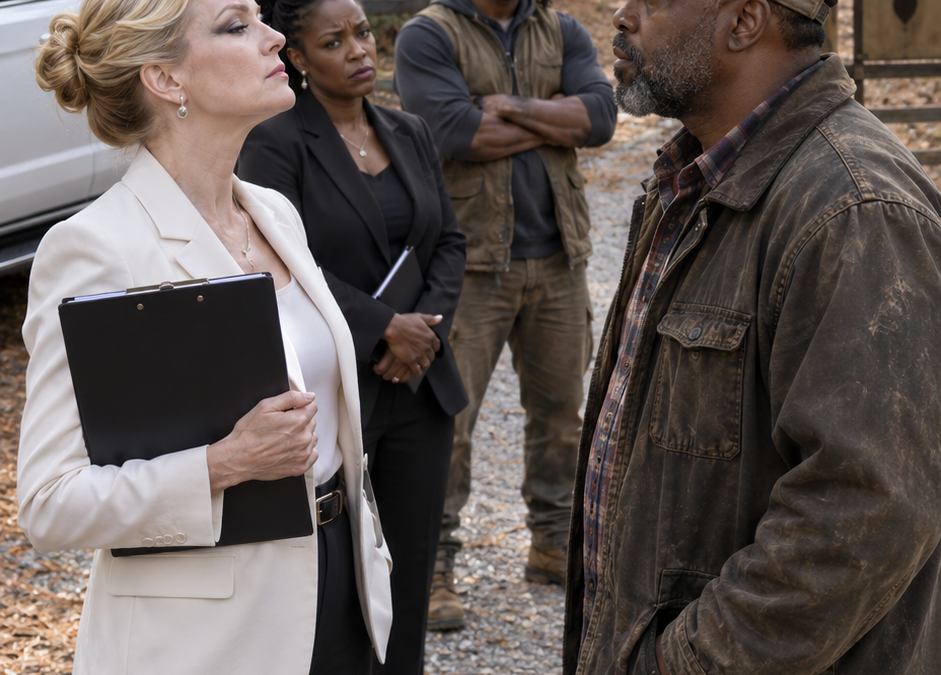
Sandra Voss stood at the edge of the timber with a clipboard tucked against her side and a laminated Ridgecrest Pines HOA badge clipped neatly to her blazer.
“This is an HOA-governed community,” she continued. “Those trails fall under our jurisdiction. You have thirty days to remove your posted signs, or the association will pursue enforcement action.”
She delivered every word evenly.
Rehearsed.
Certain.
She leaned slightly forward when she reached enforcement action, as though expecting the phrase itself to settle the matter.
I let her finish.
The October air smelled of pine resin, damp clay, and the first frost lifting out of the low ground.
Behind me, 2,200 acres of managed longleaf and loblolly pine rolled over ridges and down into creek bottoms.
Old logging roads disappeared beneath decades of needles.
A red-tailed hawk crossed the ridge.
Somewhere farther down the drainage, water moved over stone.
I had spent enough years reading property lines to know exactly where Sandra was standing.
She apparently had not.
I looked beyond her toward the white SUV parked on my access road.
Then I looked back at her.
“What makes these trails HOA property?”
Her answer came immediately.
“They’re designated community recreational corridors.”
“Designated where?”
“In the association records.”
“That’s not what I asked.”
A faint crease appeared between her eyebrows.
I kept my voice level.
“What recorded instrument gives Ridgecrest Pines a property interest in this land?”
She shifted the clipboard.
“The trails have been used by residents for years.”
“That still isn’t what I asked.”
For the first time, the rhythm of her delivery broke.
Only slightly.
Sandra recovered quickly.
“Our governing documents are very clear.”
“I’ll look into it.”
She studied me, perhaps expecting an argument.
I gave her none.
Then she handed me a business card.
SANDRA VOSS
BOARD PRESIDENT
RIDGECREST PINES HOMEOWNERS ASSOCIATION
Heavy cream stock.
Embossed green logo.
I slipped it into my jacket pocket.
“Thirty days, Mr. Pruitt.”
“I heard you.”
She returned to her SUV and drove back down the gravel road.
I stood there until the vehicle disappeared around the first bend.
Then I turned toward the trees.
The forest was exactly as it had been five minutes earlier.
Same ridgeline.
Same creek.
Same trail.
Same boundary.
That was something land taught you if you stayed around it long enough.
People arrived carrying documents, titles, opinions, demands, deadlines, and confidence.
The land did not respond to any of them.
It simply remained where the record said it was.
My name is Calvin Pruitt.
By the morning Sandra Voss confronted me, I had spent thirty-one years working as a timber surveyor and managing the Pruitt tract.
Before those thirty-one years, I spent another eight learning from my grandfather, Elias Pruitt.
He had learned from his father.
Property lines had been part of my life before I was old enough to understand why men sometimes fought over them.
I could read a metes-and-bounds description the way another person reads road directions.
Bearings.
Distances.
Corners.
Adjoiners.
Monuments.
Pins.
Creeks.
Ridges.
I knew where the Pruitt tract began.
I knew where Ridgecrest Pines ended.
And the trail Sandra had just claimed was not inside her subdivision.
Not by a few feet.
Not by some surveyor’s margin of error.
It ran deep into my property.
So after she left, I did not call the HOA.
I did not pull down my signs.
I went home.
Opened the fireproof box in my study.
Removed the deed.
And sat at the kitchen table with a cup of coffee.
The legal description was exactly what I remembered.
Every call.
Every bearing.
Every boundary.
The title was clean.
The question was not whether I owned the land.
The question was how Ridgecrest Pines had convinced itself that I did not.
That answer began decades before Sandra Voss ever held a clipboard.
My grandfather, Elias Pruitt, acquired the first eight hundred acres in 1941.
He bought them from the Harlan County Timber Cooperative after saving for eleven years.
Every dollar mattered.
Elias logged throughout Tennessee, North Carolina, Kentucky, and Virginia. He spent more nights sleeping in a truck or bunkhouse than he ever admitted to my grandmother.
He was not romantic about land.
That is important.
People sometimes look at old family acreage and imagine that the men who acquired it must have been dreamers.
Elias was not.
He understood soil.
Timber.
Water.
Slope.
Access.
Markets.
Regrowth.
He knew precisely what productive pine ground was worth and precisely how quickly a careless man could destroy it.
He had watched loggers clear acreage, collect one large check, and spend the following thirty years working on somebody else’s property.
Elias wanted something different.
He wanted a forest that would still be producing after he was dead.
His first timber harvest on the tract came in the winter of 1943.
He cut with two hired men and a mule named Cora.
Then he replanted.
That part mattered more to him than the cutting.
I still have his records.
Composition notebooks stacked inside a cedar chest.
Each page filled with pencil.
Dates.
Species.
Board feet.
Weather conditions.
Planting rates.
Names of workers.
Locations of cuts.
He did not write poetry in those books.
But if you understand forestry, they are beautiful.
They show restraint.
He never harvested a stand simply because he could.
He left trees along creek banks.
Maintained wildlife cover.
Protected steep slopes.
And preserved several groups of old-growth loblolly because, as he once told me, “Some trees deserve to finish what they started.”
My father, Robert Pruitt, expanded the property.
In 1969, he bought six hundred adjoining acres from the Alderman family after their patriarch died and none of the children wanted to continue farming.
Then came the acquisition that eventually became central to everything Sandra Voss and I fought about.
In 1984, a developer purchased acreage along the eastern ridge intending to build a recreational community.
The project failed.
Financing collapsed.
Contractors walked away.
Robert bought the remaining eight hundred acres.
That brought the Pruitt tract to 2,200 acres.
When my father died, the property passed to me through his estate in 2003.
Probate took fourteen months.
At the end of it, my title was clean.
No competing ownership claim.
No subdivision covenant.
No HOA declaration.
No recreational easement running permanently with the land.
Just 2,200 acres of working forest under one recorded ownership.
I knew the place intimately.
The northern drainage filled quickly after heavy rain.
The southern ridge dried sooner in spring.
Deer moved through two predictable creek corridors in November.
Turkey nested near the younger stands.
An old logging road curved beneath the northeast ridge, crossed a shallow creek, and continued toward what would later become Ridgecrest Pines.
That road eventually formed part of the hunting and hiking trail Sandra claimed belonged to her association.
But Ridgecrest Pines itself began separately.
Its development sat on roughly 340 acres west of my forest.
The property had once been part of a failed equestrian resort.
In the late 1990s, a developer named Gareth Fossie purchased it and divided it into forty-seven residential lots.
Cabins came first.
Then larger permanent homes.
Common areas.
Paved roads.
A small clubhouse.
In 2001, Fossie organized the Ridgecrest Pines Homeowners Association to maintain the development after lot sales were substantially complete.
The recorded declaration covered those 340 acres.
Nothing in it annexed my land.
Nothing in it claimed my forest.
The plat boundary was clear.
The CC&Rs were clear.
Ridgecrest Pines ended where the Pruitt tract began.
But there had once been a relationship between the two properties.
That became important.
In 2001, while my father was still alive, Gareth Fossie approached him about recreational access.
Residents wanted additional hiking and seasonal hunting space.
Dad was willing to accommodate them.
But he understood the distinction between permission and ownership.
His attorney prepared a license agreement.
Not an easement.
Not a deed.
A license.
The document allowed Ridgecrest Pines residents to use a specific network of marked trails covering roughly 180 acres along the portion of the Pruitt tract closest to the subdivision.
The HOA paid an annual fee.
The agreement lasted five years and could be renewed only through mutual written consent.
Both parties had to sign the renewal.
And Section 3 contained language that would eventually become the most important part of that old document.
The license granted a personal privilege of access only.
It conveyed no easement.
No ownership interest.
No estate in land.
No permanent property right.
If it expired without written renewal, the access privilege ended automatically.
My father renewed the arrangement twice during his lifetime.
After he died, I did not renew it.
Nobody from Ridgecrest Pines formally asked me to.
I had begun reorganizing my own hunting leases, and I wanted greater control over the property.
The license expired.
What I did not do was immediately barricade every trail.
That proved to be my mistake.
Not a legal mistake.
A practical one.
Residents continued walking there.
Some hunted.
I knew about occasional use.
For a while, I tolerated it.
Most were respectful.
Nobody caused enough trouble to make closing everything urgent.
But tolerance is not title.
Silence is not an easement.
And an expired license does not become permanent because nobody puts a chain across a trail the next morning.
Years passed.
Then I began tightening access.
Trespassing elsewhere on the tract had increased.
People were leaving trash.
I had found two unauthorized tree stands.
During one turkey season, somebody fired across a drainage where I had contractors working farther down the ridge.
That ended my patience.
The following spring, I installed signs.
PRIVATE PROPERTY
SEASONAL ACCESS RESTRICTED
WRITTEN PERMISSION REQUIRED
I placed them well inside my boundary, including along the old licensed trail network.
That was when Sandra Voss noticed.
Three days after confronting me, she sent the first certified letter.
It was addressed:
CALVIN PRUITT
ADJACENT PROPERTY OWNER
That phrasing interested me.
Not member.
Not lot owner.
Adjacent property owner.
Even their own letterhead acknowledged I lived outside the association.
The letter cited Article 6, Section 4 of the Ridgecrest Pines CC&Rs.
It claimed my signs unlawfully restricted access to “established recreational amenities and community corridors.”
Then came the financial portion.
Compliance fee: $375.
Administrative processing charge: $85.
Total: $460.
I stared at that number.
Then at the deed beside it.
There is something almost impressive about receiving an HOA fine when you have never belonged to the HOA.
I read the entire letter twice.
Then I opened a manila folder.
On the tab I wrote:
RIDGECREST PINES — ACCESS DISPUTE
The letter went inside.
I did not send payment.
I did not call Sandra.
Twelve days later, another certified envelope arrived.
The second letter was more aggressive.
It warned that Ridgecrest Pines could seek injunctive relief if I continued obstructing what it called a “designated community greenway.”
Those three words caught my attention.
Designated community greenway.
That was finally specific.
And specific claims can be checked.
I went to my computer.
Opened the Harlan County GIS system.
Pulled the recorded Ridgecrest Pines subdivision plat.
Then I read it slowly.
Forty-seven residential lots.
Two common-area parcels totaling approximately twelve acres.
Stormwater easement.
Utility corridor.
Road rights-of-way.
No greenway extending into the Pruitt tract.
No hunting corridor.
No recreational easement.
No trail dedication beyond the subdivision boundary.
I enlarged the northern section.
The plat ended exactly where my deed said it ended.
I printed the page.
Then I placed it inside the folder with Sandra’s letters.
That evening, I wrote one word inside the front cover.
Proceed.
The following Monday, I called Ruth Callahan.
Ruth practiced property law in Knoxville.
Three timber operators I trusted had used her in boundary disputes.
All three described her the same way.
Slow until she isn’t.
That made sense after I met her.
Ruth did not rush because she did not like rebuilding arguments after discovering she had missed something.
She gathered facts until the legal answer had nowhere left to hide.
I brought her everything.
My deed.
The Ridgecrest plat.
Sandra’s letters.
The CC&Rs.
And the old 2001 recreational license I found beneath my father’s property files.
Ruth spent nearly forty minutes reading.
She did not ask many questions.
When she reached Section 3 of the license agreement, she read it twice.
Then she pulled the county records herself.
Finally, she removed her glasses.
“They don’t have a recorded interest in your land.”
“That’s what I thought.”
“The 2001 agreement is a license. It expressly says it is not an easement.”
“Yes.”
“It required written renewal.”
“Yes.”
“You didn’t renew it?”
“No.”
“Then it expired.”
She turned toward the subdivision plat.
“And this doesn’t show the greenway they’re claiming.”
“No.”
Ruth leaned back.
“So we have an HOA attempting to enforce its private covenants against a nonmember on adjoining land based on a recreational license that expired years ago.”
“That’s my understanding.”
She looked down at the documents again.
“The question is why they think they can.”
I smiled.
“That’s the part I want answered.”
Ruth picked up a legal pad.
She wrote:
CHAIN OF TITLE
Then:
QUIET TITLE
“How patient are you?” she asked.
“I grow trees for a living.”
That earned the faintest smile.
“Good.”
The following week, Ruth ordered a full chain-of-title search on both properties.
For the Pruitt tract, she requested records going back to the original patent.
For Ridgecrest Pines, she wanted every plat, amendment, easement, dedication, declaration, correction, and recorded instrument dating from Gareth Fossie’s first subdivision work.
The search cost $420.
It took eleven business days.
While we waited, I hired Denton Marsh.
Denton was a licensed land surveyor I had known for twenty years.
He had surveyed timber ground in three counties and carried his field notes in black composition books wrapped in clear plastic whenever the weather turned bad.
He came out during the last week of October.
We walked the northern property line together.
The forest floor was thick with pine needles.
Every step made a soft tearing sound.
Denton located the iron pins from the 1984 survey.
Checked cap markings.
Verified bearings.
Measured distances.
Compared the physical monuments against my recorded legal description.
At one creek crossing, he stopped for nearly ten minutes.
Not because anything was wrong.
Because he was careful.
On the second afternoon, we reached the northeast corner near a stand of old loblolly.
The former recreational trail crossed nearby.
Denton took another measurement.
Then another.
Finally, he closed his field book.
“Cal.”
“What?”
“This trail’s on you.”
“How much?”
“For a good quarter mile before anything related to Ridgecrest begins.”
I nodded.
“That’s what I had.”
“There’s no recorded easement monument.”
“No.”
“No dedication marker.”
“No.”
He glanced back toward the trail.
“Somebody’s been walking an expired license and calling it a greenway.”
“That’s about the size of it.”
Denton did not comment further.
That was why I trusted him.
A good surveyor is not paid to feel strongly.
He is paid to be right.
He delivered his preliminary field measurements two days later.
Then the title search came back.
Ruth called me on Thursday afternoon.
“Can you come tomorrow morning?”
“What did you find?”
“I’d rather show you.”
That told me it mattered.
When I entered her conference room the next morning, documents covered most of the table.
The Pruitt chain of title sat in one stack.
The Ridgecrest Pines records sat in another.
Ruth started with mine.
Elias Pruitt.
1969 acquisition.
Robert Pruitt.
1984 acquisition.
Robert Pruitt.
2003 probate transfer.
Calvin Pruitt.
No breaks.
No conveyances out.
No easements giving Ridgecrest permanent access.
No restrictive covenant connecting my property to the subdivision.
“The title is clean,” Ruth said.
Then she slid another document toward me.
“This is where it gets interesting.”
The top of the page read:
REVISED PLAT OF RIDGECREST PINES COMMON AREAS
Recorded 2009.
I had never seen it.
The revision had been commissioned during the tenure of a previous HOA president named Dale Whitfield.
Ruth pointed to Common Area Parcel B.
The original common parcel had been 4.2 acres.
The revised plat pushed its northern description outward.
A notation referenced:
THE NATURAL BOUNDARY OF THE EXISTING TRAIL CORRIDOR AS ESTABLISHED BY COMMUNITY USE.
I read the phrase once.
Then again.
“How far does that move them?”
“Onto your land.”
I looked up.
Ruth tapped the document.
“This is what Sandra is calling the recorded community greenway.”
I felt something inside me become very still.
Not anger.
Clarity.
“Where’s the deed?”
“There isn’t one.”
“Easement?”
“No.”
“Conveyance?”
“No.”
“Signature from Dad?”
“No.”
“Mine?”
“No.”
I looked back at the plat.
“So they redrew their common-area boundary across the property line.”
“Yes.”
“With nothing transferring title.”
“Yes.”
“Can they do that?”
“No.”
The answer came so quickly it almost sounded harsh.
Ruth folded her hands.
“A plat can describe land. It can subdivide land owned by the person filing it. It cannot magically convey someone else’s property to the filer.”
“Then this is void.”
“As to your land, yes.”
She pointed to the instrument number.
“The surveyor filed a revision apparently based on existing trail use. But the title record contains no deed, easement, dedication, license extension, or other instrument authorizing the HOA to absorb that corridor.”
I sat back.
Fifteen years.
That document had sat in the county record for fifteen years.
People had looked at it.
Board members had inherited it from previous boards.
Residents had been given trail maps based on it.
Sandra Voss had probably been told that it proved everything she needed to prove.
Yet underneath it all, the ownership record had never changed.
A line had been drawn on paper.
The land had not gone with it.
Ruth watched me.
“You all right?”
“I’m thinking.”
“About?”
“My grandfather.”
She waited.
“He used to tell me a bad cut in timber could take fifty years to grow over.”
Ruth nodded toward the plat.
“This one took fifteen years for somebody to notice.”
I looked back down.
“What do we do?”
“We ask a judge to declare the revision void as to the Pruitt tract and quiet title in your favor.”
“Do it.”
Ruth drafted the petition.
It identified my chain of title.
Attached the original recreational license.
Explained its expiration.
Attached Denton’s survey.
Attached the original Ridgecrest plat.
Then the 2009 revision.
She asked the court to declare that Ridgecrest Pines held no estate, easement, covenant interest, recreational right, or other property interest in the disputed trail corridor.
She also asked the court to declare the 2009 plat revision legally ineffective wherever it purported to include Pruitt property.
The case was filed in Harlan County Circuit Court on November 14.
The HOA received service through its registered property-management company.
Eleven days later, the signed return receipt came back.
I placed a copy in my folder.
By then, the file had become thick.
Sandra’s business card.
Both violation notices.
The $460 fine.
The CC&Rs.
Maps.
Surveys.
License agreement.
Title report.
2009 plat revision.
Court petition.
I had seen files like that before.
They grow slowly.
One confident piece of paper at a time.
The HOA retained an attorney named Philip Garrett.
His first letter defended the association.
He argued that Ridgecrest Pines had enjoyed longstanding recreational use of the corridor.
He argued the 2009 plat revision had been formally recorded.
He argued the quiet-title case lacked merit.
He requested sixty additional days.
Ruth gave him thirty.
“Why not refuse?” I asked.
“Because I want him to read.”
That was Ruth.
“He’ll read the chain.”
“Yes.”
“He’ll see the missing conveyance.”
“Yes.”
“And then?”
“Then we find out whether he’s a lawyer or a spokesman.”
Thirty days passed.
Then nearly another two weeks.
I continued working.
Trees do not care about litigation.
A thinning operation was scheduled on the southern tract.
A culvert washed out after three days of rain.
I inspected deer damage in a young stand.
The forest demanded attention whether someone was trying to claim part of it or not.
But I walked the disputed trail often.
I thought about my father opening it to Ridgecrest residents in 2001.
He had probably believed he was being a good neighbor.
I think he was.
The agreement was clear.
The fee was modest.
Residents received access.
Dad retained ownership.
Everybody understood the arrangement.
At least they did then.
The problem came later.
People who were not present when permission was granted inherited the benefit without inheriting the memory that it had been permission.
That happens more often than most people realize.
A favor becomes a routine.
A routine becomes an expectation.
An expectation becomes a belief.
Then, one day, somebody writes the belief onto an official map.
Years pass.
And the next generation assumes the map created the truth instead of merely recording somebody’s mistake.
Six weeks after Garrett’s first letter, he called Ruth.
He wanted a meeting.
When she told me, I asked one question.
“Sandra coming?”
“No.”
That interested me.
The meeting took place in mid-January.
Philip Garrett arrived alone.
Mid-fifties.
Dark suit.
Leather portfolio with worn corners.
He shook my hand.
“Mr. Pruitt.”
“Mr. Garrett.”
He sat across from Ruth and me.
Then he opened his portfolio.
Three documents came out.
The title report.
Denton’s survey.
The 2009 plat revision.
Yellow highlighting covered several sections.
He had read.
Garrett placed one hand over the papers.
“Mr. Pruitt, I want to be straightforward with you.”
“All right.”
“I’ve now reviewed the complete instrument history.”
He glanced at Ruth.
“I do not have a title argument.”
Nobody spoke.
Garrett continued.
“The 2009 plat revision was recorded, but there is no underlying conveyance supporting the northern expansion of Common Area Parcel B.”
Ruth said nothing.
“The recreational license granted in 2001 expired under its own terms. I found no written renewal following Mr. Robert Pruitt’s death.”
“That’s correct,” I said.
“There is also no easement of record.”
“Correct.”
Garrett nodded.
“My client has been operating under an understanding of the property that the public record does not support.”
That was the first sentence anybody representing Ridgecrest Pines had spoken to me that treated ownership as a fact instead of an inconvenience.
“I appreciate you saying that,” I said.
Garrett exhaled slowly.
“I have recommended that the board not continue contesting your quiet-title petition.”
Ruth opened her legal pad.
Garrett noticed.
“I’m authorized to discuss a consent judgment.”
The negotiation lasted less than two hours.
There was not much left to negotiate.
The facts had already done most of the work.
Ridgecrest Pines would consent to judgment declaring me the sole owner of the disputed corridor.
The HOA would acknowledge that the trail network lay outside the subdivision boundary.
All compliance demands against me would be withdrawn.
The $460 assessment would disappear.
The HOA would no longer represent the trails as a Ridgecrest Pines community amenity unless I entered into a future written access agreement.
Most importantly, the 2009 plat revision would be judicially voided as to the Pruitt tract.
A certified copy of the judgment would be recorded with the Harlan County Register of Deeds.
The county record would contain a permanent notation explaining that the plat revision created no interest in my property.
Ridgecrest would also pay Ruth’s legal fees through entry of judgment.
$4,840.
Ruth had asserted additional claims that could have exposed the association to further damages and attorney fees if we established bad-faith interference with my property rights.
I agreed not to pursue them.
Garrett looked surprised.
“You’re comfortable resolving it on those terms?”
“I want the record fixed.”
“That’s all?”
“That’s enough.”
Because it was.
I did not need Sandra Voss punished.
I did not need homeowners assessed extra dues.
I did not want to spend another year proving something Garrett had already admitted.
I wanted my title clear.
I wanted the false plat corrected.
I wanted Ridgecrest Pines to stop claiming authority over land it did not own.
Nothing else improved the forest.
Garrett signed the proposed consent documents on behalf of the HOA.
Ruth finalized them.
On January 22, Harlan County Circuit Court entered the order.
I read it at my kitchen table.
The same place I had read Sandra’s original demand.
The court confirmed my ownership of the disputed trail corridor.
It declared that Ridgecrest Pines held no recorded easement, ownership interest, or continuing recreational license over the land.
And it declared the portion of the 2009 revision purporting to extend Ridgecrest Pines Common Area Parcel B onto the Pruitt tract legally void.
Eleven days later, the county recorded the annotation.
The language was dry.
Almost painfully so.
JUDICIALLY VOIDED AS TO THE PRUITT TRACT.
HARLAN COUNTY CIRCUIT COURT.
CASE NO. 24-CV-0118.
INSTRUMENT OF NO LEGAL EFFECT AS TO ADJOINING LANDOWNER.
I read it twice.
Then I put the certified copy beside my grandfather’s deed.
There are victories that make noise.
That one made none.
No jury.
No dramatic cross-examination.
No television cameras.
No Sandra Voss staring at a judge while her argument collapsed.
Just a corrected county record.
And to me, that was better.
A month later, I heard Sandra resigned from the Ridgecrest Pines board.
The news came through Harlan Teague.
Harlan owned forty acres south of me and considered county gossip a form of public service.
He arrived one Saturday morning carrying a thermos.
“Thought you’d want to know.”
I was sharpening a chain.
“Usually when you say that, I don’t.”
“Sandra’s out.”
I stopped filing.
“Out?”
“Resigned.”
I waited.
“Two other board members aren’t running again.”
“That so?”
“Property-management company’s gone too.”
I set the file down.
“They replace them?”
“Already did.”
“With who?”
“New board president’s Frank Amos. Retired civil engineer.”
I knew the name vaguely.
“What’s Frank doing?”
Harlan smiled.
“First thing he did was hire another lawyer and order a review of every property instrument the HOA’s filed since 2001.”
“That sounds sensible.”
“That’s exactly what I said.”
Harlan poured coffee into the lid of his thermos.
“You going to reopen those trails?”
“No.”
“Never?”
“I didn’t say that.”
He looked at me.
“I said if Ridgecrest wants access, they can ask.”
He laughed.
“There’s a novel idea.”
That was the part of the dispute some people misunderstood.
I was not angry that Ridgecrest residents liked the forest.
I understood why they did.
The creek bottom was beautiful.
The hunting was good.
The ridge trail offered a view across half the county when the leaves dropped.
My father had allowed access because he wanted neighboring families to enjoy the land under controlled conditions.
I might eventually have done the same.
But permission only has meaning if refusal remains possible.
Otherwise it is not permission.
It is surrender.
I walked the northern boundary later that afternoon.
Winter had settled hard into the low ground.
Thin ice edged the creek.
The loblolly pines stood dark against a pale sky.
The trail curved exactly where it always had.
Nothing about it looked disputed.
That was one of the strange things about property fights.
The land often appears completely indifferent to them.
Humans spend months writing letters about a boundary.
The boundary continues running beneath leaves and snow exactly where it ran before the first envelope was mailed.
I reached one of my posted signs.
PRIVATE PROPERTY.
The metal was cold beneath my glove.
Sandra had ordered me to remove that sign.
She had given me thirty days.
Months later, it was still there.
Not because I had defied authority.
Because she had never possessed the authority she claimed.
There is an important distinction.
I continued toward the northeast corner.
The old iron pin protruded several inches above the soil.
Denton had tied fresh flagging around a nearby branch during his survey.
Orange tape moved slightly in the wind.
I crouched and brushed pine needles away from the marker.
That pin had been there before Ridgecrest Pines existed.
Before Sandra Voss was president.
Before anyone filed the 2009 plat revision.
It had sat silently through all of it.
A quarter inch of steel saying the same thing year after year.
Here.
The line is here.
My grandfather understood that kind of permanence.
Elias did not believe paper was more important than land.
He believed paper was how people protected land from other people’s memories.
That distinction took me most of my life to understand.
Memory changes.
Stories change.
People tell themselves things.
Someone says, “We’ve always used that road.”
Then somebody else says, “I thought the HOA owned it.”
Ten years later, a new board member says, “It’s a community trail.”
Then someone draws it on a map.
Eventually the assumption acquires formatting.
Letterhead.
A logo.
A plat revision.
A compliance department.
That is when mistakes become dangerous.
Not when someone misunderstands.
When the misunderstanding becomes institutional.
Sandra had probably never sat down intending to steal a piece of my forest.
I believe that.
She inherited a map.
She saw residents using trails.
She saw a recorded plat revision.
She assumed everything had been legally handled years earlier.
Then she made her mistake.
She stopped checking.
She treated inherited certainty as evidence.
When my signs contradicted what she believed, she did not ask whether the association might be wrong.
She concluded that I was violating her rules.
Then she fined me.
Then she threatened court action.
That is what authority can do to otherwise reasonable people when they stop asking where their jurisdiction ends.
The irony was that the answer had been available the entire time.
Harlan County Register of Deeds.
Public record.
Anyone could have looked.
The 2001 license was there.
The lack of renewal was there.
My deed was there.
The chain of title was there.
The missing conveyance behind the 2009 plat was there.
Nothing had been hidden.
No conspiracy.
No secret document.
The truth was boring.
That is usually a good sign.
By March, Frank Amos contacted me.
Not through a threatening letter.
He called.
“Mr. Pruitt?”
“Speaking.”
“This is Frank Amos with Ridgecrest Pines.”
“I know who you are.”
“I wanted to introduce myself.”
“All right.”
He paused.
“I’ve reviewed the judgment.”
“Good.”
“And the original access agreement your father had with Mr. Fossie.”
“Good.”
“I’d like to apologize on behalf of the association.”
That caught me off guard.
“You don’t need to apologize for people who aren’t you.”
“I’m president now. I’m responsible for what the association does while I’m here.”
I respected that answer.
Frank continued.
“We’re reviewing every external-access representation in our community materials.”
“That sounds wise.”
“We’ve removed the Pruitt trails from the current amenity map.”
“Thank you.”
Another pause.
“Some residents have asked whether a legitimate access agreement could ever be discussed.”
There it was.
The same basic question my father had answered in 2001.
But this time they were asking it correctly.
“I’m willing to talk.”
Frank sounded surprised.
“You are?”
“Yes.”
“After all this?”
“Frank, the problem was never people walking in the forest.”
He waited.
“The problem was being told I didn’t own the forest.”
“I understand.”
We met two weeks later.
No clipboard.
No fines.
No assertion of jurisdiction.
Frank brought the HOA’s new attorney.
I brought Ruth.
We did not recreate the old license immediately.
There were practical issues.
Insurance.
Hunting seasons.
Access limits.
Liability.
Trail maintenance.
Guest rules.
No motor vehicles.
No permanent structures.
No commercial events.
No representation that the property was owned by the HOA.
And, above all else, automatic expiration unless both parties renewed in writing.
Ruth smiled when that clause came up.
“We have some history with that one.”
Frank nodded.
“I’ve read it.”
Eventually, I agreed to a limited one-year recreational license covering only hiking outside hunting season.
No hunting rights.
That mattered to me.
My hunting leases were managed separately.
Ridgecrest accepted the distinction.
The association paid an annual fee.
Small enough that the money did not matter.
Large enough that nobody could ever pretend the access was accidental or ownerless.
The agreement was written.
Signed.
Dated.
Recorded as a memorandum referencing the underlying license.
Everyone understood what it was.
Permission.
Not ownership.
That spring, I walked the trail after the first Ridgecrest residents were allowed back in.
A father and his teenage daughter passed me near the creek.
They stopped.
“Mr. Pruitt?”
“Yes?”
The father looked slightly uncomfortable.
“We appreciate you letting us use the trail again.”
“You’re welcome.”
His daughter pointed toward the ridge.
“Does it go all the way to the overlook?”
“Yes.”
“Can we go that far?”
“Stay on the marked route and you can.”
She smiled.
“Thank you.”
They continued uphill.
I watched them disappear between the pines.
For a moment I thought about Dad.
Robert would have liked that.
He had never treated ownership as an excuse to isolate himself from everyone around him.
But he also never confused generosity with surrender.
The difference was documentation.
That was the lesson running through three generations of my family.
Elias documented harvests.
Robert documented purchases.
I documented boundaries.
Not because paperwork was sacred.
Because memory was unreliable.
Years later, someone always asks:
What did we agree to?
Where does the line run?
Who owns this road?
When does this license expire?
Was that permission permanent?
The answer should not depend on who tells the best story.
It should be in the record.
The Ridgecrest dispute never reached the dramatic courtroom battle Sandra’s letters had threatened.
In the end, it did not need to.
Once both sides looked at the same documents, there was very little left to argue about.
That might sound less satisfying than a judge pounding a gavel and humiliating an HOA board.
It was more satisfying to me.
Because my goal was never humiliation.
It was certainty.
The 2009 plat revision had been sitting in public records for fifteen years telling a false story about my northern boundary.
Now the same public record corrected it permanently.
Anyone performing a title examination in the future would see the annotation.
Any future Ridgecrest president would see it.
Any buyer.
Surveyor.
Attorney.
Developer.
Bank.
Title company.
The mistake would no longer be inherited as truth.
That mattered more than an angry speech ever could.
I still keep Sandra’s original compliance notice.
It is in the same folder.
The $375 compliance fee.
The $85 administrative charge.
The demand that I remove my posted signs within thirty days.
Sometimes I take it out when I am organizing property records.
Not because I enjoy remembering the dispute.
Because the letter reminds me how convincing an unsupported claim can look when it is formatted properly.
HOA letterhead.
Article number.
Deadline.
Fine schedule.
Signature.
Everything about it looked official.
Everything except jurisdiction.
That is the piece people forget to examine.
An organization can have real authority and still make a claim outside that authority.
Ridgecrest Pines was a legitimate homeowners association.
Its CC&Rs were enforceable against its members and lots.
Its board could collect dues.
Maintain common areas.
Adopt rules authorized by its governing documents.
None of that gave it power over my forest.
Authority is not contagious.
It does not spread across a property line because the association finds the neighboring land useful.
A board vote cannot create an easement.
A plat cannot transfer a stranger’s title merely because somebody draws the line farther north.
Longstanding use cannot automatically convert permission into ownership.
And a trail does not become communal because enough people become accustomed to walking it.
Every property right has a source.
Find the source.
That is what Ruth taught me to ask.
Not:
What do they claim?
But:
What instrument creates the right they claim?
Those are very different questions.
Sandra gave me bylaws.
Ruth asked for a conveyance.
Sandra gave me a community map.
Ruth asked for a deed.
Sandra gave me history of use.
Ruth asked whether the license had been renewed.
Sandra pointed to the 2009 plat.
Ruth asked what legal instrument authorized that plat to move a boundary.
Every time, the question became narrower.
Eventually there was nowhere for the claim to stand.
I walked the ridge again the following October.
Almost one year after Sandra first confronted me.
The air had the same cold edge.
Pine resin.
Clay.
Frost leaving the soil.
The new recreational license had worked well.
No trouble.
No unauthorized hunting.
No vehicles.
No trash.
Ridgecrest residents followed the marked route.
When hunting season began, access closed automatically under the agreement.
Nobody argued.
Frank Amos sent a reminder to residents himself.
A simple email:
TRAIL ACCESS CLOSED FOR SEASONAL FORESTRY AND HUNTING MANAGEMENT PURSUANT TO THE PRUITT RECREATIONAL LICENSE.
Pursuant to the Pruitt recreational license.
I liked those words.
Not because they emphasized my name.
Because they acknowledged the source of the right.
Permission existed because an owner had granted it.
The relationship was finally honest.
I reached the old loblolly stand near the northeastern corner.
Some of those trees had been standing when Elias purchased his first eight hundred acres.
My grandfather refused to cut them.
My father refused too.
So had I.
One day, someone after me would decide what happened to them.
That was the humbling part of owning land.
You never really possess it in the sense people imagine.
You hold responsibility for a period of time.
Elias held it.
Robert held it.
Now I did.
My job was to leave the record clean enough that whoever came next would know exactly what had been handed to them.
No mystery easements.
No false plat lines.
No inherited assumptions.
I rested one hand against the bark of the largest loblolly.
The trunk was broad enough that I could not have wrapped both arms around it.
Wind moved through the crown.
Granddad once told me pine trees held evening light longer than the sky.
When I was young, I thought he was simply saying something old men say when they want children to look up from their work.
Now I understood.
The upper branches caught the last amber light while the ground beneath me had already turned gray.
For several minutes, I stood there.
No lawyers.
No HOA presidents.
No court filings.
Just trees.
Then I followed the boundary home.
The survey pins were still where they belonged.
My signs were still standing.
The creek still curved beneath the trail.
Nothing about the forest had changed because Sandra Voss once told me I had thirty days to surrender control of it.
But something in the record had changed.
A false claim had been corrected.
And that was enough.
When my grandfather bought his first eight hundred acres in 1941, he believed that land held carefully could survive almost anything people did around it.
Markets.
Developers.
Arguments.
Bad timber prices.
Good timber prices.
Wars.
Recessions.
Family deaths.
New roads.
New neighbors.
He was mostly right.
But land does not protect itself from paperwork.
People must do that.
You keep the deed.
You record the survey.
You understand every easement.
You document every license.
You check every plat filed near your boundary.
And when someone tells you with absolute confidence that their organization owns a right over your property, you do not begin by arguing louder.
You ask them to show you the instrument.
That was what ended the Ridgecrest Pines dispute.
Not anger.
Not threats.
Not a more impressive title.
A simple question.
Where is the document that gives you the right you claim?
They never had one.
They had an expired license.
A mistaken plat.
Fifteen years of assumption.
And a president who believed those things added up to ownership.
They did not.
The forest knew that.
The deed knew that.
The iron pins knew that.
Eventually, the county record said it clearly enough that everyone else had to know it too.
And in the end, those hunting trails remained exactly what they had always been.
Mine to close.
Mine to protect.
And, when I chose, mine to share.








