𝗙𝗨𝗟𝗟 𝗦𝗧𝗢𝗥𝗬 The HOA Called the Cops to Throw Me Out of My Own House—So I Let Their President Lie on Camera
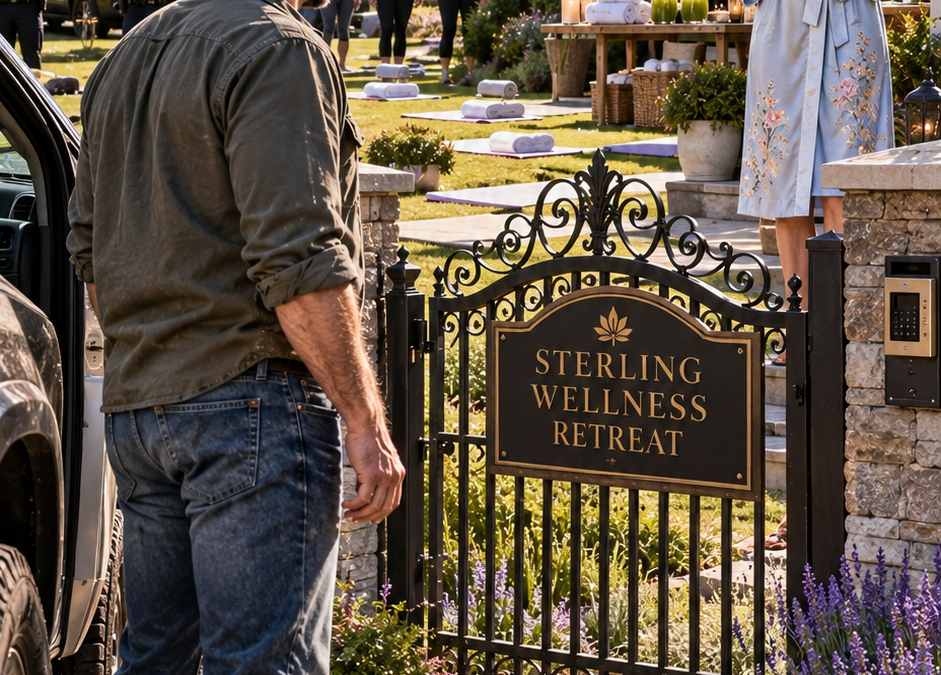
PART2
The cruiser stopped behind my truck.
A young deputy stepped out.
Late twenties.
Calm posture.
Body camera active.
His name tag read REYES.
He looked first at me, then at Victoria, then at roughly thirty strangers doing yoga on my front lawn.
His eyebrows moved slightly.
It was the expression of a man who had expected a trespassing complaint and instead discovered a luxury wellness convention.
“Afternoon,” he said. “What’s going on?”
Victoria moved quickly.
“Deputy, thank goodness.”
That alone told me a lot.
Normal people do not usually say “thank goodness” when law enforcement arrives unless they’ve already assigned the officer a role in their story.
She stepped down from the porch.
“This man drove through the community gate, entered our retreat property, and began claiming the property belongs to him.”
“I didn’t begin claiming anything,” I said. “It belongs to me.”
Victoria ignored me.
“We acquired this estate three weeks ago under the Whispering Pines community preservation and abandonment process. I have the lease right here.”
She lifted her clipboard.
“I’d like him removed.”
Reyes looked at me.
“Sir, identification?”
I handed him my driver’s license.
He read it.
“Marcus Vance?”
“Yes.”
“Address?”
I pointed toward the house.
“That one.”
Victoria laughed again.
“He’s trying to create a residency claim.”
Reyes looked at her.
“What?”
“He has apparently been mailing himself documents to this address.”
I turned my head slowly toward her.
That was new.
Interesting.
Victoria kept going.
“He has been absent for over a year. The property was abandoned, the association lawfully intervened, and the owner’s estate executed a lease.”
“I am the owner.”
“No,” she said sharply. “The Vance estate owns it.”
I almost smiled.
That was mistake number one.
There was no “Vance estate.”
My property was held in the Vance Family Trust.
I was the sole trustee.
But I didn’t correct her yet.
Reyes held out his hand toward the clipboard.
“Can I see your paperwork?”
“Of course.”
She gave it to him triumphantly.
He read the first page.
Then the second.
His face gave away nothing.
“What name signed this?”
“Donald Vance.”
I looked at Victoria.
There had never been a Donald Vance in my immediate family.
Not my father.
Not my grandfather.
Not an uncle.
Nobody.
Reyes looked at me.
“Do you know Donald Vance?”
“No.”
Victoria crossed her arms.
“Convenient.”
I nodded.
“Very.”
Reyes checked the notary stamp.
Then my license.
“Mr. Vance, she has a notarized lease. I don’t have access out here to enough title records to determine who has the superior civil claim.”
“Understood.”
Victoria smiled.
Reyes continued.
“If she currently has possession and documentation, I can’t resolve title ownership on a driveway.”
“I understand.”
“So I’m going to ask you to leave for tonight and address it through the court.”
Victoria’s smile widened.
There it was.
The victory she had expected.
She had a clipboard.
The deputy had told me to leave.
Therefore, in Victoria’s mind, the universe had once again recognized its natural hierarchy.
She stood a little straighter.
“I want it documented that he was warned,” she said.
Reyes gave her a brief look.
“I’ll document the call.”
“And if he returns?”
“That depends on the circumstances.”
“I want him trespassed.”
I looked at Reyes.
“Deputy, I’d like three things included in your report.”
Victoria made an irritated sound.
Reyes nodded.
“Go ahead.”
“First, I am leaving voluntarily under protest because you’ve asked me to leave while ownership is verified.”
“All right.”
“Second, I am stating on camera that the lease Mrs. Sterling presented is fraudulent.”
Victoria rolled her eyes.
“Third, I want it recorded that Mrs. Sterling is asserting, on behalf of Whispering Pines HOA, legal jurisdiction and possessory rights over my entire parcel.”
Reyes looked at Victoria.
“Ma’am?”
She shrugged.
“Of course we are.”
“Entire parcel?”
“Yes.”
That was mistake number two.
I nodded.
“Thank you.”
Victoria tapped her pen against the clipboard.
“Log whatever you want, sweetheart. You’ll have a lien on that truck by Friday if you come back here.”
There are moments in life when another person’s arrogance becomes so complete that the most productive thing you can do is simply admire the craftsmanship.
I looked at her.
“You’re threatening to lien my truck?”
“If necessary.”
“Through the HOA?”
“You’re interfering with association property.”
I glanced at Reyes.
He was watching her carefully now.
His body camera was still recording.
“Understood,” I said.
I walked back toward my F-250.
No yelling.
No threats.
No dramatic speech.
That disappointed Victoria.
I could tell.
People like her want anger.
Anger lets them point and say, “See? This is why we had concerns.”
Calm forces them to keep talking.
I put my suitcase into the passenger seat.
Then I looked up at the second floor of my house.
My study light was on.
A man stood near my desk.
He wore a gray polo shirt.
At first, I couldn’t tell what he was doing.
Then he moved sideways.
A small paper shredder sat beside him.
He fed several sheets through it.
I knew those shelves.
My grandfather’s original engineering notebooks were in there.
My late wife’s journals.
Property records.
Old letters.
I felt my jaw tighten.
I turned toward Reyes.
“Deputy.”
He followed my gaze.
“There’s somebody inside my study shredding documents.”
Victoria immediately said, “Those are association records.”
I looked at her.
“They’re in my private office.”
“This is no longer your private office.”
Reyes looked uncomfortable.
“Mr. Vance, please leave tonight. I’ll note everything.”
I nodded.
That was enough.
I got into my truck.
Victoria called after me.
“Don’t come back without your attorney.”
I started the engine.
Then I smiled at her through the open window.
“Victoria, that’s excellent advice.”
Her expression changed.
Only slightly.
But I saw it.
I backed down the driveway.
The new iron gate closed behind me.
For the first mile, I drove in silence.
My phone buzzed.
A text from Maya.
Maya had worked as my paralegal and administrative fixer for nearly nine years whenever my consulting work crossed into land, utility, or regulatory problems.
I’m at my desk. What happened?
I pulled onto the shoulder.
Then I typed:
She took the bait.
Maya called immediately.
“You’re alive?”
“Yes.”
“House intact?”
“Mostly.”
“Mostly?”
“Victoria Sterling is wearing Ellen’s robe and running a wellness retreat from my porch.”
There was silence.
Then Maya said very carefully, “I need you to repeat that.”
I did.
“She called the sheriff?”
“Yes.”
“And the sheriff removed you?”
“Asked me to leave for the night because she produced a notarized lease.”
“Who signed it?”
“Donald Vance.”
Maya laughed once.
Not because it was funny.
Because sometimes fraud is so lazy that the only available emotional response is disbelief.
“There is no Donald Vance.”
“I know.”
“Marcus.”
“Yes?”
“Please tell me you did not argue with her.”
“I left.”
“Good.”
“She also claimed HOA jurisdiction over the entire parcel on body cam.”
Maya went silent.
Then she said, “Oh.”
Exactly.
“Oh.”
My grandfather taught me something when I was twelve.
We had been repairing an irrigation ditch after a storm. I got impatient and started trying to move rocks before we understood where the water was coming from.
He stopped me.
“Don’t fix what you haven’t mapped.”
I never forgot it.
Victoria had just told a uniformed deputy, on video, that Whispering Pines claimed authority over my parcel.
That statement was going to matter.
A lot.
I checked into a Hilton on the south side of town.
The room had two beds, beige walls, and a coffee machine that produced something technically warm enough to qualify as a beverage.
I hung up my jacket.
Opened my laptop.
And began mapping.
Whispering Pines had been built in 2009.
Ninety-six luxury homes tucked into the mountain above my land.
Private road.
Clubhouse.
Pool.
Security gate.
The whole package marketed as “exclusive alpine living.”
My grandfather had bought our fifteen acres in 1973.
Thirty-six years before the HOA existed.
Our property sat at the narrow eastern throat of the valley.
The developers had built around us because my grandfather refused to sell.
By the time I inherited the land eleven years earlier, Whispering Pines surrounded us on three sides.
But our parcel was never incorporated.
We paid no dues.
We signed no declarations.
We followed county law.
Not HOA rules.
Victoria hated that.
She had been elected HOA president three years earlier.
Before that, Whispering Pines had been irritating but mostly harmless.
Newsletters about snow removal.
Lost dogs.
Pool hours.
Then Victoria arrived.
Fine revenue tripled.
The newsletters became legalistic little sermons.
Wrong mailbox color?
Fine.
Garbage can visible from the street?
Fine.
Garden sculpture seven inches too tall?
Fine.
A medical transport van in a driveway beyond the permitted window?
Fine.
One retired resident joked that Victoria could spot an unauthorized hydrangea from orbit.
Then he got fined for hydrangeas.
Nobody joked after that.
I had spent fifteen months overseas working on state utility grid modernization projects in Singapore and Dubai.
My deployment had been scheduled for eighteen months.
I returned three months early.
Victoria clearly had not planned for that.
At 12:17 a.m., Maya called.
“I ran Donald Vance.”
“And?”
“He doesn’t exist in any trust record connected to you.”
“Expected.”
“The notary is more interesting.”
“Go.”
“Brenda Higgins. Commission revoked fourteen months ago.”
“For what?”
“Fraudulent title transfers.”
I leaned back.
“Of course.”
“Her stamp should not legally have been used on anything.”
“What about the abandonment filing?”
Keyboard clicking.
“She filed under an emergency community stewardship ordinance from the nineties.”
“That’s for properties in foreclosure or presenting an immediate public hazard.”
“Correct.”
“My taxes are current.”
“I know.”
“My insurance is current.”
“I know.”
“The landscaping contract was active.”
“I have the invoices.”
“So how did she create abandonment?”
Maya sighed.
“She mailed notice to your old consulting office.”
I stared at the screen.
“That office closed four years ago.”
“Exactly.”
“She knew my current address.”
“Obviously.”
“And then claimed no response.”
“Yes.”
I laughed quietly.
“You have to admire the efficiency.”
“No, Marcus.”
“No?”
“No admiration.”
“Fine.”
I opened a new folder on my computer.
“Let’s start with the cameras.”
Three years earlier, several properties in the valley had been burglarized.
Afterward, I installed a redundant surveillance system.
Not the consumer Wi-Fi cameras most people buy at a hardware store.
Mine ran on isolated solar backup with an independent cellular uplink.
If house power died, cameras stayed live.
If internet died, cameras stayed live.
If someone reset the router, cameras stayed live.
Engineering is mostly the art of assuming somebody will eventually do something stupid.
I logged into the archive.
The footage loaded.
Fourteen days earlier.
8:14 a.m.
Victoria’s white SUV entered the frame.
I froze it.
“There she is.”
Maya connected remotely to my screen.
A locksmith van followed.
The locksmith got out.
Victoria handed him papers.
He drilled my smart lock.
Eleven minutes later, the front door opened.
Then Victoria paid him in cash.
I zoomed.
Three hundred and forty dollars.
Maya whistled.
“Save it.”
“Already recording.”
An hour later, a U-Haul arrived.
Victoria’s son, Brent, carried boxes out of my house.
Then framed photographs.
Then clothing.
Then one of Ellen’s cedar storage trunks.
I stopped the footage.
For the first time that night, I had to step away from the desk.
I walked to the hotel window.
Cars moved along the highway below.
I thought about Ellen.
She had died after a long illness.
The worst thing grief does is teach you which objects can suddenly become irreplaceable.
A coffee mug.
A handwritten grocery list.
A scarf.
A robe.
Victoria saw household goods.
I saw the remaining physical evidence of a life.
My anger returned.
Cold again.
Controlled.
I sat back down.
“Keep going.”
At 1:43 p.m., Victoria looked directly at one camera.
Smiled.
Waved.
Then told somebody beside her, “Those are disconnected.”
Maya said, “Please tell me the audio works.”
“It works.”
“Marcus.”
“Yes?”
“I think I love your security system.”
“Get in line.”
Then the man from my study appeared.
I recognized him.
“Pause.”
“What?”
“I know him.”
“Who?”
“Smart-home contractor. He upgraded the HOA clubhouse last year.”
The footage showed him opening my utility control room.
Then connecting equipment to the solar inverter.
Maya frowned.
“What’s he doing?”
“Let’s find out.”
I pulled up the power logs.
My house’s solar production had jumped in a strange pattern during the previous ten days.
Generation remained normal.
House consumption was low.
But export load had increased dramatically.
I traced the destination.
Then I laughed.
“What?”
“The clubhouse.”
“You’re kidding.”
“No.”
My solar array was feeding power to the Whispering Pines clubhouse through an unauthorized connection.
“How much?”
“Enough that their utility bill probably looks miraculous.”
I checked historical statements.
The clubhouse had been running a severe heating and pool-energy deficit for months.
Victoria had not merely occupied my property.
She had tried to convert my home into the centerpiece of her wellness business while siphoning energy from my private generation system.
“You know,” Maya said, “normal HOA presidents organize Christmas-light contests.”
“Victoria has ambition.”
The next morning, I met Henry Ellis at a diner three miles from Whispering Pines.
Henry was seventy-eight, retired Marine Corps, first-wave resident of the subdivision.
He sat in a booth wearing an old service cap.
An accordion folder rested beside him.
“I heard you came back,” he said.
“I did.”
“And Victoria threw you out.”
“Temporarily.”
Henry’s mouth twitched.
“She told people you’re some kind of land speculator.”
“That’s creative.”
“Said you’re trying to seize HOA common property.”
“My property existed before the HOA.”
“I know that.”
I pointed at the folder.
“What do you have?”
Henry slid it across.
“Five years.”
I opened it.
Violation notices.
Fine statements.
Threats.
Letters.
His late wife Margie had once been fined six hundred dollars because a birdbath exceeded the HOA’s approved height.
“Three inches,” Henry said.
I looked at him.
“Three?”
“Three.”
“You measured?”
“Of course I measured. I’m old, not helpless.”
He pushed another notice toward me.
Garden hose left visible.
Two hundred dollars.
Medical transport parked too long.
Four hundred.
Mulch color.
Three hundred.
Mailbox bracket.
Five hundred.
“You paid all of these?”
“Most.”
“Why?”
Henry looked down at his coffee.
“Margie hated conflict.”
His voice softened.
“Victoria knew it.”
That sentence bothered me.
Not because it surprised me.
Because I recognized the method.
Find people who don’t want confrontation.
Pressure them individually.
Make each one believe resistance is more expensive than surrender.
Exactly what they thought they could do to me.
Under the notices were financial summaries.
I scanned them.
Something jumped out.
“What’s Sterling Wellness LLC?”
Henry looked up.
“You noticed fast.”
“Four thousand one hundred dollars a month from the discretionary account.”
“Victoria’s sister-in-law owns it.”
I stared at him.
“Residents approved this?”
“We didn’t know.”
“For what service?”
“Community wellness consulting.”
“What does that mean?”
Henry shrugged.
“Apparently it means moving money.”
I kept reading.
Road maintenance budgets were underfunded.
Pool reserve depleted.
Fine revenue increased while repairs decreased.
Sterling Wellness LLC received steady payments.
Then the idea clicked.
“My house.”
Henry nodded.
“She planned to make it the retreat headquarters.”
“Before the audit.”
“Exactly.”
A real property.
Real event.
Real photographs.
A way to make the wellness contracts look legitimate.
Henry studied me.
“Can you stop her?”
I closed the folder.
“Henry, she’s already stopped herself.”
He frowned.
“She just hasn’t noticed yet.”
For the next forty-eight hours, Maya and I built the file.
County recorder.
Tax assessor.
GIS department.
State utility commission.
Historical subdivision plats.
Developer records.
I wasn’t interested in arguing over personalities.
I wanted the infrastructure.
That is the difference between engineers and bullies.
Bullies care about who sounds powerful.
Engineers care about what is actually carrying the load.
Late Thursday afternoon, I found it.
A 1992 recorded agreement signed by my grandfather, Silas Vance.
The original Whispering Pines developers needed access across the eastern strip of his parcel.
At first, they had operated on an informal arrangement.
My grandfather hated informal arrangements.
So in 1992, he had insisted they reduce everything to writing.
The document was twelve pages.
Typed.
Recorded.
Notarized.
I read paragraph four.
Then I read it again.
The road license was revocable.
It was personal to the original developer.
It did not create a permanent easement.
More importantly, any successor entity asserting adverse ownership, jurisdiction, or control over my grandfather’s parcel automatically terminated the license.
I sat back.
Victoria had publicly claimed HOA jurisdiction over my entire parcel.
She had recorded documents asserting ownership interests.
She had done it on Deputy Reyes’s body camera.
Maya was silent when I read the provision.
Then she said, “You planned that question.”
“Yes.”
“You knew?”
“I suspected.”
“That’s why you asked her to claim the whole parcel.”
“Yes.”
“You are a deeply irritating person.”
“I’ve been told.”
Then came the utility map.
The high-capacity transformer serving all ninety-six Whispering Pines homes and the clubhouse sat along my driveway.
I pulled the GIS coordinates.
Checked the survey.
Checked again.
Forty-two inches inside my boundary.
Not HOA common land.
Mine.
The underlying utility rights were complicated, but the unauthorized interconnection to my private solar system was not.
I called my old regional contact at the utility authority.
By Friday, the commission had enough evidence to issue a temporary safety suspension on the unauthorized cross-feed pending inspection.
That distinction mattered.
I wasn’t going to wander around cutting power to ninety-six homes because I was angry.
I wasn’t Victoria.
The utility authority would isolate the unlawful connection under a documented safety procedure.
The legal road issue would be handled separately.
Paper.
Process.
Records.
Friday afternoon, I returned to the sheriff’s department.
Deputy Reyes met me in an interview room.
A sergeant joined us halfway through.
I placed my laptop on the table.
“Remember when I said the lease was forged?”
Reyes nodded.
I played the footage.
Victoria arriving.
Locksmith drilling.
Cash payment.
U-Haul.
Property being removed.
The man entering my utility room.
Then I showed the notary revocation.
The trust.
The tax records.
The deed.
The false abandonment notice.
Reyes leaned back.
“She told me you were trying to fake residency.”
“I know.”
He looked embarrassed.
“You understand why I asked you to leave.”
“I do.”
“You were unusually calm.”
“I wanted the statement on camera.”
He stared at me.
Then he almost smiled.
“You knew she was going to keep talking.”
“I had confidence in her.”
The sergeant coughed into his fist.
Reyes pointed at the video.
“This isn’t a civil possession dispute anymore.”
“No.”
“Burglary. Forged instrument. False filing.”
“Potential utility theft.”
I showed them the power data.
The sergeant’s expression changed.
“We’ve had complaints about Sterling for two years.”
“From Henry Ellis?”
“Henry. Others. Every time it got tangled in HOA lawyers and contract language.”
I closed the laptop.
“She has a grand opening tomorrow.”
“At your house?”
“At noon.”
The sergeant nodded slowly.
“You want us there.”
“Yes.”
“Why noon?”
“Because Victoria likes audiences.”
Reyes leaned back.
“So do you want her arrested before it starts?”
“No.”
The sergeant smiled.
“When?”
“After she publicly identifies herself as the person controlling the property.”
Reyes shook his head.
“Patient man.”
“Engineer.”
“Difference?”
“We know structures fail faster when people keep adding weight.”
Saturday morning was cold and bright.
Frost clung to the pine needles.
By eleven-thirty, my estate looked like a catalog advertisement for wealthy people trying to rediscover breathing.
White canopy.
Organic fruit.
Smoked salmon.
Green juice.
A harpist.
Forty-three cars.
Luxury SUVs were parked partly across my pasture.
I parked outside the main community gate and walked up an old service path.
Canvas jacket.
Work boots.
My father’s black leather briefcase.
Inside it:
My deed.
The trust.
The recorded road license.
The utility order.
Certified county maps.
At eleven fifty-five, I reached the edge of my property.
Victoria stood near the porch.
Cream blazer.
Pearls.
Champagne.
Her son Brent was filming.
She looked radiant.
People often do just before consequences become visible.
At noon, she walked to a microphone.
“Friends and neighbors…”
Her voice echoed across my lawn.
“Today marks a new chapter for Whispering Pines.”
Applause.
“We are reclaiming neglected spaces…”
I almost laughed.
“…and transforming them into assets that benefit our entire community.”
Henry stood near the front.
He saw me.
Said nothing.
Victoria continued.
“This property represents what happens when strong community leadership refuses to let individual neglect undermine shared values.”
Individual neglect.
I had been working overseas on infrastructure that powered cities.
But apparently I had failed to attend to the emergency lavender needs of Cedar Hollow Mountain.
She raised ceremonial scissors.
“We have secured the property.”
That was useful.
“We have lawful possession.”
Even better.
“And we have established the Sterling Wellness Center as a permanent community resource.”
Perfect.
Behind me, utility technicians were already completing the commission-authorized isolation of the unauthorized solar cross-feed.
At 12:02, the clubhouse interconnection dropped.
My home’s illegally modified feed went dead.
The microphone clicked off.
The speaker produced a single ugly squeal.
Several decorative lights died.
Some remote systems in the clubhouse shifted to backup power.
Victoria tapped the microphone.
Nothing.
“Brent?”
He looked toward the equipment.
“Mom, I don’t know.”
A catering worker checked a plug.
Then I stepped from beside the cedar hedge.
“The breaker isn’t the problem.”
Every head turned.
Victoria saw me.
Her face changed.
“You.”
“Yes.”
“I told you not to return.”
“I remember.”
“This event is private.”
“So is the property.”
She pointed toward the driveway.
“Security!”
Instead, Deputy Reyes emerged from beneath the red pines.
The sergeant walked beside him.
Both wore active body cameras.
Victoria looked relieved.
That was my favorite part.
She actually thought they had come for me.
“Officer,” she said. “Thank God. He’s trespassing again.”
Reyes said nothing.
I walked toward the porch.
Then stopped at the bottom step.
Victoria lifted her clipboard.
“I have a legally recognized lease.”
“No, Victoria.”
I opened my briefcase.
“You have a forged piece of paper signed by a fictional man.”
The crowd began murmuring.
I handed her the certified trust record.
“The Vance Family Trust has one trustee.”
I pointed at my name.
“Me.”
Her eyes moved across the document.
“Donald Vance doesn’t exist.”
“My attorneys—”
“Didn’t prepare your lease.”
“They reviewed—”
“The notary whose stamp appears on it lost her commission fourteen months ago for fraudulent title work.”
Victoria’s face tightened.
“You don’t know what you’re talking about.”
I handed Reyes a duplicate.
He already knew.
But the crowd didn’t.
So I kept going.
“This is the surveillance footage from the morning you entered.”
Brent’s phone lowered.
I looked at him.
“You’re in it too.”
He went pale.
Victoria snapped, “Do not speak to my son.”
“You brought him into my house.”
“You abandoned the property.”
“I was on a documented state utility assignment.”
“The HOA followed procedure.”
“You sent notice to an office closed four years ago.”
Silence.
I pulled out the abandonment filing.
“My taxes were current. Insurance current. Maintenance current. You knew where I was.”
Victoria raised her voice.
“We acted to protect this community.”
“No.”
I held up the financial records Henry had given me.
“You acted to protect Sterling Wellness LLC.”
That landed.
Several residents turned toward one another.
Victoria stared at Henry.
“You gave him confidential association records?”
Henry crossed his arms.
“They came in my mailbox. That’s usually how letters work.”
A few people laughed.
Victoria’s jaw tightened.
I continued.
“More than four thousand dollars a month in HOA funds went to a company owned by your sister-in-law.”
“Consulting.”
“For what?”
“Wellness development.”
“Using my house.”
“We lawfully leased—”
“No.”
I placed the deed on top of her clipboard.
“You burglarized my house.”
Her face went white.
Then I took out the road agreement.
“But the house isn’t your biggest problem.”
People became quiet again.
“This is the recorded 1992 access license granted by my grandfather to the original developer.”
Henry knew what was coming.
Victoria did not.
I read the key language.
Any successor entity asserting ownership, jurisdiction, or adverse interest over the Vance parcel triggered automatic termination of the license.
I looked at Victoria.
“Three nights ago, on Deputy Reyes’s body camera, you asserted that the HOA had jurisdiction over my entire parcel.”
She stared.
“You recorded a false interest against it.”
I tapped the document.
“You triggered the termination provision yourself.”
A woman near the front said, “What does that mean?”
I turned toward the residents.
“It means the HOA does not have a permanent easement over the portion of access road crossing my land.”
Conversation exploded.
Victoria raised both hands.
“Everybody calm down. He cannot lock residents out of their homes.”
“I have no intention of doing that.”
The room—or rather lawn—quieted.
I looked at Henry.
“I will grant the homeowners direct access.”
Then back at Victoria.
“But not through HOA control.”
Her expression hardened.
“You can’t dissolve our rights because of some technicality.”
“Recorded property rights are generally called documents, Victoria. You only call them technicalities when they aren’t yours.”
Someone laughed.
Then another.
I took out the utility map.
“This is also interesting.”
Victoria stared at it.
“The transformer vault supporting the ridge sits forty-two inches inside my parcel.”
She said nothing.
“And somebody connected my private solar system to HOA facilities without authorization.”
Brent looked toward the house.
That was mistake number three.
His reaction was immediate.
Visible.
Reyes noticed.
So did I.
“The state utility authority inspected the data yesterday,” I continued. “The unauthorized cross-feed has been suspended pending investigation.”
Victoria finally lost control.
“You shut off the neighborhood?”
“No.”
I spoke slowly.
“The utility authority isolated an unauthorized connection you installed.”
“You can’t interfere with essential service!”
“I didn’t.”
I pointed toward the technicians down the road.
“They did.”
Her champagne glass shook.
“You’re destroying property values!”
There it was.
The sacred phrase.
Property values.
The incantation people like Victoria used when ordinary words such as fraud, theft, and trespassing became inconvenient.
I looked around.
“My property value seemed to concern you quite a lot when your investment scheme needed a wellness center.”
She threw the champagne glass.
It shattered on the gravel.
“Arrest him!”
Deputy Reyes stepped forward.
Victoria pointed at me.
“Officer, remove this man immediately.”
Reyes climbed the porch steps.
She smiled.
Then he walked past me.
Her smile disappeared.
“Victoria Sterling?”
She blinked.
“Yes?”
“Turn around, please.”
“What?”
“Turn around.”
“What are you doing?”
“You are being placed under arrest pending charges including burglary, forgery related to recorded documents, filing a false report, and unlawful entry.”
The entire lawn went silent.
“No.”
Reyes reached for her wrist.
“No!”
She pulled back.
“This is my property!”
Reyes looked around.
“That’s becoming increasingly unlikely.”
Someone laughed.
Victoria spun toward the crowd.
“This man manipulated you!”
Reyes cuffed one wrist.
“This is retaliation!”
Second wrist.
Click.
The sound was small.
Metallic.
Clean.
For three years, Victoria had sent residents letters threatening liens, hearings, fines, and legal action.
Now the loudest sound on the mountain was a pair of handcuffs closing.
“Brent!” she screamed.
Her son stood frozen.
“Film this!”
He already was.
His hand shook.
Henry stepped toward him.
“Don’t break the phone,” I said.
Henry looked mildly disappointed.
“I wasn’t going to.”
“You were thinking about it.”
“Thinking is still legal.”
Reyes escorted Victoria toward the cruiser.
She twisted around.
“You’ll all regret this! Without me, this neighborhood will collapse!”
Henry called after her.
“We’ll risk it.”
That got the first real cheer.
Two board members who had signed parts of the annexation paperwork were questioned separately. They were not theatrically dragged away as in some television drama, but investigators removed them from the event and began interviewing them regarding their roles.
The crowd stayed.
Nobody knew what to do.
The harpist quietly packed her instrument.
A catering employee began removing trays.
One man still held a green juice as though uncertain whether it had become evidence.
Henry walked toward me.
“What about the road?”
“Open.”
“For now?”
“For good, once we document it properly.”
His eyes narrowed.
“What are you proposing?”
“Direct easement to the residents. Not the HOA.”
“How much?”
“One dollar a year.”
Henry stared.
“That’s it?”
“That’s it.”
“Conditions?”
“Access only. No expansion without consent. No HOA jurisdiction over my parcel.”
He smiled.
“No fines for mailbox color?”
“Henry, you can paint your mailbox fluorescent purple for all I care.”
He looked deeply satisfied.
“You might be the greatest threat to community standards this mountain has ever seen.”
“I’ll put it on my résumé.”
The investigation lasted several months.
The HOA’s finances were frozen and audited.
What came out was ugly.
The association had collected nearly $184,000 in questionable fines over three years.
A large portion had been routed into discretionary spending.
Sterling Wellness LLC had received repeated payments.
Contracts had been approved without proper competitive review.
Several “consulting” expenses had no meaningful deliverables.
My property had been central to the plan.
Victoria wanted to launch the retreat before the annual audit.
Photographs.
Events.
Invoices.
A physical location.
Something that could retroactively make the payments look less ridiculous.
My early return destroyed the schedule.
The forged lease had been their shortcut.
The state pursued separate fraud allegations against the people involved in the financial scheme.
Victoria’s sister-in-law ultimately faced serious consequences for the company transactions.
Civil restitution orders followed.
Residents began receiving refund notices.
Henry called me when his arrived.
“Six hundred dollars.”
“For the birdbath?”
“For the birdbath.”
“Are you going to spend it responsibly?”
“Absolutely not.”
“What are you buying?”
“A taller birdbath.”
I laughed so hard I had to put the phone down.
The HOA itself became the next fight.
Residents organized a special vote.
Victoria no longer had control.
The board faction supporting her collapsed.
Ninety-four homeowners voted to dissolve the mandatory association structure in its existing form.
Two voted against.
Henry later told me he knew exactly who both were.
“I don’t care,” I said.
“I do.”
“Of course you do.”
The replacement was voluntary.
No architectural police.
No roaming fine committee.
No power to lien somebody’s home because their mulch offended a committee chair.
Henry joined the temporary transition board.
So did a younger homeowner named Sloan Merritt, who worked in commercial title analysis and had the unusual HOA skill of actually reading documents before asserting what they said.
I signed the road-access agreement directly with the residents’ new association.
One dollar annually.
Guaranteed residential access.
Emergency access protected.
No claim of ownership.
No authority over my land.
It was fourteen pages.
Henry groaned when he saw it.
“Fourteen?”
“Be grateful.”
“For what?”
“I started with twenty-six.”
The unauthorized solar connection was removed completely.
The main transformer remained under its existing regulated utility rights.
No drama.
No symbolic blackouts.
No revenge.
Just a properly documented infrastructure arrangement.
Which, to me, was far more satisfying.
My house took longer.
Some of Ellen’s belongings were damaged.
Several journals had been shredded.
Not all.
Thank God.
Most of the family engineering records had backups in my digital archive.
The cedar trunk was scratched.
The robe Victoria wore that afternoon came back in an evidence bag.
I stared at it for several minutes when investigators returned it.
Then I put it away.
I never washed it.
Never used it.
Never threw it out.
Some things belong to memory, not utility.
I hired a small crew to help restore the house, but much of the work I did myself.
I replaced the drilled lock.
Removed the decorative wellness signage.
Tore out a ridiculous aromatic diffuser system someone had installed in my entryway.
For three weeks, the house smelled like lavender no matter how many windows I opened.
Henry stopped by one afternoon while I was ripping adhesive lettering off the glass.
RESTORE. RENEW. RECONNECT.
He read it.
“Reconnect?”
“Apparently.”
“To what?”
“Your wallet, mostly.”
He nodded.
“Good business model.”
I restored the porch to red cedar.
Reprogrammed the smart system.
Recalibrated the solar array.
Replaced the storage locks.
Every few hours, I would stop and see my grandfather somewhere in the work.
He had never been wealthy.
Not when he bought the land.
He had just been stubborn.
He believed property meant something simple.
You cared for what was yours.
You respected what belonged to others.
You wrote agreements down.
He would have hated Victoria.
Not because she ran an HOA.
Because she believed authority could substitute for ownership.
Those are not the same thing.
One morning in late spring, I sat on the porch with coffee.
The valley was quiet.
My F-250 sat in the driveway.
The cedar trees moved gently in the wind.
A neighbor drove up the access road and waved.
I waved back.
No gates closed behind him.
No clipboard appeared.
No one inspected his vehicle.
The transformer hummed quietly near the hedge.
Legal.
Authorized.
Documented.
Henry came walking up the drive carrying something.
“You brought homework?”
He held out a framed orange notice.
I recognized it.
The occupancy violation Victoria had attached to my door.
“You kept this?”
“You gave me a copy.”
“Why is it framed?”
“Turn it over.”
I did.
A small brass plate had been mounted beneath the notice.
It read:
THE DEED WAS ALWAYS IN THE ENVELOPE.
I looked at him.
“That’s dramatic.”
“You deserve dramatic.”
“I’m hanging it in a closet.”
“Coward.”
I hung it in the hallway closet.
He complained for three weeks.
Eventually, the criminal and civil cases wound down.
Victoria’s lawyers tried to characterize what happened as administrative overreach.
That phrase amused Maya.
“Administrative overreach?”
she said one afternoon.
“She moved into your house.”
“Apparently with administrative enthusiasm.”
“She wore your wife’s clothes.”
“Very administratively.”
“She forged a lease.”
“Extremely organized.”
Maya put her face in her hands.
The final restitution agreement included repayments to residents from frozen HOA funds and recoverable assets.
Separate penalties followed for fraudulent filings and improper financial conduct.
The homeowners got something more important than money.
They got records.
A full accounting.
Who approved what.
Where payments went.
Which notices were legitimate.
Which fines weren’t.
The mountain stopped operating on rumor.
Months later, Deputy Reyes stopped by.
Not officially.
He was in the area.
I offered him coffee.
We sat on the porch.
“You know,” he said, “I felt terrible about making you leave that night.”
“You didn’t make me leave.”
“I asked.”
“You had two conflicting documents and no title database in the driveway.”
“I still got it wrong.”
“You got incomplete information.”
He looked toward the road.
“Why didn’t you show me the cameras that night?”
“I hadn’t reviewed them.”
“But you already knew her lease was fake.”
“I knew Donald Vance didn’t exist.”
“You could’ve argued.”
“Yes.”
“Why didn’t you?”
I took a drink.
“Because she was talking.”
He laughed.
“That’s it?”
“Mostly.”
I looked toward the trees.
“People like Victoria expect resistance. Resistance lets them change the subject. Suddenly the issue isn’t the fake document anymore. It’s your attitude. Your anger. Whether you were polite enough while someone stole your house.”
Reyes nodded slowly.
“So you let her talk.”
“She told you she controlled the entire parcel.”
“I remember.”
“That statement mattered more than me winning an argument in my driveway.”
He shook his head.
“You engineers are strange.”
“We’re delightful.”
“That’s not the word I used.”
The following summer, the residents held their first neighborhood picnic without an HOA.
Someone asked whether they could use a clearing along my eastern boundary.
They asked.
That alone was enough to make me say yes.
Henry showed up carrying a birdbath in the bed of his pickup.
It was enormous.
At least four feet tall.
I stared at it.
“You actually did it.”
“Refund money.”
“Margie would approve?”
He looked at the birdbath.
Then smiled.
“She would’ve thought it was ridiculous.”
“Perfect.”
Sloan Merritt walked over.
“We’re not creating rules about birdbath height.”
“I will sue immediately if you do,” Henry said.
Sloan looked at me.
“Is he always like this?”
“Yes.”
“I was hoping retirement would help.”
“It made him stronger.”
People laughed.
Children ran across the grass.
Nobody asked permission to wear the wrong color.
Nobody measured a mailbox.
Nobody photographed license plates.
I stood near the porch and watched people use a piece of my land because I had said yes.
Consent.
Such a simple idea.
Victoria never understood it.
That was really what the entire conflict had been about.
Not yoga mats.
Not roads.
Not electricity.
Not even the house.
Consent.
She believed that if she could produce enough paper, speak with enough confidence, and put enough official-looking stamps on a document, she could manufacture permission after the fact.
She couldn’t.
A lie does not become ownership because you laminate it.
A forged signature does not become consent because somebody notarizes it.
An HOA rule does not become law because the president types it in bold.
And a person standing quietly in front of you does not become weak because he chooses not to shout.
That was Victoria’s worst miscalculation.
She saw me standing in my driveway with a sheriff behind me and assumed calm meant surrender.
She saw my work clothes and assumed I would be easy to humiliate.
She saw fifteen months of absence and assumed nobody was watching.
She saw a property outside her authority and assumed enough forms could pull it inside.
She kept digging.
Every letter was another shovel of dirt.
Every false statement went deeper.
Every signature widened the hole.
Every time she pointed at me and declared herself the lawful authority, she added another piece of evidence.
All I had to do was let her continue.
I thought about that one Saturday evening while locking the front door.
My original smart gate was back.
No brass keypad.
No Sterling Wellness sign.
Just cedar posts, steel hardware, and a small plaque.
VANCE SANCTUARY — PRIVATE PROPERTY
Nothing threatening.
Nothing theatrical.
I walked into the hall.
Opened the closet.
The framed violation notice hung inside.
Under it:
THE DEED WAS ALWAYS IN THE ENVELOPE.
I smiled.
Victoria had once threatened to put a lien on my truck by Friday.
Instead, by Friday, investigators were reading her filings.
She had called the cops to remove me from my own house.
Months later, those same recordings helped prove what she had done.
She wanted my property to become the headquarters of her private wellness company.
Instead, her company became an exhibit.
She wanted residents afraid of her authority.
Instead, ninety-four of them voted her system out of existence.
And the most satisfying part was that I never needed to outshout her.
I didn’t have to threaten her.
I didn’t have to trespass into her home.
I didn’t need to fabricate a rule.
I only needed three things.
The deed.
The records.
And enough patience to let Victoria Sterling explain, in great detail and preferably on camera, exactly how guilty she was.
That evening, I stepped back onto the porch.
The sun was dropping behind the ridge.
The solar glass reflected orange light across the trees.
Somewhere downhill, Henry was probably constructing an illegally tall decorative fountain just because nobody could stop him.
The road remained open.
The homes had power.
The forest smelled like cedar again.
No lavender.
Thank God.
I sat down with my coffee.
My grandfather’s mountain was still where he had left it.
My house was still mine.
And Victoria Sterling had finally learned the difference between acting like you own something and having your name on the deed.
Have you finished reading the story and want to read it again?
The HOA Called the Cops to Throw Me Out of My Own House—So I Let Their President Lie on Camera
The HOA president called the cops to remove me from my own house.
I knew her paperwork was fake before the deputy finished reading it.
So I did the one thing she never expected—I left quietly and let her keep lying.
The first thing I noticed when I drove my Ford F-250 up the winding gravel driveway wasn’t the red pines, the cedar siding, or the late-afternoon sun burning gold across the solar-glass walls of the house my grandfather and I had spent years building.
It was lavender.
Artificial lavender.
The kind of aggressive synthetic perfume that smells less like a flower and more like somebody trying to disinfect a yoga studio.
It had no business being in the middle of fifteen acres of cedar, wet earth, pine needles, and mountain air.
I took my foot off the accelerator and let the truck roll to a stop.
For a few seconds, I simply sat there.
My name is Marcus Vance. I was fifty-four years old, a former Army Corps of Engineers officer and, for the previous twenty-two years, a state smart-grid engineer. My profession had taught me not to react to the first alarm that flashed red.
You look at the system.
You identify the failure.
You verify the data.
Then you act.
That discipline was useful because what I saw through my windshield made almost no sense.
My electronic driveway gate was gone.
Not damaged.
Gone.
In its place stood an ornate wrought-iron gate with decorative scrollwork, a brass keypad, and a polished sign that read:
STERLING WELLNESS RETREAT
I stared at it.
Then I looked beyond it.
My lawn was covered in white yoga mats.
Dozens of them.
A table beside my front porch held citronella candles, rolled towels, green juice, and glossy brochures.
People I had never seen before wandered across land my grandfather had cleared with a secondhand tractor in 1973.
And standing on my porch, holding a clipboard like she had received the mountain itself as a promotion, was Victoria Sterling.
I knew Victoria.
Everybody around Whispering Pines knew Victoria.
She was the HOA president who had somehow turned a neighborhood association into a minor authoritarian government with landscaping committees.
But what caught my eye wasn’t her clipboard.
It was her robe.
Pale blue silk.
Small embroidered flowers along the cuffs.
My late wife’s robe.
I had bought it for Ellen on our twentieth anniversary.
She had died four years earlier.
For a moment, all the engineering discipline in the world disappeared.
My hands tightened around the steering wheel.
I could tolerate somebody trespassing.
I could tolerate paperwork.
I could even tolerate an HOA president behaving as though a clipboard were a constitutional office.
But seeing Victoria Sterling standing in my wife’s clothing changed something inside me.
I shut off the engine.
Then I waited.
Not because I was afraid.
Because I wanted my anger under control before I stepped out.
When I finally opened the truck door, conversations across my lawn began dying one by one.
My boots hit the gravel.
Several people turned.
A teenager lowered his phone.
Victoria looked toward me.
For a fraction of a second, her expression collapsed.
Recognition.
Alarm.
Calculation.
Then the famous Sterling smile returned.
“Can I help you, sir?” she called.
I walked toward my own porch.
“This is a private community event,” she continued. “If you’re looking for the county road, you made a wrong turn.”
I stopped several yards from her.
“I didn’t make a wrong turn, Victoria.”
Her eyes narrowed.
“I live here.”
A few heads turned toward her.
I pointed at the house.
“This is my property.”
She laughed.
Actually laughed.
“Oh,” she said, glancing toward her guests, “I think we have a very serious misunderstanding.”
I looked at the silk robe again.
“No,” I said. “I think you do.”
Her smile disappeared.
Then I heard tires behind me.
A sheriff’s cruiser was climbing my driveway.
Victoria looked past my shoulder and smiled again.
That was when I understood something important.
She had expected police.
Maybe she had already called them.
Maybe this entire scene had been rehearsed.
Either way, she believed the badge arriving behind me belonged to her version of events.
That was fine.
Because I had spent most of my adult life around systems designed to record exactly what people did when they believed they were in control.
And if Victoria wanted to start building my case for me on a deputy’s body camera, I wasn’t about to interrupt her.
PART2
The cruiser stopped behind my truck.
A young deputy stepped out.
Late twenties.
Calm posture.
Body camera active.
His name tag read REYES.
He looked first at me, then at Victoria, then at roughly thirty strangers doing yoga on my front lawn.
His eyebrows moved slightly.
It was the expression of a man who had expected a trespassing complaint and instead discovered a luxury wellness convention.
“Afternoon,” he said. “What’s going on?”
Victoria moved quickly.
“Deputy, thank goodness.”
That alone told me a lot.
Normal people do not usually say “thank goodness” when law enforcement arrives unless they’ve already assigned the officer a role in their story.
She stepped down from the porch.
“This man drove through the community gate, entered our retreat property, and began claiming the property belongs to him.”
“I didn’t begin claiming anything,” I said. “It belongs to me.”
Victoria ignored me.
“We acquired this estate three weeks ago under the Whispering Pines community preservation and abandonment process. I have the lease right here.”
She lifted her clipboard.
“I’d like him removed.”
Reyes looked at me.
“Sir, identification?”
I handed him my driver’s license.
He read it.
“Marcus Vance?”
“Yes.”
“Address?”
I pointed toward the house.
“That one.”
Victoria laughed again.
“He’s trying to create a residency claim.”
Reyes looked at her.
“What?”
“He has apparently been mailing himself documents to this address.”
I turned my head slowly toward her.
That was new.
Interesting.
Victoria kept going.
“He has been absent for over a year. The property was abandoned, the association lawfully intervened, and the owner’s estate executed a lease.”
“I am the owner.”
“No,” she said sharply. “The Vance estate owns it.”
I almost smiled.
That was mistake number one.
There was no “Vance estate.”
My property was held in the Vance Family Trust.
I was the sole trustee.
But I didn’t correct her yet.
Reyes held out his hand toward the clipboard.
“Can I see your paperwork?”
“Of course.”
She gave it to him triumphantly.
He read the first page.
Then the second.
His face gave away nothing.
“What name signed this?”
“Donald Vance.”
I looked at Victoria.
There had never been a Donald Vance in my immediate family.
Not my father.
Not my grandfather.
Not an uncle.
Nobody.
Reyes looked at me.
“Do you know Donald Vance?”
“No.”
Victoria crossed her arms.
“Convenient.”
I nodded.
“Very.”
Reyes checked the notary stamp.
Then my license.
“Mr. Vance, she has a notarized lease. I don’t have access out here to enough title records to determine who has the superior civil claim.”
“Understood.”
Victoria smiled.
Reyes continued.
“If she currently has possession and documentation, I can’t resolve title ownership on a driveway.”
“I understand.”
“So I’m going to ask you to leave for tonight and address it through the court.”
Victoria’s smile widened.
There it was.
The victory she had expected.
She had a clipboard.
The deputy had told me to leave.
Therefore, in Victoria’s mind, the universe had once again recognized its natural hierarchy.
She stood a little straighter.
“I want it documented that he was warned,” she said.
Reyes gave her a brief look.
“I’ll document the call.”
“And if he returns?”
“That depends on the circumstances.”
“I want him trespassed.”
I looked at Reyes.
“Deputy, I’d like three things included in your report.”
Victoria made an irritated sound.
Reyes nodded.
“Go ahead.”
“First, I am leaving voluntarily under protest because you’ve asked me to leave while ownership is verified.”
“All right.”
“Second, I am stating on camera that the lease Mrs. Sterling presented is fraudulent.”
Victoria rolled her eyes.
“Third, I want it recorded that Mrs. Sterling is asserting, on behalf of Whispering Pines HOA, legal jurisdiction and possessory rights over my entire parcel.”
Reyes looked at Victoria.
“Ma’am?”
She shrugged.
“Of course we are.”
“Entire parcel?”
“Yes.”
That was mistake number two.
I nodded.
“Thank you.”
Victoria tapped her pen against the clipboard.
“Log whatever you want, sweetheart. You’ll have a lien on that truck by Friday if you come back here.”
There are moments in life when another person’s arrogance becomes so complete that the most productive thing you can do is simply admire the craftsmanship.
I looked at her.
“You’re threatening to lien my truck?”
“If necessary.”
“Through the HOA?”
“You’re interfering with association property.”
I glanced at Reyes.
He was watching her carefully now.
His body camera was still recording.
“Understood,” I said.
I walked back toward my F-250.
No yelling.
No threats.
No dramatic speech.
That disappointed Victoria.
I could tell.
People like her want anger.
Anger lets them point and say, “See? This is why we had concerns.”
Calm forces them to keep talking.
I put my suitcase into the passenger seat.
Then I looked up at the second floor of my house.
My study light was on.
A man stood near my desk.
He wore a gray polo shirt.
At first, I couldn’t tell what he was doing.
Then he moved sideways.
A small paper shredder sat beside him.
He fed several sheets through it.
I knew those shelves.
My grandfather’s original engineering notebooks were in there.
My late wife’s journals.
Property records.
Old letters.
I felt my jaw tighten.
I turned toward Reyes.
“Deputy.”
He followed my gaze.
“There’s somebody inside my study shredding documents.”
Victoria immediately said, “Those are association records.”
I looked at her.
“They’re in my private office.”
“This is no longer your private office.”
Reyes looked uncomfortable.
“Mr. Vance, please leave tonight. I’ll note everything.”
I nodded.
That was enough.
I got into my truck.
Victoria called after me.
“Don’t come back without your attorney.”
I started the engine.
Then I smiled at her through the open window.
“Victoria, that’s excellent advice.”
Her expression changed.
Only slightly.
But I saw it.
I backed down the driveway.
The new iron gate closed behind me.
For the first mile, I drove in silence.
My phone buzzed.
A text from Maya.
Maya had worked as my paralegal and administrative fixer for nearly nine years whenever my consulting work crossed into land, utility, or regulatory problems.
I’m at my desk. What happened?
I pulled onto the shoulder.
Then I typed:
She took the bait.
Maya called immediately.
“You’re alive?”
“Yes.”
“House intact?”
“Mostly.”
“Mostly?”
“Victoria Sterling is wearing Ellen’s robe and running a wellness retreat from my porch.”
There was silence.
Then Maya said very carefully, “I need you to repeat that.”
I did.
“She called the sheriff?”
“Yes.”
“And the sheriff removed you?”
“Asked me to leave for the night because she produced a notarized lease.”
“Who signed it?”
“Donald Vance.”
Maya laughed once.
Not because it was funny.
Because sometimes fraud is so lazy that the only available emotional response is disbelief.
“There is no Donald Vance.”
“I know.”
“Marcus.”
“Yes?”
“Please tell me you did not argue with her.”
“I left.”
“Good.”
“She also claimed HOA jurisdiction over the entire parcel on body cam.”
Maya went silent.
Then she said, “Oh.”
Exactly.
“Oh.”
My grandfather taught me something when I was twelve.
We had been repairing an irrigation ditch after a storm. I got impatient and started trying to move rocks before we understood where the water was coming from.
He stopped me.
“Don’t fix what you haven’t mapped.”
I never forgot it.
Victoria had just told a uniformed deputy, on video, that Whispering Pines claimed authority over my parcel.
That statement was going to matter.
A lot.
I checked into a Hilton on the south side of town.
The room had two beds, beige walls, and a coffee machine that produced something technically warm enough to qualify as a beverage.
I hung up my jacket.
Opened my laptop.
And began mapping.
Whispering Pines had been built in 2009.
Ninety-six luxury homes tucked into the mountain above my land.
Private road.
Clubhouse.
Pool.
Security gate.
The whole package marketed as “exclusive alpine living.”
My grandfather had bought our fifteen acres in 1973.
Thirty-six years before the HOA existed.
Our property sat at the narrow eastern throat of the valley.
The developers had built around us because my grandfather refused to sell.
By the time I inherited the land eleven years earlier, Whispering Pines surrounded us on three sides.
But our parcel was never incorporated.
We paid no dues.
We signed no declarations.
We followed county law.
Not HOA rules.
Victoria hated that.
She had been elected HOA president three years earlier.
Before that, Whispering Pines had been irritating but mostly harmless.
Newsletters about snow removal.
Lost dogs.
Pool hours.
Then Victoria arrived.
Fine revenue tripled.
The newsletters became legalistic little sermons.
Wrong mailbox color?
Fine.
Garbage can visible from the street?
Fine.
Garden sculpture seven inches too tall?
Fine.
A medical transport van in a driveway beyond the permitted window?
Fine.
One retired resident joked that Victoria could spot an unauthorized hydrangea from orbit.
Then he got fined for hydrangeas.
Nobody joked after that.
I had spent fifteen months overseas working on state utility grid modernization projects in Singapore and Dubai.
My deployment had been scheduled for eighteen months.
I returned three months early.
Victoria clearly had not planned for that.
At 12:17 a.m., Maya called.
“I ran Donald Vance.”
“And?”
“He doesn’t exist in any trust record connected to you.”
“Expected.”
“The notary is more interesting.”
“Go.”
“Brenda Higgins. Commission revoked fourteen months ago.”
“For what?”
“Fraudulent title transfers.”
I leaned back.
“Of course.”
“Her stamp should not legally have been used on anything.”
“What about the abandonment filing?”
Keyboard clicking.
“She filed under an emergency community stewardship ordinance from the nineties.”
“That’s for properties in foreclosure or presenting an immediate public hazard.”
“Correct.”
“My taxes are current.”
“I know.”
“My insurance is current.”
“I know.”
“The landscaping contract was active.”
“I have the invoices.”
“So how did she create abandonment?”
Maya sighed.
“She mailed notice to your old consulting office.”
I stared at the screen.
“That office closed four years ago.”
“Exactly.”
“She knew my current address.”
“Obviously.”
“And then claimed no response.”
“Yes.”
I laughed quietly.
“You have to admire the efficiency.”
“No, Marcus.”
“No?”
“No admiration.”
“Fine.”
I opened a new folder on my computer.
“Let’s start with the cameras.”
Three years earlier, several properties in the valley had been burglarized.
Afterward, I installed a redundant surveillance system.
Not the consumer Wi-Fi cameras most people buy at a hardware store.
Mine ran on isolated solar backup with an independent cellular uplink.
If house power died, cameras stayed live.
If internet died, cameras stayed live.
If someone reset the router, cameras stayed live.
Engineering is mostly the art of assuming somebody will eventually do something stupid.
I logged into the archive.
The footage loaded.
Fourteen days earlier.
8:14 a.m.
Victoria’s white SUV entered the frame.
I froze it.
“There she is.”
Maya connected remotely to my screen.
A locksmith van followed.
The locksmith got out.
Victoria handed him papers.
He drilled my smart lock.
Eleven minutes later, the front door opened.
Then Victoria paid him in cash.
I zoomed.
Three hundred and forty dollars.
Maya whistled.
“Save it.”
“Already recording.”
An hour later, a U-Haul arrived.
Victoria’s son, Brent, carried boxes out of my house.
Then framed photographs.
Then clothing.
Then one of Ellen’s cedar storage trunks.
I stopped the footage.
For the first time that night, I had to step away from the desk.
I walked to the hotel window.
Cars moved along the highway below.
I thought about Ellen.
She had died after a long illness.
The worst thing grief does is teach you which objects can suddenly become irreplaceable.
A coffee mug.
A handwritten grocery list.
A scarf.
A robe.
Victoria saw household goods.
I saw the remaining physical evidence of a life.
My anger returned.
Cold again.
Controlled.
I sat back down.
“Keep going.”
At 1:43 p.m., Victoria looked directly at one camera.
Smiled.
Waved.
Then told somebody beside her, “Those are disconnected.”
Maya said, “Please tell me the audio works.”
“It works.”
“Marcus.”
“Yes?”
“I think I love your security system.”
“Get in line.”
Then the man from my study appeared.
I recognized him.
“Pause.”
“What?”
“I know him.”
“Who?”
“Smart-home contractor. He upgraded the HOA clubhouse last year.”
The footage showed him opening my utility control room.
Then connecting equipment to the solar inverter.
Maya frowned.
“What’s he doing?”
“Let’s find out.”
I pulled up the power logs.
My house’s solar production had jumped in a strange pattern during the previous ten days.
Generation remained normal.
House consumption was low.
But export load had increased dramatically.
I traced the destination.
Then I laughed.
“What?”
“The clubhouse.”
“You’re kidding.”
“No.”
My solar array was feeding power to the Whispering Pines clubhouse through an unauthorized connection.
“How much?”
“Enough that their utility bill probably looks miraculous.”
I checked historical statements.
The clubhouse had been running a severe heating and pool-energy deficit for months.
Victoria had not merely occupied my property.
She had tried to convert my home into the centerpiece of her wellness business while siphoning energy from my private generation system.
“You know,” Maya said, “normal HOA presidents organize Christmas-light contests.”
“Victoria has ambition.”
The next morning, I met Henry Ellis at a diner three miles from Whispering Pines.
Henry was seventy-eight, retired Marine Corps, first-wave resident of the subdivision.
He sat in a booth wearing an old service cap.
An accordion folder rested beside him.
“I heard you came back,” he said.
“I did.”
“And Victoria threw you out.”
“Temporarily.”
Henry’s mouth twitched.
“She told people you’re some kind of land speculator.”
“That’s creative.”
“Said you’re trying to seize HOA common property.”
“My property existed before the HOA.”
“I know that.”
I pointed at the folder.
“What do you have?”
Henry slid it across.
“Five years.”
I opened it.
Violation notices.
Fine statements.
Threats.
Letters.
His late wife Margie had once been fined six hundred dollars because a birdbath exceeded the HOA’s approved height.
“Three inches,” Henry said.
I looked at him.
“Three?”
“Three.”
“You measured?”
“Of course I measured. I’m old, not helpless.”
He pushed another notice toward me.
Garden hose left visible.
Two hundred dollars.
Medical transport parked too long.
Four hundred.
Mulch color.
Three hundred.
Mailbox bracket.
Five hundred.
“You paid all of these?”
“Most.”
“Why?”
Henry looked down at his coffee.
“Margie hated conflict.”
His voice softened.
“Victoria knew it.”
That sentence bothered me.
Not because it surprised me.
Because I recognized the method.
Find people who don’t want confrontation.
Pressure them individually.
Make each one believe resistance is more expensive than surrender.
Exactly what they thought they could do to me.
Under the notices were financial summaries.
I scanned them.
Something jumped out.
“What’s Sterling Wellness LLC?”
Henry looked up.
“You noticed fast.”
“Four thousand one hundred dollars a month from the discretionary account.”
“Victoria’s sister-in-law owns it.”
I stared at him.
“Residents approved this?”
“We didn’t know.”
“For what service?”
“Community wellness consulting.”
“What does that mean?”
Henry shrugged.
“Apparently it means moving money.”
I kept reading.
Road maintenance budgets were underfunded.
Pool reserve depleted.
Fine revenue increased while repairs decreased.
Sterling Wellness LLC received steady payments.
Then the idea clicked.
“My house.”
Henry nodded.
“She planned to make it the retreat headquarters.”
“Before the audit.”
“Exactly.”
A real property.
Real event.
Real photographs.
A way to make the wellness contracts look legitimate.
Henry studied me.
“Can you stop her?”
I closed the folder.
“Henry, she’s already stopped herself.”
He frowned.
“She just hasn’t noticed yet.”
For the next forty-eight hours, Maya and I built the file.
County recorder.
Tax assessor.
GIS department.
State utility commission.
Historical subdivision plats.
Developer records.
I wasn’t interested in arguing over personalities.
I wanted the infrastructure.
That is the difference between engineers and bullies.
Bullies care about who sounds powerful.
Engineers care about what is actually carrying the load.
Late Thursday afternoon, I found it.
A 1992 recorded agreement signed by my grandfather, Silas Vance.
The original Whispering Pines developers needed access across the eastern strip of his parcel.
At first, they had operated on an informal arrangement.
My grandfather hated informal arrangements.
So in 1992, he had insisted they reduce everything to writing.
The document was twelve pages.
Typed.
Recorded.
Notarized.
I read paragraph four.
Then I read it again.
The road license was revocable.
It was personal to the original developer.
It did not create a permanent easement.
More importantly, any successor entity asserting adverse ownership, jurisdiction, or control over my grandfather’s parcel automatically terminated the license.
I sat back.
Victoria had publicly claimed HOA jurisdiction over my entire parcel.
She had recorded documents asserting ownership interests.
She had done it on Deputy Reyes’s body camera.
Maya was silent when I read the provision.
Then she said, “You planned that question.”
“Yes.”
“You knew?”
“I suspected.”
“That’s why you asked her to claim the whole parcel.”
“Yes.”
“You are a deeply irritating person.”
“I’ve been told.”
Then came the utility map.
The high-capacity transformer serving all ninety-six Whispering Pines homes and the clubhouse sat along my driveway.
I pulled the GIS coordinates.
Checked the survey.
Checked again.
Forty-two inches inside my boundary.
Not HOA common land.
Mine.
The underlying utility rights were complicated, but the unauthorized interconnection to my private solar system was not.
I called my old regional contact at the utility authority.
By Friday, the commission had enough evidence to issue a temporary safety suspension on the unauthorized cross-feed pending inspection.
That distinction mattered.
I wasn’t going to wander around cutting power to ninety-six homes because I was angry.
I wasn’t Victoria.
The utility authority would isolate the unlawful connection under a documented safety procedure.
The legal road issue would be handled separately.
Paper.
Process.
Records.
Friday afternoon, I returned to the sheriff’s department.
Deputy Reyes met me in an interview room.
A sergeant joined us halfway through.
I placed my laptop on the table.
“Remember when I said the lease was forged?”
Reyes nodded.
I played the footage.
Victoria arriving.
Locksmith drilling.
Cash payment.
U-Haul.
Property being removed.
The man entering my utility room.
Then I showed the notary revocation.
The trust.
The tax records.
The deed.
The false abandonment notice.
Reyes leaned back.
“She told me you were trying to fake residency.”
“I know.”
He looked embarrassed.
“You understand why I asked you to leave.”
“I do.”
“You were unusually calm.”
“I wanted the statement on camera.”
He stared at me.
Then he almost smiled.
“You knew she was going to keep talking.”
“I had confidence in her.”
The sergeant coughed into his fist.
Reyes pointed at the video.
“This isn’t a civil possession dispute anymore.”
“No.”
“Burglary. Forged instrument. False filing.”
“Potential utility theft.”
I showed them the power data.
The sergeant’s expression changed.
“We’ve had complaints about Sterling for two years.”
“From Henry Ellis?”
“Henry. Others. Every time it got tangled in HOA lawyers and contract language.”
I closed the laptop.
“She has a grand opening tomorrow.”
“At your house?”
“At noon.”
The sergeant nodded slowly.
“You want us there.”
“Yes.”
“Why noon?”
“Because Victoria likes audiences.”
Reyes leaned back.
“So do you want her arrested before it starts?”
“No.”
The sergeant smiled.
“When?”
“After she publicly identifies herself as the person controlling the property.”
Reyes shook his head.
“Patient man.”
“Engineer.”
“Difference?”
“We know structures fail faster when people keep adding weight.”
Saturday morning was cold and bright.
Frost clung to the pine needles.
By eleven-thirty, my estate looked like a catalog advertisement for wealthy people trying to rediscover breathing.
White canopy.
Organic fruit.
Smoked salmon.
Green juice.
A harpist.
Forty-three cars.
Luxury SUVs were parked partly across my pasture.
I parked outside the main community gate and walked up an old service path.
Canvas jacket.
Work boots.
My father’s black leather briefcase.
Inside it:
My deed.
The trust.
The recorded road license.
The utility order.
Certified county maps.
At eleven fifty-five, I reached the edge of my property.
Victoria stood near the porch.
Cream blazer.
Pearls.
Champagne.
Her son Brent was filming.
She looked radiant.
People often do just before consequences become visible.
At noon, she walked to a microphone.
“Friends and neighbors…”
Her voice echoed across my lawn.
“Today marks a new chapter for Whispering Pines.”
Applause.
“We are reclaiming neglected spaces…”
I almost laughed.
“…and transforming them into assets that benefit our entire community.”
Henry stood near the front.
He saw me.
Said nothing.
Victoria continued.
“This property represents what happens when strong community leadership refuses to let individual neglect undermine shared values.”
Individual neglect.
I had been working overseas on infrastructure that powered cities.
But apparently I had failed to attend to the emergency lavender needs of Cedar Hollow Mountain.
She raised ceremonial scissors.
“We have secured the property.”
That was useful.
“We have lawful possession.”
Even better.
“And we have established the Sterling Wellness Center as a permanent community resource.”
Perfect.
Behind me, utility technicians were already completing the commission-authorized isolation of the unauthorized solar cross-feed.
At 12:02, the clubhouse interconnection dropped.
My home’s illegally modified feed went dead.
The microphone clicked off.
The speaker produced a single ugly squeal.
Several decorative lights died.
Some remote systems in the clubhouse shifted to backup power.
Victoria tapped the microphone.
Nothing.
“Brent?”
He looked toward the equipment.
“Mom, I don’t know.”
A catering worker checked a plug.
Then I stepped from beside the cedar hedge.
“The breaker isn’t the problem.”
Every head turned.
Victoria saw me.
Her face changed.
“You.”
“Yes.”
“I told you not to return.”
“I remember.”
“This event is private.”
“So is the property.”
She pointed toward the driveway.
“Security!”
Instead, Deputy Reyes emerged from beneath the red pines.
The sergeant walked beside him.
Both wore active body cameras.
Victoria looked relieved.
That was my favorite part.
She actually thought they had come for me.
“Officer,” she said. “Thank God. He’s trespassing again.”
Reyes said nothing.
I walked toward the porch.
Then stopped at the bottom step.
Victoria lifted her clipboard.
“I have a legally recognized lease.”
“No, Victoria.”
I opened my briefcase.
“You have a forged piece of paper signed by a fictional man.”
The crowd began murmuring.
I handed her the certified trust record.
“The Vance Family Trust has one trustee.”
I pointed at my name.
“Me.”
Her eyes moved across the document.
“Donald Vance doesn’t exist.”
“My attorneys—”
“Didn’t prepare your lease.”
“They reviewed—”
“The notary whose stamp appears on it lost her commission fourteen months ago for fraudulent title work.”
Victoria’s face tightened.
“You don’t know what you’re talking about.”
I handed Reyes a duplicate.
He already knew.
But the crowd didn’t.
So I kept going.
“This is the surveillance footage from the morning you entered.”
Brent’s phone lowered.
I looked at him.
“You’re in it too.”
He went pale.
Victoria snapped, “Do not speak to my son.”
“You brought him into my house.”
“You abandoned the property.”
“I was on a documented state utility assignment.”
“The HOA followed procedure.”
“You sent notice to an office closed four years ago.”
Silence.
I pulled out the abandonment filing.
“My taxes were current. Insurance current. Maintenance current. You knew where I was.”
Victoria raised her voice.
“We acted to protect this community.”
“No.”
I held up the financial records Henry had given me.
“You acted to protect Sterling Wellness LLC.”
That landed.
Several residents turned toward one another.
Victoria stared at Henry.
“You gave him confidential association records?”
Henry crossed his arms.
“They came in my mailbox. That’s usually how letters work.”
A few people laughed.
Victoria’s jaw tightened.
I continued.
“More than four thousand dollars a month in HOA funds went to a company owned by your sister-in-law.”
“Consulting.”
“For what?”
“Wellness development.”
“Using my house.”
“We lawfully leased—”
“No.”
I placed the deed on top of her clipboard.
“You burglarized my house.”
Her face went white.
Then I took out the road agreement.
“But the house isn’t your biggest problem.”
People became quiet again.
“This is the recorded 1992 access license granted by my grandfather to the original developer.”
Henry knew what was coming.
Victoria did not.
I read the key language.
Any successor entity asserting ownership, jurisdiction, or adverse interest over the Vance parcel triggered automatic termination of the license.
I looked at Victoria.
“Three nights ago, on Deputy Reyes’s body camera, you asserted that the HOA had jurisdiction over my entire parcel.”
She stared.
“You recorded a false interest against it.”
I tapped the document.
“You triggered the termination provision yourself.”
A woman near the front said, “What does that mean?”
I turned toward the residents.
“It means the HOA does not have a permanent easement over the portion of access road crossing my land.”
Conversation exploded.
Victoria raised both hands.
“Everybody calm down. He cannot lock residents out of their homes.”
“I have no intention of doing that.”
The room—or rather lawn—quieted.
I looked at Henry.
“I will grant the homeowners direct access.”
Then back at Victoria.
“But not through HOA control.”
Her expression hardened.
“You can’t dissolve our rights because of some technicality.”
“Recorded property rights are generally called documents, Victoria. You only call them technicalities when they aren’t yours.”
Someone laughed.
Then another.
I took out the utility map.
“This is also interesting.”
Victoria stared at it.
“The transformer vault supporting the ridge sits forty-two inches inside my parcel.”
She said nothing.
“And somebody connected my private solar system to HOA facilities without authorization.”
Brent looked toward the house.
That was mistake number three.
His reaction was immediate.
Visible.
Reyes noticed.
So did I.
“The state utility authority inspected the data yesterday,” I continued. “The unauthorized cross-feed has been suspended pending investigation.”
Victoria finally lost control.
“You shut off the neighborhood?”
“No.”
I spoke slowly.
“The utility authority isolated an unauthorized connection you installed.”
“You can’t interfere with essential service!”
“I didn’t.”
I pointed toward the technicians down the road.
“They did.”
Her champagne glass shook.
“You’re destroying property values!”
There it was.
The sacred phrase.
Property values.
The incantation people like Victoria used when ordinary words such as fraud, theft, and trespassing became inconvenient.
I looked around.
“My property value seemed to concern you quite a lot when your investment scheme needed a wellness center.”
She threw the champagne glass.
It shattered on the gravel.
“Arrest him!”
Deputy Reyes stepped forward.
Victoria pointed at me.
“Officer, remove this man immediately.”
Reyes climbed the porch steps.
She smiled.
Then he walked past me.
Her smile disappeared.
“Victoria Sterling?”
She blinked.
“Yes?”
“Turn around, please.”
“What?”
“Turn around.”
“What are you doing?”
“You are being placed under arrest pending charges including burglary, forgery related to recorded documents, filing a false report, and unlawful entry.”
The entire lawn went silent.
“No.”
Reyes reached for her wrist.
“No!”
She pulled back.
“This is my property!”
Reyes looked around.
“That’s becoming increasingly unlikely.”
Someone laughed.
Victoria spun toward the crowd.
“This man manipulated you!”
Reyes cuffed one wrist.
“This is retaliation!”
Second wrist.
Click.
The sound was small.
Metallic.
Clean.
For three years, Victoria had sent residents letters threatening liens, hearings, fines, and legal action.
Now the loudest sound on the mountain was a pair of handcuffs closing.
“Brent!” she screamed.
Her son stood frozen.
“Film this!”
He already was.
His hand shook.
Henry stepped toward him.
“Don’t break the phone,” I said.
Henry looked mildly disappointed.
“I wasn’t going to.”
“You were thinking about it.”
“Thinking is still legal.”
Reyes escorted Victoria toward the cruiser.
She twisted around.
“You’ll all regret this! Without me, this neighborhood will collapse!”
Henry called after her.
“We’ll risk it.”
That got the first real cheer.
Two board members who had signed parts of the annexation paperwork were questioned separately. They were not theatrically dragged away as in some television drama, but investigators removed them from the event and began interviewing them regarding their roles.
The crowd stayed.
Nobody knew what to do.
The harpist quietly packed her instrument.
A catering employee began removing trays.
One man still held a green juice as though uncertain whether it had become evidence.
Henry walked toward me.
“What about the road?”
“Open.”
“For now?”
“For good, once we document it properly.”
His eyes narrowed.
“What are you proposing?”
“Direct easement to the residents. Not the HOA.”
“How much?”
“One dollar a year.”
Henry stared.
“That’s it?”
“That’s it.”
“Conditions?”
“Access only. No expansion without consent. No HOA jurisdiction over my parcel.”
He smiled.
“No fines for mailbox color?”
“Henry, you can paint your mailbox fluorescent purple for all I care.”
He looked deeply satisfied.
“You might be the greatest threat to community standards this mountain has ever seen.”
“I’ll put it on my résumé.”
The investigation lasted several months.
The HOA’s finances were frozen and audited.
What came out was ugly.
The association had collected nearly $184,000 in questionable fines over three years.
A large portion had been routed into discretionary spending.
Sterling Wellness LLC had received repeated payments.
Contracts had been approved without proper competitive review.
Several “consulting” expenses had no meaningful deliverables.
My property had been central to the plan.
Victoria wanted to launch the retreat before the annual audit.
Photographs.
Events.
Invoices.
A physical location.
Something that could retroactively make the payments look less ridiculous.
My early return destroyed the schedule.
The forged lease had been their shortcut.
The state pursued separate fraud allegations against the people involved in the financial scheme.
Victoria’s sister-in-law ultimately faced serious consequences for the company transactions.
Civil restitution orders followed.
Residents began receiving refund notices.
Henry called me when his arrived.
“Six hundred dollars.”
“For the birdbath?”
“For the birdbath.”
“Are you going to spend it responsibly?”
“Absolutely not.”
“What are you buying?”
“A taller birdbath.”
I laughed so hard I had to put the phone down.
The HOA itself became the next fight.
Residents organized a special vote.
Victoria no longer had control.
The board faction supporting her collapsed.
Ninety-four homeowners voted to dissolve the mandatory association structure in its existing form.
Two voted against.
Henry later told me he knew exactly who both were.
“I don’t care,” I said.
“I do.”
“Of course you do.”
The replacement was voluntary.
No architectural police.
No roaming fine committee.
No power to lien somebody’s home because their mulch offended a committee chair.
Henry joined the temporary transition board.
So did a younger homeowner named Sloan Merritt, who worked in commercial title analysis and had the unusual HOA skill of actually reading documents before asserting what they said.
I signed the road-access agreement directly with the residents’ new association.
One dollar annually.
Guaranteed residential access.
Emergency access protected.
No claim of ownership.
No authority over my land.
It was fourteen pages.
Henry groaned when he saw it.
“Fourteen?”
“Be grateful.”
“For what?”
“I started with twenty-six.”
The unauthorized solar connection was removed completely.
The main transformer remained under its existing regulated utility rights.
No drama.
No symbolic blackouts.
No revenge.
Just a properly documented infrastructure arrangement.
Which, to me, was far more satisfying.
My house took longer.
Some of Ellen’s belongings were damaged.
Several journals had been shredded.
Not all.
Thank God.
Most of the family engineering records had backups in my digital archive.
The cedar trunk was scratched.
The robe Victoria wore that afternoon came back in an evidence bag.
I stared at it for several minutes when investigators returned it.
Then I put it away.
I never washed it.
Never used it.
Never threw it out.
Some things belong to memory, not utility.
I hired a small crew to help restore the house, but much of the work I did myself.
I replaced the drilled lock.
Removed the decorative wellness signage.
Tore out a ridiculous aromatic diffuser system someone had installed in my entryway.
For three weeks, the house smelled like lavender no matter how many windows I opened.
Henry stopped by one afternoon while I was ripping adhesive lettering off the glass.
RESTORE. RENEW. RECONNECT.
He read it.
“Reconnect?”
“Apparently.”
“To what?”
“Your wallet, mostly.”
He nodded.
“Good business model.”
I restored the porch to red cedar.
Reprogrammed the smart system.
Recalibrated the solar array.
Replaced the storage locks.
Every few hours, I would stop and see my grandfather somewhere in the work.
He had never been wealthy.
Not when he bought the land.
He had just been stubborn.
He believed property meant something simple.
You cared for what was yours.
You respected what belonged to others.
You wrote agreements down.
He would have hated Victoria.
Not because she ran an HOA.
Because she believed authority could substitute for ownership.
Those are not the same thing.
One morning in late spring, I sat on the porch with coffee.
The valley was quiet.
My F-250 sat in the driveway.
The cedar trees moved gently in the wind.
A neighbor drove up the access road and waved.
I waved back.
No gates closed behind him.
No clipboard appeared.
No one inspected his vehicle.
The transformer hummed quietly near the hedge.
Legal.
Authorized.
Documented.
Henry came walking up the drive carrying something.
“You brought homework?”
He held out a framed orange notice.
I recognized it.
The occupancy violation Victoria had attached to my door.
“You kept this?”
“You gave me a copy.”
“Why is it framed?”
“Turn it over.”
I did.
A small brass plate had been mounted beneath the notice.
It read:
THE DEED WAS ALWAYS IN THE ENVELOPE.
I looked at him.
“That’s dramatic.”
“You deserve dramatic.”
“I’m hanging it in a closet.”
“Coward.”
I hung it in the hallway closet.
He complained for three weeks.
Eventually, the criminal and civil cases wound down.
Victoria’s lawyers tried to characterize what happened as administrative overreach.
That phrase amused Maya.
“Administrative overreach?”
she said one afternoon.
“She moved into your house.”
“Apparently with administrative enthusiasm.”
“She wore your wife’s clothes.”
“Very administratively.”
“She forged a lease.”
“Extremely organized.”
Maya put her face in her hands.
The final restitution agreement included repayments to residents from frozen HOA funds and recoverable assets.
Separate penalties followed for fraudulent filings and improper financial conduct.
The homeowners got something more important than money.
They got records.
A full accounting.
Who approved what.
Where payments went.
Which notices were legitimate.
Which fines weren’t.
The mountain stopped operating on rumor.
Months later, Deputy Reyes stopped by.
Not officially.
He was in the area.
I offered him coffee.
We sat on the porch.
“You know,” he said, “I felt terrible about making you leave that night.”
“You didn’t make me leave.”
“I asked.”
“You had two conflicting documents and no title database in the driveway.”
“I still got it wrong.”
“You got incomplete information.”
He looked toward the road.
“Why didn’t you show me the cameras that night?”
“I hadn’t reviewed them.”
“But you already knew her lease was fake.”
“I knew Donald Vance didn’t exist.”
“You could’ve argued.”
“Yes.”
“Why didn’t you?”
I took a drink.
“Because she was talking.”
He laughed.
“That’s it?”
“Mostly.”
I looked toward the trees.
“People like Victoria expect resistance. Resistance lets them change the subject. Suddenly the issue isn’t the fake document anymore. It’s your attitude. Your anger. Whether you were polite enough while someone stole your house.”
Reyes nodded slowly.
“So you let her talk.”
“She told you she controlled the entire parcel.”
“I remember.”
“That statement mattered more than me winning an argument in my driveway.”
He shook his head.
“You engineers are strange.”
“We’re delightful.”
“That’s not the word I used.”
The following summer, the residents held their first neighborhood picnic without an HOA.
Someone asked whether they could use a clearing along my eastern boundary.
They asked.
That alone was enough to make me say yes.
Henry showed up carrying a birdbath in the bed of his pickup.
It was enormous.
At least four feet tall.
I stared at it.
“You actually did it.”
“Refund money.”
“Margie would approve?”
He looked at the birdbath.
Then smiled.
“She would’ve thought it was ridiculous.”
“Perfect.”
Sloan Merritt walked over.
“We’re not creating rules about birdbath height.”
“I will sue immediately if you do,” Henry said.
Sloan looked at me.
“Is he always like this?”
“Yes.”
“I was hoping retirement would help.”
“It made him stronger.”
People laughed.
Children ran across the grass.
Nobody asked permission to wear the wrong color.
Nobody measured a mailbox.
Nobody photographed license plates.
I stood near the porch and watched people use a piece of my land because I had said yes.
Consent.
Such a simple idea.
Victoria never understood it.
That was really what the entire conflict had been about.
Not yoga mats.
Not roads.
Not electricity.
Not even the house.
Consent.
She believed that if she could produce enough paper, speak with enough confidence, and put enough official-looking stamps on a document, she could manufacture permission after the fact.
She couldn’t.
A lie does not become ownership because you laminate it.
A forged signature does not become consent because somebody notarizes it.
An HOA rule does not become law because the president types it in bold.
And a person standing quietly in front of you does not become weak because he chooses not to shout.
That was Victoria’s worst miscalculation.
She saw me standing in my driveway with a sheriff behind me and assumed calm meant surrender.
She saw my work clothes and assumed I would be easy to humiliate.
She saw fifteen months of absence and assumed nobody was watching.
She saw a property outside her authority and assumed enough forms could pull it inside.
She kept digging.
Every letter was another shovel of dirt.
Every false statement went deeper.
Every signature widened the hole.
Every time she pointed at me and declared herself the lawful authority, she added another piece of evidence.
All I had to do was let her continue.
I thought about that one Saturday evening while locking the front door.
My original smart gate was back.
No brass keypad.
No Sterling Wellness sign.
Just cedar posts, steel hardware, and a small plaque.
VANCE SANCTUARY — PRIVATE PROPERTY
Nothing threatening.
Nothing theatrical.
I walked into the hall.
Opened the closet.
The framed violation notice hung inside.
Under it:
THE DEED WAS ALWAYS IN THE ENVELOPE.
I smiled.
Victoria had once threatened to put a lien on my truck by Friday.
Instead, by Friday, investigators were reading her filings.
She had called the cops to remove me from my own house.
Months later, those same recordings helped prove what she had done.
She wanted my property to become the headquarters of her private wellness company.
Instead, her company became an exhibit.
She wanted residents afraid of her authority.
Instead, ninety-four of them voted her system out of existence.
And the most satisfying part was that I never needed to outshout her.
I didn’t have to threaten her.
I didn’t have to trespass into her home.
I didn’t need to fabricate a rule.
I only needed three things.
The deed.
The records.
And enough patience to let Victoria Sterling explain, in great detail and preferably on camera, exactly how guilty she was.
That evening, I stepped back onto the porch.
The sun was dropping behind the ridge.
The solar glass reflected orange light across the trees.
Somewhere downhill, Henry was probably constructing an illegally tall decorative fountain just because nobody could stop him.
The road remained open.
The homes had power.
The forest smelled like cedar again.
No lavender.
Thank God.
I sat down with my coffee.
My grandfather’s mountain was still where he had left it.
My house was still mine.
And Victoria Sterling had finally learned the difference between acting like you own something and having your name on the deed.








