𝗙𝗨𝗟𝗟 𝗦𝗧𝗢𝗥𝗬 The HOA Called My Private Bridge Community Access Until a 42-Year-Old Deed Walked Into the Room
𝗙𝗨𝗟𝗟 𝗦𝗧𝗢𝗥𝗬
She left angry.
I thought that might be the end of it.
That was my first mistake.
The next morning, orange HOA markers appeared along my driveway.
By noon, two landscaping workers were trimming branches near the bridge approach. They had a small trailer full of tools, safety vests, and a printed work order clipped to a board. I walked down from the house before they got very far.
“Who hired you?”
One worker straightened immediately.
“Willow Creek HOA.”
“To do what?”
“Clear north community access.”
I pointed back toward the county road.
“This is private property.”
The younger worker looked worried. The older one lowered his clippers and read the work order again as if hoping it would transform into something safer.
Patricia arrived twenty minutes later.
“You cannot interfere with HOA contractors,” she said.
“They’re on my land.”
“This corridor serves our residents.”
“Show me the easement.”
Her expression changed slightly.
Not much.
Enough.
“We’re locating the original records.”
“So you don’t have one.”
“We have historical use.”
“No. You have a map your developer drew.”
A pickup stopped behind us then. My neighbor Walter Briggs climbed out.
Walter was seventy-two and had lived across the county road since before my parents bought the property. He moved slowly, but he saw everything. He looked at the orange markers, then at Patricia.
“What are those?”
“Community bridge access,” Patricia said.
Walter stared at her.
“Community?”
He pointed toward my bridge.
“Jim Cole built that crossing.”
“My father rebuilt it,” I said.
Walter nodded.
“Because the old farm bridge washed out.”
Patricia opened her folder again.
“Our records show a crossing here before 1984.”
Walter smiled.
“There was.”
Patricia looked satisfied.
Then Walter finished.
“For cattle.”
Her smile disappeared.
That afternoon, I called a title company.
I asked for every recorded document connected to my parcel: deeds, easements, right-of-way agreements, bridge references, access restrictions, old maps, anything that mentioned the crossing. The researcher assigned to the file was named Emily Foster. She was calm, precise, and skeptical of anything not recorded.
The next morning, she called.
“We found an older deed,” she said.
“How old?”
“Recorded forty-two years ago. Around the time your parents rebuilt the bridge.”
She emailed me a scan.
The document was faded, but one paragraph was perfectly readable.
It described the creek crossing, the bridge, the access rights, and the controlling restriction in language clear enough to make Patricia’s green dotted line look childish.
Private crossing for the exclusive benefit of the Cole parcel.
I read it twice.
Then my phone rang.
Patricia.
“The board has scheduled contractors to remove your gate Friday,” she said.
I looked at the deed on my screen.
“Patricia, I think you should cancel them.”
“Why?”
“Because I just found the document you’ve been claiming gives your neighborhood access.”
She went quiet.
I looked toward the bridge through my office window.
“It says the exact opposite.”
Patricia did not cancel the contractors.
She moved them earlier.
At 7:15 Friday morning, a white utility truck stopped beside my bridge. Two men climbed out carrying bolt cutters. I walked down my driveway before they reached the lock.
“Don’t touch that gate.”
The older contractor stopped immediately.
“We have an HOA work order.”
Patricia’s SUV appeared behind them like she had been waiting nearby for the moment.
She stepped out with the same folder.
“I told you this access cannot be obstructed.”
I held up the deed.
“And I told you what this says.”
She barely looked at it.
“One old document doesn’t override established access.”
“It’s the recorded deed.”
“Our attorney is reviewing it.”
“Then why are your contractors here?”
Neither worker moved.
Patricia pointed at my lock.
“Remove it.”
The older contractor shook his head.
“Not until somebody proves we have authority.”
Patricia’s face tightened.
“You were hired to open the gate.”
“We were hired by an HOA,” he said. “That doesn’t make this HOA property.”
He put the bolt cutters back in the truck.
Then Walter arrived.
He parked across the road and walked over like he had all morning to spare.
“Morning.”
Patricia did not answer.
Walter looked at the contractors.
“Taking Nathan’s gate now?”
“It’s community access,” Patricia snapped.
Walter shook his head.
“No, ma’am.”
“You are not involved.”
“I was here when that bridge was rebuilt.”
That got the contractors’ attention.
Walter pointed toward the creek.
“In 1983, the old crossing washed out. Nathan’s parents paid for the replacement themselves.”
Patricia opened her folder as if it could protect her from memory.
“The existence of a bridge isn’t disputed.”
“Who could use it is,” I said.
Then another vehicle arrived.
A silver sedan.
Emily Foster stepped out carrying certified copies.
“I brought the 1984 deed and the recorded access agreement,” she said.
Patricia reached for the packet. Emily gave her a copy.
Patricia read the first page. Then the second. Her eyes stopped on the same paragraph mine had.
Private crossing for the exclusive benefit of the Cole parcel.
She looked up.
“This could refer only to construction rights.”
Emily shook her head.
“The next page defines ongoing access.”
Patricia kept reading.
The language there was even clearer.
No public dedication. No shared residential easement. No transferable community right.
Then Emily showed us the original parcel map. Willow Creek Estates did not exist. The land behind me was one large tract owned by a timber company. The bridge crossed from the county road directly onto what became my parcel.
Patricia pointed at the timber tract.
“They still had access through here.”
Emily zoomed in on the map.
“No. A separate logging road served that property from the east.”
Walter smiled.
“That’s the road the subdivision entrance sits on now.”
Patricia said nothing.
A black pickup pulled in.
Michael Turner, one of Willow Creek’s board members, stepped out and looked from Patricia to the contractors.
“Why are they here?”
“Gate removal,” I said.
Michael frowned.
“The board didn’t approve physical removal.”
Patricia stiffened.
“We authorized restoration of community access.”
“We authorized legal review,” Michael said.
Silence.
I looked at him.
“Did the board see this deed?”
“No.”
Patricia interrupted.
“We received it yesterday.”
Michael turned toward her.
“You received a deed saying the bridge is private and still sent contractors?”
“It’s one interpretation.”
Emily handed him the certified copy.
“It’s not my interpretation. It’s recorded language.”
Michael read it. Then he looked at the HOA recreation map.
“Where did this green trail come from?”
Patricia answered carefully.
“The developer planning documents.”
Emily asked one question.
“Recorded or promotional?”
Patricia did not know.
Michael called the HOA manager. Five minutes later, we had the answer.
Promotional.
The green line had appeared in a sales brochure twelve years earlier. Not on the recorded subdivision plat. Not on a deed. Not in an easement.
A marketing map had become an HOA access map.
Then one contractor pointed toward the bridge entrance.
“What’s that?”
A small bronze plate was bolted beneath the timber railing. Years of dirt had nearly covered it. Walter stepped closer, wiped it clean with his thumb, and read aloud.
“Cole Private Crossing, 1984.”
Patricia stared at it.
Michael looked at her.
“Cancel the work order.”
She did not move.
“Patricia.”
Finally, she nodded.
The contractors left.
But before Michael could follow them, Patricia said quietly, “This isn’t finished.”
I looked at the deed in my hand.
For the first time that morning, I agreed with her.
Because Emily had found another document.
A 1984 agreement signed by the owner of the land that eventually became Willow Creek Estates.
According to Emily, that agreement did not merely say my bridge was private. It explained exactly why the neighboring tract had been denied any right to use it.
She spread the second document across the hood of my truck. Patricia stayed. So did Michael. Walter stood at the edge of the road, arms folded, looking like a man watching old truth crawl back into daylight.
The agreement was dated August 17, 1984.
Three signatures appeared at the bottom.
My father.
My mother.
Harold Benton, owner of the timber tract that later became Willow Creek Estates.
Emily pointed to paragraph six.
I read it aloud.
“Grantor acknowledges that the replacement bridge shall create no access right, easement, license, or benefit in favor of the adjoining Benton tract.”
Michael looked at Patricia.
“That’s our land?”
“Formerly,” Emily said. “But yes, that’s the tract Willow Creek was developed from.”
Patricia shook her head.
“Harold Benton couldn’t bind future development forever.”
Emily turned the page.
“The agreement specifically says the restriction runs with the adjoining tract unless amended by recorded instrument.”
“Was it amended?” I asked.
“I found no amendment.”
Patricia looked at Michael.
“We need counsel.”
For once, I agreed.
That afternoon, Willow Creek’s attorney, Robert Hail, called me.
He was much more careful than Patricia.
“We’re reviewing the chain of title,” he said.
“Good.”
“Until that’s complete, could you leave the gate unlocked?”
“No.”
A pause.
“That would reduce tension.”
“It would also give thirty-six households access my deed says they don’t have.”
He did not push.
Then something happened at 6:40 that evening.
My driveway camera alerted me.
Four Willow Creek residents were standing at the gate. One was Patricia. She was not carrying bolt cutters this time. She was carrying a laminated HOA notice.
She zip-tied it to my fence.
NOTICE OF COMMUNITY ACCESS DISPUTE
DO NOT OBSTRUCT PEDESTRIAN PASSAGE
I walked down.
“Robert Hail called me three hours ago.”
Patricia looked surprised.
“He said you’re reviewing title.”
“We are.”
“Then why are you telling residents they can pass?”
“This has been used as neighborhood access.”
“No, it hasn’t.”
A younger resident named Jason Moore spoke up.
“We’ve crossed here before.”
“How often?”
“A few times.”
“When?”
“Last summer.”
I looked at Patricia.
That was new.
Then Jason explained.
“The HOA organized a creek cleanup. Residents crossed your bridge while you were away visiting your daughter.”
My stomach tightened.
“How did the gate open?”
Patricia said nothing.
Jason did.
“The HOA had a key.”
There were only three gate keys.
Mine.
My brother’s.
And one old spare my parents had once kept with the timber company for emergency fire access.
Emily’s 1984 document suddenly mattered even more. The agreement mentioned that spare key specifically: temporary emergency key, no access right created.
I asked Patricia where she got it.
“It was in the HOA maintenance office,” she said.
Michael arrived ten minutes later. He looked genuinely confused.
“We have Nathan’s gate key?”
Patricia folded her arms.
“It transferred from the developer.”
“And you’ve used it for maintenance access without telling him?”
“The bridge serves the community.”
I pulled the laminated notice down.
“Then I’m changing the lock.”
The next morning, Robert Hail emailed both of us.
His preliminary title review found no community easement, no pedestrian easement, no bridge dedication, and no recorded access right. He recommended the HOA suspend all access claims until full review was complete.
Patricia responded twenty minutes later and copied the entire board.
Historic use may have created prescriptive access rights regardless of recorded deed language.
Emily read the email over the phone and sounded almost amused.
“Historic use,” she said.
Then she opened the county aerial archive.
Images from 1985 showed the bridge.
They also showed my gate.
Locked in several photographs.
Willow Creek Estates was not built until 2014. There could not have been decades of neighborhood use by a neighborhood that had not existed.
Then Walter called.
“I found something in my barn.”
He brought over an old photograph from 1986. My father stood beside the bridge, younger than I could now remember him without help. Behind him was Harold Benton. Attached to the gate was a sign.
PRIVATE BRIDGE
COLE ACCESS ONLY
On the back, Walter had written the date: October 4, 1986.
Michael looked at the photograph, then at Patricia.
“So what’s the historic community use?”
She did not answer.
Robert Hail did.
He sent another email that afternoon. One sentence mattered.
Based on the recorded 1984 deed, the adjoining tract agreement, and available historical evidence, Willow Creek HOA presently has no documented right to use the Cole bridge.
Patricia did not answer Robert’s email.
She called an emergency HOA meeting.
Michael invited me.
I almost declined.
Then he said, “You should see the map Patricia plans to use.”
So Thursday evening, I walked into the Willow Creek clubhouse carrying the certified 1984 deed.
Thirty residents were already seated.
Patricia stood beside a projector. Behind her was an aerial map. A red line crossed my bridge, ran along my driveway, and connected to Willow Creek’s walking trail.
She pointed at it.
“This route appears in developer planning materials.”
I raised my hand.
“Is that map recorded?”
Patricia ignored me.
Michael did not.
“Answer him.”
She paused.
“No.”
Then Robert Hail entered.
The room quieted.
Patricia looked relieved.
“Our attorney can explain the HOA’s position.”
Robert placed his briefcase on the table.
“I can explain what the records show.”
That was not the same thing.
He displayed the recorded subdivision plat.
No red line.
No bridge easement.
No pedestrian corridor.
Nothing crossed my parcel.
Then he displayed the developer sales brochure.
There it was: a dotted recreational route labeled “Proposed Nature Connection.”
Robert looked at the residents.
“Proposed is important.”
A man in the second row spoke.
“We were told that trail reached the county road.”
Several people nodded.
One woman raised her hand.
“The sales agent said we had a north exit.”
Patricia turned toward me.
“The residents relied on that representation.”
Robert shook his head.
“A sales representation does not automatically create an easement over land the developer didn’t own.”
The room changed.
People stopped looking at me.
They started looking at Patricia.
Then Michael opened the original HOA turnover documents from 2016. He had spent two days searching them.
Inside was a developer memorandum.
North Trail connection not acquired. Cole bridge access request declined by owner.
I stared at the screen.
My father had declined.
Robert checked the date.
A year before Willow Creek opened, the developer had asked my father for pedestrian access across the bridge. He said no.
Patricia’s face tightened.
“I’ve never seen that.”
Michael looked at her.
“It’s in the same archive as the recreation map.”
Then another board member, Denise Walker, spoke.
“I remember this.”
Everyone turned.
Denise had served on the transition committee.
“The developer told us the northern connection wasn’t included.”
Patricia stared at her.
“Why isn’t that in our community materials?”
“It was,” Denise said.
She opened an old homeowner packet.
The trail map stopped at the creek.
No bridge crossing.
No access through my driveway.
The newer HOA map was different.
Michael put both versions on the screen.
One: trail ends at creek.
The other: trail crosses my bridge.
“Who changed it?” I asked.
The room went silent.
Kevin Shaw, the HOA manager, opened his laptop and searched the document history.
“Map revised March 2022.”
“By whom?” Michael asked.
Kevin hesitated.
“President account.”
Patricia had become president in 2021.
She immediately shook her head.
“That doesn’t mean I personally edited it.”
Kevin checked the revision log.
“Uploaded by P. Sloan.”
Nobody spoke.
Then he opened the accompanying board email.
Patricia had written: Adding north access connection to reflect historic community route.
Denise stared at her.
“What historic route?”
Patricia’s voice sharpened.
“Residents had been using it.”
I stood.
“Using my locked bridge because the HOA had an emergency key you weren’t authorized to use.”
Robert looked at Patricia.
“What emergency key?”
Michael explained.
Robert’s expression changed.
He asked Kevin to locate the maintenance inventory.
The key was listed there.
Cole bridge fire/emergency source developer transfer. Restrictions: private access. Do not use for routine HOA entry.
Patricia sat down for the first time all evening.
She had nothing to say.
Robert turned to me.
“Nathan, has the HOA ever requested permission from you directly?”
“No.”
He looked toward the board.
“Then I recommend immediate removal of all HOA signage and maps identifying this bridge as community access.”
Patricia stood again.
“You’re surrendering a neighborhood asset.”
Robert answered calmly.
“We cannot surrender an asset the HOA never possessed.”
That should have ended the meeting.
It did not.
Denise had found one more envelope in the turnover archive. Across the front, stamped in red, were the words:
PRIVATE BRIDGE LEGAL NOTICE
Inside was a letter sent to Willow Creek’s developer in 2013 from my father’s attorney. It cited the 1984 deed. It rejected the requested easement. At the bottom was proof of receipt signed by the developer.
The company that created Willow Creek had known from the beginning that my bridge was private.
The only question left was how that fact disappeared after the HOA took control.
The next morning, Michael called me.
“We found the missing file.”
I drove to the clubhouse.
Robert Hail was already there. So was Patricia. Nobody looked comfortable.
Kevin opened the HOA’s digital archive. The developer had transferred hundreds of documents in 2016. One folder was labeled North Access.
Inside were five files.
The 1984 deed.
The adjoining tract agreement.
My father’s 2013 rejection letter.
The developer memorandum confirming no bridge rights.
And an internal legal opinion.
Robert opened the opinion.
The conclusion was short.
Willow Creek holds no recorded or implied access right over the Cole bridge or driveway.
Michael looked at Patricia.
“This was in our archive.”
She folded her arms.
“So were thousands of other documents.”
Kevin did not say anything. He clicked the file history.
Last opened: February 14, 2022. P. Sloan.
The room went quiet.
That was three weeks before Patricia uploaded the revised recreation map showing my bridge as community access.
Patricia leaned toward the screen.
“I review many files.”
Robert asked, “Did you read this one?”
“I don’t remember.”
Kevin opened another record.
The legal opinion had been downloaded.
Same user.
Same date.
Then an email appeared.
Patricia to the former HOA manager.
Subject: North Connection.
Developer failed to secure formal easement. Residents nevertheless need secondary pedestrian access. Update trail materials to reflect practical route while board evaluates long-term options.
Michael read it twice.
“You knew there wasn’t an easement.”
Patricia’s voice hardened.
“I knew the developer hadn’t recorded one.”
“That’s what we’ve been asking.”
“I believed historical use might support access.”
Robert looked at her.
“In 2022?”
She did not answer.
Then Kevin found the former manager’s response.
Cannot recommend designating Cole bridge as HOA access without owner consent or legal opinion.
Patricia had replied:
Noted. Update map for internal community use only.
But the map did not stay internal.
It appeared in newsletters, welcome packets, the HOA website, and eventually on the sign attached to my gate.
I looked at Patricia.
“You created the route.”
“I documented a route residents were already using.”
Michael shook his head.
“After the HOA gave them a map telling them to use it.”
That distinction mattered.
Then Sarah Nolan, a resident from the first phase, arrived.
Michael had asked her to bring old neighborhood emails. She showed us a 2022 announcement posted by Patricia.
New North Trail connection now available for resident walking and cycling.
Sarah looked embarrassed.
“That’s why my family crossed the bridge. We thought the HOA had permission.”
I believed her.
So did Robert.
Then another resident, Mark Ellison, forwarded a message from Patricia after someone questioned the locked gate.
Board is working to restore full access. Residents should continue to treat North Bridge as part of the community trail network.
My patience disappeared.
While Patricia had been telling me residents had created historical use, she had been telling residents they already possessed access.
Each claim supported the other, except neither existed before she started making them.
Robert closed his laptop.
“I recommend the board issue an immediate correction to every homeowner.”
Patricia stood.
“That would expose the HOA to embarrassment.”
Michael looked at her.
“We’re already there.”
Then Kevin’s phone rang.
He listened. His expression changed.
“What?”
He ended the call.
“County bridge inspector.”
I looked at him.
“Why?”
Kevin turned toward Patricia.
“Apparently someone from Willow Creek reported Nathan’s bridge as a community pedestrian structure and requested a safety inspection.”
Patricia said nothing.
Michael stared at her.
“Did you do that?”
“I requested confirmation that a bridge being used by residents was safe.”
Robert rubbed his forehead.
“When?”
Patricia did not answer.
Kevin did.
“Yesterday.”
After the meeting.
After the deed.
After the legal notice.
After her own attorney said the HOA had no documented access.
Then a county vehicle appeared outside the clubhouse.
The inspector had gone to my property first, found the locked gate, and followed the HOA contact information back to the office. His name was David Ross. He walked inside holding the request form.
“Who submitted this as Willow Creek community infrastructure?”
Patricia slowly raised her hand.
David looked at Robert, then at me.
“Does the HOA own the bridge?”
“No,” I said.
“Maintain it?”
“No.”
“Hold an easement?”
Robert answered, “No.”
David crossed out something on the form.
“Then this isn’t an HOA bridge inspection.”
Patricia looked furious.
“So you’re refusing to inspect a safety concern?”
David shook his head.
“I’m correcting the ownership classification.”
He handed me the form.
Patricia had described the bridge as “existing HOA north access crossing.”
I looked at the submission date.
She had made the claim again after the 42-year-old deed had already disproved it.
This time, she had put it on a county document.
David did not leave immediately.
He asked to see the bridge, not as HOA infrastructure, but as a privately owned crossing involved in an access dispute. I agreed.
Patricia followed us.
So did Michael and Robert.
At my gate, David photographed the county road connection, the gate, the lock, the bronze plate, and the sign scar left by Patricia’s bolts. He looked at the plate beneath the railing.
“Was this visible when you filed the request?”
Patricia hesitated.
“Not clearly.”
Walter Briggs was standing across the road.
He laughed once.
“It’s been there forty-two years.”
David continued inspecting.
The bridge was ordinary private infrastructure: timber deck, steel beams, gravel driveway, no sidewalks, no public trail markings, no HOA maintenance tags. Then he noticed four small holes in the gatepost.
“What was mounted here?”
“My HOA sign,” I said.
Patricia corrected me.
“A temporary access notice.”
David looked at Robert.
“Without owner permission?”
Robert answered, “Correct.”
David photographed the holes.
Then a county land records vehicle arrived.
The bridge inspection request had triggered a parcel review because Patricia had identified the crossing as HOA-owned infrastructure. A county technician named Laura Kim stepped out carrying a tablet.
“I need to confirm the ownership record.”
Emily Foster had already provided certified copies. I handed them over.
Laura checked the parcel number, the 1984 deed, and the adjoining tract agreement. Then she looked toward Willow Creek.
“This restriction is indexed against the predecessor tract.”
Patricia frowned.
Meaning it was not only recorded with my parcel.
Laura turned the tablet around.
“It was also entered into the chain of title for the land that became Willow Creek.”
Michael stared at the screen.
“So anyone researching our development parcel should have found it?”
“Yes.”
That changed something.
Patricia had repeatedly described the deed as an obscure document from my family’s records.
It was not.
The restriction had followed both properties.
Then Laura found a later entry.
Notice of Private Access Restriction.
My father’s attorney had not merely sent the developer a letter. He had recorded a notice. It referenced the 1984 deed by book and page. It named the Cole Bridge and stated that no access had been granted to the proposed Willow Creek subdivision.
Michael shook his head.
“This is impossible to miss.”
Robert did not answer.
Then Deputy Sheriff Aaron Mills pulled onto the shoulder.
Patricia looked at me.
“You called the sheriff?”
“No.”
David had called for a neutral record while ownership and access were being disputed on site. Aaron listened to both sides. Then he asked Patricia one question.
“Do you currently have documentation granting your residents access?”
She looked at Robert.
Robert answered, “No.”
Aaron nodded.
“Then until somebody produces that documentation, residents should not be directed onto private property.”
Patricia crossed her arms.
“This is a civil matter.”
“Correct,” Aaron said. “And I’m trying to keep it from becoming something else.”
Then a Willow Creek couple approached with bicycles.
They stopped when they saw everyone.
“We thought the bridge reopened,” the woman said.
Michael looked at them.
“Who told you that?”
She held up her phone.
An HOA notification sent forty minutes earlier.
North Access under county review. Pedestrian use remains permitted pending final determination.
Robert’s expression changed instantly.
“Who sent that?”
Kevin called from the clubhouse and checked the system.
President account.
Patricia.
Michael stared at her.
“You sent residents here while we were standing at Nathan’s locked gate?”
“I said pending determination.”
Aaron looked at the cyclists.
“The property owner has not granted permission. Please use another route.”
They apologized and turned around.
Patricia reached for her phone.
Michael stopped her.
“Don’t send anything else.”
“You don’t control board communications.”
“Maybe not,” he said.
He called Kevin.
“Disable president publishing access until the board meets.”
Patricia’s face went pale.
“You cannot do that.”
Robert answered before Michael could.
“The board can preserve itself from additional liability.”
Then Laura Kim received a message from the county recorder. She opened another scan.
“This may settle the historical use question.”
It was an affidavit recorded in 1984 by Harold Benton himself, the former owner of the land behind my bridge. He acknowledged that his tract had independent road access. He acknowledged that the Cole Bridge was not necessary for reaching his property. And he expressly disclaimed any right to use it.
Walter looked at Patricia.
“That’s your historic owner.”
Laura nodded.
The person whose land eventually became Willow Creek had not merely failed to obtain bridge rights.
He had formally stated that his land had none.
Aaron closed his notebook.
The HOA had spent weeks claiming history supported community access.
Now county records showed that history had documented the opposite from the beginning.
The Willow Creek board met again that night.
This time, Patricia was not running the meeting.
Michael was.
Every chair in the clubhouse was occupied. Residents stood along the walls. Robert Hail sat at the front with copies of county records. I stayed near the back.
Michael began with one sentence.
“The north bridge is not HOA property.”
Nobody argued.
He displayed the 1984 deed.
Then the adjoining tract agreement.
Then Harold Benton’s recorded affidavit.
Then the 2013 notice.
Four separate documents.
Same conclusion.
No community access.
A resident raised her hand.
“Then why were we told there was?”
Michael looked toward Patricia.
She sat at the end of the board table, rigid and pale.
“The board relied on inaccurate historical information.”
Denise Walker interrupted.
“No.”
Everyone turned.
“The board didn’t.”
She held up the 2016 homeowner map.
“The original materials were accurate.”
Then Kevin displayed the 2022 revision history.
Patricia’s account.
Patricia’s upload.
Patricia’s announcement.
Patricia leaned toward her microphone.
“I believed the neighborhood needed a secondary pedestrian connection.”
Robert answered, “Need doesn’t create ownership.”
A few residents murmured.
Then Sarah Nolan stood.
“My children crossed Nathan’s bridge because the HOA told us it was allowed.”
Another resident spoke.
“So did we.”
Then another.
Nobody sounded angry at me.
That mattered.
Patricia had spent weeks framing my locked gate as me blocking the neighborhood. Now residents understood they had been sent onto private land.
Michael opened the maintenance records.
“The emergency bridge key has been surrendered.”
Kevin placed it in an envelope and handed it to me.
The old brass key had a faded tag.
Cole Bridge Emergency Only.
I recognized it.
My father had labeled it himself.
For forty-two years, that key had existed for fires and emergencies.
Not walking trails.
Not bicycles.
Not convenience.
I put it in my pocket.
Then Robert presented his recommendation.
Remove every HOA map showing bridge access. Issue a written correction to residents. Remove all signs and trail markers directing people toward my property. Confirm in HOA records that the bridge and driveway were private. Stop using the term North Community Access.
Michael called for a vote.
Four directors voted yes.
Patricia voted no.
The room went quiet.
She looked around.
“We’re giving away an important community connection.”
Denise stared at her.
“We never owned it.”
Then Michael made another motion.
“Pending governance review, I move to remove Patricia Sloan as HOA president.”
Patricia stood.
“This is retaliation.”
Michael did not raise his voice.
“This is about repeated representations after our attorney advised there was no documented access.”
Robert looked down at his notes.
Nobody interrupted.
The vote was four to one.
Again, Patricia was the only no.
She sat back down.
For the first time since she had attached that sign to my gate, she no longer had authority to send another crew.
Then Deputy Aaron Mills entered.
He was not there for the board vote. He asked for Robert. The county wanted copies of communications related to the bridge inspection request. Patricia’s submission had classified my private structure as HOA infrastructure, and the county needed to correct its file and determine how that representation had been made.
Robert nodded.
“We’ll preserve everything.”
Kevin looked uncomfortable.
“I already started.”
He opened the HOA archive, then stopped.
Michael walked over.
“What?”
Kevin pointed at the screen.
A folder named North Access Communications had been moved to trash at 5:18 that afternoon.
User: P. Sloan.
Patricia’s face changed.
“I was cleaning duplicate files.”
Kevin restored the folder.
There were forty-three documents inside.
Emails.
Map drafts.
Legal warnings.
Resident notices.
Then Robert opened one from March 2022. It was from Willow Creek’s former attorney.
Do not represent the Cole Bridge as HOA access absent a recorded easement or written owner consent.
Patricia had replied:
Understood.
Nobody spoke.
Michael looked at her.
“You understood in 2022.”
Patricia gathered her papers.
“This meeting is over for me.”
She walked toward the door.
Aaron did not stop her.
Neither did I.
Then Kevin opened another document from the restored folder.
A draft agreement.
Willow Creek Pedestrian Bridge Easement Request.
Prepared in 2022.
Never signed.
At the bottom was a note from Patricia.
Owner unlikely to agree. Do not approach until community use is established.
Robert read the sentence twice.
Then he looked at me.
That was the moment the entire dispute changed.
Patricia had not mistaken community use for an existing right.
The records suggested she had wanted community use first and permission later.
Robert asked Kevin to preserve the draft agreement immediately. Then he asked everyone else to stop opening files, not because the truth was unclear, but because it was finally clear enough that nobody wanted the record altered again.
The next morning, Michael called me.
“The board wants to meet at your bridge.”
At ten o’clock, four directors arrived.
Patricia did not.
Robert came with them. So did Laura Kim from county land records. Emily Foster brought the certified title packet.
We stood beside the gate where the dispute had started.
Michael looked at the empty holes from Patricia’s community access sign.
“We’ll repair those.”
I nodded.
Laura opened the county’s final title summary.
She had traced both properties back before 1984.
No public dedication.
No shared bridge easement.
No pedestrian right.
No subdivision access.
Then she reached the key document.
“This is the controlling recorded instrument for the crossing.”
She pointed to the language.
Private crossing for the exclusive benefit of the Cole parcel.
Then the adjoining agreement.
Harold Benton had expressly denied his tract any bridge rights. His tract became Willow Creek. The restriction followed it. Forty-two years later, nothing had amended it.
Robert looked at Michael.
“From a title standpoint, the HOA’s claim ends here.”
Nobody argued.
Then Emily showed us something she had found in my parents’ closing archive.
A receipt for bridge reconstruction.
My parents had paid every dollar.
Timber. Steel. Concrete abutment repairs. Labor.
Beside it was a handwritten note from Harold Benton.
Thank you for allowing emergency fire crossing if ever needed. I understand this creates no general access.
Walter read it over my shoulder.
“Your father kept everything.”
Apparently, he had.
Then a Willow Creek maintenance truck arrived.
Not to remove my gate.
To remove HOA property.
Workers pulled the orange trail markers from the approach. They took down the North Access arrow near the neighborhood trail. Kevin updated the digital recreation map while we watched. The green line stopped at the creek, exactly where the original 2016 map had stopped.
Then Michael handed me a board resolution.
Willow Creek HOA acknowledges no ownership, easement, license, or community access right over the Cole Bridge or private driveway.
All four remaining directors had signed it.
I read it carefully.
Robert pointed to another paragraph.
The HOA would notify every resident. It would reimburse the cost of repairing my gatepost. It would never retain a bridge key without my written permission, and any future emergency access arrangement would require a separate agreement.
I signed only the receipt acknowledging I had received their resolution.
I was not granting anything.
That distinction mattered now.
Then Patricia’s SUV appeared on the county road.
She slowed, stopped, and stepped out.
Nobody had invited her.
She looked at the workers removing the final trail marker.
“So that’s it.”
Michael answered.
“Yes.”
She looked at me.
“You could still allow pedestrian access.”
“I could.”
For a second, she seemed hopeful.
“I’m not.”
Her expression hardened.
“Thirty-six families have to walk two extra miles because of one locked bridge.”
Robert corrected her.
“They have the access routes their subdivision was legally designed with.”
Patricia looked toward the bridge.
“I was trying to improve the community.”
I believed that might even have been true at the beginning.
But good intentions did not turn somebody else’s driveway into HOA property.
Laura handed Patricia a copy of the county correction.
The bridge had been removed from the HOA infrastructure inquiry.
Ownership classification: private Cole parcel access. Status: no recorded community right.
Patricia read it silently.
The forty-two-year-old deed had not merely weakened her argument.
It had ended it.
Michael pointed toward the bronze plate beneath the railing.
Workers had cleaned it.
The lettering was visible from the road again.
Cole Private Crossing, 1984.
Patricia looked at the plate, then at the gate, then at the deed in Laura’s hand.
For weeks, she had claimed the neighborhood had history on its side.
Now every historical record stood on mine.
She returned to her SUV without another word.
As she drove away, Walter leaned against the railing.
“Forty-two years,” he said.
I nodded.
He smiled.
“Good paperwork ages better than arguments.”
The creek moved quietly beneath us.
The bridge had not changed.
The property had not changed.
Only the claim had.
And after weeks of maps, notices, contractors, meetings, county records, legal reviews, emergency keys, and corrected filings, Willow Creek finally acknowledged what the deed had said since 1984.
The bridge was private.
It always had been.
Three months later, nobody called it North Community Access anymore.
Willow Creek’s new map showed exactly what the original subdivision plan had shown. The neighborhood trail ended at the creek. My bridge did not appear on it. Neither did my driveway.
The HOA repaired the holes in my gatepost. They replaced the damaged section of fencing where their contractors had cleared branches. Michael mailed every homeowner a formal correction.
Private Property Notice: The Cole Bridge and driveway are not HOA amenities or community access routes.
I expected complaints.
I got two.
Both were polite.
Most residents seemed more embarrassed than angry.
Sarah Nolan stopped by one Saturday while I was repairing a railing.
“I owe you an apology,” she said.
“You didn’t know.”
“We should have asked.”
I looked toward Willow Creek.
“You were told it was community property.”
She nodded.
“That’s what bothers me.”
That bothered a lot of people.
At the next annual HOA meeting, Michael was elected president. Denise became vice president. One of their first changes required any future HOA map showing access outside subdivision property to include the recorded document supporting that access.
Kevin joked that nobody would ever look at a green dotted line the same way again.
I believed him.
Patricia remained in Willow Creek for a while.
I occasionally saw her driving past the bridge. She never stopped. Six months later, Walter told me her house was listed.
I did not celebrate.
By then, I was tired of the whole thing.
The county closed its bridge inquiry after correcting the ownership classification. Robert Hail sent me a final letter confirming that Willow Creek disclaimed any present community right over the crossing.
I put it in the same folder as the 1984 deed.
Then I made three copies.
One stayed in my house.
One went into a safe deposit box.
One went to my brother.
My father had saved the original paperwork for forty-two years. I was not going to be the generation that misplaced it.
Then something unexpected happened the following summer.
A brush fire started several miles north of Willow Creek. Nothing reached our properties, but county crews temporarily staged equipment nearby. Michael called me.
“Nathan, if emergency vehicles ever need the bridge, what’s the procedure?”
That was the first time anyone from Willow Creek asked before assuming.
I appreciated it.
“For an actual emergency, call me. If responders need access, I’ll open it.”
“No permanent HOA key?”
“No.”
“Understood.”
Simple.
Clear.
Respectful.
Exactly what the 1984 agreement had intended.
A week later, Michael sent me a draft emergency contact notice. I approved my phone number being listed. Nothing else. No pedestrian rights. No trail access. No implied easement. Just emergency coordination between neighbors.
That was enough.
By autumn, the bridge looked almost exactly as it had before the dispute.
The bronze plate remained cleaned and visible. The new lock stayed on the gate. I added one small sign.
PRIVATE DRIVEWAY
NO COMMUNITY TRAIL ACCESS
Not threatening.
Not dramatic.
Just accurate.
Walter saw it and laughed.
“Think they’ll understand this one?”
“They’ve got forty-two years of paperwork if they don’t.”
He smiled.
Then we stood there watching leaves move beneath the bridge.
For weeks, Patricia had treated ownership like something an HOA could create through repetition.
Put a route on a map.
Tell residents it existed.
Send contractors.
Post signs.
Call it historical.
Eventually, maybe everyone would accept it.
But property records do not work that way.
The Willow Creek developer had known the truth before the first house was built. Harold Benton had known it in 1984. My parents had known it when they rebuilt the crossing. The deed had preserved it through every owner, every subdivision map, and every HOA board that came afterward.
Willow Creek had its roads, its trails, its entrance, its common areas.
I had my bridge.
That did not make us enemies.
It made us neighbors with a boundary.
One evening, I drove home just before sunset. I unlocked the gate, crossed the bridge, then stopped on the other side.
Behind me, Willow Creek’s trail ended at the creek exactly where it belonged.
Ahead of me, my gravel driveway climbed toward the house.
Forty-two years earlier, one recorded deed had drawn that distinction clearly.
Patricia spent weeks trying to erase it with HOA maps and community notices.
In the end, she could not.
Because calling a private bridge community access does not make it community property.
And sometimes the strongest answer to a modern claim is a piece of paper old enough to remember what everyone else forgot.
𝗧𝗛𝗘 𝗘𝗡𝗗
The HOA Called My Private Bridge Community Access Until a 42-Year-Old Deed Walked Into the Room
The sign on my gate was new, but the lie behind it was old enough to feel planned.
Patricia Sloan stood beside it like she had discovered a public road instead of trespassing on a private bridge my family had rebuilt before her neighborhood existed.
By the time the county records were finished speaking, every green line on her HOA map had turned into evidence against her.
My name is Nathan Cole, and for most of my life, the bridge was simply part of coming home.
It was not grand. It was not decorative. It was a narrow timber-and-steel crossing over Coldwater Creek, wide enough for one vehicle at a time, weathered by four decades of rain, tires, leaves, and winter frost. It connected the county road to my gravel driveway, and my gravel driveway climbed through eleven wooded acres to the house my parents had left me.
The bridge was practical. That was all.
My father never called it anything romantic. He called it “the crossing.” My mother called it “the bridge.” When I was young, I called it the place where I stopped my bike to watch minnows flash in the creek below. Later, when I learned what things cost, I called it expensive. Timber. Steel. concrete abutments. labor. maintenance. paint. inspection. gravel at both ends. A private bridge is never truly finished. It simply waits for the next repair.
But it was ours.
That fact had never been in question.
My parents rebuilt the bridge in 1984 after the old farm crossing washed out. Before that, the crossing had served an older agricultural route, mostly cattle movement and occasional equipment access from a time when the land behind us was still timber property. When my parents rebuilt it, they paid for the work themselves because they needed reliable access to our parcel from the county road. The bridge led directly onto our land. It did not lead to a park, a public trail, or a subdivision. It led home.
For decades, nobody argued with that.
Then Willow Creek Estates expanded behind me.
Thirty-six homes appeared where timberland and old logging roads had been. First came the survey stakes. Then the grading crews. Then the utility trenches, foundations, rooftops, sidewalks, and polished stone entrance sign. The development looked harmless enough from a distance. Neat homes. Decorative lights. Walking trails. Flower beds near the clubhouse. Families with strollers. Retirees in golf carts. Dogs with better grooming than most people I knew.
I had no problem with any of that.
They had their land.
I had mine.
The trouble was geography.
Willow Creek’s main road connected to the highway nearly two miles away from their northern edge. My bridge sat much closer to that side of the neighborhood. If residents could cross my bridge, follow my gravel driveway, and cut through to the county road, they could shorten walks, bike rides, and perhaps even vehicle routes. On a recreation map, that convenience must have looked tempting.
Convenience is where a lot of property disputes are born.
The first time Patricia Sloan said the bridge belonged to the neighborhood, I thought I had misheard her.
She was fifty-four, president of the Willow Creek Homeowners Association, and the sort of woman who wore authority like a tailored jacket. Her hair was always smooth, her folders always tabbed, her voice always controlled until someone asked the wrong question. I had spoken to her exactly twice before the morning she came to my gate. Once about tree limbs near the boundary. Once about storm runoff. Both conversations had been short, stiff, and unpleasant in the way conversations become unpleasant when one person treats private land like a negotiation.
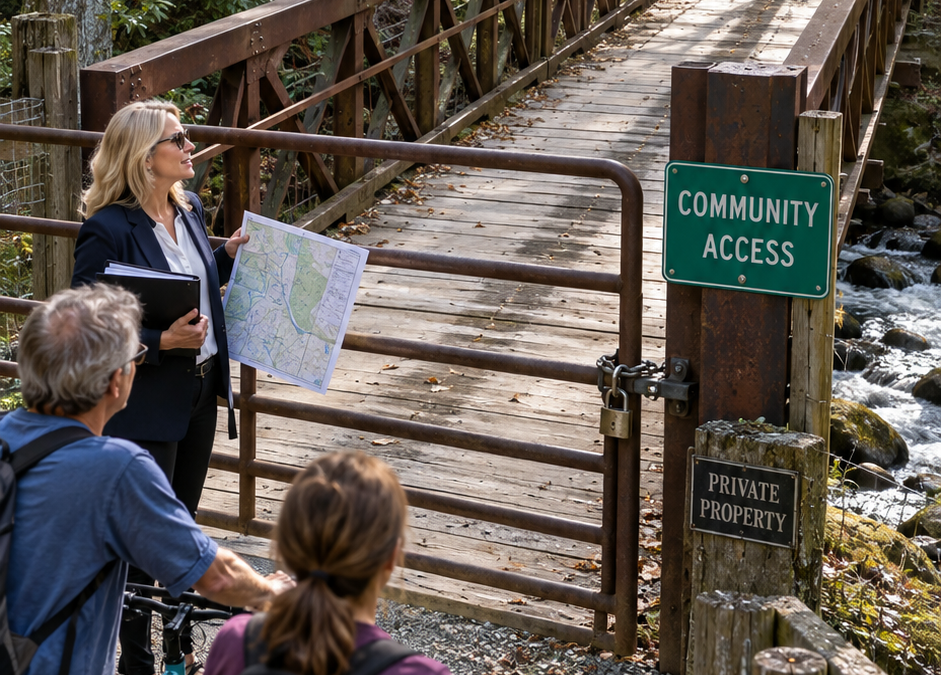
That morning, she stood beside my locked gate with three residents waiting behind her on bicycles.
A brand-new sign had been bolted to my gatepost.
COMMUNITY ACCESS
WILLOW CREEK HOMEOWNERS ASSOCIATION
I stared at the sign.
Then at Patricia.
Then back at the sign.
“You can’t lock this bridge anymore,” she said. “The entire neighborhood has the right to use it.”
The words were so wrong that for a second I could only study her face.
She was not joking.
“My family owns this bridge,” I said.
She pointed toward the gate as if pointing made facts rearrange themselves.
“The board confirmed this is historical neighborhood access.”
“What neighborhood?”
“Willow Creek.”
“Willow Creek didn’t exist when this bridge was built.”
Her smile tightened.
“The land did.”
That was my first glimpse of how far she was willing to stretch language. The land did exist, yes. So did the creek. So did the sky. That did not mean the HOA had inherited rights from the clouds.
Behind her, the cyclists looked uncomfortable. One man shifted beside his bike.
“We were told this connects to the community trail,” he said.
“It doesn’t.”
Patricia opened her folder.
“This map says otherwise.”
She unfolded an HOA recreation map and held it up. A green dotted line ran through Willow Creek’s walking trail system, crossed the creek over my bridge, continued along my gravel driveway, and connected to the county road. They had labeled it “North Access Trail.”
I almost laughed.
Not because it was funny.
Because the arrogance of turning my driveway into a trail with a printer and a green dotted line was almost impressive.
“Your map turned my driveway into a trail,” I said.
Patricia did not blink.
“The developer identified an existing crossing.”
“Existing doesn’t mean public.”
“The HOA attorney believes residents have access.”
“Then your attorney can send me the recorded document.”
Her arms folded across her folder.
“We don’t need your permission to exercise an established right.”
Then she reached for the gate.
It was locked.
Her expression hardened.
“You need to remove this.”
“No.”
“Nathan—”
“No.”
One of the cyclists quietly turned his bike around. I respected him for that. The other two stayed, caught between embarrassment and curiosity.
Patricia lowered her voice.
“If you obstruct community access, the HOA will take action.”
I took my phone out and photographed the sign, the bolts, the gate, Patricia, the cyclists, and the map in her hand.
“You installed this?”
“Yes,” she said. “At the access point.”
“On my property.”
“At the access point,” she repeated.
I removed the sign.
Patricia immediately raised her phone.
“I’m documenting that.”
“Good.”
I placed the sign beside her SUV.
“Document where you found it.”
She left angry.
I thought that might be the end of it.
That was my first mistake.
The next morning, orange HOA markers appeared along my driveway.
By noon, two landscaping workers were trimming branches near the bridge approach. They had a small trailer full of tools, safety vests, and a printed work order clipped to a board. I walked down from the house before they got very far.
“Who hired you?”
One worker straightened immediately.
“Willow Creek HOA.”
“To do what?”
“Clear north community access.”
I pointed back toward the county road.
“This is private property.”
The younger worker looked worried. The older one lowered his clippers and read the work order again as if hoping it would transform into something safer.
Patricia arrived twenty minutes later.
“You cannot interfere with HOA contractors,” she said.
“They’re on my land.”
“This corridor serves our residents.”
“Show me the easement.”
Her expression changed slightly.
Not much.
Enough.
“We’re locating the original records.”
“So you don’t have one.”
“We have historical use.”
“No. You have a map your developer drew.”
A pickup stopped behind us then. My neighbor Walter Briggs climbed out.
Walter was seventy-two and had lived across the county road since before my parents bought the property. He moved slowly, but he saw everything. He looked at the orange markers, then at Patricia.
“What are those?”
“Community bridge access,” Patricia said.
Walter stared at her.
“Community?”
He pointed toward my bridge.
“Jim Cole built that crossing.”
“My father rebuilt it,” I said.
Walter nodded.
“Because the old farm bridge washed out.”
Patricia opened her folder again.
“Our records show a crossing here before 1984.”
Walter smiled.
“There was.”
Patricia looked satisfied.
Then Walter finished.
“For cattle.”
Her smile disappeared.
That afternoon, I called a title company.
I asked for every recorded document connected to my parcel: deeds, easements, right-of-way agreements, bridge references, access restrictions, old maps, anything that mentioned the crossing. The researcher assigned to the file was named Emily Foster. She was calm, precise, and skeptical of anything not recorded.
The next morning, she called.
“We found an older deed,” she said.
“How old?”
“Recorded forty-two years ago. Around the time your parents rebuilt the bridge.”
She emailed me a scan.
The document was faded, but one paragraph was perfectly readable.
It described the creek crossing, the bridge, the access rights, and the controlling restriction in language clear enough to make Patricia’s green dotted line look childish.
Private crossing for the exclusive benefit of the Cole parcel.
I read it twice.
Then my phone rang.
Patricia.
“The board has scheduled contractors to remove your gate Friday,” she said.
I looked at the deed on my screen.
“Patricia, I think you should cancel them.”
“Why?”
“Because I just found the document you’ve been claiming gives your neighborhood access.”
She went quiet.
I looked toward the bridge through my office window.
“It says the exact opposite.”
Patricia did not cancel the contractors.
She moved them earlier.
At 7:15 Friday morning, a white utility truck stopped beside my bridge. Two men climbed out carrying bolt cutters. I walked down my driveway before they reached the lock.
“Don’t touch that gate.”
The older contractor stopped immediately.
“We have an HOA work order.”
Patricia’s SUV appeared behind them like she had been waiting nearby for the moment.
She stepped out with the same folder.
“I told you this access cannot be obstructed.”
I held up the deed.
“And I told you what this says.”
She barely looked at it.
“One old document doesn’t override established access.”
“It’s the recorded deed.”
“Our attorney is reviewing it.”
“Then why are your contractors here?”
Neither worker moved.
Patricia pointed at my lock.
“Remove it.”
The older contractor shook his head.
“Not until somebody proves we have authority.”
Patricia’s face tightened.
“You were hired to open the gate.”
“We were hired by an HOA,” he said. “That doesn’t make this HOA property.”
He put the bolt cutters back in the truck.
Then Walter arrived.
He parked across the road and walked over like he had all morning to spare.
“Morning.”
Patricia did not answer.
Walter looked at the contractors.
“Taking Nathan’s gate now?”
“It’s community access,” Patricia snapped.
Walter shook his head.
“No, ma’am.”
“You are not involved.”
“I was here when that bridge was rebuilt.”
That got the contractors’ attention.
Walter pointed toward the creek.
“In 1983, the old crossing washed out. Nathan’s parents paid for the replacement themselves.”
Patricia opened her folder as if it could protect her from memory.
“The existence of a bridge isn’t disputed.”
“Who could use it is,” I said.
Then another vehicle arrived.
A silver sedan.
Emily Foster stepped out carrying certified copies.
“I brought the 1984 deed and the recorded access agreement,” she said.
Patricia reached for the packet. Emily gave her a copy.
Patricia read the first page. Then the second. Her eyes stopped on the same paragraph mine had.
Private crossing for the exclusive benefit of the Cole parcel.
She looked up.
“This could refer only to construction rights.”
Emily shook her head.
“The next page defines ongoing access.”
Patricia kept reading.
The language there was even clearer.
No public dedication. No shared residential easement. No transferable community right.
Then Emily showed us the original parcel map. Willow Creek Estates did not exist. The land behind me was one large tract owned by a timber company. The bridge crossed from the county road directly onto what became my parcel.
Patricia pointed at the timber tract.
“They still had access through here.”
Emily zoomed in on the map.
“No. A separate logging road served that property from the east.”
Walter smiled.
“That’s the road the subdivision entrance sits on now.”
Patricia said nothing.
A black pickup pulled in.
Michael Turner, one of Willow Creek’s board members, stepped out and looked from Patricia to the contractors.
“Why are they here?”
“Gate removal,” I said.
Michael frowned.
“The board didn’t approve physical removal.”
Patricia stiffened.
“We authorized restoration of community access.”
“We authorized legal review,” Michael said.
Silence.
I looked at him.
“Did the board see this deed?”
“No.”
Patricia interrupted.
“We received it yesterday.”
Michael turned toward her.
“You received a deed saying the bridge is private and still sent contractors?”
“It’s one interpretation.”
Emily handed him the certified copy.
“It’s not my interpretation. It’s recorded language.”
Michael read it. Then he looked at the HOA recreation map.
“Where did this green trail come from?”
Patricia answered carefully.
“The developer planning documents.”
Emily asked one question.
“Recorded or promotional?”
Patricia did not know.
Michael called the HOA manager. Five minutes later, we had the answer.
Promotional.
The green line had appeared in a sales brochure twelve years earlier. Not on the recorded subdivision plat. Not on a deed. Not in an easement.
A marketing map had become an HOA access map.
Then one contractor pointed toward the bridge entrance.
“What’s that?”
A small bronze plate was bolted beneath the timber railing. Years of dirt had nearly covered it. Walter stepped closer, wiped it clean with his thumb, and read aloud.
“Cole Private Crossing, 1984.”
Patricia stared at it.
Michael looked at her.
“Cancel the work order.”
She did not move.
“Patricia.”
Finally, she nodded.
The contractors left.
But before Michael could follow them, Patricia said quietly, “This isn’t finished.”
I looked at the deed in my hand.
For the first time that morning, I agreed with her.
Because Emily had found another document.
A 1984 agreement signed by the owner of the land that eventually became Willow Creek Estates.
According to Emily, that agreement did not merely say my bridge was private. It explained exactly why the neighboring tract had been denied any right to use it.
She spread the second document across the hood of my truck. Patricia stayed. So did Michael. Walter stood at the edge of the road, arms folded, looking like a man watching old truth crawl back into daylight.
The agreement was dated August 17, 1984.
Three signatures appeared at the bottom.
My father.
My mother.
Harold Benton, owner of the timber tract that later became Willow Creek Estates.
Emily pointed to paragraph six.
I read it aloud.
“Grantor acknowledges that the replacement bridge shall create no access right, easement, license, or benefit in favor of the adjoining Benton tract.”
Michael looked at Patricia.
“That’s our land?”
“Formerly,” Emily said. “But yes, that’s the tract Willow Creek was developed from.”
Patricia shook her head.
“Harold Benton couldn’t bind future development forever.”
Emily turned the page.
“The agreement specifically says the restriction runs with the adjoining tract unless amended by recorded instrument.”
“Was it amended?” I asked.
“I found no amendment.”
Patricia looked at Michael.
“We need counsel.”
For once, I agreed.
That afternoon, Willow Creek’s attorney, Robert Hail, called me.
He was much more careful than Patricia.
“We’re reviewing the chain of title,” he said.
“Good.”
“Until that’s complete, could you leave the gate unlocked?”
“No.”
A pause.
“That would reduce tension.”
“It would also give thirty-six households access my deed says they don’t have.”
He did not push.
Then something happened at 6:40 that evening.
My driveway camera alerted me.
Four Willow Creek residents were standing at the gate. One was Patricia. She was not carrying bolt cutters this time. She was carrying a laminated HOA notice.
She zip-tied it to my fence.
NOTICE OF COMMUNITY ACCESS DISPUTE
DO NOT OBSTRUCT PEDESTRIAN PASSAGE
I walked down.
“Robert Hail called me three hours ago.”
Patricia looked surprised.
“He said you’re reviewing title.”
“We are.”
“Then why are you telling residents they can pass?”
“This has been used as neighborhood access.”
“No, it hasn’t.”
A younger resident named Jason Moore spoke up.
“We’ve crossed here before.”
“How often?”
“A few times.”
“When?”
“Last summer.”
I looked at Patricia.
That was new.
Then Jason explained.
“The HOA organized a creek cleanup. Residents crossed your bridge while you were away visiting your daughter.”
My stomach tightened.
“How did the gate open?”
Patricia said nothing.
Jason did.
“The HOA had a key.”
There were only three gate keys.
Mine.
My brother’s.
And one old spare my parents had once kept with the timber company for emergency fire access.
Emily’s 1984 document suddenly mattered even more. The agreement mentioned that spare key specifically: temporary emergency key, no access right created.
I asked Patricia where she got it.
“It was in the HOA maintenance office,” she said.
Michael arrived ten minutes later. He looked genuinely confused.
“We have Nathan’s gate key?”
Patricia folded her arms.
“It transferred from the developer.”
“And you’ve used it for maintenance access without telling him?”
“The bridge serves the community.”
I pulled the laminated notice down.
“Then I’m changing the lock.”
The next morning, Robert Hail emailed both of us.
His preliminary title review found no community easement, no pedestrian easement, no bridge dedication, and no recorded access right. He recommended the HOA suspend all access claims until full review was complete.
Patricia responded twenty minutes later and copied the entire board.
Historic use may have created prescriptive access rights regardless of recorded deed language.
Emily read the email over the phone and sounded almost amused.
“Historic use,” she said.
Then she opened the county aerial archive.
Images from 1985 showed the bridge.
They also showed my gate.
Locked in several photographs.
Willow Creek Estates was not built until 2014. There could not have been decades of neighborhood use by a neighborhood that had not existed.
Then Walter called.
“I found something in my barn.”
He brought over an old photograph from 1986. My father stood beside the bridge, younger than I could now remember him without help. Behind him was Harold Benton. Attached to the gate was a sign.
PRIVATE BRIDGE
COLE ACCESS ONLY
On the back, Walter had written the date: October 4, 1986.
Michael looked at the photograph, then at Patricia.
“So what’s the historic community use?”
She did not answer.
Robert Hail did.
He sent another email that afternoon. One sentence mattered.
Based on the recorded 1984 deed, the adjoining tract agreement, and available historical evidence, Willow Creek HOA presently has no documented right to use the Cole bridge.
Patricia did not answer Robert’s email.
She called an emergency HOA meeting.
Michael invited me.
I almost declined.
Then he said, “You should see the map Patricia plans to use.”
So Thursday evening, I walked into the Willow Creek clubhouse carrying the certified 1984 deed.
Thirty residents were already seated.
Patricia stood beside a projector. Behind her was an aerial map. A red line crossed my bridge, ran along my driveway, and connected to Willow Creek’s walking trail.
She pointed at it.
“This route appears in developer planning materials.”
I raised my hand.
“Is that map recorded?”
Patricia ignored me.
Michael did not.
“Answer him.”
She paused.
“No.”
Then Robert Hail entered.
The room quieted.
Patricia looked relieved.
“Our attorney can explain the HOA’s position.”
Robert placed his briefcase on the table.
“I can explain what the records show.”
That was not the same thing.
He displayed the recorded subdivision plat.
No red line.
No bridge easement.
No pedestrian corridor.
Nothing crossed my parcel.
Then he displayed the developer sales brochure.
There it was: a dotted recreational route labeled “Proposed Nature Connection.”
Robert looked at the residents.
“Proposed is important.”
A man in the second row spoke.
“We were told that trail reached the county road.”
Several people nodded.
One woman raised her hand.
“The sales agent said we had a north exit.”
Patricia turned toward me.
“The residents relied on that representation.”
Robert shook his head.
“A sales representation does not automatically create an easement over land the developer didn’t own.”
The room changed.
People stopped looking at me.
They started looking at Patricia.
Then Michael opened the original HOA turnover documents from 2016. He had spent two days searching them.
Inside was a developer memorandum.
North Trail connection not acquired. Cole bridge access request declined by owner.
I stared at the screen.
My father had declined.
Robert checked the date.
A year before Willow Creek opened, the developer had asked my father for pedestrian access across the bridge. He said no.
Patricia’s face tightened.
“I’ve never seen that.”
Michael looked at her.
“It’s in the same archive as the recreation map.”
Then another board member, Denise Walker, spoke.
“I remember this.”
Everyone turned.
Denise had served on the transition committee.
“The developer told us the northern connection wasn’t included.”
Patricia stared at her.
“Why isn’t that in our community materials?”
“It was,” Denise said.
She opened an old homeowner packet.
The trail map stopped at the creek.
No bridge crossing.
No access through my driveway.
The newer HOA map was different.
Michael put both versions on the screen.
One: trail ends at creek.
The other: trail crosses my bridge.
“Who changed it?” I asked.
The room went silent.
Kevin Shaw, the HOA manager, opened his laptop and searched the document history.
“Map revised March 2022.”
“By whom?” Michael asked.
Kevin hesitated.
“President account.”
Patricia had become president in 2021.
She immediately shook her head.
“That doesn’t mean I personally edited it.”
Kevin checked the revision log.
“Uploaded by P. Sloan.”
Nobody spoke.
Then he opened the accompanying board email.
Patricia had written: Adding north access connection to reflect historic community route.
Denise stared at her.
“What historic route?”
Patricia’s voice sharpened.
“Residents had been using it.”
I stood.
“Using my locked bridge because the HOA had an emergency key you weren’t authorized to use.”
Robert looked at Patricia.
“What emergency key?”
Michael explained.
Robert’s expression changed.
He asked Kevin to locate the maintenance inventory.
The key was listed there.
Cole bridge fire/emergency source developer transfer. Restrictions: private access. Do not use for routine HOA entry.
Patricia sat down for the first time all evening.
She had nothing to say.
Robert turned to me.
“Nathan, has the HOA ever requested permission from you directly?”
“No.”
He looked toward the board.
“Then I recommend immediate removal of all HOA signage and maps identifying this bridge as community access.”
Patricia stood again.
“You’re surrendering a neighborhood asset.”
Robert answered calmly.
“We cannot surrender an asset the HOA never possessed.”
That should have ended the meeting.
It did not.
Denise had found one more envelope in the turnover archive. Across the front, stamped in red, were the words:
PRIVATE BRIDGE LEGAL NOTICE
Inside was a letter sent to Willow Creek’s developer in 2013 from my father’s attorney. It cited the 1984 deed. It rejected the requested easement. At the bottom was proof of receipt signed by the developer.
The company that created Willow Creek had known from the beginning that my bridge was private.
The only question left was how that fact disappeared after the HOA took control.
The next morning, Michael called me.
“We found the missing file.”
I drove to the clubhouse.
Robert Hail was already there. So was Patricia. Nobody looked comfortable.
Kevin opened the HOA’s digital archive. The developer had transferred hundreds of documents in 2016. One folder was labeled North Access.
Inside were five files.
The 1984 deed.
The adjoining tract agreement.
My father’s 2013 rejection letter.
The developer memorandum confirming no bridge rights.
And an internal legal opinion.
Robert opened the opinion.
The conclusion was short.
Willow Creek holds no recorded or implied access right over the Cole bridge or driveway.
Michael looked at Patricia.
“This was in our archive.”
She folded her arms.
“So were thousands of other documents.”
Kevin did not say anything. He clicked the file history.
Last opened: February 14, 2022. P. Sloan.
The room went quiet.
That was three weeks before Patricia uploaded the revised recreation map showing my bridge as community access.
Patricia leaned toward the screen.
“I review many files.”
Robert asked, “Did you read this one?”
“I don’t remember.”
Kevin opened another record.
The legal opinion had been downloaded.
Same user.
Same date.
Then an email appeared.
Patricia to the former HOA manager.
Subject: North Connection.
Developer failed to secure formal easement. Residents nevertheless need secondary pedestrian access. Update trail materials to reflect practical route while board evaluates long-term options.
Michael read it twice.
“You knew there wasn’t an easement.”
Patricia’s voice hardened.
“I knew the developer hadn’t recorded one.”
“That’s what we’ve been asking.”
“I believed historical use might support access.”
Robert looked at her.
“In 2022?”
She did not answer.
Then Kevin found the former manager’s response.
Cannot recommend designating Cole bridge as HOA access without owner consent or legal opinion.
Patricia had replied:
Noted. Update map for internal community use only.
But the map did not stay internal.
It appeared in newsletters, welcome packets, the HOA website, and eventually on the sign attached to my gate.
I looked at Patricia.
“You created the route.”
“I documented a route residents were already using.”
Michael shook his head.
“After the HOA gave them a map telling them to use it.”
That distinction mattered.
Then Sarah Nolan, a resident from the first phase, arrived.
Michael had asked her to bring old neighborhood emails. She showed us a 2022 announcement posted by Patricia.
New North Trail connection now available for resident walking and cycling.
Sarah looked embarrassed.
“That’s why my family crossed the bridge. We thought the HOA had permission.”
I believed her.
So did Robert.
Then another resident, Mark Ellison, forwarded a message from Patricia after someone questioned the locked gate.
Board is working to restore full access. Residents should continue to treat North Bridge as part of the community trail network.
My patience disappeared.
While Patricia had been telling me residents had created historical use, she had been telling residents they already possessed access.
Each claim supported the other, except neither existed before she started making them.
Robert closed his laptop.
“I recommend the board issue an immediate correction to every homeowner.”
Patricia stood.
“That would expose the HOA to embarrassment.”
Michael looked at her.
“We’re already there.”
Then Kevin’s phone rang.
He listened. His expression changed.
“What?”
He ended the call.
“County bridge inspector.”
I looked at him.
“Why?”
Kevin turned toward Patricia.
“Apparently someone from Willow Creek reported Nathan’s bridge as a community pedestrian structure and requested a safety inspection.”
Patricia said nothing.
Michael stared at her.
“Did you do that?”
“I requested confirmation that a bridge being used by residents was safe.”
Robert rubbed his forehead.
“When?”
Patricia did not answer.
Kevin did.
“Yesterday.”
After the meeting.
After the deed.
After the legal notice.
After her own attorney said the HOA had no documented access.
Then a county vehicle appeared outside the clubhouse.
The inspector had gone to my property first, found the locked gate, and followed the HOA contact information back to the office. His name was David Ross. He walked inside holding the request form.
“Who submitted this as Willow Creek community infrastructure?”
Patricia slowly raised her hand.
David looked at Robert, then at me.
“Does the HOA own the bridge?”
“No,” I said.
“Maintain it?”
“No.”
“Hold an easement?”
Robert answered, “No.”
David crossed out something on the form.
“Then this isn’t an HOA bridge inspection.”
Patricia looked furious.
“So you’re refusing to inspect a safety concern?”
David shook his head.
“I’m correcting the ownership classification.”
He handed me the form.
Patricia had described the bridge as “existing HOA north access crossing.”
I looked at the submission date.
She had made the claim again after the 42-year-old deed had already disproved it.
This time, she had put it on a county document.
David did not leave immediately.
He asked to see the bridge, not as HOA infrastructure, but as a privately owned crossing involved in an access dispute. I agreed.
Patricia followed us.
So did Michael and Robert.
At my gate, David photographed the county road connection, the gate, the lock, the bronze plate, and the sign scar left by Patricia’s bolts. He looked at the plate beneath the railing.
“Was this visible when you filed the request?”
Patricia hesitated.
“Not clearly.”
Walter Briggs was standing across the road.
He laughed once.
“It’s been there forty-two years.”
David continued inspecting.
The bridge was ordinary private infrastructure: timber deck, steel beams, gravel driveway, no sidewalks, no public trail markings, no HOA maintenance tags. Then he noticed four small holes in the gatepost.
“What was mounted here?”
“My HOA sign,” I said.
Patricia corrected me.
“A temporary access notice.”
David looked at Robert.
“Without owner permission?”
Robert answered, “Correct.”
David photographed the holes.
Then a county land records vehicle arrived.
The bridge inspection request had triggered a parcel review because Patricia had identified the crossing as HOA-owned infrastructure. A county technician named Laura Kim stepped out carrying a tablet.
“I need to confirm the ownership record.”
Emily Foster had already provided certified copies. I handed them over.
Laura checked the parcel number, the 1984 deed, and the adjoining tract agreement. Then she looked toward Willow Creek.
“This restriction is indexed against the predecessor tract.”
Patricia frowned.
Meaning it was not only recorded with my parcel.
Laura turned the tablet around.
“It was also entered into the chain of title for the land that became Willow Creek.”
Michael stared at the screen.
“So anyone researching our development parcel should have found it?”
“Yes.”
That changed something.
Patricia had repeatedly described the deed as an obscure document from my family’s records.
It was not.
The restriction had followed both properties.
Then Laura found a later entry.
Notice of Private Access Restriction.
My father’s attorney had not merely sent the developer a letter. He had recorded a notice. It referenced the 1984 deed by book and page. It named the Cole Bridge and stated that no access had been granted to the proposed Willow Creek subdivision.
Michael shook his head.
“This is impossible to miss.”
Robert did not answer.
Then Deputy Sheriff Aaron Mills pulled onto the shoulder.
Patricia looked at me.
“You called the sheriff?”
“No.”
David had called for a neutral record while ownership and access were being disputed on site. Aaron listened to both sides. Then he asked Patricia one question.
“Do you currently have documentation granting your residents access?”
She looked at Robert.
Robert answered, “No.”
Aaron nodded.
“Then until somebody produces that documentation, residents should not be directed onto private property.”
Patricia crossed her arms.
“This is a civil matter.”
“Correct,” Aaron said. “And I’m trying to keep it from becoming something else.”
Then a Willow Creek couple approached with bicycles.
They stopped when they saw everyone.
“We thought the bridge reopened,” the woman said.
Michael looked at them.
“Who told you that?”
She held up her phone.
An HOA notification sent forty minutes earlier.
North Access under county review. Pedestrian use remains permitted pending final determination.
Robert’s expression changed instantly.
“Who sent that?”
Kevin called from the clubhouse and checked the system.
President account.
Patricia.
Michael stared at her.
“You sent residents here while we were standing at Nathan’s locked gate?”
“I said pending determination.”
Aaron looked at the cyclists.
“The property owner has not granted permission. Please use another route.”
They apologized and turned around.
Patricia reached for her phone.
Michael stopped her.
“Don’t send anything else.”
“You don’t control board communications.”
“Maybe not,” he said.
He called Kevin.
“Disable president publishing access until the board meets.”
Patricia’s face went pale.
“You cannot do that.”
Robert answered before Michael could.
“The board can preserve itself from additional liability.”
Then Laura Kim received a message from the county recorder. She opened another scan.
“This may settle the historical use question.”
It was an affidavit recorded in 1984 by Harold Benton himself, the former owner of the land behind my bridge. He acknowledged that his tract had independent road access. He acknowledged that the Cole Bridge was not necessary for reaching his property. And he expressly disclaimed any right to use it.
Walter looked at Patricia.
“That’s your historic owner.”
Laura nodded.
The person whose land eventually became Willow Creek had not merely failed to obtain bridge rights.
He had formally stated that his land had none.
Aaron closed his notebook.
The HOA had spent weeks claiming history supported community access.
Now county records showed that history had documented the opposite from the beginning.
The Willow Creek board met again that night.
This time, Patricia was not running the meeting.
Michael was.
Every chair in the clubhouse was occupied. Residents stood along the walls. Robert Hail sat at the front with copies of county records. I stayed near the back.
Michael began with one sentence.
“The north bridge is not HOA property.”
Nobody argued.
He displayed the 1984 deed.
Then the adjoining tract agreement.
Then Harold Benton’s recorded affidavit.
Then the 2013 notice.
Four separate documents.
Same conclusion.
No community access.
A resident raised her hand.
“Then why were we told there was?”
Michael looked toward Patricia.
She sat at the end of the board table, rigid and pale.
“The board relied on inaccurate historical information.”
Denise Walker interrupted.
“No.”
Everyone turned.
“The board didn’t.”
She held up the 2016 homeowner map.
“The original materials were accurate.”
Then Kevin displayed the 2022 revision history.
Patricia’s account.
Patricia’s upload.
Patricia’s announcement.
Patricia leaned toward her microphone.
“I believed the neighborhood needed a secondary pedestrian connection.”
Robert answered, “Need doesn’t create ownership.”
A few residents murmured.
Then Sarah Nolan stood.
“My children crossed Nathan’s bridge because the HOA told us it was allowed.”
Another resident spoke.
“So did we.”
Then another.
Nobody sounded angry at me.
That mattered.
Patricia had spent weeks framing my locked gate as me blocking the neighborhood. Now residents understood they had been sent onto private land.
Michael opened the maintenance records.
“The emergency bridge key has been surrendered.”
Kevin placed it in an envelope and handed it to me.
The old brass key had a faded tag.
Cole Bridge Emergency Only.
I recognized it.
My father had labeled it himself.
For forty-two years, that key had existed for fires and emergencies.
Not walking trails.
Not bicycles.
Not convenience.
I put it in my pocket.
Then Robert presented his recommendation.
Remove every HOA map showing bridge access. Issue a written correction to residents. Remove all signs and trail markers directing people toward my property. Confirm in HOA records that the bridge and driveway were private. Stop using the term North Community Access.
Michael called for a vote.
Four directors voted yes.
Patricia voted no.
The room went quiet.
She looked around.
“We’re giving away an important community connection.”
Denise stared at her.
“We never owned it.”
Then Michael made another motion.
“Pending governance review, I move to remove Patricia Sloan as HOA president.”
Patricia stood.
“This is retaliation.”
Michael did not raise his voice.
“This is about repeated representations after our attorney advised there was no documented access.”
Robert looked down at his notes.
Nobody interrupted.
The vote was four to one.
Again, Patricia was the only no.
She sat back down.
For the first time since she had attached that sign to my gate, she no longer had authority to send another crew.
Then Deputy Aaron Mills entered.
He was not there for the board vote. He asked for Robert. The county wanted copies of communications related to the bridge inspection request. Patricia’s submission had classified my private structure as HOA infrastructure, and the county needed to correct its file and determine how that representation had been made.
Robert nodded.
“We’ll preserve everything.”
Kevin looked uncomfortable.
“I already started.”
He opened the HOA archive, then stopped.
Michael walked over.
“What?”
Kevin pointed at the screen.
A folder named North Access Communications had been moved to trash at 5:18 that afternoon.
User: P. Sloan.
Patricia’s face changed.
“I was cleaning duplicate files.”
Kevin restored the folder.
There were forty-three documents inside.
Emails.
Map drafts.
Legal warnings.
Resident notices.
Then Robert opened one from March 2022. It was from Willow Creek’s former attorney.
Do not represent the Cole Bridge as HOA access absent a recorded easement or written owner consent.
Patricia had replied:
Understood.
Nobody spoke.
Michael looked at her.
“You understood in 2022.”
Patricia gathered her papers.
“This meeting is over for me.”
She walked toward the door.
Aaron did not stop her.
Neither did I.
Then Kevin opened another document from the restored folder.
A draft agreement.
Willow Creek Pedestrian Bridge Easement Request.
Prepared in 2022.
Never signed.
At the bottom was a note from Patricia.
Owner unlikely to agree. Do not approach until community use is established.
Robert read the sentence twice.
Then he looked at me.
That was the moment the entire dispute changed.
Patricia had not mistaken community use for an existing right.
The records suggested she had wanted community use first and permission later.
Robert asked Kevin to preserve the draft agreement immediately. Then he asked everyone else to stop opening files, not because the truth was unclear, but because it was finally clear enough that nobody wanted the record altered again.
The next morning, Michael called me.
“The board wants to meet at your bridge.”
At ten o’clock, four directors arrived.
Patricia did not.
Robert came with them. So did Laura Kim from county land records. Emily Foster brought the certified title packet.
We stood beside the gate where the dispute had started.
Michael looked at the empty holes from Patricia’s community access sign.
“We’ll repair those.”
I nodded.
Laura opened the county’s final title summary.
She had traced both properties back before 1984.
No public dedication.
No shared bridge easement.
No pedestrian right.
No subdivision access.
Then she reached the key document.
“This is the controlling recorded instrument for the crossing.”
She pointed to the language.
Private crossing for the exclusive benefit of the Cole parcel.
Then the adjoining agreement.
Harold Benton had expressly denied his tract any bridge rights. His tract became Willow Creek. The restriction followed it. Forty-two years later, nothing had amended it.
Robert looked at Michael.
“From a title standpoint, the HOA’s claim ends here.”
Nobody argued.
Then Emily showed us something she had found in my parents’ closing archive.
A receipt for bridge reconstruction.
My parents had paid every dollar.
Timber. Steel. Concrete abutment repairs. Labor.
Beside it was a handwritten note from Harold Benton.
Thank you for allowing emergency fire crossing if ever needed. I understand this creates no general access.
Walter read it over my shoulder.
“Your father kept everything.”
Apparently, he had.
Then a Willow Creek maintenance truck arrived.
Not to remove my gate.
To remove HOA property.
Workers pulled the orange trail markers from the approach. They took down the North Access arrow near the neighborhood trail. Kevin updated the digital recreation map while we watched. The green line stopped at the creek, exactly where the original 2016 map had stopped.
Then Michael handed me a board resolution.
Willow Creek HOA acknowledges no ownership, easement, license, or community access right over the Cole Bridge or private driveway.
All four remaining directors had signed it.
I read it carefully.
Robert pointed to another paragraph.
The HOA would notify every resident. It would reimburse the cost of repairing my gatepost. It would never retain a bridge key without my written permission, and any future emergency access arrangement would require a separate agreement.
I signed only the receipt acknowledging I had received their resolution.
I was not granting anything.
That distinction mattered now.
Then Patricia’s SUV appeared on the county road.
She slowed, stopped, and stepped out.
Nobody had invited her.
She looked at the workers removing the final trail marker.
“So that’s it.”
Michael answered.
“Yes.”
She looked at me.
“You could still allow pedestrian access.”
“I could.”
For a second, she seemed hopeful.
“I’m not.”
Her expression hardened.
“Thirty-six families have to walk two extra miles because of one locked bridge.”
Robert corrected her.
“They have the access routes their subdivision was legally designed with.”
Patricia looked toward the bridge.
“I was trying to improve the community.”
I believed that might even have been true at the beginning.
But good intentions did not turn somebody else’s driveway into HOA property.
Laura handed Patricia a copy of the county correction.
The bridge had been removed from the HOA infrastructure inquiry.
Ownership classification: private Cole parcel access. Status: no recorded community right.
Patricia read it silently.
The forty-two-year-old deed had not merely weakened her argument.
It had ended it.
Michael pointed toward the bronze plate beneath the railing.
Workers had cleaned it.
The lettering was visible from the road again.
Cole Private Crossing, 1984.
Patricia looked at the plate, then at the gate, then at the deed in Laura’s hand.
For weeks, she had claimed the neighborhood had history on its side.
Now every historical record stood on mine.
She returned to her SUV without another word.
As she drove away, Walter leaned against the railing.
“Forty-two years,” he said.
I nodded.
He smiled.
“Good paperwork ages better than arguments.”
The creek moved quietly beneath us.
The bridge had not changed.
The property had not changed.
Only the claim had.
And after weeks of maps, notices, contractors, meetings, county records, legal reviews, emergency keys, and corrected filings, Willow Creek finally acknowledged what the deed had said since 1984.
The bridge was private.
It always had been.
Three months later, nobody called it North Community Access anymore.
Willow Creek’s new map showed exactly what the original subdivision plan had shown. The neighborhood trail ended at the creek. My bridge did not appear on it. Neither did my driveway.
The HOA repaired the holes in my gatepost. They replaced the damaged section of fencing where their contractors had cleared branches. Michael mailed every homeowner a formal correction.
Private Property Notice: The Cole Bridge and driveway are not HOA amenities or community access routes.
I expected complaints.
I got two.
Both were polite.
Most residents seemed more embarrassed than angry.
Sarah Nolan stopped by one Saturday while I was repairing a railing.
“I owe you an apology,” she said.
“You didn’t know.”
“We should have asked.”
I looked toward Willow Creek.
“You were told it was community property.”
She nodded.
“That’s what bothers me.”
That bothered a lot of people.
At the next annual HOA meeting, Michael was elected president. Denise became vice president. One of their first changes required any future HOA map showing access outside subdivision property to include the recorded document supporting that access.
Kevin joked that nobody would ever look at a green dotted line the same way again.
I believed him.
Patricia remained in Willow Creek for a while.
I occasionally saw her driving past the bridge. She never stopped. Six months later, Walter told me her house was listed.
I did not celebrate.
By then, I was tired of the whole thing.
The county closed its bridge inquiry after correcting the ownership classification. Robert Hail sent me a final letter confirming that Willow Creek disclaimed any present community right over the crossing.
I put it in the same folder as the 1984 deed.
Then I made three copies.
One stayed in my house.
One went into a safe deposit box.
One went to my brother.
My father had saved the original paperwork for forty-two years. I was not going to be the generation that misplaced it.
Then something unexpected happened the following summer.
A brush fire started several miles north of Willow Creek. Nothing reached our properties, but county crews temporarily staged equipment nearby. Michael called me.
“Nathan, if emergency vehicles ever need the bridge, what’s the procedure?”
That was the first time anyone from Willow Creek asked before assuming.
I appreciated it.
“For an actual emergency, call me. If responders need access, I’ll open it.”
“No permanent HOA key?”
“No.”
“Understood.”
Simple.
Clear.
Respectful.
Exactly what the 1984 agreement had intended.
A week later, Michael sent me a draft emergency contact notice. I approved my phone number being listed. Nothing else. No pedestrian rights. No trail access. No implied easement. Just emergency coordination between neighbors.
That was enough.
By autumn, the bridge looked almost exactly as it had before the dispute.
The bronze plate remained cleaned and visible. The new lock stayed on the gate. I added one small sign.
PRIVATE DRIVEWAY
NO COMMUNITY TRAIL ACCESS
Not threatening.
Not dramatic.
Just accurate.
Walter saw it and laughed.
“Think they’ll understand this one?”
“They’ve got forty-two years of paperwork if they don’t.”
He smiled.
Then we stood there watching leaves move beneath the bridge.
For weeks, Patricia had treated ownership like something an HOA could create through repetition.
Put a route on a map.
Tell residents it existed.
Send contractors.
Post signs.
Call it historical.
Eventually, maybe everyone would accept it.
But property records do not work that way.
The Willow Creek developer had known the truth before the first house was built. Harold Benton had known it in 1984. My parents had known it when they rebuilt the crossing. The deed had preserved it through every owner, every subdivision map, and every HOA board that came afterward.
Willow Creek had its roads, its trails, its entrance, its common areas.
I had my bridge.
That did not make us enemies.
It made us neighbors with a boundary.
One evening, I drove home just before sunset. I unlocked the gate, crossed the bridge, then stopped on the other side.
Behind me, Willow Creek’s trail ended at the creek exactly where it belonged.
Ahead of me, my gravel driveway climbed toward the house.
Forty-two years earlier, one recorded deed had drawn that distinction clearly.
Patricia spent weeks trying to erase it with HOA maps and community notices.
In the end, she could not.
Because calling a private bridge community access does not make it community property.
And sometimes the strongest answer to a modern claim is a piece of paper old enough to remember what everyone else forgot.








