𝗙𝗨𝗟𝗟 𝗦𝗧𝗢𝗥𝗬 The HOA Called My Forty Acres Neglected Until the First Storm Showed Them What the Weeds Were Holding Back
𝗙𝗨𝗟𝗟 𝗦𝗧𝗢𝗥𝗬
I looked at the envelope, then past her.
One of the crew had removed a low line of deadfall that used to lie across the slope. Another had cut through a thick shelf of switchgrass near a shallow depression. To Brooke, it probably looked cleaner already.
To me, the ground looked naked.
“How much have you cleared?” I asked.
“Enough to begin bringing the parcel into compliance.”
“That’s not what I asked.”
She exhaled through her nose.
“The western section today. The remaining hazardous growth after that.”
My eyes followed the slope east.
Forty acres does not look large on a map. Standing inside it, you notice every rise, every low spot, every place water chooses when the sky opens. The eastern side still held the roughest vegetation on the property: native grass, scattered brush, old limbs positioned across contour, and a low green strip that curved toward a natural depression.
Brooke pointed toward it.
“That entire area needs to be cleaned.”
I looked back at her.
“Don’t touch another foot.”
Her expression barely changed.
“This isn’t optional.”
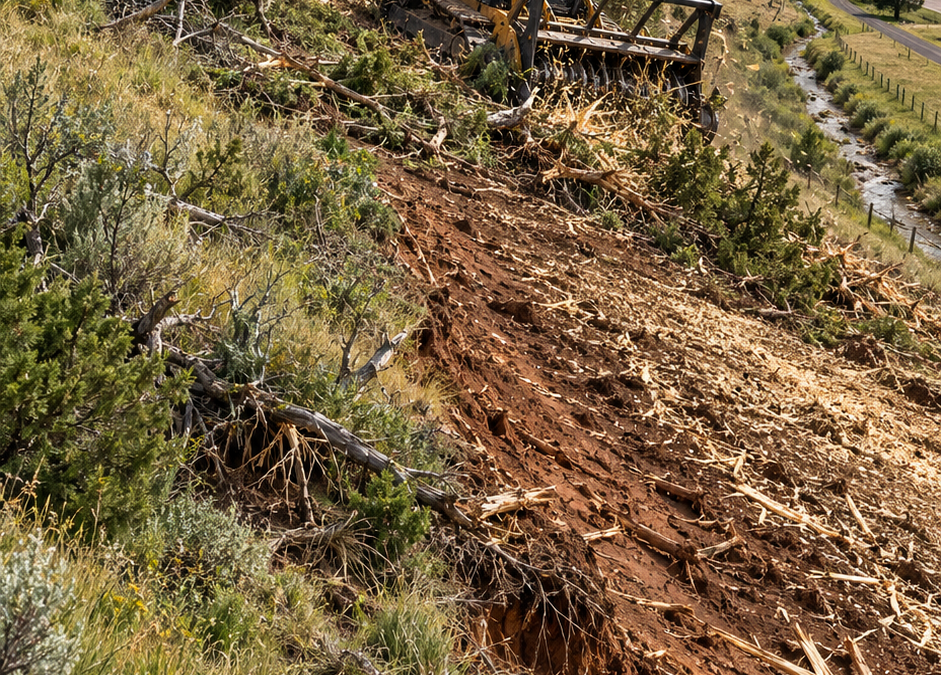
I stepped around her and crouched beside the fresh track marks. The mulcher had exposed hard soil beneath the grass. I scraped loose chips away with my glove. Little ridges that had interrupted runoff were gone. Roots were torn open. A shallow channel I had spent years softening with grass now emptied directly onto bare ground.
Brooke came up behind me.
“Jack, we’re trying to protect the neighborhood.”
I stood and brushed dirt from my palm.
“Then stop the machines.”
“Dead brush next to residential property is a liability.”
“That brush isn’t there because I’m lazy.”
She glanced across the acreage.
“Then why is it there?”
I looked toward the eastern strip, then at the clean scar her crew had already carved through the west side.
“You should have asked that before you started cutting.”
Brooke’s jaw tightened.
Behind her, the mulcher operator waited with both hands resting on the controls.
“The crew is here now,” she said.
“Then send them home.”
“And leave forty acres like this?”
She gestured at the surviving vegetation like it was disease.
I picked up the envelope she had tried to hand me and set it on the hood of her SUV without opening it.
“Bill me for whatever you think you’ve done,” I said.
Then I pointed toward the untouched eastern acreage.
“But if one machine crosses into that section, we’re going to have a different problem.”
Brooke stared at me, then at the land behind me.
She thought I was protecting weeds.
I was looking at the last part of the property that could still do the job her crew had just paid itself to destroy.
Brooke left before the crew did.
I stood at the edge of the cleared strip while the workers loaded chainsaws, fuel cans, and orange cones into their trailer. The foreman, a broad man named Wes, walked over and rubbed the back of his neck.
“For what it’s worth,” he said, “she told us the property owner had been notified and approved access.”
I looked at him.
“I didn’t.”
His eyes shifted toward the exposed slope.
“Yeah. I figured that out.”
By sunset, the machines were gone, but the smell of shredded cedar hung over the pasture.
Before I touched anything, I photographed the tracks, the cut lines, the flattened swale, and the crew’s path from the gate. Then I emailed the association and the contractor.
I had never approved entry.
No further work was authorized.
Nothing else on the property was to be disturbed.
After that, I spent the next hour walking the damage. I could argue about who had the right to do what later. First, I needed to know what they had changed before the next rain showed me the hard way.
My boots sank into loose mulch where thick grass had held the soil. Near the bottom of the slope, I found the first thing I was afraid of.
A shallow drainage swale had been flattened almost smooth.
I knelt and pushed my fingers into the dirt.
Dry on top.
Powder underneath.
The association had a clause. I knew that. Brooke knew that. But the clause did not give her a blank check to decide any rough-looking ground was an emergency, send in heavy equipment, and ask questions afterward.
She had not corrected a threat.
She had created one.
The next morning, I woke to the soft rattle of rain against the metal roof.
Nothing dramatic. Barely enough to darken the porch boards.
I pulled on boots and walked west with coffee in one hand. Water already beaded on the exposed dirt. Where the old grass strip had been, a thin brown thread was moving downhill.
I set my mug on a fence post and followed it.
At the bottom, the thread widened and disappeared into the surviving vegetation. I drove two steel stakes into the ground, stretched mason’s line between them, and marked the water level with tape. Then I moved uphill and did it again.
Not evidence for court.
Not yet.
I needed to understand what the machines had changed before I decided what to do next.
Around ten, my phone buzzed.
An email from the association carried an invoice for $8,460 labeled Emergency Vegetation Mitigation.
Beneath it was a notice giving me ten days to authorize completion of the remaining work.
I read it twice, standing beside my workbench with sawdust still on my sleeves.
Then another message arrived.
Brooke.
Contractor availability is limited. Please confirm access by Friday to avoid additional enforcement costs.
I looked through the open workshop door toward the eastern acreage. The rain had strengthened enough to silver the roof of my pickup.
For a few seconds, I considered doing what Brooke expected: hiring an attorney, firing off letters, spending weeks arguing over authority while the land sat exposed.
Instead, I opened the weather app.
A larger storm system was forecast for the weekend.
I set the phone down.
The mistake I had made fourteen years earlier had taken three years to repair. Brooke had recreated part of it in one afternoon. I was not going to waste the next ten days arguing about whether she had the right to finish.
I needed to keep her from finishing at all.
I pulled an old survey map from the cabinet above my workbench, spread it beside a topographic map I had drawn notes on over the years, and traced the western slope with one finger.
Then I circled the untouched eastern strip.
Brooke thought the argument was about brush.
It was not anymore.
Her crew had changed the way forty acres handled water, and the next storm was already on its way.
By Friday morning, the rain had moved east and left the property steaming under a hard white sun. I was replacing a warped gate board when I heard tires on gravel.
Brooke’s SUV came through the entrance first.
Behind it rolled Wes’s truck, the equipment trailer, and the same tracked mulcher that had stripped the western slope.
I set the drill on the tailgate and walked toward them.
Brooke stepped out before the dust settled, red pantsuit sharp against the brown pasture.
“You didn’t respond.”
“I did.”
“No, you didn’t.”
“The locked gate was my response.”
Her eyes moved to the chain I had added across the service entrance.
Wes stayed beside his truck. He was not unloading anything.
Brooke pointed toward the eastern acreage.
“The board authorized completion.”
“And I told you nobody crosses that line.”
She pulled a folded document from her leather folder.
“The association has a maintenance provision allowing corrective access when a condition threatens neighboring property.”
I did not reach for it.
“Does it tell you where the water goes after you correct it?”
Her mouth tightened.
“We are not discussing drainage.”
“You should be.”
I walked to the fence and pointed downhill.
The western strip was visibly different now. Two days of light rain had cut narrow grooves through the exposed soil. At the lowest point, reddish sediment had collected against the surviving grass in a fan nearly six feet wide.
Wes noticed it.
He took two steps closer and stared.
Brooke did not.
“You’re delaying required work,” she said.
“I’m preventing you from making the damage bigger.”
“Damage?”
She gave a short laugh.
“We removed combustible material.”
I opened the tailgate of my pickup and took out two wooden stakes connected by bright mason’s line. Mud stained both stakes halfway up.
“Tuesday morning,” I said. “That line was four inches above runoff. Yesterday afternoon, water reached it.”
Brooke glanced at the stakes.
“It rained less than an inch.”
“Exactly.”
I carried them to the edge of the stripped slope and drove one back into its marked hole.
“This ground used to slow that water before it reached the bottom.”
I pointed east.
“That section you’re trying to clear is the last intact break between this slope and the homes below.”
For the first time, Wes looked directly at Brooke.
“You told us it was overgrowth removal.”
“It is.”
“You didn’t mention drainage structures.”
“They’re not structures,” she snapped.
That word mattered.
I had not called them structures either. Brooke had.
Wes folded his arms.
“I’m not taking the machine through a locked gate without the owner’s permission.”
Brooke turned toward him.
“You have authorization from the association.”
“That’s not the same thing.”
The air went still between them. I could hear insects buzzing around the fence posts.
Brooke looked at me again.
“Fine. Keep obstructing access. Every delay goes on your account.”
She got back into the SUV and slammed the door.
Wes waited until she drove away before speaking.
“She’ll find another contractor.”
“I know.”
He looked toward the eastern strip.
“What exactly did you build out there?”
“Nothing fancy. Contour breaks. Native grass. Deadfall. A few shallow swales. Mostly I stopped fighting the land.”
Wes stared downhill for another moment, then climbed into his truck.
After they left, I changed tactics.
A chain could stop one contractor.
It could not stop an association convinced I was bluffing.
I spent the afternoon moving equipment out of the western low ground and placing straw wattles across the fresh erosion cuts. Then I called the three homeowners downhill from my property.
I did not ask them to fight the HOA.
I asked one question.
“If we get heavy rain this weekend, can I walk your drainage line with you?”
Two said yes immediately.
The third hesitated, then agreed.
Near sunset, I stood on the eastern rise while thunderheads stacked dark blue beyond the county road. My phone buzzed with another association notice. I did not open it.
Downhill, porch lights were beginning to come on one by one.
Brooke thought the locked gate was my defense.
It was not.
The gate was buying me time to protect what she had not cut yet.
I spent Saturday morning cutting into land I had spent years trying not to disturb.
The tractor blade skimmed the eastern rise in a shallow arc, peeling back grass six inches at a time. I was not digging a ditch. A ditch would have concentrated the water and sent it somewhere faster. I wanted the opposite. I wanted a broad, almost invisible change in grade that would persuade runoff to spread sideways before gravity gathered it into something stronger.
Henry Fulton, my neighbor from the next property over, arrived around nine in his old green pickup. He shut the door, studied the fresh cut, then looked at me.
“You’re taking that through the hay ground.”
“Not if I can avoid it.”
He walked twenty feet downhill and planted one boot beside a strip of bluestem.
“Looks like you’re running out of places to avoid.”
I did not answer.
He was right.
The hayfield covered the flattest, most productive ground I owned. I had cut it every spring for years. Beyond it sat the natural depression, and beyond that, the thick eastern strip Brooke wanted removed. If I could connect those pieces without cutting across the field, I could keep most of what mattered.
I spent four hours trying.
I shaped a shallow contour around the north edge, moved two old logs across the grade, and opened a narrow passage through a stand of native grass. Then Henry hooked a five-hundred-gallon water tank to his pickup. We released enough water uphill to see where gravity wanted it.
The first sheet spread exactly where I hoped.
Then it found a low seam I had not accounted for, turned south, and accelerated.
I jogged beside it until it disappeared into the western clearing.
“Damn it.”
Henry shut the valve.
“Again?”
“Again.”
The second test failed farther downhill.
By midafternoon, my navy shirt was dark with sweat, dust coated my forearms, and the tractor seat felt hot through my jeans. I killed the engine and stood on the running board, staring across the property.
From up there, Brooke’s work almost looked good.
Open ground.
Clean sight lines.
No tangled brush.
That was the problem.
Every acre she simplified gave water fewer choices.
My phone rang.
Brooke.
“Jack, there’s a crew scheduled Monday.”
“Cancel them.”
“You know I can’t do that.”
“You can. You won’t.”
“The eastern boundary is our highest priority. It’s closest to the homes.”
I looked directly at the rough green strip.
“That’s why I left it.”
Silence.
Then she said, “You’re telling me dead limbs and weeds are protecting houses?”
“I’m telling you the roots, grass, contour, and rough ground slow water before it reaches them. This started as a fire safety issue, and your solution created a drainage issue.”
Her voice hardened.
“I’m not letting you invent a new excuse every time we enforce a rule.”
I rubbed mud from the tractor’s steering wheel with my thumb.
“Come out here and I’ll show you.”
“I’ve seen your property.”
“No. You’ve seen what you think is wrong with it.”
She ended the call.
Henry had heard enough from where he stood.
“Monday?”
“Monday.”
He looked toward the sky. High clouds were moving in from the west, thin and fast.
“Storm still coming.”
I climbed back onto the tractor.
Then we worked Sunday.
That evening, I moved the livestock fence twenty yards uphill and closed the lane that crossed the eastern slope. It added nearly half a mile to the route between the barn and lower pasture, but I needed the ground open. Before dark, Henry and I marked three connected curves with orange flags: the surviving grass shelf, the natural depression, and the edge of the hayfield.
I stopped at the last flag.
The hay stood knee-high, dry at the tips, moving softly in the wind.
Henry stood beside me.
“If the north route doesn’t hold—”
I stared across the field.
“Then this becomes the route.”
“That’s your best ground.”
“I know.”
Thunder rolled somewhere beyond the horizon.
I pulled the final flag from my pocket and pushed it into the soil at the edge of the hay.
For the first time since Brooke’s machines arrived, I was not trying to rebuild what she had destroyed.
I was deciding what I was willing to lose to make what remained work.
Sunday morning came hot, bright, and windless.
Henry was already at the eastern fence when I drove the tractor down from the barn. We worked the north route first, widening the shallow contour I had cut the day before and packing loose soil along its downhill edge.
By ten, sweat had soaked through my shirt and dust stuck to the back of my neck. The sky looked harmless.
That bothered me more than thunder would have.
Henry backed the water tank into position.
“Ready?”
I nodded.
He opened the valve.
Water spread across the upper cut, slowed against the grass shelf, then curved east exactly as planned.
For twenty yards, it worked.
Then the flow reached the edge of the acreage Brooke’s crew had cleared.
With nothing there to break it apart, a second stream arrived from uphill and joined the first. The combined flow jumped my shallow contour and carved a brown finger through the loose soil.
Henry shut the valve.
I walked downhill until I found where the water had stopped. It had piled reddish sediment against the surviving grass.
I looked back uphill.
“Every clean acre is feeding the same low points.”
Henry followed my gaze.
“And Monday, they want to clean more.”
Around noon, tires crunched at the gate.
Brooke stepped from her SUV alone.
She did not walk toward me. She walked straight to the cleared western strip and stood with her hands on her hips, surveying it like a finished landscaping job.
“This is what the whole parcel should look like,” she called.
I climbed down from the tractor.
“Come here.”
She stayed where she was.
“I didn’t come for another demonstration.”
“Then look at your shoes.”
She glanced down.
Fine red sediment coated the toes of them.
I pointed to the erosion grooves running behind her.
“That came from less than an inch of rain.”
“Bare soil settles.”
“Water doesn’t.”
I walked toward the eastern strip, and she followed far enough to keep arguing at the grass line. Sediment from our test water had collected in a thick fan. I pushed my boot into it.
“Everything you remove up there makes this section work harder.”
Brooke looked toward the homes beyond the boundary. Their roofs showed between live oaks less than a quarter mile downhill.
“That’s exactly why I want this cleared before fire season gets worse.”
“Clear this and you remove the last place the water can spread before those yards.”
“You’re assuming a drainage problem that hasn’t happened.”
“I’m trying to keep it from happening.”
She folded her arms.
“The crew comes tomorrow.”
I stared at her for a second, then walked away.
I was not going to spend another hour trying to make her see terrain she had already decided was weeds.
At the hayfield, the orange flags Henry and I had planted formed a broad curve toward the natural depression. I paced it again.
Two hundred and thirty feet.
Cutting it would take productive ground out of rotation and divide the field in a way I would have to work around for years.
Henry came up beside me after Brooke left.
“Forecast changed.”
He held out his phone.
The storm was moving faster. Heavy rain was expected overnight into Monday morning.
“How much?” I asked.
“Could be two to three inches.”
I looked at the flags.
“That’s not unusual here.”
“Not before.”
He did not need to finish.
Before the western slope had grass, roots, brush lines, and dozens of small interruptions.
Now it had open lanes pointing downhill.
I climbed onto the tractor and spent the afternoon strengthening the depression instead of cutting the hayfield. I told myself I was preserving options. By sunset, I knew what I was really doing.
I was postponing the one choice I did not want to make.
The first gust hit just after dark, carrying the smell of wet dust through the open workshop door. I stepped outside. Lightning flickered behind the western clouds. Across the pasture, the hayfield disappeared into darkness, but I knew exactly where those orange flags stood.
Tomorrow, Brooke’s crew planned to take the eastern strip.
Tonight, the land was going to tell me whether I had waited too long to sacrifice the field.
The rain started at 1:17 in the morning.
I know because the first hard drops hit the workshop roof while I was still sitting at my bench with my boots on. Within ten minutes, the sound changed from scattered impacts to a steady metallic roar.
I stepped outside with a flashlight.
The air smelled like wet cedar and red dirt.
Water was already running along the gravel beside the barn. I drove the tractor down to the eastern slope and checked the depression first. It was taking water, but the ground was darkening fast. The channels I cut held for the moment.
At dawn, the rain eased to a gray drizzle.
I had not slept.
I was standing beside the eastern gate when headlights appeared through the mist.
A pickup came first, then a flatbed carrying a compact mulcher.
Brooke’s SUV followed.
I walked into the service lane before they reached the gate and parked my tractor sideways across it.
The contractor stopped twenty feet away.
Brooke stepped out beneath an umbrella. Her red pantsuit was mostly hidden under a raincoat, but there was no mistaking the way she marched toward me.
“Move the tractor.”
“Not today.”
“You’re obstructing authorized work again.”
I pointed toward the saturated ground.
“You’re not putting tracked equipment through there after this rain.”
The new contractor climbed from his pickup and looked past me toward the pasture.
“How wet is it?”
“Wet enough to rut.”
Brooke turned on him.
“We’re clearing vegetation, not grading.”
“Machine still has to get there,” he said.
I climbed down from the tractor.
“The section she wants you to clear is the only intact rough ground between that slope and the houses.”
Brooke’s face tightened.
“We’ve been through this.”
“Then you’ve heard the warning.”
She stepped closer, stopping several feet away.
“After the ground dries, we’re finishing the work.”
“If the ground dries.”
She stared at me.
“Is that supposed to be a threat?”
I almost laughed, but I was too tired.
“It’s weather, Brooke. It doesn’t care what either of us wants.”
The contractor checked the forecast on his phone and shook his head.
“More rain this afternoon. I’m not unloading.”
Brooke looked from him to me.
“Fine. After the storm.”
She returned to her SUV.
The trucks backed out behind her.
I watched them disappear before moving the tractor.
I had bought hours.
Maybe a day.
That was all.
By noon, the sky had dropped low and dark again.
Henry arrived with his pickup and the water tank, though we did not need test water anymore. Thin streams were already moving off the cleared western ground. We walked them on foot.
“What used to arrive as scattered trickles now meets in two low places,” Henry said.
“I know.”
“Still holding?”
I crouched beside the lower contour. Water slid through the grass in a sheet less than an inch deep.
“So far.”
Henry looked toward the hayfield.
The orange flags bent in the wind.
“You cutting it?”
I stood.
“Not yet.”
He did not argue.
That made it worse.
I spent the afternoon reinforcing the surviving grass shelf, clearing loose chips from the depression, and opening another few inches along the northern contour. Everything I did was meant to protect my barn, my equipment yard, and the eastern boundary without touching the hay.
I kept telling myself that meant the system still had room.
Just before dark, my phone gave a weather alert.
Another band of heavy rain was moving directly toward us.
I read the expected rainfall twice.
Then I looked west.
The cleared slope had turned almost black with water. Small brown streams were already joining at the bottom. Beyond me, the hayfield waited untouched. Beyond that stood the rough eastern vegetation Brooke still intended to remove.
I put the phone away and climbed onto the tractor.
The engine turned over with a low diesel knock.
I drove to the first orange flag and stopped with the blade hovering above the grass.
Rain began ticking against the brim of my hat.
My hand rested on the hydraulic control.
I could protect the field for one more night.
I just did not know whether protecting it would cost me everything below it.
The blade stayed above the hay for maybe three seconds.
Then I pulled the hydraulic lever.
Steel dropped into wet soil with a dull scrape, and the first strip of grass folded beneath it.
I drove slowly, following the orange flags across the field. Rain hammered my hat and ran cold down the back of my neck. Every pass cost me something.
That hay was winter feed.
I had spent months growing it, and now I was cutting a shallow diversion through the best section because the land upstream no longer behaved the way it had before the HOA crew cleared it.
By midnight, I had opened two broad grass channels that curved away from the barn and equipment yard toward the eastern depression.
They were not pretty.
They were not deep.
They did not need to be.
They needed to spread fast-moving runoff before it concentrated.
Henry followed in his pickup, headlights washing over the rain.
When I shut the tractor down, the sudden silence lasted half a second before the storm filled it.
“You sacrificed almost three acres,” he said.
I looked across the flattened hay.
“I know.”
At 2:40, the real test arrived.
Water came off the western clearing in a brown sheet. It crossed the low pasture faster than I had ever seen it move, struck the first contour, and began filling the channel.
Henry and I stood under the barn overhang with flashlights.
“There,” he said.
The water turned exactly where I had cut.
For a moment, relief loosened my shoulders.
Then the second flow arrived.
It was heavier.
The first channel spilled into the second, and both pushed toward the depression.
The system was working.
Barely.
By sunrise, the rain had weakened.
My hayfield looked carved open, but the barn was dry. So was the equipment yard.
I walked the channels in mud that grabbed at my boots.
Near the eastern side, I stopped.
Water had spread through the rough vegetation Brooke wanted removed, slowing into dozens of shallow ribbons before reaching the boundary.
That untouched section was not dead brush doing nothing.
It was absorbing the last hard push.
At 9:15, Brooke came back.
This time, she brought the contractor and two HOA board members. Her SUV stopped beside the gate, and she stepped out staring at the cut channels.
“What did you do?”
“Protected my property.”
She walked several yards along the fence, looking at the muddy field.
“You destroyed your own hay.”
“Part of it.”
“And you’re blaming us for that too?”
I pointed toward the western clearing.
Water still streamed from it in narrow brown lines.
“Walk with me.”
“I’m not interested in another demonstration.”
“Then your contractor should be.”
He was already watching the runoff.
I opened the gate and led him toward the eastern slope. Brooke followed, irritated enough to forget she had refused. We stopped where water entered the remaining rough vegetation.
The contractor crouched, pressed two fingers into the soil, then looked back toward the stripped acreage.
“How much did your first crew clear?”
Brooke crossed her arms.
“What they were contracted to clear.”
“That’s not what I asked.”
One board member shifted uncomfortably.
Brooke’s voice hardened.
“The remaining section is scheduled next.”
The contractor stood.
“Not with my equipment.”
Her head snapped toward him.
“Excuse me?”
He pointed at the soaked ground.
“That vegetation is spreading runoff. If I mulch it now, I’m putting tracks through saturated soil and removing the last rough surface before the boundary.”
“You’re a vegetation contractor, not a hydrologist.”
“I’m also the guy whose company name goes on the job.”
Brooke stared at him, jaw tight.
Then she turned to me.
“You staged this.”
I looked down at my ruined hayfield, mud covering my boots to the ankles.
“You think I destroyed three acres of my own crop to win an argument?”
She did not answer.
A board member finally spoke.
“Brooke, maybe we stop until we understand what we’re changing.”
Her expression went still.
That was the first time anyone besides me had said stop in front of her.
And I knew immediately the storm had not ended the fight.
It had changed who was willing to stand in her way.
Brooke did not stop.
She changed tactics.
By noon, the contractor’s machines were gone, but a white HOA utility truck sat outside my west gate with two orange barricades stretched across the shared access lane in front of the entrance. Brooke stood beside them in her red pantsuit, one hand on her hip while an HOA maintenance worker drove steel stakes into the shoulder.
“Temporary safety closure,” she said when I walked up. “Until your unauthorized drainage alterations are evaluated.”
Rainwater dripped from the brim of my brown hat.
“You mean the channels that kept the barn dry last night?”
“I mean the earthwork you performed after being notified of a fire hazard.”
She pointed past me toward the pasture.
“No vehicles through this entrance.”
That gate was how I reached the western acreage with my tractor, feed trailer, and water tank. Blocking it did not prove she was right. It made my daily work harder, which was exactly the point.
I looked at the barricades.
Then at Brooke.
“Keep your people off my side of the fence.”
“Then stop creating problems the association has to solve.”
I turned away before anger made the decision for me.
That afternoon, I moved feed through the north gate, adding nearly four miles to every trip.
By the third run, my shoulders ached from tractor vibration, and the fuel gauge had dropped farther than it should have. The easy move would have been to tear the barricades aside and give Brooke the confrontation she wanted.
Instead, I left them untouched.
The storm had shown me something more useful than any argument could.
My land could answer for itself if I stopped trying to make Brooke understand it.
I spent the next two days working, not investigating.
Henry helped me reshape the first diversion where the water had nearly overtopped it. We rolled straw wattles along the vulnerable edge, spread clean mulch over exposed soil, and drove wooden stakes into the contour.
On the eastern section, I did almost nothing.
That was the point.
The rough grass, brush, and uneven ground remained exactly as they had been before.
The HOA labeled them dangerous.
The land used them as protection.
Late Thursday afternoon, the contractor returned alone. He parked outside the north gate and walked in carrying his hard hat.
“Brooke wants me back Monday,” he said. “Different crew.”
I rested my shovel against the tractor tire.
“You taking the job?”
He looked across the remaining vegetation.
“Not unless she gives me written direction accepting the site conditions.”
“Will she?”
He gave a dry laugh.
“She doesn’t like putting responsibility in writing.”
Then his face tightened.
“But she’ll find somebody who doesn’t care.”
That landed harder than I expected.
I had bought time.
Not safety.
Sunday brought another storm warning.
Less rain than the first one, but the ground was already saturated. At dusk, I drove to the western ridge and saw fresh fluorescent paint on the grass beyond the fence.
A clearing line.
It ran directly toward the untouched eastern section.
Brooke had found another crew.
Their skid steers arrived just after seven Monday morning.
I was already there.
So were Henry and the first contractor, standing on the public side of the fence.
Brooke stepped from her SUV and lifted one hand toward the machines.
“Proceed.”
I opened my gate and drove my tractor into the field.
Not toward them.
Away from them.
I lowered the blade into the diversion channel and began clearing storm debris that had collected overnight. The new operator stopped his machine and watched.
Brooke marched to the fence.
“You cannot interfere with contracted hazard removal.”
I killed the engine.
“I’m not interfering. I’m maintaining my drainage.”
“That drainage exists because of your unauthorized excavation.”
“And the water exists because you stripped the slope.”
Behind her, the new contractor climbed down and stared at the muddy runoff marks crossing the cleared acreage. Then he looked at the rough eastern ground, at my diversion channels, and at the brown stain where the last storm had spread and slowed.
He did not restart his machine.
Brooke pointed sharply toward the brush.
“I hired you to clear that section.”
The man shook his head.
“Not today.”
Her hand dropped.
“Why?”
He nodded toward the sky. Gray clouds were building over the ridge.
“Because if I remove that cover before tonight’s rain, whatever happens downhill becomes part of my morning.”
For the first time since this began, Brooke was not arguing with me. She was standing between two contractors, a saturated hillside, and a storm she could not order to stop.
Then the first cold drop struck the back of my hand.
The rain came harder before Brooke could answer.
Within minutes, the machines were backing toward the county road, tires pressing dark tracks into the wet gravel while Brooke stood beside her SUV, watching another crew leave without touching the eastern strip.
I climbed onto my tractor and drove downhill.
The diversion channel was already carrying water.
Henry followed on foot, keeping to the grass shelf.
By the time we reached the lower contour, brown runoff was pouring from the HOA-cleared acreage in three separate streams.
“More than last time!” Henry shouted over the rain.
I nodded and pushed the tractor forward.
A mat of wood chips had washed into the upper channel and was choking the bend. I lowered the bucket, peeled the debris away, and dumped it on higher ground.
Water surged through the opening and spread across the hayfield I had sacrificed. The cut grass flattened beneath it. For thirty yards, the flow widened, slowed, and entered the natural depression.
Then it reached the eastern vegetation.
What had arrived as a muddy stream broke apart among grass clumps, roots, fallen limbs, and uneven ground until it became dozens of shallow ribbons.
I shut off the tractor and listened.
Rain on my hat.
Water moving through grass.
Nothing rushing toward the houses below.
Brooke had followed us down. Her red pantsuit was dark at the shoulders beneath her open raincoat, and mud covered the heels of her shoes. She stopped near the edge of the rough strip.
“So this proves your excavation works,” she said.
“Partly.”
I pointed behind her.
“Look uphill.”
She turned.
Across the cleared western slope, water ran through bare lanes where brush and ground cover had stood a week earlier. One of the shallow erosion cuts had widened enough to expose pale subsoil.
“Now look down.”
Beyond the eastern boundary, the nearest backyard was wet but quiet.
No brown water crossed the fence.
No sediment reached the patio below.
The land between us was doing exactly what I had spent years teaching myself to let it do.
Brooke did not speak.
Henry did.
“Take that last cover out, and you’re removing the only thing left slowing this before the property line.”
One of the board members had arrived behind us. He stared at the water, then at my torn hayfield.
“You cut all that to redirect runoff?”
“Almost three acres,” I said. “Because I couldn’t put the vegetation back before the storm.”
He looked at Brooke.
“We’re done clearing.”
Her jaw tightened.
“You don’t make that decision alone.”
“Neither do you.”
The rain softened by late afternoon.
The next morning, three board members walked the property with me, Henry, both contractors, and two of the homeowners downhill.
Nobody needed a dramatic speech.
The ground did the talking.
They saw the erosion above, the diversion through my ruined hay, and the sediment trapped in the untouched eastern strip. They saw how the water spread where the land was rough and accelerated where Brooke had made it clean. They saw the western scar, the cut channels, the saturated soil, and the quiet yards below.
Before noon, the remaining clearing order was suspended.
Two days later, the barricades disappeared from my west gate.
The $8,460 assessment was formally withdrawn with them.
The HOA also agreed to restore the acreage its contractor had stripped and cover the documented feed I had to buy because of the hay I had sacrificed. How they settled responsibility with the clearing company was between them.
I could have spent months fighting over every other loss.
By then, I knew what I wanted most.
The clearing order dead.
The assessment gone.
The damaged ground put back before another season of rain.
I refused their first proposal to grade it smooth.
That was the same mistake in a different costume.
Instead, I made them restore roughness.
They reseeded native grass. They placed erosion-control material along the same contours their machines had erased. They set wattles where the flow had cut too quickly. They left selected deadfall where it slowed water without creating access hazards. They did not make the land pretty.
They made it functional again.
Brooke came out once during the work.
She stood near the fence while crews spread seed over the western slope. She did not point at anything that day.
“You could have explained this better from the beginning,” she said.
I rested both hands on the fence rail.
“I tried.”
She looked toward the eastern strip.
“It still looks like a fire hazard.”
“Then next time, ask why it’s there before sending a machine.”
She left without answering.
I never recovered that season’s hay.
The association covered the replacement feed, but money did not put those three acres back into production that winter. Every bale I unloaded reminded me what stopping them had cost. The lost time. The fuel. The mud. The stress. The nights without sleep. The sound of my own tractor blade cutting into grass I had meant to harvest.
But by spring, green shoots covered the western slope again.
The diversion channels softened under new growth, and I kept them. The damaged contours did not return exactly as they had been before. Land never does that. It heals in its own shape. But it healed enough.
One April morning, I stood beside the workshop while rain moved gently across the roof.
Water slipped down the restored contours, spread through the hayfield, and vanished into the rough eastern ground exactly where it was supposed to. No rush. No brown surge. No sediment fan. No flood against the homes below.
Just water moving the way it had before someone tried to improve what they had never understood.
The HOA had called my forty acres neglected.
They cleared part of it without asking.
They billed me for the privilege.
What finally stopped them was not a louder argument, a better threat, or a clever legal trick.
It was the part of the land they never bothered to study.
The roots.
The grass.
The deadfall.
The roughness.
The ugly places doing quiet work.
Brooke thought a clean slope meant safety.
The storm showed her the truth.
Sometimes the land that looks unmanaged is the land that has been managed the longest.𝗧𝗛𝗘 𝗘𝗡𝗗
The HOA Called My Forty Acres Neglected Until the First Storm Showed Them What the Weeds Were Holding Back
The wood chipper was already screaming when I came out of my workshop.
By the time I crossed the pasture, the HOA had carved a raw wound through land I had spent fourteen years teaching myself not to disturb.
They thought they were clearing brush, but the first rain was about to show them what that brush had been protecting.
My name is Jack Morrison, and the western edge of my forty acres never looked pretty to people who did not understand it.
That was partly my fault, I suppose. I never tried to make it pretty. I did not mow it into clean lines or prune every cedar until it looked ornamental. I did not drag out every fallen limb the moment it hit the ground. I did not flatten every rough patch, trim every contour, or turn the slope into something that looked respectable from the road.
I had done that once.
Fourteen years earlier, when I first bought the acreage, I made the same mistake everyone else makes when they believe neat land is healthy land. I cut brush. I burned deadfall. I mowed low. I cleaned the western slope until it looked open and controlled. I stood back afterward, sweating through my shirt, proud of myself for turning wild ground into something that seemed managed.
Then September came.
One storm dropped nearly four inches of rain overnight.
By sunrise, brown water was tearing across my driveway hard enough to carry gravel into the county ditch. The slope that had looked clean the day before had become a chute. Without roots, grass shelves, deadfall, and uneven cover slowing the water, every drop found the fastest way downhill. It carved little channels that became wider channels. It stripped soil where I had exposed it. It pushed sediment toward the low ground and nearly flooded the equipment yard behind my barn.
That was the first time the land taught me that appearances could lie.
It took me three years to repair what I had done in one season.
I stopped mowing certain contours. I let deep-rooted native grass return in strips. I left selected fallen limbs across the grade where they slowed runoff without blocking access. I built shallow swales so subtle most people would walk over them without noticing. I kept the barn, access lanes, fence approaches, and house perimeter cut back. I was not careless. I was deliberate.
The ugly parts were not neglect.
They were brakes.
Water remembers every shortcut you give it.
I learned that sentence the hard way, not from a book, not from a consultant, not from an HOA newsletter, but from walking my land in storms with a flashlight and watching where the water wanted to go.
Brooke Stanton never asked why the land looked the way it did.
She decided what it was from a distance.
Brooke was the president of the Cedar Ridge Homeowners Association, though everyone knew the HOA was basically Brooke with a board behind her. She wore bright suits, carried white envelopes, quoted bylaws like scripture, and acted as if every natural thing near the neighborhood was a pending violation waiting for her signature.
My acreage had been folded into the association long before I bought it. That was one of the compromises that came with the property. Forty acres on the edge of the development, technically inside the association boundary, but not inside the manicured residential lots. The declaration gave the HOA limited power to address certain immediate threats to neighboring property. That clause had always bothered me, but I had read it carefully before buying. It did not give them general control of my land. It did not allow them to turn acreage into landscaping. It did not authorize machines to invade because rough grass offended someone’s view.
It allowed corrective action only for actual immediate threats.
Brooke used the word emergency whenever she wanted to skip the part where proof was required.
For months, she had sent notices about the western slope.
Dead vegetation.
Combustible material.
Unmaintained brush.
Fire hazard.
The first notice made me walk the boundary and check the ground around the homes below. I trimmed where trimming made sense. I cleared near the fence approaches. I cut back anything close to structures, lanes, or equipment. But I did not strip the slope. I would not remove the native grass shelf. I would not drag out the deadfall that lay across contour. I would not turn the slope back into the clean, dangerous chute I had spent years repairing.
So Brooke escalated.
I answered two letters. Then three. I sent photographs. I explained that the rough vegetation served a drainage function. I offered to walk the property with a board member, the county extension agent, or a qualified erosion-control specialist. Brooke ignored the offer. She kept sending notices written as if the question had already been answered.
Then one August morning, while I was sharpening mower blades in my workshop, I heard the chipper.
At first, the sound did not make sense.
The workshop sat behind the barn, and machines were not unusual on my property. Tractor. mower. saw. compressor. generator. I was used to mechanical noise. But this was different. A high, grinding scream, heavy and hungry, rising and falling as something hard went through a drum.
Then I smelled cedar.
Fresh cedar.
Not the dry, faint scent of old limbs warming in the sun. This was sharp and green and wrong.
I stepped out of the workshop, wiped my hands on a rag, and walked around the corner of the barn.
Then I stopped cold.
A tracked mulcher was crawling through the western edge of my acreage.
Its drum chewed brush I had spent years leaving exactly where it was. Pale wood chips sprayed behind it in an ugly fan. Three men in reflective vests were dragging cut limbs into piles. Beyond them, maybe fifty yards inside my property, Brooke Stanton stood beside a white SUV in a red pantsuit, one arm extended as she directed the operator toward the next strip.
For a second, I could not move.
Then I ran.
My boots hammered the dry August ground. I waved both arms until one of the workers spotted me. He signaled the operator. The drum wound down with a metallic whine, and suddenly the whole slope went quiet except for the ticking engine and cicadas screaming in the trees.
Brooke turned toward me.
“Jack, what are you doing?”
I pointed behind her.
“What am I doing?”
Where knee-high native grass, scattered cedar, fallen limbs, and rough patches had broken up the slope that morning, there was now an open strip of raw ground nearly two hundred feet long.
Brooke looked at it with satisfaction.
“Mitigating the fire hazard.”
“On my land.”
“You received notices.”
“I received complaints about vegetation.”
She folded her arms.
“Which you chose not to address.”
A worker killed the chipper completely. The silence sharpened everything. I could smell hot hydraulic fluid, shredded cedar, exposed dirt, and the bitter edge of my own anger.
Brooke reached into her SUV and came back with a white envelope.
“The association authorized emergency mitigation,” she said. “The contractor’s cost will be assessed to your property.”
I looked at the envelope, then past her.
One of the crew had removed a low line of deadfall that used to lie across the slope. Another had cut through a thick shelf of switchgrass near a shallow depression. To Brooke, it probably looked cleaner already.
To me, the ground looked naked.
“How much have you cleared?” I asked.
“Enough to begin bringing the parcel into compliance.”
“That’s not what I asked.”
She exhaled through her nose.
“The western section today. The remaining hazardous growth after that.”
My eyes followed the slope east.
Forty acres does not look large on a map. Standing inside it, you notice every rise, every low spot, every place water chooses when the sky opens. The eastern side still held the roughest vegetation on the property: native grass, scattered brush, old limbs positioned across contour, and a low green strip that curved toward a natural depression.
Brooke pointed toward it.
“That entire area needs to be cleaned.”
I looked back at her.
“Don’t touch another foot.”
Her expression barely changed.
“This isn’t optional.”
I stepped around her and crouched beside the fresh track marks. The mulcher had exposed hard soil beneath the grass. I scraped loose chips away with my glove. Little ridges that had interrupted runoff were gone. Roots were torn open. A shallow channel I had spent years softening with grass now emptied directly onto bare ground.
Brooke came up behind me.
“Jack, we’re trying to protect the neighborhood.”
I stood and brushed dirt from my palm.
“Then stop the machines.”
“Dead brush next to residential property is a liability.”
“That brush isn’t there because I’m lazy.”
She glanced across the acreage.
“Then why is it there?”
I looked toward the eastern strip, then at the clean scar her crew had already carved through the west side.
“You should have asked that before you started cutting.”
Brooke’s jaw tightened.
Behind her, the mulcher operator waited with both hands resting on the controls.
“The crew is here now,” she said.
“Then send them home.”
“And leave forty acres like this?”
She gestured at the surviving vegetation like it was disease.
I picked up the envelope she had tried to hand me and set it on the hood of her SUV without opening it.
“Bill me for whatever you think you’ve done,” I said.
Then I pointed toward the untouched eastern acreage.
“But if one machine crosses into that section, we’re going to have a different problem.”
Brooke stared at me, then at the land behind me.
She thought I was protecting weeds.
I was looking at the last part of the property that could still do the job her crew had just paid itself to destroy.
Brooke left before the crew did.
I stood at the edge of the cleared strip while the workers loaded chainsaws, fuel cans, and orange cones into their trailer. The foreman, a broad man named Wes, walked over and rubbed the back of his neck.
“For what it’s worth,” he said, “she told us the property owner had been notified and approved access.”
I looked at him.
“I didn’t.”
His eyes shifted toward the exposed slope.
“Yeah. I figured that out.”
By sunset, the machines were gone, but the smell of shredded cedar hung over the pasture.
Before I touched anything, I photographed the tracks, the cut lines, the flattened swale, and the crew’s path from the gate. Then I emailed the association and the contractor.
I had never approved entry.
No further work was authorized.
Nothing else on the property was to be disturbed.
After that, I spent the next hour walking the damage. I could argue about who had the right to do what later. First, I needed to know what they had changed before the next rain showed me the hard way.
My boots sank into loose mulch where thick grass had held the soil. Near the bottom of the slope, I found the first thing I was afraid of.
A shallow drainage swale had been flattened almost smooth.
I knelt and pushed my fingers into the dirt.
Dry on top.
Powder underneath.
The association had a clause. I knew that. Brooke knew that. But the clause did not give her a blank check to decide any rough-looking ground was an emergency, send in heavy equipment, and ask questions afterward.
She had not corrected a threat.
She had created one.
The next morning, I woke to the soft rattle of rain against the metal roof.
Nothing dramatic. Barely enough to darken the porch boards.
I pulled on boots and walked west with coffee in one hand. Water already beaded on the exposed dirt. Where the old grass strip had been, a thin brown thread was moving downhill.
I set my mug on a fence post and followed it.
At the bottom, the thread widened and disappeared into the surviving vegetation. I drove two steel stakes into the ground, stretched mason’s line between them, and marked the water level with tape. Then I moved uphill and did it again.
Not evidence for court.
Not yet.
I needed to understand what the machines had changed before I decided what to do next.
Around ten, my phone buzzed.
An email from the association carried an invoice for $8,460 labeled Emergency Vegetation Mitigation.
Beneath it was a notice giving me ten days to authorize completion of the remaining work.
I read it twice, standing beside my workbench with sawdust still on my sleeves.
Then another message arrived.
Brooke.
Contractor availability is limited. Please confirm access by Friday to avoid additional enforcement costs.
I looked through the open workshop door toward the eastern acreage. The rain had strengthened enough to silver the roof of my pickup.
For a few seconds, I considered doing what Brooke expected: hiring an attorney, firing off letters, spending weeks arguing over authority while the land sat exposed.
Instead, I opened the weather app.
A larger storm system was forecast for the weekend.
I set the phone down.
The mistake I had made fourteen years earlier had taken three years to repair. Brooke had recreated part of it in one afternoon. I was not going to waste the next ten days arguing about whether she had the right to finish.
I needed to keep her from finishing at all.
I pulled an old survey map from the cabinet above my workbench, spread it beside a topographic map I had drawn notes on over the years, and traced the western slope with one finger.
Then I circled the untouched eastern strip.
Brooke thought the argument was about brush.
It was not anymore.
Her crew had changed the way forty acres handled water, and the next storm was already on its way.
By Friday morning, the rain had moved east and left the property steaming under a hard white sun. I was replacing a warped gate board when I heard tires on gravel.
Brooke’s SUV came through the entrance first.
Behind it rolled Wes’s truck, the equipment trailer, and the same tracked mulcher that had stripped the western slope.
I set the drill on the tailgate and walked toward them.
Brooke stepped out before the dust settled, red pantsuit sharp against the brown pasture.
“You didn’t respond.”
“I did.”
“No, you didn’t.”
“The locked gate was my response.”
Her eyes moved to the chain I had added across the service entrance.
Wes stayed beside his truck. He was not unloading anything.
Brooke pointed toward the eastern acreage.
“The board authorized completion.”
“And I told you nobody crosses that line.”
She pulled a folded document from her leather folder.
“The association has a maintenance provision allowing corrective access when a condition threatens neighboring property.”
I did not reach for it.
“Does it tell you where the water goes after you correct it?”
Her mouth tightened.
“We are not discussing drainage.”
“You should be.”
I walked to the fence and pointed downhill.
The western strip was visibly different now. Two days of light rain had cut narrow grooves through the exposed soil. At the lowest point, reddish sediment had collected against the surviving grass in a fan nearly six feet wide.
Wes noticed it.
He took two steps closer and stared.
Brooke did not.
“You’re delaying required work,” she said.
“I’m preventing you from making the damage bigger.”
“Damage?”
She gave a short laugh.
“We removed combustible material.”
I opened the tailgate of my pickup and took out two wooden stakes connected by bright mason’s line. Mud stained both stakes halfway up.
“Tuesday morning,” I said. “That line was four inches above runoff. Yesterday afternoon, water reached it.”
Brooke glanced at the stakes.
“It rained less than an inch.”
“Exactly.”
I carried them to the edge of the stripped slope and drove one back into its marked hole.
“This ground used to slow that water before it reached the bottom.”
I pointed east.
“That section you’re trying to clear is the last intact break between this slope and the homes below.”
For the first time, Wes looked directly at Brooke.
“You told us it was overgrowth removal.”
“It is.”
“You didn’t mention drainage structures.”
“They’re not structures,” she snapped.
That word mattered.
I had not called them structures either. Brooke had.
Wes folded his arms.
“I’m not taking the machine through a locked gate without the owner’s permission.”
Brooke turned toward him.
“You have authorization from the association.”
“That’s not the same thing.”
The air went still between them. I could hear insects buzzing around the fence posts.
Brooke looked at me again.
“Fine. Keep obstructing access. Every delay goes on your account.”
She got back into the SUV and slammed the door.
Wes waited until she drove away before speaking.
“She’ll find another contractor.”
“I know.”
He looked toward the eastern strip.
“What exactly did you build out there?”
“Nothing fancy. Contour breaks. Native grass. Deadfall. A few shallow swales. Mostly I stopped fighting the land.”
Wes stared downhill for another moment, then climbed into his truck.
After they left, I changed tactics.
A chain could stop one contractor.
It could not stop an association convinced I was bluffing.
I spent the afternoon moving equipment out of the western low ground and placing straw wattles across the fresh erosion cuts. Then I called the three homeowners downhill from my property.
I did not ask them to fight the HOA.
I asked one question.
“If we get heavy rain this weekend, can I walk your drainage line with you?”
Two said yes immediately.
The third hesitated, then agreed.
Near sunset, I stood on the eastern rise while thunderheads stacked dark blue beyond the county road. My phone buzzed with another association notice. I did not open it.
Downhill, porch lights were beginning to come on one by one.
Brooke thought the locked gate was my defense.
It was not.
The gate was buying me time to protect what she had not cut yet.
I spent Saturday morning cutting into land I had spent years trying not to disturb.
The tractor blade skimmed the eastern rise in a shallow arc, peeling back grass six inches at a time. I was not digging a ditch. A ditch would have concentrated the water and sent it somewhere faster. I wanted the opposite. I wanted a broad, almost invisible change in grade that would persuade runoff to spread sideways before gravity gathered it into something stronger.
Henry Fulton, my neighbor from the next property over, arrived around nine in his old green pickup. He shut the door, studied the fresh cut, then looked at me.
“You’re taking that through the hay ground.”
“Not if I can avoid it.”
He walked twenty feet downhill and planted one boot beside a strip of bluestem.
“Looks like you’re running out of places to avoid.”
I did not answer.
He was right.
The hayfield covered the flattest, most productive ground I owned. I had cut it every spring for years. Beyond it sat the natural depression, and beyond that, the thick eastern strip Brooke wanted removed. If I could connect those pieces without cutting across the field, I could keep most of what mattered.
I spent four hours trying.
I shaped a shallow contour around the north edge, moved two old logs across the grade, and opened a narrow passage through a stand of native grass. Then Henry hooked a five-hundred-gallon water tank to his pickup. We released enough water uphill to see where gravity wanted it.
The first sheet spread exactly where I hoped.
Then it found a low seam I had not accounted for, turned south, and accelerated.
I jogged beside it until it disappeared into the western clearing.
“Damn it.”
Henry shut the valve.
“Again?”
“Again.”
The second test failed farther downhill.
By midafternoon, my navy shirt was dark with sweat, dust coated my forearms, and the tractor seat felt hot through my jeans. I killed the engine and stood on the running board, staring across the property.
From up there, Brooke’s work almost looked good.
Open ground.
Clean sight lines.
No tangled brush.
That was the problem.
Every acre she simplified gave water fewer choices.
My phone rang.
Brooke.
“Jack, there’s a crew scheduled Monday.”
“Cancel them.”
“You know I can’t do that.”
“You can. You won’t.”
“The eastern boundary is our highest priority. It’s closest to the homes.”
I looked directly at the rough green strip.
“That’s why I left it.”
Silence.
Then she said, “You’re telling me dead limbs and weeds are protecting houses?”
“I’m telling you the roots, grass, contour, and rough ground slow water before it reaches them. This started as a fire safety issue, and your solution created a drainage issue.”
Her voice hardened.
“I’m not letting you invent a new excuse every time we enforce a rule.”
I rubbed mud from the tractor’s steering wheel with my thumb.
“Come out here and I’ll show you.”
“I’ve seen your property.”
“No. You’ve seen what you think is wrong with it.”
She ended the call.
Henry had heard enough from where he stood.
“Monday?”
“Monday.”
He looked toward the sky. High clouds were moving in from the west, thin and fast.
“Storm still coming.”
I climbed back onto the tractor.
Then we worked Sunday.
That evening, I moved the livestock fence twenty yards uphill and closed the lane that crossed the eastern slope. It added nearly half a mile to the route between the barn and lower pasture, but I needed the ground open. Before dark, Henry and I marked three connected curves with orange flags: the surviving grass shelf, the natural depression, and the edge of the hayfield.
I stopped at the last flag.
The hay stood knee-high, dry at the tips, moving softly in the wind.
Henry stood beside me.
“If the north route doesn’t hold—”
I stared across the field.
“Then this becomes the route.”
“That’s your best ground.”
“I know.”
Thunder rolled somewhere beyond the horizon.
I pulled the final flag from my pocket and pushed it into the soil at the edge of the hay.
For the first time since Brooke’s machines arrived, I was not trying to rebuild what she had destroyed.
I was deciding what I was willing to lose to make what remained work.
Sunday morning came hot, bright, and windless.
Henry was already at the eastern fence when I drove the tractor down from the barn. We worked the north route first, widening the shallow contour I had cut the day before and packing loose soil along its downhill edge.
By ten, sweat had soaked through my shirt and dust stuck to the back of my neck. The sky looked harmless.
That bothered me more than thunder would have.
Henry backed the water tank into position.
“Ready?”
I nodded.
He opened the valve.
Water spread across the upper cut, slowed against the grass shelf, then curved east exactly as planned.
For twenty yards, it worked.
Then the flow reached the edge of the acreage Brooke’s crew had cleared.
With nothing there to break it apart, a second stream arrived from uphill and joined the first. The combined flow jumped my shallow contour and carved a brown finger through the loose soil.
Henry shut the valve.
I walked downhill until I found where the water had stopped. It had piled reddish sediment against the surviving grass.
I looked back uphill.
“Every clean acre is feeding the same low points.”
Henry followed my gaze.
“And Monday, they want to clean more.”
Around noon, tires crunched at the gate.
Brooke stepped from her SUV alone.
She did not walk toward me. She walked straight to the cleared western strip and stood with her hands on her hips, surveying it like a finished landscaping job.
“This is what the whole parcel should look like,” she called.
I climbed down from the tractor.
“Come here.”
She stayed where she was.
“I didn’t come for another demonstration.”
“Then look at your shoes.”
She glanced down.
Fine red sediment coated the toes of them.
I pointed to the erosion grooves running behind her.
“That came from less than an inch of rain.”
“Bare soil settles.”
“Water doesn’t.”
I walked toward the eastern strip, and she followed far enough to keep arguing at the grass line. Sediment from our test water had collected in a thick fan. I pushed my boot into it.
“Everything you remove up there makes this section work harder.”
Brooke looked toward the homes beyond the boundary. Their roofs showed between live oaks less than a quarter mile downhill.
“That’s exactly why I want this cleared before fire season gets worse.”
“Clear this and you remove the last place the water can spread before those yards.”
“You’re assuming a drainage problem that hasn’t happened.”
“I’m trying to keep it from happening.”
She folded her arms.
“The crew comes tomorrow.”
I stared at her for a second, then walked away.
I was not going to spend another hour trying to make her see terrain she had already decided was weeds.
At the hayfield, the orange flags Henry and I had planted formed a broad curve toward the natural depression. I paced it again.
Two hundred and thirty feet.
Cutting it would take productive ground out of rotation and divide the field in a way I would have to work around for years.
Henry came up beside me after Brooke left.
“Forecast changed.”
He held out his phone.
The storm was moving faster. Heavy rain was expected overnight into Monday morning.
“How much?” I asked.
“Could be two to three inches.”
I looked at the flags.
“That’s not unusual here.”
“Not before.”
He did not need to finish.
Before the western slope had grass, roots, brush lines, and dozens of small interruptions.
Now it had open lanes pointing downhill.
I climbed onto the tractor and spent the afternoon strengthening the depression instead of cutting the hayfield. I told myself I was preserving options. By sunset, I knew what I was really doing.
I was postponing the one choice I did not want to make.
The first gust hit just after dark, carrying the smell of wet dust through the open workshop door. I stepped outside. Lightning flickered behind the western clouds. Across the pasture, the hayfield disappeared into darkness, but I knew exactly where those orange flags stood.
Tomorrow, Brooke’s crew planned to take the eastern strip.
Tonight, the land was going to tell me whether I had waited too long to sacrifice the field.
The rain started at 1:17 in the morning.
I know because the first hard drops hit the workshop roof while I was still sitting at my bench with my boots on. Within ten minutes, the sound changed from scattered impacts to a steady metallic roar.
I stepped outside with a flashlight.
The air smelled like wet cedar and red dirt.
Water was already running along the gravel beside the barn. I drove the tractor down to the eastern slope and checked the depression first. It was taking water, but the ground was darkening fast. The channels I cut held for the moment.
At dawn, the rain eased to a gray drizzle.
I had not slept.
I was standing beside the eastern gate when headlights appeared through the mist.
A pickup came first, then a flatbed carrying a compact mulcher.
Brooke’s SUV followed.
I walked into the service lane before they reached the gate and parked my tractor sideways across it.
The contractor stopped twenty feet away.
Brooke stepped out beneath an umbrella. Her red pantsuit was mostly hidden under a raincoat, but there was no mistaking the way she marched toward me.
“Move the tractor.”
“Not today.”
“You’re obstructing authorized work again.”
I pointed toward the saturated ground.
“You’re not putting tracked equipment through there after this rain.”
The new contractor climbed from his pickup and looked past me toward the pasture.
“How wet is it?”
“Wet enough to rut.”
Brooke turned on him.
“We’re clearing vegetation, not grading.”
“Machine still has to get there,” he said.
I climbed down from the tractor.
“The section she wants you to clear is the only intact rough ground between that slope and the houses.”
Brooke’s face tightened.
“We’ve been through this.”
“Then you’ve heard the warning.”
She stepped closer, stopping several feet away.
“After the ground dries, we’re finishing the work.”
“If the ground dries.”
She stared at me.
“Is that supposed to be a threat?”
I almost laughed, but I was too tired.
“It’s weather, Brooke. It doesn’t care what either of us wants.”
The contractor checked the forecast on his phone and shook his head.
“More rain this afternoon. I’m not unloading.”
Brooke looked from him to me.
“Fine. After the storm.”
She returned to her SUV.
The trucks backed out behind her.
I watched them disappear before moving the tractor.
I had bought hours.
Maybe a day.
That was all.
By noon, the sky had dropped low and dark again.
Henry arrived with his pickup and the water tank, though we did not need test water anymore. Thin streams were already moving off the cleared western ground. We walked them on foot.
“What used to arrive as scattered trickles now meets in two low places,” Henry said.
“I know.”
“Still holding?”
I crouched beside the lower contour. Water slid through the grass in a sheet less than an inch deep.
“So far.”
Henry looked toward the hayfield.
The orange flags bent in the wind.
“You cutting it?”
I stood.
“Not yet.”
He did not argue.
That made it worse.
I spent the afternoon reinforcing the surviving grass shelf, clearing loose chips from the depression, and opening another few inches along the northern contour. Everything I did was meant to protect my barn, my equipment yard, and the eastern boundary without touching the hay.
I kept telling myself that meant the system still had room.
Just before dark, my phone gave a weather alert.
Another band of heavy rain was moving directly toward us.
I read the expected rainfall twice.
Then I looked west.
The cleared slope had turned almost black with water. Small brown streams were already joining at the bottom. Beyond me, the hayfield waited untouched. Beyond that stood the rough eastern vegetation Brooke still intended to remove.
I put the phone away and climbed onto the tractor.
The engine turned over with a low diesel knock.
I drove to the first orange flag and stopped with the blade hovering above the grass.
Rain began ticking against the brim of my hat.
My hand rested on the hydraulic control.
I could protect the field for one more night.
I just did not know whether protecting it would cost me everything below it.
The blade stayed above the hay for maybe three seconds.
Then I pulled the hydraulic lever.
Steel dropped into wet soil with a dull scrape, and the first strip of grass folded beneath it.
I drove slowly, following the orange flags across the field. Rain hammered my hat and ran cold down the back of my neck. Every pass cost me something.
That hay was winter feed.
I had spent months growing it, and now I was cutting a shallow diversion through the best section because the land upstream no longer behaved the way it had before the HOA crew cleared it.
By midnight, I had opened two broad grass channels that curved away from the barn and equipment yard toward the eastern depression.
They were not pretty.
They were not deep.
They did not need to be.
They needed to spread fast-moving runoff before it concentrated.
Henry followed in his pickup, headlights washing over the rain.
When I shut the tractor down, the sudden silence lasted half a second before the storm filled it.
“You sacrificed almost three acres,” he said.
I looked across the flattened hay.
“I know.”
At 2:40, the real test arrived.
Water came off the western clearing in a brown sheet. It crossed the low pasture faster than I had ever seen it move, struck the first contour, and began filling the channel.
Henry and I stood under the barn overhang with flashlights.
“There,” he said.
The water turned exactly where I had cut.
For a moment, relief loosened my shoulders.
Then the second flow arrived.
It was heavier.
The first channel spilled into the second, and both pushed toward the depression.
The system was working.
Barely.
By sunrise, the rain had weakened.
My hayfield looked carved open, but the barn was dry. So was the equipment yard.
I walked the channels in mud that grabbed at my boots.
Near the eastern side, I stopped.
Water had spread through the rough vegetation Brooke wanted removed, slowing into dozens of shallow ribbons before reaching the boundary.
That untouched section was not dead brush doing nothing.
It was absorbing the last hard push.
At 9:15, Brooke came back.
This time, she brought the contractor and two HOA board members. Her SUV stopped beside the gate, and she stepped out staring at the cut channels.
“What did you do?”
“Protected my property.”
She walked several yards along the fence, looking at the muddy field.
“You destroyed your own hay.”
“Part of it.”
“And you’re blaming us for that too?”
I pointed toward the western clearing.
Water still streamed from it in narrow brown lines.
“Walk with me.”
“I’m not interested in another demonstration.”
“Then your contractor should be.”
He was already watching the runoff.
I opened the gate and led him toward the eastern slope. Brooke followed, irritated enough to forget she had refused. We stopped where water entered the remaining rough vegetation.
The contractor crouched, pressed two fingers into the soil, then looked back toward the stripped acreage.
“How much did your first crew clear?”
Brooke crossed her arms.
“What they were contracted to clear.”
“That’s not what I asked.”
One board member shifted uncomfortably.
Brooke’s voice hardened.
“The remaining section is scheduled next.”
The contractor stood.
“Not with my equipment.”
Her head snapped toward him.
“Excuse me?”
He pointed at the soaked ground.
“That vegetation is spreading runoff. If I mulch it now, I’m putting tracks through saturated soil and removing the last rough surface before the boundary.”
“You’re a vegetation contractor, not a hydrologist.”
“I’m also the guy whose company name goes on the job.”
Brooke stared at him, jaw tight.
Then she turned to me.
“You staged this.”
I looked down at my ruined hayfield, mud covering my boots to the ankles.
“You think I destroyed three acres of my own crop to win an argument?”
She did not answer.
A board member finally spoke.
“Brooke, maybe we stop until we understand what we’re changing.”
Her expression went still.
That was the first time anyone besides me had said stop in front of her.
And I knew immediately the storm had not ended the fight.
It had changed who was willing to stand in her way.
Brooke did not stop.
She changed tactics.
By noon, the contractor’s machines were gone, but a white HOA utility truck sat outside my west gate with two orange barricades stretched across the shared access lane in front of the entrance. Brooke stood beside them in her red pantsuit, one hand on her hip while an HOA maintenance worker drove steel stakes into the shoulder.
“Temporary safety closure,” she said when I walked up. “Until your unauthorized drainage alterations are evaluated.”
Rainwater dripped from the brim of my brown hat.
“You mean the channels that kept the barn dry last night?”
“I mean the earthwork you performed after being notified of a fire hazard.”
She pointed past me toward the pasture.
“No vehicles through this entrance.”
That gate was how I reached the western acreage with my tractor, feed trailer, and water tank. Blocking it did not prove she was right. It made my daily work harder, which was exactly the point.
I looked at the barricades.
Then at Brooke.
“Keep your people off my side of the fence.”
“Then stop creating problems the association has to solve.”
I turned away before anger made the decision for me.
That afternoon, I moved feed through the north gate, adding nearly four miles to every trip.
By the third run, my shoulders ached from tractor vibration, and the fuel gauge had dropped farther than it should have. The easy move would have been to tear the barricades aside and give Brooke the confrontation she wanted.
Instead, I left them untouched.
The storm had shown me something more useful than any argument could.
My land could answer for itself if I stopped trying to make Brooke understand it.
I spent the next two days working, not investigating.
Henry helped me reshape the first diversion where the water had nearly overtopped it. We rolled straw wattles along the vulnerable edge, spread clean mulch over exposed soil, and drove wooden stakes into the contour.
On the eastern section, I did almost nothing.
That was the point.
The rough grass, brush, and uneven ground remained exactly as they had been before.
The HOA labeled them dangerous.
The land used them as protection.
Late Thursday afternoon, the contractor returned alone. He parked outside the north gate and walked in carrying his hard hat.
“Brooke wants me back Monday,” he said. “Different crew.”
I rested my shovel against the tractor tire.
“You taking the job?”
He looked across the remaining vegetation.
“Not unless she gives me written direction accepting the site conditions.”
“Will she?”
He gave a dry laugh.
“She doesn’t like putting responsibility in writing.”
Then his face tightened.
“But she’ll find somebody who doesn’t care.”
That landed harder than I expected.
I had bought time.
Not safety.
Sunday brought another storm warning.
Less rain than the first one, but the ground was already saturated. At dusk, I drove to the western ridge and saw fresh fluorescent paint on the grass beyond the fence.
A clearing line.
It ran directly toward the untouched eastern section.
Brooke had found another crew.
Their skid steers arrived just after seven Monday morning.
I was already there.
So were Henry and the first contractor, standing on the public side of the fence.
Brooke stepped from her SUV and lifted one hand toward the machines.
“Proceed.”
I opened my gate and drove my tractor into the field.
Not toward them.
Away from them.
I lowered the blade into the diversion channel and began clearing storm debris that had collected overnight. The new operator stopped his machine and watched.
Brooke marched to the fence.
“You cannot interfere with contracted hazard removal.”
I killed the engine.
“I’m not interfering. I’m maintaining my drainage.”
“That drainage exists because of your unauthorized excavation.”
“And the water exists because you stripped the slope.”
Behind her, the new contractor climbed down and stared at the muddy runoff marks crossing the cleared acreage. Then he looked at the rough eastern ground, at my diversion channels, and at the brown stain where the last storm had spread and slowed.
He did not restart his machine.
Brooke pointed sharply toward the brush.
“I hired you to clear that section.”
The man shook his head.
“Not today.”
Her hand dropped.
“Why?”
He nodded toward the sky. Gray clouds were building over the ridge.
“Because if I remove that cover before tonight’s rain, whatever happens downhill becomes part of my morning.”
For the first time since this began, Brooke was not arguing with me. She was standing between two contractors, a saturated hillside, and a storm she could not order to stop.
Then the first cold drop struck the back of my hand.
The rain came harder before Brooke could answer.
Within minutes, the machines were backing toward the county road, tires pressing dark tracks into the wet gravel while Brooke stood beside her SUV, watching another crew leave without touching the eastern strip.
I climbed onto my tractor and drove downhill.
The diversion channel was already carrying water.
Henry followed on foot, keeping to the grass shelf.
By the time we reached the lower contour, brown runoff was pouring from the HOA-cleared acreage in three separate streams.
“More than last time!” Henry shouted over the rain.
I nodded and pushed the tractor forward.
A mat of wood chips had washed into the upper channel and was choking the bend. I lowered the bucket, peeled the debris away, and dumped it on higher ground.
Water surged through the opening and spread across the hayfield I had sacrificed. The cut grass flattened beneath it. For thirty yards, the flow widened, slowed, and entered the natural depression.
Then it reached the eastern vegetation.
What had arrived as a muddy stream broke apart among grass clumps, roots, fallen limbs, and uneven ground until it became dozens of shallow ribbons.
I shut off the tractor and listened.
Rain on my hat.
Water moving through grass.
Nothing rushing toward the houses below.
Brooke had followed us down. Her red pantsuit was dark at the shoulders beneath her open raincoat, and mud covered the heels of her shoes. She stopped near the edge of the rough strip.
“So this proves your excavation works,” she said.
“Partly.”
I pointed behind her.
“Look uphill.”
She turned.
Across the cleared western slope, water ran through bare lanes where brush and ground cover had stood a week earlier. One of the shallow erosion cuts had widened enough to expose pale subsoil.
“Now look down.”
Beyond the eastern boundary, the nearest backyard was wet but quiet.
No brown water crossed the fence.
No sediment reached the patio below.
The land between us was doing exactly what I had spent years teaching myself to let it do.
Brooke did not speak.
Henry did.
“Take that last cover out, and you’re removing the only thing left slowing this before the property line.”
One of the board members had arrived behind us. He stared at the water, then at my torn hayfield.
“You cut all that to redirect runoff?”
“Almost three acres,” I said. “Because I couldn’t put the vegetation back before the storm.”
He looked at Brooke.
“We’re done clearing.”
Her jaw tightened.
“You don’t make that decision alone.”
“Neither do you.”
The rain softened by late afternoon.
The next morning, three board members walked the property with me, Henry, both contractors, and two of the homeowners downhill.
Nobody needed a dramatic speech.
The ground did the talking.
They saw the erosion above, the diversion through my ruined hay, and the sediment trapped in the untouched eastern strip. They saw how the water spread where the land was rough and accelerated where Brooke had made it clean. They saw the western scar, the cut channels, the saturated soil, and the quiet yards below.
Before noon, the remaining clearing order was suspended.
Two days later, the barricades disappeared from my west gate.
The $8,460 assessment was formally withdrawn with them.
The HOA also agreed to restore the acreage its contractor had stripped and cover the documented feed I had to buy because of the hay I had sacrificed. How they settled responsibility with the clearing company was between them.
I could have spent months fighting over every other loss.
By then, I knew what I wanted most.
The clearing order dead.
The assessment gone.
The damaged ground put back before another season of rain.
I refused their first proposal to grade it smooth.
That was the same mistake in a different costume.
Instead, I made them restore roughness.
They reseeded native grass. They placed erosion-control material along the same contours their machines had erased. They set wattles where the flow had cut too quickly. They left selected deadfall where it slowed water without creating access hazards. They did not make the land pretty.
They made it functional again.
Brooke came out once during the work.
She stood near the fence while crews spread seed over the western slope. She did not point at anything that day.
“You could have explained this better from the beginning,” she said.
I rested both hands on the fence rail.
“I tried.”
She looked toward the eastern strip.
“It still looks like a fire hazard.”
“Then next time, ask why it’s there before sending a machine.”
She left without answering.
I never recovered that season’s hay.
The association covered the replacement feed, but money did not put those three acres back into production that winter. Every bale I unloaded reminded me what stopping them had cost. The lost time. The fuel. The mud. The stress. The nights without sleep. The sound of my own tractor blade cutting into grass I had meant to harvest.
But by spring, green shoots covered the western slope again.
The diversion channels softened under new growth, and I kept them. The damaged contours did not return exactly as they had been before. Land never does that. It heals in its own shape. But it healed enough.
One April morning, I stood beside the workshop while rain moved gently across the roof.
Water slipped down the restored contours, spread through the hayfield, and vanished into the rough eastern ground exactly where it was supposed to. No rush. No brown surge. No sediment fan. No flood against the homes below.
Just water moving the way it had before someone tried to improve what they had never understood.
The HOA had called my forty acres neglected.
They cleared part of it without asking.
They billed me for the privilege.
What finally stopped them was not a louder argument, a better threat, or a clever legal trick.
It was the part of the land they never bothered to study.
The roots.
The grass.
The deadfall.
The roughness.
The ugly places doing quiet work.
Brooke thought a clean slope meant safety.
The storm showed her the truth.
Sometimes the land that looks unmanaged is the land that has been managed the longest.








