𝗙𝗨𝗟𝗟 𝗦𝗧𝗢𝗥𝗬 The HOA Called It Drainage Work Until I Followed the Trucks Carrying My Grandfather’s Gravel
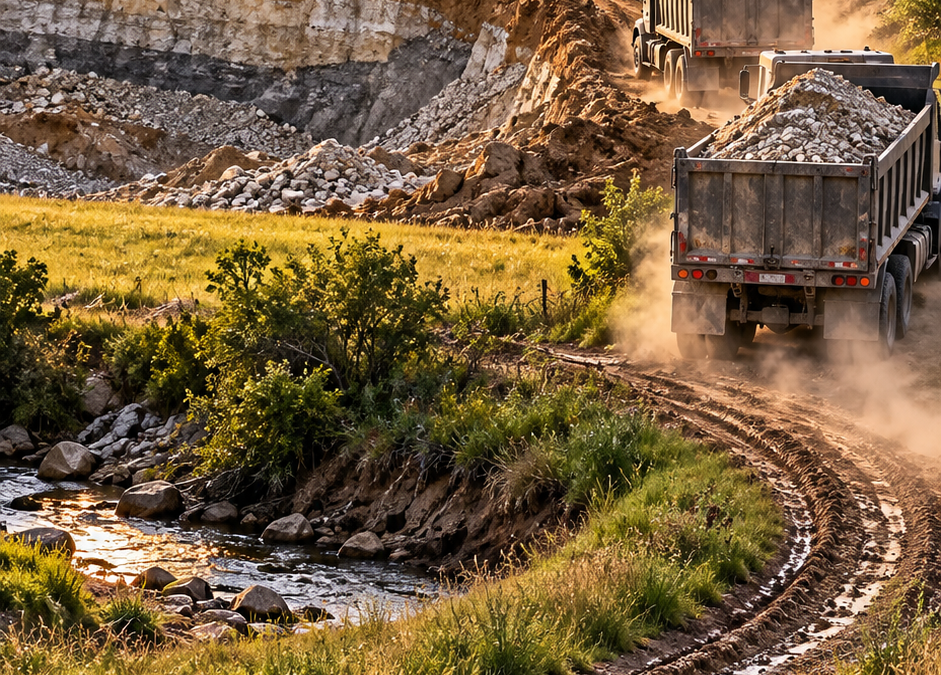
𝗙𝗨𝗟𝗟 𝗦𝗧𝗢𝗥𝗬
Then I walked the excavation alone.
The exposed wall smelled damp and mineral-cold beneath the diesel hanging in the air. I could see exactly what they had found. The gravel seam ran under the field like a pale band. I picked up one stone and closed my fist around it.
Grandpa’s voice came back clear enough to make me look toward the old barn.
Land doesn’t grow back after somebody hauls it away.
By sunset, I had moved my tractor across the north road and dragged two heavy logs behind it.
Standing there in the orange dust, looking at my homemade barricade, I believed I had solved the problem.
All I had really done was teach Monica which road not to use.
At 5:40 the next morning, I woke to a vibration I felt through the kitchen floor before I heard the engines.
My coffee was still dripping when I stepped onto the porch.
The north road was empty.
The tractor and logs had not moved.
Then another low rumble came from behind the barn.
I set the mug down and walked fast through the wet grass. Fifty yards past the equipment shed, fresh tire tracks cut through the lower hayfield toward the creek.
Monica had not moved my barricade.
She had gone around it.
I followed the tracks to an old cattle crossing my grandfather had stopped using twenty years earlier. Somebody had pulled two fence posts, laid steel plates over the muddy bank, and built a temporary access lane during the night.
Three dump trucks were already inside.
An excavator worked farther uphill, its bucket peeling back topsoil while a loader fed pale gravel into a truck.
I did not block them this time.
That was my first change.
Before I did anything else, I sent Monica and the contractor written notice that I disputed any right to excavate outside the drainage corridor and that no gravel had permission to leave the farm.
I could fight over paperwork later.
First, I needed a record of what they were doing before they changed the story.
The day before, I had reacted like a man protecting a gate.
That morning, I started thinking like the mechanic my grandfather taught me to be.
Before you tear anything apart, understand how the whole machine works.
I parked beside the barn, grabbed my phone, and walked the route from the broken fence to the excavation. I photographed tire impressions, steel plates, the cut bank, the stockpiled topsoil, and each truck as it passed.
I did not argue with the drivers.
I wrote down identifying numbers and watched where they went.
At 7:15, Monica arrived in the same white SUV. Her red pantsuit looked almost unreal against the muddy field. She stepped out, saw me standing beside the barn, and stopped.
“You’re trespassing again,” I said.
“The contractor has authorization from you.”
She did not answer that.
Instead, she looked toward my phone.
“Recording workers isn’t going to change the project.”
“I’m not recording workers.”
I lowered the phone and watched a loaded truck turn toward the county road.
“I’m learning the route.”
Her eyes followed mine for half a second.
That was enough.
I climbed into my pickup and followed the truck from a distance.
It drove twelve miles east, passed the Cedar Ridge entrance completely, then turned into a commercial aggregate yard outside town.
I parked across the highway near a feed store. The truck rolled onto a scale, disappeared behind a row of material bins, and came back empty fourteen minutes later.
Then another truck arrived.
Same company.
Same pale gravel from my farm.
I wrote the time on the back of an old parts receipt.
By noon, I had watched four loads go through that gate.
Whatever Monica called drainage improvement, the material was not staying at Cedar Ridge.
On the way home, I stopped at my repair shop and asked my employee, Sam, to cover the afternoon appointments.
He looked at the mud on my boots and the dust coating my truck.
“How bad?”
“Bad enough. I’m closing early.”
That decision cost me two scheduled jobs and a transmission rebuild I had promised to finish by Friday. I hated walking away from paid work, but every hour I spent under somebody else’s truck was another hour they could dig mine out from under me.
Back at the farm, I parked near the lower crossing instead of the north road.
Monica’s SUV was gone, but the excavator kept working.
I sat on the tailgate and watched the machine bite into the field until the operator finally shut down at dusk.
When the last truck left, I walked to the cut. The gravel seam was wider now. Near the edge, half-buried in loose dirt, I found a rusted horseshoe.
I wiped it clean with my thumb.
Grandpa used to hang old shoes over the barn doors instead of throwing them away.
I slipped it into my back pocket and looked toward the road where the trucks had disappeared.
Monica had assumed my warning meant I would defend the boundary harder.
She was wrong.
I was not going to spend the next week chasing machines around 118 acres.
If she wanted my grandfather’s ground badly enough to keep finding new ways in, I was going to find out where every load went, who benefited when it arrived, and what happened when the supply stopped.
The next morning, I did not follow the loaded trucks.
I followed the empty ones.
That distinction mattered.
By 6:20, I was parked behind a shuttered garden center across from the aggregate yard, drinking gas station coffee while the sky turned from gray to hard blue.
The first dump truck pulled out empty at 6:43.
Instead of heading toward my farm, it drove west to Cedar Ridge.
I followed far enough back to keep two vehicles between us.
Twenty minutes later, the truck turned through the HOA’s new development entrance and stopped beside a half-finished clubhouse where crews were grading a broad terrace above the retention pond.
Yesterday’s pale gravel was everywhere.
It formed the base beneath fresh concrete forms, filled drainage trenches, and lay in long compacted strips where a private access road was taking shape.
I parked on a public shoulder beyond the entrance and watched another loaded truck arrive from the aggregate yard. The driver backed toward the clubhouse. A skid steer spread the material.
Nothing about it looked temporary.
I pulled out the parts receipt from my dashboard and added another time beneath yesterday’s four.
For the first time, I understood the machine Monica had built.
My farm was not the project.
My farm was the supply.
I spent the next three days changing my routine.
Mornings at the repair shop.
Afternoons watching truck movements.
Evenings walking the old property lines with Grandpa’s rusted horseshoe in my pocket.
I missed dinner twice, slept badly, and lost the transmission job when the customer could not wait. That one hurt. It was twenty-eight hundred dollars I needed.
And when I watched another dump truck crawl out of my lower field carrying material somebody else would profit from, I nearly drove straight down there and blocked the crossing with my pickup.
Instead, I stopped at the barn.
Anger would have given Monica exactly what she expected.
One furious landowner.
One obstruction.
One excuse to paint me as unreasonable.
I needed leverage she could not drive around.
On Thursday afternoon, I followed a loaded truck beyond the aggregate yard for the first time. It left twenty minutes later, still loaded, now carrying a printed weight slip clipped near the driver’s window.
It headed toward Cedar Ridge.
I stayed behind it until it entered the development, then drove into town and parked outside a small diner where truckers usually stopped after the lunch rush.
One of the drivers I had seen all week was at the counter. I recognized his gray beard and orange work vest.
I sat two stools away and ordered coffee.
I did not ask him to betray anybody.
I asked one question.
“You guys hauling that gravel by the ton or by the load?”
He glanced at me.
“Ton.”
“Thought so.”
I stirred my coffee.
“Makes more sense with the scale.”
He looked again, longer this time.
“You the farm owner?”
I stopped stirring.
“Yeah.”
His jaw tightened.
“Then you ought to know we’re told it’s HOA-owned material.”
He reached for his check.
I felt something cold settle behind my ribs.
“Who told you?”
“Dispatch paperwork.”
He stood.
“That’s all I’m saying.”
I did not chase him.
I paid for my coffee and went home.
Near sunset, I walked down to the excavation.
The cut had grown into a long exposed shelf through the hillside. Orange survey stakes marked the next section. I pulled one from the dirt, turned it in my hand, then pushed it back exactly where it had been.
That was another change.
I was not going to destroy their markers.
I wanted to know what they intended to take next.
I climbed the hill until I could see the entire operation below me: the temporary crossing, the truck lane, the excavator, the pale seam running beneath my grandfather’s pasture.
Then I saw something I had overlooked because I had been watching the machines.
Beside the loading area sat a small weatherproof box mounted to a post.
Drivers stopped beside it before leaving. One man punched numbers into a keypad, waited, then pulled away.
The operation was not improvised.
They were counting every load.
That night, I spread my notes across Grandpa’s old workbench and drew three columns on a sheet of butcher paper.
Farm.
Yard.
Cedar Ridge.
Under each one, I wrote times, truck numbers, and destinations.
The pattern tightened until there was almost no empty space between them. Monica had wanted me focused on trespassing. Instead, she had shown me a supply chain.
And if somebody was counting every ton leaving my land, then somewhere somebody was also counting every dollar it became.
Friday afternoon, I finally stopped treating the trucks like the whole story.
The money was moving somewhere before the gravel ever reached Cedar Ridge, and I needed to see where.
I started with the one place Monica could not reroute overnight: the people doing the work.
At 3:30, I closed the repair shop, losing another half day of appointments, and drove to the aggregate yard. The same gray-bearded driver from the diner was checking a tire near the back fence.
I stayed on the public side and called over without crossing the gate.
“I don’t need paperwork,” I said. “I need to understand how you get paid.”
He looked toward the office, then wiped his hands on his vest.
“Company bills the account.”
“Which account?”
He hesitated.
“Cedar Ridge site development. Not drainage.”
His eyes met mine.
“I didn’t say that.”
Then he climbed into his cab and shut the door.
It was not proof, but it changed the shape of the problem.
I drove home through a hot wind that pushed dust across the highway in thin sheets.
When I reached the farm, the excavator was gone.
For half a second, I thought they had stopped.
Then I heard machinery from the west pasture.
They had opened a third access point through a neighboring service lane and moved nearly a quarter mile deeper onto my land.
Monica was standing beside the loader when I arrived.
Red pantsuit.
Sunglasses.
One hand raised while she directed a truck into position.
“You’re expanding the cut,” I said.
She lowered her hand.
“We’re completing scheduled grading.”
“You’re mining gravel.”
“That’s your interpretation.”
“No,” I said. “That’s what the truck driver calls it when he gets paid by the ton.”
The loader idled between us, its engine pulsing through the soles of my boots.
Monica removed her sunglasses slowly.
“Be careful about repeating things you can’t substantiate.”
I looked past her at the fresh excavation.
They had reached the old walnut windbreak Grandpa planted along the ridge. Two trees were already marked with orange paint.
That changed something in me.
The gravel could be measured in tons and dollars.
Those trees could not.
I walked past Monica, took a folding shovel from my truck, and began cutting a shallow trench across the temporary haul lane.
She stared at me.
“What exactly are you doing?”
“Keeping runoff out of the creek.”
I shaped the trench toward the old grass swale Grandpa had maintained for decades.
It was not enough to stop trucks.
I was not trying to stop them that way anymore.
I was forcing the operation into narrower ground away from the creek and the walnut ridge using the farm’s existing drainage contours.
Monica understood before I finished.
“You can’t interfere with our access.”
I drove the shovel into the soil and leaned on the handle.
“Then don’t use my land.”
Her mouth tightened.
She turned and signaled the loader operator away from the lane.
That evening, I moved cattle panels to protect the walnut line and reopened Grandpa’s old drainage swale with the tractor. It took four hours. My shoulders burned. My hands blistered under my gloves, and one hydraulic hose split just before dark.
But when rain came after midnight, water ran through the grass instead of the excavation.
By sunrise, their west access had become soft enough that loaded trucks could not climb it without tearing deep ruts. The machines sat still until almost ten. I watched from the barn while Monica paced beside her SUV, phone pressed to her ear.
For the first time all week, she was reacting to me.
Then a flatbed arrived carrying crushed stone.
Not my pale gravel.
Dark quarry rock.
They spread it over the wet access lane, compacted it, and by noon the trucks were moving again.
Monica had answered my move with money.
A lot of it.
I stood beneath the barn awning, listening to stone grind under heavy tires, and realized something important.
Every obstacle I created made her spend more to keep extracting.
More trucks.
More labor.
More purchased material.
More hours.
I could not beat her by guarding 118 acres one gate at a time.
But I could make every ton she took harder and more expensive to move.
And if the operation only worked because my grandfather’s gravel was cheap, then Monica had just shown me exactly where to put pressure.
By Monday, I had stopped trying to outrun Monica’s equipment.
I spent the morning repairing the split hydraulic hose on my tractor, then drove steel posts along the walnut ridge and rerouted my own farm traffic onto the high ground.
I left the temporary haul lanes alone.
If her contractor wanted to keep using them, they could keep paying to maintain them.
The effect showed before lunch.
A grader arrived.
Then a water truck.
Then another load of dark quarry stone.
Every machine that entered without carrying my gravel out was costing somebody money.
Around two, I drove into town and parked across from the aggregate yard again.
I watched three of the familiar dump trucks roll onto the scale, but this time I paid attention to what happened before the gate opened.
Each driver stopped at the keypad.
Each entered a number.
A small printer inside the booth spit out a ticket.
One driver tucked his beneath the windshield visor before pulling away.
The gray-bearded driver came through twenty minutes later. He saw my truck and parked at the diner across the highway.
I waited until he went inside, then followed.
He was sitting in the back booth with iced tea when I approached.
“You’re making those loads expensive,” he said before I sat down.
“That’s the idea.”
“Company isn’t happy.”
“Which company?”
He looked at me for a long moment.
“The hauling outfit gets paid either way. I’m talking about whoever is covering the site account.”
I slid into the booth.
“Cedar Ridge?”
He shook his head once.
“Invoices don’t say HOA.”
That landed harder than I expected.
“What do they say?”
“Don’t know the whole name. Something development. Same authorization code every load.”
He rubbed a thumb across the condensation on his glass.
“That’s all I’ve seen.”
I did not push him.
I thanked him, left cash for his tea, and walked outside into ninety-degree heat.
For days, I had assumed Monica was using HOA money to steal material for Cedar Ridge.
Now the money trail had moved away from the HOA itself.
That afternoon, I did not go home.
I drove to the Cedar Ridge construction entrance and watched from the county road.
The clubhouse terrace was nearly ready for concrete, but the private road beyond it continued toward a separate tract behind the development. New stakes marked future lots on ground that was not part of the occupied neighborhood.
A black pickup pulled beside Monica’s SUV.
A man in a white construction helmet stepped out and unfolded a site plan across his hood. Monica leaned over it with him, then pointed toward the unfinished road.
The man pointed back toward my farm.
They were not arguing.
They were coordinating.
I took one photograph from the public shoulder, lowered the phone, and drove away.
I felt the old urge to confront her again, but that would only tell her what I had noticed.
Instead, I went to my shop and pulled the butcher paper off Grandpa’s workbench.
Farm.
Yard.
Cedar Ridge.
I crossed out the third heading and wrote:
Development tract.
Suddenly, the truck movements made more sense.
The HOA was not necessarily the customer.
It was cover.
Near dusk, I returned to the farm and found Monica waiting beside the north gate. No contractor. No trucks. Just her white SUV and that red suit against the fading pasture.
“You’ve caused significant delays,” she said.
“Then stop digging.”
“This isn’t going to end the way you think.”
“I don’t know how it ends yet.”
That answer seemed to bother her more than an accusation would have.
She folded her arms.
“What do you want, Derek?”
I looked toward the excavation.
“Right now, I want to know why gravel taken under an HOA drainage project is being billed through a development account.”
She went completely still.
Only for a second.
Then her expression reset.
“You don’t understand construction accounting.”
“Probably not.”
I opened the gate.
“But I understand when somebody changes the subject.”
She watched me drive through without another word.
That night, headlights swept across my bedroom wall at 1:17 in the morning.
I got up and looked through the blinds.
A truck was moving slowly along the lower field.
No excavator.
No loader.
Just two men stopping beside the weatherproof box near the haul lane. One opened it with a key. The other removed something and carried it back to the truck.
They were gone in less than five minutes.
I pulled on my boots and walked down with a flashlight.
The box was empty.
The keypad was gone.
So was whatever record had been stored inside.
I stood in the damp grass, listening to the truck fade toward the highway.
Monica had not stopped the operation.
She had started erasing the part that counted it.
The empty box changed my plan again.
At daylight, I walked the lower field before the trucks arrived. Dew soaked the cuffs of my jeans. The post where the keypad had been mounted showed four clean screw holes and a lighter rectangle where the plastic housing had blocked the sun.
I photographed it.
Then I kept walking.
Fifty yards uphill, fresh orange stakes continued toward the walnut ridge.
They were still planning to dig.
I could spend another week watching records disappear, or I could make the gravel itself stop being cheap.
By seven, I had the tractor running.
I reopened two old farm lanes that ran across the haul route and started moving hay equipment between the north barn and west pasture. Nothing theatrical. Nothing parked as a barricade. Just normal farm work on my own ground, slow enough that loaded trucks had to wait for me at every crossing.
Then I repaired the cattle fence they had removed at the creek.
The new gate was twelve feet wide, plenty for my equipment, but their dump trucks could not swing through it from the temporary steel crossing without backing twice.
By noon, six trucks were stacked along the lower lane, engines idling in the heat. Diesel shimmered above their hoods.
Monica arrived twenty minutes later.
She came down the slope fast, red jacket open, one hand pointing toward the line of trucks.
“You’re deliberately obstructing operations.”
I tightened the last hinge bolt and tested the gate.
“I’m repairing my fence.”
“You changed the opening.”
“I put it where the original posts were.”
“Our trucks can’t use it efficiently.”
I looked at her.
“That sounds expensive.”
Her lips pressed into a flat line.
Behind her, one driver shut off his engine.
Then another.
The sudden quiet made the cicadas sound twice as loud.
Monica stepped closer.
“You think slowing trucks down gives you leverage?”
“No.”
I wiped grease from my fingers with a rag.
“Your costs give me leverage.”
That landed.
She looked toward the waiting trucks before answering.
“You have no idea what our costs are.”
“You’re right.”
I folded the rag and put it in my pocket.
“But somebody does.”
I left her there and drove into town.
I was not chasing missing keypad records anymore.
The trucks themselves had shown me where the money had to surface: fuel, drivers, equipment hours, purchased road stone, scale fees, site deliveries.
A project could hide its purpose behind words, but it could not build anything without paying people.
I returned to the diner just after three.
The gray-bearded driver was outside beside his truck, checking his phone.
“Your company still getting paid for all that waiting?” I asked.
He gave me a tired look.
“Detention after forty-five minutes. Billed to that development account.”
“Same account?”
“Same account.”
“And the material?”
He hesitated, then said, “Separate line item.”
I felt my jaw tighten.
“They’re charging for the gravel too.”
“I’m saying what shows on dispatch.”
He climbed into his cab before I could ask more.
That was enough.
Until then, I had pictured somebody saving money by stealing material from my farm.
This was different.
Somebody was turning my gravel into revenue before using it on the development.
I drove to Cedar Ridge and stopped on the public shoulder where I could see the unfinished road. Monica’s white SUV sat beside the black pickup I had seen earlier.
A temporary construction banner had been mounted near the new tract entrance, but I did not need to read it.
I recognized the logo from the truck’s magnetic job tags.
Two dark peaks inside a circle.
I had seen the same mark years ago on invoices at my repair shop. A local site development company.
I went back to the shop, opened the old customer database, and searched the logo from memory.
The company record came up with an address and a billing contact.
I stared at the screen.
The contact was not Monica.
It was a man whose last name matched hers.
The customer notes identified him as a Sutton family contact I had dealt with years earlier.
I leaned back slowly, hearing the shop fan click overhead.
For the first time, the route had a human connection at both ends.
Monica had not been protecting an HOA project.
She had been using one to feed a private development tied directly to her own family.
And now that I knew where the money entered the system, I did not need the box they had removed from my field anymore.
By the next morning, I had stopped trying to prove who had entered my farm.
I was following what left it.
I called three aggregate yards before I found one that remembered the Cedar Ridge job. The manager would not discuss another customer’s account, and I did not push him.
I asked one question instead.
“If a contractor brings material from a private source, does your yard ever handle the billing without physically handling the stone?”
He paused.
“Sometimes. Brokerage, testing, certified weights. Depends on the contract.”
That gave me the shape of it.
My grandfather used to say gravel only looked free until somebody put it on a scale.
So I drove home and pulled the old platform scale out of the machinery shed.
It had not been used since we sold cattle years earlier. The deck was rusted, weeds had grown through the approach, and the indicator box smelled like dust and mouse nests. I spent the afternoon cleaning contacts, replacing two damaged cables, and leveling the approach with the tractor.
By sunset, the display flickered alive.
The next morning, when the first empty dump truck came through the lower lane, I waved the driver down.
“New farm rule,” I said. “Anything hauling material off this property crosses my scale coming in and going out.”
He looked past me toward the excavation.
“Monica know about this?”
“She doesn’t own the scale.”
The driver looked toward the excavation, then back at me. He clearly was not interested in becoming part of an ownership fight. With a small shrug, he rolled forward.
I photographed the empty weight, the truck number, and the time.
When he came back loaded, I did it again.
Then the second truck.
Then the third.
By noon, Monica’s SUV came hard down the lane and stopped beside the scale. Dust rolled around her tires. She stepped out before the engine had fully settled.
“You cannot interfere with scheduled hauling.”
I kept writing the loaded weight in my notebook.
“I’m not interfering. I’m measuring what’s leaving my farm.”
“Those trucks are operating under HOA authorization.”
“Then authorization shouldn’t be afraid of a number.”
Her eyes dropped to the scale display.
For the first time since this started, she did not answer immediately.
She turned toward the drivers.
“Nobody crosses that scale again.”
The gray-bearded driver leaned out his window.
“Ma’am, if he owns the access, I’m not driving around his equipment.”
Monica’s face tightened.
“Use the south route.”
That was her mistake.
The south route crossed a narrow culvert my grandfather had installed for pickups and tractors, not loaded tri-axle dump trucks.
I did not argue.
I simply walked over and closed the passenger gate across it.
“That lane isn’t rated for your trucks.”
“Move the gate.”
“No.”
Her voice dropped.
“You’re costing everyone money.”
I looked at the line of trucks, then at the excavation beyond them.
“That’s the idea.”
By late afternoon, the hauling stopped.
Not because a judge ordered it.
Not because the sheriff arrived.
It stopped because every usable path off my property now passed through a scale I controlled.
That night, I compared my weights with the dispatch information the driver had mentioned.
The numbers did not make sense.
The loads leaving my farm were heavier than the quantities being described as delivered from the commercial supplier.
Not by a little.
Across one day, the difference was dozens of tons.
I sat at the kitchen table under the yellow light, my grandfather’s old ledger beside my notebook.
His handwriting listed gravel taken from that same ridge forty years earlier for barn pads, fence lanes, and drainage work. Beside every entry, he had written a quantity.
Twelve tons for the barn approach.
Nine for the creek crossing.
Six for the west lane.
He had measured what the farm gave him.
Monica had assumed nobody else would.
The next morning, no trucks came.
Instead, a black pickup stopped outside my gate.
The man who stepped out wore clean work boots and a company polo with the two-peak logo.
He did not introduce himself at first.
He looked at the scale, the repaired fence, then the silent excavation.
“You’re the owner.”
“I am.”
He nodded toward my notebook. “And you’ve been weighing our trucks.”
“Every one I could.”
His expression changed slightly.
Not anger.
Calculation.
“Monica said you were trying to extort the project.”
I closed the notebook.
“Then you should probably ask her why your company is paying for stone that’s coming out of my grandfather’s farm.”
The man from Two Peaks finally gave me his name, Curtis Bell, and asked if we could talk somewhere out of the wind.
I took him into the machinery shed instead of the house.
The old scale indicator glowed on the workbench between us while dust moved through sunlight above the rafters. Curtis opened a tablet and pulled up his company’s hauling schedule. I set my notebook beside it.
We did not need long.
His records showed loads supposedly purchased through an approved aggregate supplier.
My scale showed those same trucks arriving empty and leaving my farm heavy.
Curtis dragged one finger down the screen, stopped, then looked toward the excavation.
“How much has been removed?”
“More than I can put back with a shovel.”
He rubbed his jaw.
“We were told the material was already purchased and staged here.”
That landed harder than I expected.
Monica had not just treated my land like HOA property.
She had turned the ridge into inventory.
Curtis offered to suspend his trucks immediately.
I told him suspension was not enough.
“If they stop now, Monica calls this a misunderstanding and moves the equipment somewhere else. I need the operation to finish telling us what it is.”
His eyes narrowed.
“You want us to keep hauling?”
“One controlled load.”
I hated saying it.
Every bucket taken from that ridge felt like letting somebody cut another piece from my grandfather’s farm. But blocking the road had only frozen the board.
I needed to change the game.
Curtis agreed to send one truck the next morning under his supervision.
I spent the night resetting the scale and marking the edge of the excavation with survey stakes so nothing could quietly expand.
At 7:12 the next morning, Monica arrived before the excavator started. Her red pantsuit looked almost unreal against the gray dirt and cedar scrub.
She saw Curtis standing beside me and slowed.
“Why is he here?”
Curtis answered before I could.
“To verify today’s load.”
Monica’s mouth tightened.
“There is nothing to verify.”
The excavator bucket bit into the ridge. Stone rattled into the truck bed with a hard metallic roar. Monica kept talking over it, insisting the HOA had authorized site preparation and material relocation.
I watched the truck instead.
Empty weight first.
Loaded weight second.
Curtis entered both numbers into his tablet.
Then he made a call to his dispatcher and asked for the invoice tied to that exact truck.
We waited beside the scale while the engine idled. Heat shimmered above the hood.
When the invoice arrived, Curtis stared at it for several seconds.
“This says twenty-two tons supplied by Red Mesa Aggregate.”
He turned the tablet toward Monica.
“This truck never went to Red Mesa.”
Monica did not look at the screen.
“That’s an accounting issue.”
Curtis shook his head.
“No. That’s a source issue.”
She pointed at me.
“He has manipulated this entire situation.”
I felt the old instinct rise in me—the urge to argue every accusation.
Instead, I stepped back from the scale.
“Then weigh it somewhere else.”
Curtis did.
He directed the driver to the county certified truck scale eleven miles away.
I followed in my pickup.
Monica followed too.
Forty minutes later, the printed weight came back within eighty pounds of mine.
Close enough that nobody spoke for a moment.
That was the reversal.
My scale was no longer the story.
The material was.
Curtis called his office and cancelled every remaining haul connected to the HOA project. Then he told Monica his company would not accept another load until the source and ownership were resolved.
She stood beside her SUV, phone pressed to her ear, watching the excavator sit motionless on my ridge.
For days, she had controlled the pace because every truck that left made the damage harder to undo.
Now the same trucks had become useless to her.
By noon, the excavator operator shut down and climbed out.
The sudden silence felt strange.
I walked into the cut alone.
Fresh stone crunched under my boots. Near the back wall, beneath the scraped earth, I found one of my grandfather’s old cedar fence posts lying broken in the dirt.
I picked it up and carried it back toward the scale.
Monica was still there.
“You think you’ve won?” she said.
I rested the broken post against the workbench.
“No.”
I looked past her at the stranded machinery.
“I think you finally have to pay for every decision you make from here.”
Two mornings later, the excavator was still sitting where its engine had gone cold. Dust had settled across the tracks, and a thin line of dew darkened the bucket.
I stood at the scale with my grandfather’s broken cedar post beside me when Curtis pulled through the gate.
He was not alone.
Behind his pickup came two flatbeds from his company.
Monica arrived ten minutes later, braking hard enough to throw pale gravel against the weeds. She stepped out in that red pantsuit and pointed at the flatbeds.
“Those machines are under contract.”
Curtis closed his truck door.
“Not anymore.”
Her eyes snapped toward him.
“You can’t terminate an HOA project because one property owner is causing delays.”
“I’m not terminating it because of delays.”
Curtis held up his tablet.
“I’m terminating our participation because your billing represented privately excavated material as commercially supplied aggregate.”
Monica turned to me.
“This is exactly what you wanted.”
I looked past her toward the cut in the ridge.
“What I wanted was for you not to mine my farm.”
She started talking about easements, maintenance, authority, and development improvements. Every phrase was polished smooth from repetition.
I let her finish.
Then I walked to the scale and laid my notebook beside Curtis’s records.
One day of weights had been enough to expose the economics of the operation.
The earlier dispatch history gave us the rest.
Truck by truck.
Load by load.
The material leaving my land matched the hauling pattern feeding Cedar Ridge and the private development tract beyond it. Once Curtis’s company refused to accept or bill another ton, Monica had nowhere legitimate to send it and no contractor willing to keep excavating under the same arrangement.
The machine owner arrived before noon.
He inspected the site, spoke quietly with Curtis, then loaded the excavator onto a trailer.
Monica stood beside her SUV, watching the tracks climb the ramps.
She did not shout this time.
The sound that mattered was the chain binder snapping tight.
Over the next three weeks, the consequences moved backward along the same path the gravel had taken.
The Cedar Ridge developer rejected the disputed material charges and required replacement aggregate from a verified commercial source. Two Peaks reversed the unsupported brokerage charges tied to my farm and withdrew from Monica’s arrangement. Without free stone, the development’s road budget jumped hard enough that the planned extension across the second phase was shelved.
The shortcut that had made Monica’s scheme profitable was gone.
I did not get my ridge back untouched.
That was the part nobody could fix.
Rain collected in the raw cut after the first September storm, and every time I saw that exposed face of stone, I remembered how long I had mistaken patience for waiting.
So I spent my own weekends repairing it.
Curtis sent equipment at his company’s expense to reshape the unsafe slope and return the unused material still piled near the haul lane. The documented weights also gave us a number nobody could pretend was guesswork anymore. I settled the material and restoration loss rather than spend the next year fighting over every missed shop hour and every load that had already disappeared into Cedar Ridge.
It did not make the ridge whole.
I never pretended it did.
What mattered to me was that the digging stayed stopped, the damaged ground got repaired, and nobody could call my grandfather’s gravel free again.
I seeded the disturbed ground with native grass, rebuilt the drainage swale, and reset the old fence line. I kept the broken cedar post. I hung the rusted horseshoe from the same post before I left that evening.
One evening, while I was tamping soil around a new corner post, Monica drove slowly past the gate.
She stopped but never got out.
Her window lowered.
“You destroyed a project people were depending on.”
I rested both hands on the post driver.
“No. I made it pay for what it actually used.”
She stared at me for a few seconds, then looked toward the ridge.
There were no trucks there anymore.
No excavator.
No orange stakes.
Just fresh soil, straw, and the first thin green shoots coming through.
She raised the window and drove away.
By October, the scale was back under the machinery shed roof.
I could have sold it.
Instead, I cleaned the deck, painted the frame, and left my grandfather’s ledger on the shelf above the indicator box.
His old entries were still there in pencil.
Twelve tons for the barn approach.
Nine for the creek crossing.
Six for the west lane.
He had counted what the land gave him because he understood something Monica never did.
A farm is not empty space between property lines.
Every fence, ditch, road, tree, and layer of stone carries somebody’s labor.
One cold morning, I walked to the repaired ridge with coffee steaming through the lid of my thermos. Frost covered the new grass. I pushed the broken cedar post deeper into the soil beside its replacement, not as a marker anyone else needed to understand, but because I did.
They had followed the gravel because they thought nobody would follow the money.
They were wrong.
I followed both all the way.
𝗧𝗛𝗘 𝗘𝗡𝗗
The HOA Called It Drainage Work Until I Followed the Trucks Carrying My Grandfather’s Gravel
The first truck was already leaving my field when I realized the hole in the ground was not for drainage.
By the time I followed the gravel across town, I understood why Monica Sutton needed me angry instead of curious.
She had not just crossed my property line—she had turned my grandfather’s land into somebody else’s supply yard.
The first dump truck was already climbing out of my grandfather’s north field when I came around the bend and hit the brakes hard enough to throw my thermos onto the floorboard.
Gravel rattled against steel.
Diesel smoke rolled across the pasture in a hot, oily haze.
Beyond the truck, an excavator swung its bucket into a raw yellow-gray cut where there had been grass three days earlier.
I sat there for maybe two seconds, staring at a hole that had no business existing.
Then I drove straight across the field.
My name is Derek Brennan. I was forty-six that summer, and the 118 acres under those tires had belonged to my grandfather, Walter, before they belonged to me. I repaired farm equipment for a living, which meant I knew the sound of honest work. I knew the rhythm of grading a lane, cleaning a ditch, digging a trench, repairing a washout.
This was not drainage work.
This was extraction.
I stopped my pickup sideways across the old farm road just as the second loaded truck started toward me. Its air brakes hissed. Dust rolled over my hood. The driver leaned out his window and shouted something I could not hear over the excavator.
I climbed out and pointed at the ground.
“Shut it down.”
The excavator kept running.
Then I saw Monica Sutton walking toward me from beside a white contractor truck, her red pantsuit bright against all that dirt.
Monica was the HOA president of Cedar Ridge, the upscale subdivision beyond my eastern fence. Forty-five years old, polished, controlled, and always dressed like every field, fence, and ditch in the county was waiting for her approval. She was the kind of woman who could point at something and make three people move before she finished the sentence.
She raised one hand toward the operator.
The bucket stopped in midair.
“Derek,” she said, as if I had arrived late to an appointment. “You’re blocking scheduled work.”
I looked past her.
The cut was roughly sixty feet across, maybe eight feet deep at the center. Fresh tire tracks ran through grass my grandfather used to mow with an old Ford tractor that smoked whenever the weather turned cold.
“Scheduled by who?”
“This is drainage improvement associated with Cedar Ridge.”
She gestured toward the development beyond my eastern fence.
“The runoff corridor has to be stabilized.”
There was an old drainage easement along the eastern edge of the farm, narrow enough that a contractor looking only at the HOA’s paperwork might believe Monica had some reason to be nearby. But the excavation in front of me was not on that corridor.
It was forty yards inside my ground.
I walked to the nearest dump truck and dragged my fingers across the material piled above the sidewall.
Rounded stone.
Sand.
Clean gravel.
I knew that layer.
Grandpa had shown it to me when I was twelve, after we repaired a washed-out fence post near the creek. He dug down with a shovel, tapped the gravel with the blade, and told me never to let somebody convince me dirt was worthless just because it was under my boots.
I let the handful fall through my fingers.
“Drainage improvement doesn’t require hauling my gravel away.”
Monica’s jaw tightened.
“The contractor is handling material management on property adjacent to Cedar Ridge.”
“No,” I said. “On my property.”
I pointed toward an old hedge line forty yards behind her.
“That is the boundary.”
One of the drivers killed his engine.
Suddenly the field became quiet enough that I could hear loose stones ticking down inside his truck bed.
Monica glanced at the blocked road, then at my pickup.
“Move your vehicle.”
“Not until every machine is off this farm.”
She stepped closer but stopped several feet away.
“You are turning a manageable situation into something expensive.”
I looked at the excavator.
Then at the hole.
“You already did that.”
For the first time, her expression changed.
Not much.
Just a small narrowing around the eyes.
She turned toward the foreman.
“Park the equipment.”
The man looked relieved. The loaded trucks could not leave with my pickup across the road anyway.
Monica walked back toward her vehicle, heels pressing into the soft edge of the field. At the door, she turned.
“You can’t keep a truck parked there forever, Derek.”
I rested both hands on my belt and watched her.
“I won’t have to.”
She gave me a thin smile.
“We’ll see.”
Her SUV disappeared toward Cedar Ridge ten minutes later. I stayed until the last engine went silent.
Then I walked the excavation alone.
The exposed wall smelled damp and mineral-cold beneath the diesel hanging in the air. I could see exactly what they had found. The gravel seam ran under the field like a pale band. I picked up one stone and closed my fist around it.
Grandpa’s voice came back clear enough to make me look toward the old barn.
Land doesn’t grow back after somebody hauls it away.
By sunset, I had moved my tractor across the north road and dragged two heavy logs behind it.
Standing there in the orange dust, looking at my homemade barricade, I believed I had solved the problem.
All I had really done was teach Monica which road not to use.
At 5:40 the next morning, I woke to a vibration I felt through the kitchen floor before I heard the engines.
My coffee was still dripping when I stepped onto the porch.
The north road was empty.
The tractor and logs had not moved.
Then another low rumble came from behind the barn.
I set the mug down and walked fast through the wet grass. Fifty yards past the equipment shed, fresh tire tracks cut through the lower hayfield toward the creek.
Monica had not moved my barricade.
She had gone around it.
I followed the tracks to an old cattle crossing my grandfather had stopped using twenty years earlier. Somebody had pulled two fence posts, laid steel plates over the muddy bank, and built a temporary access lane during the night.
Three dump trucks were already inside.
An excavator worked farther uphill, its bucket peeling back topsoil while a loader fed pale gravel into a truck.
I did not block them this time.
That was my first change.
Before I did anything else, I sent Monica and the contractor written notice that I disputed any right to excavate outside the drainage corridor and that no gravel had permission to leave the farm.
I could fight over paperwork later.
First, I needed a record of what they were doing before they changed the story.
The day before, I had reacted like a man protecting a gate.
That morning, I started thinking like the mechanic my grandfather taught me to be.
Before you tear anything apart, understand how the whole machine works.
I parked beside the barn, grabbed my phone, and walked the route from the broken fence to the excavation. I photographed tire impressions, steel plates, the cut bank, the stockpiled topsoil, and each truck as it passed.
I did not argue with the drivers.
I wrote down identifying numbers and watched where they went.
At 7:15, Monica arrived in the same white SUV. Her red pantsuit looked almost unreal against the muddy field. She stepped out, saw me standing beside the barn, and stopped.
“You’re trespassing again,” I said.
“The contractor has authorization from you.”
She did not answer that.
Instead, she looked toward my phone.
“Recording workers isn’t going to change the project.”
“I’m not recording workers.”
I lowered the phone and watched a loaded truck turn toward the county road.
“I’m learning the route.”
Her eyes followed mine for half a second.
That was enough.
I climbed into my pickup and followed the truck from a distance.
It drove twelve miles east, passed the Cedar Ridge entrance completely, then turned into a commercial aggregate yard outside town.
I parked across the highway near a feed store. The truck rolled onto a scale, disappeared behind a row of material bins, and came back empty fourteen minutes later.
Then another truck arrived.
Same company.
Same pale gravel from my farm.
I wrote the time on the back of an old parts receipt.
By noon, I had watched four loads go through that gate.
Whatever Monica called drainage improvement, the material was not staying at Cedar Ridge.
On the way home, I stopped at my repair shop and asked my employee, Sam, to cover the afternoon appointments.
He looked at the mud on my boots and the dust coating my truck.
“How bad?”
“Bad enough. I’m closing early.”
That decision cost me two scheduled jobs and a transmission rebuild I had promised to finish by Friday. I hated walking away from paid work, but every hour I spent under somebody else’s truck was another hour they could dig mine out from under me.
Back at the farm, I parked near the lower crossing instead of the north road.
Monica’s SUV was gone, but the excavator kept working.
I sat on the tailgate and watched the machine bite into the field until the operator finally shut down at dusk.
When the last truck left, I walked to the cut. The gravel seam was wider now. Near the edge, half-buried in loose dirt, I found a rusted horseshoe.
I wiped it clean with my thumb.
Grandpa used to hang old shoes over the barn doors instead of throwing them away.
I slipped it into my back pocket and looked toward the road where the trucks had disappeared.
Monica had assumed my warning meant I would defend the boundary harder.
She was wrong.
I was not going to spend the next week chasing machines around 118 acres.
If she wanted my grandfather’s ground badly enough to keep finding new ways in, I was going to find out where every load went, who benefited when it arrived, and what happened when the supply stopped.
The next morning, I did not follow the loaded trucks.
I followed the empty ones.
That distinction mattered.
By 6:20, I was parked behind a shuttered garden center across from the aggregate yard, drinking gas station coffee while the sky turned from gray to hard blue.
The first dump truck pulled out empty at 6:43.
Instead of heading toward my farm, it drove west to Cedar Ridge.
I followed far enough back to keep two vehicles between us.
Twenty minutes later, the truck turned through the HOA’s new development entrance and stopped beside a half-finished clubhouse where crews were grading a broad terrace above the retention pond.
Yesterday’s pale gravel was everywhere.
It formed the base beneath fresh concrete forms, filled drainage trenches, and lay in long compacted strips where a private access road was taking shape.
I parked on a public shoulder beyond the entrance and watched another loaded truck arrive from the aggregate yard. The driver backed toward the clubhouse. A skid steer spread the material.
Nothing about it looked temporary.
I pulled out the parts receipt from my dashboard and added another time beneath yesterday’s four.
For the first time, I understood the machine Monica had built.
My farm was not the project.
My farm was the supply.
I spent the next three days changing my routine.
Mornings at the repair shop.
Afternoons watching truck movements.
Evenings walking the old property lines with Grandpa’s rusted horseshoe in my pocket.
I missed dinner twice, slept badly, and lost the transmission job when the customer could not wait. That one hurt. It was twenty-eight hundred dollars I needed.
And when I watched another dump truck crawl out of my lower field carrying material somebody else would profit from, I nearly drove straight down there and blocked the crossing with my pickup.
Instead, I stopped at the barn.
Anger would have given Monica exactly what she expected.
One furious landowner.
One obstruction.
One excuse to paint me as unreasonable.
I needed leverage she could not drive around.
On Thursday afternoon, I followed a loaded truck beyond the aggregate yard for the first time. It left twenty minutes later, still loaded, now carrying a printed weight slip clipped near the driver’s window.
It headed toward Cedar Ridge.
I stayed behind it until it entered the development, then drove into town and parked outside a small diner where truckers usually stopped after the lunch rush.
One of the drivers I had seen all week was at the counter. I recognized his gray beard and orange work vest.
I sat two stools away and ordered coffee.
I did not ask him to betray anybody.
I asked one question.
“You guys hauling that gravel by the ton or by the load?”
He glanced at me.
“Ton.”
“Thought so.”
I stirred my coffee.
“Makes more sense with the scale.”
He looked again, longer this time.
“You the farm owner?”
I stopped stirring.
“Yeah.”
His jaw tightened.
“Then you ought to know we’re told it’s HOA-owned material.”
He reached for his check.
I felt something cold settle behind my ribs.
“Who told you?”
“Dispatch paperwork.”
He stood.
“That’s all I’m saying.”
I did not chase him.
I paid for my coffee and went home.
Near sunset, I walked down to the excavation.
The cut had grown into a long exposed shelf through the hillside. Orange survey stakes marked the next section. I pulled one from the dirt, turned it in my hand, then pushed it back exactly where it had been.
That was another change.
I was not going to destroy their markers.
I wanted to know what they intended to take next.
I climbed the hill until I could see the entire operation below me: the temporary crossing, the truck lane, the excavator, the pale seam running beneath my grandfather’s pasture.
Then I saw something I had overlooked because I had been watching the machines.
Beside the loading area sat a small weatherproof box mounted to a post.
Drivers stopped beside it before leaving. One man punched numbers into a keypad, waited, then pulled away.
The operation was not improvised.
They were counting every load.
That night, I spread my notes across Grandpa’s old workbench and drew three columns on a sheet of butcher paper.
Farm.
Yard.
Cedar Ridge.
Under each one, I wrote times, truck numbers, and destinations.
The pattern tightened until there was almost no empty space between them. Monica had wanted me focused on trespassing. Instead, she had shown me a supply chain.
And if somebody was counting every ton leaving my land, then somewhere somebody was also counting every dollar it became.
Friday afternoon, I finally stopped treating the trucks like the whole story.
The money was moving somewhere before the gravel ever reached Cedar Ridge, and I needed to see where.
I started with the one place Monica could not reroute overnight: the people doing the work.
At 3:30, I closed the repair shop, losing another half day of appointments, and drove to the aggregate yard. The same gray-bearded driver from the diner was checking a tire near the back fence.
I stayed on the public side and called over without crossing the gate.
“I don’t need paperwork,” I said. “I need to understand how you get paid.”
He looked toward the office, then wiped his hands on his vest.
“Company bills the account.”
“Which account?”
He hesitated.
“Cedar Ridge site development. Not drainage.”
His eyes met mine.
“I didn’t say that.”
Then he climbed into his cab and shut the door.
It was not proof, but it changed the shape of the problem.
I drove home through a hot wind that pushed dust across the highway in thin sheets.
When I reached the farm, the excavator was gone.
For half a second, I thought they had stopped.
Then I heard machinery from the west pasture.
They had opened a third access point through a neighboring service lane and moved nearly a quarter mile deeper onto my land.
Monica was standing beside the loader when I arrived.
Red pantsuit.
Sunglasses.
One hand raised while she directed a truck into position.
“You’re expanding the cut,” I said.
She lowered her hand.
“We’re completing scheduled grading.”
“You’re mining gravel.”
“That’s your interpretation.”
“No,” I said. “That’s what the truck driver calls it when he gets paid by the ton.”
The loader idled between us, its engine pulsing through the soles of my boots.
Monica removed her sunglasses slowly.
“Be careful about repeating things you can’t substantiate.”
I looked past her at the fresh excavation.
They had reached the old walnut windbreak Grandpa planted along the ridge. Two trees were already marked with orange paint.
That changed something in me.
The gravel could be measured in tons and dollars.
Those trees could not.
I walked past Monica, took a folding shovel from my truck, and began cutting a shallow trench across the temporary haul lane.
She stared at me.
“What exactly are you doing?”
“Keeping runoff out of the creek.”
I shaped the trench toward the old grass swale Grandpa had maintained for decades.
It was not enough to stop trucks.
I was not trying to stop them that way anymore.
I was forcing the operation into narrower ground away from the creek and the walnut ridge using the farm’s existing drainage contours.
Monica understood before I finished.
“You can’t interfere with our access.”
I drove the shovel into the soil and leaned on the handle.
“Then don’t use my land.”
Her mouth tightened.
She turned and signaled the loader operator away from the lane.
That evening, I moved cattle panels to protect the walnut line and reopened Grandpa’s old drainage swale with the tractor. It took four hours. My shoulders burned. My hands blistered under my gloves, and one hydraulic hose split just before dark.
But when rain came after midnight, water ran through the grass instead of the excavation.
By sunrise, their west access had become soft enough that loaded trucks could not climb it without tearing deep ruts. The machines sat still until almost ten. I watched from the barn while Monica paced beside her SUV, phone pressed to her ear.
For the first time all week, she was reacting to me.
Then a flatbed arrived carrying crushed stone.
Not my pale gravel.
Dark quarry rock.
They spread it over the wet access lane, compacted it, and by noon the trucks were moving again.
Monica had answered my move with money.
A lot of it.
I stood beneath the barn awning, listening to stone grind under heavy tires, and realized something important.
Every obstacle I created made her spend more to keep extracting.
More trucks.
More labor.
More purchased material.
More hours.
I could not beat her by guarding 118 acres one gate at a time.
But I could make every ton she took harder and more expensive to move.
And if the operation only worked because my grandfather’s gravel was cheap, then Monica had just shown me exactly where to put pressure.
By Monday, I had stopped trying to outrun Monica’s equipment.
I spent the morning repairing the split hydraulic hose on my tractor, then drove steel posts along the walnut ridge and rerouted my own farm traffic onto the high ground.
I left the temporary haul lanes alone.
If her contractor wanted to keep using them, they could keep paying to maintain them.
The effect showed before lunch.
A grader arrived.
Then a water truck.
Then another load of dark quarry stone.
Every machine that entered without carrying my gravel out was costing somebody money.
Around two, I drove into town and parked across from the aggregate yard again.
I watched three of the familiar dump trucks roll onto the scale, but this time I paid attention to what happened before the gate opened.
Each driver stopped at the keypad.
Each entered a number.
A small printer inside the booth spit out a ticket.
One driver tucked his beneath the windshield visor before pulling away.
The gray-bearded driver came through twenty minutes later. He saw my truck and parked at the diner across the highway.
I waited until he went inside, then followed.
He was sitting in the back booth with iced tea when I approached.
“You’re making those loads expensive,” he said before I sat down.
“That’s the idea.”
“Company isn’t happy.”
“Which company?”
He looked at me for a long moment.
“The hauling outfit gets paid either way. I’m talking about whoever is covering the site account.”
I slid into the booth.
“Cedar Ridge?”
He shook his head once.
“Invoices don’t say HOA.”
That landed harder than I expected.
“What do they say?”
“Don’t know the whole name. Something development. Same authorization code every load.”
He rubbed a thumb across the condensation on his glass.
“That’s all I’ve seen.”
I did not push him.
I thanked him, left cash for his tea, and walked outside into ninety-degree heat.
For days, I had assumed Monica was using HOA money to steal material for Cedar Ridge.
Now the money trail had moved away from the HOA itself.
That afternoon, I did not go home.
I drove to the Cedar Ridge construction entrance and watched from the county road.
The clubhouse terrace was nearly ready for concrete, but the private road beyond it continued toward a separate tract behind the development. New stakes marked future lots on ground that was not part of the occupied neighborhood.
A black pickup pulled beside Monica’s SUV.
A man in a white construction helmet stepped out and unfolded a site plan across his hood. Monica leaned over it with him, then pointed toward the unfinished road.
The man pointed back toward my farm.
They were not arguing.
They were coordinating.
I took one photograph from the public shoulder, lowered the phone, and drove away.
I felt the old urge to confront her again, but that would only tell her what I had noticed.
Instead, I went to my shop and pulled the butcher paper off Grandpa’s workbench.
Farm.
Yard.
Cedar Ridge.
I crossed out the third heading and wrote:
Development tract.
Suddenly, the truck movements made more sense.
The HOA was not necessarily the customer.
It was cover.
Near dusk, I returned to the farm and found Monica waiting beside the north gate. No contractor. No trucks. Just her white SUV and that red suit against the fading pasture.
“You’ve caused significant delays,” she said.
“Then stop digging.”
“This isn’t going to end the way you think.”
“I don’t know how it ends yet.”
That answer seemed to bother her more than an accusation would have.
She folded her arms.
“What do you want, Derek?”
I looked toward the excavation.
“Right now, I want to know why gravel taken under an HOA drainage project is being billed through a development account.”
She went completely still.
Only for a second.
Then her expression reset.
“You don’t understand construction accounting.”
“Probably not.”
I opened the gate.
“But I understand when somebody changes the subject.”
She watched me drive through without another word.
That night, headlights swept across my bedroom wall at 1:17 in the morning.
I got up and looked through the blinds.
A truck was moving slowly along the lower field.
No excavator.
No loader.
Just two men stopping beside the weatherproof box near the haul lane. One opened it with a key. The other removed something and carried it back to the truck.
They were gone in less than five minutes.
I pulled on my boots and walked down with a flashlight.
The box was empty.
The keypad was gone.
So was whatever record had been stored inside.
I stood in the damp grass, listening to the truck fade toward the highway.
Monica had not stopped the operation.
She had started erasing the part that counted it.
The empty box changed my plan again.
At daylight, I walked the lower field before the trucks arrived. Dew soaked the cuffs of my jeans. The post where the keypad had been mounted showed four clean screw holes and a lighter rectangle where the plastic housing had blocked the sun.
I photographed it.
Then I kept walking.
Fifty yards uphill, fresh orange stakes continued toward the walnut ridge.
They were still planning to dig.
I could spend another week watching records disappear, or I could make the gravel itself stop being cheap.
By seven, I had the tractor running.
I reopened two old farm lanes that ran across the haul route and started moving hay equipment between the north barn and west pasture. Nothing theatrical. Nothing parked as a barricade. Just normal farm work on my own ground, slow enough that loaded trucks had to wait for me at every crossing.
Then I repaired the cattle fence they had removed at the creek.
The new gate was twelve feet wide, plenty for my equipment, but their dump trucks could not swing through it from the temporary steel crossing without backing twice.
By noon, six trucks were stacked along the lower lane, engines idling in the heat. Diesel shimmered above their hoods.
Monica arrived twenty minutes later.
She came down the slope fast, red jacket open, one hand pointing toward the line of trucks.
“You’re deliberately obstructing operations.”
I tightened the last hinge bolt and tested the gate.
“I’m repairing my fence.”
“You changed the opening.”
“I put it where the original posts were.”
“Our trucks can’t use it efficiently.”
I looked at her.
“That sounds expensive.”
Her lips pressed into a flat line.
Behind her, one driver shut off his engine.
Then another.
The sudden quiet made the cicadas sound twice as loud.
Monica stepped closer.
“You think slowing trucks down gives you leverage?”
“No.”
I wiped grease from my fingers with a rag.
“Your costs give me leverage.”
That landed.
She looked toward the waiting trucks before answering.
“You have no idea what our costs are.”
“You’re right.”
I folded the rag and put it in my pocket.
“But somebody does.”
I left her there and drove into town.
I was not chasing missing keypad records anymore.
The trucks themselves had shown me where the money had to surface: fuel, drivers, equipment hours, purchased road stone, scale fees, site deliveries.
A project could hide its purpose behind words, but it could not build anything without paying people.
I returned to the diner just after three.
The gray-bearded driver was outside beside his truck, checking his phone.
“Your company still getting paid for all that waiting?” I asked.
He gave me a tired look.
“Detention after forty-five minutes. Billed to that development account.”
“Same account?”
“Same account.”
“And the material?”
He hesitated, then said, “Separate line item.”
I felt my jaw tighten.
“They’re charging for the gravel too.”
“I’m saying what shows on dispatch.”
He climbed into his cab before I could ask more.
That was enough.
Until then, I had pictured somebody saving money by stealing material from my farm.
This was different.
Somebody was turning my gravel into revenue before using it on the development.
I drove to Cedar Ridge and stopped on the public shoulder where I could see the unfinished road. Monica’s white SUV sat beside the black pickup I had seen earlier.
A temporary construction banner had been mounted near the new tract entrance, but I did not need to read it.
I recognized the logo from the truck’s magnetic job tags.
Two dark peaks inside a circle.
I had seen the same mark years ago on invoices at my repair shop. A local site development company.
I went back to the shop, opened the old customer database, and searched the logo from memory.
The company record came up with an address and a billing contact.
I stared at the screen.
The contact was not Monica.
It was a man whose last name matched hers.
The customer notes identified him as a Sutton family contact I had dealt with years earlier.
I leaned back slowly, hearing the shop fan click overhead.
For the first time, the route had a human connection at both ends.
Monica had not been protecting an HOA project.
She had been using one to feed a private development tied directly to her own family.
And now that I knew where the money entered the system, I did not need the box they had removed from my field anymore.
By the next morning, I had stopped trying to prove who had entered my farm.
I was following what left it.
I called three aggregate yards before I found one that remembered the Cedar Ridge job. The manager would not discuss another customer’s account, and I did not push him.
I asked one question instead.
“If a contractor brings material from a private source, does your yard ever handle the billing without physically handling the stone?”
He paused.
“Sometimes. Brokerage, testing, certified weights. Depends on the contract.”
That gave me the shape of it.
My grandfather used to say gravel only looked free until somebody put it on a scale.
So I drove home and pulled the old platform scale out of the machinery shed.
It had not been used since we sold cattle years earlier. The deck was rusted, weeds had grown through the approach, and the indicator box smelled like dust and mouse nests. I spent the afternoon cleaning contacts, replacing two damaged cables, and leveling the approach with the tractor.
By sunset, the display flickered alive.
The next morning, when the first empty dump truck came through the lower lane, I waved the driver down.
“New farm rule,” I said. “Anything hauling material off this property crosses my scale coming in and going out.”
He looked past me toward the excavation.
“Monica know about this?”
“She doesn’t own the scale.”
The driver looked toward the excavation, then back at me. He clearly was not interested in becoming part of an ownership fight. With a small shrug, he rolled forward.
I photographed the empty weight, the truck number, and the time.
When he came back loaded, I did it again.
Then the second truck.
Then the third.
By noon, Monica’s SUV came hard down the lane and stopped beside the scale. Dust rolled around her tires. She stepped out before the engine had fully settled.
“You cannot interfere with scheduled hauling.”
I kept writing the loaded weight in my notebook.
“I’m not interfering. I’m measuring what’s leaving my farm.”
“Those trucks are operating under HOA authorization.”
“Then authorization shouldn’t be afraid of a number.”
Her eyes dropped to the scale display.
For the first time since this started, she did not answer immediately.
She turned toward the drivers.
“Nobody crosses that scale again.”
The gray-bearded driver leaned out his window.
“Ma’am, if he owns the access, I’m not driving around his equipment.”
Monica’s face tightened.
“Use the south route.”
That was her mistake.
The south route crossed a narrow culvert my grandfather had installed for pickups and tractors, not loaded tri-axle dump trucks.
I did not argue.
I simply walked over and closed the passenger gate across it.
“That lane isn’t rated for your trucks.”
“Move the gate.”
“No.”
Her voice dropped.
“You’re costing everyone money.”
I looked at the line of trucks, then at the excavation beyond them.
“That’s the idea.”
By late afternoon, the hauling stopped.
Not because a judge ordered it.
Not because the sheriff arrived.
It stopped because every usable path off my property now passed through a scale I controlled.
That night, I compared my weights with the dispatch information the driver had mentioned.
The numbers did not make sense.
The loads leaving my farm were heavier than the quantities being described as delivered from the commercial supplier.
Not by a little.
Across one day, the difference was dozens of tons.
I sat at the kitchen table under the yellow light, my grandfather’s old ledger beside my notebook.
His handwriting listed gravel taken from that same ridge forty years earlier for barn pads, fence lanes, and drainage work. Beside every entry, he had written a quantity.
Twelve tons for the barn approach.
Nine for the creek crossing.
Six for the west lane.
He had measured what the farm gave him.
Monica had assumed nobody else would.
The next morning, no trucks came.
Instead, a black pickup stopped outside my gate.
The man who stepped out wore clean work boots and a company polo with the two-peak logo.
He did not introduce himself at first.
He looked at the scale, the repaired fence, then the silent excavation.
“You’re the owner.”
“I am.”
He nodded toward my notebook. “And you’ve been weighing our trucks.”
“Every one I could.”
His expression changed slightly.
Not anger.
Calculation.
“Monica said you were trying to extort the project.”
I closed the notebook.
“Then you should probably ask her why your company is paying for stone that’s coming out of my grandfather’s farm.”
The man from Two Peaks finally gave me his name, Curtis Bell, and asked if we could talk somewhere out of the wind.
I took him into the machinery shed instead of the house.
The old scale indicator glowed on the workbench between us while dust moved through sunlight above the rafters. Curtis opened a tablet and pulled up his company’s hauling schedule. I set my notebook beside it.
We did not need long.
His records showed loads supposedly purchased through an approved aggregate supplier.
My scale showed those same trucks arriving empty and leaving my farm heavy.
Curtis dragged one finger down the screen, stopped, then looked toward the excavation.
“How much has been removed?”
“More than I can put back with a shovel.”
He rubbed his jaw.
“We were told the material was already purchased and staged here.”
That landed harder than I expected.
Monica had not just treated my land like HOA property.
She had turned the ridge into inventory.
Curtis offered to suspend his trucks immediately.
I told him suspension was not enough.
“If they stop now, Monica calls this a misunderstanding and moves the equipment somewhere else. I need the operation to finish telling us what it is.”
His eyes narrowed.
“You want us to keep hauling?”
“One controlled load.”
I hated saying it.
Every bucket taken from that ridge felt like letting somebody cut another piece from my grandfather’s farm. But blocking the road had only frozen the board.
I needed to change the game.
Curtis agreed to send one truck the next morning under his supervision.
I spent the night resetting the scale and marking the edge of the excavation with survey stakes so nothing could quietly expand.
At 7:12 the next morning, Monica arrived before the excavator started. Her red pantsuit looked almost unreal against the gray dirt and cedar scrub.
She saw Curtis standing beside me and slowed.
“Why is he here?”
Curtis answered before I could.
“To verify today’s load.”
Monica’s mouth tightened.
“There is nothing to verify.”
The excavator bucket bit into the ridge. Stone rattled into the truck bed with a hard metallic roar. Monica kept talking over it, insisting the HOA had authorized site preparation and material relocation.
I watched the truck instead.
Empty weight first.
Loaded weight second.
Curtis entered both numbers into his tablet.
Then he made a call to his dispatcher and asked for the invoice tied to that exact truck.
We waited beside the scale while the engine idled. Heat shimmered above the hood.
When the invoice arrived, Curtis stared at it for several seconds.
“This says twenty-two tons supplied by Red Mesa Aggregate.”
He turned the tablet toward Monica.
“This truck never went to Red Mesa.”
Monica did not look at the screen.
“That’s an accounting issue.”
Curtis shook his head.
“No. That’s a source issue.”
She pointed at me.
“He has manipulated this entire situation.”
I felt the old instinct rise in me—the urge to argue every accusation.
Instead, I stepped back from the scale.
“Then weigh it somewhere else.”
Curtis did.
He directed the driver to the county certified truck scale eleven miles away.
I followed in my pickup.
Monica followed too.
Forty minutes later, the printed weight came back within eighty pounds of mine.
Close enough that nobody spoke for a moment.
That was the reversal.
My scale was no longer the story.
The material was.
Curtis called his office and cancelled every remaining haul connected to the HOA project. Then he told Monica his company would not accept another load until the source and ownership were resolved.
She stood beside her SUV, phone pressed to her ear, watching the excavator sit motionless on my ridge.
For days, she had controlled the pace because every truck that left made the damage harder to undo.
Now the same trucks had become useless to her.
By noon, the excavator operator shut down and climbed out.
The sudden silence felt strange.
I walked into the cut alone.
Fresh stone crunched under my boots. Near the back wall, beneath the scraped earth, I found one of my grandfather’s old cedar fence posts lying broken in the dirt.
I picked it up and carried it back toward the scale.
Monica was still there.
“You think you’ve won?” she said.
I rested the broken post against the workbench.
“No.”
I looked past her at the stranded machinery.
“I think you finally have to pay for every decision you make from here.”
Two mornings later, the excavator was still sitting where its engine had gone cold. Dust had settled across the tracks, and a thin line of dew darkened the bucket.
I stood at the scale with my grandfather’s broken cedar post beside me when Curtis pulled through the gate.
He was not alone.
Behind his pickup came two flatbeds from his company.
Monica arrived ten minutes later, braking hard enough to throw pale gravel against the weeds. She stepped out in that red pantsuit and pointed at the flatbeds.
“Those machines are under contract.”
Curtis closed his truck door.
“Not anymore.”
Her eyes snapped toward him.
“You can’t terminate an HOA project because one property owner is causing delays.”
“I’m not terminating it because of delays.”
Curtis held up his tablet.
“I’m terminating our participation because your billing represented privately excavated material as commercially supplied aggregate.”
Monica turned to me.
“This is exactly what you wanted.”
I looked past her toward the cut in the ridge.
“What I wanted was for you not to mine my farm.”
She started talking about easements, maintenance, authority, and development improvements. Every phrase was polished smooth from repetition.
I let her finish.
Then I walked to the scale and laid my notebook beside Curtis’s records.
One day of weights had been enough to expose the economics of the operation.
The earlier dispatch history gave us the rest.
Truck by truck.
Load by load.
The material leaving my land matched the hauling pattern feeding Cedar Ridge and the private development tract beyond it. Once Curtis’s company refused to accept or bill another ton, Monica had nowhere legitimate to send it and no contractor willing to keep excavating under the same arrangement.
The machine owner arrived before noon.
He inspected the site, spoke quietly with Curtis, then loaded the excavator onto a trailer.
Monica stood beside her SUV, watching the tracks climb the ramps.
She did not shout this time.
The sound that mattered was the chain binder snapping tight.
Over the next three weeks, the consequences moved backward along the same path the gravel had taken.
The Cedar Ridge developer rejected the disputed material charges and required replacement aggregate from a verified commercial source. Two Peaks reversed the unsupported brokerage charges tied to my farm and withdrew from Monica’s arrangement. Without free stone, the development’s road budget jumped hard enough that the planned extension across the second phase was shelved.
The shortcut that had made Monica’s scheme profitable was gone.
I did not get my ridge back untouched.
That was the part nobody could fix.
Rain collected in the raw cut after the first September storm, and every time I saw that exposed face of stone, I remembered how long I had mistaken patience for waiting.
So I spent my own weekends repairing it.
Curtis sent equipment at his company’s expense to reshape the unsafe slope and return the unused material still piled near the haul lane. The documented weights also gave us a number nobody could pretend was guesswork anymore. I settled the material and restoration loss rather than spend the next year fighting over every missed shop hour and every load that had already disappeared into Cedar Ridge.
It did not make the ridge whole.
I never pretended it did.
What mattered to me was that the digging stayed stopped, the damaged ground got repaired, and nobody could call my grandfather’s gravel free again.
I seeded the disturbed ground with native grass, rebuilt the drainage swale, and reset the old fence line. I kept the broken cedar post. I hung the rusted horseshoe from the same post before I left that evening.
One evening, while I was tamping soil around a new corner post, Monica drove slowly past the gate.
She stopped but never got out.
Her window lowered.
“You destroyed a project people were depending on.”
I rested both hands on the post driver.
“No. I made it pay for what it actually used.”
She stared at me for a few seconds, then looked toward the ridge.
There were no trucks there anymore.
No excavator.
No orange stakes.
Just fresh soil, straw, and the first thin green shoots coming through.
She raised the window and drove away.
By October, the scale was back under the machinery shed roof.
I could have sold it.
Instead, I cleaned the deck, painted the frame, and left my grandfather’s ledger on the shelf above the indicator box.
His old entries were still there in pencil.
Twelve tons for the barn approach.
Nine for the creek crossing.
Six for the west lane.
He had counted what the land gave him because he understood something Monica never did.
A farm is not empty space between property lines.
Every fence, ditch, road, tree, and layer of stone carries somebody’s labor.
One cold morning, I walked to the repaired ridge with coffee steaming through the lid of my thermos. Frost covered the new grass. I pushed the broken cedar post deeper into the soil beside its replacement, not as a marker anyone else needed to understand, but because I did.
They had followed the gravel because they thought nobody would follow the money.
They were wrong.
I followed both all the way.








