𝗙𝗨𝗟𝗟 𝗦𝗧𝗢𝗥𝗬 The HOA Bulldozed My Airstrip Weather Station for Luxury Garages — Then the FAA Ordered Every Garage Torn Down
𝗣𝗔𝗥𝗧 𝟮
Bad grammar.
Good advice.
There was another piece of history I barely thought about.
In 2016, Walsh Field accepted a federal airport improvement grant.
One point four million dollars.
The runway surface had been deteriorating under tanker use.
The old asphalt dated back to the sixties, and repairs weren’t enough anymore.
The grant paid for resurfacing and related improvements.
I signed what felt like an inch of paperwork.
The project got done.
I put the federal folder on a shelf over my workbench.
Blue folder.
Then I forgot about it.
For nine years, it collected dust.
That would eventually matter more than almost anything else.
But not yet.
Fairmont Ridge Estates came later than the runway.
Much later.
In 2004, a developer bought roughly eighty acres north of my property.
One hundred sixteen homes went in.
Curved roads.
Stone entrance monument.
Decorative streetlights.
Gate.
Clubhouse.
HOA.
The developer advertised Walsh Field as a charming “heritage aviation feature.”
I should have paid more attention to that phrase.
At thirty-two, I was more interested in keeping airplanes flying than in reading subdivision documents.
That mistake eventually became expensive.
Karen Ashford bought into the second phase.
Luxury real estate had been her career for twenty years.
She had the smile.
The wardrobe.
The voice.
The ability to describe an ordinary garage as an “automotive carriage experience.”
Eventually she became HOA president.
Two terms.
Glossy newsletters.
Custom logo.
Committees.
She ran the place as if every cul-de-sac were staging for a property showing.
For years, she referred to the strip of association-owned land at the north end of Walsh Field as the “legacy parcel.”
Always warmly.
Always nostalgically.
Then one December, the warmth disappeared.
A certified letter arrived.
My weather station, it said, was an unauthorized structure on Fairmont Ridge common-area Tract C.
I had thirty days to remove it at my expense.
I read the letter twice.
Then a third time.
My first response was reasonable.
Too reasonable, as it turned out.
I emailed the HOA.
Attached photographs.
Attached the chart supplement.
Highlighted the station frequency and phone number.
Explained that the equipment was federally commissioned aviation infrastructure.
Explained that aircraft approaching Walsh Field used it before committing to land.
Explained that an air ambulance crew could be listening to that station with a patient waiting somewhere in the mountains.
Karen never replied.
That silence bothered me more than the letter.
People who think they’re right usually argue.
People who discover they’re wrong usually ask questions.
Someone who receives evidence they’re wrong and simply says nothing?
That’s often somebody doing something else.
In February, the HOA board voted to remove the “obstruction.”
Nine minutes of discussion.
I wasn’t invited.
I wasn’t notified.
According to the minutes, I wasn’t considered a party to the decision because the structure sat on HOA land.
Two months later, I watched a bulldozer tear it down from nine hundred feet.
I called the sheriff.
A deputy arrived about twenty minutes later.
Young guy.
Calm.
Professional.
He photographed the broken mast.
Cable trench.
Concrete pad.
Then he asked me to explain what happened.
When I reached the part where Karen told me over the radio to “land somewhere else,” he stopped writing.
“She said that on the field frequency?”
“Yes.”
He looked toward Karen.
“All right.”
He said it the way people do when they assume the next document will make the situation simple.
I handed him my deed.
He read the legal description slowly.
Karen walked over carrying one sheet of paper.
She gave it to him without speaking to me.
He read it.
Then read it again.
Then handed my deed back.
“Mr. Walsh, this is civil.”
“She destroyed ninety-two thousand dollars of equipment.”
He looked uncomfortable.
“I can’t arrest a survey.”
That sentence lived in my head for months.
I can’t arrest a survey.
At the time, I hated hearing it.
Later, I understood.
The deputy wasn’t there to adjudicate recorded property lines.
I asked to see the document Karen had shown him.
She held it out.
I had it in my hands maybe four seconds.
Long enough to see one thing.
2004 recorded plat.
That night, I downloaded the complete Fairmont Ridge plat.
Four sheets.
Spread them across my kitchen table.
And there it was.
TRACT C
COMMON AREA
FAIRMONT RIDGE HOMEOWNERS ASSOCIATION
1.8 ACRES
My father’s deed stopped approximately forty feet south of where I had installed the weather mast.
I sat there staring at the line.
Forty feet.
I had spent ninety-two thousand dollars installing a weather system on ground that wasn’t mine.
Not secretly.
Not at night.
A crane.
Concrete truck.
Technicians.
Calibration crew.
Six weeks of visible work.
And for six years, nobody at Fairmont Ridge said one word.
No letter.
No phone call.
Nothing.
Then December arrived and suddenly the station was an emergency.
I didn’t sleep much.
The next morning, Roy Kesler came into my hangar.
Roy was an A&P mechanic who had worked on airplanes for my father before he worked on them for me.
He was one of those men who could communicate disappointment by raising one eyebrow half an inch.
He carried the newest Fairmont Ridge newsletter.
Front page.
OBSTRUCTION REMOVED — TRACT C IMPROVEMENT MOVES FORWARD.
Below the headline was a glossy rendering.
Twelve luxury garage bays.
Stone veneer.
Glass doors.
Carriage lights.
Black Porsche parked at a tasteful angle.
The project had a name.
THE CARRIAGE VAULT AT FAIRMONT RIDGE.
Roy tapped the rendering.
“That was printed before yesterday.”
“I know.”
“Glossy stock?”
“Yes.”
“Two weeks minimum.”
“At least.”
We both stared at it.
The rendering existed before Karen bulldozed my station.
Maybe long before.
Roy tapped the page again.
“You lose the weather station, you lose tanker operations.”
“I know.”
“They won’t load retardant into an aircraft operating from a strip with no reliable weather.”
“I know, Roy.”
He stared at me.
“Then stop saying you know and do something.”
So I started building a file.
The station had a local data drive.
The bulldozer destroyed the mast.
It didn’t destroy the equipment shed.
I pulled the drive.
Six years of observations.
One every ninety seconds.
Wind.
Ceiling.
Visibility.
Altimeter.
Temperature.
Then the final entry.
April 9.
9:14:22 a.m.
After that?
Nothing.
I copied the drive three times.
I saved my phone video.
Photographs.
Chart supplement.
Certified HOA letter.
My unanswered response.
Board minutes.
Then I sent a written demand.
Replace the station or fund replacement.
The HOA responded nine days later.
With an invoice.
Eighteen thousand four hundred dollars.
Equipment rental.
Removal of unauthorized structure.
Disposal.
They bulldozed my station.
Then billed me for the bulldozer.
I put the invoice on my refrigerator.
I can’t recommend that as a mental-health strategy.
Thirty days later, Fairmont Ridge recorded a lien against my house.
Not the runway.
My house.
The house my father built in 1971.
The house where he died.
That was when I attended my first HOA meeting.
Folding chairs.
Burned coffee.
Maybe forty residents.
I signed up for open comment.
When my name was called, I carried the weather log to the podium.
Karen sat at the board table.
I started explaining what the station was.
Why pilots used it.
Why emergency crews used it.
Why removing it had consequences beyond an argument over 1.8 acres.
Karen placed a kitchen timer on the table.
Three minutes.
I kept talking.
The timer beeped.
Karen smiled.
“Thank you, Mr. Walsh.”
“I have two more pages.”
“Your time has expired.”
“This station supports medical flights.”
“Next speaker.”
I stood there.
She looked past me.
Not angry.
Not defensive.
Patient.
The way a teacher looks at a child refusing to sit down.
I gathered my papers.
Three people followed me outside.
Two apologized.
The third changed everything.
Her name was Nadine Bole.
Mid-fifties.
Cardigan.
Board secretary for eleven years.
She stood beside my truck gripping her keys.
“They removed me from the project committee in January.”
“Why?”
“I asked one question.”
“What question?”
She looked back toward the clubhouse doors.
For a moment, I thought she wouldn’t answer.
Then she said, “Ask when the garages went on sale.”
“Not when they were approved?”
“No.”
“When they went on sale.”
Then she left.
For the first time since April 9, I stopped being angry.
I became curious.
Association financial and project records were available to members.
I wasn’t a member.
But I knew people who were.
One was Harold Puit.
Retired dentist.
His wife told him to show me his purchase packet.
Harold put it on his kitchen table.
“I don’t want trouble.”
“You bought one of the garages?”
He nodded.
“Can’t get into it because they haven’t built it.”
“How much?”
“Eighty-five thousand.”
There were twelve bays.
Twelve times eighty-five thousand.
One million twenty thousand dollars.
In presales.
I found the contract date.
Then read it again.
Then a third time.
The garage purchase agreement had been signed four months before the HOA board voted to remove my weather station.
I sat there holding a cup of coffee I never drank.
Karen had not discovered an unauthorized obstruction and then imagined a use for the cleared land.
The garages came first.
Sales came first.
Deposits came first.
Then the station became a violation.
I kept reading.
Buried in the project packet was another line.
Project management compensation: six percent of project cost.
Payable to the association president in her capacity as project manager.
Karen.
Six percent.
Now the whole thing smelled different.
Not legally.
Not yet.
But morally?
It stank.
I drove three hours the following morning to meet Ellen Danforth.
Aviation attorney.
Roy recommended her because, in his words, “She knows the difference between an AWOS and a toaster.”
I put everything on her desk.
Plat.
Deed.
Weather logs.
Newsletter.
Garage contracts.
Karen’s compensation.
The lien.
The invoice.
Ellen read quietly for eleven minutes.
Then looked up.
“You want me to tell you this is criminal?”
“I want you to tell me it’s something.”
“It is something.”
“What?”
“Ugly.”
“That’s it?”
“Ugly is not a cause of action.”
She tapped the plat.
“This is the problem.”
“They own Tract C.”
“Yes.”
“They destroyed my station.”
“You installed your station on their land.”
“It was federally commissioned.”
“Still their land.”
“They waited six years.”
“That could matter to damages. Maybe other theories. But motive doesn’t beat recorded title.”
I hated how reasonable she sounded.
“So I’m losing?”
“Right now?”
She leaned back.
“Yes.”
We sent a cease-and-desist letter anyway.
No construction on Tract C pending resolution.
Certified.
Law firm letterhead.
The HOA poured foundations the next morning.
I saw the pump truck from the downwind leg.
Concrete flowing into forms exactly where my mast had stood.
That’s when I learned what a cease-and-desist letter is worth to someone who has already priced the consequences.
Not much.
So I tried another direction.
I called the county building department.
“How did a twelve-bay garage structure get approved eleven hundred feet from the approach end of a public-use runway?”
The clerk pulled the permit.
“Accessory structures. HOA common area. Storage.”
“Does the application mention Walsh Field?”
Paper shuffled.
Silence.
“No, sir.”
“No airport reference?”
“No.”
I hung up.
Then stood alone in the hangar with the phone in my hand.
Every doorway Karen had walked through had opened for her.
The plat was real.
The board vote was real.
The county permit was real.
The application simply never mentioned the public-use runway sitting a few hundred yards away.
She wasn’t breaking every rule in sight.
She was moving through gaps.
Then the newsletter attacked me.
A photograph of my airplane appeared on the front page.
Taken from somebody’s back deck while I was spraying.
Headline:
AERIAL CHEMICAL OPERATIONS ADJACENT TO RIDGE HOMES.
The article mentioned drift.
Children.
Property values.
Repeated refusal by an “operator” to cooperate with the community.
Two houses pulled their listings that week.
Neighbors who had waved at me for fifteen years suddenly found fascinating things to inspect on the opposite side of the road.
Roy came to the hangar.
“The tanker contractor called me.”
“Why you?”
“They asked if Walsh Field is going to have weather this fire season.”
“What did you say?”
“That I’d call back.”
He crossed his arms.
“Bennett, if they scratch this strip off the list, Karen doesn’t need to win another legal argument.”
I knew.
“The field just dies.”
He left.
I stayed in the hangar after dark.
At that moment, Karen had almost everything.
Recorded title.
County permit.
Garage deposits.
A lien against my house.
An invoice demanding that I pay for destruction of my own weather equipment.
And a neighborhood being told my airplanes were poisoning children.
I had motive.
Motive wasn’t enough.
So I started searching old paperwork.
Boxes.
Minutes.
Files.
Anything.
I climbed onto the workbench to reach a shelf.
My hand landed on a blue folder covered in dust.
The 2016 federal grant.
I moved it aside.
Kept searching.
At that point, I didn’t understand that I had just touched the answer.
The lien eventually pushed the matter into court.
The court sent us to mediation first.
Retired judge.
Conference room.
Whiteboard nobody touched.
Ellen and I arrived with everything.
Deed.
Weather logs.
Video.
Federal chart supplement.
Garage contracts.
Six-percent management fee.
County permit application.
Association records.
Fairmont Ridge’s attorney was Lawrence Beckwith.
Gray suit.
Tired eyes.
He listened.
Never objected.
When Ellen finished, Beckwith set his pen down.
Then asked one question.
“Whose name is on Tract C?”
That was his entire case.
And legally?
It was enough.
The mediator reviewed the plat.
Reviewed the deed.
Then explained, calmly, that Fairmont Ridge held recorded title.
An owner generally had authority to remove an encroaching structure from its property.
Whatever claims I might have concerning the manner of removal were separate.
But the central ownership dispute wasn’t much of a dispute.
I lost.
Completely.
I want to be clear about that.
Not “technically lost.”
Not “lost round one.”
I sat in a cold conference room and learned that the sentence I had repeated for months—
She destroyed my station on my property—
was wrong.
It wasn’t my property.
The station had been on Fairmont Ridge land the day I poured the pad.
It had been on their land every night it broadcast weather.
The invoice remained.
The lien remained.
Beckwith packed his briefcase.
Karen moved slowly.
Almost leisurely.
Before leaving, she stopped beside my chair.
“You lost your own land, Mr. Walsh.”
Her voice was pleasant.
Then she smiled.
“Try zoning next.”
She walked out.
She was right.
About ownership.
Remember that.
Because that fact never changes.
Fairmont Ridge owned Tract C then.
Fairmont Ridge owns Tract C now.
I got home around eight.
Discovery had produced several boxes of HOA records.
Most looked useless.
Pool chemical invoices.
Landscape contracts.
Old meeting notices.
I couldn’t sleep.
So I sat on the living-room floor and started reading.
Box one.
Nothing.
Box two.
Nothing.
Box three.
Near the bottom, I found Fairmont Ridge’s 2004 common-area closing file.
Title commitment.
Schedule B.
Exceptions.
Item three stopped me.
FEDERAL AVIATION OBLIGATIONS OF RECORD AFFECTING TRACT C, AS MORE PARTICULARLY DESCRIBED IN INSTRUMENTS RECORDED IN BOOK 411.
In the margin were initials.
K.A.
And a date.
Karen Ashford.
I stared at it.
Read it maybe forty times.
I didn’t know what it meant.
Not really.
But it wasn’t landscaping.
It wasn’t a utility easement.
It said federal aviation obligations.
I photographed the page.
At 1:14 a.m., I emailed it to Ellen.
Three words.
Does this matter?
She called at 1:06 the next afternoon.
No hello.
“Bennett, do you still have your federal grant file?”
“What grant file?”
“The 2016 runway resurfacing grant.”
Blue folder.
I drove to the hangar.
Climbed onto the bench.
Pulled it down.
Blew off nine years of dust.
Grant agreement.
One point four million dollars.
Then a folded drawing.
Airport Layout Plan.
FAA-approved.
I opened it across the workbench.
Found the runway.
Found the north end.
Found the airport property boundary.
Then stopped.
The boundary did not end where my deed ended.
It wrapped around Tract C.
All 1.8 acres.
Inside the federally approved airport boundary.
“Ellen.”
“Yes?”
“This shows their land inside the airport.”
“Yes.”
“But they own it.”
“Yes.”
“The mediator literally just said they own it.”
“I know.”
“Then what does this change?”
There was a pause.
Then Ellen said something I will remember for the rest of my life.
“You’ve been arguing the wrong question.”
I looked down at the drawing.
“What question?”
“You’ve spent seven months asking who owns Tract C.”
“They do.”
“Yes.”
She continued.
“But federal airport grant obligations don’t necessarily care whose name is on the deed. They can attach obligations to airport land and remain enforceable during the grant-assurance period.”
“How long?”
“Twenty years under this agreement.”
“Starting 2016.”
“Yes.”
“Until 2036.”
“Yes.”
I stared at the boundary line.
“So Fairmont Ridge owns the dirt.”
“Correct.”
“But that doesn’t mean they can use it for anything they want.”
“Now you’re asking the right question.”
I looked again at the title commitment.
Schedule B.
Federal aviation obligations.
Karen’s initials.
“She knew.”
“We’ll prove what she knew later.”
“Her initials are on it.”
“Yes.”
“And the project attorney?”
“We’re going to find out.”
For seven months, Karen’s entire position had been built on ownership.
And ownership was real.
I could not beat her there.
But ownership and permitted use were not the same thing.
Fairmont Ridge had purchased Tract C subject to recorded aviation obligations.
The ground remained theirs.
The restrictions came with it.
The next morning, I started learning how to file a federal airport compliance complaint.
Ellen handled the legal work.
A Part 16 complaint went to the FAA.
Sixty-one pages.
Not dramatic pages.
Boring pages.
Those are usually the useful ones.
Grant agreement.
Approved Airport Layout Plan.
Recorded Book 411 instruments.
2004 title commitment.
Schedule B.
AWOS logs.
Garage pre-sale contracts.
County permit application.
HOA correspondence.
The complaint landed with the FAA Airports District Office.
A compliance specialist named Dale Overbeck received it.
Six days later, Fairmont Ridge got a letter requiring a response.
Nadine called me.
“She read it at the meeting.”
“Karen?”
“Yes.”
“What did she say?”
“She asked whether anyone in the room was an airplane.”
I closed my eyes.
“She joked about an FAA compliance notice?”
“Yes.”
Beckwith submitted the HOA’s response.
Private residential property.
Fee-simple ownership.
Title confirmed by court.
No federal ownership interest.
Request for dismissal.
Then Karen made what might have been the decisive mistake.
She accelerated construction.
Six-day work weeks.
Early mornings.
Work lights after sunset.
Framing went up.
Stone veneer followed.
Glass garage doors.
Carriage lights.
Photographer.
She wasn’t trying to win only with law anymore.
She was trying to win with completion.
Nadine told me what Karen said at a board meeting.
“Nobody bulldozes twelve garages families already paid for.”
That was the strategy.
Build them.
Finish them.
Fill them.
Make enforcement politically ugly.
Turn twelve neighbors and their eighty-five-thousand-dollar purchases into hostages.
Then dare someone in Washington to order demolition.
Three weeks into that push, Ellen called.
Her voice was different.
“Karen filed with the county.”
“For what?”
“She wants a formal determination that Walsh Field is abandoned and nonoperational.”
I sat down.
“Why?”
“You know why.”
I did.
Every federal argument we were making depended on Walsh Field remaining an airport.
If Karen could create a county record saying the field was effectively dead, she could argue the aviation obligations no longer had anything meaningful to protect.
“What evidence?”
“Operations down.”
“Because she destroyed my weather station.”
“Yes.”
“No published weather.”
“Because she destroyed my weather station.”
“Yes.”
Then Ellen paused.
“And an affidavit.”
“From Karen?”
“Yes.”
“What does it say?”
“That the weather station had been broken and unmaintained for years before removal.”
I stopped breathing for a second.
“She swore that?”
“Under penalty of perjury.”
The county hearing came first.
The FAA response deadline nine days later.
Two clocks.
Two fights.
Ellen gave me one instruction.
“Keep the field alive.”
So we built the record.
The weather station hard drive was beautiful in its monotony.
Every ninety seconds.
For six years.
Then:
9:12:52.
Normal observation.
9:14:22.
Normal observation.
Then nothing.
Federal monitoring records matched.
Outage logged at 9:14 on April 9.
Not three years earlier.
Not intermittent.
Not neglected.
9:14.
The morning Karen’s contractor put a bulldozer blade through the mast.
Roy handled operations history.
Fuel tickets.
Maintenance records.
Agricultural flights.
Transient traffic.
Air ambulance relay use.
Fire tanker activity.
Four years.
He obtained a letter from the medical flight program confirming Walsh Field as a relay location.
Another from the fire contractor confirmed use during three of the previous four seasons.
One sentence at the bottom worried me.
Continued use contingent upon functioning weather reporting.
True.
Painfully true.
Karen had damaged the field operationally, then attempted to use the damage she caused as proof the field was dead.
Nadine came to my house a week before the hearing.
She parked down the road and walked.
That told me immediately this wasn’t a casual visit.
She carried an envelope.
Executive-session minutes.
October.
Unredacted.
She had kept her own secretary copy.
The project attorney had briefed the board about Tract C before construction.
One sentence jumped out.
PARCEL CARRIES AVIATION ENCUMBRANCES OF RECORD. ASSOCIATION SHOULD OBTAIN FEDERAL RELEASE PRIOR TO IMPROVEMENT.
In the margin, handwritten in blue ink:
LEGACY NOISE.
Karen’s handwriting.
I covered the words with my thumb.
“Eleven years you were secretary?”
Nadine nodded.
“I typed those minutes.”
“Why give them to me now?”
She stared through the window toward the runway.
“Because she made me put that timer in front of you.”
I said nothing.
“And I did it.”
Two days before the hearing, Fairmont Ridge mailed invitations.
Cream cardstock.
Gold foil.
Ribbon cutting.
THE CARRIAGE VAULT AT FAIRMONT RIDGE.
Press welcome.
Scheduled three days before the FAA response deadline.
Karen wasn’t hiding.
She was celebrating.
The county hearing happened Thursday morning.
Bad carpet.
Forty folding chairs.
Karen wore navy.
Beckwith sat beside her with a tabbed binder.
She spoke first.
And she was good.
I will give her that.
She described Walsh Field as a fading private strip.
Aging operator.
Seasonal agricultural activity.
Declining operations.
No functioning weather source.
One hundred sixteen families living near an increasingly obsolete runway.
Then Beckwith read her affidavit.
The sentence landed exactly the way Ellen wanted it to.
“The weather station had been non-functional and unmaintained for a period of years prior to its removal.”
Ellen did not object.
She let him finish.
Then she stood.
Two exhibits.
First: AWOS local log.
She put the final entries on the screen.
9:12:52.
Normal.
9:14:22.
Normal.
Next expected cycle?
Silence.
Then she showed the federal outage record.
April 9.
9:14.
Ellen looked at the board.
“The petitioner has sworn that this weather station was dead for years.”
She paused.
“The record shows it operating normally less than two minutes before the petitioner’s contractor destroyed it.”
Nobody moved.
One county-board member leaned toward his microphone.
“Ms. Ashford, are you asking this board to find the airport abandoned partly because it has no functioning weather station?”
Karen sat straight.
“Among other factors, yes.”
“And your contractor removed the weather station?”
“That was an unrelated property enforcement matter.”
He frowned.
“It doesn’t sound unrelated.”
Roy testified next.
No notes.
He had no need for them.
Air ambulance relay operations.
Tanker reloads.
Agricultural flights going back decades.
Transient traffic.
Maintenance.
Fuel.
He read the medical-flight letter.
Then the fire contractor letter.
The petition was denied.
Not narrowly.
Not after a split vote.
Denied.
I expected Karen to look shaken.
She walked out smiling.
Because from her perspective, she had lost one procedural move.
She still owned Tract C.
Still had a court-confirmed title.
Still had twelve almost-completed garage bays.
Still had deposits.
Still had a lien on my house.
Still had my eighteen-thousand-four-hundred-dollar invoice.
Still had a ribbon cutting in four days.
I went.
I’ve asked myself why.
Part of me wanted to see how far she would take it.
Part of me hated the idea that my father’s runway would appear in the background of photographs celebrating what had replaced his sign.
Tables were set.
White cloth.
Coffee.
Paper cups printed with the Carriage Vault logo.
County reporter.
Photographer.
Twelve bays stood complete.
Glass doors raised.
Stone veneer clean.
Carriage lights glowing uselessly in daylight.
Harold Puit stood beside his wife.
Karen carried oversized ceremonial scissors.
Gold handles.
Of course.
She spoke for three minutes.
Thanked the board.
Thanked residents.
Used the word vision twice.
Then she said the HOA had removed an obstruction and delivered a modern amenity.
“This,” she said, “is what happens when a community moves forward instead of clinging to the past.”
Then a man in a gray polo walked up the drive.
Government lanyard.
Folder under his arm.
No urgency.
No drama.
Karen noticed him.
Then looked away.
He kept coming.
Finally he stopped near the ribbon.
“Ms. Ashford?”
“Yes?”
“Dale Overbeck. FAA Airports District Office.”
Everything became quiet.
“I need to serve you with this.”
He handed her a folder.
Then handed Beckwith another copy.
The photographer took one more picture.
Then lowered the camera.
The reporter opened his notebook.
Karen still held the giant scissors.
She opened the folder.
Read.
Her face barely moved.
But the hand holding the scissors slowly dropped.
The document was a final agency decision.
Walsh Field had accepted $1.4 million in federal airport improvement funds in 2016.
Those funds came with grant assurances.
The applicable obligations continued through 2036.
They applied to airport land shown within the FAA-approved Airport Layout Plan.
Tract C was inside that boundary.
Karen looked up.
“We own this land.”
She sounded relieved saying it.
Because it was true.
And truth had saved her before.
Overbeck nodded.
“Yes, ma’am.”
“A court already confirmed that.”
“Yes, ma’am.”
Then he said it.
“The obligation follows the ground, not the name.”
Karen’s expression changed.
Not much.
Enough.
She looked toward Beckwith.
He had opened the decision to the exhibits.
He wasn’t looking back at her.
She started arguing.
Fairmont Ridge purchased the property in good faith.
Nobody disclosed restrictions.
Any federal limitation should have appeared in the title record.
Overbeck didn’t argue.
He didn’t need to.
The decision already addressed it.
The aviation obligations were recorded in Book 411.
Before Fairmont Ridge acquired title.
The HOA’s own 2004 title commitment listed them as Schedule B exceptions.
Karen’s initials appeared beside the entry.
The board’s own attorney had later advised obtaining a federal release before developing Tract C.
Executive-session minutes proved it.
Karen’s own handwritten note dismissed those restrictions as “legacy noise.”
The county garage permit application identified the project as accessory storage on common area.
No airport disclosure.
No federal release.
And the association had begun selling twelve garage bays for eighty-five thousand dollars each months before the board ever voted to label my weather station an obstruction.
The decision did not call the project an innocent mistake.
It called the garages non-aeronautical development on obligated airport land without required federal release.
Then came another finding.
The new structures also penetrated the protected approach surface at the north end.
The order was brutally simple.
Remove the structures.
Restore Tract C to grade.
Reinstate a published weather source.
All costs to Fairmont Ridge.
Nobody spoke for several seconds.
Then Harold Puit did.
“What happens to our deposits?”
Karen didn’t answer.
I didn’t speak either.
There was nothing I could say more effectively than the folder in her hand.
I walked beyond the tables.
Past the open garage bays.
Onto the dirt near where the weather mast used to stand.
Wind was southwest.
Maybe eight knots.
Ceiling around four thousand.
There was no automated voice to say so.
Yet.
Fairmont Ridge appealed.
It took eleven weeks.
They lost.
Compliance deadline:
December 12.
Demolition started at eight in the morning.
I stood near the fence.
I didn’t film.
I had filmed enough.
The glass doors came off first.
Twelve of them.
Laid flat in grass.
Then the carriage lights.
Then crews stripped the stone veneer.
It was only about an inch and a half thick over block.
That felt appropriate somehow.
Beautiful surface.
Ordinary material underneath.
The roof came down in sections.
By the second day, Karen’s million-dollar “Carriage Vault” was a pile of rubble.
On day three, a saw crew cut the slab into squares.
Trucks hauled the concrete away.
I watched the demolition equipment moving through the exact ground where another bulldozer had destroyed my weather station months earlier.
Same kind of machines.
Opposite direction.
Restoration and demolition eventually cost about $1.9 million.
The association’s insurer denied the claim, citing intentional conduct.
The bill fell onto Fairmont Ridge.
Special assessment:
Sixteen thousand four hundred dollars per home.
One hundred sixteen homes.
The neighborhood turned on Karen almost instantly.
People ask whether I enjoyed that.
Not really.
Harold Puit wasn’t Karen.
Neither were most residents.
He had paid eighty-five thousand dollars for a garage he lost.
Then got assessed sixteen thousand four hundred dollars to demolish it.
The twelve buyers sued.
Fairmont Ridge was named.
Karen was named personally.
The board reviewed the title commitment.
Her initials.
Executive-session minutes.
Her “legacy noise” note.
The board withdrew her indemnification.
The vote took eleven minutes.
She was removed as president.
The bylaws were amended to prohibit her from serving again.
A personal judgment later came in at roughly three hundred forty thousand dollars.
Then there was the affidavit.
Being wrong about property rights is one thing.
Losing a land dispute is one thing.
Swearing under penalty of perjury that a functioning aviation weather station had been broken for years when machine logs show it broadcasting normally until ninety seconds before your contractor destroyed it is another.
That issue was referred.
Karen faced criminal charges.
The case ultimately resolved with a plea to one count.
She served eleven months.
Restitution followed.
By then, the smile from the mediation room felt like it belonged to somebody from another lifetime.
The lien came off my house.
The eighteen-thousand-four-hundred-dollar demolition invoice was voided.
Fairmont Ridge covered my allowable costs.
Then, on a cold Tuesday in March, installers arrived at Tract C.
The same company that had installed the original system.
New mast.
Same sensor height.
Same general location.
Replacement cost:
One hundred forty-eight thousand dollars.
Paid by Fairmont Ridge under the federal order.
The strangest part?
The HOA still owned the land.
It owns it now.
That never changed.
The whole lesson was never that their deed disappeared.
It was that a deed doesn’t erase restrictions already attached to the property.
Fairmont Ridge can own Tract C.
Until the federal obligations expire, it simply cannot turn it into whatever Karen feels like selling.
Roy repaired my father’s sign.
The bulldozer had split it through the middle.
He ground the crack.
Welded a metal support behind it.
When he finished, a gray scar ran directly through the words.
WEATHER DON’T CARE WHO’S WAITING.
“Want to paint it?” I asked.
“No.”
“Why?”
Roy looked at the weld.
“Looks better this way.”
He was right.
The new weather station came online on a Thursday.
I stood beneath it.
Listened.
The automated voice began reading conditions.
Wind.
Ceiling.
Visibility.
Altimeter.
Same flat tone.
No victory music.
No applause.
Just information.
For a while, I expected something more emotional.
I had spent almost a year fighting.
Lost in mediation.
Had a lien put on my home.
Watched Karen build garages where my father’s sign had stood.
Watched neighbors believe I was the problem.
Then found the federal records.
Survived the abandonment hearing.
Watched the FAA order the entire project removed.
And after all that?
A robot voice announced the altimeter setting.
That was enough.
Months later, in October, rain moved over the valley during the night.
Ceiling around fifteen hundred.
I woke up at two because the scanner in my kitchen was talking.
It had woken me for years.
Then gone silent for eleven months.
Now I let it wake me.
“Wind one-niner-zero at six. Ceiling one thousand five hundred. Altimeter three-zero-one-two.”
Eight minutes later, I heard rotors.
I got out of bed.
Walked to the window.
An air ambulance helicopter came up the valley.
Approach light on.
It descended toward Walsh Field.
Landed.
Stayed four minutes.
Then lifted again and disappeared north toward the high country.
Somebody was waiting up there.
I never learned who.
I didn’t ask.
That was never the point.
My father used to say weather didn’t care who was waiting.
He was right.
Weather doesn’t care about property disputes.
HOA presidents.
Garage deposits.
County hearings.
Federal grants.
Egos.
Deeds.
It does what it does.
What matters is whether somebody can tell you what it’s doing before you put an aircraft into it.
Karen thought this whole fight was about ownership.
For seven months, I thought so too.
That’s why I lost.
Fairmont Ridge owned Tract C.
The judge was right.
Karen was right about that.
But she made the mistake arrogant people make when they finally get one important fact correct.
She assumed being right about one thing made her right about everything.
She owned the dirt.
She did not own the right to erase twenty years of federal aviation obligations attached to it.
She owned Tract C.
She did not own the authority to turn obligated airport ground into private luxury garages without release.
She owned the parcel.
She did not own the sky above the runway.
And she definitely did not own the truth.
That truth had been sitting in boring documents the whole time.
A blue folder above my workbench.
An Airport Layout Plan.
Book 411.
A Schedule B exception.
Her own initials.
Minutes from her own executive session.
Six years of ninety-second weather observations.
Not dramatic.
Not loud.
Not glamorous.
Which was fitting.
Because the thing that finally beat Karen Ashford wasn’t me yelling louder.
It wasn’t a sheriff arresting anybody beside a bulldozer.
It wasn’t even the judge.
I lost in front of the judge.
What beat her was paper she had already read and decided she was important enough to ignore.
That’s why, every time I drive past the north end now, I look at my father’s repaired sign.
The weld scar is still visible.
I hope Roy never paints it.
The scar belongs there.
So does the station.
So does the runway.
And somewhere in Fairmont Ridge, I’m sure somebody still has one of those glossy brochures showing twelve beautiful garage bays with stone fronts, glass doors, carriage lights, and a black Porsche parked at an angle.
A million-dollar rendering of something that no longer exists.
I kept one copy myself.
It’s tucked into the federal grant folder.
Right behind the Airport Layout Plan.
Sometimes when I’m in the hangar late, I open the folder and look at both pages.
The rendering shows what Karen thought money, confidence, and an HOA vote could create.
The airport plan shows what the ground was legally obligated to remain.
One drawing cost Fairmont Ridge almost two million dollars to erase.
The other had been sitting on my shelf the entire time.
And now, whenever the weather turns ugly and that automated voice comes over the frequency again, I think about how close Walsh Field came to losing its voice because twelve garages looked more profitable than a weather mast.
Then the station speaks.
A pilot listens.
Somebody lands safely.
And the field keeps doing what my father built it to do.
Tell the truth about the sky.
Have you finished reading the story and want to read it again?
The HOA Bulldozed My Airstrip Weather Station for Luxury Garages — Then the FAA Ordered Every Garage Torn Down
The HOA bulldozed my weather station while I was on final approach.
They thought owning the dirt meant they could do whatever they wanted with it.
Then a nine-year-old federal document turned twelve luxury garages into very expensive rubble.
I was nine hundred feet above my own runway when Walsh Field stopped talking.
“Wind two-two-zero at eight. Ceiling four thousand. Altimeter three-zero-one-two…”
Then silence.
Not static.
Not interference.
Nothing.
I stared at the panel.
The frequency was right.
The receiver was working.
I keyed the mic and tried again.
Still nothing.
Then I looked toward the north end of the runway.
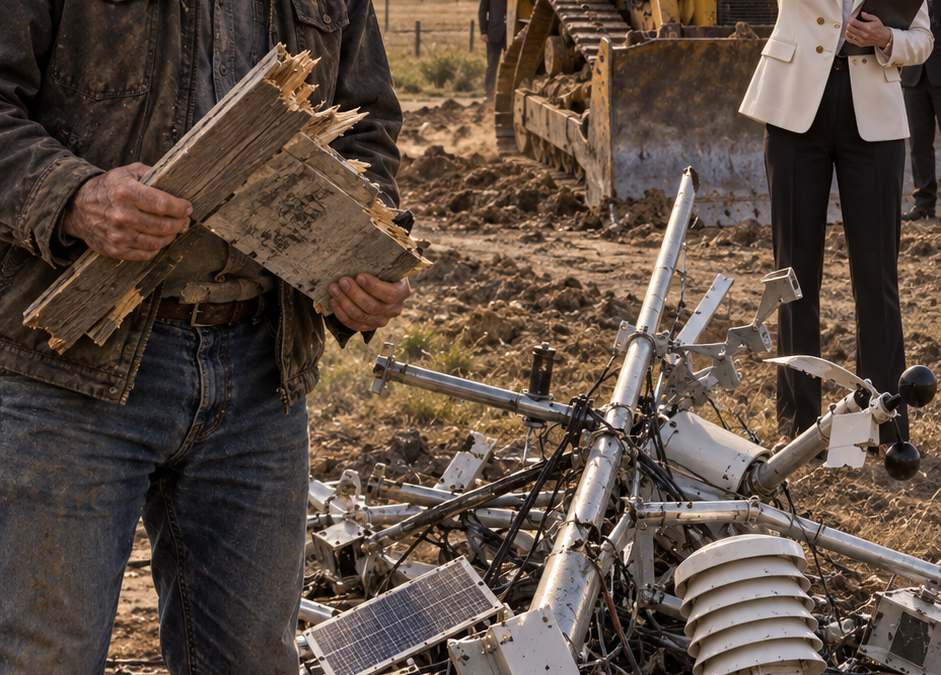
A yellow Caterpillar D6 was backing away from what used to be my automated weather station.
The sensor mast lay twisted across broken concrete.
The anemometer cable dragged behind the dozer like a dead snake.
And standing beside the machine in a white blazer, holding a clipboard like she was supervising the installation of tulips, was Karen Ashford.
President of the Fairmont Ridge Homeowners Association.
I banked left.
For a second, I seriously considered landing anyway and shutting the runway down with the airplane sitting sideways across it.
Instead, I circled once.
Then again.
The dozer blade pushed another piece of concrete aside.
I keyed the common frequency.
“Karen, stop the machine.”
A few seconds passed.
Then her voice came through a handheld radio.
“Tract C is association property. Land somewhere else.”
I almost laughed.
Not because anything was funny.
Because sometimes arrogance is so complete that your brain briefly mistakes it for parody.
“That’s ninety-two thousand dollars of aviation equipment.”
“Then you shouldn’t have installed it on our property.”
I landed.
Harder than usual.
By the time I taxied back, shut down, and walked toward the north end, the mast was in two pieces.
My father’s sign was lying face down in the dirt.
One corner had snapped clean through.
Karen didn’t even look embarrassed.
She held the clipboard against her white blazer and pointed toward the bulldozer operator.
“Finish the pad.”
I walked closer.
“Stop the machine.”
Karen finally looked at me.
“You don’t stop anything here, Mr. Walsh.”
“That station is published aviation infrastructure.”
“This is HOA property.”
“There are aircraft using this field that depend on that weather source.”
“You are a guest with an airplane and a hobby.”
I stared at her.
“A hobby?”
She turned toward the operator.
“Keep going. He isn’t a party to this.”
The blade scraped across the pad again.
I didn’t yell.
I took out my phone.
I filmed the debris.
The broken mast.
The cable trench.
My father’s sign.
Then I said the time aloud so the recording would capture it.
“Nine sixteen a.m.”
Karen watched me.
“You can film all you like.”
I looked at her.
“I plan to.”
At that moment, I still believed she had made the stupidest mistake of her life.
I was wrong.
The stupidest mistake came later.
That morning, she had something I didn’t.
A plat.
A deed.
And legally, unfortunately, she was right about one thing.
She owned the ground.
My father built Walsh Field in 1962.
Back then, it was nothing more than a hayfield and an idea.
Calvin Walsh rented a tractor, borrowed a transit, and cut twenty-nine hundred feet north to south through pasture.
The runway was dirt for four years.
Then asphalt.
He painted the numbers himself.
Every spring, until arthritis made his hands too stiff, he repainted them.
After that, I did it.
I still do.
Walsh Field eventually received the identifier W22.
It appeared on federal charts.
Pilots could find it.
Call it.
Land there.
I ran my agricultural aviation business out of it through the warmer months.
In fire season, retardant aircraft used it as a reload strip.
During winter emergencies, air ambulance crews sometimes used it as a relay point because the valley was flat, lighted, and substantially closer to the high country than the regional airport.
Walsh Field wasn’t busy.
But busy and useful are not the same thing.
I learned that in February of 2018.
My father had a stroke at ten o’clock one night.
I called emergency services.
The nearest helicopter crew asked one question I couldn’t answer.
“What’s your ceiling?”
I walked outside.
Looked up.
Clouds.
Dark sky.
Snow threatening over the ridge.
“I don’t know.”
There was no official weather reporting station within forty miles.
The crew would not launch into that valley without reliable conditions.
So Dad went by ground ambulance.
Over the pass.
Fifty-two minutes.
He was alive when we reached the hospital.
He wasn’t by morning.
I remember standing in the hospital parking lot after sunrise thinking about that question.
What’s your ceiling?
Not because knowing the ceiling would definitely have saved him.
I never let myself tell that story.
Medicine isn’t that clean.
Weather isn’t either.
But I knew one thing.
Nobody using my runway would ever again have to guess what the sky was doing.
That spring, I started planning a weather station.
Not a backyard wind sock with a thermometer.
A proper automated aviation weather system.
Installed cost: ninety-two thousand dollars.
Sensor mast.
Anemometer.
Ceiling detector.
Visibility sensor.
Barometric equipment.
Backup battery.
Phone connectivity.
Broadcast capability.
Calibration.
Commissioning.
The FAA commissioned it in 2019.
After that, Walsh Field had a voice.
Day and night.
Rain.
Heat.
Snow.
Smoke.
Any pilot could call the published number or tune the frequency and hear the field describe itself in that emotionless automated tone pilots trust precisely because it has no emotions.
Wind.
Visibility.
Ceiling.
Temperature.
Altimeter.
Facts.
My father would have liked it.
At the base of the mast, I mounted a wooden sign he’d cut years earlier from an old hangar wall.
He’d burned five words into it with a torch.
WEATHER DON’T CARE WHO’S WAITING.
Bad grammar.
Good advice.
There was another piece of history I barely thought about.
In 2016, Walsh Field accepted a federal airport improvement grant.
One point four million dollars.
The runway surface had been deteriorating under tanker use.
The old asphalt dated back to the sixties, and repairs weren’t enough anymore.
The grant paid for resurfacing and related improvements.
I signed what felt like an inch of paperwork.
The project got done.
I put the federal folder on a shelf over my workbench.
Blue folder.
Then I forgot about it.
For nine years, it collected dust.
That would eventually matter more than almost anything else.
But not yet.
Fairmont Ridge Estates came later than the runway.
Much later.
In 2004, a developer bought roughly eighty acres north of my property.
One hundred sixteen homes went in.
Curved roads.
Stone entrance monument.
Decorative streetlights.
Gate.
Clubhouse.
HOA.
The developer advertised Walsh Field as a charming “heritage aviation feature.”
I should have paid more attention to that phrase.
At thirty-two, I was more interested in keeping airplanes flying than in reading subdivision documents.
That mistake eventually became expensive.
Karen Ashford bought into the second phase.
Luxury real estate had been her career for twenty years.
She had the smile.
The wardrobe.
The voice.
The ability to describe an ordinary garage as an “automotive carriage experience.”
Eventually she became HOA president.
Two terms.
Glossy newsletters.
Custom logo.
Committees.
She ran the place as if every cul-de-sac were staging for a property showing.
For years, she referred to the strip of association-owned land at the north end of Walsh Field as the “legacy parcel.”
Always warmly.
Always nostalgically.
Then one December, the warmth disappeared.
A certified letter arrived.
My weather station, it said, was an unauthorized structure on Fairmont Ridge common-area Tract C.
I had thirty days to remove it at my expense.
I read the letter twice.
Then a third time.
My first response was reasonable.
Too reasonable, as it turned out.
I emailed the HOA.
Attached photographs.
Attached the chart supplement.
Highlighted the station frequency and phone number.
Explained that the equipment was federally commissioned aviation infrastructure.
Explained that aircraft approaching Walsh Field used it before committing to land.
Explained that an air ambulance crew could be listening to that station with a patient waiting somewhere in the mountains.
Karen never replied.
That silence bothered me more than the letter.
People who think they’re right usually argue.
People who discover they’re wrong usually ask questions.
Someone who receives evidence they’re wrong and simply says nothing?
That’s often somebody doing something else.
In February, the HOA board voted to remove the “obstruction.”
Nine minutes of discussion.
I wasn’t invited.
I wasn’t notified.
According to the minutes, I wasn’t considered a party to the decision because the structure sat on HOA land.
Two months later, I watched a bulldozer tear it down from nine hundred feet.
I called the sheriff.
A deputy arrived about twenty minutes later.
Young guy.
Calm.
Professional.
He photographed the broken mast.
Cable trench.
Concrete pad.
Then he asked me to explain what happened.
When I reached the part where Karen told me over the radio to “land somewhere else,” he stopped writing.
“She said that on the field frequency?”
“Yes.”
He looked toward Karen.
“All right.”
He said it the way people do when they assume the next document will make the situation simple.
I handed him my deed.
He read the legal description slowly.
Karen walked over carrying one sheet of paper.
She gave it to him without speaking to me.
He read it.
Then read it again.
Then handed my deed back.
“Mr. Walsh, this is civil.”
“She destroyed ninety-two thousand dollars of equipment.”
He looked uncomfortable.
“I can’t arrest a survey.”
That sentence lived in my head for months.
I can’t arrest a survey.
At the time, I hated hearing it.
Later, I understood.
The deputy wasn’t there to adjudicate recorded property lines.
I asked to see the document Karen had shown him.
She held it out.
I had it in my hands maybe four seconds.
Long enough to see one thing.
2004 recorded plat.
That night, I downloaded the complete Fairmont Ridge plat.
Four sheets.
Spread them across my kitchen table.
And there it was.
TRACT C
COMMON AREA
FAIRMONT RIDGE HOMEOWNERS ASSOCIATION
1.8 ACRES
My father’s deed stopped approximately forty feet south of where I had installed the weather mast.
I sat there staring at the line.
Forty feet.
I had spent ninety-two thousand dollars installing a weather system on ground that wasn’t mine.
Not secretly.
Not at night.
A crane.
Concrete truck.
Technicians.
Calibration crew.
Six weeks of visible work.
And for six years, nobody at Fairmont Ridge said one word.
No letter.
No phone call.
Nothing.
Then December arrived and suddenly the station was an emergency.
I didn’t sleep much.
The next morning, Roy Kesler came into my hangar.
Roy was an A&P mechanic who had worked on airplanes for my father before he worked on them for me.
He was one of those men who could communicate disappointment by raising one eyebrow half an inch.
He carried the newest Fairmont Ridge newsletter.
Front page.
OBSTRUCTION REMOVED — TRACT C IMPROVEMENT MOVES FORWARD.
Below the headline was a glossy rendering.
Twelve luxury garage bays.
Stone veneer.
Glass doors.
Carriage lights.
Black Porsche parked at a tasteful angle.
The project had a name.
THE CARRIAGE VAULT AT FAIRMONT RIDGE.
Roy tapped the rendering.
“That was printed before yesterday.”
“I know.”
“Glossy stock?”
“Yes.”
“Two weeks minimum.”
“At least.”
We both stared at it.
The rendering existed before Karen bulldozed my station.
Maybe long before.
Roy tapped the page again.
“You lose the weather station, you lose tanker operations.”
“I know.”
“They won’t load retardant into an aircraft operating from a strip with no reliable weather.”
“I know, Roy.”
He stared at me.
“Then stop saying you know and do something.”
So I started building a file.
The station had a local data drive.
The bulldozer destroyed the mast.
It didn’t destroy the equipment shed.
I pulled the drive.
Six years of observations.
One every ninety seconds.
Wind.
Ceiling.
Visibility.
Altimeter.
Temperature.
Then the final entry.
April 9.
9:14:22 a.m.
After that?
Nothing.
I copied the drive three times.
I saved my phone video.
Photographs.
Chart supplement.
Certified HOA letter.
My unanswered response.
Board minutes.
Then I sent a written demand.
Replace the station or fund replacement.
The HOA responded nine days later.
With an invoice.
Eighteen thousand four hundred dollars.
Equipment rental.
Removal of unauthorized structure.
Disposal.
They bulldozed my station.
Then billed me for the bulldozer.
I put the invoice on my refrigerator.
I can’t recommend that as a mental-health strategy.
Thirty days later, Fairmont Ridge recorded a lien against my house.
Not the runway.
My house.
The house my father built in 1971.
The house where he died.
That was when I attended my first HOA meeting.
Folding chairs.
Burned coffee.
Maybe forty residents.
I signed up for open comment.
When my name was called, I carried the weather log to the podium.
Karen sat at the board table.
I started explaining what the station was.
Why pilots used it.
Why emergency crews used it.
Why removing it had consequences beyond an argument over 1.8 acres.
Karen placed a kitchen timer on the table.
Three minutes.
I kept talking.
The timer beeped.
Karen smiled.
“Thank you, Mr. Walsh.”
“I have two more pages.”
“Your time has expired.”
“This station supports medical flights.”
“Next speaker.”
I stood there.
She looked past me.
Not angry.
Not defensive.
Patient.
The way a teacher looks at a child refusing to sit down.
I gathered my papers.
Three people followed me outside.
Two apologized.
The third changed everything.
Her name was Nadine Bole.
Mid-fifties.
Cardigan.
Board secretary for eleven years.
She stood beside my truck gripping her keys.
“They removed me from the project committee in January.”
“Why?”
“I asked one question.”
“What question?”
She looked back toward the clubhouse doors.
For a moment, I thought she wouldn’t answer.
Then she said, “Ask when the garages went on sale.”
“Not when they were approved?”
“No.”
“When they went on sale.”
Then she left.
For the first time since April 9, I stopped being angry.
I became curious.
Association financial and project records were available to members.
I wasn’t a member.
But I knew people who were.
One was Harold Puit.
Retired dentist.
His wife told him to show me his purchase packet.
Harold put it on his kitchen table.
“I don’t want trouble.”
“You bought one of the garages?”
He nodded.
“Can’t get into it because they haven’t built it.”
“How much?”
“Eighty-five thousand.”
There were twelve bays.
Twelve times eighty-five thousand.
One million twenty thousand dollars.
In presales.
I found the contract date.
Then read it again.
Then a third time.
The garage purchase agreement had been signed four months before the HOA board voted to remove my weather station.
I sat there holding a cup of coffee I never drank.
Karen had not discovered an unauthorized obstruction and then imagined a use for the cleared land.
The garages came first.
Sales came first.
Deposits came first.
Then the station became a violation.
I kept reading.
Buried in the project packet was another line.
Project management compensation: six percent of project cost.
Payable to the association president in her capacity as project manager.
Karen.
Six percent.
Now the whole thing smelled different.
Not legally.
Not yet.
But morally?
It stank.
I drove three hours the following morning to meet Ellen Danforth.
Aviation attorney.
Roy recommended her because, in his words, “She knows the difference between an AWOS and a toaster.”
I put everything on her desk.
Plat.
Deed.
Weather logs.
Newsletter.
Garage contracts.
Karen’s compensation.
The lien.
The invoice.
Ellen read quietly for eleven minutes.
Then looked up.
“You want me to tell you this is criminal?”
“I want you to tell me it’s something.”
“It is something.”
“What?”
“Ugly.”
“That’s it?”
“Ugly is not a cause of action.”
She tapped the plat.
“This is the problem.”
“They own Tract C.”
“Yes.”
“They destroyed my station.”
“You installed your station on their land.”
“It was federally commissioned.”
“Still their land.”
“They waited six years.”
“That could matter to damages. Maybe other theories. But motive doesn’t beat recorded title.”
I hated how reasonable she sounded.
“So I’m losing?”
“Right now?”
She leaned back.
“Yes.”
We sent a cease-and-desist letter anyway.
No construction on Tract C pending resolution.
Certified.
Law firm letterhead.
The HOA poured foundations the next morning.
I saw the pump truck from the downwind leg.
Concrete flowing into forms exactly where my mast had stood.
That’s when I learned what a cease-and-desist letter is worth to someone who has already priced the consequences.
Not much.
So I tried another direction.
I called the county building department.
“How did a twelve-bay garage structure get approved eleven hundred feet from the approach end of a public-use runway?”
The clerk pulled the permit.
“Accessory structures. HOA common area. Storage.”
“Does the application mention Walsh Field?”
Paper shuffled.
Silence.
“No, sir.”
“No airport reference?”
“No.”
I hung up.
Then stood alone in the hangar with the phone in my hand.
Every doorway Karen had walked through had opened for her.
The plat was real.
The board vote was real.
The county permit was real.
The application simply never mentioned the public-use runway sitting a few hundred yards away.
She wasn’t breaking every rule in sight.
She was moving through gaps.
Then the newsletter attacked me.
A photograph of my airplane appeared on the front page.
Taken from somebody’s back deck while I was spraying.
Headline:
AERIAL CHEMICAL OPERATIONS ADJACENT TO RIDGE HOMES.
The article mentioned drift.
Children.
Property values.
Repeated refusal by an “operator” to cooperate with the community.
Two houses pulled their listings that week.
Neighbors who had waved at me for fifteen years suddenly found fascinating things to inspect on the opposite side of the road.
Roy came to the hangar.
“The tanker contractor called me.”
“Why you?”
“They asked if Walsh Field is going to have weather this fire season.”
“What did you say?”
“That I’d call back.”
He crossed his arms.
“Bennett, if they scratch this strip off the list, Karen doesn’t need to win another legal argument.”
I knew.
“The field just dies.”
He left.
I stayed in the hangar after dark.
At that moment, Karen had almost everything.
Recorded title.
County permit.
Garage deposits.
A lien against my house.
An invoice demanding that I pay for destruction of my own weather equipment.
And a neighborhood being told my airplanes were poisoning children.
I had motive.
Motive wasn’t enough.
So I started searching old paperwork.
Boxes.
Minutes.
Files.
Anything.
I climbed onto the workbench to reach a shelf.
My hand landed on a blue folder covered in dust.
The 2016 federal grant.
I moved it aside.
Kept searching.
At that point, I didn’t understand that I had just touched the answer.
The lien eventually pushed the matter into court.
The court sent us to mediation first.
Retired judge.
Conference room.
Whiteboard nobody touched.
Ellen and I arrived with everything.
Deed.
Weather logs.
Video.
Federal chart supplement.
Garage contracts.
Six-percent management fee.
County permit application.
Association records.
Fairmont Ridge’s attorney was Lawrence Beckwith.
Gray suit.
Tired eyes.
He listened.
Never objected.
When Ellen finished, Beckwith set his pen down.
Then asked one question.
“Whose name is on Tract C?”
That was his entire case.
And legally?
It was enough.
The mediator reviewed the plat.
Reviewed the deed.
Then explained, calmly, that Fairmont Ridge held recorded title.
An owner generally had authority to remove an encroaching structure from its property.
Whatever claims I might have concerning the manner of removal were separate.
But the central ownership dispute wasn’t much of a dispute.
I lost.
Completely.
I want to be clear about that.
Not “technically lost.”
Not “lost round one.”
I sat in a cold conference room and learned that the sentence I had repeated for months—
She destroyed my station on my property—
was wrong.
It wasn’t my property.
The station had been on Fairmont Ridge land the day I poured the pad.
It had been on their land every night it broadcast weather.
The invoice remained.
The lien remained.
Beckwith packed his briefcase.
Karen moved slowly.
Almost leisurely.
Before leaving, she stopped beside my chair.
“You lost your own land, Mr. Walsh.”
Her voice was pleasant.
Then she smiled.
“Try zoning next.”
She walked out.
She was right.
About ownership.
Remember that.
Because that fact never changes.
Fairmont Ridge owned Tract C then.
Fairmont Ridge owns Tract C now.
I got home around eight.
Discovery had produced several boxes of HOA records.
Most looked useless.
Pool chemical invoices.
Landscape contracts.
Old meeting notices.
I couldn’t sleep.
So I sat on the living-room floor and started reading.
Box one.
Nothing.
Box two.
Nothing.
Box three.
Near the bottom, I found Fairmont Ridge’s 2004 common-area closing file.
Title commitment.
Schedule B.
Exceptions.
Item three stopped me.
FEDERAL AVIATION OBLIGATIONS OF RECORD AFFECTING TRACT C, AS MORE PARTICULARLY DESCRIBED IN INSTRUMENTS RECORDED IN BOOK 411.
In the margin were initials.
K.A.
And a date.
Karen Ashford.
I stared at it.
Read it maybe forty times.
I didn’t know what it meant.
Not really.
But it wasn’t landscaping.
It wasn’t a utility easement.
It said federal aviation obligations.
I photographed the page.
At 1:14 a.m., I emailed it to Ellen.
Three words.
Does this matter?
She called at 1:06 the next afternoon.
No hello.
“Bennett, do you still have your federal grant file?”
“What grant file?”
“The 2016 runway resurfacing grant.”
Blue folder.
I drove to the hangar.
Climbed onto the bench.
Pulled it down.
Blew off nine years of dust.
Grant agreement.
One point four million dollars.
Then a folded drawing.
Airport Layout Plan.
FAA-approved.
I opened it across the workbench.
Found the runway.
Found the north end.
Found the airport property boundary.
Then stopped.
The boundary did not end where my deed ended.
It wrapped around Tract C.
All 1.8 acres.
Inside the federally approved airport boundary.
“Ellen.”
“Yes?”
“This shows their land inside the airport.”
“Yes.”
“But they own it.”
“Yes.”
“The mediator literally just said they own it.”
“I know.”
“Then what does this change?”
There was a pause.
Then Ellen said something I will remember for the rest of my life.
“You’ve been arguing the wrong question.”
I looked down at the drawing.
“What question?”
“You’ve spent seven months asking who owns Tract C.”
“They do.”
“Yes.”
She continued.
“But federal airport grant obligations don’t necessarily care whose name is on the deed. They can attach obligations to airport land and remain enforceable during the grant-assurance period.”
“How long?”
“Twenty years under this agreement.”
“Starting 2016.”
“Yes.”
“Until 2036.”
“Yes.”
I stared at the boundary line.
“So Fairmont Ridge owns the dirt.”
“Correct.”
“But that doesn’t mean they can use it for anything they want.”
“Now you’re asking the right question.”
I looked again at the title commitment.
Schedule B.
Federal aviation obligations.
Karen’s initials.
“She knew.”
“We’ll prove what she knew later.”
“Her initials are on it.”
“Yes.”
“And the project attorney?”
“We’re going to find out.”
For seven months, Karen’s entire position had been built on ownership.
And ownership was real.
I could not beat her there.
But ownership and permitted use were not the same thing.
Fairmont Ridge had purchased Tract C subject to recorded aviation obligations.
The ground remained theirs.
The restrictions came with it.
The next morning, I started learning how to file a federal airport compliance complaint.
Ellen handled the legal work.
A Part 16 complaint went to the FAA.
Sixty-one pages.
Not dramatic pages.
Boring pages.
Those are usually the useful ones.
Grant agreement.
Approved Airport Layout Plan.
Recorded Book 411 instruments.
2004 title commitment.
Schedule B.
AWOS logs.
Garage pre-sale contracts.
County permit application.
HOA correspondence.
The complaint landed with the FAA Airports District Office.
A compliance specialist named Dale Overbeck received it.
Six days later, Fairmont Ridge got a letter requiring a response.
Nadine called me.
“She read it at the meeting.”
“Karen?”
“Yes.”
“What did she say?”
“She asked whether anyone in the room was an airplane.”
I closed my eyes.
“She joked about an FAA compliance notice?”
“Yes.”
Beckwith submitted the HOA’s response.
Private residential property.
Fee-simple ownership.
Title confirmed by court.
No federal ownership interest.
Request for dismissal.
Then Karen made what might have been the decisive mistake.
She accelerated construction.
Six-day work weeks.
Early mornings.
Work lights after sunset.
Framing went up.
Stone veneer followed.
Glass garage doors.
Carriage lights.
Photographer.
She wasn’t trying to win only with law anymore.
She was trying to win with completion.
Nadine told me what Karen said at a board meeting.
“Nobody bulldozes twelve garages families already paid for.”
That was the strategy.
Build them.
Finish them.
Fill them.
Make enforcement politically ugly.
Turn twelve neighbors and their eighty-five-thousand-dollar purchases into hostages.
Then dare someone in Washington to order demolition.
Three weeks into that push, Ellen called.
Her voice was different.
“Karen filed with the county.”
“For what?”
“She wants a formal determination that Walsh Field is abandoned and nonoperational.”
I sat down.
“Why?”
“You know why.”
I did.
Every federal argument we were making depended on Walsh Field remaining an airport.
If Karen could create a county record saying the field was effectively dead, she could argue the aviation obligations no longer had anything meaningful to protect.
“What evidence?”
“Operations down.”
“Because she destroyed my weather station.”
“Yes.”
“No published weather.”
“Because she destroyed my weather station.”
“Yes.”
Then Ellen paused.
“And an affidavit.”
“From Karen?”
“Yes.”
“What does it say?”
“That the weather station had been broken and unmaintained for years before removal.”
I stopped breathing for a second.
“She swore that?”
“Under penalty of perjury.”
The county hearing came first.
The FAA response deadline nine days later.
Two clocks.
Two fights.
Ellen gave me one instruction.
“Keep the field alive.”
So we built the record.
The weather station hard drive was beautiful in its monotony.
Every ninety seconds.
For six years.
Then:
9:12:52.
Normal observation.
9:14:22.
Normal observation.
Then nothing.
Federal monitoring records matched.
Outage logged at 9:14 on April 9.
Not three years earlier.
Not intermittent.
Not neglected.
9:14.
The morning Karen’s contractor put a bulldozer blade through the mast.
Roy handled operations history.
Fuel tickets.
Maintenance records.
Agricultural flights.
Transient traffic.
Air ambulance relay use.
Fire tanker activity.
Four years.
He obtained a letter from the medical flight program confirming Walsh Field as a relay location.
Another from the fire contractor confirmed use during three of the previous four seasons.
One sentence at the bottom worried me.
Continued use contingent upon functioning weather reporting.
True.
Painfully true.
Karen had damaged the field operationally, then attempted to use the damage she caused as proof the field was dead.
Nadine came to my house a week before the hearing.
She parked down the road and walked.
That told me immediately this wasn’t a casual visit.
She carried an envelope.
Executive-session minutes.
October.
Unredacted.
She had kept her own secretary copy.
The project attorney had briefed the board about Tract C before construction.
One sentence jumped out.
PARCEL CARRIES AVIATION ENCUMBRANCES OF RECORD. ASSOCIATION SHOULD OBTAIN FEDERAL RELEASE PRIOR TO IMPROVEMENT.
In the margin, handwritten in blue ink:
LEGACY NOISE.
Karen’s handwriting.
I covered the words with my thumb.
“Eleven years you were secretary?”
Nadine nodded.
“I typed those minutes.”
“Why give them to me now?”
She stared through the window toward the runway.
“Because she made me put that timer in front of you.”
I said nothing.
“And I did it.”
Two days before the hearing, Fairmont Ridge mailed invitations.
Cream cardstock.
Gold foil.
Ribbon cutting.
THE CARRIAGE VAULT AT FAIRMONT RIDGE.
Press welcome.
Scheduled three days before the FAA response deadline.
Karen wasn’t hiding.
She was celebrating.
The county hearing happened Thursday morning.
Bad carpet.
Forty folding chairs.
Karen wore navy.
Beckwith sat beside her with a tabbed binder.
She spoke first.
And she was good.
I will give her that.
She described Walsh Field as a fading private strip.
Aging operator.
Seasonal agricultural activity.
Declining operations.
No functioning weather source.
One hundred sixteen families living near an increasingly obsolete runway.
Then Beckwith read her affidavit.
The sentence landed exactly the way Ellen wanted it to.
“The weather station had been non-functional and unmaintained for a period of years prior to its removal.”
Ellen did not object.
She let him finish.
Then she stood.
Two exhibits.
First: AWOS local log.
She put the final entries on the screen.
9:12:52.
Normal.
9:14:22.
Normal.
Next expected cycle?
Silence.
Then she showed the federal outage record.
April 9.
9:14.
Ellen looked at the board.
“The petitioner has sworn that this weather station was dead for years.”
She paused.
“The record shows it operating normally less than two minutes before the petitioner’s contractor destroyed it.”
Nobody moved.
One county-board member leaned toward his microphone.
“Ms. Ashford, are you asking this board to find the airport abandoned partly because it has no functioning weather station?”
Karen sat straight.
“Among other factors, yes.”
“And your contractor removed the weather station?”
“That was an unrelated property enforcement matter.”
He frowned.
“It doesn’t sound unrelated.”
Roy testified next.
No notes.
He had no need for them.
Air ambulance relay operations.
Tanker reloads.
Agricultural flights going back decades.
Transient traffic.
Maintenance.
Fuel.
He read the medical-flight letter.
Then the fire contractor letter.
The petition was denied.
Not narrowly.
Not after a split vote.
Denied.
I expected Karen to look shaken.
She walked out smiling.
Because from her perspective, she had lost one procedural move.
She still owned Tract C.
Still had a court-confirmed title.
Still had twelve almost-completed garage bays.
Still had deposits.
Still had a lien on my house.
Still had my eighteen-thousand-four-hundred-dollar invoice.
Still had a ribbon cutting in four days.
I went.
I’ve asked myself why.
Part of me wanted to see how far she would take it.
Part of me hated the idea that my father’s runway would appear in the background of photographs celebrating what had replaced his sign.
Tables were set.
White cloth.
Coffee.
Paper cups printed with the Carriage Vault logo.
County reporter.
Photographer.
Twelve bays stood complete.
Glass doors raised.
Stone veneer clean.
Carriage lights glowing uselessly in daylight.
Harold Puit stood beside his wife.
Karen carried oversized ceremonial scissors.
Gold handles.
Of course.
She spoke for three minutes.
Thanked the board.
Thanked residents.
Used the word vision twice.
Then she said the HOA had removed an obstruction and delivered a modern amenity.
“This,” she said, “is what happens when a community moves forward instead of clinging to the past.”
Then a man in a gray polo walked up the drive.
Government lanyard.
Folder under his arm.
No urgency.
No drama.
Karen noticed him.
Then looked away.
He kept coming.
Finally he stopped near the ribbon.
“Ms. Ashford?”
“Yes?”
“Dale Overbeck. FAA Airports District Office.”
Everything became quiet.
“I need to serve you with this.”
He handed her a folder.
Then handed Beckwith another copy.
The photographer took one more picture.
Then lowered the camera.
The reporter opened his notebook.
Karen still held the giant scissors.
She opened the folder.
Read.
Her face barely moved.
But the hand holding the scissors slowly dropped.
The document was a final agency decision.
Walsh Field had accepted $1.4 million in federal airport improvement funds in 2016.
Those funds came with grant assurances.
The applicable obligations continued through 2036.
They applied to airport land shown within the FAA-approved Airport Layout Plan.
Tract C was inside that boundary.
Karen looked up.
“We own this land.”
She sounded relieved saying it.
Because it was true.
And truth had saved her before.
Overbeck nodded.
“Yes, ma’am.”
“A court already confirmed that.”
“Yes, ma’am.”
Then he said it.
“The obligation follows the ground, not the name.”
Karen’s expression changed.
Not much.
Enough.
She looked toward Beckwith.
He had opened the decision to the exhibits.
He wasn’t looking back at her.
She started arguing.
Fairmont Ridge purchased the property in good faith.
Nobody disclosed restrictions.
Any federal limitation should have appeared in the title record.
Overbeck didn’t argue.
He didn’t need to.
The decision already addressed it.
The aviation obligations were recorded in Book 411.
Before Fairmont Ridge acquired title.
The HOA’s own 2004 title commitment listed them as Schedule B exceptions.
Karen’s initials appeared beside the entry.
The board’s own attorney had later advised obtaining a federal release before developing Tract C.
Executive-session minutes proved it.
Karen’s own handwritten note dismissed those restrictions as “legacy noise.”
The county garage permit application identified the project as accessory storage on common area.
No airport disclosure.
No federal release.
And the association had begun selling twelve garage bays for eighty-five thousand dollars each months before the board ever voted to label my weather station an obstruction.
The decision did not call the project an innocent mistake.
It called the garages non-aeronautical development on obligated airport land without required federal release.
Then came another finding.
The new structures also penetrated the protected approach surface at the north end.
The order was brutally simple.
Remove the structures.
Restore Tract C to grade.
Reinstate a published weather source.
All costs to Fairmont Ridge.
Nobody spoke for several seconds.
Then Harold Puit did.
“What happens to our deposits?”
Karen didn’t answer.
I didn’t speak either.
There was nothing I could say more effectively than the folder in her hand.
I walked beyond the tables.
Past the open garage bays.
Onto the dirt near where the weather mast used to stand.
Wind was southwest.
Maybe eight knots.
Ceiling around four thousand.
There was no automated voice to say so.
Yet.
Fairmont Ridge appealed.
It took eleven weeks.
They lost.
Compliance deadline:
December 12.
Demolition started at eight in the morning.
I stood near the fence.
I didn’t film.
I had filmed enough.
The glass doors came off first.
Twelve of them.
Laid flat in grass.
Then the carriage lights.
Then crews stripped the stone veneer.
It was only about an inch and a half thick over block.
That felt appropriate somehow.
Beautiful surface.
Ordinary material underneath.
The roof came down in sections.
By the second day, Karen’s million-dollar “Carriage Vault” was a pile of rubble.
On day three, a saw crew cut the slab into squares.
Trucks hauled the concrete away.
I watched the demolition equipment moving through the exact ground where another bulldozer had destroyed my weather station months earlier.
Same kind of machines.
Opposite direction.
Restoration and demolition eventually cost about $1.9 million.
The association’s insurer denied the claim, citing intentional conduct.
The bill fell onto Fairmont Ridge.
Special assessment:
Sixteen thousand four hundred dollars per home.
One hundred sixteen homes.
The neighborhood turned on Karen almost instantly.
People ask whether I enjoyed that.
Not really.
Harold Puit wasn’t Karen.
Neither were most residents.
He had paid eighty-five thousand dollars for a garage he lost.
Then got assessed sixteen thousand four hundred dollars to demolish it.
The twelve buyers sued.
Fairmont Ridge was named.
Karen was named personally.
The board reviewed the title commitment.
Her initials.
Executive-session minutes.
Her “legacy noise” note.
The board withdrew her indemnification.
The vote took eleven minutes.
She was removed as president.
The bylaws were amended to prohibit her from serving again.
A personal judgment later came in at roughly three hundred forty thousand dollars.
Then there was the affidavit.
Being wrong about property rights is one thing.
Losing a land dispute is one thing.
Swearing under penalty of perjury that a functioning aviation weather station had been broken for years when machine logs show it broadcasting normally until ninety seconds before your contractor destroyed it is another.
That issue was referred.
Karen faced criminal charges.
The case ultimately resolved with a plea to one count.
She served eleven months.
Restitution followed.
By then, the smile from the mediation room felt like it belonged to somebody from another lifetime.
The lien came off my house.
The eighteen-thousand-four-hundred-dollar demolition invoice was voided.
Fairmont Ridge covered my allowable costs.
Then, on a cold Tuesday in March, installers arrived at Tract C.
The same company that had installed the original system.
New mast.
Same sensor height.
Same general location.
Replacement cost:
One hundred forty-eight thousand dollars.
Paid by Fairmont Ridge under the federal order.
The strangest part?
The HOA still owned the land.
It owns it now.
That never changed.
The whole lesson was never that their deed disappeared.
It was that a deed doesn’t erase restrictions already attached to the property.
Fairmont Ridge can own Tract C.
Until the federal obligations expire, it simply cannot turn it into whatever Karen feels like selling.
Roy repaired my father’s sign.
The bulldozer had split it through the middle.
He ground the crack.
Welded a metal support behind it.
When he finished, a gray scar ran directly through the words.
WEATHER DON’T CARE WHO’S WAITING.
“Want to paint it?” I asked.
“No.”
“Why?”
Roy looked at the weld.
“Looks better this way.”
He was right.
The new weather station came online on a Thursday.
I stood beneath it.
Listened.
The automated voice began reading conditions.
Wind.
Ceiling.
Visibility.
Altimeter.
Same flat tone.
No victory music.
No applause.
Just information.
For a while, I expected something more emotional.
I had spent almost a year fighting.
Lost in mediation.
Had a lien put on my home.
Watched Karen build garages where my father’s sign had stood.
Watched neighbors believe I was the problem.
Then found the federal records.
Survived the abandonment hearing.
Watched the FAA order the entire project removed.
And after all that?
A robot voice announced the altimeter setting.
That was enough.
Months later, in October, rain moved over the valley during the night.
Ceiling around fifteen hundred.
I woke up at two because the scanner in my kitchen was talking.
It had woken me for years.
Then gone silent for eleven months.
Now I let it wake me.
“Wind one-niner-zero at six. Ceiling one thousand five hundred. Altimeter three-zero-one-two.”
Eight minutes later, I heard rotors.
I got out of bed.
Walked to the window.
An air ambulance helicopter came up the valley.
Approach light on.
It descended toward Walsh Field.
Landed.
Stayed four minutes.
Then lifted again and disappeared north toward the high country.
Somebody was waiting up there.
I never learned who.
I didn’t ask.
That was never the point.
My father used to say weather didn’t care who was waiting.
He was right.
Weather doesn’t care about property disputes.
HOA presidents.
Garage deposits.
County hearings.
Federal grants.
Egos.
Deeds.
It does what it does.
What matters is whether somebody can tell you what it’s doing before you put an aircraft into it.
Karen thought this whole fight was about ownership.
For seven months, I thought so too.
That’s why I lost.
Fairmont Ridge owned Tract C.
The judge was right.
Karen was right about that.
But she made the mistake arrogant people make when they finally get one important fact correct.
She assumed being right about one thing made her right about everything.
She owned the dirt.
She did not own the right to erase twenty years of federal aviation obligations attached to it.
She owned Tract C.
She did not own the authority to turn obligated airport ground into private luxury garages without release.
She owned the parcel.
She did not own the sky above the runway.
And she definitely did not own the truth.
That truth had been sitting in boring documents the whole time.
A blue folder above my workbench.
An Airport Layout Plan.
Book 411.
A Schedule B exception.
Her own initials.
Minutes from her own executive session.
Six years of ninety-second weather observations.
Not dramatic.
Not loud.
Not glamorous.
Which was fitting.
Because the thing that finally beat Karen Ashford wasn’t me yelling louder.
It wasn’t a sheriff arresting anybody beside a bulldozer.
It wasn’t even the judge.
I lost in front of the judge.
What beat her was paper she had already read and decided she was important enough to ignore.
That’s why, every time I drive past the north end now, I look at my father’s repaired sign.
The weld scar is still visible.
I hope Roy never paints it.
The scar belongs there.
So does the station.
So does the runway.
And somewhere in Fairmont Ridge, I’m sure somebody still has one of those glossy brochures showing twelve beautiful garage bays with stone fronts, glass doors, carriage lights, and a black Porsche parked at an angle.
A million-dollar rendering of something that no longer exists.
I kept one copy myself.
It’s tucked into the federal grant folder.
Right behind the Airport Layout Plan.
Sometimes when I’m in the hangar late, I open the folder and look at both pages.
The rendering shows what Karen thought money, confidence, and an HOA vote could create.
The airport plan shows what the ground was legally obligated to remain.
One drawing cost Fairmont Ridge almost two million dollars to erase.
The other had been sitting on my shelf the entire time.
And now, whenever the weather turns ugly and that automated voice comes over the frequency again, I think about how close Walsh Field came to losing its voice because twelve garages looked more profitable than a weather mast.
Then the station speaks.
A pilot listens.
Somebody lands safely.
And the field keeps doing what my father built it to do.
Tell the truth about the sky.








