𝗙𝗨𝗟𝗟 𝗦𝗧𝗢𝗥𝗬 The HOA Built Its Biggest Stage Beside My Dry Hayfield and Treated My Warning Like a Nuisance
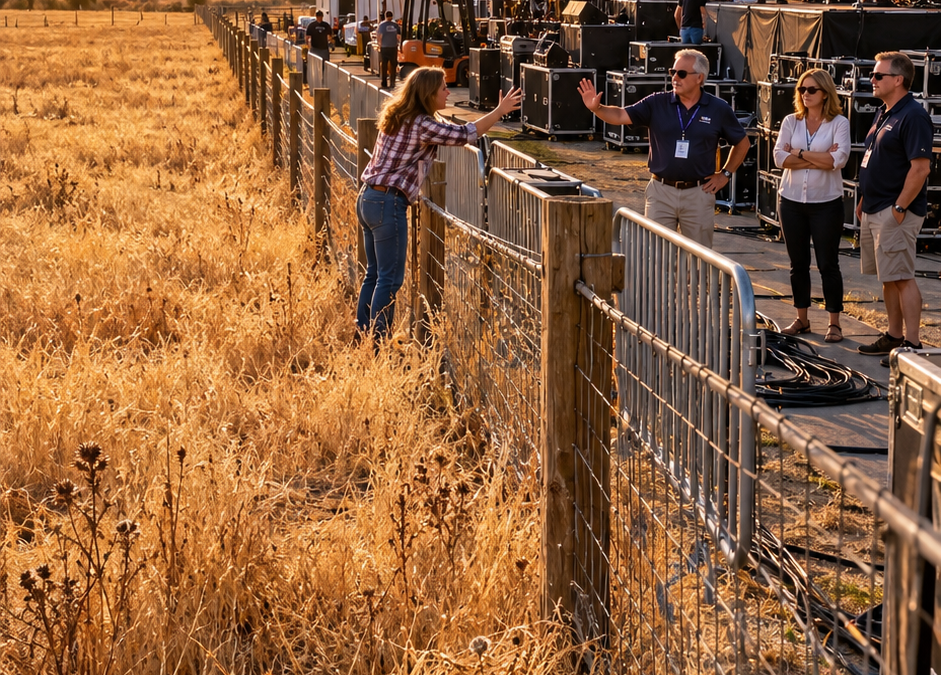
𝗙𝗨𝗟𝗟 𝗦𝗧𝗢𝗥𝗬
That was all he gave me.
We’ll be careful.
No details.
No commitment.
No moved equipment.
No safety buffer.
No acknowledgment that my property was not part of his event space.
I went home unsettled.
For the next few days, I watched the preparations grow more elaborate. Lighting towers were tested at dusk. The sound system boomed through short bursts of music. Workers unloaded boxes of decorations, banners, extension cords, folding chairs, portable barricades, and cases of bottled water. Food trucks arrived for layout checks. Volunteers marked pedestrian lanes with flags.
The stage stood there, expensive and proud, just across the line from my dry hay.
The more polished the festival became, the worse my feeling got.
Then I found out about the fireworks.
It happened the day before the festival. I was at the local feed store buying mineral blocks when I overheard two Ashford Lakes residents talking in the checkout line.
“The fireworks are supposed to start right after nine,” one woman said.
“The kids are going to love it,” the other replied. “Richard said this year’s finale is bigger than last year.”
I went still.
The cashier handed me my receipt, but I barely heard her.
Fireworks.
Beside my hayfield.
After weeks without rain.
I drove straight to the HOA office.
Richard was outside the clubhouse, supervising volunteers who were hanging a banner that read ASHFORD LAKES SUMMER CELEBRATION in blue letters. He looked pleased with himself. The whole place did. Everything was clean, bright, and organized. It looked like success if you did not understand what dry grass could do with one spark and a little wind.
“Richard,” I said.
He turned, and this time he did not bother with the full smile.
“Sarah.”
“You’re planning fireworks?”
His eyes moved briefly toward one of the volunteers, then back to me.
“We have a closing display scheduled.”
“Where?”
“On the far side of the festival lawn.”
“Near my field.”
“Near the open area.”
“My field, Richard.”
He held up both hands.
“The display company knows what it’s doing.”
“Who approved the launch location?”
“The event was approved.”
“That wasn’t my question.”
His jaw tightened.
“We are not going to cancel the finale because you’re uncomfortable.”
“I am not uncomfortable. I am warning you about dry fuel.”
“Fuel?”
“The grass. The hay. The field you’ve been pretending is just scenery.”
He looked offended.
“We have safety measures.”
“What safety measures?”
He glanced toward the stage.
“Extinguishers. Staff. Vendor protocols. Crowd control.”
“Extinguishers near a hayfield do not stop wind-driven fire.”
That irritated him.
“You are exaggerating the risk.”
I took a step closer.
“Have you walked through my field?”
“No, Sarah, I have not walked through your field.”
“Then you don’t know what you’re dismissing.”
“I don’t need to trespass on your land to run an HOA event.”
“No. But you need to understand the land next to the explosives you’re planning to launch.”
His face changed.
“Fireworks are not explosives in the way you’re implying.”
“They throw sparks. The field is dry. The wind usually pushes east after sunset. My field is east of your launch area. That is the issue.”
He looked past me as if hoping someone would interrupt.
No one did.
“Everything is already approved,” he said.
“By the county fire marshal?”
He hesitated.
“By the vendor and the event committee.”
“Richard.”
His voice lowered.
“Sarah, enough. This festival has been in planning for months. We have hundreds of residents expecting a celebration. We are not going to dismantle the evening because you are nervous about grass.”
I remember that sentence clearly.
Nervous about grass.
I could have shouted.
I wanted to.
Instead, I looked him dead in the eye.
“If one ember lands in that field, you will not be able to control what happens next.”
He folded his arms.
“We’ll take your concern under advisement.”
That meant no.
We both knew it.
I left the clubhouse with my hands shaking on the steering wheel.
At home, I called the nonemergency line for the county fire office. I explained the situation: HOA festival, planned fireworks, dry hayfield, stage near property line, wind concerns. The woman who answered took notes and said she would forward the concern, but with the event so close, I knew bureaucracy might move slower than flame.
So I did what I could control.
I walked my property line. I moved equipment away from the field edge. I checked the water tanks near the barn. I cleared dry debris from around my own outbuildings. I called my neighbor Paul, who had a tractor and a water trailer, and told him what was happening.
“You think they’ll really set off fireworks?” he asked.
“Yes.”
“With your hay that dry?”
“Yes.”
He swore softly.
“Want me nearby tomorrow night?”
“I don’t want to drag you into this.”
“Sarah, fire doesn’t stop at the property line because people have HOA bylaws.”
That was the first sensible thing anyone had said to me all day.
The next morning, the festival grounds came alive.
By eight, volunteers were setting up tents. By ten, vendors were unloading food. By noon, families were walking through the gates with strollers, lawn chairs, sun hats, and coolers. Children ran across the clubhouse lawn with painted faces. Music played from the stage during sound checks. The smell of barbecue drifted over the fence, mixing with dust and dry grass.
From a distance, it looked happy.
That was what made it feel so strange.
Danger does not always announce itself with dark skies and thunder. Sometimes it stands in sunlight among balloons and food trucks while people laugh too loudly to hear the warning.
I watched from my porch for part of the afternoon. Then I went down to the fence line.
The hay was worse than it had been two days earlier. The heat had pulled what little moisture remained from the stalks. When I bent a handful between my fingers, it snapped. The sound was small, but it made my stomach tighten.
Across the property line, Richard was everywhere.
He shook hands near the entrance. He posed for pictures in front of the stage. He adjusted a microphone. He spoke to the band manager. He accepted compliments like they were oxygen.
At one point, he saw me by the fence and gave me a little wave.
Not friendly.
Victorious.
I did not wave back.
By evening, hundreds of residents had gathered.
The festival lights came on as the sun lowered behind the roofs. Strings of bulbs glowed above the vendor tents. The stage lights washed the band in blue and gold. The crowd thickened until the lawn looked like a moving pattern of heads, folding chairs, paper plates, and children wearing glow bracelets.
Music carried across the field.
Laughter too.
I stood on my side of the fence with a flashlight in one hand and my phone in the other. Paul had parked his truck at the far end of my driveway with the water trailer behind it, not because we thought we could stop a major fire, but because doing nothing felt unbearable.
“You called the fire office?” he asked.
“Yes.”
“Any response?”
“They took the report.”
He looked toward the festival.
“That’s not a response.”
“No.”
The air changed after sunset.
It usually did.
During the day, heat rose from the ground and held everything close. After dark, wind moved down across the open areas and pushed east, just as I had told Richard. That night, I felt it touch my face and move through the dry hay.
The field made that whispering sound again.
The band finished a song, and the crowd cheered.
Then Richard walked onto the stage.
The microphone carried his voice all the way to my porch.
“Ladies and gentlemen, Ashford Lakes residents, friends, and neighbors, thank you for making this our biggest summer celebration yet.”
Applause rolled across the lawn.
He spoke about community, tradition, pride, hard work, volunteers, sponsors, and the future of Ashford Lakes. He said the festival proved what could be accomplished when people came together. He said the board had worked tirelessly. He thanked the event committee. He thanked the vendors. He thanked himself without using his own name.
Then he lifted one hand toward the dark sky.
“And now,” he said, “we have one final surprise.”
My grip tightened around the flashlight.
Paul muttered, “Here we go.”
The crowd turned toward the launch area.
I turned toward my field.
The first firework went up with a sharp hiss, then burst above the festival grounds in red light.
The crowd cheered.
Another rose.
Gold.
Then green.
Then blue.
Children screamed with delight. People clapped. Phones lifted into the air. The music swelled again from the speakers, dramatic and triumphant, as though the whole night had been arranged for Richard’s final moment of glory.
I did not watch the sky.
I watched the sparks.
Most faded before they fell. Some drifted longer. Tiny glowing fragments disappeared into darkness, hard to track against the black outline of trees and the pale field below.
The wind pushed east.
Toward me.
Toward the hay.
I moved along the fence line, scanning the ground.
“Do you see anything?” Paul asked.
“Not yet.”
Another burst opened overhead.
A cluster of white sparks spread wide and fell slower than the others.
I followed them with my eyes until they vanished beyond the launch glare.
For a moment, nothing happened.
Then I saw it.
A thin line of smoke.
At first, it was so faint I thought my fear had invented it. A gray thread rose from the field about thirty yards inside my property line, near a low patch where dry stalks had fallen over themselves. I froze.
Then a small orange point appeared at the base of the smoke.
“No,” I whispered.
Paul saw my face.
“What?”
“Smoke.”
I raised the flashlight and ran.
The first flame was small enough to step on.
That is what people do not understand about fire. It does not begin as a wall. It begins as something almost insulting in its smallness. A curl. A flicker. A little mouth of orange chewing at one dry stem.
I reached it and stomped once.
The flame flattened.
Then another popped up two feet away.
Then three more.
The wind came across the field and the line of smoke leaned sideways.
“Paul!” I shouted.
He was already moving.
I turned toward the festival.
“Fire!” I screamed. “Fire in the field!”
The fireworks kept going.
The crowd kept cheering.
The stage lights flashed.
Nobody heard me over the music and explosions.
I dialed 911 with shaking hands.
“There’s a grass fire,” I said the moment the dispatcher answered. “Ashford Lakes festival grounds, east boundary, next to the hayfield. Fireworks started it. Dry field. Wind moving it fast.”
The dispatcher began asking questions. I answered while running along the line, trying to track the spread. Paul dragged the water hose from his trailer, but we both knew it would not be enough if the wind kept feeding it.
The flames grew from scattered points into a crawling line.
Then the line became a sheet.
Dry hay caught with a sound I will never forget. Not a roar at first. A rushing crackle, like paper being crushed by invisible hands. The fire moved low and fast, licking through the grass, orange underbelly flashing in the dark.
I shouted again toward the festival.
This time a few people near the fence turned.
One man pointed.
A woman screamed.
That scream did what mine had not.
It pierced the celebration.
Heads turned. Phones lowered. People near the back of the crowd began standing. The fireworks continued for several more seconds, bright colors bursting above a field that was now smoking in earnest.
Then someone on the event crew finally understood.
The music cut off.
The sudden silence was worse than the noise.
Richard’s voice came over the microphone, confused at first.
“Please remain calm. We appear to have a small grass issue near the east boundary.”
A small grass issue.
The flames jumped a bare patch and caught a thicker line of hay.
Wind shoved smoke toward the festival lawn.
People began moving.
Not running yet.
Turning, murmuring, gathering children, folding chairs forgotten, plates dropped into the grass.
I waved my flashlight wildly.
“Move away from the field!” I yelled. “Move back!”
Richard left the stage and hurried toward the boundary with two event volunteers behind him. By the time he reached the safety barrier, the fire was no longer something he could explain away.
His face changed.
I saw it even in the poor light.
The confidence drained out of him.
He looked from the fire to me, then to the stage behind him, as if his mind was finally calculating the direction of the wind, the dryness of the grass, the crowd density, the electrical cables, the decorative fabric, the lighting truss, the speakers, and the fact that his two-million-dollar centerpiece stood exactly where the fire wanted to go.
“Sarah!” he shouted. “What happened?”
I stared at him across the fence.
“What I told you would happen.”
He looked away.
The fire moved faster.
Paul sprayed water along the nearest edge, slowing one section but not stopping the front. I stomped out smaller spots where I could, but the heat pushed me back. Smoke thickened, stinging my eyes and throat. Dry grass popped as it burned. Ash lifted into the air and spun over the fence.
Sirens sounded in the distance.
Thank God.
Festival organizers began shouting instructions. Some were useful. Some were panicked nonsense. Volunteers tried to push people toward the main parking lot. Parents grabbed children. The band abandoned the stage. Vendors shut off equipment. Someone knocked over a table. Someone else kept asking whether the fireworks were supposed to resume.
Then the wind shifted slightly.
The fire turned.
Not fully, but enough.
It moved along the edge of my field, then curled toward the festival grounds.
Toward the stage.
I heard Richard shout something I could not make out.
The first fire truck arrived hard, lights flashing red against the smoke. Then another. Then a brush truck. Firefighters moved with a speed and discipline that made the HOA volunteers look like shadows by comparison. They pulled lines, shouted commands, cut through confusion, and began doing the work Richard should have respected before the first firework ever left the ground.
A firefighter in a helmet approached me.
“You the property owner?”
“Yes. Sarah Mitchell.”
“Anyone in the field?”
“No. My neighbor Paul is near the west edge with a water trailer.”
“Get back behind the driveway. Now.”
I pointed toward the festival.
“The stage has power running to it.”
“We see it. Move back.”
There are moments when you obey because the person in front of you has earned authority by knowing what they are doing.
I moved.
Paul did too.
Firefighters attacked the flank near my property first, trying to keep the fire from spreading deeper into the field and toward my barn. Another crew moved to protect the festival structures. Police arrived and began clearing the crowd farther back. Sirens layered over shouted instructions. Radios crackled. Smoke rolled across the lights.
The festival was over.
Nobody had announced it.
It had simply ceased to exist.
Music had become emergency orders.
Applause had become coughing.
Celebration had become evacuation.
I stood near my driveway with ash landing in my hair and watched firefighters fight a disaster that had begun as a warning dismissed in daylight.
Richard was behind the safety line now, arguing with someone in a reflective vest.
He kept pointing toward the stage.
The firefighter did not care what the stage cost.
That was another thing Richard learned too late.
Emergencies reorder importance.
During planning meetings, the stage had been the center of everything. The backdrop. The lights. The sound. The sponsor banners. The ceremony. The photographs. The symbol of Richard’s successful leadership.
During the fire, it was just another threatened structure, and not even the most important one.
People came first.
Then homes.
Then land.
Then equipment.
The flames reached the edge of the festival grounds despite the firefighters’ work. They did not sweep through like a movie explosion. Real fire can be more cruelly specific. It found dry landscaping mulch near a decorative barrier. It found fabric skirting near a vendor tent. It found cables and temporary coverings and places where heat could gather. It found the underside of a side platform before firefighters pushed it back.
Smoke swallowed the stage.
For several minutes, I could not see the roof truss clearly. Red light pulsed through gray clouds. Water arced from hoses. Firefighters moved in and out of the haze. One of the side screens sparked, then went dark. A bank of stage lights cracked from heat. Part of the decorative facing blackened and curled. The expensive sound panels near the east wing disappeared behind smoke.
Richard stood behind the line, frozen.
He looked less like a president now and more like a man watching an invoice burn.
I should have felt satisfaction.
I did not.
My field was burning.
My chest hurt from smoke.
People were scared.
Children were crying.
The fire had crossed from my property toward theirs, and even though I had warned them, I still felt the sick helplessness of watching land I cared for become fuel because someone else thought caution was inconvenience.
The fight lasted longer than I can clearly remember.
Time behaved strangely. Some minutes stretched forever. Others vanished. I remember the smell of wet ash. I remember a firefighter kneeling near the fence line, cutting away a smoldering patch with a tool. I remember Paul handing me a bottle of water and realizing my hands were black with soot. I remember a woman from the HOA clutching a little boy against her chest while he asked whether the fire was going to eat the music stage.
Eventually, the flames stopped advancing.
Then the firefighters worked the hot spots.
Then the smoke thinned.
The field was no longer yellow.
It was black.
A long scar ran through the hay, widened near the festival boundary, then broke into burned patches where crews had contained it. The stage still stood, but it no longer looked triumphant. One side was charred. Equipment hung damaged. Cables sagged. Sections of the platform were soaked, blackened, warped, or torn apart during emergency access. The decorative panels Richard had been so proud of looked like melted paper.
The crowd was gone.
Only emergency crews, officials, board members, and stunned volunteers remained.
After midnight, an investigator asked to speak with me.
He introduced himself as Fire Investigator Daniel Reeves. He had a notebook, a flashlight, and a face that gave away nothing.
“You own the field?”
“Yes.”
“Were you present when the fire started?”
“Yes.”
“Tell me what you saw.”
So I did.
I told him about the dry conditions. The weeks without significant rain. The hayfield. The stage location. The fireworks. The wind. The warnings I had given Richard. The smoke I noticed after the display started. My 911 call. Paul’s attempt to control the edge with a water trailer.
He wrote steadily.
“When did you warn the HOA?”
“First earlier this week, then again yesterday when I learned about the fireworks.”
“Who specifically?”
“Richard Coleman.”
“HOA president?”
“Yes.”
“What did you tell him?”
“That the hayfield was dangerously dry and that fireworks or sparks near it could start a fire.”
“What did he say?”
“That everything was approved and under control.”
The investigator looked toward Richard, who stood near the damaged stage speaking to a board member.
“Anyone else present for that conversation?”
“The first warning, yes. Two board members were near him. I don’t know their names.”
“I’ll ask.”
He made another note.
“Did you try to stop the festival?”
“No. I asked them to move dangerous activities away from the field or take the dry conditions seriously.”
“That distinction matters.”
“I hope so.”
“It does.”
He moved on to Paul, then to festival staff, then to Richard.
I watched from a distance.
Richard’s posture had changed entirely. He was no longer pointing. No longer commanding. He stood with his shoulders drawn in while the investigator asked questions. Twice, he looked toward me. Twice, he looked away first.
By two in the morning, the immediate emergency was under control.
The firefighters had contained the fire, soaked the hot spots, and checked the surrounding structures. My barn had survived. My house had survived. No one had been seriously injured, though several people had been treated for smoke irritation and panic-related issues. That was the mercy in the middle of the disaster.
The stage had not survived in any usable sense.
The next morning showed the truth more brutally than the night had.
I woke after barely three hours of sleep and walked outside before sunrise. The air still smelled burned. A faint haze hung over the field. Ash clung to my boots with every step.
My hayfield looked wounded.
That is the only word I have.
The burned area cut through it in an ugly, irregular sweep. Black earth showed where grass had been. Fence posts near the east side were charred. A section of wire had warped. The ground was still damp from firefighting water, and here and there thin smoke lifted from spots crews had marked for recheck.
Across the boundary, the festival grounds looked like a defeated army had passed through.
Tents were collapsed or soaked. Trash bins had melted along one side. Signs lay face-down in the mud. The grass near the stage was torn by boots and hose lines. The stage itself, the proud centerpiece of Richard’s biggest festival yet, stood badly damaged and silent.
In daylight, the cost was obvious.
The east side was scorched. Several lighting rigs were destroyed. Audio equipment had been ruined by heat, smoke, or water. The side screen was dead. Sections of the platform were unsafe. Decorative panels were blackened. Wiring would need full inspection. The structure that had looked so grand under colored lights now looked like a warning nobody could ignore.
I stood at my fence and stared.
Richard arrived around seven.
He looked like he had not slept at all.
His shirt was wrinkled. His hair was flat on one side. He carried no folder, no radio, no clipboard. Without those things, he looked older.
He stopped on his side of the boundary.
For a while, neither of us spoke.
Finally, he said, “I’m sorry about your field.”
I looked at him.
It was the first human sentence I had heard from him in days.
“Are you?”
His face tightened, but he did not argue.
“Yes.”
“You were warned.”
He looked toward the blackened grass.
“I know.”
I waited.
He swallowed.
“I thought the vendor had it covered.”
“No, Richard. You thought approval was the same thing as judgment.”
He did not answer.
The silence between us carried everything: the conversations, the dismissal, the fireworks, the smoke, the stage, the investigators, the residents who had run from a celebration with children in their arms.
“I didn’t want your festival ruined,” I said.
“I know.”
“I didn’t want your stage burned.”
He looked at the damaged structure.
“I know.”
“I wanted you to move the dangerous part away from dry fuel.”
His eyes lowered.
“I should have listened.”
That was all he said.
Maybe it was all he could say.
I wanted that admission to undo something. It did not. It did not bring back my hay. It did not unfrighten the people who had been evacuated. It did not repair the stage. But it mattered that he finally said it without performance.
Then a county vehicle pulled in, and the day became official again.
Investigators spent hours documenting the scene. They photographed the burn pattern, the launch area, the stage, the field edge, the wind direction indicators, the dry grass, the damaged fence, and every place the fire had crossed or nearly crossed a boundary. They collected event records. They asked for vendor contracts. They requested safety communications. They interviewed board members, volunteers, and residents.
They asked me for any written communications I had sent.
I had fewer than I wished.
Most of my warnings had been verbal. But I did have one email sent after I learned about the fireworks. In it, I had written clearly that my hayfield was dangerously dry, that the proposed fireworks location created a fire risk, and that the HOA should move or cancel any spark-producing activity near my property. Richard had responded with one sentence.
The event has been reviewed and approved.
I printed it for the investigator.
He read it without expression.
Then he said, “Keep a copy.”
“I have several.”
“Good.”
By afternoon, the HOA board was in crisis.
The damage estimate began circulating almost immediately. Nobody knew the final number yet, but the stage alone had reportedly cost close to two million dollars when rental, construction, equipment, lighting, sound, temporary structures, sponsorship installations, and festival infrastructure were counted. Some of it was insured. Some of it was disputed. Some of it depended on whether the fire investigation found negligence.
That word spread through Ashford Lakes faster than the smoke had.
Negligence.
Residents who had praised Richard the night before were suddenly asking different questions.
Who approved fireworks near a dry field?
Was there a burn ban?
Was the fire office consulted?
Did the vendor inspect the surrounding property?
Were warnings documented?
Why was the stage placed so close to the property line?
Why had Sarah Mitchell been ignored?
That last question reached me by evening.
Not because the HOA told anyone the truth voluntarily, but because people talk after disasters. A woman who had been near Richard during my first warning told her neighbor. A volunteer remembered seeing me argue with him near the banner. Paul told three people he had come with a water trailer because I was worried. Someone saw the email during a records discussion. By the next morning, most of Ashford Lakes knew I had warned Richard before the fire.
That changed the mood.
At first, some residents looked at me with suspicion, as if the fire had originated on my land and therefore belonged to me morally as well as geographically. But once they learned the dry field had been the very thing I warned about, their anger began turning toward the board.
The emergency HOA meeting was scheduled for the following evening.
I did not plan to attend.
My field was damaged. My fence needed repair. Insurance calls had begun. Investigators still had questions. I did not owe Ashford Lakes my presence while they argued over the disaster they had staged beside my property.
Then Mrs. Keller called.
She was one of the few residents I liked, a widow who lived near the eastern edge of the subdivision and had always waved when passing my mailbox.
“Sarah,” she said gently, “you should come.”
“I don’t think that’s a good idea.”
“They’re going to discuss the fire.”
“I assumed.”
“Richard is already saying nobody could have predicted the wind.”
My hand tightened around the phone.
“He said that?”
“That’s what I heard.”
I closed my eyes.
Nobody could have predicted the wind.
I had predicted the wind to his face.
Mrs. Keller continued, “People need to hear what you told him.”
“I already told investigators.”
“I know. But residents need to hear it too.”
I looked out the window at my burned field.
“I don’t want to fight with him in a room full of angry people.”
“I don’t think you need to fight,” she said. “I think you need to tell the truth before they bury it under procedure.”
So I went.
The clubhouse was packed.
Not festive now.
No banners. No music. No food trucks. No children running through lawn games. Just residents sitting shoulder to shoulder in folding chairs, faces tight, voices low. The air smelled faintly of smoke because everything still did.
Richard sat at the front table with the board.
He looked terrible.
That should have made me feel sympathy. Some part of me did. But sympathy does not erase responsibility. The man had dismissed a simple warning, and now half the room was wondering whether HOA dues, insurance premiums, special assessments, or legal costs would rise because of it.
The meeting began with a statement from the board attorney.
She explained that the investigation was ongoing, that liability had not been determined, that residents should avoid speculation, and that the board would cooperate with authorities. It was careful and bloodless.
Then Richard spoke.
His voice was lower than usual.
“Last night’s incident was a tragedy for our community. We are grateful no lives were lost and no homes were destroyed. We will rebuild stronger.”
A few people shifted uneasily.
He continued.
“The exact cause and contributing conditions are still being investigated. Weather conditions changed rapidly, and unfortunately, the fire spread in a way no one anticipated.”
I stood.
I had not meant to do it so quickly.
But my body moved before I could reason with it.
The room turned.
Richard stopped speaking.
The attorney leaned toward her microphone.
“Ms. Mitchell, public comment will occur—”
“No,” I said. “Not after that sentence.”
The room went completely still.
Richard stared at me.
I walked to the front slowly. My boots still had ash in the seams. My jeans smelled faintly of smoke no matter how many times I had brushed them. I did not carry a folder. I carried one printed email.
I faced the residents first.
“My name is Sarah Mitchell. I own the hayfield east of the festival grounds.”
Nobody spoke.
“I did not oppose your festival. I did not want your celebration canceled. I did not want anyone embarrassed. I warned Richard Coleman because my field had not seen significant rain in weeks, the hay was dry, and the evening wind normally pushed toward my property.”
Richard looked down.
“I warned him in person earlier in the week. I warned him again when I learned about the fireworks. I told him sparks near that field could start a fire. I asked him to keep dangerous activities away from the dry grass.”
I lifted the email.
“After that, I sent written notice. His response was that the event had been reviewed and approved.”
A murmur moved through the room.
I turned toward Richard.
“So please do not tell these people nobody anticipated it.”
His face went pale.
The attorney said, “Ms. Mitchell, the investigation—”
“I have already spoken to the investigators,” I said. “I’m not here to decide liability. I’m here because people in this room deserve to know that this was not unforeseeable. It was warned about.”
Mrs. Keller stood.
“I want that entered into the minutes.”
Several people nodded.
A man near the back called out, “Who approved the fireworks?”
Another voice followed.
“Was the fire marshal consulted?”
Then another.
“Did the vendor know about the dry field?”
The room began to swell with questions.
Richard tried to speak, but the board attorney stopped him with one hand. That gesture told the room something too.
The board was no longer managing a celebration.
It was managing exposure.
One board member, a woman named Diane Price, leaned into her microphone with a shaken expression.
“I was present when Ms. Mitchell first raised concerns,” she said.
Richard turned toward her sharply.
Diane continued.
“She did warn us about the dry field.”
The room reacted immediately.
Another board member looked stunned.
“Why wasn’t that brought to the full board?”
Diane’s eyes filled with tears, though she kept her voice steady.
“I assumed Richard had it handled.”
Richard closed his eyes.
There it was.
The sentence that ruins more systems than malice ever could.
I assumed he had it handled.
The attorney called for order, but residents were angry now. Not wild. Not unreasonable. Angry in the clear, grounded way people become angry when they realize a costly disaster had a moment where it might have been prevented.
Questions came fast.
Who had authority over the fireworks contract?
Were alternative launch sites considered?
Was the dry field included in the safety plan?
Who decided not to move the display?
Was there documentation of Sarah’s warning?
Why had the stage been placed near the property boundary?
Would insurance cover damage if warnings were ignored?
Would residents pay through assessments?
Richard answered almost none of it directly.
He used words like review, process, vendor coordination, unforeseen spread, evolving conditions, unfortunate outcome. Each phrase made the room colder toward him.
Finally, an older man in the front row stood.
“You spent two million dollars putting up a stage beside dry hay and didn’t think fire was worth a second look?”
Richard said, “That cost figure includes multiple festival components.”
The man stared at him.
“That’s what you want to correct?”
Nobody laughed.
It was not funny.
By the end of the meeting, the board had voted to suspend future fireworks and open-flame activities pending full policy review. They created an incident committee. They requested all event planning records. They agreed to cooperate with county investigators and provide residents with a written timeline.
Richard did not resign that night.
But his authority did.
You could feel it leave the room.
After the meeting, he approached me near the door.
For once, no one followed him. No board member, no volunteer, no resident eager to stand near power.
“Sarah,” he said.
I turned.
His face looked worn down.
“I should not have said nobody anticipated it.”
“No,” I said. “You shouldn’t have.”
“I panicked.”
“I know.”
“I’m trying to protect the association.”
“You should have protected people and property before the fire.”
He absorbed that like a physical blow.
“I’m sorry.”
This time, the apology sounded less like courtesy and more like surrender.
I looked at him for a long moment.
“I believe you’re sorry now,” I said. “I wish you had respected the warning then.”
I walked out before he could answer.
The weeks after the fire were consumed by consequences.
Insurance adjusters came. Investigators finalized reports. Contractors evaluated the stage. Engineers inspected what could be salvaged and what had to be torn down. My field damage was assessed. My fence repair was documented. The HOA’s event records were reviewed. The fireworks vendor’s safety plan came under scrutiny. The board’s communications were collected.
The final report did not read like drama.
Official reports rarely do.
It noted dry vegetative conditions. It noted proximity of the fireworks activity to combustible field material. It noted wind conditions. It noted ignition consistent with fireworks-related debris. It noted prior warning from adjacent property owner. It noted that the fire spread from the field area toward the festival grounds and damaged event infrastructure, including the stage.
No single sentence screamed.
The facts did not need to.
Richard resigned three weeks later.
His resignation letter thanked volunteers, praised community spirit, and said leadership required knowing when to step aside. It did not mention my name. It did not mention the warning. It did not mention the phrase nervous about grass.
I did not need it to.
The neighborhood had already heard enough.
The HOA eventually settled the property damage issues through insurance and counsel. My fence was repaired. My field compensation took longer, because hay is not just grass when it is part of your livelihood, your land management, your soil plan, your season. Money covered some things. It did not undo the sight of blackened ground after sunrise.
The stage was dismantled.
For months, the festival lawn looked strangely empty without it. The HOA tried to announce a rebuilding plan, but residents pushed back hard. They demanded simpler events, transparent budgets, outside safety review, and written emergency planning before any large gathering. Fireworks were banned from future HOA events unless conditions, permits, distance, and professional safety approvals were documented in advance.
Even then, most residents said no.
I did not blame them.
Some lessons leave smoke in the memory.
By the next summer, my field had begun to recover.
Not perfectly.
Burned land does not return on command. The first green growth looked fragile, almost shy, pushing through blackened soil in patches. I walked the rows often, watching what came back and what did not. Some areas needed reseeding. Some needed time. The fence line bore scars even after repair. A few posts were new, and I could always tell which ones. New wood stands too clean beside old weathered lines.
One evening, nearly a year after the fire, I stood by the fence at sunset.
Ashford Lakes was holding a smaller summer gathering on the clubhouse lawn. No stage. No fireworks. No dramatic lights. Just picnic tables, acoustic music, food tents, and a clearly marked safety area near the grills. A water truck sat near the access lane. Fire extinguishers were visible. A volunteer walked the boundary twice with a checklist.
I watched from my property.
Not because I distrusted every person there.
Because land remembers what people try to forget.
Mrs. Keller saw me from the walking path and came over to the fence.
“Beautiful evening,” she said.
“It is.”
“They did it differently this year.”
“I noticed.”
She looked toward the field.
“It’s coming back.”
“Slowly.”
“Still,” she said. “It’s coming back.”
I nodded.
Across the lawn, children chased each other with paper streamers. Someone played a guitar badly but happily. Residents sat in folding chairs under the soft gold light of evening. It looked like what the festival should have been all along: human-sized, careful, and humble before the conditions around it.
Mrs. Keller rested one hand on the fence.
“People still talk about that night.”
“I imagine they do.”
“They talk about your warning too.”
I looked at her.
She smiled sadly.
“Not as gossip. As a rule now.”
“A rule?”
“If Sarah Mitchell says the field is dry, listen.”
For the first time in a long while, I laughed.
Not loudly.
But enough.
After she walked away, I stayed until the sun dropped behind the trees.
The field moved gently in the evening wind. Green had returned in uneven waves. The air smelled like grass again instead of smoke. On the HOA side, the gathering continued without drama. No explosions. No sparks falling through darkness. No sirens cutting through music.
Just people finally understanding that celebration should never require pretending danger is rude.
Richard Coleman moved away later that year.
I heard he sold his house quietly and relocated closer to his daughter. I never spoke to him again after the settlement. Sometimes I wondered whether he still thought about the field. Whether he remembered my voice outside the clubhouse. Whether he heard the phrase nervous about grass and understood how foolish it sounded after the fact.
I do not know.
I do not need to.
My life returned to the land in front of me.
That was enough.
The HOA learned its lesson in the most expensive way possible. Not just through money, though the money mattered. The destroyed stage became a number repeated in meetings, insurance calls, budget reviews, and angry conversations near mailboxes. Nearly two million dollars of planning, equipment, and pride had stood beside a dry hayfield as if cost could protect it from consequence.
It could not.
A warning ignored does not disappear.
It waits.
It waits in dry grass, shifting wind, bad assumptions, and the seconds between a spark landing and someone finally smelling smoke.
The morning after the fire, I thought the field would always look dead to me.
I was wrong.
Land is tougher than pride.
The hay returned because that is what living things try to do when given time, care, and the absence of stupidity. I reseeded what needed reseeding. I repaired what could be repaired. I walked the boundary more often. I kept better written records. And I stopped assuming people in official positions would take obvious risks seriously without being forced to put their decisions on paper.
That was my lesson.
Theirs was simpler.
When someone who knows the land tells you it is too dry for fireworks, you listen.
The field is green again now.
Not untouched.
Not innocent.
But alive.
And every summer, when the air turns hot and the rain stays away too long, I walk the same fence line and run dry stalks between my fingers. I look toward the place where the HOA stage once stood. There is nothing massive there anymore. No towering lights. No sponsor banners. No platform built to impress people from a distance.
Just open lawn.
A few picnic tables.
A clear stretch of space between celebration and consequence.
That space should have existed from the beginning.
It does now.
𝗧𝗛𝗘 𝗘𝗡𝗗
The HOA Built Its Biggest Stage Beside My Dry Hayfield and Treated My Warning Like a Nuisance
I saw the danger before anyone smelled smoke.
Richard Coleman saw only lights, music, banners, and the applause he believed would make him untouchable.
By the time the night sky changed from celebration to sirens, every person who had ignored my warning understood that dry grass does not respect HOA authority.
My name is Sarah Mitchell, and my hayfield had been part of my life long before the HOA ever built its clubhouse, paved its walking paths, or decided that every open acre near their neighborhood existed for their convenience.
The field sat behind my house, long and wide, sloping gently toward the line where my property met the festival grounds of Ashford Lakes. In spring, it looked almost soft. Green stalks rolled under the wind, and the air carried the clean, sweet smell of grass growing fast after rain. In early summer, when conditions were right, the hay came in thick enough that I could stand near the fence and see the field ripple like water.
That year was different.
The rain stopped too early.
By late June, the ground had hardened under my boots. The grass turned pale at the tips, then yellow, then brittle. When I walked through it, each step made a dry whispering sound that raised the hair on the back of my neck. The hay was not just ready. It was thirsty, sharp, and dangerous.
Any farmer, rancher, firefighter, or half-awake county kid could have looked at that field and understood the risk.
The HOA did not.
Or maybe they did and chose not to care.
Ashford Lakes had been planning its summer festival for months. I knew because the work was impossible to miss. Trucks rolled in before sunrise. Volunteers hung banners from the light poles. Electricians ran cables. Landscapers trimmed everything that already looked trimmed. Crews assembled vendor booths near the clubhouse lawn, and a catering company delivered temporary refrigerators behind the tennis courts.
The centerpiece was the stage.
Massive was the only honest word for it.
It rose at the edge of the festival grounds, right beside my hayfield, a black steel and aluminum structure with overhead lighting rigs, side screens, speakers, decorative panels, and a raised platform wide enough for an entire band. Every day it grew larger. First came the supports. Then the deck. Then the roof truss. Then the lighting towers. Then the sound equipment.
From my back fence, I could see workers bolting pieces together while dry grass scratched at my jeans.
At first, I told myself not to overreact.
I did not dislike the festival. I had never tried to stop it. People celebrating on their own property did not bother me. Children laughing, food trucks serving barbecue, music drifting across the lake at sunset—none of that was my enemy. I understood why residents looked forward to it. Ashford Lakes had spent years trying to turn its annual festival into something bigger than a neighborhood picnic. This year, Richard Coleman wanted it to feel like a county fair, a concert, and a political campaign for his own reputation all at once.
Richard was the HOA president.
He was tall, silver-haired, always cleanly dressed, and permanently convinced that confidence could replace competence if delivered in a deep enough voice. He liked being seen in motion: pointing at workers, speaking into a phone, shaking hands, adjusting signs, correcting people over details he barely understood. He had a way of standing with his feet apart and his hands on his hips, as if he were supervising the construction of a dam instead of a neighborhood festival stage.
He was not an evil man.
That almost made him harder to deal with.
Evil people know when they are doing damage. Richard thought he was building something wonderful, and that made him reckless. He believed good intentions created their own safety plan.
They do not.
The first time I warned him, he was standing near the stage with two board members and a contractor. The sun was high, the air was dry, and every blade of hay behind my fence looked like kindling waiting for a match. I walked over from my side of the property line and stopped near the temporary barrier the HOA had placed along the edge of the festival grounds.
“Richard,” I called.
He turned with the smile he used when he wanted an audience to see how approachable he was.
“Sarah. Beautiful day, isn’t it?”
“It’s dry.”
His smile faltered only a little.
“That it is.”
“I need to talk to you about the field.”
He glanced toward my property.
“What about it?”
“It hasn’t had real rain in weeks. The hay is brittle. If you’re planning anything with sparks, open flame, grills, fireworks, or generators close to the fence, you need to move it away.”
One of the board members looked toward the grass then. She understood something. I saw it in her face before Richard spoke over the concern forming there.
“We’ve got everything under control.”
“That’s not a plan.”
He chuckled, not cruelly, but dismissively.
“We have permits, vendors, insurance, professionals, all of it. This is not our first event.”
“It is your first event with a dry hayfield ten yards from your stage.”
Richard’s smile tightened.
“Sarah, I appreciate the concern.”
That phrase is almost always the beginning of someone ignoring you.
“I’m not trying to interfere with your festival,” I said. “I’m trying to prevent a fire.”
“We’re not doing anything unsafe.”
“Then tell me what activities are planned after dark.”
He looked away for half a second.
That half second stayed with me.
“Music,” he said. “Food. A few closing remarks. Nothing you need to worry about.”
“Richard.”
He checked his watch.
“I really can’t get into operational details right now. We’ve got a schedule to keep.”
“My field is not decoration.”
“I understand that.”
“No, I don’t think you do.”
His face hardened slightly.
“Sarah, the HOA has coordinated with the appropriate parties. Everything is approved.”
“Approved by whom?”
“Our event committee.”
“That is not the same thing as safety review.”
He lowered his voice.
“Let’s not create unnecessary drama.”
I looked past him at the stage, then at the yellow field beyond my fence.
“Fire is not drama until someone ignores the warning.”
He sighed then, as if I had become tedious.
“We’ll be careful.”
That was all he gave me.
We’ll be careful.
No details.
No commitment.
No moved equipment.
No safety buffer.
No acknowledgment that my property was not part of his event space.
I went home unsettled.
For the next few days, I watched the preparations grow more elaborate. Lighting towers were tested at dusk. The sound system boomed through short bursts of music. Workers unloaded boxes of decorations, banners, extension cords, folding chairs, portable barricades, and cases of bottled water. Food trucks arrived for layout checks. Volunteers marked pedestrian lanes with flags.
The stage stood there, expensive and proud, just across the line from my dry hay.
The more polished the festival became, the worse my feeling got.
Then I found out about the fireworks.
It happened the day before the festival. I was at the local feed store buying mineral blocks when I overheard two Ashford Lakes residents talking in the checkout line.
“The fireworks are supposed to start right after nine,” one woman said.
“The kids are going to love it,” the other replied. “Richard said this year’s finale is bigger than last year.”
I went still.
The cashier handed me my receipt, but I barely heard her.
Fireworks.
Beside my hayfield.
After weeks without rain.
I drove straight to the HOA office.
Richard was outside the clubhouse, supervising volunteers who were hanging a banner that read ASHFORD LAKES SUMMER CELEBRATION in blue letters. He looked pleased with himself. The whole place did. Everything was clean, bright, and organized. It looked like success if you did not understand what dry grass could do with one spark and a little wind.
“Richard,” I said.
He turned, and this time he did not bother with the full smile.
“Sarah.”
“You’re planning fireworks?”
His eyes moved briefly toward one of the volunteers, then back to me.
“We have a closing display scheduled.”
“Where?”
“On the far side of the festival lawn.”
“Near my field.”
“Near the open area.”
“My field, Richard.”
He held up both hands.
“The display company knows what it’s doing.”
“Who approved the launch location?”
“The event was approved.”
“That wasn’t my question.”
His jaw tightened.
“We are not going to cancel the finale because you’re uncomfortable.”
“I am not uncomfortable. I am warning you about dry fuel.”
“Fuel?”
“The grass. The hay. The field you’ve been pretending is just scenery.”
He looked offended.
“We have safety measures.”
“What safety measures?”
He glanced toward the stage.
“Extinguishers. Staff. Vendor protocols. Crowd control.”
“Extinguishers near a hayfield do not stop wind-driven fire.”
That irritated him.
“You are exaggerating the risk.”
I took a step closer.
“Have you walked through my field?”
“No, Sarah, I have not walked through your field.”
“Then you don’t know what you’re dismissing.”
“I don’t need to trespass on your land to run an HOA event.”
“No. But you need to understand the land next to the explosives you’re planning to launch.”
His face changed.
“Fireworks are not explosives in the way you’re implying.”
“They throw sparks. The field is dry. The wind usually pushes east after sunset. My field is east of your launch area. That is the issue.”
He looked past me as if hoping someone would interrupt.
No one did.
“Everything is already approved,” he said.
“By the county fire marshal?”
He hesitated.
“By the vendor and the event committee.”
“Richard.”
His voice lowered.
“Sarah, enough. This festival has been in planning for months. We have hundreds of residents expecting a celebration. We are not going to dismantle the evening because you are nervous about grass.”
I remember that sentence clearly.
Nervous about grass.
I could have shouted.
I wanted to.
Instead, I looked him dead in the eye.
“If one ember lands in that field, you will not be able to control what happens next.”
He folded his arms.
“We’ll take your concern under advisement.”
That meant no.
We both knew it.
I left the clubhouse with my hands shaking on the steering wheel.
At home, I called the nonemergency line for the county fire office. I explained the situation: HOA festival, planned fireworks, dry hayfield, stage near property line, wind concerns. The woman who answered took notes and said she would forward the concern, but with the event so close, I knew bureaucracy might move slower than flame.
So I did what I could control.
I walked my property line. I moved equipment away from the field edge. I checked the water tanks near the barn. I cleared dry debris from around my own outbuildings. I called my neighbor Paul, who had a tractor and a water trailer, and told him what was happening.
“You think they’ll really set off fireworks?” he asked.
“Yes.”
“With your hay that dry?”
“Yes.”
He swore softly.
“Want me nearby tomorrow night?”
“I don’t want to drag you into this.”
“Sarah, fire doesn’t stop at the property line because people have HOA bylaws.”
That was the first sensible thing anyone had said to me all day.
The next morning, the festival grounds came alive.
By eight, volunteers were setting up tents. By ten, vendors were unloading food. By noon, families were walking through the gates with strollers, lawn chairs, sun hats, and coolers. Children ran across the clubhouse lawn with painted faces. Music played from the stage during sound checks. The smell of barbecue drifted over the fence, mixing with dust and dry grass.
From a distance, it looked happy.
That was what made it feel so strange.
Danger does not always announce itself with dark skies and thunder. Sometimes it stands in sunlight among balloons and food trucks while people laugh too loudly to hear the warning.
I watched from my porch for part of the afternoon. Then I went down to the fence line.
The hay was worse than it had been two days earlier. The heat had pulled what little moisture remained from the stalks. When I bent a handful between my fingers, it snapped. The sound was small, but it made my stomach tighten.
Across the property line, Richard was everywhere.
He shook hands near the entrance. He posed for pictures in front of the stage. He adjusted a microphone. He spoke to the band manager. He accepted compliments like they were oxygen.
At one point, he saw me by the fence and gave me a little wave.
Not friendly.
Victorious.
I did not wave back.
By evening, hundreds of residents had gathered.
The festival lights came on as the sun lowered behind the roofs. Strings of bulbs glowed above the vendor tents. The stage lights washed the band in blue and gold. The crowd thickened until the lawn looked like a moving pattern of heads, folding chairs, paper plates, and children wearing glow bracelets.
Music carried across the field.
Laughter too.
I stood on my side of the fence with a flashlight in one hand and my phone in the other. Paul had parked his truck at the far end of my driveway with the water trailer behind it, not because we thought we could stop a major fire, but because doing nothing felt unbearable.
“You called the fire office?” he asked.
“Yes.”
“Any response?”
“They took the report.”
He looked toward the festival.
“That’s not a response.”
“No.”
The air changed after sunset.
It usually did.
During the day, heat rose from the ground and held everything close. After dark, wind moved down across the open areas and pushed east, just as I had told Richard. That night, I felt it touch my face and move through the dry hay.
The field made that whispering sound again.
The band finished a song, and the crowd cheered.
Then Richard walked onto the stage.
The microphone carried his voice all the way to my porch.
“Ladies and gentlemen, Ashford Lakes residents, friends, and neighbors, thank you for making this our biggest summer celebration yet.”
Applause rolled across the lawn.
He spoke about community, tradition, pride, hard work, volunteers, sponsors, and the future of Ashford Lakes. He said the festival proved what could be accomplished when people came together. He said the board had worked tirelessly. He thanked the event committee. He thanked the vendors. He thanked himself without using his own name.
Then he lifted one hand toward the dark sky.
“And now,” he said, “we have one final surprise.”
My grip tightened around the flashlight.
Paul muttered, “Here we go.”
The crowd turned toward the launch area.
I turned toward my field.
The first firework went up with a sharp hiss, then burst above the festival grounds in red light.
The crowd cheered.
Another rose.
Gold.
Then green.
Then blue.
Children screamed with delight. People clapped. Phones lifted into the air. The music swelled again from the speakers, dramatic and triumphant, as though the whole night had been arranged for Richard’s final moment of glory.
I did not watch the sky.
I watched the sparks.
Most faded before they fell. Some drifted longer. Tiny glowing fragments disappeared into darkness, hard to track against the black outline of trees and the pale field below.
The wind pushed east.
Toward me.
Toward the hay.
I moved along the fence line, scanning the ground.
“Do you see anything?” Paul asked.
“Not yet.”
Another burst opened overhead.
A cluster of white sparks spread wide and fell slower than the others.
I followed them with my eyes until they vanished beyond the launch glare.
For a moment, nothing happened.
Then I saw it.
A thin line of smoke.
At first, it was so faint I thought my fear had invented it. A gray thread rose from the field about thirty yards inside my property line, near a low patch where dry stalks had fallen over themselves. I froze.
Then a small orange point appeared at the base of the smoke.
“No,” I whispered.
Paul saw my face.
“What?”
“Smoke.”
I raised the flashlight and ran.
The first flame was small enough to step on.
That is what people do not understand about fire. It does not begin as a wall. It begins as something almost insulting in its smallness. A curl. A flicker. A little mouth of orange chewing at one dry stem.
I reached it and stomped once.
The flame flattened.
Then another popped up two feet away.
Then three more.
The wind came across the field and the line of smoke leaned sideways.
“Paul!” I shouted.
He was already moving.
I turned toward the festival.
“Fire!” I screamed. “Fire in the field!”
The fireworks kept going.
The crowd kept cheering.
The stage lights flashed.
Nobody heard me over the music and explosions.
I dialed 911 with shaking hands.
“There’s a grass fire,” I said the moment the dispatcher answered. “Ashford Lakes festival grounds, east boundary, next to the hayfield. Fireworks started it. Dry field. Wind moving it fast.”
The dispatcher began asking questions. I answered while running along the line, trying to track the spread. Paul dragged the water hose from his trailer, but we both knew it would not be enough if the wind kept feeding it.
The flames grew from scattered points into a crawling line.
Then the line became a sheet.
Dry hay caught with a sound I will never forget. Not a roar at first. A rushing crackle, like paper being crushed by invisible hands. The fire moved low and fast, licking through the grass, orange underbelly flashing in the dark.
I shouted again toward the festival.
This time a few people near the fence turned.
One man pointed.
A woman screamed.
That scream did what mine had not.
It pierced the celebration.
Heads turned. Phones lowered. People near the back of the crowd began standing. The fireworks continued for several more seconds, bright colors bursting above a field that was now smoking in earnest.
Then someone on the event crew finally understood.
The music cut off.
The sudden silence was worse than the noise.
Richard’s voice came over the microphone, confused at first.
“Please remain calm. We appear to have a small grass issue near the east boundary.”
A small grass issue.
The flames jumped a bare patch and caught a thicker line of hay.
Wind shoved smoke toward the festival lawn.
People began moving.
Not running yet.
Turning, murmuring, gathering children, folding chairs forgotten, plates dropped into the grass.
I waved my flashlight wildly.
“Move away from the field!” I yelled. “Move back!”
Richard left the stage and hurried toward the boundary with two event volunteers behind him. By the time he reached the safety barrier, the fire was no longer something he could explain away.
His face changed.
I saw it even in the poor light.
The confidence drained out of him.
He looked from the fire to me, then to the stage behind him, as if his mind was finally calculating the direction of the wind, the dryness of the grass, the crowd density, the electrical cables, the decorative fabric, the lighting truss, the speakers, and the fact that his two-million-dollar centerpiece stood exactly where the fire wanted to go.
“Sarah!” he shouted. “What happened?”
I stared at him across the fence.
“What I told you would happen.”
He looked away.
The fire moved faster.
Paul sprayed water along the nearest edge, slowing one section but not stopping the front. I stomped out smaller spots where I could, but the heat pushed me back. Smoke thickened, stinging my eyes and throat. Dry grass popped as it burned. Ash lifted into the air and spun over the fence.
Sirens sounded in the distance.
Thank God.
Festival organizers began shouting instructions. Some were useful. Some were panicked nonsense. Volunteers tried to push people toward the main parking lot. Parents grabbed children. The band abandoned the stage. Vendors shut off equipment. Someone knocked over a table. Someone else kept asking whether the fireworks were supposed to resume.
Then the wind shifted slightly.
The fire turned.
Not fully, but enough.
It moved along the edge of my field, then curled toward the festival grounds.
Toward the stage.
I heard Richard shout something I could not make out.
The first fire truck arrived hard, lights flashing red against the smoke. Then another. Then a brush truck. Firefighters moved with a speed and discipline that made the HOA volunteers look like shadows by comparison. They pulled lines, shouted commands, cut through confusion, and began doing the work Richard should have respected before the first firework ever left the ground.
A firefighter in a helmet approached me.
“You the property owner?”
“Yes. Sarah Mitchell.”
“Anyone in the field?”
“No. My neighbor Paul is near the west edge with a water trailer.”
“Get back behind the driveway. Now.”
I pointed toward the festival.
“The stage has power running to it.”
“We see it. Move back.”
There are moments when you obey because the person in front of you has earned authority by knowing what they are doing.
I moved.
Paul did too.
Firefighters attacked the flank near my property first, trying to keep the fire from spreading deeper into the field and toward my barn. Another crew moved to protect the festival structures. Police arrived and began clearing the crowd farther back. Sirens layered over shouted instructions. Radios crackled. Smoke rolled across the lights.
The festival was over.
Nobody had announced it.
It had simply ceased to exist.
Music had become emergency orders.
Applause had become coughing.
Celebration had become evacuation.
I stood near my driveway with ash landing in my hair and watched firefighters fight a disaster that had begun as a warning dismissed in daylight.
Richard was behind the safety line now, arguing with someone in a reflective vest.
He kept pointing toward the stage.
The firefighter did not care what the stage cost.
That was another thing Richard learned too late.
Emergencies reorder importance.
During planning meetings, the stage had been the center of everything. The backdrop. The lights. The sound. The sponsor banners. The ceremony. The photographs. The symbol of Richard’s successful leadership.
During the fire, it was just another threatened structure, and not even the most important one.
People came first.
Then homes.
Then land.
Then equipment.
The flames reached the edge of the festival grounds despite the firefighters’ work. They did not sweep through like a movie explosion. Real fire can be more cruelly specific. It found dry landscaping mulch near a decorative barrier. It found fabric skirting near a vendor tent. It found cables and temporary coverings and places where heat could gather. It found the underside of a side platform before firefighters pushed it back.
Smoke swallowed the stage.
For several minutes, I could not see the roof truss clearly. Red light pulsed through gray clouds. Water arced from hoses. Firefighters moved in and out of the haze. One of the side screens sparked, then went dark. A bank of stage lights cracked from heat. Part of the decorative facing blackened and curled. The expensive sound panels near the east wing disappeared behind smoke.
Richard stood behind the line, frozen.
He looked less like a president now and more like a man watching an invoice burn.
I should have felt satisfaction.
I did not.
My field was burning.
My chest hurt from smoke.
People were scared.
Children were crying.
The fire had crossed from my property toward theirs, and even though I had warned them, I still felt the sick helplessness of watching land I cared for become fuel because someone else thought caution was inconvenience.
The fight lasted longer than I can clearly remember.
Time behaved strangely. Some minutes stretched forever. Others vanished. I remember the smell of wet ash. I remember a firefighter kneeling near the fence line, cutting away a smoldering patch with a tool. I remember Paul handing me a bottle of water and realizing my hands were black with soot. I remember a woman from the HOA clutching a little boy against her chest while he asked whether the fire was going to eat the music stage.
Eventually, the flames stopped advancing.
Then the firefighters worked the hot spots.
Then the smoke thinned.
The field was no longer yellow.
It was black.
A long scar ran through the hay, widened near the festival boundary, then broke into burned patches where crews had contained it. The stage still stood, but it no longer looked triumphant. One side was charred. Equipment hung damaged. Cables sagged. Sections of the platform were soaked, blackened, warped, or torn apart during emergency access. The decorative panels Richard had been so proud of looked like melted paper.
The crowd was gone.
Only emergency crews, officials, board members, and stunned volunteers remained.
After midnight, an investigator asked to speak with me.
He introduced himself as Fire Investigator Daniel Reeves. He had a notebook, a flashlight, and a face that gave away nothing.
“You own the field?”
“Yes.”
“Were you present when the fire started?”
“Yes.”
“Tell me what you saw.”
So I did.
I told him about the dry conditions. The weeks without significant rain. The hayfield. The stage location. The fireworks. The wind. The warnings I had given Richard. The smoke I noticed after the display started. My 911 call. Paul’s attempt to control the edge with a water trailer.
He wrote steadily.
“When did you warn the HOA?”
“First earlier this week, then again yesterday when I learned about the fireworks.”
“Who specifically?”
“Richard Coleman.”
“HOA president?”
“Yes.”
“What did you tell him?”
“That the hayfield was dangerously dry and that fireworks or sparks near it could start a fire.”
“What did he say?”
“That everything was approved and under control.”
The investigator looked toward Richard, who stood near the damaged stage speaking to a board member.
“Anyone else present for that conversation?”
“The first warning, yes. Two board members were near him. I don’t know their names.”
“I’ll ask.”
He made another note.
“Did you try to stop the festival?”
“No. I asked them to move dangerous activities away from the field or take the dry conditions seriously.”
“That distinction matters.”
“I hope so.”
“It does.”
He moved on to Paul, then to festival staff, then to Richard.
I watched from a distance.
Richard’s posture had changed entirely. He was no longer pointing. No longer commanding. He stood with his shoulders drawn in while the investigator asked questions. Twice, he looked toward me. Twice, he looked away first.
By two in the morning, the immediate emergency was under control.
The firefighters had contained the fire, soaked the hot spots, and checked the surrounding structures. My barn had survived. My house had survived. No one had been seriously injured, though several people had been treated for smoke irritation and panic-related issues. That was the mercy in the middle of the disaster.
The stage had not survived in any usable sense.
The next morning showed the truth more brutally than the night had.
I woke after barely three hours of sleep and walked outside before sunrise. The air still smelled burned. A faint haze hung over the field. Ash clung to my boots with every step.
My hayfield looked wounded.
That is the only word I have.
The burned area cut through it in an ugly, irregular sweep. Black earth showed where grass had been. Fence posts near the east side were charred. A section of wire had warped. The ground was still damp from firefighting water, and here and there thin smoke lifted from spots crews had marked for recheck.
Across the boundary, the festival grounds looked like a defeated army had passed through.
Tents were collapsed or soaked. Trash bins had melted along one side. Signs lay face-down in the mud. The grass near the stage was torn by boots and hose lines. The stage itself, the proud centerpiece of Richard’s biggest festival yet, stood badly damaged and silent.
In daylight, the cost was obvious.
The east side was scorched. Several lighting rigs were destroyed. Audio equipment had been ruined by heat, smoke, or water. The side screen was dead. Sections of the platform were unsafe. Decorative panels were blackened. Wiring would need full inspection. The structure that had looked so grand under colored lights now looked like a warning nobody could ignore.
I stood at my fence and stared.
Richard arrived around seven.
He looked like he had not slept at all.
His shirt was wrinkled. His hair was flat on one side. He carried no folder, no radio, no clipboard. Without those things, he looked older.
He stopped on his side of the boundary.
For a while, neither of us spoke.
Finally, he said, “I’m sorry about your field.”
I looked at him.
It was the first human sentence I had heard from him in days.
“Are you?”
His face tightened, but he did not argue.
“Yes.”
“You were warned.”
He looked toward the blackened grass.
“I know.”
I waited.
He swallowed.
“I thought the vendor had it covered.”
“No, Richard. You thought approval was the same thing as judgment.”
He did not answer.
The silence between us carried everything: the conversations, the dismissal, the fireworks, the smoke, the stage, the investigators, the residents who had run from a celebration with children in their arms.
“I didn’t want your festival ruined,” I said.
“I know.”
“I didn’t want your stage burned.”
He looked at the damaged structure.
“I know.”
“I wanted you to move the dangerous part away from dry fuel.”
His eyes lowered.
“I should have listened.”
That was all he said.
Maybe it was all he could say.
I wanted that admission to undo something. It did not. It did not bring back my hay. It did not unfrighten the people who had been evacuated. It did not repair the stage. But it mattered that he finally said it without performance.
Then a county vehicle pulled in, and the day became official again.
Investigators spent hours documenting the scene. They photographed the burn pattern, the launch area, the stage, the field edge, the wind direction indicators, the dry grass, the damaged fence, and every place the fire had crossed or nearly crossed a boundary. They collected event records. They asked for vendor contracts. They requested safety communications. They interviewed board members, volunteers, and residents.
They asked me for any written communications I had sent.
I had fewer than I wished.
Most of my warnings had been verbal. But I did have one email sent after I learned about the fireworks. In it, I had written clearly that my hayfield was dangerously dry, that the proposed fireworks location created a fire risk, and that the HOA should move or cancel any spark-producing activity near my property. Richard had responded with one sentence.
The event has been reviewed and approved.
I printed it for the investigator.
He read it without expression.
Then he said, “Keep a copy.”
“I have several.”
“Good.”
By afternoon, the HOA board was in crisis.
The damage estimate began circulating almost immediately. Nobody knew the final number yet, but the stage alone had reportedly cost close to two million dollars when rental, construction, equipment, lighting, sound, temporary structures, sponsorship installations, and festival infrastructure were counted. Some of it was insured. Some of it was disputed. Some of it depended on whether the fire investigation found negligence.
That word spread through Ashford Lakes faster than the smoke had.
Negligence.
Residents who had praised Richard the night before were suddenly asking different questions.
Who approved fireworks near a dry field?
Was there a burn ban?
Was the fire office consulted?
Did the vendor inspect the surrounding property?
Were warnings documented?
Why was the stage placed so close to the property line?
Why had Sarah Mitchell been ignored?
That last question reached me by evening.
Not because the HOA told anyone the truth voluntarily, but because people talk after disasters. A woman who had been near Richard during my first warning told her neighbor. A volunteer remembered seeing me argue with him near the banner. Paul told three people he had come with a water trailer because I was worried. Someone saw the email during a records discussion. By the next morning, most of Ashford Lakes knew I had warned Richard before the fire.
That changed the mood.
At first, some residents looked at me with suspicion, as if the fire had originated on my land and therefore belonged to me morally as well as geographically. But once they learned the dry field had been the very thing I warned about, their anger began turning toward the board.
The emergency HOA meeting was scheduled for the following evening.
I did not plan to attend.
My field was damaged. My fence needed repair. Insurance calls had begun. Investigators still had questions. I did not owe Ashford Lakes my presence while they argued over the disaster they had staged beside my property.
Then Mrs. Keller called.
She was one of the few residents I liked, a widow who lived near the eastern edge of the subdivision and had always waved when passing my mailbox.
“Sarah,” she said gently, “you should come.”
“I don’t think that’s a good idea.”
“They’re going to discuss the fire.”
“I assumed.”
“Richard is already saying nobody could have predicted the wind.”
My hand tightened around the phone.
“He said that?”
“That’s what I heard.”
I closed my eyes.
Nobody could have predicted the wind.
I had predicted the wind to his face.
Mrs. Keller continued, “People need to hear what you told him.”
“I already told investigators.”
“I know. But residents need to hear it too.”
I looked out the window at my burned field.
“I don’t want to fight with him in a room full of angry people.”
“I don’t think you need to fight,” she said. “I think you need to tell the truth before they bury it under procedure.”
So I went.
The clubhouse was packed.
Not festive now.
No banners. No music. No food trucks. No children running through lawn games. Just residents sitting shoulder to shoulder in folding chairs, faces tight, voices low. The air smelled faintly of smoke because everything still did.
Richard sat at the front table with the board.
He looked terrible.
That should have made me feel sympathy. Some part of me did. But sympathy does not erase responsibility. The man had dismissed a simple warning, and now half the room was wondering whether HOA dues, insurance premiums, special assessments, or legal costs would rise because of it.
The meeting began with a statement from the board attorney.
She explained that the investigation was ongoing, that liability had not been determined, that residents should avoid speculation, and that the board would cooperate with authorities. It was careful and bloodless.
Then Richard spoke.
His voice was lower than usual.
“Last night’s incident was a tragedy for our community. We are grateful no lives were lost and no homes were destroyed. We will rebuild stronger.”
A few people shifted uneasily.
He continued.
“The exact cause and contributing conditions are still being investigated. Weather conditions changed rapidly, and unfortunately, the fire spread in a way no one anticipated.”
I stood.
I had not meant to do it so quickly.
But my body moved before I could reason with it.
The room turned.
Richard stopped speaking.
The attorney leaned toward her microphone.
“Ms. Mitchell, public comment will occur—”
“No,” I said. “Not after that sentence.”
The room went completely still.
Richard stared at me.
I walked to the front slowly. My boots still had ash in the seams. My jeans smelled faintly of smoke no matter how many times I had brushed them. I did not carry a folder. I carried one printed email.
I faced the residents first.
“My name is Sarah Mitchell. I own the hayfield east of the festival grounds.”
Nobody spoke.
“I did not oppose your festival. I did not want your celebration canceled. I did not want anyone embarrassed. I warned Richard Coleman because my field had not seen significant rain in weeks, the hay was dry, and the evening wind normally pushed toward my property.”
Richard looked down.
“I warned him in person earlier in the week. I warned him again when I learned about the fireworks. I told him sparks near that field could start a fire. I asked him to keep dangerous activities away from the dry grass.”
I lifted the email.
“After that, I sent written notice. His response was that the event had been reviewed and approved.”
A murmur moved through the room.
I turned toward Richard.
“So please do not tell these people nobody anticipated it.”
His face went pale.
The attorney said, “Ms. Mitchell, the investigation—”
“I have already spoken to the investigators,” I said. “I’m not here to decide liability. I’m here because people in this room deserve to know that this was not unforeseeable. It was warned about.”
Mrs. Keller stood.
“I want that entered into the minutes.”
Several people nodded.
A man near the back called out, “Who approved the fireworks?”
Another voice followed.
“Was the fire marshal consulted?”
Then another.
“Did the vendor know about the dry field?”
The room began to swell with questions.
Richard tried to speak, but the board attorney stopped him with one hand. That gesture told the room something too.
The board was no longer managing a celebration.
It was managing exposure.
One board member, a woman named Diane Price, leaned into her microphone with a shaken expression.
“I was present when Ms. Mitchell first raised concerns,” she said.
Richard turned toward her sharply.
Diane continued.
“She did warn us about the dry field.”
The room reacted immediately.
Another board member looked stunned.
“Why wasn’t that brought to the full board?”
Diane’s eyes filled with tears, though she kept her voice steady.
“I assumed Richard had it handled.”
Richard closed his eyes.
There it was.
The sentence that ruins more systems than malice ever could.
I assumed he had it handled.
The attorney called for order, but residents were angry now. Not wild. Not unreasonable. Angry in the clear, grounded way people become angry when they realize a costly disaster had a moment where it might have been prevented.
Questions came fast.
Who had authority over the fireworks contract?
Were alternative launch sites considered?
Was the dry field included in the safety plan?
Who decided not to move the display?
Was there documentation of Sarah’s warning?
Why had the stage been placed near the property boundary?
Would insurance cover damage if warnings were ignored?
Would residents pay through assessments?
Richard answered almost none of it directly.
He used words like review, process, vendor coordination, unforeseen spread, evolving conditions, unfortunate outcome. Each phrase made the room colder toward him.
Finally, an older man in the front row stood.
“You spent two million dollars putting up a stage beside dry hay and didn’t think fire was worth a second look?”
Richard said, “That cost figure includes multiple festival components.”
The man stared at him.
“That’s what you want to correct?”
Nobody laughed.
It was not funny.
By the end of the meeting, the board had voted to suspend future fireworks and open-flame activities pending full policy review. They created an incident committee. They requested all event planning records. They agreed to cooperate with county investigators and provide residents with a written timeline.
Richard did not resign that night.
But his authority did.
You could feel it leave the room.
After the meeting, he approached me near the door.
For once, no one followed him. No board member, no volunteer, no resident eager to stand near power.
“Sarah,” he said.
I turned.
His face looked worn down.
“I should not have said nobody anticipated it.”
“No,” I said. “You shouldn’t have.”
“I panicked.”
“I know.”
“I’m trying to protect the association.”
“You should have protected people and property before the fire.”
He absorbed that like a physical blow.
“I’m sorry.”
This time, the apology sounded less like courtesy and more like surrender.
I looked at him for a long moment.
“I believe you’re sorry now,” I said. “I wish you had respected the warning then.”
I walked out before he could answer.
The weeks after the fire were consumed by consequences.
Insurance adjusters came. Investigators finalized reports. Contractors evaluated the stage. Engineers inspected what could be salvaged and what had to be torn down. My field damage was assessed. My fence repair was documented. The HOA’s event records were reviewed. The fireworks vendor’s safety plan came under scrutiny. The board’s communications were collected.
The final report did not read like drama.
Official reports rarely do.
It noted dry vegetative conditions. It noted proximity of the fireworks activity to combustible field material. It noted wind conditions. It noted ignition consistent with fireworks-related debris. It noted prior warning from adjacent property owner. It noted that the fire spread from the field area toward the festival grounds and damaged event infrastructure, including the stage.
No single sentence screamed.
The facts did not need to.
Richard resigned three weeks later.
His resignation letter thanked volunteers, praised community spirit, and said leadership required knowing when to step aside. It did not mention my name. It did not mention the warning. It did not mention the phrase nervous about grass.
I did not need it to.
The neighborhood had already heard enough.
The HOA eventually settled the property damage issues through insurance and counsel. My fence was repaired. My field compensation took longer, because hay is not just grass when it is part of your livelihood, your land management, your soil plan, your season. Money covered some things. It did not undo the sight of blackened ground after sunrise.
The stage was dismantled.
For months, the festival lawn looked strangely empty without it. The HOA tried to announce a rebuilding plan, but residents pushed back hard. They demanded simpler events, transparent budgets, outside safety review, and written emergency planning before any large gathering. Fireworks were banned from future HOA events unless conditions, permits, distance, and professional safety approvals were documented in advance.
Even then, most residents said no.
I did not blame them.
Some lessons leave smoke in the memory.
By the next summer, my field had begun to recover.
Not perfectly.
Burned land does not return on command. The first green growth looked fragile, almost shy, pushing through blackened soil in patches. I walked the rows often, watching what came back and what did not. Some areas needed reseeding. Some needed time. The fence line bore scars even after repair. A few posts were new, and I could always tell which ones. New wood stands too clean beside old weathered lines.
One evening, nearly a year after the fire, I stood by the fence at sunset.
Ashford Lakes was holding a smaller summer gathering on the clubhouse lawn. No stage. No fireworks. No dramatic lights. Just picnic tables, acoustic music, food tents, and a clearly marked safety area near the grills. A water truck sat near the access lane. Fire extinguishers were visible. A volunteer walked the boundary twice with a checklist.
I watched from my property.
Not because I distrusted every person there.
Because land remembers what people try to forget.
Mrs. Keller saw me from the walking path and came over to the fence.
“Beautiful evening,” she said.
“It is.”
“They did it differently this year.”
“I noticed.”
She looked toward the field.
“It’s coming back.”
“Slowly.”
“Still,” she said. “It’s coming back.”
I nodded.
Across the lawn, children chased each other with paper streamers. Someone played a guitar badly but happily. Residents sat in folding chairs under the soft gold light of evening. It looked like what the festival should have been all along: human-sized, careful, and humble before the conditions around it.
Mrs. Keller rested one hand on the fence.
“People still talk about that night.”
“I imagine they do.”
“They talk about your warning too.”
I looked at her.
She smiled sadly.
“Not as gossip. As a rule now.”
“A rule?”
“If Sarah Mitchell says the field is dry, listen.”
For the first time in a long while, I laughed.
Not loudly.
But enough.
After she walked away, I stayed until the sun dropped behind the trees.
The field moved gently in the evening wind. Green had returned in uneven waves. The air smelled like grass again instead of smoke. On the HOA side, the gathering continued without drama. No explosions. No sparks falling through darkness. No sirens cutting through music.
Just people finally understanding that celebration should never require pretending danger is rude.
Richard Coleman moved away later that year.
I heard he sold his house quietly and relocated closer to his daughter. I never spoke to him again after the settlement. Sometimes I wondered whether he still thought about the field. Whether he remembered my voice outside the clubhouse. Whether he heard the phrase nervous about grass and understood how foolish it sounded after the fact.
I do not know.
I do not need to.
My life returned to the land in front of me.
That was enough.
The HOA learned its lesson in the most expensive way possible. Not just through money, though the money mattered. The destroyed stage became a number repeated in meetings, insurance calls, budget reviews, and angry conversations near mailboxes. Nearly two million dollars of planning, equipment, and pride had stood beside a dry hayfield as if cost could protect it from consequence.
It could not.
A warning ignored does not disappear.
It waits.
It waits in dry grass, shifting wind, bad assumptions, and the seconds between a spark landing and someone finally smelling smoke.
The morning after the fire, I thought the field would always look dead to me.
I was wrong.
Land is tougher than pride.
The hay returned because that is what living things try to do when given time, care, and the absence of stupidity. I reseeded what needed reseeding. I repaired what could be repaired. I walked the boundary more often. I kept better written records. And I stopped assuming people in official positions would take obvious risks seriously without being forced to put their decisions on paper.
That was my lesson.
Theirs was simpler.
When someone who knows the land tells you it is too dry for fireworks, you listen.
The field is green again now.
Not untouched.
Not innocent.
But alive.
And every summer, when the air turns hot and the rain stays away too long, I walk the same fence line and run dry stalks between my fingers. I look toward the place where the HOA stage once stood. There is nothing massive there anymore. No towering lights. No sponsor banners. No platform built to impress people from a distance.
Just open lawn.
A few picnic tables.
A clear stretch of space between celebration and consequence.
That space should have existed from the beginning.
It does now.








