𝗙𝗨𝗟𝗟 𝗦𝗧𝗢𝗥𝗬 The HOA Built a Pump Station in My Pasture Because Rock Under Their Own Land Was Too Expensive
𝗙𝗨𝗟𝗟 𝗦𝗧𝗢𝗥𝗬
One of the contractors stopped working.
“What’s the problem?” Monica asked.
The inspector returned to his truck, pulled out several sheets clipped together, and flipped through them. He looked at the station again. Then at the ridge. Then at the papers.
The whole crew went quiet.
Finally, he pointed at the concrete pad.
“I need everybody to stop for a minute.”
Monica folded her arms.
“This installation was approved.”
He looked at her, puzzled rather than angry.
“I didn’t ask whether the project was approved.”
He tapped the papers in his hand.
“I’m asking why it’s here.”
That was the first moment I realized this might be bigger than an HOA president trespassing on my ranch.
Because if this was exactly where the county expected that pump station to be, why did the county inspector look like he had just found it in the wrong place?
The inspector did not give me an answer that morning. He told everyone to hold where they were while he made calls, then went back to his truck with the plan folder under his arm.
Monica stayed beside the pump station, arguing with the foreman.
I walked away before she could turn the argument into another performance.
Harland Creek Ranch had been mine for nineteen years. I bought it from a retired cattleman named Earl Danner after saving through most of my thirties and borrowing the rest. I did not inherit it. I did not marry into it. I earned it one payment, one fence repair, one winter feed bill, one long dry summer at a time.
Every acre had a job.
The east pasture was part of a rotation I depended on to keep the herd on good grass without burning one section down to dirt. From the subdivision above, it probably looked empty. That was the problem with people who only understood land from windows and brochures. They thought emptiness meant availability.
The east pasture was not empty.
A shallow water line fed a trough near the lower fence. A wide cattle lane connected two larger pastures, letting me rotate the herd without pushing animals onto the county road. The strip Monica’s contractor had trenched across sat exactly where I moved cattle when I needed to shift them calmly between fields.
Now there was a construction trench through it.
That afternoon, I tried to move thirty-two head around the work area. I had no choice. The grass schedule had already been thrown off, and leaving the herd where it was would make a bad rotation worse.
I opened the gate, used panels to guide them wide, and thought I had given the trench enough distance.
I was wrong.
One of my best bred heifers stepped onto the wet edge of the trench. The dirt folded under her front hoof. She dropped hard to one knee, slid toward the cut, and kicked sideways while the cattle behind her crowded forward.
For five seconds, all I could see was twelve hundred pounds of pregnant animal fighting for footing beside a trench that had not been there two days earlier.
I got the gate swung open before the whole group piled into her.
She scrambled up.
No broken leg.
No blood.
Mud up to her shoulder, a wild eye, and me standing there with my pulse hammering.
That changed the way I looked at the site.
The trench was no longer an inconvenience.
It was a hazard.
I moved the herd into the north paddock earlier than planned, blocked the damaged lane with panels, and relocated a mineral feeder so the cows had no reason to crowd the construction zone. Then I did the math.
The north paddock held the young regrowth I had been saving for later in the rotation. If I burned through that grass two weeks early, I would have to replace the feed somewhere else. By my estimate, that meant roughly three thousand dollars’ worth of winter silage and hay disappearing from reserve before winter even started.
That was before veterinary risk.
Before lane repair.
Before whatever those tire tracks had done to the shallow water line.
I photographed everything: the trench from both ends, the collapsed edge where the heifer had slipped, the trough, the displaced panels, the cattle lane, the skid steer tracks, the pump station, and the temporary stake beside it.
Then I opened the notebook I kept in my truck and wrote down the time.
I was angry.
But anger was not evidence.
At 1:17 that afternoon, I emailed Redstone Crest HOA. I identified the location. I stated that I had not granted permission for trenching, permanent equipment, or construction access. I documented the livestock hazard. I asked the board to provide the exact document they believed gave them the right to place a permanent pump station on my ranch.
Monica replied forty-three minutes later.
Her message said the installation was part of an authorized community utility project and that the HOA possessed all necessary rights for access and operation.
Then she added something new.
Any interference or delay continuing beyond 24 hours will be assessed to the responsible party at $1,200 per day in project delay costs.
I read that sentence twice.
There was no attachment showing she had the power to charge me anything. No easement. No map. No agreement with my signature. Just a deadline and a number.
I saved the email as a PDF, forwarded it to a separate account, and printed a copy.
Then I went back outside.
The pump station sat behind orange mesh while my cattle watched it from the north paddock. The heifer that had slipped was standing normally, chewing like nothing had happened.
That should have made me feel better.
It did not.
A board that had put machinery on my land was now telling me that asking questions could cost me twelve hundred dollars a day.
If Monica wanted to turn the next twenty-four hours into a clock, fine.
I was going to use every minute of it to find out what right exactly she thought the HOA had.
The next morning, I heard the excavator before I saw it.
The twenty-four-hour deadline in Monica’s email had not even expired. By the time I reached the east pasture, the skid steer was inside my fence again. Two men were unloading pipe, and the trench had been opened another twenty yards.
Monica stood near the concrete pad talking to the foreman.
I did not notice her blazer first this time.
I noticed her shoes.
Black designer heels, polished enough for a board meeting, were sinking into the soft edge of a cattle pasture. Every time she shifted her weight, the mud swallowed another fraction of an inch.
It was the first thing about her that looked truly out of place.
I stopped my truck outside the work area and started recording.
“Yesterday, the county inspector told everyone to hold.”
The foreman looked toward Monica.
“He told the crew to pause while he reviewed something,” she said. “There is no stop-work order.”
“So you brought them back before the review was finished.”
“The project is authorized.”
The words were familiar.
Her voice was not.
She sounded tighter.
I pointed toward the trench.
“A bred heifer went down at that cut yesterday.”
One of the laborers stopped moving.
Monica glanced at the trench and then back at me.
“The site is marked.”
“After you dug it.”
She opened the leather portfolio under her arm and pulled out three stapled pages.
“Since you keep demanding paperwork.”
The top sheet carried the Redstone Crest HOA letterhead and the words Work Authorization in bold type.
I photographed it.
As I zoomed in on the project number, Monica’s fingers tightened on the pages so hard the edge buckled. Her knuckles went pale.
That was new too.
The authorization named the contractor and directed him to install the wastewater pump station and related force-main work. Monica had signed it for the HOA.
It did not name me.
It did not identify my parcel.
It did not contain a legal description.
It did not attach any agreement granting access to my ranch.
“This authorizes the contractor to work for your board,” I said.
“It authorizes the project.”
“Where does it authorize this location?”
Her jaw flexed.
“You are not qualified to interpret engineering documents.”
The foreman stepped closer and looked at the page in my phone.
“Ms. Vale,” he said quietly, “where’s the site-control attachment?”
She looked at him.
“The what?”
“The property attachment. Easement. Access exhibit. Owner authorization. Whatever legal sent over for the alternate site.”
Monica’s face changed for one second.
Then the board-president voice returned.
“Your company has been given everything it needs.”
The foreman did not move.
“My contract covers work within the authorized project site. My carrier is not going to love me knowingly working on disputed private property without a site-control document.”
“You are not on disputed property.”
The foreman looked at me.
Then at the fence.
Then at the packet.
“I’m standing in a pasture owned by the man who is disputing it.”
Nobody said anything for a moment.
That was the first crack I saw in the contractor’s willingness to treat Monica’s certainty as protection.
She turned to me.
“You are creating unnecessary risk for everyone involved.”
“No,” I said. “I asked you for the paper that removes the risk.”
She shoved the authorization back into her portfolio.
“If you interfere with this crew, the delay charges in my email still apply.”
“Then put the legal basis for those charges in writing too.”
Her eyes narrowed.
I walked the edge of the work area and photographed what had changed overnight.
The construction footprint had spread. Spoil covered part of the compacted cattle lane. A fence panel had been moved for equipment. Tire tracks crossed close enough to the shallow water line that I flagged the spot for later inspection. The herd was bunched on the north side.
I was already using grass I had planned to save.
Every extra hour of work made the physical problem bigger. Every extra foot of trench made Monica’s threat more expensive if she somehow tried to enforce it.
At 10:42, a white utility truck came through the temporary opening in my fence. Two workers got out carrying a grade rod and a clipboard.
One walked directly to the stake beside the concrete pad. He read the painted number. Then he unfolded his sheet. He looked at the stake again.
The two men spoke quietly.
One pointed uphill.
The foreman joined them.
“What are you checking?” I asked from outside the mesh.
“Field control,” the worker said.
“For what?”
“The pump station.”
I looked at the concrete pad.
“Seems like somebody already picked a location.”
The worker did not answer.
Monica came across the mud toward us, heels now coated halfway up the sides.
“Stay away from the crew.”
“I’m outside the barrier.”
“This is an active construction site.”
“It became one after your contractor cut my fence.”
The foreman lifted a hand.
“Everybody give the equipment room.”
I nodded toward the clipboard.
“What sheet are you using for the station location?”
Monica answered first.
“That is project material.”
But the foreman looked at the worker.
“Approved station sheet?”
The worker nodded.
I heard the phrase clearly.
Approved station sheet.
“What’s the sheet number?” I asked.
The worker folded the page against the clipboard.
“You’ll need to get it from the engineer.”
Monica stepped between us.
“There. You have your answer.”
I did not.
If the crew was working from an approved station sheet, then that sheet had to show a station somewhere. And the men checking the stake had just pointed somewhere else.
I photographed the stake from outside the mesh. It carried a station abbreviation and a number.
Then I walked uphill along the fence.
About forty yards away, partly hidden by grass near an old corner post, I found another stake with the same project abbreviation.
Different number.
I photographed it too, this time keeping the pump station visible in the background.
I did not know what the numbers meant.
That mattered.
I had learned enough by then not to promote every suspicious detail into proof. But two stakes tied to the same project, separated by forty yards, were worth preserving.
When I returned to my truck, Monica was waiting by the driver’s door. The mud on her shoes had dried into a gray-brown crust.
“You should think very carefully about what you’re doing,” she said.
“I am.”
“You are putting sewer service for more than a hundred homes at risk.”
“The pump station isn’t operating yet.”
“That’s because you keep interfering.”
“No,” I said. “That’s because the county inspector stopped yesterday and asked why it was here.”
Her hand tightened around the portfolio.
“Do you really want to be the reason families get a delay notice?”
There it was.
She had shifted from authority to pressure.
The board.
The contractor.
Now the homeowners.
I pulled out my phone.
“Send me that too.”
She stared at me.
“What?”
“Put in writing that you’re blaming me for sewer delays while you still haven’t shown me a right to use my land.”
For once, she did not have a fast answer.
She turned away.
By early afternoon, the foreman received a phone call. He walked twenty yards into the field to take it. When he came back, he told the operators to shut down.
Monica crossed the site immediately.
I could not hear the first part of the exchange, but the foreman’s voice carried on the last sentence.
“I’m not extending the trench until we verify the approved station sheet and the property attachment.”
Monica said something lower.
He shook his head.
“My name is on the daily report.”
The foreman called his office before he let anyone restart. I heard him give the project number, then spell my last name twice. When he hung up, he told Monica that his risk manager wanted written confirmation of site control before any additional excavation crossed the lane.
Monica lowered her voice.
“You’re letting a landowner derail a public safety project.”
He glanced at me, then at the trench.
“I’m letting my company avoid becoming part of a title dispute.”
That landed harder than anything I had said.
Monica had been treating the contractor like an extension of the board. Now the contractor was drawing a line around his own exposure.
That mattered.
He was not protecting me.
He was protecting himself.
And that was enough to change the atmosphere.
The machines went quiet. The worker with the clipboard packed his grade rod. Monica stood beside the concrete pad with mud on her heels and a portfolio clenched against her chest.
I sat in my truck and wrote down everything I had.
An HOA work authorization that did not identify my parcel.
A threatened charge of $1,200 a day.
A contractor asking for a site-control attachment.
Two field stakes with different station numbers.
A crew working from something called an approved station sheet.
And a county inspector who had already looked at the concrete pad and asked why it was there.
None of it proved where the pump station was supposed to be.
But for the first time, even Monica’s own contractor was asking the same question I was.
If this was truly the approved location, why did the people building it need to verify where it belonged?
The next morning, I went to the county and asked for records.
Not an opinion.
Not a ruling.
Records.
The work authorization gave me the project number, and that number opened a file much larger than anything Monica had shown me. Development services had permit applications, inspection notes, engineering correspondence, plan sheets, contractor questions, and revision logs for the Redstone Crest wastewater upgrade.
I started with the phrase the crew had used in the field.
Approved station sheet.
The clerk found it inside the stamped civil set and turned her monitor toward me.
The pump station was easy to identify. It had equipment callouts, elevations, a station designation, and a county approval stamp in the title block.
Then I looked at the property lines.
The station was not in my pasture.
It was uphill on a parcel labeled Redstone Crest HOA Common Parcel B.
My ranch lay below it.
The difference was not subtle.
“Can you zoom in?” I asked.
The clerk enlarged the plan.
The boundary line ran between the approved pump station symbol and my east pasture.
I asked for a certified copy.
Then I asked the question that mattered next.
“Was this location ever revised?”
She searched the approved plan index.
“There are revisions to the project.”
“Any approved revision moving the station downhill?”
She checked again.
“Not in the approved civil set.”
That was useful.
It was not enough.
I asked for every file under the project number containing the words station, relocation, alternate, field adjustment, rock, excavation, and site access.
The stack grew.
For the next two hours, I worked through it at a table beside the records counter. Most of the pages were routine: electrical clearances, pipe bedding, control-panel specifications, material notes.
Then I found a one-page sketch.
At the top were the words:
Pump Station Field Adjustment.
The original station location appeared as a dashed box on Common Parcel B. A second box had been drawn farther south and downhill. That second box landed almost exactly where the concrete pad now sat in my pasture.
There was no county approval stamp.
No formal revision block.
At the bottom, someone had written:
Shift south/downhill for excavation feasibility. Confirm limits in field.
I asked the clerk for a copy.
Then I kept reading.
A contractor email dated six weeks before construction described shallow bedrock encountered during test excavation at the approved HOA site. Attached to the message was a preliminary change estimate.
Rock hammering.
Additional excavation hours.
Haul-off.
Equipment standby.
Estimated increase: $82,400.
Now Monica’s urgency had a number.
The next email came from the project engineer. He suggested evaluating a lower alternate site that could reduce rock excavation, provided hydraulic requirements, revised civil documents, and property control were all addressed.
Property control.
I circled the phrase.
Three days later, the contractor sent a follow-up. The downhill option would reduce rock work and shorten part of the excavation route. The message estimated that the alternate could avoid most of the $82,400 change.
Monica was copied.
Her reply came nineteen minutes later.
Please advance the lower option if engineering has no operational objection. We cannot carry an $80,000+ rock change and stay within the board-approved project cap.
There was another email in the chain I had not expected. It was between Monica, the HOA treasurer, and one other board member. The treasurer warned that if the rock change exceeded the project contingency, the board might need a special assessment before the next annual meeting.
Monica replied:
I am not taking an avoidable assessment to the membership this quarter. Find a workable location within the existing cap.
That did not prove why she made every decision, but it explained what pressure she was under.
The annual meeting was six weeks away.
Board elections were scheduled for the same night.
I wrote both dates in my notebook.
Then I found the engineer’s answer. He said the lower location appeared hydraulically workable based on preliminary elevations, but the change would have to be reflected in revised civil documents and coordinated with the permitting authority.
He also wrote:
Confirm legal site access and permanent property rights before construction.
That sentence stopped me.
The project team had not been told the land question did not matter.
They had been told to confirm it.
I searched for the confirmation.
No approved revised civil sheet.
No county stamp on the field-adjustment sketch.
No property document in the project file.
I went back to the clerk.
“Could an approved revision be under another project number?”
She searched the project name, engineer, contractor, and parcel.
Nothing appeared that replaced the original station location.
“What about this field sketch?”
She looked at it carefully.
“It is in the correspondence file. I can tell you it’s part of the county record. I can’t tell you what legal effect it has.”
That was fair.
She was not there to decide my land dispute.
I copied the original civil plan, the field-adjustment sketch, the rock estimate, the budget emails, and the engineer’s response. Before leaving, I asked for the parcel map showing Common Parcel B and my ranch.
Then I spread the documents across the hood of my truck in the parking lot.
The sequence was no longer mysterious.
The county-approved design placed the station on HOA land.
Test excavation hit shallow rock.
The contractor priced the problem at more than eighty thousand dollars.
The HOA did not want the cost.
An alternate downhill location was proposed.
The engineer said it might work technically, but revised documents and property rights still had to be confirmed.
Then concrete appeared on my ranch.
What I still did not have was the bridge between those steps.
Who said the alternate was finally approved?
Who confirmed the land rights?
And where was that paper?
That afternoon, I returned to the pasture with the plans.
The hidden stake uphill now made sense. Its number matched the station reference on the stamped civil drawing. Near it, I found a scraped patch where test excavation had exposed pale broken rock.
Then I walked downhill.
The stake beside the concrete pad matched the alternate notation on the field-adjustment sketch.
Two stakes.
Two locations.
One approved plan.
Monica arrived around four in her black SUV. She came toward the tailgate, saw the county copies spread across it, and slowed down.
“You’ve been busy,” she said.
“I found the approved station sheet.”
Her eyes went to the stamp.
I placed the field-adjustment sketch beside it.
“And I found this.”
“There were field modifications.”
“I know.”
I laid the $82,400 estimate on top.
Her face tightened.
“The original site hit rock,” I said. “The lower site avoided most of this.”
“Engineering issues are not your area.”
“Budget issues seem to be yours.”
She said nothing.
I pulled out the email about the special assessment.
“Did the homeowners know the station was moved after an eighty-two-thousand-dollar rock estimate?”
Her expression hardened.
“The board was trying to control costs.”
“Did they know the cheaper location was my ranch?”
“The project was coordinated.”
“That is not what I asked.”
She glanced toward the subdivision.
I put my finger on the line about the annual meeting.
“Or was the bigger problem explaining an eighty-thousand-dollar overrun to homeowners six weeks before an election?”
Her head snapped back toward me.
“Do not turn this into some personal accusation.”
“I’m reading your email.”
“You’re reading fragments without context.”
“Then give me the context. Show me the approved revision. Show me the property document. Show me anything that turns evaluate the lower site into permission to pour concrete here.”
For the first time, Monica did not tell me everything had already been handled.
She looked at the papers.
Then at the station.
Then back at me.
“The board made the decision it believed was best for Redstone Crest.”
That was not an answer either.
But it was different from the answer she had been giving me.
I gathered the documents.
“Did the board vote to move it onto my parcel?”
“You need to direct further questions to counsel.”
“I will.”
She turned toward her SUV.
I called after her.
“One more thing.”
She stopped.
“The engineer wrote that permanent property rights had to be confirmed before construction. Who confirmed them?”
Monica stood there for a moment without turning around.
Then she got into her vehicle and drove uphill.
I watched until the SUV disappeared between the houses.
By then, I knew where the station had originally belonged. I knew what made that location expensive. I knew who pushed for a cheaper alternative. And I knew the engineer had specifically warned that property rights still had to be addressed.
The question was no longer why someone wanted the station moved.
The paperwork answered that.
The question was who had the authority to turn a cheaper idea into permission to build on land the HOA did not own.
The next step was not another trip to the pasture.
It was a title office.
Sarah Benton practiced agricultural property and utility law in the county. I sent her the approved civil plan, the field-adjustment sketch, the engineering emails, the work authorization, and the legal description from my deed.
Then I asked her the only question I cared about.
“Does Redstone Crest have a recorded right to put that pump station where it is?”
She did not answer from the documents I brought.
She ordered the land records.
Two days later, I sat across from her in a conference room while she opened a title report and several archived instruments.
“There are legitimate utility rights in and around the subdivision,” she said. “There are also drainage and access references affecting other areas.”
My stomach tightened.
Then she slid one page toward me.
“But I do not see a recorded easement granting Redstone Crest the right to install this permanent wastewater facility at the location on your parcel.”
I read the parcel description.
“So Monica’s all necessary rights?”
“Not in the recorded instruments we found.”
Sarah did not sound excited.
That made the answer hit harder.
She turned the county-approved plan toward me.
“This drawing answers one question. The title record answers another. Do not blend them.”
I nodded.
“The county reviewed a project at a stated location. That does not by itself create a private property right over neighboring land. If a project moves onto land the applicant does not own, they still need legally sufficient site control for that use.”
It was the cleanest explanation I had heard.
An approved project was not the same thing as ownership.
A contractor’s work order was not an easement.
An engineer saying a location could function was not permission from the landowner.
Sarah reached for another folder.
“Now, here is the part I think your HOA is going to have trouble explaining.”
The document was five years old.
Earl Danner still owned Harland Creek Ranch then. The cover page came from Redstone Crest HOA. The board had asked Danner to sign a right-of-entry and prospective utility access agreement across the same eastern strip of the ranch.
It was not for this exact pump station, but the proposed corridor overlapped the area where the new station had just been built.
Attached to the request was Earl’s handwritten response.
No permanent utility rights conveyed. Access request declined.
I stared at it.
“Why is this in the file?”
“Because Danner’s lawyer kept the correspondence with the property records. It was not recorded as an easement because he did not grant one.”
Sarah turned the cover letter over.
At the bottom were two names: the HOA president at the time and Monica Vale, listed as board secretary.
Her signature appeared beneath the transmittal line.
I leaned back.
“She knew.”
“Be precise,” Sarah said. “This shows she was involved in a prior request concerning utility access over this area and that the owner refused that request. It does not prove what she believed about every later project.”
That distinction mattered.
But so did the document.
Monica had not arrived in this dispute with no history. Five years earlier, her own board had treated the east strip as land for which it needed the owner’s agreement. Now she was telling me the HOA already had all necessary rights.
Sarah placed the old request next to the new work authorization.
The contrast did more than any lecture could have.
One document asked.
The other simply ordered work.
“What do we do with this?” I asked.
“We make them identify their claimed right.”
Sarah drafted a letter to HOA counsel that afternoon.
It stated that the pump station sat on my parcel, that the county-approved civil sheet showed a different location, and that I had not executed an easement, license, or construction consent for the alternate site.
Then she added the older correspondence.
Your client previously sought utility access from the prior owner over substantially the same ranch area and received a written refusal. Please identify the specific recorded instrument Redstone Crest now contends authorizes the present permanent installation.
Sarah also told me not to overstate what the old letter proved.
“It does not automatically make the new construction malicious,” she said. “But it makes a simple mistake explanation harder. The association had previously recognized that this strip belonged to somebody else and that it needed permission to obtain utility access. That history belongs in the record.”
She added a preservation request to the letter asking the HOA and its project team to retain board emails, relocation discussions, contractor communications, and documents concerning site control.
It was not dramatic.
But it closed another escape route.
Nobody could later say the relevant paperwork had simply vanished.
No accusation of fraud.
No claim that the old refusal automatically decided the new dispute.
Just a question they could not answer with the word authorized.
Their attorney replied the next morning.
The response referred generally to utility rights serving the Redstone Crest development and said the board believed the project had been properly coordinated.
Sarah read it once.
“They still did not identify an instrument.”
She sent a second request.
Document name.
Recording number.
Date.
Grantor.
Grantee.
Legal description.
Something we could actually check.
That afternoon, Monica emailed me directly.
All future communications should be directed through counsel.
No twelve-hundred-dollar threat.
No warning about arrest.
No sentence about all necessary rights.
I looked out the office window toward the direction of the ranch.
The dispute had changed.
At first, Monica’s confidence had been the strongest thing in the field. Now, every time we replaced a broad claim with a specific question, that confidence had less room to stand.
There were still two separate issues.
The county would have to decide what it could accept on the construction side. The HOA would have to show what property right it claimed on my side.
Sarah closed the title file.
“Do not touch the station,” she said. “Do not block the county. Do not give them an excuse to make your conduct the issue.”
“I won’t.”
“Good. Let the documents do their jobs.”
That evening, I stood at the edge of the pasture.
Uphill was the site the county drawing showed. Downhill was the station the HOA had actually built. In my truck was a five-year-old letter showing that Redstone Crest had once asked permission to use this same side of the ranch and had been told no.
The next question was no longer what Monica said the HOA could do.
It was what the county and the contractor would do once they had to act on the record in front of them.
Three mornings later, the county came back.
This time, the inspector brought a second official from development services. The project engineer arrived in a separate truck. The contractor’s superintendent parked beside the equipment trailer.
Monica pulled in last.
She crossed the pasture fast, but the mud stopped her from moving with the same certainty she carried into board meetings.
Nobody was waiting for her to start.
The inspector opened the stamped civil plan across the hood of his truck.
He pointed uphill.
“This is the station location in the approved file.”
Then he pointed at the concrete pad in my pasture.
“This is where it was built.”
Monica folded her arms.
“The engineer coordinated a field adjustment.”
The engineer answered before the inspector did.
“We evaluated an alternate. I said the lower site appeared hydraulically workable. I also said revised civil documents and property control needed to be resolved.”
“You told the board the site would function,” Monica said.
“I did. Function is not the issue he is asking about.”
The inspector looked at Monica.
“Do you have an approved relocation sheet?”
“Counsel has the project file.”
“We have the county file.”
He waited.
No one handed him anything.
He walked to the control cabinet. From his folder, he removed a bright red notice, peeled the backing from a weather-resistant sleeve, and fixed it directly to the front panel.
STOP WORK — HOLD FOR REVISED APPROVAL.
Every worker on the site could see it.
The superintendent took off his hard hat and rubbed the back of his neck.
Monica stared at the notice.
“You cannot stop a critical community utility because of a paperwork discrepancy.”
The inspector stayed calm.
“I am not deciding your property dispute. I am not deciding who owns what. I am telling you the installation in front of me does not match the approved site configuration in our file, and I cannot allow work under that approval to continue as if it does.”
He handed the superintendent a copy.
“No commissioning. No additional permanent installation at this location until the county accepts a corrected submittal or another compliant resolution.”
The superintendent nodded once.
Then he looked at Monica.
“My crew is done here until that is cleared. We have a contract, and I have a stop-work order with my company name on the site log.”
That ended the argument.
The superintendent told the electricians to lock out the panel. The excavator operator shut down. A laborer rolled up extension cords.
No one looked to Monica for permission.
That was the moment her authority broke.
Not because I yelled louder.
Because everyone else finally had something more dangerous to them than making the HOA president angry.
A written order.
A professional license.
An insurance file.
A company name on a daily report.
My phone buzzed while the crew was packing up.
Sarah.
She had received another response from HOA counsel.
Still no recorded easement.
Instead, the attorney wrote that Redstone Crest was evaluating property-rights solutions and potential compensation arrangements.
A week earlier, Monica had told me the HOA already had everything it needed.
Now they wanted to buy what they claimed they already owned.
I put the phone away.
Monica walked toward me carrying a checkbook from her portfolio.
“Wade.”
It was the first time she had used my first name.
I said nothing.
She opened the checkbook against the hood of her SUV.
“The board is prepared to compensate you for an easement and temporary construction access.”
“How much?”
She wrote a number.
$25,000.
Then she tore out the check and held it toward me.
The memo line read:
Easement consideration subject to agreement.
“This is good-faith money,” she said. “We can finish the legal documents today. You get compensated, the neighborhood gets its system, and all of this ends.”
I did not take the check.
I looked past it, at the trench, at the temporary panels, at the patch where my heifer had gone down, at the cattle lane I had not been able to use normally for more than a week.
“Put it through counsel,” I said.
Her arm stayed extended.
“Twenty-five thousand dollars is real money.”
“So is land.”
“You are making this personal.”
“No,” I said. “I’m making you ask before you use it.”
Her face flushed.
“The relocation will cost far more than this.”
“That sounds like a board problem.”
“You know what happens if we have to go back into the rock?”
“I read the estimate.”
Her eyes narrowed.
“This assessment will land on families who had nothing to do with your dispute.”
“No. The cost will come from a decision I did not make.”
She lowered the check.
For several seconds, neither of us spoke.
Behind her, the red stop-work notice moved slightly in the wind against the cabinet door.
The superintendent walked over.
“Ms. Vale, I need written direction on whether we demobilize or leave the equipment staged.”
Monica looked at him.
Then at the inspector.
Then at me.
A week earlier, she had threatened to have me arrested for touching the control panel.
Now the control panel carried a county order she could not remove. Her contractor was asking whether to leave, and the only path to keep the station where it sat required something she had never bothered to get from me.
My agreement.
I still did not take the check.
By noon, the workers were gone.
The cabinet was locked. The machines were idle. The bright red notice remained on the station.
But the county order did not tell Redstone Crest what choice to make next.
They could redesign.
They could try to negotiate with me.
They could move the station back uphill.
Whatever they chose, the cost of that decision was finally going to fall somewhere the board could no longer hide.
Redstone Crest made its decision eleven days later.
The HOA would not pursue a permanent easement across my ranch.
Sarah received the letter first. The board had voted to relocate the pump station back onto HOA-controlled property under a revised design.
That answered where the station would go.
It did not answer who would pay for the mistake.
The answer reached the neighborhood before the machinery reached my pasture. Every homeowner in Redstone Crest received a notice announcing a special assessment tied to the pump station relocation, demolition of the abandoned work, additional rock excavation, engineering revisions, and restoration costs.
More than a hundred households on the hill were being asked to absorb a bill created by a decision most of them had never known had been made.
The next board meeting was standing room only.
I went because Sarah said the restoration agreement would be discussed in open session.
Monica sat at the front table.
For once, she did not command the room.
Homeowners did.
One man held up the assessment notice and asked why the original approved location had been abandoned. A woman two rows behind him wanted to know why the board had spent money building on property it did not control. Someone else asked when the board first learned about the $82,400 rock estimate.
Then an older homeowner asked the question that changed the room.
“If the cheaper site required somebody else’s land, why didn’t you get his permission before you poured concrete?”
Monica looked down at the documents in front of her.
She did not answer immediately.
The treasurer did.
He said the board’s project controls had failed.
That sentence was entered into the minutes.
The directors voted to remove Monica’s individual authority to approve construction field changes. Any future relocation affecting property boundaries would require a recorded board vote, legal review, and documented site control before a contractor could proceed.
She remained on the board that night, but when the meeting ended, she packed her cobalt blue blazer over one arm and left through a side door while homeowners were still arguing about the assessment.
Nobody applauded.
They did not need to.
The consequences were already printed on every assessment notice in the room.
A few days later, the contractor returned to my ranch.
The superintendent met me at the gate with a restoration agreement Sarah had already reviewed. This document looked nothing like Monica’s original work authorization. It named my parcel. It defined the access route. It listed the exact work permitted. It required damage repair. It expired when restoration was complete.
I signed that one.
For four days, the crew worked backward through the mistake.
The control cabinet came off the pad. Pipe sections were removed. A breaker hammer tore apart the concrete. The trench was reopened only where necessary, then backfilled and compacted. The cattle lane was graded. The damaged strip was reseeded. The contractor’s insurer handled part of the pasture damage. Redstone Crest covered the remaining restoration, redesign, and relocation expenses through the revised project budget and assessment.
Then the drilling equipment went uphill.
The rock was still there.
It had never cared about Monica’s budget.
The new station cost more to build on Common Parcel B, exactly where the county-approved project had originally placed it. Revised plans were submitted. The site work was completed. The system eventually entered service from HOA land.
By early fall, green shoots had come through the repaired strip in my east pasture.
The cattle lane was open. The trough line was working. The bred heifer that had nearly gone into the trench was still with the herd, heavier now and close to calving.
One evening, I opened the gate and moved the cattle through the east pasture again.
They crossed the restored ground without hesitation.
From that field, I could see the replacement pump station up on the ridge.
It was not hidden.
It was not defeated.
It was simply where it belonged.
That mattered more to me than watching Monica lose an argument.
Land does not care who has the louder voice in a board meeting. A boundary does not move because a cheaper plan would be convenient. And permission is not a detail you fix after the concrete cures.
The grass eventually covered the scar.
The cattle returned to their old route.
The station kept running on Redstone Crest property.
And the line between those two places stayed exactly where it had been all along.
𝗧𝗛𝗘 𝗘𝗡𝗗
The HOA Built a Pump Station in My Pasture Because Rock Under Their Own Land Was Too Expensive
The concrete pad was already curing where my cattle lane had been two days earlier.
Monica Vale stood beside the control cabinet like the machine belonged to her because the board had said so.
Then the county inspector opened the approved plan and asked one question she could not answer.
My name is Wade Harland, and until that morning, I had never seen HOA infrastructure sitting in the middle of my cattle pasture.
I had seen plenty of bad judgment along a property line. Fences moved by six inches because somebody wanted a cleaner corner. Contractors parking where they should not because open grass looked easier than turning around. Survey ribbons appearing in places where nobody had called the owner first. I had dealt with all of that over the years.
But a pump station was different.
A pump station was not a misplaced cone.
It was not a truck tire over a fence line.
It was not a temporary mistake somebody could back out of with a sheepish apology and a little raking.
It was permanent, or at least built to be permanent. Concrete, conduit, control cabinet, trench, force main, electrical service, inspection sleeves, and enough earthwork to change how cattle moved across the east pasture. It was the sort of thing that had to be designed, permitted, scheduled, delivered, poured, wired, inspected, commissioned, and maintained.
Nobody accidentally built one in the wrong place because they sneezed over a map.
That was what made the sight of it so hard to absorb.
I had come down toward the east pasture just after sunrise because the cattle were bunched wrong. A herd tells you when something changes before a person does. They had gathered along the north side of the pasture, tight and restless, watching the lower field the way cattle watch a stray dog or a downed tree. I heard the hum before I saw anything. Low, steady, mechanical. Not a tractor. Not a pump I owned.
Then I came over the slope and saw it.
A brand-new concrete pad sat where grass had been two days earlier. Gray conduit climbed into a metal control cabinet. Fresh earth ran away from it in a straight brown scar, cutting through the grazing field like a wound. Excavator tracks crossed from the temporary opening in my fence toward the subdivision on the ridge. A skid steer idled near the fence line. Contractors moved around the station like they had been there all week.
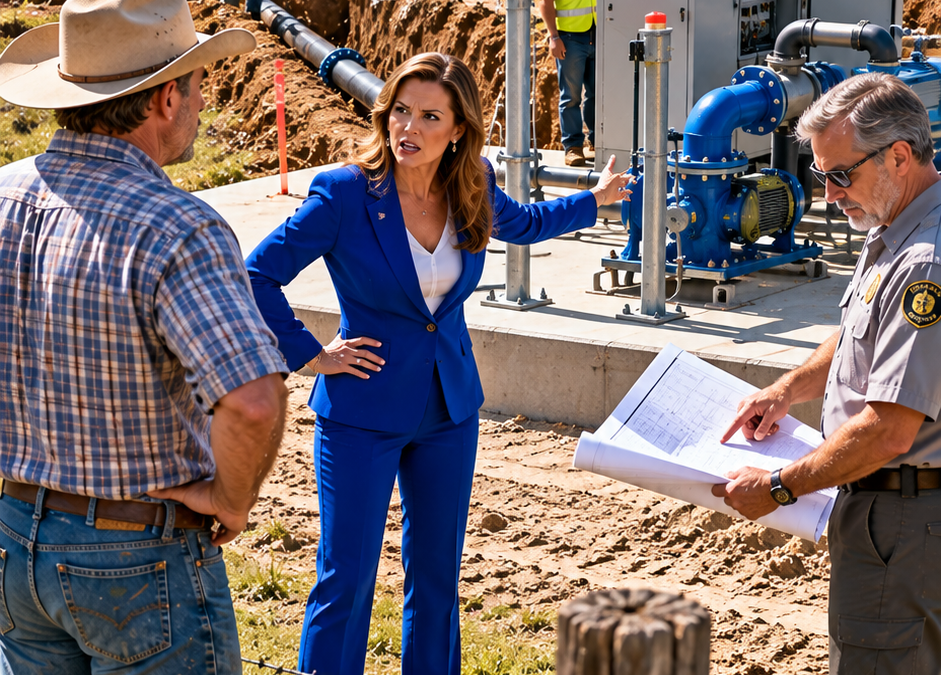
And Monica Vale stood beside it in a cobalt blue blazer, one hand lifted toward the crew, guarding the installation like a flag planted after a conquest.
Monica was president of Redstone Crest HOA, the subdivision uphill from my ranch. I knew her by sight from the few times she had come down to complain about dust, cattle noise, or farm trucks using the county road too early in the morning. She always spoke as if every conversation had been decided before she arrived.
That morning, she looked pleased with herself.
I was not.
I stopped outside the work area and stared at the concrete pad.
One contractor had the control cabinet open. Another was checking the trench with a grade rod. A laborer was moving orange mesh. Nobody looked confused about where they were. Nobody looked like a man who had accidentally crossed a property line and was waiting for a surveyor to save him.
I walked toward Monica.
“I want the equipment shut down until somebody explains what this is doing here.”
She gave me a sharp smile.
“You don’t get to shut down community infrastructure.”
“It’s sitting on my ranch.”
“It’s serving our development.”
“That wasn’t my question.”
Her expression hardened.
“The HOA has the rights it needs.”
I looked past her at the pad. Painted numbers marked one corner. A plastic inspection sleeve was tied to a temporary stake beside the trench. I could not make sense of them from where I stood, but I took out my phone and began photographing everything.
The station.
The trench.
The tire tracks.
The crew.
The stake.
The opening in my fence.
Monica stepped into the frame.
“Do not photograph our contractors.”
“They’re standing on my property.”
She started to answer, but a county inspector had already walked past us.
I had seen the truck pull in behind me, but I had been too focused on the station to care. The inspector was a thin man in a gray county shirt with a tablet in one hand and a folder under his arm. He did not introduce himself right away. He walked straight to the pad, crouched beside the concrete, checked the cabinet, then paced several yards toward the trench. He looked uphill toward Redstone Crest, then back toward my fence.
One of the contractors stopped working.
“What’s the problem?” Monica asked.
The inspector returned to his truck, pulled out several sheets clipped together, and flipped through them. He looked at the station again. Then at the ridge. Then at the papers.
The whole crew went quiet.
Finally, he pointed at the concrete pad.
“I need everybody to stop for a minute.”
Monica folded her arms.
“This installation was approved.”
He looked at her, puzzled rather than angry.
“I didn’t ask whether the project was approved.”
He tapped the papers in his hand.
“I’m asking why it’s here.”
That was the first moment I realized this might be bigger than an HOA president trespassing on my ranch.
Because if this was exactly where the county expected that pump station to be, why did the county inspector look like he had just found it in the wrong place?
The inspector did not give me an answer that morning. He told everyone to hold where they were while he made calls, then went back to his truck with the plan folder under his arm.
Monica stayed beside the pump station, arguing with the foreman.
I walked away before she could turn the argument into another performance.
Harland Creek Ranch had been mine for nineteen years. I bought it from a retired cattleman named Earl Danner after saving through most of my thirties and borrowing the rest. I did not inherit it. I did not marry into it. I earned it one payment, one fence repair, one winter feed bill, one long dry summer at a time.
Every acre had a job.
The east pasture was part of a rotation I depended on to keep the herd on good grass without burning one section down to dirt. From the subdivision above, it probably looked empty. That was the problem with people who only understood land from windows and brochures. They thought emptiness meant availability.
The east pasture was not empty.
A shallow water line fed a trough near the lower fence. A wide cattle lane connected two larger pastures, letting me rotate the herd without pushing animals onto the county road. The strip Monica’s contractor had trenched across sat exactly where I moved cattle when I needed to shift them calmly between fields.
Now there was a construction trench through it.
That afternoon, I tried to move thirty-two head around the work area. I had no choice. The grass schedule had already been thrown off, and leaving the herd where it was would make a bad rotation worse.
I opened the gate, used panels to guide them wide, and thought I had given the trench enough distance.
I was wrong.
One of my best bred heifers stepped onto the wet edge of the trench. The dirt folded under her front hoof. She dropped hard to one knee, slid toward the cut, and kicked sideways while the cattle behind her crowded forward.
For five seconds, all I could see was twelve hundred pounds of pregnant animal fighting for footing beside a trench that had not been there two days earlier.
I got the gate swung open before the whole group piled into her.
She scrambled up.
No broken leg.
No blood.
Mud up to her shoulder, a wild eye, and me standing there with my pulse hammering.
That changed the way I looked at the site.
The trench was no longer an inconvenience.
It was a hazard.
I moved the herd into the north paddock earlier than planned, blocked the damaged lane with panels, and relocated a mineral feeder so the cows had no reason to crowd the construction zone. Then I did the math.
The north paddock held the young regrowth I had been saving for later in the rotation. If I burned through that grass two weeks early, I would have to replace the feed somewhere else. By my estimate, that meant roughly three thousand dollars’ worth of winter silage and hay disappearing from reserve before winter even started.
That was before veterinary risk.
Before lane repair.
Before whatever those tire tracks had done to the shallow water line.
I photographed everything: the trench from both ends, the collapsed edge where the heifer had slipped, the trough, the displaced panels, the cattle lane, the skid steer tracks, the pump station, and the temporary stake beside it.
Then I opened the notebook I kept in my truck and wrote down the time.
I was angry.
But anger was not evidence.
At 1:17 that afternoon, I emailed Redstone Crest HOA. I identified the location. I stated that I had not granted permission for trenching, permanent equipment, or construction access. I documented the livestock hazard. I asked the board to provide the exact document they believed gave them the right to place a permanent pump station on my ranch.
Monica replied forty-three minutes later.
Her message said the installation was part of an authorized community utility project and that the HOA possessed all necessary rights for access and operation.
Then she added something new.
Any interference or delay continuing beyond 24 hours will be assessed to the responsible party at $1,200 per day in project delay costs.
I read that sentence twice.
There was no attachment showing she had the power to charge me anything. No easement. No map. No agreement with my signature. Just a deadline and a number.
I saved the email as a PDF, forwarded it to a separate account, and printed a copy.
Then I went back outside.
The pump station sat behind orange mesh while my cattle watched it from the north paddock. The heifer that had slipped was standing normally, chewing like nothing had happened.
That should have made me feel better.
It did not.
A board that had put machinery on my land was now telling me that asking questions could cost me twelve hundred dollars a day.
If Monica wanted to turn the next twenty-four hours into a clock, fine.
I was going to use every minute of it to find out what right exactly she thought the HOA had.
The next morning, I heard the excavator before I saw it.
The twenty-four-hour deadline in Monica’s email had not even expired. By the time I reached the east pasture, the skid steer was inside my fence again. Two men were unloading pipe, and the trench had been opened another twenty yards.
Monica stood near the concrete pad talking to the foreman.
I did not notice her blazer first this time.
I noticed her shoes.
Black designer heels, polished enough for a board meeting, were sinking into the soft edge of a cattle pasture. Every time she shifted her weight, the mud swallowed another fraction of an inch.
It was the first thing about her that looked truly out of place.
I stopped my truck outside the work area and started recording.
“Yesterday, the county inspector told everyone to hold.”
The foreman looked toward Monica.
“He told the crew to pause while he reviewed something,” she said. “There is no stop-work order.”
“So you brought them back before the review was finished.”
“The project is authorized.”
The words were familiar.
Her voice was not.
She sounded tighter.
I pointed toward the trench.
“A bred heifer went down at that cut yesterday.”
One of the laborers stopped moving.
Monica glanced at the trench and then back at me.
“The site is marked.”
“After you dug it.”
She opened the leather portfolio under her arm and pulled out three stapled pages.
“Since you keep demanding paperwork.”
The top sheet carried the Redstone Crest HOA letterhead and the words Work Authorization in bold type.
I photographed it.
As I zoomed in on the project number, Monica’s fingers tightened on the pages so hard the edge buckled. Her knuckles went pale.
That was new too.
The authorization named the contractor and directed him to install the wastewater pump station and related force-main work. Monica had signed it for the HOA.
It did not name me.
It did not identify my parcel.
It did not contain a legal description.
It did not attach any agreement granting access to my ranch.
“This authorizes the contractor to work for your board,” I said.
“It authorizes the project.”
“Where does it authorize this location?”
Her jaw flexed.
“You are not qualified to interpret engineering documents.”
The foreman stepped closer and looked at the page in my phone.
“Ms. Vale,” he said quietly, “where’s the site-control attachment?”
She looked at him.
“The what?”
“The property attachment. Easement. Access exhibit. Owner authorization. Whatever legal sent over for the alternate site.”
Monica’s face changed for one second.
Then the board-president voice returned.
“Your company has been given everything it needs.”
The foreman did not move.
“My contract covers work within the authorized project site. My carrier is not going to love me knowingly working on disputed private property without a site-control document.”
“You are not on disputed property.”
The foreman looked at me.
Then at the fence.
Then at the packet.
“I’m standing in a pasture owned by the man who is disputing it.”
Nobody said anything for a moment.
That was the first crack I saw in the contractor’s willingness to treat Monica’s certainty as protection.
She turned to me.
“You are creating unnecessary risk for everyone involved.”
“No,” I said. “I asked you for the paper that removes the risk.”
She shoved the authorization back into her portfolio.
“If you interfere with this crew, the delay charges in my email still apply.”
“Then put the legal basis for those charges in writing too.”
Her eyes narrowed.
I walked the edge of the work area and photographed what had changed overnight.
The construction footprint had spread. Spoil covered part of the compacted cattle lane. A fence panel had been moved for equipment. Tire tracks crossed close enough to the shallow water line that I flagged the spot for later inspection. The herd was bunched on the north side.
I was already using grass I had planned to save.
Every extra hour of work made the physical problem bigger. Every extra foot of trench made Monica’s threat more expensive if she somehow tried to enforce it.
At 10:42, a white utility truck came through the temporary opening in my fence. Two workers got out carrying a grade rod and a clipboard.
One walked directly to the stake beside the concrete pad. He read the painted number. Then he unfolded his sheet. He looked at the stake again.
The two men spoke quietly.
One pointed uphill.
The foreman joined them.
“What are you checking?” I asked from outside the mesh.
“Field control,” the worker said.
“For what?”
“The pump station.”
I looked at the concrete pad.
“Seems like somebody already picked a location.”
The worker did not answer.
Monica came across the mud toward us, heels now coated halfway up the sides.
“Stay away from the crew.”
“I’m outside the barrier.”
“This is an active construction site.”
“It became one after your contractor cut my fence.”
The foreman lifted a hand.
“Everybody give the equipment room.”
I nodded toward the clipboard.
“What sheet are you using for the station location?”
Monica answered first.
“That is project material.”
But the foreman looked at the worker.
“Approved station sheet?”
The worker nodded.
I heard the phrase clearly.
Approved station sheet.
“What’s the sheet number?” I asked.
The worker folded the page against the clipboard.
“You’ll need to get it from the engineer.”
Monica stepped between us.
“There. You have your answer.”
I did not.
If the crew was working from an approved station sheet, then that sheet had to show a station somewhere. And the men checking the stake had just pointed somewhere else.
I photographed the stake from outside the mesh. It carried a station abbreviation and a number.
Then I walked uphill along the fence.
About forty yards away, partly hidden by grass near an old corner post, I found another stake with the same project abbreviation.
Different number.
I photographed it too, this time keeping the pump station visible in the background.
I did not know what the numbers meant.
That mattered.
I had learned enough by then not to promote every suspicious detail into proof. But two stakes tied to the same project, separated by forty yards, were worth preserving.
When I returned to my truck, Monica was waiting by the driver’s door. The mud on her shoes had dried into a gray-brown crust.
“You should think very carefully about what you’re doing,” she said.
“I am.”
“You are putting sewer service for more than a hundred homes at risk.”
“The pump station isn’t operating yet.”
“That’s because you keep interfering.”
“No,” I said. “That’s because the county inspector stopped yesterday and asked why it was here.”
Her hand tightened around the portfolio.
“Do you really want to be the reason families get a delay notice?”
There it was.
She had shifted from authority to pressure.
The board.
The contractor.
Now the homeowners.
I pulled out my phone.
“Send me that too.”
She stared at me.
“What?”
“Put in writing that you’re blaming me for sewer delays while you still haven’t shown me a right to use my land.”
For once, she did not have a fast answer.
She turned away.
By early afternoon, the foreman received a phone call. He walked twenty yards into the field to take it. When he came back, he told the operators to shut down.
Monica crossed the site immediately.
I could not hear the first part of the exchange, but the foreman’s voice carried on the last sentence.
“I’m not extending the trench until we verify the approved station sheet and the property attachment.”
Monica said something lower.
He shook his head.
“My name is on the daily report.”
The foreman called his office before he let anyone restart. I heard him give the project number, then spell my last name twice. When he hung up, he told Monica that his risk manager wanted written confirmation of site control before any additional excavation crossed the lane.
Monica lowered her voice.
“You’re letting a landowner derail a public safety project.”
He glanced at me, then at the trench.
“I’m letting my company avoid becoming part of a title dispute.”
That landed harder than anything I had said.
Monica had been treating the contractor like an extension of the board. Now the contractor was drawing a line around his own exposure.
That mattered.
He was not protecting me.
He was protecting himself.
And that was enough to change the atmosphere.
The machines went quiet. The worker with the clipboard packed his grade rod. Monica stood beside the concrete pad with mud on her heels and a portfolio clenched against her chest.
I sat in my truck and wrote down everything I had.
An HOA work authorization that did not identify my parcel.
A threatened charge of $1,200 a day.
A contractor asking for a site-control attachment.
Two field stakes with different station numbers.
A crew working from something called an approved station sheet.
And a county inspector who had already looked at the concrete pad and asked why it was there.
None of it proved where the pump station was supposed to be.
But for the first time, even Monica’s own contractor was asking the same question I was.
If this was truly the approved location, why did the people building it need to verify where it belonged?
The next morning, I went to the county and asked for records.
Not an opinion.
Not a ruling.
Records.
The work authorization gave me the project number, and that number opened a file much larger than anything Monica had shown me. Development services had permit applications, inspection notes, engineering correspondence, plan sheets, contractor questions, and revision logs for the Redstone Crest wastewater upgrade.
I started with the phrase the crew had used in the field.
Approved station sheet.
The clerk found it inside the stamped civil set and turned her monitor toward me.
The pump station was easy to identify. It had equipment callouts, elevations, a station designation, and a county approval stamp in the title block.
Then I looked at the property lines.
The station was not in my pasture.
It was uphill on a parcel labeled Redstone Crest HOA Common Parcel B.
My ranch lay below it.
The difference was not subtle.
“Can you zoom in?” I asked.
The clerk enlarged the plan.
The boundary line ran between the approved pump station symbol and my east pasture.
I asked for a certified copy.
Then I asked the question that mattered next.
“Was this location ever revised?”
She searched the approved plan index.
“There are revisions to the project.”
“Any approved revision moving the station downhill?”
She checked again.
“Not in the approved civil set.”
That was useful.
It was not enough.
I asked for every file under the project number containing the words station, relocation, alternate, field adjustment, rock, excavation, and site access.
The stack grew.
For the next two hours, I worked through it at a table beside the records counter. Most of the pages were routine: electrical clearances, pipe bedding, control-panel specifications, material notes.
Then I found a one-page sketch.
At the top were the words:
Pump Station Field Adjustment.
The original station location appeared as a dashed box on Common Parcel B. A second box had been drawn farther south and downhill. That second box landed almost exactly where the concrete pad now sat in my pasture.
There was no county approval stamp.
No formal revision block.
At the bottom, someone had written:
Shift south/downhill for excavation feasibility. Confirm limits in field.
I asked the clerk for a copy.
Then I kept reading.
A contractor email dated six weeks before construction described shallow bedrock encountered during test excavation at the approved HOA site. Attached to the message was a preliminary change estimate.
Rock hammering.
Additional excavation hours.
Haul-off.
Equipment standby.
Estimated increase: $82,400.
Now Monica’s urgency had a number.
The next email came from the project engineer. He suggested evaluating a lower alternate site that could reduce rock excavation, provided hydraulic requirements, revised civil documents, and property control were all addressed.
Property control.
I circled the phrase.
Three days later, the contractor sent a follow-up. The downhill option would reduce rock work and shorten part of the excavation route. The message estimated that the alternate could avoid most of the $82,400 change.
Monica was copied.
Her reply came nineteen minutes later.
Please advance the lower option if engineering has no operational objection. We cannot carry an $80,000+ rock change and stay within the board-approved project cap.
There was another email in the chain I had not expected. It was between Monica, the HOA treasurer, and one other board member. The treasurer warned that if the rock change exceeded the project contingency, the board might need a special assessment before the next annual meeting.
Monica replied:
I am not taking an avoidable assessment to the membership this quarter. Find a workable location within the existing cap.
That did not prove why she made every decision, but it explained what pressure she was under.
The annual meeting was six weeks away.
Board elections were scheduled for the same night.
I wrote both dates in my notebook.
Then I found the engineer’s answer. He said the lower location appeared hydraulically workable based on preliminary elevations, but the change would have to be reflected in revised civil documents and coordinated with the permitting authority.
He also wrote:
Confirm legal site access and permanent property rights before construction.
That sentence stopped me.
The project team had not been told the land question did not matter.
They had been told to confirm it.
I searched for the confirmation.
No approved revised civil sheet.
No county stamp on the field-adjustment sketch.
No property document in the project file.
I went back to the clerk.
“Could an approved revision be under another project number?”
She searched the project name, engineer, contractor, and parcel.
Nothing appeared that replaced the original station location.
“What about this field sketch?”
She looked at it carefully.
“It is in the correspondence file. I can tell you it’s part of the county record. I can’t tell you what legal effect it has.”
That was fair.
She was not there to decide my land dispute.
I copied the original civil plan, the field-adjustment sketch, the rock estimate, the budget emails, and the engineer’s response. Before leaving, I asked for the parcel map showing Common Parcel B and my ranch.
Then I spread the documents across the hood of my truck in the parking lot.
The sequence was no longer mysterious.
The county-approved design placed the station on HOA land.
Test excavation hit shallow rock.
The contractor priced the problem at more than eighty thousand dollars.
The HOA did not want the cost.
An alternate downhill location was proposed.
The engineer said it might work technically, but revised documents and property rights still had to be confirmed.
Then concrete appeared on my ranch.
What I still did not have was the bridge between those steps.
Who said the alternate was finally approved?
Who confirmed the land rights?
And where was that paper?
That afternoon, I returned to the pasture with the plans.
The hidden stake uphill now made sense. Its number matched the station reference on the stamped civil drawing. Near it, I found a scraped patch where test excavation had exposed pale broken rock.
Then I walked downhill.
The stake beside the concrete pad matched the alternate notation on the field-adjustment sketch.
Two stakes.
Two locations.
One approved plan.
Monica arrived around four in her black SUV. She came toward the tailgate, saw the county copies spread across it, and slowed down.
“You’ve been busy,” she said.
“I found the approved station sheet.”
Her eyes went to the stamp.
I placed the field-adjustment sketch beside it.
“And I found this.”
“There were field modifications.”
“I know.”
I laid the $82,400 estimate on top.
Her face tightened.
“The original site hit rock,” I said. “The lower site avoided most of this.”
“Engineering issues are not your area.”
“Budget issues seem to be yours.”
She said nothing.
I pulled out the email about the special assessment.
“Did the homeowners know the station was moved after an eighty-two-thousand-dollar rock estimate?”
Her expression hardened.
“The board was trying to control costs.”
“Did they know the cheaper location was my ranch?”
“The project was coordinated.”
“That is not what I asked.”
She glanced toward the subdivision.
I put my finger on the line about the annual meeting.
“Or was the bigger problem explaining an eighty-thousand-dollar overrun to homeowners six weeks before an election?”
Her head snapped back toward me.
“Do not turn this into some personal accusation.”
“I’m reading your email.”
“You’re reading fragments without context.”
“Then give me the context. Show me the approved revision. Show me the property document. Show me anything that turns evaluate the lower site into permission to pour concrete here.”
For the first time, Monica did not tell me everything had already been handled.
She looked at the papers.
Then at the station.
Then back at me.
“The board made the decision it believed was best for Redstone Crest.”
That was not an answer either.
But it was different from the answer she had been giving me.
I gathered the documents.
“Did the board vote to move it onto my parcel?”
“You need to direct further questions to counsel.”
“I will.”
She turned toward her SUV.
I called after her.
“One more thing.”
She stopped.
“The engineer wrote that permanent property rights had to be confirmed before construction. Who confirmed them?”
Monica stood there for a moment without turning around.
Then she got into her vehicle and drove uphill.
I watched until the SUV disappeared between the houses.
By then, I knew where the station had originally belonged. I knew what made that location expensive. I knew who pushed for a cheaper alternative. And I knew the engineer had specifically warned that property rights still had to be addressed.
The question was no longer why someone wanted the station moved.
The paperwork answered that.
The question was who had the authority to turn a cheaper idea into permission to build on land the HOA did not own.
The next step was not another trip to the pasture.
It was a title office.
Sarah Benton practiced agricultural property and utility law in the county. I sent her the approved civil plan, the field-adjustment sketch, the engineering emails, the work authorization, and the legal description from my deed.
Then I asked her the only question I cared about.
“Does Redstone Crest have a recorded right to put that pump station where it is?”
She did not answer from the documents I brought.
She ordered the land records.
Two days later, I sat across from her in a conference room while she opened a title report and several archived instruments.
“There are legitimate utility rights in and around the subdivision,” she said. “There are also drainage and access references affecting other areas.”
My stomach tightened.
Then she slid one page toward me.
“But I do not see a recorded easement granting Redstone Crest the right to install this permanent wastewater facility at the location on your parcel.”
I read the parcel description.
“So Monica’s all necessary rights?”
“Not in the recorded instruments we found.”
Sarah did not sound excited.
That made the answer hit harder.
She turned the county-approved plan toward me.
“This drawing answers one question. The title record answers another. Do not blend them.”
I nodded.
“The county reviewed a project at a stated location. That does not by itself create a private property right over neighboring land. If a project moves onto land the applicant does not own, they still need legally sufficient site control for that use.”
It was the cleanest explanation I had heard.
An approved project was not the same thing as ownership.
A contractor’s work order was not an easement.
An engineer saying a location could function was not permission from the landowner.
Sarah reached for another folder.
“Now, here is the part I think your HOA is going to have trouble explaining.”
The document was five years old.
Earl Danner still owned Harland Creek Ranch then. The cover page came from Redstone Crest HOA. The board had asked Danner to sign a right-of-entry and prospective utility access agreement across the same eastern strip of the ranch.
It was not for this exact pump station, but the proposed corridor overlapped the area where the new station had just been built.
Attached to the request was Earl’s handwritten response.
No permanent utility rights conveyed. Access request declined.
I stared at it.
“Why is this in the file?”
“Because Danner’s lawyer kept the correspondence with the property records. It was not recorded as an easement because he did not grant one.”
Sarah turned the cover letter over.
At the bottom were two names: the HOA president at the time and Monica Vale, listed as board secretary.
Her signature appeared beneath the transmittal line.
I leaned back.
“She knew.”
“Be precise,” Sarah said. “This shows she was involved in a prior request concerning utility access over this area and that the owner refused that request. It does not prove what she believed about every later project.”
That distinction mattered.
But so did the document.
Monica had not arrived in this dispute with no history. Five years earlier, her own board had treated the east strip as land for which it needed the owner’s agreement. Now she was telling me the HOA already had all necessary rights.
Sarah placed the old request next to the new work authorization.
The contrast did more than any lecture could have.
One document asked.
The other simply ordered work.
“What do we do with this?” I asked.
“We make them identify their claimed right.”
Sarah drafted a letter to HOA counsel that afternoon.
It stated that the pump station sat on my parcel, that the county-approved civil sheet showed a different location, and that I had not executed an easement, license, or construction consent for the alternate site.
Then she added the older correspondence.
Your client previously sought utility access from the prior owner over substantially the same ranch area and received a written refusal. Please identify the specific recorded instrument Redstone Crest now contends authorizes the present permanent installation.
Sarah also told me not to overstate what the old letter proved.
“It does not automatically make the new construction malicious,” she said. “But it makes a simple mistake explanation harder. The association had previously recognized that this strip belonged to somebody else and that it needed permission to obtain utility access. That history belongs in the record.”
She added a preservation request to the letter asking the HOA and its project team to retain board emails, relocation discussions, contractor communications, and documents concerning site control.
It was not dramatic.
But it closed another escape route.
Nobody could later say the relevant paperwork had simply vanished.
No accusation of fraud.
No claim that the old refusal automatically decided the new dispute.
Just a question they could not answer with the word authorized.
Their attorney replied the next morning.
The response referred generally to utility rights serving the Redstone Crest development and said the board believed the project had been properly coordinated.
Sarah read it once.
“They still did not identify an instrument.”
She sent a second request.
Document name.
Recording number.
Date.
Grantor.
Grantee.
Legal description.
Something we could actually check.
That afternoon, Monica emailed me directly.
All future communications should be directed through counsel.
No twelve-hundred-dollar threat.
No warning about arrest.
No sentence about all necessary rights.
I looked out the office window toward the direction of the ranch.
The dispute had changed.
At first, Monica’s confidence had been the strongest thing in the field. Now, every time we replaced a broad claim with a specific question, that confidence had less room to stand.
There were still two separate issues.
The county would have to decide what it could accept on the construction side. The HOA would have to show what property right it claimed on my side.
Sarah closed the title file.
“Do not touch the station,” she said. “Do not block the county. Do not give them an excuse to make your conduct the issue.”
“I won’t.”
“Good. Let the documents do their jobs.”
That evening, I stood at the edge of the pasture.
Uphill was the site the county drawing showed. Downhill was the station the HOA had actually built. In my truck was a five-year-old letter showing that Redstone Crest had once asked permission to use this same side of the ranch and had been told no.
The next question was no longer what Monica said the HOA could do.
It was what the county and the contractor would do once they had to act on the record in front of them.
Three mornings later, the county came back.
This time, the inspector brought a second official from development services. The project engineer arrived in a separate truck. The contractor’s superintendent parked beside the equipment trailer.
Monica pulled in last.
She crossed the pasture fast, but the mud stopped her from moving with the same certainty she carried into board meetings.
Nobody was waiting for her to start.
The inspector opened the stamped civil plan across the hood of his truck.
He pointed uphill.
“This is the station location in the approved file.”
Then he pointed at the concrete pad in my pasture.
“This is where it was built.”
Monica folded her arms.
“The engineer coordinated a field adjustment.”
The engineer answered before the inspector did.
“We evaluated an alternate. I said the lower site appeared hydraulically workable. I also said revised civil documents and property control needed to be resolved.”
“You told the board the site would function,” Monica said.
“I did. Function is not the issue he is asking about.”
The inspector looked at Monica.
“Do you have an approved relocation sheet?”
“Counsel has the project file.”
“We have the county file.”
He waited.
No one handed him anything.
He walked to the control cabinet. From his folder, he removed a bright red notice, peeled the backing from a weather-resistant sleeve, and fixed it directly to the front panel.
STOP WORK — HOLD FOR REVISED APPROVAL.
Every worker on the site could see it.
The superintendent took off his hard hat and rubbed the back of his neck.
Monica stared at the notice.
“You cannot stop a critical community utility because of a paperwork discrepancy.”
The inspector stayed calm.
“I am not deciding your property dispute. I am not deciding who owns what. I am telling you the installation in front of me does not match the approved site configuration in our file, and I cannot allow work under that approval to continue as if it does.”
He handed the superintendent a copy.
“No commissioning. No additional permanent installation at this location until the county accepts a corrected submittal or another compliant resolution.”
The superintendent nodded once.
Then he looked at Monica.
“My crew is done here until that is cleared. We have a contract, and I have a stop-work order with my company name on the site log.”
That ended the argument.
The superintendent told the electricians to lock out the panel. The excavator operator shut down. A laborer rolled up extension cords.
No one looked to Monica for permission.
That was the moment her authority broke.
Not because I yelled louder.
Because everyone else finally had something more dangerous to them than making the HOA president angry.
A written order.
A professional license.
An insurance file.
A company name on a daily report.
My phone buzzed while the crew was packing up.
Sarah.
She had received another response from HOA counsel.
Still no recorded easement.
Instead, the attorney wrote that Redstone Crest was evaluating property-rights solutions and potential compensation arrangements.
A week earlier, Monica had told me the HOA already had everything it needed.
Now they wanted to buy what they claimed they already owned.
I put the phone away.
Monica walked toward me carrying a checkbook from her portfolio.
“Wade.”
It was the first time she had used my first name.
I said nothing.
She opened the checkbook against the hood of her SUV.
“The board is prepared to compensate you for an easement and temporary construction access.”
“How much?”
She wrote a number.
$25,000.
Then she tore out the check and held it toward me.
The memo line read:
Easement consideration subject to agreement.
“This is good-faith money,” she said. “We can finish the legal documents today. You get compensated, the neighborhood gets its system, and all of this ends.”
I did not take the check.
I looked past it, at the trench, at the temporary panels, at the patch where my heifer had gone down, at the cattle lane I had not been able to use normally for more than a week.
“Put it through counsel,” I said.
Her arm stayed extended.
“Twenty-five thousand dollars is real money.”
“So is land.”
“You are making this personal.”
“No,” I said. “I’m making you ask before you use it.”
Her face flushed.
“The relocation will cost far more than this.”
“That sounds like a board problem.”
“You know what happens if we have to go back into the rock?”
“I read the estimate.”
Her eyes narrowed.
“This assessment will land on families who had nothing to do with your dispute.”
“No. The cost will come from a decision I did not make.”
She lowered the check.
For several seconds, neither of us spoke.
Behind her, the red stop-work notice moved slightly in the wind against the cabinet door.
The superintendent walked over.
“Ms. Vale, I need written direction on whether we demobilize or leave the equipment staged.”
Monica looked at him.
Then at the inspector.
Then at me.
A week earlier, she had threatened to have me arrested for touching the control panel.
Now the control panel carried a county order she could not remove. Her contractor was asking whether to leave, and the only path to keep the station where it sat required something she had never bothered to get from me.
My agreement.
I still did not take the check.
By noon, the workers were gone.
The cabinet was locked. The machines were idle. The bright red notice remained on the station.
But the county order did not tell Redstone Crest what choice to make next.
They could redesign.
They could try to negotiate with me.
They could move the station back uphill.
Whatever they chose, the cost of that decision was finally going to fall somewhere the board could no longer hide.
Redstone Crest made its decision eleven days later.
The HOA would not pursue a permanent easement across my ranch.
Sarah received the letter first. The board had voted to relocate the pump station back onto HOA-controlled property under a revised design.
That answered where the station would go.
It did not answer who would pay for the mistake.
The answer reached the neighborhood before the machinery reached my pasture. Every homeowner in Redstone Crest received a notice announcing a special assessment tied to the pump station relocation, demolition of the abandoned work, additional rock excavation, engineering revisions, and restoration costs.
More than a hundred households on the hill were being asked to absorb a bill created by a decision most of them had never known had been made.
The next board meeting was standing room only.
I went because Sarah said the restoration agreement would be discussed in open session.
Monica sat at the front table.
For once, she did not command the room.
Homeowners did.
One man held up the assessment notice and asked why the original approved location had been abandoned. A woman two rows behind him wanted to know why the board had spent money building on property it did not control. Someone else asked when the board first learned about the $82,400 rock estimate.
Then an older homeowner asked the question that changed the room.
“If the cheaper site required somebody else’s land, why didn’t you get his permission before you poured concrete?”
Monica looked down at the documents in front of her.
She did not answer immediately.
The treasurer did.
He said the board’s project controls had failed.
That sentence was entered into the minutes.
The directors voted to remove Monica’s individual authority to approve construction field changes. Any future relocation affecting property boundaries would require a recorded board vote, legal review, and documented site control before a contractor could proceed.
She remained on the board that night, but when the meeting ended, she packed her cobalt blue blazer over one arm and left through a side door while homeowners were still arguing about the assessment.
Nobody applauded.
They did not need to.
The consequences were already printed on every assessment notice in the room.
A few days later, the contractor returned to my ranch.
The superintendent met me at the gate with a restoration agreement Sarah had already reviewed. This document looked nothing like Monica’s original work authorization. It named my parcel. It defined the access route. It listed the exact work permitted. It required damage repair. It expired when restoration was complete.
I signed that one.
For four days, the crew worked backward through the mistake.
The control cabinet came off the pad. Pipe sections were removed. A breaker hammer tore apart the concrete. The trench was reopened only where necessary, then backfilled and compacted. The cattle lane was graded. The damaged strip was reseeded. The contractor’s insurer handled part of the pasture damage. Redstone Crest covered the remaining restoration, redesign, and relocation expenses through the revised project budget and assessment.
Then the drilling equipment went uphill.
The rock was still there.
It had never cared about Monica’s budget.
The new station cost more to build on Common Parcel B, exactly where the county-approved project had originally placed it. Revised plans were submitted. The site work was completed. The system eventually entered service from HOA land.
By early fall, green shoots had come through the repaired strip in my east pasture.
The cattle lane was open. The trough line was working. The bred heifer that had nearly gone into the trench was still with the herd, heavier now and close to calving.
One evening, I opened the gate and moved the cattle through the east pasture again.
They crossed the restored ground without hesitation.
From that field, I could see the replacement pump station up on the ridge.
It was not hidden.
It was not defeated.
It was simply where it belonged.
That mattered more to me than watching Monica lose an argument.
Land does not care who has the louder voice in a board meeting. A boundary does not move because a cheaper plan would be convenient. And permission is not a detail you fix after the concrete cures.
The grass eventually covered the scar.
The cattle returned to their old route.
The station kept running on Redstone Crest property.
And the line between those two places stayed exactly where it had been all along.








