𝗣𝗔𝗥𝗧 𝟮 The HOA Built a $250,000 EV Station on My Land—Then Called the Cops When I Shut It Down
𝗣𝗔𝗥𝗧 𝟮
Four days later, she sent me another violation.
This time, the crime was curtains.
Apparently, the minimalist black roller shades in my study represented such a serious threat to Western civilization that the association required a three-hundred-dollar fine, plus fifty dollars per day until I replaced them with “approved neutral window treatments.”
Their preferred option was beige linen.
Naturally.
Whispering Pines had an unhealthy emotional attachment to beige.
The houses were beige.
The fences were beige.
The clubhouse interior was beige.
If Evelyn could have regulated sunsets, I suspected she would have required the sky to submit a color sample before turning orange.
I stood in my kitchen with coffee in one hand and the notice in the other while Evelyn’s golf cart slowed outside my fence.
This time she wasn’t alone.
Two private security guards stood beside the road in matching navy uniforms.
They were photographing my side yard.
I walked outside.
“Can I help you?”
One of them lowered his phone.
“We’ve been instructed to document exterior compliance.”
“From my property?”
“We’re on the association side.”
He said it with more confidence than accuracy.
I looked at his boots.
Both men were standing several feet inside what I understood to be my parcel.
Interesting.
“Who instructed you?”
“The HOA.”
“Specifically?”
The guard hesitated.
“President Sterling.”
“Thank you.”
I went back inside.
No shouting.
No accusations.
No threats.
Just another timestamp.
Another photograph.
Another entry.
Later that afternoon, I discovered that the security company was owned by Evelyn’s brother-in-law.
Of course it was.
By then, I was beginning to suspect that Whispering Pines wasn’t really a residential association.
It was more like a family business with landscaping.
The notices became routine.
Every Friday afternoon, usually after four-thirty when most attorneys’ offices were preparing to close for the weekend, another red envelope appeared.
One week, I was cited because my trash container remained near the curb twelve minutes past the permitted collection window.
Twelve minutes.
Not twelve hours.
Not twelve days.
Twelve minutes.
I briefly considered asking whether Evelyn synchronized her enforcement watch with the National Institute of Standards and Technology.
Instead, I scanned the letter.
The following week, the HOA fined me because my pickup truck was parked at an angle they considered inconsistent with “community visual harmony.”
That phrase deserved a place in a museum.
The week after that, they claimed my eastern fence exceeded maximum height by four inches.
Then came a landscaping complaint.
Then an exterior-lighting complaint.
Then a notice alleging that one of my security cameras was visible from a common area and therefore created an “unwelcoming visual impression.”
Apparently being watched by cameras was offensive.
Being photographed by Evelyn’s private guards was community management.
By the end of the third month, the HOA claimed I owed nearly twelve thousand dollars.
Then the language changed.
The notices stopped talking about compliance.
They started talking about liens.
After liens came foreclosure.
I sat at my desk one evening reading the latest letter while Evelyn’s white golf cart idled near the end of my driveway.
Her silhouette was visible through the bare branches.
She was staring at my house.
People like Evelyn often mistake calm for weakness.
If you don’t argue, they assume you’re afraid.
If you don’t retaliate immediately, they assume you don’t know how.
If you continue paying your mortgage, cutting your grass, and saying good morning, they assume pressure is working.
It wasn’t.
I was collecting evidence.
The process reminded me of hostile-management strategies I’d seen during corporate investigations. When executives wanted to remove somebody without admitting that was the goal, they rarely began with one catastrophic act.
They created friction.
A written warning.
A performance concern.
Another warning.
A disputed policy.
A denied expense.
A bad evaluation.
Enough paperwork eventually created the appearance that the target was the problem.
Evelyn was doing the neighborhood version of the same thing.
Only she had made two serious errors.
First, she assumed nobody would check whether her rules were enforceable.
Second, she assumed nobody would check the money.
I started with the money.
The Whispering Pines member portal contained a financial section because state law and the association’s own governing documents required residents to have access to certain records.
The section was almost empty.
There was one annual budget summary.
It had broad categories such as:
LANDSCAPING.
SECURITY.
ADMINISTRATION.
INFRASTRUCTURE.
COMMUNITY IMPROVEMENTS.
No meaningful detail.
No itemized invoices.
No contract summaries.
No reserve schedules worth mentioning.
I stared at the page for a while.
In my profession, missing information can be more revealing than information that’s present.
Healthy organizations like documentation because documentation proves what they did.
Unhealthy organizations prefer summaries.
Summaries give you room to hide.
I submitted a formal records request as an owner.
While reviewing the portal, I also discovered something almost comically careless: the association’s own member-access system had been configured so that authenticated homeowners could access directories containing financial records that the interface itself did not neatly display.
I didn’t bypass passwords.
I didn’t defeat security.
I didn’t impersonate anyone.
I simply accessed records available to my authorized account through the association’s own badly organized system.
And there they were.
Four years of ledgers.
Bank statements.
Invoices.
Vendor payment records.
Reserve transfers.
Board approvals.
I downloaded the records I was entitled to review and started building a transaction map.
The first anomaly appeared within fifteen minutes.
STERLING SOLUTIONS LLC.
Three thousand four hundred dollars.
Every month.
Same amount.
Again.
And again.
And again.
I filtered by vendor.
The transfers extended backward through years of records.
More than one hundred sixty thousand dollars had moved from association accounts to Sterling Solutions.
The invoices were almost useless.
“Administrative consulting.”
“Community services.”
“Project coordination.”
No time sheets.
No detailed scope.
No deliverables.
No project documentation.
No bidding records.
I searched the company registration.
Principal officer: Evelyn Sterling’s brother.
I leaned back.
“Well, Evelyn.”
The room was quiet except for the low hum of my computer.
“You’ve been busy.”
That was only the beginning.
The landscaping contract belonged to a company controlled by the husband of another board member.
Its rates were roughly forty percent higher than comparable service packages I found in surrounding communities.
The security contract went to Evelyn’s brother-in-law.
There had been no meaningful competitive bidding process in the files I reviewed.
Then I found the drainage assessment.
Residents had been told the neighborhood needed emergency work to prevent erosion and water damage.
A special assessment had been collected.
The money entered the operating account.
Shortly afterward, large amounts were transferred to vaguely described administrative expenses.
Some of the expected drainage work had either been reduced or delayed.
I started tracing fine revenue.
That was when the architecture became clear.
The aggressive enforcement wasn’t merely Evelyn’s personality.
It was financially useful.
Fines helped fill gaps.
The association had been draining reserves and directing suspiciously favorable contracts toward people close to board leadership. When cash became tight, compliance enforcement intensified.
Red notices produced money.
Money disguised deficits.
Deficits stayed out of resident-facing summaries.
It was a beautifully ugly little machine.
And every time Evelyn drove her golf cart through the neighborhood measuring trash cans and driveway angles, she was essentially operating a mobile revenue department.
I spent three nights organizing the records.
I built tables showing recurring payments.
I cross-referenced corporate registrations.
I matched board approvals to invoice dates.
I identified related-party relationships.
I marked missing documentation.
I calculated the effect on reserves.
Then I created a fifty-page report written the same way I would prepare an internal forensic memorandum for senior counsel at work.
No dramatic adjectives.
No accusations I couldn’t support.
Just dates.
Amounts.
Names.
Signatures.
Documents.
If there was one thing I had learned from financial investigations, it was this:
Never exaggerate when the facts are already devastating.
I backed everything up.
Encrypted cloud storage.
Offline drive.
Printed copy.
A copy for my attorney.
By then I knew exactly what kind of fight I was in.
But the financial records still didn’t answer one important question.
Why was Evelyn so comfortable treating the eastern side of my property like it belonged to the HOA?
That question led me outside.
I called Tom Willis.
Tom had been surveying property in the county for nearly thirty years. He had the calm voice of a man who had spent most of his career explaining to furious neighbors that fences did not become legal boundaries merely because somebody’s grandfather had put them in the wrong place.
He arrived Thursday morning with high-precision GPS equipment, a total station, old plats, deed descriptions, and the emotional energy of someone delighted to spend two days ignoring everybody except numbered coordinates.
I liked him immediately.
“You want just the disputed side?” he asked.
“Everything.”
“Full boundary?”
“Full boundary.”
He nodded.
“Good.”
Tom worked for two days.
He located older monuments.
He checked recorded plats.
He compared my deed description with subdivision maps.
He ran coordinates.
He drove steel stakes with bright orange caps into the ground.
Evelyn drove past twice.
The first time, she slowed down.
The second time, she stopped.
I happened to be standing near the porch.
“Having trouble with your fence?” she called.
“Just checking my boundaries.”
She smiled.
“Those were established years ago.”
“Then this should be easy.”
Her smile disappeared.
“Historical community use matters, Mr. Vance.”
“So do surveys.”
She drove away.
Tom watched her go.
“Friend of yours?”
“President of the HOA.”
He looked at me.
Then at the golf cart.
Then back at me.
“I’m going to guess that’s not a yes.”
On the second evening, Tom walked toward my porch with mud on his boots and his tablet under one arm.
His expression was different.
Not alarmed.
Interested.
Surveyors, I’ve learned, have their own version of excitement.
It mostly involves saying things like “You should probably see this.”
Tom put the tablet on my outdoor table.
“You’ve got a clean deed,” he said.
“Good.”
“And you’ve got an encroachment.”
“How much?”
He enlarged the map.
“A serious one.”
The Whispering Pines EV charging station stood near the eastern edge of my property.
It was a large solar-assisted structure with several high-speed chargers, steel support columns, lighting, landscaping, and a broad concrete foundation. The HOA had advertised it heavily as evidence that Whispering Pines was modern, sustainable, technologically progressive, and presumably morally superior to neighborhoods where people still plugged vehicles into their own garages.
The reported project cost was around two hundred fifty thousand dollars.
According to Tom’s measurements, part of it was sitting almost six feet inside my property.
Not one decorative shrub.
Not an inch of paving.
The concrete foundation itself.
Steel columns.
Electrical conduit.
A section of the charging area.
All of it.
For approximately fifty feet.
I stared at the survey.
“You’re certain?”
Tom gave me the look professionals reserve for questions they understand but do not enjoy.
“I’ll run the calculations again tonight. But yes.”
“What happened?”
He pulled up an older subdivision drawing.
“My guess? Somebody built using the apparent landscaping line instead of verifying the recorded boundary. The visual edge here isn’t your legal edge.”
“So they assumed.”
“Looks that way.”
“And nobody ordered a boundary verification before pouring a quarter-million-dollar project.”
Tom smiled faintly.
“People like concrete more than paperwork.”
I laughed.
For months, Evelyn had been fining me because she claimed my tire had touched HOA property.
Meanwhile, the HOA had poured an enormous concrete structure six feet onto mine.
There are moments when reality becomes so perfectly absurd that anger has nowhere useful to go.
You simply admire the craftsmanship.
“Can you certify it?” I asked.
“Absolutely.”
“File it?”
“Yes.”
“Please do.”
The following morning, Tom completed the sealed boundary report and recorded the appropriate survey documentation with the county.
I sent the report to my attorney.
We prepared a formal notice of encroachment and trespass.
The association received it within forty-eight hours.
The notice identified the deed.
The recorded survey.
The location.
The approximate dimensions of the encroachment.
It demanded removal of the concrete, columns, electrical infrastructure, and any related improvements within thirty days at the association’s expense.
It also revoked any implied permission for continued access across my parcel.
The HOA’s law firm responded with breathtaking speed and very little reading comprehension.
Their letter claimed the station area had been established through “historical community use.”
Historical.
The charging station was three years old.
Apparently three years now qualified as antiquity.
The attorney also suggested that long-standing access rights and community expectations could limit my ability to interfere with the facility.
I read the letter twice.
Then I called my lawyer.
“Did they read the survey?”
“Maybe the first page.”
“The station is physically on my deeded parcel.”
“I know.”
“They’re arguing historical use.”
“I know.”
“It’s three years old.”
“I know.”
I waited.
My attorney finally laughed.
“I was trying to remain professional.”
“Please continue trying.”
We decided not to debate them endlessly by mail.
The notice stood.
The deadline stood.
The evidence stood.
Evelyn, meanwhile, escalated my fines.
The claimed balance passed twelve thousand dollars.
Then I received formal notice that the HOA intended to begin lien and foreclosure procedures.
That was when Evelyn scheduled an emergency town hall meeting.
Officially, the meeting concerned “community standards, financial stewardship, and preservation priorities.”
Unofficially, it was supposed to be my public execution.
Evelyn had spent weeks telling people that one difficult homeowner was refusing to honor his obligations and threatening community amenities.
I knew because neighbors had started approaching me.
Some were cautious.
Some were embarrassed.
Most had their own stories.
Ray Holloway, who lived two streets over, had been fined nine hundred dollars because his granddaughter’s chalk drawings remained on his driveway overnight.
Lillian Marsh, a widow in her seventies, had accumulated thousands in penalties after planting vegetables in a side garden Evelyn considered too visible from the road.
Another resident had been cited because his work van displayed his plumbing company’s phone number.
One woman told me she stopped hosting her grandchildren because the HOA repeatedly complained about outdoor toys.
Nobody had organized against Evelyn because each person thought their dispute was individual.
That is one of the oldest tricks in administrative bullying.
Make everyone believe they’re alone.
Isolation converts outrage into shame.
Shame keeps people quiet.
Records do the opposite.
Records connect patterns.
And I had four years of them.
The emergency meeting was held on the first Thursday of November.
By the time I arrived at the community center, nearly every chair was occupied.
People lined the walls.
Evelyn sat behind a long folding table with four board members and the association’s attorney.
She wore a cream-colored blazer.
Her binder was open.
Her hair was perfect.
Her expression suggested she had already rehearsed the applause.
I sat in the third row with my laptop bag between my feet.
Evelyn called the meeting to order.
For twenty minutes, she lectured us about standards.
She used phrases like “shared values.”
“Community integrity.”
“Protecting investments.”
“Collective responsibility.”
There was a slide about architectural uniformity.
Another about landscaping.
Another about enforcement.
Then my house appeared on the screen.
It was a photograph taken from the street.
A bright red circle marked my driveway.
Evelyn folded her hands.
“Unfortunately,” she said, “the board has encountered one particularly serious pattern of repeated noncompliance.”
A few heads turned toward me.
I stayed seated.
She continued.
“The property owner has accumulated more than twelve thousand dollars in unpaid assessments, penalties, and enforcement costs.”
Assessments.
Interesting choice of word.
Most were disputed fines.
“The board has therefore voted unanimously to proceed with all remedies available under the governing documents, including lien enforcement and, if necessary, foreclosure.”
The room went still.
Evelyn looked directly at me.
“We cannot allow any resident to believe he is above the rules.”
That was my cue.
I stood.
The attorney immediately leaned toward Evelyn.
She ignored him.
“Mr. Vance,” she said, “you’ll have an opportunity during resident comment.”
“I won’t need long.”
“You need to wait your turn.”
“I believe this concerns the property you’re threatening to foreclose on.”
There were murmurs.
Evelyn lifted her chin.
“Three minutes.”
“Perfect.”
I walked to the front with my laptop.
The attorney stood.
“I don’t think it’s appropriate for a resident to connect an unreviewed device to association equipment.”
“I emailed the presentation to your office this afternoon.”
He stopped.
That was the thing about preparation.
It ruined so many wonderful objections.
I connected the laptop.
The projector changed.
On the wall appeared my deed.
I highlighted the legal description.
Then Tom’s survey.
Then the certified boundary line.
Then a close aerial photograph.
The EV station was clearly marked.
So was the encroachment.
Nearly six feet inside my property.
For roughly fifty feet.
I turned toward the audience.
“This is the Whispering Pines vehicle-charging station.”
Everyone knew that.
Half the room used it.
“The association spent approximately two hundred fifty thousand dollars constructing it.”
Evelyn interrupted.
“This has nothing to do with your unpaid fines.”
“It has everything to do with whether your board understands property lines.”
I clicked again.
The certified survey seal filled the screen.
“This structure was built on my property.”
The room changed.
It wasn’t loud yet.
It was the sound before loud.
People shifted.
Someone whispered, “What?”
I continued.
“The concrete foundation, support columns, and electrical conduits cross my recorded boundary by approximately six feet.”
Evelyn’s face tightened.
“The board disputes that.”
“Your attorney received the certified survey and formal trespass notice thirty days ago.”
Her attorney looked at the table.
I enjoyed that small detail.
“The notice demanded removal,” I said. “The deadline expires tomorrow.”
Evelyn leaned toward her microphone.
“The association has historic access rights.”
“The station is three years old.”
A laugh came from somewhere near the back.
Not a big laugh.
But enough.
Evelyn turned toward the sound.
I clicked again.
Now the screen showed the charging-station construction invoice.
Then the project approval.
Then the missing boundary-verification documentation.
“Before approving a quarter-million-dollar structure,” I said, “the board apparently did not obtain an independent survey confirming that it owned the land beneath the structure.”
A man near the aisle raised his hand.
“Who approved the project?”
I changed slides.
Evelyn’s signature appeared.
The room got louder.
She struck the table lightly.
“This is not a trial.”
“No,” I said. “Trials have stricter rules.”
That earned a larger laugh.
Her attorney closed his eyes.
I could almost hear him reconsidering his career choices.
Evelyn spoke over the room.
“Mr. Vance, your time has expired.”
“I haven’t reached the financial records yet.”
The room went completely quiet.
Even Evelyn paused.
I clicked.
STERLING SOLUTIONS LLC.
$3,400.
Monthly.
Four years.
The first table showed the transfers.
The second showed cumulative totals.
The third showed the company registration.
Principal officer:
Her brother.
Evelyn’s face lost color.
“This information was obtained improperly.”
“No. These are association records available to members through the association’s own authenticated system and records produced pursuant to my request.”
Her attorney stood again.
“I strongly recommend that we adjourn.”
Evelyn turned on him.
“We are not adjourning.”
I nearly felt sorry for him.
Nearly.
I displayed copies of invoices.
“Sterling Solutions received more than one hundred sixty thousand dollars in association funds. The invoices contain broad descriptions such as administrative consulting and project coordination. In the records provided to me, I found no competitive bidding package, no detailed work product corresponding to many of these recurring payments, and no adequate disclosure to residents identifying the vendor as the president’s family member.”
People started talking.
I raised my voice slightly.
“There’s more.”
That quieted them.
Next came landscaping.
Then security.
Then emergency drainage funds.
Then the reserve balance.
I explained everything slowly.
I never called Evelyn a thief.
I didn’t need to.
I showed people where their money went.
I showed related parties.
I showed approvals.
I showed signatures.
I showed how reserve funds declined.
I showed how fine revenue increased.
I showed the relationship between enforcement income and budget shortfalls.
By the time I reached the security contract, one of the board members sitting beside Evelyn looked physically ill.
“That’s your brother-in-law’s company?” someone shouted.
Evelyn tried to respond.
“The board follows accepted vendor-selection procedures.”
“Show us the bids!” another resident yelled.
Someone else stood.
“Where’s the drainage money?”
Then Lillian Marsh rose from the second row.
She was small, silver-haired, and usually so quiet I had barely heard her speak above conversational volume.
That night, her voice carried across the entire clubhouse.
“You fined me thirty-eight hundred dollars for growing tomatoes while you were paying your own family out of our reserve fund?”
Evelyn pointed toward the microphone.
“Mrs. Marsh, please sit down.”
“No.”
That one word did more damage than any of my slides.
No.
For years, Evelyn had built her power around the assumption that nobody would say it.
Now an elderly widow had.
A man behind her stood next.
Then another woman.
Then Ray.
Within seconds, residents were demanding records, refunds, explanations, resignations.
Evelyn pounded the table.
“Order!”
Nobody cared.
“Order!”
Still nothing.
Her authority didn’t disappear because someone removed it.
It disappeared because everyone simultaneously realized it had depended on their cooperation.
The attorney leaned close to her.
This time I heard him clearly.
“Adjourn the meeting.”
Evelyn stared at me.
“You think you’ve won something?”
I closed my laptop.
“No.”
I looked at the screen behind her, where the transfer table was still projected ten feet wide.
“I think your accountant is going to have a very interesting month.”
The room erupted.
The meeting ended without a formal motion because there was no longer anything resembling a meeting.
People surrounded me in the parking lot.
Some wanted copies of the survey.
Others wanted the financial report.
Several wanted to know whether the fines could be challenged.
I gave them the name of my attorney and told them to request their individual account histories before doing anything else.
Evelyn left through a side door.
Her golf cart remained parked outside.
For once, she didn’t patrol the neighborhood on the way home.
The next morning, the thirty-day encroachment deadline expired.
My attorney sent the HOA one final written notice.
Access across my property to the disputed portion of the charging facility was revoked.
The HOA still refused to remove it.
So I hired a licensed electrical contractor.
Not some guy with bolt cutters.
Not a dramatic midnight operation.
A licensed contractor.
Permits.
Documentation.
Photographs.
Lockout procedures.
The section of power infrastructure crossing my property was safely isolated under professional supervision.
We placed temporary barriers along my boundary.
By eleven that morning, several chargers were unavailable.
At eleven-twenty, Evelyn arrived.
Not in the golf cart.
In a black SUV.
She jumped out before it fully stopped.
“What have you done?”
I was standing beside my attorney and the electrical contractor.
“I enforced the notice.”
“You cannot shut down community infrastructure.”
“It’s sitting on my land.”
“You are interfering with HOA property.”
“Your property is welcome to stop being on my property.”
Her face reddened.
“You are going to reconnect that immediately.”
“No.”
“You don’t understand what you’re doing.”
“I understand it down to the recorded coordinates.”
She pointed at me.
“Are you threatening me?”
“I’m warning you. Remove it from my land or it stays shut down.”
She pulled out her phone.
“Fine.”
“Fine.”
“I’m calling the police.”
“Please do.”
That answer seemed to confuse her.
People who use police threats as leverage generally rely on the other person being terrified of official scrutiny.
I had spent the previous three months trying to get more official scrutiny.
She dialed.
Approximately twenty minutes later, two county sheriff’s deputies arrived.
Evelyn hurried toward them before they had fully stepped out of the patrol vehicle.
“He’s sabotaged community electrical equipment,” she said.
One deputy looked toward the barriers.
Then toward me.
“Sir, are you the property owner?”
“Yes.”
“Can you tell us what happened?”
I handed him a folder.
Inside was the deed.
Certified survey.
Recorded documents.
Trespass notice.
Proof of delivery.
HOA response.
Contractor information.
Photographs.
My attorney introduced himself.
The deputy read for several minutes.
Evelyn stood beside him, increasingly impatient.
“This is theft of services,” she said.
The deputy held up a hand.
“Ma’am, I need to read this.”
She went silent.
He studied the survey again.
Then he walked to one of Tom’s orange-capped stakes and looked along the boundary.
The second deputy spoke with the electrical contractor.
No equipment had been damaged.
No public utility had been tampered with.
No one had entered HOA land to destroy property.
A professionally managed electrical connection crossing my parcel had been isolated after notice in the context of a documented civil property dispute.
The first deputy returned.
“This appears to be a civil matter.”
Evelyn blinked.
“He shut off our station.”
“Part of the station appears to be located on property he claims belongs to him, supported by a recorded survey.”
“I am the HOA president.”
The deputy’s expression did not change.
“I’m aware of that now.”
“You need to order him to restore service.”
“We’re not going to adjudicate a boundary dispute on the roadside.”
“He is causing damages.”
“Then your attorney can address that through the courts.”
For perhaps the first time since I had met her, Evelyn Sterling had no immediate answer.
The deputy handed me my folder.
“Keep everything documented.”
“I intend to.”
He almost smiled.
Evelyn looked at me as if I had arranged the laws of property ownership specifically to humiliate her.
Then she made one more mistake.
She said, loudly enough for both deputies to hear:
“This neighborhood will make you regret this.”
My attorney looked at her.
“Thank you.”
She frowned.
“For what?”
“For saying that in front of witnesses.”
Both deputies suddenly found the ground very interesting.
Evelyn got back into her SUV and slammed the door.
By afternoon, photos of the blocked charging station had circulated through the neighborhood.
By evening, residents were asking why the HOA had spent a quarter of a million dollars on a facility without verifying ownership of the land.
The public town hall had damaged Evelyn.
Calling the sheriff finished the job.
Not because the deputies arrested her.
They didn’t.
Not because they declared me legally victorious.
They didn’t.
It was much simpler.
Everyone saw that her favorite weapon—authority—had limits.
The next week was chaos.
Three board members demanded an independent audit.
Two requested legal advice separate from the association’s existing counsel.
Residents submitted formal requests for vendor records.
A group of homeowners circulated a petition demanding a special election.
Someone obtained a copy of my forensic report.
Then another person forwarded it.
By Monday morning, half the neighborhood seemed to have it.
My attorney had also submitted relevant records to county authorities for review.
The financial questions were no longer gossip at a community meeting.
They were documented concerns sitting on official desks.
The sheriff’s department and county prosecutor’s office began reviewing materials relating to the association’s financial activity.
I was careful about how I described that.
An inquiry is not a conviction.
A suspicious payment is not automatically theft.
A conflict of interest is not automatically a crime.
Evidence matters.
Due process matters.
The same discipline that had helped me expose the problem required me not to exaggerate the outcome.
Evelyn had no such discipline.
She sent a message to residents calling the allegations “a malicious campaign by a disgruntled homeowner attempting to destabilize the association.”
That lasted approximately six hours.
Then someone replied with the corporate registration showing her brother’s ownership of Sterling Solutions.
Someone else posted the monthly payments.
Another resident asked why the board had never disclosed them.
The statement disappeared.
Three weeks after the town hall, Evelyn resigned.
Her letter was short.
She cited personal reasons and health considerations.
There was no mention of Sterling Solutions.
No mention of the survey.
No mention of the charging station.
No mention of the sheriff.
No mention of the foreclosure threat she had delivered with such theatrical confidence only weeks earlier.
It was the administrative equivalent of setting a kitchen on fire and resigning because the smoke was affecting your allergies.
The remaining board members moved quickly.
Very quickly.
It’s remarkable how efficient people become once their names appear in the same spreadsheet as questionable payments.
The enforcement committee was dissolved.
Outstanding compliance fines were suspended pending independent review.
The foreclosure action against me was withdrawn.
The HOA issued a written apology describing what had occurred as “administrative discrepancies.”
Administrative discrepancies.
I framed that phrase mentally.
Apparently attempting to take someone’s house over disputed curtain colors and driveway geometry qualified as a discrepancy.
The association also agreed to remove the encroaching portion of the EV charging facility at its own expense.
Contractors arrived in December.
This time, they brought a surveyor.
I enjoyed that.
They cut concrete.
Removed conduit.
Relocated equipment.
Excavated the foundation crossing my parcel.
Regraded the soil.
Spread straw over the disturbed earth.
When the work was finished, Tom’s orange boundary stakes remained untouched.
The new line was impossible to misunderstand.
Several residents stood nearby on the final afternoon watching the contractors load broken concrete into a dump truck.
Ray walked over with coffee.
“Two hundred fifty thousand dollars,” he said.
“Originally.”
“How much do you think moving it cost?”
“Enough that they’ll probably start respecting surveyors.”
He laughed.
“You know what Evelyn told people when they built it?”
“What?”
“She called it her legacy project.”
I looked at the pile of broken concrete.
“Technically, she was right.”
In January, Whispering Pines held an emergency election.
Evelyn was gone.
Two of her closest allies declined to run.
The new president was a retired civil engineer named Harold Bennett, who had lived in the neighborhood for nine years and possessed what I considered the single most important qualification for HOA leadership:
He hated meetings.
His first meeting lasted forty-two minutes.
That alone made him wildly popular.
The new board adopted quarterly financial reviews.
Related-party vendor relationships had to be disclosed.
Larger contracts required competitive bids.
Homeowners gained a formal appeals process.
Enforcement notices required specific documentary support.
Board members could no longer invent interpretations of rules and treat them as sacred scripture simply because they had access to red paper.
The independent review also began examining prior fines.
Some were reduced.
Some were canceled.
Some payments were credited back to residents where the documentation did not support the enforcement action.
Lillian’s garden penalties disappeared.
Ray’s chalk-drawing fine was removed.
The plumber could park his work van in his own driveway again.
It turned out civilization survived.
The neighborhood changed in ways that looked insignificant unless you knew how tense it had been before.
A bicycle appeared beside a driveway overnight.
Nobody photographed it.
A family painted its front door blue.
An actual blue.
Not Slate Mist.
Not Coastal Beige.
Blue.
Lillian planted tomatoes.
Large ones.
Red ones.
Completely noncompliant-looking tomatoes.
When I walked past her yard one afternoon, she held one up like a trophy.
“Think the property values can handle this?”
“I’ll notify the authorities.”
She laughed.
That laugh told me more about the change in Whispering Pines than any revised bylaw ever could.
For years, residents had lived with the low-level anxiety of being watched.
Evelyn had convinced them that constant enforcement was necessary to preserve value.
But fear has a cost too.
You could see it in people who stopped using their yards.
People who hurried indoors when the golf cart appeared.
People who paid ridiculous fines because fighting seemed more expensive than surrender.
When that pressure disappeared, the neighborhood didn’t collapse.
Nobody abandoned their lawns.
Nobody painted obscenities on their garage doors.
Nobody turned the clubhouse into a livestock barn.
People simply began acting like they owned their homes again.
Imagine that.
A regional newspaper eventually ran a feature about the dispute.
The reporter spent several days reviewing public records and interviewing residents.
The article laid out the timeline plainly:
The fines.
The threatened foreclosure.
The charging-station encroachment.
The questionable related-party payments.
The governance reforms that followed.
Several former board members gave interviews.
Their explanations sounded familiar.
They had trusted Evelyn.
They assumed the documents had been reviewed.
They believed legal counsel would catch problems.
They signed approvals because everyone else signed them.
I had heard variations of that excuse throughout my career.
Fraud, mismanagement, and abuse rarely survive because every participant is evil.
They survive because enough people decide not to look closely.
One person says, “I’m sure accounting checked it.”
Accounting says, “The manager approved it.”
The manager says, “The board authorized it.”
The board says, “Counsel reviewed it.”
Counsel says, “We relied on information supplied by management.”
Everybody points somewhere else.
Meanwhile, the payment clears.
The concrete gets poured.
The fine gets issued.
The homeowner gets threatened.
Responsibility disappears into process.
Until someone opens the records.
Lillian came to my house one Saturday in February carrying cornbread in an old wooden box.
We sat on the porch.
The air was cold, but the sun was bright.
Birds moved between the feeders along the eaves.
For a while we talked about nothing important.
Weather.
Road conditions.
Her garden.
Then she grew quiet.
“I was going to sell,” she said.
I looked at her.
“My house.”
“Because of the HOA?”
She nodded.
“I’d already called a realtor.”
I didn’t know that.
She wrapped both hands around her coffee.
“When the fines started doubling, I stopped sleeping properly. Every time a car slowed down outside, I thought another letter was coming.”
Her eyes stayed on the pasture.
“I know it sounds foolish.”
“It doesn’t.”
“I couldn’t afford a lawyer. Evelyn knew that.”
I said nothing.
Lillian continued.
“She’d sit across from me in those hearings with three board members and an attorney, and I’d feel like I was on trial for living in my own house.”
That sentence stayed with me.
“I grew vegetables,” she said. “That’s what I did.”
“I’ve seen the tomatoes. Very dangerous.”
She laughed, but tears had gathered in her eyes.
“I kept thinking maybe I was wrong. Maybe I signed something I didn’t understand. Maybe I should just pay them.”
“That’s what the pressure was designed to make you think.”
She nodded.
“If you hadn’t shown everybody those records, I would’ve been gone before spring.”
I looked across the ridge.
When I started the fight, I hadn’t intended to rescue Whispering Pines.
I wanted the HOA off my property.
I wanted the false fines withdrawn.
I wanted the charging station moved.
That was it.
But systems like Evelyn’s depend on everyone treating abuse as a private problem.
The moment the records connected our experiences, it stopped being Jordan Vance versus the HOA.
It became eighty residents asking the same question.
What exactly have you been doing with our authority?
And that was a question Evelyn could not survive.
By spring, the eastern edge of my land looked normal again.
The disturbed soil had settled.
Grass began pushing through the straw.
I replaced the old fence with a sturdy cedar split-rail line built directly along Tom’s surveyed coordinates.
Ray and two other neighbors volunteered to help.
We spent a Saturday setting posts.
No committee.
No architectural review.
No golf cart.
Just four men arguing about whether one post was a quarter-inch out of level.
Some forms of regulation are healthy.
When we reached the section where the charging station had once crossed onto my land, Ray stopped.
“You should put up a sign.”
“What kind?”
He grinned.
“PRIVATE PROPERTY. SURVEY AVAILABLE UPON REQUEST.”
I considered it.
“Too aggressive.”
“BOUNDARY LINE SPONSORED BY EVELYN STERLING?”
“Tempting.”
We left it blank.
The stakes were enough.
I reset my mailbox post myself.
I leveled it with a plumb bob and packed gravel tightly around the base.
It reminded me of my father.
When I was young, he’d walked property lines with me on land nearby and taught me to look for the old markers that survived after fences rotted away.
Stone.
Iron pins.
Notches.
Recorded bearings.
He believed boundaries deserved maintenance.
Not because he was possessive.
Because uncertainty invited conflict.
One afternoon when I was a boy, we’d stopped near an old stone marker partially buried under pine needles.
He cleared it with his boot.
“The land doesn’t belong to the loudest person,” he told me.
At the time, I barely listened.
I was probably thinking about lunch.
Now I remembered every word.
“It belongs to whoever has the patience to keep the records straight and walk the lines when the weather is bad.”
That was my father.
Practical.
Unimpressed by theatrics.
He would have despised HOA meetings.
I thought about him frequently during the dispute.
Evelyn’s power had always been loud.
Letters.
Threats.
Security guards.
Meeting microphones.
Legal language.
Golf carts rolling slowly past people’s houses.
My defense had been almost embarrassingly boring.
Deeds.
Invoices.
Survey coordinates.
Bank transfers.
Email timestamps.
Signed notices.
The boring things won.
They usually do when authority has to prove itself.
The original red violation slip remained in the drawer of my desk.
Two hundred dollars for charging my Tesla from an outlet on my own house while my tire allegedly touched community property.
Every once in a while, I took it out and looked at it.
Not because I was angry.
Because it was funny.
That one little red sheet represented Evelyn’s entire mistake.
She believed a document became powerful merely because she printed it.
But paper works both ways.
A violation notice is paper.
So is a deed.
So is a certified survey.
So is a bank statement.
So is a vendor invoice.
So is a corporate registration.
So is a recorded trespass notice.
The difference is that some paper carries evidence.
By early summer, Whispering Pines had become almost annoyingly peaceful.
The new HOA newsletter was one page.
Meeting dates.
Road maintenance.
Budget information.
A reminder about trash collection.
No photographs of offending properties.
No “compliance corner.”
No president’s essay about the moral significance of mailbox uniformity.
My curtains remained black.
No civilization ended.
My truck occasionally sat crooked in the driveway.
The earth continued rotating.
My Tesla charged from the outlet on my garage.
Somehow the neighborhood survived that too.
The replacement EV chargers had been moved entirely onto verified common property.
Before construction, the new board ordered a survey.
Harold emailed me a copy almost as a joke.
SUBJECT: WE CHECKED THIS TIME.
I replied:
PROGRESS.
The financial investigation continued through the proper channels, and I deliberately stayed out of the rumor mill.
People wanted dramatic updates.
They wanted handcuffs.
They wanted courtroom scenes.
They wanted Evelyn escorted from Whispering Pines while eighty homeowners applauded.
Real accountability is usually less cinematic.
Auditors request documents.
Attorneys exchange letters.
Investigators interview people.
Boards correct records.
Vendors are examined.
Money gets traced.
That process can be slow.
But Evelyn’s personal empire had already collapsed in the only way that mattered to the neighborhood.
She no longer controlled it.
Her golf cart disappeared.
The enforcement committee disappeared.
Her relatives’ favored contracts were subjected to review.
The fines she had used as weapons were dismantled one account at a time.
The woman who once threatened to foreclose on my home because I refused to accept manufactured violations had resigned after being forced to explain why her family members kept appearing on the other end of HOA payments.
That was enough irony for me.
I saw her only once after that.
I was leaving a hardware store when I noticed her crossing the parking lot.
No cream blazer.
No clipboard.
No golf cart.
Just Evelyn Sterling carrying two shopping bags toward an SUV.
She saw me.
Stopped.
For a second, I wondered whether she’d say something.
She didn’t.
Neither did I.
There was nothing left to discuss.
She had spent months trying to make me understand my place.
Eventually, a survey did it for both of us.
That evening, I drove home as the sun dropped behind the ridge.
The new cedar fence ran straight along the eastern boundary.
Lillian was in her garden.
Ray’s granddaughter had covered half his driveway with chalk flowers.
A plumber’s van sat in another driveway.
Someone had placed a ridiculous ceramic frog beside a mailbox.
Whispering Pines looked less uniform.
It also looked more alive.
I pulled into my driveway, parked at whatever angle happened naturally, and plugged my Tesla into the garage outlet.
I paused.
Looked down at the cable.
Looked toward the street.
No golf cart.
No clipboard.
No red notice.
I laughed.
Inside, I made coffee and walked out onto the porch.
The ridge was quiet.
Not the nervous quiet that had existed under Evelyn, when everyone wondered who was being watched.
Real quiet.
The kind people choose.
The kind I had moved there for.
I thought about the first time Evelyn had stood beside my car and informed me that three inches of tire and one visible charging cable represented threats to community standards.
She had looked completely certain.
That had always been her greatest strength.
And her fatal weakness.
Certainty without verification is just arrogance wearing business clothes.
She had been so busy measuring my tire that she never checked where her own quarter-million-dollar charging station was standing.
She had been so busy auditing curtains, trash cans, gardens, work vans, fences, and children’s chalk that she never imagined anyone might audit her.
She had spent years teaching the neighborhood that documents were weapons.
Then she met someone who knew how to read them.
The account was settled.
The false foreclosure threat was dead.
My fines were gone.
The charging station had been removed from my property.
The board had been replaced.
Residents had their appeals process.
The financial records were open.
And Evelyn’s reign over Whispering Pines had ended not with some dramatic confrontation, but with something much more satisfying.
Her own signatures.
Her own invoices.
Her own contracts.
Her own concrete.
Her own phone call to the sheriff.
She had built the case against herself piece by piece and then delivered it directly into my hands.
All I had done was keep the receipts.
As the last sunlight disappeared behind the trees, I could still see the orange survey cap near the fence.
Six feet.
That was all.
Six feet of dirt had been enough to expose years of intimidation.
Six feet had separated what Evelyn claimed from what she could prove.
Six feet had turned a twelve-thousand-dollar foreclosure threat into a public examination of her own conduct.
And six feet had taught an entire HOA a lesson it should never have needed:
Authority ends where ownership begins.
I took another sip of coffee.
A car passed slowly on the road.
Not a security vehicle.
Not Evelyn.
Just a neighbor heading home.
The sound faded into the trees.
Then there was nothing but wind moving through the pines.
My house.
My driveway.
My outlet.
My land.
And finally, nobody with a clipboard was confused about where the line was anymore.
Have you finished reading the story and want to read it again?
The HOA Built a $250,000 EV Station on My Land—Then Called the Cops When I Shut It Down
The HOA thought a red violation notice would scare me.
They had no idea what I had already started documenting.
And when Evelyn Sterling finally called the police, she gave me exactly the audience I needed.
The front tire of my Tesla rolled over the gravel and stopped a few inches from the edge of my lawn.
I put the car in park but left the climate control running.
In my rearview mirror, a white electric golf cart was creeping up my driveway.
There was something almost impressive about the absurdity of it.
A woman driving an electric golf cart was coming to lecture me about how I charged an electric car.
Behind the wheel sat Evelyn Sterling, newly elected president of the Whispering Pines Homeowners Association and apparently self-appointed governor-general of every mailbox, shrub, curtain, trash can, driveway angle, and visible human emotion within the development.
She stopped beside my car.
She didn’t knock on my window.
She didn’t say hello.
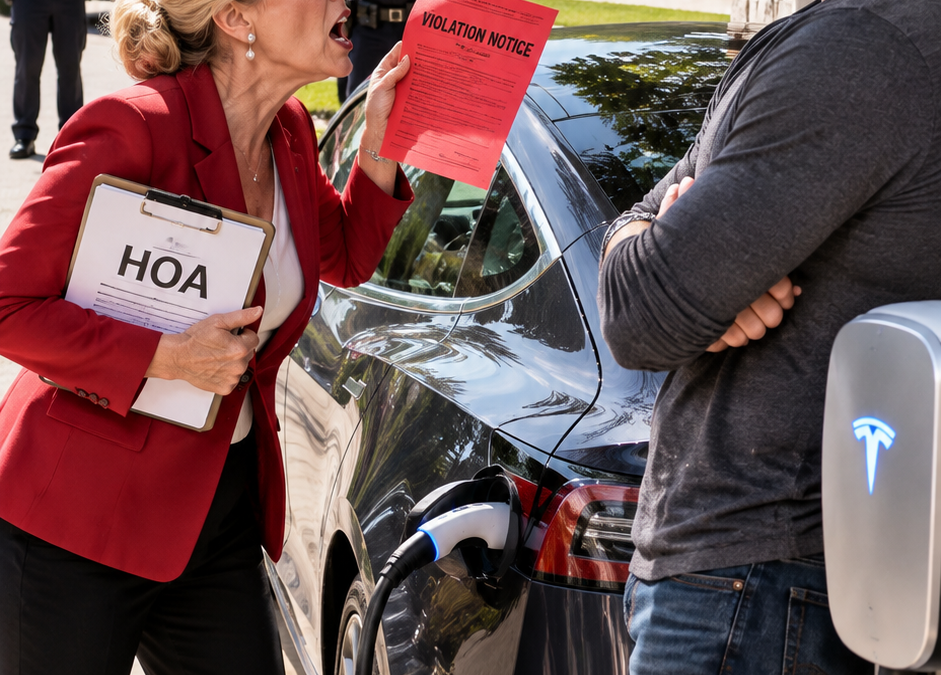
She stepped off the cart with a clipboard under one arm and slapped a bright red violation notice directly against my driver’s-side glass.
I lowered the window.
“Good afternoon, Evelyn.”
Her smile was polished and thin.
“Mr. Vance, you’re violating Section Four, Subsection Two.”
“Am I?”
“You are.”
She tapped the notice with her pen.
“Exterior power usage visible from the street constitutes an aesthetic violation. Your charging cable is exposed. Additionally, the front tire of your vehicle is encroaching on the common lawn boundary.”
I looked toward my tire.
It was sitting on my gravel.
My gravel was on my property.
But arguing with someone like Evelyn before you had gathered the complete record was like correcting a spreadsheet before you had found the broken formula.
Sometimes the smartest thing you could do was let the error keep running.
“That’s a two-hundred-dollar fine,” she continued.
“For charging my car from my garage?”
“For violating the standards.”
“And the tire?”
“That’s also part of the violation.”
She waited.
I knew what she expected.
She expected anger.
Or embarrassment.
Or a frantic apology followed by me dragging the charging cable inside and promising never again to expose Whispering Pines to the horrifying sight of electricity.
Instead, I peeled the notice from the window and examined the signature.
EVELYN STERLING.
I had seen the same sharp handwriting on several warnings since moving in three weeks earlier.
“I’ll review it,” I said.
Her smile tightened.
“The board expects compliance, Mr. Vance.”
“I’m sure it does.”
I rolled the window up.
She stood there for another second, annoyed that I hadn’t given her anything dramatic to report, then climbed back into her golf cart and drove away.
I watched her disappear around the curve.
I wasn’t angry.
Not yet.
I was interested.
I was thirty-two, a senior data scientist and financial-risk analyst for one of the largest investment banks in the country. My career consisted largely of finding the numbers people hoped nobody would check.
If a multinational corporation buried a liability six subsidiaries deep, I found it.
If a trading desk changed assumptions to make a bad position look healthy, I found it.
If a senior executive insisted that a suspicious transaction was perfectly normal, my first instinct was never to argue.
My first instinct was to ask for the ledger.
People who relied on intimidation tended to hate records.
Evelyn Sterling had just made the mistake of introducing herself to a man who loved them.
Three weeks earlier, I had moved into a modern steel-and-glass house near the end of a quiet cul-de-sac in Whispering Pines. The property sat along a larger tract my family had known for years, land I had spent enough of my childhood walking with my father to remember where the old markers had stood before developers arrived.
When the chance came to buy the parcel outright, I used a substantial portion of my stock-option payout and did exactly that.
I wanted quiet.
The HOA brochure had promised quiet.
What it had failed to mention was that Whispering Pines defined peace as absolute obedience.
I carried Evelyn’s red notice into my study, scanned it, saved the security-camera footage of her visit, and opened a new directory on my computer.
I named it:
WHISPERING PINES HOA — ACTIVE DISPUTE.
Then I smiled.
Because if Evelyn wanted to turn my home into an audit, I was going to make sure she enjoyed the full experience.
PART2
Four days later, she sent me another violation.
This time, the crime was curtains.
Apparently, the minimalist black roller shades in my study represented such a serious threat to Western civilization that the association required a three-hundred-dollar fine, plus fifty dollars per day until I replaced them with “approved neutral window treatments.”
Their preferred option was beige linen.
Naturally.
Whispering Pines had an unhealthy emotional attachment to beige.
The houses were beige.
The fences were beige.
The clubhouse interior was beige.
If Evelyn could have regulated sunsets, I suspected she would have required the sky to submit a color sample before turning orange.
I stood in my kitchen with coffee in one hand and the notice in the other while Evelyn’s golf cart slowed outside my fence.
This time she wasn’t alone.
Two private security guards stood beside the road in matching navy uniforms.
They were photographing my side yard.
I walked outside.
“Can I help you?”
One of them lowered his phone.
“We’ve been instructed to document exterior compliance.”
“From my property?”
“We’re on the association side.”
He said it with more confidence than accuracy.
I looked at his boots.
Both men were standing several feet inside what I understood to be my parcel.
Interesting.
“Who instructed you?”
“The HOA.”
“Specifically?”
The guard hesitated.
“President Sterling.”
“Thank you.”
I went back inside.
No shouting.
No accusations.
No threats.
Just another timestamp.
Another photograph.
Another entry.
Later that afternoon, I discovered that the security company was owned by Evelyn’s brother-in-law.
Of course it was.
By then, I was beginning to suspect that Whispering Pines wasn’t really a residential association.
It was more like a family business with landscaping.
The notices became routine.
Every Friday afternoon, usually after four-thirty when most attorneys’ offices were preparing to close for the weekend, another red envelope appeared.
One week, I was cited because my trash container remained near the curb twelve minutes past the permitted collection window.
Twelve minutes.
Not twelve hours.
Not twelve days.
Twelve minutes.
I briefly considered asking whether Evelyn synchronized her enforcement watch with the National Institute of Standards and Technology.
Instead, I scanned the letter.
The following week, the HOA fined me because my pickup truck was parked at an angle they considered inconsistent with “community visual harmony.”
That phrase deserved a place in a museum.
The week after that, they claimed my eastern fence exceeded maximum height by four inches.
Then came a landscaping complaint.
Then an exterior-lighting complaint.
Then a notice alleging that one of my security cameras was visible from a common area and therefore created an “unwelcoming visual impression.”
Apparently being watched by cameras was offensive.
Being photographed by Evelyn’s private guards was community management.
By the end of the third month, the HOA claimed I owed nearly twelve thousand dollars.
Then the language changed.
The notices stopped talking about compliance.
They started talking about liens.
After liens came foreclosure.
I sat at my desk one evening reading the latest letter while Evelyn’s white golf cart idled near the end of my driveway.
Her silhouette was visible through the bare branches.
She was staring at my house.
People like Evelyn often mistake calm for weakness.
If you don’t argue, they assume you’re afraid.
If you don’t retaliate immediately, they assume you don’t know how.
If you continue paying your mortgage, cutting your grass, and saying good morning, they assume pressure is working.
It wasn’t.
I was collecting evidence.
The process reminded me of hostile-management strategies I’d seen during corporate investigations. When executives wanted to remove somebody without admitting that was the goal, they rarely began with one catastrophic act.
They created friction.
A written warning.
A performance concern.
Another warning.
A disputed policy.
A denied expense.
A bad evaluation.
Enough paperwork eventually created the appearance that the target was the problem.
Evelyn was doing the neighborhood version of the same thing.
Only she had made two serious errors.
First, she assumed nobody would check whether her rules were enforceable.
Second, she assumed nobody would check the money.
I started with the money.
The Whispering Pines member portal contained a financial section because state law and the association’s own governing documents required residents to have access to certain records.
The section was almost empty.
There was one annual budget summary.
It had broad categories such as:
LANDSCAPING.
SECURITY.
ADMINISTRATION.
INFRASTRUCTURE.
COMMUNITY IMPROVEMENTS.
No meaningful detail.
No itemized invoices.
No contract summaries.
No reserve schedules worth mentioning.
I stared at the page for a while.
In my profession, missing information can be more revealing than information that’s present.
Healthy organizations like documentation because documentation proves what they did.
Unhealthy organizations prefer summaries.
Summaries give you room to hide.
I submitted a formal records request as an owner.
While reviewing the portal, I also discovered something almost comically careless: the association’s own member-access system had been configured so that authenticated homeowners could access directories containing financial records that the interface itself did not neatly display.
I didn’t bypass passwords.
I didn’t defeat security.
I didn’t impersonate anyone.
I simply accessed records available to my authorized account through the association’s own badly organized system.
And there they were.
Four years of ledgers.
Bank statements.
Invoices.
Vendor payment records.
Reserve transfers.
Board approvals.
I downloaded the records I was entitled to review and started building a transaction map.
The first anomaly appeared within fifteen minutes.
STERLING SOLUTIONS LLC.
Three thousand four hundred dollars.
Every month.
Same amount.
Again.
And again.
And again.
I filtered by vendor.
The transfers extended backward through years of records.
More than one hundred sixty thousand dollars had moved from association accounts to Sterling Solutions.
The invoices were almost useless.
“Administrative consulting.”
“Community services.”
“Project coordination.”
No time sheets.
No detailed scope.
No deliverables.
No project documentation.
No bidding records.
I searched the company registration.
Principal officer: Evelyn Sterling’s brother.
I leaned back.
“Well, Evelyn.”
The room was quiet except for the low hum of my computer.
“You’ve been busy.”
That was only the beginning.
The landscaping contract belonged to a company controlled by the husband of another board member.
Its rates were roughly forty percent higher than comparable service packages I found in surrounding communities.
The security contract went to Evelyn’s brother-in-law.
There had been no meaningful competitive bidding process in the files I reviewed.
Then I found the drainage assessment.
Residents had been told the neighborhood needed emergency work to prevent erosion and water damage.
A special assessment had been collected.
The money entered the operating account.
Shortly afterward, large amounts were transferred to vaguely described administrative expenses.
Some of the expected drainage work had either been reduced or delayed.
I started tracing fine revenue.
That was when the architecture became clear.
The aggressive enforcement wasn’t merely Evelyn’s personality.
It was financially useful.
Fines helped fill gaps.
The association had been draining reserves and directing suspiciously favorable contracts toward people close to board leadership. When cash became tight, compliance enforcement intensified.
Red notices produced money.
Money disguised deficits.
Deficits stayed out of resident-facing summaries.
It was a beautifully ugly little machine.
And every time Evelyn drove her golf cart through the neighborhood measuring trash cans and driveway angles, she was essentially operating a mobile revenue department.
I spent three nights organizing the records.
I built tables showing recurring payments.
I cross-referenced corporate registrations.
I matched board approvals to invoice dates.
I identified related-party relationships.
I marked missing documentation.
I calculated the effect on reserves.
Then I created a fifty-page report written the same way I would prepare an internal forensic memorandum for senior counsel at work.
No dramatic adjectives.
No accusations I couldn’t support.
Just dates.
Amounts.
Names.
Signatures.
Documents.
If there was one thing I had learned from financial investigations, it was this:
Never exaggerate when the facts are already devastating.
I backed everything up.
Encrypted cloud storage.
Offline drive.
Printed copy.
A copy for my attorney.
By then I knew exactly what kind of fight I was in.
But the financial records still didn’t answer one important question.
Why was Evelyn so comfortable treating the eastern side of my property like it belonged to the HOA?
That question led me outside.
I called Tom Willis.
Tom had been surveying property in the county for nearly thirty years. He had the calm voice of a man who had spent most of his career explaining to furious neighbors that fences did not become legal boundaries merely because somebody’s grandfather had put them in the wrong place.
He arrived Thursday morning with high-precision GPS equipment, a total station, old plats, deed descriptions, and the emotional energy of someone delighted to spend two days ignoring everybody except numbered coordinates.
I liked him immediately.
“You want just the disputed side?” he asked.
“Everything.”
“Full boundary?”
“Full boundary.”
He nodded.
“Good.”
Tom worked for two days.
He located older monuments.
He checked recorded plats.
He compared my deed description with subdivision maps.
He ran coordinates.
He drove steel stakes with bright orange caps into the ground.
Evelyn drove past twice.
The first time, she slowed down.
The second time, she stopped.
I happened to be standing near the porch.
“Having trouble with your fence?” she called.
“Just checking my boundaries.”
She smiled.
“Those were established years ago.”
“Then this should be easy.”
Her smile disappeared.
“Historical community use matters, Mr. Vance.”
“So do surveys.”
She drove away.
Tom watched her go.
“Friend of yours?”
“President of the HOA.”
He looked at me.
Then at the golf cart.
Then back at me.
“I’m going to guess that’s not a yes.”
On the second evening, Tom walked toward my porch with mud on his boots and his tablet under one arm.
His expression was different.
Not alarmed.
Interested.
Surveyors, I’ve learned, have their own version of excitement.
It mostly involves saying things like “You should probably see this.”
Tom put the tablet on my outdoor table.
“You’ve got a clean deed,” he said.
“Good.”
“And you’ve got an encroachment.”
“How much?”
He enlarged the map.
“A serious one.”
The Whispering Pines EV charging station stood near the eastern edge of my property.
It was a large solar-assisted structure with several high-speed chargers, steel support columns, lighting, landscaping, and a broad concrete foundation. The HOA had advertised it heavily as evidence that Whispering Pines was modern, sustainable, technologically progressive, and presumably morally superior to neighborhoods where people still plugged vehicles into their own garages.
The reported project cost was around two hundred fifty thousand dollars.
According to Tom’s measurements, part of it was sitting almost six feet inside my property.
Not one decorative shrub.
Not an inch of paving.
The concrete foundation itself.
Steel columns.
Electrical conduit.
A section of the charging area.
All of it.
For approximately fifty feet.
I stared at the survey.
“You’re certain?”
Tom gave me the look professionals reserve for questions they understand but do not enjoy.
“I’ll run the calculations again tonight. But yes.”
“What happened?”
He pulled up an older subdivision drawing.
“My guess? Somebody built using the apparent landscaping line instead of verifying the recorded boundary. The visual edge here isn’t your legal edge.”
“So they assumed.”
“Looks that way.”
“And nobody ordered a boundary verification before pouring a quarter-million-dollar project.”
Tom smiled faintly.
“People like concrete more than paperwork.”
I laughed.
For months, Evelyn had been fining me because she claimed my tire had touched HOA property.
Meanwhile, the HOA had poured an enormous concrete structure six feet onto mine.
There are moments when reality becomes so perfectly absurd that anger has nowhere useful to go.
You simply admire the craftsmanship.
“Can you certify it?” I asked.
“Absolutely.”
“File it?”
“Yes.”
“Please do.”
The following morning, Tom completed the sealed boundary report and recorded the appropriate survey documentation with the county.
I sent the report to my attorney.
We prepared a formal notice of encroachment and trespass.
The association received it within forty-eight hours.
The notice identified the deed.
The recorded survey.
The location.
The approximate dimensions of the encroachment.
It demanded removal of the concrete, columns, electrical infrastructure, and any related improvements within thirty days at the association’s expense.
It also revoked any implied permission for continued access across my parcel.
The HOA’s law firm responded with breathtaking speed and very little reading comprehension.
Their letter claimed the station area had been established through “historical community use.”
Historical.
The charging station was three years old.
Apparently three years now qualified as antiquity.
The attorney also suggested that long-standing access rights and community expectations could limit my ability to interfere with the facility.
I read the letter twice.
Then I called my lawyer.
“Did they read the survey?”
“Maybe the first page.”
“The station is physically on my deeded parcel.”
“I know.”
“They’re arguing historical use.”
“I know.”
“It’s three years old.”
“I know.”
I waited.
My attorney finally laughed.
“I was trying to remain professional.”
“Please continue trying.”
We decided not to debate them endlessly by mail.
The notice stood.
The deadline stood.
The evidence stood.
Evelyn, meanwhile, escalated my fines.
The claimed balance passed twelve thousand dollars.
Then I received formal notice that the HOA intended to begin lien and foreclosure procedures.
That was when Evelyn scheduled an emergency town hall meeting.
Officially, the meeting concerned “community standards, financial stewardship, and preservation priorities.”
Unofficially, it was supposed to be my public execution.
Evelyn had spent weeks telling people that one difficult homeowner was refusing to honor his obligations and threatening community amenities.
I knew because neighbors had started approaching me.
Some were cautious.
Some were embarrassed.
Most had their own stories.
Ray Holloway, who lived two streets over, had been fined nine hundred dollars because his granddaughter’s chalk drawings remained on his driveway overnight.
Lillian Marsh, a widow in her seventies, had accumulated thousands in penalties after planting vegetables in a side garden Evelyn considered too visible from the road.
Another resident had been cited because his work van displayed his plumbing company’s phone number.
One woman told me she stopped hosting her grandchildren because the HOA repeatedly complained about outdoor toys.
Nobody had organized against Evelyn because each person thought their dispute was individual.
That is one of the oldest tricks in administrative bullying.
Make everyone believe they’re alone.
Isolation converts outrage into shame.
Shame keeps people quiet.
Records do the opposite.
Records connect patterns.
And I had four years of them.
The emergency meeting was held on the first Thursday of November.
By the time I arrived at the community center, nearly every chair was occupied.
People lined the walls.
Evelyn sat behind a long folding table with four board members and the association’s attorney.
She wore a cream-colored blazer.
Her binder was open.
Her hair was perfect.
Her expression suggested she had already rehearsed the applause.
I sat in the third row with my laptop bag between my feet.
Evelyn called the meeting to order.
For twenty minutes, she lectured us about standards.
She used phrases like “shared values.”
“Community integrity.”
“Protecting investments.”
“Collective responsibility.”
There was a slide about architectural uniformity.
Another about landscaping.
Another about enforcement.
Then my house appeared on the screen.
It was a photograph taken from the street.
A bright red circle marked my driveway.
Evelyn folded her hands.
“Unfortunately,” she said, “the board has encountered one particularly serious pattern of repeated noncompliance.”
A few heads turned toward me.
I stayed seated.
She continued.
“The property owner has accumulated more than twelve thousand dollars in unpaid assessments, penalties, and enforcement costs.”
Assessments.
Interesting choice of word.
Most were disputed fines.
“The board has therefore voted unanimously to proceed with all remedies available under the governing documents, including lien enforcement and, if necessary, foreclosure.”
The room went still.
Evelyn looked directly at me.
“We cannot allow any resident to believe he is above the rules.”
That was my cue.
I stood.
The attorney immediately leaned toward Evelyn.
She ignored him.
“Mr. Vance,” she said, “you’ll have an opportunity during resident comment.”
“I won’t need long.”
“You need to wait your turn.”
“I believe this concerns the property you’re threatening to foreclose on.”
There were murmurs.
Evelyn lifted her chin.
“Three minutes.”
“Perfect.”
I walked to the front with my laptop.
The attorney stood.
“I don’t think it’s appropriate for a resident to connect an unreviewed device to association equipment.”
“I emailed the presentation to your office this afternoon.”
He stopped.
That was the thing about preparation.
It ruined so many wonderful objections.
I connected the laptop.
The projector changed.
On the wall appeared my deed.
I highlighted the legal description.
Then Tom’s survey.
Then the certified boundary line.
Then a close aerial photograph.
The EV station was clearly marked.
So was the encroachment.
Nearly six feet inside my property.
For roughly fifty feet.
I turned toward the audience.
“This is the Whispering Pines vehicle-charging station.”
Everyone knew that.
Half the room used it.
“The association spent approximately two hundred fifty thousand dollars constructing it.”
Evelyn interrupted.
“This has nothing to do with your unpaid fines.”
“It has everything to do with whether your board understands property lines.”
I clicked again.
The certified survey seal filled the screen.
“This structure was built on my property.”
The room changed.
It wasn’t loud yet.
It was the sound before loud.
People shifted.
Someone whispered, “What?”
I continued.
“The concrete foundation, support columns, and electrical conduits cross my recorded boundary by approximately six feet.”
Evelyn’s face tightened.
“The board disputes that.”
“Your attorney received the certified survey and formal trespass notice thirty days ago.”
Her attorney looked at the table.
I enjoyed that small detail.
“The notice demanded removal,” I said. “The deadline expires tomorrow.”
Evelyn leaned toward her microphone.
“The association has historic access rights.”
“The station is three years old.”
A laugh came from somewhere near the back.
Not a big laugh.
But enough.
Evelyn turned toward the sound.
I clicked again.
Now the screen showed the charging-station construction invoice.
Then the project approval.
Then the missing boundary-verification documentation.
“Before approving a quarter-million-dollar structure,” I said, “the board apparently did not obtain an independent survey confirming that it owned the land beneath the structure.”
A man near the aisle raised his hand.
“Who approved the project?”
I changed slides.
Evelyn’s signature appeared.
The room got louder.
She struck the table lightly.
“This is not a trial.”
“No,” I said. “Trials have stricter rules.”
That earned a larger laugh.
Her attorney closed his eyes.
I could almost hear him reconsidering his career choices.
Evelyn spoke over the room.
“Mr. Vance, your time has expired.”
“I haven’t reached the financial records yet.”
The room went completely quiet.
Even Evelyn paused.
I clicked.
STERLING SOLUTIONS LLC.
$3,400.
Monthly.
Four years.
The first table showed the transfers.
The second showed cumulative totals.
The third showed the company registration.
Principal officer:
Her brother.
Evelyn’s face lost color.
“This information was obtained improperly.”
“No. These are association records available to members through the association’s own authenticated system and records produced pursuant to my request.”
Her attorney stood again.
“I strongly recommend that we adjourn.”
Evelyn turned on him.
“We are not adjourning.”
I nearly felt sorry for him.
Nearly.
I displayed copies of invoices.
“Sterling Solutions received more than one hundred sixty thousand dollars in association funds. The invoices contain broad descriptions such as administrative consulting and project coordination. In the records provided to me, I found no competitive bidding package, no detailed work product corresponding to many of these recurring payments, and no adequate disclosure to residents identifying the vendor as the president’s family member.”
People started talking.
I raised my voice slightly.
“There’s more.”
That quieted them.
Next came landscaping.
Then security.
Then emergency drainage funds.
Then the reserve balance.
I explained everything slowly.
I never called Evelyn a thief.
I didn’t need to.
I showed people where their money went.
I showed related parties.
I showed approvals.
I showed signatures.
I showed how reserve funds declined.
I showed how fine revenue increased.
I showed the relationship between enforcement income and budget shortfalls.
By the time I reached the security contract, one of the board members sitting beside Evelyn looked physically ill.
“That’s your brother-in-law’s company?” someone shouted.
Evelyn tried to respond.
“The board follows accepted vendor-selection procedures.”
“Show us the bids!” another resident yelled.
Someone else stood.
“Where’s the drainage money?”
Then Lillian Marsh rose from the second row.
She was small, silver-haired, and usually so quiet I had barely heard her speak above conversational volume.
That night, her voice carried across the entire clubhouse.
“You fined me thirty-eight hundred dollars for growing tomatoes while you were paying your own family out of our reserve fund?”
Evelyn pointed toward the microphone.
“Mrs. Marsh, please sit down.”
“No.”
That one word did more damage than any of my slides.
No.
For years, Evelyn had built her power around the assumption that nobody would say it.
Now an elderly widow had.
A man behind her stood next.
Then another woman.
Then Ray.
Within seconds, residents were demanding records, refunds, explanations, resignations.
Evelyn pounded the table.
“Order!”
Nobody cared.
“Order!”
Still nothing.
Her authority didn’t disappear because someone removed it.
It disappeared because everyone simultaneously realized it had depended on their cooperation.
The attorney leaned close to her.
This time I heard him clearly.
“Adjourn the meeting.”
Evelyn stared at me.
“You think you’ve won something?”
I closed my laptop.
“No.”
I looked at the screen behind her, where the transfer table was still projected ten feet wide.
“I think your accountant is going to have a very interesting month.”
The room erupted.
The meeting ended without a formal motion because there was no longer anything resembling a meeting.
People surrounded me in the parking lot.
Some wanted copies of the survey.
Others wanted the financial report.
Several wanted to know whether the fines could be challenged.
I gave them the name of my attorney and told them to request their individual account histories before doing anything else.
Evelyn left through a side door.
Her golf cart remained parked outside.
For once, she didn’t patrol the neighborhood on the way home.
The next morning, the thirty-day encroachment deadline expired.
My attorney sent the HOA one final written notice.
Access across my property to the disputed portion of the charging facility was revoked.
The HOA still refused to remove it.
So I hired a licensed electrical contractor.
Not some guy with bolt cutters.
Not a dramatic midnight operation.
A licensed contractor.
Permits.
Documentation.
Photographs.
Lockout procedures.
The section of power infrastructure crossing my property was safely isolated under professional supervision.
We placed temporary barriers along my boundary.
By eleven that morning, several chargers were unavailable.
At eleven-twenty, Evelyn arrived.
Not in the golf cart.
In a black SUV.
She jumped out before it fully stopped.
“What have you done?”
I was standing beside my attorney and the electrical contractor.
“I enforced the notice.”
“You cannot shut down community infrastructure.”
“It’s sitting on my land.”
“You are interfering with HOA property.”
“Your property is welcome to stop being on my property.”
Her face reddened.
“You are going to reconnect that immediately.”
“No.”
“You don’t understand what you’re doing.”
“I understand it down to the recorded coordinates.”
She pointed at me.
“Are you threatening me?”
“I’m warning you. Remove it from my land or it stays shut down.”
She pulled out her phone.
“Fine.”
“Fine.”
“I’m calling the police.”
“Please do.”
That answer seemed to confuse her.
People who use police threats as leverage generally rely on the other person being terrified of official scrutiny.
I had spent the previous three months trying to get more official scrutiny.
She dialed.
Approximately twenty minutes later, two county sheriff’s deputies arrived.
Evelyn hurried toward them before they had fully stepped out of the patrol vehicle.
“He’s sabotaged community electrical equipment,” she said.
One deputy looked toward the barriers.
Then toward me.
“Sir, are you the property owner?”
“Yes.”
“Can you tell us what happened?”
I handed him a folder.
Inside was the deed.
Certified survey.
Recorded documents.
Trespass notice.
Proof of delivery.
HOA response.
Contractor information.
Photographs.
My attorney introduced himself.
The deputy read for several minutes.
Evelyn stood beside him, increasingly impatient.
“This is theft of services,” she said.
The deputy held up a hand.
“Ma’am, I need to read this.”
She went silent.
He studied the survey again.
Then he walked to one of Tom’s orange-capped stakes and looked along the boundary.
The second deputy spoke with the electrical contractor.
No equipment had been damaged.
No public utility had been tampered with.
No one had entered HOA land to destroy property.
A professionally managed electrical connection crossing my parcel had been isolated after notice in the context of a documented civil property dispute.
The first deputy returned.
“This appears to be a civil matter.”
Evelyn blinked.
“He shut off our station.”
“Part of the station appears to be located on property he claims belongs to him, supported by a recorded survey.”
“I am the HOA president.”
The deputy’s expression did not change.
“I’m aware of that now.”
“You need to order him to restore service.”
“We’re not going to adjudicate a boundary dispute on the roadside.”
“He is causing damages.”
“Then your attorney can address that through the courts.”
For perhaps the first time since I had met her, Evelyn Sterling had no immediate answer.
The deputy handed me my folder.
“Keep everything documented.”
“I intend to.”
He almost smiled.
Evelyn looked at me as if I had arranged the laws of property ownership specifically to humiliate her.
Then she made one more mistake.
She said, loudly enough for both deputies to hear:
“This neighborhood will make you regret this.”
My attorney looked at her.
“Thank you.”
She frowned.
“For what?”
“For saying that in front of witnesses.”
Both deputies suddenly found the ground very interesting.
Evelyn got back into her SUV and slammed the door.
By afternoon, photos of the blocked charging station had circulated through the neighborhood.
By evening, residents were asking why the HOA had spent a quarter of a million dollars on a facility without verifying ownership of the land.
The public town hall had damaged Evelyn.
Calling the sheriff finished the job.
Not because the deputies arrested her.
They didn’t.
Not because they declared me legally victorious.
They didn’t.
It was much simpler.
Everyone saw that her favorite weapon—authority—had limits.
The next week was chaos.
Three board members demanded an independent audit.
Two requested legal advice separate from the association’s existing counsel.
Residents submitted formal requests for vendor records.
A group of homeowners circulated a petition demanding a special election.
Someone obtained a copy of my forensic report.
Then another person forwarded it.
By Monday morning, half the neighborhood seemed to have it.
My attorney had also submitted relevant records to county authorities for review.
The financial questions were no longer gossip at a community meeting.
They were documented concerns sitting on official desks.
The sheriff’s department and county prosecutor’s office began reviewing materials relating to the association’s financial activity.
I was careful about how I described that.
An inquiry is not a conviction.
A suspicious payment is not automatically theft.
A conflict of interest is not automatically a crime.
Evidence matters.
Due process matters.
The same discipline that had helped me expose the problem required me not to exaggerate the outcome.
Evelyn had no such discipline.
She sent a message to residents calling the allegations “a malicious campaign by a disgruntled homeowner attempting to destabilize the association.”
That lasted approximately six hours.
Then someone replied with the corporate registration showing her brother’s ownership of Sterling Solutions.
Someone else posted the monthly payments.
Another resident asked why the board had never disclosed them.
The statement disappeared.
Three weeks after the town hall, Evelyn resigned.
Her letter was short.
She cited personal reasons and health considerations.
There was no mention of Sterling Solutions.
No mention of the survey.
No mention of the charging station.
No mention of the sheriff.
No mention of the foreclosure threat she had delivered with such theatrical confidence only weeks earlier.
It was the administrative equivalent of setting a kitchen on fire and resigning because the smoke was affecting your allergies.
The remaining board members moved quickly.
Very quickly.
It’s remarkable how efficient people become once their names appear in the same spreadsheet as questionable payments.
The enforcement committee was dissolved.
Outstanding compliance fines were suspended pending independent review.
The foreclosure action against me was withdrawn.
The HOA issued a written apology describing what had occurred as “administrative discrepancies.”
Administrative discrepancies.
I framed that phrase mentally.
Apparently attempting to take someone’s house over disputed curtain colors and driveway geometry qualified as a discrepancy.
The association also agreed to remove the encroaching portion of the EV charging facility at its own expense.
Contractors arrived in December.
This time, they brought a surveyor.
I enjoyed that.
They cut concrete.
Removed conduit.
Relocated equipment.
Excavated the foundation crossing my parcel.
Regraded the soil.
Spread straw over the disturbed earth.
When the work was finished, Tom’s orange boundary stakes remained untouched.
The new line was impossible to misunderstand.
Several residents stood nearby on the final afternoon watching the contractors load broken concrete into a dump truck.
Ray walked over with coffee.
“Two hundred fifty thousand dollars,” he said.
“Originally.”
“How much do you think moving it cost?”
“Enough that they’ll probably start respecting surveyors.”
He laughed.
“You know what Evelyn told people when they built it?”
“What?”
“She called it her legacy project.”
I looked at the pile of broken concrete.
“Technically, she was right.”
In January, Whispering Pines held an emergency election.
Evelyn was gone.
Two of her closest allies declined to run.
The new president was a retired civil engineer named Harold Bennett, who had lived in the neighborhood for nine years and possessed what I considered the single most important qualification for HOA leadership:
He hated meetings.
His first meeting lasted forty-two minutes.
That alone made him wildly popular.
The new board adopted quarterly financial reviews.
Related-party vendor relationships had to be disclosed.
Larger contracts required competitive bids.
Homeowners gained a formal appeals process.
Enforcement notices required specific documentary support.
Board members could no longer invent interpretations of rules and treat them as sacred scripture simply because they had access to red paper.
The independent review also began examining prior fines.
Some were reduced.
Some were canceled.
Some payments were credited back to residents where the documentation did not support the enforcement action.
Lillian’s garden penalties disappeared.
Ray’s chalk-drawing fine was removed.
The plumber could park his work van in his own driveway again.
It turned out civilization survived.
The neighborhood changed in ways that looked insignificant unless you knew how tense it had been before.
A bicycle appeared beside a driveway overnight.
Nobody photographed it.
A family painted its front door blue.
An actual blue.
Not Slate Mist.
Not Coastal Beige.
Blue.
Lillian planted tomatoes.
Large ones.
Red ones.
Completely noncompliant-looking tomatoes.
When I walked past her yard one afternoon, she held one up like a trophy.
“Think the property values can handle this?”
“I’ll notify the authorities.”
She laughed.
That laugh told me more about the change in Whispering Pines than any revised bylaw ever could.
For years, residents had lived with the low-level anxiety of being watched.
Evelyn had convinced them that constant enforcement was necessary to preserve value.
But fear has a cost too.
You could see it in people who stopped using their yards.
People who hurried indoors when the golf cart appeared.
People who paid ridiculous fines because fighting seemed more expensive than surrender.
When that pressure disappeared, the neighborhood didn’t collapse.
Nobody abandoned their lawns.
Nobody painted obscenities on their garage doors.
Nobody turned the clubhouse into a livestock barn.
People simply began acting like they owned their homes again.
Imagine that.
A regional newspaper eventually ran a feature about the dispute.
The reporter spent several days reviewing public records and interviewing residents.
The article laid out the timeline plainly:
The fines.
The threatened foreclosure.
The charging-station encroachment.
The questionable related-party payments.
The governance reforms that followed.
Several former board members gave interviews.
Their explanations sounded familiar.
They had trusted Evelyn.
They assumed the documents had been reviewed.
They believed legal counsel would catch problems.
They signed approvals because everyone else signed them.
I had heard variations of that excuse throughout my career.
Fraud, mismanagement, and abuse rarely survive because every participant is evil.
They survive because enough people decide not to look closely.
One person says, “I’m sure accounting checked it.”
Accounting says, “The manager approved it.”
The manager says, “The board authorized it.”
The board says, “Counsel reviewed it.”
Counsel says, “We relied on information supplied by management.”
Everybody points somewhere else.
Meanwhile, the payment clears.
The concrete gets poured.
The fine gets issued.
The homeowner gets threatened.
Responsibility disappears into process.
Until someone opens the records.
Lillian came to my house one Saturday in February carrying cornbread in an old wooden box.
We sat on the porch.
The air was cold, but the sun was bright.
Birds moved between the feeders along the eaves.
For a while we talked about nothing important.
Weather.
Road conditions.
Her garden.
Then she grew quiet.
“I was going to sell,” she said.
I looked at her.
“My house.”
“Because of the HOA?”
She nodded.
“I’d already called a realtor.”
I didn’t know that.
She wrapped both hands around her coffee.
“When the fines started doubling, I stopped sleeping properly. Every time a car slowed down outside, I thought another letter was coming.”
Her eyes stayed on the pasture.
“I know it sounds foolish.”
“It doesn’t.”
“I couldn’t afford a lawyer. Evelyn knew that.”
I said nothing.
Lillian continued.
“She’d sit across from me in those hearings with three board members and an attorney, and I’d feel like I was on trial for living in my own house.”
That sentence stayed with me.
“I grew vegetables,” she said. “That’s what I did.”
“I’ve seen the tomatoes. Very dangerous.”
She laughed, but tears had gathered in her eyes.
“I kept thinking maybe I was wrong. Maybe I signed something I didn’t understand. Maybe I should just pay them.”
“That’s what the pressure was designed to make you think.”
She nodded.
“If you hadn’t shown everybody those records, I would’ve been gone before spring.”
I looked across the ridge.
When I started the fight, I hadn’t intended to rescue Whispering Pines.
I wanted the HOA off my property.
I wanted the false fines withdrawn.
I wanted the charging station moved.
That was it.
But systems like Evelyn’s depend on everyone treating abuse as a private problem.
The moment the records connected our experiences, it stopped being Jordan Vance versus the HOA.
It became eighty residents asking the same question.
What exactly have you been doing with our authority?
And that was a question Evelyn could not survive.
By spring, the eastern edge of my land looked normal again.
The disturbed soil had settled.
Grass began pushing through the straw.
I replaced the old fence with a sturdy cedar split-rail line built directly along Tom’s surveyed coordinates.
Ray and two other neighbors volunteered to help.
We spent a Saturday setting posts.
No committee.
No architectural review.
No golf cart.
Just four men arguing about whether one post was a quarter-inch out of level.
Some forms of regulation are healthy.
When we reached the section where the charging station had once crossed onto my land, Ray stopped.
“You should put up a sign.”
“What kind?”
He grinned.
“PRIVATE PROPERTY. SURVEY AVAILABLE UPON REQUEST.”
I considered it.
“Too aggressive.”
“BOUNDARY LINE SPONSORED BY EVELYN STERLING?”
“Tempting.”
We left it blank.
The stakes were enough.
I reset my mailbox post myself.
I leveled it with a plumb bob and packed gravel tightly around the base.
It reminded me of my father.
When I was young, he’d walked property lines with me on land nearby and taught me to look for the old markers that survived after fences rotted away.
Stone.
Iron pins.
Notches.
Recorded bearings.
He believed boundaries deserved maintenance.
Not because he was possessive.
Because uncertainty invited conflict.
One afternoon when I was a boy, we’d stopped near an old stone marker partially buried under pine needles.
He cleared it with his boot.
“The land doesn’t belong to the loudest person,” he told me.
At the time, I barely listened.
I was probably thinking about lunch.
Now I remembered every word.
“It belongs to whoever has the patience to keep the records straight and walk the lines when the weather is bad.”
That was my father.
Practical.
Unimpressed by theatrics.
He would have despised HOA meetings.
I thought about him frequently during the dispute.
Evelyn’s power had always been loud.
Letters.
Threats.
Security guards.
Meeting microphones.
Legal language.
Golf carts rolling slowly past people’s houses.
My defense had been almost embarrassingly boring.
Deeds.
Invoices.
Survey coordinates.
Bank transfers.
Email timestamps.
Signed notices.
The boring things won.
They usually do when authority has to prove itself.
The original red violation slip remained in the drawer of my desk.
Two hundred dollars for charging my Tesla from an outlet on my own house while my tire allegedly touched community property.
Every once in a while, I took it out and looked at it.
Not because I was angry.
Because it was funny.
That one little red sheet represented Evelyn’s entire mistake.
She believed a document became powerful merely because she printed it.
But paper works both ways.
A violation notice is paper.
So is a deed.
So is a certified survey.
So is a bank statement.
So is a vendor invoice.
So is a corporate registration.
So is a recorded trespass notice.
The difference is that some paper carries evidence.
By early summer, Whispering Pines had become almost annoyingly peaceful.
The new HOA newsletter was one page.
Meeting dates.
Road maintenance.
Budget information.
A reminder about trash collection.
No photographs of offending properties.
No “compliance corner.”
No president’s essay about the moral significance of mailbox uniformity.
My curtains remained black.
No civilization ended.
My truck occasionally sat crooked in the driveway.
The earth continued rotating.
My Tesla charged from the outlet on my garage.
Somehow the neighborhood survived that too.
The replacement EV chargers had been moved entirely onto verified common property.
Before construction, the new board ordered a survey.
Harold emailed me a copy almost as a joke.
SUBJECT: WE CHECKED THIS TIME.
I replied:
PROGRESS.
The financial investigation continued through the proper channels, and I deliberately stayed out of the rumor mill.
People wanted dramatic updates.
They wanted handcuffs.
They wanted courtroom scenes.
They wanted Evelyn escorted from Whispering Pines while eighty homeowners applauded.
Real accountability is usually less cinematic.
Auditors request documents.
Attorneys exchange letters.
Investigators interview people.
Boards correct records.
Vendors are examined.
Money gets traced.
That process can be slow.
But Evelyn’s personal empire had already collapsed in the only way that mattered to the neighborhood.
She no longer controlled it.
Her golf cart disappeared.
The enforcement committee disappeared.
Her relatives’ favored contracts were subjected to review.
The fines she had used as weapons were dismantled one account at a time.
The woman who once threatened to foreclose on my home because I refused to accept manufactured violations had resigned after being forced to explain why her family members kept appearing on the other end of HOA payments.
That was enough irony for me.
I saw her only once after that.
I was leaving a hardware store when I noticed her crossing the parking lot.
No cream blazer.
No clipboard.
No golf cart.
Just Evelyn Sterling carrying two shopping bags toward an SUV.
She saw me.
Stopped.
For a second, I wondered whether she’d say something.
She didn’t.
Neither did I.
There was nothing left to discuss.
She had spent months trying to make me understand my place.
Eventually, a survey did it for both of us.
That evening, I drove home as the sun dropped behind the ridge.
The new cedar fence ran straight along the eastern boundary.
Lillian was in her garden.
Ray’s granddaughter had covered half his driveway with chalk flowers.
A plumber’s van sat in another driveway.
Someone had placed a ridiculous ceramic frog beside a mailbox.
Whispering Pines looked less uniform.
It also looked more alive.
I pulled into my driveway, parked at whatever angle happened naturally, and plugged my Tesla into the garage outlet.
I paused.
Looked down at the cable.
Looked toward the street.
No golf cart.
No clipboard.
No red notice.
I laughed.
Inside, I made coffee and walked out onto the porch.
The ridge was quiet.
Not the nervous quiet that had existed under Evelyn, when everyone wondered who was being watched.
Real quiet.
The kind people choose.
The kind I had moved there for.
I thought about the first time Evelyn had stood beside my car and informed me that three inches of tire and one visible charging cable represented threats to community standards.
She had looked completely certain.
That had always been her greatest strength.
And her fatal weakness.
Certainty without verification is just arrogance wearing business clothes.
She had been so busy measuring my tire that she never checked where her own quarter-million-dollar charging station was standing.
She had been so busy auditing curtains, trash cans, gardens, work vans, fences, and children’s chalk that she never imagined anyone might audit her.
She had spent years teaching the neighborhood that documents were weapons.
Then she met someone who knew how to read them.
The account was settled.
The false foreclosure threat was dead.
My fines were gone.
The charging station had been removed from my property.
The board had been replaced.
Residents had their appeals process.
The financial records were open.
And Evelyn’s reign over Whispering Pines had ended not with some dramatic confrontation, but with something much more satisfying.
Her own signatures.
Her own invoices.
Her own contracts.
Her own concrete.
Her own phone call to the sheriff.
She had built the case against herself piece by piece and then delivered it directly into my hands.
All I had done was keep the receipts.
As the last sunlight disappeared behind the trees, I could still see the orange survey cap near the fence.
Six feet.
That was all.
Six feet of dirt had been enough to expose years of intimidation.
Six feet had separated what Evelyn claimed from what she could prove.
Six feet had turned a twelve-thousand-dollar foreclosure threat into a public examination of her own conduct.
And six feet had taught an entire HOA a lesson it should never have needed:
Authority ends where ownership begins.
I took another sip of coffee.
A car passed slowly on the road.
Not a security vehicle.
Not Evelyn.
Just a neighbor heading home.
The sound faded into the trees.
Then there was nothing but wind moving through the pines.
My house.
My driveway.
My outlet.
My land.
And finally, nobody with a clipboard was confused about where the line was anymore.








