𝗣𝗔𝗥𝗧 𝟮 The HOA Board Laughed at My Flood Wall—Hours Later, They Were Standing in Water While My House Stayed Dry
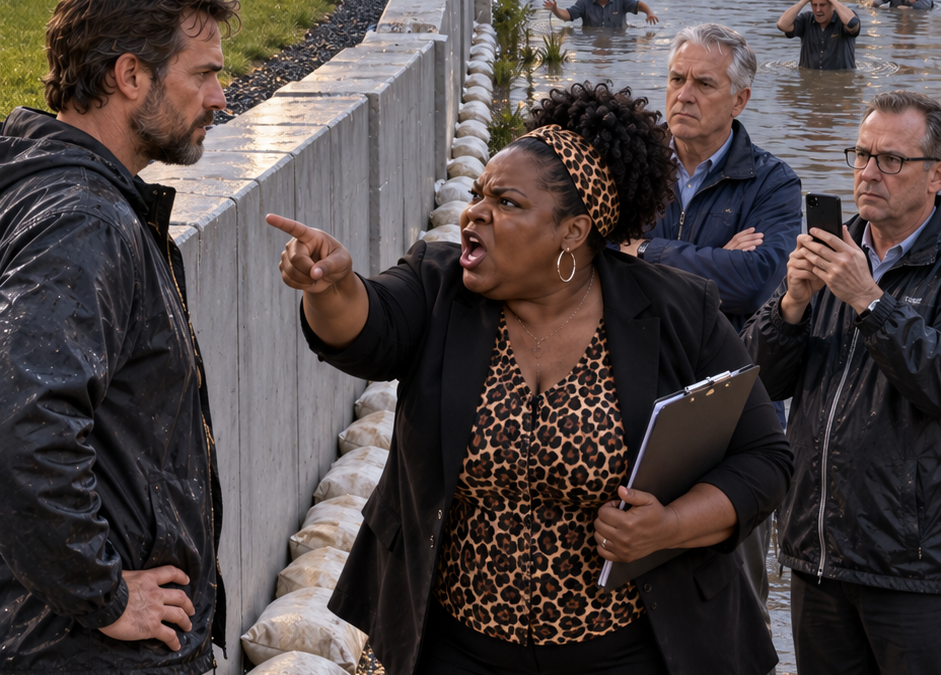
𝗣𝗔𝗥𝗧 𝟮
They drove away.
The notice remained taped to my flood wall.
Across the street, Marcus and Sarah Holloway stood on their porch.
They had moved into Maplewood Estates about eighteen months earlier.
Young couple.
Still learning the neighborhood.
Farther down, Mrs. Aldridge stood at the end of her driveway.
Seventy-two years old.
Twenty-five years in the same house.
She folded her arms.
Nobody said anything.
That was normal in Maplewood.
People watched Gerald.
They rarely challenged him.
The man had turned minor HOA enforcement into an atmosphere.
Grass a quarter inch too high.
Fine.
Christmas lights two days late.
Fine.
Trash can visible from the street.
Fine.
Wrong paint shade.
Fine.
Mrs. Aldridge once got fined over a copper wind chime her daughter had brought her from Oregon.
The violation notice called it an “unapproved exterior noise-producing fixture.”
She paid.
Took it down.
Never argued.
Gerald had learned something important from years of doing that.
Most people do not surrender because they believe you are right.
They surrender because fighting you looks exhausting.
That was his real power.
Not the covenants.
Fatigue.
But there was something Gerald did not know when he slapped that orange notice onto my wall.
I had not built the barrier because I was nervous.
I had built it because the numbers said the water was coming.
And every inch of it had already been approved.
Seven weeks earlier, the county building department had issued a permit.
I had drainage calculations.
A site plan.
FEMA reclassification maps.
County stormwater reports.
And one letter that Gerald would eventually wish I had never found.
A letter addressed directly to the Maplewood Estates HOA.
Dated March 2020.
Warning the board that this part of the neighborhood had been reclassified for increased flood risk.
Gerald knew.
The board knew.
The residents did not.
The first drops of rain landed on the pavement less than thirty-six hours after Gerald laughed at the wall.
By then, he had already sent a crew to tear it down.
PART2
I moved into Maplewood Estates four years before the storm.
I was fifty-one.
Not fully retired, but close enough to decide which jobs I accepted.
After two decades of civil contracting, I was tired of hotels, emergency calls, inspectors, overnight concrete pours, and the constant understanding that one bad design decision could turn somebody’s property into a lake.
I wanted quiet.
A manageable house.
A garage.
A yard.
Maplewood looked perfect.
Ninety-six homes.
Mature trees.
Wide streets.
Good sidewalks.
One entrance monument maintained just well enough to suggest the HOA had money without looking like it was trying too hard.
I did what I always did before buying land.
I checked the records.
Most people tour kitchens.
I look at drainage.
County assessor.
Parcel map.
Floodplain data.
Topography.
Utility easements.
Old grading plans.
At the time, nothing stopped me from buying.
But I noticed something in the newer records.
In 2018, the county had rerouted a major drainage channel three blocks east of Maplewood Estates.
The project had solved one problem upstream.
It had also changed downstream flow patterns.
The next year, FEMA updated flood-risk designations for part of the neighborhood.
The eastern section—including my block—moved into a moderate-to-high-risk category.
That did not mean every storm would flood the neighborhood.
It meant the margin for error had changed.
Water that once dispersed across a broader basin now traveled more directly through a set of drainage lines beneath the lower end of Maplewood.
The original infrastructure had not been designed for that altered flow.
I paid attention.
Gerald apparently did not.
Or rather, I eventually discovered that he had paid attention and made a choice not to tell anyone.
My own lot had a specific weakness.
The backyard fell slightly toward the southeastern corner.
That corner fed toward an old drainage line.
Under ordinary rain, harmless.
During a major event producing more than three inches per hour, the modeled flow pushed water toward my foundation.
The first time I read the county drainage report, I sat at the kitchen table with a pencil and sketched a rough barrier.
By the end of the week, the sketch had become a plan.
Concrete block base.
Reinforced sections.
Sandbag seams where flexibility made more sense than permanent mass.
Interior grading to redirect seepage away from the foundation.
The goal was not to stop an ocean.
It was to control runoff long enough for the street system to clear.
I submitted everything to the county.
Permit application.
Dimensions.
Materials.
Setback.
Hydraulic assumptions.
The inspector made me revise one corner because my original angle created a possible eddy against the driveway.
I changed it.
Resubmitted.
Approved.
Permit issued.
I built the wall.
It was not beautiful.
Gerald got that much right.
Flood-control structures rarely win landscaping awards.
But I did not care what it looked like during sunshine.
I cared what it would do at two inches of water per hour.
The wall went up in stages.
Marcus came over one afternoon while I was setting block.
“What are you building?”
“Flood barrier.”
He laughed lightly.
Then saw I was serious.
“For what flood?”
“The one the maps say we’re eventually going to get.”
He frowned.
“I thought this neighborhood wasn’t in a flood zone.”
“It wasn’t.”
That caught him.
“What do you mean wasn’t?”
“Changed in 2019.”
He stared at me.
“When?”
“2019.”
“No one told us.”
“I know.”
At the time, I did not fully understand why.
That came later.
Gerald’s first violation notice arrived before I had even finished compacting the interior slope.
UNAUTHORIZED STRUCTURAL MODIFICATION.
AESTHETIC NONCOMPLIANCE.
FAILURE TO SEEK HOA ARCHITECTURAL APPROVAL.
I responded with my county permit.
No argument.
No accusations.
Just a copy of the permit and a short letter explaining that the barrier served stormwater-safety purposes and had been approved by the relevant county authority.
No reply.
Then came the driveway visit.
Gerald.
Dale.
Phil.
The laughter.
The orange notice.
Forty-eight hours.
Five hundred dollars per day after that.
Lien after seven days.
Contractor removal if I refused.
That evening, I sat at my kitchen table with the storm building outside.
The folder lay open in front of me.
County permit.
FEMA map.
Drainage report.
Weather forecast.
Then the letter I had obtained through a public-records request.
I had requested all county communications with Maplewood Estates related to the 2019 flood-risk update.
Most of what came back was routine.
Technical memos.
Email chains.
Map attachments.
Then I found the March 2020 letter.
Addressed to the Maplewood Estates Homeowners Association.
It explained the revised flood designation.
It recommended the association notify all homeowners.
It provided mitigation contacts.
It suggested owners in the affected area review insurance and drainage conditions.
The receipt showed the HOA received it.
Gerald had been president.
Dale had been treasurer.
Phil had been secretary.
Same board.
That same year, Maplewood issued thirty-four violation notices.
Grass.
Paint.
Holiday lights.
Parking.
Fence stain.
Not one newsletter mentioned flood risk.
Not one board agenda discussed it.
Not one warning went to residents.
Not Mrs. Aldridge.
Not the Kavanaughs.
Not Marcus and Sarah.
Sarah later told me their purchase disclosures had made no mention of any updated community flood designation.
That bothered me more than Gerald’s laugh.
The next morning, his certified letter arrived.
Two pages.
Formal HOA letterhead.
Gerald’s signature.
The association rejected my response.
The flood wall had to go.
At hour forty-nine, five hundred dollars per day.
After seven days, lien proceedings.
The HOA reserved the right to remove the wall and charge me for demolition.
I read the whole thing.
Then wrote back.
One page.
No emotion.
I cited the county building permit.
I cited the state-level provision I had relied on during permitting, which restricted HOA interference with certain lawfully approved safety and drainage structures.
I notified them that a flash-flood watch was in effect.
I stated clearly that I would not remove the structure.
Certified mail.
Gerald called two hours later.
His first words were:
“We’ve run this neighborhood thirty years without the county telling us how to operate.”
I had already started recording.
“Our rules are our rules in Maplewood.”
“This is a permitted flood structure.”
“You have until tomorrow night.”
He hung up.
No discussion.
Later that afternoon, an emergency HOA meeting notice hit everyone’s inbox.
6:00 p.m.
Unauthorized structure.
Removal order.
Lien authorization.
Community vote.
I went.
The room smelled like old carpet and burnt coffee.
Gerald had a projector.
Dale’s photographs filled the wall.
Wide-angle shots emphasizing the bulk of my barrier.
Close-ups of sandbags.
One photograph taken from low enough to make the structure look nearly chest-high.
Gerald called it an eyesore.
Then a hazard.
Then a threat to property values.
He never once used the word flood.
Residents sat quietly.
The Kavanaughs in the second row.
Marcus and Sarah near the back.
Mrs. Aldridge absent.
I knew why.
She had already spent years learning what happened to people who challenged Gerald in public.
Gerald opened comments.
I raised my hand.
“Ninety seconds,” he said.
I stood.
“The structure has a county building permit. I submitted the permit to the board. The county has also issued a flash-flood watch for this area.”
Gerald leaned back.
“HOA rules supersede county preferences inside this community.”
I looked toward Phil.
He had his laptop open.
“Please enter my objection into the minutes.”
Gerald’s eyes shifted toward him.
Phil froze.
“For the record,” I continued, “please include the permit number and my written statutory citation.”
Phil looked at Gerald.
Gerald looked back.
That lasted maybe half a second.
Then Phil typed.
Gerald called the vote.
Three to zero.
Removal upheld.
Legal action authorized.
Lien approved.
Meeting over.
I stepped outside.
My phone buzzed.
Weather update.
Four to six inches expected within a three-hour window.
The neighborhood storm-drain system had been designed for roughly half that.
Light rain hit my windshield on the way home.
I remember thinking that Gerald might not need a courtroom to learn what a drainage model meant.
The following morning, Mrs. Aldridge knocked at 8:15.
Marcus and Sarah stood behind her.
She still had on her garden jacket and carried a thermos.
“We’d like to know what you know.”
I invited them in.
Spread the maps across the kitchen table.
No speeches.
Just facts.
2018 drainage reroute.
2019 FEMA reclassification.
Changed flow path.
Drainage capacity.
Predicted low point.
Marcus leaned over the contour map.
He was a mechanical engineer, not civil, but engineering is engineering once enough numbers are on paper.
His finger stopped near Elm Bend.
“This is the collection point.”
“Yes.”
He traced the line.
“Gerald’s lot is practically on top of it.”
“Yes.”
Sarah looked at me.
“Our back door?”
“Higher.”
“So better?”
“Better. Not safe.”
Mrs. Aldridge was quiet.
I put the 2020 letter in front of her.
She read it slowly.
Then again.
“They knew?”
“Yes.”
“All this time?”
“Yes.”
She looked toward my wall through the kitchen window.
“I’ve lived here twenty-five years.”
I didn’t say anything.
“They fined me for a wind chime.”
Her voice was low.
“They knew this neighborhood had been reclassified and they fined me for a wind chime.”
There was no useful answer to that.
We spent an hour walking her property.
Her back-left corner dipped toward the foundation.
I had extra sandbags.
We placed them.
Nothing sophisticated.
Just enough to slow and redirect.
Marcus and Sarah checked their own door seals.
I showed them where I thought runoff would collect.
That afternoon, the flash-flood watch became a warning.
Storm arrival:
Approximately twenty-four hours.
Mrs. Aldridge read the alert on my phone.
“Your wall going to hold?”
“Yes.”
I believed that.
Because belief had nothing to do with it.
I had designed for the projected load.
Twelve hours before the storm, a white flatbed truck pulled onto our street.
Two workers got out.
One carried a pry bar.
The other had a clipboard.
They walked directly toward my barrier.
I met them halfway.
“Morning.”
The foreman nodded.
“Mr. Mercer?”
“Yes.”
“We’ve got a removal order.”
He showed it to me.
Authorized demolition of unauthorized structure.
Gerald Whitmore’s signature.
“I need you to read something before you touch it.”
I brought out a laminated copy of the permit.
Then another sheet summarizing the applicable safety-structure provision.
At the bottom I had added one sentence:
Removal of a lawfully permitted flood-mitigation structure without authorization may expose the person performing the work to personal civil liability.
The foreman read it.
Then read it again.
His coworker lowered the pry bar slightly.
“You got this from the county?”
“Permit number is right there.”
The foreman looked up at the sky.
Then toward my house.
Then back at the permit.
That was when Gerald’s sedan arrived.
He stopped in the street.
Door open before the engine finished settling.
“What’s the holdup?”
The foreman held out the permit.
“He’s got county approval.”
Gerald barely looked.
“That permit doesn’t override HOA authority.”
“It says flood-control structure.”
“Doesn’t matter.”
I raised my phone.
“Everything happening here is being recorded.”
Gerald turned toward me.
“If anyone removes the wall, I’m filing a county complaint immediately.”
He looked at the phone.
Then at the foreman.
“Proceed.”
The foreman did not move.
Gerald’s face hardened.
“I said proceed.”
The foreman looked toward the southeast.
The sky was almost charcoal.
He pulled out his phone.
Made a call.
Spoke quietly.
Listened.
Then hung up.
He clipped the work order back to his board.
“We’re not touching it.”
Gerald stared.
“You have a signed authorization.”
“I have a county permit in my hand.”
“The HOA hired you.”
“And I’m declining the job.”
The second worker was already returning the pry bar to the truck.
For the first time since I moved into Maplewood, I watched somebody tell Gerald no without negotiating.
It did not sit well with him.
“We filed the lien this morning,” he said loudly.
Neighbors had begun appearing.
Five houses.
Maybe more.
He wanted an audience.
“You understand that, Ethan?”
I said nothing.
“You’ll sell this house before I let you ignore association authority.”
Still nothing.
His certainty was almost impressive.
The contractor drove away.
Gerald pointed toward me.
“This is not over.”
Then left.
I went inside.
Saved the recording.
Put the lien notice into the folder.
Then walked back out and checked the wall again.
Everything intact.
By four that afternoon, Gerald sent another emergency-meeting notice.
Final vote.
Final enforcement authorization.
Lien confirmation.
Six o’clock.
Two weather alerts had already gone out.
Gerald called the meeting anyway.
Twenty-two residents came.
He used the same photographs.
Same bylaw slides.
Same phrases.
Community standards.
Property values.
Unauthorized structure.
Disruption of a lawful removal.
The storm was now hours away.
He never mentioned it.
When he opened comments, I raised my hand.
He sighed.
“One minute.”
“I want the minutes to reflect that I object to the removal order and that a county flash-flood warning is currently active for this neighborhood.”
Gerald looked at Phil.
Phil typed.
That was all I wanted.
Gerald called the vote.
Three to zero.
Again.
Removal confirmed.
Lien confirmed.
Legal action confirmed.
He tapped his gavel against the table.
Meeting closed.
Outside, the air felt different.
Anyone who has worked long enough outdoors knows that feeling.
Pressure drops.
Sound changes.
Clouds move too fast at the wrong height.
The drainage ditch behind the community building was already running.
I drove home.
Checked the wall with a flashlight.
Sandbags tight.
Block stable.
Interior drainage clear.
The orange violation notice remained taped to one section.
Humidity had softened the corners.
I left it.
At 6:58 p.m., the rain began.
Light at first.
At 7:11, a text arrived from a neighbor two houses from the Kavanaughs.
Water backing through laundry-room drain. Has this ever happened?
At 7:19, Marcus:
Water under back door. What should we do?
I called him.
“Towels inside. Sandbags outside. Don’t block the drainage path completely. Give the water somewhere else to go.”
At 7:21, I heard yelling three houses away.
Gerald.
His detached garage sat directly over the lowest modeled collection area on our side of the block.
By 7:30, the street had become a shallow river.
I watched from my front window.
Rain hammered the roof.
Gutters overflowed.
Storm drains disappeared beneath brown water.
Debris moved along the curb.
Branches.
Mulch.
Trash.
Anything light enough to float.
My flood wall took the first serious push around 7:40.
Water hit the street-facing side.
Rose.
Then began redirecting toward the graded channel I had cut along the interior edge.
Exactly as designed.
I went outside twice in rain gear.
Checked seepage.
None.
Checked block movement.
None.
Checked sandbag displacement.
Minimal.
I corrected one corner.
Then went inside.
At eight, the street water was halfway up several driveways.
Dale’s property began taking water through the lower garage door.
Phil’s backyard flooded from the rear drainage easement.
Gerald’s garage was already filling.
At 8:17, Marcus called.
“Back door’s holding now.”
“Good.”
“We’ve got water through a living-room window seal.”
“Stay away from any outlets near it.”
“Your place?”
“Dry.”
There was a pause.
Then:
“Your wall is working.”
“Yes.”
He said nothing else.
He didn’t need to.
The rainfall peaked close to nine.
My weather station showed 5.4 inches over roughly three hours.
The drainage system had no chance.
The road carried eight to ten inches in places.
My wall held.
Not perfectly.
Nothing does.
But my foundation remained dry.
Garage dry.
Driveway mostly dry.
Backyard controlled.
Outside, neighbors started gathering as the rain eased.
First ten people.
Then fifteen.
Then maybe twenty.
Flashlights.
Rain jackets.
Phones.
They weren’t gathered because of me.
They were looking at the contrast.
On one side of my barrier, dark water raced down the street.
On the other side, my yard was intact.
Mrs. Aldridge texted at 9:04.
Back corner held. Dry inside. Thank you.
I read that twice.
Marcus at 9:07.
Two inches came through window seal. Back door held. Sarah okay.
Another neighbor at 9:11.
Is that the wall Gerald was trying to tear down this morning?
I did not answer.
I put on my jacket and walked outside.
The orange violation notice was still attached to the wall.
Rain had soaked it.
The paper had gone nearly translucent.
Ink bleeding at the edges.
But the bright orange sheet remained there.
A violation notice attached to the structure that was currently doing exactly what the county approved it to do.
I looked down the street.
Gerald stood in the open door of his detached garage.
Water covered his shoes.
He had a wet vacuum in one hand.
Phone in the other.
For once, no clipboard.
He was staring at my wall.
Not me.
The wall.
Behind him, water reflected the garage lights.
Several cardboard boxes floated near a workbench.
Dale was two houses farther down pushing water with a shop broom.
Phil stood in his driveway with his pants rolled to his knees.
Three members of the board that had unanimously voted to tear down my flood barrier were now standing in floodwater.
Neighbors could see all three.
Gerald finally looked at me.
Our eyes met.
Neither of us spoke.
That was the moment I remember most clearly.
Not because I enjoyed seeing his garage flooded.
I didn’t.
Flood damage is expensive.
Messy.
Emotionally exhausting.
I would not wish it on anybody.
But there was something unavoidable about the scene.
Twelve hours earlier, Gerald had ordered a contractor to dismantle the only permitted flood barrier on the block.
He had possessed the 2020 county flood notice.
He had received my permit.
He had received my written objection.
He had received the weather warnings.
And he had still chosen authority over information.
Now authority did nothing for him.
Water had entered his garage anyway.
The flood did not care that he was president.
It did not care about the three-to-zero vote.
It did not care about the lien.
It did not care that Maplewood had not flooded in thirty years.
Gerald looked down.
Started the wet vacuum.
I went inside.
For a long time, I sat at the kitchen table.
My evidence folder rested in front of me.
I put one hand on it.
I did not feel victorious.
I felt exhausted.
And I felt angry.
Not about my wall anymore.
About the 2020 letter.
Because people had been hurt that night.
Marcus and Sarah had water inside.
The Kavanaughs lost flooring.
Dale and Phil suffered property damage.
Gerald’s garage was a mess.
Several residents had spent twenty-four frantic hours improvising sandbag defenses they should have had years to prepare.
The board had known.
That was the part I could not ignore.
The rain continued past midnight.
By morning, the worst had passed.
The cleanup lasted three days.
Dumpsters appeared.
Wet carpet.
Drywall.
Damaged furniture.
Fans ran in open garages.
Insurance adjusters moved from house to house.
On the second morning, county inspectors arrived.
They walked the street carrying clipboards.
Gerald stayed inside.
The day after the storm, I filed a formal complaint with the county building department.
I attached everything.
Flood-wall permit.
HOA violation.
Certified removal demand.
Gerald’s phone call.
Recording from the contractor visit.
Lien notice.
Minutes from both emergency meetings.
Weather warnings.
The photograph of the wall with the orange violation notice and the storm clouds behind it.
The complaint was not dramatic.
Three pages.
I submitted it.
Then slept for nearly ten hours.
The county investigation took six weeks.
Their eventual directive was straightforward.
Maplewood Estates could not compel removal of the county-permitted flood-control structure under the circumstances documented.
Any future physical interference with the approved barrier could expose the association to enforcement action and liability.
The lien Gerald filed against my home was challenged.
Within sixty days, it was released.
My title was clear again.
But the most damaging discovery did not come from the lien.
It came from the HOA’s own attorney.
During review of the enforcement file, a memorandum surfaced.
One page.
Dated eight days before Gerald sent the contractor.
The association attorney had warned the board that my county permit likely limited the HOA’s ability to enforce aesthetic restrictions against the flood wall.
The memo explicitly advised that forced removal carried significant legal risk.
Gerald had received it.
Read it.
Then proceeded anyway.
That changed everything.
He could no longer say he misunderstood.
He could no longer claim nobody warned him.
He had known the county had approved the structure.
He knew legal counsel had advised caution.
He knew the neighborhood had been reclassified for flood risk.
He knew a major storm was approaching.
And he had still sent two men with a pry bar.
Once that memo became known, residents stopped whispering.
Marcus and Sarah filed a civil claim against the HOA.
So did the Kavanaughs.
Another family joined them.
The claims focused heavily on the HOA’s failure to circulate the 2020 flood-risk notice despite the county’s written recommendation.
The association’s insurance became involved.
Lawyers got involved.
Reserve money started disappearing.
Suddenly, every homeowner understood that Gerald’s decisions were not paid for by Gerald alone.
They were paid from community funds.
Their money.
Meetings filled.
People started asking questions they had apparently been storing for years.
Who approved fines?
Where were appeal records?
Why were legal opinions not shared with the full board?
Why was the flood letter never distributed?
Why had Gerald been permitted to control enforcement for eleven years with practically no oversight?
The answers were ugly because most were simple.
Nobody had stopped him.
Dale resigned first.
His email came four hours after Gerald’s.
Gerald’s resignation was two sentences.
No apology.
No explanation.
He stated that recent circumstances had made continued service “unproductive” and that he believed new leadership was necessary.
Dale’s message sounded almost identical.
Phil stayed.
Temporarily.
He ran the transition meeting.
For the first time in the four years I had known him, he spoke for more than thirty seconds.
“I should have challenged things sooner,” he said.
The room went silent.
He looked down.
“I didn’t.”
That was all.
It was not enough to undo anything.
But I respected him for saying it.
Mrs. Aldridge became the unlikely center of what happened next.
The same woman who had quietly removed her wind chimes years earlier walked door to door with a petition.
Garden jacket.
Thermos.
Forty-one signatures.
She convinced enough residents to demand an interim election.
Attendance broke every HOA record anybody could remember.
For once, people were competing to serve.
Mrs. Aldridge ran.
She won.
At the first interim board meeting, her copper wind chimes were back on her porch.
I noticed when I walked past.
The first board action was to distribute the complete county flood-risk information to every homeowner.
Maps.
Mitigation contacts.
Insurance information.
Drainage guidance.
The second action ordered a review of fines issued during the previous three years.
The third placed a formal acknowledgment into the meeting minutes.
The prior board had failed to distribute the 2020 county flood notification.
That failure had materially affected residents’ ability to evaluate and mitigate risk.
Two paragraphs.
No poetry.
No excuses.
Just acknowledgment.
It mattered.
Mrs. Aldridge ran meetings differently.
Questions from residents were answered before votes whenever possible.
Legal advice involving community liability had to be shared with every director.
Major enforcement actions required more than one signature.
Appeals no longer went directly through the president alone.
None of it was revolutionary.
That was the strange part.
Good governance often looks boring.
Gerald’s meetings had felt powerful because every decision arrived already made.
Mrs. Aldridge’s meetings felt slower.
People talked.
Sometimes disagreed.
Then voted.
That was healthier.
Three weeks after the flood, I walked outside one Tuesday morning carrying coffee.
No meeting.
No weather warning.
No contractor.
No certified letter.
The wall was still there.
Bare now.
The orange violation notice had disappeared.
Maybe dissolved in the storm.
Maybe someone removed it during cleanup.
I never asked.
The concrete blocks showed a muddy line marking the highest water level.
The sandbag seams were stained.
There were small scratches where debris had hit.
I liked those marks.
They proved the structure had done what I built it to do.
Down the street, a dumpster still sat in front of Gerald’s house.
Contractors were repairing the garage.
I could hear saws.
Air compressors.
Normal reconstruction sounds.
Mrs. Aldridge stood on her porch.
The copper chimes barely moved in the morning air.
She raised one hand.
I raised mine.
Then I went inside.
For the first time in months, I passed the mailbox without checking it.
I didn’t realize how much tension had built around that little metal box until the morning I stopped expecting Gerald’s handwriting inside.
The evidence folder still sat on my kitchen table.
Thick.
Permit.
Maps.
Letters.
Notices.
Lien.
Meeting minutes.
Photographs.
Recordings.
County directive.
I picked it up.
Carried it to the shelf.
Put it away.
That should have been the end.
Mostly, it was.
The civil claims eventually settled.
I never learned every dollar.
Some things remained private.
I knew the association paid significant legal expenses.
I knew its insurer handled portions of the claims.
I knew Gerald personally contributed to at least one settlement after coverage questions arose concerning decisions he made after receiving legal advice.
I did not celebrate that.
I wanted accountability.
There is a difference.
Maplewood’s reserve fund had to be rebuilt.
Dues increased temporarily.
Residents were angry about that.
But for once, they knew why.
Every quarterly financial statement was reviewed publicly.
Flood mitigation became an actual agenda item.
County engineers were invited to one meeting.
Homeowners received recommendations for grading, backflow prevention, sump systems, and emergency preparation.
Marcus volunteered to help organize a neighborhood drainage committee.
Sarah joked that nothing makes people love infrastructure faster than two inches of water in a living room.
She was right.
My flood wall became strangely ordinary.
At first, neighbors stopped to look at it.
Then people brought questions.
Could they build something similar?
Did they need permits?
Would a shorter barrier work?
What about their backyard?
I never pretended every house needed what mine had.
Different elevations.
Different flow paths.
Different risks.
I helped several residents read their drainage maps.
That was enough.
Mrs. Aldridge did not build a permanent wall.
She improved grading and added a small raised barrier near the back corner.
Marcus and Sarah replaced their lower window seals and built a removable flood panel for the back door.
The Kavanaughs installed a sump system.
Practical changes.
Nothing dramatic.
That was what the old board should have encouraged in 2020.
Instead, they had worried about paint colors.
I saw Gerald occasionally.
Grocery store.
Gas station.
Once walking near the entrance monument.
We never had another real conversation.
Months after the storm, I was unloading lumber from my truck when he passed.
He slowed.
Looked at the flood wall.
Then at me.
“I suppose you’re happy.”
I set the lumber down.
“No.”
That surprised him.
“You won.”
“I kept water out of my house.”
“You know what I mean.”
“Yes.”
I did.
“You embarrassed me.”
I looked at him.
“Gerald, I didn’t make it rain.”
His jaw tightened.
“That whole neighborhood turned against me.”
“You had the flood letter.”
He looked away.
“You had it for four years.”
Silence.
“You had my permit.”
Still nothing.
“You had the lawyer’s memo.”
His face changed.
Slightly.
That one still bothered him.
“You told that contractor to tear down a permitted safety structure twelve hours before a flood.”
“I was enforcing the rules.”
“No.”
I shook my head.
“You were enforcing yourself.”
That ended the conversation.
He walked away.
I never spoke to him again.
Years in construction had taught me that failure often begins far before the thing actually breaks.
A bridge does not suddenly become weak the morning it collapses.
Drainage does not suddenly become inadequate the night water backs up.
Most disasters have a long prehistory.
Ignored inspection.
Deferred repair.
Outdated assumptions.
Warning letters nobody wants to read.
The flood at Maplewood was like that.
People liked telling the story afterward as though the storm proved Gerald wrong in one dramatic evening.
It did.
But the failure had begun years earlier.
The county rerouted drainage.
FEMA updated risk.
The HOA received the notice.
Gerald buried it.
Residents were not warned.
No community mitigation plan.
No discussion.
Nothing.
Then, when one homeowner built a permitted defense, the president tried to remove it because it was ugly.
The storm merely exposed what already existed.
That is what water does.
It exposes low points.
Physical ones.
Institutional ones too.
I kept the photograph from the afternoon before the flood.
Wall in the foreground.
Orange violation notice.
Black clouds behind it.
The picture looks almost staged.
It wasn’t.
Every time I see it, I remember Gerald placing his hand on top of the wall and laughing.
“This neighborhood has never flooded in thirty years.”
He was not lying.
That was true.
It just wasn’t useful.
History describes what happened.
Risk asks what happens next.
Gerald never understood the difference.
Mrs. Aldridge did.
The new board eventually invited the county flood-mitigation office to speak to residents.
The engineer who came brought updated maps.
He stood at the front of the same community room where Gerald had once projected photographs of my “eyesore.”
The irony was obvious.
Nobody mentioned it.
The engineer explained rainfall probabilities.
Capacity.
Drainage.
What reclassification meant.
What it did not mean.
Residents asked questions for almost two hours.
Not one person asked about aesthetics.
Afterward, Mrs. Aldridge found me near the door.
“You staying?”
“For what?”
“Board seat opens next spring.”
I laughed.
“No.”
“You’d be good.”
“That’s exactly why I’m saying no.”
She smiled.
“Fair.”
Then she lowered her voice.
“You know what changed all this?”
“The flood?”
“No.”
She pointed toward the room.
“You made Gerald put things in the minutes.”
I thought about that.
She was right in a way.
The permit.
My objection.
The weather warning.
Each time Gerald tried to move faster, I asked Phil to write it down.
Not because I expected those minutes to save my house.
The wall did that.
But records matter after the shouting stops.
People rewrite history.
Documents make that harder.
Gerald later tried to claim the severity of the storm had been unforeseeable.
Meeting minutes showed I specifically warned the board that a flash-flood warning was active.
He suggested he believed the wall was unpermitted.
The certified correspondence showed otherwise.
He suggested the contractor acted independently.
My recording captured his direct instruction:
Proceed with removal.
Paper remembers.
Audio remembers.
Water remembers too.
There is still a stain near the base of my flood wall showing the high-water mark from that night.
I could pressure-wash it away.
I haven’t.
The blocks have weathered.
The sandbags were eventually replaced by a cleaner permanent section after the county approved an updated design.
The new barrier looks better.
Even Gerald might have approved aesthetically.
But I kept one original section.
Orange violation notice long gone.
Concrete marked from water.
I like it.
It reminds me that good engineering is not supposed to look impressive when nothing is happening.
It is supposed to be there when something does.
Mrs. Aldridge’s wind chimes are still on her porch.
Some mornings I can hear them from my driveway.
A light copper sound.
Gerald once fined her for that sound.
Now she is the HOA president.
Not permanently.
She promised two terms maximum.
“Anybody who wants this job longer than four years probably shouldn’t have it,” she once told me.
That made me laugh harder than it should have.
Her board still sends violation notices.
People sometimes forget that the lesson was never that HOAs should stop having rules.
A truck parked on the lawn for six months still gets attention.
Someone painting their house fluorescent purple will probably receive a letter.
But the process changed.
Warnings first.
Appeal.
Multiple board approvals.
Clear citation to actual covenant language.
And if a county safety permit conflicts with an aesthetic rule, nobody argues about whose clipboard is stronger.
They call the county.
That should have been obvious all along.
One spring, several years after the flood, another major storm moved through.
Not as severe.
Three inches in a few hours.
The neighborhood handled it.
Drainage improvements helped.
Homeowners had prepared.
No flooded garages.
No emergency contractors.
No panic.
I stood under my porch roof that evening watching the water move along the curb.
My barrier redirected runoff.
Quietly.
No audience.
No HOA board standing in the street.
That was better.
I realized then that I had stopped thinking about Gerald almost entirely.
For a long time, I believed that whole conflict had been about proving him wrong.
It wasn’t.
Gerald being wrong was incidental.
The point was protecting the house.
Protecting the people who had information withheld from them.
Making sure the next board could not do the same thing.
Winning an argument is satisfying for about five minutes.
Changing the conditions that created it lasts longer.
That was what mattered.
The original evidence folder is still on the shelf in my office.
I have not opened it in years.
Once in a while, I see the edge of the orange violation notice inside.
The copy, anyway.
The original disappeared in the storm.
I think that is fitting.
Gerald had slapped it against the wall as if the paper itself carried force.
Forty-eight hours.
Five hundred dollars per day.
Lien.
Demolition.
All those words.
Then the rain came.
The ink ran.
The paper softened.
The corners curled.
And eventually the entire notice disappeared.
The wall stayed.
That night taught Maplewood Estates something I had learned years earlier standing knee-deep beside failed culverts and flooded roads.
Water does not negotiate.
It does not recognize titles.
It does not respect seniority.
It does not care how many meetings somebody chaired.
You can vote three to zero that a flood wall is ugly.
The water will still decide whether it was necessary.
Gerald called mine a joke.
Dale photographed it for the group chat.
Phil compared it to children’s building blocks.
Hours later, Dale was sweeping water from his garage.
Phil was standing in floodwater.
Gerald was ankle-deep holding a wet vacuum, staring across the street at the one house they had voted to make less protected.
Mine.
I never laughed at him.
I never needed to.
The flood had already made the point.
And unlike Gerald, water never had to raise its voice.
Have you finished reading the story and want to read it again?
The HOA Board Laughed at My Flood Wall—Hours Later, They Were Standing in Water While My House Stayed Dry
They gave me forty-eight hours to tear down the wall protecting my house.
They laughed when I told them the storm was coming.
By nightfall, three HOA board members were watching floodwater pour through their own doors while my property sat dry behind the “joke” they had tried to destroy.
My name is Ethan Mercer, and the morning Gerald Whitmore decided my flood wall was an eyesore, the sky had already begun changing.
He either didn’t notice or didn’t care.
Gerald had been president of the Maplewood Estates HOA for eleven years, which was long enough for him to confuse repetition with law and silence with agreement.
He arrived with Dale, the board treasurer, and Phil, the secretary.
The three of them stood at the edge of my driveway studying the wall I had spent weeks designing and building.
Gerald was already smiling when I stepped outside.
Not a friendly smile.
The kind people wear when they believe they are about to teach someone a lesson in front of witnesses.
He carried a clipboard in one hand and a bright orange violation notice in the other.
Before he even said hello, he slapped the notice against the concrete block at the end of the barrier.
“Forty-eight hours.”
I looked at the paper.
Then at him.
“For what?”
“To remove this.”
He tapped the wall.
“After forty-eight hours, the association begins fines. If you still refuse, we file a lien and hire a contractor to take it down ourselves.”
Dale lifted his phone and started taking pictures.
Phil stood several feet behind them with both hands in his pockets.
I looked from one man to another.
“This wall?”
Gerald gave a short laugh.
“This neighborhood hasn’t flooded in thirty years.”
There it was.
Thirty years.
Gerald said it like water had signed an agreement.
Like a neighborhood surviving three decades without catastrophe guaranteed the thirty-first.
I had spent twenty years in civil construction.
Stormwater management.
Drainage.
Flood mitigation.
Road projects.
Culverts.
Retention basins.
You learn a particular humility doing that kind of work.
Water does not care about history.
It does not care about bylaws.
It does not care how long a neighborhood president has held office.
It goes where gravity sends it.
I glanced southeast.
Dark clouds were stacking low over the horizon.
The National Weather Service had been tracking the system all week.
My phone buzzed in my pocket.
I checked it.
FLASH FLOOD WATCH IN EFFECT THROUGH 10 P.M.
I read the notification once.
Put the phone away.
Gerald was still talking.
“Honestly, Ethan, what is this supposed to be?”
He turned toward Dale instead of me.
Dale laughed.
Phil muttered something about oversized Lego blocks.
Gerald placed one hand flat on top of the wall.
Slowly.
Deliberately.
Almost affectionately.
“This is exactly the kind of thing the covenants are designed to prevent. People start improvising, pretty soon everybody thinks they’re an engineer.”
I looked at his hand.
Then at him.
“I am an engineer by trade.”
He blinked once.
Then waved it away.
“You know what I mean.”
Actually, I did.
He meant I was supposed to be embarrassed.
He meant the wall looked ugly.
He meant that in Maplewood Estates, what Gerald considered attractive had somehow become more important than what the county considered safe.
I said nothing.
People who work around serious infrastructure eventually learn something useful.
When somebody else gets louder, you get quieter.
Noise does not improve bad calculations.
Gerald turned toward Dale.
“Contact the contractor.”
Dale nodded.
“Before the weekend?”
“Before the weekend.”
Phil glanced toward the sky.
It was brief.
I noticed.
Gerald didn’t.
Then the three of them headed toward Gerald’s white sedan.
Halfway there, he looked over his shoulder.
“Forty-eight hours, Ethan.”
He pointed at the orange notice.
“Don’t make this harder than it needs to be.”
They drove away.
The notice remained taped to my flood wall.
Across the street, Marcus and Sarah Holloway stood on their porch.
They had moved into Maplewood Estates about eighteen months earlier.
Young couple.
Still learning the neighborhood.
Farther down, Mrs. Aldridge stood at the end of her driveway.
Seventy-two years old.
Twenty-five years in the same house.
She folded her arms.
Nobody said anything.
That was normal in Maplewood.
People watched Gerald.
They rarely challenged him.
The man had turned minor HOA enforcement into an atmosphere.
Grass a quarter inch too high.
Fine.
Christmas lights two days late.
Fine.
Trash can visible from the street.
Fine.
Wrong paint shade.
Fine.
Mrs. Aldridge once got fined over a copper wind chime her daughter had brought her from Oregon.
The violation notice called it an “unapproved exterior noise-producing fixture.”
She paid.
Took it down.
Never argued.
Gerald had learned something important from years of doing that.
Most people do not surrender because they believe you are right.
They surrender because fighting you looks exhausting.
That was his real power.
Not the covenants.
Fatigue.
But there was something Gerald did not know when he slapped that orange notice onto my wall.
I had not built the barrier because I was nervous.
I had built it because the numbers said the water was coming.
And every inch of it had already been approved.
Seven weeks earlier, the county building department had issued a permit.
I had drainage calculations.
A site plan.
FEMA reclassification maps.
County stormwater reports.
And one letter that Gerald would eventually wish I had never found.
A letter addressed directly to the Maplewood Estates HOA.
Dated March 2020.
Warning the board that this part of the neighborhood had been reclassified for increased flood risk.
Gerald knew.
The board knew.
The residents did not.
The first drops of rain landed on the pavement less than thirty-six hours after Gerald laughed at the wall.
By then, he had already sent a crew to tear it down.
PART2
I moved into Maplewood Estates four years before the storm.
I was fifty-one.
Not fully retired, but close enough to decide which jobs I accepted.
After two decades of civil contracting, I was tired of hotels, emergency calls, inspectors, overnight concrete pours, and the constant understanding that one bad design decision could turn somebody’s property into a lake.
I wanted quiet.
A manageable house.
A garage.
A yard.
Maplewood looked perfect.
Ninety-six homes.
Mature trees.
Wide streets.
Good sidewalks.
One entrance monument maintained just well enough to suggest the HOA had money without looking like it was trying too hard.
I did what I always did before buying land.
I checked the records.
Most people tour kitchens.
I look at drainage.
County assessor.
Parcel map.
Floodplain data.
Topography.
Utility easements.
Old grading plans.
At the time, nothing stopped me from buying.
But I noticed something in the newer records.
In 2018, the county had rerouted a major drainage channel three blocks east of Maplewood Estates.
The project had solved one problem upstream.
It had also changed downstream flow patterns.
The next year, FEMA updated flood-risk designations for part of the neighborhood.
The eastern section—including my block—moved into a moderate-to-high-risk category.
That did not mean every storm would flood the neighborhood.
It meant the margin for error had changed.
Water that once dispersed across a broader basin now traveled more directly through a set of drainage lines beneath the lower end of Maplewood.
The original infrastructure had not been designed for that altered flow.
I paid attention.
Gerald apparently did not.
Or rather, I eventually discovered that he had paid attention and made a choice not to tell anyone.
My own lot had a specific weakness.
The backyard fell slightly toward the southeastern corner.
That corner fed toward an old drainage line.
Under ordinary rain, harmless.
During a major event producing more than three inches per hour, the modeled flow pushed water toward my foundation.
The first time I read the county drainage report, I sat at the kitchen table with a pencil and sketched a rough barrier.
By the end of the week, the sketch had become a plan.
Concrete block base.
Reinforced sections.
Sandbag seams where flexibility made more sense than permanent mass.
Interior grading to redirect seepage away from the foundation.
The goal was not to stop an ocean.
It was to control runoff long enough for the street system to clear.
I submitted everything to the county.
Permit application.
Dimensions.
Materials.
Setback.
Hydraulic assumptions.
The inspector made me revise one corner because my original angle created a possible eddy against the driveway.
I changed it.
Resubmitted.
Approved.
Permit issued.
I built the wall.
It was not beautiful.
Gerald got that much right.
Flood-control structures rarely win landscaping awards.
But I did not care what it looked like during sunshine.
I cared what it would do at two inches of water per hour.
The wall went up in stages.
Marcus came over one afternoon while I was setting block.
“What are you building?”
“Flood barrier.”
He laughed lightly.
Then saw I was serious.
“For what flood?”
“The one the maps say we’re eventually going to get.”
He frowned.
“I thought this neighborhood wasn’t in a flood zone.”
“It wasn’t.”
That caught him.
“What do you mean wasn’t?”
“Changed in 2019.”
He stared at me.
“When?”
“2019.”
“No one told us.”
“I know.”
At the time, I did not fully understand why.
That came later.
Gerald’s first violation notice arrived before I had even finished compacting the interior slope.
UNAUTHORIZED STRUCTURAL MODIFICATION.
AESTHETIC NONCOMPLIANCE.
FAILURE TO SEEK HOA ARCHITECTURAL APPROVAL.
I responded with my county permit.
No argument.
No accusations.
Just a copy of the permit and a short letter explaining that the barrier served stormwater-safety purposes and had been approved by the relevant county authority.
No reply.
Then came the driveway visit.
Gerald.
Dale.
Phil.
The laughter.
The orange notice.
Forty-eight hours.
Five hundred dollars per day after that.
Lien after seven days.
Contractor removal if I refused.
That evening, I sat at my kitchen table with the storm building outside.
The folder lay open in front of me.
County permit.
FEMA map.
Drainage report.
Weather forecast.
Then the letter I had obtained through a public-records request.
I had requested all county communications with Maplewood Estates related to the 2019 flood-risk update.
Most of what came back was routine.
Technical memos.
Email chains.
Map attachments.
Then I found the March 2020 letter.
Addressed to the Maplewood Estates Homeowners Association.
It explained the revised flood designation.
It recommended the association notify all homeowners.
It provided mitigation contacts.
It suggested owners in the affected area review insurance and drainage conditions.
The receipt showed the HOA received it.
Gerald had been president.
Dale had been treasurer.
Phil had been secretary.
Same board.
That same year, Maplewood issued thirty-four violation notices.
Grass.
Paint.
Holiday lights.
Parking.
Fence stain.
Not one newsletter mentioned flood risk.
Not one board agenda discussed it.
Not one warning went to residents.
Not Mrs. Aldridge.
Not the Kavanaughs.
Not Marcus and Sarah.
Sarah later told me their purchase disclosures had made no mention of any updated community flood designation.
That bothered me more than Gerald’s laugh.
The next morning, his certified letter arrived.
Two pages.
Formal HOA letterhead.
Gerald’s signature.
The association rejected my response.
The flood wall had to go.
At hour forty-nine, five hundred dollars per day.
After seven days, lien proceedings.
The HOA reserved the right to remove the wall and charge me for demolition.
I read the whole thing.
Then wrote back.
One page.
No emotion.
I cited the county building permit.
I cited the state-level provision I had relied on during permitting, which restricted HOA interference with certain lawfully approved safety and drainage structures.
I notified them that a flash-flood watch was in effect.
I stated clearly that I would not remove the structure.
Certified mail.
Gerald called two hours later.
His first words were:
“We’ve run this neighborhood thirty years without the county telling us how to operate.”
I had already started recording.
“Our rules are our rules in Maplewood.”
“This is a permitted flood structure.”
“You have until tomorrow night.”
He hung up.
No discussion.
Later that afternoon, an emergency HOA meeting notice hit everyone’s inbox.
6:00 p.m.
Unauthorized structure.
Removal order.
Lien authorization.
Community vote.
I went.
The room smelled like old carpet and burnt coffee.
Gerald had a projector.
Dale’s photographs filled the wall.
Wide-angle shots emphasizing the bulk of my barrier.
Close-ups of sandbags.
One photograph taken from low enough to make the structure look nearly chest-high.
Gerald called it an eyesore.
Then a hazard.
Then a threat to property values.
He never once used the word flood.
Residents sat quietly.
The Kavanaughs in the second row.
Marcus and Sarah near the back.
Mrs. Aldridge absent.
I knew why.
She had already spent years learning what happened to people who challenged Gerald in public.
Gerald opened comments.
I raised my hand.
“Ninety seconds,” he said.
I stood.
“The structure has a county building permit. I submitted the permit to the board. The county has also issued a flash-flood watch for this area.”
Gerald leaned back.
“HOA rules supersede county preferences inside this community.”
I looked toward Phil.
He had his laptop open.
“Please enter my objection into the minutes.”
Gerald’s eyes shifted toward him.
Phil froze.
“For the record,” I continued, “please include the permit number and my written statutory citation.”
Phil looked at Gerald.
Gerald looked back.
That lasted maybe half a second.
Then Phil typed.
Gerald called the vote.
Three to zero.
Removal upheld.
Legal action authorized.
Lien approved.
Meeting over.
I stepped outside.
My phone buzzed.
Weather update.
Four to six inches expected within a three-hour window.
The neighborhood storm-drain system had been designed for roughly half that.
Light rain hit my windshield on the way home.
I remember thinking that Gerald might not need a courtroom to learn what a drainage model meant.
The following morning, Mrs. Aldridge knocked at 8:15.
Marcus and Sarah stood behind her.
She still had on her garden jacket and carried a thermos.
“We’d like to know what you know.”
I invited them in.
Spread the maps across the kitchen table.
No speeches.
Just facts.
2018 drainage reroute.
2019 FEMA reclassification.
Changed flow path.
Drainage capacity.
Predicted low point.
Marcus leaned over the contour map.
He was a mechanical engineer, not civil, but engineering is engineering once enough numbers are on paper.
His finger stopped near Elm Bend.
“This is the collection point.”
“Yes.”
He traced the line.
“Gerald’s lot is practically on top of it.”
“Yes.”
Sarah looked at me.
“Our back door?”
“Higher.”
“So better?”
“Better. Not safe.”
Mrs. Aldridge was quiet.
I put the 2020 letter in front of her.
She read it slowly.
Then again.
“They knew?”
“Yes.”
“All this time?”
“Yes.”
She looked toward my wall through the kitchen window.
“I’ve lived here twenty-five years.”
I didn’t say anything.
“They fined me for a wind chime.”
Her voice was low.
“They knew this neighborhood had been reclassified and they fined me for a wind chime.”
There was no useful answer to that.
We spent an hour walking her property.
Her back-left corner dipped toward the foundation.
I had extra sandbags.
We placed them.
Nothing sophisticated.
Just enough to slow and redirect.
Marcus and Sarah checked their own door seals.
I showed them where I thought runoff would collect.
That afternoon, the flash-flood watch became a warning.
Storm arrival:
Approximately twenty-four hours.
Mrs. Aldridge read the alert on my phone.
“Your wall going to hold?”
“Yes.”
I believed that.
Because belief had nothing to do with it.
I had designed for the projected load.
Twelve hours before the storm, a white flatbed truck pulled onto our street.
Two workers got out.
One carried a pry bar.
The other had a clipboard.
They walked directly toward my barrier.
I met them halfway.
“Morning.”
The foreman nodded.
“Mr. Mercer?”
“Yes.”
“We’ve got a removal order.”
He showed it to me.
Authorized demolition of unauthorized structure.
Gerald Whitmore’s signature.
“I need you to read something before you touch it.”
I brought out a laminated copy of the permit.
Then another sheet summarizing the applicable safety-structure provision.
At the bottom I had added one sentence:
Removal of a lawfully permitted flood-mitigation structure without authorization may expose the person performing the work to personal civil liability.
The foreman read it.
Then read it again.
His coworker lowered the pry bar slightly.
“You got this from the county?”
“Permit number is right there.”
The foreman looked up at the sky.
Then toward my house.
Then back at the permit.
That was when Gerald’s sedan arrived.
He stopped in the street.
Door open before the engine finished settling.
“What’s the holdup?”
The foreman held out the permit.
“He’s got county approval.”
Gerald barely looked.
“That permit doesn’t override HOA authority.”
“It says flood-control structure.”
“Doesn’t matter.”
I raised my phone.
“Everything happening here is being recorded.”
Gerald turned toward me.
“If anyone removes the wall, I’m filing a county complaint immediately.”
He looked at the phone.
Then at the foreman.
“Proceed.”
The foreman did not move.
Gerald’s face hardened.
“I said proceed.”
The foreman looked toward the southeast.
The sky was almost charcoal.
He pulled out his phone.
Made a call.
Spoke quietly.
Listened.
Then hung up.
He clipped the work order back to his board.
“We’re not touching it.”
Gerald stared.
“You have a signed authorization.”
“I have a county permit in my hand.”
“The HOA hired you.”
“And I’m declining the job.”
The second worker was already returning the pry bar to the truck.
For the first time since I moved into Maplewood, I watched somebody tell Gerald no without negotiating.
It did not sit well with him.
“We filed the lien this morning,” he said loudly.
Neighbors had begun appearing.
Five houses.
Maybe more.
He wanted an audience.
“You understand that, Ethan?”
I said nothing.
“You’ll sell this house before I let you ignore association authority.”
Still nothing.
His certainty was almost impressive.
The contractor drove away.
Gerald pointed toward me.
“This is not over.”
Then left.
I went inside.
Saved the recording.
Put the lien notice into the folder.
Then walked back out and checked the wall again.
Everything intact.
By four that afternoon, Gerald sent another emergency-meeting notice.
Final vote.
Final enforcement authorization.
Lien confirmation.
Six o’clock.
Two weather alerts had already gone out.
Gerald called the meeting anyway.
Twenty-two residents came.
He used the same photographs.
Same bylaw slides.
Same phrases.
Community standards.
Property values.
Unauthorized structure.
Disruption of a lawful removal.
The storm was now hours away.
He never mentioned it.
When he opened comments, I raised my hand.
He sighed.
“One minute.”
“I want the minutes to reflect that I object to the removal order and that a county flash-flood warning is currently active for this neighborhood.”
Gerald looked at Phil.
Phil typed.
That was all I wanted.
Gerald called the vote.
Three to zero.
Again.
Removal confirmed.
Lien confirmed.
Legal action confirmed.
He tapped his gavel against the table.
Meeting closed.
Outside, the air felt different.
Anyone who has worked long enough outdoors knows that feeling.
Pressure drops.
Sound changes.
Clouds move too fast at the wrong height.
The drainage ditch behind the community building was already running.
I drove home.
Checked the wall with a flashlight.
Sandbags tight.
Block stable.
Interior drainage clear.
The orange violation notice remained taped to one section.
Humidity had softened the corners.
I left it.
At 6:58 p.m., the rain began.
Light at first.
At 7:11, a text arrived from a neighbor two houses from the Kavanaughs.
Water backing through laundry-room drain. Has this ever happened?
At 7:19, Marcus:
Water under back door. What should we do?
I called him.
“Towels inside. Sandbags outside. Don’t block the drainage path completely. Give the water somewhere else to go.”
At 7:21, I heard yelling three houses away.
Gerald.
His detached garage sat directly over the lowest modeled collection area on our side of the block.
By 7:30, the street had become a shallow river.
I watched from my front window.
Rain hammered the roof.
Gutters overflowed.
Storm drains disappeared beneath brown water.
Debris moved along the curb.
Branches.
Mulch.
Trash.
Anything light enough to float.
My flood wall took the first serious push around 7:40.
Water hit the street-facing side.
Rose.
Then began redirecting toward the graded channel I had cut along the interior edge.
Exactly as designed.
I went outside twice in rain gear.
Checked seepage.
None.
Checked block movement.
None.
Checked sandbag displacement.
Minimal.
I corrected one corner.
Then went inside.
At eight, the street water was halfway up several driveways.
Dale’s property began taking water through the lower garage door.
Phil’s backyard flooded from the rear drainage easement.
Gerald’s garage was already filling.
At 8:17, Marcus called.
“Back door’s holding now.”
“Good.”
“We’ve got water through a living-room window seal.”
“Stay away from any outlets near it.”
“Your place?”
“Dry.”
There was a pause.
Then:
“Your wall is working.”
“Yes.”
He said nothing else.
He didn’t need to.
The rainfall peaked close to nine.
My weather station showed 5.4 inches over roughly three hours.
The drainage system had no chance.
The road carried eight to ten inches in places.
My wall held.
Not perfectly.
Nothing does.
But my foundation remained dry.
Garage dry.
Driveway mostly dry.
Backyard controlled.
Outside, neighbors started gathering as the rain eased.
First ten people.
Then fifteen.
Then maybe twenty.
Flashlights.
Rain jackets.
Phones.
They weren’t gathered because of me.
They were looking at the contrast.
On one side of my barrier, dark water raced down the street.
On the other side, my yard was intact.
Mrs. Aldridge texted at 9:04.
Back corner held. Dry inside. Thank you.
I read that twice.
Marcus at 9:07.
Two inches came through window seal. Back door held. Sarah okay.
Another neighbor at 9:11.
Is that the wall Gerald was trying to tear down this morning?
I did not answer.
I put on my jacket and walked outside.
The orange violation notice was still attached to the wall.
Rain had soaked it.
The paper had gone nearly translucent.
Ink bleeding at the edges.
But the bright orange sheet remained there.
A violation notice attached to the structure that was currently doing exactly what the county approved it to do.
I looked down the street.
Gerald stood in the open door of his detached garage.
Water covered his shoes.
He had a wet vacuum in one hand.
Phone in the other.
For once, no clipboard.
He was staring at my wall.
Not me.
The wall.
Behind him, water reflected the garage lights.
Several cardboard boxes floated near a workbench.
Dale was two houses farther down pushing water with a shop broom.
Phil stood in his driveway with his pants rolled to his knees.
Three members of the board that had unanimously voted to tear down my flood barrier were now standing in floodwater.
Neighbors could see all three.
Gerald finally looked at me.
Our eyes met.
Neither of us spoke.
That was the moment I remember most clearly.
Not because I enjoyed seeing his garage flooded.
I didn’t.
Flood damage is expensive.
Messy.
Emotionally exhausting.
I would not wish it on anybody.
But there was something unavoidable about the scene.
Twelve hours earlier, Gerald had ordered a contractor to dismantle the only permitted flood barrier on the block.
He had possessed the 2020 county flood notice.
He had received my permit.
He had received my written objection.
He had received the weather warnings.
And he had still chosen authority over information.
Now authority did nothing for him.
Water had entered his garage anyway.
The flood did not care that he was president.
It did not care about the three-to-zero vote.
It did not care about the lien.
It did not care that Maplewood had not flooded in thirty years.
Gerald looked down.
Started the wet vacuum.
I went inside.
For a long time, I sat at the kitchen table.
My evidence folder rested in front of me.
I put one hand on it.
I did not feel victorious.
I felt exhausted.
And I felt angry.
Not about my wall anymore.
About the 2020 letter.
Because people had been hurt that night.
Marcus and Sarah had water inside.
The Kavanaughs lost flooring.
Dale and Phil suffered property damage.
Gerald’s garage was a mess.
Several residents had spent twenty-four frantic hours improvising sandbag defenses they should have had years to prepare.
The board had known.
That was the part I could not ignore.
The rain continued past midnight.
By morning, the worst had passed.
The cleanup lasted three days.
Dumpsters appeared.
Wet carpet.
Drywall.
Damaged furniture.
Fans ran in open garages.
Insurance adjusters moved from house to house.
On the second morning, county inspectors arrived.
They walked the street carrying clipboards.
Gerald stayed inside.
The day after the storm, I filed a formal complaint with the county building department.
I attached everything.
Flood-wall permit.
HOA violation.
Certified removal demand.
Gerald’s phone call.
Recording from the contractor visit.
Lien notice.
Minutes from both emergency meetings.
Weather warnings.
The photograph of the wall with the orange violation notice and the storm clouds behind it.
The complaint was not dramatic.
Three pages.
I submitted it.
Then slept for nearly ten hours.
The county investigation took six weeks.
Their eventual directive was straightforward.
Maplewood Estates could not compel removal of the county-permitted flood-control structure under the circumstances documented.
Any future physical interference with the approved barrier could expose the association to enforcement action and liability.
The lien Gerald filed against my home was challenged.
Within sixty days, it was released.
My title was clear again.
But the most damaging discovery did not come from the lien.
It came from the HOA’s own attorney.
During review of the enforcement file, a memorandum surfaced.
One page.
Dated eight days before Gerald sent the contractor.
The association attorney had warned the board that my county permit likely limited the HOA’s ability to enforce aesthetic restrictions against the flood wall.
The memo explicitly advised that forced removal carried significant legal risk.
Gerald had received it.
Read it.
Then proceeded anyway.
That changed everything.
He could no longer say he misunderstood.
He could no longer claim nobody warned him.
He had known the county had approved the structure.
He knew legal counsel had advised caution.
He knew the neighborhood had been reclassified for flood risk.
He knew a major storm was approaching.
And he had still sent two men with a pry bar.
Once that memo became known, residents stopped whispering.
Marcus and Sarah filed a civil claim against the HOA.
So did the Kavanaughs.
Another family joined them.
The claims focused heavily on the HOA’s failure to circulate the 2020 flood-risk notice despite the county’s written recommendation.
The association’s insurance became involved.
Lawyers got involved.
Reserve money started disappearing.
Suddenly, every homeowner understood that Gerald’s decisions were not paid for by Gerald alone.
They were paid from community funds.
Their money.
Meetings filled.
People started asking questions they had apparently been storing for years.
Who approved fines?
Where were appeal records?
Why were legal opinions not shared with the full board?
Why was the flood letter never distributed?
Why had Gerald been permitted to control enforcement for eleven years with practically no oversight?
The answers were ugly because most were simple.
Nobody had stopped him.
Dale resigned first.
His email came four hours after Gerald’s.
Gerald’s resignation was two sentences.
No apology.
No explanation.
He stated that recent circumstances had made continued service “unproductive” and that he believed new leadership was necessary.
Dale’s message sounded almost identical.
Phil stayed.
Temporarily.
He ran the transition meeting.
For the first time in the four years I had known him, he spoke for more than thirty seconds.
“I should have challenged things sooner,” he said.
The room went silent.
He looked down.
“I didn’t.”
That was all.
It was not enough to undo anything.
But I respected him for saying it.
Mrs. Aldridge became the unlikely center of what happened next.
The same woman who had quietly removed her wind chimes years earlier walked door to door with a petition.
Garden jacket.
Thermos.
Forty-one signatures.
She convinced enough residents to demand an interim election.
Attendance broke every HOA record anybody could remember.
For once, people were competing to serve.
Mrs. Aldridge ran.
She won.
At the first interim board meeting, her copper wind chimes were back on her porch.
I noticed when I walked past.
The first board action was to distribute the complete county flood-risk information to every homeowner.
Maps.
Mitigation contacts.
Insurance information.
Drainage guidance.
The second action ordered a review of fines issued during the previous three years.
The third placed a formal acknowledgment into the meeting minutes.
The prior board had failed to distribute the 2020 county flood notification.
That failure had materially affected residents’ ability to evaluate and mitigate risk.
Two paragraphs.
No poetry.
No excuses.
Just acknowledgment.
It mattered.
Mrs. Aldridge ran meetings differently.
Questions from residents were answered before votes whenever possible.
Legal advice involving community liability had to be shared with every director.
Major enforcement actions required more than one signature.
Appeals no longer went directly through the president alone.
None of it was revolutionary.
That was the strange part.
Good governance often looks boring.
Gerald’s meetings had felt powerful because every decision arrived already made.
Mrs. Aldridge’s meetings felt slower.
People talked.
Sometimes disagreed.
Then voted.
That was healthier.
Three weeks after the flood, I walked outside one Tuesday morning carrying coffee.
No meeting.
No weather warning.
No contractor.
No certified letter.
The wall was still there.
Bare now.
The orange violation notice had disappeared.
Maybe dissolved in the storm.
Maybe someone removed it during cleanup.
I never asked.
The concrete blocks showed a muddy line marking the highest water level.
The sandbag seams were stained.
There were small scratches where debris had hit.
I liked those marks.
They proved the structure had done what I built it to do.
Down the street, a dumpster still sat in front of Gerald’s house.
Contractors were repairing the garage.
I could hear saws.
Air compressors.
Normal reconstruction sounds.
Mrs. Aldridge stood on her porch.
The copper chimes barely moved in the morning air.
She raised one hand.
I raised mine.
Then I went inside.
For the first time in months, I passed the mailbox without checking it.
I didn’t realize how much tension had built around that little metal box until the morning I stopped expecting Gerald’s handwriting inside.
The evidence folder still sat on my kitchen table.
Thick.
Permit.
Maps.
Letters.
Notices.
Lien.
Meeting minutes.
Photographs.
Recordings.
County directive.
I picked it up.
Carried it to the shelf.
Put it away.
That should have been the end.
Mostly, it was.
The civil claims eventually settled.
I never learned every dollar.
Some things remained private.
I knew the association paid significant legal expenses.
I knew its insurer handled portions of the claims.
I knew Gerald personally contributed to at least one settlement after coverage questions arose concerning decisions he made after receiving legal advice.
I did not celebrate that.
I wanted accountability.
There is a difference.
Maplewood’s reserve fund had to be rebuilt.
Dues increased temporarily.
Residents were angry about that.
But for once, they knew why.
Every quarterly financial statement was reviewed publicly.
Flood mitigation became an actual agenda item.
County engineers were invited to one meeting.
Homeowners received recommendations for grading, backflow prevention, sump systems, and emergency preparation.
Marcus volunteered to help organize a neighborhood drainage committee.
Sarah joked that nothing makes people love infrastructure faster than two inches of water in a living room.
She was right.
My flood wall became strangely ordinary.
At first, neighbors stopped to look at it.
Then people brought questions.
Could they build something similar?
Did they need permits?
Would a shorter barrier work?
What about their backyard?
I never pretended every house needed what mine had.
Different elevations.
Different flow paths.
Different risks.
I helped several residents read their drainage maps.
That was enough.
Mrs. Aldridge did not build a permanent wall.
She improved grading and added a small raised barrier near the back corner.
Marcus and Sarah replaced their lower window seals and built a removable flood panel for the back door.
The Kavanaughs installed a sump system.
Practical changes.
Nothing dramatic.
That was what the old board should have encouraged in 2020.
Instead, they had worried about paint colors.
I saw Gerald occasionally.
Grocery store.
Gas station.
Once walking near the entrance monument.
We never had another real conversation.
Months after the storm, I was unloading lumber from my truck when he passed.
He slowed.
Looked at the flood wall.
Then at me.
“I suppose you’re happy.”
I set the lumber down.
“No.”
That surprised him.
“You won.”
“I kept water out of my house.”
“You know what I mean.”
“Yes.”
I did.
“You embarrassed me.”
I looked at him.
“Gerald, I didn’t make it rain.”
His jaw tightened.
“That whole neighborhood turned against me.”
“You had the flood letter.”
He looked away.
“You had it for four years.”
Silence.
“You had my permit.”
Still nothing.
“You had the lawyer’s memo.”
His face changed.
Slightly.
That one still bothered him.
“You told that contractor to tear down a permitted safety structure twelve hours before a flood.”
“I was enforcing the rules.”
“No.”
I shook my head.
“You were enforcing yourself.”
That ended the conversation.
He walked away.
I never spoke to him again.
Years in construction had taught me that failure often begins far before the thing actually breaks.
A bridge does not suddenly become weak the morning it collapses.
Drainage does not suddenly become inadequate the night water backs up.
Most disasters have a long prehistory.
Ignored inspection.
Deferred repair.
Outdated assumptions.
Warning letters nobody wants to read.
The flood at Maplewood was like that.
People liked telling the story afterward as though the storm proved Gerald wrong in one dramatic evening.
It did.
But the failure had begun years earlier.
The county rerouted drainage.
FEMA updated risk.
The HOA received the notice.
Gerald buried it.
Residents were not warned.
No community mitigation plan.
No discussion.
Nothing.
Then, when one homeowner built a permitted defense, the president tried to remove it because it was ugly.
The storm merely exposed what already existed.
That is what water does.
It exposes low points.
Physical ones.
Institutional ones too.
I kept the photograph from the afternoon before the flood.
Wall in the foreground.
Orange violation notice.
Black clouds behind it.
The picture looks almost staged.
It wasn’t.
Every time I see it, I remember Gerald placing his hand on top of the wall and laughing.
“This neighborhood has never flooded in thirty years.”
He was not lying.
That was true.
It just wasn’t useful.
History describes what happened.
Risk asks what happens next.
Gerald never understood the difference.
Mrs. Aldridge did.
The new board eventually invited the county flood-mitigation office to speak to residents.
The engineer who came brought updated maps.
He stood at the front of the same community room where Gerald had once projected photographs of my “eyesore.”
The irony was obvious.
Nobody mentioned it.
The engineer explained rainfall probabilities.
Capacity.
Drainage.
What reclassification meant.
What it did not mean.
Residents asked questions for almost two hours.
Not one person asked about aesthetics.
Afterward, Mrs. Aldridge found me near the door.
“You staying?”
“For what?”
“Board seat opens next spring.”
I laughed.
“No.”
“You’d be good.”
“That’s exactly why I’m saying no.”
She smiled.
“Fair.”
Then she lowered her voice.
“You know what changed all this?”
“The flood?”
“No.”
She pointed toward the room.
“You made Gerald put things in the minutes.”
I thought about that.
She was right in a way.
The permit.
My objection.
The weather warning.
Each time Gerald tried to move faster, I asked Phil to write it down.
Not because I expected those minutes to save my house.
The wall did that.
But records matter after the shouting stops.
People rewrite history.
Documents make that harder.
Gerald later tried to claim the severity of the storm had been unforeseeable.
Meeting minutes showed I specifically warned the board that a flash-flood warning was active.
He suggested he believed the wall was unpermitted.
The certified correspondence showed otherwise.
He suggested the contractor acted independently.
My recording captured his direct instruction:
Proceed with removal.
Paper remembers.
Audio remembers.
Water remembers too.
There is still a stain near the base of my flood wall showing the high-water mark from that night.
I could pressure-wash it away.
I haven’t.
The blocks have weathered.
The sandbags were eventually replaced by a cleaner permanent section after the county approved an updated design.
The new barrier looks better.
Even Gerald might have approved aesthetically.
But I kept one original section.
Orange violation notice long gone.
Concrete marked from water.
I like it.
It reminds me that good engineering is not supposed to look impressive when nothing is happening.
It is supposed to be there when something does.
Mrs. Aldridge’s wind chimes are still on her porch.
Some mornings I can hear them from my driveway.
A light copper sound.
Gerald once fined her for that sound.
Now she is the HOA president.
Not permanently.
She promised two terms maximum.
“Anybody who wants this job longer than four years probably shouldn’t have it,” she once told me.
That made me laugh harder than it should have.
Her board still sends violation notices.
People sometimes forget that the lesson was never that HOAs should stop having rules.
A truck parked on the lawn for six months still gets attention.
Someone painting their house fluorescent purple will probably receive a letter.
But the process changed.
Warnings first.
Appeal.
Multiple board approvals.
Clear citation to actual covenant language.
And if a county safety permit conflicts with an aesthetic rule, nobody argues about whose clipboard is stronger.
They call the county.
That should have been obvious all along.
One spring, several years after the flood, another major storm moved through.
Not as severe.
Three inches in a few hours.
The neighborhood handled it.
Drainage improvements helped.
Homeowners had prepared.
No flooded garages.
No emergency contractors.
No panic.
I stood under my porch roof that evening watching the water move along the curb.
My barrier redirected runoff.
Quietly.
No audience.
No HOA board standing in the street.
That was better.
I realized then that I had stopped thinking about Gerald almost entirely.
For a long time, I believed that whole conflict had been about proving him wrong.
It wasn’t.
Gerald being wrong was incidental.
The point was protecting the house.
Protecting the people who had information withheld from them.
Making sure the next board could not do the same thing.
Winning an argument is satisfying for about five minutes.
Changing the conditions that created it lasts longer.
That was what mattered.
The original evidence folder is still on the shelf in my office.
I have not opened it in years.
Once in a while, I see the edge of the orange violation notice inside.
The copy, anyway.
The original disappeared in the storm.
I think that is fitting.
Gerald had slapped it against the wall as if the paper itself carried force.
Forty-eight hours.
Five hundred dollars per day.
Lien.
Demolition.
All those words.
Then the rain came.
The ink ran.
The paper softened.
The corners curled.
And eventually the entire notice disappeared.
The wall stayed.
That night taught Maplewood Estates something I had learned years earlier standing knee-deep beside failed culverts and flooded roads.
Water does not negotiate.
It does not recognize titles.
It does not respect seniority.
It does not care how many meetings somebody chaired.
You can vote three to zero that a flood wall is ugly.
The water will still decide whether it was necessary.
Gerald called mine a joke.
Dale photographed it for the group chat.
Phil compared it to children’s building blocks.
Hours later, Dale was sweeping water from his garage.
Phil was standing in floodwater.
Gerald was ankle-deep holding a wet vacuum, staring across the street at the one house they had voted to make less protected.
Mine.
I never laughed at him.
I never needed to.
The flood had already made the point.
And unlike Gerald, water never had to raise its voice.








