𝗙𝗨𝗟𝗟 𝗦𝗧𝗢𝗥𝗬 The Guest List Was Missing My Name, but My Father’s Secret Had Been Carrying It for Twenty Years
𝗙𝗨𝗟𝗟 𝗦𝗧𝗢𝗥𝗬
He knew I had been left off the list.
He had wanted it that way.
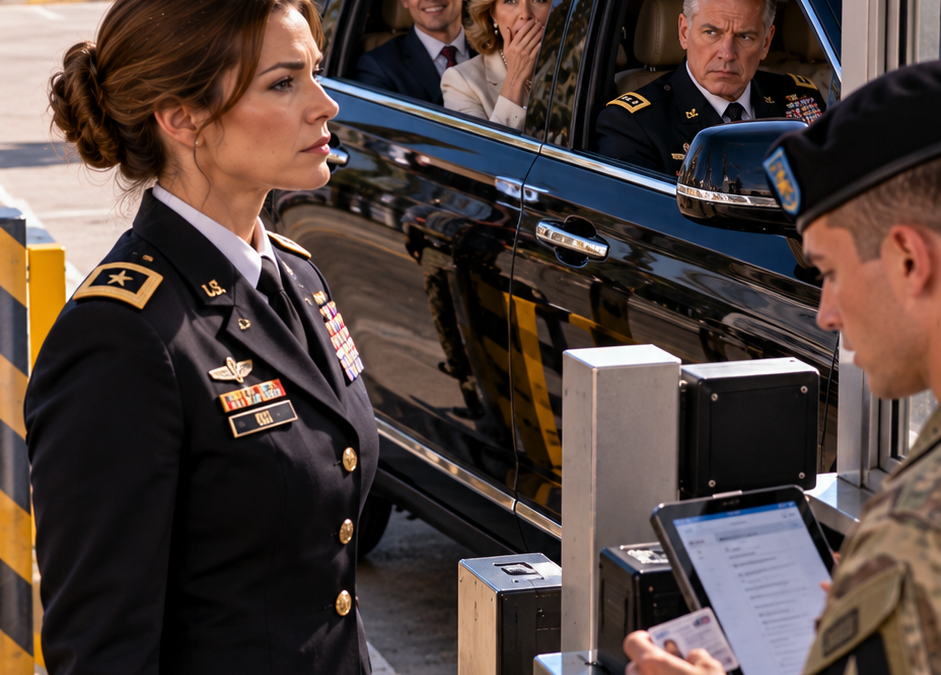
I stepped through the doors anyway.
Conversation faded around me.
My mother went pale.
Penn stared.
Then Major General Adrian Mercer, the installation commander, turned toward the room.
His face brightened.
“Ladies and gentlemen, before we begin…”
My father stiffened.
Mercer gestured toward me.
“We have the honor of welcoming Brigadier General Sable Rowan Vale.”
The entire room stood.
Applause exploded around us.
I had spent most of my career learning not to mistake ceremony for truth.
A room could stand for you and still know nothing about you.
A family could sit beside you for years and somehow know even less.
I returned Mercer’s greeting, shook his hand, and let him guide me toward the front row.
“General Vale,” he said quietly, his smile still in place for the room. “I had no idea you were coming.”
“I wasn’t certain I would.”
He glanced toward my father.
Something passed across his face.
Not surprise.
Recognition.
That interested me.
“You’ll sit with the family, of course,” Mercer said.
“No,” my father said.
The word came too quickly.
Mercer turned.
My father seemed to realize what he had done.
He cleared his throat.
“I mean, there may not be room. The family section was arranged in advance.”
There were two empty chairs beside my mother.
Mercer looked at them.
So did everyone close enough to hear.
I saved my father from having to explain.
“The aisle is fine,” I said.
Mercer’s gaze lingered on me for half a second.
Then he nodded.
“Actually, we’ve reserved a seat beside Colonel Nasser for distinguished guests.”
“Perfect.”
My father’s shoulders loosened.
Barely.
That bothered me more than if he had glared.
Relief meant intention.
I crossed to the other side of the aisle and took my seat beside Colonel Farah Nasser, Fort Halder’s deputy commander.
We had met twice before, both times overseas, both times in rooms without windows.
She leaned toward me.
“I assume there’s a story here.”
“Several.”
“Any of them mine to know?”
“Not yet.”
She smiled faintly.
“Then I’ll behave.”
The ceremony began.
For forty-three minutes, I listened to other people describe my father.
A leader of unusual discipline.
A mentor.
A strategist.
A man who remembered the names of junior officers’ spouses.
A commander who never asked people to endure what he would not endure himself.
Each description fit.
That was the difficult part.
My father had never been a fraud.
He was generous with subordinates. Patient with young officers. Loyal to old friends. He sent handwritten condolences to families. He visited wounded soldiers without photographers. He once drove three hours through a snowstorm because a former sergeant’s wife had died and he did not want the man sitting alone at the funeral.
I knew all those things.
They were true.
So was the man who had removed his own daughter from a guest list.
People are rarely one thing.
Intelligence work teaches you that before anything else.
My father sat beneath the stage lights while Mercer spoke about his first deployment, his command years, and the operations that would later be reduced to neat paragraphs in official biographies.
My mother dabbed at her eyes.
Penn smiled when an old photograph appeared on the screen: Dad as a young captain, lean and serious, standing beside an armored vehicle in desert camouflage.
Then another picture appeared.
Dad pinning lieutenant’s bars on Penn.
A ripple of affectionate laughter moved through the auditorium because Penn had been so young in the photograph, barely twenty-two, with a grin he had not yet learned to control.
The next image was our family at Penn’s commissioning.
Mom.
Dad.
Penn.
No me.
I looked at the screen.
I remembered that day.
I had been there.
I had flown eleven hours, landed at two in the morning, changed in an airport restroom, and arrived before sunrise because Penn had once called me from college and admitted in a quiet voice that he was scared he would not make it through officer training.
I had stood beside him before the ceremony.
I had fixed the collar of his uniform.
I had told him, “You don’t have to become Dad.”
He had laughed.
“I know.”
“Good,” I had said. “Become Penn.”
There had been a photograph of the four of us.
I knew because I had a copy.
Yet somehow the slide showed a version taken after I had stepped away to answer a secure call.
The omission was small.
Almost elegant.
No one in the auditorium would notice.
My father did.
His eyes flicked toward me.
I met them.
He looked away first.
The ceremony continued.
When it was time for him to speak, Dad rose slowly.
Age had changed his movements more than I expected.
He was seventy now. Still straight-backed, still imposing, but his left knee bothered him and he placed one hand briefly on the lectern before beginning.
“I promised my wife I wouldn’t speak for forty years,” he said.
The room laughed.
Mom shook her head.
“So I have reduced my remarks to thirty-eight.”
More laughter.
That was Dad.
Dry humor delivered with a face solemn enough to make people wonder whether they had permission to laugh.
Then his voice changed.
He thanked soldiers.
Command teams.
Friends.
My mother.
“My wife, Marion, has been the fixed point in a life built around departures.”
Mom looked down.
Dad looked toward Penn.
“And my son, Major Penn Vale, who chose this difficult profession knowing exactly what it asks.”
Celia touched Penn’s arm.
I waited.
One second.
Two.
Three.
Dad moved on.
He thanked Mercer.
He thanked Fort Halder.
He thanked the enlisted aides who had organized the ceremony.
He did not say my name.
I had expected that.
Still, expectations do not always reduce impact.
Sometimes they simply give pain a schedule.
When he finished, the audience stood again.
I stood with them.
My father’s eyes found me through the applause.
For a moment, neither of us looked away.
Then Mercer returned to the lectern.
“There is one final matter.”
Dad’s expression altered.
Very slightly.
His head turned.
Mercer reached beneath the lectern and lifted a dark blue folder.
My father looked at him sharply.
I felt Colonel Nasser shift beside me.
Mercer smiled.
“Harlan, you told me you wanted no surprises today.”
A few people laughed.
My father did not.
Mercer continued.
“For those who know General Vale’s career, you know that much of the work he is proudest of involved building leaders whose contributions were not always visible.”
The room quieted.
Mercer opened the folder.
“Several months ago, while preparing for this ceremony, I requested archival material on General Vale’s early assignments. One file led to another, and eventually to an operation that remains partly classified.”
My father’s face lost color.
Not pride.
Not annoyance.
Something closer to apprehension.
I sat straighter.
Mercer glanced toward me.
“Some details cannot be discussed here. But the Department has authorized me to acknowledge that one of General Vale’s most significant contributions was helping establish an intelligence coordination framework later used across multiple commands.”
I knew the framework.
Everyone in my field did.
The Vale Protocol.
Officially, VALE had been presented as an acronym decades ago, its original development buried beneath layers of classification.
But internally, senior intelligence officers knew Harlan Vale had been one of its architects.
What few people knew was that I had spent eight years rebuilding it.
Mercer continued.
“And in one of those strange circles military careers sometimes make, the officer who modernized that framework is with us today.”
Every instinct I had sharpened over twenty years told me not to look at my father.
I did anyway.
His jaw was tight.
Mercer said my name.
“Brigadier General Sable Vale.”
The applause that followed was different from the first.
Not louder.
More personal.
Officers around me turned.
Colonel Nasser smiled.
I rose because protocol required it.
Mercer held out the folder.
“General Vale, perhaps you would join us?”
For one disorienting moment, I thought he meant my father.
Then I realized he was looking at me.
I walked onto the stage.
Dad stood several feet away.
Mercer positioned himself between us.
“This is not an award,” he said, “but an archival citation recognizing the continuity of work between two generations of officers.”
He gave me the folder.
Inside was a printed historical summary, heavily redacted.
At the bottom were two names.
Harlan Rowan Vale.
Sable Rowan Vale.
I stared at them.
We had never been listed together professionally.
Not once.
My father had made certain of that.
Mercer lowered his voice.
“I thought it mattered.”
I looked at him.
“Who authorized this?”
His expression changed.
“That,” he said softly, “is a conversation for afterward.”
We stepped back while the photographer took one official picture.
Dad and me.
Side by side.
His retirement uniform heavy with four decades of service.
My brigadier general’s star catching the auditorium light.
Neither of us smiled much.
But neither of us moved away.
When the photographer lowered the camera, Dad whispered without looking at me.
“You shouldn’t have come.”
There it was.
No misunderstanding.
No accidental omission.
I kept my voice low.
“Why?”
“Not here.”
“You chose here when you left my name off the list.”
His eyes closed briefly.
“Sable.”
“No. I’m not making a scene. I’m asking a question.”
Mercer was greeting someone a few feet away.
No one appeared to be listening.
Dad finally looked at me.
“You don’t know what you’re asking.”
“I’m asking why my father didn’t want his daughter at his retirement.”
Something moved behind his eyes.
Regret, perhaps.
Or fear.
Then Mercer turned back toward us, and the moment disappeared.
The reception afterward was held in the officers’ club beneath framed photographs of former commanders.
For the first twenty minutes, strangers kept approaching me.
Some knew my work.
Most did not.
A retired colonel told me he had read one of my threat assessments during a Baltic exercise years ago.
A civilian analyst thanked me for defending an interagency team during a budget review.
A lieutenant colonel I barely remembered said, “Ma’am, you signed my reassignment request after my wife got sick. You probably don’t remember.”
I did.
His name was Carr.
His wife had lymphoma.
“How is she?”
His face opened into a smile.
“Seven years clear.”
“That’s good to hear.”
Across the room, I saw my father watching.
Not with anger.
With an expression I could not read.
My mother approached only after the line of people around me thinned.
She held a glass of sparkling water with both hands.
“You’ve lost weight,” she said.
“Hello to you too, Mom.”
“I didn’t mean—”
“I know.”
She looked toward my uniform.
“The star suits you.”
“Stars don’t suit anyone. They mostly complicate seating charts.”
For a second, the corner of her mouth twitched.
Then the distance returned.
“You could have told us.”
“That I was promoted?”
“Yes.”
“I did.”
Her brows drew together.
“No, you didn’t.”
“I sent you and Dad an announcement three months ago.”
“I never saw it.”
“I sent it to your house.”
Mom looked toward Dad.
“He handles the mail.”
That was such a small sentence.
But something inside me shifted.
“Did he tell you I was coming today?”
She hesitated.
“Sable—”
“Did he?”
“He said you might.”
“Might?”
“He said your schedule was uncertain.”
“My schedule was uncertain. My invitation wasn’t supposed to be.”
She looked at the floor.
“I assumed there had been some administrative mistake.”
“No, you didn’t.”
Her eyes lifted.
That landed.
I regretted the sharpness immediately.
Not because it was not true.
Because truth without care is often just another form of impatience.
I softened my voice.
“Mom, you saw Penn at the gate.”
“Yes.”
“You saw me.”
“I did.”
“You didn’t stop.”
Her face changed.
“I thought your father had arranged something.”
“What?”
“I don’t know.”
“That’s the problem.”
She inhaled.
Then said something I had not expected.
“You’re right.”
It was so quiet I almost missed it.
Mom had spent much of my childhood preventing arguments by absorbing them. If Dad became stern, she became cheerful. If I became angry, she became practical. If Penn cried, she made sandwiches.
She was a woman who had spent forty years turning tension into errands.
“I’m sorry,” she said.
I looked at her.
Not enough words existed between us to fix anything in that moment.
But they were the first words that felt like an opening.
“Thank you.”
Her eyes filled.
“I should have asked more questions.”
Before I could answer, Penn appeared beside us.
“Mom, Celia needs you for a photograph.”
Mom wiped beneath one eye.
“Of course.”
She touched my sleeve before leaving.
Not a hug.
But not nothing.
Penn watched her walk away.
Then he looked at me.
“I didn’t know you were a general.”
I studied him.
“How is that possible?”
“Dad said you were working at headquarters.”
“I am.”
“He made it sound like you were… I don’t know. Staff support.”
I almost laughed.
“Staff support.”
“I’m telling you what he said.”
“And you never wondered?”
Penn’s face tightened.
“You never told me either.”
“I tried.”
“When?”
“Your promotion ceremony.”
He blinked.
“I wasn’t invited.”
“Yes, you were.”
“No.”
“I sent you an invitation.”
“I never got it.”
The noise of the reception seemed to recede.
“When?”
“January.”
He pulled out his phone.
“Show me.”
“I don’t carry archived invitations on demand.”
“No, I mean the address.”
I told him.
He stared.
“That’s my old Army account.”
“The one Dad gave me.”
“I haven’t used that in two years.”
I said nothing.
Penn looked toward our father.
His expression slowly changed.
“Why would he give you that?”
“I was hoping you could tell me.”
Celia joined us before he could answer.
She was polished in the way some people become polished through years of learning how to enter rooms without disturbing them.
“Sable,” she said. “Congratulations.”
“Thank you.”
Her cheeks colored.
“And I owe you an apology.”
“For what?”
“The gate.”
Penn glanced at her.
She continued.
“When he said clearance issue, I laughed. I thought he was joking because you work in intelligence.”
“I guessed.”
“It wasn’t kind.”
“It also wasn’t a federal offense.”
That made her smile.
“Still.”
“Apology accepted.”
Penn looked distracted.
“Sable, did Dad ever tell you not to contact me?”
“No.”
“He told me you didn’t want family involved in your career.”
“I didn’t want family influence involved in my career. That’s different.”
“He said you wanted distance.”
“I wanted independence.”
Penn gave a small, humorless laugh.
“Apparently we’ve spent fifteen years speaking through a translator.”
Celia looked between us.
“I’m going to find Marion.”
When she left, Penn put both hands into his pockets.
“You really invited me?”
“Yes.”
“To your promotion?”
“Yes.”
He looked wounded in a way I had not seen since he was twenty.
“I would have come.”
“I know.”
He nodded once.
Then again, as if convincing himself.
“I would have come.”
“I know, Penn.”
Across the room, Dad was speaking to Mercer near the windows.
Mercer handed him a thin envelope.
Dad looked down at it.
Then directly at me.
“What is that?” Penn asked.
“I don’t know.”
We watched Dad place the envelope inside his jacket.
Then he walked away from Mercer.
“Something’s wrong,” Penn said.
“With Dad?”
“With all of this.”
I had spent my career dealing with information in fragments.
A missed invitation.
A wrong email address.
A guest list omission.
A newspaper profile.
Photographs chosen without me.
Any one of them could be explained.
Together, they formed a pattern.
Patterns were where truth usually began.
An hour later, the reception thinned.
Dad disappeared into a side corridor after telling Mom he needed five minutes.
I found Mercer near a display case containing ceremonial sabers.
“You said the archival citation was a conversation for afterward.”
He nodded.
“I wondered when you’d ask.”
“I’m asking.”
He glanced around.
“Walk with me.”
We stepped onto the veranda.
The wind had softened.
Beyond the parade field, spring had barely begun to return to the trees.
Mercer buttoned his jacket.
“Your father opposed the citation.”
“I gathered that.”
“He called me twice.”
“Recently?”
“Last month.”
“What did he say?”
“That connecting your career publicly to his might create the wrong impression.”
“He’s been avoiding that impression for twenty years.”
Mercer studied me.
“You know, I served under Harlan when you were at the academy.”
“That sounds unfortunate.”
“It often was.”
Despite himself, he smiled.
Then his face became serious.
“He was proud of you.”
“No.”
“Yes.”
“General—”
“I’m not telling you how to feel about your father. I’m telling you what I witnessed.”
I said nothing.
“He had your academy class photograph in his desk.”
“That proves I graduated.”
“He knew your class standing.”
My throat tightened.
“He knew where you were assigned before official announcements reached the command.”
“He had friends.”
“He kept every unclassified article that mentioned your work.”
I looked away.
Across the field, a flag moved in the wind.
Mercer continued quietly.
“When you were selected for brigadier general, he called me.”
That turned me back.
“He called you?”
“He wanted to know whether the selection had been confirmed.”
“Why?”
“I assumed pride.”
“Did he tell you?”
“No.”
“Then don’t assume.”
Mercer nodded.
“Fair.”
I folded my arms.
“Why oppose the citation?”
“He said your career should stand independently.”
“That sounds noble enough to be suspicious.”
“He also said something else.”
“What?”
Mercer hesitated.
“He said, ‘She has already paid enough for my name.’”
The wind moved between us.
I felt something cold settle beneath my ribs.
“What does that mean?”
“I asked him.”
“And?”
“He wouldn’t answer.”
“Do you know?”
“No.”
I searched Mercer’s face.
He was telling the truth.
Or believed he was.
“Why did you proceed?”
“Because the citation was historically accurate. And because I thought your father was protecting you from a problem that no longer existed.”
“What problem?”
“That’s what I’ve been trying to determine.”
He looked back toward the building.
“Have you ever heard the name Elias Venn?”
It took a second.
Then memory shifted.
“Colonel Elias Venn?”
Mercer nodded.
“He worked with Dad in Europe.”
“He did.”
“I met him once when I was a kid.”
“How old?”
“Maybe eleven.”
“What do you remember?”
A porch.
Summer heat.
A man laughing too loudly.
A silver watch.
My father telling me to go inside.
“Almost nothing.”
Mercer drew a slow breath.
“Venn was investigated for unauthorized intelligence disclosures in the late nineties.”
“I know the case.”
“Publicly?”
“The sanitized version.”
“Your father was interviewed.”
“That isn’t in the record.”
“No.”
My attention sharpened.
Mercer continued.
“I discovered it while reviewing sealed personnel material tied to the early protocol work.”
“Was Dad suspected?”
“I don’t know.”
“Then what do you know?”
“That after the Venn investigation, your father made a formal request.”
“For what?”
“To separate your future personnel records from his command sponsorship.”
I stared at him.
“That doesn’t make sense. I was a teenager.”
“You were seventeen.”
I remembered being seventeen.
Dad had barely spoken to me that year.
Every conversation had become an instruction.
Where are you going?
When will you be back?
Have you finished your application?
Why intelligence?
Why not logistics?
Why not engineering?
Why do you always need to choose the hardest route?
At the time, I had interpreted it as disappointment.
Maybe that was what it had been.
Or maybe I had named something before I understood it.
“What exactly did he request?”
“That if you entered military service, no assignment, evaluation, promotion recommendation, or intelligence access determination should rely on his endorsement.”
I almost smiled.
“He got his wish.”
Mercer shook his head.
“You misunderstand. That kind of request wasn’t necessary. Family members do not normally receive career credit merely because of a parent’s rank.”
“I’m aware.”
“Which is why the request stood out.”
“Was it approved?”
“Yes.”
“Who signed it?”
“I don’t know. The authorization was above my access.”
That surprised me.
There were not many things above a major general’s access inside ordinary archival review.
Mercer continued.
“Then, several years later, after you entered intelligence, your father submitted another memorandum.”
“For?”
“I only saw the reference, not the document.”
“What reference?”
Mercer reached inside his jacket and gave me a folded piece of paper.
Not classified.
A citation number.
A date.
And a subject line.
PERSONNEL CONFLICT SAFEGUARD — VALE, S.R.
My own initials.
Dated eighteen years earlier.
I read it twice.
“What does this safeguard do?”
“I don’t know.”
“You’ve never seen one?”
“No.”
“Neither have I.”
“That’s why I thought you should ask him.”
I folded the paper.
“Is that what was in the envelope you gave him?”
Mercer looked surprised.
“No.”
“What was that?”
“Something else from the archive.”
“What?”
Before he could answer, the veranda door opened.
Dad stood there.
For once, he looked every one of his seventy years.
“Adrian,” he said.
Mercer met his eyes.
“Harlan.”
Dad looked at the paper in my hand.
His expression hardened.
“You had no right.”
Mercer’s voice stayed calm.
“It concerns her.”
“It concerns decisions made before either of you understood the circumstances.”
“I understand my own personnel file,” I said.
Dad looked at me.
“No. You understand what you were allowed to see.”
There was no anger in his tone.
That made the words worse.
I stepped toward him.
“Then tell me.”
He glanced past me toward the parade field.
“I won’t discuss it here.”
“Fine. Where?”
He was silent.
“Dad.”
“Come to the house tonight.”
Penn’s voice came from behind him.
“All of us?”
Dad turned.
Penn stood in the doorway with Mom beside him.
Mom looked from Dad to me.
“What is going on?”
Dad closed his eyes.
For the first time in my life, I saw him look cornered not by enemies, not by command, but by his own family asking the same question at once.
He opened the door wider.
“Tonight,” he said. “Seven.”
Then he walked away.
My parents’ house sat twenty minutes outside Fort Halder on a quiet street lined with maple trees.
They had bought it six years earlier in anticipation of retirement.
Dad had complained about the kitchen cabinets.
Mom had planted hydrangeas.
I had never been invited.
That thought arrived as I parked.
Not dramatically.
Just factually.
The house had existed for six years, and I had never crossed its doorway.
Celia arrived with Penn.
I had assumed she might stay away.
Instead, she stepped from his car carrying a bakery box.
“Peace offering,” she said.
“What is it?”
“Lemon cake.”
“To whom?”
“Everyone.”
“That may be optimistic.”
“I’m marrying into this.”
“Fair point.”
Penn managed a tired smile.
Mom opened the door before we knocked.
For a few moments, we behaved like an ordinary family.
She took coats.
Celia complimented the house.
Penn asked whether Dad’s knee was bothering him.
I looked at photographs.
There were many.
Penn’s academy graduation.
Penn’s first promotion.
Penn and Celia at a lake.
My parents in Italy.
My father with presidents, commanders, foreign officers.
Then, on a small table beside the stairs, I found one photograph of me.
I was thirteen.
My hair was in a braid.
I was sitting on Dad’s shoulders at an air show, laughing so hard my eyes were closed.
The frame was worn at the edges.
I picked it up.
Mom saw me.
“He keeps that there.”
I put it down.
“Does he?”
“He dusts it himself.”
There were a dozen answers I could have given.
None seemed useful.
Dad was waiting in the dining room.
He had changed out of uniform.
A navy sweater made him look smaller.
Not weak.
Human.
On the table lay the envelope Mercer had given him.
Beside it was an old metal document box.
Dad waited until we were seated.
Then he looked at Celia.
“This is family business.”
Celia stood immediately.
“Of course.”
Penn reached for her hand.
“No.”
Dad frowned.
Penn’s voice stayed steady.
“She’s my family.”
Celia said softly, “Penn—”
“I want you here.”
Dad studied his son.
Something like approval appeared briefly.
“Very well.”
Celia sat.
Mom folded her hands.
Dad looked at me.
“You wanted an explanation.”
“Yes.”
“You may not like it.”
“I haven’t liked the absence of one.”
He accepted that.
Then he opened the metal box.
Inside were folders.
Old ones.
Paper, not digital.
He removed the first.
“Elias Venn was my closest friend for twelve years.”
I remembered the silver watch.
The booming laugh.
Dad telling me to go inside.
“We served together in Germany, Bosnia, and later in Washington,” he continued. “He was brilliant. Charming. Good with people. Better with secrets than anyone I knew.”
“That doesn’t sound like a compliment,” Penn said.
“It isn’t.”
Dad looked down at the folder.
“In 1998, classified reporting began appearing outside authorized channels. Nothing catastrophic. Fragments. Operational assessments. Names omitted, details changed. Enough to suggest that someone with high-level access was speaking carelessly.”
“Venn?” I asked.
“He became the focus.”
“Was he guilty?”
Dad’s answer took too long.
“We never proved criminal intent.”
“That wasn’t my question.”
“No,” he said. “We never proved he deliberately betrayed anyone.”
Mom’s face had gone still.
She knew this story.
At least part of it.
Dad continued.
“But Venn liked being important. He liked letting people know he understood things they didn’t. He talked to journalists, industry contacts, political staff. He believed he could control what he revealed.”
“And couldn’t,” I said.
“No.”
Dad pushed the folder toward me.
Inside was a photocopy of an old memorandum.
Most names were blacked out.
One was not.
H. R. Vale.
“I was questioned because I worked closely with him,” Dad said. “Our names were connected professionally. For nearly a year, every decision I had made was reviewed.”
“But you were cleared.”
“Yes.”
“Then what does that have to do with me?”
Dad looked at me.
“You met Venn.”
“I was eleven.”
“You met him more than once.”
“So?”
“He took an interest in you.”
My stomach tightened, though his tone remained measured.
“What kind of interest?”
“Academic. You were reading books years ahead of your grade. You solved puzzles he brought. You asked questions.”
“I was a kid.”
“You were very bright.”
Penn leaned back.
“She’s still in the room, Dad.”
Dad gave him a look.
Penn shrugged.
“Just saying.”
A tiny pressure in the room eased.
Dad almost smiled.
Then he went on.
“Venn used to joke that you would grow up and take my job.”
“I don’t remember.”
“You wouldn’t.”
“What happened?”
“One afternoon, he gave you a notebook.”
A memory surfaced.
Blue cover.
Graph paper.
A brass clasp.
I stared at Dad.
“I had a cipher notebook.”
“Yes.”
“He taught me substitution codes.”
“Yes.”
“I thought you gave it to me.”
“No.”
I could almost feel the old notebook in my hands.
I had carried it for months.
Made codes with Penn.
Written secret messages about teachers, neighbors, Christmas presents.
“What did that have to do with the investigation?”
Dad looked at Mom.
She looked down.
Then he said, “Venn hid information in it.”
Nobody moved.
I stared at him.
“What?”
“Not classified documents. Numbers. Contact references. Meeting dates. Things that meant nothing to a child.”
My voice came out quiet.
“He used me to store information?”
“I don’t know what he intended.”
“You just said—”
“I said he hid information in the notebook. I don’t know whether he expected to retrieve it, whether he thought no one would look there, or whether he had convinced himself it was harmless.”
Penn’s face had gone pale.
“What happened to the notebook?”
Dad looked at me.
“You brought it to me.”
Memory shifted again.
I had been crying.
Why?
I could not remember.
“I found a page torn loose,” Dad said. “You told me Mr. Venn had told you never to show anyone the last section.”
Something cold moved across my skin.
“I told you that?”
“Yes.”
“What did you do?”
“I turned it over to investigators.”
“And?”
“The references helped establish the scope of his unauthorized contacts.”
I sat back.
A childhood object had suddenly become evidence.
Not a dramatic betrayal.
Something stranger.
A small adult secret placed in a child’s hands because no one believed the child would matter.
“Why didn’t you ever tell me?”
“You were eleven.”
“I’m forty-three now.”
Dad looked away.
“I intended to.”
“When?”
He had no answer.
Penn asked, “Is that why you tried to keep Sable out of intelligence?”
Dad nodded.
“At first.”
“At first?” I repeated.
“When you applied to the academy, I knew the Venn investigation remained in sealed records. I knew anyone reviewing your background thoroughly could find your name buried in associated material.”
“But I wasn’t under investigation.”
“No.”
“I was a child.”
“Yes.”
“Then why would it matter?”
“It shouldn’t have.”
That word settled heavily.
Shouldn’t.
Dad continued.
“But organizations are made of people. People remember names. They draw lines between facts even when the lines shouldn’t exist.”
“So you decided to cut the line yourself.”
“Yes.”
“By acting like you didn’t have a daughter?”
His face tightened.
“No.”
“That is what you did.”
“I separated our careers.”
“You separated our lives.”
He looked at me then.
“I know.”
The admission stopped me.
No defense.
No correction.
Just two words.
Mom spoke quietly.
“Harlan thought distance would protect you.”
“And you agreed?”
She shook her head.
“Not at first.”
“At first?”
Mom looked at Dad, then back at me.
“After your academy appointment, someone contacted the house.”
“Who?”
“We never knew.”
Dad said, “A reporter.”
“About Venn?”
“Yes.”
“What did they ask?”
“Whether my daughter’s appointment had been influenced by people connected to the investigation.”
My stomach turned.
“Was anything published?”
“No.”
“Because?”
“I spoke to the academy. The appointment process was documented. Your record was clean. There was no story.”
“Then why keep going?”
Dad rubbed one hand over his face.
“Because I became convinced attention itself was the danger.”
I studied him.
There was the hidden truth.
Not a conspiracy.
Not some grand betrayal.
Fear.
A disciplined man had become afraid of something he could not completely control, and because fear looked too much like weakness to him, he had disguised it as strategy.
“You decided if you never praised me publicly,” I said, “no one could say I benefited from you.”
“Yes.”
“If you never helped me—”
“No one could say your career was mine.”
“If you never came to promotions—”
His eyes lowered.
“That was different.”
“How?”
“I was asked not to attend one.”
“By whom?”
He looked at me.
“Your first intelligence command.”
That made no sense.
“Who?”
“I won’t give you a name without permission.”
“Dad, this was fifteen years ago.”
“And some promises do not expire.”
I felt anger rise and forced it back.
“You chose that promise over showing up for me.”
“I believed the request was made for your protection.”
“Did you ever ask me?”
“No.”
“That answer keeps appearing.”
“I know.”
Penn leaned forward.
“What about me?”
Dad turned toward him.
“What about you?”
“You told me she wanted distance.”
“I thought that was easier.”
“For whom?”
Dad did not answer.
Penn’s voice remained controlled, but hurt showed through it.
“You gave Sable my old email address.”
Dad closed his eyes.
“You found that out.”
“Yes.”
“Why?” I asked.
Dad looked toward the table.
“I didn’t want you two comparing what I had told you.”
The room became very quiet.
Mom whispered, “Harlan.”
He nodded.
“I know.”
Not justification.
Admission.
A crack widened inside the version of my father I had carried for decades.
He had not forgotten me.
He had not failed to notice me.
He had actively constructed distance because he believed distance was safer.
Then, over time, he had begun protecting the distance itself.
That was harder to forgive.
And easier to understand.
Both things could be true.
Dad opened the second folder.
“This is the request Adrian found.”
He slid it toward me.
PERSONNEL CONFLICT SAFEGUARD — VALE, S.R.
The document was short.
I read it slowly.
It requested that my assignments and advancement be insulated from any review authority connected to Harlan Vale or officers directly subordinate to him.
No endorsements.
No informal recommendations.
No preference.
No punitive inference based on his old associations.
I looked up.
“You requested protections against punishment too.”
“Yes.”
“You didn’t just want to stop favoritism.”
“No.”
“You thought someone might hold Venn against me.”
“I wanted the record to make clear that they could not.”
I read the final paragraph.
Then stopped.
There was an endorsement signature.
Not my father’s.
A name I knew.
General Estelle Maren.
The first woman to lead Strategic Intelligence Command.
A legend by the time I entered service.
“She approved this?”
“Yes.”
“You knew Maren?”
“Very well.”
“She mentored me.”
“I know.”
The words landed almost physically.
“She interviewed me for my first command.”
“I know.”
“She recommended me for the joint task group.”
“I know.”
I stared at him.
“Did you ask her to?”
“No.”
“Did you ever contact her about me?”
“Once.”
“When?”
“When you were nineteen.”
“For what?”
“To tell her never to help you because of me.”
I gave a disbelieving laugh.
“That sounds like helping me because of you.”
“I realized that after I said it.”
Even Penn smiled faintly.
Dad did too.
For one second, we were family.
Then he reached for the envelope Mercer had given him.
“This arrived in the archive three weeks ago.”
He placed it between us.
“What is it?” Mom asked.
Dad did not answer.
He looked at me.
“Open it.”
Inside was a letter.
Handwritten.
The paper was old but carefully preserved.
The date at the top was fourteen years earlier.
The signature at the bottom made me stop breathing for a moment.
Estelle Maren.
I had attended her funeral nine years ago.
I unfolded the pages.
Dear Harlan,
If you are reading this, then either I have finally convinced you to stop being stubborn or someone has waited until I am no longer available to argue with you.
That sounded like her.
Even from the grave, Maren had no patience for ceremony.
I kept reading.
You asked me years ago to make certain Sable was judged without your shadow. I did. What you never understood was that a shadow is not removed by turning off the light.
My eyes blurred.
I blinked.
The room remained silent.
Maren wrote about my first years in intelligence.
My evaluations.
My mistakes.
My refusal to invoke my father’s name.
She wrote that she had watched me avoid officers who had served with Dad because I feared being seen as favored.
Then came the line that changed the room.
Sable believes you are ashamed of her.
I stopped.
Dad looked down.
I continued.
I know this because she told me.
Not directly. Sable does very little directly when pain is involved. She said, “My father prefers my work not be associated with his.” I asked whether that bothered her. She said, “It makes things simpler.”
You and I both know what soldiers mean when they say something makes things simpler.
I had forgotten that conversation.
Or buried it.
Maren went on.
You are trying to protect her reputation. Instead, you are teaching her that your pride in her must be hidden.
There is a difference between refusing to open a door for your daughter and pretending she is not standing outside it.
My father’s eyes were wet.
I had never seen that before.
Not once.
I finished the letter.
The final paragraph was brief.
Someday, Harlan, she will outrank the version of herself you are still trying to protect. When that happens, tell her the truth. Tell Penn too. Families do poorly with classified information.
Then came the signature.
Estelle.
Below it, in different handwriting, someone had added a note.
Delivered to Fort Halder archives pursuant to Gen. Maren’s sealed instruction upon Lt. Gen. Harlan Vale’s retirement.
Mercer had not chosen the timing.
Maren had.
Fourteen years earlier.
I set the letter down.
Nobody spoke.
Dad finally said, “She called me after writing that.”
“What did you tell her?”
“That she was wrong.”
“Was she?”
He looked at me.
“No.”
The answer was barely audible.
Mom reached across the table and placed her hand over his.
Penn looked away toward the window.
Celia’s eyes shone, but she said nothing.
I felt no victory.
That surprised me.
For years, I had imagined explanations.
Some childish part of me had believed that if Dad ever admitted he had hurt me, satisfaction would follow.
Instead, there was grief.
Not only for what had happened.
For how unnecessary so much of it had been.
“I don’t know what to do with this,” I said.
Dad nodded.
“I don’t expect you to.”
“I missed your sixtieth birthday because you told me it was family only.”
His face tightened.
“I know.”
“I am family.”
“Yes.”
“You told a newspaper reporter you had one child in uniform.”
“I know.”
“Why?”
“I panicked.”
“At sixty-eight?”
“Yes.”
That almost made me laugh.
Harlan Vale.
Lieutenant general.
Forty years of command.
Panicked by a reporter asking about his daughter.
“It sounds ridiculous,” he said.
“It does.”
“I know.”
Penn cleared his throat.
“What happens now?”
No one answered.
That was the first honest moment of the evening.
Because there was no operational plan for repairing twenty years.
No sequence.
No briefing slide.
No checklist.
Mom finally said, “We eat.”
Penn looked at her.
“What?”
“The lemon cake.”
Celia blinked.
Mom stood.
“I don’t know how to repair this either. But Celia brought cake, and I have spent my entire adult life feeding people when conversations become impossible.”
Penn laughed.
A small laugh.
Then I did.
Even Dad smiled.
It was not forgiveness.
But it was the first time all evening that nobody was pretending.
We moved to the kitchen.
Mom cut the cake.
Penn found coffee.
Celia opened drawers until she found forks.
Dad stood near the counter looking unsure where to place himself in his own house.
I noticed another photograph on the refrigerator.
Me.
A picture from my colonel promotion.
I looked at Dad.
“You had this?”
He nodded.
“Who sent it?”
“Maren.”
“She died before I made colonel.”
He stared.
Then walked to the refrigerator.
He removed the photograph.
On the back was handwriting.
Not Maren’s.
Dad frowned.
“I thought…”
He stopped.
“What?”
“I thought Estelle sent this.”
“When did you get it?”
“A few days after the ceremony.”
“Who was there?”
“Your command team.”
“And Penn,” I said.
Penn nearly dropped the coffee pot.
“What?”
I looked at him.
“You were there.”
His face went blank.
“No, I wasn’t.”
“Yes.”
“Sable, I told you. I never received an invitation.”
“You didn’t come to the formal ceremony.”
I looked at the photograph again.
“But someone came to the reception afterward.”
Penn frowned.
I remembered rain.
A hotel lobby.
A man in civilian clothes standing near the entrance.
I had seen him from behind and thought—
I looked at my brother.
“I thought it was you.”
“It wasn’t.”
Dad turned the photograph over again.
In the lower corner of the image stood a blurred figure.
Only part of his face visible.
Older.
Gray-haired.
Watching me.
Dad gripped the edge of the photograph.
“Who is that?” Celia asked.
My father did not answer immediately.
Then he said a name I had not heard spoken in decades.
“Elias Venn.”
Penn stared.
“I thought he disappeared after the investigation.”
Dad’s expression changed.
“No.”
He looked at me.
“He disappeared before the investigation ended.”
The kitchen seemed suddenly smaller.
I took the photograph from his hand.
Venn had been standing at my colonel promotion reception.
Seven years after the personnel safeguard.
Nearly two decades after he had placed coded information in an eleven-year-old girl’s notebook.
And somehow that photograph had arrived anonymously at my father’s house.
I looked at Dad.
“Did you know he was still watching my career?”
His answer was immediate.
“No.”
For the first time that day, I believed him without reservation.
Dad reached for the old document box.
Then stopped.
His face had gone very still.
“There’s one more thing.”
“What?”
He looked at Mom.
Then Penn.
Then me.
“When Venn vanished, investigators believed he left the country.”
“And?”
Dad’s eyes remained on the photograph.
“Three years later, I received a letter from him.”
I felt the room change.
“What did it say?”
Dad opened the metal box again.
This time, he reached all the way to the bottom.
But the compartment he opened was empty.
He stared at it.
Mom stepped closer.
“Harlan?”
Dad moved two folders aside.
Then another.
His voice dropped.
“The letter was here.”
“You lost it?” Penn asked.
“No.”
Dad slowly raised his eyes.
“I read it two nights ago.”
Nobody moved.
“What was in it?” I asked.
He looked at me.
“Your name.”
For the first time since entering Fort Halder that morning, the question was no longer why my father had spent twenty years keeping me at a distance.
It was whether someone else had been close enough to understand exactly what that distance would do.
Dad turned the metal box upside down over the kitchen table.
Folders slid out.
Old memoranda.
Photocopies.
A sealed envelope that had yellowed at the edges.
A cracked leather notebook.
No letter.
Mom pressed one hand against the counter.
“Who else knew it was there?”
“No one,” Dad said.
Penn looked at the back door.
“You said you read it two nights ago. Where?”
“In my study.”
“Did you put it back?”
Dad opened his mouth.
Then closed it.
That hesitation frightened me more than the missing letter.
“Dad.”
“I thought I did.”
“You thought?”
He rubbed his forehead.
“I read it. Then I took it upstairs.”
“Why?”
“Because I didn’t want your mother finding it.”
Mom’s face tightened.
“Harlan.”
“I know.”
“No,” she said. “I don’t think you do.”
He accepted that with a small nod.
I stepped closer.
“Where upstairs?”
“My nightstand. Then my jacket pocket. Then…”
He stopped.
“Then what?”
His eyes moved toward the hallway.
“The photograph.”
I looked at the colonel promotion photo.
“What about it?”
“I took the letter out again after seeing the photograph this morning. Before the ceremony. I wanted to compare the handwriting.”
“And?”
“It was Venn’s.”
“Then where did you put it?”
Dad stared at the photograph.
“Behind the frame.”
Penn moved first.
He took the picture from my hand, slid the backing loose, and reached behind the mat.
His fingers closed around folded paper.
For several seconds, no one breathed.
Then he pulled it free.
The page was old, creased, and written in a hand that looked elegant in the way sharp knives look elegant.
Dad’s shoulders sagged.
Mom whispered, “Thank God.”
I did not share her relief.
Not yet.
A missing letter found behind a photograph was better than a stolen one.
But the fact remained.
Elias Venn had sent a picture of himself watching my career.
And my father had hidden the letter explaining why.
Penn handed it to me.
My name appeared in the first paragraph.
Harlan,
If this reaches you, then you already know I kept an eye on the girl.
Not because she was yours.
Because she was sharper than you ever allowed yourself to admit in public.
I felt my father flinch beside me.
I kept reading.
You will tell yourself distance protects her. You have always preferred a perimeter to an honest conversation.
But distance also creates blind spots.
Remember that.
I read the next paragraph twice.
The notebook was not meant for her to keep. It was meant for you to find.
Dad made a sound behind me.
I turned.
“What?”
He shook his head.
“I thought he used you because you were convenient.”
The letter proved otherwise.
Venn had given me the notebook because he knew my father would search every object that came near me after I told him something felt wrong. He had used a child not as a hiding place, but as a delivery method.
I continued.
You were always better at protecting systems than people, Harlan. So I gave the information to the one person you could not ignore.
Your daughter.
The words blurred for a moment.
Dad sat down slowly.
Penn leaned against the counter.
Mom stood frozen.
I kept reading.
I do not expect forgiveness. I do not even know whether what I did can be called help. I was already tangled in mistakes, ego, and cowardice by then. But the fragments in that notebook prevented worse things from happening. You know that. So do the men who will never admit they needed evidence from an eleven-year-old girl.
Tell her someday.
Not the details.
Tell her that she mattered before anyone thought to ask whether she should.
My hand tightened around the page.
The final lines were worse.
If you bury this, you will do what you always do.
You will turn protection into distance and distance into habit.
One day, she will stand in a room wearing the rank she earned without you.
If you have any courage left by then, stand beside her.
If you do not, at least stop standing in front of the door.
I lowered the letter.
No one spoke.
The kitchen lights hummed softly above us.
Outside, tree branches moved against the window.
It was Celia who finally said, “He knew.”
Her voice was small but clear.
We all looked at her.
She swallowed.
“He knew what the distance would do. Venn. Maren. They both knew.”
Penn stared at the letter.
“And still none of you told her.”
Dad closed his eyes.
“No.”
His voice was broken.
“No, we did not.”
I looked at him.
“You received this three years after Venn vanished?”
“Yes.”
“And you still kept going?”
He looked up.
“I was afraid.”
The sentence was so plain that it stripped the room bare.
No strategy.
No doctrine.
No classified reasoning.
Just fear.
“Of what?” I asked.
“That if I stood beside you, every old shadow attached to me would reach you. That if I praised you, people would say you had not earned it. That if Venn was still alive and watching, any public association between us might give him leverage. That if anyone connected your career to mine, all your work would be questioned.”
He looked down at his hands.
“And then, after a while, I was afraid of admitting how long I had let that fear decide for me.”
Mom sat beside him.
“You let it decide for all of us.”
“I know.”
Penn said quietly, “You made me think she didn’t want us.”
Dad’s face tightened.
“I know.”
“You made her think we didn’t want her.”
“I know.”
I stared at the letter.
The strangest part was that I understood him.
Not approved.
Not forgave.
Understood.
Fear can look intelligent when it wears a uniform.
It can sound like risk management.
It can turn love into policy.
It can convince a man that distance is mercy, and by the time he realizes mercy has become abandonment, the people he meant to protect have learned how to live without him.
I folded Venn’s letter and placed it beside Maren’s.
Two ghosts on a kitchen table, both more honest than the living had been.
Dad looked at me.
“I don’t know how to repair this.”
“Good,” I said.
He blinked.
“Good?”
“Yes. Because if you thought you knew, I wouldn’t trust it.”
A tiny, painful smile moved across his face.
Then disappeared.
“What do you want me to do?”
It was the first time he had asked.
Not ordered.
Not explained.
Asked.
I looked at the photographs on the refrigerator.
Me as a colonel.
Penn at his academy graduation.
Dad beside commanders and presidents.
A family wall assembled from omissions and private regrets.
“I want you to stop managing the truth.”
He nodded once.
“I want Mom to hear things from me, not through you.”
Mom said, “Yes.”
“I want Penn to have my actual contact information.”
Penn let out a breath that was almost a laugh.
“That would be useful.”
“And I want no public correction right now.”
Dad looked surprised.
“No?”
“No. Not because I’m protecting you. Because I am not interested in becoming the final act of your retirement ceremony.”
His eyes lowered.
“But,” I continued, “when people ask, you will tell the truth.”
“What truth?”
“That you have two children in uniform.”
Penn looked at me.
Dad nodded.
“And if they ask why I wasn’t mentioned before?”
“Tell them that is your mistake to explain.”
He absorbed that.
“Yes.”
I picked up Maren’s letter.
“And I’m keeping this.”
“Of course.”
“And Venn’s.”
Dad hesitated.
Then nodded.
“It concerns you.”
“That answer also keeps appearing late.”
“I know.”
For the first time, there was no authority left in his voice.
Only a father who had spent twenty years building a wall and finally understood he could not order the rubble back into a home.
We ate cake after that.
It sounds absurd because it was.
Mom cut lemon cake with trembling hands.
Celia passed forks.
Penn made coffee too strong even by my standards.
Dad sat at the table and looked like a man who had survived a battle he could not claim to have won.
No one knew what to say.
That was strangely comforting.
For once, nobody filled the silence with explanations.
Before I left, Penn walked me to my car.
The night had turned cold.
He shoved his hands into his jacket pockets.
“I’m sorry about the gate.”
“You already said that?”
“No, Celia did. I laughed.”
“You thought it was a joke.”
“I wanted it to be.”
I looked at him.
He rubbed one hand over the back of his neck.
“I thought you looked down on us.”
“I know.”
“I thought you stayed away because we weren’t important enough.”
“I know.”
He turned toward me.
“Did you?”
“No.”
He nodded, but the answer hurt him anyway.
Truth often does.
“I would’ve come,” he said again.
“To the promotion?”
“To all of it. If I had known.”
“I believe you.”
His eyes filled suddenly, and he looked away.
Penn had always hated crying more than injury.
I touched his shoulder.
It was awkward.
Then it was not.
“We start with correct phone numbers,” I said.
He laughed once.
“Low bar.”
“It seems necessary for this family.”
He nodded.
“I’ll send you mine.”
“Use one you actually check.”
“Brutal.”
“Accurate.”
When I turned toward my car, Dad was standing on the porch.
He did not call out.
He did not ask me to stay.
He simply stood there, one hand resting on the railing, watching his daughter leave from a house she had never been invited into until the truth finally forced the door open.
I stopped beside the driver’s door.
“Dad.”
His posture changed.
“Yes?”
“I don’t forgive you tonight.”
He closed his eyes briefly.
“I know.”
“But I understand more than I did this morning.”
He opened them.
For Harlan Vale, that was enough to nearly break him.
“Thank you,” he said.
I got into my car and drove away.
The next morning, I returned to Fort Halder for a final scheduled briefing before leaving.
Mercer met me outside the headquarters building.
“You found the letter,” he said.
I looked at him.
“Of course you knew there was a letter.”
“I knew of it. Not its contents.”
“Maren?”
“Partly.”
“Venn?”
“Partly.”
I studied him.
He did not flinch.
“Your family produces difficult archives,” he said.
Despite everything, I laughed.
Then I handed him a copy of Venn’s letter.
“Secure it properly this time.”
He accepted it.
“Yes, ma’am.”
“And Mercer?”
“Yes?”
“You were right about the citation.”
He gave one small nod.
“I’m glad.”
“It mattered.”
“I thought it might.”
I walked past him into the building.
For the first time in years, I did not feel like I had to make myself smaller to keep my father’s name from touching mine.
His name had touched mine all along.
In records.
In rumors.
In fear.
In pride he hid badly.
In distance he called protection.
In a protocol we had both shaped without standing together.
But my work was still mine.
My rank was mine.
My life was mine.
A week later, a revised official photograph arrived in my secure inbox.
The archival citation ceremony.
Harlan Rowan Vale and Sable Rowan Vale standing side by side.
This time, attached beneath it, was a short corrected biography for my father’s retirement archive.
It listed his wife, Marion.
His son, Major Penn Vale.
And his daughter, Brigadier General Sable Rowan Vale.
No praise.
No drama.
Just the truth.
I stared at that line longer than I expected.
Then I forwarded it to Penn.
He replied within thirty seconds.
About time.
A second message followed.
Also, Mom wants your real mailing address. She says she has twenty years of birthday cards to overcorrect for.
I smiled despite myself.
Tell her one card is fine.
Penn replied:
You tell her. I’m not getting between two generals.
For the first time in a long time, I laughed without bitterness.
That evening, I placed Maren’s letter and Venn’s letter in a locked drawer inside my quarters.
Not because I wanted to hide them.
Because some truths deserve protection after spending too long being misused.
My father called three days later.
I let it ring twice before answering.
“Sable.”
“Dad.”
A pause.
Then, carefully, “What are you working on these days?”
Such a simple question.
So late.
Still, not worthless.
“Some of it, I can’t tell you.”
“I know.”
“But some of it, I can.”
“I’d like to hear that part.”
I looked out the window at the fading light.
For years, I had mistaken his silence for shame.
He had mistaken distance for protection.
Penn had mistaken absence for choice.
Mom had mistaken peacekeeping for love.
We had all been wrong in different directions.
So I began where I could.
“There’s a coordination framework you might remember,” I said. “Officially, it was called VALE.”
On the other end of the line, my father became very still.
“Yes,” he said. “I remember.”
“I rebuilt part of it.”
“I know.”
“No,” I said. “You know the fact. I’m going to tell you the work.”
A silence.
Then his voice changed.
Softer.
Ready.
“All right.”
I sat down.
And for the first time in twenty years, I told my father the truth without feeling like I had to prove I had earned the right to speak.
He listened.
That did not fix everything.
Nothing that old breaks or heals all at once.
But it was a beginning.
And after everything my family had hidden behind guest lists, photographs, old files, sealed letters, and careful omissions, a beginning felt like enough for one night.
My father had tried to keep me out of his retirement ceremony.
Instead, I walked into the auditorium and found the secret he had carried longer than his uniform.
He had thought erasing my name would protect me from his shadow.
But names do not disappear just because someone leaves them off a list.
Mine had been in the archive.
In the work.
In the letters.
In the memories he was too afraid to admit.
And finally, it was in the open.
Brigadier General Sable Rowan Vale.
Daughter.
Sister.
Officer.
Not hidden.
Not protected into loneliness.
Not waiting outside the door anymore.








