𝗙𝗨𝗟𝗟 𝗦𝗧𝗢𝗥𝗬 The General Ordered His Men to Make Me Forget My Rank Inside a Locked War Room, and the Secret He Was Protecting Was Worth More Than My Life
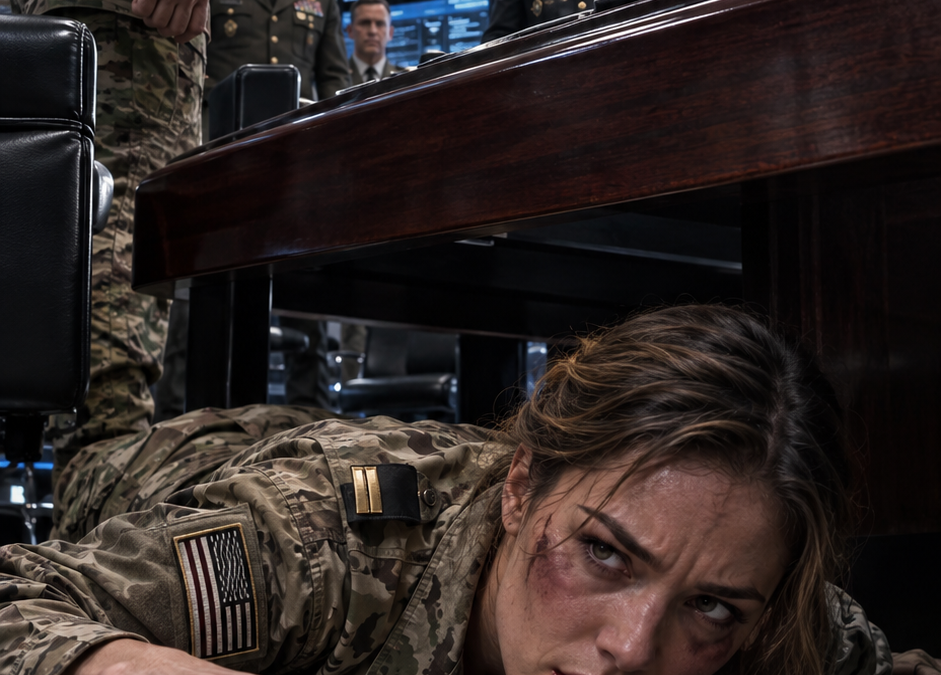
𝗙𝗨𝗟𝗟 𝗦𝗧𝗢𝗥𝗬
The steel doors locked.
So I lay there.
Captain Clara Vance.
Federal investigator.
Combat veteran.
Reduced to counting breaths beneath a table because my body could no longer support me.
One.
Two.
Three.
The room dimmed at the edges.
Then an alarm sounded.
Not the local security tone.
Three hard electronic notes.
Everyone stopped moving.
The electromagnetic locks engaged.
Then disengaged.
Sterling’s voice sharpened.
“Who authorized that override?”
Nobody answered.
The heavy doors opened.
I could see only shoes at first.
Polished black leather.
Not tactical boots.
Dress shoes.
They crossed the floor slowly.
Behind them came hurried voices.
“Sir, we didn’t receive advance—”
“We can relocate the briefing—”
“The general wasn’t informed—”
The footsteps stopped near the table.
Sterling spoke.
“Mr. Secretary.”
That woke me more effectively than adrenaline.
Arthur Pendelton.
Secretary of Defense.
Former Marine four-star.
A man with a reputation for dismantling broken commands rather than managing around them.
Sterling tried to recover.
“This is an unexpected—”
Pendelton ignored him.
I saw his shoes turn.
A pause.
Then move.
Toward the blood.
My blood.
He followed the drops under the table.
His shoes stopped inches from my face.
“General Sterling,” he said.
His voice was quiet.
“I came here personally to review the Special Inspector General audit.”
Nobody answered.
Pendelton bent.
Then I saw his face.
White hair.
Hard eyes.
And something I will never forget when he recognized me beneath that table.
Not surprise.
Fury.
“Clara?”
I tried to move.
Pain punished me immediately.
His gaze took in the torn uniform.
My blood.
The twisted captain’s bar.
Then he slowly stood.
“Why,” the Secretary of Defense asked, “is my inspector on the floor?”
Sterling answered too quickly.
“Sir, Captain Vance became unstable during a classified security incident.”
I almost laughed.
It would have hurt too much.
“She compromised an operational server,” he continued. “When challenged, she reached toward her weapon. Master Sergeant Miller responded to a perceived insider threat.”
Pendelton did not even look at him.
He knelt beside me.
A Secretary of Defense on both knees on a war room floor.
“Can you hear me?”
“Yes, sir.”
“Medical is coming.”
I put my palm against the linoleum.
“Don’t move.”
“No.”
“Clara.”
“I’m not staying down.”
I don’t know whether that was bravery either.
Maybe I simply could not tolerate giving Sterling the last image of me beneath his table.
I dragged myself out.
My ribs screamed.
Pendelton reached toward me.
I shook my head.
He understood.
I used the table.
One arm.
One knee.
Then both feet.
The room tilted violently.
But I stood.
My hair had fallen loose.
Blood ran down my chin.
One captain’s bar hung crooked from my collar.
I looked directly at Sterling.
Pendelton stood beside me.
“Report.”
My voice shook.
I hated that.
Then I stopped hating it.
Fear and pain do not make facts less true.
“The audit identified forty-two million dollars in unallocated Project Aegis funds.”
I took a shallow breath.
“The money moved through Delaware shell companies into a maritime logistics firm owned by General Sterling’s brother-in-law.”
Sterling stepped forward.
“She’s lying.”
I kept speaking.
“When I initiated preservation of the local servers, General Sterling ordered Master Sergeant Miller to incapacitate me and force authorization of a clearance waiver.”
“Arrest her!”
Sterling turned toward the MPs.
“Insubordination. Treason. Take her to the brig.”
Two MPs looked at him.
Then at Pendelton.
“If either of you moves toward Captain Vance,” Pendelton said, “you will answer directly to me.”
They stepped away.
Pendelton finally faced Sterling.
“Thomas.”
Using his first name stripped more authority from him than shouting ever could have.
“I knew your father,” Pendelton said. “I served beside you in Anbar. I remember the officer you used to be.”
Sterling’s face tightened.
“You do not understand Aegis.”
“I understand enough.”
“Arthur—”
“Don’t.”
One word.
Sterling stopped.
Pendelton moved closer.
“You thought these woods hid you.”
Sterling said nothing.
“You thought you could assault a federal investigator because she was a captain, because she was alone, and because you assumed nobody above you was looking.”
Sweat had formed near Sterling’s temple.
“You’re making conclusions before reviewing the operational—”
“I received the ledger forty-five minutes ago.”
My head lifted.
Sterling froze.
Pendelton continued.
“An encrypted transmission reached my office from this installation. The relevant files are already being preserved in Washington.”
Maya.
It had to be.
For the first time since Miller struck me, relief cut through the pain.
Pendelton looked toward the doors.
“Medical.”
They opened almost immediately.
Dr. Evelyn Mercer entered carrying a trauma kit.
Everybody at Fort Blackwood called her Doc.
She had iron-gray hair, the bedside manner of a field artillery battery, and more combat medicine behind her than most physicians ever wanted.
She came straight to me.
“Move.”
A colonel moved.
She caught my arm just as my hand slipped from the table.
“I have you.”
“I can stand.”
“Yes, and I can perform open-heart surgery with a steak knife. Sit down.”
She guided me into a chair.
Her fingers checked my pulse.
Pupils.
Jaw.
Ribs.
When she touched my left side, my body betrayed me.
I gasped.
“Three ribs minimum,” she muttered. “Possible fluid accumulation.”
Pendelton looked at her.
“How bad?”
“Bad enough that she goes to the clinic now instead of continuing whatever testosterone festival this room has become.”
Under other circumstances, somebody might have objected to the Secretary of Defense being included in a testosterone festival.
Nobody did.
Pendelton nodded.
“Take her.”
Mercer looked at me.
“Can you walk to the stretcher?”
“Yes.”
She sighed.
“Of course you can.”
As the corpsmen helped me toward the doors, I passed Miller.
He stood rigid.
His right glove was stained.
My blood.
I stopped.
He finally looked at me.
I looked at the glove.
Then back into his eyes.
He lowered them first.
Behind me, Pendelton spoke.
“General Sterling. Master Sergeant Miller. You are relieved of all duties effective immediately.”
The room went dead silent.
“Surrender your weapons.”
Sterling started to protest.
Pendelton continued.
“Department of Justice personnel are already en route.”
That was the last thing I heard before the doors closed.
The clinic smelled like antiseptic, old floor wax, and overheated coffee.
Mercer cut my uniform away.
When the fabric came off, neither of us spoke for several seconds.
A dark purple imprint spread over my ribs.
Almost the shape of a boot.
Mercer’s jaw tightened.
“Miller boxed before he joined Sterling’s security detail.”
“That explains the personality.”
“Don’t make me laugh while I’m trying to find internal bleeding.”
She injected local anesthetic.
I stared at the ceiling.
“Maya.”
“She’s safe.”
My head turned too quickly.
Pain followed.
“Where?”
“My office.”
Mercer taped gauze near my lip.
“Your lieutenant is drinking hot chocolate and shaking hard enough to create weather.”
“She sent the ledger?”
“Yes.”
I closed my eyes.
Mercer continued.
“She bypassed the communications block through the medical emergency network.”
Of course she did.
Maya understood systems.
More importantly, she had understood something I had underestimated.
When the obvious door closes, systems usually leave another one for emergencies.
“She called me first,” Mercer said. “Then she transmitted directly to Pendelton’s office.”
“She thought Sterling would come after her.”
“She was correct.”
I exhaled carefully.
“She did well.”
“She was terrified.”
“So?”
Mercer looked at me.
I opened my eyes.
“Courage isn’t the absence of terror, Doc.”
She watched me for several seconds.
“You believe that?”
“I have to.”
She started cleaning blood from my face.
Then she asked, “Why did you keep pushing?”
“The audit?”
“You knew Sterling was dangerous.”
“Yes.”
“You knew the base was compromised.”
“Yes.”
“A smart bureaucrat would have written ‘administrative irregularities,’ flown home, and collected a promotion.”
“I’m not smart.”
“No argument there.”
I almost smiled.
Then the old images came back.
My brother behind me in the hallway.
The corporal dying in Helmand.
A vehicle waiting on supplies that arrived late.
Contractors billing the government for equipment that failed soldiers who never knew somebody had taken a cut.
“People die when operational money becomes somebody’s private account,” I said.
Mercer stopped working.
“If the uniform doesn’t stand for something beyond rank, then it’s just fabric.”
Her face changed.
“My son was a Marine.”
I knew.
Most people on base knew pieces.
Not the whole thing.
“He died in Ramadi,” she continued. “Bad armor plating.”
Her voice roughened.
“The contractor providing part of that equipment was connected to a procurement committee Sterling helped oversee.”
I stared at her.
“For ten years, I’ve watched him get promoted.”
A tear appeared in the corner of one eye.
She wiped it away angrily.
“You have no idea how many times I wanted proof.”
“I didn’t bring him down alone.”
“No.”
She squeezed my hand.
“But you stood where the door had to break.”
The treatment-room door opened.
Pendelton entered with two security officers.
“The FBI’s Public Corruption unit is landing,” he said.
I tried to sit.
Mercer immediately pushed me down.
“No.”
“The investigation—”
“Is proceeding without you for several minutes,” Pendelton said.
“Sir—”
“Sterling is in custody.”
I went still.
“Miller?”
“Cooperating.”
That surprised me.
“He’s giving a deposition. Bribes. Threats. Off-books operations.”
Pendelton reached inside his coat.
He placed a small case on the table beside me.
Inside were silver oak leaves.
Major.
I stared at them.
“Sir.”
“Your promotion recommendation was submitted three months ago.”
I looked at him.
“The board considered you too aggressive.”
“That sounds familiar.”
“They wanted somebody better at playing the game.”
“And?”
Pendelton’s eyes hardened.
“I told them the game was the problem.”
He extended his hand.
I took it.
“Congratulations, Major Vance.”
The title felt strange.
Not because I didn’t want it.
Because the bent captain’s bar from my torn uniform was sitting in an evidence bag across the room.
One insignia destroyed.
Another waiting.
Before I could make meaning out of that, a woman in an FBI windbreaker entered the room.
Special Agent Katherine Reyes.
She carried a ballistic briefcase and looked like sleep was something she had stopped negotiating with years earlier.
“I need five minutes.”
Mercer crossed her arms.
“My patient has broken ribs and a concussion.”
“This can’t wait.”
“Everybody says that.”
Reyes placed a court order on the bed.
“Captain Bradley Cole barricaded himself inside Building 402.”
My fatigue vanished.
Cole.
Sterling’s logistics officer.
The man who moved the Aegis numbers.
“What is he doing?”
“Trying to destroy the physical backup.”
My heart monitor accelerated.
“Degaussing?”
Reyes nodded.
“Industrial unit.”
The Project Aegis physical arrays were the chain of custody.
Maya’s transmitted copy proved what we had found.
The original drives proved it wasn’t fabricated.
If Cole erased them, Sterling’s lawyers would spend years attacking the integrity of the digital transfer.
“How long?”
“Our tactical team is outside the blast door. Forty minutes to cut through.”
“He needs less than five once he gets power.”
“Correct.”
I tried to sit.
Pain forced me back.
Reyes leaned closer.
“I don’t need your body, Major. I need your memory.”
That got my attention.
“You audited the base architecture before you hit the financial system.”
“Yes.”
“Tell me another way into that server room.”
I closed my eyes.
Building 402.
Original construction.
Cold War infrastructure.
Modernized electrical.
Backup arrays.
Sub-floor cooling.
Steam tunnels.
My eyes opened.
“There is an old utility tunnel under the western wall.”
Reyes grabbed her radio.
“Good.”
“Wait.”
She stopped.
“The maintenance hatch has a pressure-lock system.”
“So?”
“If your team forces it, emergency valves may interpret the breach as a steam-line failure.”
Reyes frowned.
“What happens then?”
“The tunnel floods with superheated vapor.”
Her radio slowly lowered.
“How hot?”
“Hot enough that your tactical team won’t make it out.”
Silence.
Then a voice came from the curtain.
“I know the bypass.”
Maya stood there wearing an oversized fleece.
Her face was pale.
Her hands were not steady.
But she was standing.
Mercer looked at her.
“What bypass?”
“Manual isolation valve.”
Maya stepped closer.
“There’s a civil-defense access point beneath this clinic. The original utility plans connect it to the Zone Four steam line.”
“How do you know?”
“I’ve been monitoring the storm relays.”
Reyes stared.
Maya continued.
“Cole can’t charge the degausser because the power system keeps interpreting the surge as lightning instability. He’s overriding the safety relays manually.”
“How long?”
“Maybe fifteen minutes.”
Reyes swore quietly.
“Can you cut building power remotely?”
“No. He physically disconnected the network.”
“The transformer?”
“Locked.”
“Key?”
“Sterling’s security ring.”
Reyes looked at me.
I looked at Maya.
She knew what I was thinking.
“The basement,” she said.
Mercer pointed at her.
“No.”
Maya ignored her.
“The valve is accessible from the old storage corridor.”
“Which is flooded,” Mercer said.
“Three inches.”
“Dark.”
“I have eyes.”
“Old steam lines.”
“I know.”
“You’re an accountant.”
Maya flinched.
Then she looked at me.
“Major.”
The new title landed differently coming from her.
“When they hurt you this morning, I heard it.”
The room changed.
“Maya.”
“I heard the first hit.”
Her voice trembled.
“I was in the secondary office.”
She looked down.
“My first instinct was to hide.”
I said nothing.
“My parents taught me that survival meant being invisible. Keep your head down. Work harder. Don’t challenge people with power.”
Her pen slipped from her fingers.
It hit the floor.
“I wanted to crawl under the desk.”
She looked at me again.
“Then I saw the ledger on the screen.”
Tears filled her eyes.
“I saw the parts that failed. The money. The names attached to the casualty reports.”
Her voice broke.
“And I understood that staying invisible was still a choice.”
I felt something inside me shift.
For years, I had believed leadership meant taking the blow first.
Protect everyone behind you.
Stand in every doorway.
Never ask anyone else to carry your weight.
That had not begun in the Army.
It had begun at ten years old.
Maya was offering me another definition.
Maybe leadership wasn’t taking every hit.
Maybe it was helping somebody discover they could stand too.
“Please,” she whispered. “Let me do this.”
Mercer shook her head.
“Clara.”
I looked at Reyes.
“Give Lieutenant Lin a radio and a flashlight.”
Maya’s chin lifted.
Reyes handed them over.
“Channel three. If you hear steam, run.”
“Yes, ma’am.”
“No heroics.”
Maya looked at me.
For once, I didn’t tell her heroes weren’t real.
I just nodded.
She left.
I turned toward Mercer.
“Bring me your laptop.”
“You’ve lost your mind.”
“I don’t need to walk.”
“You need to breathe.”
“I can do both.”
“No human being has ever been more irritating with three broken ribs.”
“Laptop.”
Three minutes later, I had a Toughbook across my knees.
Reyes put the tactical team on channel three.
I pulled up architectural schematics through the medical intranet.
“Maya.”
Static.
Then her voice.
“I’m in.”
Water splashed around her boots.
“Look up. Gray insulated piping. Four-inch main.”
“I see it.”
“Find yellow stencil. HP-STEAM-02.”
A pause.
“Found it.”
“Follow east.”
I watched temperature numbers climb.
Two-ten.
Two-twenty-five.
Two-forty.
Cole was getting close.
“You’re looking for a green junction box marked Bypass Valve 12A.”
“Major.”
Her breathing accelerated.
“What?”
“There’s a chain.”
Of course there was.
“Can you cut it?”
“I have bolt cutters.”
Metal clanged through the radio.
Reyes asked, “Can she shoot the lock?”
“No.”
“Why?”
“Old fuel lines. Unventilated space. One spark could ignite vapor.”
I pressed the radio.
“Maya, don’t cut the padlock.”
“What?”
“Cut a chain link.”
“They’re thick.”
“Find rust.”
Silence.
“Use the oldest link. Put the cutters against the seam.”
“I can’t get leverage.”
“Use the floor.”
I heard her breathing.
“Put one handle down. Use your body weight on the other.”
The temperature hit two-sixty.
“Maya.”
“I’m trying.”
Metal groaned.
“Again.”
A grunt.
Then a sharp crack exploded through the speaker.
The chain broke.
Maya gasped.
“I’m through.”
“Find the red wheel.”
“I see it.”
“Wrap your fleece around the rim.”
“It’s hot.”
“Use the fabric. Clockwise.”
“It won’t move.”
“Scale buildup. Push.”
The metal shrieked.
Maya cried out.
“Maya?”
“Still here.”
“Again.”
Another screech.
Then a heavy mechanical click.
I watched the pressure numbers fall.
Two-sixty.
Two-ten.
One-fifty.
Ninety.
I looked at Reyes.
“The line is isolated.”
She hit her radio.
“Go!”
The tactical team breached the utility hatch.
Through a hijacked internal camera, I watched operators move beneath Building 402.
Cole stood beside the storage array.
The industrial degausser sat on wheels near him.
Its warning indicator flashed.
Charging.
The floor behind him erupted upward.
Federal tactical officers came through.
“Hands!”
Cole turned.
He panicked.
Instead of surrendering, he lunged for the breaker.
“No!”
My shout meant nothing through the laptop.
The tactical team deployed a flashbang.
White light swallowed the feed.
Cole dropped.
Three agents overwhelmed him.
Seconds later, Reyes’s radio crackled.
“Suspect secure. Drives intact.”
I stopped breathing.
Then remembered to start again.
Maya’s voice came through the radio.
“Major?”
I grabbed it.
“I’m here.”
“Did we get them?”
I looked at the screen.
The storage lights blinked steadily.
“Yes.”
A sob escaped her.
Not weakness.
Relief.
“You did it.”
“We did it.”
Pendelton had entered the room during the breach.
He walked toward my bed.
Closed the laptop.
“You’ve done enough.”
I almost argued.
He gave me the look senior leaders develop after decades of encountering stubborn subordinates.
“The aircraft is ready.”
Outside, the rain over Fort Blackwood was beginning to break.
“Go recover, Major.”
This time I obeyed.
The C-17 carried me east under medical supervision.
A chest tube drained the fluid around my lung.
Every patch of turbulence reminded me of Miller’s boot.
Reyes sat beside my litter.
“The Seattle grand jury convened,” she told me.
I stared at the ceiling.
“And?”
“Sterling is being charged with conspiracy to defraud the United States, wire fraud, theft of federal property, and assault connected to your investigation.”
“Cole?”
“Talking.”
“Miller?”
“Talking more.”
I closed my eyes.
“Project Aegis?”
“Bigger than Fort Blackwood.”
She opened her briefcase.
“The physical drives contain five years of metadata. Sterling personally authorized repeated transfers into those maritime shell accounts.”
I thought of the corporal in Helmand.
Doc Mercer’s son.
Names I had never learned.
People whose deaths had been filed beneath equipment failures, procurement delays, insufficient maintenance, supply shortages.
Paper language for human graves.
Reyes seemed to know where my thoughts had gone.
“This isn’t over.”
“No.”
“But you aren’t going back.”
I opened my eyes.
“What?”
“You are going to Walter Reed.”
“I need to testify.”
“You need to recover.”
“I’m not hiding.”
She studied me.
“You think receiving help means hiding?”
I said nothing.
“That might be worth discussing with someone who isn’t an FBI agent.”
“I’ll pass.”
Her mouth almost smiled.
“Of course you will.”
Then her expression softened.
“For the next few weeks, let us carry the shield.”
That sentence stayed with me.
Walter Reed reduced my world to breathing exercises, pain management, physical therapy, secured briefings, and white hospital walls.
Master Sergeant Donald Mac MacIntyre became responsible for teaching me that surviving something and recovering from it were separate jobs.
He had a silver beard, a carbon-fiber prosthetic leg, and no reverence for rank when rank interfered with rehabilitation.
“Breathe.”
“I am breathing.”
“You are sipping air like a nervous debutante. Fill the lung.”
“It hurts.”
“Excellent diagnostic observation, Major.”
I glared at him.
He pointed toward the spirometer.
“Again.”
I inhaled.
Pain tightened around my ribs.
The plastic marker climbed.
Mac watched.
“Three thousand.”
I pushed.
Three thousand.
He nodded.
“Good.”
Then he lowered me back onto the pillow with surprising gentleness.
“Miller almost killed you.”
“I know.”
“No, you intellectually understand it.”
He tapped the side of his head.
“Your body hasn’t caught up.”
I looked toward the courtyard.
“Pendelton knew Sterling was dangerous.”
Mac went quiet.
“He suspected.”
“He sent me anyway.”
“Yes.”
“He used me as bait.”
Mac considered the word.
“A lightning rod.”
“That sounds nicer.”
“Still gets hit.”
I looked at him.
“He needed proof Sterling couldn’t bury.”
Mac nodded.
“And Sterling needed to think you were alone.”
The thought had occurred to me before.
Hearing it aloud made it uglier.
For years, I had told myself institutions were different from families like mine because institutions had rules.
But rules can also become tools in the hands of people willing to sacrifice someone for a larger objective.
Even good objectives.
That realization bothered me more than I expected.
During quiet afternoons, my father’s face returned.
Not because Sterling looked like him.
They were nothing alike physically.
But power had sounded the same in both houses.
My father had believed earning the money meant he owned the fear inside our home.
Sterling believed commanding the base meant he owned the people inside it.
Both men treated resistance as betrayal.
Both needed witnesses to surrender.
Both escalated when obedience stopped.
I had spent my life believing I was fighting men like them.
Only at Walter Reed did I understand I was also still fighting one specific man who had been dead for years.
Ten-year-old Clara had survived by standing in doorways.
Adult Clara had turned doorways into a profession.
Maybe there were worse things.
But there was a cost to always being the shield.
Twelve days into my recovery, somebody knocked.
“Come in.”
Maya entered.
For several seconds, I simply stared.
Service dress.
Perfect posture.
Hair pinned neatly.
No shaking hands.
She marched to the foot of my bed and saluted.
“Major Vance. Lieutenant Lin reporting.”
I returned it.
“At ease before you injure yourself.”
She smiled.
That smile meant more than the uniform.
“Sit.”
She did.
“You look different.”
“I testified.”
“Senate?”
“Yes.”
“How bad?”
“Sterling’s lawyers spent three hours explaining that I’m young, inexperienced, emotional, and apparently incapable of understanding the spreadsheets I built.”
“What did you do?”
Maya’s eyes sharpened.
“I gave the committee the cryptographic hash values for every unauthorized transfer from 2022 forward.”
I smiled.
“From memory?”
“Yes.”
“Show-off.”
“They stopped asking questions.”
“That’s my lieutenant.”
The smile left her.
“They showed photographs.”
I waited.
“The war room.”
Her hands remained still.
“The blood under the table.”
I said nothing.
“The wall.”
“Maya.”
“I didn’t understand how close you came.”
A tear formed.
She didn’t wipe it away.
“If the chain hadn’t broken in that basement—”
“It broke.”
“If I’d been slower—”
“You weren’t.”
“If Cole had destroyed the drives—”
“He didn’t.”
She looked frustrated.
“How do you make your brain stop finishing the bad version?”
That question was harder.
“You don’t always.”
She stared.
“That’s it?”
“I can lie if you’d prefer.”
A small laugh escaped her.
Then I reached for her hand.
“The story isn’t that you were terrified.”
Her fingers tightened around mine.
“You went down there terrified.”
She looked at me.
“And stayed.”
I squeezed once.
“Remember the whole story.”
Maya nodded.
Then she opened the leather portfolio on her lap.
“I brought something.”
A padded envelope.
Fort Blackwood postmark.
The handwriting belonged to Mercer.
Inside was an old Marine Corps Eagle, Globe, and Anchor pin wrapped in surgical gauze.
The silver had worn smooth with age.
There was a letter.
I read it slowly.
Then again.
I will not repeat everything Doc Mercer wrote.
Some words belong to the person who receives them.
But I understood the weight of the pin in my palm.
I knew what the Marine Corps had meant to her son.
I knew what losing him had taken from her.
And I knew what Sterling’s fall had meant to a mother who spent years watching a man connected to a corrupt procurement system continue walking around with stars on his shoulders.
I closed my hand around the metal.
For most of my life, I believed I was alone whenever things became truly dark.
That belief had once kept me alive.
Now it was becoming a lie.
Maya had transmitted the ledger.
Mercer had protected her.
Reyes had preserved the case.
Tactical agents had entered the tunnel.
Mac was forcing air back into my injured lung.
None of us had carried the whole thing.
Maybe that was the lesson I had resisted longest.
A shield is not supposed to be one person.
On the twenty-first day, I put on my new uniform.
Standing before the mirror took more strength than I expected.
The bruises beneath the fabric were fading.
My ribs no longer punished every full breath.
The silver oak leaves rested on my shoulders.
Major.
Inside the jacket, I placed Mercer’s old Marine pin where nobody else could see it.
Not as decoration.
As weight.
A reminder.
The door opened.
Pendelton entered alone.
He stopped several feet away.
His eyes moved from my uniform to the oak leaves.
“You look like a major.”
I came to attention and saluted.
“Mr. Secretary.”
He did not immediately return it.
Instead he walked toward the window.
Washington glowed outside under evening light.
“Sterling signed a plea agreement an hour ago.”
I lowered my hand.
“What terms?”
“Fifteen years at the United States Disciplinary Barracks.”
I said nothing.
“Full forfeiture of assets tied to the Delaware network. Pension surrendered under the agreement.”
“And the others?”
“Twenty-four warrants across three installations.”
My chest tightened for a different reason.
“The contractor network?”
“Being dismantled.”
He turned toward me.
“The company connected to the defective armor in Mercer’s son’s case has lost its federal charter. Corporate officers are being indicted.”
I looked down.
Somewhere in the building, phones rang.
Orders moved.
Cases opened.
The machinery of accountability finally worked.
Slowly.
Imperfectly.
Years too late for some people.
But moving.
Then Pendelton said, “There’s something else.”
I looked at him.
His expression had changed.
“I knew.”
“About Sterling?”
“Enough.”
“How much is enough?”
“I knew he had constructed a protected network at Fort Blackwood.”
“And you sent me in alone.”
“Yes.”
The word hurt more than I expected.
“You knew Miller was his enforcer.”
“I knew Sterling used intimidation.”
“That’s not what I asked.”
Pendelton held my gaze.
“No. I did not know Miller would assault you as severely as he did.”
“But you knew violence was possible.”
“Yes.”
I took one slow breath.
“You could have warned me.”
“Yes.”
“You could have given me security.”
“If I had, Sterling would have understood that the audit was already an operation against him.”
“Instead you needed him comfortable.”
“Yes.”
“You needed him arrogant.”
“Yes.”
“You needed him to think I was disposable.”
Pendelton did not answer immediately.
Finally he said, “I needed him to reveal how far he would go.”
Something hot moved through me.
“By letting him go through me.”
His face tightened.
“Yes.”
The honesty almost made it worse.
I stepped closer.
“You promoted me after he broke my ribs.”
“The promotion was already pending.”
“That isn’t my point.”
“I know.”
“You don’t get to turn what happened to me into a clean story about institutional courage.”
“No.”
The Secretary of Defense stood silent while a major challenged him in a hospital room.
That mattered.
“I did my job,” I said. “Maya did hers. Mercer did hers. Reyes did hers.”
“Yes.”
“But don’t tell yourself the system worked exactly as designed.”
“I don’t.”
His voice roughened.
“I will carry that decision for the rest of my life.”
I believed him.
That did not absolve him.
Maybe he understood that too.
“I needed an investigator Sterling couldn’t buy,” he said.
“You found one.”
“One he couldn’t frighten.”
“He frightened me.”
Pendelton paused.
That seemed to surprise him.
I almost laughed.
“Do you think courage means I wasn’t scared?”
“No.”
“Good.”
He nodded slowly.
“You held anyway.”
“So did Maya.”
“I know.”
“So did Rodriguez.”
“Yes.”
“Mercer had been holding for ten years.”
“Yes.”
I looked out the window.
“Then stop turning this into one person’s legend.”
The silence lasted a while.
Pendelton finally smiled.
Not warmly.
Respectfully.
“That’s why I’m here.”
He placed a blue leather folder on the table.
I looked at it.
“What is that?”
“Your next assignment.”
“I’ve been a major for approximately fifteen minutes.”
“Then you have fourteen minutes more experience than the candidate I considered yesterday.”
I opened the folder.
Defense Oversight Task Force.
Chief.
Permanent staff of fifty investigators.
Statutory authority across classified defense budgets.
Direct reporting access to the Secretary’s office.
I looked up.
“You’re serious.”
“Completely.”
“I just spent three weeks learning to breathe.”
“Continue breathing.”
“You make that sound optional.”
“In Washington it frequently is.”
Despite myself, I smiled.
Then I studied the document again.
“Why me?”
“You know why.”
“I want to hear you say it correctly.”
His eyes narrowed slightly.
Not anger.
Understanding.
“Because you understand that oversight is not revenge.”
I waited.
“Because you refused to falsify records even after being assaulted.”
Still I waited.
“Because you defended the junior officer who saved the case instead of treating her like an accessory to your success.”
Closer.
“Because,” he continued, “you challenged me five minutes ago even though I control this appointment.”
There.
I closed the folder.
“That one.”
Pendelton reached into his pocket.
A silver pen.
He placed it beside the assignment.
“You won’t be working alone again.”
I looked at him.
“Is that a promise or a policy?”
“Make it policy.”
I picked up the pen.
For a moment, I saw every version of myself reflected in its polished surface.
The child in the hallway.
The young woman kneeling beside a dying corporal.
The captain beneath Sterling’s table.
The patient who didn’t know how to let other people help her.
The major standing in a hospital room with a piece of a dead Marine’s history pinned inside her jacket.
Pain had shaped me.
But I finally understood that pain did not deserve ownership of everything it shaped.
My father did not own my courage because he forced me to discover it.
Sterling did not own my integrity because he tested it.
Pendelton did not own my future because he placed me in the path of danger.
Those things were mine.
I signed.
Then I looked at him.
“I’m ready.”
Pendelton finally returned the salute I had given him minutes earlier.
When he left, I stayed by the window.
Below, people crossed the Walter Reed courtyard.
Patients.
Families.
Doctors.
A lieutenant carrying a leather portfolio.
Maya.
She walked with her head up.
Not because she had stopped being afraid.
Because fear no longer decided how much space she was allowed to occupy.
That may have been the part of Fort Blackwood I was proudest of.
Sterling would go to prison.
His network would be dismantled.
The money would be traced.
The contractors would face charges.
Those things mattered.
But systems rot when ordinary fear becomes routine.
People stop asking.
Stop reporting.
Stop objecting.
They tell themselves the person above them must know something they don’t.
They survive one compromise.
Then another.
Until one day a general can order a captain beaten inside a secure government bunker and the men in the room respond as though he had requested coffee.
Fort Blackwood had not become Sterling’s kingdom in one day.
It became his kingdom one surrendered boundary at a time.
The same way my childhood house became my father’s.
The same way any abusive system does.
Someone uses power wrongly.
Someone else stays quiet.
A third person decides silence is safer.
Soon everybody believes silence is normal.
I used to think stopping men like Sterling required somebody willing to stand alone.
I was wrong.
Standing alone may begin the resistance.
It cannot sustain it.
Maya sent the file.
Mercer opened the medical network.
Reyes secured the warrant.
The tactical team saved the physical drives.
Miller eventually testified.
Cole cooperated.
Investigators followed the money.
Prosecutors built the case.
Nobody saved the institution alone.
That realization changed the way I understood rank.
Rank was never proof of worth.
Sterling had stars.
Miller had stripes.
I had bars.
Maya had one thin silver line on each shoulder.
None of those symbols had stopped anyone from choosing wrongly or rightly.
The insignia Sterling’s men bent when they threw me under that table had represented authority.
But authority wasn’t what made me get up.
When I returned to duty, I kept the damaged captain’s bar.
Evidence released it months later.
One corner was flattened.
The clasp never worked again.
I placed it inside my desk drawer beside Mercer’s Marine pin.
I did not repair it.
I didn’t need to.
Some broken things should remain broken because the break tells the truth.
Maya eventually transferred onto my task force.
On her first morning in Washington, she arrived fifteen minutes early carrying three binders and the same model of black G2 pen she had dropped on the Fort Blackwood clinic floor.
I noticed immediately.
“So the nervous habit is back?”
She looked at the pen.
“No.”
“Then why that one?”
She placed it on my desk.
“Reminder.”
“Of what?”
She smiled.
“That I don’t hide under desks anymore.”
I looked at her for a long moment.
Then I pushed the first classified audit folder across the table.
“Good.”
She opened it.
“Because these numbers are terrible.”
“That,” I said, “is the spirit.”
Outside my office, fifty investigators were learning the new rules.
No command was too important to audit.
No program was too secret to document lawfully.
No star exempted anyone from review.
No junior investigator would be left isolated because challenging powerful people was inconvenient.
And no one working for me would ever be told that enduring abuse was the price of proving courage.
Sometimes I still woke remembering Miller’s boot.
Sometimes my father’s hallway returned with it.
Sometimes I smelled dust from Helmand even in a clean Washington apartment.
Healing did not erase history.
It simply changed who got to direct what happened next.
Years earlier, I had believed justice meant making sure bad men could never hurt anyone again.
I know better now.
Sometimes justice arrives late.
Sometimes the dead never see it.
Sometimes the punishment is imperfect.
Sometimes the institution that allowed harm is also the institution responsible for repairing it.
That contradiction is difficult.
But difficulty does not excuse surrender.
Thomas Sterling believed power meant nobody could force him to answer a question.
My father believed the same thing inside a smaller house.
They were both wrong.
Power does not erase accountability.
It increases the need for it.
That became the principle I carried into every office afterward.
Not because a promotion made me wiser.
Not because a Secretary praised me.
Not because Sterling went to prison.
Because I remembered what the floor felt like against my face.
Cold.
Hard.
Indifferent.
I remembered listening to men above me discuss when I would surrender.
I remembered believing, for a few frightening seconds, that maybe nobody was coming.
Then a door opened.
Later, I understood the most important part of that memory was not who walked through it.
It was that before the door opened, Maya had already acted.
Terrified.
Alone.
Hands shaking.
She had looked at a screen full of stolen money and dead soldiers’ names and decided not to disappear.
That decision sent the ledger beyond Sterling’s reach.
That decision brought Pendelton.
That decision kept the investigation alive.
The smallest person in Sterling’s kingdom had pulled the first stone loose.
Everything else followed.
So when people later called Fort Blackwood the day I broke a corrupt general, I corrected them.
I didn’t break him.
Truth did.
Maya did.
Every frightened officer who finally testified did.
Every mother whose child had paid for somebody else’s greed did.
Every investigator who followed the money instead of the rank did.
I was only one person who refused to sign the lie.
And maybe that is enough.
Sometimes history doesn’t turn because the strongest person enters the room.
Sometimes it turns because the person already on the floor decides the truth still matters.
Sterling told his men to make me forget my rank.
For a few minutes beneath that table, my insignia was twisted, my uniform was torn, and I couldn’t even stand.
But rank had never been the thing holding me together.
By the time I understood that, Sterling’s kingdom was already falling.
And when I finally walked back into uniform wearing silver oak leaves instead of captain’s bars, I carried one certainty with me that no general, no beating, and no title could ever change.
Honor was never the insignia on my shoulder.
It was what remained after someone tried to tear it off.
Have you finished reading the story and want to read it again?
The General Ordered His Men to Make Me Forget My Rank Inside a Locked War Room, and the Secret He Was Protecting Was Worth More Than My Life
The first thing I tasted was blood.
The second thing I felt was my captain’s insignia cutting into my skin.
Above the table, the general who had ordered my beating was already deciding how to erase the rest of me.
I lay beneath the enormous mahogany table in Fort Blackwood’s Tier-1 War Room, one cheek pressed against cold linoleum, trying to breathe without moving my ribs.
Every inhale felt like broken glass.
My left side burned where a combat boot had landed hard enough to fold me around it. My jaw throbbed. Blood from my split lip had worked its way into the back of my throat, leaving that unmistakable copper taste I remembered from places I had spent years trying not to revisit.
Helmand.
A shattered vehicle.
A hospital in Germany.
My father’s house in Ohio.
Different rooms.
Same lesson.
Men who believed power made them untouchable always expected the person on the floor to stay there.
I was Captain Clara Vance.
Thirty-one years old.
Special Inspector General investigator.
And ten minutes earlier, Major General Thomas Sterling had looked at one of his senior enlisted men and calmly ordered him to beat me until I forgot my rank.
Master Sergeant Marcus Miller had tried.
The bent silver bar digging into my shoulder suggested he had come close.
I heard boots moving above me.
Miller.
Maybe Colonel Hayes from Sterling’s operations staff.
Neither sounded worried.
That frightened me more than the beating itself.
People panic when they know they have crossed a line.
These men sounded like they had crossed it before.
“He’ll cool her down,” somebody murmured.
Sterling answered from somewhere near the main console.
“She’ll sign the waiver.”
I closed my eyes.
No, I wouldn’t.
The document waiting for my signature would classify forty-two million dollars in missing Project Aegis funds as a protected operational discrepancy.
In plain English, it would turn theft into secrecy.
And if I signed it, Sterling would survive.
Maybe that was why he believed I eventually would.
Fort Blackwood had taught everyone else to.
The installation sat inside miles of wet Pacific Northwest forest, surrounded by fog, old-growth pine, locked gates, and enough classified work to make civilian oversight inconvenient. Sterling had commanded it long enough that people stopped distinguishing between his authority and the law itself.
He liked that confusion.
He cultivated it.
For thirty years, he had built the kind of military reputation people described with words like decisive, ruthless, effective.
He had served in ugly places.
Solved difficult problems.
Protected careers above him.
Destroyed obstacles beneath him.
By the time I arrived, the Pentagon still saw a hardened commander who got results.
Fort Blackwood saw something else.
A king.
The first person to warn me was my junior investigator, First Lieutenant Maya Lin.
Maya was one of the best forensic accountants I had ever met.
She could look at fifty thousand transactions and tell you which seventeen didn’t belong before I’d finished my second cup of coffee.
She was also twenty-six, painfully conscientious, and still believed fear was something professional adults should be embarrassed to admit.
The night before Sterling had me beaten, she sat across from me in our temporary office turning the cap of a black pen over and over between her fingers.
“Ma’am,” she said, “we need to talk about what happens if we file tomorrow.”
“We already know what happens.”
“We lock the Aegis accounts.”
“Yes.”
“We freeze local logistics access.”
“Yes.”
“We refer the contractor chain to Justice.”
“Yes.”
Her pen cap clicked again.
“And then General Sterling realizes we’re accusing him of stealing forty-two million dollars.”
“We’re not accusing him.”
Maya looked relieved for half a second.
Then I continued.
“The records are.”
Her eyes closed.
“That isn’t better.”
I almost smiled.
“No.”
She lowered her voice even though the office door was locked.
“I’ve talked to people here. Quietly.”
“That usually works better than shouting.”
“Ma’am.”
That stopped me.
Maya was genuinely frightened.
“People who challenge him disappear.”
“Disappear?”
“Not literally.”
“Then choose a better word.”
“They get reassigned. Careers stall. Medical clearances suddenly become problems. Security renewals get delayed. One civilian accountant was transferred to Alaska after questioning a contractor invoice.”
“That may be coincidence.”
“Three weeks after Sterling threatened him?”
“Less likely.”
Maya leaned forward.
“He owns this place.”
“No commander owns an installation.”
“You know what I mean.”
I did.
That was what bothered me.
Her voice dropped.
“We’re alone.”
I looked at the encrypted ledger on my monitor.
Shell companies in Delaware.
Maritime logistics firms.
Inflated maintenance contracts.
Money moving through subcontractors that appeared nowhere in approved Project Aegis procurement documents.
Forty-two million dollars.
Enough money to buy better armor.
Better radios.
Medical equipment.
Vehicle parts.
The kinds of things people in Washington called procurement assets and soldiers on the ground called the difference between surviving and not.
“We aren’t alone,” I told her.
Maya looked unconvinced.
“We have the statute. We have the records. We have the truth.”
She stared at me.
“You really believe that’s enough?”
At the time, I did.
Or maybe I needed to.
I had built my adult life around the idea that rules could stop dangerous men.
That belief wasn’t academic.
My father taught me why rules mattered long before the Army did.
He was a factory worker before the plant closed.
After that came drinking.
Then bitterness.
Then the slow transformation of our small Ohio house into a place where everyone learned to read footsteps.
My mother read his face.
My brother read his hands.
I read exits.
When I was ten, I stood between him and my seven-year-old brother during one of his worst nights.
He broke my collarbone.
For years afterward, people praised me for being brave.
I never remembered bravery.
I remembered being scared.
I remembered thinking nobody was coming through the door.
That night did something permanent to me.
It taught me that if the person with power refuses to stop, somebody has to stand in the way.
Years later, in Helmand Province, an IED flipped my vehicle and tore metal through my left shoulder.
A nineteen-year-old corporal from Texas died beside me waiting for a medical evacuation that arrived too late.
The official review later found a logistics failure.
Then another report found defective contracted equipment.
Then another office discovered the contractor had political connections.
Reports stacked on reports.
Nobody I knew went to prison.
That was when I stopped believing corruption was abstract.
Money disappears on paper.
People disappear in reality.
So when I was selected for the Special Inspector General team auditing classified defense budgets, I did not see spreadsheets.
I saw consequences.
That was why, at 0900 the next morning, I entered Sterling’s war room with one encrypted tablet and no security detail.
The room looked exactly like the kind of place powerful men eventually confuse with the world.
Reinforced walls.
Global satellite feeds.
Secure communications.
A circular mahogany table large enough to seat twenty.
Sterling sat at its head.
Miller stood behind him.
The general did not invite me to sit.
“Captain Vance.”
His tone was almost friendly.
“I’ve reviewed your preliminary memorandum.”
“Then you know why I’m here.”
“I know that someone in Washington gave an ambitious captain access to numbers she doesn’t understand.”
I set my tablet on the table.
“Forty-two million dollars in unauthorized contractor payouts is difficult to misunderstand.”
His smile faded slightly.
“Project Aegis operates outside conventional procurement channels.”
“Not outside federal law.”
The room went quiet.
Staff officers stared very hard at their screens.
Sterling leaned back.
“You’ve confused classification with corruption.”
“No, sir. Classification limits disclosure. It doesn’t legalize theft.”
Miller’s eyes moved toward me.
I continued.
“I initiated a preservation lockdown on the logistics server twenty minutes ago.”
Sterling sat forward.
“You did what?”
“The accounts are frozen pending review. I need the decryption keys for the Aegis sub-ledgers.”
He stared at me for several seconds.
Then he smiled.
That was the moment I should have understood.
Angry men are predictable.
Calm men who have decided rules no longer matter are much more dangerous.
“Captain,” he said, “do those silver bars make you feel powerful?”
“No, sir.”
“They should.”
His smile widened.
“Apparently they do.”
“I’m executing statutory authority.”
“You are interfering with an active national security operation.”
“If that is your position, document it.”
Miller shifted.
Sterling stood.
He was a large man even in his sixties, broad through the chest, silver-haired, ribbons covering half his uniform.
He came around the table.
“You walked into my command, locked my systems, accused my staff, and now you want me to document why you are wrong?”
“Yes.”
He stopped in front of me.
“You genuinely don’t know where you are.”
“I know exactly where I am.”
“Do you?”
His voice softened.
“Outside Washington, Captain, authority becomes practical.”
That sentence told me more than the ledgers had.
I reached for my tablet.
“I’m adding that statement to the report.”
He looked at Miller.
“Secure her device.”
My hand moved instinctively toward my sidearm.
Not to draw.
To protect access.
Miller moved faster.
His hand hit my chest like a battering ram.
My back struck the wall.
The old injury near my collarbone exploded with pain.
Before I recovered, his fist caught my jaw.
White light filled my vision.
I heard Sterling say something.
Then another blow came.
I swung back.
My knuckles caught Miller near his cheek.
For one brief second, surprise appeared in his eyes.
Then he drove me down.
A boot hit my ribs.
I collapsed beneath the table.
I did not scream.
That was pride, not courage.
I know the difference now.
Above me, Sterling’s voice remained calm.
“Let her stay there.”
I tried to breathe.
“She’ll understand eventually.”
Miller’s boots moved away.
Then Sterling said the sentence I remembered more clearly than the blows.
“When she’s ready to sign the waivers, we’ll let her up.”
The steel doors locked.
So I lay there.
Captain Clara Vance.
Federal investigator.
Combat veteran.
Reduced to counting breaths beneath a table because my body could no longer support me.
One.
Two.
Three.
The room dimmed at the edges.
Then an alarm sounded.
Not the local security tone.
Three hard electronic notes.
Everyone stopped moving.
The electromagnetic locks engaged.
Then disengaged.
Sterling’s voice sharpened.
“Who authorized that override?”
Nobody answered.
The heavy doors opened.
I could see only shoes at first.
Polished black leather.
Not tactical boots.
Dress shoes.
They crossed the floor slowly.
Behind them came hurried voices.
“Sir, we didn’t receive advance—”
“We can relocate the briefing—”
“The general wasn’t informed—”
The footsteps stopped near the table.
Sterling spoke.
“Mr. Secretary.”
That woke me more effectively than adrenaline.
Arthur Pendelton.
Secretary of Defense.
Former Marine four-star.
A man with a reputation for dismantling broken commands rather than managing around them.
Sterling tried to recover.
“This is an unexpected—”
Pendelton ignored him.
I saw his shoes turn.
A pause.
Then move.
Toward the blood.
My blood.
He followed the drops under the table.
His shoes stopped inches from my face.
“General Sterling,” he said.
His voice was quiet.
“I came here personally to review the Special Inspector General audit.”
Nobody answered.
Pendelton bent.
Then I saw his face.
White hair.
Hard eyes.
And something I will never forget when he recognized me beneath that table.
Not surprise.
Fury.
“Clara?”
I tried to move.
Pain punished me immediately.
His gaze took in the torn uniform.
My blood.
The twisted captain’s bar.
Then he slowly stood.
“Why,” the Secretary of Defense asked, “is my inspector on the floor?”
Sterling answered too quickly.
“Sir, Captain Vance became unstable during a classified security incident.”
I almost laughed.
It would have hurt too much.
“She compromised an operational server,” he continued. “When challenged, she reached toward her weapon. Master Sergeant Miller responded to a perceived insider threat.”
Pendelton did not even look at him.
He knelt beside me.
A Secretary of Defense on both knees on a war room floor.
“Can you hear me?”
“Yes, sir.”
“Medical is coming.”
I put my palm against the linoleum.
“Don’t move.”
“No.”
“Clara.”
“I’m not staying down.”
I don’t know whether that was bravery either.
Maybe I simply could not tolerate giving Sterling the last image of me beneath his table.
I dragged myself out.
My ribs screamed.
Pendelton reached toward me.
I shook my head.
He understood.
I used the table.
One arm.
One knee.
Then both feet.
The room tilted violently.
But I stood.
My hair had fallen loose.
Blood ran down my chin.
One captain’s bar hung crooked from my collar.
I looked directly at Sterling.
Pendelton stood beside me.
“Report.”
My voice shook.
I hated that.
Then I stopped hating it.
Fear and pain do not make facts less true.
“The audit identified forty-two million dollars in unallocated Project Aegis funds.”
I took a shallow breath.
“The money moved through Delaware shell companies into a maritime logistics firm owned by General Sterling’s brother-in-law.”
Sterling stepped forward.
“She’s lying.”
I kept speaking.
“When I initiated preservation of the local servers, General Sterling ordered Master Sergeant Miller to incapacitate me and force authorization of a clearance waiver.”
“Arrest her!”
Sterling turned toward the MPs.
“Insubordination. Treason. Take her to the brig.”
Two MPs looked at him.
Then at Pendelton.
“If either of you moves toward Captain Vance,” Pendelton said, “you will answer directly to me.”
They stepped away.
Pendelton finally faced Sterling.
“Thomas.”
Using his first name stripped more authority from him than shouting ever could have.
“I knew your father,” Pendelton said. “I served beside you in Anbar. I remember the officer you used to be.”
Sterling’s face tightened.
“You do not understand Aegis.”
“I understand enough.”
“Arthur—”
“Don’t.”
One word.
Sterling stopped.
Pendelton moved closer.
“You thought these woods hid you.”
Sterling said nothing.
“You thought you could assault a federal investigator because she was a captain, because she was alone, and because you assumed nobody above you was looking.”
Sweat had formed near Sterling’s temple.
“You’re making conclusions before reviewing the operational—”
“I received the ledger forty-five minutes ago.”
My head lifted.
Sterling froze.
Pendelton continued.
“An encrypted transmission reached my office from this installation. The relevant files are already being preserved in Washington.”
Maya.
It had to be.
For the first time since Miller struck me, relief cut through the pain.
Pendelton looked toward the doors.
“Medical.”
They opened almost immediately.
Dr. Evelyn Mercer entered carrying a trauma kit.
Everybody at Fort Blackwood called her Doc.
She had iron-gray hair, the bedside manner of a field artillery battery, and more combat medicine behind her than most physicians ever wanted.
She came straight to me.
“Move.”
A colonel moved.
She caught my arm just as my hand slipped from the table.
“I have you.”
“I can stand.”
“Yes, and I can perform open-heart surgery with a steak knife. Sit down.”
She guided me into a chair.
Her fingers checked my pulse.
Pupils.
Jaw.
Ribs.
When she touched my left side, my body betrayed me.
I gasped.
“Three ribs minimum,” she muttered. “Possible fluid accumulation.”
Pendelton looked at her.
“How bad?”
“Bad enough that she goes to the clinic now instead of continuing whatever testosterone festival this room has become.”
Under other circumstances, somebody might have objected to the Secretary of Defense being included in a testosterone festival.
Nobody did.
Pendelton nodded.
“Take her.”
Mercer looked at me.
“Can you walk to the stretcher?”
“Yes.”
She sighed.
“Of course you can.”
As the corpsmen helped me toward the doors, I passed Miller.
He stood rigid.
His right glove was stained.
My blood.
I stopped.
He finally looked at me.
I looked at the glove.
Then back into his eyes.
He lowered them first.
Behind me, Pendelton spoke.
“General Sterling. Master Sergeant Miller. You are relieved of all duties effective immediately.”
The room went dead silent.
“Surrender your weapons.”
Sterling started to protest.
Pendelton continued.
“Department of Justice personnel are already en route.”
That was the last thing I heard before the doors closed.
The clinic smelled like antiseptic, old floor wax, and overheated coffee.
Mercer cut my uniform away.
When the fabric came off, neither of us spoke for several seconds.
A dark purple imprint spread over my ribs.
Almost the shape of a boot.
Mercer’s jaw tightened.
“Miller boxed before he joined Sterling’s security detail.”
“That explains the personality.”
“Don’t make me laugh while I’m trying to find internal bleeding.”
She injected local anesthetic.
I stared at the ceiling.
“Maya.”
“She’s safe.”
My head turned too quickly.
Pain followed.
“Where?”
“My office.”
Mercer taped gauze near my lip.
“Your lieutenant is drinking hot chocolate and shaking hard enough to create weather.”
“She sent the ledger?”
“Yes.”
I closed my eyes.
Mercer continued.
“She bypassed the communications block through the medical emergency network.”
Of course she did.
Maya understood systems.
More importantly, she had understood something I had underestimated.
When the obvious door closes, systems usually leave another one for emergencies.
“She called me first,” Mercer said. “Then she transmitted directly to Pendelton’s office.”
“She thought Sterling would come after her.”
“She was correct.”
I exhaled carefully.
“She did well.”
“She was terrified.”
“So?”
Mercer looked at me.
I opened my eyes.
“Courage isn’t the absence of terror, Doc.”
She watched me for several seconds.
“You believe that?”
“I have to.”
She started cleaning blood from my face.
Then she asked, “Why did you keep pushing?”
“The audit?”
“You knew Sterling was dangerous.”
“Yes.”
“You knew the base was compromised.”
“Yes.”
“A smart bureaucrat would have written ‘administrative irregularities,’ flown home, and collected a promotion.”
“I’m not smart.”
“No argument there.”
I almost smiled.
Then the old images came back.
My brother behind me in the hallway.
The corporal dying in Helmand.
A vehicle waiting on supplies that arrived late.
Contractors billing the government for equipment that failed soldiers who never knew somebody had taken a cut.
“People die when operational money becomes somebody’s private account,” I said.
Mercer stopped working.
“If the uniform doesn’t stand for something beyond rank, then it’s just fabric.”
Her face changed.
“My son was a Marine.”
I knew.
Most people on base knew pieces.
Not the whole thing.
“He died in Ramadi,” she continued. “Bad armor plating.”
Her voice roughened.
“The contractor providing part of that equipment was connected to a procurement committee Sterling helped oversee.”
I stared at her.
“For ten years, I’ve watched him get promoted.”
A tear appeared in the corner of one eye.
She wiped it away angrily.
“You have no idea how many times I wanted proof.”
“I didn’t bring him down alone.”
“No.”
She squeezed my hand.
“But you stood where the door had to break.”
The treatment-room door opened.
Pendelton entered with two security officers.
“The FBI’s Public Corruption unit is landing,” he said.
I tried to sit.
Mercer immediately pushed me down.
“No.”
“The investigation—”
“Is proceeding without you for several minutes,” Pendelton said.
“Sir—”
“Sterling is in custody.”
I went still.
“Miller?”
“Cooperating.”
That surprised me.
“He’s giving a deposition. Bribes. Threats. Off-books operations.”
Pendelton reached inside his coat.
He placed a small case on the table beside me.
Inside were silver oak leaves.
Major.
I stared at them.
“Sir.”
“Your promotion recommendation was submitted three months ago.”
I looked at him.
“The board considered you too aggressive.”
“That sounds familiar.”
“They wanted somebody better at playing the game.”
“And?”
Pendelton’s eyes hardened.
“I told them the game was the problem.”
He extended his hand.
I took it.
“Congratulations, Major Vance.”
The title felt strange.
Not because I didn’t want it.
Because the bent captain’s bar from my torn uniform was sitting in an evidence bag across the room.
One insignia destroyed.
Another waiting.
Before I could make meaning out of that, a woman in an FBI windbreaker entered the room.
Special Agent Katherine Reyes.
She carried a ballistic briefcase and looked like sleep was something she had stopped negotiating with years earlier.
“I need five minutes.”
Mercer crossed her arms.
“My patient has broken ribs and a concussion.”
“This can’t wait.”
“Everybody says that.”
Reyes placed a court order on the bed.
“Captain Bradley Cole barricaded himself inside Building 402.”
My fatigue vanished.
Cole.
Sterling’s logistics officer.
The man who moved the Aegis numbers.
“What is he doing?”
“Trying to destroy the physical backup.”
My heart monitor accelerated.
“Degaussing?”
Reyes nodded.
“Industrial unit.”
The Project Aegis physical arrays were the chain of custody.
Maya’s transmitted copy proved what we had found.
The original drives proved it wasn’t fabricated.
If Cole erased them, Sterling’s lawyers would spend years attacking the integrity of the digital transfer.
“How long?”
“Our tactical team is outside the blast door. Forty minutes to cut through.”
“He needs less than five once he gets power.”
“Correct.”
I tried to sit.
Pain forced me back.
Reyes leaned closer.
“I don’t need your body, Major. I need your memory.”
That got my attention.
“You audited the base architecture before you hit the financial system.”
“Yes.”
“Tell me another way into that server room.”
I closed my eyes.
Building 402.
Original construction.
Cold War infrastructure.
Modernized electrical.
Backup arrays.
Sub-floor cooling.
Steam tunnels.
My eyes opened.
“There is an old utility tunnel under the western wall.”
Reyes grabbed her radio.
“Good.”
“Wait.”
She stopped.
“The maintenance hatch has a pressure-lock system.”
“So?”
“If your team forces it, emergency valves may interpret the breach as a steam-line failure.”
Reyes frowned.
“What happens then?”
“The tunnel floods with superheated vapor.”
Her radio slowly lowered.
“How hot?”
“Hot enough that your tactical team won’t make it out.”
Silence.
Then a voice came from the curtain.
“I know the bypass.”
Maya stood there wearing an oversized fleece.
Her face was pale.
Her hands were not steady.
But she was standing.
Mercer looked at her.
“What bypass?”
“Manual isolation valve.”
Maya stepped closer.
“There’s a civil-defense access point beneath this clinic. The original utility plans connect it to the Zone Four steam line.”
“How do you know?”
“I’ve been monitoring the storm relays.”
Reyes stared.
Maya continued.
“Cole can’t charge the degausser because the power system keeps interpreting the surge as lightning instability. He’s overriding the safety relays manually.”
“How long?”
“Maybe fifteen minutes.”
Reyes swore quietly.
“Can you cut building power remotely?”
“No. He physically disconnected the network.”
“The transformer?”
“Locked.”
“Key?”
“Sterling’s security ring.”
Reyes looked at me.
I looked at Maya.
She knew what I was thinking.
“The basement,” she said.
Mercer pointed at her.
“No.”
Maya ignored her.
“The valve is accessible from the old storage corridor.”
“Which is flooded,” Mercer said.
“Three inches.”
“Dark.”
“I have eyes.”
“Old steam lines.”
“I know.”
“You’re an accountant.”
Maya flinched.
Then she looked at me.
“Major.”
The new title landed differently coming from her.
“When they hurt you this morning, I heard it.”
The room changed.
“Maya.”
“I heard the first hit.”
Her voice trembled.
“I was in the secondary office.”
She looked down.
“My first instinct was to hide.”
I said nothing.
“My parents taught me that survival meant being invisible. Keep your head down. Work harder. Don’t challenge people with power.”
Her pen slipped from her fingers.
It hit the floor.
“I wanted to crawl under the desk.”
She looked at me again.
“Then I saw the ledger on the screen.”
Tears filled her eyes.
“I saw the parts that failed. The money. The names attached to the casualty reports.”
Her voice broke.
“And I understood that staying invisible was still a choice.”
I felt something inside me shift.
For years, I had believed leadership meant taking the blow first.
Protect everyone behind you.
Stand in every doorway.
Never ask anyone else to carry your weight.
That had not begun in the Army.
It had begun at ten years old.
Maya was offering me another definition.
Maybe leadership wasn’t taking every hit.
Maybe it was helping somebody discover they could stand too.
“Please,” she whispered. “Let me do this.”
Mercer shook her head.
“Clara.”
I looked at Reyes.
“Give Lieutenant Lin a radio and a flashlight.”
Maya’s chin lifted.
Reyes handed them over.
“Channel three. If you hear steam, run.”
“Yes, ma’am.”
“No heroics.”
Maya looked at me.
For once, I didn’t tell her heroes weren’t real.
I just nodded.
She left.
I turned toward Mercer.
“Bring me your laptop.”
“You’ve lost your mind.”
“I don’t need to walk.”
“You need to breathe.”
“I can do both.”
“No human being has ever been more irritating with three broken ribs.”
“Laptop.”
Three minutes later, I had a Toughbook across my knees.
Reyes put the tactical team on channel three.
I pulled up architectural schematics through the medical intranet.
“Maya.”
Static.
Then her voice.
“I’m in.”
Water splashed around her boots.
“Look up. Gray insulated piping. Four-inch main.”
“I see it.”
“Find yellow stencil. HP-STEAM-02.”
A pause.
“Found it.”
“Follow east.”
I watched temperature numbers climb.
Two-ten.
Two-twenty-five.
Two-forty.
Cole was getting close.
“You’re looking for a green junction box marked Bypass Valve 12A.”
“Major.”
Her breathing accelerated.
“What?”
“There’s a chain.”
Of course there was.
“Can you cut it?”
“I have bolt cutters.”
Metal clanged through the radio.
Reyes asked, “Can she shoot the lock?”
“No.”
“Why?”
“Old fuel lines. Unventilated space. One spark could ignite vapor.”
I pressed the radio.
“Maya, don’t cut the padlock.”
“What?”
“Cut a chain link.”
“They’re thick.”
“Find rust.”
Silence.
“Use the oldest link. Put the cutters against the seam.”
“I can’t get leverage.”
“Use the floor.”
I heard her breathing.
“Put one handle down. Use your body weight on the other.”
The temperature hit two-sixty.
“Maya.”
“I’m trying.”
Metal groaned.
“Again.”
A grunt.
Then a sharp crack exploded through the speaker.
The chain broke.
Maya gasped.
“I’m through.”
“Find the red wheel.”
“I see it.”
“Wrap your fleece around the rim.”
“It’s hot.”
“Use the fabric. Clockwise.”
“It won’t move.”
“Scale buildup. Push.”
The metal shrieked.
Maya cried out.
“Maya?”
“Still here.”
“Again.”
Another screech.
Then a heavy mechanical click.
I watched the pressure numbers fall.
Two-sixty.
Two-ten.
One-fifty.
Ninety.
I looked at Reyes.
“The line is isolated.”
She hit her radio.
“Go!”
The tactical team breached the utility hatch.
Through a hijacked internal camera, I watched operators move beneath Building 402.
Cole stood beside the storage array.
The industrial degausser sat on wheels near him.
Its warning indicator flashed.
Charging.
The floor behind him erupted upward.
Federal tactical officers came through.
“Hands!”
Cole turned.
He panicked.
Instead of surrendering, he lunged for the breaker.
“No!”
My shout meant nothing through the laptop.
The tactical team deployed a flashbang.
White light swallowed the feed.
Cole dropped.
Three agents overwhelmed him.
Seconds later, Reyes’s radio crackled.
“Suspect secure. Drives intact.”
I stopped breathing.
Then remembered to start again.
Maya’s voice came through the radio.
“Major?”
I grabbed it.
“I’m here.”
“Did we get them?”
I looked at the screen.
The storage lights blinked steadily.
“Yes.”
A sob escaped her.
Not weakness.
Relief.
“You did it.”
“We did it.”
Pendelton had entered the room during the breach.
He walked toward my bed.
Closed the laptop.
“You’ve done enough.”
I almost argued.
He gave me the look senior leaders develop after decades of encountering stubborn subordinates.
“The aircraft is ready.”
Outside, the rain over Fort Blackwood was beginning to break.
“Go recover, Major.”
This time I obeyed.
The C-17 carried me east under medical supervision.
A chest tube drained the fluid around my lung.
Every patch of turbulence reminded me of Miller’s boot.
Reyes sat beside my litter.
“The Seattle grand jury convened,” she told me.
I stared at the ceiling.
“And?”
“Sterling is being charged with conspiracy to defraud the United States, wire fraud, theft of federal property, and assault connected to your investigation.”
“Cole?”
“Talking.”
“Miller?”
“Talking more.”
I closed my eyes.
“Project Aegis?”
“Bigger than Fort Blackwood.”
She opened her briefcase.
“The physical drives contain five years of metadata. Sterling personally authorized repeated transfers into those maritime shell accounts.”
I thought of the corporal in Helmand.
Doc Mercer’s son.
Names I had never learned.
People whose deaths had been filed beneath equipment failures, procurement delays, insufficient maintenance, supply shortages.
Paper language for human graves.
Reyes seemed to know where my thoughts had gone.
“This isn’t over.”
“No.”
“But you aren’t going back.”
I opened my eyes.
“What?”
“You are going to Walter Reed.”
“I need to testify.”
“You need to recover.”
“I’m not hiding.”
She studied me.
“You think receiving help means hiding?”
I said nothing.
“That might be worth discussing with someone who isn’t an FBI agent.”
“I’ll pass.”
Her mouth almost smiled.
“Of course you will.”
Then her expression softened.
“For the next few weeks, let us carry the shield.”
That sentence stayed with me.
Walter Reed reduced my world to breathing exercises, pain management, physical therapy, secured briefings, and white hospital walls.
Master Sergeant Donald Mac MacIntyre became responsible for teaching me that surviving something and recovering from it were separate jobs.
He had a silver beard, a carbon-fiber prosthetic leg, and no reverence for rank when rank interfered with rehabilitation.
“Breathe.”
“I am breathing.”
“You are sipping air like a nervous debutante. Fill the lung.”
“It hurts.”
“Excellent diagnostic observation, Major.”
I glared at him.
He pointed toward the spirometer.
“Again.”
I inhaled.
Pain tightened around my ribs.
The plastic marker climbed.
Mac watched.
“Three thousand.”
I pushed.
Three thousand.
He nodded.
“Good.”
Then he lowered me back onto the pillow with surprising gentleness.
“Miller almost killed you.”
“I know.”
“No, you intellectually understand it.”
He tapped the side of his head.
“Your body hasn’t caught up.”
I looked toward the courtyard.
“Pendelton knew Sterling was dangerous.”
Mac went quiet.
“He suspected.”
“He sent me anyway.”
“Yes.”
“He used me as bait.”
Mac considered the word.
“A lightning rod.”
“That sounds nicer.”
“Still gets hit.”
I looked at him.
“He needed proof Sterling couldn’t bury.”
Mac nodded.
“And Sterling needed to think you were alone.”
The thought had occurred to me before.
Hearing it aloud made it uglier.
For years, I had told myself institutions were different from families like mine because institutions had rules.
But rules can also become tools in the hands of people willing to sacrifice someone for a larger objective.
Even good objectives.
That realization bothered me more than I expected.
During quiet afternoons, my father’s face returned.
Not because Sterling looked like him.
They were nothing alike physically.
But power had sounded the same in both houses.
My father had believed earning the money meant he owned the fear inside our home.
Sterling believed commanding the base meant he owned the people inside it.
Both men treated resistance as betrayal.
Both needed witnesses to surrender.
Both escalated when obedience stopped.
I had spent my life believing I was fighting men like them.
Only at Walter Reed did I understand I was also still fighting one specific man who had been dead for years.
Ten-year-old Clara had survived by standing in doorways.
Adult Clara had turned doorways into a profession.
Maybe there were worse things.
But there was a cost to always being the shield.
Twelve days into my recovery, somebody knocked.
“Come in.”
Maya entered.
For several seconds, I simply stared.
Service dress.
Perfect posture.
Hair pinned neatly.
No shaking hands.
She marched to the foot of my bed and saluted.
“Major Vance. Lieutenant Lin reporting.”
I returned it.
“At ease before you injure yourself.”
She smiled.
That smile meant more than the uniform.
“Sit.”
She did.
“You look different.”
“I testified.”
“Senate?”
“Yes.”
“How bad?”
“Sterling’s lawyers spent three hours explaining that I’m young, inexperienced, emotional, and apparently incapable of understanding the spreadsheets I built.”
“What did you do?”
Maya’s eyes sharpened.
“I gave the committee the cryptographic hash values for every unauthorized transfer from 2022 forward.”
I smiled.
“From memory?”
“Yes.”
“Show-off.”
“They stopped asking questions.”
“That’s my lieutenant.”
The smile left her.
“They showed photographs.”
I waited.
“The war room.”
Her hands remained still.
“The blood under the table.”
I said nothing.
“The wall.”
“Maya.”
“I didn’t understand how close you came.”
A tear formed.
She didn’t wipe it away.
“If the chain hadn’t broken in that basement—”
“It broke.”
“If I’d been slower—”
“You weren’t.”
“If Cole had destroyed the drives—”
“He didn’t.”
She looked frustrated.
“How do you make your brain stop finishing the bad version?”
That question was harder.
“You don’t always.”
She stared.
“That’s it?”
“I can lie if you’d prefer.”
A small laugh escaped her.
Then I reached for her hand.
“The story isn’t that you were terrified.”
Her fingers tightened around mine.
“You went down there terrified.”
She looked at me.
“And stayed.”
I squeezed once.
“Remember the whole story.”
Maya nodded.
Then she opened the leather portfolio on her lap.
“I brought something.”
A padded envelope.
Fort Blackwood postmark.
The handwriting belonged to Mercer.
Inside was an old Marine Corps Eagle, Globe, and Anchor pin wrapped in surgical gauze.
The silver had worn smooth with age.
There was a letter.
I read it slowly.
Then again.
I will not repeat everything Doc Mercer wrote.
Some words belong to the person who receives them.
But I understood the weight of the pin in my palm.
I knew what the Marine Corps had meant to her son.
I knew what losing him had taken from her.
And I knew what Sterling’s fall had meant to a mother who spent years watching a man connected to a corrupt procurement system continue walking around with stars on his shoulders.
I closed my hand around the metal.
For most of my life, I believed I was alone whenever things became truly dark.
That belief had once kept me alive.
Now it was becoming a lie.
Maya had transmitted the ledger.
Mercer had protected her.
Reyes had preserved the case.
Tactical agents had entered the tunnel.
Mac was forcing air back into my injured lung.
None of us had carried the whole thing.
Maybe that was the lesson I had resisted longest.
A shield is not supposed to be one person.
On the twenty-first day, I put on my new uniform.
Standing before the mirror took more strength than I expected.
The bruises beneath the fabric were fading.
My ribs no longer punished every full breath.
The silver oak leaves rested on my shoulders.
Major.
Inside the jacket, I placed Mercer’s old Marine pin where nobody else could see it.
Not as decoration.
As weight.
A reminder.
The door opened.
Pendelton entered alone.
He stopped several feet away.
His eyes moved from my uniform to the oak leaves.
“You look like a major.”
I came to attention and saluted.
“Mr. Secretary.”
He did not immediately return it.
Instead he walked toward the window.
Washington glowed outside under evening light.
“Sterling signed a plea agreement an hour ago.”
I lowered my hand.
“What terms?”
“Fifteen years at the United States Disciplinary Barracks.”
I said nothing.
“Full forfeiture of assets tied to the Delaware network. Pension surrendered under the agreement.”
“And the others?”
“Twenty-four warrants across three installations.”
My chest tightened for a different reason.
“The contractor network?”
“Being dismantled.”
He turned toward me.
“The company connected to the defective armor in Mercer’s son’s case has lost its federal charter. Corporate officers are being indicted.”
I looked down.
Somewhere in the building, phones rang.
Orders moved.
Cases opened.
The machinery of accountability finally worked.
Slowly.
Imperfectly.
Years too late for some people.
But moving.
Then Pendelton said, “There’s something else.”
I looked at him.
His expression had changed.
“I knew.”
“About Sterling?”
“Enough.”
“How much is enough?”
“I knew he had constructed a protected network at Fort Blackwood.”
“And you sent me in alone.”
“Yes.”
The word hurt more than I expected.
“You knew Miller was his enforcer.”
“I knew Sterling used intimidation.”
“That’s not what I asked.”
Pendelton held my gaze.
“No. I did not know Miller would assault you as severely as he did.”
“But you knew violence was possible.”
“Yes.”
I took one slow breath.
“You could have warned me.”
“Yes.”
“You could have given me security.”
“If I had, Sterling would have understood that the audit was already an operation against him.”
“Instead you needed him comfortable.”
“Yes.”
“You needed him arrogant.”
“Yes.”
“You needed him to think I was disposable.”
Pendelton did not answer immediately.
Finally he said, “I needed him to reveal how far he would go.”
Something hot moved through me.
“By letting him go through me.”
His face tightened.
“Yes.”
The honesty almost made it worse.
I stepped closer.
“You promoted me after he broke my ribs.”
“The promotion was already pending.”
“That isn’t my point.”
“I know.”
“You don’t get to turn what happened to me into a clean story about institutional courage.”
“No.”
The Secretary of Defense stood silent while a major challenged him in a hospital room.
That mattered.
“I did my job,” I said. “Maya did hers. Mercer did hers. Reyes did hers.”
“Yes.”
“But don’t tell yourself the system worked exactly as designed.”
“I don’t.”
His voice roughened.
“I will carry that decision for the rest of my life.”
I believed him.
That did not absolve him.
Maybe he understood that too.
“I needed an investigator Sterling couldn’t buy,” he said.
“You found one.”
“One he couldn’t frighten.”
“He frightened me.”
Pendelton paused.
That seemed to surprise him.
I almost laughed.
“Do you think courage means I wasn’t scared?”
“No.”
“Good.”
He nodded slowly.
“You held anyway.”
“So did Maya.”
“I know.”
“So did Rodriguez.”
“Yes.”
“Mercer had been holding for ten years.”
“Yes.”
I looked out the window.
“Then stop turning this into one person’s legend.”
The silence lasted a while.
Pendelton finally smiled.
Not warmly.
Respectfully.
“That’s why I’m here.”
He placed a blue leather folder on the table.
I looked at it.
“What is that?”
“Your next assignment.”
“I’ve been a major for approximately fifteen minutes.”
“Then you have fourteen minutes more experience than the candidate I considered yesterday.”
I opened the folder.
Defense Oversight Task Force.
Chief.
Permanent staff of fifty investigators.
Statutory authority across classified defense budgets.
Direct reporting access to the Secretary’s office.
I looked up.
“You’re serious.”
“Completely.”
“I just spent three weeks learning to breathe.”
“Continue breathing.”
“You make that sound optional.”
“In Washington it frequently is.”
Despite myself, I smiled.
Then I studied the document again.
“Why me?”
“You know why.”
“I want to hear you say it correctly.”
His eyes narrowed slightly.
Not anger.
Understanding.
“Because you understand that oversight is not revenge.”
I waited.
“Because you refused to falsify records even after being assaulted.”
Still I waited.
“Because you defended the junior officer who saved the case instead of treating her like an accessory to your success.”
Closer.
“Because,” he continued, “you challenged me five minutes ago even though I control this appointment.”
There.
I closed the folder.
“That one.”
Pendelton reached into his pocket.
A silver pen.
He placed it beside the assignment.
“You won’t be working alone again.”
I looked at him.
“Is that a promise or a policy?”
“Make it policy.”
I picked up the pen.
For a moment, I saw every version of myself reflected in its polished surface.
The child in the hallway.
The young woman kneeling beside a dying corporal.
The captain beneath Sterling’s table.
The patient who didn’t know how to let other people help her.
The major standing in a hospital room with a piece of a dead Marine’s history pinned inside her jacket.
Pain had shaped me.
But I finally understood that pain did not deserve ownership of everything it shaped.
My father did not own my courage because he forced me to discover it.
Sterling did not own my integrity because he tested it.
Pendelton did not own my future because he placed me in the path of danger.
Those things were mine.
I signed.
Then I looked at him.
“I’m ready.”
Pendelton finally returned the salute I had given him minutes earlier.
When he left, I stayed by the window.
Below, people crossed the Walter Reed courtyard.
Patients.
Families.
Doctors.
A lieutenant carrying a leather portfolio.
Maya.
She walked with her head up.
Not because she had stopped being afraid.
Because fear no longer decided how much space she was allowed to occupy.
That may have been the part of Fort Blackwood I was proudest of.
Sterling would go to prison.
His network would be dismantled.
The money would be traced.
The contractors would face charges.
Those things mattered.
But systems rot when ordinary fear becomes routine.
People stop asking.
Stop reporting.
Stop objecting.
They tell themselves the person above them must know something they don’t.
They survive one compromise.
Then another.
Until one day a general can order a captain beaten inside a secure government bunker and the men in the room respond as though he had requested coffee.
Fort Blackwood had not become Sterling’s kingdom in one day.
It became his kingdom one surrendered boundary at a time.
The same way my childhood house became my father’s.
The same way any abusive system does.
Someone uses power wrongly.
Someone else stays quiet.
A third person decides silence is safer.
Soon everybody believes silence is normal.
I used to think stopping men like Sterling required somebody willing to stand alone.
I was wrong.
Standing alone may begin the resistance.
It cannot sustain it.
Maya sent the file.
Mercer opened the medical network.
Reyes secured the warrant.
The tactical team saved the physical drives.
Miller eventually testified.
Cole cooperated.
Investigators followed the money.
Prosecutors built the case.
Nobody saved the institution alone.
That realization changed the way I understood rank.
Rank was never proof of worth.
Sterling had stars.
Miller had stripes.
I had bars.
Maya had one thin silver line on each shoulder.
None of those symbols had stopped anyone from choosing wrongly or rightly.
The insignia Sterling’s men bent when they threw me under that table had represented authority.
But authority wasn’t what made me get up.
When I returned to duty, I kept the damaged captain’s bar.
Evidence released it months later.
One corner was flattened.
The clasp never worked again.
I placed it inside my desk drawer beside Mercer’s Marine pin.
I did not repair it.
I didn’t need to.
Some broken things should remain broken because the break tells the truth.
Maya eventually transferred onto my task force.
On her first morning in Washington, she arrived fifteen minutes early carrying three binders and the same model of black G2 pen she had dropped on the Fort Blackwood clinic floor.
I noticed immediately.
“So the nervous habit is back?”
She looked at the pen.
“No.”
“Then why that one?”
She placed it on my desk.
“Reminder.”
“Of what?”
She smiled.
“That I don’t hide under desks anymore.”
I looked at her for a long moment.
Then I pushed the first classified audit folder across the table.
“Good.”
She opened it.
“Because these numbers are terrible.”
“That,” I said, “is the spirit.”
Outside my office, fifty investigators were learning the new rules.
No command was too important to audit.
No program was too secret to document lawfully.
No star exempted anyone from review.
No junior investigator would be left isolated because challenging powerful people was inconvenient.
And no one working for me would ever be told that enduring abuse was the price of proving courage.
Sometimes I still woke remembering Miller’s boot.
Sometimes my father’s hallway returned with it.
Sometimes I smelled dust from Helmand even in a clean Washington apartment.
Healing did not erase history.
It simply changed who got to direct what happened next.
Years earlier, I had believed justice meant making sure bad men could never hurt anyone again.
I know better now.
Sometimes justice arrives late.
Sometimes the dead never see it.
Sometimes the punishment is imperfect.
Sometimes the institution that allowed harm is also the institution responsible for repairing it.
That contradiction is difficult.
But difficulty does not excuse surrender.
Thomas Sterling believed power meant nobody could force him to answer a question.
My father believed the same thing inside a smaller house.
They were both wrong.
Power does not erase accountability.
It increases the need for it.
That became the principle I carried into every office afterward.
Not because a promotion made me wiser.
Not because a Secretary praised me.
Not because Sterling went to prison.
Because I remembered what the floor felt like against my face.
Cold.
Hard.
Indifferent.
I remembered listening to men above me discuss when I would surrender.
I remembered believing, for a few frightening seconds, that maybe nobody was coming.
Then a door opened.
Later, I understood the most important part of that memory was not who walked through it.
It was that before the door opened, Maya had already acted.
Terrified.
Alone.
Hands shaking.
She had looked at a screen full of stolen money and dead soldiers’ names and decided not to disappear.
That decision sent the ledger beyond Sterling’s reach.
That decision brought Pendelton.
That decision kept the investigation alive.
The smallest person in Sterling’s kingdom had pulled the first stone loose.
Everything else followed.
So when people later called Fort Blackwood the day I broke a corrupt general, I corrected them.
I didn’t break him.
Truth did.
Maya did.
Every frightened officer who finally testified did.
Every mother whose child had paid for somebody else’s greed did.
Every investigator who followed the money instead of the rank did.
I was only one person who refused to sign the lie.
And maybe that is enough.
Sometimes history doesn’t turn because the strongest person enters the room.
Sometimes it turns because the person already on the floor decides the truth still matters.
Sterling told his men to make me forget my rank.
For a few minutes beneath that table, my insignia was twisted, my uniform was torn, and I couldn’t even stand.
But rank had never been the thing holding me together.
By the time I understood that, Sterling’s kingdom was already falling.
And when I finally walked back into uniform wearing silver oak leaves instead of captain’s bars, I carried one certainty with me that no general, no beating, and no title could ever change.
Honor was never the insignia on my shoulder.
It was what remained after someone tried to tear it off.








