𝗙𝗨𝗟𝗟 𝗦𝗧𝗢𝗥𝗬 The General Already Knew My Name Before I Ever Knew His
𝗙𝗨𝗟𝗟 𝗦𝗧𝗢𝗥𝗬
I opened the door.
And froze.
Colonel Barrett sat behind his desk, tall and silver-haired, with the unnerving ability to make every room feel like it had been inspected before you arrived.
Across from him sat the older man from the diner.
Same face.
Same steady eyes.
But the faded cap was gone.
So was the old jacket.
He wore a perfectly pressed Marine Corps general officer uniform.
Then I saw his shoulders.
Four stars.
For one ridiculous second, I actually looked back at the door because I thought I had entered the wrong room.
The older man looked directly at me.
“Corporal Reynolds.”
My heart nearly stopped.
I snapped to attention so fast my spine probably made a noise.
“Sir!”
He stood slowly.
“Relax, Corporal.”
“Yes, sir.”
I relaxed approximately half an inch.
Colonel Barrett looked down at his desk, clearly trying not to smile.
A thick folder sat in front of the general. My name was printed across the tab.
That did not improve my breathing.
The general opened it.
Training records.
Evaluations.
Fitness scores.
Recommendations.
My stomach tightened.
He looked up.
“Do you remember me?”
“Yes, sir.”
“And what did you think I was?”
“A veteran, sir.”
One eyebrow rose.
“I am a veteran.”
Colonel Barrett coughed into his fist.
“Yes, sir.”
“You had no idea who I was when you paid my bill.”
“No, sir.”
“You expected nothing.”
“No, sir.”
“And if you had known who I was?”
I thought carefully.
“I still would have paid it, sir.”
This time, he smiled.
Then he tapped the folder.
“The diner bill isn’t why you’re here.”
That caught me completely off guard.
He removed a document from the folder and slid it across the desk.
My eyes dropped to the heading.
MARINE CORPS ENLISTED COMMISSIONING EDUCATION PROGRAM.
At first, the words seemed to rearrange themselves every time I tried to read them.
Below the heading was a memorandum recommending me for an accelerated package review, contingent on qualifications, command endorsement, and my willingness to pursue a commission.
I lifted my eyes.
“Sir?”
The general folded his hands in front of him.
“You can read, Corporal.”
“Yes, sir.”
“Then I imagine you understand the words.”
“I understand the words, sir. I’m not sure I understand why they’re in my hands.”
Colonel Barrett finally allowed himself a small smile.
“That,” he said, “is why General Mercer is here.”
General Mercer.
The name landed differently than the stars had.
Everybody in our corner of the Marine Corps knew it. General Thomas Mercer had spent more than four decades in uniform. He had commanded Marines overseas, served in senior joint assignments, and lately seemed to appear in every official photograph involving strategy, readiness, or congressional testimony.
I had once watched him speak for twenty minutes during mandatory professional military education.
I remembered taking notes.
I had apparently bought him meatloaf and coffee twelve days later without recognizing him.
That realization did not help.
General Mercer must have read something on my face.
“You’re wondering why I was dressed like that.”
I hesitated.
“Yes, sir.”
“I had been at a private memorial gathering in Chesapeake. Small group. Old friends. No staff. No official transportation. No need for a uniform.”
He glanced at Colonel Barrett.
“And before your imagination gets carried away, Corporal, I did not deliberately arrange for my credit card to fail.”
Colonel Barrett coughed again.
I stared straight ahead.
“Yes, sir.”
“My bank, however, has since received a strongly worded phone call.”
That almost made me smile.
Almost.
General Mercer tapped the folder again.
“When you told me your name, I remembered it. The next morning I asked an aide to find out whether Corporal Jenna Reynolds was actually a Marine stationed in the area.”
He paused.
“That was supposed to be the end of it.”
Something in his tone told me it had not been.
“What changed, sir?”
“Your name appeared twice.”
I frowned.
“Twice?”
“The first time because I asked for it. The second time in a completely unrelated readiness report that crossed my desk three days later.”
He pulled out a sheet from the folder and slid it toward me.
I recognized the heading immediately.
It was an after-action summary from an equipment accountability problem six months earlier.
I had not thought about it in weeks.
General Mercer watched me.
“You remember this?”
“Yes, sir.”
“Tell me about it.”
I shifted my weight.
“There isn’t much to tell.”
“Then it shouldn’t take long.”
Colonel Barrett’s mouth twitched again.
I took a quiet breath.
“Our section discovered discrepancies in serialized communications equipment during a quarterly inventory. Some item records didn’t match physical locations.”
“How many?”
“Thirty-two items initially, sir.”
“Value?”
“Significant.”
“That is not a number.”
“Just over eight hundred thousand dollars in total inventory value, sir. But none of it was actually missing.”
General Mercer nodded once.
“Continue.”
The problem had started with one radio.
It was supposed to be in one cage, but it appeared on a training range sign-out sheet from another unit. Then another serial number did not match. Then we found transfers recorded in one system but not another.
Nobody had stolen anything.
Nobody had intentionally falsified anything.
The section had simply inherited years of hurried paperwork, temporary loans, personnel turnover, and small administrative shortcuts that had become invisible because everyone had learned to live around them.
When Staff Sergeant Malik ordered a full reconciliation, we spent eleven ugly days tracing serial numbers through storage rooms, electronic records, hand receipts, archived emails, and handwritten notes.
General Mercer asked, “What was your role?”
“I was part of the reconciliation team.”
“That answer is technically accurate and practically useless.”
I glanced at Colonel Barrett.
He gave me a look that said I was on my own.
So I tried again.
“I noticed the errors followed a pattern. Most of them came from temporary issue transactions made during large exercises. The physical equipment moved correctly, but several administrative handoffs were never closed.”
“And?”
“I built a tracking sheet.”
“A tracking sheet.”
“Yes, sir.”
He looked amused.
“You say that like you organized a church bake sale.”
“It was just Excel, sir.”
Colonel Barrett stared at the ceiling.
General Mercer laughed.
It was the first time I heard him do it.
“Corporal Reynolds, according to your command, your ‘just Excel’ sheet identified the source of twenty-seven discrepancies within forty-eight hours, established a repeatable audit process, and was later adopted by three other sections.”
Heat reached my face.
“I had help.”
“Your report names every person who helped you.”
“They deserved credit.”
“Yes.”
His expression changed slightly.
“That caught my attention.”
I did not know what to say.
He flipped another page.
“Then there was this.”
I knew what it was before he turned it around.
A counseling statement.
One I had hoped never to see again.
The room seemed smaller.
General Mercer noticed.
“Now we’re getting somewhere.”
I kept my eyes on the page.
The document was dated eight months earlier. My name sat near the top. So did Staff Sergeant Malik’s.
Beneath the administrative language was the event I had spent months trying not to replay.
I had made a mistake during training preparation.
Not a catastrophic mistake. Nobody had been hurt. No mission had failed. But I had submitted an inaccurate readiness figure because I trusted an outdated spreadsheet instead of personally verifying the equipment count.
The error made it into a briefing draft.
Staff Sergeant Malik caught it before the final report left the battalion.
I corrected it immediately.
Then I did something that, at the time, had not felt especially brave.
I told him it was my mistake.
General Mercer said, “Explain this one.”
I swallowed.
“I reported a number without personally confirming the source.”
“Why?”
“I was behind. We had two people out. I thought the previous count was still current.”
“You assumed.”
“Yes, sir.”
“And when Staff Sergeant Malik found it?”
“I corrected it.”
“That isn’t what I asked.”
I met his eyes.
“I told him I had caused it.”
“Could you have blamed someone else?”
The question unsettled me more than the others.
“I suppose I could have said the spreadsheet hadn’t been updated.”
“Which was true.”
“Yes, sir.”
“Or that you had inherited incorrect information.”
“Also true.”
“Or that your section was undermanned.”
“Yes, sir.”
“But instead?”
“I said I should have verified it before I used it.”
General Mercer leaned back.
For several seconds, nobody spoke.
Rain ticked faintly against the window. The same steady September rain that had followed me into the diner two weeks earlier seemed to have returned to Norfolk just to make the memory feel closer.
Finally, General Mercer said, “Do you know what your staff sergeant wrote in the follow-up?”
“No, sir.”
“He wrote that you never repeated the mistake.”
I glanced at Colonel Barrett.
He nodded.
General Mercer continued.
“He also wrote that within three months, you had developed a verification checklist that reduced reporting corrections across your section.”
I said quietly, “We needed one.”
“You needed one because you made a mistake.”
“Yes, sir.”
“And your reaction was to make it harder for everybody, including yourself, to make the same mistake again.”
I did not answer.
He closed the folder.
“That interests me more than a clean record.”
For some reason, that sentence went straight through me.
I had spent most of my military career believing a good Marine accumulated proof of competence.
High scores.
Strong evaluations.
Perfect inspections.
Fast promotion recommendations.
The mistake had felt like a stain.
Apparently General Mercer saw something else.
He pointed toward the chair beside me.
“Sit down, Corporal.”
I sat.
This time I relaxed more than half an inch.
He took his own seat.
“The Corps has plenty of intelligent people,” he said. “Plenty of physically capable people. Plenty of ambitious people. What it needs constantly, and does not always recognize early enough, are people who can be trusted when there is no advantage in telling the truth.”
He glanced at the commissioning memorandum.
“You may have that quality.”
May.
Not had.
Not definitely.
Oddly, I respected him more for that word.
“Sir, with respect, I’m not officer material.”
Colonel Barrett’s eyebrows rose.
General Mercer looked almost pleased.
“Excellent.”
I blinked.
“Sir?”
“Now we can have a useful conversation.”
He leaned forward.
“Tell me why.”
The answer had been inside me for years.
I had simply never expected to explain it to a four-star general.
“I enlisted because I wanted to earn my place before I tried to lead anybody.”
“Reasonable.”
“I still feel that way.”
“Less reasonable.”
I looked up.
General Mercer’s expression remained calm.
“Corporal, nobody ever finishes earning the right to lead. Leadership is not a certificate you receive after sufficient suffering.”
“I understand that, sir.”
“Do you?”
The question was not harsh.
That made it harder.
I thought of my father.
For eighteen years, David Reynolds had repaired commercial heating systems around Richmond. He left home before sunrise in winter, came back smelling like metal, dust, and cold air, and believed almost religiously that responsibility should precede privilege.
He had loved that I enlisted.
He had also said the same sentence before I left for boot camp.
Learn to carry weight before you ask anyone else to carry it for you.
I had carried those words everywhere.
Maybe too far.
“My father taught me to prove I could do the work first,” I said.
General Mercer nodded slowly.
“Your father sounds sensible.”
“He is.”
“And does he believe you should remain a corporal forever?”
“No, sir.”
“Then perhaps you have confused his lesson with your fear.”
The room went still.
I did not like how accurate that sounded.
Colonel Barrett looked down at the desk.
General Mercer let the silence sit without rescuing me from it.
Eventually, I asked, “What exactly are you offering, sir?”
“Nothing.”
That surprised me.
He pushed the memorandum toward me again.
“I cannot hand you a commission. I cannot make you an officer. I cannot bypass selection requirements, education requirements, medical standards, or command procedures.”
Some of the pressure in my chest eased.
“So this isn’t—”
“A reward for buying dinner?”
“Yes, sir.”
“No.”
His voice was firm.
“And if you tell anyone that a four-star general bought you a commission in exchange for meatloaf, I will deny knowing you.”
Colonel Barrett laughed out loud.
I did too.
Once.
Nervously.
Then General Mercer became serious again.
“What I am giving you is something much less glamorous.”
He tapped the paper.
“An invitation to consider a path your command believes you have been dismissing.”
I turned toward Colonel Barrett.
“My command?”
He opened a drawer and removed another folder.
Thinner.
Older.
He placed it in front of me.
“Three recommendations,” he said.
I stared.
“Three?”
“Over the last eighteen months.”
“From who?”
“Staff Sergeant Malik. Captain Lewis. And your previous platoon commander.”
I felt almost betrayed.
Not because they had done anything wrong.
Because I had never known.
Colonel Barrett seemed to understand.
“They were informal recommendations, Reynolds. Suggestions that your chain of command discuss commissioning programs with you.”
“Why didn’t anybody?”
He tilted his head.
“People did.”
I searched my memory.
Career counseling.
Retention briefs.
A conversation with Captain Lewis after a field exercise.
Staff Sergeant Malik asking whether I had ever thought about finishing my degree.
I had treated each one as casual.
I had laughed one off.
I had told Malik I was not interested in being the person who walked into a room with an answer before knowing the job.
Colonel Barrett said, “Apparently, you are extremely skilled at not hearing questions you don’t want to answer.”
I looked back at the memorandum.
General Mercer said, “That is the part of your record I found interesting.”
“The recommendations?”
“The pattern.”
He opened the thick folder again.
“Competent enough to stand out. Reluctant to be seen standing out. Quick to credit others. Unusually hard on yourself. Comfortable accepting responsibility. Uncomfortable accepting confidence.”
My throat tightened.
Nobody had ever summarized me that way.
I wasn’t sure I liked it.
Which probably meant there was truth in it.
Then General Mercer said, “And then I met you in a diner.”
I waited.
“You were tired.”
“Yes, sir.”
“You did not know me.”
“No, sir.”
“You did not perform for anyone.”
“No, sir.”
“And when you saw a stranger embarrassed by something as small as a declined card, you solved the problem without making him feel small.”
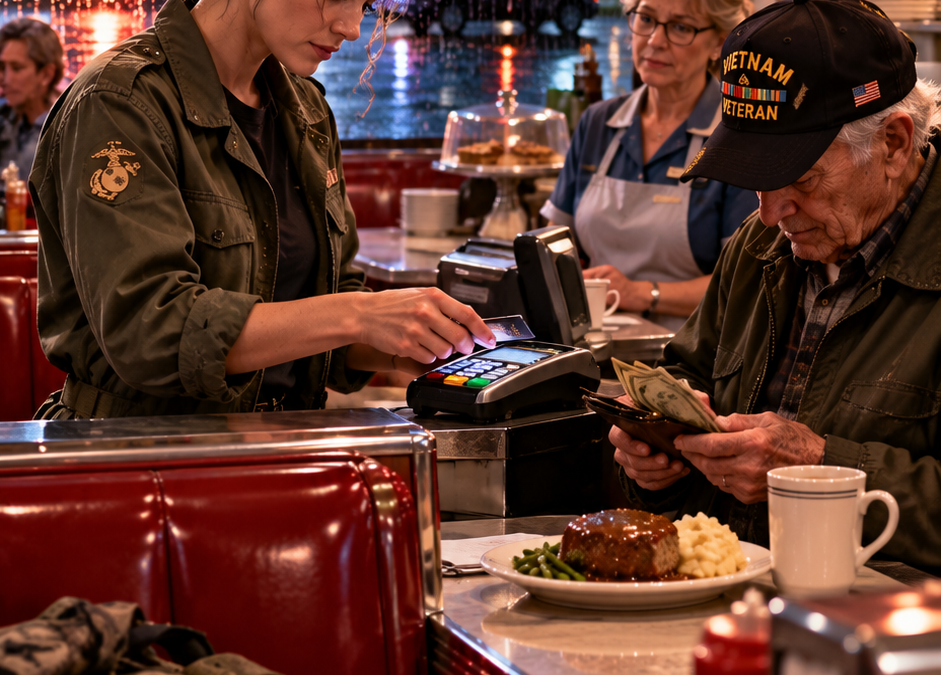
I remembered the old man’s wallet.
The way he had counted his money twice.
The quiet behind us.
General Mercer’s voice softened.
“That told me your instincts matched the paperwork.”
I looked away.
For all the evaluations in the folder, that was the comment that made me uncomfortable.
Maybe because kindness felt more private than achievement.
Colonel Barrett cleared his throat.
“There is another piece.”
I turned back.
He reached into the folder and removed a sealed envelope.
My name was handwritten across the front.
Not typed.
Handwritten.
I knew the writing immediately.
Staff Sergeant Malik.
“What is that?”
“Open it.”
Inside was a single page.
No official letterhead.
No formal memorandum.
Just a note.
Reynolds,
If you’re reading this, somebody finally made you stop dodging the conversation.
That sounded exactly like him.
I almost smiled.
Then I kept reading.
He wrote that good leaders were not people who wanted authority. At least, not usually. They were people willing to accept responsibility for decisions that affected others.
He reminded me of a winter field exercise when a young lance corporal named Ortiz had been struggling with a technical qualification.
Ortiz had failed twice.
I remembered it vividly.
He had been embarrassed and started arriving early to practice before anyone else showed up. One morning, I arrived before him. Then again the next. For three weeks, we studied procedures before formation.
He passed on his third attempt.
I had forgotten anyone else noticed.
Malik had.
His letter said:
You didn’t lower the standard for him. You stayed beside him until he could reach it. Learn the difference.
I stopped reading.
The office blurred for half a second.
I blinked until it became clear again.
The final paragraph was shorter.
You keep telling yourself you need more experience before you can lead. That sounds responsible. Sometimes it is. Sometimes it’s a respectable way to hide from the possibility that people may actually need you to step forward. Figure out which one this is.
I folded the letter carefully.
General Mercer asked, “Well?”
I exhaled.
“I’m going to need to be angry with Staff Sergeant Malik for approximately five minutes.”
Colonel Barrett nodded.
“Approved.”
General Mercer smiled.
Then I asked the question that had been forming since I entered.
“Why did you come personally?”
That changed something in his face.
The humor faded.
Not into sadness exactly.
Something quieter.
He looked toward the rain-streaked window.
“When I was a corporal,” he said, “somebody did something similar for me.”
Neither Colonel Barrett nor I spoke.
“I had been in the Corps a little over two years. My father had died unexpectedly back home in Ohio. I returned after emergency leave thinking I was perfectly fine.”
His mouth tightened at the memory.
“I was not perfectly fine.”
He told us his father had owned a hardware store. Small place. Two aisles. Old wooden floor. The kind of shop where people came in for one screw and stayed thirty minutes discussing weather.
After the funeral, Mercer had returned to base with almost no money left.
One night, an older gunnery sergeant found him sitting alone at a bus station cafeteria with a cup of coffee he had been pretending was dinner.
“The gunny bought me a sandwich,” Mercer said. “He never made a speech. Never asked why I didn’t have money. He just sat down and said, ‘You look hungry.’”
The general’s eyes settled on mine.
“I never forgot the dignity of that.”
The diner suddenly felt different in my memory.
Not destiny.
Not coincidence arranged by some invisible hand.
Just a thread.
One person noticing another.
Then, years later, another.
“What happened to him?” I asked.
“The gunnery sergeant?”
“Yes, sir.”
“He retired. Became a high school teacher in Arizona. Died six years ago.”
“I’m sorry.”
“So am I.”
He paused.
“But that is not a sad story, Corporal. He had a good life.”
Then he looked at the commissioning package.
“And he taught me something I remembered when you paid a stranger’s bill.”
I understood.
“Small things can stay with people.”
“For a very long time.”
We sat quietly.
Then General Mercer stood.
The meeting was apparently over.
“You have thirty days to decide whether you want your command to begin a formal application process.”
I stood as well.
“Yes, sir.”
“And Reynolds?”
“Sir?”
“Do not decide because I suggested it.”
“I won’t.”
“Do not decide because your commanding officer wants it.”
Colonel Barrett said dryly, “I appreciate the clarification, General.”
“Do not decide because your staff sergeant wrote you a sentimental letter.”
“It wasn’t very sentimental, sir.”
“No. He seems emotionally economical.”
That was the best description of Staff Sergeant Malik I had ever heard.
General Mercer picked up his cap.
“Decide because you have examined what you are willing to become.”
Then he walked toward the door.
Before leaving, he stopped beside me.
“Also, I owe you eighteen dollars and forty-three cents.”
I blinked.
“Sir?”
“The diner.”
“You don’t owe me anything.”
“I was afraid you would say that.”
He reached into his pocket.
For one terrible second, I thought a four-star general was about to hand me cash in my commanding officer’s office.
Instead, he pulled out a folded receipt. On the back was a handwritten address.
“What’s this?”
“The diner.”
“I know where the diner is.”
“The waitress.”
I frowned.
“She is retiring next month. Worked there thirty-one years.”
I remembered her.
Short gray hair.
Reading glasses hanging from a chain.
She had called General Mercer “honey” without the slightest idea who he was.
“She mentioned they’re collecting photographs and notes from regular customers,” he said. “I thought perhaps we could settle my debt another way.”
“How?”
“Take someone to dinner there who needs the company.”
Then he left.
Colonel Barrett and I stood in silence.
A few seconds later, I heard the outer office door close.
I looked down at the package.
Then at Staff Sergeant Malik’s note.
Then at the receipt.
Colonel Barrett waited.
“Well?”
“I have thirty days.”
“You have thirty days.”
“I intend to use all thirty.”
“I assumed you would.”
I tucked the papers carefully into the folder.
At the door, he called my name.
“Reynolds.”
I turned.
He was no longer smiling.
“You should call your father.”
That surprised me.
“Sir?”
“You mentioned him.”
“I did.”
“People who shape our decisions deserve to know when those decisions are changing.”
I drove home with that sentence sitting beside me.
The rain had stopped by then. Norfolk roads glowed beneath streetlights, wet pavement holding reflections like pieces of broken glass.
My apartment was only fifteen minutes away.
I drove past it.
Then I kept going.
Two hours later, I was northbound on Interstate 95.
I called Staff Sergeant Malik first.
He answered on the fourth ring.
“Reynolds.”
“How did you know it was me?”
“Caller ID is one of civilization’s major achievements.”
“You wrote a letter.”
“I write lots of things.”
“You ambushed me with a four-star general.”
“I did no such thing.”
“You knew.”
A pause.
Then, “I knew Colonel Barrett wanted to discuss your future.”
“Did you know Mercer would be there?”
Another pause.
“That part was new.”
I could hear his wife laughing somewhere in the background.
“You could have told me,” I said.
“You wouldn’t have listened.”
“I listen.”
“You comply with instructions. Different skill.”
I frowned at the highway.
“That is deeply insulting.”
“It is also accurate.”
A few miles passed.
Then his voice became quieter.
“You okay?”
“Yes.”
“You sure?”
“No.”
“Good.”
I laughed despite myself.
“Why good?”
“Means you understand it matters.”
I hesitated.
“Do you really think I should apply?”
He did not answer immediately.
That was one reason I trusted him. He never used silence theatrically. He simply thought before speaking.
Finally he said, “I think you should decide without using fear dressed up as humility.”
General Mercer had said almost the same thing.
I tightened my grip on the steering wheel.
“Everybody suddenly thinks they understand me.”
“No,” Malik said. “We just work near you.”
Before ending the call, he added one more thing.
“Reynolds?”
“Yeah?”
“If you become an officer, you’re still buying your own coffee.”
Then he hung up.
My parents lived outside Richmond in the same brick house where my younger brother and I had grown up.
I arrived close to ten.
The porch light was on.
It was always on.
My mother opened the door before I knocked.
“Jenna?”
She looked behind me, immediately worried.
“Is everything okay?”
“Everything’s fine.”
“Then why are you standing on my porch at ten o’clock on a Thursday?”
“I wanted to talk.”
“That is never how children begin conversations that let mothers sleep.”
She pulled me inside.
The house smelled like coffee and the cinnamon candle she burned almost year-round.
My father was at the kitchen table in reading glasses, studying an HVAC parts catalog like it contained state secrets.
He looked up.
“Hey, kid.”
Then he saw my expression and removed his glasses.
“What happened?”
I put the folder on the table.
My mother sat beside him.
I told them everything.
The diner.
The declined card.
The uniform.
The stars.
The folder.
The recommendations.
The program.
For almost the entire story, my father did not interrupt.
My mother interrupted twelve times.
When I finished, she stared at me.
“You paid for a four-star general’s dinner?”
“That is not the important part.”
“It is temporarily the important part to me.”
“Mom.”
“How much?”
“Eighteen dollars and forty-three cents.”
She nodded gravely.
“Reasonable.”
My father rubbed a hand across his jaw.
“So they want you to apply for a commission.”
“They want me to consider applying.”
“Do you want to?”
“I don’t know.”
He looked at me for a long moment.
“You drove two hours because you don’t know?”
“I drove two hours because you told me something before I enlisted.”
“What?”
“Learn to carry weight before asking others to carry it.”
Recognition flickered across his face.
“I think I built my whole career around that,” I said.
“That doesn’t sound terrible.”
“Mercer thinks I may have turned it into an excuse.”
My father looked down.
My mother turned toward him.
“David?”
He removed his glasses again.
Something passed between my parents.
Something small.
Old.
I saw it.
“What?”
Neither answered.
“Dad?”
He stood and went to the hallway closet.
When he returned, he carried a battered cardboard file box.
I had seen it before.
Tax records.
Old warranties.
Family documents.
He set it on the table and opened it.
Inside were folders labeled with years. He reached beneath them and removed a large cream-colored envelope.
My name was written on the front.
The handwriting was not my father’s.
I stared at it.
“What is that?”
He sat down slowly.
“Something I should have given you a long time ago.”
My mother covered his hand with hers.
“Given me when?”
“Before you enlisted.”
A strange chill moved across my shoulders.
“Who wrote it?”
My father pushed the envelope toward me.
The handwriting was familiar.
Not immediately.
But somewhere deep in memory.
Birthday cards.
Christmas envelopes.
A signature beneath every book I received until I was seventeen.
My grandfather.
My father’s father, Harold Reynolds, had died during my senior year of high school. He had served in the Marines in the years after Vietnam, though he rarely talked about it. He was the reason I first considered the Corps.
I touched my name on the envelope.
“Grandpa wrote this?”
Dad nodded.
“When?”
“A week before he died.”
I looked at him.
“You’ve had this for nine years?”
His face tightened.
“Yes.”
“Why?”
For the first time that night, my father—the man who could explain any mechanical failure, any bill, any practical difficulty in twenty clear words—seemed unable to find a sentence.
Finally he said, “Because he asked me to give it to you only if you ever reached a point where you were afraid of becoming more than the life you had planned.”
I stopped breathing for a second.
My mother squeezed his hand.
Dad continued quietly.
“I kept telling myself that point had never come.”
I looked at the commissioning package.
Then at the envelope.
“And now?”
He met my eyes.
“Now I think I may have been wrong.”
I opened it.
Inside was a two-page handwritten letter. The paper had yellowed slightly along the edges.
The first line made my throat close.
Dear Jenny,
Nobody had called me Jenny since he died.
I kept reading.
My grandfather wrote about service.
Not battles.
Not medals.
Not glory.
He wrote about people.
A lieutenant who once admitted he was wrong in front of enlisted Marines.
A corporal who stayed late to teach him how to repair a radio.
A captain who remembered the name of a Marine’s sick mother.
Small things.
Human things.
Then the letter changed.
He wrote that my father had told him I was considering enlisting.
He said he was proud.
But then came the paragraph my father had apparently spent nine years protecting me from.
Or protecting himself from.
Your father will teach you to be careful with responsibility because he has spent his entire life believing responsibility is something that must hurt before you deserve it. He learned some of that from me. I wish he had not.
I looked up.
Dad’s eyes were wet.
He did not look away.
I returned to the letter.
Work hard, Jenny. Earn trust. Learn your trade. Keep your promises. But do not mistake suffering for qualification. Do not believe you must exhaust every doubt before accepting an opportunity. Doubt does not disappear. We simply decide what matters more than it does.
I could barely see the next lines.
At the bottom, in my grandfather’s uneven handwriting, was one final sentence.
If the day comes when someone asks you to lead, don’t ask whether you feel ready. Ask whether you are willing to keep learning after you say yes.
The room was silent.
I lowered the letter.
My father looked older than he had when I arrived.
Not weak.
Just human in a way children rarely allow their parents to become.
“Why didn’t you give this to me?”
He exhaled slowly.
“Because I disagreed with him.”
There it was.
No dramatic excuse.
No hidden tragedy.
Just an honest answer.
“I thought your grandfather was afraid I had pushed you too hard,” he said. “I thought he was trying to correct something that didn’t need correcting.”
“Did you?”
“Push you too hard?”
“Yes.”
He thought about it.
“Sometimes.”
My mother looked at him.
He nodded.
“I probably did.”
Then he leaned forward.
“But Jenna, I never wanted you afraid to succeed.”
“I’m not afraid to succeed.”
He gave me the kind of look only a parent can give an adult child—the look that says they remember every version of you.
“Aren’t you?”
I opened my mouth.
Nothing came out.
That answer sat between us.
My mother stood.
“I’m making tea.”
It was what she did whenever the Reynolds family reached the emotional depth limit of a kitchen conversation.
Nobody objected.
Dad looked at the letter.
“I should have given it to you.”
“Yes.”
“I’m sorry.”
I could tell he expected forgiveness quickly.
Not because he thought he was entitled to it.
Because that was how our family usually worked.
Someone apologized.
Someone said it was fine.
Everyone moved on.
But something had changed that night.
Maybe General Mercer was right.
Maybe responsibility meant telling the truth even when the gentler answer was available.
So I said, “I love you.”
Dad nodded.
“I love you too.”
“But I’m angry.”
He swallowed.
“Okay.”
“I don’t know how angry yet.”
“Okay.”
“I need you not to explain it away.”
He looked down for a moment.
Then back at me.
“I won’t.”
That was the beginning of forgiveness.
Not the end.
My mother placed three cups of tea on the table and pretended not to have heard anything.
I read my grandfather’s letter again.
Then again.
Close to midnight, my father went upstairs.
My mother stayed.
She sat across from me with both hands around her mug.
“There’s something else,” she said.
I looked up.
“Please tell me we’re finished with secret documents.”
“No documents.”
“Good.”
“A person.”
“That is worse.”
She almost smiled.
“Your grandfather sent a copy of that letter to someone.”
I waited.
“Who?”
“A Marine he served with. They stayed friends for years.”
“Why?”
“He wrote in another note that if your father never gave you the letter, this friend would know when the right time came.”
I stared at her.
“Did this friend ever contact Dad?”
“Once. After your grandfather died.”
“And?”
“Your father told him he would handle it.”
I closed my eyes.
“Of course he did.”
My mother reached across the table.
“There is something you should know before you get angry again.”
I looked at her.
“The man respected your father’s decision. He never interfered.”
“Then why are you telling me now?”
“Because I recognized his name when you told us your story.”
The room seemed suddenly too quiet.
My pulse began to rise.
“What name?”
My mother looked toward the stairs.
Then back at me.
“Thomas Mercer.”
For several seconds, I simply stared at her.
The general.
The diner.
My grandfather’s letter.
The coincidence that had seemed almost poetic a few hours earlier suddenly had another layer beneath it.
“He knew Grandpa?”
“Apparently very well.”
“Did he know who I was at the diner?”
“I don’t know.”
That question changed everything.
Not because it made the general sinister.
It did not.
But because I could no longer tell where coincidence ended and history began.
I looked at my grandfather’s letter.
Then at the commissioning packet.
Two papers written nine years apart.
One from a man I had loved.
One from a future I had never seriously imagined.
And somewhere between them sat General Thomas Mercer, who had looked me in the eye and told me the diner was not why I had been called into that office.
Maybe he had been telling the complete truth.
Maybe he had only been telling part of it.
I folded my grandfather’s letter and slipped it back into the envelope.
My mother watched me.
“What are you going to do?”
“Tomorrow?”
“Yes.”
I looked toward the dark kitchen window.
“Tomorrow I’m going to ask a four-star general how long he has known my name.”
I barely slept.
By 0500, I was awake in my childhood bedroom staring at the ceiling I had stared at as a teenager when I first imagined leaving home. The room was different now. My mother had turned it into a half-guest room, half-storage space. There were folded blankets on the chair, a box of Christmas decorations near the closet, and one old cross-country medal still hanging from the corner of the mirror because nobody had ever bothered to take it down.
I got up quietly, dressed, and found my father already in the kitchen.
He was sitting with coffee, the cream-colored envelope on the table between us.
For a moment, neither of us spoke.
Then he said, “I should have told you Mercer knew your grandfather.”
“Yes.”
“I didn’t think it mattered.”
“That seems to be a family pattern.”
He accepted that.
I poured coffee and sat across from him.
“Did you know he was a general?”
“Not then. He was a colonel when your grandfather died. Maybe brigadier. I’m not sure.”
“Did Grandpa ask him to watch over me?”
Dad shook his head.
“No. Your grandfather was too proud for that. And Mercer would have refused if it sounded like favoritism.”
“What did he ask?”
Dad looked at the envelope.
“He asked him to be ready if I failed you.”
That hurt him to say.
I could see it.
For a second, my anger loosened just enough to let pity in.
“You didn’t fail me completely,” I said.
He gave a small, humorless laugh.
“That’s a generous evaluation.”
“It’s an accurate one.”
He looked at me.
“You became exactly the kind of person I hoped you would become. Responsible. Steady. Honest.” His voice tightened. “I just didn’t realize I had made you think those qualities only counted if they cost you something.”
I looked down at my coffee.
“I don’t know how to separate discipline from punishment.”
He nodded slowly.
“That may be my fault.”
“Not only yours.”
“No. But enough of it.”
The kitchen was quiet.
Then my father said, “Ask Mercer what you need to ask. But don’t use the answer to avoid asking yourself the harder question.”
“What harder question?”
“Whether you want this.”
I did not answer.
Because I still did not know.
Back at base, I went through the morning like I was moving underwater.
I completed tasks. Answered emails. Corrected a roster. Signed out equipment. Responded when people spoke to me. All the while, the question sat under everything.
How long had he known my name?
At 1100, Colonel Barrett’s clerk called.
“The colonel can see you now.”
I had not requested the meeting through the clerk.
I had sent one short message directly to Colonel Barrett.
Sir, respectfully request guidance on contacting General Mercer regarding a personal matter connected to yesterday’s discussion.
I expected a reply later.
Instead, I found myself standing outside his office again less than twenty-four hours after the most confusing meeting of my life.
“Enter.”
Colonel Barrett was alone this time.
No four-star general.
No folder on the desk.
No rain on the window.
Just the colonel looking at me as if he had expected me exactly when I arrived.
“Sit down, Reynolds.”
I sat.
He folded his hands.
“You learned something.”
“Yes, sir.”
“About General Mercer.”
“Yes, sir.”
“And your grandfather.”
I held still.
He already knew.
Colonel Barrett saw the realization on my face.
“General Mercer called this morning,” he said.
“What did he say?”
“That you might come asking difficult questions.”
My mouth went dry.
“Sir, I don’t want to accuse him of anything improper.”
“Then don’t. Ask him directly.”
“Can I?”
Colonel Barrett pushed a slip of paper across the desk.
A phone number.
“He said you may call.”
I stared at it.
“When?”
“Now, if you want.”
My heartbeat kicked once, hard.
“Here, sir?”
“If you prefer.”
I looked at the phone on his desk.
Then at the number.
Then back at him.
He stood.
“I’ll give you the room.”
“Sir, you don’t have to—”
“I know.”
He walked to the door, then stopped.
“Reynolds.”
“Yes, sir?”
“Respect does not require you to make yourself smaller. Not even with four stars on the other end of the line.”
Then he left.
I sat alone in my commanding officer’s office, staring at a phone number that suddenly felt heavier than the commissioning packet.
I dialed before I lost my nerve.
The call rang twice.
“Mercer.”
My back straightened automatically.
“Sir, Corporal Reynolds.”
“I wondered whether you would call today or wait twenty-nine days and make this part of your decision process as inefficient as possible.”
Despite myself, I almost smiled.
“Today, sir.”
“Good. Ask.”
No small talk.
No pretending.
Just ask.
I took one breath.
“How long have you known my name, sir?”
Silence.
Not confusion.
Recognition.
Then General Mercer said, “That depends on what you mean.”
“I mean before the diner.”
Another pause.
“Yes.”
The word landed quietly, but it still landed.
My throat tightened.
“How long?”
“Nine years.”
I closed my eyes.
My grandfather’s letter seemed to rustle in my memory.
“Because of my grandfather.”
“Yes.”
“Did you know it was me in the diner?”
“No.”
I opened my eyes.
“Sir?”
“I did not know the woman in the diner was Harold Reynolds’s granddaughter until you told me your name.”
“But you recognized it.”
“I recognized the last name. Then the first. Then I asked where you were from. Quietly. Afterward.”
“You didn’t mention that yesterday.”
“No.”
“Why not?”
“Because if I had led with your grandfather, you would have spent the entire meeting wondering whether the opportunity was about him instead of you.”
I had no answer because that was exactly what I was doing now.
General Mercer continued.
“Your grandfather was one of the finest Marines I ever knew. He was also one of the most stubborn men God ever issued boots to.”
A laugh escaped me before I could stop it.
“That sounds accurate, sir.”
“He wrote me a letter before he died. He said he had written one to you as well.”
“My father kept it.”
“I know.”
“You knew?”
“Your father told me years ago that he would decide when to give it to you.”
“And you accepted that?”
“He was your father. I was not.”
There was no defensiveness in his voice.
That made it harder to stay angry.
I asked, “What did my grandfather want from you?”
“He wanted me to remember your name.”
That was almost worse.
I looked at the colonel’s empty office wall.
“Why?”
“Because he worried the people who loved you most would teach you responsibility without teaching you permission.”
My eyes stung.
I hated that.
I hated that a man nine years dead could still understand me that well.
General Mercer’s voice softened.
“He did not ask me to get you promoted. He did not ask me to interfere with your career. He did not ask me to watch you like some guardian angel. He asked me to remember that somewhere out there was a young woman named Jenna Reynolds who might one day confuse being worthy with being exhausted.”
The office blurred.
I blinked hard.
“Sir, did you arrange any of this?”
“The diner? No.”
“The readiness report?”
“No.”
“The recommendations?”
“No.”
“But when my name appeared—”
“I paid attention.”
“Because of him.”
“At first,” he said. “Because of him.”
At first.
The words mattered.
“And after that?”
“After that, because of you.”
I sat very still.
General Mercer let the silence breathe.
Then he said, “You bought dinner for a stranger without knowing his rank. You took responsibility for a mistake when there were easier explanations available. You built a process that helped other Marines instead of simply protecting your own record. You credited your team. You helped Ortiz without lowering the standard. Your chain of command noticed you repeatedly before I ever walked into Colonel Barrett’s office.”
He paused.
“Your grandfather made me remember the name. You made the name matter.”
I pressed my fingers against my eyes for one second.
When I lowered my hand, my voice was steadier.
“Why didn’t you tell me in person?”
“Because yesterday was not about your grandfather.”
“And today?”
“Today you asked.”
That was fair.
Infuriating, but fair.
I looked at the commissioning memorandum on the desk.
“Sir, I don’t know if I’m ready.”
“You won’t be.”
That startled me.
He continued.
“You will not be ready in the way you want to be ready. Nobody is. The question is whether you are willing to enter the process honestly and let it test you.”
“My grandfather wrote something like that.”
“He was wiser on paper than he was in person.”
This time I did smile.
Then General Mercer said, “I have something of his.”
My heart shifted.
“What?”
“A photograph. Him, me, and three other Marines outside a maintenance bay in Okinawa. He wrote on the back of it years later. I think you should have a copy.”
I could barely answer.
“Yes, sir.”
“I’ll send it through Colonel Barrett.”
“Thank you.”
“And Reynolds?”
“Yes, sir?”
“If you decide not to apply, make sure the decision is honest. Not fear. Not false humility. Not loyalty to an old version of yourself. Honest.”
“I will.”
“If you decide to apply, understand this. Nobody owes you selection. Nobody owes you success. The process may still tell you no.”
“Yes, sir.”
“But if you tell yourself no before the process has a chance, that is not humility. That is avoidance wearing dress blues.”
I let out a breath that was almost a laugh.
“Yes, sir.”
“One more thing.”
“Sir?”
“The diner waitress retires in three weeks. Do not overthink dinner.”
Then he hung up.
I sat with the receiver in my hand for a few seconds before placing it back in the cradle.
Colonel Barrett knocked once before entering, which I suspected was more courtesy than necessity.
“Well?” he asked.
“He knew my grandfather.”
“I gathered.”
“He did not know it was me at the diner.”
Colonel Barrett nodded.
“Do you believe him?”
I thought about it.
“Yes.”
“Good.”
“I’m still angry.”
“At the general?”
“At everyone. Him a little. My father a lot. Myself some.”
“That sounds administratively complex.”
“Yes, sir.”
He sat behind his desk.
“Does it change your decision?”
“I don’t know.”
“Then take your thirty days.”
I looked at the paper again.
“No, sir.”
His eyebrows rose.
“I don’t need thirty days.”
For the first time since the meeting began, Colonel Barrett looked surprised.
I stood, not at attention exactly, but straight.
“I don’t know if I’ll be selected. I don’t know if I’ll succeed. I don’t know if I’m ready in the way I wanted to be ready.” I looked him in the eye. “But I know the difference between caution and hiding now.”
He said nothing.
I continued.
“I want to apply.”
Colonel Barrett held my gaze for a long moment.
Then he nodded once.
“Very well, Reynolds.”
That was all.
No speech.
No dramatic music.
No instant transformation.
Just the beginning of paperwork.
The Marine Corps loves beginnings that look like paperwork.
Over the next several weeks, my life became a rotating cycle of forms, transcripts, medical appointments, essays, interviews, and command endorsements. Staff Sergeant Malik treated the entire process like an inconvenient but necessary maintenance inspection.
When I told him I had decided to apply, he said, “About time.”
“That’s all?”
“You wanted balloons?”
“I expected slightly more emotional investment.”
“I wrote you a letter. My annual quota is exhausted.”
But later that afternoon, I found a fresh coffee on my desk.
Black.
No note.
I knew.
My father and I had harder conversations.
Not one.
Several.
The first time he apologized, I listened. The second time, I told him apologies would not repair nine years of silence. The third time, he asked what would.
“I don’t know,” I said honestly. “Maybe time. Maybe you letting me make a decision without trying to protect me from it.”
So he did.
When I called to tell him I had started the application, he did not warn me about disappointment. He did not remind me how hard it would be. He did not tell me to keep my expectations low.
He only said, “I’m proud of you.”
Then, after a pause, “And I’m sorry I made pride feel like pressure.”
That mattered.
My mother mailed me my grandfather’s letter because she said important paper should not live forever in a box under tax records. I kept it in a plastic sleeve inside my desk.
A week later, Colonel Barrett called me in again.
This time, there was no fear in my stomach.
Not none, exactly.
But less.
On his desk lay a photocopied photograph.
Five Marines stood outside a maintenance bay, younger than history had any right to make them. One of them was General Mercer before the stars, before the polished speeches, before the official portraits. Another was my grandfather.
He stood with one hand on his hip, squinting into the sun, looking so alive that I had to sit down.
On the back, copied in faded ink, were the words:
Tom Mercer thinks too much. Good Marine anyway.
I laughed so hard I had to cover my mouth.
Colonel Barrett looked confused until I handed it to him.
He read it.
Then even he smiled.
I placed the copy behind my grandfather’s letter.
The application process did not become easier after that.
If anything, it became harder because now it mattered in a way I could not hide from.
There were days I doubted everything.
Days I thought about withdrawing before anyone could reject me.
Days I remembered General Mercer’s sentence.
If you tell yourself no before the process has a chance, that is not humility.
So I stayed in the process.
The board results came months later on a gray morning that looked painfully similar to the night I had first walked into the diner.
I was checking a supply correction when Staff Sergeant Malik appeared beside my desk.
“Reynolds.”
“Yes, Staff Sergeant.”
“Commanding officer wants to see you.”
My stomach dropped out of habit.
Malik’s face gave away nothing.
“Now?”
“Unless you have a later appointment with destiny.”
I stared at him.
“That is exactly what you said last time.”
“I’m efficient.”
The walk to Colonel Barrett’s office felt longer than it was.
I knocked.
“Enter.”
This time, Colonel Barrett was standing.
So was Staff Sergeant Malik behind me, though I had not realized he had followed.
Captain Lewis was there too.
My pulse started to hammer.
Colonel Barrett held a document in his hand.
“Corporal Reynolds.”
“Yes, sir.”
He looked at me for one long second.
Then he smiled.
“You were selected.”
The words did not register at first.
Not fully.
Selected.
My body understood before my mind did. My knees felt strange. My throat closed. I stared at him like he had spoken in another language.
Staff Sergeant Malik said quietly, “Breathe, Reynolds.”
So I did.
Once.
Badly.
Captain Lewis laughed under his breath.
Colonel Barrett handed me the document.
I looked down.
My name was there.
Official.
Real.
Not a reward.
Not a favor.
Not a debt repaid for a rainy-night dinner.
A door.
One I still had to walk through.
I thought I would feel triumphant.
Instead, I felt humbled in a way that did not make me smaller.
That was new.
Colonel Barrett extended his hand.
“Congratulations.”
I shook it.
“Thank you, sir.”
Captain Lewis shook my hand next.
Then Staff Sergeant Malik.
His handshake was brief, firm, and emotionally economical.
“Don’t get weird,” he said.
I laughed.
“I’m already weird.”
“Then don’t get worse.”
That afternoon, I called my parents.
My mother cried first.
My father tried not to.
Then failed.
“I wish your grandfather could see this,” he said.
I looked at the letter on my desk.
“Maybe he did enough.”
That evening, I drove to the diner.
The same bell over the door gave the same tired ring. The same red vinyl booths waited under the same warm lights. The waitress with the gray hair was behind the counter, though now there were balloons taped near the register and a little sign that said HAPPY RETIREMENT, RUTH.
She recognized me.
“Marine,” she said. “Haven’t seen you in a while.”
“No, ma’am.”
“You eating alone?”
I thought about General Mercer’s receipt.
Take someone to dinner there who needs the company.
I had planned to bring Staff Sergeant Malik, mostly to irritate him.
Instead, I had called my father.
He arrived five minutes after I did, wearing his work jacket, smelling faintly of metal and cold air.
He looked nervous when he walked in.
That alone told me I had made the right choice.
We sat in the booth by the window.
Ruth brought coffee without asking too many questions.
My father picked up the menu.
“What’s good here?”
“Meatloaf.”
He smiled.
“Of course it is.”
For a while, we talked about ordinary things. His work. My mother’s garden. My brother’s new apartment. Then the silence came.
Not bad.
Just honest.
My father set down his coffee.
“I don’t know how to be the father of someone who is becoming more than I know how to advise.”
I looked at him across the table.
“You don’t have to advise everything.”
“That will be difficult for me.”
“I know.”
“I can try.”
“I know that too.”
He looked out at the rain starting again beyond the glass.
“You’re not doing this because of me, are you?”
“No.”
“Because of your grandfather?”
“No.”
“Because of Mercer?”
“No.”
“Then why?”
I thought about the diner. The folder. The counseling statement. Ortiz studying before formation. Staff Sergeant Malik’s letter. General Mercer’s question. My grandfather’s handwriting. My father’s apology.
Then I said, “Because I’m willing to keep learning after I say yes.”
My father’s eyes filled again.
This time, he did not look away.
When the bill came, I took it before he could.
He protested immediately.
“Jenna.”
I smiled.
“Tonight your card works and mine does too. I’m still paying.”
He shook his head.
“Stubborn.”
“Family trait.”
At the register, Ruth looked at the two of us.
“You military folks keep making me sentimental in my final weeks.”
I glanced at the wall near the pie case. It was covered in photographs and notes from regular customers.
I pulled a folded paper from my pocket.
It was not long.
Just a note.
Thank you for serving coffee, food, and dignity to people who needed all three.
— Corporal Jenna Reynolds
Beneath it, my father added:
And for feeding my daughter on the night her future found her.
I stared at him when he wrote that.
He pretended not to notice.
Ruth read the note and pressed it to her chest.
“You two are going to make me cry over meatloaf.”
My father said, “That seems reasonable.”
Outside, the rain had softened.
We stood under the diner awning for a moment before going to our cars.
My father looked at me.
“I am proud of you.”
“I know.”
“No,” he said. “Not because you were selected. I’m proud of you because you asked the hard question.”
“Which one?”
He smiled sadly.
“All of them.”
A week later, a letter arrived through command mail.
Not official correspondence.
Personal.
Inside was a short note from General Mercer.
Corporal Reynolds,
Your grandfather once told me that leadership is what remains after ambition has been stripped away. I did not understand him then. I understand him better now.
You asked how long I had known your name.
Here is the full answer.
I knew it for nine years because Harold Reynolds asked me to remember it.
I noticed it two weeks after a rainy night because a Marine helped an old man without knowing his rank.
I respected it after reading your record.
What you do with it next is yours.
— T. Mercer
I read that note three times.
Then I placed it behind my grandfather’s letter and the photograph.
For a long time, I had believed readiness was something I had to earn completely before stepping forward. I thought leadership belonged to people who had no doubts, no unfinished fears, no private questions following them into quiet rooms.
I was wrong.
The opportunity did not erase my doubt.
It exposed it.
Then it asked whether I was willing to move anyway.
Months later, when I packed for the next stage of my career, I found the receipt from the diner tucked into the pocket of my folder.
Eighteen dollars and forty-three cents.
A small bill.
A small act.
A rainy night I could easily have forgotten.
But life does not always change through grand moments. Sometimes it changes because someone is embarrassed at a register and someone else decides not to let them stand alone in it.
I kept the receipt.
Not as proof that I had done something good.
As a reminder that you never know when a simple act is touching a much longer story.
General Mercer had known my name before I knew his.
My grandfather had written to a future version of me before I was ready to meet her.
My father had kept the letter too long and still found the courage to hand it over.
Staff Sergeant Malik had seen through every excuse I called humility.
And I had finally learned that carrying weight is not the same as refusing help.
The night before I left, I stood in my apartment with my packed bags by the door and my grandfather’s letter in my hand.
I read the last line one more time.
If the day comes when someone asks you to lead, don’t ask whether you feel ready. Ask whether you are willing to keep learning after you say yes.
For the first time, I did not read it as pressure.
I read it as permission.
Then I turned off the light, picked up my bags, and stepped into the morning.








