𝗙𝗨𝗟𝗟 𝗦𝗧𝗢𝗥𝗬 The Gate Linda Built to Keep Me Out Was Standing on the One Strip of Land She Never Owned
𝗙𝗨𝗟𝗟 𝗦𝗧𝗢𝗥𝗬
It was not.
I had been at the county office less than forty minutes.
“You need to stop creating unnecessary conflict,” she continued. “The board has authority over that roadway.”
“I’m looking at the county map right now.”
Silence.
Only for a second.
Then her voice sharpened.
“County maps can be outdated.”
“Maybe,” I said, watching Susan place certified documents into a folder. “That’s why I’m getting the recorded plat too.”
Another silence.
This one lasted longer.
“Daniel,” Linda said, “I strongly recommend you do not interfere with HOA infrastructure.”
“Linda, did your contractor survey the gate location before pouring those pillars?”
She hung up.
That answered more than anything she could have said.
When I returned home an hour later, Linda was not alone.
Two HOA board members stood beside her. One was Harold Pierce, a retired insurance man who always looked as if he was trying to calculate risk in his head. The other was Denise Cole, who served as board secretary and had a reputation for being quieter than Linda but not stupid. A man in a Cedar Ridge security shirt stood near the keypad, shifting his weight.
My truck had barely stopped before Linda walked toward the gate.
“You were told to use another entrance.”
“There is no other entrance.”
“Then park outside and walk.”
I held up the county folder.
The security guard looked uncomfortable.
Linda did not.
Instead, she handed me a white envelope through the bars.
“Formal notice.”
I opened it.
The HOA was accusing me of unauthorized commercial use of a private residential road. It demanded that I immediately stop bringing trucks, trailers, farm equipment, livestock, and commercial agricultural activity through Cedar Ridge.
I looked up.
“You wrote this today?”
“The board approved it.”
A pickup slowed behind me.
My neighbor, Tom Reeves, rolled down his window.
“What’s going on?”
Linda stepped forward before I could answer.
“HOA matter. Please keep moving.”
Tom looked at the gate, then at me.
“Since when is this HOA property?”
Linda’s jaw tightened.
“Since always.”
Tom laughed once.
“No, ma’am.”
Everything went quiet.
Tom had lived across the highway for thirty-two years. He pointed toward the stone pillar.
“I helped Daniel’s father replace the culvert under that road in 1998. Cedar Ridge was still a soybean field.”
One board member glanced at Linda.
She ignored him.
“Historical use does not establish ownership.”
“You’re right,” I said.
I pulled the certified parcel map from the folder.
“Ownership does.”
I unfolded it against my truck hood. Tom walked over. The security guard followed. Linda stayed where she was.
I pointed to the boundary line.
“The county shows the HOA ending here.”
Then I moved my finger to the gate.
“And your gate is here.”
The security guard looked from the map to Linda.
“That’s outside the subdivision.”
Linda finally approached. She studied the page for maybe five seconds before stepping back.
“This proves nothing.”
“It’s certified.”
“We have our own records.”
“Great,” I said. “Bring them.”
Her face hardened.
“You are not entering through this gate.”
Then she turned to the security guard.
“If he attempts to cross, call the sheriff.”
Tom looked at me.
I looked at Linda.
“Please do.”
She blinked.
I folded the map carefully.
“Because when the deputy gets here, I’m going to ask him one very simple question.”
I pointed at the concrete pillar planted beside my road.
“Who gave Cedar Ridge permission to build that on my land?”
Linda did not call the sheriff.
That surprised me more than the gate.
She stood beside the keypad with her phone in one hand, staring at the certified map I had just shown her.
The security guard, a young man named Marcus, shifted his weight and finally said, “Mrs. Mercer, I’m not comfortable detaining anybody over a property line dispute.”
Linda turned on him.
“Nobody asked you to be comfortable.”
Marcus’s face changed.
Tom heard it too. He pulled his truck onto the shoulder, shut off the engine, and stayed.
That gave me my first real witness.
Linda noticed.
“Everyone needs to leave,” she said.
I shook my head.
“I’m standing on my property.”
“That’s disputed.”
“Then show me your survey.”
Harold Pierce quietly asked, “Linda, do we actually have one?”
She shot him a look.
“The developer documents establish HOA control.”
“That’s not what he asked,” Tom said.
Linda ignored him.
Then a landscaping truck came down the ranch road from inside the gate. The driver entered a code. The steel arms began to swing open.
I saw my chance.
I walked toward the opening.
Linda stepped directly in front of me.
“Do not cross.”
“Move, Linda.”
“This is your final warning.”
I stopped three feet away.
Behind her, the landscaper froze halfway through the gate.
“You are physically blocking me from reaching my ranch,” I said.
“I am enforcing community security.”
“My cattle are on the other side.”
“Not my responsibility.”
Then a sound carried across the pasture.
A long, distressed bawl.
Then another.
I looked toward the fence.
One of my cows was pacing near the water trough.
My stomach tightened.
I had shut off that line before leaving town because the valve had cracked overnight. The replacement fitting was sitting in the passenger seat of my truck. The pump key was beside it.
I needed through.
Now.
“Linda,” I said, forcing my voice to stay steady, “I have livestock without water.”
For half a second, I expected basic common sense to win.
Instead, she folded her arms.
“You should contact animal services.”
Tom stared at her.
“You cannot be serious.”
“I am not responsible for his poor planning.”
That did it.
Harold stepped away from her.
“Linda, open the gate.”
“No.”
“Open it.”
“I said no.”
Denise pulled out her phone.
“I’m calling our attorney.”
Linda spun toward her.
“We already have legal guidance.”
“Then he can repeat it to me,” Denise said.
The board was cracking right in front of us.
But Linda doubled down.
She reached into the keypad housing and changed something. A red light flashed. The landscaper tried his code again.
Nothing happened.
Marcus looked at the keypad.
“You just locked everybody out.”
“I’ve suspended access until this situation is resolved.”
The landscaper leaned out his window.
“Ma’am, I’ve got two guys and equipment inside.”
Linda pointed toward the subdivision.
“They can exit through Cedar Ridge.”
“They can’t. Our trailer won’t clear your residential roundabout.”
Now even people inside the subdivision were being trapped by her decision.
Three more residents gathered near the entrance. Phones were coming out.
Linda saw them recording.
“Stop filming HOA security operations.”
Nobody stopped.
Then my phone rang.
It was my ranch hand, Miguel.
“Daniel, where are you?”
“At the gate.”
“We’ve got a bigger problem.”
I turned away from Linda.
“What happened?”
“The north herd pushed through the temporary divider. They’re crowding the dry trough.”
My chest tightened.
“Can you get the backup tank running?”
“Not without the pump key.”
I looked through my windshield.
The key ring was sitting beside the replacement valve on my side of Linda’s locked gate.
Miguel lowered his voice.
“And Daniel?”
“Yeah?”
“One of the calves is already down.”
I looked at Linda.
She was still arguing with her own board members.
I picked up the county folder, handed it to Tom, and took out my phone.
Linda saw me dialing.
“Who are you calling?”
This time, I did not answer her.
The dispatcher did.
“County Sheriff’s Office. What’s your emergency?”
I kept my eyes on the gate.
“I need a deputy at Carter Ranch Road immediately. Someone has blocked the only access to livestock in distress.”
Linda’s face went pale.
I added, “And I have certified county records showing the gate may have been built on my property.”
The deputy arrived before Linda’s attorney called back.
His cruiser rolled onto the shoulder with no siren, but the moment everyone saw the county emblem on the door, the arguing stopped.
Deputy Ryan Keller stepped out and looked at the gate, the trapped landscaping truck, the growing crowd, and finally me.
“Who’s Daniel Carter?”
“I am.”
Linda immediately moved between us.
“Officer, I’m Linda Mercer, president of the Cedar Ridge HOA. This man is attempting to trespass into our private community.”
Keller looked past her.
“Mr. Carter, where do you live?”
I pointed through the gate.
“Three miles that way.”
The deputy stared at Linda.
“So he’s trying to go home.”
“His ranch is beyond the community boundary.”
“Then why is your gate blocking his road?”
Linda’s mouth tightened.
“It’s complicated.”
“It wasn’t complicated ten minutes ago,” Tom muttered.
Keller heard him.
“Sir, were you here when this started?”
“Most of it.”
Linda turned sharply.
“He’s not an impartial witness.”
Keller raised one hand.
“I’ll decide who I need to speak with.”
For the first time all day, Linda stopped talking.
I gave Keller the certified parcel map and explained the water problem with the herd. He studied the page, then walked along the gate line himself. He stopped beside the western pillar.
“Where’s the property marker?”
“I think there’s one about fifteen feet behind that ditch.”
We crossed the grass.
I found the old iron survey pin where I had seen it months earlier. Keller crouched beside it but did not touch it.
Tom pointed toward the gate.
“If that’s still the boundary marker, they built the whole thing on Daniel’s side.”
Linda followed us.
“That marker could be obsolete.”
“Could be,” Keller said. “That’s why I’m not making a boundary determination.”
Linda seemed relieved.
Then Keller added, “But I’m also not arresting Mr. Carter for trespassing based solely on your claim.”
Her relief vanished.
A horn blasted behind us.
Miguel had driven my old ranch utility cart down from the pasture and stopped on the far side of the gate.
“We need that pump key.”
I ran to my truck, grabbed the key ring and valve fitting, then returned.
Linda stepped toward the keypad.
“The gate remains closed.”
Keller looked at her.
“Mrs. Mercer, there is an active livestock welfare issue.”
“That does not change HOA policy.”
“It changes what I’m dealing with.”
Harold finally snapped.
“Open the damn gate, Linda.”
Several residents murmured agreement.
Linda looked around and realized she was losing the crowd.
Then something unexpected happened.
Denise walked toward me, holding her phone.
“Daniel, you need to see this.”
On her screen was an email chain between Linda and the gate contractor dated three weeks earlier.
The contractor had asked for a boundary survey before installation.
Linda’s reply was underneath.
Proceed using existing road edge. Survey not necessary.
I looked up.
“You knew they hadn’t surveyed it.”
Linda reached for the phone.
“Denise, that’s confidential board communication.”
Denise pulled it away.
“No. What’s confidential is why you told us the contractor verified the boundary.”
Harold stared at Linda.
“You told the board the location was confirmed.”
“It was confirmed by the development plan.”
“That’s not what you said.”
Keller took out his notebook.
“Mrs. Cole, can you preserve that email?”
Linda’s voice rose.
“This is absurd. We’re discussing an administrative misunderstanding like it’s a crime.”
Nobody answered because Denise was scrolling.
Then she stopped again.
Her face changed.
“There’s another email.”
She handed the phone to Keller.
This one was from the contractor to Linda two days before construction.
Possible encroachment. Carter parcel.
Keller read it twice.
Then he looked at the concrete pillars.
“Mrs. Mercer, don’t delete anything from your phone.”
Linda went completely still.
For the first time, I understood that the gate itself might not be the biggest problem anymore.
Linda did not say another word for nearly thirty seconds.
Then her phone rang.
She looked at the screen, turned away from Deputy Keller, and answered in a low voice.
“Yes, Martin.”
That had to be the HOA attorney.
I could not hear everything, but I heard enough.
“No, the deputy is still here.”
A pause.
“Yes, Denise showed him the email.”
Another pause.
Then Linda’s shoulder stiffened.
“What do you mean don’t touch anything?”
Keller looked at me.
That sentence had caught his attention too.
While Linda argued quietly into her phone, Marcus manually released the gate under Keller’s direction. The steel arm finally rolled open.
I grabbed the pump key and fitting.
“Miguel, let’s go.”
We were halfway through when Linda stepped into the road.
“This does not constitute permission for future access.”
I did not stop.
“Move,” Keller said.
This time, Linda moved.
Miguel and I raced toward the pasture.
By the time we reached the trough, the down calf was breathing hard but still alert. We repaired the valve, started the pump, and within minutes, water poured into the tank. The herd crowded forward. Miguel crouched beside the calf.
“He’s getting up.”
I watched the little animal struggle onto shaky legs.
For the first time that day, something had gone right.
Then Tom called me.
“Daniel, you need to come back.”
“What happened?”
“County survey department just showed up.”
I looked at Miguel.
He nodded toward the road.
“Go. I’ve got this.”
When I returned, a county pickup was parked beside Keller’s cruiser. A woman in an orange safety vest was setting up survey equipment near the ditch. Linda stood with Harold and Denise.
Nobody was talking to her anymore.
The woman introduced herself as Aaron Walsh from County Public Works.
“Deputy Keller contacted dispatch about a possible obstruction involving a recorded access corridor.”
“Access corridor?” I asked.
Linda immediately stepped forward.
“You were told this was HOA property.”
Aaron did not even look up from her equipment.
“I was told there was a boundary dispute. I’m checking county control points.”
That shut Linda down.
Aaron located the old survey pin I had shown Keller. Then she crossed the road and found another marker buried beneath several inches of gravel. She measured, checked her tablet, measured again.
Finally, she walked toward the western gate pillar.
“Who installed this?”
“Cedar Ridge HOA,” Harold said.
Linda glared at him.
Aaron placed a fluorescent mark on the ground.
“This pillar appears to be approximately fourteen feet, eight inches west of the Cedar Ridge parcel boundary.”
Tom whistled.
I said nothing.
Aaron walked to the other pillar.
“Same issue here.”
Linda’s voice turned defensive.
“Approximately is not legally definitive.”
“No,” Aaron said. “A licensed boundary survey would establish the precise line.”
Linda crossed her arms, almost triumphant.
Then Aaron continued.
“But there is another issue.”
She enlarged something on her tablet.
“This road is not merely adjacent to Mr. Carter’s parcel.”
She turned the screen toward Keller.
“It is part of a recorded county-recognized access route serving the Carter property.”
I stepped closer.
“So the HOA can’t block it.”
Aaron chose her words carefully.
“They certainly should not obstruct it without confirming their legal authority.”
Denise covered her mouth.
Harold looked furious.
But Tom was staring toward the stone pillar.
“Daniel.”
Something in his voice made me turn.
He pointed at the fresh concrete around the base.
“Didn’t there used to be another marker right there?”
I walked closer.
Then I remembered.
A small yellow county stake had stood beside that drainage ditch for years.
It was gone.
Aaron immediately photographed the area.
“Nobody step there.”
Linda backed away.
Keller noticed.
“Mrs. Mercer, do you know what happened to that marker?”
“No.”
Marcus cleared his throat.
Every head turned toward him.
“I might.”
Linda’s face drained.
Marcus looked directly at Keller.
“I was working security the morning they built the gate.”
He pointed at the fresh concrete.
“The contractor stopped because there was a survey stake in the way.”
My stomach tightened.
“What happened to it?”
Marcus looked at Linda.
“She told them to pull it out.”
Nobody moved.
Deputy Keller looked at Marcus.
“Tell me exactly what you saw.”
Marcus swallowed.
“The contractor uncovered a yellow stake while digging the western footing. He stopped the excavator and called Mrs. Mercer over.”
Linda stepped forward.
“Marcus, be very careful.”
Keller turned toward her.
“Mrs. Mercer, three words.”
That was enough.
Linda stopped.
Marcus continued.
“The foreman said the stake might mark a property line and they should wait for a surveyor. Mrs. Mercer told him the HOA already knew where the boundary was. He wouldn’t remove it.”
Keller’s expression hardened.
“So who did?”
Marcus pointed at Linda.
“She did.”
Linda exploded.
“That is completely false.”
Tom immediately raised his phone.
“I’ve been recording since the deputy arrived.”
Linda stared at him.
Keller stepped between them.
“Nobody is accusing anybody of a crime right now. I’m documenting statements.”
Aaron photographed the concrete again.
Then she asked Marcus, “What happened to the stake?”
“He put it beside the ditch.”
“Who?”
“The foreman.”
Marcus hesitated.
“Then Linda picked it up and put it in her SUV.”
Harold actually walked away. He stood beside his car with both hands on his head.
Denise looked sick.
“Linda, you told us there were no markers.”
Linda’s face tightened.
“I told you there were no relevant markers.”
Aaron looked up sharply.
“That is a very different statement.”
A second county vehicle arrived ten minutes later. This one belonged to code enforcement.
The officer, James Holloway, took photographs of the pillars, measured their distance from the road edge, and asked for the gate permit.
Linda handed him a folder.
He flipped through it.
“Where’s the site plan?”
“The contractor handled permitting.”
Holloway looked toward the contractor’s name on the paperwork.
“This permit covers electrical work for an access control system.”
“Correct.”
“It does not authorize construction in a disputed access corridor.”
Linda’s confidence finally cracked.
“The HOA attorney approved the project.”
“Your attorney does not issue county permits.”
Tom coughed into his hand to hide a laugh.
Then Holloway noticed something else.
A small camera had been mounted above the keypad.
“Is that recording?”
Marcus nodded.
“Twenty-four hours.”
Keller turned.
“How long are recordings stored?”
“Thirty days.”
Linda’s head snapped toward Marcus.
“Security footage is HOA property.”
Keller answered before Marcus could.
“Then preserve today’s footage and anything from the installation date.”
Linda pulled out her phone.
“I’m calling counsel.”
“That is your right,” Keller said, writing in his notebook. “But nobody deletes footage.”
For the first time, I saw fear replace anger on Linda’s face.
Not embarrassment.
Fear.
Then a dark pickup approached from the highway and stopped behind the cruiser. A heavyset man in a work shirt climbed out.
Marcus recognized him immediately.
“That’s the gate contractor.”
The man walked toward us.
“Who called about Cedar Ridge?”
“I did,” Aaron said. “Were you present during installation?”
He nodded.
“Unfortunately.”
Linda moved toward him.
“Ray, don’t discuss anything until Martin gets here.”
Ray looked at her, then at the deputy, then at me.
“I’m done taking instructions from Cedar Ridge.”
That silenced everyone.
He opened his truck and pulled out a rolled set of plans.
“I kept the original installation sketch because I knew this would come back on us.”
He spread it across my hood.
There were two gate locations marked, one in red and one in blue.
Ray pointed to the blue line.
“This is where we recommended installing it.”
It sat inside Cedar Ridge.
Then he pointed to the red line.
“This is where Mrs. Mercer ordered us to build.”
Directly across my ranch road.
“Why?” I asked.
Ray looked at Linda.
“Because the first location wouldn’t stop you from using the road.”
Keller stopped writing.
Linda said nothing.
Ray reached into his folder again.
“And that is not the worst part.”
He pulled out a printed email.
“She put the reason in writing.”
Ray laid the email flat against my truck hood.
Nobody reached for it at first.
Linda did.
Deputy Keller put his hand over the page before she could touch it.
“Leave it.”
Ray pointed to the date. Four weeks before the gate was installed. The message came from Linda’s HOA account.
I read the sentence twice.
The gate must be positioned west of the subdivision entrance so Carter Ranch traffic cannot bypass HOA access control.
Harold stared at Linda.
“You told us this was about resident security.”
“It was.”
Ray shook his head.
“No. You specifically asked me whether the gate could prevent ranch vehicles from passing.”
Linda’s voice sharpened.
“Because heavy equipment was damaging the road.”
“My family maintains that road,” I said.
She turned on me.
“Your family acts like owning land gives you the right to ignore everyone around you.”
There it was.
Not safety.
Not traffic.
Not dust.
Control.
Keller photographed the email.
Then Ray pulled out his phone.
“I also have texts.”
Linda’s attorney arrived before he could show them.
A silver sedan stopped near the entrance, and a man in a navy suit stepped out carrying a leather case.
“Nobody says anything else,” he called.
Linda looked relieved.
“Martin.”
He barely acknowledged her.
“I’m Martin Graves, counsel for Cedar Ridge HOA. Deputy, I’d like to understand what’s happening.”
Keller gave him the short version.
Gate. Boundary dispute. Missing marker. Livestock access. Contractor records. Preservation of security footage.
By the time he finished, Graves was not looking at me.
He was looking at Linda.
“Did you remove a survey marker?”
“No.”
Marcus spoke from behind us.
“I watched her do it.”
Graves closed his eyes for half a second.
Then Denise stepped forward.
“She told the board the contractor confirmed the boundary.”
“I relied on the development documents,” Linda snapped.
Ray laughed.
“You relied on them after I told you they didn’t match the county stakes.”
Graves held up one hand.
“Ray, please.”
“I’m not your client.”
That landed hard.
Then Holloway from code enforcement returned from his county truck carrying a printed aerial sheet.
“I contacted Public Works records,” he said. “There is something everyone needs to see.”
He spread the sheet beside Ray’s installation sketch.
A highlighted strip ran beneath the gate and continued toward my ranch.
Aaron leaned closer.
“That’s the old road dedication.”
Holloway nodded.
I looked between them.
“What does that mean?”
“It means this corridor has a recorded access history older than Cedar Ridge.”
Linda immediately said, “That does not establish Carter ownership.”
“No,” Aaron replied. “The parcel record does that.”
She tapped the western edge.
“But this makes obstructing the road even more problematic.”
Graves quietly asked Linda, “Did you send me this document before approving construction?”
Linda did not answer.
“Linda.”
“I sent you the HOA plat.”
“That is not what I asked.”
Her face flushed.
Then Ray unlocked his phone.
“I think this answers why.”
He opened a text thread and handed the screen to Keller.
One message was highlighted. Ray had written:
County map appears to show proposed gate outside HOA boundary. Recommend survey before proceeding.
Linda’s response was directly underneath:
If we wait for another survey, Carter will challenge the project. Install Friday before he can interfere.
Tom whispered, “Wow.”
Keller read it again.
Then he looked at Linda.
“Mrs. Mercer, I’m asking you directly. Where is the yellow survey stake?”
“I don’t know.”
Marcus immediately pointed toward her white SUV.
“Check the rear storage compartment.”
Linda spun around.
“You have no right to search my vehicle.”
Keller nodded.
“Correct. Not without consent or appropriate legal authority.”
For a moment, nobody moved.
Then Graves pulled Linda aside.
They whispered for less than a minute.
When they returned, Graves looked exhausted.
“My client will voluntarily open the rear compartment.”
Linda pressed the key fob.
The hatch lifted.
Keller walked over. So did Aaron.
I stayed where I was.
Five seconds later, Aaron reached inside wearing gloves. She came back holding a bent yellow metal stake coated with dried dirt.
The faded county identification tag was still attached.
Nobody said a word.
Keller looked at Linda.
“At this point, Mrs. Mercer, I need you to remain here while I contact my supervisor.”
And suddenly, the gate blocking my ranch was not an HOA dispute anymore.
Linda stopped arguing after they found the stake.
That was the strangest part.
For hours, she had an answer for everything. The map was outdated. The road belonged to Cedar Ridge. The contractor had authority. Marcus was lying. The county marker was irrelevant.
Now she stood beside her SUV with her arms folded while Deputy Keller spoke quietly with his supervisor on the phone.
Then Aaron’s tablet chimed.
She looked down.
“I just got the archived survey.”
Everyone turned toward her.
County records had located the subdivision boundary survey filed before Cedar Ridge’s first home was built. Aaron opened the document and overlaid it on the current parcel map.
The lines matched exactly.
She pointed toward the gate.
“There is no ambiguity anymore.”
Graves stepped closer.
“How far outside the HOA parcel?”
“Western footing is fourteen feet, nine inches onto the Carter parcel. Eastern footing is just over thirteen.”
I stared at Linda.
She had spent the entire morning threatening to have me arrested for trespassing while standing beside a gate her HOA had built on my land.
Harold spoke first.
“Take it down.”
Linda looked at him.
“You don’t have authority to make that decision alone.”
“I’m not making it alone.”
Denise stepped beside him.
“I vote to remove it immediately.”
Harold raised his hand.
“So do I.”
Linda laughed bitterly.
“You cannot hold a board vote on the side of a road.”
Graves quietly said, “You may want to stop challenging them.”
Her head snapped toward him.
“You’re supposed to represent the HOA.”
“I do,” he said, looking at the recovered survey stake. “That is precisely why I’m telling you to stop.”
Holloway’s phone rang.
He listened for a moment before walking toward the gate. When he returned, he carried a red notice.
“County is issuing a stop-use order pending formal review.”
He attached it to the keypad housing.
Linda stepped forward.
“You cannot disable community security.”
Holloway looked directly at her.
“This structure appears to have been installed outside your parcel and across a recorded access corridor without sufficient authorization.”
Then he turned to Ray.
“Can you remove it safely?”
“The steel gate, yes. The pillars will take equipment.”
“Start with the gate.”
Linda’s mouth fell open.
“Absolutely not.”
Nobody listened.
Ray called his crew.
Twenty minutes later, the same workers who had installed the gate arrived with tools. Residents lined both sides of the subdivision entrance. Phones were everywhere.
The first impact wrench screamed against the hinge bolts.
Linda flinched.
One bolt came free.
Then another.
The black steel panel shifted.
For the first time all day, my ranch road began opening again.
Tom stood beside me.
“Never thought I’d enjoy watching somebody unscrew a gate.”
I almost smiled.
Then a Cedar Ridge resident named Mrs. Alvarez approached us. She had been watching quietly since morning.
“Daniel?”
“Yes?”
“I’m sorry.”
“You didn’t build it.”
“No,” she said. “But some of us complained about your trucks.”
She looked toward my pasture.
“We were told you were illegally using our private road.”
That caught my attention.
“Who told you?”
She looked at Linda.
“She did.”
Another resident stepped forward.
“Same thing at the annual meeting.”
Then another.
“She said the ranch had no legal access through here.”
Denise’s face changed.
“That was never in the board minutes.”
Mrs. Alvarez pulled out her phone.
“I recorded the meeting.”
Linda looked up sharply.
And just like that, the problem got bigger again.
The gate was not one bad decision.
Linda had been building a story about me for months.
Ray’s crew lifted the steel panel from its hinges and lowered it onto the grass.
The road was finally clear.
But Keller was not leaving.
He walked toward me, holding the contractor email, photographs, and a copy of Aaron’s archived survey.
“Mr. Carter, we’re going to need a formal statement from you.”
I looked past him at Linda.
She had spent one morning trying to prove I had no right to cross that road.
Now the county map, her contractor, her security guard, her own board members, and her own residents were all saying the same thing.
The gate had never protected Cedar Ridge from me.
It had exposed her.
Three weeks later, there was nothing left of Linda’s gate except two pale rectangles in the gravel where the pillars had stood.
Cedar Ridge paid to remove them.
They also paid to repair the drainage ditch, restore the disturbed boundary area, and commission a licensed survey of the entire road corridor. The survey confirmed what the county records had shown from the beginning. The disputed section belonged to my ranch.
More importantly, Cedar Ridge had no authority to block my access.
I received the final survey by certified mail on a Thursday afternoon.
On Friday morning, I drove my cattle trailer down the road.
Nobody stopped me.
But someone was waiting.
Harold stood near the subdivision entrance holding a coffee. He raised one hand as I slowed.
“Morning, Daniel.”
“Morning.”
He looked toward the empty space where the gate had been.
“Board voted last night.”
I waited.
“Linda is no longer president.”
That did not surprise me.
After Mrs. Alvarez produced her recording, several residents went back through old HOA emails and meeting notices. What they found was not some grand conspiracy. It was simpler and uglier.
For months, Linda had described my ranch as a threat to property values. She had blamed my trucks for road damage without evidence. She had told residents I was exploiting a loophole. Then she pushed the gate project through as the solution.
The board had believed her because nobody had bothered asking me.
“She resigned?” I asked.
Harold shook his head.
“Removed.”
I nodded.
Then he surprised me.
“We owe you an apology.”
“You already removed the gate.”
“That’s not the same thing.”
Before I could answer, a small boy from one of the Cedar Ridge houses ran toward the roadside fence. His mother hurried after him.
“Mr. Carter, I’m sorry.”
I stopped the truck.
It was Mrs. Alvarez.
Her son pointed at the cattle trailer.
“Are those cows?”
I smiled for the first time in what felt like weeks.
“Those are cows.”
“Can I see them?”
His mother looked embarrassed.
“Only if you’re not busy.”
Ten minutes later, my trailer was parked beside the pasture entrance while three Cedar Ridge families stood at the fence watching the cattle.
Then five families.
Then eight.
Miguel came down from the barn and looked at the crowd.
“What happened?”
“Apparently,” I said, “we’re a tourist attraction now.”
He laughed.
That Saturday, something happened I never expected.
Cedar Ridge residents showed up at the ranch—not with violation notices, not with complaints, but with work gloves.
A storm had knocked branches across part of the road, and Harold organized volunteers to help clear them. Tom brought his chainsaw. Mrs. Alvarez brought sandwiches. Even Marcus came after his security shift.
Nobody mentioned Linda.
They did not need to.
A month later, the county installed permanent reference markers along the boundary. I was there when Aaron placed the final one.
She looked toward the subdivision.
“This should prevent future confusion.”
I laughed.
“I don’t think anybody over there is confused anymore.”
She smiled.
Neither was I.
I had spent years treating Cedar Ridge as something that existed beside my ranch. They had their neighborhood. I had my cattle. As long as everyone stayed on their side, I figured we would be fine.
But that gate changed something.
Not because it created a fight.
Because it forced people to look at what they had been told and compare it with what was actually true.
Linda had counted on a polished sign, a black steel gate, and the authority of an HOA title being enough to make me turn around.
For a few hours, it almost was.
But property lines do not move because somebody speaks confidently. Records do not change because a board president wants them to. And an old ranch road does not suddenly become private because someone bolts a sign across it.
These days, when I drive past Cedar Ridge, there is no keypad, no security guard, and no private road sign.
Just gravel, fence posts, and one small county marker beside the ditch.
Most people would drive past without noticing it.
I notice it every time.
Because that little marker settled an argument a six-foot steel gate could not.
Linda built the gate to show me where she believed I did not belong.
The county map showed everyone something else.
She had built it on the one piece of ground that had never belonged to her.
𝗧𝗛𝗘 𝗘𝗡𝗗
The Gate Linda Built to Keep Me Out Was Standing on the One Strip of Land She Never Owned
The gate had not been there when I left for town that morning.
By the time I came back, a black steel barrier stretched across the only road to my ranch, and Linda Mercer stood behind it like she had just erased three generations of my family’s history.
She thought the sign bolted to that gate gave her authority, but the ground beneath it was about to tell a very different story.
My name is Daniel Carter, and I had used that road my entire life.
Long before Cedar Ridge existed, before the stone entrance columns and the manicured lawns and the private security signs, that gravel road cut through the low pasture and led straight to my family’s ranch. My grandfather hauled cattle down it in the 1970s. My father taught me to drive on it when I was twelve, sitting beside me in an old pickup with cracked vinyl seats and a stubborn clutch that nearly made me cry the first week.
For the last fourteen years, I had used it every day to reach the one hundred eighty acres where I raised cattle, stored hay, repaired fences, and kept enough feed stacked to survive a bad winter.
It was not just a road to me.
It was the line between the outside world and the work that kept my life standing.
That morning, I had driven into town for feed sacks, a replacement valve fitting, and a pump key I had forgotten to move back into the utility shed. One of the water lines near the north pasture had cracked the night before, so I had shut it off temporarily and planned to repair it as soon as I got back. It was routine ranch trouble. Annoying, but manageable.
Then I came over the rise and slammed on the brakes so hard the feed sacks in the truck bed hit the cab.
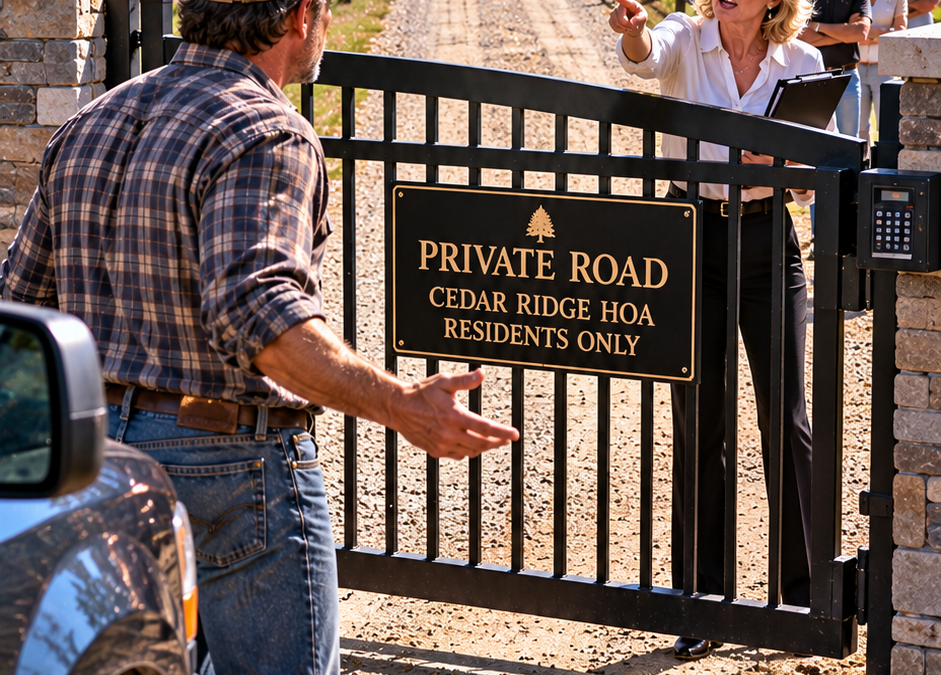
Twenty yards ahead of me, across the only gravel road leading to my ranch, stood a brand-new black steel gate.
Two stone pillars had been planted on either side, still streaked with wet mortar. A keypad box blinked beside one post. Across the middle of the gate, bolted clean and polished, was a sign that looked like it belonged at the entrance to a resort.
PRIVATE ROAD
CEDAR RIDGE HOA RESIDENTS ONLY
For a few seconds, I just stared.
The words did not fit the place.
That road did not belong to Cedar Ridge. Cedar Ridge had not existed when my family started using it. The subdivision was barely six years old. Before that, the land east of the road had been soybean fields, drainage ditches, and windblown grass. My father had paid to repair the culvert under that road in 1998. I had paid for gravel, grading, ditch clearing, and washout repairs ever since I took over the ranch.
And now somebody had locked me out.
A white SUV rolled toward me from the subdivision entrance and stopped on the other side of the gate.
I recognized the driver immediately.
Linda Mercer.
President of the Cedar Ridge Homeowners Association.
She stepped out wearing sunglasses and carrying a clipboard, like she had been waiting for this exact moment. Her blouse was crisp. Her hair was fixed. Her face held that calm, satisfied expression people wear when they believe the difficult part is already finished.
“Daniel,” she called through the bars. “You’ll need to turn around.”
I almost laughed.
“Turn around and go where?”
“Your property needs a separate access point.”
I looked behind me at nearly three miles of ranch road, then back at her.
“This is my access point.”
Linda shook her head.
“Not anymore.”
That was when I noticed three Cedar Ridge residents standing near their mailboxes, watching us. Nobody spoke. Nobody even pretended not to be listening.
I climbed out of my truck slowly.
The gravel crunched under my boots as I walked toward the gate. Up close, it looked expensive. Heavy hinges. Fresh wiring. Reinforced posts. The kind of structure built by people who wanted the word no to look permanent.
“Who authorized this?” I asked.
“The HOA board.”
“You built a gate across a road I’ve used my entire life.”
“This is a private community road.”
“No,” I said. “This is Carter Ranch Road.”
Linda lifted the clipboard.
“We’ve had complaints about agricultural vehicles, livestock trailers, dust, and unnecessary traffic.”
I stared at her.
“My truck is unnecessary traffic?”
“You are not a Cedar Ridge homeowner.”
“I am a rancher trying to get to my ranch.”
“That does not give you unrestricted access through a residential community.”
I reached through the bars and pointed toward the distant barn, barely visible beyond the pasture. My cattle trailer sat beside it.
“I have twenty-three head scheduled to be moved tomorrow morning. The trailer comes through here.”
“Then you’ll need another route.”
“There isn’t another route.”
Her expression did not change.
“That is something you should have considered before operating a ranch next to a residential community.”
One of the residents by the mailboxes actually lowered his head when she said that.
Because everyone standing there knew the truth.
I had not built my ranch next to Cedar Ridge.
Cedar Ridge had built itself beside my ranch.
I pulled out my phone and photographed the gate, the pillars, the keypad, the sign, and Linda standing beside all of it.
Her posture changed immediately.
“What are you doing?”
“Taking pictures.”
“You don’t have permission to photograph HOA property.”
That sentence told me something important.
Linda was not worried about the gate.
She was worried about proof.
I stepped back toward my truck.
“You might want to call whoever told you this road belongs to Cedar Ridge.”
She folded her arms.
“Our attorney has reviewed the community documents.”
“Good,” I said, opening my truck door. “Then he won’t mind reviewing them again.”
Linda smiled like she had already won.
“Daniel, cutting or damaging this gate will be considered trespassing and destruction of HOA property. We’ve already notified security.”
I paused with one hand on the door.
“I’m not touching your gate.”
Her smile widened.
“Smart decision.”
I looked down at the gravel beneath my boots.
There was something Linda did not know.
Three months earlier, I had found an old survey marker while repairing a drainage ditch beside this road. At the time, I had not thought much about why a county marker sat almost fifteen feet inside what Cedar Ridge claimed as its boundary. Land is full of old markers, and sometimes they raise questions you do not have time to chase because cattle need feed, fences need wire, and water lines break in the middle of already busy weeks.
Now I had time.
I backed my truck up until I could turn around at the pasture entrance. Linda watched from behind the gate, probably thinking she had forced me off her private road.
By noon, I was standing inside the county records office with a clerk named Susan tracing a yellow boundary line across a parcel map.
Susan was in her late fifties, sharp-eyed, and patient in the way only county clerks become after years of helping people discover that what they believe about land is not always what the records say.
She leaned closer to the monitor.
Then her finger stopped.
Her eyebrows lifted.
“Mr. Carter,” she said slowly, “I think your HOA has a very serious problem.”
I leaned over the counter.
The black gate was almost exactly where I had described it.
And it was not standing on Cedar Ridge property.
“Zoom in right there,” I said.
Susan clicked twice. The parcel line spread across the county screen. The road running from the highway toward my ranch was shaded differently from Cedar Ridge’s internal streets. A narrow strip followed the road all the way past the subdivision entrance and ended at my south pasture.
Susan tapped the monitor.
“Cedar Ridge’s boundary stops here.”
Her finger rested nearly twenty feet east of the new gate.
“So whose land is the gate on?” I asked.
She opened another record.
“According to the current parcel map, this strip belongs to Carter Ranch Holdings.”
I stared at her.
“That’s me.”
“I assumed so.”
For the first time that morning, I felt something besides anger.
Linda had not just blocked my access.
The HOA appeared to have installed a steel gate on my property.
Susan warned me that the parcel map was not a substitute for a fresh boundary survey, so I requested certified copies of the recorded plat, my deed, and the road easement documents. While the printer ran, my phone buzzed.
Cedar Ridge HOA.
I answered.
“Daniel Carter.”
Linda did not bother saying hello.
“I’ve been informed you’re challenging the gate.”
“Who informed you?”
“That’s irrelevant.”
It was not.
I had been at the county office less than forty minutes.
“You need to stop creating unnecessary conflict,” she continued. “The board has authority over that roadway.”
“I’m looking at the county map right now.”
Silence.
Only for a second.
Then her voice sharpened.
“County maps can be outdated.”
“Maybe,” I said, watching Susan place certified documents into a folder. “That’s why I’m getting the recorded plat too.”
Another silence.
This one lasted longer.
“Daniel,” Linda said, “I strongly recommend you do not interfere with HOA infrastructure.”
“Linda, did your contractor survey the gate location before pouring those pillars?”
She hung up.
That answered more than anything she could have said.
When I returned home an hour later, Linda was not alone.
Two HOA board members stood beside her. One was Harold Pierce, a retired insurance man who always looked as if he was trying to calculate risk in his head. The other was Denise Cole, who served as board secretary and had a reputation for being quieter than Linda but not stupid. A man in a Cedar Ridge security shirt stood near the keypad, shifting his weight.
My truck had barely stopped before Linda walked toward the gate.
“You were told to use another entrance.”
“There is no other entrance.”
“Then park outside and walk.”
I held up the county folder.
The security guard looked uncomfortable.
Linda did not.
Instead, she handed me a white envelope through the bars.
“Formal notice.”
I opened it.
The HOA was accusing me of unauthorized commercial use of a private residential road. It demanded that I immediately stop bringing trucks, trailers, farm equipment, livestock, and commercial agricultural activity through Cedar Ridge.
I looked up.
“You wrote this today?”
“The board approved it.”
A pickup slowed behind me.
My neighbor, Tom Reeves, rolled down his window.
“What’s going on?”
Linda stepped forward before I could answer.
“HOA matter. Please keep moving.”
Tom looked at the gate, then at me.
“Since when is this HOA property?”
Linda’s jaw tightened.
“Since always.”
Tom laughed once.
“No, ma’am.”
Everything went quiet.
Tom had lived across the highway for thirty-two years. He pointed toward the stone pillar.
“I helped Daniel’s father replace the culvert under that road in 1998. Cedar Ridge was still a soybean field.”
One board member glanced at Linda.
She ignored him.
“Historical use does not establish ownership.”
“You’re right,” I said.
I pulled the certified parcel map from the folder.
“Ownership does.”
I unfolded it against my truck hood. Tom walked over. The security guard followed. Linda stayed where she was.
I pointed to the boundary line.
“The county shows the HOA ending here.”
Then I moved my finger to the gate.
“And your gate is here.”
The security guard looked from the map to Linda.
“That’s outside the subdivision.”
Linda finally approached. She studied the page for maybe five seconds before stepping back.
“This proves nothing.”
“It’s certified.”
“We have our own records.”
“Great,” I said. “Bring them.”
Her face hardened.
“You are not entering through this gate.”
Then she turned to the security guard.
“If he attempts to cross, call the sheriff.”
Tom looked at me.
I looked at Linda.
“Please do.”
She blinked.
I folded the map carefully.
“Because when the deputy gets here, I’m going to ask him one very simple question.”
I pointed at the concrete pillar planted beside my road.
“Who gave Cedar Ridge permission to build that on my land?”
Linda did not call the sheriff.
That surprised me more than the gate.
She stood beside the keypad with her phone in one hand, staring at the certified map I had just shown her.
The security guard, a young man named Marcus, shifted his weight and finally said, “Mrs. Mercer, I’m not comfortable detaining anybody over a property line dispute.”
Linda turned on him.
“Nobody asked you to be comfortable.”
Marcus’s face changed.
Tom heard it too. He pulled his truck onto the shoulder, shut off the engine, and stayed.
That gave me my first real witness.
Linda noticed.
“Everyone needs to leave,” she said.
I shook my head.
“I’m standing on my property.”
“That’s disputed.”
“Then show me your survey.”
Harold Pierce quietly asked, “Linda, do we actually have one?”
She shot him a look.
“The developer documents establish HOA control.”
“That’s not what he asked,” Tom said.
Linda ignored him.
Then a landscaping truck came down the ranch road from inside the gate. The driver entered a code. The steel arms began to swing open.
I saw my chance.
I walked toward the opening.
Linda stepped directly in front of me.
“Do not cross.”
“Move, Linda.”
“This is your final warning.”
I stopped three feet away.
Behind her, the landscaper froze halfway through the gate.
“You are physically blocking me from reaching my ranch,” I said.
“I am enforcing community security.”
“My cattle are on the other side.”
“Not my responsibility.”
Then a sound carried across the pasture.
A long, distressed bawl.
Then another.
I looked toward the fence.
One of my cows was pacing near the water trough.
My stomach tightened.
I had shut off that line before leaving town because the valve had cracked overnight. The replacement fitting was sitting in the passenger seat of my truck. The pump key was beside it.
I needed through.
Now.
“Linda,” I said, forcing my voice to stay steady, “I have livestock without water.”
For half a second, I expected basic common sense to win.
Instead, she folded her arms.
“You should contact animal services.”
Tom stared at her.
“You cannot be serious.”
“I am not responsible for his poor planning.”
That did it.
Harold stepped away from her.
“Linda, open the gate.”
“No.”
“Open it.”
“I said no.”
Denise pulled out her phone.
“I’m calling our attorney.”
Linda spun toward her.
“We already have legal guidance.”
“Then he can repeat it to me,” Denise said.
The board was cracking right in front of us.
But Linda doubled down.
She reached into the keypad housing and changed something. A red light flashed. The landscaper tried his code again.
Nothing happened.
Marcus looked at the keypad.
“You just locked everybody out.”
“I’ve suspended access until this situation is resolved.”
The landscaper leaned out his window.
“Ma’am, I’ve got two guys and equipment inside.”
Linda pointed toward the subdivision.
“They can exit through Cedar Ridge.”
“They can’t. Our trailer won’t clear your residential roundabout.”
Now even people inside the subdivision were being trapped by her decision.
Three more residents gathered near the entrance. Phones were coming out.
Linda saw them recording.
“Stop filming HOA security operations.”
Nobody stopped.
Then my phone rang.
It was my ranch hand, Miguel.
“Daniel, where are you?”
“At the gate.”
“We’ve got a bigger problem.”
I turned away from Linda.
“What happened?”
“The north herd pushed through the temporary divider. They’re crowding the dry trough.”
My chest tightened.
“Can you get the backup tank running?”
“Not without the pump key.”
I looked through my windshield.
The key ring was sitting beside the replacement valve on my side of Linda’s locked gate.
Miguel lowered his voice.
“And Daniel?”
“Yeah?”
“One of the calves is already down.”
I looked at Linda.
She was still arguing with her own board members.
I picked up the county folder, handed it to Tom, and took out my phone.
Linda saw me dialing.
“Who are you calling?”
This time, I did not answer her.
The dispatcher did.
“County Sheriff’s Office. What’s your emergency?”
I kept my eyes on the gate.
“I need a deputy at Carter Ranch Road immediately. Someone has blocked the only access to livestock in distress.”
Linda’s face went pale.
I added, “And I have certified county records showing the gate may have been built on my property.”
The deputy arrived before Linda’s attorney called back.
His cruiser rolled onto the shoulder with no siren, but the moment everyone saw the county emblem on the door, the arguing stopped.
Deputy Ryan Keller stepped out and looked at the gate, the trapped landscaping truck, the growing crowd, and finally me.
“Who’s Daniel Carter?”
“I am.”
Linda immediately moved between us.
“Officer, I’m Linda Mercer, president of the Cedar Ridge HOA. This man is attempting to trespass into our private community.”
Keller looked past her.
“Mr. Carter, where do you live?”
I pointed through the gate.
“Three miles that way.”
The deputy stared at Linda.
“So he’s trying to go home.”
“His ranch is beyond the community boundary.”
“Then why is your gate blocking his road?”
Linda’s mouth tightened.
“It’s complicated.”
“It wasn’t complicated ten minutes ago,” Tom muttered.
Keller heard him.
“Sir, were you here when this started?”
“Most of it.”
Linda turned sharply.
“He’s not an impartial witness.”
Keller raised one hand.
“I’ll decide who I need to speak with.”
For the first time all day, Linda stopped talking.
I gave Keller the certified parcel map and explained the water problem with the herd. He studied the page, then walked along the gate line himself. He stopped beside the western pillar.
“Where’s the property marker?”
“I think there’s one about fifteen feet behind that ditch.”
We crossed the grass.
I found the old iron survey pin where I had seen it months earlier. Keller crouched beside it but did not touch it.
Tom pointed toward the gate.
“If that’s still the boundary marker, they built the whole thing on Daniel’s side.”
Linda followed us.
“That marker could be obsolete.”
“Could be,” Keller said. “That’s why I’m not making a boundary determination.”
Linda seemed relieved.
Then Keller added, “But I’m also not arresting Mr. Carter for trespassing based solely on your claim.”
Her relief vanished.
A horn blasted behind us.
Miguel had driven my old ranch utility cart down from the pasture and stopped on the far side of the gate.
“We need that pump key.”
I ran to my truck, grabbed the key ring and valve fitting, then returned.
Linda stepped toward the keypad.
“The gate remains closed.”
Keller looked at her.
“Mrs. Mercer, there is an active livestock welfare issue.”
“That does not change HOA policy.”
“It changes what I’m dealing with.”
Harold finally snapped.
“Open the damn gate, Linda.”
Several residents murmured agreement.
Linda looked around and realized she was losing the crowd.
Then something unexpected happened.
Denise walked toward me, holding her phone.
“Daniel, you need to see this.”
On her screen was an email chain between Linda and the gate contractor dated three weeks earlier.
The contractor had asked for a boundary survey before installation.
Linda’s reply was underneath.
Proceed using existing road edge. Survey not necessary.
I looked up.
“You knew they hadn’t surveyed it.”
Linda reached for the phone.
“Denise, that’s confidential board communication.”
Denise pulled it away.
“No. What’s confidential is why you told us the contractor verified the boundary.”
Harold stared at Linda.
“You told the board the location was confirmed.”
“It was confirmed by the development plan.”
“That’s not what you said.”
Keller took out his notebook.
“Mrs. Cole, can you preserve that email?”
Linda’s voice rose.
“This is absurd. We’re discussing an administrative misunderstanding like it’s a crime.”
Nobody answered because Denise was scrolling.
Then she stopped again.
Her face changed.
“There’s another email.”
She handed the phone to Keller.
This one was from the contractor to Linda two days before construction.
Possible encroachment. Carter parcel.
Keller read it twice.
Then he looked at the concrete pillars.
“Mrs. Mercer, don’t delete anything from your phone.”
Linda went completely still.
For the first time, I understood that the gate itself might not be the biggest problem anymore.
Linda did not say another word for nearly thirty seconds.
Then her phone rang.
She looked at the screen, turned away from Deputy Keller, and answered in a low voice.
“Yes, Martin.”
That had to be the HOA attorney.
I could not hear everything, but I heard enough.
“No, the deputy is still here.”
A pause.
“Yes, Denise showed him the email.”
Another pause.
Then Linda’s shoulder stiffened.
“What do you mean don’t touch anything?”
Keller looked at me.
That sentence had caught his attention too.
While Linda argued quietly into her phone, Marcus manually released the gate under Keller’s direction. The steel arm finally rolled open.
I grabbed the pump key and fitting.
“Miguel, let’s go.”
We were halfway through when Linda stepped into the road.
“This does not constitute permission for future access.”
I did not stop.
“Move,” Keller said.
This time, Linda moved.
Miguel and I raced toward the pasture.
By the time we reached the trough, the down calf was breathing hard but still alert. We repaired the valve, started the pump, and within minutes, water poured into the tank. The herd crowded forward. Miguel crouched beside the calf.
“He’s getting up.”
I watched the little animal struggle onto shaky legs.
For the first time that day, something had gone right.
Then Tom called me.
“Daniel, you need to come back.”
“What happened?”
“County survey department just showed up.”
I looked at Miguel.
He nodded toward the road.
“Go. I’ve got this.”
When I returned, a county pickup was parked beside Keller’s cruiser. A woman in an orange safety vest was setting up survey equipment near the ditch. Linda stood with Harold and Denise.
Nobody was talking to her anymore.
The woman introduced herself as Aaron Walsh from County Public Works.
“Deputy Keller contacted dispatch about a possible obstruction involving a recorded access corridor.”
“Access corridor?” I asked.
Linda immediately stepped forward.
“You were told this was HOA property.”
Aaron did not even look up from her equipment.
“I was told there was a boundary dispute. I’m checking county control points.”
That shut Linda down.
Aaron located the old survey pin I had shown Keller. Then she crossed the road and found another marker buried beneath several inches of gravel. She measured, checked her tablet, measured again.
Finally, she walked toward the western gate pillar.
“Who installed this?”
“Cedar Ridge HOA,” Harold said.
Linda glared at him.
Aaron placed a fluorescent mark on the ground.
“This pillar appears to be approximately fourteen feet, eight inches west of the Cedar Ridge parcel boundary.”
Tom whistled.
I said nothing.
Aaron walked to the other pillar.
“Same issue here.”
Linda’s voice turned defensive.
“Approximately is not legally definitive.”
“No,” Aaron said. “A licensed boundary survey would establish the precise line.”
Linda crossed her arms, almost triumphant.
Then Aaron continued.
“But there is another issue.”
She enlarged something on her tablet.
“This road is not merely adjacent to Mr. Carter’s parcel.”
She turned the screen toward Keller.
“It is part of a recorded county-recognized access route serving the Carter property.”
I stepped closer.
“So the HOA can’t block it.”
Aaron chose her words carefully.
“They certainly should not obstruct it without confirming their legal authority.”
Denise covered her mouth.
Harold looked furious.
But Tom was staring toward the stone pillar.
“Daniel.”
Something in his voice made me turn.
He pointed at the fresh concrete around the base.
“Didn’t there used to be another marker right there?”
I walked closer.
Then I remembered.
A small yellow county stake had stood beside that drainage ditch for years.
It was gone.
Aaron immediately photographed the area.
“Nobody step there.”
Linda backed away.
Keller noticed.
“Mrs. Mercer, do you know what happened to that marker?”
“No.”
Marcus cleared his throat.
Every head turned toward him.
“I might.”
Linda’s face drained.
Marcus looked directly at Keller.
“I was working security the morning they built the gate.”
He pointed at the fresh concrete.
“The contractor stopped because there was a survey stake in the way.”
My stomach tightened.
“What happened to it?”
Marcus looked at Linda.
“She told them to pull it out.”
Nobody moved.
Deputy Keller looked at Marcus.
“Tell me exactly what you saw.”
Marcus swallowed.
“The contractor uncovered a yellow stake while digging the western footing. He stopped the excavator and called Mrs. Mercer over.”
Linda stepped forward.
“Marcus, be very careful.”
Keller turned toward her.
“Mrs. Mercer, three words.”
That was enough.
Linda stopped.
Marcus continued.
“The foreman said the stake might mark a property line and they should wait for a surveyor. Mrs. Mercer told him the HOA already knew where the boundary was. He wouldn’t remove it.”
Keller’s expression hardened.
“So who did?”
Marcus pointed at Linda.
“She did.”
Linda exploded.
“That is completely false.”
Tom immediately raised his phone.
“I’ve been recording since the deputy arrived.”
Linda stared at him.
Keller stepped between them.
“Nobody is accusing anybody of a crime right now. I’m documenting statements.”
Aaron photographed the concrete again.
Then she asked Marcus, “What happened to the stake?”
“He put it beside the ditch.”
“Who?”
“The foreman.”
Marcus hesitated.
“Then Linda picked it up and put it in her SUV.”
Harold actually walked away. He stood beside his car with both hands on his head.
Denise looked sick.
“Linda, you told us there were no markers.”
Linda’s face tightened.
“I told you there were no relevant markers.”
Aaron looked up sharply.
“That is a very different statement.”
A second county vehicle arrived ten minutes later. This one belonged to code enforcement.
The officer, James Holloway, took photographs of the pillars, measured their distance from the road edge, and asked for the gate permit.
Linda handed him a folder.
He flipped through it.
“Where’s the site plan?”
“The contractor handled permitting.”
Holloway looked toward the contractor’s name on the paperwork.
“This permit covers electrical work for an access control system.”
“Correct.”
“It does not authorize construction in a disputed access corridor.”
Linda’s confidence finally cracked.
“The HOA attorney approved the project.”
“Your attorney does not issue county permits.”
Tom coughed into his hand to hide a laugh.
Then Holloway noticed something else.
A small camera had been mounted above the keypad.
“Is that recording?”
Marcus nodded.
“Twenty-four hours.”
Keller turned.
“How long are recordings stored?”
“Thirty days.”
Linda’s head snapped toward Marcus.
“Security footage is HOA property.”
Keller answered before Marcus could.
“Then preserve today’s footage and anything from the installation date.”
Linda pulled out her phone.
“I’m calling counsel.”
“That is your right,” Keller said, writing in his notebook. “But nobody deletes footage.”
For the first time, I saw fear replace anger on Linda’s face.
Not embarrassment.
Fear.
Then a dark pickup approached from the highway and stopped behind the cruiser. A heavyset man in a work shirt climbed out.
Marcus recognized him immediately.
“That’s the gate contractor.”
The man walked toward us.
“Who called about Cedar Ridge?”
“I did,” Aaron said. “Were you present during installation?”
He nodded.
“Unfortunately.”
Linda moved toward him.
“Ray, don’t discuss anything until Martin gets here.”
Ray looked at her, then at the deputy, then at me.
“I’m done taking instructions from Cedar Ridge.”
That silenced everyone.
He opened his truck and pulled out a rolled set of plans.
“I kept the original installation sketch because I knew this would come back on us.”
He spread it across my hood.
There were two gate locations marked, one in red and one in blue.
Ray pointed to the blue line.
“This is where we recommended installing it.”
It sat inside Cedar Ridge.
Then he pointed to the red line.
“This is where Mrs. Mercer ordered us to build.”
Directly across my ranch road.
“Why?” I asked.
Ray looked at Linda.
“Because the first location wouldn’t stop you from using the road.”
Keller stopped writing.
Linda said nothing.
Ray reached into his folder again.
“And that is not the worst part.”
He pulled out a printed email.
“She put the reason in writing.”
Ray laid the email flat against my truck hood.
Nobody reached for it at first.
Linda did.
Deputy Keller put his hand over the page before she could touch it.
“Leave it.”
Ray pointed to the date. Four weeks before the gate was installed. The message came from Linda’s HOA account.
I read the sentence twice.
The gate must be positioned west of the subdivision entrance so Carter Ranch traffic cannot bypass HOA access control.
Harold stared at Linda.
“You told us this was about resident security.”
“It was.”
Ray shook his head.
“No. You specifically asked me whether the gate could prevent ranch vehicles from passing.”
Linda’s voice sharpened.
“Because heavy equipment was damaging the road.”
“My family maintains that road,” I said.
She turned on me.
“Your family acts like owning land gives you the right to ignore everyone around you.”
There it was.
Not safety.
Not traffic.
Not dust.
Control.
Keller photographed the email.
Then Ray pulled out his phone.
“I also have texts.”
Linda’s attorney arrived before he could show them.
A silver sedan stopped near the entrance, and a man in a navy suit stepped out carrying a leather case.
“Nobody says anything else,” he called.
Linda looked relieved.
“Martin.”
He barely acknowledged her.
“I’m Martin Graves, counsel for Cedar Ridge HOA. Deputy, I’d like to understand what’s happening.”
Keller gave him the short version.
Gate. Boundary dispute. Missing marker. Livestock access. Contractor records. Preservation of security footage.
By the time he finished, Graves was not looking at me.
He was looking at Linda.
“Did you remove a survey marker?”
“No.”
Marcus spoke from behind us.
“I watched her do it.”
Graves closed his eyes for half a second.
Then Denise stepped forward.
“She told the board the contractor confirmed the boundary.”
“I relied on the development documents,” Linda snapped.
Ray laughed.
“You relied on them after I told you they didn’t match the county stakes.”
Graves held up one hand.
“Ray, please.”
“I’m not your client.”
That landed hard.
Then Holloway from code enforcement returned from his county truck carrying a printed aerial sheet.
“I contacted Public Works records,” he said. “There is something everyone needs to see.”
He spread the sheet beside Ray’s installation sketch.
A highlighted strip ran beneath the gate and continued toward my ranch.
Aaron leaned closer.
“That’s the old road dedication.”
Holloway nodded.
I looked between them.
“What does that mean?”
“It means this corridor has a recorded access history older than Cedar Ridge.”
Linda immediately said, “That does not establish Carter ownership.”
“No,” Aaron replied. “The parcel record does that.”
She tapped the western edge.
“But this makes obstructing the road even more problematic.”
Graves quietly asked Linda, “Did you send me this document before approving construction?”
Linda did not answer.
“Linda.”
“I sent you the HOA plat.”
“That is not what I asked.”
Her face flushed.
Then Ray unlocked his phone.
“I think this answers why.”
He opened a text thread and handed the screen to Keller.
One message was highlighted. Ray had written:
County map appears to show proposed gate outside HOA boundary. Recommend survey before proceeding.
Linda’s response was directly underneath:
If we wait for another survey, Carter will challenge the project. Install Friday before he can interfere.
Tom whispered, “Wow.”
Keller read it again.
Then he looked at Linda.
“Mrs. Mercer, I’m asking you directly. Where is the yellow survey stake?”
“I don’t know.”
Marcus immediately pointed toward her white SUV.
“Check the rear storage compartment.”
Linda spun around.
“You have no right to search my vehicle.”
Keller nodded.
“Correct. Not without consent or appropriate legal authority.”
For a moment, nobody moved.
Then Graves pulled Linda aside.
They whispered for less than a minute.
When they returned, Graves looked exhausted.
“My client will voluntarily open the rear compartment.”
Linda pressed the key fob.
The hatch lifted.
Keller walked over. So did Aaron.
I stayed where I was.
Five seconds later, Aaron reached inside wearing gloves. She came back holding a bent yellow metal stake coated with dried dirt.
The faded county identification tag was still attached.
Nobody said a word.
Keller looked at Linda.
“At this point, Mrs. Mercer, I need you to remain here while I contact my supervisor.”
And suddenly, the gate blocking my ranch was not an HOA dispute anymore.
Linda stopped arguing after they found the stake.
That was the strangest part.
For hours, she had an answer for everything. The map was outdated. The road belonged to Cedar Ridge. The contractor had authority. Marcus was lying. The county marker was irrelevant.
Now she stood beside her SUV with her arms folded while Deputy Keller spoke quietly with his supervisor on the phone.
Then Aaron’s tablet chimed.
She looked down.
“I just got the archived survey.”
Everyone turned toward her.
County records had located the subdivision boundary survey filed before Cedar Ridge’s first home was built. Aaron opened the document and overlaid it on the current parcel map.
The lines matched exactly.
She pointed toward the gate.
“There is no ambiguity anymore.”
Graves stepped closer.
“How far outside the HOA parcel?”
“Western footing is fourteen feet, nine inches onto the Carter parcel. Eastern footing is just over thirteen.”
I stared at Linda.
She had spent the entire morning threatening to have me arrested for trespassing while standing beside a gate her HOA had built on my land.
Harold spoke first.
“Take it down.”
Linda looked at him.
“You don’t have authority to make that decision alone.”
“I’m not making it alone.”
Denise stepped beside him.
“I vote to remove it immediately.”
Harold raised his hand.
“So do I.”
Linda laughed bitterly.
“You cannot hold a board vote on the side of a road.”
Graves quietly said, “You may want to stop challenging them.”
Her head snapped toward him.
“You’re supposed to represent the HOA.”
“I do,” he said, looking at the recovered survey stake. “That is precisely why I’m telling you to stop.”
Holloway’s phone rang.
He listened for a moment before walking toward the gate. When he returned, he carried a red notice.
“County is issuing a stop-use order pending formal review.”
He attached it to the keypad housing.
Linda stepped forward.
“You cannot disable community security.”
Holloway looked directly at her.
“This structure appears to have been installed outside your parcel and across a recorded access corridor without sufficient authorization.”
Then he turned to Ray.
“Can you remove it safely?”
“The steel gate, yes. The pillars will take equipment.”
“Start with the gate.”
Linda’s mouth fell open.
“Absolutely not.”
Nobody listened.
Ray called his crew.
Twenty minutes later, the same workers who had installed the gate arrived with tools. Residents lined both sides of the subdivision entrance. Phones were everywhere.
The first impact wrench screamed against the hinge bolts.
Linda flinched.
One bolt came free.
Then another.
The black steel panel shifted.
For the first time all day, my ranch road began opening again.
Tom stood beside me.
“Never thought I’d enjoy watching somebody unscrew a gate.”
I almost smiled.
Then a Cedar Ridge resident named Mrs. Alvarez approached us. She had been watching quietly since morning.
“Daniel?”
“Yes?”
“I’m sorry.”
“You didn’t build it.”
“No,” she said. “But some of us complained about your trucks.”
She looked toward my pasture.
“We were told you were illegally using our private road.”
That caught my attention.
“Who told you?”
She looked at Linda.
“She did.”
Another resident stepped forward.
“Same thing at the annual meeting.”
Then another.
“She said the ranch had no legal access through here.”
Denise’s face changed.
“That was never in the board minutes.”
Mrs. Alvarez pulled out her phone.
“I recorded the meeting.”
Linda looked up sharply.
And just like that, the problem got bigger again.
The gate was not one bad decision.
Linda had been building a story about me for months.
Ray’s crew lifted the steel panel from its hinges and lowered it onto the grass.
The road was finally clear.
But Keller was not leaving.
He walked toward me, holding the contractor email, photographs, and a copy of Aaron’s archived survey.
“Mr. Carter, we’re going to need a formal statement from you.”
I looked past him at Linda.
She had spent one morning trying to prove I had no right to cross that road.
Now the county map, her contractor, her security guard, her own board members, and her own residents were all saying the same thing.
The gate had never protected Cedar Ridge from me.
It had exposed her.
Three weeks later, there was nothing left of Linda’s gate except two pale rectangles in the gravel where the pillars had stood.
Cedar Ridge paid to remove them.
They also paid to repair the drainage ditch, restore the disturbed boundary area, and commission a licensed survey of the entire road corridor. The survey confirmed what the county records had shown from the beginning. The disputed section belonged to my ranch.
More importantly, Cedar Ridge had no authority to block my access.
I received the final survey by certified mail on a Thursday afternoon.
On Friday morning, I drove my cattle trailer down the road.
Nobody stopped me.
But someone was waiting.
Harold stood near the subdivision entrance holding a coffee. He raised one hand as I slowed.
“Morning, Daniel.”
“Morning.”
He looked toward the empty space where the gate had been.
“Board voted last night.”
I waited.
“Linda is no longer president.”
That did not surprise me.
After Mrs. Alvarez produced her recording, several residents went back through old HOA emails and meeting notices. What they found was not some grand conspiracy. It was simpler and uglier.
For months, Linda had described my ranch as a threat to property values. She had blamed my trucks for road damage without evidence. She had told residents I was exploiting a loophole. Then she pushed the gate project through as the solution.
The board had believed her because nobody had bothered asking me.
“She resigned?” I asked.
Harold shook his head.
“Removed.”
I nodded.
Then he surprised me.
“We owe you an apology.”
“You already removed the gate.”
“That’s not the same thing.”
Before I could answer, a small boy from one of the Cedar Ridge houses ran toward the roadside fence. His mother hurried after him.
“Mr. Carter, I’m sorry.”
I stopped the truck.
It was Mrs. Alvarez.
Her son pointed at the cattle trailer.
“Are those cows?”
I smiled for the first time in what felt like weeks.
“Those are cows.”
“Can I see them?”
His mother looked embarrassed.
“Only if you’re not busy.”
Ten minutes later, my trailer was parked beside the pasture entrance while three Cedar Ridge families stood at the fence watching the cattle.
Then five families.
Then eight.
Miguel came down from the barn and looked at the crowd.
“What happened?”
“Apparently,” I said, “we’re a tourist attraction now.”
He laughed.
That Saturday, something happened I never expected.
Cedar Ridge residents showed up at the ranch—not with violation notices, not with complaints, but with work gloves.
A storm had knocked branches across part of the road, and Harold organized volunteers to help clear them. Tom brought his chainsaw. Mrs. Alvarez brought sandwiches. Even Marcus came after his security shift.
Nobody mentioned Linda.
They did not need to.
A month later, the county installed permanent reference markers along the boundary. I was there when Aaron placed the final one.
She looked toward the subdivision.
“This should prevent future confusion.”
I laughed.
“I don’t think anybody over there is confused anymore.”
She smiled.
Neither was I.
I had spent years treating Cedar Ridge as something that existed beside my ranch. They had their neighborhood. I had my cattle. As long as everyone stayed on their side, I figured we would be fine.
But that gate changed something.
Not because it created a fight.
Because it forced people to look at what they had been told and compare it with what was actually true.
Linda had counted on a polished sign, a black steel gate, and the authority of an HOA title being enough to make me turn around.
For a few hours, it almost was.
But property lines do not move because somebody speaks confidently. Records do not change because a board president wants them to. And an old ranch road does not suddenly become private because someone bolts a sign across it.
These days, when I drive past Cedar Ridge, there is no keypad, no security guard, and no private road sign.
Just gravel, fence posts, and one small county marker beside the ditch.
Most people would drive past without noticing it.
I notice it every time.
Because that little marker settled an argument a six-foot steel gate could not.
Linda built the gate to show me where she believed I did not belong.
The county map showed everyone something else.
She had built it on the one piece of ground that had never belonged to her.








