𝗙𝗨𝗟𝗟 𝗦𝗧𝗢𝗥𝗬 The gate had been standing on my family’s ranch longer than Silver Laurel Estates had existed.
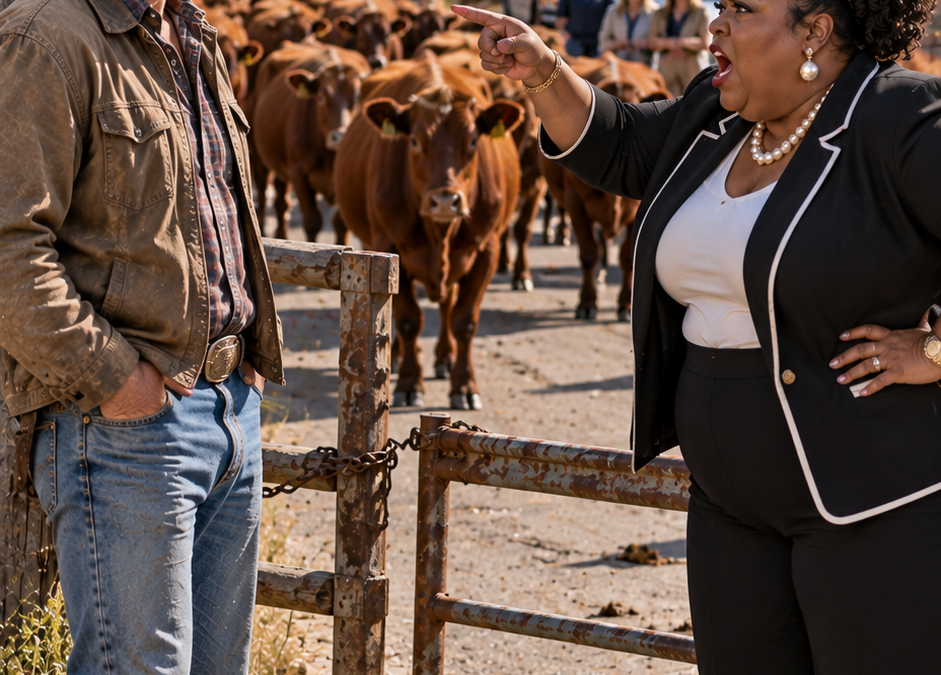
𝗣𝗔𝗥𝗧 𝟮
The paint had faded.
The letters were uneven.
The gate sagged maybe half an inch on one side.
It was not pretty.
It was never supposed to be.
That gate closed the end of a livestock transfer corridor connecting my east pasture to the north pasture.
The corridor followed the ranch boundary.
Drift fencing kept cattle moving in the correct direction.
When we transferred the herd, the animals naturally followed that fenced path instead of spreading across open land.
For decades, open land had existed beyond the gate.
Then Silver Laurel arrived.
Now beyond that gate was pavement.
Luxury houses.
A decorative fountain.
Children riding bicycles.
Cars worth more than some of my equipment.
The gate became more important after the subdivision was built, not less.
Celeste moved into Silver Laurel about three years before everything happened.
One of the largest houses.
Near the top of the circle.
Within eighteen months, she became HOA president.
She had a gift for making demands sound like improvements.
She never said she disliked my ranch.
She wanted to “improve perimeter compatibility.”
She never complained that the cattle smelled.
She wanted to “enhance the resident experience.”
She never said my gate was ugly.
She wanted to “elevate visual standards along the community boundary.”
The first time she used that phrase while standing in my driveway wearing white tennis clothes and sunglasses, I almost admired the effort.
I had spent my life dealing with cattle buyers, feed suppliers, bankers, mechanics, inspectors, and men who could lie to you about hay quality while staring straight at a moldy bale.
I thought I had heard every possible way of avoiding plain language.
Celeste was better.
The first complaint involved Harvey Boon’s hay truck.
Harvey has delivered hay to Keen Ridge longer than I have been running it.
Sometimes he arrives before daylight.
That is ranching.
Celeste emailed that commercial vehicle traffic before six disturbed residents.
I explained that agricultural work started early.
Her answer suggested I develop a “more community-sensitive delivery schedule.”
Then came a letter telling me my equipment shed needed repainting.
The shed sat almost a quarter mile outside Silver Laurel’s boundary.
I ignored that one.
Then a real estate agent I had never met came to my house with an offer for a narrow strip along the subdivision edge.
The price was low.
The proposed strip included part of my transfer corridor.
“No.”
The agent called again.
“No.”
Then Celeste came herself.
She stood beside the old gate with her arms crossed.
“No one paying what those homeowners paid should have to look at this every evening.”
She touched the top rail.
I did not like that.
“The gate isn’t for them.”
“It impacts them.”
“It keeps cattle out of their street.”
She smiled.
“Surely there are more modern solutions.”
“There are.”
“Then why not use one?”
“Because this one works.”
Her smile tightened.
“Some people hold onto things long after they’ve stopped being useful.”
I looked at the gate.
Then at her.
“It hasn’t stopped being useful.”
That should have been the end of it.
Instead, three days later, I found a laminated notice zip-tied to the steel.
Silver Laurel letterhead.
Gold crest.
EMERGENCY LANDSCAPE REMEDIATION REQUEST.
There is no such legal notice in Brier County.
Celeste had invented an official-sounding title and printed it on expensive paper.
The gate was described as an encroachment into a community landscape buffer.
I had seven days to remove it.
After that, Silver Laurel would take whatever action it considered necessary to protect resident welfare and aesthetics.
I stood there reading it while cattle grazed behind me.
Then I went to my office.
Opened the fireproof box.
Pulled the ranch plats.
The gate sat inside Keen Ridge.
Not close.
Not debatable.
Inside.
But there was something strange.
One old ranch service route appeared on Verdant Crest’s marketing survey as part of a scenic buffer.
Their glossy map made the boundary look cleaner than the actual recorded line.
Not legally meaningful.
But confusing enough to become useful to someone who wanted confusion.
I called Celeste.
Asked her to meet me at the gate.
I offered to walk the line.
Show her the markers.
End the argument.
She declined.
Instead she emailed me.
The association had consulted appropriate experts.
The gate was an unsafe obstruction.
If I did not remove it, the HOA would.
I read obstruction several times.
The old steel gate keeping three hundred cattle from a residential street had become the unsafe part of the equation.
What I did not yet know was that the gate had become inconvenient for more than Celeste’s aesthetics.
Verdant Crest was preparing Phase Two.
Bigger houses farther up the ridge.
Model homes.
Drone footage.
Promotional tours.
The route prospective buyers would take ran directly past my livestock corridor.
An old ranch gate carrying a hand-painted warning did not fit the photographs.
Celeste had apparently promised Verdant Crest operations manager Marlo Jensen that she would “handle the farm situation” before the launch.
I learned that later.
At the time, the first person who warned me something serious was happening was Naen Foster.
Naen lived near the end of the cul-de-sac.
Retired planning attorney.
Sharp.
Quiet.
She told me she had no special affection for cattle smells.
Then she told me she liked abuse of land-use authority even less.
“I saw Celeste at your boundary.”
“When?”
“Yesterday afternoon.”
“Doing what?”
“Walking it with two men from Verdant Crest.”
She said they were measuring.
Using a tablet.
Pointing at the gate.
“What do you think she’s doing?”
“I think she’s avoiding formal enforcement because she knows formal enforcement would require somebody to check the boundary.”
That got my attention.
Naen advised me to document everything.
So I mounted a battery trail camera in a scrub oak overlooking the gate.
Then I called Elliot Voss.
Surveyor.
Independent.
He had helped me with a boundary dispute years earlier.
Elliot spent most of a day reestablishing the line.
Near sunset, before he finished the final report, he walked up holding his field book.
“You’ve got a problem.”
“What kind?”
“One of your original brass monuments isn’t visible.”
“Missing?”
“Maybe.”
We dug.
Several inches down, beneath landscaping soil pushed in from Silver Laurel’s side, we found metal.
The marker had been covered.
Maybe deliberately.
Maybe carelessly.
At that moment, I could not prove which.
Before I had time to decide what it meant, Harvey called.
The north-pasture water system needed emergency repair.
A main section had failed.
The herd could not remain there.
All three hundred head needed to move south through the transfer corridor the next morning.
I looked toward Silver Laurel.
Then toward the old gate.
I called a locksmith.
Asked him to come at dawn and reinforce the hardware.
I did not know exactly what Celeste was planning.
But I had stopped assuming she would wait for permission.
That night I went to bed late.
Woke before the alarm.
Something felt wrong.
I drove to the gate without making coffee.
First thing I saw was tread marks.
Heavy equipment.
Wide tracks cutting from Silver Laurel’s side through wet grass.
Then I saw the ditch.
My gate was lying inside it.
Folded.
Twisted.
Both main posts ripped from the ground with concrete still clinging to the bottoms.
The tension wire above the drift fence had been cut.
Clean cut.
Not torn.
Not broken.
The warning sign my father painted was gone.
I stood there for a long second.
That gate had survived forty years of cattle pressing against it.
Snow.
Wind.
Equipment bumps.
One bull who had spent an entire summer trying to destroy anything between himself and another pasture.
Now it was lying in mud because somebody had decided it spoiled a photograph.
Then I saw the drift fence.
A whole section had been shoved aside.
The bulldozer had created an opening directly toward Silver Laurel’s pavement.
The disturbed ground sloped gently downward.
It looked almost like a ramp.
My trail camera was gone.
I found it tossed into brush twelve yards away.
Housing cracked.
Memory card still inside.
I did not check the footage.
There was no time.
I called Celeste.
She answered on the second ring.
Too awake for six in the morning.
“Your contractor destroyed my gate.”
“Our landscaping crew removed an unauthorized structure.”
“It wasn’t on your land.”
“The boundary has always been ambiguous.”
“No, it hasn’t.”
“Reasonable people can disagree.”
“Not about coordinates.”
She sighed.
“If your livestock are properly managed, Dorian, they shouldn’t be anywhere near our community.”
For a second, I genuinely could not speak.
Three hundred cattle were scheduled to move through that corridor in less than an hour.
“You need to close the cul-de-sac.”
“What?”
“Put up vehicles. Temporary barriers. Anything.”
“Why?”
“Because we’re moving the herd today.”
Silence.
“The gate you removed was the barrier.”
She laughed.
Actually laughed.
“Dorian, please don’t start threatening residents with some imaginary stampede.”
“I’m not threatening anybody.”
“This is exactly the kind of intimidation—”
“Celeste.”
I interrupted her.
“You removed the only livestock barrier between three hundred cattle and your street.”
“If your ranch is properly operated—”
“You need to close the road.”
She hung up.
Harvey arrived fifteen minutes later.
He climbed from his truck.
Looked at me.
Then looked at the ditch.
“Oh, hell.”
We walked the breach.
He touched one of the severed wires.
“Herd’s already bunched.”
“How long can we hold them?”
“Not long.”
They were waiting in a holding area half a mile north.
Three hundred animals in tightening space.
Water infrastructure under repair.
Heat building.
Cattle do not understand why a transfer suddenly stops.
They push.
They turn.
They stress.
Then fences start taking loads they were never designed to take.
Harvey and I improvised.
Stock trailers.
Portable panels.
Electric wire.
Anything we could drag into position.
The opening was too wide.
The bulldozer had removed more than the gate.
It had changed the shape of the corridor.
I remember standing with electric wire in my hand while Harvey looked north toward the herd.
“We’ve got to move.”
“I know.”
“You ready?”
“No.”
“Me neither.”
But we did.
I stayed at the broken section.
Harvey brought the herd down.
At first, everything worked.
Cattle flowed between the remaining drift fencing.
Steady.
Calm.
Then Bess reached the opening.
Bess was old.
Experienced.
The kind of lead cow younger animals trusted.
She stopped.
Looked toward the route she normally followed.
Then looked toward the open slope created by the bulldozer.
The pavement beyond was easier.
So she turned.
No panic.
No charge.
She simply walked through.
Two cows followed.
Then ten.
Then fifty.
Once that much herd commits to a direction, you do not stand in front of it and argue.
I tried pushing the lead group back.
Harvey brought his truck around.
Too late.
Three hundred cattle followed the path humans had opened for them.
They entered Silver Laurel almost politely.
The first dozen stepped onto immaculate lawns.
Hooves sank into irrigated turf.
One cow stopped to eat ornamental grass.
Another walked up someone’s driveway.
Then more animals spread across the cul-de-sac.
Doors opened.
People shouted.
Children were called inside.
Phones appeared everywhere.
Car alarms started when cattle brushed against parked vehicles.
It was surreal.
Not violent.
That almost made it harder to explain.
The community fountain stood at the center of the circle.
Large stone basin.
Decorative jets.
Flower beds surrounding it.
The cattle found water.
Within minutes, dozens were gathered around the fountain.
Drinking.
Stepping through flowers.
A golf cart ended up trapped between two steers.
The driver held down the horn.
The cattle did not care.
A delivery van was boxed in completely.
The driver leaned out the window asking me how long this would take.
“I don’t know.”
That was the honest answer.
Celeste appeared about ten minutes into it.
White athletic clothes.
Hair perfect.
Face furious.
She marched toward me.
“Do you understand what you’ve done?”
“Celeste, we need to move them first.”
“You released cattle into a residential community.”
“No.”
“Look around you!”
“I am.”
“You are responsible for every dollar of damage.”
“We can argue later. Right now, stop walking into the herd.”
She ignored me.
Stepped directly toward several animals.
I saw the danger before she did.
One cow shifted sideways.
Another followed.
I grabbed Celeste’s arm and pulled her out of the line.
She jerked away.
“Don’t touch me.”
Her face had gone pale.
For the first time, she understood that cattle do not recognize HOA authority.
Sheriff’s deputies arrived soon after.
Two of them.
Both stared at the cul-de-sac full of cows with expressions suggesting the academy had skipped this scenario.
They asked questions.
I showed them the gate.
Fresh tracks.
Cut wire.
Torn posts.
They quickly understood this was an animal-control and property dispute, not an intentional release.
Harvey and I organized the recovery.
His truck became a moving barrier.
I opened an alternate return route toward the east pasture.
A few residents, once they understood what we were trying to do, opened backyard gates to help form a channel.
Naen recorded.
Everything.
Tread marks.
Gate wreckage.
Equipment.
Contractor logo.
The broken corridor.
It took almost two hours.
Slow work.
Patient work.
The last cow finally left the fountain plaza and crossed back toward pasture.
Celeste stood beside the deputies.
Mud streaked her white clothes.
She pointed at me.
“You are paying for every blade of grass your animals touched.”
I looked past her at the gate in the ditch.
I did not answer.
Within hours, Celeste was controlling the story.
Silver Laurel residents received an emergency update.
Reckless livestock management.
Dangerous ranch operations.
Neighborhood invasion.
She shared videos of cattle on lawns.
Cattle at the fountain.
Residents shouting.
What she did not share was footage of the destroyed gate.
Within forty-eight hours, one of my restaurant customers called.
They bought beef shares from me regularly.
Good account.
Three years.
The owner sounded embarrassed.
He had seen online posts about the “farm safety incident.”
His restaurant could not afford negative association.
“We’re going to pause purchases.”
I sat in my office afterward staring at the wall.
Losing the money hurt.
Losing the relationship hurt more.
I had spent years building a reputation.
Five minutes on the phone erased part of it.
Online comments were worse.
Irresponsible rancher.
Dangerous animals.
Maybe farms do not belong near communities anymore.
Then Naen came to my house carrying the trail-camera card.
“You haven’t watched this?”
“No.”
We put it into her laptop.
4:17 a.m.
A bulldozer appeared.
Slowly.
Deliberately.
It approached my gate.
A man in a wide-brimmed hat directed the operator.
The machine pushed.
My gate bent.
Posts came free.
Fence collapsed.
At the far edge of the frame sat Celeste’s white SUV.
Engine running.
Then audio.
Faint.
We turned the volume up.
Played it again.
A voice.
“Clear it out before the photo shoot. No need to ask him.”
Naen and I looked at each other.
Again.
Same words.
Celeste responded to growing questions by publishing a map.
According to her version, the gate had stood within a shared community utility corridor.
Official-sounding phrase.
No recorded document I had ever seen used it.
Elliot called.
“We need the original survey.”
“I gave you the county file.”
“Not the digital one.”
“Why?”
“Because I don’t trust what I’m looking at.”
That led us into archives.
County records.
Historical society.
A storage facility used by an old surveying company.
Nine days.
Dust.
Boxes.
Old aerial photographs.
Then we found it.
Linen-backed survey.
Original ranch corridor.
Hatched clearly.
Boundary monuments recorded.
No Silver Laurel.
No landscape buffer.
No shared corridor.
My livestock route.
Exactly where my family said it was.
Old aerial photographs showed the fence line.
Decades of continuity.
Then Elliot returned to the buried brass marker.
He mapped fresh soil.
The result was worse than expected.
Silver Laurel’s decorative flower bed extended almost three meters into my property.
This was not merely a gate dispute.
Part of my livestock corridor had been landscaped into the subdivision.
Naen found Verdant Crest’s original marketing brochure.
Private nature walking trail.
The illustrated trail ran through the same strip.
Land they had never owned.
That realization exhausted me.
Silver Laurel’s beautiful edge had been sold partly by pretending my property belonged to its scenery.
I confronted Marlo Jensen at a real estate conference.
She managed operations for Verdant Crest’s Phase Two launch.
She was careful.
Corporate.
She said Verdant Crest had “relied on the association to handle local boundary matters.”
That was the kind of sentence written to survive meetings.
What I heard was:
We benefited, but we do not want responsibility.
Then Celeste contacted me.
Settlement offer.
Drop all landscape damage claims if I sold Verdant Crest the disputed strip.
Price was better than earlier offers.
Still below market.
I read the contract.
Buried inside was the real price.
By signing, I would acknowledge that the destroyed gate had been an unauthorized structure located on HOA-controlled land.
I would personally validate the story she had been telling.
My attorney read it.
“This isn’t a purchase agreement.”
“No.”
“It’s a confession they want you to sign.”
I declined.
Her lawyer responded with a damages demand.
Landscaping.
Fountain cleaning.
Irrigation.
“Reputational harm to the Silver Laurel Estates brand.”
Then came a petition for new livestock restrictions near residential developments.
For a while, it worked.
Some residents became frightened.
Property values have a way of making reasonable people tolerate unreasonable arguments.
Then June Carver called.
Reporter for the county paper.
She wanted an interview.
I agreed under conditions.
Walk the land.
See the marker.
Review the survey.
Talk to Celeste.
Talk to Verdant Crest.
Do not publish a simple rancher-versus-HOA outrage story.
June agreed.
Around the same time, Naen organized a walking tour for Silver Laurel residents.
About a dozen showed up.
Elliot exposed the brass marker.
Showed them the recorded coordinates.
Showed how the flower bed crossed onto ranch property.
Walked them to the remains of the bulldozer tracks.
People became quiet.
Seeing land in person changes arguments.
Celeste arrived midway through.
She was furious.
Called Naen an outside agitator.
Naen reminded her she had lived inside Silver Laurel for years.
Then explained, very calmly, the difference between maintaining a landscape buffer and owning the land under it.
Celeste lost control.
Just briefly.
“The company promised that entire area would be clean before the launch event.”
Silence.
June was recording.
So were residents.
I watched Celeste realize what she had said.
The gate had never been about safety.
She had just tied it publicly to Verdant Crest’s launch timeline.
Then Elliot found something worse.
He compared Celeste’s newly distributed boundary map with an older version she had shared months earlier.
They were not the same.
Fonts differed.
Coordinates differed.
The supposedly historic version used mapping references that did not exist when the document claimed to have been created.
Someone had manufactured a map.
Designed it to look old.
Used it as evidence.
Marlo called me almost immediately after Verdant Crest’s legal team learned what Elliot had found.
This time she sounded frightened.
She admitted Celeste had requested design files.
Asked for material to support the HOA’s authority over the perimeter.
Verdant Crest had not formally authorized gate destruction.
But they also knew Celeste intended to clear the area and did not stop her.
Then Marlo gave me an email exchange.
Celeste to Verdant Crest.
Days before the demolition.
The livestock fencing needed to be removed before drone photography.
The Phase Two launch required a clean perimeter.
There it was.
Motive.
Not safety.
Not resident welfare.
Marketing.
I sent everything in one package.
My attorney.
County planning.
HOA liability carrier.
June.
No threats.
No private leverage.
Just records.
Celeste called an emergency HOA meeting.
She wanted authorization to spend association money suing me.
Instead, residents asked questions.
Why had a bulldozer been sent toward neighboring land?
Why had nobody voted?
Why did historical surveys contradict the HOA map?
Naen distributed copies.
Then the landscaping contractor delivered the final blow to Celeste’s denial.
Her lawyer had tried blaming them.
The contractor produced text messages.
Direct instructions from Celeste’s office.
Clear the entire structure before sunrise.
Celeste still filed an insurance claim blaming my cattle for irrigation damage.
That claim triggered an engineering review.
The engineer found damaged irrigation lines beneath the landscaping.
Crushed before the cattle arrived.
Damage consistent with bulldozer weight.
Water had already been leaking.
The soil had softened.
Cattle hooves made the surface look worse, but heavy equipment had created much of the underlying failure.
The claim collapsed.
Then the county ordered a formal resurvey.
Elliot presented.
Historical markers.
1978 map.
Aerial photographs.
Boundary coordinates.
Altered modern map.
Everything.
The real turning point came during a public site inspection.
County officials.
Elliot.
Naen.
June.
Marlo.
Celeste.
Me.
We stood where the gate had been.
Temporary orange fencing marked the opening.
Celeste made one last argument.
The gate, regardless of exact boundaries, had been old.
Dangerous.
Outdated.
I looked at the ditch where my grandfather’s posts had once stood.
“Ugly isn’t the same as useless.”
Nobody spoke.
“That gate had a job.”
I pointed toward Silver Laurel.
“You saw what happened when it disappeared.”
Celeste said the cattle were my responsibility.
“They are.”
I agreed.
“That is why I had a gate.”
Naen then informed county officials that residents were circulating a petition to remove Celeste and audit HOA contracts.
Marlo confirmed Verdant Crest had removed Celeste from any role in the Phase Two launch.
Then Celeste’s own insurer notified her that because demolition had not been properly approved through association procedure, some costs might fall outside normal HOA coverage.
I felt no joy hearing that.
Mostly exhaustion.
Then, a week later, excavation crews began removing the flower bed that had crossed into my corridor.
Naen called.
“You need to see this.”
Under the landscaping, roughly two feet down, crews found stonework.
Old foundation reinforcement.
Carefully laid.
Elliot recognized it immediately.
Historical stabilization along the livestock corridor.
Physical infrastructure.
Older than my father.
Possibly installed by my great-grandfather’s generation.
I stood looking down at those stones.
For weeks, we had been proving the corridor with lines.
Coordinates.
Maps.
Photographs.
Now the ground itself was answering.
This was not leftover space.
It was ranch infrastructure people had maintained for generations.
The county’s final determination came two weeks later.
Silver Laurel had no authority over the corridor.
The encroaching landscaping had to be removed.
The ranch boundary had to be restored.
The HOA had to acknowledge in writing that it had no right to interfere with agricultural fencing or operational infrastructure on Keen Ridge property.
The settlement followed.
New cattle gate.
Paid by Silver Laurel.
Properly engineered drift fencing.
Clear warning signage.
Emergency contact information.
Compensation for business disruption.
Lost restaurant revenue.
Additional labor.
Temporary fencing.
Survey expenses.
I could have pursued more.
My attorney told me punitive claims were possible.
I declined.
I wanted the ranch restored.
I wanted the boundary documented.
I wanted a process that ensured nobody would ever send heavy equipment toward my property before sunrise again.
Silver Laurel agreed to a formal communication protocol for disputes involving neighboring landowners.
Celeste lost her presidency in a resident vote.
I did not attend.
I had seen enough rooms turn against people.
Naen told me Celeste left quietly.
No final speech.
No accusation.
She gathered her materials and walked out.
Naen later joined a temporary leadership committee.
Reluctantly.
When I asked why she agreed, she said:
“Because apparently somebody has to read the documents.”
Silver Laurel later asked if I would host a supervised ranch day.
That request surprised me.
I almost said no.
Then I thought about everything that had happened because people loved the idea of countryside without understanding what working countryside actually required.
So I agreed.
Adults only for the first event.
Controlled areas.
No wandering near livestock.
We showed them the transfer corridor.
Water systems.
Fencing.
Why cattle follow pressure and opening.
Why a gate can look old and still be essential.
One resident who had shouted at me during the original chaos came over while Harvey and I were finishing the new fence.
He had posted some of the harshest videos online.
He held out his hand.
“I owe you an apology.”
I shook it.
He looked toward Silver Laurel.
“When those cows were on my lawn, all I could think about was my car and my property value.”
“Understandable.”
“No.”
He shook his head.
“I bought out here because I wanted rural views.”
He gave a tired smile.
“Turns out I wanted rural views without rural reality.”
I understood what he meant.
I do not think of myself as some clean winner.
That morning cost me money.
Time.
A customer.
Sleep.
Trust.
Silver Laurel residents were dragged into a conflict most never asked for.
Many were frightened.
Some suffered property damage.
Children watched cattle wander through streets where cattle had no business being.
That mattered.
But the solution was never pretending the ranch should disappear.
The new gate stands where the old one stood.
Stronger.
Cleaner hardware.
Still plain.
We deliberately avoided making it decorative.
I did not need a monument.
I needed a gate.
Across the top is a new sign.
LIVESTOCK TRANSFER CORRIDOR
KEEP CLOSED
EMERGENCY CONTACT: KEEN RIDGE RANCH
One cool morning after everything settled, Harvey and I moved the herd again.
Three hundred animals.
Same corridor.
Bess at the front.
She reached the new gate.
Waited.
We opened it toward the pasture route.
She followed the correct line.
The others moved after her.
Calm.
Orderly.
Exactly the way the system had worked for decades.
Beyond the fence, Silver Laurel looked as polished as ever.
Slate roofs.
Sprinklers.
Stone entrance.
Flower beds.
But something had changed.
The subdivision could no longer pretend the ranch beside it was just scenery.
That was what Celeste never understood.
Working land is not a backdrop.
A cattle gate is not an aesthetic suggestion.
A livestock corridor is not empty ground waiting for a landscape designer.
And boundaries do not disappear simply because someone with a brochure would prefer a cleaner photograph.
For a long time, I thought the story was about the morning three hundred cattle filled a luxury cul-de-sac.
That was certainly the image people remembered.
Cows drinking from the fountain.
Cattle standing beside expensive cars.
Residents filming from balconies.
Celeste covered in mud.
But that was only the visible consequence.
The real story began earlier.
The moment someone looked at something she did not understand and decided that because it interfered with her vision, she had the authority to remove it.
Celeste believed the gate was the problem.
So she bulldozed it.
The cattle simply showed everyone what the gate had been solving.
I closed the new one myself one autumn evening.
Checked the latch.
Pulled once to make sure it seated.
Then stood for a moment looking over Keen Ridge.
Cattle grazed in the distance.
Mountain light was fading.
The ranch sounded the way it always had.
Wind.
Insects.
An occasional low call from the herd.
No shouting.
No phones.
No bulldozers.
Just a gate doing its job.
That was all I had ever wanted.
Not revenge.
Not a victory over Silver Laurel.
Not three hundred cows wandering through anybody’s fountain.
Just a clear line between my land and theirs, and enough respect on both sides that nobody ever again mistook a working ranch for empty space waiting to be improved.
Have you finished reading the story and want to read it again?
The gate had been standing on my family’s ranch longer than Silver Laurel Estates had existed.
Celeste Armitage looked at it and saw rust, bad landscaping, and something ruining the view from a luxury cul-de-sac.
What she never bothered to ask was why three generations of ranchers had made sure that gate stayed closed.
My name is Dorian Keen.
I was forty-one years old when three hundred head of Red Angus wandered into one of the most expensive cul-de-sacs in Brier County, Colorado.
People later called it a stampede.
It wasn’t.
There was no panic.
No wild-eyed cattle smashing through fences.
No deliberate release.
No revenge.
The truth was much quieter than that, and in some ways much worse.
One old cow found an open path where a gate had stood the day before.
She walked through it.
The rest followed.
That was all it took.
Keen Ridge Ranch covers a little over eleven hundred acres along the edge of the county, where the foothills start lifting toward the mountains and subdivisions become scattered ranches before giving way to open ground.
My family has worked that land for three generations.
My grandfather expanded the original acreage.
My father kept it alive through drought years that broke better operations than ours.
I came back when I was twenty-six after he died.
Before that, I had been working a job I did not love in a city I liked even less.
For most of my childhood, I had imagined leaving the ranch forever.
Then I lost my father and discovered how much of the place I had been carrying inside me without knowing it.
I came home.
Stayed.
Never left again.
I am not wealthy in the way people imagine when they hear eleven hundred acres.
Land wealth and bank-account wealth are two completely different things.
I do not own a yacht.
I do not have a vacation house.
Most years, I know exactly how much diesel costs to the cent.
What I have is ground.
Fences.
Water rights.
Hay.
Equipment that always needs one more repair.
And a herd of just over three hundred Red Angus.
I know most of the mature cows well enough to identify them at a distance.
Bess has a pale scar near her left eye.
Maggie always drifts toward the outer edge of the herd.
A cow we call June will push open anything that is not properly latched.
That kind of knowledge is not sentimental.
It is part of running cattle.
You learn which animals lead.
Which ones hesitate.
Which ones panic.
Which ones will follow a feed truck through a wall if they think grain is on the other side.
Celeste Armitage never understood that ranch infrastructure exists because animals behave predictably until humans remove the thing directing them.
Silver Laurel Estates sat against my eastern boundary.
Eight years earlier, that ground had belonged to the Pruitt family.
Then Verdant Crest Development bought it.
Within three years, pastures became roads.
Roads became cul-de-sacs.
Slate roofs appeared.
Imported trees were planted in soil that did not naturally want them.
A stone entry monument went up with SILVER LAUREL ESTATES spelled in gold lettering.
The marketing promised rural tranquility.
Mountain views.
Nature.
Privacy.
What the brochures did not explain was that genuine rural land comes with things developers cannot always landscape away.
Dust.
Cattle trucks before sunrise.
Manure smells when the wind turns.
Calves bawling at two in the morning.
Machinery.
Fences.
And livestock corridors that existed before anyone began selling the view.
My cattle gate sat near the far end of Silver Laurel’s most expensive cul-de-sac.
It was old gray steel mounted between heavy posts my grandfather had set decades ago.
Across the top rail was a sign my father painted sometime in the 1980s.
KEEP CLOSED
LIVESTOCK TRANSFER ROUTE
The paint had faded.
The letters were uneven.
The gate sagged maybe half an inch on one side.
It was not pretty.
It was never supposed to be.
That gate closed the end of a livestock transfer corridor connecting my east pasture to the north pasture.
The corridor followed the ranch boundary.
Drift fencing kept cattle moving in the correct direction.
When we transferred the herd, the animals naturally followed that fenced path instead of spreading across open land.
For decades, open land had existed beyond the gate.
Then Silver Laurel arrived.
Now beyond that gate was pavement.
Luxury houses.
A decorative fountain.
Children riding bicycles.
Cars worth more than some of my equipment.
The gate became more important after the subdivision was built, not less.
Celeste moved into Silver Laurel about three years before everything happened.
One of the largest houses.
Near the top of the circle.
Within eighteen months, she became HOA president.
She had a gift for making demands sound like improvements.
She never said she disliked my ranch.
She wanted to “improve perimeter compatibility.”
She never complained that the cattle smelled.
She wanted to “enhance the resident experience.”
She never said my gate was ugly.
She wanted to “elevate visual standards along the community boundary.”
The first time she used that phrase while standing in my driveway wearing white tennis clothes and sunglasses, I almost admired the effort.
I had spent my life dealing with cattle buyers, feed suppliers, bankers, mechanics, inspectors, and men who could lie to you about hay quality while staring straight at a moldy bale.
I thought I had heard every possible way of avoiding plain language.
Celeste was better.
The first complaint involved Harvey Boon’s hay truck.
Harvey has delivered hay to Keen Ridge longer than I have been running it.
Sometimes he arrives before daylight.
That is ranching.
Celeste emailed that commercial vehicle traffic before six disturbed residents.
I explained that agricultural work started early.
Her answer suggested I develop a “more community-sensitive delivery schedule.”
Then came a letter telling me my equipment shed needed repainting.
The shed sat almost a quarter mile outside Silver Laurel’s boundary.
I ignored that one.
Then a real estate agent I had never met came to my house with an offer for a narrow strip along the subdivision edge.
The price was low.
The proposed strip included part of my transfer corridor.
“No.”
The agent called again.
“No.”
Then Celeste came herself.
She stood beside the old gate with her arms crossed.
“No one paying what those homeowners paid should have to look at this every evening.”
She touched the top rail.
I did not like that.
“The gate isn’t for them.”
“It impacts them.”
“It keeps cattle out of their street.”
She smiled.
“Surely there are more modern solutions.”
“There are.”
“Then why not use one?”
“Because this one works.”
Her smile tightened.
“Some people hold onto things long after they’ve stopped being useful.”
I looked at the gate.
Then at her.
“It hasn’t stopped being useful.”
That should have been the end of it.
Instead, three days later, I found a laminated notice zip-tied to the steel.
Silver Laurel letterhead.
Gold crest.
EMERGENCY LANDSCAPE REMEDIATION REQUEST.
There is no such legal notice in Brier County.
Celeste had invented an official-sounding title and printed it on expensive paper.
The gate was described as an encroachment into a community landscape buffer.
I had seven days to remove it.
After that, Silver Laurel would take whatever action it considered necessary to protect resident welfare and aesthetics.
I stood there reading it while cattle grazed behind me.
Then I went to my office.
Opened the fireproof box.
Pulled the ranch plats.
The gate sat inside Keen Ridge.
Not close.
Not debatable.
Inside.
But there was something strange.
One old ranch service route appeared on Verdant Crest’s marketing survey as part of a scenic buffer.
Their glossy map made the boundary look cleaner than the actual recorded line.
Not legally meaningful.
But confusing enough to become useful to someone who wanted confusion.
I called Celeste.
Asked her to meet me at the gate.
I offered to walk the line.
Show her the markers.
End the argument.
She declined.
Instead she emailed me.
The association had consulted appropriate experts.
The gate was an unsafe obstruction.
If I did not remove it, the HOA would.
I read obstruction several times.
The old steel gate keeping three hundred cattle from a residential street had become the unsafe part of the equation.
What I did not yet know was that the gate had become inconvenient for more than Celeste’s aesthetics.
Verdant Crest was preparing Phase Two.
Bigger houses farther up the ridge.
Model homes.
Drone footage.
Promotional tours.
The route prospective buyers would take ran directly past my livestock corridor.
An old ranch gate carrying a hand-painted warning did not fit the photographs.
Celeste had apparently promised Verdant Crest operations manager Marlo Jensen that she would “handle the farm situation” before the launch.
I learned that later.
At the time, the first person who warned me something serious was happening was Naen Foster.
Naen lived near the end of the cul-de-sac.
Retired planning attorney.
Sharp.
Quiet.
She told me she had no special affection for cattle smells.
Then she told me she liked abuse of land-use authority even less.
“I saw Celeste at your boundary.”
“When?”
“Yesterday afternoon.”
“Doing what?”
“Walking it with two men from Verdant Crest.”
She said they were measuring.
Using a tablet.
Pointing at the gate.
“What do you think she’s doing?”
“I think she’s avoiding formal enforcement because she knows formal enforcement would require somebody to check the boundary.”
That got my attention.
Naen advised me to document everything.
So I mounted a battery trail camera in a scrub oak overlooking the gate.
Then I called Elliot Voss.
Surveyor.
Independent.
He had helped me with a boundary dispute years earlier.
Elliot spent most of a day reestablishing the line.
Near sunset, before he finished the final report, he walked up holding his field book.
“You’ve got a problem.”
“What kind?”
“One of your original brass monuments isn’t visible.”
“Missing?”
“Maybe.”
We dug.
Several inches down, beneath landscaping soil pushed in from Silver Laurel’s side, we found metal.
The marker had been covered.
Maybe deliberately.
Maybe carelessly.
At that moment, I could not prove which.
Before I had time to decide what it meant, Harvey called.
The north-pasture water system needed emergency repair.
A main section had failed.
The herd could not remain there.
All three hundred head needed to move south through the transfer corridor the next morning.
I looked toward Silver Laurel.
Then toward the old gate.
I called a locksmith.
Asked him to come at dawn and reinforce the hardware.
I did not know exactly what Celeste was planning.
But I had stopped assuming she would wait for permission.
That night I went to bed late.
Woke before the alarm.
Something felt wrong.
I drove to the gate without making coffee.
First thing I saw was tread marks.
Heavy equipment.
Wide tracks cutting from Silver Laurel’s side through wet grass.
Then I saw the ditch.
My gate was lying inside it.
Folded.
Twisted.
Both main posts ripped from the ground with concrete still clinging to the bottoms.
The tension wire above the drift fence had been cut.
Clean cut.
Not torn.
Not broken.
The warning sign my father painted was gone.
I stood there for a long second.
That gate had survived forty years of cattle pressing against it.
Snow.
Wind.
Equipment bumps.
One bull who had spent an entire summer trying to destroy anything between himself and another pasture.
Now it was lying in mud because somebody had decided it spoiled a photograph.
Then I saw the drift fence.
A whole section had been shoved aside.
The bulldozer had created an opening directly toward Silver Laurel’s pavement.
The disturbed ground sloped gently downward.
It looked almost like a ramp.
My trail camera was gone.
I found it tossed into brush twelve yards away.
Housing cracked.
Memory card still inside.
I did not check the footage.
There was no time.
I called Celeste.
She answered on the second ring.
Too awake for six in the morning.
“Your contractor destroyed my gate.”
“Our landscaping crew removed an unauthorized structure.”
“It wasn’t on your land.”
“The boundary has always been ambiguous.”
“No, it hasn’t.”
“Reasonable people can disagree.”
“Not about coordinates.”
She sighed.
“If your livestock are properly managed, Dorian, they shouldn’t be anywhere near our community.”
For a second, I genuinely could not speak.
Three hundred cattle were scheduled to move through that corridor in less than an hour.
“You need to close the cul-de-sac.”
“What?”
“Put up vehicles. Temporary barriers. Anything.”
“Why?”
“Because we’re moving the herd today.”
Silence.
“The gate you removed was the barrier.”
She laughed.
Actually laughed.
“Dorian, please don’t start threatening residents with some imaginary stampede.”
“I’m not threatening anybody.”
“This is exactly the kind of intimidation—”
“Celeste.”
I interrupted her.
“You removed the only livestock barrier between three hundred cattle and your street.”
“If your ranch is properly operated—”
“You need to close the road.”
She hung up.
Harvey arrived fifteen minutes later.
He climbed from his truck.
Looked at me.
Then looked at the ditch.
“Oh, hell.”
We walked the breach.
He touched one of the severed wires.
“Herd’s already bunched.”
“How long can we hold them?”
“Not long.”
They were waiting in a holding area half a mile north.
Three hundred animals in tightening space.
Water infrastructure under repair.
Heat building.
Cattle do not understand why a transfer suddenly stops.
They push.
They turn.
They stress.
Then fences start taking loads they were never designed to take.
Harvey and I improvised.
Stock trailers.
Portable panels.
Electric wire.
Anything we could drag into position.
The opening was too wide.
The bulldozer had removed more than the gate.
It had changed the shape of the corridor.
I remember standing with electric wire in my hand while Harvey looked north toward the herd.
“We’ve got to move.”
“I know.”
“You ready?”
“No.”
“Me neither.”
But we did.
I stayed at the broken section.
Harvey brought the herd down.
At first, everything worked.
Cattle flowed between the remaining drift fencing.
Steady.
Calm.
Then Bess reached the opening.
Bess was old.
Experienced.
The kind of lead cow younger animals trusted.
She stopped.
Looked toward the route she normally followed.
Then looked toward the open slope created by the bulldozer.
The pavement beyond was easier.
So she turned.
No panic.
No charge.
She simply walked through.
Two cows followed.
Then ten.
Then fifty.
Once that much herd commits to a direction, you do not stand in front of it and argue.
I tried pushing the lead group back.
Harvey brought his truck around.
Too late.
Three hundred cattle followed the path humans had opened for them.
They entered Silver Laurel almost politely.
The first dozen stepped onto immaculate lawns.
Hooves sank into irrigated turf.
One cow stopped to eat ornamental grass.
Another walked up someone’s driveway.
Then more animals spread across the cul-de-sac.
Doors opened.
People shouted.
Children were called inside.
Phones appeared everywhere.
Car alarms started when cattle brushed against parked vehicles.
It was surreal.
Not violent.
That almost made it harder to explain.
The community fountain stood at the center of the circle.
Large stone basin.
Decorative jets.
Flower beds surrounding it.
The cattle found water.
Within minutes, dozens were gathered around the fountain.
Drinking.
Stepping through flowers.
A golf cart ended up trapped between two steers.
The driver held down the horn.
The cattle did not care.
A delivery van was boxed in completely.
The driver leaned out the window asking me how long this would take.
“I don’t know.”
That was the honest answer.
Celeste appeared about ten minutes into it.
White athletic clothes.
Hair perfect.
Face furious.
She marched toward me.
“Do you understand what you’ve done?”
“Celeste, we need to move them first.”
“You released cattle into a residential community.”
“No.”
“Look around you!”
“I am.”
“You are responsible for every dollar of damage.”
“We can argue later. Right now, stop walking into the herd.”
She ignored me.
Stepped directly toward several animals.
I saw the danger before she did.
One cow shifted sideways.
Another followed.
I grabbed Celeste’s arm and pulled her out of the line.
She jerked away.
“Don’t touch me.”
Her face had gone pale.
For the first time, she understood that cattle do not recognize HOA authority.
Sheriff’s deputies arrived soon after.
Two of them.
Both stared at the cul-de-sac full of cows with expressions suggesting the academy had skipped this scenario.
They asked questions.
I showed them the gate.
Fresh tracks.
Cut wire.
Torn posts.
They quickly understood this was an animal-control and property dispute, not an intentional release.
Harvey and I organized the recovery.
His truck became a moving barrier.
I opened an alternate return route toward the east pasture.
A few residents, once they understood what we were trying to do, opened backyard gates to help form a channel.
Naen recorded.
Everything.
Tread marks.
Gate wreckage.
Equipment.
Contractor logo.
The broken corridor.
It took almost two hours.
Slow work.
Patient work.
The last cow finally left the fountain plaza and crossed back toward pasture.
Celeste stood beside the deputies.
Mud streaked her white clothes.
She pointed at me.
“You are paying for every blade of grass your animals touched.”
I looked past her at the gate in the ditch.
I did not answer.
Within hours, Celeste was controlling the story.
Silver Laurel residents received an emergency update.
Reckless livestock management.
Dangerous ranch operations.
Neighborhood invasion.
She shared videos of cattle on lawns.
Cattle at the fountain.
Residents shouting.
What she did not share was footage of the destroyed gate.
Within forty-eight hours, one of my restaurant customers called.
They bought beef shares from me regularly.
Good account.
Three years.
The owner sounded embarrassed.
He had seen online posts about the “farm safety incident.”
His restaurant could not afford negative association.
“We’re going to pause purchases.”
I sat in my office afterward staring at the wall.
Losing the money hurt.
Losing the relationship hurt more.
I had spent years building a reputation.
Five minutes on the phone erased part of it.
Online comments were worse.
Irresponsible rancher.
Dangerous animals.
Maybe farms do not belong near communities anymore.
Then Naen came to my house carrying the trail-camera card.
“You haven’t watched this?”
“No.”
We put it into her laptop.
4:17 a.m.
A bulldozer appeared.
Slowly.
Deliberately.
It approached my gate.
A man in a wide-brimmed hat directed the operator.
The machine pushed.
My gate bent.
Posts came free.
Fence collapsed.
At the far edge of the frame sat Celeste’s white SUV.
Engine running.
Then audio.
Faint.
We turned the volume up.
Played it again.
A voice.
“Clear it out before the photo shoot. No need to ask him.”
Naen and I looked at each other.
Again.
Same words.
Celeste responded to growing questions by publishing a map.
According to her version, the gate had stood within a shared community utility corridor.
Official-sounding phrase.
No recorded document I had ever seen used it.
Elliot called.
“We need the original survey.”
“I gave you the county file.”
“Not the digital one.”
“Why?”
“Because I don’t trust what I’m looking at.”
That led us into archives.
County records.
Historical society.
A storage facility used by an old surveying company.
Nine days.
Dust.
Boxes.
Old aerial photographs.
Then we found it.
Linen-backed survey.
Original ranch corridor.
Hatched clearly.
Boundary monuments recorded.
No Silver Laurel.
No landscape buffer.
No shared corridor.
My livestock route.
Exactly where my family said it was.
Old aerial photographs showed the fence line.
Decades of continuity.
Then Elliot returned to the buried brass marker.
He mapped fresh soil.
The result was worse than expected.
Silver Laurel’s decorative flower bed extended almost three meters into my property.
This was not merely a gate dispute.
Part of my livestock corridor had been landscaped into the subdivision.
Naen found Verdant Crest’s original marketing brochure.
Private nature walking trail.
The illustrated trail ran through the same strip.
Land they had never owned.
That realization exhausted me.
Silver Laurel’s beautiful edge had been sold partly by pretending my property belonged to its scenery.
I confronted Marlo Jensen at a real estate conference.
She managed operations for Verdant Crest’s Phase Two launch.
She was careful.
Corporate.
She said Verdant Crest had “relied on the association to handle local boundary matters.”
That was the kind of sentence written to survive meetings.
What I heard was:
We benefited, but we do not want responsibility.
Then Celeste contacted me.
Settlement offer.
Drop all landscape damage claims if I sold Verdant Crest the disputed strip.
Price was better than earlier offers.
Still below market.
I read the contract.
Buried inside was the real price.
By signing, I would acknowledge that the destroyed gate had been an unauthorized structure located on HOA-controlled land.
I would personally validate the story she had been telling.
My attorney read it.
“This isn’t a purchase agreement.”
“No.”
“It’s a confession they want you to sign.”
I declined.
Her lawyer responded with a damages demand.
Landscaping.
Fountain cleaning.
Irrigation.
“Reputational harm to the Silver Laurel Estates brand.”
Then came a petition for new livestock restrictions near residential developments.
For a while, it worked.
Some residents became frightened.
Property values have a way of making reasonable people tolerate unreasonable arguments.
Then June Carver called.
Reporter for the county paper.
She wanted an interview.
I agreed under conditions.
Walk the land.
See the marker.
Review the survey.
Talk to Celeste.
Talk to Verdant Crest.
Do not publish a simple rancher-versus-HOA outrage story.
June agreed.
Around the same time, Naen organized a walking tour for Silver Laurel residents.
About a dozen showed up.
Elliot exposed the brass marker.
Showed them the recorded coordinates.
Showed how the flower bed crossed onto ranch property.
Walked them to the remains of the bulldozer tracks.
People became quiet.
Seeing land in person changes arguments.
Celeste arrived midway through.
She was furious.
Called Naen an outside agitator.
Naen reminded her she had lived inside Silver Laurel for years.
Then explained, very calmly, the difference between maintaining a landscape buffer and owning the land under it.
Celeste lost control.
Just briefly.
“The company promised that entire area would be clean before the launch event.”
Silence.
June was recording.
So were residents.
I watched Celeste realize what she had said.
The gate had never been about safety.
She had just tied it publicly to Verdant Crest’s launch timeline.
Then Elliot found something worse.
He compared Celeste’s newly distributed boundary map with an older version she had shared months earlier.
They were not the same.
Fonts differed.
Coordinates differed.
The supposedly historic version used mapping references that did not exist when the document claimed to have been created.
Someone had manufactured a map.
Designed it to look old.
Used it as evidence.
Marlo called me almost immediately after Verdant Crest’s legal team learned what Elliot had found.
This time she sounded frightened.
She admitted Celeste had requested design files.
Asked for material to support the HOA’s authority over the perimeter.
Verdant Crest had not formally authorized gate destruction.
But they also knew Celeste intended to clear the area and did not stop her.
Then Marlo gave me an email exchange.
Celeste to Verdant Crest.
Days before the demolition.
The livestock fencing needed to be removed before drone photography.
The Phase Two launch required a clean perimeter.
There it was.
Motive.
Not safety.
Not resident welfare.
Marketing.
I sent everything in one package.
My attorney.
County planning.
HOA liability carrier.
June.
No threats.
No private leverage.
Just records.
Celeste called an emergency HOA meeting.
She wanted authorization to spend association money suing me.
Instead, residents asked questions.
Why had a bulldozer been sent toward neighboring land?
Why had nobody voted?
Why did historical surveys contradict the HOA map?
Naen distributed copies.
Then the landscaping contractor delivered the final blow to Celeste’s denial.
Her lawyer had tried blaming them.
The contractor produced text messages.
Direct instructions from Celeste’s office.
Clear the entire structure before sunrise.
Celeste still filed an insurance claim blaming my cattle for irrigation damage.
That claim triggered an engineering review.
The engineer found damaged irrigation lines beneath the landscaping.
Crushed before the cattle arrived.
Damage consistent with bulldozer weight.
Water had already been leaking.
The soil had softened.
Cattle hooves made the surface look worse, but heavy equipment had created much of the underlying failure.
The claim collapsed.
Then the county ordered a formal resurvey.
Elliot presented.
Historical markers.
1978 map.
Aerial photographs.
Boundary coordinates.
Altered modern map.
Everything.
The real turning point came during a public site inspection.
County officials.
Elliot.
Naen.
June.
Marlo.
Celeste.
Me.
We stood where the gate had been.
Temporary orange fencing marked the opening.
Celeste made one last argument.
The gate, regardless of exact boundaries, had been old.
Dangerous.
Outdated.
I looked at the ditch where my grandfather’s posts had once stood.
“Ugly isn’t the same as useless.”
Nobody spoke.
“That gate had a job.”
I pointed toward Silver Laurel.
“You saw what happened when it disappeared.”
Celeste said the cattle were my responsibility.
“They are.”
I agreed.
“That is why I had a gate.”
Naen then informed county officials that residents were circulating a petition to remove Celeste and audit HOA contracts.
Marlo confirmed Verdant Crest had removed Celeste from any role in the Phase Two launch.
Then Celeste’s own insurer notified her that because demolition had not been properly approved through association procedure, some costs might fall outside normal HOA coverage.
I felt no joy hearing that.
Mostly exhaustion.
Then, a week later, excavation crews began removing the flower bed that had crossed into my corridor.
Naen called.
“You need to see this.”
Under the landscaping, roughly two feet down, crews found stonework.
Old foundation reinforcement.
Carefully laid.
Elliot recognized it immediately.
Historical stabilization along the livestock corridor.
Physical infrastructure.
Older than my father.
Possibly installed by my great-grandfather’s generation.
I stood looking down at those stones.
For weeks, we had been proving the corridor with lines.
Coordinates.
Maps.
Photographs.
Now the ground itself was answering.
This was not leftover space.
It was ranch infrastructure people had maintained for generations.
The county’s final determination came two weeks later.
Silver Laurel had no authority over the corridor.
The encroaching landscaping had to be removed.
The ranch boundary had to be restored.
The HOA had to acknowledge in writing that it had no right to interfere with agricultural fencing or operational infrastructure on Keen Ridge property.
The settlement followed.
New cattle gate.
Paid by Silver Laurel.
Properly engineered drift fencing.
Clear warning signage.
Emergency contact information.
Compensation for business disruption.
Lost restaurant revenue.
Additional labor.
Temporary fencing.
Survey expenses.
I could have pursued more.
My attorney told me punitive claims were possible.
I declined.
I wanted the ranch restored.
I wanted the boundary documented.
I wanted a process that ensured nobody would ever send heavy equipment toward my property before sunrise again.
Silver Laurel agreed to a formal communication protocol for disputes involving neighboring landowners.
Celeste lost her presidency in a resident vote.
I did not attend.
I had seen enough rooms turn against people.
Naen told me Celeste left quietly.
No final speech.
No accusation.
She gathered her materials and walked out.
Naen later joined a temporary leadership committee.
Reluctantly.
When I asked why she agreed, she said:
“Because apparently somebody has to read the documents.”
Silver Laurel later asked if I would host a supervised ranch day.
That request surprised me.
I almost said no.
Then I thought about everything that had happened because people loved the idea of countryside without understanding what working countryside actually required.
So I agreed.
Adults only for the first event.
Controlled areas.
No wandering near livestock.
We showed them the transfer corridor.
Water systems.
Fencing.
Why cattle follow pressure and opening.
Why a gate can look old and still be essential.
One resident who had shouted at me during the original chaos came over while Harvey and I were finishing the new fence.
He had posted some of the harshest videos online.
He held out his hand.
“I owe you an apology.”
I shook it.
He looked toward Silver Laurel.
“When those cows were on my lawn, all I could think about was my car and my property value.”
“Understandable.”
“No.”
He shook his head.
“I bought out here because I wanted rural views.”
He gave a tired smile.
“Turns out I wanted rural views without rural reality.”
I understood what he meant.
I do not think of myself as some clean winner.
That morning cost me money.
Time.
A customer.
Sleep.
Trust.
Silver Laurel residents were dragged into a conflict most never asked for.
Many were frightened.
Some suffered property damage.
Children watched cattle wander through streets where cattle had no business being.
That mattered.
But the solution was never pretending the ranch should disappear.
The new gate stands where the old one stood.
Stronger.
Cleaner hardware.
Still plain.
We deliberately avoided making it decorative.
I did not need a monument.
I needed a gate.
Across the top is a new sign.
LIVESTOCK TRANSFER CORRIDOR
KEEP CLOSED
EMERGENCY CONTACT: KEEN RIDGE RANCH
One cool morning after everything settled, Harvey and I moved the herd again.
Three hundred animals.
Same corridor.
Bess at the front.
She reached the new gate.
Waited.
We opened it toward the pasture route.
She followed the correct line.
The others moved after her.
Calm.
Orderly.
Exactly the way the system had worked for decades.
Beyond the fence, Silver Laurel looked as polished as ever.
Slate roofs.
Sprinklers.
Stone entrance.
Flower beds.
But something had changed.
The subdivision could no longer pretend the ranch beside it was just scenery.
That was what Celeste never understood.
Working land is not a backdrop.
A cattle gate is not an aesthetic suggestion.
A livestock corridor is not empty ground waiting for a landscape designer.
And boundaries do not disappear simply because someone with a brochure would prefer a cleaner photograph.
For a long time, I thought the story was about the morning three hundred cattle filled a luxury cul-de-sac.
That was certainly the image people remembered.
Cows drinking from the fountain.
Cattle standing beside expensive cars.
Residents filming from balconies.
Celeste covered in mud.
But that was only the visible consequence.
The real story began earlier.
The moment someone looked at something she did not understand and decided that because it interfered with her vision, she had the authority to remove it.
Celeste believed the gate was the problem.
So she bulldozed it.
The cattle simply showed everyone what the gate had been solving.
I closed the new one myself one autumn evening.
Checked the latch.
Pulled once to make sure it seated.
Then stood for a moment looking over Keen Ridge.
Cattle grazed in the distance.
Mountain light was fading.
The ranch sounded the way it always had.
Wind.
Insects.
An occasional low call from the herd.
No shouting.
No phones.
No bulldozers.
Just a gate doing its job.
That was all I had ever wanted.
Not revenge.
Not a victory over Silver Laurel.
Not three hundred cows wandering through anybody’s fountain.
Just a clear line between my land and theirs, and enough respect on both sides that nobody ever again mistook a working ranch for empty space waiting to be improved.








