𝗙𝗨𝗟𝗟 𝗦𝗧𝗢𝗥𝗬 The Gate Agent Ordered Me to Leave, but I Had Made a Promise to a Fallen Soldier’s Mother
𝗙𝗨𝗟𝗟 𝗦𝗧𝗢𝗥𝗬
The words hit me harder than I expected.
I had heard that particular word used that particular way before. I knew exactly what he intended.
For a second, I was no longer thinking about airline procedures or military regulations.
I was thinking about my father, who had taught me that dignity was not something another person could grant or take away. I was thinking about the years I had spent earning the rank displayed on my shoulders. I was thinking about every Black serviceman who had worn the uniform of a country that sometimes struggled to recognize him as its equal.
Then I looked through the terminal window.
Maria was still waiting beside the aircraft.
I did not have the luxury of making that morning about my anger.
I reached across the counter, collected the two pieces of my boarding pass, and placed them carefully beside my orders.
“Mr. Thompson, I’m assigned to escort Staff Sergeant Maria Rodriguez on Flight 447 to Denver. You are interfering with that duty.”
He smiled without warmth.
“I’m stopping a fraud.”
Behind me, someone gasped.
A passenger lifted a phone.
Then another.
Within seconds, phones were raised throughout the boarding area.
I noticed the cameras, but my attention remained on Bradley.
“What evidence do you have of fraud?”
“I don’t have to explain airport security procedures to you.”
“Then call airport security.”
His expression changed.
He had expected me to become angry.
He had expected me to demand respect, threaten his job, or provide him with a reason to remove me.
Instead, I had asked him to bring in someone who could verify what he already knew.
He reached for the telephone.
“Gladly.”
I checked the time.
Priority boarding should already have started.
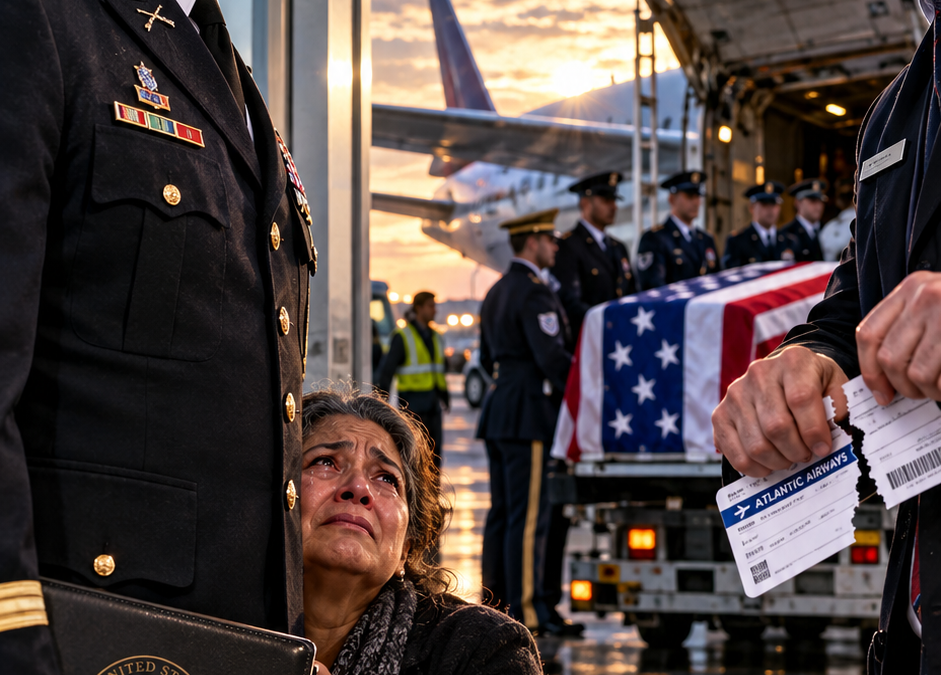
Below the window, the honor detail waited beside Maria’s case, unable to continue the transfer until my boarding authorization was released.
I thought of her mother sitting hundreds of miles away, waiting for the call that would tell her daughter was coming home.
Bradley noticed me looking at the clock.
“You in some kind of hurry?”
“The transfer team is waiting for me.”
He shrugged.
“Then you should’ve brought better paperwork.”
Something inside me went very still.
Until that moment, I had allowed myself to believe he might simply be an arrogant man who misunderstood a procedure.
But confusion looks for an answer.
Bradley was receiving answers and refusing every one of them.
And I was beginning to understand that no amount of paperwork would satisfy a man who had already decided I did not belong.
Two airport security officers arrived less than five minutes later.
Bradley met them before they reached the counter.
“This passenger is attempting to board with suspicious military credentials. He’s becoming aggressive, and I want him removed from the gate.”
One officer looked at me.
“Colonel, may I see your identification?”
I handed him everything.
He studied my military ID, checked the escort authorization, and compared both against the information on Sara’s screen.
Then he turned toward Bradley.
“His credentials match. We have no fraud report associated with this reservation.”
Bradley’s expression barely changed.
“That’s not the issue anymore.”
The officer frowned.
“What is the issue?”
“He’s disrupting boarding.”
I looked at the departure screen. We had already lost several minutes.
The officer turned back to me.
“Did you threaten Mr. Thompson?”
“No.”
“Did you attempt to enter the jet bridge without authorization?”
“No.”
“Did you refuse to provide identification?”
I gestured toward my documents.
“They’ve been sitting on that counter since I arrived.”
The officer looked at Sara.
“Can you confirm that?”
Her hands hovered over the keyboard.
I saw her glance at Bradley. Later, I would learn that she had worked beside him for seven years and had watched him use that same expression to silence colleagues, intimidate passengers, and make legitimate complaints disappear.
Four passengers had filed discrimination complaints against him in the previous year alone. Sara had helped them complete their statements.
Within days, the allegations had been rewritten as ordinary service disagreements or removed from the system entirely.
She had saved copies, although she had never found the courage to challenge the people responsible.
Until that morning.
“Colonel Washington provided everything we requested,” she said. “Mr. Thompson read the verified escort note before he added the fraud warning.”
Bradley’s head snapped toward her.
“She doesn’t understand our security protocols.”
Sara swallowed.
“I understand what I saw.”
The officer returned his attention to Bradley.
“Sir, unless you have evidence of an actual security threat, this passenger needs to be allowed to board.”
Bradley folded his arms.
“I want your supervisor.”
An elderly man standing near the front of the boarding line stepped forward. He wore a faded Vietnam veteran’s cap and walked with a cane.
“There’s a dead American soldier under that airplane,” he said. “Read the colonel’s papers and let him do his duty.”
Bradley pointed toward the seating area.
“Mind your own business.”
The veteran removed his cap.
Several passengers followed his example.
I watched the old man’s fingers tighten around the brim. His eyes were wet, although his voice remained steady.
“How long are you planning to make her wait?”
I looked through the glass.
“The aircraft can’t complete the transfer until the escort is cleared to board.”
He nodded.
“Then you’re not delaying one passenger.”
The words traveled through the waiting area.
People who had been quietly recording began describing the confrontation to relatives on their phones. A local reporter waiting for another flight approached the counter.
Bradley saw the cameras and became furious.
“Anybody recording airline personnel can be removed from this gate.”
Nobody put their phone away.
“That’s not an airport rule.”
The voice belonged to Captain Patricia Williams, the airport security supervisor, who had just arrived.
She looked at the two officers, the torn boarding pass, and the documents spread across the counter.
“Tell me what’s happening.”
Bradley started talking.
He gave her a complicated explanation involving suspicious credentials, passenger aggression, inconsistent documentation, and what he described as my refusal to cooperate.
Williams listened without interrupting.
Then she turned to me.
“Colonel, may I examine your orders?”
“Of course.”
She read them carefully, found the escort control number, and called the military liaison using the airport’s official directory.
She placed the call on speaker.
The response came almost immediately.
“Colonel James Washington is the assigned casualty escort for Staff Sergeant Maria Rodriguez, traveling on Atlantic Airways Flight 447 to Denver. His orders and priority boarding authorization are confirmed.”
Williams thanked the liaison and ended the call.
She returned my documents.
“Colonel, your orders are authentic.”
Then she looked directly at Bradley.
“That settles the security question.”
He shook his head.
“It settles the paperwork question. I still have concerns about his behavior.”
Sara stared at him.
“There wasn’t a behavior problem.”
“There is now.”
He reached toward his terminal.
I watched him change the reservation warning from suspected fraud to passenger aggression.
“Preserve that record,” I said.
He laughed.
“You don’t give orders behind this counter.”
“No,” Williams replied. “But I do. Step away from the keyboard.”
Bradley’s face flushed.
For the first time, he was surrounded by people who had the authority to challenge him and the willingness to do it.
He looked from Williams to the security officers, then toward the passengers recording every second.
Finally, he pointed at me.
“He could be using this military story to gain access to restricted information. You should take his phone.”
I felt my jaw tighten.
“Mr. Thompson, you’ve verified my identity. You’ve verified my orders. You’ve spoken to the military liaison. What exactly are you still trying to prove?”
“That you belong on that aircraft.”
I looked through the window.
“My reason for being here is beneath your airplane.”
Bradley glanced at Maria’s coffin.
“That proves a soldier is on the flight. It doesn’t prove you’re supposed to be with her.”
“Actually,” a woman said behind me, “it proves more than enough.”
I recognized her voice before I turned around.
Elena Rodriguez stood at the edge of the crowd, wearing a dark suit and carrying a small travel bag.
Her eyes were fixed on Bradley.
She was Maria’s older sister and a federal agent. She had been scheduled to travel home on the same flight, but neither of us had expected her to encounter a confrontation when she reached the gate.
She stepped beside me and displayed her badge.
“My name is Agent Elena Rodriguez. The soldier beneath your aircraft is my sister.”
Bradley’s expression changed instantly.
“I’m very sorry for your loss.”
Elena stared at him.
“You just accused the officer bringing her home of inventing his assignment.”
“I was following security procedures.”
“Were his orders confirmed?”
Williams answered.
“Three separate verifications.”
“Was there any evidence of fraud?”
“No.”
Elena looked back at Bradley.
“Then why is he still standing here?”
“He came looking for trouble.”
“No,” she said quietly. “He came here with my sister.”
She turned toward me, and for a moment, I saw the grief she had been containing beneath her professional composure.
Her sister was right outside that window.
She was so close that Elena could see the flag.
Yet an airline employee had managed to turn those last few yards into an obstacle neither of us could cross.
Elena faced Bradley again.
“Since you’ve continued adding accusations after the documents were verified, this incident and its records will be referred to the federal investigators already reviewing complaints involving this airport.”
He went pale.
“What investigation?”
For six months, I had served as a military liaison to a confidential review of discrimination complaints involving civilian airlines.
Four of those complaints named Bradley Thompson.
I had never met him before that morning, but I knew his name. I knew that passengers had reported discriminatory treatment and that their original statements appeared to have been altered during regional review.
I also knew that the available evidence had not been sufficient to establish exactly who had changed those records.
But I had not chosen Flight 447 to investigate Bradley.
The military casualty transportation office had selected Maria’s route. I had accepted an escort assignment, and my responsibility was to bring her home.
Bradley had created the confrontation entirely through his own decisions.
When he realized I recognized his name, his expression hardened.
“You set me up.”
“No,” I answered. “You were given verified military orders. Every decision you made after that was yours.”
His eyes darted toward the computer.
I knew what he intended before he moved.
He lunged toward the keyboard and started trying to remove the escort note from the reservation.
Sara moved in front of him.
“Don’t touch it!”
He seized her arm and shoved her aside.
Williams caught his wrist.
“Let her go!”
Bradley jerked free and reached for the terminal again.
One security officer blocked him while the other secured his hands behind his back.
Suddenly, everything became quiet.
The man who had spent the previous half hour threatening everyone around him was being escorted away from his own counter.
He looked toward Sara.
Then toward Williams.
Finally, he shouted something that explained a great deal about the confidence he had displayed that morning.
“My uncle runs this region! You’re all making a mistake!”
Elena turned toward Sara.
“Who’s his uncle?”
Sara hesitated.
“Derek Thompson. Atlantic’s regional director.”
“Did he handle the earlier complaints?”
She nodded.
“I filed them. They disappeared after his office reviewed them.”
“Do you have copies?”
Sara looked directly at Elena.
“Yes.”
The gate telephone rang before anyone could ask another question.
It was Robert Sterling, the chief executive of Atlantic Airways.
The confrontation had already spread online, and Williams had submitted an emergency report to airline headquarters.
Sterling asked to speak with me.
“Colonel Washington, I want to apologize for what happened. Your verified escort authorization will be honored immediately.”
“Thank you. Staff Sergeant Rodriguez has been waiting long enough.”
He paused.
“Mr. Thompson’s employment is terminated effective immediately. His regional director has also been suspended, and his access to company systems is being revoked.”
Bradley heard every word through the speaker.
“You can’t fire me without regional review!”
Sterling’s response was cold.
“That decision has already been made.”
The security officers led Bradley away.
He continued protesting until the crowd swallowed his voice.
I watched him disappear around the corner, then turned toward Sara.
“Can we still get Staff Sergeant Rodriguez aboard?”
“Yes, Colonel.”
She printed another boarding pass.
But before she could hand it to me, something changed on her screen.
Her expression went blank.
“Wait.”
“What is it?”
She refreshed the complaint database.
One folder disappeared.
Then another.
“Oh, God.”
Elena stepped closer.
“Sara?”
“Someone is removing the complaints.”
Within seconds, seventeen records connected to Bradley’s employee number began changing from closed to unavailable archive.
Sara photographed the screen.
“Derek still has access.”
Williams called Atlantic’s operations center while Elena contacted the federal investigator assigned to the review.
The technician initially told Williams that regional approval was required to lock the complaint database.
“Regional approval?” Williams repeated. “The regional director is the person we’re trying to stop!”
Another folder vanished.
Sara started reading the names aloud as Elena wrote them on the back of a boarding envelope.
An Army widow.
A Marine returning from deployment.
A Black family removed from a honeymoon flight after complaining about Bradley’s language.
There were others whose names I had never heard.
I realized that what was disappearing from the screen was more than paperwork.
These were people who had believed their experiences mattered enough to report. People who had trusted an institution to record what had happened to them.
And now someone was trying to erase them again.
Finally, the system locked.
“Remote session terminated,” Sara announced.
Williams looked at her.
“Did we stop him?”
Sara refreshed the list.
Only two records remained visible.
“We stopped whatever he was doing right now. I don’t know whether the others can be recovered.”
Elena forwarded the photographs to the federal investigator.
Then she turned to me.
“James, go.”
I hesitated.
“Your sister—”
“Is waiting for you.”
She touched my arm.
“I’ll be right behind you.”
I collected my documents and approached the jet bridge.
Nobody asked another question.
The captain met me at the aircraft door, apologized, and explained that the honor detail was ready to complete the transfer.
I thanked him and took my assigned seat.
Through the window, I watched the ground crew move Maria’s transfer case toward the aircraft.
Every movement was measured and careful.
The flag never touched the ground.
When the transfer was complete, the honor detail stepped back and saluted.
I returned the salute from inside the aircraft.
Only then did I sit down.
For the first time that morning, I allowed myself to feel how close I had come to breaking my promise.
Elena boarded several minutes later.
She sat beside me without speaking.
As Flight 447 pushed away from the gate, I looked through the window and silently told Maria that we were finally going home.
The aircraft climbed through a bank of heavy clouds.
For several minutes, neither Elena nor I said anything.
I had learned during casualty missions that grief often makes people feel obligated to explain silence.
They speak because they fear the quiet will become unbearable.
They describe a soldier’s bravery, repeat condolences, or offer comforting words that sound appropriate but accomplish very little.
I knew better than to fill that silence.
Eventually, Elena spoke.
“My sister has a blue suitcase at our parents’ house.”
I looked toward her.
“She left it there after Christmas. She told Mom she’d need it when she came home on leave.”
Elena stared at the seat in front of her.
“My mother wouldn’t let anybody put it away.”
“She doesn’t have to.”
“That’s what I told her.”
She rubbed her palms against her knees.
“Maria called every Sunday at seven. It didn’t matter where she was stationed. If she couldn’t call, she’d send a message explaining why.”
She gave a small, painful smile.
“Last Christmas, she tried to convince my father that she could fix his old radio. She had the whole thing taken apart across the kitchen table before he realized what she’d done.”
“Did she fix it?”
“Of course. Then she killed the plant Mom gave her as a thank-you.”
I smiled.
Elena laughed once, then covered her mouth.
Her eyes filled.
For a moment, the federal agent disappeared, and I was sitting beside a woman who would never hear her little sister complain about being unable to keep a houseplant alive again.
“I wanted to put Bradley against a wall,” she admitted.
“So did I.”
“But you didn’t.”
“No.”
“How?”
I looked down at my hands.
“Because being capable of doing something doesn’t mean you should do it.”
She gave me a tired look.
“Do you always talk like an Army field manual?”
“Only when I’m trying not to talk like an angry man.”
She almost smiled again.
The captain announced that Staff Sergeant Maria Rodriguez was making her final journey home.
He asked the passengers to observe a moment of silence.
The cabin became still.
I bowed my head.
For once, nobody mentioned Bradley Thompson.
Nobody discussed the video.
For those few moments, Maria was simply a soldier coming home.
While we were in the air, events at Dulles were moving faster than either of us realized.
Months later, during the federal investigation, I learned exactly what had happened after we boarded.
Derek Thompson had been sitting in Atlantic’s regional office when his nephew called.
He had watched the gate video and immediately understood that Bradley’s behavior had exposed the complaints Derek had spent years concealing.
When headquarters suspended him, Derek tried to access his regular account.
It was locked.
But he still possessed a recovery token issued during a server outage two years earlier.
That temporary account should have been disabled.
Nobody had checked.
He entered the complaint database through an old vendor access page and located seventeen files associated with Bradley.
Four carried federal preservation markers.
Derek attempted to conceal all seventeen.
He also opened Sara’s emergency employment record and found her home address.
Then he contacted a private contractor who handled after-hours records for Atlantic.
According to the records investigators later recovered, Derek claimed that Sara had stolen confidential passenger information and ordered the contractor to retrieve her company laptop.
He created an authorization after issuing the instruction.
By the time Sara left the airport, someone was already on his way to her apartment.
She didn’t know that.
She only knew that Derek had tried to destroy the complaints, that he understood she possessed copies, and that the first seven years of her career had suddenly become evidence against the people who controlled it.
Williams insisted on accompanying her.
A federal investigator traveled with them.
As they entered the employee parking area, Sara noticed a man in an Atlantic maintenance jacket standing near the elevator.
He recognized her.
Then he saw Williams and the investigator and stepped back.
They changed vehicles and left through the rental car area.
A dark SUV followed them for two highway exits before turning away when a police cruiser joined their route.
Sara called her mother from the back seat.
She didn’t tell her everything.
She only asked her to lock the doors and avoid answering unfamiliar numbers.
When they reached Sara’s apartment, the front door was closed and the lock appeared undamaged.
Nothing inside looked disturbed.
Then she opened her desk drawer.
Her laptop was gone.
So were the printed complaints she had stored beneath it.
She stood staring at the empty drawer.
Later, she told me that the worst part wasn’t losing the computer.
It was realizing that Derek had known exactly where she lived and had sent someone into her home as casually as he might have ordered an employee to change shifts.
The computer contained years of personal photographs, training documents, and an unfinished application for a supervisory position.
The man had taken her private life along with the evidence.
Sara sat down.
For several seconds, she couldn’t speak.
Williams stood beside her while the investigator examined the hallway security footage.
It showed a man in an Atlantic maintenance jacket leaving eight minutes before they arrived.
He carried a gray document bag.
Sara recognized him from the parking garage.
Then the investigator asked why she had started saving complaints.
She told him about the fourth passenger.
The woman had been a nurse who questioned why two white travelers with oversized bags were allowed through while she was stopped.
Bradley called security.
Derek’s office later reclassified her complaint as a disagreement over baggage policy.
Sara had been ordered to telephone the woman and explain that the company’s investigation found no evidence of unequal treatment.
The nurse had asked one question.
“You saw what happened, didn’t you?”
Sara had lied.
She told the woman she hadn’t seen enough to confirm her account.
That evening, unable to sleep, she started copying every original complaint she could still access.
She had kept those files for months without knowing whether she would ever use them.
But now they were gone.
Williams asked whether she had saved anything elsewhere.
Sara remembered a small memory card she had prepared after the fourth complaint.
She had taped it to the back of a framed photograph of her mother.
The photograph was still on the bookshelf.
She lifted it, turned it over, and carefully removed the card.
It was untouched.
The investigator sealed it inside an evidence envelope.
Derek had taken her computer.
He had taken the printed complaints.
But he had not taken the truth.
By the time Flight 447 landed in Denver, Sara’s memory card was already being secured for forensic examination.
I learned that later.
At the time, my entire world had narrowed to the aircraft window and the family waiting beyond it.
The plane stopped at a remote stand.
I descended first and took my position beside the cargo lift.
Elena waited with her parents behind the marked security line.
When the cargo door opened, I heard Maria’s mother cry out.
It was a sound I cannot adequately describe.
There was recognition in it, and relief, and something so profoundly wounded that everyone standing nearby instinctively looked away.
Maria’s father raised his right hand in a trembling salute.
Her mother held Elena so tightly that neither woman could move.
I walked beside Maria’s transfer case as the ground crew lowered it and moved it toward the waiting vehicle.
I kept my eyes forward.
I had made a promise, and I intended to fulfill every part of it.
When the transfer stopped, Mrs. Rodriguez approached me.
She took both my hands.
“You brought her home.”
“Yes, ma’am.”
“You didn’t leave her?”
“Not for a moment.”
She pressed my hands against her chest.
“Thank you for keeping your promise.”
I had stood beside generals, commanders, and decorated veterans who had offered me praise throughout my career.
Nothing any of them had ever said meant as much as those words.
I bowed my head.
For the first time since leaving Dulles, my eyes filled with tears.
That evening, Sara’s recovered memory card revealed why Derek had been so desperate.
The original complaint from the Army widow described Bradley forcing her to open a casualty packet in public and explain the circumstances of her husband’s death.
Atlantic’s surviving version said she had become emotionally unstable during routine verification.
The original complaint from a Latino Marine described Bradley mocking his uniform.
The revised version called it a disagreement over baggage charges.
Then investigators found a message between Bradley and Derek.
Bradley had asked his uncle to take care of one of the complaints.
Derek replied that it had already been cleaned and warned him to stop leaving witnesses.
There was no misunderstanding that exchange.
Bradley expected his uncle to make the problem disappear.
Derek expected Bradley to avoid attracting attention while mistreating passengers.
Investigators traced the contractor who had entered Sara’s apartment through the building’s access records and security footage.
He admitted receiving instructions from Derek and delivering the stolen laptop to Atlantic’s regional office.
Federal agents searched the office that night.
They recovered Sara’s computer from a locked cabinet in the storage room.
Beneath it were six original complaint folders and an extraordinary document titled “Exposure Contacts.”
Sara’s name appeared first.
Beside it, Derek had written that she was unreliable, under financial pressure, and awaiting promotion.
Other employees had similarly detailed notes.
One had a sick spouse.
Another was waiting for full-time hours.
A third needed to renew a security clearance.
Derek had cataloged the personal circumstances that could make each witness afraid to speak.
When I eventually saw that document, I understood that Bradley’s behavior at Gate B27 hadn’t been protected by a simple friendship or a careless supervisor.
It had been protected by a system deliberately designed to punish anyone who challenged it.
But the records recovered from the regional office represented only part of the evidence.
Investigators learned that approximately twenty more boxes had been moved to Atlantic’s east cargo warehouse.
A separate warrant was required to search that building.
While the legal authorization was being prepared, an officer was assigned to watch the loading dock.
At two ten in the morning, a dispatcher directed him to investigate a reported break-in at an address across the cargo road.
The address did not exist.
By the time anyone discovered the false report, the loading dock had been left unattended.
At four eighteen, a white van arrived at the warehouse.
Two workers entered using a temporary access code.
They began loading boxes containing original passenger complaints into the vehicle.
One of them covered the loading camera with a plastic bag.
A night custodian noticed.
He had watched the video from Gate B27 during his break because his son had sent it to him with a message asking whether this was the airport where he worked.
Now he recognized the regional name printed across the boxes being moved out of the warehouse.
He photographed the van and its license plate.
When one of the workers noticed him, he pushed his cleaning cart through a fire door and called the number federal investigators had posted for employees with information.
He remained hidden until the men left.
When he returned to the loading area, he found that one of the boxes had split open.
Several documents lay scattered across the floor.
The top page contained a complaint from a passenger whose husband had been accused of posing a threat after asking for wheelchair assistance.
Across the original statement, someone had written an instruction to remove the allegation of racial discrimination and classify the incident as a congestion dispute.
The custodian hid the page beneath an overturned trash bin.
Meanwhile, airport police located the van approaching the highway.
The driver refused to stop when officers activated their lights.
He turned sharply toward the cargo area, struck a curb, and caused one of the boxes to slide against the rear doors.
Documents spilled onto the service road.
Police blocked the exit and detained both workers.
They claimed they had been instructed to destroy outdated baggage forms.
Their paperwork described an authorized records disposal.
The boxes told a different story.
Inside were the original complaints Sara had tried to preserve, including the four cases that had first brought Bradley under federal review.
There were handwritten instructions directing managers to remove references to race and military status before sending complaints to headquarters.
The custodian’s photographs established that the loading camera had been deliberately covered.
Electronic records showed the temporary access code had been created from Derek’s home computer after his suspension.
His destruction order had been issued after he was instructed to preserve the records.
When federal agents confronted him, Derek insisted the files were duplicates.
They weren’t.
They were the original statements, containing details that had been removed from every surviving corporate version.
He blamed an assistant.
Investigators established that the assistant had been outside the country when the instructions were issued.
He denied knowing about the van.
Both workers produced his authorization.
Within hours, Derek Thompson was arrested on allegations involving evidence destruction, witness interference, and the concealment of records.
I was in Denver when Elena called to tell me.
I stood beside the hotel window, watching snow gather on the streets.
For several seconds, I said nothing.
“James?”
“I’m here.”
“We recovered the archive.”
“All of it?”
“Enough to establish what happened.”
I looked toward the distant mountains.
“And Sara?”
“She’s safe.”
That was the answer I needed most.
But Derek was not finished.
Even after his arrest, his attorneys released a statement accusing Sara of stealing confidential passenger records and helping me stage the entire confrontation at Gate B27.
The allegation appeared on television within hours.
Suddenly, the woman who had preserved evidence of misconduct was being described as an ambitious employee who had violated company policy for personal gain.
Reporters gathered outside her apartment.
Her neighbors started asking questions.
Her mother became afraid to answer the telephone.
Atlantic placed Sara on paid leave while the investigation continued.
When she called me several days later, her voice was strained.
“I thought speaking up would make things better.”
“You kept seventeen people from disappearing into a filing cabinet.”
“And now everyone thinks I’m a thief.”
“Not everyone.”
She was quiet.
“Colonel, I lied to that nurse. I told her I hadn’t seen what happened. I let them make her believe she was imagining it.”
I sat down.
“Sara, you can’t change the call you made that day.”
“I know.”
“But you can decide what happens to the truth you saved afterward.”
She inhaled slowly.
“I’m going to testify.”
“Then tell them everything.”
She did.
And when Derek called her from a blocked number that evening, she answered with federal investigators recording the conversation.
He offered to protect her career if she signed a statement claiming Bradley had acted under pressure because he genuinely suspected document fraud.
When she refused, he warned that airlines shared employment references.
He told her to consider whether she wanted to destroy her future for passengers who would eventually forget her name.
Sara listened.
Then she said something that I would remember when she later repeated it in court.
“I thought about my career every time I stayed quiet. That’s how your nephew got to Maria Rodriguez.”
She ended the call.
The recording became additional evidence of witness intimidation.
Four days after Maria arrived in Denver, we buried her.
Snow edged the grass around the cemetery.
A white canopy stood above her family and the honor detail.
I had asked the public and the news media to leave the Rodriguez family alone, and most respected that request.
There were no speeches about Bradley Thompson.
No references to viral videos or federal investigations.
Maria’s friends remembered the woman who could fix almost anything electronic.
Her father told a story about the radio she had repaired at Christmas.
Elena spoke about Sunday telephone calls and the blue suitcase waiting at her parents’ house.
Her mother listened, holding a folded tissue that had become damp long before the service began.
When taps sounded, I stood at attention.
The folded flag was placed in Mrs. Rodriguez’s hands.
She held it against her chest.
After the ceremony, she found me near the honor detail.
“They found the complaints?”
“Yes, ma’am.”
“And the people who hid them?”
“The investigation is continuing.”
She looked down at the flag.
“I don’t want my daughter’s name remembered because of what that man said to you.”
“I understand.”
“I want her name attached to whatever changes so another mother doesn’t have to worry about this.”
I promised her I would carry that request to the military transportation officials involved in the review.
It was another promise.
And this time, I intended to make certain the entire system helped me keep it.
The federal investigation continued for months.
Atlantic’s chief executive, Robert Sterling, admitted that the company had rewarded regional managers for closing passenger complaints quickly without adequately examining how those complaints were resolved.
Derek’s region had consistently reported unusually favorable numbers.
Headquarters had praised him for them.
Nobody had asked whether the results reflected improved service or suppressed evidence.
The airline faced substantial civil liability, government contract restrictions, and a mandatory external review.
Sterling announced a series of reforms and later resigned.
But corporate penalties did not resolve the criminal case.
Federal prosecutors charged Bradley with offenses involving obstruction, false statements, interference with the escort mission, and civil rights violations supported by the documented pattern.
Derek faced conspiracy, evidence tampering, witness intimidation, and fraud involving records submitted to government travel officials.
The two men initially attempted to blame each other.
Bradley claimed Derek had manipulated the complaint system without his knowledge.
Derek claimed he had merely tried to conceal the damage caused by an uncontrollable nephew.
Their attorneys eventually constructed a different defense.
They argued that I had arranged the entire confrontation.
I learned about that strategy several weeks before trial.
The prosecution had known about my earlier liaison work, but Bradley’s attorneys intended to present it as evidence of an elaborate trap.
They claimed I had deliberately chosen his gate, concealed my involvement in the federal review, and provoked an employee whom I knew was already under investigation.
According to their version, Maria’s casualty escort mission had been used as cover for an operation designed to destroy Bradley’s career.
The accusation spread quickly.
Commentators began calling the confrontation an airport sting.
Some repeated the suggestion that I had exploited a fallen soldier to create a public scandal.
I had expected the defense to question my judgment.
I had not expected anyone to turn Maria’s journey home into something ugly.
Then Mrs. Rodriguez called me.
“Colonel, they’re saying you knew that man would be at the gate.”
I stood in my office, gripping the telephone.
“I knew his name was connected to earlier complaints. I didn’t know his schedule.”
“They’re saying you chose the flight.”
“The casualty transportation office selected the route. I accepted the escort assignment.”
She began crying.
“They’re making it sound like my daughter was part of some plan.”
I closed my eyes.
“Maria was never part of an investigation. I was there to bring her home.”
“I know.”
Her voice trembled.
“I know because I’m the one who asked you not to leave her.”
The prosecutors offered to keep her off the witness list.
The military records could establish when the flight was selected and when I received my assignment without requiring a grieving mother to testify.
I agreed immediately.
But I refused to conceal my earlier involvement in the review.
If Bradley’s attorneys intended to make my knowledge of the complaints central to their case, the jury deserved to hear the truth.
I had known about four complaints.
I had recognized Bradley’s name.
Neither fact changed the authenticity of my orders or justified his conduct.
Meanwhile, Sara faced a decision that tested her more severely than anything she had experienced at the gate.
Atlantic’s insurer offered to settle her privacy and retaliation claims.
The proposed compensation was substantial enough to pay her mother’s remaining mortgage and allow Sara to leave airport employment permanently.
But the agreement contained a broad confidentiality provision that would restrict what she could say publicly about the altered complaints.
She read it several times.
Then she returned it unsigned.
Later, she told me that accepting the money would not have required her to lie.
That was what made the decision so difficult.
For years, Derek had used financial pressure to control employees.
Now, for the first time in her career, Sara had an opportunity to secure her own future.
But she could not bear the thought of accepting a comfortable silence while the people whose complaints she had preserved continued fighting to be heard.
When Elena prepared her for trial, Sara admitted she was terrified.
“They’re going to make me sound greedy.”
“They’re going to question everything you did,” Elena told her. “Your decision to copy the complaints. Your decision to speak. Your decision not to accept the settlement.”
“What if the truth makes me look bad?”
“Then tell it anyway.”
Sara nodded.
She had spent seven years learning how easily people could manipulate a carefully edited statement.
Now she would have the opportunity to speak without allowing somebody else to change her words afterward.
The joint criminal trial began several months later.
Bradley and Derek sat beside their attorneys, no longer speaking to each other.
I attended the opening proceedings in dress uniform.
The prosecution presented a relatively simple case.
Bradley had read a verified military escort note before labeling my reservation fraudulent.
After airport security confirmed my identity, he had changed the accusation to aggression despite having no evidence of misconduct.
When Williams ordered him to preserve the record, he attempted to alter it again.
Derek had previously helped conceal complaints against Bradley, and after the gate confrontation, he had used an unauthorized recovery account to hide additional records.
He had directed a contractor to retrieve Sara’s laptop, threatened her career, and ordered original complaint files removed for destruction after receiving a preservation instruction.
The defense did not seriously dispute that these actions had occurred.
Instead, Bradley’s attorneys claimed my earlier knowledge of the complaints explained the confrontation.
Derek’s attorneys described the records changes as routine administrative editing and argued that the warehouse removal was an ordinary disposal operation.
They also attacked Sara.
She testified on the fourth morning.
I sat behind the prosecution table as she approached the witness stand.
She wore a navy jacket and carried herself with deliberate composure.
But when she raised her hand to take the oath, I could see it trembling.
The prosecutor began by asking about the escort note.
“Ms. Carter, did Mr. Thompson read Colonel Washington’s military authorization?”
“Yes.”
“How can you be certain?”
“Because I watched him read it.”
“Did he demonstrate that he understood its contents?”
“Yes. He asked why a colonel was escorting a staff sergeant. That information was in the authorization.”
The prosecutor displayed the system log.
“And when did he add the suspected fraud warning?”
“After reading the note.”
“Why did you photograph the complaint database?”
“Because I had seen complaints disappear before.”
She explained the seventeen disappearing records, the stolen laptop, and the memory card hidden behind her mother’s photograph.
Then Derek’s attorney began his cross-examination.
He approached the witness stand with a copy of Sara’s employment file.
“Ms. Carter, you copied confidential passenger information onto a personal device.”
“Yes.”
“That violated company policy.”
“Yes.”
He paused.
“You knew that keeping those documents could give you leverage against your employer.”
“I knew the original complaints were being changed.”
“That’s not what I asked.”
“No. I didn’t save them to gain leverage.”
He displayed her draft promotion agreement.
“After assisting the government, you were offered a better position.”
“Yes.”
“With higher pay.”
“Yes.”
“And compensation for the alleged invasion of your apartment.”
“Yes.”
“You considered accepting that money?”
“I did.”
He turned toward the jury.
“So every major decision you made improved your position. You kept confidential documents. You waited until cameras were recording before challenging Mr. Thompson. You discussed financial compensation. You received protection. And now there’s a promotion waiting for you.”
Sara gripped the edge of the witness stand.
I knew what he was trying to accomplish.
For years, Derek had portrayed employees who complained as unreliable, emotional, or financially motivated.
His attorney was using the same method.
If Sara was frightened, she was unreliable.
If she had preserved evidence, she was dishonest.
If she accepted protection after being threatened, she was seeking special treatment.
And if she considered compensation after someone stole her computer, she was greedy.
The attorney leaned forward.
“Ms. Carter, isn’t it true that your testimony has always been for sale?”
Sara was silent for several seconds.
Then she looked directly at Derek.
“If my testimony were for sale, I would’ve accepted the agreement that required me to stay quiet.”
The attorney stopped.
“What agreement?”
The prosecutor stood.
The judge allowed a limited explanation because the defense had opened the subject of Sara’s financial motives.
Sara described the confidentiality provision she had refused.
She also described Derek’s recorded telephone call offering to protect her career if she changed her statement.
When the prosecutor returned for redirect examination, she asked one final question.
“Ms. Carter, what did you receive for refusing to change your testimony?”
Sara’s eyes filled.
“Reporters outside my apartment. My mother afraid to answer her phone. And the chance to tell the truth before someone changed it again.”
I watched her leave the witness stand.
She had entered the courtroom frightened that everyone would see her as the employee who had failed to protect earlier passengers.
She left having acknowledged that failure without allowing it to excuse the people who had caused it.
I testified the following morning.
The prosecutor asked me to identify my military orders, explain my escort assignment, and describe the confrontation at Gate B27.
I did not discuss my decorations or combat experience.
I spoke about Maria.
I explained why an escort is assigned to accompany a fallen soldier and why the transfer cannot be treated as an ordinary luggage movement.
I described her mother’s telephone call and the promise I had made.
Then the prosecutor handed me an evidence sleeve.
Inside were the two halves of my original boarding pass.
The barcode had been matched, but the paper had not been repaired.
I recognized it immediately.
“Is that the boarding pass Mr. Thompson tore at Gate B27?”
“Yes.”
“What happened immediately afterward?”
“He told me to leave.”
“Did you threaten him?”
“No.”
“Did you refuse to provide your identification?”
“No.”
“Did you attempt to enter the aircraft without authorization?”
“No.”
She returned to the prosecution table.
“No further questions.”
Bradley’s attorney stood.
He had spent several weeks preparing to challenge my credibility.
I could see the confidence in his expression as he approached the witness stand.
“Colonel Washington, before you arrived at Gate B27, you already knew my client’s name.”
“Yes.”
“Because he appeared in four discrimination complaints under federal review.”
“Correct.”
“And you were assisting that review.”
“As a military liaison.”
“So you knew that another incident involving my client could provide valuable evidence.”
“I understood how additional evidence could affect an investigation.”
He smiled.
“Yet you chose not to disclose that information to Mr. Thompson.”
“I wasn’t traveling as an investigator. I was traveling as a casualty escort.”
“You could have shown him your federal authorization.”
“My military orders were sufficient to establish my right to board.”
“You could have contacted Agent Rodriguez earlier.”
“Her sister was beneath the airplane. She wasn’t my investigative resource.”
He walked toward the jury.
“Colonel, isn’t it true that you recognized an opportunity the moment you saw Bradley Thompson?”
I considered my answer.
“I recognized his name. I also recognized that I had legitimate orders. The second fact should have made the first irrelevant.”
“But you allowed the confrontation to continue.”
“I asked him to verify my documents. He did.”
“And you never warned him that his accusations could become evidence against him.”
“A passenger isn’t required to explain criminal procedure before an airline employee follows verified orders.”
The attorney displayed a photograph showing me leaning slightly toward the counter.
“You appear angry here.”
“I was angry.”
“You’re a highly trained military officer.”
“Yes.”
“You have the physical ability to intimidate someone like my client.”
“Yes.”
“Then perhaps his concerns about aggression were reasonable.”
I looked at the photograph.
“My hands are resting on the counter.”
The attorney said nothing.
“I didn’t threaten him. I didn’t touch him. When security arrived, I stepped back.”
He changed the photograph.
Now the screen showed Bradley grabbing Sara’s arm while trying to reach the computer.
I looked directly at the jury.
“That is the only physical aggression recorded during the confrontation.”
The attorney returned to his notes.
“You knew what Mr. Thompson was capable of because you had reviewed earlier complaints.”
“I knew what four people had reported.”
“And you understood that he might react badly.”
“I understood that he was required to process valid military documents.”
He stopped in front of me.
“Did you choose Flight 447?”
“No.”
“Did you ask to serve as escort?”
“I accepted the assignment.”
“Did you know Mr. Thompson would be working at that gate?”
“No.”
“But when you arrived and recognized him, you decided to let him fail in front of forty cameras.”
I looked at Bradley.
Then I looked back at his attorney.
“At every point in that confrontation, your client had the opportunity to hand me a boarding pass. He chose not to.”
The attorney frowned.
“That wasn’t my question.”
“It’s my answer.”
He returned to the defense table, collected another document, and approached me again.
“Colonel, why didn’t you simply walk away when the situation became confrontational?”
For the first time that morning, I felt my composure slipping.
I thought about Maria’s mother clutching the folded flag at the cemetery.
I thought about Elena sitting beside me on the airplane, talking about her sister’s blue suitcase.
I thought about Maria’s transfer case waiting outside Gate B27 while Bradley Thompson searched for one more accusation.
I looked at the jury.
“Because Staff Sergeant Maria Rodriguez was beneath that aircraft, and I had promised her mother she wouldn’t travel alone.”
The courtroom became silent.
The attorney returned to his seat.
He had no further questions.
The defense called no witness who could explain why Bradley changed the reservation warning after my orders were verified.
Neither Bradley nor Derek testified.
Their attorneys argued that administrative editing did not amount to the deliberate suppression of complaints, that removing records for disposal did not establish an intent to destroy evidence, and that my earlier knowledge of Bradley made the entire gate encounter suspicious.
The prosecution’s closing argument lasted less than twenty minutes.
The lead prosecutor placed my torn boarding pass beside Derek’s destruction order.
She reminded the jury that I had presented valid military documents, asked for official verification, and remained at the gate because my assigned duty required me to board.
Bradley had read the authorization, invented a fraud allegation, changed that allegation when it failed, and attempted to alter the record after being ordered to preserve it.
Derek had hidden complaints, threatened a witness, and arranged to remove original documents after a preservation order.
My previous knowledge of the complaints did not create those actions.
The prosecution asked the jury to judge each defendant on his own conduct.
Seven hours later, the jury returned.
Bradley stared at Derek when the court clerk announced that a verdict had been reached.
Derek looked straight ahead.
I sat behind the prosecution table, my hands folded in my lap.
Bradley was found guilty on the principal obstruction, false-statement, and civil-rights counts.
Derek was found guilty of conspiracy, evidence tampering, witness intimidation, and fraud.
Neither man looked at Sara when the verdicts were read.
At sentencing, Bradley apologized to Maria’s family and claimed that the pressure of the confrontation had affected his judgment.
The judge rejected that explanation.
Pressure had not forced him to tear a verified boarding pass.
Pressure had not required him to invent new accusations when the previous ones failed.
And pressure had not made him reach for a computer after being ordered to preserve its records.
Bradley received a prison sentence, financial penalties, and a permanent prohibition on employment involving passenger security or government travel.
Derek received a longer sentence.
The judge noted that Bradley’s discriminatory behavior had harmed passengers directly, but Derek’s deliberate concealment had enabled the misconduct to continue.
Atlantic Airways paid substantial penalties and compensation to affected passengers. The company lost a major government travel contract and accepted independent oversight.
Robert Sterling resigned after the initial reforms were implemented.
The company’s new complaint system prohibited managers named in allegations from editing or resolving those allegations themselves.
Every denial of a verified military casualty escort triggered automatic preservation of reservation records and available camera footage.
Sara was appointed director of station integrity.
Her first official action was to send every altered complaint recovered during the investigation to an independent reviewer.
She also contacted the nurse whose complaint she had once denied.
Sara told me afterward that she had rehearsed the conversation several times but had abandoned every prepared explanation when the woman answered.
Instead, she apologized.
She acknowledged that she had witnessed the unequal treatment and had failed to support the nurse when she reported it.
The woman listened.
Then she asked whether the original complaint had finally been recovered.
Sara told her it had.
For the first time in years, the woman would receive a determination based on what she had actually reported.
Meanwhile, I worked with military transportation officials and federal transportation representatives to develop a shared casualty escort verification system.
The objective was straightforward.
An authorized airline employee would be able to enter a single escort control code and receive immediate confirmation of the traveler’s assignment and priority boarding instructions.
If the verification produced a discrepancy, the employee would have an established military contact who could resolve it without leaving a fallen service member waiting indefinitely.
Maria’s mother asked that her daughter’s name be attached to the new procedure.
It became the Maria Rodriguez Escort Standard.
One year after Flight 447, I returned to Gate B27.
I wasn’t wearing my uniform.
I had come through Dulles on my way to a meeting, and I decided to stop at the gate where everything had begun.
Sara was standing behind the counter, training two new employees.
She noticed me immediately.
“Colonel Washington.”
“Sara.”
She came around the counter and embraced me.
For a moment, neither of us mentioned the trial or the months that had followed.
Then a young Black lieutenant approached the desk.
He wore ceremonial blues and carried a black folder beneath his arm.
I recognized the documents before he opened them.
He was escorting a fallen service member to Chicago.
One of the new agents accepted his orders and entered the escort control code.
A green confirmation appeared.
“Lieutenant, your documents are verified. We’ll board you before general passengers.”
The young officer thanked her.
“Is the honor transfer on schedule?”
“Yes, sir. The captain has already been notified.”
No supervisor appeared to question his rank.
Nobody demanded another form of identification after the documents were verified.
No passenger raised a phone.
No one asked why he had been assigned to accompany the soldier beneath the aircraft.
He simply received his boarding pass and entered the jet bridge.
Sara came to stand beside me.
“It looks ordinary,” she said.
I watched the lieutenant disappear toward the aircraft.
“That’s the point.”
Below the window, an honor detail moved toward the cargo lift.
I thought about Maria’s blue suitcase, still waiting in her parents’ house, and the Sunday evening calls her family would never receive again.
I thought about her mother taking my hands in Denver and thanking me for keeping a promise that should never have been threatened.
Maria’s name was no longer associated solely with the humiliation of that morning.
It was attached to a procedure that treated a fallen soldier’s final journey with the dignity it deserved.
The young lieutenant boarded.
The honor detail completed the transfer.
And Flight 447’s painful history remained where it belonged: not forgotten, not repeated, but transformed into a standard that allowed the next soldier to come home without having to prove that honor belonged to them.








