𝗙𝗨𝗟𝗟 𝗦𝗧𝗢𝗥𝗬 The Gate Agent Looked at My First-Class Boarding Pass and Decided I Didn’t Belong
𝗙𝗨𝗟𝗟 𝗦𝗧𝗢𝗥𝗬
Another described being forced to check a bag that complied with published dimensions while larger bags belonging to other passengers passed without examination.
A young graduate student reported that Derek had accused him of trying to sneak into the priority boarding line, even after his boarding pass confirmed his eligibility.
Every complaint had been acknowledged.
Almost none had been meaningfully addressed.
That disturbed me more than the existence of the complaints themselves.
Our airline had procedures specifically designed to prevent repeated misconduct from being ignored. Yet somehow, an employee named in eleven separate complaints was still handling passengers at the same gate.
Gregory Adams, our vice president of operations, had authorized an unannounced field audit.
He had also approved Derek’s immediate suspension if I personally confirmed serious misconduct.
The signed authorization was inside my portfolio.
But an authorization wasn’t a conclusion.
My job was to establish what actually happened, document it accurately, and distinguish legitimate operational decisions from discriminatory or abusive conduct.
I wanted evidence, not a confrontation.
I purchased an ordinary first-class ticket to Chicago O’Hare, selected seat 2A, and arrived as any other passenger might.
After finding a seat near Gate 19, I opened my portfolio and wrote the date at the top of my audit form.
Then I waited.
Derek Lawson arrived at approximately 6:15.
He was a stocky man with closely cropped hair and sunglasses pushed onto his head, despite being indoors. He wore a standard SkyPoint polo shirt, its sleeves rolled tightly around his arms, and a Bluetooth earpiece sat in his right ear.
He placed a large thermos on the counter and began talking to another employee.
I watched an older man approach with a boarding pass.
Derek ignored him.
The passenger waited.
After nearly half a minute, the man finally cleared his throat.
“Excuse me. Is this the gate for the Chicago flight?”
Derek barely looked up.
“Can’t you read the screen?”
The passenger glanced at the departure monitor.
“Yes, I just wanted to confirm—”
“Then it’s the right gate.”
The older man walked away.
Derek returned to his conversation without another thought.
I wrote down the interaction.
A few minutes later, another passenger approached to ask whether the flight was expected to depart on time.
Derek held up one finger and continued discussing a football game with his coworker.
When he finally answered, he pointed at the monitor.
“That’s what the board is for.”
Again, I recorded the time.
Neither interaction justified serious disciplinary action by itself. Employees sometimes have difficult mornings. A curt answer doesn’t automatically establish discrimination.
But patterns matter.
So do choices.
And Derek seemed to approach every passenger as though their existence were an inconvenience.
As the boarding area gradually filled, I watched a retired schoolteacher named Brenda Collins settle into a chair three rows from the counter.
I learned her name later.
She was sixty-three, with silver hair, reading glasses, and a paperback novel that she held open while occasionally watching the activity around her.
Near the window sat Troy Henderson, a Black college student wearing a gray hoodie and headphones. He was traveling home to Chicago for his mother’s birthday.
I noticed him because he had been among the first passengers to arrive, yet he waited patiently without approaching the counter.
At approximately 6:40, I closed my portfolio and stood.
The passenger ahead of me finished speaking with Derek and walked away.
I approached the counter.
“Good morning. I’d like to confirm my seat assignment, please.”
Derek remained turned toward his coworker.
He held up one finger.
I waited.
Five seconds.
Ten.
Twenty.
I could hear him describing a football game while his coworker laughed.
After thirty seconds, I cleared my throat.
“Excuse me.”
He turned sharply.
“What?”
I placed my boarding pass on the counter.
“I’d like to confirm my seat assignment. I also submitted an upgrade request last week, and I want to make sure everything was processed correctly.”
He picked up the boarding pass with two fingers.
His eyes moved across it.
Then he looked at me.
“Seat 2A. First class.”
“That’s correct.”
He studied my face again.
“I don’t think so.”
I paused.
“I’m sorry?”
“System probably glitched. You sure you didn’t book basic economy?”
I felt the first small tightening in my chest.
“My reservation was confirmed three days ago. Seat 2A, first class.”
He turned toward the computer, typed for several seconds, and clicked through the reservation.
“Well, it says 2A.”
“Then we’re all set?”
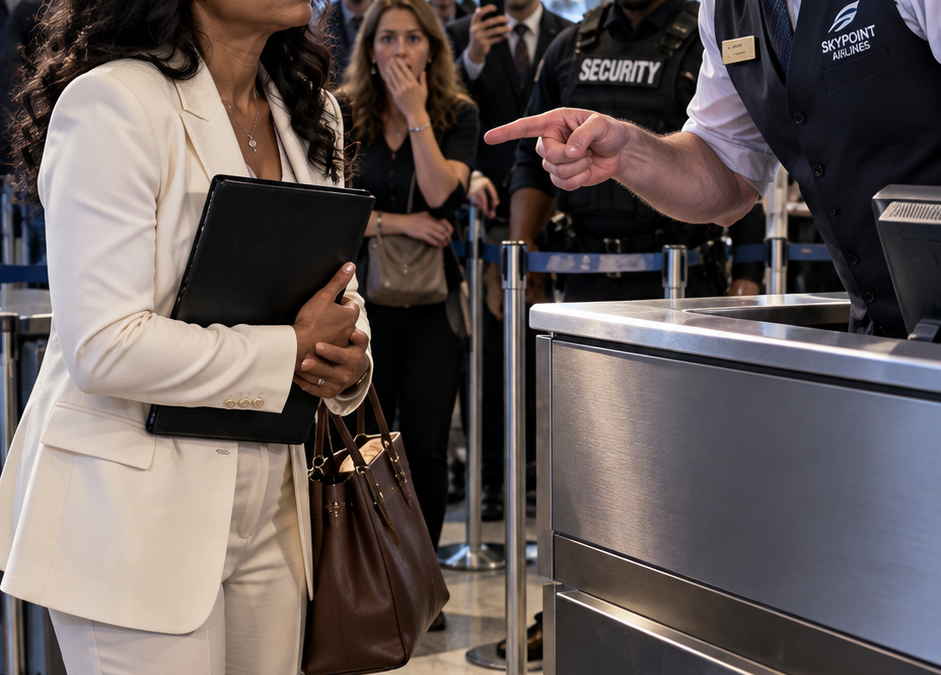
He looked at my suitcase.
“Not with that bag.”
I glanced down.
“What about it?”
“Too big. You’ll have to gate-check it.”
The suitcase was a standard cabin-size carry-on that I had used on SkyPoint flights for years.
It was well within the published dimensions.
“I believe it meets the size requirements. Would you like me to place it in the baggage sizer?”
He leaned against the counter.
“I don’t need a sizer.”
“I’m happy to verify it.”
“I can tell by looking at it.”
He pulled out a pink gate-check tag and slapped it beside my boarding pass.
“Tag it, check it, or step aside.”
I looked at him.
“Could you explain which dimension exceeds the allowance?”
He stared.
“Excuse me?”
“Our policy specifies maximum dimensions. I’d like to know which one my suitcase exceeds.”
His jaw tightened.
“Today it exceeds my requirements.”
I felt a familiar frustration.
I had helped revise that exact baggage policy two years earlier.
Its purpose was to create consistent standards so that employees couldn’t make arbitrary decisions based on personal preferences.
But Derek wasn’t interested in the policy.
He was interested in ending the conversation on his own terms.
“May I have your full name and employee identification number, please?”
Something flickered across his face.
Then he smirked.
“Derek. That’s all you need.”
“I’d appreciate your surname and employee number.”
“And I’d appreciate a million dollars. We don’t always get what we want, sweetheart.”
His coworker laughed.
I glanced at Derek’s identification badge.
DL4189.
I wrote it down.
He noticed.
“What are you doing?”
“Recording the employee information.”
“Planning to get me fired?”
“I’m requesting clarification about a baggage decision.”
He laughed again.
And then something happened that removed any possibility of explaining his conduct as a misunderstanding.
A white man wearing a navy blazer approached the counter beside me.
He carried a large leather duffel bag, visibly larger than my suitcase. Its zipper was stretched around a bulky jacket, and one end protruded awkwardly beneath the shoulder strap.
Derek looked at him.
His entire manner changed.
“Good morning, sir. How can I help you?”
The man handed over his boarding pass.
Derek scanned it and smiled.
“You’re all set. Boarding starts in about twenty minutes. Have a great flight.”
The man thanked him and walked away.
Nobody measured his bag.
Nobody asked him to check it.
Nobody mentioned the oversized jacket protruding from the top.
I watched him disappear into the waiting area.
Then I looked at Derek.
“That gentleman’s bag was larger than mine.”
Derek shrugged.
“Different reservation.”
“Does his reservation change the baggage dimensions?”
He leaned forward.
“Are we really going to do this?”
“I’m asking why the same rule isn’t being applied consistently.”
“Lady, I don’t have time for your attitude.”
I opened my portfolio.
I recorded the comparison, including the other passenger’s approximate bag dimensions and the fact that no measurement had been performed.
Derek watched my pen moving.
Then he pointed at the portfolio.
“You writing a letter to the mayor?”
“I’d like to speak to your supervisor.”
He crossed his arms.
“You’re looking at him.”
I knew that wasn’t true.
The duty roster identified Janet Moore as the station manager that morning.
Derek Lawson was a gate agent.
Nothing in his employee file indicated that he had supervisory authority over the station.
“You’re the supervisor on duty?” I asked.
“That’s what I said.”
“Then I’d like to speak with Janet Moore.”
His expression changed immediately.
“Who told you that name?”
“I understand she’s the station manager.”
“Janet’s busy.”
“Please contact her.”
He looked past me toward the passengers waiting in line.
“Step aside. I’ve got actual customers to board.”
I remained where I was.
“I’m a confirmed passenger, and I’m requesting a supervisor.”
He picked up his radio.
“Lawson at Gate 19. I need assistance. I’ve got an uncooperative passenger refusing to clear the boarding counter.”
He released the button.
Then he looked directly at me.
“Last chance. Move.”
I wrote down the time.
And his exact words.
That was when his patience disappeared completely.
He reached across the counter and grabbed my suitcase.
I instinctively tightened my grip on the handle.
“Please don’t touch my property.”
He pulled harder.
“You’re gate-checking this bag whether you like it or not.”
Then he yanked it away from me.
The suitcase lifted over the counter, struck the luggage cart, and fell onto the hard floor behind him.
The clasp broke.
My clothes spilled out.
A blouse sleeve landed partly beneath the cart’s wheel.
I heard someone gasp.
Derek looked down at the mess and laughed.
“Guess you should’ve bought better luggage.”
For a moment, I couldn’t move.
I had carried that suitcase through dozens of airports.
It wasn’t particularly fashionable, but it had been my companion through years of promotions, exhausting conferences, and countless nights away from home.
My mother had helped me choose it when I accepted my first management position.
She had insisted on something sturdy.
“Buy something that’ll last, Whitney. You never know how far you’re going to travel.”
Now the brass clasp lay broken beside a dirty luggage cart.
And my mother’s necklace was somewhere among the clothes scattered on the floor.
I swallowed the anger rising in my throat.
Then I looked at Derek.
“Please retrieve my belongings.”
He smiled.
“Your bag’s checked.”
“You threw it onto the floor.”
“Should’ve followed instructions.”
Behind me, I heard a young man move.
Troy Henderson had stood up from his chair.
He raised his phone and began recording.
Derek noticed the movement but seemed unconcerned.
He had spent six years behind that counter.
Perhaps he believed that experience had taught him which passengers would complain, which employees would support him, and which incidents would disappear before anyone with authority examined them.
He leaned toward me.
“You know what your problem is?”
I didn’t answer.
“You people think you’re entitled to everything.”
The words hung between us.
“You walk up here with your little attitude, your fancy boarding pass, acting like you belong in first class.”
I looked at him steadily.
“Are you denying me boarding because of my race?”
He laughed.
“I’m denying you boarding because you don’t know how to behave.”
“Then please identify the behavior you’re referring to.”
He slapped the counter.
“Don’t play games with me.”
Several passengers turned toward us.
Brenda Collins lowered her book.
Derek pointed at me.
“You don’t belong up front. You never did.”
A terrible stillness settled over the boarding area.
I had investigated discrimination complaints for years.
I had listened to passengers describe being humiliated in public, questioned about reservations they had already paid for, and treated as suspicious simply because someone behind a counter decided they looked out of place.
But listening to another person’s account was different from standing there while the humiliation was directed at me.
I felt the heat rising into my face.
I felt the eyes of strangers on my back.
And I understood why so many passengers eventually abandoned legitimate complaints.
Sometimes the humiliation of explaining what happened feels almost as terrible as the incident itself.
I forced myself to breathe.
“Are you finished?”
Derek laughed.
“Oh, sweetheart. I haven’t even started.”
He reached for the desk telephone.
Then he dialed airport security.
I listened as he reported that a Black female passenger was causing a disturbance, refusing to follow boarding instructions, behaving aggressively, and making him feel threatened.
He said all of it while leaning casually against the counter.
I hadn’t touched him.
I hadn’t threatened him.
I hadn’t even raised my voice.
Yet he described me as though I were a dangerous person who needed to be removed from the terminal.
That was the moment I realized this investigation had become more serious than an ordinary personnel audit.
A false accusation made to airport security can have consequences far beyond an uncomfortable conversation.
It can result in a passenger being detained, questioned, or removed from a flight.
And for someone without the resources to challenge the accusation, the damage can last long after the aircraft departs.
I took out my phone and sent a message to Calvin Brooks, my colleague in the compliance office.
“Gate 19. Everything the complaints described. Worse. Come immediately. Bring the file.”
Then I put my phone away.
Derek hung up and crossed his arms.
“Police are coming. You had your chance to leave.”
I returned to my audit form.
The sound of my pen moving across the paper seemed unusually loud.
Three minutes passed.
Two airport security officers appeared at the end of the corridor.
One was a tall man with a gray mustache. The other was a shorter woman with dark hair pulled tightly behind her head.
Both approached with the measured seriousness of people responding to a reported disturbance.
Derek immediately straightened his shirt.
His expression changed from smug amusement to exaggerated professional concern.
“Officers, thank you for coming.”
He pointed at me.
“This woman has been causing problems since she got to my counter. She refused to check an oversized bag, became aggressive, and now she won’t leave.”
The male officer looked at me.
“Ma’am, may I see your identification and boarding pass?”
“Of course.”
I handed him both.
He examined the boarding pass.
“Seat 2A. First class.”
“Yes, sir.”
He checked my identification.
Then he looked toward the suitcase lying open behind the counter.
“Is that your luggage?”
“Yes.”
“What happened to it?”
“Mr. Lawson threw it onto the luggage cart and then the floor. The clasp broke, and my belongings fell out.”
Derek scoffed.
“That’s not what happened.”
The female officer studied me.
“Ma’am, did you threaten this employee?”
“No.”
“Did you refuse to comply with a lawful security instruction?”
“No. I asked him to explain why my compliant carry-on was being rejected while larger bags were allowed through. I requested a supervisor. He refused and called security.”
The male officer turned toward Derek.
“She requested a supervisor, and you called us?”
“She was causing a scene.”
“What specifically did she do?”
Derek hesitated.
“She was aggressive.”
“How?”
“Her attitude.”
The officer stared at him.
“Sir, I’m asking what she actually did.”
Before Derek could answer, someone behind me stood up.
“Officer, that’s not what happened.”
I turned.
Brenda Collins had closed her paperback and stepped into the aisle.
Her reading glasses rested low on her nose.
She looked nervous, but she continued walking toward us.
“I’ve been sitting right there since six o’clock. I watched the entire exchange.”
Derek rolled his eyes.
“Ma’am, this doesn’t concern you.”
Brenda stopped.
“It concerns me because I watched you lie.”
The gate became completely quiet.
She turned toward the security officers.
“That woman was polite. She asked about her seat. She asked about her luggage. She requested a supervisor. She never raised her voice.”
Brenda pointed toward the broken suitcase.
“He grabbed her bag and threw it. Her clothes fell onto the floor. Then he called you and said she was aggressive.”
Her voice trembled.
“That was a lie.”
Derek’s face hardened.
“You don’t know our policies.”
“I know what I saw.”
Brenda folded her hands.
“And I’ve seen you do something similar before.”
I looked at her.
She glanced toward me, then back at Derek.
“Last month. A young man traveling on this same flight. You humiliated him in front of everybody.”
Derek opened his mouth.
Brenda continued.
“I didn’t say anything that day. I should have.”
Her eyes filled.
“I’m saying something now.”
I felt a tightness in my throat.
I had come prepared to document Derek’s conduct.
I hadn’t expected a stranger to admit her own past silence in front of an entire boarding area.
Then Troy Henderson stepped forward.
“I have video.”
He held up his phone.
“I recorded everything from the moment he grabbed her bag.”
Derek looked at the screen.
For the first time that morning, I saw genuine uncertainty cross his face.
But it disappeared quickly.
He turned toward the officers.
“I don’t care what these people think they saw. I’m authorized to deny boarding to disruptive passengers.”
He reached for my boarding pass.
I was about to ask him to leave it alone when he snatched it from the officer’s hand.
Then he tore it in half.
The sound was sharp and unmistakable.
He dropped both pieces on the counter.
“Done. She’s off the flight.”
Nobody spoke.
Derek pointed toward the terminal corridor.
“Officers, escort her out.”
I looked at the torn pieces of paper.
Then I carefully picked them up.
I placed them inside my portfolio beside the audit form, closed the brass clasp, and looked at the officers.
Neither moved toward me.
The male officer spoke quietly into his radio.
The female officer turned toward Derek.
“Sir, we need you to step back from the counter.”
He stared at her.
“What?”
“Step back.”
“I’m the one who called you!”
“And we’re asking you to step away.”
His face turned red.
For a moment, I thought he might actually refuse.
Then he noticed the passengers watching him.
He looked toward Troy’s phone.
And finally, he looked at me.
“You think you’ve won something?”
I didn’t answer.
I was watching the corridor behind him.
Calvin Brooks had just appeared near the entrance to Gate 19.
He was walking quickly, a thick manila folder under his arm and a corporate identification badge hanging from his neck.
When he saw me standing beside the broken suitcase, his expression changed.
He moved directly past the security officers.
Then he stopped at my side.
“Director Walker.”
Derek went still.
Calvin held out the folder.
“The complaint file you requested.”
I accepted it.
“Thank you, Calvin.”
The male security officer looked between us.
“Director?”
Calvin nodded.
“Whitney Walker. Regional director of compliance and field audits for SkyPoint Airlines.”
For several seconds, Derek didn’t move.
He looked at Calvin’s corporate identification.
Then at me.
Then at the folder.
“What?”
I placed the portfolio on the counter and opened it.
“My name is Whitney Walker, Mr. Lawson. I oversee compliance investigations and field audits across this region.”
His mouth opened.
Nothing came out.
“I was assigned to evaluate operations at this gate following repeated passenger complaints.”
He grabbed the edge of the counter.
“You work for SkyPoint?”
“Yes.”
“Corporate?”
“Yes.”
He looked desperately toward his coworker.
Then back at me.
“You should’ve told me!”
There it was.
The first thing he said after discovering my identity wasn’t an apology.
It wasn’t concern for the belongings he had damaged or the passengers he had humiliated.
It was an accusation.
He was angry that I hadn’t warned him I had enough authority to hold him accountable.
I looked directly at him.
“Why should I have needed to tell you who I was before you treated me with respect?”
His expression changed.
“I didn’t mean—”
“You were willing to insult me because you believed I was an ordinary passenger who couldn’t challenge you.”
“That’s not true!”
I opened the complaint file.
“Fourteen complaints in six months, Mr. Lawson. Eleven naming you.”
I placed the documents on the counter.
His eyes moved across the pages.
I could see recognition as he noticed the names and dates.
“The same allegations appear repeatedly. Selective baggage enforcement. Racially targeted insults. Unjustified boarding restrictions.”
He shook his head.
“Those people exaggerated.”
I opened my audit form.
“This morning, you confirmed the central allegations yourself.”
I read the documented findings aloud.
Verbal abuse involving racist language.
Selective application of published baggage rules.
Refusal to provide employee identification.
False representation of supervisory authority.
A misleading security report.
Deliberate destruction of a passenger’s boarding pass.
Damage to passenger property.
Seven serious findings during a single interaction.
Derek stared at the paper.
“You’re making this sound worse than it was.”
I looked toward the open suitcase.
“Your actions are documented by witnesses and video, Mr. Lawson. The record doesn’t depend on how you describe them now.”
He swallowed.
“You can’t fire me over one bad morning.”
“This is why I’m holding fourteen complaints.”
I turned toward the security officers.
“Thank you for responding. Please preserve your incident notes and any relevant recordings. SkyPoint will handle the immediate personnel action.”
The male officer nodded.
“We’ll need statements about the original report.”
“Of course.”
I took out my company radio.
“Janet Moore, this is Whitney Walker, regional compliance. I’m at Gate 19. Please come immediately.”
There was a brief silence.
Then Janet’s voice came through.
“Director Walker? I’ll be right there.”
Derek stared at the radio.
All morning, he had behaved as though the counter represented absolute authority.
Now he seemed to be searching for somewhere to hide.
Three minutes later, Janet Moore arrived.
She was a woman in her early fifties with short gray hair, a neat blazer, and the unmistakable expression of a manager who had been told something serious had happened without yet knowing exactly what.
She approached me.
“Director Walker, I came as quickly as possible.”
I handed her the portfolio.
“Please review the field audit and the accompanying complaint file.”
She opened it.
I watched her read.
Her face changed with each section.
When she reached the false security report, she covered her mouth.
Then she looked at Derek.
“Is this accurate?”
He shifted his weight.
“Janet, this whole thing got blown out of proportion.”
“Did you say these things?”
“She wouldn’t cooperate.”
Janet looked at the broken suitcase.
“Did you throw her bag?”
“I was trying to check it.”
“Did you tear up her boarding pass?”
He glanced at the security officers.
Nobody offered him an escape.
“Yes, but—”
“And you called her a gorilla?”
The silence that followed was almost unbearable.
Derek’s eyes moved toward me.
“She didn’t tell me who she was.”
Janet stared at him.
For a moment, I saw genuine disbelief in her face.
Then she closed the portfolio.
“Mr. Lawson, you are suspended from duty, effective immediately, pending a full investigation.”
His mouth dropped open.
“Janet, come on. I’ve worked here six years.”
“Remove your identification badge.”
“You’re seriously doing this?”
“Now.”
His hands went to the lanyard around his neck.
The same badge he had refused to identify earlier that morning suddenly seemed impossibly difficult to remove.
His fingers trembled.
He tried twice before the clip released.
Finally, he handed it to Janet.
She accepted it without speaking.
Then she turned toward the security officers.
“Please escort Mr. Lawson to the employee exit. His terminal access will be suspended pending further notice.”
Derek looked at me one last time.
“You’re really going to ruin my life over this?”
I thought about the passengers whose complaints I had read.
I thought about Brenda’s account of the young man she had watched being humiliated a month earlier.
And I thought about the mother traveling with her toddler who had been forced to watch an airline employee describe a Black woman as an animal.
“No, Mr. Lawson. I’m documenting what you chose to do.”
The officers accompanied him toward the corridor.
He passed the passengers who had watched the confrontation unfold.
Nobody applauded.
Nobody cheered.
Brenda simply stood beside her chair, watching him leave.
Troy lowered his phone.
Derek disappeared around the corner.
And for the first time since I had arrived, Gate 19 was quiet.
Janet turned toward me.
“Director Walker, I am deeply sorry.”
I looked at the scattered belongings behind the counter.
“Let’s start by retrieving my suitcase.”
She immediately instructed a ground crew member to collect everything.
When he brought the bag over, I knelt beside it and checked the contents.
My blouse was stained.
My cardigan had collected dust from the floor.
The clasp was broken beyond repair.
But the cloth pouch containing my mother’s necklace was still there.
I opened it.
The necklace was undamaged.
I closed my eyes for a moment and held it tightly in my palm.
Janet knelt beside me.
“We’ll replace everything that’s damaged.”
“Thank you.”
“I’ll also have a new boarding pass issued immediately.”
I nodded.
She hesitated.
“Whitney, I should have caught this earlier.”
I looked at her.
Fourteen complaints.
Eleven involving the same employee.
An approved suspension authorization that had sat waiting for field confirmation.
And a manager who had apparently believed the situation could continue without becoming a crisis.
“We’ll review how this happened, Janet.”
She nodded slowly.
“Understood.”
Brenda approached while the replacement boarding pass was printing.
She held her paperback against her chest.
“Excuse me.”
I stood.
“Yes?”
“I’m glad somebody finally held him accountable.”
Her voice was quiet.
She looked toward the corridor.
“Last month, I watched him treat a young man almost exactly the same way. He questioned his boarding pass. Made him open his bag. Told him he didn’t belong in the priority line.”
She swallowed.
“I knew it was wrong. But I didn’t want to get involved.”
I waited.
“I went home and couldn’t sleep. I kept thinking about that young man standing there while everyone watched.”
Her eyes filled.
“When I saw it happening again today, I couldn’t sit there.”
I touched her arm.
“You spoke today. That matters.”
She nodded, though I could see that she was still thinking about the person she hadn’t defended before.
Troy approached next.
He held out his phone.
“I have the entire recording. Do you want me to send it to you?”
I handed him my business card.
“Please submit the original file through the secure complaint portal listed on the back. The complete recording is important for the investigation.”
He examined the card.
Then he looked at me.
“I’ve never seen somebody act like that in real life.”
I thought about the fourteen complaints.
“Unfortunately, a lot of people have.”
He glanced toward the counter.
“Are you okay?”
It was such a simple question.
And it was the first time anyone that morning had asked me without expecting a professional answer.
I looked at the suitcase beside me.
Then at the passengers preparing to board.
“I will be.”
Janet returned with my replacement boarding pass.
Seat 2A.
First class.
The same seat I had purchased before any of this began.
A ground crew employee brought a replacement carry-on and carefully transferred my belongings into it.
I thanked him.
Then I collected my portfolio and walked toward the jet bridge.
I didn’t look back.
I had already seen everything I needed to see.
When I settled into seat 2A, the cabin was quiet.
Sunlight streamed through the window, illuminating the polished armrest and the folded blanket on my seat.
A flight attendant approached.
“Good morning, Ms. Walker. Can I get you anything before departure?”
I looked at her.
“Water, please.”
She smiled.
“Of course.”
I placed my portfolio on the tray table.
Then I opened my laptop and began writing the formal report.
I recorded each interaction chronologically.
The delayed acknowledgment at the counter.
The arbitrary baggage decision.
The comparison with the larger bag belonging to another passenger.
The refusal to provide identification.
The false claim of supervisory authority.
The damage to my property.
The racist insults.
The misleading call to airport security.
The destruction of my boarding pass.
And the statements given by witnesses.
I had spent twelve years learning how to write reports that distinguished emotion from evidence.
But that morning, I found it unusually difficult.
Every time I typed one of Derek’s insults, I remembered his face.
The casual amusement.
The way he had looked around at the passengers as though humiliating me were a performance.
The confidence with which he had described me as dangerous while I stood completely still.
I stopped typing.
For several minutes, I simply looked out the window.
The aircraft began moving.
Beyond the runway, the Charlotte skyline emerged beneath the rising sun.
I thought about my mother.
She had spent years working two jobs to help me finish college.
When I became a gate agent, she had celebrated as though I had been appointed chief executive of the entire airline.
When I received my first promotion, she had bought me the necklace now resting safely inside my replacement suitcase.
She would have hated what happened that morning.
But I knew exactly what she would have told me.
“Don’t let what he did become the most important thing about you.”
I opened my laptop again.
And finished the report.
By the time Flight 1843 landed in Chicago, the investigation had already begun.
Janet submitted an emergency incident report less than thirty minutes after Derek’s removal.
She attached my audit form, the previous passenger complaints, the suspension authorization, and statements from the security officers.
She also documented the damage to my suitcase and the destruction of my boarding pass.
Gregory Adams received the report before noon.
He called me while I was in a conference room at our Chicago office.
“Whitney, I’ve read everything.”
I stood beside the window.
“Then you know what happened.”
“I do.”
He was quiet for a moment.
“Fourteen complaints. How did this continue for six months?”
“That’s what we need to establish.”
He sighed.
“I authorized your suspension recommendation because I expected another complaint that needed independent confirmation.”
“You got confirmation.”
“I got more than that.”
His voice hardened.
“I want a complete review of the station. Not just Lawson. Every complaint that passed through that gate, every supervisor responsible for escalation, and every policy decision that allowed this to continue.”
I looked down at my report.
“Agreed.”
“Whitney?”
“Yes?”
“Are you all right?”
I hesitated.
Then I answered honestly.
“I’m angry, Gregory.”
“You have every reason to be.”
“But I’m angrier about the people who complained before me.”
He didn’t answer.
I continued.
“Those passengers told us what was happening. They gave dates, flight numbers, and employee descriptions. Some provided witness information. We had evidence long before this morning.”
“I know.”
“And nothing meaningful happened.”
His voice was quieter when he replied.
“Then we fix that.”
I wanted to believe him.
But I had spent enough years in compliance to know that promises made during a crisis often disappear when the headlines fade.
“Put it in writing,” I said.
He paused.
Then he answered.
“I will.”
By two o’clock that afternoon, SkyPoint had opened a formal internal investigation covering the previous eighteen months of operations at Gate 19.
Investigators examined complaint records, shift schedules, employee statements, baggage enforcement logs, and prior supervisory reviews.
The scope extended beyond Derek.
We needed to understand whether other employees had witnessed the misconduct, whether managers had failed to escalate complaints, and whether the station’s procedures had allowed discriminatory behavior to become routine.
The findings began accumulating almost immediately.
Several employees admitted they had heard Derek use insulting language toward passengers.
Others described arbitrary enforcement of baggage restrictions.
A junior agent said she had once challenged him after watching him single out a Black family.
He had responded by reminding her that he controlled shift assignments.
She had never challenged him again.
Another employee described how Derek sometimes joked that he could identify passengers who would complain simply by looking at them.
The pattern was unmistakable.
And the complaint system had failed to interrupt it.
Thursday morning, two days after my flight, Derek Lawson’s employment was terminated.
His badge was deactivated.
His access to airline systems was revoked.
His personnel file documented the misconduct established during the investigation.
Six years of employment ended with a formal termination letter.
But the incident was no longer confined to our internal records.
Troy Henderson had submitted his original video to the investigation.
He had also prepared a shorter version for public release, obscuring the faces of uninvolved passengers.
When he posted it online, the video spread rapidly.
By Friday morning, hundreds of thousands of people had watched Derek throw my suitcase and insult me.
By Friday evening, the audience had grown into the millions.
People began sharing their own experiences at airports.
Some described being questioned about first-class reservations they had purchased months earlier.
Others recalled being separated from family members during boarding or subjected to unusual baggage inspections.
Several people recognized Derek.
One woman posted that he had mocked her elderly mother’s accent.
A man described being denied priority boarding even after showing the required documentation.
And the young graduate student Brenda had mentioned came forward.
His name was Marcus Bennett.
He was twenty-four and completing a graduate program in Chicago.
Four months before my audit, Derek had accused him of trying to enter a priority boarding line without authorization.
Marcus had shown his boarding pass.
Derek had refused to look at it.
When Marcus insisted, Derek threatened to remove him from the flight.
Eventually, another employee intervened and allowed him to board.
Marcus filed a complaint the next day.
He received a generic acknowledgment and never heard anything further.
When our investigators contacted him, he initially refused to speak.
“I already told your airline what happened,” he said. “Nobody cared.”
I understood his anger.
I asked whether he would be willing to review the original complaint with an independent investigator.
He agreed.
When we retrieved his file, we discovered that the incident had been categorized as a routine priority boarding disagreement.
The allegation of discriminatory treatment had not been escalated.
I stared at the screen.
That was the problem we had been trying to identify.
And there it was, in plain language.
A young man had described being publicly humiliated.
Our system had reduced his experience to an ordinary customer service issue.
I called Gregory.
“We need to change the way complaints are classified.”
“I agree.”
“No. I mean fundamentally. Employees shouldn’t be able to bury discrimination allegations beneath generic service categories.”
He paused.
“Prepare the proposal.”
I spent the next several days working with our legal, human resources, and operations teams.
But while we were investigating what had happened, the public conversation continued growing.
Local television stations in Charlotte aired excerpts from Troy’s recording.
National news organizations picked up the story.
Reporters repeatedly focused on the revelation that the woman Derek had targeted was the very executive assigned to investigate him.
I understood why that detail attracted attention.
It was dramatic.
It made the consequences immediate.
But every time someone described the incident as an amusing reversal of power, I thought about Marcus Bennett.
He hadn’t been carrying a pre-approved suspension authorization.
He hadn’t been accompanied by a corporate colleague who could arrive with a personnel file.
He had simply purchased a ticket and expected to be treated fairly.
And when he complained, nothing happened.
That was the part of the story I didn’t want anyone to forget.
The following Monday, Gregory held a press conference at SkyPoint’s headquarters in Dallas.
He stood behind a podium bearing the airline’s logo and publicly acknowledged the company’s failures.
He confirmed Derek’s termination and announced a series of corrective measures.
Mandatory bias-awareness and de-escalation training would be introduced across all major hubs.
A new complaint escalation policy would require automatic review when an employee accumulated three complaints within six months.
And an independent organization would audit discrimination-related complaints submitted to SkyPoint during the previous two years.
The announcement was significant.
But I knew that implementing those promises would be harder than making them.
Policies don’t enforce themselves.
People do.
And people sometimes find extraordinary ways to avoid rules that make them uncomfortable.
Meanwhile, the legal consequences of the confrontation were beginning to develop.
My attorney reviewed the incident, the video evidence, and the airline’s internal findings.
I had spent years representing the company’s interests in compliance matters.
Now I had to decide how to address harm I had personally experienced.
It was an uncomfortable position.
I cared about SkyPoint.
I had devoted twelve years of my life to the company.
I had helped build policies, train employees, and investigate failures.
But caring about an institution doesn’t require pretending it hasn’t harmed you.
Eight days after the incident, my attorney filed a civil complaint in Mecklenburg County Superior Court naming SkyPoint and Derek Lawson.
The complaint addressed the discriminatory treatment, damage to my property, emotional distress, and denial of service associated with the confrontation.
I delegated all internal decisions involving the complaint and its settlement to independent company officials and outside counsel.
I didn’t want my executive position to influence the outcome.
Nor did I want anyone to suggest that I had used the field audit to obtain preferential treatment.
The company would need to address what had happened to me as it would any other passenger’s complaint.
The criminal review was separate.
The Mecklenburg County District Attorney’s Office examined the call Derek had made to airport police.
He had described me as aggressive and claimed to feel threatened.
The video showed me standing behind the counter with my hands visible and my portfolio beneath my arm.
The security officers’ statements corroborated the fact that I had cooperated when they arrived.
Investigators also reviewed Brenda’s statement and the original unedited recording.
Approximately three weeks after the incident, Derek was formally charged in connection with the false report.
His attorney challenged the prosecution.
He argued that Derek had acted under pressure and genuinely believed the situation was escalating.
But the recording showed Derek smiling during the call and continuing to threaten me after he had asked police to intervene.
The defense also attempted to minimize the significance of the racial language.
By that point, however, multiple witnesses had corroborated the insults.
And our internal investigation had recovered prior complaints describing similar conduct.
I followed the proceedings carefully but refused to turn the criminal case into a public argument.
I had testified in enough administrative hearings to know that evidence is strongest when people allow it to speak without embellishment.
After several unsuccessful attempts to have the case dismissed, Derek eventually agreed to plead guilty.
His sentencing hearing took place approximately two months after the charges were filed.
I attended with my attorney.
The courtroom was smaller than I expected.
Several reporters sat along the back wall. Brenda Collins was present, along with Marcus Bennett and two other passengers whose complaints had been reviewed during the investigation.
Derek entered wearing a dark suit.
He looked different without his airline uniform.
The swagger I remembered from Gate 19 was gone.
His shoulders were hunched, and he avoided looking toward the gallery.
When the judge asked whether he understood the charge and the consequences of his plea, he answered quietly.
“Yes, Your Honor.”
His attorney spoke about his years of employment and argued that he had already suffered substantial consequences.
He had lost his job.
His reputation had been damaged.
He was struggling to find new employment.
I listened without satisfaction.
Losing a career is serious.
Public humiliation is painful.
And I understood that his future would be more difficult because of what had happened.
But I also remembered the confidence with which he had called security on me.
And I wondered how many passengers had experienced similar consequences without ever receiving a hearing, an apology, or compensation.
The court imposed a suspended custodial sentence, supervised probation, community service, and additional conditions.
Derek was also required to provide a written public apology.
When he read his statement, his hands shook.
He acknowledged that he had used racist language, damaged my property, and made a false report to airport security.
He admitted that his treatment of me had been unacceptable.
Then he looked toward me.
“Ms. Walker, I’m sorry.”
I met his eyes.
I didn’t smile.
I didn’t offer forgiveness merely because an apology had been ordered.
But I nodded to acknowledge that I had heard him.
Outside the courthouse, reporters gathered around the entrance.
One asked whether I felt vindicated.
I thought carefully before answering.
“The evidence was finally taken seriously. That’s important.”
Another reporter asked whether I believed Derek had received an appropriate punishment.
I declined to characterize the sentence.
What interested me more was whether the systems that had protected his behavior would change.
And whether the people who had complained before me would finally receive answers.
Approximately six weeks later, the civil case reached a confidential settlement.
SkyPoint also made a separate public commitment to establish a permanent undercover compliance audit program.
It would operate across all of the airline’s major hubs.
Unannounced field auditors would travel ordinary routes, observe customer-facing employees, examine inconsistent enforcement of policies, and independently review the handling of discrimination complaints.
The program was named the Walker Protocol.
I initially objected to the name.
I told Gregory that I didn’t want an airline policy to become a monument to one executive who happened to catch an abusive employee in the act.
But he explained that the name represented a specific responsibility.
The policy would be a reminder that an employee’s conduct should not change depending on the perceived status of the person standing in front of them.
More importantly, it required complaints to move through independent review channels when certain thresholds were reached.
A supervisor could no longer quietly close repeated discrimination complaints against a favored employee without a documented explanation.
Investigators would be able to identify recurring patterns across stations.
And auditors would regularly test whether policies were being applied consistently.
I agreed to the name on one condition.
The program’s success would be measured by what happened to ordinary passengers, not by how frequently executives conducted audits.
Gregory accepted.
The first additional investigations began almost immediately.
Marcus Bennett’s complaint was reopened.
After reviewing the original report and the evidence recovered during the Gate 19 investigation, SkyPoint reached a private settlement with him.
Gregory also sent him a personal letter acknowledging the company’s failure to address his concerns when he first reported them.
Marcus called me after receiving it.
“I appreciate the letter,” he said. “But it shouldn’t have taken what happened to you.”
“You’re right.”
He hesitated.
“Do you think this would’ve happened if you weren’t a director?”
I looked out my office window.
“I don’t know. But the fact that you have to ask tells me we had a serious problem.”
He was quiet.
Then he said something I would carry with me for years.
“I just wanted to get on my plane.”
I closed my eyes.
A confirmed passenger.
A valid boarding pass.
A suitcase.
A young man trying to go home.
That was all he had wanted.
And somehow, our company had allowed the ordinary act of boarding an aircraft to become an experience he still remembered with humiliation months later.
Brenda Collins also became an unexpected part of the story.
Two days after Derek’s sentencing, a local television station interviewed her in her Raleigh home.
She sat in an armchair with her reading glasses resting on the end of her nose.
The reporter asked why she had intervened at Gate 19.
Brenda looked down at her hands.
Then she described the earlier flight when she had watched Marcus being humiliated.
“I told myself it wasn’t my business,” she said.
Her voice broke.
“I was uncomfortable, but I stayed quiet. And when I went home, I couldn’t stop thinking about him.”
She paused.
“When I saw it happening again, I realized I was making the same decision all over again.”
The interviewer asked whether she regretted not speaking sooner.
“Every day.”
I watched the interview from my office.
Brenda had become something of a public figure after her testimony.
But what moved me most was the simplicity of her explanation.
She hadn’t presented herself as fearless.
She hadn’t pretended to be a hero.
She had admitted that she had been afraid the first time and had decided not to let that fear determine her actions the second time.
Several months later, she began volunteering with a passenger advocacy organization in Raleigh.
She helped travelers understand complaint procedures and assisted people who weren’t comfortable navigating airline customer service systems.
She called me occasionally.
Usually, she wanted clarification about a policy or contact information for an independent complaint reviewer.
But sometimes she simply asked how I was doing.
Those conversations meant more to me than she probably realized.
Troy Henderson’s life also changed.
His original video became one of the most important pieces of evidence in the investigation.
The recording had captured not only Derek’s insults but also the moments when other passengers chose to intervene.
Troy completed college the following spring.
By then, he had developed an interest in journalism and the way recorded evidence could expose misconduct that written complaints had failed to resolve.
His footage was later discussed during a congressional hearing examining racial profiling in air travel.
He didn’t testify.
But the recording helped illustrate how an ordinary boarding interaction could escalate when an employee acted on discriminatory assumptions.
After graduation, Troy joined a digital newsroom in Chicago.
When he sent me a message announcing his first assignment covering civil rights, I smiled.
I still remembered the young man in the gray hoodie standing beside the window at Gate 19.
He had been traveling home for his mother’s birthday.
Instead, he had found himself documenting an incident that changed the direction of his career.
The airline’s independent audit concluded approximately eight months after my flight.
The findings were disturbing.
Twenty-three additional complaints across five major hubs had been improperly handled or ignored during the preceding two years.
Some involved discriminatory language.
Others described selective enforcement of policies or retaliatory treatment after passengers requested supervisors.
The audit recommended retraining for twelve employees, termination of four employees, and reassignment of two station managers who had failed to escalate serious concerns.
But the most important finding wasn’t the number of individual employees disciplined.
It was the evidence that our complaint system had allowed multiple warning signs to accumulate without producing meaningful intervention.
We had treated complaints as isolated administrative tasks instead of examining the patterns they revealed.
And that failure had consequences for people whose names never appeared in a viral video.
Six months after Gate 19, I was promoted to vice president of customer experience and compliance.
The promotion came with a larger office, a substantial increase in responsibility, and oversight of the Walker Protocol nationwide.
I accepted with mixed emotions.
Part of me was proud.
I had worked hard for twelve years, and the opportunity to influence the airline’s policies at a national level was something I had once considered almost impossible.
But another part of me remembered exactly why the position now existed.
It had taken a humiliating morning at an airport gate, a broken suitcase, a false security report, and millions of people watching a video before our company confronted failures that passengers had been describing for months.
I didn’t want the promotion to become the happy ending that allowed everyone to forget what had happened before it.
So I continued flying undercover.
Not as often as I had when I was a regional director, but enough to remind myself what the airline looked like from the other side of the counter.
Sometimes I traveled in first class.
Sometimes I booked the cheapest available ticket.
Sometimes I carried the same ordinary suitcase that most business travelers used.
Other times, I traveled with nothing more than a backpack.
I watched how employees responded to passengers who were confused, exhausted, frightened, or visibly unfamiliar with air travel.
I paid particular attention to how they treated people who lacked the confidence to challenge an unfair decision.
And I insisted that the program review interactions across different racial and socioeconomic backgrounds.
Because what happened at Gate 19 wasn’t simply about one man using racist language.
It was about an employee who believed he could decide which passengers deserved ordinary courtesy.
And it was about a system that had allowed him to keep making those decisions.
One year after the incident, I returned to Charlotte.
My flight was scheduled to depart from Terminal C.
I arrived early and walked toward Gate 19.
The terminal looked almost exactly as I remembered.
The same enormous windows.
The same pale tile floor.
The same smell of coffee drifting from the concessions.
A cleaning employee pushed a mop bucket past the boarding counter.
For a moment, I could almost hear Derek’s voice.
I remembered the sound of my suitcase striking the luggage cart.
I remembered Brenda standing up with her paperback clutched against her chest.
And I remembered the two pieces of my boarding pass lying beneath the fluorescent lights.
I approached the counter.
A young agent looked up immediately.
“Good morning, ma’am. How can I help you?”
I handed her my boarding pass.
“Could you confirm my seat assignment?”
“Of course.”
She scanned the barcode.
“Seat 2A. First class. Everything looks good.”
I thanked her.
Then I gestured toward my carry-on.
“Would you mind checking whether this bag meets the size requirements?”
She smiled.
“Certainly.”
She indicated the baggage sizer beside the counter.
I placed the suitcase inside.
It fit easily.
“You’re all set,” she said. “Boarding begins in about twenty minutes.”
“Thank you.”
“You’re very welcome. Have a wonderful flight.”
I stepped away.
It was an ordinary interaction.
No confrontation.
No humiliation.
No supervisor.
No security officers.
No passenger reaching for a phone.
And that was exactly what I had hoped to find.
I walked toward the windows and sat down near the gate.
Across the waiting area, a young Black man approached the counter carrying an oversized backpack.
The agent greeted him.
He asked a question about his boarding group.
She checked his reservation, explained the boarding sequence, and answered his follow-up question without impatience.
When he asked whether his backpack needed to be checked, she showed him the baggage sizer and helped him determine whether it complied with the cabin restrictions.
He thanked her and walked away.
Nobody stared.
Nobody whispered.
Nobody treated his presence as suspicious.
I opened my portfolio.
Inside was a copy of the first audit form I had completed at Gate 19.
I had kept it all this time.
The original was preserved in the investigation file, but I carried a copy because I never wanted to forget how easily a company could confuse having a policy with enforcing it.
I looked at the seven documented findings.
Then I closed the folder.
For years, I had believed that the most important responsibility of a compliance officer was to identify misconduct.
Now I understood that identifying misconduct was only the beginning.
The real responsibility was to create a system in which ordinary people didn’t have to depend on extraordinary circumstances to be treated fairly.
I thought about Marcus Bennett, whose first complaint had disappeared into an administrative category that barely acknowledged what happened to him.
I thought about the other passengers who had tried to report Derek long before I arrived.
I thought about Brenda, who had learned that remaining silent could leave a stranger carrying humiliation long after the flight ended.
And I thought about Troy, whose decision to record the confrontation had preserved evidence that nobody could explain away.
Their actions mattered.
Not because they exposed a man who happened to insult the wrong woman.
But because they helped reveal what had happened to the people before me.
The boarding announcement interrupted my thoughts.
“SkyPoint Flight 1843 to Chicago O’Hare will now begin preboarding.”
I stood and collected my belongings.
The agent smiled as I approached.
“Good morning again.”
“Good morning.”
She scanned my boarding pass.
A green confirmation appeared.
“Enjoy your flight, Ms. Walker.”
I thanked her and walked toward the jet bridge.
Nobody asked whether I belonged.
Nobody questioned the seat I had purchased.
Nobody decided my luggage was unacceptable simply by looking at me.
For a moment, I felt something unexpected.
Relief.
Not because I had finally proven that I could fly first class.
I had never needed to prove that.
I felt relieved because an ordinary passenger had just received ordinary courtesy at the very counter where I had once been publicly humiliated.
As I stepped onto the aircraft, I thought about the question Derek had asked after learning who I was.
Why hadn’t I told him?
Why hadn’t I warned him that I was a corporate director with the authority to initiate his suspension?
I had spent months considering what his reaction revealed.
He had never apologized for assuming I was inferior.
He had apologized only after discovering that I outranked him.
And that was precisely why the investigation had been necessary.
I settled into seat 2A and placed my suitcase safely in the overhead compartment.
The flight attendant offered me a glass of water.
I accepted it with a smile.
Then I looked out the window as the aircraft began preparing for departure.
The morning sun was rising over Charlotte, illuminating the same runways I had watched a year earlier.
I touched the necklace beneath my blouse.
My mother had been right.
I would walk into rooms where people questioned whether I deserved to be there.
I had learned that some of those people would wear uniforms, carry identification badges, and believe their position gave them the right to humiliate anyone they considered beneath them.
But I had also learned that an elderly woman could find the courage to speak after regretting her silence, a college student could preserve the truth with a phone, and a company could be forced to confront the complaints it had ignored.
The aircraft pushed away from the gate.
I watched the terminal recede through the window.
I had once believed that my greatest professional achievement would be reaching an executive position in the airline industry.
Now I measured success differently.
Somewhere behind me, another passenger was approaching Gate 19.
I didn’t know their name.
I didn’t know what they looked like or how much they had paid for their ticket.
I didn’t know whether they were traveling to a business meeting, a birthday celebration, a hospital, or a funeral.
And none of those details should matter to the person scanning their boarding pass.
They deserved the same dignity I had finally received.
Not because they were important.
Not because they carried a corporate badge.
Not because they had a powerful title or an authorization letter hidden inside a portfolio.
Simply because they were human.
That was the responsibility I carried away from Gate 19.
And this time, I intended to make certain that the system worked even when nobody knew who was watching.








