𝗙𝗨𝗟𝗟 𝗦𝗧𝗢𝗥𝗬 The Fresh Asphalt Across My Cattle Trail Hid a Line the Developer Was Never Supposed to Cross
𝗙𝗨𝗟𝗟 𝗦𝗧𝗢𝗥𝗬
He handed my phone back.
“We’ll verify it.”
That sounded different from actually, we do.
Luke walked toward the trailer.
“What about the cattle?”
Jason pointed at the barriers. “They still can’t cross.”
I looked at the fresh asphalt.
“Then your construction trucks don’t cross either.”
His expression hardened. “You don’t control our development.”
“No,” I said. “But apparently you don’t control my easement.”
A dump truck approached from inside Highland Meadows. The supervisor waved it forward.
I stepped beside my truck.
Jason raised his voice.
“Caleb, don’t interfere with active construction.”
“I’m standing on the access you blocked.”
Tom pulled out his phone and started recording.
The dump truck stopped.
Then Hannah called me back.
“I’ve pulled the original instrument,” she said.
“What year?”
“1986.”
That made sense. My father had bought the north pasture in 1985. The south parcel was sold the following year.
Hannah continued, “The easement is twenty-four feet wide. It specifically protects livestock movement, farm vehicles, fencing access, and maintenance.”
I looked at the new road.
It was almost exactly twenty-four feet wide.
Jason heard that.
His face tightened.
“Can you email it?” I asked.
“Already sent.”
My phone buzzed.
The scanned document had my father’s signature. It also had the signature of the former owner of the land now being developed.
Near the bottom was a sentence in capital letters.
NO GATE, STRUCTURE, ROADWAY IMPROVEMENT, OR OTHER USE SHALL UNREASONABLY INTERFERE WITH AGRICULTURAL PASSAGE.
Luke read it over my shoulder.
“Roadway improvement.”
Tom smiled. “That’s awkward.”
Jason did not smile.
He called someone.
While he spoke, I walked the edge of the asphalt.
That was when I noticed the drainage curb.
The old cattle trail had been nearly level. It had ruts, grass, and a slight crown in the center, but cattle knew it. They moved across it without crowding because the banks were open and the path widened naturally near the culvert.
The new pavement had six-inch concrete curbs on both sides.
Even if Jason removed the barriers, moving cattle across would funnel them between construction traffic and unfinished lots.
Then I saw the storm drain.
It sat right in the center of the route where we normally turned toward the lower pasture. Its steel grate had openings wide enough to catch a hoof.
Luke crouched beside it.
“We can’t run cattle over this.”
Jason ended his call. “The road was built to county standards, not cattle standards.”
I held up the document. “The easement requires cattle standards.”
A white county pickup turned onto the site.
A woman stepped out wearing a reflective vest.
“Emily Ross,” she said. “County land use.”
Jason walked toward her immediately.
“Good. We need clarification.”
Emily looked at the barriers, then at the old sign in my hand, then at the easement on my phone.
“I’ve already spoken with Hannah.”
Jason’s confidence slipped again.
Emily asked for the Highland Meadows approved Phase 2 plan.
He handed it over.
She unfolded it on the hood of her truck.
The secondary access road was clearly shown. Then she pointed to a small note beside it.
“What’s this?”
Jason leaned closer.
So did his supervisor.
The note was small enough that a person could miss it if he wanted to miss it.
EXISTING AGRICULTURAL EASEMENT ACCESS TO BE MAINTAINED DURING AND AFTER CONSTRUCTION.
Tom let out a slow breath.
Jason stared at the page.
“That note wasn’t on our field set.”
Emily looked at him.
“Then your field set is missing a condition.”
She walked toward the barriers.
“Until I determine how this road was built across a protected access without maintaining passage, no construction traffic uses this corridor.”
Jason’s head snapped up.
“You can’t shut down Phase 2 over a cattle trail.”
Emily looked toward the excavators waiting beyond him.
“I’m not shutting it down over a cattle trail.” She tapped the recorded easement. “I’m stopping you from using an access road your approval required you to keep available to someone else.”
Jason stopped calling it a misunderstanding.
Now he called it a design conflict.
Emily Ross did not care what he called it.
She photographed the barriers, then the curbs, then the storm drain sitting directly in the livestock path.
“Who approved this field configuration?” she asked.
Jason pointed toward the construction trailer. “Our civil engineer. Brian Keller.”
Emily called him.
Twenty minutes later, Brian arrived carrying rolled plans.
He looked at the road.
Then at me.
Then at Jason.
“This isn’t what I designed,” he said.
Jason’s supervisor immediately spoke.
“We built from Revision D.”
Brian frowned. “There is no Revision D.”
Nobody said anything.
The supervisor walked to his truck and returned with a stained plan set. Revision D was printed in the corner.
Brian spread his own approved drawings beside it.
The difference was obvious.
His plan showed a paved road crossing my easement, but there were no continuous curbs, no storm drain in the cattle route, and a twenty-four-foot agricultural crossing clearly marked with removable barriers.
Jason’s field set showed none of that.
Tom leaned closer.
“Somebody erased the cattle crossing.”
Brian’s face tightened.
“It wasn’t me.”
Emily pointed at the revision box.
“No engineer stamp.”
Jason folded his arms. “It was probably an internal construction update.”
“Who issued it?” Emily asked.
Nobody answered.
Then Luke called from farther down the road.
“Caleb.”
He was standing beside a dirt pile where the old wooden post had been thrown. Something metal was sticking from the soil. We walked over. Luke pulled carefully.
A second sign emerged.
AGRICULTURAL EASEMENT. KEEP CLEAR.
It had been attached to a steel post. The post was not weathered at the bottom.
It was freshly bent.
Emily photographed it.
“Was this here before construction?”
“Yes,” I said. “Near the culvert.”
Jason looked at his supervisor.
The supervisor looked away.
Emily asked him directly. “Who removed it?”
“Site crew.”
“Why?”
“It was inside the road footprint.”
Brian stared at him. “My plan specifically said to preserve easement markers.”
Jason’s phone rang.
He ignored it.
Then Tom stepped closer.
“I’ve got something too.”
He opened photos from six months earlier. His grandson had been helping him repair fence near my lower pasture. In the background, the cattle trail was visible. So were both easement signs. Beside them stood orange survey stakes.
One had a handwritten label.
AG ACCESS — 24 FT
Brian zoomed in.
“Those are our survey stakes.”
Emily looked at Jason.
“So the easement was marked before grading.”
Jason’s jaw tightened.
Before he could answer, a ranch truck approached from the north pasture. Luke’s brother had brought the first group of heifers toward the crossing. They stopped behind the fence, restless and confused.
One animal pushed against the gate.
Luke shook his head.
“We need them in the lower pasture before dark.”
Emily turned to Jason.
“Open a safe passage.”
“We can’t. The curb concrete hasn’t cured.”
“Then provide the temporary crossing required by your approved plan.”
Jason looked at Brian.
Brian shook his head. “That should have been installed before paving.”
The construction supervisor finally spoke.
“We were told it would slow the road schedule.”
Emily looked at him.
“By whom?”
He hesitated.
Jason’s expression warned him not to answer.
That was enough for me to notice.
Emily noticed too.
“Who told you?”
The supervisor exhaled.
“Jason.”
Jason stepped forward. “That’s not accurate.”
The supervisor pulled out his phone.
“I have the message.”
Silence.
He opened a construction group chat.
Three weeks earlier, Jason had written:
Remove livestock crossing detail from field layout. We need uninterrupted truck access through Phase 2.
Brian stared at him.
“You changed my design.”
Jason said nothing.
The supervisor scrolled farther.
Another message appeared.
If Morgan complains, legal can deal with the old easement later.
Emily read it twice.
Then she took out her phone.
Jason looked toward the waiting excavators.
“Who are you calling?”
“County inspections.”
“For what?”
Emily looked at the paved road, the removed signs, and the cattle trapped on the wrong side.
“To determine how much construction was built from an unauthorized plan.”
Jason’s face went pale.
Because the problem was no longer one blocked trail.
Revision D had been used across Phase 2.
County inspections arrived before Jason’s attorney did.
Two trucks.
Three inspectors.
And suddenly nobody at Highland Meadows seemed interested in calling my trail outdated.
Emily handed the lead inspector, Marcus Hill, both plan sets. He compared the approved drawing with Revision D. Then he looked down the new road.
“How much of Phase 2 was built from this?”
The construction supervisor answered quietly.
“Most of the western section.”
Jason stepped in. “Revision D only contains minor field adjustments.”
Marcus pointed at the missing agricultural crossing.
“This isn’t minor.”
Then Brian Keller noticed something else.
He traced the stormwater line on Revision D.
“Where’s Culvert C4?”
The supervisor looked toward the lower lots.
“Installed according to this.”
“Yes,” Brian said. “And my approved design offsets that culvert twelve feet to preserve the easement.”
We walked downhill.
The new concrete pipe crossed directly beneath my cattle trail. Its headwall extended into the twenty-four-foot easement corridor.
Luke stared at it.
“So even if the pavement comes up, that’s still in our path.”
Brian nodded. “It shouldn’t be there.”
Marcus photographed everything.
Jason’s attorney arrived soon after.
Her name was Rebecca Sloan.
She read the easement first.
Then the approved plan.
Then Jason’s messages.
Her expression became noticeably less confident with each page.
“Who created Revision D?” Marcus asked.
Jason answered, “Field coordination.”
Rebecca looked at him.
“That’s not a person.”
Nobody spoke.
Then a white pickup stopped near the old culvert.
An older man climbed out.
Tom smiled when he saw him.
“Caleb, you remember Henry Walsh.”
I did.
Henry had surveyed ranch parcels around Red Creek for decades before retiring. Tom had called him.
Henry walked slowly to the stone culvert and looked at the pavement.
“Well,” he said, shaking his head. “They covered the crossing.”
Jason’s attorney stepped forward. “You were involved with the easement?”
“I wrote it,” Henry said.
That silenced everyone.
Henry opened an old field notebook. He had kept copies of his survey records. He pointed toward two stones beside the ditch.
“The easement runs from that monument to the cottonwood line, twenty-four feet wide.”
Marcus asked whether the recorded document matched his notes.
“Exactly.”
Henry looked at me. “Your father insisted the language protect livestock movement.”
I smiled slightly despite everything.
“That sounds like him.”
Then Henry walked toward the newly paved road.
He stopped beside a strip of fresh concrete.
“Where’s the brass marker?”
Jason frowned. “What marker?”
“The easement reference disc.”
My stomach tightened.
I had forgotten about it.
Henry pointed at the pavement.
“It was set here.”
Luke crouched. “Under the asphalt?”
Henry nodded. “Unless somebody removed it.”
Marcus called for a locator.
The county crew swept the pavement.
Thirty seconds later, the detector screamed directly beneath the blacktop.
Henry smiled without humor.
“There it is.”
Jason looked at his supervisor.
The supervisor looked stunned. “We didn’t know.”
Brian immediately answered, “The survey layer on my approved plan shows it.”
Emily opened Revision D.
The survey layer was gone.
Not altered.
Gone.
Marcus looked at Jason. “Who removed the survey information?”
Rebecca touched Jason’s arm. “Don’t answer until we review the files.”
Then one of the inspectors returned from the construction trailer carrying a printed email.
“The superintendent gave us this voluntarily.”
Jason’s face changed.
Marcus read it aloud.
“From Jason Whitmore. Subject: Phase 2 road schedule. Survey overlays create unnecessary field confusion. Issue contractor sheets without legacy easement markings.”
Tom looked at me.
There it was.
Not an accident.
Not an old trail nobody noticed.
Jason had known the easement markings existed.
He had ordered them removed from the contractor sheets.
Marcus folded the email.
Then he pulled a red notice from his clipboard.
Jason stepped forward. “What is that?”
Marcus attached it to the Phase 2 construction board.
STOP WORK — WESTERN PHASE 2 ACCESS AND ASSOCIATED IMPROVEMENTS
Jason stared at it.
“You can’t shut down an entire section.”
Marcus pointed toward the buried brass marker.
“You built over a recorded easement using unauthorized plans.”
Behind us, engines began shutting down.
One excavator.
Then another.
Then every machine along the western section.
My cattle still had not crossed.
But for the first time all day, neither had Highland Meadows.
The stop-work notice changed Jason’s tone.
He stopped arguing with me.
Now he argued with the county.
Marcus did not care.
Nothing in the western section would move until inspectors knew what had been built from Revision D.
Jason pointed toward my cattle.
“Then Morgan’s livestock can’t move either.”
Emily looked at him.
“Wrong.”
She turned to Brian.
“Can you create a temporary safe crossing without disturbing evidence?”
Brian studied the approved plan.
“Yes.”
Within an hour, crews placed heavy rubber mats over a protected section of pavement, covered the dangerous storm grate, and installed temporary livestock panels separating my cattle from the construction area.
Luke opened the north gate.
The first heifer hesitated.
Then she crossed.
Twenty-six followed.
I stood beside the trail while the herd moved toward the lower pasture.
Jason watched from twenty yards away.
For him, construction had stopped.
For me, the easement was finally doing exactly what it had been recorded to do.
Then Henry Walsh called me over.
“Caleb, there’s something you should see.”
He had opened his old field notebook beside the buried brass marker.
“This disc isn’t just a reference point.”
“What is it?”
“It’s tied to the original easement centerline.”
He showed Marcus a hand-drawn measurement.
“If the road shifted during construction, we can determine exactly how far.”
The county crew marked the underground disc. Then Henry located a second monument near the cottonwoods. Brian measured between them.
His expression changed.
“The road isn’t centered on the approved alignment.”
Emily looked up. “How far off?”
“Almost eleven feet toward Caleb’s ranch.”
Jason stepped closer. “That’s within normal field tolerance.”
Brian stared at him.
“Not when it pushes permanent drainage structures into a protected easement.”
Marcus walked downhill again.
The misplaced culvert suddenly made sense.
The entire road had shifted.
Then Luke noticed a stack of wooden survey stakes behind the construction trailer.
“Those look familiar.”
One still carried faded writing.
AG ACCESS — 24 FT
Tom had photographed that exact label six months earlier.
Marcus asked the superintendent who pulled them.
The man hesitated.
“Grading crew.”
“On whose instruction?”
He looked at Jason.
Rebecca immediately stepped forward. “My client isn’t answering informal questions.”
But the superintendent had his own records.
He opened a daily construction log.
Entry from five weeks earlier:
REMOVE LEGACY AG STAKES PER JW DIRECTION. SHIFT ROAD WEST TO AVOID UTILITY CONFLICT.
Brian grabbed the approved utility plan.
“What conflict?”
The superintendent pointed toward a proposed water main.
Brian shook his head. “That line was relocated before final approval.”
Emily stared at Jason.
“So you shifted the road to solve a utility problem that no longer existed?”
Jason said nothing.
Henry looked toward the development lots.
“Where did those eleven feet go?”
Brian followed the shifted road alignment on the plan, then stopped at Lot 27.
The change had widened the buildable area beside the road.
Tom saw it too.
“That lot got bigger.”
Emily measured from the approved line.
“Not legally.”
A sale sign stood on Lot 27.
UNDER CONTRACT
I looked at Jason.
“You blocked my cattle trail to create more room for a house.”
“It’s not that simple.”
Then a woman approached from the finished section. She introduced herself as Megan Price.
“We’re buying Lot 27.”
Jason’s face went pale.
Megan held up her phone.
“Our sales agent told us the lot was enlarged after engineering found unused land beside the road.”
Henry looked at the recorded easement.
“Unused.”
He pointed toward my cattle disappearing into the lower pasture.
“Looks used to me.”
Megan turned toward Jason.
“Is part of our planned yard inside his easement?”
Nobody answered.
Marcus did another measurement, then another. Finally, he planted a temporary flag across the corner of Lot 27.
“Based on the recorded corridor, this section cannot be treated as unrestricted building area.”
Megan stared at the flag.
Jason stared at the stopped machinery.
And I finally understood why my old cattle trail had suddenly become so inconvenient.
Highland Meadows had not simply paved over it.
Someone had tried to make it disappear because those twenty-four protected feet were worth more to the development if nobody remembered they belonged to my access.
Megan did not leave.
She called her husband.
Then she called their real estate attorney.
Within thirty minutes, Jason had another problem standing beside Lot 27.
Megan’s husband, Eric Price, walked straight to the temporary flag Marcus had planted.
“Our contract shows this entire area as private yard.”
Jason’s attorney answered before he could.
“The county is still verifying the easement location.”
Henry Walsh opened his notebook.
“I verified it thirty-eight years ago.”
Eric looked at Jason.
“Were you aware of this easement when you sold us the lot?”
Jason said nothing.
Rebecca touched his arm.
“Don’t answer.”
Marcus was not interested in the sales contract.
He was interested in Revision D.
His inspectors had begun comparing every western Phase 2 improvement against the approved plans. The list grew quickly.
Road shifted eleven feet.
Culvert misplaced.
Agricultural crossing deleted.
Survey overlays removed.
Two easement markers pulled.
Then an inspector named Dana Cole called from the construction trailer.
“Marcus, come see this.”
We followed.
A large scheduling board covered one wall. Most notes were ordinary: concrete dates, utility inspections, lot releases.
But beside Phase 2 road was a yellow sticky note.
MOVE WEST BEFORE LOT 27 FOUNDATION RELEASE.
Initials: J.W.
Jason stared at it.
“Anybody could have written that.”
The superintendent shook his head.
“You did.”
Rebecca closed her eyes.
Marcus photographed the note.
Then Dana opened the project’s digital revision log.
There was an entry from six weeks earlier.
ROAD SHIFT REQUEST — 10 FT MINIMUM WEST. SUBMITTED BY JASON WHITMORE. REASON: MAXIMIZE LOT 27 BUILDABLE ENVELOPE.
Brian Keller stared at the screen.
“You submitted this after I rejected the shift.”
That caught everyone’s attention.
Emily turned toward him. “You rejected it?”
Brian opened his email and found the message.
Jason had asked whether the road could move west. Brian’s reply was short.
No. Recorded agricultural easement prevents westward shift. Maintain approved alignment and livestock crossing.
Dated seven weeks earlier.
Before Revision D.
Before the stakes disappeared.
Before the asphalt.
Jason’s face went blank.
Tom whispered, “There it is.”
Rebecca asked for a private conversation with her client.
Marcus gave them space.
Then a sheriff’s vehicle turned into Highland Meadows.
Deputy Aaron Blake stepped out.
Jason immediately looked at Marcus.
“You called law enforcement over a road alignment?”
Marcus shook his head.
“The county didn’t.”
Henry raised one hand.
“I did.”
Everyone looked at him.
Henry pointed toward the buried brass disc.
“That monument was recorded with the original survey. I wanted its condition documented before anyone cuts the pavement.”
Deputy Blake crouched beside the locator mark.
“You’re saying a permanent survey reference is underneath this road?”
“Yes.”
“And the developer knew it existed?”
Brian held up the approved plan. “It was shown here.”
Dana held up Revision D. “It was removed here.”
Deputy Blake looked at Jason.
Rebecca stepped between them.
“My client won’t answer questions without counsel.”
“You’re his counsel,” Deputy Blake said.
She paused.
“Then he won’t answer questions.”
Nobody laughed.
The county crew carefully cut a small square through the asphalt, layer by layer.
Blacktop.
Base material.
Compacted gravel.
Then the brass disc appeared, still anchored in concrete.
Scratched but intact.
Henry crouched beside it.
“That’s mine.”
He cleaned the surface.
The stamp number matched his field notebook.
Marcus measured from the disc to the road centerline, then to the curb, then to the corner of Lot 27.
He stood slowly.
“The recorded easement is exactly where the county records say it is.”
Jason stared at the exposed marker.
There was nowhere left for the trail to move on paper.
Then Dana’s radio crackled.
Another inspector had found a permit issue.
She listened.
“Which foundations?”
Her expression changed.
She looked toward the rows of unfinished homes.
“Three.”
Jason stepped forward. “What?”
Dana lowered the radio.
“Three Phase 2 foundations were approved using setback measurements from your shifted road.”
Eric Price looked toward Lot 27.
“Mine.”
Dana nodded. “Lot 27 is one of them.”
Marcus looked at the red stop-work notice, then at the three foundations.
“This just expanded.”
Jason’s attempt to erase twenty-four feet of cattle access had not only blocked my ranch.
It had moved the reference line used to build part of the subdivision.
And now the county was not investigating one road.
It was checking every structure that depended on it.
By sunset, Highland Meadows looked abandoned.
Three foundations had been flagged.
The western access road was closed to construction traffic.
County inspectors were measuring everything from the brass disc Jason had paved over.
Deputy Blake stayed, not because Marcus asked him to, but because Henry wanted the removed survey markers documented.
The superintendent led us behind a storage container.
Two bent steel posts lay beneath scrap lumber.
One still carried the faded sign.
AGRICULTURAL EASEMENT. KEEP CLEAR.
Henry looked at it.
“That’s the second marker.”
Deputy Blake photographed both posts.
“Who put them here?”
The superintendent answered. “My grading crew.”
“Who told them to remove them?”
He opened his daily log again.
“J.W.”
Jason’s attorney immediately stepped forward.
“We’ve established that initials are not a sworn statement.”
The superintendent looked at her.
“Then I’ll give one.”
Jason turned toward him.
“Think carefully.”
Deputy Blake’s expression changed.
“Mr. Whitmore, don’t tell a witness how to answer me.”
Jason went quiet.
The superintendent gave his statement beside the county truck.
Then Brian gave one. He explained that he had rejected Jason’s requested road shift because of my easement.
Dana preserved the revision log.
Emily requested the original digital engineering files.
Everything was becoming harder to dismiss as field confusion.
Then Marcus received a call from county building.
He listened for nearly two minutes.
“Understood.”
He ended the call.
“Lot 27’s foundation permit is suspended.”
Eric Price stared at him.
“What about our house?”
“Construction stops until the setback is recalculated from the approved road and recorded easement.”
Megan looked at Jason.
“You sold us a lot using dimensions your own engineer rejected.”
Jason finally lost his composure.
“The house can be adjusted.”
Eric stepped forward. “We already paid for upgrades.”
Rebecca moved between them.
“This isn’t the place.”
“No,” Megan said. “Apparently, this is exactly the place.”
Then another pickup arrived.
A woman named Clare Donovan stepped out carrying a laptop case. She represented Highland Meadows Title Company.
Jason looked surprised to see her.
Rebecca did not.
Clare opened the project’s title commitment on the hood of Marcus’s truck.
“I was asked whether the Morgan agricultural easement appeared in title.”
She scrolled.
“Yes. There it is. Exception 14. Recorded 1986. Twenty-four-foot agricultural access easement.”
Clare opened an email.
“Our office specifically requested acknowledgment from the developer before closing on the development parcel.”
Emily asked, “Who acknowledged it?”
Clare turned the screen.
Jason Whitmore.
Nine months earlier.
Tom looked at me.
Jason had known before Phase 2 even started.
Clare opened the attachment.
Jason’s signed acknowledgment stated:
Developer accepts title subject to existing Morgan Agricultural Access Easement.
Jason’s face emptied.
Rebecca stopped taking notes.
Deputy Blake asked Clare to preserve the email.
She agreed.
Then Henry pointed toward the road.
“There’s one more thing.”
He walked to the old stone culvert.
“The easement doesn’t end at the pavement.”
We followed him toward Highland Meadows.
His original field notes showed the corridor continuing another one hundred forty feet along what was now the edge of Lots 26 and 27.
Marcus measured it.
The shifted road, new culvert, landscaping wall, and part of Lot 27’s planned driveway all interfered with the protected corridor.
Emily stared at the approved plan.
“Restoring passage means more than cutting a cattle opening through the curb.”
Brian nodded.
“The road has to return to the approved alignment.”
Jason looked at him.
“You can’t move a finished road.”
Brian pointed toward the easement.
“You moved it once.”
That landed harder than anything else.
Marcus took out another red notice.
This one was larger.
STOP WORK — PHASE 2 WESTERN INFRASTRUCTURE AND AFFECTED LOTS
He posted it beside the first.
Jason stared at both notices.
Then at the brass disc exposed through his new asphalt.
Nine months earlier, he had signed a document acknowledging my cattle easement.
Seven weeks earlier, his engineer had warned him not to move the road into it.
And now the recorded trail he tried to erase was shutting down every piece of construction built on the assumption that nobody would remember it existed.
The next morning, Jason did not arrive first.
The owner of Highland Meadows did.
His name was Robert Vance.
He stepped out of a dark pickup, looked at the two red stop-work notices, then at the square cut through his brand-new asphalt exposing Henry’s brass disc.
“What happened?”
Nobody answered immediately.
Jason arrived five minutes later with Rebecca.
Robert turned toward him.
“I asked you a question.”
Jason started with the same explanation.
“There’s a legacy easement conflict.”
Robert looked at Clare Donovan.
“Legacy?”
Clare opened the title file.
“You acknowledged it nine months ago.”
Robert’s face changed.
Clare showed him Jason’s signature.
Then Brian showed him the rejected road shift request.
Then Marcus showed him Revision D.
Finally, Dana showed him the digital entry.
MAXIMIZE LOT 27 BUILDABLE ENVELOPE
Robert read it twice.
“You moved an approved road to enlarge a lot.”
Jason shook his head. “We were solving multiple field constraints.”
Brian answered, “No. I told you the utility conflict had already been resolved.”
Robert looked toward Lot 27.
Megan and Eric were standing near their suspended foundation.
“And we sold that lot using the shifted dimensions.”
Nobody answered.
Robert closed his eyes.
Then he looked at me.
“Mr. Morgan, what do you want?”
Jason immediately said, “We can negotiate compensation.”
I looked at him.
“For what?”
“The easement.”
“It’s not for sale.”
Robert studied me.
“You wouldn’t consider relocating it?”
“No.”
Luke was moving another small group of cattle through the temporary crossing behind us.
I pointed toward them.
“My ranch still uses it.”
Henry nodded.
“Exactly why it was recorded.”
Robert turned to Marcus.
“What restores compliance?”
Marcus pointed to Brian.
“Start with the approved plan.”
Brian spread it across the truck hood.
The original road sat eleven feet east. The cattle crossing remained open. The culvert avoided the easement. Lot 27 was smaller but buildable.
Eric leaned over the plan.
“Our house still fits?”
Brian measured.
“Not the current footprint.”
Megan looked worried.
“But a revised one?”
“Yes.”
Robert turned toward them.
“Highland Meadows will cover the redesign.”
Jason stared at him.
“Robert, don’t commit to—”
“You’re done committing this company to anything.”
Silence.
Robert removed Jason from the project on the spot.
Rebecca quietly closed her folder.
Then Robert called the site superintendent.
“Prepare to remove the western curb, relocate the culvert, and rebuild the road to the approved alignment.”
The superintendent nodded.
Jason looked stunned.
“You’ll lose weeks.”
Robert pointed toward the red notices.
“We’ve already lost them.”
Then Emily received an email from county engineering.
She opened it.
“The original Phase 2 approval remains valid if construction returns to the stamped plan and the agricultural easement is fully restored.”
Marcus nodded.
“That gives you a path forward.”
Robert looked at me.
“We’ll restore every marker too.”
Henry spoke.
“Not every marker.”
He pointed at the brass disc.
“That one never left.”
For the first time, I smiled.
By noon, crews began saw-cutting the curb that had blocked my cattle.
The storm grate came out next.
Then excavators started exposing the misplaced culvert.
Not one machine crossed the protected corridor without Luke or me approving temporary livestock clearance.
Jason stood beside his SUV watching.
Before leaving, he looked at me.
“All this over twenty-four feet.”
I shook my head.
“No.”
I pointed at the cattle moving safely toward the lower pasture.
“All this because you knew those twenty-four feet weren’t yours to erase.”
He drove away.
The development had not been defeated.
It had been corrected.
And that was the reversal Jason never expected.
The recorded easement did not stop Highland Meadows from building.
It stopped them from building as if my rights did not exist.
Six weeks later, the road was back where it belonged.
Eleven feet east.
That did not sound like much until you saw what had changed.
The concrete curb no longer cut across my cattle route. The dangerous storm grate was gone. The culvert had been rebuilt outside the twenty-four-foot corridor. Two new agricultural easement signs stood beside the trail.
This time, nobody tossed them into a dirt pile.
Henry Walsh came out when the county performed the final survey. He watched the crew verify his old brass disc.
“Still right where I put it,” he said.
I smiled. “After surviving a road.”
“Good monuments are stubborn.”
“So were old ranchers, apparently.”
Marcus signed off on the restored western infrastructure after Brian confirmed construction matched the original approved plans. Then the red notices came down.
Highland Meadows started moving again, but differently.
Every contractor received an updated field set showing my easement in bright cross-hatching. Every morning, the superintendent checked with Luke before heavy equipment approached the livestock crossing. Nobody called it unused land anymore.
Lot 27 changed too.
Robert Vance kept his promise to Megan and Eric. Their house was redesigned. The foundation that had been started from the wrong setback was corrected before framing. Their yard ended up smaller than the sales drawing had shown, but it did not extend into my access.
Megan stopped beside my fence one afternoon.
“I was angry at you at first.”
“I figured.”
“We thought your easement was going to ruin our house.”
She looked toward the trail.
“Then we found out it was there before Highland Meadows.”
“Long before.”
She nodded. “We should have been told.”
“You should have.”
That was the strange part.
Most of the people in the development were not my enemies.
They had been working from information someone else had changed.
The superintendent had not invented Revision D.
The buyers had not hidden the easement.
Even Brian had warned Jason not to shift the road.
One decision had spread outward until everyone was standing on bad assumptions.
Jason never returned to the site. I heard he was no longer with Highland Meadows. Deputy Blake and the county handled whatever remained concerning the removed markers and project records.
I was not interested in chasing rumors.
I already had what mattered.
My trail.
My access.
My cattle moving safely between pastures.
By late summer, the construction noise returned.
Hammers.
Trucks.
Concrete mixers.
But whenever I opened the north gate, construction stopped at the crossing. Luke would raise a hand, the flagger would hold traffic, and the herd would walk through exactly as my father intended when he recorded that easement in 1986.
One evening, Tom joined me near the old stone culvert.
A group of heifers crossed toward the lower field while the sun dropped behind Highland Meadows.
Tom looked at the finished road.
“Funny.”
“What?”
“They probably thought paving it made it theirs.”
I watched the last animal cross.
“Fresh asphalt looks official.”
He laughed. “So does a recorded easement.”
That stayed with me.
Jason had shown up with plans, engineers, contractors, sales deadlines, and a road already paved. He acted like the work itself settled the argument. As if once enough concrete was poured, the past could not object.
But the county records did not care how expensive the pavement was.
The brass disc did not care how many houses were under contract.
And the easement did not disappear because somebody removed it from a contractor drawing.
Highland Meadows eventually finished Phase 2.
Families moved in.
Lawns grew.
Streetlights came on.
And through the middle of all that new construction remained a twenty-four-foot corridor created decades earlier for one simple reason.
Cattle needed to pass.
They still do.
The developer paved over my private trail.
Then the recorded easement stopped their construction.
Not forever.
Just long enough to make them put everything back where it belonged.
𝗧𝗛𝗘 𝗘𝗡𝗗
The Fresh Asphalt Across My Cattle Trail Hid a Line the Developer Was Never Supposed to Cross
The road was black, smooth, and still warm when I found it.
That morning, it had been a dirt cattle trail my family had used for more than forty years.
By sunset, the developer would learn that fresh asphalt does not erase a recorded easement.
“You can’t move cattle through here anymore.”
The man said it while standing on fresh asphalt that had been dirt when I went to town that morning.
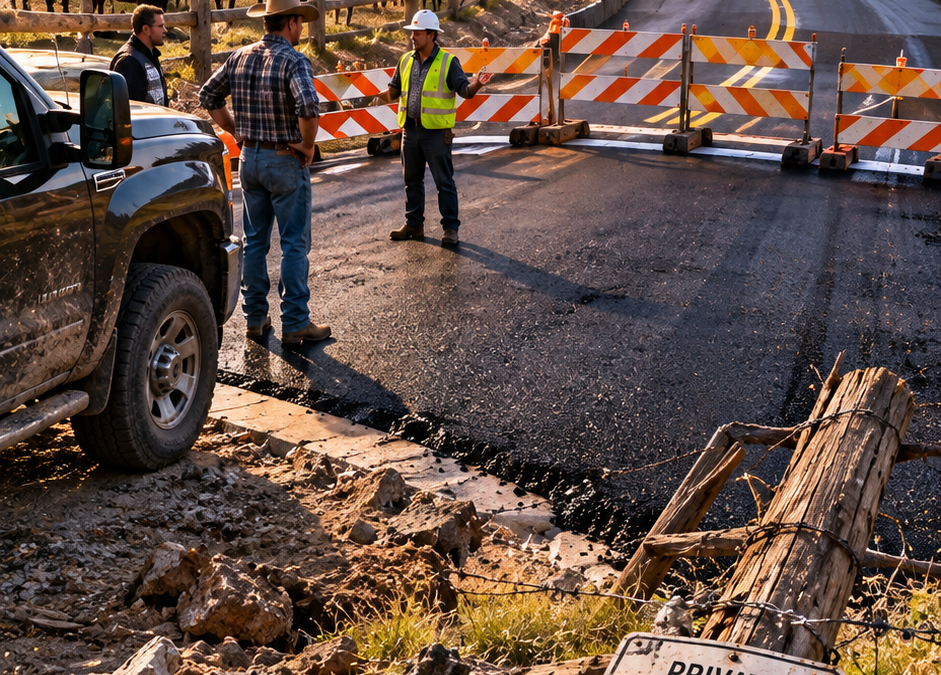
I stopped my truck in the middle of the lane and stared through the windshield, certain I had heard him wrong. Behind him, orange construction barriers blocked the old trail that ran between my north pasture and the lower grazing field. Beyond the barriers, a crew was painting white lines across black pavement so new it still looked oily under the sun.
A temporary sign stood in the dirt beside the road.
HIGHLAND MEADOWS PHASE 2 ACCESS ROAD
For a few seconds, I did not move.
My name is Caleb Morgan, and my family had run cattle on those eighty-six acres outside Red Creek for more than forty years. That narrow trail was not a public road. It was not a subdivision street. It was not some abandoned shortcut waiting for a developer to discover it.
It was a private agricultural access corridor.
My father had used it.
My grandfather had helped maintain it.
I had moved cattle through it every season since I was old enough to open a gate without being told twice.
And someone had just paved over it.
I climbed out of my truck.
The supervisor adjusted his hard hat and looked at me as if I were the inconvenience.
“Who authorized this?” I asked.
“Developer.”
“Which developer?”
Before he could answer, a black SUV rolled toward us from inside the construction zone and stopped beside the barriers. A man stepped out wearing clean boots, pressed khakis, and a Highland Meadows vest.
He smiled like he had practiced it in mirrors.
“Mr. Morgan?”
“Who are you?”
“Jason Whitmore. Development director.”
He offered his hand.
I did not take it.
Jason glanced at the asphalt, then at me. “I understand this looks abrupt.”
“You paved my cattle trail.”
“We improved an existing access corridor.”
“For whose access?”
“Our construction traffic. Eventually, the neighborhood.”
I stared at him.
“You don’t have construction access through my ranch.”
Jason’s smile stayed in place, but the edges tightened.
“Actually, we do.”
He opened a folder and pulled out a subdivision plan. A thick gray line crossed the exact route of my trail.
PROPOSED SECONDARY ACCESS
He tapped the line with one finger.
“You see?”
“I see a drawing.”
“It’s county approved.”
“Where’s the easement?”
His smile faded slightly.
“The corridor is established.”
“That’s not what I asked.”
Behind me, a truck horn sounded. My ranch hand, Luke Bennett, had arrived with the livestock trailer. Twenty-seven heifers were waiting in the north pasture. We were supposed to move them before evening, before the temperature dropped and before they started pushing hard against the temporary fence.
Luke climbed out and stared at the barriers.
“You’ve got to be kidding me.”
Jason stepped toward him. “No livestock on the new pavement.”
Luke looked at me.
I looked back at Jason.
“You blocked the only safe crossing between my pastures.”
“There are alternate routes.”
“Through where?”
He pointed toward the western fence line. “Your upper field.”
“That’s a steep drainage slope.”
Jason shrugged. “Our road can’t be used for cattle.”
Our road.
That got my attention.
Then I noticed something lying beside a pile of torn dirt near the shoulder. It was an old wooden post, half buried under gravel dust. A small metal sign was still attached to it, bent at one corner but readable.
PRIVATE AGRICULTURAL ACCESS
My father had put that sign there when I was a teenager.
I walked over and picked it up.
Jason watched me like I was being sentimental about trash.
“That sign is outdated,” he said.
“No.” I brushed dirt off the lettering with my thumb. “It’s just inconvenient.”
A pickup stopped on the county road.
My neighbor, Tom Alvarez, climbed out and looked across the fresh pavement with his mouth slightly open.
“Caleb,” he said, “what happened to the Morgan Trail?”
Jason answered before I could.
“It’s now Highland Meadows secondary access.”
Tom laughed once.
“No, it isn’t.”
Jason turned toward him.
Tom pointed toward the old stone culvert near the ditch. “My grandfather helped Caleb’s father record that trail when the south parcel was sold.”
Jason went still.
I looked at Tom. “Record it?”
He nodded. “Courthouse records. Agricultural easement.”
Jason closed his folder. “Easements can be modified.”
“Was this one?” I asked.
He did not answer.
So I called the county recorder’s office from the roadside.
A clerk named Hannah Pierce took my parcel number. I could hear her typing. At first, it was ordinary keyboard clicking, the kind you hear when someone is just moving through records. Then she stopped.
“Mr. Morgan?”
“Yes.”
“I found the easement.”
Jason stared at my phone.
“What does it say?” I asked.
Hannah’s voice sharpened. “It says the corridor must remain continuously available for livestock passage and agricultural access.”
I looked at the fresh asphalt.
At Highland Meadows.
At Jason Whitmore.
Another pause came through the phone.
“They are not the easement holder,” Hannah added.
Jason’s face changed.
“Actually,” she continued, “their development parcel is listed as the burdened property.”
I looked past Jason toward the excavators waiting inside Phase 2.
“What does that mean?”
“It means the recorded easement does not give them the right to close your trail,” Hannah said. “It requires them to keep it open for you.”
Then she said, “Put Mr. Whitmore on the phone.”
I held it toward him.
He did not take it.
“County recorder doesn’t interpret development approvals,” he said.
Hannah heard him.
“I am not interpreting your approval, Mr. Whitmore. I am reading a recorded easement.”
Jason finally took the phone.
“This access was incorporated into our approved road network,” he said.
Hannah’s voice came through clearly enough for all of us to hear.
“Was the agricultural easement released?”
Silence.
“Modified?” she asked.
Jason looked toward his construction supervisor. “We have title clearance.”
“Then provide the recorded release number.”
He handed my phone back.
“We’ll verify it.”
That sounded different from actually, we do.
Luke walked toward the trailer.
“What about the cattle?”
Jason pointed at the barriers. “They still can’t cross.”
I looked at the fresh asphalt.
“Then your construction trucks don’t cross either.”
His expression hardened. “You don’t control our development.”
“No,” I said. “But apparently you don’t control my easement.”
A dump truck approached from inside Highland Meadows. The supervisor waved it forward.
I stepped beside my truck.
Jason raised his voice.
“Caleb, don’t interfere with active construction.”
“I’m standing on the access you blocked.”
Tom pulled out his phone and started recording.
The dump truck stopped.
Then Hannah called me back.
“I’ve pulled the original instrument,” she said.
“What year?”
“1986.”
That made sense. My father had bought the north pasture in 1985. The south parcel was sold the following year.
Hannah continued, “The easement is twenty-four feet wide. It specifically protects livestock movement, farm vehicles, fencing access, and maintenance.”
I looked at the new road.
It was almost exactly twenty-four feet wide.
Jason heard that.
His face tightened.
“Can you email it?” I asked.
“Already sent.”
My phone buzzed.
The scanned document had my father’s signature. It also had the signature of the former owner of the land now being developed.
Near the bottom was a sentence in capital letters.
NO GATE, STRUCTURE, ROADWAY IMPROVEMENT, OR OTHER USE SHALL UNREASONABLY INTERFERE WITH AGRICULTURAL PASSAGE.
Luke read it over my shoulder.
“Roadway improvement.”
Tom smiled. “That’s awkward.”
Jason did not smile.
He called someone.
While he spoke, I walked the edge of the asphalt.
That was when I noticed the drainage curb.
The old cattle trail had been nearly level. It had ruts, grass, and a slight crown in the center, but cattle knew it. They moved across it without crowding because the banks were open and the path widened naturally near the culvert.
The new pavement had six-inch concrete curbs on both sides.
Even if Jason removed the barriers, moving cattle across would funnel them between construction traffic and unfinished lots.
Then I saw the storm drain.
It sat right in the center of the route where we normally turned toward the lower pasture. Its steel grate had openings wide enough to catch a hoof.
Luke crouched beside it.
“We can’t run cattle over this.”
Jason ended his call. “The road was built to county standards, not cattle standards.”
I held up the document. “The easement requires cattle standards.”
A white county pickup turned onto the site.
A woman stepped out wearing a reflective vest.
“Emily Ross,” she said. “County land use.”
Jason walked toward her immediately.
“Good. We need clarification.”
Emily looked at the barriers, then at the old sign in my hand, then at the easement on my phone.
“I’ve already spoken with Hannah.”
Jason’s confidence slipped again.
Emily asked for the Highland Meadows approved Phase 2 plan.
He handed it over.
She unfolded it on the hood of her truck.
The secondary access road was clearly shown. Then she pointed to a small note beside it.
“What’s this?”
Jason leaned closer.
So did his supervisor.
The note was small enough that a person could miss it if he wanted to miss it.
EXISTING AGRICULTURAL EASEMENT ACCESS TO BE MAINTAINED DURING AND AFTER CONSTRUCTION.
Tom let out a slow breath.
Jason stared at the page.
“That note wasn’t on our field set.”
Emily looked at him.
“Then your field set is missing a condition.”
She walked toward the barriers.
“Until I determine how this road was built across a protected access without maintaining passage, no construction traffic uses this corridor.”
Jason’s head snapped up.
“You can’t shut down Phase 2 over a cattle trail.”
Emily looked toward the excavators waiting beyond him.
“I’m not shutting it down over a cattle trail.” She tapped the recorded easement. “I’m stopping you from using an access road your approval required you to keep available to someone else.”
Jason stopped calling it a misunderstanding.
Now he called it a design conflict.
Emily Ross did not care what he called it.
She photographed the barriers, then the curbs, then the storm drain sitting directly in the livestock path.
“Who approved this field configuration?” she asked.
Jason pointed toward the construction trailer. “Our civil engineer. Brian Keller.”
Emily called him.
Twenty minutes later, Brian arrived carrying rolled plans.
He looked at the road.
Then at me.
Then at Jason.
“This isn’t what I designed,” he said.
Jason’s supervisor immediately spoke.
“We built from Revision D.”
Brian frowned. “There is no Revision D.”
Nobody said anything.
The supervisor walked to his truck and returned with a stained plan set. Revision D was printed in the corner.
Brian spread his own approved drawings beside it.
The difference was obvious.
His plan showed a paved road crossing my easement, but there were no continuous curbs, no storm drain in the cattle route, and a twenty-four-foot agricultural crossing clearly marked with removable barriers.
Jason’s field set showed none of that.
Tom leaned closer.
“Somebody erased the cattle crossing.”
Brian’s face tightened.
“It wasn’t me.”
Emily pointed at the revision box.
“No engineer stamp.”
Jason folded his arms. “It was probably an internal construction update.”
“Who issued it?” Emily asked.
Nobody answered.
Then Luke called from farther down the road.
“Caleb.”
He was standing beside a dirt pile where the old wooden post had been thrown. Something metal was sticking from the soil. We walked over. Luke pulled carefully.
A second sign emerged.
AGRICULTURAL EASEMENT. KEEP CLEAR.
It had been attached to a steel post. The post was not weathered at the bottom.
It was freshly bent.
Emily photographed it.
“Was this here before construction?”
“Yes,” I said. “Near the culvert.”
Jason looked at his supervisor.
The supervisor looked away.
Emily asked him directly. “Who removed it?”
“Site crew.”
“Why?”
“It was inside the road footprint.”
Brian stared at him. “My plan specifically said to preserve easement markers.”
Jason’s phone rang.
He ignored it.
Then Tom stepped closer.
“I’ve got something too.”
He opened photos from six months earlier. His grandson had been helping him repair fence near my lower pasture. In the background, the cattle trail was visible. So were both easement signs. Beside them stood orange survey stakes.
One had a handwritten label.
AG ACCESS — 24 FT
Brian zoomed in.
“Those are our survey stakes.”
Emily looked at Jason.
“So the easement was marked before grading.”
Jason’s jaw tightened.
Before he could answer, a ranch truck approached from the north pasture. Luke’s brother had brought the first group of heifers toward the crossing. They stopped behind the fence, restless and confused.
One animal pushed against the gate.
Luke shook his head.
“We need them in the lower pasture before dark.”
Emily turned to Jason.
“Open a safe passage.”
“We can’t. The curb concrete hasn’t cured.”
“Then provide the temporary crossing required by your approved plan.”
Jason looked at Brian.
Brian shook his head. “That should have been installed before paving.”
The construction supervisor finally spoke.
“We were told it would slow the road schedule.”
Emily looked at him.
“By whom?”
He hesitated.
Jason’s expression warned him not to answer.
That was enough for me to notice.
Emily noticed too.
“Who told you?”
The supervisor exhaled.
“Jason.”
Jason stepped forward. “That’s not accurate.”
The supervisor pulled out his phone.
“I have the message.”
Silence.
He opened a construction group chat.
Three weeks earlier, Jason had written:
Remove livestock crossing detail from field layout. We need uninterrupted truck access through Phase 2.
Brian stared at him.
“You changed my design.”
Jason said nothing.
The supervisor scrolled farther.
Another message appeared.
If Morgan complains, legal can deal with the old easement later.
Emily read it twice.
Then she took out her phone.
Jason looked toward the waiting excavators.
“Who are you calling?”
“County inspections.”
“For what?”
Emily looked at the paved road, the removed signs, and the cattle trapped on the wrong side.
“To determine how much construction was built from an unauthorized plan.”
Jason’s face went pale.
Because the problem was no longer one blocked trail.
Revision D had been used across Phase 2.
County inspections arrived before Jason’s attorney did.
Two trucks.
Three inspectors.
And suddenly nobody at Highland Meadows seemed interested in calling my trail outdated.
Emily handed the lead inspector, Marcus Hill, both plan sets. He compared the approved drawing with Revision D. Then he looked down the new road.
“How much of Phase 2 was built from this?”
The construction supervisor answered quietly.
“Most of the western section.”
Jason stepped in. “Revision D only contains minor field adjustments.”
Marcus pointed at the missing agricultural crossing.
“This isn’t minor.”
Then Brian Keller noticed something else.
He traced the stormwater line on Revision D.
“Where’s Culvert C4?”
The supervisor looked toward the lower lots.
“Installed according to this.”
“Yes,” Brian said. “And my approved design offsets that culvert twelve feet to preserve the easement.”
We walked downhill.
The new concrete pipe crossed directly beneath my cattle trail. Its headwall extended into the twenty-four-foot easement corridor.
Luke stared at it.
“So even if the pavement comes up, that’s still in our path.”
Brian nodded. “It shouldn’t be there.”
Marcus photographed everything.
Jason’s attorney arrived soon after.
Her name was Rebecca Sloan.
She read the easement first.
Then the approved plan.
Then Jason’s messages.
Her expression became noticeably less confident with each page.
“Who created Revision D?” Marcus asked.
Jason answered, “Field coordination.”
Rebecca looked at him.
“That’s not a person.”
Nobody spoke.
Then a white pickup stopped near the old culvert.
An older man climbed out.
Tom smiled when he saw him.
“Caleb, you remember Henry Walsh.”
I did.
Henry had surveyed ranch parcels around Red Creek for decades before retiring. Tom had called him.
Henry walked slowly to the stone culvert and looked at the pavement.
“Well,” he said, shaking his head. “They covered the crossing.”
Jason’s attorney stepped forward. “You were involved with the easement?”
“I wrote it,” Henry said.
That silenced everyone.
Henry opened an old field notebook. He had kept copies of his survey records. He pointed toward two stones beside the ditch.
“The easement runs from that monument to the cottonwood line, twenty-four feet wide.”
Marcus asked whether the recorded document matched his notes.
“Exactly.”
Henry looked at me. “Your father insisted the language protect livestock movement.”
I smiled slightly despite everything.
“That sounds like him.”
Then Henry walked toward the newly paved road.
He stopped beside a strip of fresh concrete.
“Where’s the brass marker?”
Jason frowned. “What marker?”
“The easement reference disc.”
My stomach tightened.
I had forgotten about it.
Henry pointed at the pavement.
“It was set here.”
Luke crouched. “Under the asphalt?”
Henry nodded. “Unless somebody removed it.”
Marcus called for a locator.
The county crew swept the pavement.
Thirty seconds later, the detector screamed directly beneath the blacktop.
Henry smiled without humor.
“There it is.”
Jason looked at his supervisor.
The supervisor looked stunned. “We didn’t know.”
Brian immediately answered, “The survey layer on my approved plan shows it.”
Emily opened Revision D.
The survey layer was gone.
Not altered.
Gone.
Marcus looked at Jason. “Who removed the survey information?”
Rebecca touched Jason’s arm. “Don’t answer until we review the files.”
Then one of the inspectors returned from the construction trailer carrying a printed email.
“The superintendent gave us this voluntarily.”
Jason’s face changed.
Marcus read it aloud.
“From Jason Whitmore. Subject: Phase 2 road schedule. Survey overlays create unnecessary field confusion. Issue contractor sheets without legacy easement markings.”
Tom looked at me.
There it was.
Not an accident.
Not an old trail nobody noticed.
Jason had known the easement markings existed.
He had ordered them removed from the contractor sheets.
Marcus folded the email.
Then he pulled a red notice from his clipboard.
Jason stepped forward. “What is that?”
Marcus attached it to the Phase 2 construction board.
STOP WORK — WESTERN PHASE 2 ACCESS AND ASSOCIATED IMPROVEMENTS
Jason stared at it.
“You can’t shut down an entire section.”
Marcus pointed toward the buried brass marker.
“You built over a recorded easement using unauthorized plans.”
Behind us, engines began shutting down.
One excavator.
Then another.
Then every machine along the western section.
My cattle still had not crossed.
But for the first time all day, neither had Highland Meadows.
The stop-work notice changed Jason’s tone.
He stopped arguing with me.
Now he argued with the county.
Marcus did not care.
Nothing in the western section would move until inspectors knew what had been built from Revision D.
Jason pointed toward my cattle.
“Then Morgan’s livestock can’t move either.”
Emily looked at him.
“Wrong.”
She turned to Brian.
“Can you create a temporary safe crossing without disturbing evidence?”
Brian studied the approved plan.
“Yes.”
Within an hour, crews placed heavy rubber mats over a protected section of pavement, covered the dangerous storm grate, and installed temporary livestock panels separating my cattle from the construction area.
Luke opened the north gate.
The first heifer hesitated.
Then she crossed.
Twenty-six followed.
I stood beside the trail while the herd moved toward the lower pasture.
Jason watched from twenty yards away.
For him, construction had stopped.
For me, the easement was finally doing exactly what it had been recorded to do.
Then Henry Walsh called me over.
“Caleb, there’s something you should see.”
He had opened his old field notebook beside the buried brass marker.
“This disc isn’t just a reference point.”
“What is it?”
“It’s tied to the original easement centerline.”
He showed Marcus a hand-drawn measurement.
“If the road shifted during construction, we can determine exactly how far.”
The county crew marked the underground disc. Then Henry located a second monument near the cottonwoods. Brian measured between them.
His expression changed.
“The road isn’t centered on the approved alignment.”
Emily looked up. “How far off?”
“Almost eleven feet toward Caleb’s ranch.”
Jason stepped closer. “That’s within normal field tolerance.”
Brian stared at him.
“Not when it pushes permanent drainage structures into a protected easement.”
Marcus walked downhill again.
The misplaced culvert suddenly made sense.
The entire road had shifted.
Then Luke noticed a stack of wooden survey stakes behind the construction trailer.
“Those look familiar.”
One still carried faded writing.
AG ACCESS — 24 FT
Tom had photographed that exact label six months earlier.
Marcus asked the superintendent who pulled them.
The man hesitated.
“Grading crew.”
“On whose instruction?”
He looked at Jason.
Rebecca immediately stepped forward. “My client isn’t answering informal questions.”
But the superintendent had his own records.
He opened a daily construction log.
Entry from five weeks earlier:
REMOVE LEGACY AG STAKES PER JW DIRECTION. SHIFT ROAD WEST TO AVOID UTILITY CONFLICT.
Brian grabbed the approved utility plan.
“What conflict?”
The superintendent pointed toward a proposed water main.
Brian shook his head. “That line was relocated before final approval.”
Emily stared at Jason.
“So you shifted the road to solve a utility problem that no longer existed?”
Jason said nothing.
Henry looked toward the development lots.
“Where did those eleven feet go?”
Brian followed the shifted road alignment on the plan, then stopped at Lot 27.
The change had widened the buildable area beside the road.
Tom saw it too.
“That lot got bigger.”
Emily measured from the approved line.
“Not legally.”
A sale sign stood on Lot 27.
UNDER CONTRACT
I looked at Jason.
“You blocked my cattle trail to create more room for a house.”
“It’s not that simple.”
Then a woman approached from the finished section. She introduced herself as Megan Price.
“We’re buying Lot 27.”
Jason’s face went pale.
Megan held up her phone.
“Our sales agent told us the lot was enlarged after engineering found unused land beside the road.”
Henry looked at the recorded easement.
“Unused.”
He pointed toward my cattle disappearing into the lower pasture.
“Looks used to me.”
Megan turned toward Jason.
“Is part of our planned yard inside his easement?”
Nobody answered.
Marcus did another measurement, then another. Finally, he planted a temporary flag across the corner of Lot 27.
“Based on the recorded corridor, this section cannot be treated as unrestricted building area.”
Megan stared at the flag.
Jason stared at the stopped machinery.
And I finally understood why my old cattle trail had suddenly become so inconvenient.
Highland Meadows had not simply paved over it.
Someone had tried to make it disappear because those twenty-four protected feet were worth more to the development if nobody remembered they belonged to my access.
Megan did not leave.
She called her husband.
Then she called their real estate attorney.
Within thirty minutes, Jason had another problem standing beside Lot 27.
Megan’s husband, Eric Price, walked straight to the temporary flag Marcus had planted.
“Our contract shows this entire area as private yard.”
Jason’s attorney answered before he could.
“The county is still verifying the easement location.”
Henry Walsh opened his notebook.
“I verified it thirty-eight years ago.”
Eric looked at Jason.
“Were you aware of this easement when you sold us the lot?”
Jason said nothing.
Rebecca touched his arm.
“Don’t answer.”
Marcus was not interested in the sales contract.
He was interested in Revision D.
His inspectors had begun comparing every western Phase 2 improvement against the approved plans. The list grew quickly.
Road shifted eleven feet.
Culvert misplaced.
Agricultural crossing deleted.
Survey overlays removed.
Two easement markers pulled.
Then an inspector named Dana Cole called from the construction trailer.
“Marcus, come see this.”
We followed.
A large scheduling board covered one wall. Most notes were ordinary: concrete dates, utility inspections, lot releases.
But beside Phase 2 road was a yellow sticky note.
MOVE WEST BEFORE LOT 27 FOUNDATION RELEASE.
Initials: J.W.
Jason stared at it.
“Anybody could have written that.”
The superintendent shook his head.
“You did.”
Rebecca closed her eyes.
Marcus photographed the note.
Then Dana opened the project’s digital revision log.
There was an entry from six weeks earlier.
ROAD SHIFT REQUEST — 10 FT MINIMUM WEST. SUBMITTED BY JASON WHITMORE. REASON: MAXIMIZE LOT 27 BUILDABLE ENVELOPE.
Brian Keller stared at the screen.
“You submitted this after I rejected the shift.”
That caught everyone’s attention.
Emily turned toward him. “You rejected it?”
Brian opened his email and found the message.
Jason had asked whether the road could move west. Brian’s reply was short.
No. Recorded agricultural easement prevents westward shift. Maintain approved alignment and livestock crossing.
Dated seven weeks earlier.
Before Revision D.
Before the stakes disappeared.
Before the asphalt.
Jason’s face went blank.
Tom whispered, “There it is.”
Rebecca asked for a private conversation with her client.
Marcus gave them space.
Then a sheriff’s vehicle turned into Highland Meadows.
Deputy Aaron Blake stepped out.
Jason immediately looked at Marcus.
“You called law enforcement over a road alignment?”
Marcus shook his head.
“The county didn’t.”
Henry raised one hand.
“I did.”
Everyone looked at him.
Henry pointed toward the buried brass disc.
“That monument was recorded with the original survey. I wanted its condition documented before anyone cuts the pavement.”
Deputy Blake crouched beside the locator mark.
“You’re saying a permanent survey reference is underneath this road?”
“Yes.”
“And the developer knew it existed?”
Brian held up the approved plan. “It was shown here.”
Dana held up Revision D. “It was removed here.”
Deputy Blake looked at Jason.
Rebecca stepped between them.
“My client won’t answer questions without counsel.”
“You’re his counsel,” Deputy Blake said.
She paused.
“Then he won’t answer questions.”
Nobody laughed.
The county crew carefully cut a small square through the asphalt, layer by layer.
Blacktop.
Base material.
Compacted gravel.
Then the brass disc appeared, still anchored in concrete.
Scratched but intact.
Henry crouched beside it.
“That’s mine.”
He cleaned the surface.
The stamp number matched his field notebook.
Marcus measured from the disc to the road centerline, then to the curb, then to the corner of Lot 27.
He stood slowly.
“The recorded easement is exactly where the county records say it is.”
Jason stared at the exposed marker.
There was nowhere left for the trail to move on paper.
Then Dana’s radio crackled.
Another inspector had found a permit issue.
She listened.
“Which foundations?”
Her expression changed.
She looked toward the rows of unfinished homes.
“Three.”
Jason stepped forward. “What?”
Dana lowered the radio.
“Three Phase 2 foundations were approved using setback measurements from your shifted road.”
Eric Price looked toward Lot 27.
“Mine.”
Dana nodded. “Lot 27 is one of them.”
Marcus looked at the red stop-work notice, then at the three foundations.
“This just expanded.”
Jason’s attempt to erase twenty-four feet of cattle access had not only blocked my ranch.
It had moved the reference line used to build part of the subdivision.
And now the county was not investigating one road.
It was checking every structure that depended on it.
By sunset, Highland Meadows looked abandoned.
Three foundations had been flagged.
The western access road was closed to construction traffic.
County inspectors were measuring everything from the brass disc Jason had paved over.
Deputy Blake stayed, not because Marcus asked him to, but because Henry wanted the removed survey markers documented.
The superintendent led us behind a storage container.
Two bent steel posts lay beneath scrap lumber.
One still carried the faded sign.
AGRICULTURAL EASEMENT. KEEP CLEAR.
Henry looked at it.
“That’s the second marker.”
Deputy Blake photographed both posts.
“Who put them here?”
The superintendent answered. “My grading crew.”
“Who told them to remove them?”
He opened his daily log again.
“J.W.”
Jason’s attorney immediately stepped forward.
“We’ve established that initials are not a sworn statement.”
The superintendent looked at her.
“Then I’ll give one.”
Jason turned toward him.
“Think carefully.”
Deputy Blake’s expression changed.
“Mr. Whitmore, don’t tell a witness how to answer me.”
Jason went quiet.
The superintendent gave his statement beside the county truck.
Then Brian gave one. He explained that he had rejected Jason’s requested road shift because of my easement.
Dana preserved the revision log.
Emily requested the original digital engineering files.
Everything was becoming harder to dismiss as field confusion.
Then Marcus received a call from county building.
He listened for nearly two minutes.
“Understood.”
He ended the call.
“Lot 27’s foundation permit is suspended.”
Eric Price stared at him.
“What about our house?”
“Construction stops until the setback is recalculated from the approved road and recorded easement.”
Megan looked at Jason.
“You sold us a lot using dimensions your own engineer rejected.”
Jason finally lost his composure.
“The house can be adjusted.”
Eric stepped forward. “We already paid for upgrades.”
Rebecca moved between them.
“This isn’t the place.”
“No,” Megan said. “Apparently, this is exactly the place.”
Then another pickup arrived.
A woman named Clare Donovan stepped out carrying a laptop case. She represented Highland Meadows Title Company.
Jason looked surprised to see her.
Rebecca did not.
Clare opened the project’s title commitment on the hood of Marcus’s truck.
“I was asked whether the Morgan agricultural easement appeared in title.”
She scrolled.
“Yes. There it is. Exception 14. Recorded 1986. Twenty-four-foot agricultural access easement.”
Clare opened an email.
“Our office specifically requested acknowledgment from the developer before closing on the development parcel.”
Emily asked, “Who acknowledged it?”
Clare turned the screen.
Jason Whitmore.
Nine months earlier.
Tom looked at me.
Jason had known before Phase 2 even started.
Clare opened the attachment.
Jason’s signed acknowledgment stated:
Developer accepts title subject to existing Morgan Agricultural Access Easement.
Jason’s face emptied.
Rebecca stopped taking notes.
Deputy Blake asked Clare to preserve the email.
She agreed.
Then Henry pointed toward the road.
“There’s one more thing.”
He walked to the old stone culvert.
“The easement doesn’t end at the pavement.”
We followed him toward Highland Meadows.
His original field notes showed the corridor continuing another one hundred forty feet along what was now the edge of Lots 26 and 27.
Marcus measured it.
The shifted road, new culvert, landscaping wall, and part of Lot 27’s planned driveway all interfered with the protected corridor.
Emily stared at the approved plan.
“Restoring passage means more than cutting a cattle opening through the curb.”
Brian nodded.
“The road has to return to the approved alignment.”
Jason looked at him.
“You can’t move a finished road.”
Brian pointed toward the easement.
“You moved it once.”
That landed harder than anything else.
Marcus took out another red notice.
This one was larger.
STOP WORK — PHASE 2 WESTERN INFRASTRUCTURE AND AFFECTED LOTS
He posted it beside the first.
Jason stared at both notices.
Then at the brass disc exposed through his new asphalt.
Nine months earlier, he had signed a document acknowledging my cattle easement.
Seven weeks earlier, his engineer had warned him not to move the road into it.
And now the recorded trail he tried to erase was shutting down every piece of construction built on the assumption that nobody would remember it existed.
The next morning, Jason did not arrive first.
The owner of Highland Meadows did.
His name was Robert Vance.
He stepped out of a dark pickup, looked at the two red stop-work notices, then at the square cut through his brand-new asphalt exposing Henry’s brass disc.
“What happened?”
Nobody answered immediately.
Jason arrived five minutes later with Rebecca.
Robert turned toward him.
“I asked you a question.”
Jason started with the same explanation.
“There’s a legacy easement conflict.”
Robert looked at Clare Donovan.
“Legacy?”
Clare opened the title file.
“You acknowledged it nine months ago.”
Robert’s face changed.
Clare showed him Jason’s signature.
Then Brian showed him the rejected road shift request.
Then Marcus showed him Revision D.
Finally, Dana showed him the digital entry.
MAXIMIZE LOT 27 BUILDABLE ENVELOPE
Robert read it twice.
“You moved an approved road to enlarge a lot.”
Jason shook his head. “We were solving multiple field constraints.”
Brian answered, “No. I told you the utility conflict had already been resolved.”
Robert looked toward Lot 27.
Megan and Eric were standing near their suspended foundation.
“And we sold that lot using the shifted dimensions.”
Nobody answered.
Robert closed his eyes.
Then he looked at me.
“Mr. Morgan, what do you want?”
Jason immediately said, “We can negotiate compensation.”
I looked at him.
“For what?”
“The easement.”
“It’s not for sale.”
Robert studied me.
“You wouldn’t consider relocating it?”
“No.”
Luke was moving another small group of cattle through the temporary crossing behind us.
I pointed toward them.
“My ranch still uses it.”
Henry nodded.
“Exactly why it was recorded.”
Robert turned to Marcus.
“What restores compliance?”
Marcus pointed to Brian.
“Start with the approved plan.”
Brian spread it across the truck hood.
The original road sat eleven feet east. The cattle crossing remained open. The culvert avoided the easement. Lot 27 was smaller but buildable.
Eric leaned over the plan.
“Our house still fits?”
Brian measured.
“Not the current footprint.”
Megan looked worried.
“But a revised one?”
“Yes.”
Robert turned toward them.
“Highland Meadows will cover the redesign.”
Jason stared at him.
“Robert, don’t commit to—”
“You’re done committing this company to anything.”
Silence.
Robert removed Jason from the project on the spot.
Rebecca quietly closed her folder.
Then Robert called the site superintendent.
“Prepare to remove the western curb, relocate the culvert, and rebuild the road to the approved alignment.”
The superintendent nodded.
Jason looked stunned.
“You’ll lose weeks.”
Robert pointed toward the red notices.
“We’ve already lost them.”
Then Emily received an email from county engineering.
She opened it.
“The original Phase 2 approval remains valid if construction returns to the stamped plan and the agricultural easement is fully restored.”
Marcus nodded.
“That gives you a path forward.”
Robert looked at me.
“We’ll restore every marker too.”
Henry spoke.
“Not every marker.”
He pointed at the brass disc.
“That one never left.”
For the first time, I smiled.
By noon, crews began saw-cutting the curb that had blocked my cattle.
The storm grate came out next.
Then excavators started exposing the misplaced culvert.
Not one machine crossed the protected corridor without Luke or me approving temporary livestock clearance.
Jason stood beside his SUV watching.
Before leaving, he looked at me.
“All this over twenty-four feet.”
I shook my head.
“No.”
I pointed at the cattle moving safely toward the lower pasture.
“All this because you knew those twenty-four feet weren’t yours to erase.”
He drove away.
The development had not been defeated.
It had been corrected.
And that was the reversal Jason never expected.
The recorded easement did not stop Highland Meadows from building.
It stopped them from building as if my rights did not exist.
Six weeks later, the road was back where it belonged.
Eleven feet east.
That did not sound like much until you saw what had changed.
The concrete curb no longer cut across my cattle route. The dangerous storm grate was gone. The culvert had been rebuilt outside the twenty-four-foot corridor. Two new agricultural easement signs stood beside the trail.
This time, nobody tossed them into a dirt pile.
Henry Walsh came out when the county performed the final survey. He watched the crew verify his old brass disc.
“Still right where I put it,” he said.
I smiled. “After surviving a road.”
“Good monuments are stubborn.”
“So were old ranchers, apparently.”
Marcus signed off on the restored western infrastructure after Brian confirmed construction matched the original approved plans. Then the red notices came down.
Highland Meadows started moving again, but differently.
Every contractor received an updated field set showing my easement in bright cross-hatching. Every morning, the superintendent checked with Luke before heavy equipment approached the livestock crossing. Nobody called it unused land anymore.
Lot 27 changed too.
Robert Vance kept his promise to Megan and Eric. Their house was redesigned. The foundation that had been started from the wrong setback was corrected before framing. Their yard ended up smaller than the sales drawing had shown, but it did not extend into my access.
Megan stopped beside my fence one afternoon.
“I was angry at you at first.”
“I figured.”
“We thought your easement was going to ruin our house.”
She looked toward the trail.
“Then we found out it was there before Highland Meadows.”
“Long before.”
She nodded. “We should have been told.”
“You should have.”
That was the strange part.
Most of the people in the development were not my enemies.
They had been working from information someone else had changed.
The superintendent had not invented Revision D.
The buyers had not hidden the easement.
Even Brian had warned Jason not to shift the road.
One decision had spread outward until everyone was standing on bad assumptions.
Jason never returned to the site. I heard he was no longer with Highland Meadows. Deputy Blake and the county handled whatever remained concerning the removed markers and project records.
I was not interested in chasing rumors.
I already had what mattered.
My trail.
My access.
My cattle moving safely between pastures.
By late summer, the construction noise returned.
Hammers.
Trucks.
Concrete mixers.
But whenever I opened the north gate, construction stopped at the crossing. Luke would raise a hand, the flagger would hold traffic, and the herd would walk through exactly as my father intended when he recorded that easement in 1986.
One evening, Tom joined me near the old stone culvert.
A group of heifers crossed toward the lower field while the sun dropped behind Highland Meadows.
Tom looked at the finished road.
“Funny.”
“What?”
“They probably thought paving it made it theirs.”
I watched the last animal cross.
“Fresh asphalt looks official.”
He laughed. “So does a recorded easement.”
That stayed with me.
Jason had shown up with plans, engineers, contractors, sales deadlines, and a road already paved. He acted like the work itself settled the argument. As if once enough concrete was poured, the past could not object.
But the county records did not care how expensive the pavement was.
The brass disc did not care how many houses were under contract.
And the easement did not disappear because somebody removed it from a contractor drawing.
Highland Meadows eventually finished Phase 2.
Families moved in.
Lawns grew.
Streetlights came on.
And through the middle of all that new construction remained a twenty-four-foot corridor created decades earlier for one simple reason.
Cattle needed to pass.
They still do.
The developer paved over my private trail.
Then the recorded easement stopped their construction.
Not forever.
Just long enough to make them put everything back where it belonged.








