𝗣𝗔𝗥𝗧 𝟮 The Four SEALs at My Table Had No Idea Why My Brother’s Name Made Me Reach for a Number I Had Never Called
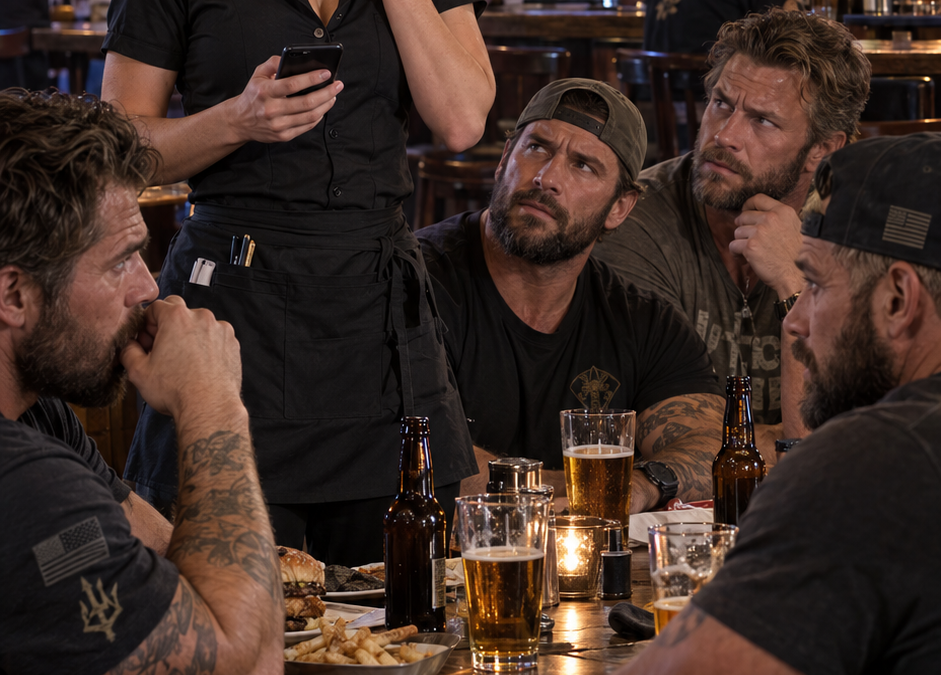
𝗣𝗔𝗥𝗧 𝟮
I looked because grief does strange things to memory.
Six months after somebody dies, there are mornings when your mind wakes before the loss does.
For two or three seconds, the world is normal.
Then you remember.
Those seconds terrified me.
I worried someday they might stretch longer.
Someday I might hear Danny’s name and need half a heartbeat to remember why I had not spoken to him recently.
So I kept the photograph close.
Proof.
He had existed.
He had been real.
And I had not imagined the life in which my brother came home until the day he did not.
I left the Navy the week after his funeral.
Technically, there were forms.
Meetings.
Medical evaluations.
Administrative procedures.
Nothing in the military happens simply because your heart breaks.
But emotionally, my decision took less than a minute.
I could not go back without him.
People assumed that meant Danny and I always deployed together.
We did not.
We shared three deployments closely enough that I treated members of his team and operated around his unit.
Other times we were separated by oceans.
But the possibility of him existed in the architecture of my military life.
A secure message.
A brief call.
A name on a roster.
A rumor that his team had made it back.
Even when he was not physically beside me, the Navy contained him.
After his funeral, every hallway seemed to contain the shape of where he should have been.
People looked at me with sympathy.
Senior officers lowered their voices.
Friends asked whether I needed time.
What I needed was to stop being the surviving Cole.
So I left.
I found the bar.
And for six months, I became Olivia the waitress.
That Friday started normally.
I came in at three.
Restocked bottles.
Checked the register.
Argued with the kitchen manager about why he kept hiding the clean bar towels.
At six, the first after-work crowd arrived.
By eight, every table was occupied except one near the back.
At eight-fifteen, four young men took it.
I knew what they were before I reached them.
Not because of haircuts.
Military towns were full of military haircuts.
Not even because of their posture.
It was the combination.
The way they entered and instinctively checked the room without seeming to.
The way one chose the seat facing the door.
The way another moved a chair two inches to open his line of sight toward the hallway.
They were relaxed.
Happy.
But their bodies had already been trained to read space.
New SEALs.
Or newly assigned.
There was a difference between men who had spent years in a unit and men who had just reached one.
The veterans carried the work more quietly.
These four still had the shine of arrival.
Pride without accumulated ghosts.
I did not hold that against them.
Once, I had been proud without understanding the invoice that eventually arrived.
I walked over with my pad.
“What are we drinking?”
The blond one nearest the wall grinned.
“Whatever tastes best when somebody finally gets assigned.”
“Congratulations.”
“You know what that means?”
I looked at him.
“I work half a mile from the base.”
His friends laughed.
“Fair point.”
They ordered beer.
Their names came naturally through conversation.
Garrett was the blond one.
Mason sat across from him.
Reed was the quietest.
Tyler laughed at nearly everything.
I brought their first round.
Then food.
Then a second round.
They were loud, but not rude.
At first.
They talked about instructors.
Selections.
Training injuries.
Who they hoped to work with.
Who had the worst reputation.
Who had the best.
Then the conversation moved toward old operators.
Legends.
Every community builds them.
People whose names become shorthand for what everyone else is supposed to become.
I was three tables away when I heard Danny’s name.
“Cole.”
I stopped.
Not visibly, I hoped.
Garrett was talking.
“One instructor used Danny Cole again. Swear to God, every scenario ends with, ‘Cole did this,’ or ‘Cole would’ve seen that.’”
Tyler laughed.
“Danny freaking Cole.”
Mason lifted his beer.
“I’m starting to think the guy wasn’t real.”
Something inside me tightened.
I told myself to keep walking.
It was not my conversation.
Danny did not need defending.
Dead men do not become less real because strangers misunderstand them.
I knew all of that.
Then Garrett said, “He’s like one of those training ghosts. Every class gets the story. Nobody actually knows him.”
I reached their table before I had decided to go there.
I set down two glasses.
Garrett looked up.
“Anything else?” I asked.
“No, we’re good.”
My mouth moved before caution caught it.
“Danny Cole was my brother.”
Silence.
Exactly one second.
Then Garrett smiled.
Not cruelly.
That almost made it worse.
It was the smile people give when they think someone has joined a joke.
“No way.”
“Yes.”
Tyler laughed.
I looked at him.
He tried to stop.
Garrett leaned back.
“Your brother?”
“Yes.”
“Danny Cole?”
“That’s generally how brothers work.”
Reed stopped smiling.
Maybe he heard something in my voice.
Garrett did not.
“Come on.”
My fingers tightened around the tray.
“Come on what?”
“Danny Cole is practically a myth.”
“No. He was a person.”
Garrett shook his head.
“I’m not saying there wasn’t some guy originally. I’m saying the version they teach us? That’s a story.”
I stared at him.
A story.
That word landed badly.
I had seen what stories cost when the person inside them was real.
I said, “He was thirty-one years old when he died six months ago.”
Garrett’s smile weakened.
“Okay.”
“Seventh deployment.”
Nobody laughed now.
“I served seven years as a combat medic. I worked with him on three deployments.”
Mason raised his eyebrows.
“You?”
“Yes.”
There was the first insult.
Not in the word.
In the disbelief.
I looked down at my blue waitress shirt.
Apron.
Order pad.
Maybe he could not reconcile those things with the image in his head.
I understood that.
People liked their identities permanent.
Soldier.
Waitress.
Hero.
Civilian.
Dead.
Alive.
Reality rarely respected those categories.
Garrett glanced toward the register.
“You got pictures?”
“Yes.”
“Of him?”
“One.”
“Could be anybody.”
That came from Tyler.
I turned toward him.
He had laughed hardest earlier.
Now he was studying me with the expression of someone who had decided skepticism was sophistication.
“I’m just saying,” he continued. “Every bar near a base has stories.”
Garrett gave a small uncomfortable laugh.
Tyler kept going.
“You know. Somebody’s cousin was on some classified team. Somebody dated a guy who can’t be named. Somebody’s brother did something nobody can verify.”
My chest grew very still.
That happens when I am angry.
Other people become louder.
I become quiet.
Tyler mistook quiet for weakness.
He smiled.
“I’m not saying you’re lying.”
That sentence almost always means the opposite.
“But?”
“But Danny Cole is a name instructors use.”
“Yes.”
“Nobody actually knows him.”
“I did.”
“Well.”
He spread his hands.
“You say you did.”
Across the room, someone set a glass down.
Hard.
I glanced toward the bar.
Frank sat on stool six.
Frank had been coming to the bar for eleven years.
Retired military.
He never discussed specifics.
Never asked me about mine.
When I first started, he looked at my hands once and said, “You’ve done something besides this.”
I answered, “Everybody has.”
He nodded.
That was our entire conversation on the subject.
Now Frank was watching our table.
His jaw had tightened.
He knew the name.
I could tell.
Not from training stories.
Something else.
He gave me the smallest shake of his head.
Not telling me to stop.
Telling me I did not owe them proof.
He was right.
I looked back at the four young men.
Garrett at least appeared uncomfortable now.
“Look,” he said, “if it really was your brother, obviously I’m sorry.”
If.
I repeated the word silently.
If.
Six months of grief reduced to a conditional.
I could have yelled.
I could have pulled the photograph from behind the register.
I could have opened old files on my phone.
I could have listed citations.
Commanders.
Dates.
Places.
But the classified pieces would remain classified, and the public pieces would never explain the man.
More importantly, Danny would have hated the entire performance.
He never needed strangers to believe him.
Neither should I.
So I picked up the tray.
“You boys enjoy your drinks.”
Garrett looked surprised.
“That’s it?”
I met his eyes.
“No.”
Something in my tone finally reached him.
I walked back to the bar.
Frank watched me approach.
“Liv.”
“Don’t.”
He raised both hands.
“Wasn’t going to.”
I put the tray down.
Behind the register, Danny’s photograph waited.
I looked at it.
He looked ridiculously serious.
“You’d hate this,” I whispered.
Frank heard me.
“He’d probably enjoy it.”
I glanced at him.
“You didn’t know him.”
Frank took a drink.
“Never said I didn’t.”
That stopped me.
I looked at him properly.
Frank stared forward.
“Some names travel.”
“Danny’s did.”
“Yes.”
He did not elaborate.
I did not ask.
Then my hand moved toward the pocket of my apron.
My phone was inside.
The number had been there three years.
Danny made me save it before a deployment.
Not his personal number.
Not command.
A shared emergency line used by six men from his unit.
Danny and five teammates.
Eventually six became seven when Commander Daniel Walsh became part of the chain.
Danny had been very specific.
“If you ever need us, call.”
“I know how phones work.”
“I’m serious, Livvy.”
“I have your number.”
“Not mine. This one.”
“Why?”
“Because if I can’t answer, they will.”
“I don’t plan on needing six SEALs simultaneously.”
“You plan too much.”
I saved it mostly to end the argument.
Never used it.
After Danny died, the number remained.
I could have deleted it.
I tried once.
My thumb hovered over the screen.
Could not do it.
Deleting a number should not feel like burying someone twice.
But grief makes symbols out of stupid things.
So the contact stayed.
TEAM.
One word.
No photograph.
No names.
Now I opened it.
Frank watched my hand.
His eyebrows rose slightly.
“You sure?”
“No.”
That seemed to satisfy him.
I pressed call.
It rang once.
Twice.
Then a voice answered.
“Go.”
Walsh.
I had not heard his voice since the funeral.
For one second, I could not speak.
The funeral came back all at once.
Flags.
Dress uniforms.
My mother’s hand shaking inside mine.
Walsh standing beside Danny’s casket like a man had driven a steel rod through his spine and left it there.
“Liv?”
He knew the number.
Of course he knew.
Only one person outside their immediate group had it.
Me.
I looked toward the corner table.
Garrett was telling another story.
Already moved on.
I said three words.
“Bar needs you.”
Silence.
Not confusion.
Assessment.
Then Walsh asked one question.
“Are you safe?”
“Yes.”
“Location?”
I almost laughed.
“You know where I work.”
Another pause.
“We’re thirty minutes out.”
“Walsh—”
The line went dead.
I stared at the screen.
Frank took another drink.
“Well.”
“What?”
“That was probably excessive.”
I put my phone away.
“You told me not to prove anything.”
“I said you didn’t owe them proof. I didn’t say this wouldn’t be entertaining.”
I almost smiled.
Almost.
Then I went back to work.
Twenty-nine minutes can feel extremely long when you know six men in dress uniforms are driving toward you.
It can also feel completely ordinary.
Table four wanted ketchup.
A customer at the bar needed another whiskey.
Two people argued about a tab.
Someone sent back fries because they were cold.
The kitchen lost an order.
I handled all of it.
That was what training does.
You can be waiting for something enormous and still complete the small task in front of you.
Hands working.
Mind elsewhere.
I glanced at the clock only seven times.
Maybe twelve.
The young SEALs had forgotten our conversation.
At least outwardly.
Garrett was telling a story.
Tyler was scrolling on his phone.
Reed occasionally looked toward me.
Mason had become quieter.
At one point Reed said something to Tyler.
I could not hear it.
Tyler shrugged.
Frank noticed too.
“They’re not bad kids,” he said.
“They’re grown men.”
“You know what I mean.”
“Yes.”
“They’re celebrating.”
“That’s not an excuse.”
“No.”
Frank looked into his glass.
“But most people learn humility by surviving the moment they didn’t have enough of it.”
I thought about my first years.
Things I said before knowing better.
Assumptions I made.
Confidence that had not yet met consequence.
That softened something.
Not enough to excuse them.
Enough to remember they were unfinished.
At twenty-six minutes, Frank stopped drinking.
He looked through the front window.
I noticed.
“You see them?”
He nodded.
I did not turn.
There was still a table waiting on change.
So I counted bills.
Closed the check.
Thanked the couple.
Picked up empty glasses.
Because important moments do not excuse unfinished work.
At twenty-nine minutes, the front door opened.
Commander Daniel Walsh entered first.
The bar quieted almost immediately.
Not completely.
Silence spread.
One table noticed.
Then another.
Walsh was forty-four.
Broad shoulders.
Silver beginning at the temples.
Twenty-two years carved into the way he carried himself.
He wore full dress uniform.
Every ribbon.
Every device.
Every piece exactly where it belonged.
Five men entered behind him.
Danny’s unit.
My brother’s brothers.
Men who had carried his casket.
Men whose voices I had heard cracking behind closed doors after the funeral because they did not want my mother to hear them cry.
Men I had not seen in six months.
They were supposed to be on their way to the naval base for a formal event.
Their deployment bags were still in the SUVs.
Walsh had apparently turned an entire convoy around because I used a number I had never called.
The room became silent.
Even the music seemed suddenly too loud.
Walsh’s eyes swept the room automatically.
Door.
Bar.
Tables.
Exits.
Then me.
He stopped.
I was holding a tray.
Apron tied around my waist.
A pencil behind one ear.
For some reason, seeing him while dressed like that embarrassed me.
Not because I was ashamed of the job.
Because Walsh belonged to a version of my life where I had worn body armor and medical gear.
Now he was looking at me as though trying to fit the woman behind the tray into the space where that medic used to stand.
His expression changed.
Something gentler.
Sad.
“Olivia.”
“Walsh.”
Two names.
That was enough.
The five men behind him looked at me.
Harris.
Doyle.
Mendez.
Brooks.
Carter.
I knew all of them.
Different histories.
Different scars.
Same absence.
Harris gave me a small nod.
Mendez looked like he wanted to hug me but knew better than to try in the middle of a crowded bar.
Doyle’s eyes went toward the photograph behind the register.
Then the young men at the corner table.
He understood immediately.
Walsh walked to me.
The others followed.
Garrett stopped talking halfway through a sentence.
All four young SEALs sat straighter.
They recognized Walsh.
Of course they did.
They recognized at least three of the others too.
These were not stories from training.
These were active names.
Men instructors referenced.
Men young operators hoped to impress.
And every one of them had just crossed a crowded bar directly toward the waitress they had dismissed.
Walsh stopped in front of me.
His eyes moved over my face.
“You okay?”
“Yes.”
“You sure?”
“No.”
That earned the smallest hint of a smile.
Danny used to answer him exactly that way.
Walsh looked toward the corner.
“Which table?”
I nodded.
His jaw tightened.
“Liv.”
“What?”
“What happened?”
I could have exaggerated.
I did not.
“They heard Danny’s name. I said he was my brother. They thought I was making it up.”
Walsh’s face became unreadable.
“That all?”
“One suggested every bar near a base has somebody with a story.”
Behind him, Mendez muttered something in Spanish.
Harris looked toward the table.
I said quickly, “They’re young.”
Walsh looked at me.
“So were we.”
“Please don’t destroy them.”
“I wasn’t planning to.”
“That sentence does not comfort me.”
“It shouldn’t.”
He turned.
The six men crossed the room.
I followed because suddenly this felt less like what I had wanted and more like I had called artillery onto a position because somebody hurt my feelings.
Frank caught my eye.
He smiled.
I mouthed, “Shut up.”
He raised his glass.
Garrett stood as Walsh approached.
“Commander.”
Walsh stopped at the table.
“Sit.”
Garrett sat.
The other three already had.
Walsh looked at each of them.
Not angry.
That was worse.
Anger gives you something to push against.
Walsh’s calm made it impossible to pretend the conversation was emotional.
“Which one of you said Danny Cole was a training story?”
Nobody answered.
Walsh waited.
Garrett swallowed.
“Sir, I said something close to that.”
“What exactly?”
Garrett looked at me.
Then Walsh.
“I said instructors use his name so much it started to feel like a myth.”
Walsh nodded.
“Anything else?”
Tyler spoke.
“I said people around bases claim connections.”
“Meaning?”
Tyler’s face flushed.
“That I didn’t believe her.”
Walsh looked at him.
“Why?”
Tyler opened his mouth.
Stopped.
His eyes flicked toward my apron.
Walsh saw it.
Everyone saw it.
“Because she’s serving drinks?”
“No, sir.”
“Then why?”
“I don’t know.”
“That answer I believe.”
The words were not cruel.
That mattered.
Walsh pulled an empty chair from the neighboring table.
Sat down.
The five men remained standing behind him.
The visual was absurdly intimidating.
I moved closer.
“Walsh.”
He raised one hand.
Not dismissing me.
Asking for a minute.
Then he looked at the four younger men.
“You’ve heard Cole’s name in training?”
“Yes, sir,” Garrett said.
“All of you?”
Four nods.
“What have you heard?”
Garrett hesitated.
“The canyon extraction.”
Walsh nodded.
“Mason?”
“The compromised route operation.”
“Reed?”
“The eleven-minute withdrawal.”
“Tyler?”
Tyler swallowed.
“Last deployment. Not details.”
“Good. You shouldn’t know the details.”
Walsh leaned back.
“You know what those stories have in common?”
Nobody answered.
“They’re incomplete.”
He looked at me.
Then back at them.
“You were taught outcomes.”
His voice remained quiet.
“Cole moved here. Cole recognized that. Cole held this point. Cole solved that problem.”
He tapped one finger against the table.
“That makes him sound like a machine.”
Garrett stared down.
“He wasn’t.”
Walsh’s expression softened.
“He complained about his knees.”
Mendez laughed quietly behind him.
“He cheated at cards.”
“Constantly,” Doyle added.
“He sang badly.”
“Violently badly,” Harris said.
A few people in the bar smiled.
I looked down because my eyes had suddenly filled.
Walsh continued.
“He once forgot his mother’s birthday.”
“That was my birthday,” I said.
Walsh looked at me.
“Even worse.”
A faint laugh moved through the room.
Not mocking.
Human.
Then Walsh became serious again.
“Danny Cole was not a myth.”
He looked at Garrett.
“He was a man.”
The words landed harder than any list of medals could have.
“A very good operator. One of the best I ever commanded.”
Walsh paused.
“But if you remember only the legend, you learn the wrong lesson.”
Garrett looked up.
“What lesson is that, sir?”
“That excellence means you stop being human.”
Walsh shook his head.
“Danny was exceptional because he knew exactly how human everybody around him was.”
He glanced at me.
“Including his sister.”
My throat tightened.
Walsh told them about Danny’s third deployment.
Not classified details.
Only the human truth.
A team pinned.
A route collapsing.
A decision with no good options.
Danny noticed something everyone else missed.
Not because he was magical.
Because he had spent hours studying terrain when everyone else wanted to sleep.
Preparation.
Discipline.
Attention.
The legend made it sound instinctive.
Walsh made it sound earned.
Then the fifth deployment.
Eleven minutes.
A compromised extraction.
One wounded operator losing blood faster than I could control it.
Danny buying us time.
Not by doing one dramatic thing.
By doing twelve small correct things in sequence while exhausted.
I had been there for that one.
I remembered yelling at him.
“Cole, move!”
He shouted back.
“Working on it!”
I had screamed something less professional.
Walsh glanced at me as he described the event.
“She can tell you the unedited version.”
“No,” I said.
Some laughter.
Then the last deployment.
Walsh’s voice changed.
The whole room felt it.
“The seventh was different.”
My fingers went cold.
I did not want to hear this.
I had read the sanitized report.
I had been told enough.
But Walsh had been there in the command chain.
The men behind him had lived it.
“He made a decision that saved the rest of his element.”
Walsh kept details deliberately vague.
“No hero speech.”
His jaw tightened.
“No moment where everybody got to understand what he was doing.”
My eyes burned.
“He saw the problem first. He understood what it meant. He acted.”
Walsh’s gaze moved across the four young men.
“The rest came home.”
A pause.
“He didn’t.”
The room had become so silent I could hear the refrigerator behind the bar cycle on.
Walsh continued.
“When instructors use his name, that is what they are trying to teach you.”
Garrett’s eyes were wet now.
“Not that Danny Cole never made mistakes.”
Walsh leaned forward.
“But that when the moment came, his preparation, judgment, and loyalty were already there.”
Tyler looked toward me.
Walsh followed his gaze.
“And this woman?”
My stomach dropped.
“Walsh.”
He ignored me.
Politely.
“This woman was a combat medic for seven years.”
The four men stared.
“She served alongside Danny on three deployments.”
Walsh’s voice hardened slightly.
“She kept men alive who are standing in this room tonight.”
I closed my eyes.
I hated praise.
Danny knew that.
Apparently Walsh had forgotten.
Mendez touched the scar beneath his collar.
“That would be me.”
Harris raised his hand.
“And me.”
Doyle said, “Twice.”
I glared at him.
“You’re welcome.”
He smiled.
Walsh looked at Tyler.
“You saw a waitress uniform.”
Tyler nodded slowly.
“Yes, sir.”
“And decided it told you her whole life.”
“Yes, sir.”
“Remember that.”
No humiliation.
No shouting.
Just instruction.
That was when I understood why I had called them.
Not because I wanted those four men punished.
I wanted Danny to become real again.
Not just to them.
To me.
For six months, I had been protecting myself from every reminder.
I thought grief would become manageable if I reduced him to one photograph behind a register.
Then strangers spoke his name like folklore and I realized what I had actually been afraid of.
Not forgetting Danny.
Watching the world remember him incorrectly.
Walsh stood.
The four young SEALs started to stand too.
He shook his head.
“Stay.”
Then he turned toward me.
“Liv.”
“What?”
“There’s something else.”
I frowned.
“No.”
Mendez smiled.
“Yes.”
“I called you to settle an argument. Why do all of you look suspicious?”
Harris reached inside a garment bag one of the men had carried in.
Walsh took something from him.
A small presentation case.
My breathing stopped.
“Walsh.”
He approached.
I stepped backward.
“No.”
“Olivia.”
“No.”
The entire bar watched.
I hated being watched.
Walsh opened the case.
Inside was a medal.
Danny’s unit commendation.
One of the highest honors they could issue internally.
I recognized the design.
I had attended two presentations.
Never imagined one connected to my brother.
Walsh spoke quietly.
“The unit vote was unanimous.”
“When?”
“The night after the funeral.”
My eyes went to the medal.
“Why didn’t Mom get it?”
“She received everything that belonged to family notification.”
He paused.
“This is different.”
“How?”
“This comes from us.”
The men behind him stood straighter.
Walsh continued.
“Not the Navy.”
His voice roughened.
“The men who came home because Danny did not.”
That destroyed whatever control I had left.
I looked away.
My eyes found the photograph behind the register.
Danny at twenty-nine.
Pretending to be serious.
“You should have given it to Mom.”
Walsh shook his head.
“She told us where it belonged.”
I looked at him.
“You spoke to her?”
“This morning.”
Of course he had.
My mother apparently participated in conspiracies now.
Walsh closed the case halfway.
“She said Danny spent his whole career making sure everybody knew you were his sister.”
My lips trembled.
“He bragged about you constantly.”
“That’s not true.”
Five men behind him immediately disagreed.
“It was exhausting,” Harris said.
Mendez nodded.
“We knew your medical qualifications before we knew your favorite color.”
“My favorite color?”
“Blue.”
I stared.
“That is not my favorite color.”
Mendez looked horrified.
“He lied.”
For one second, laughter saved me.
Then Walsh handed me the case.
The weight felt wrong.
Too much meaning for such a small object.
“He would not want it hidden in an office.”
Walsh nodded toward the photograph.
“Put it somewhere his sister can see it.”
I looked down.
My hands shook.
I had performed medical procedures under fire without trembling.
Grief has never cared what else you can survive.
“Thank you,” I whispered.
Walsh nodded.
Nothing more.
That was exactly enough.
Then Garrett stood.
This time Walsh did not stop him.
Garrett crossed toward me.
The confidence from earlier was gone.
Not destroyed.
Changed.
Humbled confidence is different from broken confidence.
It knows where the edges are.
He stopped two feet away.
“I’m sorry.”
I looked at him.
He swallowed.
“I didn’t know.”
I could have said that ignorance was not an excuse.
I could have made him work harder.
But the apology was clean.
No justification.
No request for me to make him feel better.
Two sentences.
Enough.
I nodded.
“Okay.”
He looked surprised.
“That’s it?”
“What were you hoping for?”
“I don’t know.”
“You already learned the important part.”
He glanced at Walsh.
“No, ma’am.”
Then back to me.
“I think I learned more than one.”
That earned a small smile.
“Good.”
Tyler approached next.
He looked worse.
“I was an ass.”
Walsh coughed behind him.
Tyler corrected himself.
“Respectfully, sir.”
Someone laughed.
I crossed my arms.
“You were.”
“I’m sorry.”
“I believe you.”
His eyes moved toward my apron.
“I shouldn’t have assumed.”
“No.”
“Does that happen a lot?”
“What?”
“People not believing what you were because of what you do now?”
I thought about it.
“Sometimes.”
“How do you handle it?”
“Usually better than tonight.”
That surprised a laugh out of him.
Then I became serious.
“People are allowed to become different things.”
He nodded.
“Remember that when you leave service someday.”
His expression changed.
That idea had probably never felt real.
Young military people often believe service is not something that can end.
Not for them.
Not yet.
I knew better.
“You won’t always wear a uniform,” I said. “Don’t build your entire idea of who deserves respect around one.”
“Yes, ma’am.”
He returned to the table.
The four of them sat quietly.
Not punished.
Thinking.
That was better.
Frank remained at the bar.
When I passed, he touched the wood once.
I stopped.
“You knew Danny?”
He looked at the photograph.
“Knew of him before tonight.”
“That’s not what I asked.”
Frank sighed.
“Different circles.”
“Frank.”
He smiled.
“There are things old men enjoy keeping mysterious.”
“You’re fifty-eight.”
“Ancient.”
I stared.
His expression softened.
“I saw him once.”
“When?”
“Years ago.”
He named a location.
My eyebrows rose.
“That means—”
“Yes.”
“What were you doing there?”
He lifted his glass.
“Enjoying my mysterious youth.”
I shook my head.
“Everybody in this bar has apparently lied to me.”
“Privacy is not lying.”
“That sounds like something a liar says.”
He laughed.
Then looked toward Danny’s medal.
“He was good.”
My chest tightened.
“Yes.”
“More important, from what I saw, he was decent.”
That meant more.
“Yeah.”
Frank nodded once.
Then went back to his drink.
Walsh and the team stayed for another twenty minutes.
They had somewhere they were supposed to be.
Their original route had taken them toward the base.
My phone call made them U-turn.
I felt guilty.
“I hope whatever ceremony you’re missing isn’t important.”
Walsh checked his watch.
“We’re late, not missing it.”
“Because of me.”
“Because of Danny.”
My eyes narrowed.
“That is emotional manipulation.”
“Learned from your mother.”
“Traitors. Both of you.”
Walsh smiled.
Before leaving, the men gathered near the register.
Harris looked at Danny’s photo.
“Still hate that picture.”
“Why?”
“He looks professional.”
“He could fake it.”
“Exactly.”
Mendez tapped the counter.
“You should come by the unit sometime.”
My entire body tightened.
He saw it immediately.
“No pressure.”
“I’m not ready.”
“We know.”
Doyle said, “Door’s open anyway.”
I nodded.
“Thanks.”
Walsh lingered after the others moved toward the entrance.
“You called.”
I looked at him.
“Yes.”
“You never did before.”
“No.”
“Why tonight?”
I thought about that.
Because they laughed?
Because I was angry?
Because Danny deserved witnesses?
All partially true.
Finally, I said, “I think I needed to know the number still worked.”
Walsh understood immediately.
“It works.”
My throat tightened.
“Even now?”
“Especially now.”
“Danny’s gone.”
“Yes.”
The word hurt.
Walsh never softened truth.
That was why Danny respected him.
“But you aren’t.”
I looked down.
He continued.
“You didn’t leave the family because you left the Navy.”
“I know.”
“No, Liv.”
He waited until I looked at him.
“I don’t think you do.”
Then he left.
The door closed behind the six men.
A moment later, the SUVs started in the parking lot.
The bar remained quiet until their headlights disappeared.
Then someone turned the music back up.
Conversation resumed slowly.
Glasses clinked.
Kitchen tickets printed.
Ordinary life returned.
That was one thing military service had taught me.
No matter what happens, somebody still needs dinner.
I stood behind the register holding Danny’s medal.
The photograph was still tucked at its angle.
I placed the medal beside it.
Not center stage.
Not under a spotlight.
Just beside him.
The way it should be.
Then I picked up my tray.
Frank said, “You going back to work?”
“I have tables.”
“You just had six decorated operators turn around a convoy because someone insulted your brother.”
“Table seven still needs ranch.”
Frank smiled.
“Fair.”
I went back onto the floor.
The four young SEALs watched me differently.
That was obvious.
I was not sure I liked it.
I did not want awe.
I wanted basic respect to have existed before proof arrived.
But maybe that was unfair too.
People learn because something happens.
Those four had learned something.
The question was what they would do with it.
An hour later, Garrett called me over.
I approached cautiously.
“What now?”
He pushed the check toward me.
“We’re heading out.”
“Okay.”
He glanced at the medal behind the register.
“Can I ask one thing?”
“Depends.”
“What was he actually like?”
I stopped.
That was the right question.
Not what did he do?
Not how many awards?
Not what part of the legends was true?
What was he like?
I pulled out the empty chair beside their table.
Sat.
“My brother?”
Garrett nodded.
I thought.
“He hated mayonnaise.”
They looked confused.
I continued.
“He could sleep anywhere except airplanes.”
Tyler smiled.
“He once drove four hours to return a dog he found because he didn’t trust animal control.”
Reed leaned forward.
“He was terrible with money.”
Mason laughed.
“How terrible?”
“Bought a motorcycle he absolutely could not afford. Told my mother it was an investment.”
“In what?”
“His own happiness.”
The table laughed.
I smiled.
“He called me before every deployment.”
“Because you were his sister?”
“No.”
I looked down.
“Because he was scared.”
Their laughter stopped.
Garrett stared at me.
“He admitted that?”
“To me.”
I folded my hands.
“That’s another thing instructors probably don’t tell you.”
“What?”
“Brave people get scared.”
I looked around the table.
“Danny never believed courage was the absence of fear. He thought people who weren’t afraid usually didn’t understand the situation.”
Reed nodded slowly.
“What did he say?”
“Usually?”
I smiled.
“‘This one feels bad, Livvy.’”
“And you?”
“‘They all feel bad when you call me beforehand.’”
A faint laugh.
“Then he’d tell me some stupid story, ask about Mom, and hang up.”
I paused.
“The last time, he called at 1:47 in the morning.”
Garrett’s expression softened.
“What did he say?”
“He asked whether I’d watered his plant.”
Tyler blinked.
“That’s it?”
“That was Danny.”
I swallowed.
“He had a plant in his apartment. Half dead. He’d named it Steve.”
“Steve?”
“Yes.”
“Did you water it?”
“No.”
Four horrified faces.
I smiled.
“I forgot.”
“What happened?”
“Steve died before Danny did.”
Mason covered his face.
“That’s brutal.”
“Danny called me a murderer.”
Their laughter was quiet now.
Gentler.
That was what I wanted.
Not reverence.
Not mythology.
I wanted them to know Danny had owned a dying plant named Steve.
Legends were useful.
People were worth loving.
There was a difference.
They left just before midnight.
Garrett stopped by the register.
“Thank you.”
“For what?”
“For calling them.”
I shook my head.
“I didn’t do that for you.”
“I know.”
He glanced at Danny’s photo.
“But I’m glad you did.”
Then he left.
The bar finally emptied.
I locked the door.
Turned chairs upside down.
Wiped tables.
Counted the register.
Same routine.
Except something had shifted.
At eleven-fifty, I stood alone behind the bar.
Danny’s medal caught light from the final lamp.
I picked up the photograph.
First time in six months I had removed it from its hiding place.
My thumb moved across the edge.
“Happy now?”
Nothing.
Of course.
“You caused a scene.”
Still nothing.
I laughed.
Then cried.
Not hard.
Just enough.
For months, I had cried like someone being injured.
That night felt different.
Like pressure leaving a sealed room.
I thought about Walsh’s words.
You didn’t leave the family because you left the Navy.
I had been acting as though grief required total retreat.
If I returned a call, I was moving backward.
If I visited the base, I was moving backward.
If I spoke Danny’s name too often, I was refusing to heal.
If I did not speak it, I was abandoning him.
There was no correct direction because grief is not a road.
It is weather.
Some days you walk through it.
Some days it traps you indoors.
Eventually you stop trying to defeat it and learn what kind of coat to wear.
I put Danny’s photograph back.
But I changed the angle.
Until then, only I could see it.
That night, I turned it outward.
Not dramatically.
Just enough that someone standing at the register could see his face.
I placed the medal beside it.
Then went home.
The next Friday, the four young SEALs came back.
I did not expect them.
Garrett entered first.
Quieter than the week before.
They took the same table.
When I approached, Tyler said, “Before anything else, we brought something.”
I tensed.
Mason placed a small potted plant on the table.
Half dead.
A handwritten card stuck in the soil.
STEVE II.
I stared.
Then started laughing so hard I had to put my tray down.
Frank nearly fell off his stool.
Garrett grinned.
“We were told legends deserve continuity.”
“Who told you that?”
“Commander Walsh.”
Of course.
I picked up the plant.
“You understand I killed the first one.”
“Exactly why we thought you needed another chance.”
I looked at the four men.
They were still young.
Still loud.
Still proud.
But something had shifted.
Maybe small.
Maybe enough.
“Fine.”
I carried Steve II to the register.
Placed him beside Danny.
For the next few months, the corner table became theirs most Fridays.
They never treated me like a legend’s sister again.
Thank God.
They treated me like Olivia.
Sometimes they asked about Danny.
Sometimes I answered.
Sometimes I said, “Not tonight.”
They learned to accept both.
They deployed.
Returned.
Changed.
The first time Garrett came back from an operation with the particular silence men acquire after something goes wrong, he sat at the bar alone.
I placed coffee in front of him.
He looked at it.
“I ordered beer.”
“You need coffee.”
He did not argue.
After twenty minutes, he said, “I understand a little more now.”
I wiped the counter.
“About what?”
“Why you left.”
My hands stopped.
He continued.
“Not everything.”
“No.”
“But enough that I don’t think I would have laughed that night.”
“You were a different person that night.”
He looked toward Danny’s photograph.
“Feels like years.”
“It wasn’t.”
“Some weeks age you.”
That sounded like something Danny might have said.
I nodded.
“Yes.”
Garrett stared into his coffee.
“Do the stories ever stop becoming heavier?”
“No.”
His eyes lifted.
I added, “You get stronger in different places.”
He absorbed that.
Then nodded.
That was all.
A year after the night I called Walsh, I finally returned to the unit.
Not permanently.
Not to reenlist.
Just to visit.
I stood outside the building for ten minutes before going in.
My heart beat harder than it had under fire.
Walsh came outside.
Did not say anything.
Just stood beside me.
Eventually I asked, “Are you going to make this easier?”
“No.”
“Helpful.”
“You know where the door is.”
“Yes.”
“You know the people inside.”
“Yes.”
“What’s the problem?”
I looked at him.
“You’re a terrible counselor.”
“I’m a commander.”
“Debatable.”
That made him smile.
Then I went in.
Danny’s photograph was on the wall.
Not the picture I had.
Another one.
Laughing.
Head tilted back.
Alive in a way formal photographs never capture.
Below it was a small plaque.
No operational details.
Just his name.
Dates.
A line I recognized.
THE STANDARD IS WHAT YOU DO WHEN NO ONE NEEDS TO KNOW.
Danny used to say that.
I stood in front of it for a long time.
Walsh stayed several feet away.
Finally, I said, “He’d think this was embarrassing.”
“Absolutely.”
“He’d complain about the picture.”
“For hours.”
I smiled.
And for the first time since his death, I stood in the building that had shaped both our lives without feeling like I was trespassing in my own past.
I was not coming back.
That mattered.
But I was not running anymore either.
That mattered more.
Two years later, I still worked at the bar.
Fewer shifts.
I had begun doing medical training again part-time for veterans and first responders.
Nothing operational.
Nothing that asked me to become who I had been.
Just enough to use the parts of myself I no longer wanted to bury.
Danny’s photograph remained behind the register.
The medal beside it.
Steve II somehow survived.
Against every reasonable prediction.
Frank insisted that made the plant more legendary than Danny.
I threatened to ban him.
The young SEALs rotated in and out.
New faces arrived.
Sometimes somebody recognized Danny’s name.
Occasionally they would point at the photograph.
“Is that Danny Cole?”
And now I could say yes without my chest collapsing.
Sometimes they asked how I knew him.
I usually smiled.
“He was my brother.”
Most believed me.
Some did not.
I no longer cared.
Because the lesson from that Friday night was not that I needed decorated men to walk through a door and validate my story.
It was almost the opposite.
Walsh and the others had not made Danny real.
Danny had always been real.
Their arrival simply forced four young men to confront how quickly they had confused their own ignorance with evidence.
And if I was honest, I had been doing something similar.
I had confused Danny’s death with the end of every relationship his life had created.
I thought his team no longer belonged to me.
Thought the base no longer belonged anywhere in my life.
Thought leaving the Navy meant cutting away everything connected to it.
But the night I called that number, six men made a U-turn without asking whether I still wore the uniform.
Walsh did not ask whether my problem was serious enough.
He asked whether I was safe.
Then they came.
That was Danny’s final gift to me.
Not the medal.
Not the legend.
A family I had nearly thrown away because I thought grief meant closing every door that reminded me of him.
I know better now.
Some names become stories because what people did deserves to be remembered.
But no story can contain an entire person.
Danny Cole was a standard to young operators.
A decorated SEAL to the Navy.
A commander’s best man in impossible situations.
A teammate who brought people home.
To my mother, he was her son.
To me, he was my idiot older brother who killed houseplants, bought motorcycles he could not afford, hated mayonnaise, sang badly, called when he was scared, and believed I was stronger than I ever believed myself to be.
All of those things were true.
None canceled the others.
And whenever a young man at the bar says Danny’s name now, I do not tense the way I used to.
I look at the photograph.
Sometimes I correct a detail.
Sometimes I tell a story.
Sometimes I simply keep pouring drinks.
Because I no longer need every person in the room to understand who Danny was.
The people who mattered already know.
And I finally understand something he spent his entire life trying to teach me.
The truth does not become stronger because people applaud it.
It does not become weaker because somebody laughs.
It simply waits.
And sooner or later, the people who need to learn it find themselves standing in front of it.
Have you finished reading the story and want to read it again?
The Four SEALs at My Table Had No Idea Why My Brother’s Name Made Me Reach for a Number I Had Never Called
They laughed when I told them the name they treated like a legend belonged to my brother.
I could have walked away and let them keep believing I was only a waitress with a story nobody could prove.
Instead, I reached for a number I had carried for three years and never once dared to call.
My name is Olivia Cole, and six months after I buried my brother, I learned something I should have understood long before his funeral.
A legend can belong to an entire military community.
But the man inside that legend still belongs to the people who knew how he took his coffee, what made him laugh, and what he sounded like when he called home at two in the morning because he needed to hear a familiar voice.
The bar where I worked sat half a mile from the naval base.
It was the kind of place military towns seem to grow naturally.
Dark wood.
Neon beer signs.
A jukebox that worked when it felt like it.
A row of televisions mounted above the bar with sports playing silently while country music competed with conversation.
By Friday evening, the place usually filled with sailors, mechanics, retired chiefs, young operators, spouses waiting for shifts to end, and civilians who had learned enough about military life not to ask questions they had no business asking.
Nobody cared much what you had done before walking through the door.
That was one reason I liked it.
I had worked there for exactly six months.
I started eleven days after Danny’s funeral.
Most people assumed I needed money.
I did.
But that was not why I took the job.
I needed something simpler than the life I had left.
Something where a bad night meant a broken glass.
Where red on the floor came from spilled cocktail mix instead of blood.
Where people complained because their burger was overcooked instead of because someone was dying faster than we could move him.
I had spent seven years as a Navy combat medic embedded with Naval Special Warfare teams.
I was not a physician.
I was not a surgeon.
I was the person operators looked for when something happened before a surgeon could ever reach them.
I knew how to open an airway in darkness.
How to control bleeding inside a vehicle bouncing across terrain.
How to assess a man by touch because dust made seeing impossible.
How to keep my voice level while another human being watched my face for signs of whether he should be afraid.
You learn quickly in that job that people rarely remember the technical words you use.
They remember your eyes.
They remember whether your hands shook.
They remember whether you lied.
I became very good at not lying.
If something hurt, I said it would hurt.
If we had time, I said we had time.
If I did not know, I never said I did.
And if someone asked whether I was leaving them, the answer was always the same.
“No.”
Danny used to tell me that was what made me good.
“You never promise the outcome,” he once said.
We were sitting on ammunition crates eating food that had no business being called dinner.
“You just promise the next minute.”
“That’s all anybody actually has.”
He smiled.
“You always this cheerful?”
“Only around family.”
Danny was my older brother.
Two years older.
Twenty-nine in the photograph behind the register.
Thirty-one when he died.
Seven deployments.
More medals than he knew what to do with.
More classified commendations than our mother was ever allowed to fully understand.
Within his unit, he was already becoming one of those names people said differently.
Not because he demanded it.
Danny hated being praised in public.
If someone called him a hero within earshot, he usually responded by asking whether heroes still had to clean equipment.
He believed professionalism was something you did, not something you announced.
That was probably why his reputation became so large.
Other people had to tell his stories because he never would.
By the final years of his career, instructors were using his name in training.
I did not learn that from Danny.
I learned it from younger SEALs who rotated through our medical training cycles.
They would see my surname.
Cole.
Sometimes one would ask.
“Any relation to Danny Cole?”
I would say, “He’s my brother.”
The reaction was always interesting.
Some thought I was joking.
Some suddenly became more respectful than necessary.
Others immediately wanted stories.
I rarely gave them any.
Because their Danny Cole and mine were different men.
Their Danny Cole had made impossible decisions in hostile environments.
Mine once locked himself out of our mother’s house wearing only gym shorts and had to climb through a bathroom window.
Their Danny Cole had dragged two wounded teammates across terrain under fire.
Mine could not cook pasta without calling me to ask how much water went in the pot.
Their Danny Cole was a name spoken in training halls.
Mine still called me Livvy when he wanted something.
Both versions were real.
Only one belonged entirely to me.
That photograph behind the register showed him in dress uniform at twenty-nine.
Straight shoulders.
Dark hair.
Expression serious enough to fool strangers.
I knew the picture had been taken three minutes after he made a joke so inappropriate our mother nearly hit him.
I kept the photograph tucked against the wall behind the register.
It was not displayed for customers.
Only I could see it from where I usually stood.
Every shift, at least once, my eyes found it.
Not because I wanted to hurt.
Not because I was trying to hold on.
I looked because grief does strange things to memory.
Six months after somebody dies, there are mornings when your mind wakes before the loss does.
For two or three seconds, the world is normal.
Then you remember.
Those seconds terrified me.
I worried someday they might stretch longer.
Someday I might hear Danny’s name and need half a heartbeat to remember why I had not spoken to him recently.
So I kept the photograph close.
Proof.
He had existed.
He had been real.
And I had not imagined the life in which my brother came home until the day he did not.
I left the Navy the week after his funeral.
Technically, there were forms.
Meetings.
Medical evaluations.
Administrative procedures.
Nothing in the military happens simply because your heart breaks.
But emotionally, my decision took less than a minute.
I could not go back without him.
People assumed that meant Danny and I always deployed together.
We did not.
We shared three deployments closely enough that I treated members of his team and operated around his unit.
Other times we were separated by oceans.
But the possibility of him existed in the architecture of my military life.
A secure message.
A brief call.
A name on a roster.
A rumor that his team had made it back.
Even when he was not physically beside me, the Navy contained him.
After his funeral, every hallway seemed to contain the shape of where he should have been.
People looked at me with sympathy.
Senior officers lowered their voices.
Friends asked whether I needed time.
What I needed was to stop being the surviving Cole.
So I left.
I found the bar.
And for six months, I became Olivia the waitress.
That Friday started normally.
I came in at three.
Restocked bottles.
Checked the register.
Argued with the kitchen manager about why he kept hiding the clean bar towels.
At six, the first after-work crowd arrived.
By eight, every table was occupied except one near the back.
At eight-fifteen, four young men took it.
I knew what they were before I reached them.
Not because of haircuts.
Military towns were full of military haircuts.
Not even because of their posture.
It was the combination.
The way they entered and instinctively checked the room without seeming to.
The way one chose the seat facing the door.
The way another moved a chair two inches to open his line of sight toward the hallway.
They were relaxed.
Happy.
But their bodies had already been trained to read space.
New SEALs.
Or newly assigned.
There was a difference between men who had spent years in a unit and men who had just reached one.
The veterans carried the work more quietly.
These four still had the shine of arrival.
Pride without accumulated ghosts.
I did not hold that against them.
Once, I had been proud without understanding the invoice that eventually arrived.
I walked over with my pad.
“What are we drinking?”
The blond one nearest the wall grinned.
“Whatever tastes best when somebody finally gets assigned.”
“Congratulations.”
“You know what that means?”
I looked at him.
“I work half a mile from the base.”
His friends laughed.
“Fair point.”
They ordered beer.
Their names came naturally through conversation.
Garrett was the blond one.
Mason sat across from him.
Reed was the quietest.
Tyler laughed at nearly everything.
I brought their first round.
Then food.
Then a second round.
They were loud, but not rude.
At first.
They talked about instructors.
Selections.
Training injuries.
Who they hoped to work with.
Who had the worst reputation.
Who had the best.
Then the conversation moved toward old operators.
Legends.
Every community builds them.
People whose names become shorthand for what everyone else is supposed to become.
I was three tables away when I heard Danny’s name.
“Cole.”
I stopped.
Not visibly, I hoped.
Garrett was talking.
“One instructor used Danny Cole again. Swear to God, every scenario ends with, ‘Cole did this,’ or ‘Cole would’ve seen that.’”
Tyler laughed.
“Danny freaking Cole.”
Mason lifted his beer.
“I’m starting to think the guy wasn’t real.”
Something inside me tightened.
I told myself to keep walking.
It was not my conversation.
Danny did not need defending.
Dead men do not become less real because strangers misunderstand them.
I knew all of that.
Then Garrett said, “He’s like one of those training ghosts. Every class gets the story. Nobody actually knows him.”
I reached their table before I had decided to go there.
I set down two glasses.
Garrett looked up.
“Anything else?” I asked.
“No, we’re good.”
My mouth moved before caution caught it.
“Danny Cole was my brother.”
Silence.
Exactly one second.
Then Garrett smiled.
Not cruelly.
That almost made it worse.
It was the smile people give when they think someone has joined a joke.
“No way.”
“Yes.”
Tyler laughed.
I looked at him.
He tried to stop.
Garrett leaned back.
“Your brother?”
“Yes.”
“Danny Cole?”
“That’s generally how brothers work.”
Reed stopped smiling.
Maybe he heard something in my voice.
Garrett did not.
“Come on.”
My fingers tightened around the tray.
“Come on what?”
“Danny Cole is practically a myth.”
“No. He was a person.”
Garrett shook his head.
“I’m not saying there wasn’t some guy originally. I’m saying the version they teach us? That’s a story.”
I stared at him.
A story.
That word landed badly.
I had seen what stories cost when the person inside them was real.
I said, “He was thirty-one years old when he died six months ago.”
Garrett’s smile weakened.
“Okay.”
“Seventh deployment.”
Nobody laughed now.
“I served seven years as a combat medic. I worked with him on three deployments.”
Mason raised his eyebrows.
“You?”
“Yes.”
There was the first insult.
Not in the word.
In the disbelief.
I looked down at my blue waitress shirt.
Apron.
Order pad.
Maybe he could not reconcile those things with the image in his head.
I understood that.
People liked their identities permanent.
Soldier.
Waitress.
Hero.
Civilian.
Dead.
Alive.
Reality rarely respected those categories.
Garrett glanced toward the register.
“You got pictures?”
“Yes.”
“Of him?”
“One.”
“Could be anybody.”
That came from Tyler.
I turned toward him.
He had laughed hardest earlier.
Now he was studying me with the expression of someone who had decided skepticism was sophistication.
“I’m just saying,” he continued. “Every bar near a base has stories.”
Garrett gave a small uncomfortable laugh.
Tyler kept going.
“You know. Somebody’s cousin was on some classified team. Somebody dated a guy who can’t be named. Somebody’s brother did something nobody can verify.”
My chest grew very still.
That happens when I am angry.
Other people become louder.
I become quiet.
Tyler mistook quiet for weakness.
He smiled.
“I’m not saying you’re lying.”
That sentence almost always means the opposite.
“But?”
“But Danny Cole is a name instructors use.”
“Yes.”
“Nobody actually knows him.”
“I did.”
“Well.”
He spread his hands.
“You say you did.”
Across the room, someone set a glass down.
Hard.
I glanced toward the bar.
Frank sat on stool six.
Frank had been coming to the bar for eleven years.
Retired military.
He never discussed specifics.
Never asked me about mine.
When I first started, he looked at my hands once and said, “You’ve done something besides this.”
I answered, “Everybody has.”
He nodded.
That was our entire conversation on the subject.
Now Frank was watching our table.
His jaw had tightened.
He knew the name.
I could tell.
Not from training stories.
Something else.
He gave me the smallest shake of his head.
Not telling me to stop.
Telling me I did not owe them proof.
He was right.
I looked back at the four young men.
Garrett at least appeared uncomfortable now.
“Look,” he said, “if it really was your brother, obviously I’m sorry.”
If.
I repeated the word silently.
If.
Six months of grief reduced to a conditional.
I could have yelled.
I could have pulled the photograph from behind the register.
I could have opened old files on my phone.
I could have listed citations.
Commanders.
Dates.
Places.
But the classified pieces would remain classified, and the public pieces would never explain the man.
More importantly, Danny would have hated the entire performance.
He never needed strangers to believe him.
Neither should I.
So I picked up the tray.
“You boys enjoy your drinks.”
Garrett looked surprised.
“That’s it?”
I met his eyes.
“No.”
Something in my tone finally reached him.
I walked back to the bar.
Frank watched me approach.
“Liv.”
“Don’t.”
He raised both hands.
“Wasn’t going to.”
I put the tray down.
Behind the register, Danny’s photograph waited.
I looked at it.
He looked ridiculously serious.
“You’d hate this,” I whispered.
Frank heard me.
“He’d probably enjoy it.”
I glanced at him.
“You didn’t know him.”
Frank took a drink.
“Never said I didn’t.”
That stopped me.
I looked at him properly.
Frank stared forward.
“Some names travel.”
“Danny’s did.”
“Yes.”
He did not elaborate.
I did not ask.
Then my hand moved toward the pocket of my apron.
My phone was inside.
The number had been there three years.
Danny made me save it before a deployment.
Not his personal number.
Not command.
A shared emergency line used by six men from his unit.
Danny and five teammates.
Eventually six became seven when Commander Daniel Walsh became part of the chain.
Danny had been very specific.
“If you ever need us, call.”
“I know how phones work.”
“I’m serious, Livvy.”
“I have your number.”
“Not mine. This one.”
“Why?”
“Because if I can’t answer, they will.”
“I don’t plan on needing six SEALs simultaneously.”
“You plan too much.”
I saved it mostly to end the argument.
Never used it.
After Danny died, the number remained.
I could have deleted it.
I tried once.
My thumb hovered over the screen.
Could not do it.
Deleting a number should not feel like burying someone twice.
But grief makes symbols out of stupid things.
So the contact stayed.
TEAM.
One word.
No photograph.
No names.
Now I opened it.
Frank watched my hand.
His eyebrows rose slightly.
“You sure?”
“No.”
That seemed to satisfy him.
I pressed call.
It rang once.
Twice.
Then a voice answered.
“Go.”
Walsh.
I had not heard his voice since the funeral.
For one second, I could not speak.
The funeral came back all at once.
Flags.
Dress uniforms.
My mother’s hand shaking inside mine.
Walsh standing beside Danny’s casket like a man had driven a steel rod through his spine and left it there.
“Liv?”
He knew the number.
Of course he knew.
Only one person outside their immediate group had it.
Me.
I looked toward the corner table.
Garrett was telling another story.
Already moved on.
I said three words.
“Bar needs you.”
Silence.
Not confusion.
Assessment.
Then Walsh asked one question.
“Are you safe?”
“Yes.”
“Location?”
I almost laughed.
“You know where I work.”
Another pause.
“We’re thirty minutes out.”
“Walsh—”
The line went dead.
I stared at the screen.
Frank took another drink.
“Well.”
“What?”
“That was probably excessive.”
I put my phone away.
“You told me not to prove anything.”
“I said you didn’t owe them proof. I didn’t say this wouldn’t be entertaining.”
I almost smiled.
Almost.
Then I went back to work.
Twenty-nine minutes can feel extremely long when you know six men in dress uniforms are driving toward you.
It can also feel completely ordinary.
Table four wanted ketchup.
A customer at the bar needed another whiskey.
Two people argued about a tab.
Someone sent back fries because they were cold.
The kitchen lost an order.
I handled all of it.
That was what training does.
You can be waiting for something enormous and still complete the small task in front of you.
Hands working.
Mind elsewhere.
I glanced at the clock only seven times.
Maybe twelve.
The young SEALs had forgotten our conversation.
At least outwardly.
Garrett was telling a story.
Tyler was scrolling on his phone.
Reed occasionally looked toward me.
Mason had become quieter.
At one point Reed said something to Tyler.
I could not hear it.
Tyler shrugged.
Frank noticed too.
“They’re not bad kids,” he said.
“They’re grown men.”
“You know what I mean.”
“Yes.”
“They’re celebrating.”
“That’s not an excuse.”
“No.”
Frank looked into his glass.
“But most people learn humility by surviving the moment they didn’t have enough of it.”
I thought about my first years.
Things I said before knowing better.
Assumptions I made.
Confidence that had not yet met consequence.
That softened something.
Not enough to excuse them.
Enough to remember they were unfinished.
At twenty-six minutes, Frank stopped drinking.
He looked through the front window.
I noticed.
“You see them?”
He nodded.
I did not turn.
There was still a table waiting on change.
So I counted bills.
Closed the check.
Thanked the couple.
Picked up empty glasses.
Because important moments do not excuse unfinished work.
At twenty-nine minutes, the front door opened.
Commander Daniel Walsh entered first.
The bar quieted almost immediately.
Not completely.
Silence spread.
One table noticed.
Then another.
Walsh was forty-four.
Broad shoulders.
Silver beginning at the temples.
Twenty-two years carved into the way he carried himself.
He wore full dress uniform.
Every ribbon.
Every device.
Every piece exactly where it belonged.
Five men entered behind him.
Danny’s unit.
My brother’s brothers.
Men who had carried his casket.
Men whose voices I had heard cracking behind closed doors after the funeral because they did not want my mother to hear them cry.
Men I had not seen in six months.
They were supposed to be on their way to the naval base for a formal event.
Their deployment bags were still in the SUVs.
Walsh had apparently turned an entire convoy around because I used a number I had never called.
The room became silent.
Even the music seemed suddenly too loud.
Walsh’s eyes swept the room automatically.
Door.
Bar.
Tables.
Exits.
Then me.
He stopped.
I was holding a tray.
Apron tied around my waist.
A pencil behind one ear.
For some reason, seeing him while dressed like that embarrassed me.
Not because I was ashamed of the job.
Because Walsh belonged to a version of my life where I had worn body armor and medical gear.
Now he was looking at me as though trying to fit the woman behind the tray into the space where that medic used to stand.
His expression changed.
Something gentler.
Sad.
“Olivia.”
“Walsh.”
Two names.
That was enough.
The five men behind him looked at me.
Harris.
Doyle.
Mendez.
Brooks.
Carter.
I knew all of them.
Different histories.
Different scars.
Same absence.
Harris gave me a small nod.
Mendez looked like he wanted to hug me but knew better than to try in the middle of a crowded bar.
Doyle’s eyes went toward the photograph behind the register.
Then the young men at the corner table.
He understood immediately.
Walsh walked to me.
The others followed.
Garrett stopped talking halfway through a sentence.
All four young SEALs sat straighter.
They recognized Walsh.
Of course they did.
They recognized at least three of the others too.
These were not stories from training.
These were active names.
Men instructors referenced.
Men young operators hoped to impress.
And every one of them had just crossed a crowded bar directly toward the waitress they had dismissed.
Walsh stopped in front of me.
His eyes moved over my face.
“You okay?”
“Yes.”
“You sure?”
“No.”
That earned the smallest hint of a smile.
Danny used to answer him exactly that way.
Walsh looked toward the corner.
“Which table?”
I nodded.
His jaw tightened.
“Liv.”
“What?”
“What happened?”
I could have exaggerated.
I did not.
“They heard Danny’s name. I said he was my brother. They thought I was making it up.”
Walsh’s face became unreadable.
“That all?”
“One suggested every bar near a base has somebody with a story.”
Behind him, Mendez muttered something in Spanish.
Harris looked toward the table.
I said quickly, “They’re young.”
Walsh looked at me.
“So were we.”
“Please don’t destroy them.”
“I wasn’t planning to.”
“That sentence does not comfort me.”
“It shouldn’t.”
He turned.
The six men crossed the room.
I followed because suddenly this felt less like what I had wanted and more like I had called artillery onto a position because somebody hurt my feelings.
Frank caught my eye.
He smiled.
I mouthed, “Shut up.”
He raised his glass.
Garrett stood as Walsh approached.
“Commander.”
Walsh stopped at the table.
“Sit.”
Garrett sat.
The other three already had.
Walsh looked at each of them.
Not angry.
That was worse.
Anger gives you something to push against.
Walsh’s calm made it impossible to pretend the conversation was emotional.
“Which one of you said Danny Cole was a training story?”
Nobody answered.
Walsh waited.
Garrett swallowed.
“Sir, I said something close to that.”
“What exactly?”
Garrett looked at me.
Then Walsh.
“I said instructors use his name so much it started to feel like a myth.”
Walsh nodded.
“Anything else?”
Tyler spoke.
“I said people around bases claim connections.”
“Meaning?”
Tyler’s face flushed.
“That I didn’t believe her.”
Walsh looked at him.
“Why?”
Tyler opened his mouth.
Stopped.
His eyes flicked toward my apron.
Walsh saw it.
Everyone saw it.
“Because she’s serving drinks?”
“No, sir.”
“Then why?”
“I don’t know.”
“That answer I believe.”
The words were not cruel.
That mattered.
Walsh pulled an empty chair from the neighboring table.
Sat down.
The five men remained standing behind him.
The visual was absurdly intimidating.
I moved closer.
“Walsh.”
He raised one hand.
Not dismissing me.
Asking for a minute.
Then he looked at the four younger men.
“You’ve heard Cole’s name in training?”
“Yes, sir,” Garrett said.
“All of you?”
Four nods.
“What have you heard?”
Garrett hesitated.
“The canyon extraction.”
Walsh nodded.
“Mason?”
“The compromised route operation.”
“Reed?”
“The eleven-minute withdrawal.”
“Tyler?”
Tyler swallowed.
“Last deployment. Not details.”
“Good. You shouldn’t know the details.”
Walsh leaned back.
“You know what those stories have in common?”
Nobody answered.
“They’re incomplete.”
He looked at me.
Then back at them.
“You were taught outcomes.”
His voice remained quiet.
“Cole moved here. Cole recognized that. Cole held this point. Cole solved that problem.”
He tapped one finger against the table.
“That makes him sound like a machine.”
Garrett stared down.
“He wasn’t.”
Walsh’s expression softened.
“He complained about his knees.”
Mendez laughed quietly behind him.
“He cheated at cards.”
“Constantly,” Doyle added.
“He sang badly.”
“Violently badly,” Harris said.
A few people in the bar smiled.
I looked down because my eyes had suddenly filled.
Walsh continued.
“He once forgot his mother’s birthday.”
“That was my birthday,” I said.
Walsh looked at me.
“Even worse.”
A faint laugh moved through the room.
Not mocking.
Human.
Then Walsh became serious again.
“Danny Cole was not a myth.”
He looked at Garrett.
“He was a man.”
The words landed harder than any list of medals could have.
“A very good operator. One of the best I ever commanded.”
Walsh paused.
“But if you remember only the legend, you learn the wrong lesson.”
Garrett looked up.
“What lesson is that, sir?”
“That excellence means you stop being human.”
Walsh shook his head.
“Danny was exceptional because he knew exactly how human everybody around him was.”
He glanced at me.
“Including his sister.”
My throat tightened.
Walsh told them about Danny’s third deployment.
Not classified details.
Only the human truth.
A team pinned.
A route collapsing.
A decision with no good options.
Danny noticed something everyone else missed.
Not because he was magical.
Because he had spent hours studying terrain when everyone else wanted to sleep.
Preparation.
Discipline.
Attention.
The legend made it sound instinctive.
Walsh made it sound earned.
Then the fifth deployment.
Eleven minutes.
A compromised extraction.
One wounded operator losing blood faster than I could control it.
Danny buying us time.
Not by doing one dramatic thing.
By doing twelve small correct things in sequence while exhausted.
I had been there for that one.
I remembered yelling at him.
“Cole, move!”
He shouted back.
“Working on it!”
I had screamed something less professional.
Walsh glanced at me as he described the event.
“She can tell you the unedited version.”
“No,” I said.
Some laughter.
Then the last deployment.
Walsh’s voice changed.
The whole room felt it.
“The seventh was different.”
My fingers went cold.
I did not want to hear this.
I had read the sanitized report.
I had been told enough.
But Walsh had been there in the command chain.
The men behind him had lived it.
“He made a decision that saved the rest of his element.”
Walsh kept details deliberately vague.
“No hero speech.”
His jaw tightened.
“No moment where everybody got to understand what he was doing.”
My eyes burned.
“He saw the problem first. He understood what it meant. He acted.”
Walsh’s gaze moved across the four young men.
“The rest came home.”
A pause.
“He didn’t.”
The room had become so silent I could hear the refrigerator behind the bar cycle on.
Walsh continued.
“When instructors use his name, that is what they are trying to teach you.”
Garrett’s eyes were wet now.
“Not that Danny Cole never made mistakes.”
Walsh leaned forward.
“But that when the moment came, his preparation, judgment, and loyalty were already there.”
Tyler looked toward me.
Walsh followed his gaze.
“And this woman?”
My stomach dropped.
“Walsh.”
He ignored me.
Politely.
“This woman was a combat medic for seven years.”
The four men stared.
“She served alongside Danny on three deployments.”
Walsh’s voice hardened slightly.
“She kept men alive who are standing in this room tonight.”
I closed my eyes.
I hated praise.
Danny knew that.
Apparently Walsh had forgotten.
Mendez touched the scar beneath his collar.
“That would be me.”
Harris raised his hand.
“And me.”
Doyle said, “Twice.”
I glared at him.
“You’re welcome.”
He smiled.
Walsh looked at Tyler.
“You saw a waitress uniform.”
Tyler nodded slowly.
“Yes, sir.”
“And decided it told you her whole life.”
“Yes, sir.”
“Remember that.”
No humiliation.
No shouting.
Just instruction.
That was when I understood why I had called them.
Not because I wanted those four men punished.
I wanted Danny to become real again.
Not just to them.
To me.
For six months, I had been protecting myself from every reminder.
I thought grief would become manageable if I reduced him to one photograph behind a register.
Then strangers spoke his name like folklore and I realized what I had actually been afraid of.
Not forgetting Danny.
Watching the world remember him incorrectly.
Walsh stood.
The four young SEALs started to stand too.
He shook his head.
“Stay.”
Then he turned toward me.
“Liv.”
“What?”
“There’s something else.”
I frowned.
“No.”
Mendez smiled.
“Yes.”
“I called you to settle an argument. Why do all of you look suspicious?”
Harris reached inside a garment bag one of the men had carried in.
Walsh took something from him.
A small presentation case.
My breathing stopped.
“Walsh.”
He approached.
I stepped backward.
“No.”
“Olivia.”
“No.”
The entire bar watched.
I hated being watched.
Walsh opened the case.
Inside was a medal.
Danny’s unit commendation.
One of the highest honors they could issue internally.
I recognized the design.
I had attended two presentations.
Never imagined one connected to my brother.
Walsh spoke quietly.
“The unit vote was unanimous.”
“When?”
“The night after the funeral.”
My eyes went to the medal.
“Why didn’t Mom get it?”
“She received everything that belonged to family notification.”
He paused.
“This is different.”
“How?”
“This comes from us.”
The men behind him stood straighter.
Walsh continued.
“Not the Navy.”
His voice roughened.
“The men who came home because Danny did not.”
That destroyed whatever control I had left.
I looked away.
My eyes found the photograph behind the register.
Danny at twenty-nine.
Pretending to be serious.
“You should have given it to Mom.”
Walsh shook his head.
“She told us where it belonged.”
I looked at him.
“You spoke to her?”
“This morning.”
Of course he had.
My mother apparently participated in conspiracies now.
Walsh closed the case halfway.
“She said Danny spent his whole career making sure everybody knew you were his sister.”
My lips trembled.
“He bragged about you constantly.”
“That’s not true.”
Five men behind him immediately disagreed.
“It was exhausting,” Harris said.
Mendez nodded.
“We knew your medical qualifications before we knew your favorite color.”
“My favorite color?”
“Blue.”
I stared.
“That is not my favorite color.”
Mendez looked horrified.
“He lied.”
For one second, laughter saved me.
Then Walsh handed me the case.
The weight felt wrong.
Too much meaning for such a small object.
“He would not want it hidden in an office.”
Walsh nodded toward the photograph.
“Put it somewhere his sister can see it.”
I looked down.
My hands shook.
I had performed medical procedures under fire without trembling.
Grief has never cared what else you can survive.
“Thank you,” I whispered.
Walsh nodded.
Nothing more.
That was exactly enough.
Then Garrett stood.
This time Walsh did not stop him.
Garrett crossed toward me.
The confidence from earlier was gone.
Not destroyed.
Changed.
Humbled confidence is different from broken confidence.
It knows where the edges are.
He stopped two feet away.
“I’m sorry.”
I looked at him.
He swallowed.
“I didn’t know.”
I could have said that ignorance was not an excuse.
I could have made him work harder.
But the apology was clean.
No justification.
No request for me to make him feel better.
Two sentences.
Enough.
I nodded.
“Okay.”
He looked surprised.
“That’s it?”
“What were you hoping for?”
“I don’t know.”
“You already learned the important part.”
He glanced at Walsh.
“No, ma’am.”
Then back to me.
“I think I learned more than one.”
That earned a small smile.
“Good.”
Tyler approached next.
He looked worse.
“I was an ass.”
Walsh coughed behind him.
Tyler corrected himself.
“Respectfully, sir.”
Someone laughed.
I crossed my arms.
“You were.”
“I’m sorry.”
“I believe you.”
His eyes moved toward my apron.
“I shouldn’t have assumed.”
“No.”
“Does that happen a lot?”
“What?”
“People not believing what you were because of what you do now?”
I thought about it.
“Sometimes.”
“How do you handle it?”
“Usually better than tonight.”
That surprised a laugh out of him.
Then I became serious.
“People are allowed to become different things.”
He nodded.
“Remember that when you leave service someday.”
His expression changed.
That idea had probably never felt real.
Young military people often believe service is not something that can end.
Not for them.
Not yet.
I knew better.
“You won’t always wear a uniform,” I said. “Don’t build your entire idea of who deserves respect around one.”
“Yes, ma’am.”
He returned to the table.
The four of them sat quietly.
Not punished.
Thinking.
That was better.
Frank remained at the bar.
When I passed, he touched the wood once.
I stopped.
“You knew Danny?”
He looked at the photograph.
“Knew of him before tonight.”
“That’s not what I asked.”
Frank sighed.
“Different circles.”
“Frank.”
He smiled.
“There are things old men enjoy keeping mysterious.”
“You’re fifty-eight.”
“Ancient.”
I stared.
His expression softened.
“I saw him once.”
“When?”
“Years ago.”
He named a location.
My eyebrows rose.
“That means—”
“Yes.”
“What were you doing there?”
He lifted his glass.
“Enjoying my mysterious youth.”
I shook my head.
“Everybody in this bar has apparently lied to me.”
“Privacy is not lying.”
“That sounds like something a liar says.”
He laughed.
Then looked toward Danny’s medal.
“He was good.”
My chest tightened.
“Yes.”
“More important, from what I saw, he was decent.”
That meant more.
“Yeah.”
Frank nodded once.
Then went back to his drink.
Walsh and the team stayed for another twenty minutes.
They had somewhere they were supposed to be.
Their original route had taken them toward the base.
My phone call made them U-turn.
I felt guilty.
“I hope whatever ceremony you’re missing isn’t important.”
Walsh checked his watch.
“We’re late, not missing it.”
“Because of me.”
“Because of Danny.”
My eyes narrowed.
“That is emotional manipulation.”
“Learned from your mother.”
“Traitors. Both of you.”
Walsh smiled.
Before leaving, the men gathered near the register.
Harris looked at Danny’s photo.
“Still hate that picture.”
“Why?”
“He looks professional.”
“He could fake it.”
“Exactly.”
Mendez tapped the counter.
“You should come by the unit sometime.”
My entire body tightened.
He saw it immediately.
“No pressure.”
“I’m not ready.”
“We know.”
Doyle said, “Door’s open anyway.”
I nodded.
“Thanks.”
Walsh lingered after the others moved toward the entrance.
“You called.”
I looked at him.
“Yes.”
“You never did before.”
“No.”
“Why tonight?”
I thought about that.
Because they laughed?
Because I was angry?
Because Danny deserved witnesses?
All partially true.
Finally, I said, “I think I needed to know the number still worked.”
Walsh understood immediately.
“It works.”
My throat tightened.
“Even now?”
“Especially now.”
“Danny’s gone.”
“Yes.”
The word hurt.
Walsh never softened truth.
That was why Danny respected him.
“But you aren’t.”
I looked down.
He continued.
“You didn’t leave the family because you left the Navy.”
“I know.”
“No, Liv.”
He waited until I looked at him.
“I don’t think you do.”
Then he left.
The door closed behind the six men.
A moment later, the SUVs started in the parking lot.
The bar remained quiet until their headlights disappeared.
Then someone turned the music back up.
Conversation resumed slowly.
Glasses clinked.
Kitchen tickets printed.
Ordinary life returned.
That was one thing military service had taught me.
No matter what happens, somebody still needs dinner.
I stood behind the register holding Danny’s medal.
The photograph was still tucked at its angle.
I placed the medal beside it.
Not center stage.
Not under a spotlight.
Just beside him.
The way it should be.
Then I picked up my tray.
Frank said, “You going back to work?”
“I have tables.”
“You just had six decorated operators turn around a convoy because someone insulted your brother.”
“Table seven still needs ranch.”
Frank smiled.
“Fair.”
I went back onto the floor.
The four young SEALs watched me differently.
That was obvious.
I was not sure I liked it.
I did not want awe.
I wanted basic respect to have existed before proof arrived.
But maybe that was unfair too.
People learn because something happens.
Those four had learned something.
The question was what they would do with it.
An hour later, Garrett called me over.
I approached cautiously.
“What now?”
He pushed the check toward me.
“We’re heading out.”
“Okay.”
He glanced at the medal behind the register.
“Can I ask one thing?”
“Depends.”
“What was he actually like?”
I stopped.
That was the right question.
Not what did he do?
Not how many awards?
Not what part of the legends was true?
What was he like?
I pulled out the empty chair beside their table.
Sat.
“My brother?”
Garrett nodded.
I thought.
“He hated mayonnaise.”
They looked confused.
I continued.
“He could sleep anywhere except airplanes.”
Tyler smiled.
“He once drove four hours to return a dog he found because he didn’t trust animal control.”
Reed leaned forward.
“He was terrible with money.”
Mason laughed.
“How terrible?”
“Bought a motorcycle he absolutely could not afford. Told my mother it was an investment.”
“In what?”
“His own happiness.”
The table laughed.
I smiled.
“He called me before every deployment.”
“Because you were his sister?”
“No.”
I looked down.
“Because he was scared.”
Their laughter stopped.
Garrett stared at me.
“He admitted that?”
“To me.”
I folded my hands.
“That’s another thing instructors probably don’t tell you.”
“What?”
“Brave people get scared.”
I looked around the table.
“Danny never believed courage was the absence of fear. He thought people who weren’t afraid usually didn’t understand the situation.”
Reed nodded slowly.
“What did he say?”
“Usually?”
I smiled.
“‘This one feels bad, Livvy.’”
“And you?”
“‘They all feel bad when you call me beforehand.’”
A faint laugh.
“Then he’d tell me some stupid story, ask about Mom, and hang up.”
I paused.
“The last time, he called at 1:47 in the morning.”
Garrett’s expression softened.
“What did he say?”
“He asked whether I’d watered his plant.”
Tyler blinked.
“That’s it?”
“That was Danny.”
I swallowed.
“He had a plant in his apartment. Half dead. He’d named it Steve.”
“Steve?”
“Yes.”
“Did you water it?”
“No.”
Four horrified faces.
I smiled.
“I forgot.”
“What happened?”
“Steve died before Danny did.”
Mason covered his face.
“That’s brutal.”
“Danny called me a murderer.”
Their laughter was quiet now.
Gentler.
That was what I wanted.
Not reverence.
Not mythology.
I wanted them to know Danny had owned a dying plant named Steve.
Legends were useful.
People were worth loving.
There was a difference.
They left just before midnight.
Garrett stopped by the register.
“Thank you.”
“For what?”
“For calling them.”
I shook my head.
“I didn’t do that for you.”
“I know.”
He glanced at Danny’s photo.
“But I’m glad you did.”
Then he left.
The bar finally emptied.
I locked the door.
Turned chairs upside down.
Wiped tables.
Counted the register.
Same routine.
Except something had shifted.
At eleven-fifty, I stood alone behind the bar.
Danny’s medal caught light from the final lamp.
I picked up the photograph.
First time in six months I had removed it from its hiding place.
My thumb moved across the edge.
“Happy now?”
Nothing.
Of course.
“You caused a scene.”
Still nothing.
I laughed.
Then cried.
Not hard.
Just enough.
For months, I had cried like someone being injured.
That night felt different.
Like pressure leaving a sealed room.
I thought about Walsh’s words.
You didn’t leave the family because you left the Navy.
I had been acting as though grief required total retreat.
If I returned a call, I was moving backward.
If I visited the base, I was moving backward.
If I spoke Danny’s name too often, I was refusing to heal.
If I did not speak it, I was abandoning him.
There was no correct direction because grief is not a road.
It is weather.
Some days you walk through it.
Some days it traps you indoors.
Eventually you stop trying to defeat it and learn what kind of coat to wear.
I put Danny’s photograph back.
But I changed the angle.
Until then, only I could see it.
That night, I turned it outward.
Not dramatically.
Just enough that someone standing at the register could see his face.
I placed the medal beside it.
Then went home.
The next Friday, the four young SEALs came back.
I did not expect them.
Garrett entered first.
Quieter than the week before.
They took the same table.
When I approached, Tyler said, “Before anything else, we brought something.”
I tensed.
Mason placed a small potted plant on the table.
Half dead.
A handwritten card stuck in the soil.
STEVE II.
I stared.
Then started laughing so hard I had to put my tray down.
Frank nearly fell off his stool.
Garrett grinned.
“We were told legends deserve continuity.”
“Who told you that?”
“Commander Walsh.”
Of course.
I picked up the plant.
“You understand I killed the first one.”
“Exactly why we thought you needed another chance.”
I looked at the four men.
They were still young.
Still loud.
Still proud.
But something had shifted.
Maybe small.
Maybe enough.
“Fine.”
I carried Steve II to the register.
Placed him beside Danny.
For the next few months, the corner table became theirs most Fridays.
They never treated me like a legend’s sister again.
Thank God.
They treated me like Olivia.
Sometimes they asked about Danny.
Sometimes I answered.
Sometimes I said, “Not tonight.”
They learned to accept both.
They deployed.
Returned.
Changed.
The first time Garrett came back from an operation with the particular silence men acquire after something goes wrong, he sat at the bar alone.
I placed coffee in front of him.
He looked at it.
“I ordered beer.”
“You need coffee.”
He did not argue.
After twenty minutes, he said, “I understand a little more now.”
I wiped the counter.
“About what?”
“Why you left.”
My hands stopped.
He continued.
“Not everything.”
“No.”
“But enough that I don’t think I would have laughed that night.”
“You were a different person that night.”
He looked toward Danny’s photograph.
“Feels like years.”
“It wasn’t.”
“Some weeks age you.”
That sounded like something Danny might have said.
I nodded.
“Yes.”
Garrett stared into his coffee.
“Do the stories ever stop becoming heavier?”
“No.”
His eyes lifted.
I added, “You get stronger in different places.”
He absorbed that.
Then nodded.
That was all.
A year after the night I called Walsh, I finally returned to the unit.
Not permanently.
Not to reenlist.
Just to visit.
I stood outside the building for ten minutes before going in.
My heart beat harder than it had under fire.
Walsh came outside.
Did not say anything.
Just stood beside me.
Eventually I asked, “Are you going to make this easier?”
“No.”
“Helpful.”
“You know where the door is.”
“Yes.”
“You know the people inside.”
“Yes.”
“What’s the problem?”
I looked at him.
“You’re a terrible counselor.”
“I’m a commander.”
“Debatable.”
That made him smile.
Then I went in.
Danny’s photograph was on the wall.
Not the picture I had.
Another one.
Laughing.
Head tilted back.
Alive in a way formal photographs never capture.
Below it was a small plaque.
No operational details.
Just his name.
Dates.
A line I recognized.
THE STANDARD IS WHAT YOU DO WHEN NO ONE NEEDS TO KNOW.
Danny used to say that.
I stood in front of it for a long time.
Walsh stayed several feet away.
Finally, I said, “He’d think this was embarrassing.”
“Absolutely.”
“He’d complain about the picture.”
“For hours.”
I smiled.
And for the first time since his death, I stood in the building that had shaped both our lives without feeling like I was trespassing in my own past.
I was not coming back.
That mattered.
But I was not running anymore either.
That mattered more.
Two years later, I still worked at the bar.
Fewer shifts.
I had begun doing medical training again part-time for veterans and first responders.
Nothing operational.
Nothing that asked me to become who I had been.
Just enough to use the parts of myself I no longer wanted to bury.
Danny’s photograph remained behind the register.
The medal beside it.
Steve II somehow survived.
Against every reasonable prediction.
Frank insisted that made the plant more legendary than Danny.
I threatened to ban him.
The young SEALs rotated in and out.
New faces arrived.
Sometimes somebody recognized Danny’s name.
Occasionally they would point at the photograph.
“Is that Danny Cole?”
And now I could say yes without my chest collapsing.
Sometimes they asked how I knew him.
I usually smiled.
“He was my brother.”
Most believed me.
Some did not.
I no longer cared.
Because the lesson from that Friday night was not that I needed decorated men to walk through a door and validate my story.
It was almost the opposite.
Walsh and the others had not made Danny real.
Danny had always been real.
Their arrival simply forced four young men to confront how quickly they had confused their own ignorance with evidence.
And if I was honest, I had been doing something similar.
I had confused Danny’s death with the end of every relationship his life had created.
I thought his team no longer belonged to me.
Thought the base no longer belonged anywhere in my life.
Thought leaving the Navy meant cutting away everything connected to it.
But the night I called that number, six men made a U-turn without asking whether I still wore the uniform.
Walsh did not ask whether my problem was serious enough.
He asked whether I was safe.
Then they came.
That was Danny’s final gift to me.
Not the medal.
Not the legend.
A family I had nearly thrown away because I thought grief meant closing every door that reminded me of him.
I know better now.
Some names become stories because what people did deserves to be remembered.
But no story can contain an entire person.
Danny Cole was a standard to young operators.
A decorated SEAL to the Navy.
A commander’s best man in impossible situations.
A teammate who brought people home.
To my mother, he was her son.
To me, he was my idiot older brother who killed houseplants, bought motorcycles he could not afford, hated mayonnaise, sang badly, called when he was scared, and believed I was stronger than I ever believed myself to be.
All of those things were true.
None canceled the others.
And whenever a young man at the bar says Danny’s name now, I do not tense the way I used to.
I look at the photograph.
Sometimes I correct a detail.
Sometimes I tell a story.
Sometimes I simply keep pouring drinks.
Because I no longer need every person in the room to understand who Danny was.
The people who mattered already know.
And I finally understand something he spent his entire life trying to teach me.
The truth does not become stronger because people applaud it.
It does not become weaker because somebody laughs.
It simply waits.
And sooner or later, the people who need to learn it find themselves standing in front of it.








