𝗙𝗨𝗟𝗟 𝗦𝗧𝗢𝗥𝗬 The Four Empty Seats in the Front Row Became the Moment I Finally Stopped Begging to Be Seen
𝗙𝗨𝗟𝗟 𝗦𝗧𝗢𝗥𝗬
I looked up so fast my pen rolled off the table.
Major General Caroline Pierce stood in the doorway.
Everyone at the academy knew General Pierce.
She was one of those people whose reputation arrived before she did. Decorated. Brilliant. Severe when necessary. Impossible to impress with decoration and very easy to disappoint with sloppy thinking. She had commanded under conditions people wrote case studies about. She had testified before people who enjoyed pretending questions were weapons. She had mentored officers who now commanded formations of their own.
And she was looking at my ruined planning board.
I stood so quickly my chair nearly fell.
“Yes, ma’am.”
“Why are you still here?”
The truthful answer came out before the careful one.
“Because I don’t want to fail it twice.”
She stared at me.
For one terrible second, I thought I had said the wrong thing.
Then she entered the room, pulled out the chair across from mine, and sat down.
“Show me where your plan collapsed.”
That night changed everything.
General Pierce did not rescue me.
She did not soften the critique.
She did not tell me I had potential in the warm, vague way people sometimes praise failure because they are uncomfortable standing near it.
She took my plan apart piece by piece and made me defend every decision I had made.
Whenever I tried to blame fatigue, she raised one eyebrow.
Whenever I tried to overcorrect, she made me slow down.
Whenever I guessed, she said, “Don’t decorate uncertainty. Identify it.”
At two in the morning, I finally found the mistake that had poisoned the whole plan.
Not the obvious mistake.
The first one.
The assumption I had made so early that every later decision had inherited it.
General Pierce tapped the page.
“There.”
I stared at it.
My throat tightened.
“I built the entire plan around the wrong constraint.”
“Yes.”
“I should have caught it.”
“Yes.”
I waited for more.
She simply looked at me.
“What did you learn?”
That became her question.
Not, Are you embarrassed?
Not, How will you explain yourself?
Not, Do you understand how disappointed I am?
What did you learn?
Over the next three years, she asked me that question more times than I could count.
After failed simulations.
After strong performances.
After leadership exercises where I succeeded for the wrong reason.
After moments when I confused intensity with clarity.
She never made things easier.
She made them honest.
By my final year, I ranked among the strongest graduates in my class. I earned leadership recognition. I received the assignment I had dreamed about. I had built friendships with people who had seen me exhausted, wrong, furious, humbled, and determined, and had stayed anyway.
And when the academy announced that General Pierce would deliver our commencement address, my mother suddenly became interested.
She called me the same afternoon the announcement went out.
“Clara, is this a big deal?”
I almost laughed.
“Yes, Mom.”
“How big?”
“She’s one of the most respected leaders in the military.”
“Oh.” A pause. “Will there be photographs?”
“Yes.”
“Can we get good seats?”
I closed my eyes.
There it was.
Not, Are you proud?
Not, What does this mean to you?
Photographs.
Still, I told her how to request family seating.
Two days later, she called again, breathless with satisfaction.
“We got four VIP seats.”
“That’s great.”
“Tiffany says she may wear cream. Do you think cream photographs well next to uniforms?”
“I don’t know.”
“And your father wants to know if there’s a reception.”
“Yes.”
“Wonderful. This is going to be so special.”
I let myself believe her.
That was my mistake.
Three days before graduation, Mom called me while I was packing my uniform for inspection.
She sounded distracted.
“Honey, there’s been a little change of plans.”
I sat on the edge of my bed.
“What kind of change?”
“Tiffany reached ten thousand followers.”
I waited.
Mom laughed lightly, as though I should understand the importance of this immediately.
“We decided to surprise her with a cruise. Your father found a last-minute deal.”
I looked at the uniform hanging from my closet door.
“My graduation is Saturday.”
“I know, sweetheart.”
“You’re leaving before Saturday?”
“The cruise departs Friday afternoon.”
I did not speak.
Mom filled the silence.
“We’ll watch the livestream if the Wi-Fi works.”
“If the Wi-Fi works.”
“Don’t say it like that.”
Dad took the phone from her. I could hear movement, then his voice, casual and firm.
“Clara, you’ll have plenty of military ceremonies.”
“You only graduate from this academy once.”
He sighed.
“Don’t make everything a competition with your sister.”
I almost laughed then.
Because that was the line.
Always.
If Tiffany received attention, it was love.
If I asked for attention too, it was competition.
“I’m not competing,” I said. “I’m asking my parents to attend my graduation.”
“And we’re proud of you,” he replied.
“But you’re not coming.”
“Tiffany worked hard for this milestone.”
“So did I.”
The words came out before I could stop them.
Dad was quiet for half a second.
Then he said, “This is exactly what I mean.”
I ended the call before I said something I could not take back.
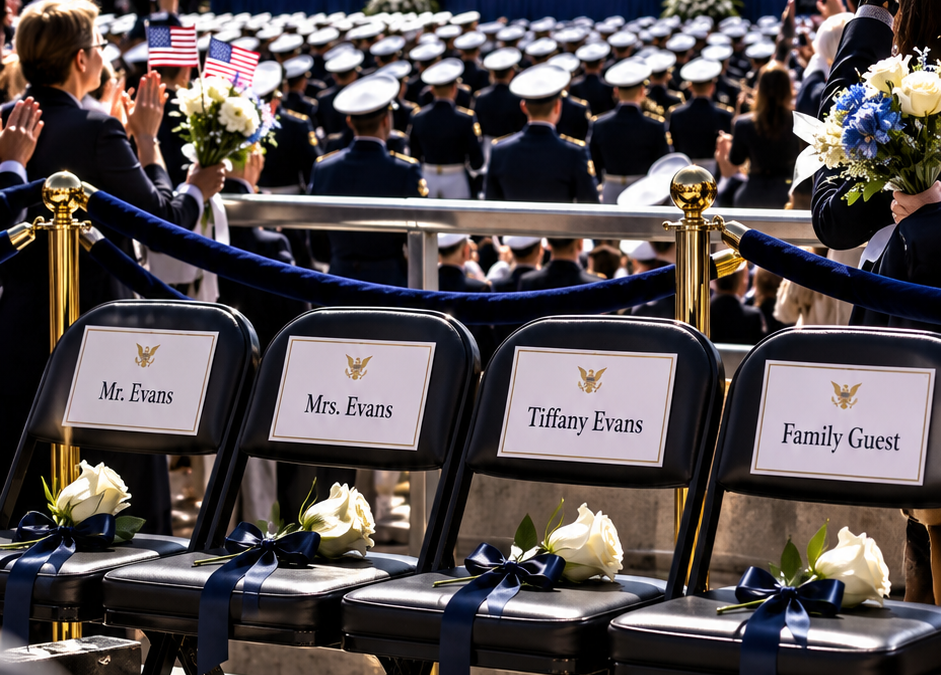
Now, three days later, I sat under the bright stadium sky, looking at four empty VIP chairs and a message from my mother telling me I was not really important yet.
The announcer’s voice rolled through the speakers.
“Ladies and gentlemen, please rise for Major General Caroline Pierce.”
Thousands of people stood.
The stadium shifted into one body.
General Pierce walked to the podium in full dress uniform, steady and composed, carrying a leather folder in one hand.
Applause rose around her.
I stood with everyone else, my throat tight, my phone heavy in my pocket.
She waited for the applause to settle, opened the folder, and looked across the graduates.
Her eyes found me.
I knew the exact moment she saw my face.
General Pierce had a gift for noticing what people were trying to hide.
Then her gaze moved toward the VIP section.
Four empty chairs.
Four printed names.
Four absences pretending not to matter.
She knew whose seats they were.
Her expression changed.
Not dramatically.
General Pierce was not dramatic.
But something in her eyes sharpened.
She looked down at her prepared remarks.
Then she closed the folder.
The stadium went silent.
“I had prepared remarks today about leadership,” she said.
Her voice carried cleanly across the field.
She paused.
“But instead, I think I’d rather begin by telling you about one of your graduates.”
My heart stopped.
No.
Please, no.
Her eyes locked on mine.
“Cadet Clara Evans, please stand.”
Ten thousand faces turned toward me.
For one suspended moment, my body refused to move.
Then training took over.
I stood.
The stadium seemed impossibly large.
I could feel my classmates looking at me. I could feel the cameras. I could feel the empty seats near the front as though they had become lights pointed directly at my life.
General Pierce rested both hands on the podium.
For a few seconds, she said nothing.
The silence did not feel empty.
It felt attentive.
“Three years ago,” she said, “I found Cadet Evans alone in a planning room after most of the building had gone dark.”
A soft laugh moved through the crowd.
My face burned.
“She had failed an exercise that afternoon,” General Pierce continued. “Not catastrophically. Not memorably. The kind of failure most people experience, learn from, and then prefer not to discuss again.”
I remembered the fluorescent light.
The stale coffee.
The pen marks on my hand.
My exhaustion.
My shame.
“She had been told to go home,” Pierce said. “Instead, she was rebuilding the entire plan from the beginning.”
I stared straight ahead.
I had assumed she had forgotten that night.
I should have known better.
“When I asked why she was still there, she told me she did not want to fail the same way twice.”
General Pierce paused.
“That answer stayed with me.”
The stadium went quiet in a deeper way.
“She did not blame the exercise. She did not blame the evaluator. She did not blame exhaustion. She did not ask whether the standard was fair. She wanted to understand what she had missed.”
My throat tightened.
“That is not a glamorous quality,” she said. “You will rarely see it celebrated online. There is no medal for quietly returning to difficult work after everyone else has gone home.”
For one painful second, I wished my parents were there.
Not because I wanted them to feel guilty.
Not because I wanted them to hear praise and regret their cruise.
I wanted them to know me.
That was the part that hurt.
My mother knew Tiffany’s favorite coffee order.
She knew Tiffany’s best camera angle.
She knew every brand Tiffany had ever promoted, every follower milestone, every caption draft, every vacation outfit.
I wasn’t sure she knew my assignment after graduation.
I had told her twice.
General Pierce’s voice brought me back.
“And yet,” she said, “that may be one of the most important qualities a leader can possess.”
She looked directly at me.
“Cadet Evans, you may sit.”
I sat.
My knees felt unsteady.
General Pierce opened her folder again, looked at the prepared pages, then closed it a second time.
“I think the graduates have heard enough about Evans,” she said. “Otherwise she will spend the next ten years blaming me for making her uncomfortable.”
Laughter moved across the stadium.
Even I smiled.
Then her expression settled into something thoughtful.
“What I want to say to all of you is this: recognition and importance are not the same thing.”
The stadium quieted again.
“You are entering institutions where recognition may come slowly, or not at all. Some of your best decisions will never be known outside a small room. Some of your hardest days will be invisible to everyone except the people standing beside you.”
Her eyes passed over the graduates.
“Do not confuse being watched with being valuable. Do not confuse applause with contribution. Do not confuse attention with trust.”
I lowered my gaze.
The words landed somewhere deeper than I expected.
For the first time that morning, the four empty seats no longer seemed like the center of the stadium.
“Most importantly,” General Pierce said, “learn to recognize the people who show up.”
She let the sentence remain between us.
“Those are often the people who will matter most.”
Then she opened her leather folder and began her formal address.
The ceremony continued.
Names were called.
Families cheered.
Flags moved in the breeze.
When it was my turn, I crossed the stage beneath bright sunlight and accepted the certificate I had spent years earning.
When my name was announced, I expected the applause to sound thin.
Instead, voices rose from the graduate section.
“Evans!”
“Clara!”
“About time!”
I recognized Daniel Cho shouting the loudest.
Beside him, Leah Morgan clapped both hands over her head like she was trying to direct aircraft.
I laughed.
It surprised me.
The sound came out before I had time to feel self-conscious.
At the edge of the stage, General Pierce shook my hand.
“Congratulations, Captain Evans.”
The title startled me.
Captain.
Not Cadet.
Not Clara trying to prove something.
Captain Evans.
“Thank you, ma’am.”
She held my hand a second longer than protocol required.
“You earned this.”
Then she released me.
I walked down the steps.
The empty chairs were still there.
But for the first time all morning, I was looking somewhere else.
After the ceremony, the academy grounds became a maze of uniforms, flowers, cameras, grandparents, balloons, and proud parents trying unsuccessfully to organize large groups into photographs.
I stood near an old stone building, holding my cap under one arm.
Daniel Cho appeared carrying three bottles of water and two bouquets.
“Good news,” he said. “I stole hydration from Leah’s family.”
“You stole flowers too?”
“No. Those belong to my mother, who currently believes every graduate without flowers is suffering a national emergency.”
Before I could respond, a small woman in a blue dress approached with another bouquet in her arms.
“Clara.”
Mrs. Cho wrapped me in a hug before I could decide whether protocol allowed it.
“You were wonderful.”
“I mostly walked across a stage.”
“You did it with excellent posture.”
Daniel rolled his eyes.
“My mother has extremely specific standards.”
Mrs. Cho ignored him and handed me the flowers.
White roses mixed with blue delphiniums.
“I heard General Pierce,” she said quietly. “You should be very proud.”
Something tightened in my chest.
“Thank you.”
She touched my arm.
“And for what it is worth, Daniel has talked about you for three years. Usually complaining.”
“I have not,” Daniel said.
“You absolutely have.”
“I have offered professional observations.”
Mrs. Cho smiled at me.
“Apparently you are stubborn, competitive, impossible during field exercises, and the only person he trusts to tell him when one of his ideas is ridiculous.”
“That sounds accurate,” I said.
“Traitor,” Daniel muttered.
Then Leah arrived with her father and older brother.
Within ten minutes, I had been absorbed into other people’s family photographs.
I stood beside Daniel’s grandmother.
I held Leah’s brother’s camera.
Someone’s aunt handed me a plate of food.
People asked where my family was.
At first, I answered honestly.
“They couldn’t make it.”
Later, I shortened it.
“They’re traveling.”
Nobody pushed.
That kindness somehow made it harder.
Around two in the afternoon, my phone buzzed again.
Tiffany.
She had sent a video.
I hesitated before opening it.
Music played in the background. My sister stood on the deck of the cruise ship wearing oversized sunglasses, her hair moving in the wind.
“Clara!” she shouted cheerfully toward the camera. “Congratulations! Mom says you looked serious in the livestream, but I told her that’s probably military tradition.”
The camera turned.
Dad sat under an umbrella reading something on his tablet.
Mom waved from a lounge chair.
“Congratulations!” she called.
Then Tiffany pointed the camera back at herself.
“We’ll celebrate when we get home. Also, I’m officially at ten thousand six hundred and twelve followers, which is insane.”
The video ended.
I stared at the frozen image of my sister’s smiling face.
A year earlier, I might have cried.
Two years earlier, I might have called my mother and demanded an explanation that would never satisfy me.
That afternoon, I simply felt tired.
I typed, Thank you.
Then I put my phone away.
When I returned to the group, General Pierce was standing beside Mrs. Cho.
Everyone suddenly looked more disciplined.
“Ma’am,” Daniel said.
“At ease, Cho. Your grandmother has already informed me that you are incapable of standing still for more than seven seconds.”
Daniel’s grandmother, who was ninety and apparently fearless, nodded.
“It’s true.”
General Pierce smiled.
Then she turned to me.
“Evans, walk with me.”
“Yes, ma’am.”
We moved away from the crowd along a tree-lined path.
For several moments, neither of us spoke.
Finally, I said, “You didn’t have to do that.”
“I know.”
“You changed your speech.”
“I modified my opening.”
“You talked about me in front of ten thousand people.”
“That is usually what happens when one stands behind a podium with a microphone.”
I gave her a look.
She almost smiled.
“I embarrassed you,” she said.
“A little.”
“Good.”
We continued walking.
Then her tone softened.
“Are you all right?”
The directness made answering difficult.
“Yes, ma’am.”
She stopped.
I stopped too.
“Clara.”
She rarely used my first name.
“I didn’t ask whether you can function,” she said. “I know you can function. I asked whether you’re all right.”
I looked back toward the crowd.
Families stood beneath the trees taking pictures.
“No,” I admitted.
General Pierce nodded once.
There was no pity in her expression.
That helped.
“I kept thinking they would change their minds,” I said.
“That is understandable.”
“I knew they wouldn’t. But I kept thinking maybe they would.”
“That is also understandable.”
“I feel ridiculous.”
“Why?”
“Because I’m twenty-eight years old. I shouldn’t care this much whether my parents attend a ceremony.”
“Who told you adulthood means becoming indifferent?”
I looked at her.
“No one.”
“Then stop inventing rules solely to punish yourself.”
That sounded exactly like something General Pierce would say.
We resumed walking.
After a moment, she added, “Your mother requested those seats personally, correct?”
“Yes.”
“How long ago?”
“About five months.”
“And she understood the ceremony?”
“Yes.”
General Pierce nodded.
I waited for her to criticize them.
She did not.
Instead she said, “Then you have information.”
“Information?”
“You now know something clearly that you may have spent years trying not to know.”
I considered that.
“What do I do with it?”
“That is your decision.”
I frowned.
“You could at least pretend to have an answer.”
“I have many answers. The difficulty is that none of them are mine to choose.”
She looked toward me.
“You can spend the next decade trying to convince your parents to become different people. You can stop speaking to them. You can maintain a limited relationship. You can have one honest conversation and see what happens. You can do nothing today.”
I exhaled slowly.
“That’s not very helpful.”
“It is extremely helpful. You simply wanted me to choose for you.”
She was right.
I disliked that.
“Do not make a permanent decision while you are hurt,” she said. “But do not pretend today did not matter simply because admitting it matters is uncomfortable.”
We reached the edge of the courtyard.
Someone called her name from behind us.
General Pierce turned, then looked back at me.
“One more thing.”
“Yes, ma’am?”
She nodded toward Daniel, Leah, and the families gathered near them.
“Your seats were not as empty as you think.”
Then she walked away.
That evening, a group of us went to dinner at a restaurant near the river.
There were twenty-three people at the table.
I knew fourteen of them.
By dessert, I had been introduced as “basically family” by three unrelated households.
The absurdity of it nearly made me cry again.
Leah noticed.
She always noticed.
“You okay?” she asked quietly.
“I’m apparently related to half the graduating class.”
“You could do worse.”
Daniel pointed his fork at us from across the table.
“You are both being suspicious.”
“We’re planning to replace you,” Leah said.
“With whom?”
“Someone quieter.”
Daniel looked offended.
Mrs. Cho raised her glass.
“I support this plan.”
Everyone laughed.
Later, when the check arrived, I tried to pay for myself.
Mr. Morgan pushed my card back across the table.
“Absolutely not.”
“Sir—”
“Today you’re our guest.”
“I can pay for dinner.”
“I know.”
He looked at me with the calm patience of someone accustomed to stubborn people.
“Being able to do something doesn’t mean you should always have to.”
I stared at the card in my hand.
It was such a simple sentence.
Maybe because of that, I remembered it.
The next morning, I woke in my small apartment to sunlight pouring through the blinds.
For several seconds, I forgot graduation had happened.
Then I saw the uniform carefully hung beside the closet.
My phone contained thirty-seven messages.
Most were congratulations.
Several included photographs from the ceremony.
One was from my mother.
We saw part of General Pierce’s speech online. Why didn’t you tell us she was going to talk about you?
I read it twice.
Not congratulations.
Not We wish we had been there.
Why didn’t you tell us?
I placed the phone face down on the table.
Then I made coffee.
Twenty minutes later, I turned it over.
Another message.
People keep sending me clips. Your aunt says you were some kind of special student for General Pierce. You never tell us anything.
I laughed once.
Not because it was funny.
Because I genuinely did not know what else to do.
I typed several replies.
Deleted all of them.
Finally, I wrote:
I did tell you. More than once.
Three dots appeared.
Disappeared.
Appeared again.
Then:
Well, you know how busy things have been with Tiffany’s work.
I set the phone down.
That sentence was the entire history of my family in one line.
Tiffany’s piano lessons.
Tiffany’s auditions.
Tiffany’s first boyfriend.
Tiffany’s college applications.
Tiffany’s internships.
Tiffany’s content.
Tiffany’s collaborations.
Tiffany’s milestones.
There was always a reason my parents missed something.
And it was nearly always Tiffany.
For years, I blamed her.
That morning, for the first time, I wondered whether that was entirely fair.
My sister was twenty-three. She had been five when my parents began comparing us openly. She had not built the system. She had simply learned how to live inside it.
My phone rang.
Tiffany.
I considered ignoring her.
Then I answered.
“Hi.”
“Hey.”
The ship’s background noise was loud.
“Can you hear me?” she asked.
“Yes.”
“Okay. Mom is being weird.”
“That narrows it down.”
Tiffany laughed.
Then she stopped.
“People are posting clips from your graduation.”
“I know.”
“You didn’t tell me General Pierce was, like, your mentor.”
“I did.”
There was a pause.
“When?”
“Christmas.”
Another pause.
“Oh.”
I remembered exactly.
We had been sitting at my parents’ dining table. I had explained that General Pierce had helped me prepare for a selection board. Halfway through, my mother interrupted because Tiffany had received an email from a clothing brand.
The conversation never returned to me.
“I guess I forgot,” Tiffany said.
“It happens.”
“You sound mad.”
“I’m tired.”
“Clara.”
I closed my eyes.
“What?”
“Did you want us there?”
The question was so surprising I opened my eyes again.
“Yes.”
She was quiet.
“Like… really?”
“Yes, Tiffany.”
“I thought you didn’t care about ceremonies.”
I almost asked why she would think that.
Then I realized the answer.
Because I had trained them to think I did not care.
Every missed birthday dinner.
Every forgotten award.
Every canceled visit.
I had learned to say, It’s fine.
Eventually people believe you.
“Graduation mattered to me,” I said.
“Oh.”
I could hear wind through the phone.
“Mom said you told her it wasn’t a big deal.”
“I never said that.”
“She said—”
“She may have heard what she wanted to hear.”
Tiffany did not respond.
I immediately regretted the sharpness.
But before I could apologize, she said quietly, “I didn’t know.”
I sat down at the kitchen table.
“I believe you.”
Another pause.
Then Tiffany said, “I think I should have known anyway.”
I did not have an answer for that.
Neither of us spoke for a while.
Finally, she said, “Can I call you when we get back?”
“Sure.”
“Just me.”
I looked at the phone.
“Okay.”
“Congratulations, Clara.”
This time, she sounded different.
Not cheerful.
Sincere.
“Thank you.”
After we hung up, I stayed at the table for several minutes.
Something had shifted.
Not fixed.
Shifted.
Sometimes that was the beginning of something.
The next six weeks moved quickly.
I relocated for my new assignment.
My apartment contained exactly one chair for the first ten days.
Daniel sent me a picture of a folding table with the message:
CAPTAIN EVANS COMMAND CENTER.
Leah mailed me a housewarming package containing coffee, a plant, and a note that read:
Please keep at least one living thing alive.
The plant survived.
Barely.
Work demanded attention in a way that was almost comforting.
Nobody cared about my family history.
Nobody cared about General Pierce’s graduation speech.
They cared whether I arrived prepared.
Whether I listened.
Whether I made decisions carefully.
Whether I admitted when I did not know something.
For the first time in years, I felt measured by standards I understood.
I also began noticing something General Pierce had tried to teach me long before.
Leadership was mostly quiet.
It was checking someone’s work without making them feel small.
It was remembering who had been awake too long.
It was asking one more question when a confident answer did not quite make sense.
It was giving credit away.
It was taking responsibility toward yourself.
None of it looked impressive in photographs.
I liked that.
My parents returned from the cruise.
My mother sent a group message with two hundred and fourteen pictures.
I did not respond.
A week later, she called.
“How’s the new place?”
“Fine.”
“Do you have furniture?”
“Mostly.”
“Tiffany said you two talked.”
“We did.”
There was a carefulness in my mother’s voice I had rarely heard before.
“She feels terrible.”
“I didn’t ask her to.”
“No, but she does.”
I waited.
My mother cleared her throat.
“Your father and I were thinking maybe we could come visit.”
I almost said yes automatically.
Then I remembered General Pierce.
You now have information.
“When?”
“Maybe next month.”
“I need to check my schedule.”
“Oh.”
She sounded surprised.
I understood why.
Historically, my schedule had never mattered.
“If we come,” she continued, “maybe you can show us around.”
“Some areas, yes.”
“And perhaps you could introduce us to General Pierce if she’s around.”
There it was.
Small.
Almost invisible.
But there.
I leaned back in my chair.
“General Pierce doesn’t work here.”
“Oh. I thought maybe—”
“No.”
“Well, never mind.”
Silence stretched.
Then she asked, “Did you see the article?”
“What article?”
“About graduation. Someone wrote something online about General Pierce changing her speech.”
My shoulders tightened.
“No.”
“They mention you.”
“I didn’t know.”
“Tiffany’s followers found it.”
Of course they had.
My mother laughed awkwardly.
“You’ve become the famous one in the family.”
I felt something cold settle inside me.
Not anger.
Recognition.
For years, my parents had treated achievement as important only when other people noticed it.
Now other people had noticed mine.
Suddenly, they were curious.
“I have to go, Mom.”
“Clara—”
“I’m due somewhere.”
That was true.
But it was not why I ended the call.
The article turned out to be brief.
It described General Pierce’s remarks about quiet leadership and mentioned me by name.
There was nothing scandalous.
Nothing embarrassing.
Yet seeing my private disappointment indirectly turned into a public lesson made me uncomfortable.
I called General Pierce.
She answered on the fourth ring.
“Evans.”
“Ma’am.”
“You sound irritated.”
“There’s an article.”
“Yes.”
“You knew?”
“I was interviewed.”
I stared at the wall.
“You were interviewed?”
“I am occasionally asked questions.”
“About me?”
“Briefly.”
“Ma’am.”
“What?”
“I don’t want to become some inspirational story about empty chairs.”
Her voice changed.
“Good.”
That surprised me.
“Good?”
“Yes.”
“Then why did you talk about me?”
“Because the story was not about your chairs.”
I was silent.
“It was about how you responded to failure three years ago,” she said. “The chairs were visible. That is why people noticed them. But they were not the lesson.”
I let out a breath.
“You are not required to explain your family to anyone,” she continued. “If someone asks, tell them graduation was meaningful and leave it there.”
“People like stories.”
“People especially like stories that make complicated lives look simple.”
I smiled despite myself.
“That sounds like experience.”
“It is.”
Before I could ask what she meant, she said, “Your mother contacted my office.”
I stopped smiling.
“What?”
“Twice.”
I stood without realizing it.
“Why?”
“She asked whether I might be available when they visit you.”
My eyes closed.
Of course she had.
“I’m sorry.”
“Do not apologize for another adult.”
“She shouldn’t have done that.”
“No.”
“I’ll talk to her.”
“Clara.”
“Yes?”
“Do not turn this into a larger conflict than it needs to be.”
I sat again.
“That advice feels suspiciously reasonable.”
“I have moments.”
“What did you tell her?”
“That my schedule would not allow it.”
“Was that true?”
“Yes.”
A beat.
“It also would not have mattered if it wasn’t.”
I smiled.
Then General Pierce said, “Your mother sounded nervous.”
That caught my attention.
“Nervous?”
“Yes.”
“About what?”
“I don’t know.”
I thought about the sudden visit.
The careful phone call.
The questions about the article.
“I assumed she wanted the photograph.”
“She may.”
Pierce hesitated.
“But perhaps not only the photograph.”
My parents arrived four weeks later.
Tiffany did not come.
“She had a campaign,” Mom explained as I met them near the entrance to my apartment building.
My father hugged me awkwardly.
“You look good.”
“So do you.”
My mother held a gift bag.
“We brought you something.”
Inside was a framed photograph.
For one moment, I thought it might be a family picture.
Instead, it was a professionally printed image from graduation.
I stood onstage shaking General Pierce’s hand.
My mother smiled.
“We ordered it online.”
“It’s nice.”
“You look very official.”
Dad laughed.
“She is official.”
They both looked around my apartment.
My mother’s eyes went immediately to the bookshelf, the framed class photograph, the plant Leah had sent, and the small collection of cards pinned near the kitchen.
“You have a lot of things from friends.”
“Yes.”
“I didn’t realize you were so close with them.”
“We’ve been through a lot together.”
She nodded slowly.
For dinner, I took them to a quiet restaurant a few blocks away.
The first twenty minutes were easy.
Dad asked about work.
Mom asked about the city.
Then she said, “I want to explain about graduation.”
I put down my fork.
Dad looked toward her.
“We already talked about this.”
“No,” Mom said. “We didn’t.”
That alone surprised me.
My mother disliked revisiting uncomfortable subjects.
She preferred time to cover them.
“I honestly thought you wouldn’t care that much,” she said.
“I told you I cared.”
“I know.”
She folded her napkin.
“But you’ve always been so independent.”
The old explanation.
The reliable one.
“You never needed us the way Tiffany did.”
I stared at her.
“Mom, independence isn’t the same as not needing people.”
Her face changed slightly.
“I know that now.”
Dad sighed.
“We made the wrong call.”
It was the first time either of them had said it plainly.
No excuse.
No comparison.
I looked at him.
“Yes,” I said.
He nodded.
“I know.”
Mom’s eyes became shiny, though she did not cry.
“I saw the empty seats in one of the videos.”
I looked down.
“They showed them?”
“Only for a second.”
She swallowed.
“I knew they were ours.”
A waiter passed behind her carrying a tray of glasses.
The restaurant continued around us.
Nothing dramatic happened.
That somehow made the conversation feel more real.
“I kept thinking about them,” Mom said.
I waited.
“Then I thought about other things.”
“What things?”
She gave a small, uncomfortable laugh.
“Your high school graduation.”
I remembered.
My father had been there.
My mother arrived late because Tiffany had a dance rehearsal.
“My commissioning ceremony,” I said.
Mom nodded.
“Your college awards dinner.”
“You didn’t come.”
“I know.”
“Because Tiffany had a photo shoot.”
“She did.”
There was no defense in her voice.
Only acknowledgment.
Dad leaned back.
“I think we convinced ourselves you preferred being left alone.”
“Why?”
He looked at me for a long moment.
“Because it made things easier.”
That answer hurt more than an excuse would have.
It was also honest.
I could work with honest.
My mother said, “Tiffany asked me something after the cruise.”
“What?”
“She asked why we knew all her work schedules but didn’t know what your assignment was.”
I glanced between them.
“What did you say?”
Mom looked embarrassed.
“I told her that your work was complicated.”
“And?”
“She asked whether we had ever tried to understand it.”
I almost smiled.
That sounded like Tiffany.
“She’s been upset with us,” Dad said.
“Why?”
“Because she thinks we used her as a reason not to show up for you.”
I did not immediately answer.
Because that was exactly what they had done.
But hearing that Tiffany recognized it changed something.
My mother twisted her napkin between her fingers.
“She said something else.”
“What?”
“She said she’s been wondering how many times we made her feel important by making you feel unimportant.”
The words struck me harder than I expected.
For years, I had imagined Tiffany enjoying every comparison.
Maybe sometimes she had.
She was human.
So was I.
But perhaps there had been moments when she noticed the cost too.
“I don’t want you blaming her,” I said.
My mother looked surprised.
“I don’t.”
“You did when we were younger.”
Dad frowned.
“What do you mean?”
“If I was upset about missing something, you’d say Tiffany needed you more. If I wanted something, you’d say Tiffany already had plans. If we argued, I was told I should be mature because I was older.”
Neither parent interrupted.
“You made her the reason,” I said. “Even when the decisions were yours.”
My mother looked down.
Dad rubbed one hand over his jaw.
“I hadn’t thought of it that way.”
“I have.”
“I suppose you have.”
We sat with that.
Then Mom said quietly, “I’m sorry.”
There were no dramatic tears.
No reaching across the table.
No instant repair.
Just two words.
They mattered because she did not add but afterward.
Dad nodded.
“So am I.”
I believed they meant it.
I was not yet sure what that meant for us.
Those were different questions.
The visit lasted three days.
Nothing miraculous happened.
My parents did not suddenly become perfect.
My mother still checked her phone too often.
My father still had a habit of changing the subject when conversations became uncomfortable.
But they asked questions.
Real ones.
Dad wanted to know how training exercises were evaluated.
Mom asked why I had chosen my specialty.
They listened to the entire answer.
When I showed them around the public areas near my post, they took photographs, but fewer than I expected.
At one point, Mom lowered her phone.
“I think I’ve spent too much time documenting things.”
I raised an eyebrow.
“That is a surprising statement.”
She laughed.
“I knew you’d say that.”
The night before they left, we sat in my apartment drinking tea.
Mom noticed a photograph on the shelf.
It showed me with Daniel, Leah, and several classmates after graduation. Mrs. Cho stood in front holding two bouquets.
“Who is this?” Mom asked.
“Daniel’s mother.”
“She gave you flowers?”
“Yes.”
Mom was quiet.
“She seems kind.”
“She is.”
Another silence.
Then Mom asked, “Were you with them after the ceremony?”
“Yes.”
“For dinner too?”
“Yes.”
She nodded.
Her face became difficult to read.
I thought she might be jealous.
Instead, she said, “I’m glad.”
And I believed her.
After they left, I expected everything to return to normal.
It did not.
Tiffany called me two days later.
“I have a confession.”
“That sounds dangerous.”
“It’s not.”
“Disappointing.”
She laughed.
Then she said, “I’m thinking of changing what I do.”
“What do you mean?”
“My content.”
I leaned against the kitchen counter.
“You just hit ten thousand followers.”
“I know.”
“Wasn’t that the goal?”
“It was.”
“And now?”
She sighed.
“Now I keep asking why it was the goal.”
I did not answer.
“I spent two years trying to get to ten thousand,” she continued. “Then I got there and Mom and Dad took me on a cruise, and everyone acted like I had reached the summit of something.”
“You worked hard.”
“I did.”
Her tone sharpened slightly.
“I’m not saying I didn’t.”
“I know.”
“But on the cruise, I kept checking numbers. Likes. Follows. Comments. Shares. I was literally sitting beside the ocean staring at analytics.”
I smiled.
“That sounds like you.”
“It sounds insane when you say it like that.”
“You said it.”
“Same difference.”
Then her voice grew quieter.
“And while I was staring at my phone, clips from your graduation started showing up.”
I waited.
“You looked happy when General Pierce shook your hand.”
“I was.”
“You looked… I don’t know. Like you were exactly where you were supposed to be.”
That sentence stayed with me.
“I don’t feel that way very often,” Tiffany said.
I had never heard her admit that.
“What do you want to do?”
“I don’t know.”
“That’s allowed.”
“Is it?”
“Yes.”
A pause.
“Clara?”
“Yeah?”
“Did you always know what you wanted?”
I thought about all the stories our family told about me.
Clara the independent one.
Clara the serious one.
Clara who always had a plan.
“No.”
“Really?”
“Really.”
“But you joined ROTC and then the academy and—”
“I made choices. That’s different.”
“What’s the difference?”
I looked toward the framed graduation photograph my parents had given me.
“Knowing what you want sounds like certainty,” I said. “Making a choice just means deciding which direction you’re willing to walk without certainty.”
Tiffany was silent.
Then she laughed softly.
“You sound like General Pierce.”
“That is deeply concerning.”
“I meant it as a compliment.”
“Still concerning.”
She laughed again.
For the first time in years, talking to my sister felt easy.
Months passed.
My parents called more often.
Not constantly.
Not perfectly.
But differently.
Dad began sending articles about military history and asking whether they were accurate.
Usually, they were not.
Mom started writing important dates in a calendar.
She still forgot one.
When she realized, she called and apologized before I mentioned it.
That mattered.
Tiffany changed her content gradually.
She stopped posting every day.
Her following dipped.
Then stabilized.
She began talking more openly about work, creativity, and the strange pressure of turning personal life into a public performance.
One evening she called and said, “I lost three hundred followers this month.”
“Are you okay?”
“Yes.”
I waited.
She added, sounding surprised, “I think I actually am.”
I smiled.
“Good.”
The greatest change, though, was not in them.
It was in me.
I stopped waiting for every family interaction to prove whether they loved me enough.
I stopped measuring new behavior against old disappointment every single day.
I also stopped pretending history had disappeared.
Both things could be true.
They had hurt me.
They were trying.
I could appreciate the second without erasing the first.
General Pierce called that “adult accounting.”
I told her it sounded like something invented by someone who hated emotional vocabulary.
She did not deny it.
Nearly a year after graduation, I returned to the academy for a professional seminar.
The campus looked smaller.
That surprised me.
Places often do after they stop containing your entire life.
I passed the stadium.
For a moment, I saw the four empty seats again in my mind.
Then my phone rang.
My mother.
“Are you there?”
“Yes.”
“At the academy?”
“Yes.”
“Did you go past the stadium?”
“I’m looking at it.”
She was quiet.
Then she said, “I mailed you something.”
“What?”
“You’ll get it when you go home.”
“Should I be worried?”
“Probably not.”
“Very reassuring.”
She laughed.
Then her voice softened.
“I’ve been thinking about that day.”
“I know.”
“No, I mean something specific.”
I waited.
“After General Pierce’s speech went online, I was upset that you hadn’t told us how important she was to you.”
“I remember.”
“I thought you were keeping part of your life from us.”
“I was.”
“Yes.”
Her honesty startled me.
“But I finally realized something.”
“What?”
“You didn’t stop telling us things because you were secretive.”
She paused.
“You stopped because we kept showing you we weren’t listening.”
I looked across the empty stadium.
A breeze moved through the flags along the upper walkway.
“Mom—”
“I should have realized sooner.”
I did not know what to say.
So I told the truth.
“I wish you had.”
“I know.”
Another silence.
Then she said, “There’s something else I should have told you months ago.”
Her tone had changed.
Not frightening.
Careful.
“What?”
“Do you remember Aunt Rebecca?”
My mother’s younger sister.
Barely.
She lived in Oregon and rarely attended family gatherings.
“A little.”
“She called me after graduation.”
“Okay.”
“She had seen the speech.”
I waited.
My mother hesitated.
“Clara, she said our family has done this before.”
I frowned.
“Done what?”
“Chosen one daughter to worry about and assumed the other one would be fine.”
The words seemed to quiet the entire stadium.
“What do you mean?”
My mother exhaled.
“She wasn’t talking about you and Tiffany.”
I gripped the phone.
“She was talking about me and her.”
For a moment, neither of us spoke.
The stadium stretched in front of me, empty now, stripped of ceremony and applause. Rows of seats curved beneath the afternoon sky. I could almost see my younger self sitting there again, trying to make four empty chairs mean less than they did.
“What happened?” I asked.
Mom’s voice trembled.
“When we were young, Rebecca was the one who struggled. School, friends, everything. She was emotional. Sensitive. Always in some kind of crisis. Our parents focused on her because they thought I was strong.”
I listened.
“I got good grades,” Mom continued. “I helped around the house. I didn’t ask for much. So they assumed I didn’t need much.”
I closed my eyes.
The pattern was so familiar it hurt.
“When Rebecca needed something, everyone moved. When I achieved something, they said they were proud, but they rarely showed up. I told myself it didn’t matter.”
Her voice broke slightly.
“Then I grew up and did the same thing to you.”
I sat on a stone bench near the stadium entrance.
“Mom.”
“I’m not telling you this as an excuse.”
“Good.”
A breath of laughter moved through the phone, sad and small.
“No. I know better now.”
“What did Aunt Rebecca say?”
“That she spent years feeling guilty for how much attention she received and resentful that I seemed so capable. We never talked about it. Not honestly.”
“Why did she call you?”
“Because she saw those seats. She said she knew exactly what they meant.”
I looked toward the field.
For years, I had believed our family’s favoritism began with Tiffany.
Now I saw it had been inherited.
Not deliberately.
Not maliciously.
But inheritance does not have to be intentional to be real.
Pain can be passed down quietly, disguised as personality.
The strong one.
The sensitive one.
The easy child.
The difficult child.
The one who needs us.
The one who will be fine.
“What was in the package you mailed?” I asked.
Mom was quiet for a moment.
“A photo.”
“Of what?”
“My college graduation.”
I frowned.
“I’ve never seen that.”
“I know.”
“Why?”
“Because my parents weren’t there.”
I stopped breathing for a second.
“They weren’t?”
“No. Rebecca had something that day. I don’t even remember what anymore. A breakup, maybe. Or a fight. Something that felt urgent to everyone then.”
I looked at the empty stadium.
“My roommate’s parents took a picture of me afterward,” Mom said. “I kept it hidden for years because looking at it made me feel pathetic.”
“Mom.”
“I mailed it to you because I don’t want to hide it anymore.”
Her voice grew steadier.
“And because I want you to know something. What I did to you was wrong, even if it came from something old. Understanding the pattern doesn’t make it harmless.”
For the first time in my life, my mother sounded like someone who had stopped asking pain to justify itself.
I swallowed hard.
“Thank you for telling me.”
“I should have told you in person.”
“Maybe. But you told me.”
“I’m trying, Clara.”
“I know.”
That was all I could offer.
It was not forgiveness in full.
It was not trust restored.
But it was true.
When I returned home three days later, the package waited in my mailbox.
Inside was an old photograph in a worn envelope.
My mother stood on a campus lawn in a graduation gown, younger than I had ever known her, holding a rolled diploma in one hand. She was smiling, but not fully. The kind of smile people use when they know the picture will outlast the feeling.
Behind her, other graduates were surrounded by families.
My mother stood alone.
On the back, in faded ink, someone had written:
Diane — graduation day.
No hearts.
No note from her parents.
No proud message.
Just her name and the date.
Behind the photograph was a letter.
Clara,
I have spent a long time pretending I did not understand how that day felt for you.
The truth is worse.
I understood too well.
I recognized it, and I still chose not to stop it.
I think I was afraid that if I admitted how badly we had hurt you, I would have to admit how badly I had been hurt too. That was cowardly. You deserved better than a mother who needed your pain to stay quiet so mine could remain buried.
I cannot redo your graduation.
I cannot give you back the years when we should have listened.
But I can tell the truth now.
You were never less important.
You were only less attended to.
That was our failure, not your measure.
Love,
Mom
I read the letter twice.
Then I placed the photograph beside my own graduation picture.
Two women in uniformed versions of achievement, decades apart, both standing near absence.
But this time, the absence had been named.
That mattered.
The following month, Tiffany came to visit me alone.
She arrived with one suitcase, two iced coffees, and an expression that told me she had rehearsed the entire conversation on the flight.
My first words were, “You look terrified.”
“I am terrified.”
“Of me?”
“Of sincerity.”
“That’s fair.”
She laughed, and the tension broke enough for her to breathe.
We spent the first day doing ordinary things. I showed her my apartment. We bought groceries. She mocked my single surviving plant and named it Sergeant Leaves. I told her that was terrible. She said that was why it worked.
That night, we sat on the floor eating takeout because I still did not own enough chairs.
Tiffany poked at her noodles.
“I need to apologize without making it about me.”
“That is an ambitious opening.”
“I know. I watched three videos about it.”
I stared at her.
She winced.
“I know. But they helped.”
“Go on.”
She set down her fork.
“I liked being the favorite.”
The honesty struck me.
“I know.”
“I liked it even when I knew it hurt you.”
My throat tightened.
She looked down.
“I don’t think I understood how much. But sometimes I knew enough. And I still liked it because it made me feel safe.”
I did not interrupt.
“When Mom and Dad praised me, I felt like I existed. When they compared us, I told myself you didn’t care because caring would have made me feel guilty.”
She looked at me then.
“I’m sorry.”
The apartment was quiet.
Outside, a car passed slowly.
I thought about all the years I had wanted exactly those words.
Now that I had them, they did not erase anything.
But they did open a door.
“Thank you,” I said.
Her eyes filled.
“I don’t want to be their reason anymore.”
“You never should have been.”
“I know.”
We sat with that.
Then she said, “I’m proud of you.”
I looked at her.
She wiped under one eye quickly, annoyed at herself.
“I know I should have said it before. But I am. Not because of the speech or the article or because people online think it’s moving. I’m proud of you because you did something hard and became someone I don’t fully understand yet, but I want to.”
For a moment, I could not speak.
Then I said, “I’d like that.”
The next morning, I took her to a small museum near the base. She asked too many questions, took fewer pictures than usual, and listened when I answered.
At one exhibit, she stopped beside a display about women in military leadership.
“Did you ever feel like you didn’t belong?”
I smiled faintly.
“All the time.”
“Really?”
“Yes.”
“But you always seem so sure.”
“That’s posture.”
She laughed.
Then she stood a little straighter.
“Posture is free, right?”
I looked at her.
She remembered.
Somehow, from some half-forgotten thing I had said years earlier, she remembered.
“Yes,” I said. “Posture is free.”
A year and a half after the graduation ceremony, I attended another event at the academy.
This time, I was not graduating.
I was speaking.
Not at commencement. Nothing that grand. A leadership seminar for cadets preparing for advanced field evaluations.
General Pierce sat in the front row.
That alone made me more nervous than the entire room of cadets.
Before I began, I looked at the audience.
Young faces.
Tired faces.
Confident ones.
Frightened ones pretending not to be.
I set my notes on the podium.
For a moment, I thought about the speech General Pierce had closed the day my family did not come.
Then I looked down at my prepared remarks.
And smiled.
I did not close the folder.
I had learned that lesson too.
Not every meaningful moment required abandoning the plan.
Sometimes the plan was strong because you had rebuilt it carefully after failure.
I began with the truth.
“Some of you think leadership begins when people start watching you,” I said. “It doesn’t.”
The room quieted.
“Leadership begins in the moments when no one is applauding. It begins when you are tired and wrong and tempted to protect your pride instead of correcting your mistake. It begins when you decide that being unseen is not the same as being unimportant.”
General Pierce’s eyes narrowed slightly.
Not displeased.
Recognizing.
I continued.
“You will have days when the people you hoped would show up do not. You will have achievements that matter deeply to you and barely register to others. You will be tempted to measure your value by who notices.”
I paused.
“Don’t.”
The cadets watched me.
“Notice your own work. Notice the people beside you. Notice who stays after failure, who tells you the truth, who helps rebuild the plan when the room has gone dark.”
My voice steadied.
“And when you have the chance to show up for someone else, do it. Not because there will be a photograph. Not because anyone will praise you for it. Do it because absence teaches lessons too, and some lessons take years to unlearn.”
Afterward, General Pierce found me near the side entrance.
“You quoted me without attribution.”
“I modified your opening.”
Her mouth twitched.
“Careful, Evans. That is almost humor.”
“I’ve been practicing.”
“So I noticed.”
We walked outside together.
The stadium was visible beyond the trees.
I no longer flinched when I saw it.
That surprised me most.
The place had not changed.
But I had.
My phone buzzed.
A message from Mom.
Good luck today. We’re proud of you.
A second message arrived from Dad.
Your mother said not to overdo it, but I’m saying it anyway. Knock them dead.
Then one from Tiffany.
Sergeant Leaves and I believe in you.
She attached a picture of my plant, which she had apparently edited to include sunglasses.
I laughed.
General Pierce looked at me.
“Good news?”
“Yes,” I said. “I think so.”
She nodded toward the stadium.
“Still empty?”
I looked at the messages again.
Then toward the field.
“No,” I said. “Not anymore.”
The truth was more complicated than that, of course.
The seats had been empty that day.
Nothing could rewrite that.
My parents had missed my graduation. My mother had sent the message. My father had chosen the cruise. Tiffany had celebrated a number while I sat alone in a crowd.
Those things remained true.
But they were no longer the only true things.
Mrs. Cho had handed me flowers.
Daniel and Leah had shouted my name.
General Pierce had seen the empty chairs and chosen not to let them define the day.
My mother had sent me the photograph of her own lonely graduation.
My father had admitted that ease had become an excuse.
Tiffany had apologized without asking me to comfort her.
And I had learned that being overlooked by people who should have seen me did not make me invisible.
It only meant I had spent too long facing the wrong audience.
That evening, when I returned home, the photograph of my mother’s graduation still sat beside mine.
Two ceremonies.
Two lonely daughters.
One pattern finally named.
I picked up my phone and called Mom.
She answered on the second ring.
“Clara?”
“Hi.”
“How did it go?”
“It went well.”
“I’m glad.”
I looked at the two photographs.
“I was thinking about your picture.”
She went quiet.
“The graduation one?”
“Yes.”
“I almost didn’t send it.”
“I’m glad you did.”
Her breath caught softly.
“So am I.”
I touched the edge of the frame.
“I don’t want us to keep passing this down.”
“No,” she said quickly. “Neither do I.”
“That means we have to keep telling the truth.”
“I know.”
“Even when it makes us uncomfortable.”
“I know.”
“Even when it would be easier to call someone independent and stop asking what they need.”
Mom was quiet for a long moment.
Then she said, “What do you need, Clara?”
Such a simple question.
So late.
Still, not worthless.
I sat down at my small kitchen table.
“I need time,” I said.
“Okay.”
“I need you to keep listening when the answer is not easy.”
“I’ll try.”
“And I need you to understand that I love you, but I’m not going to shrink my life to make our family comfortable anymore.”
Her voice trembled.
“I don’t want you to.”
For the first time, I believed her.
After we hung up, I stayed at the table in the quiet.
The apartment was small.
My plant was still barely alive.
My uniform hung on the closet door.
My phone rested beside two photographs that once would have broken my heart and now felt like evidence.
Not of perfect healing.
Not of a perfect family.
Evidence that someone had finally stopped pretending.
I thought back to the morning of graduation.
The stadium.
The message.
The empty seats.
My mother had told me I was not really important yet.
She had been wrong.
But the greater truth was this: I had been wrong too.
I had believed importance needed witnesses.
I had believed being unseen by my family meant some part of me remained unfinished.
I had believed that if I became disciplined enough, accomplished enough, impressive enough, they would finally look up and realize I had been standing there all along.
But importance does not begin when people notice it.
It does not wait for applause.
It does not require a front-row seat to become real.
I was important in the dark planning room when I rebuilt what I had failed.
I was important when my classmates shouted my name.
I was important when I stood alone.
I was important before my family understood it.
And I would remain important even if they forgot again.
That was the lesson the empty seats taught me.
Not that I had been abandoned.
I already knew what abandonment felt like.
The lesson was that absence can tell the truth, but it does not get the final word.
I do.








