𝗙𝗨𝗟𝗟 𝗦𝗧𝗢𝗥𝗬 The Footbridge Behind My New Cabin Came With One Line on the Survey the HOA President Never Wanted Me to Read
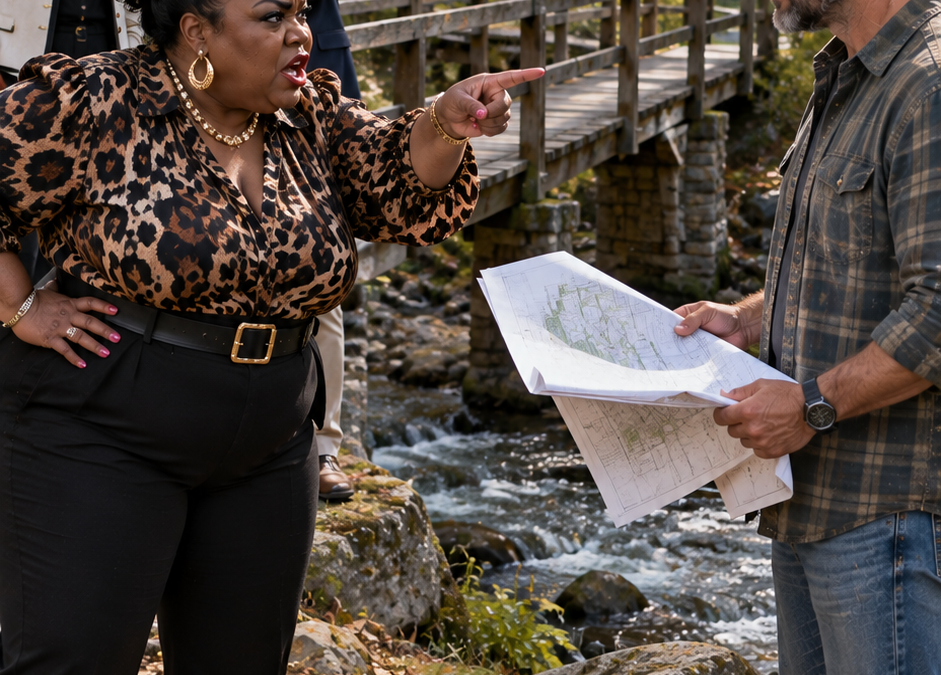
𝗙𝗨𝗟𝗟 𝗦𝗧𝗢𝗥𝗬
I counted.
Community.
She used the word four times in less than two minutes.
Then she started walking back toward the Lexus.
At twenty feet, she turned around.
“Just leave association infrastructure to the people who understand it.”
“Have a good afternoon.”
She drove away.
I stayed on the bridge.
Twenty minutes earlier, I had been prepared to replace a loose board someday without even sending anybody a bill.
Now I wanted to see a document.
That evening, I cleared the kitchen table.
Deed.
Title commitment.
Closing binder.
Recorded subdivision plat.
Seller disclosure.
Lender survey.
I made coffee.
Turned on the overhead light.
And started reading.
The deed contained a metes-and-bounds description.
The property followed Millstone Creek in two places.
Then the line turned toward a monument in the tree line.
I traced it with my finger.
Then again with the edge of a ruler because fingers are imprecise and documents are not improved by optimism.
Then I opened the survey.
Put on my reading glasses.
And looked at the little rectangle I had dismissed at closing.
It wasn’t a generic symbol.
It was the bridge.
Drawn to scale.
Both approaches.
Both abutments.
The entire forty-foot span.
And beside it was a survey note.
I leaned closer.
Then looked at the boundary line.
Then back at the bridge.
I read the line again.
The footbridge wasn’t touching my property.
It wasn’t half on my property.
It wasn’t straddling a line.
The entire structure sat inside my parcel.
Both ends.
Both stone abutments.
Every board.
Every railing post.
All of it.
I sat back.
The chair creaked.
Outside, the creek moved through the darkness.
For a long time, I simply listened.
Then I kept reading.
Because a surprise in a plan set often comes with a second surprise hiding nearby.
The Windham Ridge path crossed from HOA common ground onto my parcel roughly sixty feet before reaching the first abutment.
That meant the final sixty feet of their trail approach sat on my land too.
I went immediately to the title commitment.
There had to be an easement.
That was the most reasonable explanation.
Overhead electric easement.
Recorded.
Drainage easement near the northern culvert.
Recorded.
Twenty-foot utility corridor along the western edge.
Recorded.
Nothing for pedestrians.
Nothing for Windham Ridge.
Nothing for a bridge.
Nothing for trail access.
Nothing.
I read the exceptions twice.
My first conclusion was not that Marissa was lying.
My first conclusion was that the survey was wrong.
Old creek boundaries can be messy.
Water moves.
Pins disappear.
Descriptions written fifty years earlier don’t always fit neatly over modern mapping.
Surveyors make mistakes.
The next morning, I called Nolan Beckett.
Independent surveyor.
Forty-seven.
A project manager I trusted described him as expensive, slow, and correct.
In that order.
Nolan listened to my explanation.
Then asked, “Do you want a boundary confirmation, or do you want somebody to tell you what you’re hoping the boundary is?”
“Confirmation.”
“Good. I charge the same either way.”
I did not mention Marissa.
I did not mention Windham Ridge.
I told him only that a lender survey showed a structure entirely inside my parcel and I wanted independent verification.
If you want a measurement, don’t hand the person measuring a preferred answer.
Nolan came Tuesday.
Receiver.
Tripod.
Field book.
He started from a county-road monument.
Worked the western line.
Spent almost an hour fighting brush at the northeast corner until he located an old iron pin.
I brought him coffee.
He ignored it.
At two in the afternoon, orange survey ribbon fluttered from several stakes.
He called me over.
“Lender’s guy was fine.”
“So the bridge?”
He pointed toward an orange stake.
“Your line is there.”
Then he pointed toward the stone abutment.
“Bridge is here.”
“How much room?”
“Enough that we’re not having a conversation about inches.”
He unfolded the survey.
“Both ends inside.”
He tapped another point.
“Your parcel includes the approach for roughly sixty feet.”
“And the far side?”
“County preserve begins about nine feet beyond your line. Their trail starts there.”
“So the entire bridge is mine.”
“I’d word that more carefully.”
He looked at me.
“The structure sits entirely on your parcel.”
“Confidence?”
Nolan gave me a look.
“I’ll seal it.”
Fair enough.
He studied the bridge.
Then asked, “Did somebody tell you this belongs to them?”
“The HOA.”
“Based on what?”
“They haven’t said.”
Nolan folded his drawing.
“That’s the question I’d ask.”
“Which one?”
“Under what document?”
By 4:00, he was gone.
At 5:26, my phone buzzed.
Email.
Subject line:
UNAUTHORIZED INTERFERENCE WITH ASSOCIATION PROPERTY.
Marissa.
Four paragraphs.
Professional.
Calm.
The association had been informed that survey markers were being installed around association-maintained infrastructure.
The Windham Ridge Footbridge was association property.
I was directed not to touch its decking, rails, abutments, or approaches.
Windham Ridge carried liability insurance.
Interference could compromise coverage.
Then the last sentence:
Failure to comply may result in legal action.
I read that twice.
An HOA I didn’t belong to was threatening to sue me for touching a structure located entirely on my deed.
I saved the email.
Created a folder.
Printed a copy.
Then went to bed.
I have regretted emails I sent angry.
I have never regretted the ones I waited until morning to write.
My response was six lines.
I thanked Marissa for the notice.
I stated that a licensed surveyor had verified the structure sat inside my property.
Then I asked her to provide any document establishing the association’s claimed ownership.
Deed.
Recorded easement.
License.
Recorded common-element plat.
Any instrument.
I promised to review it in good faith.
Eleven hours later, she sent me a map.
Not a deed.
Not a survey.
A color trail map.
Green dotted walking routes.
Subdivision streets.
County preserve.
Millstone Creek represented by a blue squiggle.
Across it, a thick black line.
Label:
WINDHAM RIDGE FOOTBRIDGE.
Marissa wrote that the association’s maintenance and identification of the crossing had been consistent for many years and she trusted the map would resolve my confusion.
I stared at it.
Somebody had typed a name beside a line on a brochure.
Apparently that had become title evidence.
I replied that an internal trail map did not convey ownership.
I repeated my request for a recorded instrument.
If one existed, I said, the matter ended immediately.
Her next reply was colder.
“You are confusing survey lines with property law.”
Then:
“The board has retained counsel for exactly these situations.”
And:
“I would encourage you to defer to people experienced in community administration before spending unnecessary money.”
I sat at my kitchen table reading those sentences.
No fact.
Not one.
Only instructions to stop asking.
Two days later, her tone changed completely.
Warm.
Conciliatory.
Nobody wanted conflict with a new neighbor.
Windham Ridge had always tried to maintain the corridor responsibly.
She believed there was a simple solution.
The HOA would keep maintaining the bridge.
Keep insuring it.
Residents would continue walking to the preserve.
All I needed to do was sign a short document confirming the existing arrangement.
Five pages attached.
My first reaction was relief.
I want to admit that because it matters.
I never wanted to block the trail.
I liked the idea of people walking through the woods.
A bridge on my property maintained by somebody else sounded like a benefit.
If a signature could formalize what everybody had apparently been doing peacefully for years, why not?
I printed it.
Sat down.
Picked up a pen.
And nearly signed.
Then an old habit stopped me.
Never sign something important before somebody smarter than you reads it.
During closing, a title-company friend had given me the name of a real-estate attorney.
Camille Sutton.
I called.
Her office occupied a converted brick storefront with terrible parking.
She was thirty-nine.
No dramatic courtroom personality.
She read.
That was her talent.
She read things until words people skipped became the only words that mattered.
She read Marissa’s document once quickly.
Then again with a red pen.
Page three received a box.
She pushed the paper toward me.
“Do you know what this is?”
“Confirmation of access.”
“No.”
She tapped the granting clause.
“This is a conveyance.”
I read.
Fee owner grants and conveys.
Perpetual non-exclusive pedestrian access easement.
Association, members, successors and assigns.
Ingress and egress for maintenance and repair.
Run with the land.
Recorded in county records.
I felt my stomach tighten.
Camille explained.
“This is permanent.”
“They said they’re confirming the existing arrangement.”
“This doesn’t confirm an existing right. It creates one.”
She pointed.
“Perpetual.”
Another word.
“Runs with the land.”
Another.
“Successors and assigns.”
She looked at me.
“If you sign this, the easement stays after you sell.”
I sat back.
“How much is something like that worth?”
“To them?”
“Yes.”
“Potentially quite a lot.”
Windham Ridge advertised preserve access.
Homes close to the trail sold partly because residents could walk directly into county land.
A permanent recorded connection had real market value.
“What are they giving me?”
Camille turned the pages.
“Nothing I would call consideration beyond continuing maintenance.”
“They’re already doing maintenance.”
“Yes.”
She capped her pen.
Then asked one simple question.
“If they already own the bridge, why do they need you to grant them a permanent easement to reach it?”
I had no answer.
None.
A board that owned the bridge would send me proof.
A board with an existing permanent access right wouldn’t need a signature from the new property owner.
That afternoon, I wrote Marissa.
Three sentences.
I would not sign a new permanent easement.
If Windham Ridge already possessed the rights she repeatedly claimed, the proposed document was unnecessary.
I remained open to a reasonable arrangement after ownership was established.
She did not reply for four days.
Instead, somebody installed a sign.
Hunter green.
White lettering.
WINDHAM RIDGE HOMEOWNERS ASSOCIATION PROPERTY
RESIDENT ACCESS ONLY
The post stood eight feet from the bridge.
On my land.
I wanted to pull it out.
Every instinct in my body said get a sledge, knock it flat, and leave it lying there for her to collect.
Instead I got my phone.
Four photographs.
One showing Nolan’s orange survey ribbon in the same frame.
One showing the stamped installation date.
Then I walked away.
The sign stayed eleven days.
Every morning I passed it with coffee.
Every morning, it became better evidence.
Then an HOA maintenance crew arrived.
Three men.
Pressure-treated rail stock.
Compressor.
They planned to replace the upstream handrail.
The foreman waved.
He had no idea there was a dispute.
I walked down.
“Morning.”
“Morning.”
“You guys working on the bridge?”
“Yes, sir.”
“I need you to stop before you start.”
His face changed.
I explained the ownership issue.
No accusations.
No threats.
I told him I wasn’t going after his company or his workers.
I simply did not consent to construction on the structure until ownership was resolved.
He called his office.
Twenty minutes later, the Lexus arrived.
Marissa got out.
She spoke to the foreman first.
“The association contracted this work. A third party has no authority to interfere.”
Then she looked at me.
“This is exactly what happens when a man thinks buying dirt gives him authority.”
One of the workers laughed accidentally.
I smiled.
“Buying dirt generally does give you some authority over the dirt you bought.”
The worker suddenly became very interested in his compressor.
Marissa didn’t react.
She said Windham Ridge had historic access rights created through decades of continuous use.
“Recorded where?” I asked.
Three seconds.
Maybe four.
“Our attorneys should handle this.”
She left.
The crew loaded its materials.
The foreman gave me an apologetic nod.
I called Camille.
I repeated the phrase “historic access rights.”
She became interested.
Nine days later, she called me into her office.
She had found something.
County records.
Owner name: Dean Halbrook.
I had never heard of him.
The document title was printed in capital letters.
REVOCABLE PEDESTRIAN LICENSE.
Not easement.
License.
Camille highlighted two sections.
“A license is permission,” she said.
“An easement is a property right.”
“I know generally.”
“This distinction is everything here.”
The 2008 license allowed Windham Ridge residents to cross the property and use the bridge.
It allowed association maintenance subject to the owner’s terms.
Then I reached page two.
The license shall automatically terminate upon transfer of fee title.
It shall not bind a successor owner unless renewed by that successor in a written instrument executed after the transfer.
I read it again.
My purchase had closed at 10:40 in the morning.
At 10:40, Windham Ridge’s access license ended automatically.
Not because I canceled it.
Not because I put up a gate.
Because the contract said so.
The instant title transferred to me, their permission expired.
Camille watched me.
Then said, “Now we have another question.”
“What?”
“Did Marissa know?”
I didn’t like how that question felt.
“Why would she?”
“Because if she didn’t know, this is a mistake.”
“And if she did?”
Camille looked at me for a moment.
“Then the five pages she asked you to sign look very different.”
I didn’t want to assume intent.
The license was sixteen years old.
Indexed under a previous owner’s name.
Boards turn over.
Management companies change.
Files get buried.
People repeat institutional stories until nobody remembers the source.
Maybe Marissa genuinely believed Windham Ridge owned the bridge.
Possible.
So we stayed conservative.
No gate.
No chain.
No confrontation.
That choice became important.
I understood something from construction disputes.
The moment I physically closed that bridge, I would stop being Reed Callahan with a deed.
I would become “the man who blocked children and families from the preserve.”
Facts have weight.
Images have more.
So I did nothing dramatic.
Residents kept walking.
Dog walkers crossed.
Joggers crossed.
Kids crossed.
Nobody was stopped.
Instead, Camille drafted a letter.
Certified copies went to every board member and the management company.
Not just Marissa.
For thirty days, I would explicitly permit continued pedestrian use while we verified the legal record.
Five conditions.
No claims of HOA ownership.
No construction without consent.
No signage on my parcel.
No new encumbrances.
Any long-term arrangement would be negotiated after ownership was acknowledged.
It gave Windham Ridge the only practical thing they said they needed.
Access.
It asked for the only thing I needed.
Truth.
Vice President Elise Warren apparently wanted the board to accept.
Marissa refused.
I learned later what she said in the meeting.
Accepting permission from me would amount to admitting the association didn’t own the crossing.
Then:
“We don’t negotiate with every man who buys land next to us.”
Nine days later, the management company sent a demand.
Remove survey markers.
Stop “harassing” residents.
Confirm HOA access rights within fourteen days.
I had never harassed anyone.
Then Marissa contacted my title company.
She reported a long-standing property dispute involving the northern portion of my parcel.
That changed something in me.
A person fighting over a bridge argues about a bridge.
A person trying to influence your title wants leverage over your land.
She was making ownership unpleasant.
Clouded.
Expensive.
Complicated.
Signing her five-page easement was supposed to start looking easier than resisting.
I wanted history.
Camille found a name.
Graham Pike.
Former Windham Ridge board member.
Retired highway-department employee.
He had witnessed the 2008 license.
I went to his house Sunday afternoon.
No folder.
No papers.
I didn’t want to arrive looking like I needed him to choose sides.
He stood under a carport beside a workbench.
“You’re the fellow with the creek.”
Apparently Marissa had introduced me to the neighborhood.
I explained what I knew.
Graham listened.
Then disappeared inside.
He came back carrying an old manila folder.
“The bridge went up in 2007.”
That sentence changed the story again.
Windham Ridge did not build the bridge.
Dean Halbrook did.
Dean had owned my seventeen acres from the mid-1970s.
Millwright.
Liked timber.
Liked the preserve.
The original subdivision developer had planned a trail connection but never purchased enough land to build one.
The county refused to buy private creek frontage just to provide a subdivision shortcut.
Residents wanted access.
Dean offered a solution.
He paid for the engineering.
Paid for the stone abutments.
Bought most of the timber.
Provided much of the labor.
Windham Ridge contributed roughly one-third of material costs.
They chose the handrail profile.
That decorative detail was why the bridge looked like it belonged to them.
But it didn’t.
“Why the license?” I asked.
Graham smiled.
“Because Dean hated easements.”
He had once sold land in Kentucky and later learned a right-of-way burdened property differently than he expected.
Cost him money.
Never forgot it.
At a meeting in 2007, Dean told the Windham Ridge board he would let their kids walk across his land until the sun burned out.
But he would not give a committee a permanent property right.
Permission, yes.
Easement, no.
Because an easement stays after the owner is dead.
So the attorney drafted the revocable pedestrian license.
Then Graham said:
“That’s how things were until about three years ago.”
I looked at him.
“What happened?”
“Dean listed the property.”
The first sale fell through.
Then ownership shifted briefly before Harold eventually became seller.
But when Dean first listed it, Windham Ridge got nervous.
Trail access was advertised as a neighborhood amenity.
Marissa was already president.
“She asked the association attorney whether the license would survive a sale.”
My stomach tightened.
“What did the lawyer say?”
Graham opened his folder.
Pulled out a printed email.
Three years and two months old.
Addressed to the Windham Ridge board.
Marissa included.
The legal opinion was plain.
The 2008 instrument was a license.
Not an easement.
The license terminated automatically on transfer.
Windham Ridge held no recorded easement.
A prescriptive-right claim would likely fail because the association’s use had always been permissive.
Future access would require a new license or easement from the next owner.
I read the final sentence four times.
Any future purchaser would need to grant a new license or easement.
Marissa knew.
Not assumed.
Not inherited misinformation.
Knew.
She had asked the question.
The lawyer had answered.
Three years before I bought the property.
I thought about the first conversation.
“Our bridge.”
She knew.
“Leave association infrastructure to the people who understand it.”
She knew.
The trail map.
She knew.
The threat of legal action.
She knew.
The five-page perpetual easement.
She absolutely knew.
I drove home.
Halfway there, I pulled into a turnout.
Sat with the engine running.
For weeks, I had believed Marissa was arrogant.
That was irritating but understandable.
People mistake routine for rights all the time.
An HOA maintains something fifteen years and everybody eventually says “ours.”
No villain required.
Now that explanation was gone.
She had not been defending a mistaken belief.
She had been trying to manufacture a new legal reality before I learned the old one had expired.
Camille and I mapped everything on a whiteboard.
Her question was simple.
“What did Marissa need from the first conversation?”
I thought.
“She needed me to agree she owned it.”
“No.”
Camille shook her head.
“She needed you not to investigate.”
That distinction mattered.
“You are confusing survey lines with property law.”
Stop looking.
“Defer to people with experience.”
Stop looking.
The map.
Stop looking.
The maintenance crew.
Stop looking.
The sign.
A visible claim.
The insurer.
Pressure.
Then the five-page document.
The solution.
Sign here.
A permanent easement.
Recorded forever.
Free.
She almost got it.
I had held the pen.
That part still bothered me.
Camille found another piece.
Windham Ridge board minutes.
Six months before my closing:
Trail access continuity risk following Halbrook parcel sale.
The board had been told some risk existed.
Matter tabled.
Three weeks after I bought the property, a resident asked about the crossing.
Marissa’s answer was recorded:
Association ownership of the bridge is not in question.
She said that while possessing legal advice stating the association had no recorded easement and future access required consent from the new owner.
The other board members were not necessarily part of it.
That mattered to me.
Elise had wanted to accept my temporary permission.
The other directors were ordinary people.
Teacher.
Dentist.
Bakery owner.
Retirees.
They had been told their president had the issue under control.
Why would they search county indexes?
Marissa sent more emails.
I saved every one.
Then came the special membership notice.
An adjacent property owner was attempting to seize community infrastructure.
One hundred forty homes received it.
For the next couple of weeks, some Windham Ridge residents stopped saying hello.
A man across the creek told me, “Some of us actually care about this neighborhood.”
“I hope you enjoy your walk.”
I went home.
Saved the notice.
A written allegation that somebody is stealing a thing shown on his deed is not merely insulting.
It is useful evidence.
Then Marissa installed a second sign.
This time directly on the bridge.
Bolted to the handrail.
PROPERTY OF WINDHAM RIDGE HOMEOWNERS ASSOCIATION.
Nolan returned.
Surveyed its position.
Thirty-one feet inside my boundary.
He prepared a sealed supplemental exhibit.
I wrote the board asking that the sign be removed within seven days.
Marissa answered personally at eleven that night.
“Your permission is neither required nor relevant.”
I forwarded it to Camille.
Four minutes later:
Good. Keep that.
The formal notice went out Monday.
Deed.
Nolan’s sealed survey.
Supplemental exhibit.
Title commitment.
2008 license.
Termination clause enlarged on its own page.
Three-year-old attorney email.
Photographs.
Marissa’s statements.
The packet went to every board member.
Management.
And the HOA insurer.
Wednesday night, Elise called me.
Her voice sounded broken.
“She never showed us that letter.”
The special board meeting happened Thursday.
Elise invited me.
Not Marissa.
That detail told me enough.
Camille came.
I let her speak.
Marissa began by calling the situation a technical boundary disagreement between neighbors.
She hoped everyone could move forward.
Calm.
Always calm.
Camille asked three questions.
“Does Windham Ridge hold a deed to the bridge or the land underneath it?”
“No.”
“Does Windham Ridge hold a recorded pedestrian easement over Mr. Callahan’s parcel?”
Marissa shifted.
“We have operated under a long-established arrangement—”
Camille repeated the question.
“Is there a recorded easement?”
“No.”
Third question.
“Did you, while serving as association president, receive written legal advice stating that the 2008 pedestrian license would terminate when title transferred and that a future owner would need to grant a new license or easement?”
Marissa looked down.
“The board receives a substantial amount of correspondence.”
Camille put the attorney letter on the projector.
The room went silent.
Not dramatic silence.
The worse kind.
People reading.
Graham Pike sat three rows back.
He confirmed the date.
Confirmed the distribution list.
Confirmed he had received the same email while serving on the board.
A retired teacher in front put on reading glasses.
The man who had accused me of not caring about the neighborhood leaned forward and read it twice.
Elise looked at Marissa.
Then asked the question that ended everything.
“If you knew the new owner had to grant access, why did you tell us ownership was not in question?”
Marissa’s answer:
“I was protecting the interests of the community.”
That was the only time I spoke.
“No.”
She looked at me.
“You tried to get me to sign away a permanent right over my own property by telling me you already had it.”
Her face hardened.
“You don’t understand how communities like this function.”
I nodded.
“Maybe I don’t.”
Then I looked at the deed on the table.
“But I understand what my name on that means.”
I could have closed the bridge.
Legally, I had plenty of leverage.
I didn’t.
Camille placed another document before the board.
A revocable pedestrian access agreement.
Windham Ridge residents could keep crossing the bridge exactly as they had for seventeen years.
No fee.
No locked gate.
No revenge.
But several things had to happen.
The association would acknowledge that the bridge and the relevant approach corridor sat on my parcel.
Maps would be corrected.
The membership notice accusing me of taking HOA infrastructure would be withdrawn.
The letter to my title company would be withdrawn.
Both HOA ownership signs would be removed.
Windham Ridge would maintain liability coverage naming me as additional insured.
Maintenance would require written coordination.
Costs would be shared fairly.
And one sentence would be stated without ambiguity:
Permission does not constitute an easement and shall not ripen into any permanent property right.
That’s what changed the room.
As long as Marissa could portray me as the man trying to steal the neighborhood’s bridge, people had reason to fear me.
Now I was offering everything they actually needed.
Continued walking access.
The only price was acknowledging reality.
Marissa had no story left.
The vote was five to one.
The agreement was accepted.
Then another motion.
Five to one again.
Marissa Crowell was removed as president.
She gathered her folders.
At the door, she looked toward Elise.
“You’ll regret giving him this much leverage.”
Elise did not look up.
“Marissa, it was his leverage before he ever met us.”
That line stayed with me.
Because she was right.
I had not created power by finding the deed.
The deed had existed before me.
Dean Halbrook understood that.
Harold knew more than he had said.
The creek didn’t care.
The survey didn’t care.
The mistake was believing that because nobody had checked the line lately, the line had stopped mattering.
The signs came down.
The title-company letter was withdrawn.
The neighborhood notice was corrected.
The trail map was revised.
And residents kept walking.
Spring came.
The maples leafed out.
One Saturday in April, we replaced several bridge deck boards.
Windham Ridge paid its share.
I paid mine.
I stood knee-deep in Millstone Creek wearing waders, passing boards up to the crew.
A woman waited on the bank with two beagles.
“I’m sorry,” she said for maybe the fourth time. “We can come back.”
“You’re fine.”
“We’re in your way.”
“You’re really not.”
One of the workers laughed.
“Give us two minutes.”
She smiled.
The dogs pulled toward the bridge.
Nothing about that moment felt like surrender.
Nobody had lost the woods.
Nobody had lost the trail.
Nobody had lost the bridge.
What Windham Ridge lost was the fiction that access and ownership were the same thing.
A small new sign eventually went up at the head of the path.
Cedar.
Simple routed letters.
PRIVATE PROPERTY
PEDESTRIAN ACCESS BY PERMISSION OF THE LANDOWNER
The wording wasn’t mine.
Camille took it directly from the agreement.
I liked that.
No accusation.
No bragging.
Just accurate language.
Graham Pike stopped beside it one afternoon.
He read it.
Then laughed.
“Dean would’ve liked that.”
“Why?”
He looked toward the bridge.
“Because that’s all he ever wanted.”
He pointed toward Windham Ridge.
“Let everybody through.”
Then toward the ground.
“Just don’t let anybody forget whose land they’re standing on.”
He crossed the bridge.
I stayed behind.
Millstone Creek ran beneath the timbers, bending around the upstream stone the same way it had before Windham Ridge existed.
I thought about the strange scale of the whole fight.
Forty feet of timber.
A few hundred feet of trail.
A sign.
A survey line.
On paper, it looked small.
But it was never really about the bridge.
It was about whether repetition could become ownership.
Whether maintaining something long enough allowed somebody to forget who had granted permission.
Whether an institution could turn a convenience into a permanent property right simply by acting certain enough, long enough.
And mostly, it was about one woman who already knew the answer but believed she could convince the new owner not to ask the question.
That was Marissa’s mistake.
She thought my problem was that I didn’t understand property law.
My actual problem was much simpler.
I read paperwork.
She had mistaken my willingness to cooperate for a willingness to surrender.
Those are not the same thing.
If she had come to my door the first week and said:
Reed, the old license expired when you bought the property. This bridge is important to our residents. Can we negotiate something fair?
I would have said yes.
Probably that afternoon.
The final agreement proved it.
I never wanted money.
Never wanted the bridge closed.
Never wanted families turned away from the preserve.
I only wanted the relationship to be what Dean Halbrook had intended from the beginning.
People could cross.
The community could enjoy the trail.
The association could help maintain the bridge.
But everybody needed to remember one thing.
Permission is something an owner gives.
A permanent right is something an owner conveys.
And nobody gets to quietly convert the first into the second because sixteen years have passed and the paperwork is inconvenient.
Marissa knew that.
Her own attorney had told her.
That’s why she needed my signature.
That’s why she never showed me a deed.
That’s why the trail map arrived instead.
That’s why the maintenance crew showed up.
That’s why signs appeared.
That’s why my title company received a warning.
She wasn’t proving ownership.
She was trying to build enough pressure around a false premise that signing away a perpetual easement felt easier than challenging it.
It almost worked.
Sometimes I think about that morning in Camille’s office.
The pen I had nearly put to page five.
How ordinary it felt.
No threat.
No shouting.
Just a friendly-looking agreement ending a dispute.
A signature.
Ten seconds.
Had I signed, every future owner of my land would have inherited the easement.
Every title report would have shown it.
Windham Ridge would have gained a permanent legal corridor to the county preserve.
For nothing.
And years later, somebody might have looked at the recorded instrument and assumed it had always been that way.
That’s how these things become history.
Not because history is true.
Because somebody signs it.
Almost a year has passed now.
Nobody from Windham Ridge has been rude to me in eleven months.
Dog walkers wave.
Joggers say morning.
Kids cross with fishing rods even though I doubt they catch much.
The bridge remains exactly where it was the first day I saw it.
Same water below.
Same maples above.
Same routed handrail that originally made me assume it belonged to the HOA.
I fixed that lifted board eventually.
Took maybe ten minutes.
Nobody sent an email.
Nobody threatened legal action.
Nobody told me to leave association infrastructure to somebody qualified.
I replaced the board because it was loose.
That simple.
One morning, I stood there drinking coffee while two Windham Ridge residents crossed toward the preserve.
They nodded.
I nodded back.
Neither of us discussed deeds.
We didn’t need to.
The sign stood near the path.
Private property.
Access by permission.
Five words worth remembering.
Marissa had spent weeks insisting Windham Ridge owned the bridge.
She put it in emails.
Put it on signs.
Put it in meeting minutes.
Told residents.
Told the title company.
She acted as if saying something officially enough could make the survey line disappear.
But lines don’t care about confidence.
A boundary does not move because a president stands on the wrong side of it in expensive shoes.
A license does not become an easement because nobody has read it recently.
And a deed does not surrender because somebody produces a colorful map.
The whole thing had been sitting in front of everyone for years.
One bridge.
One parcel.
One expired license.
One attorney’s letter.
One line on a survey.
Marissa believed the most important part was convincing everyone the bridge belonged to Windham Ridge.
She was wrong.
The most important part was that it never had.
Have you finished reading the story and want to read it again?
The Footbridge Behind My New Cabin Came With One Line on the Survey the HOA President Never Wanted Me to Read
The bridge looked like it belonged to Windham Ridge.
The HOA president spoke to me like there had never been any question about that.
Then I unfolded the survey on my kitchen table and found the one fact she could not afford for me to understand.
My name is Reed Callahan.
I was forty-one when I bought seventeen acres outside the boundary of a private community called Windham Ridge.
I didn’t buy the place because of the bridge.
I bought it because of everything else.
The cabin sat back from the county road behind an old gravel turnaround, half hidden by hardwoods that had grown without anybody trying to shape them into anything decorative. Millstone Creek cut diagonally across the parcel, broad and lazy near the north end before tightening between two banks where the water moved fast enough to make a low steady sound.
Beyond the creek, the land climbed into maples.
Past those trees was a county nature preserve.
Brown trail markers.
A wooden kiosk.
Miles of walking paths.
No clubhouse.
No architectural committee.
No neighbor measuring mailbox posts.
That last part mattered to me.
I had spent eleven years in a subdivision where a man wearing a golf shirt once measured my mailbox with a tape, photographed it, and mailed me a violation notice because the post stood slightly farther from the curb than the neighborhood standard allowed.
After eleven years of that, seventeen acres without covenants felt less like real estate and more like oxygen.
The purchase agreement stated clearly that the property was not subject to Windham Ridge covenants.
I read that sentence twice before signing.
Then I read it again.
My wife used to joke that I could turn a grocery receipt into a contract review if you gave me enough time.
She had been gone four years by then.
Cancer.
Fast enough that there were still mornings when I woke expecting to hear her moving in the kitchen before remembering why the house was quiet.
I kept a lot of habits from our life together.
One of them was paperwork.
Deeds.
Surveys.
Receipts.
Warranty cards.
Closing binders.
Anything somebody handed me that might matter later went into a filing cabinet in the hallway.
She had called it my hobby.
After she died, nobody was around to make fun of me for it.
That habit would eventually save me from signing away a permanent property right worth more than I knew.
But on the day I first walked the seventeen acres, I had no idea any of that was coming.
The seller was a seventy-nine-year-old man named Harold Vance.
His knees were failing.
His daughter had a casita waiting for him outside Tucson, and Harold talked about Arizona the way sailors talk about land after a long voyage.
“No ice,” he told me.
“That the main attraction?”
“No splitting wood either.”
He walked the property slowly.
Pointed at an old maple.
“That one lost half its crown in an ice storm.”
He showed me a fence line.
“Older than the county road.”
He pointed at a culvert.
“That thing floods twice a year, makes you think the world is ending, then settles down like nothing happened.”
I liked him immediately.
Which, professionally speaking, should have made me more careful.
I ran projects for a civil construction company two counties over.
My working life involved plans, right-of-way limits, elevations, submittals, change orders, utility conflicts, boundaries, and the slow, expensive business of discovering that one line on a drawing had been misunderstood three months after concrete was poured.
I am not an attorney.
I’m not a surveyor.
But I have watched six-figure mistakes grow out of somebody saying, “That’s probably what this means.”
So I normally read everything.
Twice.
Sometimes three times.
Yet when Harold showed me the footbridge, I barely thought about it.
A path came down from Windham Ridge, crossed a strip of grass, reached Millstone Creek, and continued over a timber bridge to the preserve trail on the opposite side.
The bridge was well made.
Heavy timber framing.
Two-by-eight decking.
Stone abutments.
A routed top cap on the handrail matching the decorative woodwork used around Windham Ridge’s entrance signage.
It looked like HOA money.
I stood in the middle and felt the span settle gently under my weight.
“Windham Ridge’s bridge?” I asked Harold.
He looked toward the water.
“Folks up there have been walking across it for years.”
That wasn’t an answer.
I didn’t notice.
Or maybe I noticed and decided I didn’t care.
I had a cabin.
A creek.
Seventeen acres.
No covenants.
The bridge seemed like somebody else’s concern.
Closing took place three weeks later.
A title-company conference room.
A glass bowl full of individually wrapped mints.
A notary who stamped documents with the mechanical rhythm of somebody finishing an eight-hour shift.
Among the papers was a fresh lender survey.
I looked at it.
Not carefully enough.
Near the creek crossing was a small rectangular shape.
I assumed it indicated a culvert or crossing feature.
Then the notary asked for my driver’s license.
The thought disappeared.
I moved into the cabin over two days.
A friend helped with a rental truck while complaining constantly and refusing every offer of gas money.
That first night, I sat on the porch in the dark.
The creek moved below me.
Something large pushed through the brush.
I told myself it was a deer because the alternatives didn’t improve sleep.
There was no gate.
No committee.
No approval form waiting on my kitchen counter.
For the first time in years, every visible thing around me belonged either to me or to nobody I had to negotiate with.
I slept better than I had in four years.
A week later, I walked down to the creek with coffee.
One deck board on the footbridge had cupped upward.
The nail head stood maybe half an inch proud.
Exactly the kind of thing that catches a boot and sends somebody face-first into a handrail.
I set my coffee down.
Crouched.
Pressed the board with my palm.
I wanted to know whether the board itself had warped or the joist underneath was beginning to soften.
That was all I was doing.
I had no hammer.
No pry bar.
No drill.
No intention of changing anything.
Then I heard tires.
A white Lexus rolled down the Windham Ridge side farther than I expected any car to travel on grass.
It stopped.
A woman got out.
Cream blazer.
Low heels she clearly regretted the moment they touched uneven ground.
Sunglasses pushed into carefully maintained hair.
She walked toward me with the expression of somebody who had arrived after being told an employee was doing something incorrectly.
“Excuse me.”
I stood slowly.
I’m six foot two.
You learn after a while that standing quickly in front of strangers sometimes turns an ordinary disagreement into something else.
“What exactly are you doing to our bridge?”
“Our bridge?”
“The footbridge.”
“One board’s lifting. I was checking whether the framing underneath is sound.”
“Don’t.”
One word.
Not a request.
An instruction.
She came closer.
“Marissa Crowell. President of Windham Ridge Homeowners Association.”
The introduction wasn’t meant to tell me her name.
It was meant to tell me her rank.
“Reed Callahan.”
“I know.”
That caught my attention.
I had never met her.
She continued.
“The association maintains this bridge. We insure it. We make all decisions regarding repair and access. Residents depend on it to reach the county preserve.”
“All right.”
“Unauthorized handling of association infrastructure creates liability problems.”
“I wasn’t repairing it.”
“You were touching it.”
I looked at the board.
Then at her.
“I don’t live in Windham Ridge.”
She smiled.
A very good smile.
Polished.
Patient.
Designed to make correction sound like kindness.
“I know. That’s precisely why none of this is yours to decide.”
That was the moment something changed.
Not anger.
Recognition.
I had met Marissa before.
Not literally.
Professionally.
Every construction company has dealt with some version of her.
The person who tells a superintendent the drawings are wrong while standing on top of the drawing set.
The person who makes a confident statement in front of six witnesses and later remembers that confidence as proof.
The person who believes authority is partly volume, partly wardrobe, and mostly the willingness to behave like a question has already been answered.
I asked, “What document establishes HOA ownership?”
Her smile remained.
“Excuse me?”
“Deed. Plat. Easement. License. Anything.”
Her expression changed slightly.
“I only want to know so I don’t accidentally interfere with something that isn’t mine.”
She laughed.
Not loudly.
Just a little breath through her nose.
“Reed, men buy acreage out here and suddenly think owning a toolbox makes them surveyors.”
I said nothing.
My father used to do that.
Silence.
It drove my mother crazy.
But I inherited it because silence is useful when somebody underestimates you.
People fill it.
Marissa did.
“The board has managed this bridge for years.”
I waited.
“We have a maintenance schedule.”
I waited.
“We have a vendor.”
Nothing from me.
“The deck is sealed every third spring.”
Still nothing.
“This trail connection is extremely important to our community.”
I counted.
Community.
She used the word four times in less than two minutes.
Then she started walking back toward the Lexus.
At twenty feet, she turned around.
“Just leave association infrastructure to the people who understand it.”
“Have a good afternoon.”
She drove away.
I stayed on the bridge.
Twenty minutes earlier, I had been prepared to replace a loose board someday without even sending anybody a bill.
Now I wanted to see a document.
That evening, I cleared the kitchen table.
Deed.
Title commitment.
Closing binder.
Recorded subdivision plat.
Seller disclosure.
Lender survey.
I made coffee.
Turned on the overhead light.
And started reading.
The deed contained a metes-and-bounds description.
The property followed Millstone Creek in two places.
Then the line turned toward a monument in the tree line.
I traced it with my finger.
Then again with the edge of a ruler because fingers are imprecise and documents are not improved by optimism.
Then I opened the survey.
Put on my reading glasses.
And looked at the little rectangle I had dismissed at closing.
It wasn’t a generic symbol.
It was the bridge.
Drawn to scale.
Both approaches.
Both abutments.
The entire forty-foot span.
And beside it was a survey note.
I leaned closer.
Then looked at the boundary line.
Then back at the bridge.
I read the line again.
The footbridge wasn’t touching my property.
It wasn’t half on my property.
It wasn’t straddling a line.
The entire structure sat inside my parcel.
Both ends.
Both stone abutments.
Every board.
Every railing post.
All of it.
I sat back.
The chair creaked.
Outside, the creek moved through the darkness.
For a long time, I simply listened.
Then I kept reading.
Because a surprise in a plan set often comes with a second surprise hiding nearby.
The Windham Ridge path crossed from HOA common ground onto my parcel roughly sixty feet before reaching the first abutment.
That meant the final sixty feet of their trail approach sat on my land too.
I went immediately to the title commitment.
There had to be an easement.
That was the most reasonable explanation.
Overhead electric easement.
Recorded.
Drainage easement near the northern culvert.
Recorded.
Twenty-foot utility corridor along the western edge.
Recorded.
Nothing for pedestrians.
Nothing for Windham Ridge.
Nothing for a bridge.
Nothing for trail access.
Nothing.
I read the exceptions twice.
My first conclusion was not that Marissa was lying.
My first conclusion was that the survey was wrong.
Old creek boundaries can be messy.
Water moves.
Pins disappear.
Descriptions written fifty years earlier don’t always fit neatly over modern mapping.
Surveyors make mistakes.
The next morning, I called Nolan Beckett.
Independent surveyor.
Forty-seven.
A project manager I trusted described him as expensive, slow, and correct.
In that order.
Nolan listened to my explanation.
Then asked, “Do you want a boundary confirmation, or do you want somebody to tell you what you’re hoping the boundary is?”
“Confirmation.”
“Good. I charge the same either way.”
I did not mention Marissa.
I did not mention Windham Ridge.
I told him only that a lender survey showed a structure entirely inside my parcel and I wanted independent verification.
If you want a measurement, don’t hand the person measuring a preferred answer.
Nolan came Tuesday.
Receiver.
Tripod.
Field book.
He started from a county-road monument.
Worked the western line.
Spent almost an hour fighting brush at the northeast corner until he located an old iron pin.
I brought him coffee.
He ignored it.
At two in the afternoon, orange survey ribbon fluttered from several stakes.
He called me over.
“Lender’s guy was fine.”
“So the bridge?”
He pointed toward an orange stake.
“Your line is there.”
Then he pointed toward the stone abutment.
“Bridge is here.”
“How much room?”
“Enough that we’re not having a conversation about inches.”
He unfolded the survey.
“Both ends inside.”
He tapped another point.
“Your parcel includes the approach for roughly sixty feet.”
“And the far side?”
“County preserve begins about nine feet beyond your line. Their trail starts there.”
“So the entire bridge is mine.”
“I’d word that more carefully.”
He looked at me.
“The structure sits entirely on your parcel.”
“Confidence?”
Nolan gave me a look.
“I’ll seal it.”
Fair enough.
He studied the bridge.
Then asked, “Did somebody tell you this belongs to them?”
“The HOA.”
“Based on what?”
“They haven’t said.”
Nolan folded his drawing.
“That’s the question I’d ask.”
“Which one?”
“Under what document?”
By 4:00, he was gone.
At 5:26, my phone buzzed.
Email.
Subject line:
UNAUTHORIZED INTERFERENCE WITH ASSOCIATION PROPERTY.
Marissa.
Four paragraphs.
Professional.
Calm.
The association had been informed that survey markers were being installed around association-maintained infrastructure.
The Windham Ridge Footbridge was association property.
I was directed not to touch its decking, rails, abutments, or approaches.
Windham Ridge carried liability insurance.
Interference could compromise coverage.
Then the last sentence:
Failure to comply may result in legal action.
I read that twice.
An HOA I didn’t belong to was threatening to sue me for touching a structure located entirely on my deed.
I saved the email.
Created a folder.
Printed a copy.
Then went to bed.
I have regretted emails I sent angry.
I have never regretted the ones I waited until morning to write.
My response was six lines.
I thanked Marissa for the notice.
I stated that a licensed surveyor had verified the structure sat inside my property.
Then I asked her to provide any document establishing the association’s claimed ownership.
Deed.
Recorded easement.
License.
Recorded common-element plat.
Any instrument.
I promised to review it in good faith.
Eleven hours later, she sent me a map.
Not a deed.
Not a survey.
A color trail map.
Green dotted walking routes.
Subdivision streets.
County preserve.
Millstone Creek represented by a blue squiggle.
Across it, a thick black line.
Label:
WINDHAM RIDGE FOOTBRIDGE.
Marissa wrote that the association’s maintenance and identification of the crossing had been consistent for many years and she trusted the map would resolve my confusion.
I stared at it.
Somebody had typed a name beside a line on a brochure.
Apparently that had become title evidence.
I replied that an internal trail map did not convey ownership.
I repeated my request for a recorded instrument.
If one existed, I said, the matter ended immediately.
Her next reply was colder.
“You are confusing survey lines with property law.”
Then:
“The board has retained counsel for exactly these situations.”
And:
“I would encourage you to defer to people experienced in community administration before spending unnecessary money.”
I sat at my kitchen table reading those sentences.
No fact.
Not one.
Only instructions to stop asking.
Two days later, her tone changed completely.
Warm.
Conciliatory.
Nobody wanted conflict with a new neighbor.
Windham Ridge had always tried to maintain the corridor responsibly.
She believed there was a simple solution.
The HOA would keep maintaining the bridge.
Keep insuring it.
Residents would continue walking to the preserve.
All I needed to do was sign a short document confirming the existing arrangement.
Five pages attached.
My first reaction was relief.
I want to admit that because it matters.
I never wanted to block the trail.
I liked the idea of people walking through the woods.
A bridge on my property maintained by somebody else sounded like a benefit.
If a signature could formalize what everybody had apparently been doing peacefully for years, why not?
I printed it.
Sat down.
Picked up a pen.
And nearly signed.
Then an old habit stopped me.
Never sign something important before somebody smarter than you reads it.
During closing, a title-company friend had given me the name of a real-estate attorney.
Camille Sutton.
I called.
Her office occupied a converted brick storefront with terrible parking.
She was thirty-nine.
No dramatic courtroom personality.
She read.
That was her talent.
She read things until words people skipped became the only words that mattered.
She read Marissa’s document once quickly.
Then again with a red pen.
Page three received a box.
She pushed the paper toward me.
“Do you know what this is?”
“Confirmation of access.”
“No.”
She tapped the granting clause.
“This is a conveyance.”
I read.
Fee owner grants and conveys.
Perpetual non-exclusive pedestrian access easement.
Association, members, successors and assigns.
Ingress and egress for maintenance and repair.
Run with the land.
Recorded in county records.
I felt my stomach tighten.
Camille explained.
“This is permanent.”
“They said they’re confirming the existing arrangement.”
“This doesn’t confirm an existing right. It creates one.”
She pointed.
“Perpetual.”
Another word.
“Runs with the land.”
Another.
“Successors and assigns.”
She looked at me.
“If you sign this, the easement stays after you sell.”
I sat back.
“How much is something like that worth?”
“To them?”
“Yes.”
“Potentially quite a lot.”
Windham Ridge advertised preserve access.
Homes close to the trail sold partly because residents could walk directly into county land.
A permanent recorded connection had real market value.
“What are they giving me?”
Camille turned the pages.
“Nothing I would call consideration beyond continuing maintenance.”
“They’re already doing maintenance.”
“Yes.”
She capped her pen.
Then asked one simple question.
“If they already own the bridge, why do they need you to grant them a permanent easement to reach it?”
I had no answer.
None.
A board that owned the bridge would send me proof.
A board with an existing permanent access right wouldn’t need a signature from the new property owner.
That afternoon, I wrote Marissa.
Three sentences.
I would not sign a new permanent easement.
If Windham Ridge already possessed the rights she repeatedly claimed, the proposed document was unnecessary.
I remained open to a reasonable arrangement after ownership was established.
She did not reply for four days.
Instead, somebody installed a sign.
Hunter green.
White lettering.
WINDHAM RIDGE HOMEOWNERS ASSOCIATION PROPERTY
RESIDENT ACCESS ONLY
The post stood eight feet from the bridge.
On my land.
I wanted to pull it out.
Every instinct in my body said get a sledge, knock it flat, and leave it lying there for her to collect.
Instead I got my phone.
Four photographs.
One showing Nolan’s orange survey ribbon in the same frame.
One showing the stamped installation date.
Then I walked away.
The sign stayed eleven days.
Every morning I passed it with coffee.
Every morning, it became better evidence.
Then an HOA maintenance crew arrived.
Three men.
Pressure-treated rail stock.
Compressor.
They planned to replace the upstream handrail.
The foreman waved.
He had no idea there was a dispute.
I walked down.
“Morning.”
“Morning.”
“You guys working on the bridge?”
“Yes, sir.”
“I need you to stop before you start.”
His face changed.
I explained the ownership issue.
No accusations.
No threats.
I told him I wasn’t going after his company or his workers.
I simply did not consent to construction on the structure until ownership was resolved.
He called his office.
Twenty minutes later, the Lexus arrived.
Marissa got out.
She spoke to the foreman first.
“The association contracted this work. A third party has no authority to interfere.”
Then she looked at me.
“This is exactly what happens when a man thinks buying dirt gives him authority.”
One of the workers laughed accidentally.
I smiled.
“Buying dirt generally does give you some authority over the dirt you bought.”
The worker suddenly became very interested in his compressor.
Marissa didn’t react.
She said Windham Ridge had historic access rights created through decades of continuous use.
“Recorded where?” I asked.
Three seconds.
Maybe four.
“Our attorneys should handle this.”
She left.
The crew loaded its materials.
The foreman gave me an apologetic nod.
I called Camille.
I repeated the phrase “historic access rights.”
She became interested.
Nine days later, she called me into her office.
She had found something.
County records.
Owner name: Dean Halbrook.
I had never heard of him.
The document title was printed in capital letters.
REVOCABLE PEDESTRIAN LICENSE.
Not easement.
License.
Camille highlighted two sections.
“A license is permission,” she said.
“An easement is a property right.”
“I know generally.”
“This distinction is everything here.”
The 2008 license allowed Windham Ridge residents to cross the property and use the bridge.
It allowed association maintenance subject to the owner’s terms.
Then I reached page two.
The license shall automatically terminate upon transfer of fee title.
It shall not bind a successor owner unless renewed by that successor in a written instrument executed after the transfer.
I read it again.
My purchase had closed at 10:40 in the morning.
At 10:40, Windham Ridge’s access license ended automatically.
Not because I canceled it.
Not because I put up a gate.
Because the contract said so.
The instant title transferred to me, their permission expired.
Camille watched me.
Then said, “Now we have another question.”
“What?”
“Did Marissa know?”
I didn’t like how that question felt.
“Why would she?”
“Because if she didn’t know, this is a mistake.”
“And if she did?”
Camille looked at me for a moment.
“Then the five pages she asked you to sign look very different.”
I didn’t want to assume intent.
The license was sixteen years old.
Indexed under a previous owner’s name.
Boards turn over.
Management companies change.
Files get buried.
People repeat institutional stories until nobody remembers the source.
Maybe Marissa genuinely believed Windham Ridge owned the bridge.
Possible.
So we stayed conservative.
No gate.
No chain.
No confrontation.
That choice became important.
I understood something from construction disputes.
The moment I physically closed that bridge, I would stop being Reed Callahan with a deed.
I would become “the man who blocked children and families from the preserve.”
Facts have weight.
Images have more.
So I did nothing dramatic.
Residents kept walking.
Dog walkers crossed.
Joggers crossed.
Kids crossed.
Nobody was stopped.
Instead, Camille drafted a letter.
Certified copies went to every board member and the management company.
Not just Marissa.
For thirty days, I would explicitly permit continued pedestrian use while we verified the legal record.
Five conditions.
No claims of HOA ownership.
No construction without consent.
No signage on my parcel.
No new encumbrances.
Any long-term arrangement would be negotiated after ownership was acknowledged.
It gave Windham Ridge the only practical thing they said they needed.
Access.
It asked for the only thing I needed.
Truth.
Vice President Elise Warren apparently wanted the board to accept.
Marissa refused.
I learned later what she said in the meeting.
Accepting permission from me would amount to admitting the association didn’t own the crossing.
Then:
“We don’t negotiate with every man who buys land next to us.”
Nine days later, the management company sent a demand.
Remove survey markers.
Stop “harassing” residents.
Confirm HOA access rights within fourteen days.
I had never harassed anyone.
Then Marissa contacted my title company.
She reported a long-standing property dispute involving the northern portion of my parcel.
That changed something in me.
A person fighting over a bridge argues about a bridge.
A person trying to influence your title wants leverage over your land.
She was making ownership unpleasant.
Clouded.
Expensive.
Complicated.
Signing her five-page easement was supposed to start looking easier than resisting.
I wanted history.
Camille found a name.
Graham Pike.
Former Windham Ridge board member.
Retired highway-department employee.
He had witnessed the 2008 license.
I went to his house Sunday afternoon.
No folder.
No papers.
I didn’t want to arrive looking like I needed him to choose sides.
He stood under a carport beside a workbench.
“You’re the fellow with the creek.”
Apparently Marissa had introduced me to the neighborhood.
I explained what I knew.
Graham listened.
Then disappeared inside.
He came back carrying an old manila folder.
“The bridge went up in 2007.”
That sentence changed the story again.
Windham Ridge did not build the bridge.
Dean Halbrook did.
Dean had owned my seventeen acres from the mid-1970s.
Millwright.
Liked timber.
Liked the preserve.
The original subdivision developer had planned a trail connection but never purchased enough land to build one.
The county refused to buy private creek frontage just to provide a subdivision shortcut.
Residents wanted access.
Dean offered a solution.
He paid for the engineering.
Paid for the stone abutments.
Bought most of the timber.
Provided much of the labor.
Windham Ridge contributed roughly one-third of material costs.
They chose the handrail profile.
That decorative detail was why the bridge looked like it belonged to them.
But it didn’t.
“Why the license?” I asked.
Graham smiled.
“Because Dean hated easements.”
He had once sold land in Kentucky and later learned a right-of-way burdened property differently than he expected.
Cost him money.
Never forgot it.
At a meeting in 2007, Dean told the Windham Ridge board he would let their kids walk across his land until the sun burned out.
But he would not give a committee a permanent property right.
Permission, yes.
Easement, no.
Because an easement stays after the owner is dead.
So the attorney drafted the revocable pedestrian license.
Then Graham said:
“That’s how things were until about three years ago.”
I looked at him.
“What happened?”
“Dean listed the property.”
The first sale fell through.
Then ownership shifted briefly before Harold eventually became seller.
But when Dean first listed it, Windham Ridge got nervous.
Trail access was advertised as a neighborhood amenity.
Marissa was already president.
“She asked the association attorney whether the license would survive a sale.”
My stomach tightened.
“What did the lawyer say?”
Graham opened his folder.
Pulled out a printed email.
Three years and two months old.
Addressed to the Windham Ridge board.
Marissa included.
The legal opinion was plain.
The 2008 instrument was a license.
Not an easement.
The license terminated automatically on transfer.
Windham Ridge held no recorded easement.
A prescriptive-right claim would likely fail because the association’s use had always been permissive.
Future access would require a new license or easement from the next owner.
I read the final sentence four times.
Any future purchaser would need to grant a new license or easement.
Marissa knew.
Not assumed.
Not inherited misinformation.
Knew.
She had asked the question.
The lawyer had answered.
Three years before I bought the property.
I thought about the first conversation.
“Our bridge.”
She knew.
“Leave association infrastructure to the people who understand it.”
She knew.
The trail map.
She knew.
The threat of legal action.
She knew.
The five-page perpetual easement.
She absolutely knew.
I drove home.
Halfway there, I pulled into a turnout.
Sat with the engine running.
For weeks, I had believed Marissa was arrogant.
That was irritating but understandable.
People mistake routine for rights all the time.
An HOA maintains something fifteen years and everybody eventually says “ours.”
No villain required.
Now that explanation was gone.
She had not been defending a mistaken belief.
She had been trying to manufacture a new legal reality before I learned the old one had expired.
Camille and I mapped everything on a whiteboard.
Her question was simple.
“What did Marissa need from the first conversation?”
I thought.
“She needed me to agree she owned it.”
“No.”
Camille shook her head.
“She needed you not to investigate.”
That distinction mattered.
“You are confusing survey lines with property law.”
Stop looking.
“Defer to people with experience.”
Stop looking.
The map.
Stop looking.
The maintenance crew.
Stop looking.
The sign.
A visible claim.
The insurer.
Pressure.
Then the five-page document.
The solution.
Sign here.
A permanent easement.
Recorded forever.
Free.
She almost got it.
I had held the pen.
That part still bothered me.
Camille found another piece.
Windham Ridge board minutes.
Six months before my closing:
Trail access continuity risk following Halbrook parcel sale.
The board had been told some risk existed.
Matter tabled.
Three weeks after I bought the property, a resident asked about the crossing.
Marissa’s answer was recorded:
Association ownership of the bridge is not in question.
She said that while possessing legal advice stating the association had no recorded easement and future access required consent from the new owner.
The other board members were not necessarily part of it.
That mattered to me.
Elise had wanted to accept my temporary permission.
The other directors were ordinary people.
Teacher.
Dentist.
Bakery owner.
Retirees.
They had been told their president had the issue under control.
Why would they search county indexes?
Marissa sent more emails.
I saved every one.
Then came the special membership notice.
An adjacent property owner was attempting to seize community infrastructure.
One hundred forty homes received it.
For the next couple of weeks, some Windham Ridge residents stopped saying hello.
A man across the creek told me, “Some of us actually care about this neighborhood.”
“I hope you enjoy your walk.”
I went home.
Saved the notice.
A written allegation that somebody is stealing a thing shown on his deed is not merely insulting.
It is useful evidence.
Then Marissa installed a second sign.
This time directly on the bridge.
Bolted to the handrail.
PROPERTY OF WINDHAM RIDGE HOMEOWNERS ASSOCIATION.
Nolan returned.
Surveyed its position.
Thirty-one feet inside my boundary.
He prepared a sealed supplemental exhibit.
I wrote the board asking that the sign be removed within seven days.
Marissa answered personally at eleven that night.
“Your permission is neither required nor relevant.”
I forwarded it to Camille.
Four minutes later:
Good. Keep that.
The formal notice went out Monday.
Deed.
Nolan’s sealed survey.
Supplemental exhibit.
Title commitment.
2008 license.
Termination clause enlarged on its own page.
Three-year-old attorney email.
Photographs.
Marissa’s statements.
The packet went to every board member.
Management.
And the HOA insurer.
Wednesday night, Elise called me.
Her voice sounded broken.
“She never showed us that letter.”
The special board meeting happened Thursday.
Elise invited me.
Not Marissa.
That detail told me enough.
Camille came.
I let her speak.
Marissa began by calling the situation a technical boundary disagreement between neighbors.
She hoped everyone could move forward.
Calm.
Always calm.
Camille asked three questions.
“Does Windham Ridge hold a deed to the bridge or the land underneath it?”
“No.”
“Does Windham Ridge hold a recorded pedestrian easement over Mr. Callahan’s parcel?”
Marissa shifted.
“We have operated under a long-established arrangement—”
Camille repeated the question.
“Is there a recorded easement?”
“No.”
Third question.
“Did you, while serving as association president, receive written legal advice stating that the 2008 pedestrian license would terminate when title transferred and that a future owner would need to grant a new license or easement?”
Marissa looked down.
“The board receives a substantial amount of correspondence.”
Camille put the attorney letter on the projector.
The room went silent.
Not dramatic silence.
The worse kind.
People reading.
Graham Pike sat three rows back.
He confirmed the date.
Confirmed the distribution list.
Confirmed he had received the same email while serving on the board.
A retired teacher in front put on reading glasses.
The man who had accused me of not caring about the neighborhood leaned forward and read it twice.
Elise looked at Marissa.
Then asked the question that ended everything.
“If you knew the new owner had to grant access, why did you tell us ownership was not in question?”
Marissa’s answer:
“I was protecting the interests of the community.”
That was the only time I spoke.
“No.”
She looked at me.
“You tried to get me to sign away a permanent right over my own property by telling me you already had it.”
Her face hardened.
“You don’t understand how communities like this function.”
I nodded.
“Maybe I don’t.”
Then I looked at the deed on the table.
“But I understand what my name on that means.”
I could have closed the bridge.
Legally, I had plenty of leverage.
I didn’t.
Camille placed another document before the board.
A revocable pedestrian access agreement.
Windham Ridge residents could keep crossing the bridge exactly as they had for seventeen years.
No fee.
No locked gate.
No revenge.
But several things had to happen.
The association would acknowledge that the bridge and the relevant approach corridor sat on my parcel.
Maps would be corrected.
The membership notice accusing me of taking HOA infrastructure would be withdrawn.
The letter to my title company would be withdrawn.
Both HOA ownership signs would be removed.
Windham Ridge would maintain liability coverage naming me as additional insured.
Maintenance would require written coordination.
Costs would be shared fairly.
And one sentence would be stated without ambiguity:
Permission does not constitute an easement and shall not ripen into any permanent property right.
That’s what changed the room.
As long as Marissa could portray me as the man trying to steal the neighborhood’s bridge, people had reason to fear me.
Now I was offering everything they actually needed.
Continued walking access.
The only price was acknowledging reality.
Marissa had no story left.
The vote was five to one.
The agreement was accepted.
Then another motion.
Five to one again.
Marissa Crowell was removed as president.
She gathered her folders.
At the door, she looked toward Elise.
“You’ll regret giving him this much leverage.”
Elise did not look up.
“Marissa, it was his leverage before he ever met us.”
That line stayed with me.
Because she was right.
I had not created power by finding the deed.
The deed had existed before me.
Dean Halbrook understood that.
Harold knew more than he had said.
The creek didn’t care.
The survey didn’t care.
The mistake was believing that because nobody had checked the line lately, the line had stopped mattering.
The signs came down.
The title-company letter was withdrawn.
The neighborhood notice was corrected.
The trail map was revised.
And residents kept walking.
Spring came.
The maples leafed out.
One Saturday in April, we replaced several bridge deck boards.
Windham Ridge paid its share.
I paid mine.
I stood knee-deep in Millstone Creek wearing waders, passing boards up to the crew.
A woman waited on the bank with two beagles.
“I’m sorry,” she said for maybe the fourth time. “We can come back.”
“You’re fine.”
“We’re in your way.”
“You’re really not.”
One of the workers laughed.
“Give us two minutes.”
She smiled.
The dogs pulled toward the bridge.
Nothing about that moment felt like surrender.
Nobody had lost the woods.
Nobody had lost the trail.
Nobody had lost the bridge.
What Windham Ridge lost was the fiction that access and ownership were the same thing.
A small new sign eventually went up at the head of the path.
Cedar.
Simple routed letters.
PRIVATE PROPERTY
PEDESTRIAN ACCESS BY PERMISSION OF THE LANDOWNER
The wording wasn’t mine.
Camille took it directly from the agreement.
I liked that.
No accusation.
No bragging.
Just accurate language.
Graham Pike stopped beside it one afternoon.
He read it.
Then laughed.
“Dean would’ve liked that.”
“Why?”
He looked toward the bridge.
“Because that’s all he ever wanted.”
He pointed toward Windham Ridge.
“Let everybody through.”
Then toward the ground.
“Just don’t let anybody forget whose land they’re standing on.”
He crossed the bridge.
I stayed behind.
Millstone Creek ran beneath the timbers, bending around the upstream stone the same way it had before Windham Ridge existed.
I thought about the strange scale of the whole fight.
Forty feet of timber.
A few hundred feet of trail.
A sign.
A survey line.
On paper, it looked small.
But it was never really about the bridge.
It was about whether repetition could become ownership.
Whether maintaining something long enough allowed somebody to forget who had granted permission.
Whether an institution could turn a convenience into a permanent property right simply by acting certain enough, long enough.
And mostly, it was about one woman who already knew the answer but believed she could convince the new owner not to ask the question.
That was Marissa’s mistake.
She thought my problem was that I didn’t understand property law.
My actual problem was much simpler.
I read paperwork.
She had mistaken my willingness to cooperate for a willingness to surrender.
Those are not the same thing.
If she had come to my door the first week and said:
Reed, the old license expired when you bought the property. This bridge is important to our residents. Can we negotiate something fair?
I would have said yes.
Probably that afternoon.
The final agreement proved it.
I never wanted money.
Never wanted the bridge closed.
Never wanted families turned away from the preserve.
I only wanted the relationship to be what Dean Halbrook had intended from the beginning.
People could cross.
The community could enjoy the trail.
The association could help maintain the bridge.
But everybody needed to remember one thing.
Permission is something an owner gives.
A permanent right is something an owner conveys.
And nobody gets to quietly convert the first into the second because sixteen years have passed and the paperwork is inconvenient.
Marissa knew that.
Her own attorney had told her.
That’s why she needed my signature.
That’s why she never showed me a deed.
That’s why the trail map arrived instead.
That’s why the maintenance crew showed up.
That’s why signs appeared.
That’s why my title company received a warning.
She wasn’t proving ownership.
She was trying to build enough pressure around a false premise that signing away a perpetual easement felt easier than challenging it.
It almost worked.
Sometimes I think about that morning in Camille’s office.
The pen I had nearly put to page five.
How ordinary it felt.
No threat.
No shouting.
Just a friendly-looking agreement ending a dispute.
A signature.
Ten seconds.
Had I signed, every future owner of my land would have inherited the easement.
Every title report would have shown it.
Windham Ridge would have gained a permanent legal corridor to the county preserve.
For nothing.
And years later, somebody might have looked at the recorded instrument and assumed it had always been that way.
That’s how these things become history.
Not because history is true.
Because somebody signs it.
Almost a year has passed now.
Nobody from Windham Ridge has been rude to me in eleven months.
Dog walkers wave.
Joggers say morning.
Kids cross with fishing rods even though I doubt they catch much.
The bridge remains exactly where it was the first day I saw it.
Same water below.
Same maples above.
Same routed handrail that originally made me assume it belonged to the HOA.
I fixed that lifted board eventually.
Took maybe ten minutes.
Nobody sent an email.
Nobody threatened legal action.
Nobody told me to leave association infrastructure to somebody qualified.
I replaced the board because it was loose.
That simple.
One morning, I stood there drinking coffee while two Windham Ridge residents crossed toward the preserve.
They nodded.
I nodded back.
Neither of us discussed deeds.
We didn’t need to.
The sign stood near the path.
Private property.
Access by permission.
Five words worth remembering.
Marissa had spent weeks insisting Windham Ridge owned the bridge.
She put it in emails.
Put it on signs.
Put it in meeting minutes.
Told residents.
Told the title company.
She acted as if saying something officially enough could make the survey line disappear.
But lines don’t care about confidence.
A boundary does not move because a president stands on the wrong side of it in expensive shoes.
A license does not become an easement because nobody has read it recently.
And a deed does not surrender because somebody produces a colorful map.
The whole thing had been sitting in front of everyone for years.
One bridge.
One parcel.
One expired license.
One attorney’s letter.
One line on a survey.
Marissa believed the most important part was convincing everyone the bridge belonged to Windham Ridge.
She was wrong.
The most important part was that it never had.








