𝗙𝗨𝗟𝗟 𝗦𝗧𝗢𝗥𝗬 The Fence Was Gone Before I Learned How Expensive Twenty-Seven Feet Could Be
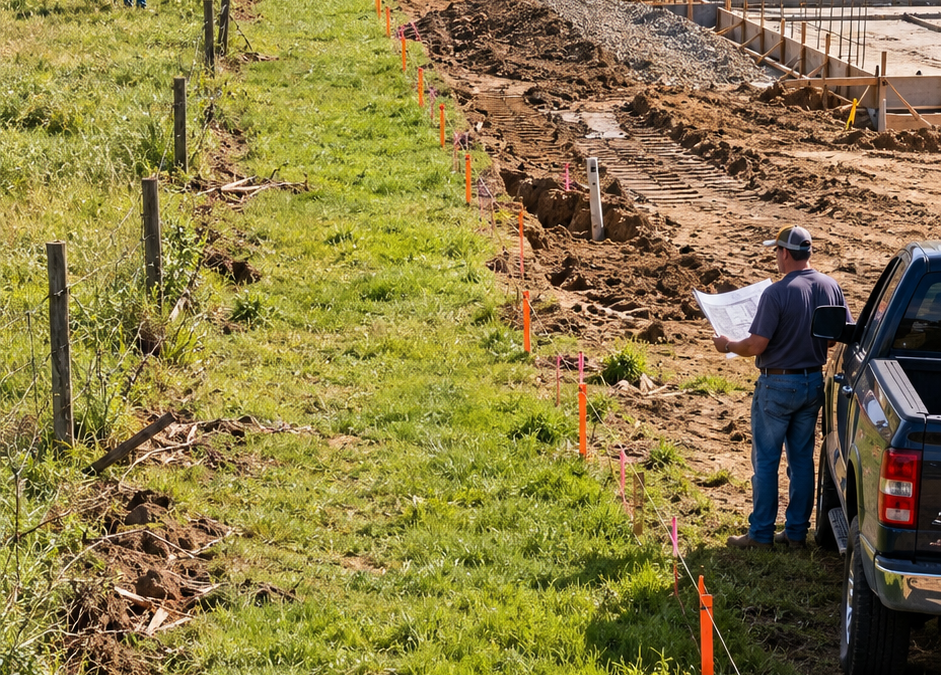
𝗙𝗨𝗟𝗟 𝗦𝗧𝗢𝗥𝗬
The inspector did not authorize either of us to settle the boundary. But the permit itself did not resolve ownership. It only approved the structure Marcus claimed would sit inside his parcel.
Marcus treated that approval like a title deed.
The concrete truck arrived the next morning.
I stood beside my damaged fence while workers poured the slab.
Marcus watched from his driveway.
“You’ll feel pretty stupid when that survey comes back,” he called.
“Maybe,” I said.
I raised my phone and photographed the wet concrete.
“But if you’re wrong, that’s going to be an expensive place to put a building.”
He shook his head like I was too stubborn to understand what had already been decided.
Over the next week, the workshop rose fast.
Framing.
Roof trusses.
Metal siding.
A wide door opening.
Electrical conduit waiting for inspection.
By the time the surveyor arrived, Marcus had a nearly finished forty-by-sixty-foot building standing across the disputed strip.
The surveyor’s name was Rachel Monroe.
She arrived in a white truck with equipment cases, field notes, and the calm expression of someone who had spent years watching property owners learn that fences, memories, and assumptions do not control recorded boundaries.
She started at the road.
Then she disappeared into the tree line with her equipment.
Marcus came outside halfway through.
“You’re using the wrong reference point,” he said.
Rachel did not look up.
“I’m locating the recorded monuments.”
Marcus pointed toward his wooden stakes.
“The line is there.”
Rachel continued working.
An hour later, she found an old iron pin buried near the southern corner.
Then another near the road.
She checked both, measured again, then walked toward the workshop. She stopped, looked through her instrument, moved ten feet, checked again, and marked a point with orange paint.
Marcus smiled at me.
“Well?”
Rachel did not answer immediately.
She marked another point.
Then another.
The line ran toward Marcus’s new workshop.
Not beside it.
Through it.
Marcus’s smile disappeared.
Rachel measured the building, checked her data again, and looked at both of us.
“Your fence was not twenty feet onto his property,” she said.
I waited.
She pointed toward the workshop.
“The recorded boundary crosses directly through this structure.”
Marcus stared at her.
“How much?”
Rachel checked her measurements one final time.
“Approximately twenty-seven feet of the building is on Mr. Harper’s parcel.”
I looked at the workshop.
Sixty feet wide.
Nearly half of it stood on my land.
For a few seconds, nobody spoke.
Then Marcus did what people do when the truth becomes too expensive to accept.
He argued with the messenger.
“That pin is wrong.”
Rachel looked toward the iron monument she had uncovered.
“It is consistent with the recorded plat.”
“My contractor measured the line.”
“From what?”
Marcus pointed toward the road.
“The northeast corner.”
“Which corner marker?”
He did not answer.
Rachel pulled up the county plat on her tablet. The original subdivision had been recorded thirty-four years earlier. My parcel was Lot 7. Marcus owned Lot 8. Between them was a boundary defined by two iron pins.
Both were still there.
Both matched the recorded bearings.
Both placed Marcus’s workshop across my line.
Marcus stared at the screen.
“This can’t be right.”
Rachel remained calm.
“I’ll complete the fieldwork before issuing the final survey, but I’m not seeing ambiguity.”
That gave Marcus something to cling to.
“So this isn’t final.”
“The measurements are preliminary,” Rachel said. “But the controlling evidence is consistent.”
His contractor, Paul Brennan, arrived shortly after.
Marcus waved him over immediately.
“Show her your boundary measurements.”
Paul looked at Rachel.
“You’re the surveyor?”
“Yes.”
He opened the construction plan. Rachel studied it, then pointed to a note in the corner.
Boundary information provided by owner.
She looked at Marcus.
“Who gave him this line?”
Paul answered before Marcus could shape the truth.
“Marcus did.”
Marcus turned on him.
“You measured it.”
“We measured setbacks from the stakes you identified.”
Silence.
I looked at Marcus.
“The stakes you told me came from professionals?”
Paul raised both hands.
“I never represented those stakes as surveyed property corners.”
Marcus’s voice sharpened.
“You said the building fit based on the boundary you provided.”
“No,” Paul said. “I said it fit based on the boundary you provided.”
Rachel photographed the plan.
Then she walked to the northern end of the workshop and drove an orange stake into the ground. Another near the center. Another beyond the rear wall.
The string between them passed through one metal wall and came out the opposite side.
It was impossible to ignore.
The property line did not care about Marcus’s workshop.
It did not bend around the new siding.
It did not shift because concrete had cured.
It ran exactly where it had always run.
Marcus pulled out his phone.
“I’m calling the county.”
Twenty minutes later, the same building inspector returned.
His name was Tom Alvarez.
Marcus met him in the driveway.
“This surveyor is claiming the approved building crosses a property line.”
Tom looked at Rachel.
“Licensed survey?”
“Yes.”
She showed him the field data.
Tom’s expression changed.
He opened the permit file. The approved site plan showed the workshop safely inside Marcus’s parcel. But when Rachel overlaid the recorded boundary, the problem became obvious.
The site plan’s boundary had been shifted nearly thirty feet.
Tom looked at Marcus.
“Where did this property line information come from?”
“My contractor.”
Paul immediately said, “Owner supplied.”
Tom checked the permit application.
Applicant: Marcus Reed.
Attached property sketch.
Owner certified.
Marcus stopped talking.
Tom walked around the workshop. The walls were already up. The roof was installed. Electrical conduit waited for inspection.
He looked through the open doorway, then back at Marcus.
“No further inspections.”
Marcus blinked.
“What?”
“I’m placing the permit on hold until the boundary issue is resolved.”
“You approved this.”
“We approved a structure shown on your submitted plan.”
Tom pointed at Rachel’s orange line.
“We did not approve construction on somebody else’s parcel.”
For the first time since this began, Marcus looked at me without confidence.
Then Rachel called us toward the old fence.
She had found something else.
One of Marcus’s wooden boundary stakes sat beside a shallow hole. Inside the hole, the soil was disturbed. Rachel crouched and used a probe.
A few inches down, metal clicked.
Another old iron pin.
Not missing.
Buried.
Marcus walked toward us.
Rachel exposed the top.
The original marker was nearly twenty-six feet away from Marcus’s wooden stake.
Tom looked at Marcus.
“Did you know this was here?”
“No.”
Paul stared at the hole.
“I asked about that marker.”
Marcus turned toward him.
“When?”
“Before excavation.”
Paul pulled up a text message.
Found old pin near fence. Is this property corner?
Marcus had replied:
Ignore old fence markers. Use new stakes.
I read the message twice.
Until that moment, Marcus could still claim he had made a terrible measurement mistake. A careless assumption. A wrong reference point. A bad guess.
Now the question was different.
He had been warned about the original marker before construction started, and he told his contractor to ignore it.
Tom asked Paul to forward the text.
Marcus objected immediately.
“That’s private communication.”
Paul looked at him.
“It’s about the permit.”
Then he sent it.
Tom saved the message with the inspection record.
Marcus stared at the workshop.
“You people are acting like I intentionally built on Daniel’s land.”
Nobody answered.
Rachel kept working.
She located a fourth reference monument farther north.
Same result.
The recorded line did not move.
The building did.
Marcus tried one more angle.
“If Daniel owns this strip, why isn’t his fence exactly on the survey line?”
Rachel measured the fence.
It wandered.
At one end, it sat eighteen inches inside my property. Near the middle, almost four feet. At the rear, less than a foot.
“Old agricultural fences are not always legal boundaries,” she said.
Marcus almost smiled.
“Exactly.”
Rachel looked at him.
“In this case, the actual boundary gives Daniel more land than the fence did.”
The smile disappeared.
That afternoon, Rachel completed her fieldwork.
Before leaving, she placed temporary survey stakes along the recorded line.
Bright orange.
Impossible to miss.
One stood three feet inside Marcus’s workshop. Another stood beyond the opposite wall. The boundary literally entered through one side of the building and exited through another.
Marcus watched her install them.
“Don’t put stakes around my building.”
Rachel looked at him.
“I’m marking Daniel’s boundary.”
After she left, I went home.
An hour later, my neighbor Frank called.
“You should come outside.”
I stepped onto the porch.
Marcus was pulling up Rachel’s stakes.
I started recording from my driveway.
“Marcus.”
He turned.
“What?”
“Leave those alone.”
“They’re in my construction area.”
“They mark my property.”
“They’re temporary.”
He yanked another one out.
Then Tom Alvarez’s county truck appeared. He had returned to post the official permit hold.
He saw Marcus holding the orange stake.
Tom stopped beside us.
“Put it back.”
Marcus froze.
“This is getting ridiculous.”
Tom pointed toward the ground.
“Survey markers associated with an active boundary review need to remain undisturbed.”
Marcus dropped the stake.
Tom attached a red notice to the workshop entrance.
Construction Suspended Pending Property Line Verification.
Marcus read it, then turned toward me.
“You happy?”
“No,” I said.
I looked at the half-finished building.
“I told you to wait nine days.”
He stepped closer.
“You could sell me the strip.”
That surprised me.
“What strip?”
“The twenty-seven feet. I’ll pay fair value.”
“It’s not a strip anymore. You built a workshop on it.”
“I’ll compensate you.”
“No.”
His jaw tightened.
“Then what do you expect me to do? Cut the building in half?”
“I expect you to stop treating your mistake like my responsibility.”
The next morning, Rachel called.
Her final survey was ready, but she had found one more document.
A boundary survey completed eight years before I bought my property.
It showed the same iron pins, the same line, and the same access corridor behind my pasture. At the bottom was a signature acknowledging the boundary. Not mine. Not Marcus’s. The previous owner of Marcus’s parcel had signed it.
Attached to Marcus’s purchase file was a title exhibit referencing that exact survey.
Marcus had not bought uncertain land.
The correct boundary had been sitting in his own closing documents the entire time.
He came to my door before eight the next morning, holding his closing binder and looking nothing like the man who had told me my deed was outdated.
“Where did Rachel get this?”
He held up the old survey.
“County records,” I said.
“This wasn’t explained to me when I bought the house.”
I looked at the highlighted title exhibit.
“But it was included.”
He flipped through the pages.
“Nobody told me that line mattered.”
“It’s a property line.”
He did not appreciate that.
Then he showed me another document, a seller disclosure. Near the bottom was a handwritten note.
West fence is not exact boundary. Refer to recorded survey.
Marcus stared at it.
“I never noticed this.”
That was possible.
But it did not move the workshop.
Later that morning, Rachel returned to set permanent reference stakes. Tom Alvarez arrived too. The county wanted the final survey attached to the suspended permit file.
Marcus brought Paul.
Paul looked exhausted.
Rachel spread the certified drawing across the hood of her truck.
“The encroachment ranges from twenty-five feet eight inches to twenty-seven feet four inches.”
Tom pointed at the workshop.
“So, approximately half the structure.”
“Yes,” Rachel said. “Foundation, walls, roof, and planned utility trench.”
Marcus looked at me.
“I’ll compensate you.”
“I already answered that.”
“Ten thousand.”
“No.”
“Fifteen.”
Paul quietly stepped away.
I pointed toward the rear access corridor.
“If I sell you that section, I lose equipment access to the back pasture.”
“We can create another access across the drainage slope.”
“You mean I can damage my land to solve your problem.”
Marcus did not answer.
Then Linda Carver, the neighbor across the road, approached carrying an envelope.
“I found something.”
Inside were photographs from four months earlier.
Linda had taken them while documenting tree removal near her own driveway. One photograph showed Marcus’s cleared property. The old white boundary post was still standing. Another showed Marcus beside it with a chainsaw. A third showed the post lying on the ground.
The iron pin beneath it was visible.
Marcus stared at the photograph.
“That proves nothing.”
Linda looked at him.
“It proves the marker wasn’t hidden when you bought the place.”
Rachel studied the image.
“Can you send me the original file?”
Linda nodded.
Marcus looked furious.
“This is turning into a trial.”
Tom answered.
“No. It’s still a permit review.”
Then Paul cleared his throat.
“I have photographs too.”
Marcus turned.
“Of what?”
“The excavation.”
Paul opened his project folder.
Before digging, his crew had photographed the site. One image showed the old iron pin exposed near my fence. A yellow measuring tape ran from the pin toward the proposed foundation.
Paul zoomed in.
Twenty-six feet.
Another photograph showed Marcus’s replacement stake farther inside my property.
Then Paul opened an email.
Three days before excavation, he had written:
Owner-supplied line conflicts with existing iron pin. Recommend survey before foundation.
Marcus’s reply:
Old pin does not match current property use. Build from new line.
I felt my stomach tighten.
I had assumed Marcus had been careless.
Now it looked different.
Rachel asked, “What did you mean by current property use?”
Marcus did not answer.
Paul did.
“Marcus said the fence had functioned as the practical line for years.”
I stared at him.
“The fence is inside my property.”
Paul nodded.
“I know that now.”
Then another email appeared.
Marcus had sent it the following morning.
Move workshop west eighteen feet. Need more turning space on house side.
Rachel looked from the email to the building.
“West is toward Daniel.”
Paul nodded.
“That’s when the footprint changed.”
Marcus stepped forward.
“The building still fit according to my measurements.”
Tom looked at him.
“Your measurements? After your contractor recommended a survey?”
Silence.
Then Tom’s phone rang.
He listened for a minute, then hung up and looked at Marcus.
“County zoning reviewed the certified survey. The permit suspension remains.”
“For how long?” Marcus asked.
“Until the encroachment is resolved.”
Marcus looked at me.
“And if Daniel refuses to sell?”
Tom glanced at the workshop.
“Then your approved building cannot remain where it is.”
For the first time, Marcus stopped arguing about where the boundary was.
The survey had ended that argument.
Now he had a more expensive one.
What to do with half a workshop built on land that had never belonged to him.
Two days later, Marcus’s attorney sent me a certified letter.
It proposed three solutions.
I could sell Marcus the disputed portion.
I could grant him a permanent building easement.
Or we could jointly adjust the boundary.
Every option allowed the workshop to stay.
None restored my access corridor.
I hired a property attorney named Clare Bennett.
She read the letter, then Rachel’s survey, then my deed, then Marcus’s closing documents.
Her first question surprised me.
“Has he entered the building since the county suspended construction?”
“I don’t know.”
That evening, I found out.
A delivery truck backed toward the workshop. Marcus stood beside it while two men unloaded tool cabinets.
I walked over.
“Construction is suspended.”
“We aren’t constructing.”
He pointed at the cabinets.
“Personal property.”
Then one worker carried electrical equipment inside.
I photographed it.
Marcus noticed.
“You really enjoy documenting me.”
“I started after you removed my fence.”
He shut the workshop door.
The next morning, Tom Alvarez returned. Someone had reported activity. Not me. Linda had.
Tom inspected the building.
Inside, temporary extension cords powered lights. A compressor sat near the unfinished electrical panel.
Tom came back outside holding another notice.
“Building isn’t cleared for occupancy.”
Marcus frowned.
“I’m storing equipment.”
“Then store it somewhere else until the permit issue is resolved.”
Marcus ripped the extension cord from the outlet.
Tom posted the notice.
Then Clare found another problem.
Marcus had certified in the permit application that he controlled the entire building site. Attached to the application was a tax parcel map. But the tax map was not a boundary survey. It said so across the bottom.
Not for conveyance or construction.
Marcus had apparently measured from a map that warned him not to use it for construction.
Then Clare found the workshop loan information. Marcus had financed part of the project through a local bank. The bank required confirmation that improvements remained entirely within his parcel.
Two hours later, Marcus appeared at my driveway.
“You contacted my bank.”
“No,” I said. “Somebody did. I hired an attorney. That’s all.”
His face tightened.
“The bank froze the final construction draw.”
That explained the sudden visit.
He looked toward the workshop.
“I’ll give you twenty-five thousand for the land.”
“No.”
“That’s more than it’s worth.”
“Not to me.”
He stepped closer.
“You’re being unreasonable.”
I pointed toward my pasture.
“You had nine days to wait for a survey.”
He looked away.
Then a black SUV arrived.
A woman stepped out and introduced herself as Natalie Brooks, risk inspector for Marcus’s construction lender.
Marcus’s expression changed immediately.
“I didn’t schedule this.”
“The bank did,” she said.
She asked to see the permitted building footprint.
Tom’s red suspension notice was still attached to the door.
Natalie photographed it.
Then Rachel arrived.
Clare had requested additional boundary points be marked for the lender inspection. Rachel stretched bright line tape between the stakes.
It passed straight through the workshop.
Natalie stared at it.
“How much encroachment?”
“Approximately half the structure,” Rachel said.
Marcus interrupted.
“It’s being resolved.”
Natalie looked at me.
“Are you selling the affected land?”
“No.”
“Easement?”
“No.”
Marcus glared at me.
Natalie wrote something on her tablet.
Then Linda walked over.
She was not alone.
An older man named Samuel Price was with her. He had owned Marcus’s property before the seller Marcus bought from.
Samuel looked at the workshop, then at the orange boundary markers.
“I warned them about this line years ago.”
Marcus frowned.
“Warned who?”
“The owner before you.”
Samuel pointed toward the rear pasture.
“People kept assuming Daniel’s fence was the boundary. It never was.”
He opened an old folder.
Inside was a copy of the same survey and a photograph.
The original iron pin.
The white post.
My old fence sitting several feet inside my property.
And beside the marker, a small wooden sign.
Property line. Fence offset.
Marcus stared at it.
“I never saw that sign.”
Samuel shrugged.
“It was there for years.”
Linda looked toward Marcus’s cleared brush pile.
“I saw it after he moved in.”
Marcus turned toward her.
“What are you saying?”
Linda pulled out her phone.
She had another photograph from Marcus’s first week of clearing.
The sign was lying beside the white post.
Still readable.
Natalie photographed the image.
Then she looked at Marcus.
“Did you disclose a known boundary issue to the lender before construction?”
Marcus did not answer.
She closed her tablet.
“The bank will require a formal review before releasing additional funds.”
By then, the county had stopped construction.
The survey had stopped his boundary argument.
Now his lender had stopped the money.
And half the building was still standing exactly where the iron pins said it should not be.
The sheriff’s deputy arrived the following morning because Marcus moved the survey stakes again.
This time, I watched him do it.
Rachel had placed three capped stakes along my access corridor for the lender inspection. At 7:20, Marcus walked out carrying a shovel.
He pulled the first stake.
Then the second.
I recorded from my driveway.
“Marcus.”
He did not stop.
“These aren’t permanent monuments,” he snapped.
“They’re marking the surveyed line.”
“They’re blocking my equipment.”
“Your equipment is on my property.”
He threw one stake into the grass.
That was when I called the non-emergency number.
Deputy Eric Dalton arrived twenty minutes later.
Marcus immediately pointed at me.
“This is a civil boundary dispute.”
Eric nodded.
“Then why are you removing survey markers?”
“They’re temporary.”
Rachel arrived while we were talking.
Eric showed her the stakes.
“Are these legal monuments?”
“No,” she said. “Witness stakes.”
Marcus smiled.
“Exactly.”
Rachel continued.
“But they reference permanent iron monuments which remain in place.”
She walked toward the buried pin, then stopped.
Her expression changed.
“Where’s the iron pin?”
Nobody answered.
She checked the second corner. That monument was still there. She returned to the first.
“This was here yesterday.”
Eric looked at Marcus.
“Did you remove it?”
“No.”
Rachel opened photographs from the previous afternoon. The capped iron pin was clearly visible.
Then Linda called from across the road.
“I have a camera.”
Her driveway camera covered part of Marcus’s side yard.
At 6:03 that morning, Marcus’s utility cart appeared near the boundary. The image was not close enough to show his hands, but the cart stopped beside the missing monument for six minutes.
Marcus shook his head.
“That proves nothing.”
Eric did not argue.
He called the county survey office.
Then Rachel said something that changed the mood.
“It doesn’t change my survey.”
Marcus looked at her.
“The marker is gone.”
“The boundary isn’t.”
She pointed toward the other recorded monuments.
“I can reestablish this corner from the controlling evidence.”
An hour later, county survey technician Brian Cole arrived.
He inspected the empty hole and the surrounding soil. A fresh shovel mark cut through the edge.
Brian photographed it.
“Nobody touches this area.”
Marcus crossed his arms.
“Are you accusing me?”
“I’m documenting a disturbed monument location.”
Brian and Rachel independently measured from the remaining control points.
Their calculated corner landed inside the empty hole.
Exactly where Rachel had found the pin.
Brian drove a temporary witness marker several feet away.
“We’ll file the disturbance report,” he said.
Marcus’s face tightened.
“This is insane. Over one piece of metal.”
Brian looked toward the workshop.
“That piece of metal helps define where one ownership ends and another begins.”
Then Clare arrived.
She handed Marcus’s attorney a notice requesting that Marcus stop entering the portion of the workshop lying on my parcel.
His attorney read it.
“This building is a single structure.”
Clare nodded.
“That’s your client’s problem.”
Marcus stared at me.
“You want me locked out of my own workshop?”
“I want you off my land.”
Before he could answer, Tom Alvarez pulled in with county planning supervisor Karen Wells.
She reviewed Rachel’s certified survey, Brian’s field verification, and the workshop.
“We’ve completed the zoning review,” she said.
Marcus looked hopeful.
“Finally.”
She pointed toward the orange line.
“The structure cannot receive final approval in its current location.”
“Can I apply for a variance?”
“A setback variance does not authorize construction across private ownership.”
Marcus looked at his attorney.
“What about moving the property line?”
Clare answered.
“Daniel is not agreeing.”
Silence.
Karen Wells handed Marcus a written correction order.
The options were simple.
Establish legal control of the encroached land or modify or relocate the structure so it remained entirely within his parcel.
Marcus read the deadline.
Thirty days to submit a correction plan.
Then Brian’s phone rang.
He stepped away. When he returned, he was holding a scanned county record.
“I found the original monument installation sheet.”
Rachel looked at it.
“1988.”
Brian nodded.
“The coordinates match your survey. There’s also a maintenance notation from 2003. Monument reset after road work. Witnesses: Samuel Price, county surveyor, and the owner of Daniel’s parcel at the time.”
Marcus stared at the document.
Brian looked toward the empty hole.
“The marker you claimed was unreliable had already been officially verified once.”
The missing pin had not moved the boundary an inch.
It had only brought another authority onto Marcus’s property.
And now the county was no longer asking where the line was.
They were asking what happened to the marker that proved it.
Marcus’s attorney called Clare that afternoon.
Not to challenge Rachel’s survey.
To negotiate.
The offer increased to forty thousand dollars.
I still said no.
Clare asked me once, “Are you certain?”
I looked toward the rear access corridor.
“If I sell it, I solve his problem by creating one for myself.”
That ended it.
The next morning, Marcus submitted a correction plan to the county.
Tom Alvarez called me.
“You should probably see this.”
The plan proposed cutting twenty-eight feet off the workshop.
The western wall would be removed. The roof shortened. The foundation saw-cut near the property line. A new wall built entirely on Marcus’s parcel.
It was ugly.
But possible.
Then Paul Brennan arrived at the county office with bad news.
The roof system was not designed for that modification.
Marcus stared at him.
“You built it.”
“From the plans you approved,” Paul said.
Removing nearly half the width would require new engineering, roof reinforcement, foundation modification, electrical redesign, and partial demolition before reconstruction.
“Cost?” Marcus asked.
Paul hesitated.
“Could exceed sixty thousand.”
Marcus looked at me.
I said nothing.
Then Karen Wells entered and placed a second document on the table.
The county had reviewed the disturbed monument report.
“The original iron pin has been found.”
Marcus looked up.
“Where?”
Brian Cole answered from the doorway.
“In the drainage ditch behind your workshop.”
Silence.
He carried an evidence bag.
Inside was a rusted iron pin with a yellow survey cap.
Rachel identified the cap number.
Same monument.
Marcus shook his head.
“I didn’t put it there.”
Brian nodded.
“That will be documented separately.”
Then Deputy Eric Dalton entered to collect statements.
He was not there to arrest anyone.
Not yet.
Linda’s camera footage had been enhanced enough to show Marcus’s utility cart carrying a long-handled tool. Still not enough to clearly show the pin being removed.
Then Paul raised his hand.
“My site camera might.”
Marcus turned sharply.
“What site camera?”
“Security camera on the material trailer.”
Paul opened the contractor app.
The trailer had faced the boundary before the permit suspension. He searched the timestamp.
6:01 a.m. Marcus’s cart entered the frame.
6:04 a.m. Marcus stepped out carrying a shovel.
6:07 a.m. He crouched beside the monument.
6:09 a.m. He lifted something narrow and metallic from the ground and placed it in the cart.
Nobody spoke.
Marcus’s attorney immediately said, “We’re done discussing this without further counsel.”
Eric nodded.
“That’s your right.”
The meeting ended.
The workshop problem did not.
That evening, three neighbors came to my house, not to take sides, but because they were worried.
One of them, Carol Jensen, owned the parcel behind Marcus.
“If his measurements were wrong by twenty-seven feet,” she said, “what about our line?”
Rachel agreed to check the recorded monuments.
Two days later, she found another discrepancy.
Not on my land.
Marcus’s new gravel turnaround extended nine feet onto Carol’s parcel.
Carol stared at it.
“You’ve got to be kidding.”
Marcus arrived while Rachel was marking the line.
“This is becoming harassment.”
Carol turned toward him.
“You put gravel on my property.”
“It was already used as access by the previous owner.”
“With permission,” Carol said.
Then she produced an old written license. It had expired when Marcus purchased the parcel.
Another assumption.
Another line he had not checked.
Then Natalie Brooks returned.
The bank had completed its review.
She handed Marcus a formal notice. Future construction funding was suspended until the workshop encroachment was corrected and the permit reinstated.
Marcus looked at Paul.
“Can we move the entire building?”
Paul stared at the concrete slab.
“Not economically.”
“Can we rebuild?”
“Yes.”
Marcus looked toward the workshop.
The metal siding was new.
The roof was new.
The doors had not even been used.
Then Clare received an email from Marcus’s attorney.
The forty-thousand-dollar offer was withdrawn.
A new proposal replaced it.
Marcus would remove everything crossing my boundary, restore my fence, repair the ground, pay Rachel’s survey costs, and reimburse my documented legal expenses related to resolving the encroachment.
Clare looked at me.
“That’s different.”
It was.
For the first time since construction began, Marcus was not asking me to rearrange my property around his workshop.
He was proposing to rearrange the workshop around the property line.
But before I could respond, Tom called.
The county had reviewed Paul’s demolition concept.
There was one condition.
Because the foundation crossed the boundary, all removal work on my side required my written access authorization.
I looked through the window toward the building.
Marcus had spent weeks acting like my permission did not matter.
Now he could not even remove his mistake without asking for it.
Marcus came to my house the next morning.
No attorney.
No site plan.
No offer to buy my land.
Just Marcus.
“I need your permission to remove the building,” he said.
I looked past him toward the workshop.
“Written permission?”
“Yes.”
That was the first time he had asked before doing something on my property.
Clare had already prepared the agreement.
It allowed controlled access for demolition only.
Contractors had to stay inside marked areas. My access corridor had to be restored. The removed fence had to be replaced. Any damage to the pasture had to be repaired. Rachel would verify the boundary before final grading.
Marcus read every page.
Then he signed.
Demolition started four days later.
Paul’s crew removed the metal siding first.
Then part of the roof.
For the first time, the orange survey line was visible through the open structure.
It looked almost absurd.
One half belonged on Marcus’s side.
The other half stood over my grass.
Then Paul uncovered another problem.
The concrete foundation extended farther west than the original framing.
Rachel measured it.
“Thirty-one feet at this corner.”
Marcus stared at the slab.
“How?”
Paul checked the excavation records.
“The foundation crew widened the footing to accommodate a drainage trench. Nobody updated the site plan.”
Tom Alvarez photographed everything.
“The entire encroaching portion comes out.”
Marcus did not argue.
That surprised me more than anything.
Brian Cole returned with the county’s replacement monument. Deputy Eric Dalton came with him. Marcus’s attorney was present this time.
Brian reestablished the missing corner using the recorded measurements.
The new monument landed exactly where the old one had been.
He drove it into the ground, capped it, photographed it, and had Marcus sign acknowledgment that he had witnessed the replacement.
The boundary question was finished.
Not emotionally.
Not practically.
Officially.
The concrete saw arrived the following Monday.
Its blade cut a straight line several inches inside Marcus’s side of the surveyed boundary. The noise carried across the pasture, hard and metallic, as thousands of dollars of new concrete became demolition debris.
Frank stopped by while I watched.
“That’s painful for him.”
“You think I feel bad?”
Frank looked at me.
“Do you?”
I thought about it.
A little.
Then I pointed toward the slab.
“Nobody wins when something that expensive gets destroyed.”
Marcus heard me.
For a second, neither of us spoke.
Finally, he said, “I should have waited for the survey.”
“Yes,” I said. “Nine days.”
That was all I had asked for.
Nine days before excavation.
Nine days before concrete.
Nine days before framing.
Nine days before attorneys, deputies, lenders, inspectors, disturbed monument reports, and saw blades.
Instead, he had rushed forward because he was certain.
Certainty had cost him more than patience ever would have.
Rachel arrived for the final boundary inspection.
She measured the remaining foundation.
Every point was now inside Marcus’s parcel.
Minimum clearance: eighteen inches.
Not enough for the original permit setback.
Marcus’s face fell.
“So I’m still not compliant.”
“Not under the original workshop design,” Tom said.
Paul opened the revised engineering plan.
The new design was not forty by sixty.
It was twenty-eight by sixty.
Narrower.
More expensive per square foot.
But entirely on Marcus’s property with an approved reduced setback after formal zoning review.
Marcus looked at me.
“I could have built this version from the beginning.”
Rachel answered before I could.
“If you had surveyed first.”
Susan Hail from the county planning office arrived with the final administrative determination.
She handed copies to both of us.
The certified survey was accepted.
The parcel boundary was confirmed.
My access corridor remained intact.
Marcus’s workshop encroachment had to remain removed.
Any future construction had to use Rachel’s recorded line.
Marcus read the document.
Then he signed the revised permit application.
This time, the property line was not based on his stakes.
It was not based on his fence assumptions.
It was not based on a tax map.
Rachel’s certified survey was attached to page one.
Marcus handed the application to Tom.
Tom checked it, then looked at me.
“Your parcel is clear.”
I looked across the orange stakes.
No wall.
No roof.
No foundation.
Just disturbed soil waiting for grass.
For weeks, Marcus had tried to make his workshop determine where the boundary should be.
In the end, the workshop moved.
The boundary never did.
By early fall, grass had started growing where half of Marcus’s workshop used to stand.
The first time I drove my tractor through the restored access corridor, I stopped halfway.
Not because anything was wrong.
Because nothing was blocking it.
No concrete.
No metal wall.
No construction equipment.
Just my land.
Paul’s crew rebuilt the workshop entirely on Marcus’s parcel.
Twenty-eight feet wide instead of forty.
The county approved the revised setback. Electrical inspection passed. Final occupancy came two months later.
Marcus never invited me inside.
I never expected him to.
But he did replace my fence.
Not with the old wire he had removed.
He paid for new posts and heavier fencing along the surveyed boundary. Rachel inspected the work before the contractor finished. At every permanent monument, they left enough clearance that nobody could mistake a fence post for the actual corner.
Then Marcus paid the costs required by our agreement.
Survey.
Documented legal expenses.
Ground restoration.
Fence replacement.
The lender released his remaining construction funds only after Natalie Brooks verified that the corrected building sat completely inside his parcel. The county closed the encroachment portion of the permit file. The disturbed monument issue continued separately.
I stayed out of it.
I had already spent enough mornings photographing things that should not have been happening.
Carol Jensen had Marcus remove the gravel that crossed onto her property.
He did not argue.
A contractor arrived, moved the gravel, regraded the edge, and finished in one afternoon.
That might have been the biggest change.
Marcus had stopped treating every boundary as a negotiation.
A month later, I found him near the road while checking my mailbox.
He looked toward the new fence.
“Rachel did good work,” he said.
“She did.”
He nodded.
Then he said something I had not expected.
“I thought that old fence was basically the line.”
“I know.”
“And when Paul found the pin, I thought it had to be outdated.”
I looked at him.
“That’s when you should have stopped.”
He nodded.
“I know that now.”
There was not much else to say.
An apology could not rebuild the original workshop.
Anger could not improve my pasture.
So we stood there for a few seconds like two neighbors who had learned exactly how expensive twenty-seven feet could become.
Then Marcus held out his hand.
I shook it.
We did not become friends.
But we stopped being enemies.
That was enough.
The following spring, Rachel returned for another job nearby. She stopped at my place on her way out.
The replacement monument was still secure. The fence was still inside my property. Marcus’s workshop was exactly where the revised survey required it to be.
Rachel smiled.
“Looks boring.”
“Best thing I’ve seen all year.”
When Frank heard that, he laughed for ten minutes.
After everything that had happened, boring really was an improvement.
No deputies.
No permit notices.
No attorneys.
No contractors arguing over owner-supplied stakes.
No lender inspections.
No missing iron pins.
Just two parcels with a clearly marked line between them.
Sometimes people asked why I had not simply sold Marcus the strip.
Forty thousand dollars sounded like good money for twenty-seven feet.
But land is not valuable only by square footage.
That corridor connected my pasture to the rear road. It let me move tractors, trailers, hay equipment, and livestock without crossing the drainage slope. Once sold, it would not have been mine to recover.
Marcus’s mistake did not create an obligation for me to surrender something I still needed.
That was the part he finally understood.
One evening, I was repairing a gate when I heard machinery from his workshop.
The doors were open. Marcus was inside working at a bench.
Everything was quiet.
Everything was legal.
Everything was on his side.
He saw me near the fence and raised one hand.
I did the same.
Then I noticed the new survey cap shining beside the corner post.
That tiny piece of metal had caused arguments, inspections, legal letters, lender reviews, demolition, reconstruction, and thousands of dollars in damage control.
But the metal itself had never created the boundary.
It only showed where the boundary had always been.
Marcus built a workshop believing his confidence, his stakes, and his construction permit were enough to define his property.
The survey proved otherwise.
Nearly half his building had crossed onto my land.
And after all the arguments were finished, the simplest fact was the one that mattered most.
You can move a fence.
You can move a workshop.
But you do not get to move a property line just because you built across it.
𝗧𝗛𝗘 𝗘𝗡𝗗
The Fence Was Gone Before I Learned How Expensive Twenty-Seven Feet Could Be
I thought the old wire fence was the line until my neighbor told me to move it for his concrete truck.
By the time I noticed the orange stakes, his new workshop was already reaching across ground I had protected for eleven years.
What started as twenty-seven feet of disputed grass became a lesson in how much damage one man’s confidence can do before the truth catches up.
My name is Daniel Harper, and for eleven years, my six acres outside Cedar Ridge had given me exactly what I wanted from land.
Space.
Quiet.
A place where nobody stood close enough to tell me what to do with my mornings.
It was not a grand estate. It was not one of those properties people photographed from a drone and posted online with dramatic music. It was six acres of grass, old fencing, a gravel drive, a modest house, a small barn, and a pasture corridor that let me move my tractor, trailers, hay equipment, and livestock between the front field and the rear access road without crossing the drainage slope.
That corridor mattered.
To anyone else, it probably looked like a strip of grass beside an old fence. To me, it was the difference between working my land safely and fighting mud, slope, and machinery every season. I had used it since the day I moved in. The previous owner had used it. The closing documents described the western boundary clearly enough that I never had a reason to question where my land ended.
The old wire fence had been there when I bought the place.
It wandered a little, the way old agricultural fences do. Some posts leaned. Some sections had been repaired with newer wire. One cedar brace near the south end looked older than my house. But according to the paperwork I received at closing, that fence followed the western boundary closely enough that I treated it as the line in daily life.
I mowed to it.
I maintained beside it.
I ran equipment along it.
I never imagined that fence would become the beginning of the most expensive argument my neighbor had ever started.
For years, the property beside mine belonged to quiet people.
They waved when they saw me, kept their place tidy, and never acted like the space between us needed to be negotiated. Then Marcus Reed bought it.
Marcus was fifty-one, successful, confident, and always improving something.
Within six months, he had added a new driveway, cleared several trees, installed landscape lighting, and announced that he was building a workshop behind his house. I did not care. His property, his money, his workshop. A man had the right to improve his own land.
The problem was that Marcus seemed to think improvement meant expanding reality to fit whatever he wanted next.
I saw the first sign on a Tuesday morning.
I was carrying feed toward the barn when I heard machinery near the fence. Not a lawn mower. Not a pickup. Something heavier. A skid steer engine coughed, reversed, and rolled across the grass close enough to make me stop mid-step.
I walked outside and saw an excavation crew near the western fence.
Marcus stood beside a row of fresh orange stakes, arms folded, looking pleased with himself. The stakes ran along a line that did not make sense. They were not beside his side of the fence. They were inside the strip I had maintained for more than a decade.
Twenty feet inside, at least.
I set the feed bucket down and walked toward him.
“What’s going on?”
Marcus turned with a smile.
“Workshop foundation.”
I looked past him at the skid steer.
“That machine is on my side.”
His smile did not move.
“Actually, Daniel, your fence is wrong.”
That got my attention.
I looked at the old wire fence, then at the orange stakes, then back at him.
“My fence has been here since before I bought the property.”
“Then the previous owner put it in the wrong place.”
“Based on what?”
Marcus walked to his truck and pulled out a folded site plan.
“My contractor measured from the road.”
He spread the plan against the hood of his truck like he was showing me something that settled the matter. The drawing showed a proposed forty-by-sixty-foot workshop behind his house. On paper, it sat thirty feet from the boundary. But the boundary line on that sketch ran straight through ground I had used for eleven years.
I tapped the line.
“My deed does not show this.”
Marcus shrugged.
“Then your deed is outdated.”
I stared at him.
“Deeds don’t usually become outdated because somebody wants a bigger workshop.”
His expression changed slightly, but he kept his voice controlled.
“I’m telling you what my contractor measured.”
“I’m telling you not to enter my property until the line is confirmed.”
The skid steer operator looked from Marcus to me and wisely shut the machine down.
Marcus did not like that.
“They work for me,” he said.
“Then tell them to stay on your land.”
“You don’t own this strip.”
“I believe I do.”
“You’re wrong.”
The way he said it bothered me more than the words themselves.
Not uncertain.
Not irritated.
Certain.
Marcus had convinced himself that confidence could substitute for proof.
The contractor was not interested in becoming part of a neighborhood boundary fight. He stepped away from the machine and said they could wait for direction. Marcus told him to hold tight, then spent the rest of the afternoon placing more wooden stakes along his claimed boundary.
The next morning, several stakes were connected by string.
By Friday, excavation had started.
Not near my fence.
Across it.
A section of the old wire fence had been removed.
I found it lying twisted in the grass.
For a moment, I simply stood there, looking at the gap.
People talk about anger as if it always comes hot. This was not hot. It was cold and heavy, the kind that makes your hands still because you know anything careless you do next will become useful to the person who crossed the line first.
I walked through the opening.
Marcus was watching an excavator dig a rectangular foundation.
“You removed my fence,” I said.
“It was on my property.”
“You still don’t have a survey.”
“I have measurements from professionals.”
“Your contractor measured from stakes you placed.”
His jaw tightened.
I pulled out my phone and started taking pictures.
The missing fence.
The stakes.
The excavation.
The machine tracks.
The rectangular hole being carved into land I believed was mine.
Marcus noticed.
“You really think pictures are going to change the line?”
“No,” I said. “But they’ll show what happened before the line was confirmed.”
Then I called a licensed surveyor.
The earliest appointment was nine days out.
Nine days.
That was all I asked Marcus to wait.
I walked back over and told him, “Stop construction until the survey.”
He laughed.
“I’m not delaying my project because you don’t understand your boundary.”
Two days later, concrete forms appeared.
Then rebar.
Then a county building inspector arrived.
For one hopeful moment, I thought construction would stop. Surely, I thought, the inspector would ask whether the property line had been verified. Surely a building that close to a disputed boundary could not move forward on nothing more than Marcus’s sketch.
The inspector checked the forms, foundation dimensions, and permit file.
I approached him.
“Has the property line been verified?”
He looked down at the permit.
“The approved plan shows the required setback.”
“Based on what survey?”
He paused.
That pause told me enough.
Marcus walked over.
“Daniel is disputing an old fence.”
I corrected him.
“I’m disputing his boundary.”
The inspector looked from Marcus’s site plan to my fence line.
“If there’s a private boundary dispute, you’ll need a survey.”
“I’ve ordered one,” I said.
Marcus crossed his arms.
“Great. Then we’ll know you’re wrong.”
The inspector did not authorize either of us to settle the boundary. But the permit itself did not resolve ownership. It only approved the structure Marcus claimed would sit inside his parcel.
Marcus treated that approval like a title deed.
The concrete truck arrived the next morning.
I stood beside my damaged fence while workers poured the slab.
Marcus watched from his driveway.
“You’ll feel pretty stupid when that survey comes back,” he called.
“Maybe,” I said.
I raised my phone and photographed the wet concrete.
“But if you’re wrong, that’s going to be an expensive place to put a building.”
He shook his head like I was too stubborn to understand what had already been decided.
Over the next week, the workshop rose fast.
Framing.
Roof trusses.
Metal siding.
A wide door opening.
Electrical conduit waiting for inspection.
By the time the surveyor arrived, Marcus had a nearly finished forty-by-sixty-foot building standing across the disputed strip.
The surveyor’s name was Rachel Monroe.
She arrived in a white truck with equipment cases, field notes, and the calm expression of someone who had spent years watching property owners learn that fences, memories, and assumptions do not control recorded boundaries.
She started at the road.
Then she disappeared into the tree line with her equipment.
Marcus came outside halfway through.
“You’re using the wrong reference point,” he said.
Rachel did not look up.
“I’m locating the recorded monuments.”
Marcus pointed toward his wooden stakes.
“The line is there.”
Rachel continued working.
An hour later, she found an old iron pin buried near the southern corner.
Then another near the road.
She checked both, measured again, then walked toward the workshop. She stopped, looked through her instrument, moved ten feet, checked again, and marked a point with orange paint.
Marcus smiled at me.
“Well?”
Rachel did not answer immediately.
She marked another point.
Then another.
The line ran toward Marcus’s new workshop.
Not beside it.
Through it.
Marcus’s smile disappeared.
Rachel measured the building, checked her data again, and looked at both of us.
“Your fence was not twenty feet onto his property,” she said.
I waited.
She pointed toward the workshop.
“The recorded boundary crosses directly through this structure.”
Marcus stared at her.
“How much?”
Rachel checked her measurements one final time.
“Approximately twenty-seven feet of the building is on Mr. Harper’s parcel.”
I looked at the workshop.
Sixty feet wide.
Nearly half of it stood on my land.
For a few seconds, nobody spoke.
Then Marcus did what people do when the truth becomes too expensive to accept.
He argued with the messenger.
“That pin is wrong.”
Rachel looked toward the iron monument she had uncovered.
“It is consistent with the recorded plat.”
“My contractor measured the line.”
“From what?”
Marcus pointed toward the road.
“The northeast corner.”
“Which corner marker?”
He did not answer.
Rachel pulled up the county plat on her tablet. The original subdivision had been recorded thirty-four years earlier. My parcel was Lot 7. Marcus owned Lot 8. Between them was a boundary defined by two iron pins.
Both were still there.
Both matched the recorded bearings.
Both placed Marcus’s workshop across my line.
Marcus stared at the screen.
“This can’t be right.”
Rachel remained calm.
“I’ll complete the fieldwork before issuing the final survey, but I’m not seeing ambiguity.”
That gave Marcus something to cling to.
“So this isn’t final.”
“The measurements are preliminary,” Rachel said. “But the controlling evidence is consistent.”
His contractor, Paul Brennan, arrived shortly after.
Marcus waved him over immediately.
“Show her your boundary measurements.”
Paul looked at Rachel.
“You’re the surveyor?”
“Yes.”
He opened the construction plan. Rachel studied it, then pointed to a note in the corner.
Boundary information provided by owner.
She looked at Marcus.
“Who gave him this line?”
Paul answered before Marcus could shape the truth.
“Marcus did.”
Marcus turned on him.
“You measured it.”
“We measured setbacks from the stakes you identified.”
Silence.
I looked at Marcus.
“The stakes you told me came from professionals?”
Paul raised both hands.
“I never represented those stakes as surveyed property corners.”
Marcus’s voice sharpened.
“You said the building fit based on the boundary you provided.”
“No,” Paul said. “I said it fit based on the boundary you provided.”
Rachel photographed the plan.
Then she walked to the northern end of the workshop and drove an orange stake into the ground. Another near the center. Another beyond the rear wall.
The string between them passed through one metal wall and came out the opposite side.
It was impossible to ignore.
The property line did not care about Marcus’s workshop.
It did not bend around the new siding.
It did not shift because concrete had cured.
It ran exactly where it had always run.
Marcus pulled out his phone.
“I’m calling the county.”
Twenty minutes later, the same building inspector returned.
His name was Tom Alvarez.
Marcus met him in the driveway.
“This surveyor is claiming the approved building crosses a property line.”
Tom looked at Rachel.
“Licensed survey?”
“Yes.”
She showed him the field data.
Tom’s expression changed.
He opened the permit file. The approved site plan showed the workshop safely inside Marcus’s parcel. But when Rachel overlaid the recorded boundary, the problem became obvious.
The site plan’s boundary had been shifted nearly thirty feet.
Tom looked at Marcus.
“Where did this property line information come from?”
“My contractor.”
Paul immediately said, “Owner supplied.”
Tom checked the permit application.
Applicant: Marcus Reed.
Attached property sketch.
Owner certified.
Marcus stopped talking.
Tom walked around the workshop. The walls were already up. The roof was installed. Electrical conduit waited for inspection.
He looked through the open doorway, then back at Marcus.
“No further inspections.”
Marcus blinked.
“What?”
“I’m placing the permit on hold until the boundary issue is resolved.”
“You approved this.”
“We approved a structure shown on your submitted plan.”
Tom pointed at Rachel’s orange line.
“We did not approve construction on somebody else’s parcel.”
For the first time since this began, Marcus looked at me without confidence.
Then Rachel called us toward the old fence.
She had found something else.
One of Marcus’s wooden boundary stakes sat beside a shallow hole. Inside the hole, the soil was disturbed. Rachel crouched and used a probe.
A few inches down, metal clicked.
Another old iron pin.
Not missing.
Buried.
Marcus walked toward us.
Rachel exposed the top.
The original marker was nearly twenty-six feet away from Marcus’s wooden stake.
Tom looked at Marcus.
“Did you know this was here?”
“No.”
Paul stared at the hole.
“I asked about that marker.”
Marcus turned toward him.
“When?”
“Before excavation.”
Paul pulled up a text message.
Found old pin near fence. Is this property corner?
Marcus had replied:
Ignore old fence markers. Use new stakes.
I read the message twice.
Until that moment, Marcus could still claim he had made a terrible measurement mistake. A careless assumption. A wrong reference point. A bad guess.
Now the question was different.
He had been warned about the original marker before construction started, and he told his contractor to ignore it.
Tom asked Paul to forward the text.
Marcus objected immediately.
“That’s private communication.”
Paul looked at him.
“It’s about the permit.”
Then he sent it.
Tom saved the message with the inspection record.
Marcus stared at the workshop.
“You people are acting like I intentionally built on Daniel’s land.”
Nobody answered.
Rachel kept working.
She located a fourth reference monument farther north.
Same result.
The recorded line did not move.
The building did.
Marcus tried one more angle.
“If Daniel owns this strip, why isn’t his fence exactly on the survey line?”
Rachel measured the fence.
It wandered.
At one end, it sat eighteen inches inside my property. Near the middle, almost four feet. At the rear, less than a foot.
“Old agricultural fences are not always legal boundaries,” she said.
Marcus almost smiled.
“Exactly.”
Rachel looked at him.
“In this case, the actual boundary gives Daniel more land than the fence did.”
The smile disappeared.
That afternoon, Rachel completed her fieldwork.
Before leaving, she placed temporary survey stakes along the recorded line.
Bright orange.
Impossible to miss.
One stood three feet inside Marcus’s workshop. Another stood beyond the opposite wall. The boundary literally entered through one side of the building and exited through another.
Marcus watched her install them.
“Don’t put stakes around my building.”
Rachel looked at him.
“I’m marking Daniel’s boundary.”
After she left, I went home.
An hour later, my neighbor Frank called.
“You should come outside.”
I stepped onto the porch.
Marcus was pulling up Rachel’s stakes.
I started recording from my driveway.
“Marcus.”
He turned.
“What?”
“Leave those alone.”
“They’re in my construction area.”
“They mark my property.”
“They’re temporary.”
He yanked another one out.
Then Tom Alvarez’s county truck appeared. He had returned to post the official permit hold.
He saw Marcus holding the orange stake.
Tom stopped beside us.
“Put it back.”
Marcus froze.
“This is getting ridiculous.”
Tom pointed toward the ground.
“Survey markers associated with an active boundary review need to remain undisturbed.”
Marcus dropped the stake.
Tom attached a red notice to the workshop entrance.
Construction Suspended Pending Property Line Verification.
Marcus read it, then turned toward me.
“You happy?”
“No,” I said.
I looked at the half-finished building.
“I told you to wait nine days.”
He stepped closer.
“You could sell me the strip.”
That surprised me.
“What strip?”
“The twenty-seven feet. I’ll pay fair value.”
“It’s not a strip anymore. You built a workshop on it.”
“I’ll compensate you.”
“No.”
His jaw tightened.
“Then what do you expect me to do? Cut the building in half?”
“I expect you to stop treating your mistake like my responsibility.”
The next morning, Rachel called.
Her final survey was ready, but she had found one more document.
A boundary survey completed eight years before I bought my property.
It showed the same iron pins, the same line, and the same access corridor behind my pasture. At the bottom was a signature acknowledging the boundary. Not mine. Not Marcus’s. The previous owner of Marcus’s parcel had signed it.
Attached to Marcus’s purchase file was a title exhibit referencing that exact survey.
Marcus had not bought uncertain land.
The correct boundary had been sitting in his own closing documents the entire time.
He came to my door before eight the next morning, holding his closing binder and looking nothing like the man who had told me my deed was outdated.
“Where did Rachel get this?”
He held up the old survey.
“County records,” I said.
“This wasn’t explained to me when I bought the house.”
I looked at the highlighted title exhibit.
“But it was included.”
He flipped through the pages.
“Nobody told me that line mattered.”
“It’s a property line.”
He did not appreciate that.
Then he showed me another document, a seller disclosure. Near the bottom was a handwritten note.
West fence is not exact boundary. Refer to recorded survey.
Marcus stared at it.
“I never noticed this.”
That was possible.
But it did not move the workshop.
Later that morning, Rachel returned to set permanent reference stakes. Tom Alvarez arrived too. The county wanted the final survey attached to the suspended permit file.
Marcus brought Paul.
Paul looked exhausted.
Rachel spread the certified drawing across the hood of her truck.
“The encroachment ranges from twenty-five feet eight inches to twenty-seven feet four inches.”
Tom pointed at the workshop.
“So, approximately half the structure.”
“Yes,” Rachel said. “Foundation, walls, roof, and planned utility trench.”
Marcus looked at me.
“I’ll compensate you.”
“I already answered that.”
“Ten thousand.”
“No.”
“Fifteen.”
Paul quietly stepped away.
I pointed toward the rear access corridor.
“If I sell you that section, I lose equipment access to the back pasture.”
“We can create another access across the drainage slope.”
“You mean I can damage my land to solve your problem.”
Marcus did not answer.
Then Linda Carver, the neighbor across the road, approached carrying an envelope.
“I found something.”
Inside were photographs from four months earlier.
Linda had taken them while documenting tree removal near her own driveway. One photograph showed Marcus’s cleared property. The old white boundary post was still standing. Another showed Marcus beside it with a chainsaw. A third showed the post lying on the ground.
The iron pin beneath it was visible.
Marcus stared at the photograph.
“That proves nothing.”
Linda looked at him.
“It proves the marker wasn’t hidden when you bought the place.”
Rachel studied the image.
“Can you send me the original file?”
Linda nodded.
Marcus looked furious.
“This is turning into a trial.”
Tom answered.
“No. It’s still a permit review.”
Then Paul cleared his throat.
“I have photographs too.”
Marcus turned.
“Of what?”
“The excavation.”
Paul opened his project folder.
Before digging, his crew had photographed the site. One image showed the old iron pin exposed near my fence. A yellow measuring tape ran from the pin toward the proposed foundation.
Paul zoomed in.
Twenty-six feet.
Another photograph showed Marcus’s replacement stake farther inside my property.
Then Paul opened an email.
Three days before excavation, he had written:
Owner-supplied line conflicts with existing iron pin. Recommend survey before foundation.
Marcus’s reply:
Old pin does not match current property use. Build from new line.
I felt my stomach tighten.
I had assumed Marcus had been careless.
Now it looked different.
Rachel asked, “What did you mean by current property use?”
Marcus did not answer.
Paul did.
“Marcus said the fence had functioned as the practical line for years.”
I stared at him.
“The fence is inside my property.”
Paul nodded.
“I know that now.”
Then another email appeared.
Marcus had sent it the following morning.
Move workshop west eighteen feet. Need more turning space on house side.
Rachel looked from the email to the building.
“West is toward Daniel.”
Paul nodded.
“That’s when the footprint changed.”
Marcus stepped forward.
“The building still fit according to my measurements.”
Tom looked at him.
“Your measurements? After your contractor recommended a survey?”
Silence.
Then Tom’s phone rang.
He listened for a minute, then hung up and looked at Marcus.
“County zoning reviewed the certified survey. The permit suspension remains.”
“For how long?” Marcus asked.
“Until the encroachment is resolved.”
Marcus looked at me.
“And if Daniel refuses to sell?”
Tom glanced at the workshop.
“Then your approved building cannot remain where it is.”
For the first time, Marcus stopped arguing about where the boundary was.
The survey had ended that argument.
Now he had a more expensive one.
What to do with half a workshop built on land that had never belonged to him.
Two days later, Marcus’s attorney sent me a certified letter.
It proposed three solutions.
I could sell Marcus the disputed portion.
I could grant him a permanent building easement.
Or we could jointly adjust the boundary.
Every option allowed the workshop to stay.
None restored my access corridor.
I hired a property attorney named Clare Bennett.
She read the letter, then Rachel’s survey, then my deed, then Marcus’s closing documents.
Her first question surprised me.
“Has he entered the building since the county suspended construction?”
“I don’t know.”
That evening, I found out.
A delivery truck backed toward the workshop. Marcus stood beside it while two men unloaded tool cabinets.
I walked over.
“Construction is suspended.”
“We aren’t constructing.”
He pointed at the cabinets.
“Personal property.”
Then one worker carried electrical equipment inside.
I photographed it.
Marcus noticed.
“You really enjoy documenting me.”
“I started after you removed my fence.”
He shut the workshop door.
The next morning, Tom Alvarez returned. Someone had reported activity. Not me. Linda had.
Tom inspected the building.
Inside, temporary extension cords powered lights. A compressor sat near the unfinished electrical panel.
Tom came back outside holding another notice.
“Building isn’t cleared for occupancy.”
Marcus frowned.
“I’m storing equipment.”
“Then store it somewhere else until the permit issue is resolved.”
Marcus ripped the extension cord from the outlet.
Tom posted the notice.
Then Clare found another problem.
Marcus had certified in the permit application that he controlled the entire building site. Attached to the application was a tax parcel map. But the tax map was not a boundary survey. It said so across the bottom.
Not for conveyance or construction.
Marcus had apparently measured from a map that warned him not to use it for construction.
Then Clare found the workshop loan information. Marcus had financed part of the project through a local bank. The bank required confirmation that improvements remained entirely within his parcel.
Two hours later, Marcus appeared at my driveway.
“You contacted my bank.”
“No,” I said. “Somebody did. I hired an attorney. That’s all.”
His face tightened.
“The bank froze the final construction draw.”
That explained the sudden visit.
He looked toward the workshop.
“I’ll give you twenty-five thousand for the land.”
“No.”
“That’s more than it’s worth.”
“Not to me.”
He stepped closer.
“You’re being unreasonable.”
I pointed toward my pasture.
“You had nine days to wait for a survey.”
He looked away.
Then a black SUV arrived.
A woman stepped out and introduced herself as Natalie Brooks, risk inspector for Marcus’s construction lender.
Marcus’s expression changed immediately.
“I didn’t schedule this.”
“The bank did,” she said.
She asked to see the permitted building footprint.
Tom’s red suspension notice was still attached to the door.
Natalie photographed it.
Then Rachel arrived.
Clare had requested additional boundary points be marked for the lender inspection. Rachel stretched bright line tape between the stakes.
It passed straight through the workshop.
Natalie stared at it.
“How much encroachment?”
“Approximately half the structure,” Rachel said.
Marcus interrupted.
“It’s being resolved.”
Natalie looked at me.
“Are you selling the affected land?”
“No.”
“Easement?”
“No.”
Marcus glared at me.
Natalie wrote something on her tablet.
Then Linda walked over.
She was not alone.
An older man named Samuel Price was with her. He had owned Marcus’s property before the seller Marcus bought from.
Samuel looked at the workshop, then at the orange boundary markers.
“I warned them about this line years ago.”
Marcus frowned.
“Warned who?”
“The owner before you.”
Samuel pointed toward the rear pasture.
“People kept assuming Daniel’s fence was the boundary. It never was.”
He opened an old folder.
Inside was a copy of the same survey and a photograph.
The original iron pin.
The white post.
My old fence sitting several feet inside my property.
And beside the marker, a small wooden sign.
Property line. Fence offset.
Marcus stared at it.
“I never saw that sign.”
Samuel shrugged.
“It was there for years.”
Linda looked toward Marcus’s cleared brush pile.
“I saw it after he moved in.”
Marcus turned toward her.
“What are you saying?”
Linda pulled out her phone.
She had another photograph from Marcus’s first week of clearing.
The sign was lying beside the white post.
Still readable.
Natalie photographed the image.
Then she looked at Marcus.
“Did you disclose a known boundary issue to the lender before construction?”
Marcus did not answer.
She closed her tablet.
“The bank will require a formal review before releasing additional funds.”
By then, the county had stopped construction.
The survey had stopped his boundary argument.
Now his lender had stopped the money.
And half the building was still standing exactly where the iron pins said it should not be.
The sheriff’s deputy arrived the following morning because Marcus moved the survey stakes again.
This time, I watched him do it.
Rachel had placed three capped stakes along my access corridor for the lender inspection. At 7:20, Marcus walked out carrying a shovel.
He pulled the first stake.
Then the second.
I recorded from my driveway.
“Marcus.”
He did not stop.
“These aren’t permanent monuments,” he snapped.
“They’re marking the surveyed line.”
“They’re blocking my equipment.”
“Your equipment is on my property.”
He threw one stake into the grass.
That was when I called the non-emergency number.
Deputy Eric Dalton arrived twenty minutes later.
Marcus immediately pointed at me.
“This is a civil boundary dispute.”
Eric nodded.
“Then why are you removing survey markers?”
“They’re temporary.”
Rachel arrived while we were talking.
Eric showed her the stakes.
“Are these legal monuments?”
“No,” she said. “Witness stakes.”
Marcus smiled.
“Exactly.”
Rachel continued.
“But they reference permanent iron monuments which remain in place.”
She walked toward the buried pin, then stopped.
Her expression changed.
“Where’s the iron pin?”
Nobody answered.
She checked the second corner. That monument was still there. She returned to the first.
“This was here yesterday.”
Eric looked at Marcus.
“Did you remove it?”
“No.”
Rachel opened photographs from the previous afternoon. The capped iron pin was clearly visible.
Then Linda called from across the road.
“I have a camera.”
Her driveway camera covered part of Marcus’s side yard.
At 6:03 that morning, Marcus’s utility cart appeared near the boundary. The image was not close enough to show his hands, but the cart stopped beside the missing monument for six minutes.
Marcus shook his head.
“That proves nothing.”
Eric did not argue.
He called the county survey office.
Then Rachel said something that changed the mood.
“It doesn’t change my survey.”
Marcus looked at her.
“The marker is gone.”
“The boundary isn’t.”
She pointed toward the other recorded monuments.
“I can reestablish this corner from the controlling evidence.”
An hour later, county survey technician Brian Cole arrived.
He inspected the empty hole and the surrounding soil. A fresh shovel mark cut through the edge.
Brian photographed it.
“Nobody touches this area.”
Marcus crossed his arms.
“Are you accusing me?”
“I’m documenting a disturbed monument location.”
Brian and Rachel independently measured from the remaining control points.
Their calculated corner landed inside the empty hole.
Exactly where Rachel had found the pin.
Brian drove a temporary witness marker several feet away.
“We’ll file the disturbance report,” he said.
Marcus’s face tightened.
“This is insane. Over one piece of metal.”
Brian looked toward the workshop.
“That piece of metal helps define where one ownership ends and another begins.”
Then Clare arrived.
She handed Marcus’s attorney a notice requesting that Marcus stop entering the portion of the workshop lying on my parcel.
His attorney read it.
“This building is a single structure.”
Clare nodded.
“That’s your client’s problem.”
Marcus stared at me.
“You want me locked out of my own workshop?”
“I want you off my land.”
Before he could answer, Tom Alvarez pulled in with county planning supervisor Karen Wells.
She reviewed Rachel’s certified survey, Brian’s field verification, and the workshop.
“We’ve completed the zoning review,” she said.
Marcus looked hopeful.
“Finally.”
She pointed toward the orange line.
“The structure cannot receive final approval in its current location.”
“Can I apply for a variance?”
“A setback variance does not authorize construction across private ownership.”
Marcus looked at his attorney.
“What about moving the property line?”
Clare answered.
“Daniel is not agreeing.”
Silence.
Karen Wells handed Marcus a written correction order.
The options were simple.
Establish legal control of the encroached land or modify or relocate the structure so it remained entirely within his parcel.
Marcus read the deadline.
Thirty days to submit a correction plan.
Then Brian’s phone rang.
He stepped away. When he returned, he was holding a scanned county record.
“I found the original monument installation sheet.”
Rachel looked at it.
“1988.”
Brian nodded.
“The coordinates match your survey. There’s also a maintenance notation from 2003. Monument reset after road work. Witnesses: Samuel Price, county surveyor, and the owner of Daniel’s parcel at the time.”
Marcus stared at the document.
Brian looked toward the empty hole.
“The marker you claimed was unreliable had already been officially verified once.”
The missing pin had not moved the boundary an inch.
It had only brought another authority onto Marcus’s property.
And now the county was no longer asking where the line was.
They were asking what happened to the marker that proved it.
Marcus’s attorney called Clare that afternoon.
Not to challenge Rachel’s survey.
To negotiate.
The offer increased to forty thousand dollars.
I still said no.
Clare asked me once, “Are you certain?”
I looked toward the rear access corridor.
“If I sell it, I solve his problem by creating one for myself.”
That ended it.
The next morning, Marcus submitted a correction plan to the county.
Tom Alvarez called me.
“You should probably see this.”
The plan proposed cutting twenty-eight feet off the workshop.
The western wall would be removed. The roof shortened. The foundation saw-cut near the property line. A new wall built entirely on Marcus’s parcel.
It was ugly.
But possible.
Then Paul Brennan arrived at the county office with bad news.
The roof system was not designed for that modification.
Marcus stared at him.
“You built it.”
“From the plans you approved,” Paul said.
Removing nearly half the width would require new engineering, roof reinforcement, foundation modification, electrical redesign, and partial demolition before reconstruction.
“Cost?” Marcus asked.
Paul hesitated.
“Could exceed sixty thousand.”
Marcus looked at me.
I said nothing.
Then Karen Wells entered and placed a second document on the table.
The county had reviewed the disturbed monument report.
“The original iron pin has been found.”
Marcus looked up.
“Where?”
Brian Cole answered from the doorway.
“In the drainage ditch behind your workshop.”
Silence.
He carried an evidence bag.
Inside was a rusted iron pin with a yellow survey cap.
Rachel identified the cap number.
Same monument.
Marcus shook his head.
“I didn’t put it there.”
Brian nodded.
“That will be documented separately.”
Then Deputy Eric Dalton entered to collect statements.
He was not there to arrest anyone.
Not yet.
Linda’s camera footage had been enhanced enough to show Marcus’s utility cart carrying a long-handled tool. Still not enough to clearly show the pin being removed.
Then Paul raised his hand.
“My site camera might.”
Marcus turned sharply.
“What site camera?”
“Security camera on the material trailer.”
Paul opened the contractor app.
The trailer had faced the boundary before the permit suspension. He searched the timestamp.
6:01 a.m. Marcus’s cart entered the frame.
6:04 a.m. Marcus stepped out carrying a shovel.
6:07 a.m. He crouched beside the monument.
6:09 a.m. He lifted something narrow and metallic from the ground and placed it in the cart.
Nobody spoke.
Marcus’s attorney immediately said, “We’re done discussing this without further counsel.”
Eric nodded.
“That’s your right.”
The meeting ended.
The workshop problem did not.
That evening, three neighbors came to my house, not to take sides, but because they were worried.
One of them, Carol Jensen, owned the parcel behind Marcus.
“If his measurements were wrong by twenty-seven feet,” she said, “what about our line?”
Rachel agreed to check the recorded monuments.
Two days later, she found another discrepancy.
Not on my land.
Marcus’s new gravel turnaround extended nine feet onto Carol’s parcel.
Carol stared at it.
“You’ve got to be kidding.”
Marcus arrived while Rachel was marking the line.
“This is becoming harassment.”
Carol turned toward him.
“You put gravel on my property.”
“It was already used as access by the previous owner.”
“With permission,” Carol said.
Then she produced an old written license. It had expired when Marcus purchased the parcel.
Another assumption.
Another line he had not checked.
Then Natalie Brooks returned.
The bank had completed its review.
She handed Marcus a formal notice. Future construction funding was suspended until the workshop encroachment was corrected and the permit reinstated.
Marcus looked at Paul.
“Can we move the entire building?”
Paul stared at the concrete slab.
“Not economically.”
“Can we rebuild?”
“Yes.”
Marcus looked toward the workshop.
The metal siding was new.
The roof was new.
The doors had not even been used.
Then Clare received an email from Marcus’s attorney.
The forty-thousand-dollar offer was withdrawn.
A new proposal replaced it.
Marcus would remove everything crossing my boundary, restore my fence, repair the ground, pay Rachel’s survey costs, and reimburse my documented legal expenses related to resolving the encroachment.
Clare looked at me.
“That’s different.”
It was.
For the first time since construction began, Marcus was not asking me to rearrange my property around his workshop.
He was proposing to rearrange the workshop around the property line.
But before I could respond, Tom called.
The county had reviewed Paul’s demolition concept.
There was one condition.
Because the foundation crossed the boundary, all removal work on my side required my written access authorization.
I looked through the window toward the building.
Marcus had spent weeks acting like my permission did not matter.
Now he could not even remove his mistake without asking for it.
Marcus came to my house the next morning.
No attorney.
No site plan.
No offer to buy my land.
Just Marcus.
“I need your permission to remove the building,” he said.
I looked past him toward the workshop.
“Written permission?”
“Yes.”
That was the first time he had asked before doing something on my property.
Clare had already prepared the agreement.
It allowed controlled access for demolition only.
Contractors had to stay inside marked areas. My access corridor had to be restored. The removed fence had to be replaced. Any damage to the pasture had to be repaired. Rachel would verify the boundary before final grading.
Marcus read every page.
Then he signed.
Demolition started four days later.
Paul’s crew removed the metal siding first.
Then part of the roof.
For the first time, the orange survey line was visible through the open structure.
It looked almost absurd.
One half belonged on Marcus’s side.
The other half stood over my grass.
Then Paul uncovered another problem.
The concrete foundation extended farther west than the original framing.
Rachel measured it.
“Thirty-one feet at this corner.”
Marcus stared at the slab.
“How?”
Paul checked the excavation records.
“The foundation crew widened the footing to accommodate a drainage trench. Nobody updated the site plan.”
Tom Alvarez photographed everything.
“The entire encroaching portion comes out.”
Marcus did not argue.
That surprised me more than anything.
Brian Cole returned with the county’s replacement monument. Deputy Eric Dalton came with him. Marcus’s attorney was present this time.
Brian reestablished the missing corner using the recorded measurements.
The new monument landed exactly where the old one had been.
He drove it into the ground, capped it, photographed it, and had Marcus sign acknowledgment that he had witnessed the replacement.
The boundary question was finished.
Not emotionally.
Not practically.
Officially.
The concrete saw arrived the following Monday.
Its blade cut a straight line several inches inside Marcus’s side of the surveyed boundary. The noise carried across the pasture, hard and metallic, as thousands of dollars of new concrete became demolition debris.
Frank stopped by while I watched.
“That’s painful for him.”
“You think I feel bad?”
Frank looked at me.
“Do you?”
I thought about it.
A little.
Then I pointed toward the slab.
“Nobody wins when something that expensive gets destroyed.”
Marcus heard me.
For a second, neither of us spoke.
Finally, he said, “I should have waited for the survey.”
“Yes,” I said. “Nine days.”
That was all I had asked for.
Nine days before excavation.
Nine days before concrete.
Nine days before framing.
Nine days before attorneys, deputies, lenders, inspectors, disturbed monument reports, and saw blades.
Instead, he had rushed forward because he was certain.
Certainty had cost him more than patience ever would have.
Rachel arrived for the final boundary inspection.
She measured the remaining foundation.
Every point was now inside Marcus’s parcel.
Minimum clearance: eighteen inches.
Not enough for the original permit setback.
Marcus’s face fell.
“So I’m still not compliant.”
“Not under the original workshop design,” Tom said.
Paul opened the revised engineering plan.
The new design was not forty by sixty.
It was twenty-eight by sixty.
Narrower.
More expensive per square foot.
But entirely on Marcus’s property with an approved reduced setback after formal zoning review.
Marcus looked at me.
“I could have built this version from the beginning.”
Rachel answered before I could.
“If you had surveyed first.”
Susan Hail from the county planning office arrived with the final administrative determination.
She handed copies to both of us.
The certified survey was accepted.
The parcel boundary was confirmed.
My access corridor remained intact.
Marcus’s workshop encroachment had to remain removed.
Any future construction had to use Rachel’s recorded line.
Marcus read the document.
Then he signed the revised permit application.
This time, the property line was not based on his stakes.
It was not based on his fence assumptions.
It was not based on a tax map.
Rachel’s certified survey was attached to page one.
Marcus handed the application to Tom.
Tom checked it, then looked at me.
“Your parcel is clear.”
I looked across the orange stakes.
No wall.
No roof.
No foundation.
Just disturbed soil waiting for grass.
For weeks, Marcus had tried to make his workshop determine where the boundary should be.
In the end, the workshop moved.
The boundary never did.
By early fall, grass had started growing where half of Marcus’s workshop used to stand.
The first time I drove my tractor through the restored access corridor, I stopped halfway.
Not because anything was wrong.
Because nothing was blocking it.
No concrete.
No metal wall.
No construction equipment.
Just my land.
Paul’s crew rebuilt the workshop entirely on Marcus’s parcel.
Twenty-eight feet wide instead of forty.
The county approved the revised setback. Electrical inspection passed. Final occupancy came two months later.
Marcus never invited me inside.
I never expected him to.
But he did replace my fence.
Not with the old wire he had removed.
He paid for new posts and heavier fencing along the surveyed boundary. Rachel inspected the work before the contractor finished. At every permanent monument, they left enough clearance that nobody could mistake a fence post for the actual corner.
Then Marcus paid the costs required by our agreement.
Survey.
Documented legal expenses.
Ground restoration.
Fence replacement.
The lender released his remaining construction funds only after Natalie Brooks verified that the corrected building sat completely inside his parcel. The county closed the encroachment portion of the permit file. The disturbed monument issue continued separately.
I stayed out of it.
I had already spent enough mornings photographing things that should not have been happening.
Carol Jensen had Marcus remove the gravel that crossed onto her property.
He did not argue.
A contractor arrived, moved the gravel, regraded the edge, and finished in one afternoon.
That might have been the biggest change.
Marcus had stopped treating every boundary as a negotiation.
A month later, I found him near the road while checking my mailbox.
He looked toward the new fence.
“Rachel did good work,” he said.
“She did.”
He nodded.
Then he said something I had not expected.
“I thought that old fence was basically the line.”
“I know.”
“And when Paul found the pin, I thought it had to be outdated.”
I looked at him.
“That’s when you should have stopped.”
He nodded.
“I know that now.”
There was not much else to say.
An apology could not rebuild the original workshop.
Anger could not improve my pasture.
So we stood there for a few seconds like two neighbors who had learned exactly how expensive twenty-seven feet could become.
Then Marcus held out his hand.
I shook it.
We did not become friends.
But we stopped being enemies.
That was enough.
The following spring, Rachel returned for another job nearby. She stopped at my place on her way out.
The replacement monument was still secure. The fence was still inside my property. Marcus’s workshop was exactly where the revised survey required it to be.
Rachel smiled.
“Looks boring.”
“Best thing I’ve seen all year.”
When Frank heard that, he laughed for ten minutes.
After everything that had happened, boring really was an improvement.
No deputies.
No permit notices.
No attorneys.
No contractors arguing over owner-supplied stakes.
No lender inspections.
No missing iron pins.
Just two parcels with a clearly marked line between them.
Sometimes people asked why I had not simply sold Marcus the strip.
Forty thousand dollars sounded like good money for twenty-seven feet.
But land is not valuable only by square footage.
That corridor connected my pasture to the rear road. It let me move tractors, trailers, hay equipment, and livestock without crossing the drainage slope. Once sold, it would not have been mine to recover.
Marcus’s mistake did not create an obligation for me to surrender something I still needed.
That was the part he finally understood.
One evening, I was repairing a gate when I heard machinery from his workshop.
The doors were open. Marcus was inside working at a bench.
Everything was quiet.
Everything was legal.
Everything was on his side.
He saw me near the fence and raised one hand.
I did the same.
Then I noticed the new survey cap shining beside the corner post.
That tiny piece of metal had caused arguments, inspections, legal letters, lender reviews, demolition, reconstruction, and thousands of dollars in damage control.
But the metal itself had never created the boundary.
It only showed where the boundary had always been.
Marcus built a workshop believing his confidence, his stakes, and his construction permit were enough to define his property.
The survey proved otherwise.
Nearly half his building had crossed onto my land.
And after all the arguments were finished, the simplest fact was the one that mattered most.
You can move a fence.
You can move a workshop.
But you do not get to move a property line just because you built across it.








