𝗙𝗨𝗟𝗟 𝗦𝗧𝗢𝗥𝗬 The Fence Was Eighty Feet Inside My Pasture Before I Knew What My Neighbor Had Buried
𝗙𝗨𝗟𝗟 𝗦𝗧𝗢𝗥𝗬
The county technician stopped smiling when I showed him the photographs.
His name was Aaron Mills. He looked young at first glance, but he had the careful eyes of someone who had seen too many land disputes begin with a neighbor claiming to have “fixed” a boundary.
He zoomed in on the first orange-capped stake.
“Who set these?”
“My neighbor says a private surveyor.”
“Do you know which one?”
“He wouldn’t tell me.”
Aaron enlarged the cap.
There was no company number. No license identification. Nothing except bright orange plastic.
“That’s unusual,” he said.
“Illegal?”
“Not necessarily. But a boundary surveyor normally documents monumentation. They don’t just drop anonymous caps and walk away.”
I handed him my deed.
Aaron pulled up the county parcel map. My property appeared in blue. Richard Hail’s parcel appeared in yellow. Between them, the mapped boundary followed the drainage ditch exactly where I remembered it.
I pointed at the screen.
“His new fence is about here.”
Aaron stared.
“That’s not close.”
“About eighty feet.”
He opened an older recorded plat.
Same line.
Then another.
Same line again.
“Has either parcel been legally adjusted?” he asked.
“Not since my father bought ours.”
Aaron searched.
No boundary line agreement.
No lot line adjustment.
No recorded transfer.
He leaned back in his chair.
“Property boundaries don’t move because someone installs new stakes.”
That was the first good sentence I had heard all morning.
Then my phone rang.
Richard.
I answered.
“Where are you?” he asked.
“County office.”
Silence.
Then his voice changed.
“You didn’t need to involve them.”
“You built a fence eighty feet into my pasture.”
“I told you there’s a survey.”
“Who surveyed it?”
Another pause.
“Langford.”
Aaron heard the name. His eyebrows lifted.
I covered the phone.
“What?”
He turned his monitor toward me.
Langford Surveying had closed four years earlier.
Its owner had retired.
I uncovered the phone.
“Richard, Langford Surveying hasn’t operated in four years.”
Silence.
Then he hung up.
Aaron leaned back.
“Now I’m interested.”
He called the county surveyor.
By noon, two county employees followed me home.
Richard’s tractor was gone.
The new fence was not.
Neither was Richard.
Aaron and county surveyor Maria Torres began at the road, comparing recorded measurements with visible features. Maria was direct, calm, and impossible to rush. She studied the ground before speaking, which made Richard increasingly nervous when he came storming across his yard fifteen minutes later.
“What are they doing?” he demanded.
Maria answered without looking up from her tablet.
“Reviewing reported boundary monument concerns.”
“This is private property.”
“Yes,” she said calmly. “And we are here at Mr. Cole’s request on his side.”
Richard pointed toward the orange stakes.
“Those are professionally surveyed.”
“By whom?”
“Langford.”
Maria looked at him.
“Full name.”
Richard hesitated.
“Robert Langford.”
Maria’s expression changed.
“Robert Langford died two years ago.”
Richard went pale.
I did not say anything.
Maria crouched beside the nearest orange stake. She photographed it, measured its position, then compared it to her equipment.
“This point does not correspond with the recorded boundary.”
Richard folded his arms.
“Old records can be wrong.”
“They can,” Maria said.
His confidence returned slightly.
Then she added, “That is why original monuments matter.”
I looked toward the ditch.
“So we find the old pins.”
Richard laughed.
“Those things have been gone for decades.”
Maria turned toward him.
“How do you know?”
He froze only for a second.
But Aaron noticed.
So did I.
Maria walked toward the oak tree. I showed her the square of disturbed soil.
She crouched and brushed away loose dirt.
“Someone excavated here recently.”
Richard shook his head.
“You can’t prove that.”
Nobody had accused him.
Not yet.
Then Aaron called from the ditch.
“Maria.”
We hurried over.
He was holding a handheld metal detector. It gave a sharp tone over a patch of compacted earth, not where Richard’s orange stake stood.
Eighty feet away.
Exactly where my father had shown me.
Aaron marked the spot.
Maria looked at Richard.
“We’ll need to expose whatever is under there.”
Richard stepped forward.
“No.”
Everyone turned.
His face had changed completely.
“You’re not digging there.”
Maria stood slowly.
“Why not?”
Richard looked at the ground, then at me, and for the first time that day, he had no answer.
Maria did not touch the shovel immediately. She looked at Richard instead.
“Mr. Hail, we are standing on Mr. Cole’s parcel according to every recorded document currently in front of me.”
Richard pointed toward the detector mark.
“That doesn’t give you permission to excavate.”
“I gave permission,” I said.
He turned on me.
“You don’t know what’s buried there.”
The words came out before he could stop them.
Aaron and Maria exchanged a glance.
I felt my stomach tighten.
“What exactly do you think is buried there, Richard?”
He shook his head.
“That’s not what I meant.”
Maria photographed the marked spot. Then she called someone at the county office.
While we waited, Richard paced beside his utility vehicle.
Tyler came across the field.
“Dad, what’s happening?”
“Nothing.”
Tyler looked at the county equipment.
“This doesn’t look like nothing.”
Richard pulled him aside. Their voices dropped. Then Tyler looked toward me, confused rather than angry.
That mattered.
A county maintenance truck arrived twenty minutes later carrying hand tools and a second detector.
Maria explained that they would expose the object carefully without disturbing its position.
Richard immediately started filming.
“Good,” Maria said. “Keep recording.”
That surprised him.
Aaron removed the top layer of soil.
Two inches.
Four.
The detector signal grew stronger.
At seven inches, his hand tool struck metal.
Clink.
Nobody spoke.
Aaron brushed away the dirt.
A rusted iron rod appeared.
Maria crouched beside it.
“Don’t move it.”
She cleaned around the top. Then she found a small brass cap, weathered and dark, but still readable.
County survey control.
My chest tightened.
I remembered my father’s boot touching that exact spot.
Richard stared at the pin.
“That proves nothing.”
Maria looked up.
“It proves an original monument exists where the recorded plat indicates one should exist.”
“It could have been placed later.”
Aaron almost laughed.
Maria did not.
“We’ll verify it.”
Then the second detector sounded near the oak.
Another signal.
We moved fifty yards north.
Same process.
Loose soil.
Compact earth.
Seven inches down.
Another iron pin.
This one had been covered by a flat piece of broken concrete.
Maria photographed everything before touching the surrounding soil.
Then Aaron noticed something.
“Look at this.”
Beside the second pin were narrow scrape marks.
Recent.
Someone had dug down to it before.
Tyler stepped closer.
“Dad.”
Richard said nothing.
Tyler looked at the exposed marker.
“You told me there weren’t any old pins.”
Richard snapped, “Stay out of this.”
Tyler’s face changed.
“You had me help build that fence.”
Nobody moved.
Richard lowered his voice.
“We relied on the new survey.”
“What survey?” Tyler asked.
“The Langford survey.”
Tyler stared at him.
“That’s the map you printed in your office.”
Richard went completely still.
Maria turned.
“Printed?”
Tyler looked between us.
“Yeah. Dad had an old property map on his computer. He changed some lines because he said the county records were inaccurate.”
Richard stepped toward him.
“Tyler.”
Maria raised one hand.
“Don’t coach him.”
Richard’s face flushed.
“This is becoming ridiculous.”
Then a truck pulled up beside my driveway.
Evelyn Marsh, who owned the property across the road, climbed out holding a cardboard tube.
“I heard county survey was here,” she said.
She walked toward me.
“Jack, your father gave my husband this years ago when they replaced the creek culvert.”
She opened the tube.
Inside was an old survey drawing.
Original signatures.
Original measurements.
Two handwritten circles marking the iron pins we had just uncovered.
Maria studied it carefully.
Then she pointed toward a note in the margin.
“What does that say?”
I leaned closer.
Set permanent pins below grade to prevent disturbance by farm equipment.
Below grade.
That was why nobody had seen them.
They had not disappeared.
They had been intentionally buried for protection.
Maria looked from the drawing to the exposed monuments, then toward Richard’s new orange stakes eighty feet away.
“The original boundary evidence is becoming very consistent.”
Richard backed toward his vehicle.
“I’m calling my attorney.”
“That’s your right,” Maria said.
He opened the utility vehicle door.
Then Aaron noticed something inside the cargo bed.
A sledgehammer.
A post puller.
Three orange-capped steel stakes identical to the ones marking Richard’s new line.
Tyler stared at them.
So did I.
Maria quietly took another photograph.
Richard slammed the tailgate shut, but by then everyone had seen enough.
Richard’s attorney arrived before lunch.
His name was Paul Mercer, and the first thing he did was tell Richard to stop talking.
That was probably the smartest advice Richard had received all day.
Paul studied the exposed pins, Evelyn’s old survey, and Maria’s county maps. Then he walked toward the new fence.
“Who installed this?”
Richard answered before Paul could stop him.
“I did.”
“Based on what?”
“The corrected boundary.”
Paul closed his eyes.
“What corrected boundary?”
Richard pointed toward the orange stakes.
“Those.”
Paul looked at Maria.
“Who set them?”
“That’s one of the questions we’re trying to answer.”
Richard’s son spoke quietly.
“Dad did.”
Every head turned.
Richard stared at Tyler.
“What are you talking about?”
Tyler looked uncomfortable, but he did not back down.
“You put the stakes in last weekend. I helped you. You told me they were temporary reference stakes.”
Richard’s face reddened.
“They were.”
“Then why did we build the fence on them?”
Paul stepped between them.
“Enough.”
Maria wrote something in her notebook.
I stood beside Evelyn and said nothing.
I did not need to.
The story was changing without my help.
Then Aaron called from farther north.
“We’ve got another signal.”
The recorded boundary had three original reference points along the pasture. We had found two. The third should have been near an old limestone outcrop.
Richard immediately objected.
“That area is on my side.”
Maria checked her tablet.
“According to the recorded plat, it isn’t.”
We walked toward the rocks.
The detector began chirping, then screaming.
Aaron marked the spot.
This time, the soil looked different.
Loose.
Recently replaced.
Maria crouched.
“Photograph before excavation.”
Aaron did.
Then he carefully removed the topsoil.
At five inches, he uncovered a piece of steel, but it was not standing vertically.
It was lying sideways.
Bent.
Maria’s expression changed.
“That is not natural disturbance.”
Aaron exposed more.
The brass cap matched the other original pins.
Someone had pulled this monument from its position and buried it horizontally two feet away.
Tyler whispered, “Dad.”
Richard said nothing.
Paul’s face tightened.
“Richard, I need to speak with you privately.”
Before they could move away, Evelyn interrupted.
“I may have something else.”
She opened her phone.
“My wildlife camera covers the creek crossing.”
Richard looked at her sharply.
“What wildlife camera?”
“The one that’s been there since deer started eating my garden.”
She scrolled through recordings.
Three nights earlier.
11:47 p.m.
Headlights appeared near the pasture.
A utility vehicle stopped beside the limestone outcrop.
Two people got out.
Richard and Tyler.
Tyler stared at the screen.
“I didn’t know what he was doing.”
The video showed Tyler holding a flashlight. Richard carried something long.
A post puller.
He disappeared behind the rocks.
Minutes later, he returned carrying an object.
The timestamp continued. Then Richard knelt near the ground.
Maria leaned closer.
“Can you send me that file?”
Paul immediately said, “We’d like to review it first.”
Evelyn shook her head.
“It’s my camera.”
She sent it.
Richard finally lost control.
“This is insane. That boundary has been wrong for decades.”
I looked at him.
“Then why not hire a real surveyor?”
He turned toward me.
“Because nobody listens unless you force the issue.”
Silence.
Even Paul stopped moving.
Maria looked directly at Richard.
“Did you remove that monument?”
Richard realized what he had said.
His mouth opened.
Nothing came out.
Then a county sheriff’s cruiser turned into my driveway.
Maria had called earlier after finding evidence that an original survey monument may have been disturbed.
Deputy Nolan Price stepped out.
He looked at the exposed pins, the bent marker, the new fence, and the group gathered around it.
“All right,” he said. “Who’s going to explain why I’m here?”
Richard pointed at me.
“This is a civil boundary dispute.”
Deputy Price looked toward Maria.
She shook her head.
“It started as one.”
Then she pointed at the original pin lying underground.
“Now we have evidence somebody physically disturbed a recorded survey monument.”
Deputy Price did not ask Richard another question immediately.
He asked Maria to walk him through the evidence from the beginning.
She started with the recorded plat.
Then the eighty-foot discrepancy.
Then the two original pins found exactly where historical records predicted.
Finally, she showed him the third monument lying bent beneath recently disturbed soil.
Price crouched beside it.
“This was supposed to be upright.”
“Yes,” Maria said.
“And in a different location?”
“Approximately two feet southwest, based on the original field notes.”
Richard’s attorney stepped forward.
“Deputy, we’re not conceding that anyone intentionally moved anything.”
Price stood.
“I didn’t ask you to.”
That quieted Paul.
Then Evelyn showed him the wildlife camera footage.
Price watched it once.
Then again.
The second time, he paused when Richard disappeared behind the limestone outcrop carrying the post puller.
“What date?”
“Three nights ago,” Evelyn said.
Price looked toward Richard.
Paul immediately answered.
“My client won’t be making a statement.”
“Understood.”
Tyler raised his hand slightly.
“I will.”
Richard spun toward him.
“No, you won’t.”
Price’s expression hardened.
“Mr. Hail, don’t tell another adult whether he can speak to me.”
Tyler looked terrified, but he continued.
“Dad told me we were fixing the boundary.”
“What did that mean?” Price asked.
“He said the old markers were wrong.”
“Did you see him remove one?”
Tyler swallowed.
“Yes.”
Richard closed his eyes.
“He used the puller near the rocks. Then he told me to shine the light while he buried it farther over.”
Paul whispered something under his breath.
Price wrote it down.
Then Tyler added something nobody expected.
“There was another night.”
Richard’s head snapped up.
“What?”
“Last month.”
Tyler looked at me.
“I’m sorry, Jack.”
“For what?”
“Dad had me help find the markers near the ditch.”
My stomach tightened.
“Before the fence?”
He nodded.
“We used a metal detector.”
Maria stepped closer.
“You located the original monuments before setting the new stakes?”
Tyler nodded again.
Richard exploded.
“He doesn’t know what he’s talking about.”
Tyler flinched.
Price moved between them.
“That’s enough.”
But Tyler was not finished.
“We found two. Dad measured from them. Then he said the deed description had to be wrong because it left the equipment shed on Jack’s side.”
I looked toward Richard’s property.
His new metal equipment shed had been built the previous summer near the disputed strip.
Suddenly, the eighty feet made sense.
Maria opened the aerial parcel map.
“Where is the shed?”
I pointed.
She zoomed in. The structure sat close to the recorded boundary.
Aaron took measurements from the original pin. Then he looked at Maria.
“Part of it crosses the line.”
Richard went silent.
Not the whole building.
But one corner and part of the concrete pad appeared to extend onto my parcel.
Evelyn whispered, “That’s why.”
Richard had not discovered a boundary problem.
He had created one because his new building had crossed the real line.
Then a white pickup stopped near the road.
A man stepped out wearing a survey vest.
He introduced himself as Samuel Reed, a licensed surveyor.
Paul looked relieved.
“Finally.”
Richard pointed at him.
“That’s my surveyor.”
Samuel frowned.
“Your what?”
Richard froze.
Samuel looked around.
“Mr. Hail called me yesterday asking for a boundary survey. I told him I could inspect next week.”
Maria pointed toward the orange stakes.
“Did you set those?”
Samuel walked over and examined one.
“No.”
“Did anyone from your company?”
“Absolutely not.”
Richard’s face drained.
Samuel turned toward him.
“You told me no monuments were visible.”
Maria pointed at the exposed original pins.
“We found three.”
Samuel stared at them, then at Richard.
“You already knew these were here, didn’t you?”
Richard said nothing.
Price closed his notebook.
That silence answered enough.
The new fence had not followed a professional survey.
The orange markers were not official.
The man Richard had finally hired to justify the boundary was standing in my pasture, looking at the original pins and realizing he had been called after the line had already been moved.
Samuel Reed did not begin Richard’s survey.
He called his office instead.
“Cancel the Hail job.”
Richard stared at him.
“You can’t do that.”
Samuel slipped his phone into his vest.
“I can when a client gives materially false information about existing monuments.”
“I hired you to establish the boundary.”
“No,” Samuel said. “You hired me yesterday.”
He pointed toward the new fence.
“That was already here.”
Paul stepped toward Richard.
“Did you tell me Reed set those orange stakes?”
Richard did not answer.
Paul’s expression changed.
Apparently, I was not the only person Richard had misled.
Deputy Price asked Samuel to inspect the exposed pins without moving them.
Samuel checked the brass caps, compared their identification numbers with Maria’s records, then examined Evelyn’s old survey.
“These appear consistent with original monumentation.”
Richard immediately said, “Appear.”
Samuel looked at him.
“Yes. Because unlike you, I do not declare a boundary before completing fieldwork.”
Tyler looked down to hide a smile.
Then Maria received a call.
She listened for less than a minute.
“We found the archived field book.”
Aaron stepped closer.
“Original survey?”
“1978.”
The county office emailed scanned pages to her tablet.
Handwritten bearings.
Distances.
Reference trees.
Creek measurements.
Monument numbers.
Maria read the first number aloud.
Samuel crouched beside the nearest pin.
“Match.”
Second number.
“Match.”
Then the third.
The bent pin near the limestone.
“Match.”
Nobody spoke.
Samuel began checking distances with his equipment.
First point to second.
Second to third.
When he finished, he looked toward the orange stakes eighty feet inside my pasture.
“The original monuments fit the recorded survey.”
Richard folded his arms.
“That doesn’t explain my deed.”
“Let me see it,” Samuel said.
Richard hesitated.
Paul finally said, “Give him the deed.”
Richard retrieved a folder from his utility vehicle.
Samuel read the legal description.
Then mine.
Then he walked toward Richard’s equipment shed.
Five minutes later, he called us over.
“Here’s your problem.”
He pointed at Richard’s deed.
“You’re reading this bearing backward.”
Richard frowned.
“No.”
“Yes.”
Samuel traced the description.
“This call runs from the creek monument northeast toward your parcel corner. You interpreted it southwest from the road.”
Aaron looked at the measurements.
“That would create roughly the eighty-foot shift.”
“Exactly,” Samuel said.
Richard had taken a line he did not understand, reversed it, and treated the result like law.
But Maria was not finished.
“Except he found the original pins first.”
Everyone looked at Tyler.
He nodded.
“We found them last month.”
Samuel stared at Richard.
“So after the monuments contradicted your interpretation, you moved one and installed your own markers.”
Paul stepped between them.
“Don’t answer.”
Richard did not need to.
Deputy Price had already heard Tyler’s statement.
He had Evelyn’s video.
Maria had photographs.
And now the archived field book matched all three original pins.
Then Aaron called from the equipment shed.
“Jack, you need to see this.”
He had placed a temporary line between the verified monuments.
It ran directly beneath one corner of Richard’s concrete pad.
Samuel measured the encroachment.
“Nine feet, four inches at the farthest point.”
Richard looked stunned.
“My building permit was approved.”
Maria answered.
“A building permit does not grant ownership of neighboring land.”
Richard looked at me.
For the first time, there was no arrogance in his face.
Only calculation.
“Jack, we can work something out.”
Yesterday, he had told me my deed was wrong.
That morning, he had tried to stop the county from uncovering the pins.
Now he wanted cooperation.
I looked at his fence cutting through my pasture.
Then at the corner of his shed sitting over my boundary.
“First,” I said, “the fence comes down.”
Richard shook his head.
“I’m not agreeing to anything yet.”
Deputy Price glanced toward him.
“That’s between you two.”
Then he looked at the bent original monument.
“But the disturbed survey marker is between you and the county.”
Richard’s face tightened again.
Price closed his notebook.
“And I’m going to need you to come with me to provide a formal statement.”
For the first time since this started, Richard was not arguing about where the boundary was.
The original pins had already answered that.
Richard did not leave in handcuffs. Deputy Price made that clear before anyone could turn the situation into something it was not.
But Richard did follow the cruiser downtown in his attorney’s car to give a formal statement about the disturbed monument.
The pasture suddenly felt quiet.
Too quiet.
Tyler remained behind, staring at the new fence.
“I’m sorry, Jack.”
I looked at him.
“You believed your father.”
“At first.”
He kicked at the grass.
“Then he started doing things at night.”
That sentence stayed with me.
Maria and Samuel spent the afternoon documenting every original pin. By four o’clock, Samuel had enough measurements for a preliminary boundary reconstruction.
He stretched a temporary fluorescent line between the verified monuments.
It followed the ditch.
Past the old oak.
Across the limestone outcrop.
Exactly where my family had treated the boundary for decades.
The new cedar fence stood eighty feet west of it.
On my side.
Samuel looked toward Richard’s shed.
“And there’s the second problem.”
The fluorescent line disappeared beneath the concrete pad.
Nine feet, four inches.
I photographed it.
Then a woman approached from Richard’s property.
His wife, Karen.
I had known her for years. She looked exhausted.
“Jack, can we talk?”
Tyler quietly walked away.
Karen stopped near the fence.
“Richard told me you were trying to take part of our property.”
“I haven’t moved anything.”
“I know that now.”
She looked toward the exposed pins.
“He said the county maps were wrong.”
“He knew where the original markers were.”
Her face tightened.
“I found something.”
She handed me an envelope.
Inside was an invoice from a fencing contractor dated two months earlier.
Estimate: relocate east boundary fence.
Attached was a sketch.
The proposed line matched Richard’s orange stakes.
At the bottom, the contractor had written:
Owner to provide survey confirmation before installation.
Below that was a handwritten note.
Self-install. No survey needed.
I looked at Karen.
“Is that Richard’s writing?”
She nodded.
Then she handed me another page.
A property appraisal for their house, dated three months earlier.
The equipment shed was listed as a major improvement.
Karen pointed at the estimated lot dimensions.
“He was refinancing.”
Everything clicked.
If the shed crossed onto my property, the refinance could become complicated.
Maybe expensive.
Maybe embarrassing.
Richard had not moved the markers because he suddenly discovered eighty feet.
He needed eighty feet to make the shed fit comfortably inside his parcel.
Then my phone rang.
Deputy Price.
“Jack, I need to ask you something.”
“What?”
“Did Richard ever offer to buy land from you near that shed?”
I thought back.
Karen looked at me.
“He did.”
“When?”
“Last summer.”
Karen covered her mouth.
“Before he poured the concrete,” she whispered.
That changed everything again.
Richard had not merely misunderstood the boundary after building the shed.
He may have known the boundary was a problem before construction.
Price asked me to forward any messages.
I searched my phone.
There it was, eleven months earlier.
Richard: Would you consider selling 15 to 20 ft along our shared line? Planning a building and could use extra setback.
My reply: Not interested. We use that pasture and drainage corridor.
I sent the screenshot.
Karen sat down on a fence post.
“He told me the shed was nowhere near your land.”
Before I could answer, Samuel called from the oak.
“Jack.”
He was examining the hole where the second pin had been uncovered.
“What?”
“Look at the soil.”
Beside the original monument were several small fragments of bright orange plastic, the same color as Richard’s new marker caps.
Samuel picked one up with gloves.
“Someone tried setting a replacement stake almost directly beside the original pin first.”
Maria photographed it.
“Then apparently changed their mind.”
Samuel looked toward the false line eighty feet away.
“They didn’t just guess wrong.”
I stared across the pasture.
First Richard found the real boundary.
Then he tested a marker beside it.
Then he moved the claimed line eighty feet.
Then he built the fence.
Step by step.
Deliberate.
My phone buzzed again.
A message from Deputy Price.
Do not disturb any markers or fence materials tonight. County investigator will be there at 8 a.m.
I showed Maria.
She nodded.
“Good.”
I looked toward Richard’s empty house.
The argument was no longer about whether the old pins were accurate.
Now the county wanted to know exactly how far Richard had gone to make them disappear.
The county investigator arrived at eight exactly.
Her name was Dana Brooks.
She did not start with Richard’s fence.
She started with the original pins.
Maria walked her from the creek to the oak, then to the limestone outcrop.
Three monuments.
Three matching identification numbers.
One bent and displaced.
All matching the archived 1978 field book.
Dana photographed the orange plastic fragments beside the second pin.
Then she looked toward the false boundary.
“Eighty feet.”
Samuel nodded.
“Approximately.”
Richard returned at 8:40 with Paul.
He looked exhausted, but the confidence was back.
“My attorney says this remains a civil property dispute.”
Dana closed her evidence case.
“The location of your fence may be civil. The handling of county-recognized survey monuments is a separate issue.”
Paul touched Richard’s arm.
“Don’t respond.”
For once, Richard listened.
Then Samuel handed Dana his completed preliminary survey.
She studied it.
“The shed crosses too?”
“Nine feet, four inches at maximum.”
Richard looked at me.
“Jack, I’ll move the fence if we settle the shed.”
There it was.
His first real concession.
But it was not an apology.
It was a trade.
“You’ll move a fence that is already on my land if I give you land under your building.”
Paul quietly said, “Richard, too late.”
Dana had heard it.
So had Karen.
She stepped out of their yard holding another folder.
Richard’s face changed.
“What are you doing?”
“Ending this.”
She handed the folder to Paul.
He opened it.
Construction drawings for the equipment shed.
A site sketch was clipped to the front. The real drainage ditch was clearly marked. So was my property line. And the proposed building sat six feet from it.
Samuel stared.
“This is not where the shed was built.”
“No,” Karen said.
Richard stepped forward.
“Those were preliminary plans.”
Karen shook her head.
“You moved the building after the permit.”
Silence.
She pointed toward the concrete pad.
“He wanted more room between the shed and our driveway.”
I stared at Richard.
“So you shifted it toward my property.”
He said nothing.
Karen continued.
“I told him to check the boundary. He said Jack would never notice a few feet.”
Richard’s face went white.
Paul closed the folder.
“Karen, you should consider separate legal advice before making additional statements.”
She looked at him.
“I didn’t move anything.”
That ended that.
Dana asked for copies.
Karen agreed.
Then a county building inspector arrived.
He compared the approved site plan with the actual shed location.
Measured.
Checked again.
Finally, he attached a notice to the building.
Site Location Under Review. No Further Work.
Richard lost control.
“This is my building.”
The inspector remained calm.
“Part of the foundation appears inconsistent with your approved plan and may extend beyond your parcel.”
Richard turned toward me.
“This is what you wanted, isn’t it?”
“No.”
I pointed at the original pins.
“I wanted you to leave the boundary where it was.”
He stared at me.
Then Tyler walked out carrying a cardboard box.
“Dad.”
Richard looked over.
Tyler set the box on the grass.
Inside were orange caps, steel stakes, a can of marking paint, and an old metal detector.
“I found these in the workshop.”
Richard’s shoulders dropped.
Dana crouched beside the box.
“May I photograph this?”
Tyler nodded.
Then he pulled out one final item.
A folded county parcel map.
A red line had been drawn eighty feet inside my property.
In Richard’s handwriting beside the new line were four words.
Move fence before appraisal.
Karen covered her mouth.
Paul stared at his client.
Dana photographed the note.
Richard did not argue.
He did not explain.
He simply looked across the pasture at the cedar fence he had built overnight.
By noon, Paul approached me alone.
“Mr. Cole, Richard will remove the fence.”
“All of it?”
“All of it.”
“And the shed?”
Paul looked toward the county notice.
“That will have to be resolved separately.”
Behind him, workers were already pulling wire from the first cedar post.
Richard had spent days insisting the orange stakes proved the land was his.
Now those stakes were coming out.
The old iron pins stayed exactly where they had been for nearly fifty years.
Underground.
Quiet.
Right.
By the end of the week, Richard’s fence was gone.
Not moved.
Gone.
Every cedar post came out of my pasture. Every strand of wire was rolled up. Every orange stake disappeared under county supervision. The grass still showed where the false boundary had crossed my land, but nothing stood there anymore pretending it was real.
The original pins stayed.
Maria had protective witness markers installed near each one so nobody would need a metal detector to locate the boundary again.
I stood beside the creek when she finished.
“Your father remembered correctly,” she said.
I looked at the small marker.
“He usually did.”
The equipment shed took longer.
A licensed survey confirmed Samuel’s preliminary measurement. Nine feet, four inches of the concrete pad crossed onto my parcel at the widest point.
Richard offered to buy the strip.
I declined.
Then he offered more.
I declined again.
Eventually, the county required him to resolve the encroachment before the building could receive final approval.
Two months later, a concrete saw arrived.
Miguel from the farm down the road called when he heard it.
“You watching?”
“From my porch.”
Workers removed the encroaching section of the pad and modified the corner of the structure.
It was not dramatic.
No shouting.
No police.
Just measurements finally being respected.
Richard barely spoke to me after that.
Tyler did.
One afternoon, he stopped beside my mailbox.
“I moved out.”
I was not surprised.
“Your dad okay?”
“He’ll be okay.”
Tyler hesitated.
“I’m still sorry.”
“You already said that.”
“I know. I just wanted you to know I should have asked questions sooner.”
I looked toward the ditch.
“We all trust people longer than we should sometimes.”
He nodded and left.
Karen sent me a handwritten note a few weeks later apologizing for what happened.
I kept it.
Not because I needed the apology, but because it reminded me that Richard’s decisions had hurt people on both sides of the boundary.
The county investigation eventually closed. I was not given every detail, and I did not need them.
What mattered to me was recorded permanently.
The original monuments were verified.
The boundary was reaffirmed.
The false markers were documented.
My eighty-foot strip remained exactly where it had always been.
That fall, I repaired the pasture where Richard’s posts had been. I filled the holes, reseeded the bare spots, and fixed the drainage edge. By spring, you could barely tell a fence had ever crossed there.
Evelyn came over one morning while I was checking the creek.
“Looks normal again.”
“That’s the idea.”
She pointed toward one of the new witness markers.
“Funny how something that small caused all that trouble.”
I shook my head.
“The marker didn’t cause anything.”
She smiled.
“Fair point.”
Richard had treated a property line like something negotiable, something he could redraw because his shed was inconveniently placed.
He found the real pins.
He knew what they meant.
Then he buried one, ignored the others, planted new stakes eighty feet away, and built a fence before anyone could challenge him.
For one night, it worked.
I woke up and saw cedar posts standing where they had no right to be.
If I had not remembered my father showing me that old iron pin, maybe I would have doubted myself longer. Maybe I would have assumed Richard had paperwork I had not seen. Maybe I would have believed confidence meant proof.
That is what confidence can do.
It can make something false look settled.
But land remembers differently.
Old surveys remain in archives.
Measurements repeat.
Neighbors keep drawings.
Cameras record things.
And iron pins buried seven inches underground do not care what somebody claims above them.
They are still there today.
One by the creek.
One near the oak.
One beside the limestone.
I do not see them every morning.
I do not need to.
I know exactly where they are.
And so does Richard.
He moved the markers everyone could see.
The ones underground told the truth.
𝗧𝗛𝗘 𝗘𝗡𝗗
The Fence Was Eighty Feet Inside My Pasture Before I Knew What My Neighbor Had Buried
That fence was not there when I went to bed.
By sunrise, cedar posts and fresh wire had cut eighty feet into my pasture like someone had redrawn my life while I slept.
Then I remembered the old iron pin my father once showed me, and I realized the real boundary had not moved—someone had only tried to hide it.
My name is Jack Cole, and I had lived on those twelve acres long enough to know every dip, ditch, oak root, and wet patch in the pasture.
My father owned the land before me. He was the kind of man who could walk a property line without looking at a paper map, not because he guessed, but because he had worked every foot of it. He knew where water collected after spring storms. He knew which fence posts leaned because cattle had rubbed against them and which ones leaned because the ground beneath them was slowly giving way. He knew where the old drainage ditch curved along the eastern edge and where the boundary pins had been set below grade so farm equipment would not tear them out.
When I was younger, I did not understand why he cared so much about things most people never noticed.
A rusted iron pin.
A handwritten survey note.
A drainage ditch.
A fence that sat a few feet inside the real boundary instead of directly on it.
He would stop in the middle of a job, tap his boot against the ground, and say, “Remember this spot, Jack. Land only stays yours if you remember where it ends.”
I used to think that sounded dramatic.
Then I woke up one morning and found a brand-new fence standing eighty feet inside my pasture.
The day began quietly.
I stepped out of the kitchen with a cup of coffee, expecting the same view I had seen every morning for years: open pasture running toward the drainage ditch, the old oak tree near the bend, and the shallow low ground that marked the edge between my land and Richard Hail’s property.
Instead, I stopped on the porch.
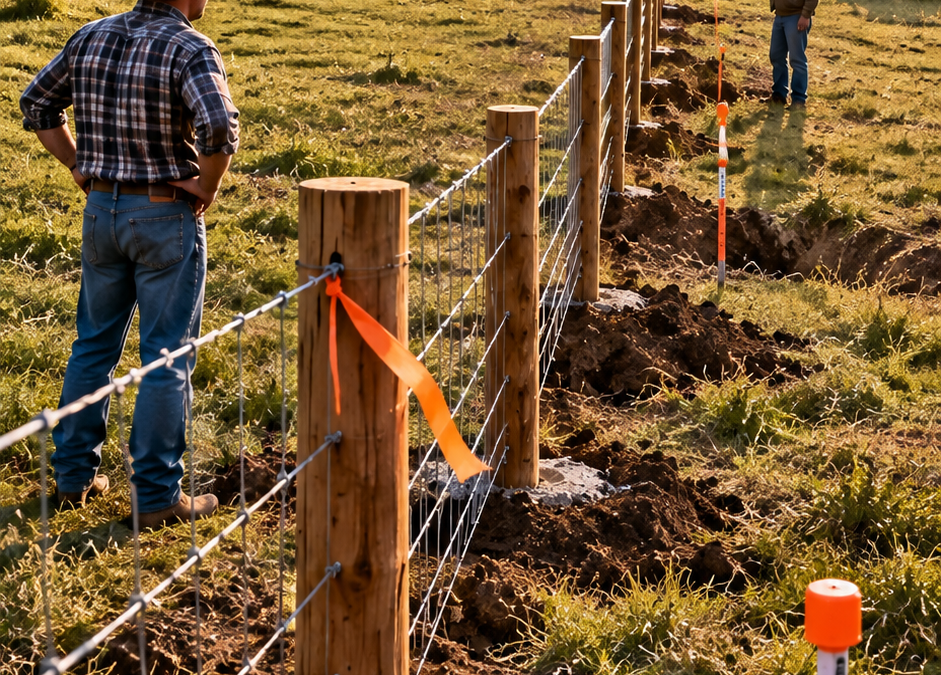
A straight line of cedar posts cut across my pasture from the creek toward the northern tree line.
Fresh wire.
Fresh concrete.
Fresh dirt around every post.
Tied to the nearest post was an orange ribbon that snapped lightly in the morning wind.
For a moment, my mind refused to accept what my eyes were seeing.
I said it out loud even though nobody was standing beside me.
“That fence wasn’t there when I went to bed.”
I walked down from the porch still holding my coffee.
The closer I got, the worse it looked. The posts were new, set deep, and spaced evenly. They did not follow the drainage ditch. They did not follow the old boundary my father had shown me. They ran in a clean, aggressive line straight through my pasture.
Eighty feet inside.
That was not a mistake a person made casually.
Then I heard an engine.
Richard Hail came across the field on his utility vehicle, driving from his side toward the new fence like a man arriving to inspect work he had already decided was correct. He stopped on the opposite side of the wire, stepped out, and gave me a nod.
“Morning, Jack.”
I pointed at the posts.
“What is this?”
Richard did not hesitate.
“Property line.”
“No, it isn’t.”
His expression barely changed.
“Survey says otherwise.”
I stared at him.
Richard had lived beside me for six years. He was not a terrible neighbor at first. He kept his place clean, waved when we passed on the road, and mostly minded his own business. But over time, I began to understand something about him. Richard liked control. He liked straight lines, cleared brush, fresh gravel, and having the last word. If something was inconvenient, he did not adapt to it. He tried to force the world to match what he wanted.
Still, I had never expected this.
I looked at the new fence again.
“My father owned this land before me,” I said. “The boundary follows the drainage ditch.”
Richard folded his arms.
“We’ve had it wrong for years.”
“We?”
“The properties. The records. The practical use.”
“My deed says otherwise.”
“Then your deed is wrong.”
That irritated me more than the fence.
A bad assumption was one thing. Standing on my land and telling me my deed was wrong because his new posts said so was something else entirely.
I walked toward one of the orange-capped steel stakes.
“Who surveyed this?”
“Private company.”
“Which company?”
Richard climbed out of the utility vehicle.
“Doesn’t matter. The markers are there.”
He pointed toward three steel stakes topped with bright orange caps. They ran in a perfectly straight line through my pasture, clean and fresh and too perfect to belong to any old boundary.
I stared at them.
“You moved the boundary eighty feet.”
“I corrected it.”
Behind him, a compact tractor sat beside a pile of additional cedar posts.
That was when I realized he was not finished.
“You planning to keep building to the road?” I asked.
“I’m finishing the fence.”
“Not until I see the survey.”
Richard gave a short laugh.
“Jack, I’m not waiting another week to use property I already own.”
“When do you get the paperwork?”
“The surveyor will send it.”
“When?”
“Next week.”
“But you built the fence today.”
He looked toward the tractor.
“I’m not delaying my property because you don’t understand yours.”
His son Tyler drove up carrying more cedar posts.
Tyler was in his early twenties, quiet, broad-shouldered, and usually polite. He looked uncomfortable the moment he saw me standing there, but he kept driving toward his father.
That told me everything.
This was not a misunderstanding Richard intended to discuss.
It was something he intended to finish.
I stepped directly in front of the tractor.
“Nobody installs another post.”
Richard’s face hardened.
“Don’t interfere with my equipment.”
“Get it off my pasture.”
“My pasture.”
We stood there staring at each other across twenty feet of grass we had both known for years.
Then Richard pointed at one of the orange stakes.
“There’s the survey marker. That’s all the proof I need.”
I looked down.
Something about it bothered me.
The steel was clean. The cap was bright. The soil around it was freshly disturbed.
But I remembered another marker.
Years earlier, while replacing a drainage pipe with my father, we had found an old iron pin near the ditch. I could still see him bending down, tapping it with the toe of his boot, and speaking in that low, serious voice he used when he wanted me to remember something.
“Don’t ever pull that,” he had said. “That’s the corner.”
I turned toward the ditch.
The pin was not visible anymore.
Neither was the second one near the oak tree.
Richard watched me looking.
“What?”
“Where are the old markers?”
He shrugged.
“What old markers?”
The answer came too quickly.
I walked toward the drainage ditch.
Richard followed.
“Jack, you’re wasting your time.”
“Maybe.”
Near the oak, I noticed a patch of ground that did not match the rest of the grass. It had not been mowed. It had been cut away in a square.
I crouched.
Beneath loose soil was a shallow depression.
Something had been dug there.
Richard stopped behind me.
“Probably an animal.”
I looked at the shovel marks.
“Animals use shovels now?”
He said nothing.
I stood.
“Fence construction stops.”
“You don’t have authority to stop me.”
“No,” I said, taking another photograph. “But the county does.”
Twenty minutes later, I was driving toward the county survey office with my deed on the passenger seat.
Richard probably thought those new orange markers had settled the argument.
But I remembered my father’s boot touching that old iron pin.
If I was right, the real boundary had not moved eighty feet.
Someone had only moved what people could see.
The county technician stopped smiling when I showed him the photographs.
His name was Aaron Mills. He looked young at first glance, but he had the careful eyes of someone who had seen too many land disputes begin with a neighbor claiming to have “fixed” a boundary.
He zoomed in on the first orange-capped stake.
“Who set these?”
“My neighbor says a private surveyor.”
“Do you know which one?”
“He wouldn’t tell me.”
Aaron enlarged the cap.
There was no company number. No license identification. Nothing except bright orange plastic.
“That’s unusual,” he said.
“Illegal?”
“Not necessarily. But a boundary surveyor normally documents monumentation. They don’t just drop anonymous caps and walk away.”
I handed him my deed.
Aaron pulled up the county parcel map. My property appeared in blue. Richard Hail’s parcel appeared in yellow. Between them, the mapped boundary followed the drainage ditch exactly where I remembered it.
I pointed at the screen.
“His new fence is about here.”
Aaron stared.
“That’s not close.”
“About eighty feet.”
He opened an older recorded plat.
Same line.
Then another.
Same line again.
“Has either parcel been legally adjusted?” he asked.
“Not since my father bought ours.”
Aaron searched.
No boundary line agreement.
No lot line adjustment.
No recorded transfer.
He leaned back in his chair.
“Property boundaries don’t move because someone installs new stakes.”
That was the first good sentence I had heard all morning.
Then my phone rang.
Richard.
I answered.
“Where are you?” he asked.
“County office.”
Silence.
Then his voice changed.
“You didn’t need to involve them.”
“You built a fence eighty feet into my pasture.”
“I told you there’s a survey.”
“Who surveyed it?”
Another pause.
“Langford.”
Aaron heard the name. His eyebrows lifted.
I covered the phone.
“What?”
He turned his monitor toward me.
Langford Surveying had closed four years earlier.
Its owner had retired.
I uncovered the phone.
“Richard, Langford Surveying hasn’t operated in four years.”
Silence.
Then he hung up.
Aaron leaned back.
“Now I’m interested.”
He called the county surveyor.
By noon, two county employees followed me home.
Richard’s tractor was gone.
The new fence was not.
Neither was Richard.
Aaron and county surveyor Maria Torres began at the road, comparing recorded measurements with visible features. Maria was direct, calm, and impossible to rush. She studied the ground before speaking, which made Richard increasingly nervous when he came storming across his yard fifteen minutes later.
“What are they doing?” he demanded.
Maria answered without looking up from her tablet.
“Reviewing reported boundary monument concerns.”
“This is private property.”
“Yes,” she said calmly. “And we are here at Mr. Cole’s request on his side.”
Richard pointed toward the orange stakes.
“Those are professionally surveyed.”
“By whom?”
“Langford.”
Maria looked at him.
“Full name.”
Richard hesitated.
“Robert Langford.”
Maria’s expression changed.
“Robert Langford died two years ago.”
Richard went pale.
I did not say anything.
Maria crouched beside the nearest orange stake. She photographed it, measured its position, then compared it to her equipment.
“This point does not correspond with the recorded boundary.”
Richard folded his arms.
“Old records can be wrong.”
“They can,” Maria said.
His confidence returned slightly.
Then she added, “That is why original monuments matter.”
I looked toward the ditch.
“So we find the old pins.”
Richard laughed.
“Those things have been gone for decades.”
Maria turned toward him.
“How do you know?”
He froze only for a second.
But Aaron noticed.
So did I.
Maria walked toward the oak tree. I showed her the square of disturbed soil.
She crouched and brushed away loose dirt.
“Someone excavated here recently.”
Richard shook his head.
“You can’t prove that.”
Nobody had accused him.
Not yet.
Then Aaron called from the ditch.
“Maria.”
We hurried over.
He was holding a handheld metal detector. It gave a sharp tone over a patch of compacted earth, not where Richard’s orange stake stood.
Eighty feet away.
Exactly where my father had shown me.
Aaron marked the spot.
Maria looked at Richard.
“We’ll need to expose whatever is under there.”
Richard stepped forward.
“No.”
Everyone turned.
His face had changed completely.
“You’re not digging there.”
Maria stood slowly.
“Why not?”
Richard looked at the ground, then at me, and for the first time that day, he had no answer.
Maria did not touch the shovel immediately. She looked at Richard instead.
“Mr. Hail, we are standing on Mr. Cole’s parcel according to every recorded document currently in front of me.”
Richard pointed toward the detector mark.
“That doesn’t give you permission to excavate.”
“I gave permission,” I said.
He turned on me.
“You don’t know what’s buried there.”
The words came out before he could stop them.
Aaron and Maria exchanged a glance.
I felt my stomach tighten.
“What exactly do you think is buried there, Richard?”
He shook his head.
“That’s not what I meant.”
Maria photographed the marked spot. Then she called someone at the county office.
While we waited, Richard paced beside his utility vehicle.
Tyler came across the field.
“Dad, what’s happening?”
“Nothing.”
Tyler looked at the county equipment.
“This doesn’t look like nothing.”
Richard pulled him aside. Their voices dropped. Then Tyler looked toward me, confused rather than angry.
That mattered.
A county maintenance truck arrived twenty minutes later carrying hand tools and a second detector.
Maria explained that they would expose the object carefully without disturbing its position.
Richard immediately started filming.
“Good,” Maria said. “Keep recording.”
That surprised him.
Aaron removed the top layer of soil.
Two inches.
Four.
The detector signal grew stronger.
At seven inches, his hand tool struck metal.
Clink.
Nobody spoke.
Aaron brushed away the dirt.
A rusted iron rod appeared.
Maria crouched beside it.
“Don’t move it.”
She cleaned around the top. Then she found a small brass cap, weathered and dark, but still readable.
County survey control.
My chest tightened.
I remembered my father’s boot touching that exact spot.
Richard stared at the pin.
“That proves nothing.”
Maria looked up.
“It proves an original monument exists where the recorded plat indicates one should exist.”
“It could have been placed later.”
Aaron almost laughed.
Maria did not.
“We’ll verify it.”
Then the second detector sounded near the oak.
Another signal.
We moved fifty yards north.
Same process.
Loose soil.
Compact earth.
Seven inches down.
Another iron pin.
This one had been covered by a flat piece of broken concrete.
Maria photographed everything before touching the surrounding soil.
Then Aaron noticed something.
“Look at this.”
Beside the second pin were narrow scrape marks.
Recent.
Someone had dug down to it before.
Tyler stepped closer.
“Dad.”
Richard said nothing.
Tyler looked at the exposed marker.
“You told me there weren’t any old pins.”
Richard snapped, “Stay out of this.”
Tyler’s face changed.
“You had me help build that fence.”
Nobody moved.
Richard lowered his voice.
“We relied on the new survey.”
“What survey?” Tyler asked.
“The Langford survey.”
Tyler stared at him.
“That’s the map you printed in your office.”
Richard went completely still.
Maria turned.
“Printed?”
Tyler looked between us.
“Yeah. Dad had an old property map on his computer. He changed some lines because he said the county records were inaccurate.”
Richard stepped toward him.
“Tyler.”
Maria raised one hand.
“Don’t coach him.”
Richard’s face flushed.
“This is becoming ridiculous.”
Then a truck pulled up beside my driveway.
Evelyn Marsh, who owned the property across the road, climbed out holding a cardboard tube.
“I heard county survey was here,” she said.
She walked toward me.
“Jack, your father gave my husband this years ago when they replaced the creek culvert.”
She opened the tube.
Inside was an old survey drawing.
Original signatures.
Original measurements.
Two handwritten circles marking the iron pins we had just uncovered.
Maria studied it carefully.
Then she pointed toward a note in the margin.
“What does that say?”
I leaned closer.
Set permanent pins below grade to prevent disturbance by farm equipment.
Below grade.
That was why nobody had seen them.
They had not disappeared.
They had been intentionally buried for protection.
Maria looked from the drawing to the exposed monuments, then toward Richard’s new orange stakes eighty feet away.
“The original boundary evidence is becoming very consistent.”
Richard backed toward his vehicle.
“I’m calling my attorney.”
“That’s your right,” Maria said.
He opened the utility vehicle door.
Then Aaron noticed something inside the cargo bed.
A sledgehammer.
A post puller.
Three orange-capped steel stakes identical to the ones marking Richard’s new line.
Tyler stared at them.
So did I.
Maria quietly took another photograph.
Richard slammed the tailgate shut, but by then everyone had seen enough.
Richard’s attorney arrived before lunch.
His name was Paul Mercer, and the first thing he did was tell Richard to stop talking.
That was probably the smartest advice Richard had received all day.
Paul studied the exposed pins, Evelyn’s old survey, and Maria’s county maps. Then he walked toward the new fence.
“Who installed this?”
Richard answered before Paul could stop him.
“I did.”
“Based on what?”
“The corrected boundary.”
Paul closed his eyes.
“What corrected boundary?”
Richard pointed toward the orange stakes.
“Those.”
Paul looked at Maria.
“Who set them?”
“That’s one of the questions we’re trying to answer.”
Richard’s son spoke quietly.
“Dad did.”
Every head turned.
Richard stared at Tyler.
“What are you talking about?”
Tyler looked uncomfortable, but he did not back down.
“You put the stakes in last weekend. I helped you. You told me they were temporary reference stakes.”
Richard’s face reddened.
“They were.”
“Then why did we build the fence on them?”
Paul stepped between them.
“Enough.”
Maria wrote something in her notebook.
I stood beside Evelyn and said nothing.
I did not need to.
The story was changing without my help.
Then Aaron called from farther north.
“We’ve got another signal.”
The recorded boundary had three original reference points along the pasture. We had found two. The third should have been near an old limestone outcrop.
Richard immediately objected.
“That area is on my side.”
Maria checked her tablet.
“According to the recorded plat, it isn’t.”
We walked toward the rocks.
The detector began chirping, then screaming.
Aaron marked the spot.
This time, the soil looked different.
Loose.
Recently replaced.
Maria crouched.
“Photograph before excavation.”
Aaron did.
Then he carefully removed the topsoil.
At five inches, he uncovered a piece of steel, but it was not standing vertically.
It was lying sideways.
Bent.
Maria’s expression changed.
“That is not natural disturbance.”
Aaron exposed more.
The brass cap matched the other original pins.
Someone had pulled this monument from its position and buried it horizontally two feet away.
Tyler whispered, “Dad.”
Richard said nothing.
Paul’s face tightened.
“Richard, I need to speak with you privately.”
Before they could move away, Evelyn interrupted.
“I may have something else.”
She opened her phone.
“My wildlife camera covers the creek crossing.”
Richard looked at her sharply.
“What wildlife camera?”
“The one that’s been there since deer started eating my garden.”
She scrolled through recordings.
Three nights earlier.
11:47 p.m.
Headlights appeared near the pasture.
A utility vehicle stopped beside the limestone outcrop.
Two people got out.
Richard and Tyler.
Tyler stared at the screen.
“I didn’t know what he was doing.”
The video showed Tyler holding a flashlight. Richard carried something long.
A post puller.
He disappeared behind the rocks.
Minutes later, he returned carrying an object.
The timestamp continued. Then Richard knelt near the ground.
Maria leaned closer.
“Can you send me that file?”
Paul immediately said, “We’d like to review it first.”
Evelyn shook her head.
“It’s my camera.”
She sent it.
Richard finally lost control.
“This is insane. That boundary has been wrong for decades.”
I looked at him.
“Then why not hire a real surveyor?”
He turned toward me.
“Because nobody listens unless you force the issue.”
Silence.
Even Paul stopped moving.
Maria looked directly at Richard.
“Did you remove that monument?”
Richard realized what he had said.
His mouth opened.
Nothing came out.
Then a county sheriff’s cruiser turned into my driveway.
Maria had called earlier after finding evidence that an original survey monument may have been disturbed.
Deputy Nolan Price stepped out.
He looked at the exposed pins, the bent marker, the new fence, and the group gathered around it.
“All right,” he said. “Who’s going to explain why I’m here?”
Richard pointed at me.
“This is a civil boundary dispute.”
Deputy Price looked toward Maria.
She shook her head.
“It started as one.”
Then she pointed at the original pin lying underground.
“Now we have evidence somebody physically disturbed a recorded survey monument.”
Deputy Price did not ask Richard another question immediately.
He asked Maria to walk him through the evidence from the beginning.
She started with the recorded plat.
Then the eighty-foot discrepancy.
Then the two original pins found exactly where historical records predicted.
Finally, she showed him the third monument lying bent beneath recently disturbed soil.
Price crouched beside it.
“This was supposed to be upright.”
“Yes,” Maria said.
“And in a different location?”
“Approximately two feet southwest, based on the original field notes.”
Richard’s attorney stepped forward.
“Deputy, we’re not conceding that anyone intentionally moved anything.”
Price stood.
“I didn’t ask you to.”
That quieted Paul.
Then Evelyn showed him the wildlife camera footage.
Price watched it once.
Then again.
The second time, he paused when Richard disappeared behind the limestone outcrop carrying the post puller.
“What date?”
“Three nights ago,” Evelyn said.
Price looked toward Richard.
Paul immediately answered.
“My client won’t be making a statement.”
“Understood.”
Tyler raised his hand slightly.
“I will.”
Richard spun toward him.
“No, you won’t.”
Price’s expression hardened.
“Mr. Hail, don’t tell another adult whether he can speak to me.”
Tyler looked terrified, but he continued.
“Dad told me we were fixing the boundary.”
“What did that mean?” Price asked.
“He said the old markers were wrong.”
“Did you see him remove one?”
Tyler swallowed.
“Yes.”
Richard closed his eyes.
“He used the puller near the rocks. Then he told me to shine the light while he buried it farther over.”
Paul whispered something under his breath.
Price wrote it down.
Then Tyler added something nobody expected.
“There was another night.”
Richard’s head snapped up.
“What?”
“Last month.”
Tyler looked at me.
“I’m sorry, Jack.”
“For what?”
“Dad had me help find the markers near the ditch.”
My stomach tightened.
“Before the fence?”
He nodded.
“We used a metal detector.”
Maria stepped closer.
“You located the original monuments before setting the new stakes?”
Tyler nodded again.
Richard exploded.
“He doesn’t know what he’s talking about.”
Tyler flinched.
Price moved between them.
“That’s enough.”
But Tyler was not finished.
“We found two. Dad measured from them. Then he said the deed description had to be wrong because it left the equipment shed on Jack’s side.”
I looked toward Richard’s property.
His new metal equipment shed had been built the previous summer near the disputed strip.
Suddenly, the eighty feet made sense.
Maria opened the aerial parcel map.
“Where is the shed?”
I pointed.
She zoomed in. The structure sat close to the recorded boundary.
Aaron took measurements from the original pin. Then he looked at Maria.
“Part of it crosses the line.”
Richard went silent.
Not the whole building.
But one corner and part of the concrete pad appeared to extend onto my parcel.
Evelyn whispered, “That’s why.”
Richard had not discovered a boundary problem.
He had created one because his new building had crossed the real line.
Then a white pickup stopped near the road.
A man stepped out wearing a survey vest.
He introduced himself as Samuel Reed, a licensed surveyor.
Paul looked relieved.
“Finally.”
Richard pointed at him.
“That’s my surveyor.”
Samuel frowned.
“Your what?”
Richard froze.
Samuel looked around.
“Mr. Hail called me yesterday asking for a boundary survey. I told him I could inspect next week.”
Maria pointed toward the orange stakes.
“Did you set those?”
Samuel walked over and examined one.
“No.”
“Did anyone from your company?”
“Absolutely not.”
Richard’s face drained.
Samuel turned toward him.
“You told me no monuments were visible.”
Maria pointed at the exposed original pins.
“We found three.”
Samuel stared at them, then at Richard.
“You already knew these were here, didn’t you?”
Richard said nothing.
Price closed his notebook.
That silence answered enough.
The new fence had not followed a professional survey.
The orange markers were not official.
The man Richard had finally hired to justify the boundary was standing in my pasture, looking at the original pins and realizing he had been called after the line had already been moved.
Samuel Reed did not begin Richard’s survey.
He called his office instead.
“Cancel the Hail job.”
Richard stared at him.
“You can’t do that.”
Samuel slipped his phone into his vest.
“I can when a client gives materially false information about existing monuments.”
“I hired you to establish the boundary.”
“No,” Samuel said. “You hired me yesterday.”
He pointed toward the new fence.
“That was already here.”
Paul stepped toward Richard.
“Did you tell me Reed set those orange stakes?”
Richard did not answer.
Paul’s expression changed.
Apparently, I was not the only person Richard had misled.
Deputy Price asked Samuel to inspect the exposed pins without moving them.
Samuel checked the brass caps, compared their identification numbers with Maria’s records, then examined Evelyn’s old survey.
“These appear consistent with original monumentation.”
Richard immediately said, “Appear.”
Samuel looked at him.
“Yes. Because unlike you, I do not declare a boundary before completing fieldwork.”
Tyler looked down to hide a smile.
Then Maria received a call.
She listened for less than a minute.
“We found the archived field book.”
Aaron stepped closer.
“Original survey?”
“1978.”
The county office emailed scanned pages to her tablet.
Handwritten bearings.
Distances.
Reference trees.
Creek measurements.
Monument numbers.
Maria read the first number aloud.
Samuel crouched beside the nearest pin.
“Match.”
Second number.
“Match.”
Then the third.
The bent pin near the limestone.
“Match.”
Nobody spoke.
Samuel began checking distances with his equipment.
First point to second.
Second to third.
When he finished, he looked toward the orange stakes eighty feet inside my pasture.
“The original monuments fit the recorded survey.”
Richard folded his arms.
“That doesn’t explain my deed.”
“Let me see it,” Samuel said.
Richard hesitated.
Paul finally said, “Give him the deed.”
Richard retrieved a folder from his utility vehicle.
Samuel read the legal description.
Then mine.
Then he walked toward Richard’s equipment shed.
Five minutes later, he called us over.
“Here’s your problem.”
He pointed at Richard’s deed.
“You’re reading this bearing backward.”
Richard frowned.
“No.”
“Yes.”
Samuel traced the description.
“This call runs from the creek monument northeast toward your parcel corner. You interpreted it southwest from the road.”
Aaron looked at the measurements.
“That would create roughly the eighty-foot shift.”
“Exactly,” Samuel said.
Richard had taken a line he did not understand, reversed it, and treated the result like law.
But Maria was not finished.
“Except he found the original pins first.”
Everyone looked at Tyler.
He nodded.
“We found them last month.”
Samuel stared at Richard.
“So after the monuments contradicted your interpretation, you moved one and installed your own markers.”
Paul stepped between them.
“Don’t answer.”
Richard did not need to.
Deputy Price had already heard Tyler’s statement.
He had Evelyn’s video.
Maria had photographs.
And now the archived field book matched all three original pins.
Then Aaron called from the equipment shed.
“Jack, you need to see this.”
He had placed a temporary line between the verified monuments.
It ran directly beneath one corner of Richard’s concrete pad.
Samuel measured the encroachment.
“Nine feet, four inches at the farthest point.”
Richard looked stunned.
“My building permit was approved.”
Maria answered.
“A building permit does not grant ownership of neighboring land.”
Richard looked at me.
For the first time, there was no arrogance in his face.
Only calculation.
“Jack, we can work something out.”
Yesterday, he had told me my deed was wrong.
That morning, he had tried to stop the county from uncovering the pins.
Now he wanted cooperation.
I looked at his fence cutting through my pasture.
Then at the corner of his shed sitting over my boundary.
“First,” I said, “the fence comes down.”
Richard shook his head.
“I’m not agreeing to anything yet.”
Deputy Price glanced toward him.
“That’s between you two.”
Then he looked at the bent original monument.
“But the disturbed survey marker is between you and the county.”
Richard’s face tightened again.
Price closed his notebook.
“And I’m going to need you to come with me to provide a formal statement.”
For the first time since this started, Richard was not arguing about where the boundary was.
The original pins had already answered that.
Richard did not leave in handcuffs. Deputy Price made that clear before anyone could turn the situation into something it was not.
But Richard did follow the cruiser downtown in his attorney’s car to give a formal statement about the disturbed monument.
The pasture suddenly felt quiet.
Too quiet.
Tyler remained behind, staring at the new fence.
“I’m sorry, Jack.”
I looked at him.
“You believed your father.”
“At first.”
He kicked at the grass.
“Then he started doing things at night.”
That sentence stayed with me.
Maria and Samuel spent the afternoon documenting every original pin. By four o’clock, Samuel had enough measurements for a preliminary boundary reconstruction.
He stretched a temporary fluorescent line between the verified monuments.
It followed the ditch.
Past the old oak.
Across the limestone outcrop.
Exactly where my family had treated the boundary for decades.
The new cedar fence stood eighty feet west of it.
On my side.
Samuel looked toward Richard’s shed.
“And there’s the second problem.”
The fluorescent line disappeared beneath the concrete pad.
Nine feet, four inches.
I photographed it.
Then a woman approached from Richard’s property.
His wife, Karen.
I had known her for years. She looked exhausted.
“Jack, can we talk?”
Tyler quietly walked away.
Karen stopped near the fence.
“Richard told me you were trying to take part of our property.”
“I haven’t moved anything.”
“I know that now.”
She looked toward the exposed pins.
“He said the county maps were wrong.”
“He knew where the original markers were.”
Her face tightened.
“I found something.”
She handed me an envelope.
Inside was an invoice from a fencing contractor dated two months earlier.
Estimate: relocate east boundary fence.
Attached was a sketch.
The proposed line matched Richard’s orange stakes.
At the bottom, the contractor had written:
Owner to provide survey confirmation before installation.
Below that was a handwritten note.
Self-install. No survey needed.
I looked at Karen.
“Is that Richard’s writing?”
She nodded.
Then she handed me another page.
A property appraisal for their house, dated three months earlier.
The equipment shed was listed as a major improvement.
Karen pointed at the estimated lot dimensions.
“He was refinancing.”
Everything clicked.
If the shed crossed onto my property, the refinance could become complicated.
Maybe expensive.
Maybe embarrassing.
Richard had not moved the markers because he suddenly discovered eighty feet.
He needed eighty feet to make the shed fit comfortably inside his parcel.
Then my phone rang.
Deputy Price.
“Jack, I need to ask you something.”
“What?”
“Did Richard ever offer to buy land from you near that shed?”
I thought back.
Karen looked at me.
“He did.”
“When?”
“Last summer.”
Karen covered her mouth.
“Before he poured the concrete,” she whispered.
That changed everything again.
Richard had not merely misunderstood the boundary after building the shed.
He may have known the boundary was a problem before construction.
Price asked me to forward any messages.
I searched my phone.
There it was, eleven months earlier.
Richard: Would you consider selling 15 to 20 ft along our shared line? Planning a building and could use extra setback.
My reply: Not interested. We use that pasture and drainage corridor.
I sent the screenshot.
Karen sat down on a fence post.
“He told me the shed was nowhere near your land.”
Before I could answer, Samuel called from the oak.
“Jack.”
He was examining the hole where the second pin had been uncovered.
“What?”
“Look at the soil.”
Beside the original monument were several small fragments of bright orange plastic, the same color as Richard’s new marker caps.
Samuel picked one up with gloves.
“Someone tried setting a replacement stake almost directly beside the original pin first.”
Maria photographed it.
“Then apparently changed their mind.”
Samuel looked toward the false line eighty feet away.
“They didn’t just guess wrong.”
I stared across the pasture.
First Richard found the real boundary.
Then he tested a marker beside it.
Then he moved the claimed line eighty feet.
Then he built the fence.
Step by step.
Deliberate.
My phone buzzed again.
A message from Deputy Price.
Do not disturb any markers or fence materials tonight. County investigator will be there at 8 a.m.
I showed Maria.
She nodded.
“Good.”
I looked toward Richard’s empty house.
The argument was no longer about whether the old pins were accurate.
Now the county wanted to know exactly how far Richard had gone to make them disappear.
The county investigator arrived at eight exactly.
Her name was Dana Brooks.
She did not start with Richard’s fence.
She started with the original pins.
Maria walked her from the creek to the oak, then to the limestone outcrop.
Three monuments.
Three matching identification numbers.
One bent and displaced.
All matching the archived 1978 field book.
Dana photographed the orange plastic fragments beside the second pin.
Then she looked toward the false boundary.
“Eighty feet.”
Samuel nodded.
“Approximately.”
Richard returned at 8:40 with Paul.
He looked exhausted, but the confidence was back.
“My attorney says this remains a civil property dispute.”
Dana closed her evidence case.
“The location of your fence may be civil. The handling of county-recognized survey monuments is a separate issue.”
Paul touched Richard’s arm.
“Don’t respond.”
For once, Richard listened.
Then Samuel handed Dana his completed preliminary survey.
She studied it.
“The shed crosses too?”
“Nine feet, four inches at maximum.”
Richard looked at me.
“Jack, I’ll move the fence if we settle the shed.”
There it was.
His first real concession.
But it was not an apology.
It was a trade.
“You’ll move a fence that is already on my land if I give you land under your building.”
Paul quietly said, “Richard, too late.”
Dana had heard it.
So had Karen.
She stepped out of their yard holding another folder.
Richard’s face changed.
“What are you doing?”
“Ending this.”
She handed the folder to Paul.
He opened it.
Construction drawings for the equipment shed.
A site sketch was clipped to the front. The real drainage ditch was clearly marked. So was my property line. And the proposed building sat six feet from it.
Samuel stared.
“This is not where the shed was built.”
“No,” Karen said.
Richard stepped forward.
“Those were preliminary plans.”
Karen shook her head.
“You moved the building after the permit.”
Silence.
She pointed toward the concrete pad.
“He wanted more room between the shed and our driveway.”
I stared at Richard.
“So you shifted it toward my property.”
He said nothing.
Karen continued.
“I told him to check the boundary. He said Jack would never notice a few feet.”
Richard’s face went white.
Paul closed the folder.
“Karen, you should consider separate legal advice before making additional statements.”
She looked at him.
“I didn’t move anything.”
That ended that.
Dana asked for copies.
Karen agreed.
Then a county building inspector arrived.
He compared the approved site plan with the actual shed location.
Measured.
Checked again.
Finally, he attached a notice to the building.
Site Location Under Review. No Further Work.
Richard lost control.
“This is my building.”
The inspector remained calm.
“Part of the foundation appears inconsistent with your approved plan and may extend beyond your parcel.”
Richard turned toward me.
“This is what you wanted, isn’t it?”
“No.”
I pointed at the original pins.
“I wanted you to leave the boundary where it was.”
He stared at me.
Then Tyler walked out carrying a cardboard box.
“Dad.”
Richard looked over.
Tyler set the box on the grass.
Inside were orange caps, steel stakes, a can of marking paint, and an old metal detector.
“I found these in the workshop.”
Richard’s shoulders dropped.
Dana crouched beside the box.
“May I photograph this?”
Tyler nodded.
Then he pulled out one final item.
A folded county parcel map.
A red line had been drawn eighty feet inside my property.
In Richard’s handwriting beside the new line were four words.
Move fence before appraisal.
Karen covered her mouth.
Paul stared at his client.
Dana photographed the note.
Richard did not argue.
He did not explain.
He simply looked across the pasture at the cedar fence he had built overnight.
By noon, Paul approached me alone.
“Mr. Cole, Richard will remove the fence.”
“All of it?”
“All of it.”
“And the shed?”
Paul looked toward the county notice.
“That will have to be resolved separately.”
Behind him, workers were already pulling wire from the first cedar post.
Richard had spent days insisting the orange stakes proved the land was his.
Now those stakes were coming out.
The old iron pins stayed exactly where they had been for nearly fifty years.
Underground.
Quiet.
Right.
By the end of the week, Richard’s fence was gone.
Not moved.
Gone.
Every cedar post came out of my pasture. Every strand of wire was rolled up. Every orange stake disappeared under county supervision. The grass still showed where the false boundary had crossed my land, but nothing stood there anymore pretending it was real.
The original pins stayed.
Maria had protective witness markers installed near each one so nobody would need a metal detector to locate the boundary again.
I stood beside the creek when she finished.
“Your father remembered correctly,” she said.
I looked at the small marker.
“He usually did.”
The equipment shed took longer.
A licensed survey confirmed Samuel’s preliminary measurement. Nine feet, four inches of the concrete pad crossed onto my parcel at the widest point.
Richard offered to buy the strip.
I declined.
Then he offered more.
I declined again.
Eventually, the county required him to resolve the encroachment before the building could receive final approval.
Two months later, a concrete saw arrived.
Miguel from the farm down the road called when he heard it.
“You watching?”
“From my porch.”
Workers removed the encroaching section of the pad and modified the corner of the structure.
It was not dramatic.
No shouting.
No police.
Just measurements finally being respected.
Richard barely spoke to me after that.
Tyler did.
One afternoon, he stopped beside my mailbox.
“I moved out.”
I was not surprised.
“Your dad okay?”
“He’ll be okay.”
Tyler hesitated.
“I’m still sorry.”
“You already said that.”
“I know. I just wanted you to know I should have asked questions sooner.”
I looked toward the ditch.
“We all trust people longer than we should sometimes.”
He nodded and left.
Karen sent me a handwritten note a few weeks later apologizing for what happened.
I kept it.
Not because I needed the apology, but because it reminded me that Richard’s decisions had hurt people on both sides of the boundary.
The county investigation eventually closed. I was not given every detail, and I did not need them.
What mattered to me was recorded permanently.
The original monuments were verified.
The boundary was reaffirmed.
The false markers were documented.
My eighty-foot strip remained exactly where it had always been.
That fall, I repaired the pasture where Richard’s posts had been. I filled the holes, reseeded the bare spots, and fixed the drainage edge. By spring, you could barely tell a fence had ever crossed there.
Evelyn came over one morning while I was checking the creek.
“Looks normal again.”
“That’s the idea.”
She pointed toward one of the new witness markers.
“Funny how something that small caused all that trouble.”
I shook my head.
“The marker didn’t cause anything.”
She smiled.
“Fair point.”
Richard had treated a property line like something negotiable, something he could redraw because his shed was inconveniently placed.
He found the real pins.
He knew what they meant.
Then he buried one, ignored the others, planted new stakes eighty feet away, and built a fence before anyone could challenge him.
For one night, it worked.
I woke up and saw cedar posts standing where they had no right to be.
If I had not remembered my father showing me that old iron pin, maybe I would have doubted myself longer. Maybe I would have assumed Richard had paperwork I had not seen. Maybe I would have believed confidence meant proof.
That is what confidence can do.
It can make something false look settled.
But land remembers differently.
Old surveys remain in archives.
Measurements repeat.
Neighbors keep drawings.
Cameras record things.
And iron pins buried seven inches underground do not care what somebody claims above them.
They are still there today.
One by the creek.
One near the oak.
One beside the limestone.
I do not see them every morning.
I do not need to.
I know exactly where they are.
And so does Richard.
He moved the markers everyone could see.
The ones underground told the truth.








