𝗣𝗔𝗥𝗧 𝟮 The Faded Tattoo on My Arm Meant Nothing to the Men Laughing at It
𝗣𝗔𝗥𝗧 𝟮
Frank gave me a look.
“Senior enough that I’m not telling you to behave because I know you already know how.”
“That is disappointingly vague.”
“Four stars.”
I stopped for half a beat.
“Admiral?”
“Yeah.”
“Who?”
Frank named the retiree, not the guest.
I recognized the name vaguely.
Not someone I had served directly with.
“Need me in back?”
“No. Keep the main floor clean. I’ll handle them.”
“Fine.”
“Also, corner booth is getting loud.”
“I noticed.”
Frank snorted.
“Of course you did.”
The six men had arrived at 7:15.
Young.
Fit.
Close haircuts.
Civilian clothes that still somehow looked military because posture is difficult to disguise.
They took the corner table without waiting for me to seat them.
I knew what they were before one of them said anything.
SEALs.
Junior enough that the confidence was still visible.
There is a particular stage in certain military careers where a person has survived difficult training, earned something legitimately hard, and has not yet accumulated enough experience to understand that accomplishment and wisdom are not the same thing.
These six were living squarely inside that stage.
Loud.
Happy.
Celebrating.
Probably deserved to celebrate whatever they had completed.
That didn’t bother me.
Confidence rarely bothers me until it starts requiring an audience.
They ordered six drinks before I finished laying down the coasters.
The loudest one sat nearest the aisle.
Late twenties.
Square jaw.
Short brown hair.
Athletic enough that even sitting still looked competitive.
His name was Garrett.
I learned that because two of the others used it every thirty seconds.
“Garrett, shut up.”
“Garrett, tell her what happened.”
“Garrett, you owe me twenty bucks.”
Garrett clearly enjoyed being Garrett.
I delivered the first round.
No trouble.
Second round at 7:40.
Volume increasing predictably.
I approached with six glasses.
Worked clockwise.
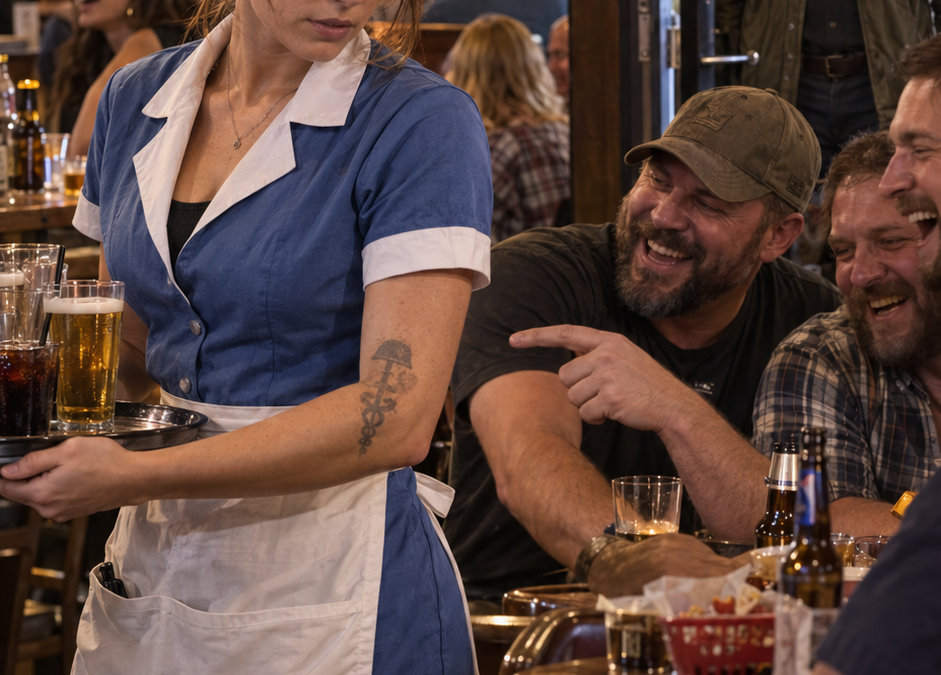
When I leaned across Garrett to set down the third drink, his eyes landed on my forearm.
I felt the shift before I looked.
People have a way of leaning toward whatever they have decided is entertaining.
Garrett stared at the tattoo.
Then at the man beside him.
A smile began.
I knew the kind.
“What the hell is that?”
I kept placing drinks.
“What?”
He pointed.
“That.”
His teammate looked.
Then another.
“Tattoo?”
Garrett laughed.
I set down another glass.
“Is that supposed to be something?”
I didn’t answer.
He leaned closer.
“Seriously, did a kid draw that?”
The table laughed.
Not every man.
Five voices.
One man sitting farthest from me did not laugh.
I noticed because I notice absences more than noise.
Garrett looked pleased with himself.
“Looks like somebody tried to draw a target with their eyes closed.”
More laughter.
I placed the last glass.
Picked up my tray.
“Anything else?”
He seemed disappointed by the lack of reaction.
“What, you’re not going to defend the masterpiece?”
“No.”
“Lost a bet?”
“No.”
“First tattoo?”
I looked at him.
“No.”
My tone ended the transaction.
Not the joke.
Garrett laughed again as I walked away.
Behind the bar, Frank had stopped polishing a glass.
His eyes tracked me.
Then the table.
He started around the counter.
I shook my head once.
He stopped.
That was all.
I did not need him fighting battles I had no interest in fighting.
Frank returned to his position.
His jaw remained tight.
I went back to work.
Table twelve wanted another round.
Booth seven needed a check.
Someone had spilled a beer near the entrance.
The tattoo remained on my arm.
Garrett remained ignorant.
Neither fact required intervention.
I had been mocked before.
People in uniform are not magically protected from stupidity.
Women in special operations environments develop a particularly low sensitivity to casual disrespect because reacting to every small act would consume the energy needed for things that matter.
And those men did not know.
That was important.
They were laughing at an image.
Not the dead.
Not intentionally.
Ignorance is not innocence, but neither is it knowledge.
I had no desire to educate them.
The meaning of that tattoo did not become more real because six younger men recognized it.
It had survived fifteen years without their approval.
It would survive another hour.
Still, as I carried a tray toward the kitchen, memory opened slightly.
It always did when someone stared at the mark too long.
Spring, 2018.
The date printed in my official record does not match the date I remember.
That happens with classified operations.
Paperwork protects information.
Human beings protect memory.
Five of us.
That number remains correct.
The operation had a designation that I will never repeat.
The place had a name, but not one any public map would connect to what happened there.
We had entered expecting one kind of mission.
We discovered another.
That is the cleanest way I can say it.
Intelligence failed.
Communication failed.
Extraction failed.
Weather complicated everything.
Then people started getting hurt.
There were five of us trapped after the main element moved out.
Cole.
Bishop.
Raines.
Marlow.
Me.
Admiral Cole was not an admiral then.
Commander Nathan Cole.
Older than the rest of us.
Calm enough to make bad situations feel temporary.
He had the irritating habit of lowering his voice when everyone else started shouting.
People listened because they had to get quieter to hear him.
Bishop was thirty-three.
Married.
Two daughters.
He talked about them constantly.
Raines complained about everything.
Food.
Weather.
Equipment.
Politics.
Air conditioning.
Silence.
Marlow was the youngest.
Barely twenty-five.
Still convinced every impossible situation had a clever solution waiting if you moved fast enough.
I was the medic.
People imagine medics as the person following everyone else.
Sometimes we are.
Sometimes people follow us because the only direction that matters is toward whoever is bleeding.
That night—or morning, depending on which clock you trusted—we were isolated.
No clean extraction.
No reliable comms.
Two wounded.
One critical.
Our safe room had become unsafe several hours earlier.
We moved.
Then moved again.
At some point, Bishop looked at Cole and asked a question none of us wanted to hear.
“What if this is it?”
Cole said, “It isn’t.”
Bishop smiled.
“Strong briefing.”
“Shut up.”
That was the first time we discussed the tattoo.
Not seriously.
Raines had found a marker.
Somebody joked about leaving identification.
Marlow said if we survived, we should all get the same symbol.
“Something classy,” he said.
Raines suggested a skull.
I said if any of them made me look at another skull tattoo, I would let them bleed.
Bishop laughed so hard it hurt his ribs.
Cole asked, “Then what?”
I drew the first version.
Circle.
Cross inside.
Simple.
Medical cross.
Circle for the team.
Or maybe that was meaning we assigned later.
Memory romanticizes things if you let it.
At the time, I think I drew it because it was easy.
Marlow looked at the symbol.
“That’s terrible.”
“You draw one.”
“I can’t.”
“Then mine wins.”
Nobody had a tattoo kit.
Obviously.
What we had was field equipment, improvised needles, ink pulled together from materials I will not recommend anyone reproduce, and the kind of judgment people exercise when exhausted enough to make permanent decisions seem reasonable.
Cole went first.
Right arm.
He did not flinch.
Raines complained through the entire thing.
Bishop made jokes.
Marlow nearly backed out because he hated needles, which was particularly entertaining given the work he did.
I went last.
The lines were uneven because Bishop’s hand was shaking from blood loss.
I told him to stop.
He refused.
“I started it.”
“You’re making it crooked.”
“Character.”
“You’re hypotensive.”
“Character.”
Cole finally said, “Let him finish.”
So Bishop did.
That was why my cross leaned left.
His hand had started failing.
I remember looking at it afterward.
Five arms.
Five ugly symbols.
Marlow said, “When we get out, we get them fixed.”
Raines said, “Absolutely.”
Cole said nothing.
I said, “No.”
Everyone looked at me.
“We leave them.”
“Crooked?”
“Exactly like this.”
“Why?”
Because we survived this version.
I didn’t say that.
Not yet.
We had not survived.
We were still inside it.
By morning, Bishop was dead.
Raines died during extraction.
Marlow made it out.
For four years.
Then another operation.
Different country.
Different mission.
His death reached me through a message I read alone in my kitchen.
That left Cole and me.
Then, six years before the night in Frank’s Bar, I was told Cole had been lost.
Not officially declared dead to me in language I could verify.
Just enough information.
Operational silence.
No contact.
No public appearance.
Nothing.
I accepted the most likely answer.
There had once been five.
Then one.
Me.
That was what I believed.
So when Garrett laughed at the tattoo, he was not laughing at ink.
He was laughing at Bishop’s shaking hand.
At Raines complaining because pain frightened him.
At Marlow pretending not to hate needles.
At Cole lowering his voice while the world outside tried to kill us.
But he did not know any of that.
I did.
That was enough.
At 7:58, I took another tray to the SEAL table.
Third round.
Garrett had moved from joking to performing.
Alcohol had added confidence without adding judgment.
He saw the tattoo again.
“Oh, there it is.”
I ignored him.
His teammate laughed.
Garrett leaned toward me.
“You know, there are places that cover those up.”
I placed the drinks down.
“They’re called tattoo shops.”
I looked at him.
“I know what they’re called.”
“Could get something real.”
I set down another beer.
“Something that doesn’t look like bathroom graffiti.”
Two nearby tables went quiet.
Not completely.
Enough.
A woman sitting behind Garrett looked at him with open disgust.
The quiet SEAL at the far side shifted uncomfortably.
Still didn’t speak.
Garrett smiled at me.
“Seriously, what was it supposed to be?”
This time, I looked directly at him.
Two seconds.
Maybe three.
I considered telling him.
Not the full story.
Just enough.
Instead I decided he had not earned it.
“Your drink is on the left.”
His grin weakened.
“What?”
“You’re reaching for your teammate’s.”
He looked down.
I was right.
The table laughed at him instead.
That helped.
Not much.
I picked up the empty tray and walked away.
Frank intercepted me near the bar.
“I can throw them out.”
“No.”
“Olivia.”
“They’re loud, not dangerous.”
“They’re assholes.”
“That is not currently an ejection category in your written policy.”
“I own the policy.”
I almost smiled.
“Back room.”
Frank looked toward the clock.
Eight.
“Right.”
Then the front door opened.
I did not see the man immediately.
I was wiping the counter.
Frank did.
His posture changed.
Not dramatically.
Army recognition.
Senior rank entering a civilian room still does strange things to old muscle memory.
I looked toward the entrance.
Full dress uniform.
Four stars.
Sixty, maybe sixty-one.
Straight posture.
Silver hair.
Rows of ribbons.
The room registered him gradually.
A few veterans noticed first.
Then others followed their gaze.
The admiral took three steps inside.
Stopped.
He wasn’t looking toward the back room.
Not at Frank.
Not at the retirement party signage.
At me.
More specifically, my arm.
The towel stopped moving in my hand.
Something about his face struck me before recognition did.
Time changes people.
Rank changes posture.
Age reshapes bone and skin.
But certain ways of looking survive.
He stood utterly still.
Then my brain found the younger face beneath the older one.
No.
Impossible.
My fingers went cold.
Commander Nathan Cole had been fifty-ish when I last saw him.
This man was older.
Four stars.
Different hair.
Different weight.
Different world.
But the eyes.
Same.
The way he held his jaw.
Same.
The way his attention narrowed until everything else in the room ceased mattering.
Same.
I whispered his name.
“Cole.”
He could not possibly have heard from across the bar.
Still, he started toward me.
Slowly.
Not hesitant.
Measured.
The corner table fell quiet as he passed.
Junior SEALs recognize four stars even after drinks.
Garrett straightened.
The admiral ignored them.
He stopped opposite me.
Only the counter between us.
Neither of us spoke.
I looked at his right arm.
Long sleeve.
Buttoned cuff.
He looked at my tattoo.
Fifteen years disappeared.
I saw him younger.
Dust.
Blood.
A bad room.
Five arms.
Then he asked quietly, “Where were you in the spring of 2018?”
I knew exactly why he asked.
Authentication.
Not nostalgia.
Some habits never die.
I put the cloth down.
“A place with no public name.”
His face tightened.
I continued.
“On a mission with no public record.”
Cole closed his eyes.
One second.
Opened them.
His voice changed.
“Olivia.”
I had not heard him say my name in fifteen years.
The sound almost broke me.
“Nathan.”
His mouth twitched.
Nobody called Admiral Cole Nathan in this room.
I probably shouldn’t have.
Neither of us cared.
“You’re alive.”
I stared at him.
“So are you.”
That produced the faintest laugh.
Then disbelief.
Then something older and heavier than either.
“I thought…”
“Me too.”
He nodded.
Enough.
Later.
Then he looked at my tattoo again.
His right hand moved toward his cuff.
I knew what was coming before anyone else did.
“Nathan.”
He unbuttoned the sleeve.
The bar grew quieter.
Not because people knew why.
Because rooms sense meaning before they understand it.
Cole rolled the sleeve once.
Twice.
Past his wrist.
Up his forearm.
There it was.
Faded.
Gray-green.
Circle.
Cross.
One line slightly uneven.
Same primitive shape.
Same mark.
His was straighter than mine because Raines had done his.
Mine leaned left because Bishop had been dying.
I had believed that tattoo existed on one living body.
Now there were two.
I reached across the counter without thinking.
My fingers touched the edge of his forearm.
Not the tattoo.
Near it.
Physical proof.
“You disappeared.”
“So did you.”
“They told me enough to assume…”
“I know.”
“What happened?”
“Later.”
I nodded.
Later.
Always later.
Behind him, nobody laughed anymore.
Garrett looked at Cole’s arm.
Then mine.
Then Cole’s uniform.
The realization hit his face in stages.
Confusion.
Recognition.
Memory.
Shame.
He remembered every joke.
So did I.
Cole followed my gaze.
He turned.
Saw the six SEALs.
He had probably registered them when he entered.
Now he actually looked.
Their posture changed simultaneously.
Shoulders back.
Chins level.
The transformation might have been funny in another context.
Cole looked at Garrett.
Then at the others.
His voice stayed low.
“What did I interrupt?”
No one answered.
Frank became intensely interested in a glass.
Traitor.
Cole looked at me.
I shook my head.
“Nothing.”
Garrett closed his eyes briefly.
He could have accepted my protection.
He didn’t.
That was the first thing he did that night that earned my respect.
“Sir.”
Cole looked at him.
Garrett stood.
“We were making comments about her tattoo.”
One teammate stared at the table.
Cole’s expression became unreadable.
“What comments?”
Garrett swallowed.
“Disrespectful ones, sir.”
“You know what it is?”
“No, sir.”
Cole looked at my arm.
Then his.
“That explains the ignorance.”
Garrett absorbed the word.
Cole continued.
“It does not explain the behavior.”
“No, sir.”
No shouting.
No humiliation.
No dramatic threat.
Cole had never needed volume.
He moved closer to the table.
The rest of the bar listened.
“Five people carried this mark.”
He held up his arm.
No one moved.
“It was not designed.”
His eyes went briefly to me.
“It was improvised in the field.”
Garrett’s face tightened.
“Not in a tattoo parlor.”
Cole continued.
“Not while drunk.”
A few people shifted.
“Not as a joke.”
Silence.
“It was made by five people who did not know whether they would see another sunrise.”
I looked down.
Suddenly the bar felt too bright.
Cole rarely spoke emotionally when we served together.
He described reality.
That made everything heavier.
“Three of those people died.”
He paused.
I looked up sharply.
Three.
Same number I knew.
So he knew about Marlow.
Of course.
Cole looked at me.
“And for six years, I believed the fourth had too.”
My throat tightened.
Garrett stared at me.
Cole continued.
“Apparently she believed the same thing about me.”
I almost smiled.
Almost.
“Five people.”
Cole held up his forearm.
“Two left.”
The entire corner table went still.
The quiet SEAL who had not laughed looked sick.
Not because he had mocked me.
Because he had stayed silent.
Sometimes silence creates its own guilt.
Cole looked at him briefly.
Maybe he understood.
Then his attention returned to Garrett.
“Do you know what your mistake was?”
Garrett swallowed.
“Laughing at something I didn’t understand.”
“No.”
Garrett looked surprised.
Cole said, “Your mistake was believing something had to be understood by you before it deserved respect.”
That landed across the whole table.
And me.
Maybe especially me.
Cole rolled his sleeve back down.
Slowly.
Covered the mark.
“Uniforms come off.”
He nodded toward their civilian clothes.
“Ranks are hidden.”
He glanced toward me.
“Stories are not printed on faces.”
No one moved.
“The profession you chose will put you in rooms with people whose histories you will never know.”
He looked at Garrett.
“If you need proof of someone’s worth before offering basic respect, you will eventually disrespect someone whose story would embarrass you.”
Garrett lowered his eyes.
“Yes, sir.”
Cole nodded once.
Conversation ended.
He turned back toward me.
I exhaled.
“You always did enjoy teaching moments.”
“Only when delivered to me conveniently.”
I almost laughed.
Then he reached into his dress jacket.
The movement changed his expression.
Something formal entered.
“There’s another reason I’m glad you’re here.”
I frowned.
“You didn’t know I was here.”
“No.”
“Then that sentence is suspicious.”
“It was supposed to reach you through official channels.”
My stomach tightened.
“What was?”
He removed a small case.
Set it on the bar.
Frank looked over.
His expression shifted immediately.
He recognized significance before I did.
I stared at the case.
“No.”
Cole nodded.
“Yes.”
“Nathan.”
“Olivia.”
“You came here for a retirement party.”
“I did.”
“Then go retire whoever is retiring.”
“Not how retirement works.”
“You know what I mean.”
He placed his palm beside the case.
“Open it.”
“No.”
“Still stubborn.”
“Still outranking me doesn’t work anymore.”
His mouth twitched.
“Open it.”
I hated that old command tone.
Mostly because my body still obeyed.
I opened the case.
Inside was a medal.
Small.
Heavy-looking.
No theatrical presentation ribbon.
No polished ceremony.
Just metal and inscription.
For several seconds, I did not understand.
Then I read the wording.
My breath left.
Operation designation abbreviated.
Citation reference.
My name.
I looked at Cole.
“What is this?”
“What it says.”
“No.”
“Yes.”
“This was never…”
“Finalized.”
I stared.
“We were told the record would stay sealed.”
“It did.”
“So why?”
“Different administrations. Different reviews.”
He paused.
“Enough of the compartment closed.”
Frank leaned slightly closer.
I could feel him reading without pretending not to.
Cole continued.
“The recommendation was written years ago.”
“By who?”
“Me.”
Of course.
“Nathan.”
“I thought you were dead.”
“That seems to have been a popular theory.”
His expression hurt.
I regretted the joke.
Not entirely.
He understood.
“It stayed in a restricted file.”
“For fifteen years?”
“Not all fifteen.”
He looked away briefly.
“The public portions remained buried. The recognition did not need to.”
I stared at the medal.
“What is it recognizing?”
His eyes returned to mine.
“You know.”
“No.”
“I think you do.”
I did.
I just didn’t want him saying it here.
Bishop.
Raines.
Marlow.
The room.
Blood.
The choices.
The extraction.
The part of 2018 I had spent years packing into an internal box small enough to carry quietly.
Cole lowered his voice.
“You kept Bishop alive three hours longer than anyone thought possible.”
My throat closed.
“He died.”
“Yes.”
“Then don’t make that sound like a victory.”
“I didn’t.”
His voice was gentle.
“He spoke to his wife.”
I froze.
“What?”
Cole’s face changed.
“You didn’t know.”
No.
I did not.
“He got a connection out.”
“When?”
“After evacuation.”
“How long?”
“Two minutes.”
I could not speak.
Cole continued.
“He talked to Sarah.”
I looked down.
Bishop had carried a photograph of his wife inside a waterproof sleeve.
He used to kiss it before operations and pretend he didn’t.
“What did he say?”
Cole shook his head.
“That’s theirs.”
Correct.
I nodded.
Tears burned behind my eyes.
“You gave him those minutes.”
“No.”
“Yes.”
“I did my job.”
“Olivia.”
“No.”
Cole waited.
I knew that waiting.
He would let me fight until I ran out.
I looked at the medal.
“What about Raines?”
His jaw tightened.
“He died at extraction.”
“I know.”
“You moved back for him after the route was already collapsing.”
“I know what I did.”
“And Marlow.”
I closed my eyes.
Marlow.
Twenty-five.
Terrified of needles.
“He lived because you stabilized him.”
“He died four years later.”
“That does not cancel the four.”
I opened my eyes.
Cole was watching me.
“The Navy is not decorating you for bringing people immortality.”
His voice remained quiet.
“It is recognizing that when the outcome offered to you was unacceptable, you changed it for as long as you could.”
The bar around us had nearly stopped.
I hated that everyone could hear.
I also no longer had enough emotional energy to care.
Cole touched the case.
“I am here tonight because of you.”
I stared at him.
“We both know that’s not that simple.”
“Nothing is.”
“You got yourself out.”
“With the blood you replaced.”
“Someone else would have—”
“No.”
His tone stopped me.
“You were the medic.”
Silence.
“You made the calls.”
His eyes did not leave mine.
“I am standing here because you refused to accept the probability we were given.”
Memory flashed.
Cole bleeding.
Pale.
Still giving orders.
Me telling him if he died after all the trouble he’d caused me, I would kill him myself.
He had laughed.
Then passed out.
I looked at his face now.
Older.
Alive.
Four stars.
A life continued fifteen years past the night I thought it had ended.
Maybe that was the medal.
Not the metal.
Him.
I looked down.
“I don’t need this.”
“I know.”
That irritated me.
“Then why bring it?”
“Because need and truth are different.”
I looked up.
Cole nodded toward the case.
“You not needing recognition does not make the record less obligated to tell the truth.”
That silenced me.
Frank placed one hand flat on the bar.
I looked at him.
He said nothing.
Frank’s silences had different meanings.
This one said stay still.
Let it happen.
I hated both men for understanding me.
Cole pushed the case slightly closer.
“It’s yours.”
I did not pick it up.
Not yet.
He let me wait.
That was another thing he remembered.
I never did anything important just because someone else had reached the emotional moment before me.
I looked at the tattoo again.
The crooked cross.
Bishop’s failing hand.
Fifteen years.
“What happened to you six years ago?”
Cole’s eyes softened.
“Long story.”
“I have a shift.”
“That seems incompatible.”
“You survived?”
“Yes.”
“Obviously.”
He almost smiled.
“Compartment change.”
“That is vague enough to be insulting.”
“Still classified.”
“Of course.”
“I wasn’t dead.”
“Helpful.”
“I was reassigned into something that required public absence.”
“For six years?”
“Close.”
“And no one could tell me?”
“You were already out.”
I laughed bitterly.
“Convenient.”
“I looked for you when it closed.”
“You did?”
“Your records ended at a forwarding address three states ago.”
I nodded.
“I moved.”
“Clearly.”
He glanced around the bar.
“You hid well.”
“I wasn’t hiding.”
He raised an eyebrow.
“Fine. I was selectively visible.”
“That sounds like hiding with vocabulary.”
“Four stars made you annoying.”
“I was annoying before.”
True.
Then the back-room door opened.
A retired captain leaned out.
“Admiral?”
Cole looked over.
The man saw me.
Saw the open medal case.
Stopped.
“Do you need a minute?”
Cole looked at me.
I nodded.
“Go.”
“You sure?”
“Yes.”
He hesitated.
Then turned toward the back room.
Before walking away, he looked at Garrett’s table.
No words.
None required.
The six young SEALs sat straighter.
Cole disappeared into the retirement party.
The bar slowly began breathing again.
Conversation returned in fragments.
Quiet first.
Then louder.
Someone ordered another drink.
A chair scraped.
Music seemed to reappear even though it had never stopped.
I stared at the medal.
Frank came around the counter.
He stood beside me.
Neither of us spoke.
Then he placed one hand on my shoulder.
Three seconds.
Maybe less.
Then removed it.
“Frank.”
“Don’t.”
“What?”
“You’ll make a joke.”
“I was going to thank you.”
“No, you weren’t.”
He knew me too well.
I looked at the case.
“You knew who the party guest was?”
“The admiral? No.”
“Liar.”
“I knew an admiral was coming.”
“You didn’t know him?”
“No.”
I believed him.
Frank looked at my tattoo.
“So five.”
“Were.”
His eyes softened.
“Two.”
“Apparently.”
He nodded.
No pity.
Good.
Then he went back behind the bar.
Because that was what I needed.
Normal work.
No ceremony.
No gathering people around me.
Just the next order.
I closed the medal case.
Slipped it into my apron pocket.
It was heavier than I expected.
For the next twenty minutes, I worked.
The corner table became unnaturally quiet.
I almost preferred them loud.
At 8:37, Garrett stood.
He walked toward the bar.
His teammates watched.
I kept wiping a table.
He stopped several feet away.
“Ma’am.”
I looked up.
“Don’t call me ma’am.”
He swallowed.
“Olivia.”
That was better.
He looked at my arm.
Then my face.
“I didn’t know.”
“I know.”
“I was out of line.”
“Yes.”
The direct answer surprised him.
Good.
“I’m sorry.”
No speech.
No explanation.
No blaming alcohol.
No “we were just joking.”
Two clean sentences.
I respected that.
I studied him for a moment.
Then nodded.
“Accepted.”
His shoulders dropped.
He did not smile.
Good again.
I pointed toward his table.
“Your teammate hasn’t touched his last beer.”
Garrett glanced back.
“Probably doesn’t want another.”
“Then don’t order a fourth round.”
For one second, he looked confused.
Then almost laughed.
“Yes, ma’am.”
I raised an eyebrow.
“Sorry.”
He returned to the table.
A few minutes later, the quiet SEAL approached.
The one who had not laughed.
I expected another apology.
He stood awkwardly.
“I didn’t laugh.”
“I noticed.”
His face tightened.
“But I didn’t stop it.”
I said nothing.
“I wanted to.”
Still nothing.
“I just…”
He looked toward his teammates.
“It was easier not to.”
“Yes.”
That answer hurt him more than judgment would have.
He nodded.
“I’m sorry.”
I picked up a stack of napkins.
“Next time don’t be.”
He frowned.
“What?”
“Don’t be sorry.”
I looked at him.
“Say something.”
He absorbed that.
Then nodded.
“Yes.”
“Good.”
He walked away.
That exchange stayed with me longer than Garrett’s apology.
Mockery is easy to identify.
Silence is more complicated.
Most harm in rooms is not done by the loudest person alone.
It is stabilized by everyone who decides discomfort costs more than intervention.
I had learned that in places far more dangerous than bars.
At nine-thirty, the retirement party spilled into the main room.
Senior officers.
Old friends.
People laughing with the relaxed exhaustion of men and women who had spent decades learning how to carry responsibility and were happy to set part of it down for one evening.
Admiral Cole emerged last.
No jacket now.
Sleeves rolled once.
Tattoo visible.
He came to the bar.
Frank poured him something without asking.
Cole looked at the glass.
“Still remember?”
Frank shrugged.
“You’re predictable.”
Cole looked at me.
“You staying until close?”
“Yes.”
“Why?”
“Employment.”
“You always were literal.”
“You always asked unnecessary questions.”
He took a drink.
I leaned against the back counter.
For the first time, there was room to look at him properly.
“Nathan.”
“Yeah?”
“Why didn’t you get yours fixed?”
He looked at his tattoo.
“Marlow wanted to.”
“I remember.”
“Raines too.”
“Of course.”
He touched one edge of the circle.
“Bishop made yours crooked.”
“Yes.”
“He apologized.”
“No, he didn’t.”
Cole smiled.
“You were treating him. He told me later.”
“What did he say?”
“That he’d ruined your arm.”
I laughed.
Of all Bishop’s concerns while dying.
“He didn’t.”
“I told him that.”
Silence.
We both looked at the tattoos.
“They’re ugly,” Cole said.
“Very.”
“Garrett wasn’t technically wrong.”
I stared at him.
“You want me to call him back?”
Cole laughed.
The sound was older.
Still familiar.
Then he grew serious.
“I thought about covering mine after Marlow.”
“Why didn’t you?”
“Same reason you didn’t.”
“I don’t know my reason.”
“Yes, you do.”
I probably did.
Fixing the lines would make them prettier.
But the crookedness belonged to the people who had drawn them.
Raines’s heavy hand.
Bishop’s tremor.
Marlow’s bad needle angle.
Changing the tattoo would not dishonor them objectively.
Still, it felt like editing handwriting from a letter written by the dead.
I left it.
So did Cole.
At ten, the SEAL table prepared to leave.
Garrett stood last.
Jacket on.
He looked toward me.
No second apology.
Good.
He simply straightened slightly as he passed.
Not a salute.
Not formal.
A physical acknowledgment.
Respect without performance.
I noticed.
I did not respond.
Some lessons need no closing ceremony.
They left.
The door shut.
Cole watched them go.
“He’ll be better.”
“You don’t know that.”
“No.”
He looked at me.
“But embarrassment properly used can be educational.”
“That belongs on a plaque.”
“I have four stars. People make plaques out of anything I say.”
I laughed.
Then touched the medal case through my apron.
“You really carried this here?”
“I had it with me because I planned to have it couriered after the retirement.”
“Why not mail it?”
“I was told the address was unreliable.”
“Rude.”
“Accurate?”
“Probably.”
He nodded.
“Then I saw your arm.”
For the first time that night, his composure slipped.
Only slightly.
His eyes lowered.
“I thought I was seeing a ghost.”
I understood.
“So did I.”
He looked at me.
“We should have found each other sooner.”
“Maybe.”
“That’s all?”
“What do you want?”
“Something sentimental.”
“You came to the wrong waitress.”
His expression softened.
“There she is.”
That sentence hit harder than expected.
I looked away.
“Don’t.”
“What?”
“Make this into a reunion scene.”
“It is literally a reunion.”
“I have tables.”
Cole smiled.
“Go.”
So I went.
That was the strange thing.
After fifteen years, after discovering a man I thought dead was alive, after receiving a medal years overdue, after watching six young SEALs learn the danger of assuming they understood a stranger, I still had table eight asking for fries.
Life is rude that way.
It continues.
Maybe that is mercy.
At eleven-thirty, the party ended.
Cole found me near the service station.
“We’ll talk.”
Not a question.
“Yes.”
He handed me a card.
Personal number.
No title printed.
Just Nathan Cole.
I looked at it.
“You carry business cards without rank?”
“Sometimes I want people to call me.”
“Revolutionary.”
“Call.”
“I will.”
He studied my face as if deciding whether to believe me.
“You always say that.”
“I haven’t seen you in fifteen years.”
“Exactly.”
I shook my head.
“Good night, Nathan.”
He looked at my forearm one last time.
“Good night, Olivia.”
Then he left.
At closing, Frank locked the front door.
The bar changed after midnight.
Without customers, all that noise condensed into evidence.
Empty glasses.
Sticky rings.
Napkins on floors.
Chairs slightly crooked.
A room recovering from people.
I took the medal case from my apron.
Placed it on the bar.
Opened it again.
Frank cleaned silently.
Finally he said, “You going to tell me?”
“Which part?”
“Any.”
I looked at the tattoo.
“Five of us got trapped.”
Frank kept wiping.
“Bad?”
“Yes.”
“Three died?”
“Yes.”
“The admiral?”
“I thought he was number four.”
Frank nodded.
“And he thought you were.”
“Yes.”
“That’s a hell of a misunderstanding.”
“Government work.”
He smiled faintly.
Then glanced at the medal.
“What’s that for?”
I closed the case.
“Surviving badly.”
Frank stopped cleaning.
“That isn’t what medals are for.”
“No?”
“No.”
“What are they for?”
He looked at me.
“Usually for doing something everyone agrees mattered while the person who did it argues they were just doing their job.”
I hated how accurate that was.
“Did the Army teach you that?”
“No. Bartending.”
I laughed.
Frank went back to cleaning.
I put the medal in my bag.
Not on display.
Not hidden either.
For the first time, somewhere in between felt acceptable.
I called Cole three days later.
We met for coffee.
The conversation lasted four hours.
I learned where he had been.
Not everything.
Enough.
He learned what my life had become.
I expected him to be disappointed.
He wasn’t.
When I told him I worked at Frank’s full time, he said, “You always did like rooms where people make bad decisions.”
That was his only judgment.
We talked about Bishop.
Raines.
Marlow.
The dead are easier to remember with someone who knew the same version of them.
Most people in my current life would have listened kindly.
Cole didn’t need explanations.
When I said Bishop used to steal hot sauce packets, he knew.
When Cole mentioned Raines’s hatred of wet socks, I laughed before he finished.
When Marlow came up, both of us went quiet.
There are friendships that continue despite time.
There are others that exist outside it.
Ours belonged to the second category.
Months later, Garrett came back to Frank’s.
Alone.
He sat at the bar.
Ordered one beer.
I recognized him immediately.
He looked slightly embarrassed.
“Am I allowed in?”
“That depends.”
“On?”
“Whether you’re planning to critique anyone’s tattoo.”
He smiled carefully.
“No.”
“Then yes.”
I poured his beer.
He looked at my arm.
Not staring.
Acknowledging.
“I’ve thought about that night.”
“I assumed you’d forget.”
“No.”
He took a drink.
“The admiral was right.”
“Dangerous thing to tell an admiral.”
“You know what I mean.”
I did.
He looked down.
“I thought respect was something people earned by showing you who they were.”
“And now?”
“I think maybe disrespect is something I should make people earn.”
That was not perfect language.
But the thought behind it was sound.
I nodded.
“Better.”
He looked relieved.
Then said something I did not expect.
“I apologized to my team too.”
“For what?”
“Making them part of it.”
Good.
“Quiet guy?”
“Eli.”
“He talked to you?”
“Eventually.”
“What did he say?”
Garrett smiled bitterly.
“That he should have told me to shut up after the first comment.”
“Smart man.”
“Yeah.”
He turned the bottle in his hand.
“I told him next time he should.”
I laughed.
“Excellent team development.”
Garrett finished his drink.
Paid.
Tipped normally.
Not excessively.
I appreciated that.
Before leaving, he said, “For what it’s worth, I don’t think the tattoo looks bad anymore.”
I looked at the crooked cross.
“You’re wrong.”
He laughed.
Then left.
I kept working at Frank’s.
The medal eventually went into a drawer at home.
Not buried under old documents.
Top drawer.
Accessible.
Cole hated that.
He thought it should be framed.
I told him if he wanted a frame so badly, he could frame his own.
He did.
Of course.
Then sent me a photograph of it.
I ignored the message for two days.
The tattoo remained on my arm.
Still crooked.
Still faded.
People occasionally asked.
Sometimes I said it was old.
Sometimes I said it belonged to friends.
Once, a young veteran stared at it for several seconds and asked quietly, “Team mark?”
I said, “Something like that.”
He nodded.
No more questions.
That was enough.
I used to think the tattoo represented the worst night of my life.
Then I thought it represented the dead.
Now I think both interpretations were too small.
It represents five people before we knew which of us would make it home.
Not heroes.
Not names in reports.
People.
Bishop with his shaking hand.
Raines complaining while being tattooed with improvised equipment.
Marlow pretending needles didn’t bother him.
Cole acting calm because everyone else needed him to.
Me telling all of them the circle looked fine when it absolutely did not.
The tattoo does not belong to death.
It belongs to the brief period when all five of us were still alive.
That matters.
Years after the night Cole walked into Frank’s, I still remember Garrett’s first laugh.
Not because it hurt.
It didn’t, exactly.
I remember it because of what it taught me about how quickly human beings fill unknown spaces with assumptions.
He saw bad ink.
He invented a story.
Young decision.
Stupid tattoo.
Bad artist.
No meaning.
The room accepted that story because it was easy.
Then Cole rolled up his sleeve.
Same ink.
Same mark.
Suddenly the object did not change.
Only the information around it did.
That is what stayed with me.
The tattoo was worthy of respect before an admiral recognized it.
I was the same woman before he walked through the door.
The medal existed in the record before anyone in the bar knew about it.
The dead had already mattered.
Nothing real changed at eight o’clock.
Only perception.
I think about that often when serving strangers.
The widower at table four who always orders two waters even though he comes alone.
The woman who tips badly because she is sending most of her paycheck to a sick sister.
The loud man at the bar whose son has not spoken to him in three years.
The teenager washing dishes who works two jobs because his mother cannot.
Every room is filled with information we do not have.
That does not mean we must treat everyone as secretly decorated heroes.
It means dignity should not require a résumé.
One Friday, about a year after Cole returned to my life, he came into Frank’s wearing civilian clothes.
No stars.
No ribbons.
Just jeans and a dark shirt.
He sat at the bar.
I poured coffee.
“Coffee?”
“Driving.”
“Responsible.”
“Age.”
I looked at his right forearm.
Short sleeves.
Tattoo visible.
“Showing off?”
“Hot.”
“That was my excuse too.”
“Worked out well for you.”
I gave him a look.
He smiled.
A young couple at the other end noticed our matching tattoos.
The woman stared for a moment.
Then asked, “Are those the same?”
Cole looked at me.
I looked at him.
He waited.
My choice.
That mattered.
I said, “Yes.”
“What do they mean?”
Fifteen years earlier, I would have answered with silence.
A year earlier, probably the same.
That night, I looked at the crooked lines and thought of all five arms.
“They mean we made it through something together.”
The woman smiled.
“That’s nice.”
Nice.
I almost laughed.
Cole did.
After they looked away, I said, “Don’t.”
“That is possibly the least accurate description.”
“It is accurate.”
“How?”
“Some of us made it.”
His smile faded.
I touched the mark.
“But we were together.”
Cole nodded.
That was enough.
We drank coffee.
Frank complained about inventory.
A glass broke near the kitchen.
Nobody laughed at the tattoos.
Nobody saluted.
Nobody knew an admiral was sitting at the bar.
For once, the mark could simply exist without requiring explanation or proof.
I liked that.
At closing, Cole stood.
“You ever going to retire?”
“From waitressing?”
“From pretending this place isn’t your command.”
“Frank owns it.”
Frank shouted from behind us, “Technically.”
Cole smiled.
I shook my head.
Then he rolled his sleeve down over the tattoo.
I left mine uncovered.
Not as a statement.
Not because I wanted anyone to ask.
The room was warm.
That was all.
Sometimes freedom is that ordinary.
The mark had survived fifteen years.
Mockery.
Sun.
Loss.
Time.
Silence.
It did not need defending.
Neither did I.
I turned off the lights over the far tables.
Stacked the last tray.
Wiped the bar where Garrett had once sat.
Then I caught my reflection in the darkened front window.
Blue-and-white uniform.
White apron.
Hair tied back.
Small faded tattoo on my right forearm.
For years, I had thought those details belonged to different lives.
The medic.
The survivor.
The waitress.
The woman people underestimated.
The woman an admiral remembered.
They were never different women.
Just different uniforms.
I looked at the tattoo one last time.
Circle.
Cross.
Crooked line.
Bishop’s hand.
Raines’s complaints.
Marlow’s nervous laugh.
Cole’s arm beside mine.
Five people.
Two still here.
I turned away from the window.
Picked up my bag.
The medal inside shifted against my keys with a small metallic sound.
Then I locked the door behind me and went home.
Have you finished reading the story and want to read it again?
The Faded Tattoo on My Arm Meant Nothing to the Men Laughing at It
They laughed because the tattoo looked cheap, crooked, and badly done.
I said nothing because explaining it would have required opening a grave I had kept closed for fifteen years.
Then the front door opened, and the one man left alive who truly understood that mark saw my arm from across the room.
My name is Olivia Hart, and on Friday nights I worked the floor at Frank’s Bar in a blue-and-white uniform, a white apron, and whatever patience I had managed to bring with me from the week.
That particular Friday, patience was running low.
The bar had been filling steadily since four.
By six-thirty, every booth was occupied, the tables near the windows were packed, and customers stood two deep along the counter waiting for drinks.
Friday crowds had a rhythm.
They entered sober.
They became louder.
They stopped hearing themselves.
Then, if you were unlucky, they started believing volume and importance were the same thing.
I had worked enough Friday nights to recognize the stages.
I also knew how to move through them.
Never rush.
Rushing looks fast but wastes movement.
Keep one hand free.
Know which table is one drink away from becoming a problem.
Watch the door without appearing to watch it.
Never let two arguments grow at the same time.
The rules were different from the ones I had once lived by, but not as different as most people would think.
For nine years, I had been a Navy combat medic attached to units whose missions rarely appeared in public records.
After that, I had spent enough time in places where the cost of missing one small detail could be measured permanently.
A bar was easier.
Usually.
I had been out for years.
Long enough that most people who knew me now had never seen me in uniform.
Long enough that my regulars knew me as the waitress who remembered their drinks, not the woman who once carried a trauma kit through environments most civilians would never see.
That was exactly how I wanted it.
I did not hide my past because I was ashamed.
I hid it because I was tired of rooms changing when people learned too much.
You can be standing in front of someone for months as yourself, and the second they discover an old rank, a deployment, a medal, an injury, suddenly they begin talking to a story instead of a person.
I had no interest in becoming a story.
Frank knew.
That was enough.
Frank owned the bar.
Army.
Two tours.
Decades older than most of our Friday crowd and considerably less impressed by anyone’s résumé.
He had hired me after an interview that lasted twelve minutes.
He asked whether I could carry a full tray with my right hand.
I said yes.
He asked whether I could handle drunk men.
I asked how drunk.
He laughed.
I got the job.
Frank never asked what I had done in the Navy.
He knew better than that.
Veterans learn quickly that some stories should be offered, not extracted.
Once, about three months after I started, he caught sight of the tattoo on my right forearm.
Small.
Faded.
A circle with a cross inside it.
The ink had once been almost black.
Years of sun and weather had turned it gray-green.
The lines were not perfectly straight.
One side of the circle sat slightly higher than the other.
The cross leaned perhaps two degrees left.
Frank looked at it.
Then at me.
“Unit?”
I said, “Something like that.”
He nodded.
Never asked again.
That was why I trusted him.
Most people assumed the tattoo had been done by an amateur.
They were correct.
It had been.
No studio.
No sterile table.
No artist.
No design book.
No careful discussion about placement.
It had been made in darkness, in a place with no public name, using what we could find because none of us knew whether we would live long enough to have it done properly later.
Five people received that mark.
Three were dead.
For years, I believed the fourth was dead too.
That left me.
Or so I thought.
The tattoo was fifteen years old by the Friday the junior SEALs laughed at it.
Fifteen years.
Enough time for the lines to blur.
Enough time for the memory behind them to stop arriving every morning and begin waiting for certain nights.
I wore long sleeves most of the time.
Not for the tattoo.
Habit.
But the bar was hot that evening.
Our ventilation system had chosen the busiest night of the week to function at approximately half strength.
So I wore short sleeves.
At six-forty, Frank caught me passing the service station.
“Back room at eight.”
“I remember.”
“Retirement party.”
“Senior officer?”
He nodded.
“Full buyout.”
“How senior?”
Frank gave me a look.
“Senior enough that I’m not telling you to behave because I know you already know how.”
“That is disappointingly vague.”
“Four stars.”
I stopped for half a beat.
“Admiral?”
“Yeah.”
“Who?”
Frank named the retiree, not the guest.
I recognized the name vaguely.
Not someone I had served directly with.
“Need me in back?”
“No. Keep the main floor clean. I’ll handle them.”
“Fine.”
“Also, corner booth is getting loud.”
“I noticed.”
Frank snorted.
“Of course you did.”
The six men had arrived at 7:15.
Young.
Fit.
Close haircuts.
Civilian clothes that still somehow looked military because posture is difficult to disguise.
They took the corner table without waiting for me to seat them.
I knew what they were before one of them said anything.
SEALs.
Junior enough that the confidence was still visible.
There is a particular stage in certain military careers where a person has survived difficult training, earned something legitimately hard, and has not yet accumulated enough experience to understand that accomplishment and wisdom are not the same thing.
These six were living squarely inside that stage.
Loud.
Happy.
Celebrating.
Probably deserved to celebrate whatever they had completed.
That didn’t bother me.
Confidence rarely bothers me until it starts requiring an audience.
They ordered six drinks before I finished laying down the coasters.
The loudest one sat nearest the aisle.
Late twenties.
Square jaw.
Short brown hair.
Athletic enough that even sitting still looked competitive.
His name was Garrett.
I learned that because two of the others used it every thirty seconds.
“Garrett, shut up.”
“Garrett, tell her what happened.”
“Garrett, you owe me twenty bucks.”
Garrett clearly enjoyed being Garrett.
I delivered the first round.
No trouble.
Second round at 7:40.
Volume increasing predictably.
I approached with six glasses.
Worked clockwise.
When I leaned across Garrett to set down the third drink, his eyes landed on my forearm.
I felt the shift before I looked.
People have a way of leaning toward whatever they have decided is entertaining.
Garrett stared at the tattoo.
Then at the man beside him.
A smile began.
I knew the kind.
“What the hell is that?”
I kept placing drinks.
“What?”
He pointed.
“That.”
His teammate looked.
Then another.
“Tattoo?”
Garrett laughed.
I set down another glass.
“Is that supposed to be something?”
I didn’t answer.
He leaned closer.
“Seriously, did a kid draw that?”
The table laughed.
Not every man.
Five voices.
One man sitting farthest from me did not laugh.
I noticed because I notice absences more than noise.
Garrett looked pleased with himself.
“Looks like somebody tried to draw a target with their eyes closed.”
More laughter.
I placed the last glass.
Picked up my tray.
“Anything else?”
He seemed disappointed by the lack of reaction.
“What, you’re not going to defend the masterpiece?”
“No.”
“Lost a bet?”
“No.”
“First tattoo?”
I looked at him.
“No.”
My tone ended the transaction.
Not the joke.
Garrett laughed again as I walked away.
Behind the bar, Frank had stopped polishing a glass.
His eyes tracked me.
Then the table.
He started around the counter.
I shook my head once.
He stopped.
That was all.
I did not need him fighting battles I had no interest in fighting.
Frank returned to his position.
His jaw remained tight.
I went back to work.
Table twelve wanted another round.
Booth seven needed a check.
Someone had spilled a beer near the entrance.
The tattoo remained on my arm.
Garrett remained ignorant.
Neither fact required intervention.
I had been mocked before.
People in uniform are not magically protected from stupidity.
Women in special operations environments develop a particularly low sensitivity to casual disrespect because reacting to every small act would consume the energy needed for things that matter.
And those men did not know.
That was important.
They were laughing at an image.
Not the dead.
Not intentionally.
Ignorance is not innocence, but neither is it knowledge.
I had no desire to educate them.
The meaning of that tattoo did not become more real because six younger men recognized it.
It had survived fifteen years without their approval.
It would survive another hour.
Still, as I carried a tray toward the kitchen, memory opened slightly.
It always did when someone stared at the mark too long.
Spring, 2018.
The date printed in my official record does not match the date I remember.
That happens with classified operations.
Paperwork protects information.
Human beings protect memory.
Five of us.
That number remains correct.
The operation had a designation that I will never repeat.
The place had a name, but not one any public map would connect to what happened there.
We had entered expecting one kind of mission.
We discovered another.
That is the cleanest way I can say it.
Intelligence failed.
Communication failed.
Extraction failed.
Weather complicated everything.
Then people started getting hurt.
There were five of us trapped after the main element moved out.
Cole.
Bishop.
Raines.
Marlow.
Me.
Admiral Cole was not an admiral then.
Commander Nathan Cole.
Older than the rest of us.
Calm enough to make bad situations feel temporary.
He had the irritating habit of lowering his voice when everyone else started shouting.
People listened because they had to get quieter to hear him.
Bishop was thirty-three.
Married.
Two daughters.
He talked about them constantly.
Raines complained about everything.
Food.
Weather.
Equipment.
Politics.
Air conditioning.
Silence.
Marlow was the youngest.
Barely twenty-five.
Still convinced every impossible situation had a clever solution waiting if you moved fast enough.
I was the medic.
People imagine medics as the person following everyone else.
Sometimes we are.
Sometimes people follow us because the only direction that matters is toward whoever is bleeding.
That night—or morning, depending on which clock you trusted—we were isolated.
No clean extraction.
No reliable comms.
Two wounded.
One critical.
Our safe room had become unsafe several hours earlier.
We moved.
Then moved again.
At some point, Bishop looked at Cole and asked a question none of us wanted to hear.
“What if this is it?”
Cole said, “It isn’t.”
Bishop smiled.
“Strong briefing.”
“Shut up.”
That was the first time we discussed the tattoo.
Not seriously.
Raines had found a marker.
Somebody joked about leaving identification.
Marlow said if we survived, we should all get the same symbol.
“Something classy,” he said.
Raines suggested a skull.
I said if any of them made me look at another skull tattoo, I would let them bleed.
Bishop laughed so hard it hurt his ribs.
Cole asked, “Then what?”
I drew the first version.
Circle.
Cross inside.
Simple.
Medical cross.
Circle for the team.
Or maybe that was meaning we assigned later.
Memory romanticizes things if you let it.
At the time, I think I drew it because it was easy.
Marlow looked at the symbol.
“That’s terrible.”
“You draw one.”
“I can’t.”
“Then mine wins.”
Nobody had a tattoo kit.
Obviously.
What we had was field equipment, improvised needles, ink pulled together from materials I will not recommend anyone reproduce, and the kind of judgment people exercise when exhausted enough to make permanent decisions seem reasonable.
Cole went first.
Right arm.
He did not flinch.
Raines complained through the entire thing.
Bishop made jokes.
Marlow nearly backed out because he hated needles, which was particularly entertaining given the work he did.
I went last.
The lines were uneven because Bishop’s hand was shaking from blood loss.
I told him to stop.
He refused.
“I started it.”
“You’re making it crooked.”
“Character.”
“You’re hypotensive.”
“Character.”
Cole finally said, “Let him finish.”
So Bishop did.
That was why my cross leaned left.
His hand had started failing.
I remember looking at it afterward.
Five arms.
Five ugly symbols.
Marlow said, “When we get out, we get them fixed.”
Raines said, “Absolutely.”
Cole said nothing.
I said, “No.”
Everyone looked at me.
“We leave them.”
“Crooked?”
“Exactly like this.”
“Why?”
Because we survived this version.
I didn’t say that.
Not yet.
We had not survived.
We were still inside it.
By morning, Bishop was dead.
Raines died during extraction.
Marlow made it out.
For four years.
Then another operation.
Different country.
Different mission.
His death reached me through a message I read alone in my kitchen.
That left Cole and me.
Then, six years before the night in Frank’s Bar, I was told Cole had been lost.
Not officially declared dead to me in language I could verify.
Just enough information.
Operational silence.
No contact.
No public appearance.
Nothing.
I accepted the most likely answer.
There had once been five.
Then one.
Me.
That was what I believed.
So when Garrett laughed at the tattoo, he was not laughing at ink.
He was laughing at Bishop’s shaking hand.
At Raines complaining because pain frightened him.
At Marlow pretending not to hate needles.
At Cole lowering his voice while the world outside tried to kill us.
But he did not know any of that.
I did.
That was enough.
At 7:58, I took another tray to the SEAL table.
Third round.
Garrett had moved from joking to performing.
Alcohol had added confidence without adding judgment.
He saw the tattoo again.
“Oh, there it is.”
I ignored him.
His teammate laughed.
Garrett leaned toward me.
“You know, there are places that cover those up.”
I placed the drinks down.
“They’re called tattoo shops.”
I looked at him.
“I know what they’re called.”
“Could get something real.”
I set down another beer.
“Something that doesn’t look like bathroom graffiti.”
Two nearby tables went quiet.
Not completely.
Enough.
A woman sitting behind Garrett looked at him with open disgust.
The quiet SEAL at the far side shifted uncomfortably.
Still didn’t speak.
Garrett smiled at me.
“Seriously, what was it supposed to be?”
This time, I looked directly at him.
Two seconds.
Maybe three.
I considered telling him.
Not the full story.
Just enough.
Instead I decided he had not earned it.
“Your drink is on the left.”
His grin weakened.
“What?”
“You’re reaching for your teammate’s.”
He looked down.
I was right.
The table laughed at him instead.
That helped.
Not much.
I picked up the empty tray and walked away.
Frank intercepted me near the bar.
“I can throw them out.”
“No.”
“Olivia.”
“They’re loud, not dangerous.”
“They’re assholes.”
“That is not currently an ejection category in your written policy.”
“I own the policy.”
I almost smiled.
“Back room.”
Frank looked toward the clock.
Eight.
“Right.”
Then the front door opened.
I did not see the man immediately.
I was wiping the counter.
Frank did.
His posture changed.
Not dramatically.
Army recognition.
Senior rank entering a civilian room still does strange things to old muscle memory.
I looked toward the entrance.
Full dress uniform.
Four stars.
Sixty, maybe sixty-one.
Straight posture.
Silver hair.
Rows of ribbons.
The room registered him gradually.
A few veterans noticed first.
Then others followed their gaze.
The admiral took three steps inside.
Stopped.
He wasn’t looking toward the back room.
Not at Frank.
Not at the retirement party signage.
At me.
More specifically, my arm.
The towel stopped moving in my hand.
Something about his face struck me before recognition did.
Time changes people.
Rank changes posture.
Age reshapes bone and skin.
But certain ways of looking survive.
He stood utterly still.
Then my brain found the younger face beneath the older one.
No.
Impossible.
My fingers went cold.
Commander Nathan Cole had been fifty-ish when I last saw him.
This man was older.
Four stars.
Different hair.
Different weight.
Different world.
But the eyes.
Same.
The way he held his jaw.
Same.
The way his attention narrowed until everything else in the room ceased mattering.
Same.
I whispered his name.
“Cole.”
He could not possibly have heard from across the bar.
Still, he started toward me.
Slowly.
Not hesitant.
Measured.
The corner table fell quiet as he passed.
Junior SEALs recognize four stars even after drinks.
Garrett straightened.
The admiral ignored them.
He stopped opposite me.
Only the counter between us.
Neither of us spoke.
I looked at his right arm.
Long sleeve.
Buttoned cuff.
He looked at my tattoo.
Fifteen years disappeared.
I saw him younger.
Dust.
Blood.
A bad room.
Five arms.
Then he asked quietly, “Where were you in the spring of 2018?”
I knew exactly why he asked.
Authentication.
Not nostalgia.
Some habits never die.
I put the cloth down.
“A place with no public name.”
His face tightened.
I continued.
“On a mission with no public record.”
Cole closed his eyes.
One second.
Opened them.
His voice changed.
“Olivia.”
I had not heard him say my name in fifteen years.
The sound almost broke me.
“Nathan.”
His mouth twitched.
Nobody called Admiral Cole Nathan in this room.
I probably shouldn’t have.
Neither of us cared.
“You’re alive.”
I stared at him.
“So are you.”
That produced the faintest laugh.
Then disbelief.
Then something older and heavier than either.
“I thought…”
“Me too.”
He nodded.
Enough.
Later.
Then he looked at my tattoo again.
His right hand moved toward his cuff.
I knew what was coming before anyone else did.
“Nathan.”
He unbuttoned the sleeve.
The bar grew quieter.
Not because people knew why.
Because rooms sense meaning before they understand it.
Cole rolled the sleeve once.
Twice.
Past his wrist.
Up his forearm.
There it was.
Faded.
Gray-green.
Circle.
Cross.
One line slightly uneven.
Same primitive shape.
Same mark.
His was straighter than mine because Raines had done his.
Mine leaned left because Bishop had been dying.
I had believed that tattoo existed on one living body.
Now there were two.
I reached across the counter without thinking.
My fingers touched the edge of his forearm.
Not the tattoo.
Near it.
Physical proof.
“You disappeared.”
“So did you.”
“They told me enough to assume…”
“I know.”
“What happened?”
“Later.”
I nodded.
Later.
Always later.
Behind him, nobody laughed anymore.
Garrett looked at Cole’s arm.
Then mine.
Then Cole’s uniform.
The realization hit his face in stages.
Confusion.
Recognition.
Memory.
Shame.
He remembered every joke.
So did I.
Cole followed my gaze.
He turned.
Saw the six SEALs.
He had probably registered them when he entered.
Now he actually looked.
Their posture changed simultaneously.
Shoulders back.
Chins level.
The transformation might have been funny in another context.
Cole looked at Garrett.
Then at the others.
His voice stayed low.
“What did I interrupt?”
No one answered.
Frank became intensely interested in a glass.
Traitor.
Cole looked at me.
I shook my head.
“Nothing.”
Garrett closed his eyes briefly.
He could have accepted my protection.
He didn’t.
That was the first thing he did that night that earned my respect.
“Sir.”
Cole looked at him.
Garrett stood.
“We were making comments about her tattoo.”
One teammate stared at the table.
Cole’s expression became unreadable.
“What comments?”
Garrett swallowed.
“Disrespectful ones, sir.”
“You know what it is?”
“No, sir.”
Cole looked at my arm.
Then his.
“That explains the ignorance.”
Garrett absorbed the word.
Cole continued.
“It does not explain the behavior.”
“No, sir.”
No shouting.
No humiliation.
No dramatic threat.
Cole had never needed volume.
He moved closer to the table.
The rest of the bar listened.
“Five people carried this mark.”
He held up his arm.
No one moved.
“It was not designed.”
His eyes went briefly to me.
“It was improvised in the field.”
Garrett’s face tightened.
“Not in a tattoo parlor.”
Cole continued.
“Not while drunk.”
A few people shifted.
“Not as a joke.”
Silence.
“It was made by five people who did not know whether they would see another sunrise.”
I looked down.
Suddenly the bar felt too bright.
Cole rarely spoke emotionally when we served together.
He described reality.
That made everything heavier.
“Three of those people died.”
He paused.
I looked up sharply.
Three.
Same number I knew.
So he knew about Marlow.
Of course.
Cole looked at me.
“And for six years, I believed the fourth had too.”
My throat tightened.
Garrett stared at me.
Cole continued.
“Apparently she believed the same thing about me.”
I almost smiled.
Almost.
“Five people.”
Cole held up his forearm.
“Two left.”
The entire corner table went still.
The quiet SEAL who had not laughed looked sick.
Not because he had mocked me.
Because he had stayed silent.
Sometimes silence creates its own guilt.
Cole looked at him briefly.
Maybe he understood.
Then his attention returned to Garrett.
“Do you know what your mistake was?”
Garrett swallowed.
“Laughing at something I didn’t understand.”
“No.”
Garrett looked surprised.
Cole said, “Your mistake was believing something had to be understood by you before it deserved respect.”
That landed across the whole table.
And me.
Maybe especially me.
Cole rolled his sleeve back down.
Slowly.
Covered the mark.
“Uniforms come off.”
He nodded toward their civilian clothes.
“Ranks are hidden.”
He glanced toward me.
“Stories are not printed on faces.”
No one moved.
“The profession you chose will put you in rooms with people whose histories you will never know.”
He looked at Garrett.
“If you need proof of someone’s worth before offering basic respect, you will eventually disrespect someone whose story would embarrass you.”
Garrett lowered his eyes.
“Yes, sir.”
Cole nodded once.
Conversation ended.
He turned back toward me.
I exhaled.
“You always did enjoy teaching moments.”
“Only when delivered to me conveniently.”
I almost laughed.
Then he reached into his dress jacket.
The movement changed his expression.
Something formal entered.
“There’s another reason I’m glad you’re here.”
I frowned.
“You didn’t know I was here.”
“No.”
“Then that sentence is suspicious.”
“It was supposed to reach you through official channels.”
My stomach tightened.
“What was?”
He removed a small case.
Set it on the bar.
Frank looked over.
His expression shifted immediately.
He recognized significance before I did.
I stared at the case.
“No.”
Cole nodded.
“Yes.”
“Nathan.”
“Olivia.”
“You came here for a retirement party.”
“I did.”
“Then go retire whoever is retiring.”
“Not how retirement works.”
“You know what I mean.”
He placed his palm beside the case.
“Open it.”
“No.”
“Still stubborn.”
“Still outranking me doesn’t work anymore.”
His mouth twitched.
“Open it.”
I hated that old command tone.
Mostly because my body still obeyed.
I opened the case.
Inside was a medal.
Small.
Heavy-looking.
No theatrical presentation ribbon.
No polished ceremony.
Just metal and inscription.
For several seconds, I did not understand.
Then I read the wording.
My breath left.
Operation designation abbreviated.
Citation reference.
My name.
I looked at Cole.
“What is this?”
“What it says.”
“No.”
“Yes.”
“This was never…”
“Finalized.”
I stared.
“We were told the record would stay sealed.”
“It did.”
“So why?”
“Different administrations. Different reviews.”
He paused.
“Enough of the compartment closed.”
Frank leaned slightly closer.
I could feel him reading without pretending not to.
Cole continued.
“The recommendation was written years ago.”
“By who?”
“Me.”
Of course.
“Nathan.”
“I thought you were dead.”
“That seems to have been a popular theory.”
His expression hurt.
I regretted the joke.
Not entirely.
He understood.
“It stayed in a restricted file.”
“For fifteen years?”
“Not all fifteen.”
He looked away briefly.
“The public portions remained buried. The recognition did not need to.”
I stared at the medal.
“What is it recognizing?”
His eyes returned to mine.
“You know.”
“No.”
“I think you do.”
I did.
I just didn’t want him saying it here.
Bishop.
Raines.
Marlow.
The room.
Blood.
The choices.
The extraction.
The part of 2018 I had spent years packing into an internal box small enough to carry quietly.
Cole lowered his voice.
“You kept Bishop alive three hours longer than anyone thought possible.”
My throat closed.
“He died.”
“Yes.”
“Then don’t make that sound like a victory.”
“I didn’t.”
His voice was gentle.
“He spoke to his wife.”
I froze.
“What?”
Cole’s face changed.
“You didn’t know.”
No.
I did not.
“He got a connection out.”
“When?”
“After evacuation.”
“How long?”
“Two minutes.”
I could not speak.
Cole continued.
“He talked to Sarah.”
I looked down.
Bishop had carried a photograph of his wife inside a waterproof sleeve.
He used to kiss it before operations and pretend he didn’t.
“What did he say?”
Cole shook his head.
“That’s theirs.”
Correct.
I nodded.
Tears burned behind my eyes.
“You gave him those minutes.”
“No.”
“Yes.”
“I did my job.”
“Olivia.”
“No.”
Cole waited.
I knew that waiting.
He would let me fight until I ran out.
I looked at the medal.
“What about Raines?”
His jaw tightened.
“He died at extraction.”
“I know.”
“You moved back for him after the route was already collapsing.”
“I know what I did.”
“And Marlow.”
I closed my eyes.
Marlow.
Twenty-five.
Terrified of needles.
“He lived because you stabilized him.”
“He died four years later.”
“That does not cancel the four.”
I opened my eyes.
Cole was watching me.
“The Navy is not decorating you for bringing people immortality.”
His voice remained quiet.
“It is recognizing that when the outcome offered to you was unacceptable, you changed it for as long as you could.”
The bar around us had nearly stopped.
I hated that everyone could hear.
I also no longer had enough emotional energy to care.
Cole touched the case.
“I am here tonight because of you.”
I stared at him.
“We both know that’s not that simple.”
“Nothing is.”
“You got yourself out.”
“With the blood you replaced.”
“Someone else would have—”
“No.”
His tone stopped me.
“You were the medic.”
Silence.
“You made the calls.”
His eyes did not leave mine.
“I am standing here because you refused to accept the probability we were given.”
Memory flashed.
Cole bleeding.
Pale.
Still giving orders.
Me telling him if he died after all the trouble he’d caused me, I would kill him myself.
He had laughed.
Then passed out.
I looked at his face now.
Older.
Alive.
Four stars.
A life continued fifteen years past the night I thought it had ended.
Maybe that was the medal.
Not the metal.
Him.
I looked down.
“I don’t need this.”
“I know.”
That irritated me.
“Then why bring it?”
“Because need and truth are different.”
I looked up.
Cole nodded toward the case.
“You not needing recognition does not make the record less obligated to tell the truth.”
That silenced me.
Frank placed one hand flat on the bar.
I looked at him.
He said nothing.
Frank’s silences had different meanings.
This one said stay still.
Let it happen.
I hated both men for understanding me.
Cole pushed the case slightly closer.
“It’s yours.”
I did not pick it up.
Not yet.
He let me wait.
That was another thing he remembered.
I never did anything important just because someone else had reached the emotional moment before me.
I looked at the tattoo again.
The crooked cross.
Bishop’s failing hand.
Fifteen years.
“What happened to you six years ago?”
Cole’s eyes softened.
“Long story.”
“I have a shift.”
“That seems incompatible.”
“You survived?”
“Yes.”
“Obviously.”
He almost smiled.
“Compartment change.”
“That is vague enough to be insulting.”
“Still classified.”
“Of course.”
“I wasn’t dead.”
“Helpful.”
“I was reassigned into something that required public absence.”
“For six years?”
“Close.”
“And no one could tell me?”
“You were already out.”
I laughed bitterly.
“Convenient.”
“I looked for you when it closed.”
“You did?”
“Your records ended at a forwarding address three states ago.”
I nodded.
“I moved.”
“Clearly.”
He glanced around the bar.
“You hid well.”
“I wasn’t hiding.”
He raised an eyebrow.
“Fine. I was selectively visible.”
“That sounds like hiding with vocabulary.”
“Four stars made you annoying.”
“I was annoying before.”
True.
Then the back-room door opened.
A retired captain leaned out.
“Admiral?”
Cole looked over.
The man saw me.
Saw the open medal case.
Stopped.
“Do you need a minute?”
Cole looked at me.
I nodded.
“Go.”
“You sure?”
“Yes.”
He hesitated.
Then turned toward the back room.
Before walking away, he looked at Garrett’s table.
No words.
None required.
The six young SEALs sat straighter.
Cole disappeared into the retirement party.
The bar slowly began breathing again.
Conversation returned in fragments.
Quiet first.
Then louder.
Someone ordered another drink.
A chair scraped.
Music seemed to reappear even though it had never stopped.
I stared at the medal.
Frank came around the counter.
He stood beside me.
Neither of us spoke.
Then he placed one hand on my shoulder.
Three seconds.
Maybe less.
Then removed it.
“Frank.”
“Don’t.”
“What?”
“You’ll make a joke.”
“I was going to thank you.”
“No, you weren’t.”
He knew me too well.
I looked at the case.
“You knew who the party guest was?”
“The admiral? No.”
“Liar.”
“I knew an admiral was coming.”
“You didn’t know him?”
“No.”
I believed him.
Frank looked at my tattoo.
“So five.”
“Were.”
His eyes softened.
“Two.”
“Apparently.”
He nodded.
No pity.
Good.
Then he went back behind the bar.
Because that was what I needed.
Normal work.
No ceremony.
No gathering people around me.
Just the next order.
I closed the medal case.
Slipped it into my apron pocket.
It was heavier than I expected.
For the next twenty minutes, I worked.
The corner table became unnaturally quiet.
I almost preferred them loud.
At 8:37, Garrett stood.
He walked toward the bar.
His teammates watched.
I kept wiping a table.
He stopped several feet away.
“Ma’am.”
I looked up.
“Don’t call me ma’am.”
He swallowed.
“Olivia.”
That was better.
He looked at my arm.
Then my face.
“I didn’t know.”
“I know.”
“I was out of line.”
“Yes.”
The direct answer surprised him.
Good.
“I’m sorry.”
No speech.
No explanation.
No blaming alcohol.
No “we were just joking.”
Two clean sentences.
I respected that.
I studied him for a moment.
Then nodded.
“Accepted.”
His shoulders dropped.
He did not smile.
Good again.
I pointed toward his table.
“Your teammate hasn’t touched his last beer.”
Garrett glanced back.
“Probably doesn’t want another.”
“Then don’t order a fourth round.”
For one second, he looked confused.
Then almost laughed.
“Yes, ma’am.”
I raised an eyebrow.
“Sorry.”
He returned to the table.
A few minutes later, the quiet SEAL approached.
The one who had not laughed.
I expected another apology.
He stood awkwardly.
“I didn’t laugh.”
“I noticed.”
His face tightened.
“But I didn’t stop it.”
I said nothing.
“I wanted to.”
Still nothing.
“I just…”
He looked toward his teammates.
“It was easier not to.”
“Yes.”
That answer hurt him more than judgment would have.
He nodded.
“I’m sorry.”
I picked up a stack of napkins.
“Next time don’t be.”
He frowned.
“What?”
“Don’t be sorry.”
I looked at him.
“Say something.”
He absorbed that.
Then nodded.
“Yes.”
“Good.”
He walked away.
That exchange stayed with me longer than Garrett’s apology.
Mockery is easy to identify.
Silence is more complicated.
Most harm in rooms is not done by the loudest person alone.
It is stabilized by everyone who decides discomfort costs more than intervention.
I had learned that in places far more dangerous than bars.
At nine-thirty, the retirement party spilled into the main room.
Senior officers.
Old friends.
People laughing with the relaxed exhaustion of men and women who had spent decades learning how to carry responsibility and were happy to set part of it down for one evening.
Admiral Cole emerged last.
No jacket now.
Sleeves rolled once.
Tattoo visible.
He came to the bar.
Frank poured him something without asking.
Cole looked at the glass.
“Still remember?”
Frank shrugged.
“You’re predictable.”
Cole looked at me.
“You staying until close?”
“Yes.”
“Why?”
“Employment.”
“You always were literal.”
“You always asked unnecessary questions.”
He took a drink.
I leaned against the back counter.
For the first time, there was room to look at him properly.
“Nathan.”
“Yeah?”
“Why didn’t you get yours fixed?”
He looked at his tattoo.
“Marlow wanted to.”
“I remember.”
“Raines too.”
“Of course.”
He touched one edge of the circle.
“Bishop made yours crooked.”
“Yes.”
“He apologized.”
“No, he didn’t.”
Cole smiled.
“You were treating him. He told me later.”
“What did he say?”
“That he’d ruined your arm.”
I laughed.
Of all Bishop’s concerns while dying.
“He didn’t.”
“I told him that.”
Silence.
We both looked at the tattoos.
“They’re ugly,” Cole said.
“Very.”
“Garrett wasn’t technically wrong.”
I stared at him.
“You want me to call him back?”
Cole laughed.
The sound was older.
Still familiar.
Then he grew serious.
“I thought about covering mine after Marlow.”
“Why didn’t you?”
“Same reason you didn’t.”
“I don’t know my reason.”
“Yes, you do.”
I probably did.
Fixing the lines would make them prettier.
But the crookedness belonged to the people who had drawn them.
Raines’s heavy hand.
Bishop’s tremor.
Marlow’s bad needle angle.
Changing the tattoo would not dishonor them objectively.
Still, it felt like editing handwriting from a letter written by the dead.
I left it.
So did Cole.
At ten, the SEAL table prepared to leave.
Garrett stood last.
Jacket on.
He looked toward me.
No second apology.
Good.
He simply straightened slightly as he passed.
Not a salute.
Not formal.
A physical acknowledgment.
Respect without performance.
I noticed.
I did not respond.
Some lessons need no closing ceremony.
They left.
The door shut.
Cole watched them go.
“He’ll be better.”
“You don’t know that.”
“No.”
He looked at me.
“But embarrassment properly used can be educational.”
“That belongs on a plaque.”
“I have four stars. People make plaques out of anything I say.”
I laughed.
Then touched the medal case through my apron.
“You really carried this here?”
“I had it with me because I planned to have it couriered after the retirement.”
“Why not mail it?”
“I was told the address was unreliable.”
“Rude.”
“Accurate?”
“Probably.”
He nodded.
“Then I saw your arm.”
For the first time that night, his composure slipped.
Only slightly.
His eyes lowered.
“I thought I was seeing a ghost.”
I understood.
“So did I.”
He looked at me.
“We should have found each other sooner.”
“Maybe.”
“That’s all?”
“What do you want?”
“Something sentimental.”
“You came to the wrong waitress.”
His expression softened.
“There she is.”
That sentence hit harder than expected.
I looked away.
“Don’t.”
“What?”
“Make this into a reunion scene.”
“It is literally a reunion.”
“I have tables.”
Cole smiled.
“Go.”
So I went.
That was the strange thing.
After fifteen years, after discovering a man I thought dead was alive, after receiving a medal years overdue, after watching six young SEALs learn the danger of assuming they understood a stranger, I still had table eight asking for fries.
Life is rude that way.
It continues.
Maybe that is mercy.
At eleven-thirty, the party ended.
Cole found me near the service station.
“We’ll talk.”
Not a question.
“Yes.”
He handed me a card.
Personal number.
No title printed.
Just Nathan Cole.
I looked at it.
“You carry business cards without rank?”
“Sometimes I want people to call me.”
“Revolutionary.”
“Call.”
“I will.”
He studied my face as if deciding whether to believe me.
“You always say that.”
“I haven’t seen you in fifteen years.”
“Exactly.”
I shook my head.
“Good night, Nathan.”
He looked at my forearm one last time.
“Good night, Olivia.”
Then he left.
At closing, Frank locked the front door.
The bar changed after midnight.
Without customers, all that noise condensed into evidence.
Empty glasses.
Sticky rings.
Napkins on floors.
Chairs slightly crooked.
A room recovering from people.
I took the medal case from my apron.
Placed it on the bar.
Opened it again.
Frank cleaned silently.
Finally he said, “You going to tell me?”
“Which part?”
“Any.”
I looked at the tattoo.
“Five of us got trapped.”
Frank kept wiping.
“Bad?”
“Yes.”
“Three died?”
“Yes.”
“The admiral?”
“I thought he was number four.”
Frank nodded.
“And he thought you were.”
“Yes.”
“That’s a hell of a misunderstanding.”
“Government work.”
He smiled faintly.
Then glanced at the medal.
“What’s that for?”
I closed the case.
“Surviving badly.”
Frank stopped cleaning.
“That isn’t what medals are for.”
“No?”
“No.”
“What are they for?”
He looked at me.
“Usually for doing something everyone agrees mattered while the person who did it argues they were just doing their job.”
I hated how accurate that was.
“Did the Army teach you that?”
“No. Bartending.”
I laughed.
Frank went back to cleaning.
I put the medal in my bag.
Not on display.
Not hidden either.
For the first time, somewhere in between felt acceptable.
I called Cole three days later.
We met for coffee.
The conversation lasted four hours.
I learned where he had been.
Not everything.
Enough.
He learned what my life had become.
I expected him to be disappointed.
He wasn’t.
When I told him I worked at Frank’s full time, he said, “You always did like rooms where people make bad decisions.”
That was his only judgment.
We talked about Bishop.
Raines.
Marlow.
The dead are easier to remember with someone who knew the same version of them.
Most people in my current life would have listened kindly.
Cole didn’t need explanations.
When I said Bishop used to steal hot sauce packets, he knew.
When Cole mentioned Raines’s hatred of wet socks, I laughed before he finished.
When Marlow came up, both of us went quiet.
There are friendships that continue despite time.
There are others that exist outside it.
Ours belonged to the second category.
Months later, Garrett came back to Frank’s.
Alone.
He sat at the bar.
Ordered one beer.
I recognized him immediately.
He looked slightly embarrassed.
“Am I allowed in?”
“That depends.”
“On?”
“Whether you’re planning to critique anyone’s tattoo.”
He smiled carefully.
“No.”
“Then yes.”
I poured his beer.
He looked at my arm.
Not staring.
Acknowledging.
“I’ve thought about that night.”
“I assumed you’d forget.”
“No.”
He took a drink.
“The admiral was right.”
“Dangerous thing to tell an admiral.”
“You know what I mean.”
I did.
He looked down.
“I thought respect was something people earned by showing you who they were.”
“And now?”
“I think maybe disrespect is something I should make people earn.”
That was not perfect language.
But the thought behind it was sound.
I nodded.
“Better.”
He looked relieved.
Then said something I did not expect.
“I apologized to my team too.”
“For what?”
“Making them part of it.”
Good.
“Quiet guy?”
“Eli.”
“He talked to you?”
“Eventually.”
“What did he say?”
Garrett smiled bitterly.
“That he should have told me to shut up after the first comment.”
“Smart man.”
“Yeah.”
He turned the bottle in his hand.
“I told him next time he should.”
I laughed.
“Excellent team development.”
Garrett finished his drink.
Paid.
Tipped normally.
Not excessively.
I appreciated that.
Before leaving, he said, “For what it’s worth, I don’t think the tattoo looks bad anymore.”
I looked at the crooked cross.
“You’re wrong.”
He laughed.
Then left.
I kept working at Frank’s.
The medal eventually went into a drawer at home.
Not buried under old documents.
Top drawer.
Accessible.
Cole hated that.
He thought it should be framed.
I told him if he wanted a frame so badly, he could frame his own.
He did.
Of course.
Then sent me a photograph of it.
I ignored the message for two days.
The tattoo remained on my arm.
Still crooked.
Still faded.
People occasionally asked.
Sometimes I said it was old.
Sometimes I said it belonged to friends.
Once, a young veteran stared at it for several seconds and asked quietly, “Team mark?”
I said, “Something like that.”
He nodded.
No more questions.
That was enough.
I used to think the tattoo represented the worst night of my life.
Then I thought it represented the dead.
Now I think both interpretations were too small.
It represents five people before we knew which of us would make it home.
Not heroes.
Not names in reports.
People.
Bishop with his shaking hand.
Raines complaining while being tattooed with improvised equipment.
Marlow pretending needles didn’t bother him.
Cole acting calm because everyone else needed him to.
Me telling all of them the circle looked fine when it absolutely did not.
The tattoo does not belong to death.
It belongs to the brief period when all five of us were still alive.
That matters.
Years after the night Cole walked into Frank’s, I still remember Garrett’s first laugh.
Not because it hurt.
It didn’t, exactly.
I remember it because of what it taught me about how quickly human beings fill unknown spaces with assumptions.
He saw bad ink.
He invented a story.
Young decision.
Stupid tattoo.
Bad artist.
No meaning.
The room accepted that story because it was easy.
Then Cole rolled up his sleeve.
Same ink.
Same mark.
Suddenly the object did not change.
Only the information around it did.
That is what stayed with me.
The tattoo was worthy of respect before an admiral recognized it.
I was the same woman before he walked through the door.
The medal existed in the record before anyone in the bar knew about it.
The dead had already mattered.
Nothing real changed at eight o’clock.
Only perception.
I think about that often when serving strangers.
The widower at table four who always orders two waters even though he comes alone.
The woman who tips badly because she is sending most of her paycheck to a sick sister.
The loud man at the bar whose son has not spoken to him in three years.
The teenager washing dishes who works two jobs because his mother cannot.
Every room is filled with information we do not have.
That does not mean we must treat everyone as secretly decorated heroes.
It means dignity should not require a résumé.
One Friday, about a year after Cole returned to my life, he came into Frank’s wearing civilian clothes.
No stars.
No ribbons.
Just jeans and a dark shirt.
He sat at the bar.
I poured coffee.
“Coffee?”
“Driving.”
“Responsible.”
“Age.”
I looked at his right forearm.
Short sleeves.
Tattoo visible.
“Showing off?”
“Hot.”
“That was my excuse too.”
“Worked out well for you.”
I gave him a look.
He smiled.
A young couple at the other end noticed our matching tattoos.
The woman stared for a moment.
Then asked, “Are those the same?”
Cole looked at me.
I looked at him.
He waited.
My choice.
That mattered.
I said, “Yes.”
“What do they mean?”
Fifteen years earlier, I would have answered with silence.
A year earlier, probably the same.
That night, I looked at the crooked lines and thought of all five arms.
“They mean we made it through something together.”
The woman smiled.
“That’s nice.”
Nice.
I almost laughed.
Cole did.
After they looked away, I said, “Don’t.”
“That is possibly the least accurate description.”
“It is accurate.”
“How?”
“Some of us made it.”
His smile faded.
I touched the mark.
“But we were together.”
Cole nodded.
That was enough.
We drank coffee.
Frank complained about inventory.
A glass broke near the kitchen.
Nobody laughed at the tattoos.
Nobody saluted.
Nobody knew an admiral was sitting at the bar.
For once, the mark could simply exist without requiring explanation or proof.
I liked that.
At closing, Cole stood.
“You ever going to retire?”
“From waitressing?”
“From pretending this place isn’t your command.”
“Frank owns it.”
Frank shouted from behind us, “Technically.”
Cole smiled.
I shook my head.
Then he rolled his sleeve down over the tattoo.
I left mine uncovered.
Not as a statement.
Not because I wanted anyone to ask.
The room was warm.
That was all.
Sometimes freedom is that ordinary.
The mark had survived fifteen years.
Mockery.
Sun.
Loss.
Time.
Silence.
It did not need defending.
Neither did I.
I turned off the lights over the far tables.
Stacked the last tray.
Wiped the bar where Garrett had once sat.
Then I caught my reflection in the darkened front window.
Blue-and-white uniform.
White apron.
Hair tied back.
Small faded tattoo on my right forearm.
For years, I had thought those details belonged to different lives.
The medic.
The survivor.
The waitress.
The woman people underestimated.
The woman an admiral remembered.
They were never different women.
Just different uniforms.
I looked at the tattoo one last time.
Circle.
Cross.
Crooked line.
Bishop’s hand.
Raines’s complaints.
Marlow’s nervous laugh.
Cole’s arm beside mine.
Five people.
Two still here.
I turned away from the window.
Picked up my bag.
The medal inside shifted against my keys with a small metallic sound.
Then I locked the door behind me and went home.








