𝗙𝗨𝗟𝗟 𝗦𝗧𝗢𝗥𝗬 The Faded Mark on My Shoulder Was the One Thing I Never Wanted That Admiral to See
𝗙𝗨𝗟𝗟 𝗦𝗧𝗢𝗥𝗬
For a moment, he simply stared.
Then Brooks burst out laughing.
“She’s here to shoot!”
He turned toward the others.
“Somebody had better help her with the recoil.”
Another officer shook his head.
“Wouldn’t want her embarrassing herself.”
Ellis didn’t laugh.
I saw him move closer to the firing line.
Kane folded his arms.
“Are you even cleared to be here?”
“Yes, sir.”
“And you’re planning to shoot?”
“Yes, sir.”
“At what distance?”
I glanced toward the far end of the range.
“Eight hundred meters.”
Brooks slapped his leg.
“Eight hundred?”
He looked around as though I’d just delivered the funniest joke he’d heard all week.
“Do you even know what eight hundred meters looks like?”
“Yes.”
Kane studied me.
There was something familiar about the expression on his face. I’d seen it on instructors who enjoyed testing students in front of an audience.
The exercise wasn’t really about finding out what the student knew.
It was about reminding everyone who controlled the room.
“All right,” he said.
He gestured toward the distant targets.
“Let’s see it.”
I nodded.
“Yes, sir.”
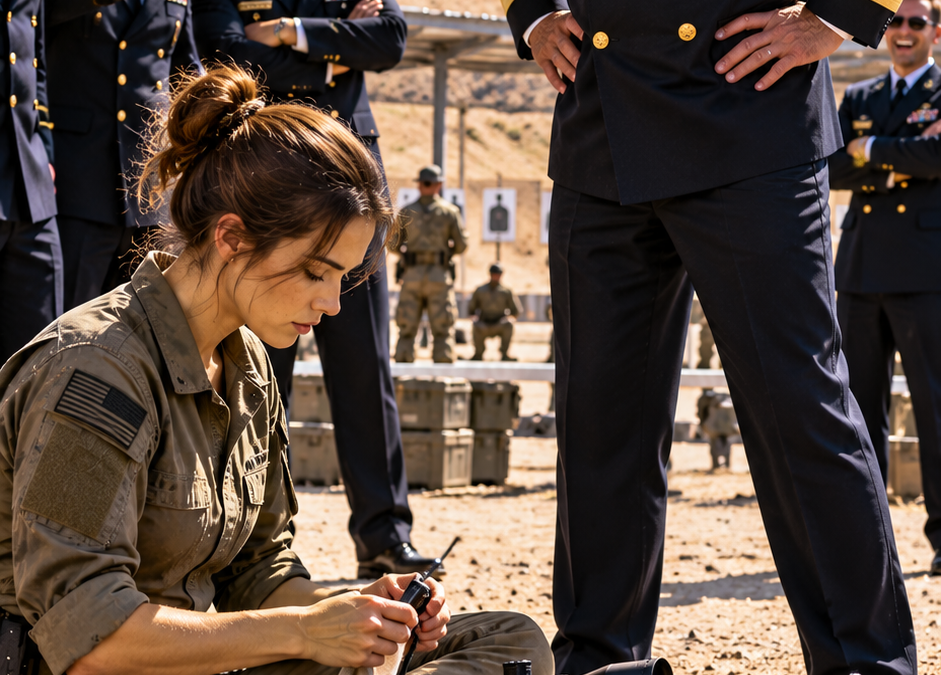
I finished putting my equipment away and reached for the rifle case.
A sudden gust of desert wind caught the loose fabric near my left shoulder.
My sleeve shifted.
Only slightly.
But it was enough.
A small, faded black symbol appeared against my skin.
A broken circle.
Three narrow lines.
A tiny star pressed into one edge.
I’d carried the tattoo for six years.
Most people assumed it was an ordinary military marking, something I’d acquired during a deployment or in celebration of completing a difficult course.
Very few people recognized its actual significance.
Ellis was one of them.
I saw his face change.
Then his eyes moved toward Admiral Kane.
Kane followed his gaze.
The smile disappeared from the admiral’s face.
Brooks frowned.
“What?”
Nobody answered.
Kane stepped closer.
His attention remained fixed on my shoulder.
I pulled my sleeve back down.
Too late.
Ellis slowly crossed the dusty strip between us.
“Where did you get that?”
His voice was very different from the one he’d been using to direct the qualification exercise.
I studied him.
“Do you recognize it?”
He swallowed.
“I recognize the man who designed it.”
Something tightened inside my chest.
Kane turned sharply toward him.
“Ellis, are you sure?”
The old range master nodded.
“I spent four years looking at one on Thomas Morgan’s shoulder.”
The sound of my father’s name seemed to pull all the heat out of the afternoon.
I stared at Ellis.
“That was my father.”
His expression changed again.
“Claire?”
I nodded.
For several seconds, he simply looked at me.
Then Kane spoke.
“You’re Tom Morgan’s daughter?”
“Yes, sir.”
The young officers exchanged bewildered glances.
Brooks cleared his throat.
“I’m missing something.”
Ellis glanced at him.
“Yes, Lieutenant. You are.”
He offered no further explanation.
Under different circumstances, I might have laughed.
But hearing my father’s name had unsettled me in a way I hadn’t expected.
Thomas Morgan had been dead for eight years.
I’d spent much of that time convincing myself that I’d made peace with our complicated relationship.
Now I was standing beneath the desert sun, looking at two men who apparently knew a version of him I’d never met.
Admiral Kane seemed to be experiencing a similar realization.
He looked at my covered shoulder.
Then at my rifle.
Then back at me.
“I knew your father.”
“I gathered that.”
“He never told me his daughter became a precision shooter.”
I felt an old resentment surface.
“He didn’t tell a lot of people much about me.”
Kane stopped smiling.
Ellis looked away.
For a moment, I regretted the bitterness in my voice.
But I didn’t apologize for it.
My father had been an exceptional marksman, a respected instructor, and a man whose professional accomplishments were still discussed in military training circles years after his death.
He’d also been an absent parent for much of my childhood.
Both things were true.
And I was tired of pretending that one automatically excused the other.
Kane glanced toward the targets.
“You came here to shoot.”
“Yes, sir.”
“Then shoot.”
Brooks shifted beside him.
“Sir, perhaps we should—”
“No.”
The admiral raised one hand.
“Let her shoot.”
I picked up my rifle case and walked toward the firing line.
Ellis followed.
Behind us, the officers moved together, their boots scraping across the gravel.
Nobody made another joke.
I settled at lane seven while Ellis took his position beside the spotting scope.
“You familiar with the wind here?” he asked.
“Not yet.”
He nodded.
“Good answer.”
I looked at him.
He pointed toward the distant terrain.
“It changes around the wash.”
“I noticed the dust moving differently.”
A faint smile touched his mouth.
“Your father used to say the same thing.”
I didn’t respond.
For most of my childhood, people who knew Thomas Morgan had been eager to tell me how extraordinary he was.
They loved his stories.
His achievements.
His ability to remain calm when everyone else was losing control.
But I remembered a different man.
The father who missed my tenth birthday.
The father who promised he’d attend my school recital, then called from an airport to explain that something important had come up.
The father who knew the technical specifications of every rifle he’d ever handled but sometimes couldn’t remember the name of my best friend.
I didn’t want another afternoon spent listening to strangers explain how fortunate I was to be his daughter.
I wanted to finish my assignment.
I settled behind the rifle.
The world gradually narrowed.
Heat.
Distance.
Wind.
Breath.
For a few precious moments, I forgot about Admiral Kane, his laughing officers, and the old man watching me with an expression I couldn’t understand.
I remembered a glass of water sitting on the railing of our back porch in Virginia.
I was nine years old.
My father had returned home after a long assignment, and for once, he wasn’t carrying a telephone or rushing toward another obligation.
He’d placed a glass of water between us.
“Watch the surface,” he told me.
I leaned forward.
“Why?”
“Tell me what you see.”
“Water.”
He smiled.
“Very observant.”
I rolled my eyes.
My father pointed toward the tiny ripples moving across the surface.
“Your mind does the same thing when you’re frightened or impatient.”
“That doesn’t make sense.”
“It will.”
Then he taught me a simple breathing exercise.
Four counts in.
Four held.
Four out.
I remembered sitting beside him, concentrating so hard that my entire face probably looked ridiculous.
When the wind stopped and the water briefly became still, I gasped.
“Dad! I did it!”
He laughed.
“You stopped the wind?”
I stared at him.
Then I realized what had happened.
“That’s not fair.”
He tapped two fingers against my forehead.
“Remember something, Claire. You can control yourself. You can’t control everything around you.”
That was one of the few lessons he’d taught me that I hadn’t spent my adult life questioning.
I returned my attention to the target.
My first shot rang out.
A moment later, the distant steel answered.
I made a small adjustment.
Second shot.
Another hit.
Then a third.
And a fourth.
Behind me, the officers remained silent.
I continued through the exercise, maintaining the same concentration I’d brought to every qualification since I was old enough to wear a uniform.
Ten rounds.
Ten hits.
Not all of them landed exactly where I wanted.
Two were slightly farther left than I’d intended.
One was high.
I was already thinking about those imperfections when I sat up.
Ellis checked the results.
Then he looked toward Kane.
The admiral had moved closer.
Brooks was staring at the target monitor as though it had personally betrayed him.
Kane folded his arms.
“Well.”
I looked at him.
“Well what, sir?”
Several of the younger officers suddenly became interested in the gravel beneath their boots.
Kane stared at me.
Then, unexpectedly, he laughed.
It wasn’t the dismissive laughter I’d heard beside the equipment shed.
He was laughing at himself.
“I believe I owe you a better introduction.”
He extended his hand.
“Victor Kane.”
I looked at it for a moment.
Then I shook it.
“Claire Morgan.”
“I know that now.”
“Yes, sir.”
His handshake was firm.
When he released my hand, he looked toward the target.
“Where did you train?”
“Several places.”
“That’s a rather unhelpful answer.”
“It’s the answer I’m authorized to give.”
Brooks blinked.
Kane looked at me for several seconds.
Then he nodded.
“Fair enough.”
Ellis rose from behind the spotting scope.
“She adjusted quickly for the wind.”
Kane nodded.
“I noticed.”
“Most people who come through here talk a great deal about what they can do at eight hundred meters.”
Ellis glanced toward the officers.
“Fewer demonstrate it.”
Nobody argued.
Brooks shifted his weight.
“Ma’am?”
I turned toward him.
His cheeks were noticeably red.
“I owe you an apology.”
I waited.
“What I said earlier was inappropriate. I made assumptions about your experience, and I shouldn’t have.”
I studied his face.
He seemed genuinely embarrassed.
“Apology accepted, Lieutenant.”
He nodded.
Then he hesitated.
“For what it’s worth, that was impressive.”
“Thank you.”
He looked relieved.
But I wasn’t finished.
“Next time, try treating someone with respect before you find out whether they can outperform you.”
His face flushed again.
“Understood.”
Kane looked at him.
“An excellent suggestion.”
Brooks straightened.
“Yes, sir.”
The admiral turned toward me.
“Walk with me, Morgan.”
I glanced at Ellis, who nodded toward the range office.
I left my rifle with him and followed Kane toward a shaded structure overlooking the firing line.
For several minutes, we walked in silence.
Then he asked the question I’d been expecting.
“Why no rank insignia?”
“Because I don’t currently hold a rank, sir.”
He stopped.
“You separated?”
“Two years ago.”
“What rank?”
“Lieutenant.”
His eyebrows rose.
“You’re rather young to have left.”
“Yes, sir.”
“Why?”
I looked toward the distant hills.
“That isn’t relevant to the evaluation.”
Kane turned toward me.
For a moment, I thought he would insist.
Then something changed in his expression.
“Evaluation?”
I said nothing.
He looked back toward the firing line.
Then toward the equipment shed where he’d first encountered me.
“You’re the independent evaluator.”
“Yes, sir.”
He closed his eyes briefly.
“Of course you are.”
I almost smiled.
“We were told Joint Marksmanship Standards was sending someone,” he said. “They didn’t give us a name.”
“That was intentional.”
“You requested anonymity?”
“Yes.”
“Why?”
I glanced toward the junior officers moving between the firing lanes.
“Because I wanted to observe the range before anyone realized the evaluator was standing beside them.”
Kane followed my gaze.
Every instructor appeared suddenly determined to demonstrate perfect attention to detail.
He sighed.
“So the entire afternoon—”
“Is part of my evaluation.”
“Wonderful.”
I allowed myself a small smile.
“For what it’s worth, sir, your equipment logs are excellent.”
He gave me a long look.
“You enjoy this.”
“Occasionally.”
We reached the shade.
Kane removed his cap and wiped his forehead.
“I suppose I should ask whether my behavior is going into your report.”
“I haven’t decided yet.”
“That sounds remarkably like yes.”
“It means I haven’t decided.”
He shook his head.
Then his expression became serious.
“Claire, may I ask you something about your father?”
I hesitated.
“Go ahead.”
“Did he give you that tattoo?”
“No.”
Kane looked surprised.
“I assumed—”
“I earned it when I was twenty-three.”
He became very still.
“Where?”
“Black Mesa.”
For several seconds, he simply stared at me.
Then he sat down on the wooden bench beneath the shade.
“You completed Black Mesa?”
“Yes, sir.”
“Who signed your final evaluation?”
“Commander Daniel Raines.”
Kane leaned back.
“Raines?”
I nodded.
“That man hated everybody.”
“He tolerated me by graduation.”
“That’s practically a declaration of love from Daniel Raines.”
Despite myself, I laughed.
For the first time since arriving, the admiral looked less like a senior officer trying to maintain control of an uncomfortable situation and more like an ordinary man remembering an old friend.
Black Mesa Precision Course wasn’t officially secret.
It was simply obscure.
The advanced program had been developed for experienced instructors and specialized marksmen who had already completed conventional qualifications.
Its emphasis was judgment.
Patience.
Knowing the limitations of equipment, terrain, and human perception.
Understanding that confidence without discipline was a liability rather than an achievement.
My father had helped develop the original curriculum.
The broken-circle tattoo had begun as an informal tradition among a small group of graduates.
The practice had eventually disappeared.
But the mark remained recognizable to people who’d been involved in those early years.
Kane studied my shoulder again.
“Tom would have been proud that you finished that course.”
I looked away.
“You don’t know that.”
His expression softened.
“Actually, I think I do.”
Something about his certainty irritated me.
“My father barely called home during his last three years in uniform.”
Kane didn’t immediately answer.
Then he said, “I didn’t say he was particularly good at showing what he felt.”
I folded my arms.
He continued.
“He spoke about you, Claire.”
I turned toward him.
“No, he didn’t.”
“Yes. He did.”
I stared at him.
My father had spent years keeping his professional and family lives so separate that I’d often wondered whether the men who served beside him even knew he had a daughter.
“What did he say?”
Kane considered the question.
“Mostly ordinary things.”
“Such as?”
“That you hated algebra.”
I blinked.
“I did.”
“That you broke a kitchen window with a softball when you were eleven and blamed a storm.”
I looked at him.
“My mother was furious.”
“Tom said you were remarkably committed to your explanation.”
Despite myself, I smiled.
I remembered standing in our kitchen, insisting that an unusually powerful gust of wind had somehow carried a softball backward through the window.
My mother had stared at the shattered glass.
My father had stood behind her, pretending to cough because he was trying not to laugh.
It was a ridiculous memory.
A good one.
I had fewer of those than I wanted.
Kane watched me.
“He kept your school photograph inside the front cover of his green field notebook.”
My smile disappeared.
“What notebook?”
Kane frowned.
“His green notebook. He carried it for years.”
I stared at him.
“My mother never received a green notebook with his personal effects.”
The admiral sat straighter.
“She didn’t?”
“No.”
He looked toward the range office.
Then toward Ellis, who was approaching with my rifle case.
When Ellis reached us, Kane asked, “Do you remember Tom’s green notebook?”
The old range master’s expression changed.
“Of course.”
“Did you ever see what happened to it?”
Ellis looked from Kane to me.
“I thought Victor had it.”
Kane frowned.
“I thought Tom mailed it home.”
I stared at both men.
“My father died eight years ago. My mother received his personal effects six weeks later. There was no green notebook.”
Neither man spoke.
For the first time that afternoon, I felt genuinely unsettled.
Because somewhere between my father’s death and my arrival at that desert range, a piece of his life had apparently disappeared.
And both men standing in front of me seemed to know considerably more about it than I did.
Ellis looked toward the range office.
“Come inside,” he said.
I followed him without another word.
The building was small and unremarkable, with faded training schedules pinned to a bulletin board and a wall calendar that was three months out of date.
The air conditioner rattled overhead.
Someone had written CHANGE FILTER beneath it in permanent marker.
Judging from the noise, nobody had followed those instructions.
Ellis crossed the room and opened a gray metal filing cabinet.
He removed a large photograph envelope from the bottom drawer.
My name was written across the front.
CLAIRE MORGAN.
I recognized the handwriting as his, not my father’s.
“How long have you had that?”
Ellis looked uncomfortable.
“I’ve kept it at home for about seven years. I brought it here when I heard you were coming.”
I stared at him.
“You knew I was coming?”
“I saw your name on the visitor authorization list this morning.”
“And you didn’t say anything?”
“I wasn’t certain it was you.”
He hesitated.
“And when I recognized you, I wasn’t sure how to begin.”
I looked at the envelope.
“What’s inside?”
“Something your father wanted you to have.”
I felt anger rising.
“My father died eight years ago.”
“I know.”
“Then why am I only hearing about this now?”
Ellis lowered his eyes.
“I owe you an explanation.”
Kane stood beside the desk, watching us.
“Ellis, what exactly did Tom leave with you?”
The old range master handed me the envelope.
“Open it.”
Inside were six photographs.
The first showed three younger men standing beside an old observation tower.
Ellis was there, with dark hair and the confident grin of someone who hadn’t yet spent fifteen years arguing with range maintenance contractors.
Kane stood on the right, wearing the insignia of a lieutenant commander.
Between them was my father.
Thomas Morgan.
His sleeves were rolled up, and he was smiling directly at the camera.
I hadn’t seen that smile in years.
It was open.
Unselfconscious.
Nothing like the guarded expression I remembered from the final years of his life.
On his exposed shoulder was the same broken-circle tattoo I carried on mine.
I ran my thumb along the edge of the photograph.
The next picture showed the three men sitting on ammunition crates with paper cups of coffee.
Another showed my father standing beside a whiteboard covered with training notes.
The fourth was a photograph of an early Black Mesa class.
The fifth showed the range at sunrise.
Then I reached the last photograph.
I stopped breathing.
My father was sitting on the back porch of our house in Virginia.
I was beside him.
Nine years old.
My hair was pulled into a crooked ponytail, and I was wearing a T-shirt with a cartoon horse on the front.
A glass of water sat on the porch railing between us.
I looked at Ellis.
“Who took this?”
“Your mother.”
I frowned.
“She would have kept it.”
“She sent a copy to your father while he was away.”
I turned it over.
Three words were written on the back in his handwriting.
Teach her patience.
Beneath them was a date.
Two weeks before my tenth birthday.
I stared at the photograph for a long time.
My father had kept it.
All those years when I’d wondered whether our afternoons together meant as much to him as they had to me, he’d carried a photograph of one of them in his notebook.
I wanted to feel comforted.
Instead, I felt an unexpected wave of grief.
Because the photograph reminded me of the father I’d loved before I learned how often he could disappoint me.
“Why did you keep these?” I asked Ellis.
He sat down.
“Because they were in the packet Tom entrusted to me.”
“What packet?”
He reached into the envelope again.
“After he retired, he gave me several pages from his notebook. He said that if you ever completed Black Mesa, I should give them to you.”
I stared at him.
“I completed Black Mesa six years ago.”
“I know.”
“You knew?”
“Commander Raines contacted me after your graduation.”
My hand tightened around the photographs.
“Then why didn’t you give them to me?”
Ellis rubbed his forehead.
“He said you’d made it clear you didn’t want anything from your father’s connections.”
I closed my eyes.
That sounded exactly like Raines.
During the course, he’d discovered my surname and asked whether I expected special consideration because of my father’s involvement in the original program.
I’d told him I’d rather fail than have my father’s reputation influence the result.
Apparently, he’d interpreted that statement rather broadly.
“So you decided I didn’t want my father’s photographs?”
Ellis looked ashamed.
“When you say it that way, it sounds foolish.”
“It was foolish.”
“You’re right.”
I studied him.
He wasn’t trying to excuse himself.
He wasn’t attempting to persuade me that keeping the packet had somehow been for my own good.
He was simply accepting that he’d made a mistake.
That made it harder to remain angry with him.
But it didn’t make the lost years disappear.
“Is there anything else?”
Ellis removed a folded sheet of paper.
My father’s handwriting covered both sides.
At the top was a single sentence.
For Claire, if she chooses this life anyway.
I sat down.
For years, I’d imagined what I would say if I could have one more conversation with my father.
I’d rehearsed arguments while driving alone.
I’d imagined telling him about my military career and explaining how much his absence had hurt.
Sometimes, I’d imagined him apologizing.
Other times, I’d imagined walking away before he could.
Now I was holding a letter he’d written before he died.
And suddenly, I wasn’t certain I wanted to read it.
Ellis seemed to understand.
“Take your time.”
I shook my head.
“I’ve already waited eight years.”
I unfolded the paper.
Claire,
If you’re reading this, you ignored at least half my advice and inherited considerably more of my stubbornness than your mother probably hoped.
A startled laugh escaped me.
That sounded like him.
Exactly like him.
I read on.
My father wrote that he’d never wanted me to become a copy of him.
He explained that being talented at something didn’t mean I had to dedicate my entire life to it. He didn’t want my career, my ambitions, or my future determined by my desire to impress him.
Then the letter became more personal.
He apologized for missing my birthdays.
My school events.
The afternoon my car broke down and I called home, only to learn that he’d left for another assignment.
My first college acceptance letter.
He mentioned each event specifically.
That hurt more than I expected.
For years, I’d convinced myself that he’d forgotten those things because he didn’t care enough to remember them.
But he’d remembered.
He’d carried them with him.
And somehow, he’d allowed the distance between us to remain anyway.
I kept reading.
Then I reached a paragraph that made my hands go cold.
My father admitted that he’d interfered with my application to an advanced instructor fellowship when I was twenty-one.
I read the sentence again.
Then I looked up.
“My father withdrew my application.”
Kane frowned.
“For what?”
“Falcon Ridge.”
His expression changed.
“You applied to Falcon Ridge?”
I nodded.
It was a selective instructor development program that I’d wanted to attend during my early years of military service.
I’d spent months preparing my application.
Then I’d received notice that I hadn’t been selected for an interview.
I never understood why.
My academic qualifications were strong. My initial training results were excellent. I’d received encouraging recommendations from instructors who had no personal relationship with my father.
But there were far more applicants than places.
I’d accepted the rejection as proof that I wasn’t ready.
Then I’d spent the following two years working harder than I’d ever worked before.
I took difficult assignments.
Studied late into the night.
Volunteered for every additional opportunity that might make me a more competitive candidate.
And beneath all that effort was a thought I rarely admitted to myself.
I wanted to prove that I belonged in the same professional world as Thomas Morgan.
Now I was discovering that the rejection I’d spent years trying to overcome hadn’t been what I believed.
I stood so abruptly that the chair scraped across the floor.
“He interfered with my career.”
Ellis looked stunned.
“I didn’t know.”
I turned toward Kane.
“Did you?”
“No.”
I looked back at the letter.
My father explained that he’d believed I was applying to Falcon Ridge for the wrong reasons.
He thought I wanted to follow his career because I was angry with him.
Because I wanted to surpass him.
Because I needed something that would finally convince him I was worthy of his attention.
So he’d asked for my application to be removed.
Without telling me.
Without asking what I actually wanted.
I looked toward the window.
Outside, the qualification drills continued.
Ordinary life was moving forward while twenty-one-year-old Claire Morgan’s greatest professional disappointment was being rewritten in front of me.
“He had no right.”
My voice shook.
Kane nodded.
“No. He didn’t.”
I turned sharply.
He didn’t attempt to defend my father.
He didn’t tell me Thomas had meant well.
He didn’t suggest that parents sometimes needed to make difficult choices.
“He had no right to make that decision for you,” Kane repeated.
For some reason, that made my eyes burn.
Because for eight years, I’d been carrying questions I could never ask.
And now I had an answer that made me angrier than the uncertainty ever had.
My father had loved me.
He’d also controlled a decision that wasn’t his to make.
Both things could be true.
I wanted to throw the letter across the room.
Instead, I returned to the desk.
There was still another paragraph.
My father wrote that he’d eventually realized he’d confused protecting me with controlling me.
He hadn’t wanted me to spend my life trying to prove something to him.
But by withdrawing my application, he’d done exactly what he’d claimed he wanted to prevent.
He’d made himself the person determining whether I was allowed to pursue my ambitions.
I read the final lines twice.
I contacted Victor. He knows what I asked him to do. If Claire still wants this path when she’s ready, give her the choice I should have given her the first time.
I slowly looked up.
Kane’s face had gone pale.
“What did he ask you to do?”
For several seconds, the admiral said nothing.
Then he walked to the office door and closed it.
The latch clicked.
Outside, another rifle shot echoed across the desert.
Kane turned back toward me.
“Your father asked me to hold a recommendation.”
“For what?”
“A direct instructor placement.”
“At Falcon Ridge?”
“No.”
“Then where?”
He looked toward the west window.
Beyond the main firing lanes, a low ridge cut across the horizon.
I’d noticed several old structures out there when I’d arrived.
Abandoned observation towers.
Weathered concrete pads.
A road that appeared to have been unused for years.
Kane pointed toward them.
“Black Mesa didn’t begin where you trained.”
I followed his gaze.
“It started here?”
He nodded.
“The original program operated on that western section of the range. Your father helped design the training area and develop the instructor curriculum.”
Ellis slowly rose.
“Victor, you told me that section was closed before Black Mesa was established.”
“It was officially closed before the program was transferred.”
“What happened to it?”
“The facility was eventually decommissioned. The training program moved, the staff dispersed, and the old records were archived.”
I looked at the distant ridge.
“And my father wanted me to work there?”
“Not exactly.”
Kane sat down again.
“He wanted you to have the opportunity to become an instructor in the program he helped build. He asked me to preserve a recommendation for you, but he insisted it shouldn’t become an offer until you’d established your own qualifications.”
I stared at him.
“He withdrew my first application, then arranged a second opportunity without telling me?”
Kane winced.
“When you describe it that way, his reasoning sounds rather difficult to defend.”
“It is difficult to defend.”
“I agree.”
I folded my arms.
“Why didn’t you contact me?”
He hesitated.
That hesitation told me there was more.
Ellis noticed it too.
“Victor.”
Kane rubbed the back of his neck.
“The recommendation disappeared during a headquarters reorganization.”
I stared at him.
“You lost it?”
“I believed it had been archived with the original program records.”
“You believed.”
“Yes.”
“Did you ever check?”
“Not thoroughly enough.”
I looked at the ceiling.
My father had spent years trying to make decisions about my future.
He’d entrusted one decision to a man who subsequently misplaced the paperwork.
And somehow, I was only learning about any of it because Admiral Kane had decided to humiliate a stranger beside an equipment shed.
The absurdity nearly made me laugh.
Kane studied my expression.
“I understand that doesn’t reflect particularly well on me.”
“No, sir. It doesn’t.”
He accepted that.
“But last month, a records team began cataloging material recovered from the old western range.”
I looked toward the window again.
“They found something?”
“Yes.”
“What?”
“A locked document case.”
Ellis took a step closer.
“With Tom’s files?”
“We haven’t completed the inventory.”
“Then why are you telling me?” I asked.
Kane met my eyes.
“Because your name is on the case.”
The room became very quiet.
I looked at the faded photograph of my father sitting beside me on our porch.
A strange sadness settled over me.
He’d apparently spent years arranging pieces of a conversation he could have had while he was still alive.
Instead of asking me what I wanted, he’d made decisions.
Instead of apologizing to my face, he’d written a letter.
Instead of giving me the information I needed to make my own choices, he’d distributed it among people who weren’t even certain when they were supposed to share it.
Perhaps that was his greatest failure as a father.
Not the missed birthdays.
Not the deployments.
Not even the terrible judgment he’d shown with my fellowship application.
It was believing that loving someone meant designing their future without inviting them into the conversation.
My phone vibrated.
I glanced at the screen.
MOM.
For a moment, I considered letting it ring.
Then I answered.
“Hi.”
My mother’s voice came through bright and ordinary.
“Did you land safely?”
“I texted you yesterday.”
“I know. I wanted to hear your voice.”
I looked at Kane and Ellis.
Both suddenly became fascinated by the papers on the desk.
“I’m fine.”
“How’s the range?”
“Hot.”
“It’s a desert, Claire.”
“I noticed.”
She laughed.
Then she fell quiet.
“You sound strange.”
My mother had always been able to hear an unspoken thought in my voice.
I looked down at the letter.
“I found something about Dad.”
There was a long silence.
“What?”
“A letter.”
Another pause.
“Claire, is it from his green notebook?”
My entire body went still.
I looked at Kane.
Then at Ellis.
Neither man moved.
“Mom.”
“Yes?”
“How do you know about the green notebook?”
She didn’t answer immediately.
Then she said something I’d waited eight years to hear without knowing I was waiting for it.
“Because your father left the rest of it with me.”
I closed my eyes.
“Why didn’t you tell me?”
Her answer was barely a whisper.
“Because he asked me to wait until you came home for the right reason.”
I stared at the letter.
“What reason?”
She was quiet.
Then she admitted, “I never knew.”
For the first time that afternoon, I felt the full weight of what my father had left behind.
Three people had been given different pieces of the same message.
Kane had lost his recommendation.
Ellis had kept his photographs and letter.
My mother had hidden the rest of his notebook.
And I’d spent eight years believing my father had gone to his grave without ever understanding how deeply his decisions had hurt me.
I looked through the window toward the forgotten range.
“Mom, I need you to listen carefully.”
“All right.”
“I’m coming home after this assignment.”
She sounded relieved.
“Oh, sweetheart—”
“But I want the notebook.”
She fell silent.
“All of it,” I said. “No more waiting. No more deciding when I’m ready.”
After a moment, she answered.
“Okay, Claire.”
I ended the call.
Kane watched me carefully.
“What do you want to do about the document case?”
I looked toward the distant ridge.
For years, I’d imagined finally receiving some kind of recognition from my father.
Now that I was standing so close to it, I wasn’t certain recognition was what I wanted anymore.
“I want to see what’s inside.”
Kane nodded.
“I can arrange that.”
“But first, Admiral, I need to finish the evaluation I came here to conduct.”
He looked almost relieved to hear something he understood.
“Of course.”
I picked up my folder.
“And I believe we still have some things to discuss about what happened at the equipment shed.”
His expression changed.
“Yes,” he said quietly. “I believe we do.”
The next morning, I returned to the firing line before sunrise.
The desert was still cool. A pale band of light stretched above the eastern mountains, and the air smelled faintly of dust and coffee.
Ellis was already there.
He handed me a paper cup.
“Black. No sugar.”
I looked at him.
“How did you know?”
“Your father drank it the same way.”
I accepted the coffee.
“Apparently, I inherited all his unpleasant habits.”
Ellis smiled.
“Not all of them.”
We stood quietly while the first instructors arrived.
I thought about the photographs, the letter, and everything Kane had told me.
Part of me wanted to abandon the evaluation and concentrate entirely on finding the rest of my father’s records.
But I’d accepted an assignment.
Fifteen people were training at that range, and their safety depended on the competence and professionalism of those responsible for them.
My father’s unfinished business could wait a few more hours.
I began by examining the qualification records.
Then I reviewed the equipment logs, observed the morning exercises, and interviewed several junior personnel about their experiences.
The technical aspects of the range were generally excellent.
Its maintenance records were thorough. The instructors demonstrated strong knowledge of their equipment, and the safety procedures were consistently followed.
But I discovered something troubling when I asked the younger personnel whether they felt comfortable reporting mistakes.
Several hesitated.
One admitted that certain instructors became irritated whenever someone asked a question that appeared too basic.
Another told me she’d been discouraged from participating in an advanced exercise because an instructor assumed she lacked the necessary experience.
Those answers reminded me of the previous afternoon.
Admiral Kane had made an assumption about a woman sitting beside an equipment shed.
His officers had laughed because he laughed.
Nobody had considered whether the woman might have been qualified.
Nobody had bothered to ask.
That was a leadership problem.
And being Thomas Morgan’s daughter didn’t change the fact that I was there to document it.
When Kane entered the range office that afternoon, I showed him my preliminary findings.
He read them without speaking.
Then he looked up.
“You included yesterday.”
“Yes, sir.”
He nodded slowly.
“I expected you would.”
“I didn’t include the incident because I was personally offended.”
He studied me.
“I understand.”
“I included it because you demonstrated to six junior officers that it was acceptable to ridicule someone whose qualifications you hadn’t established.”
Kane lowered the report.
“You’re right.”
I hadn’t expected such a direct response.
He continued.
“I also made assumptions about your rank, your experience, and why you were here. The fact that I later discovered your qualifications doesn’t make the original behavior any less inappropriate.”
I looked at him for a long moment.
“Thank you, Admiral.”
He gave a tired smile.
“Don’t thank me for acknowledging something I should have known.”
He reviewed the remaining findings and agreed to implement additional instructor-development measures addressing professional conduct, fair assessment, and the importance of creating an environment in which junior personnel could report mistakes without humiliation.
I didn’t ask for disciplinary punishment.
That wasn’t the purpose of my assignment.
But I expected the problem to be acknowledged and corrected.
And this time, Kane didn’t ask me to overlook it because of his rank.
By the following afternoon, the official evaluation was complete.
Only then did Kane arrange for me to visit the old western range.
The records team met us outside a low concrete building near the abandoned observation towers.
The structure had been empty for years.
Dust covered the windows, and the faded numbers above the entrance were barely visible.
Inside, a records officer escorted us to a room containing several recovered storage containers.
On a metal table sat a locked document case.
My name was written across the front.
Not in a neat administrative label.
In my father’s handwriting.
CLAIRE MORGAN.
I stood in front of it for several seconds.
All the anger and confusion I’d experienced during the previous two days suddenly felt very far away.
My father had written my name on that case.
He’d known it might someday reach me.
But he’d never told me it existed.
The records officer completed the necessary documentation and opened the case.
Inside were old training materials, photographs, handwritten notes, and a sealed folder containing my father’s recommendation.
Kane recognized it immediately.
“That’s the original.”
I opened the folder.
The recommendation described my qualifications as they stood before my father’s retirement and proposed that I be considered for an instructor position once I’d independently completed the appropriate training.
It wasn’t an appointment.
It wasn’t an assurance that I would receive a position regardless of my performance.
It was a recommendation from a man who believed I possessed the ability to succeed.
I stared at his signature.
Thomas Morgan.
For years, I’d imagined that my father had considered me unqualified.
Then I’d discovered that he’d interfered with my first application.
Now I was holding a document proving that he’d subsequently tried to give me another opportunity.
The contradiction hurt.
Because he could have accomplished so much more by simply talking to me.
I turned to Kane.
“Why didn’t you tell me about this before he died?”
He looked down.
“Tom wanted to wait until you had more experience. Then he died, and I believed the recommendation had been lost.”
“You could’ve called.”
“Yes.”
“You knew where my mother lived.”
“Yes.”
I looked at the papers.
“Everybody keeps telling me how much he cared about me. But nobody thought I deserved to know what he’d actually done.”
Kane accepted that without argument.
“I’m sorry, Claire.”
I nodded.
I wasn’t ready to forgive every decision he’d made.
But I believed his apology.
Then I noticed a final handwritten note beneath my father’s signature.
Claire must decide whether she wants this position. Her qualifications are to be evaluated independently. I have no right to make that choice for her.
I read the words several times.
The man who’d secretly withdrawn my fellowship application had finally understood the mistake he’d made.
But his realization had arrived too late for him to explain it to me.
I carefully returned the documents to their folder.
Kane watched me.
“The original instructor position doesn’t exist anymore.”
“I know.”
“But the program still does. There may be opportunities if you decide you want to teach.”
I looked at him.
“Would I have to go through the normal selection process?”
“Of course.”
“Then I might consider it.”
He nodded.
“Fair enough.”
I glanced toward the abandoned observation towers.
For most of my adult life, I’d measured myself against a father who was no longer alive to tell me what he thought.
Now I was beginning to understand that I didn’t need him to determine what came next.
I could respect his accomplishments.
I could acknowledge his mistakes.
And I could build a career that belonged entirely to me.
Two days later, I returned home to Virginia.
My mother was waiting at the kitchen table when I arrived.
The green notebook lay in front of her.
For a moment, neither of us moved.
Then she stood and hugged me.
I held her tightly.
When we finally sat down, I looked at the notebook.
“Is that everything?”
She nodded.
“Everything he left with me.”
“Did you read it?”
“Some of it. Not all.”
I opened the cover.
My father’s handwriting filled page after page.
Training notes.
Schedules.
Observations.
Reminders.
There were photographs tucked between several pages.
My school pictures.
A newspaper clipping about my graduation.
A copy of my first college acceptance letter.
And there were personal entries I’d never imagined he would write.
One page described an argument we’d had shortly before I joined the military.
I’d told him I wanted to make something of myself without relying on his name.
He’d told me I was too young to understand the consequences of my decisions.
I’d accused him of believing I would fail.
Then I’d walked out.
I remembered that argument vividly.
For years, I’d believed it proved that he had no confidence in me.
But his entry told a different story.
He’d been frightened that I would choose a dangerous career simply because I wanted to prove I was as capable as he was.
He’d wanted to protect me from the sacrifices his own career had demanded.
And instead of admitting that fear, he’d treated me as though I didn’t know what I wanted.
I continued reading.
There were entries about his regrets.
The birthdays he’d missed.
The conversations he’d avoided.
The way our relationship had become increasingly strained as I grew older.
Then I found an entry written shortly after he interfered with my Falcon Ridge application.
I told myself I was protecting her. The truth is that I made a decision she had every right to make herself. I don’t know how to explain that to her without losing what little trust remains between us.
My eyes filled.
I turned the page.
Another entry described his conversation with Kane.
He’d decided that the only way to correct his mistake was to ensure I had a future opportunity to pursue an instructor position if I wanted one.
But he’d also written something that made my chest ache.
I need to tell her the truth. Not when she succeeds. Not when she fails. Not when I decide she’s ready. I simply need to tell her.
I stopped reading.
My mother reached across the table.
“Claire?”
I looked up.
“Why didn’t he?”
Her eyes filled.
“I think he was afraid you wouldn’t forgive him.”
I stared at the notebook.
“And then he died.”
She nodded.
“Yes.”
I took a long breath.
“Mom, why did you wait eight years to give me this?”
She looked down at her hands.
“Your father asked me to keep it until you came home for the right reason.”
“What does that even mean?”
“I thought he wanted you to reach a point where you weren’t trying to prove yourself to him anymore.”
I shook my head.
“Then why didn’t you ask me?”
She began crying.
“I was afraid that giving it to you would reopen everything that happened before he died.”
I looked at her.
“Mom, everything was already open. I just didn’t have any answers.”
She covered her mouth.
“I’m sorry.”
I closed the notebook.
There was nothing left to argue about.
The years we’d lost weren’t coming back.
My father wasn’t going to walk through the door and explain himself.
But I could decide what happened to the years that remained.
I reached across the table and took my mother’s hand.
“Please don’t keep things from me because you think you’re protecting me.”
She nodded.
“I won’t.”
That evening, I carried the notebook onto the back porch.
The old railing had been repainted, but the view was almost exactly as I remembered it.
The same trees.
The same little patch of lawn.
The same place where my father had once taught a nine-year-old girl how to breathe when her mind felt overwhelmed.
I placed a glass of water on the railing.
Then I opened his notebook one final time.
I didn’t find an explanation that made everything he’d done acceptable.
His apology didn’t erase the missed birthdays or the damage he’d caused by interfering with my career.
His love didn’t automatically make him a good father.
But it was real.
And for the first time since his death, I no longer had to choose between remembering the man who’d hurt me and remembering the man who’d loved me.
He had been both.
I sat there until the sun disappeared.
Then I picked up my phone and called Admiral Kane.
He answered on the second ring.
“Morgan.”
“Admiral, I’ve been thinking about your offer.”
“Go ahead.”
“I’m interested in teaching.”
There was a pause.
“Black Mesa?”
“Possibly. But I want to go through the same qualification process as everybody else.”
“I wouldn’t expect anything different.”
“And I want to finish my current work before making a commitment.”
“Understood.”
I looked at the glass of water.
“One more thing, sir.”
“Yes?”
“If I ever take an instructor position, I don’t want people introduced to me as Thomas Morgan’s daughter.”
Kane was quiet.
Then he answered.
“How would you prefer to be introduced?”
I smiled.
“Claire Morgan. Qualified instructor. Nothing more.”
He laughed.
“I think we can arrange that.”
Several months later, I returned to the desert range as a guest instructor after completing the required review.
Ellis was waiting beside the equipment shed.
Brooks was there too.
He greeted me respectfully and helped organize the morning exercise.
The admiral arrived shortly afterward.
This time, he introduced me to the trainees without mentioning my father, my tattoo, or the afternoon we’d first met.
He simply explained my qualifications and the work we’d be doing.
Then he stepped aside.
I looked at the group standing in front of me.
Among them was a young woman who reminded me of myself at twenty-three.
She was quiet, attentive, and visibly nervous.
One of the other trainees made a joke about whether she could manage the advanced exercise.
I stopped him.
“Before we begin, I want everyone here to understand something.”
The group fell silent.
“You don’t know what another person is capable of until you give them a fair opportunity to demonstrate it. Your assumptions are not evidence of their limitations.”
I looked toward the young woman.
“That includes the assumptions you make about yourselves.”
She straightened slightly.
I continued.
“You’re here to learn. You’re allowed to ask questions. You’re allowed to make mistakes. And you’re expected to treat one another with respect.”
Behind the group, Admiral Kane stood beside Ellis.
Neither man said anything.
I didn’t need them to.
I turned toward the range.
“All right. Let’s get started.”
Later that afternoon, when the trainees had finished and the range had grown quiet, I returned to the equipment shed.
For a moment, I sat in the same place where Kane had first approached me.
The desert wind moved across the firing line.
Far beyond the targets, the old western observation towers stood against the horizon.
I thought about my father’s recommendation.
The green notebook.
The letter he’d never managed to give me.
And the little girl who’d sat beside him on our porch, believing she’d somehow learned to stop the wind.
I finally understood what he’d tried to teach me that day.
I couldn’t control the things other people had done.
I couldn’t recover the conversations my father and I had never shared.
And I couldn’t change the years I’d spent trying to prove I deserved his respect.
But I could choose what to carry forward.
I rolled up my sleeve and looked at the faded broken circle on my shoulder.
For years, I’d associated it with the father whose approval I could never quite reach.
Now it reminded me of something different.
I’d completed Black Mesa through my own effort.
I’d built my career through my own decisions.
And I’d returned to that desert range not because Thomas Morgan had wanted me there, but because I’d discovered that teaching was something I wanted for myself.
I pulled my sleeve down and stood.
For the first time in years, I wasn’t trying to finish my father’s story.
I was finally living my own.








