𝗙𝗨𝗟𝗟 𝗦𝗧𝗢𝗥𝗬 The Executive Beside Me Wanted Me Out of First Class Before She Even Knew My Name
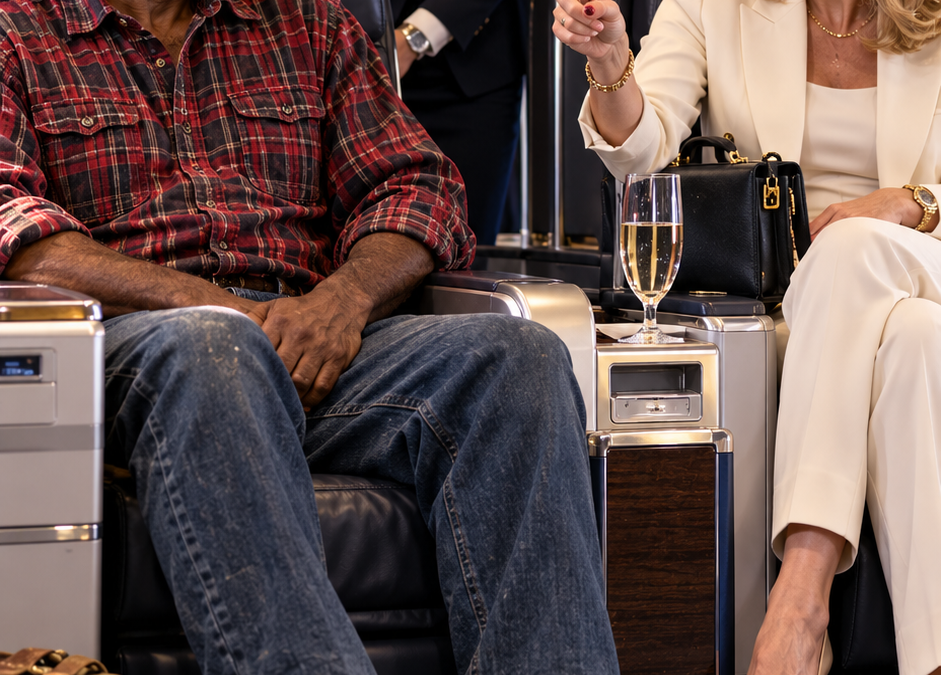
𝗙𝗨𝗟𝗟 𝗦𝗧𝗢𝗥𝗬
The ordinary sounds of an airport continued outside, indifferent to the little performance taking place in our cabin.
The woman beside me stared straight ahead.
Her knee bounced impatiently.
Eventually, Sandra returned.
“I’m sorry, ma’am. First class is fully booked. There aren’t any alternative seats available in this cabin.”
The woman closed her eyes.
“This is unbelievable.”
I looked at her.
“Planes have enough room for all kinds of people.”
She didn’t answer.
“Six hours isn’t a lifetime,” I added. “We’ll manage.”
She turned away so sharply that I thought she might strain her neck.
Sandra gave me a small, apologetic smile before continuing her preflight checks.
A few minutes later, the cabin doors closed.
I fastened my seat belt.
The woman beside me pulled out her phone and began typing with enough force to make me wonder whether she was trying to punish the screen.
I didn’t know her name yet.
I didn’t know what company she worked for.
And I certainly didn’t know she was traveling to the same business meeting that had brought me onto that airplane.
If I had, I might have asked her a few more questions before we left the ground.
Instead, I closed my eyes and thought about home.
My grandfather used to tell me that growing food taught a man patience whether he wanted to learn it or not.
You could plant the best seed in the finest soil, water it carefully, and work every day until your hands cracked.
But you still couldn’t order the weather to cooperate.
You learned to do your part.
You learned to wait.
And when a storm came, you learned to keep your feet planted until it passed.
Those lessons had carried me through droughts, failed harvests, difficult negotiations, and the deaths of people I loved.
I wasn’t going to let one unpleasant passenger ruin my flight.
At least, that was the plan.
Forty minutes after takeoff, the plane entered a patch of rough air.
The aircraft shuddered once.
Then again.
A few passengers gasped.
The seat belt sign illuminated with a sharp chime, and the flight attendants secured their carts.
The woman beside me gripped the armrest.
Her face went pale.
I glanced at her hands.
“Just a little turbulence,” I said.
She didn’t respond.
The plane dropped slightly.
Her fingers tightened.
I had flown enough to recognize ordinary rough air, although I understood why it frightened people who weren’t accustomed to it.
“Usually feels worse than it is,” I added.
She looked at me.
“Do you fly often?”
“Often enough.”
She gave a short nod.
For the first time since boarding, her voice sounded almost human.
“I travel constantly for work. Still hate turbulence.”
“Some things don’t get easier just because we do them a lot.”
She stared at me for a moment.
Then she loosened her grip on the armrest.
I looked back toward the window.
The clouds stretched beneath us like enormous gray fields.
For several minutes, we sat in silence.
Then she spoke again.
“I’m traveling for a major business meeting.”
I nodded.
“That right?”
“Supplier contract renegotiations.”
“Sounds important.”
“It is.”
She straightened slightly, apparently relieved to be discussing something that restored her sense of status.
“It’s a three-hundred-fifty-million-dollar account.”
I turned toward her.
“That’s considerable money.”
“Exactly.”
She adjusted her jacket.
“People don’t understand how much pressure comes with managing relationships that size. Every decision affects margins, investors, and our entire supply chain.”
I watched her.
There was something familiar about the language.
I had heard similar explanations from Hullbrook’s contracting department whenever I questioned our payments.
Still, there were plenty of large companies in the world.
I didn’t immediately assume she worked for the one I was going to visit.
“Must be difficult,” I said.
“You have no idea.”
She glanced at my hands.
The skin was darkened by years of sun.
There were permanent calluses across my palms and small scars along my knuckles.
She seemed reassured by the sight.
“And what do you do?”
“I farm.”
Her expression changed.
“Oh.”
I waited.
She gave me a smile that was somehow more insulting than her earlier hostility.
“A farmer. Well, that’s nice.”
I looked out the window.
“Most days.”
“Small farms are so important. Really the backbone of the country.”
I almost smiled.
“I suppose.”
“Simple, honest work. Fresh air. No corporate politics.”
I turned toward her.
“Nothing particularly simple about farming.”
She looked surprised.
“Really?”
“Weather can wipe out a year’s work in one afternoon. Equipment breaks when you can least afford it. Banks don’t much care whether the rain came on time.”
She listened with the expression of someone being forced to hear an unexpectedly long explanation from a person she’d already decided wasn’t worth her attention.
I continued anyway.
“Then you’ve got payroll, transportation, processing, storage, quality inspections, and contracts that can get complicated enough to keep a team of lawyers employed.”
Her eyes narrowed slightly.
“That sounds like a fairly large operation.”
“It has grown over the years.”
“Family business?”
“Three generations.”
She nodded politely.
“How lovely.”
I almost laughed.
She was still imagining a picturesque little farm with chickens wandering between flower beds.
I wondered whether she’d ever visited a commercial agricultural operation.
I wondered whether she understood how many people had to work together to put the food on her plate.
Then she glanced at her phone.
“Do you sell locally?”
“Some. Mostly we supply specialty grain to food manufacturers.”
“Really?”
“One large company in particular.”
She seemed only half interested now.
She was already reaching into her bag for her laptop.
“Which company?”
“Hullbrook Foods.”
Her hand stopped.
I noticed.
Then I added, “Our farm is called Marrow Family Growers.”
She went completely still.
For several seconds, she stared at me without blinking.
The expression on her face was so extraordinary that I briefly wondered whether she was feeling ill.
“Marrow?”
“That’s right.”
“Julian Marrow?”
I tilted my head.
“That’s what my mother named me.”
The blood seemed to drain from her face.
She lowered her laptop back into its case.
Then she looked at me with an entirely different kind of attention.
I watched the realization happen.
Slowly at first.
Then all at once.
“You’re Julian Marrow?”
“Yes, ma’am.”
“Of Marrow Family Growers?”
“Unless there’s another one I don’t know about.”
Her mouth opened.
Then closed.
I waited.
Finally, she whispered, “I’m Haley Albert.”
I recognized the name immediately.
She was the executive responsible for our Hullbrook account.
The woman whose department had been delaying my requests for a detailed reconciliation.
The woman whose decisions had left my accountant staring at unexplained reductions and incomplete answers for months.
I looked at her for a long moment.
“Well, Miss Albert.”
She swallowed.
“I didn’t realize.”
I rested my hands on my lap.
“Didn’t realize what?”
She looked away.
“That you were the owner.”
“Of the farm?”
“Yes.”
I studied her.
“Would it have made a difference if I weren’t?”
Her eyes returned to mine.
For the first time, she seemed genuinely frightened.
“Mr. Marrow, I think we’ve gotten off on the wrong foot.”
I nodded slowly.
“I’d say that’s one way of putting it.”
She leaned toward me.
“Please understand. I didn’t mean to offend you.”
I looked at her.
“Then what exactly did you mean when you asked the flight attendant to move me out of first class?”
Her cheeks flushed.
“That was a misunderstanding.”
“Was it?”
“The seating situation was uncomfortable.”
“For whom?”
She didn’t answer.
I leaned back.
“Miss Albert, you looked at my clothes, my boots, and my skin. Then you decided I didn’t belong beside you.”
“That’s not fair.”
I almost smiled.
“No. It wasn’t.”
She stared down at her hands.
For the first time since boarding, she had nothing to say.
I let the silence settle between us.
The aircraft continued smoothly through the clouds.
The seat belt sign went off.
A flight attendant passed with a tray of drinks.
Haley declined hers.
I accepted a glass of water.
Then she tried again.
“Mr. Marrow, I owe you an apology.”
I turned toward her.
She looked directly at me.
“What happened before takeoff was inappropriate and unprofessional.”
I waited.
“It won’t happen again.”
I studied her face.
“Funny thing about apologies.”
She shifted nervously.
“What?”
“The sincere ones generally come before a person discovers there’s money involved.”
Her eyes widened.
“That’s not why I’m apologizing.”
“Then why didn’t you apologize when the flight attendant confirmed my seat?”
She looked toward the aisle.
I continued.
“You had plenty of time. We sat here for forty minutes without speaking.”
“Mr. Marrow—”
“But now you know who I am, and suddenly you’re concerned about how I feel.”
She closed her eyes.
I wasn’t interested in humiliating her.
I’d already experienced enough of that for one morning.
But I wasn’t going to pretend her apology erased the way she’d treated me.
She took a breath.
“I hope this doesn’t affect our business relationship.”
There it was.
The concern she’d been struggling to express.
Not whether she’d hurt another human being.
Not whether the flight attendant had been placed in an uncomfortable position.
Not whether the passengers around us had witnessed something ugly.
She was worried about the contract.
I turned toward the window.
“Miss Albert, I came on this flight because we’ve been having problems with that business relationship.”
“I understand.”
“Do you?”
She swallowed.
“We take our partnership with Marrow Family Growers very seriously.”
“Then we ought to have a productive meeting.”
She nodded quickly.
“Absolutely.”
I looked back at her.
“And perhaps between now and then, you can think about why you believed I belonged in a different section of this airplane.”
She didn’t speak again.
When the captain announced our descent, she began gathering her belongings before the flight attendants had even finished their preparations.
I watched the city appear through the clouds.
Somewhere beneath us was Hullbrook’s corporate headquarters.
Somewhere inside that building were the people who controlled the payments my family depended on.
And I was beginning to suspect that our contract problems had very little to do with accounting mistakes.
The plane landed with a hard bump.
Haley was on her feet almost immediately after the seat belt sign went off.
She pulled her bag from the overhead compartment and hurried toward the aisle.
She didn’t say goodbye.
I watched her disappear into the crowd.
Then I reached for my hat.
Sandra approached while the remaining passengers were gathering their belongings.
“Mr. Marrow?”
I looked up.
“Yes, ma’am?”
“I wanted to apologize for what happened during boarding.”
I shook my head.
“You did your job.”
She smiled sadly.
“I still wish it hadn’t happened.”
“So do I.”
She hesitated.
Then she said, “You handled it with more patience than most people would have.”
I put on my hat.
“Ma’am, I’ve spent forty years dealing with weather. A little unpleasantness doesn’t always require a thunderstorm.”
She laughed.
I thanked her again and made my way toward baggage claim.
By the time I reached the carousel, I’d already begun thinking about the meeting ahead.
I wanted answers.
I wanted a proper accounting of every deduction applied to our contract.
And I wanted to understand why Hullbrook had repeatedly delayed what should have been a straightforward review.
A young man approached while I was waiting for my duffel.
“Julian!”
I turned.
Kenneth Pelum was hurrying toward me.
He was a junior analyst in Hullbrook’s supply chain department, a bright young man I’d met several times during previous negotiations.
Unlike some of the executives above him, Kenneth asked questions because he actually wanted to understand the answers.
I liked him.
“Kenneth! Good to see you.”
We shook hands.
He glanced around.
“How was your flight?”
I gave him a look.
“Interesting.”
He laughed.
“That sounds ominous.”
“You have no idea.”
He grew serious.
“I’ve got those numbers you asked about.”
I straightened.
“What did you find?”
He lowered his voice.
“It’s worse than we thought.”
My stomach tightened.
“Tell me.”
He opened a folder on his tablet.
“I went through two years of payment records. Every shipment. Every adjustment. Every invoice.”
“And?”
“Section Twelve has been reducing your payments by almost eight percent.”
I stared at him.
“Eight percent?”
He nodded.
“Across nearly two years of transactions.”
I felt the familiar ache of financial calculations beginning in my head.
Eight percent might sound modest to somebody who’d never operated a farm.
But our margins were calculated down to fractions of a dollar per unit.
Equipment payments, transportation costs, wages, land maintenance, insurance, and financing all depended on predictable revenue.
An unexplained eight-percent reduction could turn a successful season into a financial emergency.
“Who approved it?”
Kenneth hesitated.
“I’m still tracing the authorization.”
I looked at him.
“But somebody approved it.”
“Yes.”
He seemed uncomfortable.
“And the wording is complicated enough that I don’t think it happened accidentally.”
I took a slow breath.
For months, our accountant had been telling me the numbers didn’t make sense.
Now I finally understood why.
Someone had quietly changed the terms of our relationship.
And nobody had bothered telling the people whose livelihoods depended on it.
I didn’t know Haley was nearby.
I learned later that she’d heard part of our conversation while standing behind a pillar near the baggage carousel.
She knew Section Twelve.
She’d approved the adjustment during a difficult financial quarter when Hullbrook was desperate to improve its margins.
At the time, she’d apparently convinced herself it was aggressive negotiation rather than exploitation.
Now, standing in an airport after humiliating the man whose farm had absorbed those deductions, she was finally beginning to understand how dangerous her decisions had become.
Kenneth and I continued reviewing the figures.
I felt something heavy settle in my chest.
Two years.
Two years of explaining to my daughter why our cash flow wasn’t matching our production.
Two years of borrowing against future harvests.
Two years of postponing repairs and telling employees we’d make things right when the next payment arrived.
I thought about the two longtime workers we’d had to lay off.
One had been with us since my father was alive.
The other had helped teach my daughter how to operate her first tractor.
I’d stood across from both men and told them we couldn’t afford to keep them.
I remembered the shame of that conversation.
Now I was learning that our financial problems hadn’t come entirely from weather or market conditions.
Somebody had been taking money from us through a clause we’d been prevented from properly understanding.
I looked at Kenneth.
“Put everything together.”
He nodded.
“Already working on it.”
“I want the full audit.”
“You’ll have it.”
I picked up my duffel when it finally appeared.
Then I looked toward the terminal exit.
For the first time since boarding that morning, I felt truly angry.
Not about the airplane.
Not about the insults.
About the people waiting back home who’d trusted me to protect what we’d built.
And about the possibility that I had failed them without even knowing why.
By the following morning, the video from the flight was spreading across the internet.
A passenger had recorded Haley demanding that I be moved from my first-class seat.
The clip showed Sandra checking my boarding pass.
It captured Haley’s remarks about my appearance.
And it showed her continuing to demand that I be relocated even after the seat assignment had been confirmed.
My daughter sent me the link before breakfast.
“Daddy, is this you?”
I opened it.
There I was.
Sitting quietly in my old flannel shirt while a woman in a business suit explained why I didn’t belong beside her.
I watched it once.
Then I put the phone down.
My daughter called immediately.
“Are you okay?”
“I’m fine.”
“Daddy, that woman was awful.”
“I’ve met worse.”
“That doesn’t make it acceptable.”
I smiled.
“You sound like your grandfather.”
“Good. Somebody has to.”
I told her not to worry.
We had more important things to deal with.
But by the time I reached Hullbrook’s headquarters, the video had been viewed hundreds of thousands of times.
Reporters were contacting the company.
People were sharing the footage with comments about racial discrimination in first class.
Haley’s name was appearing beside Hullbrook’s logo.
And the company was beginning to experience the consequences of a problem its executives had apparently hoped would disappear.
My meeting with Haley was scheduled for two days later.
Kenneth spent the intervening time completing his audit.
He reviewed invoices, payment records, adjustment schedules, and the original contract language.
By the time he finished, the pattern was clear.
The deductions hadn’t happened randomly.
They followed a consistent calculation embedded in Section Twelve.
Somebody had designed the provision to reduce our payments without presenting the adjustment transparently during the original negotiations.
Kenneth prepared a detailed report.
Then he encountered a problem he hadn’t expected.
Haley came to his desk.
I learned the details later, when he finally told the truth to Hullbrook’s chief executive.
She asked about the audit.
He explained that the figures had been checked repeatedly.
Then she told him not to send it to senior management.
She said she wanted time to review the situation personally.
She insisted that releasing incomplete information could create unnecessary confusion.
Kenneth knew the report wasn’t incomplete.
But Haley was his supervisor.
He was young, ambitious, and frightened of damaging a career he’d worked hard to begin.
So he hesitated.
He agreed to hold the report temporarily.
It was a decision he would regret.
Two days after the flight, I returned to Hullbrook’s headquarters.
This time, I wore a clean button-down shirt and dark trousers.
I’d left my straw hat at the hotel.
But I still wore my old boots.
I hadn’t forgotten the way Haley looked at them.
Kenneth met me in the lobby.
“Morning, Julian.”
“Morning.”
He seemed nervous.
I noticed immediately.
“Everything all right?”
“Yes, sir.”
I studied him.
“Kenneth.”
He sighed.
“There’s been some pressure about the audit.”
“From who?”
He glanced toward the elevators.
“Let’s get through the meeting first.”
I didn’t like that answer.
But I followed him upstairs.
The conference room was on the fourteenth floor.
Floor-to-ceiling windows overlooked the city.
A long polished table dominated the room.
Haley was already seated at its head.
She stood when we entered.
“Mr. Marrow. Thank you for coming.”
Her smile looked as though she’d practiced it.
I took the chair directly across from her.
“Didn’t have much choice. We have a contract to discuss.”
She nodded.
“Of course.”
I placed my folder on the table.
“Let’s begin with Section Twelve.”
Her smile tightened.
“We’re reviewing that provision.”
“Good. Then I want it removed.”
She folded her hands.
“These things take time.”
I leaned forward.
“Miss Albert, you’ve had almost two years.”
She looked toward Kenneth.
He stared at his notes.
I continued.
“I want a full accounting of the money withheld from our payments. I want the improper deductions corrected. And I want a new agreement that makes every adjustment clear.”
She nodded slowly.
“I completely understand your concerns.”
“Then fix them.”
Her expression stiffened.
“We have procedures.”
“I understand procedures.”
“Legal will need to review the language. Finance will need to reconcile the historical payments. Several departments must approve any changes.”
I looked at her.
“Funny how quickly those departments managed to approve the deduction.”
She glanced away.
I continued.
“My family has supplied your company for years. We’ve met your quality requirements, delivered on schedule, and expanded production when you asked us to.”
“Absolutely.”
“And while we were doing that, your company was quietly reducing our payments.”
“I wouldn’t characterize it that way.”
“How would you characterize it?”
She opened her folder.
“As a contractual adjustment requiring further review.”
I leaned back.
There it was again.
Corporate language designed to make a simple issue sound complicated enough that everybody would eventually stop asking questions.
I thought about my grandfather.
He hadn’t finished high school.
But he could calculate the value of a harvest faster than most accountants I’d met.
He used to say that whenever somebody needed too many words to explain where your money had gone, you should start counting your pockets.
I looked directly at Haley.
“I’m not asking for a favor.”
“I know.”
“I’m asking for the money my farm earned.”
She nodded.
“Your concerns will receive our full attention.”
I closed my folder.
“Then I’ll expect a written response.”
The meeting ended without a meaningful commitment.
Kenneth walked me back toward the lobby.
Neither of us spoke until we reached the elevator.
Then he said quietly, “I’m sorry.”
I looked at him.
“For what?”
“I should have done more.”
I put a hand on his shoulder.
“You’re going to have another opportunity.”
He didn’t look reassured.
I understood why.
The people with the least authority often face the greatest personal risk when they challenge dishonesty.
And Kenneth was about to discover that the hard way.
Twenty minutes after I left, Haley approached his desk again.
She told him the audit shouldn’t circulate until she’d completed her own review.
She warned that incomplete figures could be misunderstood.
Then she began talking about loyalty, teamwork, and how easily an ambitious young employee could damage his career by mishandling sensitive information.
Kenneth finally asked whether she was threatening him.
She smiled.
Of course not.
She was merely explaining how careers were built.
He understood exactly what she meant.
He didn’t send the audit that evening.
But he didn’t delete it, either.
He saved every relevant file.
Every email.
Every instruction.
Every timestamp.
And somewhere beneath his fear, the decision to tell the truth began taking shape.
Haley, meanwhile, was working on another problem.
She needed to convince Hullbrook’s leadership that the controversy was nothing more than an unfortunate misunderstanding amplified by social media.
Her immediate supervisor, Milo Danes, was responsible for public relations.
He wanted a statement.
A quick apology.
Something that would make the company appear accountable without admitting anything that might create financial or legal exposure.
Haley resisted.
She understood that a thorough review might lead directly to the contract.
And she couldn’t afford to have anyone examining Section Twelve.
She began calling colleagues.
She told them the flight incident had been exaggerated.
She suggested I might be using the controversy to pressure Hullbrook into granting more favorable contract terms.
She described me as a difficult supplier.
A man who’d become emotional during negotiations.
Somebody trying to exploit public sympathy.
The irony was almost impressive.
She’d publicly humiliated me because she assumed I was beneath her.
Now she was portraying my objection to that humiliation as a calculated attempt to gain business leverage.
Her version reached Gracie Kesler, Hullbrook’s chief executive.
Gracie had spent decades building the company.
She was intelligent, experienced, and accustomed to trusting executives who delivered strong financial results.
Haley had been one of those executives.
For three years, her performance reports had been excellent.
She’d negotiated profitable contracts.
She’d consistently improved margins.
She’d positioned herself as a rising star within the organization.
Gracie trusted her.
And that trust became the foundation of Haley’s next lie.
During a private meeting, Haley characterized our encounter as an ordinary seating misunderstanding that had spiraled out of control online.
She acknowledged that she’d been impatient.
She admitted she could have handled the situation better.
But she insisted that the public interpretation was unfair.
Then she claimed our contract dispute was unrelated.
Gracie wanted the problem resolved quickly.
She instructed Haley and Milo to prepare a statement acknowledging the incident and committing the company to appropriate training.
Haley agreed.
That afternoon, Hullbrook issued a carefully worded public announcement describing the incident as a training opportunity.
There was no direct acknowledgment of the discrimination I’d experienced.
No explanation of the contract dispute.
No mention of Section Twelve.
And no commitment to an independent examination of the accounting problems.
When I read the statement, I felt something inside me go cold.
Training opportunity.
That was what the company had decided to call it.
As though I had volunteered to participate in an educational demonstration.
As though being humiliated in front of an airplane full of strangers had been a useful lesson rather than an ugly choice made by one of its executives.
I forwarded the statement to my attorney.
Then I returned to the farm.
I needed to see the land.
I needed to remind myself what all of this was really about.
The evening I arrived, my daughter was waiting on the porch.
She hugged me before I’d even put down my bag.
“You look tired.”
“I am.”
“How bad was the meeting?”
I glanced toward the fields.
“About what I expected.”
She led me into the kitchen.
The same table where we’d reviewed the contract was covered in payroll records.
She’d been working through another difficult month.
I sat down.
“How are we doing?”
She hesitated.
“Daddy, we’re going to have to make some hard decisions if Hullbrook doesn’t correct those payments.”
I looked at the figures.
Equipment maintenance.
Seed purchases.
Transportation expenses.
Loan payments.
Then the line that hurt most.
Payroll.
My daughter had worked with most of our employees since she was a child.
Some had attended her school graduations.
Some had carried her on their shoulders when she was little.
Now she was trying to decide whether we could afford to keep them employed.
I thought about the two workers we’d already laid off.
And for the first time, I felt genuine fear that I might lose the parcel my grandfather had struggled so hard to buy.
That land wasn’t simply an asset.
It was the place where my father had taught me how to work.
The place where my grandmother had grown vegetables behind the house.
The place where my daughter had learned to ride a bicycle between the barns.
I couldn’t imagine signing papers that transferred it to somebody else because Hullbrook had quietly taken money we’d earned.
I pushed the payroll sheet away.
“We’re not making any more layoffs yet.”
My daughter looked at me.
“Can we afford to wait?”
I stared toward the window.
“I don’t know.”
It was one of the hardest sentences I’d ever spoken to her.
But she deserved the truth.
While my family was trying to survive the uncertainty, Haley was arranging what she believed would be her escape.
She had Kenneth reassigned from supply chain analytics to the records department, three floors below his previous office.
The transfer appeared in routine paperwork.
No disciplinary hearing.
No public confrontation.
Just a quiet administrative decision that removed him from the department where he’d discovered the accounting discrepancies.
My renegotiation request was placed in a legal review queue.
No deadline was attached.
No specific individual was assigned responsibility for completing it.
Haley believed she’d contained the damage.
She’d issued a public statement.
She’d silenced the junior analyst.
She’d delayed the contract dispute.
And she assumed the public would soon forget about the flight.
For several evenings, she apparently congratulated herself on how efficiently she’d handled the crisis.
Her confidence might have survived if not for a coincidence involving the one person on the airplane who had tried to treat me fairly.
Sandra Wedell.
The flight attendant.
A few days after the incident, Sandra was visiting her cousin for dinner in an apartment building where Haley and her husband, Roland, also lived.
The apartments were close enough that voices occasionally carried through a shared wall.
Sandra had no reason to expect she’d hear anything related to the flight.
She was sitting at the kitchen table when a familiar voice drifted through.
At first, she barely noticed it.
Then she heard my name.
Marrow.
She recognized the voice almost immediately.
Haley Albert.
According to Sandra’s later account, Haley was discussing how she’d managed the controversy.
She spoke about the public statement.
She mentioned moving Kenneth into a position where he could no longer cause trouble.
And she boasted that my contract request had been buried so deeply in legal review that it might take months for anyone to examine it.
Sandra froze.
She’d watched Haley insist I didn’t belong in first class.
She’d watched her apologize only after discovering who I was.
Now she was hearing that same woman describe a deliberate effort to conceal financial misconduct.
Sandra took out her phone.
She recorded part of the conversation.
She didn’t know whether the recording could legally be used.
She didn’t know whether coming forward might damage her own career.
And she certainly didn’t know how many people might turn against her for involving herself in a dispute between a powerful corporation and one of its suppliers.
But she knew what she’d heard.
And she knew the difference between an unfortunate misunderstanding and a calculated cover-up.
For two days, she struggled with the decision.
She considered deleting the recording.
She considered sending it anonymously.
She considered convincing herself that none of this was her responsibility.
Then she remembered the way I’d sat quietly on the airplane while Haley tried to have me removed.
She remembered the silence of nearby passengers.
And she decided she didn’t want to become another person who’d witnessed something wrong and chosen to look away.
She contacted a reporter who specialized in corporate accountability.
The journalist reviewed her account, examined the recording, independently checked the timeline, and sought legal advice concerning how the material could be reported.
By the time the article was ready, the flight incident had already been circulating for nearly three weeks.
Haley thought the controversy was fading.
She was wrong.
The investigation was published on a Thursday morning.
I was standing in my kitchen when my daughter called me over to her laptop.
“Daddy, you need to see this.”
I leaned over her shoulder.
The headline concerned a Hullbrook executive caught discussing the suppression of an internal audit and the deliberate delay of a supplier’s contract dispute.
I read the article slowly.
It described Haley’s conversation.
Kenneth’s reassignment.
The buried contract review.
The carefully managed public statement.
And Sandra’s firsthand account of what she’d witnessed on our flight.
I read it twice.
Then I sat down.
My daughter watched me.
“What are you thinking?”
I looked toward the window.
For almost two years, I’d trusted Hullbrook to investigate the discrepancy in our payments.
For weeks, I’d believed that if I presented enough documentation and remained professional, somebody would eventually correct the problem.
Now I knew the person responsible for handling our complaint had been actively working to prevent it from reaching anyone who might help us.
I picked up my phone and called Kenneth.
He answered immediately.
“I saw the article,” he said.
“So did I.”
There was a long silence.
Then he spoke.
“Julian, I’m sorry.”
“For what?”
“I should have sent the audit when I first finished it.”
I looked at the accounting documents spread across my table.
“Kenneth, she was your supervisor. I understand why you were frightened.”
“I should’ve done more.”
“Then do more now.”
He didn’t answer immediately.
“What do you mean?”
I took a breath.
“I’m done waiting for Hullbrook to correct this because it happens to be convenient for them.”
He sounded worried.
“What are you going to do?”
“I’m exercising every option available under our contract to end this relationship unless the company provides a proper remedy.”
I looked toward my daughter.
“And I’m going to tell the whole story.”
Kenneth remained silent for several seconds.
Then he said, “I have the complete audit.”
“I know.”
“I kept every document.”
“Good.”
He took a breath.
“I think it’s time somebody at the top saw it.”
The next morning, Kenneth arrived at Hullbrook before most employees.
He carried a laptop bag and a plain manila folder containing the original audit, supporting calculations, emails, contract revisions, and records of Haley’s instructions.
He went directly to the executive floor.
Then he asked Gracie Kesler’s assistant for an urgent meeting.
He waited outside her office until she agreed to see him.
When he entered, he placed the folder on her desk.
“I should have brought this to you weeks ago.”
Gracie studied him.
“What’s in it?”
“The Marrow Family Growers contract.”
She opened the folder.
Kenneth explained Section Twelve.
The eight-percent reduction.
The nearly two years of underpayments.
The financial impact.
Then he explained how he’d brought the findings to Haley and been instructed not to distribute the audit.
He described her warning about his career.
His reassignment.
The unfinished contract review.
Gracie asked whether he had documentation.
He showed her everything.
She read through the records without interrupting.
By the time he finished, the expression on her face had changed completely.
She’d trusted Haley.
She’d accepted her explanation of the flight incident.
She’d allowed the company to release a statement that minimized what happened.
Now she was looking at evidence that Haley’s actions had gone far beyond a single discriminatory encounter.
They involved the deliberate concealment of financial misconduct and retaliation against an employee who’d tried to expose it.
Gracie thanked Kenneth.
Then she asked him to remain available.
She intended to call an emergency board meeting.
Before the day was over, she contacted me personally.
I was outside inspecting an irrigation line when my phone rang.
I almost ignored it.
Then I saw the caller identification.
Hullbrook Foods.
I answered.
“Julian Marrow.”
“Mr. Marrow, this is Gracie Kesler.”
I stopped walking.
“Good afternoon, Ms. Kesler.”
“I owe you an apology.”
I said nothing.
“Not a prepared statement. Not something drafted by our public relations department. A personal apology.”
I looked across the fields.
“I’m listening.”
She took a breath.
“I’ve reviewed information that should have reached me weeks ago. I’m deeply concerned by what I’ve discovered, and I’d like to invite you to a meeting with our board tomorrow morning.”
I glanced toward the old farmhouse.
“What kind of meeting?”
“One where you can hear directly from the people responsible for correcting this.”
I considered her words.
“Will Haley Albert be there?”
“Yes.”
I was quiet for a moment.
Then I said, “I’ll come.”
The following morning, I returned to Hullbrook’s headquarters.
My daughter wanted to accompany me.
I told her she needed to stay and help manage the farm.
She frowned.
“Daddy, I don’t like you going alone.”
I smiled.
“I’ve been walking into difficult rooms longer than you’ve been alive.”
“That doesn’t mean you should have to.”
I hugged her.
“No. It doesn’t.”
I promised to call as soon as the meeting ended.
Then I left.
Hullbrook’s boardroom occupied the top floor of its headquarters.
The windows stretched from floor to ceiling, offering a spectacular view of the city.
When I arrived, an assistant escorted me to a small waiting room.
Through the glass wall, I could see executives gathering around a long conference table.
Some looked anxious.
Others were studying documents.
I recognized Haley immediately.
She wore a dark suit.
Her hair was pulled back tightly.
She looked almost exactly as she had on the airplane.
For a moment, I remembered her expression when she first saw my boots.
The disgust.
The certainty that I didn’t belong beside her.
Then I remembered the two men I’d laid off, my daughter’s worried face, and the generations of work represented by the farm she had quietly helped push toward financial disaster.
I felt my hands tighten.
An assistant opened the door.
“Mr. Marrow, they’re ready for you.”
I stood.
I straightened my jacket.
Then I walked into the boardroom.
Gracie rose immediately.
“Mr. Marrow. Thank you for coming.”
I nodded.
“Morning.”
She gestured toward an empty chair directly across from Haley.
I took my seat.
Haley stared at me.
For the first time since I’d met her, she didn’t seem capable of producing a confident smile.
Gracie looked around the table.
“Thank you all for coming on such short notice.”
She placed a folder in front of her.
“We’re here because Hullbrook faces a serious failure of leadership and accountability.”
The room fell quiet.
She began with the flight incident.
The video.
The public statement.
The fact that the company had minimized what happened instead of investigating it thoroughly.
Then she addressed the leaked conversation.
Haley’s admission that she’d delayed the contract review.
Kenneth’s reassignment.
The suppressed audit.
Finally, she presented the financial findings.
Section Twelve.
An eight-percent reduction in payments.
Nearly two years.
I watched the board members examine the figures.
Several appeared genuinely shocked.
One leaned forward.
“Was the supplier informed about the adjustment?”
Gracie shook her head.
“No evidence has been produced showing adequate disclosure.”
Another director looked toward Haley.
“Who authorized it?”
Haley straightened.
“The adjustment was part of a broader cost restructuring.”
Gracie turned toward her.
“Without transparent notification to our supplier?”
“The language was included in the contract.”
I looked at Haley.
“And you knew how it would affect our payments?”
She avoided my eyes.
“The provision was approved through standard channels.”
Gracie opened another folder.
“Kenneth’s records indicate that you personally approved the change.”
Haley’s jaw tightened.
“Yes, but—”
“And when he identified the discrepancy, you ordered him not to distribute the audit.”
“I asked him to wait until the figures were properly reviewed.”
Gracie looked at her.
“Then why was he transferred out of supply chain analytics?”
Haley said nothing.
The silence stretched.
I looked around the room.
These were people who made decisions involving enormous sums of money.
They discussed profit margins, strategic partnerships, and quarterly performance as though numbers existed independently of the human beings behind them.
But I wanted them to understand what those numbers had meant to us.
I leaned forward.
“May I say something?”
Gracie nodded.
“Of course.”
I looked directly at Haley.
“You want to know what that eight percent cost us?”
She swallowed.
I continued.
“It wasn’t just money.”
I thought about my father.
My grandfather.
The old farmhouse.
The men we’d been forced to let go.
“That farm has been in my family for three generations. My grandfather bought the first piece of land with money he saved from jobs most people wouldn’t have worked for a week.”
I glanced toward the board.
“He worked that land when banks wouldn’t lend to him and neighbors didn’t believe a Black man had any business owning it.”
Nobody interrupted.
“My father expanded it. I spent my life building it into something big enough to supply your company.”
I paused.
“Then the payments started coming in short.”
I looked at Haley again.
“We thought our accountant had made a mistake. Then we thought market conditions had changed. Then we started wondering whether we were going to lose land my grandfather spent his whole life trying to keep.”
My throat tightened.
I swallowed.
“We laid off two men who’d been part of our operation for years. I had to look them in the eye and tell them there wasn’t enough money to keep paying them.”
Gracie lowered her gaze.
I continued.
“My daughter asked whether we were going to be all right. I told her yes because that’s what fathers do when their children are frightened.”
I looked toward the windows.
“But the truth was, I didn’t know.”
The room was completely silent.
“And after all that, I boarded an airplane to come meet with your company. I paid for first class because I wanted to rest my knees and my back after years of working that land.”
I turned toward Haley.
“Then the woman responsible for our account took one look at my clothes and decided I didn’t belong beside her.”
Her face changed.
For the first time, I saw something that might have been genuine shame.
She opened her mouth.
“Mr. Marrow, I didn’t know—”
“That’s the problem.”
I kept my voice quiet.
“You didn’t need to know who I was. You only needed to treat me like a person.”
She looked down.
I leaned back.
For weeks, I’d imagined what I would say if I ever had the opportunity to confront her in front of the people who trusted her.
I’d expected anger.
I’d expected to want revenge.
But sitting there, looking at a woman whose decisions had nearly cost my family its future, I mostly felt tired.
Tired of having to explain my worth.
Tired of discovering that people with authority could cause enormous harm without ever visiting the places where that harm was felt.
And tired of being told that fairness was something we would discuss after the paperwork had been reviewed.
Gracie closed the folder.
“Haley, would you like to respond?”
She looked around the table.
For several seconds, she appeared to be searching for an argument strong enough to rescue her.
Then she spoke.
“I made difficult decisions under pressure.”
Gracie waited.
“I was trying to protect the company.”
I looked at her.
“By taking money from a supplier?”
“The adjustment was intended to protect our margins.”
“And the airplane?”
She looked away.
“That was a misunderstanding.”
I shook my head.
“A misunderstanding happens when somebody makes an honest mistake.”
I leaned forward.
“You looked at me and decided I didn’t belong in a seat I paid for. There was nothing accidental about that.”
Haley pressed her lips together.
Gracie’s voice became firm.
“And suppressing the audit wasn’t accidental either.”
She gestured toward Kenneth, who was seated near the end of the table.
“Mr. Pelum brought a legitimate concern to your attention. You instructed him not to report it, threatened his career, and reassigned him.”
Haley looked toward him.
Kenneth didn’t lower his eyes.
For the first time since I’d met him, he looked entirely unafraid.
Gracie continued.
“You then misrepresented the situation to me and allowed our company to issue a public statement that concealed the seriousness of your conduct.”
Haley’s composure began to crack.
“I was protecting Hullbrook.”
Gracie shook her head.
“You were protecting yourself.”
Nobody argued.
The board members exchanged uneasy looks.
Then Gracie turned toward Haley.
“I’d like you to step outside while we discuss the appropriate next steps.”
Haley stood slowly.
She smoothed her jacket.
Then she walked toward the door.
As she passed me, she glanced in my direction.
I couldn’t tell what she wanted to see.
Anger.
Forgiveness.
Perhaps some sign that I might still be persuaded to protect her.
I gave her none of those things.
I simply watched her leave.
The door closed behind her.
For several minutes, the board reviewed the evidence and discussed the company’s responsibilities.
Gracie asked me what I wanted.
I looked at the documents.
“I want the money my farm earned.”
She nodded.
“I want Section Twelve removed.”
“Understood.”
“And I want the company to acknowledge publicly what happened instead of pretending it was a misunderstanding.”
Gracie folded her hands.
“Anything else?”
I thought about Kenneth.
About the warnings he’d received.
About how close he’d come to sacrificing his career because somebody powerful wanted him to stay quiet.
“Protect the employees who tell you when something is wrong.”
Gracie looked toward him.
Then she nodded.
“We will.”
The board reached its decision.
Haley was brought back into the room.
Gracie stood.
“Effective immediately, your employment with Hullbrook Foods is terminated.”
Haley stared at her.
For several seconds, she didn’t seem to understand.
Then her face went pale.
“Gracie—”
“The board has reviewed the evidence. We cannot allow an executive to exploit a supplier, retaliate against an employee, and misrepresent those actions to company leadership.”
Haley opened her mouth.
No words came out.
Gracie continued.
“We will issue a public statement acknowledging the discrimination, the underpayment, and our failure to address the situation when it was first reported.”
Then she looked directly at Haley.
“I trusted you. That’s my responsibility. But the decisions you made were yours.”
Haley lowered her eyes.
Security escorted her from the room after allowing her to collect her personal belongings.
I watched the door close behind her.
Then I took a long breath.
It wasn’t triumph I felt.
It was the first small measure of relief I’d experienced since boarding that airplane weeks earlier.
For the first time, someone with the authority to correct the problem had stopped explaining why it was complicated and started doing something about it.
That afternoon, I stood outside Hullbrook’s headquarters and called my daughter.
She answered immediately.
“Daddy?”
“It’s done.”
“What happened?”
“Haley’s gone. The board acknowledged the underpayments. They’re preparing a new agreement.”
She was silent.
Then she asked the question that mattered most.
“Are we going to be okay?”
I looked up at the bright sky.
For the first time in months, I could answer without pretending.
“Yes, baby. We’re going to be all right.”
I heard her begin to cry.
I closed my eyes.
For a moment, I imagined my grandfather standing beside me.
His hands rough from decades of work.
His hat pulled low against the sun.
I wished he could have seen what we’d built.
And I wished he could have known that the land he’d fought so hard to buy was going to remain in our family.
One week later, I returned to Hullbrook for a final meeting with Gracie.
The atmosphere was entirely different.
There were no rehearsed explanations.
No elaborate promises about future reviews.
Just Gracie, the company’s attorney, and a carefully prepared set of documents.
She stood when I entered.
“Mr. Marrow, thank you for coming.”
I shook her hand.
“Morning.”
She gestured toward the chair beside her.
“I’d like to begin by apologizing again.”
I sat down.
“What happened to you was wrong,” she said. “The flight incident, the underpayment, the retaliation against Kenneth, and our failure to respond appropriately.”
I nodded.
“I appreciate you saying that.”
“More importantly, I want to show you what we’re doing to correct it.”
She placed the new agreement in front of me.
Section Twelve had been removed.
The underpayments would be restored, including the applicable interest.
An independent auditor would review the calculations and verify the final amount.
Future payment adjustments would require transparent documentation and regular independent review.
I read every page.
Then I read them again.
My grandfather used to say you should never sign a document you hadn’t read carefully enough to explain to your own children.
I’d followed that advice throughout my life.
And after what happened with Hullbrook, I intended to follow it even more carefully.
The numbers finally matched what we’d earned.
The financial pressure that had threatened our family land would begin to ease.
We could restore equipment maintenance.
Address overdue expenses.
And, if the next harvest went as expected, offer work again to the employees we’d been forced to let go.
I set the agreement down.
“There’s something else I’d like to discuss.”
Gracie nodded.
“Go ahead.”
“I don’t want another farmer to go through this.”
She looked thoughtful.
“Neither do I.”
“Then you need a better way to hear from your suppliers.”
She smiled slightly.
“That’s exactly what I wanted to talk to you about.”
She opened another folder.
Hullbrook was establishing a farmer and supplier advisory board.
It would provide direct access to senior leadership, review concerns about contract transparency, and identify problems before they became expensive disputes.
It wasn’t intended to be a ceremonial committee.
The advisory board would have meaningful oversight responsibilities and regular access to executive decision-makers.
Gracie looked at me.
“I’d like you to become its first member.”
I stared at her.
“Why me?”
“Because you’ve experienced firsthand what happens when a company stops listening to the people who make its business possible.”
I considered her words.
I hadn’t traveled all that distance hoping to become part of another board.
I had enough responsibilities on my farm.
But I also knew how easily people with less influence could be ignored.
If I could help another supplier avoid the experience my family had endured, the extra work might be worthwhile.
I nodded.
“All right.”
Gracie extended her hand.
“Thank you.”
We shook hands.
For the first time since I’d boarded that flight, I felt the relationship between our businesses had a chance to become what it should have been all along.
Kenneth received some good news that afternoon, too.
Gracie restored him to supply chain analytics and offered him a senior position.
His new responsibilities included reviewing supplier payment integrity and identifying contract discrepancies before they caused harm.
When he called me, he sounded almost embarrassed.
“I don’t know what to say.”
I laughed.
“How about thank you?”
He chuckled.
“That might work.”
Then his voice grew serious.
“Julian, I really am sorry I didn’t send the audit sooner.”
I looked across the fields outside my kitchen window.
“Kenneth, you eventually did the right thing. Don’t spend the rest of your life wishing you’d done it sooner.”
He was quiet.
Then he thanked me.
I hung up feeling proud of him.
Haley’s career followed a very different path.
After her termination, Hullbrook publicly acknowledged the incident, the contract discrepancies, and the failures that allowed the problems to continue.
The story spread quickly through the food industry.
Recruiters who’d once pursued her stopped returning her calls.
Former colleagues distanced themselves.
Milo Danes, who’d helped prepare the original public statement, was reassigned to a smaller internal communications role while the company reviewed its crisis-management procedures.
Gracie initiated a broader examination of Hullbrook’s corporate culture, including protections for employees who reported wrongdoing.
Haley’s personal life also suffered.
Her husband, Roland, had been negotiating an eight-million-dollar development project.
After the controversy intensified, one of the investment groups withdrew.
Roland blamed the reputational damage associated with Haley’s conduct.
According to the later accounts, their marriage became increasingly strained.
He eventually consulted an attorney about both his business interests and their relationship.
I heard those details from people who followed the story.
I didn’t celebrate them.
I had no desire to see her family destroyed.
But I also understood that decisions have consequences beyond the person making them.
Her conduct had endangered my family, my employees, and the future of land that had been passed down through generations.
She had made those decisions while believing nobody with enough authority would ever question her.
Now the consequences were impossible to avoid.
I returned to the farm and resumed the work that had been waiting for me.
There were fields to inspect.
Equipment to repair.
Shipping schedules to confirm.
And workers who deserved to hear that our financial situation had finally improved.
My daughter met me outside the equipment shed one afternoon carrying a stack of invoices.
She looked happier than I’d seen her in months.
“The accountant confirmed the repayment schedule.”
I nodded.
“Good.”
“We can bring the guys back if they haven’t found other work.”
I smiled.
“Call them.”
She grinned.
“Already did.”
I laughed.
“Of course you did.”
Then she grew serious.
“Daddy, I was scared we were going to lose everything.”
I looked toward the oldest field.
The parcel my grandfather had purchased.
The land my father had expanded.
The soil I’d worked for most of my life.
“So was I.”
She slipped her arm through mine.
For a while, we stood together without speaking.
The wind moved softly through the grain.
A tractor rumbled in the distance.
And somewhere beyond the far fence, workers were preparing equipment for the next stage of the season.
It was an ordinary afternoon.
After everything we’d endured, ordinary felt wonderful.
Several weeks later, I received an invitation to speak at a national supplier conference.
The organizers wanted me to discuss contract transparency, agricultural partnerships, and the importance of giving suppliers a meaningful voice in corporate decisions.
I wasn’t particularly fond of public speaking.
I’d always been more comfortable standing in a field than behind a microphone.
But my daughter insisted I accept.
“Daddy, you’ve got something worth saying.”
I gave her a skeptical look.
“That’s never stopped you from telling me to talk less.”
She laughed.
“This is different.”
I agreed to go.
The conference required another flight.
First class again.
When I arrived at the airport, I wore the same old straw hat and a clean flannel shirt.
My boots had been polished, although they still looked like they belonged to a man who spent most of his days outdoors.
At the gate, the attendant scanned my boarding pass.
“Good morning, Mr. Marrow. Welcome back.”
I smiled.
“Morning.”
“You’re in first class today. Seat 2A.”
I looked at the ticket.
For a moment, I remembered Haley sitting beside me, staring at my clothes as though I’d brought the entire farm onto the airplane.
Then I looked back at the gate agent.
“Thank you.”
She smiled.
“Have a wonderful flight.”
I boarded early.
The cabin was quiet.
Sunlight streamed through the windows.
I placed my duffel in the overhead compartment, settled into my seat, and rested my hat on my lap.
A flight attendant approached.
“Good morning, Mr. Marrow. May I get you something to drink?”
“Water would be wonderful. Thank you.”
She smiled and continued down the aisle.
There was no hesitation.
No suspicious glance at my boots.
No suggestion that somebody else might be more comfortable if I moved.
Just the ordinary courtesy every passenger should receive.
I looked toward the empty seat beside me.
For a moment, I thought about everything that had happened since the last time I’d sat there.
The humiliation.
The contract.
The audit.
Kenneth’s courage.
Sandra’s decision to speak up.
Gracie’s apology.
And the enormous relief of finally telling my daughter that our farm was going to survive.
I hadn’t needed to become a different person to earn respect.
I’d simply needed the people responsible for our business relationship to recognize the value that had been there all along.
The cabin door closed.
The engines began to hum.
I fastened my seat belt and looked out the window.
Somewhere far below, my grandfather’s land waited for another harvest.
My daughter was managing the operation.
Our employees were back at work.
And the family business that had nearly been undone by somebody else’s greed was preparing for another season.
I leaned back as the plane began moving toward the runway.
For the first time in a long while, I wasn’t worried about whether the next payment would arrive or whether the bank would call.
I was thinking about the future.
And when the aircraft lifted into the morning sky, I took off my old straw hat, settled comfortably into the seat I’d paid for, and let myself enjoy the flight.








